It is an honor to serve my alma mater as the ninth dean of the College of Veterinary Medicine. Outstanding deans preceding me built a sofid foundation upon which we can build an even stronger program. Our plan for the future, completed as part of President David Schmidly's system wide strategic planning initiative and embracing OSU's "Achieving Greatness" theme, provides a blue rint. I am eager to share key components of our vision.
We based our plan on analysis of our heritage, strengths and weaknesses. Although ours js smaller rhan many peer programs, we have many strengths,
quality. Currently we manage two National Institutes of Health (NlH) funded programs designed to engage veterinary students in research careers, and we have several veterinary students currently enrolled in DVM graduate degree programs.
Our faculty deserves credit for outstanding growth in research and graduate education programs over the past five years. In fact, the college leads OSU in acquiring NIH funding. At 212 % , we lead the entire OSU system in ret'urn on state investment in research funding.
Keys to this successare focused research programs that draw heavily on our
Katie Fellows
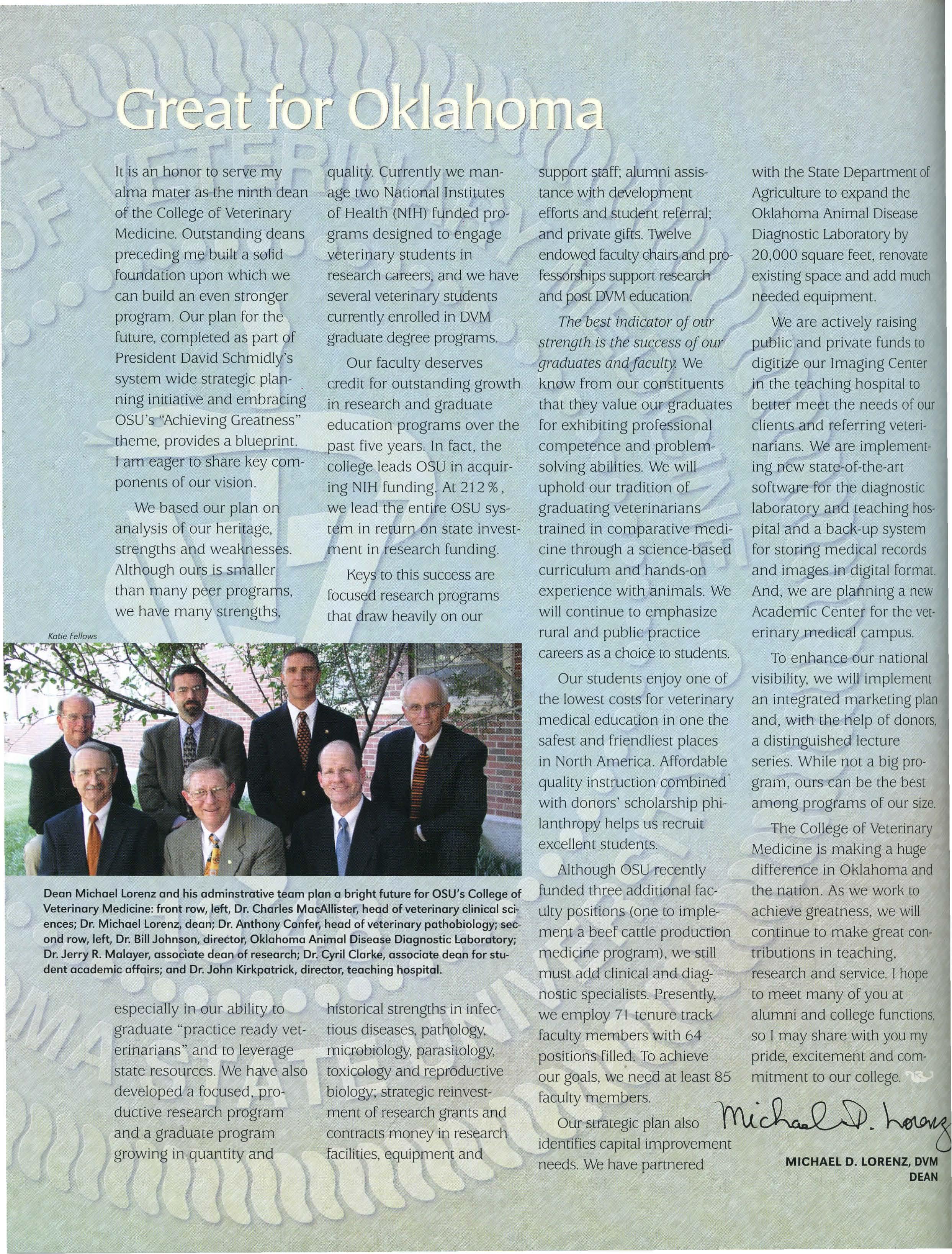
associate dean of research; Dr. Cyril Clarke, associate dean for student academic affairs; and Dr. John Kirkpatrick, director, teaching hospital.
especially in our ability to graduate "practice ready veterinarians" and to leverage state resources. We have also developed a focused, productive research program and a graduate program growing in quantity and
historical strengths in infectious diseases,pathology, microbiology, parasitology, toxicology and reproductive biology; strategic reinvestment of research grants and contracts money in research facilities, equipment and
support staff; alumni assistance with development efforts and student referral; and private gifts. Twelve endowed faculty chairs and pro, fessorsh1pssupport research and pos DVM education.
The best indicatorof our strength is the success of our graduatesandfaculty. We know from our constituents that they value our graduates for exhibiting professional competence and problemsolving abilities. We will uphold our tradition of graduating veterinarians trained in comparative medicine through a science-based curriculum and hands-on experience with animals. We will continue to emphasize rural and public practice careersas a choice to students.
Our students enjoy one of the lowest costs for veterinary medical education in one the safest and friendliest places in North America. Affordable quality instruction combined with donors' scholarship philanthropy helps us recruit excellent students.
Although OSU recently funded three additional Fae-
with the Stare Department of Agriculture to expand the Oklahoma Animal Disease Diagnostic Laboratory by 20,000 square feet, renovate existing space and add much needed equipment.
We are actively raising public and private funds to digitize our Imaging Center in the teaching hospital to better meet the needs of our clients and referring veterinarians. We are implementing new state-of-the-art software for the diagnostic laboratory and teaching hospital and a back-up system for storing medical records and images in digital formac. And, we are planning a new Academic Center for the veterinary medical campus.
To enhance our national visibility, we will implement an integrated marketing plan and, with the help of donors, a distinguished lecture series. While not a big program, ours can be the best among programs of our size.
The College of Veterinary Medicine is making a huge difference in Oklahoma and the nation. As we work to
ulty positions (one to imple- achieve greatness, we will ment a beef cattle production continue to make great conmedicine program), we still tributions in teaching, must add clinical and diag- research and service. I hope nostic specialists. Presently, to meet many of you at we employ 71 tenure track alumni and college functions. faculty members with 64 so l may share with you my positions fille?. To achieve pride, excitement and comour goals, we need at least 85 mitment to our college. faculty members. 0 n \';\
Our strategic plan also l'Y\.t~. identifies capital improvement
needs. We have partnered MICHAEL D. LORENZ, DVM DEAN
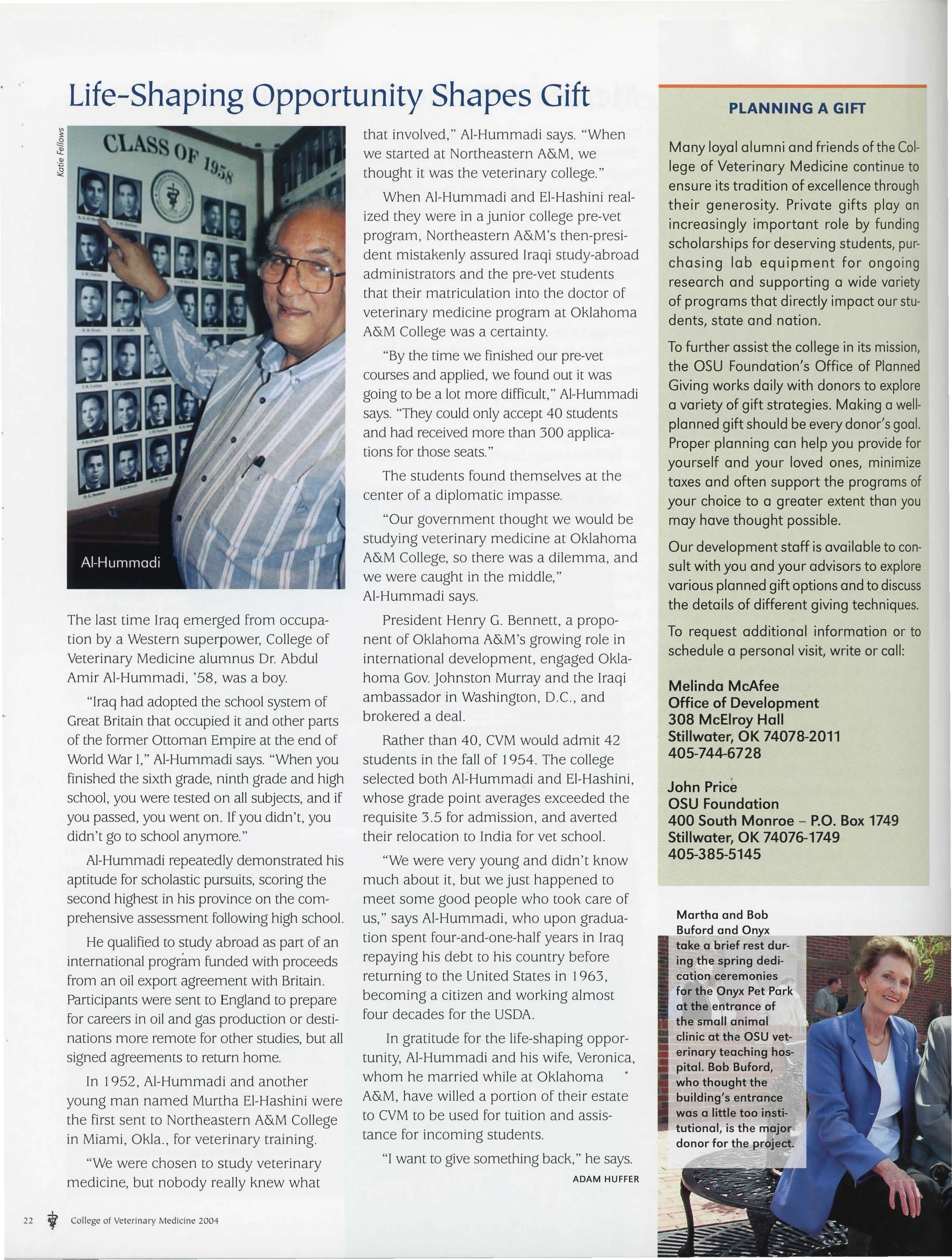
Dean Michael Lorenz and his odminstrotive team plan a bright future for OSU's College of Veterinary Medicine: front row, left, Dr. Charles ty1acAllister,head of veterinary clinical sciences; Dr. Michael Lorenz, dean; Dr. Anthony Canfer, head of veterinary pathobiology; second row, left, Dr. Bill Johnson, director, Oklahoma Animal Disease Diagnostic Laboratory; Dr. Jerry R. Malayer,
THE VET MED MAGAZINE FALL 2004/VOLUME 7
When the first class graduated fram the OSUCollege of Veterinary Medicine in 1951 there was a proud air of excitement.Today,53 years later OSU CVM continues this impressive tradition.
Didyouknow?The 2004 Norden Distinguished Teaching Award was presented to Dr. Jim Lish (physiological sciences); 2004 Pfizer Research Award winner was Dr. Lin Liu (physiological sciences);2004 Sigma Xi Young Investigator Award went to Dr. Michael Davis, (physialogical sciences);the Outstanding Doctoral Student at OSU was Dr. Mahesh Mohan (major professor, Dr.Jerry Malayer); Distinguished Alumni Awards went to Dr. L.D. Barker (class of 1965) and Dr. Tom Poal (class of 1979); and 100 percent af the 68 graduates in the class of 2003 passedthe national board on the first attempt in November.
In the 2003-04 academic year, the CVM had 140 scholarships available with a total funding af $140,000.
Please jain us at the CVM website: www.cvm.akstate.edu. The OSU homepage is located at www.okstate.edu.
OlilahomaSwralJo;-.,.~incompliancewilhTnklVIandVIIofIhellv!lAighraActof1964, E.<ew!Mllln!er11146asamer<loo,T~,IXoltheEt!ocationAm-ol 1972,Amoi"'"WJthlhabiltiesActof1990,andmherfolerallawsandragubnions.doesl101dlsumii namonII>!baSlsofra>,rolor,nanooaloogin,.._ age,ral~rll\<isabrlrty,orsran,sasa veteraninanyofnspolicies,pratlicesorprocedmes.Thisindutlasbu1isnotlimitat:ltoadmissirnrs.'1!lploymem,frnanciala,d,endoou,:ariooalSllMC!lOTitleIXollheE<!u,:auonAmontf. memsandOilahomaSlatelllM!!SI~policyl)'olubitdisa,m;nationinItopr<Msioo of"" ""'of bet1'firaoffaoobytheUnhreJsity-ooger<le!.AAfpersonlsruoontfar:uhy rr aa!Owhobel""5lhmilsarmrnatorypracaa,shave beener,,iageilinbasetlupongemllf maydlSCUSS1helrconcernsandfileinformal DI'formalcomplainlS ofPoSSiblev!Olatioos of Tito~withItoOSUf""3IXCoocdinator.Orf.arolynHernandez.Oiroctor ofAflrm1a1ive Acnon408\\1urnhurst.OloahomaSrateUnM!!Sity,Suit,.m,OK74078.1405)744-5371 or i405i744-5S71i(fa,I.Th•pub6cano~Job#8618rssuedbyO~ahomaStarnUnivem~ as ainhorirad byIheC.llegeofVelflinmyMooicinawasprimedbyTheAutfroVisualCemer. UmwrsrtyPnmingServices at acos,ofS65S3.37.4M/I0/04.
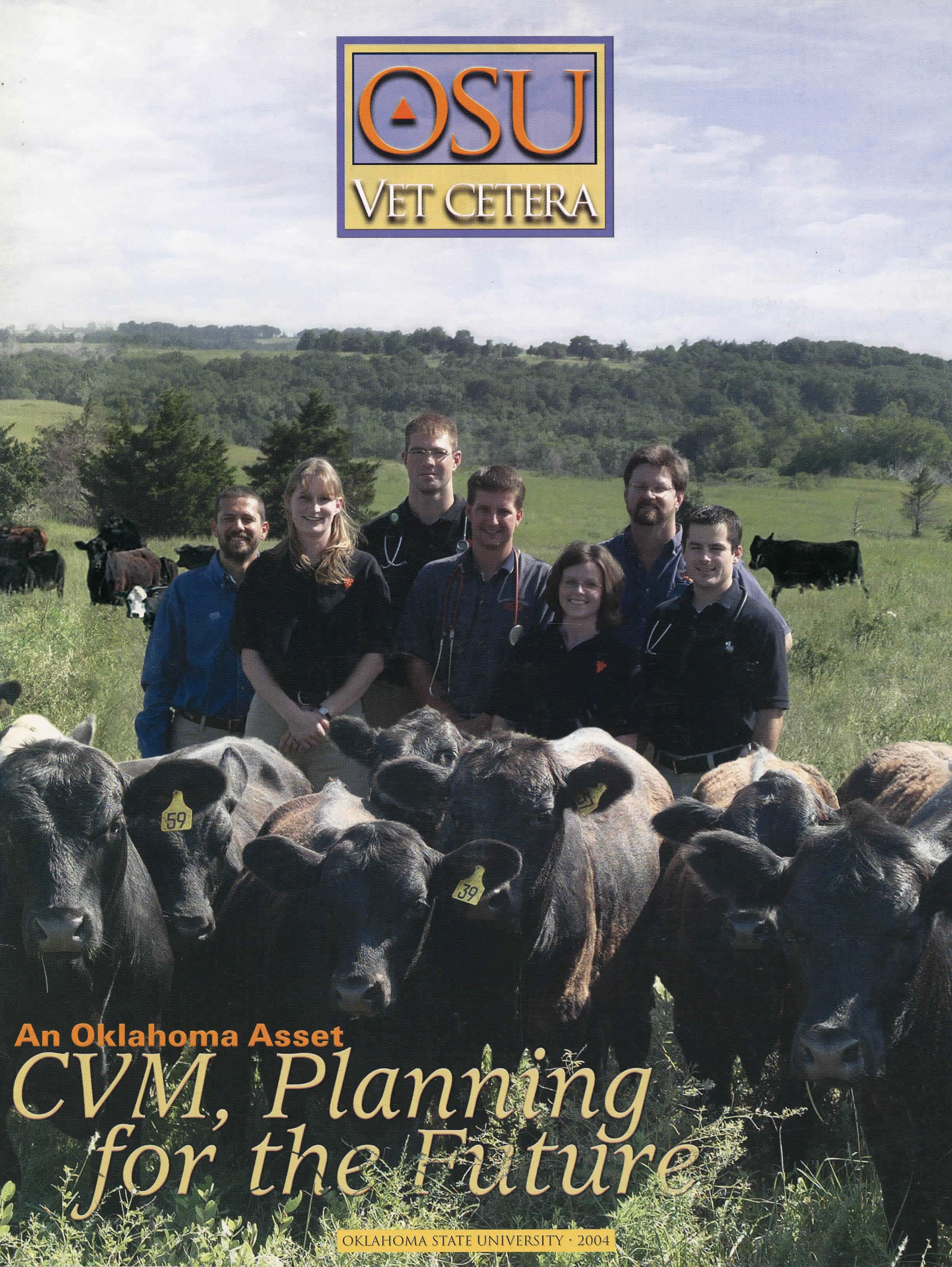
COVER: The College of Veterinary Medicine plays an important role in the economy of Oklahoma by producing practitioners who serve rural communities across the state. Some of those participating in that effort are, from left, Dr. D.L. Step, foculty; Karen Anderson, student; Jake Boyer, student; Dr. Kevin Washburn, foculty; Stana Pope, student; Dr. Robert Streeter, faculty; and Mark Barker, student.
front cover photos by Heath Shelton
C 0 N T E N T S
4 Telling Their Stories
College of Veterinary Medicine ambassadors put visitors at ease.
6 'Cutting Edge' Teaching
Interacting with veterinary students gives fifthgraders experience with hands-on learning.
8 The People's Choice
The community's interest in free pet care seminars continues to grow.
JO'Happy Trails'
Several CVM veterans are changing their pace this year.
J2 Part of the Good Country Life
Rural practitioners become an essential ingredient in their communities.
J 8 A Whole New Dimension
An exciting, new interest in equine medicine brings a vet out of retirement.
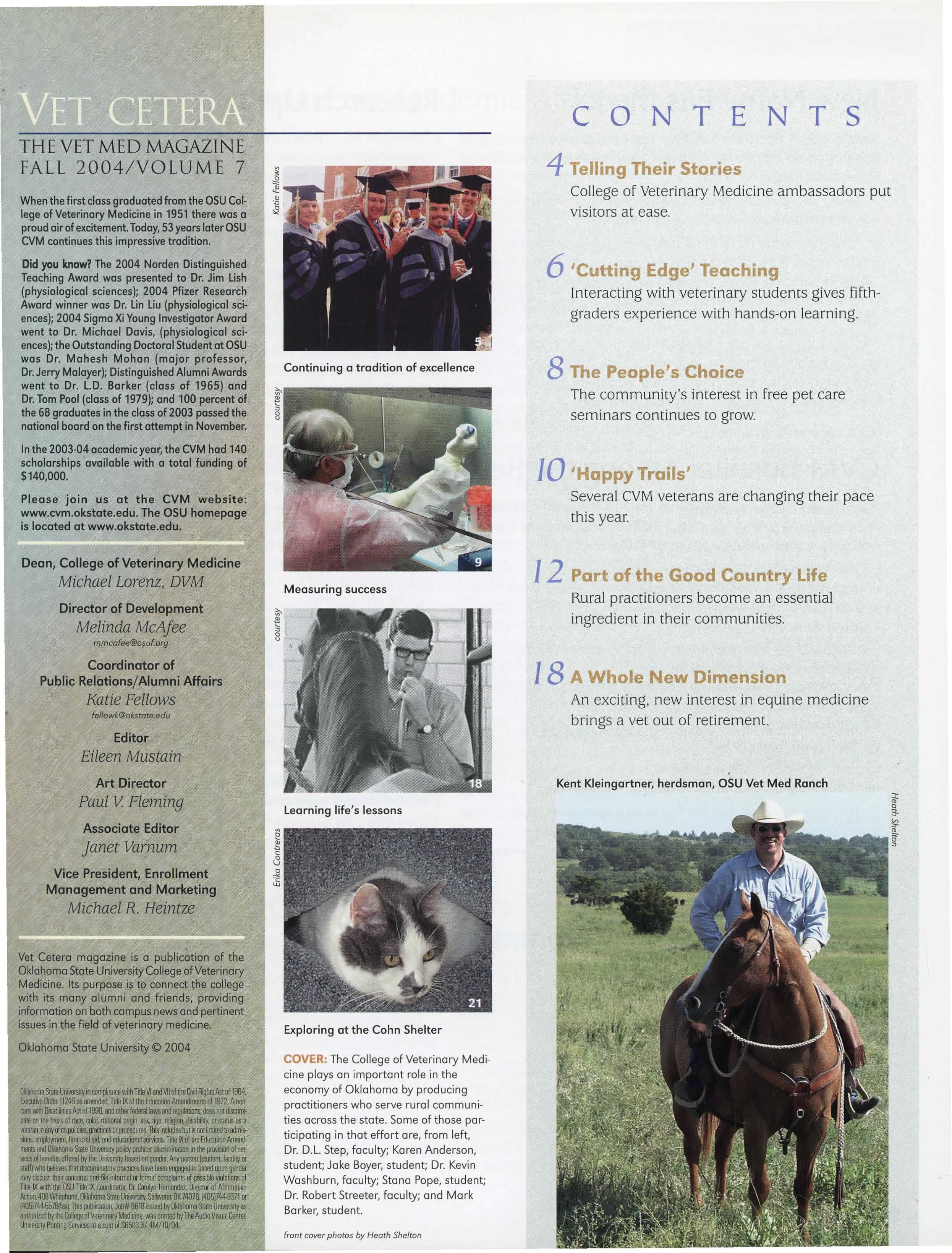
Kent Kleingartner, herdsman, OSU Vet Med Ranch
New Name Fits the Job
The College of Veterinary Medicine has been given a new designation that better reflects the College's unique status on the OSUStillwater campus.
Center for Veterinary Health Sciences was approved by the Oklahoma State University/A&M Board of Regents in September.
"The new name more accurately describes how the veterinary medicine unit budgets and operates," says Dean Michael Lorenz. "More importantly, it calls attention to our growth in research and graduate education as well as the advanced services we provide Oklahomans."
Lorenz says the Center for Veterinary Health Sciences will continue to include its three major components, the Oklahoma Disease Diagnostic Laboratory, the Boren Veterinary Teaching Hospital and the College of Veterinary Medicine.
EILEEN MUSTAIN
CVM HospitalAmong the Best
The College of Veterinary Medicine Teaching Hospital received re-accreditation following a comprehensive evaluation by the American Animal Hospital Association (AAHA) in March.
The AAHA evaluation includes a quality assessment review of the hospital's facility, medical equipment, practice methods and pet health care management, says Dr. John Kirkpatrick, hospital director.
"About I 5 percent of all small animal veterinary facilities in the U.S are accredited hospital members of the association," he says. "To maintain accredited status, the hospital must be evaluated every four years by the association's consultants."
The AAHA is an international organization of more than 16,000 veterinary care providers who treat companion animals. Established in 1933, the association is well known among veterinarians for high standards for hospital and health care.
The CVM Teaching Hospital has been a hospital member of the association since 1983.
KATIE FELLOWS
ResidentsBecome Diplomates
The Department of Veterinary Clinical Sciences is pleased to report that all four internal medicine residents finishing their advanced training programs this year have successfully completed the examinations and credentialing process to become diplomates of the American College of Veterinary Internal Medicine: Dr. Vivenne Duggan, equine medicine; Dr. Melanie Boileau, food animal medicine; Dr. Kathy Elwick, small animal medicine; and Dr. Jill Brunker, small animal medicine.
DR. JOHN KIRKPATRICK
ResearchUpdate
Research in the College of Veterinary Medicine continues to grow as we advance programs in new areas of expertise as well as areas in which we have traditionally had rich and productive scholarship.
In the last fiscal year, our CVM faculty generated new sponsored research grants and contracts exceeding $9.7 million. At the same time, research and development expenditure from sponsored research grants and contracts during the year exceeded $9.2 million.
We will soon be occupying nearly 8,000 square feet of newly remodeled space in MCEiroy Hall developed as a result of funds appropriated by the State of Oklahoma for the OSU Sensor and Sensor Technology initiative.
A newly constructed facility for infectious disease research is also scheduled for completion this fall. Constructed, in part, with a generous gift from the Presbyterian Health Foundation of Oklahoma City, this new facility will significantly advance our abilities to solve problems in animal disease transmission and pathogenesis.
In addition to our other outstanding facilities, such as those of the Equine Research Park and Bovine Research Park, veterinary medicine research programs are now housed in the new Venture I research building located in the Oklahoma Technology and Research Park west of Stillwater.
Graduate student and veterinary student training programs in research contir;ue to grow as well. This fall we began a new program for veterinary students sponsored by the National Institutes of Health, the second NIH training grant for veterinary
students at CVM. The number of students participating in master's and doctoral degree research at CVM now exceeds 60. This is a wonderful development and speaks to the quality of our faculty and their research activities.
Faculty and staff are looking forward to the upcoming OSU research week, which is scheduled for the last week in February.
Other upcoming events include the annual Sitlington Lecture in Toxicology, scheduled for Dec. 3 at 2 p.m. in the MCEiroy Hall auditorium and featuring Dr. Kenneth Olden, director of the National Institute of Environmental Health Sciences. Over the past five years CVM has hosted toxicologistsof international fame for this series.
Next spring, we plan to kickoff another event series we hope will likewise bring imernationally recognized scientists to the OSU campus. With generous support from alumni we are developing plans for even more of these events, which we hope will bring additional ••national visibility and recognition to our staff, students, alumni and faculty.
DR. JERRY R. MALAVER
ROOM TO GRIEVE
The teaching hospital hos added a grieving room where patrons can have privacy in expressing their grief and in exiting the building. "The room, which has been in development for the last two years, provides an extra measure of kindness and compassion for our patrons," says hospital director Dr. John Kirkpatrick.
TOM JOHNSTON
Update on Academic Affairs
New students in the Class of 2008 were welcomed during a White Coat Ceremony, sponsored by college faculty and staff, the American Veterinary Medical Association, Student Chapter and the Oklahoma Veterinary Medical Association. This event recognizes the induction of trainee veterinarians into a profession noted for its ethical code of conduct, application of science-based clinical care and service to community, as symbolized by the white coat.
The 80 matriculating students (six more than last year) include 56 Oklahoma residents and 24 nonresidents from I 2 states. Approximately 75 percent of these students are women, and together with their male colleagues,they represent a wide diversity of race, ethnicity, interests, life experience and educational background.
The college continues to emphasize, in both its admissions process and its curriculum, the importance of servicing the animal health needs of rural communities, including those of food animals.
Although the college currently receives admissions applications of sufficient quality and number to meet the high
A CVM First
expectations of its educational mission, the numbers of applicants have declined in recent years. The college, in collaboration with surrounding states, OSU undergraduate departments and the Alumni Association, is developing plans to increase the size of the applicant pool and welcomes referrals for potential students.
Fully implemented two years ago, the integrated coreelective curriculum provides a breadth of educational experiences across all major disciplines and domestic animal species while allowing students opportunities to select and develop individual areas of interest. In the near future, the college will offer new courses in practice management, communications, career development and biosecurity.
Exposure to animals and clinical situations promotes student learning from the first semester of the program, keeping with college goals to graduate veterinarians who are practice-ready, well trained in comparative medicine and capable of solving complex problems. Senior students continue to perform well on the national licensing examination.
Dr. Michael D. Lorenz recently made history at OSU's College of Veterinary Medicine by becoming its first alumnus to be named dean.
Lorenz. the ninth dean of CVM, received his bachelor's in pre-veterinary medicine from OSU and graduated, at the top of his class, with his DVM from OSU in 1969. Following graduation he completed a two-year internship and residency in small animal medicine at New York State Veterinary College at Cornell University.
Plans to improve assessment of instructional performance and curricular effectiveness are under development.
The college continues to upgrade its technological resources in support of instruction, particularly those relating to computing and classroom audiovisual equipment. A reassessment of available teaching space will likely support the development of plans to remodel and consolidate classroom and student laboratory facilities.
Students received over $140,000 in scholarships at the Honors and Awards Banquet in the spring. Recent sizable gifts from the Alice Levin estate and the Charles W. and Donna R. Jeffries endowment will significantly reduce student educational debt.
Considering the everincreasing costs of higher education and the insufficiency of state appropriations, scholarship support is essential to relieve some of the burden of increased tuition. Therefore, the college is actively pursuing a strategy to increase further the numb.er and amounts of student scholarships.
DR. CYRIL R. CLARKE
academic affairs in 1997, Lorenz was assistant professor and director of interns and residents at New York State Veterinary College; professor and chief of staff at the University of Georgia CVM; and professor, associate dean for academic affairs and dean of the Kansas State University .CVM.
Before he returned to CVM as professor of small animal medicine and associate dean for His primary research interest is in developing animal models for human disease, and along with a colleague, he developed the model that is still being used today for Lou Gehrig's disease. "'\ii.'
DOTTIE WITTER
Students'Put Out the Welcome Mat'
Oklahoma is a long way from home for Scotch Plains, NJ, native Anthony Loomis, a fourth-year student who serves as a CVM Ambassador.
"When I was looking at vet schools the admissions office here was so welcoming," Loomis says. "l decided I wanted to be a part of that and make others feel welcome, too."
Loomis, like the other 30 ambassadors, is a highly involved student looking to give back to the college. He is able to balance his schoolwork with many activities including the Student Chapter of the American Veterinary Medical Association; the Zoo, Exotic and Wildlife Medicine Club; and the Veterinary Business Association, which he co-founded.
His outgoing personality and exceptional work ethic make him the type of student the ambassador program needs, says Dr. Katrina Meinkoth, coordinator for Veterinary Recruitment, who modeled the program from services other colleges offer.
She designed the ambassador program, which began in 1997, to provide prospective students with a fresh look into what the college has to offer but admits surprise at its level of success.
"I had no idea how much they were going to benefit the recruitment program," Meinkoth says. "Each ambassador has his or her own story about how they got here, and that's what students and parents want to hear."
For instance, Loomis is a great example of the diversity of the students in the college. He grew up in an urban environment with no agricultural background and wasn't sure what to expect when he came to Stillwater.
He says the welcoming atmosphere attracted him to OSU. Now he tells prospective students that it is difficult to rank the top vet schools, so it is best to find the place they feel most comfortable.
Making the students feel comfortable is the job of the ambassadors. When applying to veterinary school, many students are apprehensive about discussing their concerns and questions with the interview committees, says Megan Kilduff, a CVM Ambassador.
However, when she came to OSU, Kilduff was able to speak with an ambassador in an informal setting. She says he was very friendly and informative about the college and made her feel at ease asking questions.
The ambassadors' responsibilities include giving tours to people who are serious about a career in veterinary medicine and attending public relations and alumni events. Many of these events take place in the evenings and weekends.
Meinkoth says these students are willing to give up valuable study and social time to give back to the college. Since these studel'\ts attend class from 8 a.m. to 5 p.m., the evening is their only time to study and relax.
"I really enjoy it," Loomis says. "It's one of my ways of giving back to the school."
COURTNEY HENTGES
Scott Wins National Scholarship
Mary Scott, a fourth-year student in the College of Veterinary Medicine, is one of 31 students across the nation chosen to receive Western Veterinary Conference Student Scholarships.
In addition to the $2,500 scholarship, Scott received a stipend to attend the 76th Annual Western Veterinary Conference in Las Vegas, Nev., during February 2004.
Dr. Jack Walther, Western Veterinary Conference scholarship chairman, says the scholarship committee hopes the scholarship and stipend will help students who are dealing with the high cost of veterinary education become involved with others in the veterinary profession.
"Student debt is staggering.And at the same time, students need to be introducedto organized veterinary medicine," Walther says.
"We had 31 of the brightest and best emerging leaders of the profession in Las Vegaswhere they met the world leadersin veterinary medicine," he says."Hopefully they left there saying, 'I really want to get involved in making veterinary medicine better."'
Dr. Michael Lorenz, dean of the CVM, says the conference provides an excellent opportunity for students from every school to become acquainted with leaders in the profession:. "I hope it will also show students how important it is to be involved and take a leadership role."
Scott, who received a bachelor's degree in animal science from OSU, is currently pursuing a career in internal medicine and small animal critical care medicine.
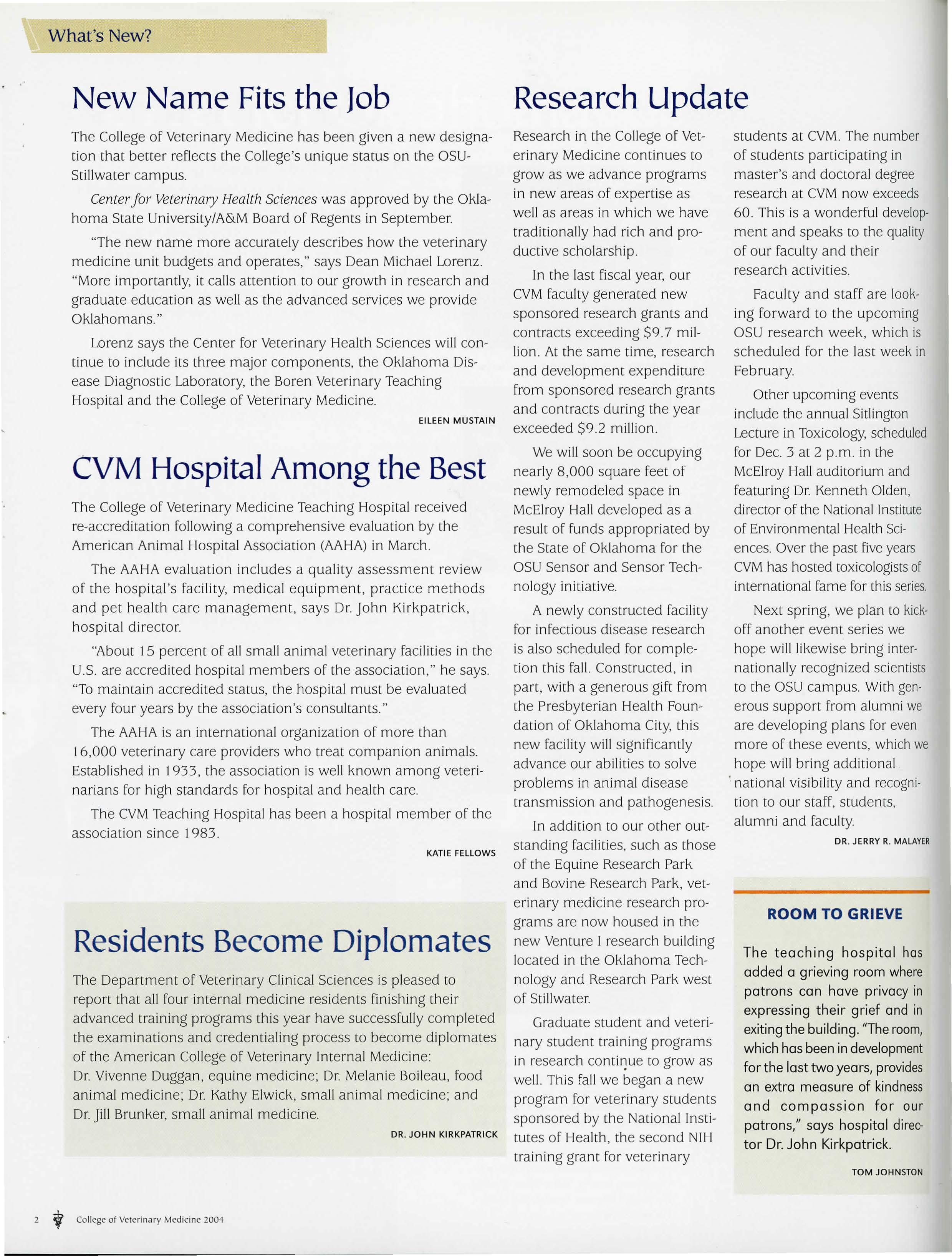
CVM Ambassadors Heather Akridge, left, and Alyson Fryer answer questions from high school students at OSU Experience, on event sponsored by the Office of Undergraduate Admissions.
KATIE FELLOWS
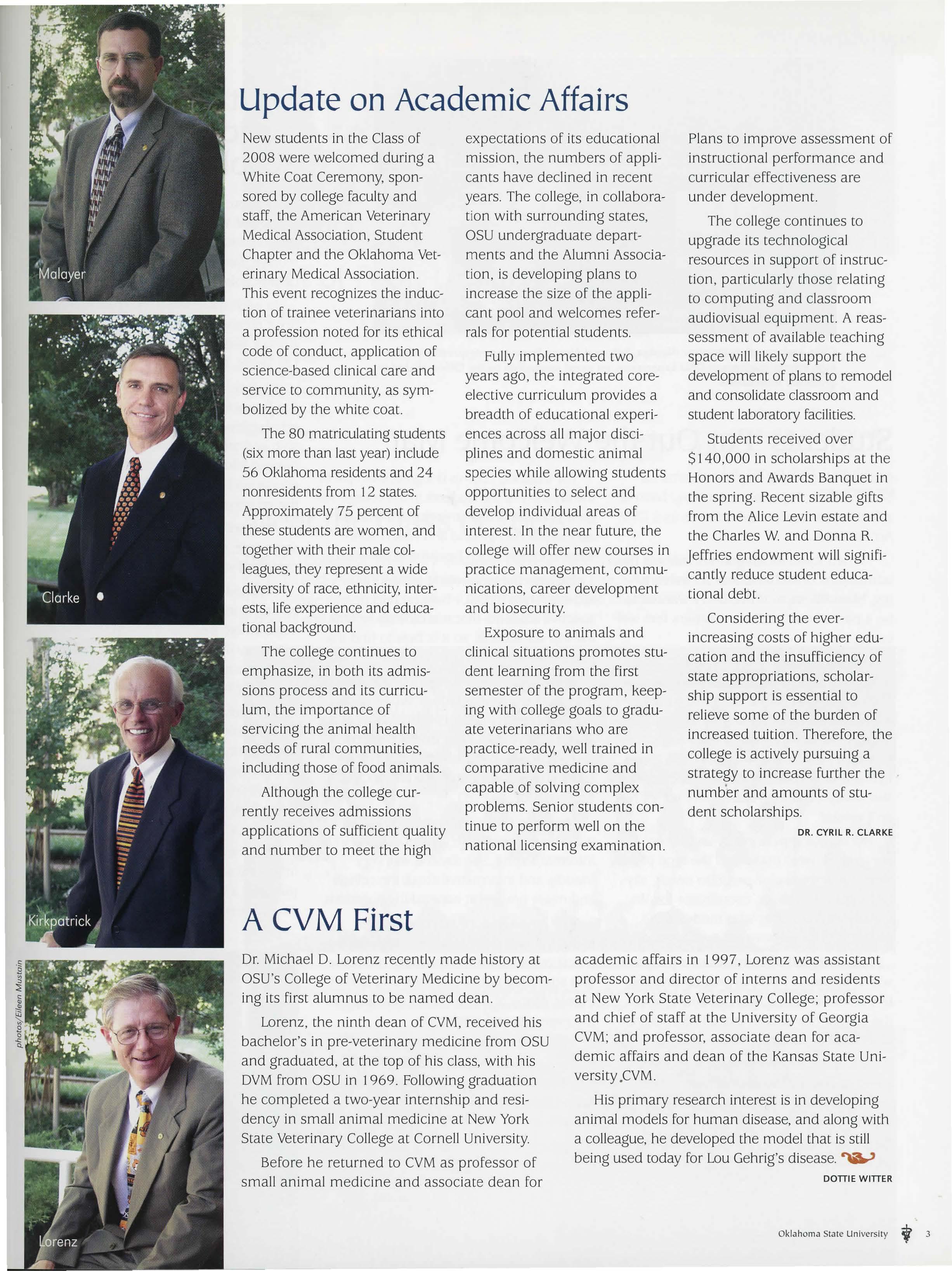
Memorial Morothon runners include, back row, Ryan Royse, Sarah Schwerdt, Todd Hayden, Aoron Stochmus, Aaron Hoffmeister, Jean d'Offay, Jim Meinkoth, Will Selby, Jeff Richards, Russell Simmons ond Alicia Gorczyca; middle row, TrocyTurner, Corol Hoak, Corey Hill, Lindsey Tate, Sara Bradley, Mendy Gage, Kathryn Graves, Tiffany Cox, Becky Funk, Melissa Kimble and Kimberly Anderson; and front row, Eleanor Edwards, Andrea Tate, Sarah Currie, Becky Brahm, Kerry Weisz, Mari Juergenson, Katy Bradford, Krista Vega and Shalyn Weaver.
Dr. EvoWelch, shown carrying the gonfolon at the May 2004 graduation, received the 2004 McElroy Award, the most prestigious student aword the College of Veterinary Medicine presents.
Dean Michoel D. Lorenz, who receivedthe McElroy Award for the doss of 1969, says this honor is revered because classmates and faculty choose the recipient.
Fleet of Foot, Long on Memory
More than 30 College of Veterinary Medicine students and three faculty members wore the OSU orange and black in the 2004 Memorial Marathon in Oklahoma City. Emblazoned with a winged foot and the phrase "Oklahoma State Cowboy
Medicine Marathon Team," their shirts made them hard to miss, according to Dr. Jean d'Offay, one of the faculty runners.
Dr. Cyril Clarke, another faculty runner, says students Todd Hayden and Kyle Loudenslager are the organizing force behind
Meet the Class of 2008
the CVM runners. Loudenslager and Rosslyn Spencer Biggs, another veterinary student, lost loved ones in the bombing. "Our student teams run in honor of relatives of students here who died in the bombing," Clarke says, "and it's a great honor to run in their memory."
TOM JOHNSTON
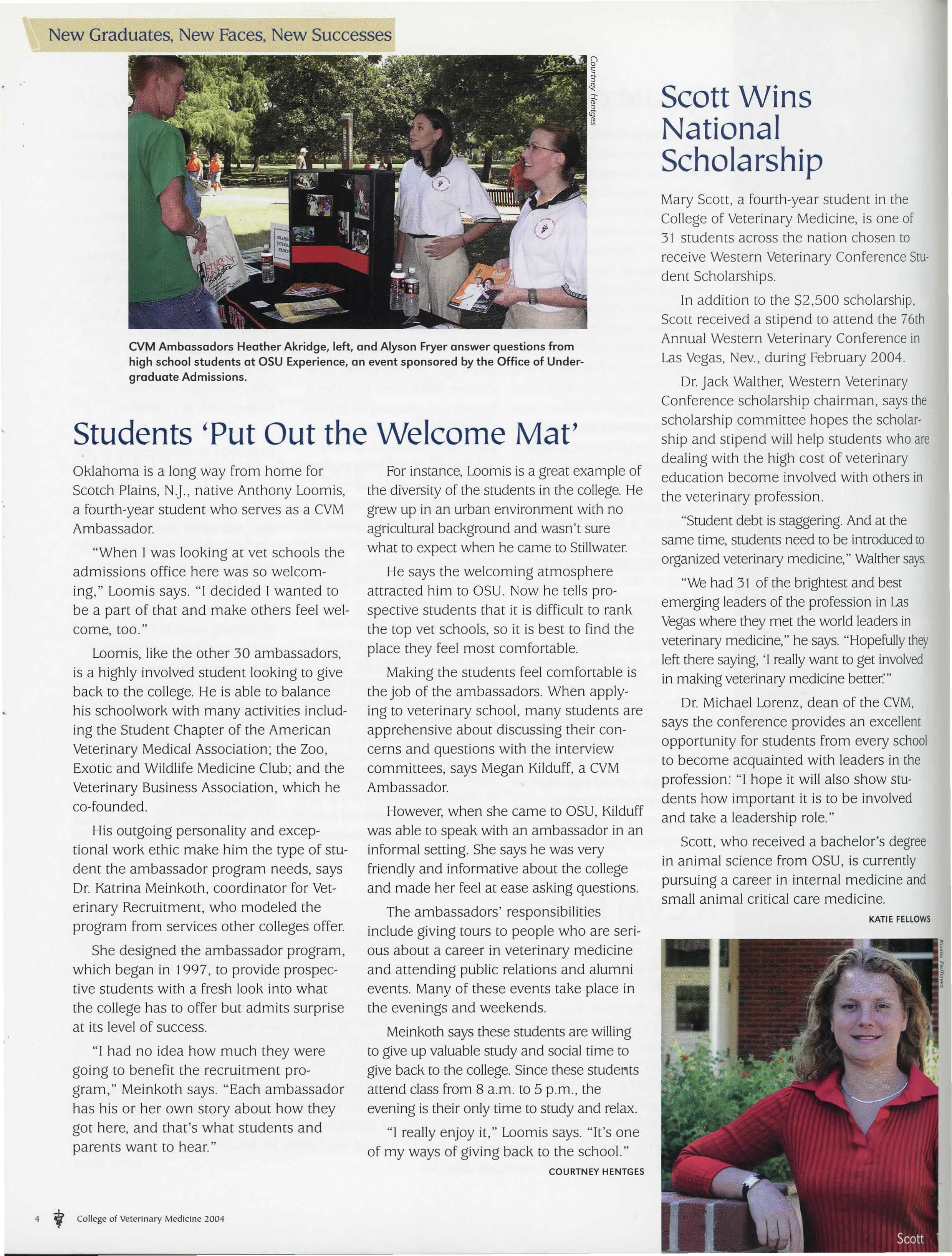
The OSU College of Veterinary Medicine Class of 2008 has 80 students, including 56 resident students and 24 out-of-state students (which includes four New Jersey contract students). The average age of this class is 24, and the average Core Course GPA is 3.425. There are 22 male students and 58 female students.
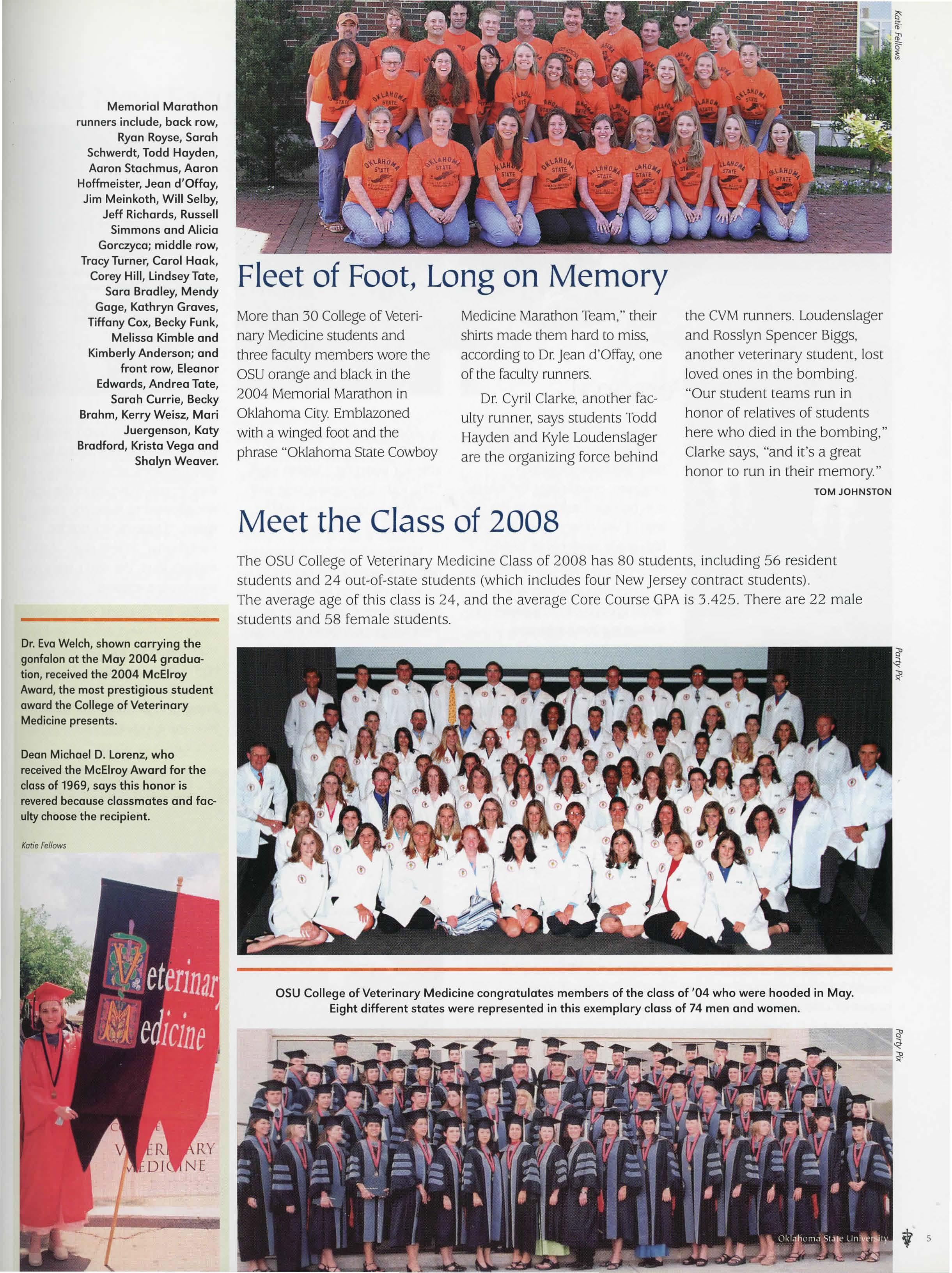
OSU College of Veterinary Medicine congratulates members of the class of '04 who were hooded in May. Eight different states were represented in this exemplary class of 74 men and women.
Up Close and Personal
Seeing a real lung is always a surprise for Patty Welsh's fifthgrade students.
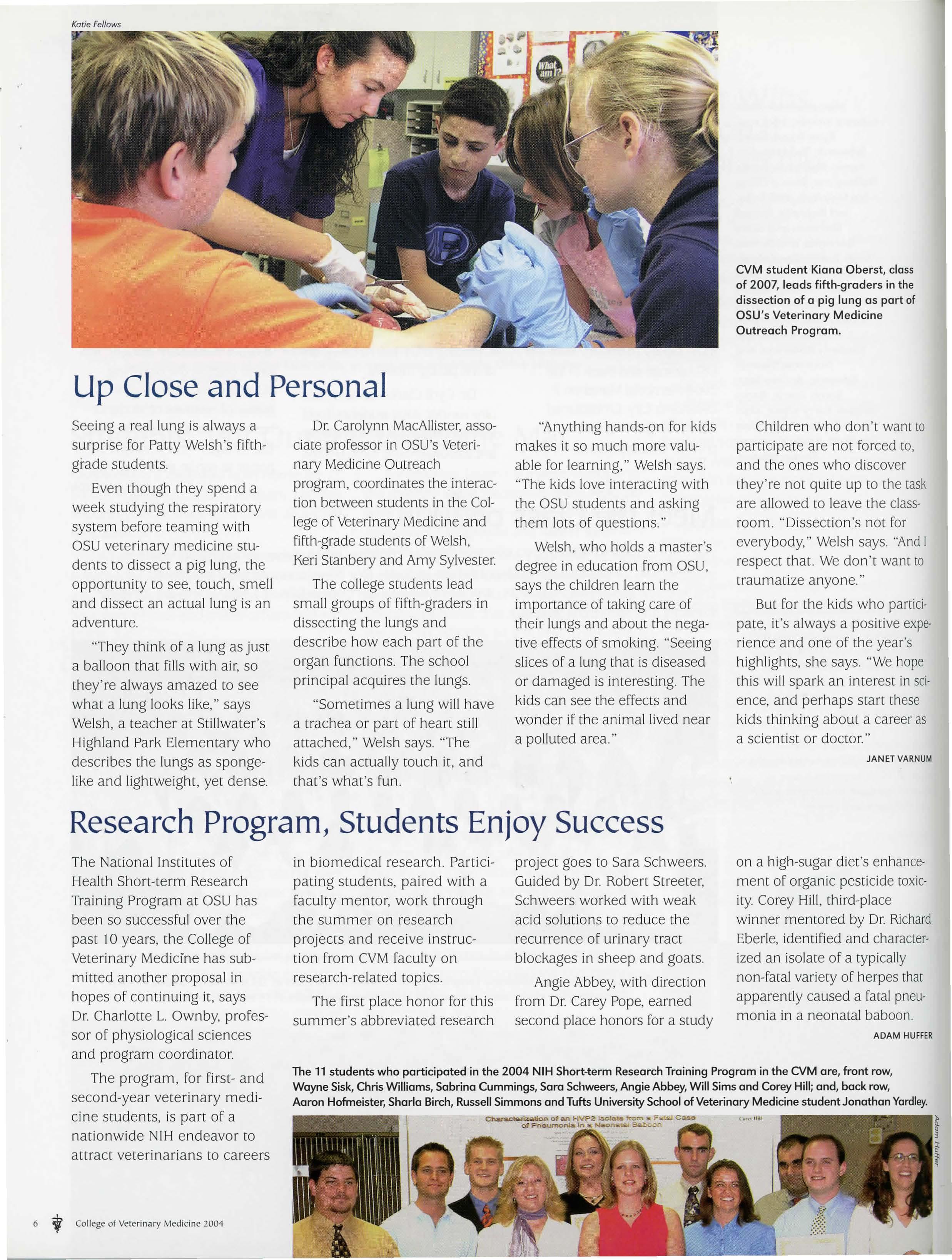
Even though they spend a week studying the respiratory system before teaming with OSU veterinary medicine students to dissect a pig lung, the opportunity to see, touch, smell and dissect an actual lung is an adventure.
"They think of a lung as just a balloon that fills with air, so they're always amazed to see what a lung looks like," says Welsh, a teacher at Stillwater's Highland Park Elementary who describes the lungs as spongelike and lightweight, yet dense.
Dr. Carolynn MacAllister, associate professor in OSU's Veterinary Medicine Outreach program, coordinates the interaction between students in the College of Veterinary Medicine and fifth-grade students of Welsh, Keri Stanbery and Amy Sylvester. The college students lead small groups of fifth-graders in dissecting the lungs and describe how each part of the organ functions. The school principal acquires the lungs.
"Sometimes a lung will have a trachea or part of heart still attached," Welsh says. "The kids can actually touch it, and that's what's fun.
"Anything hands-on for kids makes it so much more valuable for learning," Welsh says. "The kids love interacting with the OSU students and asking them lots of questions "
Welsh, who holds a master's degree in education from OSU, says the children learn the importance of taking care of their lungs and about the negative effects of smoking. "Seeing slices of a lung that is diseased or damaged is interesting. The kids can see the effects and wonder if the animal lived near a polluted area."
ResearchProgram, StudentsEnjoy Success
The National Institutes of Health Short-term R.esearch Training Program at OSU has been so successful over the past IO years, the College of Veterinary Medicine has submitted another proposal in hopes of continuing it, says Dr. Charlotte L. Ownby, professor of physiological sciences and program coordinator.
The program, for first- and second-year veterinary medicine students, is part of a nationwide NIH endeavor to attract veterinarians to careers
in biomedical research. Participating students, paired with a faculty mentor, work through the summer on research projects and receive instruction from CVM faculty on research-related topics.
The first place honor for this summer's abbreviated research
project goes to Sara Schweers.
Guided by Dr. R.obert Streeter, Schweers worked with weak acid solutions to reduce the recurrence of urinary tract blockages in sheep and goats.
Angie Abbey, with direction from Dr. Carey Pope, earned second place honors for a study
Children who don't want to participate are not forced to, and the ones who discover they're not quite up to the task are allowed to leave the classroom. "Dissection's not for everybody," Welsh says. "And I respect that. We don't want tO traumatize anyone."
But for the kids who participate, it's always a positive experience and one of the year's highlights, she says. "We hope this will spark an interest in science, and perhaps start these kids thinking about a career as a scientist or doctor."
on a high-sugar diet's enhancement of organic pesticide toxicity. Corey Hill, third-place winner mentored by Dr. R.ichard Eberle, identified and characterized an isolate of a typically non-fatal variety of herpes that apparently caused a fatal pneumonia in a neonatal baboon.
ADAM HUFFER
CVM student Kiana Oberst, class of 2007, leads fifth-graders in the dissection of a pig lung as part of OSU's Veterinary Medicine Outreach Program.
JANET VARNUM
The 11 students who participated in the 2004 NIH Short-term Research Training Program in the CVM are, front row, Wayne Sisk, Chris Williams, Sabrina Cummings, Sara Schweers, Angie Abbey, Will Sims and Corey Hill; and, back row, Aaron Hofmeister, Sharla Birch, RussellSimmons and Tufts University School of Veterinary Medicine student Jonathan Yardley.
Meet New Faculty Members
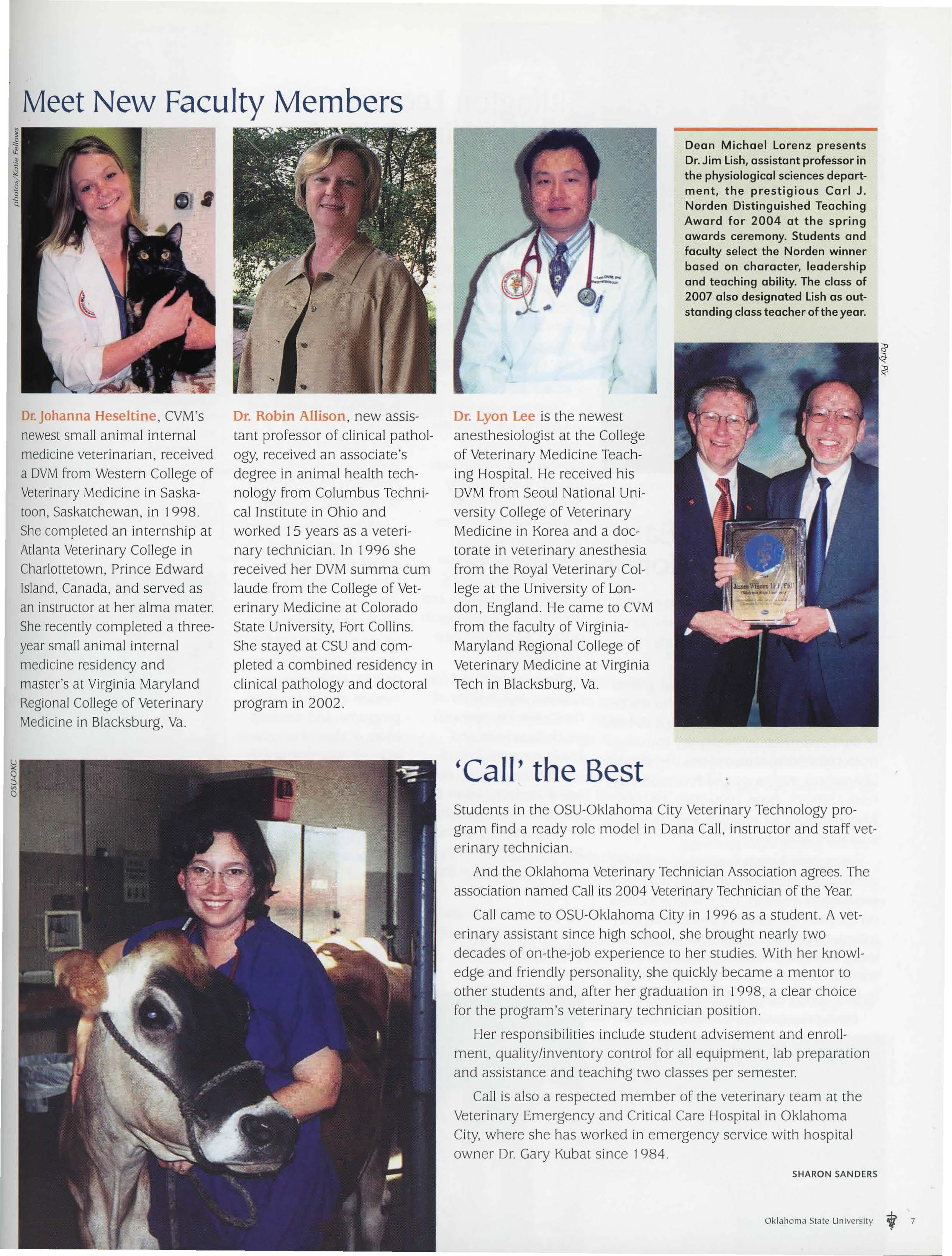
Dean Michael Lorenz presents Dr. Jim Lish, assistant professor in the physiological sciences department, the prestigious Carl J. Norden Distinguished Teaching Award for 2004 at the spring awards ceremony. Students and faculty select the Norden winner based on character, leadership and teaching ability. The class of 2007 also designated Lish as outstanding class teacher of the year.
Dr.Johanna Heseltine, CVM's newestsmall animal internal medicine veterinarian, received a DVM from Western College of VeterinaryMedicine in Saskatoon, Saskatchewan, in I 998. Shecompleted an internship at Atlanta Veterinary College in Charlottetown, Prince Edward Island, Canada, and served as an instructor at her alma mater. She recently completed a threeyear small animal internal medicine residency and master's at Virginia Maryland RegionalCollege of Veterinary Medicine in Blacksburg, Va.
Dr. Robin Allison, new assistant professor of clinical pathology, received an associate's degree in animal health technology from Columbus Technical Institute in Ohio and worked I 5 years as a veterinary technician. In I 996 she received her DVM summa cum laude from the College of Veterinary Medicine at Colorado State University, Fort Collins. She stayed at CSU and completed a combined residency in clinical pathology and doctoral program in 2002.
Dr. Lyon Lee is the newest anesthesiologist at the College of Veterinary Medicine Teaching Hospital. He received his DVM from Seoul National University College of Veterinary Medicine in Korea and a doctorate in veterinary anesthesia from the Royal Veterinary College at the University of London, England. He came to CVM from the faculty of VirginiaMaryland Regional College of Veterinary Medicine at Virginia Tech in Blacksburg, Va.
'Call' the Best
Students in the OSU-Oklahoma City Veterinary Technology program find a ready role model in Dana Call, instructor and staff veterinary technician.
And the Oklahoma Veterinary Technician Association agrees.The association named Call its 2004 Veterinary Technician of the Year.
Call came to OSU-Oklahoma City in I 996 as a student. A veterinary assistant since high school, she brought nearly two decades of on-the-job experience to her studies. With her knowledge and friendly personality, she quickly became a mentor to other students and, after her graduation in 1998, a clear choice for the program's veterinary technician position.
Her responsibilities include student advisement and enrollment, quality/inventory control for all equipment, lab preparation and assistance and teaching two classes per semester.
Call is also a respected member of the veterinary team at the Veterinary Emergency and Critical Care Hospital in Oklahoma City, where she has worked in emergency service with hospital owner Dr. Gary Kubat since I 984.
Confer's AchievementsEarn Highest OSU Honor
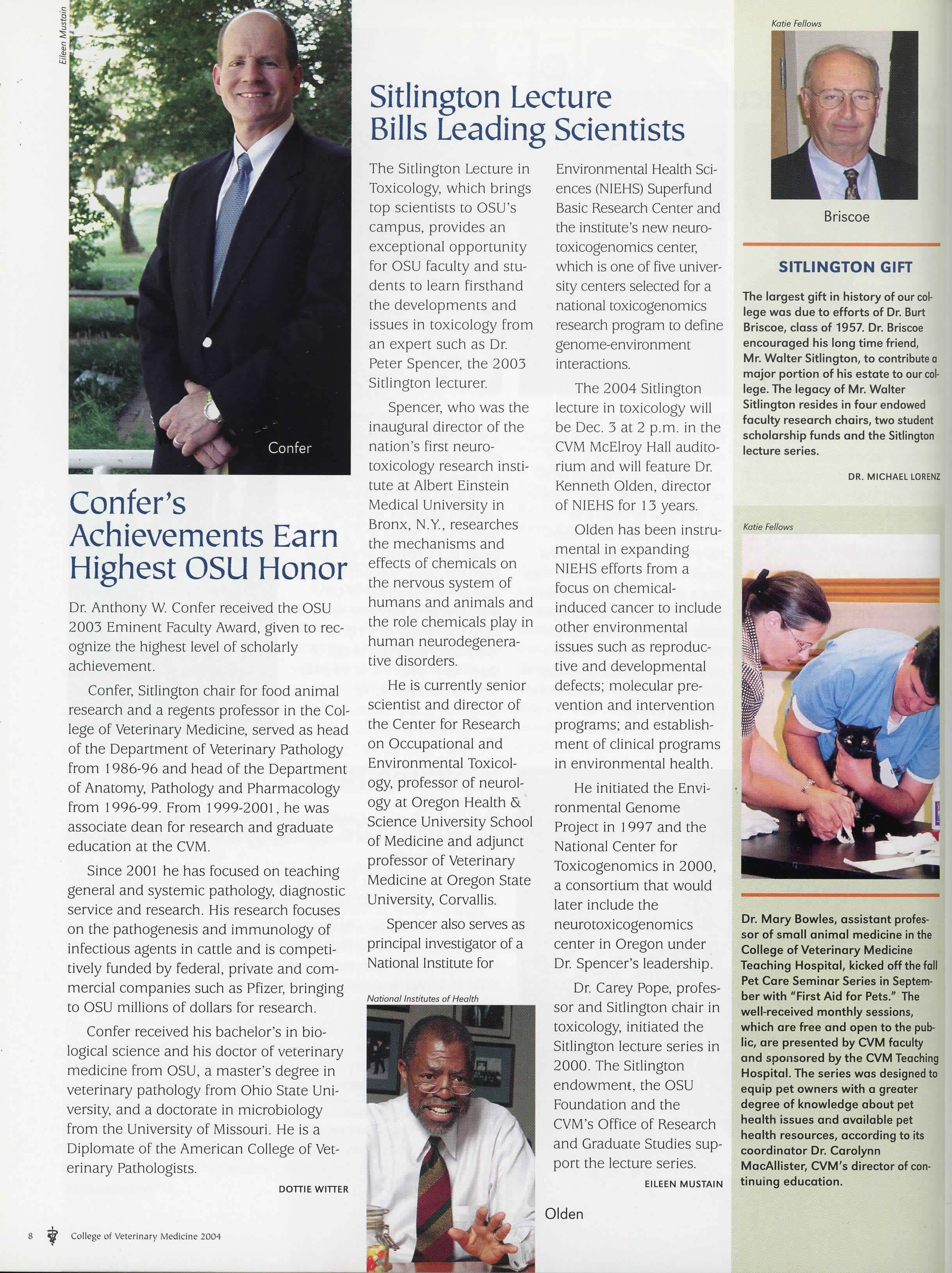
Dr Anthony W. Confer received the OSU 2003 Eminent Faculty Award, given to recognize the highest level of scholarly achievement.
Confer, Sitlington chair for food animal research and a regents professor in the College of Veterinary Medicine, served as head of the Department of Veterinary Pathology from 1986-96 and head of the Department of Anatomy, Pathology and Pharmacology from 1996-99. From 1999-2001, he was associate dean for research and graduate education at the CVM.
Since 2001 he has focused on teaching general and systemic pathology, diagnostic service and research. His research focuses on the pathogenesis and immunology of infectious agents in cattle and is competitively funded by federal, private and commercial companies such as Pfizer, bringing to OSU millions of dollars for research.
Confer received his bachelor's in biological science and his doctor of veterinary medicine from OSU, a master's degree in veterinary pathology from Ohio State University, and a doctorate in microbiology from the University of Missouri. He is a Diplomate of the American College of Veterinary Pathologists.
DOTTIE WITTER
SitlingtonLecture Bills LeadingScientists
The Sitlington Lecture in Toxicology, which brings top scientists to OSU's campus, provides an exceptional opportunity for OSU faculty and students to learn firsthand the developments and issues in toxicology from an expert such as Or.
Peter Spencer, the 2003 Sitlington lecturer.
Spencer, who was the inaugural director of the nation's first neurotoxicology research institute at Albert Einstein Medical University in Bronx, N.Y., researches the mechanisms and effects of chemicals on the nervous system of humans and animals and the role chemicals play in human neurodegenerative disorders.
He is currently senior scientist and director of the Center for Research on Occupational and Environmental Toxicology, professor of neurology at Oregon Health & Science University School of Medicine and adjunct professor of Veterinary Medicine at Oregon State University, Corvallis.
Spencer also serves as principal investigator of a National Institute for
National Institutes of Health
Environmental Health Sciences (NIEHS)Superfund Basic ResearchCenter and the institute's new neurotoxicogenomics center, which is one of five university centers selected for a national toxicogenomics research program to define genome-environment interactions.
The 2004 Sitlington lecture in toxicology will be Dec. 3 at 2 p.m. in the CVM McElroy Hall auditorium and will feature Dr. Kenneth Olden, director of NIEHS for 13 years.
Olden has been instrumental in expanding NIEHS efforts from a focus on chemicalinduced cancer to include other environmental issues such as reproductive and developmental defects; molecular prevention and intervention programs; and establishment of clinical programs in environmental health.
He initiated the Environmental Genome Project in 1997 and the National Center for Toxicogenomics in 2000, a consortium that would later include the neurotoxicogenomics center in Oregon under Dr. Spencer's leadership.
Dr. Carey Pope, professor and Sitlington chair in toxicology, initiated the Sitlington lecture series in 2000. The Sitlington endowment, the OSU Foundation and the CVM's Office of Research and Graduate Studies support the lecture series.
EILEEN MUSTAIN
SITLINGTON
The largest gift in history of our college was due to efforts of Dr. Burt Briscoe, class of 1957. Dr. Briscoe encouraged his long time friend, Mr. Walter Sitlington, to contribute a major portion of his estate to our college. The legacy of Mr. Walter Sitlington resides in four endowed faculty research chairs, two student scholarship funds and the Sitlington lecture series.
Dr. Mary Bowles, assistant professor of small animal medicine in the College of Veterinary Medicine Teaching Hospital, kicked off the foll Pet Care Seminar Series in September with "First Aid for Pets." The well-received monthly sessions, which are free and open to the public, are presented by CVM faculty and sponsored by the CVM Teaching Hospital. The series was designed to equip pet owners with a greater degree of knowledge about pet health issues and available pet health resources, according to its coordinator Dr. Carolynn MacAllister, CVM's director of continuing education.
Olden
Katie Fellows
Briscoe
GIFT
DR. MICHAEL LORENZ
Katie Fellows
TheImportance ofFollow-Through
AnneCouger's commitment to OSUand her exemplary job performanceat the College of VeterinaryMedicine E. Brock MemorialLibrary are just a coupleof the reasons she garnered the OSU 2004 Library Employeeof the Year Award.
Shealso brings to her work as library technical assistant an uncommon dedication to service, a patient stick-to-itiveness especiallyhelpful to CVM library patrons.
"Her understanding of the public service component of an academiclibrary has set a wonderful example to students, staff and facultyalike," according to HeatherMoberly, veterinary medicinelibrarian and Couger's supervisorof three years.
"Sheapproaches each interactionwith a patron with experiencedconfidence and a positive gentlemanner and follows chroughon each request until the patronhas the informati9n," saysMoberly, who along with CVMDean Michael Lorenz, nominated Couger for the annual $500 Edmon Low Library award.
"It doesn't matter to me if it's a student or staff member or a Stillwater resident who has a courtesy card. I just try to get chem the materials they need," Cougersays.
As the only veterinary medicine library in Oklahoma, the CVM Library also receives calls from veterinary practitioners around the state.
In addition to fielding patrons' questions, Couger processes new books, manages circulation and supervises six student assistants, who also nominated her for the outstanding employee award.
"It feels good to be appreciated by both the people I supervise and my boss," she says.
Couger graduated from OSU in 1967 with a bachelor's degree in family relations and child development and elementary education. She taught school at Davidson. Okla., near Lawton. for t 7 years before she began working at the CVM library in 1989.
"I like all ages I've worked with, but I like the independence of college students," she says. In fact, she says she enjoys her interaction with everyone she encounters at the library.
"The people here are just real likeable people who are very nice to work with," she says.
"They are good people, reasonable, rarely unreasonable and very cooperative. Everybody wants to do what needs to be done to get the job done."
Sounds like Couger fits right in.
Opening Doors
The journey bringing a group of Russian scientists to the College of Veterinary Medicine this spring actually began in 2000 when Dr. Rebecca Morton traveled to Russia.
Morton, associate professor in the veterinary pathobiology department, was part of a group of American researchers funded by General Atomic Inc. to review and help develop Russian biosensor technologies. One of the labs she visited during this intensive 10-day trip was Obolensk, a small science town 80 kilometers south of Moscow near the town of Prativina.
A year later the National Academy of Sciences selected the experienced Morton when it sought scientists to travel to the State Research Center for Applied Microbiology at Obolensk to develop collaborative projects. The academy has subsequently placed Morton on two committees dealing with Russian projects.
"Sometimes going through one door opens another," she
says. "I've gotten to know many Russian scientists."
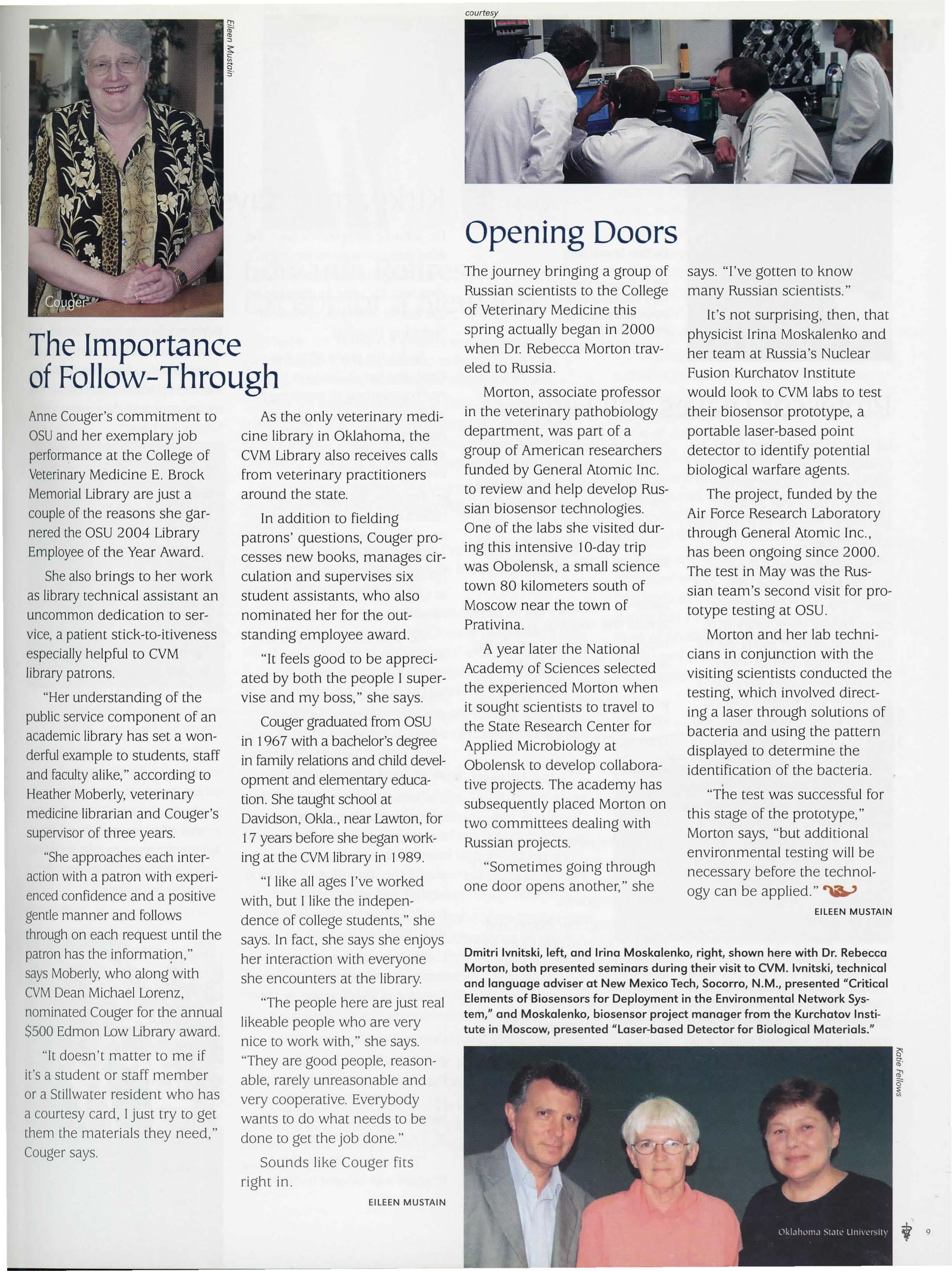
It's not surprising, then, that physicist Irina Moskalenko and her team at Russia's Nuclear Fusion Kurchatov Institute would look to CVM labs to test their biosensor prototype, a portable laser-based point detector to identify potential biological warfare agents.
The project, funded by the Air Force Research Laboratory through General Atomic Inc has been ongoing since 2000. The test in May was the Russian team's second visit for prototype testing at OSU.
Morton and her lab technicians in conjunction with the visiting scientists conducted the testing, which involved directing a laser through solutions of bacteria and using the pattern displayed to determine the identification of the bacteria.
"The test was successful for this stage of the prototype." Morton says, "but additional environmental testing will be necessary before the technology can be applied."~
EILEEN MUSTAIN
Dmitri lvnitski, left, and Irina Moskalenko, right, shown here wi~h ~r. Rebe~ca Morton, both presented seminars during their visit to CVM. lvrntsk1, t~,ch~1.cal and language adviser at New Mexico Tech, Socorro, N.M., presented Critical Elements of Biosensors for Deployment in the Environmental Network Syst m" and Moskalenko biosensor project manager from the Kurchatov lnst1t~te' in Moscow, prese~ted "Laser-based Detector for Biological Materials."
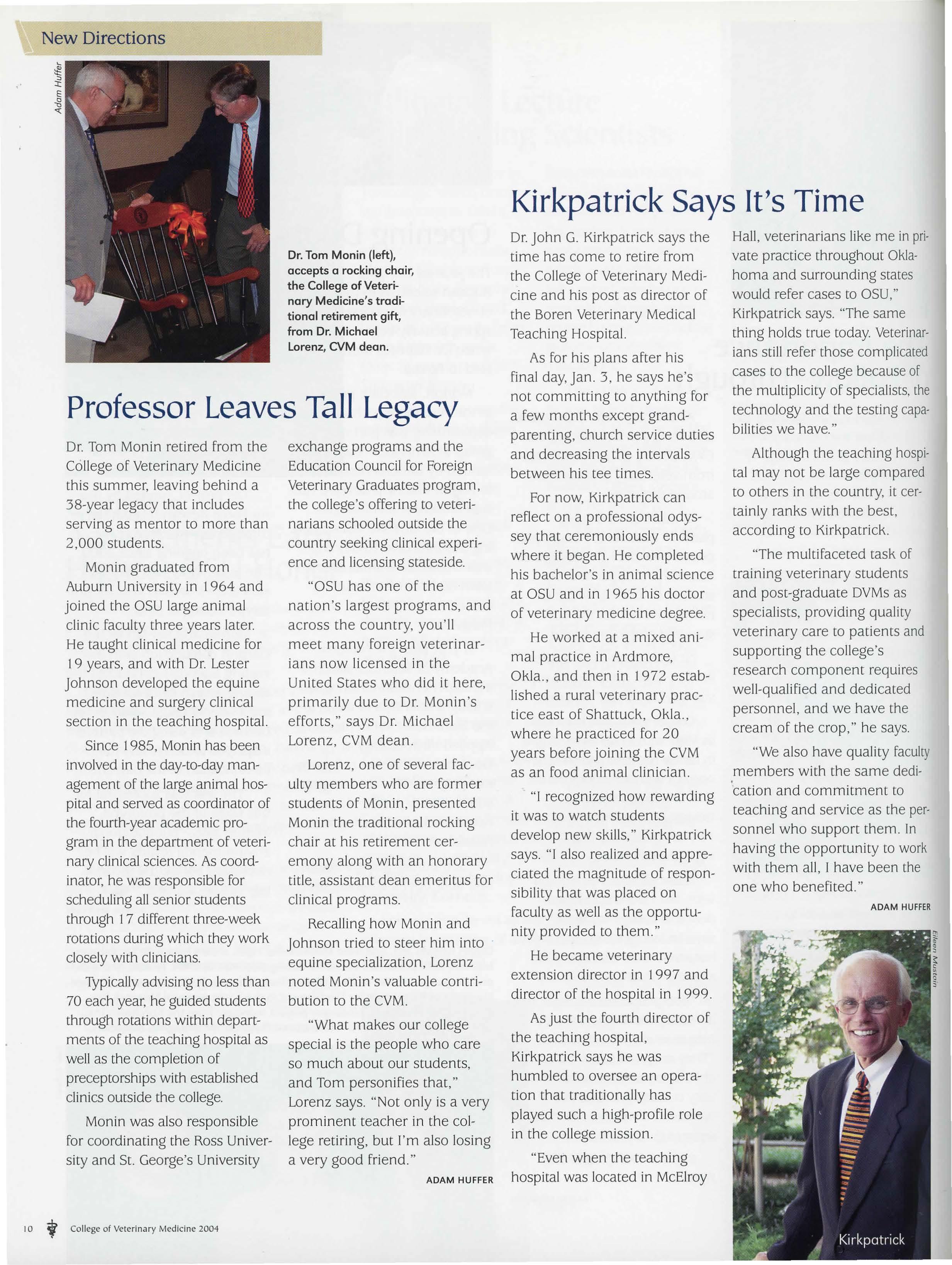
Dr. Tom Monin (left), accepts a rocking chair, the College of Veterinary Medicine's traditional retirement gift, from Dr. Michael Lorenz, CVM dean.
ProfessorLeavesTall Legacy
Dr. Tom Manin retired from the College of Veterinary Medicine this summer, leaving behind a 38-year legacy that includes serving as mentor to more than 2,000 students.
Manin graduated from Auburn University in 1964 and joined the OSU large animal clinic faculty three years later. He taught clinical medicine for I 9 years, and with Dr. Lester Johnson developed the equine medicine and surgery clinical section in the teaching hospital.
Since I 985, Manin has been involved in the day-to-day management of the large animal hospital and served as coordinator of the fourth-year academic program in the department of veterinary clinical sciences.As coordinator, he was responsible for scheduling all senior students through 17 different three-week rotations during which they work closely with clinicians.
Typically advising no less than 70 each year, he guided students through rotations within departments of the teaching hospital as well as the completion of preceptorships with established clinics outside the college.
Manin was also responsible for coordinating the Ross University and St. George's University
exchange programs and the Education Council for Foreign Veterinary Graduates program, the college's offering to veterinarians schooled outside the country seeking clinical experience and licensing stateside.
"OSU has one of the nation's largest programs, and across the country, you'll meet many foreign veterinarians now licensed in the United States who did it here, primarily due to Dr. Monin's efforts," says Dr. Michael Lorenz, CVM dean.
Lorenz, one of several faculty members who are former students of Mon in, presented Manin the traditional rocking chair at his retirement ceremony along with an honorary title, assistant dean emeritus for clinical programs.
Recalling how Manin and Johnson tried to steer him into equine specialization, Lorenz noted Monin's valuable contribution to the CVM.
"What makes our college special is the people who care so much about our students, and Tom personifies that," Lorenz says. "Not only is a very prominent teacher in the college retiring, but I'm also losing a very good friend."
ADAM HUFFER
KirkpatrickSays It's Time
Dr. John G. Kirkpatrick says the time has come to retire from the College of Veterinary Medicine and his post as director of the Boren Veterinary Medical Teaching Hospital.
As for his plans after his final day, Jan. 3, he says he's not committing to anything for a few months except grandparenting, church service duties and decreasing the intervals between his tee times.
For now, Kirkpatrick can reflect on a professional odyssey that ceremoniously ends where it began. He completed his bachelor's in animal science at OSU and in 1965 his doctor of veterinary medicine degree.
He worked at a mixed animal practice in Ardmore, Okla., and then in 1972 established a rural veterinary practice east of Shattuck, Okla., where he practiced for 20 years before joining the CVM as an food animal clinician.
"I recognized how rewarding it was to watch students develop new skills," Kirkpatrick says. "I also realized and appreciated the magnitude of responsibility that was placed on faculty as well as the opportunity provided to them."
He became veterinary extension director in 1997 and director of the hospital in 1999.
As just the fourth director of the teaching hospital, Kirkpatrick says he was humbled to oversee an operation that traditionally has played such a high-profile role in the college mission.
"Even when the teaching hospital was located in MCEiroy
Hall, veterinarians like me in private practice throughout Oklahoma and surrounding states would refer cases to OSU," Kirkpatrick says. "The same thing holds true today. Veterinarians still refer those complicated cases to the college becauseof the multiplicity of specialists,the technology and the testing capabilities we have."
Although the teaching hospital may not be large compared to others in the country, it certainly ranks with the best, according to Kirkpatrick.
"The multifaceted task of training veterinary students and post-graduate DVMs as specialists, providing quality veterinary care to patients and supporting the college's research component requires well-qualified and dedicated personnel, and we have the cream of the crop," he says.
"We also have quality faculty _members with the same dedi·cation and commitment to teaching and service as the personnel who support them. In having the opportunity to work with them all, I have been the one who benefited."
ADAM HUFFER
Work and SomePlay
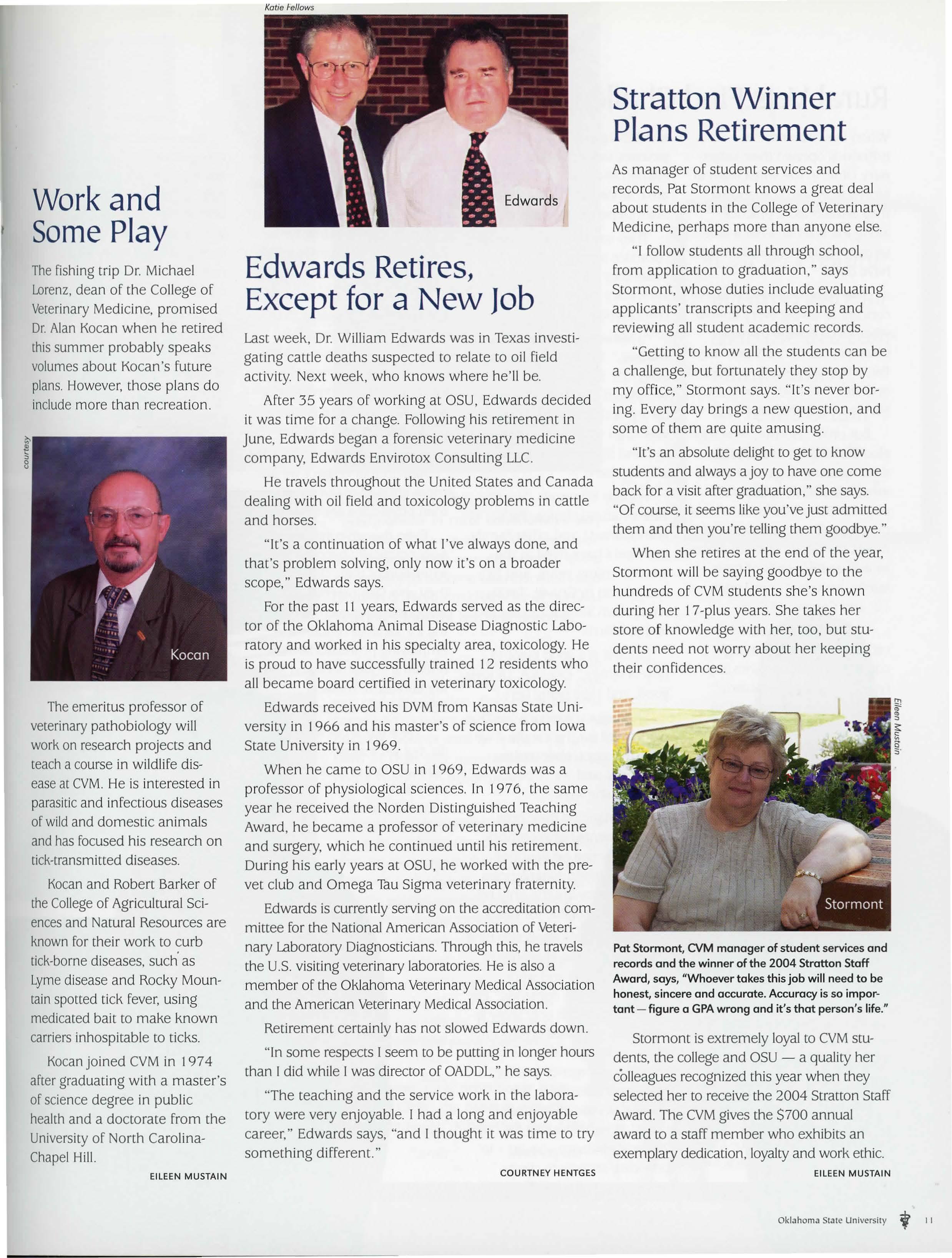
Thefishing trip Dr. Michael Lorenz,dean of the College of VeterinaryMedicine, promised Dr.Alan Kocan when he retired this summer probably speaks volumesabout Kocan's future plans.However, those plans do includemore than recreation.
The emeritus professor of veterinary pathobiology will work on research projects and teacha course in wildlife diseaseat CVM. He is interested in parasiticand infectious diseases of wild and domestic animals and has focused his research on tick-transmitted diseases.
Kocanand Robert Barker of the Collegeof Agricultural Sciencesand Natural Resources are known for their work to curb tick-bornediseases, such·as Lymedisease and Rocky Mountain spotted tick fever, using medicatedbait to make known carriersinhospitable to ticks.
Kocanjoined CVM in 1974 after graduating with a master's of science degree in public health and a doctorate from the University of North CarolinaChapel Hill.
EILEEN MUSTAIN
Edwards Retires, Except for a New Job
Last week, Dr. William Edwards was in Texas investigating cattle deaths suspected to relate to oil field activity. Next week, who knows where he'll be.
After 35 years of working at OSU, Edwards decided it was time for a change. Following his retirement in June, Edwards began a forensic veterinary medicine company, Edwards Envirotox Consulting LLC.
He travels throughout the United States and Canada dealing with oil field and toxicology problems in cattle and horses.
"It's a continuation of what I've always done, and that's problem solving, only now it's on a broader scope," Edwards says.
For the past 11years, Edwards served as the director of the Oklahoma Animal Disease Diagnostic Laboratory and worked in his specialty area, toxicology. He is proud to have successfully trained I 2 residents who all became board certified in veterinary toxicology.
Edwards received his DVM from Kansas State University in I 966 and his master's of science from Iowa State University in 1969.
When he came to OSU in 1969, Edwards was a professor of physiological sciences. In 1976, the same year he received the Norden Distinguished Teaching Award, he became a professor of veterinary medicine and surgery, which he continued until his retirement. During his early years at OSU, he worked with the prevet club and Omega Tau Sigma veterinary fraternity.
Edwards is currently serving on the accreditation committee for the National American Association of Veterinary Laboratory Diagnosticians. Through this, he travels the U.S. visiting veterinary laboratories. He is also a member of the Oklahoma Veterinary Medical Association and the American Veterinary Medical Association.
Retirement certainly has not slowed Edwards down.
"In some respects I seem to be putting in longer hours than I did while I was director of OADDL," he says.
"The teaching and the service work in the laboratory were very enjoyable. I had a long and enjoyable career," Edwards says, "and I thought it was time to try something different."
COURTNEY HENTGES
Stratton Winner Plans Retirement
As manager of student services and records, Pat Stormont knows a great deal about students in the College of Veterinary Medicine. perhaps more than anyone else.
"I follow students all through school, from application to graduation," says Stormont, whose duties include evaluating applicants' transcripts and keeping and reviewing all student academic records.
"Getting to know all the students can be a challenge, but fortunately they stop by my office," Stormont says. "It's never boring. Every day brings a new question, and some of them are quite amusing.
"It's an absolute delight to get to know students and always a joy to have one come back for a visit after graduation," she says. "Of course, it seems like you've just admitted them and then you're telling them goodbye."
When she retires at the end of the year, Stormont will be saying goodbye to the hundreds of CVM students she's known during her I 7-plus years. She takes her store of knowledge with her, too, but students need not worry about her keeping their confidences.
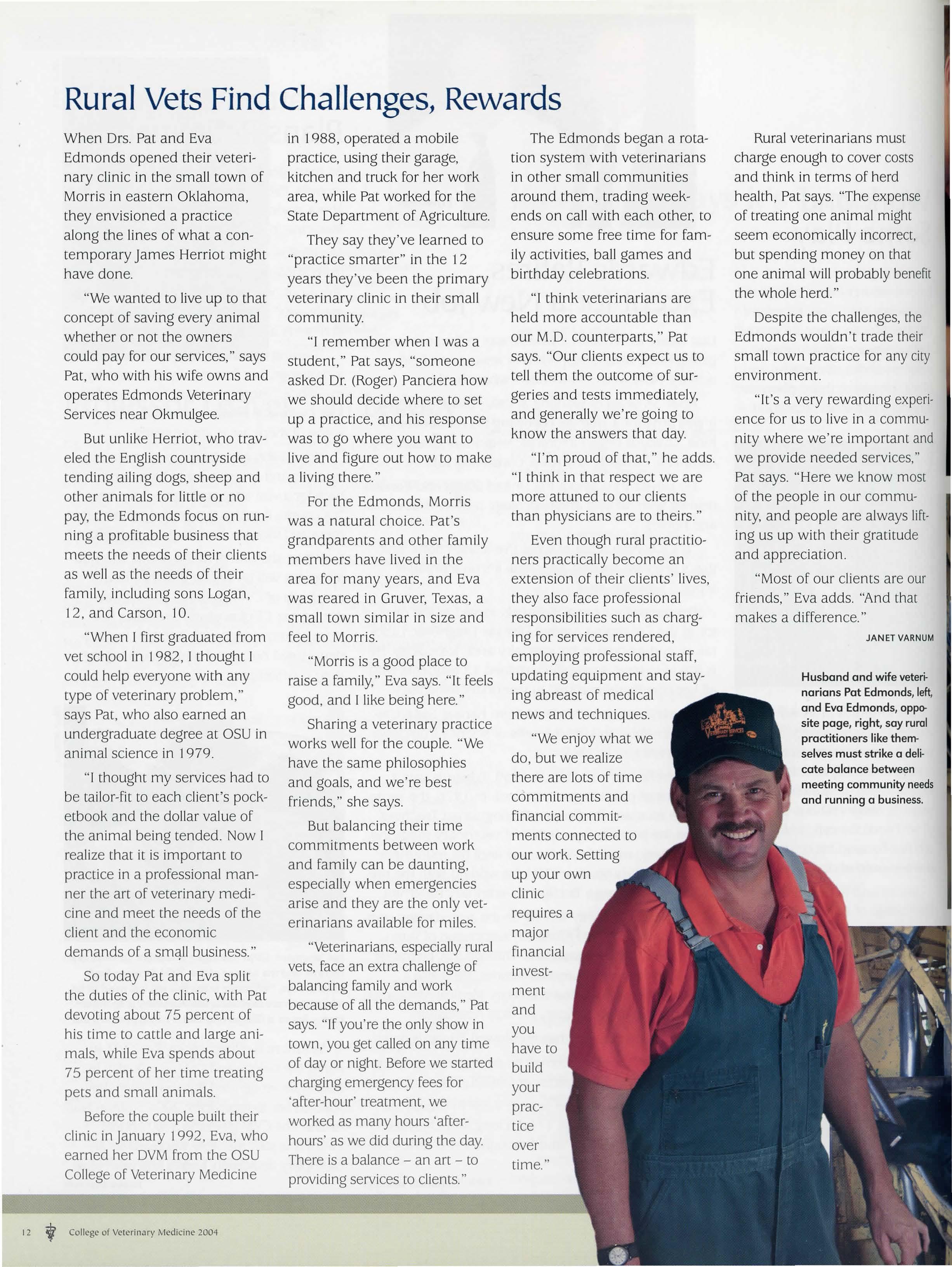
Pat Stormont, CVM manager of student services and records and the winner of the 2004 Stratton Staff Award, says, "Whoever takes this job will need to be honest, sincere and accurate. Accuracy is so important- figure a GPA wrong and it's that person's life."
Stormont is extremely loyal to CVM students, the college and OSU - a quality her colleagues recognized this year when they selected her to receive the 2004 Stratton Staff Award. The CVM gives the $700 annual award to a staff member who exhibits an exemplary dedication, loyalty and work ethic.
EILEEN MUSTAIN
RuralVets Find Challenges,Rewards
When Ors. Pat and Eva Edmonds opened their veterinary clinic in the small town of Morris in eastern Oklahoma, they envisioned a practice along the lines of what a contemporary James Herriot might have done.
"We wanted to live up to that concept of saving every animal whether or not the owners could pay for our services," says Pat, who with his wife owns and operates Edmonds Veterinary Services near Okmulgee.
But unlike Herriot, who traveled the English countryside tending ailing dogs, sheep and other animals for little or no pay, the Edmonds focus on running a profitable business that meets the needs of their clients as well as the needs of their family, including sons Logan, 12, and Carson, 10.
"When I first graduated from vet school in 1982, I thought I could help everyone with any type of veterinary problem," says Pat, who also earned an undergraduate degree at OSU in animal science in 1979.
"I thought my services had to be tailor-Fit to each client's pocketbook and the dollar value of the animal being tended. Now I realize that it is important to practice in a professional manner the art of veterinary medicine and meet the needs of the client and the economic demands of a smqll business."
So today Pat and Eva split the duties of the clinic, with Pat devoting about 75 percent of his time to cattle and large animals, while Eva spends about 75 percent of her time treating pets and small animals.
Before the couple built their clinic in January 1992, Eva, who earned her DVM from the OSU College of Veterinary Medicine
in 1988, operated a mobile practice, using their garage, kitchen and truck for her work area, while Pat worked for the State Department of Agriculture.
They say they've learned to "practice smarter" in the 12 years they've been the primary veterinary clinic in their small community.
"I remember when I was a student," Pat says, "someone asked Dr. (Roger) Panciera how we should decide where to set up a practice, and his response was to go where you want to live and figure out how to make a living there."
For the Edmonds, Morris was a natural choice. Pat's grandparents and other family members have lived in the area for many years, and Eva was reared in Gruver, Texas, a small town similar in size and feel to Morris.
"Morris is a good place to raise a family," Eva says. "It feels good, and I like being here."
Sharing a veterinary practice works well for the couple. "We have the same philosophies and goals, and we're best friends," she says.
But balancing their time commitments between work and family can be daunting, especially when emergencies arise and they are the only veterinarians available for miles.
"Veterinarians, especially rural vets, face an extra challenge of balancing family and work because of all the demands," Pat says. "If you're the only show in town, you get called on any time of day or night. Before we started charging emergency fees for 'after-hour' treatment, we worked as many hours 'afterhours' as we did during the day. There is a balance - an art - to providing services to clients."
The Edmonds began a rotation system with veterinarians in other small communities around them, trading weekends on call with each other, to ensure some free time for family activities, ball games and birthday celebrations.
"I think veterinarians are held more accountable than our M.D. counterparts," Pat says. "Our clients expect us to tell them the outcome of surgeries and tests immediately, and generally we're going to know the answers that day.
'Tm proud of that," he adds. "I think in that respect we are more attuned to our clients than physicians are to theirs."
Even though rural practitioners practically become an extension of their clients' lives, they also face professional responsibilities such as charging for services rendered, employing professional staff, updating equipment and staying abreast of medical news and techniques.
"We enjoy what we do, but we realize there are lots of time commitments and financial commitments connected to our work. Setting up your own clinic requires a major financial investment and you have to build your practice over time."
Rural veterinarians must charge enough to cover costs and think in terms of herd health, Pat says. "The expense of treating one animal might seem economically incorrect, but spending money on that one animal will probably benefil the whole herd."
Despite the challenges, lhe Edmonds wouldn't trade their small town practice for any city environment.
"It's a very rewarding experience for us to live in a community where we're important and we provide needed services," Pat says. "Here we know most of the people in our community, and people are always lifting us up with their gratitude and appreciation.
"Most of our clients are our friends," Eva adds. "And that makes a difference."
JANET VARNUM
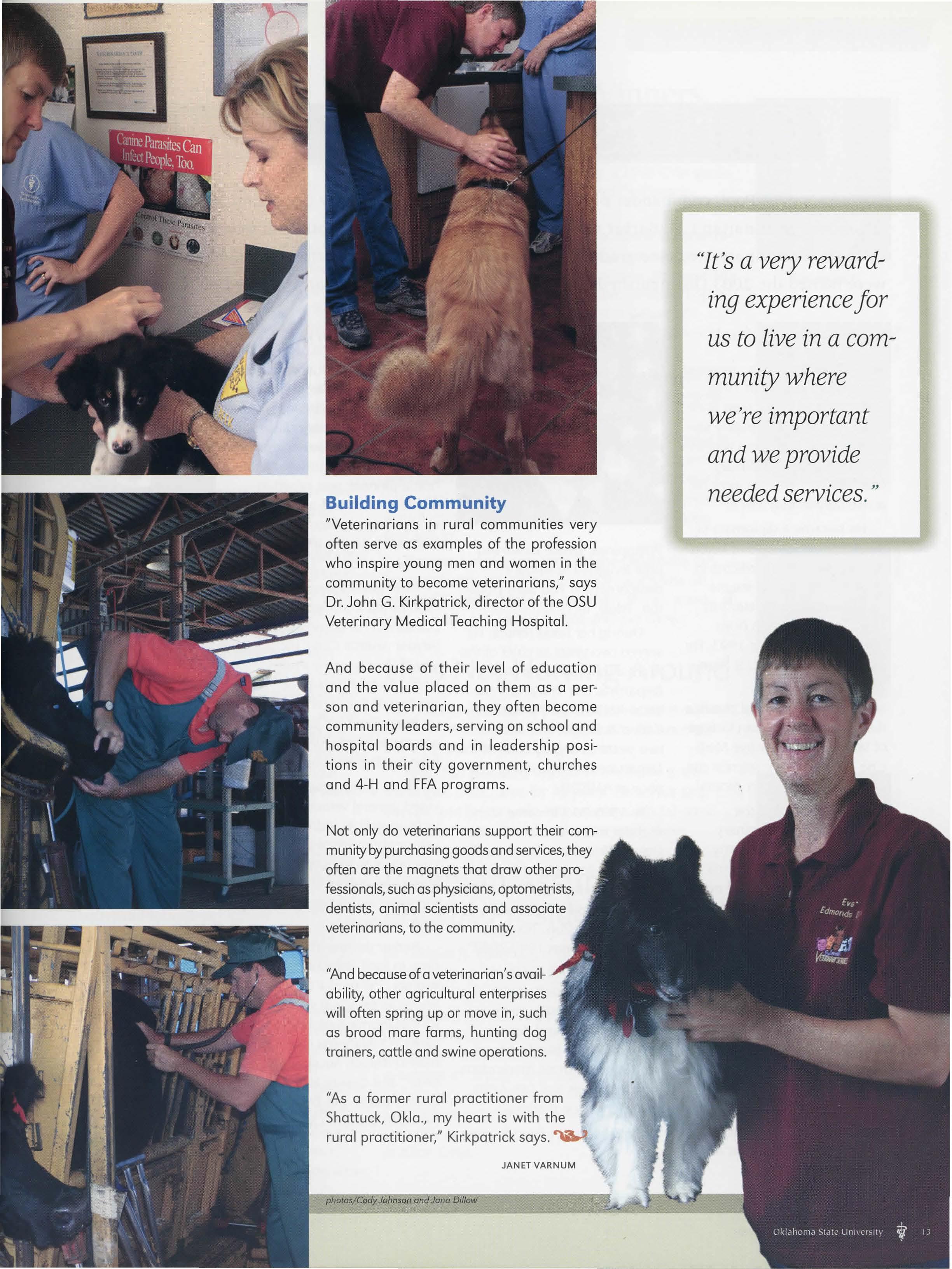
Husband and wife veter~ narians Pat Edmonds, left, and Eva Edmonds, opposite page, right, say rural practitioners like themselves must strike a delicate balance between meeting community needs and running a business.
"It'sa very rewarding experiencefor us to livein a community where we're important and we provide neededservices."
Building Community
"Veterinarians in rural communities very often serve as examples of the profession who inspire young men and women in the community to become veterinarians," says Dr. John G. Kirkpatrick, director of the OSU Veterinary Medical Teaching Hospital.
And because of their level of education and the value placed on them as a person and veterinarian, they often become community leaders, serving on school and hospital boards and in leadership positions in their city government, churches and 4-H and FFA programs.
Not only do veterinarians support their community by purchasing goods and services,they often are the magnets that draw other professionals,such as physicians,optometrists, dentists, animal scientists and associate veterinarians, to the community.
"And becauseofa veterinarian's avai~ ability, other agricultural enterprises will often spring up or move in, such as brood mare farms, hunting dog trainers, cattle and swine operations.
"As a former rural practitioner from Shattuck, Okla., my heart is with the rural practitioner," Kirkpatrick says.~
JANET VARNUM
Our Distfn£.u{shedAlumni
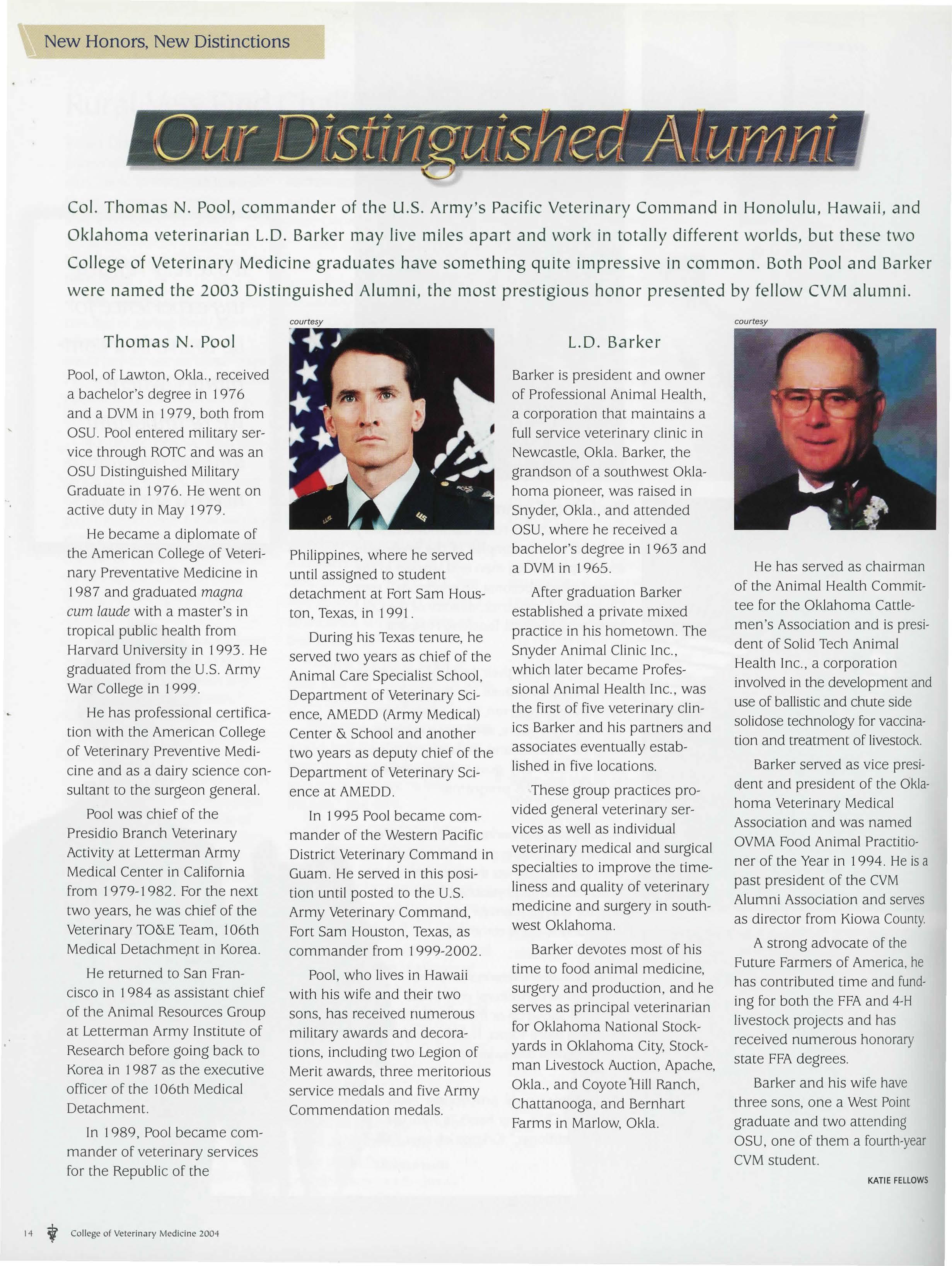
Col. Thomas N. Pool, commander of the U.S. Army's Pacific Veterinary Command in Honolulu, Hawaii, and Oklahoma veterinarian L.D. Barker may live miles apart and work in totally different worlds, but these two College of Veterinary Medicine graduates have something quite impressive in common. Both Pool and Barker were named the 2003 Distinguished Alumni, the most prestigious honor presented by fellow CVM alumni.
Thomas N. Pool
Pool, of Lawton, Okla., received a bachelor's degree in 1976 and a DVM in 1979, both from OSU. Pool entered military service through ROTCand was an OSU Distinguished Military Graduate in 1976. He went on active duty in May 1979.
He became a diplomate of the American College of Veterinary Preventative Medicine in I 987 and graduated magna cum laude with a master's in tropical public health from Harvard University in 1993. He graduated from the U.S. Army War College in 1999.
He has professional certification with the American College of Veterinary Preventive Medicine and as a dairy science consultant to the surgeon general.
Pool was chief of the Presidio Branch Veterinary Activity at Letterman Army Medical Center in California from I 979-1982. For the next two years, he was chief of the Veterinary TO&E Team, I 06th Medical Detachme,nt in Korea.
He returned to San Francisco in I 984 as assistant chief of the Animal Resources Group at Letterman Army Institute of Research before going back to Korea in 1987 as the executive officer of the 106th Medical Detachment.
In 1989, Pool became commander of veterinary services for the Republic of the
Philippines, where he served until assigned to student detachment at Fort Sam Houston, Texas, in I 991.
During his Texas tenure, he served two years as chief of the Animal Care Specialist School, Department of Veterinary Science, AMEDD (Army Medical) Center & School and another two years as deputy chief of the Department of Veterinary Science at AMEDD.
In I 995 Pool became commander of the Western Pacific District Veterinary Command in Guam. He served in this position until posted to the U.S. Army Veterinary Command, Fort Sam Houston, Texas, as commander from 1999-2002.
Pool, who lives in Hawaii with his wife and their two sons, has received numerous military awards and decorations, including two Legion of Merit awards, three meritorious service medals and five Army Commendation medals.
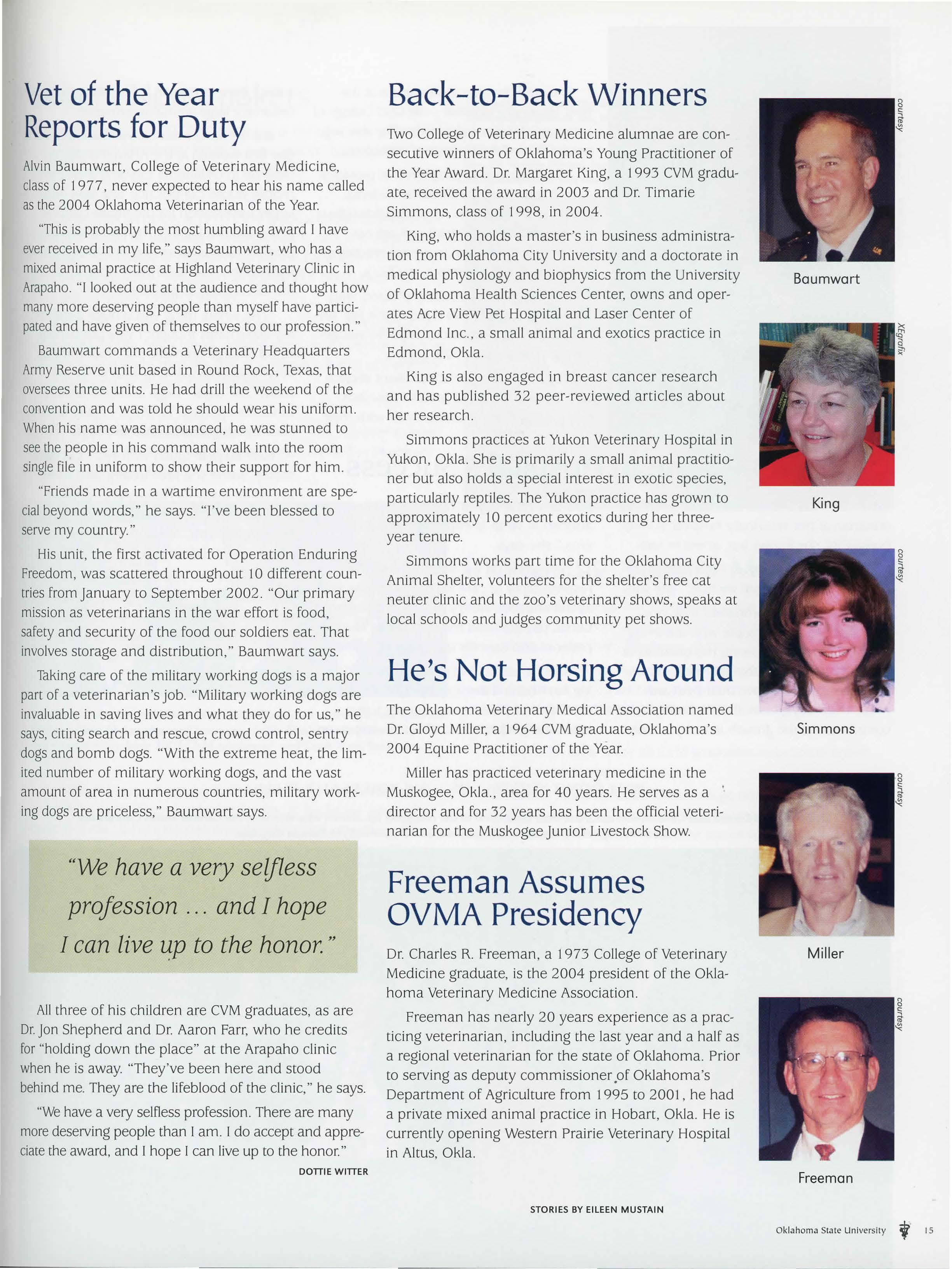
L.D. Barker
Barker is president and owner of Professional Animal Health, a corporation that maintains a full service veterinary clinic in Newcastle, Okla. Barker, the grandson of a southwest Oklahoma pioneer, was raised in Snyder, Okla., and attended OSU, where he received a bachelor's degree in I 963 and a DVM in 1965.
After graduation Barker established a private mixed practice in his hometown. The Snyder Animal Clinic Inc., which later became Professional Animal Health Inc., was the first of five veterinary clinics Barker and his partners and associates eventually established in five locations.
These group practices provided general veterinary services as well as individual veterinary medical and surgical specialties to improve the timeliness and quality of veterinary medicine and surgery in southwest Oklahoma.
Barker devotes most of his time to food animal medicine, surgery and production, and he serves as principal veterinarian for Oklahoma National Stockyards in Oklahoma City, Stockman Livestock Auction, Apache, Okla., and Coyote 1--lillRanch, Chattanooga, and Bernhart Farms in Marlow, Okla.
He has served as chairman of the Animal Health Committee for the Oklahoma Cattlemen's Association and is president of Solid Tech Animal Health Inc., a corporation involved in the development and use of ballistic and chute side solidose technology for vaccination and treatment of livestock.
Barker served as vice presiG)entand president of the Oklahoma Veterinary Medical Association and was named OVMA Food Animal Practitioner of the Year in 1994. He is a past president of the CVM Alumni Association and serves as director from Kiowa County.
A strong advocate of the Future Farmers of America, he has contributed time and funding for both the FFA and 4-H livestock projects and has received numerous honorary state FFA degrees.
Barker and his wife have three sons, one a West Point graduate and two attending OSU, one of them a fourth-year CVM student.
KATIEFELLOWS
Vetof the Year Reportsfor Duty
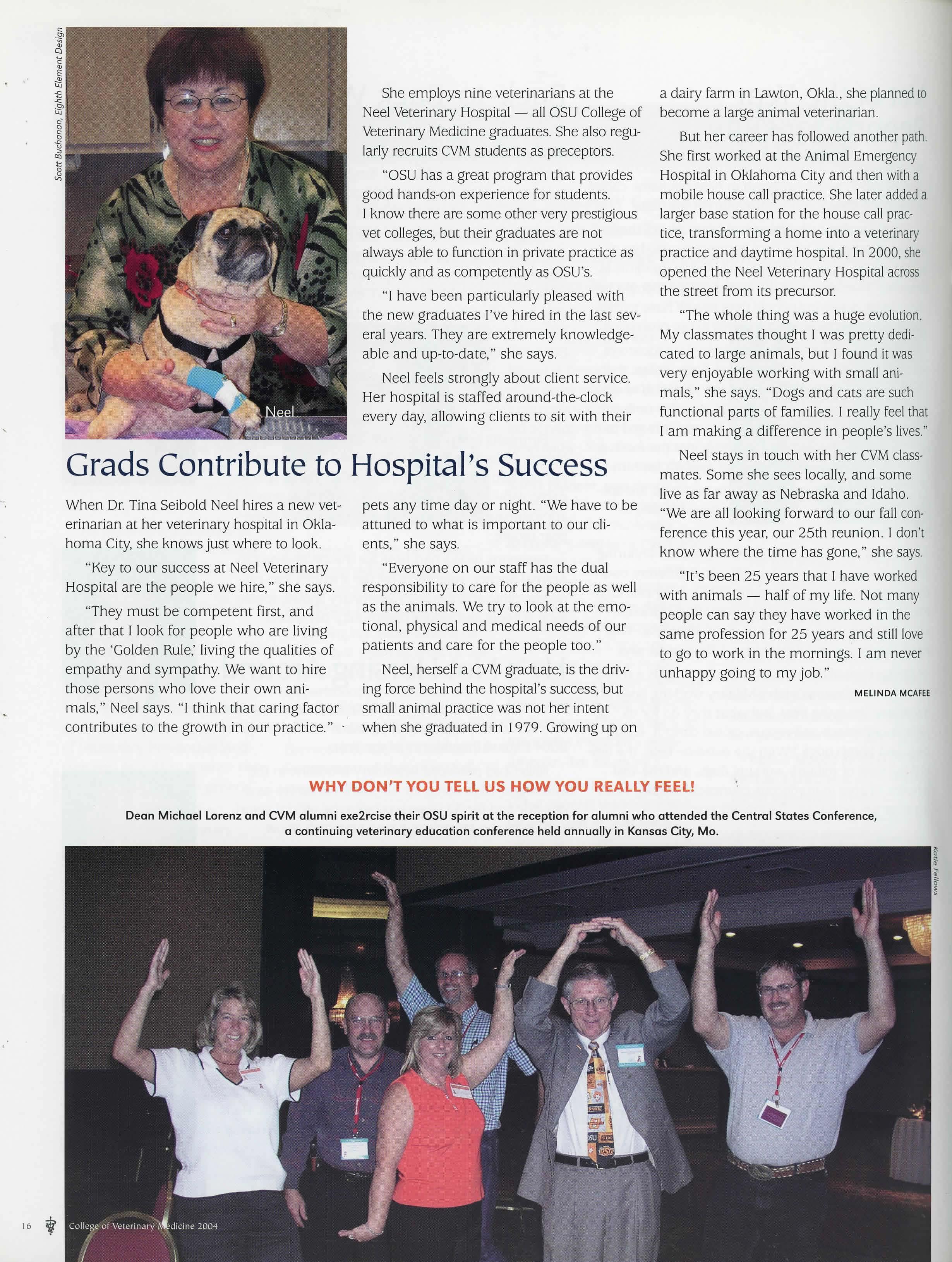
Alvin Baumwart, College of Veterinary Medicine, classof 1977, never expected to hear his name called asthe 2004 Oklahoma Veterinarian of the Year.
"This is probably the most humbling award I have everreceived in my life," says Baumwart, who has a mixedanimal practice at Highland Veterinary Clinic in Arapaho."I looked out at the audience and thought how manymore deserving people than myself have participatedand have given of themselves to our profession."
Baumwart commands a Veterinary Headquarters Army Reserve unit based in Round Rock, Texas, that overseesthree units. He had drill the weekend of the conventionand was told he should wear his uniform. Whenhis name was announced, he was stunned to seethe people in his command walk into the room singlefile in uniform to show their support for him.
"Friends made in a wartime environment are special beyond words," he says. "I've been blessed to servemy country."
His unit, the first activated for Operation Enduring Freedom,was scattered throughout 10 different countries from January to September 2002. "Our primary mission as veterinarians in the war effort is food, safetyand security of the food our soldiers eat. That involvesstorage and distribution," Baumwart says.
Taking care of the military working dogs is a major part of a veterinarian's job. "Military working dogs are invaluable in saving lives and what they do for us," he says,citing search and rescue, crowd control, sentry dogsand bomb dogs. "With the extreme heat, the limited number of military working dogs, and the vast amount of area in numerous countries, military working dogs are priceless," Baumwart says.
"We have a very selfless projession . . . and I hope I can live ~p to the honor "
All three of his children are CVM graduates, as are Dr.Jon Shepherd and Dr. Aaron Farr, who he credits for "holding down the place" at the Arapaho clinic when he is away. "They've been here and stood behind me. They are the lifeblood of the clinic," he says.
"We have a very selfless profession. There are many moredeserving people than I am. I do accept and appreciatethe award, and I hope I can live up to the honor."
DOTTIE WITTER
Back-to-Back Winners
Two College of Veterinary Medicine alumnae are consecutive winners of Oklahoma's Young Practitioner of the Year Award. Dr. Margaret King, a 1993 CVM graduate, received the award in 2003 and Dr. Timarie Simmons, class of 1998, in 2004.
King, who holds a master's in business administration from Oklahoma City University and a doctorate in medical physiology and biophysics from the University of Oklahoma Health Sciences Center, owns and operates Acre View Pet Hospital and Laser Center of Edmond Inc., a small animal and exotics practice in Edmond, Okla.
King is also engaged in breast cancer research and has published 32 peer-reviewed articles about her research.
Simmons practices at Yukon Veterinary Hospital in Yukon, Okla. She is primarily a small animal practitioner but also holds a special interest in exotic species, particularly reptiles. The Yukon practice has grown to approximately IO percent exotics during her threeyear tenure.
Simmons works part time for the Oklahoma City Animal Shelter, volunteers for the shelter's free cat neuter clinic and the zoo's veterinary shows, speaks at local schools and judges community pet shows.
He's Not HorsingAround
The Oklahoma Veterinary Medical Association named Dr. Gloyd Miller, a I 964 CVM graduate, Oklahoma's 2004 Equine Practitioner of the Year.
Miller has practiced veterinary medicine in the Muskogee, Okla., area for 40 years. He serves as a director and for 32 years has been the official veterinarian for the Muskogee Junior Livestock Show.
Freeman Assumes
OVMA Presidency
Dr. Charles R. Freeman, a I 973 College of Veterinary Medicine graduate, is the 2004 president of the Oklahoma Veterinary Medicine Association.
Freeman has nearly 20 years experience as a practicing veterinarian, including the last year and a half as a regional veterinarian for the state of Oklahoma. Prior to serving as deputy commissioner .of Oklahoma's Department of Agriculture from 1995 to 2001 , he had a private mixed animal practice in Hobart, Okla. He is currently opening Western Prairie Veterinary Hospital in Altus, Okla.
Baumwart
King
Simmons Miller Freeman
She employs nine veterinarians at the Neel Veterinary Hospital - all OSU College of Veterinary Medicine graduates. She also regularly recruits CVM students as preceptors.
"OSU has a great program that provides good hands-on experience for students.
I know there are some other very prestigious vet colleges, but their graduates are not always able to function in private practice as quickly and as competently as OSU's.
"I have been particularly pleased with the new graduates I've hired in the last several years. They are extremely knowledgeable and up-to-date," she says.
Neel feels strongly about client service. Her hospital is staffed around-the-clock every day, allowing clients to sit with their
Grads Contribute to Hospital's Success
When Dr. Tina Seibold Neel hires a new veterinarian at her veterinary hospital in Oklahoma City, she knows just where to look.
"Key to our success at Neel Veterinary Hospital are the people we hire," she says.
"They must be competent first, and after that I look for people who are living by the 'Golden Rule,' living the qualities of empathy and sympathy. We want to hire those persons who love their own animals," Neel says. "I think that caring factor contributes to the growth in our practice." •
pets any time day or night. "We have to be attuned to what is important to our clients," she says.
"Everyone on our staff has the dual responsibility to care for the people as well as the animals. We try to look at the emotional, physical and medical needs of our patients and care for the people too."
Neel, herself a CVM graduate, is the driving force behind the hospital's success,but small animal practice was not her intent when she graduated in 1979. Growing up on
a dairy farm in Lawton, Okla., she plannedto become a large animal veterinarian.
But her career has followed another path. She first worked at the Animal Emergency Hospital in Oklahoma City and then with a mobile house call practice. She later addeda larger base station for the house call practice, transforming a home into a veterinary practice and daytime hospital. In 2000, she opened the Neel Veterinary Hospital across the street from its precursor.
"The whole thing was a huge evolution. My classmates thought I was pretty dedicated to large animals, but I found it was very enjoyable working with small animals," she says. "Dogs and cats are such functional parts of families. I really feel that I am making a difference in people's lives."
Neel stays in touch with her CVM classmates. Some she sees locally, and some live as far away as Nebraska and Idaho. "We are all looking forward to our fall conference this year, our 25th reunion. I don't know where the time has gone," she says.
"It's been 25 years that I have worked with animals - half of my life. Not many people can say they have worked in the same profession for 25 years and still love to go to work in the mornings. I am never unhappy going to my job."
WHY DON'T YOU TELL US HOW YOU REALLY FEEL!
MELINDA MCAFEE
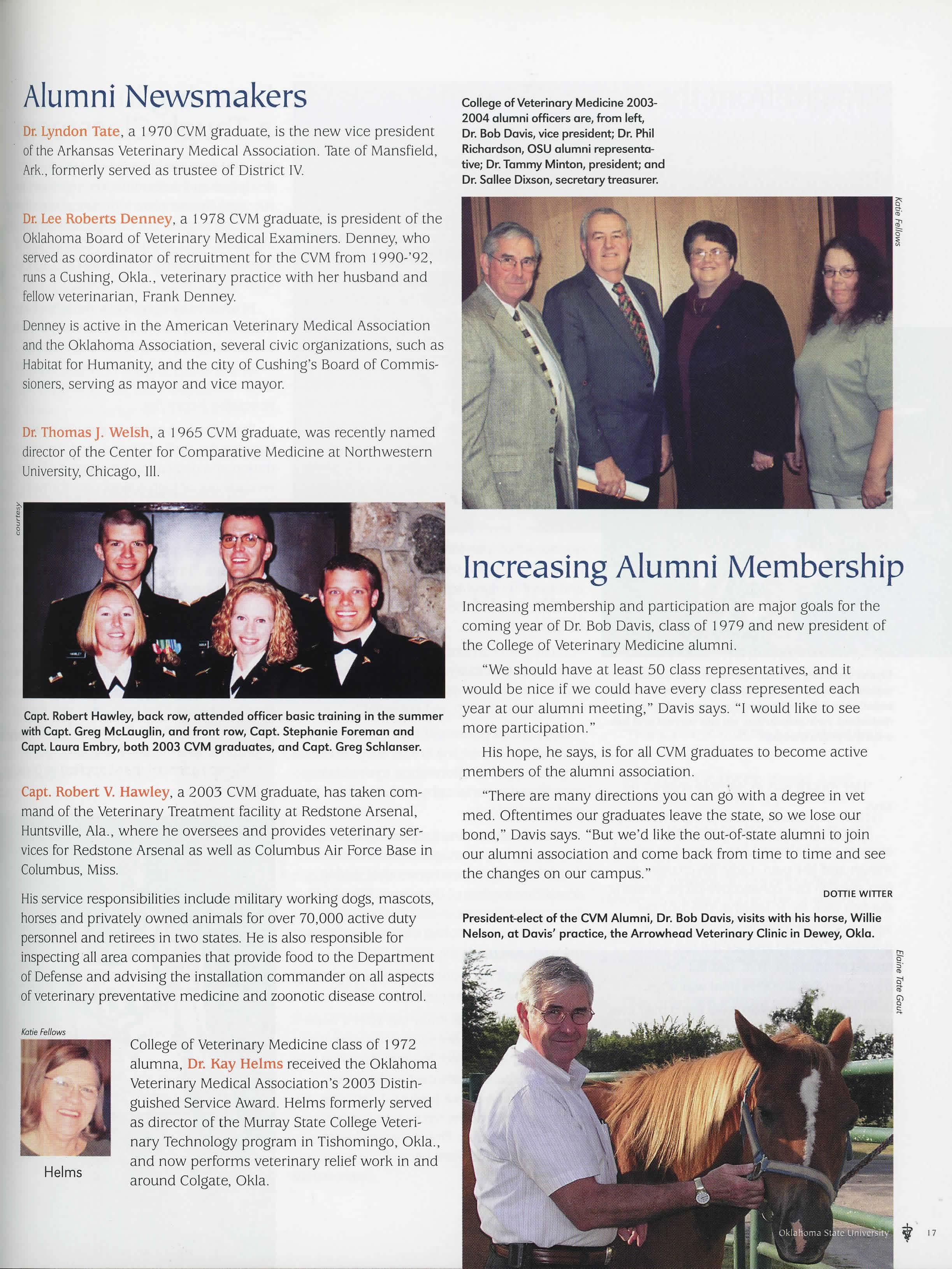
Deon Michael Lorenz and CVM alumni exe2rcise their OSU spirit at the reception for alumni who attended the Central States Conference, a continuing veterinary education conference held annually in Kansas City, Mo.
AlumniNewsmakers
Dr.Lyndon Tate, a 1970 CVM graduate, is the new vice president of the Arkansas Veterinary Medical Association. Tate of Mansfield, Ark., formerly served as trustee of District IV.
Dr. Lee Roberts Denney, a 1978 CVM graduate, is president of the OklahomaBoard of Veterinary Medical Examiners. Denney, who servedas coordinator of recruitment for the CVM from 1990-'92, runsa Cushing, Ok.la., veterinary practice with her husband and fellowveterinarian, Frank Denney.
Denneyis active in the American Veterinary Medical Association and the Oklahoma Association, several civic organizations, such as Habitatfor Humanity, and the city of Cushing's Board of Commissioners,serving as mayor and vice mayor.
Dr. Thomas J.Welsh, a 1965 CVM graduate, was recently named directorof the Center for Comparative Medicine at Northwestern University,Chicago, Ill.
College of Veterinary Medicine 20032004 alumni officers are, from left, Dr. Bob Davis, vice president; Dr. Phil Richardson, OSU alumni representative; Dr. Tammy Minton, president; and Dr. Sallee Dixson, secretary treasurer.
Capt. Robert Hawley, back raw, attended officer basic training in the summer with Capt. Greg Mclauglin, and front row, Capt. Stephanie Foreman and Capt. Louro Embry, both 2003 CVM graduates, and Capt. Greg Schlanser.
Capt. Robert V. Hawley, a 2003 CVM graduate, has taken command of the Veterinary Treatment facility at Redstone Arsenal, Huntsville,Ala., where he oversees and provides veterinary servicesfor Redstone Arsenal as well as Columbus Air Force Base in Columbus,Miss.
Hisservice responsibilities include military working dogs, mascots, horsesand privately owned animals for over 70,000 active duty personneland retirees in two states. He is also responsible for inspectingall area companies that provide food to the Department of Defenseand advising the installation commander on all aspects of veterinary preventative medicine and zoonotic disease control.
College of Veterinary Medicine class of 1972 alumna, Dr. Kay Helms received the Oklahoma Veterinary Medical Association's 2003 Distinguished Service Award. Helms formerly served as director of the Murray State College Veterinary Technology program in Tishomingo, Ok.la., and now performs veterinary relief work in and around Colgate, Ok.la.
IncreasingAlumni Membership
Increasing membership and participation are major goals for the coming year of Dr. Bob Davis, class of 1979 and new president of the College of Veterinary Medicine alumni.
"We should have at least 50 class representatives, and it would be nice if we could have every class represented each year at our alumni meeting," Davis says. "I would like to see more participation."
His hope, he says, is for all CVM graduates to become active members of the alumni association.
"There are many directions you can go with a degree in vet med. Oftentimes our graduates leave the state, so we lose our bond," Davis says. "But we'd like the out-of-state alumni to join our alumni association and come back from time to time and see the changes on our campus."
DOTTIE WITTER
President-elect of the CVM Alumni, Dr. Bob Davis, visits with his horse, Willie Nelson, at Davis' practice, the Arrowhead Veterinary Clinic in Dewey, Okla.
KatieFellows
Helms
Straightfrom the Horse'sMouth
When Dr. Ken Davis, OSU College of Veterinary Medicine class of 1967, first encountered the 2-year-old filly Lady Tak, everyone said she was not trainable and impossible to keep from running all over the track.
But one look inside her mouth convinced the equine dentist based in Williston, Fla., that he could make a positive change in the horse's life.
Retirement didn't last long. however.
Davis was in a training barn and observed a dental technician working with specialized equipment large enough to access the horse's teeth and mouth. "I was so awed by it I spent five hours on my knees watching," he says.
He trained with the technician for a year and gave up retirement to re-enter the field of veterinary medicine as one of only a small number of veterinary doctors nationwide that specialize in equine dentistry.
Today Davis and his wife spend six days a week making "house calls" across Florida.
Equine dentists don't do teeth cleanings, Davis says, instead they focus on the physically taxing task of balancing and adjusting the molars and incisors to properly realign the teeth.
Horses' teeth continually grow up to a quarter of an inch longer each year causing misalignment and pre-striking. This painful and common problem can wreck havoc with a horse that's also being asked to perform at its highest level.
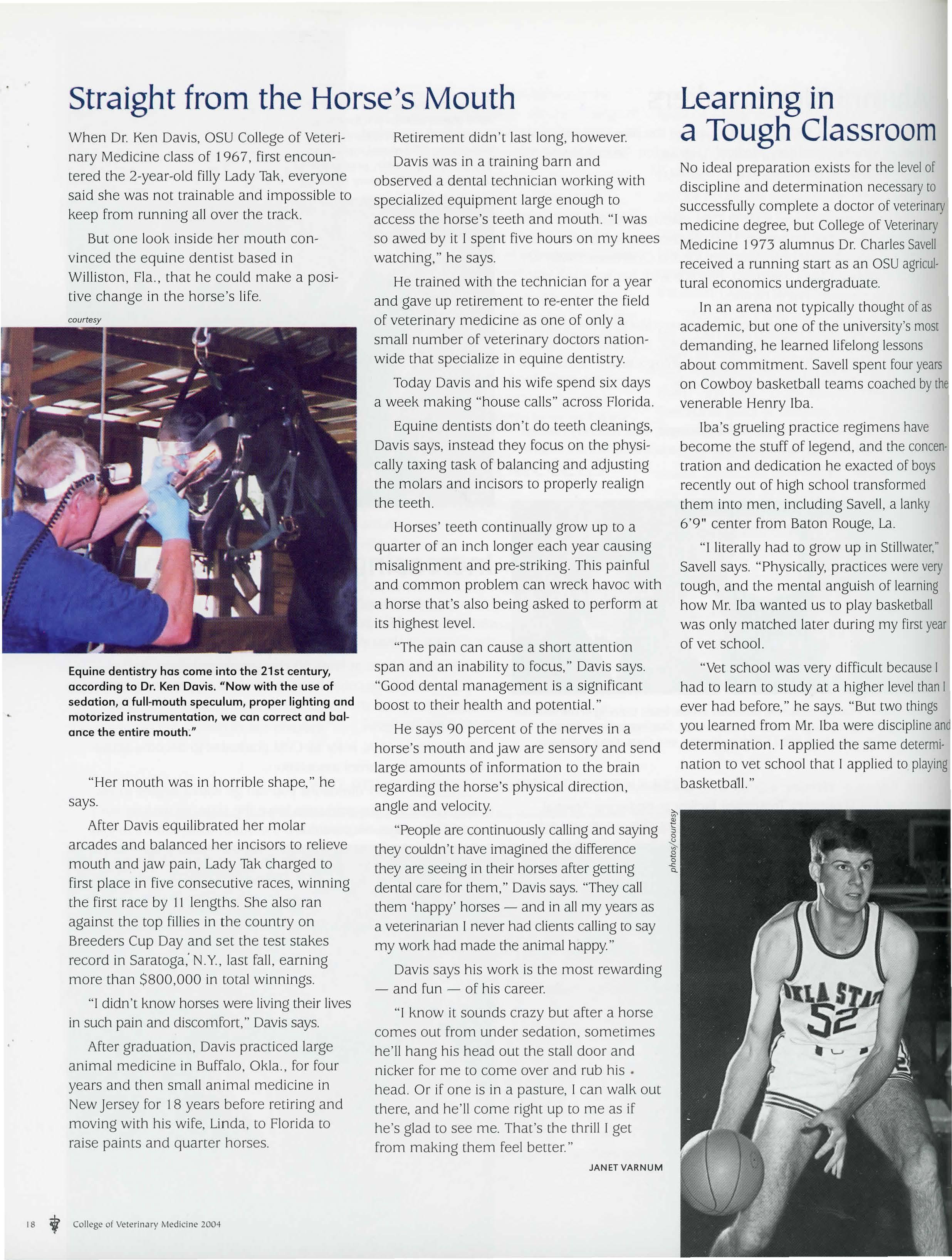
Equine dentistry has came into the 21st century, according to Dr. Ken Davis. "Now with the use of sedation, a full-mouth speculum, proper lighting and motorized instrumentation, we can correct and balance the entire mouth:"
"Her mouth was in horrible shape," he says.
After Davis equilibrated her molar arcades and balanced her incisors to relieve mouth and jaw pain, Lady Tak charged to first place in five consecutive races, winning the first race by 11 lengths. She also ran against the top fillies in the country on Breeders Cup Day and set the test stakes record in Saratoga,' N.Y., last fall, earning more than $800,000 in total winnings.
"I didn't know horses were living their lives in such pain and discomfort," Davis says.
After graduation, Davis practiced large animal medicine in Buffalo, Okla., for four years and then small animal medicine in New Jersey for 18 years before retiring and moving with his wife, Linda, to Florida to raise paints and quarter horses.
"The pain can cause a short attention span and an inability to focus," Davis says. "Good dental management is a significant boost to their health and potential."
He says 90 percent of the nerves in a horse's mouth and jaw are sensory and send large amounts of information to the brain regarding the horse's physical direction, angle and velocity.
"People are continuously calling and saying 5 they couldn't have imagined the difference they are seeing in their horses after getting dental care for them," Davis says. "They call them 'happy· horses - and in all my years as a veterinarian I never had clients calling cosay my work had made the animal happy."
Davis says his work is the most rewarding - and fun - of his career.
"I know it sounds crazy but after a horse comes out from under sedation, sometimes he'll hang his head out the stall door and nicker for me to come over and rub his head. Or if one is in a pasture, I can walk out there, and he'll come right up to me as if he's glad to see me. That's the thrill I gee from making them feel better."
VARNUM
JANET
Learningin a ToughClassroom
No ideal preparation exists for the levelof discipline and determination necessaryco successfully complete a doctor of veterinary medicine degree, but College of Veterinary Medicine 1973 alumnus Dr. CharlesSavell received a running start as an OSUagricultural economics undergraduate.
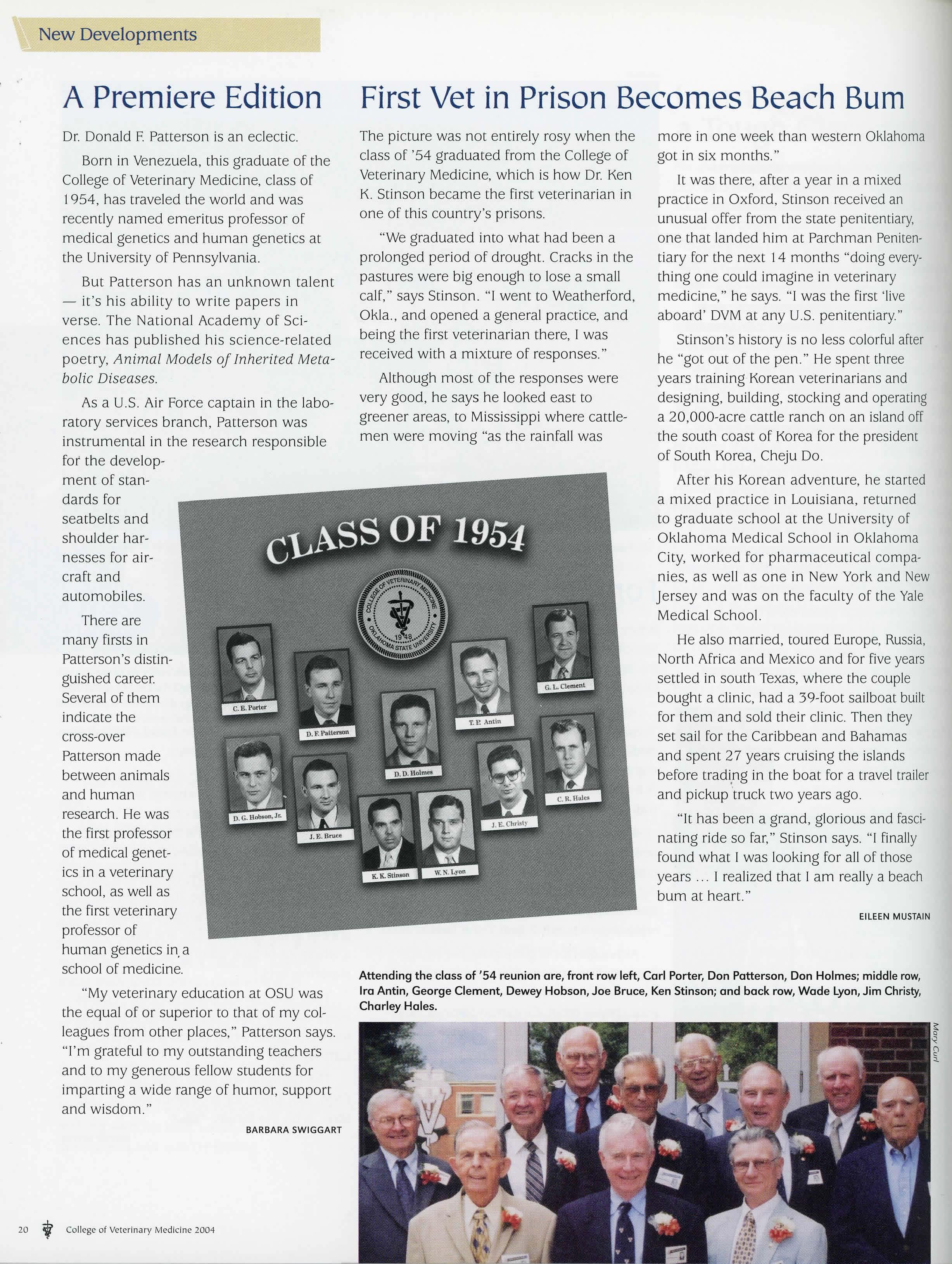
In an arena not typically thought of as academic, but one of the university's mosr demanding, he learned lifelong lessons about commitment. Savell spent four years on Cowboy basketball teams coachedby th venerable Henry Iba.
Iba's grueling practice regimens have become the stuff of legend, and the concentration and dedication he exacted of boys recently out of high school transformed chem into men, including Savell, a lanky 6'9" center from Baton Rouge, La.
"I literally had to grow up in Stillwater," Savell says. "Physically, practices were very tough, and the mental anguish of learning how Mr. Iba wanted us to play basketball was only matched later during my first year of vet school.
"Vet school was very difficult because I had to learn to study at a higher level thanI ever had before," he says. "But two things you learned from Mr. Iba were disciplinean determination. I applied the same determination to vet school that I applied to playing basketball."
··1knew I wanced to be a vet before I graduatedhigh school, but back in those days,Louisiana didn't have a veterinary school,"Savell says.
"I took the opportunity to go to OSU hopingthat I would eventually be accepted to the Collegeof Veterinary Medicine," he says. "My parentsput all of my belongings in a trunk, wishedme well and put me on a Greyhound bus,and 26 hours later, I arrived in Stillwater.
"just because you want to become a vet doesn'tmean you will, but I was lucky," he says."I was most fortunate to be admitted to theCollegeof Veterinary Medicine."
Savellsays the best thing to happen at OSU wasmeetinghis wife, Sandy Nitcher, a graduateof OSU'searly childhood education programfrom Lawrence, Kan. She worked to help supplementhis student loans and earnings fromsidejobs such as "reading the fecals" withparasitologistDr. Helen Jordan and labormgin Dr.Roger Panciera's necropsy lab.
Aftergraduation Savell completed an internshipin the small animal clinic at Texas A&Mbefore spending nine years in small animalpractice, including the last six in a cliniche started near Baton Rouge.
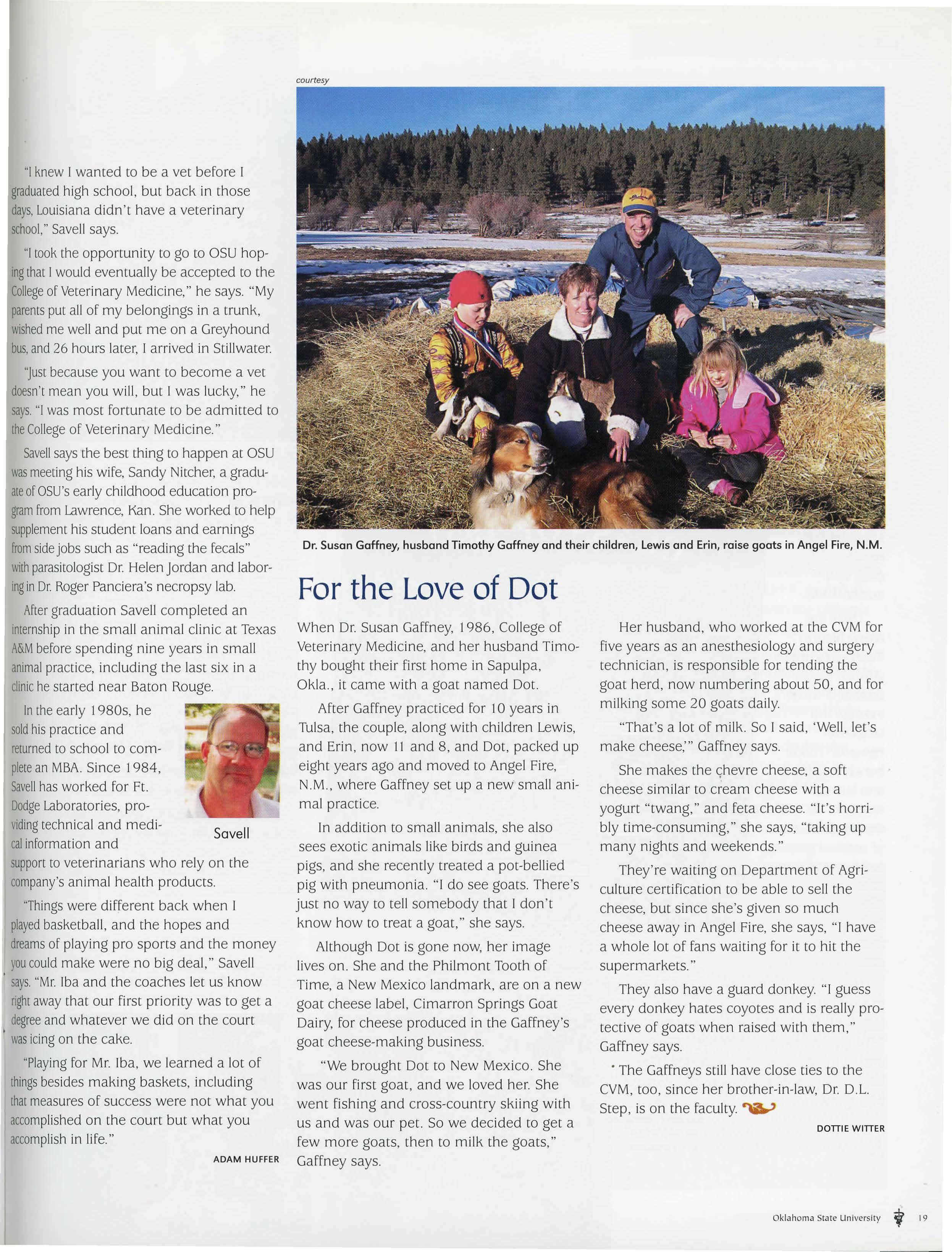
In the early 1980s, he soldhis practice and returnedto school to completean MBA. Since 1984, Savellhas worked for Ft. DodgeLaboratories, providingtechnical and medicalinformation and Savell supportto veterinarians who rely on the company'sanimal health products.
"Thingswere different back when I playedbasketball, and the hopes and dreamsof playing pro sports and the money youcould make were no big deal," Savell says."Mr. Iba and the coaches let us know rightaway that our first priority was to gee a degreeand whatever we did on the court wasicing on the cake.
"Playingfor Mr. Iba, we learned a lot of thingsbesides making baskets, including thatmeasuresof success were not what you accomplishedon the court but what you accomplishin life."
ADAM HUFFER
For the Loveof Dot
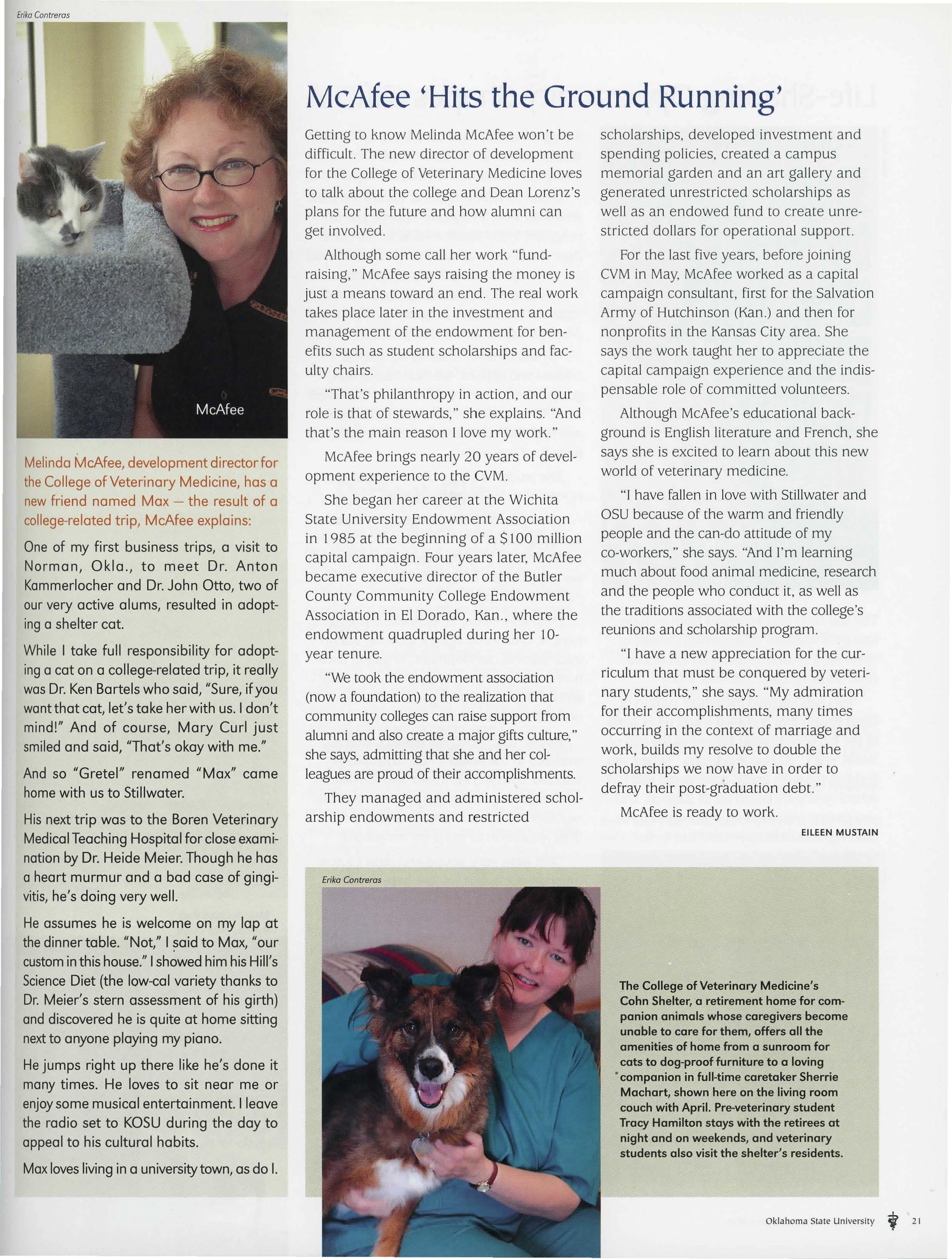
When Dr. Susan Gaffney, I 986, College of Veterinary Medicine, and her husband Timothy bought their first home in Sapulpa, Okla., it came with a goat named Dot.
After Gaffney practiced for 10 years in Tulsa, the couple, along with children Lewis, and Erin, now 11 and 8, and Dot, packed up eight years ago and moved to Angel Fire, N.M., where Gaffney set up a new small animal practice.
In addition to small animals, she also sees exotic animals like birds and guinea pigs, and she recently treated a pot-bellied pig with pneumonia. "I do see goats. There's just no way to tell somebody that I don't know how to treat a goat," she says.
Although Dot is gone now, her image lives on. She and the Philmont Tooth of Time, a New Mexico landmark, are on a new goat cheese label, Cimarron Springs Goat Dairy, for cheese produced in the Gaffney's goat cheese-making business.
"We brought Dot to New Mexico. She was our first goat, and we loved her. She went fishing and cross-country skiing with us and was our pet. So we decided to get a few more goats, then to milk the goats," Gaffney says.
Her husband, who worked at the CVM for five years as an anesthesiology and surgery technician, is responsible for tending the goat herd, now numbering about 50, and for milking some 20 goats daily.
"That's a lot of milk. So I said, 'Well, let's make cheese,"' Gaffney says.
She makes the c;:hevrecheese, a soft cheese similar to cream cheese with a yogurt "twang," and feta cheese. "It's horribly time-consuming," she says, "taking up many nights and weekends."
They're waiting on Department of Agriculture certification to be able to sell the cheese, but since she's given so much cheese away in Angel Fire, she says, "I have a whole lot of fans waiting for it to hit the supermarkets."
They also have a guard donkey. "I guess every donkey hates coyotes and is really protective of goats when raised with chem," Gaffney says.
• The Gaffneys still have close ties to the CVM, too, since her brother-in-law, Dr. D.L. Step, is on the faculty.
DOTTIE WITTER
Dr. Susan Gaffney, husband Timothy Goffney ond their children, Lewis and Erin, raise goats in Angel Fire, N.M.
A Premiere Edition
Dr. Donald F. Patterson is an eclectic.
Born in Venezuela, this graduate of the College of Veterinary Medicine, class of 1954, has traveled the world and was recently named emeritus professor of medical genetics and human genetics at the University of Pennsylvania.
But Patterson has an unknown talent - it's his ability to write papers in verse. The National Academy of Sciences has published his science-related poetry, Animal Models of Inherited Metabolic Diseases.
As a U.S Air Force captain in the laboratory services branch, Patterson was instrumental in the research responsible for the development of standards for seatbelts and shoulder harnesses for aircraft and automobiles.
There are many firsts in Patterson's distinguished career. Several of them indicate the cross-over Patterson made between animals and human research. He was the first professor of medical genetics in a veterinary school, as well as the first veterinary professor of human genetics in_a school of medicine.
"My veterinary education at OSU was the equal of or superior to that of my colleagues from other places," Patterson says. 'Tm grateful to my outstanding teachers and to my generous fellow students for imparting a wide range of humor, support and wisdom."
BARBARA SWIGGART
First Vet in Prison BecomesBeach Bum
The picture was not entirely rosy when the class of '54 graduated from the College of Veterinary Medicine, which is how Dr. Ken K. Stinson became the first veterinarian in one of this country's prisons.
"We graduated into what had been a prolonged period of drought. Cracks in the pastures were big enough to lose a small calf," says Stinson. "I went to Weatherford, Okla , and opened a general practice, and being the first veterinarian there, I was received with a mixture of responses."
Although most of the responses were very good, he says he looked east to greener areas, to Mississippi where cattlemen were moving "as the rainfall was
more in one week than western Oklahoma got in six months."
It was there, after a year in a mixed practice in Oxford, Stinson received an unusual offer from the state penitentiary, one that landed him at Parchman Penitentiary for the next 14 months "doing everything one could imagine in veterinary medicine," he says. "I was the first 'live aboard' DVM at any U.S. penitentiary."
Stinson's history is no less colorful after he "got out of the pen." He spent three years training Korean veterinarians and designing, building, stocking and operating a 20,000-acre cattle ranch on an island off the south coast of Korea for the president of South Korea, Cheju Do.
After his Korean adventure, he started a mixed practice in Louisiana, returned to graduate school at the University of Oklahoma Medical School in Oklahoma City, worked for pharmaceutical companies, as well as one in New York and New Jersey and was on the faculty of the Yale Medical School.
He also married, toured Europe, Russia, North Africa and Mexico and for five years settled in south Texas, where the couple bought a clinic, had a 39-foot sailboat built for them and sold their clinic. Then they set sail for the Caribbean and Bahamas and spent 27 years cruising the islands before tradi_ngin the boat for a travel trailer and pickup 'truck two years ago.
"It has been a grand, glorious and fascinating ride so far," Stinson says. "I finally found what I was looking for all of those years I realized that I am really a beach bum at heart."
EILEEN MUSTAIN
Attending the class of '54 reunion are, front raw left, Carl Parter, Dan Patterson, Don Holmes; middle row, Ira Antin, George Clement, Dewey Hobson, Joe Bruce, Ken Stinson; and back row, Wade Lyon, Jim Christy, Charley Hales.
MelindaMcAfee,developmentdirectorfor the College of Veterinary Medicine, has a newfriend named Max - the result of a college-relatedtrip, McAfee explains:
One of my first businesstrips, a visit to Norman, Okla., to meet Dr. Anton Kammerlocherand Dr. John Otto, two of our very active alums, resulted in adopting a sheltercat.
While I take full responsibilityfor adopting a cat on a college-relatedtrip, it really was Dr. KenBartelswho said, "Sure,if you wantthat cat, let'stake her with us. I don't mind!" And of course, Mary Curl just smiledand said, "That's okay with me."
And so "Gretel" renamed "Max" came homewith us to Stillwater.
His nexttrip was to the BorenVeterinary MedicalTeachingHospitalfor closeexaminationby Dr. Heide Meier. Though he has a heart murmur and a bad case of gingivitis,he's doing very well.
He assumeshe is welcome on my lap at thedinnertable. "Not," I ~aid to Max, "our customin thishouse." I showedhim his Hill's ScienceDiet (the low-calvariety thanks to Dr. Meier's stern assessmentof his girth) and discoveredhe is quite at home sitting nextto anyoneplayingmy piano.
He jumps right up there like he's done it many times. He loves to sit near me or enjaysomemusicalentertainment. I leave the radio set to KOSU during the day to appealto his cultural habits.
Maxloveslivingin a universitytown,as do I.
McAfee 'Hits the Ground Running'
Getting to know Melinda McAfee won't be difficult. The new director of development for the College of Veterinary Medicine loves to talk about the college and Dean Lorenz's plans for the future and how alumni can get involved.
Although some call her work "fundraising," McAfee says raising the money is just a means toward an end. The real work takes place later in the investment and management of the endowment for benefits such as student scholarships and faculty chairs.
"That's philanthropy in action, and our role is that of stewards," she explains. "And that's the main reason I love my work."
McAfee brings nearly 20 years of development experience to the CVM.
She began her career at the Wichita State University Endowment Association in 1985 at the beginning of a $ I 00 million capital campaign. Four years later, McAfee became executive director of the Butler County Community College Endowment Association in El Dorado, Kan., where the endowment quadrupled during her I 0year tenure.
"We took the endowment association (now a foundation) to the realization that community colleges can raise support from alumni and also create a major gifts culture," she says,admitting that she and her colleaguesare proud of their accomplishments.
They managed and administered scholarship endowments and restricted
scholarships, developed investment and spending policies, created a campus memorial garden and an art gallery and generated unrestricted scholarships as well as an endowed fund to create unrestricted dollars for operational support.
For the last five years, before joining CVM in May, McAfee worked as a capital campaign consultant, first for the Salvation Army of Hutchinson (Kan.) and then for nonprofits in the Kansas City area. She says the work taught her to appreciate the capital campaign experience and the indispensable role of committed volunteers.
Although McAfee's educational background is English literature and French, she says she is excited to learn about this new world of veterinary medicine.
"I have fallen in love with Stillwater and OSU because of the warm and friendly people and the can-do attitude of my co-workers," she says. "And I'm learning much about food animal medicine, research and the people who conduct it, as well as the traditions associated with the college's reunions and scholarship program.
"I have a new appreciation for the curriculum that must be conquered by veterinary students," she says. "My admiration for their accomplishments, many times occurring in the context of marriage and work, builds my resolve to double the scholarships we now have in order to defray their post-graduation debt."
McAfee is ready to work.
EILEEN MUSTAIN
The College of Veterinary Medicine's Cohn Shelter, a retirement home for companion animals whose caregivers become unable to care for them, offers all the amenities of home from a sunroom for cats to dog-proof furniture to a loving • companion in full-time caretaker Sherrie Machart, shown here on the living room couch with April. Pre-veterinary student Tracy Hamilton stays with the retirees at night and on weekends, and veterinary students also visit the shelter's residents.
Edka Contreras
Life-ShapingOpportunity ShapesGift
that involved," Al-Hummadi says. "When we started at Northeastern A&M, we thought it was the veterinary college."
When Al-Hummadi and EI-Hashini realized they were in a junior college pre-vet program, Northeastern A&M's then-president mistakenly assured Iraqi study-abroad administrators and the pre-vet students that their matriculation into the doctor of veterinary medicine program at Ok.Jahoma A&M College was a certainty.
"By the time we finished our pre-vet courses and applied, we found out it was going to be a lot more difficult," Al-Hummadi says. "They could only accept 40 students and had received more than 300 applications for those seats."
The students found themselves at the center of a diplomatic impasse.
"Our government thought we would be studying veterinary medicine at Ok.Jahoma A&M College, so there was a dilemma, and we were caught in the middle," Al-Hummadi says.
The last time Iraq emerged from occupation by a Western superpower, College of Veterinary Medicine alumnus Dr. Abdul Amir Al-Hummadi, '58, was a boy.
"Iraq had adopted the school system of Great Britain that occupied it and other parts of the former Ottoman Empire at the end of World War I," Al-Hummadi says. "When you finished the sixth grade, ninth grade and high school, you were tested on all subjects, and if you passed, you went on. If you didn't, you didn't go to school anymore."
AI-Hummadi repeatedly demonstrated his aptitude for scholastic pursuits, scoring the second highest in his province on the comprehensive assessment following high school.
He qualified to study abroad as part of an international program funded with proceeds from an oil export agreement with Britain. Participants were sent to England to prepare for careers in oil and gas production or destinations more remote for other studies, but all signed agreements to return home.
In 1952, Al-Hummadi and another young man named Murtha El-Hashini were the first sent to Northeastern A&M College in Miami, Okla., for veterinary training.
"We were chosen to study veterinary medicine, but nobody really knew what
President Henry G. Bennett, a proponent of Oklahoma A&M's growing role in international development, engaged Ok.Jahoma Gov.Johnston Murray and the Iraqi ambassador in Washington, D.C., and brokered a deal.
Rather than 40, CVM would admit 42 students in the fall of 1954. The college selected both Al-Hummadi and El-Hashini, whose grade point averages exceeded the requisite 3.5 for admission, and averted their relocation to India for vet school.
"We were very young and didn't know much about it, but we just happened to meet some good people who took care of us," says Al-Hummadi, who upon graduation spent four-and-one-half years in Iraq repaying his debt to his country before returning to the United States in 1963, becoming a citizen and working almost four decades for the USDA.
In gratitude for the life-shaping opportunity, Al-Hummadi and his wife, Veronica, whom he married while at Oklahoma A&M, have willed a portion of their estate to CVM to be used for tuition and assistance for incoming students.
"I want to give something back," he says.
ADAM
HUFFER
PLANNING A GIFT
Many loyal alumni and friends of the College of Veterinary Medicine continue to ensure its tradition of excellence through their generosity. Private gifts play an increasingly important role by funding scholarships for deserving students, purchasing lab equipment for ongoing research and supporting a wide variety of programs that directly impact our students, state and nation.
To further assist the college in its mission, the OSU Foundation's Office of Planned Giving works daily with donors to explore a variety of gift strategies. Making a wellplanned gift should be every donor's goal. Proper planning can help you provide for yourself and your loved ones, minimize taxes and often support the programs of your choice to a greater extent than you may have thought possible.
Our development staff is available to consult with you and your advisors to explore various planned gift options and to discuss the details of different giving techniques. To request additional information or to schedule a personal visit, write or call:
Melinda McAfee
Office of Development 308 McElroy Hall Stillwater, OK 74078-2011 405-744-6728
John Price
OSU Foundation
400 South Monroe - P.O. Box 1749 Stillwater, OK 74076-1749 405-385-5145
Martha and Bab Buford and Onyx take a brief rest during the spring dedication ceremonies for the Onyx Pet Park at the entrance of the small animal clinic at the OSU veterinary teaching hospital. Bob Buford, who thought the building's entrance was a little too insti-
Dr.Fred Ferguson, doss of 1963, and Melinda McAfee,CVM director of development, pause for a photo at the Gamble Mill restaurant in State College, Pa.
OSUveterinary radiographic technician John Horne examines the new digital X-ray/fluoroscopy unitdedicated this spring.
A ClassAct
The reunion of the College of Veterinary Medicine class of 1963 in fall 2003 resulted in a flurry of activity this summer. Dr. Thomas Loafmann, Dr. Gene Luther, Dr. Fred Ferguson, Dr. Charlie Warner and Dr. Eddie Fisher, among others, settled on a project to benefit the college.
Their project, the Class of I 963 Endowed Distinguished Lectureship, creates an endowment to support an annual distinguished lecturer to speak during the CVM fall conference. Presenting the annual lectures will be nationally prominent scientists and clinicians who Focuson current issues important to the veterinary profession and biomedical research community.
A PerfectGift
Galie Mae Koch always wanted the best for her animals, so it's not surprising that a bequest From this kind-hearted woman would be designated Forequipment to help provide the same excellent care Forthe pets of others.
The new $200,000 digital X-ray/Fluoroscopy unit, provided by the Koch estate with additional Funding From the Kirkpatrick Foundation in Oklahoma City, will benefit many animals Foryears to come, says Dr. John Kirkpatric!\ director of the teaching hospital.
By providing real-time images, the new digital unit will be very helpful in such special procedures as guided biopsies in small animals and as a diagnostic tool, he says, noting that the previous tluoroscopy unit was 21 years old and required frequent repair.
Although the hospital will continue using its standard radiology and darkroom techKatieFe/lawsniques, Kirkpatrick says, "The digital takes us one step closer to filmless radiography.
"We have an obligation not only to teach our students cutting-edge technology, but also to make sure they are entirely familiar with the more commonly available equipment. Not every veterinary facility these students may work at will have the latest digital equipment, so we want the students to be able to use what is available to them," Kirkpatrick says.
The lab housing the unit has a plaque on the door designating it as the Galie Mae
Fisher and his wife, Dottie, visited Stillwater in September to hammer out the details of the agreement that calls For a screening committee to meet each spring to roll out a five-year plan. The class representative and a member at large from the class of 1963 as well as the CVM dean, the associate dean For research and the director of continuing education will serve on the screening committee.
"We just cannot say enough about the closenessand the generosity of this class in giving this new endowment," says Dr. Michael Lorenz, CVM dean. "I look forward to working with the committee this coming spring for the 2005 fall veterinary conference events."
MELINDA MCAFEE
Koch Fluoroscopy Center to honor the Stillwater woman who became friends with the OSU veterinarians in the early I 990s when she began bringing her three cats to the hospital For regular health care.
"I feel certain Ms. Koch would be extremely pleased to know that her gift is so greatly appreciated and in constant use. The Kirkpatrick Foundation is also a good friend of the CVM Teaching Hospital," Kirkpatrick says. "It's what we all hope For, a perfect gift a gift that will keep on giving For years to con:ie."
KATIE FELLOWS & TOM JOHNSTON
Golie Mae Koch took her three cats to OSU' veterinary teahing hospital for regular health care.
Man's New Best Friend
Ll?mas can carry 100 pounds. They don't bite. They are relatively clean and usually very healthy. Llamas don't take up much room, and they can be quite affectionate.
Now llamas are helping students in the College of Veterinary Medicine through a scholarship fund established by enthusiasts of this unusual breed, members of the Oklahoma Llama Association.
"Our llamas have helped us provide this scholarship," says Dr. Thomas Thedford, a member of the Oklahoma Llama Association and a CVM faculty member from 1965 through 1998. Thedford was instrumental in helping develop the idea of the association's CVM scholarship.
The nonprofit organization has raised the funds through llama auctions and membership dues. And through_its diligent fundraising efforts, the scholarship fund has now reached the endowment level and will be a perpetual scholarship.
"Our plan was to provide a scholarship that would be selfsustaining," Thedford says.
The Oklahoma Llama Association gave its first scholarship to Ernie Bier in 1997 and since then has provided one or two
scholarships annually to vet med students who expressed interest in the care and treatment of llamas.
CVM alumni Heath Qualls, Erin Maszle and Robert Monin also received scholarships from the Oklahoma Llama Association. Fourth-year student Dena Gamble is the most current recipient.
David Swihart, llama breeder from Norman, Okla., who has served as president, vice president and treasurer of the llama organization, says the group's association with CVM thrills him.
Swihart, whom Thedford introduced to the teaching hospital, says after getting to know the staff, he wanted to help CVM students. "We are very attached to our llamas, and the staff at OSU's teaching hospital has been very helpful."
He also shares Thedford's enthusiasm for llamas. "My wife's first encounter with a llama occurred when one of my brother's llamas reached over and gave her a llama kiss. Once you are around them you have to fall in love with them," he says.
"They are just family-oriented, grand animals."
KATIE FELLOWS
An Abiding Friendship
Dr. Jonathan D. Friend, known by his classmates as 'Okie Friend,' received his veterinary medicine degree in 1945. In I 986, after 38 years on the faculty of the OSU College of Veterinary Medicine, Friend's former students, colleagues, friends and family members established an endowed fund for the CVM library in his name.
Friend has donated to the library endowment ever since. "It just seemed natural to continue to support the endowment. I spent a lot of time in the library while I was a student and later as a faculty member," he says.
"This is a very worthy cause. As long as there are students, there will be a need, so we plan to continue to provide funds for the library."
Growing up in Marshall, Okla., Friend was always interested in agriculture and animals. He earned an undergraduate degree in agriculture from Oklahoma A&M in the early I 940s and wanted to pursue a veterinary degree.
At that time, A&M did not have a college of veterinary medicine, so Dr. McElroy encouraged Friend to apply to the Kansas State College of Veterinary Medicine, where he later earned his veterinary degree. He worked at several locations before joining the faculty at A&M, where he was quite successful in the academic realm.
Friend says he found work he _ loved at OSU CVM, and he also found his partner for life. Dr. Friend and Dorothy Claudine Laffery met through mutual friends, and after 53 years of marriage, three children and seven grandchildren, they still enjoy time spent with family, especially reading to their grandchildren.
Friend says he will continue to support the CVM library. "Dorothy and I feel donations to this endowment directly influence OSU veterinary students. And we are thankful to be able to help with this important work."~
KATIE FELLOWS
Dr. ThomosThedford ond wife, LibbyStott, on their llomo ronch.
What They're SayingAbout Us
I was so impressed with staff, students, techs and the hospital. I only wish that some of the physicians in human medicine were as professional, caring and empathetic.
Sue Cornell
Dr.Bentz and Dr. Gilliam were wonderful, also David the student. We were very impressed with the hospital and staff. Everyone was concerned and so good to call us twice a day with reports on our horse. They were very nice to return our calls even after our horse came home.
Teresa Baker
Wewere extremely pleased with the expertise and the love Dr. Davidson and the other doctors at OSUshowed in helping save Princess' life. Those folks rate high marks in our book.
Vince &:Latisha Coats
Princess,an 18-month-old pit bull who underwent surgeryfor a gunshot wound that damaged her spine and left her without the use of her back legs, receives closeattention from owner Latisha Coats, left, Dr. Ellen Davidson,small animal surgeon, and Carmenn Shaefer, fourth-yearveterinary medicine student.
I just want to take this time to thank everyone who had a part in the diagnosis, surgery, and recovery of my quarter horse, Ima Shifty Fantasy. I especially appreciate Dr. Bentz, Dr. Devine and Dr. Moll and all the students assigned to this horse
I am so appreciative of your staff and the professionalism that was shown to me during this time that you had my horse. I feel like everyone really listened to my concerns and seemed to really care. I can't say I hope to come back there someday; however, if I ever have another equine health situation, I would prefer to come there!
Carolyn Dodd
We are extremely grateful for the care and concern shown to us and our horse. Thank you for everything!
Darren Bell
I want to thank all of you for being there for us. Bless you all for helping God's critters.
Linda Mitchell ALUMNI NEWS?
Keep your college and fellow alumni informed of pertinent events in your life by sending your news to:
Vet Cetera Center for Veterinary Health Sciences 308 McElroy Hall Stillwater, OK 74078-2011
telephone: (405) 744-6740
Fax: (405) 744-5233
email: fellowk@okstate.edu
WHAT'S AHEAD?
Dec.3
Sitlington Lecture in Toxicology, OSU
Dec.21
CVM faculty/staff/student Christmas Luncheon, OSU
Jan 21-22
OVMA annual meeting in Oklahoma City, OK
Feb.21
Western StatesAlumni Reception,LasVegas, NE
March 12-20
OSU CVM Spring Break
March 22
Phi Zeta Research Day
April8
CVM Honors/Awards Banquet
April15
Class of 2006 White Coat Ceremony
April 15-16
CVM Open House
May 2-6
Finals, Years I, II
May6
Class of 2005 Mtg. Hideaway/Rehearsal May7
Hooding/Commencement
Oklahoma State University
Collegeof VeterinaryMedicine
308 McElroyHall
Stillwater,Oklahom~ 74078-2011
We Serve Those Who Serve
Col. Kenneth Bartels of the U.S. Veterinary Command, U.S. Army Reserve, and College of Veterinary Medicine faculty member, right, swears in John Coatney to the U.S. Army during an official spring ceremony at the CVM. The CVM senior, who is about to sign his commissioning papers, joined the Army through the Health Profession Scholarship Program. As a second lieutenant, Coatney receives a stipend and will have his college expenses paid during his senior year. When he graduates he will enter the Veterinary Corps as a captain. Jolene North, another CVM senior, not pictured, also received a scholarship and commission through the Health Profession Scholarship Program. Having two recipients of the Army scholarship from the same veterinary school is unusual and is a testimony to the quality of education students receive at OSU's CVM.