In this. edition of Vet Ce era, we are focusing on the College of Veterinary Medicine Family and the extraofclina,ry teamwork and dedica iori t,equired to keep our pro-
gr ms successful and nationally competitive. Our immedia-le fatJ1ily includes faculty, staff and students, and our larger extended fjmily includes our CJlumni and friends.
This past March, we concluded the process of accreditation eview conducted by the Council 0n Education of the American Veterina y Medical Association. We received amexcellent verbal reR6rt rom the sit€ t@am,and a draft of the written report contained no surprlses. The site-te .was im13ressed with our teamwork and dedication to our students and rhe professional degree pro ram. They c,ommented favorably on our research and graduate education programs. We were 'described as being e¥.ceptionally efficient with our I resources and were complirviented on maintenance of our facilities. The final recommendation from AVMA will come sometime this fall.
During the past year, we have accomplished much despite seriousreductions in state appropriation§. For this fiscal year, our state appropriations have been reduced 1nearly $1 million. With-additional unfunded mandatory increases, our budget gap is $1 .3 million compared to last year. We have formulated a budget that will protect the professional degree
program and the progress maae in the past five years in improving research productivity and graduate education. While we have lost some open facul;:y and staff positions, we Elo not anticipate Furloughs or layoffs.
The Class of 2003 achieved a milestone in College history. All 68 members of the class passed the national boalrd examination on the first attempt. 011r research program continues to grow, and investigators secured over $12 million in Funding from outside agencies this past year. Likewise, our graduate programs, largely funded from extramural grants and contracts. continue to expand. We may have the premier life sciences graduate program on our campus. Despite the bad economy, hospital and diagnostic laboratory revenues increased. Several faculty members and students received prestigious awards, and they are highlighted in this issue. More than $180,000 was awarded to our students at the College's Awards Dinner. This was made possible by gifts from our many alumni and friends.
Dr. Joe Alexander and President David Schmidly have announced the appointment of Dr. Alexander as president o the Educational Research, Economic De~elopment, and Technology Transfer Foundation. In addition, Dr. Alexander will ave responsibility for the university's external relations. Ihe College experienced tremendous growth during the 16 years of Dr. Alexander's leadersnip as dean of Veterinary Medicine. Wewish him welt, and we ar glad that he will continue his service at OSU. The university will undertake a search for a new dean of Veterinary Medicine.
Our most important resource is our people. our family. Members of the visiting accreditation team commented that other veterinary colleges talk about being a family, but it is obvious that OSU CVM Jives "family:" every day We look for\Vard to visiting with you in person at our Fall Conference and at alumni receptions at national meetings. Thanks for your support.
Sincernly, mi~.~·
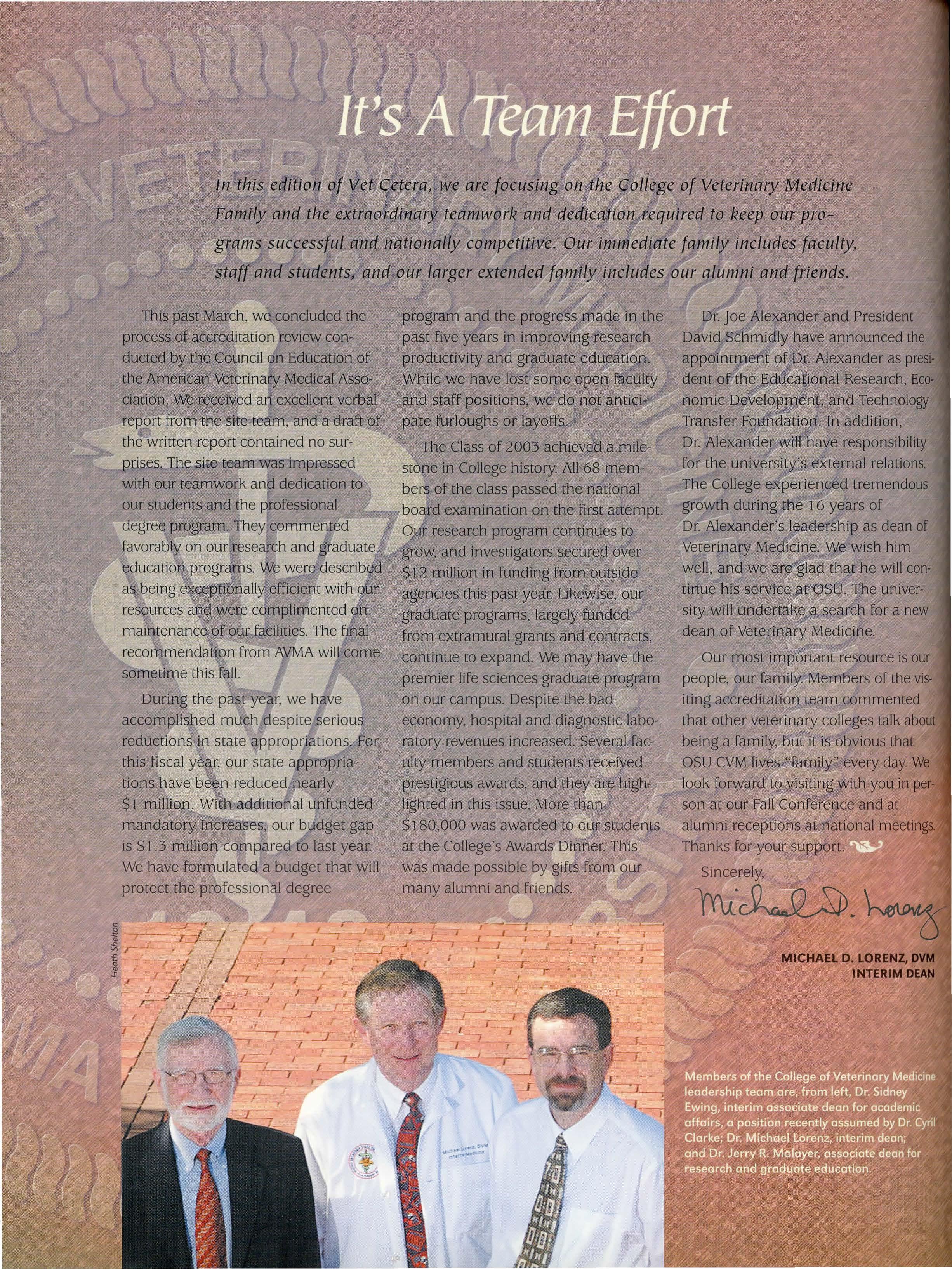
MICHAEL D. LORENZ, DVM INTERIM DEAN
FALL 20
When OSUCollegeof Veterinq;y Medij:ine s! opened itsdoors to the first doss s;}'e<II'$Oj10; • there was a feeling of excitement and an anticipation of important things to come. Todaythis same adventurous spirit continues to resound in the livesof faculty and students and alumni.Muchworkhas already.beendone to improvethe health care of our animal population.It is our hope that this important work and the current CVMresearch willserve as a legocyforthosewhocontinuetofollowinthe Felines compete for the crown footsteps of these first graduates.
Did YouKnow?During the post year the OSUCollege of Veterinary Medici,w Teaching Hospital provided care for more than 7,600 small·animals, includiqg dOQS,cats, exotic species and a variety of wildlif.e,and 3,700 large animals. In addition, hbspital personnel provided on-the-farm carefor approximately41,SQ0 animals.
Please join us at the CVM website: www.cvm.okstate.edu.lbe-OSU homepage is located at www.okstote.edu.
In Collegeof Michael n u ,c e ations/ KatieFe
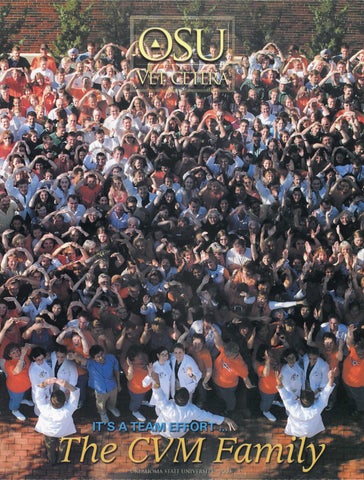
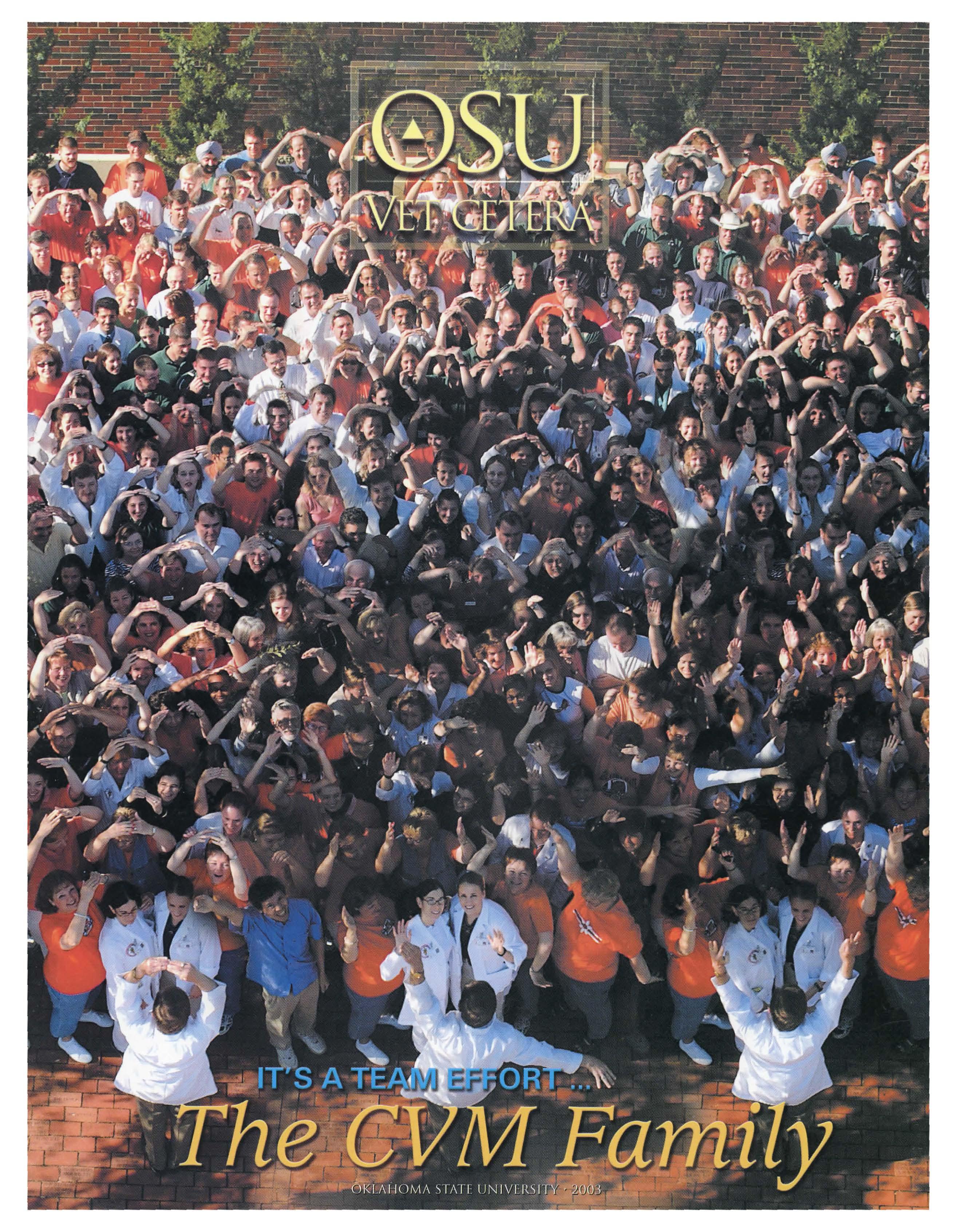
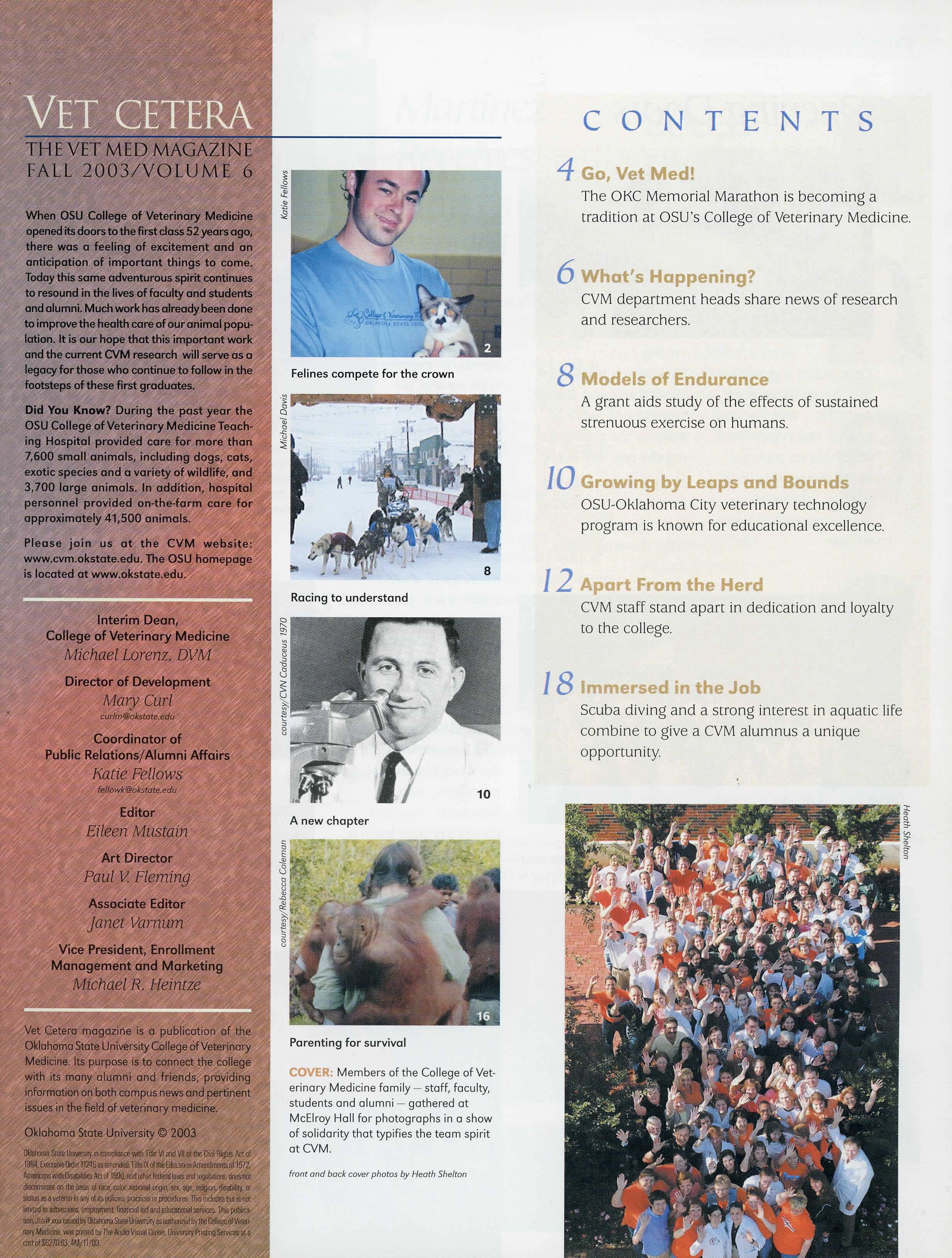
COVER: Members of the College of Veterinary Medicine family - staff, faculty, students and alumni - gathered at McElray Hall far photographs in a show of solidarity that typifies the team spirit at CVM. front and back cover photos by Heath Shelton
CONTENTS
4 Go, Vet Med!
The OKC Memorial Marathon is becoming a tradition at OSU's College of Veterinary Medicine.
6
What's Happening?
CVM department heads share news of research and researchers.
8
Models of Endurance
A grant aids study of the effects of sustained strenuous exercise on humans.
JOGrowing by Leaps and Bounds
OSU-Oklahoma City veterinary technology program is known for educational excellence.
J2 Apart From the Herd
CVM staff stand apart in dedication and loyalty to the college
J8 Immersed ·n the Job
Scuba diving and a strong interest in aquatic life combine to give a CVM alumnus a unique opportunity
Racing to understand
A new chapter
Parenting for survival
OpeningDoors
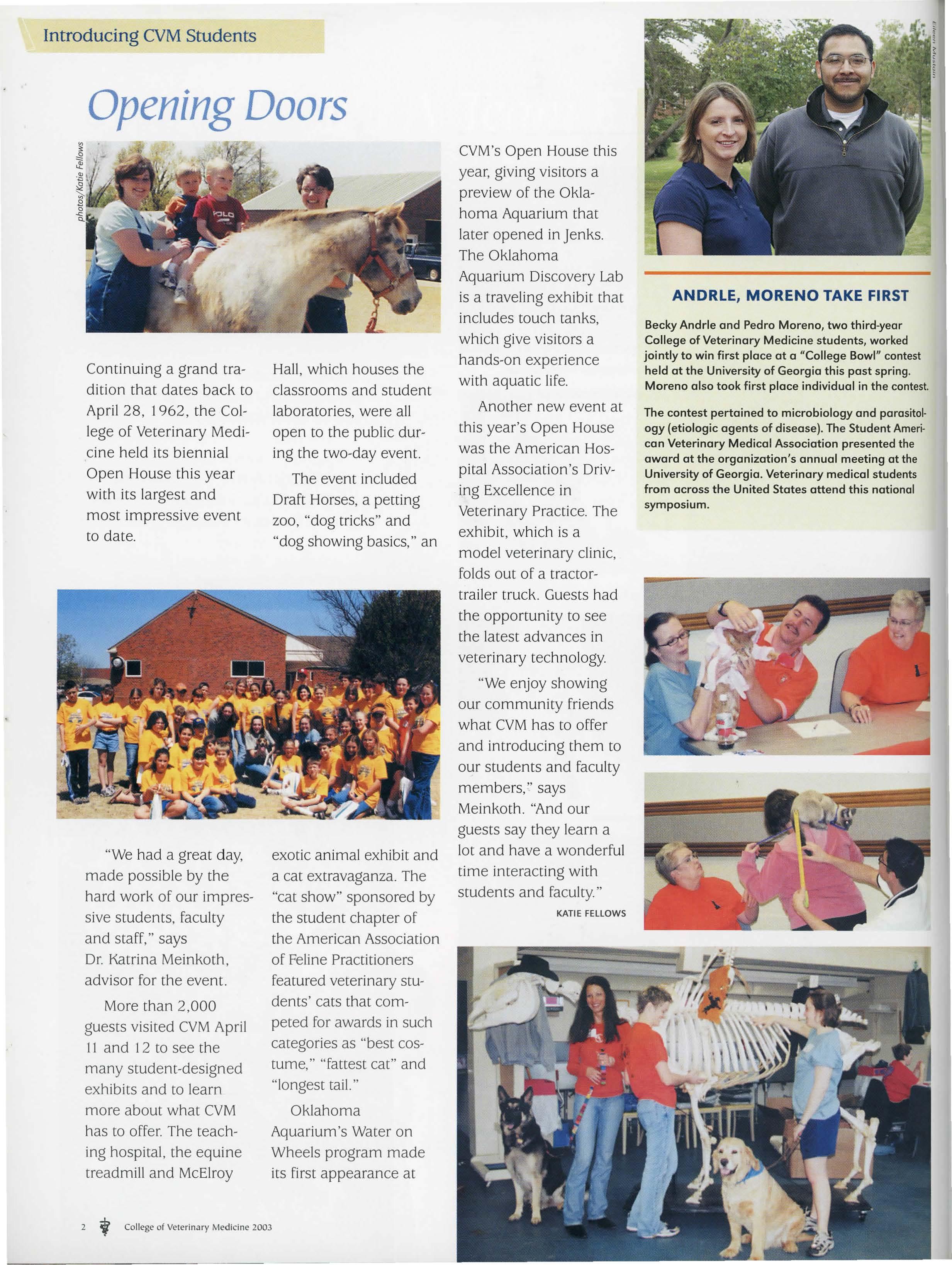
Continuing a grand tradition that dates back to April 28, 1962, the College of Veterinary Medicine held its biennial Open House this year with its largest and most impressive event to date.
Hall, which houses the classrooms and student laboratories, were all open to the public during the two-day event.
The event included Draft Horses, a petting zoo, "dog tricks" and "dog showing basics," an
CVM's Open House this year, giving visitors a preview of the Oklahoma Aquarium that later opened in Jenks. The Oklahoma Aquarium Discovery Lab is a traveling exhibit that includes touch tanks, which give visitors a hands-on experience with aquatic life.
Another new event at this year's Open House was the American Hospital Association's Driving Excellence in Veterinary Practice. The exhibit, which is a model veterinary clinic, folds out of a tractortrailer truck. Guests had the opportunity to see the latest advances in veterinary technology.
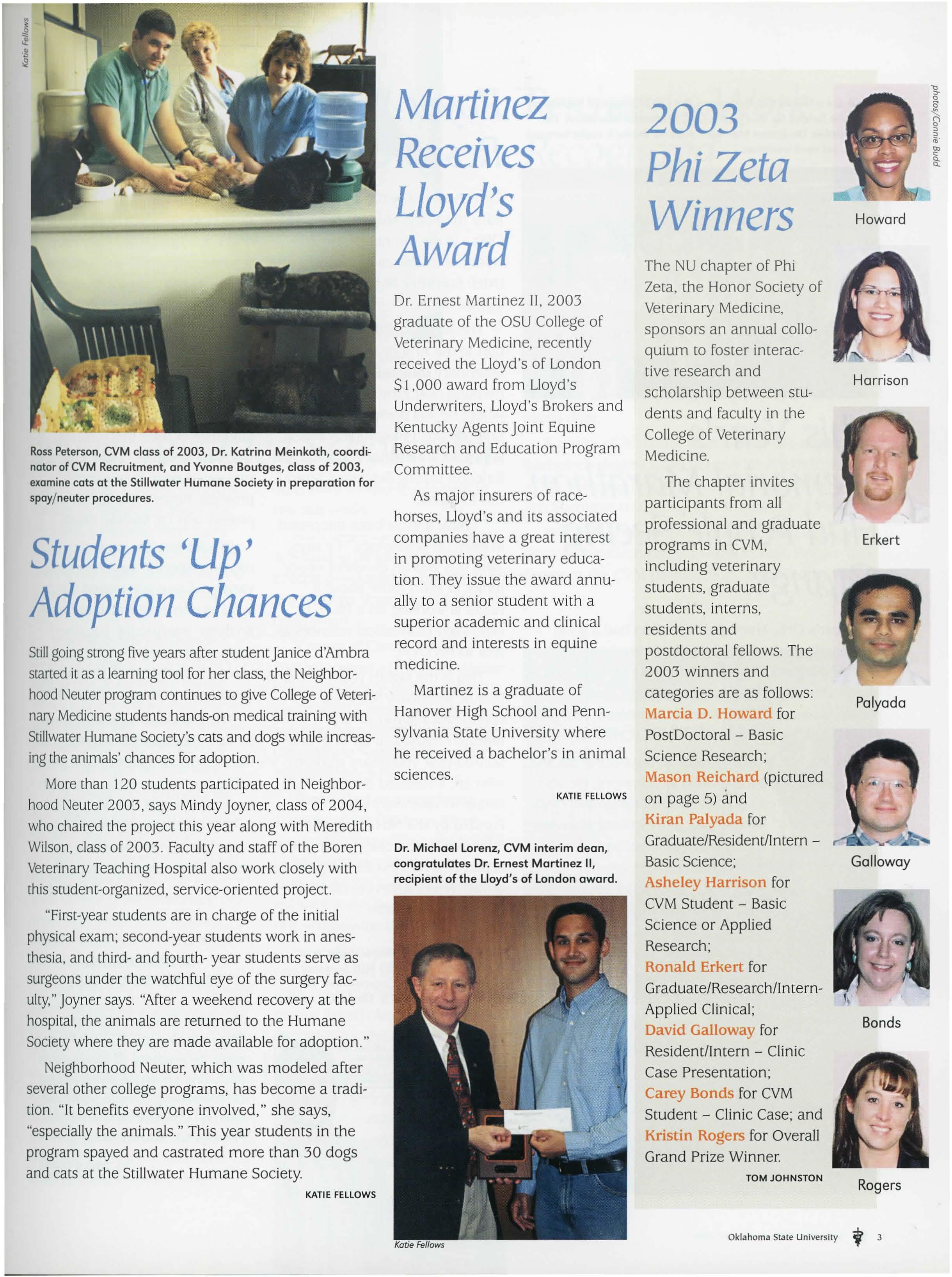
ANDRLE, MORENO TAKE FIRST
Becky Andrle and Pedro Moreno, two third-year College of Veterinary Medicine students, worked jointly to win first place at a "College Bowl" contest held at the University of Georgia this past spring. Mareno also took first place individual in the contest.
The contest pertained to microbiology and parasitology (etiologic agents of disease). The Student American Veterinary Medical Association presented the award at the organization's annual meeting at the University of Georgia. Veterinary medical students from across the United States attend this national symposium.
"We had a great day, made possible by the hard work of our impressive students, faculty and staff," says Dr. Katrina Meinkoth, advisor for the event.
More than 2,000 guests visited CVM April 11and I 2 to see the many student-designed exhibits and to learn more about what CVM has to offer. The teaching hospital, the equine treadmill and McElroy
exotic animal exhibit and a cat extravaganza. The "cat show" sponsored by the student chapter of the American Association of Feline Practitioners featured veterinary students' cats that competed for awards in such categories as "best costume," "fattest cat" and "longest tail."
Oklahoma Aquarium's Water on Wheels program made its first appearance at
"We enjoy showing our community friends what CVM has to offer and introducing them to our students and faculty members," says Meinkoth. "And our guests say they learn a lot and have a wonderful time interacting with students and faculty."
KATIE FELLOWS
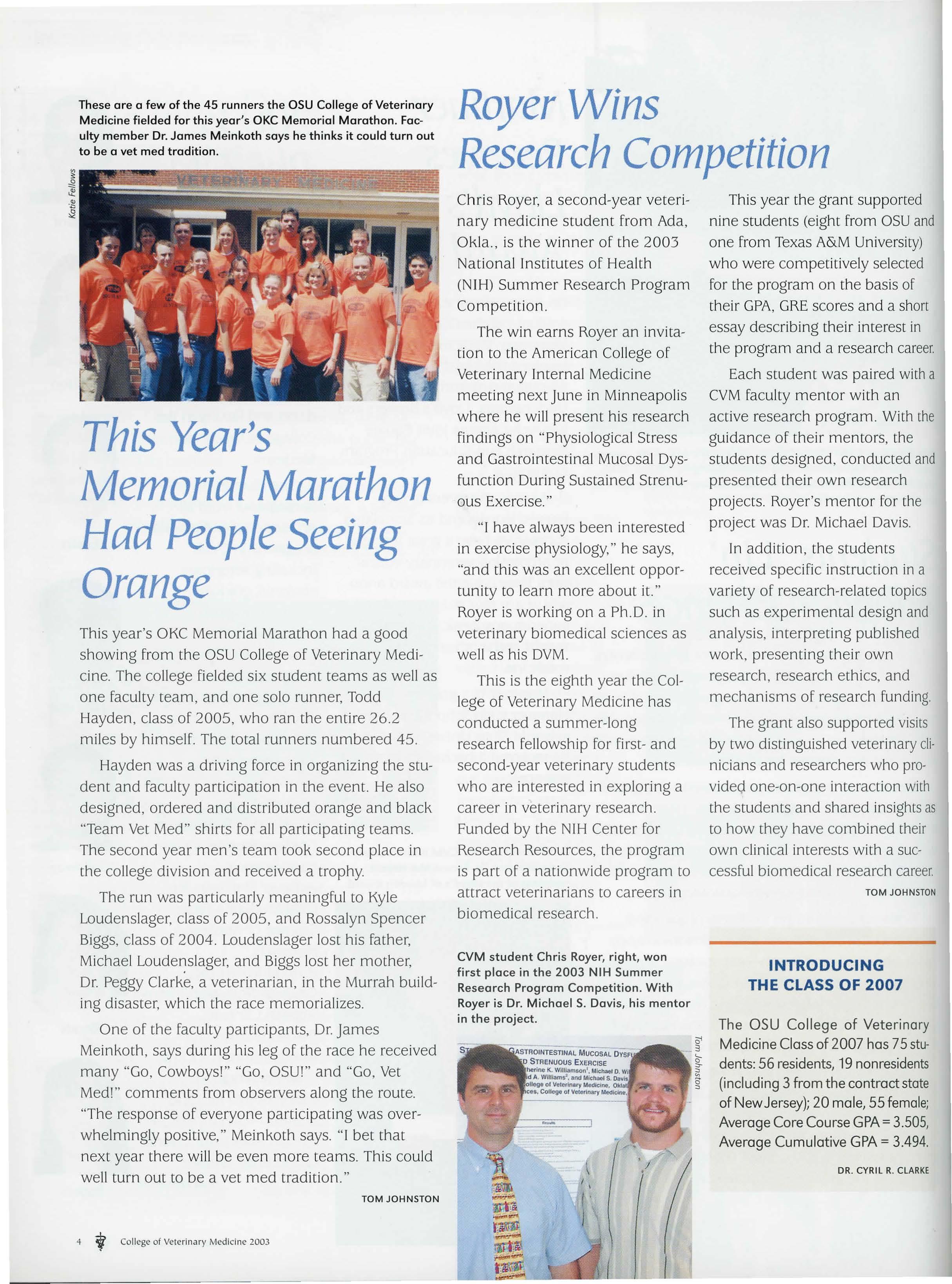
RossPeterson, CVM class of 2003, Dr. Katrina Meinkoth, coordinator of CVM Recruitment, and Yvonne Boutges, class of 2003, examinecots at the Stillwater Humane Society in preparation for spay/neuter procedures.
Students'Up' AdoptionChances
Stillgoingstrong five years after student Janice d'Ambra startedit as a learning tool for her class,the Neighborhood Neuterprogram continues to give College of Veterinary Medicinestudents hands-on medical training with StillwaterHumane Society'scats and dogs while increasing the animals' chancesfor adoption.
More than 120 students participated in Neighborhood Neuter 2003, says Mindy Joyner, class of 2004, who chaired the project this year along with Meredith Wilson, classof 2003. Faculty and staff of the Boren VeterinaryTeaching Hospital also work closely with this student-organized, service-oriented project.
"First-year students are in charge of the initial physicalexam; second-year students work in anesthesia,and third- and f9urth- year students serve as surgeonsunder the watchful eye of the surgery faculty," Joyner says. "After a weekend recovery at the hospital, the animals are returned to the Humane Societywhere they are made available for adoption."
Neighborhood Neuter, which was modeled after severalother college programs, has become a tradition. "It benefits everyone involved," she says, "especially the animals." This year students in the program spayed and castrated more than 30 dogs and cats at the Stillwater Humane Society.
KATIEFELLOWS
Martinez Receives Lloyd's Award
Dr. Ernest Martinez II, 2003 graduate of the OSU College of Veterinary Medicine, recently received the Lloyd's of London $1,000 award from Lloyd's Underwriters, Lloyd's Brokers and Kentucky Agents Joint Equine Research and Education Program Committee.
As major insurers of racehorses, Lloyd's and its associated companies have a great interest in promoting veterinary education. They issue the award annually to a senior student with a superior academic and clinical record and interests in equine medicine.
Martinez is a graduate of Hanover High School and Pennsylvania State University where he received a bachelor's in animal sciences.
Dr. Michael Lorenz, CVM interim dean, congratulates Dr. Ernest Mortinez II, recipient of the Lloyd's of London award.
2003 PhiZeta Winners
The NU chapter of Phi Zeta, the Honor Society of Veterinary Medicine, sponsors an annual colloquium to foster interactive research and scholarship between students and faculty in the College of Veterinary Medicine.
The chapter invites participants from all professional and graduate programs in CVM, including veterinary students, graduate students, interns, residents and postdoctoral fellows. The 2003 winners and categories are as follows: Marcia D. Howard for PostDoctoral - Basic Science Research; Mason Reichard (pictured on page 5) and Kiran Palyada for Graduate/Resident/InternBasic Science; Asheley Harrison for CVM Student - Basic Science or Applied Research; Ronald Erkert for Graduate/Research/InternApplied Clinical; David Galloway for Resident/Intern - Clinic Case Presentation; Carey Bonds for CVM Student - Clinic Case; and Kristin Rogers for Overall Grand Prize Winner.
TOM JOHNSTON
KATIE FELLOWS
Oklahoma State University
Howard
Harrison Erkert
Palyada
Galloway Bonds Rogers
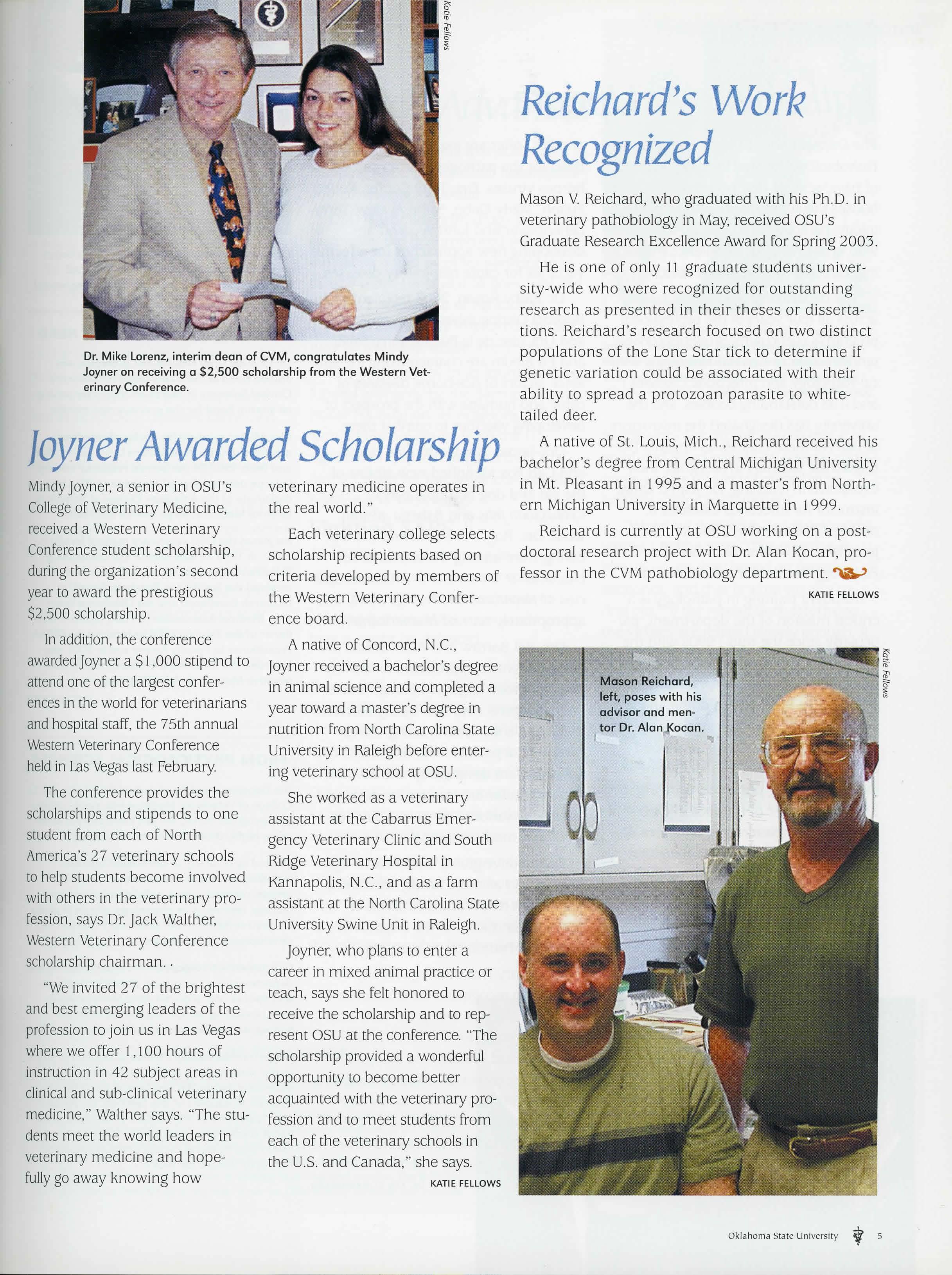
These are a few of the 45 runners the OSU College of Veterinary Medicine fielded for this year's OKC Memorial Marathon. Faculty member Dr. James Meinkoth says he thinks it could turn out to be a vet med tradition.
RoyerWins ResearchCompetition
Chris Royer, a second-year veterinary medicine student from Ada, Okla , is the winner of the 2003 National Institutes of Health (NIH) Summer Research Program Competition.
ThisYear's MemorialMarathon Had PeopleSeeing Orange
This year's OKC Memorial Marathon had a good showing from the OSU College of Veterinary Medicine. The college fielded six student teams as well as one faculty team, and one solo runner, Todd Hayden, class of 2005, who ran the entire 26.2 miles by himself. The total runners numbered 45.
Hayden was a driving force in organizing the student and faculty participation in the event. He also designed, ordered and distributed orange and black "Team Vet Med" shirts for all participating teams. The second year men's team took second place in the college division and received a trophy.
The run was particularly meaningful to Kyle Loudenslager, class of 2005, and Rossalyn Spencer Biggs, class of 2004. Loudenslager lost his father, Michael Loude~slager, and Biggs lose her mother, Dr. Peggy Clarke, a veterinarian, in the Murrah building disaster, which the race memorializes.
One of the faculty participants, Dr. James Meinkoch, says during his leg of the race he received many "Go, Cowboys!" "Go, OSU!" and "Go, Vet Med!" comments from observers along the route. "The response of everyone participating was overwhelmingly positive," Meinkoth says. "I bee that next year there will be even more teams. This could well turn out to be a vet med tradition."
TOM JOHNSTON
The win earns Royer an invitation to the American College of Veterinary Internal Medicine meeting next June in Minneapolis where he will present his research findings on "Physiological Stress and Gastrointestinal Mucosa! Dysfunction During Sustained Strenuous Exercise."
"I have always been interested in exercise physiology," he says, "and this was an excellent opportunity to learn more about it." Royer is working on a Ph.D. in veterinary biomedical sciences as well as his DVM.
This is the eighth year the College of Veterinary Medicine has conducted a summer-long research fellowship for first- and second-year veterinary students who are interested in exploring a career in veterinary research. Funded by the NIH Center for Research Resources, the program is part of a nationwide program to attract veterinarians to careers in biomedical research.
CVM student Chris Royer, right, won first place in the 2003 NIH Summer Research Program Competition. With Royer is Dr. Michael S. Davis, his mentor in the project.
This year the grant supported nine students (eight from OSU and one from Texas A&M University) who were competitively selected for the program on the basis of their GPA,GRE scores and a short essay describing their interest in the program and a research career. Each student was paired with a CVM faculty mentor with an active research program. With the guidance of their mentors, the students designed, conducted and presented their own research projects. Royer's mentor for the project was Dr. Michael Davis.
In addition, the students received specific instruction in a variety of research-related topics such as experimental design and analysis, interpreting published work, presenting their own research, research ethics, and mechanisms of research funding.
The grant also supported visits by two distinguished veterinary cli· nicians and researchers who provided one-on-one interaction with the students and shared insightsas to how they have combined their own clinical interests with a successful biomedical research career.
TOM JOHNSTON
INTRODUCING THE CLASS OF 2007
The OSU College of Veterinary Medicine Class of 2007 has 75 students: 56 residents, 19 nonresidents (including 3 from the contract state of New Jersey); 20 male, 55 female; Average Core Course GPA= 3.505, Average Cumulative GPA= 3.494.
DR. CYRIL R. CLARKE
Dr. Mike Lorenz, interim dean of CVM, congratulates Mindy Joyner on receiving a $2,500 scholarship from the Western Veterinary Conference.
Reichard'sWork Recognized
Mason V. Reichard, who graduated with his Ph.D. in veterinary pathobiology in May, received OSU's Graduate Research Excellence Award for Spring 2003.
He is one of only 11 graduate students university-wide who were recognized for outstanding research as presented in their theses or dissertations. Reichard's research focused on two distinct populations of the Lone Star tick to determine if genetic variation could be associated with their ability to spread a protozoan parasite to whitetailed deer.
JoynerAwardedScholarship
Mindy Joyner, a senior in OSU's Collegeof Veterinary Medicine, receiveda Western Veterinary Conferencestudent scholarship, during the organization's second year to award the prestigious $2,500 scholarship.
In addition, the conference awardedJoyner a $1,000 stipend to attendone of the largest conferencesin the world for veterinarians and hospitalstaff, the 75th annual WesternVeterinary Conference held in LasVegaslast February.
The conference provides the scholarshipsand stipends to one student from each of North America's 27 veterinary schools to help students become involved with others in the veterinary profession,says Dr. Jack Walther, WesternVeterinary Conference scholarshipchairman
"We invited 27 of the brightest and best emerging leaders of the profession to join us in Las Vegas where we offer I, 100 hours of instruction in 42 subject areas in clinical and sub-clinical veterinary medicine," Walther says. "The students meet the world leaders in veterinary medicine and hopefully go away knowing how
veterinary medicine operates in the real world."
Each veterinary college selects scholarship recipients based on criteria developed by members of the Western Veterinary Conference board.
A native of Concord, N.C., Joyner received a bachelor's degree in animal science and completed a year toward a master's degree in nutrition from North Carolina State University in Raleigh before entering veterinary school at OSU.
She worked as a veterinary assistant at the Cabarrus Emergency Veterinary Clinic and South Ridge Veterinary Hospital in Kannapolis, N.C., and as a farm assistant at the North Carolina State University Swine Unit in Raleigh.
Joyner, who plans to enter a career in mixed animal practice or teach, says she felt honored to receive the scholarship and to represent OSU at the conference. "The scholarship provided a wonderful opportunity to become better acquainted with the veterinary profession and to meet students from each of the veterinary schools in the U.S. and Canada," she says.
KATIE FELLOWS
A native of St. Louis, Mich., Reichard received his bachelor's degree from Central Michigan University in Mt. Pleasant in 1995 and a master's from Northern Michigan University in Marquette in 1999.
Reichard is currently at OSU working on a postdoctoral research project with Dr. Alan Kocan, professor in the CVM pathobiology department.
KATIE FELLOWS
Mason Reichard, left, poses with his advisor and mentor Dr. Alan !(aeon.
PathobiologyUpdate
The Department of Veterinary Pathobiology, formed by reorganization of basic science disciplines in 2000, houses faculty in microbiology, parasitology, pathology and related disciplines who are striving for excellence in teaching, directed service and research.
The department teaches courses across all four years of the professional program's curriculum. Students consistently recognize General Pathology, Clinical Pathology and Infectious Diseases I and II as outstanding courses, and the university has designated the instructors of each of these courses as Regents Distinguished Teachers to recognize their excellence in teaching. Dr. Jean d'Offay, instructor for Infectious Diseases II, received this award in 2002, and Dr. Jerry Ritchey, instructor in General Pathology, received the 2003 award.
Resident training in pathology is a critical mission of the department, particularly since the mid- I 990s with the manpower shortage in board certified veterinary pathologists. Ors. R.ick Cowell and James Meinkoth are doing an excellent job of training veterinarians as clinical pathologists. Rick has developed commercial sponsorship for two new resident training positions, bringing to four the number of trainees in OSU's program. The pass rate for trainees on the certification examination is excellent, with most certified during their first sitting of the boards.
SeveralVeterinary Pathobiology faculty havejoint appointments for directed service in the Oklahoma Animal Disease Diagnostic Laboratory.Ors. Bill Johnson, Jerry Saliki, Stanley Vanhooser,Uriel BlasMachado and Grant Rezabekare sought by veterinary practitioners and producers for their diagnostic expertise to the equine, food animal and poultry industries.
Departmental faculty members play crucial roles in basic and applied research that impacts real-world problems. Ors. Richard Eberle, Jerry Ritchey
and Bill Meier are exploring the genetic basis for the pathogenesis of primate herpes viruses. Ors. Tony Confer, Robert Fulton, Mady Dabo, Salhu Ayalew, Terry Lehenbauer and John Wyckoff are developing new approaches for effective vaccines for cattle respiratory diseases.
Dr. Kathy Kocan, 2003 recipient of the Regents Distinguished Research Award, and Ors. Jose de la Fuente, Jerry Saliki and Ed Blouin are characterizing the virulence factors of tick-borne diseases of cattle and humans with the prospect of developing vaccines to combat these.
Ors. James Meinkoth, Alan Kocan, and Carl Fox identified new strains of the cat and dog hemoparasites
Cytauxzoonjelis and Babesia gibsoni, while Ors. Roger Panciera and Sidney Ewing were among the scientists to characterize a new North American species of Hepatozoonan in dogs newly and appropriately named H americanum.
Ors. Bill Barrow and Alain Stintzi are using genomics approaches to identify new antibiotic targets in human bacterial pathogens. And Ors. Becky Morton and Ken Clinkenbeard, along with a commercial partner, Nomadics, Inc. of Stillwater, are developing new devices and molecular diagnostics for detecting biological warfare agents in air, water, food, and medical samples.
Competitive grants from federal agencies support all these faculty members, resulting in more than $2 million of research conducted in the Department of Veterinary Pathobiology every year.
Veterinary Pathobiology faculty continue to be recognized for excellence in service of the University. Dr. Tony Confer was selected for the 2003 Eminent Faculty Award, the highest recognition for faculty excellence. The first recipien~ of this award was Dr. Sidney Ewing, making Veterinary Pathobiology the only department to have two faculty members recognized with this award. DR. KEN CLINKENBEARD
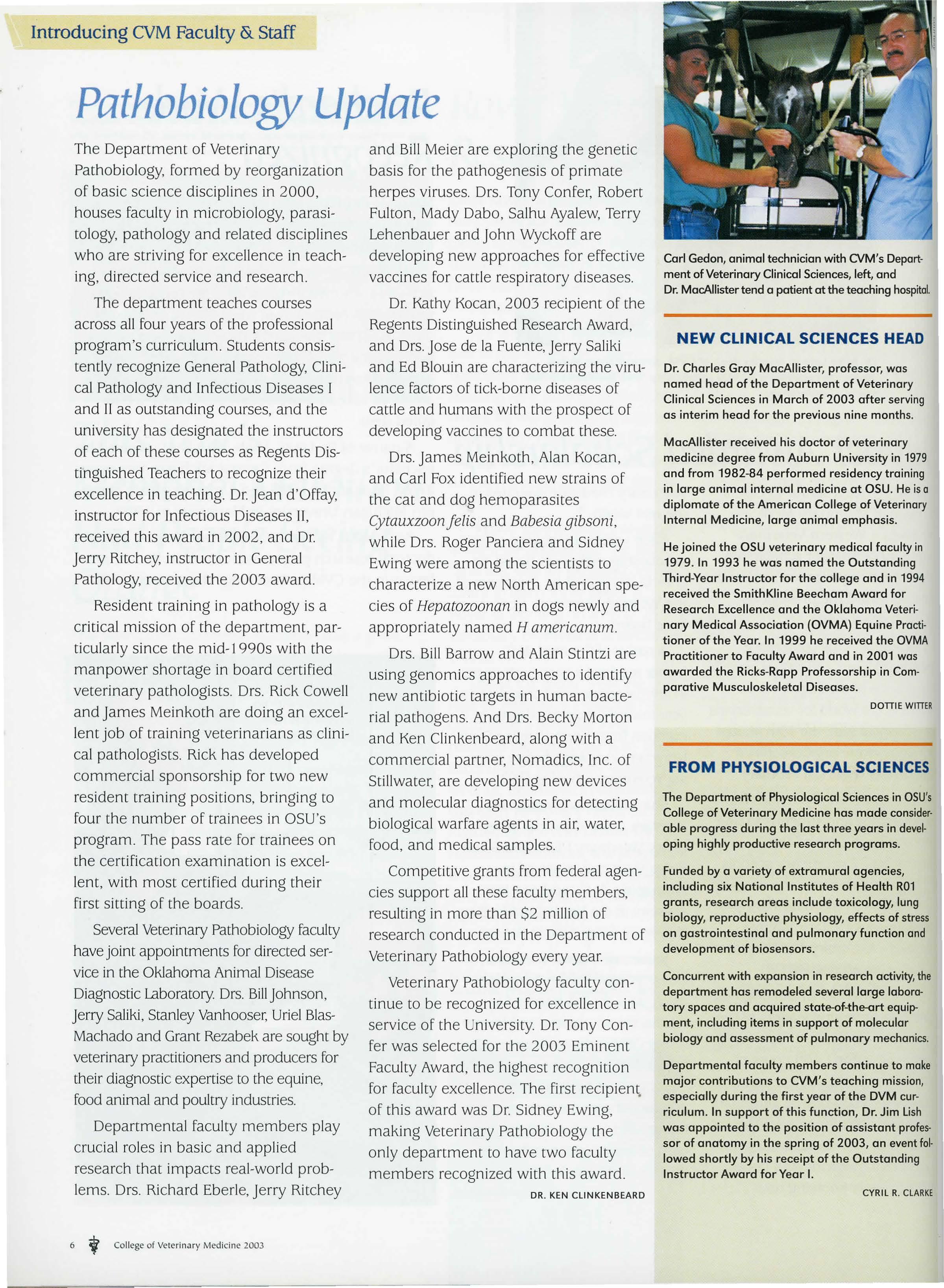
and Dr. MacAllistertend a patient at the teachinghospital.
NEW CLINICAL SCIENCES HEAD
Dr. Charles Gray MacAllister, professor, was named head of the Department of Veterinary Clinical Sciences in March of 2003 after serving as interim head for the previous nine months.
MacAllister received his doctor of veterinary medicine degree from Auburn University in 1979 and from 1982-84 performed residency training in large animal internal medicine at OSU. He is a diplomate of the American College of Veterinary Internal Medicine, large animal emphasis.
He joined the OSU veterinary medical faculty in 1979. In 1993 he was named the Outstanding Third-Year Instructor for the college and in 1994 received the SmithKline Beecham Award for Research Excellence and the Oklahoma Veterinary Medical Association (OVMA) Equine Practitioner of the Year. In 1999 he received the OVMA Practitioner to Faculty Award and in 2001 was awarded the Ricks-Rapp Professorship in Comparative Musculoskeletal Diseases.
DOTTIE WITTER
FROM PHYSIOLOGICAL SCIENCES
The Department of Physiological Sciences in OSU's College of Veterinary Medicine has made considerable progress during the last three years in developing highly productive research programs.
Funded by a variety of extramural agencies, including six National Institutes of Health R01 grants, research areas include toxicology, lung biology, reproductive physiology, effects of stress on gastrointestinal and pulmonary function ond development of biosensors.
Concurrent with expansion in research activity, the department has remodeled several large laboratory spaces and acquired state-of-the-art equipment, including items in support of molecular biology and assessment of pulmonary mechanics.
Departmental faculty members continue to make major contributions to CVM's teaching mission, especially during the first year of the DVM curriculum. In support of this function, Dr. Jim Lish was appointed to the position of assistant professor of anatomy in the spring of 2003, an event followed shortly by his receipt of the Outstanding Instructor Award for Year I.
CYRIL R. CLARKE
Carl Gedon, animal technicianwith CVM's Department of Veterinary ClinicalSciences,left,
'ShippingFever'ResearchAdvances
'BeefingUp' the Industry
Currentresearchat the College of Veterinary Medicine has the potential to save U.S.beef producers millions of dollars annually.
Dr.Anthony Confer, veterinary pathologist,and Dr. Robert Fulton, veterinaryvirologist, are collaborators on a five-year,$2.4 million research project to combatbovine respiratory disease, also knownas shipping fever, a severe pneumoniathat costs beef producers more thanall other cattle diseases combined.
Shipping fever most typically afflicts weanedcalves that are more susceptible to viruses, especially when they are stressedfrom being transported and intermingled with new cattle from other sources.The viruses weaken calves' immune systems creating conditions for bacterial infections that can ultimately result in chronic illness or death at an estimated cost of S1 billion a year.
The research goals are to decode shipping fever's pathology, determine its causesand successful treatments, developvaccines to control new strains of viruses and bacteria and improve prevention practices.
Fulton has researched the bovine viral diarrhea virus for several years and sayshe hopes OSU can approach a commercial partner in the future to help developand field test an improved vaccine for it. "But there's still work to be done before we reach that point."
Confer has spent over 20 years studying two bacteria responsible for
the severe pneumonia that occurs in shipping fever: Mannheimia haemolytica and Pasteurella multocida.
OSU is working with drug companies to develop the first improved vaccine for the bacteria and possibly participate in clinical trials. He says if all goes well and the U.S. Department of Agriculture approves it, a greatly improved vaccine may be available within five years.
The project, now in its fourth year, is funded primarily by the Samuel Roberts Noble Foundation, of Ardmore, Okla., with additional grants from the U.S. Agriculture Department and the Oklahoma Center for the Advancement of Science and Technology.
Fighting SARS
Another aspect of shipping fever under study is a bovine respiratory coronavirus that might provide a clue as to how the human SARS virus works and how it might be defeated.
Existence of the Bovine Respiratory Coronavirus is not news, Confer says, nor is OSU the only institution researching it. He says evidence of the virus' existence in the nasal cavity of calves was first published in I 985, and Louisiana State and Ohio State Universities published studies suggesting the connection of the coronavirus with shipping fever in 2000.
The coronavirus (so named because of a halo-like appearance that surrounds it in electron microscope pictures) is a member of the same family of the virus thought responsible for the Severe Acute
'CONFER'RING TOP HONORS
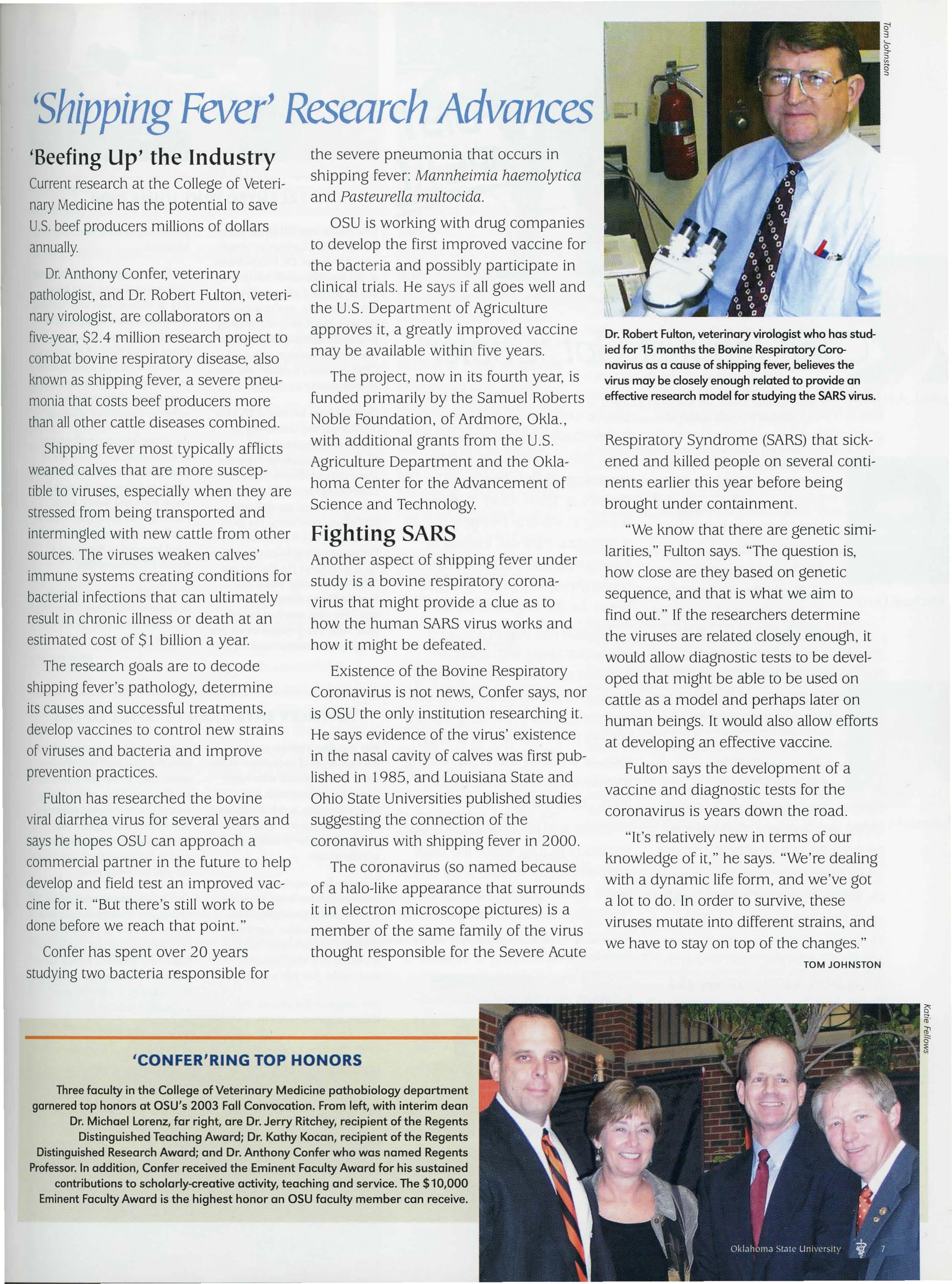
Three faculty in the College of Veterinary Medicine pathobiology department garnered top honors at OSU's 2003 Fall Convocation. From left, with interim dean Dr. Michael Lorenz, far right, are Dr. Jerry Ritchey, recipient of the Regents Distinguished Teaching Award; Dr. Kathy Kocon, recipient of the Regents Distinguished Research Award; and Dr. Anthony Confer who was named Regents Professor.In addition, Confer received the Eminent Faculty Award for his sustained contributions to scholarly-creative activity, teaching and service. The $10,000 Eminent Faculty Award is the highest honor an OSU faculty member can receive.
Dr. Robert Fulton,veterinary virologistwho has studied for 15 monthsthe BovineRespiratoryCoronavirusas a cause of shippingfever,believesthe virus may be closelyenough related to providean effectiveresearchmodel for studyingthe SARSvirus.
Respiratory Syndrome (SARS)that sickened and killed people on several continents earlier this year before being brought under containment.
"We know that there are genetic similarities," Fulton says. "The question is, how close are they based on genetic sequence, and that is what we aim to find out." If the researchers determine the viruses are related closely enough, it would allow diagnostic tests to be developed that might be able to be used on cattle as a model and perhaps later on human beings. It would also allow efforts at developing an effective vaccine.
Fulton says the development of a vaccine and diagnostic tests for the coronavirus is years down the road.
"It's relatively new in terms of our knowledge of it," he says. "We're dealing with a dynamic life form, and we've got a lot to do. In order to survive, these viruses mutate into different strains, and we have to stay on top of the changes."
TOM JOHNSTON
'Cool'JobJustGot 'Cooler'
You might say Dr. Michael Davis has a "cool" research job that just got "cooler."
Michael Davis
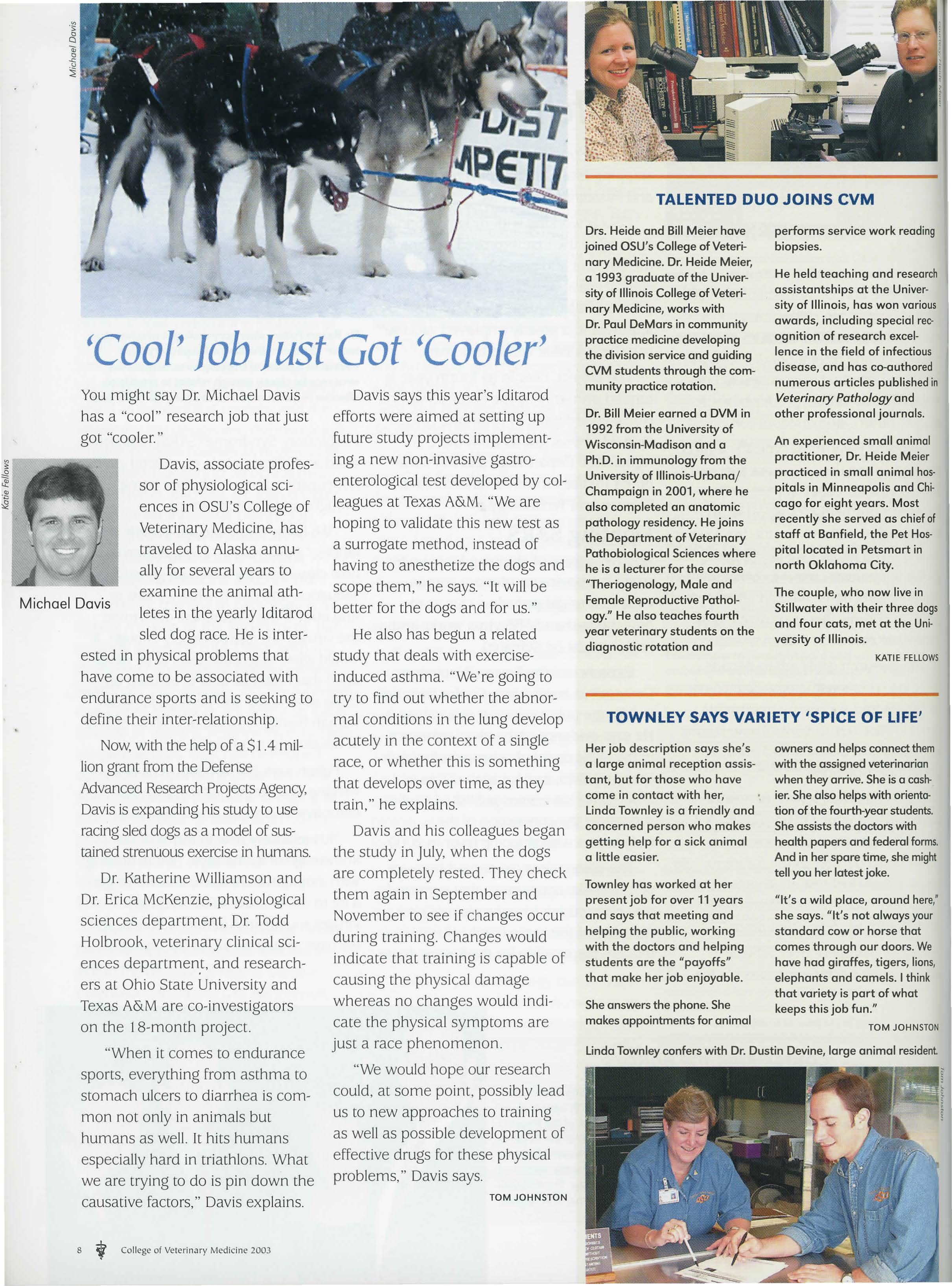
Davis, associate professor of physiological sciences in OSU's College of Veterinary Medicine, has traveled to Alaska annually for several years to examine the animal athletes in the yearly lditarod sled dog race. He is interested in physical problems that have come to be associated with endurance sports and is seeking to define their inter-relationship.
Now, with the help of a $1 .4 million grant from the Defense Advanced ResearchProjectsAgency, Davis is expanding his study to use racing sled dogs as a model of sustained strenuous exercisein humans.
Dr. Katherine Williamson and Dr. Erica McKenzie, physiological sciences department, Dr. Todd Holbrook, veterinary clinical sciences departmen_t, and researchers at Ohio State University and Texas A&M are co-investigators on the 18-month project.
"When it comes to endurance sports, everything from asthma to stomach ulcers to diarrhea is common not only in animals but humans as well. It hits humans especially hard in triathlons. What we are trying to do is pin down the causative factors," Davis explains.
Davis says this year's lditarod efforts were aimed at setting up future study projects implementing a new non-invasive gastroenterological test developed by colleagues at Texas A&M. "We are hoping to validate this new test as a surrogate method, instead of having to anesthetize the dogs and scope them," he says. "It will be better for the dogs and for us."
He also has begun a related study that deals with exerciseinduced asthma. "We're going to try to find out whether the abnormal conditions in the lung develop acutely in the context of a single race, or whether this is something that develops over time, as they train," he explains.
Davis and his colleagues began the study in July, when the dogs are completely rested. They check them again in September and November to see if changes occur during training. Changes would indicate that training is capable of causing the physical damage whereas no changes would indicate the physical symptoms are just a race phenomenon.
"We would hope our research could, at some point, possibly lead us to new approaches to training as well as possible development of effective drugs for these physical problems." Davis says.
TOM JOHNSTON
TALENTED DUO JOINS CVM
Drs. Heide and Bill Meier have joined OSU's College of Veterinary Medicine. Dr. Heide Meier, a 1993 graduate of the University of Illinois College of Veterinary Medicine, works with Dr. Paul DeMars in community practice medicine developing the division service and guiding CVM students through the community practice rotation.
Dr. Bill Meier earned a DVM in 1992 from the University of Wisconsin-Madison and a Ph.D. in immunology from the University of Illinois-Urbana/ Champaign in 2001, where he also completed an anatomic pathology residency. He joins the Department of Veterinary Pathobiological Sciences where he is a lecturer for the course "Theriogenology, Male and Female Reproductive Pathology." He also teaches fourth year veterinary students on the diagnostic rotation and
performs service work reading biopsies.
He held teaching and research assistantships at the University of Illinois, has won various awards, including special recognition of research excellence in the field of infectious disease, and has co-authored numerous articles published in Veterinary Pathology and other professional journals.
An experienced small animal practitioner, Dr. Heide Meier practiced in small animal hospitals in Minneapolis and Chicago for eight years. Mast recently she served as chief of staff at Banfield, the Pet Hospital located in Petsmart in north Oklahoma City.
The couple, who now live in Stillwater with their three dogs and four cats, met at the University of Illinois.
KATIE FELLOWS
TOWNLEY SAYS VARIETY 'SPICE OF LIFE'
Her job description says she's a large animal reception assistant, but for those who have come in contact with her, Linda Townley is a friendly and concerned person who makes getting help for a sick animal a little easier.
Townley has worked at her present job for over 11 years and says that meeting and helping the public, working with the doctors and helping students are the "payoffs" that make her job enjoyable.
She answers the phone. She makes appointments for animal
owners and helps connect them with the assigned veterinarian when they arrive. She is a cashier. She also helps with orientation of the fourth-year students. She assists the doctors with health papers and federal forms. And in her spare time, she might tell you her latest joke.
"It's a wild place, around here," she says. "It's not always your standard cow or horse that comes through our doors. We have had giraffes, tigers, lions, elephants and camels. I think that variety is part of what keeps this job fun."
TOM JOHNSTON
Linda Townley confers with Dr. Dustin Devine, large animal resident.
SettingthePace
TheOSUCollege of Veterinary Medicine teaching hospital initiated a newdiagnostic program this last summer aimed at diagnosing health problemsin non-productive racehorses.
"We look for problemswith lung performance,cardiac problems,subtle lamenessand muscle soreness,"says Dr. Mike Davis,director of the program. "Those are the 'big four' that either makeor break a horse's athletic performance."
Although horse ownersare adept at sensing when their horses have problems, some problems that impair performance are difficult or impossible to detect without specialized equipment, Davis says.
"Horse owners can makea guess at treatment, but if they are wrong,they've lost even more money in treatment
costs, training and board expenses and lost entry fees. In addition, most performance horses have multiple problems, so even if owners find the most obvious ones, they may not have found everything or even the most important problem."
The CVM program, which aims at uncovering hidden physical problems, is one of only a few veterinary schools in the nation to offer this service, Davis says, and he hopes the information uncovered in the study will help veterinarians in the field to spot and diagnose problems earlier.
The program revolves around two pieces of high-tech equipment, a force plate and an equine treadmill. When a horse steps on the force plate, a signal is fed to a computer that instantly shows a three dimensional representation of the downward force of
the horse's hoof. Veterinarians can tell whether a horse is avoiding putting equal weight on its legs, even if the avoidance is very subtle. What may not be obvious to the eye cannot escape the force plate analysis.
The equine treadmill is similar to most treadmills only larger and more durable. It has the capability to take a horse from a walk to a trot to full gallop. While the horse is at full gallop, an endoscope looks for lung and airway problems and an electrocardiogram monitors heart performance.
The diagnostic service costs $600, nearly half what other schools charge, Davis says. "Initially, we want to demonstrate the value of the service. Once people realize the program may pay them back four or five times what they've spent in diagnostics, I think we will have made our case."
TOM JOHNSTON
SMITH RECEIVES AABP HIGHEST HONOR
Dr. Robert A. Smith, OSU College of Veterinary Medicine faculty member, is the American Association of Bovine Practitioners' 2003 Bovine Practitioner of the Year. The award is AABP's highest honor and is presented for service and contributions ta the cattle veterinary medicine profession.
Smith, a retired army lieutenant colonel, earned his DVM from Kansas State University and joined OSU in 1976. He served in the clinical services department until his retirement last summer. A diplomate in the American College of Veterinary Practitioners, Smith was named McCasland Endowed Chair for Beef Cattle Health and Production in 1991.
In 1997 he received the AABP Meriel Award for Excellence in Preventative Veterinary Medicine and was named Oklahoma Food
Animal Practitioner of the Year. He also received the Award for Excellence in Beef Preventative Veterinary Medicine in 1998 from AABP and the MSD AGVET division of Merck Pharmaceuticals. Smith has served as editor of The Bovine Practitioner since 1998.
MELENDEZ, DISTINGUISHED TEACHER
Dr. Lynda Melendez received the OSU College of Veterinary Medicine's 2003 Norden Distinguished Teaching Award this spring. Dr. Michael Lorenz and Dr. Anthony Confer, the 2002 Norden winner, presented the $1,000 award. Student and faculty peers select the Norden winner based on character, leadership and teaching ability. Melendez, assistant professor in the Department of Veterinary Clinical Sciences, also received the Class Teaching Award presented by the Class of 2003. The graduating class votes by ballot to select the winner of this teaching award, which is given far outstanding instruction during the fourth-year of the veterinary medicine curriculum.
SALIKI RECEIVES PFIZER AWARD
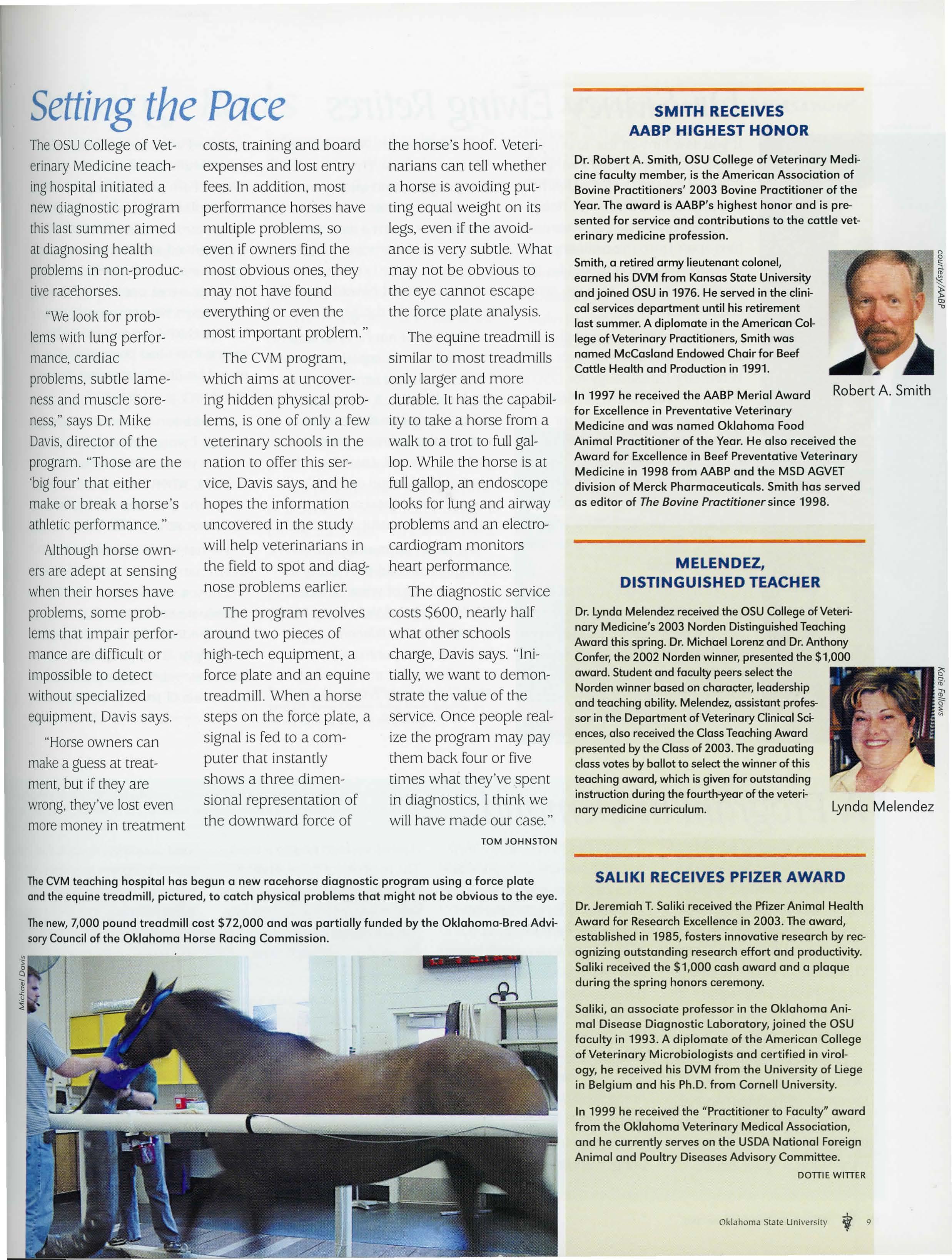
funded by the Oklahoma-Bred Advisory Council of the Oklahoma Horse Racing Commission.
Dr. Jeremiah T. Saliki received the Pfizer Animal Health Award for Research Excellence in 2003. The award, established in 1985, fosters innovative research by recognizing outstanding research effort and productivity. Saliki received the $1,000 cash award and a plaque during the spring honors ceremony.
Saliki, an associate professor in the Oklahoma Animal Disease Diagnostic Laboratory, joined the OSU faculty in 1993. A diplomate of the American College of Veterinary Microbiologists and certified in virology, he received his DVM from the University of Liege in Belgium and his Ph.D. from Cornell University.
In 1999 he received the "Practitioner to Faculty" award from the Oklahoma Veterinary Medical Association, and he currently serves on the USDA National Foreign Animal and Poultry Diseases Advisory Committee.
DOTTIE WITTER
TheCVM teaching hospital has begun a new racehorse diagnostic program using a farce plate and the equine treadmill, pictured, to catch physical problems that might not be obvious to the eye.
Thenew, 7,000 pound treadmill cost $72,000 and was partially
Robert A. Smith
Lynda Melendez
TomJohnston
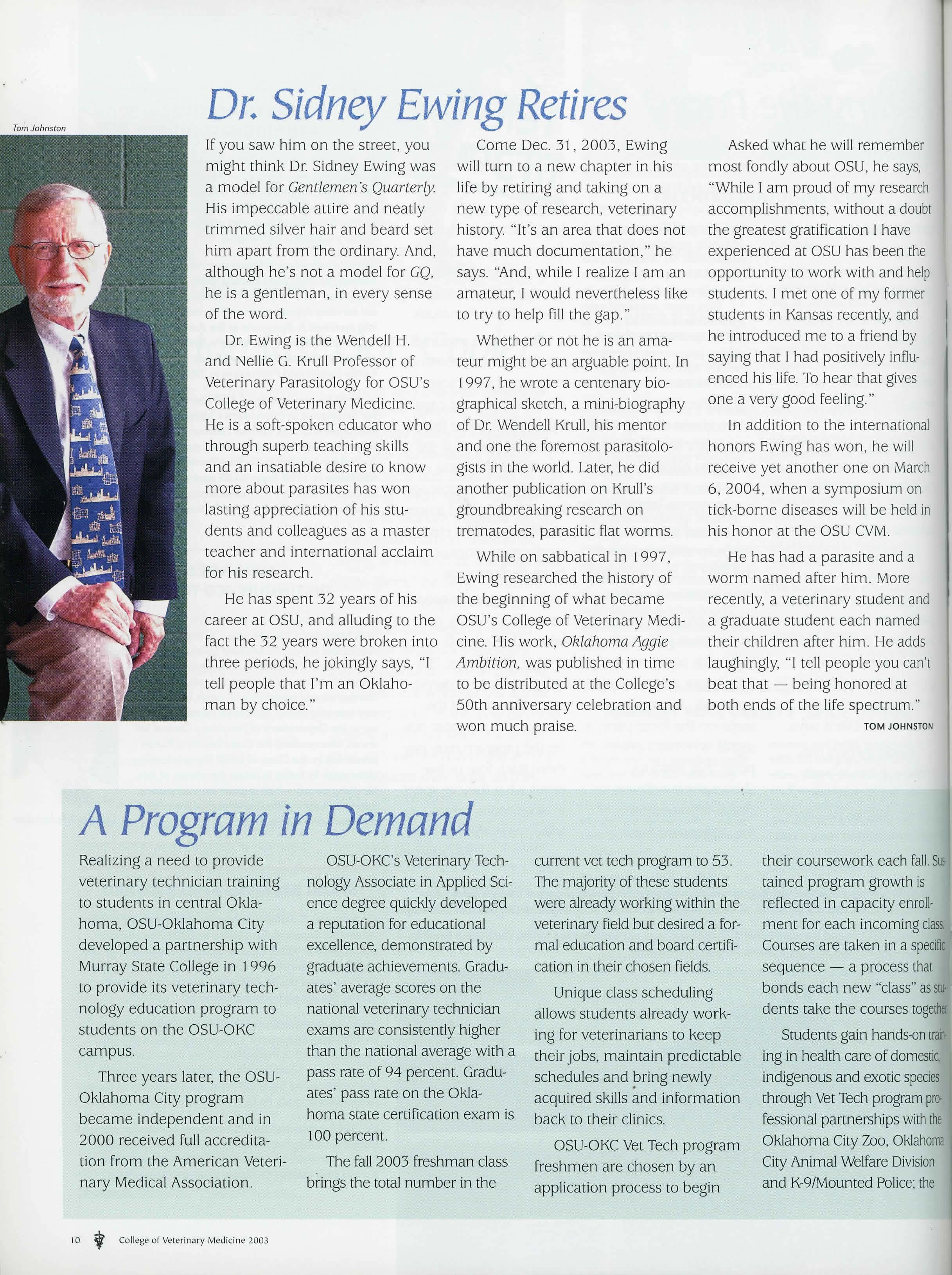
Dr. SidneyEwingRetires
If you saw him on the street, you might think Dr. Sidney Ewing was a model for Gentlemen's Quarterly. His impeccable attire and neatly trimmed silver hair and beard set him apart from the ordinary. And, although he's not a model for CQ, he is a gentleman, in every sense of the word.
Dr. Ewing is the Wendell H. and Nellie G. Krull Professor of Veterinary Parasitology for OSU's College of Veterinary Medicine. He is a soft-spoken educator who through superb teaching skills and an insatiable desire to know more about parasites has won lasting appreciation of his students and colleagues as a master teacher and international acclaim for his research.
He has spent 32 years of his career at OSU, and alluding to the fact the 32 years were broken into three periods, he jokingly says, "I tell people that I'm an Oklahoman by choice."
Come Dec. 31, 2003, Ewing will turn to a new chapter in his life by retiring and taking on a new type of research, veterinary history. "It's an area that does not have much documentation," he says. "And, while I realize I am an amateur, I would nevertheless like to try to help fill the gap."
Whether or not he is an amateur might be an arguable point. In 1997, he wrote a centenary biographical sketch, a mini-biography of Dr. Wendell Krull, his mentor and one the foremost parasitologists in the world. Later, he did another publication on Krull's groundbreaking research on trematodes, parasitic flat worms.
While on sabbatical in 1997, Ewing researched the history of the beginning of what became OSU's College of Veterinary Medicine. His work, Oklahoma Aggie Ambition, was published in time to be distributed at the College's 50th anniversary celebration and won much praise.
A Programin Demand
Realizing a need to provide veterinary technician training to students in central Oklahoma, OSU-Oklahoma City developed a partnership with Murray State College in 1996 to provide its veterinary technology education program to students on the OSU-OKC campus.
Three years later, the OSUOklahoma City program became independent and in 2000 received full accreditation from the American Veterinary Medical Association.
OSU-OKC'sVeterinary Technology Associate in Applied Science degree quickly developed a reputation for educational excellence, demonstrated by graduate achievements. Graduates' average scores on the national veterinary technician exams are consistently higher than the national average with a pass rate of 94 percent. Graduates' pass rate on the Oklahoma state certification exam is 100 percent.
The fall 2003 freshman class brings the total number in the
Asked what he will remember most fondly about OSU, he says, "While I am proud of my research accomplishments, without a doubt the greatest gratification I have experienced at OSU has been the opportunity to work with and help students. I met one of my former students in Kansas recently, and he introduced me to a friend by saying that I had positively influenced his life. To hear that gives one a very good feeling."
In addition to the international honors Ewing has won, he will receive yet another one on March 6, 2004, when a symposium on tick-borne diseases will be held in his honor at the OSU CVM. He has had a parasite and a worm named after him. More recently, a veterinary student and a graduate student each named their children after him. He adds laughingly, "I tell people you can't beat that - being honored at both ends of the life spectrum."
TOM JOHNSTON
current vet tech program to 53.
The majority of these students were already working within the veterinary field but desired a formal education and board certification in their chosen fields.
Unique class scheduling
allows students already working for veterinarians to keep their jobs, maintain predictable schedules and ?ring newly acquired skills and information back to their clinics.
OSU-OKC Vet Tech program freshmen are chosen by an application process to begin
their coursework each fall.s~ tained program growth is reflected in capacity enrollment for each incoming class. Courses are taken in a specific sequence - a process thac bonds each new "class" assrudents take the courses togethf
Students gain hands-oncrarr ing in health care of domestic. indigenous and exotic species through Vet Tech programprofessional partnerships with the Oklahoma City Zoo, Oklahoma City Animal Welfare Division and K-9/Mounted Police;the
PathologyRocks
Whatbegan as a lunchtime diversionhas grown into an instructionaltour de force for three musiciansin the College of VeterinaryMedicine.
Researchlab manager Terry Colbergand Ors. Tony Confer and JerryRitchey, music lovers all, enjoyedstrumming their guitars togetherat lunch, says Ritchey, "whenTony and I started changing lyricsto concepts in pathology"
Before long, Confer and Ritcheyhad replaced all the original lyrics in several known tunes. Theycreated HYPERSENSITIVITY sungto the tune of AC/DC's You ShookMe All Night Long and Extravasationsung to the tune of CreedenceClearwater Revival's ProudMary.
The minstrels' repertoire includessuch hits as Jriflammation sungto the tune of Bad Company's PeelLikeMakin Love; Tumor on the Road,a song about malignancy and metastasissung to the Doors' Riderson the Storm; and Chronic
Iriflammation played to the tune of Freebird by Lynrd Skynrd.
The band made its stage debut during the last lab of spring semester 2003 to give freshmen a concert before finals, Ritchey says, noting that the guitarists' lacl<.of singing ability adds to the humor.
"The response was so good, we decided to play more often to reinforce the lectures as we move through the semester. For instance, we could play Iriflammation to enforce the cardinal signs of inflammation, the first lecture in pathology," he says.
But performance requires time to practice, a scarce commodity for the busy trio. "I think we need a booking agent," Ritchey quips. "One thing is certain - this is probably a first for any North American vet college."
AN EXCERPT FROM "ESTRAVASATION"
"As soon as they leave the marrow, Rollin through the bloodstream
Every night and day,
Hopin' for that one chance of extravasation, Squeezin' through tight junctions of Endo-the- lium
Neutrophil keep on tryin'
Bacteria they're gonna be dyin'
Rollin (Selectins)
Adhesion (lntegrins)
Rollin through a vessel " (sung to the tune of
Graduatesof the CSU-Oklahoma City veterinary technology program consistentlyscorehigher than the national average
thenationalveterinary
Dr.CindyAlexander, right, assistant professor of the CSU-Oklahoma City VeterinaryTechnologyDepartment, supervises an equine x-ray procedure.
OSU College of Veterinary Medicine, Pets and People Humane Society, No More Homeless Pets in Oklahoma, Grace Living Centers, Greyhound Rescue and the Little River Zoo. In return, students provide support services to many of these facilities.
Rapid development of new procedures, trends and equipment in veterinary medicine makes ongoing learning a must for vet techs. With this in mind, for the past three year-s, the OSU-OKC Veterinary
Technology Department has partnered with the OSU College of Veterinary Medicine to provide vet tech continuing education opportunities at the annual CVM conference for veterinarians, veterinary technicians and office personnel.
With high demand forcing administrators to turn away eager, qualified candidates, expanding the veterinary technology program appears to be the logical next step.
SHARON SANDERS
EILEEN MUSTAIN
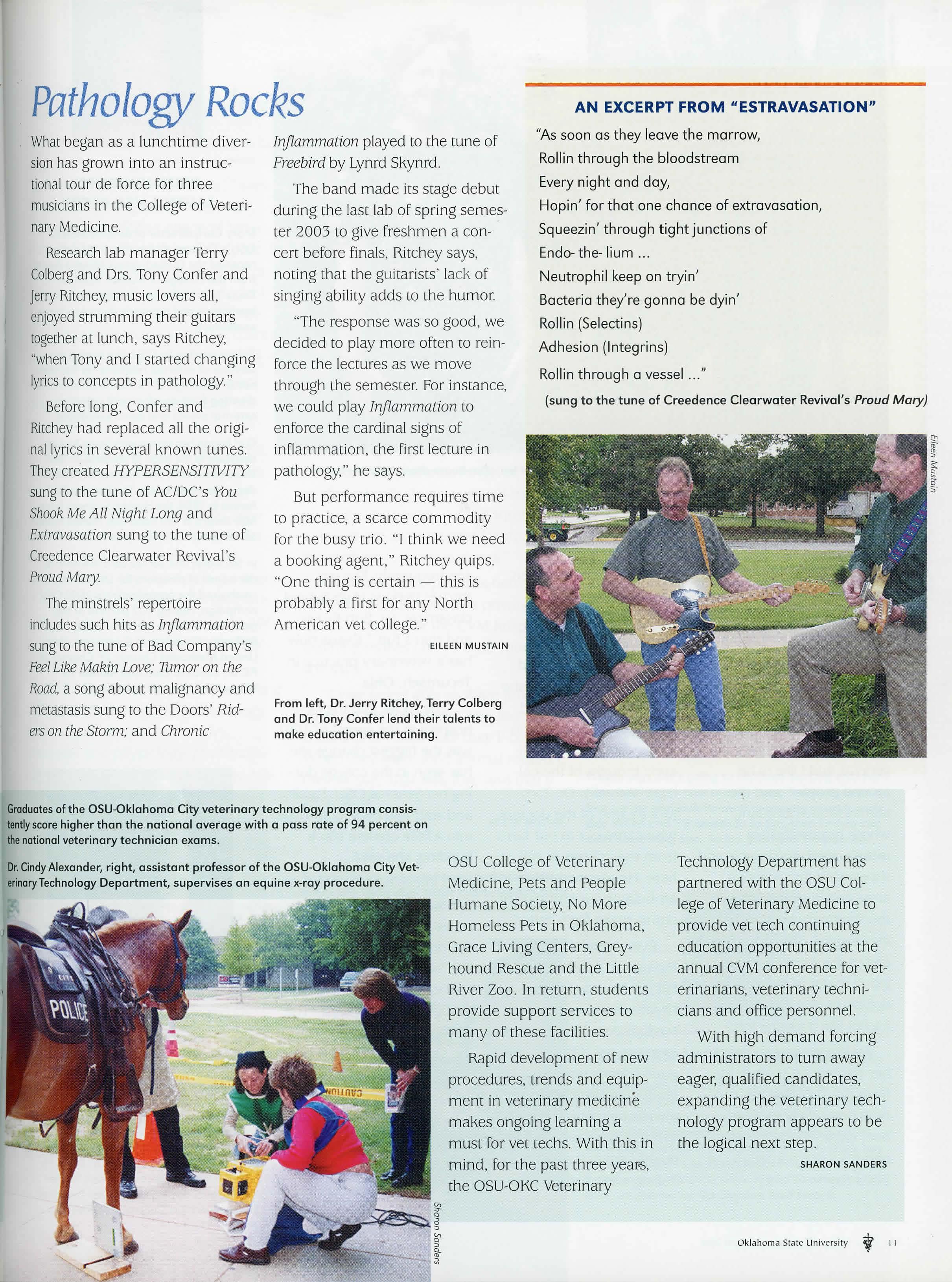
From left, Dr. Jerry Ritchey, Terry Colberg ond Dr. Tony Confer lend their talents to make education entertaining.
Creedence Clearwater Revival's Proud Mary)
with a pass rate of 94 percent on
technician exams.
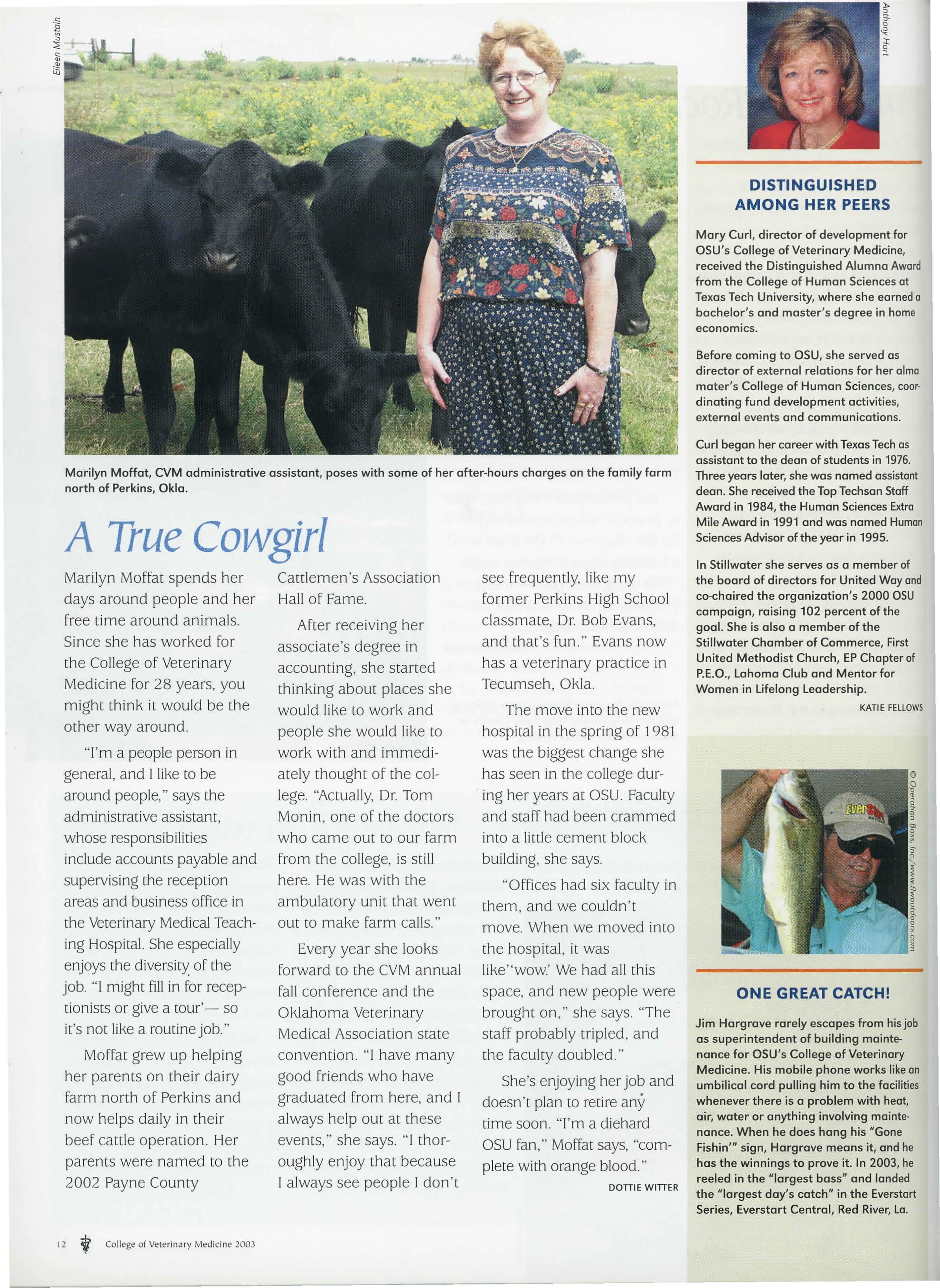
Marilyn Moffat, CVM administrative assistant, poses with some of her ofter-hours charges on the family form north of
A TrueCowgirl
Marilyn Moffat spends her days around people and her free time around animals. Since she has worked for the College of Veterinary Medicine for 28 years, you might think it would be the other way around.
''I'm a people person in general, and I like to be around people," says the administrative assistant, whose responsibilities include accounts payable and supervising the reception areas and business office in the Veterinary Medical Teaching Hospital. She especially enjoys the diversity of the job. "I might fill in for receptionists or give a tour'- so it's not like a routine job."
Cattlemen's Association Hall of Fame.
After receiving her associate's degree in accounting, she started thinking about places she would like to work and people she would like to work with and immediately thought of the college. "Actually, Dr. Tom Mon in, one of the doctors who came out to our farm from the college, is still here. He was with the ambulatory unit that went out to make farm calls."
Every year she looks forward to the CVM annual fall conference and the Oklahoma Veterinary Medical Association state convention. "I have many good friends who have graduated from here, and I always help out at these events," she says. "I thoroughly enjoy that because
Moffat grew up helping her parents on their dairy farm north of Perkins and now helps daily in their beef cattle operation. Her parents were named to the 2002 Payne County I always see people I don't
see frequently, like my former Perkins High School classmate, Dr. Bob Evans, and that's fun." Evans now has a veterinary practice in Tecumseh, Okla.
The move into the new hospital in the spring of I 981 was the biggest change she has seen in the college during her years at OSU. Faculty and staff had been crammed into a little cement block building, she says.
"Offices had six faculty in them, and we couldn't move. When we moved into the hospital, it was like"wow.' We had all this space, and new people were brought on," she says. "The staff probably tripled, and the faculty doubled."
She's enjoying her job and doesn't plan to retire any time soon. "I'm a diehard OSU fan," Moffat says, "complete with orange blood."
DOTTIE WITTER
DISTINGUISHED AMONG HER PEERS
Mory Curl, director of development for OSU's College of Veterinary Medicine, received the Distinguished Alumna Award from the College of Human Sciences at Texas Tech University, where she earned a bachelor's and master's degree in home economics.
Before coming to OSU, she served as director of external relations for her alma mater's College of Human Sciences, coordinating fund development activities, external events and communications.
' Curl began her career with Texas Tech as assistant to the dean of students in 1976. Three years later, she was named assistant dean. She received the Top Techson Staff Award in 1984, the Human Sciences Extra Mile Award in 1991 and was named Human Sciences Advisor of the year in 1995.
In Stillwater she serves as a member of the board of directors for United Way and co-choired the organization's 2000 OSU campaign, raising 102 percent of the goal. She is also a member of the Stillwater Chamber of Commerce, First United Methodist Church, EP Chapter of P.E.O., Lahoma Club and Mentor for Women in Lifelong Leadership.
KATIE FELLOWS
ONE GREAT CATCH!
Jim Hargrove rarely escapes from his job as superintendent of building maintenance for OSU's College of Veterinary Medicine. His mobile phone works like an umbilical cord pulling him to the facilities whenever there is a problem with heat, air, water or anything involving maintenance. When he does hong his "Gone Fishin"' sign, Hargrove means it, and he hos the winnings to prove it. In 2003, he reeled in the "largest boss" and landed the "largest day's catch" in the Everstart Series, Everstort Central, Red River, La.
Perkins, Okla.
IsTherea Nursein theHouse?
"WhenI tell people what I do for a living,the first thing they think is ·groomer'or 'kennel assistant,"' says TracieLuthye, registered veterinary technicianat OSU's College of VeterinaryMedicine food animal hospital. In reality,whether working in clinics or teachinghospitals, veterinary techniciansperform an indispensable servicefor veterinarians and their clients.
"We are the RNs of the vet world," shesays."We do everything except diagnose,perform surgery and prescribedrugs."
Tobecome certified or registered, a veterinarytechnician must graduate froma program accredited by the AmericanVeterinary Medicine Associationand then, if approved, sit for thestate and the national board examinations,says Luthye, a graduate of the veterinary technician program at TulsaCommunity College who also holdsassociate's degrees in zoology andapplied science.
"The board exams cover everything - clinical pathology, anesthesiology, criticalcare, animal husbandry, anatomyand physiology, pharmacology,all species of small and large animalsand jurisprudence," she says.
"A tech can free up a clinician's time and give the peace of mind that thereis someone who can help managecases.We induce and maintain anesthesia,calculate dosage, administertreatment and medication, perform technical procedures and stock andmaintain the clinic-inventory, all of which are performed under the directsupervision of a licensed DVM.
"We also help restrain and handle largeanimals," says Luthye, who raises cattleand llamas on her Perry, Okla., ranch.
"Vet techs learn basic behavioral characteristicsand diverse handling techniquesand restraints for various
large animals. With food animals, there is always a high potential for injury," she says, which is why safety instruction is an important component of her job at the teaching hospital.
Luthye introduces second-year students to proper handling techniques and use of equipment, and along with the clinician oversees fourth-year students, helping teach them safety and technical procedures.
"For instance, 1 might have to show a student how to place a jugular cathedra in a cow," she explains. "l assist the students with the care and treatment of their patients, however, 1 try to allow the students as much handson work as possible. I don't intervene unless there is a potential for injury to the students or their patients."
While there are parallels between a tech's responsibilities at a private facility and working at the CVM hospital, teaching makes Luthye's job more fun, she says.
"l love being able to share knowledge, to teach students new technical skills and to make sure they'll be safe. When they leave food animal rotation, they all say, 'that was fun,' and that's great stuff!"
EILEEN MUSTAIN
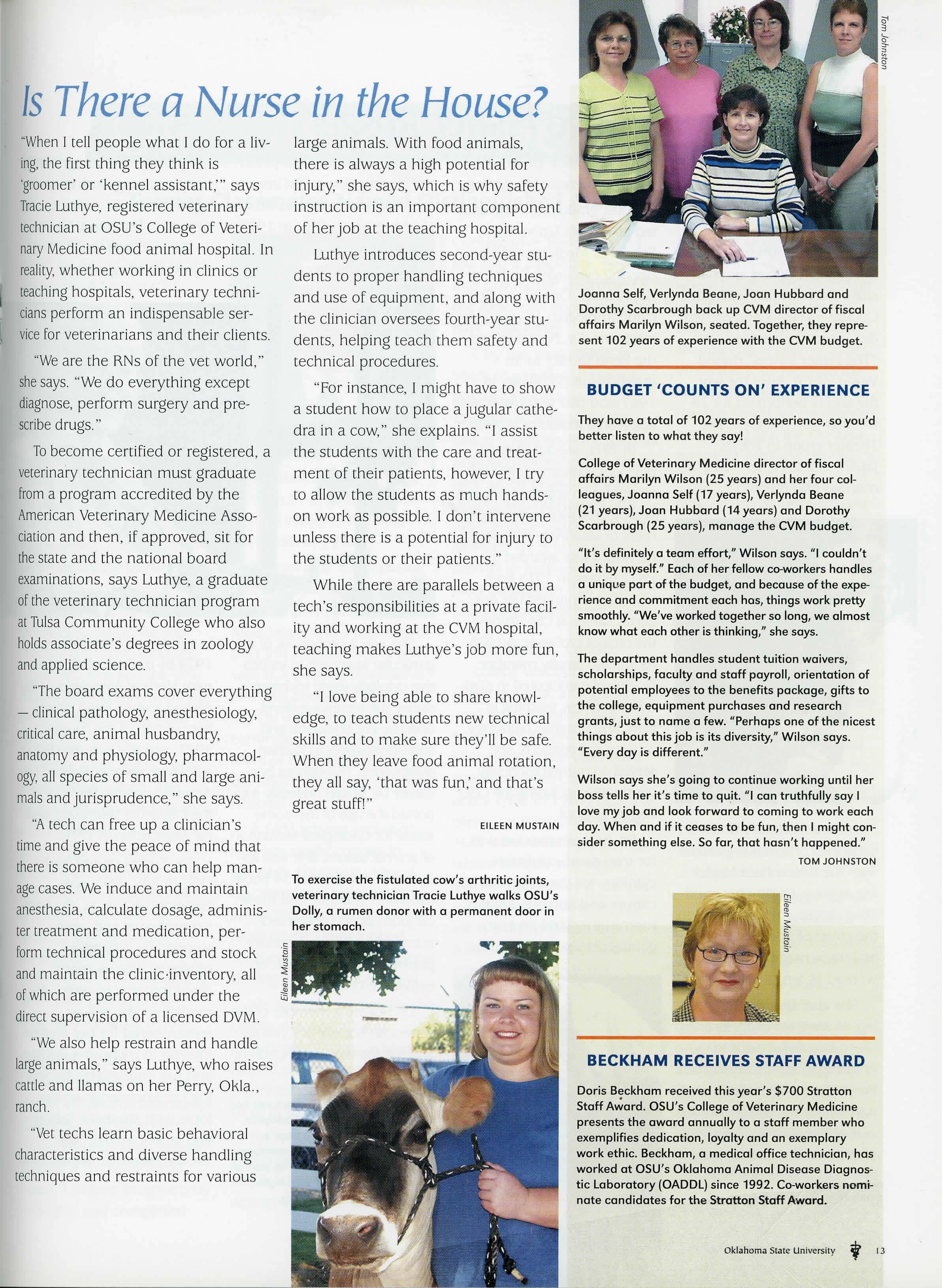
To exercise the fistulated cow's arthritic joints, veterinary technician Tracie Luthye walks OSU's Dolly, a rumen donor with a permanent door in her stomach.
Joanna Self, Verlynda Beane, Joan Hubbard and Dorothy Scarbrough back up CVM director of fiscal affairs Marilyn Wilson, seated. Together, they represent 102 years of experience with the CVM budget.
BUDGET 'COUNTS ON' EXPERIENCE
They have a total of 102 years of experience, so you'd better listen to what they say!
College of Veterinary Medicine director of fiscal affairs Marilyn Wilson (25 years) and her four colleagues, Joanna Self (17 years), Verlynda Beane (21 years), Joan Hubbard (14 years) and Dorothy Scarbrough (25 years), manage the CVM budget.
"It's definitely a team effort," Wilson says. "I couldn't do it by myself." Each of her fellow co-workers handles a unique part of the budget, and because of the experience and commitment each hos, things work pretty smoothly. "We've worked together so long, we almost know what each other is thinking," she says.
The department handles student tuition waivers, scholarships, faculty and staff payroll, orientation of potential employees to the benefits package, gifts to the college, equipment purchases and research grants, just to name a few. "Perhaps one of the nicest things about this job is its diversity," Wilson says. "Every day is different."
Wilson says she's going to continue working until her boss tells her it's time to qu_it. "I can truthfully say I love my job and look forward to coming to work each day. When and if it ceases to be fun, then I might consider something else. So far, that hasn't happened."
TOM JOHNSTON
BECKHAM RECEIVES STAFF AWARD
Doris Beckham received this year's $700 Stratton Staff A.,;ard. OSU's College of Veterinary Medicine presents the award annually to a staff member who exemplifies dedication, loyalty and on exemplary work ethic. Beckham, a medical office technician, has worked at OSU's Oklahoma Animal Disease Diagnostic Laboratory (OADDL) since 1992. Co-workers nominate candidates for the Stratton Staff Award.
RememberingJeffieFisherRoszel
Jeffie Fisher Roszel, OSU professor emeritus of veterinarian medicine, died in January of this year.
A native of Amarillo, Texas, the talented Roszel and her sister Jean traveled with the USO as a singing and comedy duo under their stage name "The Fisher Sisters" during World War II. After the war, the sisters performed for 18 months with the Ernie Pile Theater group in Tokyo, Japan, where Fisher met and married Ron Roszel.
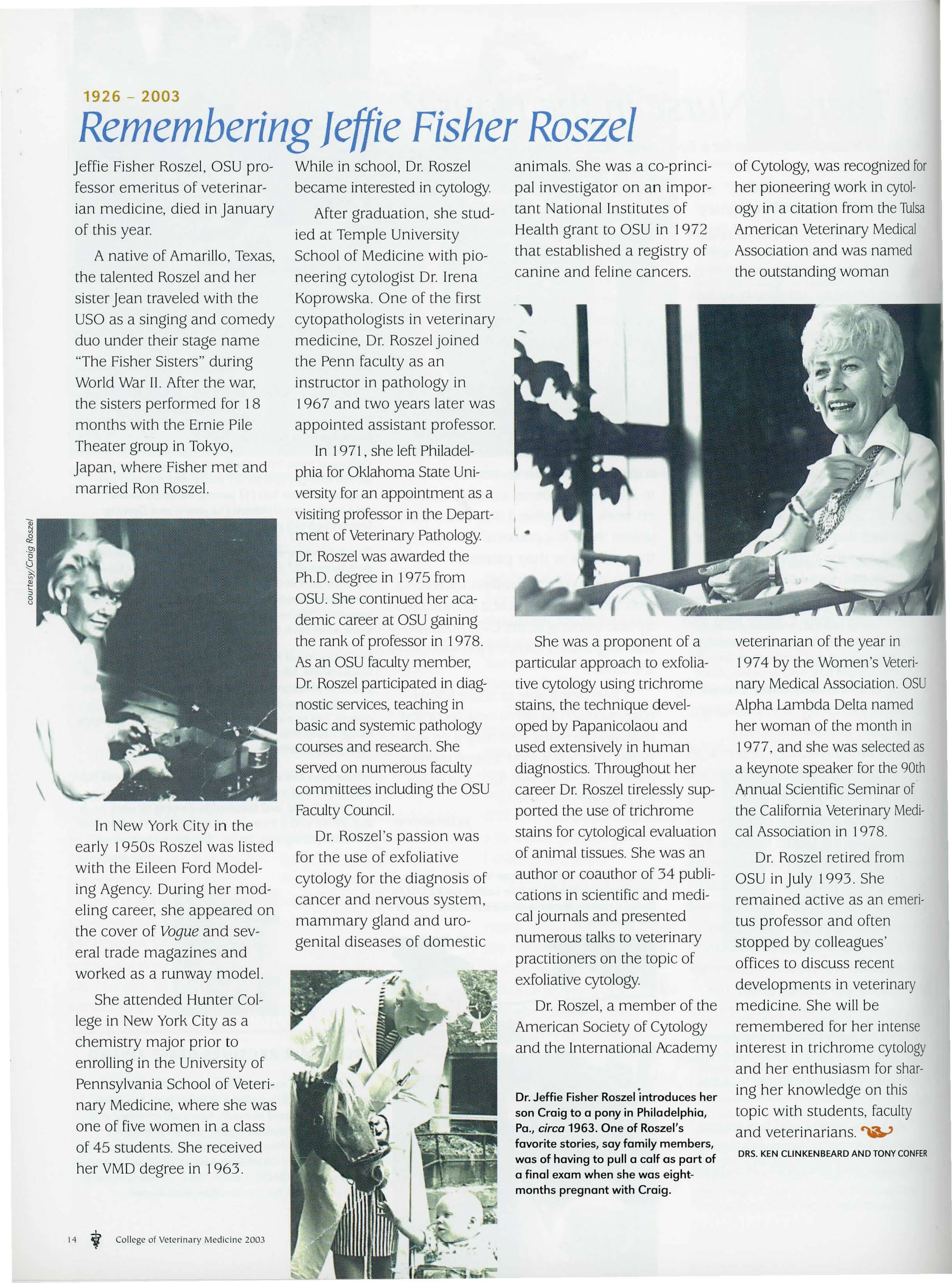
In New York City in the early 1950s Roszel was listed with the Eileen Ford Modeling Agency. During her modeling career, she appeared on the cover of Vogueand several trade magazines and worked as a runway model.
She attended Hunter College in New York City as a chemistry major prior to enrolling in the University of Pennsylvania School of Veterinary Medicine, where she was one of five women in a class of 45 students. She received her VMD degree in 1963.
While in school, Dr. Roszel became interested in cytology.
After graduation, she studied at Temple University School of Medicine with pioneering cytologist Dr. Irena Koprowska. One of the first cytopathologists in veterinary medicine, Dr. Roszel joined the Penn faculty as an instructor in pathology in 196 7 and two years later was appointed assistant professor.
In 1971, she left Philadelphia for Oklahoma State University for an appointment as a visiting professor in the Department of Veterinary Pathology. Dr. Roszelwas awarded the PhD. degree in 1975 from OSU. She continued her academic career at OSU gaining the rank of professor in 1978. As an OSU faculty member, Dr. Roszel participated in diagnostic services, teaching in basic and systemic pathology courses and research. She served on numerous faculty committees including the OSU Faculty Council.
Dr. Roszel's passion was for the use of exfoliative cytology for the diagnosis of cancer and nervous system, mammary gland and urogenital diseases of domestic
animals. She was a co-principal investigator on an important National Institutes of Health grant to OSU in I 972 that established a registry of canine and feline cancers.
She was a proponent of a particular approach to exfoliative cytology using trichrome stains, the technique developed by Papanicolaou and used extensively in human diagnostics. Throughout her career Dr. Roszel tirelessly supported the use of trichrome stains for cytological evaluation of animal tissues. She was an author or coauthor of 34 publications in scientific and medical journals and presented numerous talks to veterinary practitioners on the topic of exfoliative cytology.
Dr. Roszel, a member of the American Society of Cytology and the International Academy
Dr.
of Cytology, was recognizedfor her pioneering work in cytology in a citation from the Tulsa American Veterinary Medical Association and was named the outstanding woman veterinarian of the year in 1974 by the Women's Veterinary Medical Association. OSU Alpha Lambda Delta named her woman of the month in 1977, and she was selectedas a keynote speaker for the 90th A.nnual Scientific Seminar of the California Veterinary Medical Association in 1978.
Dr. Roszel retired from OSU in July 1993. She remained active as an emeritus professor and often stopped by colleagues' offices to discuss recent developments in veterinary medicine. She will be remembered for her intense interest in trichrome cytology and her enthusiasm for sharing her knowledge on this topic with students, faculty and veterinarians ._,_,,
DRS. KEN CLINKENBEARD AND TONY CONFER
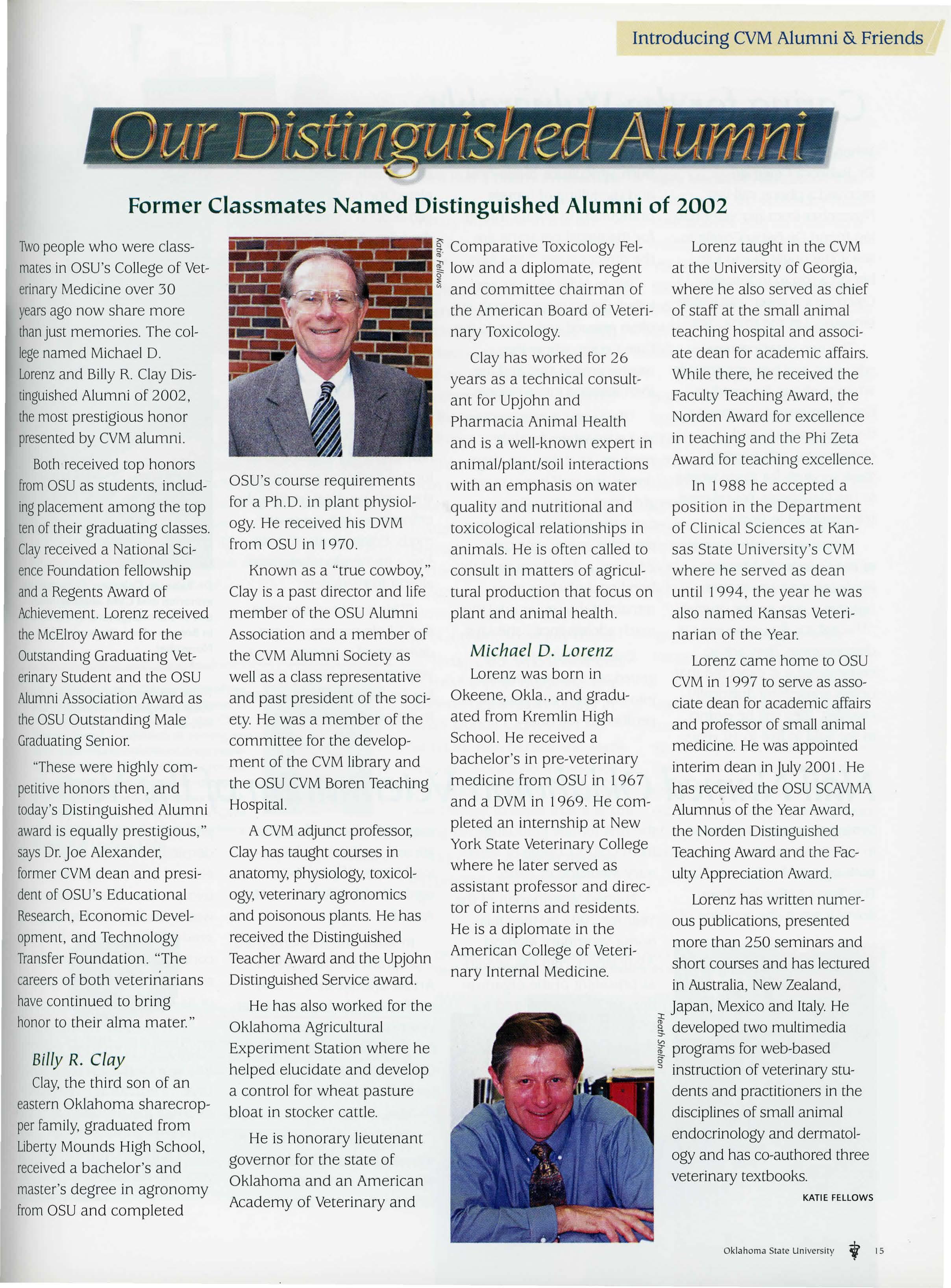
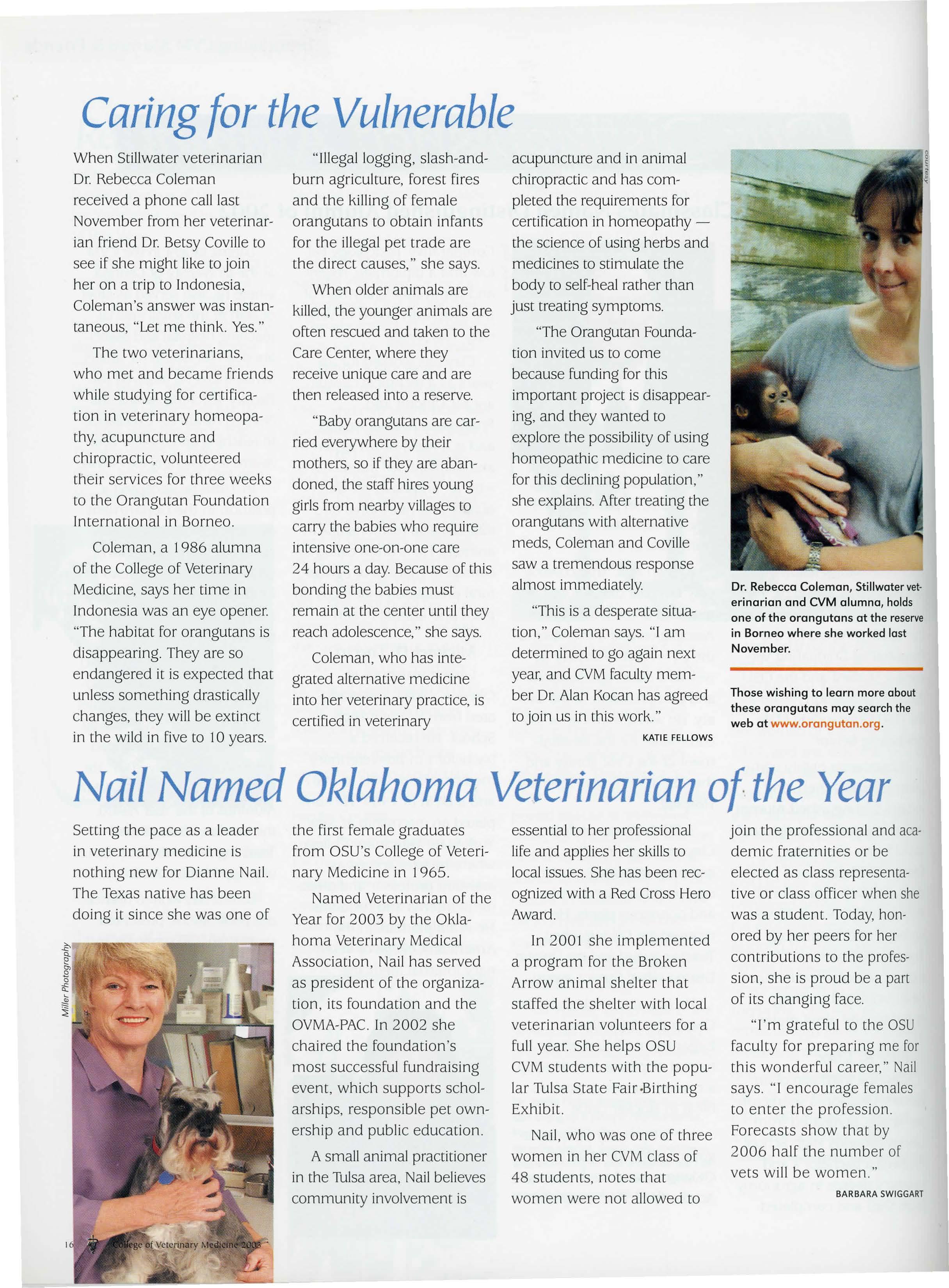
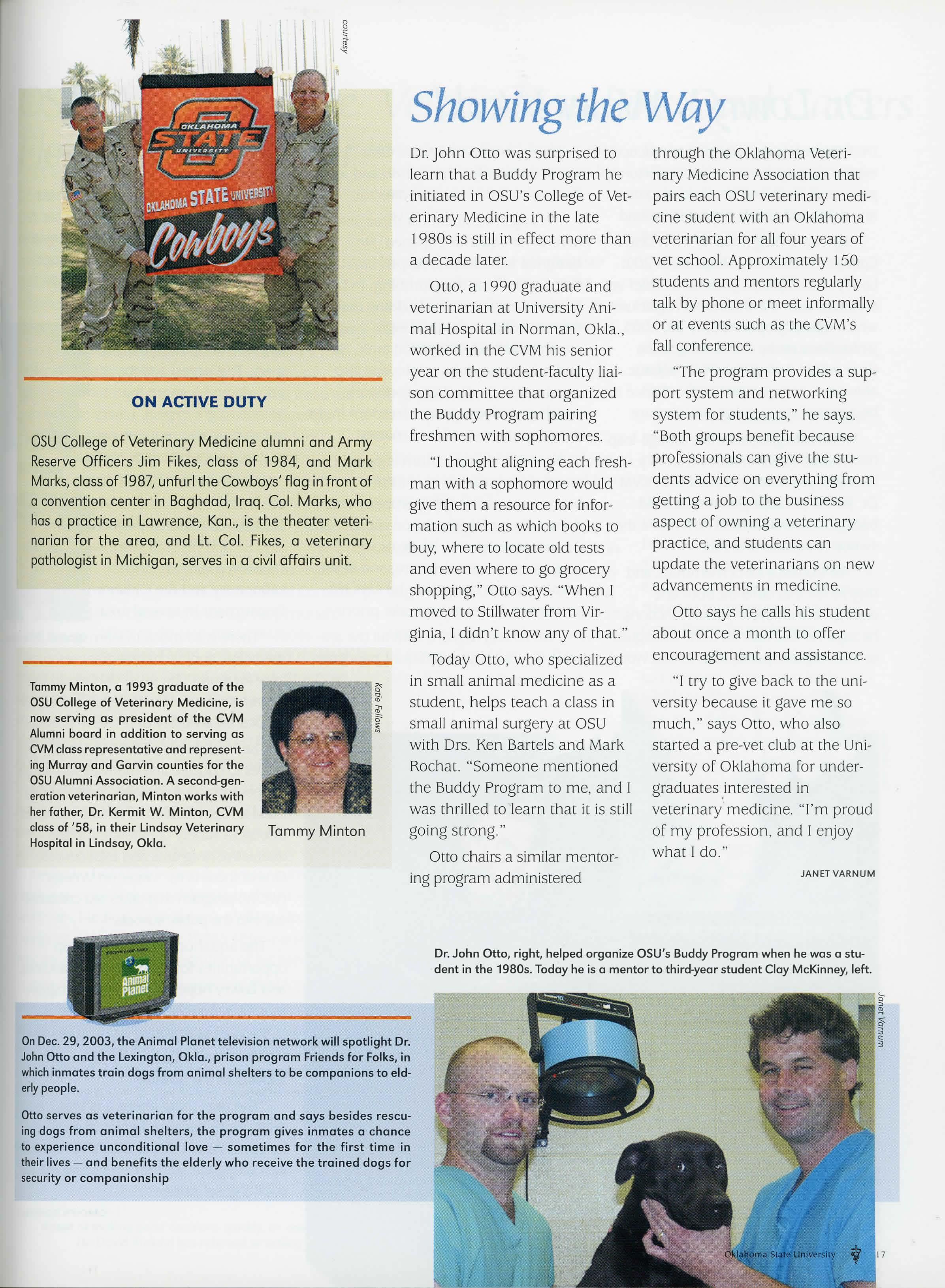
Jeffie Fisher Roszel introduces her son Craig to a pony in Philadelphia, Pa., circa 1963. One of Roszel's favorite stories, say family members, was of having to pull a calf as part of a final exam when she was eightmonths pregnant with Craig.
Our Dfsttnguts ed A umnf -
Former Classmates Named Distinguished Alumni of 2002
Twopeople who were classmatesin OSU's College of VeterinaryMedicine over 30 yearsago now share more thanjust memories. The collegenamed Michael D. Lorenzand Billy R. Clay DistinguishedAlumni of 2002, themost prestigious honor presentedby CVM alumni.
Both received top honors fromOSU as students, includingplacement among the top tenof their graduating classes.
Clayreceived a National ScienceFoundation fellowship anda Regents Award of Achievement.Lorenz received theMcElroy Award for the OutstandingGraduating VeterinaryStudent and the OSU AlumniAssociation Award as theOSUOutstanding Male GraduatingSenior.
"These were highly competitivehonors then, and today'sDistinguished Alumni awardis equally prestigious," saysDr. Joe Alexander, former CVM dean and presidentof OSU's Educational Research,Economic Development, and Technology TransferFoundation. "The careersof both veterinarians havecontinued to bring honor to their alma mater."
Billy R. Clay
Clay,the third son of an easternOklahoma sharecropper family, graduated from Liberty Mounds High School, receiveda bachelor's and master'sdegree in agronomy from OSU and completed
OSU's course requirements for a Ph.D. in plant physiology. He received his DVM from OSU in 1970.
Known as a "true cowboy," Clay is a past director and life member of the OSU Alumni Association and a member of the CVM Alumni Society as well as a class representative and past president of the society. He was a member of the committee for the development of the CVM library and the OSU CVM Boren Teaching Hospital.
A CVM adjunct professor, Clay has taught courses in anatomy, physiology, toxicology, veterinary agronomics and poisonous plants. He has received the Distinguished Teacher Award and the Upjohn Distinguished Service award.
He has also worked for the Oklahoma Agricultural Experiment Station where he helped elucidate and develop a control for wheat pasture bloat in stocker cattle.
He is honorary lieutenant governor for the state of Oklahoma and an American Academy of Veterinary and
f Comparative Toxicology Fellow and a diplomate, regent and committee chairman of the American Board of Veterinary Toxicology.
Clay has worked for 26 years as a technical consultant for Upjohn and Pharmacia Animal Health and is a well-known expert in animal/plant/soil interactions with an emphasis on water quality and nutritional and toxicological relationships in animals. He is often called to consult in matters of agricultural production that focus on plant and animal health.
Michael D. Lorenz
Lorenz was born in Okeene, Okla., and graduated from Kremlin High School. He received a bachelor's in pre-veterinary medicine from OSU in 1967 and a DVM in 1969. He completed an internship at New York State Veterinary College where he later served as assistant professor and director of interns and residents. He is a diplomate in the American College of Veterinary Internal Medicine.
Lorenz taught in the CVM at the University of Georgia, where he also served as chief of staff at the small animal teaching hospital and associate dean for academic affairs. While there, he received the Faculty Teaching Award, the Norden Award for excellence in teaching and the Phi Zeta Award for teaching excellence.
In 1988 he accepted a position in the Department of Clinical Sciences at Kansas State University's CVM where he served as dean until 1994, the year he was also named Kansas Veterinarian of the Year.
Lorenz came home to OSU CVM in 1997 to serve as associate dean for academic affairs and professor of small animal medicine. He was appointed interim dean in July 2001 He has received the OSU SCAVMA Alumnus of the Year Award, the Norden Distinguished Teaching Award and the Faculty Appreciation Award.
Lorenz has written numerous publications, presented more than 250 seminars and short courses and has lectured in Australia, New Zealand, Japan, Mexico and Italy. He developed two multimedia programs for web-based • instruction of veterinary students and practitioners in the disciplines of small animal endocrinology and dermatology and has co-authored three veterinary textbooks.
KATIE FELLOWS
Caringfor the Vulnerable
When Stillwater veterinarian Dr. Rebecca Coleman received a phone call last November from her veterinarian friend Dr. Betsy Coville to see if she might like to join her on a trip to Indonesia, Coleman's answer was instantaneous, "Let me think. Yes."
The two veterinarians, who met and became friends while studying for certification in veterinary homeopathy, acupuncture and chiropractic, volunteered their services for three weeks to the Orangutan Foundation International in Borneo.
Coleman, a 1986 alumna of the College of Veterinary Medicine, says her time in Indonesia was an eye opener. "The habitat for orangutans is disappearing. They are so endangered it is expected that unless something drastically changes, they will be extinct in the wild in five to IO years.
"Illegal logging, slash-andburn agriculture, forest fires and the killing of female orangutans to obtain infants for the illegal pet trade are the direct causes," she says.
When older animals are killed, the younger animals are often rescued and taken to the Care Center, where they receive unique care and are then released into a reserve.
"Baby orangutans are carried everywhere by their mothers, so if they are abandoned, the staff hires young girls from nearby villages to carry the babies who require intensive one-on-one care 24 hours a day. Becauseof this bonding the babies must remain at the center until they reach adolescence," she says.
Coleman, who has integrated alternative medicine into her veterinary practice, is certified in veterinary
acupuncture and in animal chiropractic and has completed the requirements for certification in homeopathythe science of using herbs and medicines to stimulate the body to self-heal rather than just treating symptoms
"The Orangutan Foundation invited us to come because funding for this important project is disappearing, and they wanted to explore the possibility of using homeopathic medicine to care for this declining population," she explains. After treating the orangutans with alternative meds, Coleman and Coville saw a tremendous response almost immediately.
"This is a desperate situation," Coleman says. "I am determined to go again next year, and CVM faculty member Dr. Alan Kocan has agreed to join us in this work."
KATIE FELLOWS
Those wishing to learn more about these orangutans may search the web at www.orangutan.org.
NailNamedOklahomaVeterinarian of the Year
Setting the pace as a leader in veterinary medicine is nothing new for Dianne Nail.
The Texas native has been doing it since she was one of the first female graduates from OSU's College of Veterinary Medicine in 1965.
Named Veterinarian of the Year for 2003 by the Oklahoma Veterinary Medical Association, Nail has served as president of the organization, its foundation and the OVMA-PAC. In 2002 she chaired the foundation's most successful fundraising event, which supports scholarships, responsible pet ownership and public education.
A small animal practitioner in the Tulsa area, Nail believes community involvement is
essential to her professional life and applies her skills to local issues.She has been recognized with a Red Cross Hero Award.
In 2001 she implemented a program for the Broken Arrow animal shelter that staffed the shelter with local veterinarian volunteers for a full year. She helps OSU CVM students with the popular Tulsa State Fair-Birthing Exhibit.
Nail, who was one of three women in her CVM class of 48 students, notes that women were not allowed to
join the professional and academic fraternities or be elected as class representative or class officer when she was a student. Today, honored by her peers for her contributions to the profession, she is proud be a part of its changing face.
''I'm grateful to the OSU faculty for preparing me for this wonderful career," Nail says. "I encourage females to enter the profession.
Forecasts show that by 2006 half the number of vets will be women."
BARBARA SWIGGART
Dr. Rebecca Cale man, Stillwater veterinarian and CVM alumna, holds one of the orangutans at the reserve in Borneo where she worked last November.
ON ACTIVE DUTY
OSUCollege of Veterinary Medicine alumni and Army ReserveOfficers Jim Fikes, class of 1984, and Mark Marks,class of 1987, unfurl the Cowboys' flag in front of a convention center in Baghdad, Iraq. Col. Marks, who has a practice in Lawrence, Kan., is the theater veterinarian for the area, and Lt. Col. Fikes, a veterinary pathologist in Michigan, serves in a civil affairs unit.
Tommy Minton, a 1993 graduate of the 0SU College of Veterinary Medicine, is now serving as president of the CVM Alumni board in addition to serving as CVM class representative and representing Murray and Garvin counties for the 0SU Alumni Association. A second-generation veterinarian, Minton works with her father, Dr. Kermit W. Minton, CVM class of '58, in their Lindsay Veterinary Hospital in Lindsay, Okla.
Showingthe Way
Dr. John Otto was surprised to learn that a Buddy Program he initiated in OSU's College of Veterinary Medicine in the late I 980s is still in effect more than a decade later.
Otto, a I 990 graduate and veterinarian at University Animal Hospital in Norman, Okla., worked in the CVM his senior year on the student-faculty liaison committee that organized the Buddy Program pairing freshmen with sophomores.
"I thought aligning each freshman with a sophomore would give them a resource for information such as which books to buy, where to locate old tests and even where to go grocery shopping," Otto says. "When I moved to Stillwater from Virginia, I didn't know any of that."
Today Otto, who specialized in small animal medicine as a student, helps teach a class in small animal surgery at OSU with Drs. Ken Bartels and Mark Rochat. "Someone mentioned the Buddy Program to me, and I was thrilled to learn that it is still going strong."
Otto chairs a similar mentoring program administered
through the Oklahoma Veterinary Medicine Association that pairs each OSU veterinary medicine student with an Oklahoma veterinarian for all four years of vet school. Approximately 150 students and mentors regularly talk by phone or meet informally or at events such as the CVM's fall conference.
"The program provides a support system and networking system for students," he says. "Both groups benefit because professionals can give the students advice on everything from getting a job to the business aspect of owning a veterinary practice, and students can update the veterinarians on new advancements in medicine.
Otto says he calls his student about once a month to offer encouragement and assistance.
"I try to give back to the university because it gave me so much," says Otto, who also started a pre-vet club at the University of Oklahoma for undergraduates _interested in veterinary"medicine. "I'm proud of my profession, and I enjoy what I do."
Tammy Minton
JANET VARNUM
Dr. John Otto, right, helped organize OSU's Buddy Program when he was a student in the 1980s. Today he is a mentor to third-year student Clay McKinney, left.
On Dec. 29, 2003, the Animal Planet television network will spotlight Dr. John Otto and the Lexington, Okla., prison program Friends for Folks, in which inmates train dogs from animal shelters to be companions to elderly people.
Otto serves as veterinarian for the program and says besides rescuing dogs from animal shelters, the program gives inmates a chance to experience unconditional love - sometimes for the first time in their lives - and benefits the elderly who receive the trained dogs for security or companionship
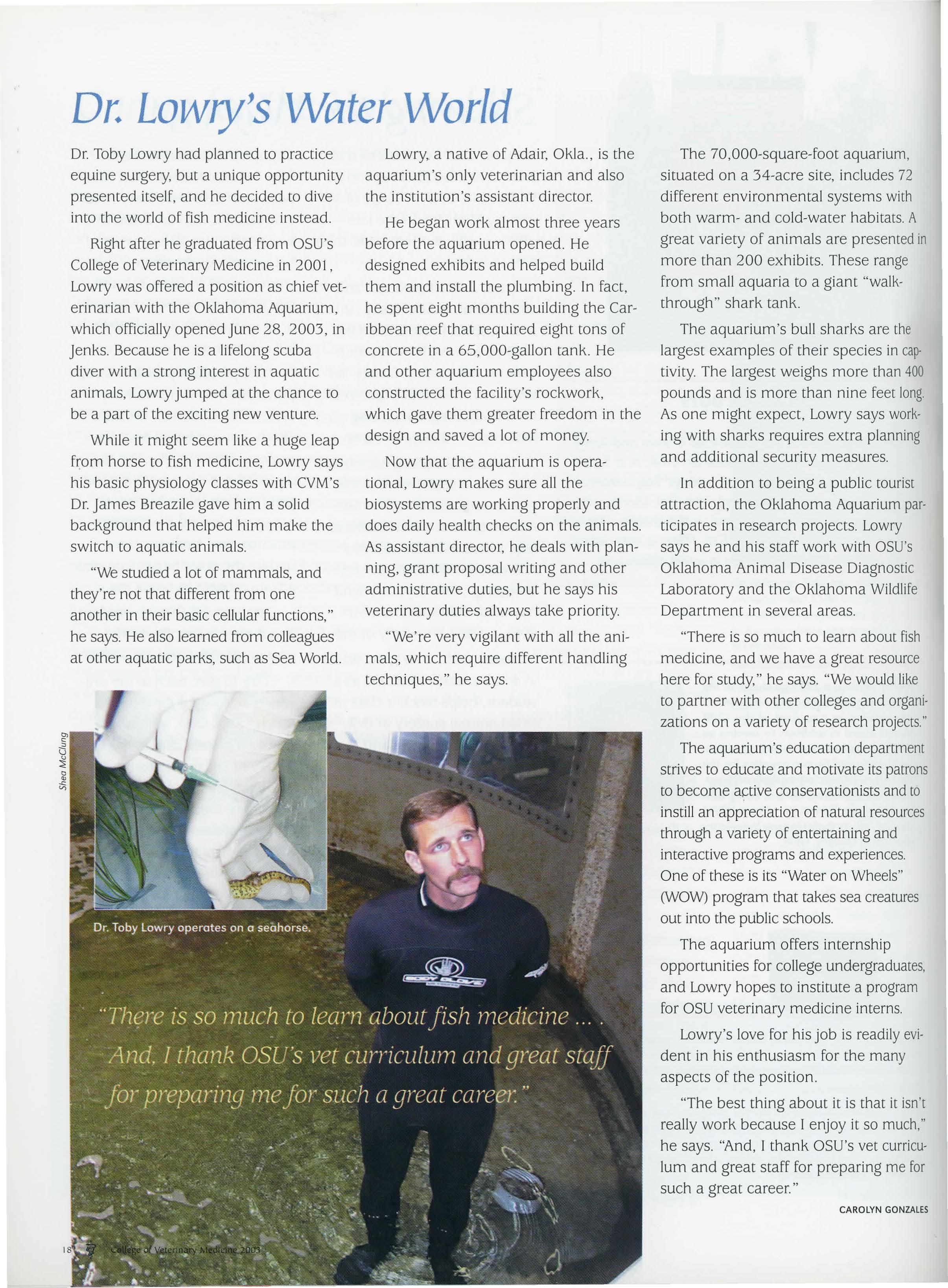
Dr. Lawry'sWaterWorld
Dr. Toby Lowry had planned to practice equine surgery, but a unique opportunity presented itself, and he decided to dive into the world of fish medicine instead.
Right after he graduated from OSU's College of Veterinary Medicine in 2001, Lowry was offered a position as chief veterinarian with the Oklahoma Aquarium, which officially opened June 28, 2003, in Jenks. Because he is a lifelong scuba diver with a strong interest in aquatic animals, Lowry jumped at the chance to be a part of the exciting new venture.
While it might seem like a huge leap f~om horse to fish medicine, Lowry says his basic physiology classes with CVM's Dr. James Breazile gave him a solid background that helped him make the switch to aquatic animals.
"We studied a lot of mammals, and they're not that different from one another in their basic cellular functions," he says. He also learned from colleagues at other aquatic parks, such as Sea World.
Lowry, a native of Adair, Okla., is the aquarium's only veterinarian and also the institution's assistant director. He began work almost three years before the aquarium opened. He designed exhibits and helped build them and install the plumbing. In fact, he spent eight months building the Caribbean reef that required eight tons of concrete in a 65,000-gallon tank. He and other aquarium employees also constructed the facility's rockwork, which gave them greater freedom in the design and saved a lot of money.
Now that the aquarium is operational, Lowry makes sure all the biosystems are working properly and does daily health checks on the animals. As assistant director, he deals with planning, grant proposal writing and other administrative duties, but he says his veterinary duties always take priority.
"We're very vigilant with all the animals, which require different handling techniques," he says.
The 70,000-square-foot aquarium, situated on a 34-acre site, includes 72 different environmental systems wirh both warm- and cold-water habitats. A great variety of animals are presentedin more than 200 exhibits. These range from small aquaria to a giant "walkthrough" shark tank.
The aquarium's bull sharks are the largest examples of their species in captivity. The largest weighs more than 400 pounds and is more than nine feet long. As one might expect, Lowry says working with sharks requires extra planning and additional security measures.
In addition to being a public tourisr attraction, the Oklahoma Aquarium participates in research projects. Lowry says he and his staff work with OSU's Oklahoma Animal Disease Diagnostic Laboratory and the Oklahoma Wildlife Department in several areas.
"There is so much to learn about fish medicine, and we have a great resource here for study," he says. "We would like to partner with other colleges and organizations on a variety of research projecrs."
The aquarium's education department strives to educate and motivate its patrons to become ar:;tiveconservationists and co instill an appreciation of natural resources through a variety of entertaining and interactive programs and experiences. One of these is its "Water on Wheels" (>NOW) program that takes sea creatures out into the public schools.
The aquarium offers internship opportunities for college undergraduates, and Lowry hopes to institute a program for OSU veterinary medicine interns.
Lawry's love for his job is readily evident in his enthusiasm for the many aspects of the position.
"The best thing about it is that it isn't really work because I enjoy it so much," he says. "And, I thank OSU's vet curriculum and great staff for preparing me for such a great career."
CAROLYN GONZALES
OSUAlumsReceiveVeterinarianPinsDual Careers
Florida'sTopHonor
Dr Bill Kyser and Dr. James H. Brandt, alumni of 0SU'sCollege of Veterinary Medicine, have receivedthe Florida Veterinary Medical Association's(FVMA) highest honor, the DistinguishedService Award, for their exceptional achievements and contributions to the profession.
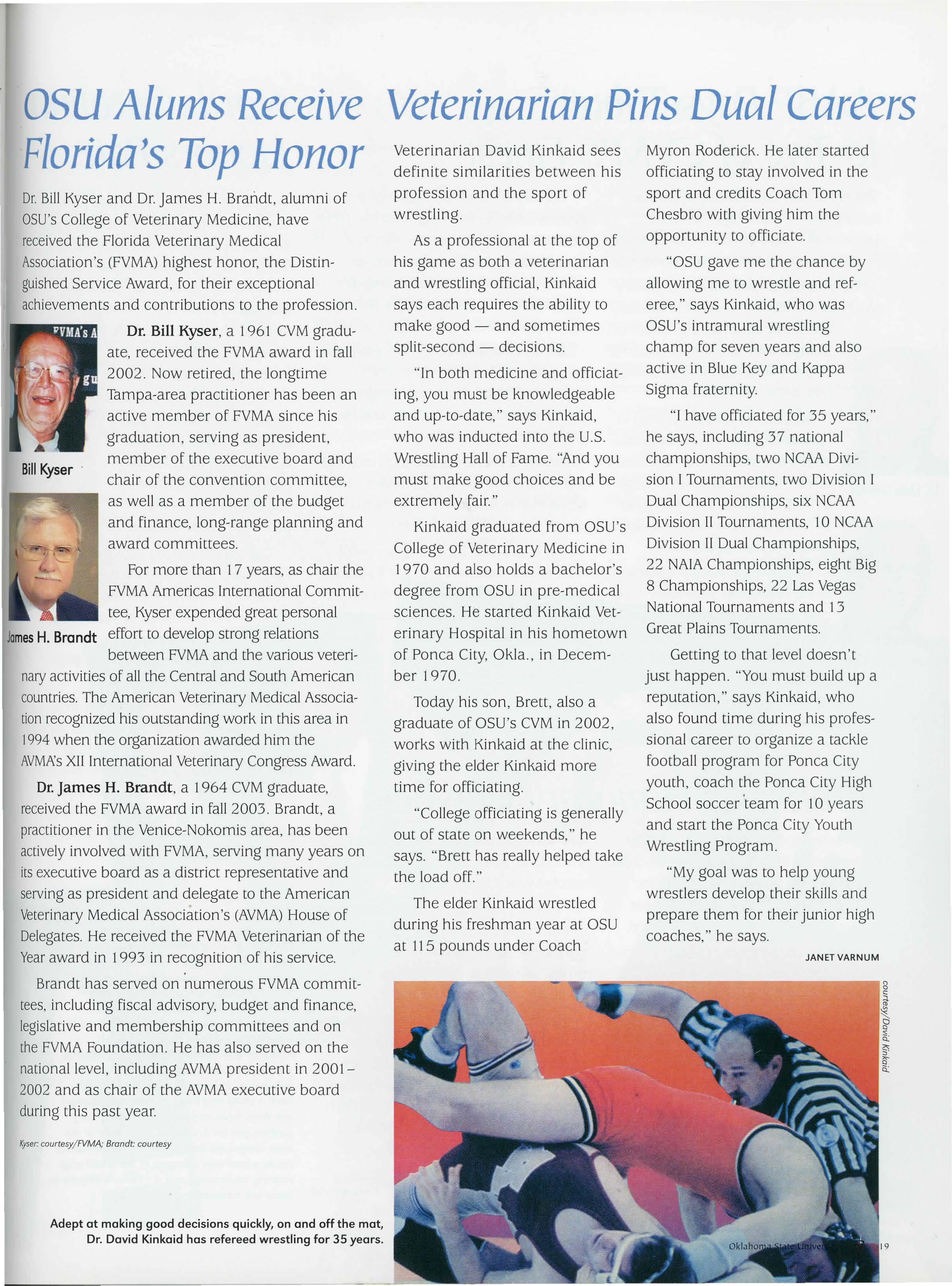
Veterinarian David Kinkaid sees definite similarities between his profession and the sport of wrestling.
BillKyser•
Dr. Bill Kyser, a 1961 CVM graduate, received the FVMA award in fall 2002. Now retired, the longtime Tampa-area practitioner has been an active member of FVMA since his graduation, serving as president, member of the executive board and chair of the convention committee, as well as a member of the budget and finance, long-range planning and award committees.
For more than 17 years, as chair the FVMA Americas International Committee, Kyser expended great personal James H. Brandt effort to develop strong relations between FVMA and the various veterinaryactivities of all the Central and South American countries.The American Veterinary Medical Association recognized his outstanding work in this area in 1994when the organization awarded him the AVMP{sXII International Veterinary Congress Award.
Dr. James H. Brandt, a 1964 CVM graduate, receivedthe FVMA award in fall 2003. Brandt, a practitioner in the Venice-Nokomis area, has been actively involved with FVMA, serving many years on its executive board as a district representative and servingas president and delegate to the American Veterinary Medical Association's (AVMA) House of Delegates.He received the FVMA Veterinarian of the Yearaward in 1993 in recognition of his service.
Brandt has served on numerous FVMA committees,including fiscal advisory, budget and finance, legislative and membership committees and on the FVMA Foundation. He has also served on the national level, including AVMA president in 20012002 and as chair of the AVMA executive board during this past year.
Kyser:courtesy/FVMA; Brandt: courtesy
As a professional at the top of his game as both a veterinarian and wrestling official, Kinkaid says each requires the ability to make good - and sometimes split-second - decisions.
"In both medicine and officiating, you must be knowledgeable and up-to-date," says Kinkaid, who was inducted into the U.S. Wrestling Hall of Fame. "And you must make good choices and be extremely fair."
Kinkaid graduated from OSU's College of Veterinary Medicine in 1970 and also holds a bachelor's degree from OSU in pre-medical sciences. He started Kinkaid Veterinary Hospital in his hometown of Ponca City, Okla., in December 1970.
Today his son, Brett, also a graduate of OSU's CVM in 2002, works with Kinkaid at the clinic, giving the elder Kinkaid more time for officiating.
"College officiating is generally out of state on weekends," he says. "Brett has really helped take the load off."
The elder Kinkaid wrestled during his freshman year at OSU at 115 pounds under Coach
Myron Roderick. He later started officiating to stay involved in the sport and credits Coach Tom Chesbro with giving him the opportunity to officiate.
"OSU gave me the chance by allowing me to wrestle and referee," says Kinkaid, who was OSU's intramural wrestling champ for seven years and also active in Blue Key and Kappa Sigma fraternity.
"I have officiated for 35 years," he says, including 37 national championships, two NCAA Division I Tournaments, two Division I Dual Championships, six NCAA Division II Tournaments, IO NCAA Division II Dual Championships, 22 NAIA Championships, eight Big 8 Championships, 22 Las Vegas National Tournaments and 13 Great Plains Tournaments.
Getting to that level doesn't just happen. "You must build up a reputation," says Kinkaid, who also found time during his professional career to organize a tackle football program for Ponca City youth, coach the Ponca City High School soccer "team for 10 years and start the Ponca City Youth Wrestling Program.
"My goal was to help young wrestlers develop their skills and prepare them for their junior high coaches," he says.
David Kinkaid has refereed wrestling for 35 years.
JANET VARNUM
MBP PaysTribute to Twoof CVM'S Finest
The American Association of Bovine Practitioners issued high honors to Dr. Samuel E. Strahm and Dr. D. Dee Griffin at the organization's 2002 conference.
Dr. Samuel E. Strahm, an honorary alumnus of OSU's College of Veterinary
Medicine, received the 2002 Fort Dodge/AABP Bovine Practitioner of the Year award for his dedication to his profession
Strahm, who has practiced in Pawhuska, Okla., since he graduated from Kansas State University in 1959, serves as an adviser to CVM and provides leadership at all levels of veterinary medicine's professional organizations.
He has represented Oklahoma in the American Veterinary Medicine Association (AVMA) House of Delegates and has served as president of the AVMA, the state and county associations and the American Association of Veterinary State Boards.
He has chaired the National Board Examination Committee and the Oklahoma Board of Veterinary Medical Examiners as well as committees devoted to professional labeling and food safety. He serves on the AVMA Council on Education.
Dr. D. Dee Griffin, a 1975 graduate of OSU's CVM, received the 2002 Alpharma/AABP Award of Excellence for his contributions to teaching and his profession.
Griffin is feedlot production management veterinarian and professor at the Great Plains Veterinary Educational Center, University of Nebraska.
He is praised for being an inspiration to his students and for his enthusiasm for the veterinary profession. Griffin has developed and teaches techniques for beef quality assurance and production monitoring in packing plants.
Strahmas HonoraryCowboy
The day Dr. Samuel E. Strahm left his native Kansasfor practice in Pawhuskaand Hominy, Okla., was a red-letter day for OSU, a major beneficiary of his 44-year legacy of service to veterinary medicine.
Strahm has mentored College of Veterinary Medicine students at his clinic over the years, represented the college during OSU's centennial commission and served on the CVM's board of examiners - an opportunity he says allowed him to interact with faculty and students and be involved in the school's activities.
More recently, Strahm has served OSU's Cooperative Extension Service on local and district advisory committees and as chairman of its statewide
advisory council. "It was supposed to be a one-year term, but I'm well into my second year," Strahm says.
'Tm not good at saying no and seem to find myself at the right place at the right time, so I've gotten involved at times," Strahm says. "In every instance, I've been very, very fortunate."
Regarding whether he bleeds orange or purple, Strahm faithfully demonstrates an affinity for both of his schools. "Every year at our AVMA con: vention, I always try to attend the KSU and the OSU alumni group meetings," he says. "And they keep inviting me back to both of them."
ADAM HUFFER
North Carolina HonorsPate
The North Carolina Veterinary Medical Association recently named alumna Dr. Nancy B. Pate "Veterinarian of the Year." Pate, who has been an active member of the NCVMA since she graduated from OSU's College of Veterinary Medicine in 1969, currently chairs the NCVMA Informatics Committee. courtesy
She spent six years in private practice and then earned a master's in public health (epidemiology and biostatistics) from the Oklahoma University School of Public Health. Nancy B.Pate
Captain Pate is on active duty in the US Public Health Service (USPHS)Commissioned Corp. She served two years with the FDA's Bureau of Veterinary Medicine before transferring to the EPA'sOffice of Air Quality and Standards (OAQPS).
Dr. Pate has worked in or with all of the programs in OAQPS and has served on many interagency work group efforts. She currently ,..servesin the Information Transfer and Program Integration Division and as a member of the USPHS Commissioned Corp Medical Readiness Force.
Ernest "E.L." Stair Jr.'s classmates in the College of Veterinary Medicine joked that ''E.L.can" when they found out he was dating the pretty librarian, Eileen (Austin), featured in this library science recruitment poster. Two of E.L. and Eileen Stairs' sons work in the field of veterinary medicine today. Eron, left, holds an economics degree from OSU and works in the Oklahoma Animal Disease Diagnostic Lab at OSU. Eric, right, holds both a DVM and Ph.D. in veterinary pathology from OSU and works as a veterinary pathologist for Arkansas' state animal disease diagnostic lab. Son Evan (not pictured) holds a bachelor's degree in electrical engineering technology and a master's degree in electrical engineering from OSU.
D. Dee Griffin
Samuel E. Strahm
VetStudent'ChecksOut' theLibrarian
It was a beautiful summer day in I 959 when Ernest ''E.L." Stair Jr. presented an engagement ring to his sweetheart, EileenAustin, on the front lawn of the Edmon Low Library.
"I worked at my parents' farm near Lawtonthat summer and had to sell a calfand haul a lot of scrap iron to raise the money for her ring," says Stair, a I 960 graduate of the College of Veterinary Medicine.
Austin, who holds a master's degree in library science from the University of Oklahoma, was working her first professionaljob as a cataloger at OSU's library when a co-worker, Stair's sister, introducedthe couple earlier that spring.
"I still remember the first time I saw E.L.,"she says. "He was walking up the stairsin the library with his sister, Pat, who had arranged a Coke date for us."
Six months later the couple married on Sept. 5, 1959, and spent another year in Stillwater while Stair finished his degree and his bride continued working at the library.
After graduating, the couple spent four years in Lincoln, Neb., where Stair worked in the University of Nebraska's National Institute of Health program and earned a master's degree conducting research with disease-free pigs.
Later, the couple moved to Texas where Stair earned a doctorate in veterinary pathology before returning to the University of Nebraska to work as assistant professor of veterinary medicine. Eileen Stair worked at the University of Nebraska library for a time and also catalogued three church libraries over the years.
Seven years later, in 1975, Stair returned to OSU, serving as chief pathologist and assistant director of the Oklahoma Animal Disease Diagnostic Lab until his retirement in 1997.
The Stairs live in Stillwater,and Stair is active in the OSU Emeriti Association, currently serving as president of the Investment Club. He frequently assistshis profession by reading slides and contributing to researchprojects. Last summer he even worked two weeks at the University of Arkansas filling in for a National Guard reservist who was called to active duty.
"OSU and the library brought us together," he says, "and we've had a lot of fun together over the years."
JANET VARNUM
KienlenGives$50,000 to OSU Veterina,yCollege
Mildred Lundberg Kienlen says she is delighted to donate $50,000 to the OSU College of Veterinary Medicine in honor of her first husband, Ellis Lundberg. "It's as much fun giving this gift as if I were getting it myself. I bet if we could see Ellis, he'd be smiling all over," she says.
For many years Kienlen and her husband co-owned and operated Barber and Lundberg, a well-known veterinary supply business in Oklahoma City Ellis Lundberg loved the veterinary field and was an active supporter of OSU graduates.The CVM will use Mrs. Kienlen's
Endowed Scholarships
donation with other private gifts to purchase a new x-ray system with fluoroscopy for the teaching hospital.
Dr. Joe Alexander, president of the OSU Educational Research, Economic Development and Technology Transfer Foundation and former Dean of the College of Veterinary Medicine, accepted the gift on behalf of the college.
"Private gifts like this are so important and help us maintain our level of excellence. Mrs. Kienlen's generosity will help us meet critical needs," he says.
KATIE FELLOWS
A Lasting Gift To Say You Care
Would you like to honor a mentor or teacher who has made a difference in your life? Perhaps your family would like to memorialize a deceased loved one or honor a living one. Perhaps your DVM class wants to give a class gift to the college.
Consider establishing an endowed scholarship in the College of Veterinary Medicine.
Endowed scholarships create permanent recognition for an individual or family while providing scholarship support for generations of deserving students.
What is the minimum investment required?
Scholarships in the OSU College of Veterinary Medicine may be endowed ~th a minimum of $10,000.
How does an endowed fund work?
Scholarship funds are added to the OSU Foundation's pooled investment fund, and earnings generated from the investments are then used to fund the perpetual scholarship stipend. Donors may make a one-time contribution to establish an endowed fund, or they may make multiple contributions over time until the fund is endowed. Contributions may also be added to the fund after it is endowed.
Do I pay a fee to set up on endowment?
Endowment gifts are subject to a one-time, five percent development fee. This fee is taken not from the gift but rather from the earnings generated by the endowment.
These development fees are used as seed money to generate additional gifts for OSU.
Are there other costs?
Because of the additional administrative responsibilities associated with managing endowments, the Foundation Trustees have authorized that a portion of the earnings will be returned to the Foundation to offset these administrative expenses. This management fee, which is currently one percent, is deducted from gross earnings.
How is the size of the scholarship award determined?
The Foundation's Board ofTrustees has established a spending policy for scholarship stipends, which permits spending up to four percent of the three-year moving average of the fund's market value. Net earnings in excessof the spendable amount will be added back to the principal of the endowment.
How do I know my wishes will be followed in the future?
The terms must be agreed upon by the donor and the OSU Foundation and are set forth in a document signed by both parties.
Mildred Lundberg Kienlen presents $50,000 to the OSU College of Veterinary Medicine. From left are Jimmie Harrel, Oklohoma State Regents for Higher Educotion; Wynona Brooks, CPA, Edmond; Ken Kienlen, Mildred Kienlen's husband, ond Mildred Kienlen, Oklahoma City; and Dr. Joe Alexander, president of the OSU Educational Reseorch, Economic Development and Technology Transfer Foundation.
BARBARA SWIGGART
OADDL,Burstingat the Seams
When the major player in the identification of animal disease sends out the call for help, it's time to listen. Dr. Bill Edwards,director of OSU's Oklahoma Animal Disease Diagnostic Laboratory (OADOL),says the "need" has outgrown the facility - and here's why.
Feware aware of the critical services the OADDL provides. The lab plays a major role in the testing and watching for existing,emerging and foreign animal diseasessuch as West Nile virus, mad cow disease,Rocky Mountain spotted fever, anthraxand E. coli, just to name a few.
Given the terrorist events of 2001, OADDL is playing a prominent role in studying bioterrorism events since many of the agents affect animals as well as people. OADDL quickly confirmed three cases of anthrax in 1996 and two in 1998, thus allowing the diseaseto be contained.
ln 2002, OADDL cooperated with the State Department of Health, serving as the primary lab for testing dead birds, mosquito pools, dead and live horses and other animals in Oklahoma suspected of having West Nile virus infections.
"Given the large number of horses involved during the West Nile epidemic," Edwards explains, "our animal carcass disposal capacity proved totally inadequate for such a disease outbreak. We literally had 20 horse carcasses stacked since our current disposal facility can process one horse per day. Although we have many needs," Edwards continues, "a new Alkaline Tissue Digester is the most critical one."
While media headlines are quick to report news about West Nile virus, OADDL has been providing a variety of services to Oklahoma - and the nation - since 1976. OADDL is involved in the testing of animals required for interstate and international shipment of livestock. Their laboratory investigations are frequently helpful in legal activities involving insured animals, civil and criminal suits. The state Racing Commission contracts for OADDL services. The facility offers diagnostic services to all veterinarians in the state. Perhaps the most unique service the lab performs is diagnostic testing for marine mammal diseases. Currently, the U.S. Navy and Sea World are clients.
"Success is a great reward," Edwards comments. "But that success is driving us to need a larger and better equipped facility." The number of requests for diagnostic assistance has risen from 6,000 to Bill Edwards 22,000 in 25 years. The lab receives an average of I 20 parcels daily, each requiring diagnostic services. "We're here to serve - and glad we are," Edwards says.
Going south for the winter? Actually, the cats that reside at the Cohn Small Animal Shelter are able to enjoy the southern rays year round - due to a gift from Robert and Karen Beach. The feline sunroom, known as "Angie's Room" in honor of the Beaches' beloved cat, was recently finished and will soon be equipped with all the things that cats love: places to sleep, to sun and to watch the birds. Come by and watch the kitties "catch some rays."
Emeritifaculty enjoy the lovely decor of the OSU College of Veterinary Medicine's alumni conference room. CVM thanks the Class of 1964 and other loyal donors who helped make furnishing the Alumni Conference Room possible.
BARBARA SWIGGART
It's been said that "Beauty calls and glary shows the way." Recently a generous patron of the Veterinary Teaching Hospital took this saying to heart, deciding that the facility should have a more inviting entrance. With his $15,000 donation, the Pet Park project is on its way to becoming a reality.
Pet Park is an opportunity to buy an engraved brick, bench, flagpole, planter or any part of the above rendering to memorialize a pet, a family member or a friend. Proceeds will go to finish the $50,000 project. Construction began in October, with a targeted completion date of December 2003. If you're interested in making a donation to the Pet Park, please contact Marilyn Moffat at mmoffat@okstate.edu or (405) 744-8574
May 24, 2003
Dear Mary (Curl),
We want you to know that we e~oyed the 50th reunion events very much. Obviously you thought deeply about the meaning of the occasion to both this class of '53 and the class of '03. The activities helped bind the class of '53 more firmly together and showed the class of '03 the spirit that comes from maintaining college ties.
Thanks again, Kenneth & Elodie Huffman
Members of the class of' 53 who attended the 50th reunion are, front row, left to right, Kenneth Huffman, John Gambardella, Roger Panciera and Sam Morrison; second row, Bob Williams, John Walker, Bill Potts and Anton Yanda; and third row, Willard Pounds and Morris Hill.
WhatThey'reSayingAboutUs
Dear Mary (Curl),
We always enjoy the OSU reception and thank the school for all they do to make it enjoyable. Veterinary medicine has done much more for us than we have for veterinary medicine, and we will continue to try to keep up.
Sincerely,
Jim and Pat Brandt
(DR. JAMES BRANDT, A 1964 CVM GRADUATE AND FORMER PRESIDENT OF THE AMERICAN VETERINARY MEDICAL ASSOCIATION)
August 2, 2003
Dr. David Schmidly OSU President 107 Whitehurst Stillwater, OK 74078
Re: Pretty Boy-A.Q.H.A. Gelding
Dear Sir,
On July 21 at 11: 30 p.m., my wife and I. arrived at your Large Animal Clinic with a good horse who had exhibited colic symptoms for 24 hours. Our vet had called OSU earlier, and Dr. Julie Dechant with a good team was there to meet us and immediately went to work on him.
To make a long story short, we were impressed by the complete team of day and night personnel. Their attitudes were exceptional, and we were called daily and updated on his progress, which was much appreciated.
We wanted you to know.
Thank you,
James T. McKay
WHAT'S NEW?
Keep your college and fellow alumni informed of pertinent events in your life by sending your news to:
Vet Cetera
OSU College of Veterinary Medicine
308 McElroy Hall Stillwater, OK 74078-2011 telephone: (405) 744-5630
Fax: (405) 744-5233 email: curlm@okstate.edu
October 3, 2003
Dear Dr. Bowles:
We wanted you to know how much we appreciate your care and concern for our dog, Agatha. We are big fans of you and the whole clinic at OSU. This is the second time that the OSU clinic has assisted us with our pets. Both times you all were very thoughtful and caring. We have been treated as family.
Our daughter's (befriended stray) cat, Kitty, was caught in our garage door in 1986 or 87 and the OSU clinic saved her life for us by inserting a pin in her right rear leg. She was about 1 O years old at the time of the accident and passed on in 1998 at the age of 22. We all got so much from her that we would not have if not for your clinic.
Veterinary Medicine has made us proud to be OSU graduates. We are enclosing a donation that we will remember our pets with. We are asking you to put our donation where it is best needed.
Again, we appreciate you.
Marilyn and Vic Coates
Larry and Carole Levy reported in August that their dog, Thelma, a Dalmatian and Blue Heeler mix, is still going strong more than two years after the College of Veterinary Medicine Teaching Hospital treated her for paralysis.
Congratulations, class of '03! The OSU College of Veterinary Medicine class of 2003 that graduated last May had a 100 percent pass rate on the December North American Veterinary Licensing Examination. This compares to a national pass rate of 93 percent. On every part of the examination, the class scored above the national mean.
We invite you to honor o friend or fomily member by contributing to the OSU College of Veterinary Medicine Walk of Honor or Teaching Hospital Pet Pork Walk. Space is still available for inscribed bricks to honor animal friends or the college's alumni, students, friends and current or former stoff and faculty. Each brick hos three lines ond is sold for $25. Send your check made to the OSU Foundation and your inscription to: College of Veterinary Medicine, 308 McElroy Holl, OSU, Stillwater, OK 74078-2011. For more information call or email Mary Curl, (405) 744-6728, curlm@okstate.edu.