LeadingtheWay intothe21stCentury
Four years ago when I came back home to Stillwater and the OSU College of Veterinary Medicine, I did not envision the day I would be asked to write this column. I am pleased to have the opportunity and fortunate that this issue of Vet Cetera focuses on areas of our college that I have called "home" during my academic career.
"Wehavemade great strides in the quality and deliveryof clinicaland diagnostic services.
,,
As a Land Grant University we have a three-fold mission "to teach, serve and research," but it is excellence in the areas of diagnostic and clinical service that is the hallmark of a great veterinary college. Our service mission is the linchpin crucial to our educational and research missions. However, we often take this mission for granted even though it is the most publicly visible.
We have made great strides in the quality and delivery of clinical and diagnostic services. We have replaced the early understaffed and under funded
clinics and laboratories with today's easily accessible, stateof-the-art facilities and equipment.
Today in our teaching hospital, we have incredible ability to "image" an animal. We have ultrasonography, nuclear scanning, radiography and computerized tomography, and they are used in all animal species. We have advanced technology in anesthesiology and methods of pain management and full-service intensive care units where patients are carefully monitored and treated 24-hours a day.
Our surgeons provide excellent orthopedic, neurological and soft tissue surgery. Medicine now includes the specialties of nuclear, transfusion and internal medicines, oncology, ophthalmology, endoscopy, critical care, theriogenology, animal behavior and herd health-production medicine.
Excellent diagnostic laboratories support the hospital. We are as good as anyone is in diagnostic cytology and pathology. After the astute Oklahoma practitioner, the Oklahoma Animal Disease Diagnostic Laboratory is the second line of defense against the threat of foreign animal diseases. We now use molecular biology technologies in the identification of disease agenrs. We have markers for tumors that confirm diagnosis and stage prognosis and PCR to to identify organisms that are present in small quantities.
As an OSU alum, I take great pride in the success of our faculty and staff and their "can do" attitude. With limited resources. they somehow find solutions. Their commitment to excellence has ensured the success of our service programs.
Can we do more, or can we be better? The answer is not just "yes" but "we have to." The challenge for our program is to stay up with today's rapid medical and technological changes. However, providing the diagnostic and clinical services our clients expect requires considerable expertise and expensive equipment.
We also face incredible challenges in recruiting and retaining clinical and diagnostic faculty members. While we have made progress in meeting the challenges of modern veterinary medicine, so have private practice and industry. Specialists today can enter these spheres for more money and have technologies available that they once found only in veterinary colleges.
We are no longer the only "game in town" when it comes to specialized veterinary services. We have to stay ahead of the curve, and this will take new resources. The challenge is to find them and to use them wisely.
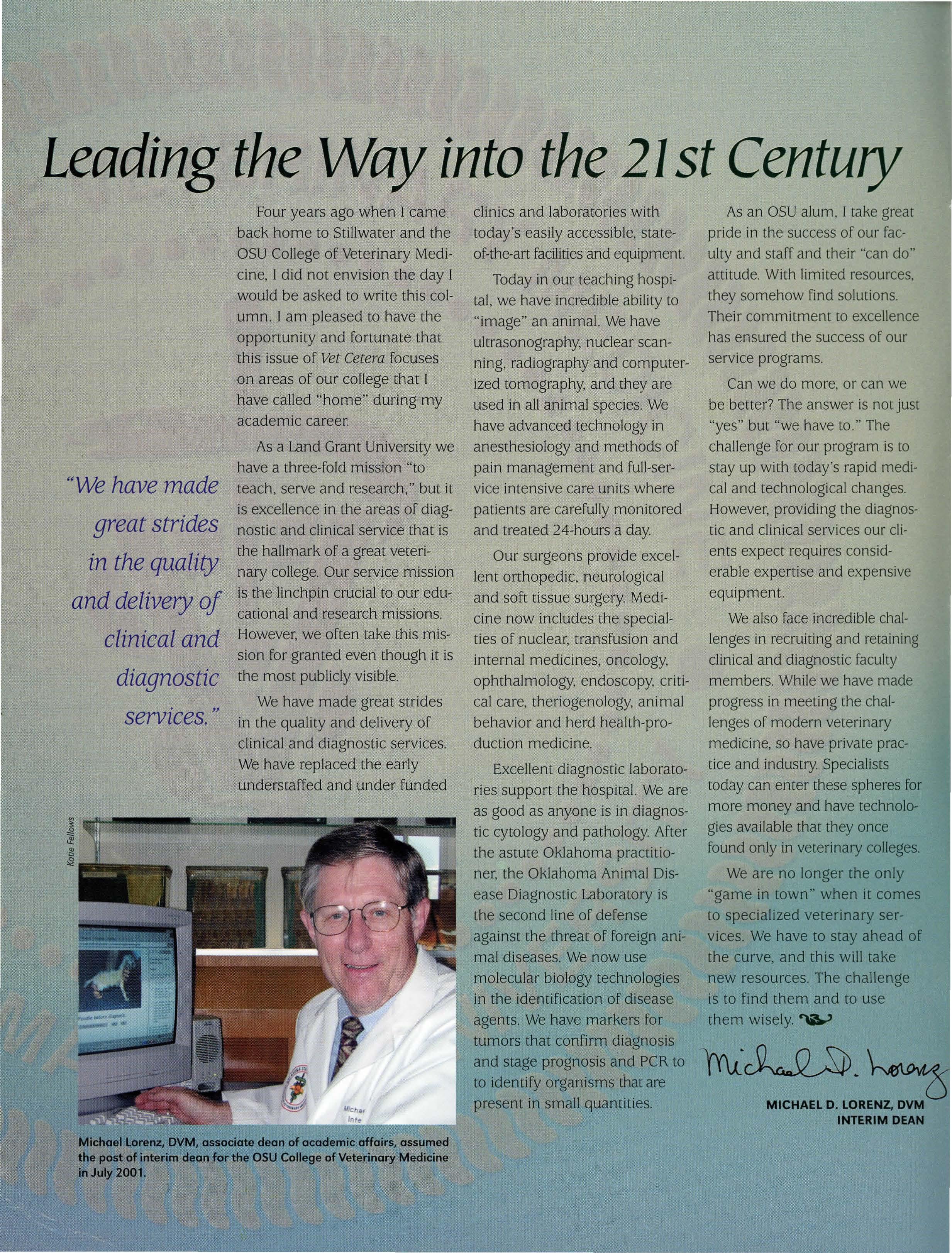
Michael Lorenz, DVM, associate dean of academic affairs, assumed the post of interim dean for the OSU College of Veterinary Medicine in July 2001.
MICHAEL D. LORENZ, DVM INTERIM DEAN
OSUCollegeof its doorsto the therewasa feelingof • ·onofimportant thissameadventurous to resoundinthelivesof andalumni.Muchwork doneto improvethe health 'malpopulation. It is our ho portant work and the cu
n:hwillserveasalegacy Home on the range
CONTENTS
4 Sensing Danger
Researchers team against biological and chemical threats.
5 Battling an Opportunistic Enemy
Researching treatment for mycobacterial infections could lead to help for HIV patients. mebeforeandthosewho in thefootstepsofthesefi
WeInviteyouto honora friend or memberbycontributingto the0SU. ofVeterinaryMedicineBrickWalk a Spaceis stillavailablefor forthe college'salumni, andcurrentand formerstaff Eachbrickhasthreelinesa
Pleasejoin us at the www.cvm.okstate.edu. is located at www.
6 Shedding Light on the Problem
A study of photodynamic therapy to treat bladder cancer in dogs could help humans as well.
8 A Different Breed
A new, one-of-a-kind Oklahoma facility speeds up canine recovery time.
/C Letters from the Future
OSU CVM's first graduating class plants a connection to the class of 2051
J6 Field of Change
A second-year student's career shift alters the fortunes of an OSU athi'etics team.
Alexander,LorenzAssumeNew Posts
Dr. Joseph Alexander, dean of the OSU College of Veterinary Medicine, assumeda new appointment as OSU Interim Vice President for Research on July 1, 2001.
Alexander, who has also held academic and administrative appointments at the University of Tennessee and Virginia Tech, has led CVM since 1985 and is OSU's longest serving dean. Under his leadership, the CVM's research funding grew from S1.3 million in 1985 to nearly $6.6 million today.
OSU President James Halligan, pleased with the appointment says, "Dr. Alexander is an experienced dean who has been very successful in attracting research funding and has earned the respect of peers for his demonstrated balance between teaching and research in the college."
Dr. Michael Lorenz, associate dean of academic affairs at the OSU CVM, will serve as interim dean. He served as associate dean for academic affairs at the University of Georgia CVM from 1982 to 1988 and as dean of veterinary medicine at Kansas State University from 1988 to 1994. He is a diplomat of the American College of Veterinary Internal Medicine.
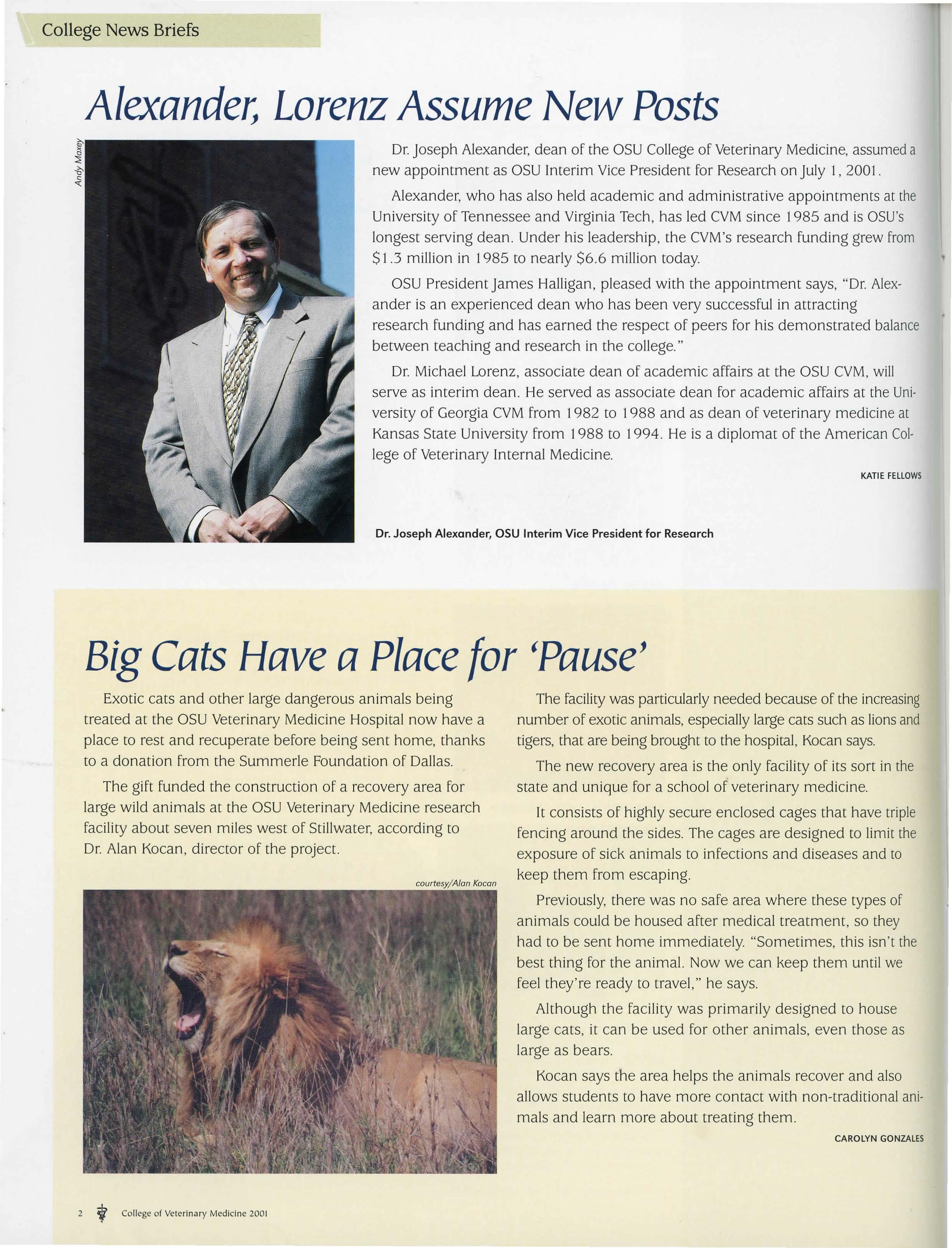
BigCatsHavea Placefor 'Pause'
Exotic cats and other large dangerous animals being treated at the OSU Veterinary Medicine Hospital now have a place to rest and recuperate before being sent home, thanks to a donation from the Summerle Foundation of Dallas.
The gift funded the construction of a recovery area for large wild animals at the OSU Veterinary Medicine research facility about seven miles west of Stillwater, according to Dr. Alan Kocan, director of the project.
courtesy/Alan Kocon
The facility was particularly needed because of the increasing number of exotic animals, especiaJlylarge cats such as lions and tigers, that are being brought to the hospital, Kocan says.
The new recovery area is the only facility of its sort in the state and unique for a school of veterinary medicine.
It consists of highly secure enclosed cages that have triple fencing around the sides. The cages are designed to limit the exposure of sick animals to infections and diseases and to keep them from escaping.
Previously, there was no safe area where these types of animals could be housed after medical treatment, so they had to be sent home immediately. "Sometimes, this isn't the best thing for the animal. Now we can keep them until we feel they're ready to travel," he says.
Although the facility was primarily designed to house large cats, it can be used for other animals, even those as large as bears.
Kocan says the area helps the animals recover and also allows students to have more contact with non-traditional animals and learn more about treating them.
CAROLYN GONZALES
KATIE FELLOWS
Dr. Joseph Alexander, OSU Interim Vice President for Research
StillGoing Strongat 25
SU's Oklahoma Animal Disease Diagnostic Laboratory (OADDL) may have celebrated its 25th birthday this year, but its services just keep growing.
In addition to the routine diagnostic testing, a service available to all Oklahomans, OADDL has three ongoing projects,says lab director Dr William Edwards.
The Oklahoma Horse Racing Commission contracts with the lab to analyze every fatal racehorse injury that occursat Oklahoma's four race tracks and to identify common denominational factors causing career-ending injuries or death in racehorses.
Dr.Jerry Saliki, a virologist at the lab, is studying the detection and prevention of Lhediseasesspread by the morbilliviruses, which are causing diseaseand mortality in thousands of seals,porpoises and dolphins.
"We are the only lab in the United Statesdoing this analysis," Edwards says.Referring to the famous killer whale that became the subject for a motion picture, he adds, "We did an analysis of Willy's blood, before they freed him."
In collaboration with the Oklahoma Department of Health and the Centers for DiseaseControl in Atlanta, OADDL also monitors horses, birds and mosquitoes for West Nile fever..
"The OADDL has come a long way in 25 years," Edwards says, "and its mission is going to become even more important in the future. In dealing with bacteria and viruses, we are dealing with a dynamic life form. These organisms are constantly changing, and we've got to stay on top of them to protect not only animal health but human health as well."
TOM JOHNSTON
A Hefty 'Shot in theArm'
OSU College of Veterinary Medicine research students received a boost this year with a $25,000 grant from the Merck-Merial Animal Health Foundation. The college will use the funds to help support a research elective program for second-, third- and fourth-year students.
"The pharmaceutical industry and government agencies are coming to recognize that there is a greater need for veterinarians to be involved in research," says Dr Jerry Malayer, director of the research elective program. "They want to get more veterinary students involved in research projects earlier in their academic careers to try to channel them toward biomedical research."
Since veterinary medical education concentrates, as expected, on medicine rather than research, students need a different type of training to become familiar with biomedical research methods, Malayer says. "The research elective program seeks to provide this training. We want our students to understand that research is a viable career option."~
TOM JOHNSTON
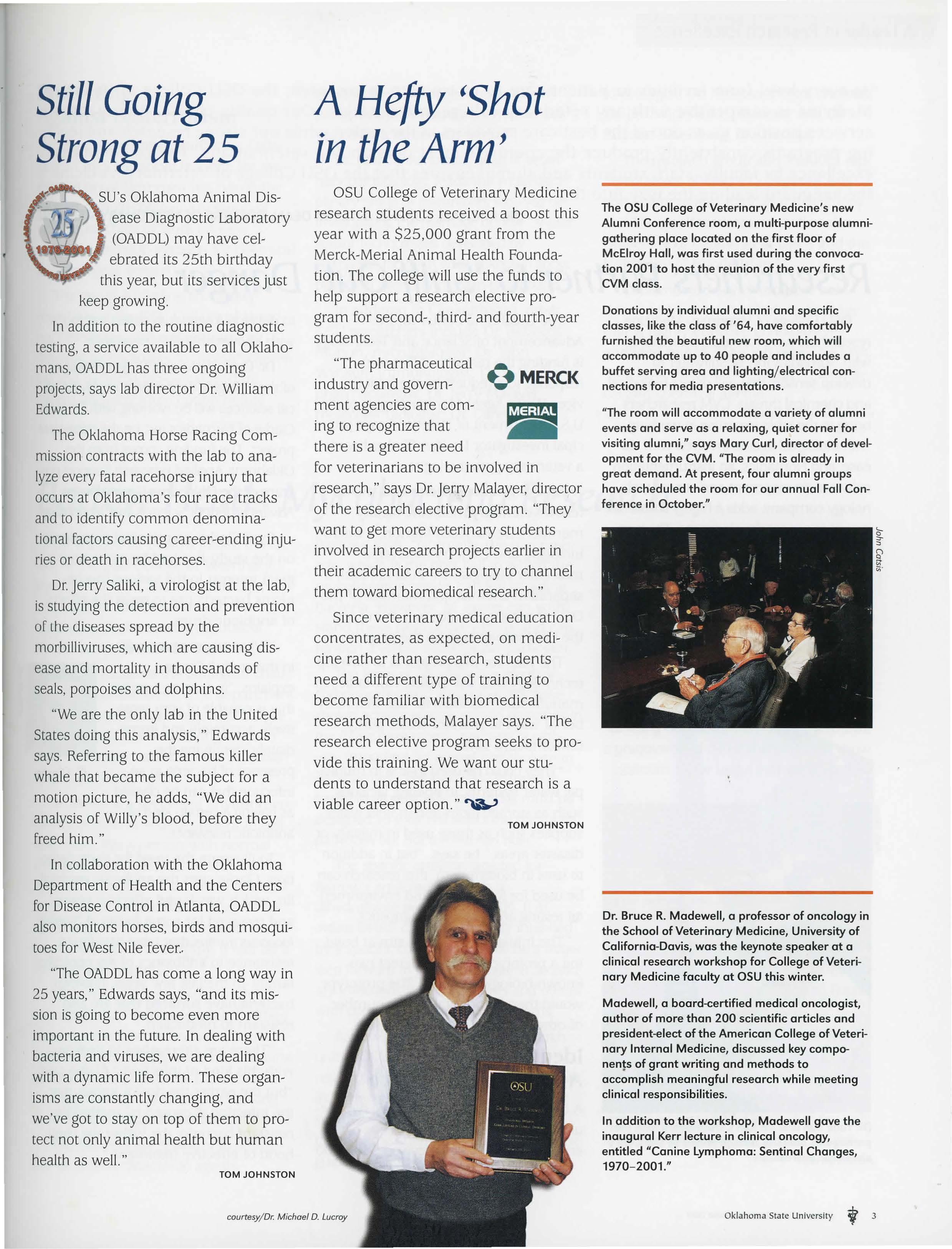
The OSU College of Veterinary Medicine's new Alumni Conference room, a multi-purpose alumnigathering place located on the first floor of McElroy Hall, was first used during the convocation 2001 to host the reunion of the very first CVM class.
Donations by individual alumni and specific classes, like the class of '64, have comfortably furnished the beautiful new room, which will accommodate up to 40 people and includes a buffet serving area and lighting/electrical connections for media presentations.
"The room will accommodate a variety of alumni events and serve as a relaxing, quiet corner for visiting alumni," says Mary Curl, director of development for the CVM. "The room is already in great demand. At present, four alumni groups have scheduled the room for our annual Fall Conference in October."
Dr. Bruce R. Madewell, a professor of oncology in the School of Veterinary Medicine, University of California-Davis, was the keynote speaker at a clinical research workshop for College of Veterinary Medicine faculty at OSU this winter.
Madewell, a board-certified medical oncologist, author of more than 200 scientific articles and president-elect of the American College of Veterinary Internal Medicine, discussed key components of grant writing and methods to accomplish meaningful research while meeting clinical responsibilities.
In addition to the workshop, Madewell gave the inaugural Kerr lecture in clinical oncology, entitled "Canine Lymphoma: Sentinel Changes, 1970-2001."
courtesy/Dr. Michael D. Lucroy
''At every level from facilities to patient care to instruction to research, the OSU College of Veterinary Medicine is competitive with any veterinary college in the nation. Our quality clinical and diagnostic services position us as one of the best care providers in the region while our strong research and teaching programs consistently produce the country's most outstanding veterinarians. The commitment to excellence by faculty, staff, students and alumni ensures that the OSU College of Veterinary Medicine is the vanguard leading the way into the 21st century."
- DR. MICHAEL LORENZ,INTERIM DEAN, COLLEGEOF VETERINARYMEDICINE
ResearchersParlnerto 'SniffOut' Danger
OSU College of Veterinary Medicine researchers have formed a partnership with Nomadics Inc. of Stillwater to develop sensors that will detect biological and chemical threats. CVM researchers bring to the table expertise in working with biological agents involved with disease, and Nomadics, an instrumentation, software development and sensor technology company, adds a highly successful record in sensor development. The partnership currently involves three areas that hold the promise of advance detection devices that will "sniff out" danger.
Monitoring Water Purity
Three faculty members from the OSU College of Veterinary Medicine and a member of the chemistry faculty in the College of Arts and Sciences have been awarded a three-year $300,000 grant to work with Nomadics Inc. in developing a biological warfare agent water monitor.
The Oklahoma Center for the Advancement of Science and Technology is funding the research. "This is in response to a request by the Joint Services Water Agent Monitor project of the U.S. Department of Defense," says principal investigator Dr. Ken Clinkenbeard, a veterinary pathobiologist.
Working with Clinkenbeard will be fellow veterinary medicine faculty members Dr. Rebecca Morton, a microbiologist, and Dr. Jerry Malayer, a molecular biologist. Dr. Ziad El Rassi, a separation chemist and member of the OSU chemistry faculty, will round out the OSU researchers on the project.
The plan for this project is to develop technology that will enable Nomadics to manufacture monitors for use in a number of ways to monitor water purity, Clinkenbeard says.
"They could be used in-line in municipal water systems, in holding facilities such as storage tanks and in field water supplies such as those used in military or disaster areas," he says, "but in addition to uses in bioterrorism, this research can be used for food safety and environmental testing and medical diagnostics "
The initial research will aim at building a prototype that will detect two known biological agents. The prototype would then be adaptable to a number of other agents, Clinkenbeard says.
Identifying Antibiotic Resistance
A team of researchers, including two faculty members of the OSU College of Veterinary Medicine, has received $300,000
to develop a sensor to detect microbes with known antibiotic resistance.
Dr. Cyril Clarke and Dr. Jerry Malayer of the college's department of physiological sciences will be working with Dr.Jean Clarke of Nomadics Inc. on the three-year project. The funding comes from the Oklahoma Applied Research Support program of the Oklahoma Center for the Advancement of Science and Technology.
Cyril Clarke, co-principal investigator on the study, has had for some time a great interest in the various mechanisms bacteria use to resist the effects of antibiotic drugs.
"What we propose to do in this study," Clarke explains, "is develop a sensor that is capable of very sensitively, accurately and immediately identifying the presence o.f bacteria in an infection that can be classed as having a certain kind of antibiotic resistance."
To illustrate the need for early detection, Clarke cites the antibiotic methicillin, which was found effective against and reserved for some forms of Staphylococcus aureus that have developed resistance to antibiotics of the penicillin family. In the last few years, however, bacteria have surfaced that are also resistant to methicillin.
"There are alternatives in dealing with this kind of infection," Clarke says, "but the earlier the doctor knows that the infection is caused by methicillinresistant bacteria, the higher the likelihood of effective treatment."
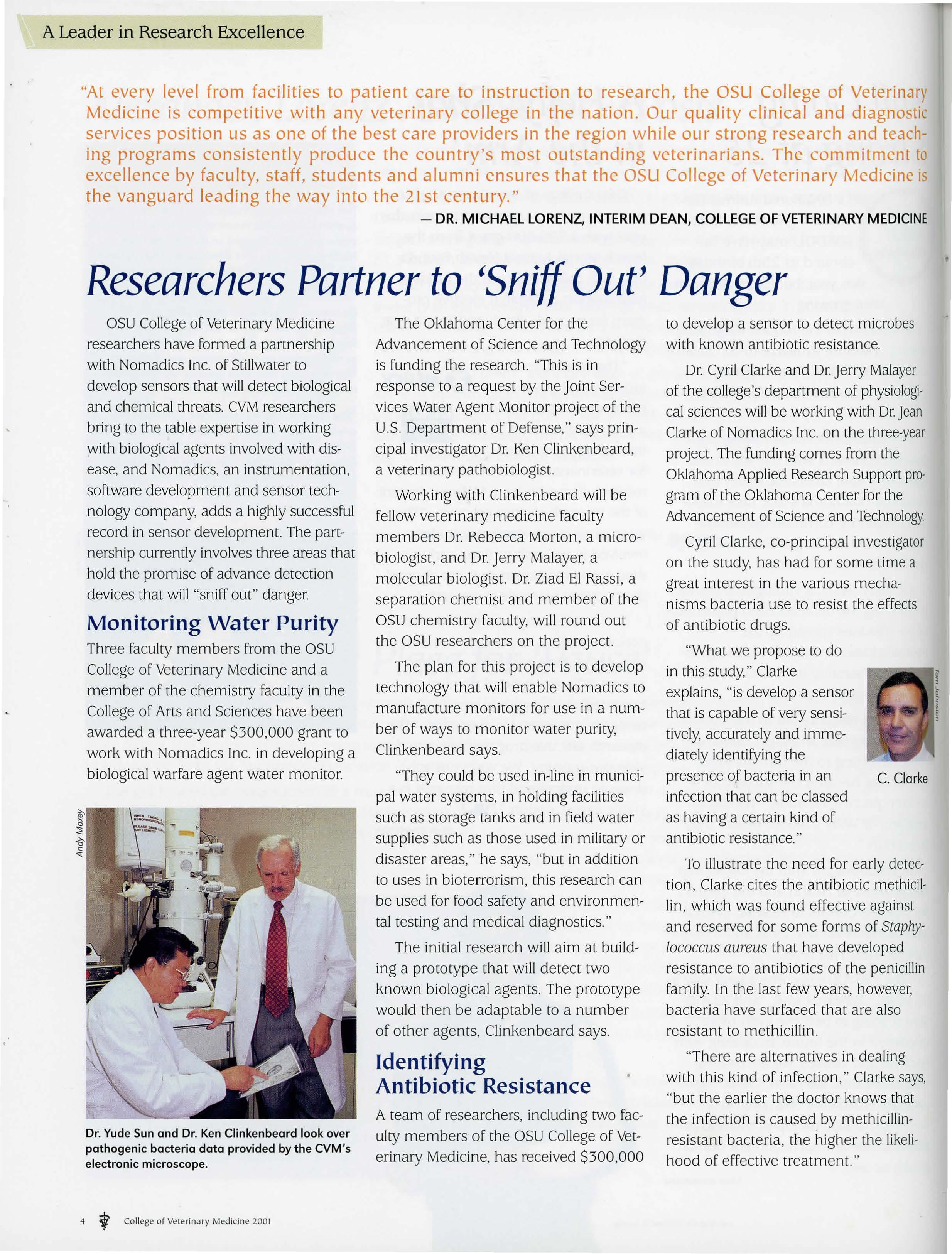
Dr. Yude Sun and Dr. Ken Clinkenbeard look over pathogenic bacteria data provided by the CVM's electronic microscope.
C. Clarke
Protecting AgainstBioterrorism
A multi-million dollar grant from Oklahoma City's Memorial Institute for the Preventionof Terrorism has paved the way for a multi-disciplinary group of OSUresearchersto work on new advancedetection systems for chemical and biological threats.
The group, including six faculty members of the OSU College of Veterinary Medicine, will concentrate on devisingtechnologies to "sense" chemical and bacterial biological warfare agents,allowing interception before
they do their damage. The grant will provide approximately $1 million per year over a three-year period.
Dr. Ken Clinkenbeard, head of veterinary pathobiology, leads the multi-disciplinary group of researcherswho will be investigating the marriage of new "sniffer" sensor technologies developed by Nomadics Inc. with what is known about biological agents and organ-phosphates.
In addition to Clinkenbeard, other OSU researchers include Dr. Rebecca Morton, microbiologist; Dr. John Wyckoff, immunologist; Dr. Cyril Clarke, pharmacologist; Dr. Jerry Malayer, molecular biologist; Dr. Carey Pope,
toxicologist; Dr. Nicholas Kotov, chemist; Dr. Jim Wickstead, physicist; and Dr. Richard Essenberg, biochemist.
The research group also includes representatives of OSU's Colleges of Arts and Sciences and Agricultural Sciences and Natural Resources, as well as the University of California at Davis and the University of Rhode Island.
Clinkenbeard says Nomadics has developed similar "sniffer" technology that is highly effective on explosives and land mines. "Our job now," he says, "will be to fit that technology to biological and chemical agents."
BarrowHeadsMycobacteriaResearch
Dr. William W. Barrow joined the faculty of the OSU College of Veterinary Medicine in April 2001 and brought with him an ambitious research project funded by the National Institutes of Health for more than $1 .3 million.
Barrow occupies the Sitlington chair in infectious diseases in the department of veterinary pathobiology, and his primary interest lies in studying ways to treat infections caused by the Mycobacteriumavium complex.
M. avium is a species of environmental mycobacteria widely present in soil and water. For a person with normal immune responses, it is of little consequence.However, for a person infected with Human Immunodeficiency Virus or for organ transplant recipients on immuno-supressive therapy, it can be a very serious matter.
"This is an opportunistic family of mycobacteria," Barrow explains. "They can be carried in the body for years with no problem. But once the immune system is compromised, the bacteria multiply throughout the body causing severedisseminated infections."
The bacteria are resistant to a number of antimycobacterial agents,
Barrows says. "Normally, the macrophage, which is the host cell in which the mycobacteria reside, can kill invading bacteria. However, M. avium can withstand these destructive efforts and can remain a viable intracellular pathogen."
The focus of his study is a group of compounds called antifolates that have shown activity against certain enzymes in the folate biosynthetic pathway, a pathway important for proper metabolism in all living cells. Because this pathway is found in all cells, effective drugs must be designed so they will select the microbial pathogen but not the human host.
The specific enzyme targeted for Barrow's antifolate research is dihydrofolate reductase (DHRF). If M. avium DHRF can be selectively inhibited by a specific compound, it will be a major step forward in protecting against secondary infections in AIDS patients and others with compromised immune systems.
Barrow's mycobacteriology research unit at OSU will conduct the primary research. The Southern Research Institute in Birmingham, Ala., will do the organic synthesis for candidate antifolates. Synthesis of the antifolate compounds will be guided by a drug design program based
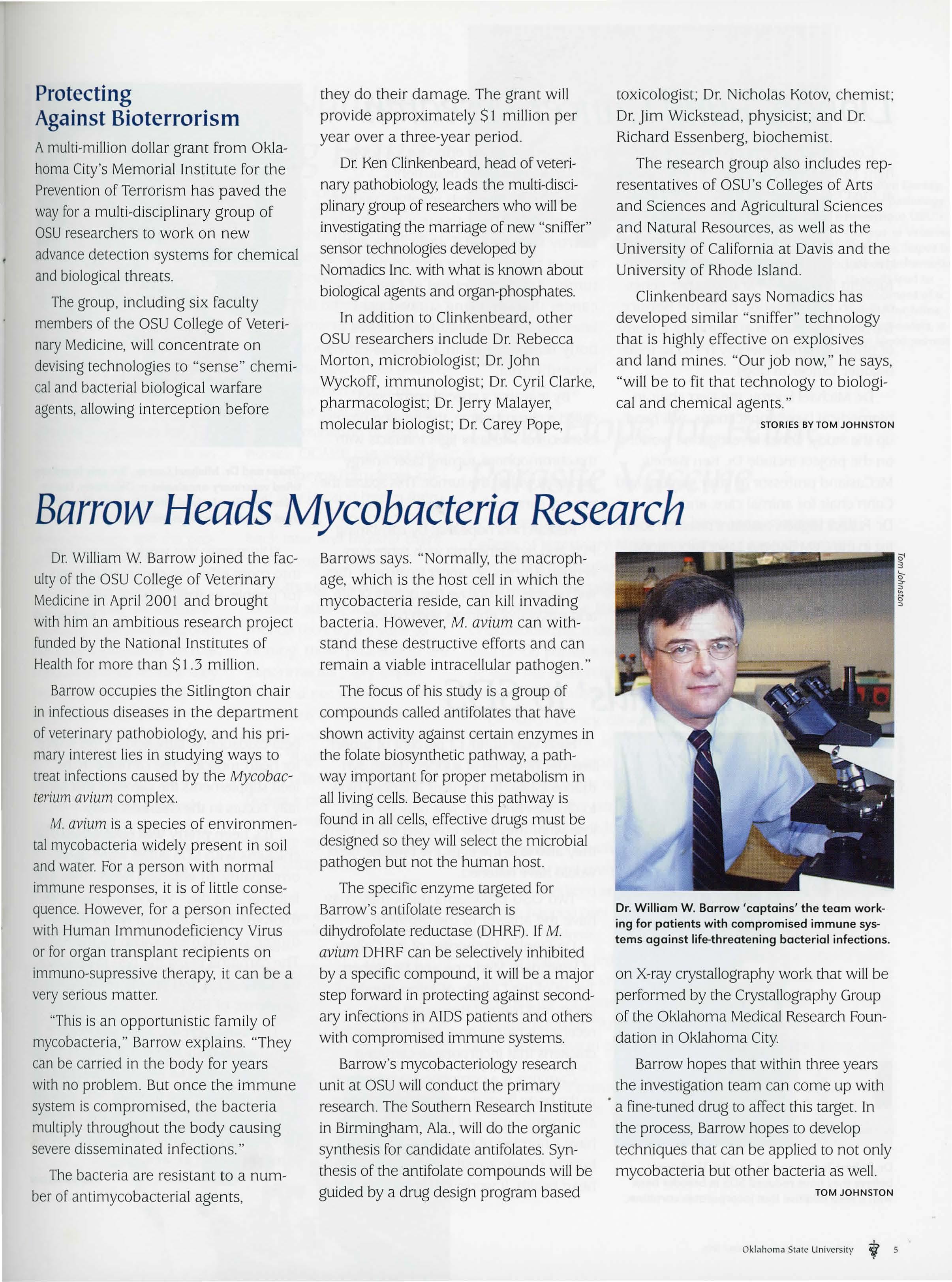
life-threatening bacterial infections.
on X-ray crystallography work that will be performed by the Crystallography Group of the Oklahoma Medical Research Foundation in Oklahoma City
Barrow hopes that within three years the investigation team can come up with a fine-tuned drug to affect this target. In the process, Barrow hopes to develop techniques that can be applied to not only mycobacteria but other bacteria as well.
TOM JOHNSTON
Dr. William W. Barrow 'captains' the team working for patients with compromised immune systems against
DonorsFundCancerResearch
Concerned donors determined to fight cancer may soon bring researchers at the OSU College of Veterinary Medicine one step closer to finding a cure.
A generous $203,745 donation from the Robert j. Kleberg, Jr. and Helen C. Kleberg Foundation and another generous $36,500 donation from the Bernice Barbour Foundation are funding a study of photodynamic therapy (PDT) to treat bladder cancer in dogs.
Dr. Michael Lucroy, the Kerr chair in biomedical laser applications, will head up the study. Other investigators working on the project include Dr. Ken Bartels, Mccasland professor of laser surgery and Cohn chair for animal care, and Dr. RussellHigbee, assistant researchscientist in the CVM SarkeysLaser Laboratory.
The scientists' goal is to develop ways to selectively treat cancer that don't have the side effects of chemotherapy and
radiation but are as effective, or more effective, than these treatments.
The laser research involves taking advantage of laser-tissue interactions, Lucroy says. "In PDT, laser light activates a cancer-killing drug within a tumor. Another method of laser-based cancer therapy being studied uses laser light to heat tissue just above body temperature, in a process called hyperthermia.
"By injecting a special compound, called a chromophore, the heating process is selective. The laser light interacts with the chromophore, turning laser energy into heat within the tumor. This spares the normal surrounding tissues," he says.
Researchershope that by combining PDT and hyperthermia with more conventional forms of cancer treatment, they will be able to improve the quality of life and survival of animals with cancer.
Puttingthe 'Skids'to SDS
Each year up to I 2 percent of broiler breeder hens die of sudden death syndrome (SOS).It's a major financial blow to chicken breeders. Not only do they lose what they have invested in the hens, they also lose the eggs the breeder hens would have hatched.
Two OSU professors think they may have the answer to the problem.
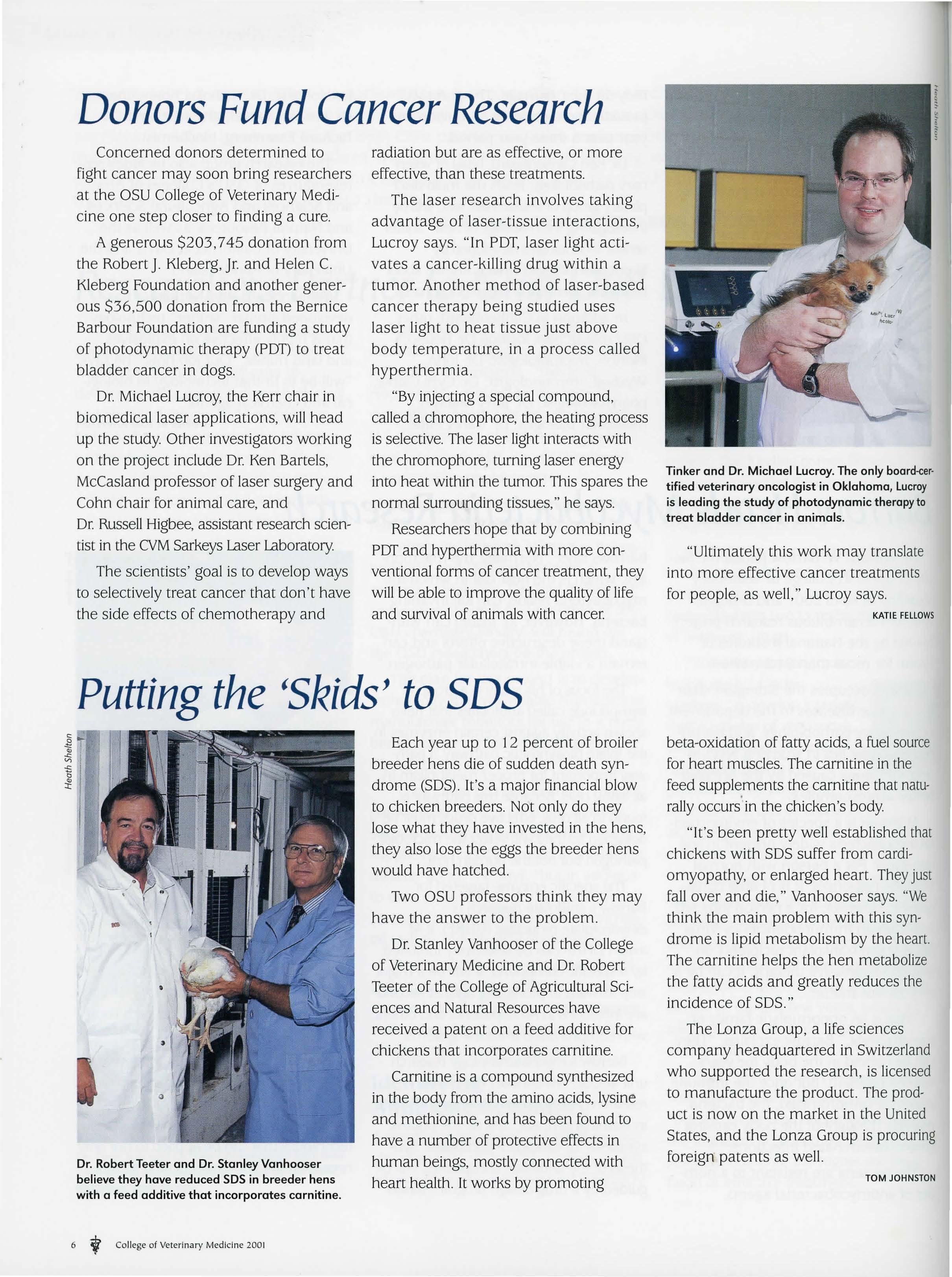
Dr. Stanley Vanhooser of the College of Veterinary Medicine and Dr. Robert Teeter of the College of Agricultural Sciences and Natural Resources have received a patent on a feed additive for chickens that incorporates carnitine.
Carnitine is a compound synthesized in the body from the amino acids, lysine and methionine, and has been found to have a number of protective effects in human beings, mostly connected with heart health. It works by promoting
"Ultimately this work may translate into more effective cancer treatments for people, as well," Lucroy says.
beta-oxidation of fatty acids, a fuel source for heart muscles. The carnitine in the feed supple_mentsthe carnitine that naturally occurs in the chicken's body.
"It's been pretty well established that chickens with SOS suffer from cardiomyopathy, or enlarged heart. They just fall over and die," Vanhooser says. "We think the main problem with this syndrome is lipid metabolism by the heart. The carnitine helps the hen metabolize the fatty acids and greatly reduces the incidence of SOS."
The Lonza Group, a life sciences company headquartered in Switzerland who supported the research, is licensed to manufacture the product. The product is now on the market in the United States, and the Lonza Group is procuring foreign patents as well.
Dr. Robert Teeter and Dr. Stanley Vanhooser believe they have reduced SOS in breeder hens with a feed additive that incorporates carnitine.
Tinker and Dr. Michael Lucroy. The only board-certified veterinary oncologist in Oklahoma, Lucroy is leading the study of photodynamic therapy to treat bladder cancer in animals.
KATIE FELLOWS
TOM JOHNSTON
WhenMotherNature
NeedsA HelpingHand
OSUresearchers in the Collegesof Veterinary Medicine,Agricultural Sciences and Natural Resources, Arts andSciencesand OsteopathicMedicine have banded togetherto form the Oklahoma Center for Assisted ReproductiveExcellence (OCARE).
Seekingand developing effectivetreatments for reproductiveproblems is an important goal on several fronts,says Dr. Reed Holyoak,a specialist in theriogenology and the program coordinator.
"Horsesand dogs are a goodexample," he explains. "Becauseboth animal groups havebeen selectively bred for traitsother than fertility, they now have considerable fertility problems. With end angeredspecies, the reservation of germplasm (eggs and sperm)is of high concern."
Most of OCARE's work centersaround overcoming infertility in breeding animals.This begins with a
breeding soundness examination, followed by either specific therapy to improve fertility and/or timed breeding in horses and dogs.
OCARE offers laser surgery for mares with uterine cysts, semen evaluation to determine sperm cell health and cryopreservation of semen for later use in artificial insemination of dogs and horses. OCARE can also collect embryos from large animal species and freeze them for storage, then bring them back later and transfer them to a surrogate female.
"Although media has focused attention on experimental techniques such as cloning, these procedures are experimental, very expensive, and not without a downside often overlooked by media coverage," Holyoak says. "Right now, we feel best about offering the standard bedrock procedures while we work toward developing and offering the more technically sophisticated ones."
TOM JOHNSTON
New Hopefor Feline ParasiteVaccine
A researcher in the OSU College of Veterinary Medicine is hoping to uncover information that might help develop a vaccine for feline cytauxzoonosis, a usually fatal blood parasite in domestic cats. No known treatment exists for the infection.
Dr. Karen Dorsey, clinical pathology resident, says the OSU veterinary hospital sees on average a couple of cases of infection by the parasite per week during peak tick season. The cat starts out with fever and lethargy and eventually becomes jaundiced and dies. This can happen over as short a time as one week.
Ticks that have fed on wild bobcats, which are known reservoirs for the disease, carry the parasite. "And you don't have to live in a rural area to be affected," Dorsey says. "It's more commor;i in rural areas, but dogs who
have been camping with families can pick up an infected tick and carry it back to an urban setting. If it happens to land and feed on your cat, the outlook is not good."
Recently, however, Dorsey and her mentors, Dr. James Meinkoth and Dr. Alan Kocan, discovered several domestic cats that were infected with what appears to be a non-fatal strain of this parasite. Dorsey is interested in finding out if cats infected with the non-fatal strain of the parasite will show resistance to infection by the fatal strain. If they do, there is a good chance a vaccine could be developed to protect pets against the problem.
The College of Veterinary Medicine Companion Animal Fund is supporting the study, which will take approximately one year to complete.~
TOM JOHNSTON
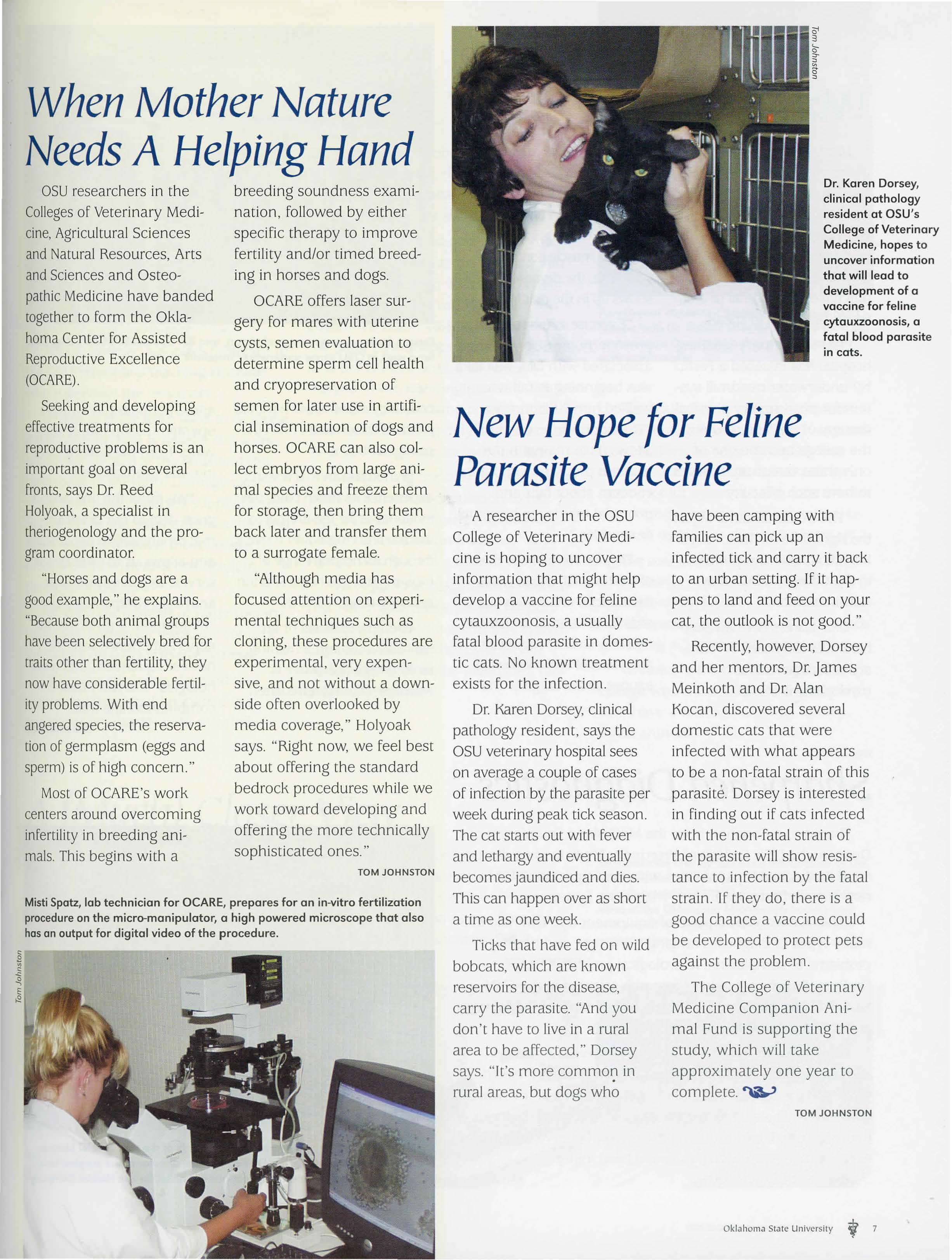
Misti Spatz, lab technician for OCARE, prepares for an in-vitro fertilization procedureon the micro-manipulator, a high powered microscope that also hasan output for digital video of the procedure.
Dr. Karen Dorsey, clinical pathology resident at OSU's College of Veterinary Medicine, hopes to uncover information that will lead to development of a vaccine for feline cytauxzoanosis, a fatal blood parasite in cats.
Walkingthe Dog
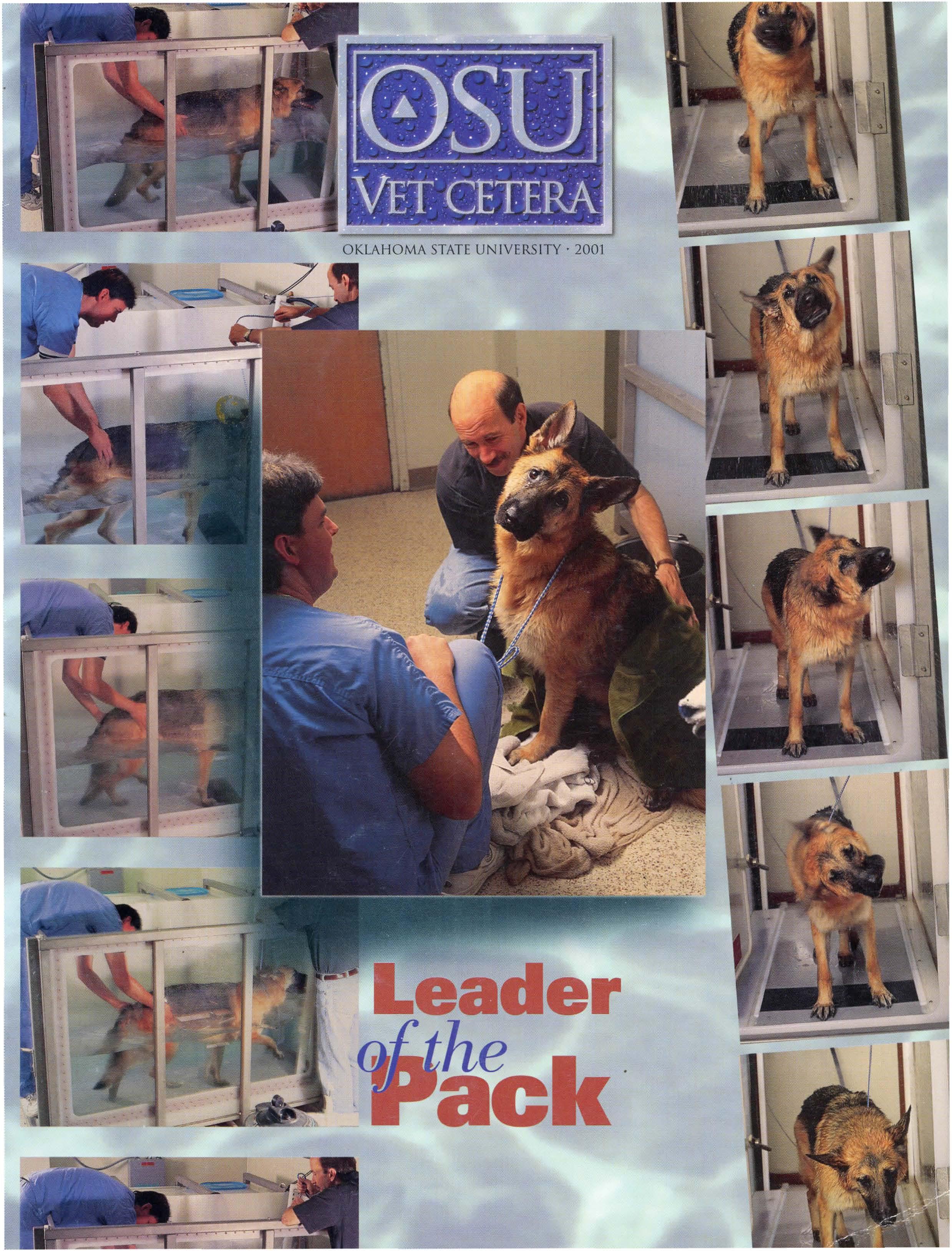
Many are familiar with the treadmill that machine at the gym that beckons you to a more healthy life by making you walk or run in place for a few miles. But OSU's College of Veterinary Medicine has purchased a treadmill of a different breed, so to speak.
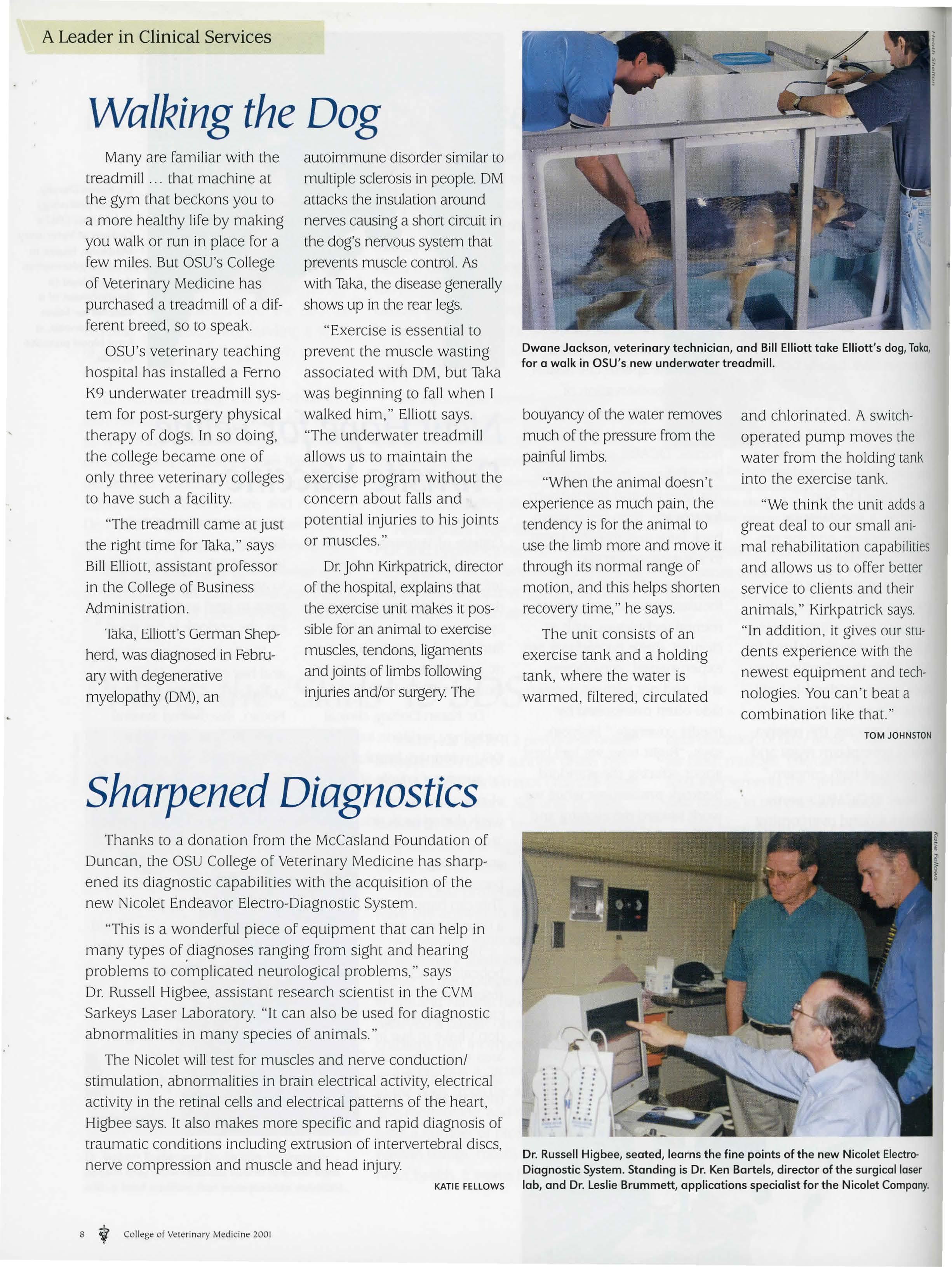
OSU's veterinary teaching hospital has installed a Ferno K9 underwater treadmill system for post-surgery physical therapy of dogs. In so doing, the college became one of only three veterinary colleges to have such a facility.
"The treadmill came at just the right time for Taka," says Bill Elliott, assistant professor in the College of Business Administration.
Taka,Elliott's German Shepherd, was diagnosed in February with degenerative myelopathy (OM), an
autoimmune disorder similar to multiple sclerosisin people. OM attacks the insulation around nerves causing a short circuit in the dog's nervous system that prevents muscle control. As with Taka,the diseasegenerally shows up in the rear legs.
"Exercise is essential to prevent the muscle wasting associated with OM, but Taka was beginning to fall when I walked him," Elliott says.
"The underwater treadmill allows us to maintain the exercise program without the concern about falls and potential injuries to his joints or muscles."
Dr.John Kirkpatrick, director of the hospital, explains that the exerciseunit makes it possible for an animal to exercise muscles, tendons, ligaments and joints of limbs following injuries and/or surgery.The
SharpenedDiagnostics
Thanks to a donation from the Mccasland Foundation of Duncan, the OSU College of Veterinary Medicine has sharpened its diagnostic capabilities with the acquisition of the new Nicolet Endeavor Electro-Diagnostic System.
"This is a wonderful piece of equipment that can help in many types of _diagnosesranging from sight and hearing problems to complicated neurological problems," says Dr. Russell Higbee, assistant research scientist in the CVM Sarkeys Laser Laboratory. "It can also be used for diagnostic abnormalities in many species of animals."
The Nicolet will test for muscles and nerve conduction/ stimulation, abnormalities in brain electrical activity, electrical activity in the retinal cells and electrical patterns of the heart, Higbee says. It also makes more specific and rapid diagnosis of traumatic conditions including extrusion of intervertebral discs, nerve compression and muscle and head injury.
KATIE FELLOWS
bouyancy of the water removes much of the pressure from the painful limbs.
"When the animal doesn't experience as much pain, the tendency is for the animal to use the limb more and move it through its normal range of motion, and this helps shorten recovery time," he says.
The unit consists of an exercise tank and a holding tank, where the water is warmed, filtered, circulated
and chlorinated. A switchoperated pump moves the water from the holding tank into the exercise tank.
"We think the unit addsa great deal to our small animal rehabilitation capabilities and allows us to offer better service to clients and their animals," Kirkpatrick says. "In addition, it gives our students experience with the newest equipment and technologies. You can't beat a combination like that."
Dwane Jackson, veterinary technician, and Bill Elliott take Elliott's dog, Take, for a walk in OSU's new underwater treadmill.
TOM JOHNSTON
Dr. Russell Higbee, seated, learns the fine points of the new Nicolet ElectroDiagnostic System. Standing is Dr. Ken Bartels, director of the surgical laser lab, and Dr. Leslie Brummett, applications specialist for the Nicolet Company.
EvenCowsNeedA 'Hot Tub'
Foryears,humans have known the benefitsof water therapy for injuries. Now,cowsare reaping those benefits too.
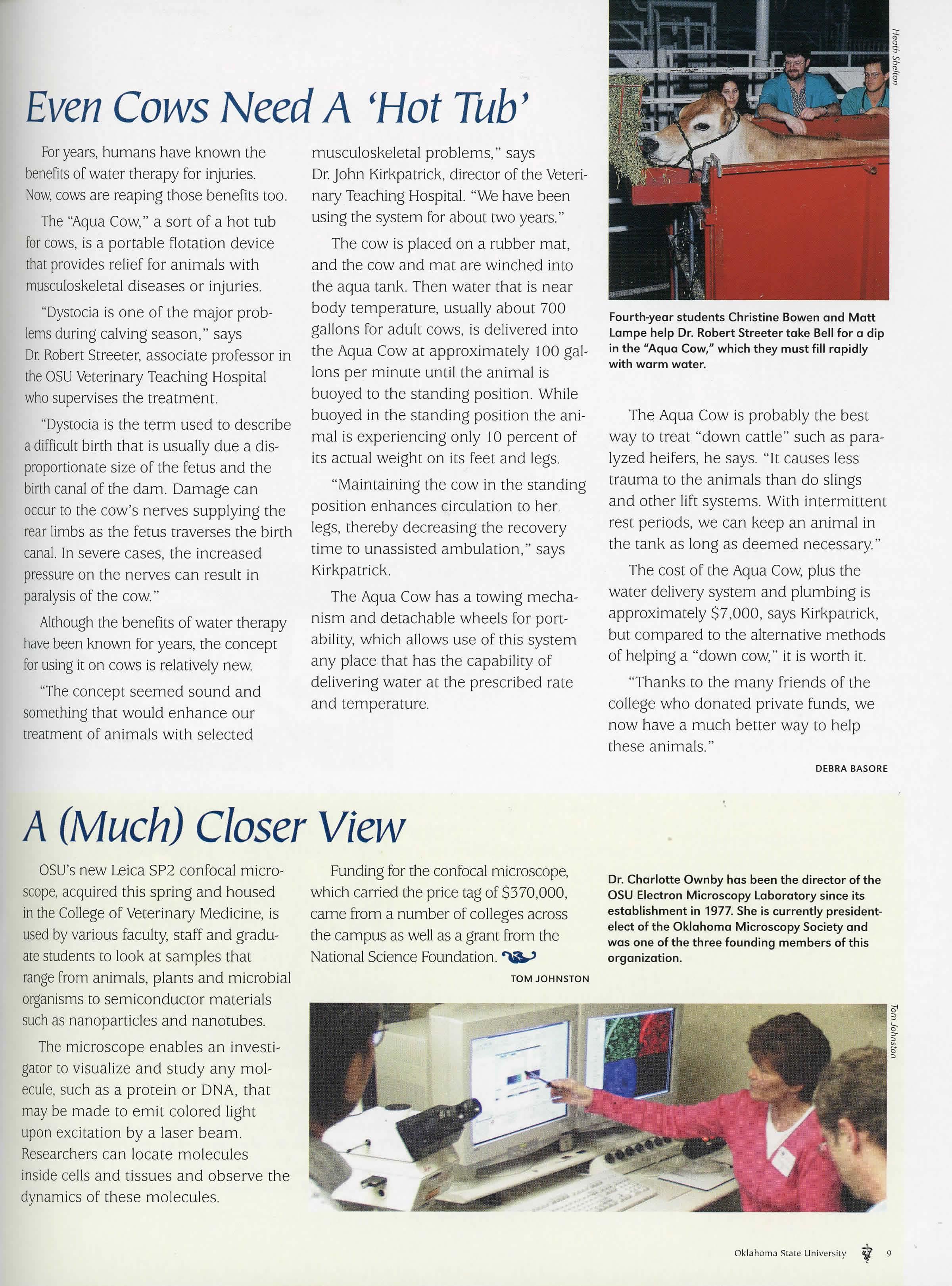
The "Aqua Cow," a sort of a hot tub for cows,is a portable flotation device thatprovides relief for animals with musculoskeletaldiseases or injuries.
"Dystocia is one of the major problemsduring calving season," says Dr.RobertStreeter, associate professor in theOSUVeterinary Teaching Hospital who supervisesthe treatment.
"Dystocia is the term used to describe a difficult birth that is usually due a disproportionatesize of the fetus and the birth canal of the dam. Damage can occurto the cow's nerves supplying the rearlimbs as the fetus traverses the birth canal.In severe cases, the increased pressureon the nerves can result in paralysisof the cow."
Althoughthe benefits of water therapy havebeen known for years, the concept forusing it on cows is relatively new.
"The concept seemed sound and something that would enhance our treatment of animals with selected
musculoskeletal problems," says Dr. John Kirkpatrick, director of the Veterinary Teaching Hospital. "We have been using the system for about two years."
The cow is placed on a rubber mat, and the cow and mat are winched into the aqua tank. Then water that is near body temperature, usually about 700 gallons for adult cows, is delivered into the Aqua Cow at approximately 100 gallons per minute until the animal is buoyed to the standing position. While buoyed in the standing position the animal is experiencing only 1O percent of its actual weight on its feet and legs.
"Maintaining the cow in the standing position enhances circulation to her legs, thereby decreasing the recovery time to unassisted ambulation," says Kirkpatrick.
The Aqua Cow has a towing mechanism and detachable wheels for portability, which allows use of this system any place that has the capability of delivering water at the prescribed rate and temperature.
A (Much)CloserView
OSU'snew Leica SP2 confocal microscope,acquired this spring and housed in the Collegeof Veterinary Medicine, is usedby various faculty, staff and graduatestudents to look at samples that rangefrom animals, plants and microbial organismsto semiconductor materials suchas nanoparticles and nanotubes.
The microscope enables an investigator to visualize and study any molecule,such as a protein or DNA, that may be made to emit colored light upon excitation by a laser beam. Researcherscan locate molecules inside cells and tissues and observe the dynamics of these molecules.
Funding for the confocal microscope, which carried the price tag of $370,000, came from a number of colleges across the campus as well as a grant from the National Science Foundation.
TOM JOHNSTON
The Aqua Cow is probably the best way to treat "down cattle" such as paralyzed heifers, he says. "It causes less trauma to the animals than do slings and other lift systems. With intermittent rest periods, we can keep an animal in the tank as long as deemed necessary."
The cost of the Aqua Cow, plus the water delivery system and plumbing is approximately $7,000, says Kirkpatrick, but compared to the alternative methods of helping a "down cow," it is worth it.
"Thanks to the many friends of the college who donated private funds, we now have a much better way to help these animals."
Dr. Charlotte Ownby has been the director of the OSU Electron Microscopy Laboratory since its establishment in 1977. She is currently presidentelect of the Oklahoma Microscopy Society and was one of the three founding members of this organization.
Fourth-year students Christine Bowen and Matt Lampe help Dr. Robert Streeter take Bell for a dip in the "Aqua Cow," which they must fill rapidly with warm water.
DEBRA BASORE
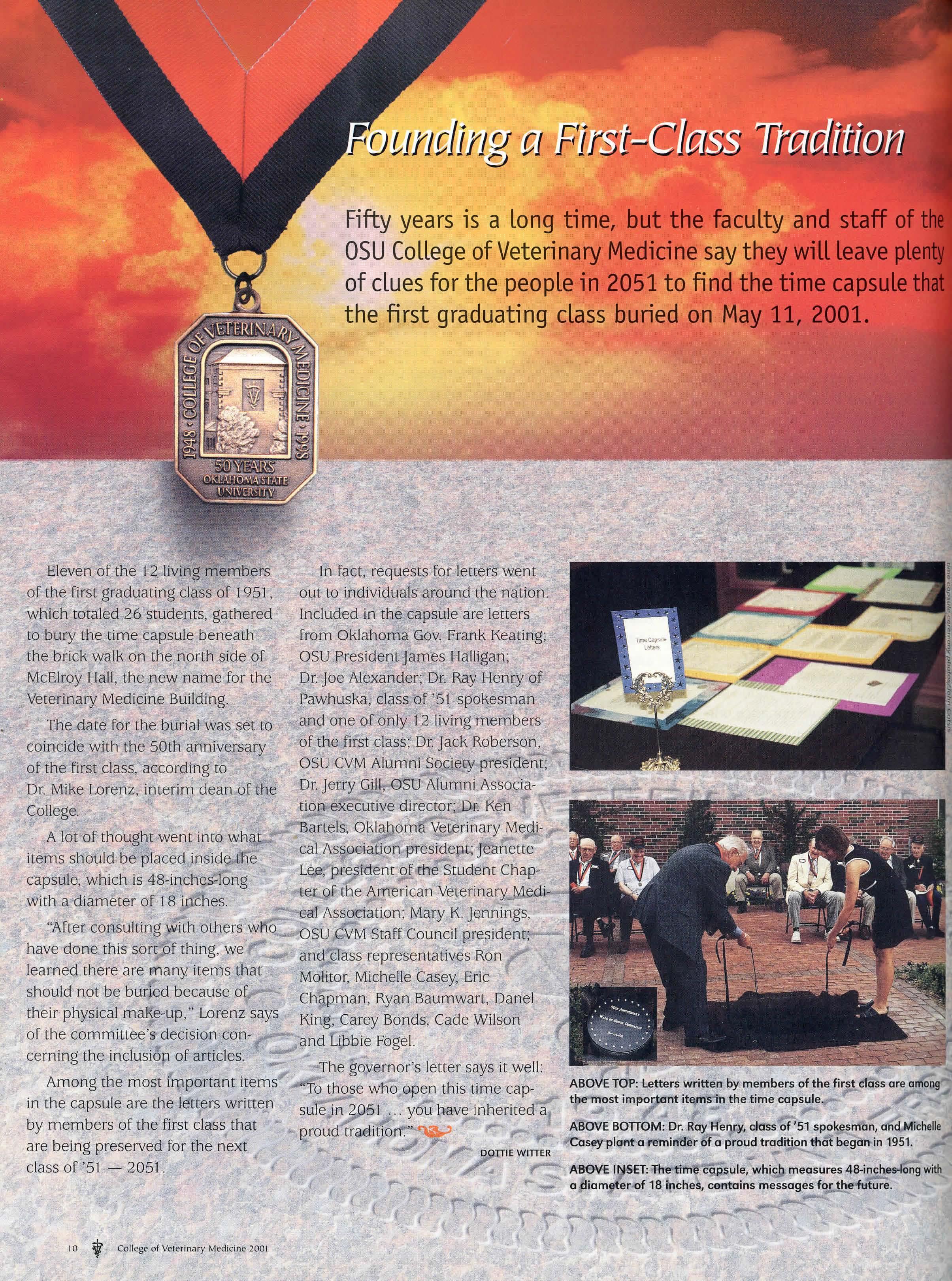
Eleven of the J living members of the first graduating class of 1951 , which totaled 26 students, ga~hered to bury the time capsule bene;;tth the brick walk on the north.side of McE!roy l;lall, the new name for the VeterinaTy M~dicine Building.
The date foi::the burial was set to coincide with the 50th ann1vE?rsary of the first class, according to Dr. Mike Lorenz, interim dean of the College.
A lot of thought went into what items should· be placed inside. tne capsule, which is 48-inchesdong with a diameter of 18 irrches.
"After consulting with others who have done this sort of thing, we learned there are many. items thar should not be buried because of their physical mal{e-up," Lorenz says of the committee's decision concerning the inclusiop of articles. -
Among the most important items in the capsule are the letters written by members of the first class that are being preserved for the next class of '51 - 2051.
Fiftyyears is a long time, but the faculty and staff oft 0SUCollegeof VeterinaryMedicinesay they will leave ple of clues for the people in 2051 to find the time capsuleth the first graduating class buried on May11, 2001.
In fact, requests for letters went ourto indivfduals around the nation.
lnclu.d,d i_11the capsule ·are Letters from Oklahoma Gov Frank Keating; OSU President :James Halligan; • Dr. Joe ,:\)exander; Dr: Ray Henry of Pawhuska, class of '51 spokes!11an and one ofonly 12 living members of the first class; Dr. Jack Roberson, OSU CVM Alwmni Society presiclent; Dr. Jerry Gill, 05U Alumni.Association e-xecutive director; Dr. Ken I3artels, Oklahoma Veterinary Medical A,ssoGiationpresidept; Je.c1nette Le--f,president of the Student Cnap, ,,.. te of the American Veterinary edic;alAssociation; Mary K. Jennings, OSU GVM Staff Council pre.sident;-and class representatives Ron Molitor, Michelle Casey, Eric Chapman, Ryan Baumwart, Dane! King, Ca_reyBonds, Cade Wilson and [lbbie Fogel
The governor's letter says it well: "To those who open this time cap· sule in 2 §1 you have inherited aproud tra0ifon. ,._ ,-
, DOTTIE WITTER
ABOVE BOTTOM: Dr. Roy l'leni:y, class of '51 spokesman, and Michelle Cosey·pl.ant a reminder of o proud tradition that began in 1951. r-" ABOVEIN.SET:The time caR§ule, which measures 48-inchelrlong with a diameter of 18 /nches, contains messages for the-future.
ABOVE TOP: Letters written by members of the first class ore among the most iml'or ant items in the time cops1,1le.
Eleven of the 12 surviving members of the OSU College of Veterinary Medicine's first graduating class, the class of 1951, attended the ceremony symbolizing the living legacy they are leaving for the class of 2051.
8 relocated to New Jerseywhere he took apositionwith the New Jersey Department of Agriculture andestablishedhis own practice in Trenton.Carter and his wifeMil,havetraveled in 49 states since his retirement and willc.elebratetheir 56th wedding anniversarythis fall. They areparentsof four sons and a daughter.Two of their sons havefollowedin their father's footsteps,and one of their 12 grandchildren is consideringa career in veterinary medicine.
n 3 and his wife, Annette, returned to Arkansasfollowinggraduation and made their home in Berryville. Hepracticedfor severalyears prior to going to work for a slaughterand pockingplant and then as a USDApoultry inspector.Theyare·the parentsoftwo sonsand a daughter and hovesevengrandchildren.In 1976,they bought a farm west of Berryvillewherethey now raise BlackSimmental.
10 movedto Wagoner to practice following hisgraduation.For manyyears, he was the only veterinarian inthecounty.He had a mixed practice of dairy and beef cattleandsmall animals and was certified as a poultry and beefveterinaryexaminer.He and his late wife, Norma Lee, raisedthreesons.He lovesto golf
6 practiced veterinary medicine in Pawneeuntil 1986,openinghis first clinic in a remodeledfilling station. He staysactivein his ranching operation near Ralston.He and hiswife,Mel, havethree children, four grandchildren and two greot,grandchildrenand are active in'the OSU Alumni Associationand veterinary organizations.
e or-Juy} G n 5 began his careerwith the USDAinArizonabeforebeingnamedassistantdirector of the ScrewwormEradicctionProgramin Florida.He was sentto McAllen,Texas,as veterinarianin chargeof the ScrewwormProgram,andfrom there he went to Washington,D.C.and then to Mississippibeforeretiring in McAllenin 1980.He and Jo have threechildren,eightgrandchildrenand two step-grandchildren.
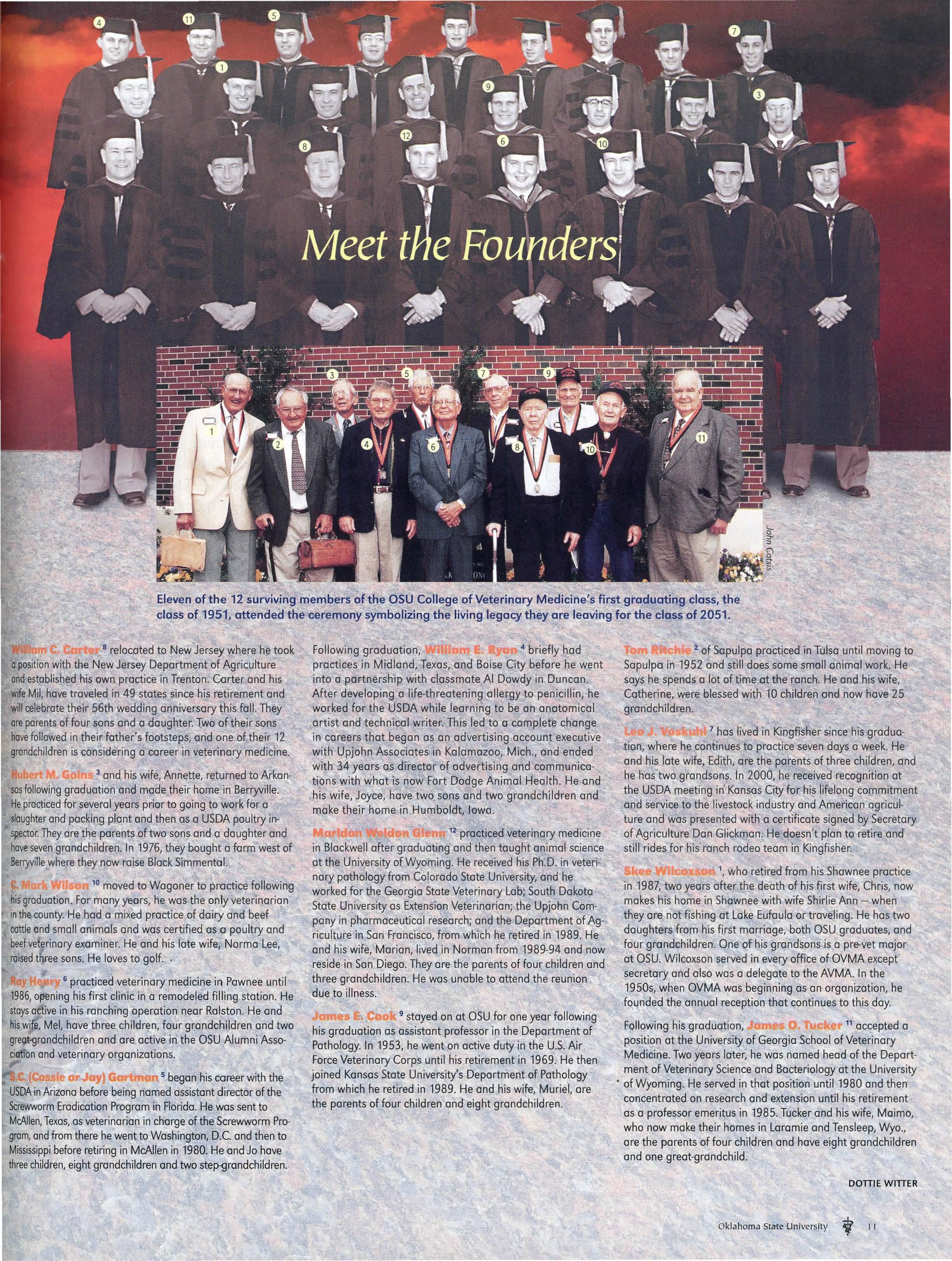
Following graduation, 4 briefly had practices in Midland, Texas,and Boise City before he went into a partnership with classmate Al Dowdy in Duncan. After developing a life-threatening allergy to penicillin, he worked for the USDA while learning to be an anatomical artist and technical writer. This led to a complete change in careers that began as an advertising account executive with Upjohn Associates in Kalamazoo, Mich., and ended with 3,4years as director. of advertising and communications with what is now Fort 0-odgeAnimal Health. He and his wife, Joyce, have two sons and two grandchildren and make their home in Humboldt, Iowa.
1 " practiced veterinary medicine in Blackwellaftergmduating and then taught animal science at the Universityof Wyoming. He receivedhis Ph.D.in veterinary pathology from Colorado State University,and he worked for the Georgia State Veterinary Lab; South Dakota State Universityas ExtensionVeterinarian; the Upjohn Company in pharmaceutical research;and the Department of Agriculture in San Francisco,from which he retired in 1989. He and his wife, Marian, lived in Norman from 1989-94 and now reside in San-Diego.They are the parents of four children and three grandchildren. He was unable to attend the reunion due to illness.
s C ok • stayed on at OSU for one year following his graduation as assistant professor in the Department of Pathology.In 1953, he went on active duty in the U.S.Air ForceVeterinary Corps until his retirement in 1969. He then joined KansasState University'sDepartment of Pathology from which he retired in 1989. He and his wife, Muriel, are the parents of four children and eight grandchildren.
2 of Sapulpa practiced in Tulsa until moving to Sapulpa in 1952 and still does some small animal work. He sayshe spendsa lot of time.at the ranch. He and his wife, Catherine, were blessedwith 10 children and now have 25 grandchildren.
7 has lived in Kingfishersince his graduation, where he continuesto practice sevendays a week. He and his late wife, Edith, are the parents of three children, and he has"two grandsons.In 2000, he receivedrecognition at the USDAmeeting in' KansasCity for his lifelong commitment and serviceto the livestockindustry and American agriculture and was presentedwith a certificate signed by Secretary of Agriculture Dan Glickman. He doesn't plan to retire and still rides for his ranch rodeo team in Kingfisher.
1 , who retired from his Shawneepractice in 1987,two years after the death of his first wife, Chris, now makes his home in Shawneewitn wife Shirlie Ann - when they are not fishing at LakeEufaula or traveling. He has two daughters from his first marriage, both OSU graduates, and four grandchildren. Ooe of his grandsonsis a pre-vetmajor at OSU.Wilcoxsonserved in every office of OVMA except secretary and also was a delegate to the AVMA. In the 1950s,when OVMA was beginning as an organization, he fo4_ndedthe annual reception that continuesto this day.
Followinghis graduation, o O 11 accepted a position at the Universityof Georgia Schoolof Veterinary Medicine. Twoyears later, he was named head of the Department of Veterinary Scienceand Bacteriologyat the University • of Wyoming. He served in that position until 1980 and then concentrated on researchand extensionuntil his retirement as a professoremeritus in 1985. Tuckerand his wife, Maimo, who now make their homes in Laramie and Tensleep,Wyo., are the parents of four children and have eight grandchildren and one great-grdndchild.
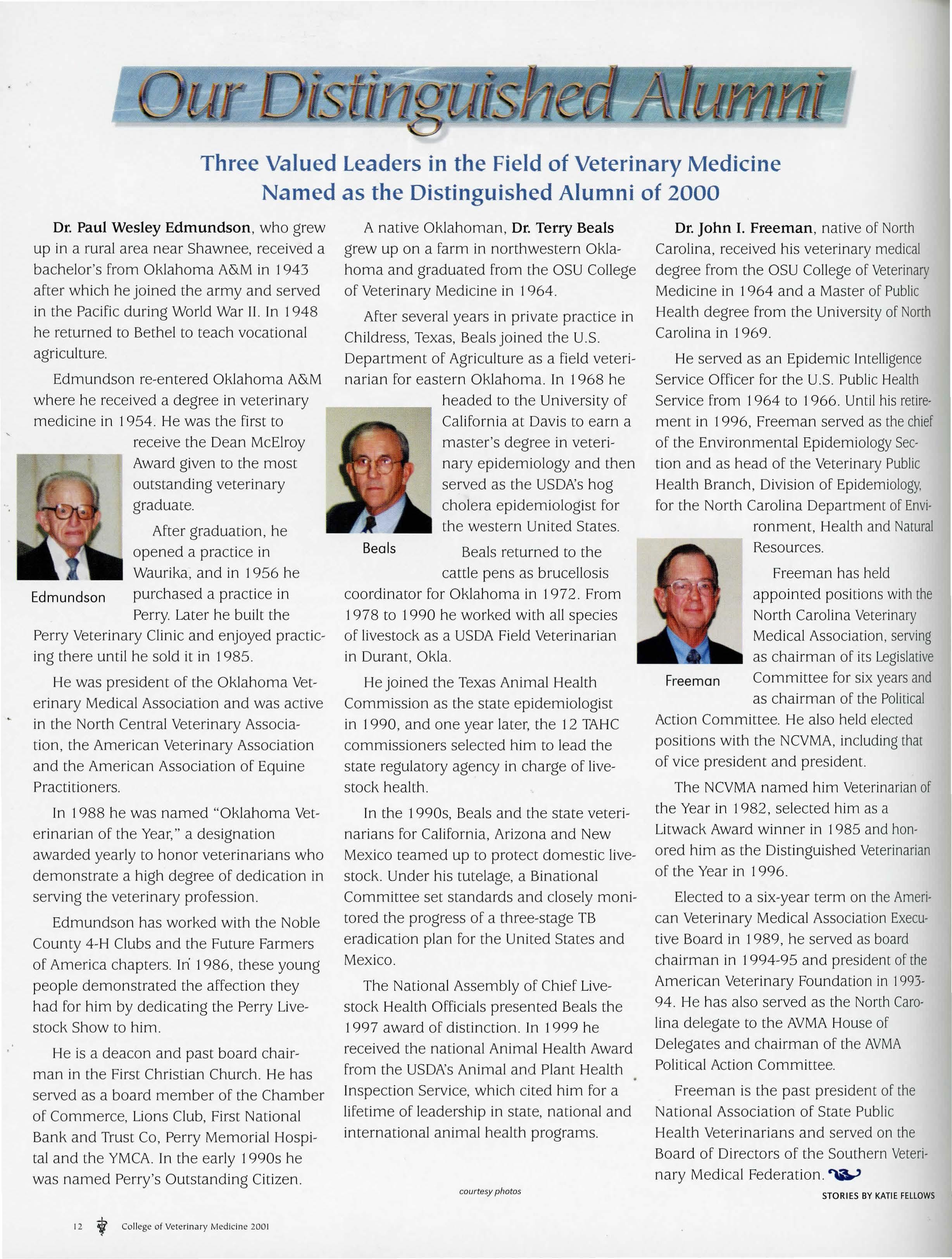
Three Valued Leaders in the Field of Veterinary Medicine
Named as the Distinguished Alumni of 2000
Dr. Paul Wesley Edmundson, who grew up in a rural area near Shawnee, received a bachelor's from Oklahoma A&M in 1943 after which he joined the army and served in the Pacific during World War 11.In 1948 he returned to Bethel to teach vocational agriculture.
Edmundson re-entered Oklahoma A&M where he received a degree in veterinary medicine in 1954. He was the first to receive the Dean McElroy Award given to the most outstanding veterinary graduate.
After graduation, he opened a practice in Waurika, and in 1956 he Edmundson purchased a practice in Perry. Later he built the Perry Veterinary Clinic and enjoyed practicing there until he sold it in 1985.
He was president of the Oklahoma Veterinary Medical Association and was active in the North Central Veterinary Association, the American Veterinary Association and the American Association of Equine Practitioners.
In 1988 he was named "Oklahoma Veterinarian of the Year," a designation awarded yearly to honor veterinarians who demonstrate a high degree of dedication in serving the veterinary profession.
Edmundson has worked with the Noble County 4-H Clubs and the Future Farmers of America chapters. lri 1986, these young people demonstrated the affection they had for him by dedicating the Perry Livestock Show to him.
He is a deacon and past board chairman in the First Christian Church. He has served as a board member of the Chamber of Commerce, Lions Club, First National Bank and Trust Co, Perry Memorial Hospital and the YMCA. In the early 1990s he was named Perry's Outstanding Citizen.
A native Oklahoman, Dr. Terry Beals grew up on a farm in northwestern Oklahoma and graduated from the OSU College of Veterinary Medicine in 1964.
After several years in private practice in Childress, Texas, Beals joined the U.S. Department of Agriculture as a field veterinarian for eastern Oklahoma. In 1968 he headed to the University of California at Davis to earn a master's degree in veterinary epidemiology and then served as the USDA's hog cholera epidemiologist for the western United States.
Beals Beals returned to the cattle pens as brucellosis coordinator for Oklahoma in 1972. From 1978 to 1990 he worked with all species of livestock as a USDA Field Veterinarian in Durant, Okla.
He joined the Texas Animal Health Commission as the state epidemiologist in 1990, and one year later, the 12 TAHC commissioners selected him to lead the state regulatory agency in charge of livestock health.
In the 1990s, Beals and the state veterinarians for California, Arizona and New Mexico teamed up to protect domestic livestock. Under his tutelage, a Binational Committee set standards and closely monitored the progress of a three-stage TB eradication plan for the United States and Mexico.
The National Assembly of Chief Livestock Health Officials presented Beals the 1997 award of distinction. In 1999 he received the national Animal Health Award from the USDA'sAnimal and Plant Health Inspection Service, which cited him for a lifetime of leadership in state, national and international animal health programs.
Dr. John I. Freeman, native of North Carolina, received his veterinary medical degree from the OSU College of Veterinary Medicine in I 964 and a Master of Public Health degree from the University of North Carolina in 1969.
He served as an Epidemic Intelligence Service Officer for the U.S. Public Health Service from 1964 to 1966. Until his retirement in 1996, Freeman served as the chief of the Environmental Epidemiology Section and as head of the Veterinary Public Health Branch, Division of Epidemiology, for the North Carolina Department of Envi-
ronment, Health and Natural Resources.
Freeman has held appointed positions with the North Carolina Veterinary Medical Association, serving as chairman of its Legislative Committee for six yearsand as chairman of the Political Action Committee. He also held elected positions with the NCVMA, including that of vice president and president.
The NCVMA named him Veterinarianof the Year in I 982, selected him as a Litwack Award winner in 1985 and honored him as the Distinguished Veterinarian of the Year in I 996.
Elected to a six-year term on the American Veterinary Medical Association Executive Board in 1989, he served as board chairman in I 994-95 and president of the American Veterinary Foundation in I 99394. He has also served as the North Carolina delegate to the AVMA House of Delegates and chairman of the AVMA Political Action Committee.
Freeman is the past president of the National Association of State Public Health Veterinarians and served on the Board of Directors of the Southern Veterinary Medical Federation.~
Freeman
Showcasing A SampleofOur OutstandingAlumni
Manwith a Mission
Dr.Keith Flanagan is a man with a mission.Several,in Fact.
Notall have to do with animal health care,though the I 978 graduate of the OSU Collegeof Veterinary Medicine has spent hislife training animal health workers and advisingothers how to do the same from Haitito Africa. All his missions, however, haveto do with improving the physical, spiritual,emotional and economic health of the Haitian people.
"There'sa saying in community development,if you want to help a person for today,plant a garden; if you want to help himfor five to ten years, plant a tree," says Flanagan,who has called Haiti home for thebetter part of 15 years. "But if you wantto help him for life, educate him."
Asdirector of community development forthe internationally famous Hospital AlbertSchweitzer in Dechapelles, Haiti, from 1990-96, Flanagan oversaw animal healthtraining, potable water development, agricultureloans, reforestation efforts and micro-enterprisedevelopment. For several yearsbefore that, he was the hospital's staff veterinarianand farm manager and helped reestablishan animal health agent program thathastrained more than 800 village level technicianssince 1987.
As a fieldworker for Christian Veterinary Missionin Haiti, Flanagan now splits his timebetween conducting various training
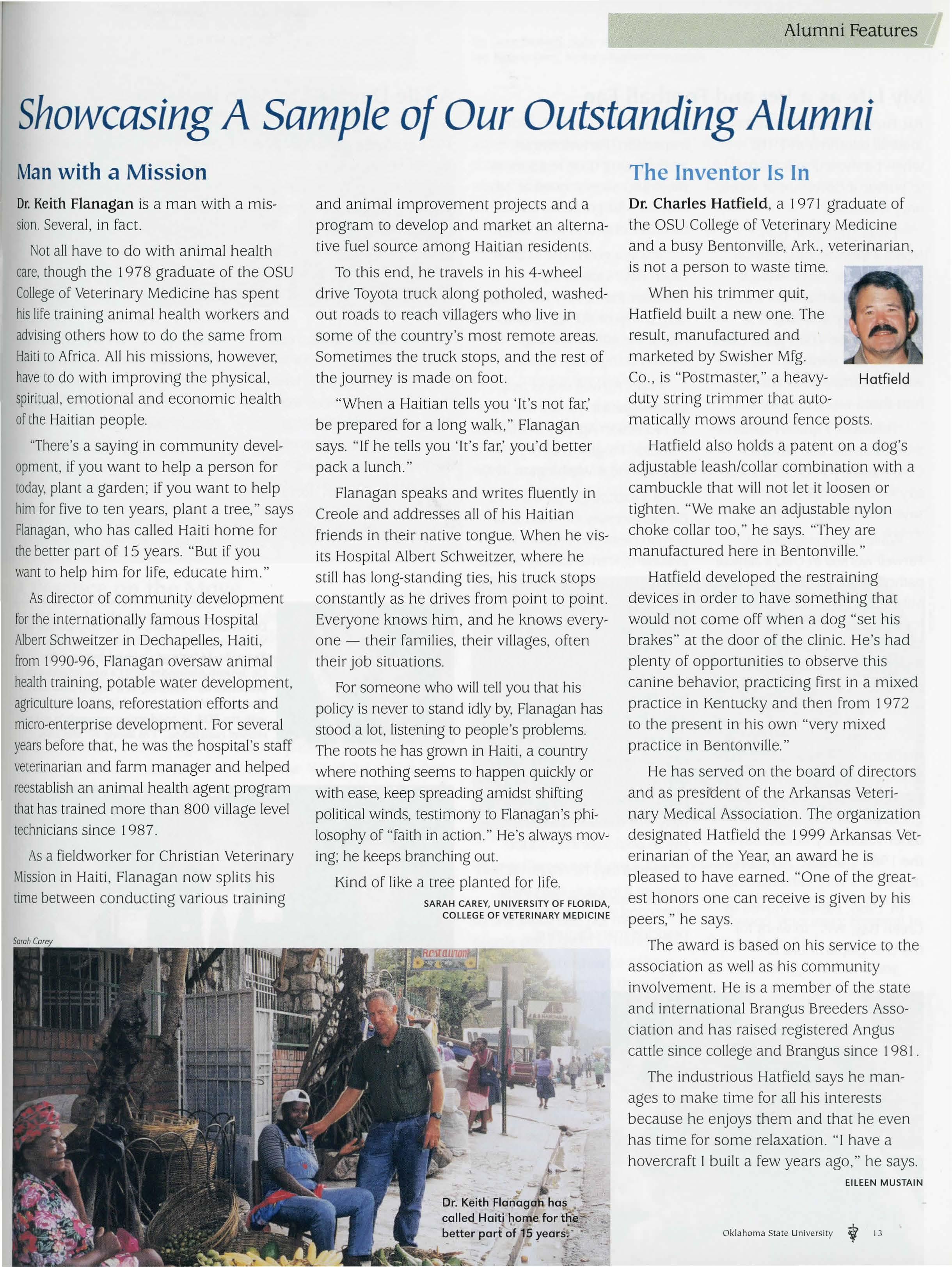
and animal improvement projects and a program to develop and market an alternative fuel source among Haitian residents.
To this end, he travels in his 4-wheel drive Toyota truck along potholed, washedout roads to reach villagers who live in some of the country's most remote areas. Sometimes the truck stops, and the rest of the journey is made on foot.
"When a Haitian tells you 'It's not far,' be prepared for a long walk," Flanagan says. "If he tells you 'It's far,' you'd better pack a lunch."
Flanagan speaks and writes fluently in Creole and addresses all of his Haitian friends in their native tongue. When he visits Hospital Albert Schweitzer, where he still has long-standing ties, his truck stops constantly as he drives from point to point. Everyone knows him, and he knows everyone - their families, their villages, often their job situations.
For someone who will tell you that his policy is never to stand idly by, Flanagan has stood a lot, listening to people's problems. The roots he has grown in Haiti, a country where nothing seems to happen quick.Jyor with ease, keep spreading amidst shifting political winds, testimony to Flanagan's philosophy of "faith in action." He's always moving; he keeps branching out.
Kind of like a tree planted for life.
SARAH CAREY, UNIVERSITY OF FLORIDA, COLLEGE OF VETERINARY MEDICINE
The Inventor Is In
Dr. Charles Hatfield, a 1971 graduate of the OSU College of Veterinary Medicine and a busy Bentonville, Ark., veterinarian, is not a person to waste time.
When his trimmer quit, Hatfield built a new one. The result, manufactured and marketed by Swisher Mfg.
Co., is "Postmaster," a heavy- Hatfield duty string trimmer that automatically mows around fence posts.
Hatfield also holds a patent on a dog's adjustable leash/collar combination with a cambuckle that will not let it loosen or tighten. "We make an adjustable nylon choke collar too," he says. "They are manufactured here in Bentonville."
Hatfield developed the restraining devices in order to have something that would not come off when a dog "set his brakes" at the door of the clinic. He's had plenty of opportunities to observe this canine behavior, practicing first in a mixed practice in Kentucky and then from I 972 to the present in his own "very mixed practice in Bentonville."
He has served on the board of directors and as presitlent of the Arkansas Veterinary Medical Association. The organization designated Hatfield the 1999 Arkansas Veterinarian of the Year, an award he is pleased to have earned. "One of the greatest honors one can receive is given by his peers," he says.
The award is based on his service to the association as well as his community involvement. He is a member of the state and international Brangus Breeders Association and has raised registered Angus cattle since college and Brangus since 1981.
The industrious Hatfield says he manages to make time for all his interests because he enjoys them and that he even has time for some relaxation. "I have a hovercraft I built a few years ago," he says.
SarahCarey
My Life as a Vet and Football Fan
Kit Farwell tackled his first football dilemma in 1976 when he moved to Stillwater to pursue a doctorate of veterinary medicine.
"I was taking Dr. Bob Noble's introductory animal science class," says Farwell, who earned a bachelor's in biochemistry in 1980. "He met everyone in his giant class and learned their names, but I was embarrassed to admit to him that I was from Norman.
"However, I quickly became a Cowboy fan and savored OSU's victory over the University of Oklahoma that year," says the Norman native.
While an undergraduate, Farwell worked in OSU's clinical pathology lab for Jim Rupp and Mike Mahoney. Later he worked for OSU alums and veterinarians Dr. Jim Sprague in Rush Springs and Dr. James Kuhn in Seminole before completing his veterinary medicine degree.
"I would advise veterinary medicine students interested in expanding their horizons to take advantage of their undergraduate training to work in other veterinary fields," says the I 984 graduate. "The DVM degree is a very versatile one."
In I 986, Farwell moved to Green Bay, Wis., to work for the U.S. Department of
Agriculture in the area of meat inspection. Farwell began investigating drug residues in meat and soon moved to Athens, Ga., for graduate studies in biochemistry and toxicology.
"It was a good time to leave Green Bay," Farwell says, "because the Packerswere beginning a 10-yearslump. Unfortunately, the Athens Bulldogs weren't doing much better."
Today, Farwell works as a toxicologist for the Environmental Protection Agency's Office of Pesticide Programs in Crystal City, Va., near Washington, D.C.
As a toxicologist for the EPA, Farwell assessesthe hazards of human pesticide exposure by evaluating animal toxicity studies.
"Pesticide toxicology is a very dynamic area," says Farwell, who is certified by the American Board of Toxicology.
"There are lots of hot issues in this area now, especially for evaluating the safety of children," Farwell says. "Since Congress passed the Food Quality Protection Act in I 996, the EPAhas been actively accessingthe possibility that children are more sensitive to pesticides than adults."
Farwell says he enjoys his field because it impacts everything from consumer use and safety to pesticide manufacturing.
JANET VARNUM
A Life Devoted to Man and Beast
Whether Dr. Gary Detrich, a 1971 graduate of the OSU College of Veterinary Medicine, is organizing a community-wide Thanksgiving dinner, treating patients at his veterinary clinic or serving on the local United Way or school board, community service is a common thread of his life.
"The saddest words I can think of in life are 'I wish I would have ,"' says Detrich, who chooses to avoid those words by filling his life with personal adventure and trying to improve the lives of those around him.
In 1985, Detrich decided to
minister challenged his audience to help the people in their own community. "I thought there's no reason we can't do that in Cushing," Detrich says. "I got up the next day and began working on it."
The first year, Detrich, his wife, Rosalind, and other volunteers served between 50 and 75 people, and 16 years later,it has grown into a large community event with more than 50 volunteers serving over 300 people each year.
"People say our dinner is as good as mom's," he adds. "We make everything from scratch." organize a Thanksgiving dinner Detrich says his own percep· in Cushing after a television tion of the dinner has changed
Dr. Antoinette Walker, a 1991 OSU College of Veterinary Medicine graduate now living in Rockville, Maryland, enjoyed visiting with Dr. Joseph Alexander, OSU's new interim vice president for research, at a recent OSU alumni reception. Walker, a veterinary medicine officer with the FDA, is conducting research in antimicrobial resistance. "I'm loving it," she says.
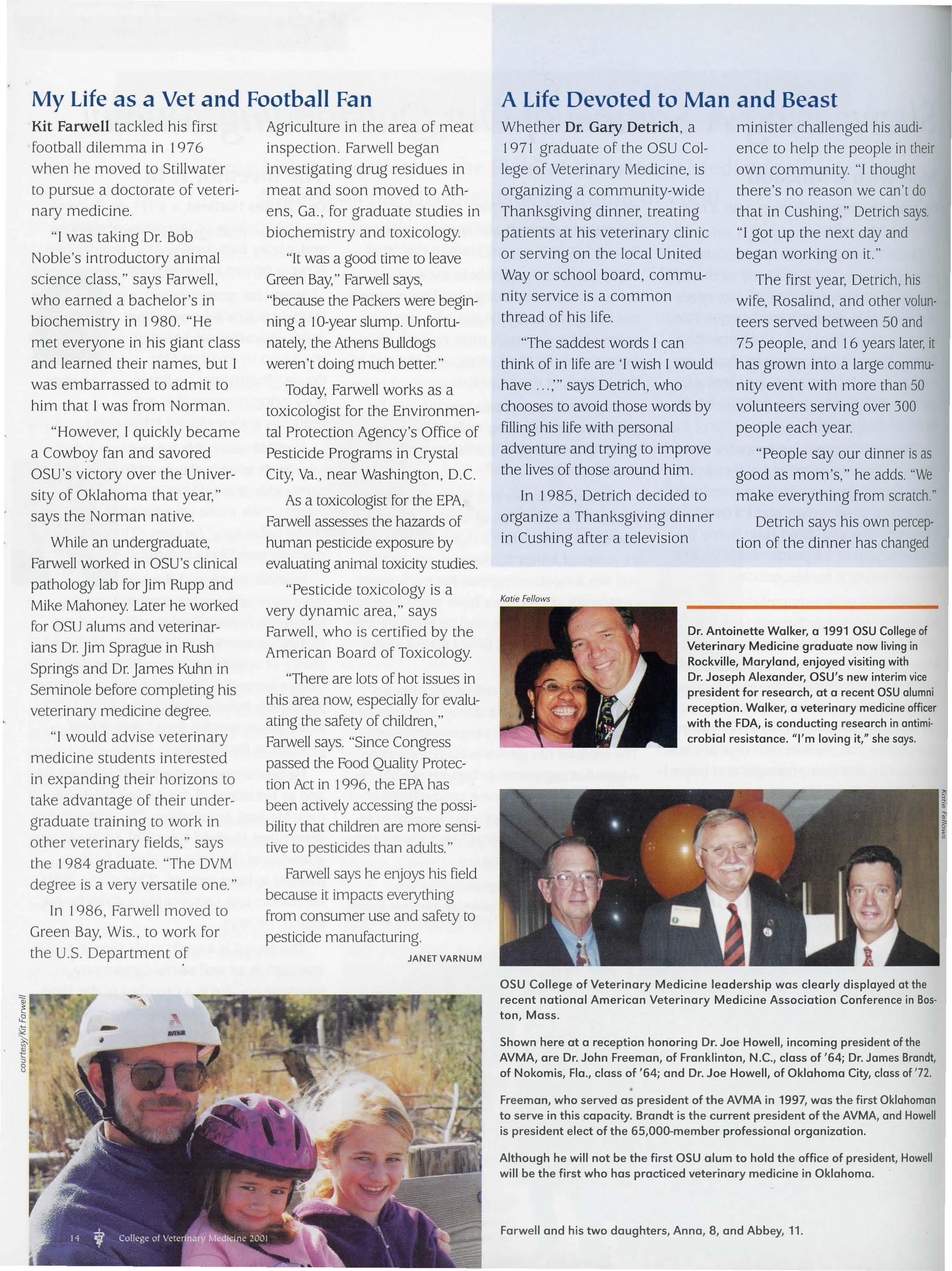
Shown here at a reception honoring Dr. Joe Howell, incoming president of the AVMA, ore Dr. John Freemon, of Franklinton, N.C., class of '64; Dr. James Brandt, of Nokomis, Flo., class of '64; and Dr. Joe Howell, of Oklahoma City, class of '72. Freemon, who served as president of the AVMA in 1997, was the first Oklahoman to serve in this capacity. Brandt is the current president of the AVMA, and Howell is president elect of the 65,000-member professional organization.
Although he will not be the first OSU alum to hold the office of president, Howell will be the first who hos practiced veterinary medicine in Oklahoma.
Farwell and his two daughters, Anna, 8, and Abbey, 11.
Katie Fellows
OSU College of Veterinary Medicine leadership was clearly displayed at the recent notional American Veterinary Medicine Association Conference in Boston, Moss.
overthe years. "In the beginning,I thought I was going to feedneedy people, but there are nottoo many truly 'hungry' peoplein our community," he says."I found that it has evolved intoan opportunity to allow peopleto serve and to givethat'sthe main blessing."
A Practice on the Move
Asfaras Dr. Linda Coenen is concerned,her 24-foot motor coachis the only way to travelandthe best way to practice veterinarymedicine.
TheGrants Pass, Ore., veterinarianand 1985 OSU College of VeterinaryMedicine alumnus hashad her mobile practice for nearlysix years. Other than the downtimefor tune-ups or the occasionalflat tire, Coenen says practicingfrom her "miniature clinicon wheels" has few drawbacksand many pluses.
Coenen,a small animal practitioner,travels with a licensedtechnician and performseverything from the routineto surgery in her mobile clinic.She can even hospitalize ananimal if she needs to, she says."Since the van is parked in my driveway at home when I'm not out on calls, I can actuallykeep a better eye on my patientsthan I could in a
Another area in which Detrich will have no regrets is in challenging himself to adventures such as climbing Mount Kilimanjaro, bicycling across the Continental Divide, crawling through Arkansas and Oklahoma caves,snorkeling the Caribbean coral reefs and hiking the Grand Canyon.
regular clinic. I'm limited in the number of pets I can keep at one time, but fortunately that is not often a problem."
She can drive over 100 miles in a day if she isn't able to schedule her patients within the same rural area. When the scheduling works out, she is able to fit in 10 to 11 patients, but on average, she sees five to six a day.
Seeing fewer patients than she would in a traditional clinic allows her more one-on-one time with each patient and makes her practice much more personal and less stressful for everyone, Coenen says.
"Most people seem to like the mobile approach. The animals are less stressed without the car trips and long waits in the office," she says, "and the people are less stressed without the hassle of getting their pets to a clinic, especially if they have more than one pet.
"I find all the things I do adventure-wise teach me something about myself," he says. "When I see the fears on the trail - and in life - that confront me, I have to face them down."
Detrich recently volunteered for a two-year position on the College of Veterinary Medicine's admission committee and also serves as a practitioner mentor for the college.
"The mentoring program is good for students because it gives them a touch of the real world in addition to their academic training," says the Midwest City native.
Detrich opened his Cimarron Valley Animal Clinic in Cushing in 1974 after working one year under the late Dr. Frank Hester, • 54 DVM, and two years of military service as a U.S. Air Force veterinarian. His practice focuses mostly on companion animals, and he says he is grateful for OSU's proximity when his patients need access to specialists and specialized equipment.
'Tm amazed at the advancements in veterinary medicine over the years," he says. "And I'm thankful for that technologyand for all the help it's given to animals, including my patients."
JANET VARNUM
'Tm a little more expensive for the initial call, but most people don't seem to mind paying for the convenience of having someone come to them," she says. "I like the fact that the owners are less stressed."
Before she began her mobile practice, Coenen practiced as a small animal associate for two years at the Beverly Hills Small Animal Hospital in Beverly Hills, Calif., three years at Basin Animal Clinic in
Klamath Falls and five years at Redwood Veterinary Hospital in Grants Pass, Ore.
Coenen appreciates being outdoors more often and away from the clamor of an office setting. She also enjoys having her Australian Shepherds, Beevis and Buddy, travel with her.
"I had to balance my work with the rest of my life," she says, "and my mobile practice allows me to do that." -_,., EILEEN MUSTAIN
courtesy/Dr. Gary Detrich
Dr. Gary Detrich, right, and Cushing optometrist, Jeff Fielding, at the summit of Mt. Kilimanjaro, Africa's highest mountain
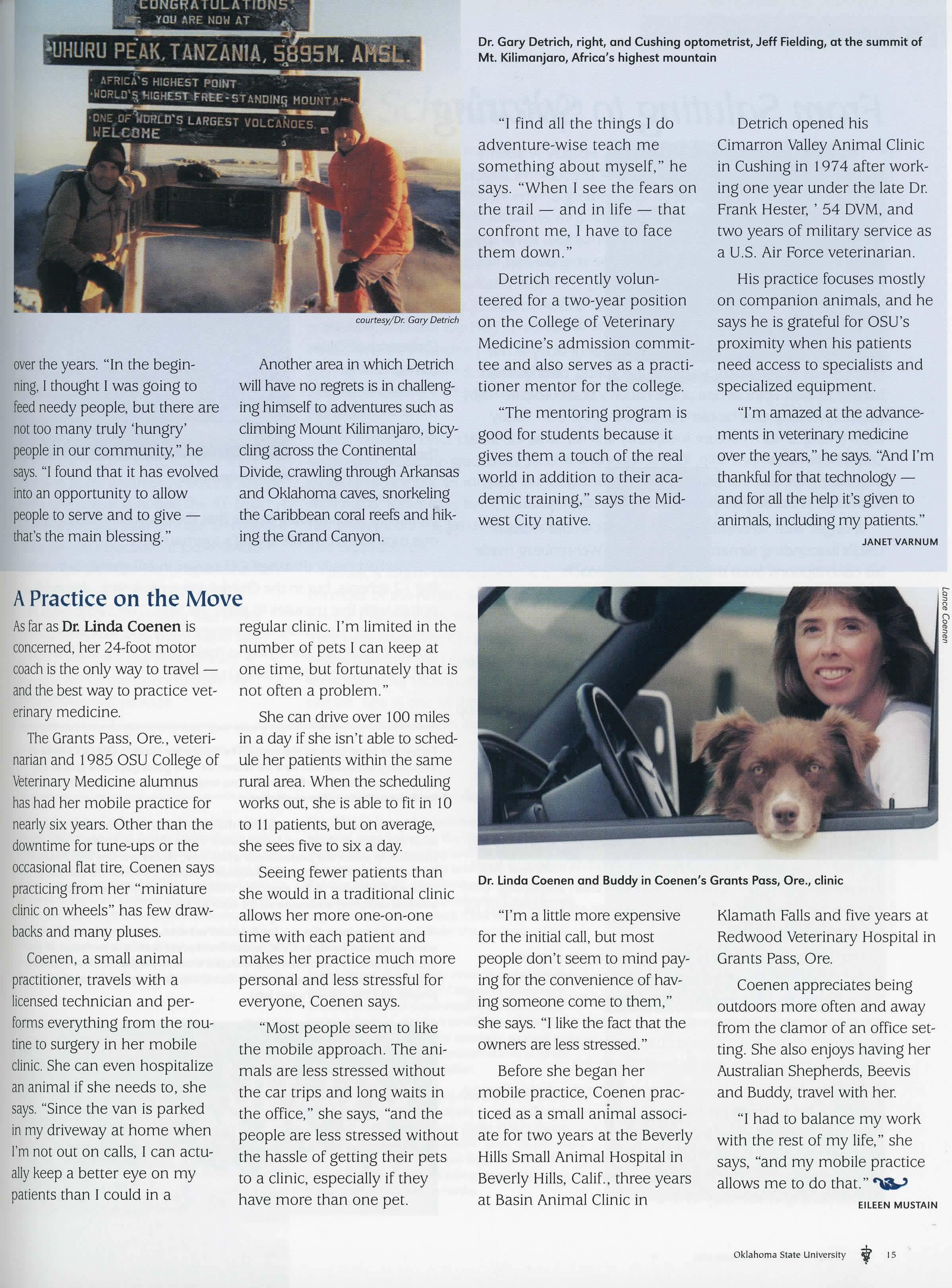
Dr. Linda Coenen and Buddy in Coenen's Grants Pass, Ore., clinic
FromSalutingto Suturing
Following a term of service at the U.S. Military Academy and subsequent employment with one of the nation's largest telecommunications firms, Aaron Wehrenberg determined finally at age 25 that he wanted to become a veterinarian. Although childhood friends and family remarked, to his surprise, that they wondered why his love for animals had not moved him to opt for a career in veterinary medicine much sooner, at least one group of OSU Athletics enthusiasts is probably glad he took his time making the decision.
Wehrenberg, who completed his first year of study in the OSU College of Veterinary Medicine this spring, distinguished himself at West Point as one of the nation's best collegiate rugby players. Not long after he came to Stillwater, the OSU Rugby team emerged from obscure mediocrity and captured the 2000 Ozark Union Championship, its first regional title in 17 years. Duplicating the feat this year, the team recorded its first back-toback titles in the 30-year history of the club sport at OSU.
A ringer with Wehrenberg's credentials would explain OSU's astounding turnaround. However, Wehrenberg made his contributions from the sidelines as a coach.
"In 1995, I was selected for the All-American rugby team, a touring group of 25 college players, and in October, while here in Oklahoma, a tib-fib fracture ended my career," says Wehrenberg, who the USA Eagles, the U.S. international, professional rugby team, had already called about a tryout.
In a mad dash for a loose ball, one of his teammates rolled-up on Wehrenberg's lower leg, snapping both the tibia and the fibula. After surgery to insert a titanium rod, an embolism formed, and he momentarily stopped breathing. The titanium rod also ended his plans for Army Airborne training, the area of post-graduate military service he had selected.
His degree in systems engineering from the Academy led to a job as an account executive with AT&T Wireless, a lucrative position that Wehrenberg found less than satisfying. One day, he compiled a list of likes and dislikes and concluded he belonged in vet school.
During his first year, a group of OSU Rugby players approached him about his rugby jersey. One of them was backs coach Brian Valleskey. The two established an immediate rapport, and Wehrenberg joined the team as pack coach. Together, the two have helped change the OSU team's approach to the game and its level of success.
The current 40-man roster suggests that the days of being unable to field a team for some matches are over for the Cowboys. For the fall season - a series of "cut" matches that determine seating in the official, USA Rugby-sanctioned, spring season - the team has organized a major Stillwater tournament sponsored by Chili's.
In spring 2002, as Ozarks champ, OSU will also again host conference foes, the University of Arkansas, John Brown, Southwestern OSU and the University of Oklahoma, for the matches to determine the regional representative in the Western Round of XII of the national cham-
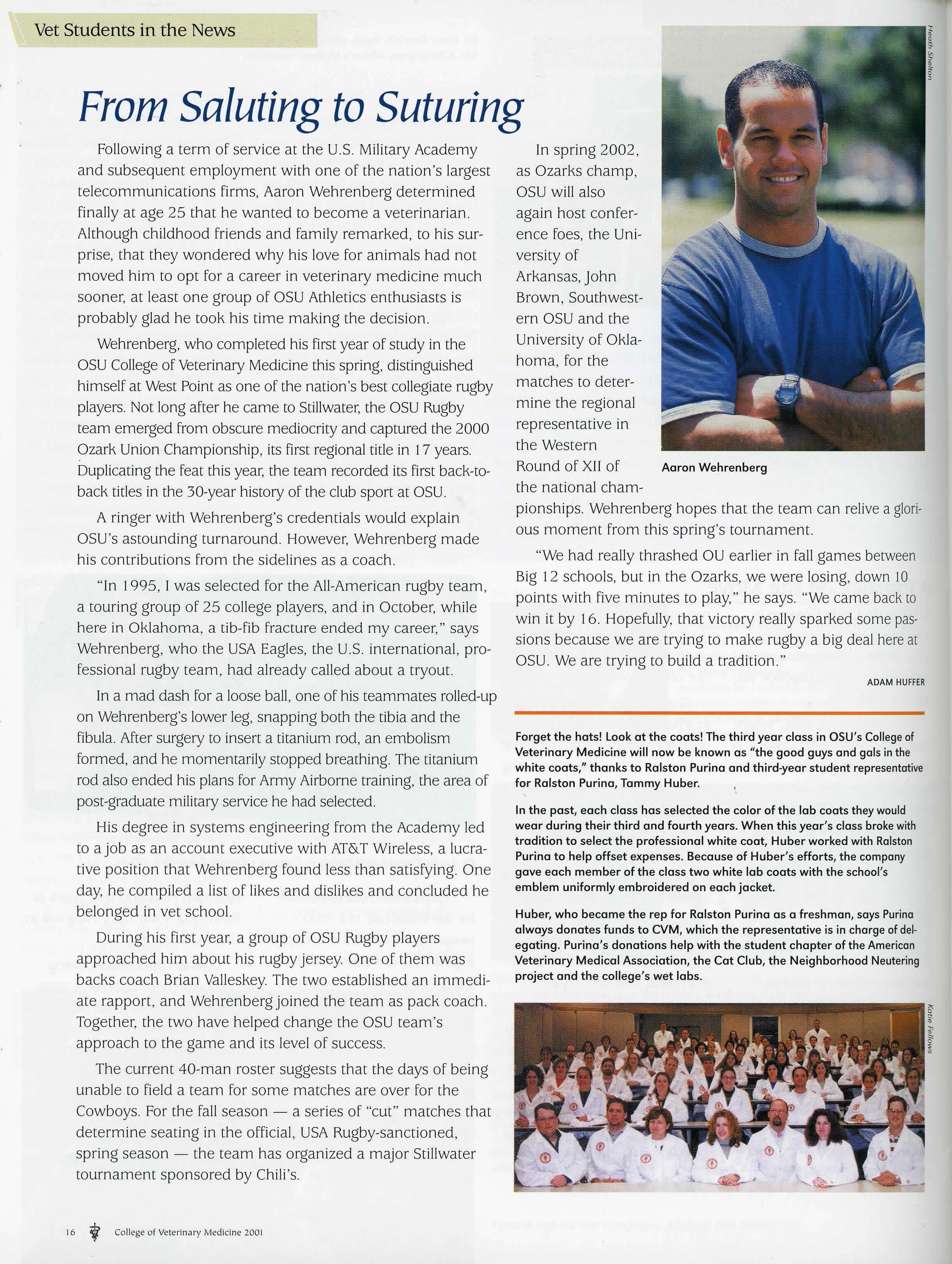
Aaron Wehrenberg pionships. Wehrenberg hopes that the team can relive a glorious moment from this spring's tournament.
"We had really thrashed OU earlier in fall games between Big 12 schools, but in the Ozarks. we were losing, down 10 points with five minutes to play," he says. "We came back to win it by 16. Hopefully, that victory really sparked some passions because we are trying to make rugby a big deal hereat OSU. We are trying to build a tradition."
ADAM HUFFER
Forget the hats! Look at the coats! The third year class in OSU's Collegeof Veterinary Medicine will now be known as "the good guys and gals in the white coats," thanks to Ralston Purina and third-year student representative for Ralston Purina, Tammy Huber.
In the past, each class has selected the color of the lab coats they would wear during their third and fourth years. When this year's class broke with tradition to select the professional white coat, Huber worked with Rolston Purina to help offset expenses. Because of Huber's efforts, the company gave each member of the class two white lab coats with the school's emblem uniformly embroidered on each jacket.
Huber, who became the rep for Ralston Purina as a freshman, says Purina always donates funds to CVM, which the representative is in charge of delegating. Purina's donations help with the student chapter of the American Veterinary Medical Association, the Cat Club, the Neighborhood Neutering project and the college's wet labs.
JonesWinsAmstutzScholarship
When Meredyth Jones was growing upshe was determined she wouldn't be a veterinarian. Her father, Mike Jones, hadchosen that path, and she was convincedhe lived at his clinic.
This spring the American Association of BovinePractitioners selected the same sandy-haireddetermined young woman asan Amstutz scholarship winner.
Dr. Terry Lehenbauer, OSU College of VeterinaryMedicine associate professor, saysJones is a perfect fit for the award. "TheAmstutz scholarship, which is givenin honor of Dr. Harold E. Amstutz, goesto an outstanding student who plansto enter a career in bovine veterinary practice. It is hoped the $1,500 cashaward will help provide Meredyth with unique educational experiences that will maximize her preparation for the practice of bovine medicine."
Jones,who has already had more firsthandexperience than many studentshave, says she is extremely excitedabout the opportunities the scholarshipwill provide.
"When I was growing up, we were at the clinic all the time," she says. "My
Life'sa hoot for Cade Wilson, first-place winner at the Oklahoma Wild Turkey Federation's owlhooting contest. (A natural sound like an owl will causemale turkeys to gobble and thus give themselvesaway to hunters.) Wilson, a second year student in the OSU College of Veterinary Medicine,first entered the state championship competition at 18, and now at 24, he's the owl-hooter "king of the mountain" in Oklahoma. Because of hisstate award, he will be representing Oklahoma at the national championships in February.
mother was the office manager, and we all had our jobs to help out. It certainly gave me a good indication of how dedicated a veterinarian must be."
She says she isn't certain what made her change her mind about becoming a veterinarian. "I was a junior in high school, and suddenly it just all clicked. I realized how much my Dad loved what he did and how much a part of me this type of life had become. I guess I just decided anything else would be boring," Jones says.
Her father, a 1982 OSU College of Veterinary Medicine graduate, has a mixed practice but an interest in cattle. As a result, Jones says her main interest has become bovine internal medicine and reproduction.
Jones, a fourth-year student, is a member of the American Association of Bovine Practitioners, the Society for Theriogenology, the Christian Veterinary Fellowship and the Legislative Board of the Oklahoma Veterinary Medical Association. She is one of three Oklahomans who has received this award.~
KATIE FELLOWS
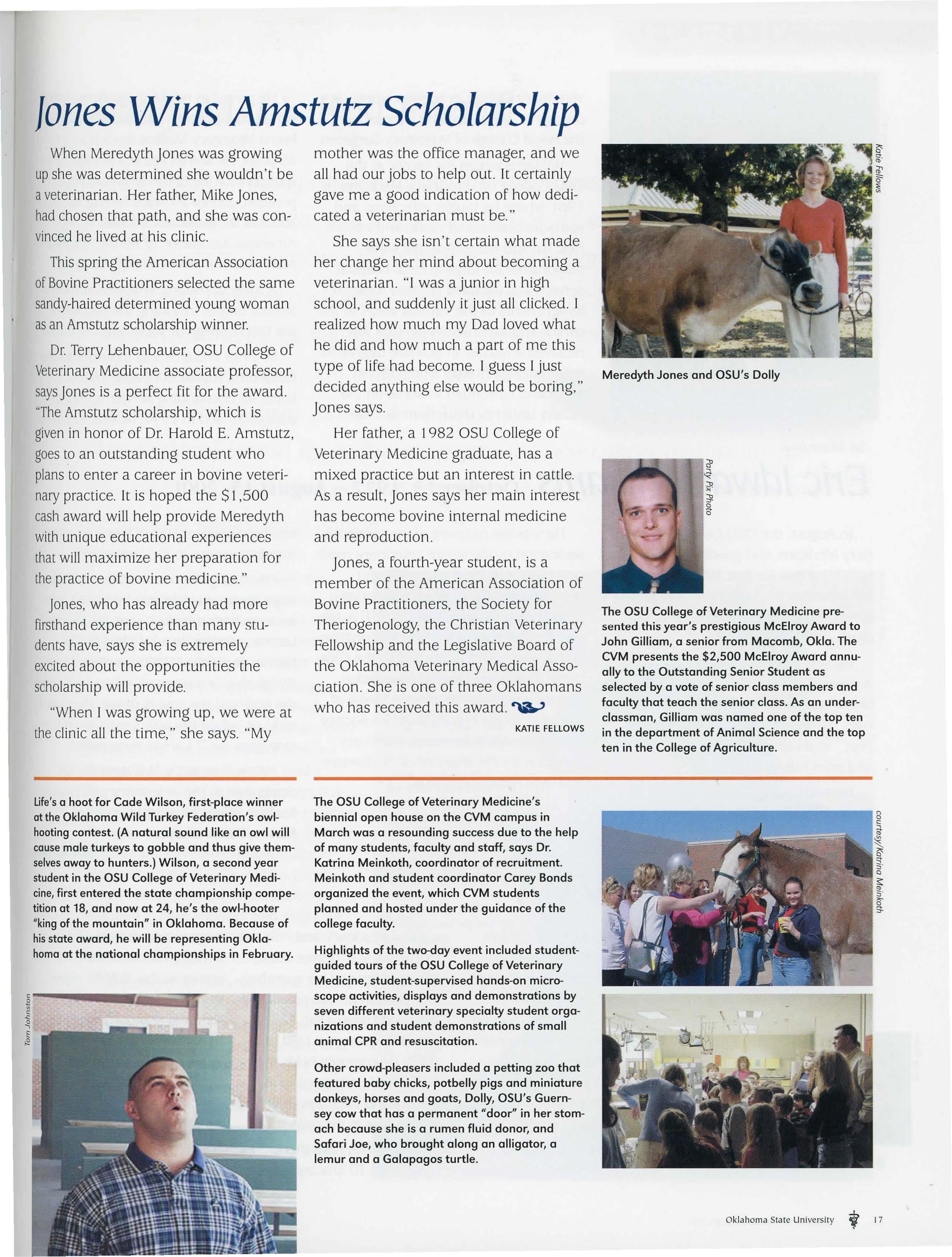
The OSU College of Veterinary Medicine's biennial open house on the CVM campus in March was a resounding success due to the help of many students, faculty and staff, says Dr. Katrina Meinkoth, coordinator of recruitment. Meinkoth and student coordinator Carey Bonds organized the event, which CVM students planned and hosted under the guidance of the college faculty.
Highlights of the two-day event included studentguided tours of the OSU College of Veterinary Medicine, student-supervised hands-on microscope activities, displays and demonstrations by seven different veterinary specialty student organizations and student demonstrations of small animal CPR and resuscitation.
Other crowd-pleasers included a petting zoo that featured baby chicks, potbelly pigs and miniature donkeys, horses and goats, Dolly, OSU's Guernsey cow that has a permanent "door" in her stomach because she is a rumen fluid donor, and Safari Joe, who brought along an alligator, a lemur and a Galapagos turtle.
The OSU College of Veterinary Medicine presented this year's prestigious McElroy Award to John Gilliam, a senior from Macomb, Okla. The CVM presents the $2,500 McElroy Award annually to the Outstanding Senior Student as selected by a vote of senior class members and faculty that teach the senior class. As an underclassman, Gilliam was named one of the top ten in the department of Animal Science and the top ten in the College of Agriculture.
Meredyth Jones and OSU's Dolly
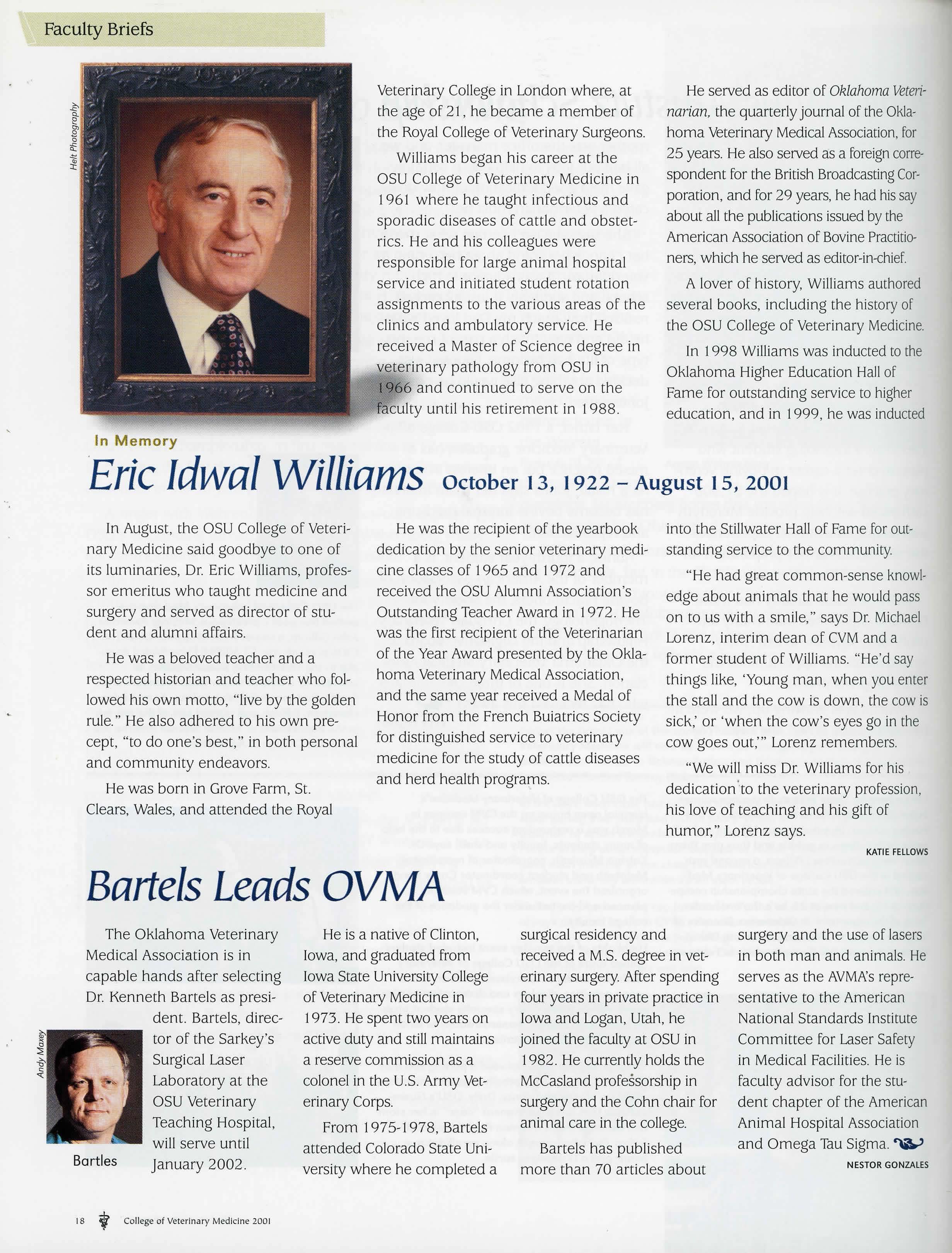
Veterinary College in London where, at the age of 21. he became a member of the Royal College of Veterinary Surgeons. Williams began his career at the OSU College of Veterinary Medicine in 1961 where he taught infectious and sporadic diseases of cattle and obstetrics. He and his colleagues were responsible for large animal hospital service and initiated student rotation assignments to the various areas of the clinics and ambulatory service. He received a Master of Science degree in veterinary pathology from OSU in 1966 and continued to serve on the faculty until his retirement in 1988.
In Memory
·EricIdwal Williams
In August, the OSU College of Veterinary Medicine said goodbye to one of its luminaries, Dr. Eric Williams, professor emeritus who taught medicine and surgery and served as director of student and alumni affairs.
He was a beloved teacher and a respected historian and teacher who followed his own motto, "live by the golden rule." He also adhered to his own precept, "to do one's best," in both personal and community endeavors.
He was born in Grove Farm, St. Clears, Wales, and attended the Royal
He served as editor of OklahomaVete1inarian. the quarterly journal of the Oklahoma Veterinary Medical Association,for 25 years. He also served as a foreigncorrespondent for the British BroadcastingCorporation, and for 29 years, he had his say about all the publications issuedby the American Association of Bovine Practitioners, which he served as editor-in-chief.
A lover of history, Williams authored several books, including the history of the OSU College of Veterinary Medicine. In 1998 Williams was inducted to the Oklahoma Higher Education Hall of Fame for outstanding service to higher education, and in 1999, he was inducted
October 13, 1922 - August 15, 2001
He was the recipient of the yearbook dedication by the senior veterinary medicine classes of 1965 and 1972 and received the OSU Alumni Association's Outstanding Teacher Award in 1972. He was the first recipient of the Veterinarian of the Year Award presented by the Oklahoma Veterinary Medical Association, and the same year received a Medal of Honor from the French Buiatrics Society for distinguished service to veterinary medicine for the study of cattle diseases and herd health programs.
BartelsLeadsOVMA
The Oklahoma Veterinary He is a native of Clinton, surgical residency and
into the Stillwater Hall of Fame for outstanding service to the community.
"He had great common-sense knowledge about animals that he would pass on to us with a smile," says Dr. Michael Lorenz, interim dean of CVM and a former student of Williams. "He'd say things like, 'Young man, when you enter the stall and the cow is down, the cow is sick,' or 'when the cow's eyes go in the cow goes out,"' Lorenz remembers.
"We will miss Dr. Williams for his dedication '·to the veterinary profession, his love of teaching and his gift of humor," Lorenz says.
surgery and the use of lasers Medical Association is in Iowa, and graduated from received a M.S. degree in vet- in both man and animals. He capable hands after selecting Iowa State University College erinary surgery. After spending serves as the AVMKs repreDr. Kenneth Bartels as presi- of Veterinary Medicine in four years in private practice in sentative to the American dent. Bartels, direc- 1973. He spent two years on Iowa and Logan, Utah, he National Standards Institute tor of the Sarkey's active duty and still maintains joined the faculty at OSU in Committee for Laser Safety Surgical Laser a reserve commission as a 1982. He currently holds the in Medical Facilities. He is Laboratory at the colonel in the U.S. Army Vet- Mccasland professorship in faculty advisor for the stuOSU Veterinary erinary Corps. surgery and the Cohn chair for dent chapter of the American Teaching Hospital, From 1975-1978, Bartels animal care in the college. Animal Hospital Association will serve until attended Colorado State Uni- Bartels has published and Omega Tau Sigma. Bartles January 2002. versity where he completed a more than 70 articles about NESTORGONZALES
KATIEFELLOWS
ReallyMan's BestFriend!
As the secondleadingcauseof deathfor Americans,canceris costly to both individualsand societyas a whole.The NationalCancerInstituteestimated overallcosts to Americansfor cancerat $104 billionin 1997 ($47 billion from directmedicalcosts and loss of productivity).In spite of traditional cancertreatments,includingradiationtherapy,chemotherapyand radical surgery,one of everyfour deaths in the UnitedStates is due to cancer. Likewise,one of everyfour dogsand cats will developsomeform of cancer duringtheir lifetime.By evaluatingpromisingnew cancertreatn1entsin companionanimals.we providebenefitsnot onlyfor pets with cancer,but ultimatelypeoplewith cancer.
With these statistics in mind, the OSU College of Veterinary Medicine has strongly committed efforts to the development of a veterinary cancer treatment program within the College.
In recent years, veterinary colleges throughout the country have joined forces to conduct large clinical trials, pool protocols for the treatment of selected tumors and share and use the results from these trials in federal grant applications for more extensive research projects. Animal models for spontaneously occurring tumors have direct applicability to those occurring in man. To be a participant in these projects, an institution is required to have sophisticated diagnostic and therapeutic capabilities similar to those found ·in human hospitals.
The Boren Veterinary Medical Teaching Hospital (BVMTH) currently offers chemotherapy and is working hard to find funding to provide equipment and facilities to offer radiation therapy. Currently, owners of animals with radiation treatable cancer must leave Oklahoma to obtain these services. This is often difficult and costly for pet owners since multiple treatments are generally
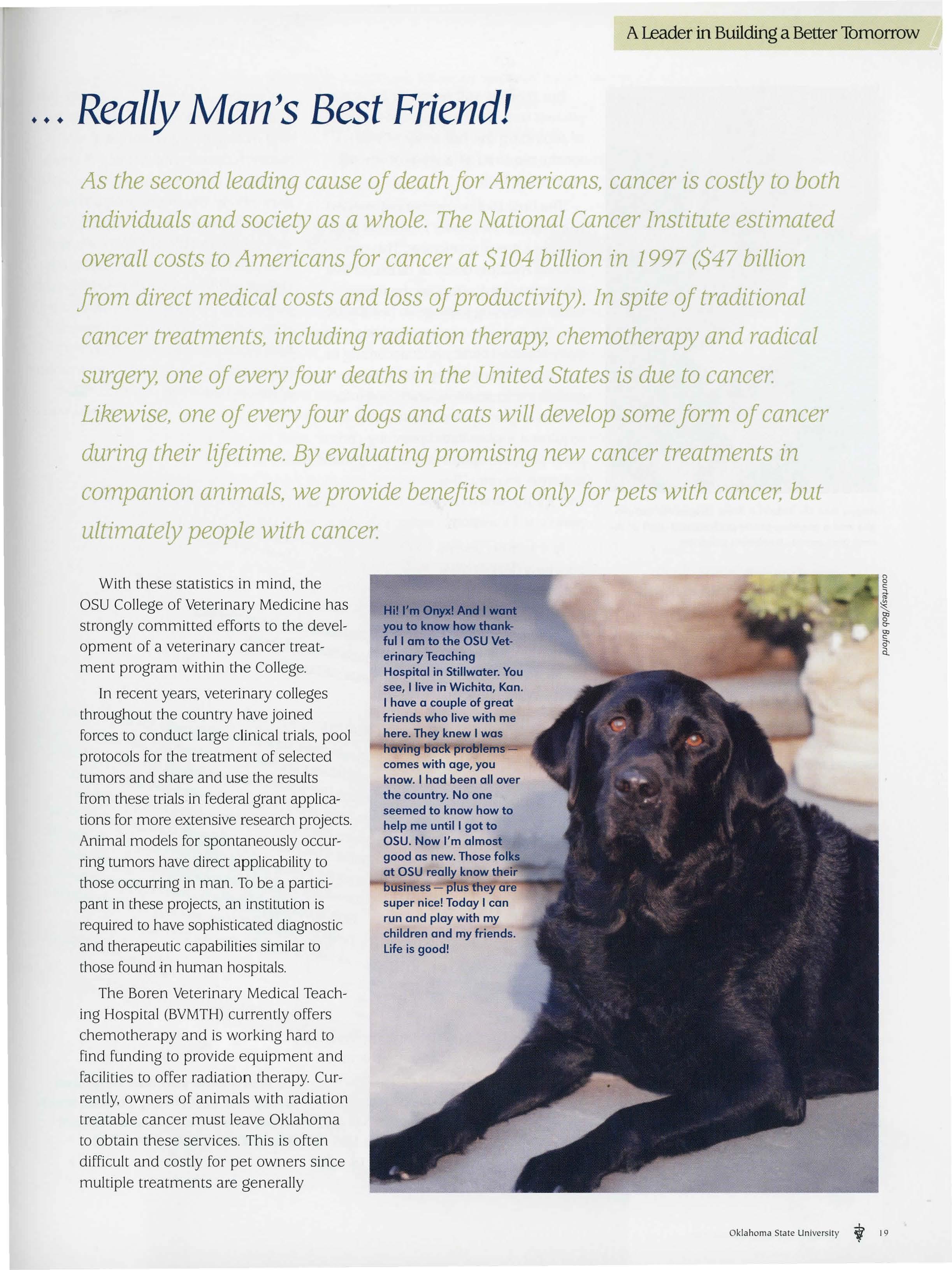
Hi!I'mOnyx!And I want you to know how thonkful I am to the OSU Veterinary Teaching Hospital in Stillwater. You see, I live in Wichita, Kan. I have a couple of great friends who live with me here. They knew I was h'Mlng back pn:,t,temscomes with age, you know. I had been all over the country. No one seemed to know how to help me until I got to OSU. Now I'm almost good as new. Those folks at OSU really know their IJ!liness - p us they are super nice! Today I can run and play with my children and my friends. Life is good!
recommended. The hardship of prolonged hospitalization could be avoided if a local treatment center were available.
OSU has made significant progress toward establishing a cancer treatment program within BVMTH. Chemotherapy treatment is available and has been used extensively since 1992, and a radioactive thyroid treatment area was established and has been in use since 1999. The newest piece of equipment for the center came in 2000 - a $200,000 computed tomography (CT scanner) unit, which is only one of two in the nation built with a specially constructed table to accommodate horses.
And, in March 2000, Dr. Michael Lucroy joined ~VM as the Kerr Chair in Biomedical Laser Applications. He has been instrumental in securing grants from the Robert and Helen KJebert Foundation and Bernice Barbour Foundation to study photodynamic therapy in bladder cancer using dogs as a model. Others included in the professional staff of the emerging cancer treatment program are Dr. Robert J Bahr, diagnostic radiologist, and Dr. Ellen Davidson, surgeon.
But there is still much to be accomplished to have the program capable of providing the full array of treatments required of a state-of-the-art veterinary facility.
The final facility component needed to complete the cancer treatment program is a linear accelerator. This unit delivers multiple doses of radiation that will increase the effect on the tumor while decreasing damage to healthy tissue. The linear accelerator requires a specially shielded facility built according to U.S. Nuclear Regulatory Commission guidelines. In addition, analyzing information to plan each radiation case requires a sophisticated planning computer program specifically developed for radiation therapy. The cost for this final component is $1 million.
At this time, several generous donors have made progress toward
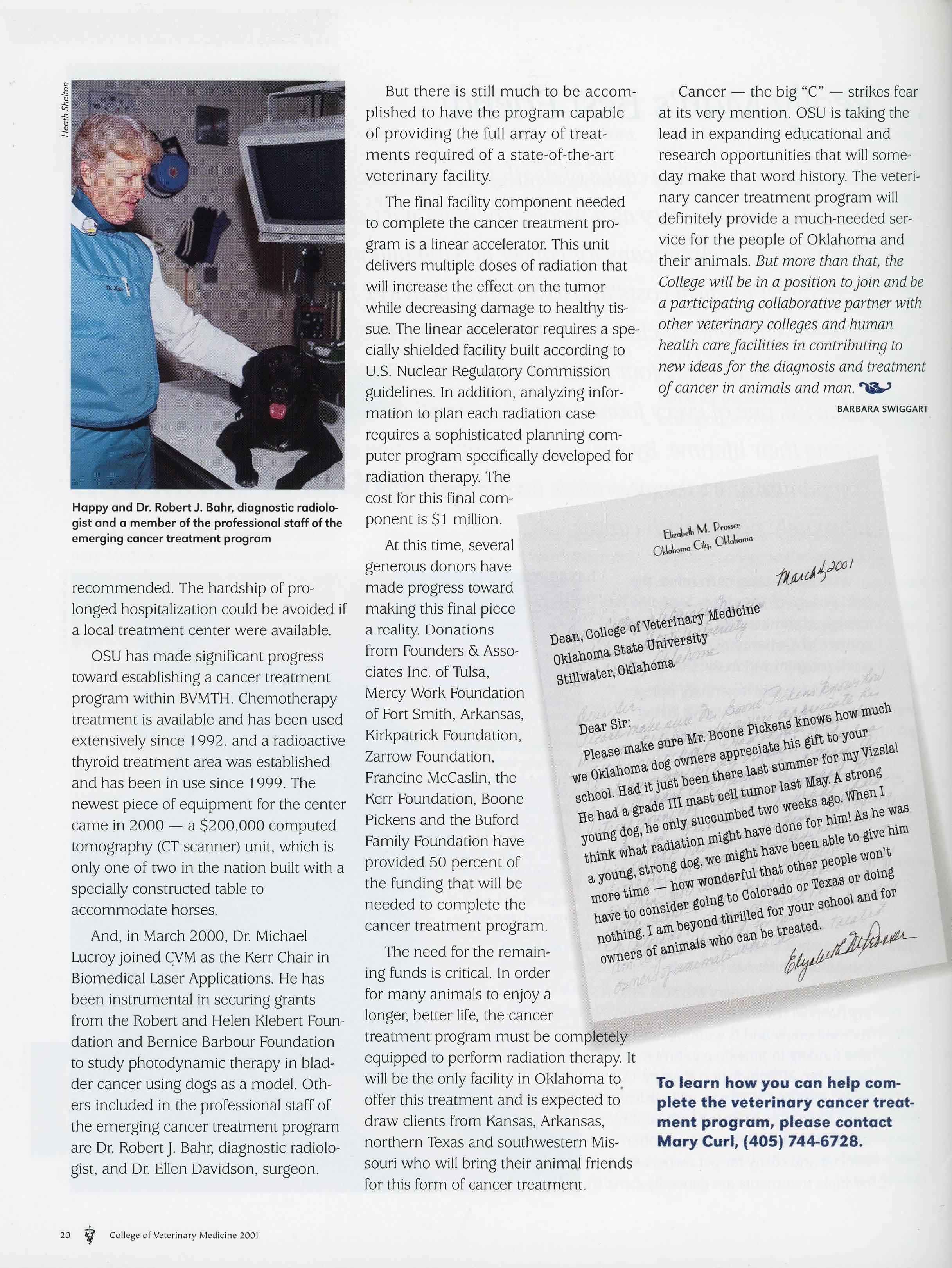
Cancer - the big "C" - strikes fear at its very mention. OSU is taking the lead in expanding educational and research opportunities that will someday make that word history. The veterinary cancer treatment program will definitely provide a much-needed service for the people of Oklahoma and their animals. But more than that, the College will be in a position to join and be a participating collaborative partner with other veterinary colleges and human health carefacilities in contributing to new ideas for the diagnosis and treatment of cancer in animals and man.
BARBARASWIGGART
making this final piece a reality. Donations from Founders & AssoMedicine Collel!,eof'Jeterina:Y Dean, unwersiW
ciates Inc. of Tulsa, Mercy Work Foundation of Fort Smith, Arkansas, Kirkpatrick Foundation, Zarrow Foundation, Francine Mccaslin, the Kerr Foundation, Boone Pickens and the Buford Family Foundation have provided 50 percent of the funding that will be needed to complete the cancer treatment program.
The need for the remaining funds is critical. In order for many animals to enjoy a longer, better life, the cancer
OklahOmastate stmwater,QltlahOma
hOwmuch
Dear Sir·. Pickensknows sure M.r.ioone . giftto your Pleasemake ers a1rpreciatenis f m"'Jizsla\ a do!!,own um.meror ., we oklahOm. st beentnere 1asts t MaYAstronl!, scnool.1:ladit )U mast ce1ltumorlas •o When l 1:lenad a gradellll succumbedtwoweeksah\~\AShe was d d ne on Y donefor younl!,Oo, d. !;ionmightnave ableto gwenim think wnat ra ia we ro.i!!,htnavebeen le won't a younl!,,stronl!,do~:,onderfUlthat otner-peos-P or Mini!, _now" d orTexa moretime . goinl!,to Colorao :uoolandfor nave to consider d thrilledfor your sc tninl!,.lam beyon n be treate~no ·ro.alswhOca ownersof ani Jl-j •
treatment program must be completely equipped to perform radiation therapy. It will be the only facility in Oklahoma to offer this treatment and is expected to. draw clients from Kansas, Arkansas, northern Texas and southwestern Missouri who will bring their animal friends for this form of cancer treatment.
To learn how you can help complete the veterinary cancer treatment program, please contact Mary Curl, (405) 744-6728.
Happy and Dr. Robert J. Bahr, diagnostic radiologist and a member of the professional staff of the emerging cancer treatment program
For more information about making a gift ta the OSl,J Companion Animal Fund, please contact Mary Curl, director of development at OSU's College of Veterinary Medicine, (405) 744-6728.
W.ben people andpels fouc.b our /iues in special wa_ys, we see£ meaningful ways lo honor I.base relahons.bips. 71100Q/ 1s College ojVelerinar_y !Jl(ed)dne, I.be Gampamon 7/mmal Yundprouides opporlumh"es lo remember an,1mals and I.be people w.bo foue and ca.re for I.hem while supporling hosp,1/a/serwces for pahenf care and medicalresearc.b Iba/ benefrl animals eueryw.bere.
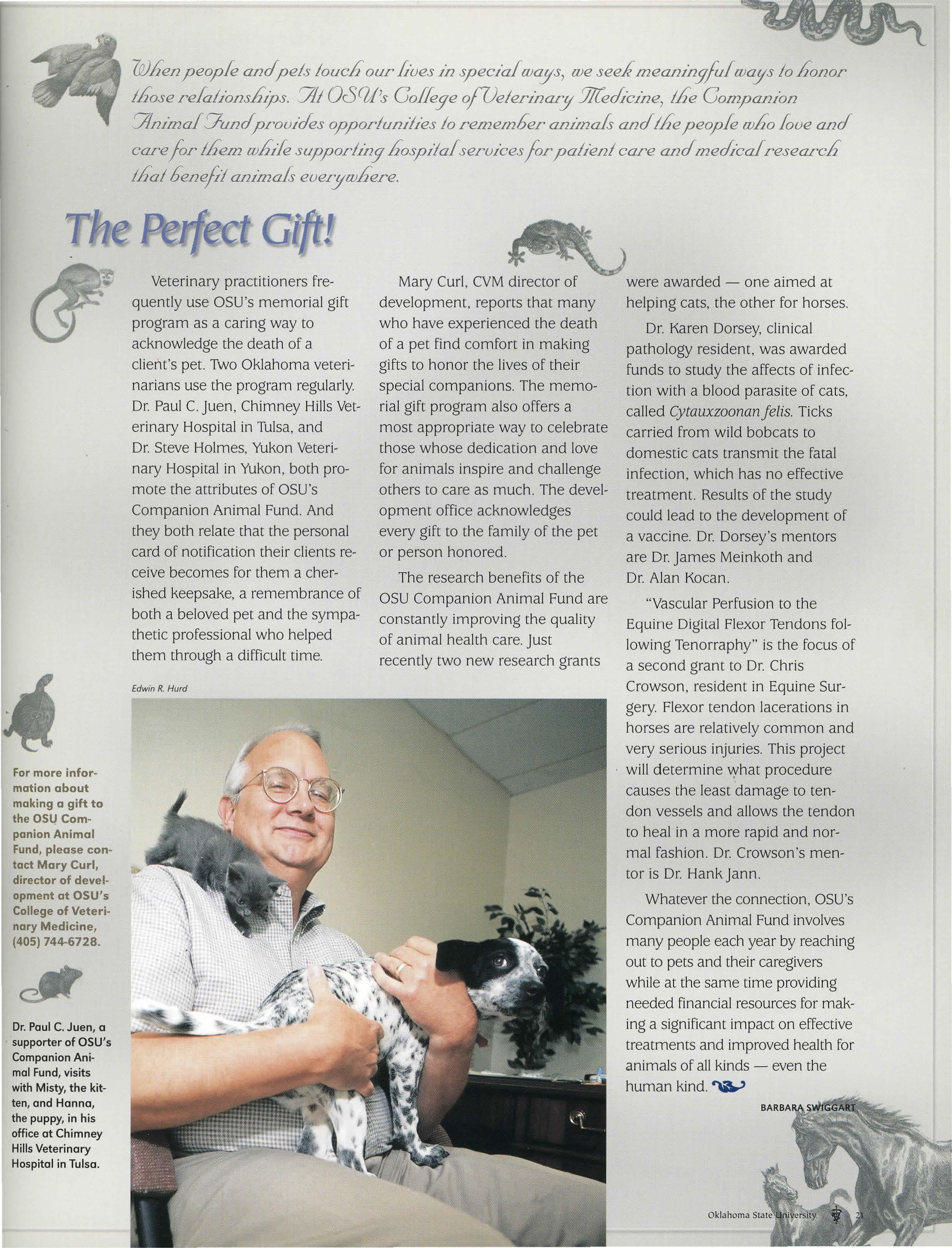
Dr. Paul C. Juen, a supporter of OSU's Companion Animal Fund, visits with Misty, the kitten, and Hanna, the puppy, in his office at Chimney Hills Veterinary Hospital in Tulsa.
Veterinary practitioners frequently use OSU's memorial gift program as a caring way to acknowledge the death of a client's pet. Two Oklahoma veterinarians use the program regularly.
Dr. Paul C. Juen, Chimney Hills Veterinary Hospital in Tulsa, and Dr. Steve Holmes, Yukon Veterinary Hospital in Yukon, both promote the attributes of OSU's Companion Animal Fund. And they both relate that the personal card of notification their clients receive becomes for them a cherished keepsake, a remembrance of both a beloved pet and the sympathetic professional who helped them through a difficult time.
Edwin R. Hurd
Mary Curl, CVM director of development, reports that many who have experienced the death of a pet find comfort in making gifts to honor the lives of their special companions. The memorial gift program also offers a most appropriate way to celebrate those whose dedication and love for animals inspire and challenge others to care as much. The development office acknowledges every gift to the family of the pet or person honored.
The research benefits of the OSU Companion Animal Fund are constantly improving the quality of animal health care. Just recently two new research grants
were awarded - one aimed at helping cats, the other for horses.
Dr. Karen Dorsey, clinical pathology resident, was awarded funds to study the affects of infection with a blood parasite of cats, called Cytauxzoonanjelis. Ticks carried from wild bobcats to domestic cats transmit the fatal infection, which has no effective treatment. Results of the study could lead to the development of a vaccine. Dr. Dorsey's mentors are Dr. James Meinkoth and Dr. Alan Kocan.
"Vascular Perfusion to the Equine DigiLal Flexor Tendons following Tenorraphy" is the focus of a second grant to Dr. Chris Crowson, resident in Equine Surgery. Flexor tendon lacerations in horses are relatively common and very serious injuries. This project will determine vyhat procedure causes the least damage to tendon vessels and allows the tendon to heal in a more rapid and normal fashion. Dr. Crowson's mentor is Dr. Hank Jann.
Whatever the connection, OSU's Companion Animal Fund involves many people each year by reaching out to pets and their caregivers while at the same time providing needed financial resourcesfor making a significant impact on effective treatments and improved health for animals of all kinds - even the human kind.~
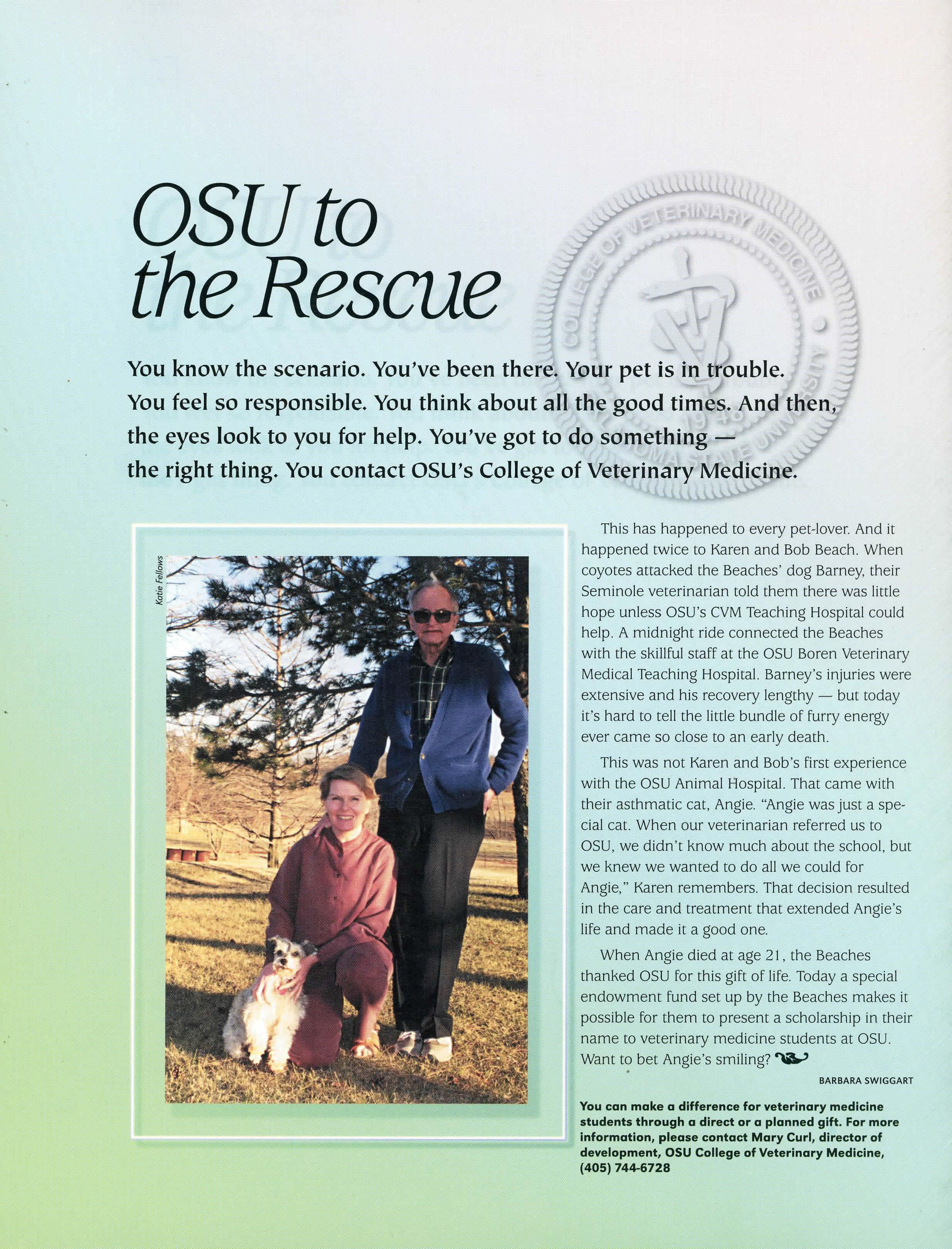
OSUto theRescue
You know the scenario. You've been there. Your pet is in trouble. You feel so responsible. You think about all the good times. And then, the eyes look to you for help. You've got to do somethingthe right thing. You contact OSU's College of Veterinary Medicine.
This has happened to every pet-lover. And it happened twice to Karen and Bob Beach. When coyotes attacked the Beaches' dog Barney, their Seminole veterinarian told them there was little hope unless OSU's CVM Teaching Hospital could help. A midnight ride connected the Beaches with the skillful staff at the OSU Boren Veterinary Medical Teaching Hospital. Barney's injuries were extensive and his recovery lengthy - but today it's hard to tell the little bundle of furry energy ever came so close to an early death.
This was not Karen and Bob's first experience with the OSU Animal Hospital. That came with their asthmatic cat, Angie. "Angie was just a special cat. When our veterinarian referred us to OSU, we didn't know much about the school, but we knew we wanted to do all we could for Angie," Karen remembers. That decision resulted in the care and treatment that extended Angie's life and made it a good one.
When Angie died at age 21 , the Beaches thanked OSU for this gift of life. Today a special endowment fund set up by the Beaches makes it possible for them to present a scholarship in their name to veterinary medicine students at OSU. Want to bet Angie's smiling?~
BARBARASWIGGART
You can make a difference for veterinary medicine students through a direct or a planned gift. For more information, please contact Mary Curl, director of development, OSU College of Veterinary Medicine, (405) 744-6728