Mooving · In New Research Directions
_Moovingesearch
When I came to Oklahoma, it didn't take long,to realize.that Ci;Lttlerepresent_, '";/. :;;:., the state's ost economically important animal agricultural enterprise. The College of Veterinary Medidne's research program has centered·tWi-PnJi finding ways to enhance producer profitability through increased production and reduction in losses suffered from disease and.reproductive inefficiencies. One of the highlights ofthe.bovine 'research J§r0gtam w~;-the development% of the first effective vaccine for anaplasmosis by Dr. William Broe.k.in 1965. A plaque corqmemorating Dr. Brodes pioneer wor½,was recently placed o;n·thef Anapjasmosis 8v,_ild,ing,tqe site of his. ,f histo.riGdi'scovery. While Dr. Brock's vaa• cine was, ver,Y effective, there were ,,, ;-,. t '.r some undesirable side effects. Most recently, Qr. Kath,erint; K.oca,r and Dt, ,:;) ' ,; Edmour Blouin have de eloped a new and improved V:-a.ccinethat has the ·"' potential to save the nation ·s tattle industry $300 million 1
.A successful research program requires specialized facilities, state-of-theart equipment anti a critical number of faculty and skilled technLcians. We are trying to n;'eet these needS"in the 1. areas of bovine infectious diseases and 'JI. .,, reproduction througb the employment of talented faculty and staff, the construction of modern facilities and the acquisition of sophisticated research instrumentation. The completion of two • .Q~JNbovine research parks will give our ficuJtyimproved facilities in which to work. We are very proud of the Wendel Wallace Bovine Research Park and the Willard Sparks Cattle Stress Center, two state-of-the-art living laboratories where students and researchers study cattle disease and management under actual field conditions. Much of our success can be attributed to the generosity of private citizens and Oklahoma foundations.
If we are to truly serve the cattle industry, our service and outreach program must equal our research success. In a recent cooperative data survey of the 27 colleges of veterinary medicine by the Association of American Veterinary Medical Colleges, OSU ranked second in number of cattle treated. To support this impressive caseload, the teaching hosgic-al now features a new hydraulic chute/restraint system, a remodeled induction/
surgical area and a hydrotherapy system for cattle. We have some of the nation's leading faculty and recently took stepsto stgnil'fcantly enhance our outreach/educationaLprogram aimed at Oklahoma food animal veterinarians and producers.It is of utmost importance that we take the lead in preparing students to provide quality veterinary service and management techniques to the country's cattle industry.
While OSU will always focus on research to improve health care in cattle, it is very critical to our future to expand into other areas including human health. Much of this issueof Vet Cetera features highly successful faculty in a number of research ateas. In addition to infectious diseases, we are now focusing on the discovery of animal models for human diseases, toxicology, animal reproduction and biomedical lasers. While we can not be "all things to all people," there is great potentialto develop nationally 'recognized research areas. Some deans like to "show off" impxessive facilities and talk about state-of-the-art equipment, yet the most vital part of'any program can be foundin the workforce. OSU's College of Veterinary Medicine is most fortunate to have a dedicated and talented group of faculty, staff and students that will ensurea bright and promising future. ·dw. V
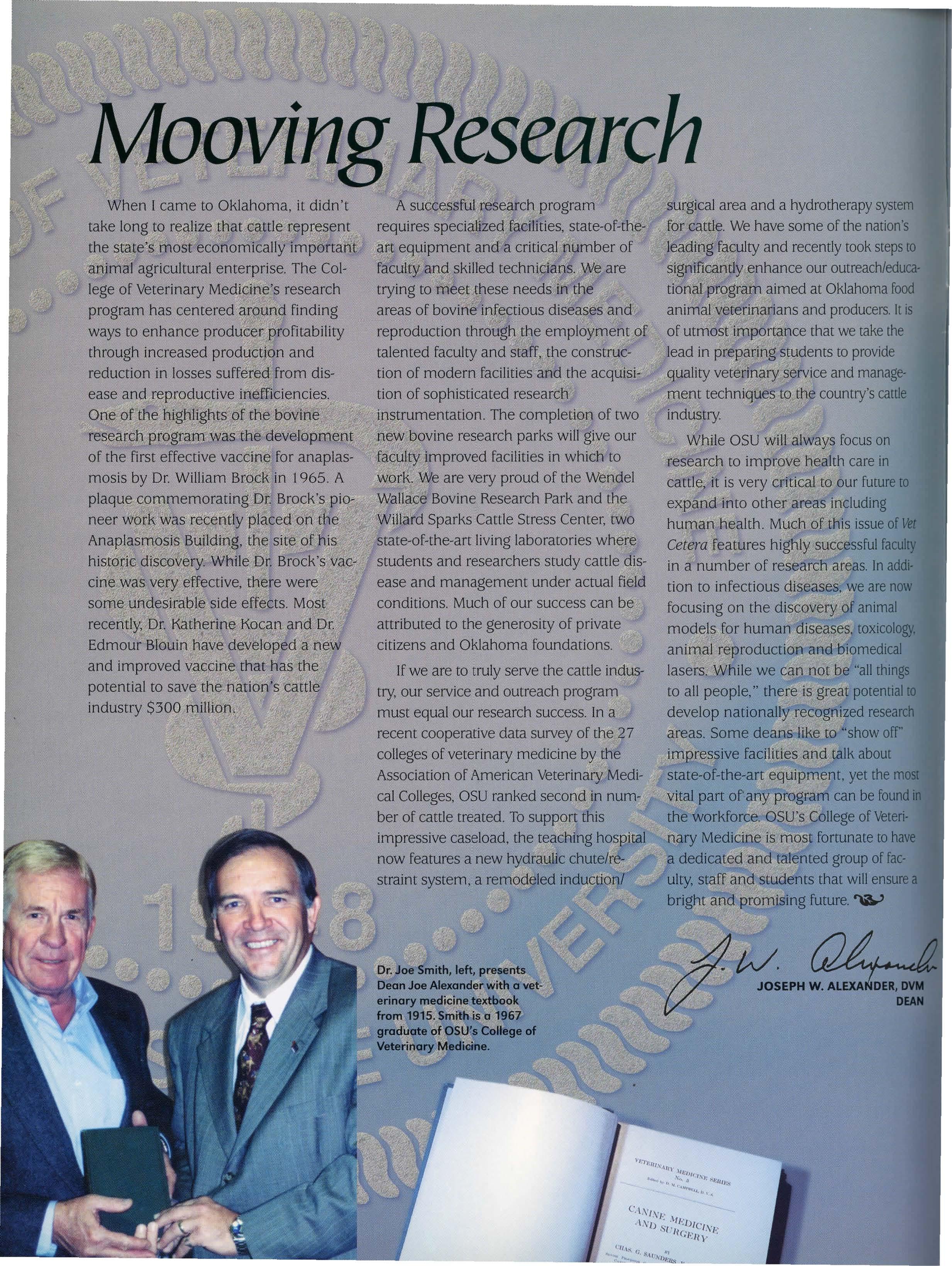
Dr. Joe Smith, left, presents Deon Joe Alexander with o veterinary medicine textbook from 1915. Smith is o 1961 graduate of OSU's College of Veterinary Medicine.
JOSEPH w. ALEXA
THE VETMEDMAGAZINE SPRING,2000NOLUME 3
lhis is another wonderful year for the OSU Collegeof Veterinary Medicine, and we hope you willwant to honor your friends and family members by contributing to our brick Walk of Honor. Space is still available for inscribed bricks far the college's alumni, students, friends and current and former staff and faculty. Each brick has a three-line, 14-spaces-per-line capacity and is $25.
lhe college also welcomes suggestions of items to include In its time capsule. For more informationcallKatieFellows,pub6c relations/ alumni affairs coordinator, at (405) 744-6740.
Please join us at the CVM Web site at: www.cvm.okstate.edu. lhe OSU homepage is located at www.okstate.edu.
Letters are welcome and should be addressed to: Oklahoma State University, Editor, VETCETERAMagazine,308 McElroy Hall,Stillwater,OK74078-2011.E-mailis also welcome at: fellowk@okstate.edu or curlm@okstate.edu.
Dean,Collegeof VeterinaryMedicine
JoeAlexander,DVM
Directorof Development
Mary Curl
Coordinatorof PublicRelations/AlumniAffairs
KatieFellows
Editor
ShelleyBrinsfield
Art Director
Paul V.Fleming
AssociateEditor
Janet Varnum
Photography HeathShelton,C.P.P (mostphotos.and unlessotherwisenoted)
AssistontVice President, CommunicationsServices
NataleaWatkins
Vet Cetera magazine is a publication of the OklahomaState UniversityCollegeofVeterinary Medicine.Its purpose is to connect the college with its many stakeholders,providinginformation on bothcampus news and pertinent issues in the field of veterinary medicine.
CONTENTS
4 The Big Picture
A new, one-of-a-kind CT scanner examines animals as large as a horse.
5 Taken A-back
Bartels' innovative laser surgery helps dogs with disk problems.
7 Lettin' the Cat Out of the Bag Study of Feline Immunodeficiency Virus (FIV) could lead to help for humans with HIV.
JOTicked Off
Insects help researchers uncover new, improved cattle vaccine.
J4 The Lion Queen
OSU CVM's first female graduate, June Iben, rescues wild cats and other exotic animals.
J6 North to Alaska
Researchers study the effects of cold air on Iditarod sleci dogs.
Oklahoma State University© 2000 lllalmaSm lnmity 11mnpl,n:ewilhTIiie 8fldYBolll1elllil Righ1sAaof 1964,Exaaniua()der11246asamenled.f111olXofil1eEducallOll""1endmemsof 1972, Amonnwilfllllsa1JiiliasAaot11100.8fldmfaderal1awsaral,p1ioos.masoot ......,_...,ll1ebasisofraca.cokr.llllionellllgl\..,age.mlgi,n.disa1Jiity.or 1111uas,__,lnanyofnspoicias.~orprocafuras.Tiisirdilasbut•oot linilat•missin....,,_ finftia1eidllll_....._ Thispublcanoo,Job#11133issuedbyOllammaSm UrimityastittOOli1lldbytheCollage of l/elmrtMali:lnt.wasprinladbyTheAllioVisuall:anra,l.fflllfsityi'rinm,gSmi:es 118mstofSJ640.66.3.5l,IJSapa,nar
COVER: For more thon 52 yeors, bovine research hos been a focal point of the OSU College of Veterinary Medicine. Reod on to discover how our sophisticoted research equipment and talented foculty ore benefiting the cottle industry in Oklahomo and beyond. (cover image manipulated) visit our CVM Web site www.cvm.okstate.edu
Pets Get a Special Night Out
Researchers Go to War
Having a Cow
Shedding New Light on Cancer
The Doggy(andCat) Doctoris In
Stillwater pet owners who find it difficult getting a doctor's appointment for their furry friends, now have an alternative.
The OSU Small Animal Clinic has started a program called "Pets' Night Out," offering routine examinations for pets every Thursday from 5-7 p.m. designed as a service for busy pet owners.
Dr. John Kirkpatrick and Dr. Paul L DeMars, who organized the new program, say the new clinic schedule for "Pets' Night Out" was
"We realize that people are so busy they often forget to take their pets in to have their necessary shots," says Kirkpatrick. "It is our hope that a 'Pets' Night Out' during the week will be a helpful time to take care of this type of preventative care."
DeMars says "Pets' Night Out" is specifically geared toward health maintenance and wellness checks that include annual examinations, vaccinations, heartworm prevention, flea and tick control and other important programs.
"We think by encouraging pet owners to schedule wellness checks, they can help prevent their pets from becoming ill," DeMars says. "Being medically proactive can be just as important to pets as it is with people."
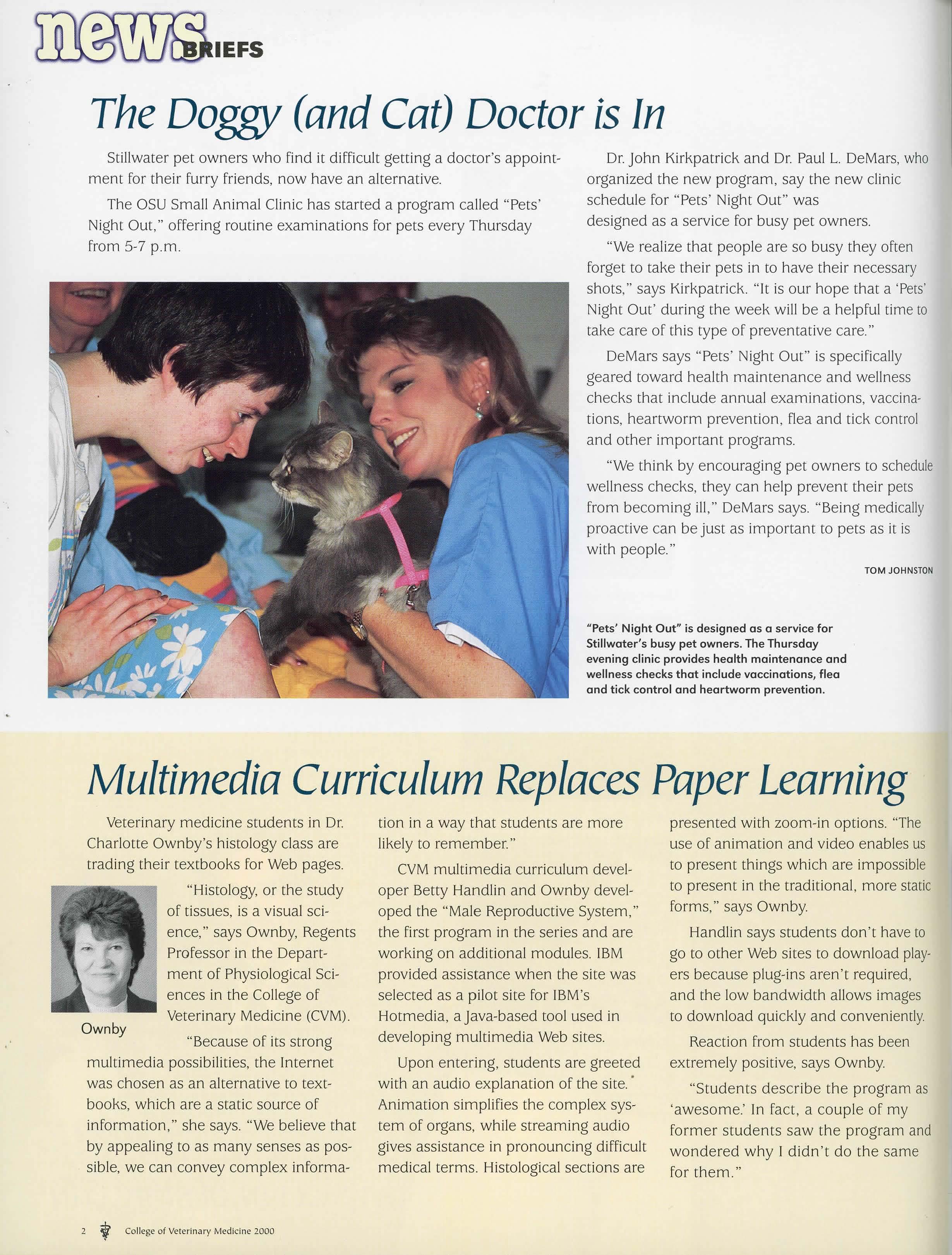
wellness checks that include vaccinations, flea and tick control and heartwarm prevention.
MultimediaCurriculumReplacesPaperLearning
Veterinary medicine students in Dr. Charlotte Ownby's histology class are trading their textbooks for Web pages.
"Histology, or the study of tissues, is a visual science," says Ownby, Regents Professor in the Department of Physiological Sciences in the College of Veterinary Medicine (CVM) Ownby
"Because of its strong multimedia possibilities, the Internet was chosen as an alternative to textbooks, which are a static source of information," she says. "We believe that by appealing to as many senses as possible, we can convey complex informa-
tion in a way that students are more likely to remember."
CVM multimedia curriculum developer Betty Handlin and Ownby developed the "Male Reproductive System," the first program in the series and are working on additional modules. IBM provided assistance when the site was selected as a pilot site for IBM's Hotmedia, a Java-based tool used in developing multimedia Web sites.
Upon entering, students are greeted with an audio explanation of the site.· Animation simplifies the complex system of organs, while streaming audio gives assistance in pronouncing difficult medical terms. Histological sections are
presented with zoom-in options. "The use of animation and video enables us to present things which are impossible to present in the traditional, more static forms," says Ownby.
Handlin says students don't have to go to other Web sites to download players because plug-ins aren't required, and the low bandwidth allows images to download quickly and conveniently.
Reaction from students has been extremely positive, says Ownby.
"Students describe the program as 'awesome.' In fact, a couple of my former students saw the program and wondered why I didn't do the same for them."
"Pets' Night Out" is designed as a service far Stillwater's busy pet owners. The Thursday evening clinic provides health maintenance and
TOM JOHNSTON
WhereHe Belongs
When Dr. George Henry left the OSU College of VeterinaryMedicine, it lost an expert in radiology. But technology has brought him right back into the college'sclassrooms.
It's well known throughout veterinary colleges that just because a faculty is large, it doesn't necessarily have an expert in every field, says Dr. Mike Lorenz, associate dean for academic affairs. Therefore, Henry universities often share professors, which can mean very intensive courses at a greatexpense to the schools.
As freshmen in the college's class of 2003 prepared for last fall's grueling radiology course, they beggedLorenz to bring Henry back from Texas A&M to teach, and he did, via Internet 2.
Twice a week, students filed into the "wired" classroom, where they saw and talked with Henry from his classroomin College Station, Texas.
"The good thing about it is we were able to effectively transmit audio and video between Dr. Henry and the students," says
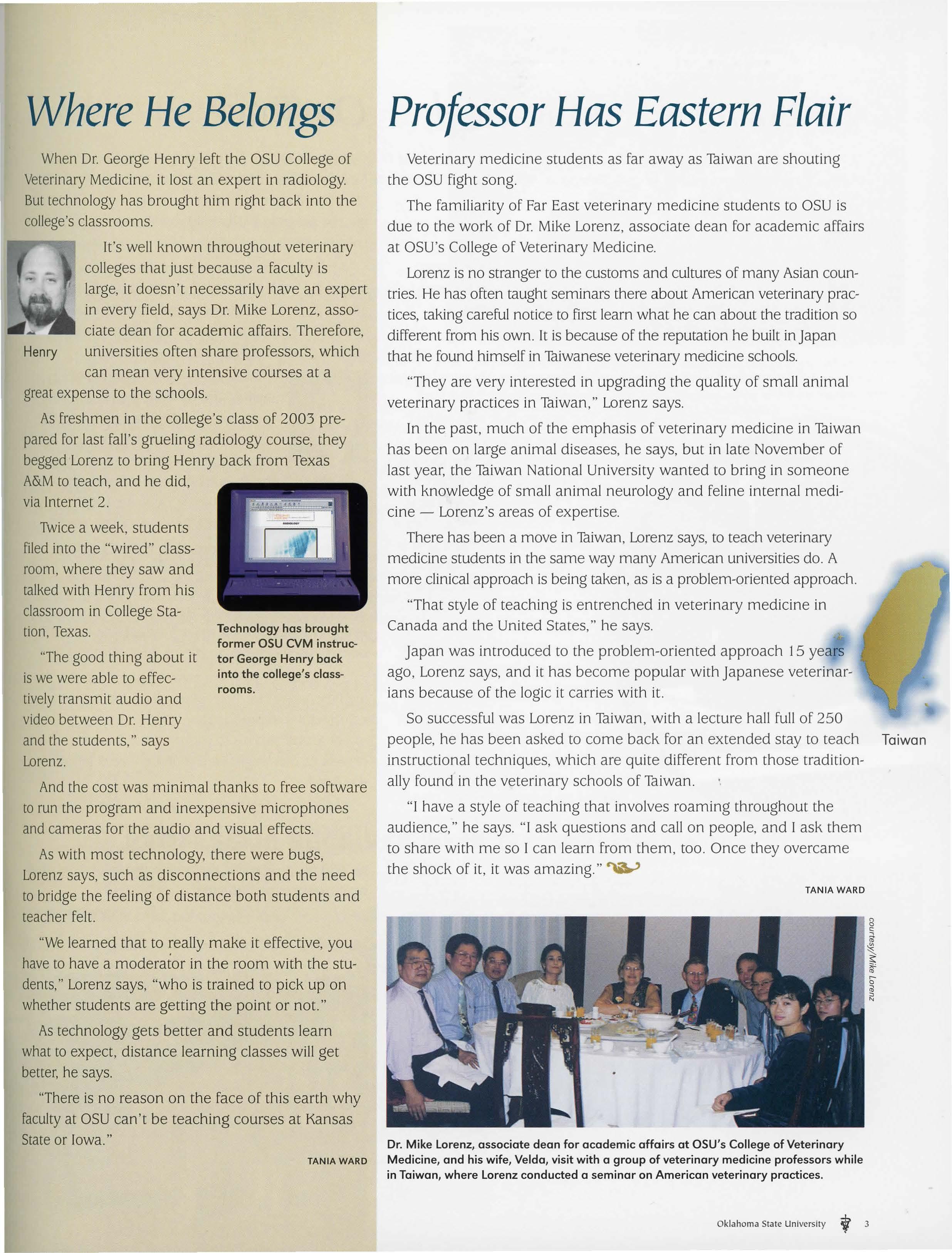
: Technology has brought former OSU CVM instructor George Henry back into the college's classrooms.
ProfessorHas EasternFlair
Veterinary medicine students as far away as Taiwan are shouting the OSU fight song.
The familiarity of Far East veterinary medicine students to OSU is due to the work of Dr. Mike Lorenz, associate dean for academic affairs at OSU's College of Veterinary Medicine.
Lorenz is no stranger to the customs and cultures of many Asian countries. He has often taught seminars there about American veterinary practices, taking careful notice to first learn what he can about the tradition so different from his own. It is because of the reputation he built in Japan that he found himself in Taiwaneseveterinary medicine schools.
"They are very interested in upgrading the quality of small animal veterinary practices in Taiwan," Lorenz says.
In the past, much of the emphasis of veterinary medicine in Taiwan has been on large animal diseases, he says, but in late November of last year, the Taiwan National University wanted to bring in someone with knowledge of small animal neurology and feline internal medicine - Lorenz's areas of expertise.
There has been a move in Taiwan, Lorenz says, to teach veterinary medicine students in the same way many American universities do. A more clinical approach is being taken, as is a problem-oriented approach.
"That style of teaching is entrenched in veterinary medicine in Canada and the United States," he says.
Japan was introduced to the problem-oriented approach 15 years ago, Lorenz says, and it has become popular with Japanese veterinarians because of the logic it carries with it.
So successful was Lorenz in Taiwan, with a lecture hall full of 250 people, he has been asked to come back for an extended stay to teach Taiwan Lorenz. instructional techniques, which are quite different from those tradition-
And the cost was minimal thanks to free software ally found in the veterinary schools of Taiwan. to run the program and inexpensive microphones and cameras for the audio and visual effects.
As with most technology, there were bugs, Lorenzsays, such as disconnections and the need to bridge the feeling of distance both students and teacher felt.
"We learned that to :eally make it effective, you haveto have a moderator in the room with the students," Lorenz says, "who is trained to pick up on whether students are getting the point or not."
As technology gets better and students learn what to expect, distance learning classes will get better,he says.
"There is no reason on the face of this earth why faculty at OSU can't be teaching courses at Kansas Stateor Iowa."
"I have a style of teaching that involves roaming throughout the audience," he says. "I ask questions and call on people, and I ask them to share with me so I can learn from them, too. Once they overcame the shock of it, it was amazing."._,.,
TANIA WARD
Dr. Mike Lorenz, associate dean for academic affairs at OSU's College of Veterinary TANIA WARD Medicine, and his wife, Velda, visit with a group of veterinary medicine professors while in Taiwan, where Lorenz conducted a seminar on American veterinary practices.
Tradition of Research Excellence
No Horsin' Around
CTScanneris a BigDeal
The College of Veterinary Medicine has installed a medical scanner capable of doing scans on a Shetland Sheepdog, Yorkshire Terrier or even a 1,500-pound horse.
"CT scanning of horses is not new, by any means," says Dr. Robert Bahr, radiology section chief. "A couple of universities in the United States and universities in Holland and Germany have been doing it for a long time. What sets us apart from them is our large animal table, which we think serves our Bahr needs in a very efficient way."
The General Electric Sytec-4000i Computed Tomography (CT) scanner is a used machine that was remanufactured by a firm in Ohio and is no larger than those used for
human beings. The feature that sets it apart from other scanners is its equine table that was engineered from the ground up. The table is built to support a typical 1,500-pound horse but is capable of holding much more if needed. It is an integral part of the machine and, during a scan, it's controlled by the computer and is so finely geared chat it can move the patient in one to 10 centimeter increments, as the scanner does its work.
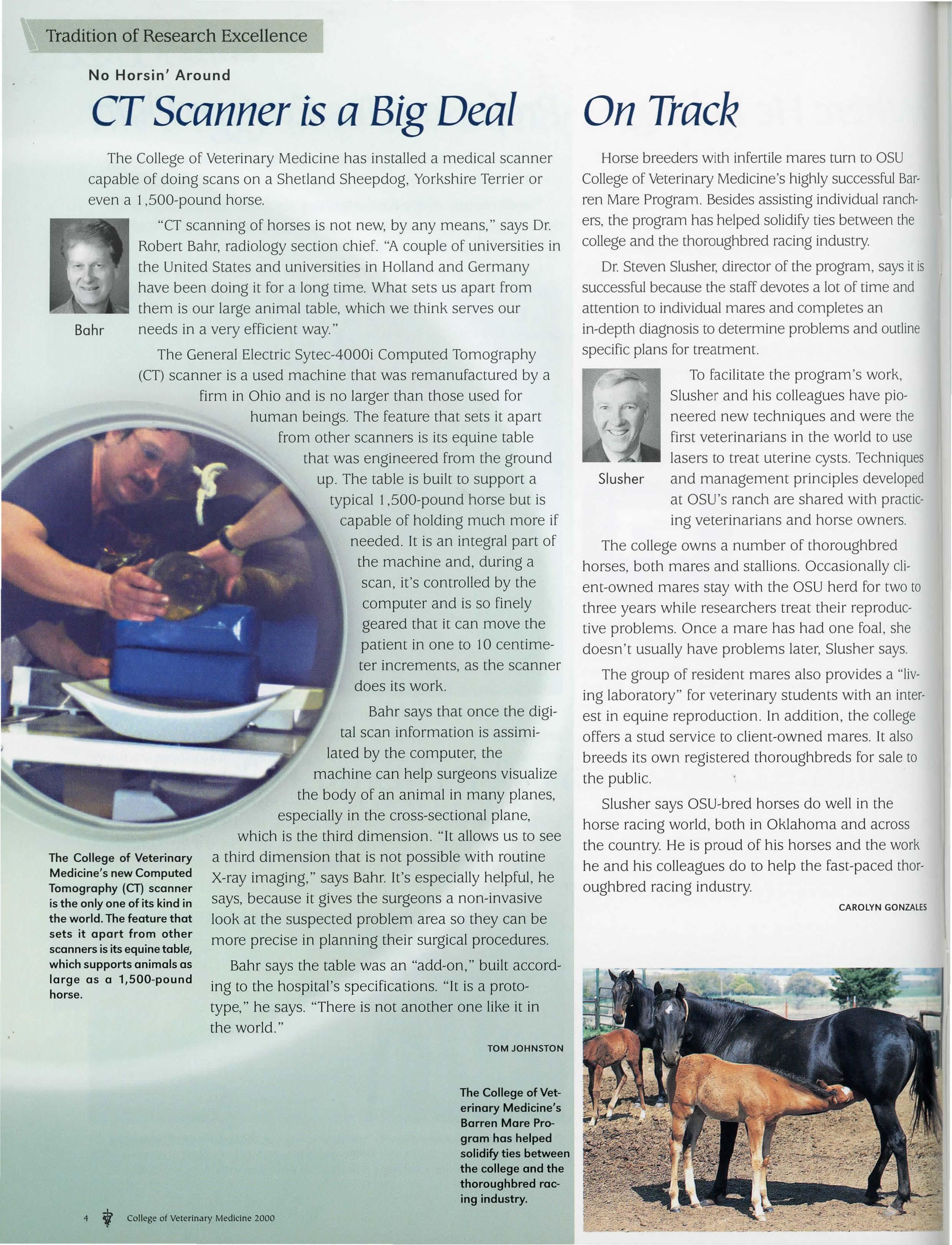
The College of Veterinary Medicine's new Computed Tomography (CT) scanner is the only one of its kind in the world. The feature that sets it apart from other scanners is its equine table, which supports animals as large as a 1,500-pound horse.
Bahr says that once the digital scan information is assimilated by the computer, the machine can help surgeons visualize the body of an animal in many planes, especially in the cross-sectional plane, which is the third dimension. "It allows us to see a third dimension that is not possible with routine X-ray imaging," says Bahr. It's especially helpful, he says, because it gives the surgeons a non-invasive look at the suspected problem area so they can be more precise in planning their surgical procedures.
Bahr says the table was an "add-on," built according to the hospital's specifications. "It is a prototype," he says. "There is not another one like it in the world."
TOM JOHNSTON
On Track
Horse breeders with infertile mares turn to OSU College of Veterinary Medicine's highly successfulBarren Mare Program. Besidesassisting individual ranchers, the program has helped solidify ties between the college and the thoroughbred racing industry.
Dr. Steven Slusher,director of the program, saysit is successful because the staff devotes a lot of time and attention to individual mares and completes an in-depth diagnosis to determine problems and outline specific plans for treatment.
To facilitate the program's work, Slusher and his colleagues have pioneered new techniques and were the first veterinarians in the world to use lasers to treat uterine cysts. Techniques and management principles developed at OSU's ranch are shared with practicing veterinarians and horse owners.
The college owns a number of thoroughbred horses, both mares and stallions. Occasionally client-owned mares stay with the OSU herd for two to three years while researchers treat their reproductive problems. Once a mare has had one foal, she doesn't usually have problems later, Slusher says.
The group of resident mares also provides a "living laboratory" for veterinary students with an interest in equine reproduction. In addition, the college offers a stud service to client-owned mares. It also breeds its own registered thoroughbreds for sale to the public.
Slusher says OSU-bred horses do well in the horse racing world, both in Oklahoma and across the country. He is proud of his horses and the work he and his colleagues do to help the fast-paced thoroughbred racing industry.
The College of Veterinary Medicine's Barren Mare Program has helped solidify ties between the college and the thoroughbred racing industry.
Slusher
CAROLYN GONZALES
Backin the Groove
Dogsas far away as Alaska and Florida are coming to OSU for a unique laser procedure. That's because OSU is the only veterinaryschool in the U.S. performing it.
Thanks to Dr. Ken Bartels, Mccasland Professor of Laser Surgery,a surgical laser procedure is helping dogs with disk disease.
Bartelssays Dachshund-type dogs, by nature, are prone to havedisk problems in their spine.
"When Dachshunds are about 3 to 7 years old, they can starthaving back problems," he says. "Up until eight years agothe only option was invasive surgery, which could have a long recovery period."
Bartelsand his colleagues in the Small Animal Surgery and RadiologySections in the Department of Veterinary Clinical Scienceshave pioneered a rechnique in which a needle is insertedinto the bulging disk. A laser optic fiber is then threadedthrough the needle. When the laser is activated, the disk is vaporized.
"Instead of making a long incision down the dog's back, wejust take seven needles and insert them into the disk spacesthat are prone to herniate," Bartels says. "After running the laser fiber through the needles and concentrating on the middle of the disk, we are able to vaporize the disk, taking away its potential of herniating in the future."
Bartelssays the procedure is done on dogs that have had previousepisodes of disk disease and have been referred to OSU'sVeterinary Teaching Hospital.
"We confirm that there's a problem before we do the procedure,"Bartels says.
The surgery is a preventative step. "The problem is that if you don't do something with disk problems, they tend to recur, and it can get a lot worse the second time."
So far, 200 dogs have had the procedure at OSU. Only six (about three percent) have had a recurring problem. With other invasive surgical procedures, the recurrence is reported to be anywhere from 15-40 percent.
"It's been quite satisfying because we've had animals from Alaska, Florida and the East Coast come to OSU to have the procedure done," says Bartels.
Dogs aren't the only ones benefiting from the study.
"The laser disk ablation surgery has been FDA-approved for humans," he says. "This type of laser surgery is now available from a physician in Oklahoma City."
PROFESSOR RECEIVES PREMIER ALUMNI AWARD
Dr.Kenneth Bartels, McCasland Professor of Laser Surgery and Cohn Chair for Animal Care, has been awarded the Stange Award for Meritorious Service in Veterinary Medicine from Iowa State University. Theaward is named in memory of a long-time ISU college dean and early leader in veterinary medicine. Bartels,who graduate~ from Iowa State University's College of Veterinary Medicine in 1973, has a national and international reputation for his clinical research utilizing laser technology in surgery.
Asa member of the OSU faculty, Bartels has built a solid record of accomplishments in applying laser technology to soft tissue surgery and has been the leading force in developing one of the country's foremost veterinary biomedical laser facilities.
"Dr. Bartels has superior leadership qualities, and his impressive achievements in resean;h have been matched by his top ratings as a teacher in the OSU veterinary curriculum," says Richard Ross, dean of Iowa State's College of Veterinary Medicine.
With his work in laser surgery, Bartels collaborates with colleagues in human medicine, industry and the military. He has earned numerous awards for research and is a Fellow in the prestigious American Societyof Laser Medicine and Surgery. He is also the incoming president of the Oklahoma Veterinary Medical Association (OVMA) scheduled to take office in January 2001.
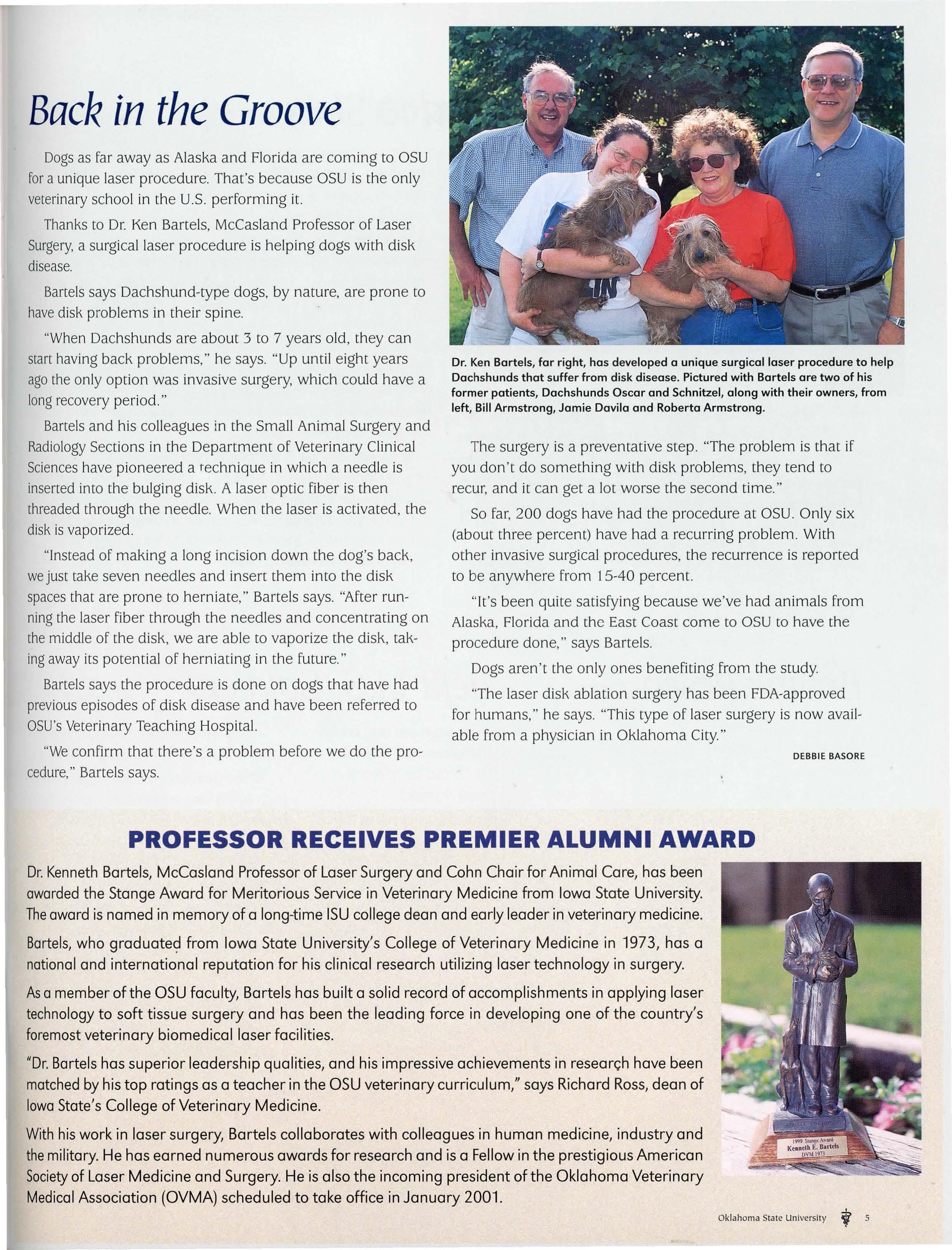
Dr. Ken Bartels, far right, has developed a unique surgical laser procedure to help Dachshunds that suffer from disk disease. Pictured with Bartels are two of his former patients, Dachshunds Oscar and Schnitzel, along with their owners, from left, Bill Armstrong, Jamie Davila and Roberta Armstrong.
DEBBIE BASORE
Gulf War ProblemsLinkedto Stress
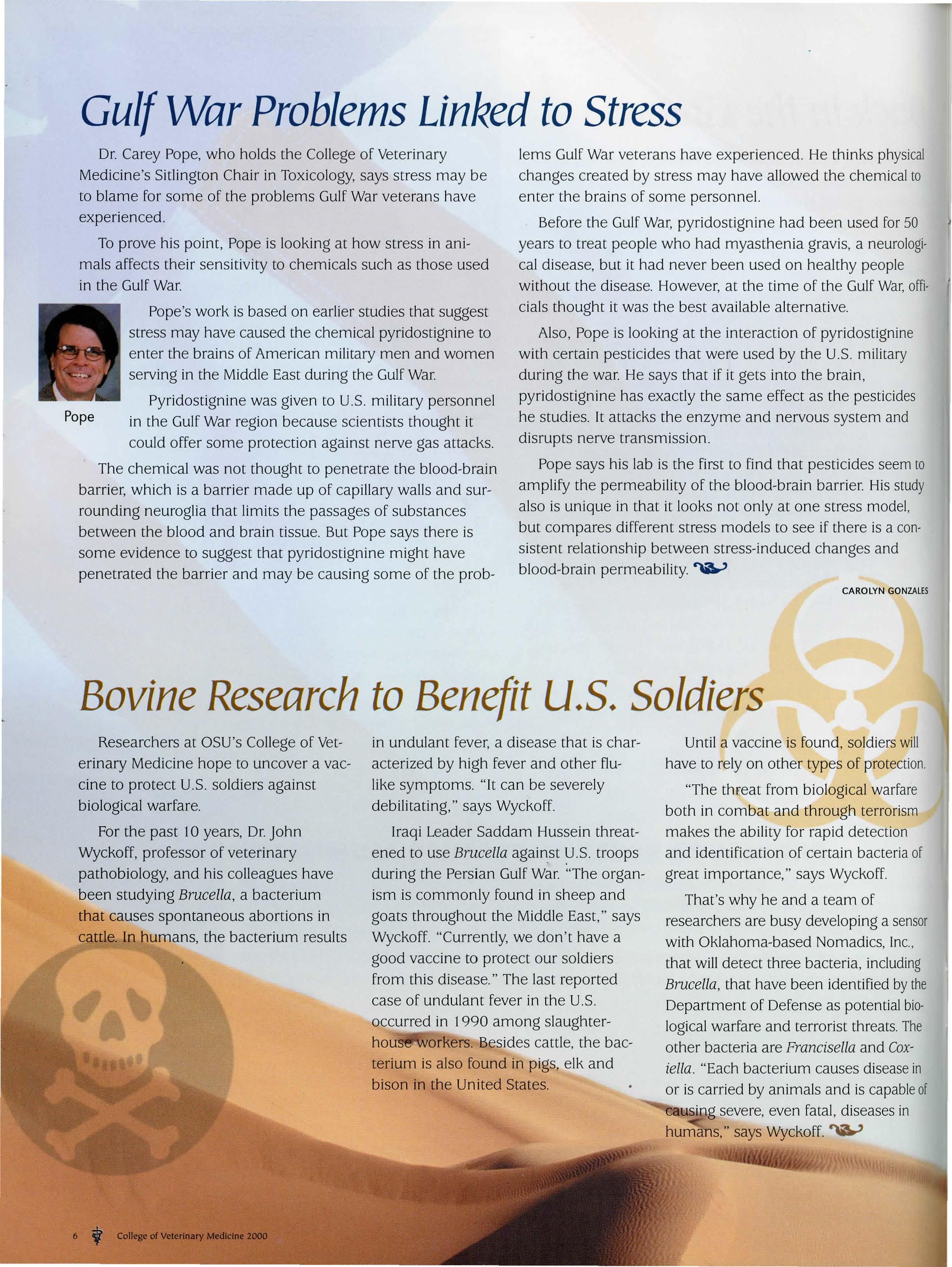
Dr. Carey Pope, who holds the College of Veterinary Medicine's Sitlington Chair in Toxicology, says stress may be to blame for some of the problems Gulf War veterans have experienced.
To prove his point, Pope is looking at how stress in animals affects their sensitivity to chemicals such as those used in the Gulf War.
Pope's work is based on earlier studies that suggest stress may have caused the chemical pyridostignine to enter the brains of American military men and women serving in the Middle East during the Gulf War.
Pope
Pyridostignine was given to U.S. military personnel in the Gulf War region because scientists thought it could offer some protection against nerve gas attacks.
The chemical was not thought to penetrate the blood-brain barrier, which is a barrier made up of capillary walls and surrounding neuroglia that limits the passages of substances between the blood and brain tissue. But Pope says there is some evidence to suggest that pyridostignine might have penetrated the barrier and may be causing some of the prob-
!ems Gulf War veterans have experienced. He thinks physical changes created by stress may have allowed the chemical to enter the brains of some personnel.
Before the Gulf War, pyridostignine had been used for 50 years to treat people who had myasthenia gravis, a neurological disease, but it had never been used on healthy people without the disease. However, at the time of the Gulf War,officials thought it was the best available alternative.
Also, Pope is looking at the interaction of pyridostignine with certain pesticides that were used by the U.S. military during the war. He says that if it gets into the brain, pyridostignine has exactly the same effect as the pesticides he studies. It attacks the enzyme and nervous system and disrupts nerve transmission.
Pope says his lab is the first to find that pesticides seem to amplify the permeability of the blood-brain barrier. His study also is unique in that it looks not only at one stress model, but compares different stress models to see if there is a consistent relationship between stress-induced changes and blood-brain permeability.
BovineResearchto BenefitU.S. Soldiers
Researchers at OSU's College of Veterinary Medicine hope to uncover a vaccine to protect U.S. soldiers against biological warfare.
For the past 10 years, Dr. John Wyckoff, professor of veterinary pathobiology, and his colleagues have been studying Brucella, a bacterium that causes spontaneous abortions in cattle. In humans, the bacterium results
in undulant fever, a disease that is characterized by high fever and other flulike symptoms. "It can be severely debilitating," says Wyckoff.
Iraqi Leader Saddam Hussein threatened to use Brucella again_st~.J.S.troops during the Persian Gulf War. "The organism is commonly found in sheep and goats throughout the Middle East," says Wyckoff. "Currently, we don't have a good vaccine to protect our soldiers from this disease." The last reported case of undulant fever in the U.S. occurred in 1990 among slaughterhou orkers. Besides cattle, the bacterium is also found in pigs, elk and bison in the United States.
Until a vaccine is found, soldiers will have to rely on other types of protection.
"The threat from biological warfare both in combat and through terrorism makes the ability for rapid detection and identification of certain bacteria of great importance," says Wyckoff.
That's why he and a team of researchers are busy developing a sensor with Oklahoma-based Nomadics, Inc., that will detect three bacteria, including Brucella, that have been identified by the Department of Defense as potential biological warfare and terrorist threats. The other bacteria are Francisella and Coxiella. "Each bacterium causes diseasein or is carried by animals and is capableof causingsevere, even fatal, diseasesin humans," says Wyckoff.
CAROLYNGONZALES
Let'sHearIt for the "Boys"
It's 8 a.m.
The door opens and in comes veterinarian Dr.Jerry Ritchey dressed in a lab coat. He shuts the door, crosses the room and sits down on the floor. Immediately,the cats that are freely roaming the room pounce on him. He scratches chembehind the ears and lets them climb all over him. He has connected with what he refers to as his "boys."
It'sa scenethat's repeated most morningsbecauseRitchey,an immunologist and researcherat OSU's College of Veterinary Medicine,realizesthe animals' need for interactionwith human beings. It happensfirst thing in the morning becausetheseare special cats.
"They are what we call 'specific pathogen free,"' says Ritchey. "They havebeen raised in an environment where they have never been exposedto common feline
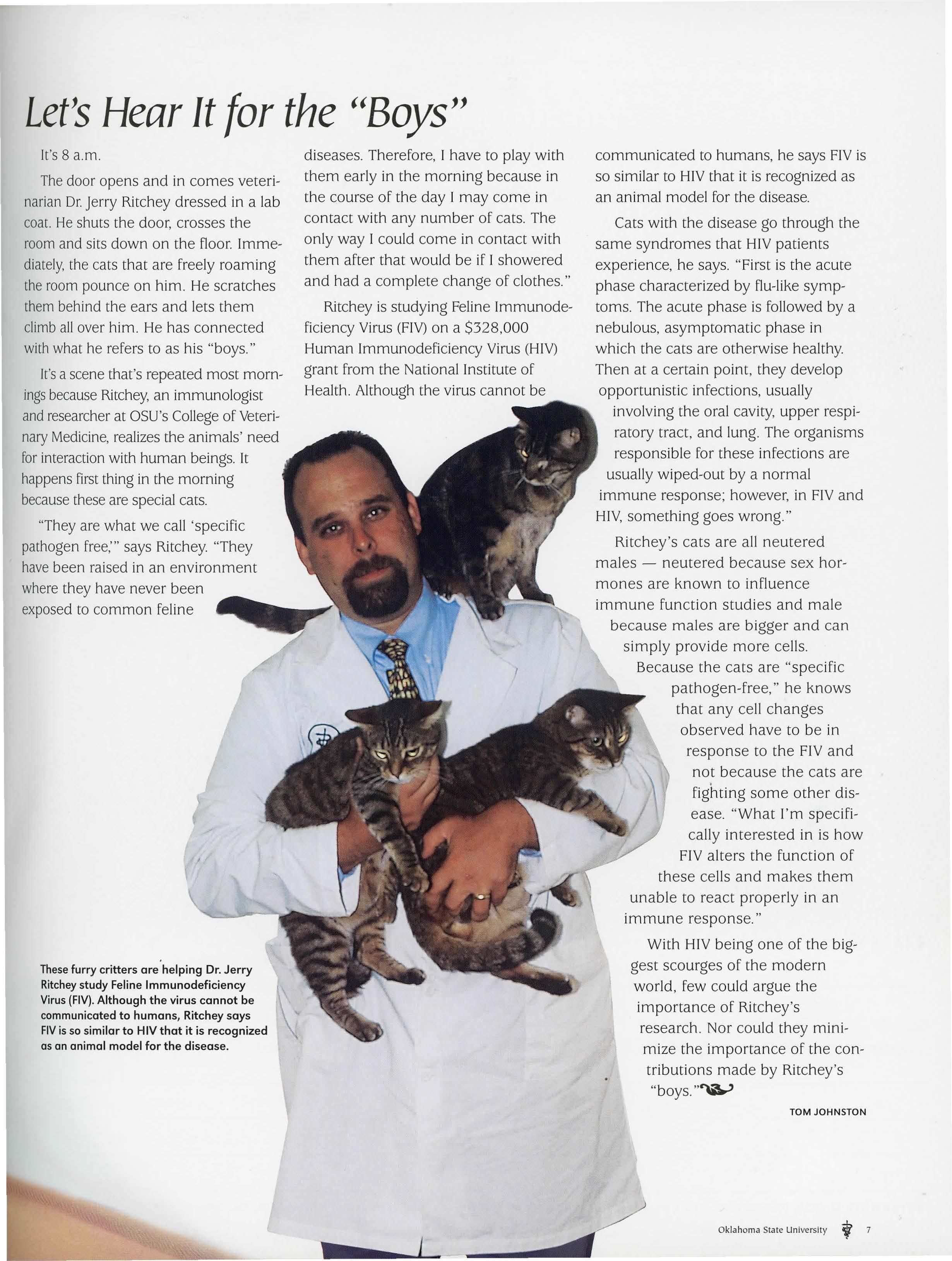
Thesefurry critters are.helping Dr. Jerry Ritcheystudy Feline Immunodeficiency Virus (FIV). Although the virus cannot be communicated to humans, Ritchey says FIV is so similar to HIV that it is recognized as an animal model for the disease.
diseases. Therefore, I have to play with them early in the morning because in the course of the day I may come in contact with any number of cats. The only way I could come in contact with them after that would be if I showered and had a complete change of clothes."
Ritchey is studying feline Immunodeficiency Virus (flV) on a $328,000 Human Immunodeficiency Virus (HIV) grant from the National Institute of Health. Although the virus cannot be
communicated to humans, he says flV is so similar to HIV that it is recognized as an animal model for the disease.
Cats with the disease go through the same syndromes that HIV patients experience, he says. "first is the acute phase characterized by flu-like symptoms. The acute phase is followed by a nebulous, asymptomatic phase in which the cats are otherwise healthy. Then at a certain point, they develop opportunistic infections, usually involving the oral cavity, upper respiratory tract, and lung. The organisms responsible for these infections are usually wiped-out by a normal immune response; however, in f!V and HIV, something goes wrong."
Ritchey's cats are all neutered males - neutered because sex hormones are known to influence immune function studies and male because males are bigger and can simply provide more cells. Because the cats are "specific pathogen-free," he knows that any cell changes observed have to be in response to the flV and not because the cats are fighting some other disease. "What I'm specifically interested in is how flV alters the function of these cells and makes them unable to react properly in an immune response."
With HIV being one of the biggest scourges of the modern world, few could argue the importance of Ritchey's research. Nor could they minimize the importance of the contributions made by Ritchey's "boys"~
TOM JOHNSTON
Class Personals
NAME
ADDRESS
I wish to share thefollowing information about what is going on in my life with my colleagues:
Cow-A-Bunga
The OSU College of Veterinary Medicine has a long tradition of excellence in the field of bovine research.
Fromthe time the college's doors opened 52 years ago, bovine research and programs have been a focal point of the CVM mission of veterinary excellence. A strong bovine program is especially important in Oklahoma, a state that ranks fourth in total cattle numbers and first in cattle per square mile.
"It's critical that the Oklahoma State University College of Veterinary Medicine be viewed as a leading institution in bovine research," says Dean Joe Alexander. "Our sophisticated research equipment and facilities combined with a creative and talented faculty benefit the cattle industry in Oklahoma ... and even beyond."
The college is proud to be a part of this econom-ically and socially important aspect of Oklahoma animal agriculture.
And that's no bull!
PetriPavesthe Way
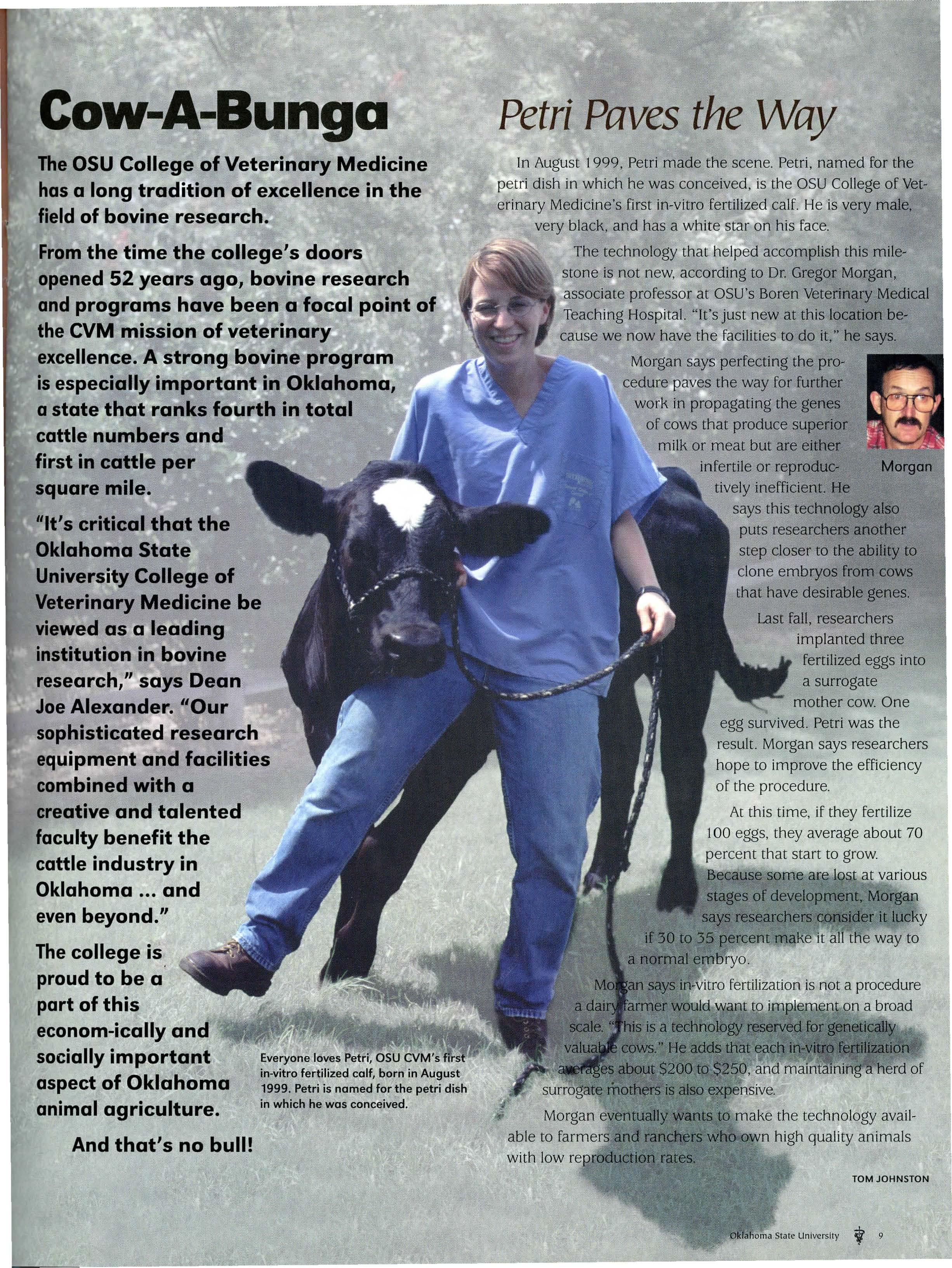
In August 1999, Petri made the scene. Petri, named for the petri dish in which he was conceived, is the OSU College of Veterinary Medicine's first in-vitro fertilized calf. He is very male, very black, and has a white star on his face.
The technology that helped accomplish this milestone is not new, according to Dr. Gregor Morgan, associate professor at OSU's Boren Veterinary Medical • Teaching Hospital. "It's just new at this location because we now have the facilities to do it," he says.
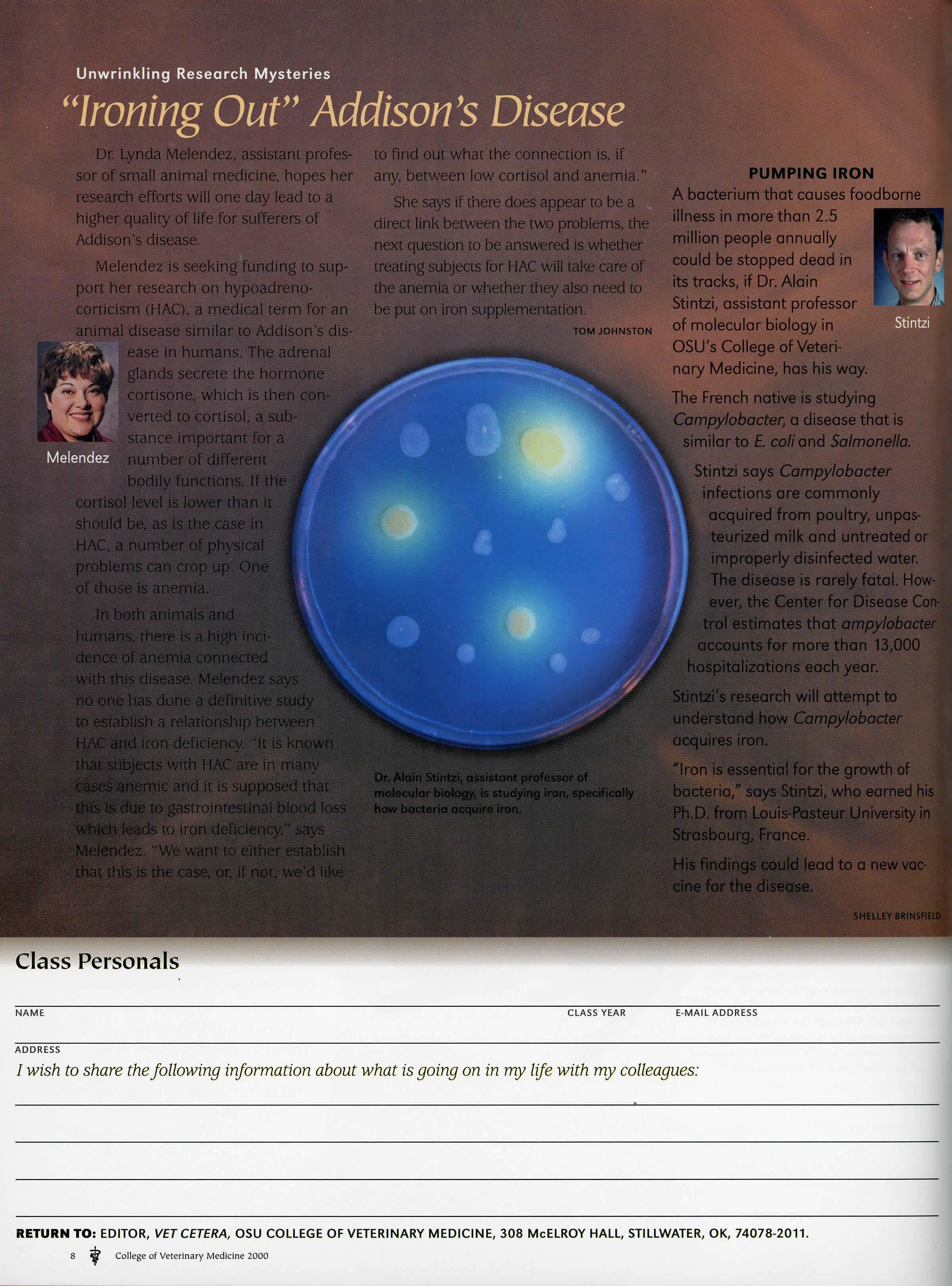
Morgan says perfecting the procedure paves the way for further work in propagating the genes of cows that produce superior milk or meat but are either infertile or reproduc- Morgan tively inefficient. He says this technology also puts researchers another step closer to the ability to clone embryos from cows that have desirable genes.
Last fall, researchers implanted three fertilized eggs into a surrogate mother cow. One egg survived. Petri was the result. Morgan says researchers hope to improve the efficiency of the procedure.
At this time, if they fertilize 100 eggs, they average about 70 percent that start to grow. Because some are lost at various stages of development, Morgan says researchers consider it lucky if 30 to 35 percent make it all the way to a normal embryo.
an says in-vitro fertilization is not a procedure armer would want to implement on a broad •s is a technology reserved for genetically cows."He adds that ~ach in-vltm fe,rtilizatid'n es about $200 to $250, and maintaining a herd of surrogate mothersis aisoexpensive.
Morgan eventuallywants to make the technology available to farmers and ranctterswho own high quality animals with low reproductionrates.
Everyone loves Petri, OSU CVM's first in-vitro fertilized coif, born in August 1999. Petri is named for the petri dish in which he was conceived.
TOM JOHNSTON
TicksUncoverCattleVaccine
Blood-sucking insects have helped researchers at OSU's College of Veterinary Medicine develop a cell culture-derived anaplasmosis vaccine that could save the nation's cattle industry $300 million a year.
Anaplasmosis is a blood parasite that invades red blood cells of cattle. The animal's immune system then begins to remove the infected red blood cells, which causes the animals to suffer acute anemia. Although the condition can be disastrous to the cattle industry, no vaccines are currently available.
Dr. Katherine Kocan, professor of veterinary pathobiology, coordiKocan nated research on the vaccine. She and Dr. Edmour Blouin, assistant researcher in anatomy, pathology and pharmacology, have worked for a number of years in concert with Ors. Ulrike Munderloh and Timothy Kurtti of the University of Minnesota to bring about the successfulgrowth of the anaplasmosis organism in a tick cell culture system.
"The tick cell cultures used for growing the organism are unlike any other cultures," says Kocan. "You have to develop a whole new protocol in working with them, and Ed Blouin has it down to an arc. I call him our tick cell culture 'artist."'
ProfessorStudying Pre-NatalFertility
Dr. Jerry Malayer, associate professor of physiological sciences in the OSU College of Veterinary Medicine, is studying the fertility of heifers even before the animals are born.
His work focuses on how estrogen and estrogen receptors aid in the development of uterine structures that begin to appear during the final months of gestation. These structures are absent in most farm animals throughout fetal development, appearing only during the first weeks or months after birth.
"Estrogens are critical for a healthy pregnancy and fetal growth," says Malayer. "In addition, the estrogen receptor appears to be important in the process of functional development of the uterus of the fetus and newborn."
"We have propagated the strain S'c_ r. that
ajf ects cattle in Okla-
i, d • h ' 1 ioma, an we are m t e
)
•. \~ /process of testing it as a \:.-:vaccine now"
Kocan's OSU predecessors devised the first effective vaccine against anaplasmosis in I 965. That vaccine, although tremendously effective, had undesirable side effects.
"We think it holds a lot of promise," Kocan says of the new process. "In a cell culture derived vaccine, we're dealing only with the anaplasmosis organism and not with cattle blood and all it might contain. It also allows us to experimentally manipulate the cell in ways that were previously impossible, and to do so at a greatly reduced cost, compared to using live cattle."
OSU recently signed a licensing agreement with Grand Laboratories of Larchwood, Iowa, for the continued development of the anaplasmosis vaccine. Grand Laboratories will pay OSU royalties from sales of the vaccine, which could eventually top $20 million.
Kocan says the market is ready to support a new, effective vaccine, considering that all anaplasmosis vaccines were taken off the market in 1998 due to the mergers of pharmaceutical companies and, consequently, that I 999 was a horrible anaplasmosis year.
In order to make one vaccine that will be effective for the entire United States, it must contain three strains. "We have propagated the strain that affects cattle in Oklahoma," she says, "and we are in the process of testing it as a vaccine now."
The research group hopes to eventually propagate the other two strains in a cell culture, Kocan says, and develop one vaccine that would protect against all anaplasmosis in the country.
TOM JOHNSTON
Malayer's research has shown that the estrogen receptor first appears in the fetal uterus near the endof the sixth month of gestation. During this time, estrogen plays an important role in the development of the uterine endometrium and uterine glands.
"By looking at the first stages of maturation of the uterus we can determine the critical phases of development and then tie those events to gene expression in adults," says Malayer.
He says the importance of the uterine Malayer architecture arises from its role in the establishment and maintenance of pregnancy in adult animals.
Ultimately, Malayer hopes his research leads to more efficient cattle production.
"We want to increase productivity and hopefully reduce expenses, resulting in increased profitability for farmers and ranchers."
SHELLEYBRINSFIELD
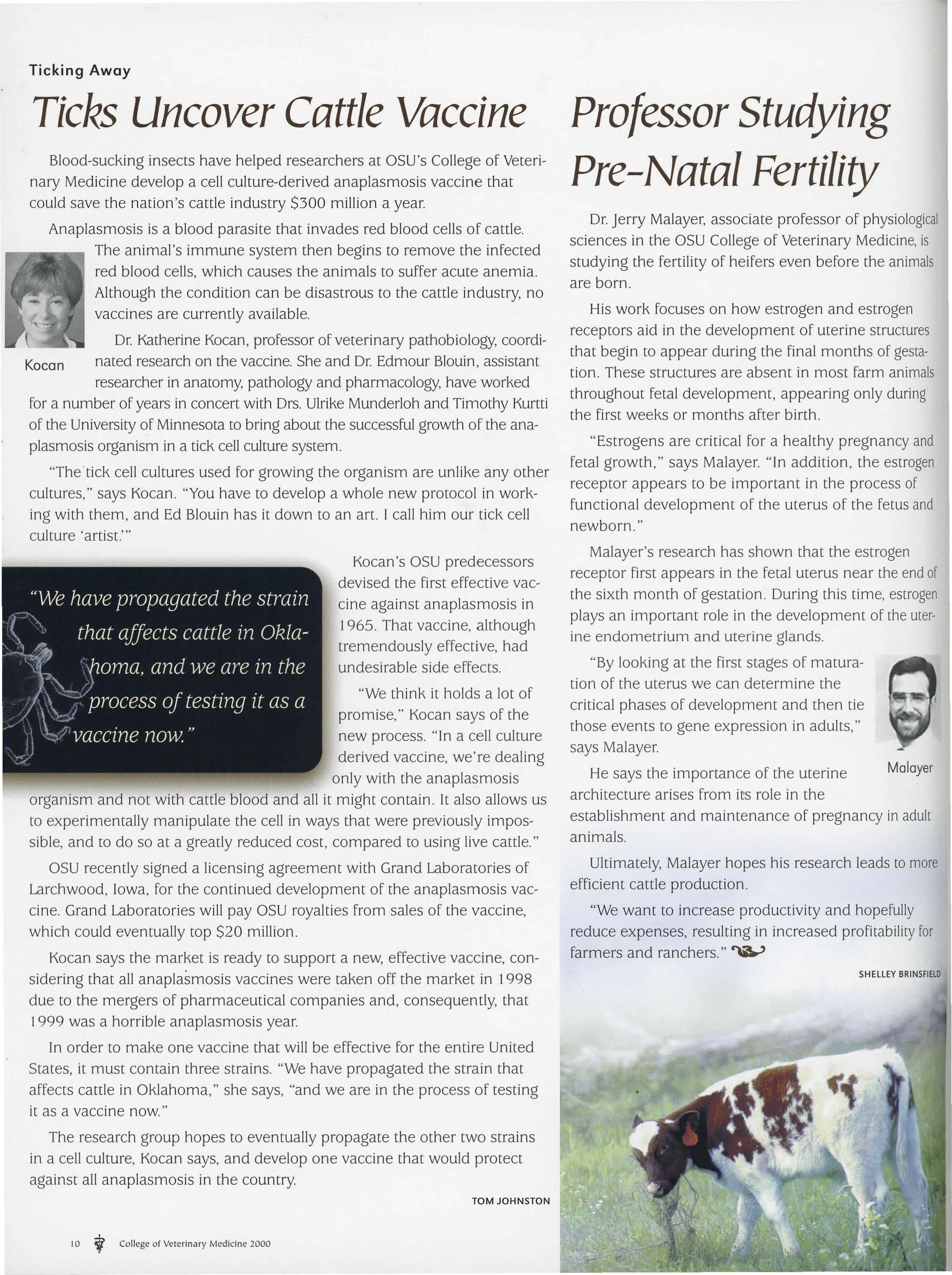
The Oklahoma State University College of Veterinary Medicine recently honored Dr. Cyril M. Brown and Dr. Ben B. Norman as its 1999 Distinguished Alumni.
Norman, a Shawnee, Okla., native, went on to earn masters degrees in veterinary pathology and preventive veterinary medicine as well as Both doctors graduated in 1960 and have been active in service both to their profession and their
alma mater.
Brown, a Cherokee, Okla., native, opened a veterinary practice in Newton, Kan., in 1961 , and today his business has grown to include the original clinic and an additional satellite clinic. Brown has been a member of the Kansas Veterinary Medical Association for the past 36 years and currently serves as treasurer. He's also served as countywide project leader for 4-H for the last 25 years, judge for numerous county fair contests and chairman of the state photo development committee. The Brown family was twice named County 4-H Family of the Year.
"TheseOklahomanatives are well-knownthroughout the UnitedStates as valued leadersin thefield of veterinarymedicine.It is becauseof their dedication and servicethat it gives us great pleasureto recognize their accomplishments. "
- Dean Joe Alexander
Former Top Doc Named to OSU Hall of Fame
Dr. Robert Whitney, a l 959 graduate of the College of Veterinary Medicine and former acting surgeon general, was recently inducted into the Oklahoma State University Alumni Association Hall of Fame. Whitney has a long and distinguished history in public service. He began his career in 1959 as a veterinary officer in the U.S. Army Veterinary Corps. In 1971 , he entered the Commissioned Corps of the U.S. Public Health Service with duty station
at the National Institutes of Health (NIH) in Bethesda, Md. He served in numerous positions at NIH, including founding director of the National Center for Research Resourcesand chief veterinary officer for the U.S. Public Health Service. In 1990, he was promoted to two-star rear admiral, the highest rank ever achieved by a veterinarian in any branch of the uniformed services.
In 1993, Whitney found himself in the interim role of acting surgeon general for three months while incoming President Bill Clinton searched for a new appointee. Whitney previously served as the deputy surgeon general of the U.S. Public Health Service under Surgeon General Antonia Novello during the Bush Administration.
his Ph.D. He currently serves in the California Governor's Office of Emergency Services, where he is instrumental in disaster preparedness work dealing with auxiliary radio commu-
Norman nications. In addition, Norman teaches courses in technical Spanish for veterinarians at the University of California - Davis, and he has served 23 years as coordinator of the livestock nursery at the California State Fair, where he directs more than 30 veterinary students in the birthing of Holstein cows, sheep, goats and sows for State Fair educational exhibits.
Whitney says while many may consider this to be a non-traditional role for a veterinarian, he does not.
"Veterinary medicine prepares students for a variety of activities by providing in-depth training in biology, problem-solving and preventative medicine," he says.
A resident of Steilacoom, Wash., Whitney currently serves as volunteer advisor to the Washington State Department of Health. He is also founder and president of Earthspan, a not-for-profit institute in Washington state that uses satellite technology to track birds and other species and to identify critical habitats and environmental conditions around the world.
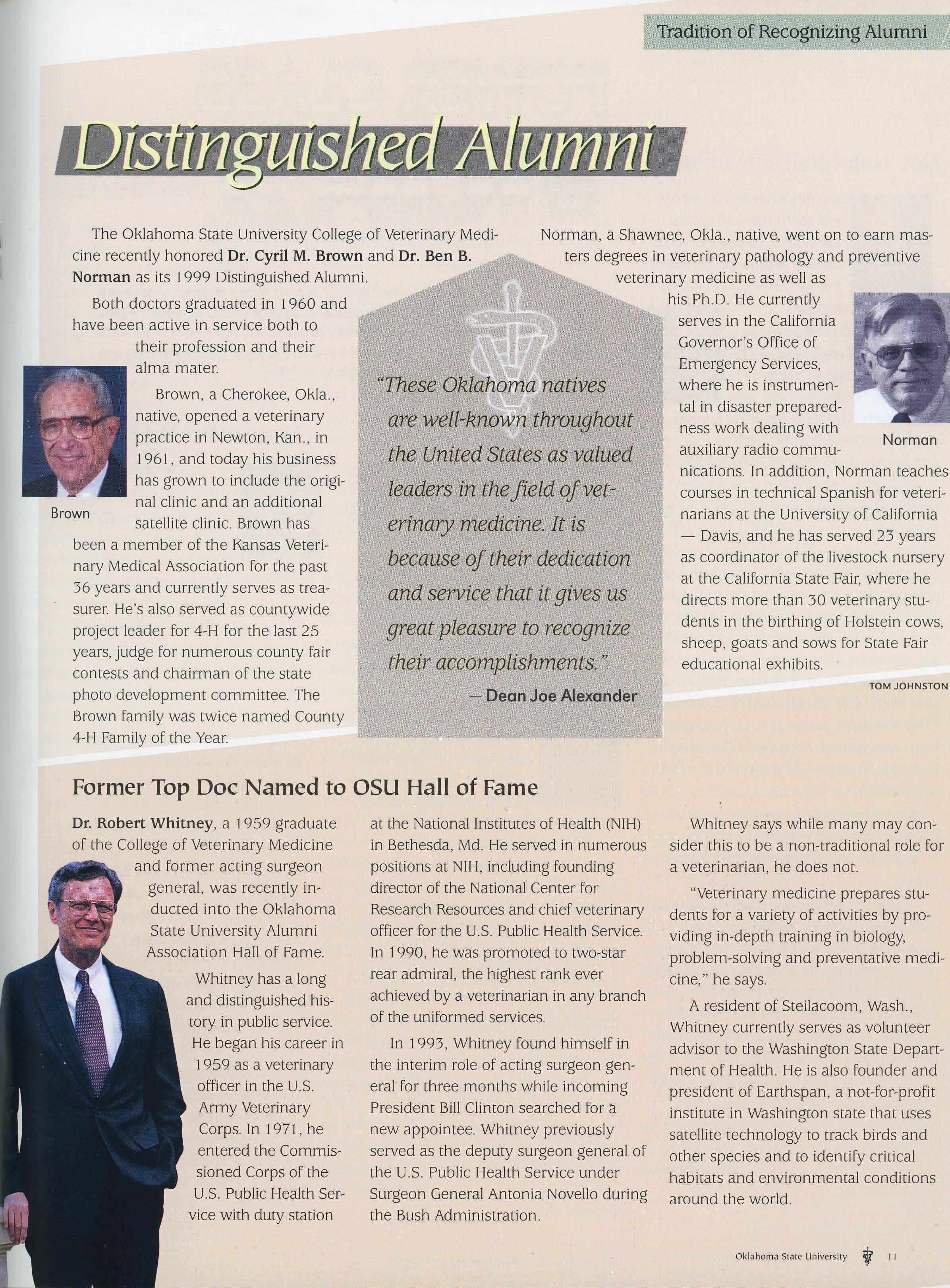
Brown
TOM JOHNSTON
Not 'Gator Bait
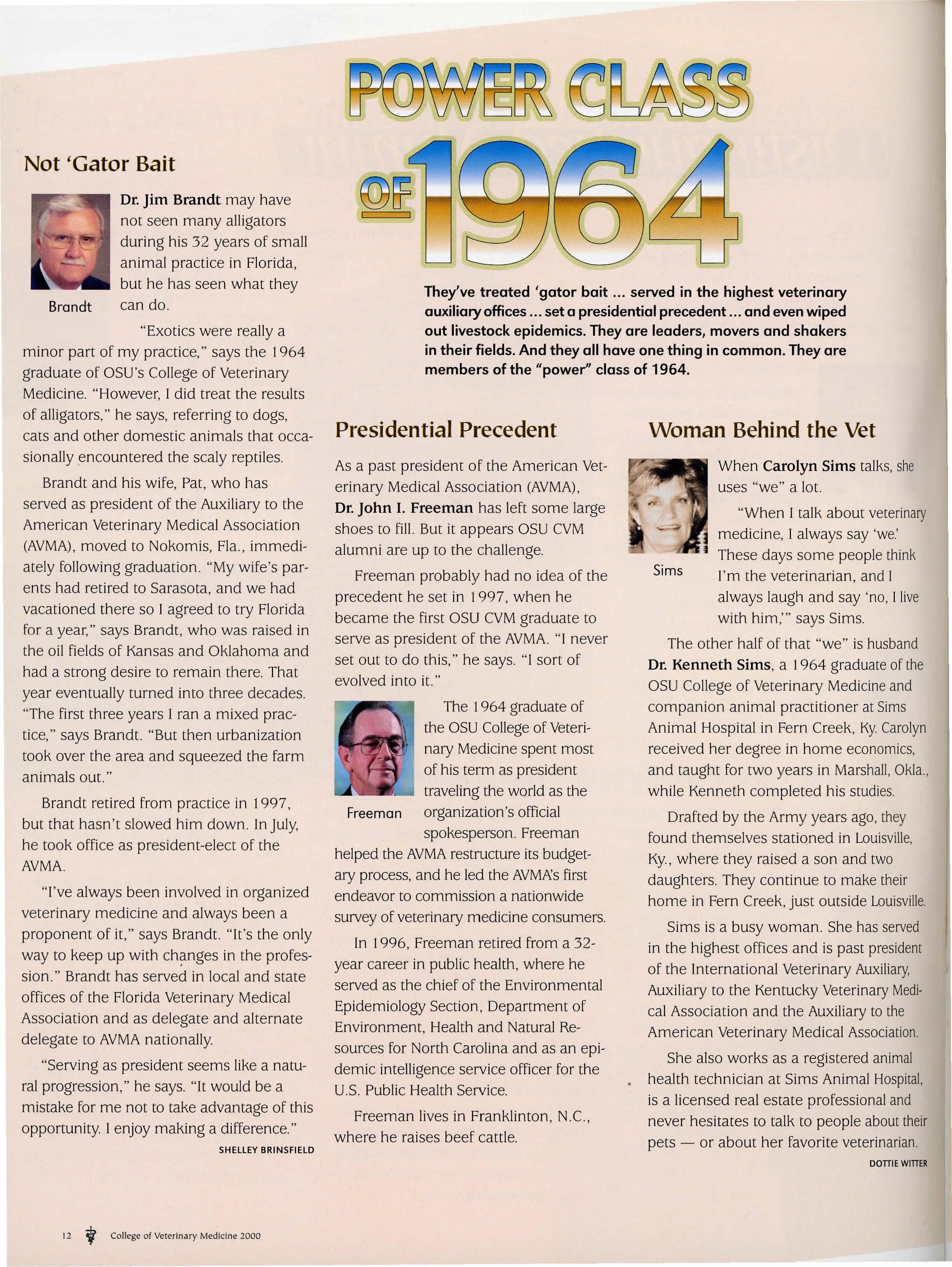
Brandt
Dr. Jim Brandt may have not seen many alligators during his 32 years of small animal practice in Florida, but he has seen what they can do.
"Exotics were really a minor part of my practice," says the 1964 graduate of OSU's College of Veterinary Medicine. "However, I did treat the results of alligators," he says, referring to dogs, cats and other domestic animals chat occasionally encountered the scaly reptiles.
Brandt and his wife, Pat, who has served as president of the Auxiliary to the American Veterinary Medical Association (AVMA), moved to Nokomis, Fla., immediately following graduation. "My wife's parents had retired to Sarasota, and we had vacationed there so I agreed to try Florida for a year," says Brandt, who was raised in the oil fields of Kansas and Oklahoma and had a strong desire to remain there. That year eventually turned into three decades. "The first three years I ran a mixed practice," says Brandt. "But then urbanization took over the area and squeezed the farm animals out."
Brandt retired from practice in 1997, but that hasn't slowed him down. In July, he took office as president-elect of the AVMA.
"I've always been involved in organized veterinary medicine and always been a proponent of it," says Brandt. "It's the only way to keep up with ch?-nges in the profession." Brandt has served in local and state offices of the Florida Veterinary Medical Association and as delegate and alternate delegate to AVMA nationally.
"Serving as president seems like a natural progression," he says. "It would be a mistake for me not to take advantage of this opportunity. I enjoy making a difference."
SHELLEY BRINSFIELD
They've treated 'gator bait served in the highest veteri~ary auxiliary offices ... set a presidential precedent ... and even wiped out livestock epidemics. They are leaders, movers and shakers in their fields. And they all have one thing in common. They are members of the "power" class of 1964.
Presidential Precedent
As a past president of the American Veterinary Medical Association (AVMA), Dr. John I. Freeman has left some large shoes to fill But it appears OSU CVM alumni are up to the challenge.
Freeman probably had no idea of the precedent he set in 1997, when he became the first OSU CVM graduate to serve as president of the AVMA. "I never set out to do this," he says. "I sort of evolved into it."
The 1964 graduate of the OSU College of Veterinary Medicine spent most of his term as president traveling the world as the Freeman organization's official spokesperson. Freeman helped the AVMA restructure its budgetary process, and he led the AVMNs first endeavor to commission a nationwide survey of veterinary medicine consumers.
In 1996, Freeman retired from a 32year career in public health, where he served as the chief of the Environmental Epidemiology Section, Department of Environment, Health and Natural Resources for North Carolina and as an epidemic intelligence service officer for the U.S. Public Health Service.
Freeman lives in Franklinton, N.C., where he raises beef cattle.
Woman Behind the Vet
When Carolyn Sims talks, she uses "we" a lot.
Sims
"When I talk about veterinary medicine, I always say 'we.' These days some people think I'm the veterinarian, and I always laugh and say 'no, I live with him,"' says Sims.
The other half of that "we" is husband Dr. Kenneth Sims, a 1964 graduate of the OSU College of Veterinary Medicine and companion animal practitioner at Sims Animal Hospital in Fern Creek, Ky. Carolyn received her degree in home economics, and taught for two years in Marshall, Okla., while Kenneth completed his studies.
Drafted by the Army years ago, they found themselves stationed in Louisville, Ky., where they raised a son and two daughters. They continue to make their home in Fern Creek, just outside Louisville.
Sims is a busy woman. She has served in the highest offices and is past president of the International Veterinary Auxiliary, Auxiliary to the Kentucky Veterinary Medical Association and the Auxiliary to the American Veterinary Medical Association.
She also works as a registered animal health technician at Sims Animal Hospital, is a licensed real estate professional and never hesitates to talk to people about their pets - or about her favorite veterinarian.
DOTTIEWITTER
Wiping Out
LivestockEpidemics
' Duringhis career as a veterinary epidemiologist,Dr. Terry Beals has witnessed the eradicationof six devastating livestock diseasesand conditions, and has also beena key participant in their control and elimination.
"It's been very satisfying to see all this andto be a part of something that's lasting,"says Beals, executive director of the TexasAnimal Health Commission.
Bealsrecently received the national Animal Health Inspection Service Award from theU.S. Department of Agriculture's Animaland Plant Health Inspection Service. Theaward is presented for a lifetime of outstandingdedication and leadership in state,national and international animal healthprograms.
"Winning this award is certainly an honor andquite humbling for someone who spent mostof his career as a field veterinarian," saysBeals,a 1964 graduate of OSU's College ofVeterinaryMedicine.
Bealsbecame interested in epidemiologywhile working as a field veterinarian forthe Department of Agriculture in the mid-to late 1960s on programs for brucellosis,tuberculosis and hog cholera in easternOklahoma.
"It was particularly interesting to me to try to identify the source of and the potential spread and exposure from herds found infected," says Beals, who·holds an advanced degree in veterinaryepidemiology from the University of California-Davis.
Following retirement in late 2000, Beals,who grew up in northwestern Oklahoma,plans to spend time in the Madill/ Tishomingo,Okla., area with his wife, Retha,where they hope to become active in a plant or tree nursery business.
JANET VARNUM
Ready to Run
If elected president of the 65,000-member American Veterinary Medical Association next year, Dr. Joe Howell won't be the first OSU alum to hold the office of president. However, he will be the first who has practiced veterinary medicine in Oklahoma.
Howell, who graduated from OSU's College of Veterinary Medicine in 1972, has worked at the Britton Road Veterinarian Clinic in Oklahoma City, Okla., throughout his entire career.
After announcing his candidacy, he plans to set off on a year-long campaign. If elected, he will serve as president from 2002-2003.
"I've been encouraged to run by several executive board members," says Howell, who has also served on the AVMA executive board.
"AVMA is going to be dealing with several economic situations including inadequate income for veterinarians," says Howell. "A national task force has determined there's a crisis Howell in terms of low incomes for practicing veterinarians. This affects students who graduate with huge debts and low income. It's also important that we work on a higher fee structure so that we can use the modern technology that is available to ensure delivery of the highest quality of veterinary medicine available to the public."
Howell believes his time spent at OSU helped prepare him for the challenges of owning and operating a small animal practice. He says it also helped prepare him for the challenges of serving as AVMA president. "I really had some excellent professors," he says. "They instilled the importance of practicing high-quality medicine and making a living doing that."
SHELLEY BRINSFIELD
An Influential Teacher
A former CVM pathology resident credits her year of residency under Dr. Roger Panciera, professor of veterinary pathology, as one of the most beneficial of her career.
"Dr. Panciera's careful, orderly approach to cases taught me to ask the right questions of owners, clinicians and myself," says Panciera Dr. Lois Roth, director of the Clinical Laboratory for the Angell Memorial Animal Hospital in Boston, Mass. "I learned the value of balancing believing in myself and questioning what I believe."
What Roth believes in is Panciera's teaching ability. "His style of teaching has helped me be a better student and teacher. His expectations of veterinary students and residents are high, and I believe this gave me the incentive to learn. I was expected to be inquisitive, to read and to question what I read."
Panciera, who graduated from OSU in 1953, was recently honored with the Charles Louis Davis Foundation's Harold W. Casey Teaching Award for 1999. This award is pres·ented annually to a veterinary pathologist who has demonstrated sustained excellence in the teaching of veterinary pathology.
Roth, who nominated Panciera for the prestigious award, says she is often surprised at the number of veterinary pathologists she meets who have spent time at Oklahoma State as veterinary students, residents or visitors. "They frequently mention the positive influence that Dr. Panciera has had on their careers."~
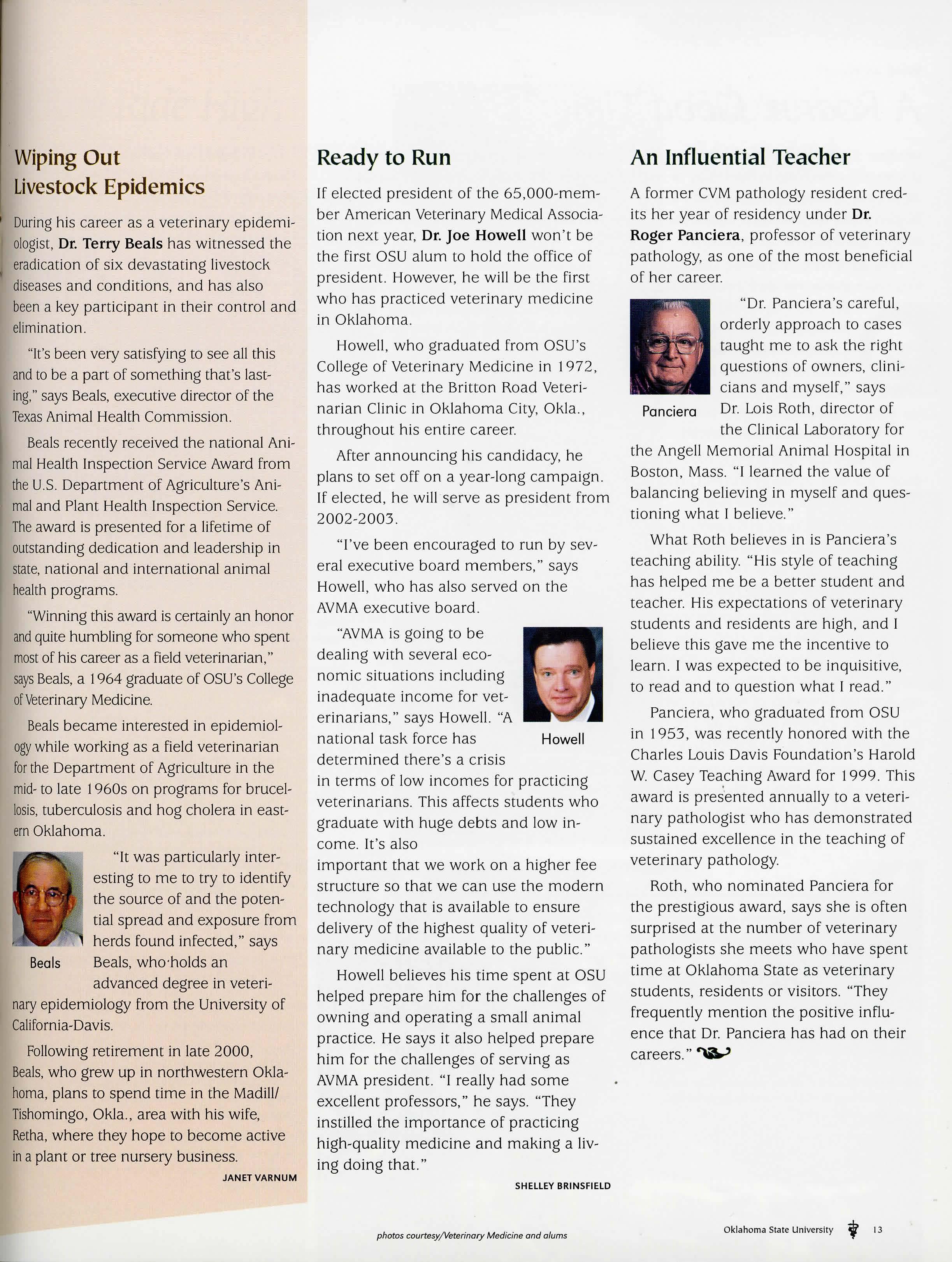
Beals
A Roarin'GoodTime
Whether struggling to enter the man's world of veterinary medicine in the 1950s, or sharing her home with rescued lions for the last 30-plus years, Dr. June Iben isn't afraid of accepting a challenge she believes in.
"I've always loved animals, although I was never allowed to have a pet as a kid," says the 73-year-old Pennsylvania native whose home is on the grounds of the Western Pennsylvania National Wild Animal Orphanage. Her neighbors Circa 1955 include lions, tigers, bobcats, hybrid wolves and servals.
"The lions live right outside my front door," she says, in highly-secured areas. "I can hear them roaring all night."
For her contributions to society and animals, lben was awarded the Public Service Award of Merit in October 1999 by the Pennsylvania Veterinary Medical Association.
Iben became OSU's first female veterinary medicine graduate in 1955, after attaining a degree in biology from Allegheny College in 1949 and a master's in bacteriology from the University of Kentucky, where her research included some of the first blood typing work done on thoroughbred horses. Her dream of becoming a veterinarian was not only forbidden by her father, but no college would accept her into its veterinary
medicine program because she was a woman. "Back then, they didn't accept women because they figured we would get married and drop out of the profession. That's why I've stayed with it all these years."
But a recommendation letter from one of her Kentucky professors caught the attention of Dean McElroy. "He gave me the chance," she says. "He was a superb person."
Iben spent 35 years in her own private practice and still works part time in a veterinarian clinic and with the exotic animal orphanage, where she cares for the big cats and produces a regular newsletter.
Iben is modest about her success. "There is no self-made person," she says. "You owe your success to all those who helped and guided you."
In the early 1960s, Iben got her first exotic feline roommate, a crippled, fourweek-old lion cub suffering from a calcium deficiency. With a proper diet and leg braces, the young cub she had christened Cathy was soon romping with Iben's pet poodle.
"I never intended to keep her," lben says, but soon the single cage became two linked cages, then three, and finally lben converted half of her own bedroom into a securely-caged indoor area, with a window giving Cathy access to a large, outdoor run. The friendly lioness lived 16 years.
courtesy/June lben
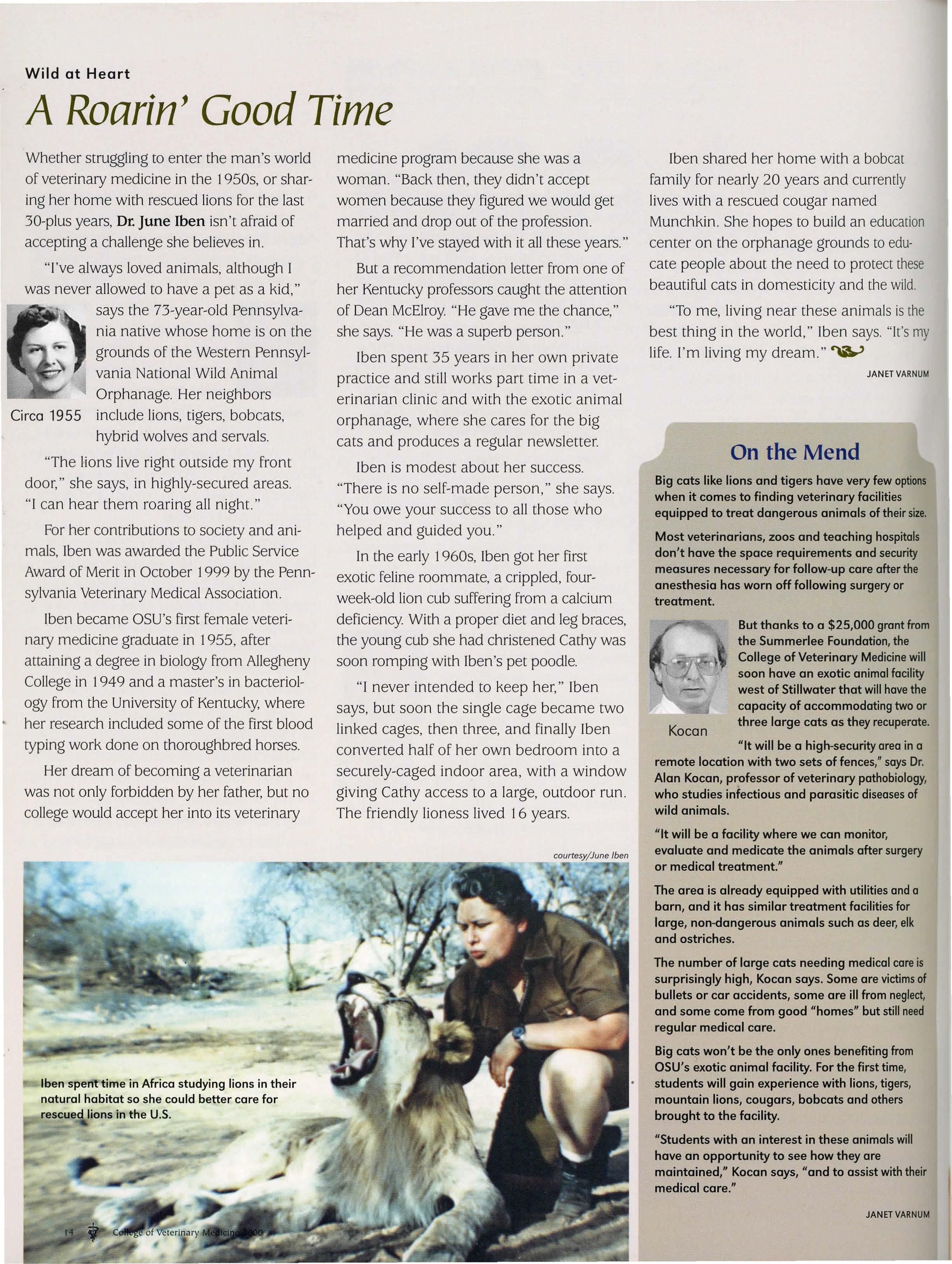
Iben shared her home with a bobcat family for nearly 20 years and currently lives with a rescued cougar named Munchk.in. She hopes to build an educa[ion center on the orphanage grounds to educate people about the need to protect these beautiful cats in domesticity and the wild.
"To me, living near these animals is the best thing in the world," lben says. "It's my life. I'm living my dream."~
On the Mend
Big cats like lions and tigers have very few options when it comes to finding veterinary facilities equipped to treat dangerous animals of their size.
Most veterinarians, zoos and teaching hospitals don't have the space requirements and security measures necessary for follow-up care after the anesthesia has worn off following surgery or treatment.
But thanks to a $25,000 grant from the Summerlee Foundation, the College of Veterinary Medicinewill soon have an exotic animal facility west of Stillwater that will havethe capacity of accommodating two or three large cats as they recuperate.
Kocon
"It will be a high-security area in a remote location with two sets of fences," says Dr. Alan Kocan, professor of veterinary pathobiology, who studies infectious and parasitic diseasesof wild animals.
"It will be a facility where we can monitor, evaluate and medicate the animals after surgery or medical treatment."
The area is already equipped with utilities and a barn, and it has similar treatment facilities for large, non-dangerous animals such as deer, elk and ostriches.
The number of large cats needing medical care is surprisingly high, Kocan says. Some are victimsof bullets or car accidents, some are ill from neglect, and some come from good "homes" but still need regular medical care.
Big cats won't be the only ones benefiting from OSU's exotic animal facility. For the first time, students will gain experience with lions, tigers, mountain lions, cougars, bobcats and others brought to the facility.
"Students with an interest in these animals will have an opportunity to see how they are maintained," Kocan says, "and to assist with their medical care."
JANET VARNUM
JANET VARNUM
TheyRideHigh
Ashleigh Fann and Charlotte Kin love horsin' around.Literally.
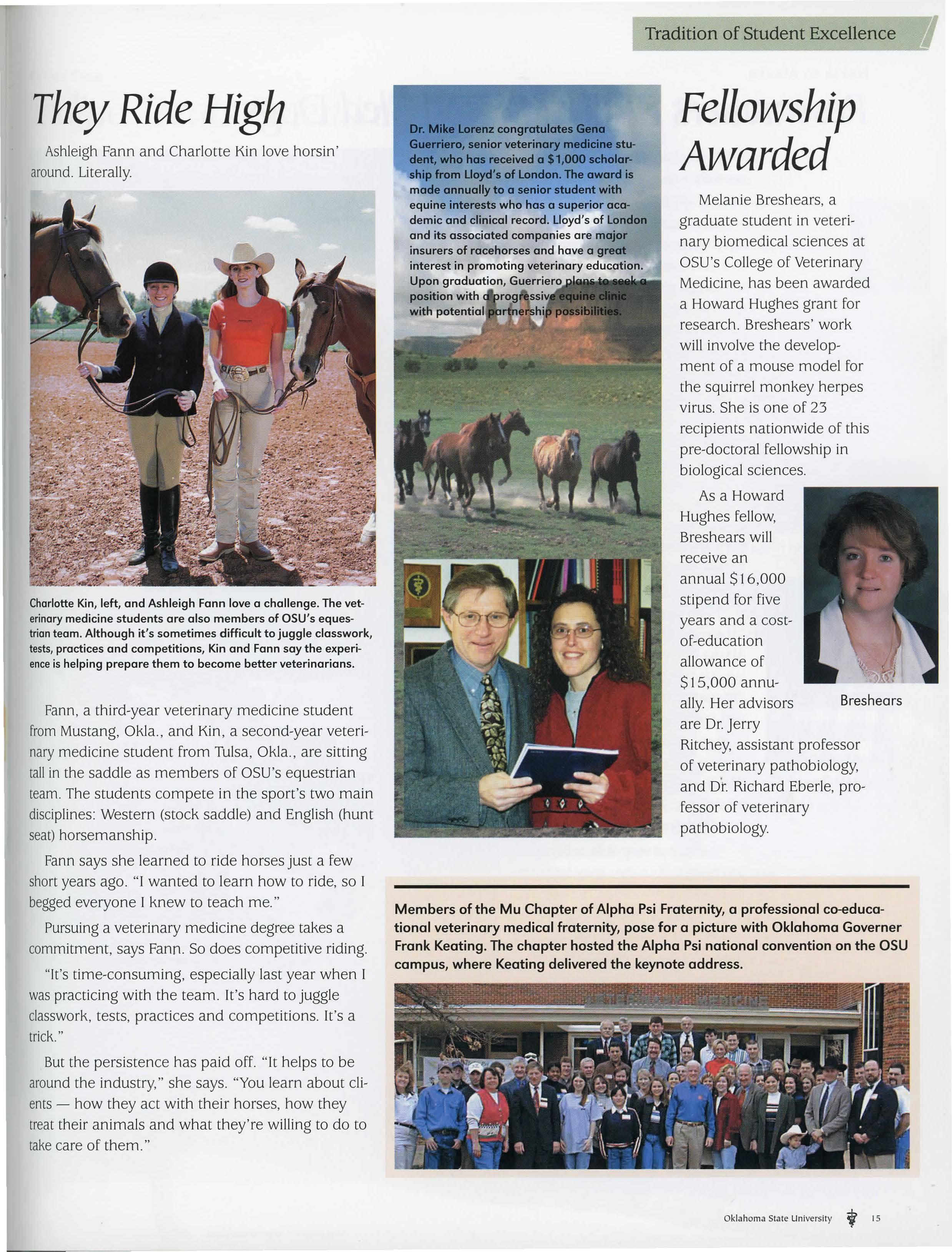
Kin, left, and Ashleigh Fann love a challenge. The veterinary medicine students are also members of OSU's equestrian team. Although it's sometimes difficult to juggle classwork, tests,practices and competitions, Kin and Fann say the experienceis helping prepare them to become better veterinarians.
Fann, a third-year veterinary medicine student from Mustang, Okla., and Kin, a second-year veterinary medicine student from Tulsa, Okla., are sitting tall in the saddle as members of OSU's equestrian team.The students compete in the sport's two main disciplines:Western (stock saddle) and English (hunt seat)horsemanship.
Fann says she learned to ride horses just a few shortyears ago. "I wanted to learn how to ride, so I beggedeveryone I knew to teach me."
Pursuinga veterinary medicine degree takes a commitment, says Fann. So does competitive riding.
"It's time-consuming, especially last year when I waspracticing with the team. It's hard to juggle classwork,tests, practices and competitions. It's a trick."
But the persistence has paid off. "It helps to be aroundthe industry," she says. "You learn about clients- how they act with their horses, how they treattheir animals and what they're willing to do to takecare of them."
renz congratulates Gena Guerriero, senior veterinary medicine student, who has received a $1,000 scholarship from Lloyd's of London. The award is made annually to a senior student with equine interests who has a superior academic and clinical record. Lloyd's of London and its associated companies ore major insurers of racehorses and have a great interest in promoting veterinary education. Upon graduation, Guerriero position with rog ssi1.1 with potential e h'
Fellowship Awarded
Melanie Breshears, a graduate student in veterinary biomedical sciences at OSU's College of Veterinary Medicine, has been awarded a Howard Hughes grant for research. Breshears' work will involve the development of a mouse model for the squirrel monkey herpes virus. She is one of 23 recipients nationwide of this pre-doctoral fellowship in biological sciences.
As a Howard Hughes fellow, Breshears will receive an annual $16,000 stipend for five years and a costof-education allowance of $15,000 annually. Her advisors are Dr. Jerry Breshears Ritchey, assistant professor of veterinary pathobiology, and o·r.Richard Eberle, professor of veterinary pathobiology.
Members of the Mu Chapter of Alpha Psi Fraternity, a professional co-educational veterinary medical fraternity, pose for a picture with Oklahoma Governer Frank Keating. The chapter hosted the Alpha Psi national convention on the OSU campus, where Keating delivered the keynote address.
Charlette
North to Alaska
ResearchersStudyIditarodSledDogs
Dr. Michael Davis traveled north to Alaska recently to study the lungs and stomachs of dogs participating in the 1, 100-mile lditarod sled race.
Davis, assistant professor in the College of Veterinary Medicine, has long been interested in competitive exercise and the effects of hyperventilation on the lungs, particularly in the presence of cold air. He also has been developing a canine model of asthma for the last several years in order to learn more about the disease.
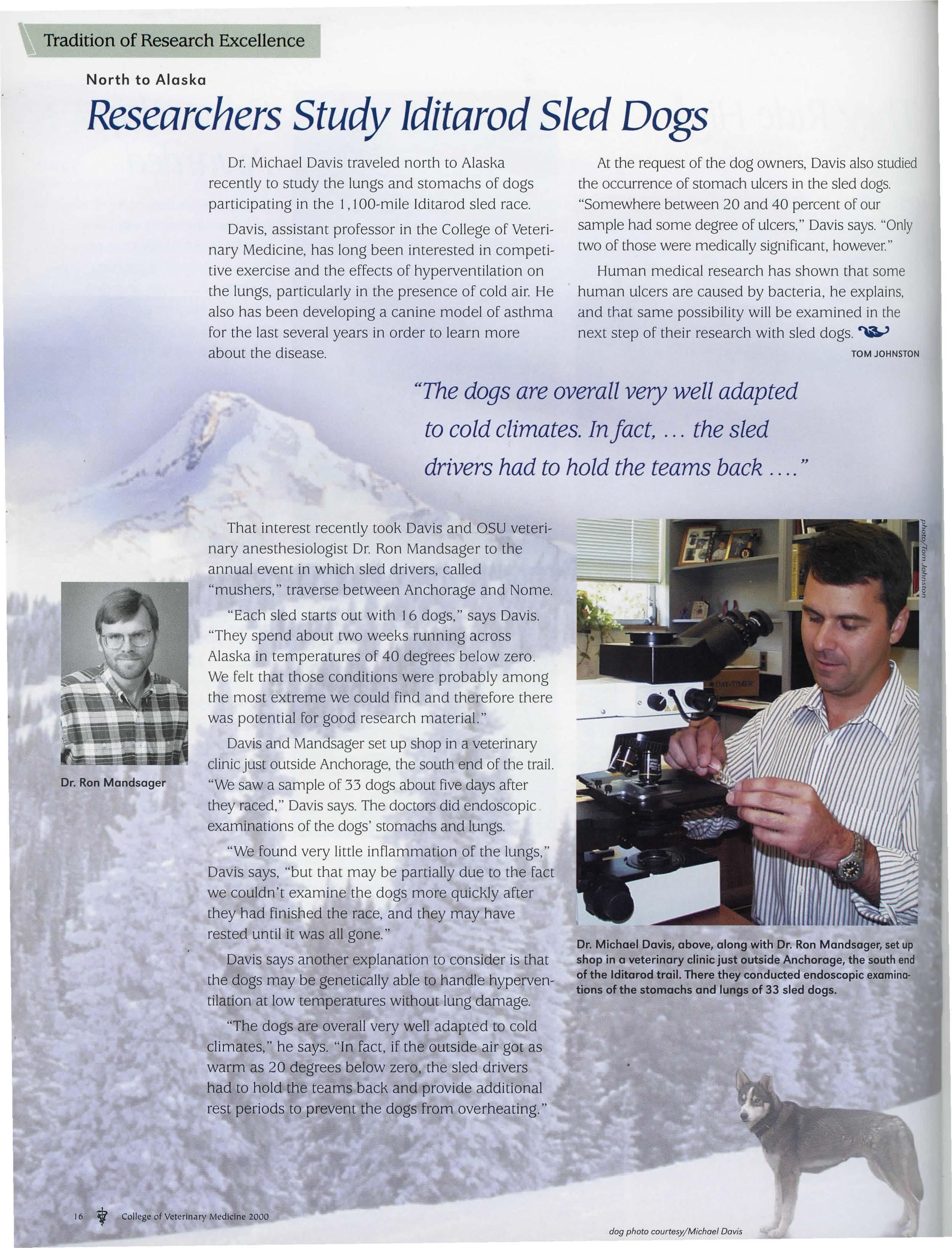
Dr. Ron Mandsager
At the request of the dog owners, Davis also studied the occurrence of stomach ulcers in the sled dogs. "Somewhere between 20 and 40 percent of our sample had some degree of ulcers," Davis says."Only two of those were medically significant, however."
Human medical research has shown that some human ulcers are caused by bacteria, he explains, and that same possibility will be examined in the next step of their research with sled dogs.
"The dogs are overall very well adapted to cold climates. In fact, ... the sled drivers had to hold the teams back .... ,,
That interest recently took Davis and OSU veterinary anesthesiologist Dr. Ron Mandsager to the annual event in which sled drivers, called "mushers," traverse between Anchorage and Nome.
"Each sled starts out with 16 dogs," says Davis. "They spend about two weeks running across Alaska in temperatures of 40 degrees below zero. We felt that those conditions were probably among the most extreme we could find and therefore there was potential for good research material."
Davis and Mandsager set up shop in a veterinary clinic just outside Anchorage, the south end of the trail. "We saw a sample of 33 dogs about five days after they raced," Davis says.The doctors did endoscopic. examinations of the dogs' stomachs and lungs.
"We found very little inflammation of the lungs," Davis says, "but that may be partially due to the fact we couldn't examine the dogs more quickly after they had finished the race, and they may have rested until it was all gone."
Davis says another explanation to consider is that the dogs may be genetically able to handle hyperventilation at low temperatures without lung damage.
"The dogs are overall very well adapted to cold climates," he says. "In fact, if the outside air got as warm as 20 degrees below zero, the sled drivers had to hold the teams back and provide additional rest periods to prevent the dogs from overheating."
TOM JOHNSTON
Dr. Michael Davis, above, along with Dr. Ron Mandsager, set up shop in a veterinary clinic just outside Anchorage, the south end of the lditarod trail. There they conducted endoscopic examinations of the stomachs and lungs of 33 sled dogs.
IodineTreatsPotentiallyFatalThyroidProblem
Hyperthyroidism in cats has risen markedly since 1985, affecting primarily older cats.
Until now, Oklahomans seeking radioactive iodine treatment for their sick pets had to travel to Kansas State University or to private practices in Kansas City or Dallas.
But OSU's new radioiodine treatment facility gives Oklahoma pet owners a more convenient Lorenz option, and also provides state-of-the-arttraining for OSU veterinary students, says Dr. Tod Drost, assistant professor of radiology. The treatment consists of administering an injection of radioactive iodine 131 to a cat. The cat is then put in isolation until its radioactivity diminishes to prescribed levels.
The amount of isolation time varies among animals, Drost says,but averagesabout a week to 10 days. During that time, the radioactive iodine concentrates in the hyperactive portion of the thyroid and destroys it. The iodine does not harm normal thyroid tissue.
Dr. Mike Lorenz, associate dean for academic affairs, says prior to the early 1980s the disease was rare. He attributes the increase to the fact that cats are just living longer.
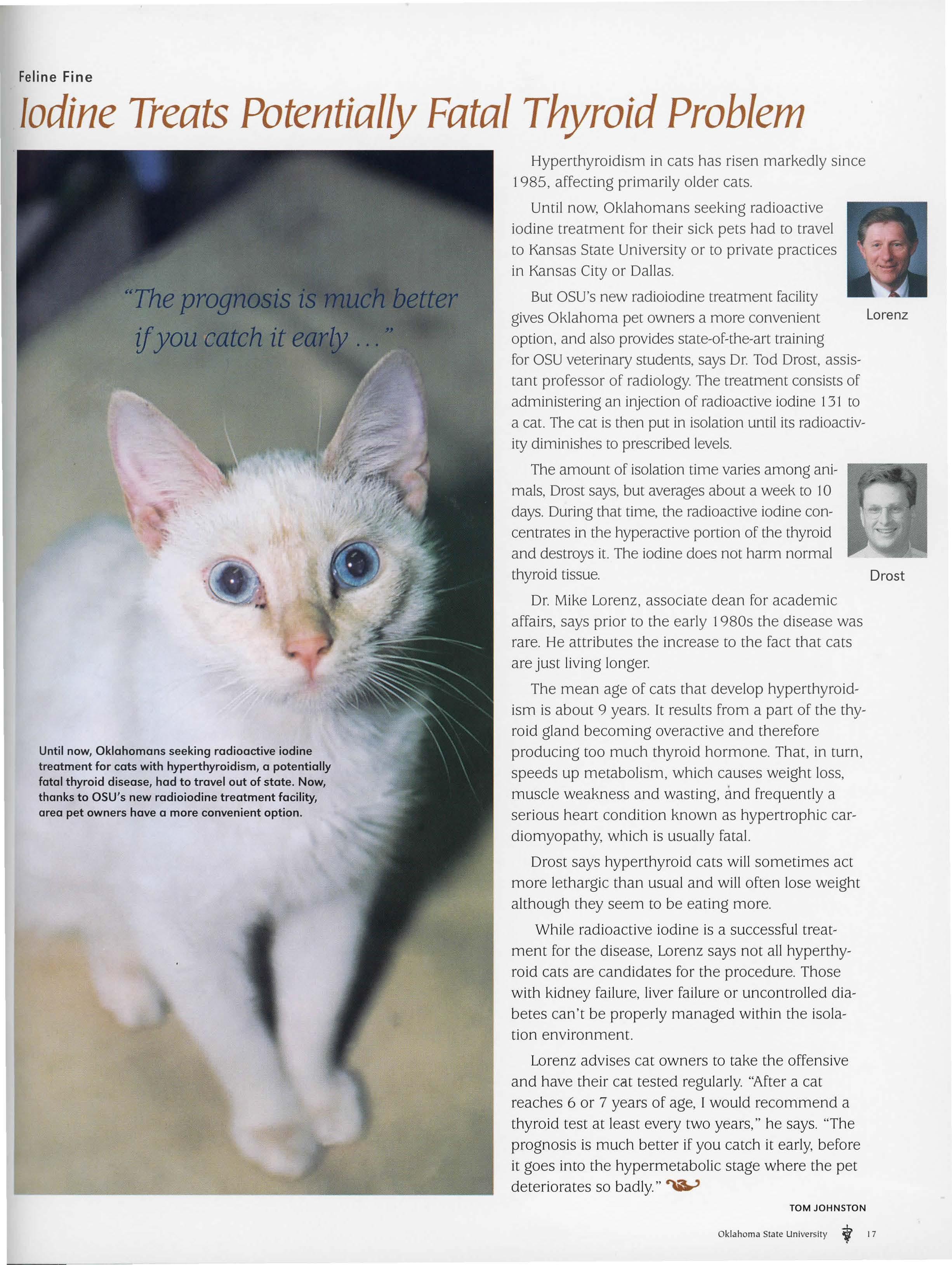
Until now, Oklahomans seeking radioactive iodine treatment for cats with hyperthyroidism, a potentially fatal thyroid disease, had to travel out of state. Now, thanks to OSU's new radioiodine treatment facility, area pet owners have a more convenient option.
The mean age of cats that develop hyperthyroidism is about 9 years. It results from a part of the thyroid gland becoming overactive and therefore producing too much thyroid hormone. That, in turn, speeds up metabolism, which causes weight loss, muscle weakness and wasting, and frequently a serious heart condition known as hypertrophic cardiomyopathy, which is usually fatal.
Drost says hyperthyroid cats will sometimes act more lethargic than usual and will often lose weight although they seem to be eating more.
While radioactive iodine is a successful treatment for the disease, Lorenz says not all hyperthyroid cats are candidates for the procedure. Those with kidney failure, liver failure or uncontrolled diabetes can't be properly managed within the isolation environment.
Lorenz advises cat owners to take the offensive and have their cat tested regularly. "After a cat reaches 6 or 7 years of age, 1would recommend a thyroid test at least every two years," he says. "The prognosis is much better if you catch it early, before it goes into the hypermetabolic stage where the pet deteriorates so badly."
Drost
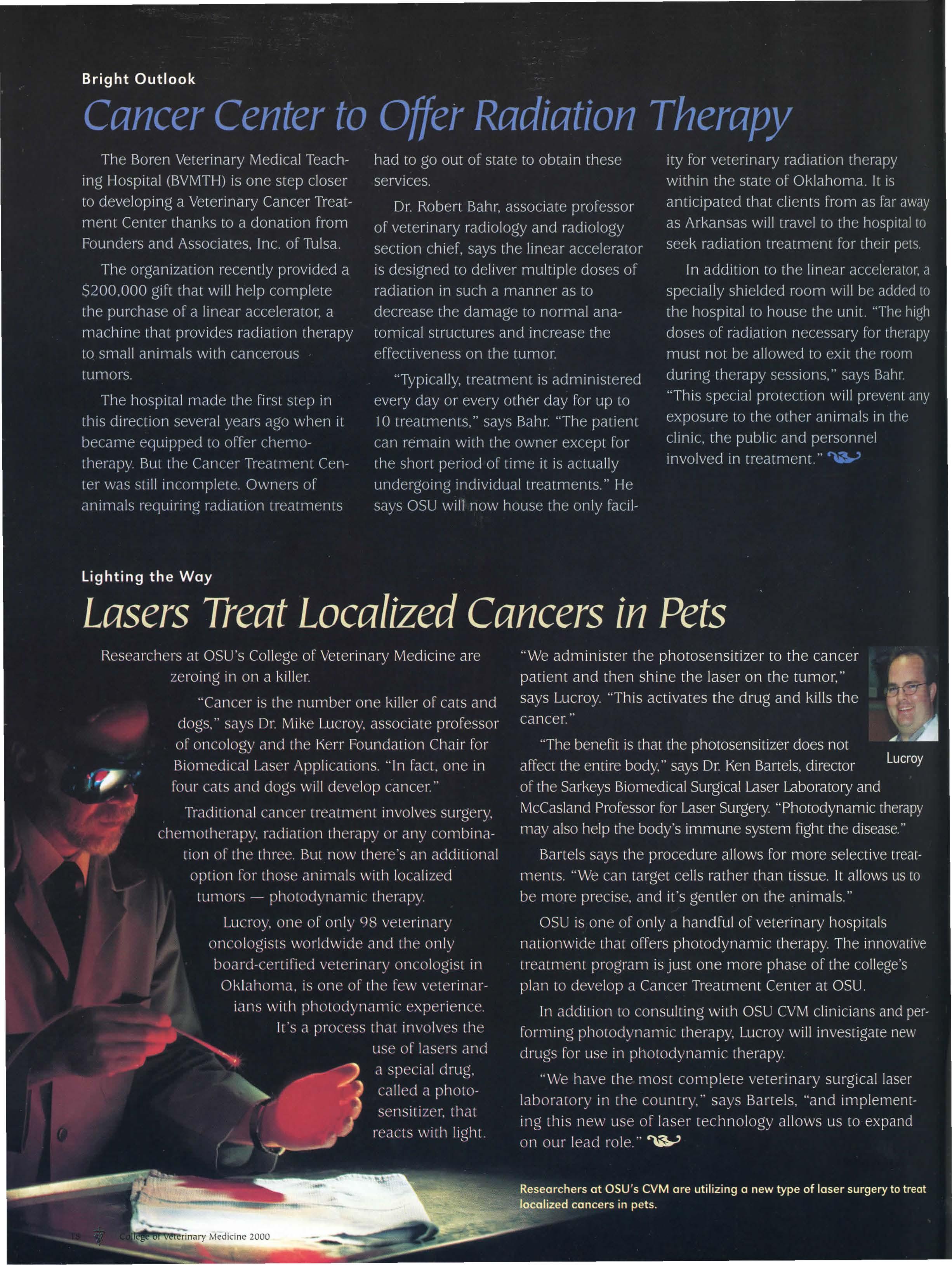
ThePriceWas Right
"Toleavethe world a bit better, whether by a healthy child, a gardenpatch or a redeemedsocial condition; Toknow evenone life has breathedeasierbecauseyou lived. That is to havesucceeded. "
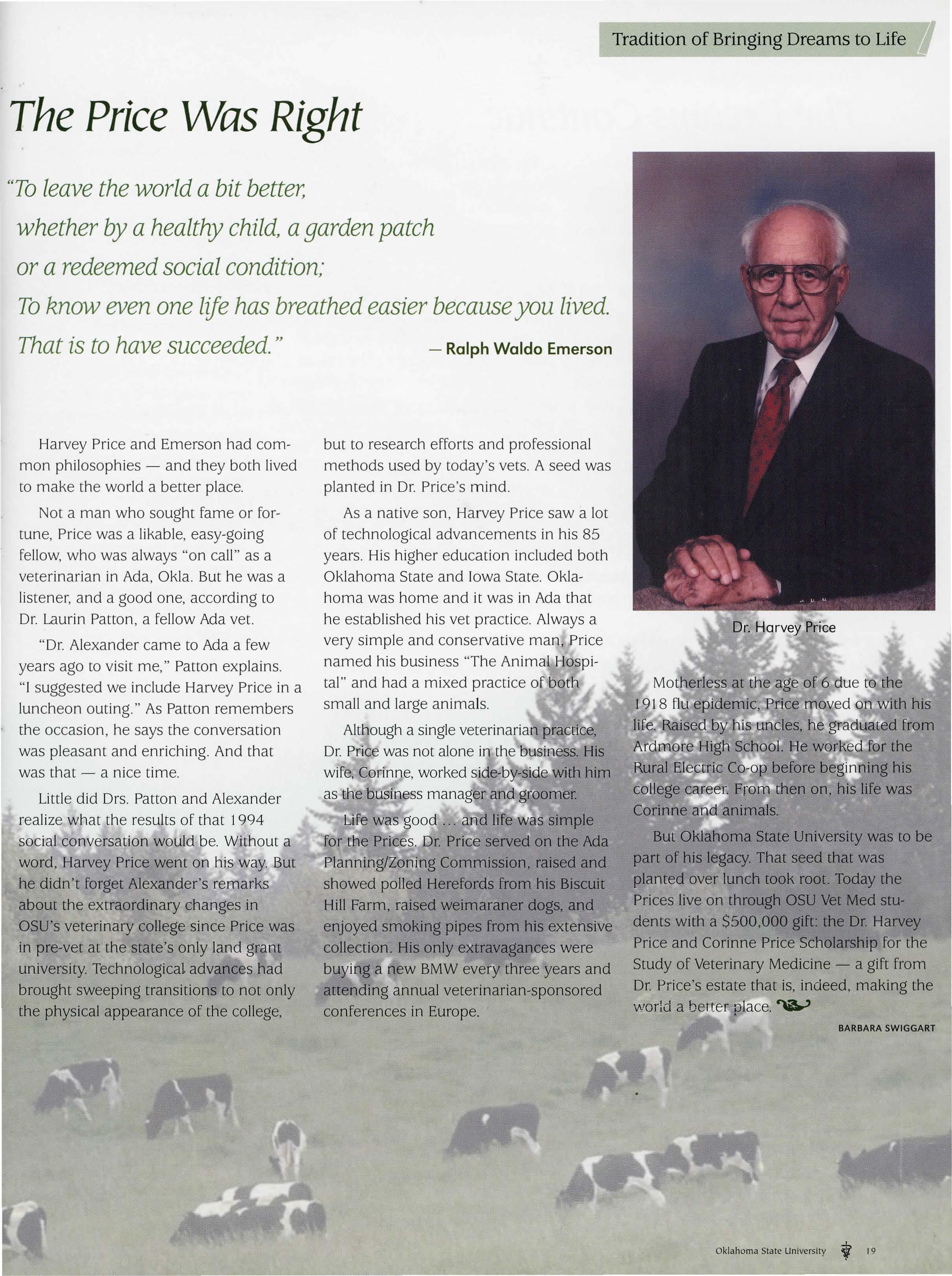
Harvey Price and Emerson had common philosophies - and they both lived to make the world a better place.
Not a man who sought fame or fortune, Price was a likable, easy-going fellow, who was always "on call" as a veterinarian in Ada, Okla. But he was a listener, and a good one, according to Dr. Laurin Patton, a fellow Ada vet.
"Dr. Alexander came to Ada a few years ago to visit me," Patton explains. "I suggested we include Harvey Price in a luncheon outing." As Patton remembers the occasion, he says the conversation was pleasant and enriching. And that was that - a nice time.
Little did Ors. Patton and Alexander realize what the results of that 1994 social conversation would be. Without a word, Harvey Price went on his way. But he didn't forget Alexander's remarks about the extraordinary changes in OSU's veterinary college since Price was in pre-vet at the state's only land grant university. TechnologicaL advances had brought sweeping transitions to not only the physical appearance of the college,
- Ralph Waldo Emerson
but to research efforts and professional methods used by today's vets. A seed was planted in Dr. Price's mind.
As a native son, Harvey Price saw a lot of technological advancements in his 85 years. His higher education included both Oklahoma State and Iowa State. Oklahoma was home and it was in Ada that he established his vet practice. Always a very simple and conservative man, Price named his business "The Animal Hospital" and had a mixed practice of both small and large animals.
Although a single veterinarian practice, Dr. Price was not alone in the business. His wife, Corinne, worked side-by-side with him as the business manager and groomer.
Life was good ... and life was simple for the Prices. Dr. Priceservedon the Ada Planning/Zoning Commission,raisedand showed polledHerefordsfrom his Biscuit Hill Farm, raisedweimaranerdogs,and enjoyedsmokingpipesfrom his extensive collection.His only extravaganceswere buyinga new BMW every three years and attendingannual veterinarian-sponsored conferences in Europe.
Motherless at the age of 6 due to the 191 8 flu epidemic, Price moved on with his life. Raised by his uncles, he graduated from Ardmore High School. He worked for the Rural Electric Co-op before beginning his college career. From then on, his life was Corinne and animals.
But Oklahoma State University was to be part of his legacy. That seed that was planted over lunch took root. Today the Prices live on through OSU Vet Med students with a $500,000 gift: the Dr. Harvey Price and Corinne Price Scholarship for the Study of Veterinary Medicine - a gift from Dr. Price's estate that is, indeed, making the world a better place ._,_,,,
The DreamsContinue Morton Receives Award
Bringing dreams to life is a continuous process at OSU's College of Veterinary Medicine. But reflecting back on the generosity of the donors to OSU's first comprehensive fund-raising effort, the "Bringing Dreams to Life" Campaign is a rewarding experience.
Faced with a goal in 1995 of $4.5 million, Vet Med finished the campaign June 30, 2000, with over $26 million. This figure reflects many donors including names like Sitlington, Noble, Presbyterian, Sarkeys, Mccasland and Kerr.
Enhancing the college's permanent e·ndowment was a major focus of Vet Med's campaign. Today there is over $3.5 million in scholarship monies for the College. In April 2000, 86 named scholarships were presented to 126 students in
the DVM and veterinary medicine graduate programs. The endowed chair program has grown to over S11 million.
In addition to scholarships and endowed chairs, the College has enjoyed expansion of its physical plant to accommodate additional research, teaching and service activities.
Today the OSU College of Veterinary Medicine has stepped forward as an institution with cutting-edge capabilities. Because of the tremendous success of the "Bringing Dreams to Life" campaign, the research program is enhanced with people, equipment and facilities. There is increased diagnostic/therapeutic equipment for the Veterinary Teaching Hospital. And the so very important ingredient to any teaching institution ... quality faculty, which is a direct result of the endowed chairs program.
Dr. Rebecca Morton is the newest recipient of the Regents Distinguished Teaching Award for the College of Veterinary Medicine.
Morton, associate professor of parasitology, microbiology and public health, says one of her goals is to make life-lo g learners of her students. Morton
"One way to do that is to make them understand that no matter how old you are or at what level of your profession, one still reads, keeps up as best they can in their field, and looks up answers to questions," she says.
Recipients are nominated by a committee of students, faculty, department heads and administration. OSU President James Halligan presented Morton with the award in August.
The Horse,The Hound,and OSU
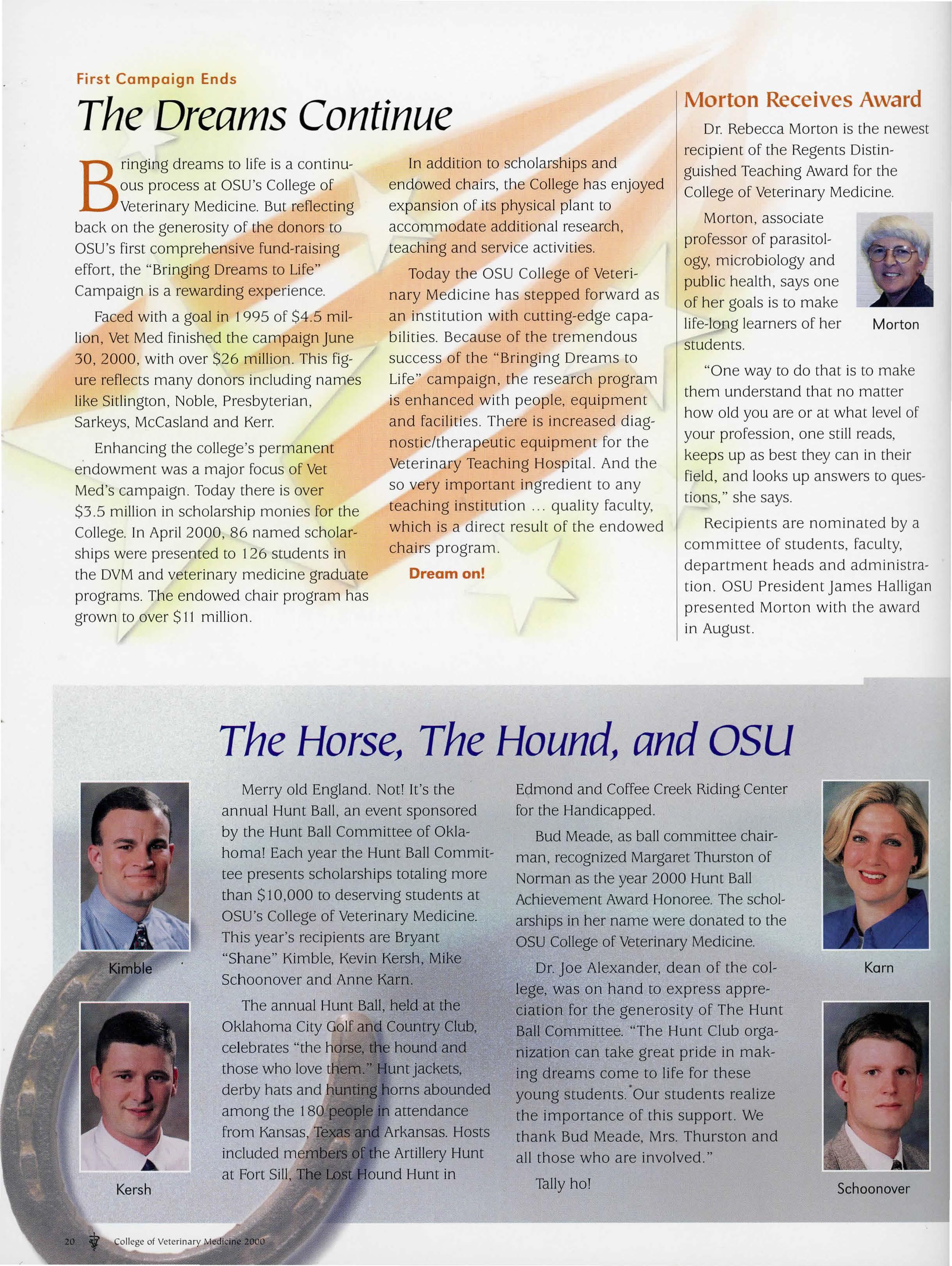
Merry old England Not! It's the annual Hunt Ball, an event sponsored by the Hunt Ball Committee of Oklahoma! Each year the Hunt Ball Committee presents scholarships totaling more than S10,000 to deserving students at OSU's College of Veterinary Medicine. This year's recipients are Bryant "Shane" Kimble, Kevin Kersh, Mike Schoonover and Anne Karn.
The annual Hunt Ball, held at the Oklahoma City G Country Club, celebrates "th hound and those who love t derby hats and among the 180 from Kansas, 11
unt jackets, oms abounded attendance Arkansas. Hosts e Artillery Hunt
Edmond and Coffee Creek Riding. Center for the Handicapped.
Bud Meade, as ball committee chairman, recognized Margaret Thurston of Norman as the year 2000 Hunt Ball Achievement Award Honoree. The scholarships in her name were donated to the OSU College of Veterinary Medicine.
Dr. Joe Alexander, dean of the college, was on hand to express appreciation for the generosity of The Hunt Ball Committee. "The Hunt Club organization can take great pride in making dreams come to life for these young students.· our students realize the importance of this support. We thank Bud Meade, Mrs. Thurston and all those who are involved."
Tally ho!
Dream on!
Karn
Schoonover
Who is Wendel Wallace?
What did he do to have the OSU Bovine Research Park named in his honor?
Recently the Noble Family made a gift to Oklahoma State University- and they made it in Wallace's name, a tribute to his service and dedication. The $1.5 million gift is the Wendel Wallace Bovine Research Park, located on eight acres just west of the OSU campus.
JrJf-1 r10rc,JJVJr\J\fr;1Jlc1 ':;
According to Dr. Joe Alexander, dean of the College of Veterinary Medicine, this new facility, dedicated on Nov. 1, 1999, will allow the college to move forward in its commitment to the field of bovine research. Funded by a number of private donations, inclu~ing the Noble gift, the facility will support the college's extensive research in anaplasmosis, shipping fever and other diseases of economic importance to Oklahoma cattle producers. "Shipping fever is the major cause of clinical disease and death loss in stocker and feedlot cattle," explains Alexander. "Because the disease results in economic losses to Oklahoma producers greater than $100 million, it is imperative that we find ways to reduce this loss."
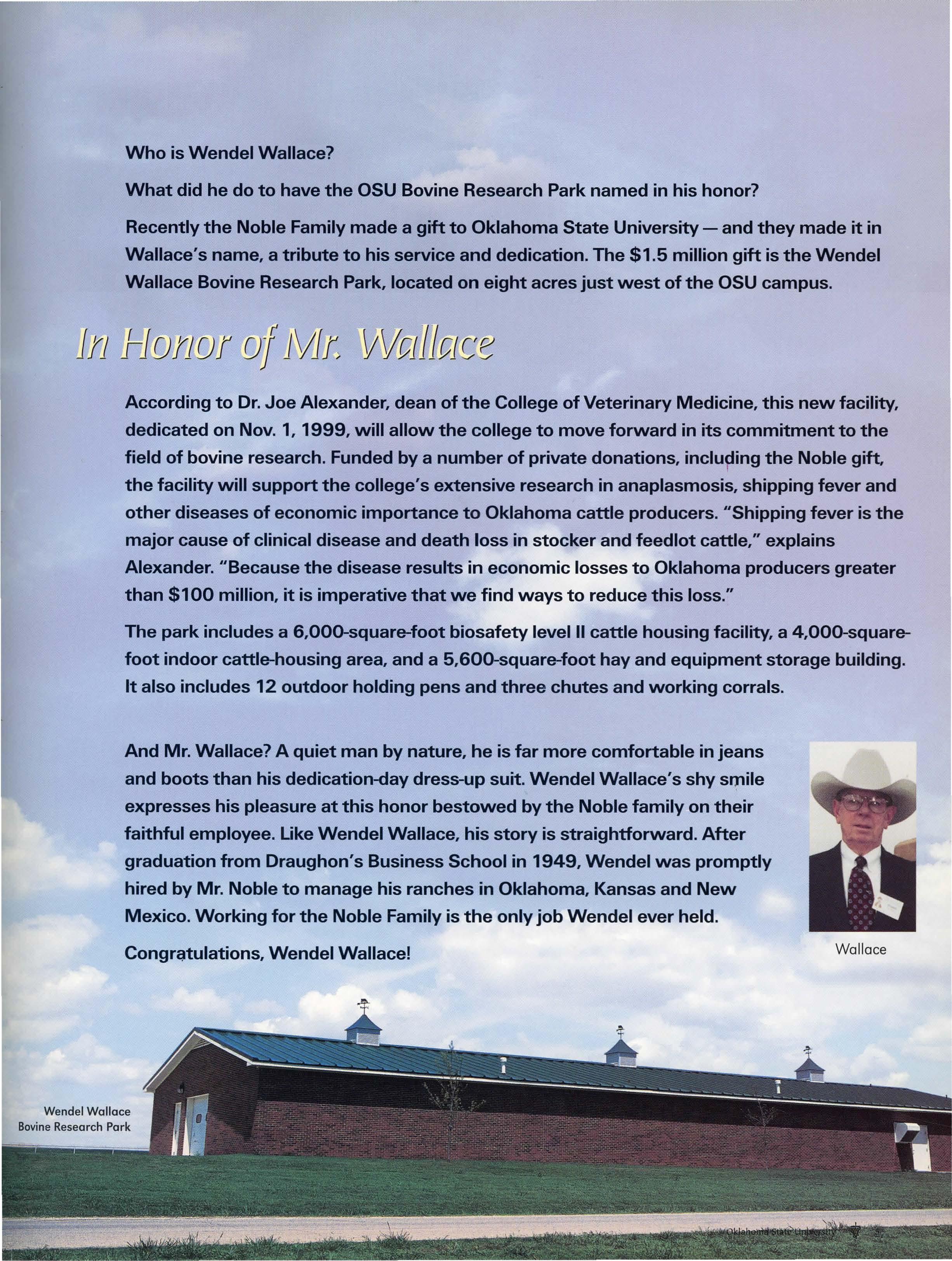
The park includes a 6,000-square-foot biosafety level II cattle housing facility, a 4,000-squarefoot indoor cattle-housing area, and a 5,600-square-foot hay and equipment storage building. It also includes 12 outdoor holding pens and three chutes and working corrals.
And Mr. Wallace? A quiet man by nature, he is far more comfortable in jeans and boots than his dedication-day dress-up suit. Wendel Wallace's shy smile expresses his pleasure at this honor bestowed by the Noble family on their faithful employee. Like Wendel Wallace, his story is straightforward. After graduation from Draughon's Business School in 1949, Wendel was promptly hired by Mr. Noble to manage his ranches in Oklahoma, Kansas and New Mexico. Working for the Noble Family is the only job Wendel ever held.
CongnJtulations, Wendel Wallace!
Wendel Wallace Bovine Research Park
Wallace
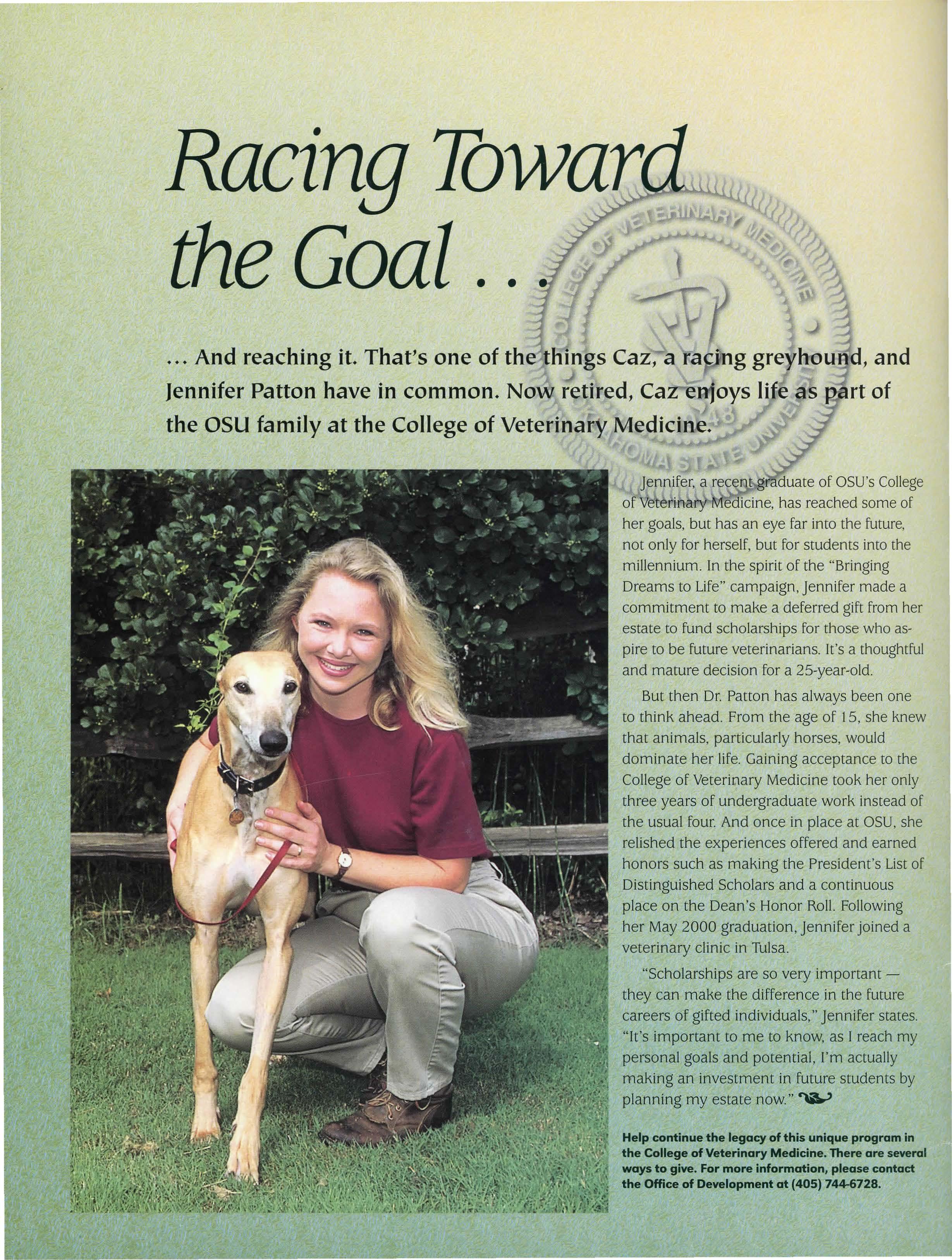
RacingIowan_~ theGoal..
. . . And reaching it. That's one of the things Caz, a ra ·ng greyhou d, and Jennifer Patton have in common. Now retired, Caz-enjoys lif~ as Rart of the OSU family at the College of Veterinary Medicine.
Jennifer, a rece t of Ve'teriha eaicine, has reached some of her goals, but has an eye far into the future, not only for herself, but for students into the millennium. In the spirit of the "Bringing Dreams to Life" campaign, Jennifer made a commitment to make a deferred gift from her estate to fund scholarships for those who aspire to be future veterinarians. It's a thoughtful and mature decision for a 25-year-old.
But then Dr. Patton has always been one to think ahead. From the age of 15, she knew that animals, particularly horses, would dominate her life. Gaining acceptance to the College of Veterinary Medicine took her only three years of undergraduate work instead of the usual four. And once in place at OSU, she relished the experiences offered and earned honors such as making the President's List of Distinguished Scholars and a continuous place on the Dean's Honor Roll. Following her May 2000 graduation, Jennifer joined a veterinary clinic in Tulsa.
"Scholarships are so very importantthey can make the difference in the future careers of gifted individuals," Jennifer states. "It's important to me to know, as I reach my personal goals and potential, I'm actually making an investment in future students by planning my estate now."
Help continue the legocy of this unique program in the College of Veterinary Medicine. There are several ways to give. For more information, please contact the Office of Development at (405) 744-6728.