Golden~pµortunities
It was with mixed feelings that we ended 1998 and the year-long celebration of a golden era of education, research and service for the OSU College of 'Veterinary Medicine (CVM). Under the leadership of Mary Curl and an outstanding steering commiHee comprised of faculty, staff, stui::lentsand alumni, we have celebrated the first 50 years of this wornderful institution.
A college that started from humble beginnings has matured into one of the nation's best professional schools. I ave gained a great respect and admiration for the early administrators a d faculty who gave this college a solid foundation, direction and vision f@rgrowth.
The college's founding fathers contributed not only to our profession but also to the needs of our whole society. They were innovative in their approaches to difficult problems, not afraid to take risks and chose to lead not just by words but by deeds.
If the CVM is to continue in the pioneering spirit of the past, we must emulate these early leaders. We must choose to consider any problems as challenges to be met with hard work, a spirit of togetherness and a commitment to be the best we can be.
Students represent the future of our profession and our societyOur faculty does an excellent job of preparing professional students for the practice of veterinary medicine. Recent innovations in the curriculum and in methods of instructional delivery will allow our students to be among the nation's best.
We are slowly making needed changes in the operation of the teaching hospital. No longer do we have the market cornered on specialists and highly-sophisticated diagnostic and therapeutic equipment. In order to insure an adequate caseload for our students and to train interns and residents, we must become more service-oriented, more accessible and more efficient in meeting the needs of Oklahoma veterinarians and of the animal-owning public.
Having cutting-edge technology and sharing that technology with veterinarians of this regio11is
paramount to our successand will involve innovative approachesto funding and greater commitment to continuing education for the practitioners. It serves little purpose to have diagnostic and therapeutic tools and methods if few people know about them or have only limited access to them.
We must continue to build our research program, which already has grown from one rather small in scope to one supported primarily through funding from the United States Department of Agriculture, the Oklahoma Agricultural Experiment Station and private foundations.
Past focus centered on diseases of importance to animals,especially food animals and horses.Recently, we have enjoyed some successin the development of animal models for human diseasesfunded by the National Institutes of Health.I believe this will be our growth area in the foreseeablefuture.
T~e college will always be held in a positive light as long as our publics view contributions to man and animals as worthwhile. We have always been involved in economic development through the teaching hospital and the Oklahoma Animal Disease Diagnostic Laboratory. These efforts need to be expanded through research and partnerships with private sector ventures.
We have been celebrating a glorious past and now look with anticipation to an even brighter future ._,_.,
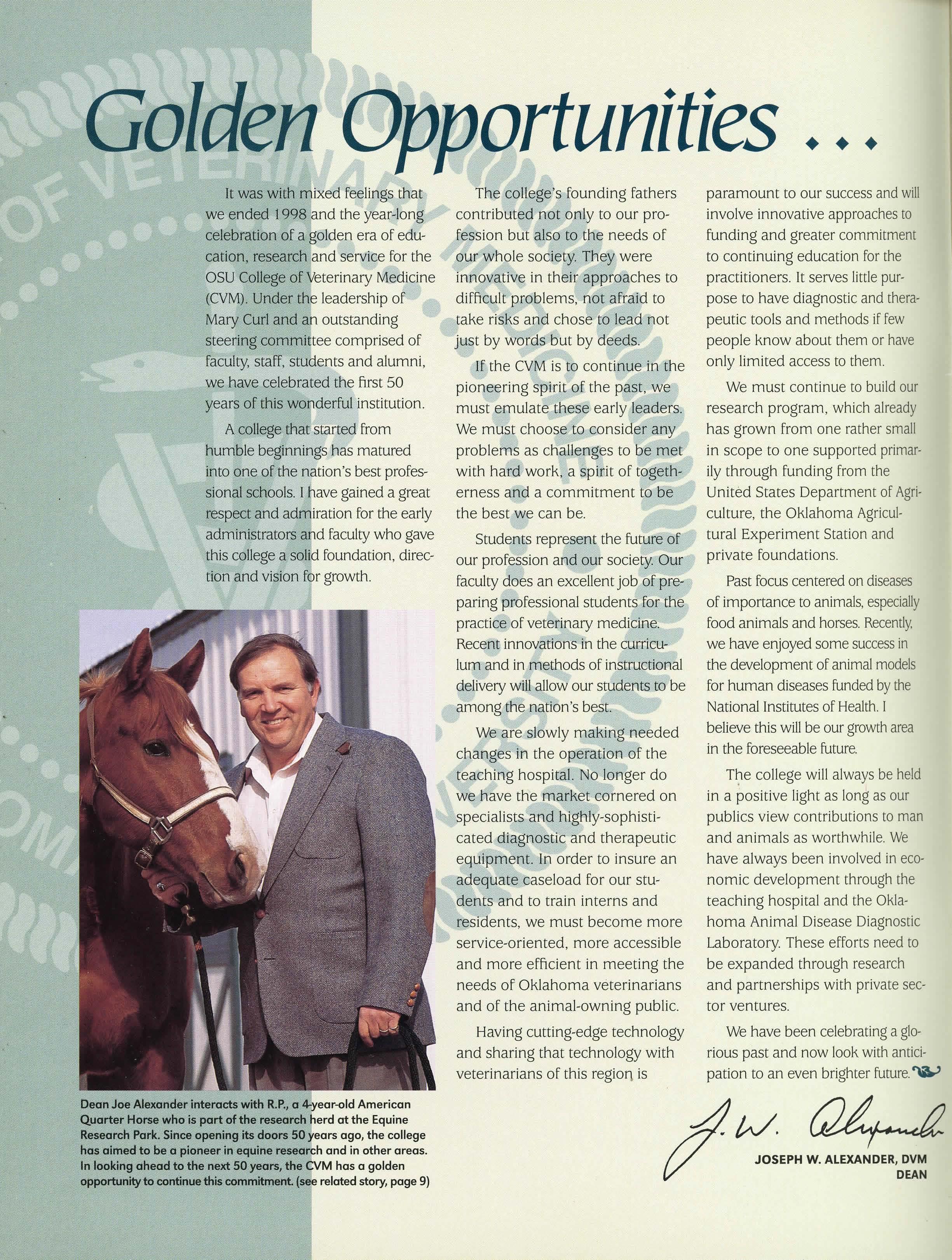
Dean Joe Alexander interacts with R.P., a 4,:year-old American Quarter Horse who is part of the research erd at the Equine Research Park. Since opening its doors 50 years ago, the college has aimed to be a pioneer in equine research and in other areas. In looking ahead to the next 50 years, the CVM has a golden opportunity to continue this commitment. (see related story, page 9)
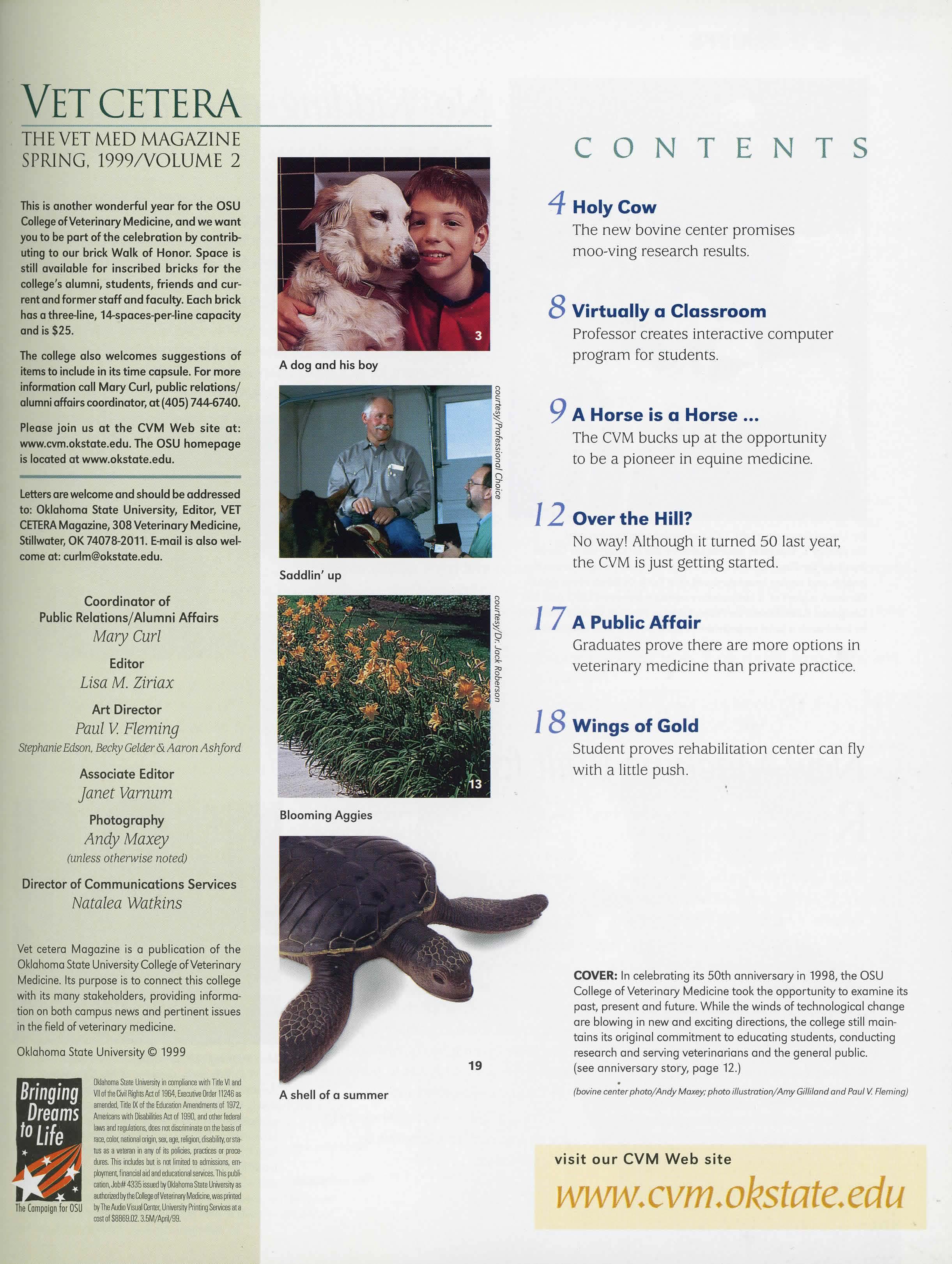
VETCETERA
THEVETMED MAGAZINE SPRING,1999NOLUME 2
This is another wonderful year for the OSU Collegeof Veterinary Medicine, and we want you to be part of the celebration by contributing to our brick Walk of Honor. Space is still available for inscribed bricks for the college's alumni, students, friends and current and former staff and faculty. Each brick has a three-line, 14-spaces-per-line capacity and is $25.
The college also welcomes suggestions of items to include in its time capsule. For more information call Mary Curl, public relations/ alumni affairs coordinator, at (405) 744-6740.
Please join us at the CVM Web site at: www.cvm.okstate.edu. The OSU homepage is located at www.okstate.edu.
Lettersarewelcomeandshouldbe addressed to: OklahomaState University,Editor, VET CITTRAMagazine,308 VeterinaryMedicine, Stillwater,OK 74078-2011.E-mailis also welcomeat: curlm@okstate.edu.
Coordinator of Public Relations/ Alumni Affairs
Mary Curl
Editor
Lisa M. Ziriax
Art Director
Paul V Fleming
StephanieEdson.BeckyGelder&.Aaron Ashford
Associate Editor
Janet Varnum
Photography
Andy Maxey (unlessotherwise noted)
Director of Communications Services Nata/eaWatkins
Vet cetera Magazine is a publication of the OklahomaStateUniversityColleg·eof Veterinary Medicine.Its purpose is to connect this college with its many stakeholders, providing information on both campus news and pertinent issues in the field of veterinary medicine.
Oklahoma State University© 1999
Ok!ahomaStateUniversityincompliancewithTitleVland ~loftheCMIR~hsActof1964,ExecutiveOrder11246as amended,TrneLI(of!heEducationAmendmensof1972. 1990,andotherlederal l!M'Sandregulations,doesnotdistriminateonthebasisof race.co!or,nationalorigin,sex.age,raligian,disabilily,ors1a-tttsasaveteraninanyofitspolicies,practicesorprocedures.Thisincludesbu1isnmlimiredmadmissions,ell} ploymem,financialaidandeducationalservices.Thispubl~ cation.Job#4335issuedhyOklahomaStateUniversity as authoriredhy!heCollegeofVeterinaryMedicine,wasprinted byThe/uJdioVisualr.emer,UniversityPrintingServicesata rostof$8869.02.3.5M/ApnV99.
C 0 NT EN
4 Holy Cow
The new bovine center promises moo-ving research results.
8 Virtually a Classroom
T S
Professor creates interactive computer program for students.
9 A Horse is a Horse ...
The CVM bucks up at the opportunity to be a pioneer in equine medicine.
J 2 Over the Hill?
No way! Although it turned 50 last year, the CVM is just getting started.
J 7 A Public Affair
Graduates prove there are more options in veterinary medicine than private practice.
J 8 Wings of Gold
Student proves rehabilitation center can fly with a little push.
COVER: In celebrating its 50th anniversary in 1998, the OSU College ofVeterinory Medicine took the opportunity to examine its post, present and future. While the winds of technological change are blowing in new and exciting directions, the college still maintains its original commitment to educating students, conducting research and serving veterinarians and the general public.
(see anniversary story, page 12.)
(bovine center photo/ Andy Moxey; photo illustration/ Amy Gilliland and Paul V.Fleming)
A dog and his boy
Saddlin' up
Blooming Aggies
A shell of a summer
Dr. Lionel Dawson, right, OSU associate professor, and
Dr. Arthur L. Goetsch, coordinator of the E (Kiko) de lo Garza Institute for Goat Research at Langston University, discuss the health and winter management of a flock of Boer/cross goats. Dawson is part of a cooperative venture between OSU and the Langston Goat Research Project and is the first faculty member to hold such a joint appointment between the two institutions.
No 'Kidding-around'
Four breeds of goats at Langston University are getting a little extra attention from OSU.
Dr. Lionel Dawson, OSU associate professor at the Veterinary Teaching Hospital, says he's overseeing the health of 1,200 goats at Langston University. The program is a cooperative venture between the OSU College of Veterinary Medicine and the Langston Goat Research Project. Dawson is the first faculty member to hold such a joint appointment between the two institutions.
"Since Langston doesn't have a veterinarian on their staff, I assist them in general healthcare, research and management of the treatment program for sick goats," Dawson says. "This joint program has brought both universities closer together."
Dawson says the project provides good hands-on experience for the senior students who accompany him twice a week. In addition, students from Australia, Africa, the Middle East and several other countries are there to observe and assist. They are researching dairy goat nutrition, milk quality, milk products, antibiotic residues in milk, the enhancement of mohair and cashmere production, control of weeds and shrubs in pastures through goat utilization, and meat quality assurance.
Dawson also teaches pre-vet and pre-med students at Langston University about goat management.
New MachineBuiltfor Speed
Recently acquired by the Oklahoma Animal Disease Diagnostic Laboratory (OADDL), the GC Mass Spec Mass Spec identifies unknown toxins and chemical compounds in a fraction of the time it takes using the old method.
"In matters of chemical analysis, this technology is as advanced as you can get at the present time," says Dr. WC. Edwards, director of the facility. "It breaks down the ions of a mass spectrum, and can actually give you the chemical structure of a compound."
The OADDL examines about 3,000 cases of animal poisoning per year, Edwards explains. This machine will identify pesticide residues, poisonous
plant alkyloids, drugs, mycotoxins, and agricultural chemicals in a fraction of the time it takes using the old method, he says.
Because of the $86,000 expense, the machine could not be bought with state-appropriated money, Edwards says. However, Dr. Larry McTague, Ardmore veterinarian and CVM alumnus, knew of the importance of the equipment. He successfully appealed to the Noble Foundation of Ardmore to supply the needed funds to purchase the cutting-edge technology.
"This machine will definitely help streamline our lab's capabilities," Edwards says.
TOM JOHNSTON
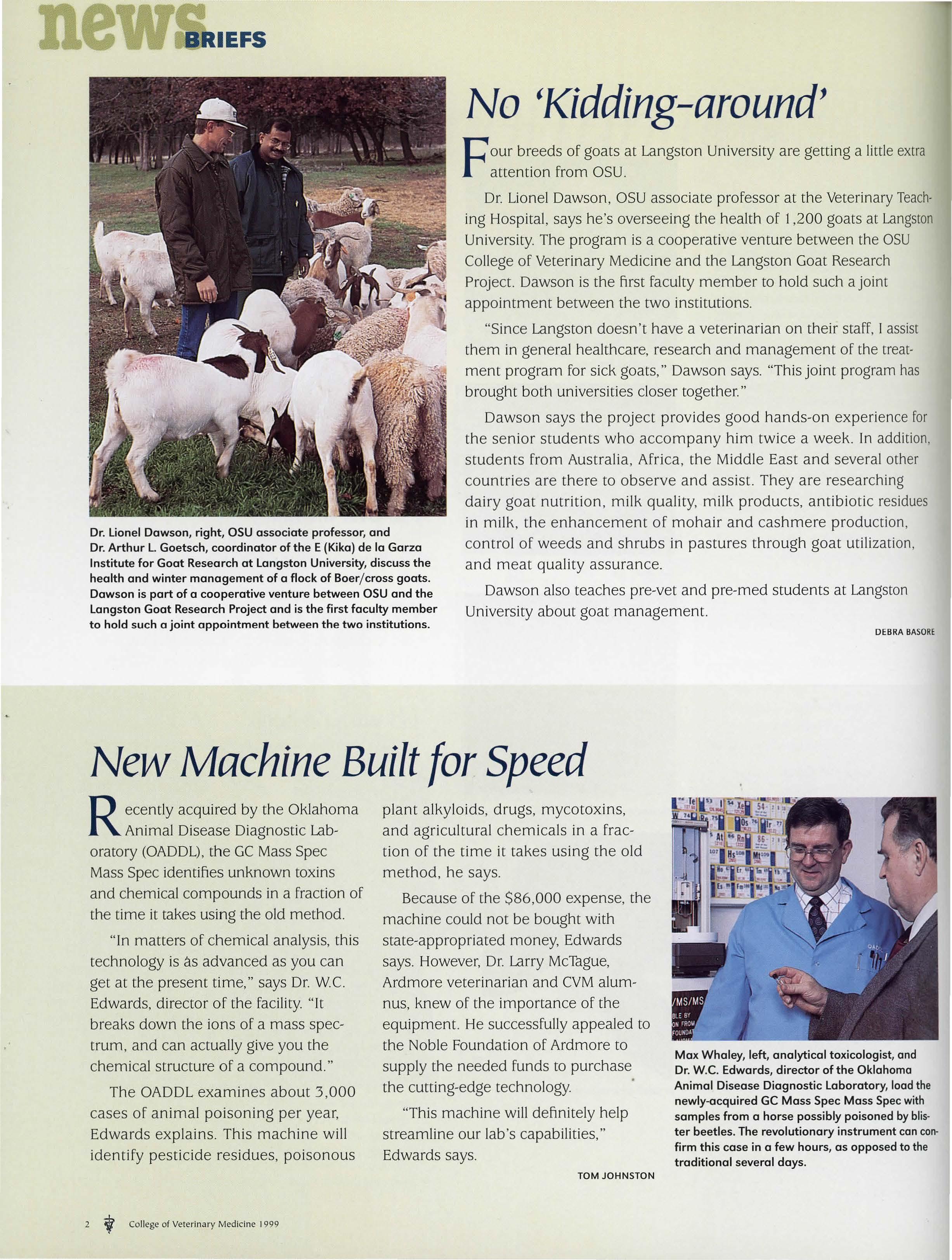
Max Whaley, left, analytical toxicologist, ond Dr. W.C. Edwards, director of the Okla homo Animal Disease Diagnostic Laboratory, lood the newly-acquired GC Mass Spec Mass Spec with samples from a horse possibly poisoned by blister beetles. The revolutionary instrument con confirm this case in a few hours, as opposed to the traditional several days.
Honored,Indeed
For 29 years, Dr. Eric Williams had his say about all the publications issued by the National Associationof Bovine Practitioners, a group of veterinarianswho specialize in cattle health. But he got a recentsurprise when he attended the national meeting in Spokane,Wash., and tendered his resignation as editor-in-chief of the association's publications.
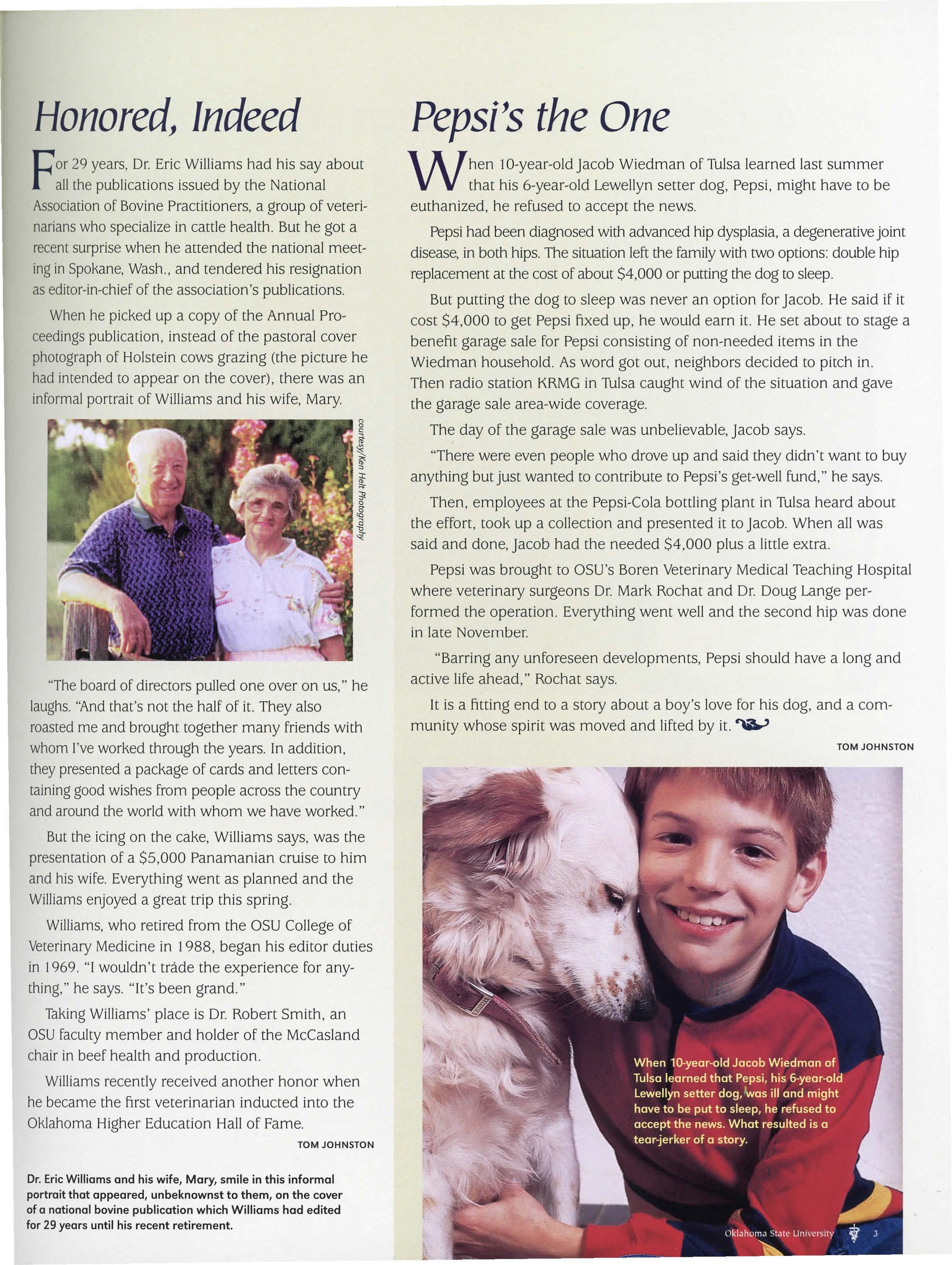
When he picked up a copy of the Annual Proceedingspublication, instead of the pastoral cover photograph of Holstein cows grazing (the picture he had intended to appear on the cover), there was an informal portrait of Williams and his wife, Mary.
"The board of directors pulled one over on us," he laughs."And that's not the half of it. They also roastedme and brought together many friends with whom I've worked through the years. In addition, they presented a package of cards and letters containing good wishes from people across the country and around the world with whom we have worked."
But the icing on the cake, Williams says, was the presentation of a $5,000 Panamanian cruise to him and his wife. Everything went as planned and the Williams enjoyed a great trip this spring.
Williams, who retired from the OSU College of Veterinary Medicine in 1988, began his editor duties in 1969. "I wouldn't trade the experience for anything," he says. "It's been grand."
Taking Williams' place is Dr. Robert Smith, an OSUfaculty member and holder of the Mccasland chair in beef health and production.
Williams recently received another honor when he became the first veterinarian inducted into the Oklahoma Higher Education Hall of Fame.
TOM JOHNSTON
Pepsi'sthe One
When 10-year-old Jacob Wiedman of Tulsa learned last summer that his 6-year-old Lewellyn setter dog, Pepsi, might have to be euthanized, he refused to accept the news.
Pepsihad been diagnosed with advanced hip dysplasia, a degenerativejoint disease,in both hips. The situation left the family with two options: double hip replacement at the cost of about $4,000 or putting the dog to sleep.
But putting the dog to sleep was never an option for Jacob. He said if it cost $4,000 to get Pepsi fixed up, he would earn it. He set about to stage a benefit garage sale for Pepsi consisting of non-needed items in the Wiedman household. As word got out, neighbors decided to pitch in. Then radio station KRMG in Tulsa caught wind of the situation and gave the garage sale area-wide coverage.
The day of the garage sale was unbelievable, Jacob says.
"There were even people who drove up and said they didn't want to buy anything but just wanted to contribute to Pepsi's get-well fund," he says.
Then, employees at the Pepsi-Cola bottling plant in Tulsa heard about the effort, took up a collection and presented it to Jacob. When all was said and done, Jacob had the needed $4,000 plus a little extra.
Pepsi was brought to OSU's Boren Veterinary Medical Teaching Hospital where veterinary surgeons Dr. Mark Rochat and Dr. Doug Lange performed the operation. Everything went well and the second hip was done in late November.
"Barring any unforeseen developments, Pepsi should have a long and active life ahead," Rochat says.
It is a fitting end to a story about a boy's love for his dog, and a community whose spirit was moved and lifted by it.._,.,,
Dr.
Eric Williams and his wife, Mary, smile in this informal portrait that appeared, unbeknownst to them, on the cover of a national bovine publication which Williams had edited for 29 years until his recent retirement.
TOM JOHNSTON
Moo-ving Along
BovineCenterBringsResearchPotential
The College of Veterinary Medicine will be using a new bovine infectious disease isolation facility by late spring if all goes as planned.
Dean Joe Alexander says the project, under construction on West Virginia Street, is next to the Anaplasmosis Building.
Dr. Anthony Confer, project leader for the bovine respiratory disease research group, says OSU needs the facility in order to maintain its position as a leader in the study of infectious diseases in cattle.
The facility is a 5,600-square-foot building that meets the United States Department of Agriculture BSL-2 containment standards, which means that infectious agents can be studied without risk to animals in the surrounding area. These standards will soon become the requirement by federal agencies and animal health industries, Confer says. He added that the isolation facility will play an integral part in the college's bovine disease research program.
Bovine respiratory disease (BRO), more commonly known as shipping fever, will be studied in the new facility. It's a disease that costs cattlemen in Oklahoma an estimated $ I 03 million annually. OSU has been involved in BRO research since 1968.
Confer says research efforts have primarily centered on developing better vaccines for the target bacteria, understanding the process of the pathogen's interaction with the host animal, working on developing better diagnostic tests for viruses. and studying viral immunity.
"Much of the thrust of our efforts is on the molecular level," he says.~
RISING TO THE OCCASION
The College of Veterinary Medicine continues to be a leader in bovine medicine, and two new programs prove it.
The Food Animal Clinic has acquired a revolutionary piece of equipment that is gaining popularity worldwide for its assistance in treating recumbent large animals. •
The Aqua Cow Rise System is a portable water flotation tank used to help weak or injured animals to their feet, says Dr. Robert Streeter, assistant professor of veterinary clinical sciences.
"The Aqua Cow utilizesthe buoyancy of the animal's digestive tract to float the animal in water, which puts even pressure overthe body's surface and, in a sense, makes the animal seem lighter than it is," Streeter says. "This enables it to stand with much less effort than is ordinarily required."
Also, the college installed state-of-the-art surgery suites in the FoodAnimal Clinic in 1997.This facility's improvement enables clinicians to provide high quality veterinary care and services to food animal patients and better meet the needs of Oklahoma livestock producers.
"The rooms feature a gating system that was developed for easy, safe and efficient handling of cattle from the unloading area to the surgery suites," says Dr. John Kirkpatrick, associate professor of veterinary clinical sciences.
Kirkpatrick says the surgery rooms put OSU's veterinary medicine program equal to or ahead of many of the country's veterinary medical teaching hospitals.
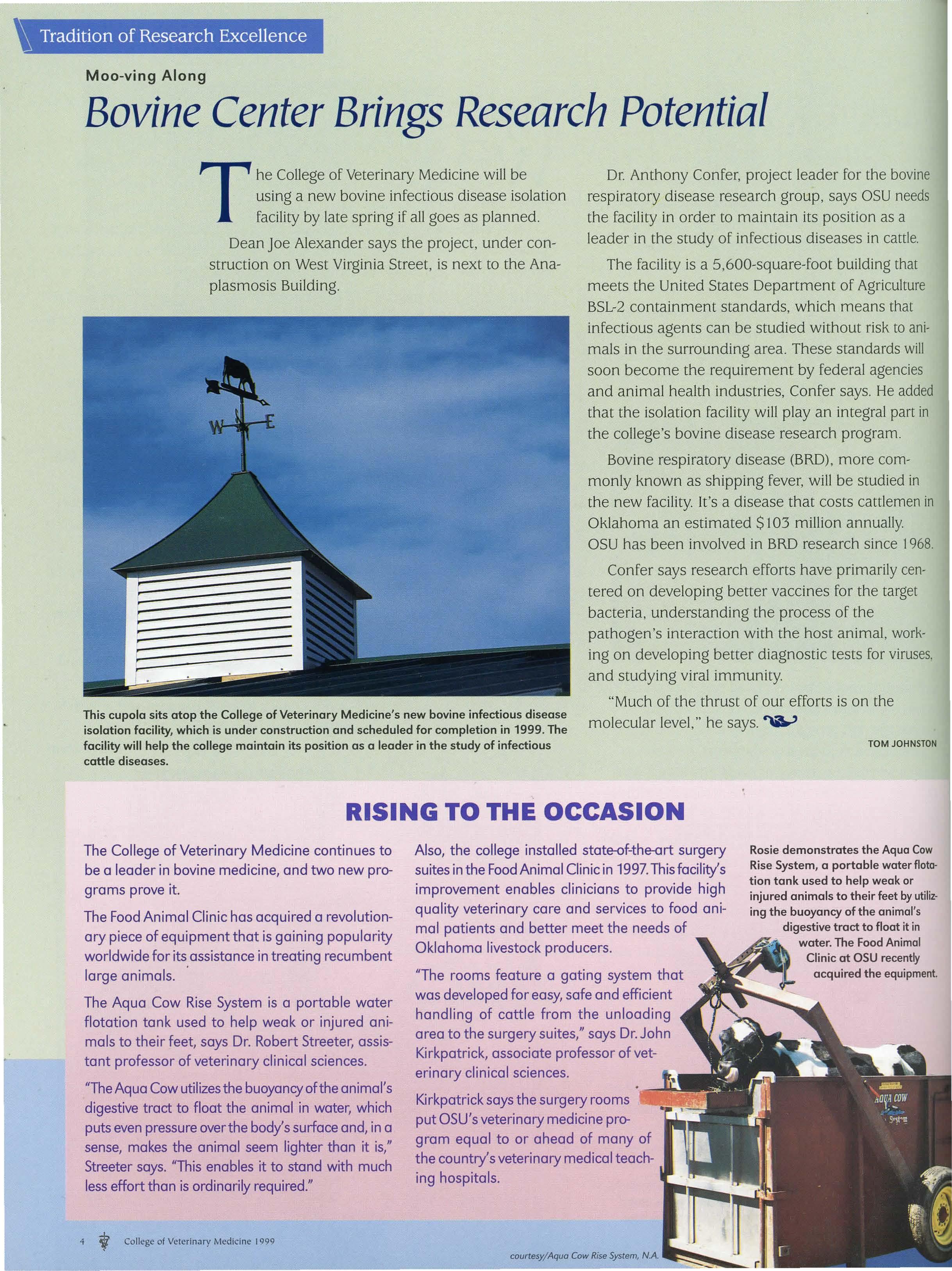
Rosie demonstrates the Aquo Cow Rise System, a portable woter flotation tank used to help weak or injured animals to their feet by utilizing the buoyancy of the animal's digestive tract to floot it in water. The Food Animal Clinic at OSU recently acquired the equipment.
This cupola sits atop the College of Veterinary Medicine's new bovine infectious disease isolation facility, which is under construction and scheduled for completion in 1999. The facility will help the college maintain its position as a leader in the study of infectious cattle diseases.
TOM JOHNSTON
PathologistHot on the Trailof CanineParasite
Dr. Roger Panciera might have made an outstanding police detective had he not chosen to be a veterinary pathologist. Both professionsrequire dogged persistence, keenpowers of observation, and careful evaluationof data to ensure the correct conclusionsare reached.
In the summer of I 995, Panciera performed a canine autopsy that revealedevidence of canine hepatozoonosis.It is a parasitic disease first seen in the United States in the late I970s and confined to Texas and Louisiana. His revelation was a first for Oklahoma and indicated the known geographicalboundaries of the disease were expanding.
Becausehe felt existing information about the disease to be somewhat sparse,Pancieraand his collaborators set about to find out more about its character:how the parasite reproduces, its phasesof development, its chosen warm-blooded hosts, and its mechanics of moving from one host to another. The brown dog tick, which is found in and around yards and even in houses, was widely thought to be the source of infection, Panciera explains.
"But it didn't make sense to us becausethe majority of dogs we were seeingwith the disease were wide-ranging countrydogs, not yard dogs," he says.
So, Panciera and colleagues decided to test different ticks as hosts for the parasiteand found one, the Gulf Coast tick, to be particularly' hospitable. This is a tick whose geographic distribution correspondswith the areas of the canine victims Panciera had seen.
"Although it is not certain that this tick is the sole avenue of infection, it is particularly prevalent in eastern Oklahoma and in each of the reported cases, seasonaltick infestation was observed," he says."Interestingly enough,
investigators in the OSU entomology department had the distribution of this tick surveyed and found its boundaries to be expanding up into Kansas."
Also, he says it had been generally thought that the disease seen in the United States was caused by the same parasite that had been seen in Africa, Europe and Asia. But in 1997, Auburn University researchers characterized the parasite as a new species. So, the U.S. disease has appeared seemingly out of nowhere.
There is no therapy that can eliminate the infection or significantly alter its progress, and it nearly always leads to the demise of the animal it infects, Panciera says. Control of the tick population appears to be the best method of minimizing its occurrence.
Panciera is the first to admit that the last several years have been filled with a terrific amount of work, and the work's not over yet.
"I feel like we have contributed significantly to the knowledge base on this disease, and we've been able to involve several students in the process," he says.
So far, it has provided research topics for two graduate students and led to the publication of several scientific papers, he adds.
But if anyone wonders if Panciera enjoys what he does, they have only to hear him describe his research experience.
"The last three years have been a period of prolonged excitement," he says. "I mean, it has really been Fun."~
TOM JOHNSTON
"Jfeel like we have contributed significantlyto the knowledgebase on this disease,and we've been able to involveseveral students in the process."
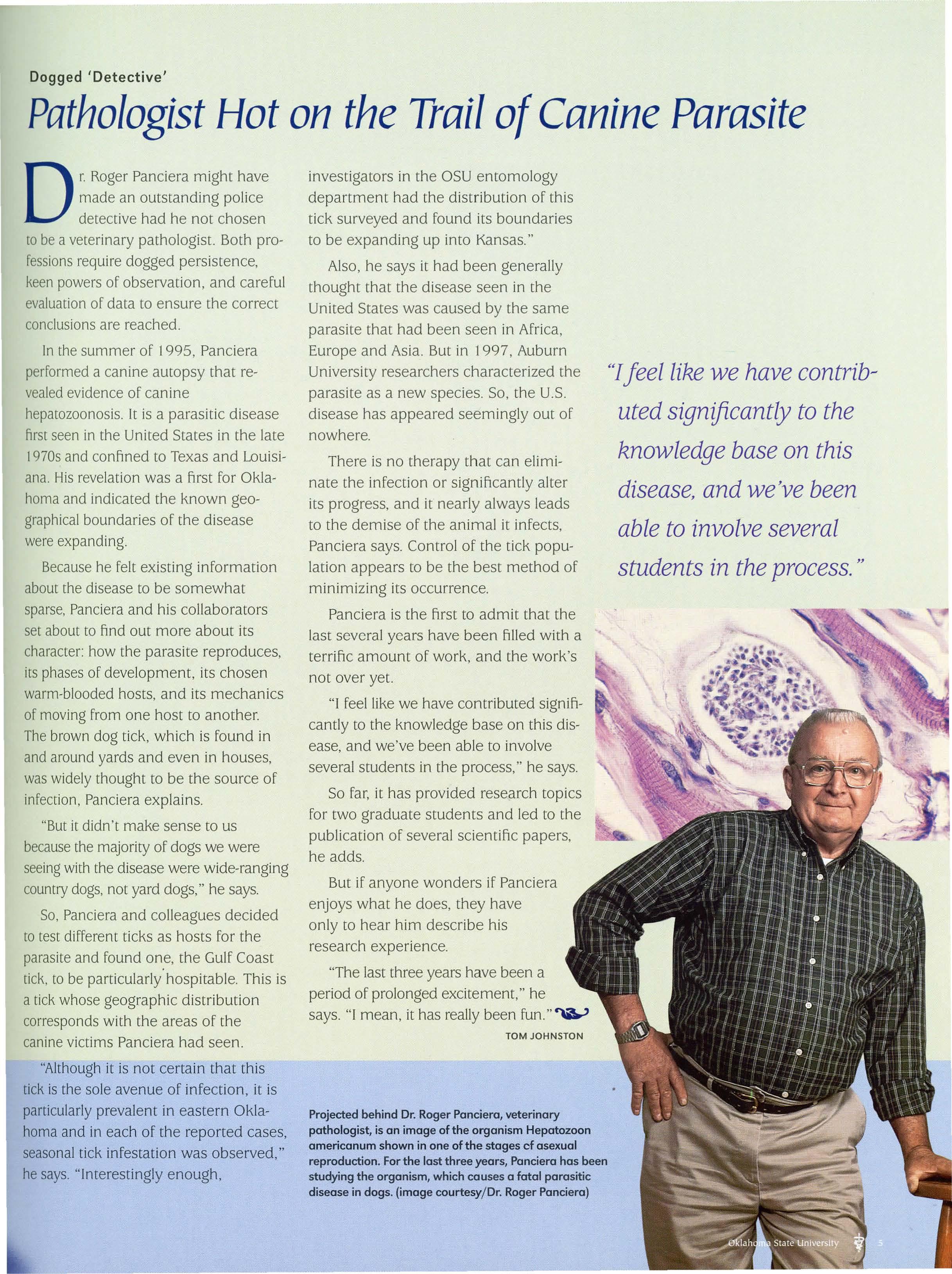
Projected behind Dr. Roger Panciera, veterinary pathologist, is an image of the organism Hepatozoon americanum shown in one of the stages of asexual reproduction. For the last three years, Panciera has been studying the organism, which causes a fatal parasitic disease in dogs. (image courtesy/Dr. Roger Panciera)
CanineMD StudyMay BenefitHumans
Itwas serendipity a case of being in the right place at the right time.
That's how Dr. Phil Woods describes the events leading to the current multifaceted research project he coordinates at OSU's College of Veterinary Medicine. The project involves investigating several aspects of canine muscular dystrophy (CMD), which causes many of the same symptoms in dogs that Duchenne muscular dystrophy causes in human beings.
"That's the beauty of an animal model .... knowing your results may be transferable to human medicine with minimal risks. "
With an incidence of one in every 3,500 human males, Duchenne muscular dystrophy is one of the most common inherited diseases in humans, Woods says.
Cytoskeletal proteins protect normal muscle cells from damage as they contract and relax, the doctor explains.
"One of chose proteins is dystrophin, and in dogs with CMD, as well as in human beings with Duchenne, dystrophin is missing," he says. "Consequently, as the muscle cell contracts and relaxes, it is broken down and is replaced with fibrotic tissue."
In the case of the heart affected by Duchenne, it becomes progressively incapable of pumping the volume of blood needed to keep the patient alive, and ultimately leads to congestive heart failure.
The muscles used to inflate the lungs also
become incapacitated, and respiratory failure becomes a significant factor.
"Because of the considerable similarities, we felt that CMD would be an excellent animal model for Duchenne, so we set about to form a colony of dogs with the same genetic characteristic to allow us to study the problem further," he says.
Woods, along with Ors. Gayman Helman and jerry Malayer of the OSU College of Veterinary Medicine and Farhat Husain of the OU Health Sciences Center, set about characterizing the animal model.
Preliminary data from their initial study has been very encouraging, Woods says.
"We have found that all of the affected dogs lack dystrophin, and we have preliminary data on the I ocation of the genetic lesion," he explains. "We have also found that all the dogs suffer from varying degrees of cardiac and musculoskeletal disease."
Armed with their preliminary data, the research group is in the process of applying for research funding from the United States Muscular Dystrophy Association and the Oklahoma Center for the Advancementof Science and Technology,which has given the projecta number-one ranking and a $70,000 grant.
Once the project is funded, Woods says the group plans a five-point attack. They will be looking at gene therapy using virus transfection to transport normal genes into affected cells; myoblast transplantation, or the injection of normal cells into affected cells; upregulation of utrophin gene expression to mimic the effect of dystrophin proteins; reducing the development of muscle pathology; and, management of cases to enhance and prolong life.
"That's the beauty of an animal model," Woods says. "You can look at all these things and be able to test possible therapeutic approaches knowing your results may be transferable to human medicine, and you can do it in a controlled environment with minimal risks."
TOM JOHNSTON
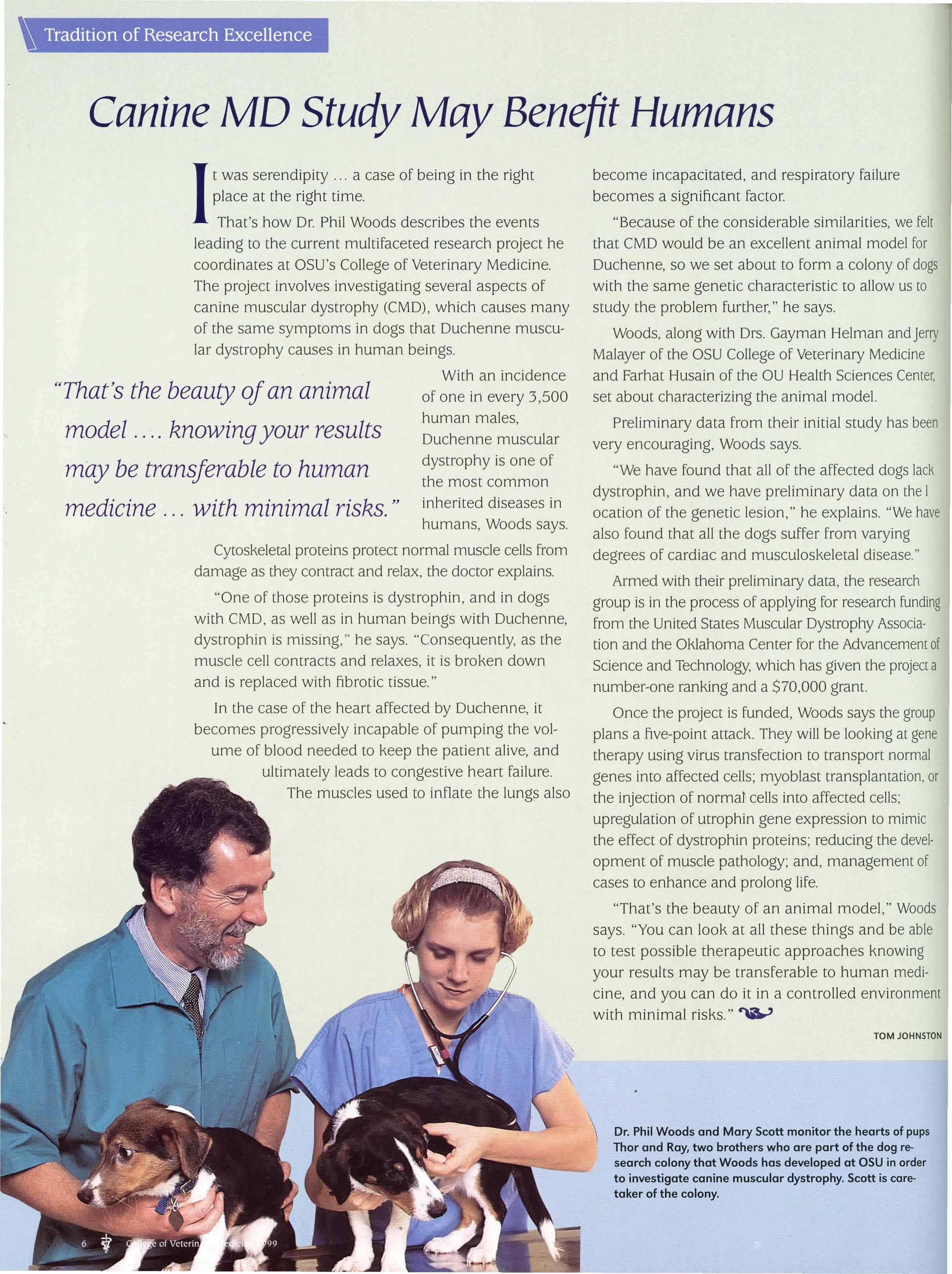
\ Dr. Phil Woods and Mary Scott monitor the hearts of pups Thor and Ray, two brothers who are part of the dog research colony that Woods has developed at OSU in order to investigate canine muscular dystrophy. Scott is caretaker of the colony.
Hands-on Approach
CurriculumChangesOfferMore Options
Major curriculum revisions were implemented last fall in the college's Professional Degree Program (PDP)
The changes are aimed at allowing students to take more electivesin their areas of interest and to give them more "hands-on" experience with animals throughout the entire program,says Dr. Mike Lorenz, CVM associate dean for academic affairs.
Sincethe PDP has a "lock-step" curriculum, meaning studentsenter a class together and remain with the same class throughoutthe entire program, only this year's entering class of 2002 is affected by the changes, so far. For the next three years,the college will have to operate with two different PDP curriculurns,Lorenz says.
Thecurriculum changes affect the first six semesters (first, secondand third years) of the nine-semester program. One of the major objectives was to reduce the amount of required hoursper semester to allow students to take more electives. Changeshave resulted in a reduction of about 25 percent in the corecurriculum, Lorenz says.
Another objective is to provide better correlation and integration of information. What has been a departmental discipline-basedcurriculum has become a college-based interdisciplinary curriculum.
Although major curriculum changes inevitably produce some headaches and extra work for faculty and staff, Lorenz saysthe faculty curriculum committee believes the changes are worth the effort and will result in a broader range of opportunities for students.
GRADUATE PROGRAM 'SINGLED' OUT
Researcherstrained in biomedical sciences at the College of Veterinary Medicine will be better-prepared for the future, thanks to changesin the graduate program.
In 1997,the college combined the infectious diseases,pathobiology, physiologicalsciencesand clinical sciencesgraduate programs into a singledegree.The new program - veterinary biomedical scienceshas31 graduate students enrolled, 22 of whom are pursuing a Ph.D.
Dr. Charles Qualls, former coordinator of the new graduate program, says the small size of the individual programs weighed in the decision to combine them.
"We felt we could better serve the needs of the students and be more competitive for training grants with a larger program," he says. "The program is better now because the size is more efficient, and a larger program makes for greater visibility."
Qualls says the revisions have been beneficial. Since the program started two years ago, students have been awarded two Graduate Research ExcellenceAwards and two Phoenix Awards.
"Our program is researched-based," he says. "We have striven to develop a program of quality to insure the students will be employable in their area of specialization."
Students seem to appreciate the change, as well.
"In the last four years, we have seen nearly a 50 percent increase in the number of students enrolled," he says.
To enroll in the program, a student must have at least a bachelor's degree with a background in biological sciences. Approximately two-thirds of the students already have a Doctor of Veterinary Medicine degree before entering the program.
CAROLYN GONZALES
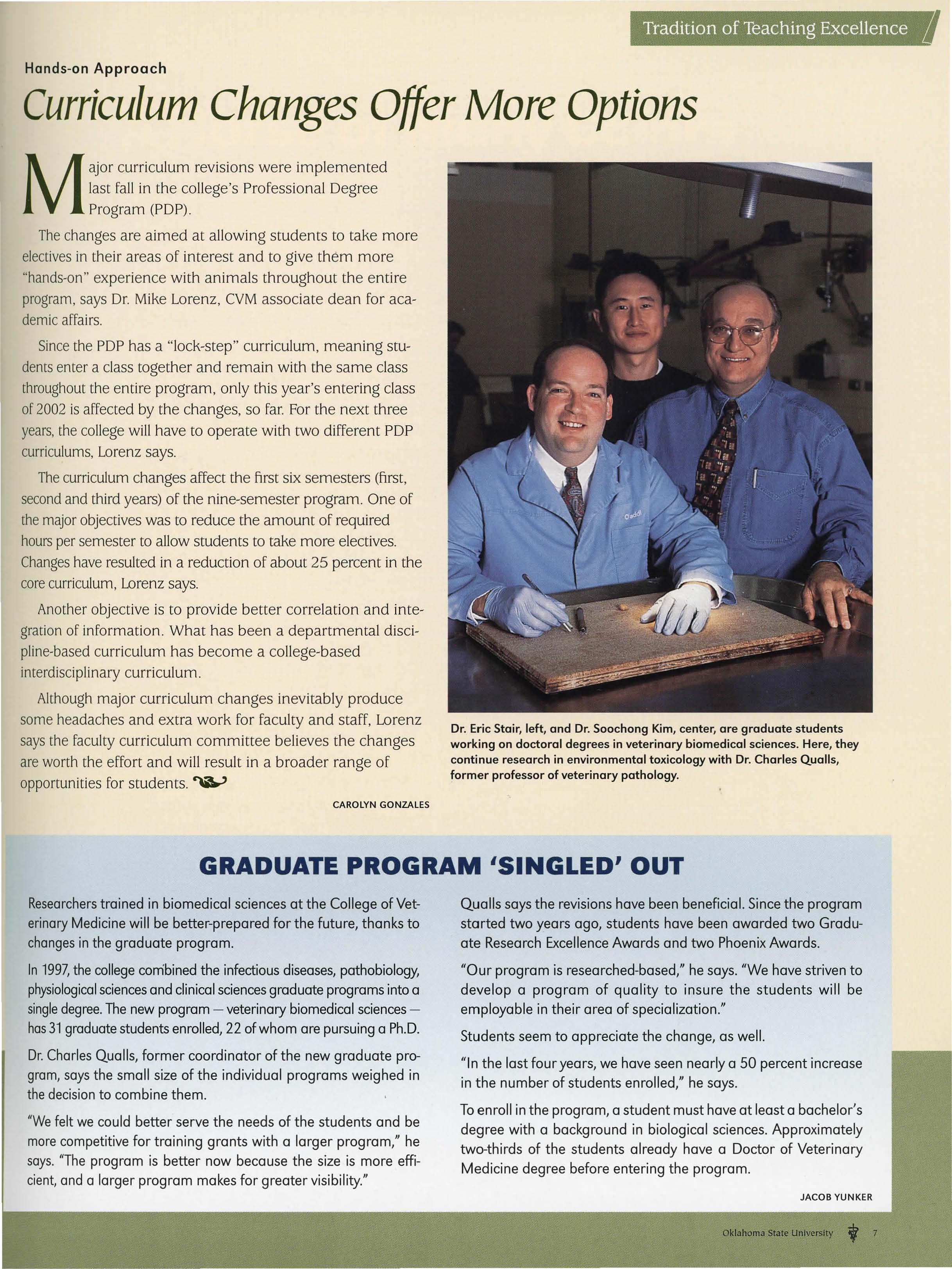
Dr. Eric Stair, left, and Dr. Soochong Kim, center, are graduate students working on doctoral degrees in veterinary biomedical sciences. Here, they continue research in environmental toxicology with Dr. Charles Qualls, former professor of veterinary pathology.
JACOB YUNKER
ComputerProgramTakesClassroomto Student
Peering into a microscope isn't all there is to the lab sessionsfor Dr. Nick Cross· histology course in OSU's College of Veterinary Medicine.
The Florida native, whose field is cell biology, has developed a computer program of the lab so students can study the form and function of animal cells and tissues without squinting into a microscope - or even being at the university.
Cross, professor of veterinary anatomy, pathology and pharmacology, has developed the interactive computer program over the last four years, introducing the full version to his histology students at the beginning of the 1998 fall semester.
The self-paced program combines text with images and can be downloaded from the college's computer network or viewed at home via CD-ROM.
Cross developed the program pretty restricted, so having the because he recognizes that stu- virtual lab program was great." dents learn in different ways and Quizzes written in the same at different speeds. format as course tests are built
"I take the attitude that every into the program, as well. Cross student is different," Cross says. says the quizzes also help stu"Each has his or her own way of dents understand and retain the learning, so I try to give them the information better. information in several different The downside to the virtual ways so they can choose what's lab? best for them."
Cross thinks it's harder for stu-
Although students in the his- dents using the computer protology course may elect to use gram to get a feel for structural the computer program rather relationships they would find than attend formal lab sessions, using conventional lab equipment all must attend the course's first and techniques. two-hour lab session. Students
"There's an unavoidable tenlearn to use a microscope and dency to use pictures of the best how to use the computer pro- examples for the virtual lab program during the session. gram, whereas in real life, they're
Cross says students like the not always this 'pretty,"' he says. "virtual lab" so well that by the "I tried to overcome this by giving end of the fall semester last year, multiple examples." the number of students who were
Other faculty members also still attending the formal histology h d 1 d · t 1 enta ave eve ope v1r ua preslab sessions had dwindled to one. tion materials for their courses.
"They seem to retain the infor- Even with the trend toward more mation better, according to their computer-generated and -guided test results," Cross says. "Looking classroom instruction, Crosssays over the exam records, I discov- he's not interested in creating a erect that the average lab exam commercial version of the lab grades for this year's students program at this point. exceeded all but one of the seven "It's taken four years to get it preceding classes.,, to this point,,, he says. "It would
First-year veterinary medicine take a lot more of my time to student Amy I. Davis of Okla- develop it into a commercial qualhoma City believes using the ity program - something I'm not computer program improved her willing to do right now." grades for the course.
Whatever his plans, Cross'vir-
"I used the compact disc ver- tual lab program seems to be just __;s;.;.io;.;n.;..;;;a_t_h.;.o_m_e;.;.,'_'.;.D.;.a_v..;is_s_a.,,_s_. '_'I___ ..as eff.ectiY.e..a.,teacl:JlP.to,ollo couldreview the informationas histologystudents- and possioften as I wanted to - anytime I bly more enjoyable- as peerin wanted to. The time you can througha microscope. spendin the universitylab is
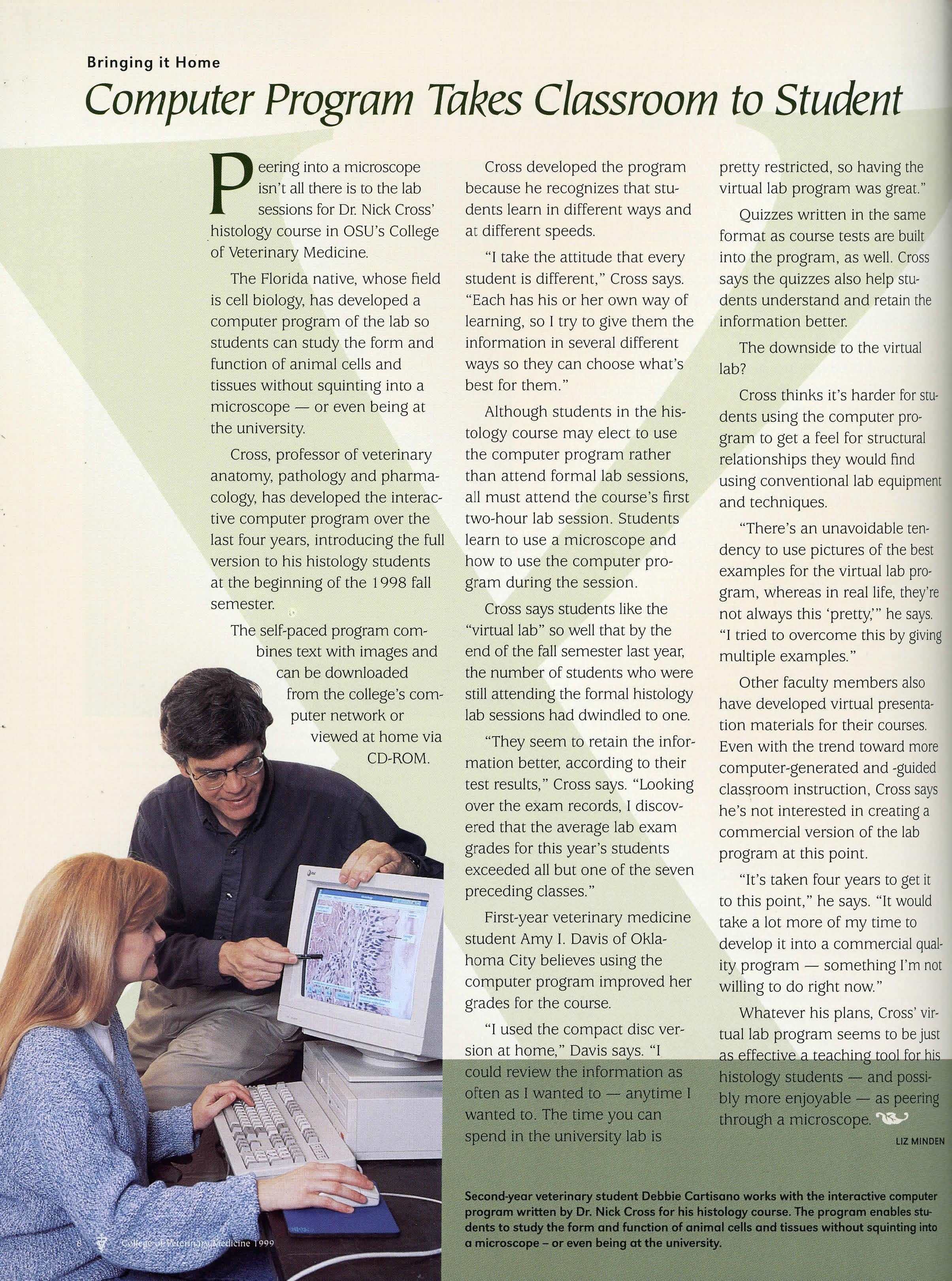
Second-yearveterinarystudentDebbieCartisanoworkswiththe interactive programwrittenby Dr.NickCrossfor his histologycourse.Theprog dentsto studythe formand functionof animalcells a micn>sco - or even beingat •
Backin the Saddle
Fewsituationsdevastate a horse breedermorethan a barren mare,but a uniqueprogramestablishedby the CVMin the late 1980scan reversethis situationabout 90 percentof the time, giving a distinct economicboost to the equine industryin Oklahomaand surroundingstates.
Designedand directedby Dr.StevenSlusherand housed on a 640 acre ranchwest of Stillwater,the internationallyrecognized Barren Mare Programdiagnoses and treats
TheManeEvent
CVMresearchershave collaboratedwith the Universityof Kentuckyand the U.S.Bureauof LandManagementin studying EquineInfectiousAnemia(EIA).Fundedthrougha grant fromthe bureau,the projectinvolved12 foals froma wild horse herdin Utah,all of whichinitiallytested positivefor EIA.
EIAis a blood-borneviral disease that is transmitted from horse to horse by insects that bite, principallythe horse fly or deer fly. Horsesin Oklahomaare requiredto have an annual EIAdiagnostictest, commonlyknownas the Cogginstest (named for its developer,CVMalumnus Dr.LeroyCoggins.)
"Thestandardprocedurehas been to euthanizeany animal which tested positive, but studies indicate that the
Hoofin'It
infertilemareswhoare broughtto the ranchby theirownersor are donatedto the programby variousindividualsor groups. Afterthey aretreated,the maresare bredwithone oftheranch's stallions.Slushersaysit's this beginning-to-endphilosophythat has madethe programsuccessful.
"By keeping the mare here for the diagnosis,treatment and breeding, we maintain a tight breedingcontinuity,and therein lies the chance of success,"he explains.
majorityof foalsfromasymptomaticEIA-infectedmaresare not infectedand willtest negativeafter about six months," says Dr.RebeccaMcConnico,principalinvestigator.
"Wesuspectthe foals have acquired'passive'antibodies by sucklingthe mare'scolostrum.In this stage, the foals can test positivewhen they actuallymay not be infected. Thisleads us to search for better screeningmethods."
McConnico'shypothesisprovedtrue when the 12 foals tested negative on all officialtests.
"Wekept the foals in isolationfor 45 days after the last one tested negative,"Mcconnicosays."Theywereretested, and all still tested negative. Theywere then released to the bureauto be adopted out."
Thanksto a new piece of technology in the CVM,veterinarianswill nowbe able to quantifythe degree of lamenessin horsesand dogswith sore legs or feet.
registersa visualmeasurementofthe downwardforceof the foot.
Whenan animal has a sore foot or leg, it will naturallynot bear as much weight on that leg, says Dr. HenryJann, associate professorin the departmentof veterinaryclinical sciences.
"Thistechnologywillbe helpful in quantifyingthe actual degreeof
The college is one of a few in the United States with this technologicalcapability.
Througha gift from John and BettyStambaughof Mannford,along with grants fromthe Officeof VeterinaryResearchand the dean'soffice, a $30,000gait force analyzer has been purchased. lamenessand responseto various It consists of a pressure-sensi- formsof therapy,"Jann says. tive force plate and a dedicated computer,whichreceivesinformation fromthe forceplate as an animalwalkson it. Thecomputerthen
GallopingAhead
Perhaps.the college's commitmentto all things equineis best illustratedthroughCVM efforts to endow a faculty chair in equine medicine.
Namedafter the late Ran RicksJr.,who wasone ofthe state's mostdistinguishedand accomplishedhorse racersand breeders,the chairhasalreadyreceiveddonationsorpledges of about $440,000.Thegoalis $500,000.
"Weare mostpleasedto honorthe memoiy of this special Oklahomahorseman,"Dean Joe Alexandersays."Thechairwillbea lasting remembranceof Ranand his manycontributionsto Thoroughbredracingin ourgreat state."
Rickswas the ownerof the first horseto enter the grounds of RemingtonPark.He wasinductedinto the inauguralclassofthe RemingtonParkHallof Fame.
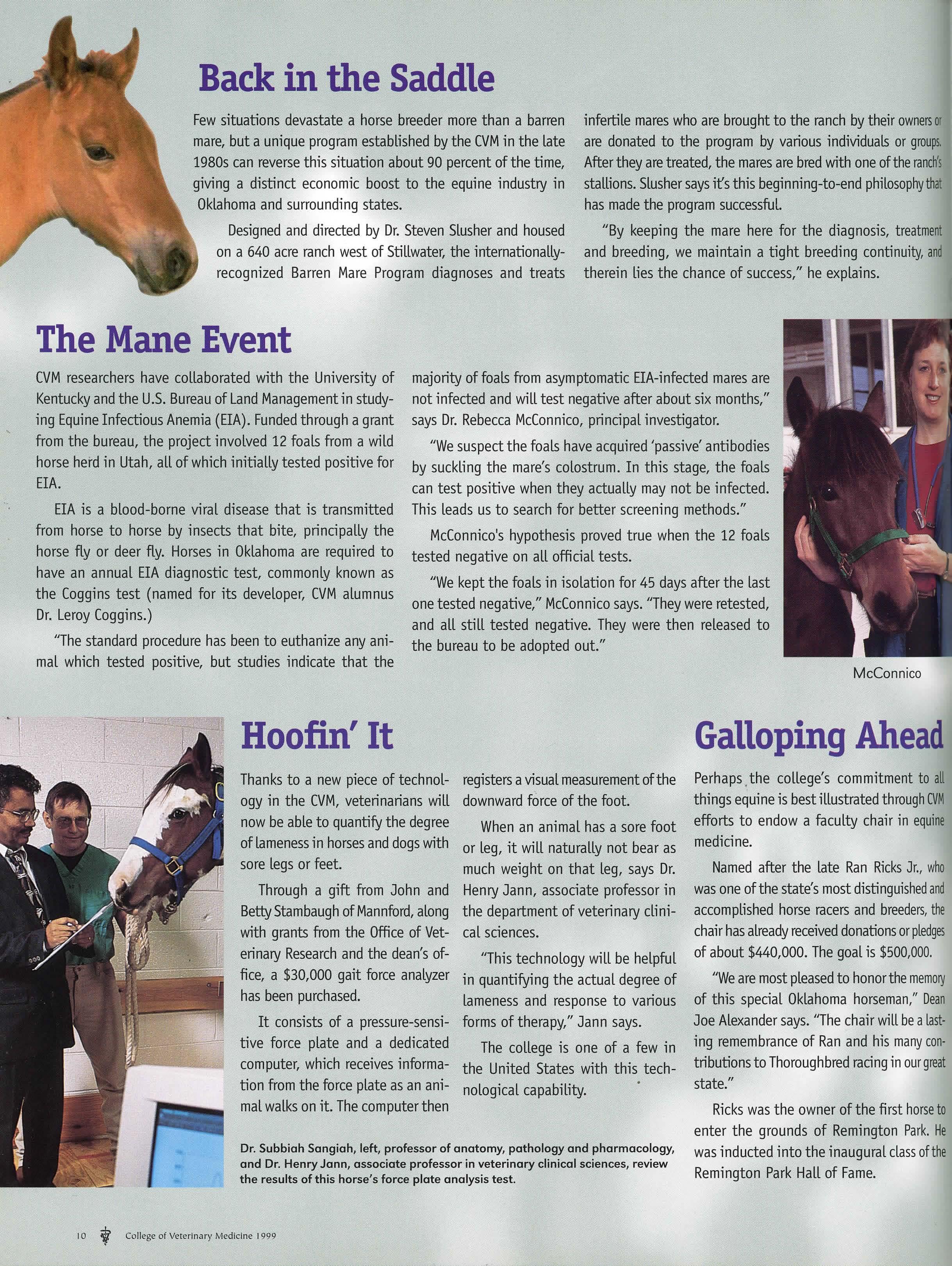
Dr. Subbiah Sangiah, left, professar af anatamy, pathalogy and pharmacology, and Dr. Henry Jann, associate professor in veterinary clinical sciences, review the results of this horse's force plate analysis test.
McConnico
JustSay'Neigh'
Becauseofresearchbeingdoneat the OklahomaAnimalDisease DiagnosticLaboratory(OADDL),horse ownersand trainers at Oklahoma'sfourracetrackshopeto gaininformationwhichwill helpthemminimizetrackinjuriesand deathsof race horses.
"Thisis a projectwestartedlastyearundercontractwiththe OklahomaHorseRacingCommission,"saysOADDLdirectorW.C. Edwards."Theprimeobjectof the studyis to identifycommon denominationalfactorscausingcareer-endinginjuriesor death inracehorses."
Hesaysthe programalso allowsveterinarydiagnosticians to tracknaturallyoccurringinfectious diseases in a highly mobilepopulationof horses.
"Wehavea 16-foottrailer with a two-ton winch,and we havefourstudentson call everyweekend,"Edwardssays.
If a horsedies on any of the state's four tracks, the lab dispatchesthe truck, brings back the horse and does an extensivepost-mortemexamination.
"Wewilldo a bone andjoint study,lookat trace elements andthecalcium-phosphorusratio of the bone, and document thetypesof injuries.Andthis is all correlatedto breed and ageofthe horse,weatherand track conditions,and activity ofthe horseat the time of the occurrence,"Edwardssays.
Headdsthat it willprobablytake another coupleof years to havesufficientnumbersin the study beforetrends in injuriesanddiseasecan be identified.
Dr.GaymanHelman,pathologistat the OADDL, is the leader ofthe project.
AHorseof a Heart
CarlGedon,animaltechnicianat the BorenVeterinaryMedicalTeachingHospital,lookstiny comparedwithOSU'sBeevo,a 4-year-oldBelgiandraft horse/AmericanQuarterHorsemix who weighs 1,900poundsandconsumesabout 60-65pounds ofhayperday.
Butsize isn't what makes Beevo a wonder horse.Becausehe is one of a veryfew horses that carriesa universal blood type, Beevois an ideal donor whose bloodcanbe transferredinto anotherhorse without danger of reaction.
Asa result,his bloodis drawn periodically,usually10 liters at a time.Partof it is storedfor emergencyuse and part of it is processedinto plasma.
Holdingthe Reins
Equineorthopedicinjurycontinuesto plaguethe horseindustry,but Drs.MichaelCollier and OlinBalchat the EquineSports MedicineLaboratoryare conductingresearchthat promisesto yield new procedures,equipmentand technologyfor prevention,management and treatmentin this area of equinesurgeryand musculoskeletaldisease.Butthe potentialgoes far beyondthis.
Someof the researchhas direct application to human medicine.Forexample, Collier,Balch,and Dr.LarryDeBaultof the Universityof OklahomaHealth Sciences Centerreceiveda $336,000grant fromthe PresbyterianFoundationof OklahomaCity in 1998.Thegrant is fundingtheir investigation of the managementof arthritis through the hormonaland laser stimulation of newly-established cartilage to resurfacedamagedjoint surfaces.
Theirresearchuses animal modelsincludingequine, canine,ovine,and rabbits - for developmentof surgicalpro-
cedures,instrumentsand equipmentfor the ultimate applicationto humanmedicine.
"Thegoal is to be able to surgicallyenter an injured or degeneratingjoint using standard and submillimeterendoscopesand communicate,whilein the surgicaltheater, with remotesurgicalspecialistsanywherein the worldusing real-time,interactive visualand spokenconferencing,"Colliersays.
Collierand his colleagueshavealso developedand assessedinnovativeequinesports medicineproductssuch as equineorthopedicsaddlepad and leg supportmaterials,conductedpharmacokineticclinicaltrials with anti-arthriticdrugs,and pioneeredthe adaptation of humanintra-oralcamerasforidentifyingand documentingequinedentaldisease.
Onthe RightTrack
Thecollegedevelopedthe EquineResearchPark,located on 40 acres north of campus, in 1995 to providea high-qualityfacility where collegefacultycan conductadvancedequine research.
The park features a 14-stallconcretefloor, biolevelII barn with a laboratory, a 24-stallbarn,a shavings,equipmentand haystoragebuilding, and paddocksand pasturesfor maintaininghorsesoutdoors.
Constructionis scheduledto begin on a buildingthat will 1 t ~l houseoffices,an additionallaboratory,a forceplate unit and ----:: 1, an apartment so a veterinarystudent can live on the pre-=, mises.Thepark has facilitatedmanyhigh-levelprojects,in/ • ,.eludinga study of equine gastric ulcersyndrome(EGUS)led- .I by Dr.CharlesMacAllister,directorof the park.
"Weknowthat closeto 90 percentof race horsesin training and young horses after weaningand halter breakinghave ulcers present in their stomach," he says. "Wehave workedto developmodelsto study EGUSand to determinewhat pharmaceuticalinterventionmight be effectivein the treatment of this condition."
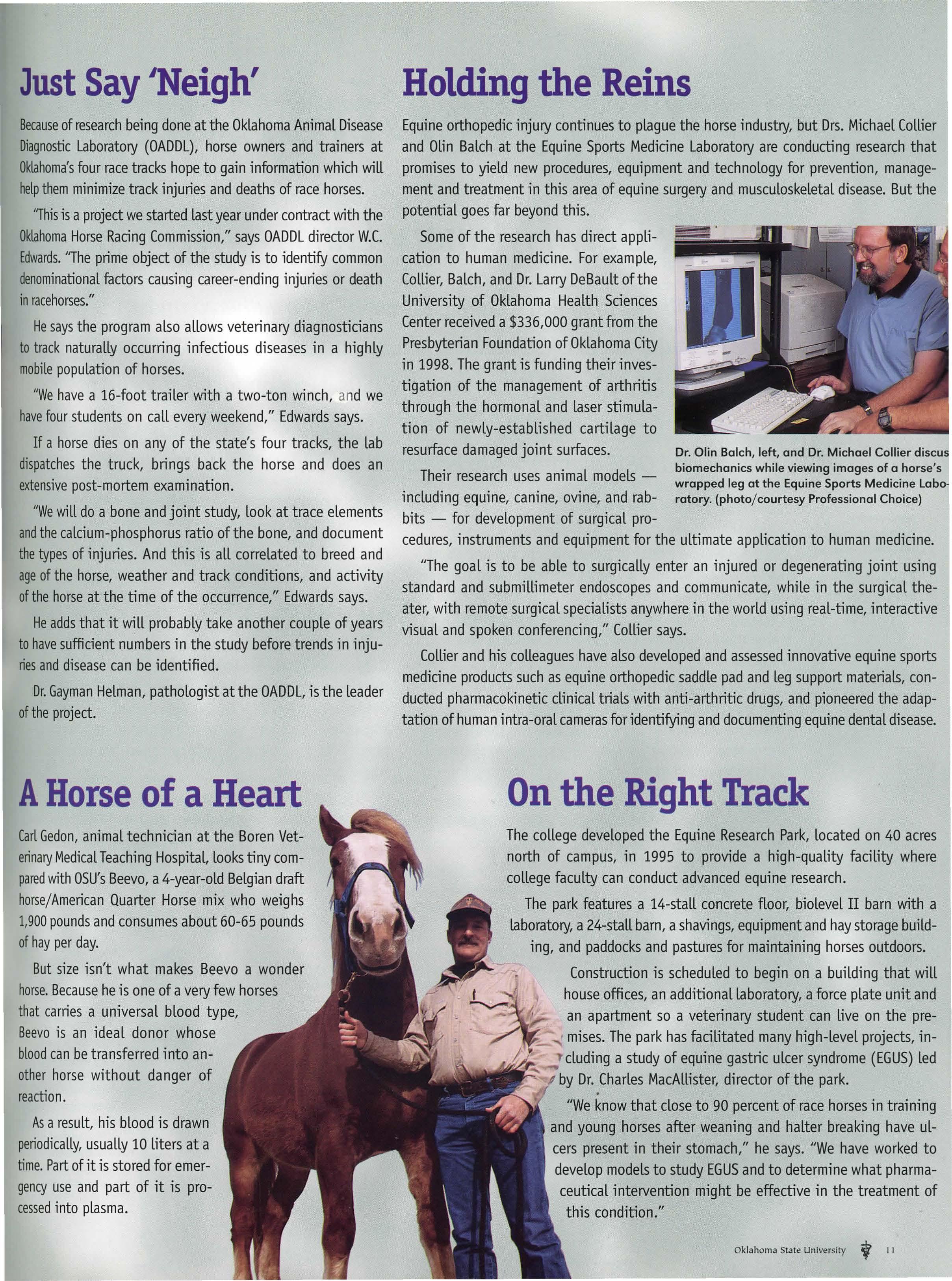
Dr. Olin Balch, left, and Dr. Michael Collier discus biomechanics while viewing images of a horse's wrapped leg at the Equine Sports Medicine Laboratory. (photo/courtesy Professional Choice)
This 50th Anniversary Cammencement Medallion was handed out to members of the first graduating classes (1951-1954).
SQTHSTEERING COMMITTEE
Ms. Mary Curl, chair
Dr. Ken Bartels
Dr. Bill Clay
Ms. Sandy Cotton
Ms. Jayne Creed
Mr. Russ Donathan
Ms. Angie DuBois
Mr. Jason Evans
Dr. Sidney Ewing
Ms. Marilyn Hayes
Dr. Katrina Meinkoth
Ms. Marilyn Moffat
Dr. J. Mack Oyler
Dr. Roger Panciera
Ms. Yalonda Patterson-Burton
Dr. Richard Shawley
Ms. Kay Lynn Thomsen
Dr. Eric Williams
A Walk DownMemoryLane
n a crispfall morning last October,scores offolks gathered under the historicAesculapius-brickedbuildingwhich has housed the OSU Collegeof VeterinaryMedicine(CVM)since the 1950s.Here amidst a colorjulfall landscape,former and currentfaculty, staff and studentsjoined other CVM friends and OSUdignitariesto celebratethe dedicationof the brick Walkof Honor,thefinal event of the year-long 50th anniversarycelebration.
1998 will be a year to remember in the annals of CVM history. Beginning with a nostalgia-filled banquet in February and culminating with the Walk of Honor dedication in October, 1998 might be more memorable than any of the past 50 years which it was set aside to honor.
"Different people have told me at different times this year about their sense of pride in this college," Dean Joe Alexander says. "They told me that the 50 th anniversary celebration was very special to them and that it reminded them of their part in making this college what it is today."
Under the guidance of the 50 th anniversary steering committee, the college
Plans are also underway to fill a time capsule with memorabilia and bury it under the new Walk of Honor where a future generation will discover it years from now.
In addition to the activities sponsored by the CVM, individuals associated with the college made their own contributions to the 50 th anniversary festivities. For example, Dr. Sidney Ewing, CVM professor, researched and wrote a thumbnail account of a portion of the college's history called "Oklahoma Aggie Ambition."
"The 50 th anniversary gave us a chance to think about the outstanding students, staff and faculty who -------~ have been a part of this planned alumni receptions around the United
THE WALK OF HONOR
The brick Walk of Honor consists of inscribed paver bricks available for $25 each to the college's alumni, students, friends and current and former staff and faculty. Space is still available for inscribed bricks, which have a three-line, 14-spaces-per-linecapacity. Also, the college welcomes suggestions of items to include in its time capsule. For more information, call Mary Curl, public relations/alumni affairs coordinator, at (405) 744-6740. is going," Alexander says. "It givesus something to be proud of."~
college and about just how far this college has come and where it States and practitioners' luncheons throughout Oklahoma. The college also published the inaugural edition of Vet cetera Magazine, created historical display cases in the CVM building lobby, developed a video on the history of the college, and offered tours and open houses to the public.
LISA M. ZIRIAX
Marilyn Hayes, left, and Marilyn Moffat, both staff of the College of Veterinary Medicine, prepare for the unveiling of the brick Walk of Honor at the dedication in October 1998.
EwingPensCollege'sAmbitiousBeginnings
During his sabbatical last year in Washington, D.C., Dr. Sidney Ewing uncovered a story which, to use hiswords, "was too good not to record."
Ewing, holder of the Wendell H. & Nellie G.
Krull Professorship in Veterinary Parasitology at the College of Veterinary Medicine (CVM), was researching his major professor, Dr. Wendell Krull, in the National Archives.
While looking through records of the old Bureau of Animal Industry (BAI), which was the accrediting agency for veterinary schools in the earlypart of this century, Ewing found correspondence to the bureaufrom Dr. L.L. Lewis. Lewis, an early professor of veterinary scienceat OSU (then called Oklahoma A&M College),was seekingthe bureau's approval of the college's veterinary program. The correspondence,which began in 1916, indicated a tenacious persistenceon the part of Lewis and a small group of faculty to achieveaccreditation of the school's veterinary program.
Ewing
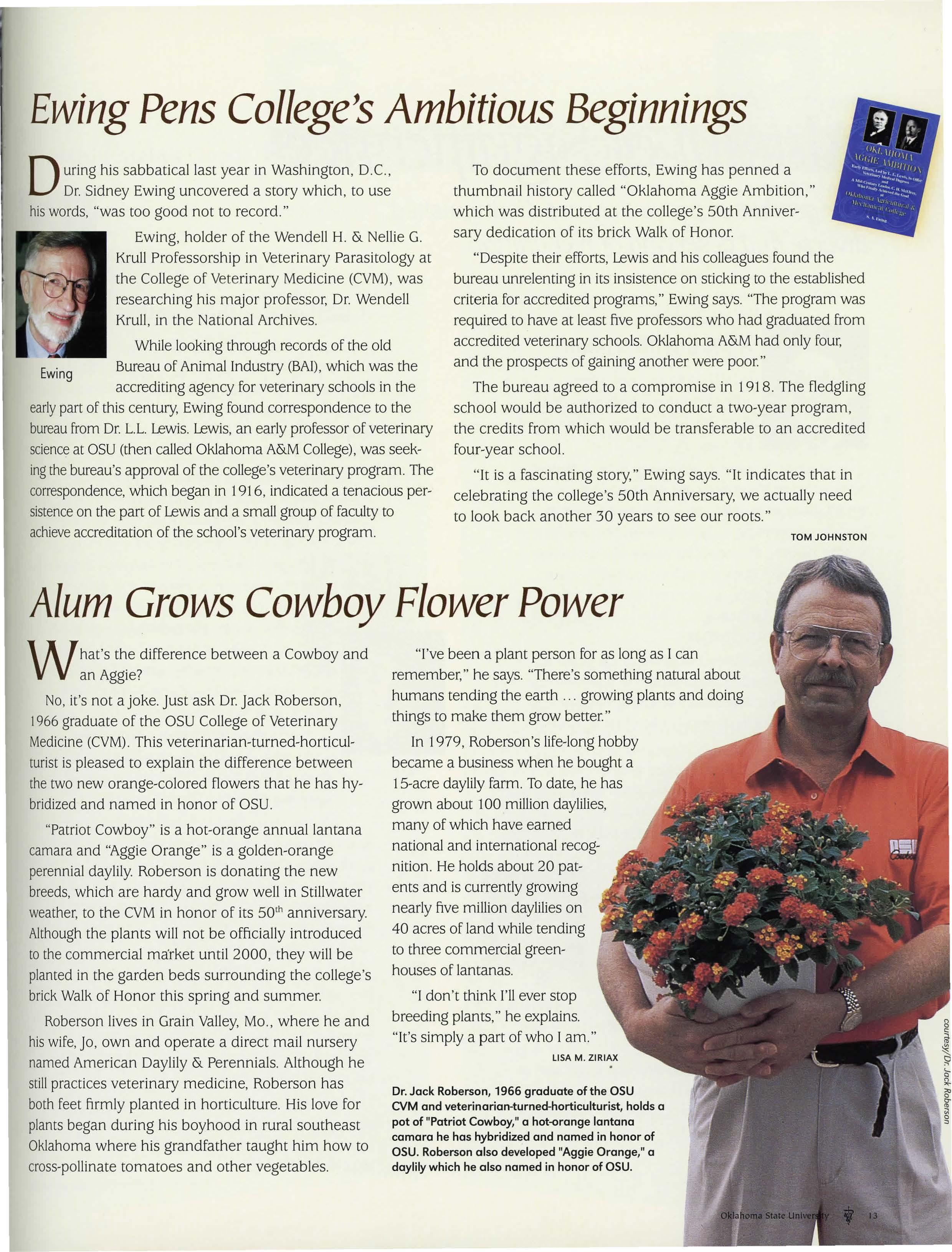
To document these efforts, Ewing has penned a thumbnail history called "Oklahoma Aggie Ambition," which was distributed at the college's 50th Anniversary dedication of its brick Walk of Honor.
"Despite their efforts, Lewis and his colleagues found the bureau unrelenting in its insistence on sticking to the established criteria for accredited programs," Ewing says. "The program was required to have at least five professors who had graduated from accredited veterinary schools. Oklahoma A&M had only four, and the prospects of gaining another were poor."
The bureau agreed to a compromise in 1918. The fledgling school would be authorized to conduct a two-year program, the credits from which would be transferable to an accredited four-year school.
"It is a fascinating story," Ewing says. "It indicates that in celebrating the college's 50th Anniversary, we actually need to look back another 30 years to see our roots."
TOM JOHNSTON
AlumGrowsCowboyFlowerPower
What's the difference between a Cowboy and an Aggie?
No, it's not a joke. Just ask Dr. Jack Roberson, 1966graduate of the OSU College of Veterinary Medicine (CVM). This veterinarian-turned-horticulturist is pleased to explain the difference between the two new orange-colored flowers that he has hybridized and named in honor of OSU.
"Patriot Cowboy" is a hot-orange annual lantana camaraand "Aggie Orange" is a golden-orange perennial daylily. Roberson is donating the new breeds,which are hardy and grow well in Stillwater weather,to the CVM in honor of its 50 th anniversary. Although the plants will not be officially introduced to the commercial market until 2000, they will be planted in the garden beds surrounding the college's brick Walk of Honor this spring and summer. Roberson lives in Grain Valley, Mo., where he and his wife, Jo, own and operate a direct mail nursery named American Daylily & Perennials. Although he still practices veterinary medicine, Roberson has both feet firmly planted in horticulture. His love for plants began during his boyhood in rural southeast Oklahoma where his grandfather taught him how to cross-pollinate tomatoes and other vegetables.
"I've been a plant person for as long as I can remember," he says. "There's something natural about humans tending the earth growing plants and doing things to make them grow better."
In 1979, Roberson's life-long hobby became a business when he bought a 15-acre daylily farm. To date, he has grown about 100 million daylilies, many of which have earned national and international recognition. He holds about 20 patents and is currently growing nearly five million daylilies on 40 acres of land while tending to three commercial greenhouses of lantanas.
"I don't think I'll ever stop breeding plants," he explains. "It's simply a part of who I am."
LISA M. ZIRIAX
Dr. Jack Rabersan, 1966 graduate of the OSU CVM and veterinarian-turned-horticulturist, holds a pot of "Patriot Cowboy," a hot-orange lantana camara he has hybridized and named in honor of OSU. Roberson also developed "Aggie Orange," a daylily which he also named in honor of OSU.
Ourgraduatesprove they are distinguished, diverseand deservingof recognition.
A Man with Vision
Dr. Ken Abrams "saw" things quite differently after earning his DVM from the OSU College of Veterinary Medicine in 1985.
Now a board-certified veterinary ophthalmologist living in North Kingstown, R.I., with his wife, Kathy, the 43-year-old realized during his senior year that he didn't have to be a general veterinary practitioner after hearing the inspiring words of a veterinary ophthalmologist during a lecture in Wichita, Kan. Later that same year, an externship with another veterinary ophthalmologist in Alaska helped seal his fate as a veterinary specialist.
"I decided that instead of becoming a general practitioner, I'd rather concentrate on one area and learn something about that because it's impossible to have expertise in all areas in veterinary medicine," he says.
Today, Abrams is one of about 175 veterinary ophthalmologists throughout the world and the only one practicing in Rhode Island. He stays busy with about 30 daily appointments, mostly cats, dogs and horses, all of which are referred by general practitioners. Patients often come from Massachusetts, Connecticut and New Hampshire, and sometimes from such distant locations as St. Thomas.
"Animals have the same eye problems as humans," he says. "Although a patient can't talk to us, we can evaluate the eye by looking at it carefully during the exam."
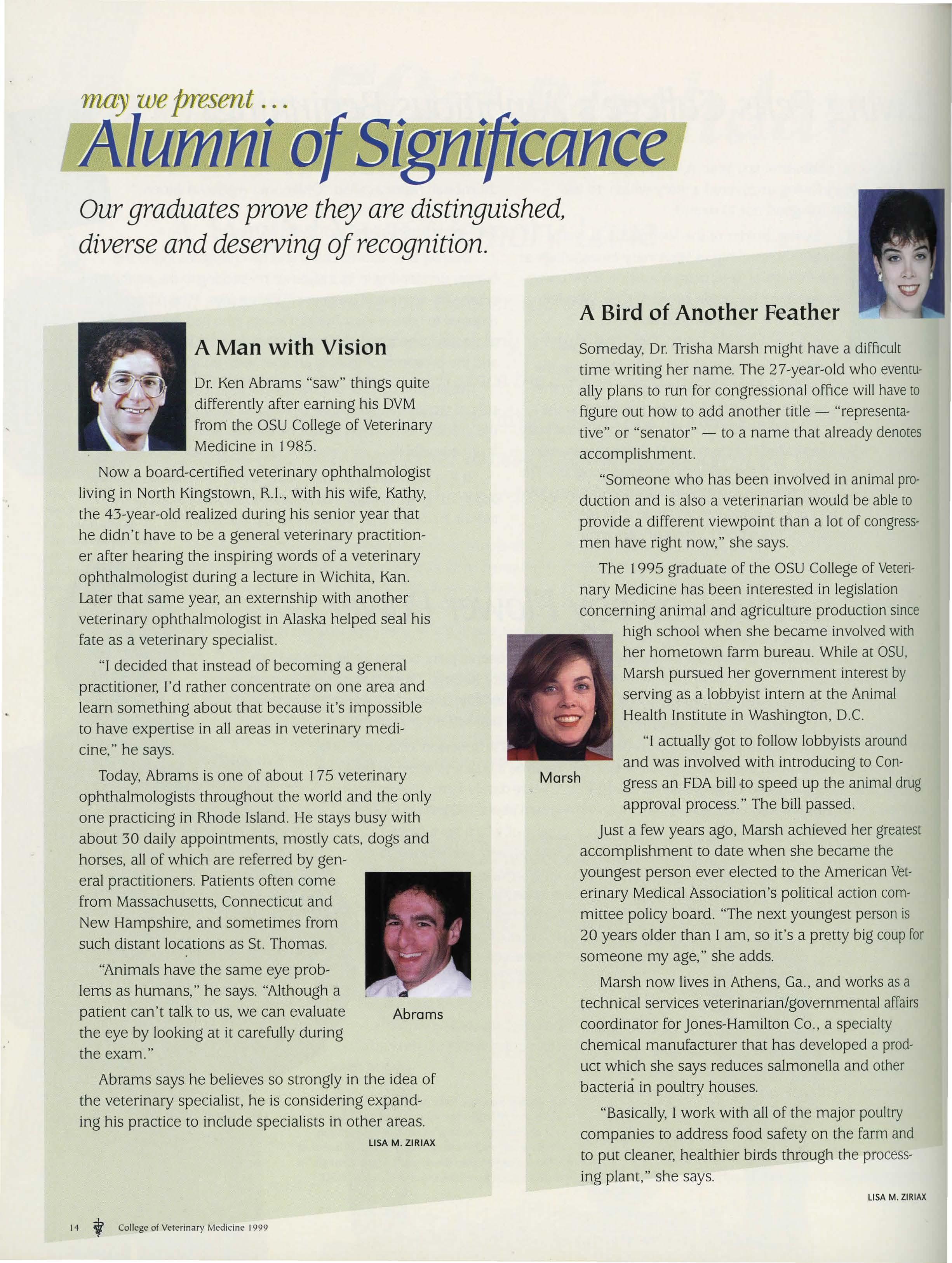
Abrams
Abrams says he believes so strongly in the idea of the veterinary specialist, he is considering expanding his practice to include specialists in other areas.
LISA M. ZIRIAX
A Bird of Another Feather
Someday, Dr. Trisha Marsh might have a difficult time writing her name. The 27-year-old who eventually plans to run for congressional office will haveto figure out how to add another title - "representative" or "senator" - to a name that already denotes accomplishment.
"Someone who has been involved in animal production and is also a veterinarian would be able to provide a different viewpoint than a lot of congressmen have right now," she says.
The 1995 graduate of the OSU College of Veterinary Medicine has been interested in legislation concerning animal and agriculture production since high school when she became involved with her hometown farm bureau. While at OSU, Marsh pursued her government interest by serving as a lobbyist intern at the Animal Health Institute in Washington, D.C.
"I actually got to follow lobbyists around and was involved with introducing to ConMarsh gress an FDA bill -to speed up the animal drug approval process." The bill passed.
Just a few years ago, Marsh achieved her greatest accomplishment to date when she became the youngest person ever elected to the American Veterinary Medical Association's political action committee policy board. "The next youngest person is 20 years older than I am, so it's a pretty big coup for someone my age," she adds.
Marsh now lives in Athens, Ga., and works as a technical services veterinarian/governmental affairs coordinator for Jones-Hamilton Co., a specialty chemical manufacturer that has developed a product which she says reduces salmonella and other bacteria in poultry houses.
"Basically, I work with all of the major poultry companies to address food safety on the farm and to put cleaner, healthier birds through the processing plant," she says.
LISA M. ZIRIAX
Farm Kid Makes Good
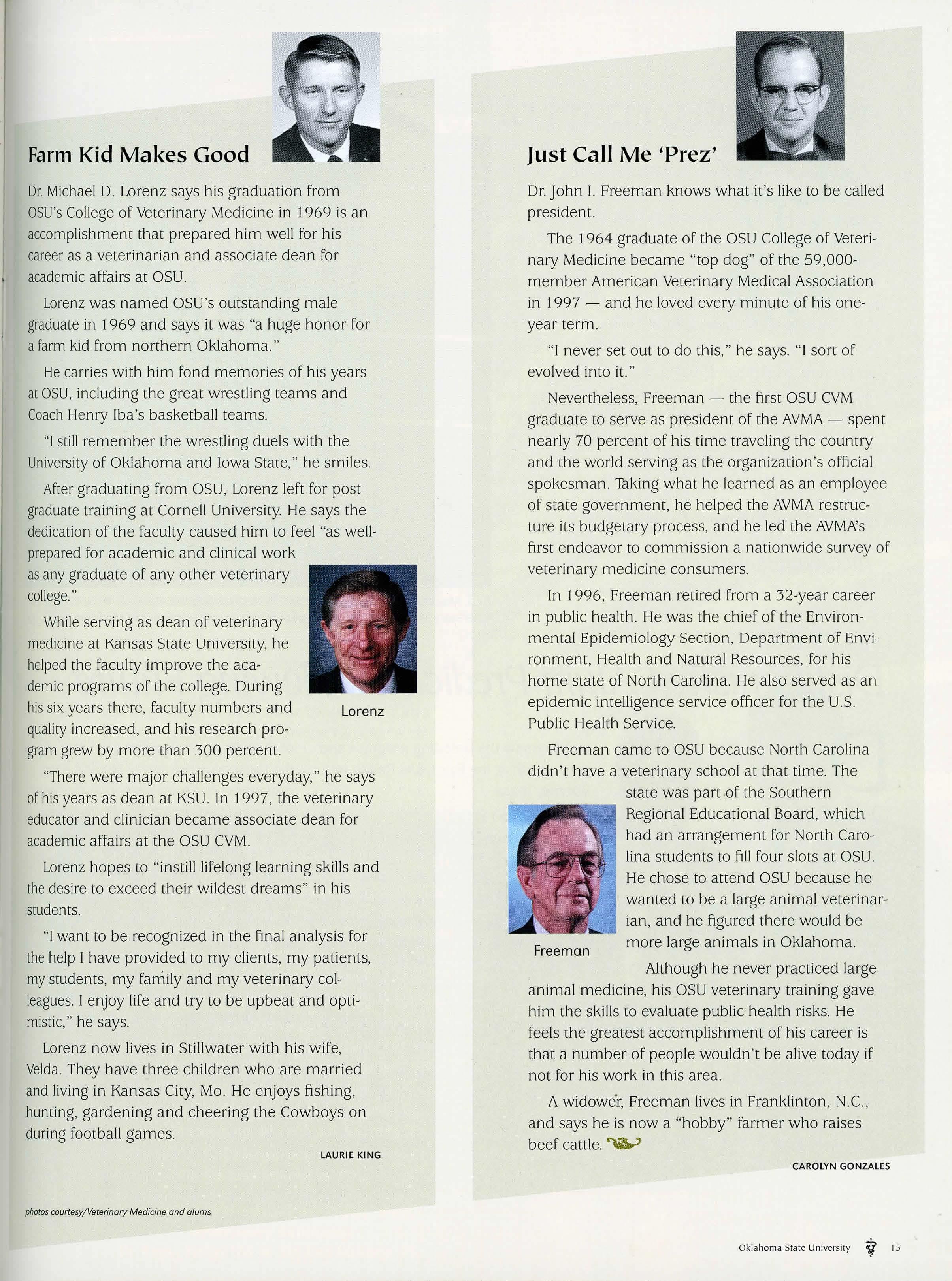
Dr.Michael D. Lorenz says his graduation from OSU'sCollege of Veterinary Medicine in 1969 is an accomplishment that prepared him well for his careeras a veterinarian and associate dean for academicaffairs at OSU.
Lorenzwas named OSU's outstanding male graduatein 1969 and says it was "a huge honor for a farm kid from northern Oklahoma."
He carries with him fond memories of his years at OSU,including the great wrestling teams and CoachHenry Iba's basketball teams.
"I still remember the wrestling duels with the Universityof Oklahoma and Iowa State," he smiles.
After graduating from OSU, Lorenz left for post graduatetraining at Cornell University. He says the dedicationof the faculty caused him to feel "as wellpreparedfor academic and clinical work asany graduate of any other veterinary college."
While serving as dean of veterinary medicineat Kansas State University, he helpedthe faculty improve the academic programs of the college. During hissix years there, faculty numbers and quality increased, and his research programgrew by more than 300 percent.
"There were major challenges everyday," he says of his years as dean at KSU. In 1997, the veterinary educatorand clinician became associate dean for academicaffairs at the OSU CVM.
Lorenz hopes to "instill lifelong learning skills and the desire to exceed their wildest dreams" in his students.
"I want to be recognized in the final analysis for the help I have provided to my clients, my patients, my students, my family and my veterinary colleagues. I enjoy life and try to be upbeat and optimistic," he says.
Lorenz now lives in Stillwater with his wife, Velda.They have three children who are married and living in Kansas City, Mo. He enjoys fishing, hunting, gardening and cheering the Cowboys on during football games.
LAURIE KING
Just Call Me 'Prez'
Dr. John I. Freeman knows what it's like to be called president.
The 1964 graduate of the OSU College of Veterinary Medicine became "top dog" of the 59,000member American Veterinary Medical Association in 1997 - and he loved every minute of his oneyear term.
"I never set out to do this," he says. "I sort of evolved into it."
Nevertheless, Freeman - the first OSU CVM graduate to serve as president of the AVMA - spent nearly 70 percent of his time traveling the country and the world serving as the organization's official spokesman. Taking what he learned as an employee of state government, he helped the AVMA restructure its budgetary process, and he led the AVMA's first endeavor to commission a nationwide survey of veterinary medicine consumers.
In I 996, Freeman retired from a 32-year career in public health. He was the chief of the Environmental Epidemiology Section, Department of Environment, Health and Natural Resources, for his home state of North Carolina. He also served as an epidemic intelligence service officer for the U.S. Public Health Service.
Freeman came to OSU because North Carolina didn't have a veterinary school at that time. The
state was part .of the Southern Regional Educational Board, which had an arrangement for North Carolina students to fill four slots at OSU. He chose to attend OSU because he wanted to be a large animal veterinarian, and he figured there would be more large animals in Oklahoma.
Although he never practiced large animal medicine, his OSU veterinary training gave him the skills to evaluate public health risks. He feels the greatest accomplishment of his career is that a number of people wouldn't be alive today if not for his work in this area.
A widower, Freeman lives in Franklinton, N.C., and says he is now a "hobby" farmer who raises beef cattle.
Lorenz
Freeman
CAROLYN GONZALES
"Todaythereis a greaterappreciation of how (veterinarians)can make a differencein people's lives.Thefuture of veterinary medicineis very bright."
Bright Outlook
DistinguishedAlum PredictsA GlowingFuture
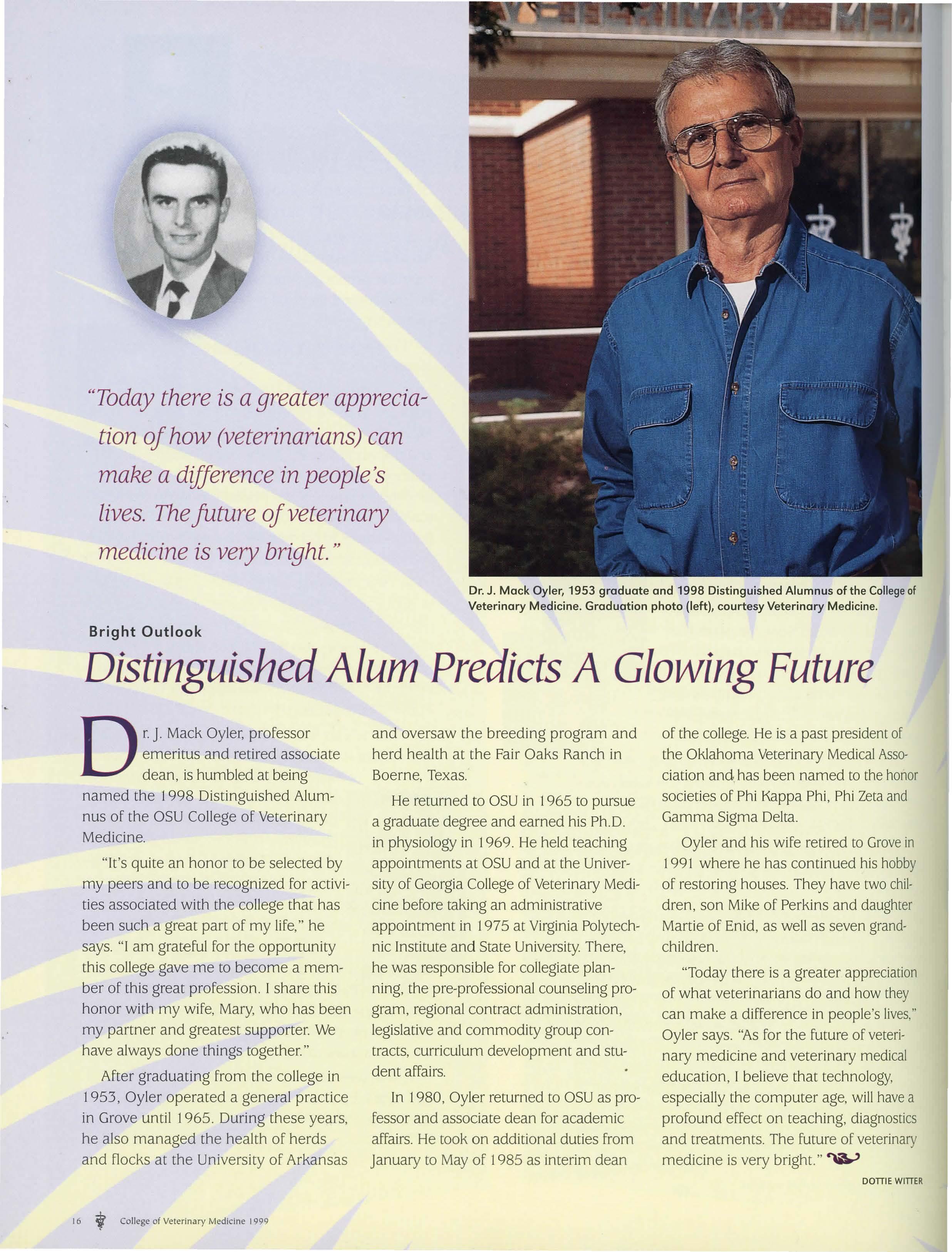
Dr. J. Mack Oyler, professor emeritus and retired associate dean, is humbled at being named the 1998 Distinguished Alumnus of the OSU College of Veterinary Medicine.
"It's quite an honor to be selected by my peers and to be recognized for activities associated with the college that has been such a great part of my life," he says. "I am grateful for the opportunity this college gave me to become a member of this great profession. I share this honor with my wife, Mary, who has been my partner and greatest supporter. We have always done things together."
After graduating from the college in 1953, Oyler operated a general practice in Grove until 1965. During these years, he also managed the health of herds and flocks at the University of Arkansas
and oversaw the breeding program and herd health at the Fair Oaks Ranch in Boerne, Texas.
He returned to OSU in 1965 to pursue a graduate degree and earned his Ph.D. in physiology in 1969. He held teaching appointments at OSU and at the University of Georgia College of Veterinary Medicine before taking an administrative appointment in 1975 at Virginia Polytechnic Institute and State University. There, he was responsible for collegiate planning, the pre-professional counseling program, regional contract administration, legislative and commodity group contracts, curriculum development and student affairs.
In 1980, Oyler returned to OSU as professor and associate dean for academic affairs. He took on additional duties from January to May of 1985 as interim dean
of the college. He is a past president of the Oklahoma Veterinary Medical Association and-has been named to the honor societies of Phi Kappa Phi, Phi Zetaand Gamma Sigma Delta.
Oyler and his wife retired to Grovein I 991 where he has continued his hobby of restoring houses. They have two children, son Mike of Perkins and daughter Martie of Enid, as well as seven grandchildren.
"Today there is a greater appreciation of what veterinarians do and how they can make a difference in people's lives," Oyler says. "As for the future of veterinary medicine and veterinary medical education, I believe that technology, especially the computer age, will havea profound effect on teaching, diagnostics and treatments. The future of veterinary medicine is very bright."
Dr. J. Mack Oyler, 1953 graduate and 1998 Distinguished Alumnus of the Collegeof Veterinary Medicine. Graduation photo (left), courtesy Veterinary Medicine.
GraduatesFindNew Waysto PracticeProfession
From the Office of the Governor to the Oklahoma Department of Agriculture (ODOA), knowledgeable graduates of the College of Veterinary Medicine are uniting government and industry to address public concerns.
Dr. Burke Healey ('84) has served as state veterinarian and directorof the Animal Industry Services Division within ODOAsince l 995.
"Our office's primary responsibility is to enforce animal healthregulations and statutes that historically have to do with zoonotic diseases," Healey says. "We serve as liaison for legislators,government offices, the commissioner of agricultureand industry groups like cattlemen's associations to makesure rules and regulations meet the goals they have as well as those of the general public."
Activities of Healey·s office include maintaining the state's dairy and meat inspections that follow products from farm to supermarket shelf. ODOA regulations exceed those of the USDA,but management of the state's animal populations is an ever-crucial process.
"We are constantly under a threat of exposure to things from countriesthat were once too distant to ever pose a risk to our consumers,"Healey says. "A decade ago, no one would have conceivedof a 5,000-head heard of Australian cattle attempting toenter at the Mexican border, although that happened recently.
"While protecting ourselves from other countries, we also negotiatewith trade representatives to ensure Oklahoma can export safe and wholesome products."
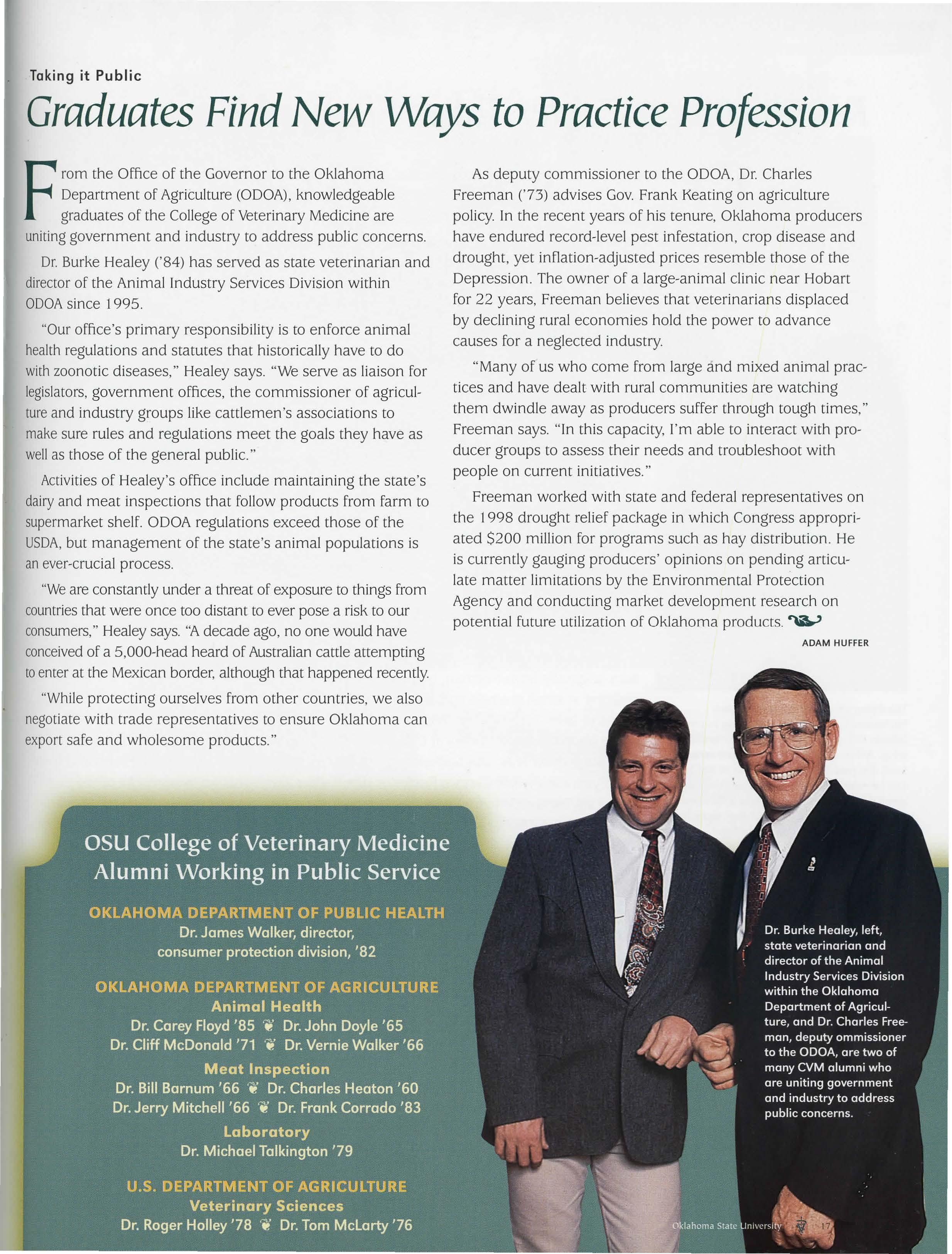
As deputy commissioner to the ODOA, Dr. Charles Freeman ('73) advises Gov. Frank Keating on agriculture policy. In the recent years of his tenure, Oklahoma producers have endured record-level pest infestation, crop disease and drought, yet inflation-adjusted prices resemble those of the Depression. The owner of a large-animal clinic near Hobart for 22 years, Freeman believes that veterinarians displaced by declining rural economies hold the power to advance causes for a neglected industry.
"Many of us who come from large and mixed animal practices and have dealt with rural communities are watching them dwindle away as producers suffer through tough times," Freeman says. "In this capacity, I'm able to interact with producer groups to assess their needs and troubleshoot with people on current initiatives."
Freeman worked with state and federal representatives on the I 998 drought relief package in which Congress appropriated $200 million for programs such as hay distribution. He is currently gauging producers' opinions on pending articulate matter limitations by the Environmental Protection Agency and conducting market development research on potential future utilization of Oklahoma products.
ADAM HUFFER
Tradition of Student Excellence
RehabilitationCenterTakesFlight
Dr. John Hoover initiated a wildlife medicine and raptor rehabilitation program at OSU's College of Veterinary Medicine in 1983.
Since then, Hoover, also a wildlife biologist and wildlife veterinarian, has treated many sick and injured wildlife at OSU and has designed a raptor rehabilitation flight cage for the program.
The college acquired land for the raptor rehabilitation facility in I 992, but there never seemed to be enough dollars or committed support to get a viable plan rolling.
That is, until Debra Nicholson Keller came along.
"Deb had a plan!" says Dr. Ken Bartels, Mccasland Professor of Laser Surgery, who holds the Cohn Chair for Animal Care. "She had volunteered in raptor rehabilitation programs in Colorado and here in Oklahoma, and had a vision for making it a reality here."
support, and many community groups and businesses became partners in the project.
Keller says the key to her success was bringing the effort down to a smaller scale. "I decided to start out with the goal of attaining one flight cage, so we might still have money left over to get the program going," she says.
But one flight cage alone is still quite an endeavor. The National Wildlife Rehabilitation Association requires flight cages to be at least 30 feet long by 10 feet wide by 15 feet tall in order to accommodate birds up to the size of a red-tailed hawk or a great horned owl. Larger cages are required for the care of eagles.
OSU veterinary teaching hospital staff member Robin Mattox constructed the flight cage in a "frame-out" style, which means there is no interiorfacing framework other than smooth plywood, which minimizes injury to the recuperating birds. The exterior consists of cedar panels.
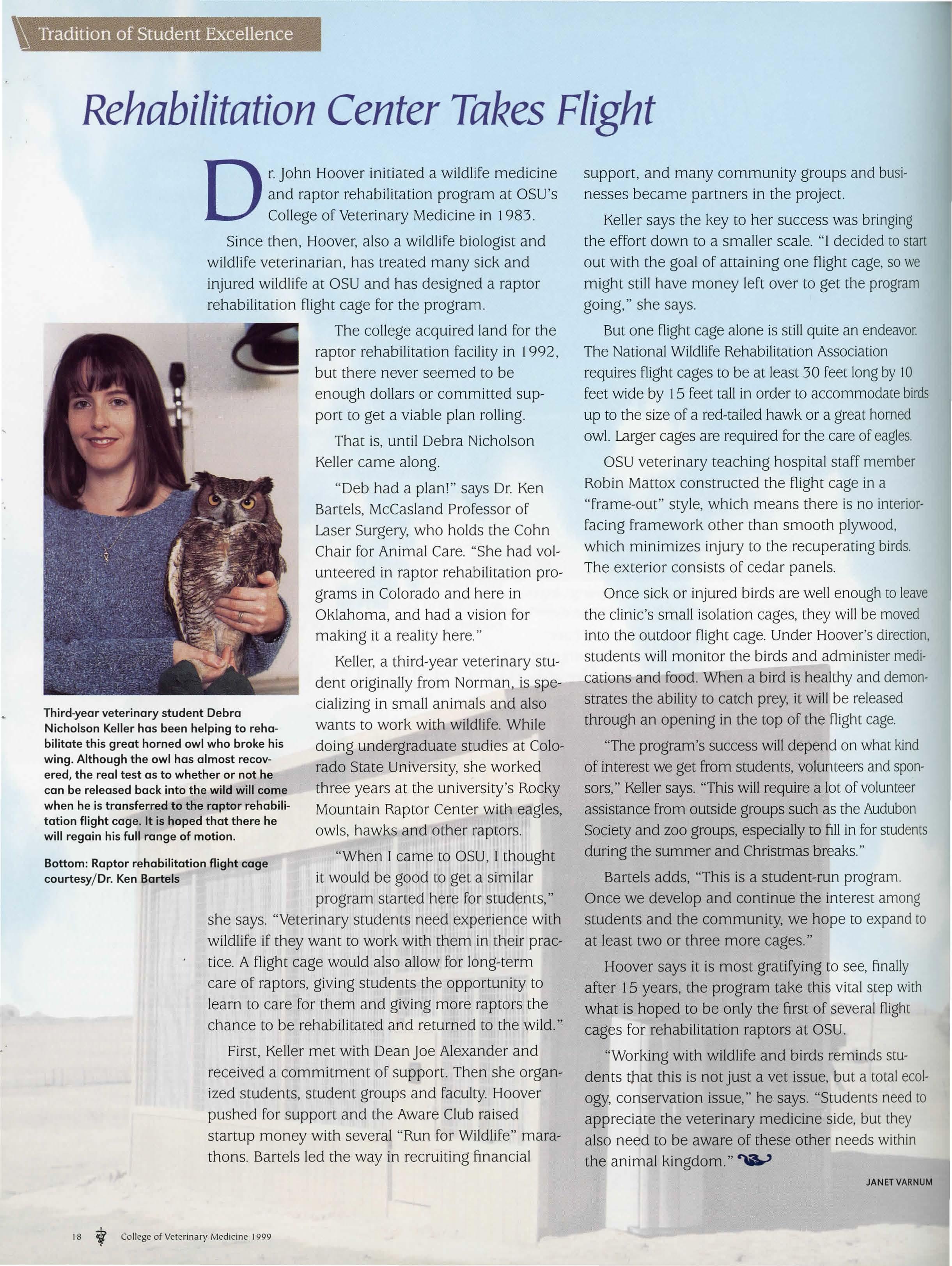
Third-year veterinary student Debra Nicholson Keller has been helping to rehabilitate this great horned owl who broke his wing. Although the owl has almost recovered, the real test as to whether or not he can be released back into the wild will come when he is transferred to the raptor rehabilitation flight cage. It is hoped that there he will regain his full range of motion.
Raptor rehabilitation flight cage
Keller, a third-year veterinary student originally from Norman, is specializing in small animals and also wants to work with wildlife. While doing undergraduate studies at Colorado State University, she worked three years at the university's Rocky Mountain Raptor Center with eagles, owls, hawks and other raptors.
"When I came to OSU, I thought it would be good to get a similar program started here for students," she says. "Veterinary students need experience with wildlife if they want to work with them in their practice. A flight cage would also allow for long-term care of raptors, giving students the opportunity to learn to care for them and giving more raptors the chance to be rehabilitated and returned to the wild."
First, Keller met with Dean Joe Alexander and received a commitment of support. Then she organized students, student groups and faculty. Hoover pushed for support and the Aware Club raised startup money with several "Run for Wildlife" marathons. Bartels led the way in recruiting financial
Once sick or injured birds are well enough to leave the clinic's small isolation cages, they will be moved into the outdoor flight cage. Under Hoover's direction, students will monitor the birds and administer medications and food. When a bird is healthy and demonstrates the ability to catch prey, it will be released through an opening in the top of the flight cage.
"The program's successwill depend on what kind of interest we get from students, volunteers and sponsors," Keller says. "This will require a lot of volunteer assistance from outside groups such as the Audubon Society and zoo groups, especially to fill in for students during the summer and Christmas breaks."
Bartels adds, "This is a student-run program. Once we develop and continue the interest among students and the community, we hope to expand to at least two or three more cages."
Hoover says it is most gratifying to see, finally after 15 years, the program take this vital step with what is hoped to be only the first of several flight cages for rehabilitation raptors at OSU.
"Working with wildlife and birds reminds students t:J,atthis is not just a vet issue, but a total ecology, conservation issue," he says. "Students need to appreciate the veterinary medicine side, but they also need to be aware of these other needs within the animal kingdom."~
Bottom:
courtesy/Dr. Ken Bartels
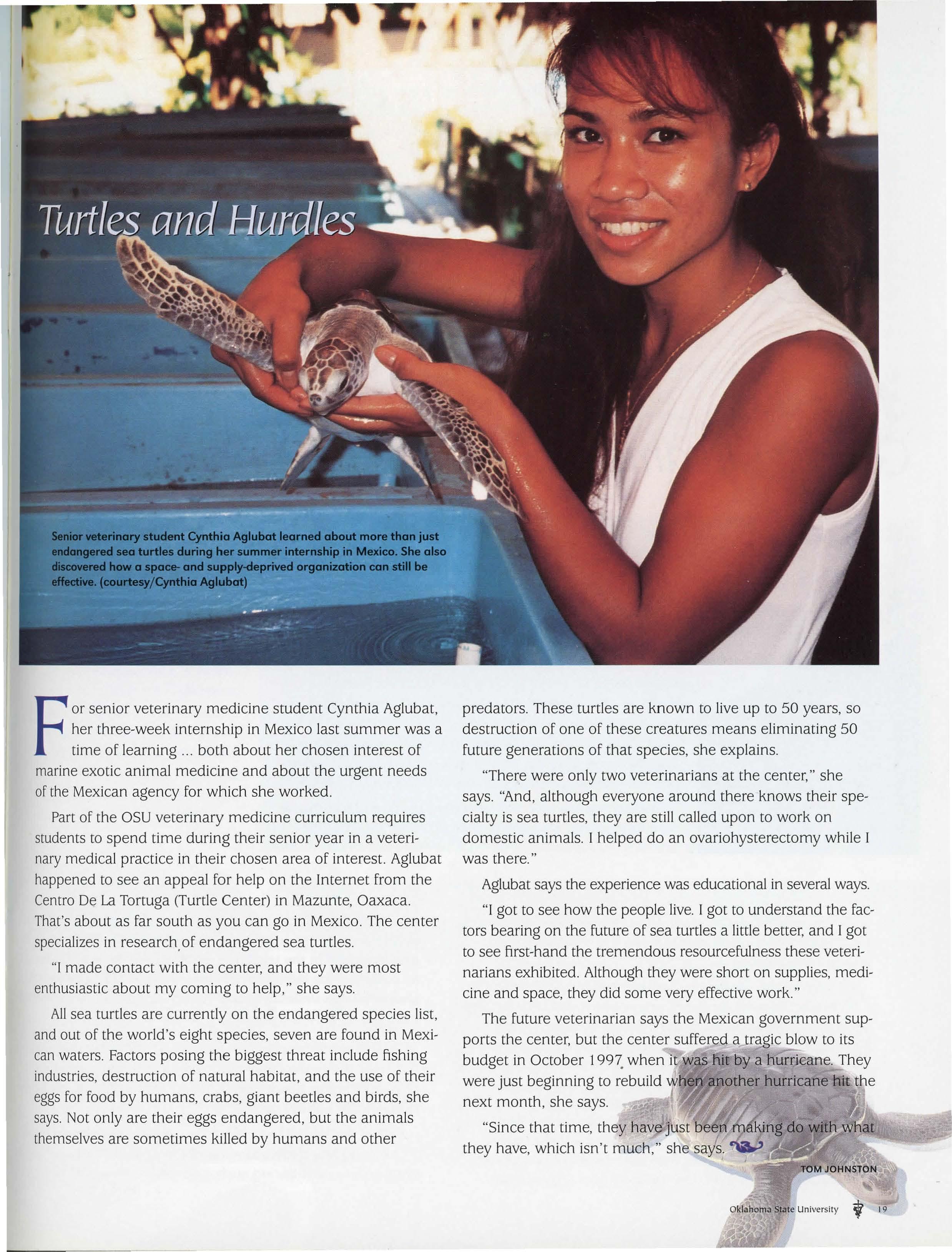
For senior veterinary medicine student Cynthia Aglubat, her three-week internship in Mexico last summer was a time of learning both about her chosen interest of marine exotic animal medicine and about the urgent needs of the Mexican agency for which she worked.
Part of the OSU veterinary medicine curriculum requires studentsto spend time during their senior year in a veterinary medical practice in their chosen area of interest. Aglubat happened to see an appeal for help on the Internet from the Centro De La Tortuga (Turtle Center) in Mazunte, Oaxaca. That's about as far south as you can go in Mexico. The center specializesin research.of endangered sea turtles.
"l made contact with the center, and they were most enthusiastic about my coming to help," she says.
All sea turtles are currently on the endangered species list, and out of the world's eight species, seven are found in Mexican waters. Factors posing the biggest threat include fishing industries, destruction of natural habitat, and the use of their eggsfor food by humans, crabs, giant beetles and birds, she says.Not only are their eggs endangered, but the animals themselves are sometimes killed by humans and other
predators. These turtles are known to live up to 50 years, so destruction of one of these creatures means eliminating 50 future generations of that species, she explains.
"There were only two veterinarians at the center," she says. "And, although everyone around there knows their specialty is sea turtles, they are still called upon to work on domestic animals. I helped do an ovariohysterectomy while I was there."
Aglubat says the experience was educational in severalways.
"I got to see how the people live. I got to understand the factors bearing on the future of sea turtles a little better, and I got to see first-hand the tremendous resourcefulness these veterinarians exhibited. Although they were short on supplies, medicine and space, they did some very effective work."
The future veterinarian says the Mexican government supports the center, but the center suffered a~tr~ic blow to its budget in October 1997_when ivw~ fiit by a hurrieane. They were just beginning to rebuild wh j\Other hurricane hit the next month, she says. .,.
"Since that time, they have just been king d they have, which isn't much," she sa s.
Okfahoma State University
Pet Project
o give to e College of Veterinary Medicine I a compelling cause. But how does one go about it? The next two pages contain a course of study that will enlighten and excite you about making a difference in the lives of people. You will better understand the who, what, when, where and why of making a gift to the college.
Gifts to OSU are, first of all, gifts.
A gift or bequest, while specific to the college, is made through the OSU Foundation. The administration
of the gift is accomplished through a collaboration of the donor, the college, and the foundation board and staff. This ensures that each gift is administered in strict compliance with the wishes of the gift-giver. The foundation can be a good resource to aid a donor in choosing the right gift.
The most important element of every gift is the donor's desire to make OSU even stronger tomorrow than it is today. Beyond this, every gift can be a tax-saving tool. Because it is tax-deductible, each gift costs less
Giving Dreamsis SimplySimple
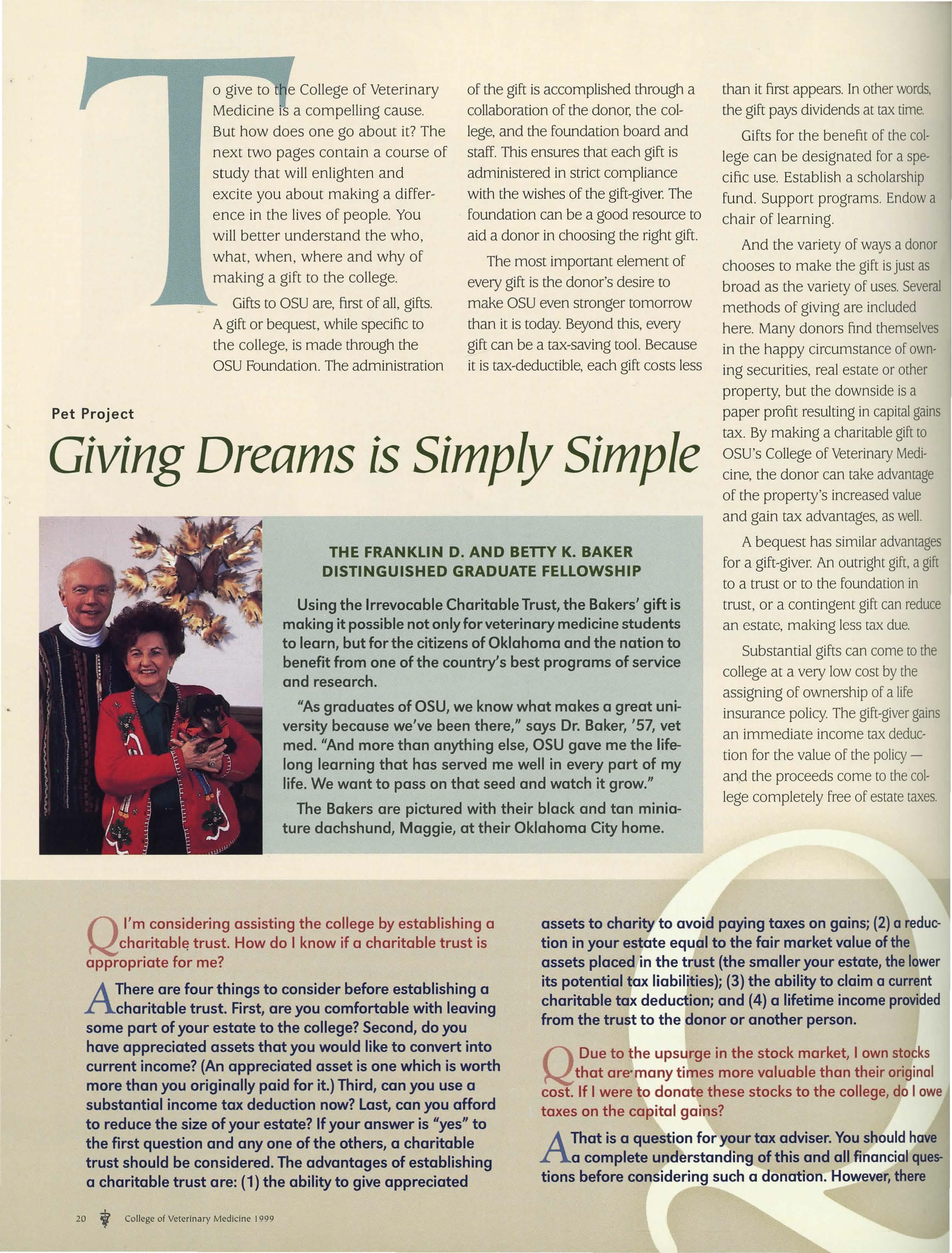
THE FRANKLIN D. AND BETTY K. BAKER DISTINGUISHED GRADUATE FELLOWSHIP
Using the Irrevocable Charitable Trust, the Bakers' gift is making it possible not only for veterinary medicine students to learn, but for the citizens of Oklahoma and the nation to benefit from one of the country's best programs of service and research.
"As graduates of OSU, we know what makes a great university because we've been there," says Dr. Baker, '57, vet med. "And more than anything else, OSU gave me the lifelong learning that has served me well in every part of my life. We want to pass on that seed and watch it grow."
The Bakers are pictured with their black and tan miniature dachshund, Maggie, at their Oklahoma City home.
QI'm considering assisting the college by establishing a charitabl~ trust. How do I know if a charitable trust is appropriate for me?
AThere are four things to consider before establishing a charitable trust. First, are you comfortable with leaving some part of your estate to the college? Second, do you
have appreciated assets that you would like to convert into current income? (An appreciated asset is one which is worth more than you originally paid for it.) Third, can you use a substantial income tax deduction now? Last, can you afford to reduce the size of your estate? If your answer is "yes" to the first question and any one of the others, a charitable trust should be considered. The advantages of establishing a charitable trust are: (1) the ability to give appreciated
than it first appears. In other words. the gift pays dividends at tax time. Gifts for the benefit of the college can be designated for a specific use. Establish a scholarship fund. Support programs. Endow a chair of learning.
And the variety of ways a donor chooses to make the gift is just as broad as the variety of uses.Several methods of giving are included here. Many donors fmd themselves in the happy circumstance of owning securities, real estate or other property, but the downside is a paper profit resulting in capitalgains tax. By making a charitable gift to OSU's College of Veterinary Medicine, the donor can take advantage of the property's increased value and gain tax advantages, as well.
A bequest has similar advantages for a gift-giver. An outright gift, a gift to a trust or to the foundation in trust, or a contingent gift can reduce an estate, making less tax due.
Substantial gifts can come to the college at a very low cost by the assigning of ownership of a life insurance policy. The gift-giver gains an immediate income tax deduction for the value of the policyand the proceeds come to the college completely free of estatetaxes.
assets to charity· to avoid paying taxes on gains; (2) a reduction in your estate equal to the fair market value of the assets placed in the trust (the smaller your estate, the lower its potential tax liabilities); (3) the ability to claim a current charitable tax deduction; and (4) a lifetime income provided from the trust to the donor or another person.
QDue to the upsurge in the stock market, I own stocks that are·many times more valuable than their original cost. If I were to donate these stocks to the college, do I owe taxes on the capital gains?
AThat is a question for your tax adviser. You should have a complete understanding of this and all financial questions before considering such a donation. However, there
It can be quite beneficial, when planning a charitable bequest, to
make that bequest from tax-deferred assets,like IRAs, savings bonds and commercial annuities. This process allows the assets to pass to a charitable cause, which is exempt from the income taxes that would have had to be paid by the individual beneficiary. Methods of making gifts to the college are available through a variety of
trusts and annuities.
For more information, please write the Office of Planned Giving, OSU Foundation, P.O.Box 1749, Stillwater, OK 74076-1749. Or, call (405) 7445244 or (800) 622-4678 ._,..,
BARBARA SWIGGART
THE COHN FAMILY SHELTER FOR SMALL ANIMALS
This facility/program is OSU's answer for people wanting to provide for their furry companions after their own lives come to an end.
The 6,600-square-foot facility is the result of the concerns of the late Leah Cohn Arendt, who wanted her 150 dogs and 13 cats to have lifelong care after she died. Her family established the Mercy Work Foundation to honor her wish and to help build and equip the new facility. In addition, the foundation established an endowed faculty chair for the college.
"The facility will be wonderful for everyone involved," Dean Joe Alexander says. "Pet owners can rest easy that their pets will be taken care of. The animals will receive loving care from faculty and students, and faculty and students will have the opportunity to learn more about animal behavior and the problems animals develop as they age."
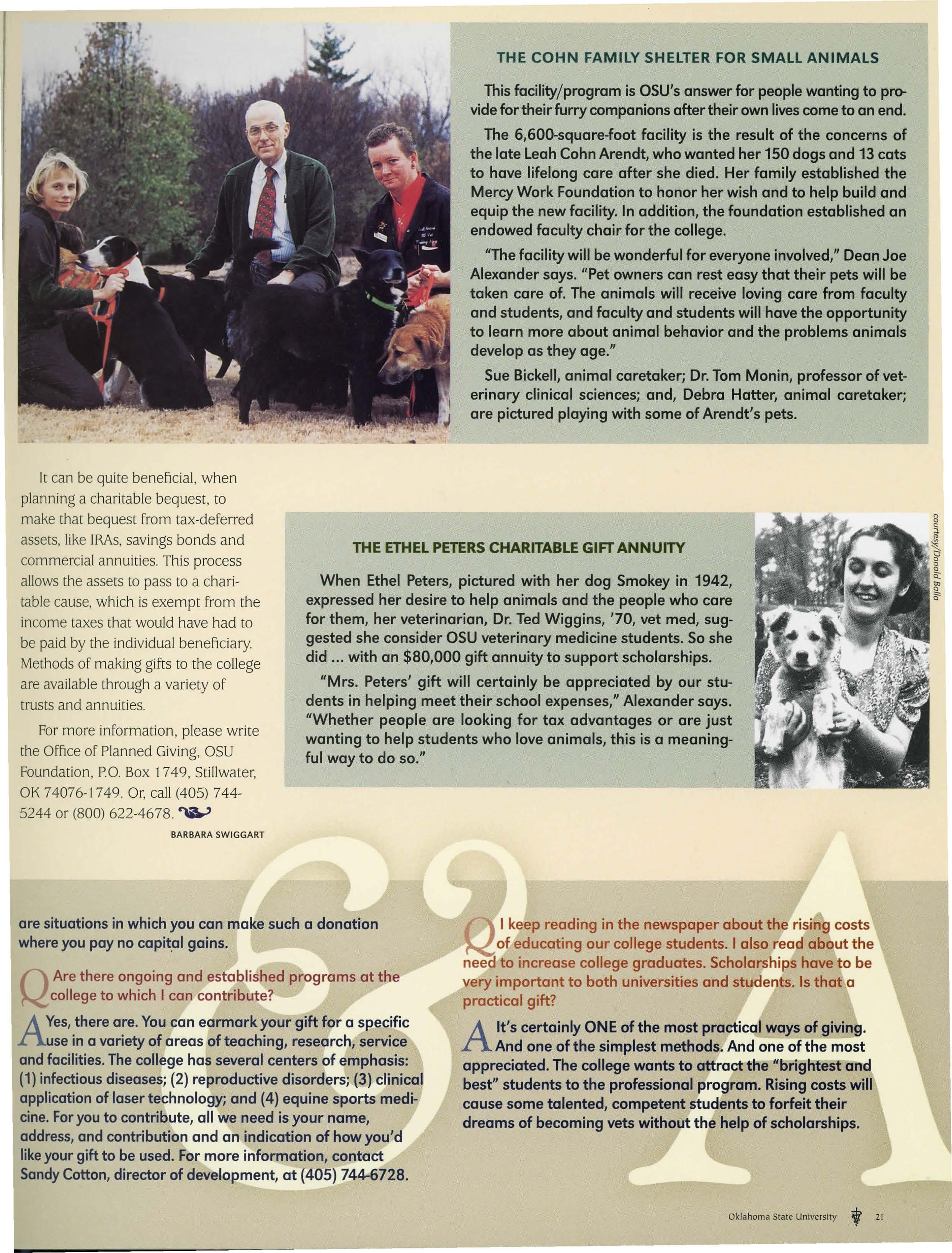
Sue Bickell, animal caretaker; Dr. Tom Monin, professor of veterinary clinical sciences; and, Debra Hatter, animal caretaker; are pictured playing with some of Arendt's pets.
THE ETHEL PETERS CHARITABLE GIFT ANNUITY
When Ethel Peters, pictured with her dog Smokey in 1942, expressed her desire to help animals and the people who care for them, her veterinarian, Dr. Ted Wiggins, '70, vet med, suggested she consider OSU veterinary medicine students. So she did with an $80,000 gift annuity to support scholarships.
"Mrs. Peters' gift will certainly be appreciated by our students in helping meet their school expenses," Alexander says. "Whether people are looking for tax advantages or are just wanting to help students who love animals, this is a meaningful way to do so."
are situations in which you can make such a donation where you pay no capit_algains.
Are there ongoing and established programs at the college to which I can contribute?
AYes,there are. You can earmark your gift for a specific use in a variety of areas of teaching, research, service and facilities. The college has several centers of emphasis: (1) infectious diseases; (2) reproductive disorders; (3) clinical application of laser technology; and (4) equine sports medicine. For you to contribute, all we need is your name, address, and contribution and an indication of how you'd like your gift to be used. For more information, contact Sandy Cotton, director of development, at (405) 744-6728.
I keep reading in the newspaper about the rising costs of educating our college students. I also read about the neecl to increase college graduates. Scholarships have to be yery important to both universities and students. Is that a practical gift?
AIt's certainly ONE of the most practical ways of giving. And one of the simplest methods. And one of the most appreciated. The college wants to attract the "brightest and best" students to the professional program. Rising costs will cause some talented, competent students to forfeit their dreams of becoming vets without the help of scholarships.
GiftSecures Felines'NineLives
"When I play with my cat, who knows if I am not a pastime to her more than she is to me?" -Montaigne
Introducing Karen Holcomb, cat lover extraordinaire. Karen, like her cats, knows what she wants and plans to make it happen.
Upon reading about OSU's Cohn Family Shelter for Small Animals, which provides lifelong care for family pets, Karen began to think about her cats' future if she were no longer able to care for them. The OSU program solved her concern. Through Karen's use of a planned gift, Tashaand Cricket are enrolled in the program, and Karen knows they will always receive the loving care to which they are accustomed.
"Their care was a big worry for me," Karen explains. "Tasha and Cricket are my children - now their future is secure. I love animals - helping them makes me the happiest person in the world."~
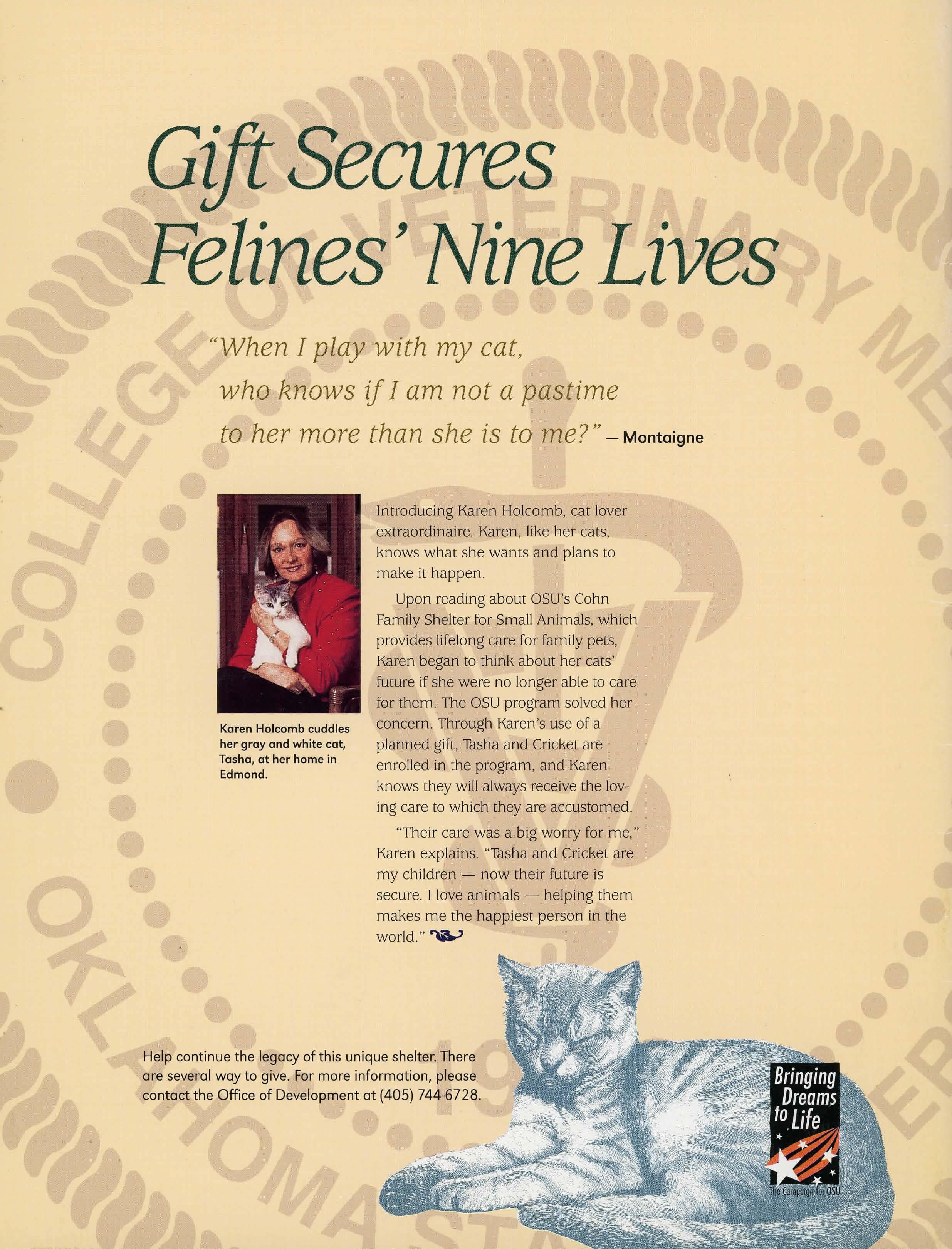
Help continue the legacy of this unique shelter. There are several way to give. For more information, please contact the Office of Development at (405) 744-6728.
Karen Holcomb cuddles her gray and white cat, Tasha, at her home in Edmond.