Remembering What' Important
Half a centuny has come and gone since the OSU College of Veterinary Medicine first opened its doors in the spring of 1948.
And while it is drue that the passing of time and major technological advances have brought sweeping changes in the physical appearance of our college, some things never change. What was important to our founders 50 years ago still h Ids true today.
Students have always been and will continue to be the lifeblood of the college. Throughout its distinguishedl 50-year history, this college has produced many of the professio 's most outstanding leaders. A college is known by the contributiol'il its graduates
make to society, and OSU can be very proud of the veterinarians who are alumni of this institution.
Faculty at OSU have always been dedicated to providing the best professional education possible. While traditional in orientation, our faculty have striven to incorporate modern methods of instruction and curriculum delivery to students.
In the fall of 1998, faculty will implement a new disciplineintegrated approach to veterinary medicine education. Students will be taught problem-solving and how to access information, not just the memorization of isolated facts. While bold and innovative in concept and design, the goal of this new curriculum and of the faculty remains to graduate students with the best education and training possible.
Staff are a vital part of this college. Although often unseen, a quality, dedicated staff is the backbone of any academic organization. Staff members work in every aspect of the college's teaching, research, service and administrative areas. They often work long hours and their loyalty to OSU is never in doubt. Our staff are a treasured part of our college family.
Alumni are our most important ambassadors. It is the love and support of the alumni that make any institution great. Most students seek a veterinary medicine education as a result of their admiration for a practicing veterinarian in their community. OSU is most proud of the professional accomplishments of its alumni and for the role they have played in the first 50 years of the College of Veterinary Medicine.
Friends are a special group. It is their love of animals that causes them to give of their resources to the college. Friends bring dreams to life by providing scholarships for students and generously supporting college programs.
They allow us to achieve a margin of excellence and to be one of the nation's finest colleges of veterinary medicine. At times, they serve as our social conscience and our link to the real world. Our profession is held in high esteem thanks to the love that people have for all creatures great and small.
So please join the OSU College of Veterinary Medicine as we celebrate 50 years of excellence by recognizing what is important, not only to our past, but also to our future.
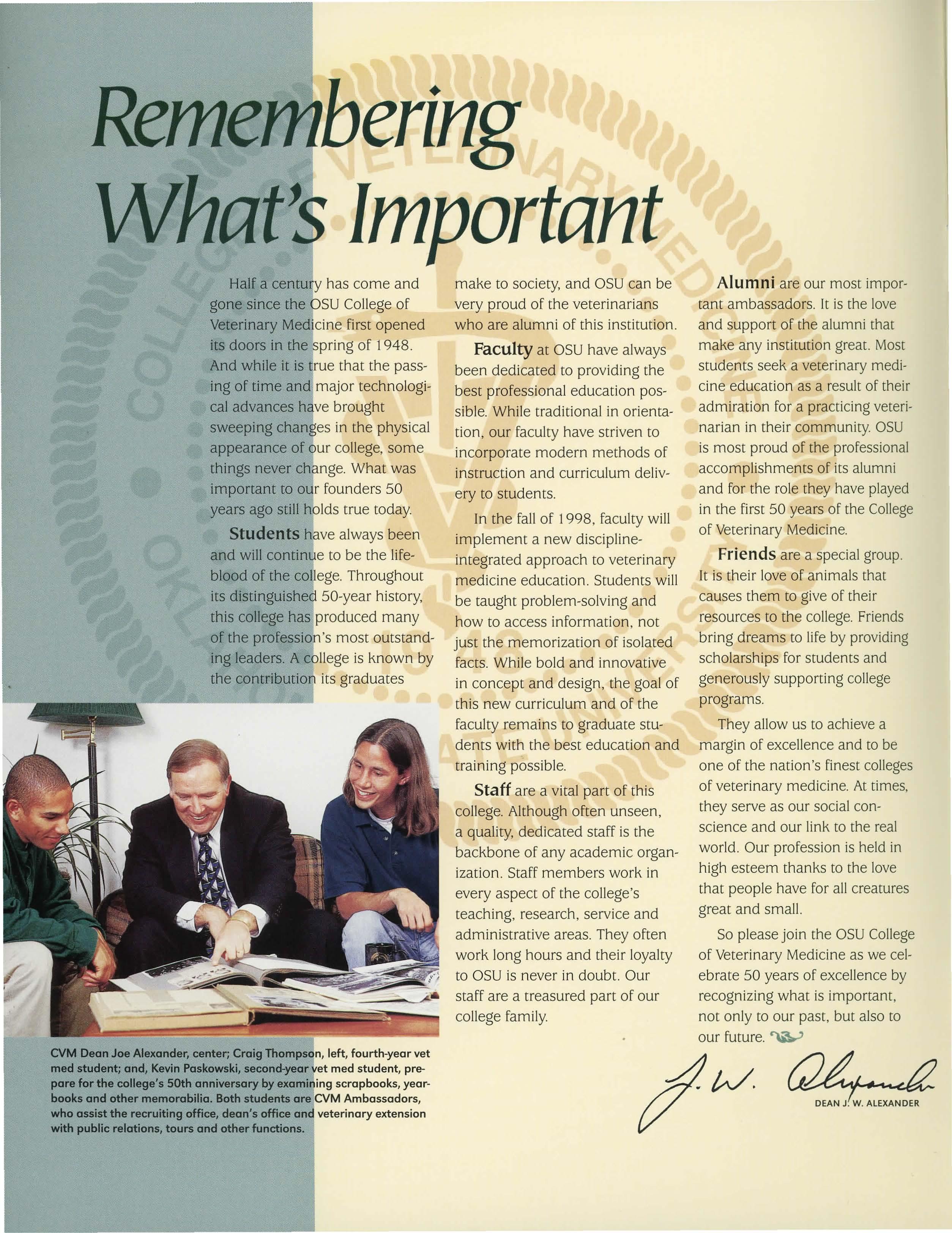
CVM Dean Jae Alexander, center; Craig Thompson, left, fourth-year vet med student; and, Kevin Paskowski, second-year et med student, prepare for the college's 50th anniversary by exami ing scrapbooks, yearbooks and other memorabilia. Both students are CVM Ambassadors, who assist the recruiting office, dean's office an veterinary extension with public relations, tours and other functions.
DEAN J. W. ALEXANDER
VET CETERA
THEVETMED MAGAZINE SPRING, 1998NOLUME 1
This is a big year far the OSU Callege of Veterinary Medicine as we celebrate our 50th anniversary, and we want you to be port of the excitement.
We invite you to be our guest for a visit to the CVM during our annual open house. Contact the recruitment office by phone at (405) 744-6961 or e-mail at jls@okway.okstate.edu.
If a trip to OSU isn't possible, visit the CVM Web site at: www.cvm.okstate.edu. The OSU homepage is located at www.okstate.edu.
Letters are welcome and should be addressed to: Oklahoma State University, Editor, VET CETERA magazine, 308 Veterinary Medicine, Stillwater, OK 74078-2011. E-mail is also welcome at: curl m@okway.okstate.edu.
Coordinator of Public Relations/ Alumni Affairs
Mary Curl
Editor Lisa M. Ziriax
Art Director
Paul V Fleming
Associate Editor
Janet Varnum
Photography
Andy Maxey (unlessotherwise noted)
Director of Communications Services Nata/eaWatkins
Vet Med Magazine is o publication of the Oklahoma State University College of , Veterinary Medicine. Its purpose is to connect this college with its many stakeholders, providing information on both campus news and pertinent issuesin the field of veterinary medicine. Oklahoma State University© 1998
OdmraSlmel.ff.riyilan¢m,v.lhTlll,VIiHIVIIci I ttellwl'91•1'aml004,"""""'llm11246as""'1Bl Tlll,~olttelru:atirll<reme1•of19/Vmmrov.lh 11mm11ao1umiHIouuloira•milll reg.jam. <ie;fll(cfisoinilam01ttebasisol,a:aou,rotirao\ji\ ""-""-~osaiil!~sratt.oas,.,.,,,,il.,,oli1s JlllS.flfOO!S~iroorues.llisil:lasllttisrofrrilBlro illlism.~framailiHloltaliramiEs. llisiili<almmellrflldmroSlmelhlmityasaRI» ...i1rttte~o11,umry-..wasfiomllrflle AllfoVoual'ant,,lhl.9silyP!im,JSeivm;mmWitmlte ""'1,1lloltldaiur'15M/Jamy/98. # 1004
CONTENTS
J The Hunt is on
The CVM is hot on the trail of a vaccine for one of the world's most destructive cattle diseases.
6 Education in Progress
Technology and research don't stand still, so why should teaching methods? At the CVM, they don't.
7 Fabulous Fifties
On the eve of its 50th birthday, the College of Veterinary Medicine takes a look at its past.
JOIllustrious Alums
OSU's vet med graduates: Where are they now? Everywhere. What are they doing? Everything.
J3 Gender Blender
Not so long ago, few women walked the halls of the CVM. One alumna remembers being in a class of her own.
J4 Sure Cure
Externship at OKC Animal Shelter is a healthy program for all involved - right down to the furry little animals.
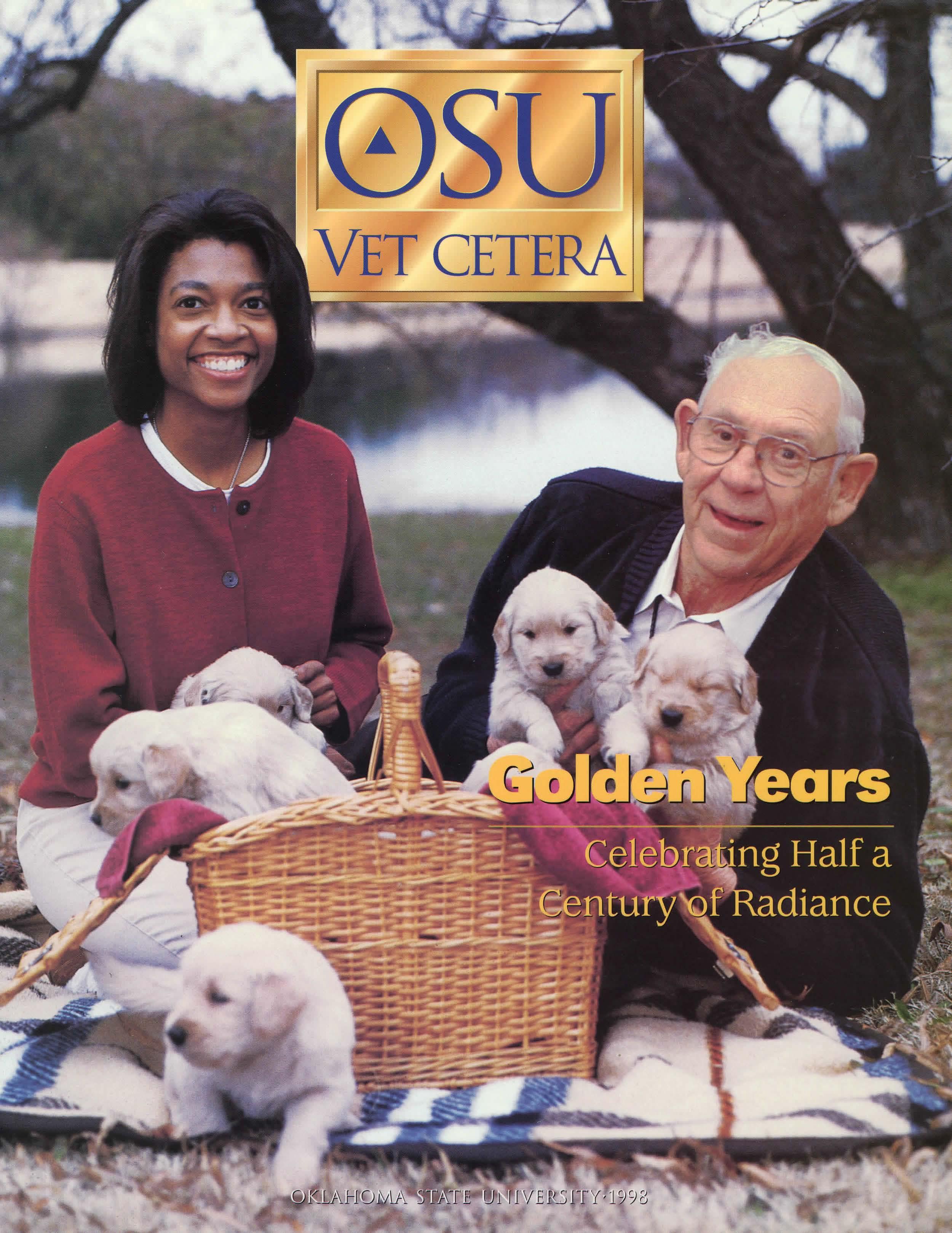
COVER: From Dr. Leo Voskuhl, right, part of the first graduating class in 1951, to Maya Scott, second-year vet med student, the College of Veterinary Medicine has maintained for 50 years its original commitment to educate and graduate the nation's finest veterinarians - an effort it plans to continue.
our CVM Web site Leo Voskuhl 1951
CVM research keeps cows healthy
Dr. LL. Lewis leads an outdoor clinic
Dr. Dianne Nail in 1961 anatomy lob
Tiffiney Hamsher with a pooch
CutsLikea Knife
And it Heals so Right
' ' L aser" evokes all kinds of images images of Luke Skywalker, "smart" military weapons, exacting measuring equipment, and state-ofthe-art manufacturing.
But the OSU Boren Veterinary Medical Teaching Hospital (BVMTH) is helping develop another image for this multipurpose technology: that of a tool of healing.
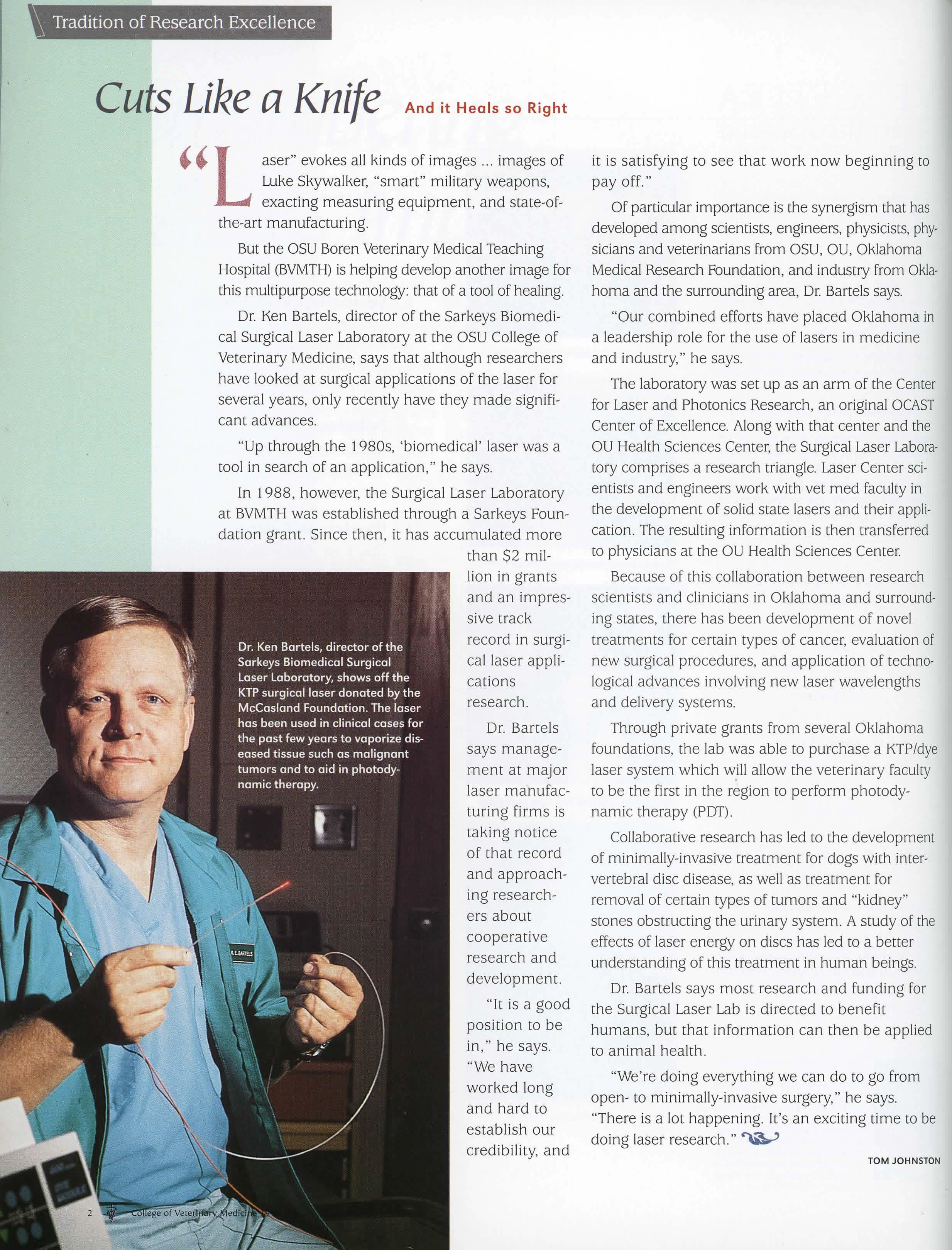
Dr. Ken Bartels, director of the Sarkeys Biomedical Surgical Laser Laboratory at the OSU College of Veterinary Medicine, says that although researchers have looked at surgical applications of the laser for several years, only recently have they made significant advances.
"Up through the l 980s, 'biomedical' laser was a tool in search of an application," he says.
In 1988, however, the Surgical Laser Laboratory at BVMTH was established through a Sarkeys Foundation grant. Since then, it has accumulated more than $2 million in grants and an impressive track record in surgical laser applications research.
Dr. Bartels says management at major laser manufacturing firms is taking notice of that record and approaching researchers about cooperative research and development.
"It is a good position to be in," he says. "We have worked long and hard to establish our credibility, and
it is satisfying to see that work now beginning to pay off."
Of particular importance is the synergism that has developed among scientists, engineers, physicists,physicians and veterinarians from OSU, OU, Oklahoma Medical ResearchFoundation, and industry from Oklahoma and the surrounding area, Dr. Bartels says.
"Our combined efforts have placed Oklahoma in a leadership role for the use of lasers in medicine and industry," he says.
The laboratory was set up as an arm of the Center for Laser and Photonics Research, an original OCAST Center of Excellence. Along with that center and the OU Health Sciences Center, the Surgical Laser Laboratory comprises a research triangle. Laser Center scientists and engineers work with vet med faculty in the development of solid state lasers and their application. The resulting information is then transferred to physicians at the OU Health Sciences Center.
Because of this collaboration between research scientists and clinicians in Oklahoma and surrounding states, there has been development of novel treatments for certain types of cancer, evaluation of new surgical procedures, and application of technological advances involving new laser wavelengths and delivery systems.
Through private grants from several Oklahoma foundations, the lab was able to purchase a KTP/dye laser system which w_illallow the veterinary faculty to be the first in the region to perform photodynamic therapy (PDT).
Collaborative research has led to the development of minimally-invasive treatment for dogs with intervertebral disc disease, as well as treatment for removal of certain types of tumors and "kidney" stones obstructing the urinary system. A study of the effects of laser energy on discs has led to a better understanding of this treatment in human beings.
Dr. Bartels says most research and funding for the Surgical Laser Lab is directed to benefit humans, but that information can then be applied to animal health.
"We're doing everything we can do to go from open- to minimally-invasive surgery," he says. "There is a lot happening. It's an exciting time to be doing laser research."
TOM JOHNSTON
Cattle Battle
In Search ofa Vaccine
0fall the animal diseases that lurk, seeking to destroy the business of the cattleman, brucellosis long ago earned its place in the "hall of infamy." But researchers at the OSUCollegeof Veterinary Medicine are leading the charge to find a successfuldead vaccine for the bacteria.
Brucellosishas been the object of much research for the past 50 years. Causedby Bruce/la abortus bacteria, the disease causes spontaneousabortions in cattle. One aborted fetus is considered to have enough pathogens to infect every cow in the continental United States.
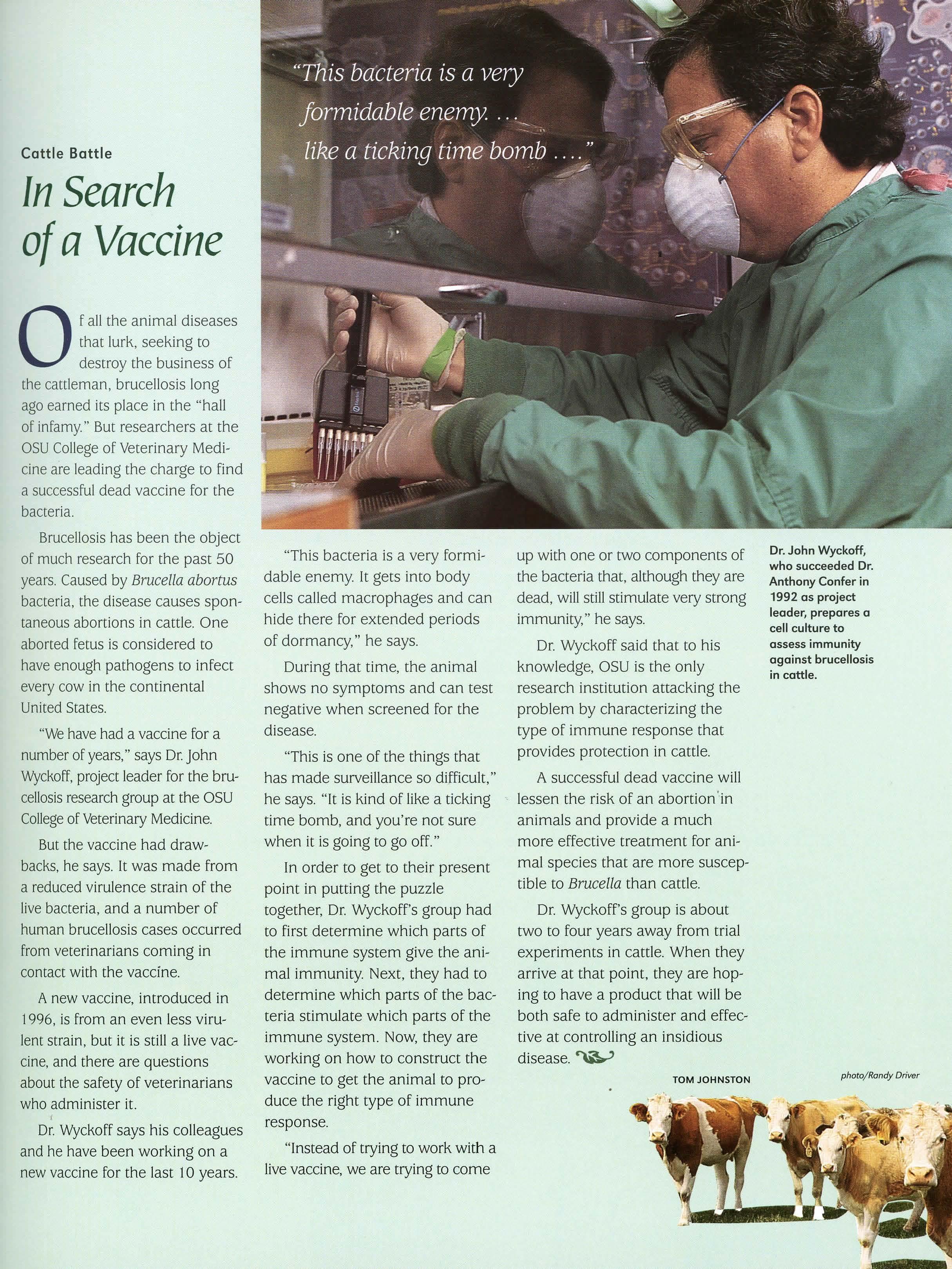
"We havehad a vaccine for a number of years," says Dr. John Wyckoff,project leader for the brucellosisresearchgroup at the OSU Collegeof Veterinary Medicine.
But the vaccine had drawbacks,he says. It was made from a reduced virulence strain of the live bacteria, and a number of human brucellosis cases occurred from veterinarians coming in contact with the vaccine.
A new vaccine, introduced in 1996, is from an even less virulent strain, but it is still a live vaccine, and there are questions about the safety of veterinarians who administer it.
' Dr. Wyckoff says his colleagues and he have been working on a new vaccine for the last 10 years.
"This bacteria is a very formidable enemy. It gees into body cells called macrophages and can hide there for extended periods of dormancy," he says.
During that time, the animal shows no symptoms and can test negative when screened for the disease.
"This is one of the things that has made surveillance so difficult," he says. "It is kind of like a ticking time bomb, and you're not sure when it is going to go off."
In order to get to their present point in putting the puzzle together, Dr. Wyckoff's group had to first determine which parts of the immune system give the animal immunity. Next, they had to determine which parts of the bacteria stimulate which parts of the immune system. Now, they are working on how to construct the vaccine to get the animal to produce the right type of immune response.
"Instead of trying to work with a live vaccine, we are trying to come
up with one or two components of the bacteria that, although they are dead, will still stimulate very strong immunity," he says.
Dr. Wyckoff said that to his knowledge, OSU is the only research institution attacking the problem by characterizing the type of immune response that provides protection in cattle.
A successful dead vaccine will lessen the risk of an abortion'in animals and provide a much more effective treatment for animal species that are more susceptible to Bruce/la than cattle.
Dr. Wyckoff's group is about two to four years away from trial experiments in cattle. When they arrive at that point, they are hoping to have a product that will be both safe to administer and effective at controlling an insidious disease.~
TOM JOHNSTON
Dr. John Wyckoff, who succeeded Dr. Anthony Confer in 1992 as project leader, prepares a cell culture to assess immunity against brucellosis in cattle.
photo/RondyDriver
Ag, VetMed
JoiningHandson Cattle, PoultryResearch
In the last 20 years, scientists from the OSU College of Veterinary Medicine and the Division of Agricultural Sciences and Natural Resources together studied more than 33,000 stocker cattle at the old Pawhuska research station.
"Wearepleased that this sharing of expertiseand other resources significantly contributesto the achievementof the missions of both areas."
- Dr. Som Curl
Together, they came up with new ways of improving the health, nutrition and management of cattle which are brought into the state for grazing on Oklahoma's grass and wheat pastures. Their research helped minimize losses from the dreaded "shipping fever," which affects cattle in transit and costs the state's cattle industry $85 million a year.
Research in these areas and collaborative efforts will continue and be expanded at the new Willard Sparks Beef Research Center, scheduled for completion in late spring of 1998. Research at the facility, located west of the OSU campus, will complement programs at OSU's new Food and Agricultural Products Research and Technology Center and incorporate cattle feeding research studies in the Oklahoma Panhandle. As Dr. Don Wagner, department head in animal science, says, it will make possible comprehensive research "from conception to consumption."
The two areas cooperate in many different ways. Several veterinary medicine faculty hold joint appointments with either the Oklahoma Agricultural Experiment Station or the Oklahoma Cooperative Extension Service.
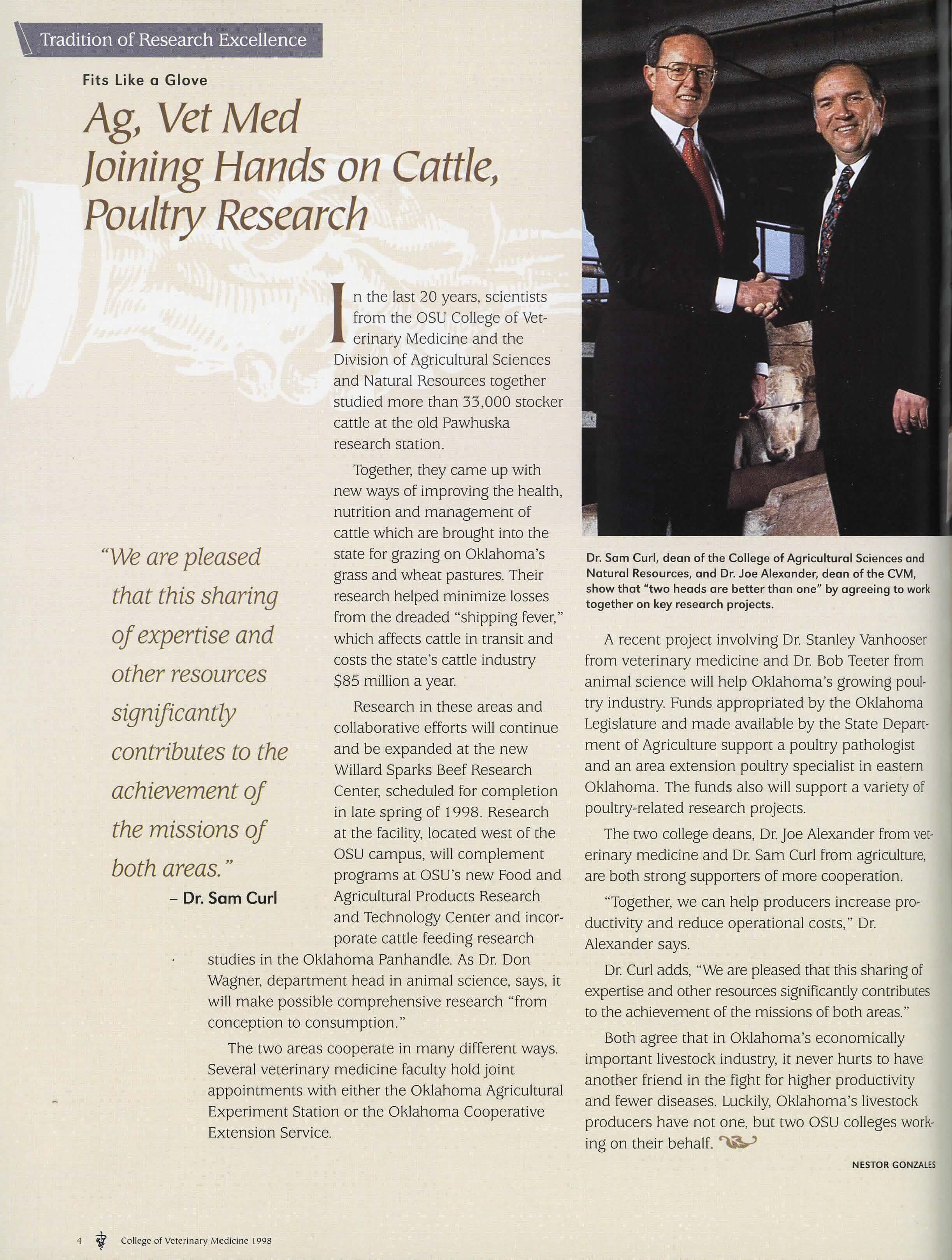
agreeing to work together on key research projects.
A recent project involving Dr. Stanley Vanhooser from veterinary medicine and Dr. Bob Teeter from animal science will help Oklahoma's growing poultry industry. Funds appropriated by the Oklahoma Legislature and made available by the State Department of Agriculture support a poultry pathologist and an area extension poultry specialist in eastern Oklahoma. The funds also will support a variety of poultry-related research projects.
The two college deans, Dr. Joe Alexander from veterinary medicine and Dr. Sam Curl from agriculture, are both strong supporters of more cooperation.
"Together, we can help producers increase productivity and reduce operational costs," Dr. Alexander says.
Dr. Curl adds, "We are pleased that this sharing of expertise and other resourcessignificantly contributes to the achievement of the missions of both areas."
Both agree that in Oklahoma's economically important livestock industry, it never hurts to have another friend in the fight for higher productivity and fewer diseases. Luckily, Oklahoma's livestock producers have not one, but two OSU colleges working on their behalf.
Dr. Sam Curl, dean of the College of Agricultural Sciences and Natural Resources, and Dr. Joe Alexander, dean of the CVM, show that "two heads are better than one" by
ProfessorGetsNod for NordenAward
Dr. Jim Meinkoth is one heck of a teacher. That's what his students and colleagues say, anyway.
In addition to being one of the college's most outstandingclinical pathologists, Dr. Meinkoth has been recognizedfor his teaching and his ability to get studentsinterested in their work. Those efforts won him the prestigious Carl j. Norden Distinguished TeacherAward for I 997.
The award, established in I 963 by Norden Laboratoriesand sponsored by Pfizer Animal Health, recognizesoutstanding teachers of veterinary medicine who havecontributed significantly to the advancement of the profession. Each year, a committee selectsthe recipient based on the results of ballots filled out by the college's students and faculty.
Melanie Breshears, fourth-year vet med student, isn't the least bit surprised Dr. Meinkoth won the award this year.
"He strives to make classroom material pertain to what we will need to know as veterinarians. He does a greatjob of lecturing to students, helping us gain a real understanding of cytology and clinical pathology," says Breshears,who has taken Dr. Meinkoth's cytology and clinical pathology courses.
The associate professor of anatomy, pathology and pharmacology knew he wanted to be a veterinarian since he was a child, but he says it wasn't until he took classeswith Dr. Ron Tyler, a former OSU pathology professor, that he decided what his specialty would be.
"During my senior year at OSU, I kept going to his office asking questions about various slides," he says. "Now I have his job, and I'm working with students and hopefully getting thern interested just like Dr. Tyler did with me."
Although he's not solving crimes or tracking down people, Dr. Meinkoth says he also plays a little "Sherlock Holmes"
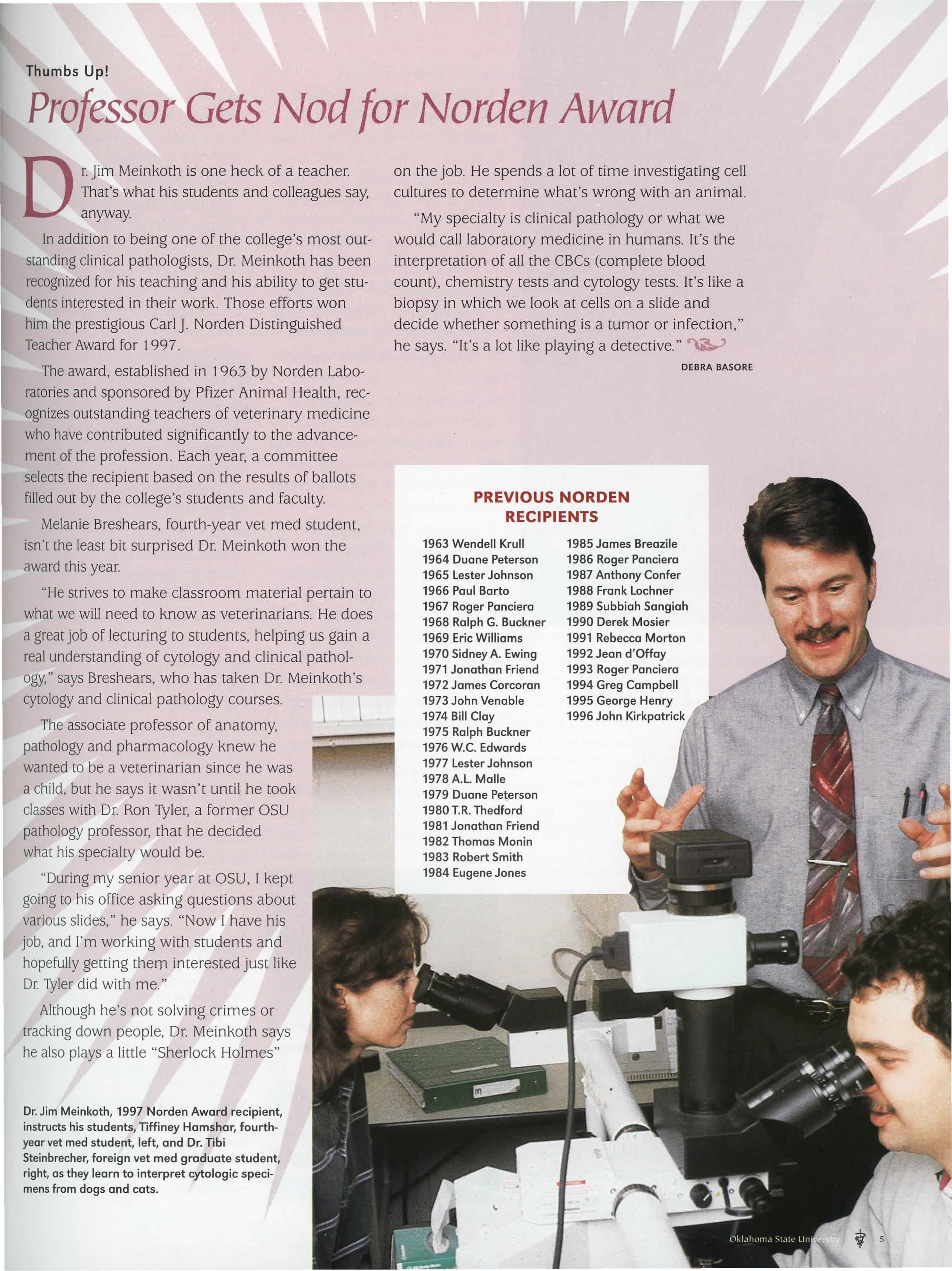
on the job. He spends a lot of time investigating cell cultures to determine what's wrong with an animal.
"My specialty is clinical pathology or what we would call laboratory medicine in humans. It's the interpretation of all the CBCs (complete blood count), chemistry tests and cytology tests. It's like a biopsy in which we look at cells on a slide and decide whether something is a tumor or infection," he says. "It's a lot like playing a detective."
PREVIOUS NORDEN RECIPIENTS
1963 Wendell Krull
1964 Duane Peterson
1965 Lester Johnson
1966 Paul Barto
1967 Roger Panciera
1968 Ralph G. Buckner
1969 Eric Williams
1970 Sidney A. Ewing
1971 Jonathan Friend
1972 James Corcoran
1973 John Venable
1974 Bill Clay
1975 Ralph Buckner
1976 W.C. Edwards
1977 Lester Johnson
1978 A.L. Malle
1979 Duane Peterson
1980 T.R.Thedford
1981 Jonathan Friend
1982 Thomas Monin
1983 Robert Smith
1984 Eugene Jones
1985 James Breazile
1986 Roger Panciera
1987 Anthony Confer
1988 Frank Lochner
1989 Subbiah Sangiah
1990 Derek Mosier
1991 Rebecca Morton
1992 Jean d'Offay
1993 Roger Panciera
1994 Greg Campbell
1995 George Henry
1996 John Kirkpatrick
Dr. Jim Meinkoth, 1997 Norden Award recipient, instructshis students, Tiffiney Hamsher, fourthyear vet med student, left, and Dr. Tibi Steinbrecher,foreign vet med graduate student, right, as they learn to interpret cytologic specimens from dogs and cats.
DEBRA BASORE
From Microscopes to Microchips
EducationEvolves
It would be difficult to consider the OSU College of Veterinary Medicine's 50th anniversary without examining the evolution in teaching methods.
When the new school of veterinary medicine opened in I 948, it didn't have computers or multimedia or lasers or ultrasound machines. In fact, it didn't even have a building.
Oklahoma A&M President Henry Bennett had put his OK on the purchase of a World War II Army building as temporary space for the school, which arrived in time for the first day of classes in March 1948.
Dr. Duane Peterson, a charter faculty member who retired about
IO years ago, recalls, "Students had to meet their small animal cases up on the fourth floor of Life Sciences East for treatment, and care for large animals was usually given at the anatomy and pathology lab across campus. We were spread out all over the place."
With the completion of the first wing of the Veterinary Medicine Building in 1949, the school became more centrally located.
"We started out with monocular microscopes," Dr. Peterson recalls. "Then we progressed to binocular scopes and, finally, to multi-head scopes where seven or eight students could look at the same specimen the instructor was looking at."
Following the technology became a hallmark for the vet med faculty. In the '70s, a revolution began to take place with communications satellites. In 1981, the vet med faculty presented a three-hour teleconference on new surgical techniques. It was the first from any college of veterinary medicine in the world. Many more followed.
Today, computers are as common in classrooms as textbooks. Dr. Grant Turnwald is working on a project to develop an Internetb/w photos/Special Collections
accessed, case-based learning system on the World Wide Web with multiple authors and institutions cooperating in a peerreviewed process.
Dr. Greg Campbell has written a computer-based text on veterinary pathology. Dr. Alan Kocan has done a similar project on veterinary protozoology and entomology. Other faculty post lecture notes, practice tests and study aids on the college's Web site.
But innovation is not confined to just computers.
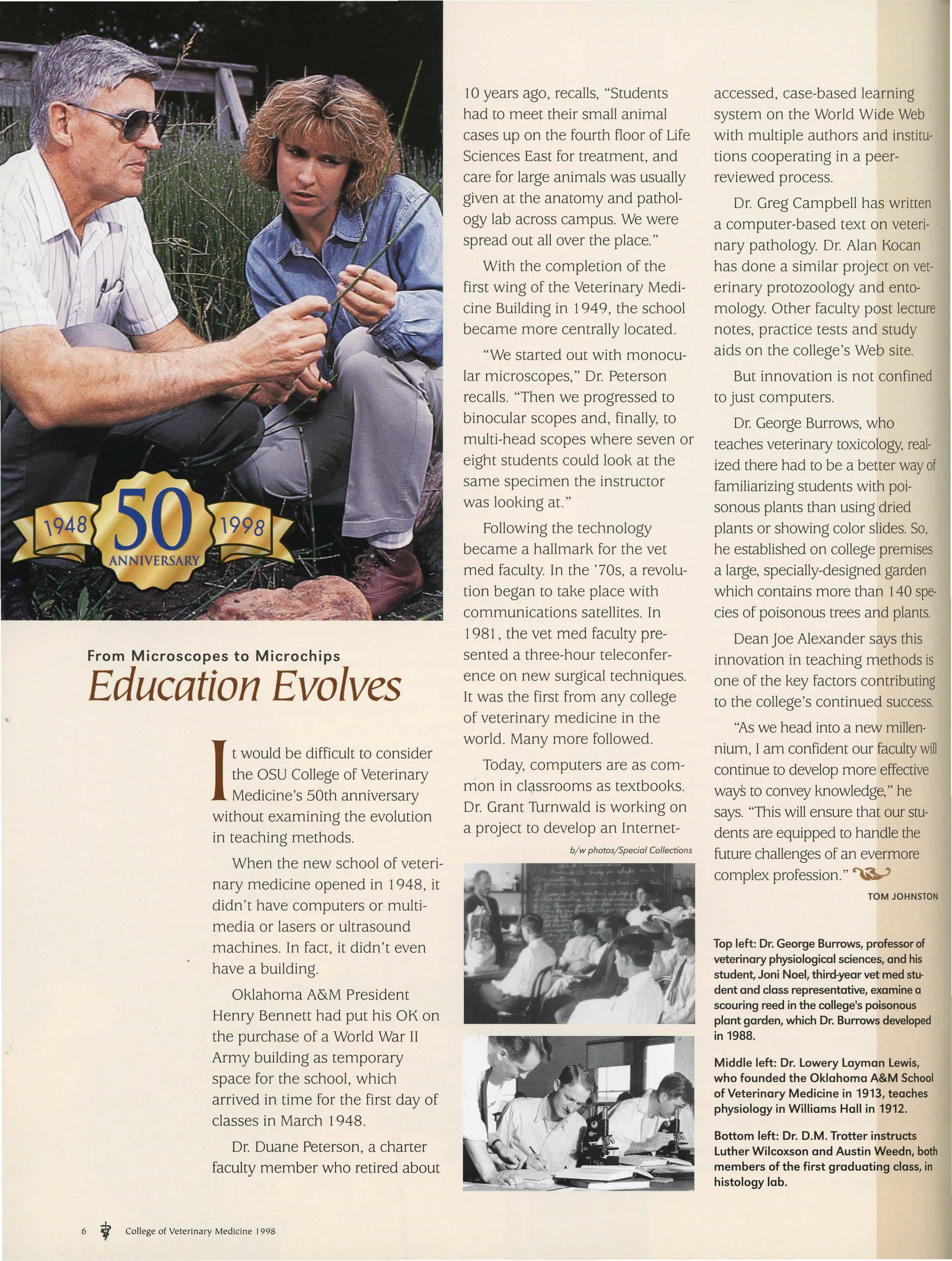
Dr. George Burrows, who teaches veterinary toxicology, realized there had to be a better way of familiarizing students with poisonous plants than using dried plants or showing color slides.So, he established on college premises a large, specially-designed garden which contains more than 140 species of poisonous trees and plants.
Dean Joe Alexander says this innovation in teaching methods is one of the key factors contributing to the college's continued success.
"As we head into a new millennium, I am confident our facultywill continue to develop more effective ways to convey knowledge," he says."This will ensure that our students are equipped to handle the future challengesof an evermore complex profession."~
TOM JOHNSTON
Top left: Dr. George Burrows, professor of veterinary physiological sciences, and his student, Joni Noel, third-year vet med student and class representative, examine a scouring reed in the college's poisonous plant garden, which Dr. Burrows developed in 19B8.
Middle left: Dr. Lowery Layman Lewis, who founded the Oklahoma A&M School of Veterinary Medicine in 1913, teaches physiology in Williams Hall in 1912.
Bottom left: Dr. D.M. Trotter instructs Luther Wilcoxson and Austin Weedn, both members of the first graduating class, in histology lab.
A WhirlwindStart!
Dr. Leo Voskuhl knew exactly what he wanted to be after watching an Enid veterinarian draw a blood sample out of the neck of a cow near his family's home in Marshall.
Although just 7 years old at the time, little Leo was old enough to have his senses stimulated.
"I thought that was out of this world. I guess it really inspired me," the 72 year old says today from
his large animal practice in Kingfisher.
The inspiration never left Dr. Voskuhl, even after he spent three years in the U.S.· Army during World War II. "I kept thinking about veterinary school, and I kept hearing rumors that they were going to start one in Stillwater. When I entered Oklahoma A&M ColIege as an undergraduate, I had my mind set on vet school, and all my studies leaned toward that."
When it turned out the rumors were true, Dr. Voskuhl was one of more than 1,000 to submit his application to the new veterinary school. He, along with 30 other young men, gained admittance based on individual interview, recommendations, and good pre-veterinary scholastic records.
And so the first class of the School of Veterinary Medicine was born and Dr. Voskuhl's childhood dream was on its way to becoming a reality.
It has been 50 years since that first class abruptly got word during the spring semester of 1948 that all students enrolled in veterinary medicine were to report to the office of Dean Clarence H. McElroy because class was to begin on Monday. "We all got up and left right then. We had to drop all the other courses we had taken since January," recalls Dr. Raymond Henry of
Pawnee, who is Dr. Voskuhl's longtime friend and former study partner.
Like Dr. Voskuhl and Dr. Henry, many of the men in the first class were war veterans, and many were on the GI Bill. All were white males, mostly from farming and ranching backgrounds. Many were married. Many were poor. All were there to learn.
"If the instructors would have told us to run our heads through a wall, we would have tried no questions asked," Dr. Henry says. "We were just so glad for the opportunity to be in veterinary school."
Dr. Duane Peterson, who gave the school's first lecture, agrees that students feverishly pursued an education. His humorous tale of two students from the first histology class illustrates this eagerness: "We only had about 30 days to get everything rolling to start classes, and it ended up that we didn't have enough (microscope) slides. One afternoon, two students went out and had a wrestling match to see who was going to use the last slide. They just didn't want to let the chance for an education go by."
When it came time for that first class to graduate in 1951, the beloved president of Oklahoma A&M, Dr. Henry G. Bennett, proudly seated members of the class in the first row during graduation ceremonies in Gallagher Hall. His desire to see a veterinary school established in Stillwater had been fulfilled - and the proof it was here to stay was manifest in the first graduating class.
In 1951, many rocky times still awaited the fledgling college. Many good times were ahead, as well. Today,we can proudly say that the difficult times and the glorious times, all 50 years of them, have made the college what it is - proud, strong, determined. The timeline on the following pages shows the highlights that best illustrate this colorful past while pointing the way to our equally vivid future.
LISA M. ZIRIAX
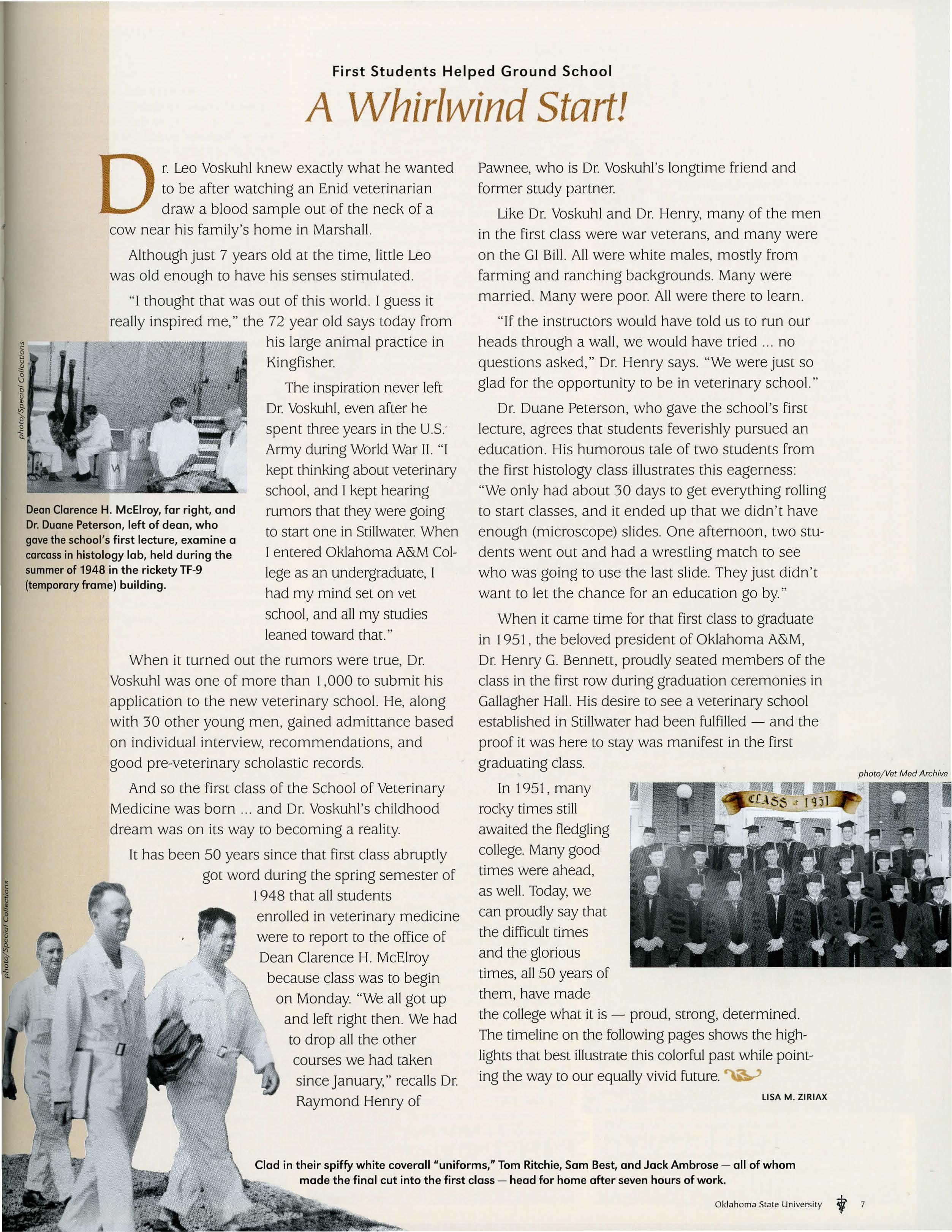
Dean Clarence H. McElroy, far right, and Dr. Duane Peterson, left of dean, who gave the school's first lecture, examine a carcassin histology lab, held during the summer of 1948 in the rickety TF-9 (temporary frame) building.
Clad in their spiffy white coverall "uniforms,'' Tom Ritchie, Sam Best, and Jack Ambrose - all of whom made the final cut into the first class - head for home after seven hours of work.
photo/Vet Med Archive
A Hint of Our History
Dr. Lowery Layman Lewis (1869-1922) is the force behind the establishment of the Oklahoma A&M School of Veterinary Medicine in 1913. But the death of Oklahoma's "Father of Veterinary Medicine" in 1922 is the beginning of the end of the school. It crumbles later that decade, leaving no known graduates.
March 1, 1948, the school is resurrected on a shoestring budget, becoming the 17th of its kind in the United States. Classes are held in the rickety TF-9 building, where you con see sunlight streaming through cracks in the walls from the inside if you stand in the right spot, swears original faculty member Dr. Jonathon Friend.
The legendary and popular Dr. Clarence H. McElroy (1886-1970) is named the school's first dean. Determined to make the school successful, "Dean Mac" insists, "It is the spirit of the School of Veterinary Medicine to win in spite of odds. When a spirit like that pervades, there is nothing which will stop our progress." He serves as dean through 1953.
Students organize the Oklahoma A&MStudent --' Veterinary ...-iw-,...._i Medical Society in Morch 1948. One of its first activities, which becomes a long-standing tradition, is building a float for the homecoming parade. The first installment, a giant dinosaur with moving legs, neck and head, is judged to be the best of all, helping put the school on the map.
Construction of the "north wing," the first part of what now is the Veterinary Medicine Building, begins in 1949.
What would a new school be without some kind of freshman initiation ritual?Thus is born in 1951 such a procedure for freshman pledges to the Student Chapter of the American Veterinary Medical Association (SCAVMA). Each pledge must carry a polished white bone and obtain the signatures of every instructor in the school, among other silly antics. The tradition foils by the wayside in the 1960s.
From 1953-56, Dr. HarryW. Orr(18961956) serves as dean. Concerned with the school's probationary accreditation, he sets about with diligence and vigor to improve its facilities, some of which he described as "inefficient" and "unsatisfactory." His efforts pay off when the State Regents for Higher Education grant Oklahoma A&M more than $3 million for capital improvements.
Established in 1953, Mu chapter of Alpha Psi is the first veterinary fraternity in Oklahoma.
A brilliant parasitologist and one of the school's brightest stars, Dr. Wendell H. Krull (1897-1971) is remembered not only for his enthusiastic teaching style, but also for his research and discovery of the life cycle of Dicrocoelium dendriticum, a liver fluke in sheep, in the early 1950s.
A feminine touch is added to the school when June lben, a native Pennsylvanian, becomes the first female to earn a DVM degree at Oklahoma A&M in 1955.
In 1956, the school grants the first graduate degree, a master's, ta G.A. Stover. One year later, the first Ph.D. in parasitology is bestowed on E.R. Beilfuss.Both events demonstrate that the recentlyestablished graduate program is indeed bearing fruit.
After the sudden death of Dean Orr in 1956, Dr. Glenn C. Holm (1909-1982) takes the reins as dean. Known as on effective administrator and a strict disciplinarian, he expects professionalism from faculty and students alike. Lois Greiner, Dr. Holm's secretary, later remembered, "If they didn't come dressed properly or looking like they should they were told in a way that they knew " Dr. Holm serves as dean until 1967.
The School of Veterinary Medicine becomes the College of Veterinary Medicine when Oklahoma A&M undergoes a name change in 1957, becoming the Oklahoma State University of Agriculture and Applied Science.
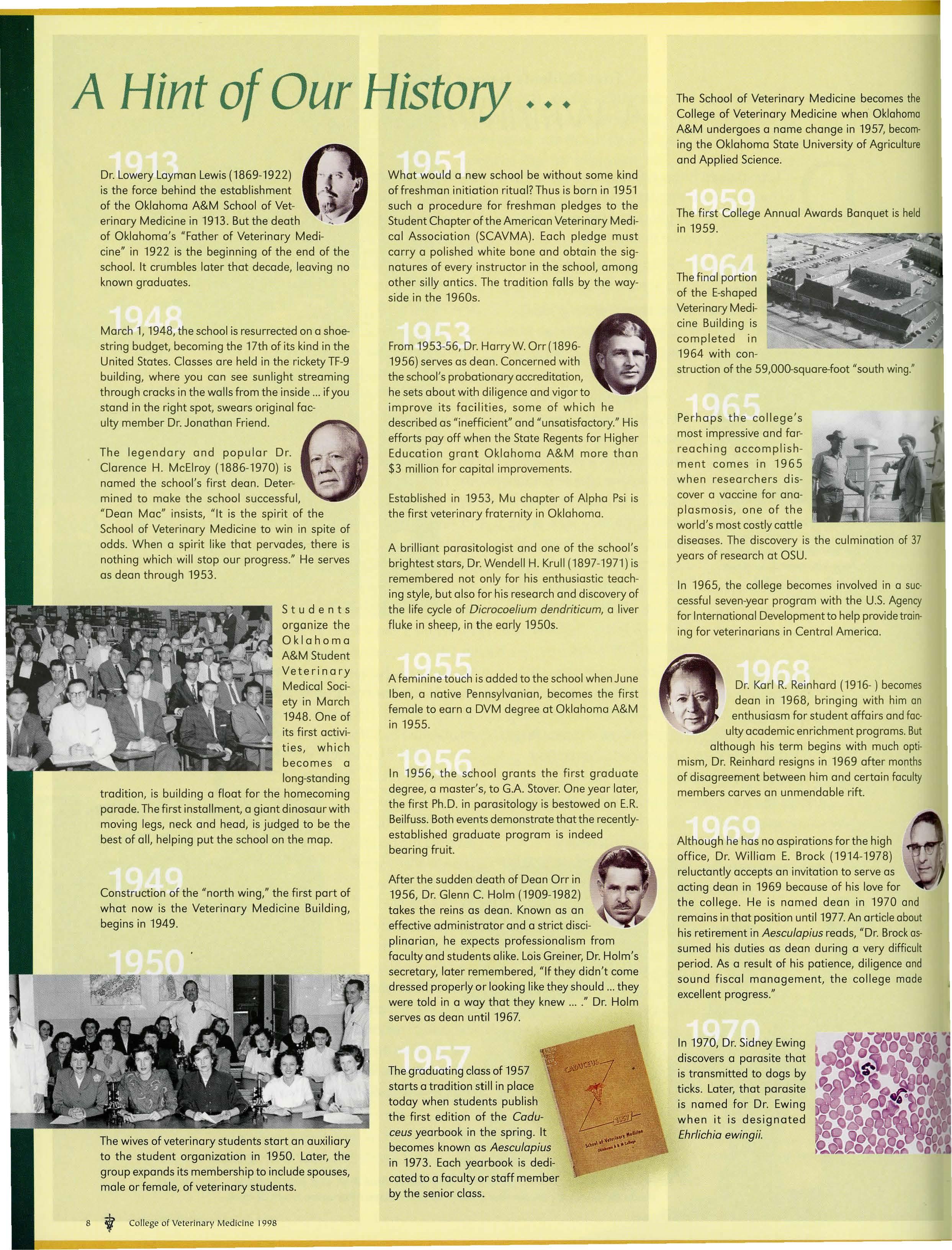
The wives of veterinary students start an auxiliary to the student organization in 1950. Loter, the group expands its membership to include spouses, male or female, of veterinary students.
The graduating class of 1957 starts a tradition still in place today when students publish the first edition of the Caduceus yearbook in the spring. It becomes known as Aesculapius ~::;~:~ in 1973. Each yearbook is dedicated to a faculty or staff member by the senior class.
The first College Annual Awards Banquet is held in 1959.
The final portion of the E-shaped Veterinary Medicine Building is completed in 1964 with con-
Perhaps the college's most impressive and farreaching accomplishment comes in 1965 when researchers discover a vaccine for anaplasmosis, one of the world's most costly cattle diseases. The discovery is the culmination of 37 years of research at OSU.
In 1965, the college becomes involved in a successful seven-year program with the U.S. Agency for Internationa I Development to help providetraining for veterinarians in Central America.
Dr. Karl R. Reinhard (1916-) becomes dean in 1968, bringing with him an enthusiasm for student affairs and faculty academic enrichment programs. But although his term begins with much optimism, Dr. Reinhard resigns in 1969 after months of disagreement between him and certain faculty members carves an unmendable rift.
Although he has no aspirations for the high office, Dr. William E. Brock (1914-1978) reluctantly accepts an invitation to serve as acting dean in 1969 because of his love for the college. He is named dean in 1970 and remains in that position until 1977.An article about his retirement in Aesculapius reads, "Dr. Brockassumed his duties as dean during a very difficult period. As a result of his patience, diligence and sound fiscal management, the college made excellent progress."
In 1970, Dr. Sidney Ewing discovers a parasite that is transmitted to dogs by ticks. Later, that parasite is named for Dr. Ewing when it is designated Ehrlichia ewingii.
In 1975, a mInImum grade point average in requiredsubjects is bumped up from 2.5 to 2.8.
Studentsestablish Oklahoma Veterinary Educational SupplyInc.,an off-campus bookstore, in 1975. It is still in operationtoday at 408 S. Main St.
A milestone in veterinary science in Oklahoma,the Oklahoma AnimalDisease Diagnostic Laboratory (OADDL) opens for servicein 1976 under the leadership of Dr. Dan Goodwin with a staff that consists of a pathologist, a virologist, and a bacteriologist.A toxicologist joins the staff the followingyear.
Dr. Patrick M. Morgan {1933-) is nameddean in 1977, beginning what somewould call an unconventional yet perceptive administration. "I see every problemas an opportunity to effect positive change for our college and our profession," Dr. Morgan writes in his dean's message for the 1978 yearbook. During his tenure, which lasted until 1984, the college reaps a harvest of greatly improved appropriations and makes substantial progress.
Eventhough bad weather threatens to farce ceremoniesinside, the much-onticipated Boren Veterinary Medical Teaching Hospital is dedicated before hundreds of students, faculty, dignitaries and well-wishers in 1981.
After years of struggle, the college finally achieves full accreditation in 1981.
Historyis made this same year as the college becomesthe first veterinary medicine college in the world to broadcast a three-hourteleconference on new surgical techniques presented by faculty from the new teaching hospital. Oklahoma City's KTVY Channel 4 televisesthe proceedings.
Thecollege's first successful equine embryo transfer in 1984 results in the birth of a sorrel filly with a white star pattern on its forehead to a surrogate mother.
At 38, Dr. Joseph W. Alexander (1947-) becomesthe seventhand youngest dean of the college in 1985. Although his childhooddream to be a cowboy is not fulfilled, Dr.Alexanderproves himself to be a solid veterinarian,educator and administrator when he writes, 'We must continually strive far improvement in the quality and efficiency of our academic program. Afterall, the Wizard of Oz was able to give the scarecrowa diploma, but not a brain "
Heart transplant pioneer Dr. Christiaan Barnard, who has a special interest in cattle, visits the college in 1985. A joint effort between the college and Oklahoma City's Baptist Hospital results in the estal:>lishment of a transplant laboratory in
the Boren Teaching Hospital.
The newly-constituted College Alumni Association meets for the first time in 1986.
In 1986, the barren mare program is established on a 640-ocre ranch donated to the college. Dr. Steven Slusher is selected as the veterinarian in charge.
The equine sports medicine lab is constructed in 1986, and Dr. Michael Collier is named director. A highspeed treadmill is its centerpiece.
The College Library is dedicated in 1987.
In 1987, the college publishes its history book, the first in the 24-volume OSU Centennial Histories Series. It is written by Dr. Eric I. Williams with contributions from faculty.
Dr. Alexander is the first OSU CVM dean elected president of the Association of American Veterinary Medical Colleges in 1990.
The Food Animal Research Park opens in 1994. Its primary focus is research of cattle diseases, including anaplasmosis and shipping fever.
In 1994, students earn first place at the National Clinical Challenge for SCAVMA "College Bowl."
In 1995, the Equine Research Park is established with Dr. Charles MacAllister as director.
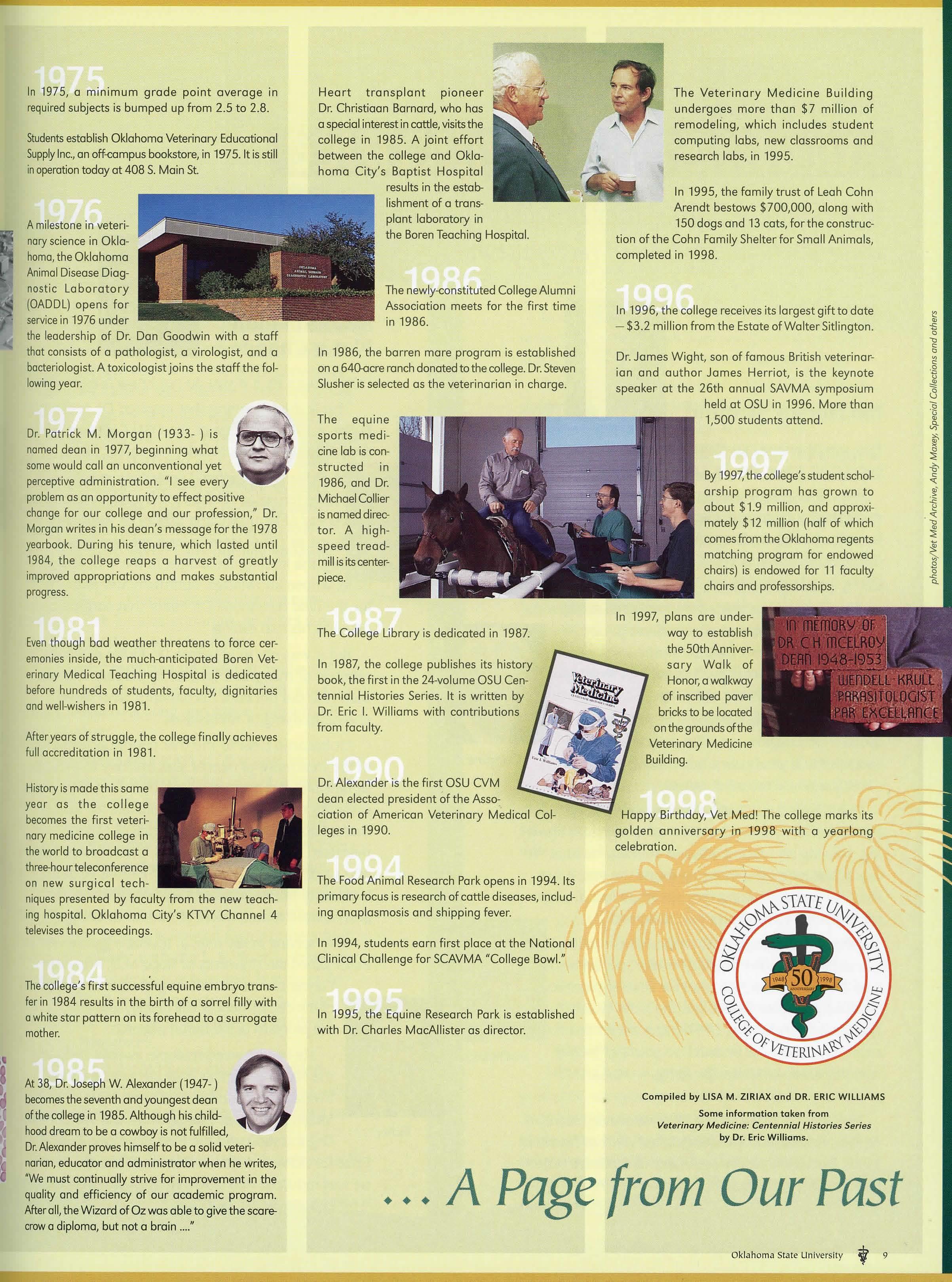
The Veterinary Medicine Building undergoes more than $7 million of remodeling, which includes student computing labs, new classrooms and research labs, in 1995.
In 1995, the family trust of Leah Cohn Arendt bestows $700,000, along with 150 dogs and 13 cats, for the construction of the Cohn Family Shelter for Small Animals, completed in 1998.
In 1996, the college receives its largest gift to date $3.2 million from the Estate of Walter Sitlington.
Dr. James Wight, son of famous British veterinarian and author James Herriot, is the keynote speaker at the 26th annual SAVMA symposium held at OSU in 1996. More than 1,500 students attend.
By 1997,the college's studentschola rship program has grown to about $1.9 million, and approximately $12 million (half of which comes from the Oklahoma regents matching program for endowed chairs) is endowed for 11 faculty chairs and professorships.
In 1997, plans are underway to establish the 50th Anniversary Walk of Honor, a walkway of inscribed paver bricks to be located on the groundsof the Veterinary Medicine Building.
Happy Birthday, Vet Med! The college marks its golden anniversary in 1998 with a yearlong celebration.
Compiled by LISA M. ZIRIAX and DR. ERIC WILLIAMS
Some information token from Veterinary Medicine: Centennial Histories Series by Dr. Eric Williams.
wepresent
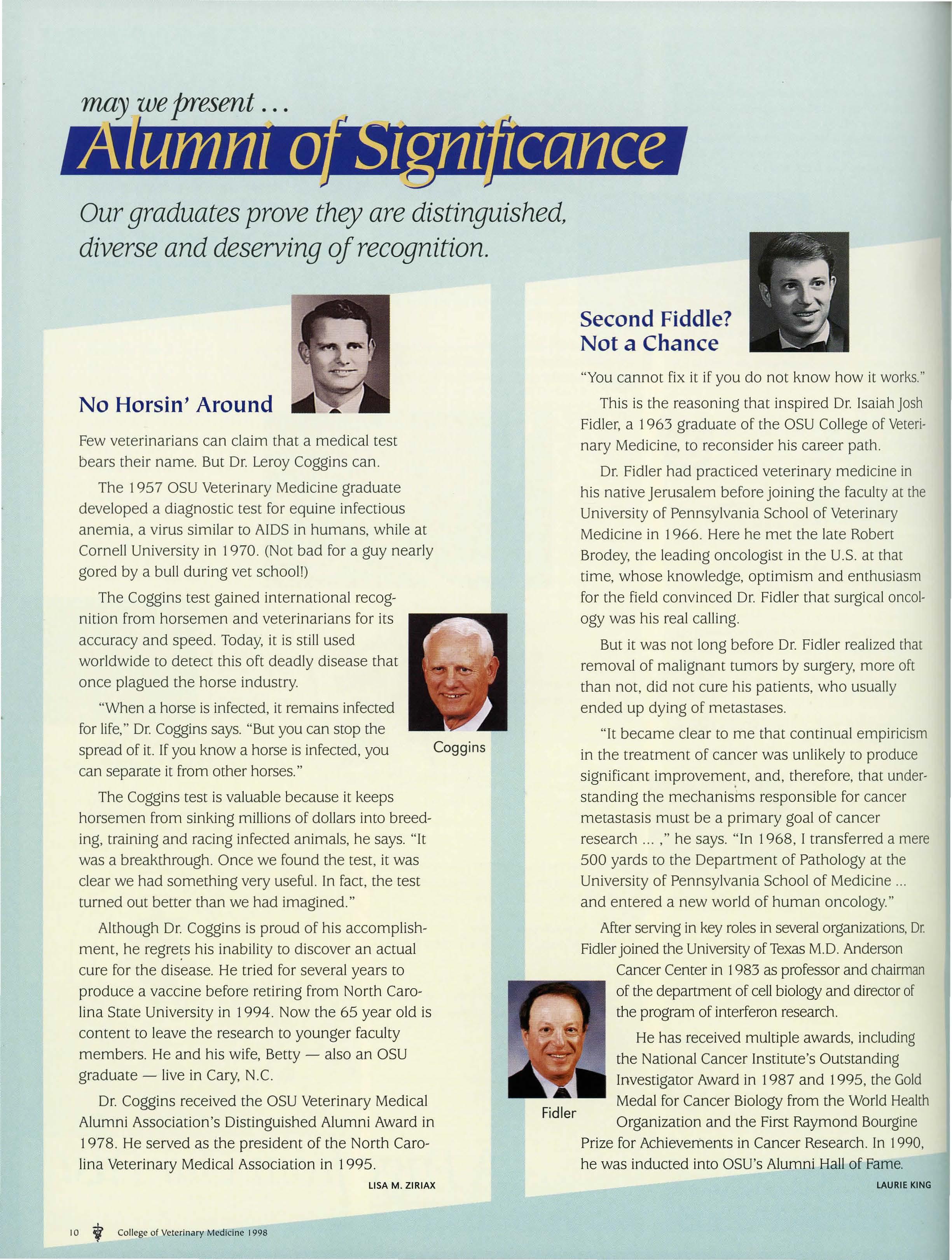
Ourgraduatesprove they are distinguished, diverseand deservingof recognition.
Second Fiddle? Not a Chance
"You cannot fix it if you do not know how it works."
No Horsin' Around
Few veterinarians can claim that a medical test bears their name. But Dr. Leroy Coggins can.
The 1957 OSU Veterinary Medicine graduate developed a diagnostic test for equine infectious anemia, a virus similar to AIDS in humans, while at Cornell University in 1970. (Not bad for a guy nearly gored by a bull during vet school!)
The Coggins test gained international recognition from horsemen and veterinarians for its accuracy and speed. Today, it is still used worldwide to detect this oft deadly disease that once plagued the horse industry.
"When a horse is infected, it remains infected for life," Dr. Coggins says. "But you can stop the spread of it. If you know a horse is infected, you can separate it from other horses."
The Coggins test is valuable because it keeps horsemen from sinking millions of dollars into breeding, training and racing infected animals, he says. "It was a breakthrough. Once we found the test, it was clear we had something very useful. In fact, the test turned out better than we had imagined."
Although Dr. Coggins is proud of his accomplishment, he regre~shis inability to discover an actual cure for the disease. He tried for several years to produce a vaccine before retiring from North Carolina State University in 1994. Now the 65 year old is content to leave the research to younger faculty members. He and his wife, Betty - also an OSU graduate - live in Cary, N.C.
Dr. Coggins received the OSU Veterinary Medical Alumni Association's Distinguished Alumni Award in 1978. He served as the president of the North Carolina Veterinary Medical Association in 1995.
LISA M. ZIRIAX
This is the reasoning that inspired Dr. Isaiah Josh Fidler, a 1963 graduate of the OSU College of Veterinary Medicine, to reconsider his career path.
Dr. Fidler had practiced veterinary medicine in his native Jerusalem before joining the faculty at the University of Pennsylvania School of Veterinary Medicine in 1966. Here he met the late Robert Brodey, the leading oncologist in the U.S. at that time, whose knowledge, optimism and enthusiasm for the field convinced Dr. Fidler that surgical oncology was his real calling.
But it was not long before Dr. Fidler realized that removal of malignant tumors by surgery, more oft than not, did not cure his patients, who usually ended up dying of metastases.
"It became clear to me that continual empiricism in the treatment of cancer was unlikely to produce significant improveme~t. and. therefore, that understanding the mechanisms responsible for cancer metastasis must be a primary goal of cancer research ," he says. "In 1968, I transferred a mere 500 yards to the Department of Pathology at the University of Pennsylvania School of Medicine ... and entered a new world of human oncology."
After serving in key roles in severalorganizations,Dr. Fidlerjoined the University ofTexas M.D. Anderson Cancer Center in 1983 as professor and chairman of the department of cell biology and director of the program of interferon research.
He has received multiple awards, including the National Cancer Institute's Outstanding Investigator Award in 1987 and I 995, the Gold Medal for Cancer Biology from the World Health Organization and the First Raymond Bourgine Prize for Achievements in Cancer Research. In 1990, he was inducted into OSU's Alumni Hall of Fame. LAURIEKING
Coggins
Fidler
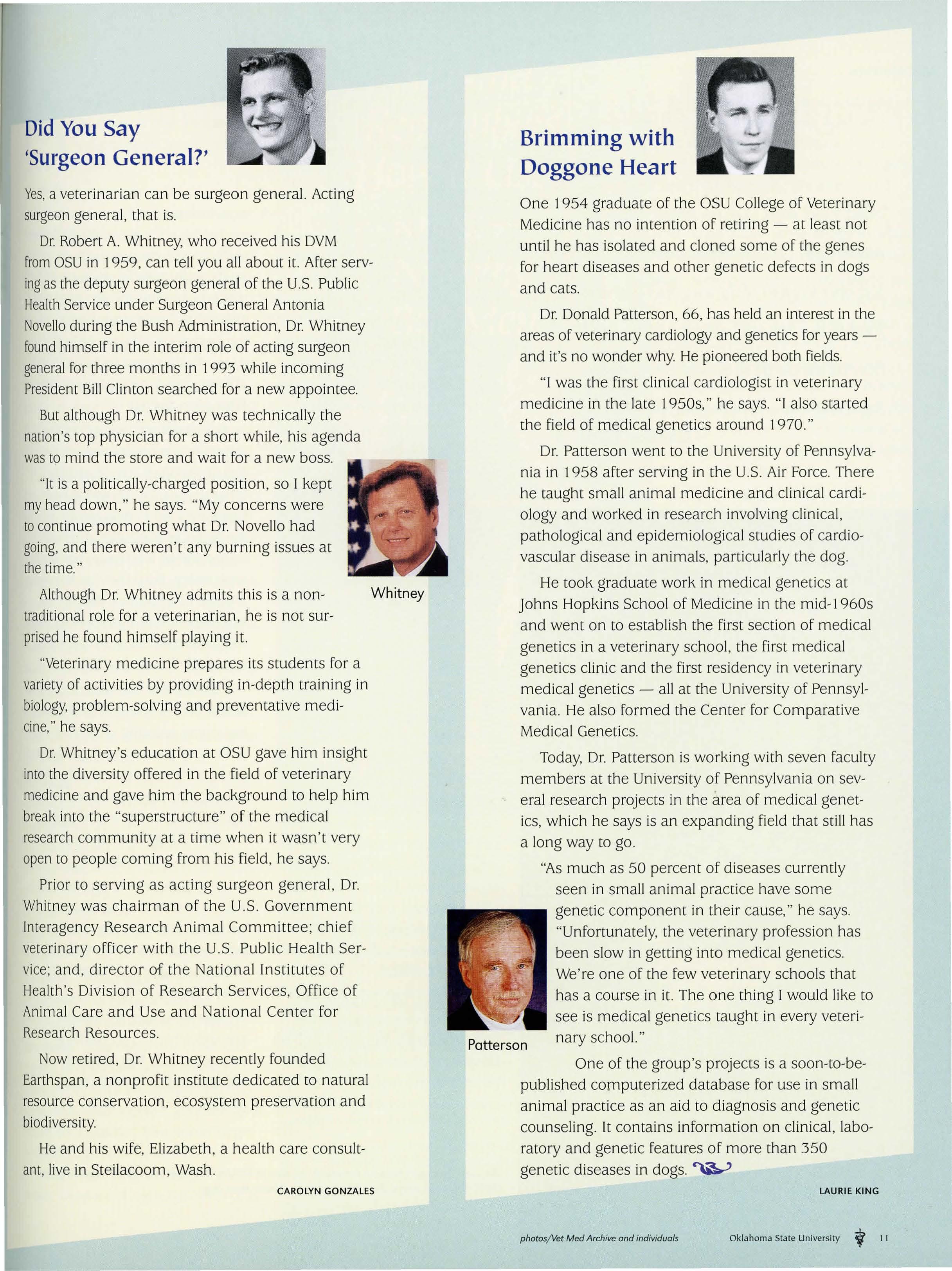
DidYou Say 'SurgeonGeneral?'
Yes,a veterinarian can be surgeon general. Acting surgeongeneral, that is.
Dr. Robert A. Whitney, who received his DVM fromOSU in 1959, can tell you all about it. After servingas the deputy surgeon general of the U.S. Public HealthService under Surgeon General Antonia Novelloduring the Bush Administration, Dr. Whitney foundhimself in the interim role of acting surgeon generalfor three months in 1993 while incoming PresidentBill Clinton searched for a new appointee.
But although Dr. Whitney was technically the nation'stop physician for a short while, his agenda wasto mind the store and wait for a new boss.
"It is a politically-charged position, so I kept my head down," he says. "My concerns were to continue promoting what Dr. Novello had going,and there weren't any burning issues at thetime."
Although Dr. Whitney admits this is a non- Whitney traditional role for a veterinarian, he is not surprisedhe found himself playing it.
"Veterinary medicine prepares its students for a varietyof activities by providing in-depth training in biology,problem-solving and preventative medicine,"he says.
Dr. Whitney's education at OSU gave him insight into the diversity offered in the field of veterinary medicineand gave him the background to help him breakinto the "superstructure" of the medical researchcommunity at a time when it wasn't very opento people coming from his field, he says.
Prior to serving as acting surgeon general, Dr. Whitney was chairman of the U.S. Government lnteragency Research Animal Committee; chief veterinary officer with the U.S. Public Health Service; and, director of the National Institutes of Health's Division of Research Services, Office of Animal Care and Use and National Center for ResearchResources.
Now retired, Dr. Whitney recently founded Earthspan,a nonprofit institute dedicated to natural resourceconservation, ecosystem preservation and biodiversity.
He and his wife, Elizabeth, a health care consultant, live in Steilacoom, Wash.
CAROLYN GONZALES
Brimming with Doggone Heart
One 1954 graduate of the OSU College of Veterinary Medicine has no intention of retiring - at least not until he has isolated and cloned some of the genes for heart diseases and other genetic defects in dogs and cats.
Dr. Donald Patterson, 66, has held an interest in the areas of veterinary cardiology and genetics for yearsand it's no wonder why. He pioneered both fields.
"I was the first clinical cardiologist in veterinary medicine in the late 1950s," he says. "I also started the field of medical genetics around 1970."
Dr. Patterson went to the University of Pennsylvania in 1958 after serving in the U.S. Air Force. There he taught small animal medicine and clinical cardiology and worked in research involving clinical, pathological and epidemiological studies of cardiovascular disease in animals, particularly the dog.
He took graduate work in medical genetics at Johns Hopkins School of Medicine in the mid-1 960s and went on to establish the first section of medical genetics in a veterinary school, the first medical genetics clinic and the first residency in veterinary medical genetics - all at the University of Pennsylvania. He also formed the Center for Comparative Medical Genetics.
Today, Dr. Patterson is working with seven faculty members at the University of Pennsylvania on several research projects in the area of medical genetics, which he says is an expanding field that still has a long way to go.
"As much as 50 percent of diseases currently seen in small animal practice have some genetic component in their cause," he says. "Unfortunately, the veterinary profession has been slow in getting into medical genetics. We're one of the few veterinary schools that has a course in it. The one thing I would like to see is medical genetics taught in every veterinary school."
One of the group's projects is a soon-to-bepublished computerized database for use in small animal practice as an aid to diagnosis and genetic counseling. It contains information on clinical, laboratory and genetic features of more than 350 genetic diseases in dogs.
Patterson
LAURIE KING
D1sr1nguishedAlumMediatesAnimalWelfare
':sf[ndGod said, '.[gtus make man in our image and let them have dominion over theflSh of the sea, and overthe fowl of the air, and over the cattle,and overall the earth,and overevery creeping thing that creepethupon the earth.'" - Genesis 1:26
he debate over the meaning of "dominion" in Genesis 1:26 (quote box, left) personifies the fight between the most adamant animal rights advocates and their fiercest opponents. Between those who suggest that dominion indicates a right to full-blown exploitation of beasts by humans and their adversaries who demand an immediate end to everything from consumption of meat to the utilization of animal products in industry is Dr. Gus Thornton.
"I interpret it to mean that man has a responsibility to animals to see that they are properly treated and properly cared for," he says.
Dr. Thornton helps activists and industry compromise.
The 1997 CVM Distinguished Alumni Award winner and 1957 graduate of the OSU CVM has dedicated his career to animal welfare and bolstering relationships between animal welfare/cruelty prevention officials and veterinarians across the country. In becoming president of the Massachusetts Society for the Prevention of Cruelty to Animals (MSPCA)in 1989, Dr. Thornton achieved a position of power that matches his passion for animal welfare.
For more than 30 years, he served as a veterinarian at the MSPCA'sAngell Memorial Animal Hospital in Boston, the largest of its kind in the world. For 22 years, he was its chief of staff. He
now oversees not just that hospital, but also the MSPCA's400-plus staff, its two other veterinary hospitals, eight animal shelters and legislative advocacy programs. Dr. Thornton is also responsible for the organization's law enforcement division and its educational affiliate, the American Humane Education Society.
In promoting animal welfare, the MSPCApartners with those industries often scrutinized by other groups. Dr. Thornton has been involved in discussions with the National Institutes of Health on the use of animals in research and testing. Now that the farmer and the cowman are friends, he wants the nation's premier animal welfare organization to join them in equally amicable relations.
"We are not the kind of organization you're going to find picketing, spray painting or boycotting in front of stores and businesses," he says. "You'll find us at conference··tablestalking to people who deal with animals, and that is how we are going to achieve our goals in animal welfare."
Dr. Thornton has received several awards for his service on behalf of animals. His induction into the ranks of other OSU distinguished alumni is especially sweet, he says.
"OSU is where my roots are and where I received the education that has allowed me to have such a fruitful career," he says.
ADAM HUFFER
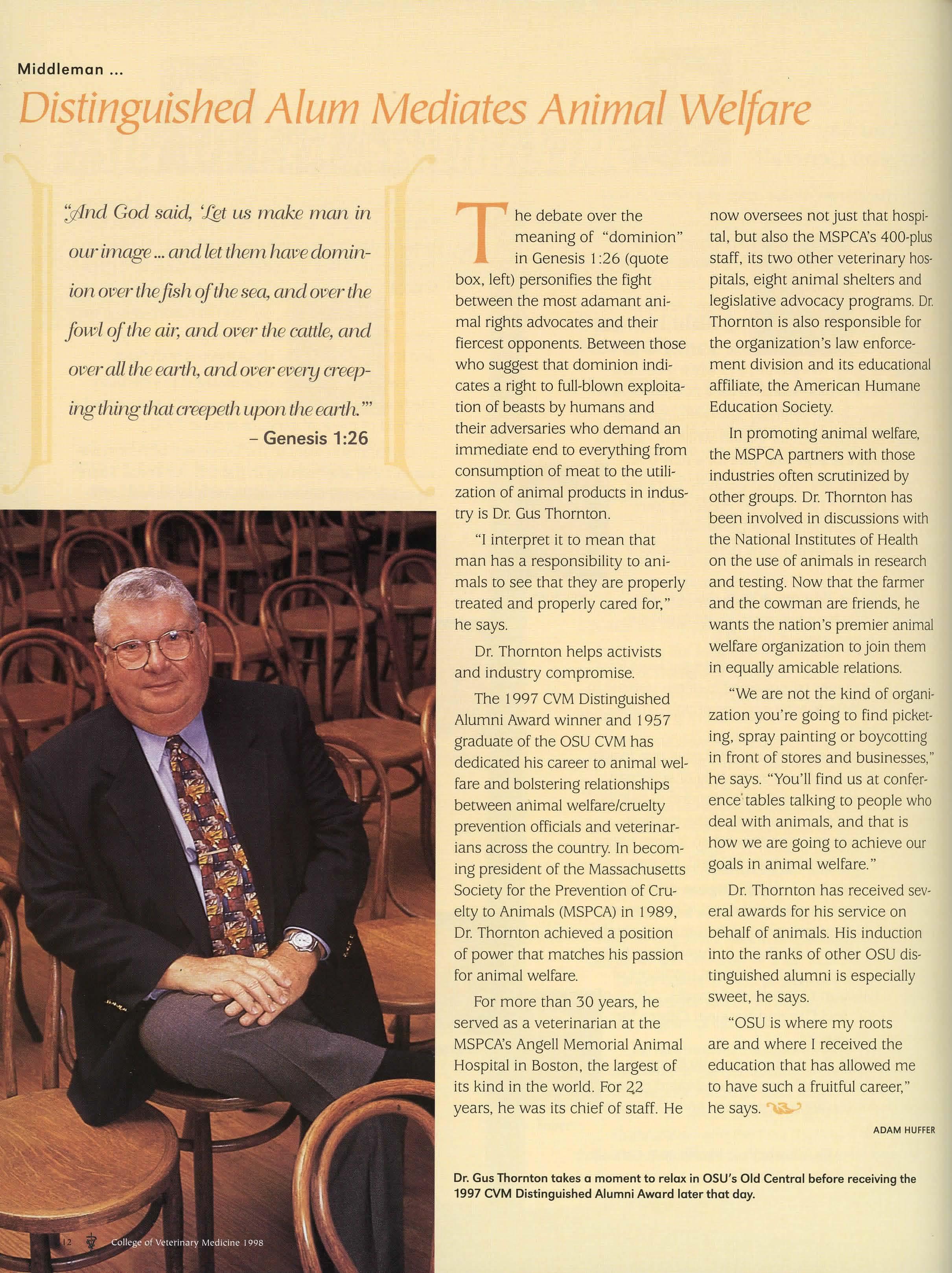
Dr. Gus Thornton tokes a moment to relax in OSU's Old Central before receiving the 1997 CVM Distinguished Alumni Award later that day.
!though a generation apart, Dr. Dianne Nail and third-year vet med student Angie DuBois have a lot in common.
Both are women who charged forward to take on the rugged curriculum of the OSUCollege of Veterinary Medicine. For 27 years, Dr. Nail, who graduated in 1965, hasbeen in small animal practice in the Tulsaarea. DuBois plans to head in that directionafter earning her DVM in 1999.
Both are leaders. Dr. Nail is the vice presidentof the Oklahoma Veterinary MedicalAssociation and DuBois is presidentof the OSU Student Chapter of the AmericanVeterinary Medical Association. Bothare married to veterinarians.
Although alike in many ways, Dr. Nail- one of the college's first femalegraduates - and DuBoiswhoas a woman is in the majority in her class today - are a world apartwhen it comes to their experiencesof being a female in what hasbeen traditionally a male-dominatedfield. DuBois met with Dr. Nailrecently to find out just what it waslike being one of the first femaleveterinarians in Oklahoma.
DuBois: "What made you decide to go into veterinary medicine?"
Dr. Nail: "I had a mentor who was a veterinarian whom I began visiting when I was in the eighth grade. Hestimulated my interest. My fatherwas very encouraging toward my becoming a professional, and I thought a woman needed to edu-
WAVE OF WOMEN FLOOD VET SCHOOL
of the large animal clinicians. I just got right in there with the guys, and we grabbed those calves and flipped 'em over and castrated them. When Dr. Lewis Moe saw that, he said, 'I believe you'll work out."'
DuBois: "Were there some things to which the female students did not have access?"
Dr. Nall: "Women were not allowed to join the professional and academic fraternities, and no female was elected to be a class representative or class officer. I had been the assistant editor of the class yearbook during my third year, and everyone just assumed I would be editor the next year. Instead, my class elected a guy who turned right around and asked me if I could help him."
DuBois: "Was it hard to find a job when you graduated?"
Dr. Nail: "No, but the pay was generally less. After I graduated from OSU and went to work in Oklahoma City, I had a very high self esteem. Another vet who had started six months before me was paid more than I was, although we had the same hours. The veterinarian for whom I worked was not supportive like my mentor had been and was quick to point out my shortcomings, so down went my esteem. It was difficult for me to convince clients that I was the vet-
erinarian and not the assistant or receptionist because I was female and looked so young. You won't have that kind of trouble with cateherself because she never knew what tomorrow would bring."
DuBois: "What was your first impressionof being a woman enrolledin the OSUveterinarycollege?"
Dr. Nall: "Just three out of 48 students in my class were women, and there were no female instructors. You had to prove yourself as a woman. Luckily, I had some large animal experience, so I had no problem handling the large animals. I went out on a call with one
This year, the college's female enrollees outnumber the males at 58 percent. That number is expected to increase.
At OSU, women hold 74 percent of the elected student positions in vet med student organizations.
The American Veterinary Medical Association elected its first female president in 1996. OSU assistant professor Dr. Carolynn MacAllister was elected the first female president of the Oklahoma Veterinary Medical Association in 1997.
By 2006, half of practicing veterinarians in the United States should be women if we continue an the same trend line.
(Statistics provided by Or. Billy Hooper, retired OSU CVM associate dean for academic affairs.)
clients, Angie, but that's just the difference in 35 years."
DuBois: "What do you think about the graduating classes at OSU now being more than 50 percent female?"
Dr. Nail: "It's great. I was on the admissions committee, so I witnessed the changeover. Today, a lot of women come into my clinic who want to be veterinarians, and I say, 'Go for it!'"
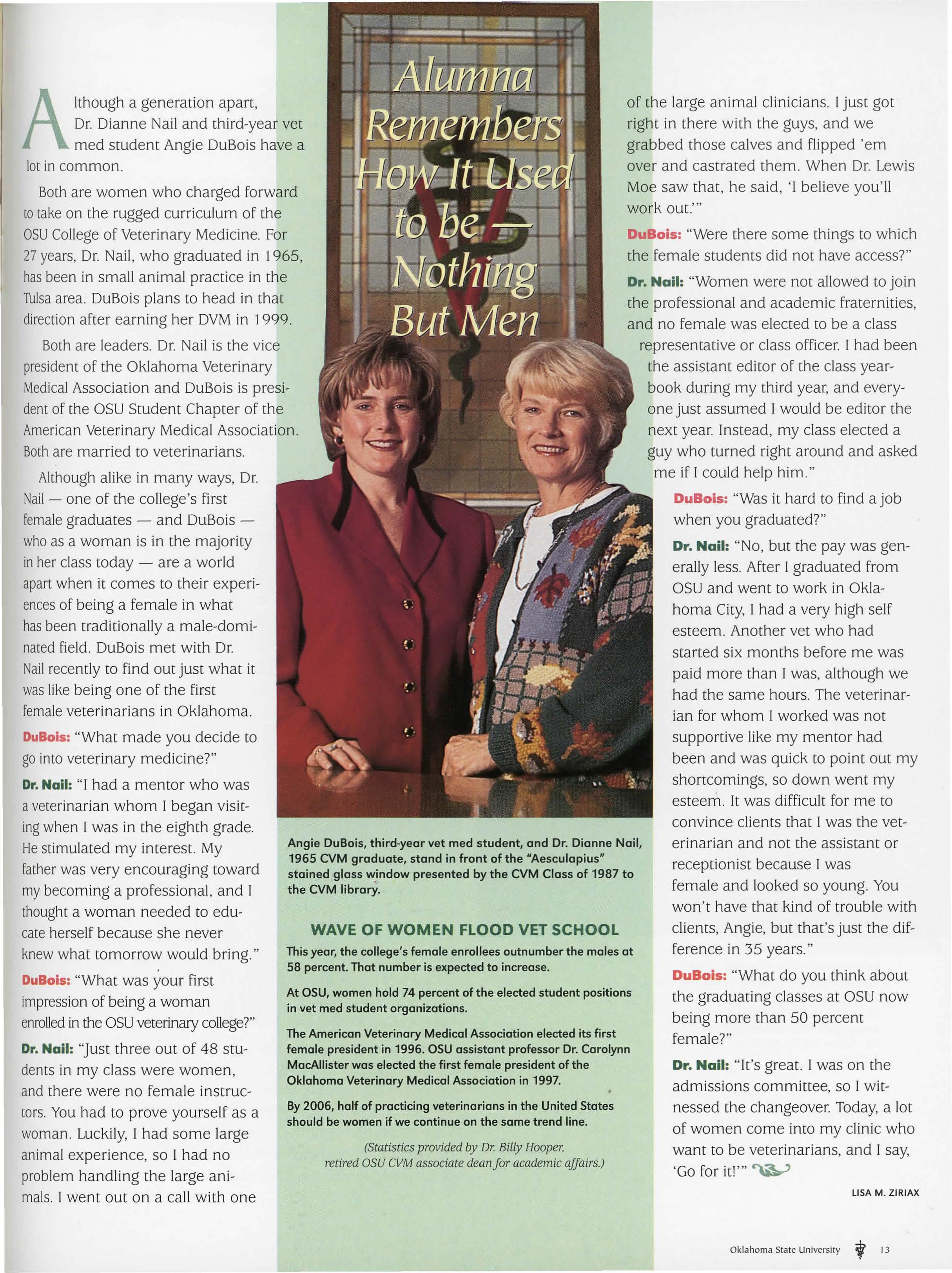
Angie DuBois, third-year vet med student, and Dr. Dianne Nail, 1965 CVM graduate, stand in front of the "Aesculapius" stained glass window presented by the CVM Class of 1987 to the CVM library.
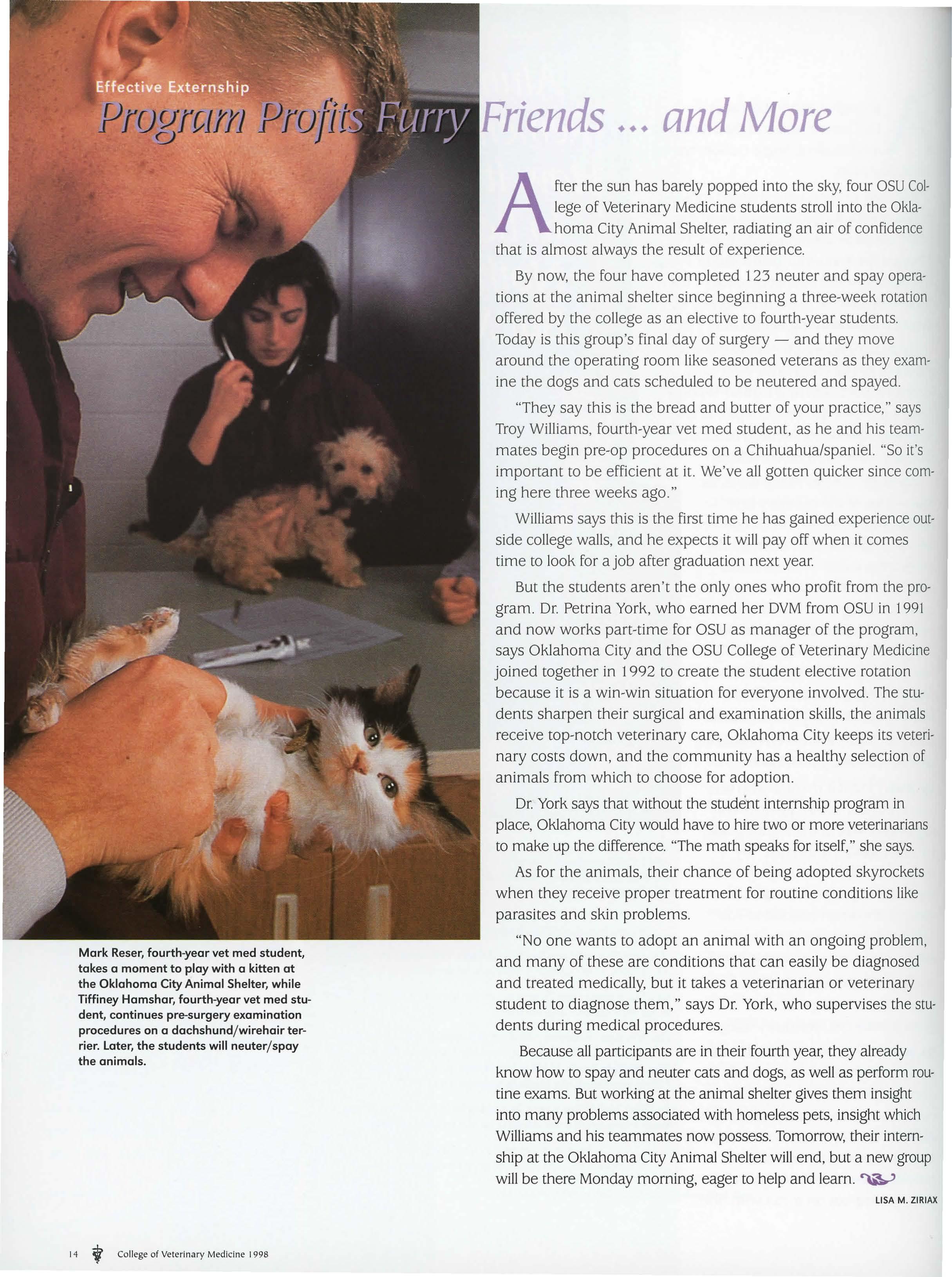
Mark Reser, fourth-year vet med student, takes a moment to play with a kitten at the Oklahoma City Animal Shelter, while Tiffiney Hamsher, fourth-year vet med student, continues pre-surgery examination procedures on a dachshund/wirehair terrier. Later, the students will neuter/spay the animals.
Friends... and More A
fter the sun has barely popped into the sky, four OSUCollege of Veterinary Medicine students stroll into the Oklahoma City Animal Shelter, radiating an air of confidence that is almost always the result of experience.
By now, the four have completed 123 neuter and spay operations at the animal shelter since beginning a three-week rotation offered by the college as an elective to fourth-year students. Today is this group's final day of surgery - and they move around the operating room like seasoned veterans as they examine the dogs and cats scheduled to be neutered and spayed.
"They say this is the bread and butter of your practice," says Troy Williams, fourth-year vet med student, as he and his teammates begin pre-op procedures on a Chihuahua/spaniel. "So it's important to be efficient at it. We've all gotten quicker since coming here three weeks ago."
Williams says this is the first time he has gained experience outside college walls, and he expects it will pay off when it comes time to look for a job after graduation next year.
But the students aren't the only ones who profit from the program. Dr. Petrina York, who earned her DVM from OSU in 1991 and now works part-time for OSU as manager of the program, says Oklahoma City and the OSU College of Veterinary Medicine joined together in 1992 to create the student elective rotation because it is a win-win situation for everyone involved. The students sharpen their surgical and examination skills, the animals receive top-notch veterinary care, Oklahoma City keeps its veterinary costs down, and the community has a healthy selection of animals from which to choose for adoption.
Dr. York says that without the student internship program in place, Oklahoma City would have to hire two or more veterinarians to make up the difference. "The math speaks for itself," she says.
As for the animals, their chance of being adopted skyrockets when they receive proper treatment for routine conditions like parasites and skin problems.
"No one wants to adopt an animal with an ongoing problem, and many of these are conditions that can easily be diagnosed and treated medically, but it takes a veterinarian or veterinary student to diagnose them," says Dr. York, who supervises the students during medical procedures.
Becauseall participants are in their fourth year, they already know how to spay and neuter cats and dogs, as well as perform routine exams. But working at the animal shelter gives them insight into many problems associated with homeless pets, insight which Williams and his teammates now possess.Tomorrow, their internship at the Oklahoma City Animal Shelter will end, but a new group will be there Monday morning, eager to help and learn.
LISA M. ZIRIAX
StudentSees'Zebras'
inBlack,White
'
'I
f you hear hoof beats, think horses and not zebras."
Most veterinary medicine students have heard this axiom so often they know it by heart. They understand that it is good advice to think of the common illnesses first when diagnosing a problem.
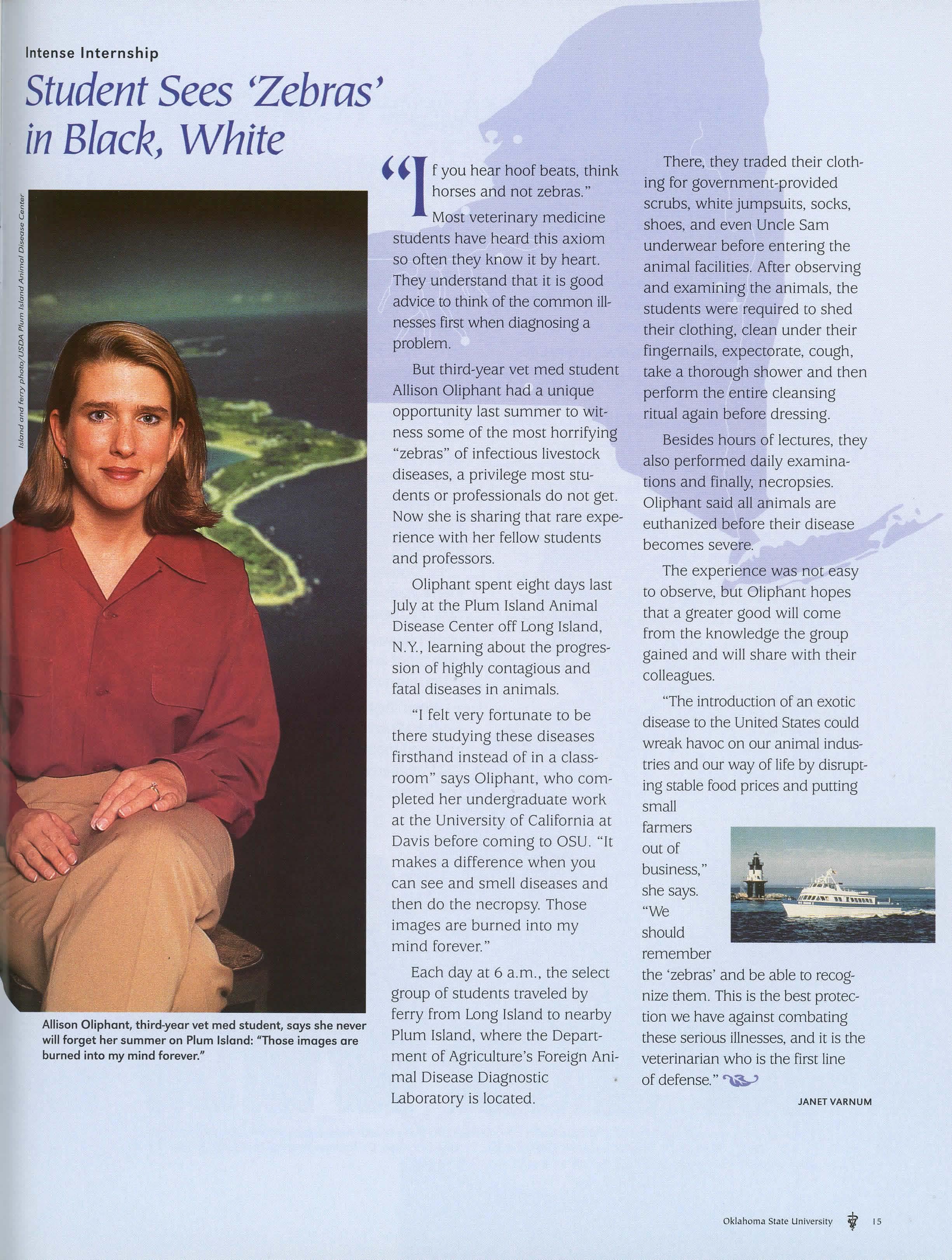
But third-year vet med student Allison Oliphant had a unique opportunity last summer to witness some of the most horrifying "zebras" of infectious livestock diseases, a privilege most students or professionals do not get. Now she is sharing that rare experience with her fellow students and professors.
Oliphant spent eight days last July at the Plum Island Animal Disease Center off Long Island, N.Y., learning about the progression of highly contagious and fatal diseases in animals.
"I felt very fortunate to be there studying these diseases firsthand instead of in a classroom" says Oliphant, who completed her undergraduate work at the University of California at Davis before coming to OSU. "It makes a difference when you can see and smell diseases and then do the necropsy. Those images are burned into my mind forever."
Each day at 6 a.m., the select group of students traveled by ferry from Long Island to nearby Plum Island, where the Department of Agriculture's Foreign Animal Disease Diagnostic Laboratory is located.
There, they traded their clothing for government-provided scrubs, white jumpsuits, socks, shoes, and even Uncle Sam underwear before entering the animal facilities. After observing and examining the animals, the students were required to shed their clothing, clean under their fingernails, expectorate, cough, take a thorough shower and then perform the entire cleansing ritual again before dressing.
Besides hours of lectures, they also performed daily examinations and finally, necropsies. Oliphant said all animals are euthanized before their disease becomes severe.
The experience was not easy to observe, but Oliphant hopes that a greater good will come from the knowledge the group gained and will share with their colleagues.
"The introduction of an exotic disease to the United Statescould wreak havoc on our animal industries and our way of life by disrupting stable food prices and putting small farmers out of business," she says. "We should remember
the 'zebras' and be able to recognize them. This is the best protection we have against combating these serious illnesses,and it is the veterinarian who is the first line of defense."~
Allison Oliphant, third-year vet med student, says she never will forget her summer on Plum Island: "Those images are burned into my mind forever."
JANET VARNUM
A Noble Cause
Every Friday morning, like clockwork, they meet at the Stillwater Holiday Inn. At 9 o'clock, coffee pours, saucers clink and tales are spun.
The conversation usually revolves around the community, current affairs, and of course, the OSU College of Veterinary Medicine.
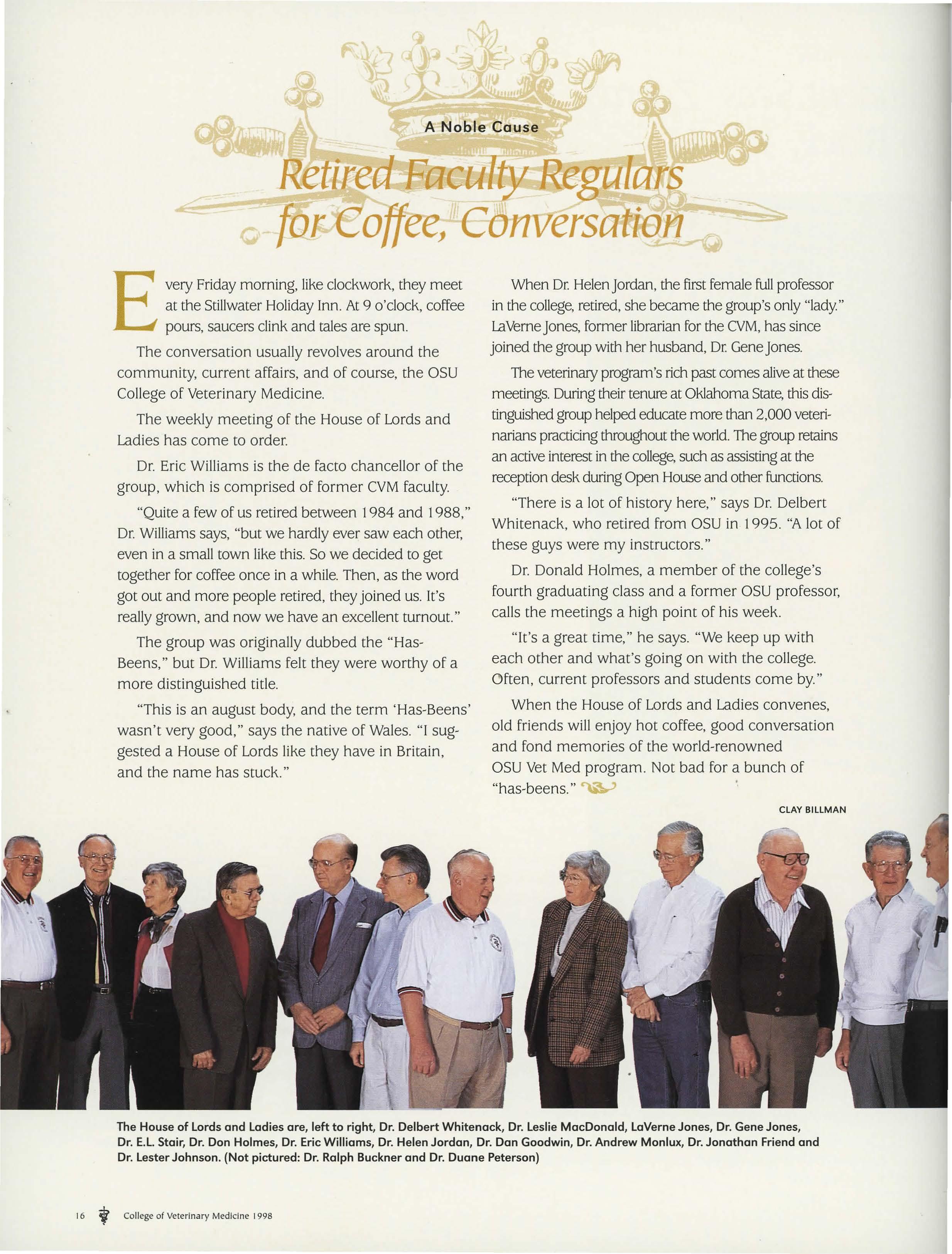
The weekly meeting of the House of Lords and Ladies has come to order.
Dr. Eric Williams is the de facto chancellor of the group, which is comprised of former CVM faculty.
"Quite a few of us retired between 1984 and 1988," Dr. Williams says, "but we hardly ever saw each other, even in a small town like this. So we decided to get together for coffee once in a while. Then, as the word got out and more people retired, they joined us. It's really grown, and now we have an excellent turnout."
The group was originally dubbed the "HasBeens," but Dr. Williams felt they were worthy of a more distinguished title.
"This is an august body, and the term 'Has-Beens' wasn't very good," says the native of Wales. "I suggested a House of Lords like they have in Britain, and the name has stuck."
When Dr. Helen Jordan, the first female full professor in the college,retired, she became the group's only "lady." 1.aVerneJones,former librarian for the CVM, has since joined the group with her husband, Dr. GeneJones.
The veterinary program's rich past comes alive at these meetings. During their tenure at Oklahoma State,this distinguished group helped educatemore than 2,000 veterinarians practicing throughout the world. The group retains an active interest in the college,such as assistingat the reception desk during Open House and other functions.
"There is a lot of history here," says Dr. Delbert Whitenack, who retired from OSU in 1995. "A lot of these guys were my instructors."
Dr. Donald Holmes, a member of the college's fourth graduating class and a former OSU professor, calls the meetings a high point of his week.
"It's a great time," he says. "We keep up with each other and what's going on with the college. Often, current professors and students come by."
When the House of Lords and Ladies convenes, old friends will enjoy hot coffee, good conversation and fond memories of the world-renowned OSU Vet Med program. Not bad for a bunch of "has-beens."
CLAY BILLMAN
The House of Lords and Ladies are, left to right, Dr. Delbert Whitenack, Dr. Leslie MacDonald, LaVerne Jones, Dr. Gene Jones, Dr. E.L. Stair, Dr. Don Holmes, Dr. Eric Williams, Dr. Helen Jordan, Dr. Dan Goodwin, Dr. Andrew Monlux, Dr. Jonathan Friend and Dr. Lester Johnson. (Not pictured: Dr. Ralph Buckner and Dr. Duane Peterson)
Doctor'sGiftGivesHopeto SingleMother
When Stillwaterphysician Dr. Mark Munson and his wife decided to give scholarshipmoney to the OSUCollegeof VeterinaryMedicine, it was a well-thought-outdecision.
"We had been blessed financially, and we decided it would be right to try to help some of the departments at OSU that held a special place in our hearts," the 1974 alumnus says. "I worked in a lab in the OSU College of Veterinary Medicine while I was going to school as a biochemistry
major, and it was a good job with great people to work for. It provided some help when we needed it, so it was only natural for us to think of the college when deciding what programs we wanted to support."
Dr. Munson says that his wife and he have experienced great satisfaction knowing their gift is helping students. But the Munsons are not the only ones experiencing satisfaction.
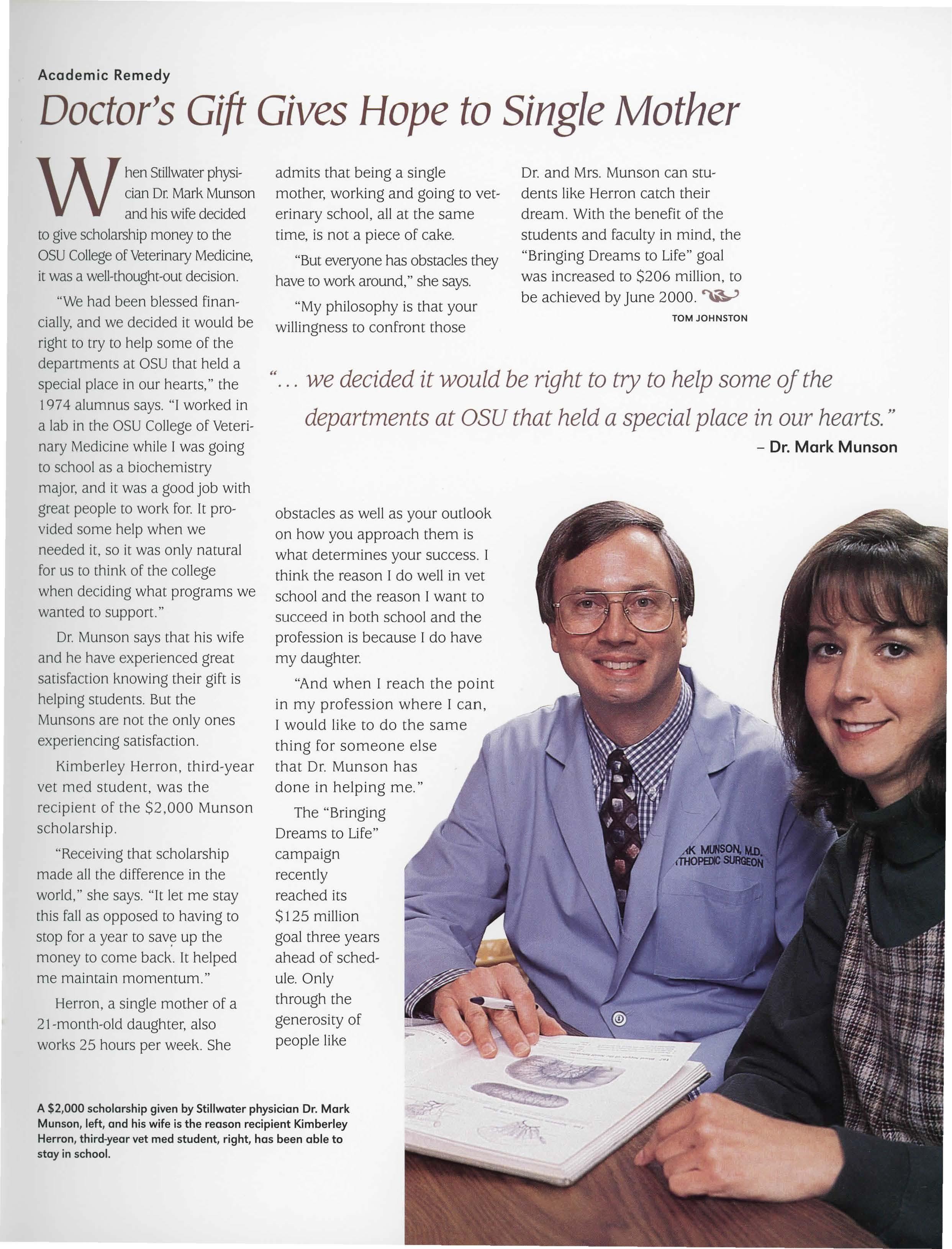
Kimberley Herron, third-year vet med student, was the recipient of the $2,000 Munson scholarship.
"Receiving that scholarship made all the difference in the world," she says. "It let me stay this fall as opposed to having to stop for a year to sav~ up the money to come back. It helped me maintain momentum."
Herron, a single mother of a 21-month-old daughter, also works 25 hours per week. She
admits that being a single mother, working and going to veterinary school, all at the same time, is not a piece of cake.
"But everyone has obstaclesthey have to work around," she says.
"My philosophy is that your willingness to confront those
Dr. and Mrs. Munson can students like Herron catch their dream. With the benefit of the students and faculty in mind, the "Bringing Dreams to Life" goal was increased to $206 million, to be achieved by June 2000.
TOM JOHNSTON
" we decidedit would be right to try to help some of the departmentsat OSU that held a specialplace in our hearts.,,
obstacles as well as your outlook on how you approach them is what determines your success. I think the reason I do well in vet school and the reason I want to succeed in both school and the profession is because I do have my daughter.
"And when I reach the point in my profession where I can, I would like to do the same thing for someone else that Dr. Munson has done in helping me."
The "Bringing Dreams to Life" campaign recently reached its $125 million goal three years ahead of schedule. Only through the generosity of people like
A $2,000 scholarship given by Stillwater physician Dr. Mark Munson, left, and his wife is the reason recipient Kimberley Herron, third-year vet med student, right, has been able to stay in school.
- Dr. Mark Munson
Livingup to Our Word
THE VETERINARIAN'S CREED
To regard my profession as something more than a means of livelihood;
To value character more highly than reputation and truth above popularity;
To be merciful and humane, preventing needless suffering among dumb beasts;
To be faithful and zealous, preventing needless loss to those I om called on to serve;
To guide my conduct by sober judgment and my judgment by a never-sleeping conscience;
To be modest and open-minded and thankful for every opportunity to increase my knowledge and my usefulness;
To be a coworker with my fellow practitioners by the mutual interchange of counsel and assistance;
To be true to myself, measuring my success by the value of the service I render rather than by the fee I receive.
- R.R. Dykstra, DVM School of Veterinary Medicine, Kansas State College
These eight points are the mission statement of the OSU College of Veterinary Medicine. They bring dreams to life. Gary and Linda Burke of Guymon can attest to that.
When G.T., one of the Burkes' six cats, fell ill, their veterinarian recommended seeking the opinion of OSU veterinarians. So they did.
Although the couple learned that their beloved pet had used his nine lives, the quality of the professionals and the facility at OSU made a lasting, positive impression on them.
"It's so simple we like animals, we want to help animals - and so does OSU," Linda relates. "With this common thread in mind, Gary and I knew it would make both of us happy to make a gift that would continue h~lping animals. We're very pleased that our estate will ensure the education of veterinary students. And we think G.T.would approve!"
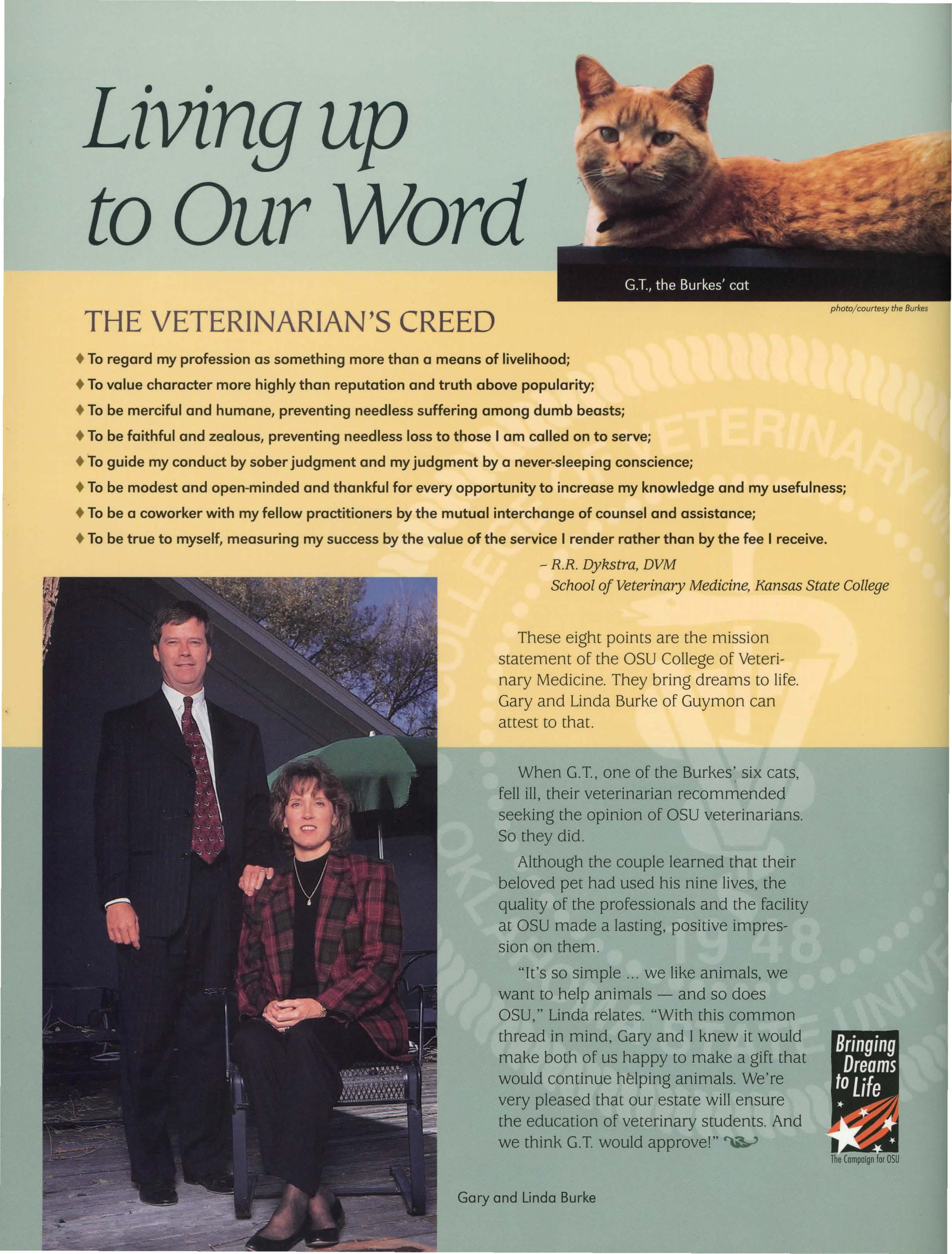
Gary and Linda Burke
photo/courtesy the Burkes