Spectrum 1997

Page 1


A College For AllSeasons

This year, PBS aired a series on one of America's first and greatest citizens. Thomas Jefferson was a statesman, a farmer, an architect, an inventor, a patron of the arts and an educator who founded the University of Virginia. The consummate Renaissance man,Jefferson knew the value of the arts as well as the sciences.

Although he lived more than 200 years ago, Jefferson is still an example for our young people to follow. The world will always need leaders who hold his "global" view and can see and appreciate goals and aspirations beyond their chosen professions or chosen nations. Preparing these leaders is an importanl goal for OSU's College of Arts and Sciences. With the largest enrollment on campus, the College has a trem·endous impact on students' lives and their careers.

In this issue, you'll meet men and women who have graduated and gone on to brilliant careers in a variety of fields. Some are scientists and some are business leaders, but they all have an appreciation for the arts and humanities, something they learned at this university.

You'll read about current students who are entering business, the military and the sciences, but are nevertheless taking advantage of these formative years to get a well-rounded education that will give them the flexibility for the challenges which lie ahead.

You'll see how the college has provided them with some of the best and most interesting faculty in the nation and learn how our professors view the classroom experience. Finally, you'll see how Arts and Sciences is a college full of activities and opportunities which prepare students academically, and also enrich them culturally for the great world that lies beyond the graduation stage. r~

COVER PHOTO: Taking many roads. They're headed in differentcareerdirections,but they credit the Collegeof Arts & Sciencesfor the education which made it all possible.Back rowfrom left: Brian D. Hall,future journalist; Levi Dennis,future musician;Jay Husbands,future careerin the military/law; seatedfrom left:Jennifer Short,future actressdressedin her FreshmanFolliescostume; TerraSawatzky,future physician. •

Dean Smith Holt visits with Amy Harvey and Pattric Lynch about their CD-ROM presentations. Dubbed Smith's 'Smurfs' the students are part of a group of students helping professors put together class presentations. See story page 16.

Former Arts & Sciences students credit the College which gave them the foundation for greatness, as well as success.

GoodChemistry

Distinguished alumnus, Dr.John Niblack, earned an Arts & Sciences degree that is helping him improve the lives of millions of people.

TheStarsareShining

From Hollywood to New York, College alumni are basking in the spotlight.

Directorof Development

Jeanne Short

DevelopmentAssistant

Ilda Hershey

Editor

Debra Basore

Art Director

Paul V. Fleming

Photography

Andy Maxey (unlessotherwisenoted)

Arts & Sciences faculty share a common commitment to excellence in education. Together, they form the "Heartbeat of the University."

SPECTRUM is a publication of the Oklahoma State University College of Arts and Sciences designed to provide information on College issues and concerns while fostering communication among OSU alumni and friends.

College of Arts and Sciences

Oklahoma State University Stillwater, Oklahoma 74078-3015 (405) 744-7274 e-mail: shortj@okway.okstate.edu Oklahoma State University in compliance with

Today's journalists face a brave new frontier in communication.

"I knowfrom my experience as an OSU Regentthat privatesupport doesnot take theplaceof state supportit beginswhere statefunding stops."

Arts & Sciences Livingthe Dream

Let me introduce myself. I'm Dean Stringer, and I have a love affair with Oklahoma State University. When you finish reading this article, I think you'll understand why and want to join me in that affection.

First, let me tell you about myself. I graduated from OSU in 1958, received a law degree from Harvard and r---r-==-~-- returned to the great

state of Oklahoma to 1 practice law. It's the best state of the 50, with the warmest and most wonderful people - and a good number of them reside in Stillwater at Oklahoma State. Over the years OSU has been like a family to me, and I like staying connected with my "folks."

Currently I'm vitally interested and deeply involved in the very first comprehensive fund-raising effort in the history of the university - it's called the "Bringing Dreams to Life" campaign. I like the idea of bringing dreams to life because that's really what OSU is all about.

I don't have to tell you that state appropriations do not fully support the COLLEGE

needs of higher education. OSU's continued success depends on private contributions. That is exactly why I said, "Sure, I'll help." So I'm chairing the group that is raising funds for the OSU College of Arts and Sciences. I have a super team of outstanding alums including Tom and Sue Bennett from Tulsa, Donna Spence from Waco, Texas,Joe and Barbara Williams from Bartlesville, Clyde Wheeler from Laverne, Steve Stephens from Oklahoma City and George Berry from Stillwater.

Malinda Berry Fischer from Stillwater and Martha Lippert from Oklahoma City joined us recently. And, of course, we love having President Emeritus Bob Kamm on our committee.

One of the best additions to the committee we made this year was from the student body -Amy Logan.

Amy is what I call a prototype for the typical OSU student: Oklahoma born and bred, has an intense sense ofloyalty, gets deeply involved in a variety of campus activities,excels academically and wants to give something back. Recently she was named one of the Top Ten Seniors for the College of Arts and Sciences.

Amy jumped right in and got behind the A&S student fund-raising effort,

Dean Stringer

"The Scholastic Classic," a Sk run. Arny says: "My experiences at OSU gave me the feeling that I never want to leave the university environment. After I get an MBA,my goal is to work in higher education. So, you'll be seeing me again!"

Nurturing the Dream

I like to think that the "S" in OSU stands for students. Remember what it was like when you went off to college: thrust out, hoping you were making the right decisions about your future. That process needs help and nurturing - OSU does that well. And one very important part of that assistance is scholarships.

I have several examples that will create inspiration to make more scholarship assistance available. The following are only three out of hundreds of outstanding students who deserve our help.

SharonGlick-Carswell- She is a biological sciences major from Edmond who has been accepted at the College of Osteopathic Medicine in Tulsa. One of OSU's Valedictorian Scholars, she also received a President's Leadership Council scholarship and was a Lew Wentz Scholar. As she says: "Mr. Stringer, OSU is the most eclectic experience any student could have. At OSU, students don't just attend class - I have had practical participation which has enabled me to cultivate some emotional intelligence. That's going to be important in medical school."

GrantWilliams - Teaching science is NOT what Grant envisioned for his future; he was going to be a veterinarian until he started working with kids. He credits his Nativ~ American Biological Sciences Scholarship for attaining his goal. He told me that he was particularly grateful to zoology professor Emily Stanley, his mentor at OSU, who helped him qualify for the Oklahoma Alliance for Minority Program. Because of this financial assistance, Grant was able to spend last summer studying the chemistry of Oklahoma streams and rivers. "I was actually a pioneer on this

project - no other student has ever had this opportunity. OSU has provided 'real world' experience that's helped me mature. It's demanding, but it's worth it," he relates.

Cheryl Wharry is referred to as a non-traditional student. The mother of three children, she reinforces the need for college scholarships. "Without the State Regents Minority Doctoral Studies Grant, I wouldn't have been able to work on my doctorate. And before that, graduate school would have been out of the picture without a scholarship from the English depart-ment." An associate professor of English at East Central in Ada, she says OSU was

instrumental in putting her professional career in place with the encouragement and support of its faculty. Another success story from Oklahoma State!

Building the Dream

I'm happy that I have had the opportunity to showcase some of the players on our drearµ team. If we're going to make a

difference in the future of Oklahoma State University, funding scholarships is important. And so is making sure that fellowships, professorships, endowed chairs, crucial facilities and equipment are in place - these are essential ingredients of a great university.

I know from my experience as an OSU Regent that private support does not take the place of state support - it begins where state funding stops. And before June 30, 2000, we will have the nearly $14 million we need for the College of Arts and Sciences - but only with your help.

I've enjoyed our visit. And I'm proud to say that at OSU, dreams are being brought to life.

'Till we meet again

CherylWharry
Amy Logan

'Earninga~ Livinganfl Livinga Life'

One of OSU President James Halligan's favorite sayings is that a university should prepare students "to earn a living and to live a life." Those words summarize the primary goal of the College of Arts and Sciences. At some point, the college touches nearly every student at the university. It teaches them the skills for achievement in the workplace, as well as instilling in them the ability to think logically, communicate clearly and appreciate the wisdom that has been passed down from earlier civilizations and cultures. In this article, you'll meet former OSU students who credit the college for giving them the foundation that helped them achieve greatness as well as success.

The Nature of Art

When Myron Ledbetter looks into an electron microscope, he sees more than plant cells. This award-winning scientist also sees art. "Nature presents wonderful forms, whether seen by the naked eye or at high magnifications through microscopes," says Ledbetter, winner of the Microscopy Society of America's 1996 Distinguished Scientist Award.

Ledbetter, who does stained glass art as a hobby, creates original designs th!3-tare inspired by the plant cell images he sees under the microscope.

"There is something very satisfying in having a visual product inspired by nature and one's imagination," says Ledbetter, a retired senior scientist from Brookhaven National Laboratory's biology department.

Ledbetter graduated from OSU in 1948 with a bachelor's degree in botany. He continued his study of botany, earning a master's degree from the University of California at Berkeley and a doctorate from Columbia University.

He received the 1996 Distinguished Scientist Award for his discovery of microtubules in plants - a major contribution to

cell biology - and for his invention with Robert Dell of the thin-foil aperture as an impcntant technical innovation in electron microscopy.

But the science world early missed out on Myron Ledbetter.

While hew s a student at Stillwater High School, edbetter as leaning toward a career in music. An outstanding flure player, Ledbetter took up the wind instrument in elementary school and excelled through the years. He was even president of the high school orchestra his senior year.

"My parents encouraged me in music," says Ledbetter. "During the Depression, the Oklahoma Symphony was formed, and we attended those concerts. That was part of the spark," says Ledbetter, a supporter of chamber music and theatre organizations in his city of Port Jefferson, N.Y.

He also credits his parents with encouraging his interest in science. "My father was a very good naturalist," Ledbetter says. "He taught me and my brother about plants and animals."

Ledbetter realized botany was the career for him when an OSU professor, the late Orville Schultz, visited his high school physics class. "He gave me an idea of what research was all about," Ledbetter says. "His general approach to botany and the fact that it dealt with plants interested me."

"Scienceand the artsjust naturallygo together."

Schultz was also a true model of the Renaissance man, says Ledbetter,who later studied with him at OSU. "Like so many people in the field of science, Professor Schultz was very well rounded in both science and the arts, especially theater."

Ledbetter followed his lead and remained active in music. "When I played in the symphonic band at OSU, at least half of the band and orchestra was made up of engineering majors," Ledbetter says.

And throughout Ledbetter's career as a researcher, he has noticed that most scientists involve themselves in the arts, either as participants or supporters. "At one of the annual science meetings I attended, we would have a string quartet that alwaysmet. And there's always been a great affinity between mathematicians and music," he says.

"Scienceand the arts just naturally go together."

A Background for Any Career

For Clyde Wheeler, learning to appreciate the arts and humanities began at OSU where he met Dr. George White. Although he made a "C' in Dr. White's Humanities 101 course, he credits the class and the teacher for this love of the arts.

"Dr. White had an influence on me and allowed me to appreciate the arts," Wheeler says. "I think the arts and humanities gives an educational background that is useful in any career, and it prepares a person for life's challenges," Wheeler says.

"I dofeel it is importantfor employees to havean appreciationfor the.arts becauseit makes a fullerand richerlife for themregardless of theiroccupation."

Wheeler's other favorite classes were in history and government. He graduated from OSU in 1947 with a bachelor's degree in history and a master's in political science in 1951. He's also a graduate of the American Business College and received a Life's Teaching Certificate from Oklahoma City University.

Upon graduation, Wheeler began his public service career in the nation's capitol. He was a special assistant to Secretary of Agricult~re, Ezra Taft Benson, and staff assistant to President Eisenhower.

Wheeler has also served as campaign manager and national committeeman of the Oklahoma Young Republican Federation for the Republican Party.

He began his business career at Sunray DX Oil Company in Tulsa, where he served as director of public affairs and public relations.

Sunray provided many opportunities for Wheeler. He became vice president of the company in 1967 and was appointed to the merger manager's staff when Sunray merged with Sun Company, Inc. Wheeler traveled to Washington, D.C., frequently for Sun and became corporate vice president in 1974.

Despite his long career in the tough, practical world of business, Wheeler believes in encouraging arts and humanities to colleagues and employees.

"I do feel it is important for employees to have an appreciation for the arts because it makes a fuller and richer life for them regardless of their occupation," Wheeler says.

Clyde Wheeler smiles as he's being congratulated by President Eisenhower. Photo taken at the official swearing-in ceremony on March 18, 1959 when Wheeler became staff assistant to President Eisenhower.

Wheeler has continued to stay involved with higher education. He served as a member and chairman of the Oklahoma State Regents for Higher Education, is a recipient of the 1978 OSU Distinguished Alumnus Award and was named a Fellow of the Academy of Arts and Science in 1979. In 1988, he was inducted into the OSU Alumni Hall of Fame.

Wheeler says he dedicates a lot of time and hard work to OSU, his career and community because education i.s important.

"Colleges are very important, and they are always short of money. I am always glad to help raise money," Wheeler says.

Wheeler said many people have influenced his life and encouraged his success. He admires President Eisenhower for his leadership, his beliefs and his accomplishments. But his greatest admiration is reserved for another outstanding and well rounded person.

"I would have to say my father is my hero," Wheeler says. "He had it all put together."

Becoming a 'Total' Human Being

She runs an oil company, but Malinda Berry Fischer knows that without the arts and humanities, life wouldn't have much meaning.

Fischer (English '62) recently moved back to Stillwater where she was born and raised. She serves as president and CEO of Thomas N. Berry & Co., a family run oil and gas production company.

"If we didn't have art and museums and the arts in general-music, humanities-we would really have no history of mankind," Fischer says. "I go to museums i.n communities and find that they tell something about the community's art or history. I look at museums, whether they're art or hi.story, as the collective memory of our world."

Fischer lived 32 years i.n Rochester, N.Y.,where she worked as a consultant in organizational management and development and was very active i.n civic and community work.

Her mother also wanted her children to realize the importance of the humanities. "My mother used to take us to OSU to whatever production was going on, whether i.twas music or theatre. Back when I was a child, it was a real special occasion when something came to Stillwater."

Serving the community is in her genes, Fischer says. "My mother served on the first arts and humanities council representing this region statewide. My grandmother, who was one of the first women graduates from OSU, help spearhead saving Old Central as a landmark."

In Rochester, she served as the chair of the Margaret Woodbury Strong Museum for 14 years. Showcasing American hi.story, the museum has thousands of artifacts ranging

"Idon't know wherethe world would be without art. Art helps makeyou a 'total'humanbeing."

from the largest doll collection in the world to steel boxes, numerous miniatures and toys.

In Stillwater, she's on the board of the Sheerar Museum, the OSU Foundation and the Oklahoma Arts Institute.

"I don't know where the world would be without art," Fischer says. "Just look around you. Even the little things such as flowers give you something artistic to look at and appreciate. Art helps make us a total human being."

Fischer points out that even her business conference room is a work of art. The paintings, the ornate moldings around the ceiling, the antique conference table and the chandelier create an environment that improves creativity and set the right tone for pleasant and productive meetings.

Malinda Berry Fischer

Planting the Seeds of Growth

Boone Pickens' interest in the arts and humanities has its roots in his childhood. Growing up in rural Holdenville, Okla., he would often trek to the public library from school.

"I had a kinship to that building," Pickens says.

As Pickens (Geology '51) forged a highly successful career that propelled him to the top of the oil industry, he always kept his child-like love of learning. His contribution to the Holdenville library in honor of his mother, Grace M. Pickens, helped preserve that legacy.

"I wanted to make sure that building survived and that we added to it," he says. "It was important to me as a child to go to that library, and I think it's extremely important for children growing up and the adults in the community to have a good library."

Pickens' gift to his home town is one of many philanthropic contributions he has made over the years, including generous donations to OSU, which houses the Boone Pickens School of Geology.

"Ifyou go back and look at the philosophersof the early times, you'IIfind that the issueswe struggledwith years ago are the same issueswe struggle with today."

Pickens recently ended his tenure as chairman and CEO of MESA Inc. - a company he founded in 1956 and built into one of America's largest independent producers of oil and natural gas. His new endeavors are BP Capital, an energy trading partnership, and Pickens Fuel Corp., which owns and operates natural gas fueling stations for vehicles in Southern California.

Throughout his career, Pickens' training has been mainly in the natural sciences. But, he says, his "people experiences" along the way have fostered a concern for the humanities.

"You spend the better part of your life writing and reasoning with people," Pickens says, so obtaining a liberal arts background is a valuable asset. "It was something I didn't focus on in college," he adds, "but I do feel like I've bridged that gap because of all my experiences. But at the same time I think it would have been easier for me if I had concentrated on the humanities and the arts back then."

This type of education helps people express themselves, which translates well into business or scientific fields, Pickens says.

"I think writing is very important. To be able to speak well and hold the attention of busy and important people comes from this type of education."

Pickens believes studying humanities reveals much about ourselves.

"If you go back and look at the philosophers of the early times and their great writings, you'll find that the issues we struggled with years ago are the same issues we struggle with today," he says.

Pickens recommends a well-rounded education as a foundation for success.

"If you get a good education in the sciences, arts and humanities, it's a good start," he says. "It will grow from there."

Regarding his own experience in the OSU College of Arts and Sciences, Pickens says, "OSU can compete with any other university in the country. I've never felt like my education was anything other than the best."

BoonePickens

Student Features

A&S Student Fine Tunes

Her Future Medical Career

Not many biochemistry majors find time to get a minor in music, nor do they want to. But for one OSU sophomore, this minor will play an important role in her future medical career.

TerraSawatzky,an OSU valedictorian scholar from Custer, Okla., wants to be a doctor someday and thinks her musical TerraSawatzky activities at college will help her in the selection process for medical school.

"You don't want a doctor who doesn't have any personality or people skills," she says. "That's what you're doing. You're dealing with people all day long."

Sawatzky's love for music developed as a child. She was encouraged to sing in church and took voice lessons for six years and piano for ten years. Her aunt, a music teacher who lived nearby, taught and encouraged her. Sawatzky's parents wanted her to participate in everything as well.

"It's definitely a family thing," Sawatzky says. "They see its importance and they believe in it and I guess that's how it was passed on to me."

Sawatzky was a member of University Singers for two semesters. She also participated in Freshman Follies, Varsity Revue and Spring Sing competitions at OSU.

Sawatzky says she has difficulty fitting music classes around all of her science labs, but she still makes it work.

"I think you should take classes that you enjoy and that will make you more worldly. It's important to have variety in your life," Sawatzky says. "Everyone's going to have different interests, and my interests happen to be music, but somebody else's might be writing or painting."

In her effort to be well-rounded, Sawatzky makes time for campus activities, too. This past year she served on the student government speaker's board committee and gave tours and leadership workshops for Student Alumni Board.

"The world would be pretty boring if we all did one thing and didn't have any variety to our personalities," she says.

Sawatzky's variety comes from a song practice between organic chemistry and physics classes.

Student Doesn't Want to Be 'AllBusiness'

Some people go through life doing as little as they can. Jay Husbands tries to see how much he can fit in. That is why the ec·onomics senior got his business degree from the College of Arts and Sciences.

"I didn't want to be all business," Husbands says. "I wanted more elec- Jay Husbands tives and more of a well-rounded college expenence.

Husbands' recent college endeavors are a far cry from business. The Putnam City North graduate played a lead role in OSU's 1997 production of "A Chorus Line."

He really didn't expect to be in theater when he came to OSU. But in his quest for a well-rounded education, he found himself in an upper-division theater class his junior yearand he liked it. One course led to another, and before long Husbands discovered his new-found interest had earned him a minor with the theater department.

Before auditioning for "A Chorus Line," Husbands' only experience on stage was a small part in an OSU play last year. He has never had voice or dance lessons and modestly says he can only carry a tune.

"I made it on potential probably, and a prayer," he says.

Husbands says the part wasn't easy for him. He can't read music and claims he can't dance well, but he took extra lessons to help overcome that. The Sigma Nu fraternity member just wanted to try it.

"It's about setting a goal and working to obtain it, even if it isn't easy for you. That's part of the reason I did this. I wanted to experience everything in college that I could."

"Everything" includes time in the Marine Corps as well. In June, Husbands was commissioned as second lieutenant and in September he will begin his first active duty school in Virginia

But Husbands' career plans are not limited to the Corps, theater or economics. In the fall of 1998, he will start his first year of law school.

Husbands could be called a 'Renaissance Cowboy' at OSU, but sees himself as an adventurous, yet ordinary guy. He credits his well-rounded experience at OSU to his philosophy about life.

"Do everything you want to do. Don't be afraid to try something becaus~ you never know when you're going to get that chance again."

GoodChemistry

While visiting OSU in April to receive the College's Distinguished Alumnus Award,Dr.John Niblack told students that as Executive Vice President of Research and Development at Pfizer Inc., a Fortune 500 company and fifth largest pharmaceutical company in the world, he often meets colleagues who ask, "Harvard or Yale?"

"I tell them Oklahoma State, but many of my employees are Harvard and Yale,"Niblack said.

Niblack began his life's work in OSU's chemistry labs. Since graduating in 1960, his intelligence, hard work and determination led him to the top of the corporate world.

"Atthe time I was a student, I thought I would end up as a university professor," says Dr. Niblack, who lives in Lyme, Conn., with his wife, Heidi.

But, while he admires the professors at the university level, he values the impact his occupation has had on improving· the livesof millions of people. "It's nice to see scienceused to actually create new medicines that can help prolong people's lives and make the bearing of their diseases easier,"he says.

Dr. Niblack joined Pfizer in 1967 as one of the company's first molecular biologists. As an active scientist from 1967 to 1980, he directed research into drugs for viral illnesses, cancer and autoimmune disorders.

In 1980, Dr. Niblack was appointed Director of Research for the company's U.S. laboratories. In the mid-1980s, he became involved with the development and regulatory approval of new drugs, and in that capacity, Dr. Niblack oversaw the worldwide development of Pfizer's current wave of new pharmaceutical products.

In 1990, he was named President of Pfizer's Central Research Division and in 1993 was promoted to Executive Vice President of Research and Development at Pfizer Inc. He presently manages the Central Research Division, the Animal Health business, the Quality Control Division and the Licensing and Development Operations for Pfizer. He is a member of the Corporate Management Committee, and reports to Pfizer's Chairman and CEO, W.C. Steere, Jr. r~

A&SAlumni Board Members

President EllenChanceLyons,Edmond BS'82 Math

Vice President

KristyBakerMclaughlin,Stillwater BS'84 Sociology

Members at Large

AlisonAnthony,Mannford BA'87,MA'90 English

ChristopherGafney,Edmond BS'90 Statistics

NancyS. Gloriod-Jones,Duncan BA'84 Spanish

RichardL. Hauschild,Edmond BS'78 Geology

CarolR. Kilpatrick,OklahomaCity BA'86 Spanish& Journalism/News

PaulKnapp,OklahomaCity BS'79, MS'81 ComputerScience

JohnLambertonIV,Tulsa BS'70 Psychology, Ph.D.'81 Sociology

SteveNelson,Tulsa BS'83 Geology, MS'88 ComputerScience

DavidK. Parrack,Norman BA'80 History

KarenK.Speer,OklahomaCity BS'87 Journalism/ PublicRelations

Departmental Representatives

ClaudiaBartlett,Sapulpa BS'80 Journalism/Advertising

Dana K. Glencross,OklahomaCity BA'82 English, MA'86 PoliticalScience

AngelikaPotter,Mannford BA'93 Philosophy

RobertR.Springer,OklahomaCity MS'77 Geography

Dean Smith Holt, Dr. John Niblack and his wife Heidi (center) pose with same af the tap Arts and Sciencesgraduating seniors.

The Stars are Shining

From Holly~ood to New York City, alumni from the College of Art~ & Scienc~sare receivingcriticalacclaimand making headlmesfor their endeavorsin the arts.

Matthew Mungle

A recent Time Magazine article reported that Matthew Mungle did such a good make-up job on James Woods for the movie, "Ghosts of Mississippi," that when Woods (minus the make-up) arrived at the Academy Awards, the guard refused to let him in.

Mungle's work for the film received an Oscar nomination. The former OSU theatre student has already claimed one Oscar for his work in "Bram Stoker's Dracula."

Mungle was born in Durant and grew up on a dairy farm owned by his parents,Jene and Beke Mungle of Atoka, Okla. During his elementary school years, he became fascinated with such horror and fantasy films as "Frankenstein" and "Dracula." Mungle would buy theatrical make-up from a store in Dallas and experiment with make-up and prosthetics. After watching "Planet of the Apes," he knew what he wanted to do. Later, he would work at the local movie theatre, making himself up to look like one of the chimpanzees to

promote the film, "Return to the Planet of the Apes." By the time he got to OSU in the mid 1970s, he could recreate almost any effect.

"He was one of those kids you always remember," says Dr. Jerry Davis, who retired as head of the Theatre Department this year. "He was very creative and very likable."

To date, Mungle has worked on more than 100 films, commercials and television cable projects. Movie credits include: "Schindler'sList,"the Arnold Schwarzeneggercomedy, 'Junior," "Edward Scissorhands,""What About Bob," "So I Married an Axe Murderer,""Heaven and Earth" and "The Glimmer Man."

While at OSU, Mungle acted in several plays, but always aspired to work in films. "He knew when he came here what he wanted to do," says Davis. "He wanted to be a make-up artist."

Barry Epperly

Dr. Barry Epperly has been the artistic director and conductor of the Oklahoma Sinfonia since he sold his favorite

Above: top left - Matthew Mungle; top right - Jay Daniel.; bottom left - Barry Epperly
Opposite: right - Otto Duecker.

Mercedes 18 years ago to raise money for the Tulsa arts organization. Since then, he's taken the orchestra and its audience through the joys of live music by programming a delightful mix of classics,pops, jazz and big band works for its concert series.

Seven years ago, the orchestra took on the added challenge of playing for Tulsa Ballet Theatre performances. Epperly's ability to read the dancers, as well as the music created the perfect marriage of heart and soul for each production.

In 1996, he assumed the additional title of Director, Performing Arts Institute, at Tulsa Community College. There, he will oversee ICC's new Performing Arts Center for Education.

Epperly received his bachelor's and master's degrees at OSU. His doctor of music arts is from the University of Southern California.

"While studying and maintaining OSU's academic standards, I began to see that life was going to require a great deal of persistence. In addition, OSU gaveme the basis for my understanding of the arts," Epperly says.

Otto Duecker

Otto Duecker's hyper-realistic oil paintings of everything from clothing to street people have earned him international acclaim.

The Tulsa artist and 1970 OSU art education graduate has work which is exhibited and sold in prestigious galleries from New York to Santa Fe. Such celebrities as Ralph Lauren, Richard Crenna, Polly Bergen and Victoria Principal have collected his art.

Duecker first became famous for painting his ultra-realistic, life-size cutouts of street people from Tulsa. For 12 years, he painted more than a hundred of these subjects whom he called "independent men."

He later concentrated on his "Floating Fruit" series, paintings of fruit against stark backgrounds which gave the illusion of suspended objects. That led to "Landed Fruit" and his "Help" series which featured domestic servants looking at art. Currently, the artist is

getting ready for a show in New York and is concentrating on floral subjects.

In one interview, Duecker called his style, "new realism." It was best described by Tulsa World writer John Wooley, who wrote about a painting which had "drops of water so real you'd swear they would splatter if you touched them."

Duecker lives and works at his home in Tulsa. His wife Ellen, a 1970 OSU library science grad, is director of technology for the Tulsa Public Schools.

Duecker credits OSU for providing a healthy atmosphere which let him develop his distinctive style. "For me, OSU meant an opportunity to be with kids from all over the state at a university that said, 'we'll give you a chance.'

A chance was all I needed."

Jay Daniel

For the last two decades, some of television's best work has been produced by an OSU Theatre Department graduate.Jay Daniel received his degree in theatre arts from OSU in 1965 and went on to become one of Hollywood's most celebrated producers. After OSU, he earned a master of fine arts degree from the University of California in Los Angeles, then entered an assistant director's training program sponsored

jointly by the Producer's Association and the Director's Guild of America.

He moved up the ladder and made his reputation as producer of the highly successful "Police Story," which won an Emmy for best dramatic series. He later produced and directed several Emmy winners including "Dead Wrong - the John Evans Story," and "The Shooting."

But, his best days were still ahead. In 1983, an association with Picturemaker Productions and his partner, Glenn Gordon Caron, led to the creation of "Moonlighting," the "must see" series which teamed Cybill Shepherd and Bruce Willis. The show was twice nominated for an Emmy as best new dramatic series and also nominated for the Golden Globe and People's Choice Awards.

The hits kept on coming. Daniel's next big success was the phenomenal "Roseanne" show, estimated to be one of the most popular series of all time. In between engagements, Daniel produced "Clean and Sober," a movie starring Michael Keaton. He and his wife, Vicky, live in Encino, Calif. Daniel has been back to campus several times to participate in activities and talk with theatre students. He received the College of Arts and Sciences Distinguished Graduate Award in 1989.

CAROLYNGONZALES
Photo by Carolyn Gonzoles. Photos opposite page courtesy of the individuals

-I~ e eart eat ft University

"Bread,beauty and brotherhoodspeak eloquentlyof the task of this universityas envisionedby itsfounders - educationto accomplishthe work of the world and educationthroughstudy of the humanities to dignify man's laborsand to directsuchfor the good of all."

Those words from OSU's beloved former president eloquently expressed the value of general education courses. As a former OSU Dean of Arts and Sciences, Dr. Kamm knew that students throughout the university depend on Arts and Sciences faculty for this important part of their university experience and benefit from it regardless of their major or future career direction.

Today's college leaders couldn't agree more. Dr. John Bantle, associate dean for research, says general education is important because it rounds out the individual. "It's too easy to become narrowly focused in your discipline and become mono-dimensional," he says. "If that happens, it limits your ability to think, to be an educated person and a good citizen."

'½s a teacherI try tofind bridgesbetweenbiologyand student~'everydaylives."

Dr. Bruce Crauder, associate dean for instruction, says general education courses are the core of a student's university experience. "These courses form the common experience which gives fullness and perspective to students' education. General e~ucation courses are designed to challenge students to think in 1;1ewways. Taken together, the general education curriculum provides a comprehensive introduction to thinking in new and diverse ways. Long after college, the quality and richness of life is enhanced by general education courses even more than by the courses needed for one's profession."

Margaret Ewing, professor of zoology, shows one af her students the famous green fish net she uses in her classes to demonstrate a concept.

Teaching these courses are faculty from the College of Arts and Sciences. They come from all over the world. They have diverse backgrounds, educational experiences, qualifications and teaching styles. The bond they share is a love of students and a commitment to excellence in education. Together, they form the "Heartbeat of the University."

Sparking an Interest

Whether she's using her famous green dip net or a pair of pantyhose to demonstrate a scientific concept to students in her biological sciences class, Dr. Margaret Ewing believes students should prepare themselves to make informed decisions about issues that touch on biology.

"As a teacher I try to find bridges between biology and students' everyday lives," says Ewing, professor of zoology and interim head of the department, who teaches an introductory biologic;alsciences class. "Some bridges are both physical and figurative, and I try to help students understand analogies using everyday examples."

One of her favorites is her big green dip net. "When I talk about cell membranes and say they are a semi-permeable material the students look at me like, 'what is she talking about?"' says Ewing. "So, I bring in the net and show them what semipermeable really means. Semi-permeable just means some things go through it, and some don't."

Of course, she explains, everyone knows the water goes through the net and the fish don't. Then they all understand it, she says. The enlightened professor then asks her students to bring models of semi-permeable materials.

"We get a wide variety of examples ranging from coffee filters, colanders, tea bags and even a diaper," she says. "Then we talk about their models and how they illustrate the principle we're discussing in class."

Ewing's philosophy of teaching is that students who are not engaged do not learn. That's why her examples or models she brings to class are an important learning tool.

Ewing says sometimes it's the models that get the students excited or spark an interest. "Sometimes I don't hear from a student all semester until they bring an example or model to class and explain it," she says.

Ewing teaches an introductory biology course for majors and one class for non-majors. In her non-majors class, she has students from business, human environmental sciences, engineering, education as well as arts and sciences.

"I believe it is essential that general education students come to know that they have many bridges to the sciences they see on TV or read about in the newspapers," she says. "Asthey bring their personal experience and their knowledge of biology together, their confidence will build and they'll become informed ci.tizens."

Ewing says she's' always had a passion for teaching. Even after teaching at OSU for 19 years she still gets excited about teaching science and watching her students succeed. It's that

passion for teaching that's led her to receive numerous teaching awards, including the Phi Eta Sigma Award for Outstanding Instruction for Freshmen, Women's Council Women to Watch Award, AMOCO Foundation Outstanding Teaching Award and many more.

She hopes her same passion for teaching and biology will rub off on her students. "My first aim as a teacher is to engage, to spark interest with my enthusiasm for the living world. I want students to understand they're part of a living world that is zinging with marvels."

"Heis the mostfair and interestinginstructorI haveever had in my life."
After a busy day of teaching and meetings, Michael Rhodes enjoys playing the Flamenco guitar for relaxation.

Learning How to Think

Dr. Michael Rhodes has spoken at national and international conferences. He's talked to the Second World Congress of Bioethics, where he was one of only two U.S. representatives, and at the Special Session of the National Academy of Medicine, where he was the only U.S. representative. He's also chaired a recent colloquium at the University of California at Berkeley on the distinction between euthanasia and assisted suicide. But Rhodes' favorite audiences are still the students in his classes.

"I really enjoy interacting with students, and one of my greatest rewards in life is helping them learn to think through complicated issues and express their ideas," Rhodes says.

Rhodes, a biomedical ethicist, teaches medical ethics, classics, philosophy of life and philosophical perspectives on death and dying. Prior to coming to OSU three years ago, he taught at several colleges including the State University of New York where he earned his Ph.D. in philosophy. During his career, he's taught a diversity of students, ranging from nursing and medical students to prison inmates in New York's Attica Prison, and he has received formal recognition for his excellence in teaching.

He gained further national recognition in April of 1995 when he became the first philosopher to be accepted as a full member of the Society of Critical Care Medicine, and he is now part of the group's task force devoted to the issue of medical futility, which is currently his main research interest. He has published articles on medical ethics, and he's written a book, "Coercion," which will soon see worldwide distribution.

He says medical ethics is an extremely challenging area for teaching and research because of its multidisciplinary nature and the rapid changes in technology and policy. For this reason, he says he must be in touch with what is going on in the field nationally and internationally.

Rhodes is not a man to shy away from challenges in any area of his life. For relaxation, he has taken up the challenge of learning to play Flamenco guitar, and he is studying under the masterful Flamenco guitarist, Johnny Beard. Rhodes' approach to life and teaching obviously work well. His student evaluations are filled with glowing comments. "He is the most fair and interesting instructor I have ever had in my life," one student writes. "He goes out of his way to help students with anything they need."

"This is the one class I did not want to miss a day of," another student said.

Rhodes' colleagues are equally enthusiastic about the young professor. Dr. Ed Lawry, head of the OSU Philosophy Department, says Rhodes has a unique ability to capture students' interest and inspire their best work.

In the classroom, he's known for his famous end-of-semester, 40-minute team debates, which are the culmination of his teaching efforts and the students' independent, semester-long research and preparation. Rhodes says these debates give him the highest satisfaction of his academic life.

"When I see my students presenting their arguments clearly, cogently and confidently, I realize that all of the work done throughout the semester has been gloriously worthwhile. On such occasions, I could not be more proud to be a teacher."

CAROLYNGONZALES

Making Connections

English professor Ed Walkiewicz teaches 20th Century American and British literature and likes to joke that he is somewhat of a "ham" in the classroom. 'Tm something of a performer, and I discovered early on there are few things that feed my ego like connecting with a classroom full of people," he says.

A native of New York, Walkiewicz began his own college education at Yale University, studying what he did bestmath and science. In fact, he was so advanced in these areas

"It'sextremelygratifyingto help bringa mind to life."
Ed Walkiewicz, English professor, goes out of his way to make his classes interesting, demanding and a richer experience for students.

that he didn't have to take lower level math and science classes. That gave him time to study the humanities. These directed studies classes, taught by full professors, allowed him to enjoy individualized attention and to learn and exchange ideas about art, history, philosophy and literature with others in a small group setting. Before long, he was hooked - he became an English major. After graduating from Yale,he continued his study of English, earning his master's degree at Columbia University and receiving his Ph.D. from the University of New Mexico.

Walkiewicz loved being a student, and that love motivated him to teach. "I relished the opportunity to converse with other people about things I found interesting," he says. "Beinga professor is one way of continuing that conversation."

By all counts, Walkiewicz has made a success of his teaching career. He is well respected by students and colleagues, and he received the OSU Graduate Student Association's teacher of the year award in 1991. One of his current students, Blaine Greteman says, "The thing that makes Dr. Walkiewicz a really great professor is that he is able to convey information very well while encouraging and demanding that you think and explore for yourself."

In addition, Greteman says Walkiewicz is always accessible and approachable both in and outside of class. Outside the classroom, Walkiewicz pursues scholarly research and writing and has published much of his work, including two books. He also serves as editor of the English Department's Cimarron Review, a quarterly literary journal.

His current research involves studying what he calls the biodynami.cs of James Joyce's "Finnegans Wake." His affinity for science should serve him well in this study, as it has in other areas of his career.

Walkiewicz has long been interested in computer technology and was an OSU pioneer of its use in the classroom. He teaches his graduate students how to use the Internet and gives some of his tests on computers. He has also devised a visual component to his courses. He uses hundreds of images of paintings and sculpture, which he has digitized, to complement the study of poems that were inspired by or written about a particular work of art, or art movement.

Walkiewicz uses ·everytool available to him, whether its technology or the "performance arts" of drama, theatrics and humor, to make his classes interesting and to help students discover how to read critically, synthesize and question. In the end, both students and teacher are richer for the experience.

When everything "clicks" in a classroom, he says the relationship between teacher and students is symbiotic. At these times, I'm stimulated to think about the material in novel ways and to make connections that hadn't been apparent to me before. "It's extremely gratifying to help bring a mind to life."

CAROLYNGONZALES

For the Love of Teaching

Through the love of helping students and the knowledge of foreign languages, one Oklahoma State University professor has made her dream of teaching come true.

OSU Spanish professor Cida Chase, said she knew at a very young age that she wanted to be a teacher. As a child, Chase would set up tables and chairs outside her home in Costa Rica so her classmates could come over and play school. Chase also helped tutor her high school classmates in Spanish, English and French.

"I liketo taketimefor students and it isimportantfor them to knowthatI care.... "
Cida Chase (center) works with some students in the new Foreign Languages Lab.

Smith's'Smurfs'

Lisa Wester got her first computer at age nine. The Tulsa junior remembers that it had a 386 processor and came with some type of "jingle disk" that allowed her to create personalized Christmas cards.

Today Wester is creating a CD-ROM that is much more complicated than any card. Her assignment is to put together a computer-assisted program that will help students in the department of statistics understand the Statistical Analysis System or SAS.

OSU teaches two SAS classes, and Wester hopes her CD-ROM presentation will someday be available to both students and teachers as an aid to understanding the coursework.

Lisa is one of several Arts and Sciences students helping college departments with everything from computer animation to class presentations. Dubbed Smith's "Smurfs" after Dean Smith Holt, who thought up the idea, the students are assigned to a professor or department and given an assignment. Presentations are created at a CD authoring center in Stout Hall, and students are paid for their work.

Others involved in the trial project this year were Heather Brixy, Brandy Johnson, Pattric Lynch and Amy Harvey.

"The college has been investing heavily in multimedia classrooms, portable technology carts and large amounts of software and hardware," said Dr. Jack Bantle, the college's associate dean for research. "The task now is to convert coursework into presentations that take advantage of the equipment's capabilities."

For example, a faculty member might want a computer animation that illustrates what happens to atoms in a molecule during a chemical reaction or to see what happens when old chemical bonds split and form new bonds. Text and even a sound track can be added to give the presentation more impact.

"Dean Holt envisioned this project as one way to solve a problem that faces universities across the nation," Bantle said. "Professors are busy people. Most are computer literate, but they don't always have time to convert their courses into presentations that will inspire modern students who are used to computer animation and interactive technology."

Chase was born in Costa Rica and came to the United States at age 19. She moved to Kansas and attended Emporia State University where she received her bachelor's and master's degree in language education. Chase continued her studies at the University of Oklahoma, where she received her master's degree in Spanish literature and her Ph. D. in Romance languages.

Following her studies, Chase taught briefly in Costa Rica and at Louisiana Tech University for three years. Chase enjoyed teaching in both places, but longed to return to Oklahoma. "In 1977, I found out about a position at OSU and applied immediately," Chase says. "I have been here for 20 years and have loved every minute of it."

Chase enjoys teaching foreign languages to students because of her love for the field. "Foreign languages are very beneficial to students because they actually learn more about English grammar. They have something to compare it to," Chase says.

In class, she tries to stress to students that even though people speak different languages and have different cultures, it is a matter of understanding and respecting other backgrounds that is important.

Chase also makes the language a culture-learning experience by bringing samples of other cultures to class. For example, during class sessions on Central America she brought clothing from the region to make the learning experience more real.

She also believes that research work is a major ingredient in creative and innovative teaching. Therefore, she uses her research to enhance the knowledge she brings to her students.

Chase says her greatest accomplishments as a teacher include being a role model to students. "If I can make someone understand other people, I am having a positive influence on them and I am_helping them believe in themselves," says Chase.

Making students see how relevant foreign language is in people's lives is also a goal Chase tries to achieve. She teaches several introductory and intermediate Spanish classes. Her classes include students from nearly every college on campus.

She says her favorite part of OSU is the students. Chase spends most of her time teaching, but helps students who are involved in Spanish Club, Delta Sigma Pi and the Latin American Association.

"I like to take time for students and it is important for them to know that I care and that I want to help them in anyway I can," Chase says. r~

NESTORGONZALES
MIKHAEL MANZELMANN

CriticalThinking Prepares

Teachersfor Classroom Experience

''C

ritical thinking" is the difference between someone who reads a supermarket tabloid and believes a space alien is the true father of Michael Jackson's baby and someone who decides to investigate further.

At the very least, a critical thinker might ask for a paternity test, says Sarah Ramsey, OSU's Master-Teacher-in-Residence and a key player in the Oklahoma Teacher Education Collaborative (O-TEC).

O-TEC is a consortium of public schools, universities and professional educational associations which is using a $5-million National Science Foundation grant to find better ways of teaching math and science in the public schools. Ramsey serves as the liaison between the university and the schools.

She says consortium efforts to secure the grant were led by Dr. Smith L. Holt, dean of the OSU

Ramsey says that if science is taught at the elementary level, it usually consists of memorizing as many things as quickly as possible. It's not only boring, but Ramsey questions whether real learning is taking place. Are students really understanding concepts and committing them to long-term memory7

Mark Rockley, an OSU chemistry professor who teaches a summer workshop for math and science teachers, doesn't think so. "Memorization commits everything to short-term memory. You can only learn something if you understand it," Rockley says.

So Rockley uses what he calls the "hypothesis" method. He gives students a hypothesis which may be worded correctly or incorrectly and can be right or wrong. Along with the hypothesis, the student receives College of Arts and Sciences, and Dr. Robert E. Howard, chairman of the University of Tulsa Chemistry Department. Eight other state uni-

what Rockley calls a "toolbox" of concepts and information. The student's job is to test the hypothesis to see if it is valid. There is no right versities are involved.

Ramsey says recruiting bright, young teachers and showing them how to pass on critical thinking skills to their students so they can become scientifically literate is at the very core of the O-TEC program.

The program funds summer academies in which high school scholars and undergraduate university students are paired with master teachers in a classroom setting. The hoped for outcome is that more students will become interested in teaching.

Faculty members from par~pating institutions, including eral

"It's like the r[Jerencebetween

readingabout ridinga

bi and actu ing it. necti wit

or wrong answer, and students can veer off in different directions. The important thing is that they apply the tools in their toolbox.

"That forces them to say 'what do I know, what tools do I have available, and h_owdo I use them?' Then, the can start to do real science. It's like the difference between reading about riding a bicycle and actually doing it. You're connecting the head with the hands."

Because good scientists are independent thinkers, Rockley also encourages skepticism.

"One of Dr. Rockley's favorite

from OSU, are also dev ing new curriculum moments in class is when a student s, 'Rockley is wrong!"' says Ramsey. "He fowhich emphasize " s-on" ways of learnin ematics and en • ing instead of the tradi • book-answer tions-take-a-test" metho

"Child e to be active. They love things with their hands," says Ramsey, graders at the Delmar Harvard Center for Investiga ing in University City, Mo. The school focuses on science.

to get students to come out of the misconcepher is always right."

e ~ight be a little threatening to some ey says it's healthy and needed if America eration of students who can compete intelsociety. "It's a little like controlled chaos, but it's very ef ectlve," she says. r~

From Big Bird to the elementary teacher who used flash cards to make division conceivable, we can all recall the initial sparking of our interest in learning mathematics. Unfortunately, Muppets and games usually can't sustain students' enthusiasm. For those of us who in high school envisioned careers that do not require advanced mathematics, learning to hate geometry, trigonometry and algebra was much easier.

At least 90 percent of the instruction conducted within OSU's mathematics department is for students who are not seeking a mathematics degree. In order to encourage the mathematical success of the many scholars who fit this category, the mathematics department now offers two entry-level courses as viable alternatives to the class most dreaded by many OSU studentscollege algebra.

"We try to be aware of new opportunities and new ways of doing things to keep our curriculum alive,"J. Brian Conrey, former head of the Mathematics department, says. "One way we've done that is by offering two new classes as alternatives to college algebra."

Conrey describes Mathematical Functions and Their Uses, 1483, and Applications of Modern Mathematics, 1493, as sophisticated courses that stimulate students with their relevance to modern issues.

"These are brand new courses, and no one has really seen anything like them," says Conrey. "In that sense, everyone comes in on an equal footing, and it's kind of a fresh start."

Applications of Modern Mathematics covers subjects including networks, problems of scheduling, mailing systems, voting systems and error correction codes. The course offers material which students in journalism or politi-

cal science may find of particular interest due to its applicability in understanding public opinion poll methods and codes.

In Mathematical Functions, students conduct qualitative analysis using calculators and graphs. Concepts explored in the class include population models and growth and exponential population growth.

"Wewanted to give people mathematics... and make classes so interestingthat studentswill want to be thereevery day."

"We are using technology in a significant way here to look at real life situations, create mathematical models and then analyze them through the use of graph and calculator," Conrey says.

The functions course was developed at OSU by Conrey and Bruce Crauder, associate head and professor, with assistance from the National Science Foundation. In implementing it and 1493, the Mathematics Department sought input from departments across campus in determining when the courses could be substituted for college algebra.

"Part of the motivation for creating these courses was most students who come to OSU have already encountered most of the concepts in college algebra • in high school," Conrey says. "We wanted to give people mathematics that they hadn't seen before, present it in an application oriented way and make

classes so interesting that students will want to be there every day."

Although 1483 is currently only available at OSU, authors of the textbook have received requests from other sehools eager to learn about the class. When the book is finalized with a hard cover, Conrey believes other schools will adopt it and create similar courses.

"We are developing a model, cutting the way if you will, for entry level mathematics that universities across the country will be interested in looking at," Conrey says. r~

]. Brian Conrey
ADAM HUFFER

The Wide, Wired World of Communication

When Paul Smeyak got his first degree in 1965, life was simple. Television news departments used film nstead of videotape, viewers could pick from three networks, and many cities had two daily newspapers and a fewradio stations. Not counting the world of books, movies and magazines, that was the media.

By the time he took over as head of OSU's School of Journalism and Broadcasting U&B) in 1996, computers, cable networks and satellite technology had changed just about everything.

Hundreds of television channels, live satellite reports from around the world, on-line newspapers and magazines, digital cameras and the Internet are just a few of the changes and challenges faced by today's journalists.

But Smeyak is not one to pine away for the old days; he likes change. That's why he left a highly successful career as

chair of the Department of Telecommunication at the University of Florida in Gainesville to come to OSU. His professional experience includes reporting for several television stations and work in management and supervision at radio stations.

In fact, Smeyak chose OSU before the university chose him. Smeyak conducted a methodical search that included reviewing lists of the top journalism programs around the nation. OSU made his top seven, and just about that time, former J&B head Marlan Nelson announced his retirement.

"When I went back after visiting here, I told my wife, 'I really want this job,"' Smeyak says. "I was looking for a school that still cherished undergraduate education and had the right balance of research and graduate work."

He says OSU'sJ&B Department has the right balance, a talented faculty and an excellent reputation.

So far, Smeyak is getting good reviews from colleagues and students. "He's putting students first and upgrading our laboratories to 21st century standards," says Shelly Peper Sitton, a public relations instructor. "He doesn't put you off, and he's very conscientious about getting things done quickly."

Anne Maase, 1997 spring editor for the Daily O'Collegian, says Smeyak has made a good impression on the entire school. "He has stated publicly and backed up his intention to increase the amount of available technology," she says.

Even as Smeyak was settling into his new job, technological and other changes in the media just kept on coming. Software giant Microsoft was battling it out with Netscape to dominate the Internet. Americans were buying millions of new satellite dishes that can receive 175 channels. New laser discs were coming on the market and threatening the dominance of video tape players.

Smeyak looks at all these changes as more opportunities for OSU students. Simply put, more media and more media outlets translate into more media jobs. And, he's confident the key to managing technology is to give students a good foundation by teaching things that endure.

"The computers will change; the cameras will use chips or something; the technology will always change, but it's that core process of writing, thinking and analyzing and communicating that will always bridge the technological advances. Our young people may have a new career every five to seven years. Whatever we teach them, it has to be things they can carry from one career choice to another. It doesn't matter where they go. If they can take those skills with them, they'll be adaptable." r~

Dr. Paul Smeyak observes Theresa Vuong doing paste-up in the Daily O'Collegian's advertising department while Matt Primm looks on.

Leadingthe Way in U.S.-RussianCooperation

Quantum Sharing

Long before such agreements were commonplace, OSU Professor Donna Bandy, director of OSU's Theoretical Quantum Optics Group, and professor Anatoly Oraevsky, director of the Theoretical Optics Group of P.N. Lebedev Physics Institute in Moscow, shook hands and began a scientific exchange that is still going strong after more than a decade.

"It began in 1985 with a handshake and a mutual interest in quantum optics," Bandy said. "At the time there was no precedence for Soviet and American scientists to engage in joint scientific study. Our agreement led the crest of collaborative efforts that propagated across the United States, especially after the break-up of the Soviet Union."

The two scientists first cooperated in editing and publishing a special issue on nonlinear dynamics of lasers in the Journal of Optical Society of America B. In 1989, they wrote a formal collaborative agreement that was signed by leaders at both institutions. The agreement was recently renegotiated and signed by OSU PresidentJames Halligan and O.N. Krokhin, director of the Lebedev Institute.

Programs under- the agreement are funded by the National Science Foundation and the North Atlantic Treaty Organization. The programs bring postdoctoral scientists, graduate students and distinguished visitors to OSU.

From the beginning, the two scientists have explored various scientific problems. Most recently, they have concentrated on the theory of semiconductor lasers.

"Our collaboration guides us along new paths in physics and has been very helpful in expanding our opportunities," Bandy said. "We network with new colleagues from St. Petersburg to Minsk to Philadelphia to Great Britain and Argentina. We visit laboratories which were, at one time, not open to us, either as an American or a Russian."

Professor Donna Bandy and professor Anatoly Oraevsky test some optical equipment. Their decade-long cooperation has provided new opportunities in physics.

ExploringSiberia

Dr. Anne Cross was one of a select group of young scientists who went to Siberia last summer to explore possibilities for research which may have implications for global climate change. An assistant professor of botany, Cross was chosen for a Young Investigator Program, which was co-sponsored by the National Academy of Sciences and the Russian Academy of Sciences.

She and eight other young professors from across the United States met in New York, then flew to Moscow to meet with scientists and members of the Russian Academy. They later traveled to Zapovednik Sabun, a national park in western Siberia. After touring this remote area, Cross and several members of the group hope to conduct further study in the boreal forests of the Western Siberian Plain, an area that Cross says is almost unique in the world because it is, as yet, visibly undisturbed by man.

"It's accessible only by helicopter," she says. "It's really in the middle of nowhere."

It's this isolation that intrigues Cross and her fellow scientists who hope to study vegetation patterns in the area and the capacity of the soil to hold carbon - an important link to global climatic change.

"The U.S. Environmental Protection Agencyis very interested in the ability of certain soils to store organic carbon. The agency wants to know what will happen to that carbon if the earth undergoes global warming, the area dries out, and carbon from the soils escapes to the atmosphere as carbon dioxide," Cross says. "This is an excellent place to study a forest where there has been virtually no interference by humans."

After their return, Cross and Dr. Daniel Zarin from the University of New Hampshire submitted grant proposals to return to the area and conduct further studies.

The Russians are very interested in conducting collaborative research in

the Zapovednik Sabun area and gave the Americans the red carpet treatment. The group toured Moscow for the first several days, then took a five-hour flight to Nizhnevartovsk, an area in western Siberia, which is a major region for oil and gas exploration.

"Another place we visited, The Forestry Ministry, looked like it was falling down on the outside, but once we were inside, it was beautiful, with special paneling and furnishings and high-tech computers," she says.

Typical days for Cross and the Russian scientists began early in the morning and ended late in the evening. On one day, the group ate an early breakfast, then boarded a boat for a 12-hour trip up and down a river to examine forest management practices. After

returning from the boat trip, they had dinner, packed a mini-bus to drive back to Nizhnevartovsk, ran out of gas, filled up at a run-down gas station in "the middle of nowhere" and finally got back at Nizhnevartovsk to sleep for a few hours until the next day began. "Sounds crazy," Cross says. "But, that was just a typical day."

In a final surprise, she and the other scientists found themselves studying in the midst of huge Russian mosquitos, that buzzed around them in the humidity and summer heat of 90 degrees or more. The sun set about 11 p.m. and rose about 3:30 a.m. "Siberia is famous for its freezing, snowy winters," Cross says. "We just weren't prepared for the summer to be so hot." r~

"Thisis an excellentplace to study a forestwheretherehas beenvirtually no interferenceby humans."
Dr. Anne Cross poses with a woman from one of the local villages she visited in Siberia.

0klahoma State University is helping shape the political and economic future of a vital region of the world - Central Asia. ,

Since 1994, OSU has been involved with exchange programs between OSU scholars and faculty and students at Kazakh State National University (KazGU) in Kazakhstan, a member of the former Soviet Union.

With the breakup of the Soviet Union, Kazakhstan found itself at a significant crossroads in its economic, political and social development as the country made the transition to a democratic form of government.

Kazakhstan's leaders realized that its higher education system was ill-equipped to provide the training required to address the new challenges, says Dr. Smith L. Holt, dean of OSU's College of Arts and Sciences.

Dean Holt, along with OSU Russian language professor Keith Tribble and Arthur Klatt, OSU Director of International Programs, led efforts to establish OSU and American educational ties with Kazakhstan. Together, they worked to establish an exchange program with KazGU.

"Kazakhstan is a young country with vast potential," Holt says. "It is rich in natural reserves of coal, iron ore, zinc, lead and petroleum and a producer of grain, meat and wool."

American companies have already begun to explore the country's petroleum potential and assist in gold and other mineral production.

Since its creation as an independent state in 1991, Kazakhstan's government has struggled toward achieving its goal of a market economy and toward democratization of its political system, but it still experiences resistance from many who are steeped in the economics and politics of the communist era.

"Kazakhstan looks to the United States for guidance in educating and training a new generation, eager to understand and implement democratic and economic reform," Holt says.

In an attempt to provide this guidance, the United States Information Agency (USlA) funded one of the first OSU/ KazGU exchange programs. In addition to support from the USlA, faculty and professional exchanges have been financed by the International Research and Exchanges Board, the Fulbright Association, the Gannett Corporation and the Freedom Forum's Internationaljournalists-in-Residence program.

Through these partnerships, OSU has developed a program in Central Asian Studies, which was approved as a new undergraduate interdisciplinary minor at OSU in 1996.

Students in the program combine the study of language, history, political science, geography and religion to acquire a comprehensive understanding of the achievements of the Central Asian states in the past, their present problems and their promise for the future.

Since the first exchange program was initiated, more than two dozen faculty from KazGU have visited, lectured and studied at OSU, while more than a dozen OSU faculty have lectured at six institutions of higher learning in Kazakhstan and the other Central Asian countries of Kirgizstan and Uzebekistan.

Now, more than 30 graduate and undergraduate students from Kazakhstan, Uzebekistan and Turkmenistan study at OSU under the sponsorship of the Freedom Support Act, the Exxon Corporation and the Bolashak Program.

"Kazakhstanlooks to the UnitedStatesfor guidance in educatingand traininga

' . ,, new generation....

In the summer of 1995, 14 journalists from Kazakh cities visited OSU for professional development seminars, and several OSU journalism professors have traveled to Kazakhstan to teach that country's journalists how the media operate in a free market society. Exchanges between the two countries' journalists continue.

In addition to journalism professors, OSU faculty from the areas of political science, sociology, foreign languages and economics have participated in various exchanges.

Ties between KazGU and OSU are aiding in the internationalization of the OSU campus and creating an awareness of Central Asia and its cultures that is currently non-existent at most universities in this country, Holt says. r~

Underthe Sea with Dr. Knobbe

Researching fish behavior, visiting underwater caves and interacting with a different culture are a few of the highlights for undergraduate students enrolled in Dr. Edward Knobbe's extension course on tropical marine biology on the island of San Salvador in the Bahamas this past summer.

Knobbe, associate professor of chemistry and head of the Environmental Institute, co-teaches the course to a class of about 30 students. Twenty are OSU students, and the remainder come from other universities. The course is divided into three areas: laboratory work, field research and lecture.

Knobbe, who's taught the course since 1992, says many students have never seen an ocean before. So part of his time is devoted to making students feelcomfortable in the water and teaching them how to free dive.

"That's actually how I got involved in teaching the course," says Knobbe. "My undergraduate degree is in marine biology,and I was a scuba instructor when I was an undergraduate student. Dr. Gary Ostrander, a former OSU professor who originally taught the course and is a co-teacher now, needed help teaching the students how to free dive and snorkel.

Knobbe said the class is a unique experience for students. By the end of the course the students walk away with a better understanding of research.

"I think the biggest thrill for students is working on a research project," he says. "Of course they also enjoy visiting underwater caves, seeing iguanas and watching fish in the reef."

Students work in pairs on research projects along with a faculty mentor. Last year Dean Smith Holt got involved with the course.

"Initially he came to observe and interact with students," Knobbe said.

"Last year he participated with some of them on their research projects."

Knobbe says San Salvador is unique. A two and a half hour flight from Ft. Lauderdale, the island is one of the outermost of a chain of some 700 islands. It is 12 to 13 miles long and five to six miles wide.

"There are several different ecosystems and communities around the island, and this affords students an opportunity to observe a diversity of life," he says. "One of the points of interest is the edge of the Continental Shelf, which is within a quarter mile of the shore. It's a 1,500-foot straight down drop, and you can actually swim out there and look at it."

He also says there are mangrove communities, barrier reefs, patch reefs, and several near-shore islands which are rookeries (areas where birds go to nest and roost).

"The course work is typically a combination of what students would learn in an ichthyology (fish) course, an invertebrate zoology course and a marine ecology course, all woven into one," he says. "People often think of tropical marine biology as just fish in a coral reef, but we cover all these different areas."

A typical day for a student would include attending a lecture for an hour after breakfast; spending the rest of the morning out at a coral reef, tide pool or other sites; back to the campus for lunch and another lecture; then back to the field; and possibly more field activities after dinner.

Students also have a chance to interact with a different culture. The island's approximately 1,000 English-speaking natives, descendants of black slaves, exist on "slash and burn" farming and what they collect from the water. There is no industry, and many of the homes

have dirt floors and no electricity or water. There weren't even telephones, just ship to shore radio, when Knobbe first started visiting San Salvador.

Although radio and television are not generally available on the island, a couple of "watering holes" in recent years have installed satellite dishes and televisions for those who are desperate-if they don't mind a four-mile round trip walk, Knobbe says.

"The people are very friendly and nice, and the students have a chance to interact with them and learn about their culture. When the kids get ready to leave, they realize that was one of the best things about their trip," Knobbe says. Students especially enjoy the islanders weekly limbo contest and "rake and scrap" band performances. r~

"I think the biggest thrillfor students is wo.rkingon a researchproject."

It was a glorious season for the arts at OSU. Last fall's theatre production of William Shakespeare's "The Tempest" (bottom) offered audiences a spectacular show, featuring a revolving stage, outstanding costumes and special effects.

Kudos to the art department for bringing the internationallyknown Tibetan monks (left) to OSU. They're shown creating a mandala using colored sand. The University Wind Ensemble is the premier performing organization in the OSU band program. Several tuba players (top) are practicing for their performance in Schladming, Austria.

College of Arts & Sciences

DEAN

Smith L. Holt

ASSOC.DEAN FOR RESEARCH

John Bantle

ASSOC.DEAN FOR INSTRUCTION

Bruce Crauder

DIRECTOR,STUDENTACADEMIC SERVICES

William A. Ivy

DIRECTOR,EXTENSION

Robert Brown DIRECTOR,DEVELOPMENT

Jeanne Short

A&S Departments and Heads

AEROSPACESTUDIES

UC Joseph Sheridan

ART

Nancy B. Wilkinson

BOTANY

James D. Ownby

CHEMISTRY

Neil Purdie

COMMUNICATION SCIENCESAND DISORDERS

Arthur L. Pentz Jr.

COMPUTERSCIENCE

Blayne E. Mayfield

ENGLISH

Jeffrey B. Walker

FOREIGNLANGUAGESAND LITERATURES

Kenneth]. Dollarhide

GEOGRAPHY

Thomas Wikle

GEOLOGY

Zuhair Al-Shaieb

HISTORY

William Bryans

JOURNALISMAND BROADCASTING

Paul Smeyak

MATHEMATICS

Bennie Evans

MICROBIOLOGY

Roben V Miller

MILITARYSCIENCE

LTC William McLean

MUSIC

William L. Ballenger

PHILOSOPHY

Edward G. Lawry

PHYSICS

Stephen W. McKeever

POLITICALSCIENCE

Michael Hirlinger

PSYCHOLOGY

Maureen Sullivan

SOCIOLOGY

Patricia A Bell

SPEECH

Michael E. Stano

STATISTICS

Larry Claypool

THEATRE

Bruce Brockman

ZOOLOGY

Margaret Ewing

Running to Bring Dreams to Life

s and Sciences Student Council members got some practical fund raising experience by organizing the SCHOLASTICCLASSICSk charity run in March. The Council awarded the first of what will be an annual scholarship from proceeds of the run.

"The Bringing Dreams to Life campaignis about students. We appreciatealumni support and want to do our part."
-

LindsayNickens,A&S Student Council and 1997 SCHot.ASTIC CLASSIC Co-chair For

SCHOLASTICCLAss1cChairs Lindsay Nickens and Steve Hill with Dean Smith Holt.

Turn static files into dynamic content formats.
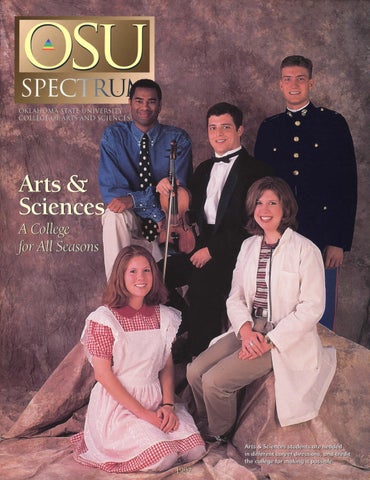
Create a flipbook
Issuu converts static files into: digital portfolios, online yearbooks, online catalogs, digital photo albums and more. Sign up and create your flipbook.