


BYKEVINKLINTWORTH SENIOR ASSOCIA7E ATHLUIC D1RECTOP
AS ANYFOOTBALLCOACH'SFAMILYCANTELLYOU,THEREARELOTSOF WAYSTD MEASURETHESUCCESSESAND FAILURESOFA PROGRAM.
They can also tell you there are plenty of people volunteering to do the measuring.
The win-loss record, postseasonappearances,conference standings, championships, national polls and numberof all-conferenceplayersareoftenthe mostcited criteria- and understandablyso. But collegefootballhas never been a sport in which all schools were created equal. A certain lack of objectivity is as much a part of collegefootballas the helmetand the fiscal mismatches.
Withthat in mind, I wouldliketo suggesta newtangible form for gaugingthe performanceof your favoriteteam.
The road win.
For OklahomaState, the road win was one of those things that used to happen to other people, but was unattainable by the Cowboys.OSU is more than 100 games under .500 all-time, when playingon the road.
One hundred games.
OSUwon 12 road games in the 1990s. Jim Stanley won a Big Eight co-championship at OSU but picked up Just 11 road wins in his six seasons at Oklahoma State. Les Miles won a respectablenine road games in his four years in Stillwater,but nevermore than three in a season.Three is a healthy number.
Mike Gundy is the winningest coach in OSU history. But he started his career with a 3-11 road record with two of the wins coming at FloridaAtlantic, and at ArkansasState (in a game played in Little Rock).
Learning ta win on the road is a process. It is a mindset,and it takestime. In 2006, OSUhad a 10-point lead and the ball with five minutes remainingat Kansas State. And lost.
Gundy was just in his second year as head coach back then. But things were slowly starting to change. The Cowboy Culture was being born.
One week after the heartbreakerin Manhattan,OSU was in Lawrence,Kan.The Cowboystrailedthe Jayhawks by 17 at halftime. Another road failure seemed imminent if not downright certain. Kansas,after all, was just one year awayfrom an appearancein the OrangeBowl.
The Cowboysrallied for a 42-32 victory with a huge second half, and Gundy had his first Big 12 road win. That win will never show up as one of the school's
biggest. However,without that rally, OSU would not haveappeared in the IndependenceBowl. There is a different vibe around a football program coming off a bowl win over Alabama when compared to one with two straight losing seasons.
It was a big win.
The followingseason,OSUended its historiclosing streak in Lincolnwith a 45-14 beatdownof Nebraska. The year after that came one of the great road wins in school history,the 28-23 victory at No. 3 Missouri in 2008. The Tigers likely would have become the toprankedteam in the country with a win over Oklahoma State.
DSU was on the national map for the first time under Gundy.
At one point, OklahomaState had lost 20 straight gamesat Texasand at TexasTech. OSUhas now won 10 straight road games in Austin and Lubbock. OSU had lost 20 straightgamesto the Huskers,beforethat 2007 win in downtown Lincoln.
TexasA&M headedout of the Big 12 chantingS-E-C. The Aggiesalso headed out of the Big 12 with a fourgame losingstreak againstOklahomaState, including two straight lossesto OSU at Kyle Field.
The big road wins that littered OSU'sclimb up the Big 12 ladder were a prelude of what was to come.
Fram 2009 through 2011, OSU was 12-2 on theraad.
Overthe past three seasons,OklahomaState has 14 road wins and just two losses.Under Gundy,OSU has won at every Big 12 venue, past and present.
OSU has gone undefeated in road games just six times in school history. Three of those seasonshave come in the last eight years.
The Cowboysare 33-12 an the road since 2009. Winningtrophiesremainsthe goal.The bowl streak is impressive. Becoming a mainstay in the national polls is historic.
Winning road games is just downright fun.
DEPARTMENTS
POSSE Magazine Staff
VICEPRESIDENTOFENROLLMENTMANAGEMENT/MARKETING KYLEWRAY EOITOR-IN-CHIEF / SENIORASSOCIATEATHLETICDIRECTOR KEVINKLINTWORTH
SENIORASSOCIATEATHLETICDIRECTOR/EXTERNALAFFAIRS JESSE MARTIN
ARTDIRECTOR/DESIGNER DAVEMALEC
PHOTOGRAPHER/PRODUCTIONASSISTANT BRUCEWATERFIELD
ASSISTANTEDITOR CLAYBILLMAN
CONTRIBUTINGPHOTOGRAPHERS
CONTRIBUTINGWRITERS

GARYLAWSON,MELISSAMORALES, PHILSHOCKLEY CLAYBILLMAN,TOMDIRATO JOHNHELSLEY,GENEJOHNSON KEVINKLINTWORTH,ROGERMOORE 1IMMlETRAMEL,KYLEWRAY
ASSISTANTATHLETICDIRECTOR/POSSEDIRECTOR
PUBLJCATIONSCOORDINATOR
ASSISTANTDIRECTOR,ANNUALGIVING COORDINATOR.ANNUALGIVING
SENIORASSOCIATEATHLETICDIRECTOR/DEVELOPMENT
ASSISTANTATHLETICDIRECTOR.DEVELOPMENT
DIRECTOROFDEVELOPMENT/OCLUB
ASSISTANTATHLETICDIRECTOH,UcVcLDPMENT
102 ATHLETICSCENTER
'i05.7'l'l.7301 P OKSTATEPOSSE.COM POSSE®OKSTATE.EDU
ELLENAYRES CLAYBILLMAN RYANSEVERSON STEPHANIEDAVIS LARRYREECE
MATTGRANTHAM
KEEGANDAVIS
SHAWNTAYLOR
STILLWATER,OK74078-5070
'i05.7'W.908'i F OKSTATEPOSSE
®OSUFANEX
At Oklahoma State University, compliance with NCAA, Big 12 and institutional rules is of the utmost importance. As a supporter of please remember that maintaining the integrity of the University and the Athletic Department is your first responsibility. As a donor, and therefore booster of NCAA rules apply to you. If you have any questions, feel free to call the Office of Athletic Compliance at '!05-7'!'!-7862. Additional information can also be found by clicking on the Compliance tab of the Athletic Department web-site at www.okstate.com.
Remember to always "Ask Before You Act,"
Respectfully, BEN DYSON ASSISTANTATHLETICDIRECTORFORCOMPLIANCE BIG 12 CONFERENCE
Donationsreceivedmay be transferredlo CowboyAthletics,Inc. In accordancewith the Joint ResolutionamongOklahoma Slate University,the OklahOmaSlate UniversityFoundation,and CowboyAthletics,Inc. POSSEmagazineis pubfishedlour limes a year by OklahomaSlale UniversityAthletic Oepartmeotand the POSSE,and is mailedto currenl membersof the POSSE.Magazinesubscriptionsavallableby membershipin the POSSEonly.Membershipls $150 annually.Postagepaid at Stillwater.OK,and additionalmalling olfices. OklahomaState Umversity,In compliancewith TIiie VI and VII of the Civil RightsAct of 1964, ExecutiveOrder11246 as amended,andTIiie IX of the EducationAmendments of 1972(HigherEducationAct), the Americanswith OisabilltiesAct of 1990,and other federaland state laws and regulations, does not discriminate on the basis of race.color, nationa!origln, sex,age,sexual orientation, gender identity, religion, disability, or status as a veteran, ln any of its policies, practices or procedures.This provision includes,but Is not limited lo admissions,employment,financial aid, and educationalservices.The following have beendesignatedto handleInquiries regarding11011-discrfmlnatlonpolicies: Dlreclorof EqualOpportunity.408 Whitehurst,OSU.Stillwater,OK74078-1035;Phone 405-744-9154;email:eeo@okstate.edu.
One reason college football is so popular across the country is that it offers an escape - mostly from chores around the house.
As any homeowner can attest, maintaining a home of any size never ends.
The homes of the Cowboys and Cowgirls encompass more than 1.3 million square feet!
And that's just the conditioned air facilities. OSU Athletics entertains guests almost constantly. The list of things that could possibly go wrong far outnumber the things that can go right.

Then there is the human element and the toll it takes. Security cameras in Boone Pickens Stadium once caught a football fan walking out of the restroom with a stall door under his arm - instead of a souvenir cup perhaps 7
The task of maintaining the OSU Athletics facilities falls on a dedicated group of staffers who most assuredly did not sign up for a 9-to-5 gig. Maintenance, upkeep and improvement of the athletic facilities borders on being a 24/7 vocation.
The buildout of new facilities (the new soccer complex will open in the fall of 2018) assures the task of maintaining facilities will continue to grow.
The facilities crew is a lot like the long snapper on a football team. No one know his name until something goes wrong. Perfection is unattainable - yet expected.
And the folks with the greatest expectations are those who proudly maintain and operate the facilities of OSU Athletics.
l!§il

P.HOTOBY:MELISSAMORALES



"The mare I thinkabaut my time in Stillwater the mare I realize haw important that time was. 11
RENATA MARCINKOWSKA
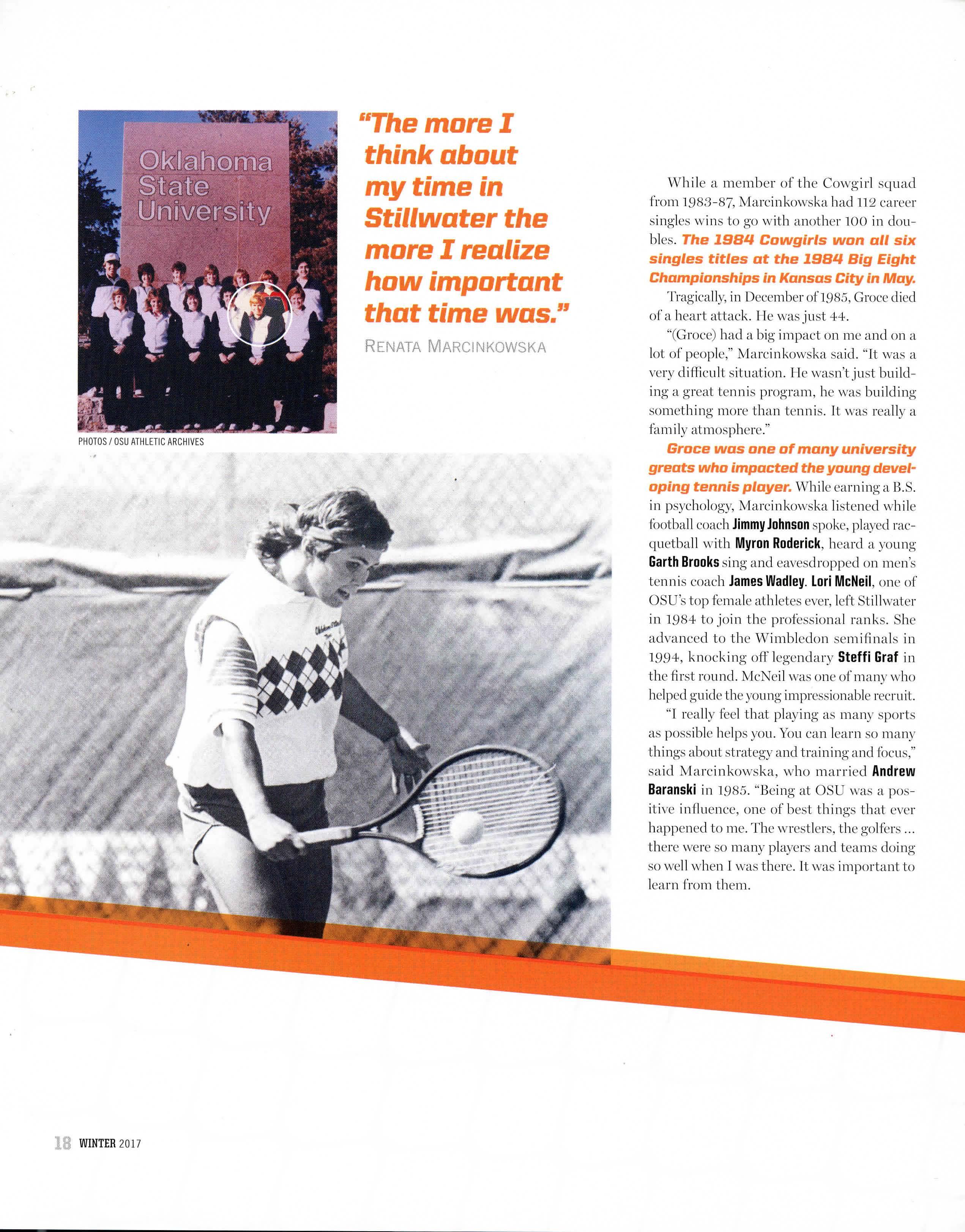
While a member of the Cowgirl squad from 1983-87, Marcinkowska had 112 career singles wins to go with another 100 in doubles. The 19811 Cowgirls won all six singles titles at the 19811 Big Eight Championships in Kansas City in Moy.
Tragically, in December of 1985, Groce died of a heart attack. 1-lewas just 44.
"(Groce) had a big impact on me and on a lot of people," Marcinkowska said. "It was a very difficult situation. He wasn't just building a great tennis program, he was building something more than tennis. It was really a family atmosphere."
Groce was one of many university greats who impacted the young developing tennis player. While earning a B.S. in psychology, Marcinkowska listened while football coach JimmyJohnsonspoke, played racquetball with MyronRoderick,heard a young GarthBrookssing and eavesdropped on men's tennis coach JamesWadley.LoriMcNeil,one of OSU's top female athletes ever, left Stil !water in 1984 to join the professional ranks. She advanced to the Wimbledon seminnals in 1994, knocking off legendary SteffiGrafin the first round. McNeil was one of many who helped guide the young impressionable recruit.
"I really feel that playing as many sports as possible helps you. You can learn so many things about strategy and training and focus," said Marcinkowska, who married Andrew Baranskiin 1985. "Being at OSU was a positive influence, one of best things that ever happened to me. The wrestlers, the golfers there were so many players and teams doing so wel I when [ was there. lt was important to learn from them.
"I thought I'd be (at OSU) for two years maybe, turn pro, and move on. I really think the right path is to go to college before thinking about turning professional. There are so many things to learn. I'm glad I stayed and didn't leave early."
It was not just the coaches and fellow students who aided Marcinkowska. Long before tbe luxurious Michael and Anne Greenwood Tenn is Center there was the newly bu i It DuBois Tennis Center and two sets of courts where the Donald W. Reynolds School of Arch itedu re bu iIding currently resides. Locals, college students, young players and old hackers spent hours on those courts in the shadows of Lewis Field.
Among those mentors and hitting partners was the late BobMurphy,an Oklahoma A&M graduate, a five-term member of the Oklahoma Senate, former Payne County District Attorney and lifelong tennis player.
"He'd come to the courts, come to the matches," Marcinkowska remembers. "One summer (after my sophomore year) when I went to Germany to play, I had problems with my student visa. He helped me get back to the (United) States.
"We didn't just talk tennis, but a lot of things. He was a very important part of my life."
Perhaps most influential were Dr.Dickand CarolAnnPowell.They visited Marcinkowska in South Carolina just before she was inducted into the South Carolina Tennis Hall of Fame in 2016.
"People like Dick and Carol Ann are hard to find," said Marcinkowska, who lived with the PowelIs for the first year of college. "They are such a big part of my life. I'll never be able to thank them enough for how much they helped me."
The PowelIs, a staple of the Stil Iwater community, celebrated 50 years of marriage in 2011. Both OSU graduates, the couple welcomed the young and impressionable Marcinkowska into their home.
"There were some problems with her eligibility so she tayed with us for most of that first year,"' said Carol Ann. "l think what I remember most about that time was the old green van, the 'Green Machine.' l think it was a 1978 Ford that could hold about 10 people. It was our van, but the team drove that van all over the place going to matches everywhere.
"Renata was really focused on tennis and her studies while she was here. With everything going on (in Poland), she did not let that bother her, or at least she did not show it."
Following graduation, Marcinkowska played professionally for eight years, reaching No. llO in the world in singles in November ofl990 and No. Sl in doubles in 1992. A heel injury derailed her career in 1992, but that clid not keep her off the tennis court. At 35, she was part of a world cham· pionship doubles tandem, and in 2002 and 2003 she won the 35's singles and doubles at the USTA National Clay Courts.
Her lifelong tennis journey now includes daily instructions as a teaching professional and a U.S. patent on a hybrid tennis court with a clay surface on one side and hard court on the other. There have also been frequent trips to Poland over the years, working with young Polish juniors who may or may not seek a life in tennis.
"Whatever I can do to give back to tennis I do," said Marcinkowska, who was divorced in 1995 and now lives with her sister, Ewa, in Myrtle Beach. "It is a great game for all ages. ft can teach you so much about Iife, too. Tenn is has been my life, and the morel think about my time in Stillwater the more I realize how important that time was."
During the Cowgirls' 2016 run to the NCAA Championship finals, head coach ChrisYoung received a letter from Marcin kowska.
"She has been a great supporter of the program," said Young. "She's always stayed in touch; she's sent me countless messages and keeps up with the program and what is go1ngon."@
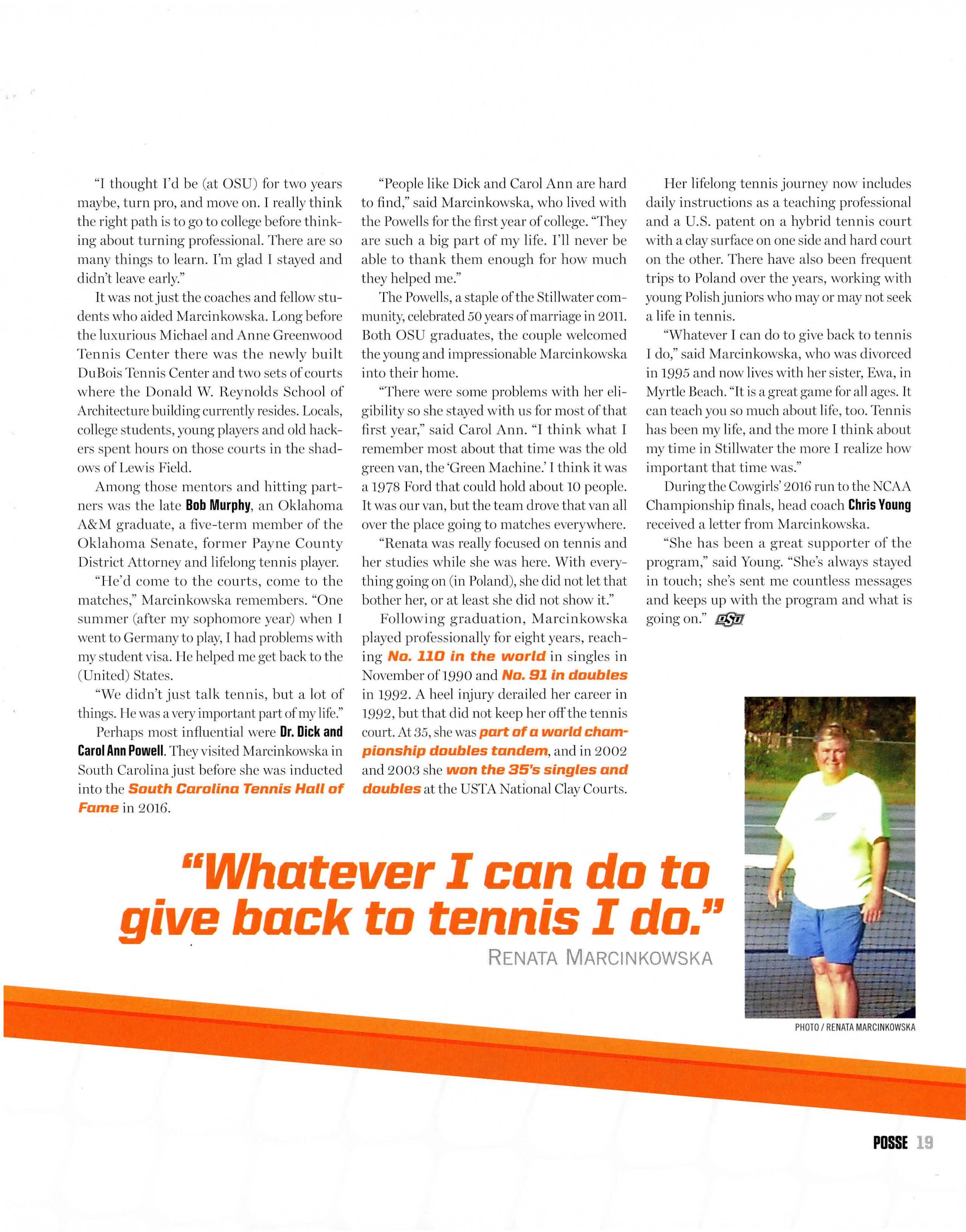
''Whatever I can do to
back to tennis I do.''
RENATA MARCINKOWSKA
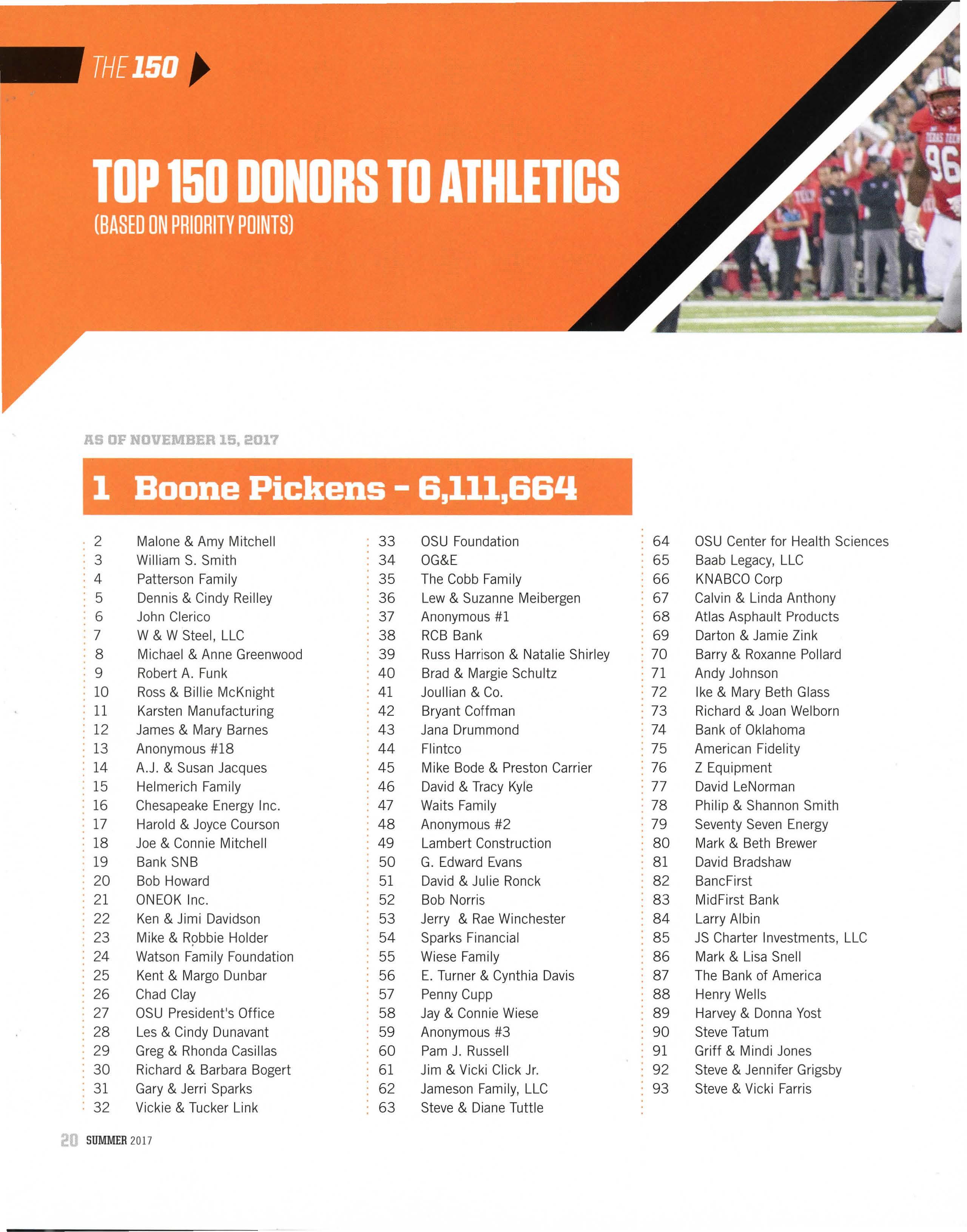
Brent & Mary Jane Wooten
Johnsons of Kingfisher
Terry & Martha Barker
Scott & Kim Verplank
Stan & Shannon Clark
Barber-Dyson Ford Lincoln-Mercury
Russ & Julie Teubner
Drummond Investments
Crossland Construction
Vionette & John Dunn
Ameristar
Shaw"s Gulf
Larry Bump
Mike & Judy Johnson
Robert & Sharon Keating
Jack Bowker Ford-Lincoln
Bill & Marsha Barnes
John & Gail Shaw
Mustang Fuel
Baloo & Maribeth Subramanian
Chandler USA, Inc.
Karen Gallagher & Bob McCracken
Fred & Kellie Harlan
Bill & Karen Anderson
Jay & Fayenelle Helm
Anonymous #14
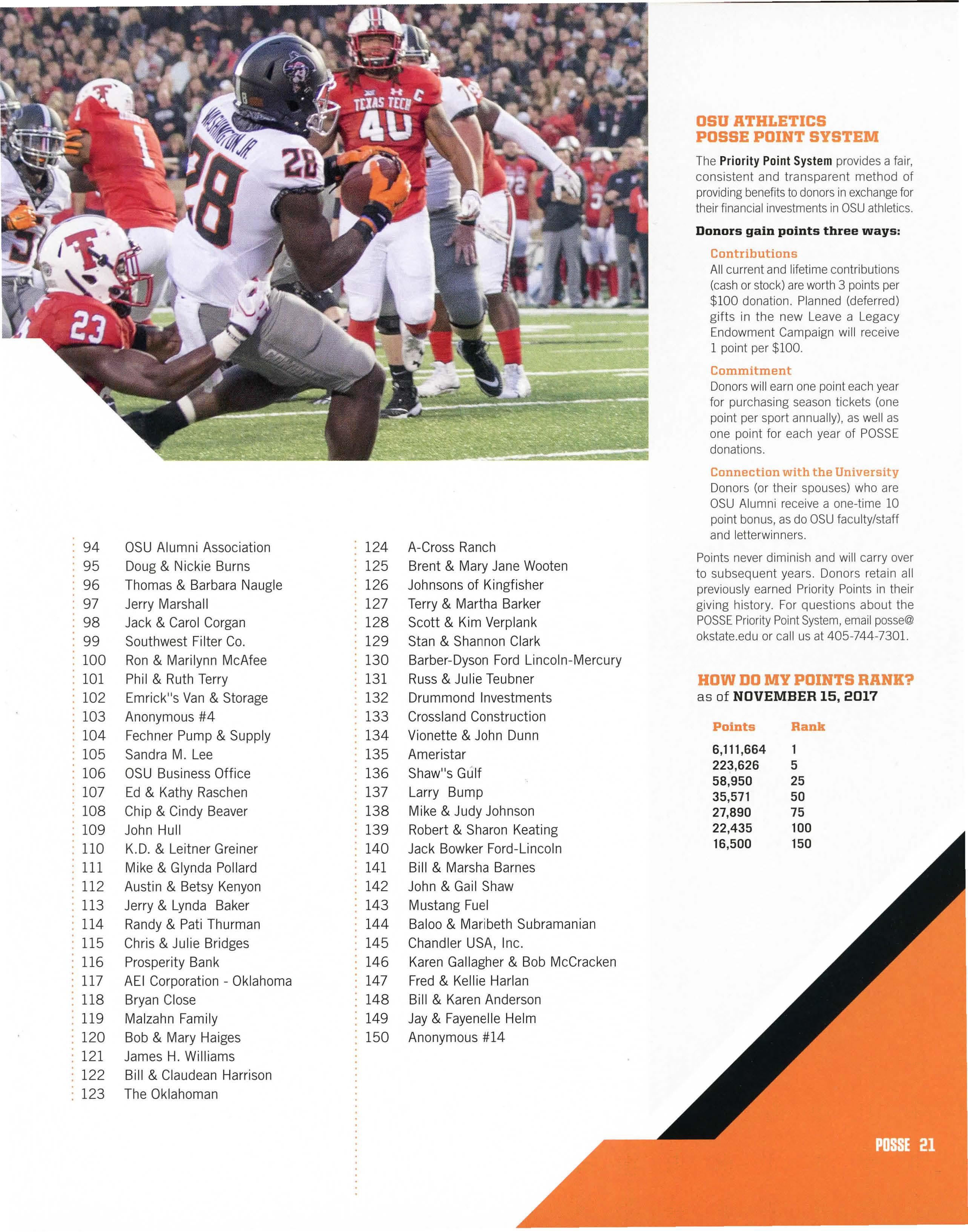
The Priority PointSystemprovidesa fair, consistent and transparent method of providingbenefitsto donorsin exchangefor theirfinancialinvestmentsin OSUathletics.
Donors gain points three ways:
Contributions
All currentand lifetimecontributions (cashor stock)areworth3 pointsper $100 donation.Planned(deferred) gifts in the new Leave a Legacy EndowmentCampaignwill receive 1 point per $100.
Commitment
Donorswill earnone pointeachyear for purchasingseasontickets (one point per sport annually),as well as one point for each year of POSSE donations.
Connection with the University Donors(or their spouses)who are OSUAlumni receivea one-time10 pointbonus,as do OSUfaculty/staff and letterwinners.
Pointsneverdiminishand will carry over to subsequentyears. Donors retain all previouslyearned PriorityPointsin their giving history. For questions about the POSSEPriorityPointSystem,emailposse@ okstate.eduor call us at 405-744-7301.
HOW DO MY POINTS RANK? as of

Annual Membership for Kids STH Grade and Under ON~ sasPER CHILD
Sign up today at okstate.com/kidsclub

Membership Includes:
• FREE ADMISSION to Home OSU Soccer, Basketball*, Wrestling, Baseball and Softball
*Men's Basketball season ticket or chaperone pass ($99) required. Excludes men's KU and OU games.
• Invites to "Member Only" Parties with the Athletes
• Membership T-shirt
• Picture of Pistol Pete
• Birthday Card from Pistol Pete
• AND MUCH MORE FOR MORE INFORMATION
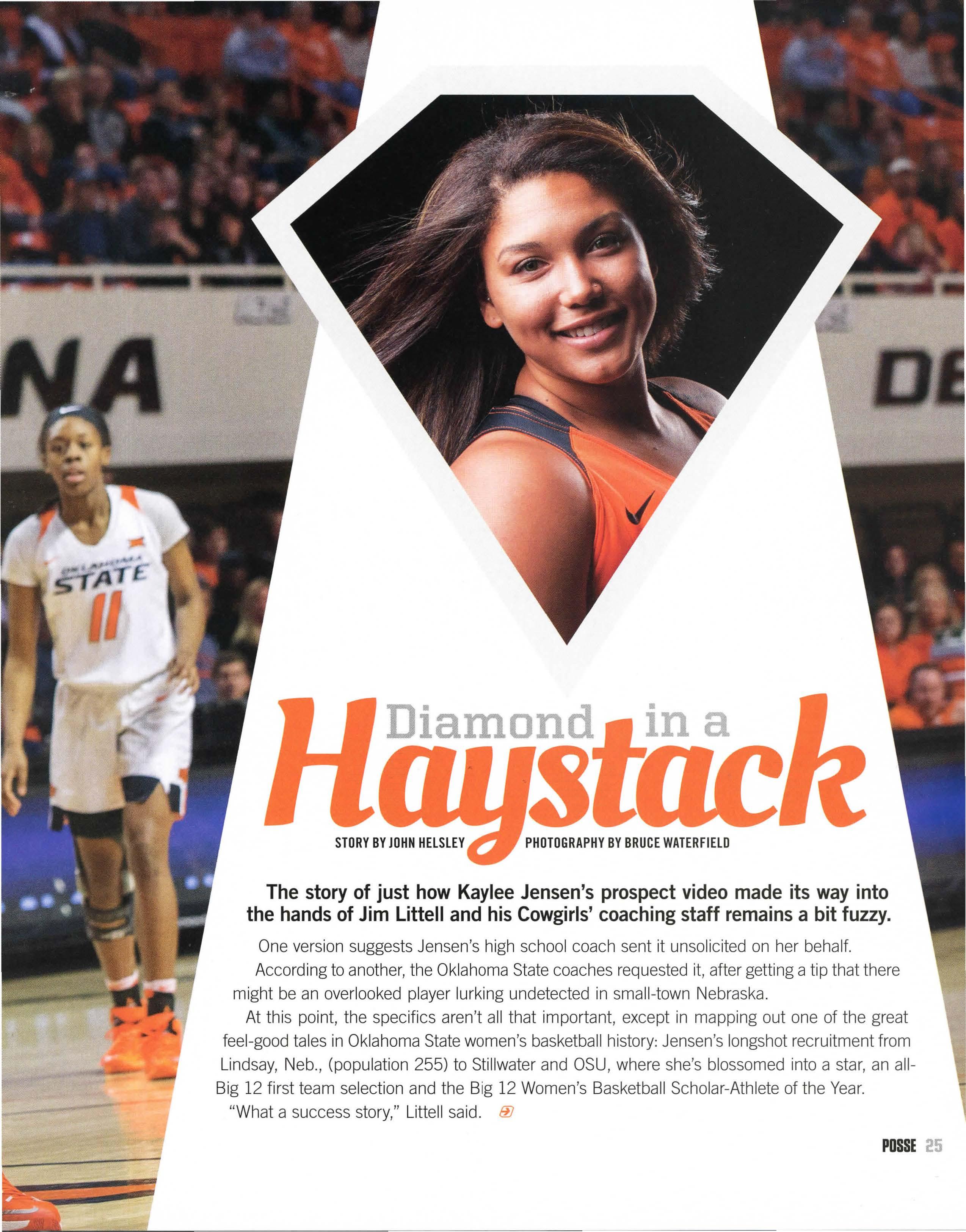
The storyof just how KayleeJensen'sprospectvideo made its way into the handsof Jim Littell and his Cowgirls'coachingstaff remainsa bit fuzzy.
One version suggestsJensen's high school coach sent it unsolicited on her behalf. Accordingto another,the OklahomaState coaches requestedit, after getting a tip that there might be an overlooked player lurking undetected in small-town Nebraska.
At this point, the specifics aren't all that important, except in mapping out one of the great feel-goodtales in OklahomaStatewomen's basketballhistory:Jensen'slongshotrecruitment from Lindsay,Neb., (population 255) to Stillwaterand OSU, where she's blossomed into a star, an allBig 12 first team selection and the Big 12 Women's BasketballScholar-Athleteof the Year. "What a success story," Littell said. f!J
OSU coaches receive a lot of unsolicited prospect videos from unknown high school players wishing and hoping to be Cowgirls, all dumped on their desks as if through thin air.
The number ranges from 75 to 100 videos a year. And that's in addition to the players the Oklahoma State coaches are actively analyzing and considering or pursuing to add to the program.
Honestly, Littell says, there's little promise of a payoff-'to comb through them all.
"Very few get a look," he said. "You kind of go through them according to what your needs are in recruiting. Not many times are they talented enough."
There is, however, one sure-A re detail that warrants automatic attention, although not some skill or any aspect that can be taught or learned.
Thedetail:height,anelementcovetedand hardto findinthewomen'sgame.
Jensen, who stands 6-f-oot--l-,had height working for her.
"'i\Thenthe tape says she's 6-4, you have a look," Littell said.
The first look led to another look, an upclose look, as .Jensen made the drive for a visit to campus. And the visit was key since the video mostly showed Jensen dominating smallschool competition and even smaller players.
ThevisitallowedJensentopresentanother sellingpointbesidessize- herself.
"She sold us as a person," Littell said. "We knew she was a really nice young lady who comes from a good family. 1-ler mom had coached, and her mom had been in education. She was a really good student, too. We felt that with what she did in the classroom, there was some commitment to her."
The Cowgirls coaches saw other reasons to believe .Jensen, who had played volleyball and placed in both the discus and shot put in the state track meet, showed good teet and strong hands.
"She didn't fumble anything, and that's not characteristic of a lot of post players," Littel I said. "When we saw on tape that she tailed some on the break and could shoot tbe 3 a little bit, those are some qualities you don't see in every post player.
"To be honest, we didn't know for sure what we were getting in her as a player. But we felt like she was somebody we could work with and develop as her career progressed. Sometimes you have to go on a need and also see some things in players that other people may have bypassed.
"There are still some diamonds in the rough, but not many. There's not many kids who go u nsecn, unnoticed anymore."
The Cowgirls had a need, a desperate need, for a post player. And yet .Jensen, despite her size and a career at Holy Family High School that saw her surpass 2,000 points and 1,000 rcbou ncls, was going mostly unnoticed and unwanted, especially by major college
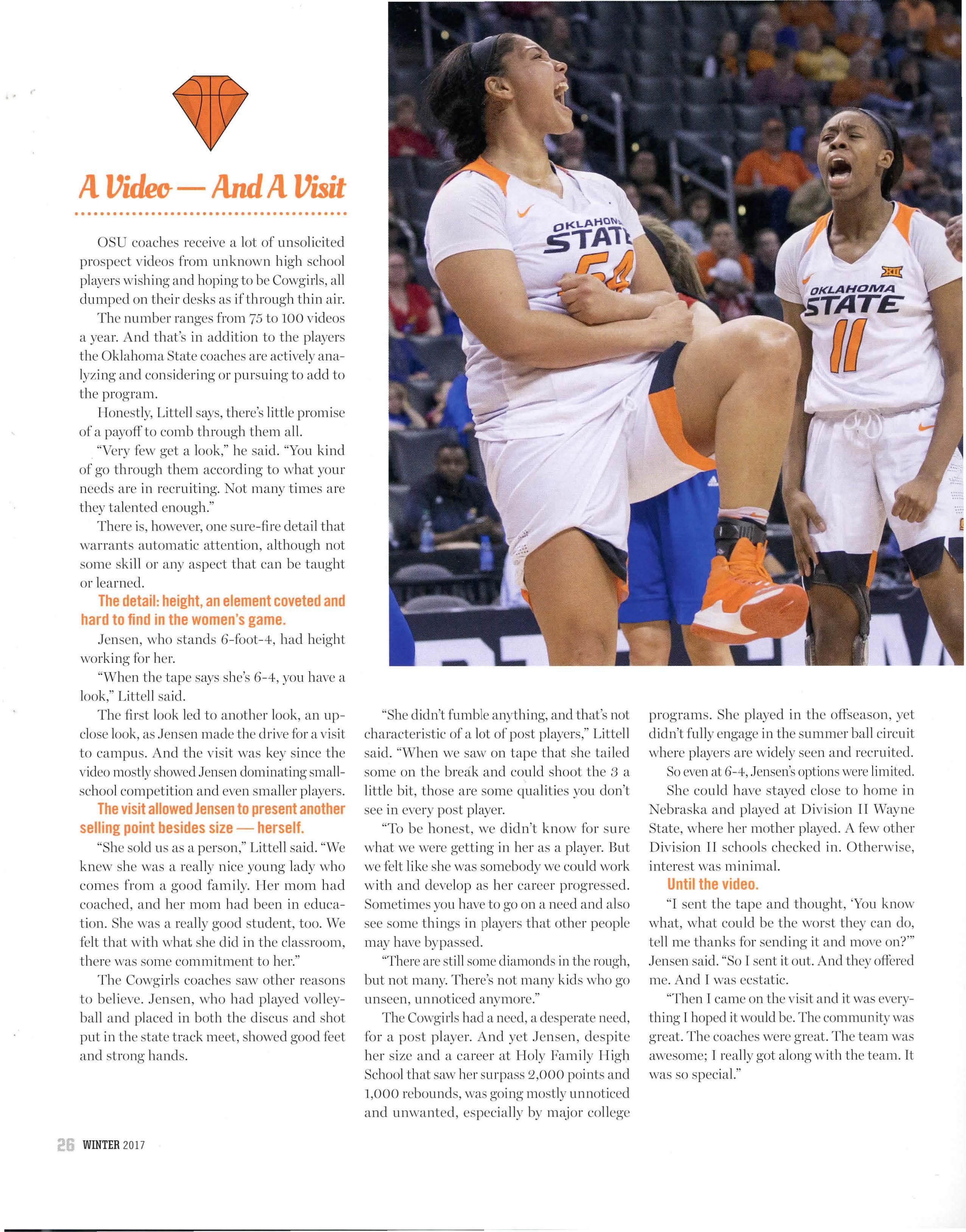
programs. She played in the offscason, yet didn't fully engage in the summer ball circuit where players are widely seen and recruited.
So even at 6-+, .Jensen'soptions were Iim ited.
She cou lei have stayed close to home in Nebraska and played at Division [T Wayne State, where her mother played. A f-ewother Division 11 schools checked in. Otherwise, interest was minimal.
Untilthevideo.
"I sent the tape and thought, 'You know what, what could be the worst they can do, tell me thanks for sending it and move on?"' .Jensen said. "So I sent it out. And they offered me. And I was ecstatic.
"Then I came on the visit and it was everything I hoped it would be. The community was great. The coaches were great. The team was awesome; I really got along with the team. It was so special."
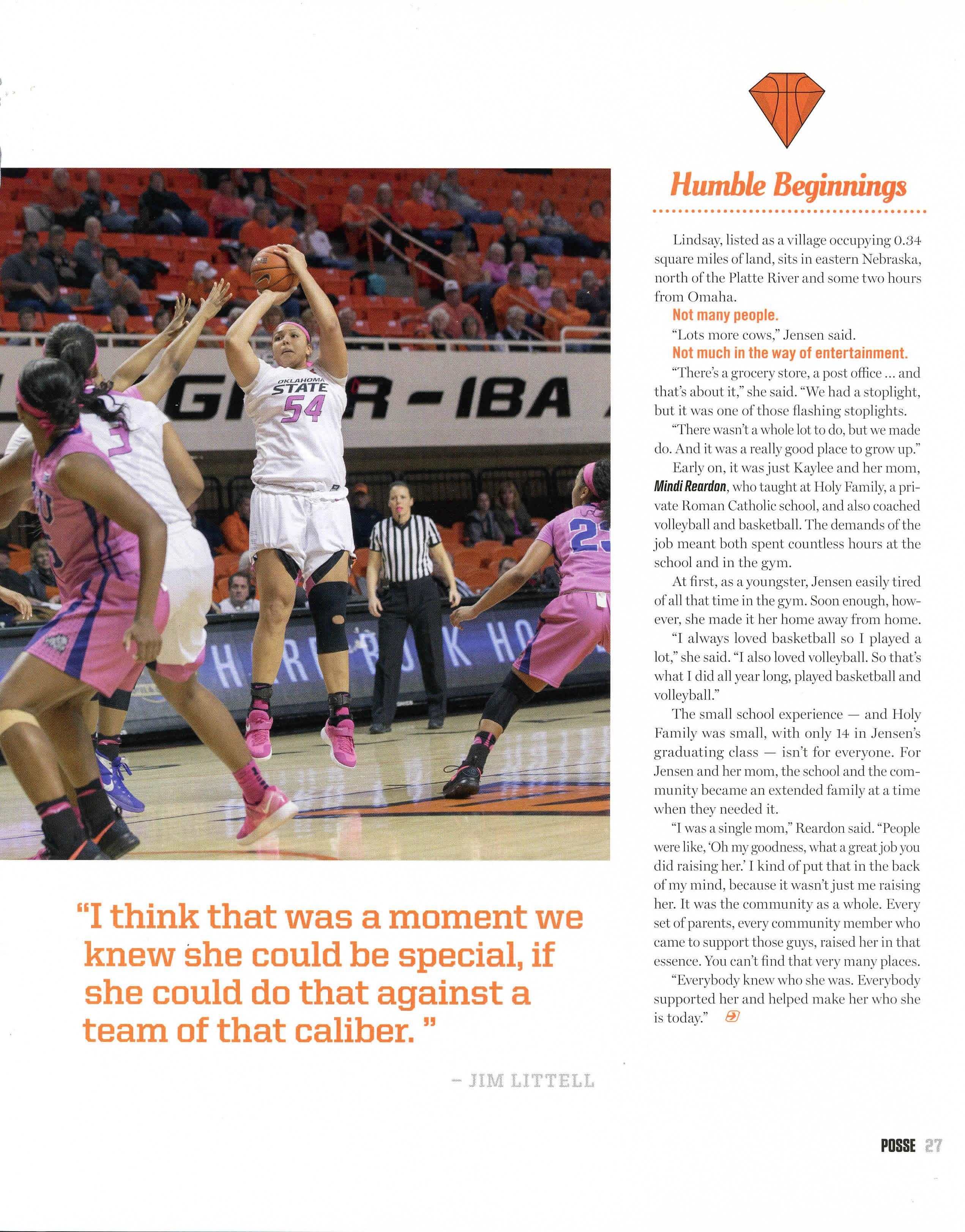
"Ithink that was a moment we knew she could be special, if she could do that against a team of that caliber. "
- JIM LITTELL
Lindsay, listed as a village occupying 0.34 square miles ofland, sits in eastern Nebraska, north of the Platte River and some two hours from Omaha.
Notmanypeople.
"Lots more cows," Jensen said.
Notmuchinthewayof entertainment.
"There's a grocery store, a post office and that's about it," she said. "We had a stop! ight, but it was one of those flashing stoplights.
"There wasn't a whole lot to do, but we made do. And it was a really good place to grow up."
Early on, it was just Kaylee and her mom, MindiReardon,who taught at Holy Family, a private Roman Catholic school, and also coached volleyball and basketball. The demands of the job meant both spent countless hours at the school and in the gym.
At first, as a youngster, Jensen easily tired of al I that ti me in the gym. Soon enough, however, she made it her home away from home.
"I always loved basketball so I played a lot," she said. "I also loved volleyball. So that's what I did all year long, played basketball and volleyball."
The small school experience - and Holy Family was small, with only 14 in Jensen's graduating class - isn't for everyone. For Jensen and her mom, the school and the community became an extended family at a ti me when they needed it.
"I was a single mom," Reardon said. "People were like, 'Oh my goodness, what a great job you did raising her.' I kind of put that in the back ofmy mind, because it wasn't just me raising her. It was the community as a whole. Every set of parents, every community member who came to support those guys, raised her in that essence. You can't find that very many places.
"Everybody knew who she was. Everybody supported her and helped make her who she is today."
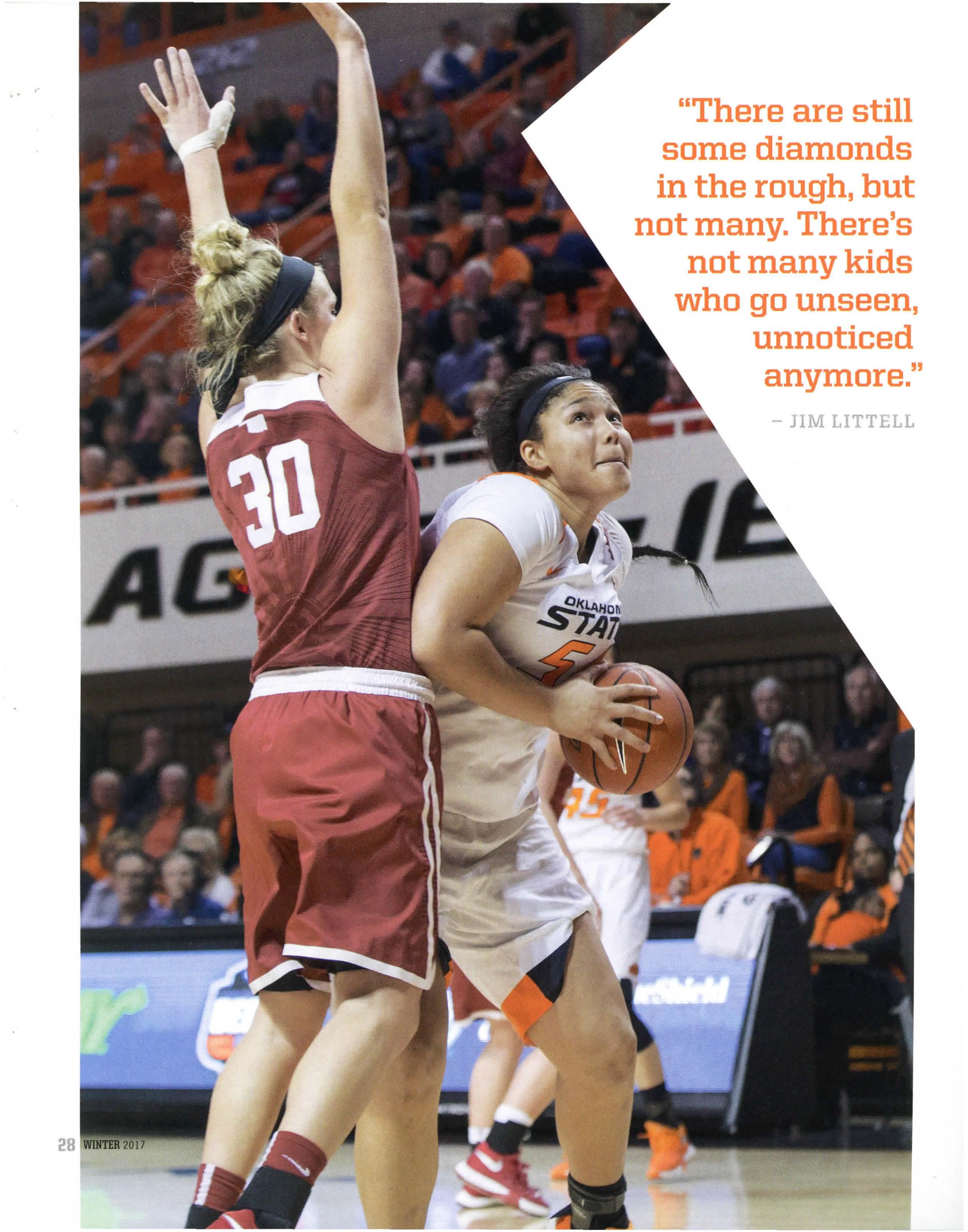
"There are still some diamonds in the rough, but not many. There's not many kids who go unseen, unnoticed anymore."
- JIM LITTELL
Jensenknewshewassteppingup-way up- fromHolyFamilyto battlesin anOSU uniform.
The girls would be bigger. The competition, in the rugged Big 12, would be like nothing she'd ever seen.
"My first year, I had to work on everything," Jensen said. "Corning from SLH.:h a small school, where Twas a head or more ta! !er than everybody, l didn't have to think about faking post moves or really playing defense, I just relied on my height a lot.
"So I had to put a lot of work in. 1 had to work on my post moves. I had to work on my shape. I had to work on my defense. It didn't come right away,and it's still not fully there, but it's something I still strive to do. It's a process, and l put work in on those things every day."
Jensen grew on the go as a true fresh man, playing in all 32 games and starting one. She steadily improved, adapting and adjusting, while also watching and learning from veteran post player LaShawn Jones.
"She was my mentor," Jensen said. "She took me under her wing a little bit, more with tough love, but it was good. And it was nice to get to play with her and kind ofunder her,just so I cou Id learn on the fly, but also so l didn't get thrown into the wolf's den al I by myself."
Prettysoon,Jensenwasa beastonthehunt.
As a sophomore, she started all 31 games and bernme a major factor on a team that also featured BrittneyMartin,who would be the Big 12' player of the year, and playmak ing point guard RoddrickaPatton.
Jensen averaged 14.6 points and 8.3 rebounds a game, clearly showing growth in her game.
The turning poinf? Littell points to a 52-45 home win over No. 4-ranked Baylor. Martin was dominant in the game, but Jensen contributed 10 points and nine rebounds and never backed down against one of the nation's premier squads.
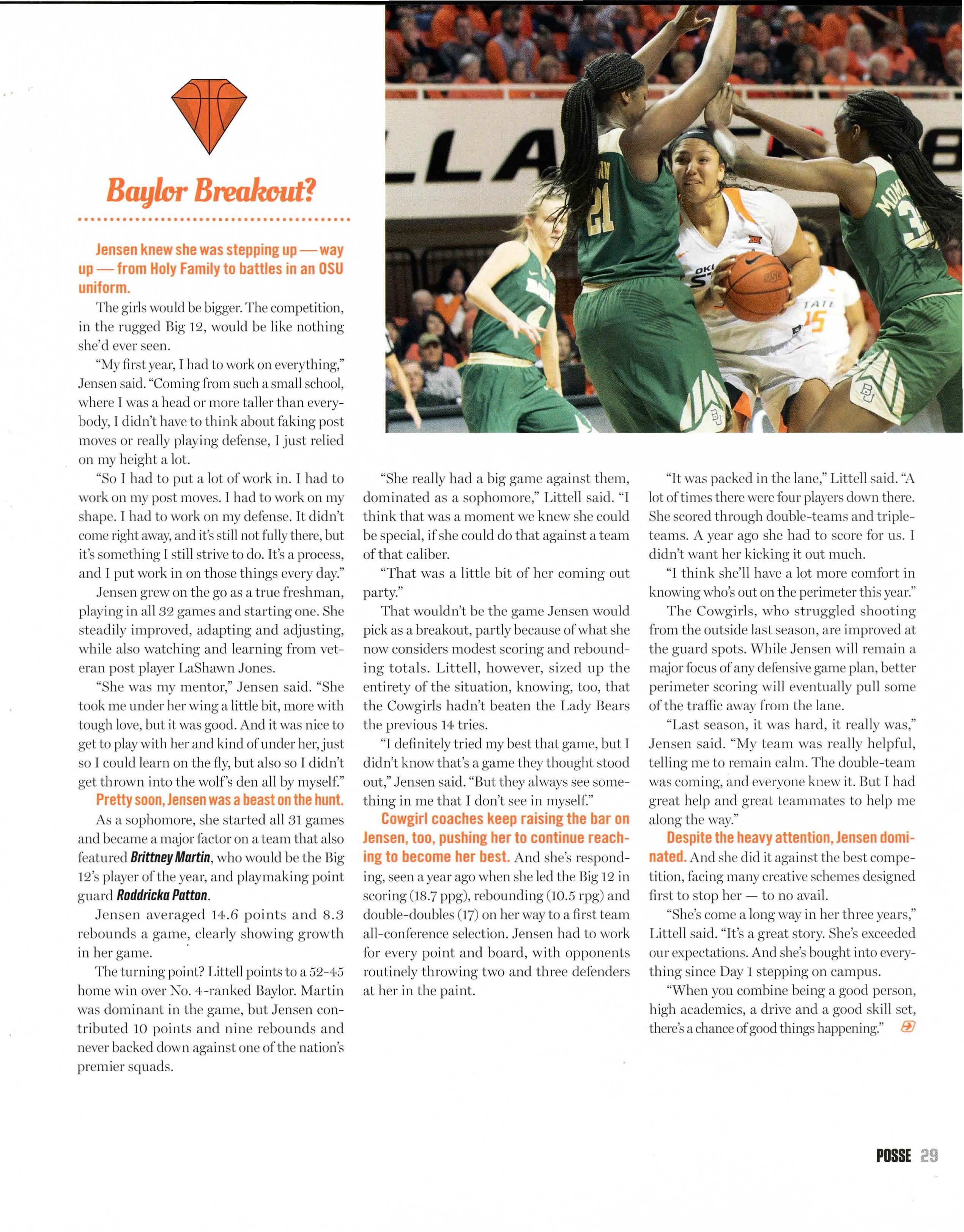
"She really had a big game against them, dominated as a sophomore," Littell said. "I think that was a moment we knew she could be special, if she could do that against a team of that caliber.
"That was a little bit of her coming out party."
That wouldn't be the game Jensen would pick as a breakout, partly because of what she now considers modest swring and rebounding totals. Littell, however, sized up the entirety of the situation, knowing, too, that the Cowgirls hadn't beaten the Lady Bears the previous 14 tries.
"I definitely tried my best that game, but I didn't know that's a game they thought stood out," Jensen said. "But they always see something in me that I don't see in myself."
Cowgirlcoacheskeepraisingthe baron Jensen,too,pushingherto continuereachingto becomeherbest.And she's responding, seen a year ago when she led the Big 12 in scoring (18.7 ppg), rebounding (10.5 rpg) and double-doubles (17) on her way to a first team all-conference selection. Jensen had to work for every point and board, with opponents routinely throwing two and three defenders at her in the paint.
"lt was packed in the lane," Littell said. "A lot of ti mes there were four players down there. She scored th rough double-teams and tripleteams. A year ago she had to score for us. I didn't want her kicking it out much.
"I think she'll have a lot more comfort in knowing who's out on the perimeter this year."
The Cowgirls, who struggled shooting from the outside last season, are improved at the guard spots. While Jensen will remain a major focus of any defensive game plan, better perimeter scoring will eventually pull some of the traffic away from the lane.
"Last season, it was hard, it really was," Jensen said. "My team was really helpful, telling me to remain calm. The double-team was coming, and everyone knew it. But I had great help and great teammates to help me along the way."
Despitetheheavyattention,Jensendominated.And she did it against the best competition, facing many creative schemes designed first to stop her - to no avail.
"She's come a long way in her three years," Littell said. "It's a great story. She's exceeded our expectations. And she's bought into everything since Day l stepping on campus.
"When you combine being a good person, high academics, a drive and a good skill set, there's a chance of good things happening." @
Seemsall KayleeJensenneededwasa chance.
Once the Cowgirls provided it, she seized it, elevating her game, her team and the university with recognition as the Big 12 Women's Basketball Scholar Athlete of the Year.
Back in Lind ay, Mindi Reardon, has watched it all with joy.
'Tm just so proud of her," Reardon said. "There were people from the area who said, 'There's no way she's going to make it. She went to a small school. She's good enough to play we!I in smal I settings against people that aren't as good as her .'
"So when she went against some of the better players in the Big 12 and had success, I think it surprised some people. And holding it together with her academics and basketbal I and being so far away from home, it's kind of awesome for her - and for me to be able to watch it."
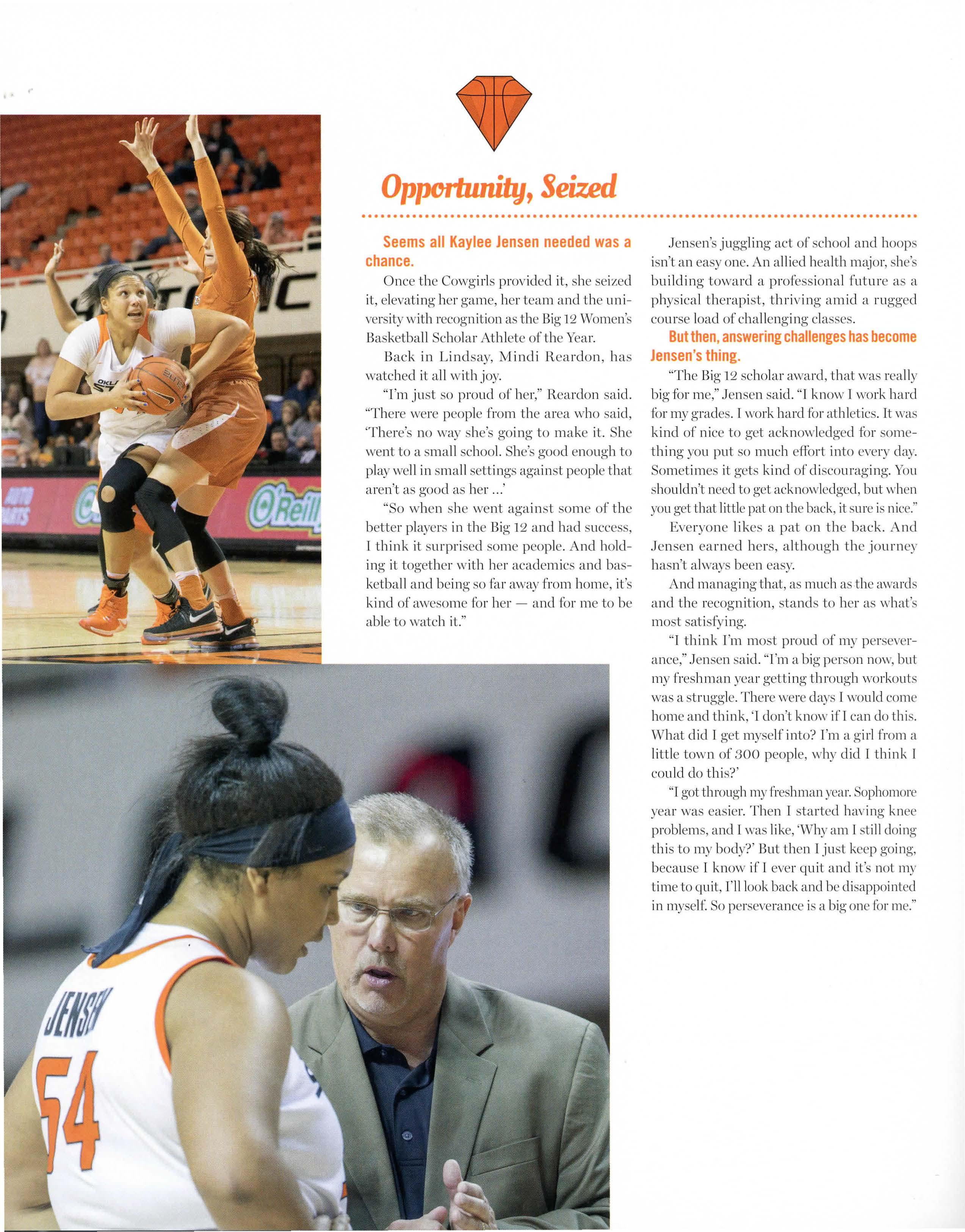
Jen en's juggling act of school and hoops isn't an easy one. An allied health major, she's building toward a professional future as a physical therapist, thriving amid a rugged course load of challenging classes.
Butthen,answeringchallengeshasbecome Jensen'sthing.
"The Big 12 scholar award, that was really big for me," .Jensen said. "l know I work hard for my grades. I work hard for athletics. It was kind of nice to get acknowledged for something you put so much effort into every day. Sometimes it gets kind of discouraging. You shouldn't need to get acknowle<lgcd, but when you get that Iittlc pat on the back, it sure is nice."
Everyone likes a pat on the back. And .Jensen earned hers, although the journey hasn't always been easy.
And managing that, as much as the awards and the recognition, stands to her as what's most satisfying.
"l think I'm most proud of my perseverance," .Jensen said. 'Tm a big person now, but my freshman year getting th rough workouts was a struggle. There were days I would come home and think, 'I don't know if I can do th is. What did l get myself into? l'm a girl from a little town of 300 people, why did I think I could do this?'
"I got through my fresh Illan year. Sopholllore year was easier. Then J started having knee problems, and I was like, 'Why alll l still doing th is to my body?' But then I just keep going, because I know if I ever quit and it's not Ill)' time to quit, I'll look back and be disappointed in myself So perseverance is a big one for Ille."
KayleeJensen'sshotat big-timebasketballliterallycamedownto a singleshot.
In her search for a college destination, she didn't send couriers carrying her high Iight videos to schools far and wide or even near. She sent one.
To Oklahoma State.
Maybe that's fitting, because it's been a fantastic fit.
"I think it was such a homey environment, first of all," Jensen said. "Coming from such a small town, homey is the only way to go. That really rang true here, too. Everyone's so close-knit - the team, the town, everybody.
"And playing wise, I noticed they played around a big or two and I thought I cou Id be really helpful scoring if! needed to, passing ifI needed to. Those things are why I chose OSU."
Thefit worksbothways.
Jensen bolstered the program with her :;LanLloutplay for :;ure. But :;he':;also left her mark on everyone arou ncl her.
"She's always smiling, always laughing," Littell said. "Her teammates really like her. She's a fun-loving kid, always joking around. Kaylee doesn't have many bad clays, which I like. Her temperament is always the same.
"She's repeatedly said, too, and it makes you feel good, 'I love this place, and I appreciate what this place has clone for me.' She knows where she was f-our years ago. And she's a product of hard work and cloing the right things, but she's also appreciative of the opportunity Oklahoma State offered her. I think she's had that great college experience you wish for every player."
ForJensen, it startedwitha wishanda prayer,almosta shotinthedark.
After sending that one video to the Cowgirls coaches, she waited for a response. And the call eventually came .Jensen still recalls that moment, complete with awkward pauses, emotions rising and falling.
"They call and say, 'I looked at the tape' and you don't know what they're going to say next," she said. "Then my heart dropped and my stomach had butterflies when they thought I had the potential to be a good player here.
"That was honestly one of the top memories in my life."
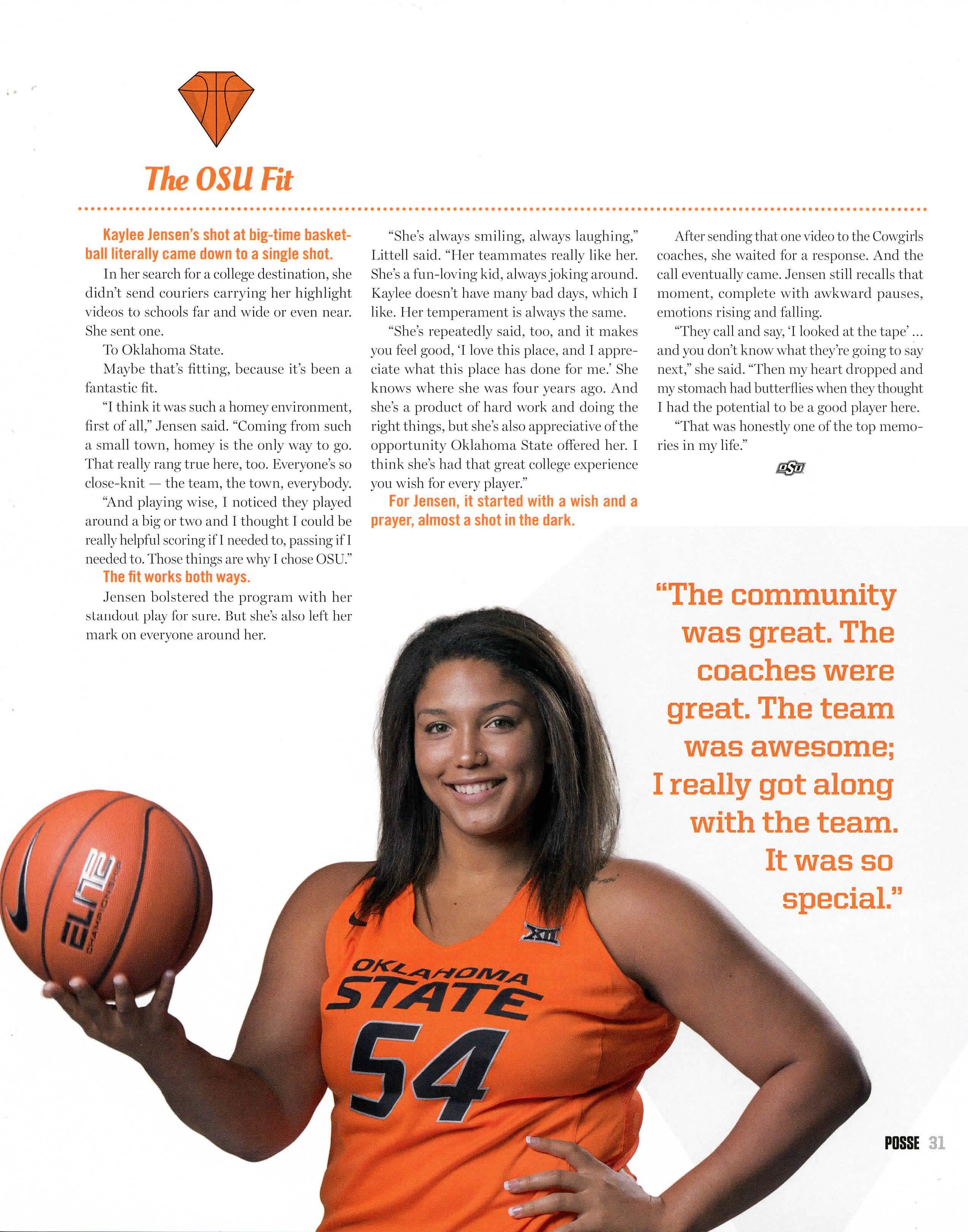
"The community was great. The coaches were great. The team was awesome; I really got along with the team. It was so special."
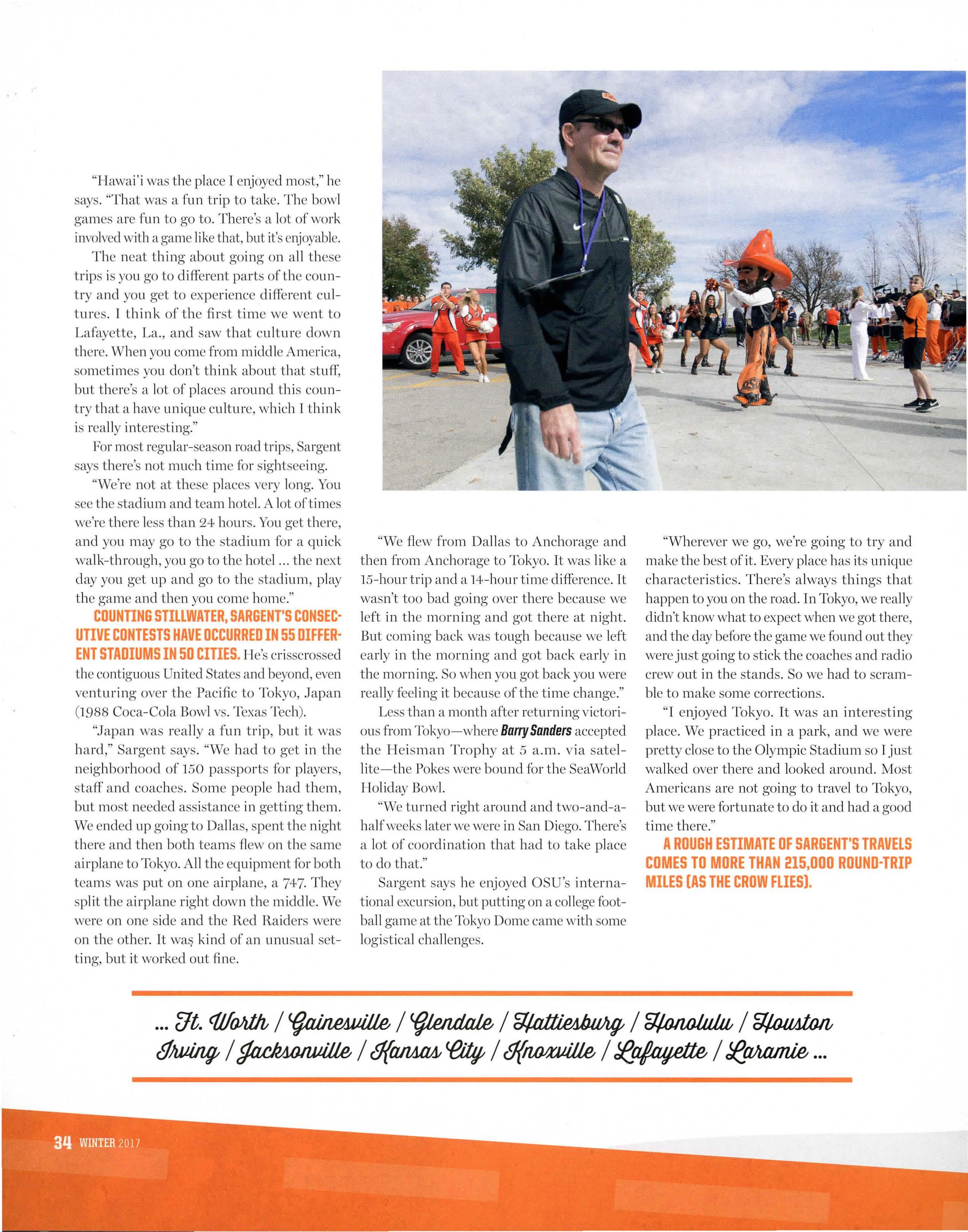
As 0SU's senior associate athletic director for game management, MARTY SARGENT oversees a bevy of behind-the-scenes activities at home and away.
SARGENT HAS BEEN EVERYWHERE COWBOY FOOTBALL HAS PLAYED SINCE NOVEMBER 1983 - WITHOUT MISSING A SINGLE GAME IN 35 YEARS. NOT ONE.
Following the 2017 regular season, Sargent's streak sits at an amazing LU2-straight 0SU games.
Let that sink in. Four hundred plus football games ... IN A ROW.
cl/m,e1; I~ I cl/l1ietu I~ I !i3ocaff?.~
The streak began in November of 1983 when JimmyJohnsonwas the Pokes' head coach.
"When I first came down here, T worked in Student Services over in the financial aid office," Sargent says. "l was there about a year before getting back into athletics, and I've been here ever since."
Sargent has always been a grid iron guy. From his walk-on days at Iowa State University and tutelage under Cyclone coaches EarleBruce and OonnieOuncan, he learned the sport inside and out. That experience helped him land the job as OSU's football operations director at a young age.
"That was Jimmy's last year before he went to Miami, and Pa_tlonesbecame head coach in the summer of'S+. That's when I became the director of football operations."
SARGENT'SFIRSTOFFICIALGAMEONSTAFF
"We played Arizona State in 198+. They were preseason No. 1, and we had a really good football team. We went out and beat them +5-3. I vi\·idly remember that game because it was the first one l did as di rector of ops.
"There are a lot of games-particularly home games-I don't remember much about because Tdon't get to watch them. I'm always looking at things that are happening in the stadium from a game management perspective."
Back in the 'Sos, staffs were much smal !er, Sargent says.
"I was very fortunate when I first got started in football," he says. "We didn't have all the modern technology that we have now, but we had three great secretaries (LeeMoss, JoyceRobbinsand SandraSwank)who knew what was going on. They were an immense help to me. Without them it would've been much more difficult."
Sargent served as the cli rector of ops u ndcr .Jones, as well as his successor, BobSimmons, who took the reins of the program in 1995.
The Pokes played the University of Hawai'i in Honolulu that season, checking a new destination off Marty's map. Not surprisingly, it ran ks at the top of his destination favorites. :J
"l-lawai'i was the place I enjoyed most," he says. "That was a fun trip to take. The bowl games are fun to go to. There's a lot of work involvedwith a game like that, but it's enjoyable.
The neat thing about going on all these trips is you go to different parts of the country and you get to experience different cultures. I think of the first time we went to Lafayette, La., and saw that culture down there. When you come from middle America, sometimes you don't think about that stuff, but there's a lot of places around this country that a have unique cu lturc, which I think is really interesting."
For most regular-season road trips, Sargent says there's not much time for sightseeing.
"We're not at these places very long. You seethe stadium and team hotel. A lot of times we're there less than 24 hours. You get there, and you may go to the stadium for a quick walk-through, you go to the hotel the next day you get up and go to the stadium, play the game and then you come home."
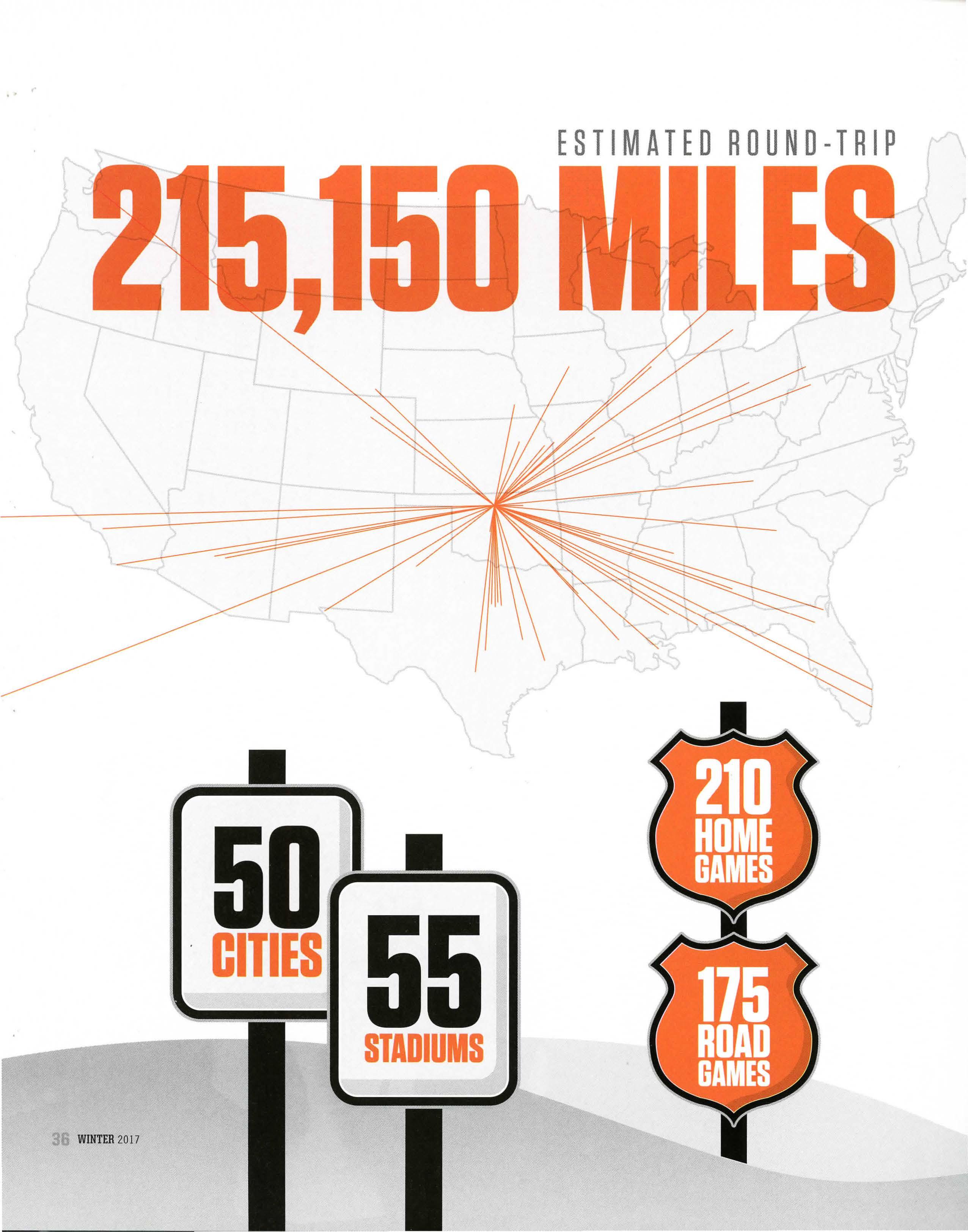
COUNTINGSTILLWATER,SARGENT'SCONSECUTIVECONTESTSHAVEOCCURREDIN55DIFFERENTSTADIUMSIN50CITIES.He's crisscrossed the contiguous United States and beyond, even venturing over the Pacific to Tokyo, Japan (1988 Coca-Cola Bowl vs. Texas Tech).
"Japan was really a fun trip, but it was hard," Sargent says. "We had to get in the neighborhood of 150 passports for players, staff and coaches. Some people had them, but most needed assistance in getting them. We ended up going to Dallas, spent the night there and then both teams flew on the same airplane to Tokyo. All the equipment for both teams was put on one airplane, a 747. They split the airplane right down the middle. We were on one side and the Red Raiders were on the other. It wa$ kind of an unusual setting, but it worked out fine
"We flew from Dallas to Anchorage and then from Anchorage to Tokyo. It was like a 15-bour trip and a 14-hou r ti me difference. It wasn't too bad going over there because we left in the morning and got there at night. But coming back was tough because we left early in the morning and got back early in the morning. So when you got back you were really feeling it because of the ti me change."
Less than a month after returning victorious from Tokyo-where BarrySandersaccepted the Heisman Trophy at 5 a.m. via satel1ite-the Pokes were bound for the SeaWorld Holiday Bowl.
"We turned right around and two-and-ahalfweeks later we were in San Diego. There's a lot of coordination that had to take place to do that."
Sargent says he enjoyed OSU's international excursion, but putting on a college football game at the Tokyo Dome came with some logistical challenges.
"Wherever we go, we're going to try and make the best of it. Every place has its unique characteristics. There's always things that happen to you on the road. In Tokyo, we really clid n't know what to expect when we got there, and the claybefore the game we found out they were just going to stick the coaches and radio crew out in the stands. So we had to scramble to make some corrections.
"I enjoyed Tokyo. It was an interesting place. We practiced in a park, and we were pretty close to the Olympic Stadium so I just walked over there and looked around. Most Americans are not going to travel to Tokyo, but we were fortunate to do it and had a good time there."
AROUGHESTIMATEOFSARGENT'STRAVELS COMESTOMORETHAN215,000ROUND-TRIP MILES(ASTHECROWFLIES).
Over the years, Sargent says football operations staffs expanded and became more specialized.
"When LesMitescame here (in 2001), that's when MackButlercame on board as di rector of ops. I'm still doing a lot with football, particularly as it involves team travel. Most of my energy is spent on airplane charters and helping with ground transportation."
In the late '90s, then-OSU Athletic Director TerryOonPhillipstasked Sargent with the logistics of the expansion of Gallagher-Iba Arena and its transformation into a comprehensive Athletics Center.
"I moved more into an administrative role for Terry Don," he says. "l was involved early on with the construction phases, particularly of Gallagher-Iba, and the first two phases of the football stadium. I enjoyed doing that because I learned a lot about construction and it helped me look at some things differently, particularly as it may relate to game management and some of the security things that need to be put in place."
Sargent says the World Trade Center attack, which occu rrcd in 2001 as plans were being conceived for OSU's football stadium renovation, changed the way we look at stadium security and facility needs.
"After 9-11, a lot of additional security measures were put in place," he says. "So it was helpful to have a basic understanding of construction and also understand the game management side of it when Boone Pickens Stadium was being built."
To pull off a successful game day at any level, let alone college football's upper echelon, requires an army of people working behind the scenes.
"Game management encompasses a lot of stuff. T get involved with TV, the visiting team, officials, team buses, security of the stadium-the whole gamut of what goes on game day. When you move in 60,000 people, there's a lot of coordination that has to take place in order for that to happen. There are specific individuals assigned in specific areas, and certain things are supposed to be happening at certain times. I just try to keep my hands wrapped around them all to make sure we know what's going on.
"We have a lot of good people here that make this work," he adds. "Without them, it wouldn't work. They want th is to be successfu I and take ownership of it."
SARGENTSAYSCOWBOYHOMEGAMESMAKE FORLONGDAYSINTHESADDLE.
"vVestart early, and it's generally two or three hours after the game is over with before T'm headed home."
Sargent has seen many of the cou ntrics most storied college venues, from the Ohio State "l Iorseshoc" to the "Big House" in Michigan to "Rocky Top" in Tennessee and the Rose Bowl in Pasadena. He says OSU can be proud of its stadium when his counterparts come to visit. "vVhen we went other places, we used to wish we had amenities like some of the top programs. Now, people come here and say the same thing about us. Boone Pickens Stadium is really a great facility. It's a far cry from what the old stadium looked like and how it functioned." :,
11WHENWEWENT OTHERPLACES, WEUSEDTO WISHWEHAD AMENMESLIKE SOMEOFTHE TOPPROGRAMS. NOW,PEOPLE COMEHEREAND SAVTHESAME THINGABOUTUS."
Sargent's journeys include two visits to Laramie, Wyo., but one trip was more memorable than the other.
"The first time we played ·wyoming was 1987. I advanced the trip and remember it was 100 degrees when we left Stillwater. I ended up driving through a blizzard on that plateau between Cheyenne and Laramie."
"Steve and I were stunned when we came out of the press elevator and the buses were nowhere to be found," Dirato, OSU's former radio analyst, recalls. "Our first thought was, 'They left us.'
"Although we won the game, I could tell Pat was irritated when we did the post-game interview. He was ready to get back to Stillwater.''
APAIROFSARGENT'SCOWORKERSREMEM· BERTHATSAMEGAMEFORADIFFERENTREASON.
"When we were on the road I had to wait in the press box until the home SID staff produced the final stat packages," says former OSU Sports Information Director SteveBuzzard."For some reason, it took a particularly long time that day. TomfOirato]had to wrap up the radio broadcast, and we went down the press box elevator together.
"When we walked to where the buses were supposed to be, they were gone. There was no one there. It was a fairly helpless feeling because we had to fly in and out of Cheyenne which was 50 miles away."
"On that Saturday, they put the team buses in one spot and the other bus in another spot,'· Sargent explains, "sol never knew if the other bus had everybody on it. And when Pat was ready to go, we left.''
Sargent's most frequented stop has been Norman, Okla., not surprisingly, with 17 trips into rival territory. Iowa State and Kansas are next on the list with 14 trips to Ames and 12 to Lawrence.
Conference realignment ended several longstanding home-and-home series with familiar Big Eight foes, but "Sarge" got to know those stadiums like the back of his hand, having trekked to M izzou a dozen times and Boulder, Colo., and Lincoln, Neb., nine times each.
The success of the MikeGundyera has ,1ddedto Sargent's post-season resume, with 11-straight bowl trips (20 total) from 2006-16. :,
"I began making plans to stay the night in Laramie and head home Sunday when Terry Tushfrom the Tulsa Worldcame out of the elevator," Dirato says. "He had a rental car and offered to take us to the Cheyenne airport just in case the plane hadn't taken off"
"We got there just as they were shutting the doors to the plane," Buzzard says. "All I remember was Marty looking at LIS and smiling."
"I can still see that smile on Marty's face," Dirato adds. "He used to kid us all the time about leaving LIS. He was almost right that day. It's still funny all these years later, but Steve and I weren't laughing in Laramie."
rp~ I rp~
I r;!rui~ I r;!ruiffJtR,g,o, I ,;!eaJtLeI,;!~ r;JtaAlwill,e I r;iti1/JJmleJv I V-empe I V-okv,o, I 'iT!tOlf I
"We went to Knoxville, Tennessee, in Bob Simmons' first year. There was a gentleman there showing me around, and he'd been to over 400-straight games. I go, 'Wow, that's a lot of games. That's thirty-some years!' I'd never really thought much of it, but when I got up into the high 200s, that's when I realized I've been to a lot of games. It's clefinitely unusual for an individual to stay th is long at one place and be able to go to this many games. It's amazing how fast it's occurred.
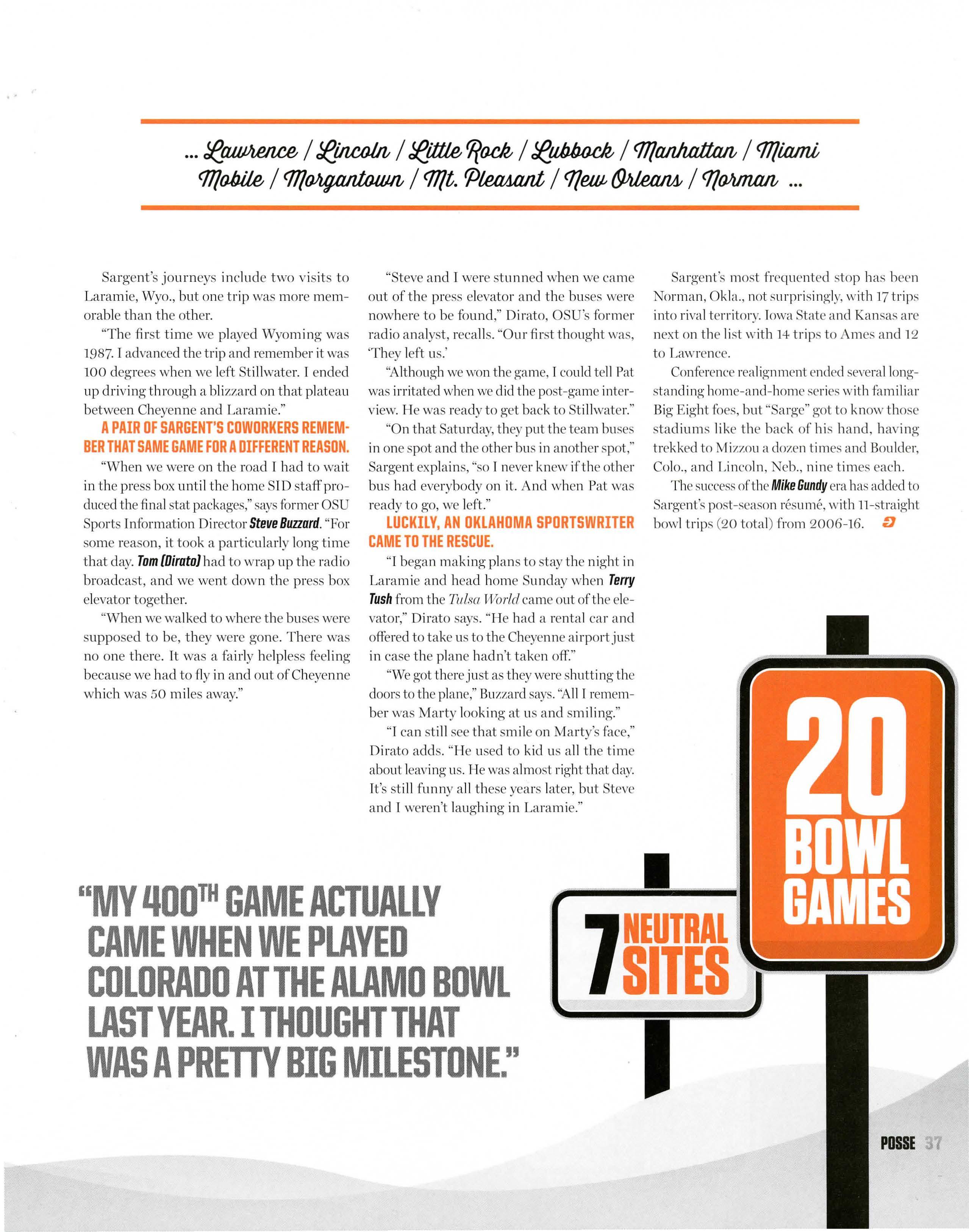
"My 400th game actually came when we played Colorado at the Alamo Bowl last year. I thought that was a pretty big milestone."
For a time, Cowboy football equipment manager Matt "Chief"Davishad a significant streak of his own going. Although Sargent had about a decade head start, Davis posed the most likely threat to his crown as the "Iron Man" of OSU Athletics.
"In 20 seasons from 1997-2016, [ was around 250-straight games," Davis says. "It ended in March when I took a new job within the department."
"I always k iclded Chief because he was the next closest to me," remarks Sargent. "I said, 'Before I leave, I'm going to make sure you miss a game so you break the streak I guess I ran him off."
Davis, now assistant athletic facilities director, says he considered Sargent's mark well out of reach.
"He absolutely took the streak seriously," Davis remarks. "He joked that he would find a way for me to miss a game. Since Marty misses nothing, I was pretty sure l wouldn't catch him Although, be did take the AD job at Oral Roberts for one clay."
(It's true. Sargent acknowledged that he was offered and accepted the athletic director position at ORU in 199+ but decided to remain at Oklahoma State.)
ANOTHERMAJOREVENTTHREATENED HIS STREAK,SARGENTSAYS.
"My son, Tony, had qualified for the U.S. Olympic time trials in ice speedskating. The time trials vvcrc up in Milwaukee, but it worked out that when he was finished competing I was able to get back to Stillwater and make the trip."
Sargent is quick to credit others for his professional growth and longevity.
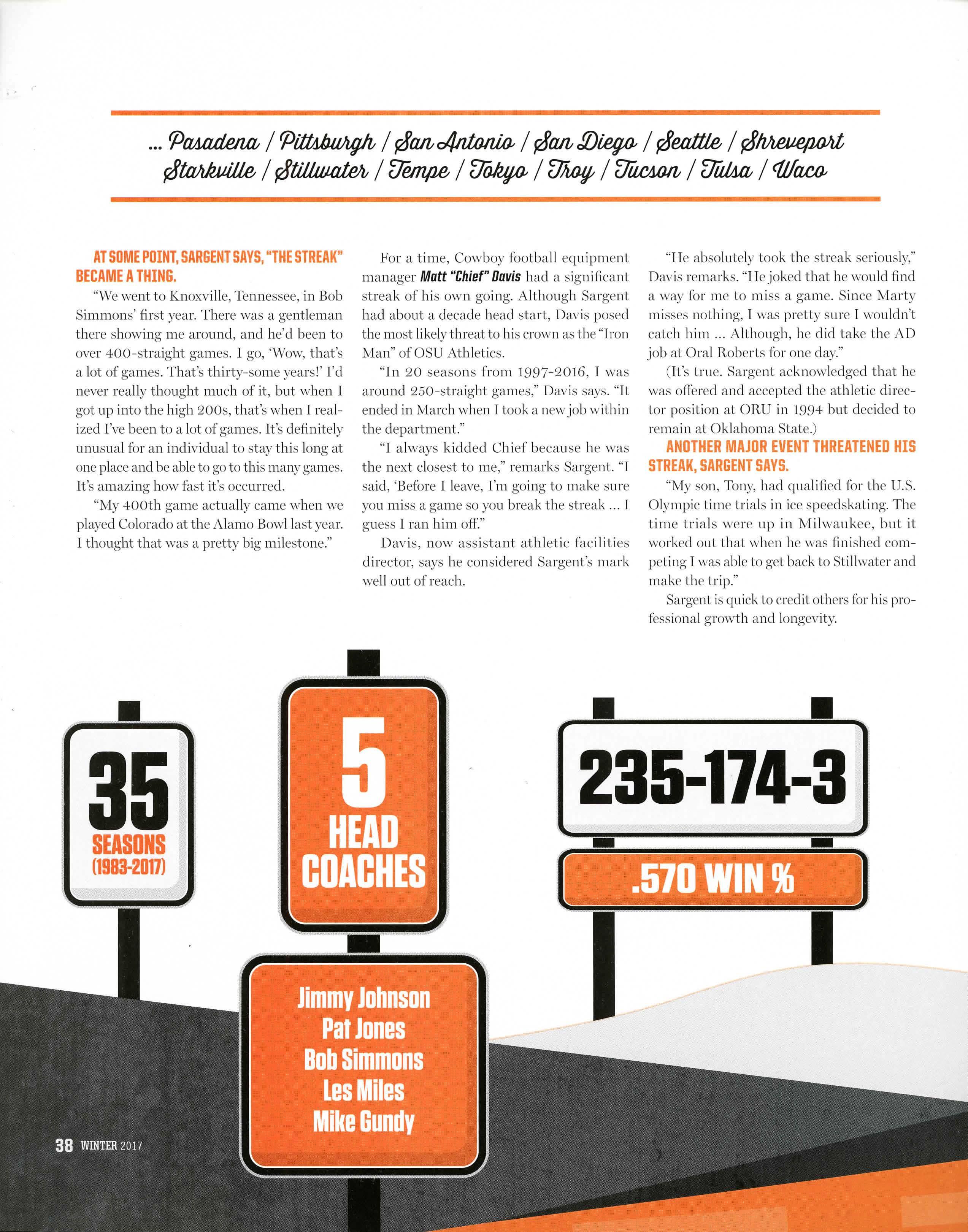
235-174-3
SEASONS (1983-2017)
"DonnieDuncanbecame a mentor to me," Sargent says. "He is someone l stayed in touch with over the years. Once he became the athletic director at Oklahoma and later with the Big 12 Conference, Tspent a lot of time with him learning about game management and many of the things I do now.
''I've been very fortunate that I've been around a lot of good people who are very knowledgeable in this profession," he adds. ''l've learned a lot of stuff from them, and 1 am very fortunate for that."
"Probably only a handful of people across the country can rival the Marty streak," Davis says. "It's definitely a combination ofluck and longevity. The tu nJover in college athletics has changed so much in the last 10 years, with people coming and going more frequently, that the Marty Sargents of the world don't really exist anymore.
"They broke the mold with Marty. 11is perseverance and commitment are u nparal leied. I-leis, hands down, an Oklahoma State legend."
SARGENTSAYSHEHASNOPLANSTOSLOW DOWNANYTIMESOON.COULD500BEONTHE HORIZON?
"How many more games l can do, l don't know. Hopefully I've got a few more left in me, because I enjoy doing this and 1 enjoy being around football."
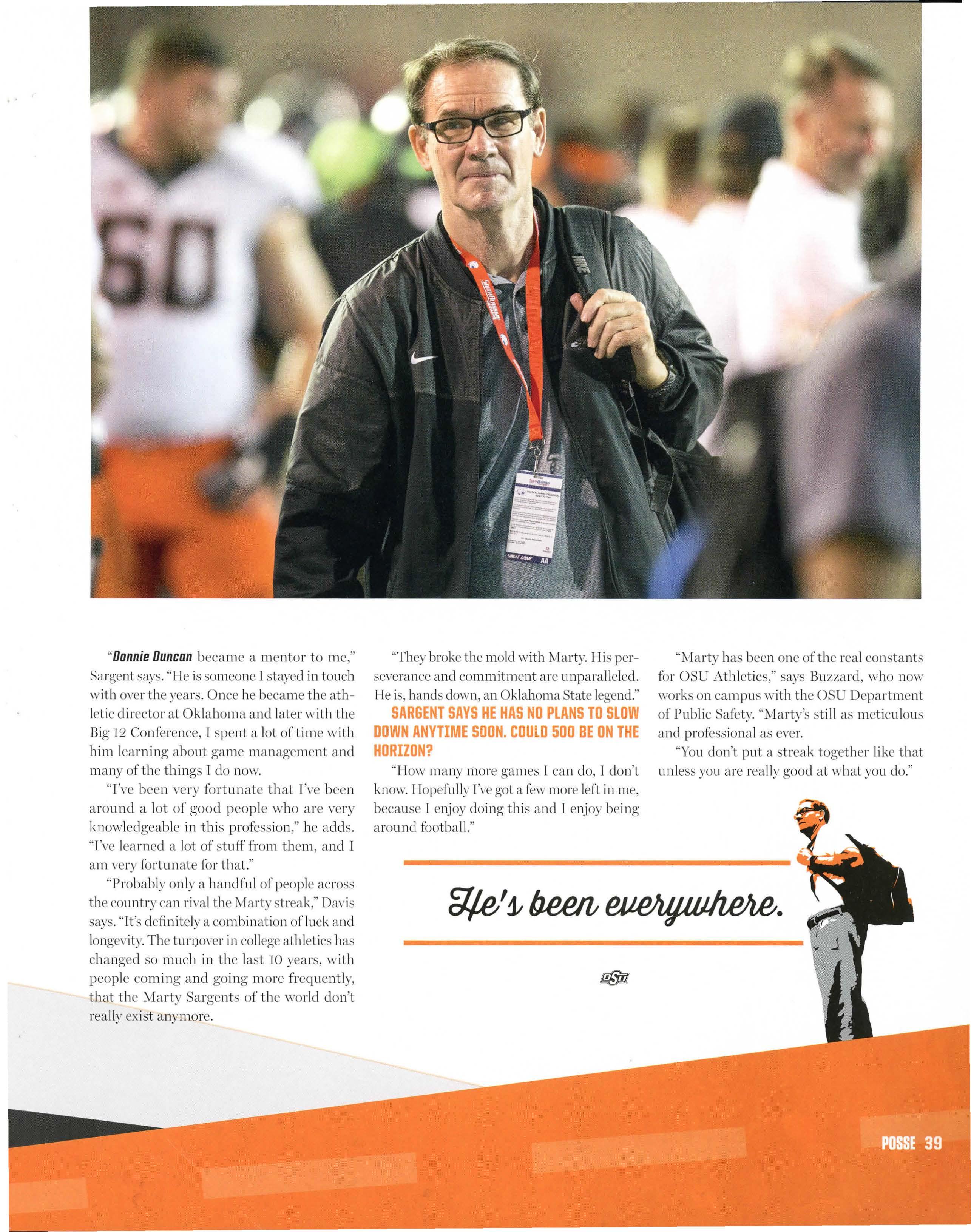
"Marty has been one oftbe real constants for OSU Athletics," says Buuard, who now works on campus with the OSU Department of Public Safety. "Marty's still as meticulous and professional as ever.
"You don't put a streak together like that unless you are really good at what you do."
STORYBYJOHNHELSLEY PHOTOSBYBRUCEWATERFIELD
WHILESTILL
AYOUNGLADGROWINGUPINBIXBY,MITCHELL SOLOMONSHAREDAMOMENTOFCLARITYWITHHISFATHER. "FIFTHORSIXTHGRADE,"ANDYSOLOMONRECALLED,
"HELOOKEDATMEANDSAID, 'I WANTTOPLAYCOLLEGE BASKETBALL.'ANDHEWASSERIOUSABOUTIT."
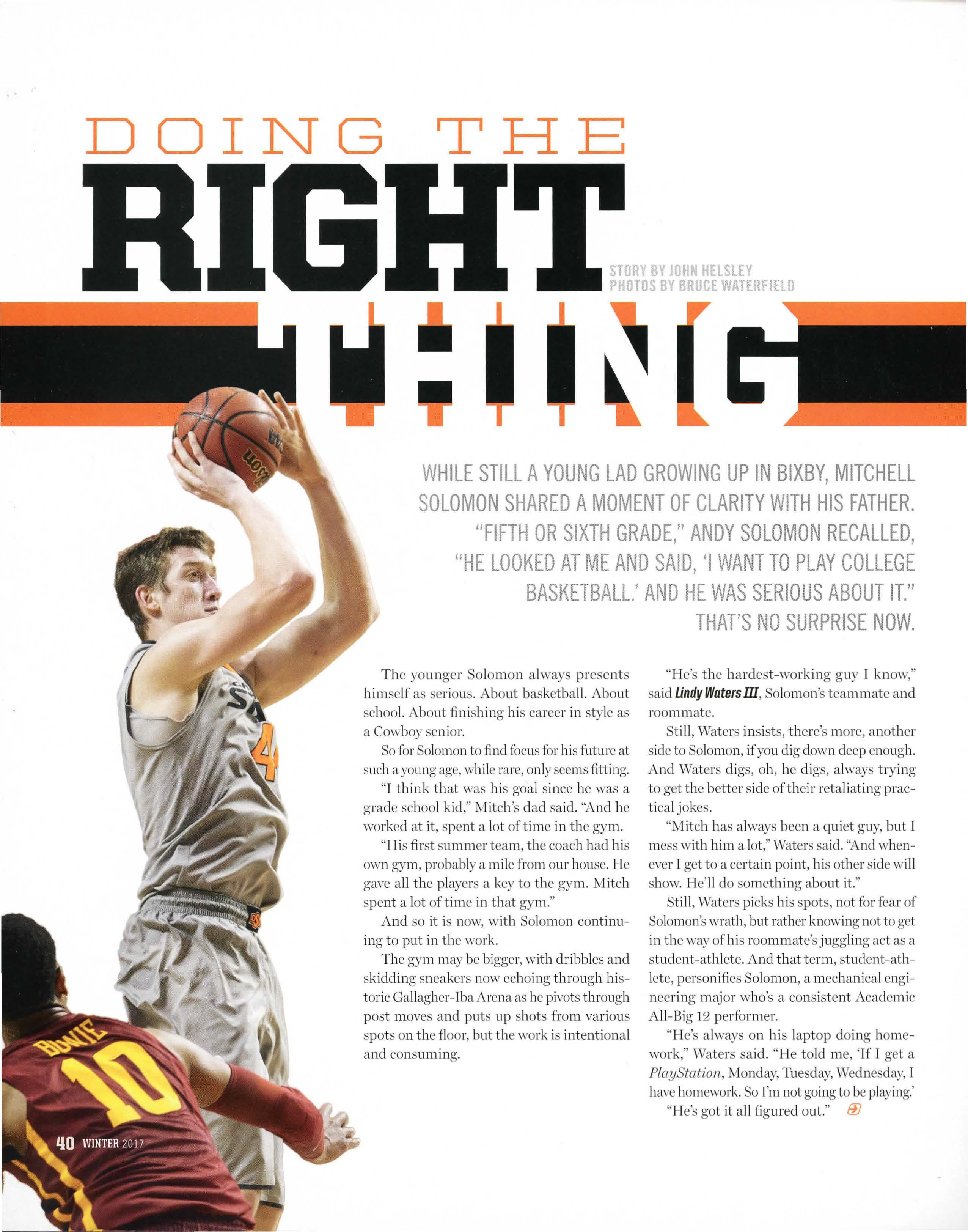
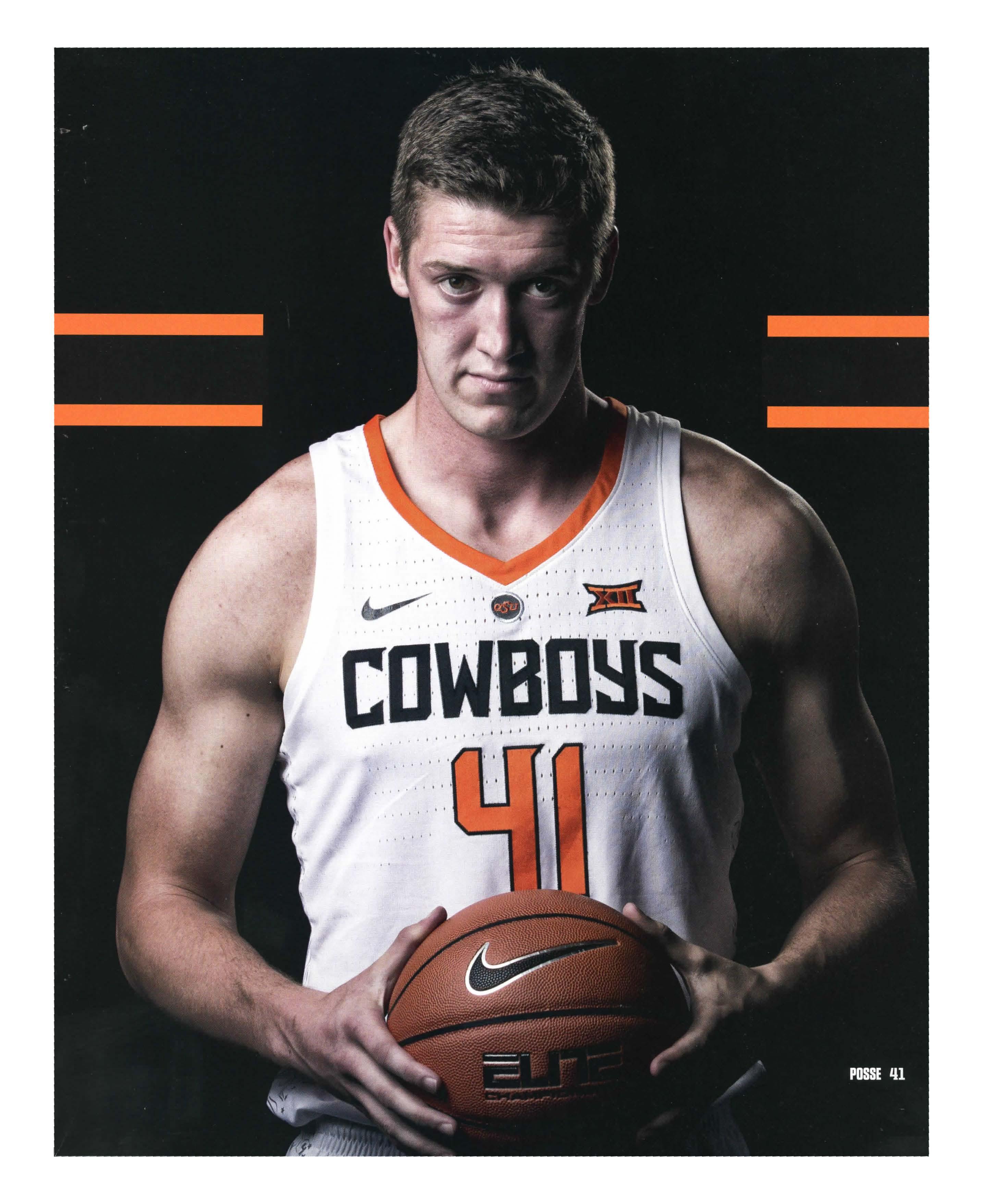
The younger Solomon always presents himself as serious. About basketball. About school. About finishing his career in style as a Cowboy senior.
So for Solomon to find focus for his future at such a young age, while rare, only seems fitting.
"I think that was his goal since he was a grade school kid," Mitch's dad said. ''And he worked at it, spent a lot of time in the gym.
"His first summer team, the coach had his own gym, probably a mile from our house. He gave all the players a key to the gym. Mitch spent a lot of ti me in that gym."
And so it is now, with Solomon continuing to put in the work.
The gym may be bigger, with dribbles and skidding sneakers now echoing th rough historic Gallagher-Iba Arena as he pivots through post moves and puts up shots from various spots on the floor, but the work is intentional and consuming. THAT'SNOSURPRISENOW.
"He's the hardest-working guy I know," said LindyWatersIII, Solomon's team mate and roommate.
Still, Waters insists, there's more, another side to Solomon, if you dig down deep enough. And Waters digs, oh, he digs, always trying to get the better side of their retaliating practical jokes.
"Mitch has always been a quiet guy, but I mess with him a lot," Waters said. "And whenever I get to a certain point, his other side wi 11 show. He'll do something about it."
Sti II, Waters picks his spots, not for fear of Solomon's wrath, but rather knowing not to get in the way of his roommate's juggling act as a student-athlete. And that term, student-athlete, personifies Solomon, a mechanical engineering major who's a consistent Academic All-Big 12 performer.
"He's always on his laptop doing homework," Waters said. "He told me, 'If I get a PlayStation, Monday, Tuesday, Wednesday, I have homework. So I'm not going to be playing.'
"He's got it all figured out." flJ
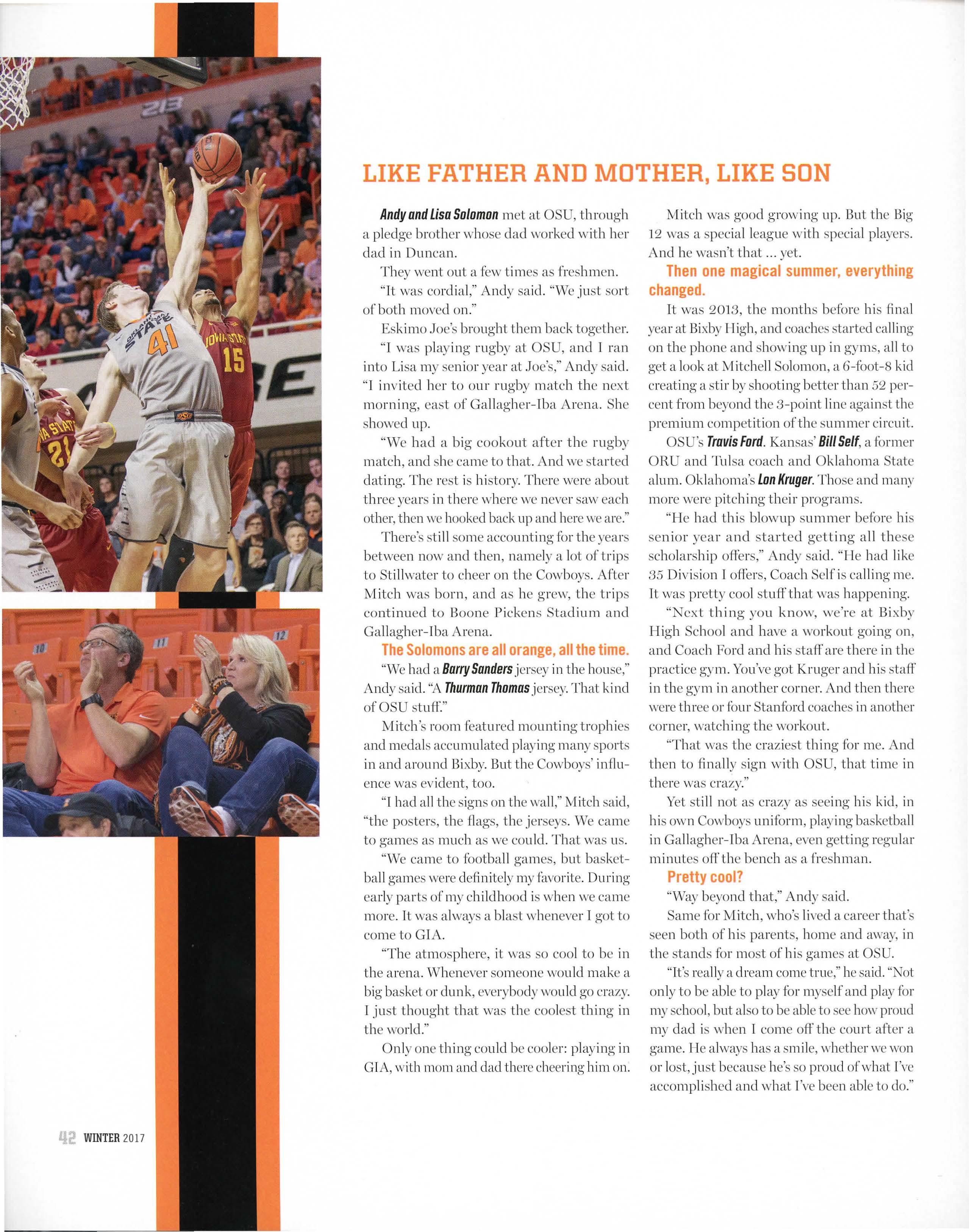
AndyandLisaSolomonmet at OSU, th rough a pledge brother whose dad worked with her dad in Duncan.
They went out a few times as freshmen.
"Tt was cordial," Andy said. "We just sort of both moved on."
Eskimo.Joe's brought them back together.
"I was playing rugby at OSU, and I ran into Lisa my senior year at .Joe's,"Andy said. "] invited her to our rugby match the next morning, east of Gallagher-Iba Arena. She showed up.
"We had a big cookout after the rugby match, and she came to that. And we started dating. The rest is history. There were about three years in there where we never saw each other, then we hooked back up and here we are."
There's still some accounting for the years between now and then, namely a lot of trips to Stillwater to cheer on the Cowboys. After Mitch was born, and as he grew, the trips continued to Boone Pickens Stadium and Gallagher-Iba Arena.
TheSolomonsareallorange,allthetime.
"We had a BarrySandersjersey in the house," Andy said. "A ThurmanThomasjersey. That kind of OSU stuff."
Mitch's room featured mounting trophies and medals accumulated playing many sports in and around Bixby. But the Cowboys' influence was evident, too.
"[ had all the signs on the wall," Mitch said, "the posters, the flags, the jerseys. We came to games as much as we could. That was us.
"We came to football games, but basketball games were definitely my favorite. During early parts of my child hood is when we came more. lt was always a blast whenever I got to come to GIA.
"The atmosphere, it was so cool to be in the arena. Whenever someone would make a big basket or dunk, everybody wou Id go crazy. I just thought that was the coolest thing in the world."
Only one thing could be cooler: playing in GIA, with mom and dad there cheering him on.
Mitch was good growing up. But the Big 12 was a special league with special players. And he wasn't that yet.
Thenonemagicalsummer,everything changed.
It was 2013, the months before his final year at Bixby 11igh, and coaches started calling on the phone and showing up in gyms, all to get a look at Mitchell Solomon, a 6-foot-8 kid creating a stir by shooting better than 52 percent from beyond the 3-poi nt Iinc against the premium competition of the summer circuit.
OSU's TravisFord.Kansas' BillSelf,a former ORU and Tulsa coach and Oklahoma State alum. Oklahoma's LonKruger.Those and many more were pitching their programs.
"He had this blowup summer before his senior year and started getting all these scholarship ofl-ers,"Andy said. "He had like 35 Division I offers, Coach Self is calling me. It was pretty cool stuff that was happening.
"Next thing you know, we're at Bixby High School and have a workout going on, and Coach Ford and his staff are there in the practice gym. You've got Kruger and his staff in the gym in another corner. And then there were three or four Stanford coaches in another corner, watching the workout.
"That was the craziest thing for me. And then to finally sign with OSU, that time in there was crazy."
Yet still not as crazy as seeing his kid, in his own Cowboys uniform, playing basketball in Gallagher-lba Arena, even getting regular minutes off the bench as a freshman.
"Way beyond that," Andy said.
Sarne for Mitch, who's lived a career that's seen both of his parents, home and away, in the stands for most of his games at OSU.
"It's really ad ream come trne," he said. "Not only to be able to play for myself and play for my school, but also to be able to see how proud my dad is when I come off the court after a game. He always has a smile, whether we won or lost, just because he's so proud of what f've accomplished and what I've been able to do."
"HE'SOURBIGGESTPIECE,BEINGINTHEPAINT,CONTROLLING THE TEMPO,REBOUNDING,JUSTBEINGABIG,PHYSICALFIGURE.HEDOES
ALOTOFTHINGSPEOPLEDON'TSEE." - LINDYWATERS Ill
Solomon's career to this point has been solid, by public standards. Last season, in his biggest role yet, Solomon averaged 5.5 points and 5.3 rebounds, with 39 blocks in 33 games. By insidcr standards, meaning his coaches and team mates, Solomon's value is off the charts. He's a stat-sheet stuffer of a different sort, racking up appreciation for production that doesn't appear in any box score, things like deflections and taking charges and hustle and defense.
"We value those things, things that people don't watch," said Cowboy head coach Mike Boynton."We know they lead to those other things people do see on a stat sheet. Sometimes, Mitchell Solomon,just because he runs the floor as hard as he can - something as simple as that - draws a defender to him and leads to JeffreyCarrollmaking a 3.
"Now, the only thing people saw was Jeffrey Carroll making a 3. And when we watch film, T never talk about JefFrey Carroll making the 3, I only talk about Mitchell Solomon running the floor, to reinforce those things are important."
It'sa blue-collarjob,nota glamourrole, yetonevitalandvaluedonanyteam.
Solomon has found the spotlight in his career, throwing down a momentu m-changing clunk in a win over Kansas as a freshman, going for 16 against the Jayhawks a year ago in Lawrence and later sinking two pressurepacked free throws to close out a Bedlam sweep before family and 13,000-plus friends inside GIA.
Night in and night out, however, it's Solomon's willingness to do the little things, and his excellence at doing them, that raise his stock with the Cowboys and coaches across the league.
"T feel like every team has to have one of those guys," Solomon said. "If that needs to be me, then that'll be me. Obviously, I'm wanting to put points on the board and wanting to make big plays, but if I need to be the guy who's in help rotations on defense or blocking shots or helping teammates who are dropping behind to be more focused on offense, then I'm going to do whatever it takes to get a win."

That mentality - whatever it takesdefines Solomon'scommitment to the Cowboys in a career that has involvedthree head coaches, al I with clifferent voices and schemes. And it's what makes Solomon so appealing to Boynton in his debut season.
"One of the things from a coaching standpoint that you always want to know is who can you count on," Boynton said. "And not in terms of just scoring, but when you put a game plan together, who are the guys you can count on to execute that game plan as we!I as they possibly can?
"Who's going to be in the right position? When everybody is watching whether the shot went in or not, who's the guy who's going to go and grab the offensive rebound because he knows his job is to get the misses? Who's going to be the guy that's going to set a screen for a teammate to get that open shot? EiJ

"M itchcll Solomon is that guy. I !e's selfless. And in those ways he has totally bought in to doing those things on a daily basis."
SolomongradedoutasOSU'sbestdefender a yearago.And over the final 15 games, when the Cowboys were making a run in the Big 12 and paving their way for a return to the NCAA Tournament, Solomon posted a plus116 in the plus-minus category, second only to JawunEvans.
"Mitch docs everything for us," Waters said. "Whether that's defense or knocking clown shots, being vocal. You can hardly ever get on him because he's always in the right spot, doing the right thing. He's always positive about everything. That's something we look up to.
"He's our biggest piece, I think, being in the paint, controlling the tempo, rebounding, just being a big, physical figure. I-ledoes a lot of things people don't sec."
Solomon's role as a scorer could increase this season. WiLh Evans, Phi/Forteand Leyton Hammondsgone from last season, the Cowboys have a points void to replace. And with the addition of big St .John's transfer YankubaSima as protection in the post, Solomon should find more freedom to flow and roam on the floor when they play together.
"They can really complement each other because thcy"re really skilled players," Boynton said. "One thing I don't think people understand about Mitch, from a basketball standpoint, is he's actually a really good shooter. Not a Phi I Forte-type shooter, but a guy, with his size can use it to his advantage. I le's capable of making the 3. And you'I I see him shoot some 3s this year."
Mitchell Solomon clream eel of being a Cowboy.
Ancl he's making the most of being a Cowboy.
Solomon ancl his family recogn izc how quickly his OSU basketball career has progressed to this senior season.
"Like a snap," Andy said.
Thesuddennessofonefinalridehascaught Mitchoffguard.
"It's weird, kind of an indescribable feeling," he said. "Your first three years, you always think, 'Well, I'll be here next year.' Now you have a different mindset.
"Being my last year, T'mtrying to play with an edge, trying to work on things I haven't clone in the past, like being more of a vocal leader. Throughout my life, I've been a leader by action, a leader by example. I think this team needs someone to be more vocal so I'm trying to fill that role and encourage others to as well."
Alas,Solomonwillbebacknextyear,just ina differentrole:student,minustheathlete.
The demands of basketball conflict with the demands of an engineering major, wh ieh requires several labs. And those labs are held in the afternoons, the same time as basketball practices. So Solomon has had to postpone that portion of his degree program, meaning he'll be back for a fifth year consisting mostly of lab work. Still, he's filled in the gaps to this point, to no su rpri~e, with purpose, taking on courses that wi 11add a business mi nor to his academic resume.

Theworkethic,accordingto Solomon, comesnaturally.
"My dad got his MBA after my middle brother and I were born," he said. "f remember him putting us to bed a ncl going to class.
"So it was instilled in my brain that education is important, and you don't mess with that. I laving an opportunity to get my education paid for, I was going to take advantage of it."
Yep, Solomon is serious.
About basketball.
About school.
And about finishing his career in style.
"lv[itch is an extremely bright person, really, really smart kid, from a basketball standpoint but even more so from an academic standpoint," Boynton said. "He's a kid who prides himselfon being the best that he can be every day. He challenges himself in the classroom with regard to how he works. He has great aspirations. He challenges himself on the basketball -floor.
"He wants to follow in his dad's footsteps, own his own business and all ofthat. It's fun to watch it all evolve. He's just a joy to be around."


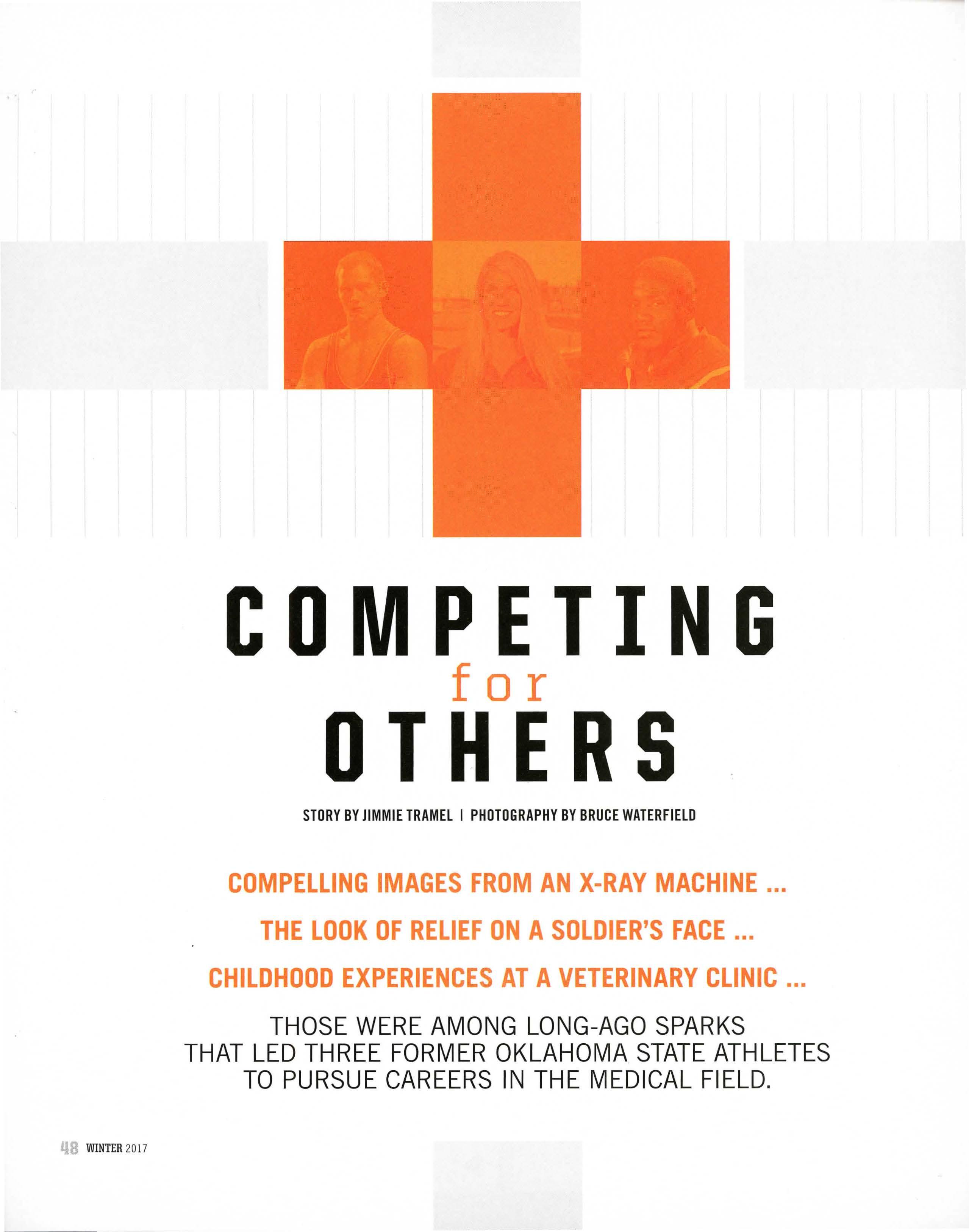
STORYBYJIMMIETRAMEL I PHOTOGRAPHYBYBRUCEWATERFIELD
COMPELLINGIMAGESFROMANX-RAYMACHINE...
THELOOKOFRELIEFONA SOLDIER'SFACE...
...
THOSE WEREAMONG LONG-AGOSPARKS THAT LED THREE FORMEROKLAHOMA STATEATHLETES TO PURSUECAREERSIN THE MEDICAL FIELD.
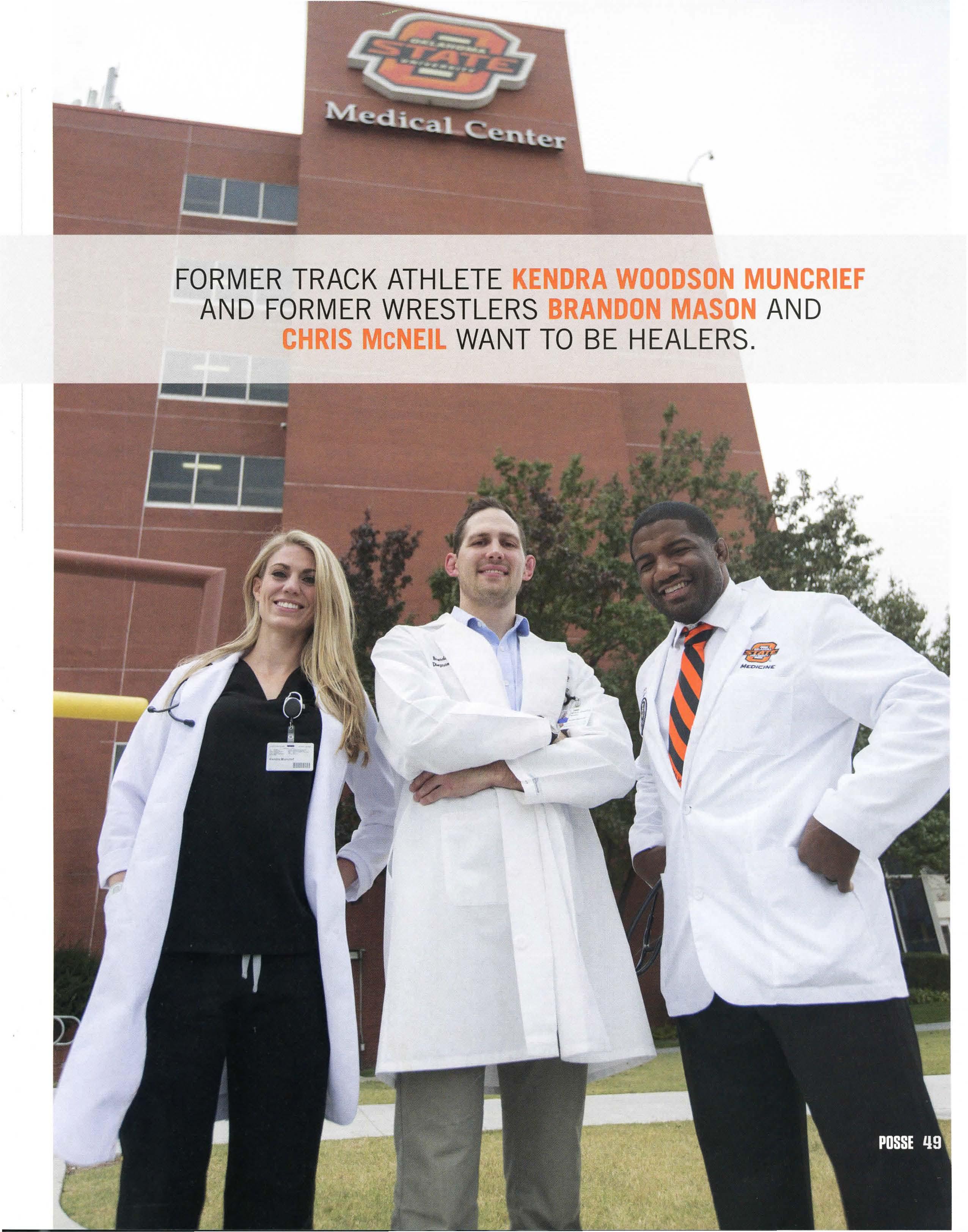
FORMERTRACKATHLETEKENDRAWOODSONMUNCRIEF AND FORMERWRESTLERSBRANDONMASONAND CHRISMcNEILWANTTO BE HEALERS.
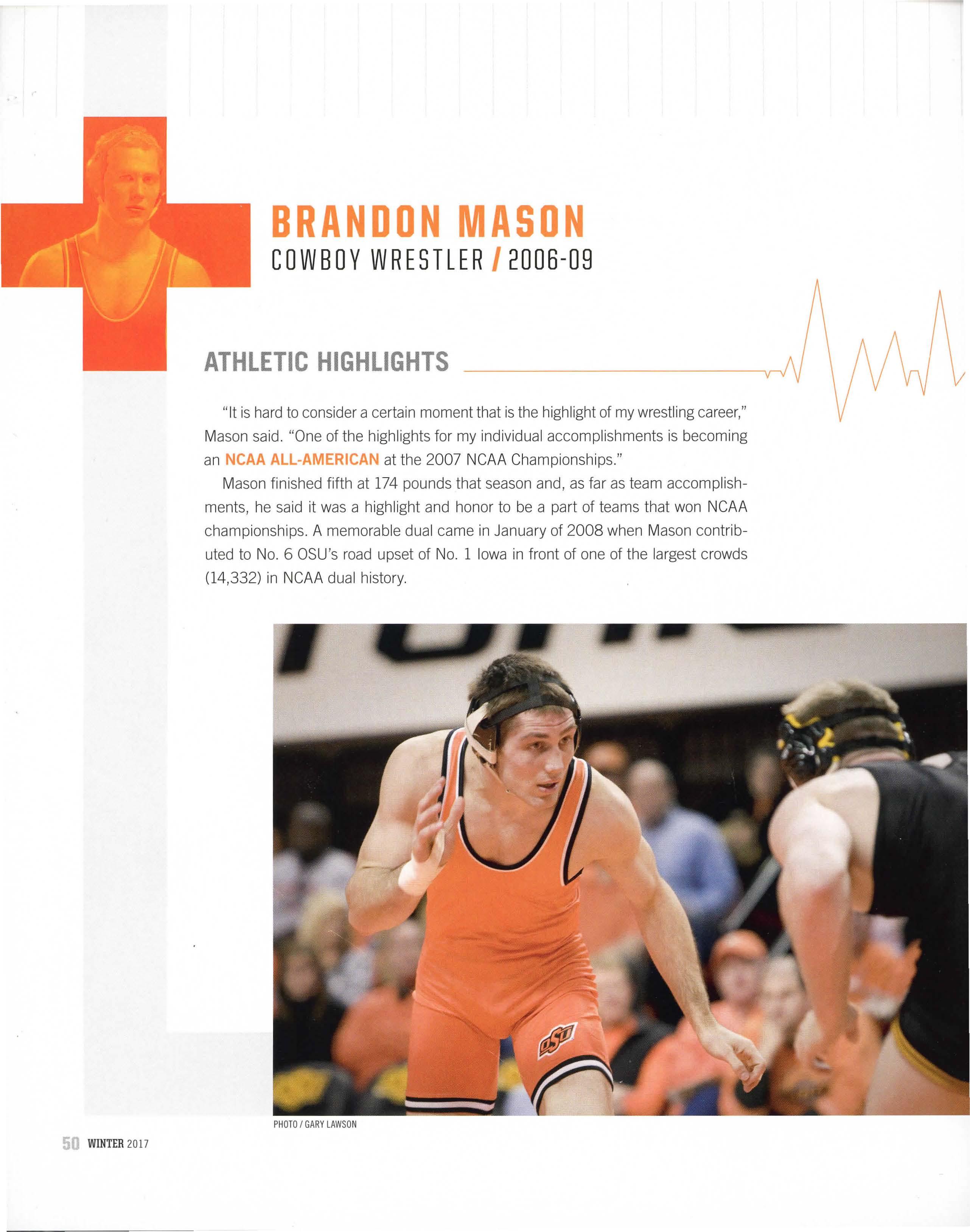
"It is hard to consider a certain moment that is the highlight of my wrestling career," Mason said. "One of the highlights for my individual accomplishments is becoming an NCAAALL-AMERICANat the 2007 NCAA Championships." Mason finished fifth at 174 pounds that season and, as far as team accomplishments, he said it was a highlight and honor to be a part of teams that won NCAA championships. A memorable dual came in January of 2008 when Mason contributed to No. 6 OSU's road upset of No. 1 Iowa in front of one of the largest crowds (14,332) in NCAA dual history.
Both of Mason's parents are chiropractors. They had an X-ray machine in their office. They took X-rays of patients and developed the images in a darkroom.
"Because of this, from a young age, I thought radiology was something that was extremely interesting and something I would be interested in doing," he said.
Mason became more and more involved in the sciences as he grew older. He began shadowing doctors. His experiences confirmed his desire to go into radiology. He applied (and was accepted) to OSU's medical school with the intention of a completing a residency in cliagnostic radiology. After four years of medical school, he applied to radiology programs across the country and said he was fortunate to gain a spot in the radiology residency program at OSU's medical center. I le is in his fifth (and final) year ofthe radiology residency.
Next? Mason accepted a one-yearfellowship at Body MIU imaging at Mallinckrodt Institute of Radiology at Washington University/Barnes Jewish Hospital in St. Louis. He said it's the top radiology program in the country.
After hisfellowship,Masonwill practice diagnosticradiologyat Stillwater MedicalCenterwith a specialtyin MRY bodyimaging.Tl_iefellowship training will allow him to be a specialist in interpreting a majority of cancer imaging, including prostate, colon, renal, 1iver and gynecologic cancer.
Mason was asked this question: In your experiences so far, what are some things that have happened in your patient interactions that let you know you are absolutely making a difference in lives and pursuing the right profession?
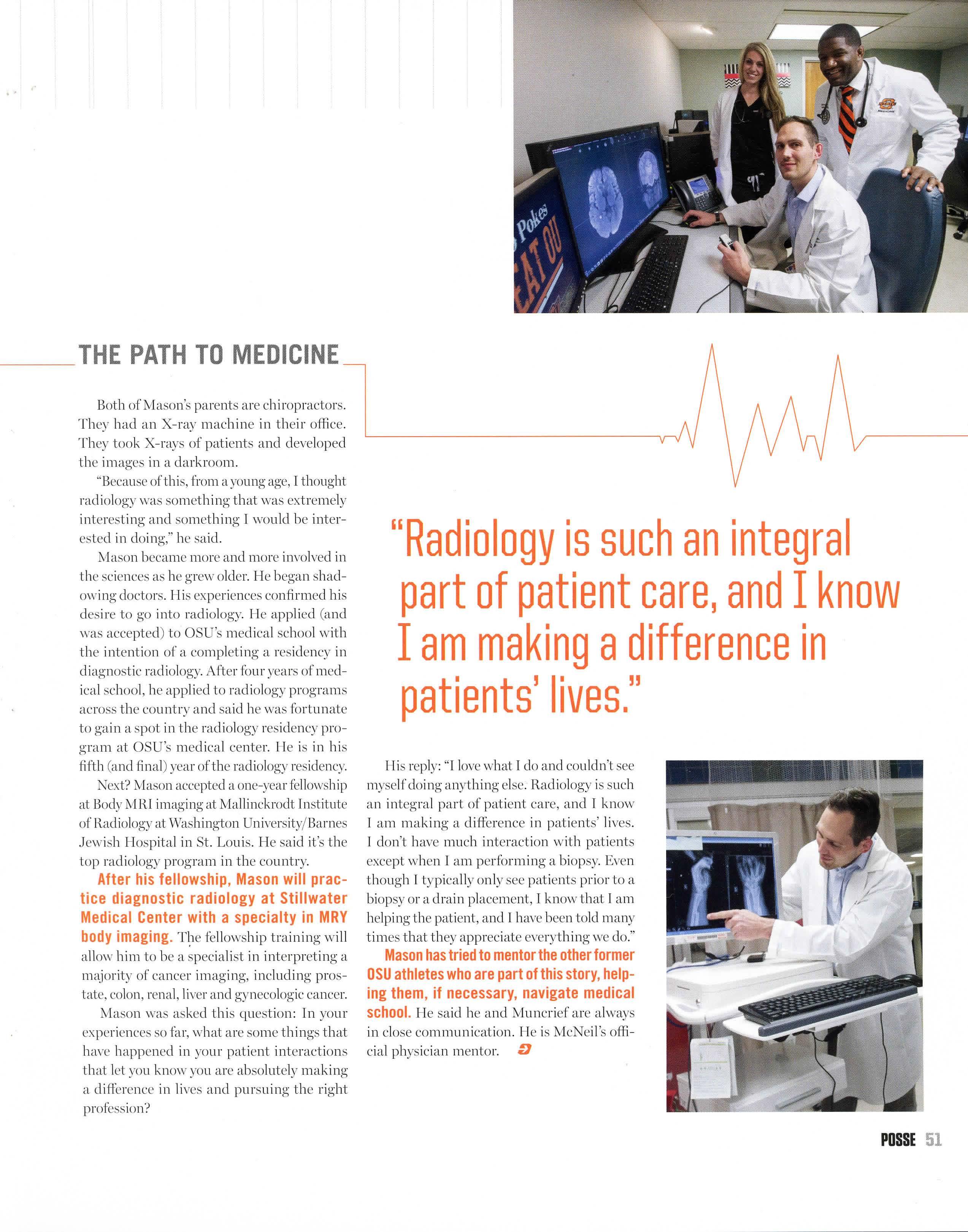
"Radiologyissuchanintegral partofpatientcare,and I know I ammaking a difference in patients'lives."
His reply: "I love what I do and couldn't see myself doing anything else. Radiology is such an integral part of patient care, and I know I am making a difference in patients' lives. I don't have much interaction with patients except when I am performing a biopsy. Even though l typically only see patients prior to a biopsy or a drain placement, I know that I am helping the patient, and 1have been told many times that they appreciate everything we do."
Masonhastriedtomentortheotherformer OSUathleteswhoarepartofthisstory,helpingthem, if necessary,navigatemedical school.He said he and Muncrief are always in close communication. He is McNeil's official physician mentor. :J
An ALL-BIG12 and ACADEMICALL-BIG12 performer, Muncrief said she has thought about the "career highlight" topic before and isn't quite sure what it would be. She said she ran the 400-meter hurdles reasonably well as a freshman, but her hurdles coach, Jim Bolding, passed away at the end of the year. Dave Smith, who previously coached only the men's team, assumed responsibility for the women's team, and she ran the 800 meters and the 3k steeplechase after that.
"I struggled with injuries towards the end of my sophomore year for the remainder of my time at OSU," she said. "College athletics are not about who is the most naturally talented necessarily but about who can stay healthiest the longest. I look back, and I think struggling through those injuries helped me have a more mature outlook and overall stronger character."
Muncrief said she had great teammates and made great friends (she counts Smith among them) during hE;rtime at OSU. She called Smith an amazing coach and said she cherished the opportunity to run for him.
"I can't say I have one race or meet that stands out as being that defining moment," she said. "I think I am most proud that I was able to be a strong student and athlete at the same time. Being a premed student-athlete was extremely difficult, but it made me a great medical student. While my career didn't turn out how I would have • hoped, I don't reflect on it with any regrets. I feel so blessed to have had the opportunity and am grateful for my coach, Dave Smith."
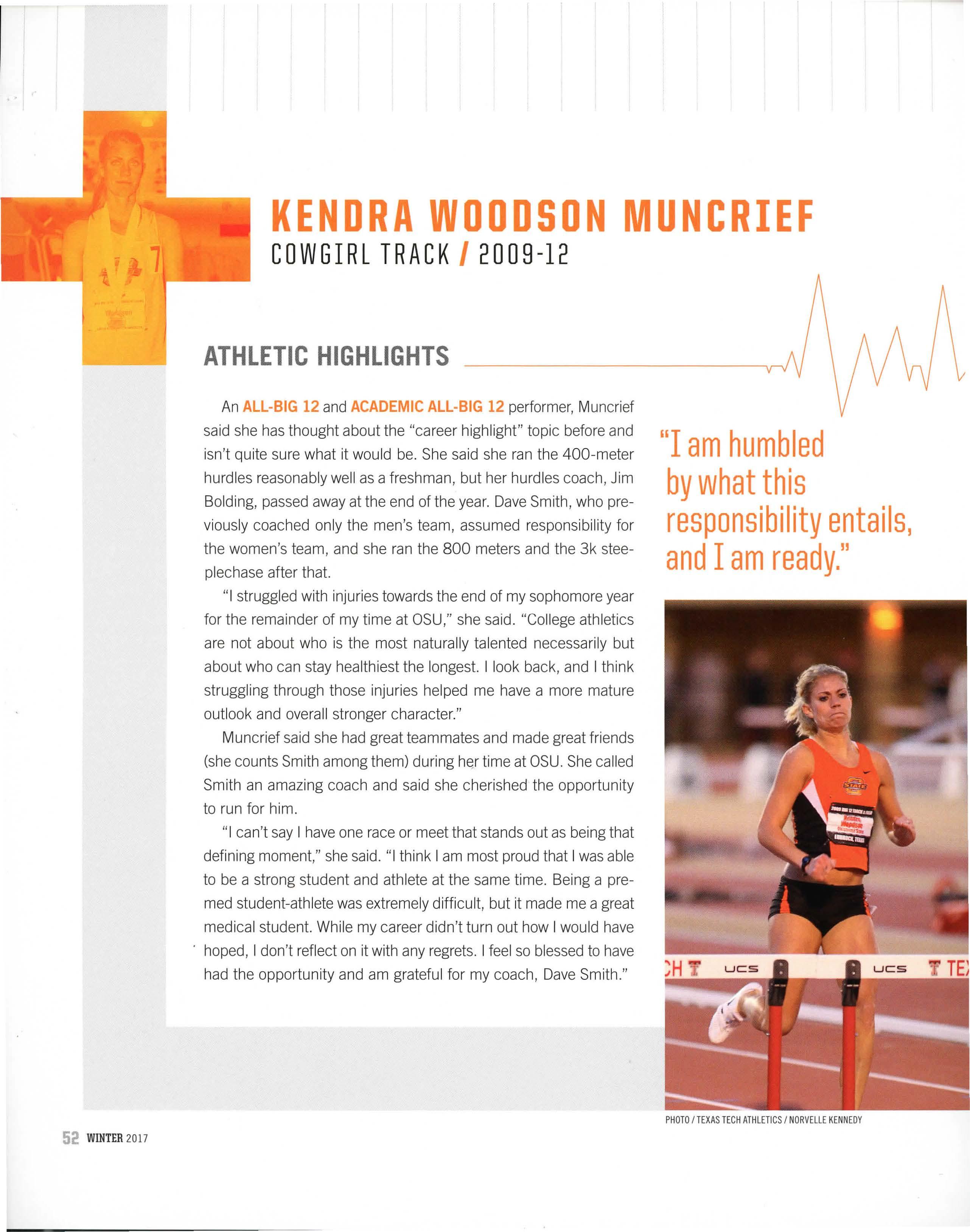
"I amhumbled bywhatthis responsibilityentails, and I amready."
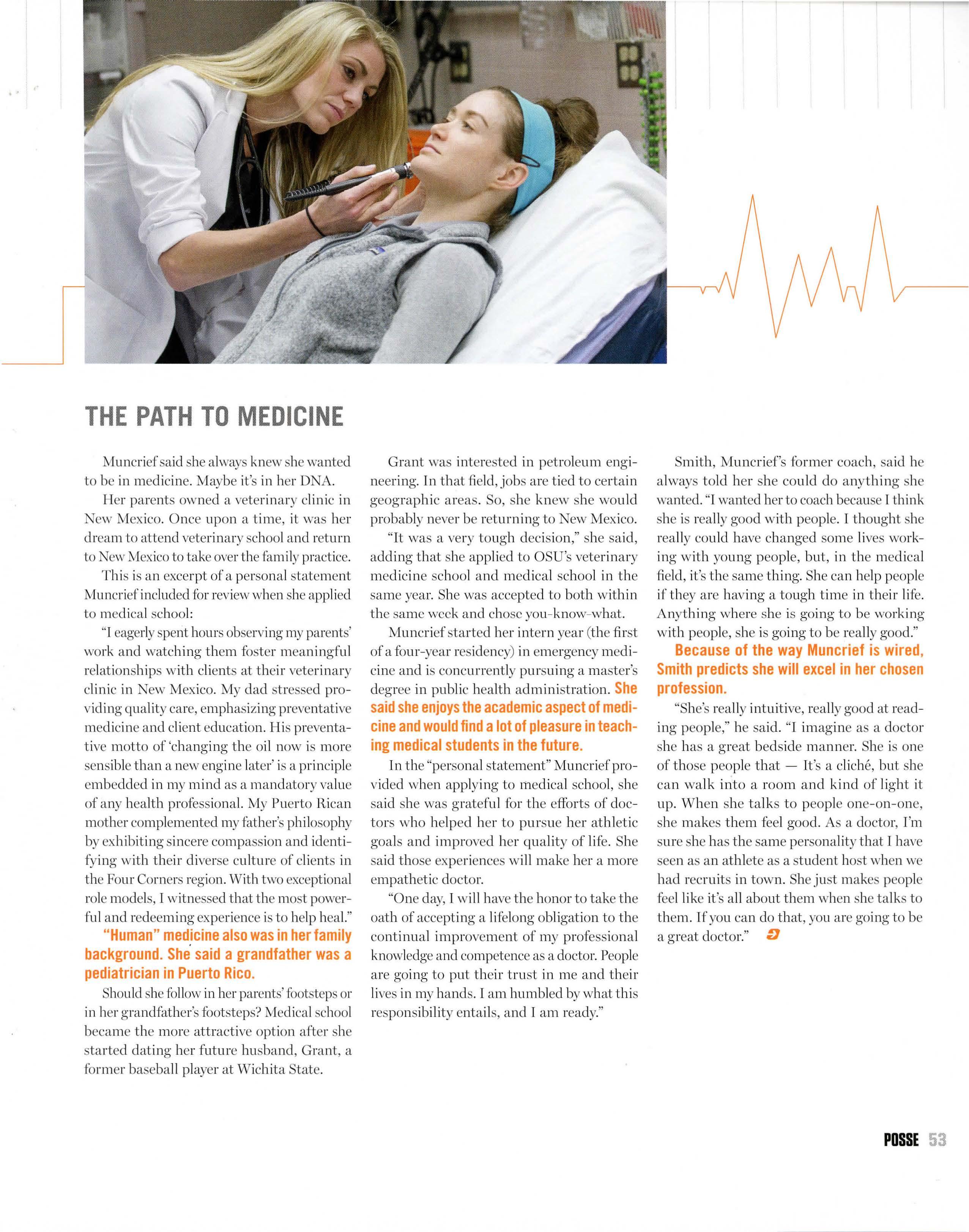
Muncrief said she always knew she wanted to be in medicine. Maybe it's in her DNA. Her parents owned a veterinary clinic in New Mexico. Once upon a time, it was her dream to attend veterinary school and return to New }dexicoto take over the family practice. This is an excerpt of a personal statement Muncrief included for review when she applied to medical school:
"I eagerly spent hours observing my parents' work and watching them foster meaningful relationships with clients at their veterinary clinic in New Mexico. My dad stressed providing qua! ity care, emphasizing preventative medicine and client education. His preventative motto of 'changing the oi I now is more sensible than a new engine later' is a principle embedded in my mind as a mandatory value of any health professional. My Puerto Rican mother complemented my father's philosophy by exhibiting sincere compassion and identifying with their diverse culture of clients in the Four Corners region. With two exceptional role model , I witnessed that the most powerfu I and redeeming experience isto help heal."
"Human"medicinealsowasinherfamily background.Shesaida grandfatherwasa pediatricianin PuertoRico.
Shou Id she follow in her parents' footsteps or in her grandfather's footsteps'? J\iledicalschool became the more attractive option after she started dating her future husband, Grant, a former baseball player at Wichita State.
Grant was interested in petroleum engineering. In that field, jobs are tied to certain geographic areas. So, she knew she would probably never be returning to New Mexico.
"It was a very tough decision," she said, adding that she applied to OSU's veterinary medicine school and medical school in the same year. She was accepted to both within the same week and chose you-know-what.
Muncrief started her intern year (the first of a four-year residency) in emergency medicine and is concurrently pursuing a master's degree in public health administration. She saidsheenjoystheacademicaspectofmedicineandwouldfinda lotofpleasureinteachingmedicalstudentsinthefuture.
In the "personal statement" Muncrief provided when applying to medical school, she said she was grateful for the efforts of doctors who helped her to pursue her athletic goals and improved her quality of life. She said those experiences will make her a more empathetic doctor.
"One day, l will have the honor to take the oath of accepting a lifelong obligation to the continual improvement of my professional knowledge and competence as a doctor. People are going to put their trust in me and their lives in my hands. I am humbled by what this responsibility entails, and I am ready."
Smith, Muncrief's former coach, said he always told her she could do anything she wanted. "I wanted her to coach because I think she is really good with people. l thought she really could have changed some lives working with young people, but, in the medical field, it's the same thing. She can help people if they are having a tough time in their life. Anything where she is going to be working with people, she is going to be really good."
Becauseof the wayMuncriefis wired, Smithpredictsshewillexcelin herchosen profession.
"She's really intuitive, really good at reading people," he said. "I imagine as a doctor she has a great bedside manner. She is one of those people that - It's a cliche, but she can walk into a room and kind of light it up. When she talks to people one-on-one, she makes them feel good. As a doctor, I'm sure she has the same personality that I have seen as an athlete as a student host when we had recruits in town. She just makes people feel like it's all about them when she talks to them. lf you can do that, you are going to be a great doctor." :,
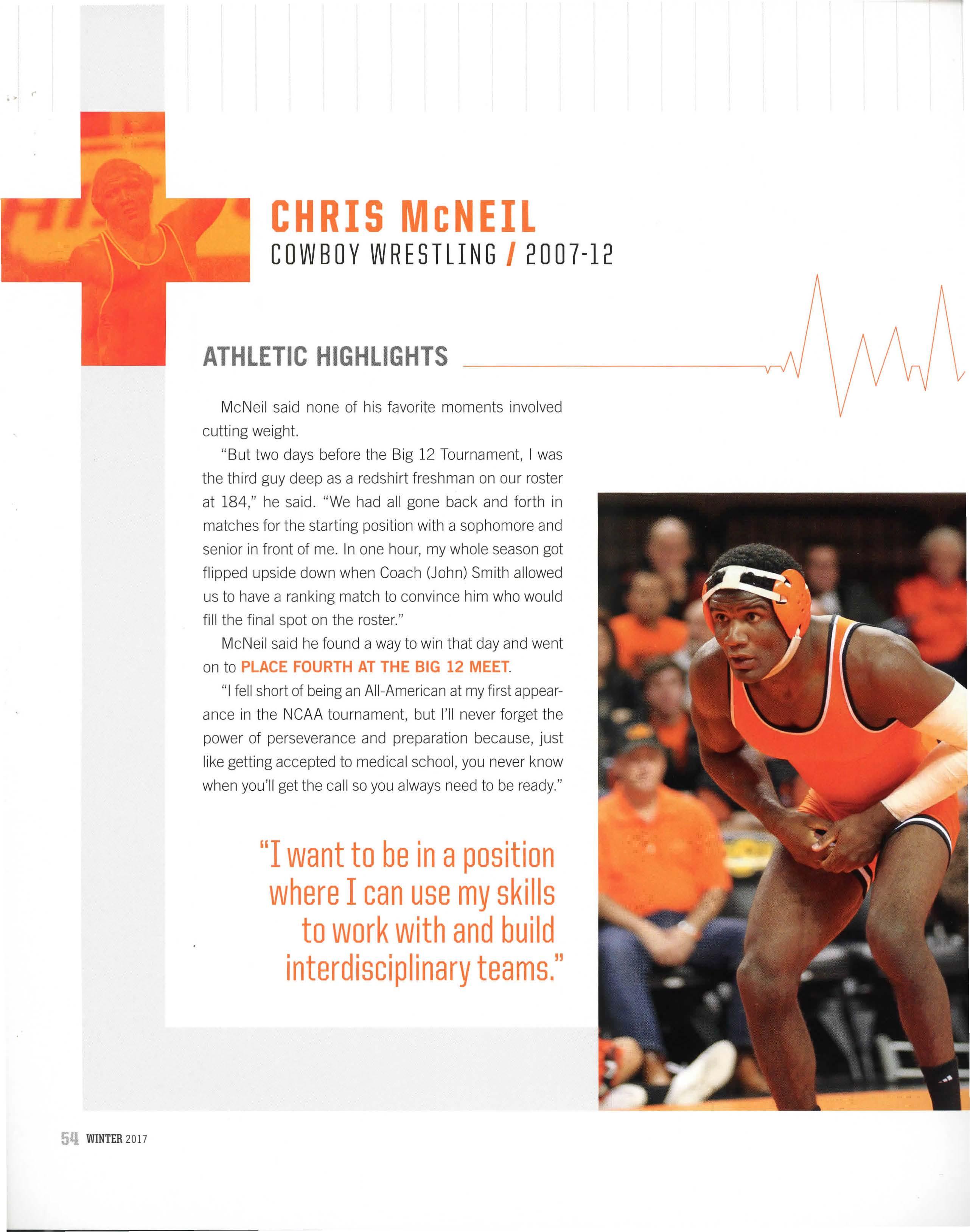
McNeil said none of his favorite moments involved cutting weight.
"But two days before the Big 12 Tournament, I was the third guy deep as a redshirt freshman on our roster at 184," he said. "We had all gone back and forth in matches for the starting position with a sophomore and senior in front of me. In one hour, my whole season got flipped upside down when Coach (John) Smith allowed us to have a ranking match to convince him who would fill the final spot on the roster."
McNeil said he found a way to win that day and went on to PLACEFOURTHAT THE BIG 12 MEET.
"I fell short of being an All-American at my first appearance in the NCAA tournament, but I'll never forget the power of perseverance and preparation because, just like getting accepted to medical school, you never know when you'll get the call so you always need to be ready."
"Iwanttobeina position where I canusemyskills toworkwithandbuild interdisciplinaryteams."
Mc Jeil said he was blessed to watch his father sern: in the U.S. Army for 2+ years as a physician's assistant. He witnessed how traumatic injuries could bring even the toughest guys to tears.
"I initiallygotinterestedinmedicinewhen I sawthe reliefcometo a soldier'sfaceas mydadenteredtheroom,"hesaid.
McNeil experienced the same feeling of relief in junior high. He fractured a femur. Bad news got better because a doctor of osteopathic medi<.:ineconvinced an MD not to put a rod in the fractured leg. That was a big deal because it allowed McNeil to continue his athletic career after recovcri ng.
'"DOs are traditionally known to be trained to view the body and the environment it's in from a holistic perspective, while M Ds arc traditionally trained to primarily treat the diseased state of the body," McNeil said.
"The two philosophies are pretty much intertwined in medical schools today, but the training and thought processes can lead the two physicians to ask very different questions and therrforr-•;-i rri\·e at clifferent levels of quality care and patient outcomes. In the case for me, the femur is one of the strongest bones in the body, and I broke it at 15. I don't know the full extent of the surgical procedure since I was able to avoid it, but any ti me there is an option to not have to cut the body open to fix it is a mark of an excellent physician."
McNeil said ifhc had undergone invasive surgery, he would have needed a longer recovery time and may not have been able to continue with high-impact sports - or at least that's his understandingofthe road not taken.
"I missed the rest of football season my freshman year of high school," he said. "But when wrestling came around I was able to excel at the state and national level to help me get on the radar for college rccru iters and eventually earn a scholarship at the most prestigious wrestling s<.:hoolin the world - Oklahoma State n iversity. Long story short, the DO helped me have a shorter recovery time and opportunity to get exposed to college rccru iters, which, in turn, changed my life."
McNeil, asked if there was anything personal in his background that made him want
to go into the health profession, talked about his educational roots. He said science and math were always clifficult subjects for him to comprehend without investing a tremendous amount oftime and effort in understanding the big picture.
"l remember in eighth grade getting a letter sent home that told my parents I wou Id be on academic probation if l didn't improve my algebra grade," he said.
McNeil's math teacher offered to work with him before school, at lunch and after school ifhe wanted to improve.
"l saw her each time until I made sure another letter wou Idn't be sent home," he said. "Neither math nor science ever got easier, but my <.:ompetitivc nature and curiosity always drew me to the subjects. I can see now that, in finding a way to make the sciences more comprehendiblc for myself, l <.:ancome up with better ways to explain the status and plan of action to my future patients and colleagues."
McNeil said wrestling taught him perseverance.
"Mentors/teammates like Brandon and Kendra set the standard and vision for what I shou Id be doing to <.:ompletethis journey," he said. "After spending time around OSU wrestling and Coach Smith, I also don't think I could ever <.:onsidertaking a career path that came 'easier' to me. All things considered, I -feelthat l was drawn to medicine because I knew I wou Id have to endure some

extraordinary circumstances to develop me into an extraordinary physician for my family, friends and patients."
McNeil,introducedtotheOklahomaCenter forHealthSciencesbyMasonin2011,saidhe wantsto learneveryspecialtyin medicine.
"I want to be in a position where I can use my skills to work with and build interdiseiplinaryteams to deliver quality care to disadvantaged groups and areas in Oklahoma from the perspective of preventive care," he said.
lvlcNeil said he is interested in being able to start his own business/practice someday to streamline a process to recruit more minorities into the medi<.:alfield through science and sports. Through an opportunity provided by OSU's Kuehne Postgraduate Scholarship, he said he was able to use the time it took to gain a<.:ccptanceinto medical school to learn from "amazing" professors at the Riata Center for Entrepreneurship and the Spears Sd1ool of Business to get a master's in entrepreneurship. I-le said that gave him a different perspective of what his role and long-term vision in medicine might be.
SCORE IT THIS WAY: MASON,MUNCRIEF AND McNEIL ARE STILL WINNING.
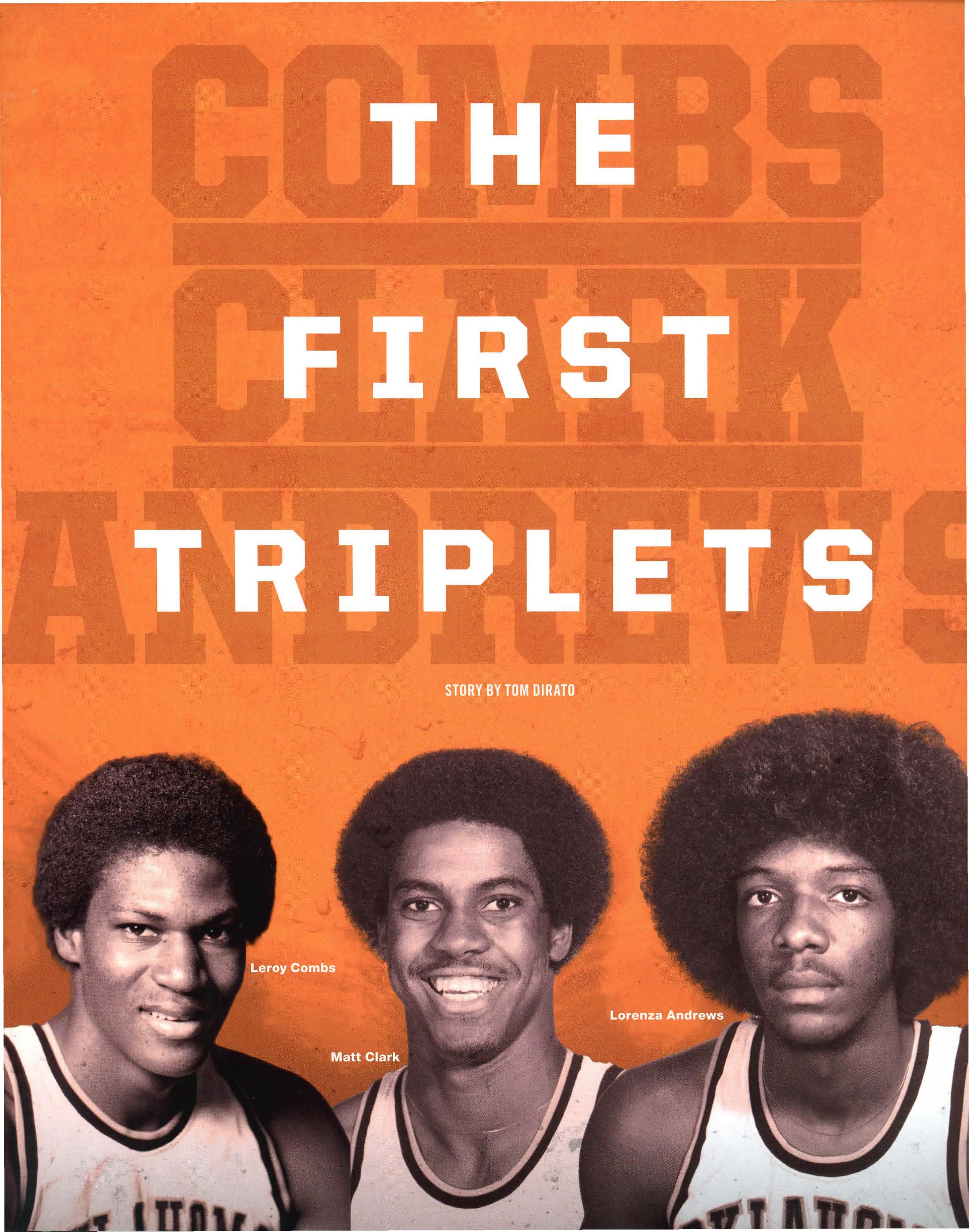
Mention"triplets"to anylongtimeOklahomaStatefan and that conversationquicklyturns to Mike Gundy, BarrySandersand Hart Lee Dykes.That trio was part of one of collegefootball'smost dominantoffenses backin the late 1980s. Alongwith the "War Pigs"up front,Gundy,Sandersand Dykestorethroughdefenses at a recordpace. They put up videogame numbers beforeany of us knewabout videogames.
But did you know about OSU's other set of triplets? You know, the Oklahoma City connection that brought Cowboy hoops back to I ife several years before footbal I started to roll and nearly a decade before EddieSutton returned to Stillwater?
MottClark,LorenzaAndrewsand LeroyCombswill go down as three of the best high school players produced by Oklahoma City high schools. And there have been many great players who have cal led OKC home over the years.
Clark played at Southeast, Andrews at Millwood and Combs at Star Spencer. Each one made their mark in Oklahoma high school basketbal I history. All three made huge wntributions to Oklahoma State while in Stillwater, and all three were solid NBA picks.
They were teammates and rivals th roughout their years growing up.
"Matt and I played baseball and basketbal I together whe~ we were young," recalled Andrews. "We both played basketball against Leroy. We knew about one another at a young age. That's what made it so special that we all ended up at Oklahoma State."
Ironically,thattrip to OSUalmostnever happened.
"Leroy and I were recruited by coach [Paul} Hansento go to Oklahoma City University," Andrews said. "When he got the Oklahoma State job, we followed him. It was an opportunity to play at a higher level and on a bigger stage. For me, when he hi red KenTurner as an assistant, that solidified my decision.
"The thought of three Oklahoma City kids playing together with a chance to do something special was exciting. We developed great chemistry, but we all had separate personalities. None of us lived together. But again, being from Oklahoma City, we always had each other's back."
Youwouldbehardpressedalltheseyears laterto findmorecompetitiveplayersthan Clark,AndrewsandCombs.While any one of them would've been a go-to guy on another team back then, they were able to blend their talents with one thought in mind-make Oklahoma State basketball relevant again.
"We had a little chip on our shoulder," offered Combs. "Looking back on it we knew Oklahoma City had a great reputation for football players, but we wanted to show the nation that we were pretty good basketball players as well. We wanted to show that ~ve had pride in our hometown, too."
Hansen was the one who helped turn the young men into mature players. There was a genuine affection between Hansen and his players. He could be tough on them, but they left the court each day knowing how much he cared for them as players, students and people.
"Coach Hansen gets all the credit," Combs said. "He molded us together. He turned us into young men after coming to school as young boys. He taught us how to play together and for one another. He was a tremendous person, as well as a great coach. We all loved playing for him."
A 11three have gone on to enjoy suc.;c.;essfu I careers. Once their pro dreams ended, they fol lowed d ifforent career paths. Andrews works in the financial world in the Dallas area, Combs has coached on both the college and high school levels, while Clark is running youth basketball c.;amps,teaching not only the sport, but valuable life lessons.
"Stillwater was a good spotfor me,"Andrews said. "I got a degree in four years and was able to take my game to a higher level after playing there. There is no question that OSU will always hold a special place in my heart." ll
"We were the lost generation when it came to Oklahoma State basketball.
Between Mr. Iba and Eddie Sutton, there wasn't much going on. But we rebuilt the foundation and put OSU basketball back on the map. Coach Sutton took it to another level after he arrived."
- Matt Clark
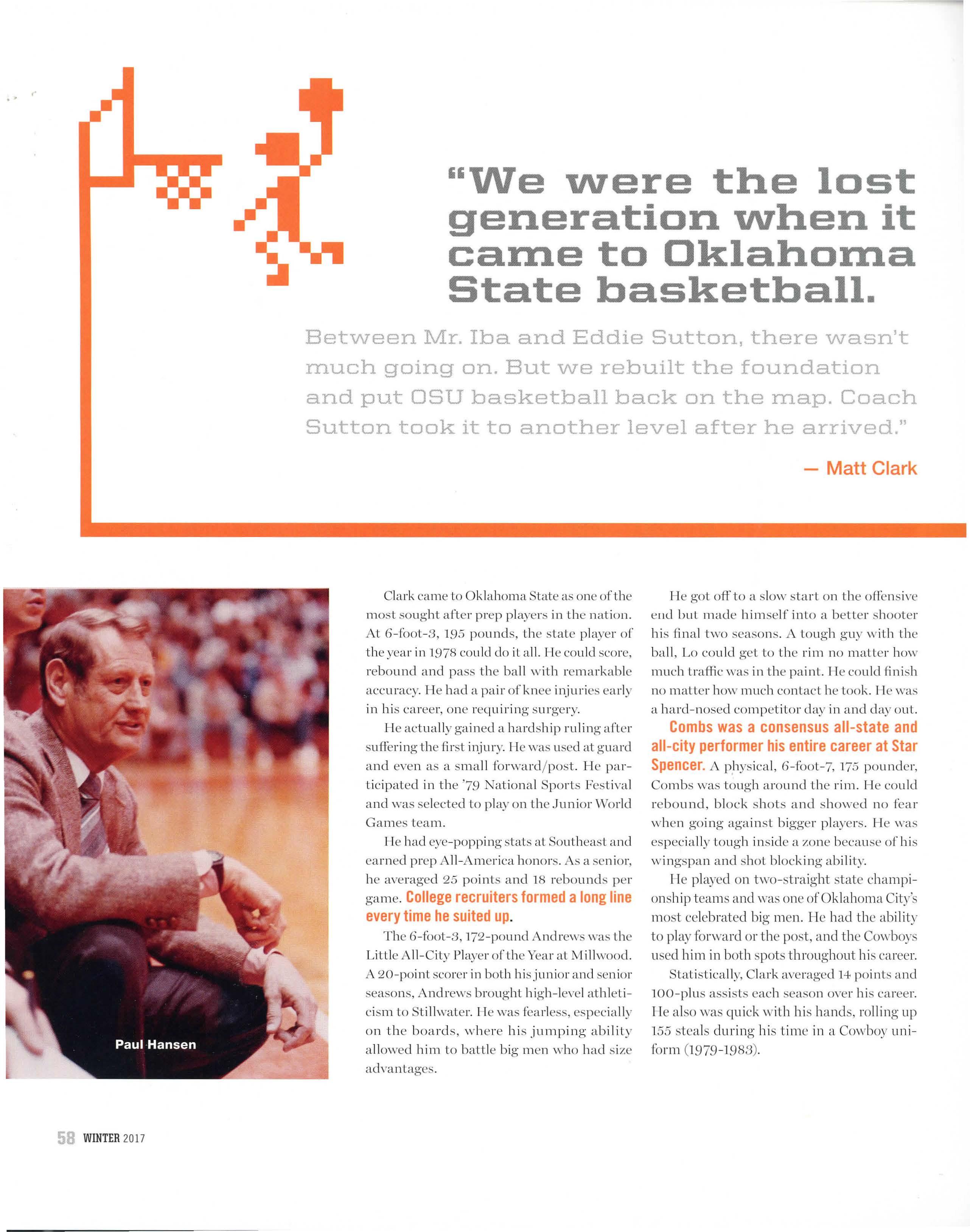
Clark came to Oklahoma State as one of the most sought after prep players in the nation. At 6-foot-3, 195 pounds, the state player or the year in 1978 could do it all. 1-fecould score, rebound and pass the ball with remarkable accuracy. He had a pair of knee injuries early in his career, one requiring surgery.
He actually gained a hardship ruling af"Ler suffering the first injury. He was used at guard and even as a small forward/post. He participated in the '79 National Sports Fcsti,·al and was selected to play on the.Junior World Garnes team.
He had eye-popping stats al Southeast and earned prep All-America honors. As a senior, he averaged 25 points and 18 rebounds per game. Collegerecruitersformeda longline everytimehesuitedup.
The 6-foot-3, 172-pound Andrews "·as the Little A II-City Player or the Year al Mill wood. A 20-poi nt scorer in both his junior and senior seasons, Andrews brought high-level athleticism to Stillwater. I le was fearless, especially on the boards, where his _jumping ability allowed him to battle big men who had size advantages.
He got off to a slow start on the oflcnsive e11d bul made himself in Lo a better shooter his final two seasons. A Lough guy with the ball, Lo could get to the rim no matter how much traffic was in the paint. He could finish no matter how much contact he took. I le was a hard-nosed competitor clay in and clay out.
Combswasa consensusall-state and all-cityperformerhisentirecareerat Star Spencer. A physical, 6-foot-7, 175 pounder, Combs was tough around the rim. He could rcbou nd, block shots and sho\\·ed no fear when going against bigger players. He was especially tough inside a zone because of his wingspan and shot blocking ability.
I le played on two-straight state championship teams and was one of Oklahoma City's most t:elebrated big men. He had the ability to play forward or the post, and the Cowboys used him in both spots throughout his career.
Statistically, Clark averaged 1+ points and 100-plus assists each season m·er his career. I le also was quick with his hands, rolling up 155 steals during his time in a Cowboy uniform (1979-1983).
Andrewsenjoyedhisbestoffensiveseason hissenioryear(16.1)andadded125assists thatseason. l le was a steady 78 percent from the foul line.
All three players were part of the '83 NBA draft. The Indiana Pacers made Combs a second-round pick (number 26 overall), Clark went to the Utah Jazz in the fifth round (100th pick) and And rcws was chosen by the Kansas City Kings in the fifth round (106th pick).
It took awhile forth is talented trio to impact the Cowboy basketball program. OSU won only 12 games in 1978-79 and finished 5-9 in Big Eight play during Clark's first season.
Andrews and Combs arrived in Stillwater the next year, but the Cowboys could only post 10 wins that season. Oklahoma State finished in last place, winningjustfourofl4 Big Eight games ..
"Looking back, we had a chip on our shou Ider after that first year," recalled Combs, who appeared in just 14 games. Andrews played in 25 games but didn't start and Clark basically sa:t out the campaign with a knee injury. Ultimately, he would gain that hardship after playing in two games.
"We cou Id see the chemistry starting to bu iId even though we weren't winning or playing a lot," Combs added.
Things started to look up with an 18-win showing during the 1980-81 season. One of those victories came against defending national champion and eighth-ranked Louisville as Eddie Hannonhit a half-court bucket at the buzzer. OSU won 72-71. The 18 wins were the most by the program si nee Mr. Iba's 1965 Big Eight championship season.
"People started talking about Oklahoma State on a national level after that game," said Combs. "It showed us what we could be if we all stayed together, played as a team and didn't worry about who got the points and the headlines."
OSUfinished8-6 intheBigEightandbeat Oklahomatwicethatyear.
That momentum slipped a little the following year as Oklahoma State closed with a 15-12 record, but the Cowboys split 14 conference games and lost several cliffhangers down the stretch.
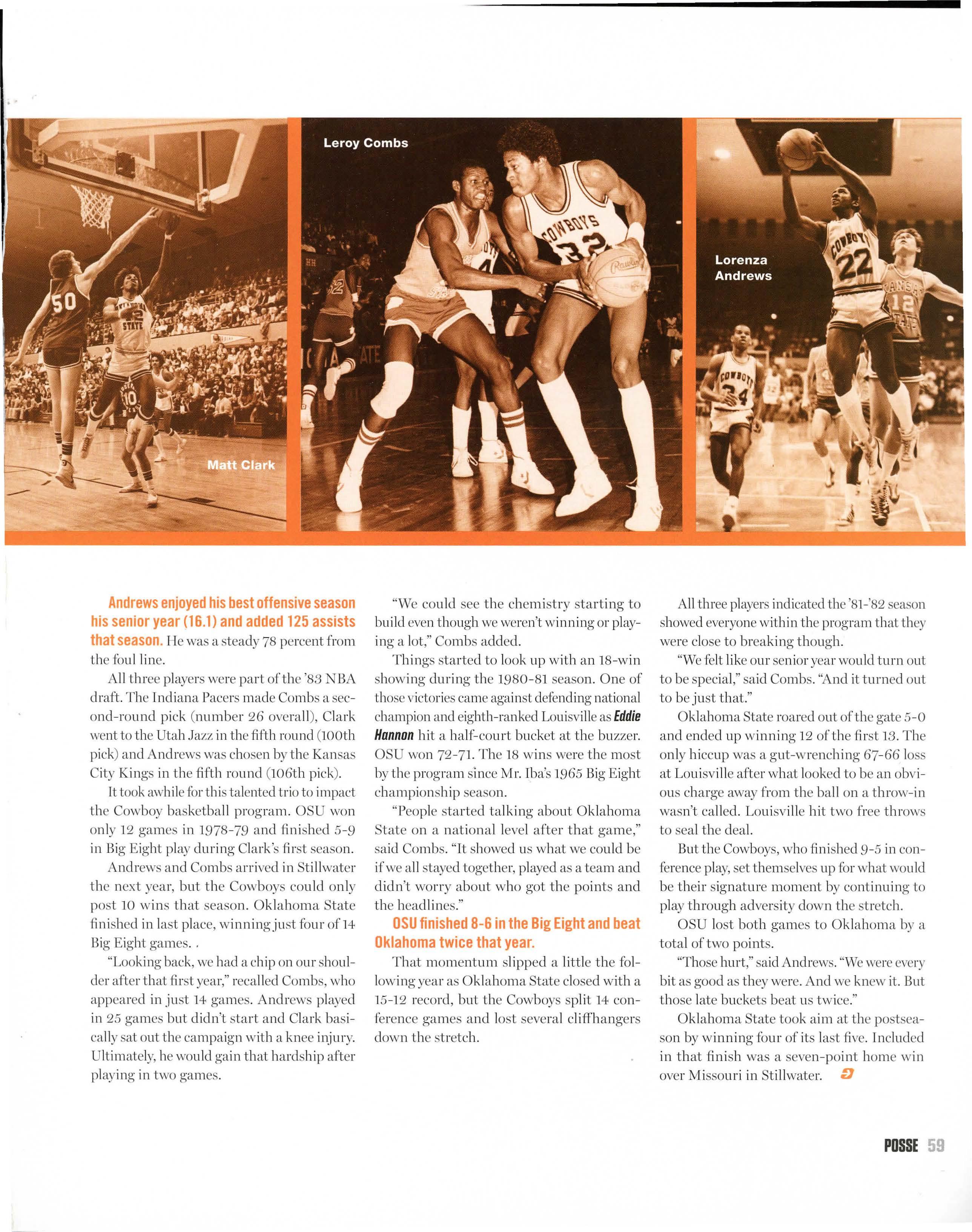
A11three players indicated the '81-'82 season showed everyone within the program that they were close to breaking though.
"We felt like our senior year would turn out to be special," said Combs. "And it turned out to be just that."
Oklahoma State roared out of the gate 5-0 and ended up winning 12 of the fi1"'t l3. The only hiccup was a gut-wrenching 67-66 loss at Louisville after what looked to be an obvious charge away from the ball on a throw-in wasn't called. Louisville bit two free throws to seal the deal.
But the Cowboys, who finished 9-5 in conference play, set themselves up for what would be their signature moment by continuing to play through adversity down the stretch.
OSU lost both games to Oklahoma by a total of two points.
"Those hurt," said Andrews. "We were every bit as good as they were. And we knew it. But those late buckets beat us twice."
Oklahoma State took aim at the postseason by winning four of its last five. Included in that finish was a seven-point home win over Missouri in Stillwater. :J
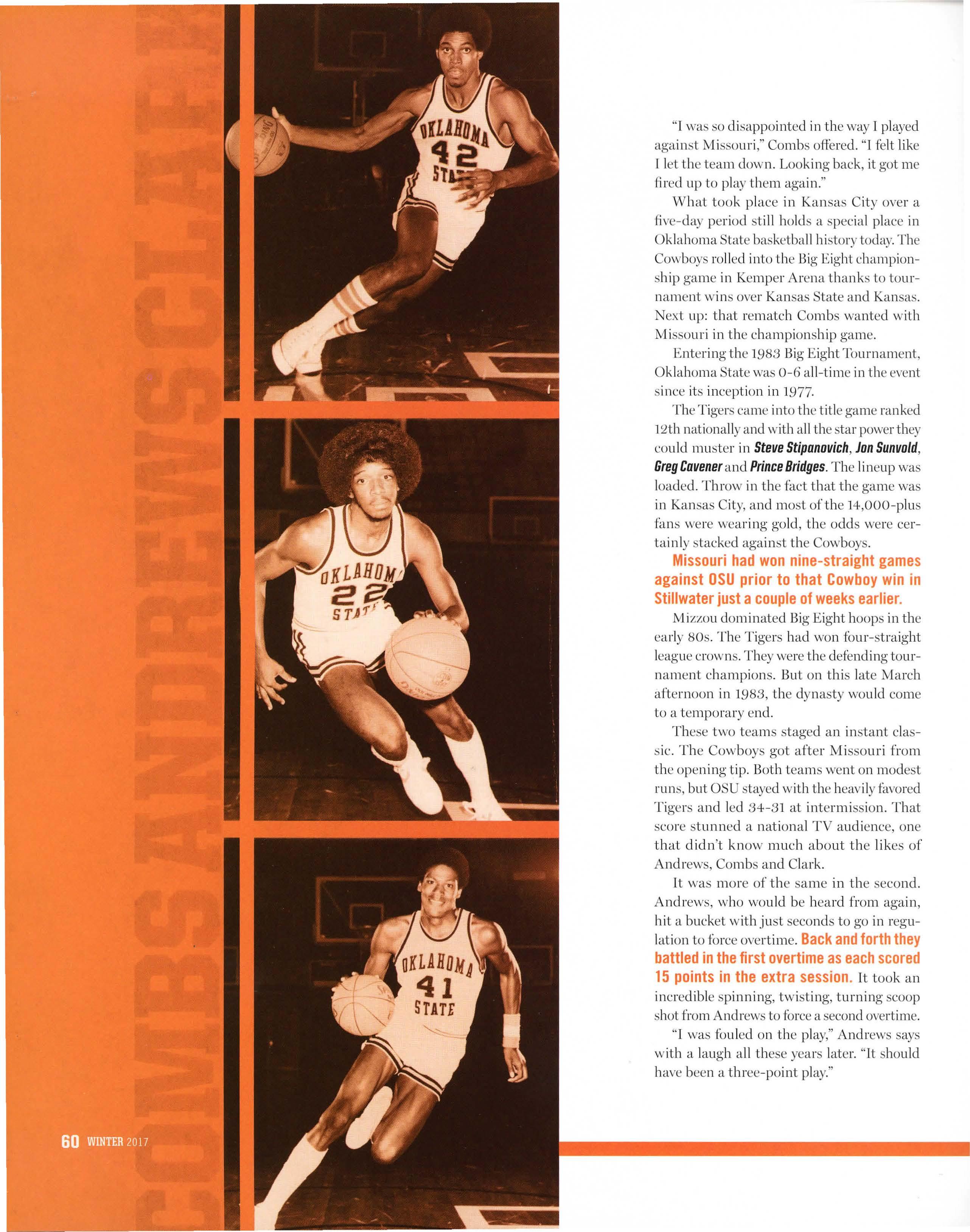
"I was so disappointed in the way I played against Missouri," Combs offered. "I felt like I let the team <lown. Looking back, it got me fired up to play them again."
What took place in Kansas City over a five-day period still holds a special place in Oklahoma State basketball history today. The Cowboys rolled into the Big Eight championship game in Kemper Arena thanks to tournament wins over Kansas State and Kansas. Next up: that rematch Combs wanted with Missouri in the championship game.
Entering the 1983 Big Eight Tournament, Oklahoma State was 0-6 all-time in the event since its inception in 1977.
The Tigers came into the title game ranked 12th nationally and with all the star power they could muster in SteveStipanovich,JonSunvold, GregCavenerand PrinceBridges.The Iineup was loaded. Throw in the fact that the game was in Kansas City, and most of the 14,000-plus fans were wearing gold, the odds were certainly stacked against the Cowboys.
Missourihadwonnine-straightgames againstOSUpriorto that Cowboywin in Stillwaterjusta coupleofweeksearlier.
Mizzou dominated Big Eight hoops in the early 80s. The Tigers had won four-straight league crowns. They were the defending tournament champions. But on this late March afternoon in 1983, the dynasty would come to a temporary end.
These two teams staged an instant classic. The Cowboys got after Missouri from the opening tip. Both teams went on modest runs, but OSU stayed with the heavily favored Tigers and led 34-31 at intermission. That score stunned a national TV audience, one that didn't know much about the likes of Andrews, Combs and Clark.
It was more of the same in the second. Andrews, who would be heard from again, hit a bucket with just seconds to go in regulation to force overtime. Backandforththey battledinthefirstovertimeaseachscored 15 pointsin the extrasession.rt took an incredible spinning, twisting, turning scoop shot from Andrews to force a second overtime.
"1 was fouled on the play," Andrews says with a laugh all these years later. "lt should have been a three-point play."
mmna1 game .rHee\Coach .n't allow the hooters, Derlnnon, to beat
over the them a2 Guy Dirk, sc downed tournam the first is players foul iad rather than nost any Wolfwould be two :anned its free ree-pointer and na kept missing rer a minute the Tar Heels reta\i-
nt to Boston Univers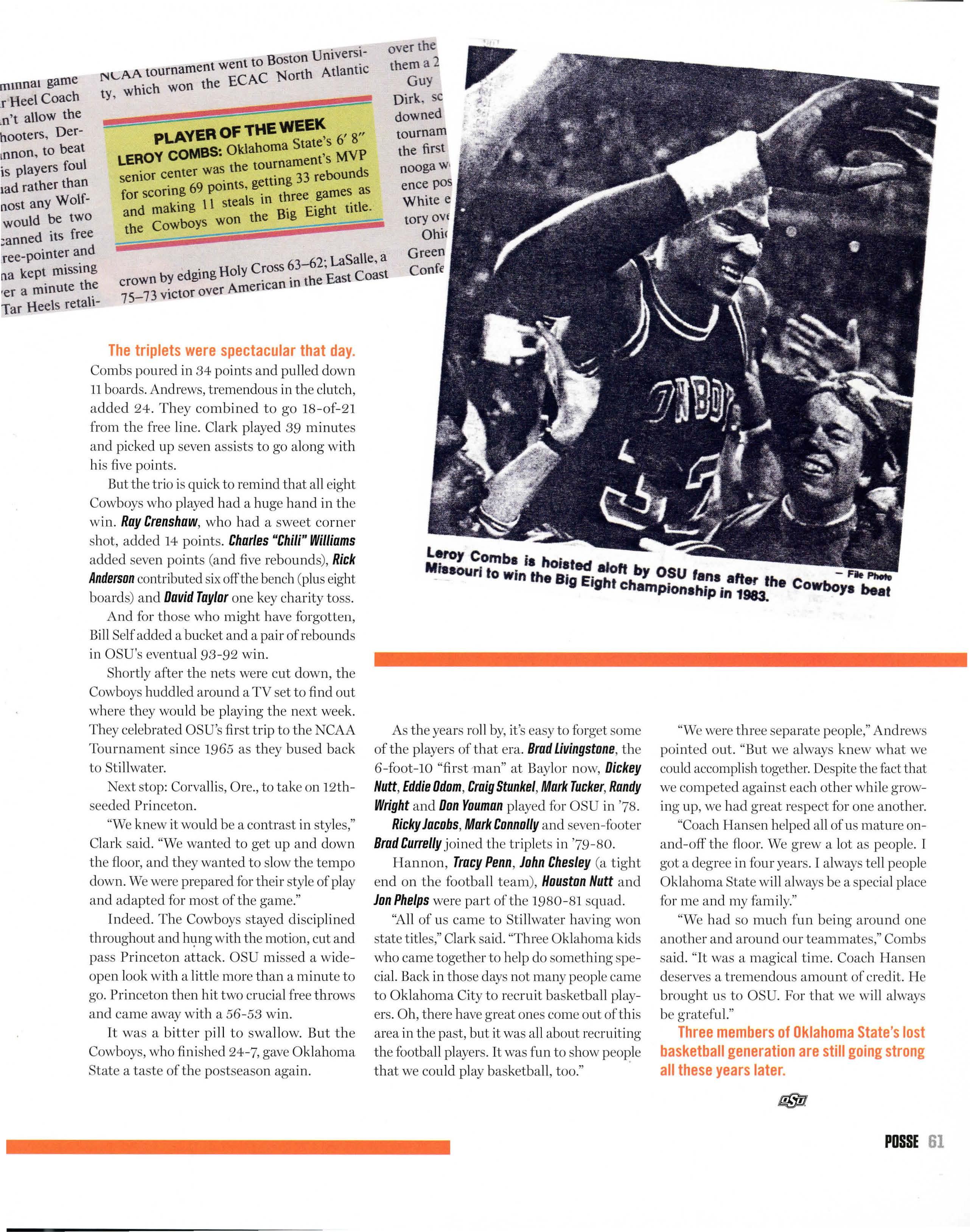
"We were three separate people," Andrews pointed out. "But we always knew what we could accomplish together. Despite the fact that we competed against each other while growing up, we had great respect for one another.
"Coach Hansen helped all of us mature onand-off the floor. We grew a lot as people. I got a degree in four years. I always tell people Oklahoma State will always be a special place for me and my family."
"We had so much fun being around one another and around our teammates," Combs said. "It was a magical time. Coach Hansen deserves a tremendous amount of credit. He brought us to OSU. For that we will always be grateful."
Threemembersof OklahomaState'slost basketballgenerationarestillgoingstrong alltheseyearslater.
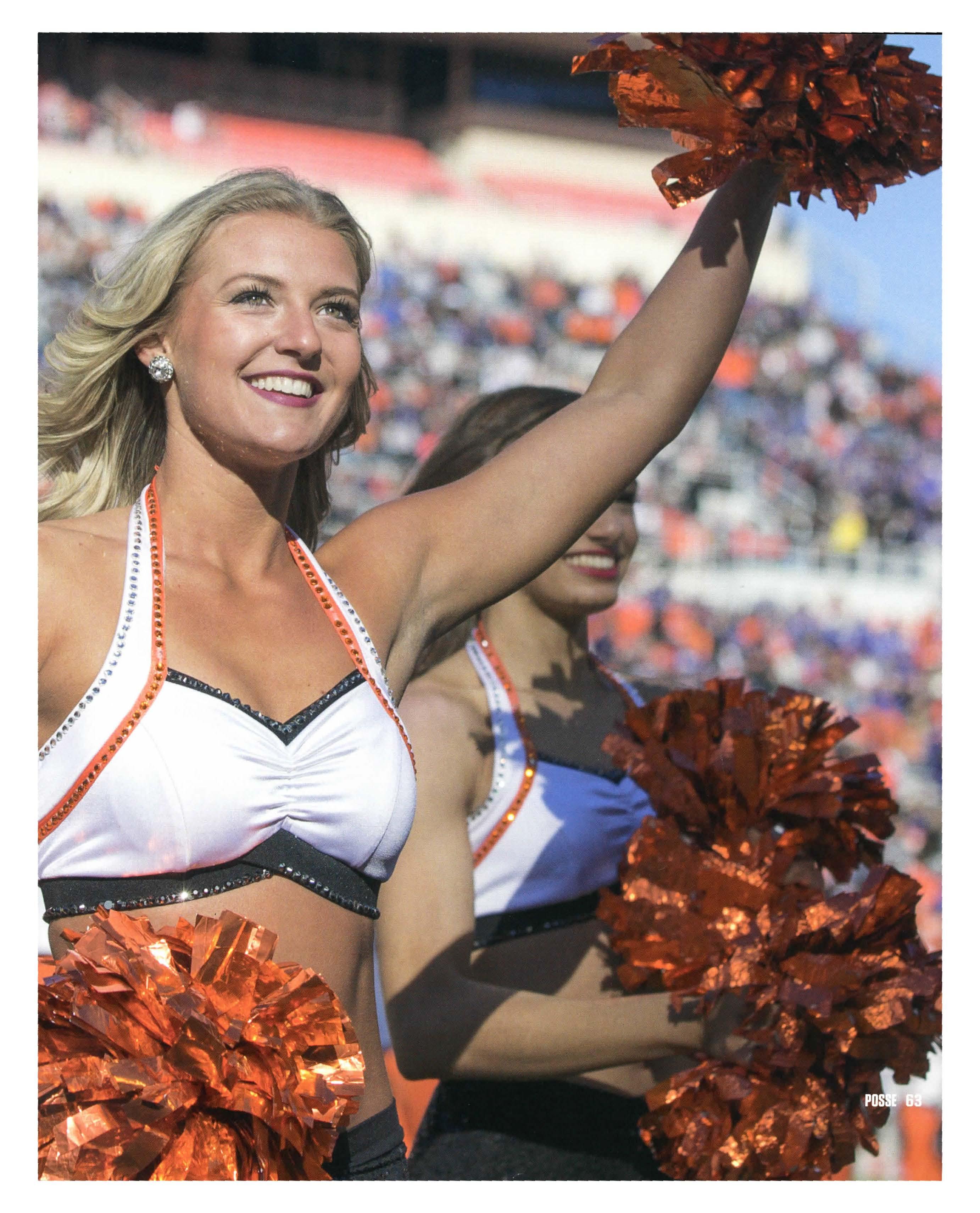
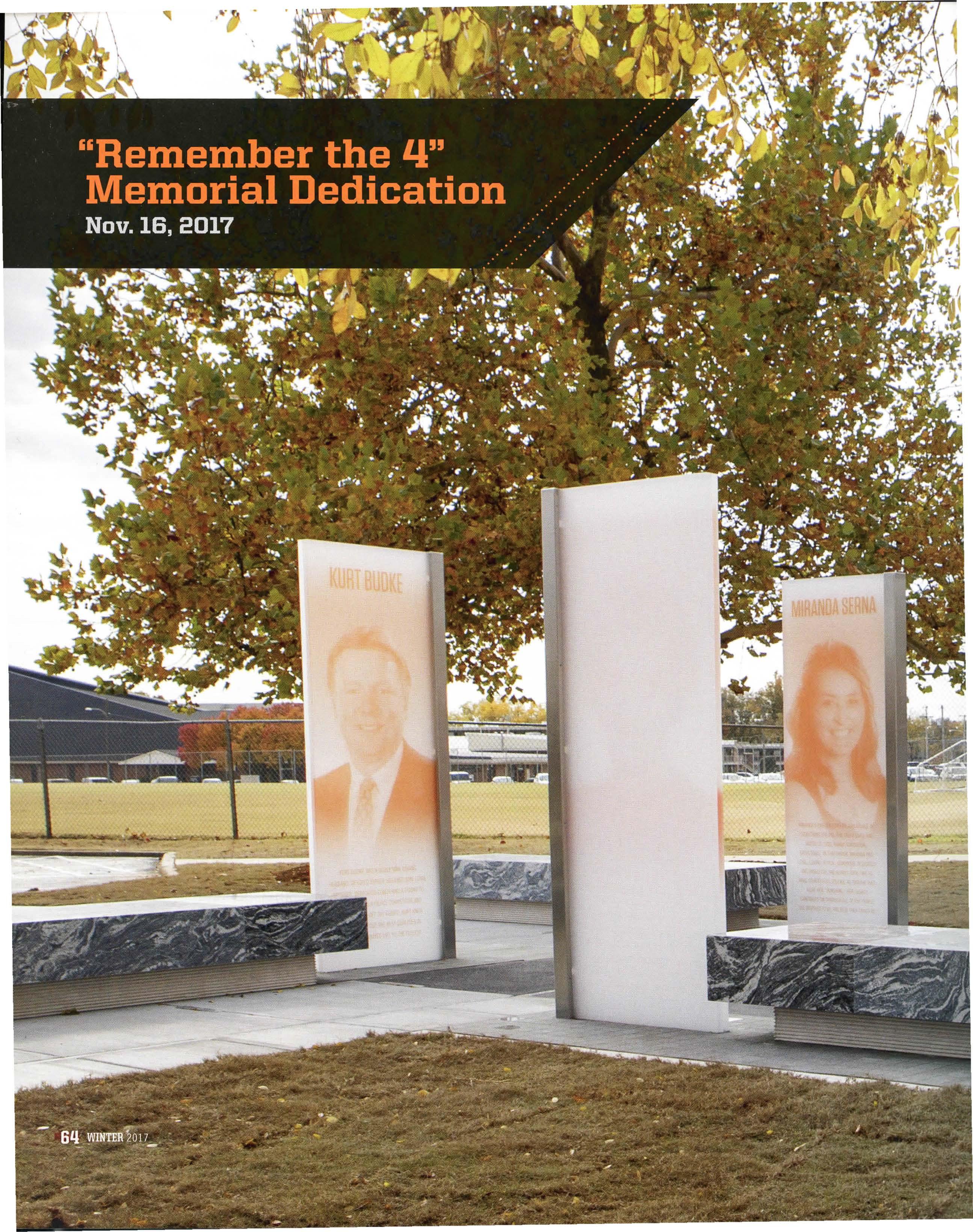
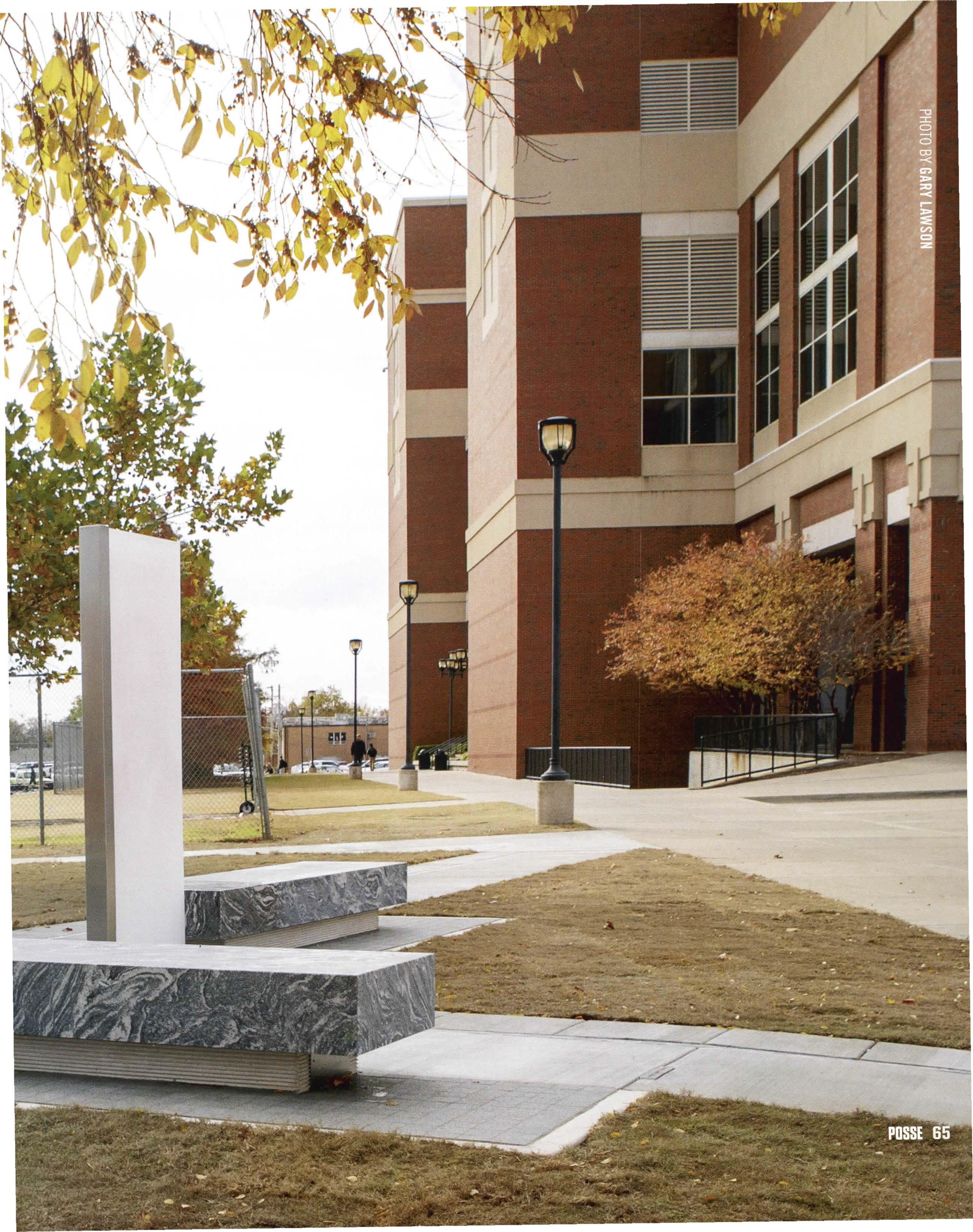


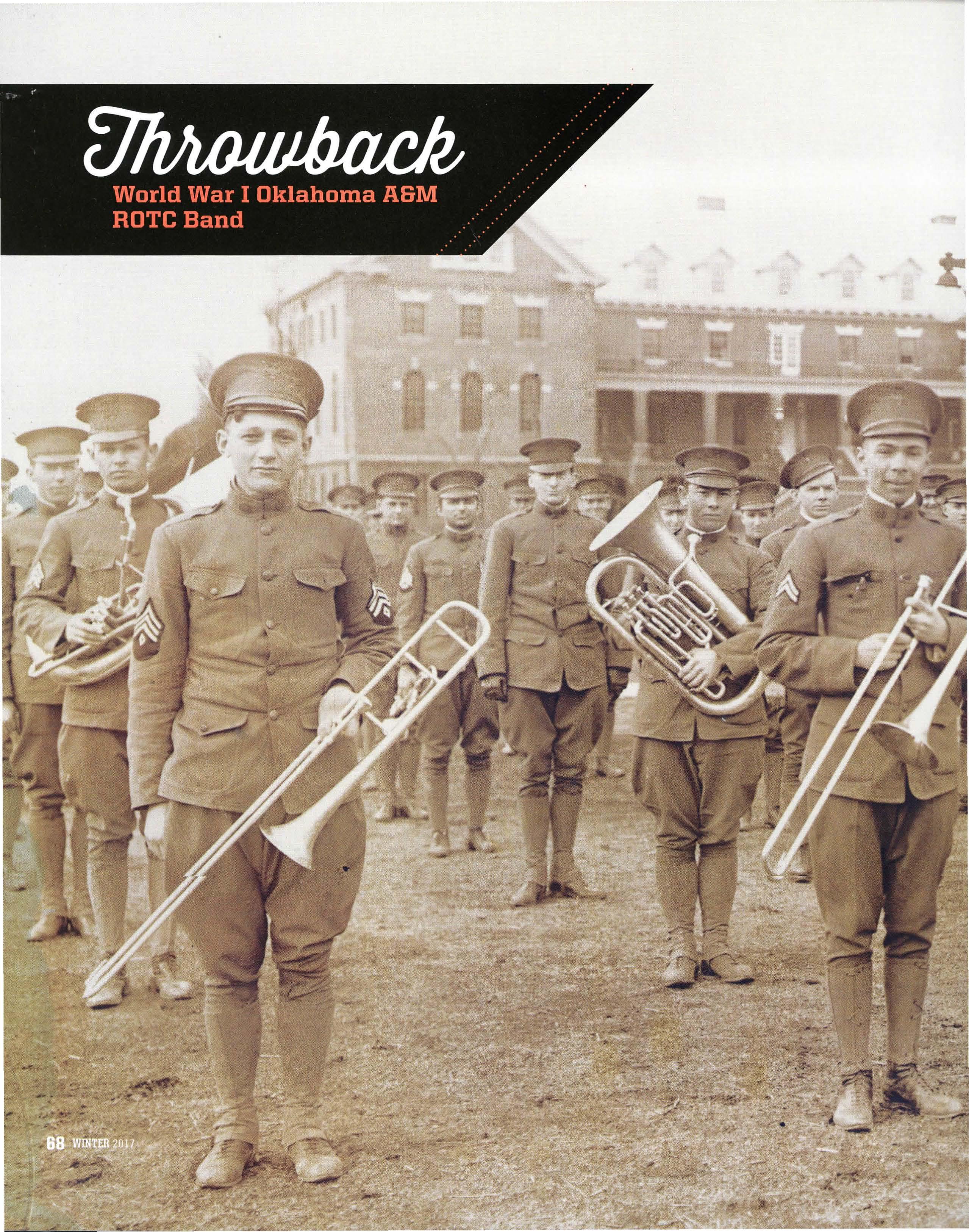
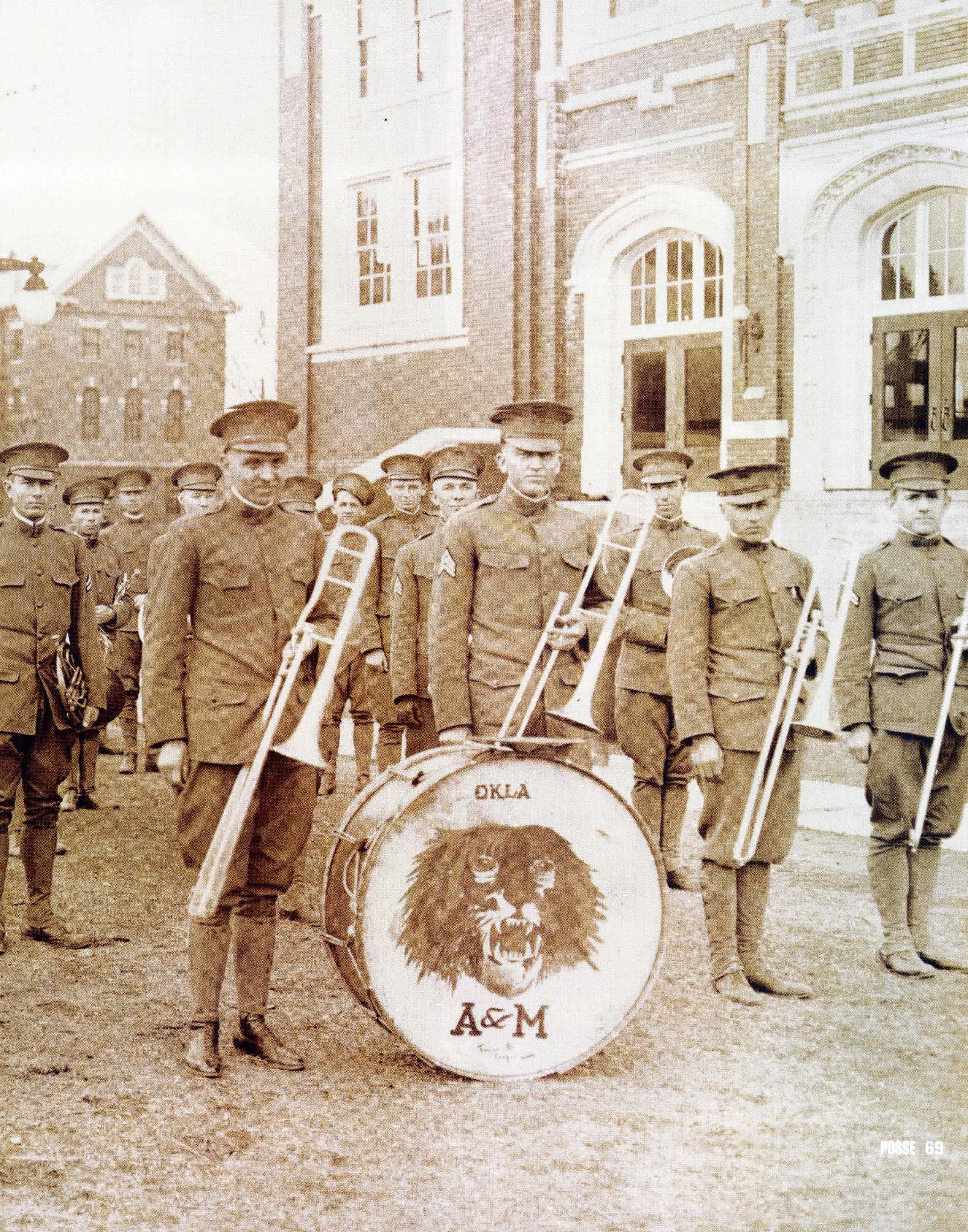
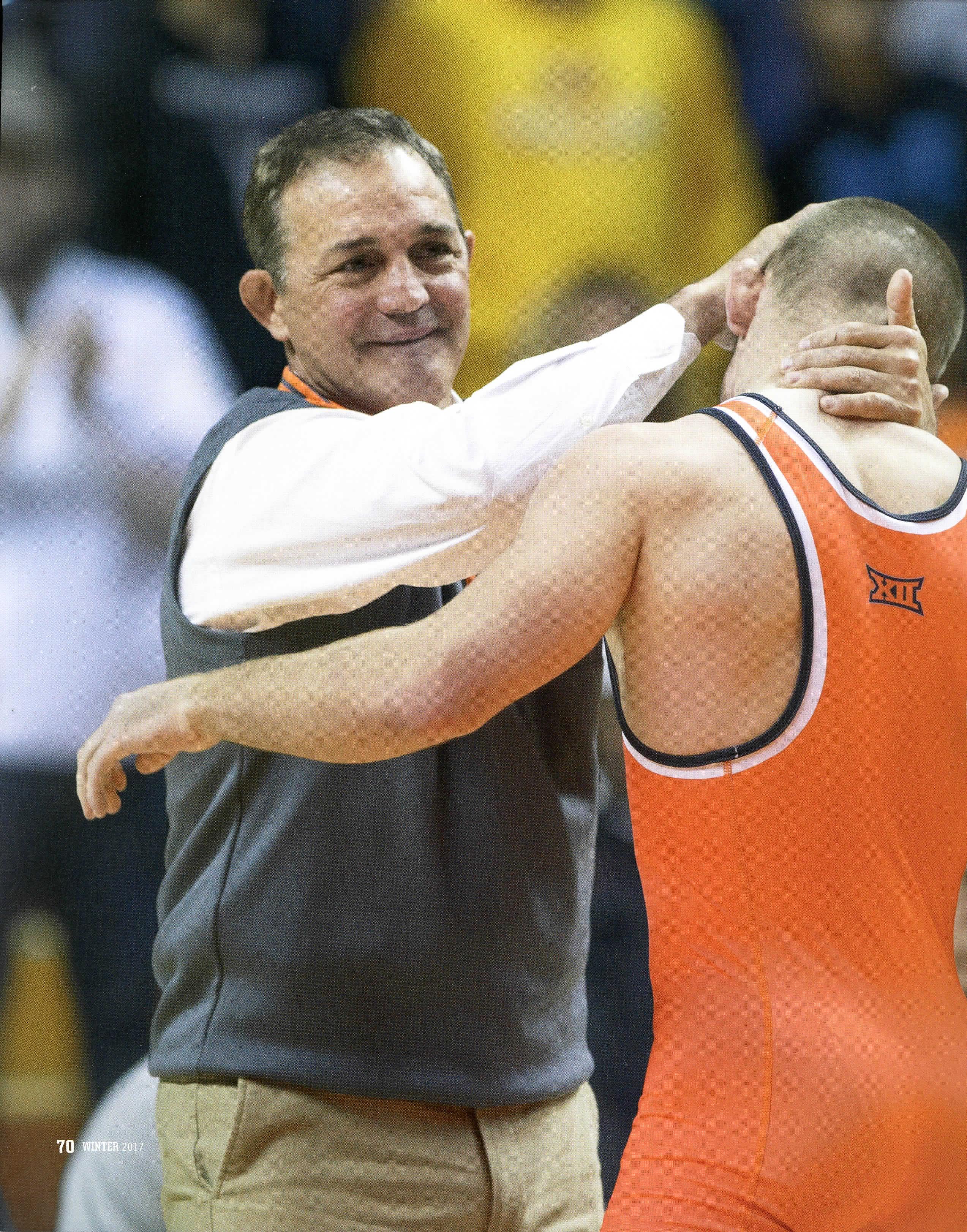

student-atliletes.
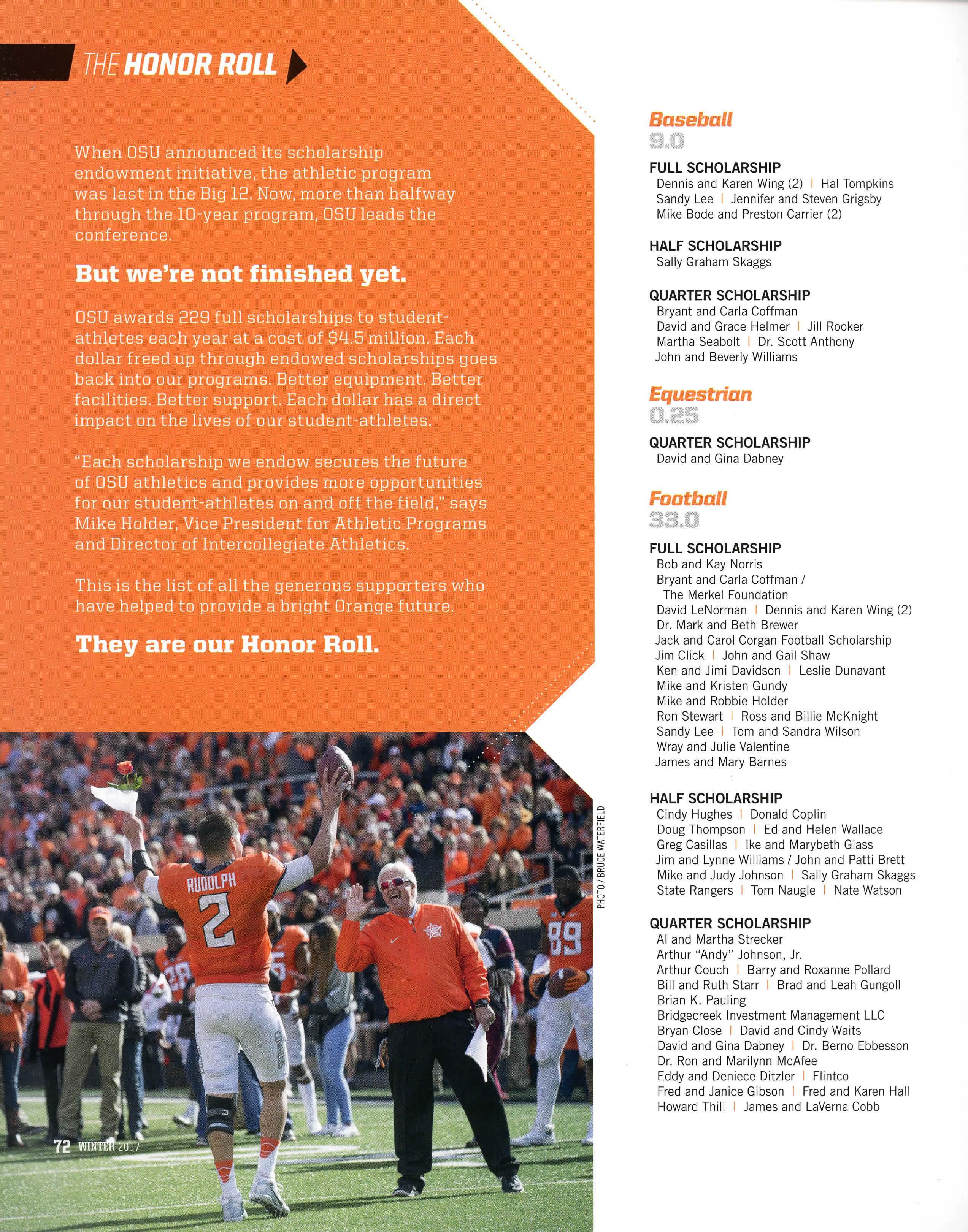
FULL SCHOLARSHIP
Dennis and Karen Wing (2) I Hal Tompkins
Sandy Lee I Jennifer and Steven Grigsby
Mike Bode and Preston Carrier (2)
HALF SCHOLARSHIP
Sally Graham Skaggs
QUARTERSCHOLARSHIP
Bryant and Carla Coffman
David and Grace Helmer I Jill Rooker
Martha Seabolt I Dr. Scott Anthony
John and Beverly Williams
Equestrian 0.25
QUARTERSCHOLARSHIP
David and Gina Dabney
Football 33.0
FULL SCHOLARSHIP
Bob and Kay Norris
Bryant and Carla Coffman I The Merkel Foundation
David LeNorman I Dennis and Karen Wing (2)
Dr. Mark and Beth Brewer
Jack and Carol Corgan Football Scholarship
Jim Click I John and Gail Shaw
Ken and Jimi Davidson I Leslie Dunavant
Mike and Kristen Gundy
Mike and Robbie Holder
Ron Stewart I Ross and Billie McKnight
Sandy Lee I Tom and Sandra Wilson
Wray and Julie Valentine
James and Mary Barnes
HALF SCHOLARSHIP
Cindy Hughes I Donald Coplin
Doug Thompson I Ed and Helen Wallace
Greg Casillas I Ike and Marybeth Glass
Jim and Lynne Williams/ John and Patti Brett
Mike and Judy Johnson I Sally Graham Skaggs
State Rangers I Tom Naugle I Nate Watson
QUARTERSCHOLARSHIP
Al and Martha Strecker
Arthur "Andy" Johnson, Jr.
Arthur Couch I Barry and Roxanne Pollard
Bill and Ruth Starr I Brad and Leah Gungoll
Brian K. Pauling
Bridgecreek Investment Management LLC
Bryan Close I David and Cindy Waits
David and Gina Dabney I Dr. Berno Ebbesson
Dr. Ron and Marilynn McAfee
Eddy and Deniece Ditzler I Flintco
Fred and Janice Gibson I Fred and Karen Hall
Howard Thill I James and Laverna Cobb
Jerry and Lynda Baker
Jerry and Rae Winchester I John P. Melot
John S. Clark I Ken and Leitner Greiner
Kent and Margo Dunbar I Paul and Mona Pitts
R. Kirk Whitman I Randall and Carol White
Roger and Laura Demaree I Shelli Osborn
Steve and Diane Tuttle
Tony and Finetta Banfield
General
1. 5
HALFSCHOLARSHIP
Terry and Martha Barker
QUARTERSCHOLARSHIP
David and Judy Powell
Kenneth and Susan Crouch
Sally Graham Skaggs
Graduate Athlete 0.75
QUARTERSCHOLARSHIP
Bob and Joan Hert I Neal Seidle
Tom and Cheryl Hamilton
FULL SCHOLARSHIP
A.J. and Susan Jacques
Bill and Marsha Barnes
Brett and Amy Jameson
Calvin and Linda Anthony
Chuck and Kim Watson
David and Julie Ranck (1.25)
Dennis and Karen Wing (2)
Douglas and Nickie Burns
Griff and Mindi Jones
James and Mary Barnes I Jim Vallian
Ken and Jimi Davidson
Kent and Margo Dunbar I Kim Ray Inc.
Sandy Lee I Mitch Jones Memorial
HALF SCHOLARSHIP
David and Julie Ranck
Dr. Mark and Susan Morrow
Jay and Connie Wiese I Sally Graham Skaggs
Stan Clark I Billy Wayne Travis
QUARTERSCHOLARSHIP
Dr. Scott and Lynne Anthony
Gary and Sue Homsey I Holloman Family
Michael and Heather Grismore
Rick and Suzanne Maxwell
Robert and Sharon Keating
Steve and Suzie Crowder
Terry and Donna Tippens
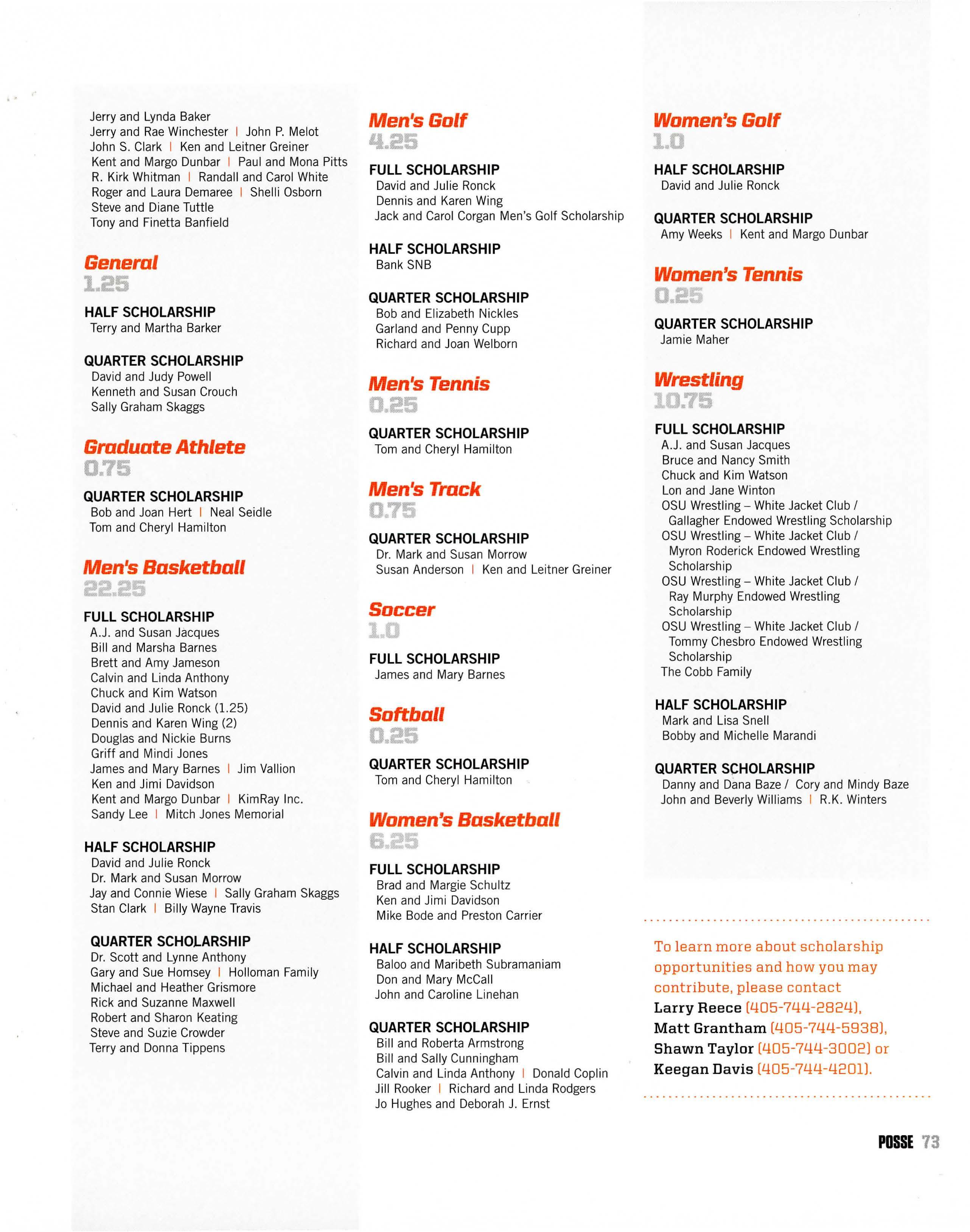
FULL SCHOLARSHIP
David and Julie Ranck
Dennis and Karen Wing
Jack and Carol Corgan Men's Golf Scholarship
HALFSCHOLARSHIP Bank SNB
QUARTERSCHOLARSHIP
Bob and Elizabeth Nickles
Garland and Penny Cupp
Richard and Joan Welborn Men's Tennis
QUARTERSCHOLARSHIP
Tom and Cheryl Hamilton Men's
QUARTERSCHOLARSHIP
Dr. Mark and Susan Morrow
Susan Anderson I Ken and Leitner Greiner
Soccer
FULL SCHOLARSHIP
James and Mary Barnes Softball
QUARTERSCHOLARSHIP
Tom and Cheryl Hamilton
Women 1s Basketball
FULL SCHOLARSHIP
Brad and Margie Schultz
Ken and Jimi Davidson
Mike Bode and Preston Carrier
HALF SCHOLARSHIP
Baloo and Maribeth Subramaniam
Don and Mary McCall
John and Caroline Linehan
QUARTERSCHOLARSHIP
Bill and Roberta Armstrong
Bill and Sally Cunningham
Calvin and Linda Anthony I Donald Coplin
Jill Rooker I Richard and Linda Rodgers
Jo Hughes and Deborah J. Ernst
HALFSCHOLARSHIP
David and Julie Ranck
QUARTERSCHOLARSHIP
Amy Weeks I Kent and Margo Dunbar
QUARTERSCHOLARSHIP
Jamie Maher
FULL SCHOLARSHIP
A.J. and Susan Jacques
Bruce and Nancy Smith
Chuck and Kim Watson
Lon and Jane Winton
OSU Wrestling - White Jacket Club/ Gallagher Endowed Wrestling Scholarship
OSU Wrestling - White Jacket Club/ Myron Roderick Endowed Wrestling Scholarship
OSU Wrestling - White Jacket Club/ Ray Murphy Endowed Wrestling Scholarship
OSU Wrestling- White Jacket Club/ Tommy Chesbro Endowed Wrestling Scholarship
The Cobb Family
HALF SCHOLARSHIP
Mark and Lisa Snell
Bobby and Michelle Marandi
QUARTERSCHOLARSHIP
Danny and Dana Baze/ Cory and Mindy Baze
John and Beverly Williams I R.K. Winters
To learn more about scholarship opportunities and how you may contribute, please contact Larry Reece (405-744-2824), Matt Grantham (405-744-5838), Shawn Taylor (405-744-3002) or Keegan Davis (405-744-4201).
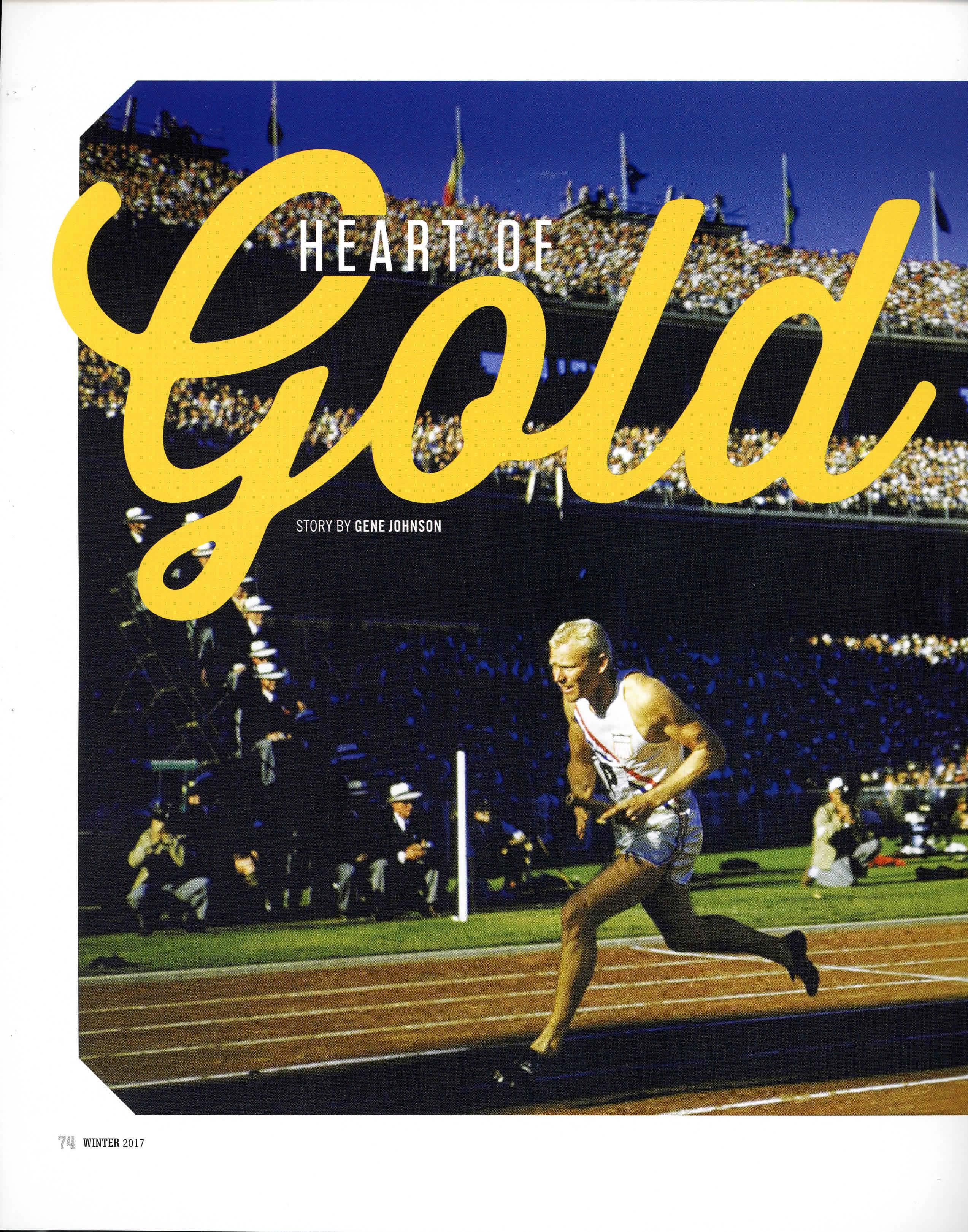
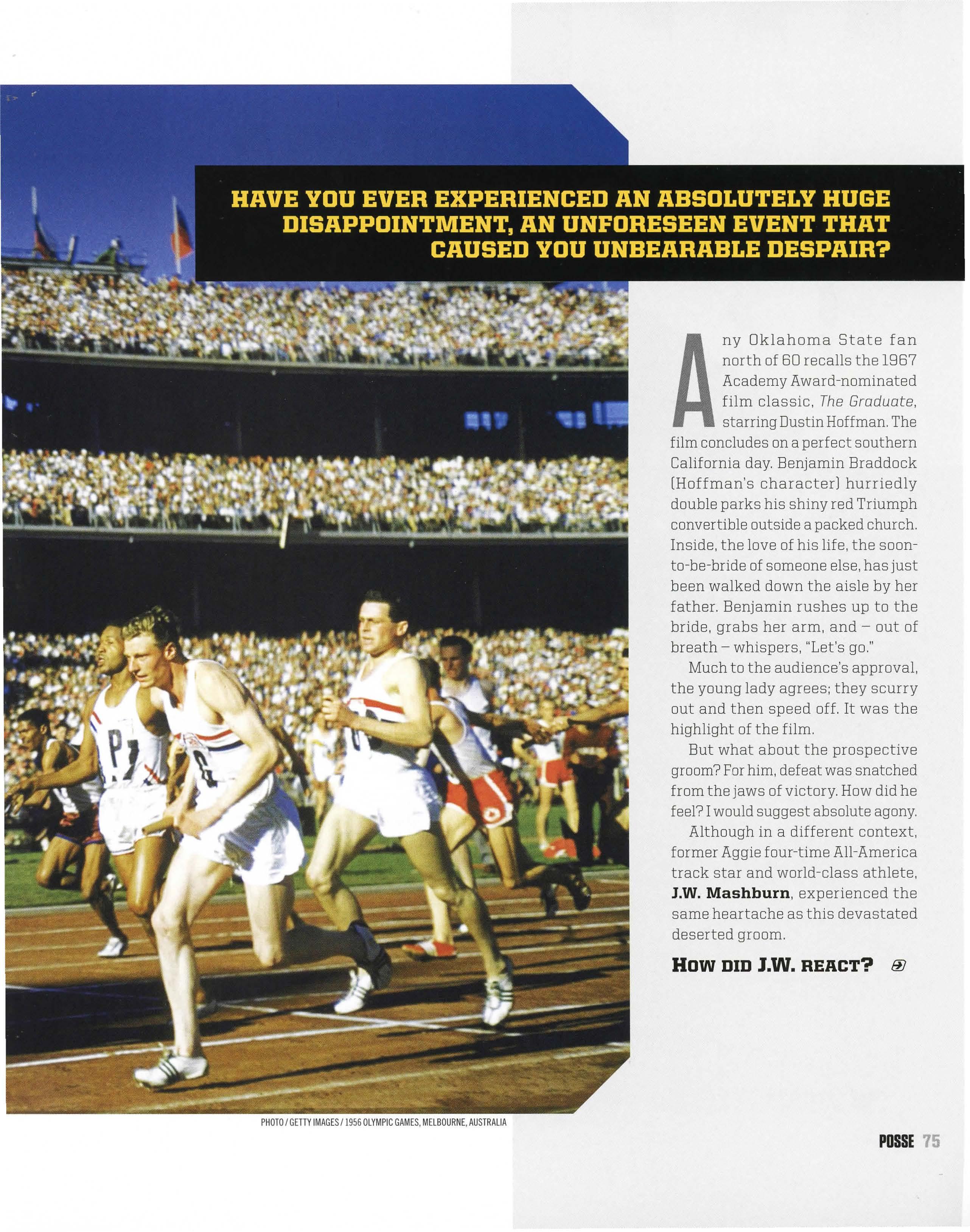
Any Oklahoma State fan north of 60 recalls the 1967 Academy Award-nominated film classic, The Graduate, starring Dustin Hoffman. The film concludes on a perfect southern California day. Benjamin Braddock (Hoffman's character) hurriedly double parks his shiny red Triumph convertible outside a packed church. Inside, the love of his life, the soonto-be-bride of someone else, has just been walked down the aisle by her father. Benjamin rushes up to the bride, grabs her arm, and - out of breath - whispers, "Let's go."
Much to the audience's approval, the young lady agrees; they scurry out and then speed off. It was the highlight of the film.
But what about the prospective groom? For him, defeat was snatched from the jaws of victory. How did he feel? I would suggest absolute agony.
Although in a different context, former Aggie four-time All-America track star and world-class athlete, J.W. Mashburn, experienced the same heartache as this devastated deserted groom.
DESTINED FOR GREATNESS, J.W. (JESSE WILLIAM) KNEW IN THE SIXTH GRADE HE WAS FAST.
"I cou lei outrun some of the older, faster kids, and our coach sent me to several state track meets where I did well. I loved to run."
Born in 1933 in Seminole, Okla., to Berry andOorothyMashburn, J .W.'sfarn ily moved several times as his dad worked in the oil fields for Warren Petroleum.
"Dad was born in Arkansas, the youngest ofll children," he said. "He didn't have any formal schooling - just outworked everybody. Dad's father died before he was born, and his 1110111 passed when he was six so he just bounced around living with different brothers and sisters.
"I had a great relationship with dad, liked being around him. We didn't have much, but most folks we knew didn't either. We lived in a place with an outhouse until I was six. Dad worked seven days a week, a workaholic."
"We were living in New Mexico," recalls .J.W.,"Dad had just been promoted to manager of a refinery being bu iIt in Wichita Fa! Is. I was 15, ready to start my sophomore year. Dad was killed in a refinery fire. He was only 37 - by far the toughest thing that ever happened to me."
That tragedy uprooted .J.W.'slife, but eventually there was stability. J.W., his younger brother, Berry, and his mom, Dorothy, moved to the Capitol Hill community in
76 WINTER2017
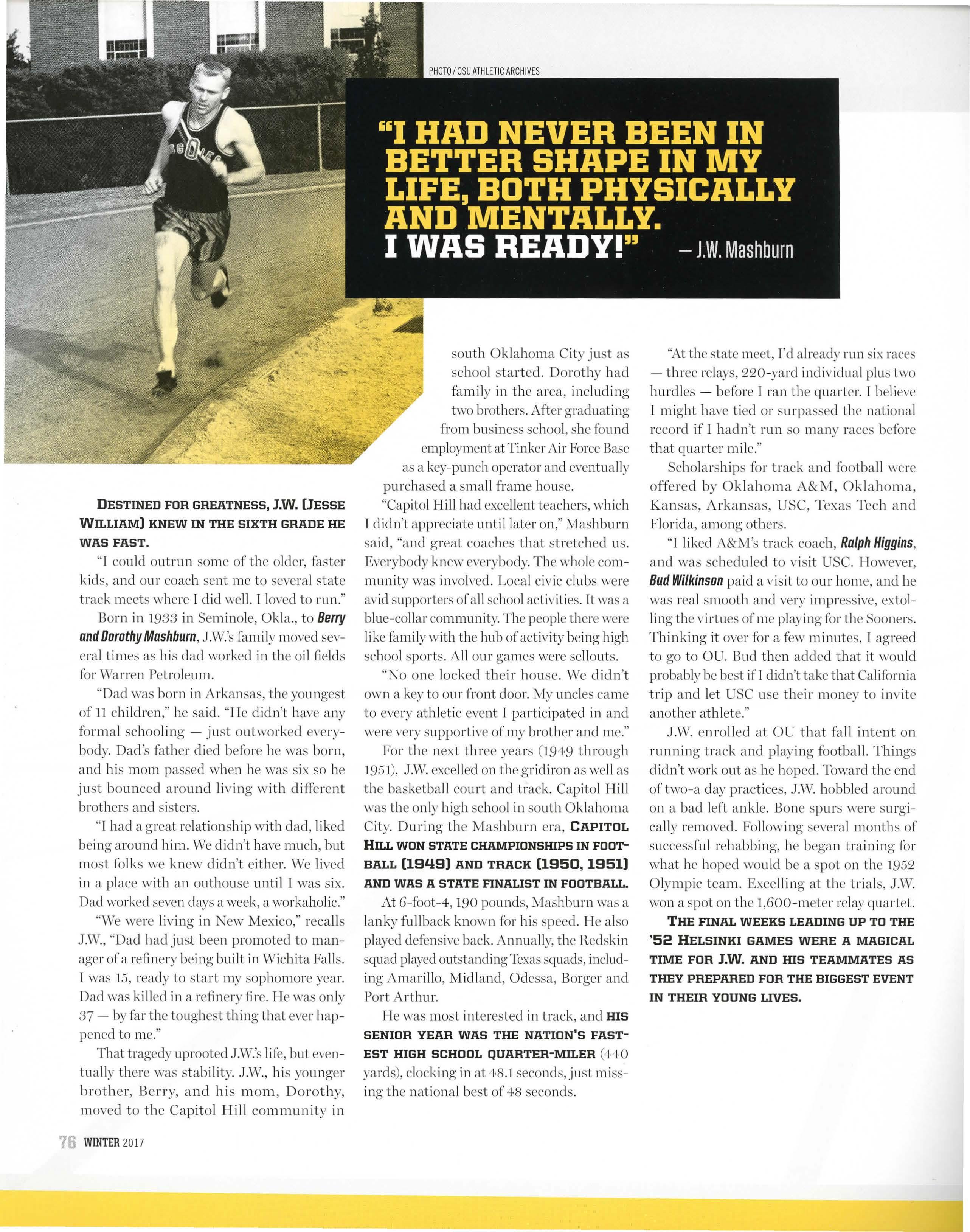
south Oklahoma City just as school started. Dorothy had family in the area, including two brothers. After graduating from business school, she found employment at Tinker Air Force Base as a key-punch operator and eventually purchased a small frame house.
"Capitol Hill had exccllentteachers, which I didn't appreciate until later on," Mashburn said, "and great coaches that stretched us. Everybody knew everybody. The whole community was involved. Local civic clubs were avid supporters of all school activities. It was a blue-collar community. The people there were Iike family with the hub of activity being high school sports. All our games were sellouts.
"No one locked their house. We didn't own a key to our front door. My uncles came to every athletic event I partiti pated in and were very supportive of my brother and me."
For the next three years (19+9 through 1951), J .W.excelled on the gridiron as wel I as the basketball court and track. Capitol Hill was the only high school in south Oklahoma City. During the Mashburn era, CAPITOL HILL WON STATE CHAMPIONSHIPS IN FOOTBALL [19Q9) AND TRACK (1950, 1951) AND WAS A STATE FINALIST IN FOOTBALL.
At 6-foot-4, 190 pounds, Mashburn was a lanky fullback known for his speed. He also played defensive back. Annually, the Redskin squad played outstanding Texas squads, including Amarillo, :Midland, Odessa, Borger and Port Arthur.
I-le was most interested in track, and HIS SENIOR YEAR WAS THE NATION'S FASTEST HIGH SCHOOL QUARTER-MILER (++0 yards), clocking in at+8.l seconds,just missing the national best of +8 seconds.
"At the state meet, I'd already run six races - three relays, 220-yarcl individual plus two hurdles - before l ran the quarter. I believe I might have tied or surpassed the national record if I hadn't run so many races before that quarter mile."
Scholarships for track and football were offered by Oklahoma A&M, Oklahoma, Kansas, Arkansas, USC, Texas Tech and Florida, among others.
"l liked A&M's track coach, RalphHiggins, and was scheduled to visit USC. I lowever, BudWilkinsonpaid a visit to our home, and he was real smooth and very impressive, extol]ing the virtues of me playing for the Sooners. Thinking it over for a few minutes, I agreed to go to OU. Bud then added that it would probably be best if l didn't take that California trip and let USC use their money to invite another athlete."
.J.W. enrolled at OU that fall intent on running track and playing football. Things didn't work out as he hoped. Toward the end of two-a clay prattices, .J.W. hobbled around on a bad left ankle. Bone spurs were surgically removed. Following several months of successful rehabbing, he began training for what he hoped would be a spot on the 1952 Olympic team. Excelling at the trials, J.W. won a spot on the 1,600-meter relay quartet.
THE FINAL WEEKS LEADING UP TO THE '52 HELSINKI GAMES WERE A MAGICAL TIME FOR J.W. AND HIS TEAMMATES AS THEY PREPARED FOR THE BIGGEST EVENT IN THEIR YOUNG LIVES.
"I was walking on clouds," Mashburn said. "I had never been in better shape in my life, both physically and mentally. I was ready!"
THE TRIUMPH OF MAKING THE OLYMPICS QUICKLYTURNED TO HEARTBREAK. The evening before the 1,600-meter race, U.S. coach BrutusHamilton,citing J.W.'s youth and inexperience, removed hi 111 from the unit and replaced hi 111with CharlesMoore, a 400-meter hurdler from Cornell.
"Never in my life have I been so ticked oft;" Mashburn said. "I told Brutus to get Moore out here, let's race! I know I can beat him. lvly teammates lobbied for me. I told Brutus he'd live to regret his decision. That night I wandered around the Olympic grounds like a caged Iion ... clid n't sleep a bit. Bad experience, one ['II never forget."
Hamilton wouldn't budge, and it proved to be a costly 111istake as the next day Jamaica upset the favored U.S. team to capture gold while the U.S. took silver.
"Brutus apologized profusely, but he cost me a gold medal. I don't think I'm completely over it yet," Mashburn said with a grin. "lf a positive came from my first Olympics, it was that my focus became intense to win gold the second time around."
Two weeks later, the U.S. team traveled to London to participate in the British Empire vs. USA games. Mashburn ran the second leg of the +x-!-40 yard invitational relay, which included Jamaica as part of the British Commonwealth. THE AMERICANS SET A NEW WORLD RECORD IN THE EVENT WITH A WINNING TIME OF 3:08.8.
It was somewhere during th is period that former Oklahoma polititian NormanLambnicknamed J.W. 'White Lightning' because of his platinum hair and world-class speed. It was an appropriate name, and both fans and the press adopted it. .
A few weeks later, back in Norman, J.W. prepared for footbal I practice. On the first day of practice, OU assistant coach GomerJones summoned him back into his office.
"Son, if I could run Iike you, I'd never put on another football uniform. You have worldclass speed."
"I took Gamer's advice and decided to stick with running. I finished my sophomore year in Norman and then transferred to (Oklahoma) A&JVl. Over the past two seasons, I'd sec A&M track coad1 Ralph Higgins at meets. He'd tell me, 'Boy, if you were up here, we'd be barn-burners.'
"Hig became Iike a second dad to me, had me over for many a home-cooked meal and encouraged me," Mashburn said. "I was always impressed with him. He would get things done. Many a night, when it was real late, l'd see the light on in his office. Also, Mr. Iba treated me real well, a true gentleman and a man of his word. It was easy for me to like and respect him.
"Another guy and I rented a Quonset hut to 1ive in, and we prepared most of our meals. During the summers, when I wasn't somewhere running in a track meet, T worked for Big Chief Drilling Company, owned by W.T. 'Bill' Payne, and saved some money. Also I got about $75 a month from my scholarship money to live on. Seemed like I did OK. Stillwater for me was like Capitol Hill in that
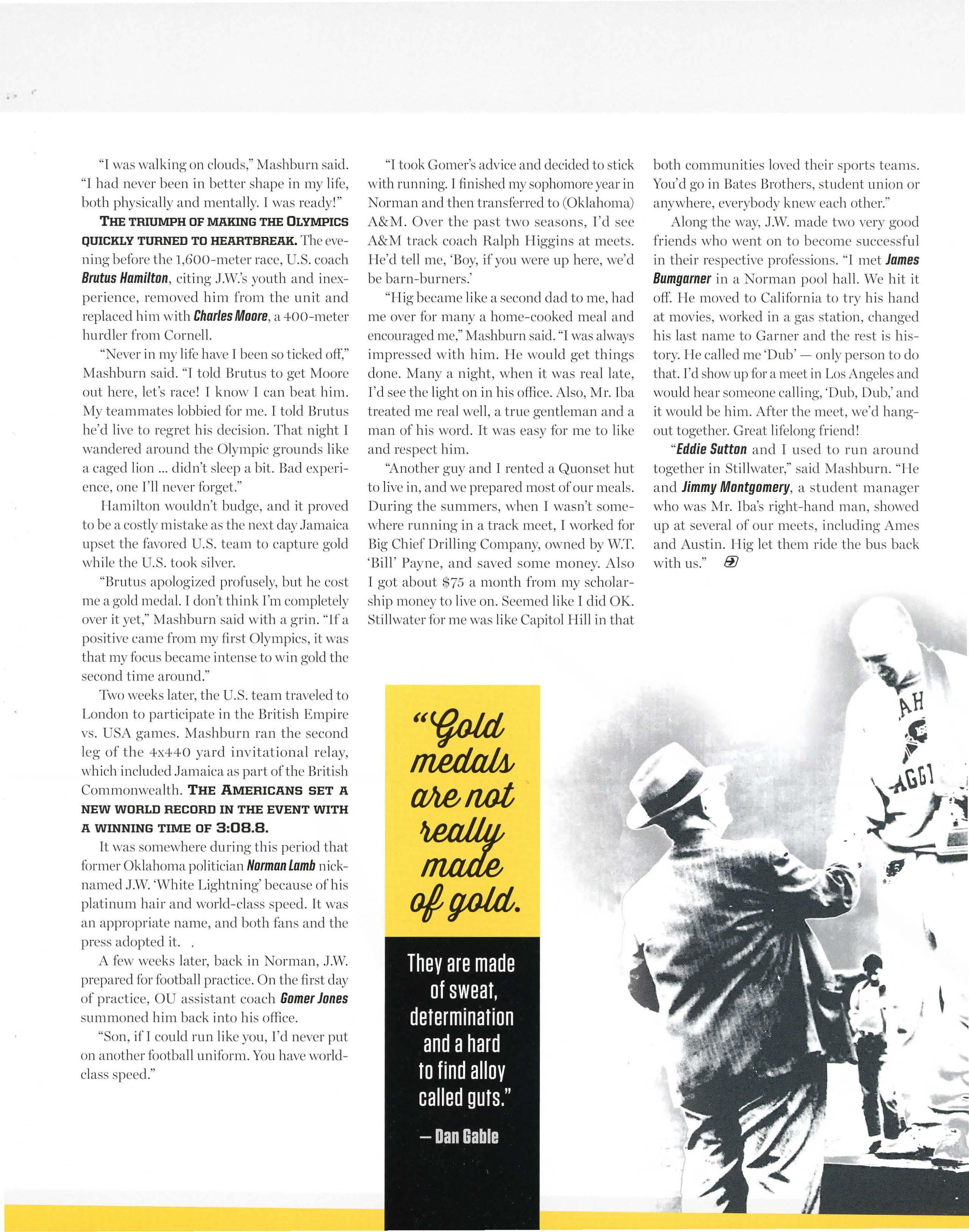
Theyaremade ofsweat, determination andahard tofindalloy calledguts."
both communities loved their sports teams. You'd go in Bates Brothers, student union or anywhere, everybody knew each other."
Along the way, .nv.made two very good friends who went on to become successful in their respective professions. "I met James Bumgarner in a Norman pool hall. We hit it off He moved to California to try his hand at movies, worked in a gas station, changed his last name to Garner and the rest is history. He called me 'Dub' - only person to do that. I'd show up for a meet in Los Angeles and would hear someone calling, 'Dub, Dub,' and it would be him. After the meet, we'd hangout together. Great Iifelong friend!
"EddieSuttonand I used to run around together in Stillwater," said Mashburn. "I le and JimmyMontgomery, a student manager who was Mr. lba's right-hand man, showed up at several of our meets, including Ames and Austin. 1-1ig let them ride the bus back with us." f£J
Than ks to J.W.'stalents, the Aggies became a dominant force on the collegiate track circuit, twice winning the mile relay at the Drake, Texas, Kansas, Coliseum and Compton relays.
J.W. captured the decath loo gold in Lawrence and was na111edthe event's outstanding athlete. His previous summers were spent in Europe running on the circuit.
"I ran in 10 events over an 11-day period. A person better be in shape to run over there."
Before 60,000 fans at the Coliseu111Relays in Los Angeles, the Aggies upset the host USC Trojans in the l,600-111eter relay.
The Olympics would take place near the end of a school semester. J.W. took off a fu 11semester and trained in California before departing for the '56 Melbourne games.
"I qualified for the 1,600-meter relay. My mom caught a bus out to watch those trials."
In the Melbourne Olympics, J.W.'s longstanding dream to win gold became a reality as the U.S. won the 1,600 relay. This was always the last track and field event - the grand finale, if you will.
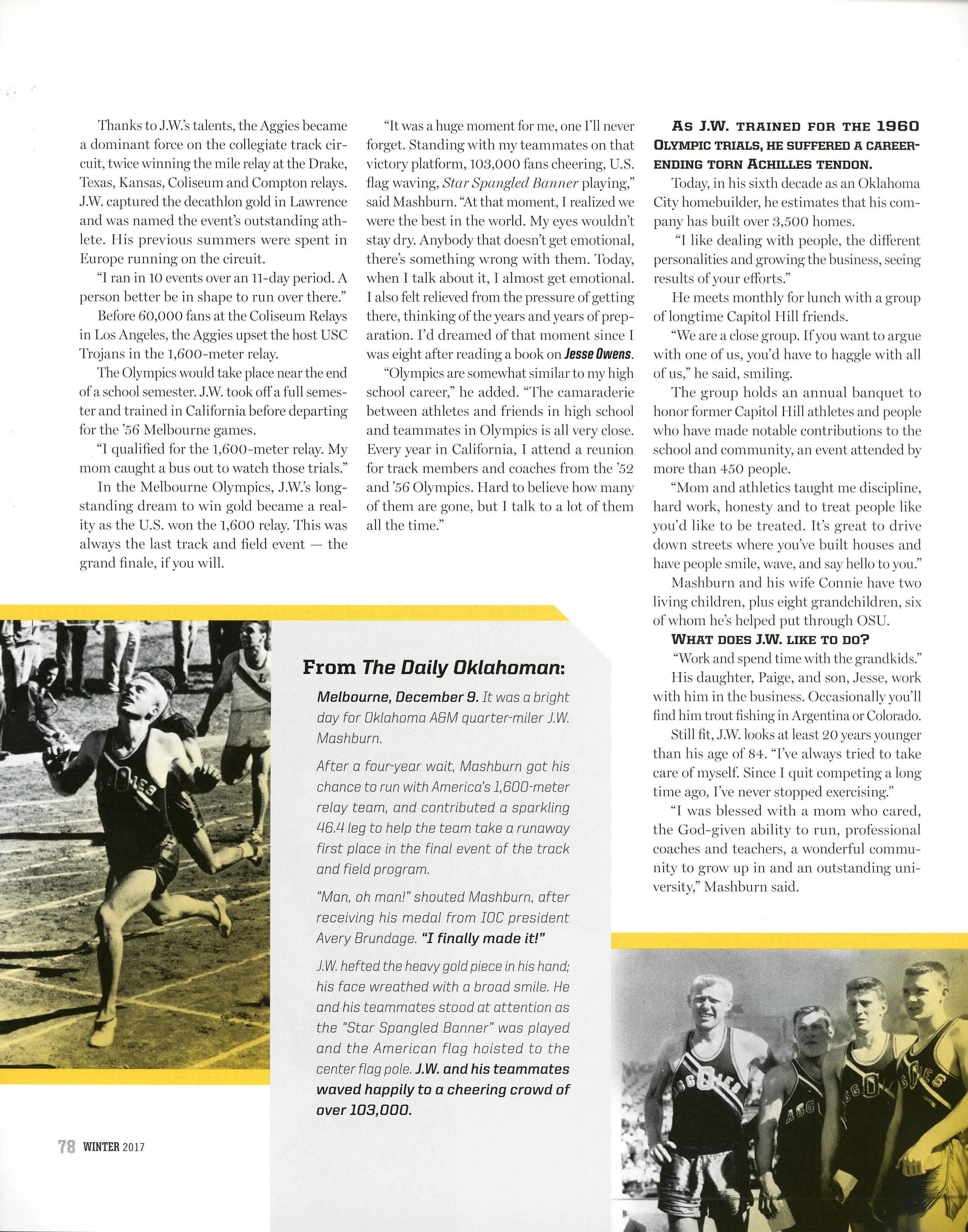
"It was a huge moment for me, one I'll never forget. Standing with my team mates on that victory platform, 103,000 fans cheering, U.S. flag waving, Star Spangled Banner playing," said Mashburn. "Atthat moment, I realized we were the best in the world. My eyes wouldn't stay clry. Anybody that doesn't get emotional, there's something wrong with them. Today, when I talk about it, I almost get emotional. I also felt relieved from the pressure of getting there, thinking of the years and years of preparation. I'd dreamed of that moment since I was eight after reading a book on JesseOwens.
"Olympics are somewhat similar to my high school career," he added. "The camaraderie between athletes and friends in high school and teammates in Olympics is all very close. Every year in California, T attend a reunion for track members and coaches from the '52 and '56 Olympics. Hard to believe how many of them are gone, but I talk to a lot of them all the time."
Melbourne, December B. It was a bright day for Oklahoma ABM quarter-miler J.W. Mashburn.
After a four-year wait, Mashburn got his chance to run with America's 1,600-meter relay team, and contributed a sparkling 46.4 leg to help the team toke a runaway first place in the final event of the track and field program.
"Mon, oh man!" shouted Mashburn, ofter receiving his medal from JDC president Avery Brundage. "I finally made it!"
J.W.hefted the heavy gold piece in his hand; his face wreathed with a broad smile. He and his teammates stood at attention as the "Star Spangled Bonner" was played and the American flag hoisted to the center flag pole. J.W. and his teammates waved happily to a cheering crowd of over 103,000.
AS J.W. TRAINED FOR THE 1960 OLYMPIC TRIALS, HE SUFFERED A CAREERENDING TORN ACHILLES TENDON.
Today, in his sixth decade as an Oklahoma City homebuilder, he estimates that his company has built over 3,500 homes.
"] like dealing with people, the different personalities and growing the business, seeing results of your efforts."
He meets monthly for lunch with a group of longtime Capitol Hil I friends.
"We are a close group. If you want to argue with one of us, you'd have to haggle with all of us," he said, smiling.
The group holds an annual banquet to honor former Capitol Hill athletes and people who have made notable contributions to the school and community, an event attended by more than 450 people.
"Mom and athletics taught me discipline, hard work, honesty and to treat people like you'd like to be treated. It's great to drive down streets where you've built houses and have people smile, wave, and say hello to you."
Mashburn and his wife Connie have two living children, plus eight grandchildren, six of whom he's helped put through OSU.
WHAT DOES J.W. LIKE TO DO?
"Work and spend time with the grandkids." His daughter, Paige, and son, Jesse, work with him in the business. Occasionally you'll find him trout fishing in Argentina or Colorado.
Still fit, J.W. looks at least 20 years younger than his age of 84. "I've always tried to take care of myself. Since I quit competing a long time ago, I've never stopped exercising."
"I was blessed with a mom who cared, the God-given ability to run, professional coaches and teachers, a wonderful community to grow up in and an outstanding university," Mashburn said.
DickSoergel,Cowboy all-ti me great and three-sport superstar, graduated from Capitol Hill 11igh School several years after J.W. and remains a good friend.
"Jn his time he was the greatest quartermiler in the country," said Soergel. "He could really turn it on ran al I over Europe against top quarter-milers in the world. Beat most of them. Very successful. Been building homes since the 1960s smart business man and tremendously good at staying up with old friends.
J.W.'s helped me on several occasions. 1-le'svery caring, thoughtful, an outstanding person. l can't tell you how much he means to the people in Capitol Hill. I !e's helped a lot of folks.''
"I got to know .J.W.in his post-athletic days and think the world of him," said 1.0.Martin, one-time OU track coach. "What he did, winning that gold medal, being the best in the world, took the same qualities that has made him a successful business man: ability, dedication and hard work. Every time I sec him, it's always a pleasure to visit with him."
BarrySwitzer,an OU legend in his own right, and J.W. are also good friends.
"I am a long-time track junkie and in college attended all the track meets," Switzer said. "J.vV.was one of my first heroes. He could fly! The Tulsa World was delivered to Fayetteville in my day while the Little Rock paper wasn't. So I kept up on Oklahoma sports.
"Heck, J .W. was the MickeyMantleof quarter-m ilcrs. At age 19, Mickey played in his first World Series, and, at the same age, J.W. made his first Olympics. A remarkable achievement. Good man. Superior athlete. I've liked and admired him a long ti me."
Long-time friend GaryLauersaid, "Being from Shawnee, I competed against him in high school. All I ever saw of him was the back of his head, his rear-end and the bottoms of his feet.
"Man, was he fast! I've known him a number of years," he added. "I-le was a world class runner, is a devoted husband and father, a gentleman. Great benefactor of the Oklahoma City area. He sets an example with his kindness and generosity.
"l n my opinion, a great ath letc but a better human being!"
"WHITE LIGHTNING" WOULD NOT BE DENIED THE SECOND TIME .AROUND and struck Olympit: gold in Melbourne, a historic hert:ulean event to forever be etched in OklahomaA&:M and Olympic track history.
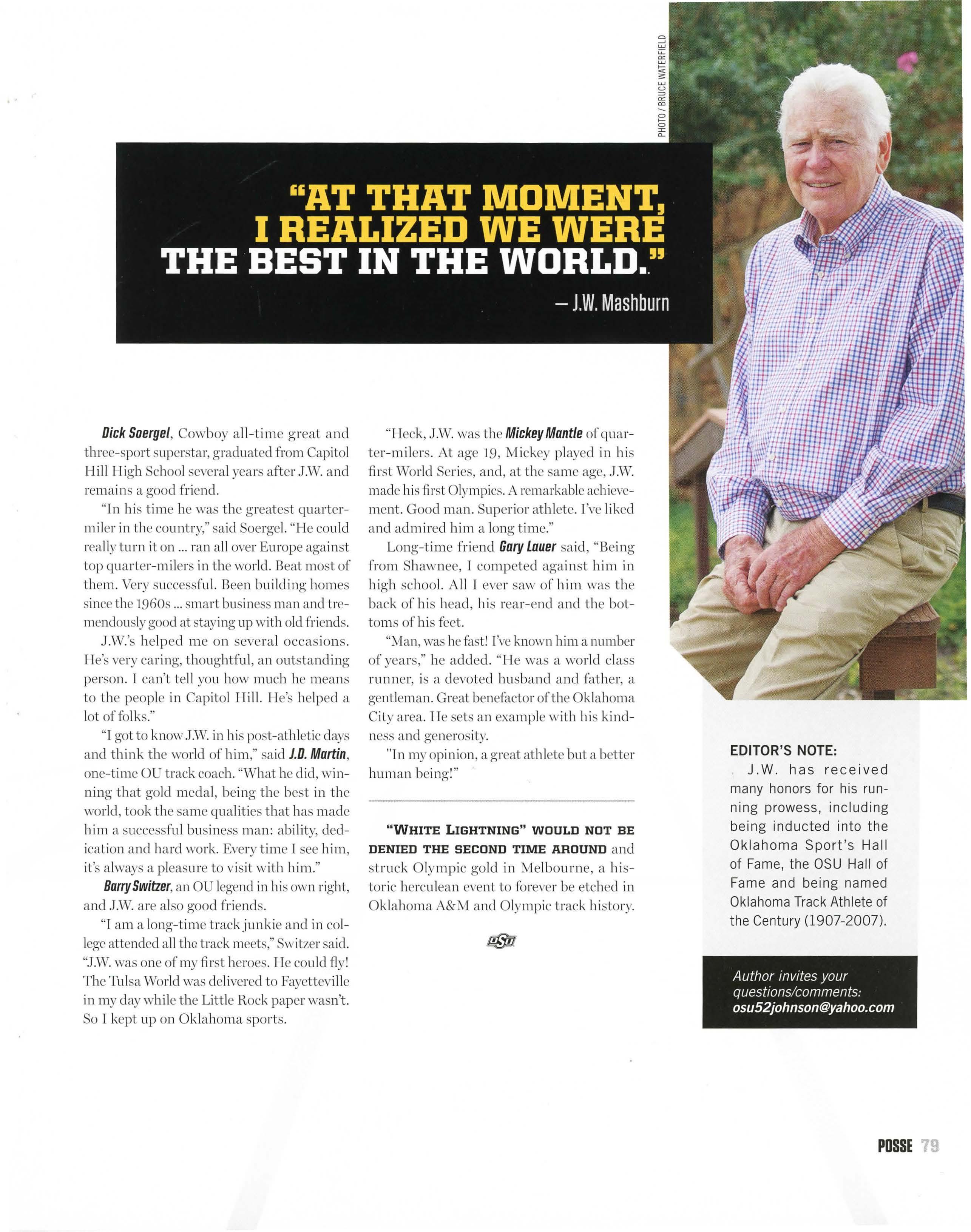
EDITOR'SNOTE:
J.W. has received many honors for his running prowess, including being inducted into the Oklahoma Sport's Hall of Fame, the OSU Hall of Fame and being named Oklahoma Track Athlete of the Century (1907-2007). Author invitesyour quest,onslcomments: osu52johnson@yahoo.com


Alanjoinedtheservice inEnglandin1915and shippedofftoWorldWarI. Hewasaccustomed to holding a fountainpen insteadofa rifle.
Along with the rest of the world, Alan was becoming accustomed to seeing significant military advancement in the development of weaponry. Inventors had been busy since the Civil War and Spanish-American skirmish. As with modernization of weapons, tools of documentation were also more developed. Through pictures and film, people across the globe recoiled in horror at the affects these new armaments had on human life. War is ugly.
Alan Milne had an idea. After his discharge from the military, he committed himself to the thought of creating something that might take the world's mind off death. So, he picked up his fountain pen. His mind drifted to a place close to home, familiar and colorful.
He wrote a few stories about his son, Christopher, and his toy bear they named Winnie-the-Pooh. So, on paper, Milne created characters from deep in the Hundred-Acre Wood where Christopher Robin played.
For the rest of the world, this boy's bear and other toy animals: Piglet, Tigger, Roo, Rabbit, Owl and Eeyore, were brought to life. Imagination was born. Parents sat down and read to spellbound children. During a twenty-minute respite from worry about-well, anything-parents witnessed their toddlers being transported to a place where the only problems were whether Pooh would find his honey or Eeyore could find happiness.
A.A. Milne's books soon reached what Malcom Gladwell would describe as the tipping point: a moment of critical mass when ideas or products (in this case a book), spread like viruses. Everyone had Winnie-the-Pooh.
In fact, at this point in the article, you, the reader, may have had to brush away the memories of times when you were read to or you yourself enthralled a little one with the adventures of Christopher Robin. For just a little while, war, famine, politics, bills, discord and numerous other phantoms could be forgotten.
We have moved on from Winnie-the-Pooh. SpongeBob and Doc McStuffins have taken his place. I'm not sure we are better off. It seems there are still events and issues in America for which we need interruption, a brief distraction from real problems. Sports help us achieve that objective. We get to wear our orange and watch the characters we read about come to life. And for a few hours, we are spellbound, transported to a place where the biggest problems are first downs, takedowns, layups, base hits, goals and speed. Our minds are taken to a place familiar and colorful: the roar of the crowd, the smell of freshly popped popcorn, cotton candy on a child's face, high fives after a win and wiping a tear of two after a loss. Whether you were one of the children being taken, or the adult helping get the whole gang to their seats, those memories were and continue to be welcome distractions from challenges. Eventually,figuratively, we will put the book back on the .shelf, only to take it off again soon to relive another adventure. Like the fun Pooh and Piglet had in our childhood, our athletes are young people, playing games that give all of us yet another adventure a bright orange one.
KYLE WRAY Vice President
Enrollment Management & Marketing
(j Kyle Wray OSU CJ@KyleWrayOSU