BACKIN BLACK
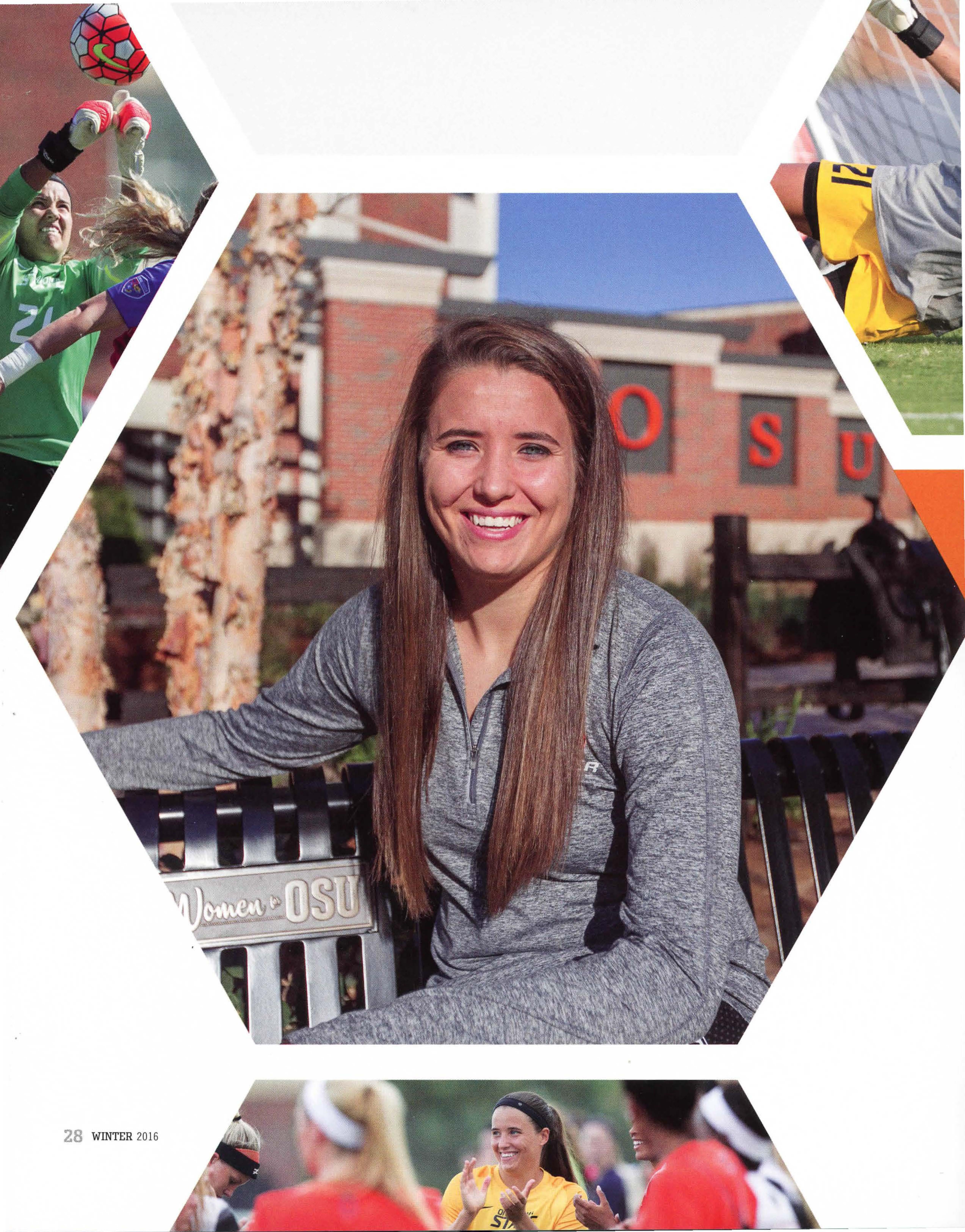
ONGAROFIGURESSHEWASBORNTOBEA
SOCCERPLAYER.l-ler father, Paolo, is Italian and had a bal I at her feet from the time she could walk. And being a goalkeeper just came natural, she says.
'·My dad was born and raised in ltaly, and soccer is part of your blood back there, so I'm sure that's what got me started in it," Ongaro said. ''As far back as I can remember, I've always loved it. Never really wanted to play any other sports. My clad was my coach growing up until basically high sc.:hool.1-le's the one who put me in goal first. l was tbe only kid who wasn't scared of the ball flying in my face. 1\-e been playing for going on 18 years novv,and I've been a goalie for as far bark as I can go."
ANOTHERTHINGTHATONGAROWASBORN INTO?ANOKLAHOMASTATEFAMILY.
Ongaro's maternal grandparents were long-time Oklahoma State faculty members. Her grandfather, Moses Frye, served as legal counsel for the OS U Board of Regents in the 1960s and ·70s and was also a business professor. 11is wife, Mary, spent two decades as the Director of Campus Recreation at the Colvin Center and was an integral part of starting the OSU women's varsity wim team in the mid-1970s. Ongaro's mother, Renee, earned a finance degree from OSU, while her aunt, CamilleDeYong, is an OSU graduate who swam for the Cowgirls and is now an industrial engineering profes or at the school.
Ongaro remembers a childhood full of trips to Stillwater to spend time with her grandmother and aunt but admits her OSU fanclom was only casual initially.
"My mom never really forced it on us," Ongaro said. ·'We would come and visit my grandma, but we would always come during Christmas or summer breaks when nobody was on campus. The first fall that I was here was the first ti me I even saw people on campus, and it was the weirdest thing to me.
"We visited and I always liked to watch OSU on TV, but it's not like I grew up in an Oklahoma State t-shirt or anything like that. There are a few pictures of me in an OSU cheerleacling uniform when l was a baby, but once I came here, it's blossomed throughout my family and now everyone wears and bleeds orange." fE
STORY WADE MCWHORTER IOTOGRAPHYBRUCE WATERFIELD
THATORANGEPRIDEISEVIDENT - EACH TIMETHECOWGIRLSAREINACTION,there's a good chance Ongaro will have a number of family members cheering her on.
"It's absolutely incredible," ·aid Frye, who is still involved with the Osher Lifelong Learning In ·titute in the OSU College of Education and also an instrumental part of the committee bringing The Ranch retirement community to Stillwater. '·I always thought it wou Id be fa.bulous if Michela couId come play here. We enjoy the day] ights out of her. She's a really precious human being, just a delight, and seeing her in action at the soccer games is wonderful.
"OSU has been a part of our family for a long time, and it's been fabulous to have Michela add to that tradition and be so successful here."
Soccer brought Ongaro to OSU. But her journey from a kid who grew up loving the game to one of the top goalkeepers in Cowgirl history is, even by her own admission, improbable and unexpected.
ln fact, playing collegiately never really crossed Ongaro's mind, that is until her family moved from Ohio to Wisconsin when she was in junior high school.
"College soccer wasn't on my radar for a long time," Ongaro said. "But the club team I joined, probably 70 percent of the players went on to play in college. l never really thought of myself as good enough for that, but it kind of came on my radar.
My freshman year of high school, l started reaching out to schools. I sent to a lot of schools in the Midwest and the South, but Oklahoma State was really on the top of my list. I'd looked into the program, and that was some of their best years. My grandma wou Id send me newspaper clippings al I the time about how well they were doing, and I really started to get interested."
But would OSU share that intere t"?
Toward the end of Ongaro's sophomore year, OSU assistant coach Kat·en Hancock made a recruiting trip to watch her play, but Ongaro recal Is it being "a slow game where I didn't do much, and you could kind of tell they lost interest at that point."
However, in a twist of fate, Ongaro just happened to be in Stil1water visiting her grandmother the following summer when OSU was holding a soccer camp. Ongaro signed up, and this time, the high school goalkeeper from Wisconsin made a positive impression on OSU head coach Colin Carmichael and the Cowgirl 'coaching staff.
Getting her f-ootin the door, even a Iittle bit, was all Ongaro needed to know she wanted to be a Cowgirl.
''After the first session of camp, Colin was very interestecl and told me they wou Id reach out after seeing more of me," Ongaro said. 'And after that camp, I started realizing that I could play at this level, and I knew OSU was it. Then when I came on my visit, it was done - OSU was where l wanted to be. Of course, there's the family aspect of it, but I don't know, l always say it - there's just something about Sti IIwater. Seeing everybody wearing orange and the environment at the games and how Colin, Justin (Elkington) and Karen were with the team, how happy
IJSJJHEADSDCCERCOACH
the girls seemed. l can't really explain it, but I just knew. It was done."
"After we saw Michela at camp, we thought, 'Thi- kid's a pretty good goalie.' But we al ready had al lotted our scholarship money for goal keepers in that class so we tal keel to her about walking on," Carmichael said. "She's a really good student so she got a ton of a ·aclemic aid, and she let us know, 'I'm definitely coming."'
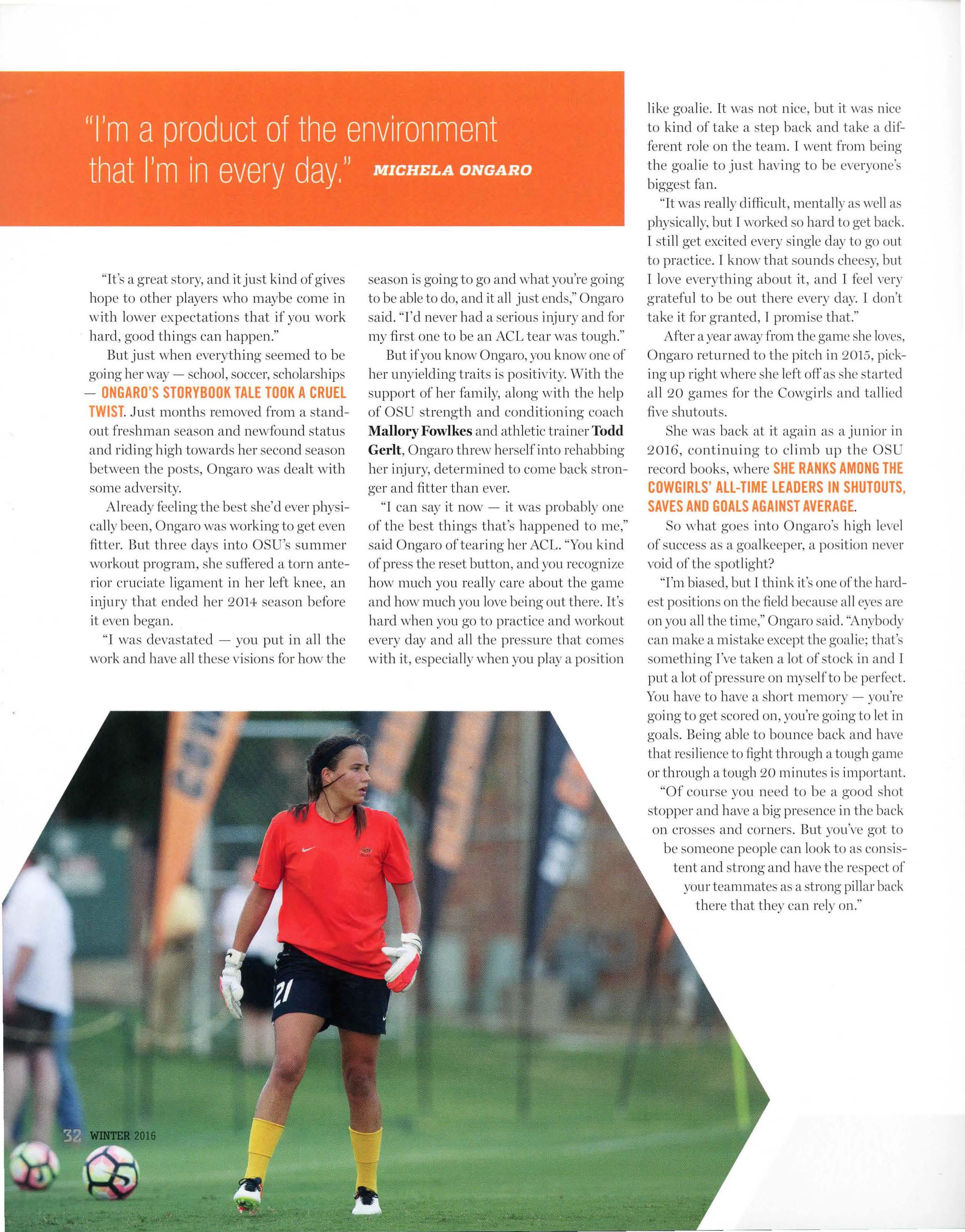
Ongaro arrived on the OSU campus for the first ti me as a stuclent-ath lete late in the summer of 2013, AWALK-ONGOALKEEPER ON AROSTERWITHTWOOTHERGOALIES, both of whom were on scholarship. One of those wasjuniorRosaMedina, who was in line to be the starter after biding her time behind Cowgirl All-American AD Franch.
But if Ongaro was third in the pecking order in goal, someone forgot to tell her.
"In preseason, you're doing a lot of games and competing, aod we're trying to figure out, especially with the new kids, where do they fit," Cannichael said. "When we were doing some of those smal I-sided games, lvfichela is flying around in goal making big saves, and it became apparent right off the bat that she was a little bit better than we thought she was during the recruiting process.
"I think not only did she get our attention, she got her teammates' attention like, 'Wow, this is going to be interesting to see who plays this year,' as opposed to it being pretty much the returncr's job. We knew pretty quick it was going to be a close battle."
While Ongaro's play was raising eyebrows around preseason camp, the freshman tempered her expectations and admittedly started out unsure of.just where - or even if - she fit into OSU's plans.
"I was just very grateful to be here, very grateful they gave me the opportunity," Ongaro said. "Honestly, l was just trying to stick around. I wanted to make the travel team. l knew that was kind of a long shot, but it wa something 1 was really shooting for and something] really wanted.
"I was very nervous. But within the first week of pickup games, again Tknew I could play at this level. It's the same sport, just a Iittle faster, a Iittlc quicker, a Iittle stronger, and T knew I would get there. l was very confident that I could at least stick around and contribute to the team. l just tried to keep my head down, work hard and earn the respect of everybody, make the saves and get the job done."
Ultimately, Medina was named the OSU starter going into the 2013 season. But a Medina's backup, Ongaro had given th Cowgirl coaching stafHood for thought, and when the incumbent had some early struggles, an opportunity presented itself.
At halftime ofOSU's ninth game of the season, a Friday road contest at Rice, OSU assistant and goal keeper coach Justin Elkington pulled Ongaro aside and told her to get ready, she would start the second half against the Owls.
Ongaro's stint in goal that night was brief - thunderstorms ultimately cut the second half short and the game was eventually canceled - BUTOPPORTUNITYWASNOTLOSTAS TWODAYSLATER,SHEWOULDBETHESTARTER ATNORTHTEXAS.
"Unbelievable - I was shocked," Ongaro said. "1 don't remember why, but I had put an extra pair of gloves in my bag for that weekend. I pulled them out, putthem on and went to warm up (at Rice). I only got to play 10-15 minutes before the game was rained out, but when they told me I was starting at UNT on Sunday, I've never been so nervous-in my life. From th second l found
out to the start of the game, I cou Id not have been more nervous.
"T respected the heck out of Rosa, and I wasn't sure I was better than her. I wasn't sitting there thinking that I was better. I trn ly thought she was getting the job done and was a great goalie so to me it was shocking. I was just trying to go in and help the team win as best I could.
"I thought it was probably a temporary situation. But I went in there, grabbed ahold of it and didn't let go. It was a great experience but definitely not something I expected or was aiming for. It was a roller coaster that first few weekends trying to prove I wa the best goalie.
"Ga.mes arc never easy - I still get nervous for games. But the more I got to play that year, the more confident I got. Being tossed into the most important games of the season was very humbling and very exciting, but a lot of pressure came with that, too."
Nerves or not, Ongaro proved he was up to the ta k of performing under that presure. She collected five saves in a 2- 1 overtime win in that first start at UNT, seizing the job and continuing to perform week-in and week-out. She started OSU's final H games in goal, helping lead the Cowgirls to the Big 12 Championship final and an NCAA Tournament berth as she recorded four shutouts and a 0.82 goals against average along the way.
An unexpected story added another chapter following that fresh man season when the kid who once wondered if she was even good enough to play at the college level had any remaining
doubt erased by Carmichael, who put Ongaro on athletic scholarship.
"Again, not something I was expecting. I was hoping for maybe books," Ongaro said. "But they rewarded me and treated me right, and I'm very grateful. It was kind of like a euphoria. More so than the money, which was going to help my family out, but the gratification and recognition that 1had done something that was worthy of the money they were giving me and that Twas contributing to a team enough that they wanted me to stick around.
"I came hereon a whim and loved it. They didn't need me. So to be able to contribute and kind of prove everyone wrong was very gratifying."
"Jt was pretty emotional, but she was just so thankful," Carmichael said. "You could tell it meant a lot to her to earn that right to have a scholarship. That's not the case for everybody. A lot of kids come in on big scholarships, and they just as ume this is normal, whereas Michela had to earn it. I think it probably means a lot more to those kids that they're not getting it right away, and they have to work for it - it's probably a little bit more special. EE
rrl'm a productoftheenvironment thatl'n1ineveryday."
MICHELA oNGARo
·'It's a great story, and it just kind of gives hope to other players who maybe come in with lower expectations that if you work hard, good things can happen.''
But just when everything seemed to be going her way - school, soccer, scholarships - ONGARO'SSTORYBOOKTALETOOKACRUEL TWIST.Just months removed from a standout freshman season and newfound status and riding high towards her second season between the posts, Ongaro was dealt with some adversity.
Already feeling the best she'd ever physically been, Ongaro was working to get even fitter. But three days into OSU's su 111mer workout program, she suffered a torn anterior cruciate ligament in her left knee, an injury that ended her 201+ season before it even began.
"I was devastated - you put in all the work and have all these visions for how the
season is going to go and what you're going to be able to do, and it all just enc.ls,"Ongaro said. 'Tel never had a serious injury and for my first one to be an ACL tear wa • tough."
But if you knowOngaro,you knowoncof her unyielding traits is positivity. With the support of her family, along with the help of OSU strength and conditioning coach Mallory Fowlkes and athletic trainer Todd Gerlt, Ongaro threw herself into rehabbing her injury, determined to come back stronger and fitter than ever.
"I can say it now - it was probably one of the best things that's happened to me," said Ongaro of tearing her ACL. "You kind of press the reset button, and you recognize how much you really care about the game and how much you love being out there. It's hard when you go to practice and workout every day and all the pressure that comes with it, especially when you play a position
like goalie. It was not nice, but it was nice to kind of take a step back and take a dif~ forent role on the team. I went from being the goalie to just having to be everyone's biggest fan.
"It was really difficult, mentally as well as physically, but I worked so hard to get back. l still get excited every single day to go out to practice. I know that sounds cheesy, but I love everything about it, and I feel very grate-fu 1 to be out there every clay. I don't take it for granted, I promise that."
After a year away from the game she loves, Ongaro returned to the pitch in 2015, picking up right where she left off as she started all 20 games for the Cowgirls and tallied five shutouts.
She was back at it again as a _junior in 2016, continuing to climb up the OSU record book , where SHERANKSAMONGTHE COWGIRLS'ALL-TIMELEADERSINSHUTOUTS, SAVESANDGOALSAGAINSTAVERAGE.
So what goes into Ongaro's high level of success as a goalkeeper, a position never void of the spot! ight?
'Tm biased, but I think it's one of the hardest positions on the field because all eye are on you all the time," Ongaro said. "Anybody can make a rnistake except the goalie; that's something I've taken a lot of stock in and I put a lot of pressure on myself to be perfect. You have to have a short rnemory - you're going to get scored on, you're going to let in goals. Being able to bounce back and have that resilience to fight through a tough garne or through a t0ugh 20 minutes is important.
"Of course you need to be a good shot stopper and have a big presence in the back on crosses and corners. But you've got to be someone people can look to as consistent and strong and have the respect of your team mates as a strong pillar back there that they can rely on."
RESPECT
ISATRAITEARNED,NEVERGIVEN, ANDASTWO-YEARTEAMCAPTAIN,ONGAROCERTAINLYHASTHATAMONGTHECOWGIRLS. Her leadership qualitie are never in doubt to anyone within earshot of the soccer fieldif there's one constant during OSU matches and practices, it's the voice of Ongaro barking out instruction and encouragement to her teammates.
"A lot of young ladies that we get, they're not comfortable hcari ng their voice loud on the field - Michela doesn't have that problem,'' Carmichael said. "She docs a great job of blending instruction and being demanding with also being very positive. You hear her in prac.:ticeall the time complimenting the forwards for shooting and sc.:oring or complimenting her defenders for shutting somebody down. She's comfortable with her voice, and it's a big help to our defense."
Ongaro admits being a vocal leader on the field is something that develops naturally.
"I'm not sure where that cam, from, but when I came in I was very c.:onsc.:iousof it," Ongaro said. '·r had to gain everyone's respect and prove I was a good enough goalie before I started to telling anyone to do anything. It's something that's developed as I've gotten older.
"Honestly, it makes the job easier. IfI can stop shots from happening, I don't even have to save the shots. (Being vocal) is something that's grown with me, and the leadership to me is the most important thing. Lthelps make everybody else's job easier. The other 10 players on the field do way more than [ do during the game - they work their butts off and run around. So ifTm able to help them at all and keep u in the game even just by talking, it's something I'm very willing to do and something I've gotten very comfortable with.
"[t's the most important thing, but it takes a type of confidence and a type of comfort that goes with it. Not everybody can do it, and it's something I've had to teach myself because I've had coaches tell me the importance of it. I've noticed that the more you talk, the more results you get. And if you're saying the right things, your teammates are going to Iisten and it's sorneth ing that helps."
While Ongaro's dedication, drive and desire have translated to success on the pitch, what she's accomplished in the classroom may be even more impressive.
In August 2016, she graduated magna cum laude with a degree in finance, and she' currently pursuing her Master of Business Administration, which she plans to complete shortly after her soccer career concludes next year.
"Cranking out a finance degree in three years while juggling everything was hard," Ongaro ·aid. ''I've always tried to manage my time and be on top of stuff, but really it's because I'm passionate about it. I like what l'm learning in school, I love soccer so it doesn't necessarily feel Iike a lot of work to me, either of them. I Iike being successfu I in the classroom and on the field, and I'm competitive in both.
·'It's been a fun ride. I still don't feel like I should have a college degree, be done and going to get a job. I put the work in, but it has been easy for me to put the work in."
A coaching veteran of more than two decades, Carmichael is amazed by his goalkeeper's ability to balance academic.:s and soccer and excel at both.
"To do both at a high level is very hard," Carmichael said. "A lot of non-athletes think it's easy for these kids, that they get everything laid out to them on a plate. But Michela has to work really hard to balance it all. She's the starting goalkeeper, she's driven to win a Big 12 championship and she's also maintaining a really good GPA and having an academic scholar ·hip becau ·e of that. She's the great story of that studentathlete who succeeds on and off the field."
From walk-on to scholarship athlete to college graduate, all at a school she's known all her life, Ongaro couldn't be happier living her Oklahoma State dream.
"I'm a produc.:tof the environment that I'm in every day. I have the best coachc ·, teammates, teachers, family, and I foeI very gratefu I for this whole experience."
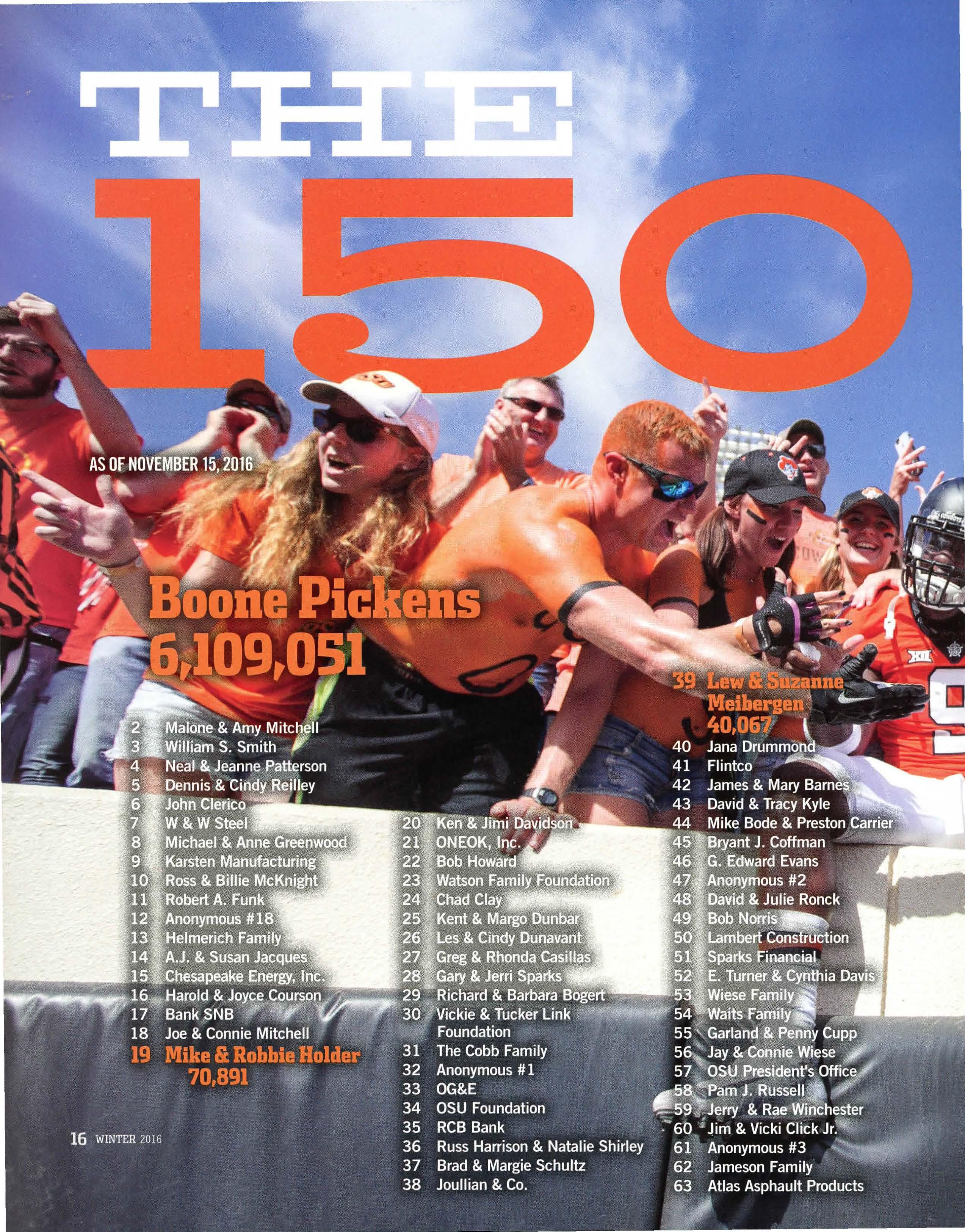
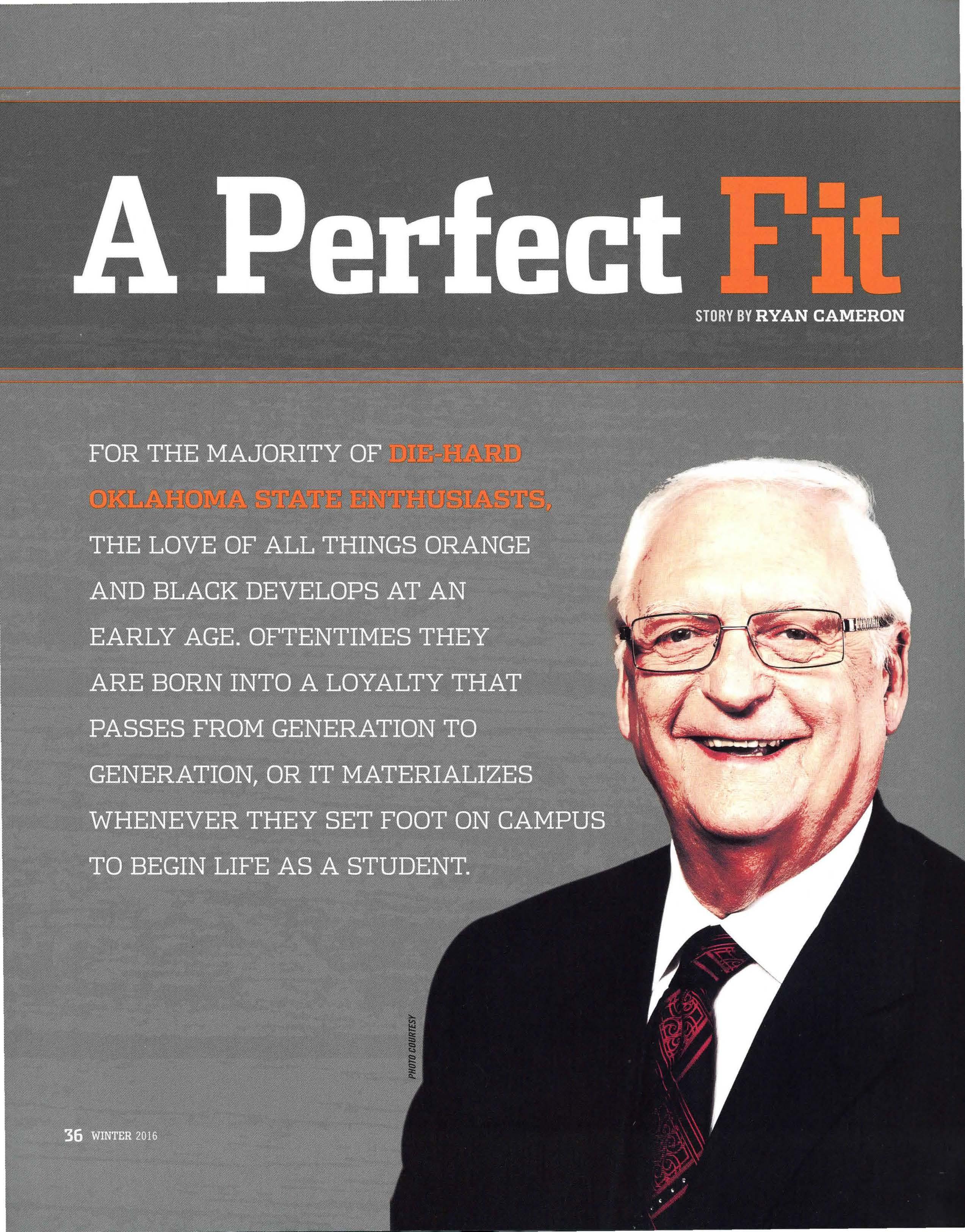
BOB FUNK, ONE OF OSU'S MOST PROMINENT SUPPORTERS, SAW HIS PASSION AND ADMIRATION FOR THE UNIVERSITY COME TO FRUITION AT A LATER STAGE IN LIFE, WELL AFTER HE HAD DIPLOMA IN HAND.
With degrees in business administration and theology from an institution nearly 2,000 miles from Sti IIwater (Seattle Pacific) and with graduate work at the University of Edinburgh in Scotland, Funk may seem an unusual fit as one of OSU's most sign if-icant contributors. I. lowever, it i quite the contrary according to the man who was instrumental in the union of the two parties.
"Mr. Fun k's Cowboy ethics, love for agribusiness and competitive spirit provided the perfect backdrop for him to adopt Oklahoma State as his 'state school.' The relationship has been wonderful and all parties have greatly benefited," said Craig Clemons, a former athletics administrator at OSU and current Funk employee.
Raised in Duvall, Wash., Funk grew up working on a dairy farm owned by his family. At an early age he came to the conclusion he wanted to become a minister, rancher and entrepreneur. TONOONE'SSURPRISE, HE SUCCEEDEDONALLCOUNTS.
AMONGHISMOSTSUCCESSFULVENTURES WASTHECREATIONOFEXPRESSRANCHES, WHICHUNQUESTIONABLYSPEAKSTOTHE CULTUREOFOSU'SCAMPUS.The operation houses thousands of Angus cattle on nearly 200,000 acres ofland acros seven locations. Additionally, the venture is also the leading Angus cattle producer as well as the top seed stock producer in the country.
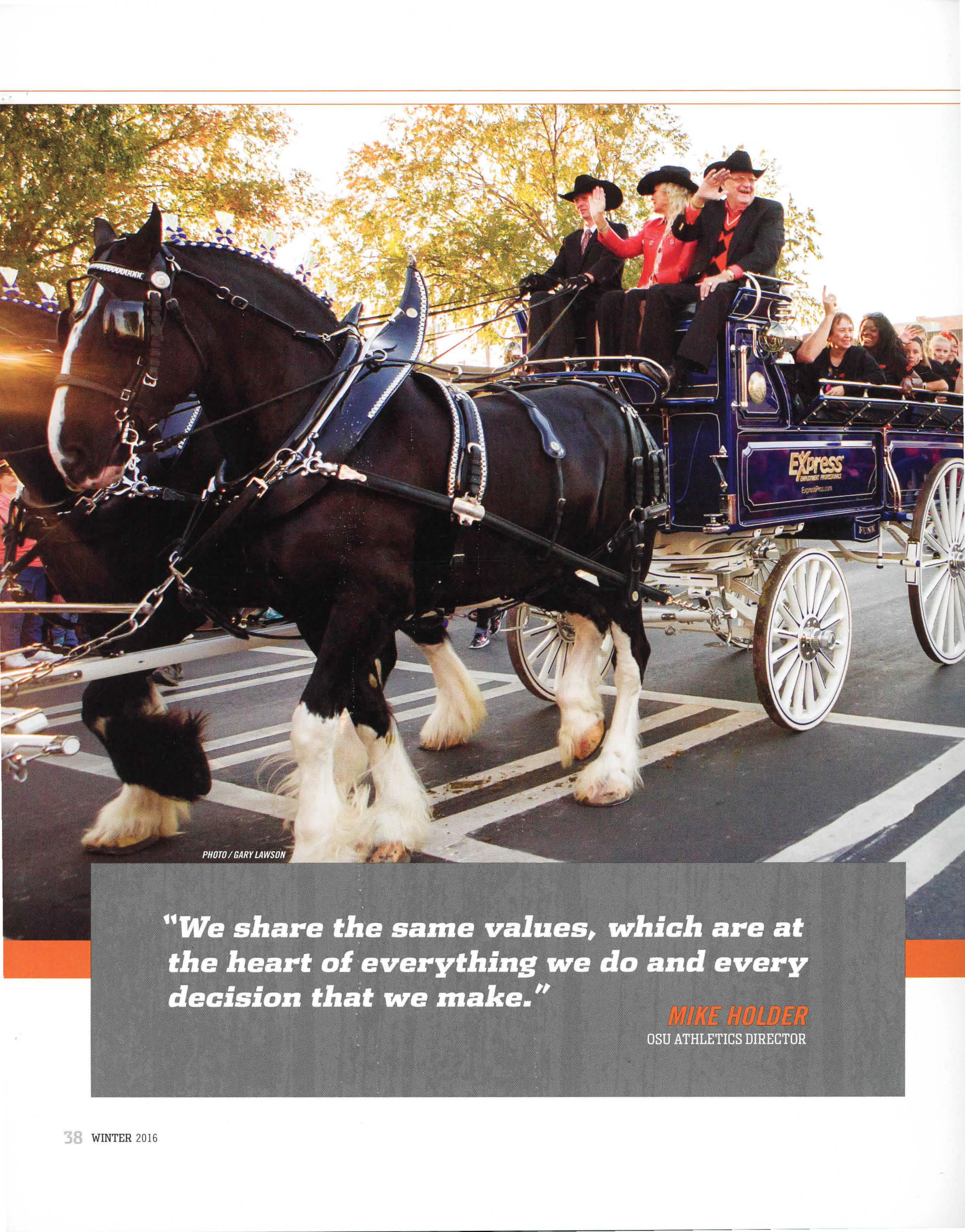
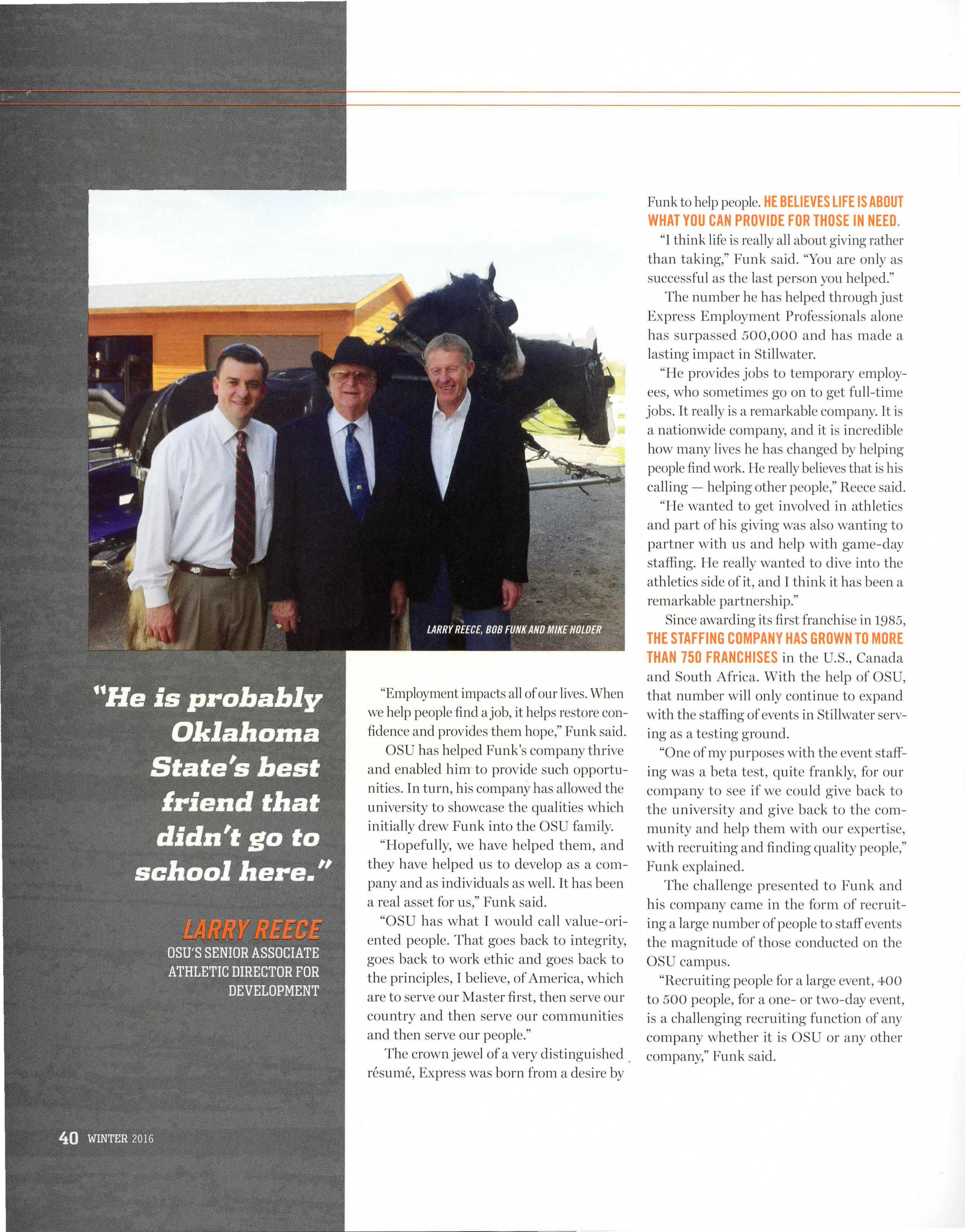
"One of the big reasons that Bob Funk and Oklahoma State are a great fit is simple. We share the same values, which are at the heart of everything we do and every decision that we make. It has been a mutually beneficial relationship in part because we view the world the same way," said OSU Athletics Di rector Mike Holder.
Funk came on board as an athletic donor during the department's Ne.1-t Level campaign, providing continued momentum toward the renovation and expansion of Boone Pickens Stadium.
"I ad mire great salespeople and anybody
In June of 2004, a little more than a year after a $20 million gift toward the campaign came via Pickens, Funk joined the movement to construct one of the finest football facilities in the country. With a $6.5 million pledge to the cause, the stadium's club level now bears the name of Funk's company, Express Employment Professionals, an operation he co-founded. He still serves as the CEO and Chairman of the Board.
"Boone certainly helped out with the programs. With what he initiated and we have participated in as well, l would say he has had an influence on my decision-making and an influence on the donation and the giving that we have had," Funk said.
"Hopefully, we have helped them and they have helped us to develop as a company and as individuals as well."
In addition to the vision for the growth of Cowboy Football, Funk's admiration for the university and its standing as a land grant institution intertwines with the nature of who was as aggressive as he was to come his enterprises. :J and see me umpteen times l felt there was an opportunity there," Funk said.
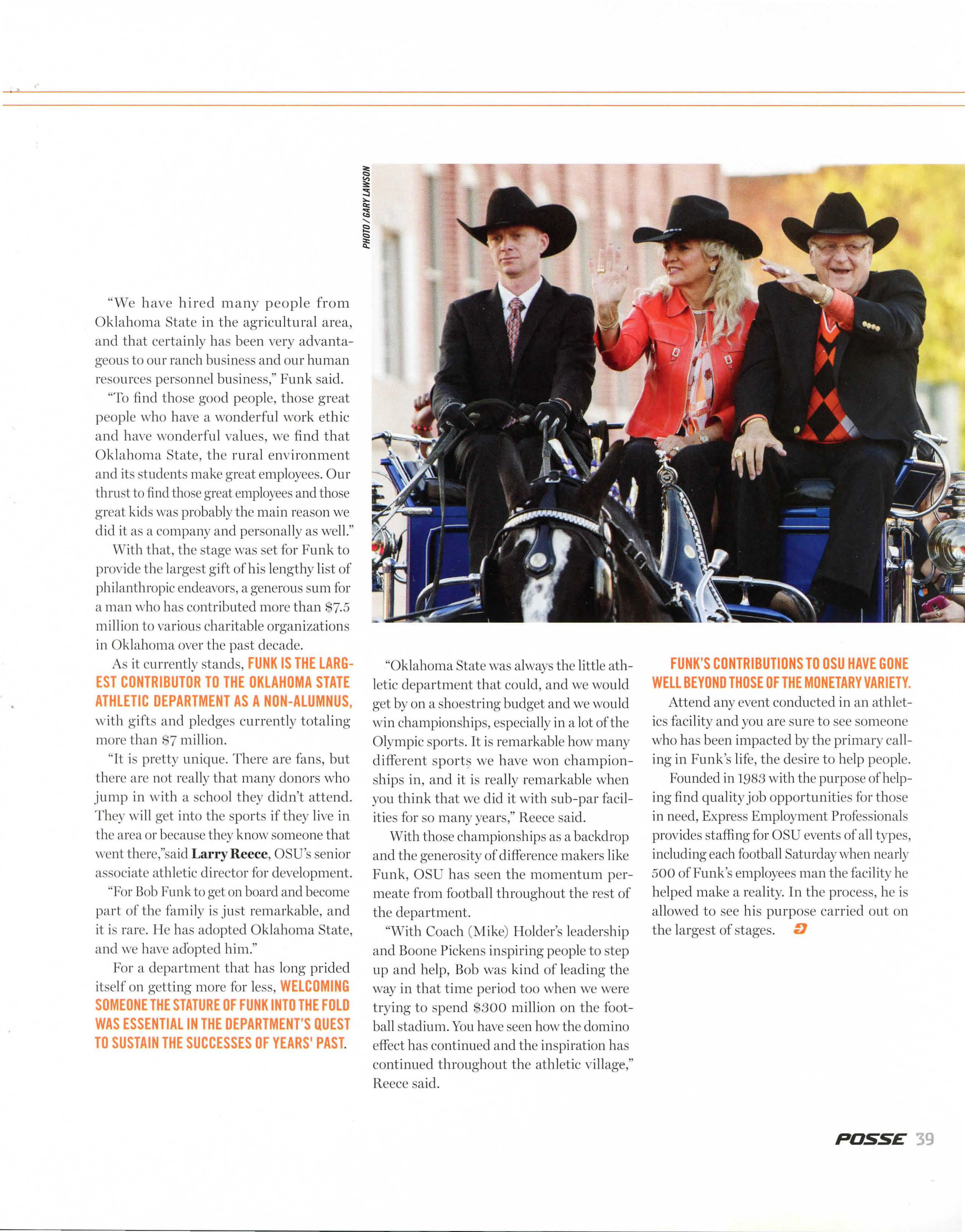
Inspired by the significant funding donated to the campaign by Pickens, FUNK TOOKALEAPOFFAITHANDBOUGHTINTOTHE VISIONFORTHEFUTUREOFOSUATHLETICS PAINTEDBYCLEMONS.
"We have hired many people from Oklahoma State in the agricultural area, and that certainly has been very advantageous to our ranch business and our human resources personnel business," Funk said.
"To find those good people, those great people who have a wonderful work ethic and have wonderful values, we find that Oklahoma State, the rural environment and its students make great employees. Our thrust to find those great employeesand those great kids was probably the main reason we did it as a company and personally as well."
vVith that, the tage was set for Funk to provide the largest gift of his lengthy list of philanthropic endeavor , a generou sum for a man who has contributed more than 87.5 million to various charitable organizations in Oklahoma over the past decade.
As it currently stands, FUNKISTHELARGESTCONTRIBUTORTOTHEOKLAHOMASTATE ATHLETICDEPARTMENTASANON-ALUMNUS, with gift· and pledges currently totaling more than 87 million.
"It is pretty unique. There are fans, but there are not really that many donors who jump in with a school they didn't attend. They will get into the sports if they live in the area or because they know someone that went there,"said Larry Reece, OSU's senior associate athletic di rector for development.
"For Bob Funk to get on board and become part of the family i • just remarkable, and it is rare. He has adopted Oklahoma State, and we have ad'opted him."
"Oklahoma State was always the little athletic department that could, and we would get by on a shoestring budget and we wou Id win championships, especially in a lot of the Olympic sports. It is remarkable how many different sport;; we have won championships in, and it is really remarkable when you think that we did it with sub-par facilities for so many years," Reece said.
With those championships as a backdrop and the generosity of difference makers like Funk, OSU has seen the momentum permeate from football throughout the rest of the department.
For a department that has long prided itself on getting more for less, WELCOMING SOMEONETHESTATUREOFFUNKINTOTHEFOLD WASESSENTIALINTHEDEPARTMENT'SQUEST TOSUSTAINTHESUCCESSESOFYEARS'PAST.
"With Coach (Mike) Holder's leadership and Boone Picken inspiring people to tep up and help, Bob was kind of leading the way in that time period too when we were trying to spend $300 million on the football stadium. You have seen how the domino effect has continued and the inspiration has continued throughout the athletic village," Reece said.
FUNK'SCONTRIBUTIONSTOOSUHAVEGONE WELLBEYONDTHOSEOFTHEMONETARYVARIETY.
Attend any event conducted in an athletics facility and you are sure to see someone who has been impacted by the primary calling in Funk's life, the desire to help people.
Founded in 1983 with the purpose of helping find quality job opportunities for those in need, Express Employment Professionals provides staffing for OSU events of all types, including each football Saturday when nearly 500 of Funk's employees man the facility he helped make a reality. In the process, he is allowed to see his purpose carried out on the largest of stages. :J
"Employment impacts all ofour lives.When we help people find a job, it help· restore confidence and provides them hope," Funk said.
OSU has helped Funk's company thrive and enabled him to provide such opportun itie In turn, his company has allowed the university to showcase the qualities which initially drew Funk into the OSU family.
"Hopefully, we have helped them, and they have helped us to develop as a company and as individuals as well. It has been a real asset for us," Funk aid.
"O U ha what I would call value-oriented people. That goes back to integrity, goes back to work ethic and goes back to the principles, I believe, of America, which are to serve our Master first, then serve our country and then serve our communities and then serve our people."
The crown jewel of a very d isti ngu ished resume, Express was born from a desire by
Funk to help people. HEBELIEVESLIFEISABOUT WHATYOUCANPROVIDEFORTHOSEINNEED.
"I think life is really all about giving rather than taking," Funk said. "You are only as successful as the last person you helped."
The number he has helped through just Express Employment Professional alone ha surpas ed 500,000 and has made a lasting impact in Stillwater.
"I-le provides jobs to temporary employees, who sometimes go on to get full-time jobs. It really is a remarkable company. It i a nationwide company, and it is incredible how many lives he has changed by helping people find work. [-le really believes that is his calling - h lping other people," Reece said.
"He wanted to get involved in athletics and part of his giving was also wanting to partner with us and help with game-day taffing. I le really wanted to dive into the athletics side of it, and l think it has been a remarkable partnership."
Since awarding its firstfranchi c in 1985, THESTAFFINGCOMPANYHASGROWNTOMORE THAN750FRANCHISES in the U.S., Canada and South Africa. With the help of OSU, that number will only continue to expand with the staffing of events in Stillwater serving as a testing ground.
"One of my purposes with the event staffing was a beta test, quite frankly, for our company to see if we could give back to the university and give back to the community and help them with our expertise, with recruiting and finding quality people," Funk explained.
The challenge presented to Funk and his company came in the form of recruiting a large nu mbcr of people to staff events the magnitude of those conducted on the OSU campus.
"Recruiting people for a large event, 400 to 500 people, for a one- or two-day event, is a challenging recruiting function of any company whether it i OSU or any other company," Funk said.
Consider the experiment nothing short of a success as the purpose behind Funk's business ha been met with countless people being provided opportunities, while OS 's operation has benefited from members of his team making the game-day experience flow as smoothly as possible.
"OSU has worked with us on issues they would like to see improved on at times and vice versa. It has been a great partnership and really been a great function for us because of the openness in communication by both parties involved," Funk said.
"I think it has been very beneficial. OSU has reciprocated with us in the training and developing of the program."
The blueprint provided by the athletic department in regard to staffing large-scale events has brought forth the potential for his company's growth throughout the Big 12 footprint and beyond.
'·We aren't certain yet, but we might be able to develop with other universities around the United States as well. We are looking at a couple of other Bigl2teamsancl a couple of the SEC teams right now to try to replicate what we have done at OS . OSU has been willing to help us do that," Funk said.
"The partnership has worked out for both parties, and our relationship with O Uhas been very valuable."
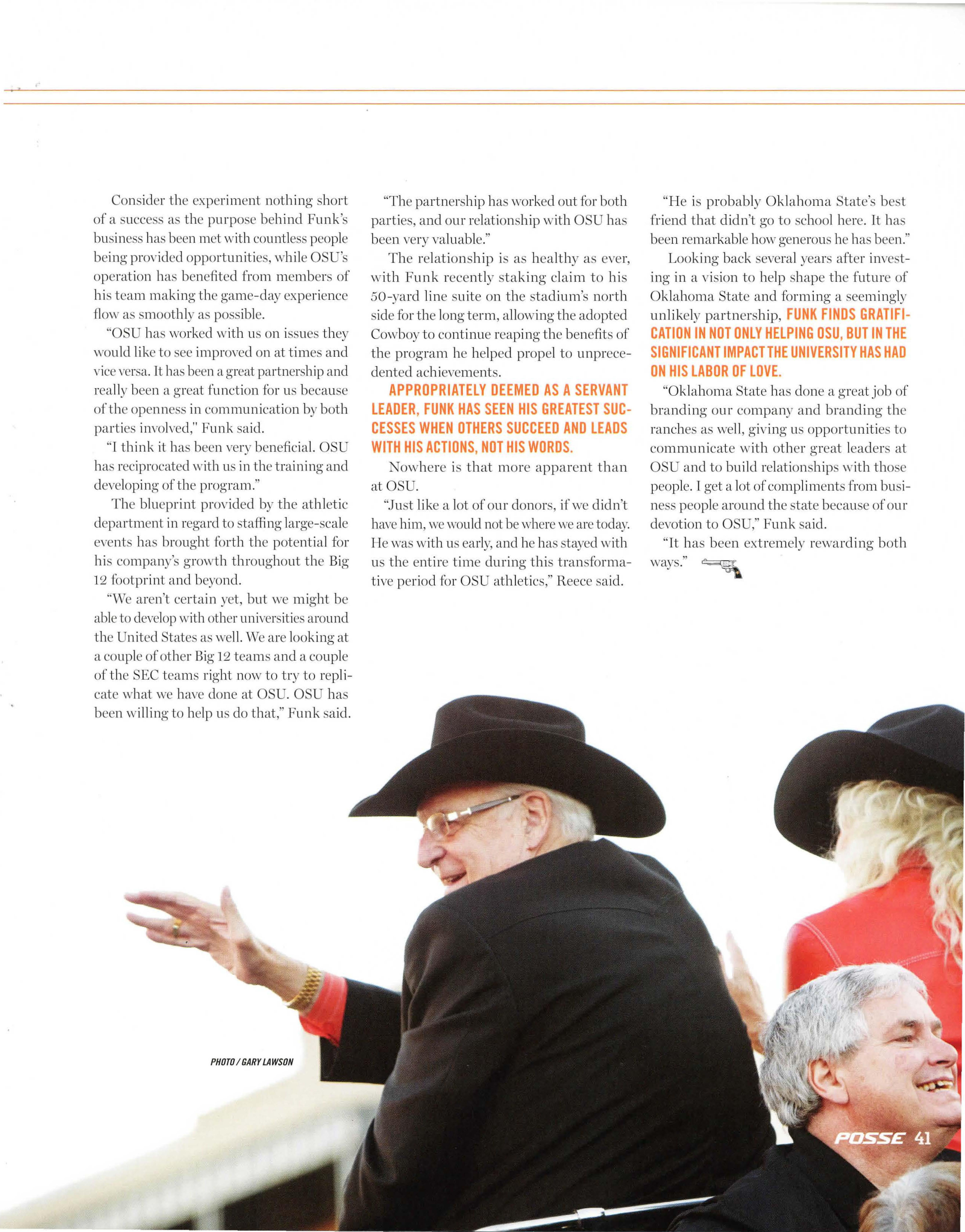
The relationship is as healthy as ever, with Funk recently staking claim to his 50-yarcl line suite on the stadium's north side for the longterm, allowing the adopted Cowboy to continue reaping the benefits of the program he helped propel to unprecedented achievements.
APPROPRIATELYDEEMEDASASERVANT LEADER,FUNKHASSEENHISGREATESTSUCCESSESWHENOTHERSSUCCEEDANDLEADS WITHHISACTIONS,NOTHISWORDS.
Nowhere is that more apparent than atOSU.
"Just Iike a lot of our donors, if we didn't have him, we would not be where we arc today. He was with us early, and he has stayed with us the entire time during this transformative period for OSU athletics," Reece said.
"He is probably Oklahoma State's best friend that clid n't go to school here. It has been remarkable how generous he has been."
Looking back several years after investing in a vision to help shape the future of Oklahoma State and forming a seemingly unlikely partnership, FUNKFINDSGRATIFICATIONINNOTONLYHELPINGOSU,BUTINTHE SIGNIFICANTIMPACTTHEUNIVERSITYHASHAD ONHISLABOROFLOVE.
"Oklahoma State has done a great job of branding our company and branding the ranches as well, giving us opportunities to communicate with other great leaders at OSU and to build relationships with those people. l get a lot of comp! imen ts from business people around the state because of our devotion to OSU," Funk said.
"It has been extremely rewarding both ways."
PHOTO/GARYLAWSON
"The deafening rhythm has become an OSU trademark, an indi$pensable part of the game-day experience, rallying the home team and distracting opponents."
- TulsaWorld
STORYBYJOHN HELSLEY
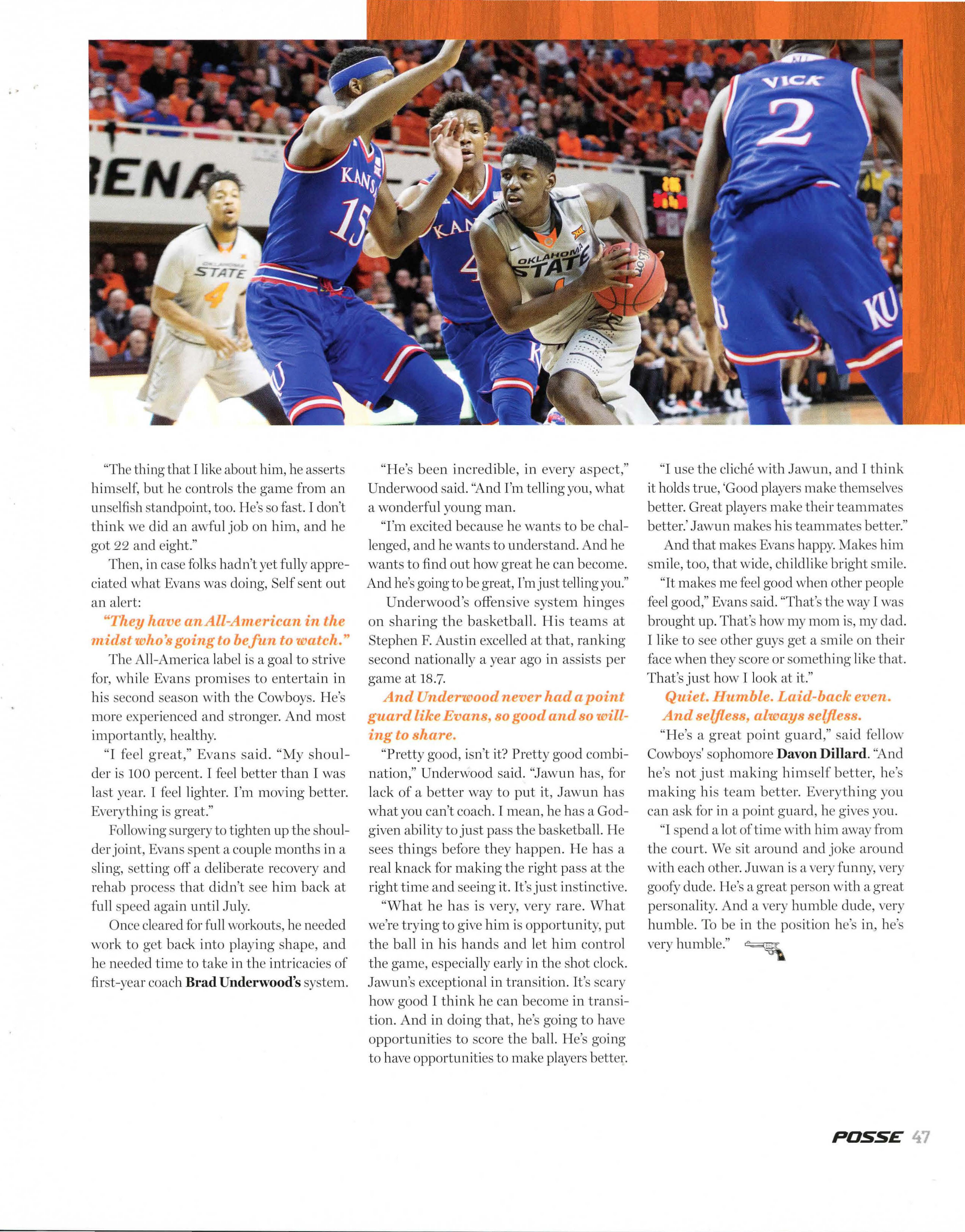
"There's so much stuff he does," said TavariusShine, one of Evans' closest friends on the Oklahoma State ba ·ketball squad. "He likes to mock people. He's one of those guys who's alway messing around with you, nagging on you. But it's not annoying, becau e it's just .Jawun. Of course, he always has the biggest smile on his face."
Ah yes, the smile.
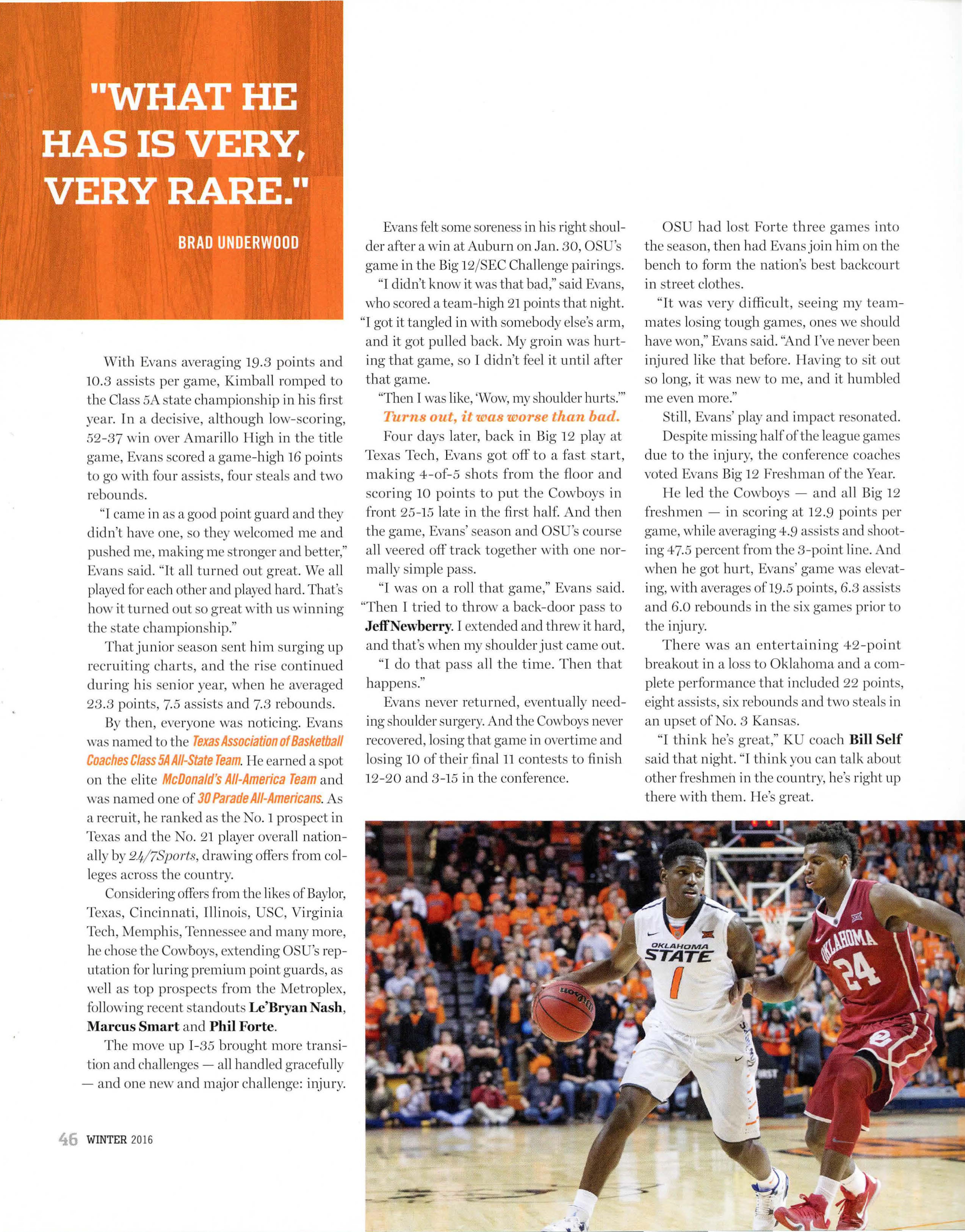
Jawun Evans betrays his own cool with his smile. And not just any smile, a wide, face-creasing smile that reveals a chi Id Iike quality that's all at once endearing.
A 11of it leads to what's truly cool about Evans. While he's a star, a preseason All-Big 12 pick and one of the premier point guards in the country with plenty of reason to be proud, he's far from proud.
Instead, he's selfless, going against the grain at a time when many athletes focus first on themselves, preferring to deflect the spotlight onto others.
And when it works on the floor, when he feeds teammates for easy baskets - one of his specialties as a smooth and slick passerthat's when the Evans' smile reaches full glow. "I want to see other people shine," he said.
And with that, Evans shines.
Born and raised mostly in Greenville, S.C., Evans built his game in the footsteps ofh is older brother, Brandon. Wherever Brandon would go, Jawun would follow, pounding a basketbal I off the pavement.
"I always had the ball in my hand, d1·ibbling, dribbling, wherever I went," Evans said. "That's what made me better. And Brandon is the one who put the ball in my hands. I've just been learning from him.
"We're opposite; he's a shooter. I mean, he can do everything, but he's a knock-down shooter. And I'm like the complete point guard. But he's the one who always put the ball in my hands. Wherever he'd go, I'd go."
Jawun looks forward to following Brandon to the playground again some day, this time with something serious on his mind.
Winning at one-on-one.
"He always used to beat me," Jawun said, laughing. "He made me mad. But I'd always keep playing. I still ain't beaten him to this day.
"But I'm going to go home, and we're going to play one-on-one, so he can see who has it and who the better brother is."
The brothers are about the same size, although Brandon i seven years older. So he's got that big brother thing working for him fully. Still, while he couldn't get it done all those other times, .Juwan has a playful promise f:or Brandon.
"Next time," he said.
"I've been in college. l've been in the weight room and working on my game a lot. o that's probably going to be the difference."
Jawu n eventually peeled away from Brandon, and from Greenville, with a detour presenting a radical change before his junior season of high school as he and his mother transplanted to Dallas. Understandably, there were some tricky adjustments to navigate.
"Not knowing anybody, going to a new school, being in a big city, it was different," Evans said. "And it was just me and my mom." Him being him, however, Evans fit in. And it didn't hurt that Kimball High needed a point guard.
"They welcomed me in great, like I'd been there forever," he said. "To this day, l'm their brother."
Initially, the move required some adjustments. New home. New school. New friends and teammates.
S0011 enough, however, Evans found his stride, on and off thejloor.
"School got easier. Basketball got easier," he said.
Basketball got good at Kimball, too. Ell
"WHAT HE HAS IS VERY, VERY RARE."
BRADUNDERWOOD
With Evans averaging 19.3 points and 10.3 assists per game, Kimball romped to the Class SA state championship in his first year. fn a decisive, although low-scoring, 52-37 win over Amarillo High in the title game, Evans scored a game-high 16 points to go with four assists, four steals and two rebounds.
"T came in as a good point guard and they didn't have one, so they welcomed me and pushed me, making me stronger and better," Evans said. "lt all turned out great. We all played for each other and played hard. That's how it turned out so great with u winning the state champion hip."
That junior season sent him surging up recruiting charts, and the rise continued during his senior year, when he averaged 23.3 points, 7.5 assists and 7.3 rebounds.
Evans felt some soreness in his right shoulder after a win at Auburn on Jan. 30, OSU's game in the Big 12/SEC Challenge pairings.
"I didn't know it was that bad," said Evans, who scored a team-high 21 points that night. "I got it tangled in with somebody else's arm, and it got pulled back. My groin was hurting that game, sol didn't feel it until after that game.
'Then I was like, 'Wow,my shoulder hurts."' Turns out, it was worse than bad.
Four days later, back in Big 12 play at Texas Tech, Evans got off to a fast start, making 4-of-5 shots from the floor and scoring 10 points to put the Cowboys in front 25-15 late in the first half. And then the game, Evans' season and OSU's cour e all veered off track together with one normally irnple pass.
"I was on a roll that game," Evans said. "Then I tried to th row a back-door pass to JeffNewberry. I extended and threw it hard, and that's when my shoulder just came out.
"I do that pass all the time. Then that happens."
Evans never returned, eventually needing shoulder surgery. And the Cowboys never recovered, losing that game in overtime and losing 10 of their final 11 contests to finish 12-20 and 3-15 in the conference.
By then, everyone was noticing. Evans was named to the TexasAssociationo!Basketbal/ CoachesClass5AAII-StateTeam.He earned a spot on the elite McDonald'sAlf-AmericaTeamand •vas named one of 30ParadeA/I-Americans. As a recruit, he ranked as the No. 1 prospect in Texas and the No. 21 player overall nationally by 24/7Sports, drawing offers from colleges across the country.
Considering offers from the Iikes of Baylor, Texas, Cincinnati, lllinois, USC, Virginia Tech, Memphis, Tennessee and many more, he chose the Cowboys, extending OSU's reputation for luring premium point guards, as well as top prospects from the Metroplex, following recent standouts Le'Bryan Nash, Marcus Smart and Phi] Forte.
The move up 1-35 brought more transition and challenges - all handled gracefully - and one new and major challenge: injury.
OSU had lost Forte three games into the season, then had Evans join him on the bench to form the nation's best backcourt in street clothes.
"It was very difficult, seeing my teammates losing tough games, ones we hould have won," Evans said. "And l've never been injured like that before. Having to sit out so long, it wa new to me, and it humbled me even more."
Still, Evans' play and impact resonated.
Despite missing half of the league games due to the injury, the conference coaches voted Evans Big 12 Freshman of the Year.
He led the Cowboys - and all Big 12 freshmen - in scoring at 12.9 points per game, while averaging 4.9 assists and shooting 47.5 percent from the 3-point line. And when he got hurt, Evans' game was elevating, with averages ofl9.5 points, 6.3 assists and 6.0 rebounds in the six games prior to the injury.
There was an entertaining 42-point breakout in a loss to Oklahoma and a complete performance that included 22 points, eight assists, six rebounds and two steals in an upset of No. 3 Kansas.
"I think he's great," KU coach BiH Self said that night. "I think you can talk about other freshmen in the country, he's right up there with them. He's great
"The thingthatl like about him, he asserts him elf, but he controls the game from an unselfish standpoint, too. He's so fast. I don't think we did an awful job on him, and he got 22 and eight."
Then, in case folks hadn't yet fully appreciated what Evans was doing, Self ·ent out an alert:
"They have anAll-American in the midst who s going to befun to watch."
The All-America label is a goal to strive for, while Evans promises to entertain in his second season with the Cowboys. He's more experienced and stronger. And most importantly, healthy.
"I feel great," Evans said. "My shoulder is 100 percent. I feel better than I was last year. I feel lighter. I'm moving better. Everything is great."
Following surgery to tighten up the shou Ider joint, Evans spent a couple months in a sling, setting off a deliberate recovery and rehab process that didn't see him back at full speed again until July.
Once cleared for full workouts, he needed work to get back into playing shape, and he needed time to take in the intricacies of
"He's been incredible, in every aspect," Underwood said. "And I'm telling you, what a wonderful young man.
'Tm excited because he wants to be challenged, and he wants to understand. And he wants to find out how great he can become. And he'sgoingto be great, l'mjusttellingyou."
Underwood's offensive y tern hinges on sharing the basketball. His teams at Stephen F. Austin excelled at that, ranking second nationally a year ago in assists per game at 18.7.
And Underwood never had a point guard like Evans, so good and so willing to share.
"Pretty good, isn't it? Pretty good combination," Underwood said. "Jawun has, for lack of a better way to put it, Jawun has what you can't coach. I mean, he has a Godgiven ability to just pass the basketball. He sees things before they happen. He has a real knack for making the right pass at the right time and eeing it. Tt'sjust in tinctive.
"What he has is very, very rare. What we're trying to give him is opportunity, put the ball in his hands and let him control the game, especially early in the shot clock. first-year coach Brad Underwood's system. .Jawun's exceptional in transition. It's scary how good I think he can become in transition. And in doing that, he' going to have opportunities to score the ball. He's going to have opportunities to make players better.
"I use the cliche with Jawun, and l think it holds true, 'Good players make themselves better. Great players make their team mates better.' .Jawun makes his teammates better."
And that makes Evans happy. Makes him smile, too, that wide, childlike bright smile.
"It makes me feel good when other people feel good," Evans said. "That's the way I was brought up. That's how my mom is, my dad. I like to see other guys get a smile on their face when they score or something like that. That's just how I look at it."
Quiet. Humble. Laid-back even. And selfless, always selfless.
"He's a great point guard," said fellow Cowboys' sophomore Davon Dillard. "And he's not just making himself better, he's making his team better. Everything you can ask for in a point guard, he gives you.
"I spend a lot of ti me with him away from the court. We sit around and joke around with each other. Ju wan is a very funny, very goofy elude. He's a great person with a great personality. And a very humble elude, very humble. To be in the position he's in, he's very humble."
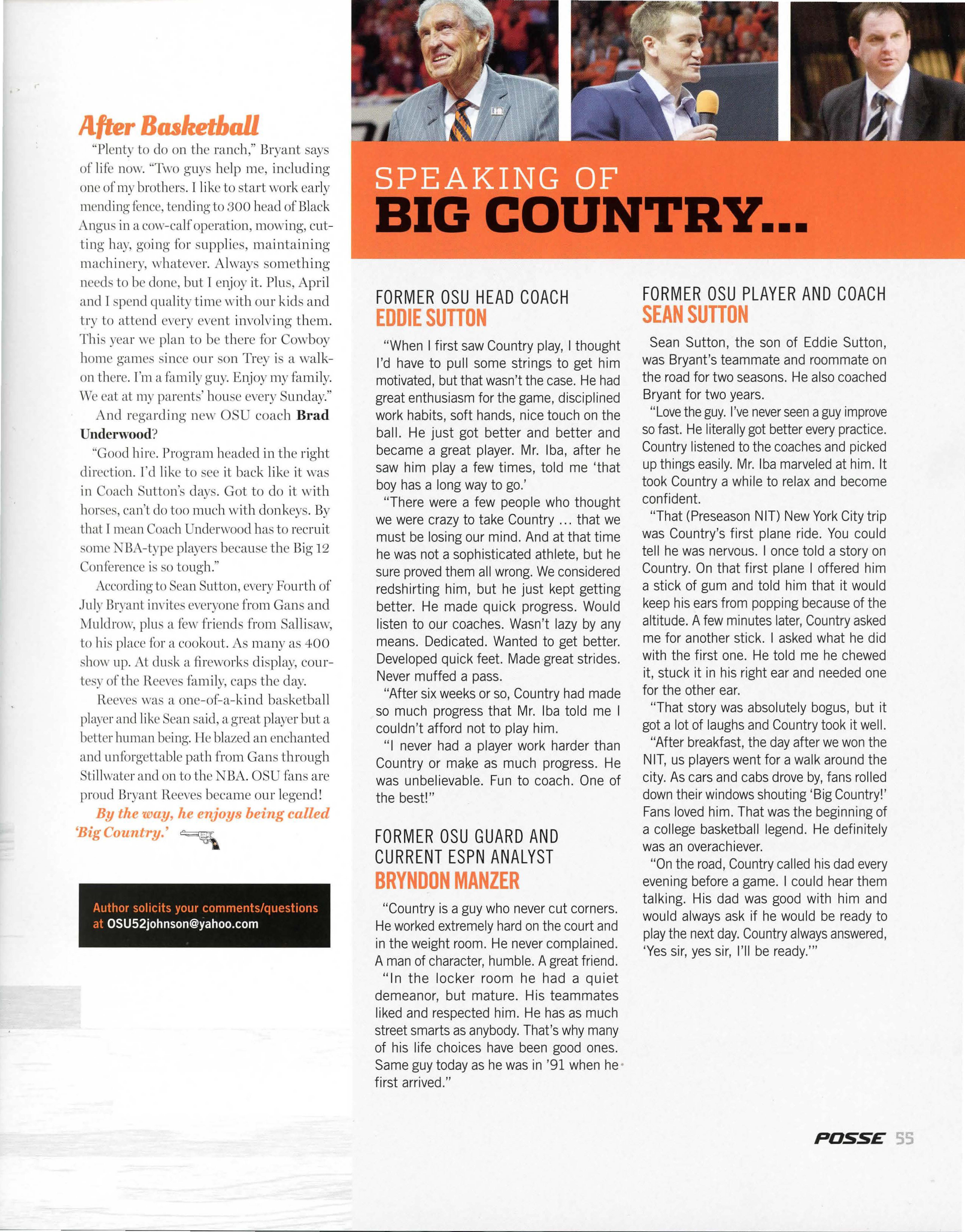
The slender Bob Kurland (1943-46) was one of the first outstanding 7-footers in college basketball and had a tremendous impact on the game. He led the Aggies to back-to-back NCAA titles. Because of his ability to swat opponents' shots away at the rim. the goaltending rule was invented. Kurland once scored 58 points in a game and also won Olympic gold medals in 1948 and 1952.
Byron Houston (1989-92). stood 6-5 and was chiseled. He was a muscular and gifted athlete who played above the rim. He became the Cowboys· all-time leading scorer, set a school record for highest career scoring average and also holds school records for career rebounds, career blocks and most made free throws.
A four-time all-Big Eight selection. Houston led the Pokes to the 1991 Big Eight championship and to the Sweet 16 of the NCAA Tournament twice. He went on to play four years in the NBA.
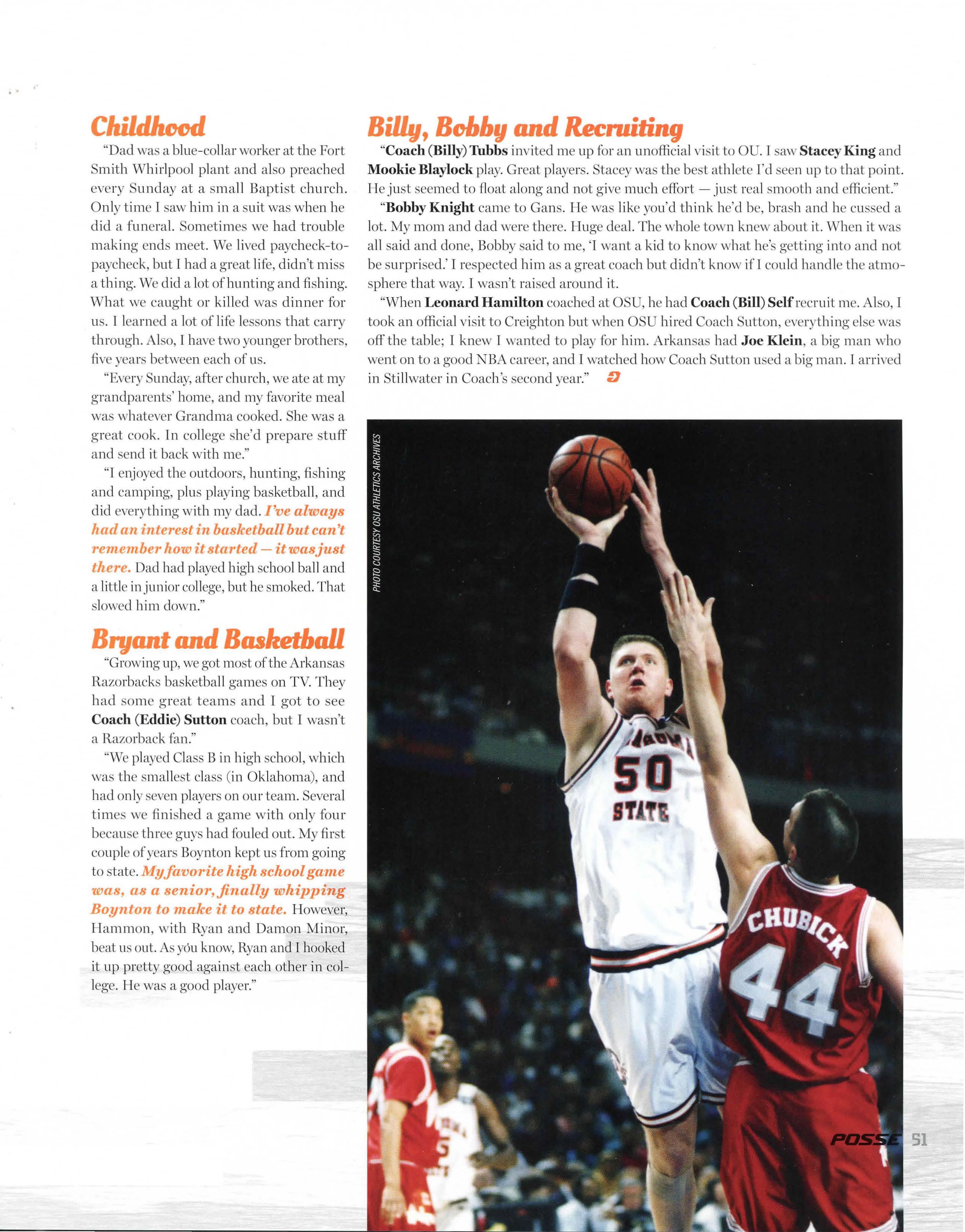
Bryant Reeves (1992-95). another seven-footer, came to Stillwater as a project but quickly became a player, averaging 8.1 points per game his freshman season on a squad that won the preseason NIT and advanced to the Sweet 16.
As a senior, Reeves, a two-time Big Eight Conference Player of the Year, led the Pokes to the 1995 Final Four. He was the sixth overall pick in the NBA Draft by the Vancouver Grizzlies and was named to the league's all-rookie team. He spent eight years in the NBA.
It was this last player that piqued my interest. • I was on a mission with my objective
At 6:+5 a.m., in the morning dark, l left Edmond for the 168-mile drive to meet Bryant at his 6,200-acre ranch outside of his hometown of Gans, just west of the Arkansas border. Temperature was in the mid-70s. It was a perfect day.
Nearly three hours later, l exited at Sallisaw and drove south, following Bryant's instructions to his home. As I drove the last mile on a gravel road to the entrance ofhi property, I caught glimpses of water through tall hackberry trees amidst the rolling hills. That water turned out to be the Arkansas River. Suddenly, on my left, the trees thinned out, and I saw the beginning of Bryant's pread. A sturdy dark brown cable and tubular fence marked the property 1ine. The meadow had been deared a ncl seeded. lt was green and neatly mowed. Black Angus cattle dotted the picturesque landscape. Approaching the property's entrance were two ma sive nine-feet tall curved black iron gates, turdily supported by a gray oval stone loundation. Centered on each gate was a two-foot diameter "R" et in a circle and painted orange. I punched the call-box key and the gate opened.
Driving on for about one-eighth of a mi le, a gray stone, two-story m,0estic house came into view. It reminded me somewhat of a modern, med ium-sizcd medieval castle. l rang the doorbell and immediately received a greeting.
"Hi. I'm April," said Bryant's wife. "You mu t be Gene. Please come in."
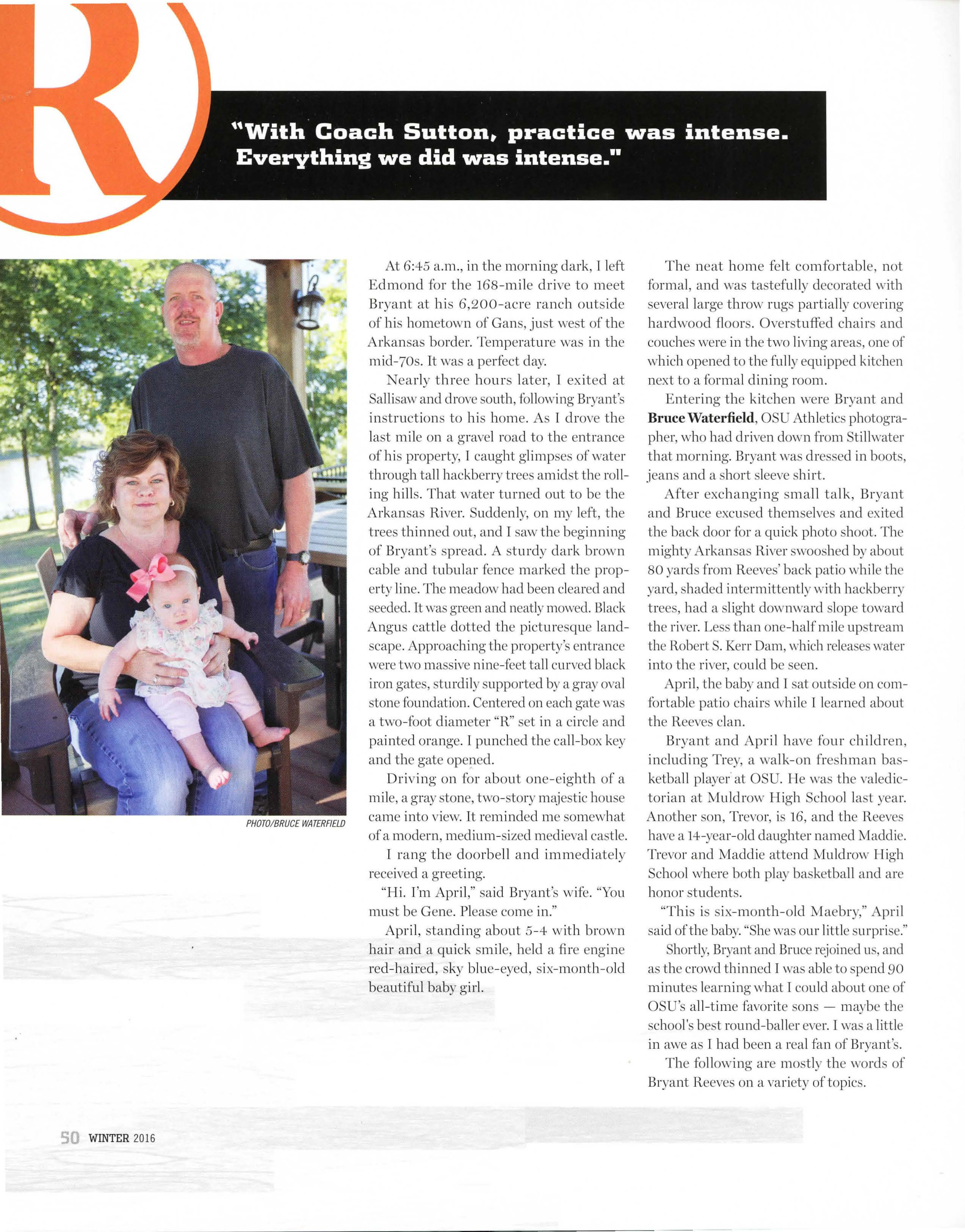
April, standing about 5-4 with brown hair and a quick mile, held a fire engine red-haired, ky blue-eyed, six-month-old beautiful baby girl.
The neat home felt comfortable, not formal, and vrns tastefully decorated with several large throw rugs partially covering hardwood floor Overstuffed chair and couches were in the two 1ivi ng area , one of which opened to the fully equipped kitchen next to a formal dining room.
Entering the kitchen were Bryant and Bruce Waterfield, OSU Athletics photographer, who had driven down from Stillwater that morning. Bryant was dressed in boots, jeans and a short sleeve shirt.
After exchanging small talk, Bryant and Bruce excu ·eel themselves and exited the back door for a quick photo shoot. The mighty Arkansa • River swooshed by about 80 yards from Reeves' back patio while the yard, shaded intermittently with hackberry tree , had a slight downward slope toward the river. Less than one-half mile up tream the Robert S. Kerr Dam, which r leases water into the river, could be een.
April, the baby and l sat outside on comfortable patio chairs while I learned about the Reeves clan.
Bryant and April have four children, including Trey, a walk-on freshman basketball player at OSU. I-le was the valedictorian at Muldrow High School last year. Another son, Trevor, is 16, and the Reeves have a l+-year-old daughter named Maddie. Trevor and Maddie attend Muldrow High School where both play basketball and arc honor students.
"This i six-month-old Maebry," April said of the baby. "She was our little surprise."
Shortly, Bryant and Bruce r~joined us, and as the crowd thin ncd I was able to spend 90 mim1tes learning what I could about one of OSU's all-time favorite sons - maybe the school's be t rou nd-bal !er ever. I was a Iittle in awe as 1 had been a real fan of Bryant's. The following are mostly the words of Bryant Reeves on a variety of topics.
Childlaood
"Dael was a blue-collar worker at the Fort Smith Whirlpool plant and also preached every Sunday at a small Baptist church. Only time I saw bim in a suit was when he did a funeral. Sometimes we had trouble making encl meet. We lived paycheck-topaycheck, but I had a great life, didn't mi • a thing. Wed id a lot of hunting and fishing. What we caught or killed was dinner for us. I learned a lot of Iife le sons that carry through. Al o, f have two younger brothers, five year between each of us.
"Every Sunday, after church, we ate at my grandparents' home, and my favorite meal was whatever Grandma cooked. She was a great cook. ln college she'd prepare stuff and send it back with me."
'·] enjoyed the outdoors, hunting, fishing and camping, plus playing basketball, and did everything with my clad. I've always had cm interest in basketball but can't remember how it started - it was just there. Da I had played high school ball and a little in junior college, but he smoked. That slowed him clown."
Bryant and Basketball
"Growing up, we got most of the Arkansas Razorbacks basketball games on TV. They had some great teams and I got to see Coach (Eddie) Sutton coach, but I wasn't a Razorback fan."
"We played Class Bin high school, which was the smallest class (in Oklahoma), and had only seven players on our team. Several times we finished a game with only four becau ethreeguys had fouled out. My first couple of years Boynton kept us from going to state. My favorite high school game was, as a senior,finally whipping Boynton to make it to state. However, Hammon, with Ryan and Damon Minor, beat us out. As you know, Ryan and l hooked it up pretty good against each other in college. He was a good player."
Billy, Bobby and Recmiting
"Coach (Billy) Tubbs invited me up for an unofficial vi ·it to OU. I saw Stacey King and MookieBlaylock play. Great players. Stacey was the best athlete I"d seen up to that point. I-lejust seemed to float along and not give much effort - just real smooth and efficient."
"Bobby Knight came to Gans. He was like you'd think he'd be, brash and he cussed a lot. My mom and clad were there. Huge deal. The whole town knew about it. When it was all said and done, Bobby said to me, 'I want a kid to know what he's getting into and not be surprised.' I respected him as a great coach but didn't know ifl could handle the atn10sphere that way. I wasn't raised around it.
"When Leonard Hamilton coached at OSU, he had Coach (Bill) Self recruit me. Also, I took an official visit to Creighton but when OSU hired Coa ·h utton, everything else wa off the table; I knew l wanted to play for him. Arkansas had Joe KJein, a big man who went on to a good NBA career, and 1 watched how Coach Sutton used a big man. I arrived in Sti IIwater in Coach's second year." :J
Life in Stillwater
Two weeks after graduating high school, Bryant moved to Stillwater.
"They had me pouring concrete in the football parking lot, 100-plus-degree heat, five days a week, and then in the evenings we'd play basketball for a couple of hours in Gallagher Hall. After that I was too ti red to do anything except go to bed and get rested for the next day.
"Coach wou Id be somewhere in the stands watching. A lot of ti mes Coach (Henry) Iba was there as well, especially when official practice began. The whole thing was new to me. I'd never lifted weights, and I was now living in an apartment."
"With Coach Sutton, practice was intense. Everything we did was intense. We even ate together as a team. He expected so much out of everyone, ah igher standard. I don't know any funny stories on him. It was all business. He believed in team bonding. There were fights on the court, but you left it there. He knew everything that was going on in our lives. Every day we players, individually, were required to drop by his office for a
short chat. Sometimes it was about practice, classwork, our next opponent or whatever. I'd say Coach was a micromanager, but looking back, that was a good thing. He didn't want us in any trouble. He believed it was all about us players, making sure we were doing what we were supposed to do. Also, Coach had a lot of pride, and with Mr. Iba being there, there was pressure on Coach to turn the program around."
"Coach Self worked with us big guys: post moves, rebounding, the whole nine yards. I did have soft hands and could shoot a bit, which I believe is a God-given ability. My freshman year I started 34 of 36 games. I had to believe I was good enough to be on the floor. That's the way 1 was raised."
The 1991-92 season, Bryant's freshman campaign, the Pokes had an experienceladen ball club with seniors Corey Williams, DarwinAlexander and All-American Byron Houston, plus sharpshooter Sean Sutton.
Bryant averaged 8.1points per game, connecting on 52 percent of his shots, and proved himself to be an integral cog on that squad. They captured the championship of the preseason NIT in New York City, started the season 20-0 and climbed to second in the national polls. The season ended in the Sweet 16 against Michigan's Fab Five freshmen.
A Semon of finb and the Birthof 'Countrv'
"There were lots of firsts for me that year. New York City was shocking. Firsttime on a plane, being on my own, first time to be out of eastern Oklahoma for more than a day or so. It opened my eyes and was a whole new cultural aspect.
"Playing in Madison Square Garden. How do you top that for a first trip? Doing what I loved to do was huge!
"In the locker room, Byron jokingly said that all us white people looked alike. Then he said since I was from a real small place he wou Id call me 'Big Country,' and it stuck. To this day, I see fans on campus or people at different events and they holler out 'Big Country' and wave. 1 think most of them don't know my real name."
AStarisBcm
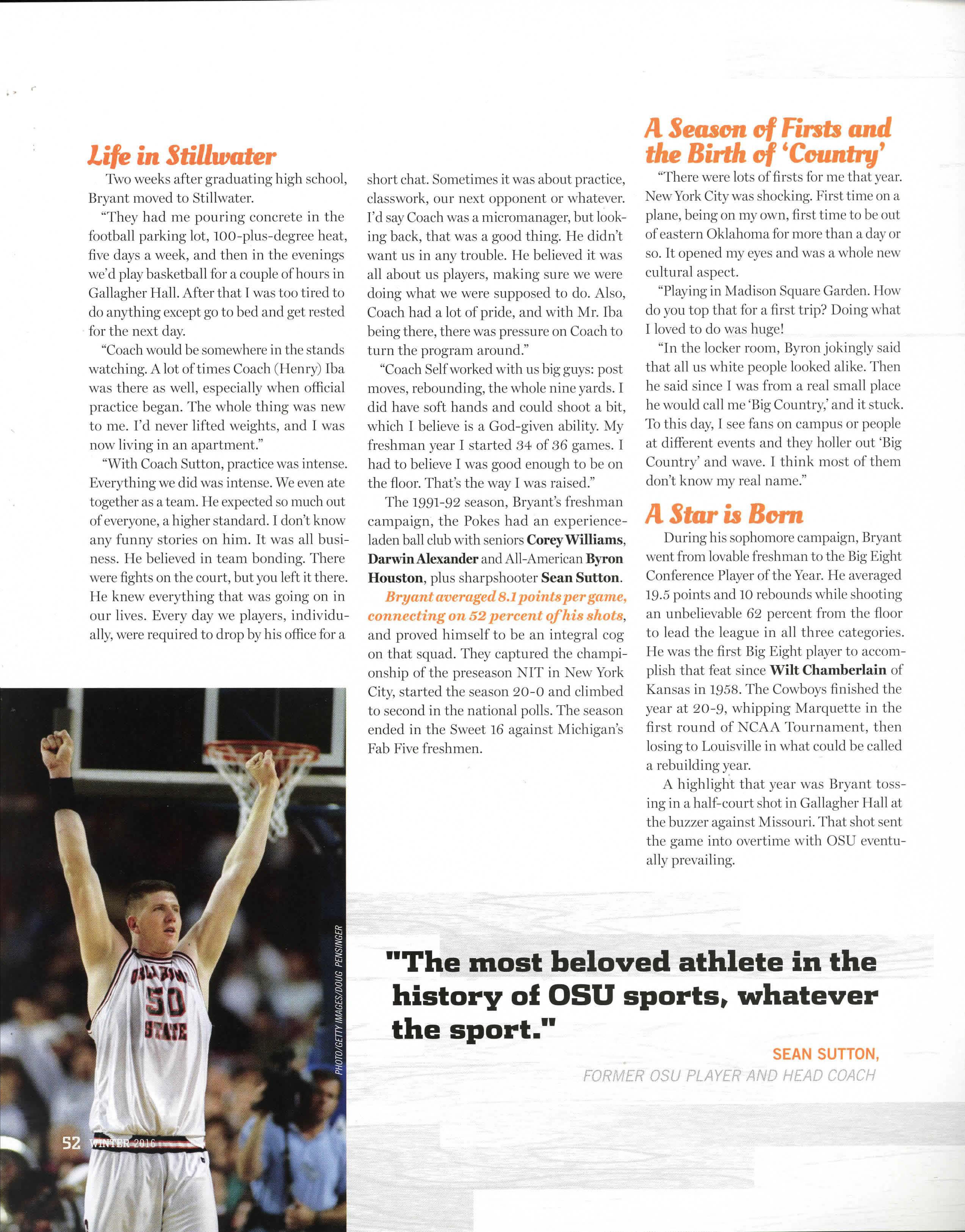
During his sophomore campaign, Bryant went from lovable freshman to the Big Eight Conference Player of the Year. He averaged 19.5 points and JO rebounds while shooting an unbelievable 62 percent from the floor to lead the league in all three categories. He was the first Big Eight player to accomplish that foat si nee Wilt Chamberlain of Kansas in 1958. The Cowboys finished the year at 20-9, whipping Marquette in the first round of NCAA Tournament, then losing to Louisville in what could be called a rebuilding year.
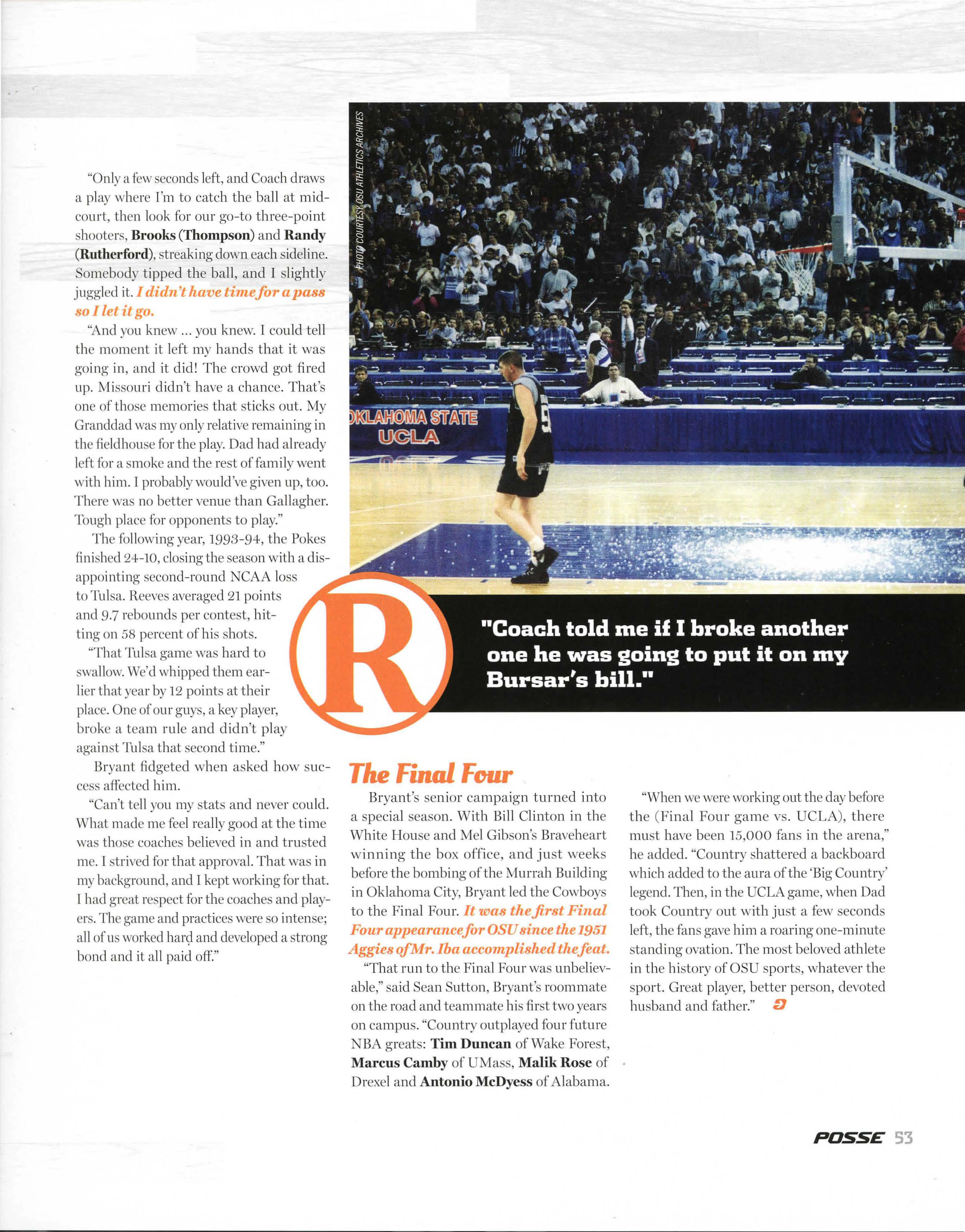
A high Iigl~t that year was Bryant tossing in a half-court shot in Gallagher Hall at the buzzer against Missouri. That shot sent the game into overtime with OSU eventually prevailing.
"The most beloved athlete in the history of OSU sports. whatever the sport."
SEAN SUTTON, FORMEROSU PLAYERAND HEAD COACH
"Only a few seconds left, and Coach draws a play where l'm to catch the ball at midcourt, then look for our go-to three-point shooters, Brooks (Thompson) and Randy (Rutl1erfo1·d),streaking down each sideline. Somebody tipped the ball, and I slightly .iuggled it. I didn't have time for a pass so I let it go.
"And you knew you knew. [ could tell the moment it left my hands that it was going in, and it did! The crowd got fired up. Missouri didn't have a chance. That's one of those memories that sticks out. My Granclclaclwas my only relative remaining in the fieldhouse for the play. Dael had already left for a smoke and the rest of family went with him. l probably would've given up, too. There was no better venue than Gallagher. Tough place for opponents to play."
The following year, 1993-9+, the Pokes finished 24-10, closing the season with a disappointing scconcl-rouncl NCAA loss to Tu Isa. Reeves averaged 21 points and 9.7 rebounds per contest, hitting on 58 percent of his shots.
"That Tulsa game was bard to swallow. We'd whipped them earlier that year by 12 points at their place. One of our guys, a key player, broke a team rule and didn't play against Tulsa that second time."
Bryant fidgeted when asked how success affected him.
"Can't tell you my stats and never could. What made me feel really good at the time was those coaches believed in and trusted me. [ strived for that approval. That was in my background, and I kept working for that. 1 had great respect for the coaches and player . The game and practices were so intense; al I of us worked harc,land developed a trong bond and it al I paid off."
TheFinal four
Bryant's senior campaign turned into a special season. With Bill Clinton in the White House and Mel Gibson's Braveheart winning tbe box office, and just weeks before the bombing of the iurrab Building in Oklahoma City, Bryant led the Cowboys to the Final Four. /twas the.first Final Four appearancefor OSU since the 1951 Aggies cifMr. Iba accomplished the feat.
"That run to the Final Four was unbelievable," said Sean Sutton, Bryant's roommate on the road and team mate his first two years on campus. "Country outplayed four future NBA greats: Tim Duncan of Wake Forest, Marcus Camby of UM ass, Malik Rose of Drexel and Antonio McDyess of Alabama.
"When we were workingouttbe day before the (Final Four game vs. UCLA), there must have been 15,000 fans in the arena," he added. "Country shattered a backboard which added to the aura of the 'Big Country' legend. Then, in the UCLA game, when Dad took Country out with just a few seconds left, the fans gave him a roaring one-minute standing ovation. The most beloved athlete in the history of OSU sports, whatever the sport. Great player, better per on, cl voted husband and father." :,
Previously that year Bryant shattered a backboard in Stillw,lter.
"Coach told me if [ broke another one he was going to put it on rny Bursar's bill," Byrant grinned. "The one in eattlc, I. definitely didn't do on purpose, the stars were just lined up right."
Bryant has strong memories of the Final Four.
"Disappointing ... hard to deal with. We were fired up thought we had a shot to win it all. Still think we should have won it. In th' moment it wa very disappointing. We let the national title get away. Something you don't forget. That Final Four run was the greatest three weeks you could ask for as a player."
Earlier that season in Stillwater, Bryant scored 33 points and grabbed 20 rebounds in a win over the Jayhawks. Eddie Sutton called it one of the top 10 performances ever by an Aggie/Cowboy player.
AfterOSU
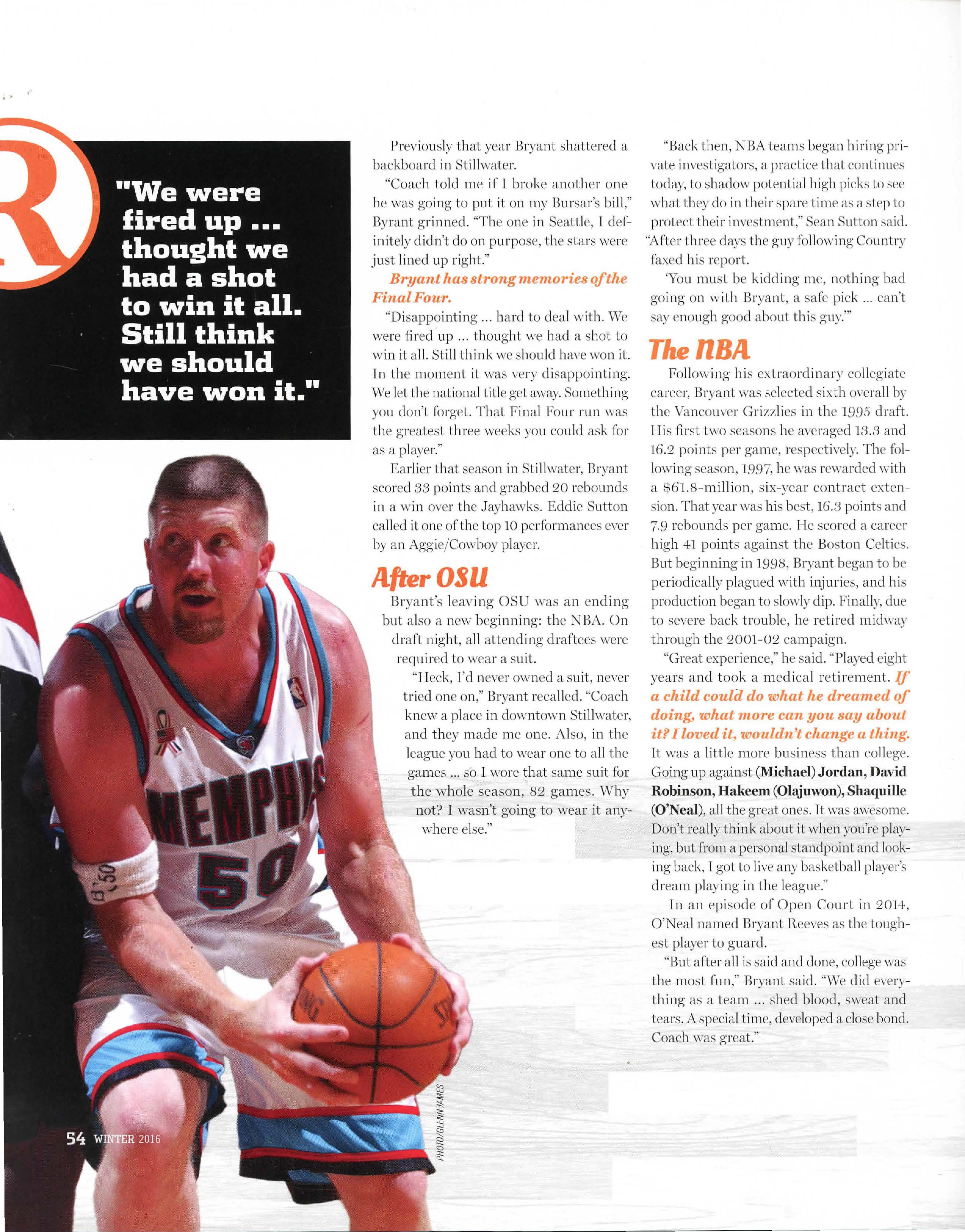
Bryant's leaving O U was an ending but also a new beginning: the NBA. On draft night, all attending draftees were required to wear a suit.
"Heck, l'd never owned a suit, never tried one on," Bryant recalled. "Coach knew a place in downtown Stillwater, and they made me one. Also, in the league you had to wear one to all the games so 1 wore that same suit for the whole season, 82 games. Why not? l wasn't going to wear it anywhere else."
"Back then, NBA teams began hiring private investigator , a practice that continues today, to shadow potential high picks to see what they do in their spare ti me as a step to protect their investment," Sean Sutton said. "After three days the guy following Country faxed his report.
'You must be kidding me, nothing bad going on with Bryant, a safe pick ... can't ay enough good about this guy."'
ThellBA
Following his extraordinary collegiate career, Bryant was selected sixth overall by the Vancouver Grizzlies in the 1995 draft. l Iis fir t two seasons he averaged 13.3 and 16.2 points per game, respectively. The following eason, 1997, he was rewarded with a $61.8-million, six-year contract extension. That year was his best, 16.3 points and 7.9 rebounds per game. He scored a career high +l point against the Bo ton Celtics. But beginning in 1998, Bryant began to be periodically plagued with injuries, and his production began to slowly clip. Finally, clue to severe back trouble, he retired midway through the 2001-02 campaign.
"Great experience," he said." Played eight years and took a medical retirement. JJ' a child could do what he dreamed of doing, what more can you say about it? I loved it, wouldn't change a thing. It was a little more busine s than college. Going up against (Michael) Jordan, David Robinson, Hakeem (Olajuwon), Shaquille (O'Neal), al I the great ones. lt was awesome. Don't reallythink about it when you're playing, but from a personal standpoint and looking back, 1 got to live any basketball player's dream playing in the league."
In an episode of Open Court in 201+, O'Neal named Bryant Reeves as the toughest player to guard.
"But after all is said and done, college was the most fun," Bryant said. "We did everything as a team ... shed blood, sweat and tears. A special time, developed a close b ncl. Coach was great."
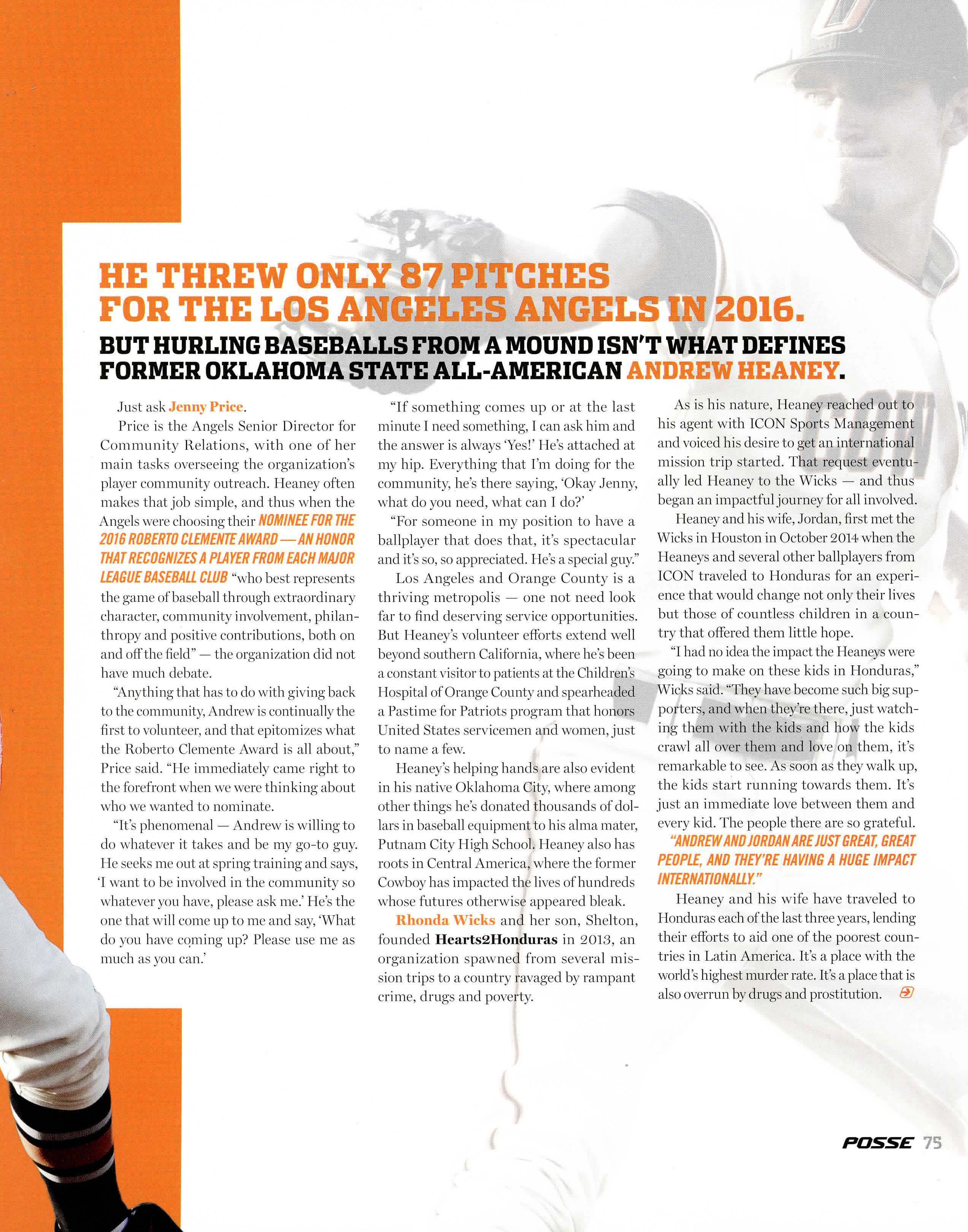
HE THREW ONLY 8 PITCHES FOR THE LOS ANGELES ANGELS IN 2016.
BUT HURLINGBASEBALLSFROMA MOUNDISN'T WHATDEFINES FORMEROKLAHOMASTATEALL-AMERICANANDREWHEANEY.
Just ask Jenny Price.
Price is the Angels Senior Director for Community Relations, with one of her main tasks overseeing the organization's player community outreach. Heaney often makes that job simple, and thus when the Angels were choosing their NOMINEEFORTHE 2016ROBERTOCLEMENTEAWARD-ANHONOR THATRECOGNIZESAPLAYERFROMEACHMAJOR LEAGUEBASEBAUCWB"who best represents the game ofbaseball through extraordinary character, community involvement, philanthropy and positive contributions, both on and off the field" - the organization did not have much debate.
"Anything that has to do with giving back to the community, Andrew is continually the first to volunteer, and that epitomizes what the Roberto Clemente Award is all about," Price said. "I-le immediately came right to the forefront when we were thinking about who we wanted to nominate.
"It's phenomenal - Andrew is willing to do whatever it takes and be my go-to guy. He seeks me out at spring training and says, 'I want to be involved in the community so whatever you have, please ask me.' He's the one that will come up to me and say, 'What do you have cqming up? Please use me as much as you can.'
"If something comes up or at the last minute [ need something, I can ask him and the answer is always 'Yes!' He's attached at my hip. Everything that I'm doing for the community, he's there saying, 'Okay Jenny, what do you need, what can l do?'
"For someone in my position to have a ballplayer that does that, it's spectacular and it's so, so appreciated. He's a special guy."
Los Angeles and Orange County is a thriving metropolis - one not need look far to find deserving service opportunities. But 1-Ieaney'svolunteer efforts extend well beyond southern California, where he's been a constant visitor to patients at the Children's Hospital of Orange County and spearheaded a Pastime for Patriots program that honors United States servicemen and women,just to name a few.
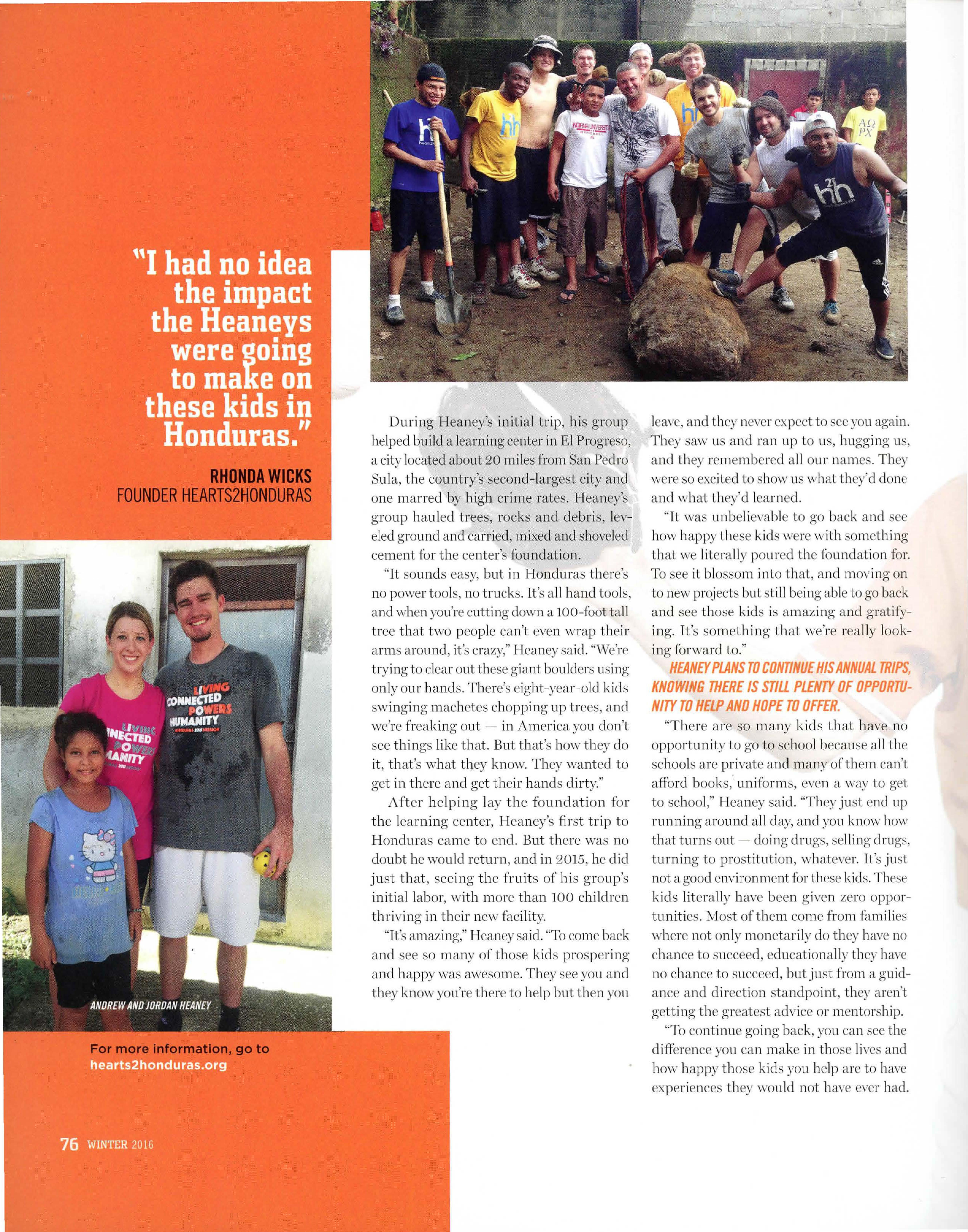
Heaney's helping hands are also evident in his native Oklahoma City, where among other things he's donated thousands of dollars in baseball equipment to his alma mater, Putnam City High School. Heaney also has roots in Central America, where the former Cowboy has impacted the lives of hundreds whose futures otherwise appeared bleak.
Rhonda Wicks and her son, Shelton, founded Hearts2Honduras in 2013, an organization spawned from several mission trips to a country ravaged by rampant crime, drugs and poverty.
As is his nature, Heaney reached out to bis agent with ICON Sports Management and voiced his desire to get an international mission trip started. That request eventually led Heaney to the Wicks - and thus began an impactful journey for all involved.
Heaney and his wife, Jordan, first met the Wicks in Houston in October 2014 when the Heaneys and several other ballplayers from ICON traveled to Honduras for an experience that would change not only their lives but those of countless children in a country that offered them little hope.
"I had no idea the impact the Heaneys were going to make on these kids in Honduras," Wicks said. "They have become such big supporters, and when they're there, just watching them with the kids and how the kids crawl all over them and love on them, it's remarkable to see. As soon as they walk up, the kids start running towards them. It's just an immediate love between them and every kid. The people there are so grateful.
"ANDREWANOJORDANAREJIJSTGREAT,GREAT PEOPLE,ANOTHEY'REHAVING A HIJGEIMPACT INTERNATIONAUY."
Heaney and his wife have traveled to Honduras each of the last three years, lending their efforts to aid one ofthe poorest countries in Latin America. It's a place with the world'shighest murder rate. It's a place that is also overrun by drugs and prostitution. fjJ
RHONDAWICKS FOUNDERHEARTS2HONDURAS
During Heaney's initial trip, his group helped build a learning center in El Progreso, a city located about 20 miles from San Pedro Sula, the country's second-largest city and one marred by high crime rates. Heaney's group hauled trees, rocks and debris, leveled ground and carried, mixed and shoveled cement f-orthe center's foundation.
"It sounds easy, but in Honduras there's no power tool , no trucks. It's al I hand tools, and when you're cutting down a 100-foot tall tree that two people can't even wrap their arms around, it's crazy," Heaney said. "vVe're trying to clear out these giant boulders using only our hands. There's eight-year-old kids swinging machetes chopping up trees, and we're freaking out - in America you don't see things like that. But that's how they <lo it, that's what they know. They wanted to get in there and get their hands dirty."
After helping lay the foundation for the learning center, Heaney's first trip to Honduras came to end. But there was no doubt he wou Id return, and in 2015, he clid just that, seeing the fruits of his group's initial labor, with more than 100 children thriving in their new facility.
"It's amazing," Heaney said. "To come back and see so many of those kids prosp •ring and happy was awesome. They see you and they know you're there to help but then you
leave, and they never expect to see you again. They saw us and ran up to us, hugging us, and they remembered all our names. They were so excited to show us what they'd done and what they'd learned.
"It was unbelievable to go back and see how happy these kids were with omething that we literally poured the foundation for. To see it blossom into that, and moving on to new projects but sti 11being able to go back and see those kids is amazing and gratifying. It's something that we're really looking forward to."
HEANEYPLANSTOCONT1NUEHISANNUALTRIPS, KNOWINGTHEREISSTIUPLENTYOFOPPORTUNITYTOHELPANDHOPETOOFFER.
"There are so many kids that have no opportunity to go to school because all the schools are private and many of them can't afford books," uniforms, even a way to get to school," Heaney said. "They just end up running around all day, and you know how that turns out - doing drugs, sel Iing drugs, turning to prostitution, whatever. It's just not a good environ rnent for these kids. These kids literally have been given zero opportunities. Most of them come from families where not only monetarily do they have no chance to succeed, educationally they have no chance to succeed, but ju t from a guidance and direction standpoint, they aren't getting the greatest advice or mentorsh ip.
"To continue going back, you can see the difference you can make in those lives and how happy those kids you help are to have experiences they would not have ever had.
It's amazing and gratif)ring To _justbe able to show up and bring a positivity to them and help them escape their daily reality is a positive in itself."
The Clemente Award nomination is also a positive in what has been a trying year for Heaney.
Coming off a 2015 season, his first with the Angels, in which he went 6-4 with a.3.49 ERA, Heaney entered 2016 as an established part of the Los Angeles rotation.
Those relationships arc invaluable, says Wicks, adding that while volunteering labor and money are necessary, IT'STHEWIWNGNESSTOBUILDAPERSONALCONNECTIONTHAT ISMOSTREWARDINGFOREVERYONEINVOLVED.
"The number one thing i to travel with us and build relationships with the children," Wicks said. "v\lego to the same communities so you meet a child that you're sponsoring. We tell people to spend your money going if you can. That's what changes these children's lives, having a relationship with you and them knowing that you care for them and are coming back.
"The teachers (in Honduras) always talk to the kids about how everybody has an impact they can make in the world - you can make a strong positive one or you can make a negative one. They always brag on Andrew and the other ballplayers and tell the kids how awesome it is that the e guys have chosen to come here to impact all of you.
"Tt'sa sign incant impact because their platform is so huge. It's really, really gr-at, and I always tell them 'Thank y'all for spending a week of your time doing this!' because they cou Id be doing other things."
For Heaney, acts of Good Samaritan ism arc simply part of who he is. And while he doesn't serve others for any recognition that might come along with it, being a sociated with an award named for one of baseball's greatest phi lanth rapists, the late, great Roberto Clemente, is fulfilling.
But following his first start of the season, the southpaw went on the clisabled Iist with tightnes near bis elbow. He tried to cu rtai I surgery with a platelet-rich plasma injection; the treatment failed to work and Heaney underwent Tommy John surgery on July l.
"It's been a long year," Heaney said. "To get hurt in the first game of the season is just an absolute kick to the stomach. l tried conservative care to treat it and see if I cou Id salvage some of the end of the season, and if not th is season, at least be ready to go for next year. And it just clid n't work out. I foe] like 1 gave it the best chance l could and then had to go with Tommy John, which is a little bit more of a sure route l guess you cou Id say.
"It's been eye-opening in the sense that I've never dealt with an injury like this, and it's obviously going to be a very long-term thing losing the majority of next year, too. lt's teaching me some cliflerent things about how to approach the game mentally and how to rehab. It's tough when you're sitting there the first two months working out and trying to get healthy and willing my body to heal itself, and it's not doing it . .Ju t every day going in there and working out and not seeing any progress can get kind of discouraging. It's been trying, but Tthink in the end it will make me better."
Angels pitching coach Charles Nagy agrees and said if he had any doubt about I leancy's ability to battle through a major injury, those thoughts were quickly erased by the pitcher's dedication to rehab. EE
"/'VEWONAWARDSANOGOrrENNOMINATED FORAWARDS,ANOTHISJSDEFINITELYTHEMOST HONOREDANOMOSTEXCITED/'VEEVERBEENFOR ONE,'Ileaney said. "It's something that I can control. That sounds weird, but sometimes in baseball you may have am iracu Jou- eason and get an awa1:dand you're thinking, 'Man, l don't know what happened.'
"But here, l do make a conscious effort to try and do the right thing, to be a productive member of society and be accountable for what I can bring and how I can a-fleet other people. It's very cool to be recognized for that."
"One of the nice t things is he was around the team every day even though he wasn't pitching thi season," Nagy said. "He goe about his business, he's focused, he knows what he wants to do and has to do, and he works extremely hard. He's a great teammate, always positive. I kept thanking him. l went th rough some injuries during my career, and I know how tough it is to try and be in a good mood every clay when you're going through the grind of rehab that's so monotonous.
"But he always had a smile on his face, was alway willing to help out anybody who needed anything. I le was out there shagging as much as he could in the outfieldhe cou lein't th row the ball but he wou lei'jai alai' it in with his glove.
"l couldn't tell him enough times about how proud I was of him and just thank him because it was great having him out there."
Heaney was a player Nagy pegged as "a guy coming in (to 2016) as one of our top three tarters - we were going to rely heavily on him to pitch a lot of innings and get us a lot of wins."
BUTTHEJOURNEYFROMSTIUWATERTOA BIGLEAGUEROTAllONWASN'TWITHOIJTAFEW TWISTSANOTURNS.
Following ajunior season at O U in 2012 in which he was a consensus All-American and the Big 12 Conference Pitcher of the Year after going 8-2 with a J.60 ERA, six complete games (i nclucli ng three shutouts) and an NCAA-be t l+O strikeouts, Heaney was selected with the No. 9 overall pick by the Miami Marlins, becoming OSU's highest MLB Draft pick since 1988 and third highest ever.
Heaney's rise to the big leagues took just two seasons as he made his debut with the 1arlins in 2014, going 0-3 in seven appearanc.:eswith Miami.
After being traded twice in the offseason - he wa first acquired by the Los Angeles Dodgers but was traded to the Angels just a few hours later - Heaney didn't need long prove his worth.
"La t year, l came into pring training and just pitc.:heclhorribly and didn't make the team," Heaney said. "I went clown to Triple A and figured some things out. lt took a while, but I kind of got the ship righted, and when I got up I made the most of the opportunity 1 was given. lt was great.
"With pitchers, I feel Iike it takes you ti me to figure out who you are as a player, what you can and can't do, what your goal is and what you have to do to get people out. Tt just took me a little bit ofti me to figure out
what my bread and butter was, and when I got it going, it really solidified who lam. And when I had some success, it really got the ball rolling."
Heaney is now consumed with working towards a return to the mound. Active on social media, he posts a daily pie on his Instagram account (@heandogB) documenting how many days since his surgery in an effort to stay positive and remained lighthearted during a process that at best won't have him back in the Angel rotation until late 2017 and more likely 2018.
a little bit more about what goes on from a pitching perspective. l'm excited about what he's absorbing and taking in, and he's champing at the bit to uti Iize al I that knowledge once he gets back out there.
"He's a strong kid with a live arm and explosivefastball - the ball moves with good sink and good run. He's got a good breaking bal I and a good changeu p from the left side; he's got a Iittle deception to him. 1-Ie'sa tough at-bat for any lefty, and he's tough on righties also because he pitches well inside to right-handers.
WHENTHATDArCOMES,HEANEYWILLBEREADY.
"He's got ah igh ceiling - his future is very bright," Nagy said. "Unfortunately, he's hit a little bump in the road, but we've seen a bunch ofother guys on similar paths. He'll get through this. He'll come back better, stronger. He's a student of the game - he watches what goes on on the field and understands
"HE'SGOTTHESTUFFANOTHEMAKEUPTOBE A TOPOFTHEROTATIONGUY.HE'SJUSTGOTTO GOOUTANODOIT."
Stepping between the lines and once again toeing the rubber will mark the continuation of a baseball journey that Heaney puts in a simple perspective.
"When l was a kid, I nevcrthought, 'When I grow up, I want to be a big league baseball player.' That was never my dream, necessarily," Heaney said. "Sure 1 wanted it to happen, and ·when it did happen it was like 'Oh my gosh, this is amazing!'
"For me, it's more like a sense of pride for my family. Every time I take the field, I just think it has to make my mom and dad so proud. To do them proud and do the right things is more how I think about it. Sure it's fun, and it gives you al I the opportunity in the world to put your elf on a platform and be able to do things that other people don't have the opportunity to do. But it's just something that makes me really happy and proud."
FOODBRINGSPEOPLETOGETHER.Sometimesininterestingplaces.
A few years ago in another town, a guy dragged me into a little diner for the third or fourth time in a year.
The previous few times, I had been intrigued by the nostalgia of the place. I was reminded of the Sunday evening television show from the 1980s called Alice.
You 1·eme11ibe1'it. It was a sitcom centered around Mel, his diner, and the interesting cast of characters who worked as waitresses. Alice was the hard working and principled single mom. Flo played the spunky, bombastic one who often told Mel to "kiss my grits." Vera was the dingy, forgetful woman whom Mel always picked on for being late or creating whatever was to be the fiasco du jour.
As my friend and I walked into this dinernot named Mel's - I felt like I was starring in the show. EXCEPTTHIS TIME IT WASN'TFUNNY. In fact, I told him I would agree to eat in this place under one condition. We would not eat at the counte1· whe1·e I could see what was happening in the kitchen.
We had made that mistake before. Ugh. Grease everywhere, and in some places it shouldn't be. I could have moonwalked on the floor, and I'm not that good a dancer. Dudes in dirty aprons wielding flying spatu-
As a result, we now have rules that make our hotdogs safer than they were back then. Because in the early 1900s, much more than meat by-products ended up in the wrapper.
The National Hotdog and Sausage Council estimates AMERICANSEAT20 BILLIONHOTDOGS
A YEAR. Many of them are eaten at concession stands at sporting events. Concession foods run the gamut across athletic facilities in the Big 12 Conference. Some are better than others. Some have unique fare while others display run-of-the-mill offerings one could find anywhere in the country.
Deep fried, candied, healthy or not so much, there seems to be something for everyone.
spicy chili. One stop shop. But the Cyclones' real claim to fame, in my humble opinion, is the pork chop. Grilled, butterflied with stuffing in the middle. You hold it by the bone and eat your way down. Each bite is juicy pork and savory stuffing._ Brilliant.
Readers were shocked as Sinclair wrote stories about how any and everything went into the sausage, so to speak. Sinclair's original intent was to discuss immigrant exploitation (let's not get into that so soon after the election), but the lack of health regulations took center stage.
His famous quote was, "I aimed at the public's heart, and by accident, I hit them in the stomach."
enced some of those things for the first time.
I'm not su1·e if it's ne1'vous ene1·gy 01· vo1'acious appetites that cause us to munch on everything from sunflower seeds and peanuts to turkey legs and tacos at an athletic event. Whichever it is, the sights and smells associated with ball games is likely las reminded me of a book called The Jungle, to take you back to a time when you experiwritten by Upton Sinclair. It was a novel about the Chicago meat packing industry in the early 20th century.
The ice cream award would have to go to Baylor. Multiple flavors of custard and toppings are fan favorites. Colorado, former Big 12 member, would win the popcorn medal. A row of vendors serving various types of popcorn flavors like cheddar, kettle corn, caramel, jalaperio and others was a huge hit. But it's Iowa State that wins the sweepstakes prize. The Frito-chili pie is amazing. Especially when you consider the skilled vendor who efficiently cuts the side out of a bag of Fritos and ladles in a hot spoonful of
The great thing about Oklahoma State it seems is, we have taken so much of what is g1·eatfood ac1·oss the count1·y and b1'ought it he1·e to our venues. IF IT'S GOOD,THEY'VE GOTIT. Boone Pickens Stadium fare runs the gamut from baconW1'apped po1'k on a stick to cheesecake on a stick- plus turkey legs, chicken nachos, veggies & hummus and the infamous G1·illa1'oni. OSU even has gameday offerings from local favorites Aspen Coffee, Pie Five Pizza and Firehouse Subs. But you better get in line before halftime. Whichever favbrite you choose, have one for me and wash it down with a great soft drink.Myfavo1'ite? ORANGE!