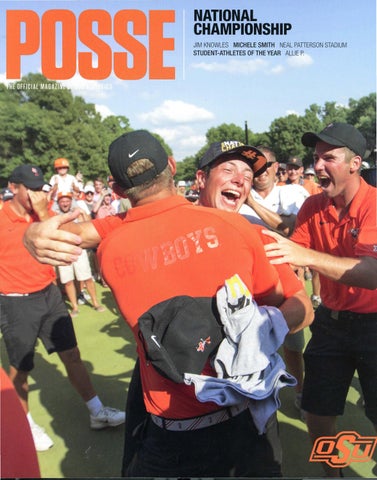
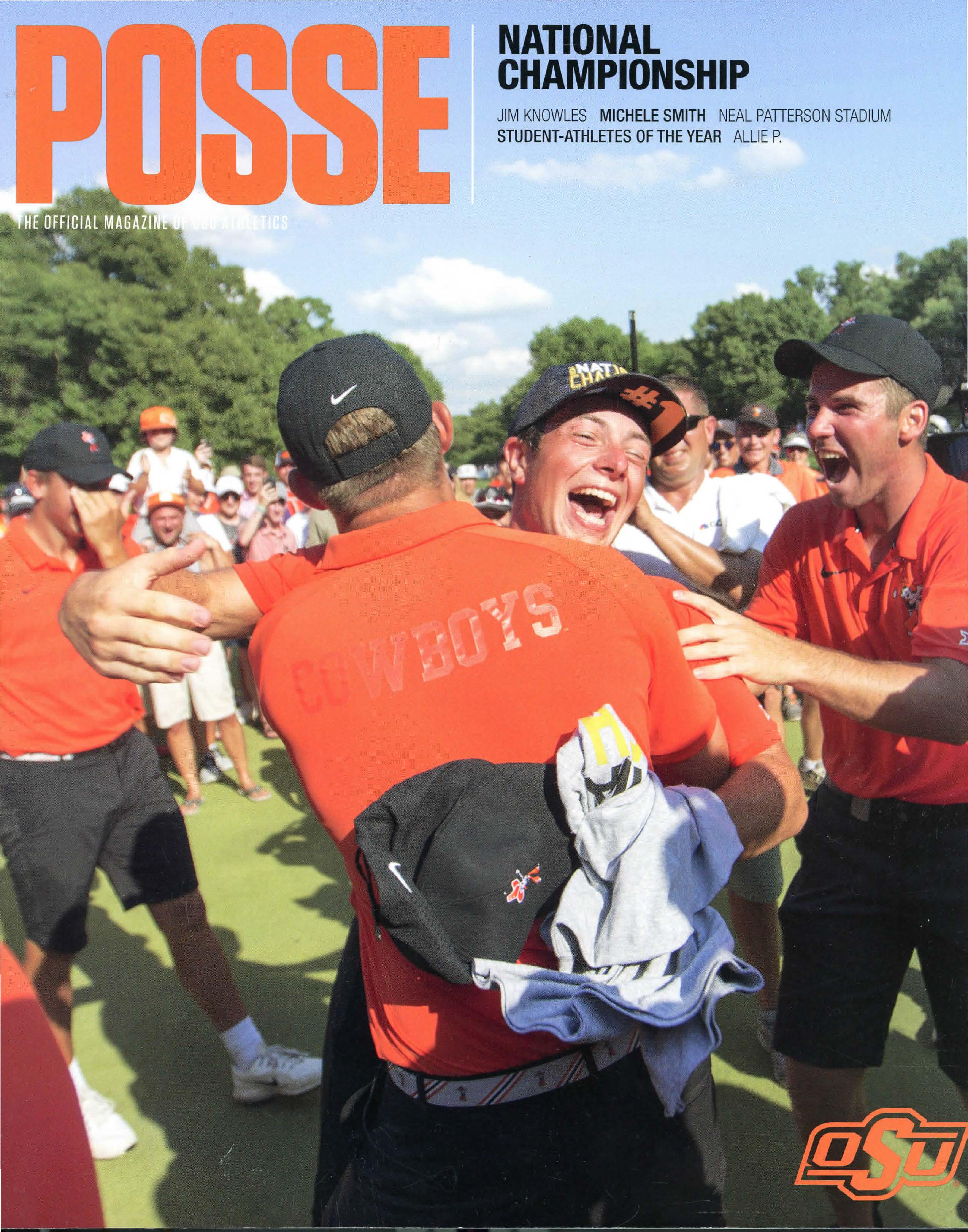
NATIONAL CHAMPIONSHIP
JIMKNOWLESMICHELESMITH NEALPATTERSONSTADIUM STUDENT-ATHLETESOFTHEYEARALLIEP.


MANOFFEWWORDS
BYKEVINKLINTWORTH SENIOR ASSOCIATEATHLETIC DIRECTOR
The women's basketball operations at Oklahoma State hum along in a quiet little out of the way corner of the OSU Athletics Center.
And it's hard not to believe that the location is exactly the place head coach Jim Littell would have picked as his headquarters, if given a choice.
Of course, Littell had few choices when he becamethe headcoach. Elevatedto the first chair on an interim basis upon the death of his friend and bossKurt Budkeand assistantcoach Miranda Serna in November of 2011, Littell simply went about hisjob. He led that first group of emotionally drained playersand staffersto the championship of the Women'sNationalInvitationTournament.
The run to the WNITtitle was certainly not the only reasonLittellwas giventhe job on a full-time basis. However,the trophy was a very nice exclamation point.
Fast forward to 2018. Littellstill quietlygoes about his job in the same corner of the athletic department. He is so unassumingthat it's easy to forget what he's accomplished,and to take it all for granted.

He will enter this fall, his eighth full season as head coach, with a record of 11.17·80.His .648 winning percentageis the best in OSU history. He is the only women'scoach in Cowgirlhistory to be named Big 12 coach of the year. He led OSU to a school-best 89 wins in one four-year stretch, including one appearance in the Sweet 16 of the NCAA Tournament.He has guided the programto five NCAATournamentsin his seven yearsas head coach and four NCAATournament wins.The programhasjust 11 NCAAwins all-time. Littell is the only OSU women's coach to win at least 20 games in five consecutive seasons. He is slowlybut surelyflippingthe script in Bedlam.OSU is now 7-6 in the last 13 games of the seriesafter sufferingthrougha 1-26 stretch. He has accomplished a lat. He says very little. Fallis nearlyhere. In October,the Cowgirlswill begin practicingfor the 2018-2019 season.And Jim Littell will quietly continue his quest to raise the profileof the Cowgirlbasketballprogram.He'll do it by splitting his time betweenpracticeand an office located in a quiet little out of the way corner of the OSUAthletics Center.
POSSE Magazine Staff
VICEPRESIDENTOFENROLLMENTANOBRANDMANAGEMENT KYLEWRAY
EDITOR-IN-CHIEF/SENIORASSOCIATEATHLETICDIRECTOR KEVINKLINTWORTH
SENIORASSOCIATEATHLETICDIRECTOR/EXTERNALAFFAIRS JESSE MARTIN
ARTDIRECTOR/DESIGNER DAVEMALEC
PHOTOGRAPHER/PRODUCTIONASSISTANT BRUCEWATERFIELD
ASSISTANTEDITOR CLAYBILLMAN
CONTRIBUTINGPHOTOGRAPHERS
CONTRIBUTINGWRITERS
STEPHEN HOWARD,GARYLAWSON MELISSAMORALES CLAYBILLMAN,RYAN CAMEJION
TOMDIR.ATC,JOHNHELSLEY GENEJOHNSON,KEVIN KLINTWORTH WADEMCWHORTER,KYLEWRAY
Athletics Annual Giving (POSSE} Development Staff
ASSISTANTATHLETICDIRECTOR/POSSEDIRECTOR PUBLICATIONSCOORDINATOR
ASSISTANTDIRECTOR,ANNUALGIVING COORDINATOR,ANNUALGIVING
Athletics Major Gift Development Staff
SENIORASSOCIATEATHLETICDIRECTOR/DEVELOPMENT
ASSISTANTATHLETICOJRECTOR,DEVELOPMENT
DIRECTOROFDEVELOPMENT/
ASSISTANTATHLETICDIRECTOR,DEVELOPMENT
DSUPDSSE
102 ATHLETICSCENTER LI05.7QJl.7301P OKSTATEPOSSE.COM POSSE®OKSTATE.EDU
ELLENAYRES CLAYBILLMAN
RYAN SEVERSON
STEPHANIEDAVIS LARRYREECE MATT GRANTHAM KEEGANDAVIS
SHAWNTAYLOR
STILLWATER,OK74078-5070 qo5.7qq_sOBLI F falOSUFANEX
ADVERTISING405.744.7301 EDITORIAL405.7441706
At Oklahoma State University, compliance with NCAA, Big 12 and institutional rules is of the utmost importance. As a supporter of OSU, please remember that maintaining the integrity of the University and the Athletic Department is your first responsibility. As a donor, and therefore booster of OSU, NCAA rules apply to you. If you have any questions, feel free to call the OSU Office of Athletic Compliance at Ll05-7LILl-7862. Additional information can also be found by clicking on the Compliance tab of the Athletic Department web-site at www.okstate.com.
Remember to always "Ask Before You Act.•
Respectfully, BEN
DYSON
ASSISTANTATHLETICDIRECTORFORCOMPLIANCE 81G12cuNfH\ NCE
Donationsreceivedmay be transferredto CowboyAthletics, Inc. in accordancewith the Joint ResolutionamongOklahoma StateUniversity,the OklahomaStateUniversityFoundation.andCowboyAthlet!cs,Inc. POSSEmagazineis publishedfour times a year by OklahomaState UniversityAthletic Departmentand the POSSE,and !s malledto currentmembersol the POSSE.Magazinesubscriptionsavailableby membershipin the POSSEonly.Membershipis $150 annually.Postagepaid at Stillwater,OK,and additionalmailingof/ices. OklahomaState University,in compUancewith Title VI andVil of the Civil RightsAct ol I964, ExecutiveOrder 11246as amended,andTitle IXof the EducationAmendments of 1972/HigherEducationAct),the Americanswith DisabilitiesAct ol 1990,and other federalandstate lawsand regulations. does not discriminateon tile basis of race, color, national origin, sex, age, sexuatorientation, genderIdentity, religion, disabllity,orstatusasa veteran,In anyofltspollcles, practicesor procedures.This provisionincludes,butis not limited loadmisslons,employment,financtalaid.and educationalservices.The following havebeendesignatedto handleInquiries regardingnon-discriminationpolicies:O!rectorof EqualOpportunity.408 Whitehurst,OSU,Stltlwater,OK74078-1035;Phone 405-744-9154;email:eeo@okstate.edu.
This publication,issuedby OklahomaState Universityas authorizedby tlIe SeniorAssociateAthletic Director,POSSE,was printedby Roy!ePrintingCompanyat a cost al Sl.136 per Issue.9.5M/August2018/#7112.
POSSEmagazineis publishedfour times a year by OklahomaState University,307 WhitehurstStillwater, OK74078. The magazineis producedby OSUAthleticsand UniversityMarketing,and is mailedto currentmembersol the POSSEAssociation. Membershipstarts at S150/yearand Includesbenefitssuchas the POSSEMagazineand memberautodecals.POSSEannual funds contribute to student-athlete scholarshipsand operating expenses.which are crlllcal lo helping our teams stay competitive.Giftsof all sizesImpactau areasol athletics.Postagepaidat SUllwater,OK,and additionalmallingoffices.
THETEAMBEHINDTHETEAMS~
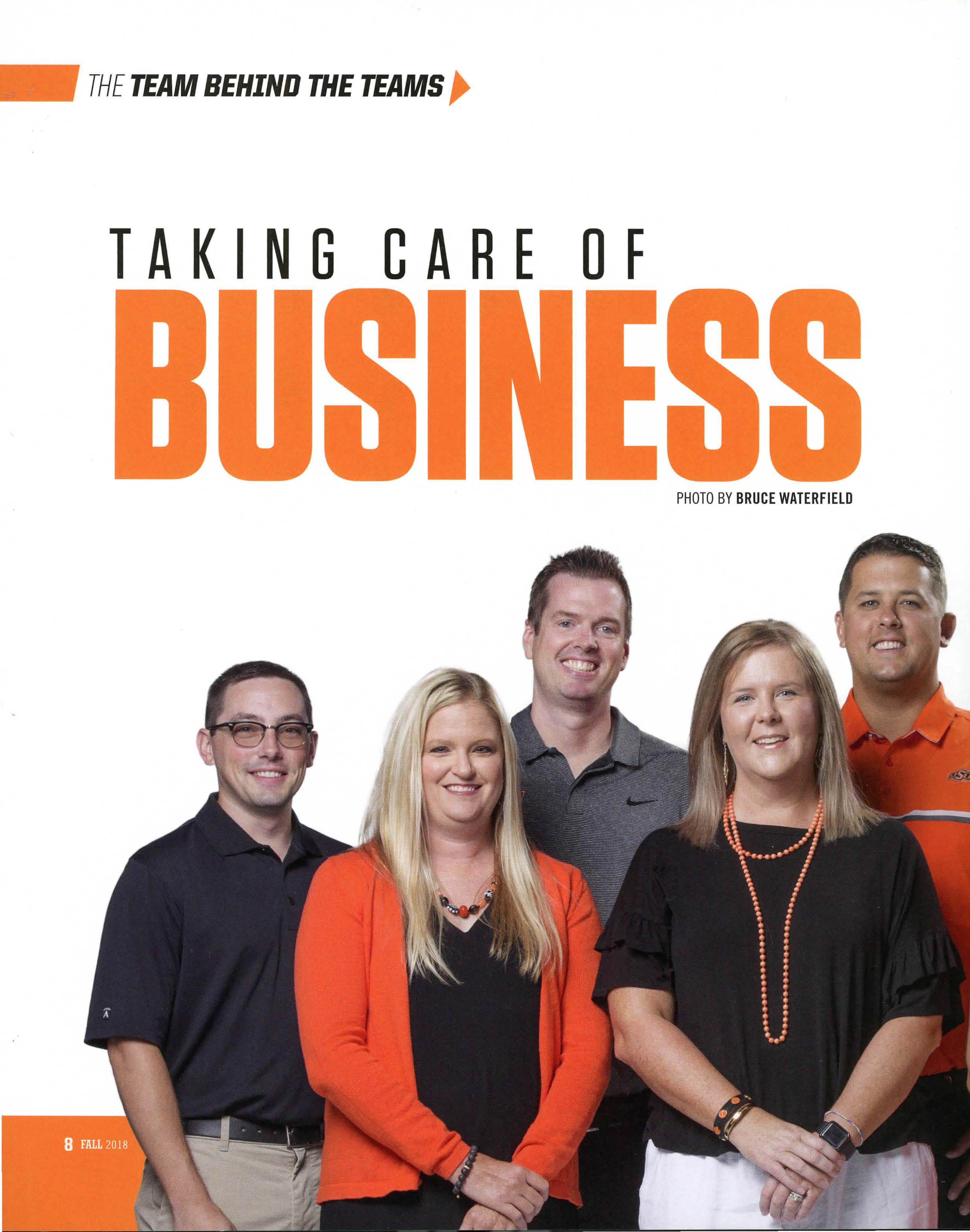
TAKING CARE OF
PHOTOBYBRUCEWATERFIELD

Many Americans have the same childhood memory. Watching mom and dad at the kitchen table dealing with the family bills, balancing their checkbook, prioritizing their resources.
In the OSU Athletic Department,the businessoffice has a team of employees conducting similar, although much more complicated, chores. The income is much greater, but so are the expenditures. OSU's staff is dealing with the tuition of many more students than a typical family brood. There is also a travel element as well as a human resourceselement. And oh yeah,there are state lawsand annual audits. And the income can vary greatly and is affected, at times, by the most peculiar circumstances. It is a job for professionalswho are performingone of the most important functions in athletics in an area that affects every single employee,team and department.
08/04/18
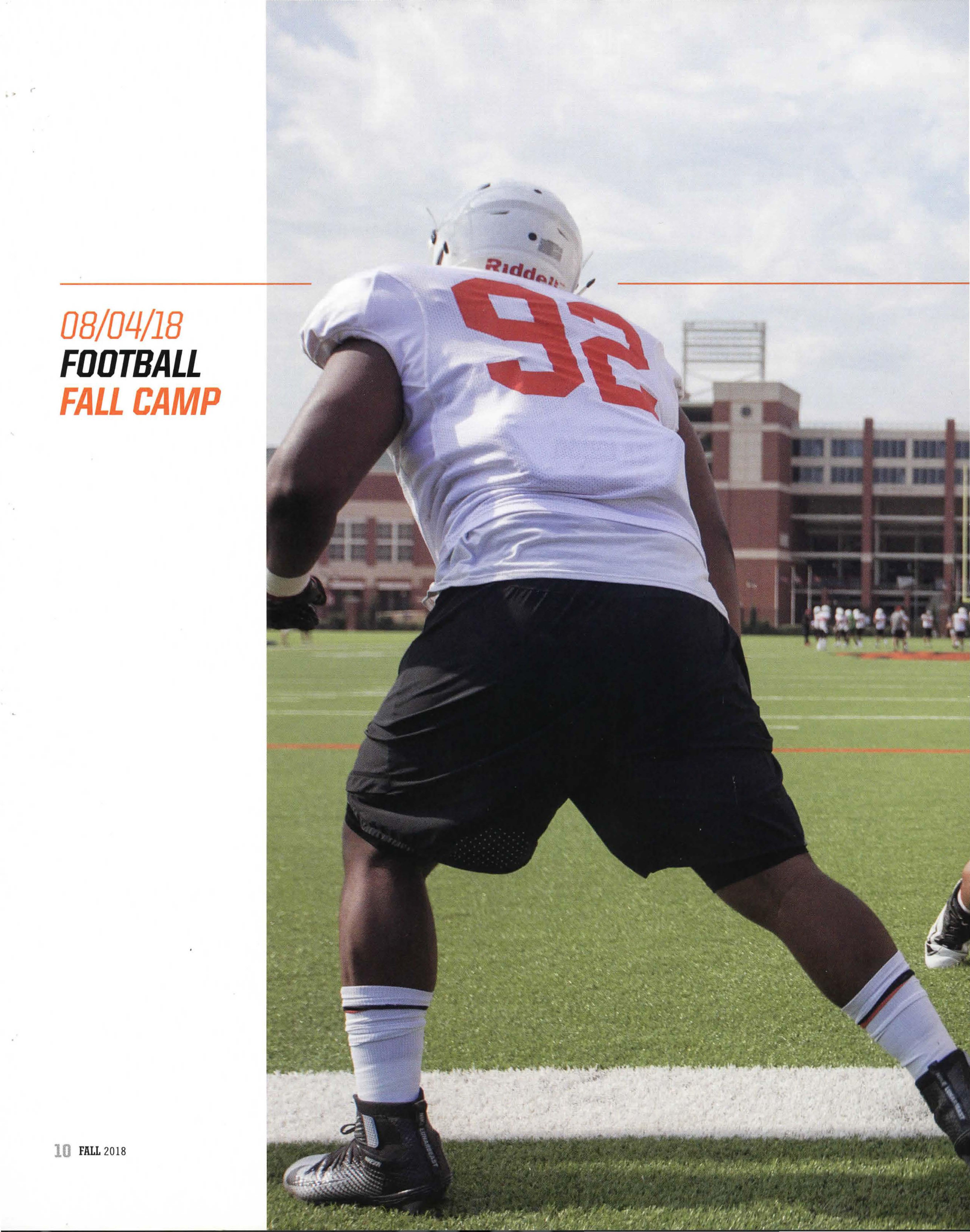
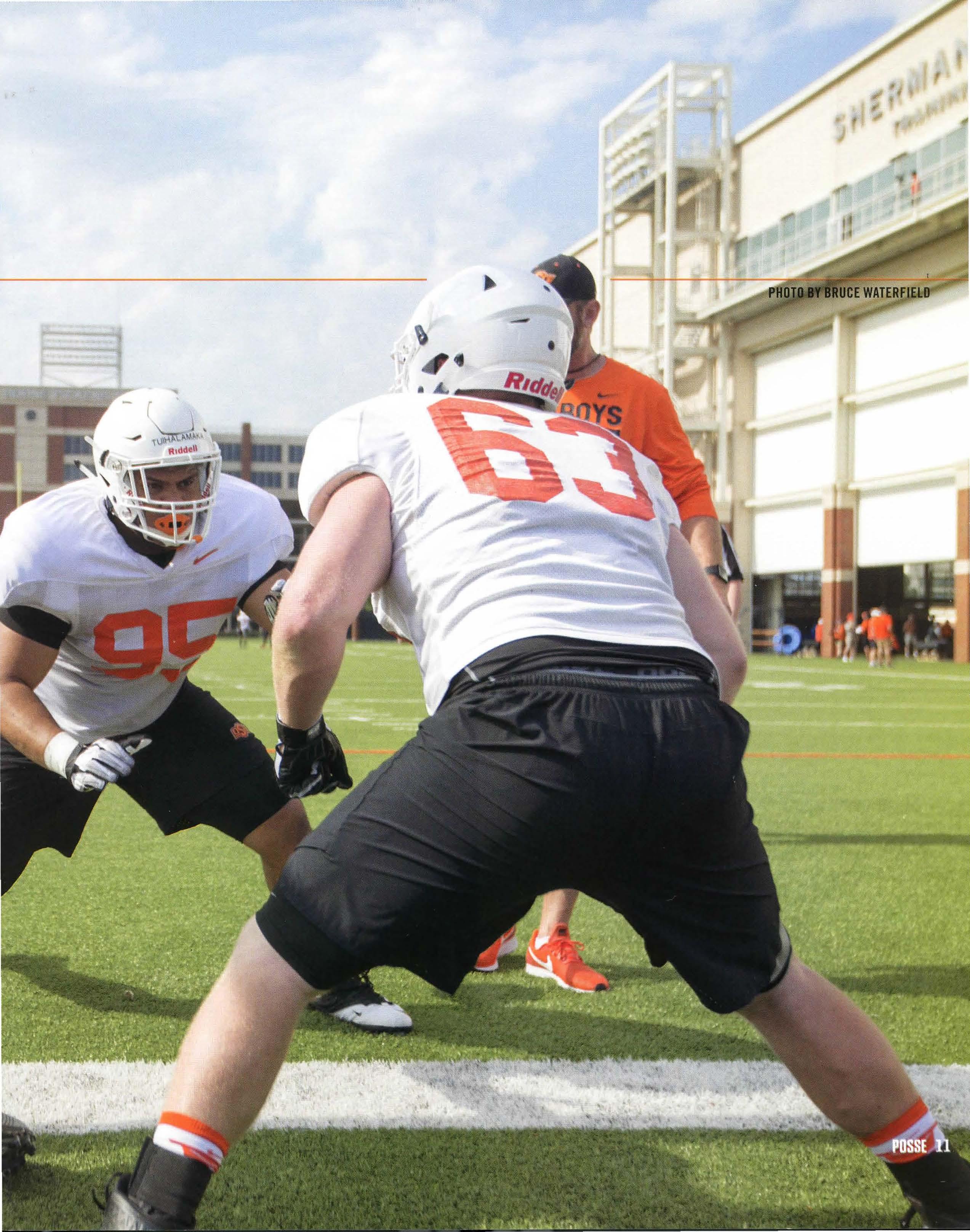

AUGUST2018
INTERNATIONAL FLAVOR
TheOSUmen's basketballteamtook a tripofa lifetime thissummera Europeantourthat featured a 2-1record againstinternational competition,alongwith countlesssightseeing andteambuilding opportunities.The CowboysvisitedVenice, Rome,VaticanCityand Athensduringtheir 10-daysoverseas.



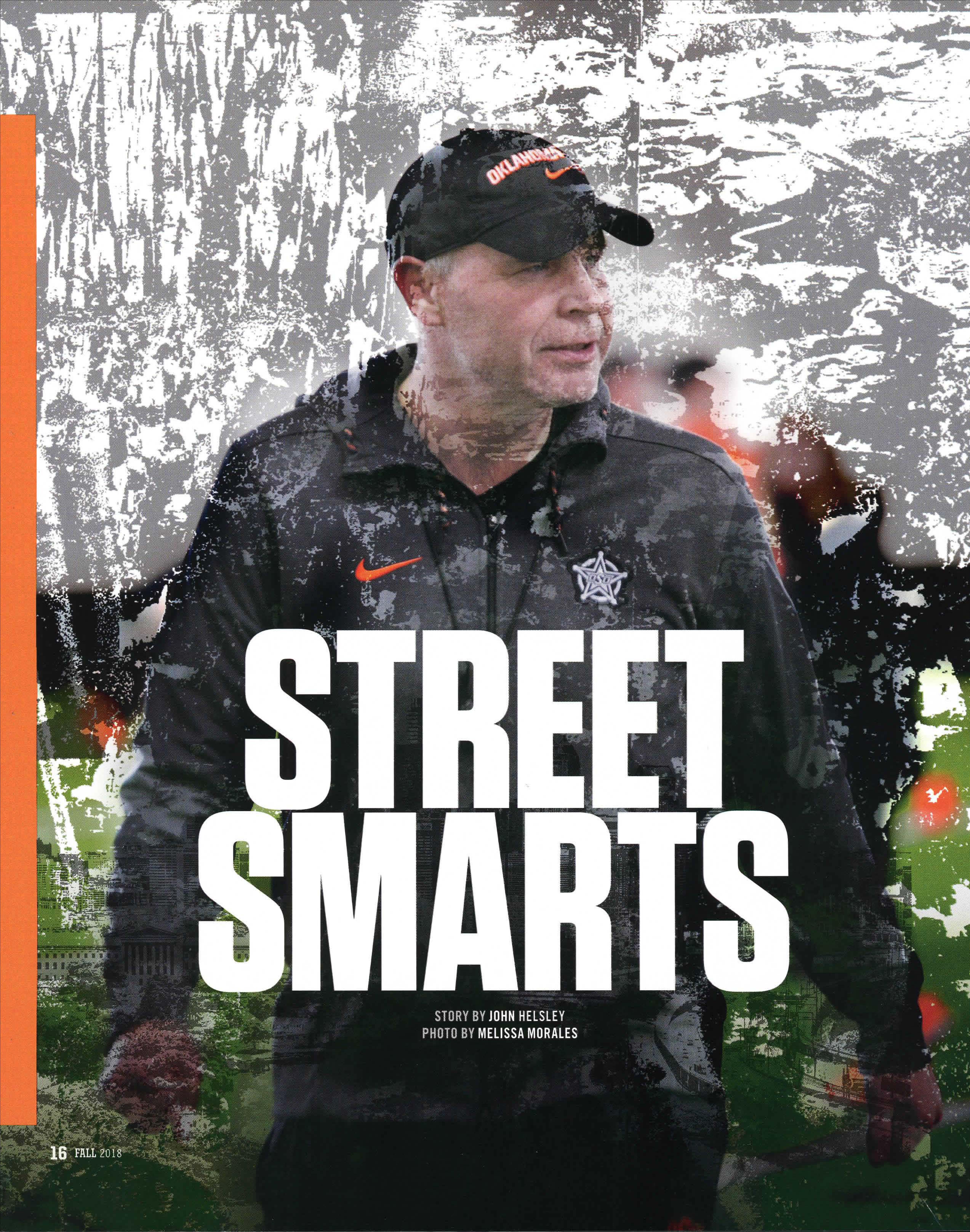
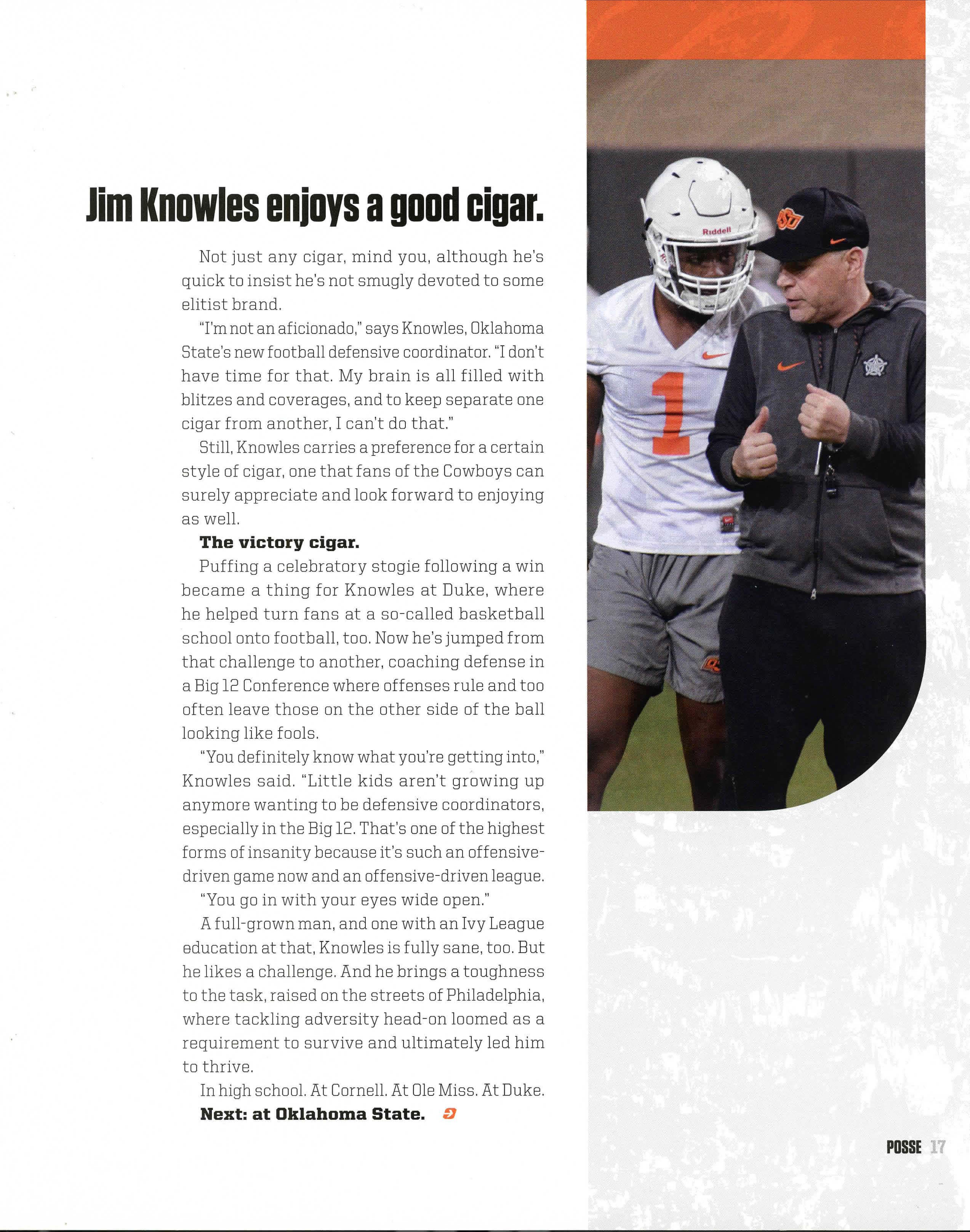
JimKnowlesenjoysagoodcigar.
Not just any cigar, mind you, although he's quick to insist he's not smugly devoted to some elitist brand.
'Tm not an aficionado," says Knowles, Oklahoma State's new football defensive coordinator. "I don't have time for that. My brain is all filled with blitzes and coverages, and to keep separate one cigar from another, I can't do that."
Still, Knowles carries a preference for a certain style of cigar, one that fans of the Cowboys can surely appreciate and look forward to enjoying as well.
The victory cigar.
Puffing a celebratory stogie following a win became a thing for Knowles at Duke, where he helped turn fans at a so-called basketball school onto football, too. Now he's jumped from that challenge to another, coaching defense in a Big 12 Conference where offenses rule and too often leave those on the other side of the ball looking like fools.
"Youdefinitely know what you're getting into," Knowles said. "Little kids aren't growing up anymore wanting to be defensive coordinators, especially in the Big 12. That's one of the highest forms of insanity because it's such an offensivedriven game now and an offensive-driven league.
"You go in with your eyes wide open."
A full-grown man, and one with an Ivy League education at that, Knowles is fully sane, too. But he likes a challenge. And he brings a toughness to the task, raised on the streets of Philadelphia, where tackling adversity head-on loomed as a requirement to survive and ultimately led him to thrive.
In high school. At Cornell. At Ole Miss. At Duke. Next: at Oklahoma State. :J
PHILLYFORMED
Jim Knowles learned some lessons on the streets in The City qf Brotherly Love. Seriou ly, the streets - no exaggeration - with the experiences leading him to cast a leery eye toward more than a few claiming the same.
"When people used to ay they were from Philly, I'd ask, 'What neighborhood?'" Knowles said. "They'd say some suburb, and I'd go, 'You're not from Philly.'
"I took the subway to high school. Didn't have a car. ever had a license until I was in college. It was truly inner city.''
Row houses. Rough neighborhood. Pavement for a playground.
"Where I was raised, there was no gras ," Knowle said. "That's the honest truth. My high school, we had to bus to practice because there was no grass field. It was a tough environment. I mean, really inner city. It was challenging. It was hard, really. It wa n't great.
"But I think l was given that ability to compete and to be taught to constantly work for something. That wa good."
Knowles never let the streets distract him from his dream. Football was important, a light providing focus to keep him on a rightward path.
Knowles was good at football, too.
"I wasn't good enough for Oklahoma State, or Penn State, back where I'm from," Knowles said.
But be was good enough, and smart enough, to gain considerable attention from the Ivy League schools. Knowles had choices, too, with an opportunity to stay home and attend Penn right there in Philadelphia.
Harvard was an option as well.
Yet Knowles found himself drawn away from the city, in search of something different, although not entirely sure what, the way he does now. And Cornell, located in Ithaca, N.Y., offered something different. And appealing.
"I cho c Cornell for a lot of the same reasons I chose Stillwater," Knowles said. "Growing up in that inner-city environment, I was dying for a college town. I was looking for a place where college students could thrive and be successful and not have to worry about all the things that went on in the big city. That is kind of how I've been my whole career.
"Growing up where I did, Stillwater and Ithaca, New York, and Oxford, Mississippi, they're all good places to live and work because the college is everything."
Cornell like OSU? In some ways, yeah.
While Cornell may be a privately endowed research university, it's also a land-grant institution in a city of some 30,000 residents, situated by a lake and hillsides, with a legitimate college town feel.
"Nobody went to college in my family," Knowles said. "Cornell was the most bluecollar Ivy League school - people who were down to earth. That's what made it more comfortable for me to go there as opposed to some others.
"There was some culture shock, for sure. The similarity though to Stillwater i that Cornell is the only Ivy League school that has an ag chool. I'll never forget my first day, walking down the middle of campus, and here comes a forklift with a giant cow on it, carrying it to the vet house."
Knowles escaped the inner city, although not without recognizing the value in the lessons lived and learned.
"When you're in the inner city, it really does take the whole community," Knowles said. "You're coached by cops and firemen, plumbers. They came to our grade schools and told us that if we weren't making all Ns and B's we couldn't play. We found out later they couldn't do that, but we all believed it.
"Football was such a steadying force in my life since where I grew up was so chaotic. I just listened to whatever these guys said. And I had the aptitude. It became something that was very important to me.
"Those people who had such an impact on me when I was young, up to my high school coach who I'm still really close to, they're a reason I coach, because they set me on the right track from a really rough environment."
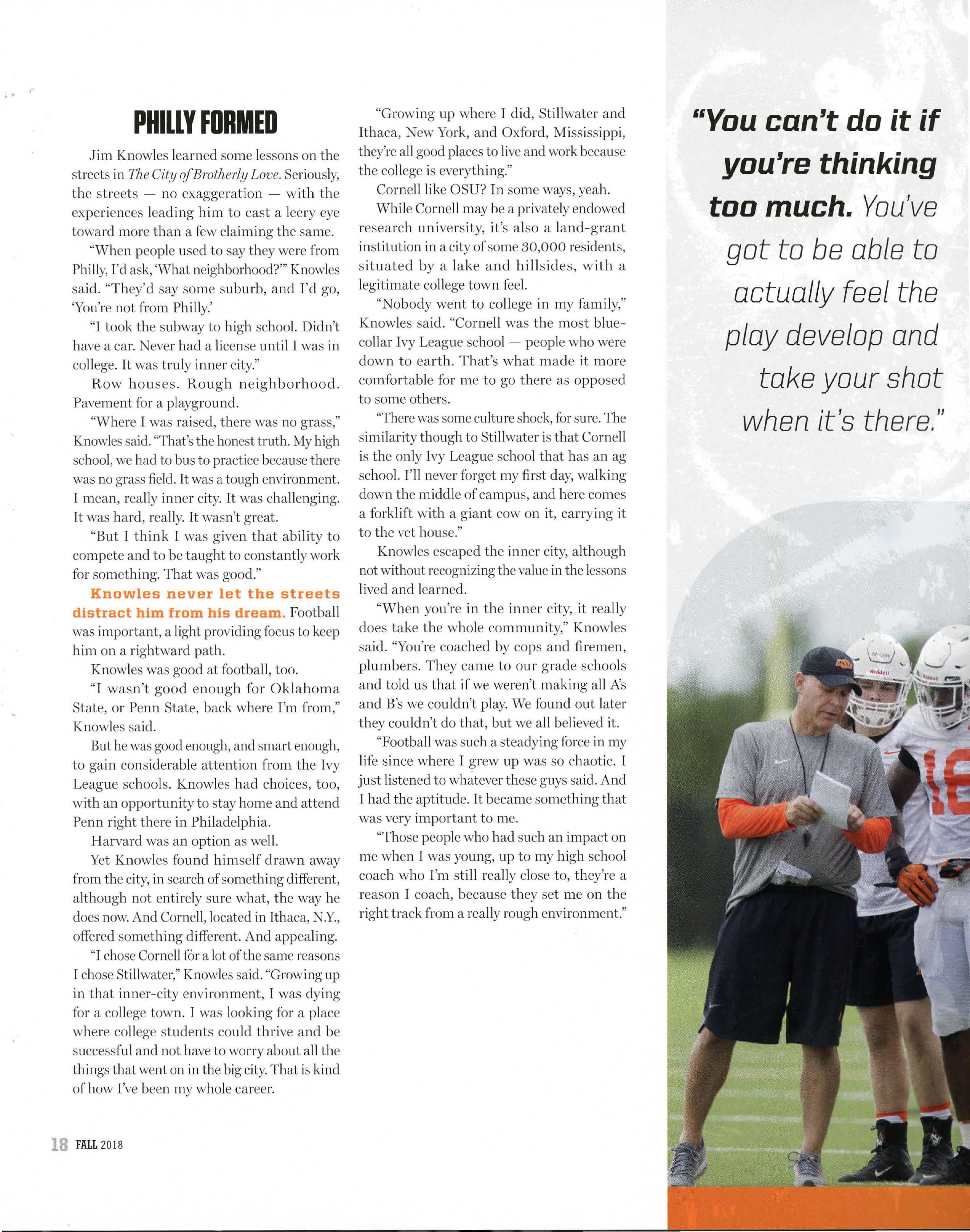
"You can't do it if you're thinking too much. You1ve got to be able to actually feel the play develop and take your shot when ifs there. JI

DRAWNTDCOACHING
If there were challenges for Knowles in climbing offthe Philly streets into the hallowed halls ofan Ivy League institution like Cornell, they never showed.
Knowlesthrived at the renowned institution founded in 1865 when Sen.EzraCornelldonated his farm and his fortune as the initial endowment. Knowles played defensive end for the Big Red, earned a B.S. in Industrial and Labor Relations and was elected to the school's respected Sphinx Head Society, graduating in 1987.
"I was in a fraternity, made some honor societies," he says. "It was great. It changed my life and opened up my eyes to things and to possibilities, things you could actually do with the rest of your life.
"All my best friends are all captains of industry, so to speak, or doctors or lawyers. I loved it there."
Prepared and braced for the workplace and ready to make some real money, Knowles spent a year on the job putting his degree to good use. He did good work. Banked some checks.
But something kept drawing him back to football.
"I remember my first year out, working and making good money," Knowles said. "But I'd still be hanging around high school practices. I couldn't get away from that smell."
That smell?
"When I grew up in the city, I'll never forget, every August when you had the chance to go to football practice, you could smell the cut grass," Knowles said. "Smells kind of stick with you. That was footbaII season.
"So even though I wanted to make money, I knew it was time to get back to football. It wasn't hard for me to quit that world and going to make $3,000 and living in a basement just to break into coaching. It was easy for me because I knew in my heart it was where I was supposed to be."
Knowles was quickly welcomed back to Cornell. In 1988, he coached the Big Red defensive line. The following six seasons, he was in charge of the running backs. Then he spent two seasons coaching linebackers and serving as recruiting coordinator.
Other opportunities followed, pulling Knowles to Western Michigan, where he got his first defensive coordinator's gig in 2001. Then he was on to Ole Miss for a year before Cornell called him home to be its 26th head coach in 2004.
It was an honor. And a challenge.
Knowles inherited a program that had sufferedthree-straight losing seasons, including a 1-9 year that included a winless run through the Ivy League in 2003.
He'd earned his chops as a coach and was confident in his abilities to scheme and lead and handle the X's and O's. But being the head coach requires so much more.
"There'sa lot of pressure you put on yomself, there really is," Knowles said. "You love the school and want to have a program that matches the school, so no matter what kind of pressure you're getting externally, there's more that you put on yourself."
It was cool being back, for sure. The feeling ofjogging out onto SchoellkopfField, the home of Big Red football since 1915, head adorned with a ball cap featuring the block "C" and representing the school and the program couldn't have been more special.
"I could give many speeches about that," Knowles said.
Knowles restored program pride with a 6-4 winning season in his second year, yet maintaining success proved difficult. And after six seasons and a 26-34 record, Knowles' time in charge at his alma mater ended.
His coaching career, however, perked up·.
David Cutcliffe, his boss at Ole Miss, immediately snatched up Knowles for his staff at Duke, plugging him in as defensive coordinator. The fit was good - for Duke's defense and for Knowles - who enjoyed fully focusing on football again.
"I think eventually you kind of lose that coaching a little bit, especially at that level," Knowles said of heading the program at Cornell. "You become more of a fundraiser and promoter and connections guy. That's one of the negatives about being the head coach.
"When I went back to being the defensive coordinator at Duke and now here, I look around and all I have to do is football, really get to know the players. I think that's where my lane is." :J
LIFEINTHEFASTLANE
Knowles' defenses play fast. Aggressive and fast and free.
And the speed factor extends to him, too.
"I made a commitment, probably after 2012, to be the fastest play-calling defense in the country," Knowles said.
A move to counter the pace of the everexpanding number of no-huddle and hurry-up offenses, the point is to get the defense called quickly and simply, then allow the players to respond and react to the action. The intellectual work is done during the week, not play to play. There are fixes and adjustments needed on game days, but that's on Knowles and his staff "I want to teach them conceptually about the game and defensive fundamentals, but I don't want to lock them up with anything," Knowles said. "I want them to know that if anything goes wrong, they can count on me to fix it. But in order for something to go right, they're going to have to make the play. I'll get them as close as l can, but they're going to eventually have to make the play, and you can't do that if you're locked up.
"Youcan't do it if you're thinking too much. You've got to be able to actually feel the play develop and take your shot when it's there."
Under Knowles,Duke's defenses continually improved, a catalyst in helping the Blue Devils reach uncharted territory on the football field.
Duke made five bowl appearances the past six years, an unprecedented run of success in Durham. The Blue Devils posted their first 10-win season and qualified for their first ACC Championship game during Knowles' run. Last season, Duke ranked in the top 25 nationally in total defense, passing defense, pass efficiency defense, scoring defense, interceptions, third-down defense, fourthdown defense and fewest first downs allowed.
Duke allowed 20.2 points per game last season, finishing No. 3 in theACC, while going 7-6 overall and 3-5 in league play. That's the fewest points per game the Blue Devils have allowed since the ground-it-out days of 1977. Two Duke defenders, linebacker JoeGiles-Harris and cornerback MarkGilbert,were named AllACC First Team.
Early reviews of Knowles' system in Stillwater have drawn raves.
"He is going to give us opportunities to fly around and make plays for ourselves," said Cowboy linebacker JustinPhillips."So he's going to make it simple for us, for everybody on the defense to know what they have to do and make their responsibilities easy for them. He's going to let us go out there and play."
Says linebacker CalvinBundage: "l like it. We cause a lot of turnovers. To be great in th is defense you have to play fast, so l like it."
Gundy also tweaked his formula in search of a true indication of the numbers.
"I took out Hail Marys, l took out endof-the-half drives - the final two minutes basically - things that I thought could skew statistics," Gundy said. "I took all the possessions, then points allowed, and came up with a Top 20. I think Duke was 12th or 14th in the country (in those calculations)."
That prompted a look, and eventually a conversation, with Knowles.
"I talked to him and liked him," Gundy said. "We interviewed seven or eight guys, really good candidates. I thought he was a perfect fit for what we were looking for. And he wanted the challenge of being in the Big 12.
"I was just kind of drawn to him from that standpoint."
Knowles has installed a new defense, a 4-2-5 alignment that beefs up the secondary where most offenses attack. And he's infused his teaching with edgy techniques designed to keep learning fun and fresh.
INTERNETSENSATION
Coaching and playing great defense in the Big 12 sizes up as something just short of impossible.
Premium quarterbacks and playmakers and up-tempo spread attacks skew statistics and scoreboards, drawing negative attention onto all those charged with preventing points.
When MikeGundyopted for a change at defensive coordinator, he found few willing candidates to take on a Power 5job in an ultrasuccessful progra1J1.Many, Gundy says, want no part of coaching defense in the Big 12. It's detrimental for the ego. And the reputation.
And the resume.
So Gundy addressed filling his openinga critical hire - through dedicated research. First, Gundy came up with his own metric: statistics focused not on total points allowed, but points allowed per possession. The fast-paced teams in the Big 12, like the Cowboys, play more possessions, as much as twice as many as some schools, creating more opportunities to score. So traditional methods aren't all that telling here in the Wild, Wild West of college football.
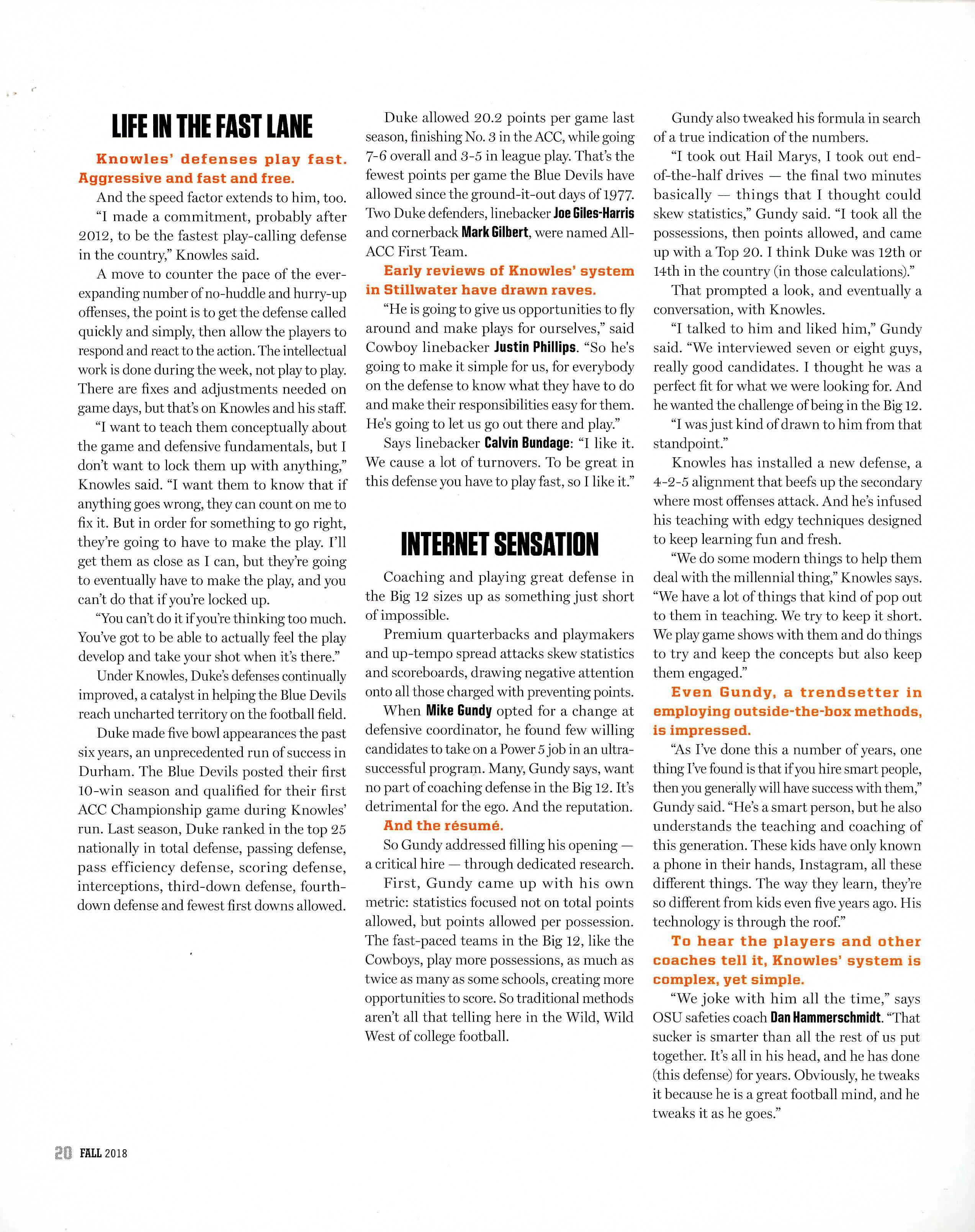
"We do some modern things to help them deal with the millennial thing," Knowles says. "We have a lot of things that kind of pop out to them in teaching. We try to keep it short. We play game shows with them and do things to try and keep the concepts but also keep them engaged."
Even Gundy, a trendsetter in employing outside-the-box methods, is impressed.
"As I've done this a number of years, one thing I've found is that if you hire smart people, then you generally will have successwith them," Gundy said. "He's a smart person, but he also understands the teaching and coaching of this generation. These kids have only known a phone in their hands, Instagram, all these different things. The way they learn, they're so different from kids even five years ago. His technology is through the roof."
To hear the players and other coaches tell it, Knowles' system is complex, yet simple.
"We joke with him all the time," says OSU safeties coach DanHammerschmidt."That sucker is smarter than all the rest of us put together. It's all in his head, and he has done (this defense) for years. Obviously, he tweaks it because he is a great football mind, and he tweaks it as he goes."
"Theyshoutd know that I'm going to do everything I possiblycon to hove the pfayers prepared ta be a tap 2D defense. 11
SMOKE'EMIFYOUGOT'EM
Growing up in Philly, Knowles could only carry dreamy visions ofliving in a collegetown.
From Ithaca to Oxford to Durham - and now to Stillwater - his perceptions have proven true, down to those smells of fresh-cut grass.
'Tm a collegetown person ever since I found out they existed," Knowles said. "I never knew that college towns existed. Once I discovered the lifestyle and how much fun it was to live in a college town, it's where I wanted to be."
And Knowles is enjoying Stillwater, even though he had to rush here ahead of his wife, Nancy, and family in advance of spring practice. Two of his children are grown, with daughter Halle attending graduate school at Towson State and son Luke entering his junior year as an engineering student at Michigan. The youngest, son Jack, will be a high school sophomore.
It wasn't easy for Knowles to leave Duke, where they were so satisfyingly raising the bar on success. It wasn't easy to uproot his family, again. It wasn't easy to break off from Cutclifle, a close friend.
But OSU offered a new opportunity, an upgrade in programs and pay and a chance to test his defense under intense stress and scrutiny. And now firmly in place, Knowles says the new job has opened his eyes to how the Cowboys have been so consistently good.
"I'vejust been impressed with the culture," he said. "Players go to class. Players get good grades. Players are responsible socially. They show up on time. All those things that make a good person, they're here.
"You know the 10 wins a season the past three years and the success Coach Gundy has had? You get inside of it and you see why. There is a culture of doing things the right way here. Winning is a value here, one of many values. Not an ultimate goal, it's part of the big picture."
Not that Knowles doesn't understand the importance of winning. He fully recognizes that the 60,000 folks filling Boone Pickens Stadium, along with all those following along via TV and radio, are quite concerned with the scoreboard.
Rest assured he is, too. And that's his message to Cowboys fans.
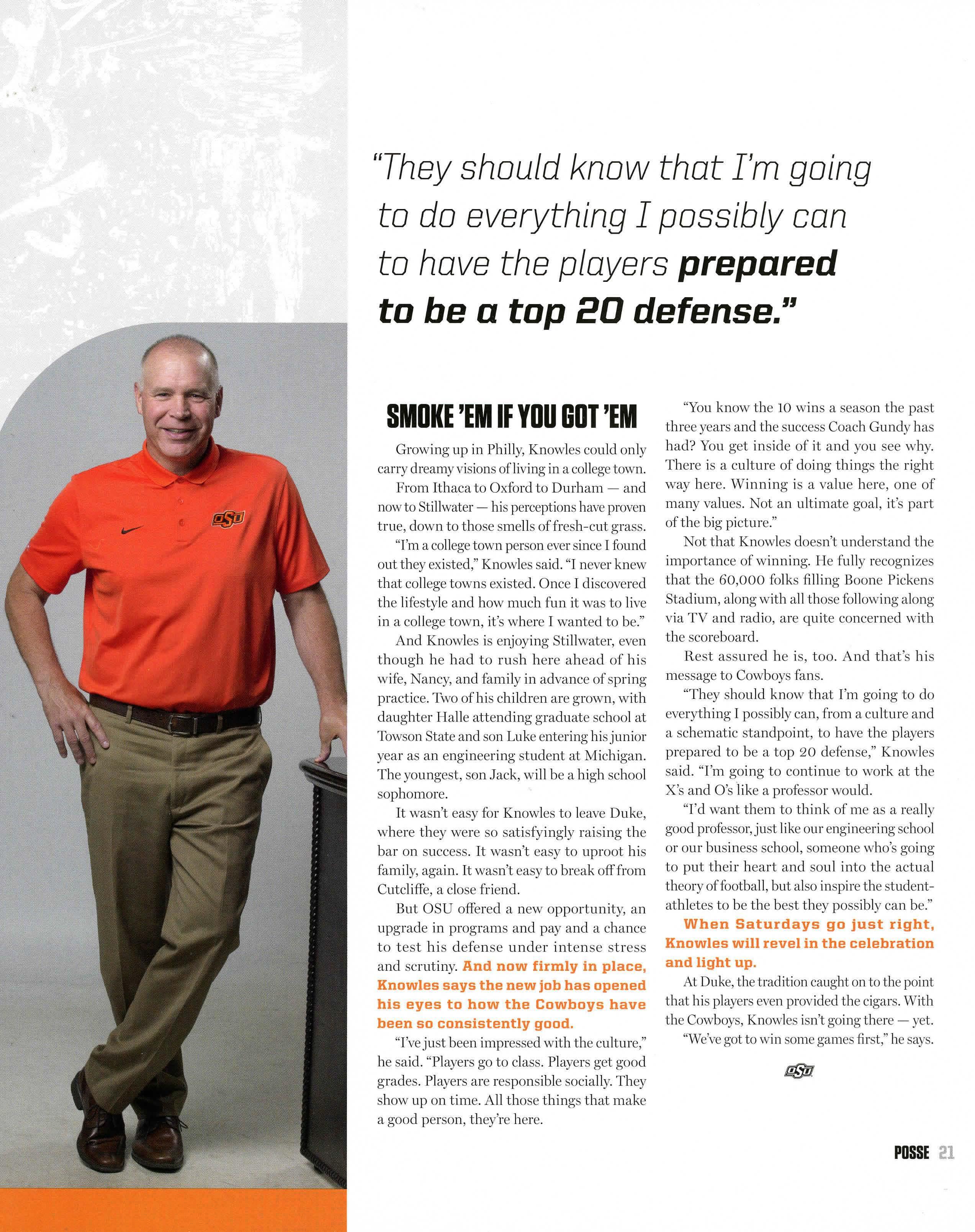
"They should know that I'm going to do everything I possibly can, from a culture and a schematic standpoint, to have the players prepared to be a top 20 defense," Knowles said. 'Tm going to continue to work at the X's and O's like a professor would.
''I'd want them to think of me as a really good professor,just Iike our engineering school or our business school, someone who's going to put their heart and soul into the actual theory of footbal I, but also inspire the studentathletes to be the best they possibly can be."
When Saturdays go just right, Knowles will revel in the celebration and light up.
At Duke, the tradition caught on to the point that his players even provided the cigars. With the Cowboys, Knowles isn't going there - yet. "We'vegot to win some games first," he says.

Bryan
Bill & Marsha Barnes
Malzahn Family
Terry & Martha Barker
Stan & Shannon Clark
Russ & Julie Teubner
Jim H. Williams
The Oklahoman
A-Cross Ranch
Chandler USA, Inc
Scott & Kim Verplank
Drummond Investments
Jack Bowker Ford-Lincoln
Shaw's Gulf Inc
Dillingham Insurance
Jon H. Wilson
Larry Bump
Randy & Robin Byford Ameristar
Baloo & Maribeth Subramaniam
Mike & Judy Johnson
Bill & Karen Anderson
Gary & Mary Ellen Bridwell
Ron & Jan King

OSU ATHLETICS POSSE POINT SYSTEM
The PriorityPointSystemprovides a fair, consistent and transparent method of providing benefits to donors in exchangefor their financial investments in OSU athletics.
Donors gain points three ways:
Contributions
All current and lifetime contributions (cash or stock) are worth 3 points per $100 donation. Planned (deferred) gifts in the new Leave a Legacy Endowment Campaign will receive 1 point per $100.
Commitment
Donors will earn one point each year for purchasing season tickets (one point per sport annually), as well as one point for each year of POSSE donations.
Connection with the University Donors (or their spouses) who are OSU Alumni receive a one-time 10 point bonus, as do OSU faculty/staff and letterwinners.
Points never diminish and will carry over to subsequent years. Donors retain all previously earned Priority Points in their giving history. For questions about the POSSEPriority Point System, email posse@ okstate.edu or call us at 405-744-7301.
HOW DO MY POINTS RANK?
15, 2018

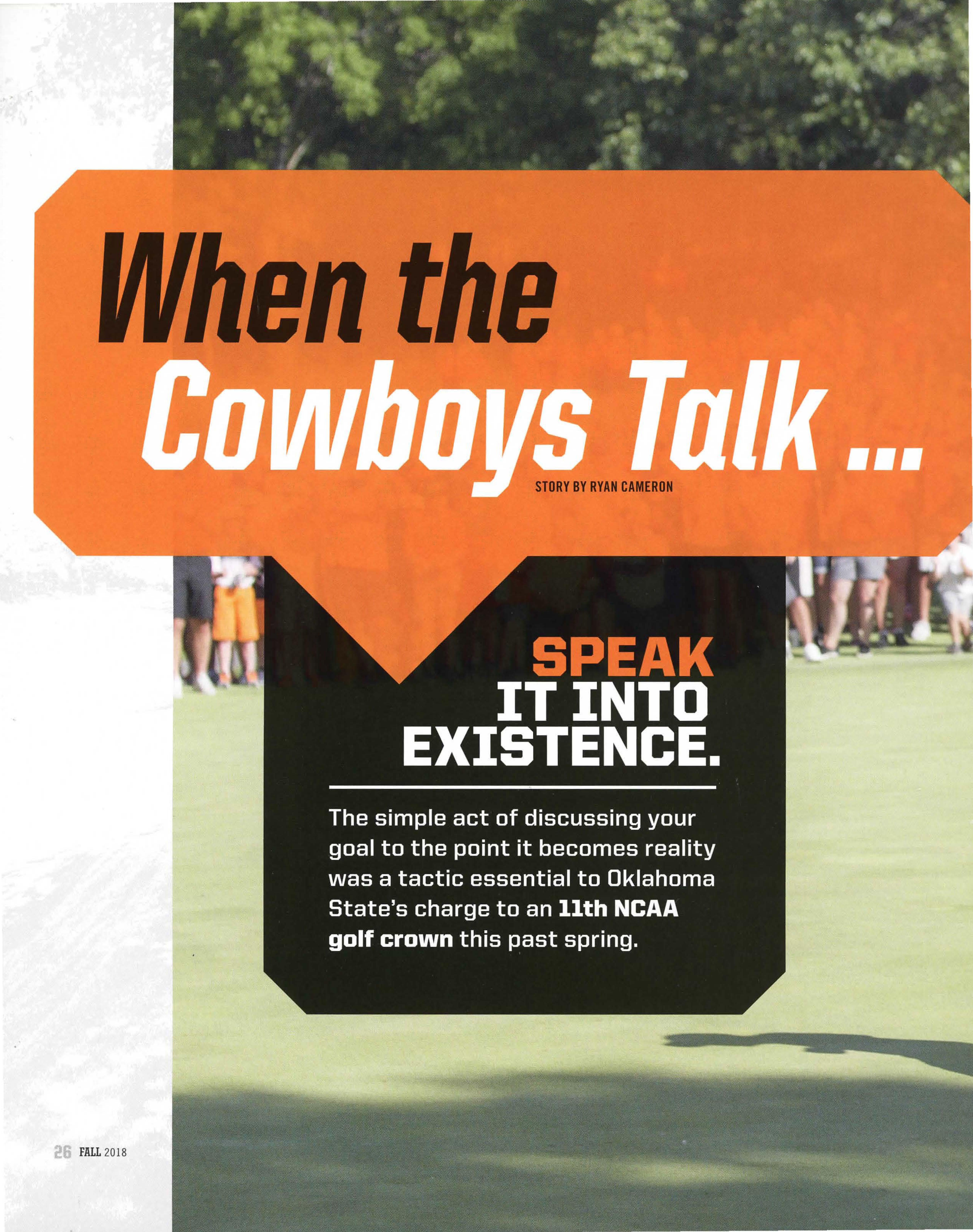
From the time it was announced Karsten Creek would host the NCAA Division I Men's Golf Championship, the stars began to align for a potentially epic ending. Take a talent-laden roster, sprinkle in an all-access television crew, mix in the strong desire to end a decade-plus title drought, cap it with the rare golf home game an l OSU head coach AlanBrattonwas positioned to pu 11off a coaching job for the books.
Rather than shy away from a s t of circu 111 tances never before seen in college gol 1-; Bratton and his confident bunch of Cowboys welcomed and openly di ·cus cd everything that came their way.
"lt was a great reminder as a coach that what you talk about matters. The more you talk about what you want to happen, the more your players pay attention. You have to credit our guy for embracing that," Bratton aid.
Long before it was announced the 2018 national champion would be crowned in Stil Iwater, Bratton and assistant coach Donnie Darrhad traveled far and wide to put the pieces ofa high-caliber roster together. From Virginia to California and Europe to their own backyard, the coaching duo ensured the lineup would pack plenty of firepower.
"We talked about our depth one through 10. Even at the championship one through five, each guy did something throughout the week to really make a mark," Bratton said. "Whether it was Kris (Ventura) scraping out a couple of rounds when he was driving it a little crooked or Austin (Eckroat) leading us in the first round. Viktor (Hovland) and Matt (Wolff) were steady all the way th rough, and Zach (Bauchou) really came on during match play."
All five were significant contributors cluring this historic season and were all crucial pieces to OSU's title-winning puzzle. :J
ConfidentQuoteBoard
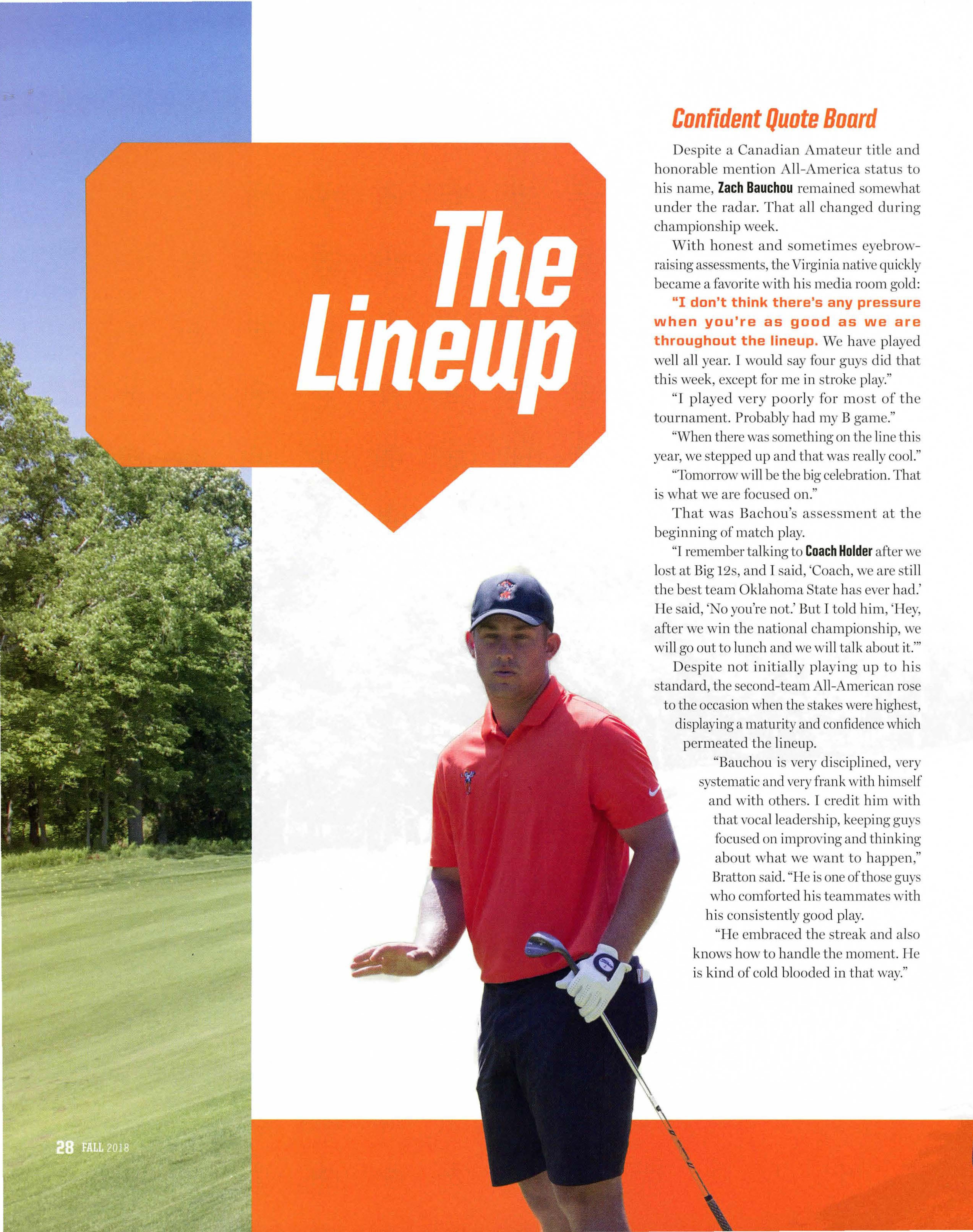
Despite a Canadian Amateur title and honorable mention All-America status to his name, ZachBauchouremained somewhat under the radar. That all changed during championship week.
With honest and sometimes eyebrowraising assessments, the Virginia native quickly became a favorite with his media room gold:
"I don't think there's any pressure when you're as good as we are throughout the lineup. We have played well all year. I would say four guys did that this week, except f-orme in stroke play."
"l played very poorly for mo t of the tournament. Probably had my B game."
"When there was something on the line this year, we stepped up and that was really cool."
"'lbmorrow will be the big celebration. That is what we are focused on."
That was Bachou's assessment at the beginning of match play.
"I remember talking to CoachHolderafter we lo tat Big 12 , and I said, 'Coach, we are still the best team Oklahoma State has ever had.' He said, 'No you're not.' But I told him, 'Hey, after wc win the national champion hip, we will go outto lunch and we will talk about it."'
Despite not initially playing up to his standard, the second-team All-American rose to the occasion when the stakes were highest, displaying a maturity and confidence which permeated the lineup.
"Bauchou is very disciplined, very systematic and very frank with himself and with other T credit him with that vocal leadership, keeping guys focused on improving and thinking about what we want to happen," Bratton said. "He i one of those guys who comforted his teammates with his consistently good play.
"He embraced the streak and also knows how to hand le the moment. He is kind of cold blooded in that way."
UnflappableRookie
Rewind to AustinEckroat'sclaysas a junior golfer, and it is not difficult to determine his college of choice.
"l was an Oklahoma State fan ver since I was a kid. I hav had season tickets to football games Ince I can remember. I wore Swinging Pete whenever I was playing in my junior tournaments at eight years old," Eckroat said.
Therefore, the opportunity to fulfill his childhood goal of winning a national championship with the Cowboys at a venue where he already had fond memories could only enhance the storybook ending.
Just like his first year at OSU, Eckroat's rookie campaign at golf powerhouse Edmond North High School was a memorable one. Not only did Eck roat com rn it to the Cowboys that year, he became the first-ever freshman to capture the Oklahoma Class 6A individual crown, doing so at Karsten Creek.
lt should come as no surprise Eckroat was able to perform at a high level with the setting being a familiar backdrop.
"For a freshman, he was about as steady as you can be emotionally. He was confident every day," Bratton said. "You can never tell how Austin is doing, and for a freshman to be sitting in that spot that was impressive. The guts and the confidence he played with really played a big part in the championship."
ModelofConsistency
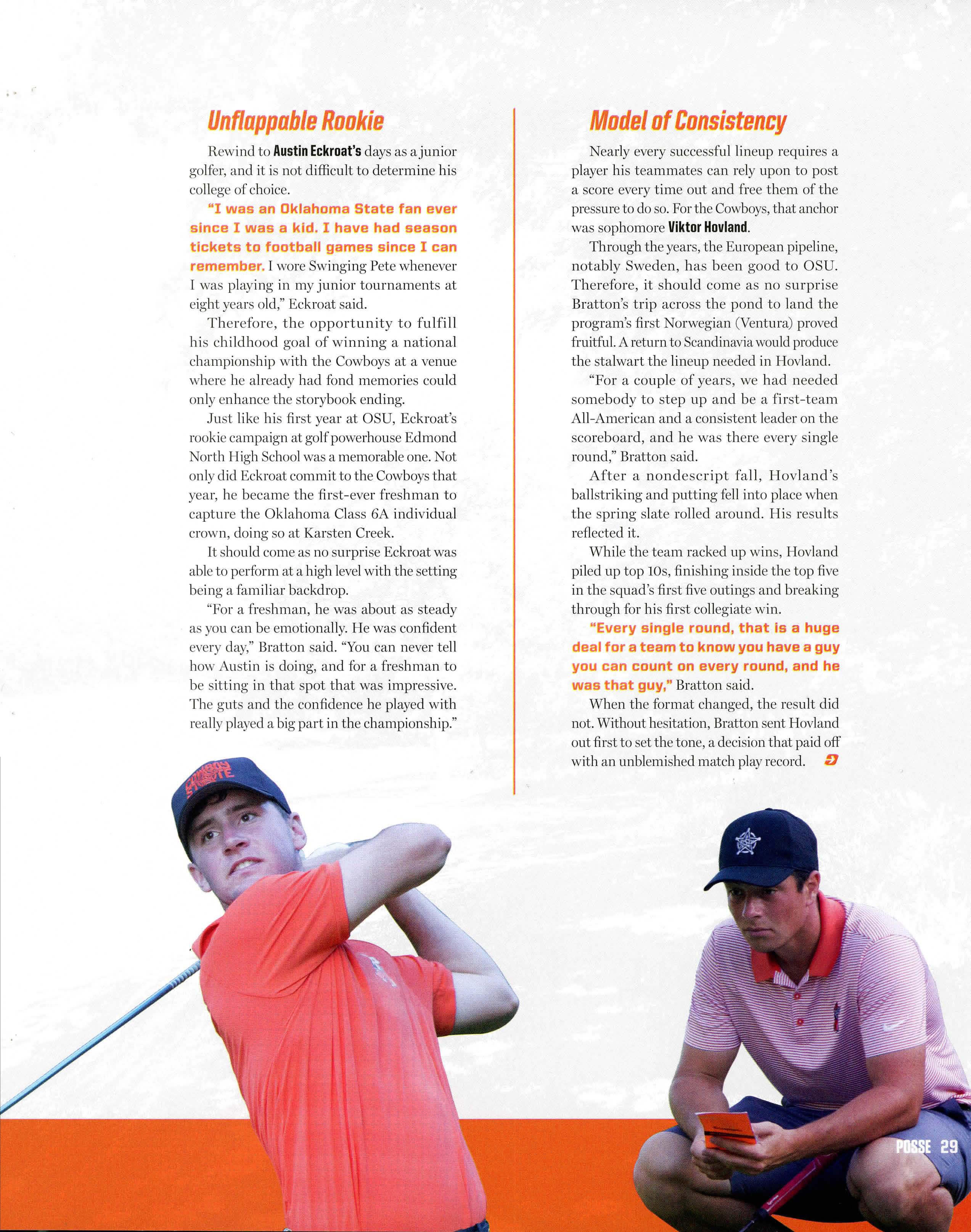
Nearly every successful lineup requires a player his teammates can rely upon to post a score every time out and free them of the pressure to do so. For the Cowboys,that anchor was sophomore ViktorHovland.
Through the years, the European pipeline, notably Sweden, has been good to OSU. Therefore, it should come as no surprise Bratton's trip across the pond to land the program's first Norwegian (Ventura) proved fruitful. A return to Scandinaviawould produce the stalwart the lineup needed in Hovland.
"For a couple of years, we had needed somebody to step up and be a first-team All-American and a consistent leader on the scoreboard, and he was there every single round," Bratton said.
After a nondescript fall, Hovland 's ballstriking and putting fell into place when the spring slate rolled around. His resu Its reflected it.
While the team racked up wins, Hovland piled up top 10s, finishing inside the top five in the squad's first five outings and breaking through for his first collegiate win.
"Every single round, that is a huge deal tor a team to know you have a guy you can count on every round, and he was that guy," Bratton said.
When the format changed, the result did not. Without hesitation, Bratton sent Hovland out first to set the tone, a decision that paid off with an unblemished match play record. :,
TheElderStatesman
Watch KristofferVenturahit a handful of shots, and it becomes apparent bis ball flight was made for Toptracer. During his collegiate career, the Norwegian with the Tour wing had constructed a solid resume that included multiple individual victoriesone being a Big 12 title - and All-America status. However, something was missing: a national championship.
"I-le is such a good ball hitter. This year he was a consi tent force and finished in the top 15 al most every ti me whether he had his game or not. l thought that was a big sign of maturity," Bratton said.
WeiI aware of the program's history, Ventura found great satisfaction in taking his place among the list of Cowboy champions.
"This is everything I dreamed of. When I came here, I knew that the history was huge and they had won 10 championships. To get it done this way is unbelievable. I don't have any words for it," Ventura said.
Not only did the honorable mention AllAmerican bring a maturity level and sense of calm to the lineup, he was able to help balance the youthful exuberance of the squad's fresh men with his business-like approach.
"It is a good thing to have another adult around, and he is pretty serious when he goes out there," Bratton said. "We had an ice balance with the youth of Austin and Matt, countered with the maturity of Zach and Kris. That was a great comp Iiment to each other."
StarintheMaking
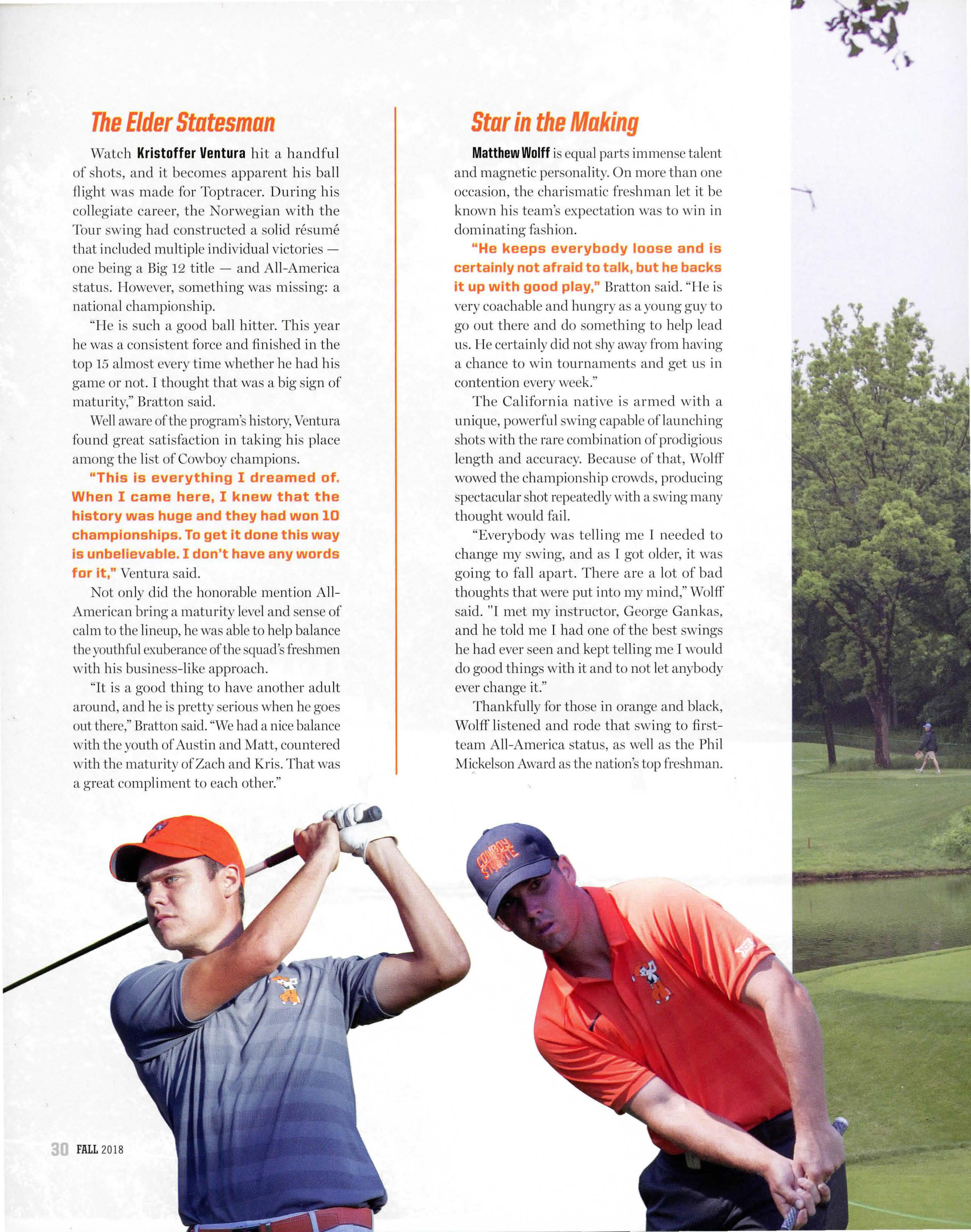
MatthewWolffis equal parts immense talent and magnetic personality. On more than one occasion, the charismatic freshman let it be known his team's expectation was to win in dominating fashion.
"He keeps everybody loose and is certainly not afraid to talk, but he backs it up with good play," Bratton said. "He is very coachable and hungry as a young guy to go out there and do something to help lead us. He certainly did not shy away From having a chance to win tournament and get us in contention every week."
The California native is armed with a unique, powcrfu I swing capable of !au nch ing shots with the rare combination of prodigious length and accuracy. Because of that, \!Volff wowed the championship crowds, producing spectacular shot repeatedly with a wing many thought would fail.
"Everybody was telling me l needed to change my swing, and a l got older, it was going to fall apart. There are a lot of bad thoughts that were put into my mind," Wolff said. "I met my instructor, George Gankas, and he told me I had one of the be. t swings be had ever seen and kept telling me I wou Id do good things with it and to not let anybody ever change it."
Thankfully for those in orange and black, Wolff listened and rode that swing to firstteam All-America status, as well as the Phil Mi:kelson Award as the nation's top freshman.
IronSharpensIron
The Cowboys' success in 2017-18 extended we!I beyond the performance of the five guys in the lineup at Karsten Creek. Everybody up and down the 10-man roster had a hand in title No. 11.
"The depth that we talked about really played out, not only the week of the championship, but the whole semester and the whole year," Bratton said.
In NickHeinen,BrendonJelley,StrattonNolen, SamStevensand HaydenWood,the roster had five players who have proven more than capable of stepping into the lineup and being successful, with multiple collegiate victories among the group.
"Those guys kept good attitudes all year, and that competition we had at home helped us get where we are over multiple years. It is not just a one-year thing," Bratton said.
With a stable full of thoroughbreds, Bratton went to work turning what could potentially be viewed as landmines into advantages. De pite the Cowboys having come up short in three previous title pursuits on home soil, he remained steadfast in his belief the orange faithful would empower his troops and the comforts of home would be invaluable.
"There was nothing the course could throw at you, weather or course conditions, that we wouldn't be ready for. That is a clear advantage, and then playing in front of a crowd and how they can lift you to do special things, which is an absolute fact," Bratton said.
"During the week, when people wanted to talk about the pressure of playing in front of a crowd or the pressure of playing at home, all our guys had heard was what an advantage that was. T think·you heard them voice that back because they were paying attention."
Examples of the standard, some more subtle than others, served as daily reminders of the stakes come the latter part of May. Whether it be the daily walks down Karsten Creek's trophy hallway,a shrine to the program's storied
history, or the championship ring adorning the hand of their head coach all season long, it was omnipresent.
"I knew we had a team that was capable, so I wore my ring. In 2006, I wore it consistently, and I ended up taking it off in a meeting at the regional and telling them I wasn't going to wear it anymore," Bratton said. "It was their turn to get one.
"Th is year, I never mentioned it to the guys, but they knew 1 had it on. I didn't end up making it a focal point with them. It was just a subtle reminder that it was their turn."
On the course, Bratton and Darr encouraged their players to monitor leaderboards during the regu Jar seaSO(lto mentally prepare for the nature of match play.
"Traditionally, when I played at Oklahoma State, you wou Id go and try to shoot as low as you could and blow away the field. It doesn't really matter how you stand in a regular stroke play event, but you really can't hide from how you stand in match play.It is right there in front of you. You know all the way through so you need to be able to handle it," Bratton explained.
"We went ahead and told our guys how we stood in tournaments, whether we were ahead or behind, trying to prepare them for being in that situation in a match."
Throughout the year, if they were not atop the leaderboard, the Cowboys were never far from it. OSU got out of the gate quickly, winning its season opener at The Carmel Cup
at Pebble Beach. Victory No. 2 would come in October at the Golf Club of Georgia and was the starting point for a historic run.
When the spring season got underway, wins in Hawaii and California prompted squad members to inquire about the school record for consecutive wins - proofBratton's strategy to embrace expectations and carve their own place in history was taking hold.
Trips to Mexico, San Diego, Florida and Texas all resulted in Cowboy triumph and extended the winning streak to seven, tying the school's single-season mark. The run would serve a bigger purpose than just a spot in the record book as it exposed the squad to a variety of scenarios.
"Whether we were ahead or behind, we won some close tournament·, we had big leads, we came from behind, and our guys were well versed in how to hand le al I those situations," Bratton said.
For a team already navigating astronomical expectations, its successes became more impres ive when considering it was thriving under the microscope of Golf Channel's Driven, a four-part series (co-produced by Cowboy great and PGA star RickieFowler)documenting the Cowboys' season-long journey.
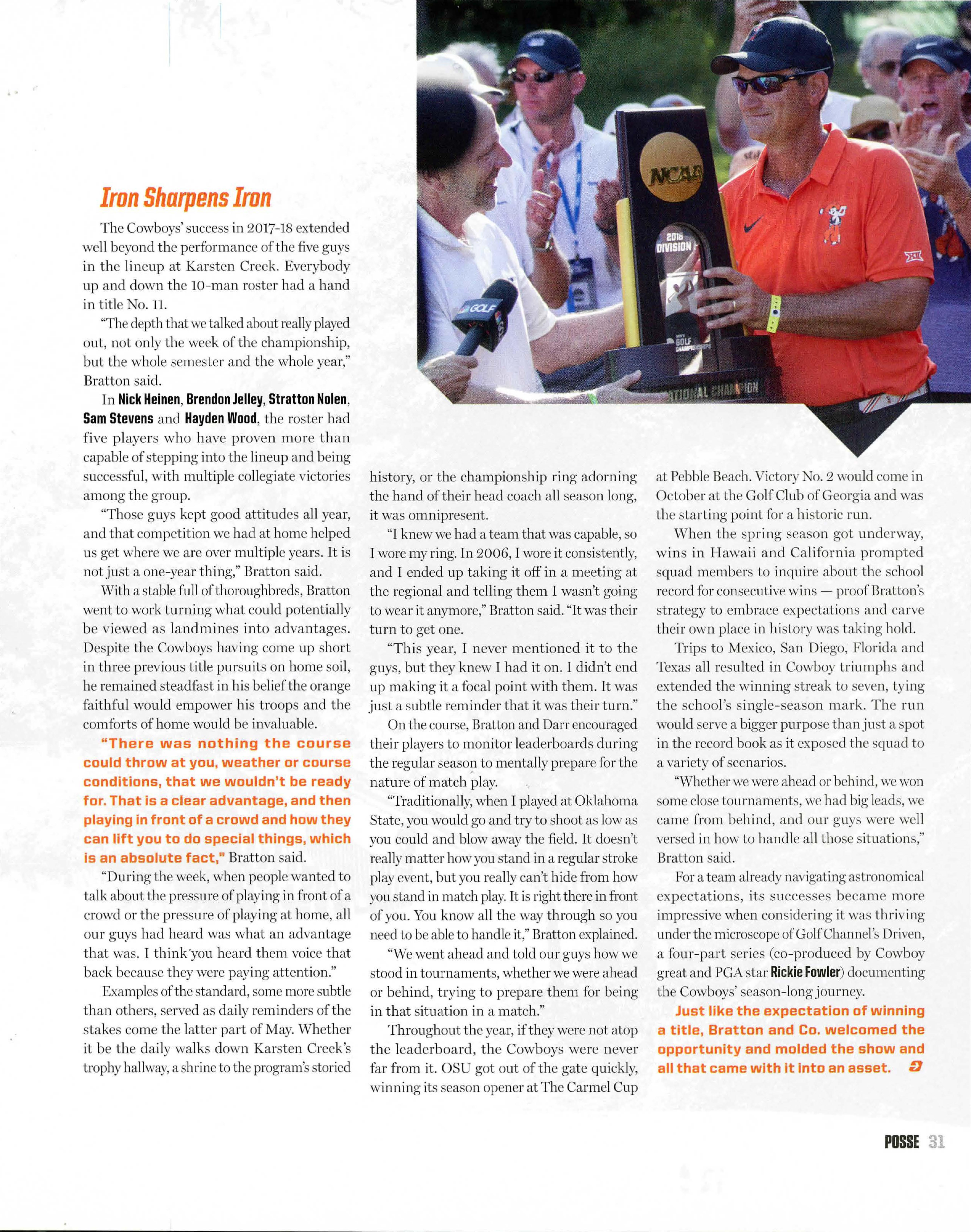
Just like the expectation of winning a title, Bratton and Co. welcomed the opportunity and molded the show and all that came with it into an asset. :J
"Driven ended up being a big bonus. We recognized quickly that having those cameras around was going to be an advantage come the end of the year because they wouId be used to that," Bratton said. "At the championship, the other teams were hoping to accomplish sorneth ing, and then they shoved a camera in front of them for the first time.
9BDLF
"They were very comfortable with it and got to say some things they ended up backing up. 1think by the time it all shook out, the world got to see what these guys were al I about, how confident they were in each other and just how good they were."
As the streak rolled on and talk of the home team being an overwhelming favorite grew, the Cowboys hittheirfirst stumbling block since the fall. A two-tournament drought, including a stinging Big 12 Championship lo sat Southern Hills, suddenly gave hope to the contenders who were descending upon Stillwater. Coming up short in Tul a did not sit well with one Cowboy in particularVentura. With the clock ticking on his championship dreams, the soft spoken senior took little comfort in haring medalist honors and made it very apparent how the rest of the story needed to unfold.

"That was not the reason we came here. We were here for a team trophy and that did not happen. We have to move on, look forward to the next two tournaments and hopefully kick everyone's a@:! in Stillwater."
Message received.
The squad recalibrated and responded with an impressive NCAA Regional victory at Ohio State's challenging Scarlet Course. Vlith their ninth victory in hand and officially qualified for the field at Karsten Creek, the Cowboys entered the week with four goals: win stroke play and then take care of their quarterfinal, semifinal and championship match opponents.
"1i\Tcwanted to make a statement and win the stroke play and go in as the No. l seed and show that we cou Id take care of all of that and leave no doubt," Bratton said. "Clearly, you can't get to the championship match until you take care of the other matches so those goals were obvious."
"We got another streak going and just plucked off each one and did a good job of not looking past what was right in front of us."

A vital cog in OSU title runs as a player (1995) and assistant coach (2006), Bratton is well versed in the heritage of the program. He repeatedly stressed the importance of the current crop of Cowboys standing on the shoulders of those who came before them. With that, championship week saw the Cowboys pay tribute to the past, mixing in throwback apparel in honor of the 40th anniversary of the program's 1978 squad.
After tackling their first goal of the week with an eight-shot victory during the stroke play portion of the event, OSU's reward was quarterfinal showdown with the No. 2 team in the country, Texas A&M. The matchup proved to be what one would expect from the top two teams with the Aggies pushing the Cowboys to the end.
All five matches reached the 18th green and two went extra holes before Eckroat calmly delivered the decisive blow with a birdie at the last. With that, a 3-1-1 victory was in hand and the second goal achieved.
"They were ranked No. 2 in the country for a reason. They were not going to go down without a fight, but our guys knew how to close out the match and they did," Bratton said.
With the field whittled to four, a date with No. 8 Auburn stood between the Cowboys and their shot at the ultimate goal. Once again it was Eckroat who closed it out in a 3-2 win to secure goal No. 3.
"That's why we brought him here, and J think that is why he came here. 1-Iehas a lot of guts and sho,ved that," Bratton said.
On the eve of the championsb ip match against Alabama, Bratton delivered one final message in the -t-ormof a special golf bag highlighted by a listing of the program's 10 previous NCAA titles. Bratton's point? Jn less than 24 hours, to once again pay homage to history and outdate the bags by becoming part of that history.
Positive vibes awaited the team at Karsten Creek the morning of its date with the Crimson Tide. Upon arriving at the course, the first two people to greet them were former Cowboy All-Americans LindyMillerand DavidEdwards.
"Lindy is arguably the best player Oklahoma State has ever had, and David won the national championship in 1978. This was the 40th anniversary of that, and we wanted to honor that team," Bratton said. "They were the first two people we saw so I thought that was a wonderful sign of things to come."
Once again, the Cowboy head coach could not have been more correct.
Having achieved their first three championship goals without being in top form, the Cowboy five saved their best for the most opportune moment.
"Aswe played through the week, we were in good position after every round, hut we didn't feel like we had hit our stride yet. I think we did a good job the whole week of getting a little bit better every day. In the final, Itbink we did play our best golf," Bratton said.
Having never wavered, it was inevitable Bauchou's game would click at some point during the week. That moment was championship Wednesday. Going out last, the confident junior was nothing short of dazzling with a 29 on the front nine behind the strength of five birdies and an eagle. He only needed 11 holes to put OSU's first point on the board and once again did not disappoint with his post-round commentary.
"I was last out, but the first in, which was pretty cool," Bauchou said.
"I just want to give credit to the other four guys here. Tbey played so well all week. I was kind of along for the ride, and then in match play between this last match and yesterday, I played really well. I stepped up. I looked really good. It was nice."
Going out in the first match, Hovland had two things in mind: put a point on the board and send up roars for the guys behind him to set the tone. The steady sophomore birdied the first two holes, shot 31 on the front nine and never looked back, wrapping op his match at the 15th where history would be made just minutes later.
Like Bauchou and Hovland, Wolff was spectacular on the outward nine, needing just 32 strokes with two birdies and an eagle. Birdies at Nos. 12 and 14 then set the stage for the coronation.
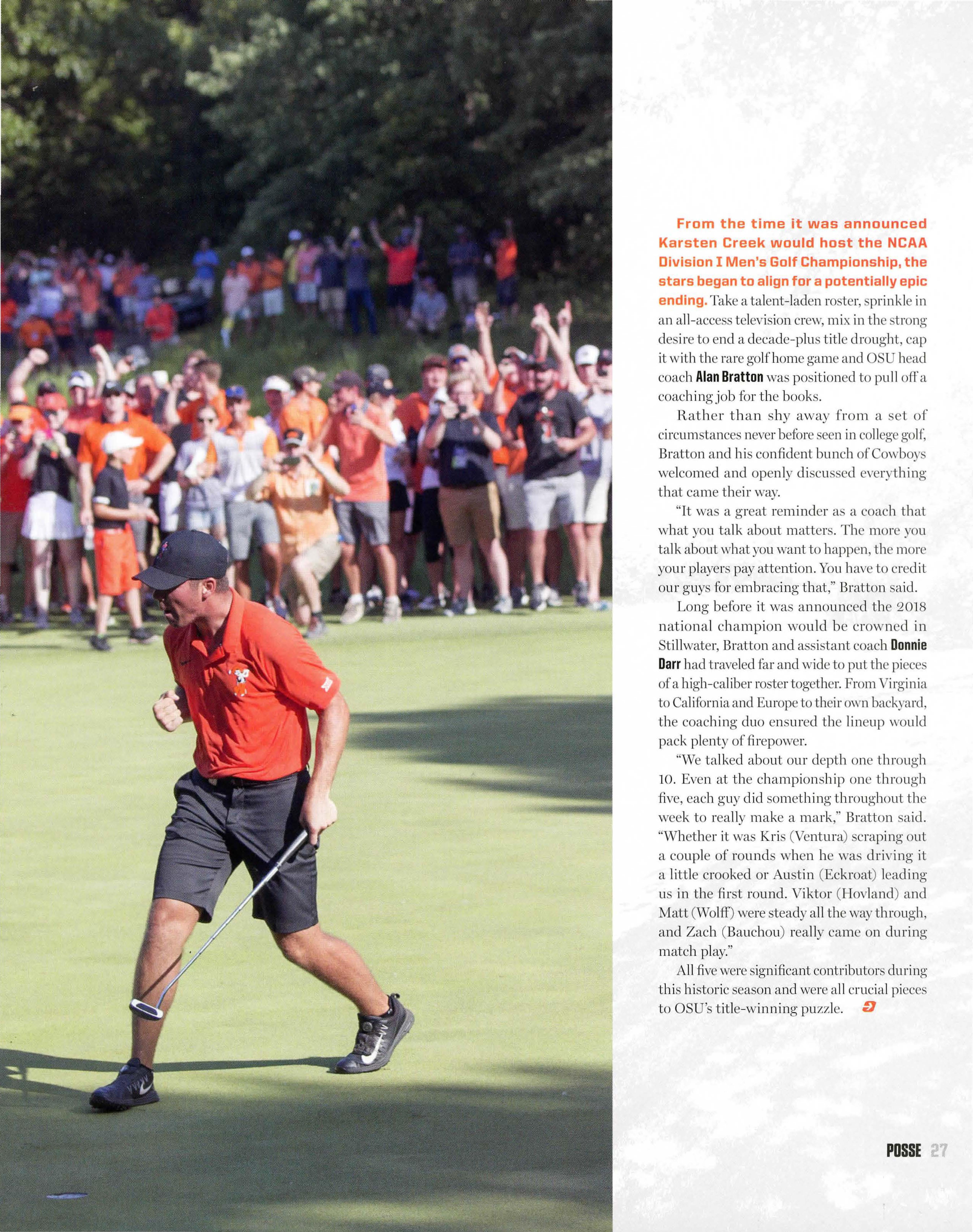
With a birdie attempt to seal the outcome, Wolff stepped up and calmly rolled in the 15-foot di ncher, setting off a celebration rarely seen in the sport and one forever etched into the memories of those in attendance.
Goal No. LI, spoken into existence.
"We talk a lot around here about, 'You get what you talk about, you get what you think about,"' Darr said. "I had never won a national championship, and for th is to happen is really cool."
Winning a national title and rnak ing your mark on one of the most iconic programs in the sport immediately places you among the elite in all of college golf; a fact not lost on Wolff.
"We are now a part oftbe elite fraternity that not a lot of people can say they are a part of. That is really the coolest thing to me," Wolff said.
As for the lunch date with Bauchou and Holder to discuss the 2017-18 squad's place in that elite fraternity? Stay tuned.
C A T C H I N G Li p W I T H
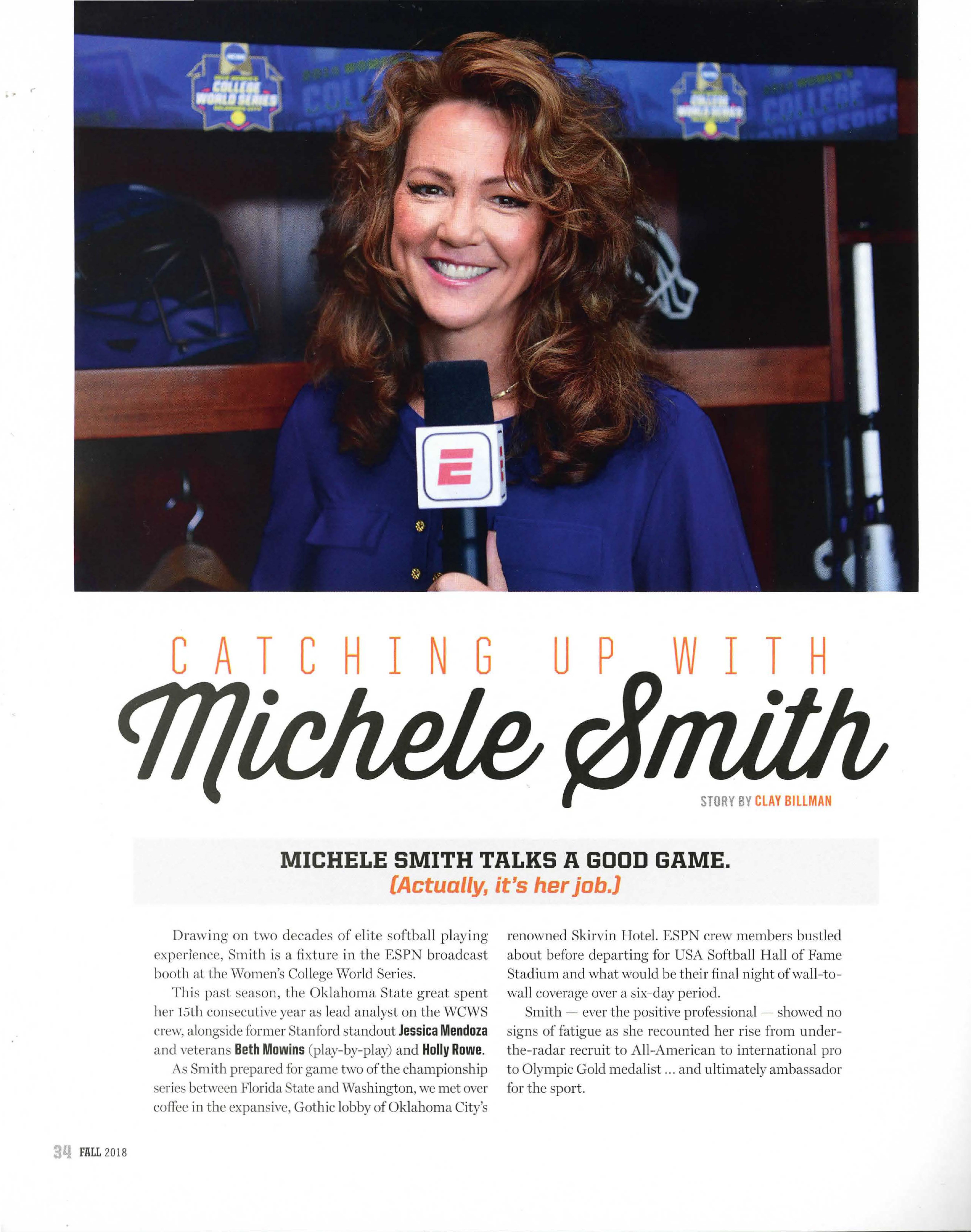
STORYBYCLAYBILLMAN
MICHELESMITH TALKS A GOODGAME.
{Actually, it's her job.}
Drawing on two decades of elite softball playing experience, Smith is a fixture in the ESPN broadcast booth at the Women's College World Series.
This past season, the Oklahoma State great spent her 15th consecutive year as lead analyst on the WCWS crew, alongside former Stanford standout JessicaMendoza and veterans BethMowins(play-by-play) and HollyRowe.
As Smith prepared for game two of the championship eries between Florida State and Washington, we met over coffee in tbe expansive, Gothic lobby of Oklahoma City's
renowned Skirvin Hotel. ESPN crew members bustled about before departing for USA Softball Hall of Fame Stadium and what would be their final night of wall-towall coverage over a six-day period.
Smith - ever the positive professional - showed no signs of fatigue as she recounted her rise from underthe-radar recruit to All-American to international pro to Olympic Gold medalist and ultimately ambassador for the sport.
JERSEY GIRL
Smith grew up in Califon, N.J. (a quaint borough of about l,000 residents at the time) and played softball at nearby Voorhees 1-ligh School, where she set school records for wins, strikeouts and no-hitters.
"I didn't start to pitch until I was a sophomore in high school," Smith adds. "In today's time, I would've never been recruited because everyone probably would've had their scholarships given away because I did start so late."
And rural New .Jersey isn't known as a softball recruiting hotbed - especially not in the mid-1980s, when the college game was developing further west.
"I remember the recruiting process. It was stressful," Smith says. "I didn't know where l wanted to go to ·chool, but I did know that in order to really play top level softball I had to go west to the Big Eight or Pac-10. The Southeastern Conference did not even have softball at that time."
Despite having the physicaltools, the 5-foot10 lefty was relativelyunheralded - so she took it upon herself to get noticed. And that meant playing with older, more experienced athletes.
"When I played ball in the ummers, I played against women that were in college, out of college, in the U.S. program so it was very challenging. Sink or swim." Smith says. "I was playing against the Raybcstos Brakettes and some of the other big women's teams.
''ffIDllll1ett a c,oJJ,e,g,,efm.!Ja.,,
"Ironirnlly enough, even though the collegiate game and the youth game were not very big in the northeast, what used to be called ASA Women's Major Fastpiteh was very big. A lot of athletes, even kids from UCLA, would come up and play. I played for a team called the Linden Majors that my pitching coach, BettyZwingraf, started. It was a big learning experience.
"It was an interesting time," she adds. "I think that's why l got a lot of offers my senior year, but it took a while for the word to get out about who I was It wasn't like nowadayswhere there's all these youth exposure tournaments."
To garner attention, Smith attended a summer camp run by softball hall of famer KathyArendsenthat featu reelthen-OS U pitching coach MargaretRebenaron staff.
"That's how OSU ended up finding out about me and recruiting me. By that time, J was already being recruited by Rutgers, but I wanted to go away. I wanted to be challenged a little bit more."
RECRUITINGPITCH
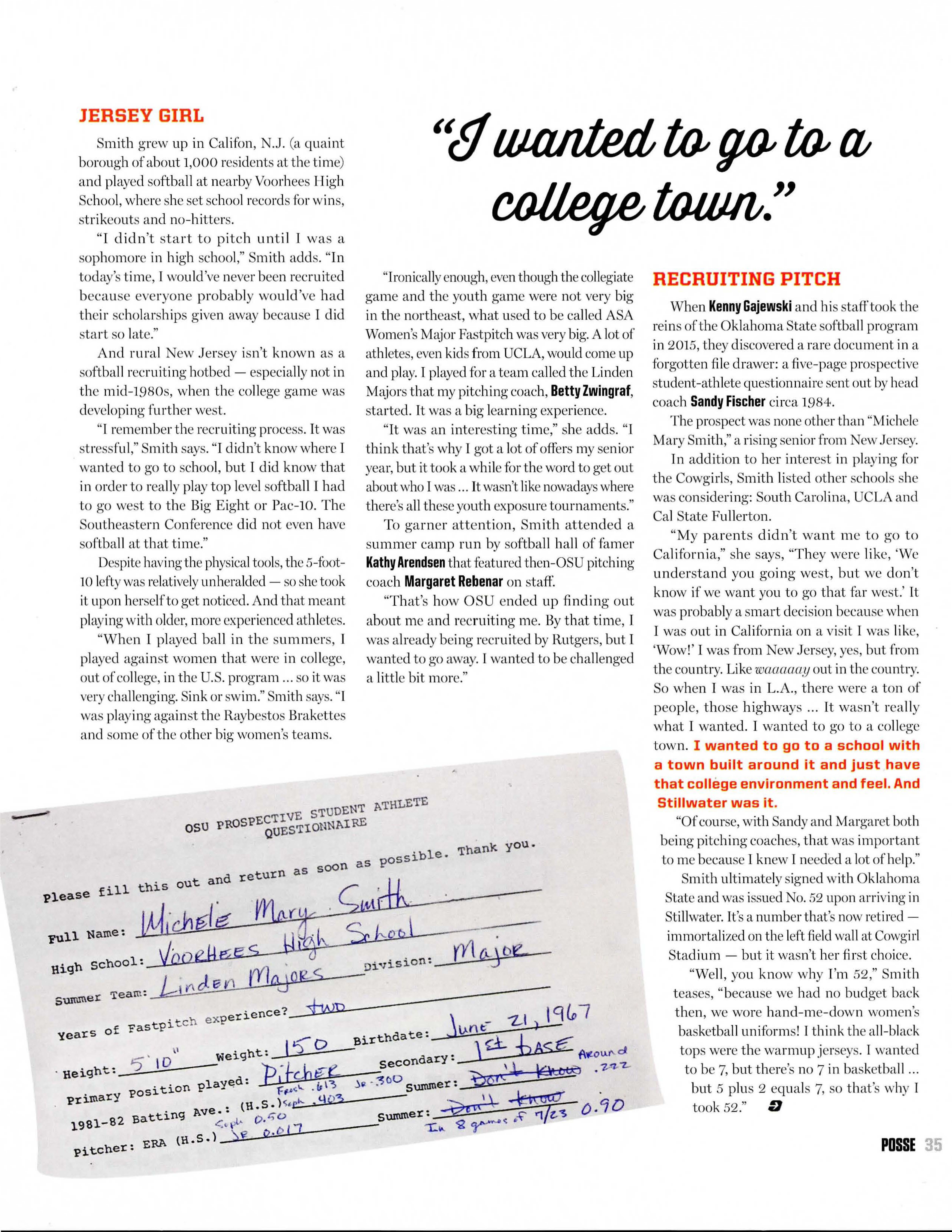
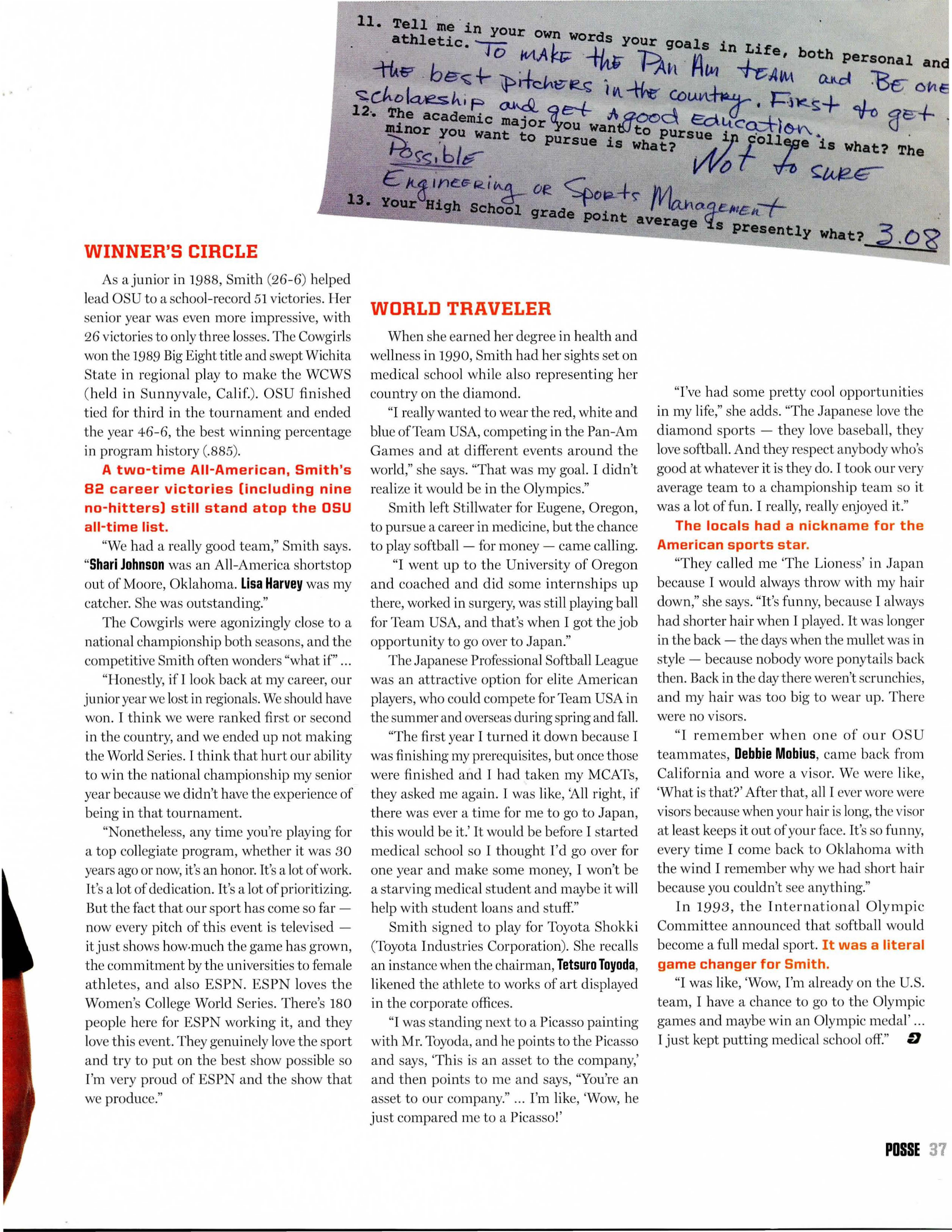
When KennyGajewskiand his staff took the reins of the Oklahoma State softball program in 2015, they discovered a rare document in a forgotten file drawer: a five-page prospective student-athlete questionnaire sent out by head coach SandyFischercirca 1984.
The prospect was none other than "Michele Mary Smith," a rising senior from New .Jersey. l n addition to her interest in playing for the Cowgirls, Smith listed other schools she wa considering: South Carolina, UCLA and Cal State Fullerton.
"My parents didn't want me to go to California," she says, "They were like, 'We understand you going west, but we don't know if we want you to go that far west.' It was probably a smart decision because when I was out in California on a visit I was like, 'Wow!' I was from New Jersey, yes, but from the country. Like waaaaay out in the country. So when I was in L.A., there were a ton of people, those highways It wasn't really what I wanted. I wanted to go to a college town. I wanted to go to a school with a town built around it and just have that college envir.onment and feel. And Stillwater was it.
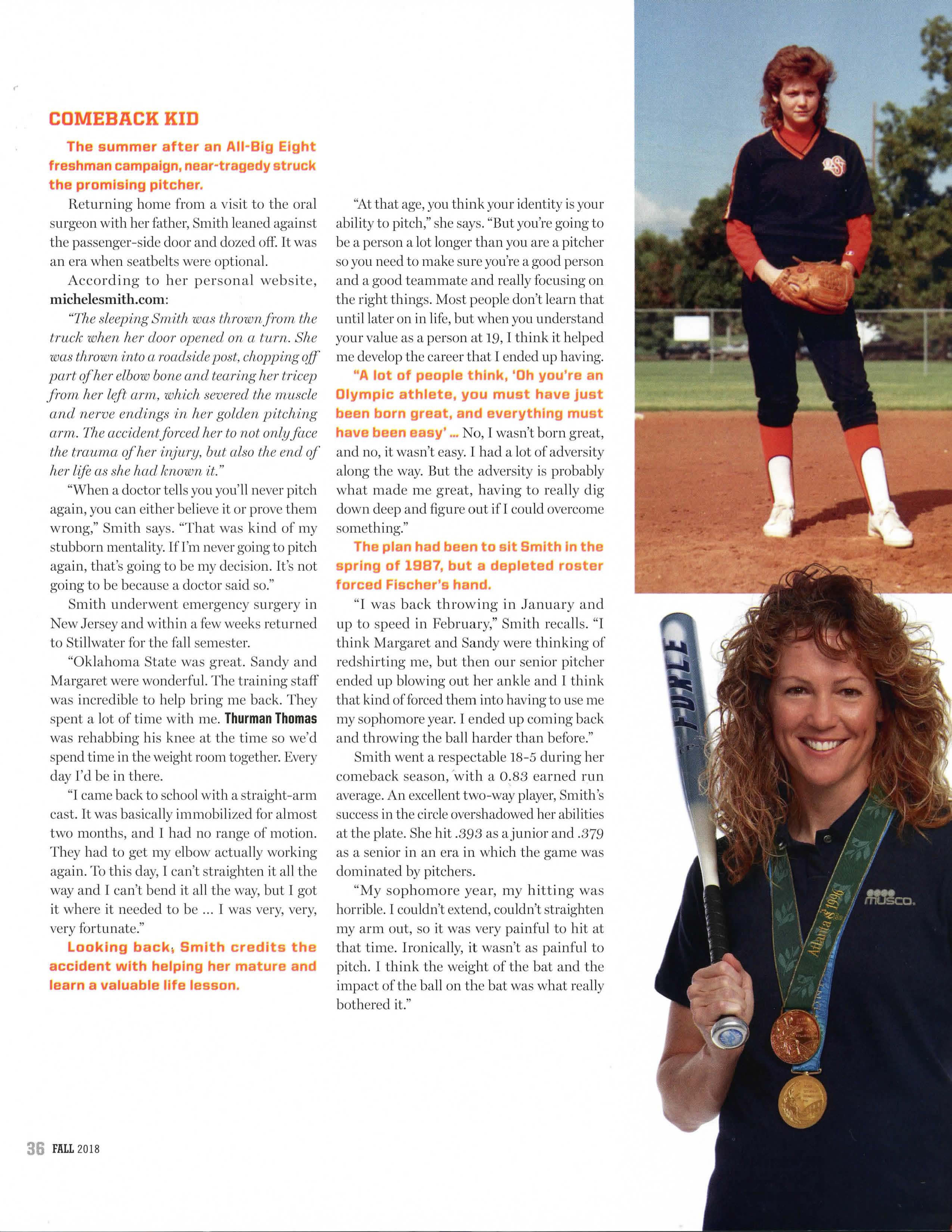
"Of course, with Sandy and Margaret both being pitching coaches, that was important to me because I knew I needed a lot of help." Smith ultimately signed with Oklahoma State and was issued No. 52 upon arriving in Stillwater. It's a number that' now retiredimmortalized on the left field wall at Cowgirl Stadium - but it wasn't her first choice.
"Well, you know why I'm 52," Smith teases, "because we had no budget back then, we wore hand-me-down women's basketball uniforms! I think the all-black tops were the warmup jersey . I wanted to be 7, but there's no 7 in ba ketball but 5 plus 2 equals 7, so that's why I took 52." D
COMEBACKKID
The summ r after n All-Bl lght freshmancampaign,near-tr gedy truck the proml Ing pitch r.
Returning home from a visit to the oral surgeon with her father, Smith leaned against the pa senger-side door and dozed off lt was an era when seatbelts were optional.
According to her personal website, michelesmith.com:
"The sleep·ing Smith was thrown.from the trnck when her door opened on a turn. She was thrown into a roadside post, chopping qff' part qfher elbow bone and tearing her tr'icep _fi-ornher lqft arm, which severed the muscle and nerve endings in her golden pitch:ing arm. Y1/J,eaccident.forced her to not onLy.fcice the trauma qf her i1lfury, but also the end qf her fife as she fwd known -it."
"When a doctor tells you you'I I never pitch again, you can either believe it or prove them wrong," Smith says. "That was kind of my stubborn mentality. If I'm never going to pitch again, that's going to be my decision. It's not going to be because a doctor said so."
Smith underwent emergency surgery in New Jersey and within a fow weeks returned to Stillwater for the fall semester.
"Oklahoma State was great. Sandy and Margaret were wonderful. The training taff was incredible to help bring me back. They spent a lot of time with me. ThurmanThomas was rehabbing his knee at the time so we'd spend time in the weight room together. Every day I'd be in there.
"I came back to school with a straight-arm cast. It wa basically immobilized for almost two months, and l had no range of motion. They had to get my elbow actually working again. To this day, l can't straighten it all the way and I can't bend it al I the way, but I got it where it needed to be I was very, very, very fortunate."
looking back; Smith credit th ccident with helping her m ture and learn a valu ble life le on.
"At that age, you think your identity is your ability to pitch," she says. "But you're going to be a person a lot longer than you are a pitcher so you need to make sure you're a good person and a good te,m1mate and really focusing on the right things. Most people don't learn that until later on in life, but when you understand your value as a person at 19, I think it helped me develop the career that I ended up having.
"Alot of p ople hlnk, 'Oh you'r n Olymplc thl te, you mu t hav Ju t b n born gr at, nd ev rythlng must h v b y' - No, l wasn't born great, and no, it wasn't easy. l had a lot of adversity along the way. But the adversity is probably what made me great, having to really dig down deep and figure out if [ could overcome something."
The pl n had be n to sit Smith In the prlng of 1987, but depleted rost r fore d Fl ch r's hand.
"l was back throwing in .January and up to speed in February," Smith recalls. "I think Margaret and Sandy were thinking of redshirting me, but then our senior pitcher ended up blowing out her ankle and l think that kind of forced them into having to use me my sophomore year. l ended up coming back and throwing the bal I harder than before."
Smith went a respectable 18-5 during her comeback season, 'with a 0.83 earned run average. An excellent two-way player, Smith's success in the circle overshadowed her abilities at the plate. She hit .393 as ajunior and .379 as a senior in an era in which the game was dom inatecl by pitchers.
"My sophomore year, my hitting was horrible. l cou Idn't extend, cou lcln't straighten my arm out, so it was very painful to hit at that time. Ironically, it wasn't as painful to pitch. I think the weight of the bat and the impact of the ball on the bat was what really bothered it."
~do kuest,., P :t
CoW\.~ • J='nc..s+ , ·_ ott 12-. !'he academic major S,i A ~d ed.4~ .J.... TO ge;-fainor you want t 'you wanti.Jfo-pursue i q::;d~. ~- 'b/ o pursue is What? '"",, 4J1foll'9• ie what? "'h
Wt,. ,rf&~•e ~~n~•ic.i~ Of! ~•+~ MA igh School grade P0int • l'fa.ne1~~-fvera9e s presently What?
WINNER'S CIRCLE
As a junior in 1988, Smith (26-6) helped lead OSU to a school-record 51 victories. Her senior year was even more impres ive, with 26 victories to only three losses. The Cowgirls won the 1989 Big Eight title and swept Wichita State in regional play to make the WCWS (held in Sunnyvale, Calif.). OSU fini hed tied for third in the tournament and ended the year 46-6, the best winning percentage in program history (.885).
A two-time All-American, Smith's 82 career victories (including nine no-hitters) still stand atop the OSU all-time list.
"We had a really good team," Smith says. "ShariJohnsonwas an All-America shortstop out of Moore, Oklahoma. LisaHarveywas my catcher. She was outstanding."
The Cowgirls were agonizingly clo e to a national championship both seasons, and the competitive Smith often wonders "what if"
"Honestly, if I look back at my career, our junior year wc lost in regionals. We hould have won. I think we were ranked fir·t or second in the country, and we ended up not making the World Series. I think that hurt our ability to win the national championship my senior year because we didn't have the experience of being in that tournament.
"Nonetheless, any time you're playing for a top collegiate program, whether it wa .'.30 years ago or now, it's an honor. It's a lot of work. It's a lot of dedication. It's a lot of prioritizing. But the fact that our sport has come o farnow every pitch of this event i televisedit just hows how-much the game has grown, the commitment by the universities to female athletes, and also ESPN. ESPN loves the Women's College World Series. There's 180 people here for ESPN working it, and they love this event. They genuinely love the sport and try to put on the best show po sible so I'm very proud of ESP and the show that we produce."
WORLD TRAVELER
When she earned her degree in health and wellness in 1990, Smith had her sights set on medical school while also representing her country on the diamond.
"I really wanted to wear the red, white and blue of Team USA, competing in the Pan-Am Games and at different events around the world," she says. "That was my goal. I didn't realize it would be in the Olympics."
Smith left Stillwater for Eugene, Oregon, to pursue a career in medicine, but the chance to play softball - for money - came calling.
"I went up to the University of Oregon and coached and did some internships up there, worked in surgery, was still playing ball for Team USA, and that's when I got the job opportunity to go over to Japan."
The Japanese Professional Softball League was an attractive option for elite American players, who could compete for Team USA in the summer and overseasduring spring and fall.
"The first year I tu med it down because I was finishing my prerequisites, but once those were finished and I had taken my MCATs, they asked me again. I was like, 'All right, if there was ever a time for me to go to Japan, this would be it.' It would be before I started medical school so I thought I'd go over for one year and make ome money, I won't be a starving medical student and maybe it will help with student loans and stuff."
Smith signed to play for Toyota Shokki (Toyota Industrie Corporation). She recalls an instanc;cwhen the chairman, TetsuroToyoda, likened the athlete to works of art displayed in the corporate offices.
"I was standing next to a Picasso painting with Mr. Toyoda, and he points to the Picasso and says, This is an as et to the company,' and then points to me and says, "You're an asset to our c:ompany." I'm like, 'Wow, he just compared me to a Picasso!'
"I've had some pretty c:ool opportunities in my life," she adds. "The Japanese love the diamond sports - they love baseball, they love oftball. And they respect anybody who's good at whatever it is they do. I took our very average team to a championship team so it was a lot of fun. I really, really enjoyed it."
The locals had a nickname for the American sports star.
"They called me 'The Lioness' in Japan because I would always throw with my hair down," she says. "It's funny, because I always had shorter hair when 1 played. It was longer in the back - the days when the mullet was in style - because nobody wore ponytails back then. Back in the claythere weren't scrunchies, and my hair was too big to wear up. There were no visors.
"I remember when one of our OSU teammates, DebbieMobius,came bad, from California and wore a visor. We were like, 'What is that'?' After that, all I ever wore were vi or because when your hair is long, the vi or at lea t keeps it out of your face. lt's so funny, every time I come back to Oklahoma with the wind I remember why we had short hair becau e you couldn't see anything."
In 1993, the International Olympic Committee announced that softball would become a full medal sport. It was a literal game changer for Smith.
"I was like, 'Wow, I'm already on the U.S. team, I have a chance to go to the Olympic game and maybe win an Olympic medal' I ju t kept putting medical school off" D


DIFFERENCE MAKER
Feeling conflicted for postponing her career as a doctor, she confided in Oregon team physician KennethSinger,M.D.
"1 said I felt really guilty that I wa • not going to medical school where I could actually be helping people," Smith admits. "Dr. Singer looked at me and said, 'How do you know you're not helping people? Just because you have a ball in your hand instead of a scalpel doesn't mean you're not helping people. Look at all the young girls you're helping.' Immediately I felt comfortable in my skin. I was like, 'Okay, I'm doing what I should be doing. I'm making a difference."
Smith continued to play professional fastpitch in Japan while competing for Team USA (earning gold at the 1996 Atlanta Games and four years later in Sydney, Australia). She also began moonlighting as an analyst in the ESPN booth.
"I think my first broadcast was in 1995. I was back and forth to Japan a lot so sometimes I would fly in, call the (WCWS) games and fly back out. I was playing from March through November every year so it was a long yearkind of like what a Major League Baseball player would do - but I was playing in Japan, for Team USA and doing a bunch of other stuff in between."
In recent years, the "other stuff' has meant charitable work, including hosting a collegiate softball tournament near her current home in Treasure [sland, Fla.
The Michele Smith National Pediatric Cancer Foundation Invitational has included her al ma mater the last several years, and the Cowgirls will again be playing as next year's tournament is broadcast worldwide.
"We've partnered up with ESPN," she explains. "It's the first time that softball is going to be televised in February at a significant amount of programming windows, which is huge for us because that's basketball season."
Smith's success on the softball diamond has spawned a number of other philanthropic endeavors, volunteer work and advisory roles - mostly aimed at helping children.
"I always joke, 'You become an Olympic athlete and then you work for free the rest of your life."'
''d'ueluut w.nze fJ'U!/1-fl cod
lllfl
life."
GAME CHANGER
Smith smiles when she thinks about what it would've been like playing in the current era of collegiate softball, with the latest technology in bats and balls designed to produce offensive fireworks.
"I think I used a 32 ounce bat in college, and most of the bats nowadays are 22 ounce so there's no comparison in technology. Today's bats are just far superior to what was used back in the '80s and '90s.
"I think the evolution of the sport has been good," she adds. "It's helped draw a larger fan base. Not every viewer loves a pitching duel where it's I-nothing so I think the offense bas been good. The one thing about the game of softball is that we feel free to change it when necessary we've moved the pitching distance back, we've got livelier balls, we have livelier bats, we've moved the fences back a little bit. I've played through all those changes."
The evolution of the sport has also opened the door for athletes of all shapes and sizes to have an opportunity for success, she says.
"That's the great thing about softballyou can be 6-foot-2, you can be 5-foot-2. There's a spot for everybody in the game. You can have speed, power The game doesn't discriminate. If you love the sport, there's probably a position for you."
COWGIRLAT HEART
Smith has kept a close eye on the Cowgirls over the years.
"I'm always proud to host them at my tournament," she says."l think Kenny G,1jewski is doing a great job of getting the program back where it belongs There's a lot of history and tradition at Oklahoma State so hopefully they can continue to build that."
Th is past spring, OS U honored the architect of the Cowgirl softball program, putting Coach Fischer's name on the outfield wall next to Smith's 52, MelanieRoche's 5 and LaurenBay's35.
"I think it was brilliant," Smith says. "Kenny told me when he got the job that he really wanted to get the alumni back involved and get Coach Fischer plugged in becau e she's the one that built the program. It started with her, and she did some amazing things while she was there so l was really happy.
"I think it's very important for the new athletes who are coming in to real.ize there's some amazing history in that program."
(And some amazing people.)
ll§fJ

, Annual Membership for Kids STH Grade and Under
ONLY $25 PER CHILD
Sign up today at okstate.com/kidsclub
PISTOL PETE'S PARTNERS
OFFICIAL KIDS CLUB OF OSU ATHLETICS
Pistol Pete's Partners offers young ) Cowboy and Cowgirl fans the opportunity / to attend over 100 OSU Athletics events for FREE I Plus ...
• Invites to "Member Only,, Parties with Student-Athletes
• Membership T-shirt
• Picture of Pistol Pete
• Birthday Card from Pistol Pete
• AND MUCH MORE FOR MORE INFORMATION VISIT OKSTATE.COM/KIDSCLUB

I
was just about to leave my office for the day when the phone rang.
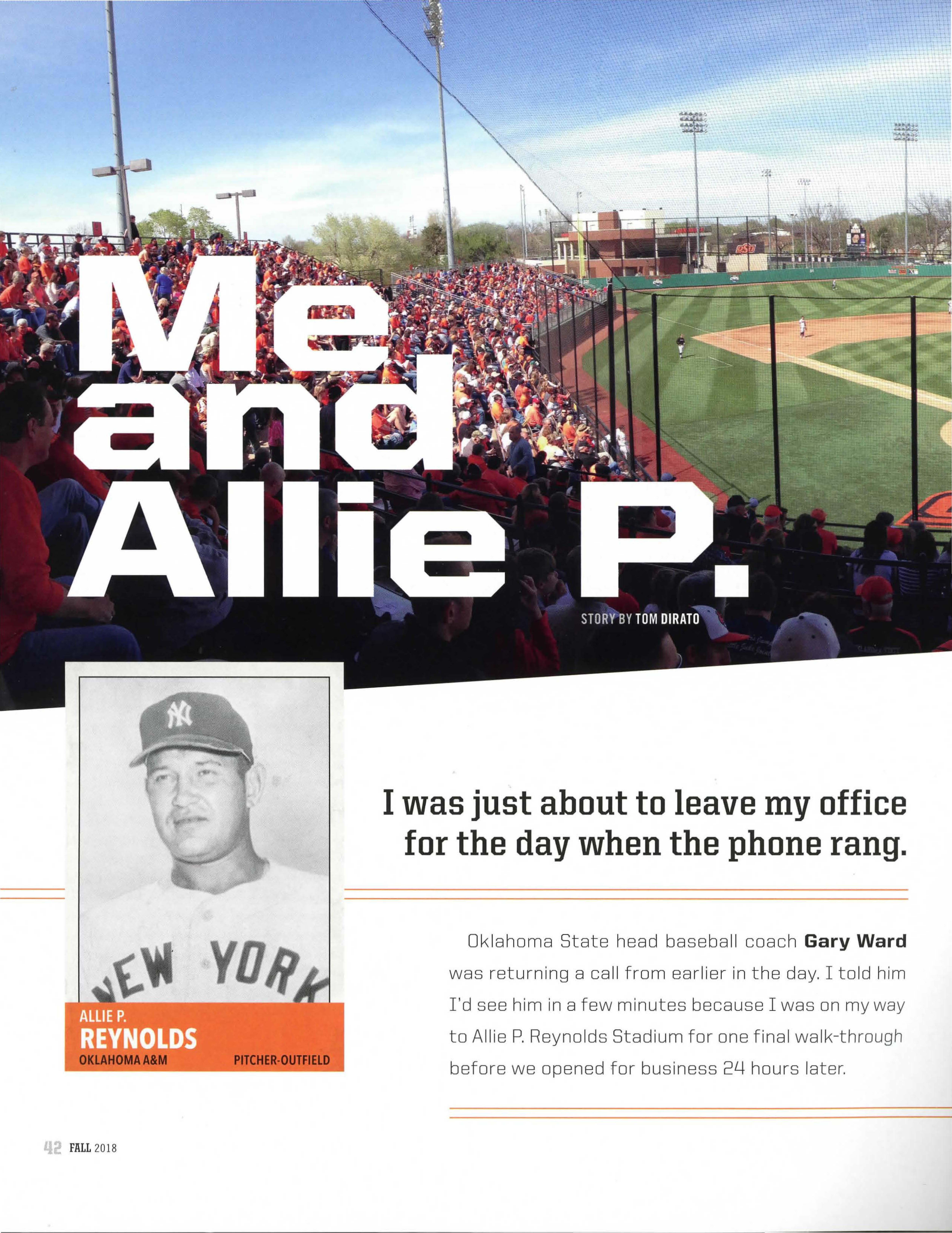
Oklahoma State head baseball coach Gary Ward was returning a call from earlier in the day. I told him I'd see him in a few minutes because I was on my way to Allie P. Reynolds Stadium for one final walk-through before we opened for business 24 hours later.
It's amazing that I can still recall that day some 38 years ago, but I can't remember Ward would certainly make good on that what I had for dinner three nights ago. I'm statement as he guided OSU to 10 College sure it was due in part to the adrenaline factor. I was about to take my own personal tour ofa stadium that would put Oklahoma State baseball back on the map.
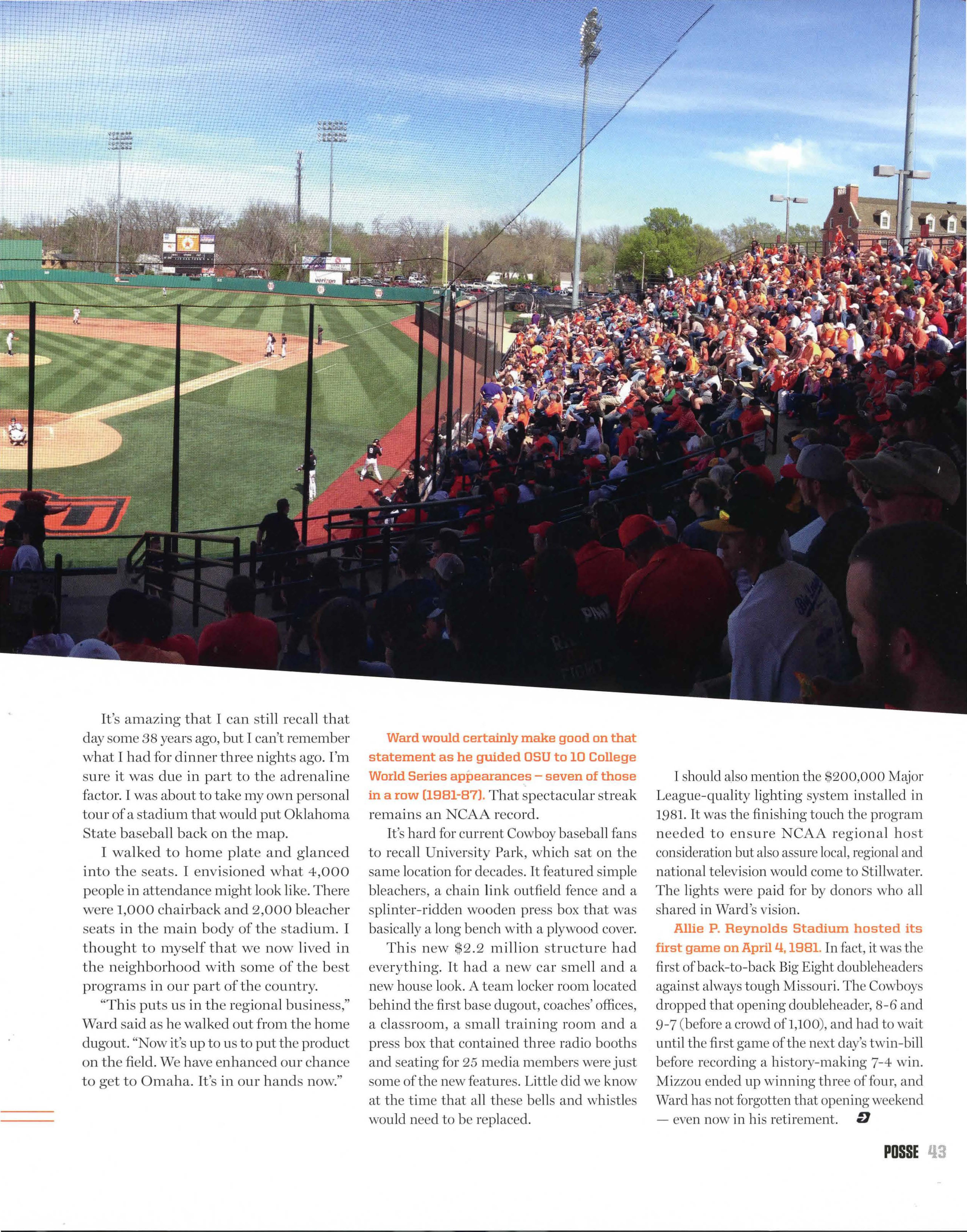
I walked to home plate and glanced into the seats. l envisioned what 4,000 people in attendance might look like. There were 1,000 chairback and 2,000 bleacher seats in the main body of the stadium. I thought to myself that we now Iived in the neighborhood with some of the best programs in our part of the country.
"This puts us in the regional business," Ward said as he walked out from the home dugout. "Now it's up to us to put the product on the field. We have enhanced our chance to get to Omaha. It's in our hands now."
World Series appearances - seven of those in a row (1981-87). That spectacular streak remains an NCAA record.
It's hard for current Cowboy baseball fans to recall University Park, which sat on the same location for decades. lt featured simple bleachers, a chain link outfield fence and a splinter-ridden wooden press box that was basically a long bench with a plywood cover.
This new $2.2 million structure had everything. It had an w car smell and a new house look. A team locker room located behind the first base dugout, coaches' offices, a classroom, a small training room and a press box that contained three radio booths and seating for 25 media members were just some of the new features. Little did we know at the time that all these bells and whistles would need to be replaced.
I should also mention the $200,000 Major League-quality lighting system installed in 1981. lt was the finishing touch the program needed to ensure NCAA regional host considerationbut also assure local,regionaland national television would come to Stillwater. The lights were paid for by donors who all shared in Ward's vision.
Allie P. Reynolds Stadium hosted its first game on April LI,1981. In fact, it was the fir t of back-to-back Big Eight doubleheaders against always tough Missouri. The Cowboys d rapped that opening doubleheader, 8-6 and 9-7 (before a crowd ofl,100), and had to wait until the fir t game of the next day's twin-bill before recording a history-making 7-4 win. Mizzou ended up winning three of four, and Ward has not forgotten that opening weekend - even now in his retirement. :J
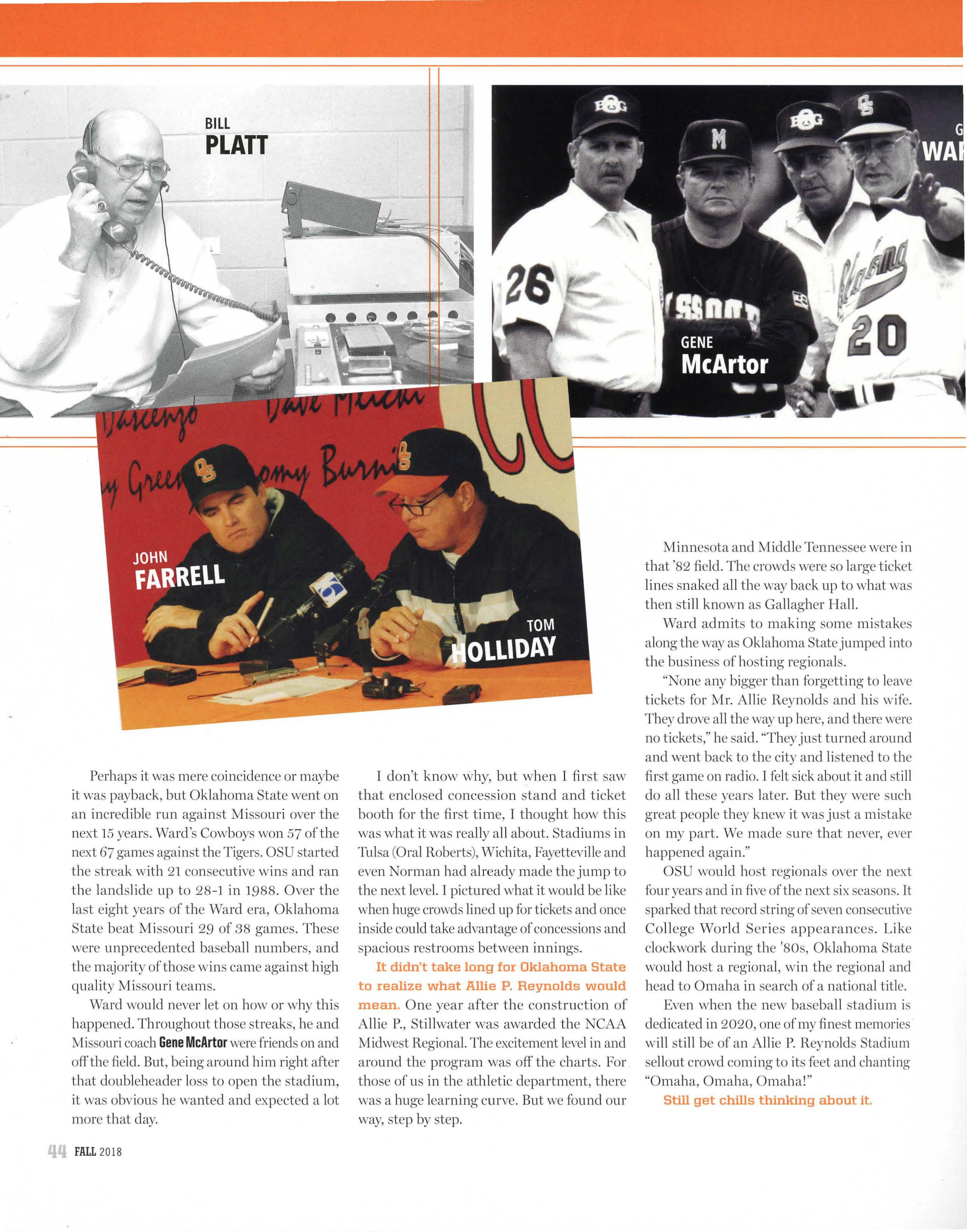
BILL PLATT
Perhaps it was mere coincidence or maybe it was payback, but Oklahoma State went on an incredible run against Missouri over the next 15 years. Ward's Cowboys won 57 of the next 67 games against the Tigers. OSU started the streak with 21 consecutive wins and ran the landslide up to 28-1 in 1988. Over the last eight years of the Ward era, Oklahoma State beat Missouri 29 of 38 games. These were unprecedented baseball numbers, and the majority of those wins came against high quality Missouri teams.
Ward would never let on how or why this happened. Throughout those streaks, he and .tvlissouri coach GeneMcArtorwere friends on and off the field. But, being around him right after that doubleheader loss to open the stadium, it was obvious he wanted and expected a lot more that day.
FALL2018
I don't know why, but when I first saw that enclosed concession stand and ticket booth for the first time, I thought how this was what it was really all about. Stadiums in Tulsa (Oral Roberts), Wichita, Fayetteville and even Norman had already made the jump to the next level. I pictured what it would be like when huge crowds lined up for tickets and once inside could take advantage of concessions and spacious restrooms between innings.
It didn't take long for Oklahoma State to realize what Allie P. Reynolds would mean. One year after the construction of Allie P., Stillwater was awarded the NCAA Midwest Regional. The excitement level in and around the program was off the charts. For those of us in the athletic department, there was a huge learning curve. But we found our way, step by step.
Minnesota and Middle Tennc see were in that '82 field. The crowds were so large ticket Iines snaked al I the way back up to what was then still known as Gallagher Hall.
Ward a lmits to making some mistakes along the way as Oklahoma State jumped into the business of hosting regionals.
"None any bigger than forgetting to leave tickets for Mr. Allie Reynolds and his wife. They drove a 11the way up here, and there were no tickets," he said. "They just turned around and went back to the city and listened to the first game on radio. I felt sick about it and sti 11 do all these years later. But they were such great people they knew it was just a mistake on my part. We made sure that never, ever happened again."
OSU would host regionals over the next four years and in five of the next six seasons. It sparked that record string of seven consecutive College World Series appearances. Like clockwork during the '80s, Oklahoma State would host a regional, win the regional and head to Omaha in earch of a national title.
Even when the new ba cball stadium is cledicated in 2020, one of my finest memories will still be of an Allie P. Reynold Stadium sellout crowd coming to its feet and chanting "Omaha, Omaha, Omaha!"
Still get chills thinking about it.
"Wehad that mentality that no one would.come into our stadium and win a game."
Randy Whisler
People have asked what my favorite memories of Allie P. Reynolds Stadium are, and to this day it's still hard to come up with an exact list. There were so many:
0 Thedaythestadiumwasofficiallydedicated (April2q,1982).Reynolds and New York Yankee legends MickeyMantleand BillDickey, along with pitching great WarrenSpahn,were on hand. There were a few speeches, but just the sight of that legendary group gathered around home plate was breathtaking.
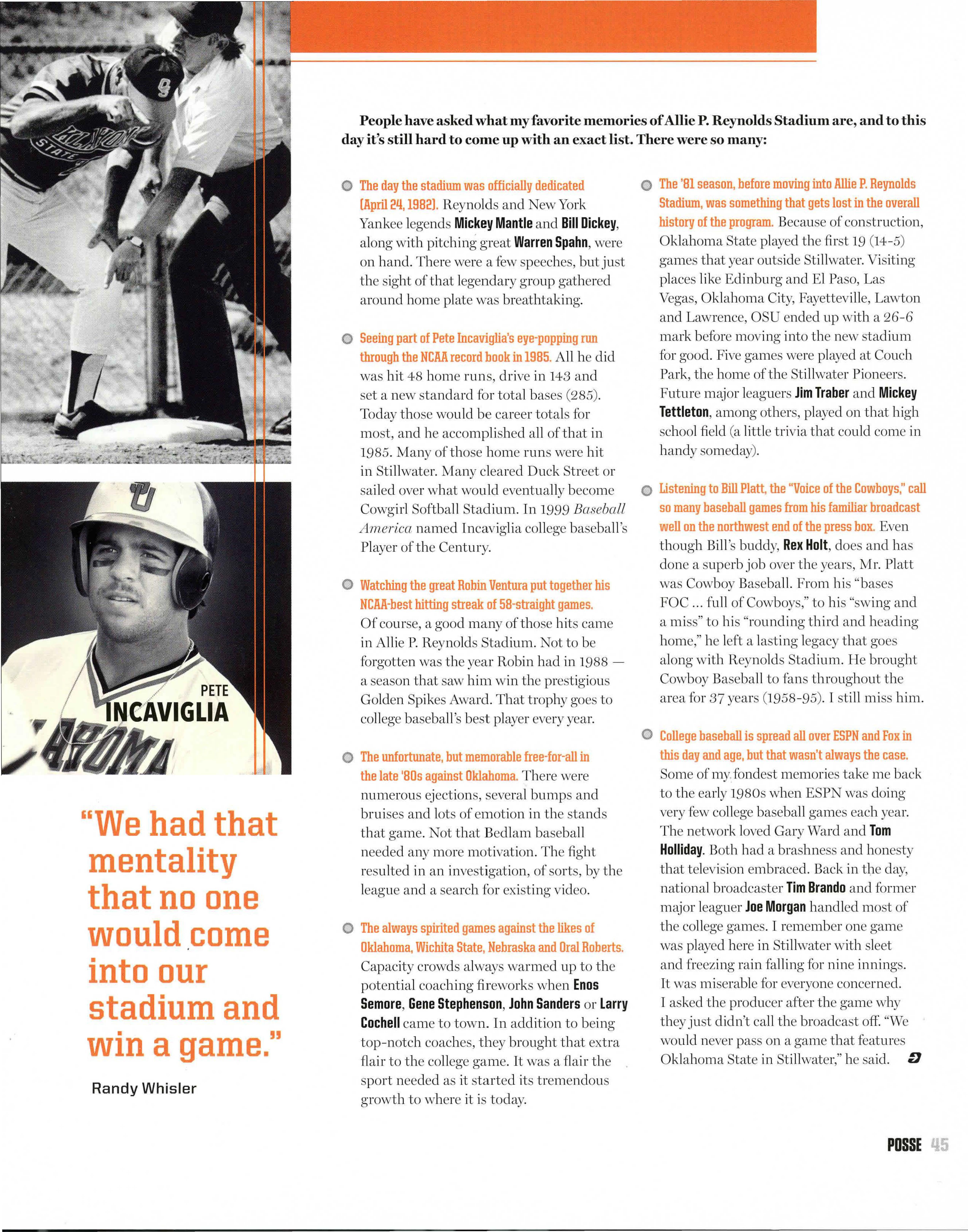
0 SeeingpartofPeteIncaviglia'seye-poppingrun throughtheNCAArecordbookin1985.All he did was hit 48 home runs, drive in 143 and set a new standard for total bases (285). Today those wou Id be career totals for most, and he accomplished all of that in 1985. Many of those home runs were hit in Stillwater. Many cleared Duck Street or sailed over what would eventually become Cowgirl Softball Stadium. In 1999 Baseball America named Incaviglia college baseball's Player of the Century.
0 WatchingthegreatRobinVenturaputtogetherhis NCAA-besthittingstreakof 58-straightgames. Of course, a good many of those hits came in Allie P. Reynolds Stadium. Not to be forgotten was the year Robin had in 1988a season that saw him win the prestigious Golden Spikes Award. That trophy goes to college baseball's best player every year.
0 Theunfortunate,butmemorablefree-for-all in thelate'80sagainstOklahoma.There were numerous ejections, several bumps and bruises and lots of emotion in the stands that game. Not that Bedlam baseball needed any more motivation. The fight resulted in an investigation, of sorts, by the league and a search for existing video.
0 Thealwaysspiritedgamesagainstthelikesof Oklahoma,WichitaState,NebraskaandOralRoberts. Capacity crowds always warmed up to the potential coaching fireworks when Enos Semore,GeneStephenson,JohnSandersor Larry Cochellcame to town. In addition to being top-notch coaches, they brought that extra flair to the college game. lt was a flair the sport needed as it started its tremendous growth to where it is today.
O The'81season,beforemovingintoAllieP.Reynolds Stadium,wassomethingthatgetslostintheoverall historyoftheprogram.Because of construction, Oklahoma State played the first 19 (14-5) games that year outside Stillwater. Visiting places like Edinburg and El Paso, Las Vegas, Oklahoma City, Fayetteville, Lawton and Lawrence, OSU ended up with a 26-6 mark before moving into the new stadium for good. Five games were played at Couch Park, the home of the Stillwater Pioneers. Future major leaguers JimTraberand Mickey Tettleton,among others, played on that high school field (a little trivia that could come in handy someday).
O ListeningtoBillPlatt,the"VoiceoftheCowboys,"call so manybaseballgamesfromhisfamiliarbroadcast wellonthenorthwestendofthepressbox.Even though Bill's buddy, RexHolt,does and has done a superb job over the years, Mr. Platt was Cowboy Baseball. From his "bases FOC fo II of Cowboys," to his "swing and a miss" to his "rounding third and heading home," he left a lasting legacy that goes along with Reynolds Stadium. He brought Cowboy Baseball to fans throughout the area for 37 years (1958-95). l still miss him.
0 Collegebaseballis spreadalloverESPNandFoxin thisdayandage,butthatwasn'talwaysthecase. Some of my.fondest memories take me back to the early 1980s when ESPN was doing very few college baseball games each year. The network loved Gary Ward and Tom Holliday.Both had a brashness and honesty that television embraced. Back in the clay, national broadcaster TimBrandoand former m,uor leaguer JoeMorganhancllecl most of the college games. I remember one game was play d here in Stillwater with sleet and freezing rain falling for nine innings. Ttwas miserable for everyone concerned. I asked the producer after the game why they just didn't call the broadcast off. "We would never pass on a game that features Oklahoma State in Stillwater," he said. :J
Along that same line, some of the most interesting pregame meetings I was able to be part of came about five hours before that televised first pitch. The meeting took place in the lobby of a local hotel. It included Ward, Holliday,the producer, Brando, Morgan and on occasion JimKaat,another former pitching great. After they were able to get OSU's gameplan from the coaches, the real fun started. The stories about college and pro baseball were priceless. These were moments and exposure Oklahoma State would never have experienced without Reynolds Stadium.
The overall 38-year record ofOSU is 926239-1 in Allie P. Reynolds tadium. The Cowboys have won 79 percent of their home games since that April day in 1981.
146FALL2018
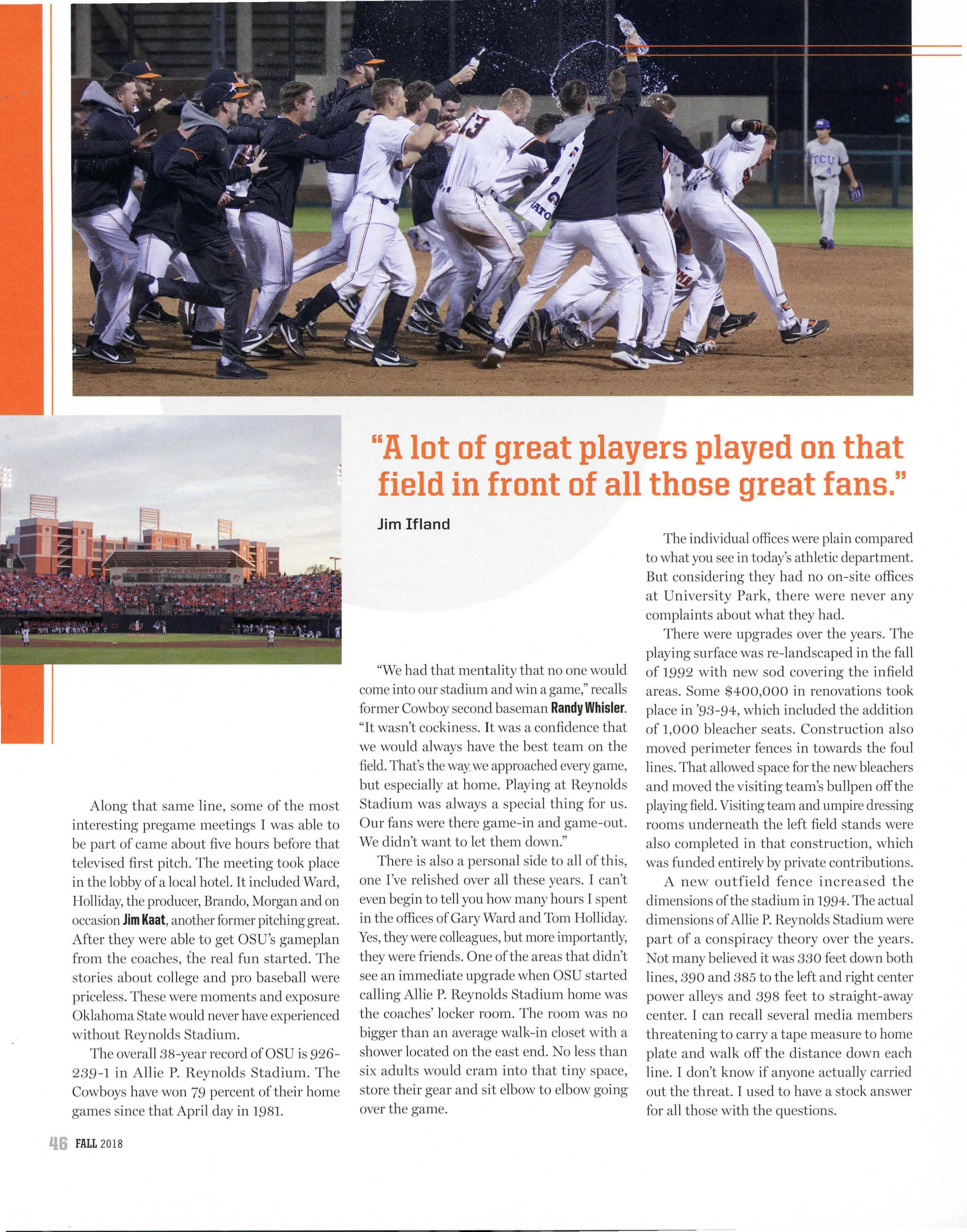
"Alot of great players played on that field in front of all those great fans."
Jim Ifland
"We had that mentality that no one would come into our stadium and win a game," recalls former Cowboy second baseman RandyWhisler. "It wasn't cockiness. It wa a confidence that we wou Id always have the best team on the field. That's the way we approached every game, but especially at home. Playing at Reynolds Stadium was always a special thing for us. Our fans were there game-in and game-out. We didn't want to let them down."
There is also a personal side to all of this, one I've relished over all these years. I can't even begin to tell you how many hours I spent in the offices of Gary Ward and Tom Holliday. Yes,they were colleagues,but more importantly, they were friends. One of the area that didn't see an immediate upgrade when OSU started calling Allie P. Reynolds Stadium home was the coaches' locker room. The room was no bigger than an average walk-in closet with a shower located on the ea tend. Noles than six adults would cram into that tiny space, tore their gear and sit elbow to elbow going over the game.
The individual offices were plain compared to what you see i today's athletic department. But considering they had no on-site offices at University Park, there were never any complaints about what they had.
There were upgrades over the years. The playing surface was re-landscaped in the fall of 1992 with new sod covering the infield areas. Some $400,000 in renovation took place in '93-94, which included the addition of 1,000 bleacher seats. Construction also moved perimeter fences in towards the foul lines. That allowed space for the new bleachers and moved the visiting team's bullpen off the playing field. Visiting team and umpire dressing rooms underneath the left field stands were also completed in that construction, which was funded entirely by private contributions.
A new outfield fence increased the dimensions of the stadium in 1994. The actual dimensions of Allie P. Reynolds Stadium were part of a conspiracy theory over the years. Not many be!ieved it was 330 feet down both Iine ·, 390 and 385 to the left and right center power alleys and 398 feet to traight-away center. I can recall several media members threatening to carry a tape measure to home plate and walk off the distance down each line. I don't know if anyone actually carried out the threat. I used to have a stock answer for all those with the questions.
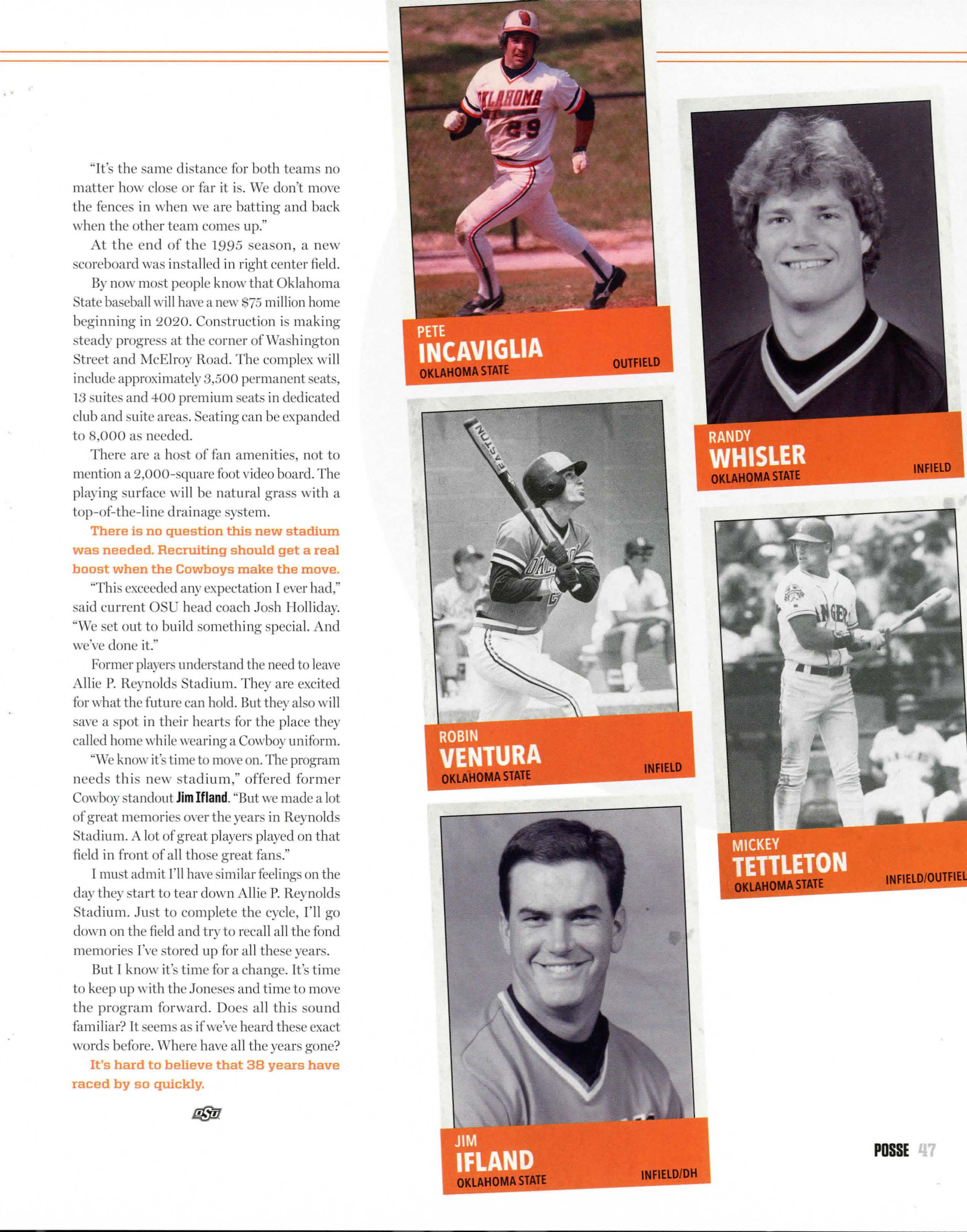
"It's the same distance for both teams no matter how clo e or far it is. We don't move the fences in when we are batting and back when the other team comes up."
t the end of the 1995 eason, a new scoreboard wa installed in right center field.
By now most people know that Oklahoma State ba eball will haYCa ne, S75 million home beginning in 2020. Con ·truction i making teady progrcs at the corner of Wa hington Street and lcElroy Road. The complex will include approximately 3,500 permanent seats, 13 suite and 400 premium eats in dedicated club and suite areas. Seating can be expanded to 8,000 as needed.
There arc a host of fan amenities, not to mention a 2,000-squarc foot video board. The playing surface will be natural grass with a top-of-the-line drainage system.
There is no question this new stadiwn was needed. Recruiting should get a real boost when the Cowboys make the move.
"Thi exceeded any expectation I ever had," said current OS head coach Josh Holliday. "We et out to build something pecial. And we've done it."
Former player understand the need to leave Allie P. Reynolds tadium. They are excited for whatthe -future can hold. Butt hey al o will sm·e a spot in their hearts for the place they called home while wearing a Cowboy uniform.
''We know it' time to move on. The program needs thi new tadium," offered former Cowboy tandout JimIfland."But we made a lot of great memorie over the year in Reynolds tadium. A lot of great players played on that field in front of all tho e great fan ."
I must admit I'll have imilarfeelings on the day they tart to tear down Allie P. Reynold· Stadium. Just to complete the cycle, I'll go down on the field and try to recall all the fond memories rve stored up for all the ·e years.
But I know it' time for a change. It's time to keep up with the Jone ·c and ti me to move the program forward. Doe all thi sound familiar? It cems a if we've heard these exact words before. Where have al I the year· gone?
It's hard to believe that 38 years have raced by so quickly.


08/06/18
TULSA COWBOY CARAVAN
MikeGundyand LarryReeceshare a storywiththe standingroomonly crowdattheTulsa CowboyCaravan at theHardRockHotel andCasino.
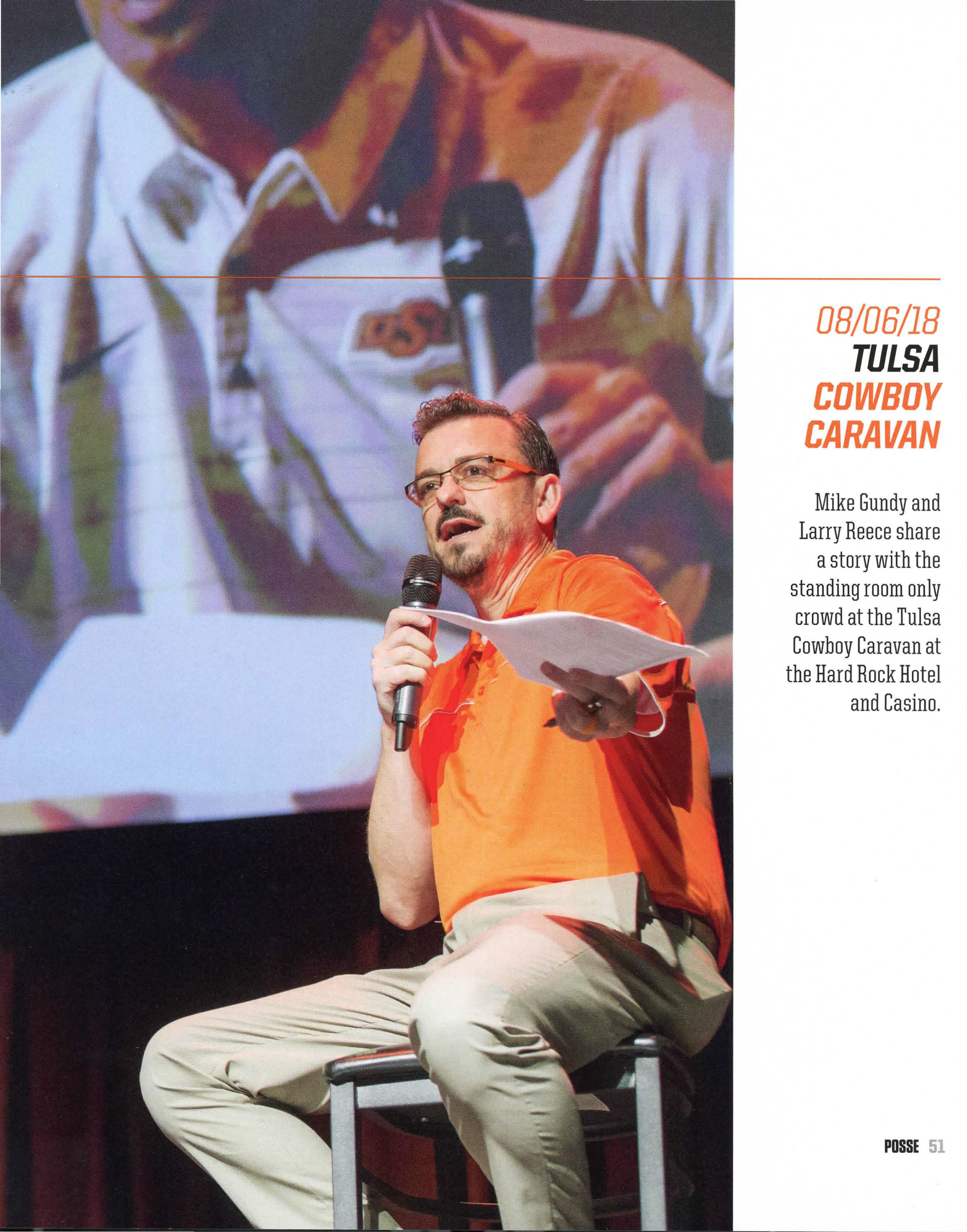
08/0LJ/18
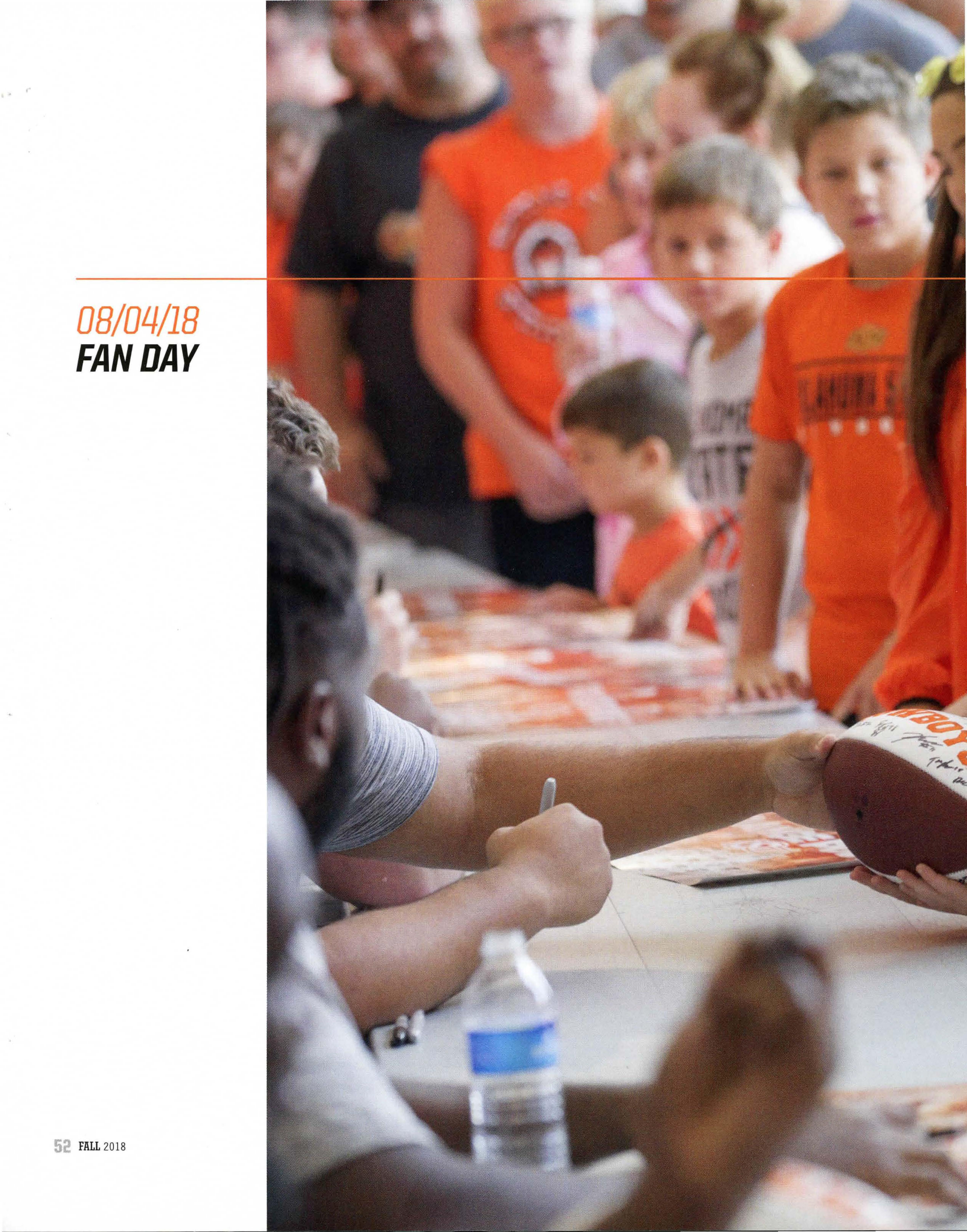

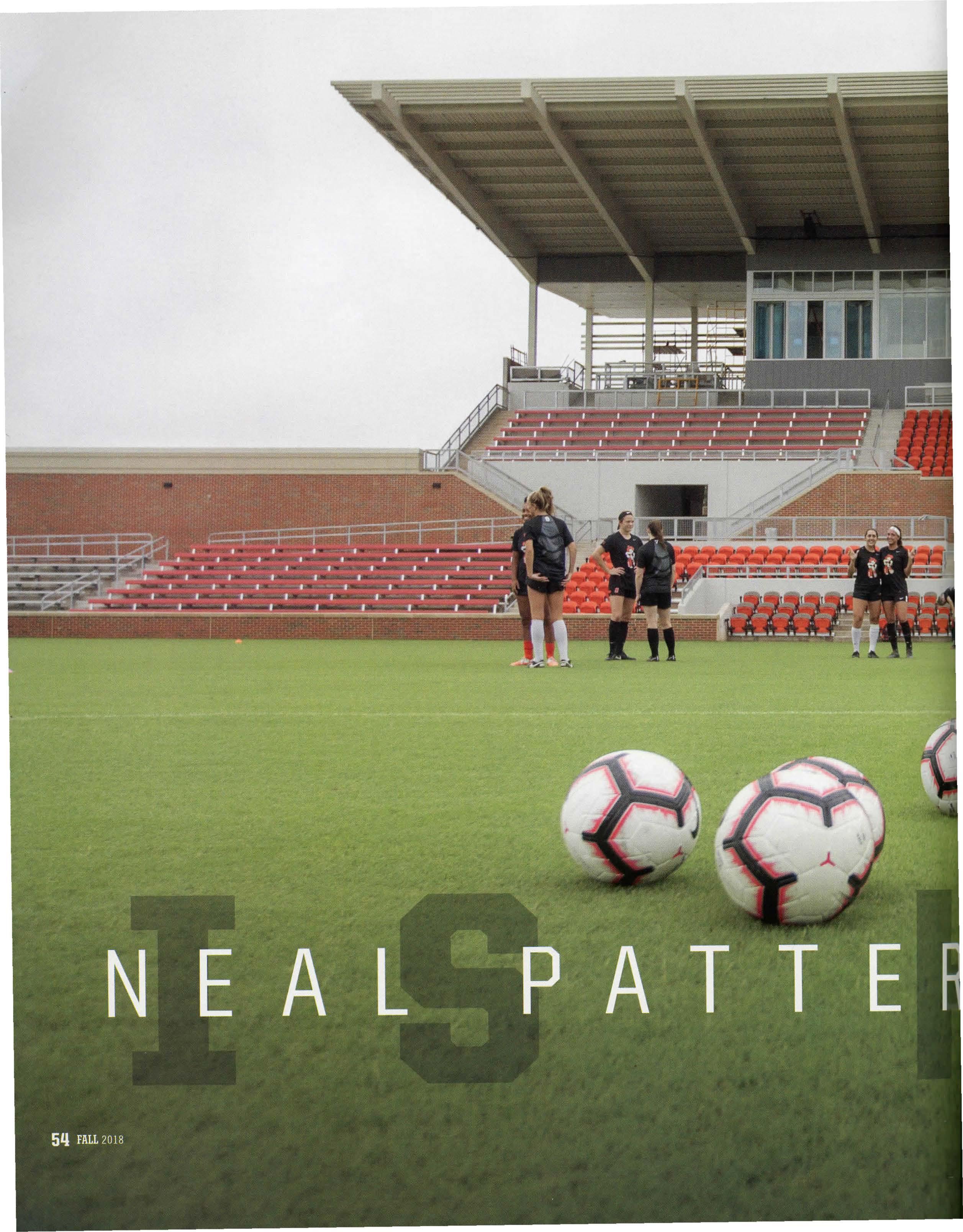
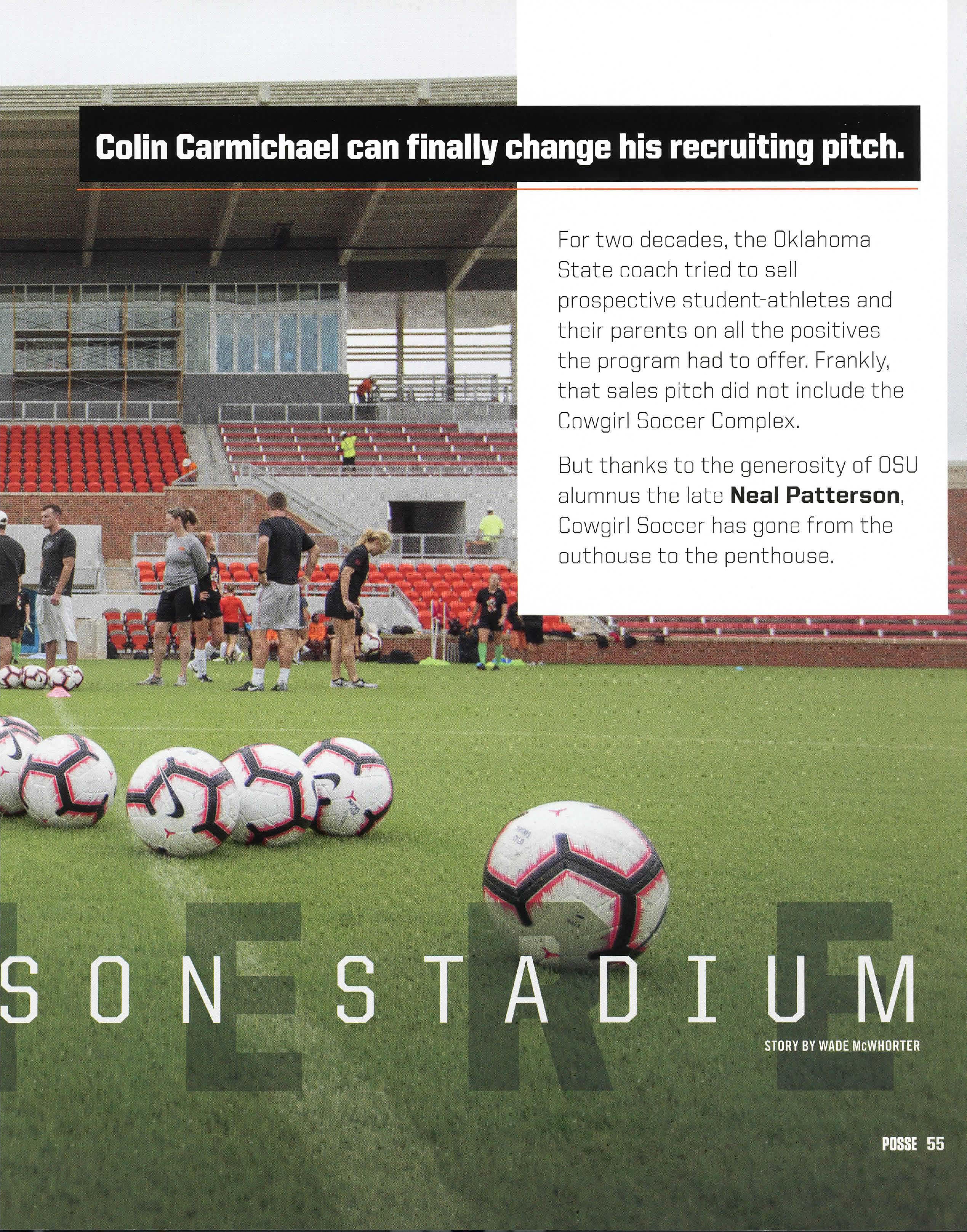
For two decades, the Oklahoma State coach tried to sell prospective student-athletes and their parents on all the positives the program had to offer. Frankly, that sales pitch did not include the Cowgirl Soccer Complex.
But thanks to the generosity of alumnus the late Neal Patterson, Cowgirl Soccer has gone from the outhouse to the penthouse.
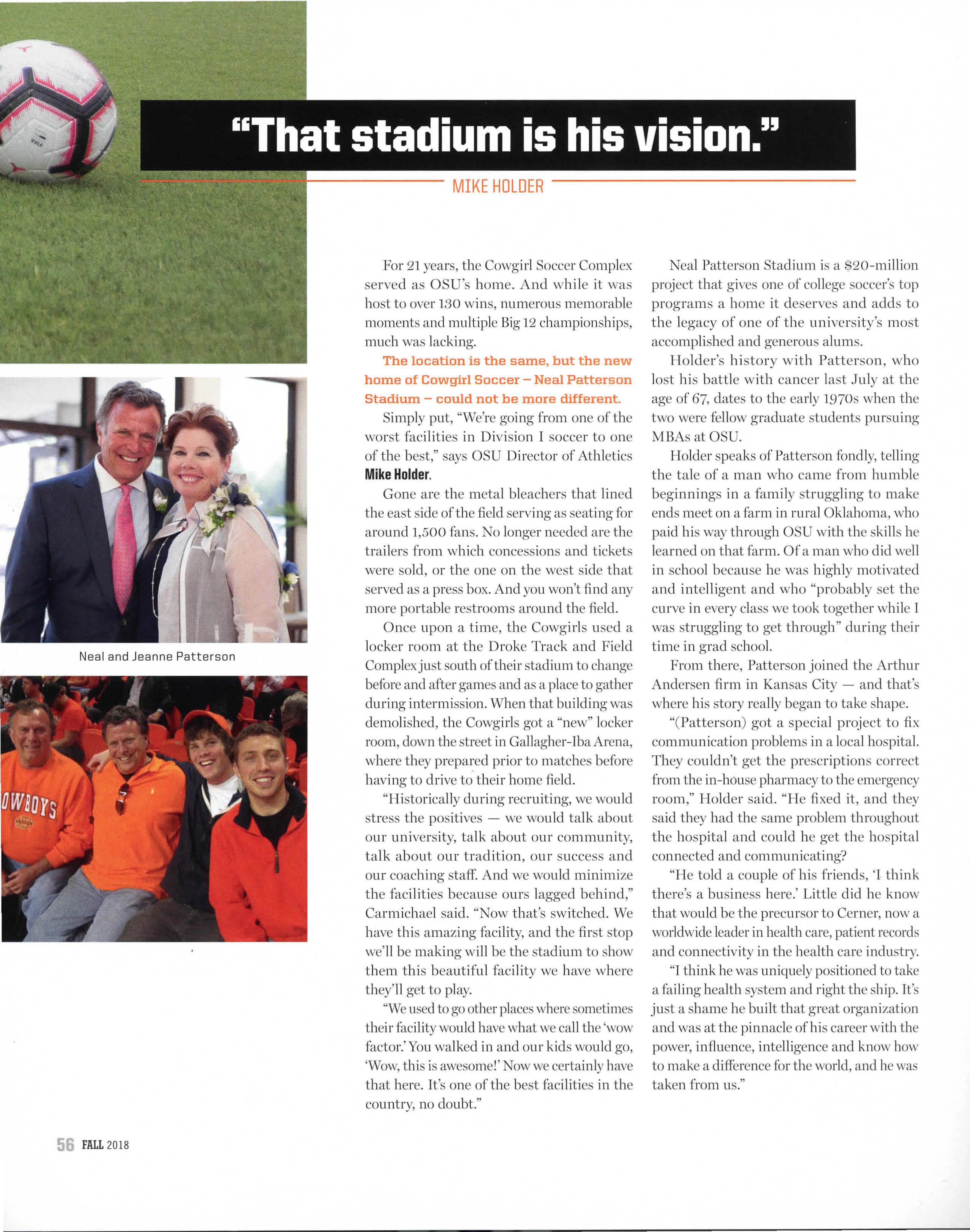
For 21 years, the Cowgirl Soccer Complex served as OSU's home. And while it was host to over 130 wins, numerous memorable moments and multiple Big 12 championships, much was lacking.
The location is the same, but the new home of Cowgirl Soccer - Neal Patterson Stadium - could not be more different.
Simply put, "We're going from one of the worst facilities in Division I soccer to one of the best," says OSU Di rector of Athletics MikeHolder.
Gone are the metal bleachers that lined the east side of the field serving as seating for around 1,500 fans. No longer needed a.rethe trailers from which concessions and tickets were sold, or the one on the west side that served as a press box. And you won't find any more portable restrooms a.round the field.
Once upon a time, the Cowgirls used a. locker room at the Droke Track and Field Complexjustsoutb of their stadium to change before and after games aod as a place to gather during intermission. When that building was demolished, the Cowgirls got a "new" locker room, down the street in Gallagher-Iba Arena, where they prepared prior to matches before having to drive to their home field.
"Historically during recruiting, we would stress the positives - we would talk about our university, talk about our community, talk about our tradition, our success and our coaching staff. And we would minimize the facilities because ours lagged behind," Carmichael said. "Now that's switched. We have this amazing facility, and the first stop we'll be making will be the stadium to show them this beautiful facility we have where they'll get to play.
"We u ed to go other places where sometimes theirfacilitywould have what we call the 'wow factor.'You walked in and our kids would go, 'Wow,this is awesome!' ow we certainly have that here. It's one of the best facilities in the c.:ountry,no doubt."
Neal Patterson Stadium is a $20-million projec.:tthat gi\·es one of college soccer's top programs a home it deserves and adds to the legacy of one of the university's most accomplished and generous alums.
Holder's history with Patterson, who lost his battle with cancer last .July at the age of 67, dates to the early 1970s when the two were fellow graduate students pursuing MBAsatOSU.
Holder speaks of Patterson fondly, telling the tale of a man who came from humble beginnings in a family struggling to make ends meet on a farm in rural Oklahoma, who paid his way through OSU with the skill he learned on that farm. Of a man who did well in school because he was highly motivated and intelligent and who "probably set the curve in every class we took together while I was struggling to get through" during their time in grad school.
From there, Patterson joined the Arthur Ander en firm in Kansas City - and that's where his story really began to take shape.
"(Patterson) got a special project to fix communication problems in a local ho pita!. They couldn't get the prescriptions correct from the in-house pharmacy to tbe emergency room," Holder said. "He fixed it, and they said they had the same problem throughout the hospital and could he get the hospital connected and communicating?
"He told a couple ofhi friends, 'I think there's a business here.' Little did he know that wou Id be the precursor to Cerner, now a worldwide leader in health care, patient records and connectivity in the health care industry.
"I think he was uniquely positioned to take a failing health ystem and right the ship. It's just a shame he built that great organization and was at the pinnacle of his career with the power, influence, intelligence and know how to make a difference forthc world, and he was taken from us."
Neal and Jeanne Patterson
Patterson co-founded the Cerner Corporation in 1979 and served as the company's chairman of the board and chief executive officer for 38 years. Today Cerner is the world's largest independent health information technology company and a multibillion-dollar business.
Patterson's wealth allowed him to generously give back to bis alma mater, which is how he and Holder reconnected during a gathering of OSU donors at Boone Pickens' ranch in Texas.
Eventually,Holder made a pitch to Patterson on donating to a new soc<.:erstadium for the Cowgirls. A soccer fanatic who was a principal owner of Major League Soccer's Sporting Kansas City franchise, Patterson agreed to help the cause, and in 2016, he pledged even more money to the project, enabling Holder and OSU to construct a state-of-the-art facility.
Carmithael remembers getting that news as he was standing on the turf at Boone Pickens Stadium hosting re<.:ruitsprior to a football game.
"(Holder) came over and basically said 'You got your stadium.' We were like 'What are you talking about?' And he just reiterated it with a little smirk like, 'This is really going to happen,"' Carmichael said. "We had already known that Mr. Patterson was going to help, we just didn't know exactly the extent.
"At that point, we all had a big hug and were excited. It was just surreal, one of those moments you'll never forget. We'd talked about it for many years, then it became a Iittle more real with the involvemcnt of Mr. Patterson and then the moment when Coach Holder told us that it was a done deal and here's what is going to happen, your knees get a little bit weak. I was wondering if Coach was teasing at first.
"When you realize it is happening, it's _iustone of those unforgettable and awesome moments."
Forever indebted to Patterson, Carmichael only wishes he had more time and opportunity to get to better know the man who changed Cowgirl Soccer.
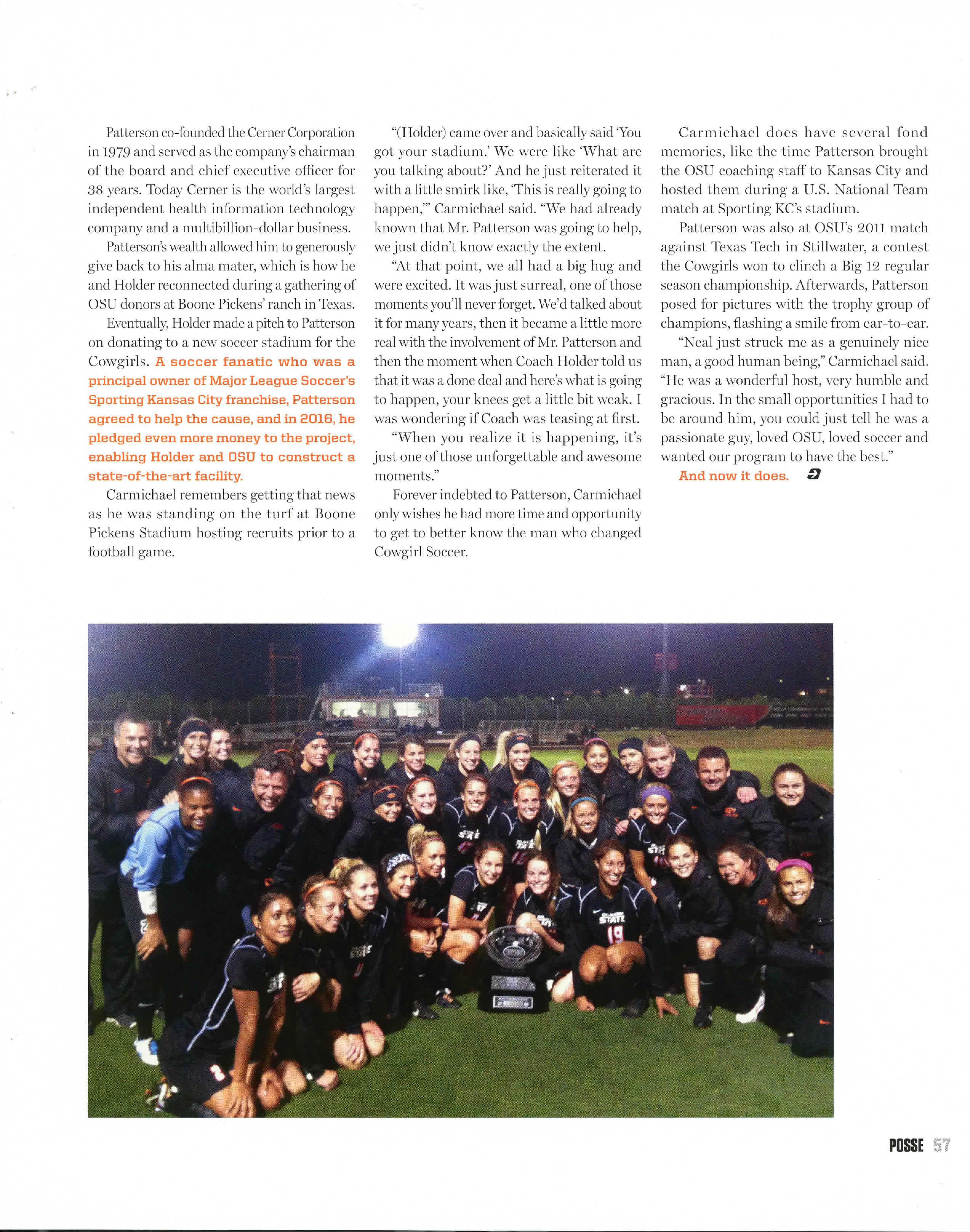
Carmichael does have several fond memories, like the time Patterson brought the OSU coaching staff to Kansas City and hosted them during a U.S. National Team match at Sporting KC's stadium.
Patterson was also at OSU's 2011 match against Texas Tech in Stillwater, a contest the Cowgirls won to clinch a Big 12 regular season championship. Afterwards, Patterson posed for pictures with the trophy group of champions, flashing a smile from ear-to-ear.
"Neal _just struck me as a genuinely nice man, a good human being," Carmichael said. "He was a wonderful host, very humble and gracious. l n the small opportunities I had to be around him, you could just tell he was a passionate guy, loved OSU, loved soccer and wanted our program to have the best."
And now it does. :J
While Patterson's name adorns the stadium, many of the architectural details that make the facility so unique are his influence.
I !older chuckles relllembering that when the initial blueprints were drawn up, Patterson balked. Those plans called for a locker room and team facilities in a building on the north encl of the colllplex with the grandstand on the west.
Patterson wanted a more interactive version, a place where athletes and fans could coexist. Also important was including a supporters' area specifically designed for a rowdy group of passionate fans to cal I home.
That vision became reality.
With locker rooms and a club area under the stadium seating, the Cowgirl players and coaches can mingle before and after matches. And a pavilion and seating for over 500 on the north encl is earmarked for rowdy students, with a group clubbed the Orange Outlaws already staking claim to enhancing the atmosphere in that area.
"Neal wanted something similar to what (Sporting KC) had - he wanted the locker rooms and everything on the west side under the main grandstand. He wanted a central club area with locker rooms on either side so the teams would walk through that area and out onto the field. And then he wanted that north end to be for the crazyf-ans, which in our case we hope are the students - give thelll a special are,i where they can get rowdy and bring a lot of energy," Holder said. "That whole complex has his fingerprints all over it. I Ii passion was ·occer, and he'd already built a world-class facility. L-lehad some strong opinions based on exp rience, and we were smart enough to listen.
"That stadium is his vision.·'
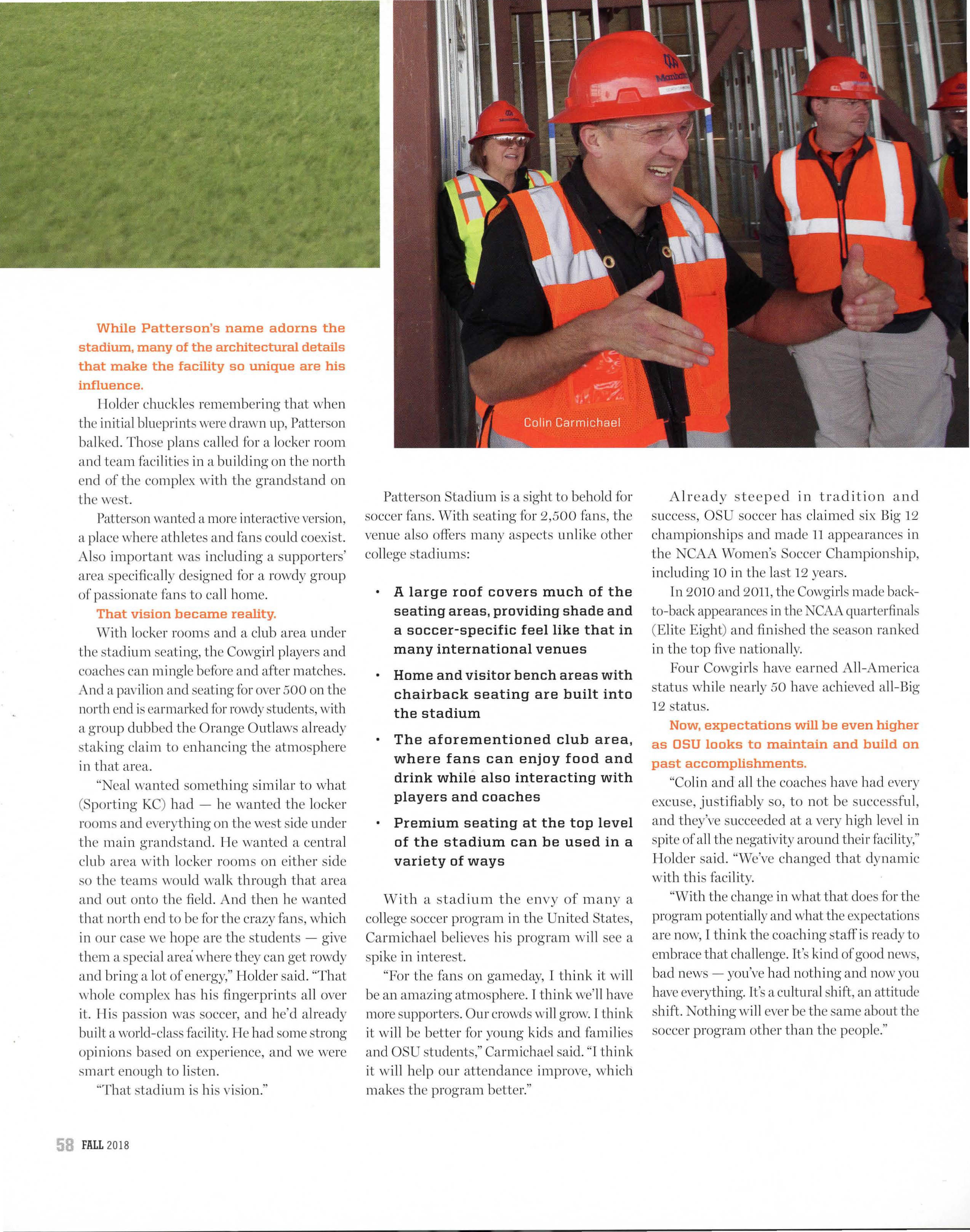
Patterson Stadium is a sight to behold for soccer fans. With seating for 2,500 fans, the venue also offers many aspects unlike other college stadiums:
A large roof covers much of the seating areas, providing shade and a soccer-specific feel like that in many international venues
Home and visitor bench areas with chairback seating are built into the stadium
The aforementioned club area, where fans can enjoy food and drink while also interacting with players and coaches
Premium seating at the top level of the stadium can be used in a variety of ways
With a stadium the envy of many a college soccer program in the United States, Carmichael believes his program will see a spike in interest.
"For the fans on gameday, I think it wi II be an amazing atmosphere. l think we'll have more supporters. Our crowds will grow. I think it will be better for young kid and families and OSU students," Carmichael said. "I think it will help our attendance illlprove, which lllakes the program better."
Already steeped in tradition and success, OSU soccer has claimed six Big 12 challlpionships and made 11 appearances in the CAA Women' Soccer Championship, including 10 in the last 12 years.
ln 2010 and 2011, the Cowgirls made backto-back appearances in the NCAA quarterfinals (Elite Eight) and finished the season ranked in the top five nationally.
Four Cowgirls have earned All-America status while nearly 50 have achieved all-Big 12 status.
Now, expectations will be even higher as OSU looks to maintain and build on past accomplishments.
"Colin and all the coaches have had every excuse, justifiably so, to not be successful, and they've succeeded at a very high level in spite of all the negativity around their facility," Holder said. "We've changed that dynamic with this facility.
"With the change in what that does for the program potentially and what the expectations are now, I think the coaching staff is ready to embrace that challenge. It's kind of good news, bad news - you've had nothing and now you have everything. It's a cultural shift, an attitude shift. Nothing will ever be the same about the soccer progralll other than the people."
Carmichael added that OSU's commitment to excellencc manifesting itself into a facility boon for his program is a blessing.
"Something that Coach Holder has been adamant about since he's been athletic di rector is he wants everybody to have the means and opportunity to compete for championships," Carmichael said. "A big part of that is the facilities. And now when you look around here and see the football stadium and the Greenwood Tennis Center and the track facility, the Smith Center and now soccer, with baseball coming~ it's amazing. That's a great credit to (Holder's) vision and what he sees and hopes for OSU Athletics.
"For our program, the fact that the Patterson family and other supporters and our ad111inistrationare willing to put so 111any resources into a women's sport shows they care about all the athletes and want the111all to have a great ex,perience." Holder's philosophy?
"1-\.facility is a physical manifestation of a university's commit111ent to that particular sport. When you have a short period of ti me to make an i111pressionon young recruits, that facility is critical. It doesn't guarantee you any success, but it's a great environment for your fans and a great recruiting tool for your coaches."
Even in its infant stages, Patterson Stadium is having a positive effect. Grace Neville is a me111berofOSU's 2018 recruiting class who visited Stillwater in the fall of2017 with the facility still under construction. But it made quite an impression on the London, England, native.
"My main decision to join the soccer program at OSU was the coaching staff, meeting the tea111and the overall facilities and friendliness at OSU," Neville said. "But the stadiu111 was the icing on the cake, a really nice added bonus, and I am extremely honored and excited to be one of the first players to play and experience the facilities at this amazing stadium.
"For OSU to make such a financial commitment and state111ent to the soccer program proves the investment and future growth of the game at OSU. Not only will the stadium attract top future players to ensure the Cowgirls re111ain a big contender for NCAA championships, but it will also provide fans and spectators with a great home venue to support the team."
And while he wasn't here to see it through, Neal Patterson left a lasting and irnpactful legacy on a program that will be forever grateful.
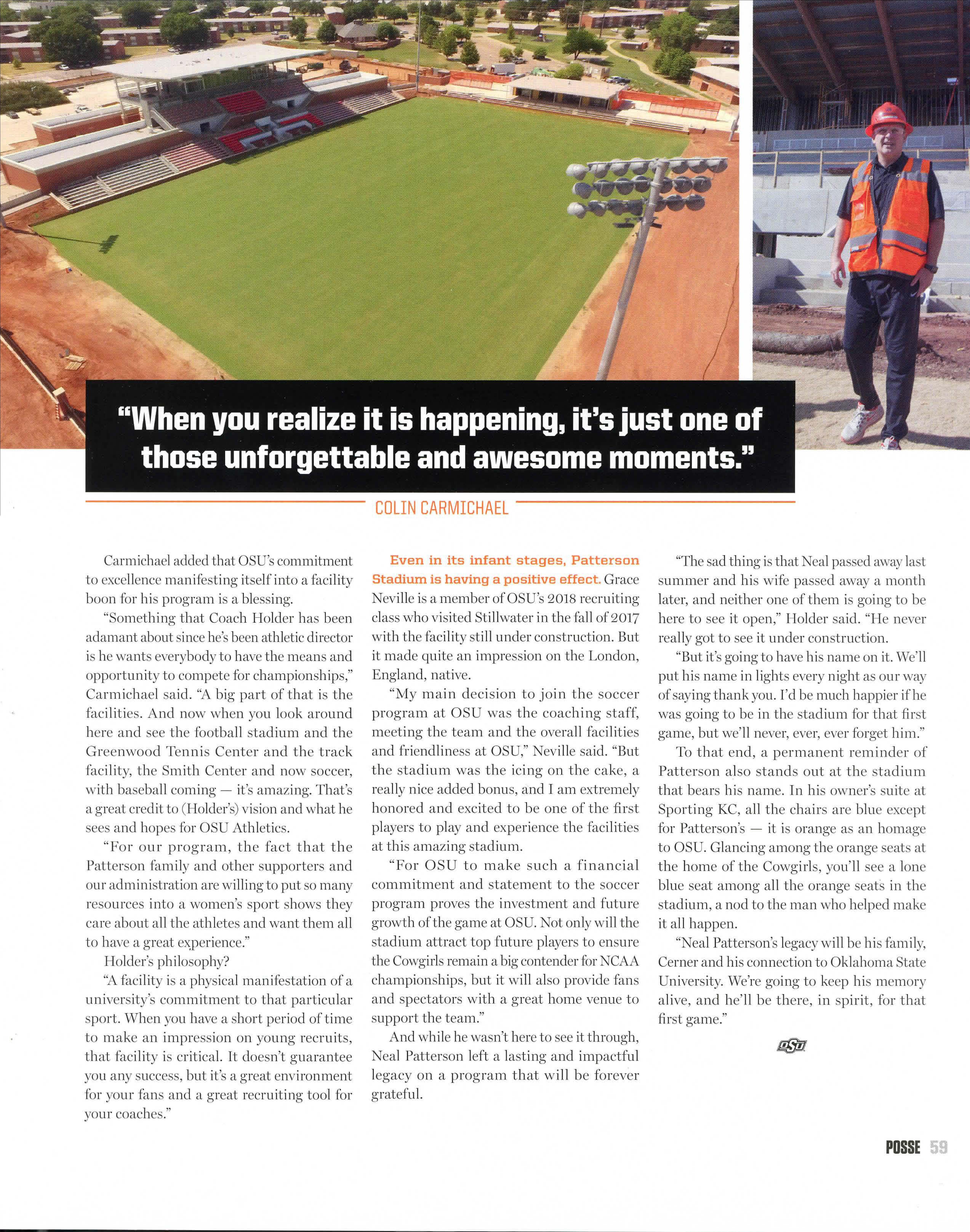
"The sad thing is that Neal passed away last summer and his wife passed away a month later, and neither one ofthem is going to be here to see it open," I-Iolder said. "He never really got to see it under construction.
"But it's going to have his na111eon it. We'll put his name in lights every night as our way of saying thank you. I'd be much happier ifhe was going to be in the stadium for that first game, but we'll never, ever, ever forget him."
To that end, a permanent reminder of Patterson also stands out at the stadium that bears his na111e.In his owner's suite at Sporting KC, all the chairs are blue except for Patterson's - it is orange as an homage to OS U. Glancing among the orange seats at the home of the Cowgirls, you'll see a lone blue seat among all the orange seats in the stadium, a nod to the man who helped make it all happen.
"Neal Patterson's legacy will be his family, Cerner and his connection to Oklahoma State University. We're going to keep his mc111ory alive, and he'll be there, in spirit, for that first game."

STORYBYRYANCAMERON
2017 2018 MALESTUDENT-ATHLETE OFTHEYEAR
"Two roads d'iverged in a wood and I took the one less traveled by, and that has made all the difference," - Robert Frost
For Britton Abbott, the beaten path would have led him to the University of Tulsa, but a different fate awaited, allowing him to carve bis own niche in the 1ineage of a trong football family.
Nobody would fault Abbott for choosing TU with two of his brothers, Bo and Blake, having played for the Golden Hurricane. Additionally, his father, Cliff, spent well over a decade with the program as a player and coach.
In the end, the Liberal, Kan., native decided to blaze his own trail, opting for orange and black.
"I always wanted to do something other than the path that my family had taken. I don't know why, but that was just me personally. I have a lot of respect for Tulsa because it has been a big part of my family's life,"Abbott said.
With a long list of productive walk-ons to its credit under head coach Mike Gundy, the Cowboy program found itself front and center on Abbott's radar.

"Ultimately, it came down to where I felt comfortable. For me, I felt really at home with the people here, and Coach Gundy did a really good job with me and how he treats walk-ons," Abbott said.
While the comfort of Stillwater was appealing to Abbott, the encouragement of his father played a role in his decision as well.
"My dad believed in me to a huge degree and told me I was good enough to play anywhere," Abbott said. "He told me wherever I chose he would foot the bill for a while and that I would be on scholarship soon.
"That really gave me the confidence to walk on here."
Forgoing a scholarship was not a necessity for Abbott, but rather a choice following a standout prep career at Liberal High School.
Abbott was twice named an all-state selection as a quarterback. He capped his career as the Kansas Class SA player of the year after throwing for 3,000 yards, rushing for 1,200 more and being responsible for 49 touchdowns. Those numbers were enough to draw scholarship offers from the likes of Wyoming, Tulsa, UTSA and Memphis, but be had his sights set elsewhere. D

"I always had a dream to play big-time football. I think that is why I ended up at Oklahoma State because I always had the dream to play in the big time, in a big conference against the best competition," Abbott said. "I believed in myself and what I wanted to do was play a role for a big-time team. That dream is what drove me to stick with it and got me to Oklahoma State in the first place."
The message delivered by Gundy during the initial meeting with Abbott and his then-freshmen classmates took hold with the hardworking Cowboy Back and set the tone for his time atOSU.
"He basically told us the only thing you are responsible for is maximizing yourself, and the rest will take care of itself, whatever that may be," Abbott explained. "Really,just take the mindset of maximizing yourself in every aspect: the weight room, classroom, getting treatments, anything. I maximized myselfto be the best I couId be, and the rest took care of itself."
The opportunity to play high-level football did not come immediately for Abbott, who redshirted as a freshman and saw limited action in a pair of games as a sophomore. Nevertheless, he continued to roll up hls sleeves and put in the work In tum, he found reward in the journey, not the destination.
"For me, it is all about the process. The whole process of collegefootball and going through nobody knowing who you are, rnak ing relationships and working your way up," Abbott said.
"The catches came later, and that is what people see and what they talk about, but the rewards for me were always there along the way, even though people m igbt not think they were."
By his sophomore season, Abbott had worked bis way into a role that saw him compete in all but one game, with most of his action coming as a blocking back. Far from the attention awarded for touchdowns and tackles, he continued to embrace his role and understood its value to the team.
"To me, every single week in our game plan there was something that was very important that I had to do,"Abbott said.
"It is not going to make the paper , but things like that which are part of the process are the things I enjoy. I think those were rewarding to me personally because nobody sees it or talks about it, but I know inside what I am doing and what it takes for us to be successful."
In 2017, Abbott saw his role increase as he started 10 times before going on to record his first career reception in DSU's win against Pittsburgh. He would add a pair of catches during the Cowboys' Camping World Bowl victory over Virginia Tech.
With Abbott maximizing every aspect of Iife as a studentath lete, his work ethic is not limited to the football field. In the classroom, he has twice been an academic all-Big 12 first team performer and was named a CoSIDA Academic AllAmerican in 2017.
Last fall, Abbott was rewarded with a scholarship. In April, he was named as OSU's Male Scholar-Athlete of the Year, solidifying his place as a pillar of the culture in which the program prides itself.
"We talk a lot about the Cowboy Culture that we have in place here, and Britton is an outstanding representative of it," Gundy said. ''He works hard and has a great attitude, and as a result, he's successful both on and off the field."
Permanently removingthe walk-ontag providedvalidation Abbott's path was the proper one and a crowning achievement in a family that holds the sport in such high esteem.
"It is really cool that I got to share that with everybody because it is a big part of them, too. Football for us is a family deal," Abbott said.
"They kept me going and always believed in me. It was never if he makes it or if he starts, it was when. Everything we did was based on when I get to that role, and we always believed I would."
Ask Abbott about his academic success, and like any good teammate he is quick to deflect the attention to others.
"I think more than anything it is a big testament to our academic staff. I really don't view myself as someone academically gifted, I just have a work ethic," Abbott said. "The people on our academic staff have a passion for student-athletes. Anytime you need help and go in there with a work ethic and effort the rest takes care of itself without a doubt."
His work ethic has resulted in two degrees so far (management and marketing), and a third in entrepreneurship is on the way. He is also in pursuit of his MBA.
Looking back on his decision to become a Cowboy with no guarantee in 2014, Abbott recalls a simple piece of advice from his father.
"My dad would tell me to make a decision and whatever it is, make it the right one. ·once you are there, go make it the right decision in how you work and how you treat people and enjoy the ti me because it goes by fast," Abbott said.
Has Abbott's decision to become a Cowboy been the right one?
"I would not trade it for anything. The guys I have been able to play with and go to school with have been unbelievable. Football has taken me places I don't know that I would have ever gotten to and introduced me to people I would have never met.
"I have been truly blessed with this college experience." f4jil
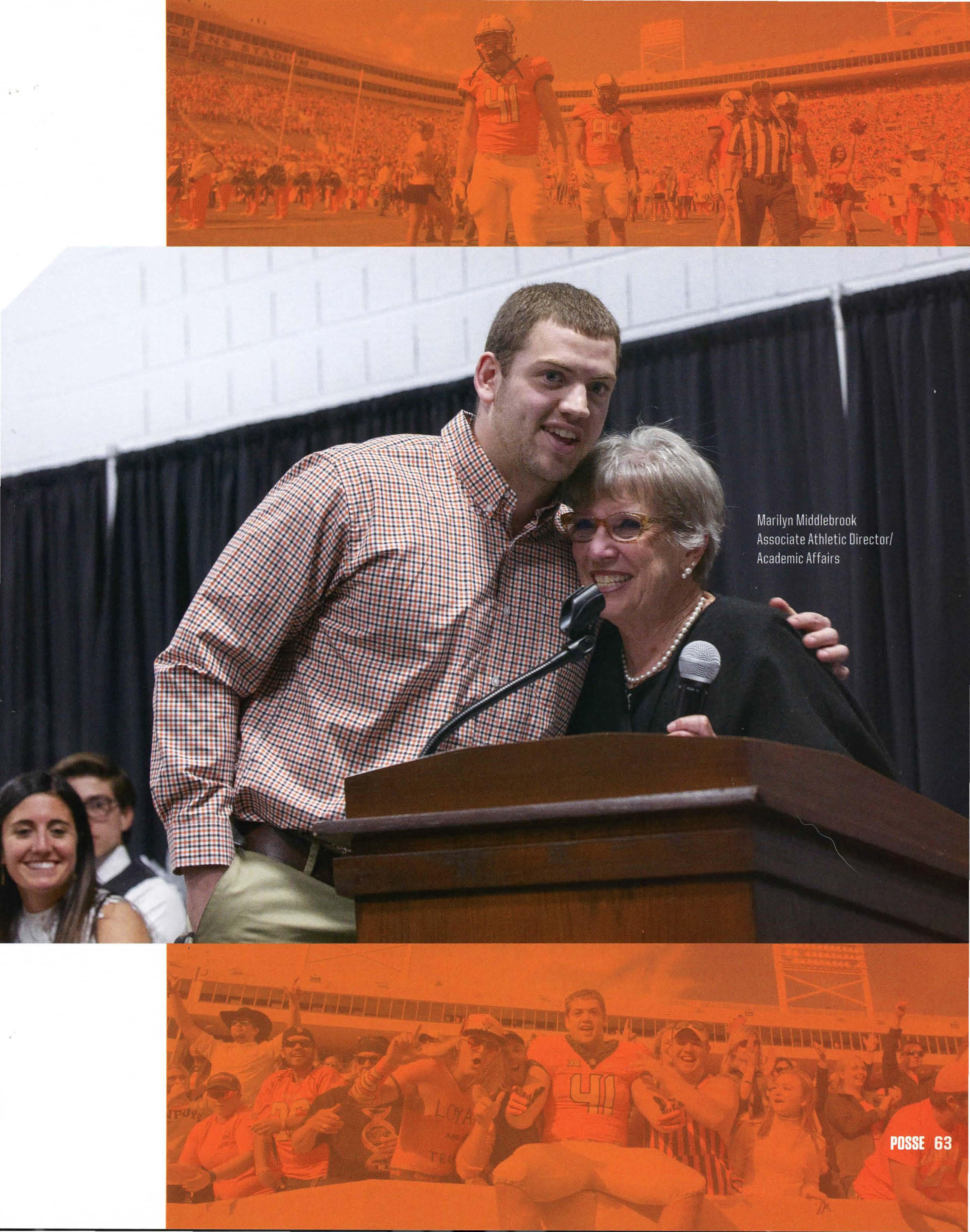

2017 2018
FEMALESTUDENT-ATHLETE OFTHEYEAR
Stephanie Ferrante grew up fully aware of OSU just not the OSU you know so well.
A native ofCbardon, Ohio, Ferrante grew up in Buckeye country and was well-versed on the subject of Ohio State. However,a recruiting vi it from Diego Flaquer, a former assistant coach for the Oklahoma State track and field program , would change all of that.
"He t:ontacted me and came on an in-home visit. I actually didn't know a lot about OSU, being from Ohio. I just knew about the other OSU. He convinced me to come on an official visit, and it was actually the last visit I was going to take."
A trip to Stillwater for Bedlam football was lined up and eventually set the rnurse for Ferrante's collegiate destination. With its facilities, academic support and atmosphere making a lasting impression on the 2018 OSU Scholar-Athlete of the Year, the family-oriented aspect of the program made her final visit the deciding one.
"Some of the other visits I went on, the team atmosphere was not as great as I witnessed when l came here," Ferrante said. "The team culture when I visited was so nice compared to the other schools."

For Ferrante, who had played soccer for a long as she could remember, opportunity as a collegiate track athlete did not exist until coaches Eric Bartley and Rick Marinelli entered the picture and persuaded her to run for the squad at Chardon High School.
The decision paid off as she flourished in her newly found venture. Ferrante recorded top-five finishes at the state championships in three events, taking second in the 400 meters, third in the 200 meters and fourth in the 100 meters.
Following her junior year, Ferrante made the decision to give up soccer and focus solely on track when it was clear competing at the Division I level was a possibility.
"I made the transition to track, and I was having more succes on the track than I did on the soccer field. I started enjoying it more and made the transition to full-blown track, which led me to decide I wanted to do it in col \ege," Ferrante said.
"I loved sot:cer, but the risk/reward of possibly getting injured for track season flashed into my mind, and I decided to focus solely on running my senior year." 8
STEPHANIE
With her attention turned completely to track, it was not long before college suitors came calling.
"The summer going into my senior year is kind of when it all took off with track. I didn't realize how good I was until coaches started contacting me," Ferrante said.
While the decision to focus on track would eventually lead her to Stillwater, there would be an adjustment period to life as a college student. However, athletics would serve as the foundation to allow Ferrante to flourish.
"When I first got here, it was really difficult not knowing anybody after coming from a small town," Ferrante said. "If I were not playing a sport I don't know how I would have done it, because you come into a family that welcomes you and your coaches are kind ofl ike your parents. It really helped motivate me, make me more independent and helped me grow up."
As she acclimated to life as a Cowgirl, Ferrante would blossom on and off the track, earning a combined seven indoor and outdoor all-Big 12 honors during her career.
She also captured a pair of Big 12 titles, winning distance medley relay titles in 2015 and 2017.
In the classroom, she was twice named an academic All-American, was an academic all-Big 12 pick on three occasions and was named an Alumni Association Senior of Significance.
Ferrante's sparkling resume was constructed,with a work ethic any coach would covet.
"More than anything, she's a nose-to-the-grindstone type of student and athlete. Most of her success on and off the track comes from her hard work. Her work ethic and grittiness are characteristics we want our whole team to emulate," Dave Smith, OSU Director of Track and Field and Cross Country, said.
Ferrante's work ethic can be traced back to her grandfather. He was an Italian immigrant who arrived in the·u.s. unable to speak English, but determined to make a successful life for his family. His willingness to take on ta! I tasks permeates the family tree.
"My dad always said to try the hardest thing possible because you don't want to settle for something lower without trying the most difficult thing. That ultimately led to me picking difficult majors and wanting to go to medical school," Ferrante said.
"Why not shoot for the stars and see what happens?"
Aim high she did, and it more than paid off.
This past May, Ferrante earned her djploma with a double major in biochemistry and microbiology/cell and molecular biology, graduating with a 4.0 grade point average.
All the while, she served as president of the Student-AthJete Advisory Committee, treasurer ofOSU's American Chemical Society Chapter and was involved in various community service projects around campus and the Stillwater community.
How was Ferrante able to be successful on multiple fronts? She says the answer is simple: time management.
"Knowing when I was on the track or when I was in the classroom, to be focused on each one at that time helped ensure success in each one," Ferrante said. "I think what led the most to my success was how to divvy up time and not procrastinate."
With her track career having drawn to a close, Ferrante will now turn her attention to medical school. After taking the upcoming year off to put in time focusing more on medical research, she will apply to potential schools with the hope of being accepted in 2019.
Appropriately, her dream occupation would be to work in orthopedics with the opportunity to be around athletes.
"Growing up, I had a mentor, Dr. Mark Mendeszoon, who was an orthopedic physician and worked with athletes. I was able to shadow him and see what his day-to-day life was like. He was a former track athlete as well, and he kind of helped me envision what would be an amazing occupation," Ferrante said.
With lofty goals still in front of her, Ferrante says Oklahoma State has been integral in her successes, and her time in Stillwater has helped her chart the course for her future endeavors.
"I think it molded me into the person I am today: a more motivated and disciplined person," Ferrante said. "If it wasn't such a friendly and engaging atmo phere I don't think I would have been as successful in sports or academics. I might not even be pursuing med school in the future.
"I tell all of my friends in Ohio that some of the best people I have ever met are from OSU."
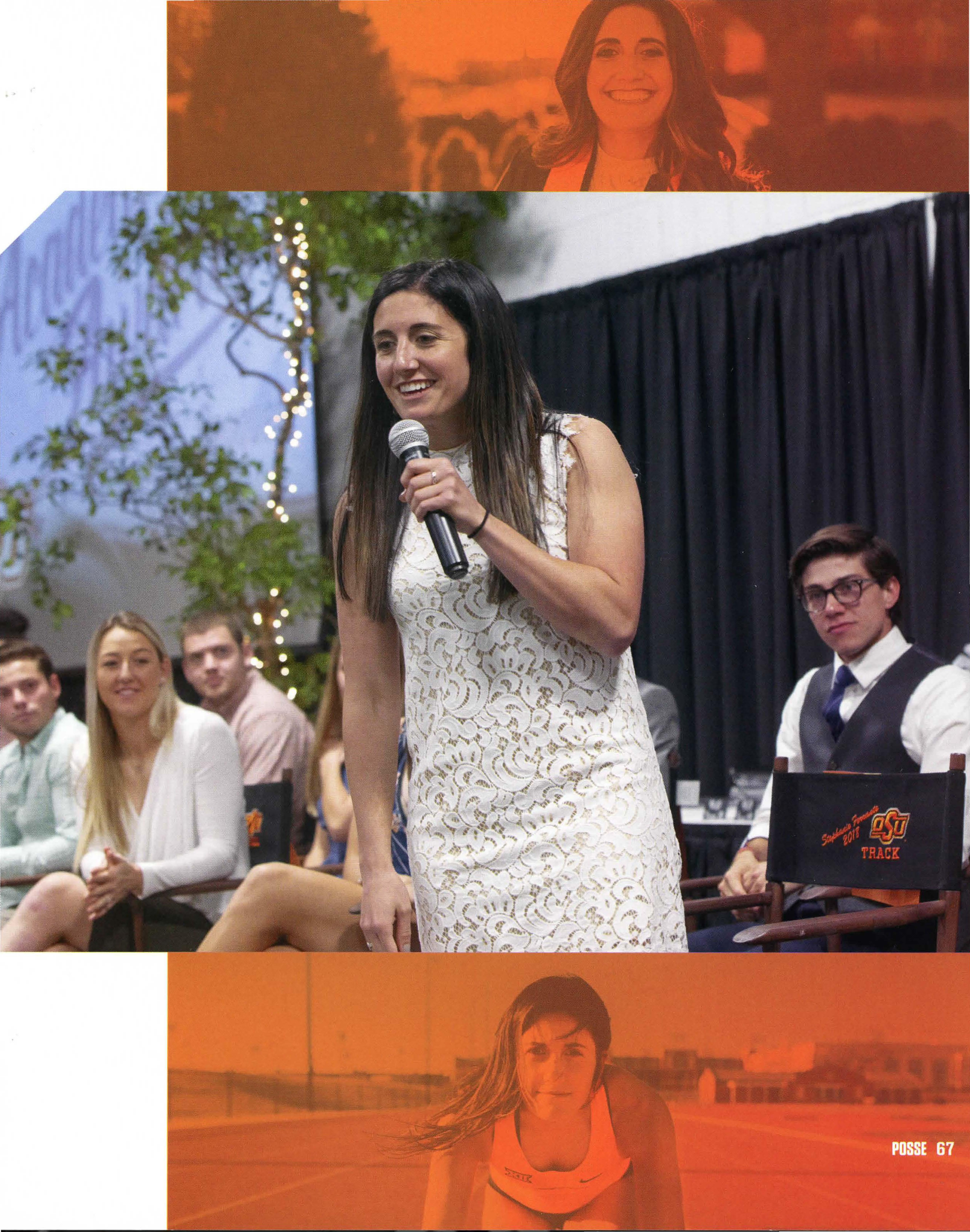
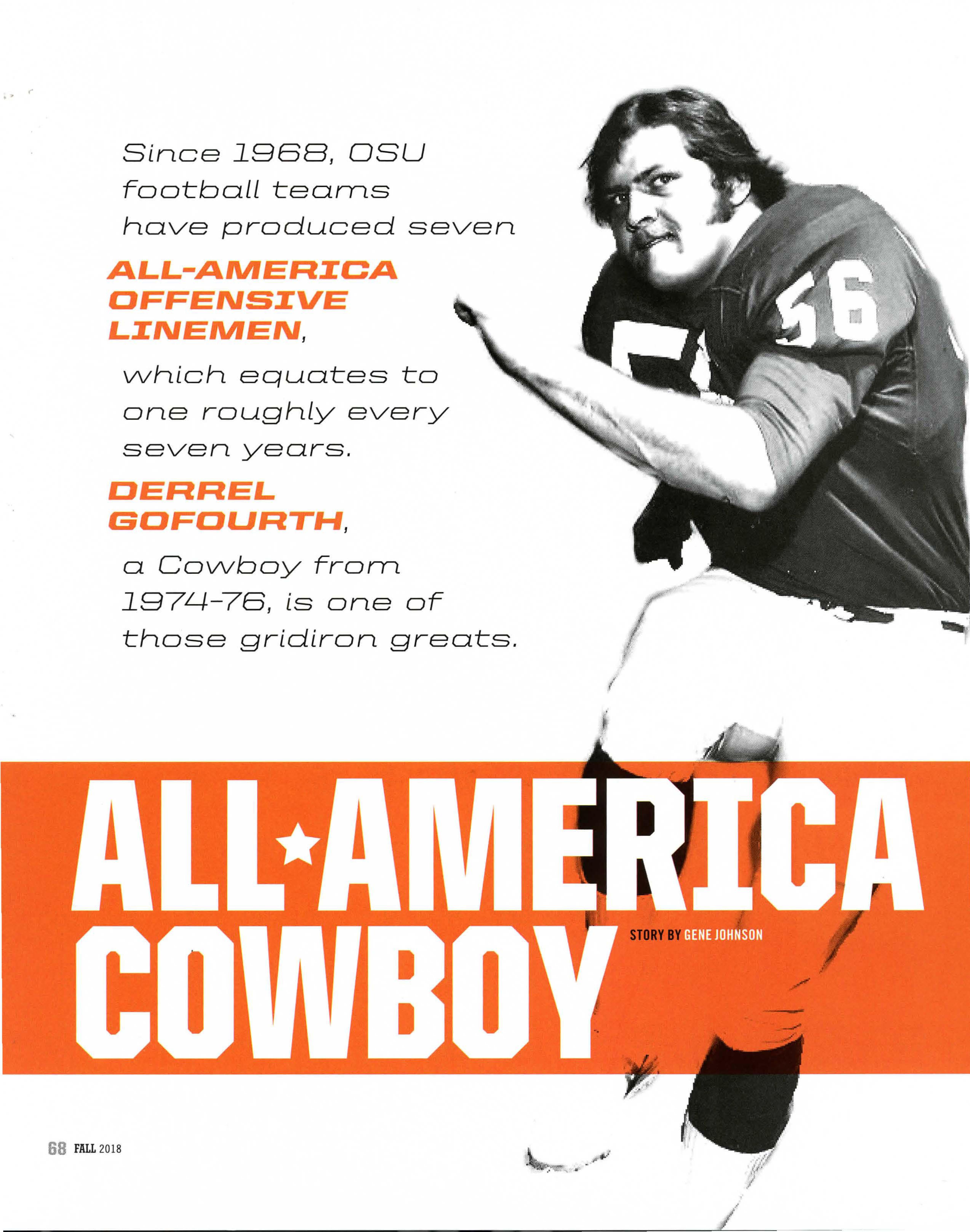
Since 1-BBB, OSU Football teams have produced seven ALL-AMERICA OFFENSIVE LINEMEN,
vvhich equates to one roughly every seven years.
DERREL GOFOURTH,
a Covvboy Frorn
1-B7L/--7B, is one oF those gridiron greats.
STARTING POINT
The year was 1955. Popular actor .James Dean died when he wrecked his brand new Porsche. Velcro and the microwave oven were invented. I Love Lucy was a top-rated TV program, and Derrel Gofourth was born in Parsons, Kan., adding to its population of13,000.
As a youngster, Gofou rth developed an interest in several sports. Overtime, football became his passion. Living in town, his mother worked in a garment factory while his dad toiled as a printer. He was three years younger than his brother, C.J.
"I was a chunky kid," Gofourth said. "Montgomery Ward sold a 'Husky' brand of jeans and overallsf-orheavier kids, which J wore.
"About twice a month our family would go to my granddad's farm for the day, running around the land, chasing horses, then riding them. I have a cousin who is into genealogy. He says our family is Scottish.
"We may have been poor, but there was a lot of love in ourfamily,"headded. "Dad worked the 4 p.m. to midnight shift. As a young kid, my brother and I would take Dad supper and spend time with him until be went back to work. Both Mom and Dad had a very po itive influence on me."
As a seventh grader, Gofourth played football for about a week, but he didn't think it was for him.
"In eighth grade, I'm slower than sin and heavy. But the following year I'd grown five inches and began to thin out: 5-11 and 190 pounds. That's when I started liking football."
His junior high track coach, RonEhmann, who also helped with football, had players stay after school to lift weights, so by his sophomore year Gofou rth stood 6-foot-l and 205 pounds.
''At that time Coach Ron had more influence on me than anyone," Gofourth said. "Coach made me a weakside linebacker. I could run as fast sideways as I cou Id forward. For 10 yards my speed was pretty good. Any race longer than that, my speed tapered off. I attended several summer camps supervised by college coaches. One time, after timing me in the 40, a coach accused me not only of carrying a piano, but playing it as I ran."
As a sophomore, he became an allconference football player. He played some junior varsity basketball, but footbal I wash is game. Ehmann moved to Florida and invited Derrel to join him for the summer where they cou Id both work out.
"My work instrument of choice was the shovel," Gofourth remembered. "Then in the evenings we'd go to the gym, lift weights and work out a great summer!"

"Parsons' long-time football coach, Joe Martin,was a hard-nosed, no-nonsense guy; some of the drills he had us do back then, you couldn't get away with today. Super hard practices, but he made us better.
"One time we were practicing and there was some thunder and Iightn ing approaching in the distance. Coach wouldn't let us lmddle up. He said iflightning truck, he didn't want to lose the whole team!" Gofourth laughed out loud. "Over the years I've stayed in touch with Coach .Joe and have gone quai I hunting with him."
At 6-2 and 208 pounds, Gofourth made all-state as a middle linebacker his junior year. Following a successful season, several seniors from that squad received Division I footbal I scholarships.
That same year, Parsons I Iigh also introduced a new sport to the varsity lineup: wrestling.
"Our coach knew nothing about it,"Gofourth said. "He taught us from a paperback book. On pure strength, a. a heavyweight, I went 23-3 and made it to the state tournament."
Hauling hay 14 hours a clay in triple-digit temperatures, plus pumping iron in his spare time, he stayed in top shape that following summer.
The next football eason, Parsons had less than 10 seniors on the roster - in addition to a new football coach. As a re ult, there were many sophomores and juniors who saw playing time.
"We ran a 4-4 defense and weren't as good a team as the year before. Coach let me call the defensive plays, and we blitzed about every down. It was fon and worked sometimes." D

RECRUITING
"Back then, colleges requested a game film if they were interested in you," Gofourth said. "Of course the high school only had one copy of each game. Youwould send it to the requesting college and usually never get it back. So I had to send some from my junior year. It seems like I never went to class on a Friday afternoon becau e I was off on a recruiting visit.
"On a scheduled trip to visit Arizona, a recruit from another high school and l were driven by our parents to Joplin, Mo., where they had a one-horse airport. Our plan was to take a plane from .Joplin to Kansas City, where we wou Id catch a connecting flight to Arizona.
"But we missed our plane in Joplin. So we called the Arizona coach and pretty soon we hear this humming sound in the air, which is a small four-seater single engine prop aircraft the Arizona coach hired to take us to Kansas City. When we got there, we looked like the old O.J.Simpsontelevision commercial as we sprinted through the airport to catch our connection, which we barely did!
"BearBryant,coach at Alabama, called me several times probably a 20-second conversation each time. Bryant would ay, 'Just calling to touch base,' then 20 seconds of silence. He wouldn't say anything, and I wouldn't either. Finally a little conversation, and then we'd hang up."
Gofourth took an official visit to Alabama, where an assistant coach wanted him to sign a Southeastern Conference letter of intent that meant only Alabama wa able to sign him from that conference.
"He told me that if I signed it, he wanted me to commit to coming to Alabama," Gofourth said. "l was interested in Alabama but chose not to sign the agreement."
Gofourth 's first visit to Stillwater was over Christmas break. •
"I definitely liked the atmosphere, then went home and made other visits. Assistant Cowboy line coach HughMccrabband I clicked."
On his second visit to OSU he had a meeting with head coach JimStanley.
"Stanley had this large three-ring binder on his desk and began reading to me, 'OSU is a good school and has great programs; we have a top bu ines school, engineering ' "I interrupted him. 'Coach, l know OSU is a real fine school, but ifl come here, it will be to play football.' Coach smiled ear-to-ear, shutting the binder and said, 'That's what I wanted to hear."'
On signing clay,OSU defensive coordinator BumPhillipsand head coach Stanley flew into Parsons around 7:30 a.m., hoping to sign Gofourth, who was still wavering between the Cowboys and the Crimson Tide.
"Bum was mad, upset I wasn't ready to sign, stomping around," recalled Gofourth. "I told him I needed to make a call to Alabama assistant coach KenDonahue.When I got through, the Alabama secretary told me Donahue was busy and wasn't taking calls. For me, that was it. I became a Cowboy and was all in. Felt real good! Besides, Stillwater was a three-hour drive from Parsons, while Tuscaloosa to Par ·on took 12-to-15 hours."
Ironically, Jim Stanley had played for Bear Bryant at Texas A&M.
THE OSU YEARS
Gofourth spent his freshman year as a third-team linebacker and traveled to several a·way games. By his sophomore season he was approaching 6-4 and weighed around 218 pounds.
During spring ball, when two offensive linemen got injured, Stanley moved Gofourth to starting right tackle.
''I'd never played on the offensiveline, didn't know any of the plays, but I was willing to give it a shot, Gofourth said. "First scrimmage I did decent ... line coach had to tell me what to do. We went 7-5 that season and won the Fiesta Bowl."
That 197'1 bowl appearance was OSU's first since 1958.
Between semesters his sophomore year, Gofourth married his high school sweetheart, Milissa, and they moved into married student housing.
Meanwhile, line coaches DonBoyceand !-!ughMcCrabb told Gofourth to start gaining weight, and they would tel I him when to stop.
"I got up to about 225 and learned to play lowbecause weight-wise I was so mismatched," he said. "No way I could stand up and take my opponents head-on. My junior year I was moved to guard, and in a complete surprise to me, made All-Big Eight and won some nice awards."
OSU did not go bowling that year but did finish 7-4.
"Coach Stanley was all about football, focused and a tough character," according to Gofou rth. "The way players play reflects the attitude of their coach. Every day he preached to us players to be mentally tough, and we responded.
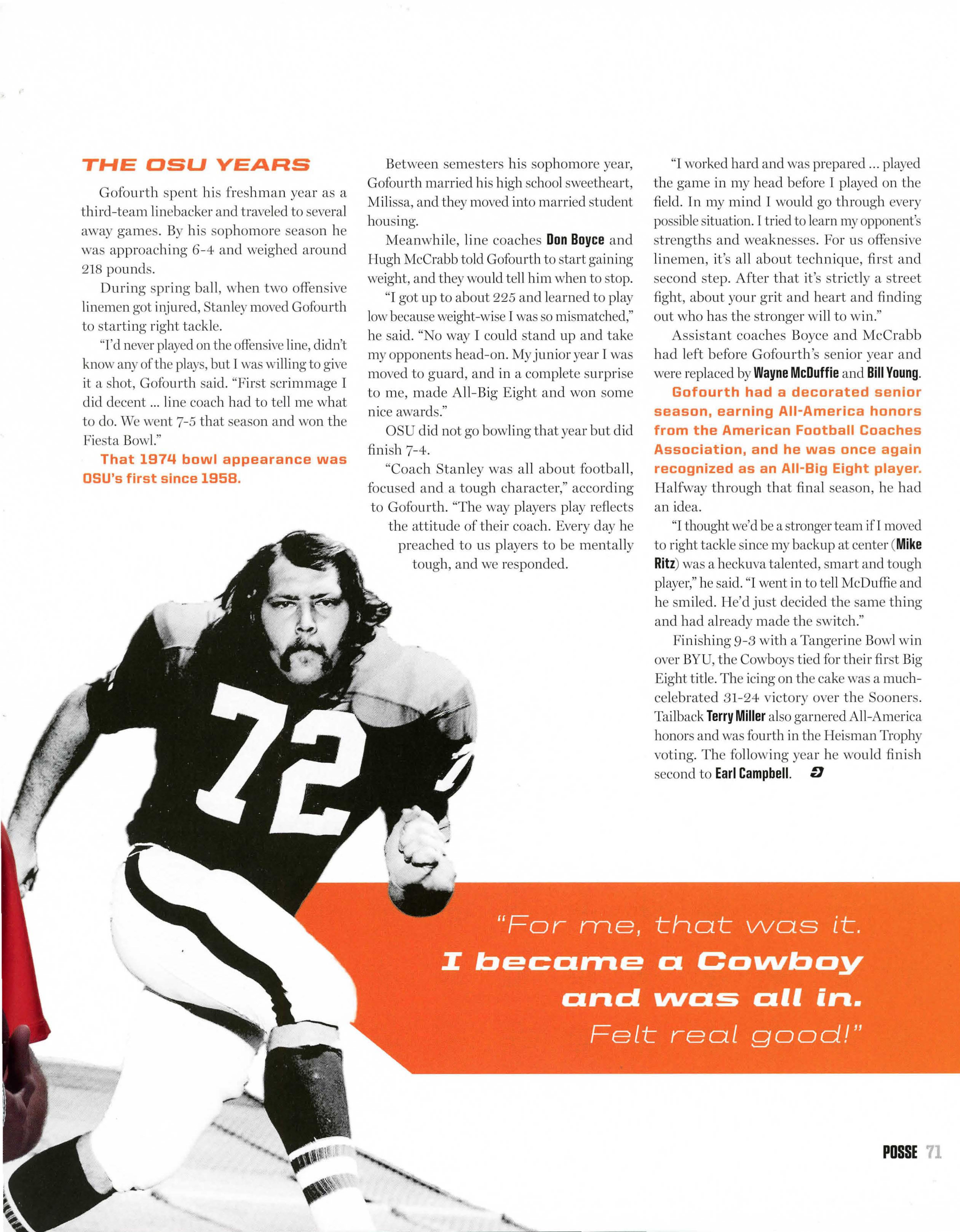
"l worked hard and was prepared played the game in my head before I played on the field. In my mind I would go through every possiblesituation. I tried to learn my opponent's strengths and weaknes es. For us offensive linemen, it's all about technique, first and second step. After that it's strictly a street fight, about your grit and heart and finding out who has the stronger will to win."
Assistant coaches Boyce and McCrabb had left before Gofourth's senior year and were replaced by WayneMcDuffieand BillYoung.
Gofourth had a decorated senior season, earning All-America honors from the American Football Coaches Association, and he was once again recognized as an All-Big Eight player. Halfway through that final season, he had an idea.
"I thought we'd be a stronger team if I moved to right tackle since my backup at center (Mike Ritz)was a heckuva talented, smart and tough player,"he said. "1 went in to tell McDuffie and he smiled. He'd just decided the same thing and had already made the switch."
Finishing 9-3 with a Tangerine Bowl win over BYU, the Cowboys tied for their first Big Eight title. The icing on the cake was a muchcelebrated 31-24 victory over the Sooners. Tai !back TerryMilleralso garnered A 11-America honors and was fourth in the Heisman Trophy voting. The following year he would finish second to EarlCampbell. :J
"J never knew a Friday night on 'The Strip' in Stillwater during ball season," Gofourth said. "We were either out of town or holed up in the Student Union Hotel. My senior year, I weighed 245 - got up to 265 in the pros. I looked at football as a job. Be prepared to do what had to be done and make myself the best player I could be. I needed to do serious weightlifting in the offseason to improve. I had a job to do on every play, and I equipped myself, mentally and physically, for it.
"Lots of great memories with the Cowboys. Winning the games we did. Our fans. Being surprised I made all-conference as a junior," he added. "Of course beating OU was nice, but I didn't grow up being a part of that rivalry like my Oklahoma teammates had. It was a much bigger deal for them than me."
Former Cowboy RobertTurner,now retired from UPS, was Gofourth's teammate and played fullback.
"On the field, all I ever saw of Derrel was his rear encl as he blocked an opposing lineman," Turner said. "He was a tenacious player, outstanding lineman. He would fight on until the whistle blew and could play three positions. No fat on him.
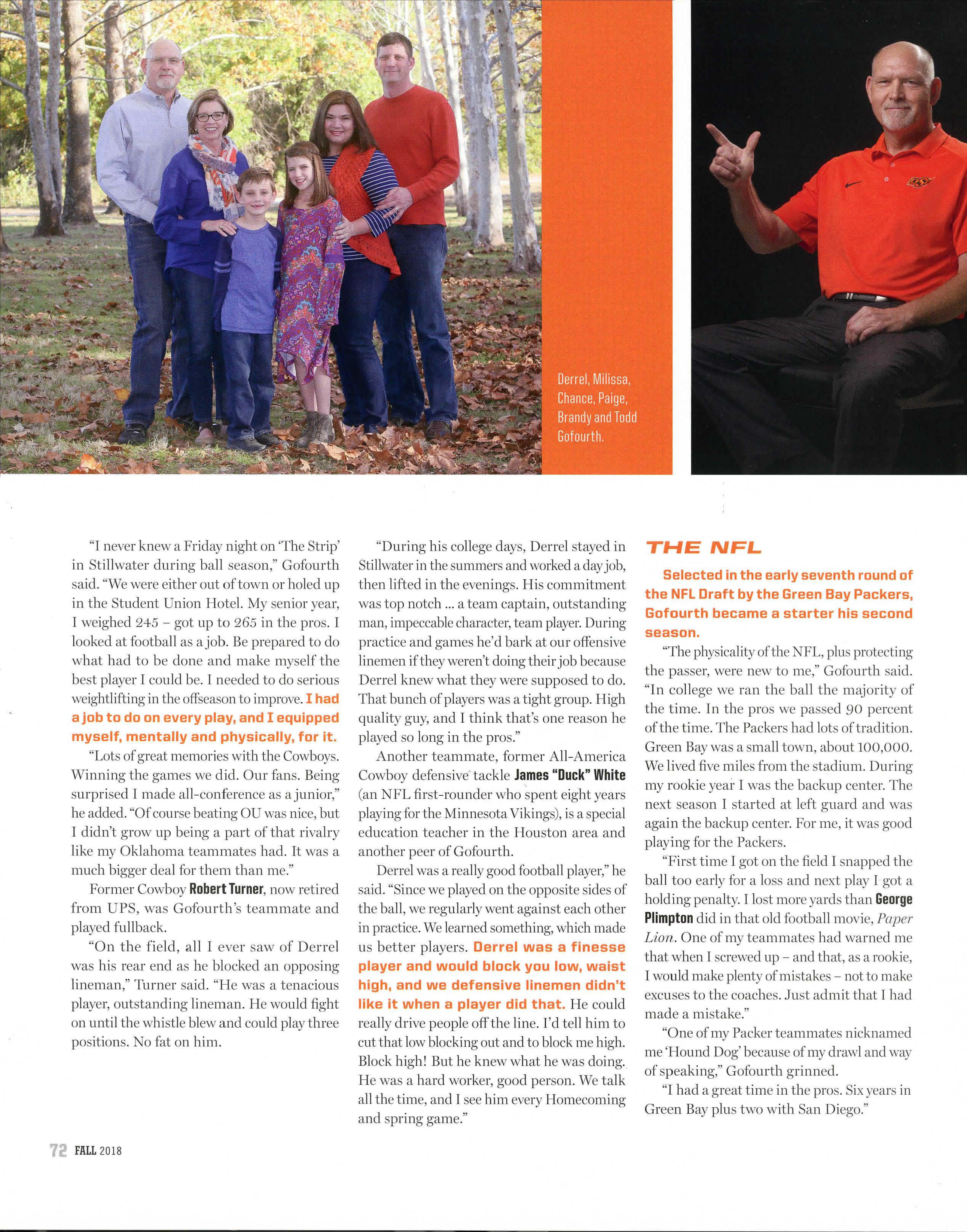
"During his college clays, Derrel stayed in Stillwater in the summers and worked a dayjob, then lifted in the evenings. His commitment was top notch a team captain, outstanding man, impeccablecharacter, team player. During practice and games he'd bark at our offensive 1inemen if they weren't doing their job because Derrel knew what they were supposed to do. That bunch of players was a tight group. High quality guy, and I think that's one reason he played so long in the pros."
Another teammate, former All-America Cowboy defensive tackle James"Duck"White (an NFL first-rounder who spent eight years playing for the Minnesota Vikings), is a special education teacher in the Houston area and another peer of Gofourth.
Derrel was a really good football player,"he said. "Since we played on the opposite sides of the ball, we regularly went against each otber in practice. We learned something, which made us better players. Oerrel was a finesse player and would block you low, waist high, and we defensive linemen didn't like it when a player did that. I-le could r ally drive people off the line. I'd tell him to cut that low blocking out and to block me high. Block high! But he knew what he was doing. He was a hard worker, good person. We talk all the time, and I see him every Homecoming and spring game."
THE NFL
Selected in the early seventh round of the NFL Draft by the Green Bay Packers, Gofourth became a starter his second season.
"The physicality of the NFL, plus protecting the passer, were new to me," Gofourth said. "In college we ran the ball the majority of the time. In the pros we passed 90 percent of the time. The Packers had lots of tradition. Green Bay was a small town, about 100,000. We lived five miles from the stadium. During my rookie year I was the backup center. The next season I started at left guard and was again the backup center. For me, it was good playing for the Packers.
"First time I got on the field I snapped the bal I too early for a loss and next play I got a holding penalty. I lost more yards than George Plimptondid in that old football movie, Paper Lion. One of my teammates had warned me that when Tscrewed up - and that, as a rookie, I would make plenty of mistakes - not to make excuses to the coaches. Just admit that I had made a mistake."
"One of my Packer team mate nick named me 'I-lound Dog' because of my draw] and way of speaking," Gofourth grinned.
"I had a great time in the pros. Six years in Green Bay plus two with San Diego."
"Lots of great memories vvith the Covvboys. Winning the games vve did. Our Fans. Being surprised I made all-conFerence as a junior."
DennisMcKnight,currently a coach for the Hamilton Tiger Cats of the Canadian Football League, was an offensive lineman for San Diego's Chargers and Gofourth's teammate for two years.
"Derrel was really strong," McKnight said. "I didn't like him at first, but we turned out to be best friends. I was a younger player, and he was toward the end of his career. The Chargers traded for Derrel to shore up our offensive line. He was experienced and could play three positions. So when I hear we traded for this guy from the Packers I'm pissed off. Being a new guy from a small school who had already been cut once, I was intimidated and believed the coaches didn't think I was any good. So I give Derrel the cold shoulder, thinking he might take my job. Then the second night of training camp, we're in the locker room playing dominos, dipping Copenhagen and becoming friends. This guy whom I thought was a threat and I became very close.
"By the time Derrel got to us, he'd had so many surgeries his body was starting to break," McKnight added. "But he was one hardworking, tough son of a gun. Really strong, a weight room guy. Playing dominos in the locker room was big deal, lots of laughs. We were a tight-knit group and Derrel fit in like a glove and was .one of our team's top three domino players.
"For at least 20 years I'd go back to Oklahoma and play in the Blackjack Charity Golf Tournament with Derrel, which we won twice," McKnight added. "He carried me and was a very competitive golfer. I love Stillwater, and for years I bad my own coffee cup hanging on the wall at Mom's Cafe. Also, I regularly used a dentist and chiropractor there.
"When Tthink ofDerrel, he is an outstanding husband, father, grandfather checks all the boxes when you think about a person. Most guys I played with don't come close to checking all the boxes. He does it all. My best friend. I don't think I'll ever know another total quality person like him. Catholics believe when a person dies they first go to Purgatory and then go to Heaven or Hell. Derrel is going straight to Heaven when he dies. He's that good a man!"
"Enjoyed my time with the Chargers," recalled Gofourth, "DonCoryellwas a player's coach. That's where my career ended. I didn't divorce football, football quit me. My 14 surgeries (five knee, four shoulder, four elbow and one back) took a toll on my body. lt was time to give up the game. By the end of my career in 1985, it took five rolls of tape to get me on the field."
Gofourth had kept a home in Stillwater during his playing career and owned several rental properties. The oil bust was in full bloom when he came back to stay.
"I had a friend who got me into the insurance business, and at first, I wasn't too gung-ho," he said. "But it worked out. I never made any cold calls. We do mostly employee benefit plans, plus my rental properties have increased so that I now have a manager for them. It all keeps me pretty busy.
"My son, Todd, here in Stillwater, works out ofhis home. Plus he and his wife, Brandy, have my grandkids, Chance (8) and Paige (10). If they are with me, my truck can't pass Brau m's without stopping. I enjoy being with them, and they stay with me every Thursday evening so Todd and Brandy can have a date night.
"My wife has worked at the university for 20-plus years. Also my dad, Chester, is in a skilled nursing home back in Parsons, and I help look after him.
"Today I weigh about 230, workout on the treadmill and elliptical. I try to at least dampen at-shirt and limit my carbs and sugar.
"If I had to do it all over again, I'd do it same way," he concluded. "Great times. I enjoyed Stillwater and OSU, married the perfect woman for me when we were both 19. We ·wereborn four days apart in the same hospital. Things have worked out very well. Stillwater is home. I have been fortunate."

The author welcomes your comments/ questions: osu52johnson@yahoo.com
ORANGEt,lBLACK GIVES BACK™
08/11/18
POSSE AUCTION
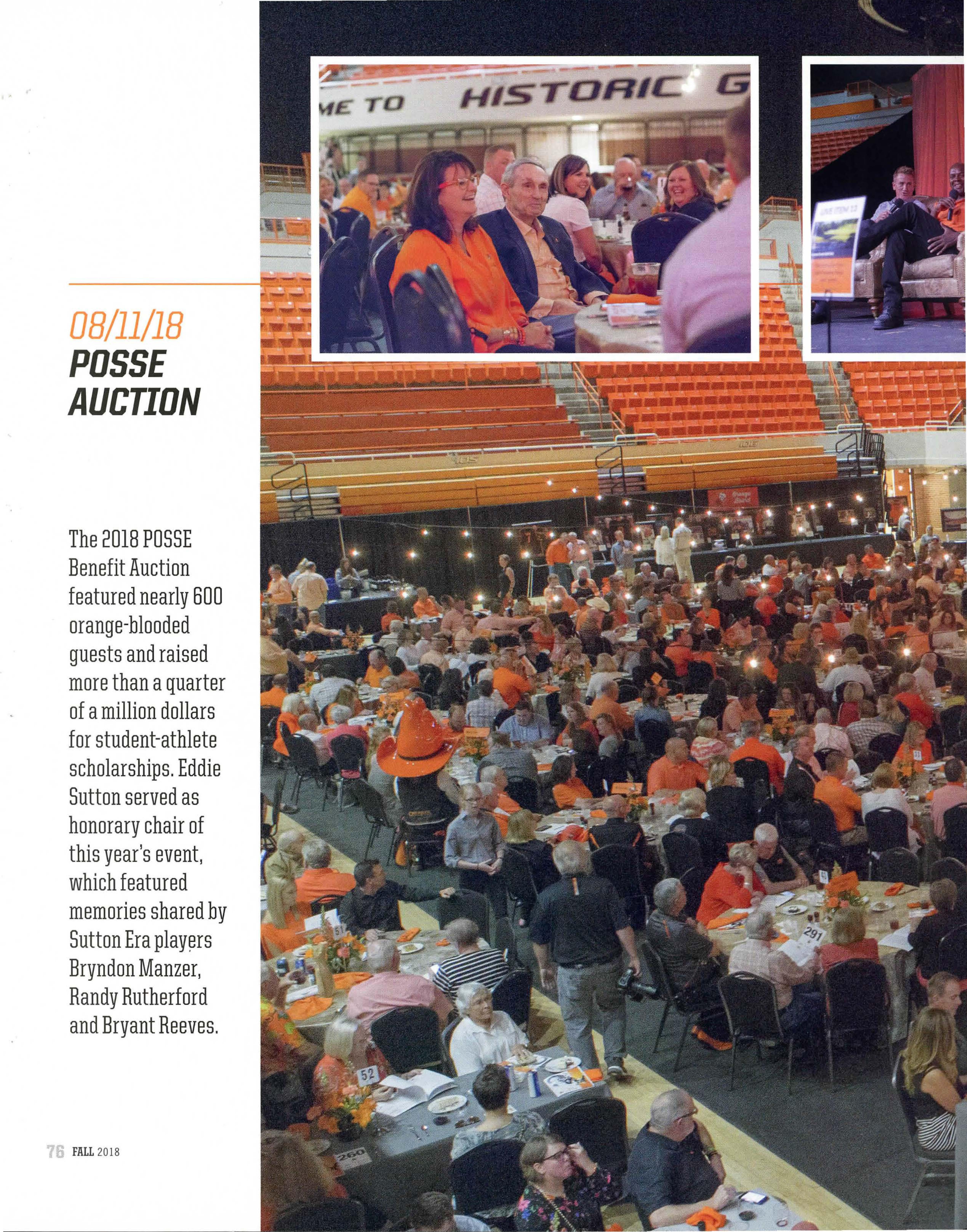
The2018POSSE BenefitAuction featurednearly600 orange-blooded guestsandraised morethana quarter ofa milliondollars forstudent-athlete scholarships.Eddie Suttonservedas honorarychairof thisyear'sevent, whichfeatured memoriessharedby SuttonEraplay~rs BryndonManzer, RandyRutherford andBryantReeves.
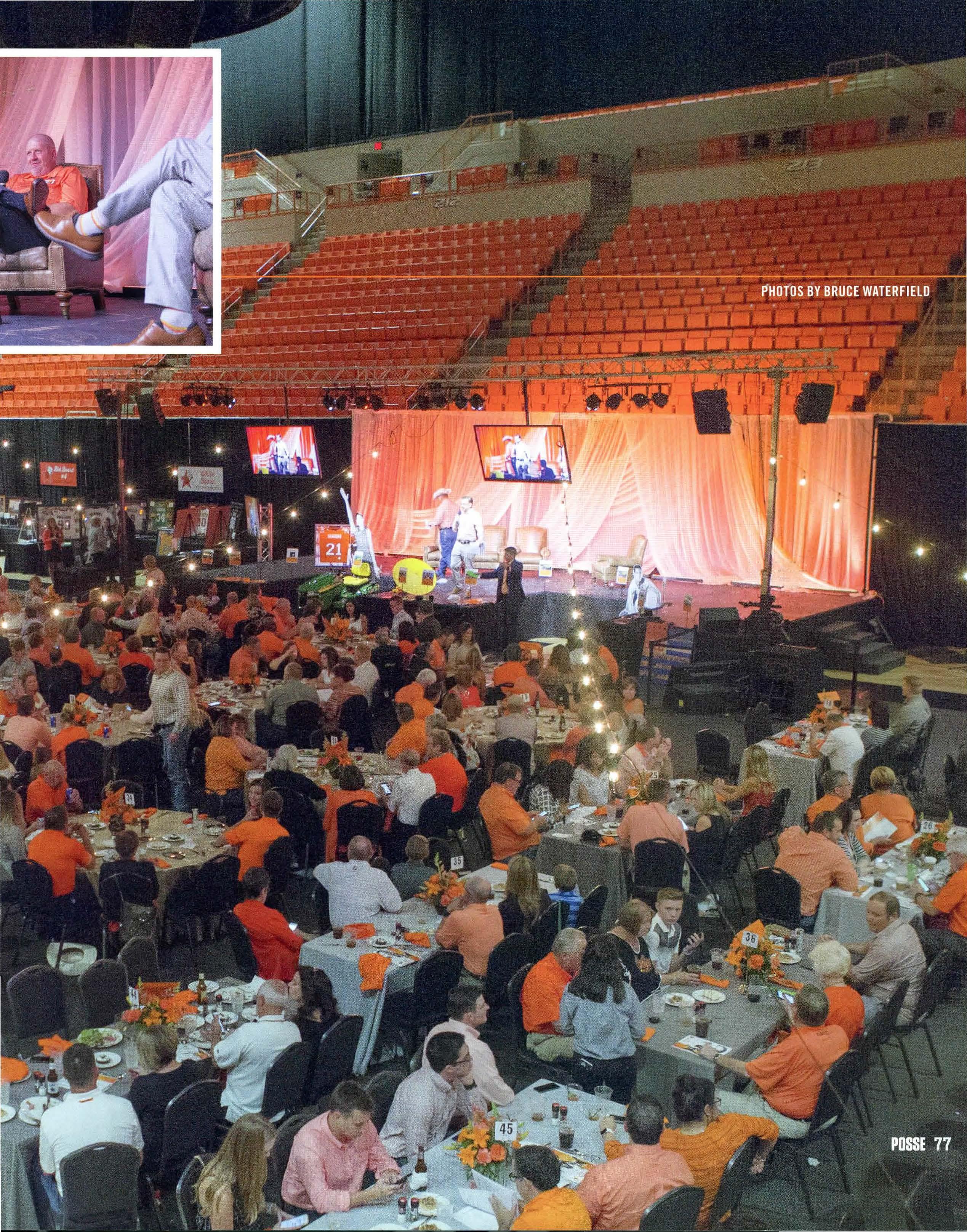

08/04/18 FANOAY
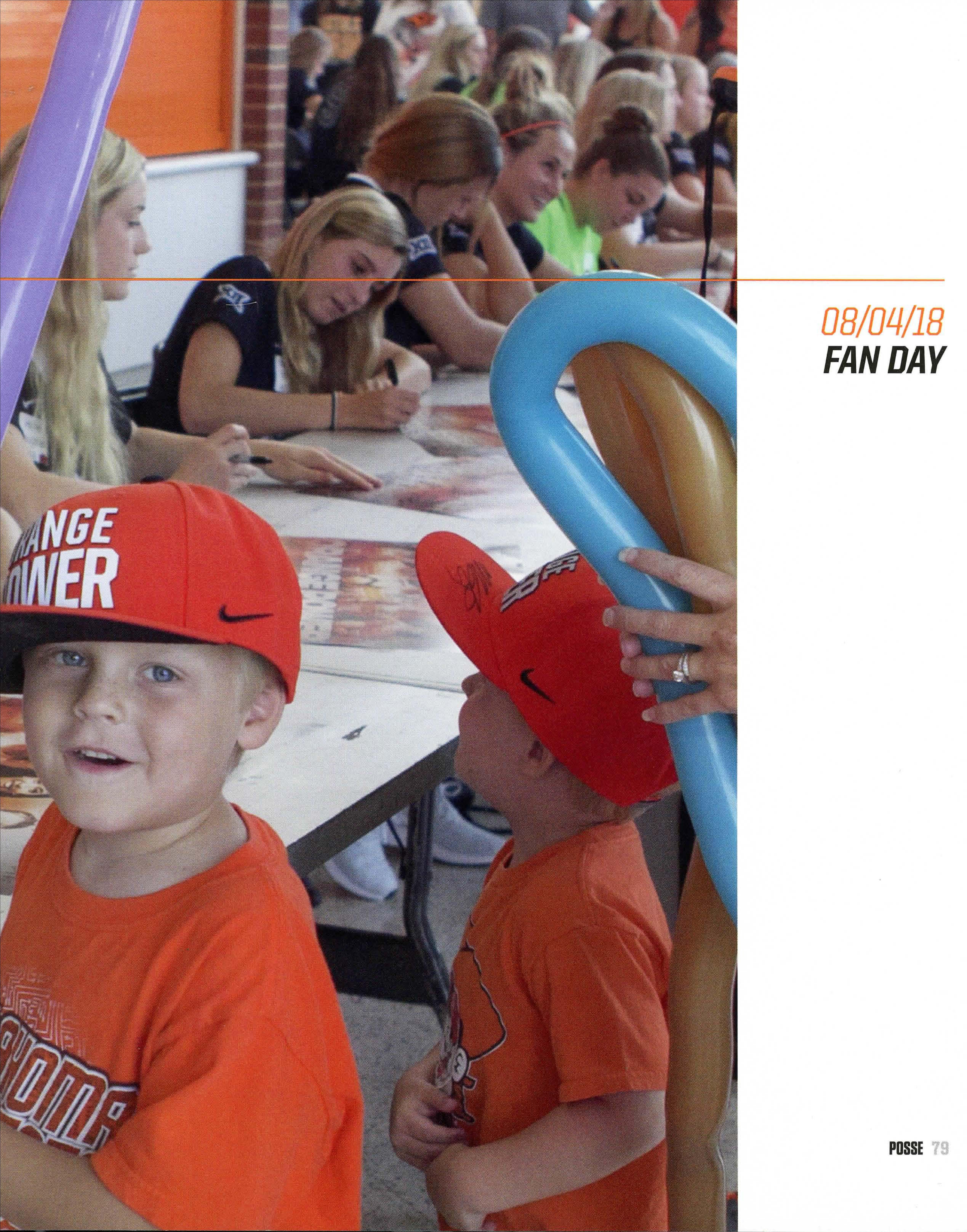
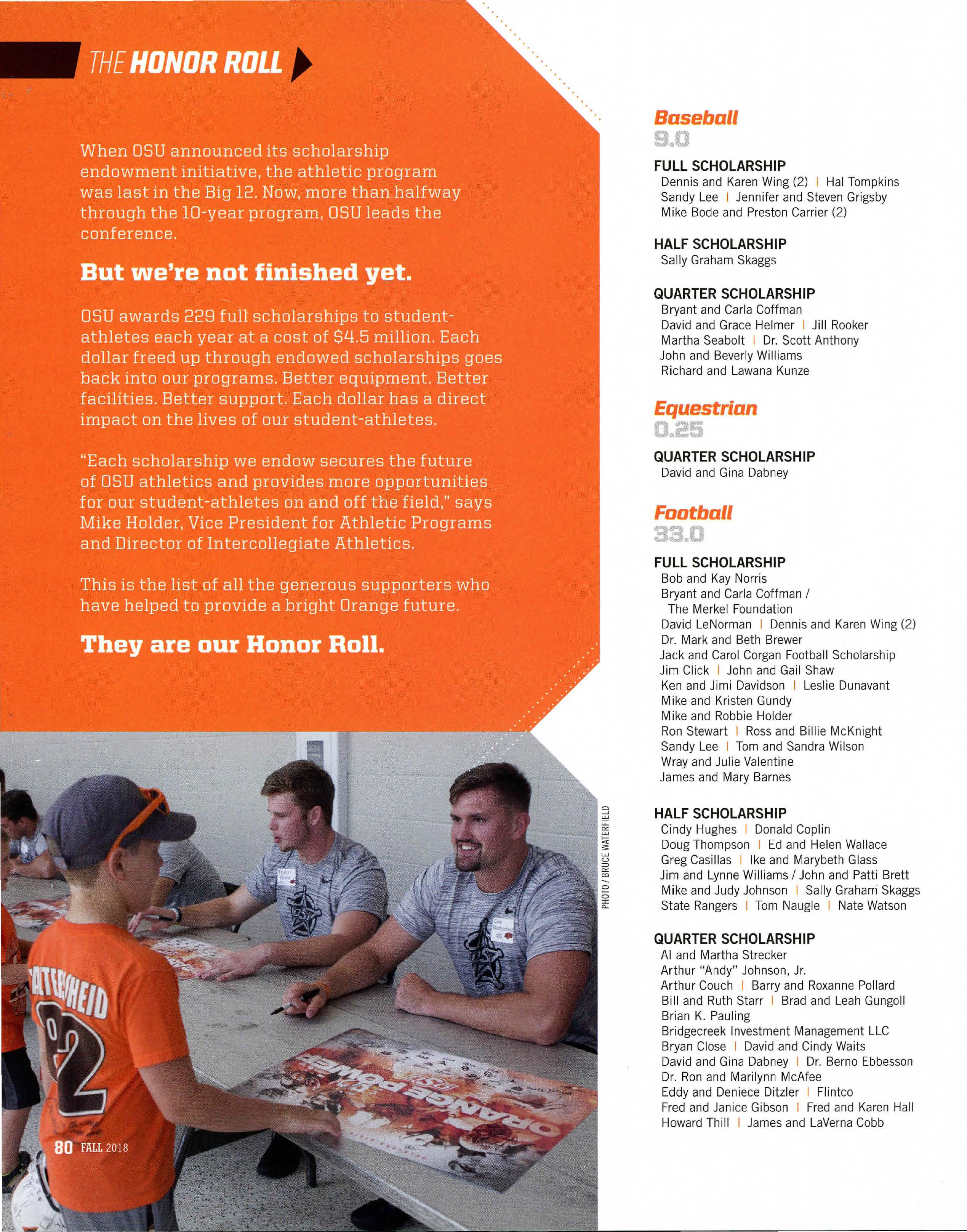
Baseball
FULL SCHOLARSHIP
Dennis and Karen Wing (2) I Hal Tompkins
Sandy Lee I Jennifer and Steven Grigsby
Mike Bode and Preston Carrier (2)
HALF SCHOLARSHIP
Sally Graham Skaggs
QUARTERSCHOLARSHIP
Bryant and Carla Coffman
David and Grace Helmer I Jill Rooker
Martha Seabolt I Dr. Scott Anthony
John and Beverly Williams
Richard and Lawana Kunze
Equestrian
QUARTERSCHOLARSHIP
David and Gina Dabney
Football
FULL SCHOLARSHIP
Bob and Kay Norris
Bryant and Carla Coffman I The Merkel Foundation
David LeNorman I Dennis and Karen Wing (2)
Dr. Mark and Beth Brewer
Jack and Carol Corgan Football Scholarship
Jim Click I John and Gail Shaw
Ken and Jimi Davidson I Leslie Dunavant
Mike and Kristen Gundy
Mike and Robbie Holder
Ron Stewart I Ross and Billie McKnight
Sandy Lee I Tom and Sandra Wilson
Wray and Julie Valentine
James and Mary Barnes
HALF SCHOLARSHIP
Cindy Hughes I Donald Coplin
Doug Thompson I Ed and Helen Wallace
Greg Casillas I Ike and Marybeth Glass
Jim and Lynne Williams/ John and Patti Brett
Mike and Judy Johnson I Sally Graham Skaggs
State Rangers I Tom Naugle I Nate Watson
QUARTERSCHOLARSHIP
Al and Martha Strecker
Arthur "Andy" Johnson, Jr.
Arthur Couch I Barry and Roxanne Pollard
Bill and Ruth Starr I Brad and Leah Gungoll
Brian K. Pauling
Bridgecreek Investment Management LLC
Bryan Close I David and Cindy Waits
David and Gina Dabney I Dr. Berno Ebbesson
Dr. Ron and Marilynn McAfee
Eddy and Deniece Ditzler I Flintco
Fred and Janice Gibson I Fred and Karen Hall
Howard Thill I James and Laverna Cobb
Jerry and Lynda Baker
Jerry and Rae Winchester I John P. Melot
John S. Clark I Ken and Leitner Greiner
Kent and Margo Dunbar I Paul and Mona Pitts
R. Kirk Whitman I Randall and Carol White
Roger and Laura Demaree I Shelli Osborn
Steve and Diane Tuttle
Tony and Finetta Banfield
General
HALF SCHOLARSHIP
Terry and Martha Barker
QUARTERSCHOLARSHIP
David and Judy Powell
Kenneth and Susan Crouch
Sally Graham Skaggs
Graduate Athlete
QUARTERSCHOLARSHIP
Bob and Joan Hert I Neal Seidle
Tom and Cheryl Hamilton
Men's Basketball
FULL SCHOLARSHIP
A.J. and Susan Jacques
Bill and Marsha Barnes
Brett and Amy Jameson
Calvin and Linda Anthony
Chuck and Kim Watson
David and Julie Ranck (1.25)
Dennis and Karen Wing (2)
Douglas and Nickie Burns
Griff and Mindi Jones
James and Mary Barnes I Jim Vallian
Ken and Jimi Davidson
Kent and Margo Dunbar I KimRay Inc.
Sandy Lee I Mitch Jones Memorial
HALF SCHOLARSHIP
David and Julie Ranck
Dr. Mark and Susan Morrow
Jay and Connie Wiese I Sally Graham Skaggs
Stan Clark I Billy Wayne Travis
QUARTERSCl:IOLARSHIP
Dr. Scott and Lynne Anthony
Gary and Sue Homsey I Holloman Family
Michael and Heather Grismore
Rick and Suzanne Maxwell
Robert and Sharon Keating
Steve and Suzie Crowder
Terry and Donna Tippens Men's Golf
FULL SCHOLARSHIP
David and Julie Ranck
Dennis and Karen Wing
Jack and Carol Corgan Men's Golf Scholarship
HALF SCHOLARSHIP Bank SNB
QUARTERSCHOLARSHIP
Bob and Elizabeth Nickles
Garland and Penny Cupp
Richard and Joan Welborn Men's Tennis 25
QUARTERSCHOLARSHIP
Tom and Cheryl Hamilton Men's Track .7 -
QUARTERSCHOLARSHIP
Dr. Mark and Susan Morrow
Susan Anderson I Ken and Leitner Greiner Soccer 1.0
FULL SCHOLARSHIP
James and Mary Barnes Softball
QUARTERSCl-:IOLARSHIP
Tom and Cheryl Hamilton Women's
FULL SCHOLARSHIP
Brad and Margie Schultz
Ken and Jimi Davidson
Mike Bode and Preston Carrier
HALF SCHOLARSHIP
Baloo and Maribeth Subramaniam
Don and Mary McCall
John and Caroline Linehan
Calvin and Linda Anthony
QUARTERSCHOLARSHIP
Bill and Roberta Armstrong
Bill and Sally Cunningham
Donald Coplin I Jill Rooker
Richard and Linda Rodgers
Jo Hughes and Deborah J. Ernst
Women's Golf
HALF SCHOLARSHIP
David and Julie Ranck
QUARTERSCHOLARSHIP
Amy Weeks I Kent and Margo Dunbar Women's
QUARTERSCHOLARSHIP
Jamie Maher
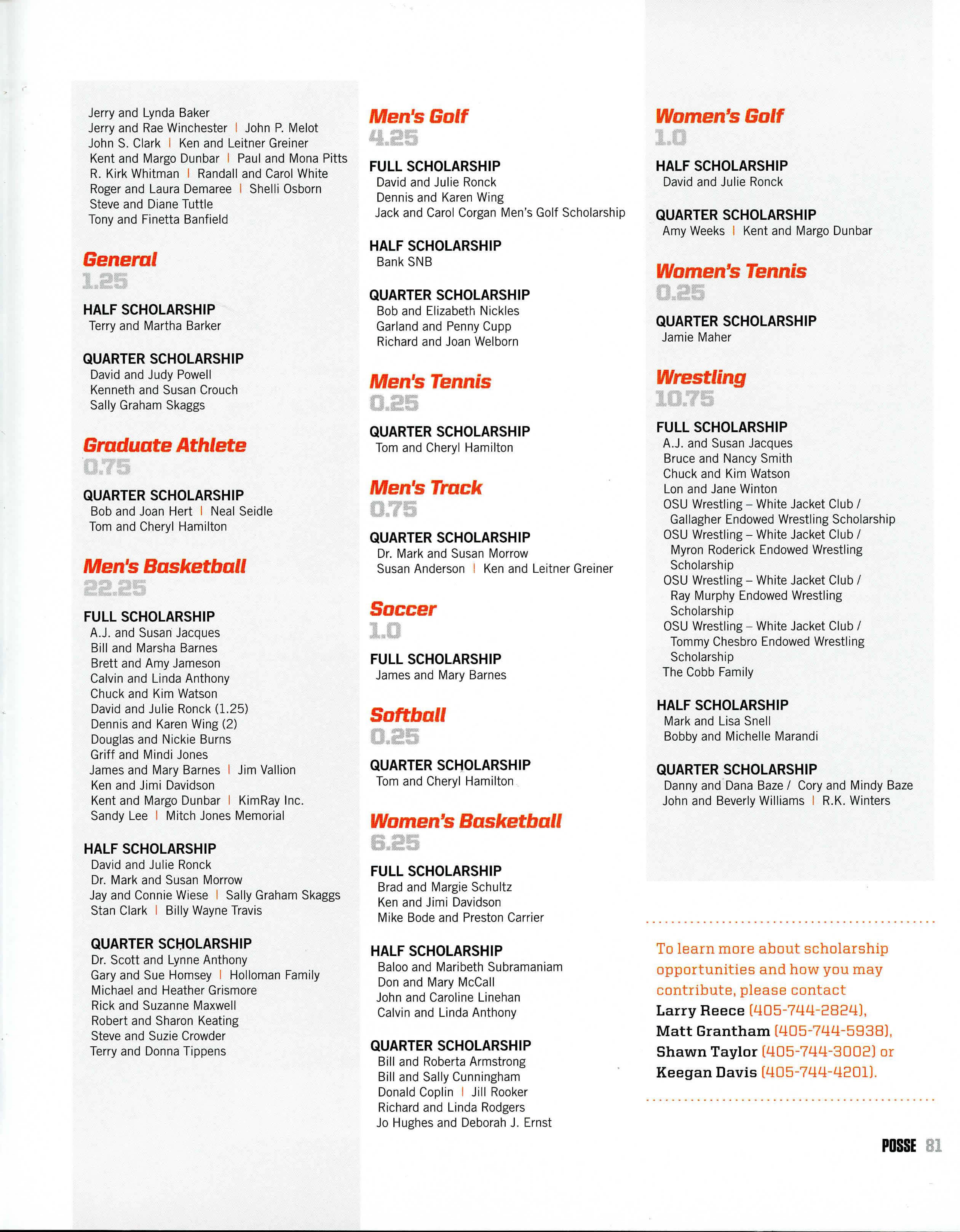
FULL SCHOLARSHIP
A.J. and Susan Jacques
Bruce and Nancy Smith
Chuck and Kim Watson
Lon and Jane Winton
OSU Wrestling - White Jacket Club/ Gallagher Endowed Wrestling Scholarship
OSU Wrestling - White Jacket Club/ Myron Roderick Endowed Wrestling Scholarship
OSU Wrestling - White Jacket Club/ Ray Murphy Endowed Wrestling Scholarship
OSU Wrestling - White Jacket Club/ Tommy Chesbro Endowed Wrestling Scholarship
The Cobb Family
HALFSCHOLARSHIP
Mark and Lisa Snell
Bobby and Michelle Marandi
QUARTERSCHOLARSHIP
Danny and Dana Baze/ Cory and Mindy Baze
John and Beverly Williams I R.K. Winters
To learn more about scholarship opportunities and how you may contribute, please contact Larry Reece (405-744-2824), Matt Grantham (405-744-5838), Shawn Taylor (405-744-3002) or Keegan Davis (405-744-4201).
WRAVINGS

SEASONOFCHANGE
"It usedto snowhere," I silentlythoughtto myself lastFebruaryasI watchedoutthewindow.
Another grey winter day was passing by without any wintery precipitation. It was one more in a string of unseasonablywarm days which hinted spring was around the corner. I wanted winter to continue for two reasons. First, because I like the cooler weather. When a person breaks into a sweat walking between the house and barn, that's too hot. There is a limit to how much clothes one can take off. Cold on the other hand allows you to layer up. Shirt, vest, coat - no problem. Fireplaces, hot chocolate and the holidays all make me happy.
Second, I wanted football season to continue. The college non-conference schedule is intriguing because we get to see new names in new positions. We get to see which teams got better or worse. Big 12 Conferencegamesare exciting each week as we watch teams propel themselvesto the top or sink towardthe otherdirection.Thenaround mid-December comes the most wonderful time of the year.Bowlseason.Footballjunkies watchas manygamesas possible.So much so, the paint is worn off your "previous channel" button on the TV remote. There is a fine skill associated with the art of knowing exactly whento switchto the othergame.Mid-January brings the various senior all-star games and then we resort to the NFL playoffs. By the time the Super Bowl rolls around in February, reality sets in for ~ure. So fellow football enthusiasts, get ready.
A great situation has developed for Oklahoma State football during the Mike Gundy era. We simply load another round into the chamber and take aim. Evenin yearswherewe graduateNFLcalibertalent,we reload with youngsterswho are all too happy to take their shots at the Big 12 record books. This year is no different. Most prognosticators will tell you that a team's offense will go as far as the quarterbackwill take you, which is fairly accurate.There are a lot of teams around the countryreplacinggoodquarterbacks.OhioState returnsa lot of playerson offenseand defense, but the trigger-man for them will be brand new. Unless they revert to the "wildbuckeye" in Columbus,a new quarterback will haveto face Big Ten defensesand try to be accurate during bad weather in November.Not easy. EvenmightyAlabamahasa highlypublicized quarterback controversyof sorts. One signalcallerwith a 25-2 recordis taking on a national championshipsavior who found a receiver in busted coveragelast January.Somethinghas to give. Let the fun begin.
The Big 12 Conference will be breaking in new quarterbacks of their own - two of them in the state of Oklahoma. Oklahoma Universityhasa newone. After a sluggishstart in Aggieland,he landedin Norman.The future OaklandA's outfielder has a lot of talent, but his only start in the Big 12 came as a result of an obscene gesture by a predecessor.We will see.
So Oklahoma State is in good company when we considernewquarterbacks.We have choices.The elder statesman, a one-year wonder and a boy wonder. Either way, he will be wearing bright orange. So get a game program and open it to the roster page. These Cowboys are going to be fun to watch.
GD POKES!
KYLE-WRAY Vice President
Enrollment & Brand Management
I] Kyle Wray OSU CJ@KyleWrayOSU