At Byford Auto Group, we take our motto seriously! For us, customer satisfaction comes first - we give more because you deserve more like free loaners for our service customers, and oil changes for life. And, you can count on our world-class service technicians to keep your car on the road and running smoothly. At Byford, we view our customers as part of our family and maintain a friendly, relaxed atmosphere ... which is probably why we have a top-tier customer satisfaction rating! Come see for yourself at any of our locations. Nobody Treats You Better Than Byford!
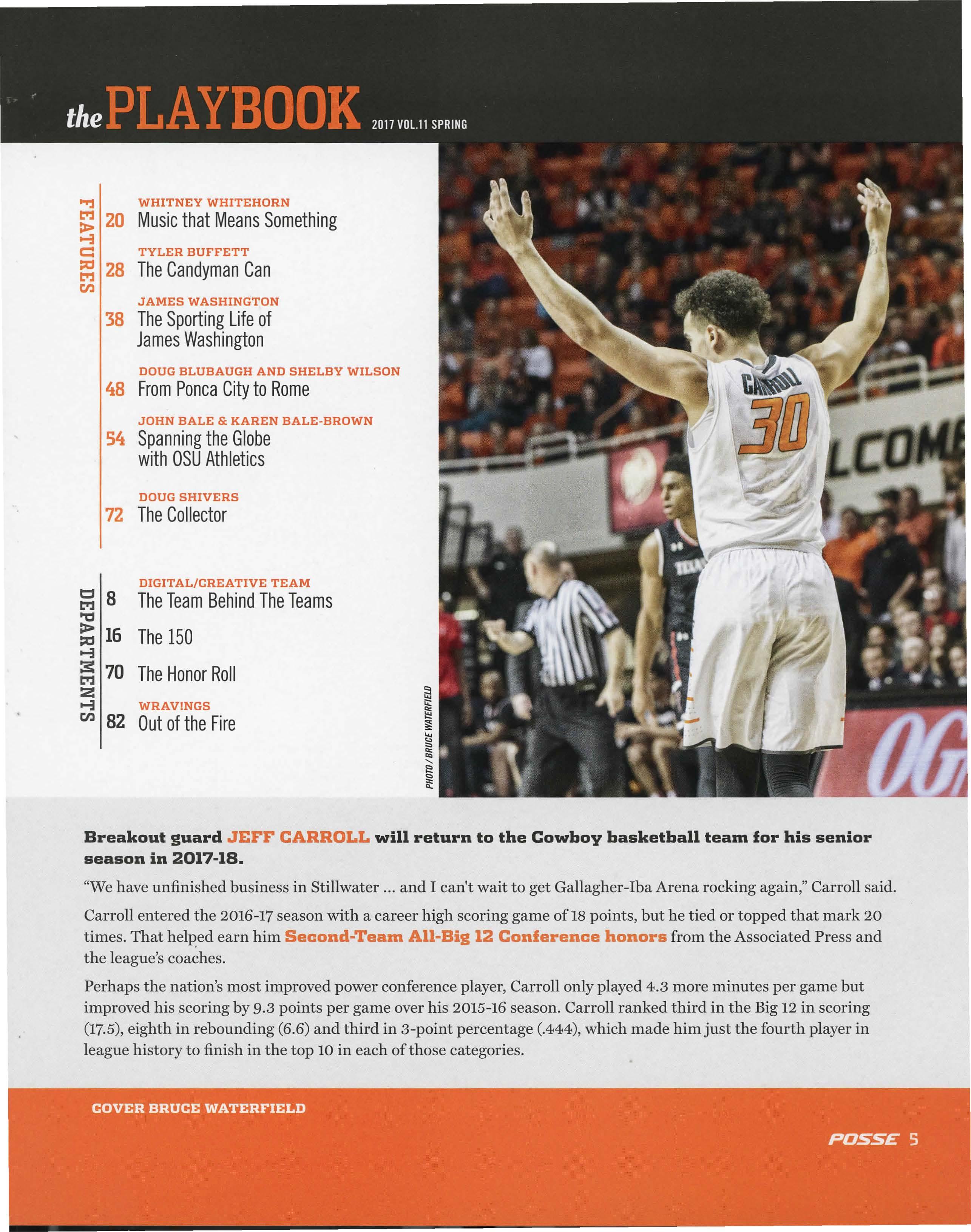
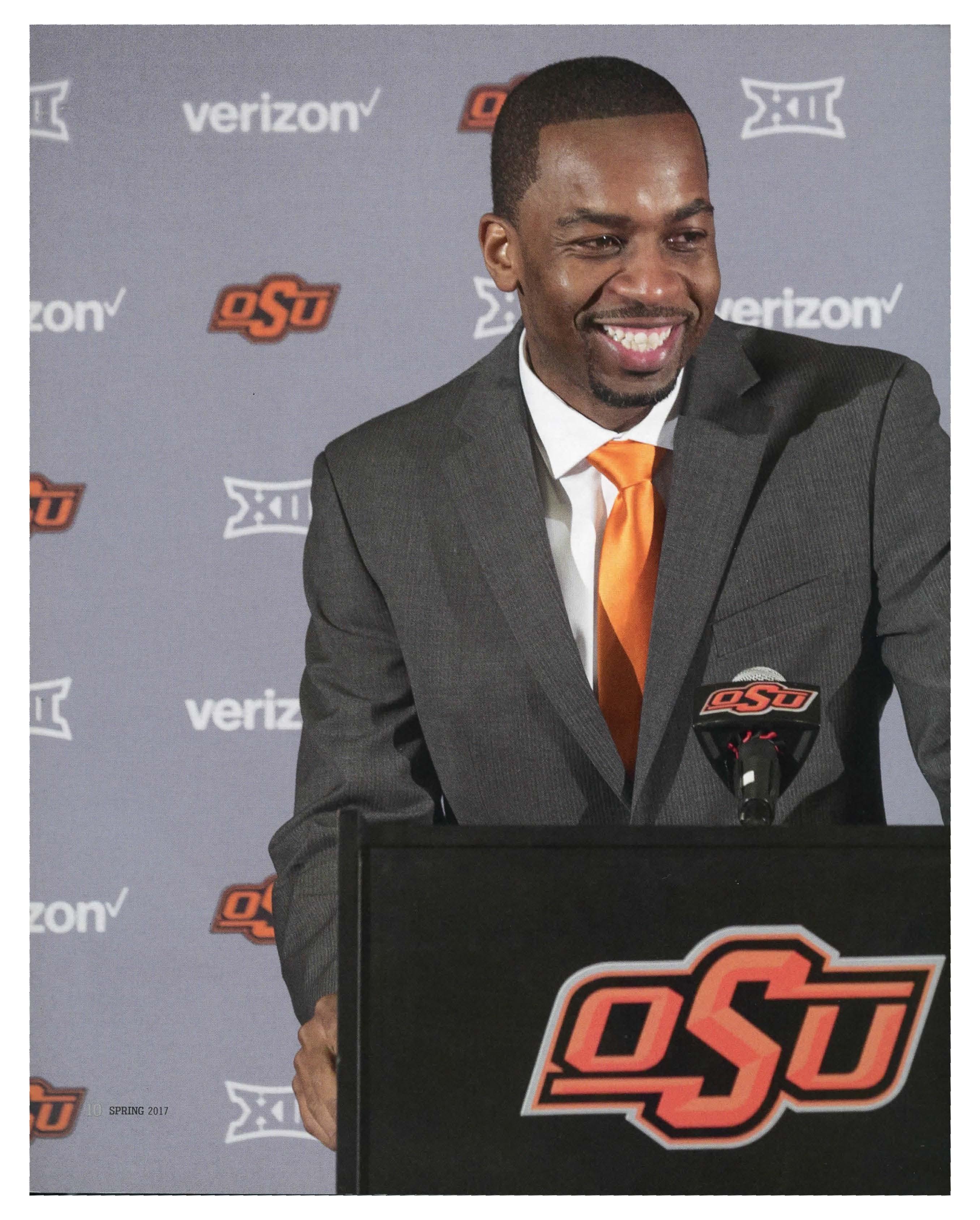
Breakout guard JEFF CARROLL will return to the Cowboy basketball team for his senior season in 2017-18.
"We have unfinished business in Stillwater and I can't wait to get Gallagher-Iba Arena rocking again," Carroll said. Carroll entered the 2016- 17 season with a career high scoring game of 18 points, but he tied or topped that mark 20 times. That helped earn him Second-Team All-Big 12 Conference honors from the Associated Press and the league's coaches.
Perhaps the nation's most improved power conference player, Carroll only played 4.3 more minutes per game but improved his scoring by 9.3 points per game over his 2015-16 season. Carroll ranked third in the Big 12 in scoring (17.5), eighth in rebounding (6.6) and third in 3-point percentage (.444), which made him just the fourth player in league history to finish in the top IO in each of those categories.
POSSE POKES ""
POSSE MAGAZINE STAFF
VICE PRESIDENT OF ENROLLMENT MANAGEMENT/ MARKETING KYLEWRAY
EDITOR-IN-CHIEF/ SENIOR ASSOCIATE ATHLETIC DIRECTOR KEVINKLINTWORTH
ASSISTANT ATHLETIC DIRECTOR/ POSSE DIRECTOR ELLENAYRES
PREMIUM SERVICES DIRECTOR KARYLHENRY
PUBLICATIONS COORDINATOR CLAYBILLMAN
ASSISTANT DIRECTOR. ANNUAL GIVING JOENELSON
COORDINATOR. ANNUAL GIVING STEPHANIEDAVIS
ATHLETICS MAJOR GIFT DEVELOPMENT STAFF
SENIOR ASSOCIATE ATHLETIC DIRECTOR/ DEVELOPMENT LARRYREECE
ASSISTANT ATHLETIC DIRECTOR, DEVELOPMENT MATTGRANTHAM
DIRECTOR OF DEVELOPMENT/ OCLUB KEEGANDAVIS
ASSISTANT ATHLETIC DIRECTOR, DEVELOPMENT SHAWNTAYLOR
OSU POSSE
102 ATHLETICS CENTER
STILLWATER, OK 74078•5070
405.744.7301 P OKSTATEPOSSE.COM
POSSE@OKSTATE.EDU
405. 744.9084 F OKSTATEPOSSE @OSUFANEX
At Oklahoma State University, compliance with NCAA, Big 12 and institutional rules is of the utmost importance. As a supporter of OSU, please remember that maintaining the integrity of the University and the Athletic Department is your first responsibility. As a donor, and therefore booster of OSU, NCAA rules apply to you. If you have any questions, feel free to call the OSU Office of Athletic Compliance at 405-744-7862. Additional information can also be found by clicking on the Compliance tab of the Athletic Department web-site at www.okstate.com.
Remember to always "Ask Before You. Act."
Respectfully,
BEN DYSON
TEA:LVLS
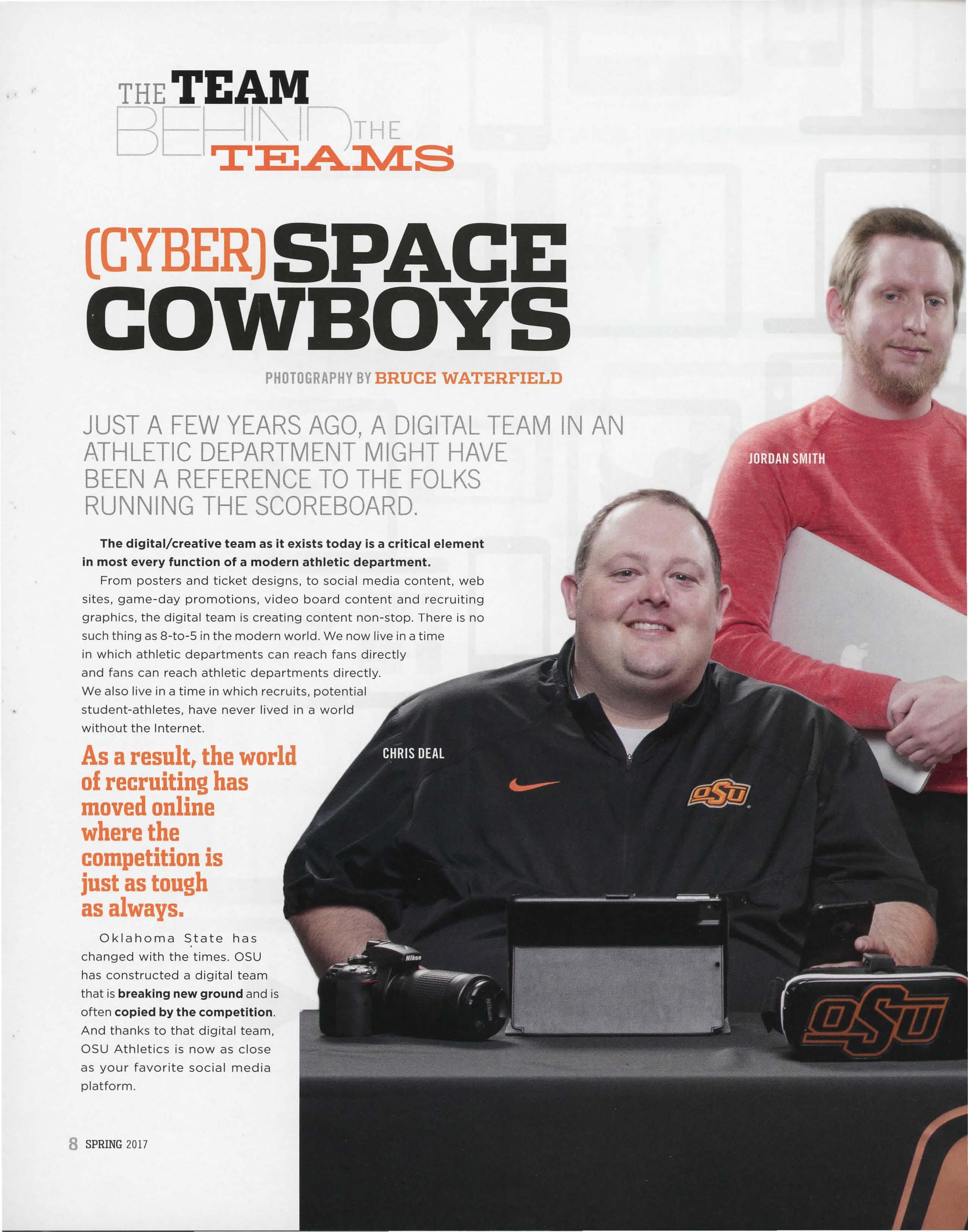
(CYBERJSPACE COWBOYS
PHOTOGRAPHY BYBRUCE WATERFIELD
JUSTA FEWYEARSAGO,A DIGITALTEAM IN AN ATHLETICDEPARTMENTMIGHTHAVE BEENA REFERENCETO THE FOLKS RUNNINGTHE SCOREBOARD.
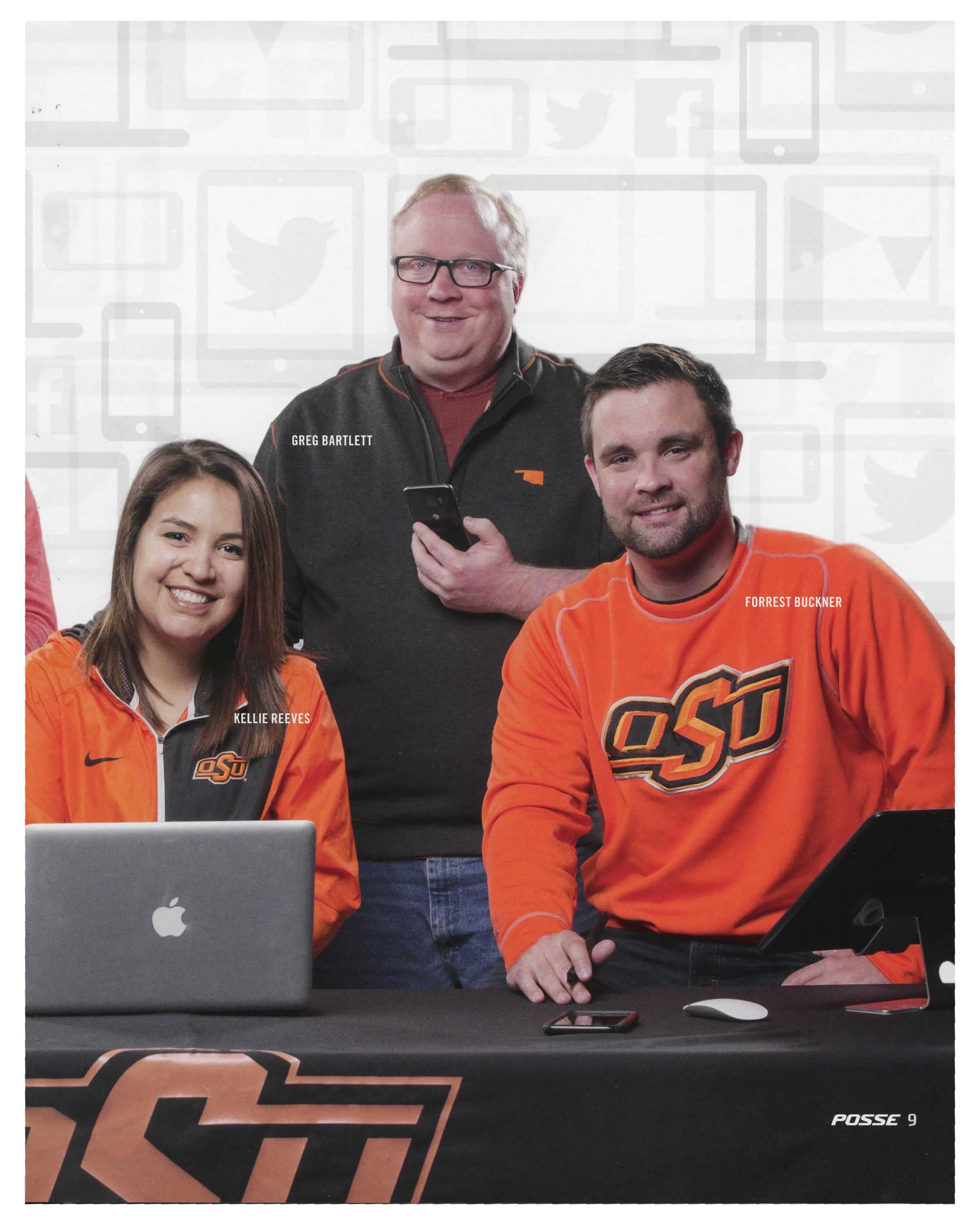
The digital/creative team as it exists today is a critical element in most every function of a modern athletic department. From posters and ticket designs, to social media content, web sites, game-day promotions, video board content and recruiting graphics, the digital team is creating content non-stop. There is no such thing as 8-to-5 in the modern world. We now live in a time in which athletic departments can reach fans directly and fans can reach athletic departments directly. We also live in a time in which recruits, potential student-athletes, have never lived in a world without the Internet.
As a result,the world of recruitinghas movedonline wherethe competitionis just as tough as always.
Oklahoma State has changed with the times. OSU has constructed a digital team that is breaking new ground and is often copied by the competition. And thanks to that digital team, OSU Athletics is now as close as your favorite social media platform.
T A £ 0 T £=
\he p Q $ $ £ A C T I O H A S M O V £ D , - I -\-o A lA G I lA I S T ~S VP: .
SavetheDate SPENDSOMEDOUGH
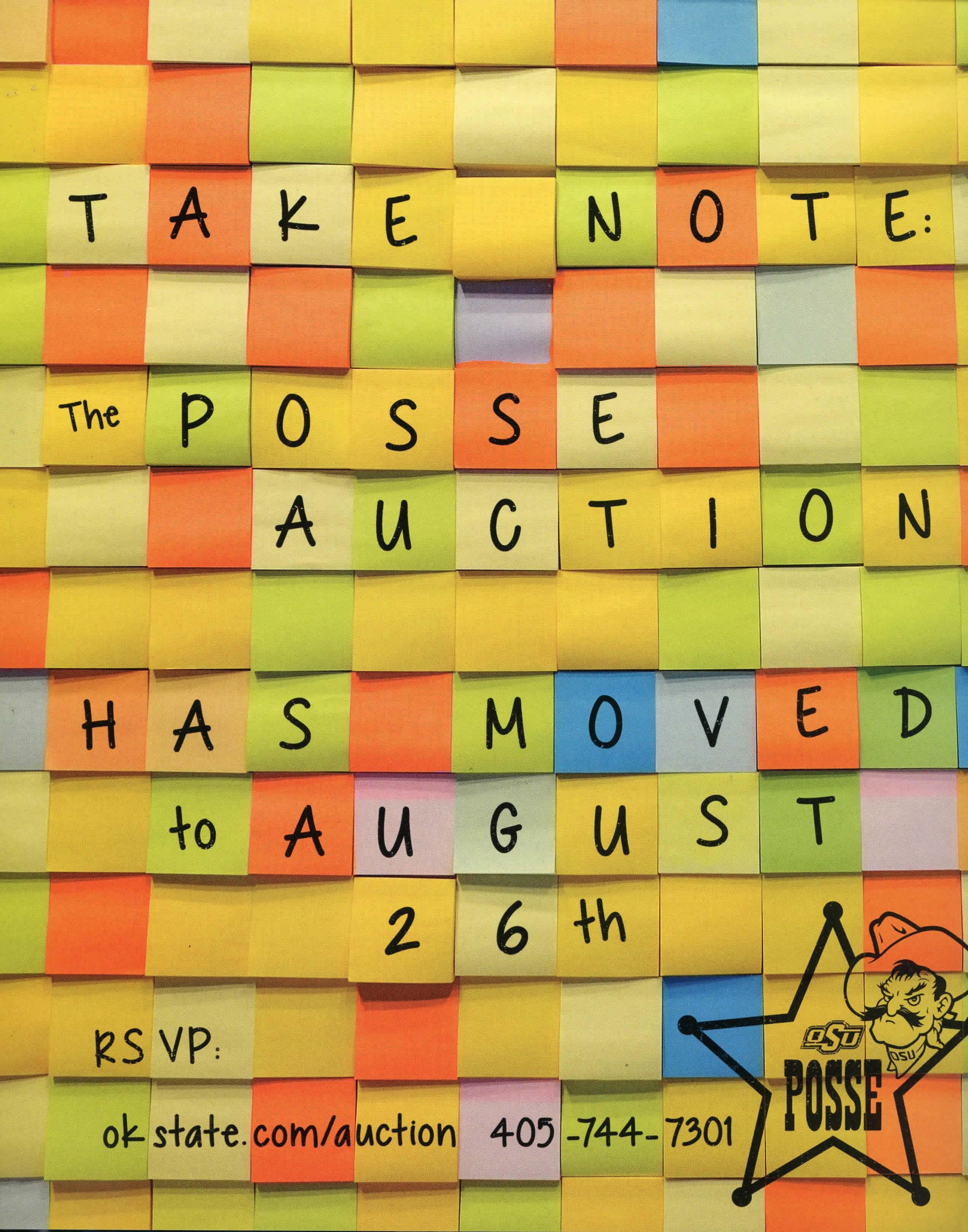
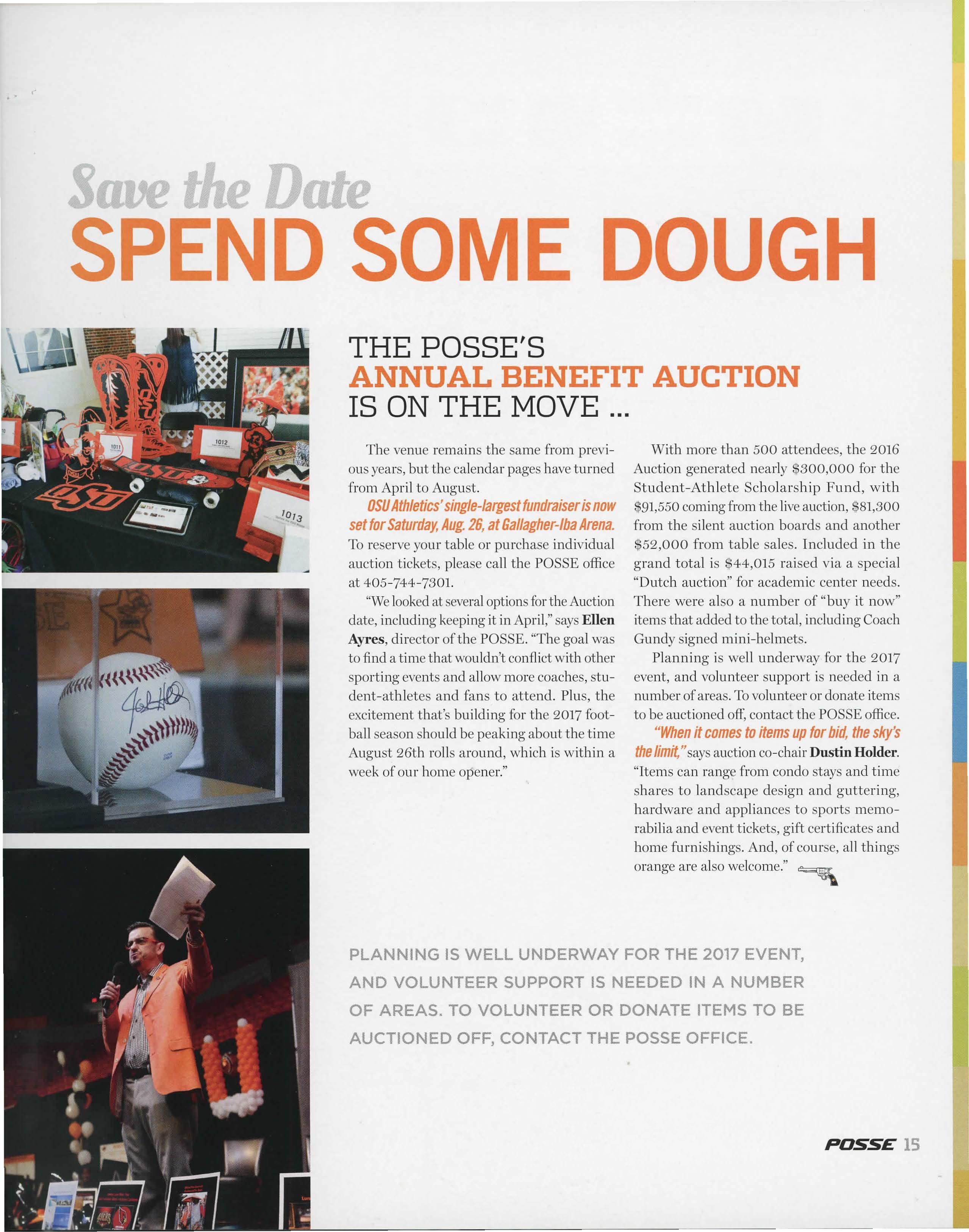
THE POSSE'S ANNUAL BENEFIT AUCTION IS ON THE MOVE ...
The venue remains the same from previous years, but the calendar pages have turned from April to August.
OSUAthletics'single-largestfundraiserisnow setforSaturday,Aug.26,atGallagher-IbaArena. To reserve your table or purchase individual auction tickets, please call the POSSE office at 405-744-7301.
"Welooked at severaloptions for the Auction date, including keeping it in April," says Ellen Ayres, director of the POSSE. "The goal was to find a time that wouldn't conflict with other sporting events and allow more coaches, student-athletes and fans to attend. Plus, the excitement that's building for the 2017 football season should be peaking about the time August 26th rolls around, which is within a week of our home opener."
With more than 500 attendees, the 2016 Auction generated nearly $300,000 for the Student-Athlete Scholarship Fund, with $91,550 coming from the 1ive auction, $81,300 from the silent auction boards and another $52,000 from table sales. Included in the grand total is $44,015 raised via a special "Dutch auction" for academic center needs. There were also a number of "buy it now" items that added to the total, including Coach Gundy signed mini-helmets.
Planning is well underway for the 2017 event, and volunteer support is needed in a number of areas. To volunteer or donate items to be auctioned off, contact the POSSE office. "When it comestoitemsupforbid,thesky's thelimit,"says auction co-chair Dustin Holder. "Items can range from condo stays and time shares to landscape design and guttering, hardware and appliances to sports memorabilia and event tickets, gift certificates and home furnishings. And, of course, all things orange are also welcome."
PLANNING IS WELL UNDERWAY FOR THE 2017 EVENT, AND VOLUNTEER SUPPORT IS NEEDED IN A NUMBER OF AREAS. TO VOLUNTEER OR DONATE ITEMS TO BE AUCTIONED OFF, CONTACT THE POSSE OFFICE.
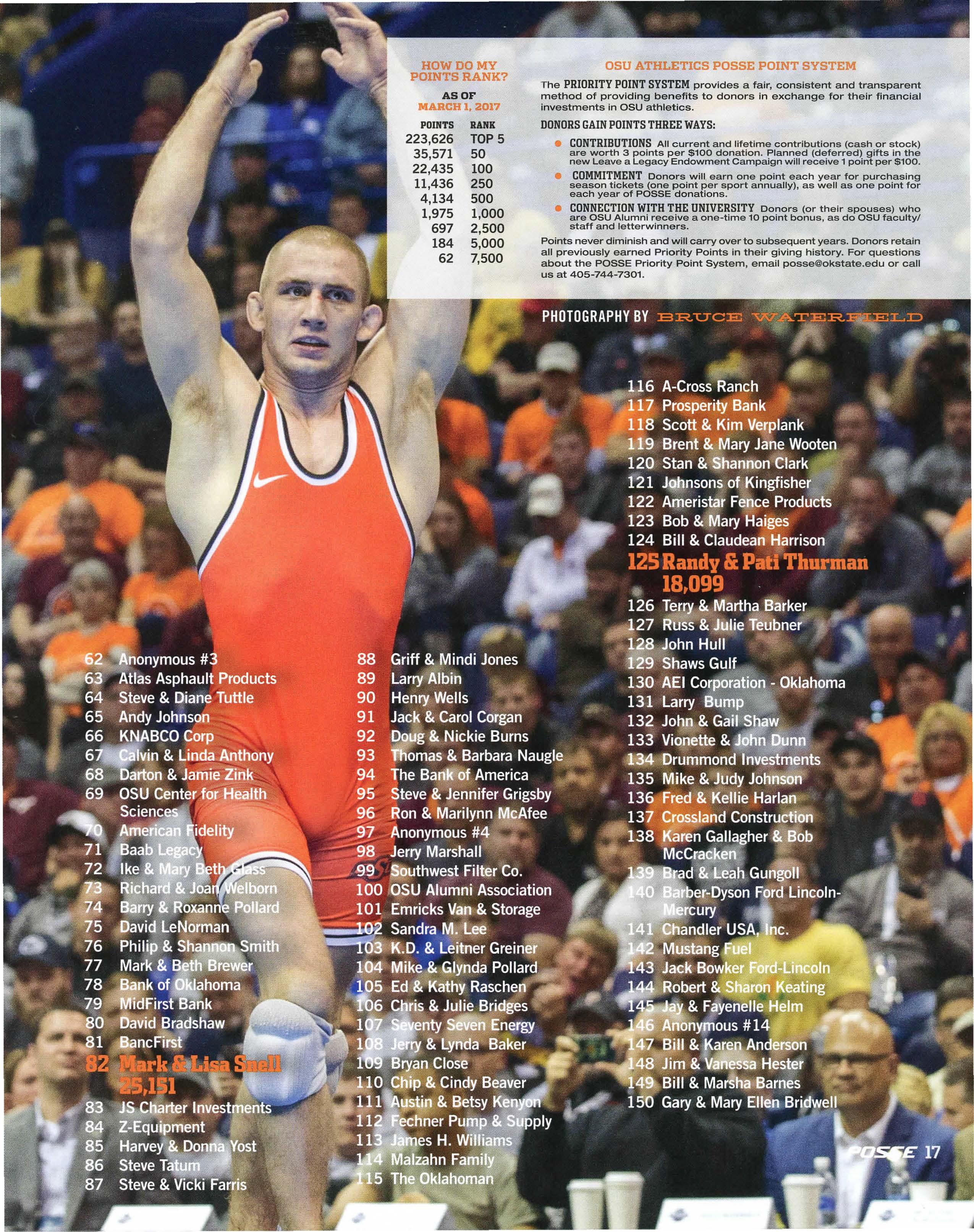
HOWDOMY POINTS RANK?
OSU ATHLETICS POSSE POINT SYSTEM
The PRIORITYPOINTSYSTEMprovides a fair, consistent and transparent method of providing benefits to donors in exchange for their financial investments in OSU athletics.
DONORSGAINPOINTSTHREEWAYS:
• CONTRIBUTIONSAll current and lifetime contributions (cash or stock) are worth 3 points per $100 donation. Planned (deferred) gifts in the new Leave a Legacy Endowment Campaign will receive 1 point per $100.
•
• CONNECTIONWITH THE UNIVERSITY Donors (or their spouses) who are OSU Alumni receive a one-time 10 point bonus, as do OSU faculty/ staff and letterwinners.
Points never diminish and will carry over to subsequent years. Donors retain all previously earned Priority Points in their giving history. For questions about the POSSE Priority Point System, email posse@okstate.edu or call us at 405-744-7301.
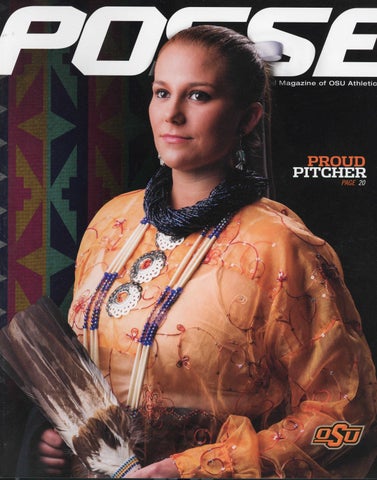
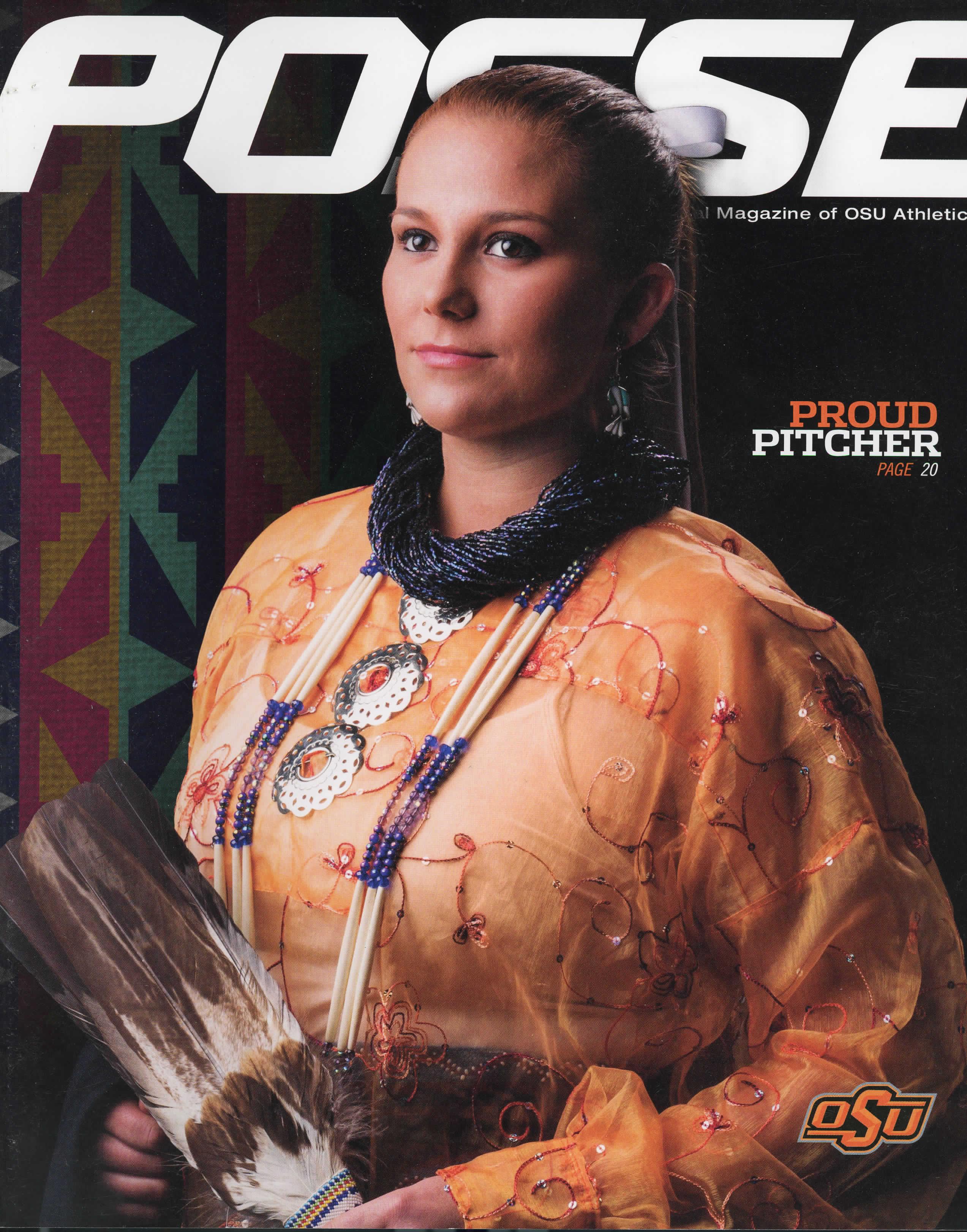
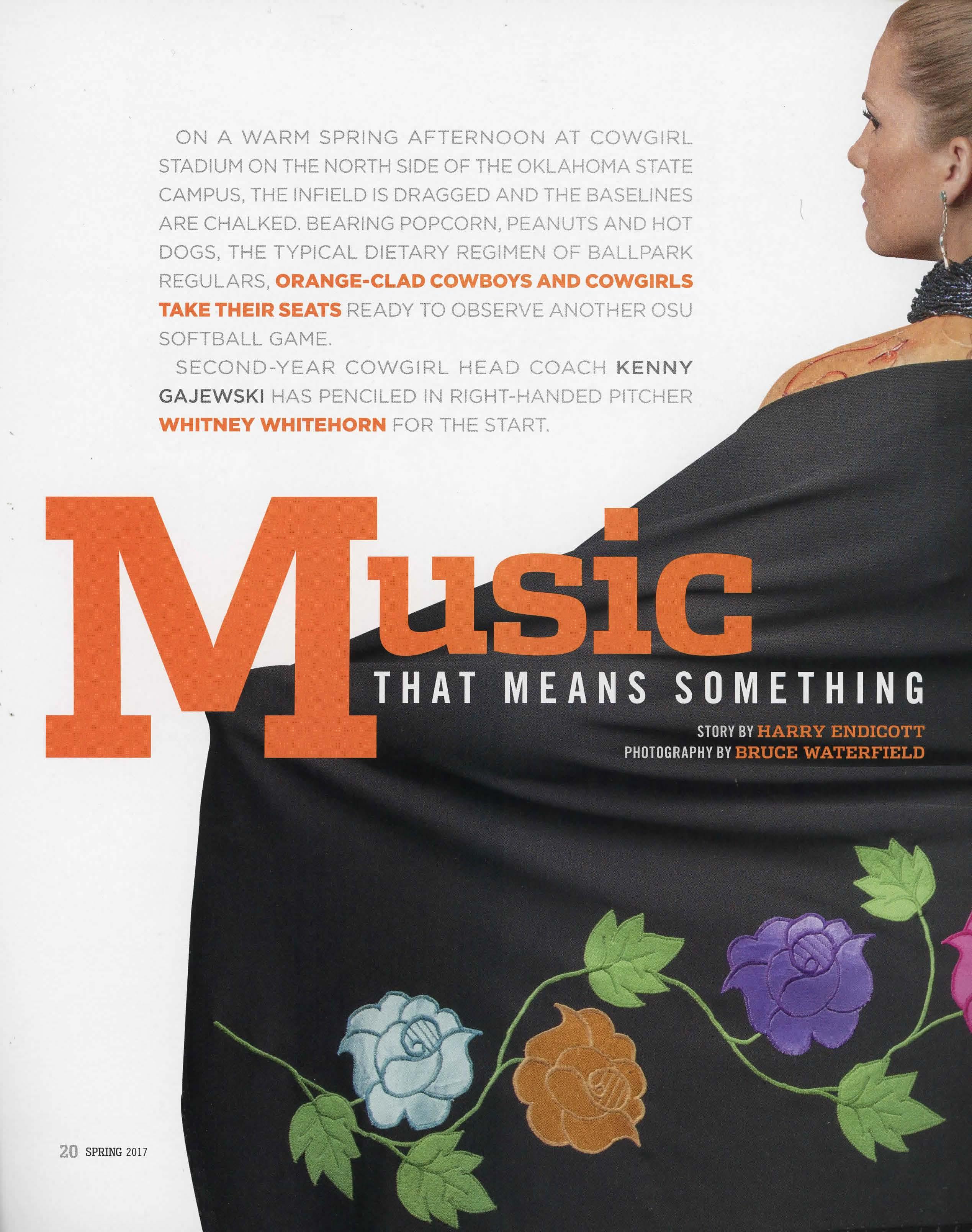
ON A WARM SPRING AFTERNOON AT COWGIRL STADIUM ON THE NORTH SIDE OF THE OKLAHOMA STATE CAMPUS, THE INFIELD IS DRAGGED AND THE BASELINES ARE CHALKED. BEARING POPCORN, PEANUTS AND HOT DOGS, THE TYPICAL DIETARY REGIMEN OF BALLPARK REGULARS, ORANGE-CLAD COWBOYS AND COWGIRLS TAKE THEIR SEATS READY TO OBSERVE ANOTHER OSU SOFTBALL GAME.
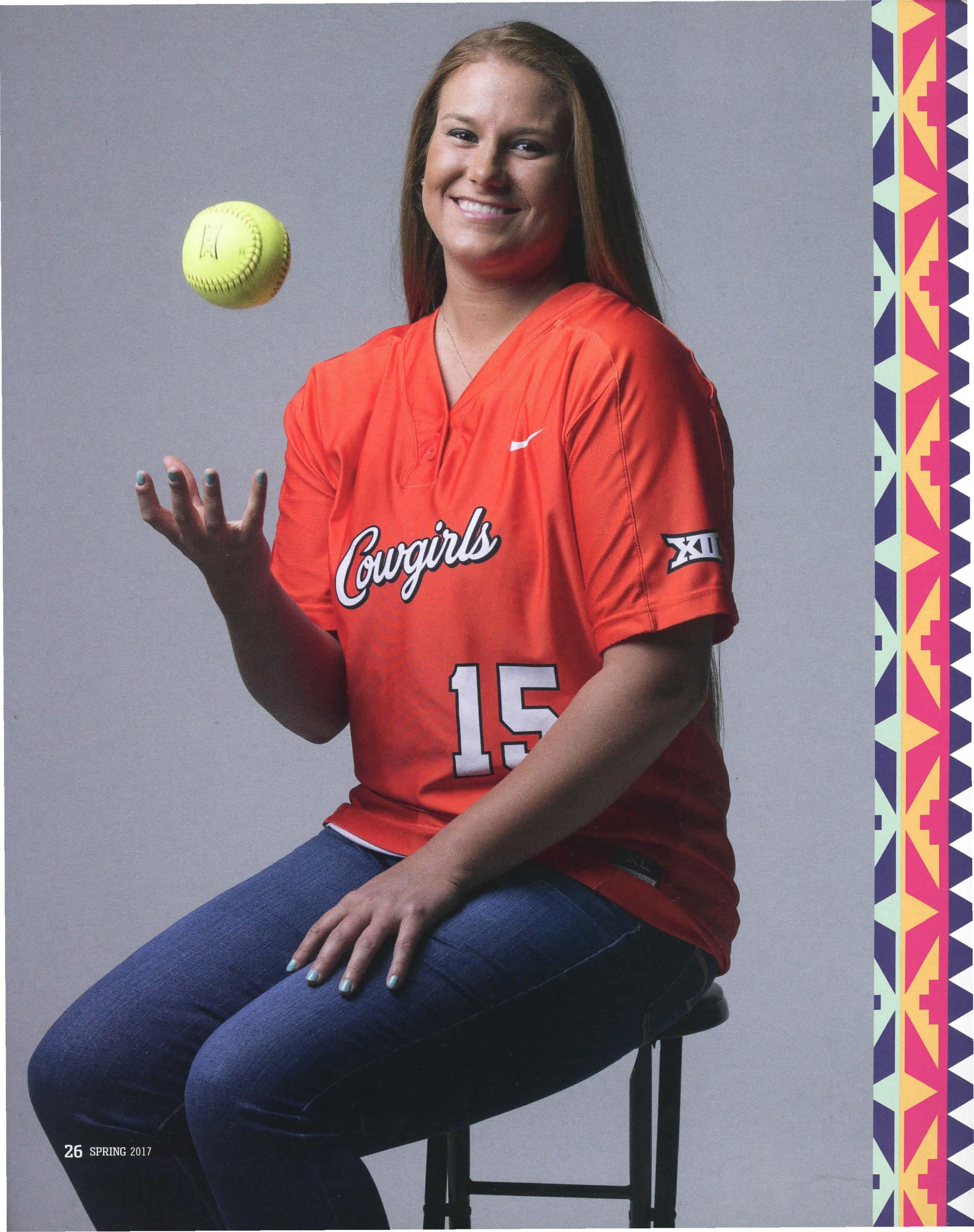
SECOND-YEAR COWGIRL HEAD COACH KENNY GAJEWSKI HAS PENCILED IN RIGHT-HANDED PITCHER WHITNEY WHITEHORN FOR THE START.
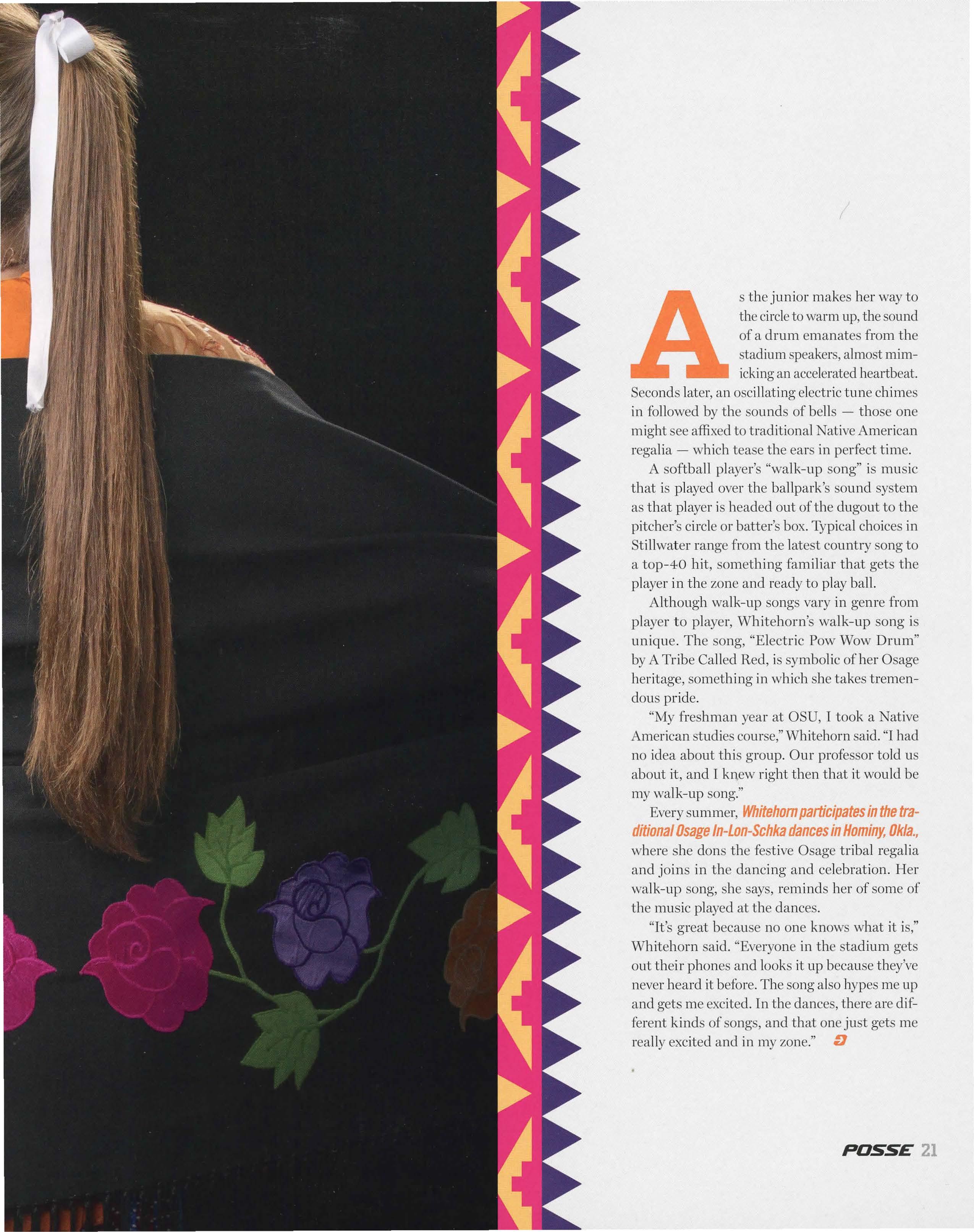
As the junior makes her way to the circleto warm up, the sound of a drum emanates from the stadium speakers, almost mimicking an acceleratedheartbeat. Seconds later, an oscillating electric tune chi mes in followed by the sounds of bells - those one might see affixed to traditional I ative American regalia - which tease the ears in perfect time.
A softball player's "walk-up song" is music that is played over the ballpark's sound system as that player is headed out of the dugout to the pitcher's circle or batter's box. Typical choices in Stillwater range from the latest country song to a top-40 hit, something familiar that gets the player in the zone and ready to play ball.
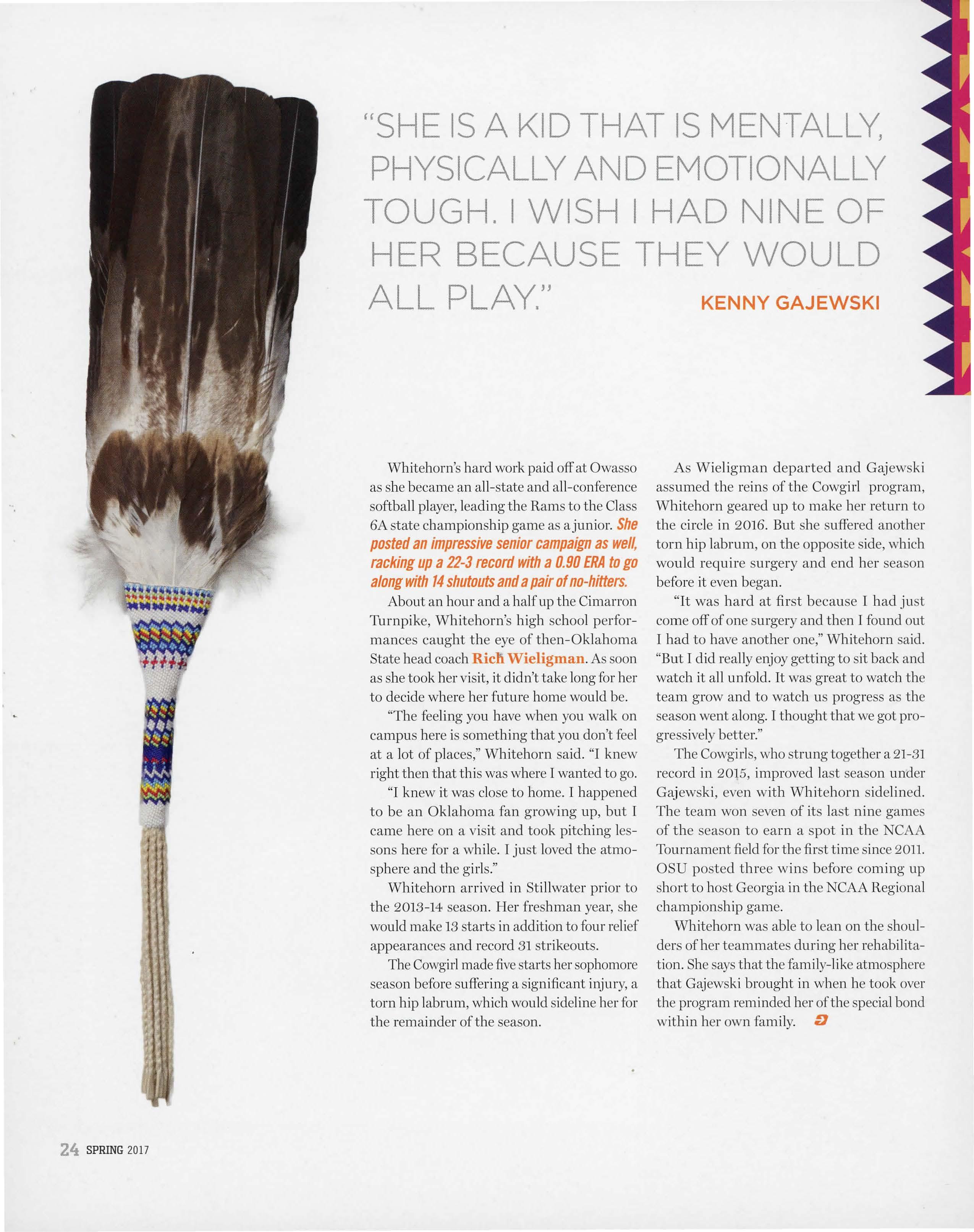
Although walk-up songs vary in genre from player to player, Whiteborn's walk-up song is unique. The song, "Electric Pow Wow Drum" by A Tribe Called Red, is symbolic of her Osage heritage, something in which she takes tremendous pride.
"My freshman year at OSU, I took a Native American studies course," Whitehorn said. "I had no idea about this group. Our professor told us about it, and I kn,ew right then that it would be my walk-up song."
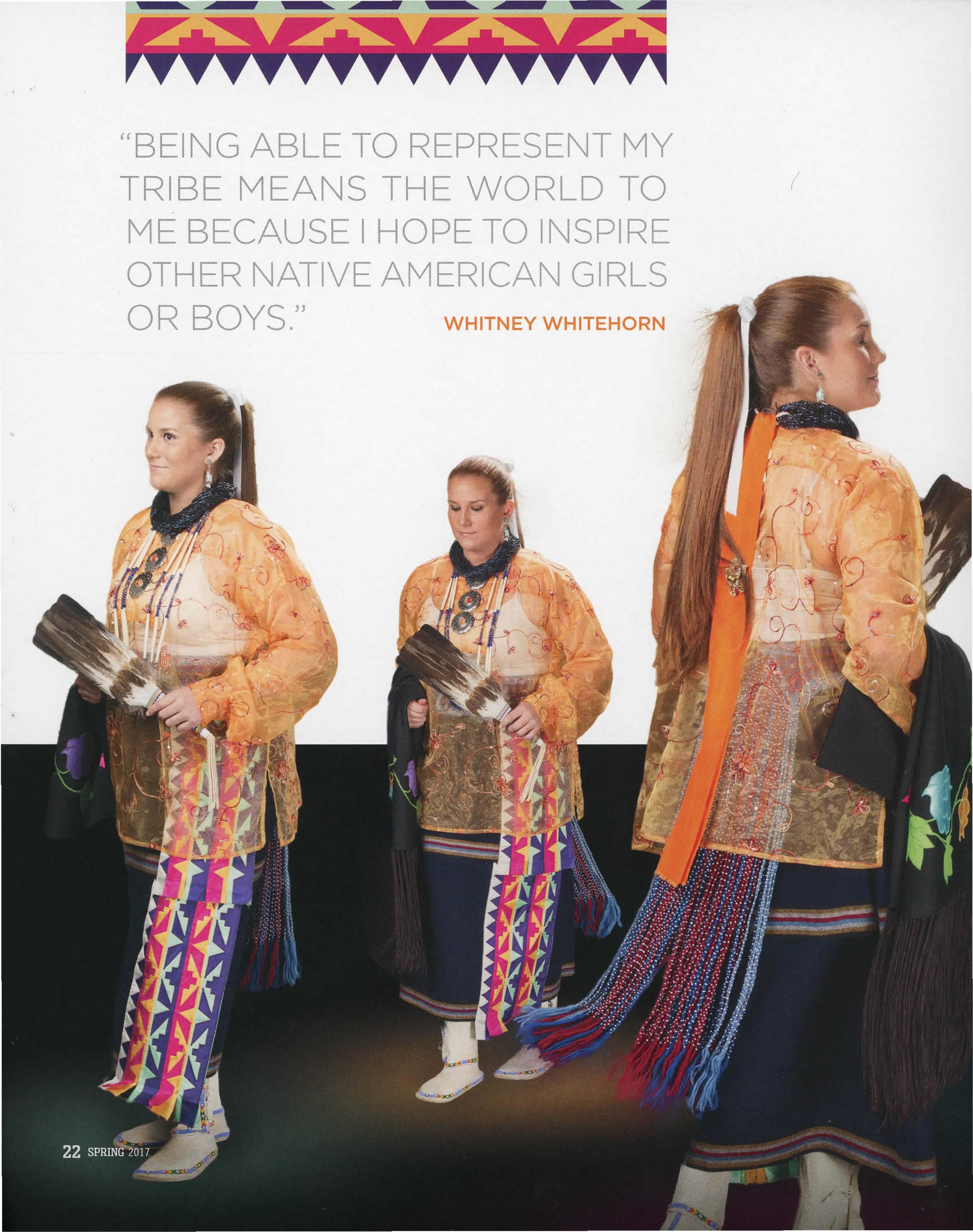
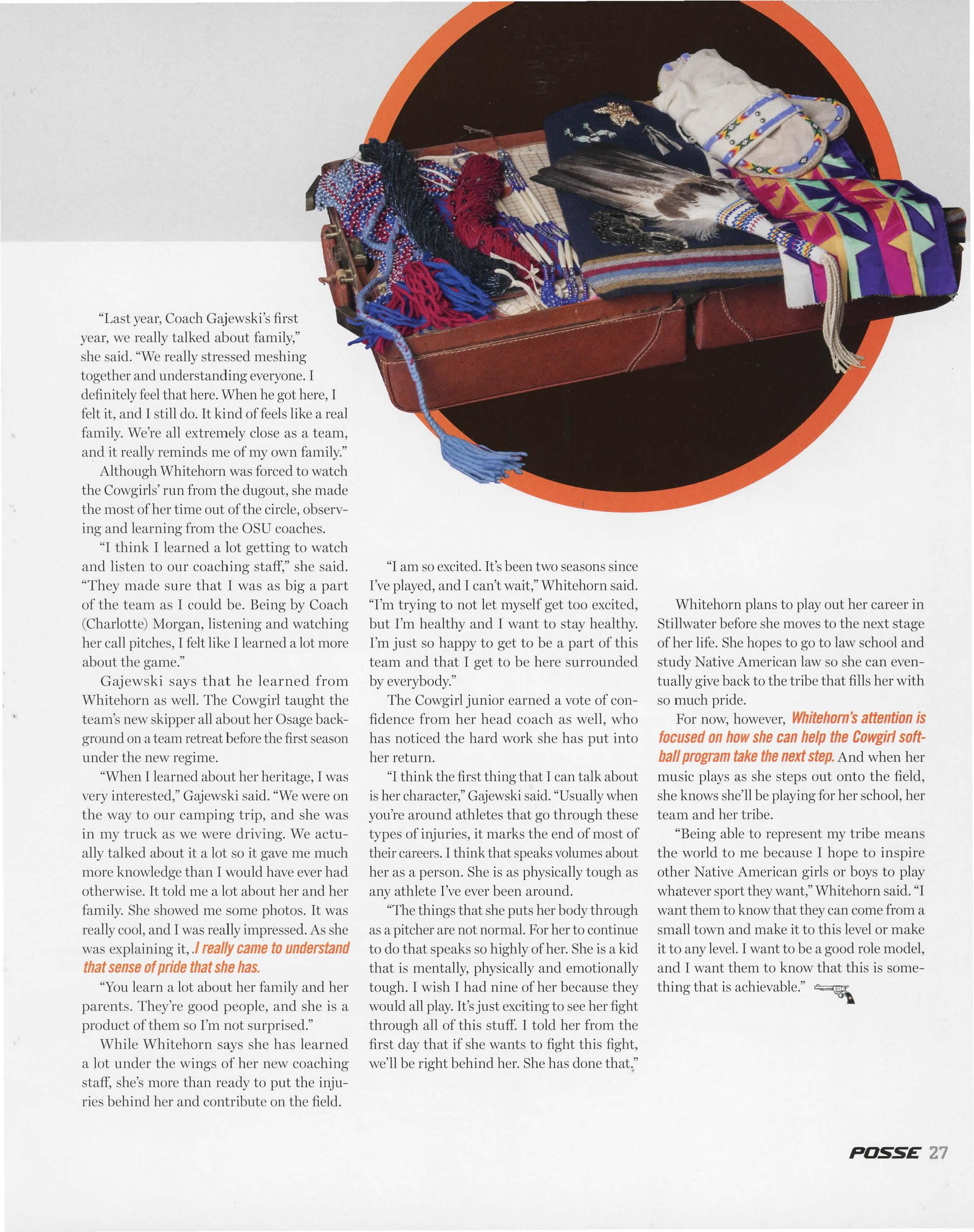
Every summer, WhitehornparticipatesinthetraditionalOsageln-Lon-SchkadancesinHominy,Okla., where she dons the festive Osage tribal regalia and joins in the dancing and celebration. Her walk-up song, she says, reminds her of some of the music played at the dances.
"It's great because no one knows what it is," Whitehorn said. "Everyone in the stadium gets out their phones and looks it up because they've never heard it before. The song also hypes me up and gets me excited. In the dances, there are different kinds of songs, and that one just gets me really excited and in my zone." :J
"BEING ABLE TO REPRESENT MY TRIBE MEANS THE WORLD TO ME BECAUSE I HOPE TO INSPIRE OTHER NATIVE AMERICAN GIRLS OR Boys. "
WHITNEY WHITEHORN
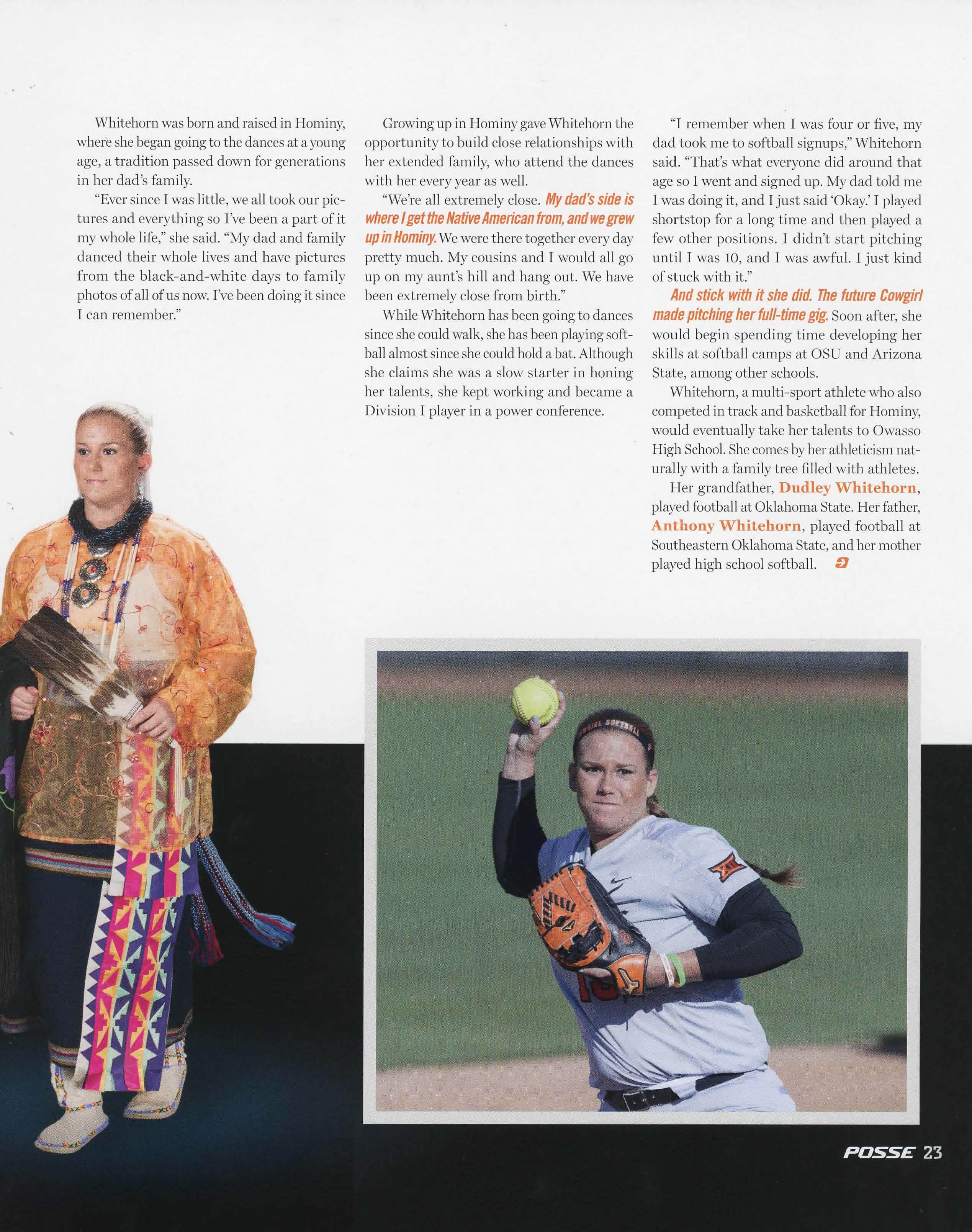
Whitehorn was born and raised in Hominy, where she began going to the dances at a young age, a tradition passed down for generations in her dad's family.
"Ever since I was little, we all took our pictures and everything so I've been a part of it my whole life," she said. "My dad and family danced their whole lives and have pictures from the black-and-white days to family photos of all of us now. I've been doing it sinee I can remember."
Growing up in Hominy gave Whitehorn the opportunity to build close relationships with her extended family, who attend the dances with her every year as well.
"We're all extremely close. Mydad'ssideis where I gettheNativeAmericanfrom,andwegrew upinHominy. We were there together every day pretty much. My cousins and I would all go up on my aunt's hill and hang out. We have been extremely close from birth."
While Whitehorn has been going to dances since she could walk, she has been playing softball almost since she could hold a bat. Although she claims she was a slow starter in honing her talents, she kept working and became a Division I player in a power conference.
"I remember when I was four or five, my dad took me to softball signups," Whitehorn said. "That's what everyone did around that age so I went and signed up. My dad told me I was doing it, and I just said 'Okay.' I played shortstop for a long time and then played a few other positions. I didn't start pitching until I was 10, and I was awful. I just kind of stuck with it."
Andstickwithit shedid.ThefutureCowgirl madepitchingherfull-timegig.Soon after, she would begin spending time developing her skills at softball camps at OSU and Arizona State, among other schools.
Whitehorn, a multi-sport athlete who also competed in track and basketball for Hominy, would eventually take her talents to Owasso High School.She comes by her athleticism naturally with a farn ily tree filled with athletes.
Her grandfather, Dudley Whitehorn, played football at Oklahoma State. Her father, Anthony Whitehorn, played footbal I at Southeastern Oklahoma State, and her mother played high school softball. :J
"SHE IS A KID THAT IS MENTALLY, PHYSICALLYAND EMOTIONALLY TOUGH. I WISH I HAD NINE OF HER BECAUSE THEY WOULD ALL PLAY."
KENNY GAJEWSKI
Whitehorn's hard work paid off at Owasso as she became an all-state and all-conference softball player, leading the Rams to the Class 6A state championship game as a junior. She postedanimpressiveseniorcampaignaswell, rackingupa 22-3recordwitha 0.90ERAtogo alongwith14shutoutsandapairofno-hitters.
About an hour and a half up the Cimarron Turnpike, Whitehorn's high school performances caught the eye of then-Oklahoma State head coach Ricl'i.Wieligman. As soon as she took her visit, it didn't take long for her to decide where her future home would be.
"The feeling you have when you walk on campus here is something that you don't feel at a lot of places," Whitehorn said. "I knew right then that th is was where I wanted to go.
"I knew it was close to home. I happened to be an Oklahoma fan growing up, but I came here on a visit and took pitching lessons here for a while. I just loved the atmosphere and the girls."
Whitehorn arrived in Stillwater prior to the 2013-14 season. Her freshman year, she would make 13 starts in addition to four relief appearances and record 31 strikeouts.
The Cowgirl made fivestarts her sophomore season before suffering a significant injury, a torn hip labrum, which would sideline her for the remainder of the season.
As Wieligman departed and Gajewski assumed the reins of the Cowgirl program, Whitehorn geared up to make her return to the circle in 2016. But she suffered another torn hip labrum, on the opposite side, which would require surgery and end her season before it even began.
"It was hard at first because I had just come off of one surgery and then I found out I had to have another one," Whitehorn said. "But I did really enjoy getting to sit back and watch it all unfold. It was great to watch the team grow and to watch us progress as the season went along. I thought that we got progressively better."
The Cowgirls, who strung together a 21-31 record in 2015, improved last season under Gajewski, even with Whitehorn sidelined. The team won seven of its last nine games of the season to earn a spot in the NCAA Tournament field for the first time since 2011. OSU posted three wins before coming up short to host Georgia in the NCAA Regional championship game.
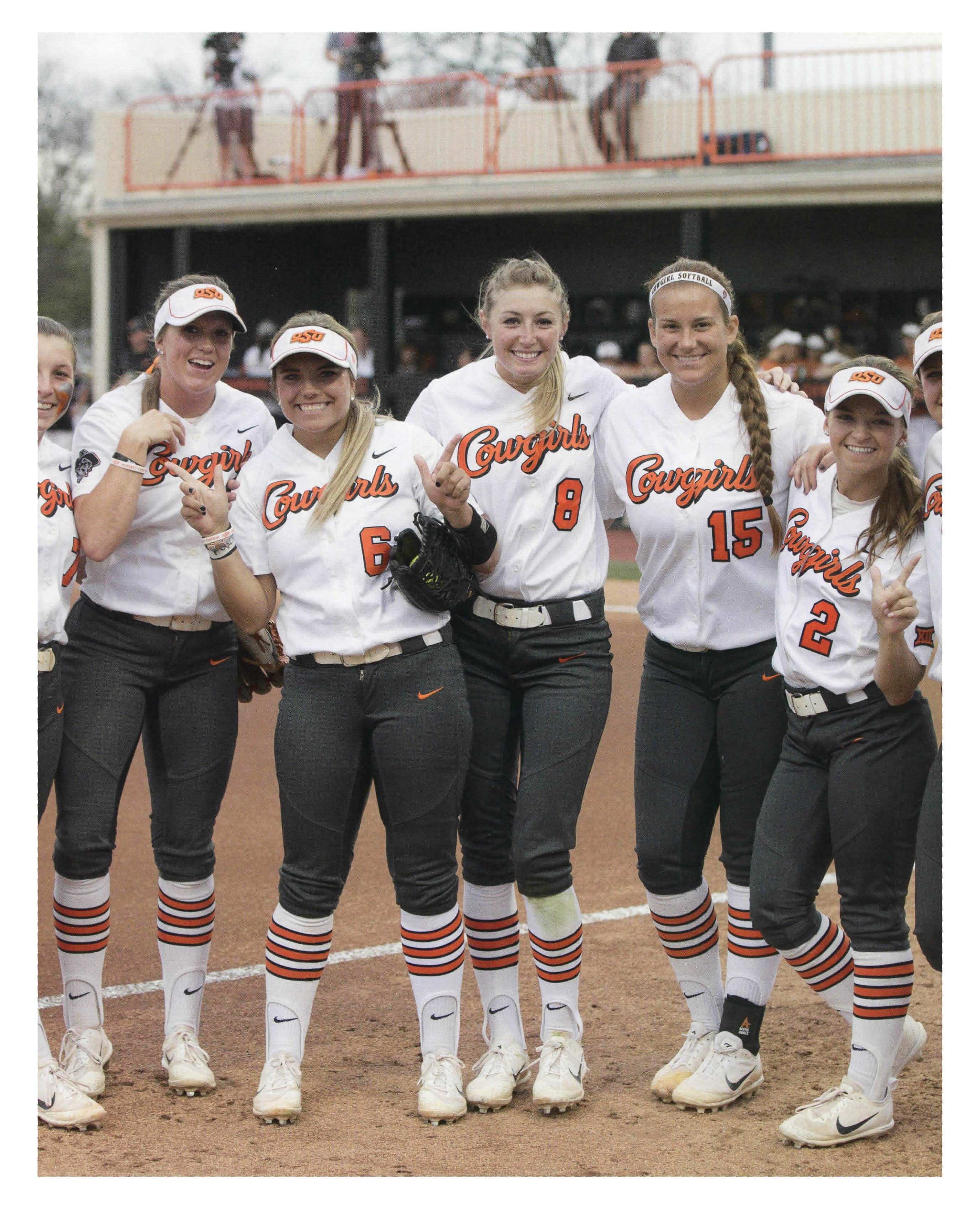
Whitehorn was able to lean on the shoulders of her teammates during her rehabilitation. She says that the family-like atmosphere that Gajewski brought in when he took over the program reminded her of the special bond within her own family.
"Last year, Coach Gc\jewski'sfirst year, we really talked about family," she said. "We really stressed meshing together and understanding everyone. I definitely feel that here. When he got here, I felt it, and 1 still do. It kind of feels like a real family. We're all extremely close as a team, and it really reminds me of my own family."
Although Whitehorn was forced to watch the Cowgirls' run from the dugout, she made the most of her time out of the circle, observing and learning from the OSU coaches.
"I think I learned a lot getting to watch and listen to our coaching staff' she said. "They made sure that l was as big a part of the team as I could be. Being by Coach (Charlotte) Morgan, listening and watching her cal I pitches, I felt like [ learned a lot more about the game."
Gajewski says that he learned from Whitehorn as well. The Cowgirl taught the team's new skipper all about her Osage background on a team retreat before the first season under the new regime.
"I am so excited. It's been two seasons since I've played, and I can't wait," Whitehorn said. 'Tm trying to not let myself get too excited, but I'm healthy and I want to stay healthy. I'm just so happy to get to be a part of this team and that I get to be here surrounded by everybody."
The Cowgirl junior earned a vote of confidence from her head coach as well, who has noticed the hard work she has put into her return.
"When I learned about her heritage, I was very interested," Gajewski said. "We were on the way to our camping trip, and she was in my truck as we were driving. We actually talked about it a lot so it gave me much more knowledge than I would have ever had otherwise. It told me a lot about her and her family. She showed me some photos. It was really cool, and I was really impressed. As she was explaining it,./ reallycametounderstand thatsenseofpridethatshehas.
"You learn a lot about her family and her parents. They're good people, and she is a product of them so I'm not surprised."
While Whitehorn says she has learned a lot under the wings of her new coaching staff; she's more than ready to put the injuries behind her and contribute on the field.
"I think the first thing that I can talk about is her character," Gajewski said. "Usually when you're around athletes that go through these types of injuries, it marks the end of most of their careers. I think that speaks volumes about her as a person. She is as physically tough as any athlete I've ever been around.
"The things that she puts her body th rough as a pitcher are not normal. For her to continue to do that speaks so highly of her. She is a kid that is mentally, physically and emotionally tough. I wish I had nine of her because they would all play. It's just exciting to see her fight th rough all of th is stuff I told her from the first day that if she wants to fight this fight, we'll be right behind her. She has done that;'
Whitehorn plans to play out her career in Stillwater before she moves to the next stage of her life. She hopes to go to law school and study Native American law so she can eventually give back to the tribe that fills her with so much pride.
For now, however, Whitehorn'sattention is focusedonhowshecanhelptheCowgirlsoftballprogramtakethenextstep.And when her music plays as she steps out onto the field, she knows she'll be playing for her school, her team and her tribe.
"Being able to represent my tribe means the world to me because I hope to inspire other Native American girls or boys to play whatever sport they want," Whitehorn said. "I want them to know that they can come from a small town and make it to th is level or make it to any level. I want to be a good role model, and I want them to know that this is something that is achievable."
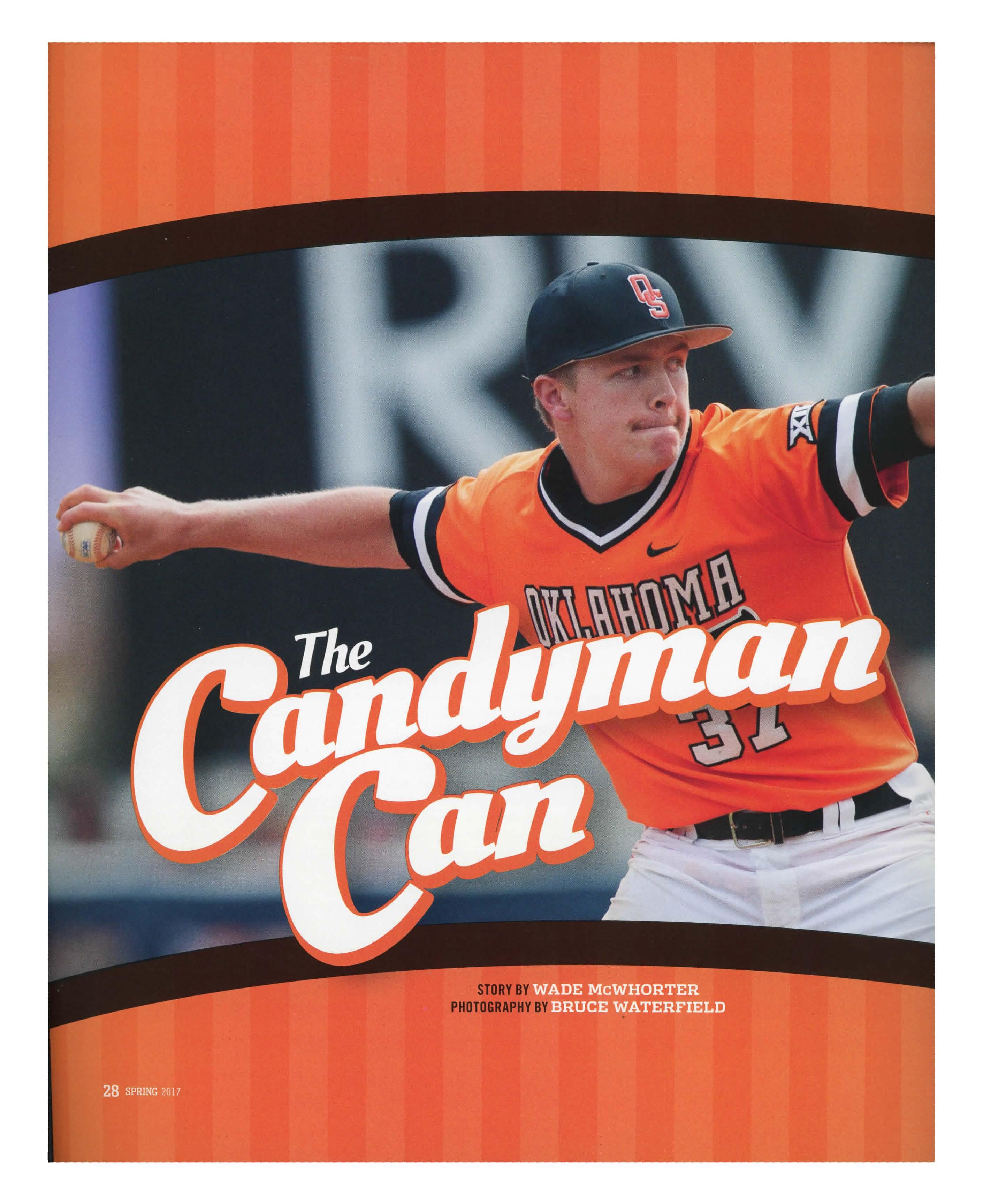
Formostcollegebaseballplayers,the endof their school'sseasonbringsa changeof uni£ormanda returnto thediamondfora summerfilledwithmore gamesonnewteams.
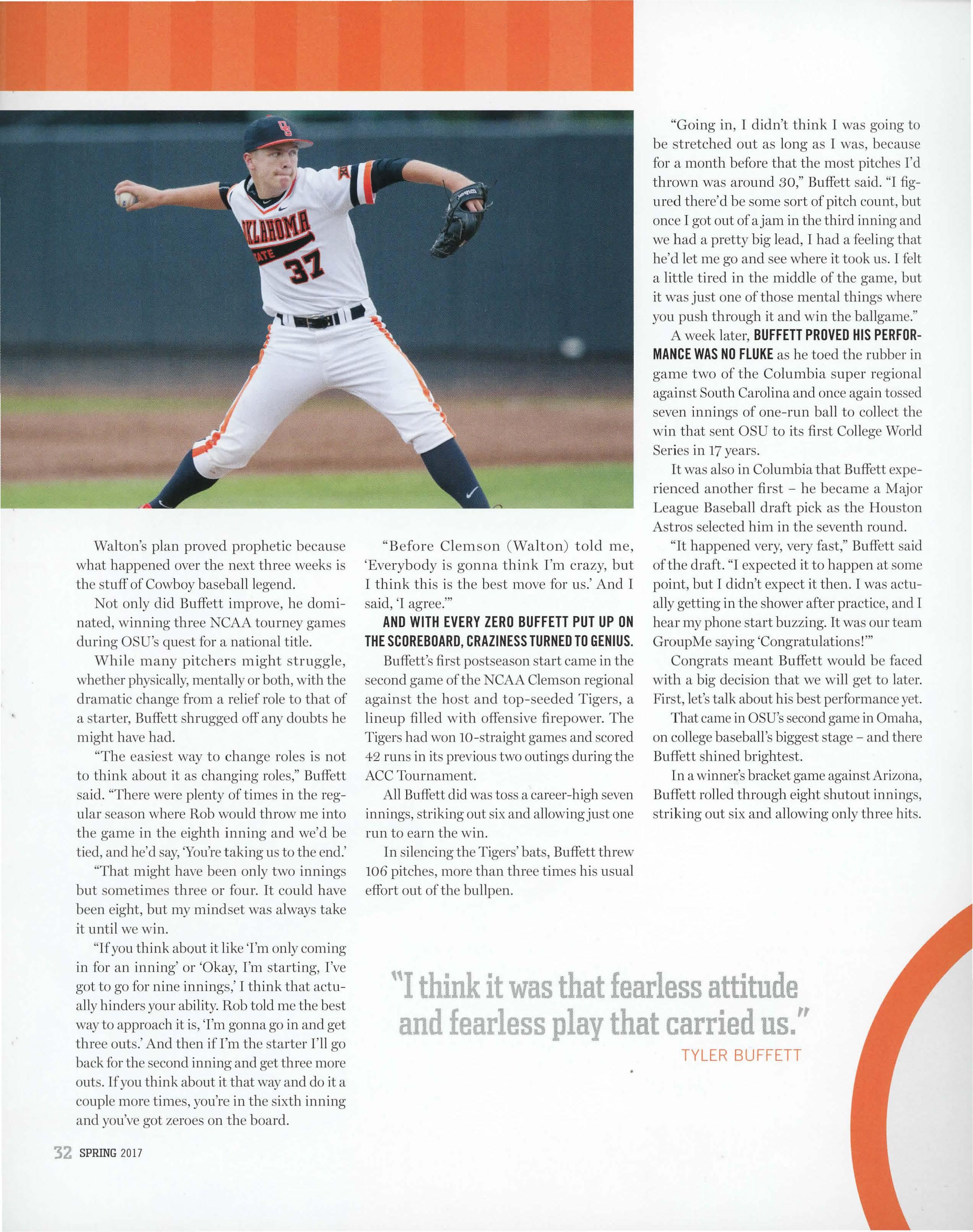
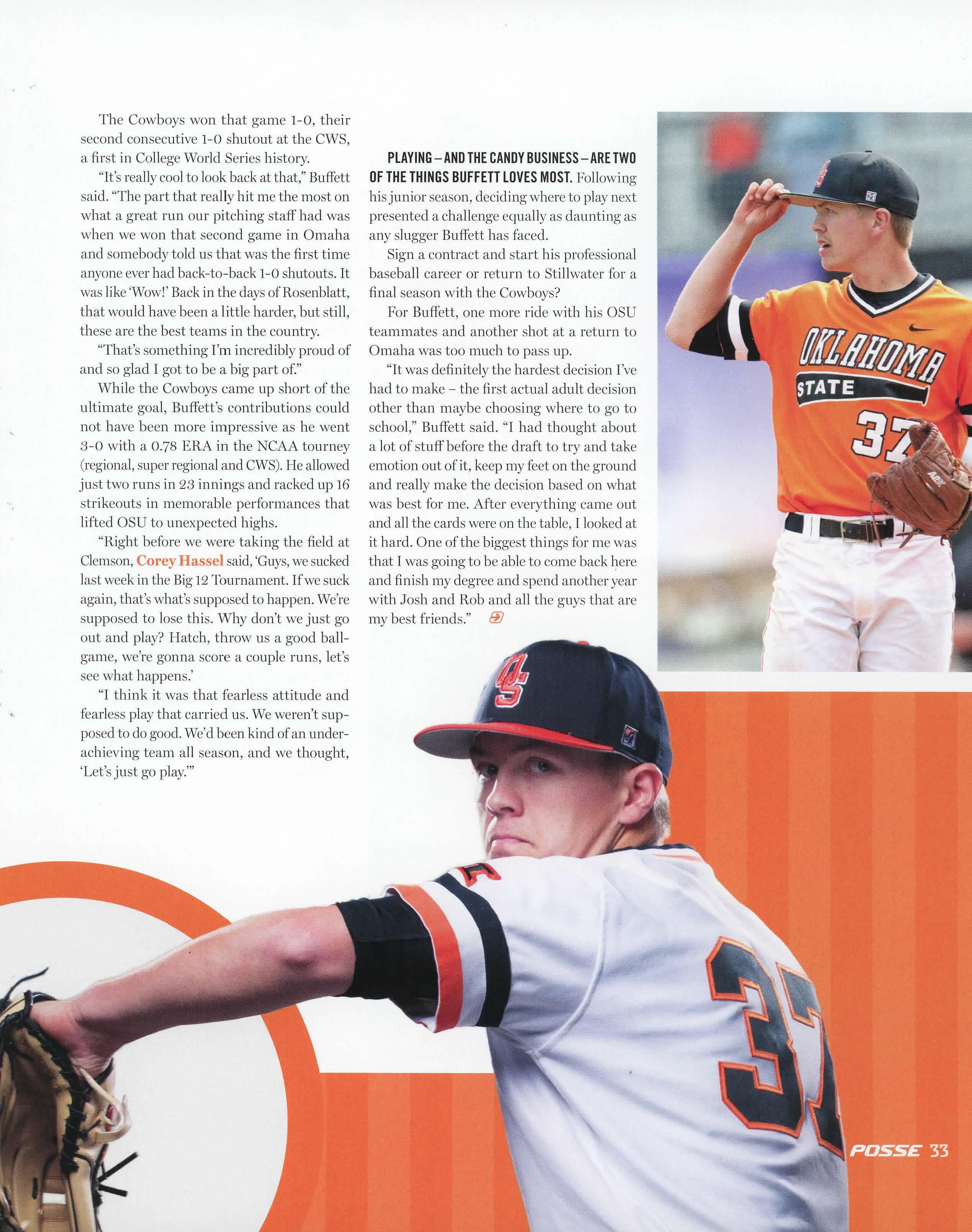
If you were looking for Buffett following the conclusion of Oklahoma State's memorable run to the 2016 College World Series, you wouldn't find him on a mound in Cape Cod or in a bullpen on the West Coast.
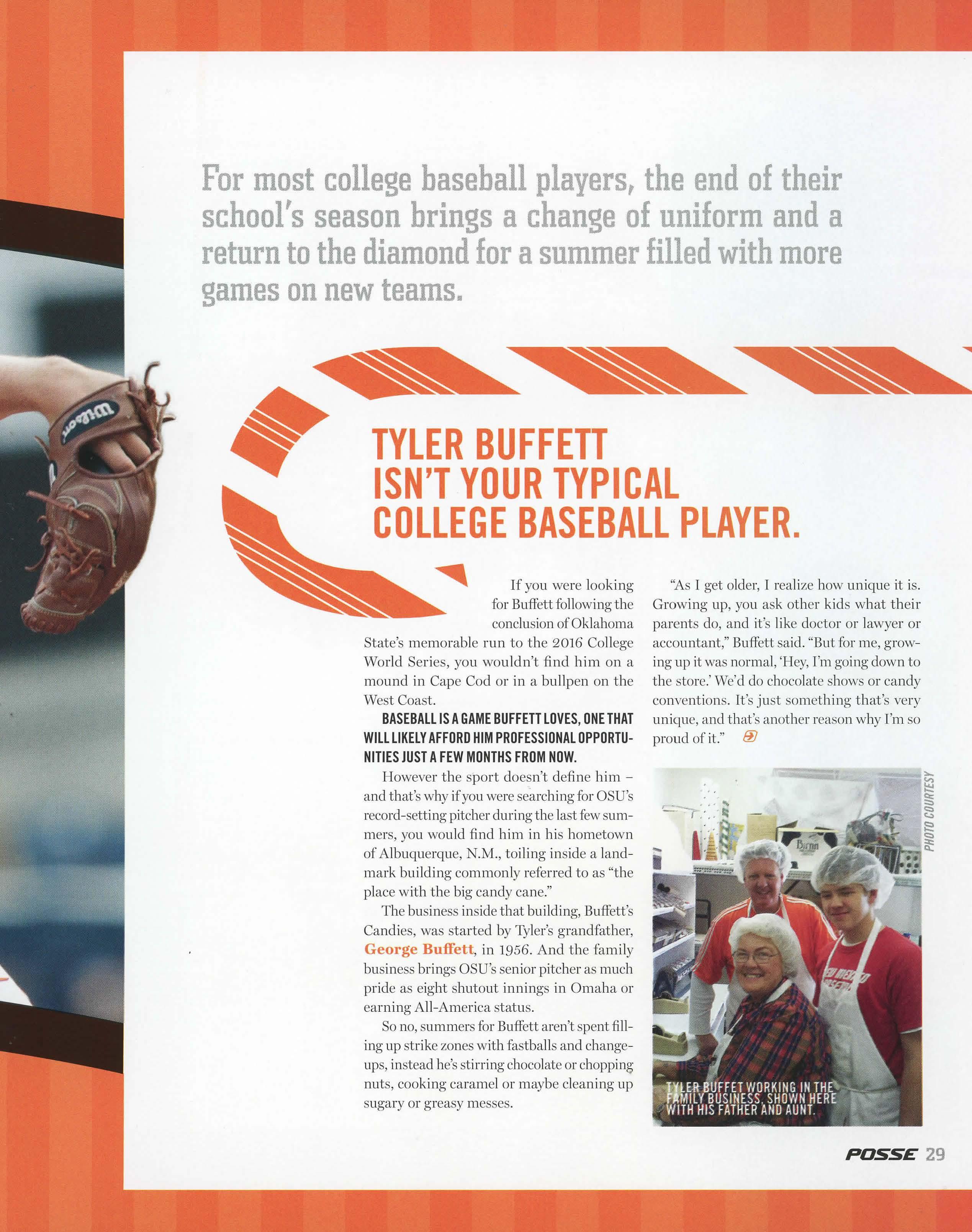
However the sport doesn't define himand that's why if you were searching for OSU's record-setting pitcher during the last few summers, you would find him in his hometown of Albuquerque, N.M., toiling inside a landmark building commonly referred to as "the place with the big candy cane."
The business inside that building, Buflett's Candies, was started by Tyler's grandfather, George Buffett, in 1956. And the family business brings OSU's senior pitcher as much pride as eight shutout innings in Omaha or earning All-America status.
So no, summers for Buffett aren't spent filling up strike zones with fastballs and changeups, instead he's stirring chocolate or chopping nuts, cooking caramel or maybe cleaning up sugary or greasy messes.
"As I get older, I realize how unique it is. Growing up, you ask other kids what their parents do, and it's like doctor or lawyer or accountant," Buffett said. "But for me, growing up it was normal, 'Hey, I'm going down to the store.' We'd do chocolate shows or candy conventions. It's just something that's very unique, and that's another reason why I'm so proud of it." f:fJ
That pride was born from what Buffett admits once upon a time was disdain, but also something that he believes helped shape him into an OSU pitching standout who recorded 14 wins and nine saves in his first three easons for the Cowboys.
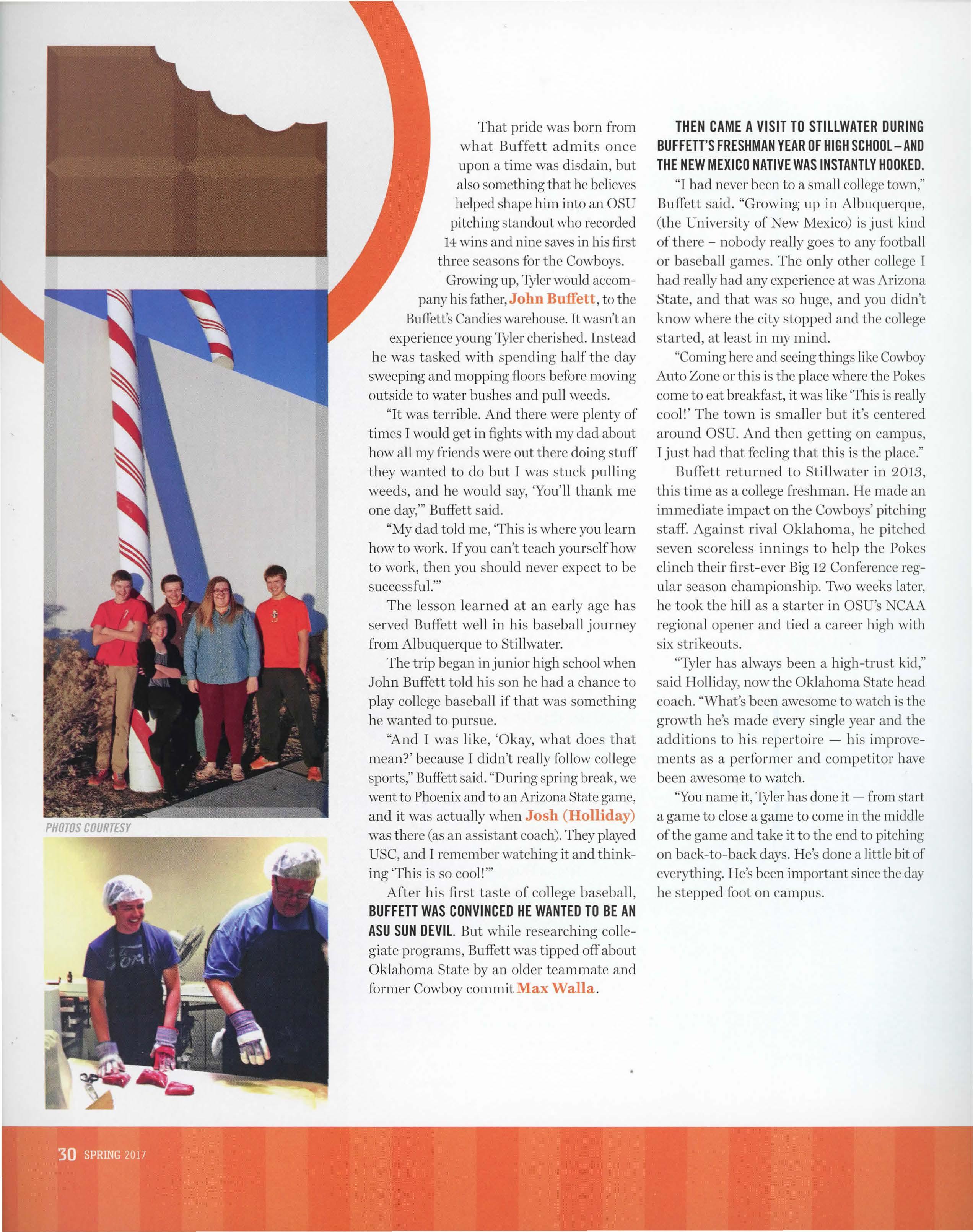
Growing up, Tyler would accompany his father, John Buffett, to the Buffett's Candies warehouse. It wasn't an experience young Tyler cherished. Instead he was tasked with spending half the day sweeping and mopping floors before moving outside to water bushes and pull weeds.
"It was terrible. And there were plenty of times I would get in fights with my dad about how all my friends were out there doing stuff they wanted to do but I was stuck pulling weeds, and he would say, 'You'll thank me one day,"' Buffett said.
"My dad told me, 'Th is is where you learn bow to work. If you can't teach yourself how to work, then you should never expect to be successful."'
The lesson learned at an early age has served Buffett well in bis baseball journey from Albuquerque to Stillwater.
The trip began in junior high school when John Buffett told his son be had a chance to play college baseball if that was something he wanted to pursue.
"And I was like, 'Okay, what does that mean?' because I didn't really follow college sports," Buffett said. "During spring break, we went to Phoenix and to an Arizona State game, and it was actually when Josh (Holliday) was there (as an assistant coach). They played USC, and I remember watching it and thinking 'This is so cool!"'
After his first taste of college baseball, BUFFETTWASCONVINCEDHEWANTEDTOBEAN ASUSUNDEVIL.But while researching collegiate programs, Buffett was tipped off about Oklahoma State by an older teammate and former Cowboy commit Max Walla.
"I had never been to a small college town," Buffett said. "Growing up in Albuquerque, (the University of New Mexico) is just kind of there - nobody really goes to any football or baseball games. The only other college I had really had any experience at was Arizona State, and that was so huge, and you didn't know where the city stopped and the college started, at least in my mind.
"Coming here and seeing things like Cowboy Auto Zone or th is is the place where the Pokes come to eat breakfast, it was like 'Th is is really cool!' The town is smaller but it' centered around OSU. And then getting on campus, I just had that feeling that this is the place."
Buffett returned to Stillwater in 2013, this time as a college freshman. He made an immediate impact on the Cowboys' pitching staff. Against rival Oklahoma, he pitched seven scoreless innings to help the Pokes clinch their first-ever Big 12 Conference regular season championship. Two weeks later, he took the hill as a starter in OSU's NCAA regional opener and tied a career high with six strikeouts.
"Tyler has always been a high-trust kid," said Hol Iiday, now the Oklahoma State head coach. "What's been awesome to watch is the growth he's made every single year and the additions to his repertoire - his improvements as a performer and competitor have been awesome to watch.
"You name it, 1Ylerhas done it - from start a game to close a game to come in the middle of the game and take it to the end to pitching on back-to-back days. He's done a Iittle bit of everything. He's been important since the day he stepped foot on campus.
"When you set out on the recruiting process to find the kind of guy that's going to help your program be excellent, this is the kind of kid you go look for."
Buffett is coming off a junior season in which he demonstrated Holliday's praise to perfection as he blossomed into a star.
Setting an OSU record with 37 appearances, Buffett made the most of those opportunities, going 9-3 with nine saves and a 2.81 ERA. He was a unanimous all- Big 12 first team selection and on watch lists for numerous national honors.
NONEOFITSURPRISEDHOLLIDAY.
"He's incredibly unselfish, a team-first kid, who has grown inside the program mentalitywise to where he is tough enough to handle anything you offer him," Holliday said. "The outlook he has is top shelf. He leads by example, he's got tremendous work ethic on and off the field. He shows you that he's a winner, and no matter what situation you put him in, he's going to find a way to win. That's an unbelievably valuable trait when a team has members like that."
Used mostly as a reliever throughout the season, Buffett struggled at the start of the postseason. At the Big l 2 Championship, he came on in relief in two games OSU was leading. He promptly gave up 11 runs - seven of them earned - in just 2/3 ofan inning as the Cowboys dropped both contests and bowed out of the tournament.
With an NCAA regional looming, OSU needed one of its top arms to snap out of the funk - in a hurry.
Enter OSU pitching coach Rob Walton, aka The Wizard.
What did Walton have in store for a guy who bad just come out of the bullpen and imploded - twice? A move to the starting rotation for the most critical portion of OSU's season.
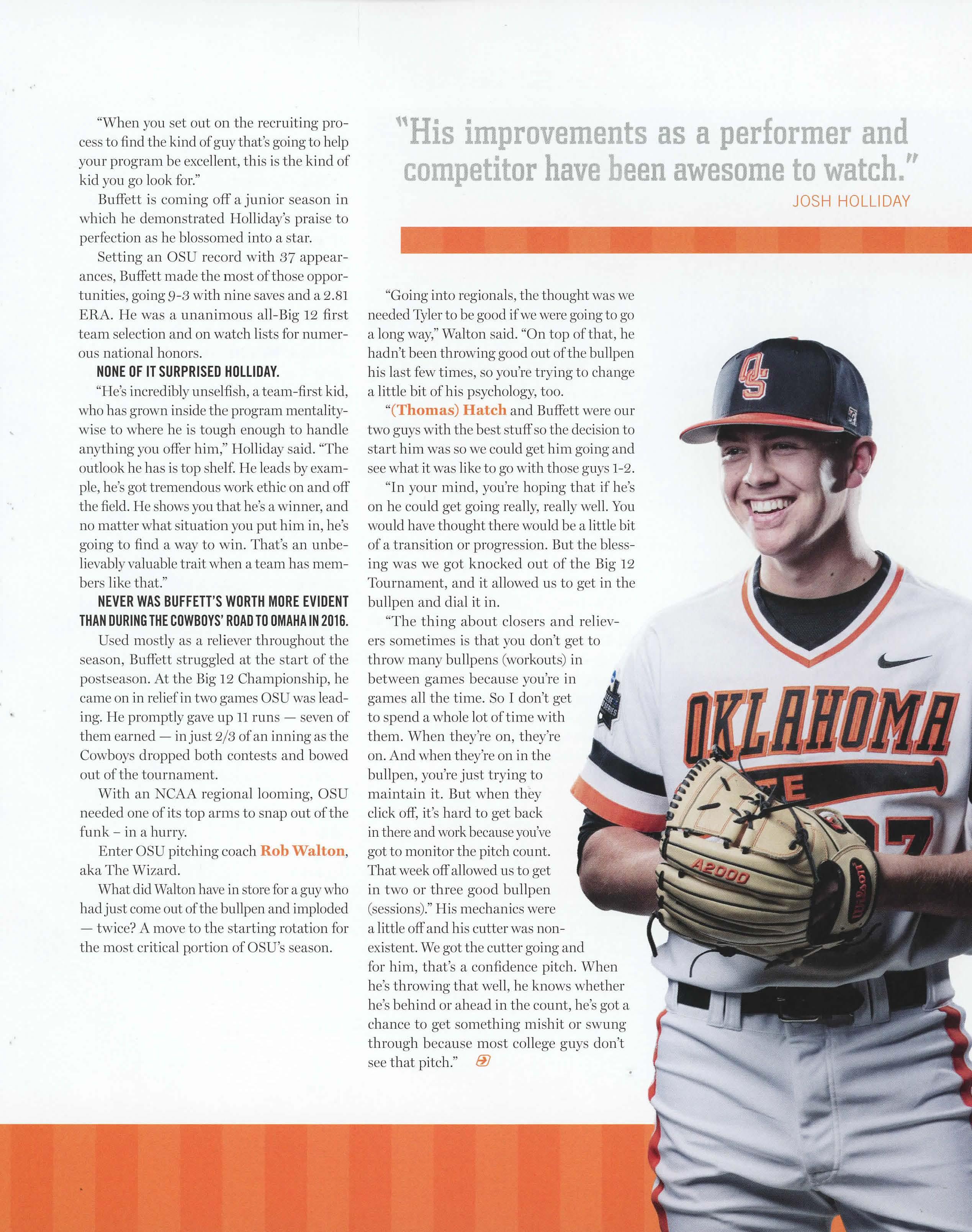
"Hisimprovementsas a per£armerand competitorhavebeenawesometo watch."
JOSH HOLLIDAY
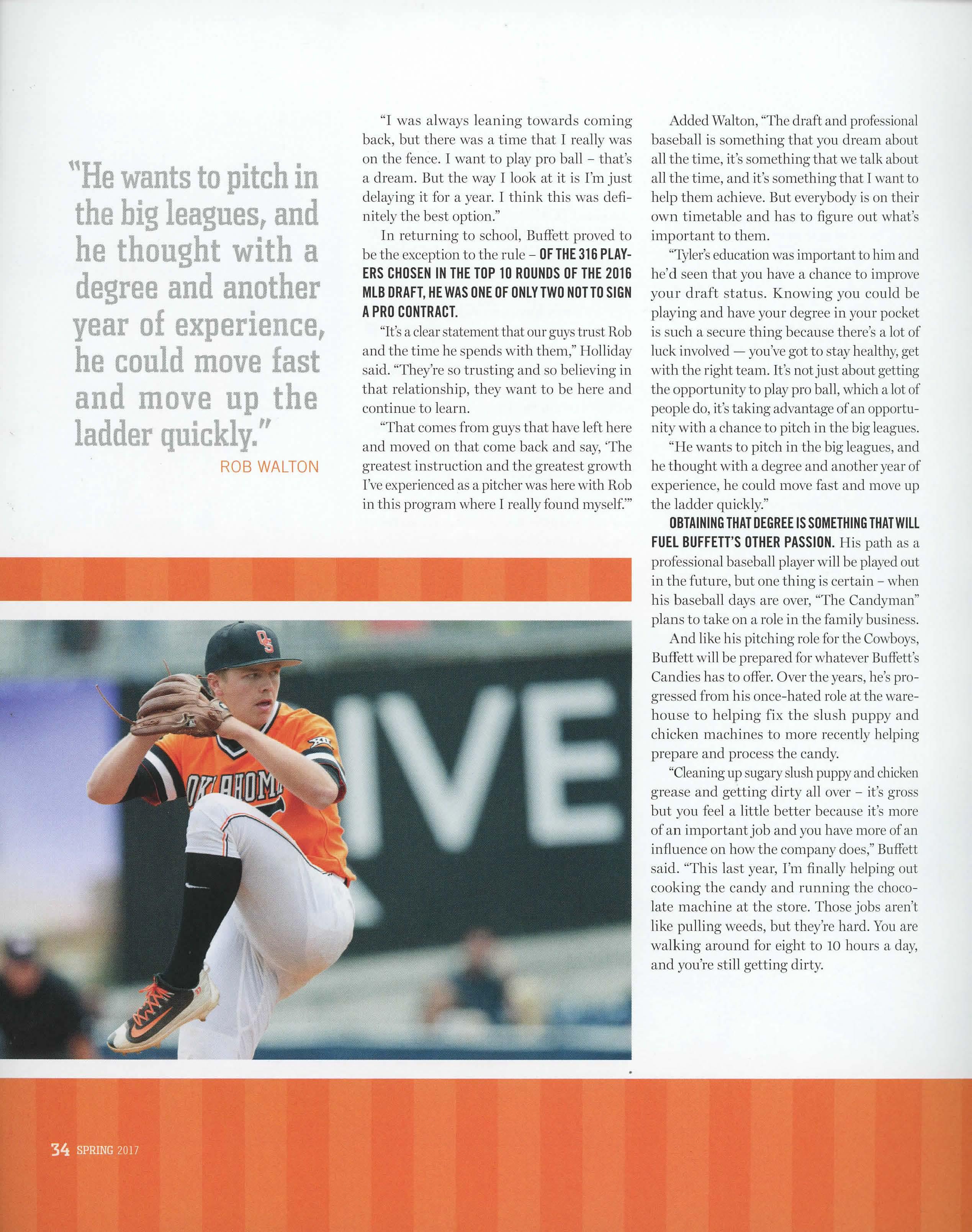
"Going into regionals, the thought was we needed Tyler to be good if we were going to go a long way,"Walton said. "On top of that, he hadn't been throwing good out of the bullpen his last few times, so you're trying to change a little bit of his psychology, too.
"(Thomas) Hatch and Buffett were our two guys with the best stuff so the decision to start him was so we could get him going and see what it was like to go with those guys 1-2.
"In your mind, you're hoping that if he's on he could get going really, really well. You wou Id have thought there wouId be a 1ittle bit of a transition or progression. But the blessing was we got knocked out of the Big 12 Tournament, and it allowed us to get in the bullpen and dial it in.
"The thing about closers and relievers sometimes is that you don't get to throw many bullpens (workouts) in between games because you're in games all the time. So I don't get to spend a whole lot of time with them. When they're on, they're on. And when they're on in the bullpen, you're just trying to maintain it. But when they click off, it's hard to get back in there and work because you've got to monitor the pitch count. That week off allowed us to get in two or three good bullpen (sessions)."His mechanics were a little off and his cutter was nonexistent. We got the cutter going and for him, that's a confidence pitch. When he's throwing that well, he knows whether he's behind or ahead in the count, he's got a chance to get something mishit or swung through because most college guys don't see that pitch." fiJ
Walton's plan proved prophetic because what happened over the next three weeks is the stuff of Cowboy basebal I legend.
Not only did Buffett improve, he dominated, winning three NCAA tourney games during OSU's quest for a national title.
While many pitchers might struggle, whether physically,mentally or both, with the dramatic change from a relief role to that of a starter, Buffett shrugged off any doubts be might have had.
"The easiest way to change roles is not to think about it as changing roles," Buffett said. "There were plenty of times in the regular season where Rob would throw me into the game in the eighth inning and we'd be tied, and he'd say,'You'retaking us to the end.'
"That might have been only two innings but sometimes three or four. It could have been eight, but my mindset was alway take it until we win.
"lfyou think about it like Tm only corning in for an inning' or 'Okay, T'm starting, I've got to go for nine innings,' I think that actually hinders your ability. Rob told me the best way to approach it is, Tm gonna go in and get three outs.' And then ifl'm the starter I'll go back for the second inning and get three more out If you think about it that way and do it a couple more times, you're in the sixth inning and you've got zeroes on the board.
"Before Clemson (Walton) told me, 'Everybody is gonna think I'm crazy, but I think this is the best move for us.' And I said, 'I agree."'
Buffett's first postseason start came in the second game of the NCAA Clemson regional against the host and top-seeded Tigers, a lineup filled with offensive firepower. The Tigers had won JO-straight games and scored 42 runs in its previous two outings during the ACC Tournament.
All Buffett did was toss a career-high seven innings, striking out six and allowing just one run to earn the win.
In silencing the Tigers' bats, Buffett threw 106 pitches, more than three times bis usual effort out of the bullpen.
"Going in, I didn't think I was going to be stretched out as long as I was, because for a month before that the most pitches I'd thrown was around 30," Buffett said. "I figured there'd be some sort of pitch count, but once I got out ofajam in the third inning and we had a pretty big lead, I had a feeling that he'd let me go and see where it took us. I felt a little tired in the middle of the game, but it was just one of those mental things where you push through it and win the ballgame.''
A week later, BUFFETTPROVEDHISPERFORMANCEWASNOFLUKE as be toed the rubber in game two of the Columbia super regional against South Carolina and once again tossed seven innings of one-run ball to collect tbe win that sent OSU to its first College World Series in 17 years.
It was also in Columbia that Buffett experienced another first - he became a Major League Baseball draft pick as the Houston Astros selected him in the seventh round.
"It happened very, very fast,'' Buffett said of the draft. "I expected it to happen at some point, but I didn't expect it then. I was actually getting in the shower after practice, and I hear my phone start buzzing. It was our team GroupMe saying 'Congratulations!"'
Congrats meant Buffett would be faced with a big decision that we will get to later. First, let's talk about his best performance yet. That came in OSU'ssecond game in Omaha, on college baseball's biggest stage - and there Buffett shined brightest.
In a winnei:'sbracket game against Arizona, Buffett rolled through eight shutout innings, striking out six and allowing only three hits.
The Cowboys won that game 1-0, their second consecutive 1-0 shutout at the CWS, a first in College World Series history.
"It's really cool to look back at that," Buffett said. "The part that really hit me the most on what a great run our pitching staff had was when we won that second game in Omaha and somebody told us that was the first time anyone ever had back-to-back 1-0 shutouts. It was like 'Wow!'Back in the days of Rosenblatt, that would have been a little harder, but still, these are the best teams in the country.
"That's something I'm incredibly proud of and so glad I got to be a big part of."
While the Cowboys came up short of the ultimate goal, Buffett's contributions could not have been more impressive as he went 3-0 with a 0.78 ERA in the NCAA tourney (regional, super regional and CWS).He allowed just two runs in 23 innings and racked up 16 strikeouts in memorable performances that lifted OSU to unexpected highs.
"Right before we were taking the field at Clemson,Corey Hassel said, 'Guys,we sucked last week in the Big12 Tournament. Ifwe suck again, that's what's supposed to happen. We're supposed to lose this. Why don't we just go out and play? Hatch, throw us a good ballgame, we're gonna score a couple runs, let's see what happens.'
"I think it was that fearless attitude and fearless play that carried us. We weren't supposed to do good. We'd been kind ofan underachieving team all season, and we thought, 'Let's just go play."'
MOST.Following his junior season, deciding where to play next presented a challenge equally as daunting as any slugger Buffett has faced.
Sign a contract and start his professional baseball career or return to Stillwater for a final season with the Cowboys?
For Buffett, one more ride with his OSU teammates and another shot at a return to Omaha was too much to pass up.
"It was definitely the hardest decision I've had to make - the first actual adu It decision other than maybe choosing where to go to school," Buffett said. "I had thought about a lot of stuff before the draft to try and take emotion out of it, keep my feet on the ground and really make the decision based on what was best for me. After everything came out and all the cards were on the table, I looked at it hard. One of the biggest things for me was that I was going to be able to come back here and finish my degree and spend another year with Josh and Rob and all the guys that are my best friends." [j)
"Hewantstopitchin thebigleagues,and he thoughtwith a degreeandanother yearof experience, he couldmovefast and move up the ladderquickly."
ROB WALTON
"I was always leaning towards coming back, but there was a time that I really was on the fence. I want to play pro ball - that's a dream. But the way I look at it is I'm just delaying it for a year. I think this was definitely the best option."
In returning to school, Buffett proved to be the exception to the rule - OFTHE316PLAYERSCHOSENINTHETOP10ROUNDSOFTHE2016 MLBDRAFT,HEWASONEOFONLYTWONOTTOSIGN APROCONTRACT.
"It's a clear statement that our guys trust Rob and the time he spends with them," Holliday said. "They're so trusting and so believing in that relationship, they want to be here and continue to learn.
"That comes from guys that have left here and moved on that come back and say, 'The greatest instruction and the greatest growth I've experienced as a pitcher was here with Rob in this program where I really found myself."'
Added Walton, "The draft and professional baseball is something that you dream about all the time, it's something that we talk about all the time, and it's something that I want to help them achieve. But everybody is on their own timetable and has to figure out what's important to them.
"1yler'seducation was important to him and he'd seen that you have a chance to improve your draft status. Knowing you could be playing and have your degree in your pocket is such a secure thing because there's a lot of luck involved -you've got to stay healthy, get with the right team. It's not just about getting the opportunity to play pro ball, which a lot of people do, it's taking advantage of an opportunity with a chance to pitch in the big leagues.
"He wants to pitch in the big leagues, and he thought with a degree and another year of experience, he could move fast and move up the ladder quickly."
OBTAININGTHATDEGREEISSOMETHINGTHATWILL
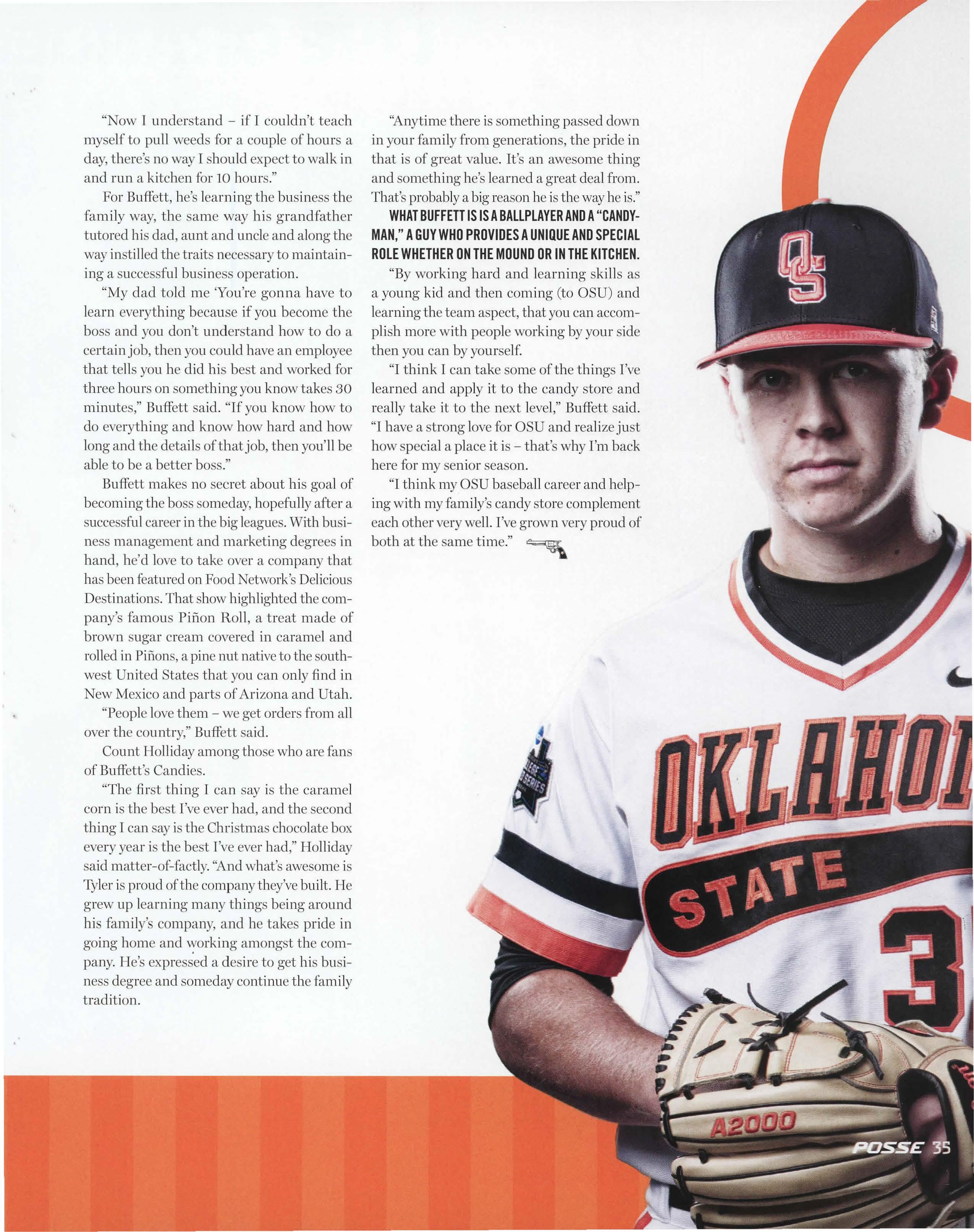
FUELBUFFETT'SOTHERPASSION.His path as a professional baseball player will be played out in the future, but one thing is certain - when his baseball days are over, "The Candyman" plans to take on a role in the family business.
And like his pitching role for the Cowboys, Buffett will be prepared for whatever Butfett's Candies has to offer. Over the years, he's progressed from his once-hated role at the warehouse to helping fix the slush puppy and chicken machines to more recently helping prepare and process the candy.
"Cleaningup sugary slush puppy and chicken grease and getting dirty all over - it's gross but you feel a little better because it's more of an important job and you have more of an influence on how the company does," Buffett said. "This last year, I'm finally helping out cooking the candy and running the chocolate machine at the store. Those jobs aren't like pulling weeds, but they're hard. You are walking around for eight to 10 hours a day, and you're still getting dirty.
"Now I understand - if I couldn't teach myself to pull weeds for a couple of hours a day, there's no way I shou Id expect to walk in and run a kitchen for 10 hours."
For Buffett, he's learning the business the family way, the same way his grandfather tutored his dad, aunt and uncle and along the way instilled the traits necessary to maintaining a successful business operation.
"My dad told me 'You're gonna have to learn everything because if you become the boss and you don't understand how to do a certain job, then you could have an employee that tells you he did his best and worked for three hours on something you know takes 30 minutes," Buffett said. "If you know how to do everything and know how hard and how long and the details of that job, then you'll be able to be a better boss."
Buffett makes no secret about his goal of becoming the boss someday, hopefully after a successful career in the big leagues. With business management and marketing degrees in hand, he'd love to take over a company that has been featured on Food Network's Delicious Destinations. That show high lighted the company's famous Pinon Roll, a treat made of brown sugar cream covered in caramel and rolled in Pifions, a pine nut native to the southwest United States that you can only find in New Mexico and parts of Arizona and Utah.
"People love them - we get orders from all over the country," Buffett said.
Count Holliday among those who are fan of Buffett's Candies.
"The first thing I can say is the caramel corn is the best I've ever had, and the second thing I can say is the Christmas chocolate box every year is the best I've ever had," Holliday said matter-of-factly. ''And what's awesome is Tyler is proud of the company they've built. He grew up learning many things being around his family's company, and he takes pride in going home and working amongst the company. He's express"eda desire to get his business degree and someday continue the family tradition.
"Anytime there is something passed down in yourfamilyfrom generations, the pride in that is of great value. It's an awesome thing and something he's learned a great deal from. That's probably a big reason he is the way he is."
"By working hard and learning skills as a young kid and then coming (to OSU) and learning the team aspect, that you can accomplish more with people working by your side then you can by yourself.
"I think I can take some of the things I've learned and apply it to the candy store and really take it to the next level," Buffett said. "I have a strong love for OSU and realize just how special a place it is - that's why I'm back here for my senior season.
"I think my OSU baseball career and helping with my family's candy store complement each other very we!I. I've grown very proud of both at the same time."
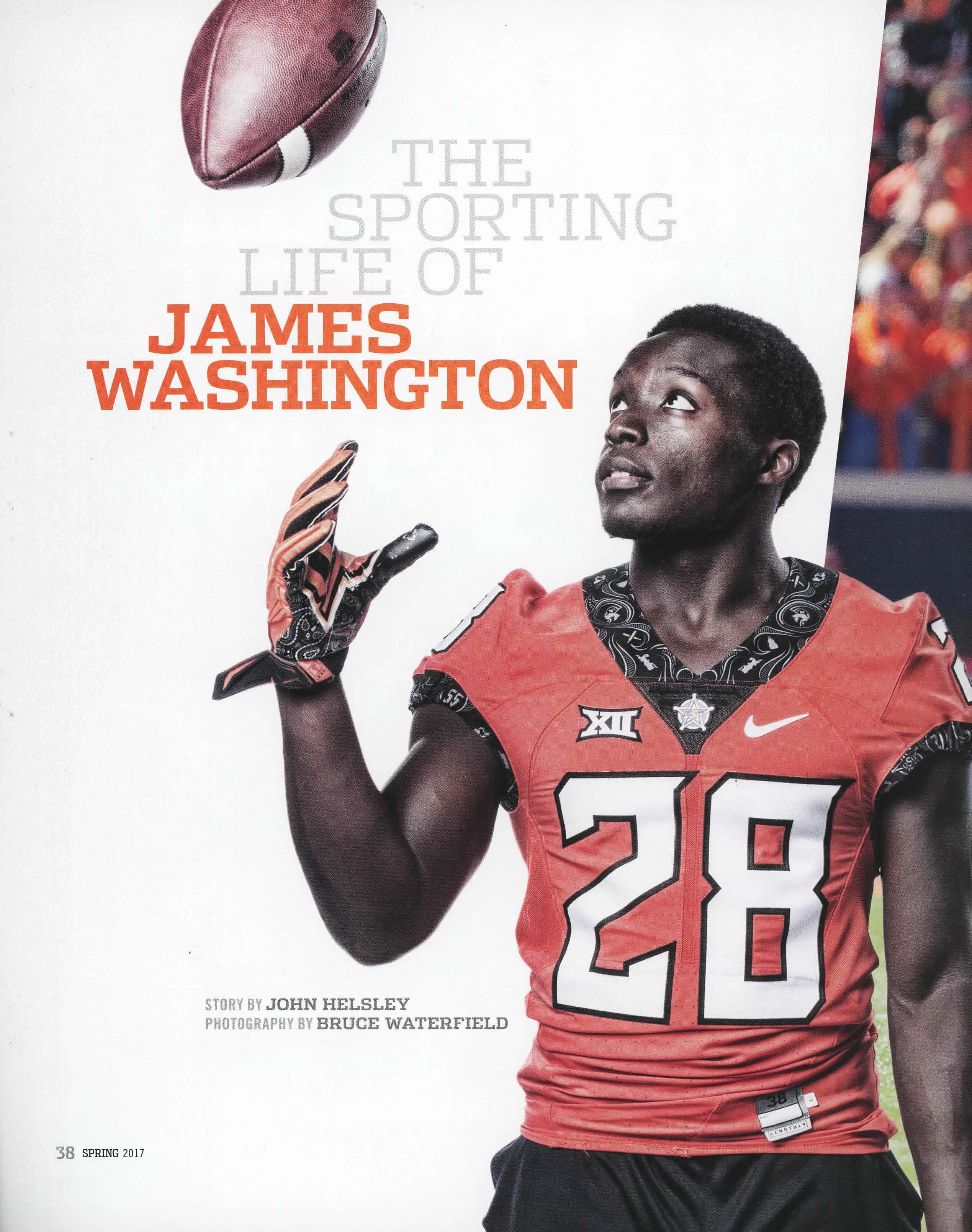
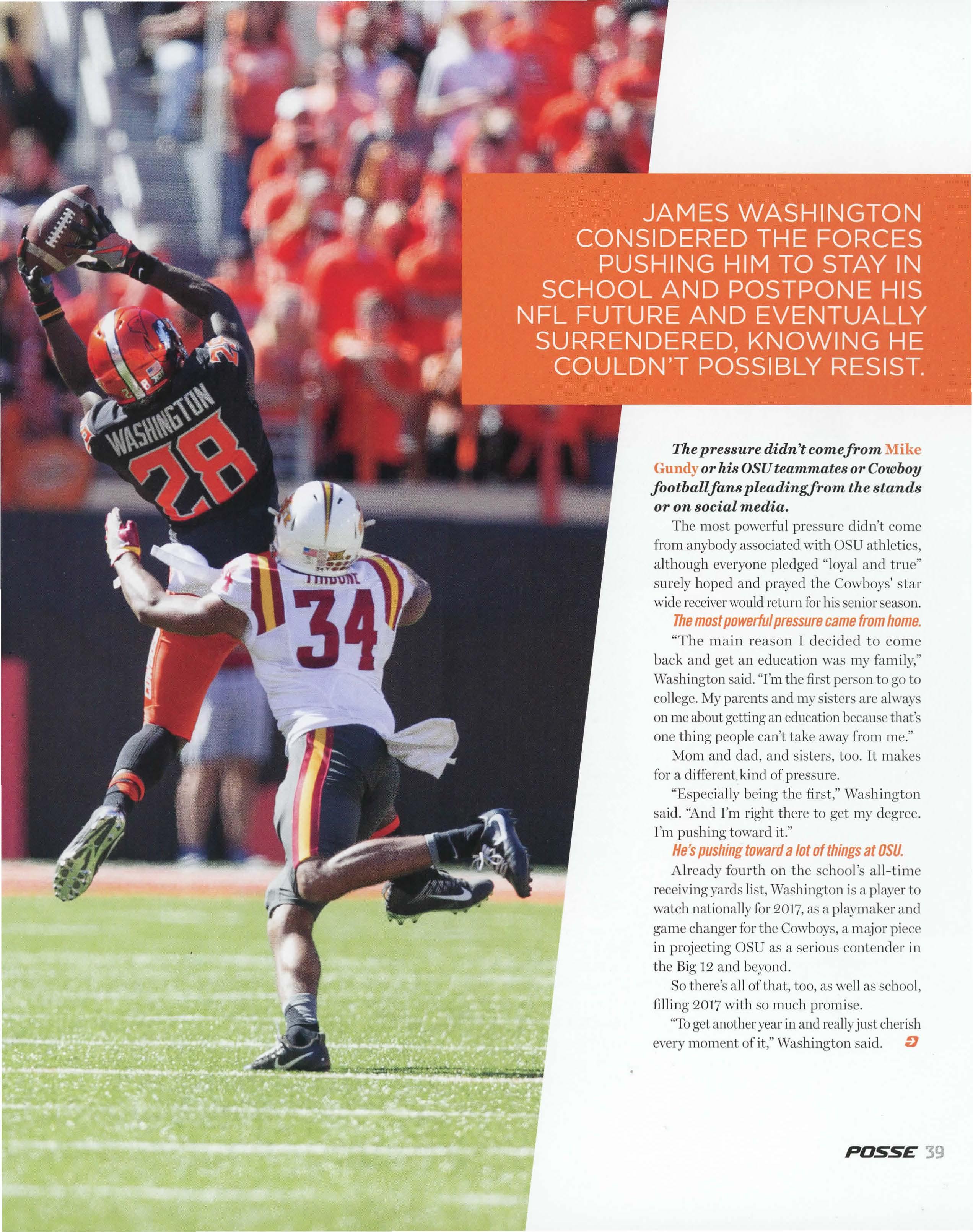
The pressure didn't come from Mike Gundy or his OSU teammates or Cowboy football fans pleading.from the stands or on social media.
The most powerful pressure didn't come from anybody associated with OSU athletics, although everyone pledged "loyal and true" surely hoped and prayed the Cowboys' star wide receiverwould return for his senior season.
Themostpowerfulpressurecamefromhome.
"The main reason I decided to come back and get an education was my family," Washington said. "I'm the first person to go to college. My parents and my sisters are always on me about getting an education because that's one thing people can't take away from me."
Morn and dad, and sisters, too. It makes for a different kind of pressure.
"Especially being the first," Washington said. "And I'm right there to get my degree. I'm pushing toward it."
He'spushingtoward a lotofthingsatOSU.
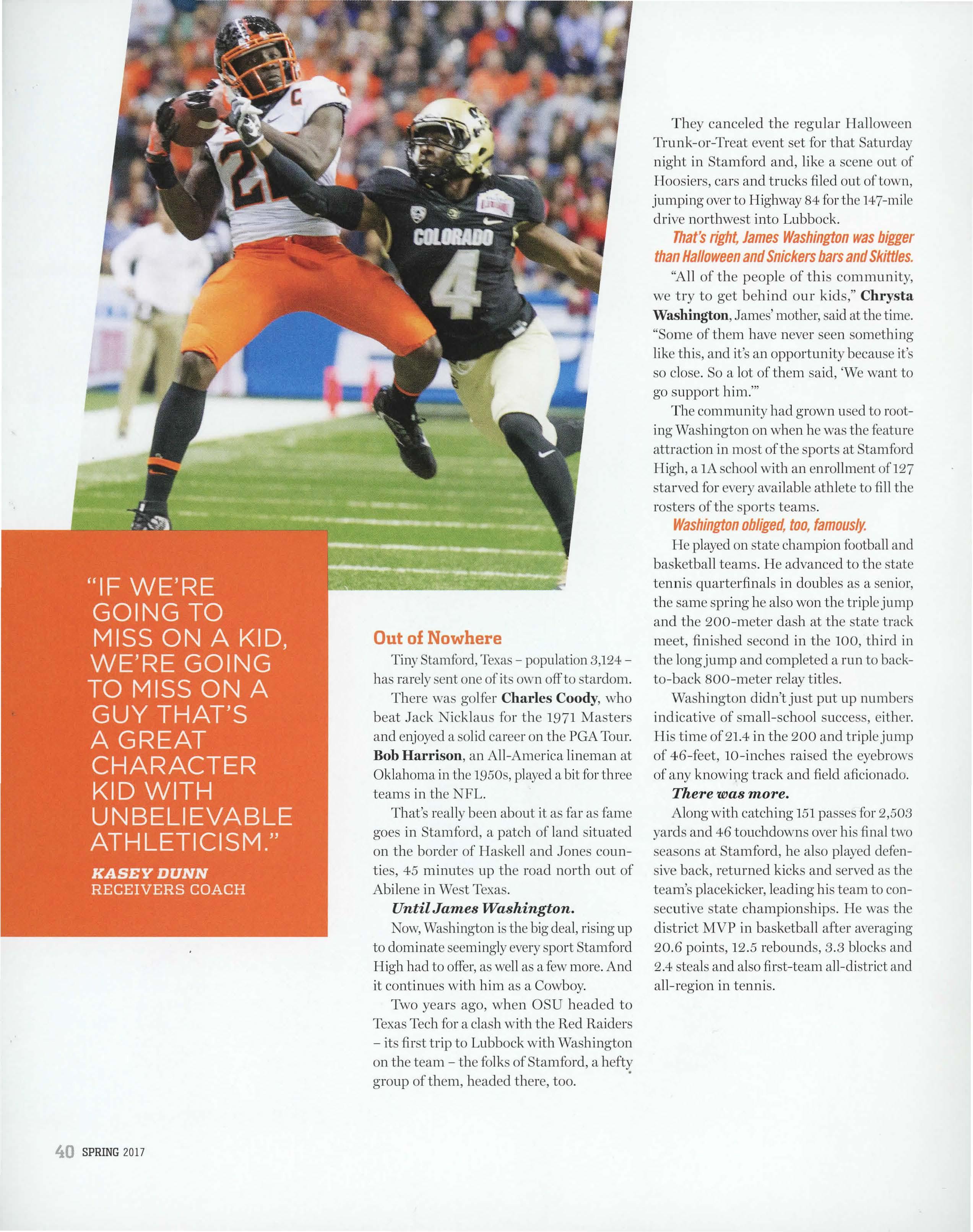
Already fourth on the school's all-time receiving yards list, Washington is a player to watch nationally for 2017, as a playmaker and game changer for the Cowboys, a major piece in projecting OSU as a serious contender in the Big 12 and beyond.
So there's all of that, too, as well as school, filling 2017 with so much promise.
"To get another year in and reallyjust cherish every moment of it," Washington said. :J
Out of Nowhere
Tiny Stamford, Texas - population 3,124has rarely sent one of its own off to stardom.
There was golfer Charles Coody, who beat Jack Nicklaus for the 1971 Masters and enjoyed a solid career on the PGA Tour. Bob Harrison, an All-America lineman at Oklahoma in the 1950s, played a bit for three teams in the NFL.
That's really been about it as far as fame goes in Stamford, a patch of land situated on the border of Haskell and Jones counties, 45 minutes up the road north out of Abilene in West Texas.
Until James Washington.
Now, Washington is the big deal, rising up to dominate seemingly every sport Stamford High had to offer, as well as a few more. And it continues with him as a Cowboy.
Two years ago, when OSU headed to Texas Tech for a clash with the Red Raiders - its first trip to Lubbock with Washington on the team - the folks of Stamford, a hefty group of them, headed there, too. •
They canceled the regular Halloween Trunk-or-Treat event set for that Saturday night in Stamford and, like a scene out of Hoosiers, cars and trucks filed out of town, jumping over to Highway 84 for the 147-mile drive northwest into Lubbock.
"All of the people of this community, we try to get behind our kids," Chrysta Washington, James' mother, said at the ti me.
"Some of them have never seen something like this, and it's an opportunity because it's so close. So a lot of them said, 'We want to go support him."'
The community had grown used to rooting Washington on when he was the feature attraction in most of the sports at Stamford High, a lA school with an enrollment ofl27 starved for every available athlete to fill the rosters of the sports teams.
Washingtonobliged,too,famously.
He played on state champion football and basketball teams. He advanced to the state tennis quarterfinals in doubles as a senior, the same spring he also won the triple jump and the 200-meter dash at the state track meet, finished second in the 100, third in the longjurnp and completed a run to backto-back 800-meter relay titles.
Washington didn't just put up numbers indicative of small-school success, either. His time of21.4 in the 200 and triple jump of 46-feet, IO-inches raised the eyebrows of any knowing track and field aficionado.
There was more.
Along with catching 151passes for 2,503 yards and 46 touchdowns over his final two seasons at Stamford, he also played defensive back, returned kicks and served as the team's placekicker, leading his team to consecutive state championships. He was the district MVP in basketball after averaging 20.6 points, 12.5 rebounds, 3.3 blocks and 2.4 steals and also first-team all-district and all-region in tennis.
Washington went to the state track meet in five events every spring of his four-year prep career. He played baseball one season and wanted to play golf; but his spring schedule was already overflowing so he saved the links for the weekends.
He also served on the Stamford student council. Oh, and he's a black belt in taekwondo.
Mom pushed him to do it all.
"1 played everything I could possibly play," said Chrysta, who was a pretty good tennis player in her day. "I guess that rubbed off on him."
Whatdidn'truboffnaturallycamewitha nudge.
"We kind of had to steer him," Chrysta said of her and her husband, James Sr. "That tennis, that was a girls' thing for him. But he realized that, 'Hey, it pays oft; too.'
"One thing will help the next thing."
And looking back now, Washington is happy his mom kept directing him, even toward tennis.
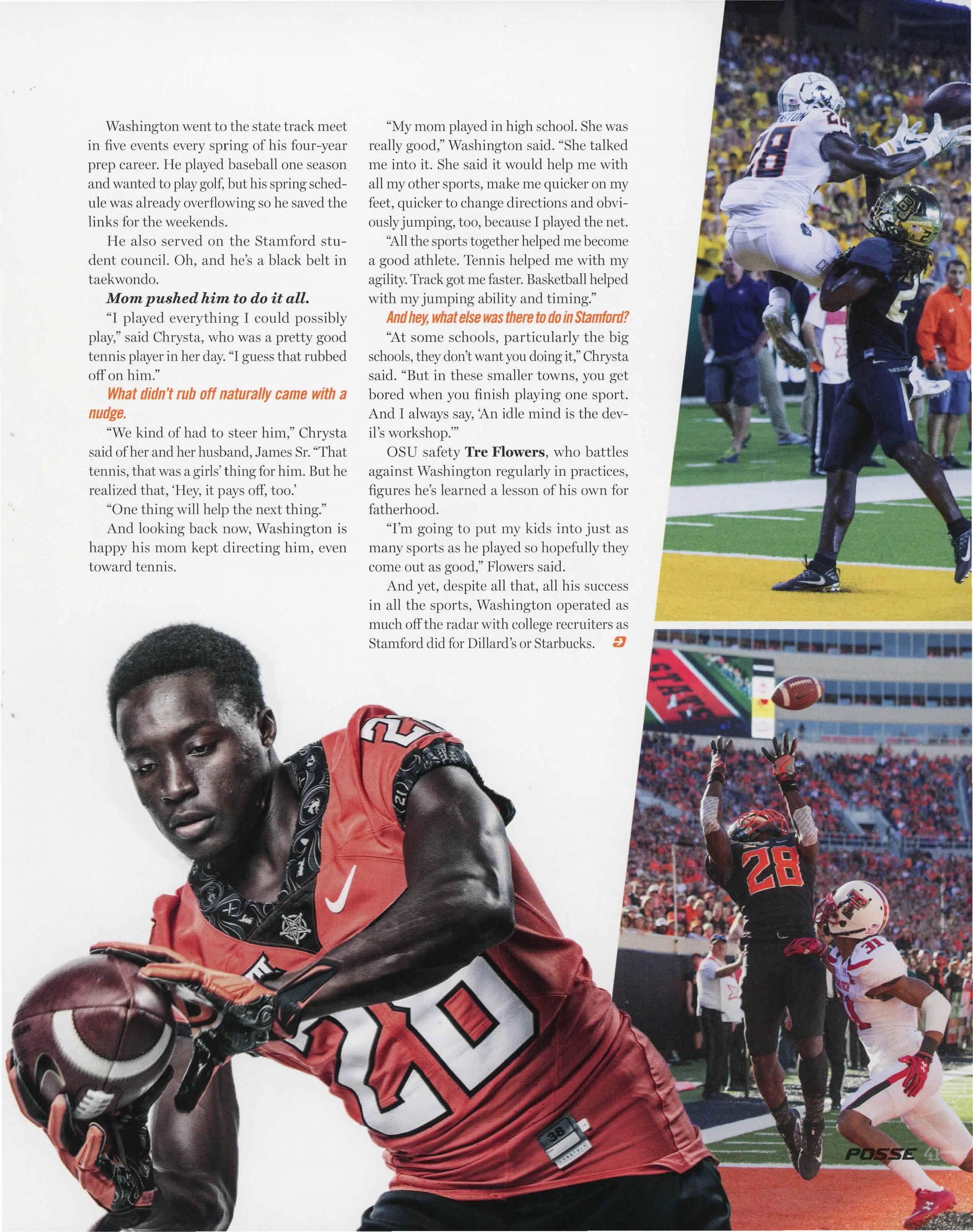
"My mom played in high school. She was really good," Washington said. "She talked me into it. She said it would help me with all my other sports, make me quicker on my feet, quicker to change directions and obviously jumping, too, because I played the net.
"Allthe sports together helped me become a good athlete. Tennis helped me with my agility. Track got me faster. Basketball helped with my jumping ability and timing."
Andhey,whatelsewastheretodoinStamford?
"At some schools, particularly the big schools,they don't want you doing it," Chrysta said. "But in these smaller towns, you get bored when you finish playing one sport. And I always say, 'An idle mind is the devil's workshop."'
OSU safety Tre Flowers, who battles against Washington regularly in practices, figures he's learned a lesson of his own for fatherhood.
'Tm going to put my kids into just as many sports as he played so hopefully they come out as good," Flowers said.
And yet, despite all that, all his success in all the sports, Washington operated as much off the radar with college recruiters as Stamford did for Dillard's or Starbucks. :J
The Road to Somewhere
Washington wanted to play college ball. Who doesn't? But first he had to be wanted. And that proved difficult, with no scouts or recruiters making their way to Stamfordnot even those assistant coaches dedicated to mining for the hidden gem.
So at the urging of his high school coach Wayne Hutchinson, Washington took his talents to the scouts.
"My senior year, no one really recruited me so I went to a lot of camps and spent a lot of money just to try and get picked up," Washington said. "I wanted to get picked up anywhere because I love the game of football. Ifl could go somewhere and play, that would be great with me.
"I went wherever I could and competed however I could, just trying to make something happen."
Chrysta, however, wasn't so sure.
"We tried one camp and after that Coach Hutchinson said try this one and this one. I'm like, 'Hey coach, too many camps.'
"But every time we'd come back home, James told me, 'Mom, I learned this. I learned that.' When you're in these smaller schools like this, you don't get all of the best coaches."
Washington didn't attend camp at OSU, which usually rules a prospect out with the Cowboys' coaches, especially obscure prospects without any scholarship offers to verify some sense oflegitimacy. Still, OSU coaches got a tip on Washington after he performed well at a camp in Dallas. And they had video on him, but even it wasn't exactly what they're used to viewing.
"He didn't have a whole lot of football video on there," said OSU receivers coach Kasey Dunn. "I-le had a lot of basketball. It was kind of split. The video is grainy. It's small-town stuff The cameraman is shaking and going all over the place."
Small-town life can be high quality, but there are some trade-offs.
There was enough, though, to like. And Washington'saccomplishmentswereimpressive,evenif hedidthemata 1Ahighschool.
"You can't dispute running 21.4 (in the 200)," Dunn said. "You can't dispute jumping 23 feet. I mean, the guy won the triple jump. Then he plays tennis and basketball. In these videos, he's 360-jamming the basketball. Now, how often do you see a six-foot guy do that?
"If we're going to miss on a kid, we'regoing to miss on a guy that's a great character kid with unbelievable athleticism."
ExcepttheCowboysdidn'tmiss.Infact,they hitit big.
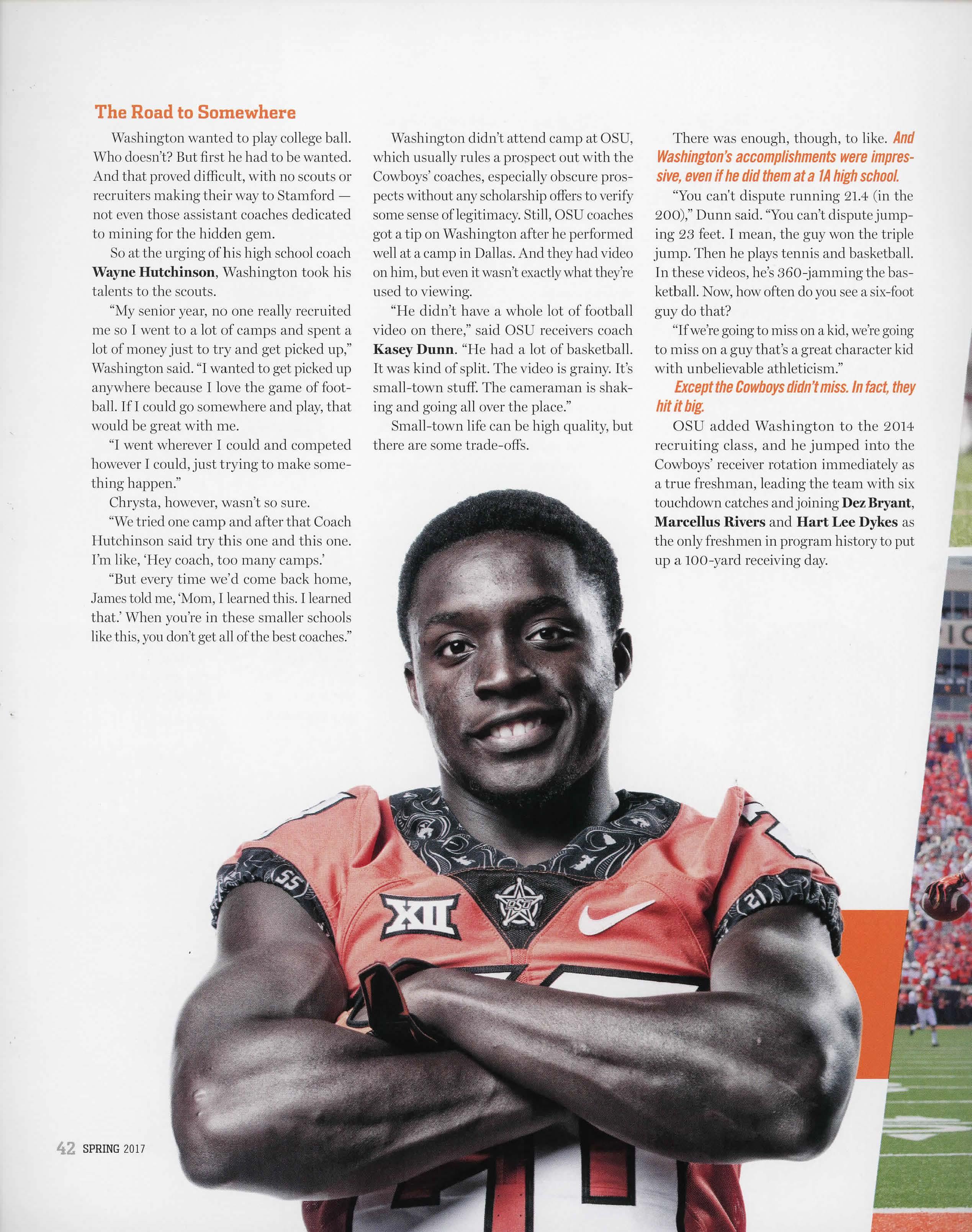
OSU added Washington to the 2014 recruiting class, and he jumped into the Cowboys' receiver rotation immediately as a true freshman, leading the team with six touchdown catches and joining Dez Bryant, Marcellus Rivers and Hart Lee Dykes as the only freshmen in program history to put up a 100-yard receiving day.
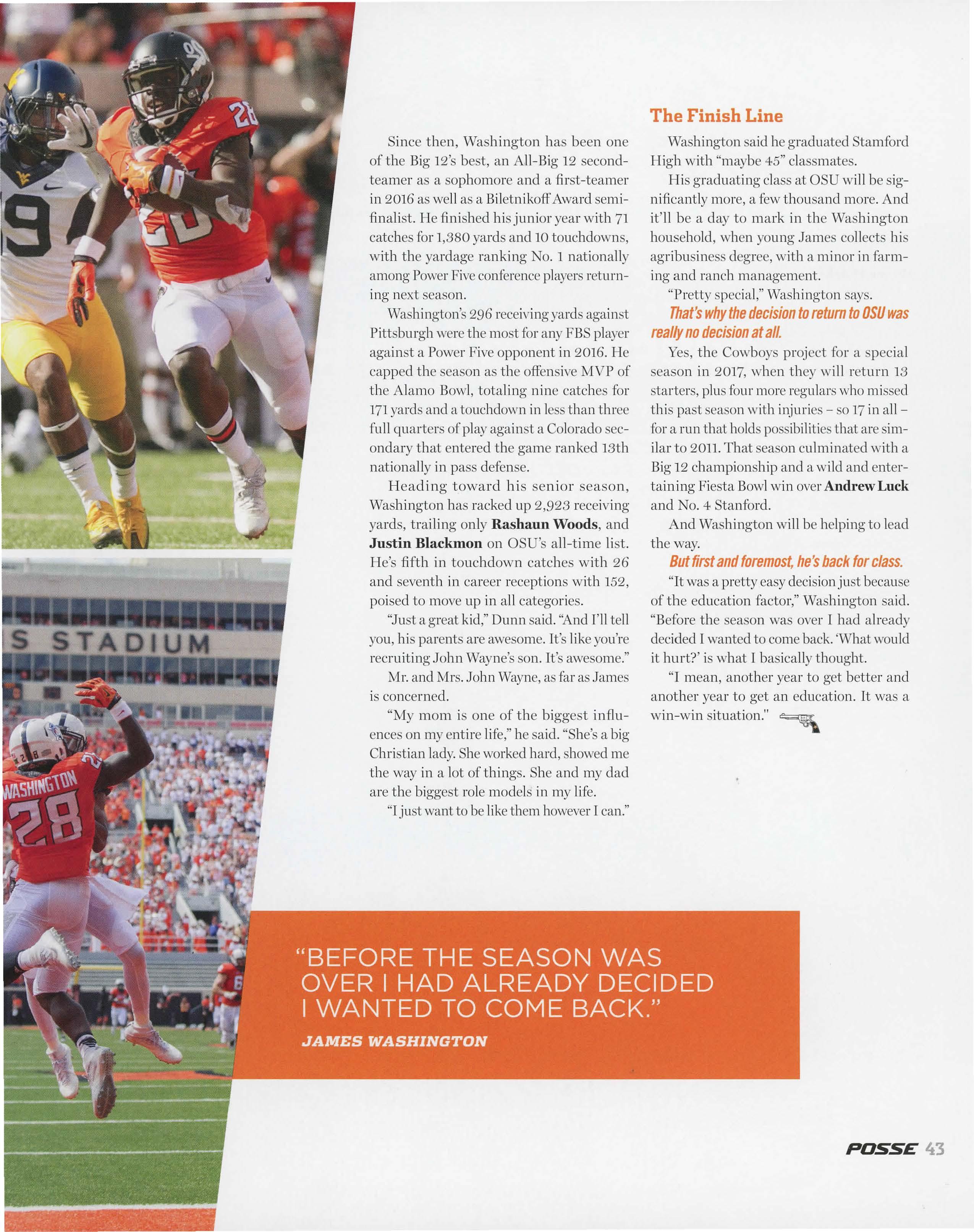
Since then, Washington has been one of the Big 12's best, an All-Big 12 secondteamer as a sophomore and a first-teamer in 2016 as well as a BiletnikoffAward semifinalist. He finished his junior year with 71 catches for 1,380 yards and 10 touchdowns, with the yardage ranking No. 1 nationally among Power Five conference players returning next season.
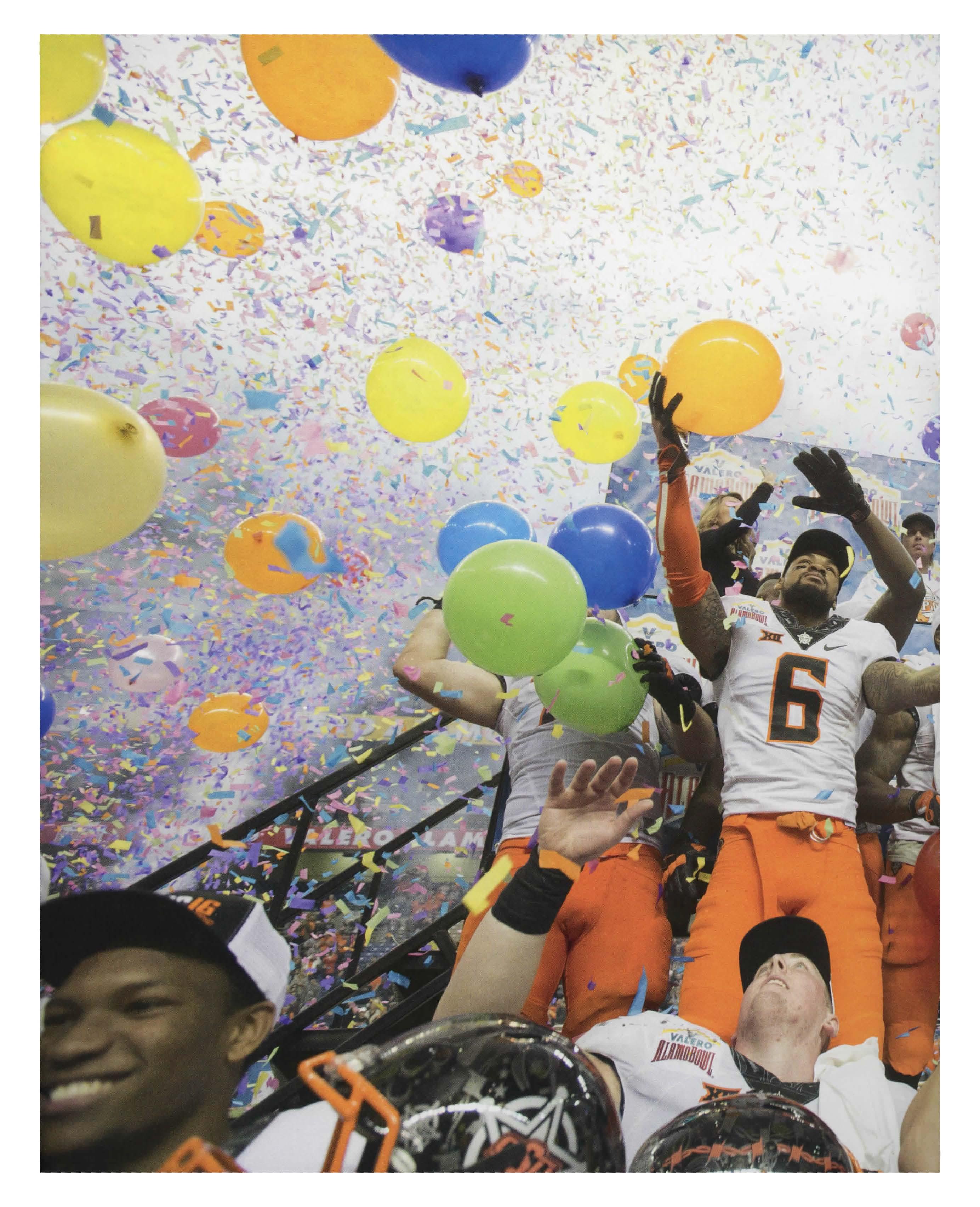
Washington's 296 receiving yards against Pittsburgh were the most for any FBS player against a Power Five opponent in 2016. He capped the eason as the offensive MVP of the Alamo Bowl, totaling nine catches for 171yards and a touchdown in less than three fu 11quarters of play against a Colorado secondary that entered the game ranked 13th nationally in pass defense.
Heading toward his senior season, Washington has racked up 2,923 receiving yards, trailing only Rashaun Woods, and Justin Blackmon on OSU's all-time list. He's fifth in touchdown catches with 26 and seventh in career receptions with 152, poised to move up in all categories.
"Just a great kid," Dunn said. ''And I'll tell you, his parents are awesome. It's like you're recruiting John Wayne's son. It's awesome."
Mr. and Mrs. John Wayne, as far as James is concerned.
"My mom is one of the biggest i n:fluences on my entire life," he said. "She's a big Christian lady. She worked hard, showed me the way in a lot of things. She and my dad are the biggest role models in my life.
"I just want to be like them however I can."
The Finish Line
Washington said he graduated Stamford High with "maybe 45" classmates.
His graduating class at OSU will be significantly more, a few thousand more. And it'll be a day to mark in the Washington household, when young James collects his agribusiness degree, with a minor in farming and ranch management.
Yes, the Cowboys project for a special season in 2017, when they will return 13 starters, plus four more regulars who missed this past season with injuries - so 17 in allfor a run that holds possibilitiesthat are similar to 2011. That season culminated with a Big 12 championship and a wild and entertaining Fiesta Bowl win over Andrew Luck and No. 4 Stanford.
And Washington will be helping to lead the way.
Butfirstandforemost,he'sbackforclass.
"It was a pretty easy decision just because of the education factor," Washington said. "Before the season was over I had already decided I wanted to come back. 'What would it hurt?' is what I basically thought.
"I mean, another year to get better and another year to get an education. It was a win-win situation."
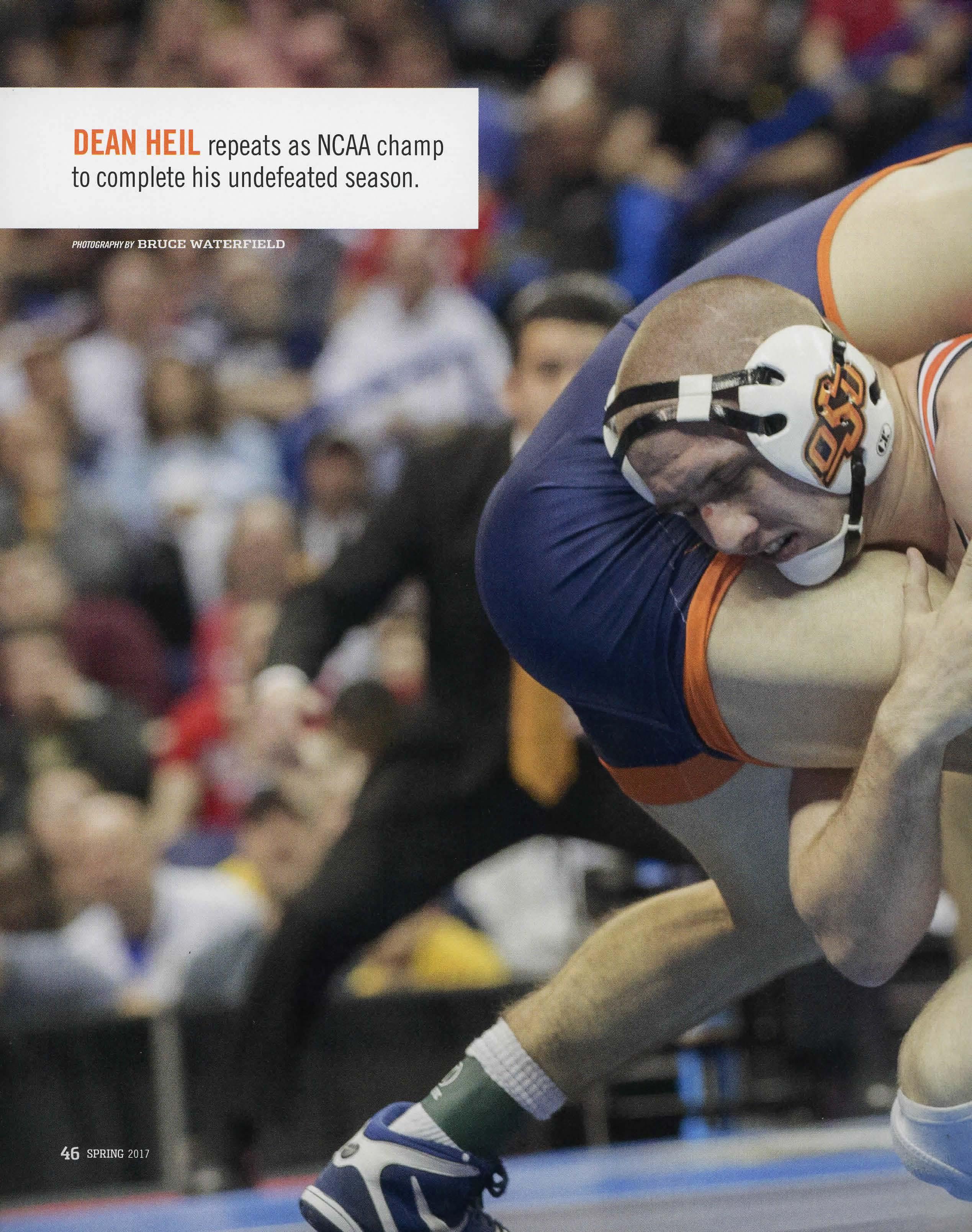
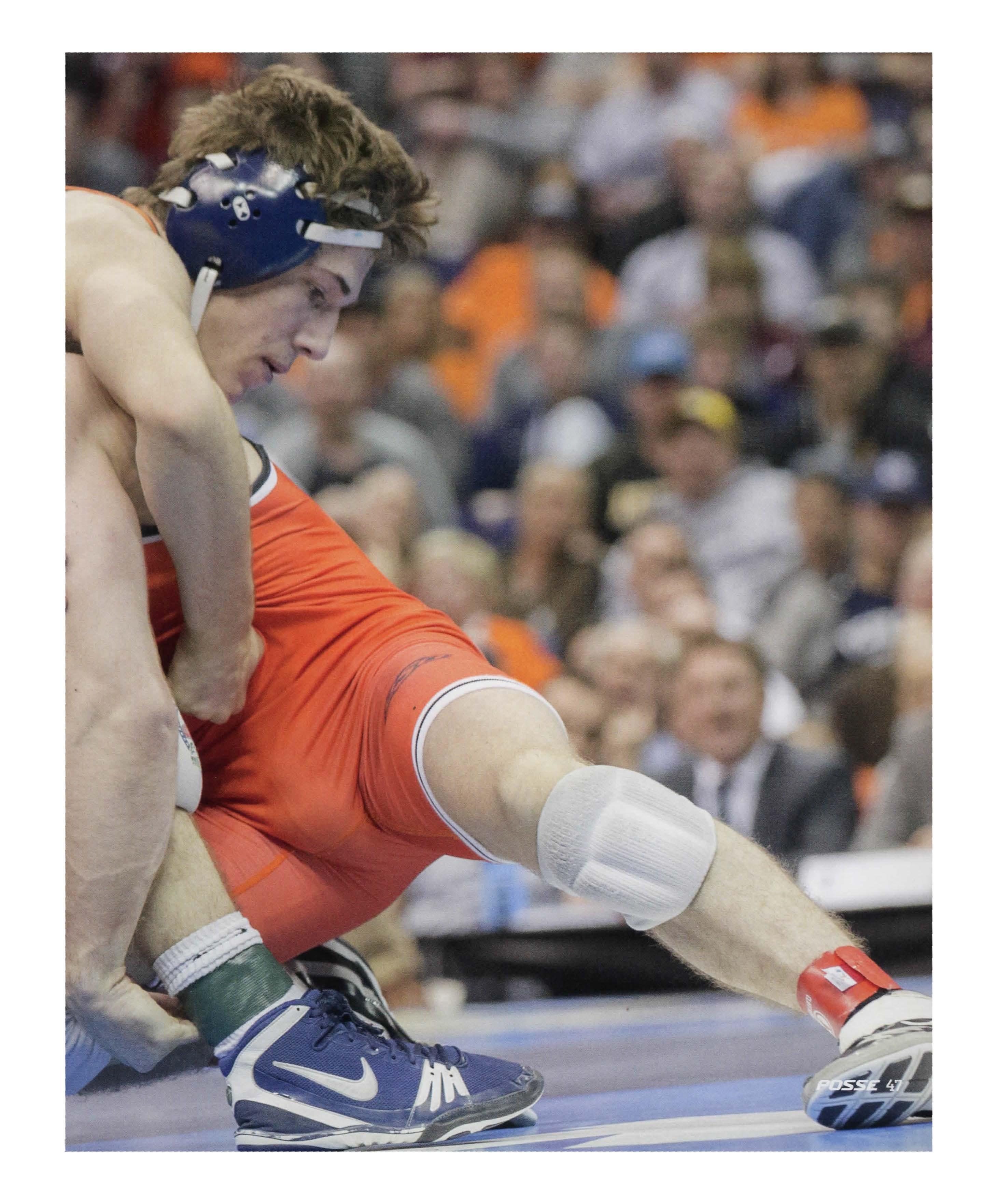
DEANHEILrepeatsasNCAAchamp to completehisundefeatedseason.
And how did two underdog Cowboys capture Olympic gold? Doug Blubaugh wrestled at 157 pounds, while Shelby Wilson checked in at 147. Both grew up on farms outside Ponca City where hard work was the expected and accepted way oflife. Blubaugh was older by two years.
Ponca City has quite a long and impressive wrestling heritage, having captured 12 state titles and 87 individual state championships. Blubaugh and Wilson are products of a unique wrestling culture, a byproduct of the hard work, ingenuity and dedication of former Oklahoma A&M mat coaches Ed Gallagher and Art Griffith.
GALLAGHERANDGRIFFITH
New wrestling principles evolved in 1916 when electrical engineering graduate Ed Gallagher was hired by Oklahoma A&M as head coach. Wl1ilein college,Gallagher excelled in track and football. As wrestling coach, he used knowledge obtained in his engineering classes to incorporate leverage as part of a new philosophy. Experiencing almost immediate success, Gallagher guided A&M teams from 1916 to 1940, going 136-5-4 in duals with 19 undefeated seasons.
A multitude of former Gallagher pupils became successful high school and college coaches.
Griffith, who had been coaching Tulsa Central High School, succeeded Gallagher. During his 13 years in Tulsa, his teams won 94 oflO0 matches. In Stillwater, Griffith-led squads collected eight NCAA championships in 13 seasons (no teams were fielded during the final three years of World War II). Gallagher's philosophy was to take a man down for two points, release him and give up an escape point, and then take him down again, turn him loose and repeat until the period expired.
GriffithaddedtoGallagher'sphilosophies with hisveryspecifictheoriesonstrength.
"If strength is everything, then a bull should be able to catch a rabbit, but he can't," he once said. "So quickness has to count for something."
He instructed his squad individually on how he wanted them to wrestle. He also taught them the finer points of coaching, asking older wrestlers to teach and critique younger team members during practice. Like Gallagher, many of Griffith's former pupils became coaching stars.
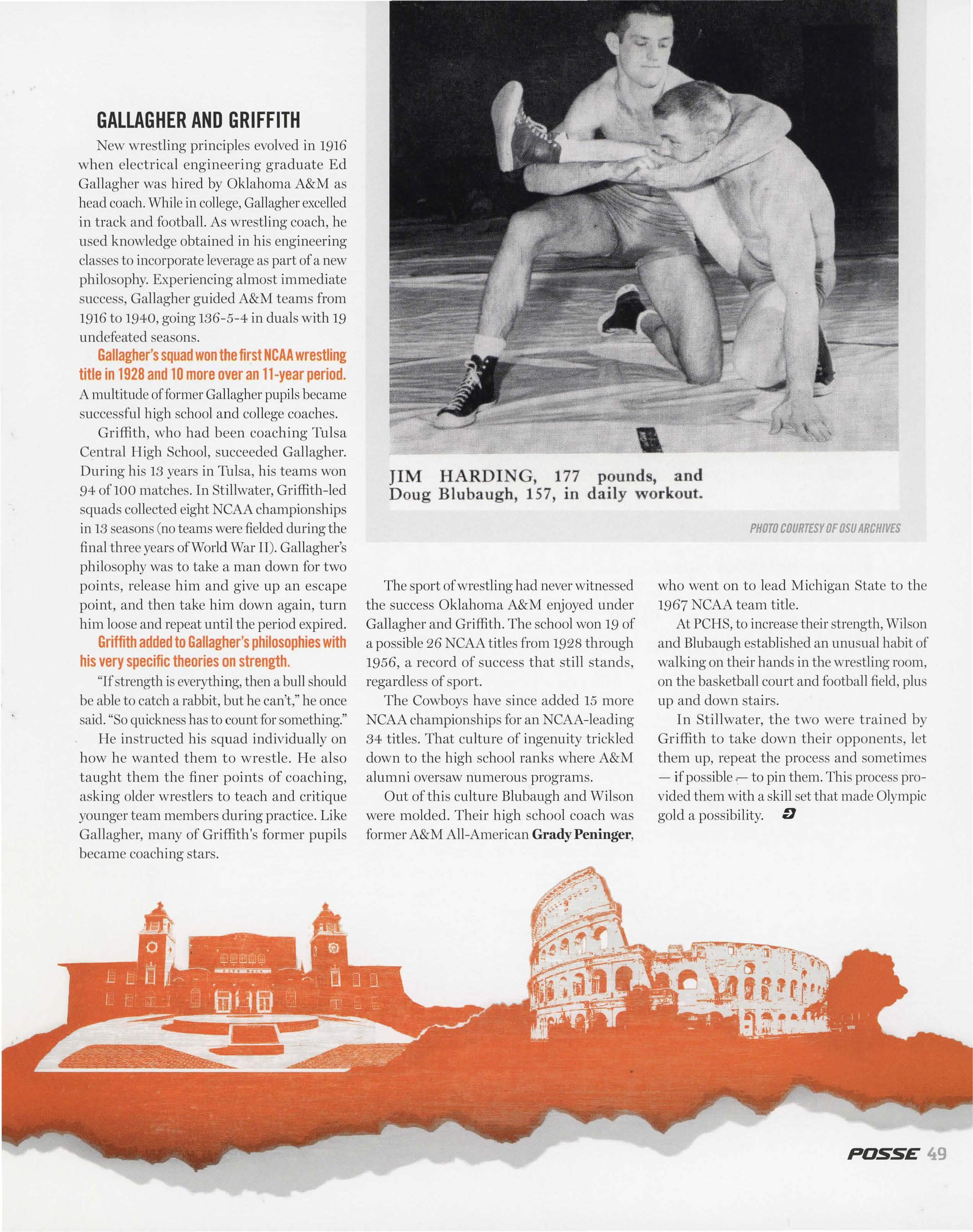
JIM
HARDING, 177 pounds, and Doug Blubaugh, 157, in daily workout.
The sport of wrest] ing had never witnessed the success Oklahoma A&M enjoyed under Gallagher and Griffith. The school won 19 of a possible 26 NCAA titles from 1928 through 1956, a record of success that still stands, regardless of sport.
The Cowboys have since added 15 more NCAA championships for an NCAA-leading 34 titles. That culture of ingenuity trickled down to the high school ranks where A&M alumni oversaw numerous programs.
Out of this culture Blubaugh and Wilson were molded. Their high school coach was former A&M All-American Grady Peninger, PHOTOCOURTESY
who went on to lead Michigan State to the 1967 NCAA team title.
At PCI-fS,to increase their strength, Wilson and Blubaugh established an unusual habit of walking on their hands in the wrestling room, on the basketball court and football field, plu up and down stairs.
In Stillwater, the two were trained by Griffith to take down their opponents, let them up, repeat the process and sometimes - if possible,- to pin them. This process provided them with a skill set that made Olympic gold a possibility. :J
"Without a doubt, standingonthat Olympicplatform, havingjustwona goldmedalandthe officialshanging it aroundmyneck withthe Star SpangledBanner playing,wasbyfar thehighlightof my career."
SHELBY WILSON
WILSON'SWAY
His junior and senior years in Stillwater (1958-59), Wilson wrestled at 147 pounds during the regular season and went undefeated with two conference titles. However, both years OSU coach Myron Rodericka three-time NCAA champ who became the successor to Griffith as OSU's coach - convinced Wilson he would have a better shot at the I CAA title ifhe dropped down a weight to 137 pounds.
"By far 147 was the best weight for me," remembers Wilson. "I-leek, I'd beaten those guys both years who won the NCAA at 147. I lost both years in the 137finals. Pulling weight to 137 was not a good thing for me. My thinking ability was hindered, and my enthusiasm was gone. I didn't want to talk to my girlfriend. I wasn't the same person.
"Same thing happened to me in high school. When it came time for the state tournament, coach pu lied me down a weight my senior year and I lost in the state finals, taking third the prior two years."
When it came time for the U.S. Olympic Trials, Wilson was again encouraged to cut weight and drop down a class.
"Being a Christian, I prayed for peace and confidence," Wilson says. 'Tm convinced the Holy Spirit told me to trust myself and stay
at 147. Once I decided that, my world turned around. 1 was enthused, confident and ready to wrestle in tip-top shape. I did my homework and, in my career, never lost a finals match at 147. Th is was my first shot at international wrestling, and I knew nothing about it."
Gettingtherewasa longjourneyforWilson. First, he decided to try to qualify in both Greco and freestyle wrestling, which would increase his chances of making it to Rome. I-le got his ticket punched for both events but elected to participate only in freestyle.
Wilson came in second at the trials but had to claw himself to the top position at the U.S. wrest! ing camp by defeating the two challengers below him, and, finally, beating the toprated American to earn the right to wrestle on the sport's biggest stage.
"I won five matches to win the Olympics. The rules fit my style. My strength was takedowns, which you got a point for, and you weren't penalized for letting the other guy up so that's what I did. I had a bad knee that would occasionally lock up and didn't want to stay down on the mat.
"Myfirstfoe was from India and next up, a challenger from Finland, both of whom l beat about4-0 or 5-0. My third opponent was from
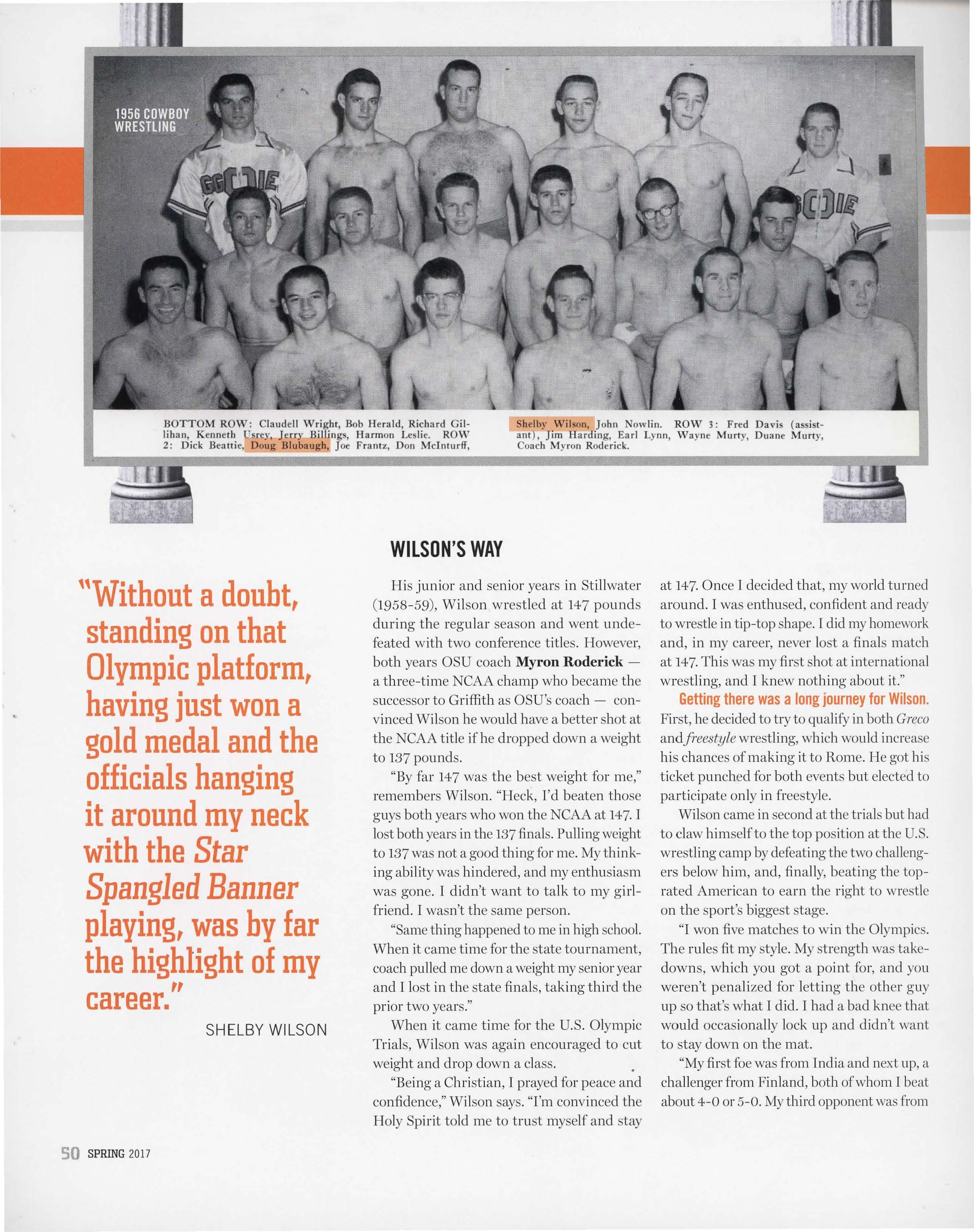
BOTTOM ROW: Claudell Wright, Bob Herald, Richard Gillihan, Kenneth T ce.y, Jer.c,y, illings, Harmon Leslie. ROW 2: Dick Beattie, Doug Blubaugh, Joe Frantz, Don Mcinturff,
Shelby \Vilson, John Nowlin. RO\V 3: Fred Davis (assistant), Jim ar ing, Earl Lynn, \:\Tayne Murty, Duane Murty, Coach Myron Roderick.
Japan and had the reputation of being both tough and aggressive, vvhich again, fit right into my strengths. I won 10-2. Those were the only points I lost. That evening Blubaugh said my next opponent, a noted Russian named VladimirSinyavsky, had watched my match and was worried because the guy I just beat killed the Russian the previous year."
After his conversation with Blubaugh, Wilson says he saw an opportunity to get in the Russian's head.
"Forsomereason, I gotthiscrazyideatodo somethingI'dneverdonebefore.When I came out to warm up, I started aggressively waving my arms like I'm ready to rip this guy apart - moving around, flexing my muscles, scowling. All the while, I'm making sure I had the Russian's attention." Wilson laughs. "I don't know if it did any good or not, but I won 4-0. Last up was the Iranian, Mystafa Tajiki, who I beat -J.-0 or 5-0. I won gold!
"Without a doubt, standing on that Olympic platform, having just won a gold medal and the officials hanging it around my neck with the Star Spangled Banner playing, was by far the highlight of my career. Difficult to describe those feelings I had at that moment."
"I came here to win and I did," Wilson said immediately after the match.
"First and only (world) championship I ever won," he says now.
A passion for wrestling came natural for Blubaugh. Early on, as part of his training regimen, he ran three miles to school. Then, following class, completed a rigorous practice session and ran home.
Early on, Blubaugh distinguished himself as an intimidating wre tier, winning two high school state titles. In college, he was part of three NCAA championship teams (1954-56) and a three-time All-American, capturing an NCAA individual title as a senior.
Current Cowboy coach .John Smith calls Doug "a true Oklahoma State wrestling hero - a tough farm kid who went on to become the best wrestler in the world."
At the Olympic Trials, former OSU wrestler Phil Kinyon was a most challenging opponent for Blubaugh. Kinyon won an CAA title in Stillwater and finished second
twice. In their previous 10 matches (four at the trials) they had wrestled each other to a draw. Finally, Blubaugh won a split decision over Kinyon followed by a 1-0 victory, earning his Olympic slot.
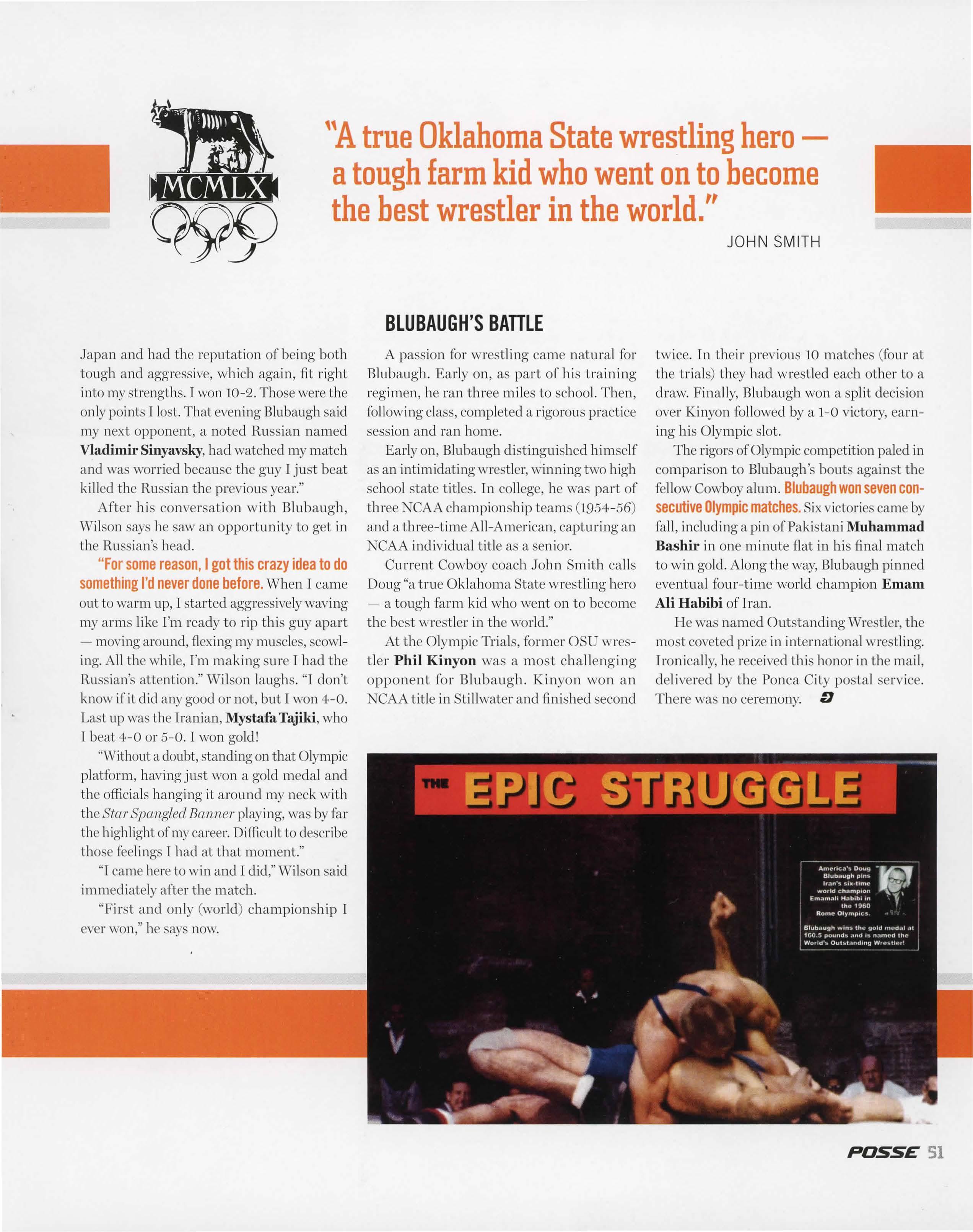
The rigors of Olympic competition paled in comparison to Blubaugh's bouts against the fellow Cowboy alum. BlubaughwonsevenconsecutiveOlympicmatches. Six victorie came by fall, including a pin of Pakistani Muhammad Bashir in one minute flat in his final match to win gold. Along the way, Blubaugh pinned eventual four-time world champion Emam Ali Habibi of l ran.
He was named Outstanding Wrestler, the most coveted prize in international wrestling. Ironically, he received this honor in the mail, delivered by the Ponca City postal service. There was no ceremony. :J
Wilson, for one year, coached wrestling and taught at Ponca City High School but didn't feel the classroom was a good fit. He then moved to Fort Worth and worked as a volunteer staffer for a church while completing two years of seminary.
Answering a call from the University of Colorado, he accepted an offer to coach the Buffalo wrestling squad, which he did from 1968 to 1974.
"Following my time at Colorado, I was more into helping people, which my wife and I enjoyed doing," Wilson said. "We started a foundation to assist people in need. We did that until 1983.
"Doug, who was head wrestling coach at Indiana, asked me to help him run a local wrestling camp he was in charge of so we moved to Bloomington, Ind. My wife and I had - and still have - a ministry assisting
international students in setting up housekeeping when they arrive from overseas. We seek opportunities to share the Gospel with them. Last Thanksgiving, for dinner, we hosted 47 internationals in our home. I coached the local high school wrestling team for 20 years. In addition, we manage rental property. I do the maintenance. I'm a Mr. Fix-it type of guy, can fix almost anything."
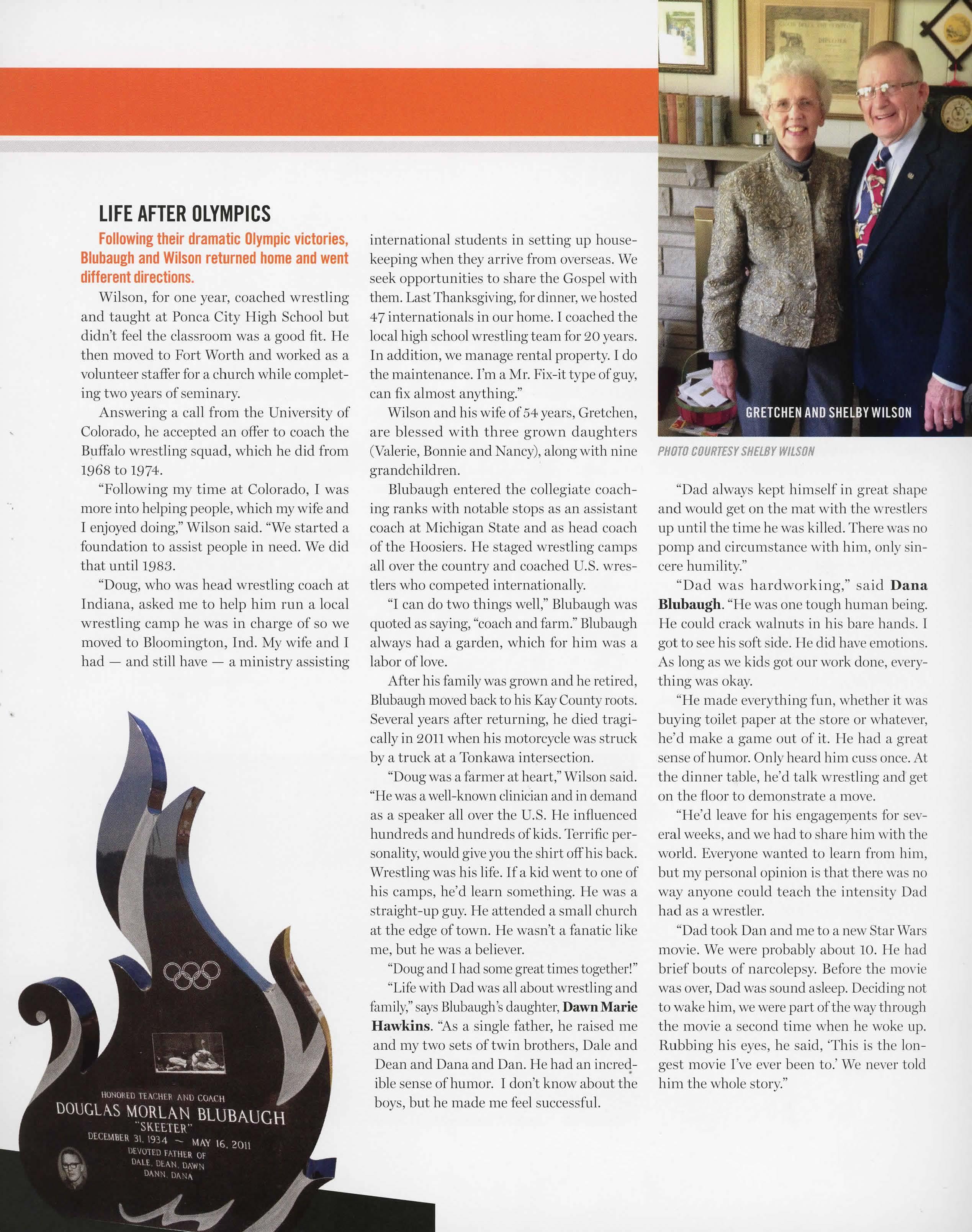
Wilson and his wife of54 years, Gretchen, are blessed with three grown daughters (Valerie, Bonnie and Nancy), along with nine grandchildren.
Blubaugh entered the collegiate coaching ranks with notable stops as an assistant coach at Michigan State and as head coach of the Hoosiers. He staged wrestling camps all over the country and coached U.S. wrestlers who competed internationally.
"I can do two things well," Blubaugh was quoted as saying, "coach and farm." Blubaugh always had a garden, which for him was a labor oflove.
After his family was grown and he retired, Blubaugh moved back to his Kay County roots. Several years after returning, he died tragically in 2011 when his motorcycle was struck by a truck at a Tonkawa intersection.
"Doug was a farmer at heart," Wilson said. "He was a well-known clinician and in demand as a speaker all over the U.S. He influenced hundreds and hundreds of kids. Terrific personality, would give you the shirt off his back. Wrestling was his life. If a kid went to one of his camps, he'd learn something. He was a straight-up guy. He attended a small church at the edge of town. He wasn't a fanatic like me, but he was a believer.
"Dougand I had some great times together!"
"Life with Dad was al I about wrest! ing and family,"says Blubaugh'sdaughter, Dawn Marie Hawkins. ''As a single father, he raised me and my two sets of twin brothers, Dale and Dean and Dana and Dan. He had an incredible sense of humor. I don't know about the boys, but he made me feel successful.
PHOTOCOURTESYSHELBYWILSON
"Dad always kept himself in great shape and would get on the mat with the wre tiers up until the time he was killed. There was no pomp and circumstance with him, only sincere humility."
"Dad was hardworking," said Dana Blubaugh. "He was one tough human being. He could crack walnuts in his bare hands. I got to see his soft side. He did have emotions. As long as we kids got our work done, everything was okay.
"He made everything fun, whether it was buying toilet paper at the store or whatever, he'd make a game out of it. He had a great sense of humor. Only heard him cuss once. At the dinner table, he'd talk wrestling and get on the floor to demonstrate a move.
"He'd leave for his engagen)ents for several weeks, and we had to share him with the world. Everyone wanted to learn from him, but my personal opinion is that there was no way anyone could teach the intensity Dad had as a wrestler.
"Dad took Dan and me to a new Star Wars movie. We were probably about 10. He had brief bouts of narcolepsy. Before the movie was over, Dad was sound asleep. Deciding not to wake him, we were part of the way through the movie a second time when he woke up. Rubbing his eyes, he said, 'This is the longest movie I've ever been to.' We never told him the whole story."
GIVINGBACK
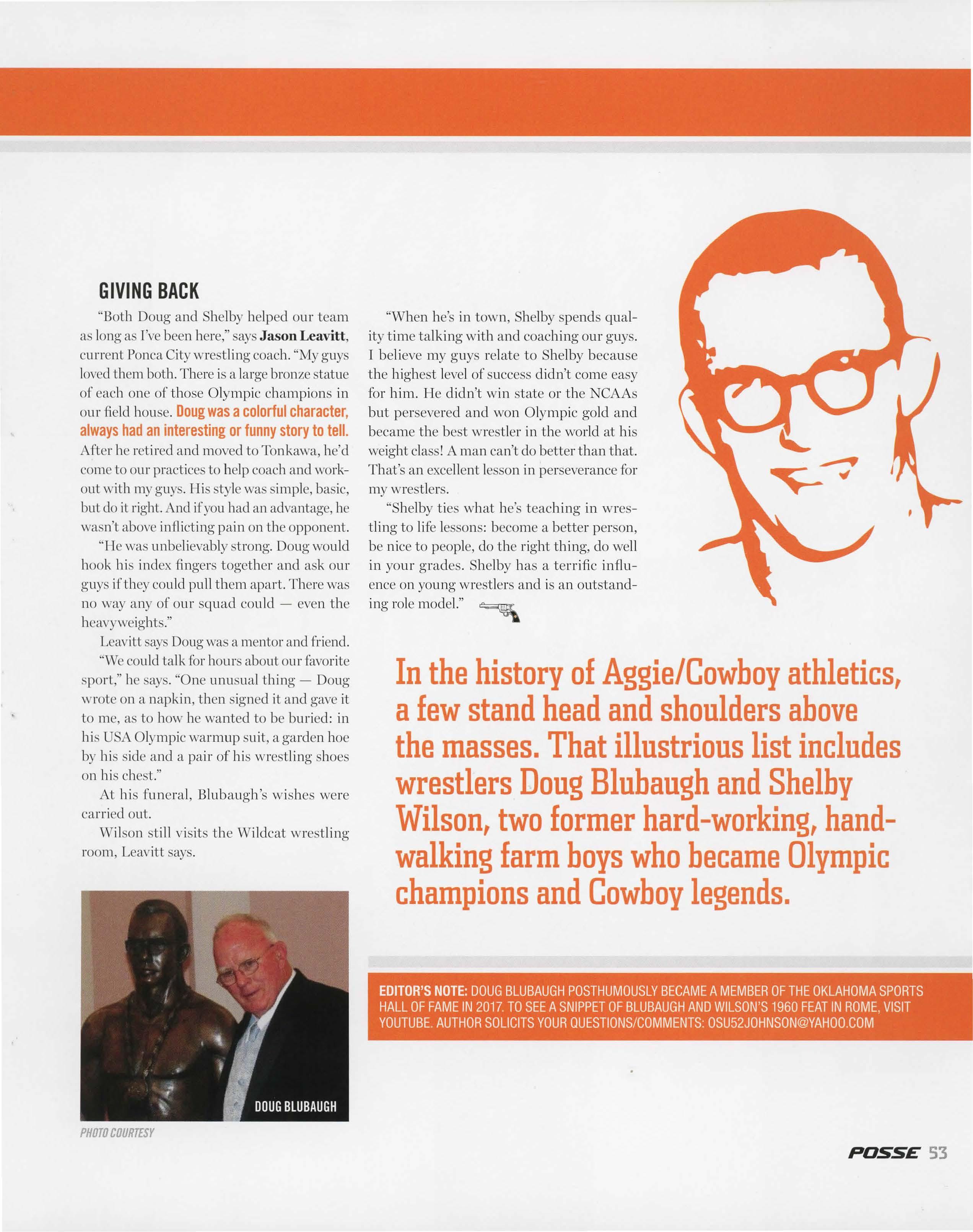
"Both Doug and Shelby helped our team as long as I've been here," says Jason Leavitt, cu rrcnt Ponca City wrest Iing coach. "My guys loved them both. There is a large bronze statue of each one of those Olympic champions in our field house. Dougwasa colorfulcharacter, alwayshadaninterestingorfunnystorytotell.
After he retired and moved to Tonkawa, he'd come to our practices to help coach and workout with my guys. His style was simple, basic, but do it right. And if you had an advantage, he wasn't above inflicting pain on the opponent.
"He was unbelievably strong. Doug would hook his index fingers together and ask our guys if they could pull them apart. There was no way any of our squad could - even the heavyweights."
Leavitt says Doug was a mentor and friend.
"We could talk for hours about our favorite sport," he says. "One unusual thing - Doug wrote on a napkin, then signed it and gave it to me, as to how he wanted to be buried: in hi USA Olympic warmup suit, a garden hoe by his side and a pair of his wrestling shoes on his chest."
At his funeral, Blubaugh's wishes were carried out.
Wilson still visits the Wildcat wrestling room, Leavitt says.
"When he's in town, Shelby spends quality time talking with and coaching our guys. I believe my guys relate to Shelby because the highest level of success didn't come easy for him. He didn't win state or the NCAAs but persevered and won Olympic gold and became the best wrestler in the world at his weight class! A man can't do better than that. That's an excellent lesson in perseverance for my wrestlers.
"Shelby ties what he's teaching in wrestling to life lessons: become a better person, be nice to people, do the right thing, do well in your grades. Shelby has a terrific influence on young wrestlers and is an outstanding role model."
Inthehistoryof Aggie/Cowboyathletics, a fewstandheadandshouldersabove
themasses.Thatillustriouslist includes wrestlersDougBlubaughandShelby Wilson,twoformerhard-working,handwalkingfarmboyswhobecameOlympic championsandCowboylegends.
WITH OSU ATHLETICS
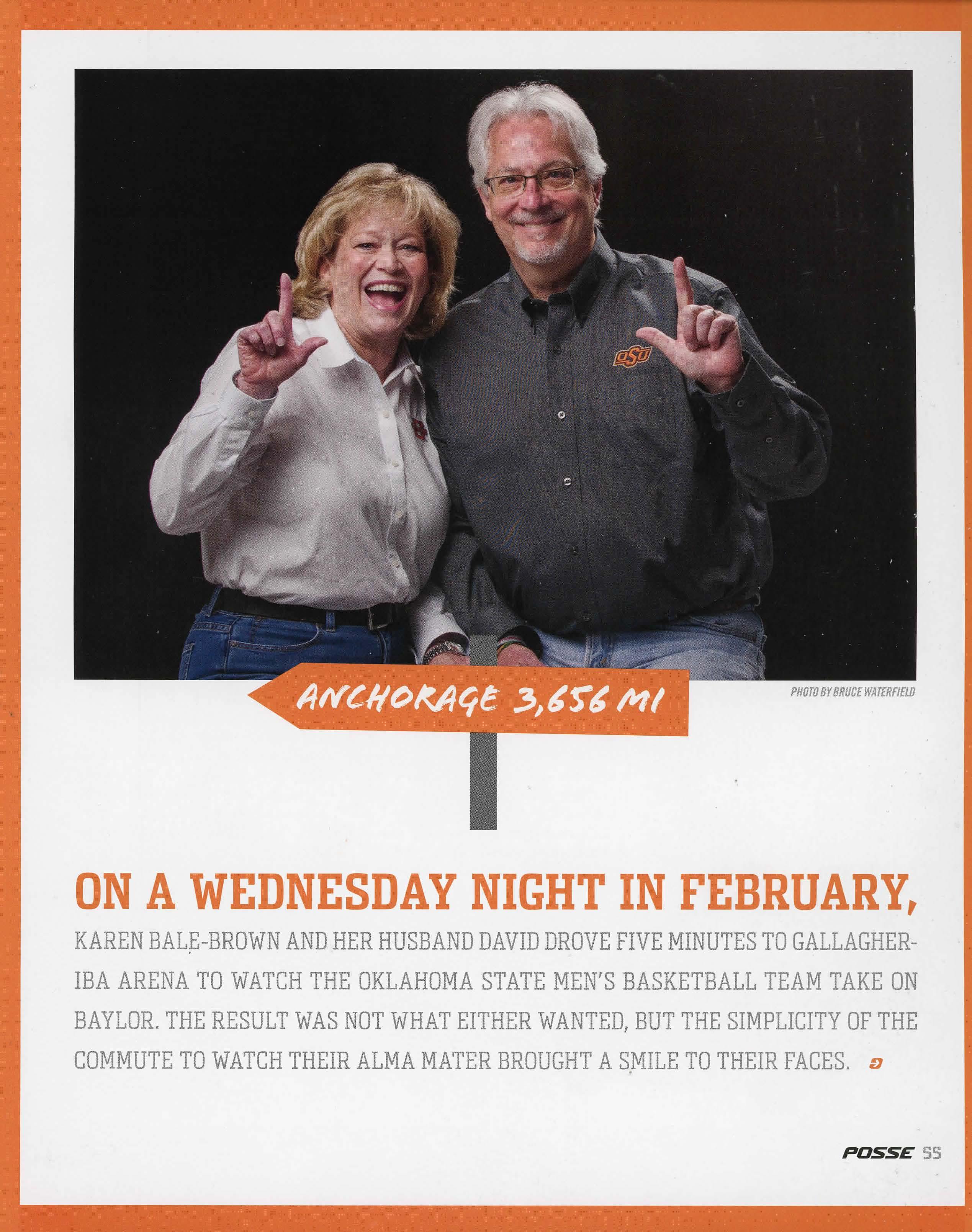
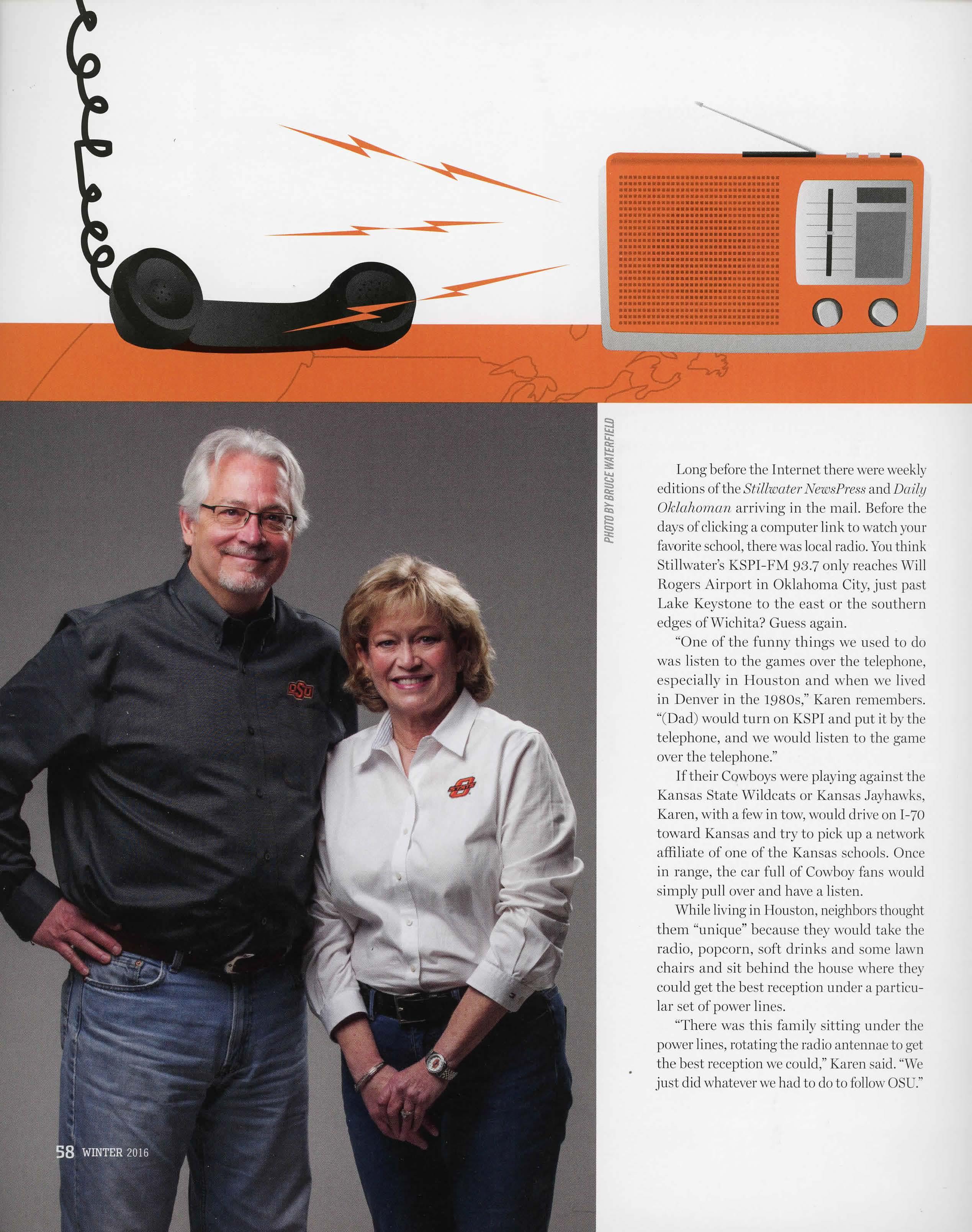
ONA WEDNESDAYNIGHTIN FEBRUARY, KARENBAL~-BROWNANDHERHUSBANDDAVIDDROVEFIVEMINUTESTOGALLAGHERIBAARENATOWATCHTHEOKLAHOMASTATEMEN'SBASKETBALLTEAMTAKEON BAYLOR.THERESULTWASNOTWHATEITHERWANTED,BUTTHESIMPLICITYOFTHE COMMUTETOWATCHTHEIRALMAMATERBROUGHT A S_MILETOTHEIRFACES.o
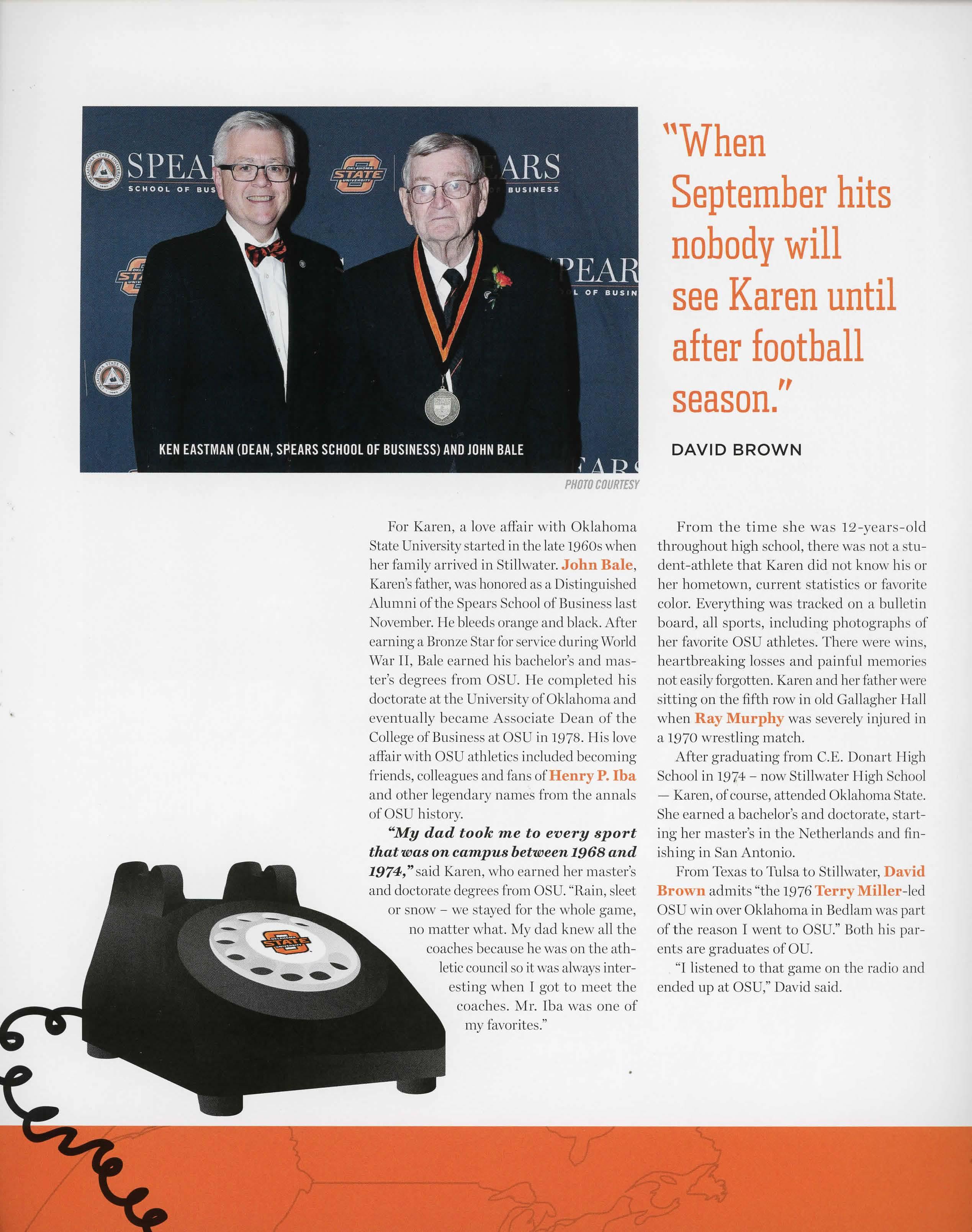
For Karen, a love affair with Oklahoma State University started in the late 1960s when her family arrived in Stillwater. John Bale, Karen's father, was honored as a Distinguished Alumni of the Spears School of Business last November. He bleeds orange and black. After earning a Bronze Stador service during World War II, Bale earned his bachelor's and master's degrees from OSU. He completed his doctorate at the University of Oklahoma and eventually became Associate Dean of the College of Business at OSU in 1978. His love affair with OSU athletics included becoming friends, colleagues and fans of Henry P. Iba and other legendary names from the annals ofOSU history.
"My dad took me to every sport that was on campus between 1968 and 1974,"said Karen, who earned her master's and doctorate degrees from OSU. "Rain, sleet or snow - we stayed for the whole game, no matter what. My dad knew all the coaches because be was on the athletic council so it was always interesting when I got to meet the coaches. Mr. Iba was one of my favorites."
From the time she was 12-years-old throughout high school, there was not a student-athlete that Karen did not know his or her hometown, current statistics or favorite color. Everything was tracked on a bulletin board, all sports, including photographs of her favorite OSU athletes. There were wins, heartbreaking losses and painful memories not ea ily forgotten. Karen and her father were sitting on the fifth row in old Gallagher Hall when Ray Murphy was severely injured in a 1970 wrestling match.
After graduating from C.E. Donart High School in 1974 - now Stillwater High School - Karen, of course, attended Oklahoma State. She earned a bachelor's and doctorate, starting her master's in the Netherlands and finishing in San Antonio.
From Texas to Tulsa to Stillwater, David Brown admits "the 1976 Terry Miller-led OSU win over Oklahoma in Bedlam was part of the reason I went to OSU." Both his parents are graduates of OU.
"I listened to that game on the radio and ended up at OSU," David said.
DAVID BROWN
Brown graduated from OSU in 1978, meeting Karen in the process. The two were married and have followed OS U athletics from al I over the globe ever si nee.
David Brown can almost thank a famous wrestlingfamilyfor his 40 years at ConocoPhillips, which led to the globetrotting. After graduating from Oklahoma State, Brown interviewed with and was hired by Ed Wells. Wells is the father oflegendary Oklahoma Sooner Wayne Wells, an NCAA champion and 1972 Olympic gold medalist.
"Actually, wrestling was never really my thing," David said. "I went to a match, didn't really understand the rules and ended up leaving early.
"I still haven't lived that one down."
David's thing is - and has always been - baseball. And why not? The year be graduated, in 1978, a coach named Gary Ward succeeded Chet Bryan at OSU and bu iIt one oftbe country's best college baseball programs. Old University Park, where Karen sat with her father for so many games, was replaced by Allie P. Reynolds Stadium and the 1980s produced plenty of memories.
"Pete Incaviglia ... you don't have to say much," David said.
Sitting in the Lewis Field bleachers or courtside in Gallagher Hall became a little more difficult as time passed .Just getting scores wasn't as easy as picking up the morning newspaper or flipping on the evening news when your home addresses include Denver, Houston, the Netherlands, Nigeria and finally, Alaska.
PHOTOCOURTESY
John Bale always provided the necessary link to Stillwater.
"When we lived in the Netherlands, my dad would send us VHS tapes of any events that were televised," Karen said. "We did the same thing for Dave when we were in the states, and he had to be out of the country for a long ti me. Those VHS tapes were great. We wou Id watch them over and over.
"Dad also sent us all the correspondence he received from OSU. ConocoPhillips has mail pouches for people who are overseas so it was free to ship things to us and to David when he was overseas. We loved it when the COP mail pouches came in." 8
Long before the Internet there were weekly editions of the Stillwater NewsPress and Daily Oklahoman arriving in the mail. Before the days of clicking a computer link to watch your favorite school, there was local radio. Youthink Stillwater's KSPI-FM 93.7 only reaches Will Rogers Airport in Oklahoma City, just past Lake Keystone to the east or the southern edges ofWichita? Guess again.
"One of the funny things we used to do was listen to the games over the telephone, especially in Houston and when we lived in Denver in the 1980s," Karen remembers. "(Dad) would turn on KSPI and put it by the telephone, and we would listen to the game over the telephone."
If their Cowboys were playing against the Kansas State Wildcats or Kansas Jaybawks, Karen, with a few in tow, would drive on 1-70 toward Kansas and try to pick up a network affiliate of one of the Kansas schools. Once in range, the car full of Cowboy fans would simply pull over and have a listen.
While living in Houston, neighbors thought them "unique" because they would take the radio, popcorn, soft drinks and some lawn chairs and sit behind the house where they could get the best reception under a particular set of power lines.
"There was this family sitting under the power Iines, rotating the radio antennae to get the best reception we could," Karen said. "We just did whatever we had to do to follow OSU."
The next generation is equally enthusiastic - and of course more technologically advanced.
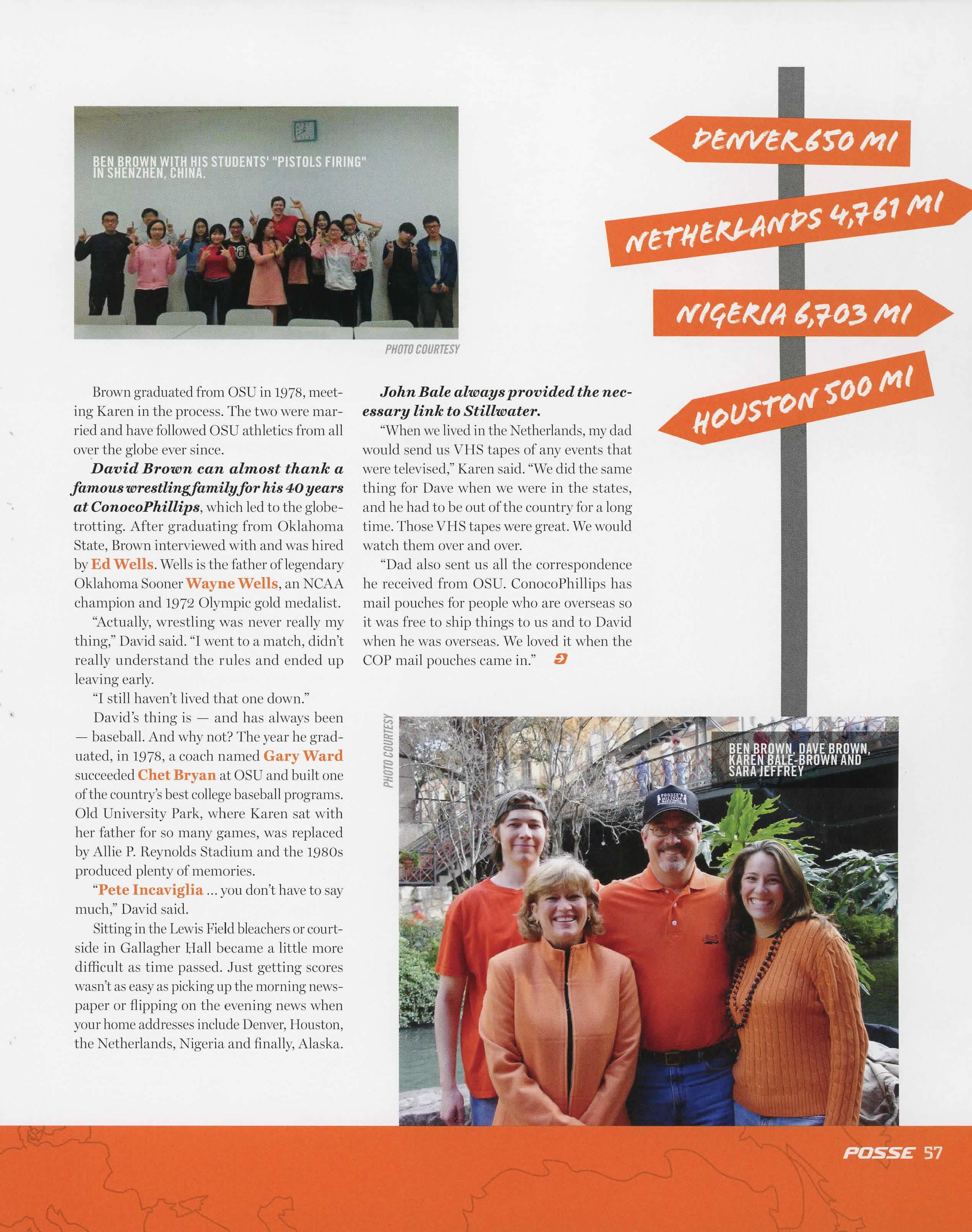
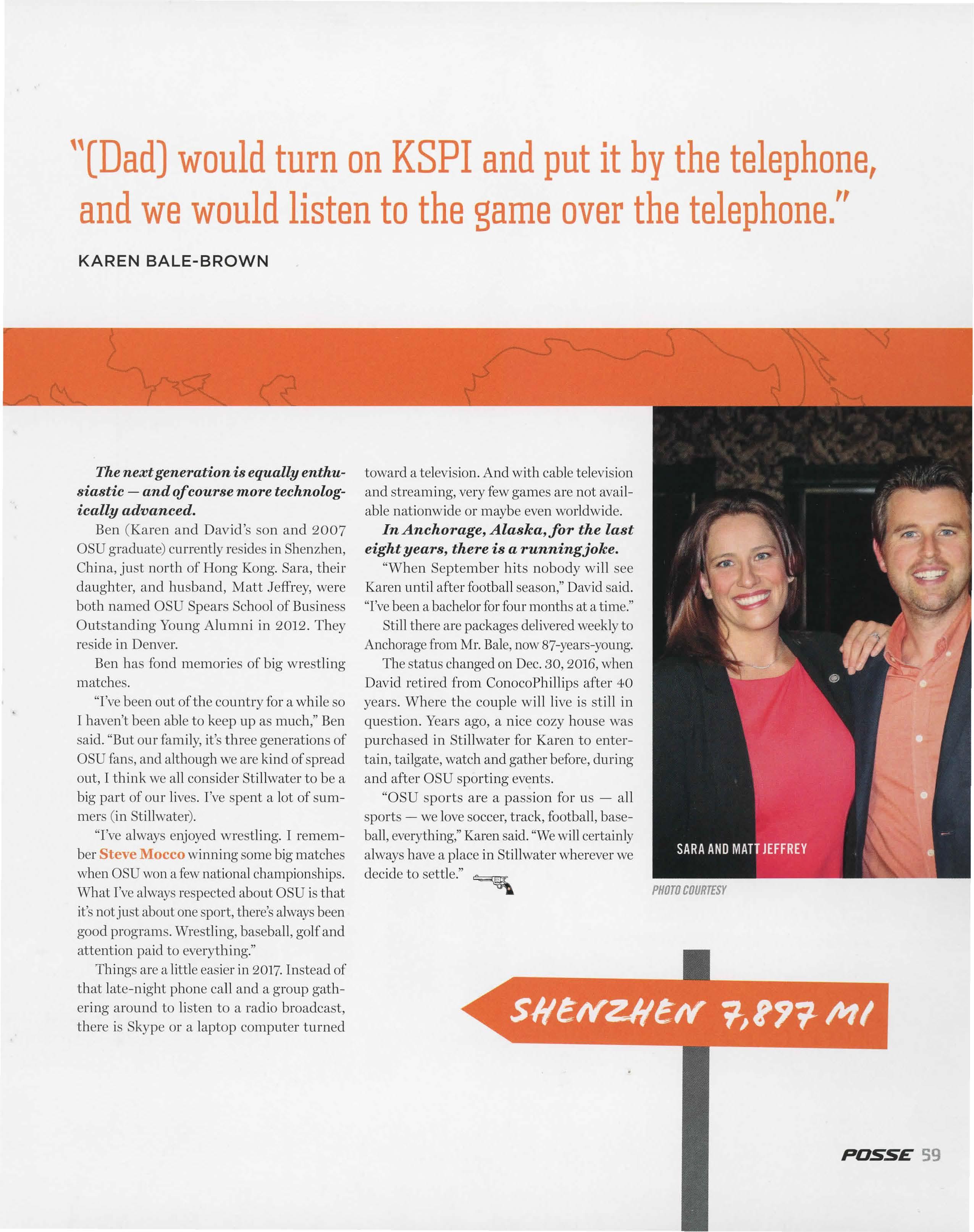
Ben (Karen and David's son and 2007 OSU graduate) currently resides in Shenzhen, China, just north of Hong Kong. Sara, their daughter, and husband, Matt Jeffrey, were both named OSU Spears School of Business Outstanding Young Alumni in 2012. They reside in Denver.
Ben has fond memories of big wrestling matches.
"I've been out of the country for a while so I haven't been able to keep up as much," Ben said. "But our family, it's three generations of OSU fans, and although we are kind of spread out, I think we all consider Stillwater to be a big part of our lives. I've spent a lot of summers (in Stillwater).
''I've always enjoyed wrestling. I remember Steve Mocco winning some big matches when OSU won a few national championships. What I've always respected about OSU is that it's not just about one sport, there's alwaysbeen good programs. Wrestling, baseball, golf and attention paid to everything."
Things are a little easier in 2017. Instead of that late-night phone call and a group gathering around to listen to a radio broadcast, there is Skype or a laptop computer turned
toward a television. And with cable television and streaming, very few games are not available nationwide or maybe even worldwide.
In Anchorage, Alaska,for the last eight years, there is a runningjoke.
"When September hits nobody will see Karen until after football season," David said. "I'vebeen a bachelor for four months at a time."
Still there are packages delivered weekly to Anchorage from Mr. Bale, now 87-years-young.
The status changed on Dec. 30, 2016, when David retired from ConocoPhillips after 40 years. Where the couple will live is still in question. Years ago, a nice cozy house was purchased in Stillwater for Karen to entertain, tailgate, watch and gather before, during and after OSU sporting events.
"OSU sports are a passion for us - all sports - we love soccer, track, football, baseball, everything," Karen said. "We will certainly always have a place in Stillwater wherever we decide to settle."
PHOTOCOURTESY
• LOWEST ENTRY FEE AVAILABLE
• UPGRADES OR MOVE ALLOWANCE
• INCENTIVES FOR OCCUPANCY
m 1Ul know 1-1 tf your lutolth changes ou 'I /J ol,le to get core at EpworlA Villa u Ill ~e Rane/, '8 complete.
• PERSONALIZATION OF APARTMENT (RESIDENCE/COTTAGE}
• 100% SATISFACTION GUARANTEE FOR ONE YEAR
NEW FOR 2016-17: DUES NO LONGER REQUIRED!
• Open to all former OSU student-athletes
• Member discounts on Cowboy Football S Basketball tickets
• Option to purchase an 0-Club Activity Card for $50 (card allows entry to Olympic-sport home events]
• Access to an OSU Career Services rep
• Option to order 0-Club ring
• Ability to purchase exclusive 0-Club merchandise
• Invitations to 0-Club reunions S events
Farmare info, contact KeeganDavis,Director of the 0-Club:L/05-71./LI-L/201 I aclub@asugiving.com
akstate.cam/aclub
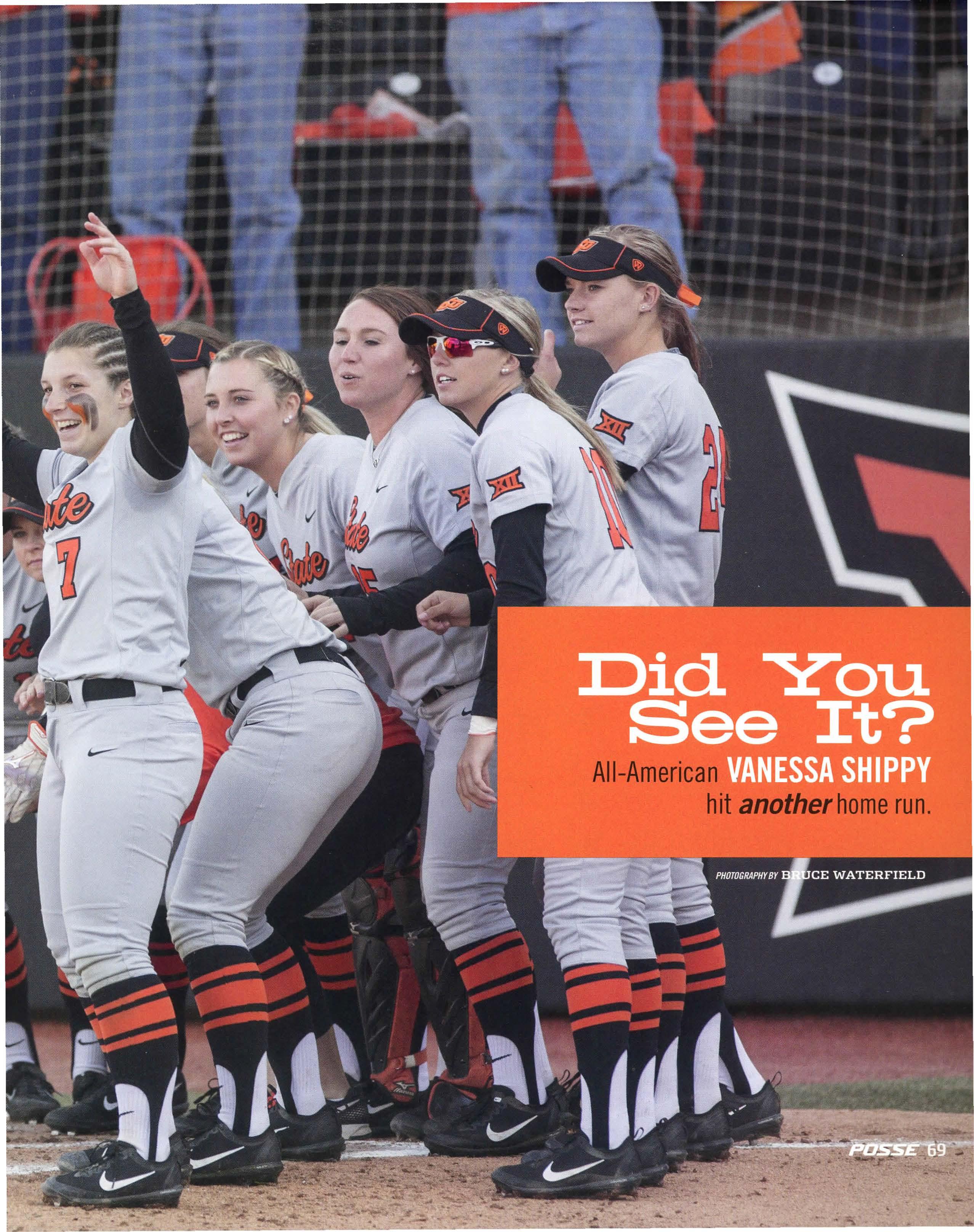
All-American hit anotherhomerun.
When OSU announced its i..i,,;,.1.1.1i,;,o=,i;..i~
,A,A;-i(I the athletic program was last in the Big 12. Now, more than halfway through the 10-year program, •
But wa•ra not Hniahed yet.
at a cost of $4.S million. Each dollar freed up through endowed scholarships goes back into our
i..:.&:11.&l.:IJIA:.t.:.III' n:' l:.u.'1.11Each dollar has a direct impact on the lives of our student-athletes. says Mike
Holder, Vice President for Athletic Programs and Director of Intercollegiate Athletics.
This is the list of all the rn· S·n~~n:mi:;Ji:!li:Jiu::;j:;:l;;:;~ who have helped to provide, u...11.J...1..a.·:11They are our .......................,_ ...
To learn more about scholarship opportunities and how you may contribute, PLEASECONTACT
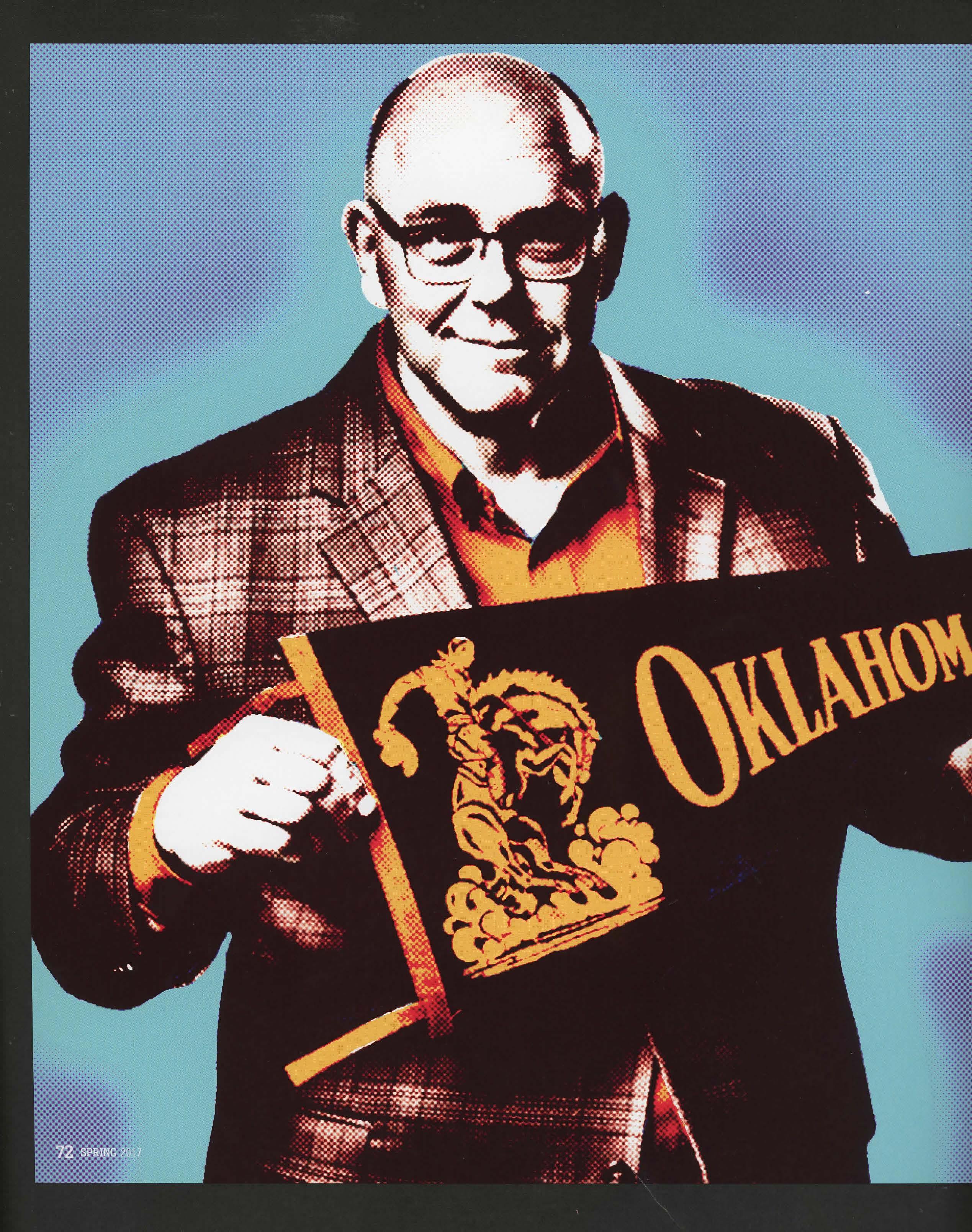
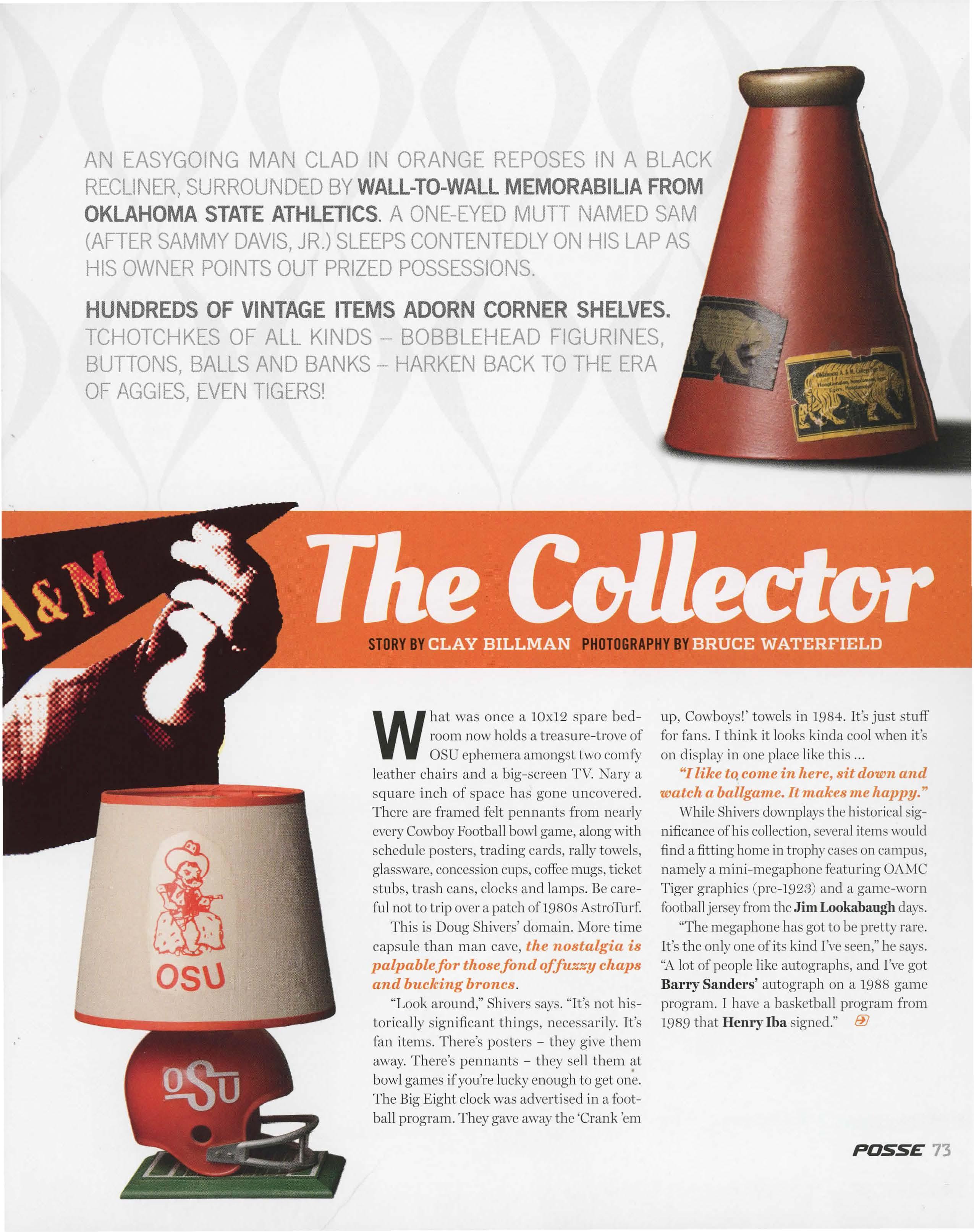
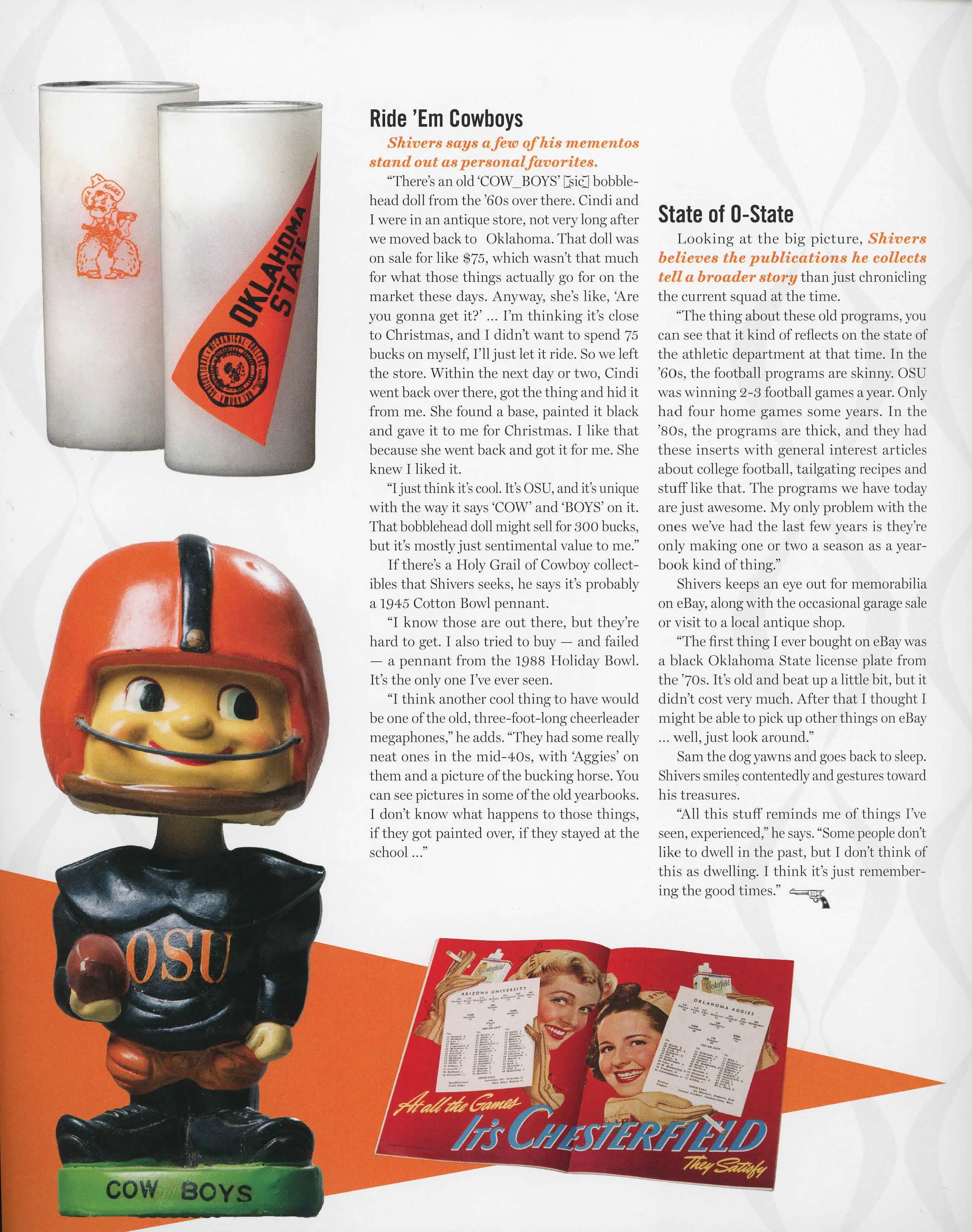
AN EASYGOINGMAN CLAD IN ORANGEREPOSESIN A BLACK RECLINER,SURROUNDEDBYWALL-TO-WALLMEMORABILIAFROM OKLAHOMASTATEATHLETICS. A ONE-EYEDMUTT NAMEDSAM (AFTERSAMMYDAVIS,JR.)SLEEPSCONTENTEDLYON HISLAPAS HISOWNERPOINTSOUT PRIZEDPOSSESSIONS. HUNDREDSOF VINTAGEITEMSADORNCORNERSHELVES. TCHOTCHKESOF ALL KINDS - BOBBLEHEADFIGURINES, BUTTONS,BALLSAND BANKS- HARKENBACKTO THE ERA OFAGGIES,EVENTIGERS!
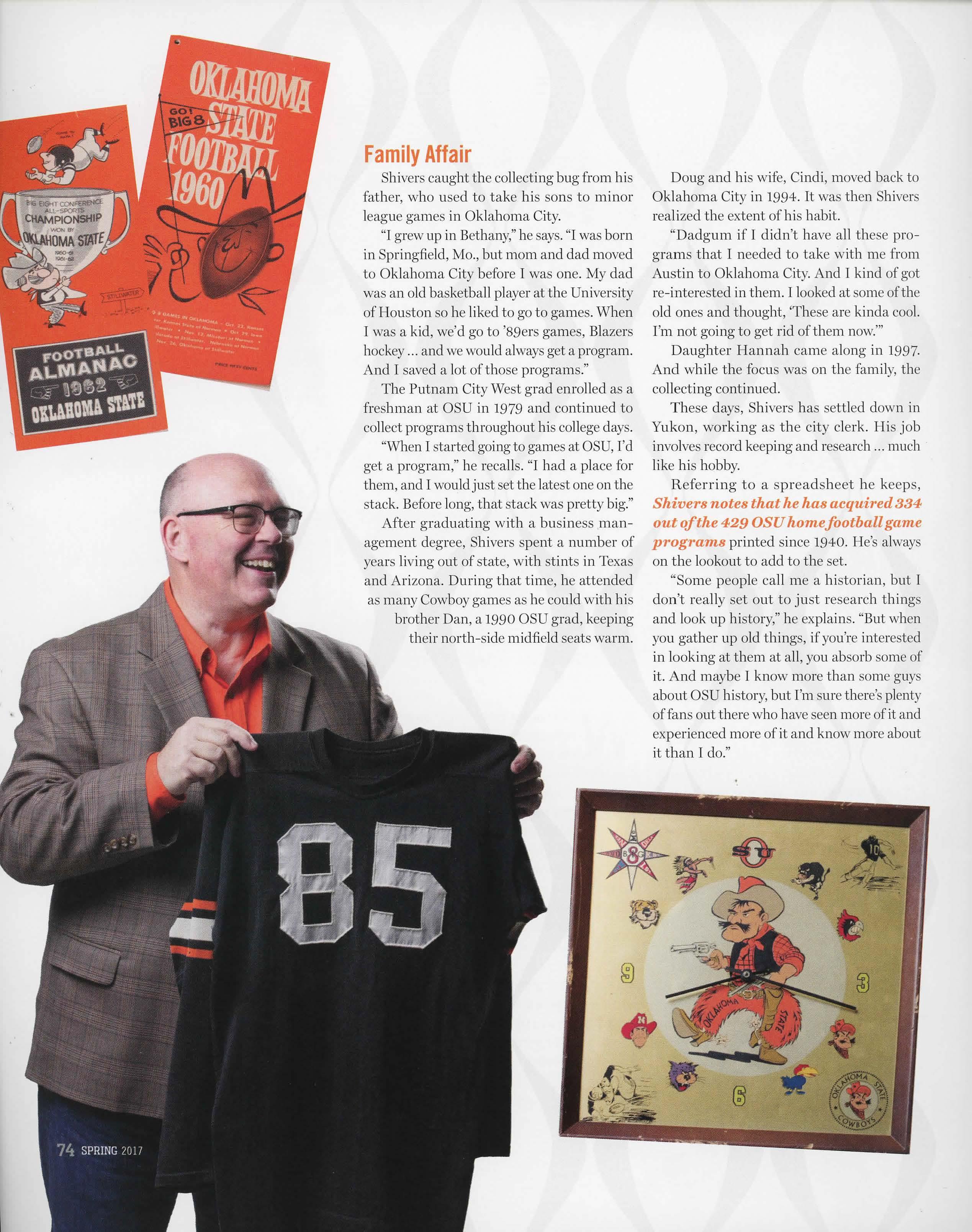
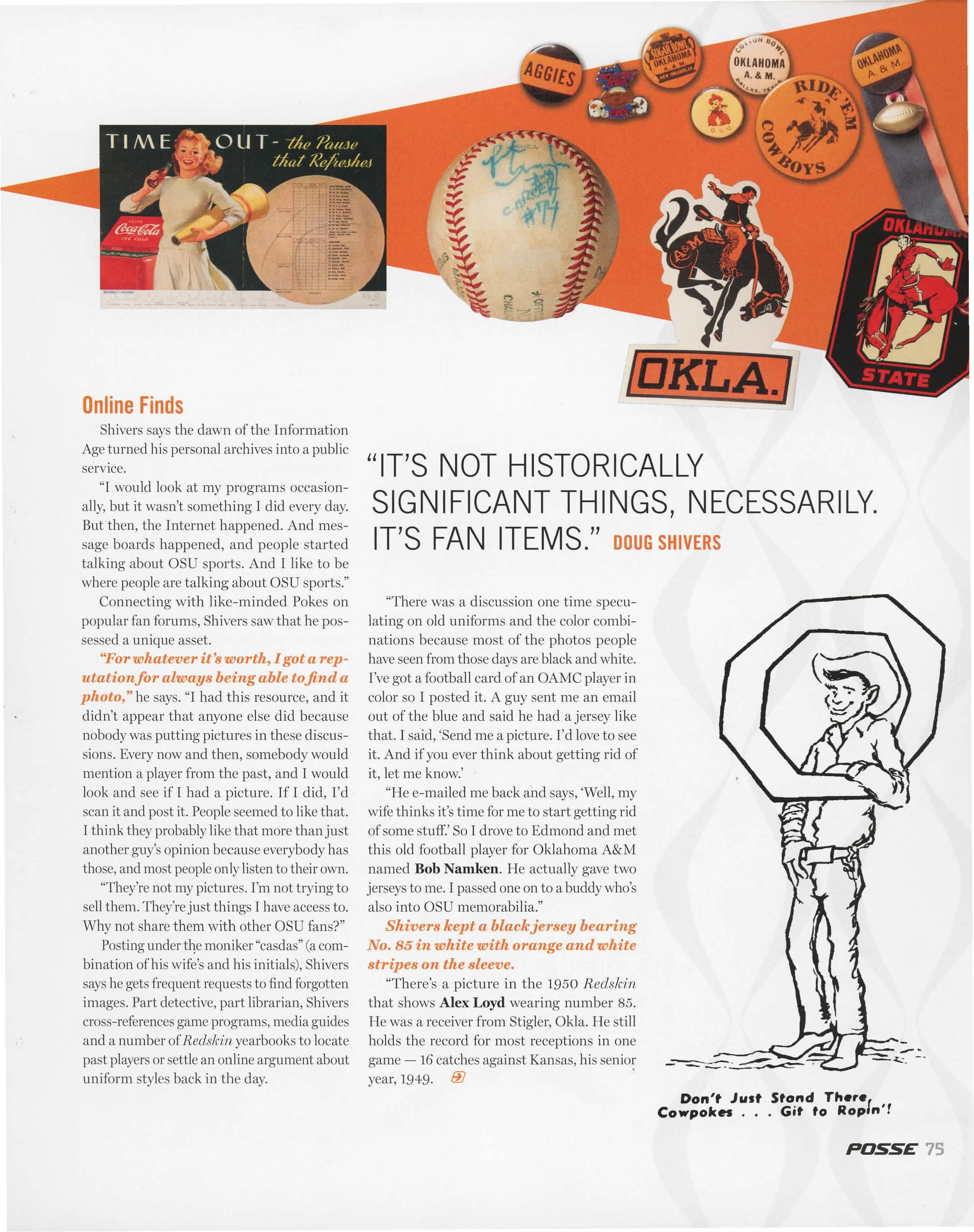
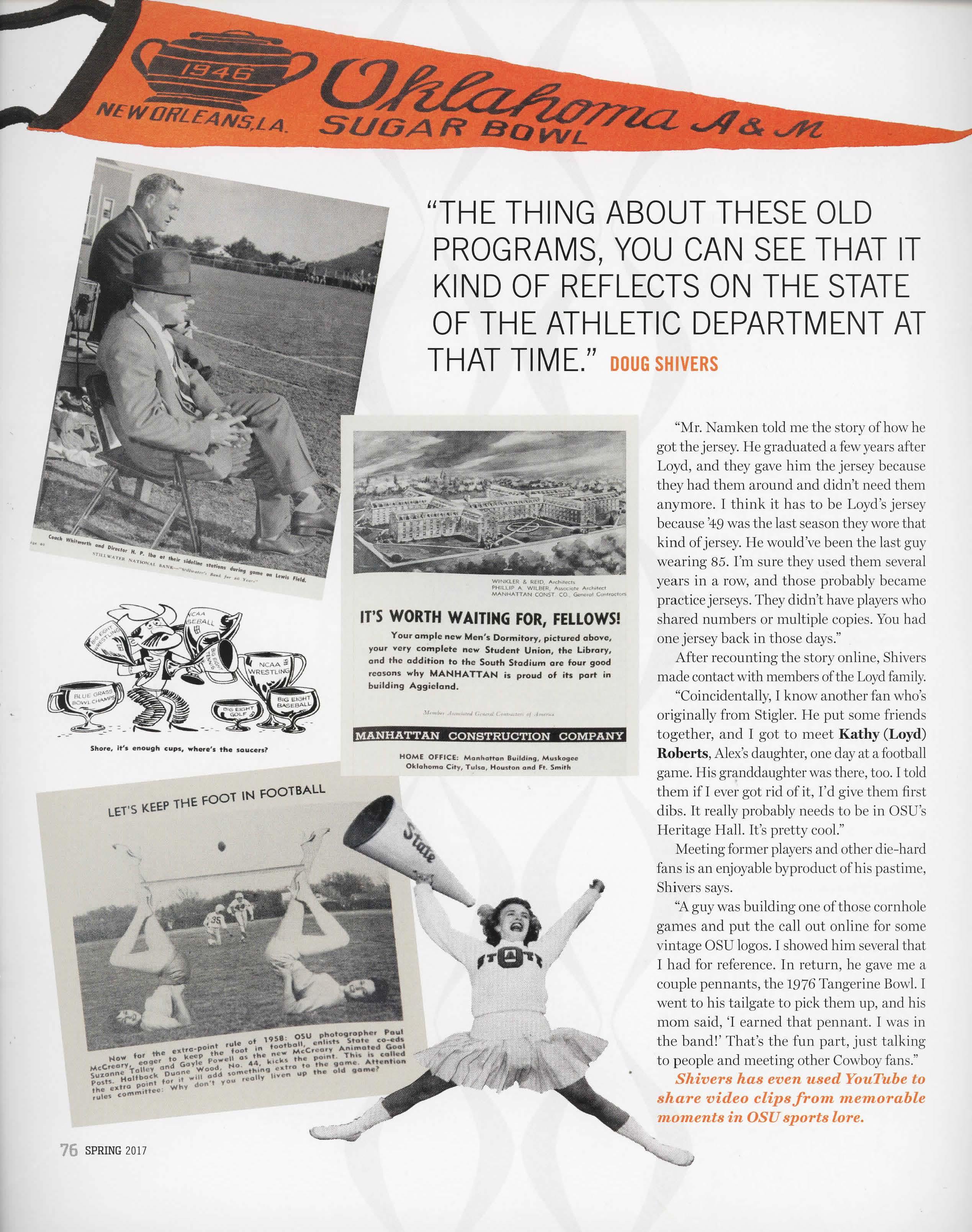
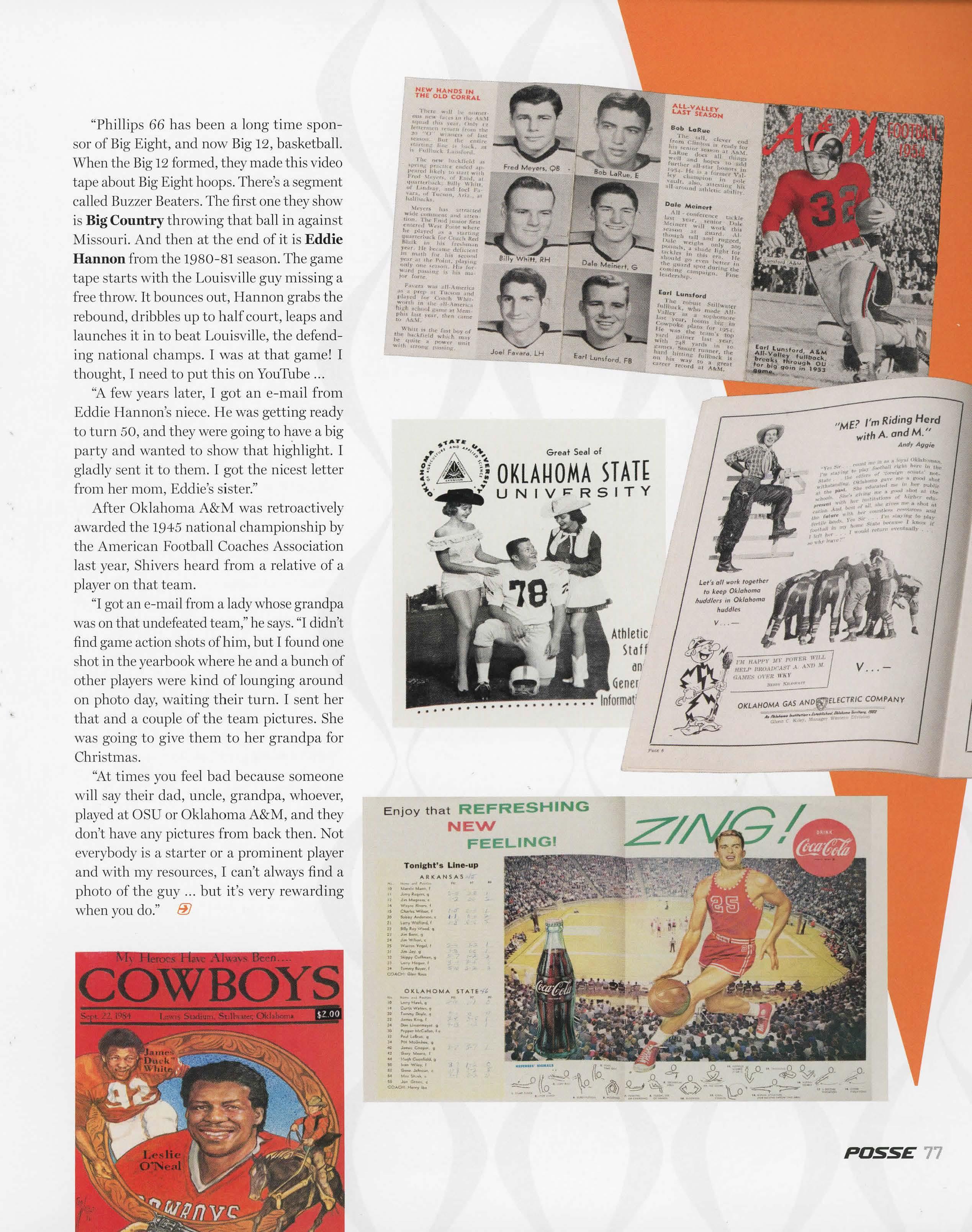
What was once a 10xl2 spare bedroom now holds a treasure-trove of OSU ephemera amongst two comfy leather chairs and a big-screen TV. Nary a square inch of space has gone uncovered. There are framed felt pennants from nearly every Cowboy Football bowl game, along with schedule posters, trading cards, rally towels, glassware, concession cups, coffee mugs, ticket stubs, trash cans, clocks and lamps. Be careful notto trip over a patch ofl980s AstroTurf.
This is Doug Shivers' domain. More time capsule than man cave, the nostalgia is palpable for those fond offuzzy chaps and bucking broncs.
"Look around," Shivers says. "It's not historically significant things, necessarily. It's fan items. There's posters - they give them away. There's pennants - they sell them ~t bowl games if you're lucky enough to get one. The Big Eight clock was advertised in a football program. They gave away the 'Crank 'em
up, Cowboys!' towels in 1984. It's just stuff for fans. I think it looks kinda cool when it's on display in one place like this
"I like tQ come in here, sit down and watch a ballgame. It makes nie happy."
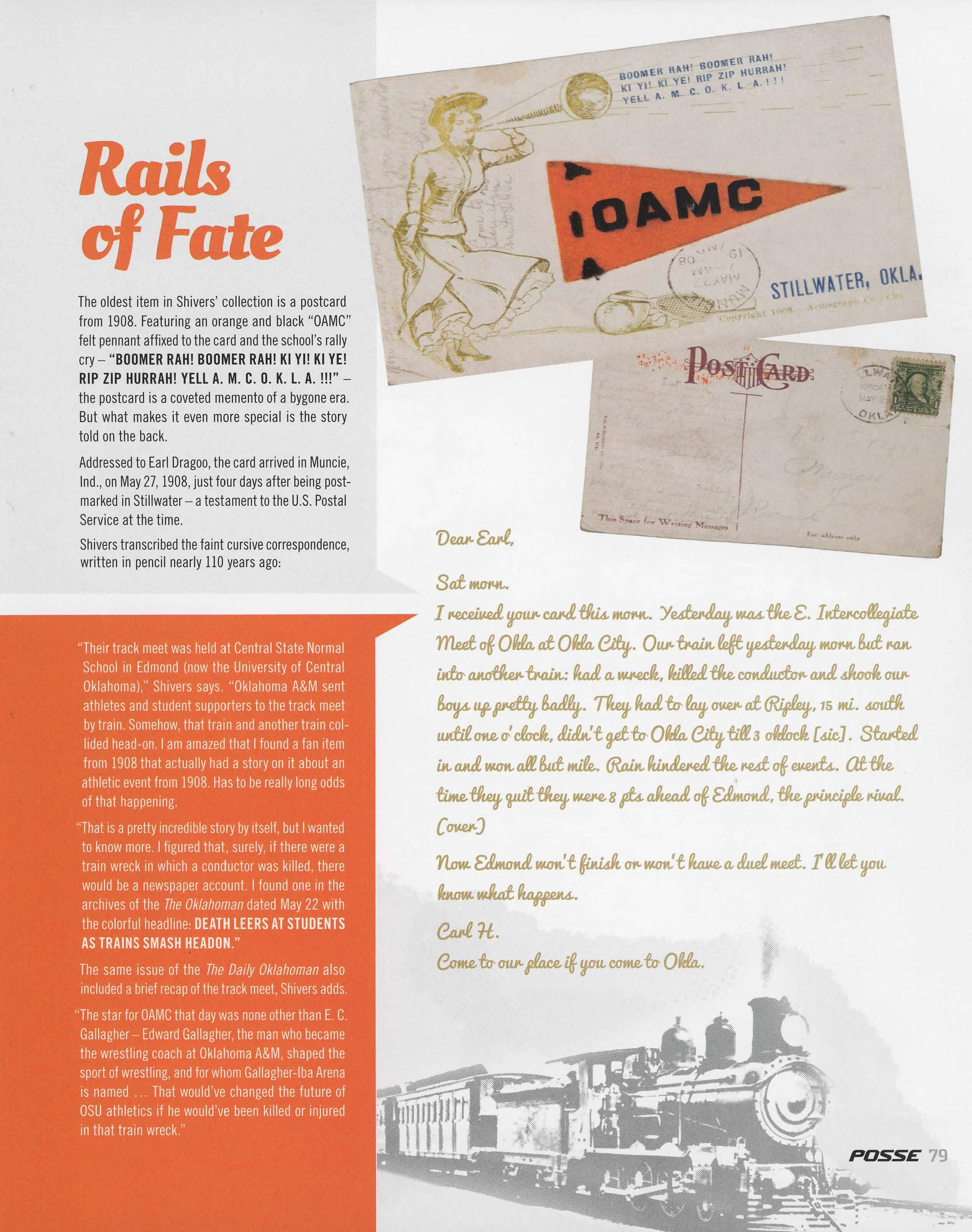
While Shivers downplays the historical significance of his collection, several items would find a fitting home in trophy cases on campus, namely a mini-megaphone featuring OAMC Tiger graphics (pre-1923) and a game-worn football jersey from the Jim Lookabaughdays.
"The megaphone has got to be pretty rare. It's the only one of its kind I've seen," he says. "A lot of people like autographs, and I've got Barry Sanders' autograph on a 1988 game program. I have a basketball program from 1989 that Henry Iba signed." E!J
FamilyAffair
Shivers caught the collecting bug from his father, who used to take his sons to mi nor league games in Oklahoma City.
"J grew up in Bethany,"he says. "I was born in Springfield, Mo., but mom and dad moved to Oklahoma City before I was one. My dad was an old basketball player at the University of Houston so he liked to go to games. When I was a kid, we'd go to '89ers games, Blazers hockey ... and we would always get a program. And I saved a lot of those programs."
The Putnam City West grad enrolled as a freshman at OSU in 1979 and continued to collect programs throughout his college days.
"When I started going to games at OSU, I'd get a program," he recalls. "I had a place for them, and I would just set the latest one on the stack. Before long, that stack was pretty big."
After graduating with a business management degree, Shivers spent a number of years living out of state, with stints in Texas and Arizona. During that time, he attended as many Cowboy games as he could with his brother Dan, a 1990 OSU grad, keeping their north-side midfield seats warm.
Doug and his wife, Cindi, moved back to Oklahoma City in 1994. It was then Shivers realized the extent of his habit.
"Dadgum if I didn't have all these programs that I needed to take with me from Austin to Oklahoma City. And I kind of got re-interested in them. I looked at some of the old ones and thought, 'These are kinda cool. I'm not going to get rid of them now."'
Daughter Hannah came along in 1997. And while the focus was on the family, the collecting continued.
These days, Shivers has settled down in Yukon, working as the city clerk. His job involves record keeping and research much like his hobby.
Referring to a spreadsheet he keeps, Shivers notes that he has acquired 334 out of the 429 OSU home football game prog1·ams printed since 1940. He's always on the lookout to add to the set.
"Some people call me a historian, but I don't really set out to just research things and look up history," he explains. "But when you gather up old things, if you're interested in looking at them at all, you absorb some of it. And maybe I know more than some guys about OSU history, but I'm sure there's plenty of fans out there who have seen more of it and experienced more of it and know more about it than I do."
OnlineFinds
Shivers says the dawn of the Information Age turned his personal archives into a public service.
"I would look at my programs occasionally, but it wasn't something I did every day. But then, the Internet happened. And message boards happened, and people started talking about OSU sports. And I like to be where people are talking about OSU sports."
Connecting with like-minded Pokes on popular fan forums, Shivers saw that he posses ed a unique asset.
"Forwhatever its worth, I got a reputationfor always being able to.find a photo," he says. "I had th is resource, and it didn't appear that anyone else did because nobody was putting pictures in these discussions. Every now and then, somebody would mention a player from the past, and I would look and see if I had a picture. If I did, I'd scan it and post it. People seemed to like that. I think they probably like that more than just another guy's opinion because everybody has those, and most people only listen to their own.
"They're not my pictures. I'm not trying to sell them. They're just things I have access to. Why not share them with other OSU fans?"
Posting undertl~e moniker "casdas" (a combination ofhis wife's and his initials), Shivers says be gets frequent requests to find forgotten images. Part detective, part librarian, Shivers cross-referencesgame programs, media guides and a number of Redskin yearbooks to locate past players or ettle an on 1ine argument about uniform styles back in the day.
"IT'S NOT HISTORICALLY SIGNIFICANTTHINGS, NECESSARILY. IT'S FAN ITEMS."DOUGSHIVERS
"There was a discussion one time speculating on old uniforms and the color combinations because most of the photos people have seen from those days are black and white. I've got a football card of an OAMC player in color so I posted it. A guy sent me an email out of the blue and said he had a jersey 1ike that. I said, 'Send me a picture. I'd love to see it. And if you ever think about getting rid of it, let me know.'
"He e-mailed me back and says, 'Well, my wife thin ks it's ti me for me to start getting rid of some stuff.' So I drove to Edmond and met this old football player for Oklahoma A&M named Bob Namken. He actually gave two jerseys to me. I passed one on to a buddy who's also into OSU memorabilia.''
Shivers kept a black jersey bearing No. 85 in white with orange and white stripes on the sleeve.
"There's a picture in the 1950 Reclslcin that shows Alex Loyd wearing number 85. He was a receiver from Stigler, Okla. He still holds the record for most receptions in one game - 16 catches against Kansas, his senior year, 1949. ffJ
"THE THING ABOUT THESEOLD PROGRAMS,YOU CAN SEETHAT IT KIND OF REFLECTSON THE STATE OF THE ATHLETICDEPARTMENTAT THAT TIME." DOUGSHIVERS
"Mr. Namken told me the story of how he got the jersey. He graduated a few years after Loyd, and they gave him the jersey because they had them around and didn't need them anymore. I think it has to be Loyd's jersey because '49 was the last season they wore that kind of jersey. He would've been the last guy wearing 85. I'm sure they used them several years in a row, and those probably became practice jerseys. They didn't have players who shared numbers or multiple copies. You had one jersey back in those days."
After recounting the story online, Shivers made contact with members of the Loydfamily.
"Coincidentally, I know another fan who's originally from Stigler. He put some friends together, and I got to meet Kathy (Loyd) Roberts, Alex'sdaughter, one day at a football game. His granddaughter was there, too. I told them if I ever got rid of it, I'd give them first dibs. It really probably needs to be in OSU's Heritage Hall. It's pretty cool."
Meeting former players and other die-hard fans is an enjoyable byproduct of his pastime, Shivers says.
"A guy was building one of those corn hole game and put the call out on line for some vintage OSU logos. I showed him several that I had for reference. In return, he gave me a couple pennants, the 1976 Tangerine Bowl. I went to his tailgate to pick them up, and his mom said, 'I earned that pennant. I was in the band!' That's the fun part, just talking to people and meeting other Cowboy fans."
Shivers has even used YouTube to share video clipsfrom memorable moments in OSU sports lore.
"Phillips 66 has been a long time sponsor of Big Eight, and now Big 12, basketball. When the Big 12 formed, they made this video tape about Big Eight hoops. There's a segment called Buzzer Beaters. The first one they show is Big Country th rowing that ball in against Missouri. And then at the end of it is Eddie Hannon from the 1980-81 season. The game tape starts with the Louisville guy missing a free throw. It bounces out, Hannon grabs the rebound, dribbles up to half court, leaps and launches it in to beat Louisville, the defending national champs. I was at that game! I thought, I need to put this on YouTube ...
"A few years later, I got an e-mail from Eddie Hannon's niece. He was getting ready to turn 50, and they were going to h_avea big party and wanted to show that highlight. I gladly sent it to them. I got the nicest letter from her mom, Eddie's sister."
After Oklahoma A&M was retroactively awarded the 1945 national championship by the American Football Coaches Association last year, Shivers heard from a relative of a player on that team.
"I got an e-mail from a lady whose grandpa was on that undefeated team,"he says. "I didn't find game action shots of him, but I found one shot in the yearbook where he and a bunch of other players were kind of lounging around on photo day, waiting their turn. I sent her that and a couple of the team pictures. She was going to give them to her grandpa for Christmas.
"At times you feel bad because someone will say their dad, uncle, grandpa, whoever, played at OSU or Oklahoma A&M, and they don't have any pictures from back then. Not everybody is a starter or a prominent player and with my resources, I can't always find a photo of the guy ... but it's very rewarding when you do." &7
"ME7 I'm Riding H~,rd with A. and M. Andy A9gio
Ride'EmCowboys
Shivers says a few of his mementos stand out as personalfavorites.
"There's an old 'COW_BOYS' [sic] bobblehead doll from the '60s over there. Cindi and I were in an antique store, not very long after we moved back to Oklahoma. That doll was on sale for like $75, which wasn't that much for what those things actually go for on the market these days. Anyway, she's like, 'Are you gonna get it?' ... I'm thinking it's close to Christmas, and I didn't want to spend 75 bucks on myself; I'll just let it ride. So we left the store. Within the next day or two, Cindi went back over there, got the thing and hid it from me. She found a base, painted it black and gave it to me for Christmas. I like that because she went back and got it for me. She knew I liked it.
"I just think it's cool. It's OSU,and it's unique with the way it says 'COW' and 'BOYS' on it. That bobblehead doll might sell for 300 bucks, but it's mostly just sentimental value to me."
If there's a Holy Grail of Cowboy collectibles that Shivers seeks, he says it's probably a 1945 Cotton Bowl pennant.
"I know those are out there, but they're hard to get. I also tried to buy - and failed - a pennant from the 1988 Holiday Bowl. It's the only one I've ever seen.
"I think another cool thing to have would be one of the old, three-foot-long cheerleader megaphones," he adds. "They had some really neat ones in the mid-40s, with 'Aggies' on them and a picture of the bucking horse. You can see pictures in some of the old yearbooks. I don't know what happens to those things, if they got painted over, if they stayed at the school "
Stateof0-State
Looking at the big picture, Shive1·s believes the publications he collects tell a broader story than just chronicling the current squad at the time.
"The thing about these old programs, you can see that it kind of reflects on the state of the athletic department at that time. In the '60s, the football programs are skinny. OSU was winning 2-3 football games a year. Only had four home games some years. In the 'sos, the programs are thick, and they had these inserts with general interest articles about college football, tailgating recipes and stuff like that. The programs we have today are just awesome. My only problem with the ones we've had the last few years is they're only making one or two a season as a yearbook kind of thing."
Shivers keeps an eye out for memorabilia on eBay,along with the occasional garage sale or visit to a local antique shop.
"The first thing I ever bought on eBay was a black Oklahoma State license plate from the '70s. It's old and beat up a little bit, but it didn't cost very much. After that I thought I might be able to pick up other things on eBay ... well, just look around."
Sam the dog yawns and goes back to sleep. Shivers smiles contentedly and gestures toward his treasures.
"All this stuff reminds me of things I've seen, experienced,"he says. "Some people don't like to dwell in the past, but I don't think of this as dwelling. I think it's just remembering the good times."
Rai& offate
Theoldestitemin Shivers'collectionis a postcard from1908.Featuringan orangeandblack"OAMC" felt pennantaffixedtothecardandtheschool'srally cry- "BOOMERRAH!BOOMERRAH!KlYI!KlYE! RIPZIPHURRAH!YELLA. M. C. 0. K. L.A. !!!"the postcardis a covetedmementoof a bygoneera. Butwhatmakesit evenmorespecialis the story toldonthe back.
Addressed to EarlDragoo,thecardarrivedin Muncie, Ind.,onMay27,1908,justfourdaysafterbeingpostmarkedin Stillwater - atestamenttotheU.S.Postal Serviceat thetime.
The occupants of the Oklahoma and Texas panhandle, however, were not standing. They rushed to save lives. The lives of family and friends. The lives of livestock that meant livelihood. As the flames fed on grassland, fueled by 70-miles-per-hour winds, they raced against the individuals chasing them across the plains. Everything was scorched. It's been a diJficultfew weeks in many of the agricultural-driven regions of our state. Before the smoke and the smell cleared, people leapt into action. Many offered all the resources needed by those who lost so much. For some it was as simple as bottled water and a ham sandwich. For others it was building materials for a barn or for a home that had succumbed to flames. Many families were able to move
their cattle and keep them safe, only to face the reality that feeding them would be virtually impossible. Farmers from all over the country began to load bales of hay. A few in the back of a truck or a several hundred in a semi-trailer. How the fire started was no longer a consideration. The focus became what would be required for recovery.
The scorched grassland in the west, aided by spring rains, is already growing back greener and healthier than ever before. The same can be said for OSU basketball. It will grow.
No lives were lost, but the passions of a fan base flared anew. And that's a good thing! Life can throw a curve ball, as we all can attest. Once one recovers from the initial emotional fallout, a plan has to be developed. How and where the fire started is no longer the consideration, only what is needed in recovery. Fans and supporters from all across the country are loading up to support OSU. It's what we do. It's who we are as a land-grant university. We help people.
GO POKES!
HELPOSU BY BUYINGONLY
When you purchase licensed products, a portion of your purchase price goes to support scholarships and other university programs.
(j Oklahoma State University: Live Orange C'J@OSUGear
@OSUGear
Get information on new retailers, merchandise and promotions.