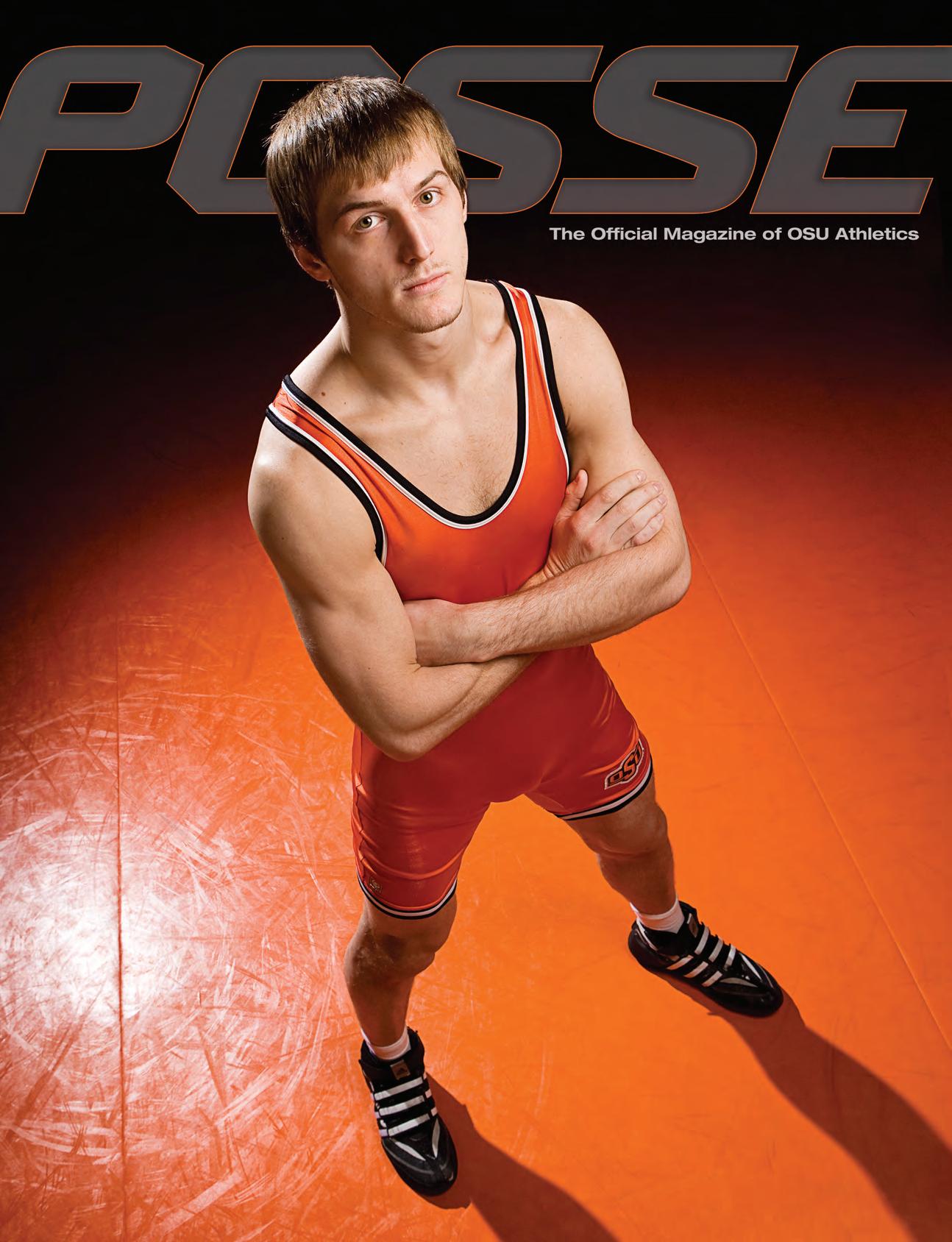


Gelogaev Grapples with
Contrasting Styles
Contrasting Styles






The winter months have been successful for the OSU Athletic department.
John Smith and our wrestlers brought home another Big Twelve title. Our men’s and women’s basketball teams received bids to their respective NCAA Tournaments.
Thanks to all of you, the fans, who attended matches and games. Your enthusiastic support of our student athletes is vital to their success.
Spring is fast approaching with more of our athletes competing and dreaming of championships. Hopefully, you will be able to catch some of the exciting action.
Be sure to put April 17 Spring Game on your calendar. This is your first opportunity to see the high octane offense of Dana Holgorsen. And it’s time to start thinking about season tickets. Be sure to visit www.okstate.com or call 877-ALL-4-OSU to get yours.
Go Pokes.

POSSE DIRECTOR
Jesse Martin
PROGRAMS COORDINATOR/BENEFITS
Mary Lewis
ASSISTANT DEVELOPMENT DIRECTOR
Ellen Ayres
PUBLICATIONS COORDINATOR
Clay Billman
ATHLETIC DEVELOPMENT ASSISTANT
Stephanie Boese
CLUB SEAT COORDINATOR
Matt Grantham
PREMIUM SERVICES
Karyl Henry
PROJECT MANAGER
Shawn Taylor
EVENT COORDINATOR / GAME DAY PARKING MANAGER
Andy Sumrall
DIRECTOR of MARKETING
Kyle Wray
EDITOR-IN-CHIEF
Cory Cheney
ART DIRECTOR|DESIGNER
Kim Butcher
CONTRIBUTING DESIGNER
Austin Hillard
DIRECTOR OF PHOTOGRAPHY
Phil Shockley
CONTRIBUTING PHOTOGRAPHER
Gary Lawson
CONTRIBUTING WRITERS
Clay Billman, Matt Elliott
ADVERTISING: 405.744.7301
EDITORIAL: 405.744.7192
OSU POSSE 102 ATHLETICS CENTER
STILLWATER, OK 74078-5070
P: 405.744.7301 / 877.2B.POSSE F: 405.744.9084
WWW.OKSTATEPOSSE.COM
POSSE@OKSTATE.EDU
The Oklahoma State University Athletic Department would like to thank John Clerico for his vision and dedication to our athletic programs. His generosity has made POSSE magazine possible.


Summer is just around the corner and will be here before you know it. As you know, summer is one of the few times that our student-athletes have enough extra time to hold down a job and make a little extra spending money. While I know most of you are familiar with the restrictions that go along with employing our studentathletes, I thought this would be a good time to cover them again.
First, a student-athlete cannot be hired simply based on their athletic ability or reputation. They must posses the same skill-set as other similarly situated employees within your organization. Second, student-athletes can only be compensated for work they actually perform. Gone are the days of student-athletes showing up for work just long enough to clock-in and having friends clock them out at the end of the day. Finally, student-athletes must be paid the going rate for the job they are performing. They are not allowed to be paid extra just because their notoriety may help attract extra consumers to you business.
Prior to employment, a student-athlete and his/her employer are required to sign a statement to be kept on file in the OSU Athletic Compliance Office which verifies that both parties understand these guidelines and that you agree to follow them. To obtain a copy of OSU’s student-athlete employment paperwork, or to ask additional questions, please contact the Compliance Office at 405-744-7259. Additional information can also be obtained under the Compliance section of the Athletic Department website (www.okstate.com).
Thank you so much for your support,
Ben Dyson Assistant AD for Compliance

Since 1904 Reliable, Dependable, Predictable.
Thank you for your contributions and support for last year’s POSSE Benefit Auction & Dinner. The auction is the POSSE’s primary fundraising event for the OSU Student-Athlete Scholarship Fund. Many generous businesses and individuals have donated items for the live and silent auctions, and these donations have contributed significantly to the success of this event.
The Oklahoma State University Athletic Department will be hosting the 2010 POSSE Benefit Auction in Gallagher-Iba Arena on Saturday, April 24. Your participation with the auction helps benefit the 467 student-athletes who are pursuing excellence both on and off the playing field. Last year, this fundraising event hosted nearly 700 Cowboy and Cowgirl fans, and raised $395,000 for the Student-Athlete Scholarship Fund.
I personally would like to take this opportunity to ask for your support again, by volunteering to help, donating an item and or purchasing tickets for the 2010 POSSE Benefit Auction & Dinner.
The POSSE has volunteers who serve on Auction Committees working all over the state. Committees are based in Stillwater, Oklahoma City and Tulsa. Volunteer work includes soliciting businesses and individuals for items to be donated for the auction, along with table and individual ticket sales to the event. Setting up the OSU Athletics Center for the event is a massive undertaking and usually begins
several days prior to the event. Numerous volunteers are needed in this area, as well. If you would like to volunteer to serve on one of these committees, please contact the OSU POSSE office at posse@okstate.edu or call 877-2B-POSSE (877-227-6773). We will help you get in touch with someone in your area to coordinate your volunteer efforts.
When it comes to suitable auction items, the sky’s the limit … from condo stays and time shares to landscape design and guttering, hardware and appliances to sports memorabilia and event tickets, gift certificates, home furnishings and more! For items donated the donor will receive: POSSE Priority Points – 3 points per $100 in the total retail value of the item(s) received. The retail value will also apply towards your 2010 POSSE Membership and Benefits (does not apply towards donor seating contributions for specific sports).
Tickets for this unique gathering of fans, coaches, staff and student-athletes are on sale now. Save the date on your calendar and make plans to be in attendance for this special event this spring. This event includes dinner and Silent, Live and Dutch auctions, with all of the proceeds going toward the Student Athlete Scholarship Fund. As always, OSU coaches, staff members, Spirit Squad and Pistol Pete will be in attendance. This popular event will SELL OUT – so act now! Ticket prices for this event are as follows:
$125 Individual Tickets
$1,000 Corporate/ Group Tables Seating for 8
$2,500 Premium Tables
Seating for 10 – includes OSU sports figure at table
$5,000 Premium Tables
Seating for 10 – includes OSU sports figure at table
For more information (including opportunities to volunteer, auction contribution agreement forms, event tickets, help donating an item or donation ideas), visit our online POSSE Auction page: www. okstateposse.com/auction.html. Please do not hesitate to contact us at posse@okstate.edu or call 877-2B-POSSE if you have any additional questions or to arrange for an item pick up.
The POSSE is your Team Behind the Teams!
Sincerely,
Jesse Martin POSSE Director
Oklahoma State Athletics
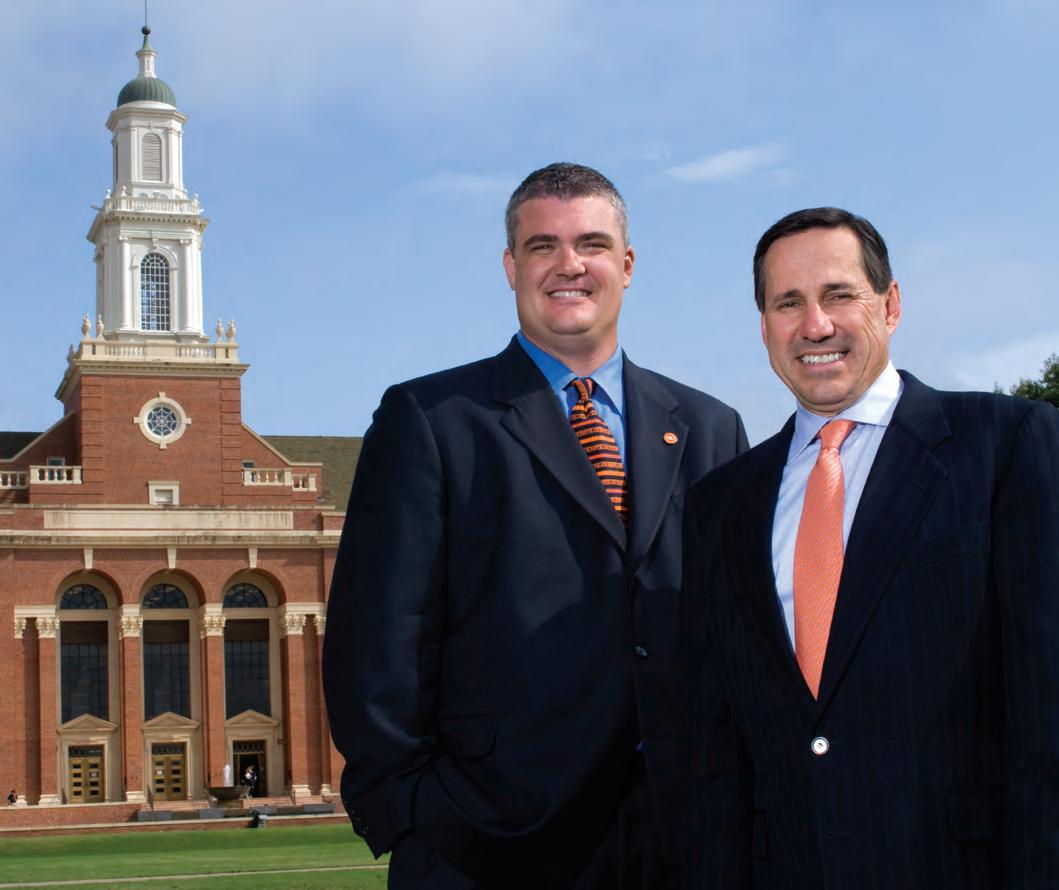
Arvest Bank already has more banking offices in Oklahoma than anyone else, so just about anywhere you live in the state, we’re ready to serve you.
We’ve expanded into Stillwater, home of the Cowboys. And who better to lead our Stillwater expansion than two OSU alumni, Don Gable and Chris Batchelder? Don, Chris and the entire team of Arvest bankers are ready to serve you at either of our new branches — located at 5215 W. 6th and 524 N. Main. Our ATM at 139 S. Knoblock is conveniently located close to the OSU campus.
If you’re ready to switch to Oklahoma’s most convenient bank, stop by your local Arvest Bank today. And if you’re in Stillwater, give Don or Chris a call at 405-385-5801.
by

For Dick Bogert, an allegiance to Oklahoma State was a family tradition. His sister and his brothers all attended. It was a given that he would, too, especially considering all the time he spent in Stillwater while they were attending.
“We all grew up on a farm north of Enid,” says Bogert. “My parents had one little 30-acre field, and the wheat crop was always designated for us to go to college.
“My oldest brother, Frank, whose picture is on the wall up there big in Gallagher-Iba, was an all-state basketball player in 1939 at Enid High School. I can still remember one Sunday dinner where Mr. Iba came to the farm to recruit Frank. I was probably six or seven years old, but you never forget that guy.”
Frank ended up playing basketball for Iba, and the rest of the siblings followed him to Stillwater.
“It was a foregone conclusion,” says Bogert, who would often spend time staying with his brothers in the dorms while they attended school, and even got to sit in on basketball practices.
“I have fond memories of Gallagher Hall,” says Bogert, “because I used to go watch practices. I’ll never forget this one time, on that upper row of seats, I decided I needed to push all the seats up. As I was slamming them along, I heard a roar. It was Mr. Iba. He said, ‘Little Bogert, sit your butt down and shut up.’ So I sat down. I finally snuck out and went back to their dorm room in Hanner Hall.”
He also remembers the last game in Gallagher Hall in 1943, which ended up being a sendoff for a lot of the players going to join World War II. His brother Bill would have been a starting guard for the Aggies after the war, but opted instead to finish his degree.
“I came over here in 1951,” Bogert says, “and spent the next five years working on
my degree. The hours I took for ROTC did not count toward my degree, so it took five years to make up for that time. I was commissioned at the end of four years, and then finished my last year of college.
“We had mandatory ROTC,” he says. “You had regular drills once a month. We formed up where the parking lot is now on the east side of the stadium. We’d march in review, and they had the Air Force, Army and some Navy.” Bogert went ahead and took advanced ROTC because it paid an additional $30 a month.
It was during his five-year stint in Stillwater that Bogert met his future wife, Barbara.
“The deal on Saturday evening, if you didn’t have anything to do, was to get on the phone,” says Bogert. “From the Beta house, we’d call Stout Hall. Anyway, I recognized her name because she was from Enid, and I asked her to go get a Coke.”
The rest, as they say, is history. They’ve been together ever since.
Bogert majored in Mechanical Engineering with a Petroleum option, completing his degree in 1956. Right out of school, he worked for Champlin Petroleum. In February of 1957, he was called to active duty and spent three years in the Air Force.
“Because I had a petroleum option, they thought I knew something about petroleum, so I was sent to Charleston Air Force Base in South Carolina,” says Bogert. “I was a petroleum supply officer. We stayed there until my three years were up, then we came home.”
Bogert leveraged his experience in the Air Force and his degree from OSU into a lucrative career in the oil industry.
“This university, there’s just something about it,” says Bogert. “It grows on you. The education I got here, I don’t think I could’ve received any place else. I just feel like we owe everything to OSU.”
The Bogerts have always stayed involved with OSU, and have had season basketball tickets since Paul Hansen was coach of the
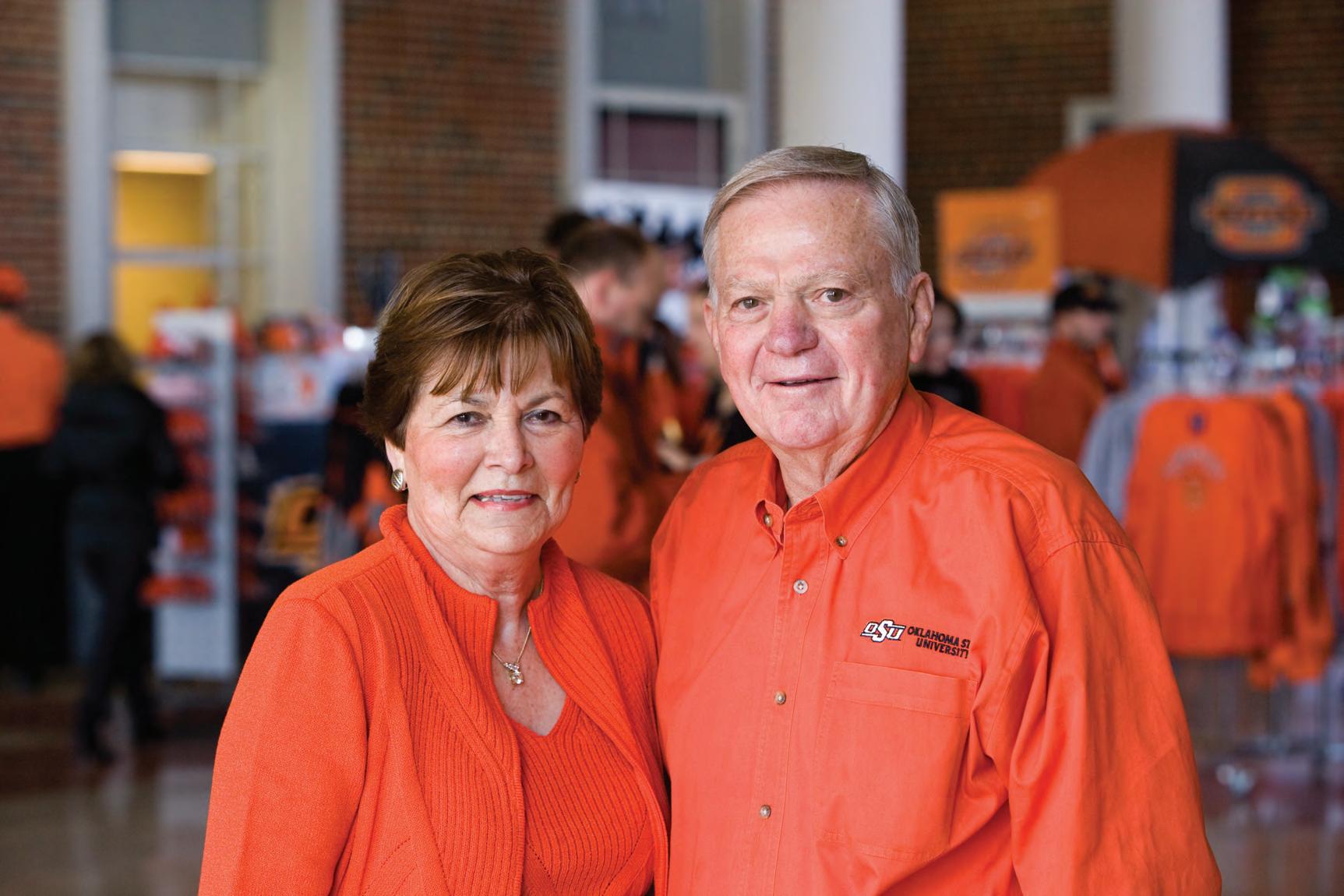
Pokes. They bought the first club seat season tickets on the south side of Boone Pickens Stadium, and rarely miss a game. They’ve contributed in many different ways, including providing summer employment opportunities to OSU football and basketball players.
“At the time Leonard Hamilton was coach of the basketball team, I had a fairly large public oil company,” says Bogert. “We would work all his basketball players, especially the ones that needed help. We’d put them out in the hot sun and make sure they had plenty of food and water.
“When Pat Jones was there, we’d have 10 or 15 football players working. Back then, they had to work. They didn’t have summer programs. In the summers, in our business, we always need a lot of help. A lot of weeds cut and fences fixed.
Pat would say, ‘Have them in shape for me.’ We’d say, ‘Okay, they’ll be in shape.’
“We made sure we never once violated a NCAA rule. Pat wanted to know, ‘How much did they make? I want to know how much money they have.’ He really looked after them. It wasn’t like it is now where they have all the good help and all the scholarships and academic aid. The facilities weren’t the best.”
Bogert says the football players would fashion weights out of the drilling equipment and work out during their breaks. “Those were the only weights they had.”
The Bogerts have also contributed financially to the university and the athletic department for a long time. “Dick and Barbara represent the kind of supporters every university
dreams about,” says Craig Clemons, Assoc. Athletic Director. “They renew season tickets every year, give philanthropic gifts to each campaign, travel to post-season tournaments and bowl games, and attend events like the POSSE Auction which fund scholarships for our student-athletes. The Bogerts have been difference-making donor for decades.”
"There aren't too many O-Staters who can say they have supported OSU more passionately and for a longer period of time than Dick and Barbara Bogert," says Larry Reece, Executive Director of OSU Athletic Development. "Most recently, they joined in to help make the Cowboy and Cowgirl locker room project a reality with yet another major commitment. Oklahoma State has always
been able to count on the Bogerts."
“We started giving to OSU because of need,” says Bogert. “We’ve been donating to athletics since the ’70s when we first began to have a little bit of extra income, and we really wanted the program to always be good. When we had our company, I’d buy 30 season tickets. They just needed the money.
“It’s like what happened at the University of Wisconsin,” he says. “The president thought, ‘If I build a good football team, I’ll have a better university.’ And it did. Having good athletic programs is good public relations for the university at large. If you have a good football team, you generate more interest in the university."


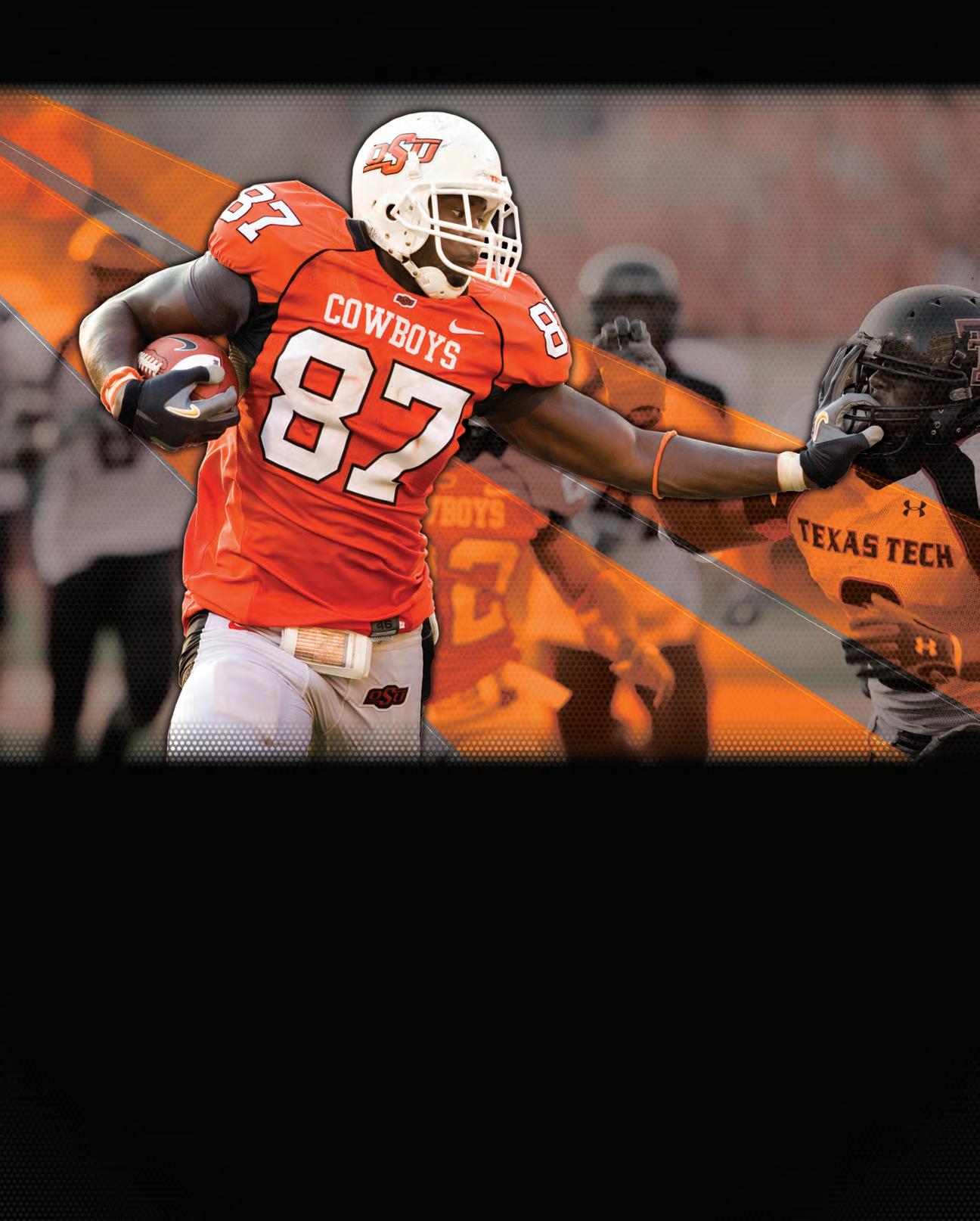
Endowed scholarships are the lifeblood of OSU athletics, allowing coaches to compete for the best athletes in the country. One example is Brandon Pettigrew, the tight end who made OSU proud when he was chosen 20th overall by the Detroit Lions in April’s NFL draft.
But without a scholarship, Pettigrew would not have been a Cowboy. You can help us find our next first-round draft choice by joining the student-athlete scholarship program. OSU’s generous supporters have committed $31 million in our quest to endow 467 scholarships in 18 men’s and women’s sports.
Leave your own legacy by helping us reach our goal of $115 million. Call 877-OSU-ATHL or visit OSUgiving.com/athleticneeds.htm to see how you can help OSU build future champions in the classroom and on the playing field.
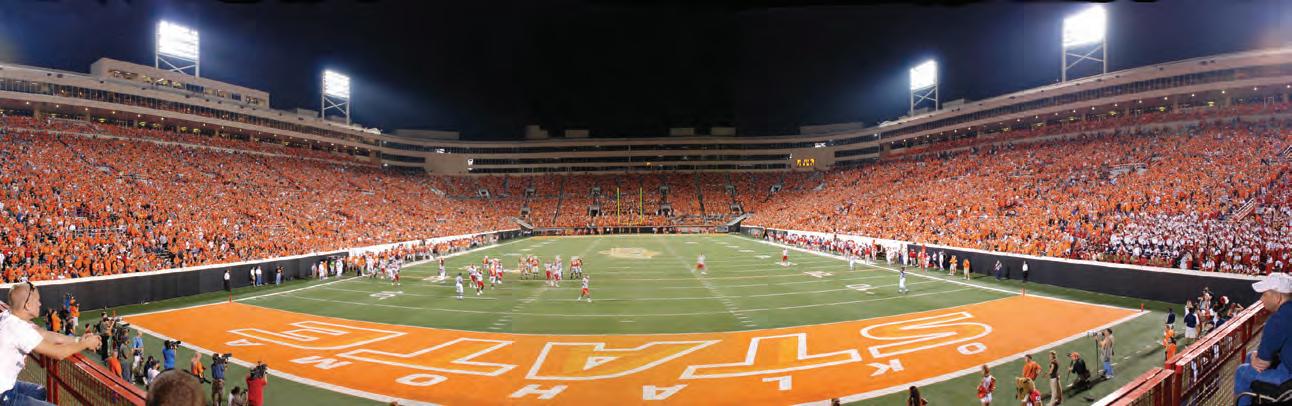





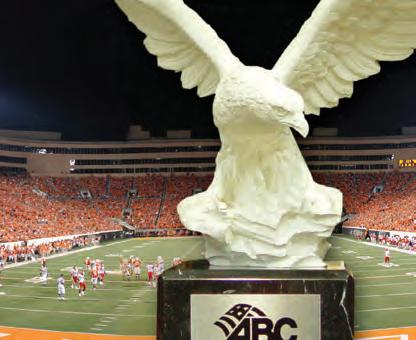




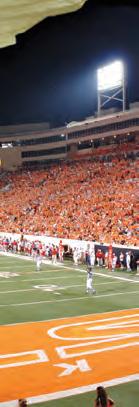



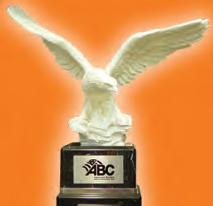
The Boone Pickens Stadium three-peats winning the ABC Excellence in Construction Award for the State of Oklahoma. Flintco thanks the 3,6000 skilled craftsmen who contributed to this prestigious project.







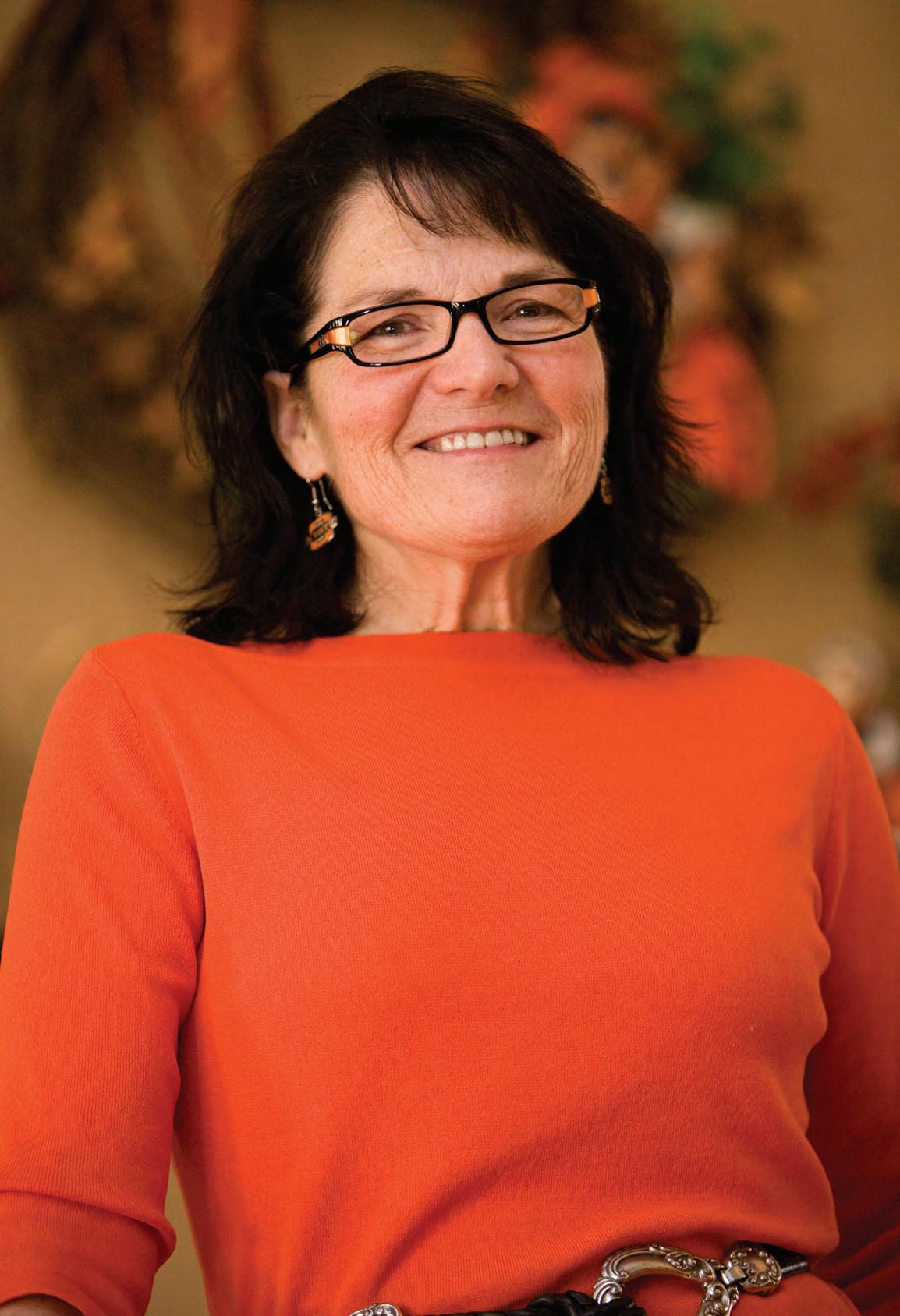
If you ask Jill Rooker, she’ll tell you she’s a “radical” OSU fan.
For one, she has an entire room in her house decorated in OSU regalia. For another, she has season tickets to men’s and women’s basketball, baseball, wrestling and football. She also holds not one, not two, but four degrees from OSU – one bachelor’s degree in radio/TV/film, one in English and journalism education, and a double master’s in library science and audio/visual technology.
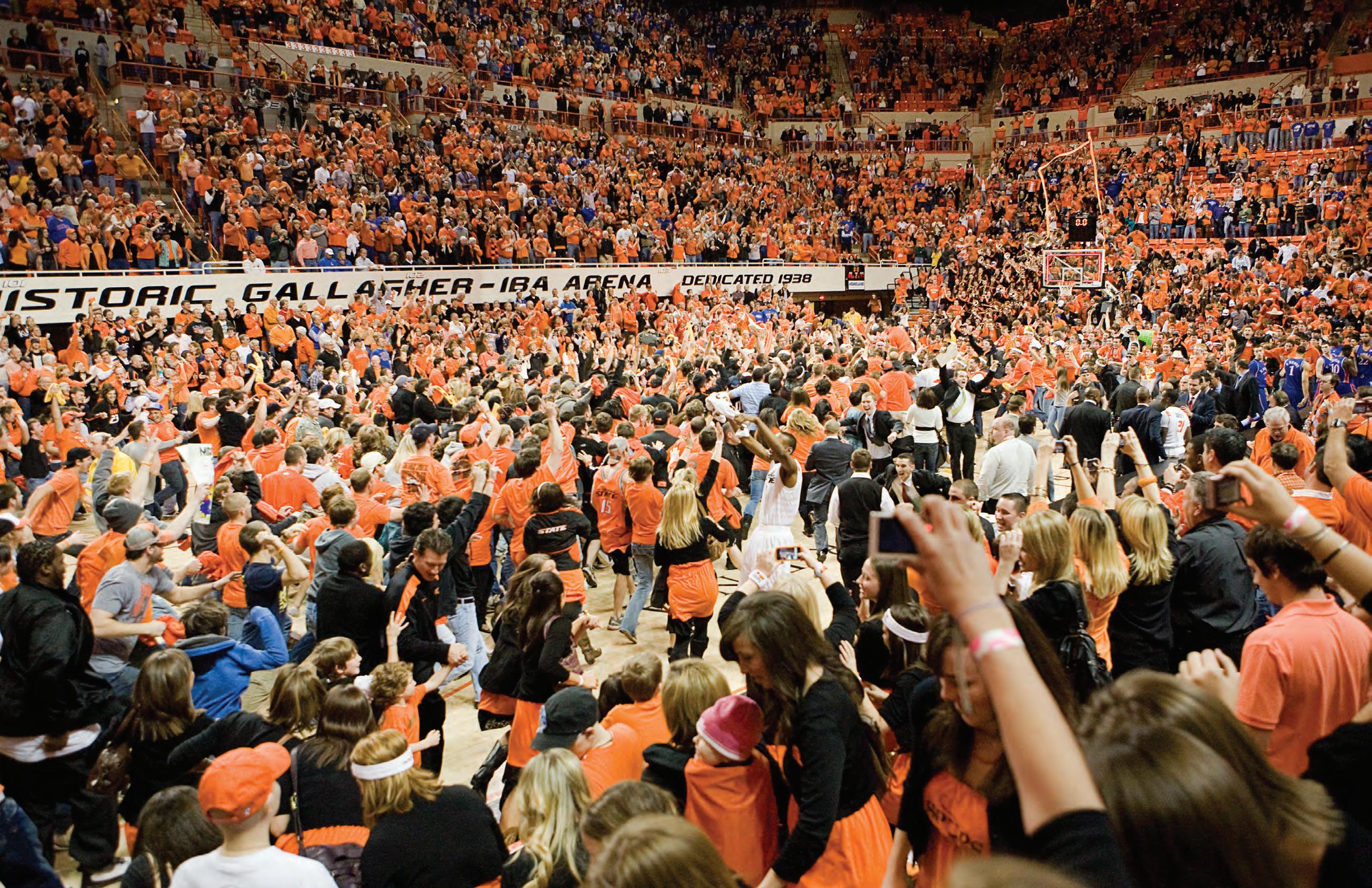
When POSSE caught up to her, she was still basking in the glory of the Pokes’ victory over the No. 1 ranked Kansas Jayhawks.
Her relationship with OSU began early. Both of her parents graduated from OSU (twice, each), and her father was “the biggest OSU fan you’ll ever meet,” she says. “In our family, if you’re not an OSU fan, you’re an outlaw.”
Her father, who attended OSU during the early 1940s, tried out for legendary coach Henry Iba’s basketball team. He would’ve made the team, too, but an opportunity to work for free room and board robbed him of his chance.
“Coach Iba told him, ‘Paul, if you stay out for basketball, you will get a suit. And if we’re way ahead or way behind, you might even get in a game, but you know as well as I do you’re too short and too slow to play much,’” says Rooker. “But he would’ve been on a national championship team had he stayed.”
A love of athletics is another thing Rooker inherited from her father. All of her family played sports. Her brothers played football and baseball, and she and her sisters played basketball.
“We weren’t good enough to play in college,” she says, “but it was always a big deal in her family.”
Rooker got her first degree in Radio, TV and film because she wanted to be a sports announcer.
“But in the ‘70s, the only women in sports were former Miss Americas,” says Rooker. “You didn’t have ESPN. You didn’t have any of those stations yet. I did work in radio for a little while. I was a news and sports director for a radio station. I really loved it. It was probably my favorite job.”
She returned to OSU for a couple of reasons. First, she wanted to become an educator, and second, she missed the town. It would be a recurring theme in her life. She left and returned four times before finally settling back in town for good about six years ago. In between, she taught in Kansas, Pawnee, and finished up her doctorate at Indiana University. She currently works at the University of Central Oklahoma where she’s a professor of instructional media in the College of Education. She’s been there for more than 20 years.
“My goal was always to teach at Oklahoma State,” says Rooker. Though she’s not a professor at OSU, she has taught sections of classes before. She’s also worked as a tutor for OSU student-athletes in the Joe and Connie Mitchell Academic Center.
“A couple years ago, I worked a few semesters as a tutor in the athletic department for Dr. Middlebrook,” she says. “That’s when I got to know some of the athletes in person. I actually realized it’s unbelievable the schedules they have to maintain during the semester their sport is taking place.
“I was astounded. If the baseball players I tutored had a weekend series, they might leave Thursday morning at 4am, depending on where they were going. So they really only got to go to class Monday, Tuesday and Wednesday. They worked very hard to get everything taken care of before they left campus.”
As a career educator, Rooker never really had what she’d describe as “a lot” of money to contribute to OSU, but it didn’t stop her from giving what she could here and there. She always intended to leave money to OSU in her
will but hadn’t gotten around to it. In 2006, she was diagnosed with breast cancer.
“Even though everything has gone well, my treatment has gone well and my tests have been fine, when that kind of thing happens, it makes you start thinking,” she says. “So I thought I’d better go ahead and get my will written up.”
In a bit of serendipity, she attended the Cowgirls’ basketball banquet that fall. There she heard Larry Reece discuss the new endowment program, the Leave a Legacy campaign.
“I had always felt a little guilty, being an educator, about giving more to athletics instead of academics, but I’m such a big sports fan, I always ended up giving more to athletics,” says Rooker. “When Larry talked about this endowment, I thought, ‘that’s me. That’s perfect!’”
She called Reese and met him for lunch, and there they discussed the program. After that, all that was left was the paperwork.
“It is not very often that you get a call from someone saying I want to give but I can tell you I had never received a call from someone saying I want to leave you everything I have,” says Reece. “That is until Jill Rooker and in my book you can’t show much more commitment to the orange than that.”
“I’m personally a fan of all the sports,” she says. “I know football and men’s basketball get a lot of press, so they get more money that way. So I decided to split my money between baseball and women’s basketball. I felt they probably needed my help a little more.
“I set up my endowment, such as it is. I’m no Boone Pickens, but if you’ve been teaching long enough, you eventually have a little set aside. It’s kind of neat for someone who doesn’t have a lot of money to still feel like they can help.”





And it's how we bring you the best in healthcare. Stillwater Medical Center has a team of services and employees committed to providing you with the most advanced healthcare in north central Oklahoma.
Cimarron Medical Services provides a full line of medical equipment. And there's no need to leaveyour house, CMS offers online shopping and fast delivery.
Our dedicated nurses at Home Health Services are ready to provide you with quality and compassionatecare in the comfort of your home. They can even set up Telehealth for daily monitoring.
Medicalfitness and outpatient rehabilitationoffered through Total Health will get you up and running again. Total Health'sfitness programs can leaveyou lighter and leaner,ready to tackle the challengeslife brings your way.
If you need more direct care, our knowledgeablestaff at The Rehab Center can provided you with inpatient rehabilitation.
Stillwater Medical Center offers state-of-the-art cardiology servicesat The Heart Center. You can now get advanced care without leavingtown.
The Dorothy Blackwell Wound Care Clinic staff provides compassionatecare and advanced treatments to help heal chronic wounds. Hyperbaricoxygen therapy,which is used to treat certain types of wounds, is now availableclose to home.
On April 24, POSSE members have the chance to make a difference in the lives of an Oklahoma State University student-athlete, and have a good time doing it.
The POSSE Benefit Auction and Dinner is the single largest fundraiser hosted by the POSSE every year. In 2009, the auction raised more than $395,000. As always, the POSSE hopes that with your help, this year’s total will surpass that of 2009.
The 2010 Honorary Chairman of the POSSE Benefit Auction and Dinner is Bryant “Big Country” Reeves. He follows in the footsteps of Cowboy legends Walt Garrison and Robin Ventura.
Reeves helped lead the Cowboy basketball team to the Final Four in Seattle in 1995, and still holds numerous school records.
Reeves says he’s thrilled to serve as Chairman, and particularly to be
mentioned along with the former Cowboys who’ve served in the position.
“It’s an honor,” he says. “Those are special names, and to be included with those guys, it’s a great honor and privilege. They did a lot for OSU.”
Reeves that working on the Benefit Auction was something he needed to do, in no small part because of the scholarship he received while attending Oklahoma State.
“That scholarship meant everything to me,” he says. “Without it, I probably would not have been able to attend college. It opened many doors for me. Working with the benefit auction is a great way to give back and help a studentathlete. You're helping young people become young adults.
When you attend OSU, you realize it’s a big family, and when you join, you become a part of that family for the rest of your life.”
The Benefit Auction and Dinner is a
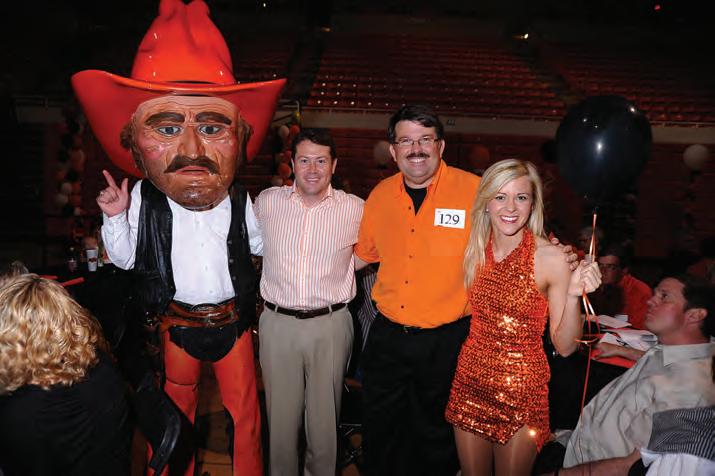
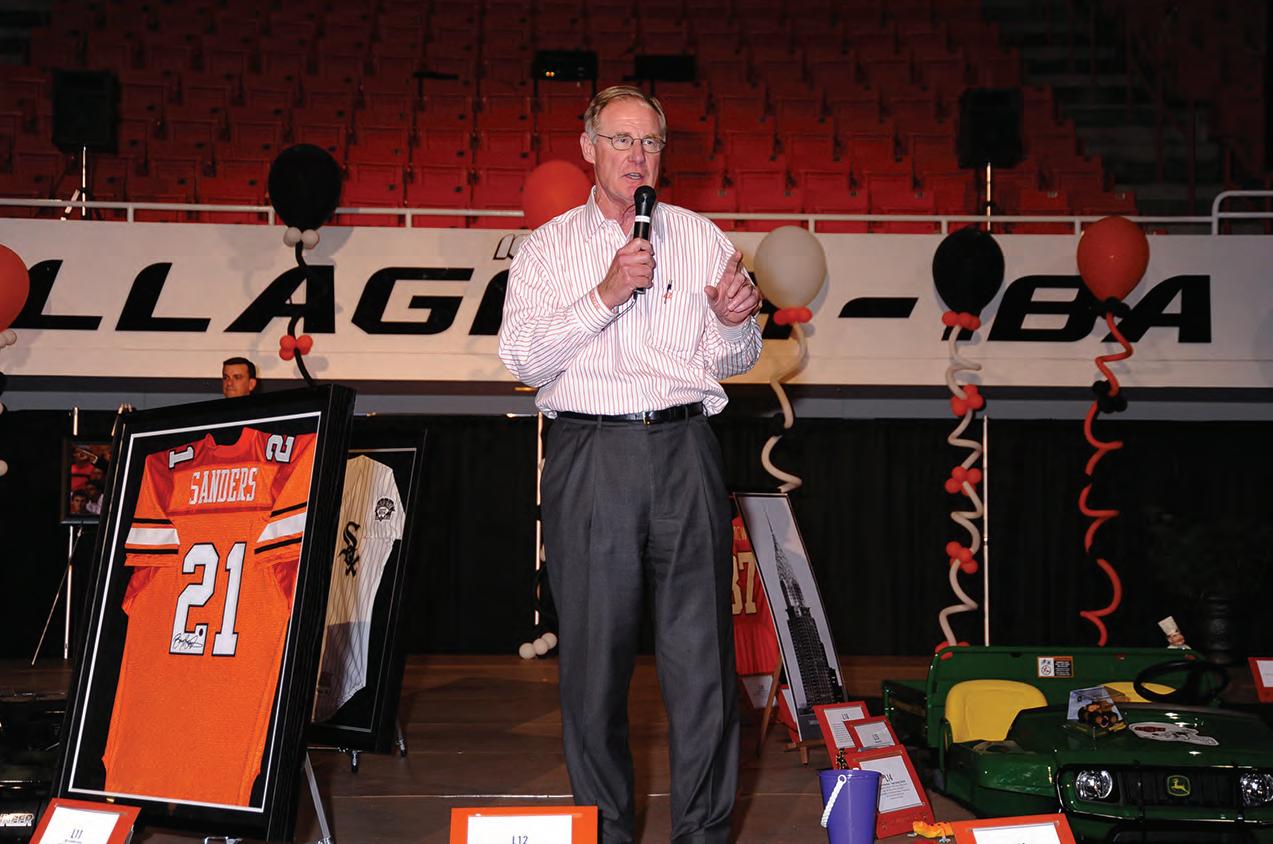
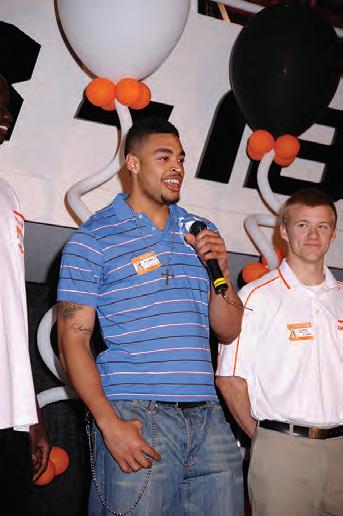
unique opportunity for fans to interact with players, coaches and athletics staff members, as well as OSU legends. In addition to the dinner, there are three separate parts to the “auction” itself. There’s a live auction, complete with an authentic, fast-talking auctioneer. That’s generally where the most exclusive items are put up for bid. Then there’s a Dutch auction, which is basically a live auction where the auctioneer starts at a pre-determined high price and then comes down until he finds a buyer. The proceeds from the Dutch auction directly benefit the Joe and Connie Mitchell Academic Center. Finally, there are the silent auction boards featuring literally hundreds of unique items.
Every item up for bid has been donated by an OSU supporter, and there are all manner of items. It’s not uncommon for there to be things like cruises or weekend stays in a lodge in Colorado ski country. Then there are unique OSU exclusives like traveling with the football team to Austin, dinner with Coach Ford or perhaps riding with the guys in the equipment truck to an away game.
“That’s a very popular auction item,” says Jesse Martin, Executive Director of the POSSE. “People really enjoy getting a behind-the-scenes view of OSU athletics. But the really interesting stuff sometimes has nothing to do with OSU. Last year, we had a freezer and a side of beef, and a couple years ago, someone nabbed a couple palettes of sod for a really good price.”
The idea for the benefit auction came about in the ‘80s. The athletic director at the time, Myron Roderick , told Dave Martin, Senior Associate Athletic Director, it was something they should think about doing. So Martin hit the road, needing to see how a benefit auction was handled. He visited other universities and even high schools, taking notes of what worked and what didn’t along the way.
“Where I really found great auctions was over in the high schools in Tulsa,” Dave says, noting that some schools plan
for their auctions for an entire year.
The first POSSE auction took place at the former Adam’s Mark hotel in Tulsa. It was successful enough that they had a sequel, which in turn spawned a second auction in Oklahoma City. At some point, it was decided that it would be better and more efficient to have a single auction, and to hold it in historic Gallagher-Iba Arena.
The event has changed more than its location over the years. These days, it’s much more “high tech,” Dave says. “People can purchase items and check out easier, and there’s more variety in items. Anybody can purchase something. There are all kinds of items on the silent board. The key is to not have all high-end items, and to have things for bid you just can’t buy in a store.
“The auction is important for two reasons,” Dave adds. “First, it’s a good fundraiser for the scholarship fund. Second, it’s a great gathering place for our alumni. People really look forward to the event. It’s a good time.”
So circle the date on your calendar. There’s sure to be something you’ll find you can’t do without, and you can then feel good knowing that money you spend is going to directly impact the life of an OSU student-athlete. You get to make a difference, and have a good time.
And if you’ve never seen GIA during the auction, that’s almost worth the trip all on its own. By all accounts, the transformation is amazing.
An individual ticket to the POSSE Benefit Auction costs $125. Tables are available for $5,000, $2,500 and $1,000. If you’re looking to have a good time and contribute to the student-athlete scholarship fund, RSVP for the auction today by calling 877-2B-POSSE, or visiting www. okstateposse.com.


by


By Matt Elliott
By Matt Elliott
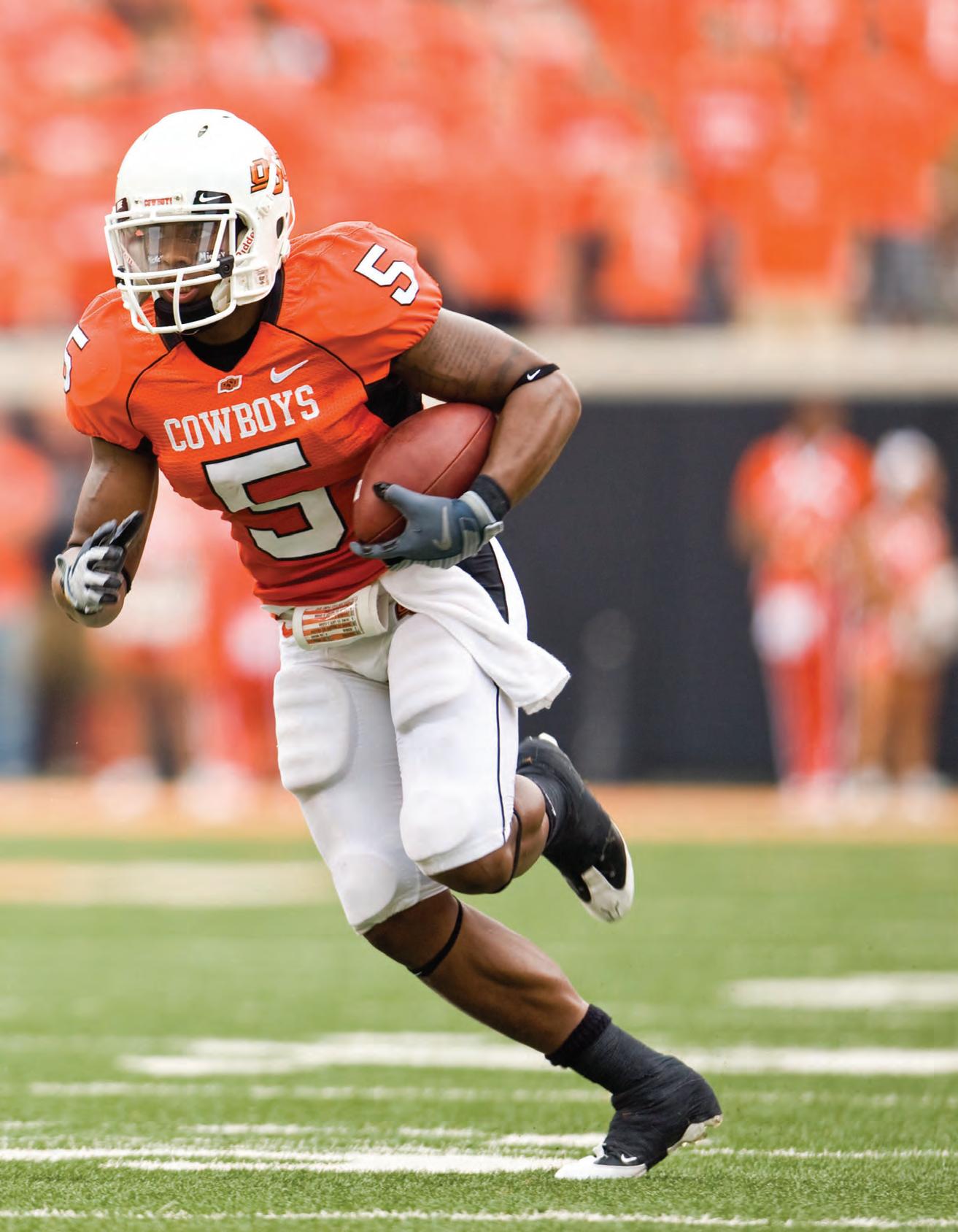
Toston, training for the NFL's 2010 Draft, was the thunder to Hunter's lightning. A shortyardage specialist, he was one to pop tacklers in the mouth instead of fake them out of their shoes. He sees being shifty, elusiverunner as setting himself to get lit up by the guy he doesn't make miss. His tough play during the season allowed the Cowboys to play it safe when they had to and run out the clock when they needed. He also picked up key first downs during short-yardage situations.
Toston, training for the NFL’s 2010 Draft, was the thunder to Hunter’s lightning. A shortyardage specialist, he was one to pop tacklers in the mouth instead of fake them out of their shoes. He sees being a shifty, elusive runner as setting himself to get lit up by the guy he doesn’t make miss. His tough play during the season allowed the Cowboys to play it safe when they had to and run out the clock when they needed. He also picked up key first downs during short-yardage situations.
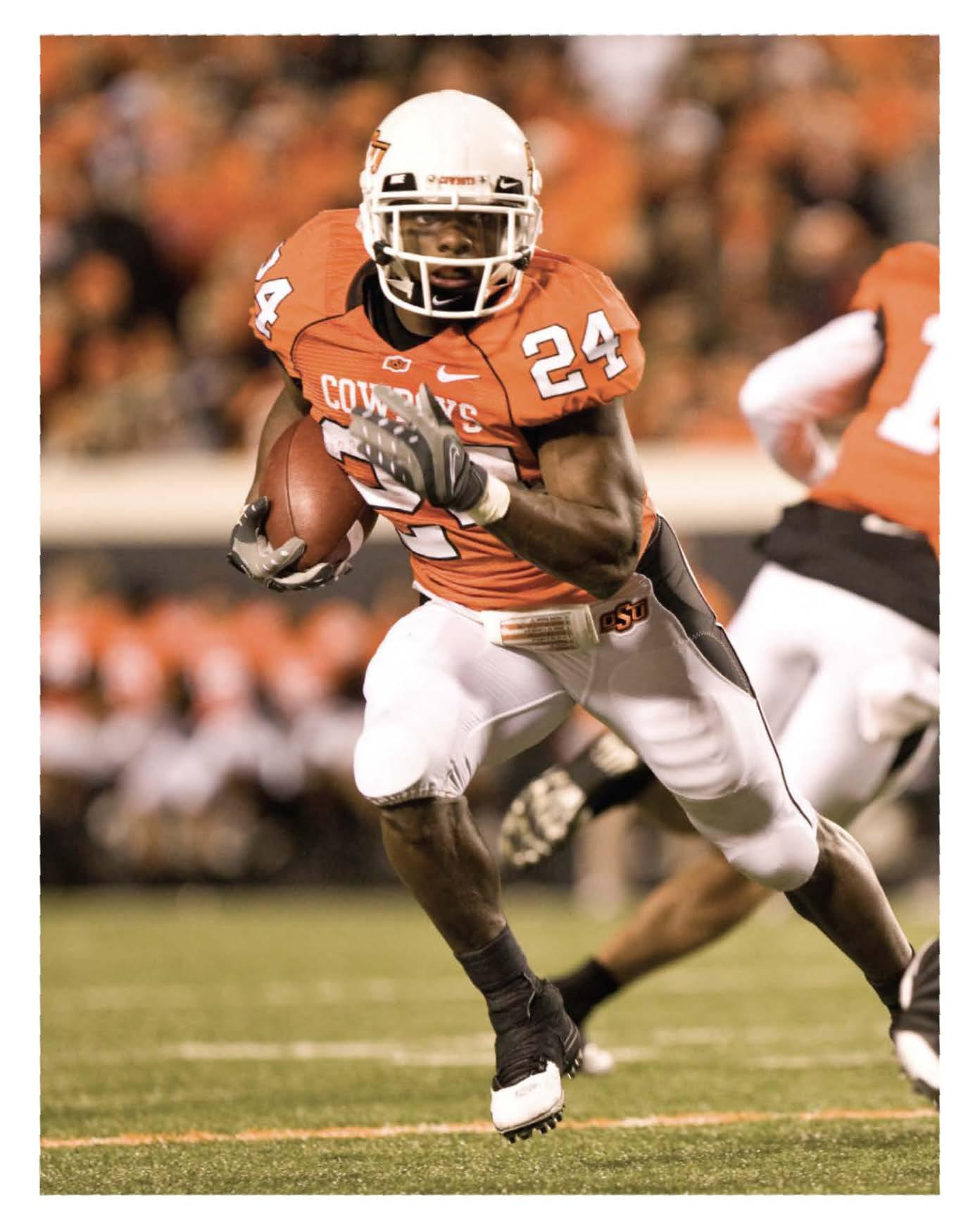
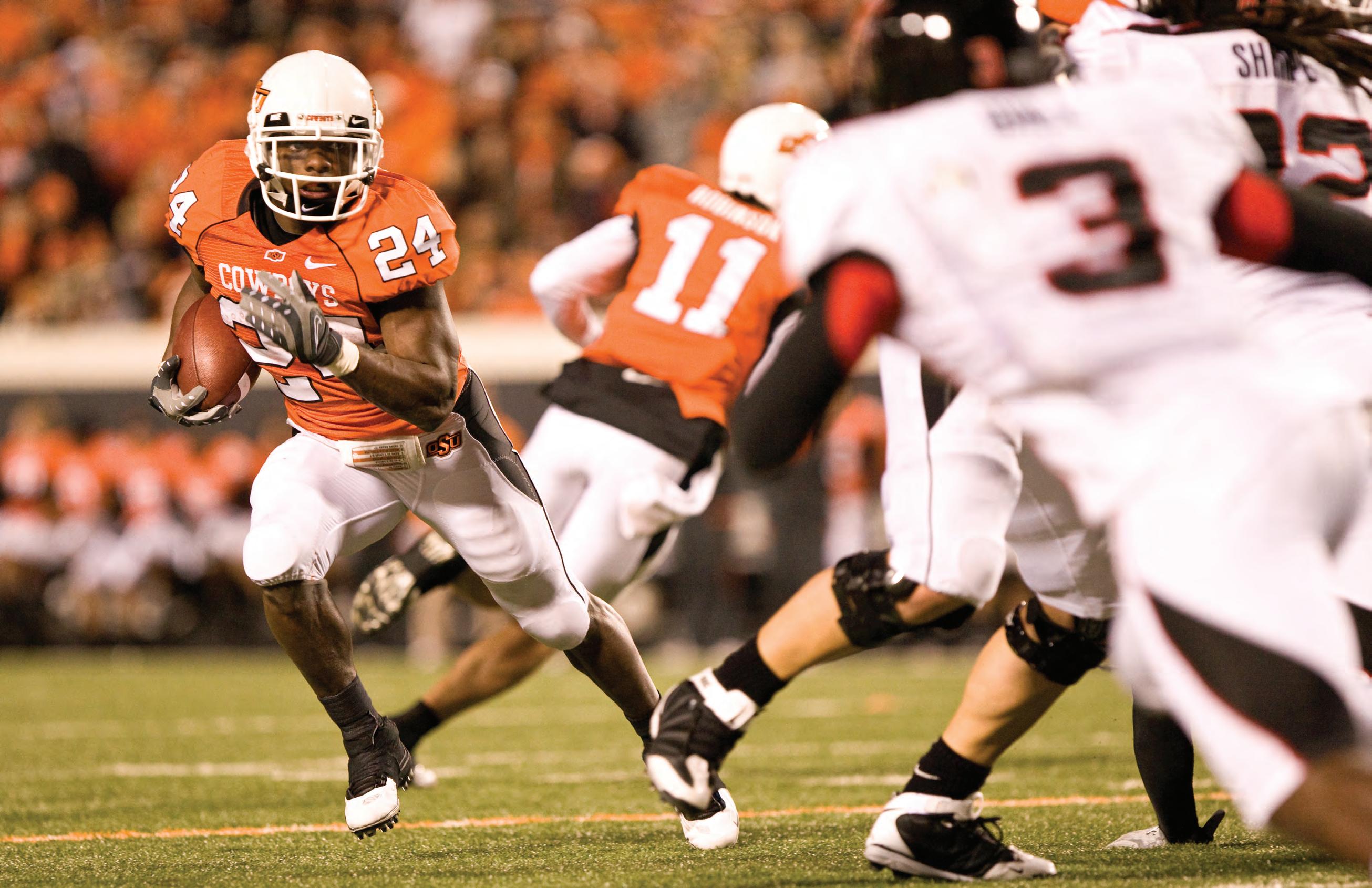
Keith Toston would've liked to close out his senior season with a win. Things didn't happen that way.
Keith Toston would’ve liked to close out his senior season with a bowl win. Things didn’t happen that way.
But he's probably not going to complain. Toston went from near the bottom of the depth chart a few years ago to a first-team
All-Big 12 selection his senior year, using a versatile but bruising style to become one of nation's top running backs and one of last year's bright spots on offense for OSU.
But he’s probably not going to complain. Toston went from near the bottom of the depth chart a few years ago to a fi rst-team All-Big 12 selection his senior year, using a versatile but bruising style to become one of nation’s top running backs and one of last year’s bright spots on offense for OSU.
It was a long, hard-fought road for Toston, who got the nod in 2009 after an ankle injury forced starter Kendall Hunter to the sidelines. Of course, he was sorry about what happened to the All-American Hunter, who missed five games after hurting his foot
It was a long, hard-fought road for Toston, who got the nod in 2009 after an ankle injury forced starter Kendall Hunter to the sidelines. Of course, he was sorry about what happened to the All-American Hunter, who missed five games after hurting his foot
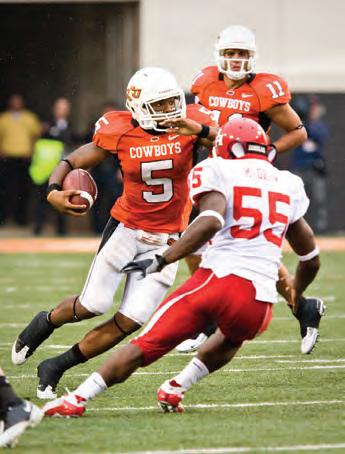
photo by Gary Lawson
against Houston, but felt no guilt about taking the snaps and logging more than 1,200 yards on the season while also being the team's second-leading receiver.
against Houston, but he felt no guilt about taking the snaps and logging more than 1,200 yards on the season while also being the team’s second-leading receiver.
"You just have to take it," Toston says. "You know how it comes. Everybody wants to play. We don't have one person on our team that wouldn't to First string. Second string. Third string. We all practice as something could happen in the game, and it's going to be us who has to step in next. Unfortunately, this year, something happened, and I had to be sure that I didn't let it be a drop off for the team."
“You just have to take it,” Toston says. “You know how it comes. Everybody wants to play. We don’t have one person on our team that wouldn’t like to play. First string. Second string. Third string. We all practice as if something could happen in the game, and it’s going to be us who has to step in next. Unfortunately, this year, something happened, and I had to be sure that I didn’t let it be a drop off for the team.”

On offense, Toston was probably the difference between a mediocre season and OSU's seventh nine-win season. The offense had to overcome injuries to other key starters, including quarterback Zac Robinson and members of the line, and recover from the loss of wide receiver Dez Bryant, one of the most electrifying players in college football. Toston's versatility was sorely needed.
On offense, Toston was probably the difference between a mediocre season and OSU’s seventh nine-win season. The offense had to overcome injuries to other key starters, including quarterback Zac Robinson and members of the line, and recover from the loss of wide receiver Dez Bryant, one of the most electrifying players in college football. Toston’s versatility was sorely needed.
“Keith carried the load for the offense,” says the Cowboys’ co-offensive coordinator, Gunter Brewer. “And the important number is wins – not offensive stats. Everyone pulled together as a good family should. Keith was the glue that held the unit together. I don’t know where we would’ve been without him. With as many parts that we had to replace, running back was one we couldn’t have had another shot at,” says Brewer.
"Keith carried the load for the offense," says the Cowboys' co-offensive coordinator, Gunter Brewer. "And the important number is wins - not offensive stats. Everyone pulled together as a good family should. Keith was the glue that held the unit together. I don't know where we would've been without him. With as many parts that we had to replace, running back was one we couldn't have had another shot at," says Brewer.
"Even though we had three running backs whom we felt like could come in and do a great job, the way Keith took it over, you'd be hard pressed to say you'd find somebody to step in and fill those shoes better. He was tremendous, carrying the load, even became a thousand-yard rusher while not even being the full-time starter."
“Even though we had three running backs whom we felt like could come in and do a great job, the way Keith took it over, you’d be hard pressed to say you’d fi nd somebody to step in and fi ll those shoes better. He was tremendous, carrying the load, even became a thousand-yard rusher while not even being the full-time starter.”
So that meant during every game he laid it all out on the field for OSU. He destroyed his body every Saturday. Averaging nearly 18 runs game, had never before taken many snaps as he did last season. There were many times, especially during the loss to OU, when he could be seen grimacing and doubled over in pain on the field after a play. He wouldn't have done other way, Brewer says.
So that meant during every game he laid it all out on the field for OSU. He destroyed his body every Saturday. Averaging nearly 18 runs a game, he had never before taken as many snaps as he did last season. There were many times, especially during the loss to OU, when he could be seen grimacing and doubled over in pain on the field after a play. He wouldn’t have done it any other way, Brewer says.
"I think that's where the leadership comes in with him. The young kids saw that he was playing through injury, knew he was injured, knew the amount of snaps he was taking and the abuse that a running back takes in the Big 12. I think the kids appreciated that and so did the coaching staff. That's where you earn your street cred."
“I think that’s where the leadership comes in with him. The young kids saw that he was playing through injury, knew he was injured, knew the amount of snaps he was taking and the abuse that a running back takes in the Big 12. I think the kids appreciated that and so did the coaching staff. That’s where you earn your street cred.”
On Sundays, he could barely move. He was mind-numbingly sore until Thursday. Then, he did it all over again for the love of a frenetic, brutal game players play only seconds at a time.
On Sundays, he could barely move. He was mind-numbingly sore until Thursday. Then, he did it all over again for the love of a frenetic, brutal game players only seconds at a time.
“You can look at a player and how they play and tell if they’re doing it just because it’s football, or if they’re doing it because they love the game,” Toston says. “Dez, he doesn’t do a whole lot of stuff. But he loves the game maybe more than any person I’ve ever seen. And it shows when he gets the opportunity to get out there and play.
"You can look at a player and how they play and tell if they're doing it just because it's football, or if they're doing it because they love the game," Toston says. "Dez, he doesn't do a whole lot of stuff. But he loves the game maybe more than person ever seen. And it shows when he gets the opportunity to get out there and play.

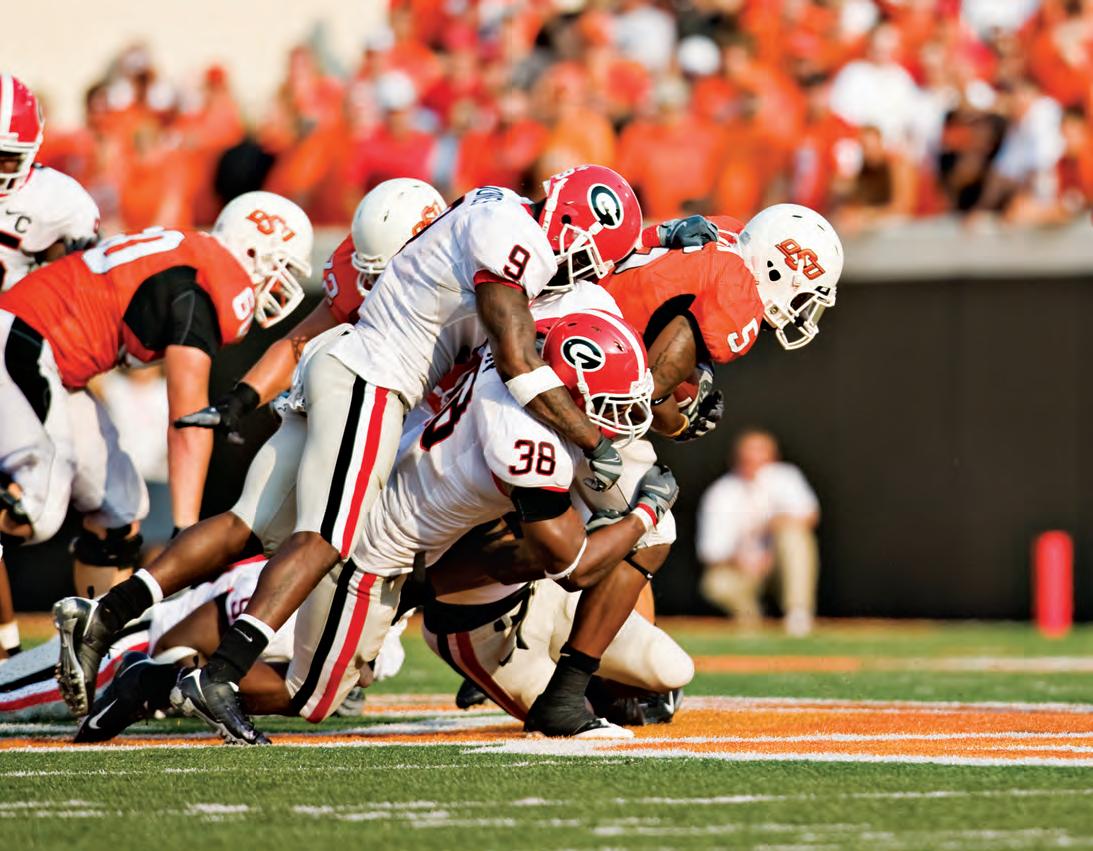
“Me, I get up and take another pounding. I can see the end of the tunnel, all the hard work my mom and my dad put into me to keep me on this path. I mean, it kind of makes me feel like I owe them something.”
— Keith Toston
“Me, I get up and take another pounding,” he says. “I can see the end of the tunnel, all the hard work my mom and my dad put into me to keep me on this path. I mean, it kind of makes me feel like I owe them something.”
Toston clutched at those fleeting moments with a fierce determination on the field. That showed in everything from broken tackles during dominating runs at Iowa State to a crazy, wide open pass play against Colorado during the fourth quarter that sparked a the come-from-behind victory.
That game was one of his personal favorites. The team had been struggling all night and needed a win before heading to Norman to face the Sooners. Quarterback Zac Robinson was injured, so Alex Cate stepped in but struggled until he was replaced by Brandon Weeden in the second-half.
During the third quarter, Toston reeled off a 45-yard run that cut Colorado’s lead to
four. With 11 minutes to go in the fourth, he had a key touchdown reception that put OSU up by four. It was a specific play coaches drew up for a defense Colorado had called several times previously.
The play was a blitz adjustment the Cowboys kept in rotation, Brewer says. The idea was to have Toston act as a blocker and trick the linebacker covering him to blitz. Then, Toston squeezes between the tackles at the line of scrimmage. If he makes it through, he’s going to be open over the middle because the defense is busy chasing receivers in one-on-one coverage. If he doesn’t make it through, the quarterback will get clobbered. They guessed right. The center hiked the ball to Weeden who then searched for Toston. No Colorado player was even in the same zip code as Toston.
“We were waiting for their defense all game to just run that play,” Toston says. When he caught the ball, he says “I was trying
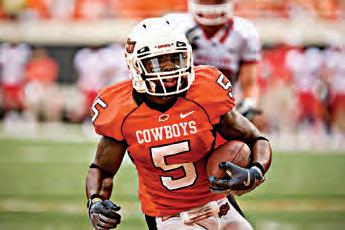
not to stumble. I was so wide open. I actually thought somebody was going to be behind me. If you ever see the game film, I turn my head before I actually catch it. It could've been a disaster.”
Brewer says, “It's not a trick play, but it's something that we oiled up and have had for years … It was a case where it was well executed and he didn’t panic because he’d run it before against Nebraska. He knew what to expect, and obviously he finished the play when he got it … It’s kind of scary when you’re that wide open. That’s why not panicking makes a big difference. A younger player would probably have problems there.”
Justin Blackmon’s 28-yard touchdown reception with eight minutes to go put the Cowboys up for good. Toston ran the ball 30 times during the game for 172 yards and had 45 receiving yards. He punched through some key first downs late in the game that helped close out the win, their last of the season that helped seal their bid for the Cotton Bowl.
It was a long way from where he started. The Angleton, Texas, product came to OSU in 2006 and was originally recruited as a safety. Coaches quickly realized they needed him at the running back position. Playing behind Dantrell Savage, he was second on the team his freshman year with 631 rushing yards, but his sophomore season’s attempts were curtailed due to fumbles, and he suffered a season-ending knee injury that year against Baylor. During 2008 as Kendall Hunter’s back up, he solved his fumbling problems and fought his way back into more playing time, averaging a whopping 6.7 yards per run and scoring nine touchdowns.
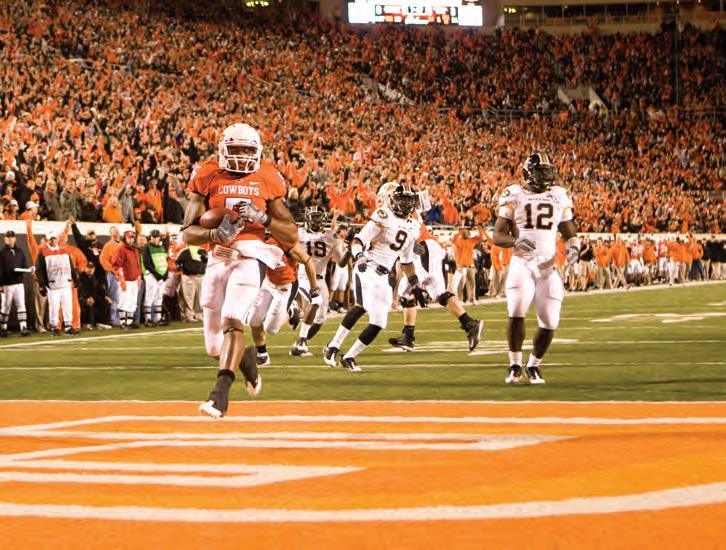
Now, he’s hoping to do the same for an NFL team somewhere. If not, he knows he’ll end up coaching somewhere.
“I’ve been playing football for about seventeen years. This is my seventeenth season. I mean contact. I started out when I was five, turning six. You had to be seven to play, but my mom put me in there early. And I was able to learn a whole lot my first year. When it was actually time to go in and play as a seven year-old I was ahead of most of the other kids. It helped me out as I got older. A lot of kids start playing football in middle school. I had already played five or six years. So I just stayed with it.
Brewer says he’s no draft expert, but he thinks Toston has a shot on his versatility alone.
“I wouldn’t want to just let it go now in this stage of my life,” Toston says. “I hope it takes me as far as it can. I just take it how it comes."
What a ride 2009 was. Fans, coaches and players rode a roller coaster to a 9-4 finish that had more bumps, highs and lows than most would care to remember. But after the smoke cleared from injuries and other issues, the Cowboys closed the book on what was still one of the best seasons in school history. The anticipation leading up to the season was almost bigger than the season itself. Several players, including Dez Bryant, Russell Okung, Kendall Hunter and Zac Robinson were on preseason award watch lists. The team was ranked at No. 9 and had just graced the cover of Sports Illustrated for the first time when the SEC’s Georgia Bulldogs hit town for the season opener. The Cowboys
won 24-10, a victory that skyrocketed OSU to No. 5 in the national polls.
Despite losing nearly half of its starters on offense to injuries, OSU would go on to log big wins against Big 12 opponents, finishing 6-2 in conference play. Although OSU fell out of the top ten with a loss to Houston, wins over Colorado and Texas Tech had them climbing back to No. 11 before their loss to the Sooners in Norman. They were selected for the Cotton Bowl in Cowboys Stadium where they lost to Ole Miss 21-7, closing out just the seventh nine-win season in school history.
It was also a year that saw the sun set on one of the most talented senior classes in Cowboy history. The class was responsible for 32 wins, the third highest in OSU history. Chief among those was the offense’s leader on the field, quarterback Zac Robinson, who in 2009 passed for 2,078 yards, ran for 305 and accounted for 19 touchdowns. Robinson did that despite battling injuries all year, including shoulder problems following a vicious collision with Texas Tech’s Jamar Wall that laid both players out.
Robinson has carved out a place as possibly the best quarterback to ever play at OSU. His performance this year edged him past Mike Gundy’s all-time career passing record. All told, he leaves OSU with 8,311 passing and 1,858 rushing yards, while also holding records for total offense, touchdown passes and single-season completion percentage. Against Baylor, he broke
the school’s single-game pass completion percentage record by connecting on 85 percent of his throws. He was one of several of OSU players who attended the NFL’s Scouting Combine in February.
Protecting his blind side in 2009 was left tackle and future first-round draft pick Russell Okung, who became only the sixth Cowboy to be a consensus All-American. Considered the best offensive lineman in the country, he was the leader of a group that allowed only 11 sacks all year, fourth-best in the nation. Okung was also a finalist for the Outland Trophy.
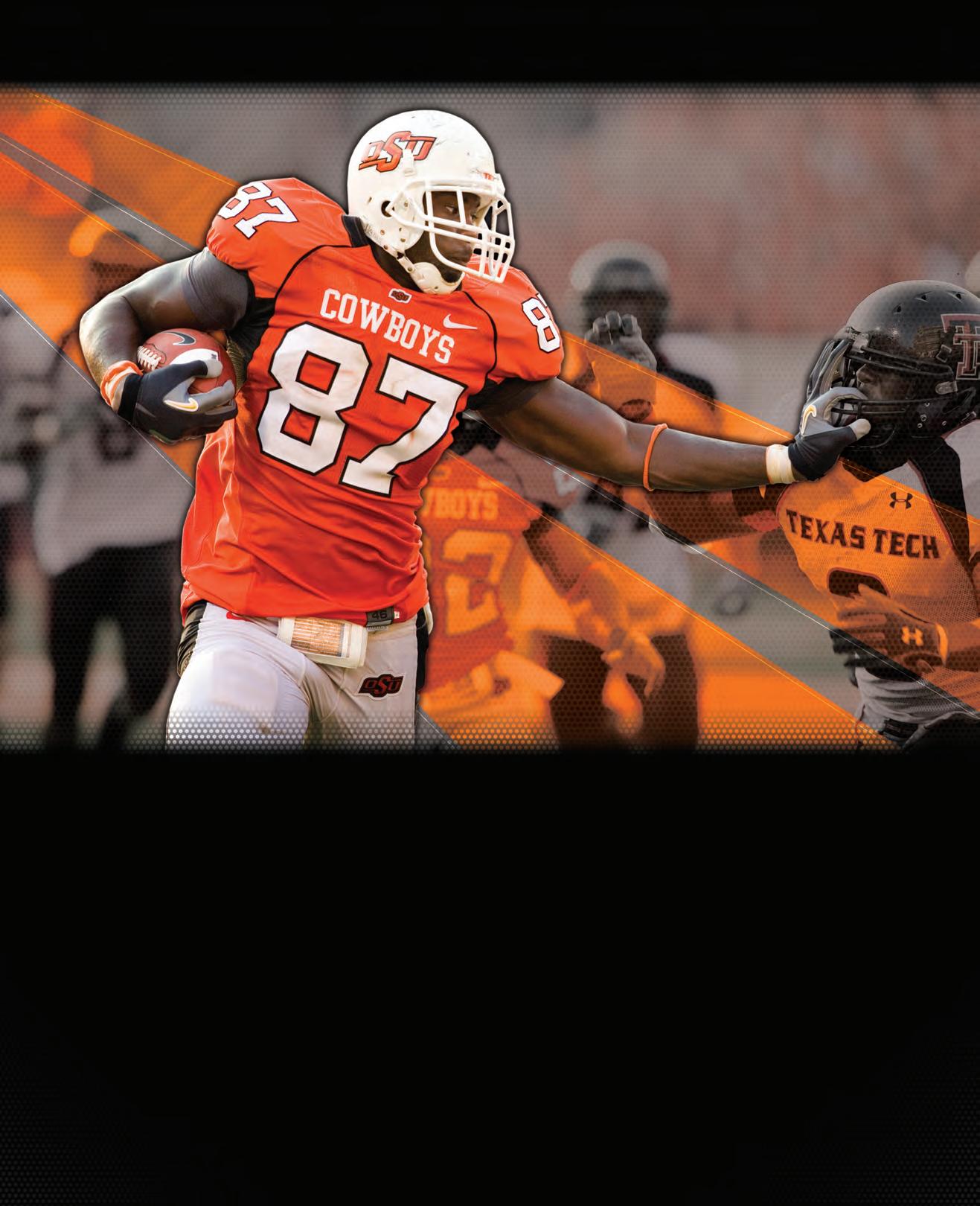
Senior running back Keith Toston, who had four games in which he ran for more than 100 yards, may have been the differencemaker on offense. His bruising, pounding runs up the middle for key first downs and to close out games brought him more than 1,200 yards on the year as he took over for injured starter Kendall Hunter. His versatility as a blocker and a receiver came through big on passing downs, too, as he fought his way to his only first-team All Big 12 selection. He finished eighth on OSU’s career rushing list with 2,729 yards.
One of the biggest stories of 2009 was the improved play of OSU’s defense. New defensive coordinator Bill Young’s no-nonsense style, emphasis on discipline, toughness and film study gave the Cowboys the 11th-best run defense in the nation. All told, OSU had the 31st-best total defense in the nation, up 62 spots from last year’s 93rd ranked unit.
That feat was accomplished in no small part
because of a defensive line, anchored by junior Ugo Chinasa and senior Derek Burton, that was supposed to be too small and thin to succeed. Backing them up was an injury-depleted core of linebackers that turned out to pack a whollop, notably because of seniors Donald Booker, Andre Sexton and Patrick Lavine.
Adding serious fear factors to the defense’s opponents were safeties Lucien Antoine and Markelle Martin. Their big hits, favorites with fans, helped change the tone of games to the Cowboys’ favor. Plus, Antoine forced three fumbles and Martin is credited with breaking up 11 passes. Cornerback
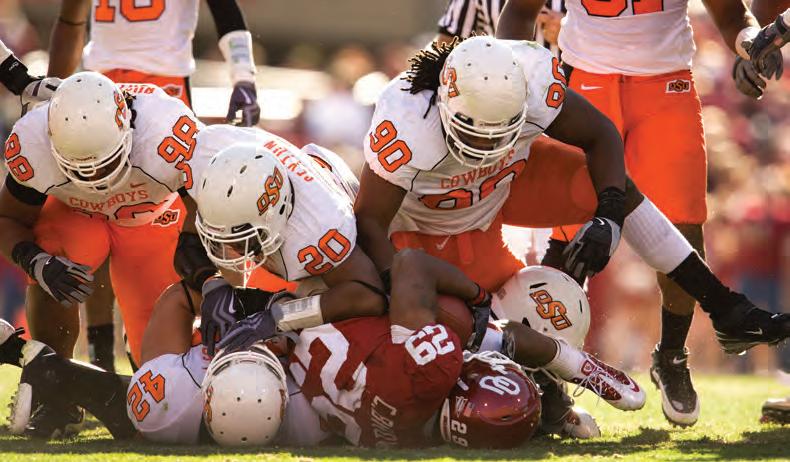
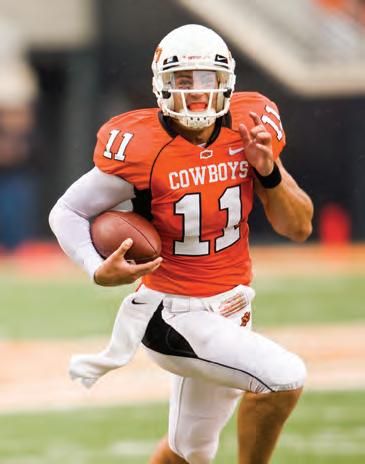
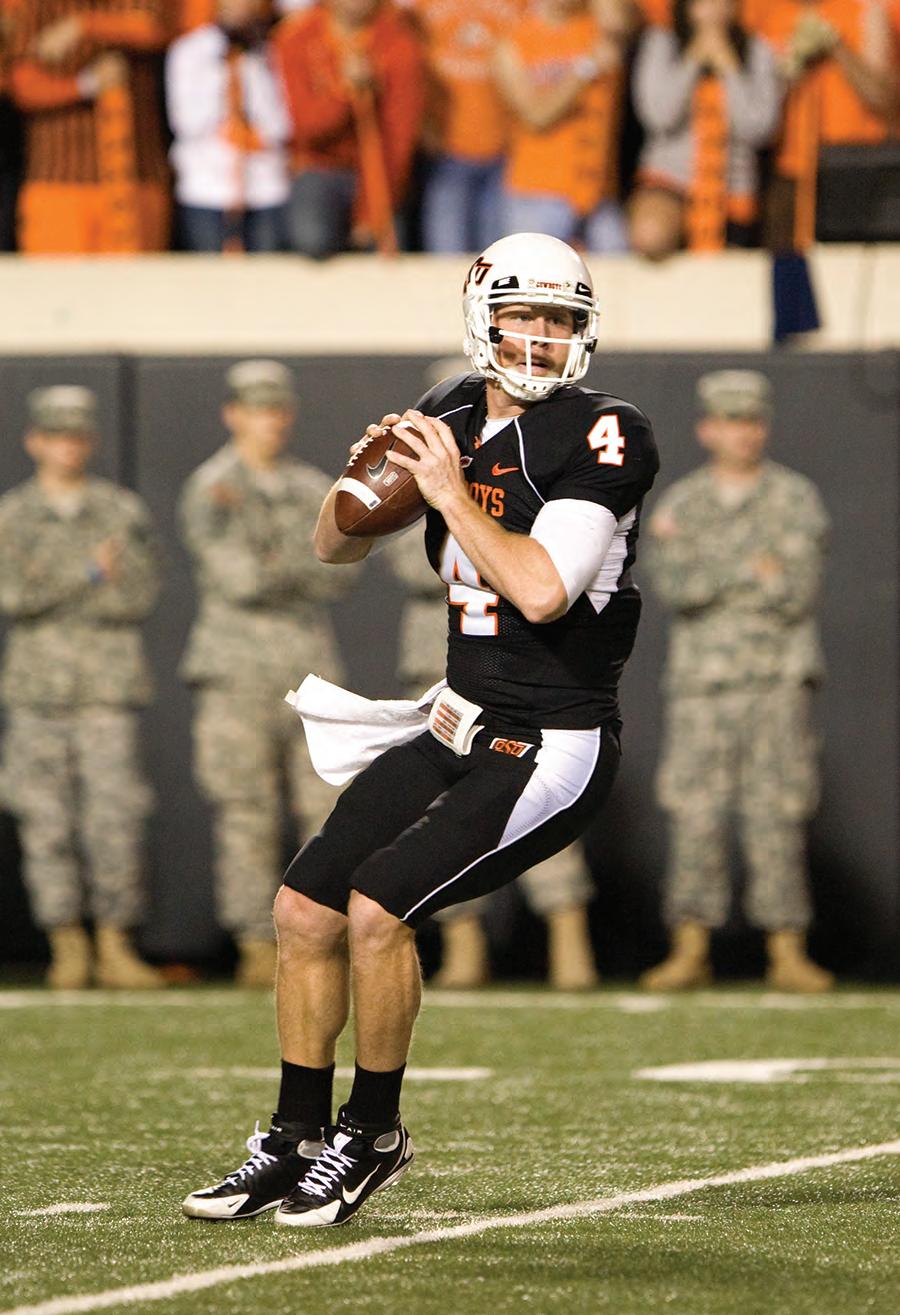
Perrish Cox had 15 pass breakups and earned All-American status while averaging more than 20 yards and 10 yards on kick and punt returns, respectively.
Many questions remain heading into spring football, but the future looks bright for the Cowboys. Players such as quarterback Brandon Weeden, who came on strong against Colorado last season, and with halfbacks Jeremy Smith and a returning Kendall Hunter ensure the Pokes won’t be starting from scratch.
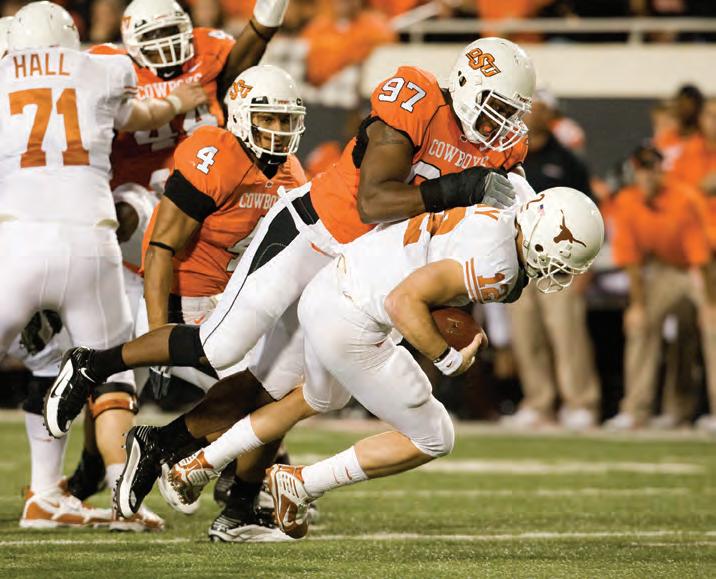
No. 9 OSU 24
No. 13 Georgia 10
Sept. 5, 2009
The Cowboys burst onto the national stage with a convincing win over the Bulldogs, a perennial SEC powerhouse. OSU’s defense clamped down, forcing two fumbles, holding Georgia scoreless in the second and fourth
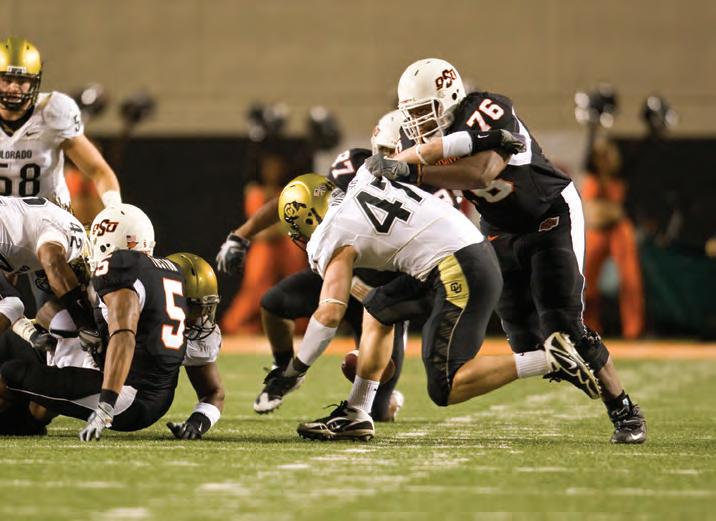
quarters and limiting the team to just over 250 total yards of offense. OSU logged 172 rushing yards, with help from 55 by Keith Toston and 78 from Kendall Hunter.
No. 5 OSU 35
Houston 45
Sept. 12, 2009
The Cowboys were stunned by a Conference USA team helmed by star quarterback Case Keenum, who threw for 366 yards and three touchdowns. OSU lost three fumbles on offense but still managed to log 434 total yards. On defense, the Cowboys gave up 512 yards to the Cougars. Hunter was injured in the first half and wouldn’t play again until the Texas game on Halloween.
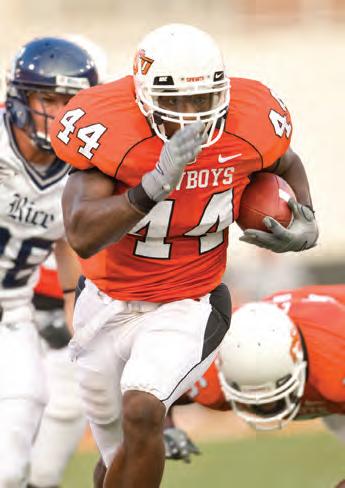
No. 16 OSU 41 Rice 24
Sept. 19, 2009
Fresh off a heartbreaking loss to the Cougars, OSU outran the Owls, its second-straight Conference USA opponent, with 124 combined rushing yards from Keith Toston, Beau Johnson and Zac Robinson. Robinson also threw for 227 yards, including 161 to
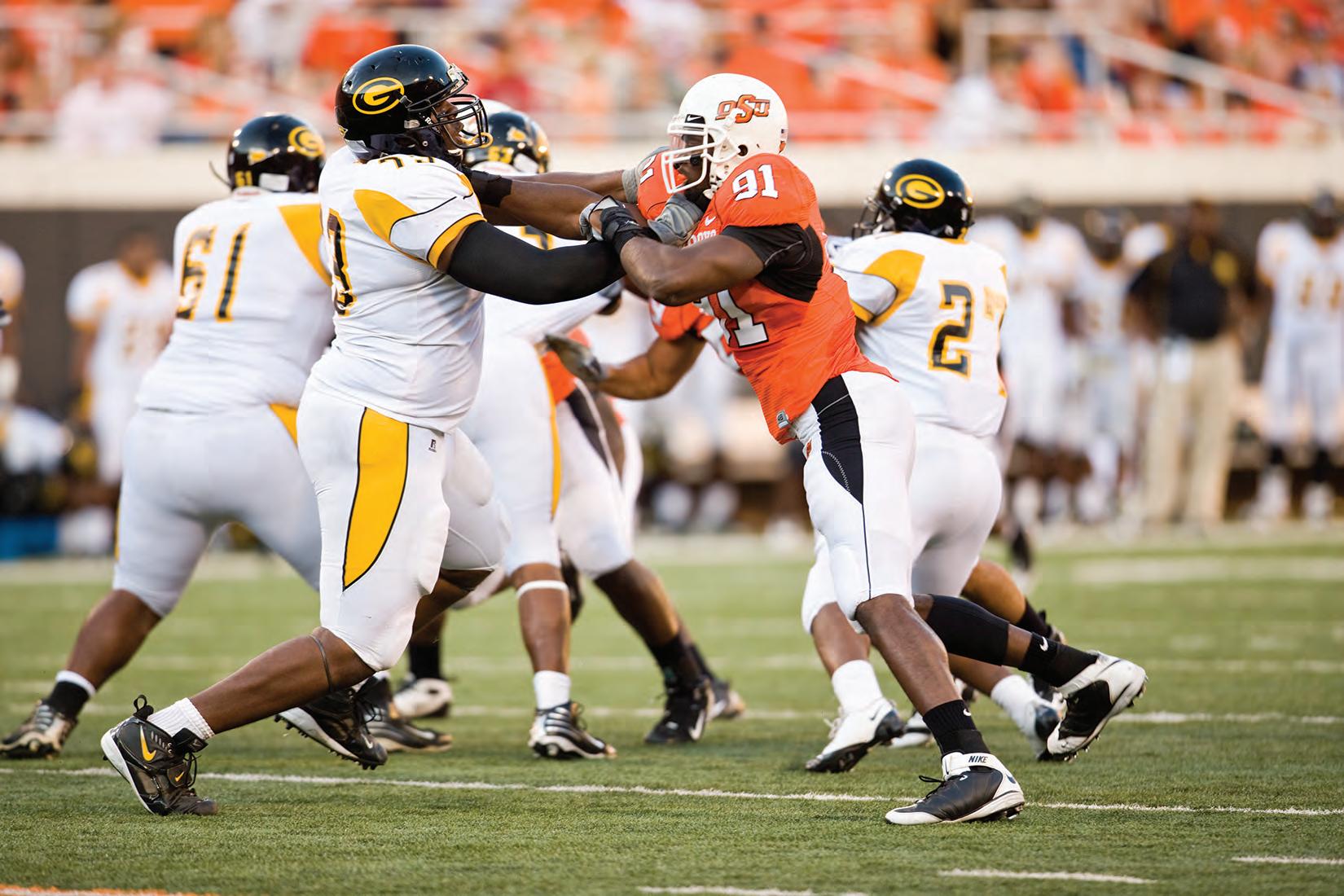
The Cowboys destroyed Grambling, their final nonconference opponent, with more than 320 yards rushing, 160 of which were from freshman Jeremy Smith. OSU fans got their first look at backup quarterback Brandon Weeden, who threw for 77 yards and two scores filling in for Robinson, who was rested after pitching for 189 yards and a score.
No. 16 OSU 36
Texas A&M 31
Oct. 10, 2009
OSU outlasted the Aggies thanks to a strong running attack and a clicking passing game that included a 51-yard third-quarter hook up between freshman Tracy Moore and Robinson, who also ran for a quick score during the first quarter. Toston chipped in with 130 hard-earned yards and 74 yards receiving, while Beau Johnson ran for the Cowboys’ touchdown in the fourth quarter that helped keep the team ahead. The Aggies had 109 yards rushing and 273 yards passing.
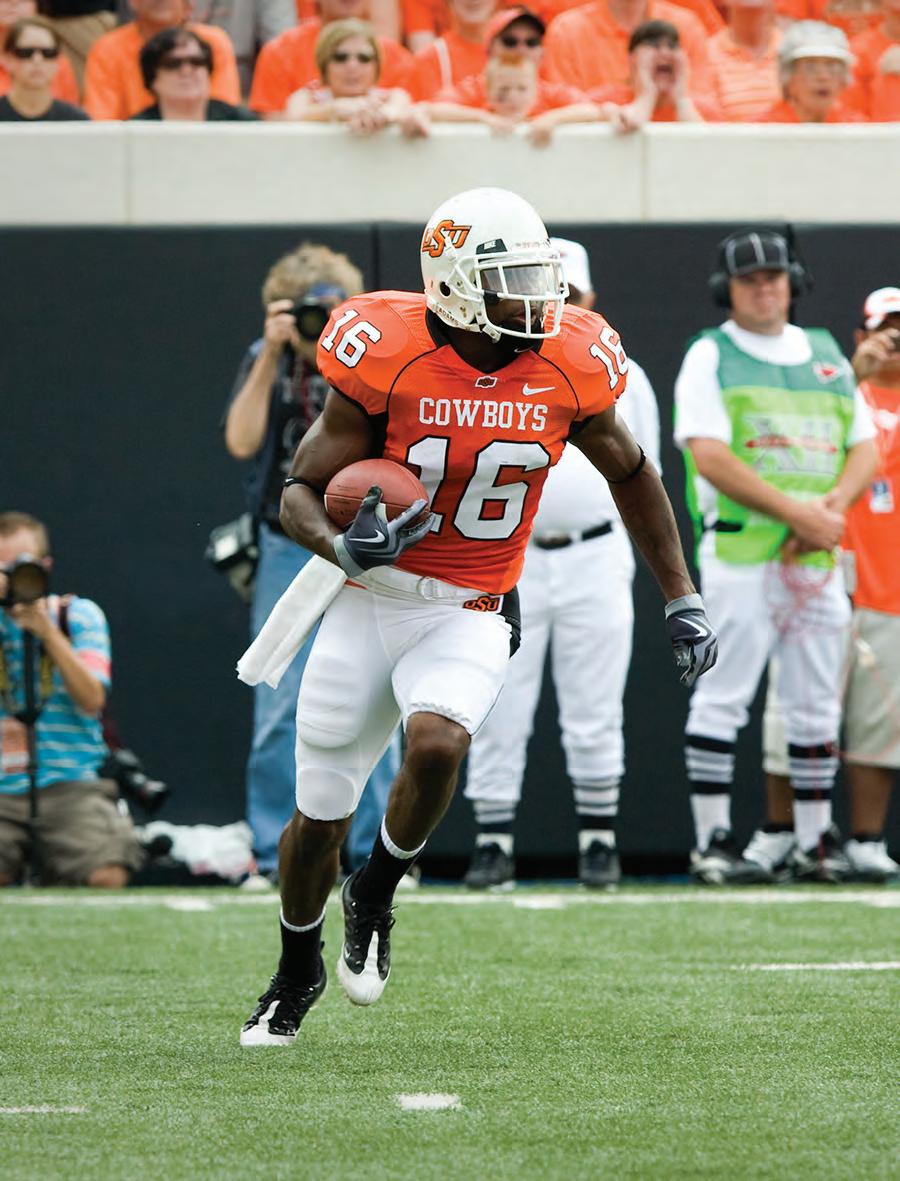
and a touchdown while also logging 54 yards receiving. Robinson threw for 227, 119 of which was to wide receiver Hubert Anyiam, and ran for another 39. Dan Bailey hit four field goals, including a career-long 51-yarder. Anyiam had ten catches in the game.
No. 14 OSU 34
Baylor 7
Oct. 24, 2009
The Cowboys trained the Bears and allowed only 43 yards rushing. Robinson connected on 85 percent of his passes, a new school record for a single game, and threw for 250 yards and three touchdowns to Cooper Bassett, Dameron Fooks and Wilson Youman. Toston ran for 109 yards and a touchdown. Beau Johnson logged 93. OSU gave up only 284 yards of total offense to the Bears.
shcking a record Boone Pickens Stadium crowd of 58,516. Robinson threw for 143 yards and a touchdown, but also threw four interceptions. Texas’s Colt McCoy threw for 171 yards and a score on 16-21 passing, while halfback Cody Johnson ran for two touchdowns.
No. 18 OSU 34
Iowa State 8
Nov. 7, 2009
OSU ran over the Cyclones with 331 yards rushing, 207 of which came from Toston, who also scored three touchdowns. Hunter, showing more confidence as he recovered from his ankle injury, ran for 50. And Robinson had nearly 200 yards of total offense. ISU quarterback Austen Arnaud threw three interceptions.
No. 17 OSU 24
Texas Tech 17
Nov. 14, 2009
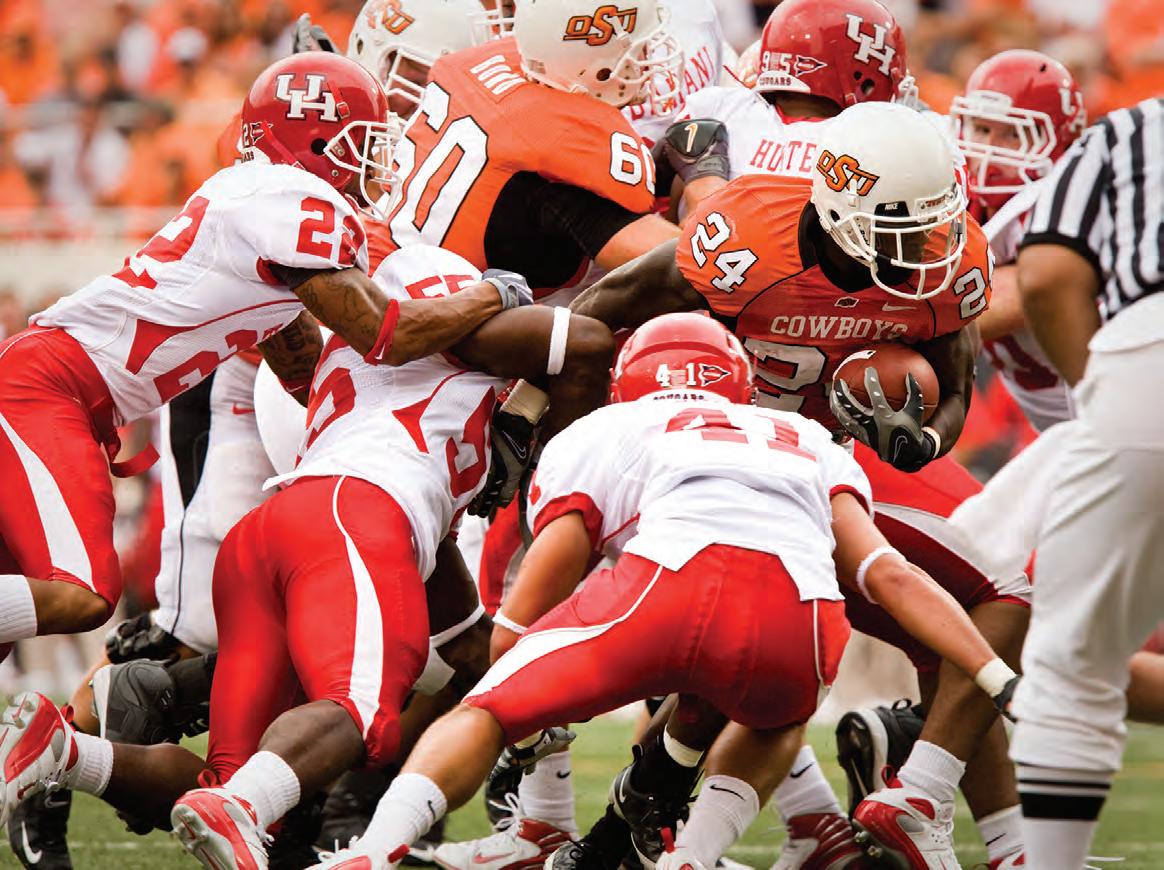
OSU ran the ball for more than 200 yards after halftime and put the defensive clamps on Tech’s offense when it counted, shutting them down during the fourth quarter and scoring on a Patrick Lavine interception return. Robinson ran for 99 yards before he was knocked out of the game late in the fourth quarter on a hit from Tech defensive back Jamar Wall. Tech outgained OSU with 307 passing yards to the Cowboys’ 90.
No. 12 OSU 31
Colorado 28
Nov. 19, 2009
With Zac Robinson injured, OSU sputtered on offense. A field goal and a spectacular 67-yard punt return by Cox in the first half kept the Cowboys in it. Backup Brandon Weeden came
in after the half and went 10-15 for 168 yards and two touchdowns. Toston came up big for the Cowboys as well, running for 172 yards and scored twice, including on a 47-yard reception.
No. 11 OSU 0
OU 27
Nov. 28, 2009
Bedlam ended up being a brutal game for the Cowboys as the OU defense smothered OSU’s offense, limiting the team to just 109 total yards. Robinson returned for the game but was injured on a run early on. He finished 9-21 for 41 yards and Toston ran for 48. As a team, OU ran for 143 and two touchdowns, while quarterback Landry Jones threw for 224.
No. 21 OSU 7
Ole Miss 21
Jan. 2, 2010
OSU gave up two touchdowns in the fourth quarter during a game that had been back forth and low-scoring throughout its duration. OSU turned the ball over seven times on interceptions and fumbles, and Ole Miss’s quarterback, Jevan Snead threw three interceptions. The Rebels’ speedy running back, Dexter McCluster, had 184 yards on the ground to OSU’s team total of 140. He also had two of the Rebels’ touchdowns. OSU’s only touchdown came on a 1 yard pass from Keith Toston to tight end Wilson Youman. The Cowboys were outgained 259 to 364 total yards on offense.






by Clay Billman

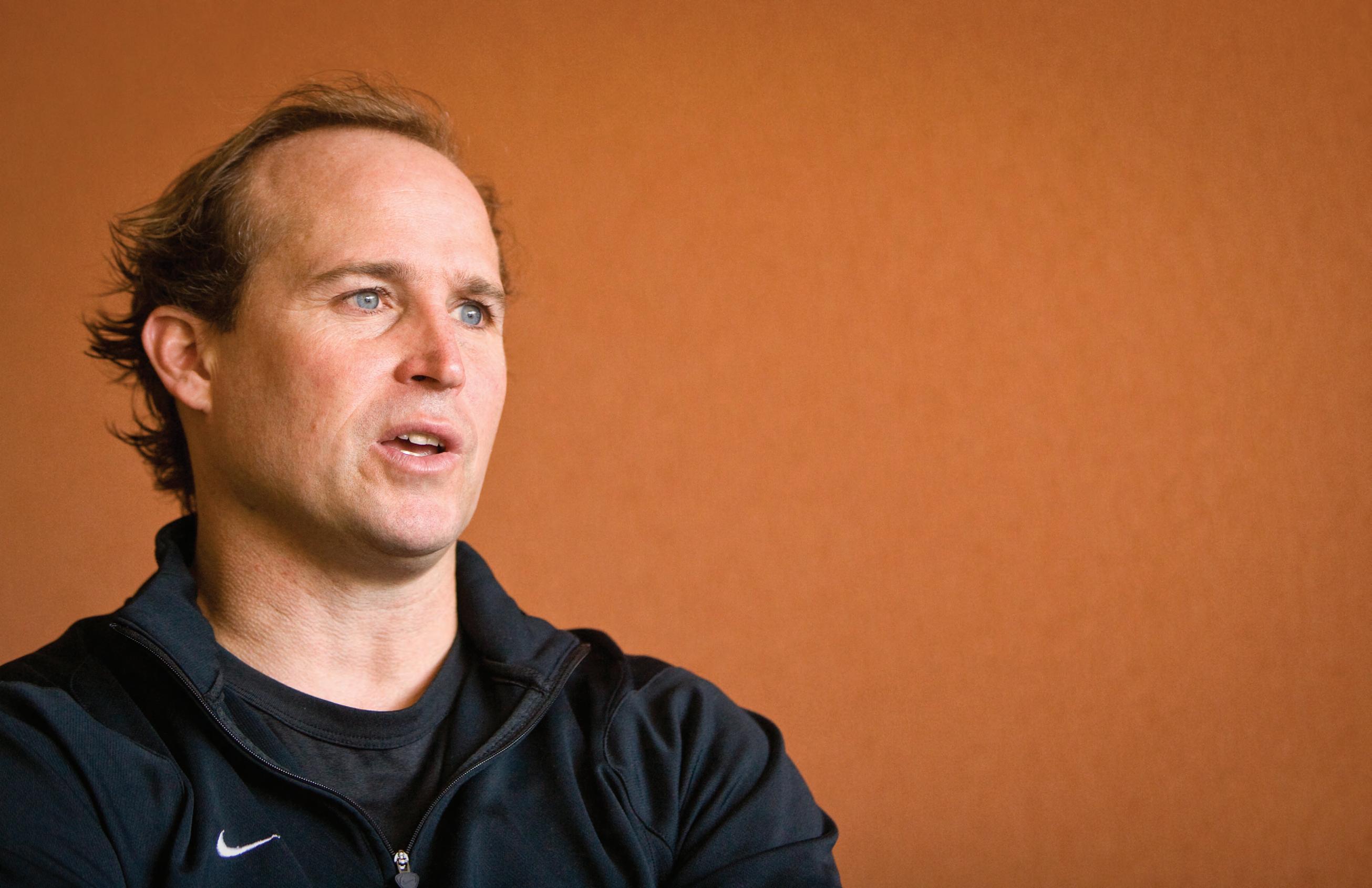
By most accounts, Mike Gundy’s biggest off-season signing in 2010 wasn’t a blue-chip prep recruit ...
By most accounts, Mike Gundy's biggest off-season signing in 2010 wasn't blue-chip recruit
It was a coach.
It was a coach.
When the University of Houston’s offensive coordinator, Dana Holgorsen, joined the Cowboy coaching staff in January, it sent a chill down the spines of defensive staffs throughout the Big 12 Conference. Oklahoma State’s offense, already accustomed to putting up impressive stats in the Gundy Era, had added the architect of the nation’s most prolific attack. Under Holgorsen, the Cougars led the NCAA Division I Football Bowl Subdivision with 564 yards and 42.2 points per game last season. In 2008, Holgorsen’s fi rst year at U of H, the team was second statistically in total offense and 10th in scoring.
When the University of llouston's offensive coordinator, Dana Ilolgorsen, joined the Cowboy coaching staff in January, it sent a chill down the spines of defensive staffs throughout the Big 12 Conference. Oklahoma State's offense, already accustomed to putting up impressive stats in the Gundy Era, had added the architect of the nation's most prolific attack. Under Ilolgorscn, the Cougars led the NCAA Division I f<ootball Bowl Subdivision with 564 yards and 42.2 points per game last season. In 2008, llolgorscn's first year at U of lI, the team was second statistically in total offense and 10th in scoring.
Holgorsen’s offensive pedigree gets its roots in his hometown of Mt. Pleasant, Iowa. There he played wide receiver for Head Coach Hal Mumme (and Offensive Coordinator Mike Leach) at Iowa Wesleyan College, where the duo debuted the now-famous “Air Raid” offense in the early ’90s.
liolgorsen's offensive pedigree gets its roots in his hometown ofMt. Pleasant, Iowa. There he played wide receiver for Head Coach IIal Mumme (and Offensive Coordinator Mike Leach) at Iowa Wesleyan College, where the duo debuted the now-famous "Air Raid" offense in the early '90s.
When his mentors moved to Valdosta State, Holgorsen followed, coaching quarterbacks and receivers. Subsequent stops at Mississippi College and Wingate broadened his experience before he re-joined Leach on the Texas Tech staff in 2000. As OSU fans are well aware, Holgorsen helped the Red Raiders re-write the record books during his eight seasons in Lubbock.
When his mentors moved to Valdosta State, IIolgorsen followed, coaching quarterbacks and receivers. Subsequent stops at Mississippi College and Wingate broadened his experience before he re-joined Leach on the Texas Tech staff in 2000. r\s OSU fans arc well aware, liolgorsen helped the Red Raiders re-write the record books during his eight seasons in Lubbock.
Despite his “Air Raid” lineage, Holgorsen has worked hard to put his own stamp on his offense.
Despite his "Air Raid" lineage, Ilolgorsen has worked hard to put his own stamp on his offense.
by Phil Shockley
“I’m open to change,” he says. “What we did at Tech was the offense you saw at Iowa Wesleyan College 20 years ago. It didn’t change very much. I’m always looking for better ways to do the same things that we do. There are a bunch of good ideas out there to explore and see what fits what you already do and what subtle changes you can make to improve. If you look at what we did last year at Houston, if we find better ways to do it here, then we’re going to change and do what we think is going to make it better.”
Despite his statistical success, Holgorsen says he isn’t interested in yardage or scoring titles.
“I focus on first downs,” he says. “We led the nation in first downs last year. Outside looking in, people think it’s all about the total yards you have in a game. We want to get first downs. We talk a lot about converting on third downs. We’re going to try to avoid long yardage situations, which means avoiding penalties. We focus on turnover margin and doing our best at not turning the ball over. If you look at it, those are the things we improved on from year-one to year-two at Houston. We improved in every one of those areas, which means we got better as an offensive football team.
“It’s not about getting to where OSU is the top program in the country statistically, it’s about playing smart, playing with a tremendous amount of effort, playing physical, avoiding penalties and turnovers, getting first downs, being efficient, working fast and getting good at that stuff.”
Holgorsen says his system is designed to be flexible and attack defenses in a variety of ways.
“We can’t dictate what they do, so we’ve got to deal with the things they’re throwing
“It’s entertaining. It’s fun to watch,” he says. “Everywhere I’ve been, the players get pretty excited about it. ” — Holgorsen
at us. The easiest thing to do is to snap it, hand the ball off and run for a first down – if you’ve got the numbers to do it. If the odds aren’t in your favor, you do something else. You end up doing what works.”
To be effective, the offense must make the defense cover the entire field, he adds.
“You’ve got to make the defense cover the whole field. By having the ability to go vertical, run underneath routes, check the run, doing screens … then you’re making the defense cover the whole field. You’ve got to give the illusion you’re going to run the ball. You’ve got to give the illusion you’re going to pass the ball.”
Holgorsen expects to see a number of different defensive looks week-in and weekout in the Big 12.
“We’re going to see everything. Defenses are becoming multiple, based on the fact that offenses are spreading and throwing and all that stuff. Schematically, we’ll be able to handle anything.”
This system is attractive to both players and fans alike, Holgorsen says.
“It’s entertaining. It’s fun to watch,” he says. “Everywhere I’ve been, the players get pretty excited about it. The biggest thing is we don’t handcuff them. We encourage them to get out there and play football, and when you get quarterbacks and receivers on the same page, then this offense allows them to roll with it a little bit. On any play, a different person could touch the ball. We try to get the ball in a lot of people’s hands, get it in space, and see if they can’t make some things happen.”
The pace the offense sets will be quick, he adds.
“We’ll play fast. It will be up-tempo. You don’t lead the nation in plays per game by huddling and playing slow. We want to get a lot of snaps, but be under control. A lot of teams go fast but they get themselves out of rhythm because they go too fast. Our goal is to go as fast as we can under control. We want to dictate the tempo, but we’ll have the ability to slow things down when we see fit.
“Most of the time we’ll get a play in as fast as we can,” Holgorsen says. “If the quarterback likes what he sees, then he’s just going to snap the ball, and we’re going to play football.”
As the lynchpin in this scheme, the OSU signal-callers will also be counted on to audible in certain situations.
“Part of training the quarterback is getting him to understand that nothing is set in stone. We can’t just line up and say, ‘Okay, this is what defense they’re going to be in, this is how we’re going to attack it.’ You have to be able to think on the move and make adjustments immediately. If we call a play that won’t work, then the QB is going to be trained to recognize that. We’re going to ask him to get us out of a bad play that we called and into a play that should be better.”
The training kicked into high gear with spring practice, where Holgorsen focused on repetition to turn thinking into instincts.
“We want to get our guys into position where they’re not thinking out there, where it’s more of a reaction than a thinking thing,” he says. “We try to run the same plays in a bunch of different formations to where it makes sense to our kids, because if they truly understand what to do, then they’re going to do it fast. A lot of times you see teams that are changing their offense a bunch to the point where they’re just not going to move very fast. We try to cut out the thinking, get a bunch of reps doing specific plays and not change it up very much.”
Holgorsen says continuity at each position helps with player development.
“We don’t want to move guys around. We don’t want them playing this position on one snap and turning and playing another position on the other snap. We try to keep guys settled in at one position where they can just learn the offense, get real comfortable with it, and all their time is just spent getting good at the techniques of playing that spot.”
Players at a particular position need not be carbon copies of each other or fit a certain mold, he adds.
“It’s more about just finding guys that make plays and just understanding where we want them more than anything,” Holgorsen says. “I don’t care about body types. We had real fast guys at Houston, but our leading receiver two years ago was 6’2”, 240. There’s a place for all of them. We try to have big guys and fast guys at the same position.
“You could have a guy like Josh Cooper (5’11”, 192 lbs.) at inside receiver, and you could also have Justin Horton (6’3”, 240 lbs.) at the same position. The biggest thing is finding a spot that suits them.”
Holgorsen says every position on offense is up for grabs this spring.
good is competition. You want to count on returning starters and older kids to lead your team, but you want competition. This team was so senior-oriented last year, and there are a lot of new kids who haven’t played. There will be some guys who are going to surprise us in the spring. But that’s why you practice.”
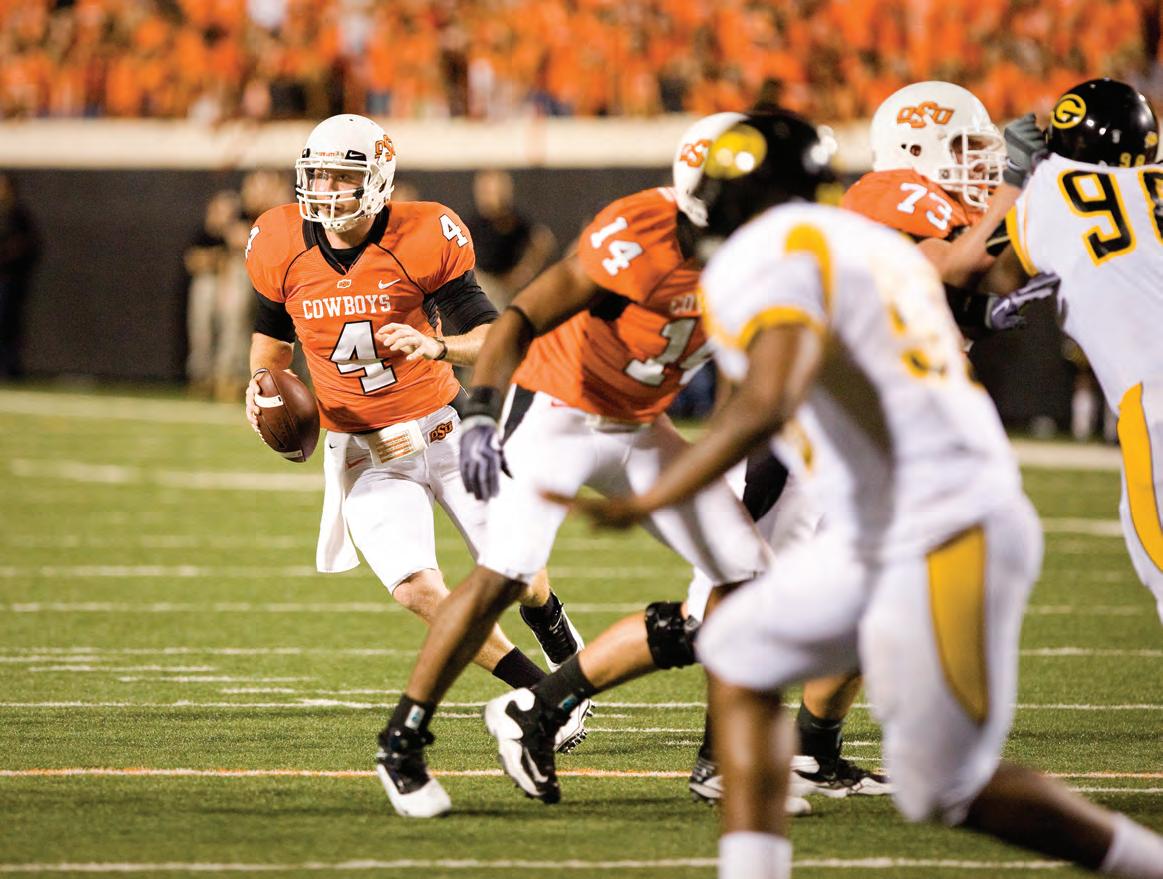
One go-to guy in Holgorsen’s playbook will be tailback Kendall Hunter, who rushed for 1,555 yards as a sophomore in 2008 before being slowed by injuries last fall.
“He was an All-American two years ago. He’s a good player and a good kid. He’s learning. He’s working hard.”
Holgorsen believes the new system will benefit Hunter’s NFL prospects, as well.
“Today’s game in the NFL is becoming more shotgun oriented, more pass-first,” he says. “It’s going to be good for Kendall to not only be able to carry the ball – which he’s pretty good at – but he’s also going to be able to get better with his receiving skills, motioning out of the backfield, moving around, getting the ball in space, working on his blocking techniques and all that ... It’s going to be good for him to develop into more of an all-around player.
we can make our decision early, or maybe we’ll have to wait until August, but we’ve got to practice in order to find out.”
Holgorsen says he looks forward to combining his high-octane offense with strong defensive and special teams units.
“That’s how you win championships. You don’t win championships being onedimensional. You’ve got to be good on all three sides of the ball. Part of the reason I was excited about coming here was having a defensive coordinator in Bill Young and a special teams coordinator in Joe DeForest who are as good as anybody in the country.”
Having faced the Cowboys from the opposing sideline every year for the last decade, Holgorsen was already quite familiar with the program and staff.
“The transition’s been easy,” he says. “I knew a lot of these guys. I just got tired of
“It’s a challenging conference, but this is the highest level that exists in college football. I’ve been at this level, and I wanted to get back to it.
“The goals that Oklahoma State has are to win the South and go to the Big 12 Championship and a BCS game. They’ve been knocking on the door for two years. We’ve got a great coaching staff, a head coach that’s proven he can win in this conference and topnotch facilities. There aren’t too many things that are broken around here, so if I can just make a little bit of difference and help us get a little bit better then it’s going to be a pretty special situation here.”

t,0111BOJ,-6'
FDDTBAL 00ne - ie • m P-h: St, M0n.l?xten0e

By Clay Billman
photography by Gary Lawson
rasnoyarsk, Russia, is roughly 6,000 miles from Stillwater, Oklahoma.
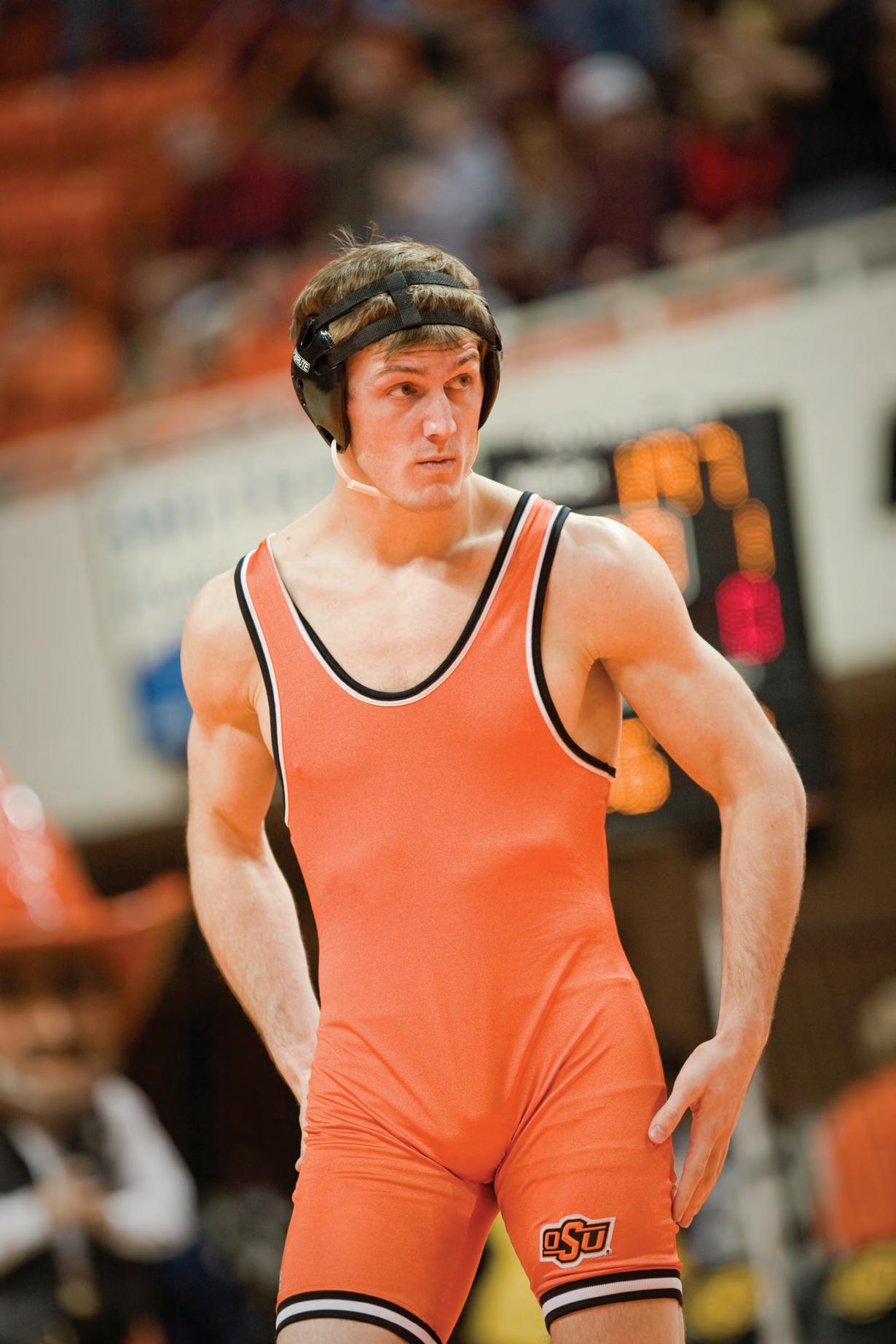
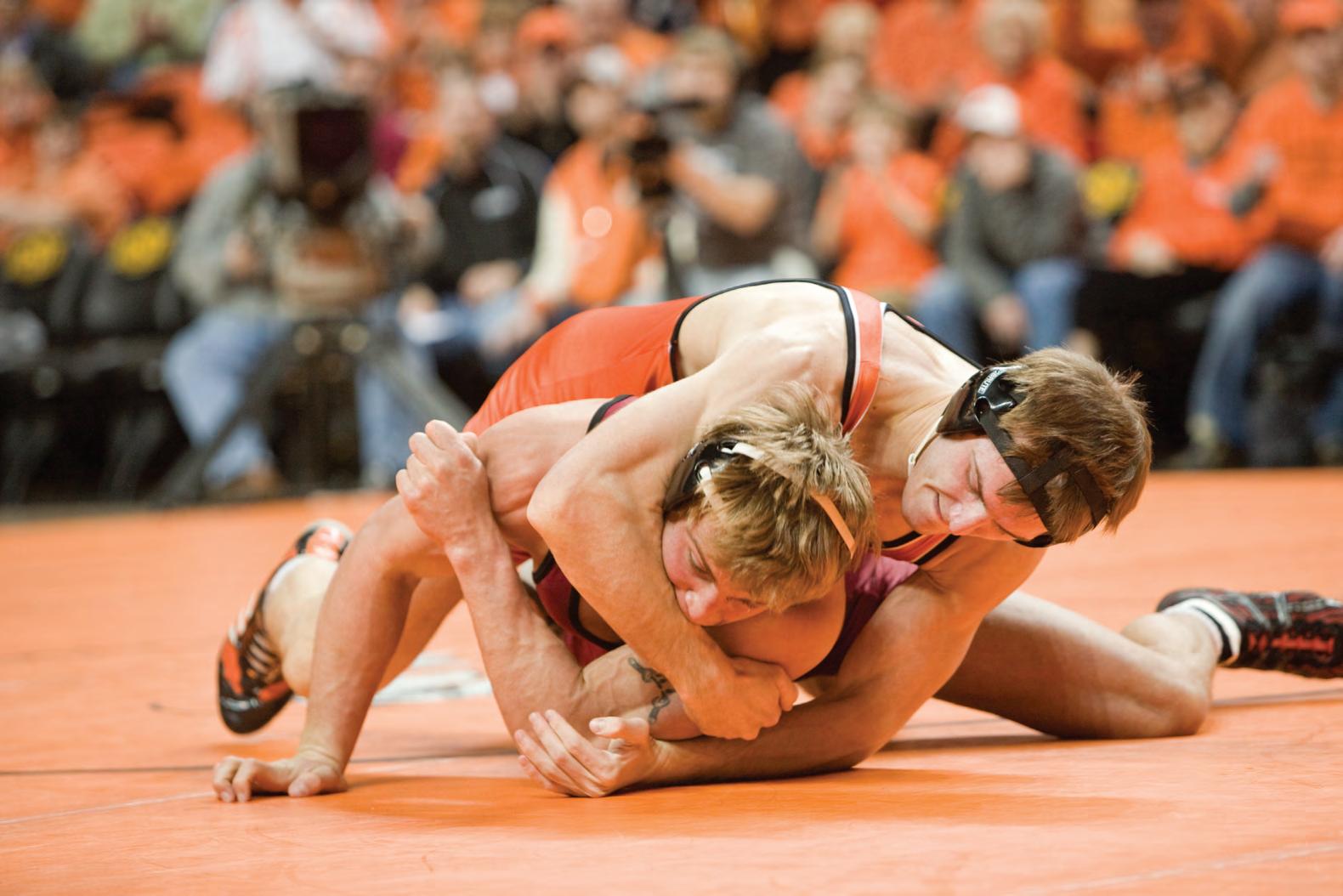
Alan Gelogaev has traveled halfway around the world to gain a college education and wrestle at Oklahoma State. He’s fi nding out that the distance between international freestyle and collegiate (sometimes called “folkstyle”) wrestling may be just as far.
Known to friends and fans as “Z” after his middle name (Zelim), Gelogaev was born in Sernovodsk, Chechnya. When he was a young boy, his family moved from his wartorn homeland to Moscow.
As a teenager, he took up wrestling with a local club. Showing promise in the sport, he left his family to train at a specialized wrestling school in Siberia’s industrial center.
“It was really hard at the start,” Gelogaev says. “I had to leave my family. I was by myself.”
In Krasnoyarsk, he grappled alongside Russian legend Buvaisar Saitiev (winner of nine world-level gold medals) in a system that emphasizes sports over scholastics.
“Over there, you choose one path,” he explains. “In Russia, if you study, you study. If you wrestle, you wrestle.”
OSU offers the opportunity to do both.
“Here, it’s a good program,” Gelogaev says. “You can study and wrestle at the same time.”
Gelogaev says he was introduced to the storied OSU program through former Cowboy Daniel Cormier, whom he met at international competitions.
“I fi rst met Daniel in the arena at some tournaments in France and Poland three years ago. He was wrestling my weight, so we got to know each other.”
From there, Gelogaev made his way to the United States and the Olympic Training Center, where he gained the attention of numerous college coaches.
“He came over from Russia and was looking for a school that would take a chance on him,” says Cowboy Head Coach John Smith. “He went to Colorado Springs to train, and colleges from across the country saw him there. I probably pulled the trigger (on a scholarship offer) a little faster than most, and for that reason, we got him.”
Smith says international wrestlers are rare at the Division I level.
“It’s not an easy situation,” he says. “It’s got to be the perfect storm before you can get somebody like that. They’ve got to be in great standing academically, and Zelim is. Without his academic background none of this would be possible for him. The reason he’s at Oklahoma State and will get an education here is that, when he was young, he was different than the wrestlers around him. He focused academically. Where he grew up that wasn’t the norm. Because he was different, we get the opportunity to help him grow academically at OSU.”
Former Cowboy and 149-pound NCAA champion Zack Esposito, now a club coach, has become one of Gelogaev’s close friends since his arrival in Stillwater.
“He’s an incredible kid,” Esposito says. “He’s happy for the opportunity he has
here. It’s exciting to see because he takes full advantage of it. He’s not just an athlete coming in here just to wrestle. He really wants to make a better life for himself. You think kids have it bad? Where he comes from … basically Chechnya and Russia are some of the most poverty-stricken countries in the world. I’ve been there. They’re just tough people. They could go without eating for a day, they could do work to take care of their family.
“To tell you where he’s from,” Esposito adds, “his uncle lives in Chechnya and built a house. A bomb dropped on it and it blew up. His uncle rebuilt the house. They dropped another bomb on it. Finally he said, ‘That’s it’ and moved away. But that’s the kind of place he comes from.”
A fi nance major in the Spears School of Business, Gelogaev has excelled in the classroom, earning Academic All-Big 12 honors this season. His transition from freestyle to collegiate rules is still a work-in-progress, however.
“The little, subtle things aren’t so subtle when you have somebody coming in who has no experience in it,” Smith says. “I didn’t realize how much difference there really is between freestyle and collegiate until I started coaching Z. The public should never underestimate how hard collegiate wrestling really is.”
Smith, who’s won Olympic and World championships in freestyle wrestling in addition to collegiate titles, says the difference in the two disciplines cannot be overstated.
“It’s much, much easier to go from collegiate to freestyle than it is from freestyle to collegiate,” he says. “A guy like me
wrestled freestyle all along through junior high and high school and college after the school season was over. We have freestyle throughout this country, but it’s what you do in the spring and the summer.”
Gelogaev’s lack of folkstyle instincts makes for some trying moments on the mat, Smith says.
“The change in styles makes it very difficult for him,” Smith adds. “When you think of the guys that we have on our team like Jordan Oliver and Jared Rosholt, these guys have been wrestling the collegiate style close to 12-15 years … so they’ve developed some instincts and some permanent things as a coach that I know they know. With Zelim, I had to start from scratch, like you would teach a kid who went out for wrestling and it was his first day: how to step on the line, how to get down in the referee’s position … Freestyle’s all a neutral start, you can lock your hands, lots of different things.”
A major difference in the disciplines, Smith says, is what happens when a wrestler is in the bottom position. And that’s where Gelogaev has had his struggles.
“In freestyle, wrestlers aren’t trying to get up off the mat. They’re lying on the mat, and you’re trying to turn them.”
Collegiate style is about control, Smith says.
“Freestyle is more about exposure – you can expose the back without any kind of control and it’s still points. You don’t have to take a guy down. You could trip him to his back and score three points. In collegiate, the big thing is getting him to hold on to his opponent after a takedown and make sure you get the two points.”
“I’m still struggling some with positions on top and bottom,” Gelogaev says. “It’s still like old reflexes. Your body doesn’t react like that. It’s like you’re reacting in freestyle, which I wrestled most of my life. It’s kind of hard to really change it.”
Despite the learning curve, Smith is impressed with Z’s development.
“He’s learning. He’s getting the feel for collegiate style wrestling, and he’s done a pretty good job for somebody that’s only wrestled our style for a year-and-a-half. The good thing is he is competitive. Z has wrestled at a high level. He’s got a lot of skill and still has some things he could do that he did in freestyle that he can do in collegiate.”
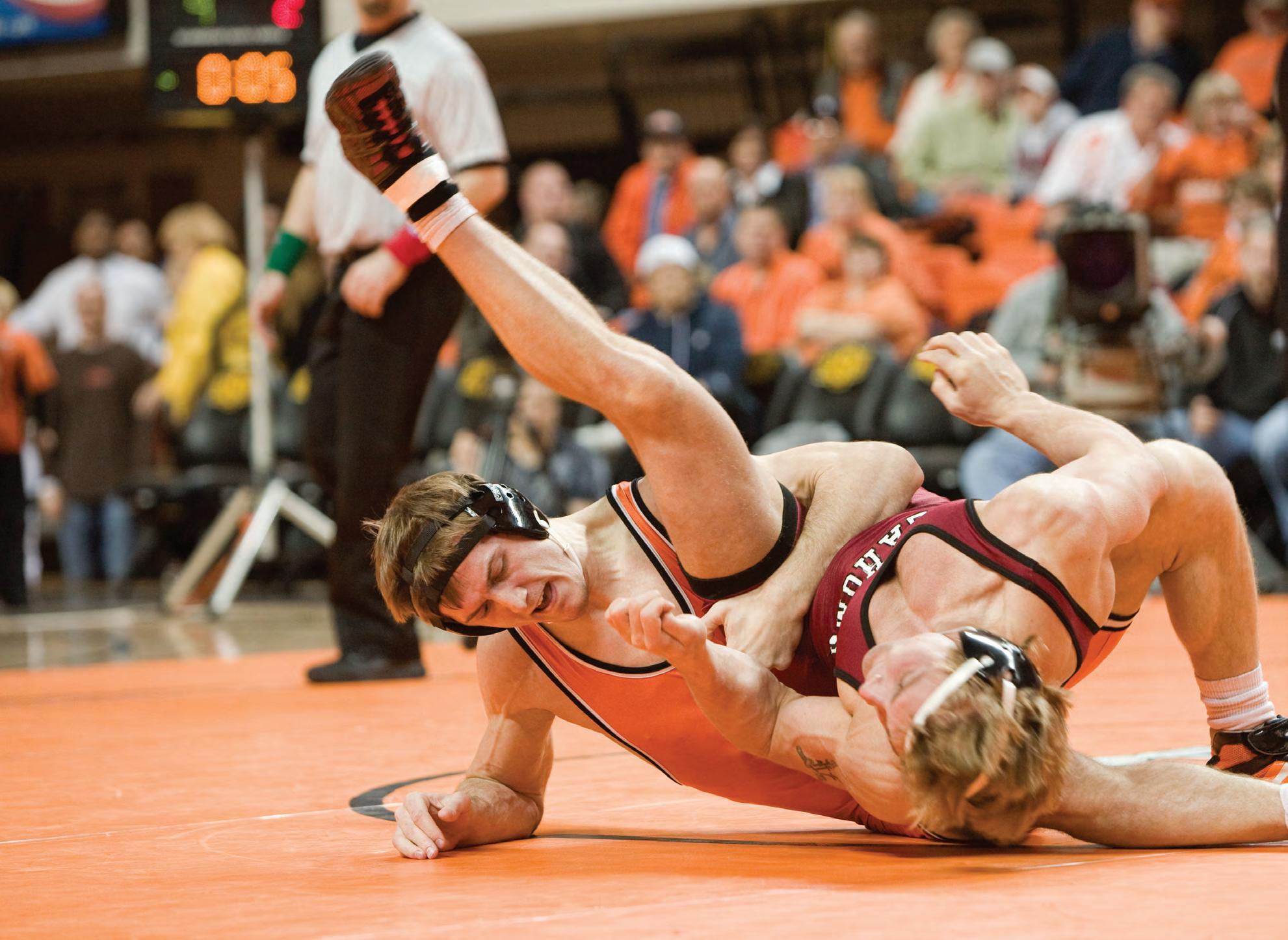
“It’s just different, the way I wrestle here,” Z says. “I like wrestling on my feet, throws, foot sweeps. I still don’t really shoot that much, I’m just kind of developing my style.”
Gelogaev has already earned a reputation for the impressive moves he honed overseas.
“It’s an exciting style,” Esposito says. “That’s the fun thing about watching Z wrestle, because you never know what he could pull out. His bread and butter, his go-to stuff, all of it is freestyle. He’s also got great defense and great position for his size.”
A sophomore in eligibility, the 6-foot3-inch Gelogaev competes at 197 pounds, arguably the most-competitive weight class in the country this season. Four of the nation’s Top 10 wrestlers are from the Big 12 Conference alone, making for a challenging first season in the starting lineup.
“We all knew it was going to be a long struggle, but he’s actually done better job than what I figured,” Smith says. “I thought he would struggle much more, with more losses than he’s had. It’s good to see him really separate himself from three-fourths of the wrestlers in his weight class.”
Through the 2010 regular season, Gelogaev’s record was 25-5, with all five losses coming to ranked wrestlers.
“He’s been real competitive with some guys at the weight, like Jake Varner from Iowa State, the defending national champion. Z got pinned in the second period because he couldn’t get off bottom, but he did go 0-0 with Varner in the first period. He has a level of confidence that he can go with anyone.”
In addition to the adjustment in rules to the collegiate sport, Gelogaev has had to adjust to the compacted season of competition.
“He’s never been in a season like this,” Smith says. “He’s never had to control his weight like he’s had to this year. And that’s a big change. He’s a guy who’s going to end up weighing in more than 20 times in a four-month season. In Russia you might weigh in eight or nine times, spread out over the entire year. So that battle, along with studying, along with maintaining a high GPA, can be overwhelming. He’s doing fine. He’s handling it all. And he’s further along than I thought he would be.”
Smith sees a bright future at OSU for Gelogaev.
“I think Z’s got to continue to learn. He needs to continue to get better on top, continue to get better on bottom. He’s got to recognize
that he needs a couple scoring opportunities and not really focus on his defense, but he’s doing that. It just takes time. But I’m excited for him and what he brings to our team.”
In the wrestling room, while Gelogaev is learning the collegiate style, his coach says some of Gelogaev’s freestyle moves are catching on with his Cowboy teammates.
“It’s fun. Some guys are hitting those moves now because they watched Z do it. We’ve got guys in the room, like Alex Meade, when they get up in that upper body position, rather than fleeing and being scared of it, now from watching Z, they’ll let it fly. You definitely have to be prepared to defend it. It’s good.”
In front of a crowd, Gelogaev shows little emotion – whether in victory or defeat. It’s something American audiences aren’t used to seeing in their athletes.
“I kind of like that he doesn’t do a whole lot after his match, win or lose,” Smith says. “The Russian culture of sports in general, not just wrestling. They’ve been taught to not show a lot of emotion. When they win they don’t get too excited, and when they lose you don’t see a whole lot. That’s probably a pretty healthy way of handling sports. He doesn’t like to lose. He loves to win, just like all of us. But his emotions on the mat are a little bit different.”
“That’s very typical with wrestlers overseas,” Esposito adds. “Being over there competing, you see it first-hand. Their mentality is a lot different than Americans. You see Americans getting all riled up before matches or before a football game … I’ve seen guys from Russia win the Olympics, and they might have a smile on their face, but it’s very little emotion. It’s almost like they expect it sometimes. Their main concern is they always try and stay calm.”
“I wouldn’t say I’m emotionless,” Gelogaev says. “I just try to be as calm as possible. Don’t be all excited about something you’ve done, because if you did something, it would be because you deserve it, you worked hard for that. That’s what I think.”
After falling to Varner in the ISU dual, a stoic Gelogaev made his way to the locker room. Some fans got the impression he didn’t care. Alone in the corridors of Gallagher-Iba Arena, he displayed his true feelings.
“I punched the wall,” Z says, looking down at the scarred knuckles of his right hand.
“Trust me, he’s disappointed,” Esposito adds. “If you think that he gets off the mat
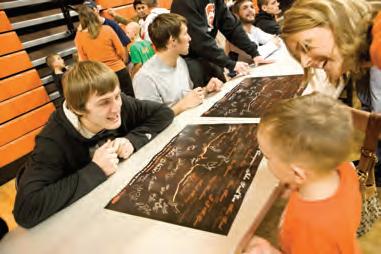
and he just has no emotion, I’m telling you, he gets mad. That’s one thing that the Russians and many foreign wrestlers are very proper about. They’re sportsmen. They don’t show those emotions in front of crowds, but I’ve seen him get mad. Every time he gets beat, he comes back and gives it his best.”
Gelogaev says he uses his defeats as motivation to get better.
“Losing is a process. You’ve got to go through it. It’s hard, but that’s how it goes. Start working harder.”
Despite a handful of disappointing losses, Smith says Gelogaev’s positive attitude remains.
“He doesn’t get down. When we go over that stuff, we sometimes put him in bad situations on bottom, put him in situations where
he has to fight to come up and learn it. He’s learning it the hard way, but he’s by no means getting down.”
Gelogaev says he likes Stillwater, but being a hemisphere from his homeland, he misses his parents and his five siblings back home in Moscow.
“I don’t like being away from home. I want to see my family every day, but I can’t, so I talk to them online often.”
“Z is very devoted to his family,” Smith says. “He doesn’t complain about being away from his family a whole lot, but you can tell it affects him. You can tell how close he his to them. It’s a real commitment on his part to be here, but he also understands what an opportunity this is for him to better his life.
“He’s a guy who appreciates what he has and the opportunity he’s been given,” Smith adds. “There’s no sense of entitlement. He shows us that he’s going to earn it every day by his grades and by his effort. He’s disappointed when he feels like he did poorly on a test. It’s just good to be around a kid like that. Wouldn’t it be nice if they all did that?”
Gelogaev’s plans include finishing his collegiate career while seeking U.S. citizenship and a spot on Team U.S.A. for the 2012 Olympics.
“Since I’m here, I am trying to get citizenship and try to make the team for U.S. because my school is going to be until 2012. That’s my plan. We will see how it goes. If I don’t make it, life is full of other things.”

generation of your company is at Oklahoma State University today.
BY MATT ELLIOTT
Tegan Cunningham has got to be half crazy. To come here all the way from one of the world’s largest and most cosmopolitan cities, Melbourne, Australia, to play basketball out in the middle of nowhere. It definitely sounded crazy to her friends, she says.
Further evidence of that half-craziness may be her love of motocross. Thankfully for the Cowgirl coaching staff, she hasn’t taken up that brutal pasttime yet.
“Ever since I was a little girl, I’ve always wanted to have a motorcycle,” says Cunningham, standing barefoot in her practice jersey outside the Cowgirls’ locker room in Gallagher-Iba Arena. “I guess I’ve always been so busy with basketball, I’ve never really had time to. It’s something I’ve always wanted to do.”
It might be easy to question her sanity when last year, early in the season, she fought for a rebound under the basket against the Sooners’ Paris twins. For those who don’t remember, those two added up to nearly 500 pounds in the post.
That was a ‘welcome to the Big 12’ moment.
“I tried to get one rebound, and I was like, ‘Holy cow,’” says Cunningham, her eyes widening. They knocked her silly. “I was like, ‘Oh, my God. Where am I?’”
She’s not crazy. She just loves the game and she loves playing for one of the best teams in the league. Her fearless nature is part of what has made her the threat the Cowgirls
needed to help the nation’s fifth-leading scorer, star point guard Andrea Riley. Both are seniors and looking to close out their final year at Oklahoma State with a deep run in the NCAA tournament.
Last year, Cunningham was the latest of several Cowgirls to come from Seward County Community College in Liberal, Kan. She averaged more than 25 minutes, 10 points and four rebounds per game.
“We had a talk at the end of last year,” says Head Coach Kurt Budke. “We told her, ‘You’ve got to come in and you’ve got to average fifteen-plus points a game. You’ve got to rebound the basketball and you’ve got to be a go-to player if we’re going to have success because, obviously, everybody is going to come at Andrea.”
“Tegan has done everything we’ve wanted ... This is a kid, who in my mind, there’s no question she’s an all-Big 12 performer ... She’s a key player in what we’ve done. We’re very proud of how she’s advanced this year … She’s just a good teammate and turned out to be the really good player we hoped she’d be.”
— Coach Budke
Cunningham responded. This year, coaches gave her more minutes and she has averaged more than 16 points, seven rebounds and 40 percent from beyond the three-point line.
“It took a year to get familiar with the team,” she says. “Now, I’m a lot more comfortable. I play a lot better with Andrea now, as far as being behind her and understanding what my role is on the floor as well as hers. The coaches always had confidence in me shooting the ball, but I didn't really have confidence in myself. And I was a little hesitant to shoot.”
This year she wants to leave it all on the court. And she has come up big in big games. In addition to her solid jump shot, she has proven to be a strong rebounder, too, a rare thing from her wing position on the floor.
She was red hot during a big win over Texas Tech in late February, shooting more than 60 percent from the field and downtown, just weeks before the then 20-8 Cowgirls headed into Big 12 Tournament. She also turned in 18 points and 12 rebounds during a huge overtime win over the Longhorns just before that. And in January against conference stalwarts Texas A&M, she dropped 18 points and nabbed 14 rebounds.
Few wins were bigger than the team’s Senior Night upset of No. 13 Iowa State. Riley and Cunningham, both playing in their last game at Gallagher-Iba, scored 52 of the 20th-ranked Cowgirls 78 points. As she had throughout much of the season, Cunningham started the first half hot with several baskets to keep OSU in range while others were still looking for their shot.
As the game progressed, the Cyclones
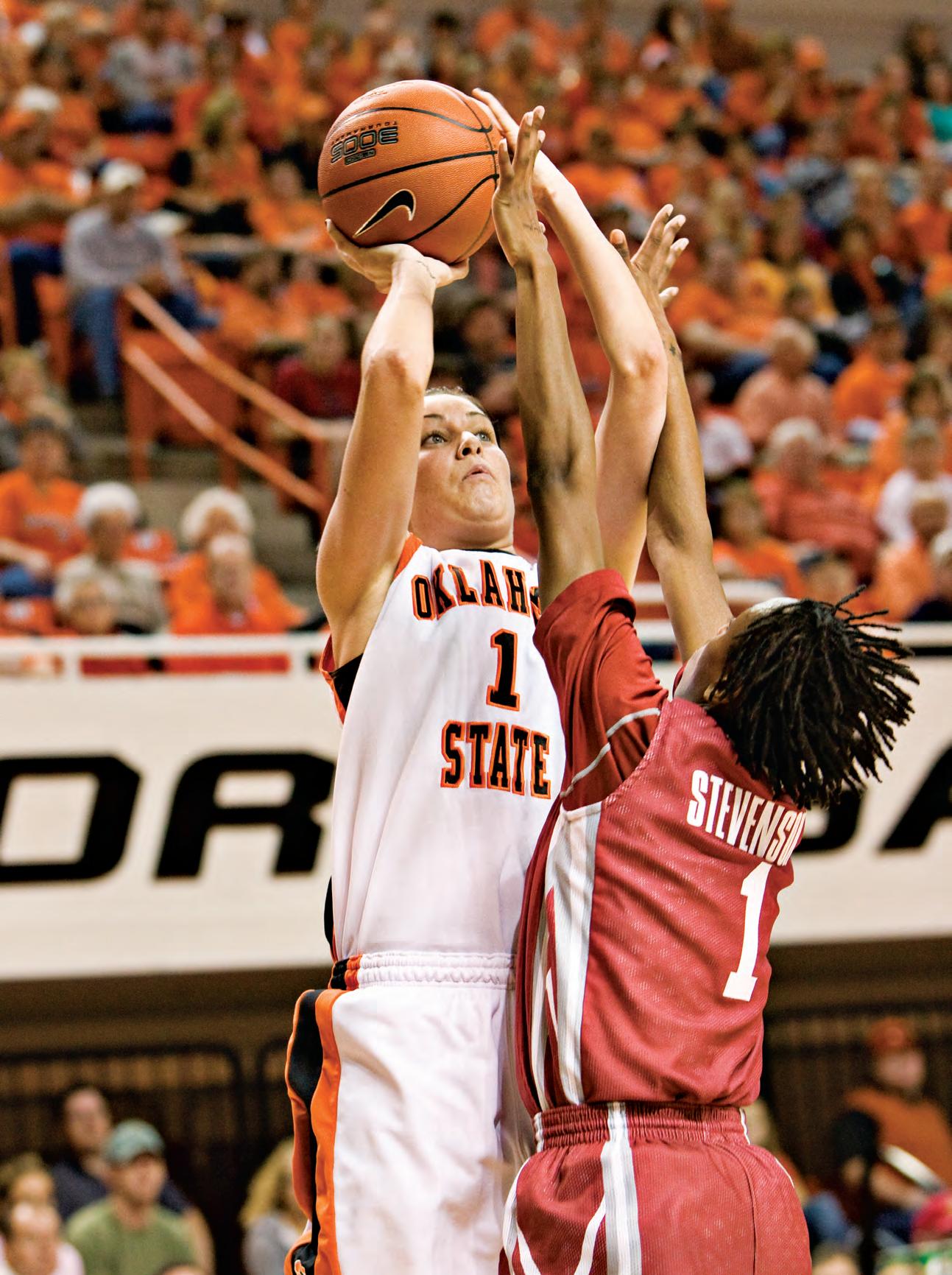
by Phil
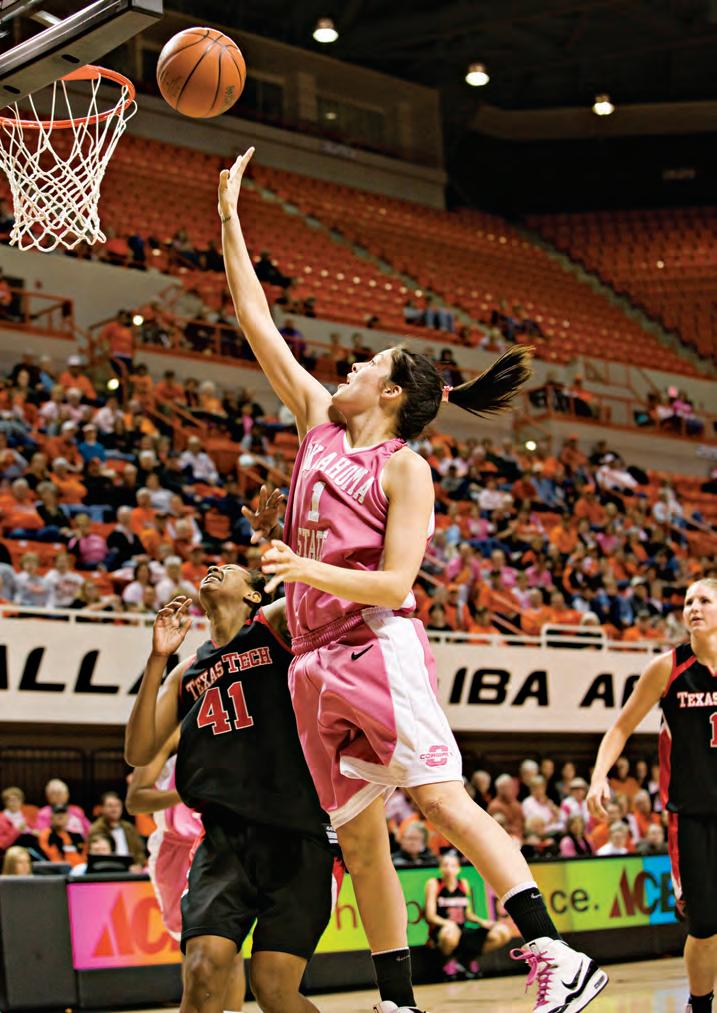
couldn’t keep Riley off the foul line, and Cunningham had several key baskets that cut short Iowa State runs, including a layup on a fast break with 11:40 to go that pushed the lead to 54-47.
“Tegan has done everything we’ve wanted,” Budke says. “This is a kid who, in my mind, there’s no question she’s an all-Big 12 performer. She has had numerous double- doubles. When she goes for numbers of eighteen points, ten rebounds on a night in the Big 12, we normally win. She’s a key player in what we’ve done. We’re very proud of how she’s advanced this year … She’s just
a good teammate and turned out to be the really good player we hoped she’d be.”
Cunningham says this year has been whirlwind. But helping get her through that has been the family atmosphere surrounding the team and Stillwater’s small town feel. That’s what she came from back in Liberal.
Astounding her friends and family, she went to Seward County, a perennial junior college basketball powerhouse, to pursue her dream of playing basketball in Division I. Due to academic eligibility issues as an internetional student-athlete, she had to start at the junior college.
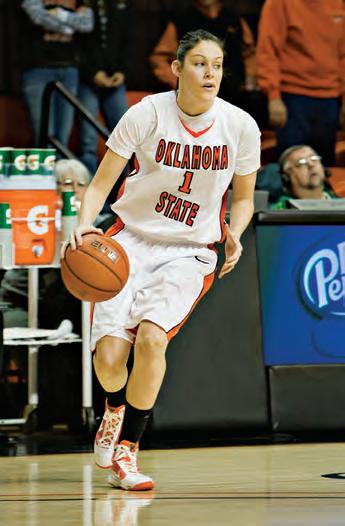
It all started with a bumpy, cramped plane ride into Liberal, a far cry from where she grew up in Melbourne, a city of nearly 4 million people. She left behind her close family including a twin sister and an older brother, as well as her favorite team, the Carlton Blues, an Australian Rules Football club (no comparison to American football, she says).
“For me, it wasn’t a matter of where I was at because I wanted to play basketball,” says Cunningham, who coped in part by living with host families while she was there. “Being in a small town like that has its advantages because there’s nothing else to do but play basketball. I just fell in love with Seward basically. I had an awesome two years there.”
Awesome, indeed. She went on to firstteam All-American status her sophomore year and led her conference with more than 21 points per game. She led her team in rebounding with nearly 8 rebounds per game. Also a first-team All-American as a freshman, she was her conference’s most valuable player both years at Seward and finished as its alltime leading scorer, scoring in double figures 68 times and logging 28 double-doubles.
It was a long climb though, she admits. When she first got there, American basketball was a big jump from her days playing in high school. She had trouble adjusting to the speed of the game and the athleticism of her competition.
“I remember during a pickup game Chontaye Walter was the point guard running
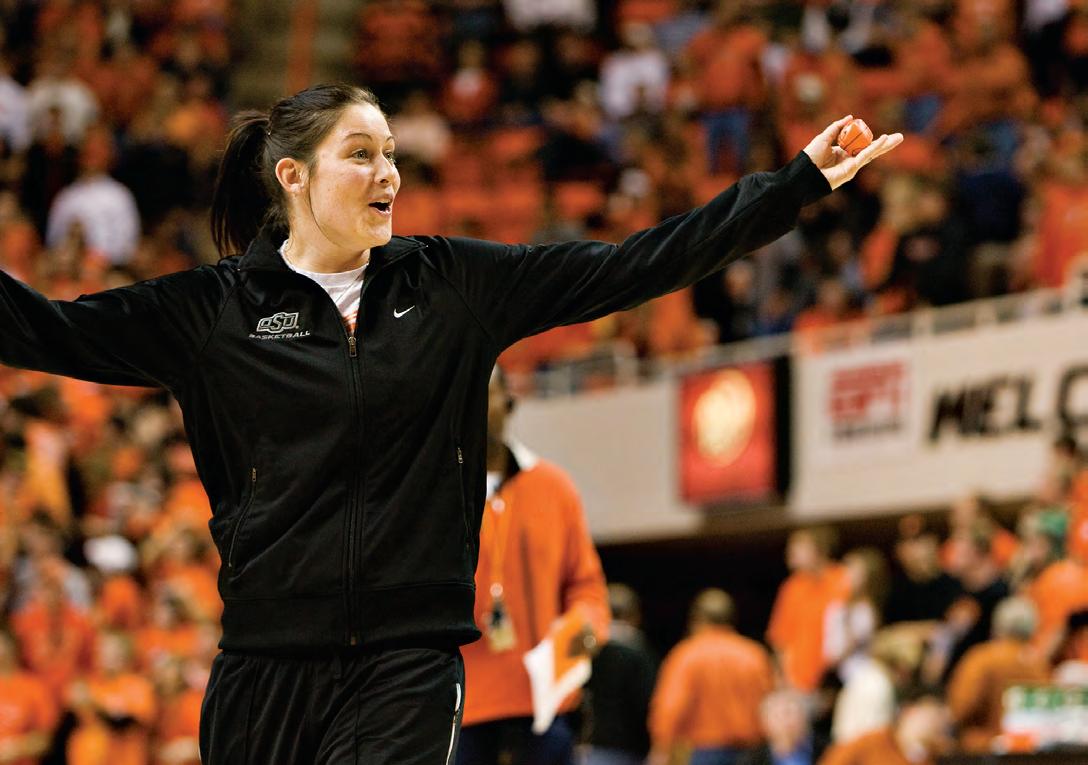
the floor. She threw me a pass through the lane, and I tried to get it but I couldn’t. She just threw the ball so fast, I didn’t get a feel for it. I was like, ‘They expect me to catch that?’”
Once she finished, she knew OSU would be a good place for her. The university’s ties to Seward are strong. Associate Head Coach Jim Littell, inducted into the NJCAA Hall of Fame in 2009, spent 14 years at Seward as one of the most successful coaches in the nation. Naturally, OSU snatched her up as quickly as they could.
She had to adjust again into a new system and a higher level of play. She showed flashes of the player coaches knew she could become, scoring 20 points and pulling down 12 rebounds against Texas Tech.
She spends her free time in Stillwater hanging out with her teammates, going to the movies and going out to eat.
Every once in a while, her family makes the umpteen-hour flight to visit her. Her mom is a school nurse and her dad works in information technology, so they can’t get away often.
Otherwise, the self-described mama’s girl has had to learn to deal with the distance and crazy difference between time zones. Often, when she plays in a game, it’s already the next day in Australia.
“My dad listens on the internet. My brother does the same. If we play in the afternoon, it’s like 6 a.m. the next day in Melbourne or something ridiculous. He’ll have to get up early just to listen. Sometimes he gives me crap about that … When I want to call mom or dad, it’s some ridiculous hour over there, and I can’t get a hold of them.”
She says holidays have been difficult. And she doesn’t get the obsession with turkey during Thanksgiving.
“Everyone makes such a huge deal about it here, and I understand why, but at the same time, it’s just turkey. Halloween is another one. Halloween is not really big at home. People get crazy about it here. Their house will be absolutely crazy, and we have nothing like that … but I like change in my life.”
She’s not sure what she’ll do once she leaves OSU. She graduates in May with a degree in education. Like many of her teammates, she’d like to go on to the WNBA. She’s not interested in playing overseas. She says she may end up coaching somewhere, but she’d really like to be closer to family.
That’s getting ahead of herself though. She’s got some unfinished business to take care of in Stillwater.
“The year has gone by so fast. I remember just coming into Stillwater this summer and having a whole new team. And now it’s almost over. I’m playing my last game at Gallagher-Iba on Wednesday. That’s life. It goes by without you realizing it … But I’m trying to keep my head up and focus on getting to the NCAA tournament coming up. This is my last go-round. I want to leave everything on the court. It’s important for me and Dre to step up our game and really show the team, leave a legacy, so next year’s team can see how hard we worked and then push themselves.”

Yep ... Red Dirt music started right here in Stillwater! Groups like Jason Boland and the Stragglers, Cross Canadian Ragweed and No Justice combined a little bit of Blues, a little bit of Country and a little bit of Rock and Roll to create the new genre.
You’ll find tomorrow’s legends of almost every genre playing the bars, juke joints, festivals and stages in Stillwater today ... many greats started here, like Country artist Garth Brooks, the Alternative Rock sensations All American Rejects and Blues icon Watermelon Slim.
Stillwater Rocks! ... and Boogies! ... and Scoots its Boots!


For over four decades, Club Car has delivered specialty transportation solutions that set the standard in innovation, quality and performance. So it’s no surprise that Karsten Creek is a loyal Club Car customer. Through our dedication to customer satisfaction, Club Car has developed the most extensive product line in the industry to meet a wide range of demands. So no matter what your needs, visit us today, and we’ll help you find the Club Car vehicle that’s right for you.
By Gene Johnson
and see.” Mr. Whitworth smiled as Wes and I continued to exchange barbs.
Wes’s senior class at Varnum, a suburb of Seminole, totaled eleven. One of Wes’s classmates went on to become a Playboy centerfold. Some things remain etched in your memory.
Exiting the Gallagher Hall basketball court area, the three of us walked down a narrow, brown-tiled corridor lined with a row of old black and white photos featuring former Aggie/Cowboy athletic teams and individual players. Mr. Whitworth, our host, stopped, then asked us matter-of-factly, “Would you boys like to meet Mr. Iba?”
At a loss for words, Wes and I stared at each other. Was the Pope Catholic? Would we like to see the Mick play in Yankee Stadium? The answer was obvious.
“Yes, sir!” I said. It was 1960. Elvis returned to music after a stint in the army, minimum wage paid $1 an hour, a deluxe hamburger with fries cost a quarter, and a gallon of gas sold for 22 cents. That November, voters would elect JFK president. Meanwhile at Oklahoma State University, tall, silver-haired Dr. Oliver Wilhelm held the office of President, foundation assets totaled zero and Cliff Speegle coached the struggling football squad to a 3-7 record, beating Tulsa, Kansas State and Nebraska.
Earlier that cold January evening, from the back seat I gazed out the side window as Mr. Whitworth’s green Buick sped north on Highway 177, passing through Perkins toward Stillwater. The temperature hovered below 20 degrees, shivering, blustery weather. Darkness was approaching. Outside, the wind whistled, swaying branches of leafless trees. The car’s heater, going full blast, provided welcome warmth. Unaware of the memorable event in store for me, I was content to be along for the trip.
A few miles earlier we’d passed a parked Highway Patrol car, so Mr. Whitworth drove
carefully, both hands on the steering wheel, paying full attention to his task.
We were on our way to see the Oklahoma State Cowboy men’s basketball team host the Iowa State Cyclones. My anticipation level rose due to my passion for basketball, plus the promise of witnessing that night’s contest. I’d never seen the Cowboys play in person; on TV twice, but never live. I was savoring the moment.
My high school basketball team, the Seminole Chieftains, was ranked third in the state, 20 wins against three losses. As a lanky 6’6” junior, I teamed with 6’7” senior Buddy Vance and 6’4” Tommy Roberson for a formidable front line. Later that year, Buddy accepted a full scholarship to play for Kansas.
In his baritone voice, Mr. Whitworth spoke. “Boys, the Cyclones will be a tough match for the Cowboys. They’re tall, talented and that Brewer boy, who could be an All-American, can score inside or outside.
What do you think?”
“You’re right, but the Pokes,” I said, using the Cowboys’ nickname, “are always super tough at home — and Greer,” OSU’s lightning quick guard, “will stick to Brewer like gum on a shoe. We’ll be alright.”
“Hope you’re right,” Mr. Whitworth added, “but it should be a heck of a game. We can’t turn the ball over, plus we’ve got to cover them and rebound.”
“Johnson, you always think the Pokes walk on water,” said Wes Bowman, sitting in the front seat. Wes was a friend, but he loved to needle me and vice versa.
“Okay, Bucko,” I responded, giving him a gentle slap on the back of the head, “just wait
A 30-year veteran with Gulf Oil, Mr. Whitworth worked as a field supervisor. Standing 5’8” and weighing a solid 190 pounds, a cannonball of a man. Mr. Whitworth had been a 145-pound wrestler at Illinois University. The neatly groomed, greyhaired gentleman was personable and easy to like. Wearing pressed khakis, a starched long sleeve white shirt, shined brown loafers and a broad brimmed grey Stetson cocked to one side, the confident Mr. Whitworth attended every home Cowboy basketball and football contest. When he spoke of OSU’s legendary basketball coach, Henry Iba, you got the idea they were good friends.
As we drove into town, you could see Stillwater was a clone of other medium-sized Oklahoma towns; seven blocks in the north/ south central business district, street lights at every intersection, three banks – two on opposite corners, two IGA stores and one Humpty Dumpty. Bates Brothers advertised clothes for the distinguished man. Several cafes lined Main street – two with flashing neon OPEN signs and another advertising MALTS — HAMBURGERS — HO’ MADE PIES . Two gas stations offered green stamps. Katz Department Store displayed a sign that promised clothes for the entire family while Thunder Road, starring Robert Mitchum, played at the Leachman Theater. The brutal weather kept the sidewalks virtually empty.
Approaching campus we soon were in the midst of large three- and four-story buildings, giving us the feeling that we’d just driven into a mature redwood forest.
“These are some of the Greek houses,” Mr. Whitworth said, pointing straight ahead, “and the Student Union sits right across from the Library. Most buildings are built in the Georgian architectural style.”
Sitting quietly, I took in the sights. Wes and I hadn’t seen anything of this magnitude. Not knowing anything about a Greek house or Georgian architecture, I kept my thoughts to myself in case Wes knew more than I did. The fact he kept his mouth shut led me to believe he didn’t know either.
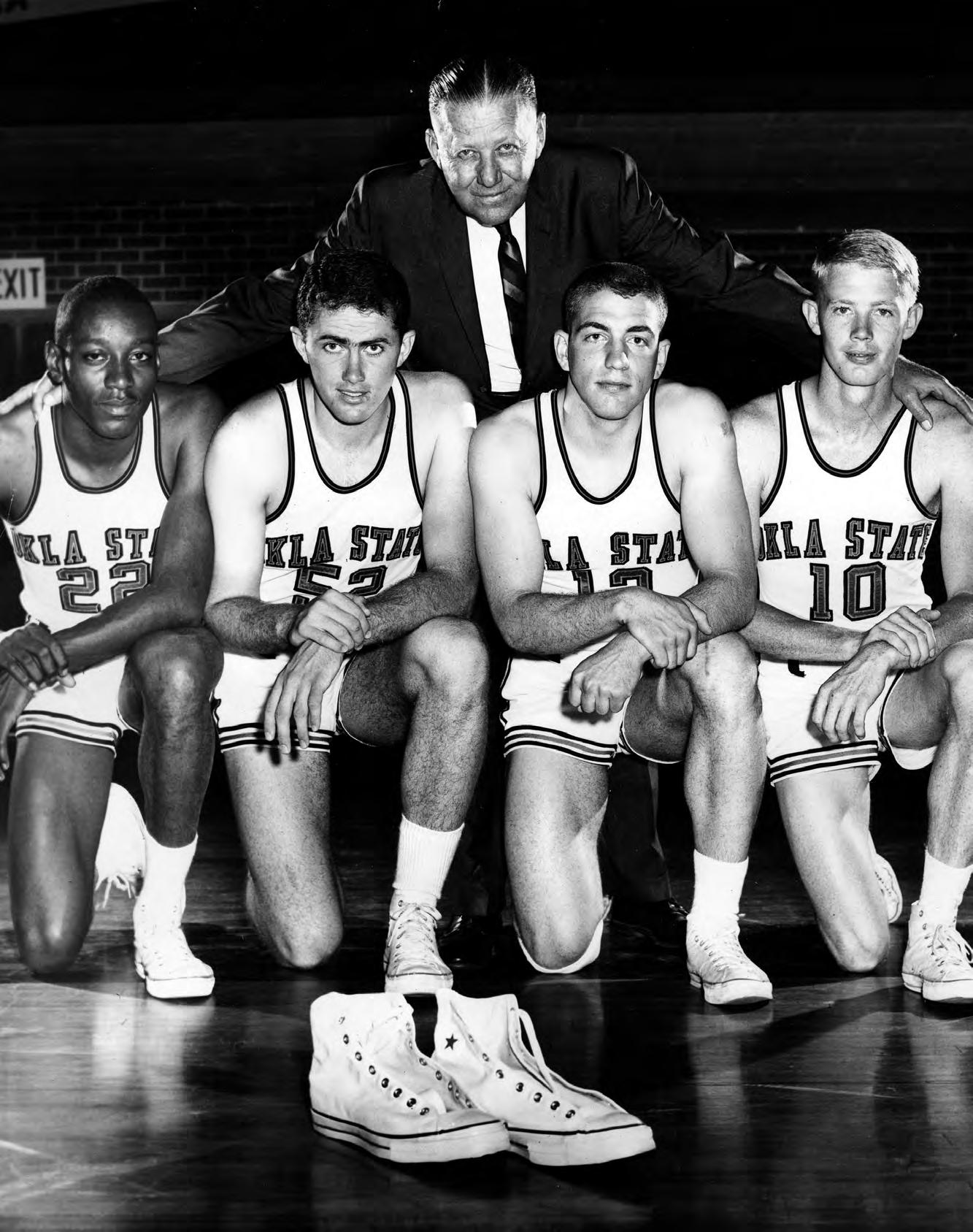
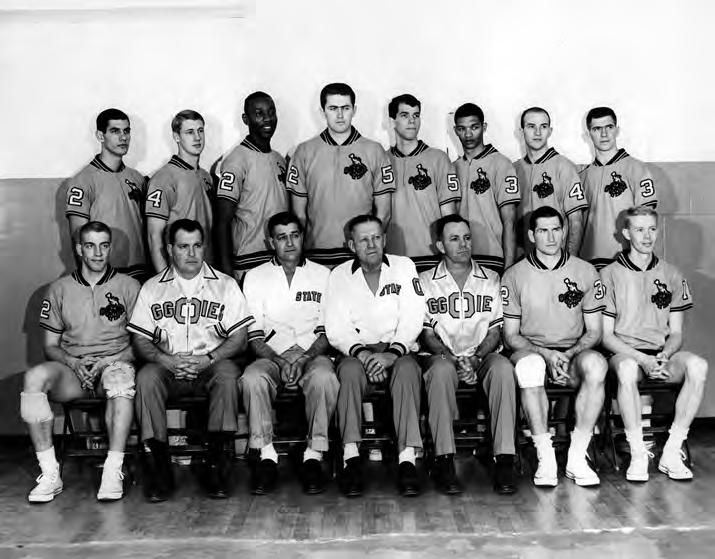
Winding our way through campus past the blocks of buildings, including the Infirmary, Home Economics building, Whitehurst and finally Lewis Field, we approached a dimly lit parking lot.
“Over there is Gallagher Hall,” said Mr. Whitworth pointing.
The closest parking spot was about 50 yards from the field house. We got out and slammed the car doors as the wind, with seemingly renewed vigor, penetrated our bones. Zipping our coats, we walked as fast as we could while not getting too far ahead of our host. Our tickets were at the Will Call window just inside the arena.
Excited fans, both adults and students, mingled in the corridors, talking and laughing, purchasing popcorn and drinks, while making their way up the stairs or through the hallway and to their seats. The majority of male students sported shiny bass weejuns, button down collar shirts and slacks with narrow belts. The girls wore tight sweaters, complimented with snug skirts and short hairstyles. I’d never seen so many pretty girls in one place.
As we turned down a long hallway that led to the court I caught a glimpse of Mr. Iba, or The Man, as his players referred to him. Tall at 6'2", weighing a solid 190 and fit at 57 years of age, Mr. Iba’s grayish brown hair was parted neatly in the middle and combed back. He resembled a successful corporate CEO in his tailored grey sharkskin suit, white shirt with gold
cuff links, black Windsor tie and shiny black wingtips. His large brown eyes were both attentive and penetrating. “Powerful” would describe him in one word, an imposing yet handsome man.
Mr. Iba began his career in Stillwater in 1934. Under his guidance OSU won fifteen conference titles, two national championships and produced thirteen All-Americans, all providing devoted fans unforgettable memories that grew with the passage of time. In a few minutes I would see his team play. Pinch me, I must be dreaming.
As we entered the court, 6700 rowdy fans were on their feet, waving as they sung the school song accompanied by the pep band. Cheerleaders yelled, urging the fans to get loud.
The teams warmed up. Finally, the ref’s whistle blew. Game time! I felt intoxicated by the atmosphere, my capacity to absorb the moment pushed to the limit. What could be better than this?
Players on both squads were big, and by big, I mean huge. Several were 6’8” or taller, and one for the visitors topped 7’ at 280 pounds, a mountain of a man. Quickness and strength were the keys to this game, and Iowa State’s star Vinnie Brewer had both. The game went back and forth, neither team leading by more than three points. Mr. Iba directed his team as General Patton had commanded his army — with dignity, confidence and absolute authority.
Sitting ten rows behind the Pokes’ bench, we could clearly hear Mr. Iba’s raspy voice,
“You guys go to work and cover somebody. Damn it, Moe, make sure you get a good shot, then hit it. Cecil, that’s the way to get on the boards. L.C., don’t let 32 beat you off the dribble. Come on boys, you can win this, now let’s do it!”
At times the roar of the crowd drowned out our ability to hear the person sitting next to us. When the Pokes shot a free throw, the crowd hushed to the point you could hear a pin drop. At halftime the Pokes were up by one. In the second half of the rugged see-saw contest, OSU’s talented defender Greer fouled out with the Cowboys up by three and two minutes left. Intensity in the arena could be cut with a knife. I could hardly breathe.
The game got closer. With three seconds remaining and OSU ahead by one, the Cyclones’ talented shooter and playmaker, Brewer, put up a desperation, off-balance twenty-footer and, to everyone’s shock, drilled it. The Pokes lost. Crushed in disbelief, the life had been sucked out of me. The stunned crowd was silent, almost a funerallike atmosphere.
Mr. Iba stood up, took a deep breath, buttoned his coat, straightened his tie, nodded to the opposing coach and, with his head up, walked off the floor. The fans quietly meandered quietly toward the exits while the players drifted toward their locker rooms.
Wes knew better than to pop off about anything. Mr. Whitworth, not happy, stood, stretched, straightened his khakis and glanced around the field house. I felt numb, but was still in awe of the whole experience. The game, the players, Mr. Iba, the fans, the noise, Gallagher Hall, the intensity — it was too much to digest. Several minutes later Mr. Whitworth motioned for us to follow him and offered the invitation to meet Mr. Iba.
Could this be real? Were we indeed going to meet The Man?
A small sign, Henry P. Iba — Athletic Director and Basketball Coach, hung over the dark wooden door, the top half had an insert of frosted glass. Mr. Whitworth knocked. The door opened.
“Hello, Allen, great to see you,” Mr. Iba said, and smiled as he shook Mr. Whitworth’s hand. “You boys come on in.”
My heart raced as we entered. Mr. Whitworth made introductions. Glancing around the room, I noticed black and white photos of All-American players and championship teams. Although his team
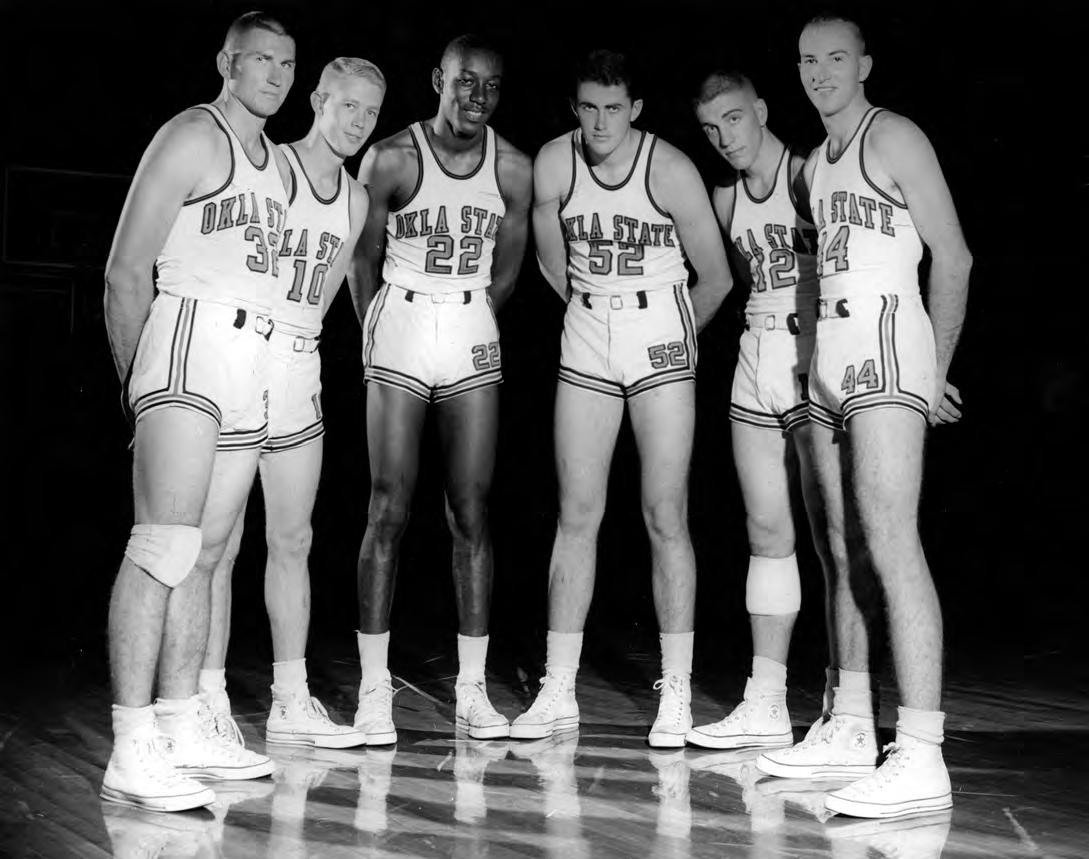
had just lost a heartbreaker, Mr. Iba was calm and cordial.
I glanced at Wes and his mouth gaped open along with mine. We were in the presence of The Man, someone we’d only read about in the papers and Life magazine or seen on TV. Mr. Iba seated himself behind a large mahogany desk, angled in the back of the spacious room as he pointed to leather chairs for us.
The two men exchanged small talk. Mr. Iba looked directly at me, “Eugene, looks like you boys at Seminole have a pretty good ball club, think you can make it to the state tournament?”
The Man was talking to me — I couldn’t believe he’d been following the Chieftains! Dry mouthed, I searched for words, “Yes sir, that’s definitely our goal. We hope to win it, too.”
“Good luck, that tournament is always an exciting time,” he said, then turned his
attention back to Mr. Whitworth for more small talk, and finally, “Allen, thanks so much for coming. By the way, you know we need to go bird hunting soon, maybe when ball season is over.”
“Anytime,” Mr. Whitworth said, and smiled as he stood. Mr. Iba walked us to the door, shaking our hands as we left.
I floated on a cloud all the way home. I don’t recall much about the return trip home except that Wes and Mr. Whitworth exchanged opinions on the game. With tonight’s events swimming in my head I thought, “Does it get any better than this?”
I had seen the Pokes play and met The Man. I had new dreams, hoping to be so lucky as to one day play basketball for OSU and Mr. Iba.
But that’s another story.
The Man: That term describes several respected, charismatic, high achieving leaders including Lincoln, Churchill and Washington, among others. But to me and dedicated OSU basketball fans and players from the ’ 30s, ’40s, ’ 50s and ’ 60s, that revered expression belongs to OSU’s legendary basketball coach, Henry P. Iba.
– Gene Johnson

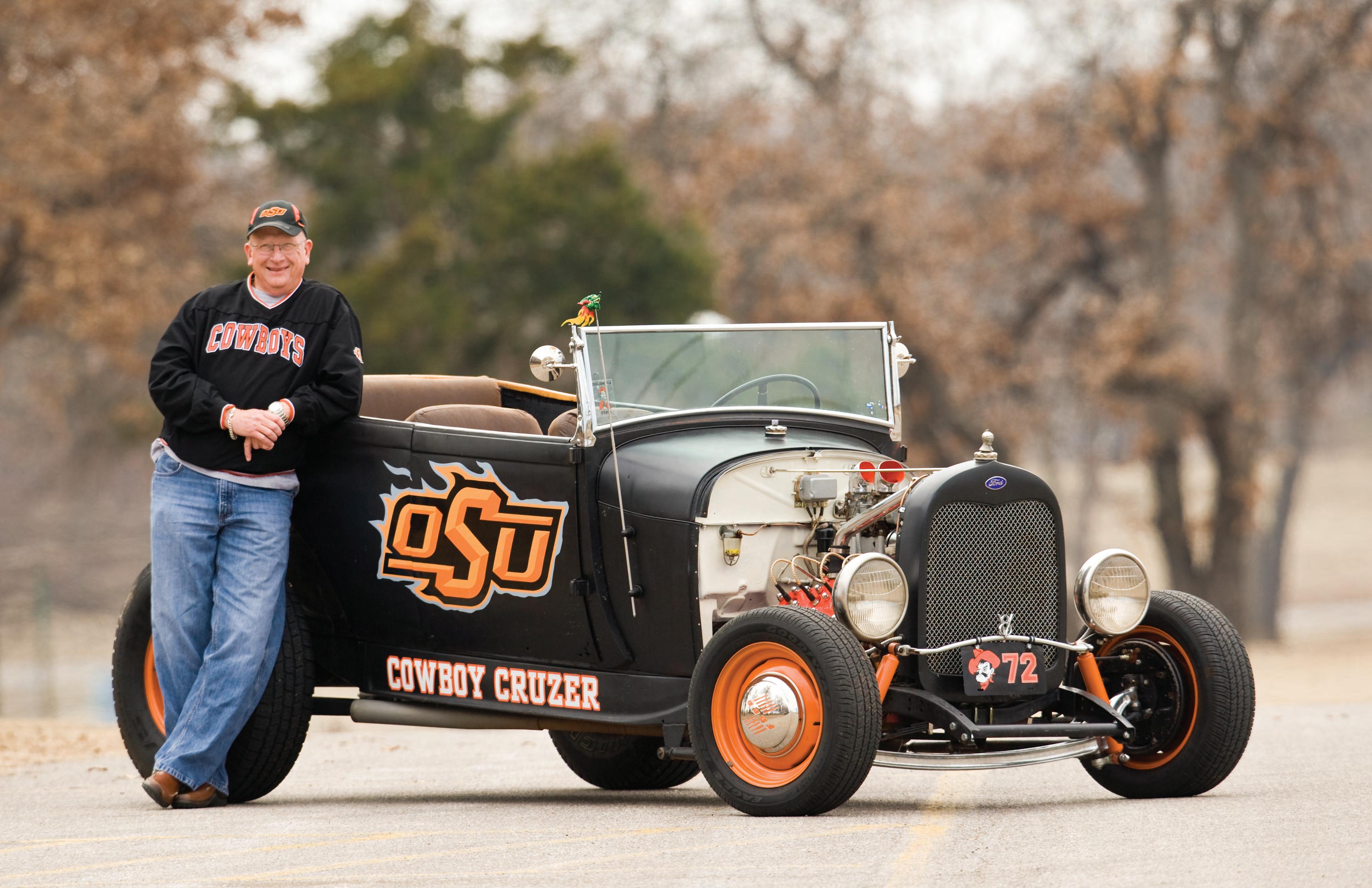


Some fans aren’t content to merely wear orange on game day. Getting an OSU vanity plate for their cars doesn’t scream “Go Pokes!” loudly enough.
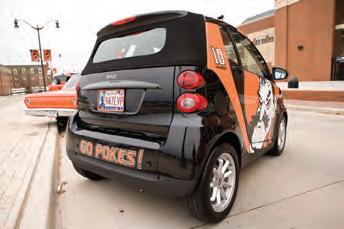
Some fans must go the extra mile. They “Poke” their rides.
During the Texas Tech game last November, some hardcore Cowboy fans rolled out their OSU-customized cars and trucks to show off. The vehicles came in all sizes, but mostly just one color. There was a Smart Car, a classic Chevrolet Nova and even a vintage Buick.
The winner, as was picked by members of the OSU gameday staff, was a Frankenstein of a hotrod, the “Cowboy Cruzer,” owned by Tedd Mitchell of Midwest City. The body is a ’29 Ford, the dashboard from an 1940 Ford. The frame is from a ’32 Ford, and the engine is out of a 1941 Ford firetruck.
“It’s a real junkyard dog,” says Mitchell.
Mitchell, a retired Air Force veteran, owns a company that puts up cell phone towers all across the nation, and is the father of OSU football player Andrew Mitchell.
He’s built a similar hot rod before, but that car now resides in New Zealand.
Mitchell, who’s got a soft spot for classic cars, also owns a 1955 Chevy Nomad, which is painted a bright yellow.
“They keep telling me to paint it orange,” says Mitchell.
Maybe next year.
While the Ford may have gotten the attention of the judges, it was hard not to miss OSU employee Kendria Cost’s Smart Car. There’s showing your colors, and then there’s putting a four-foot tall Pistol
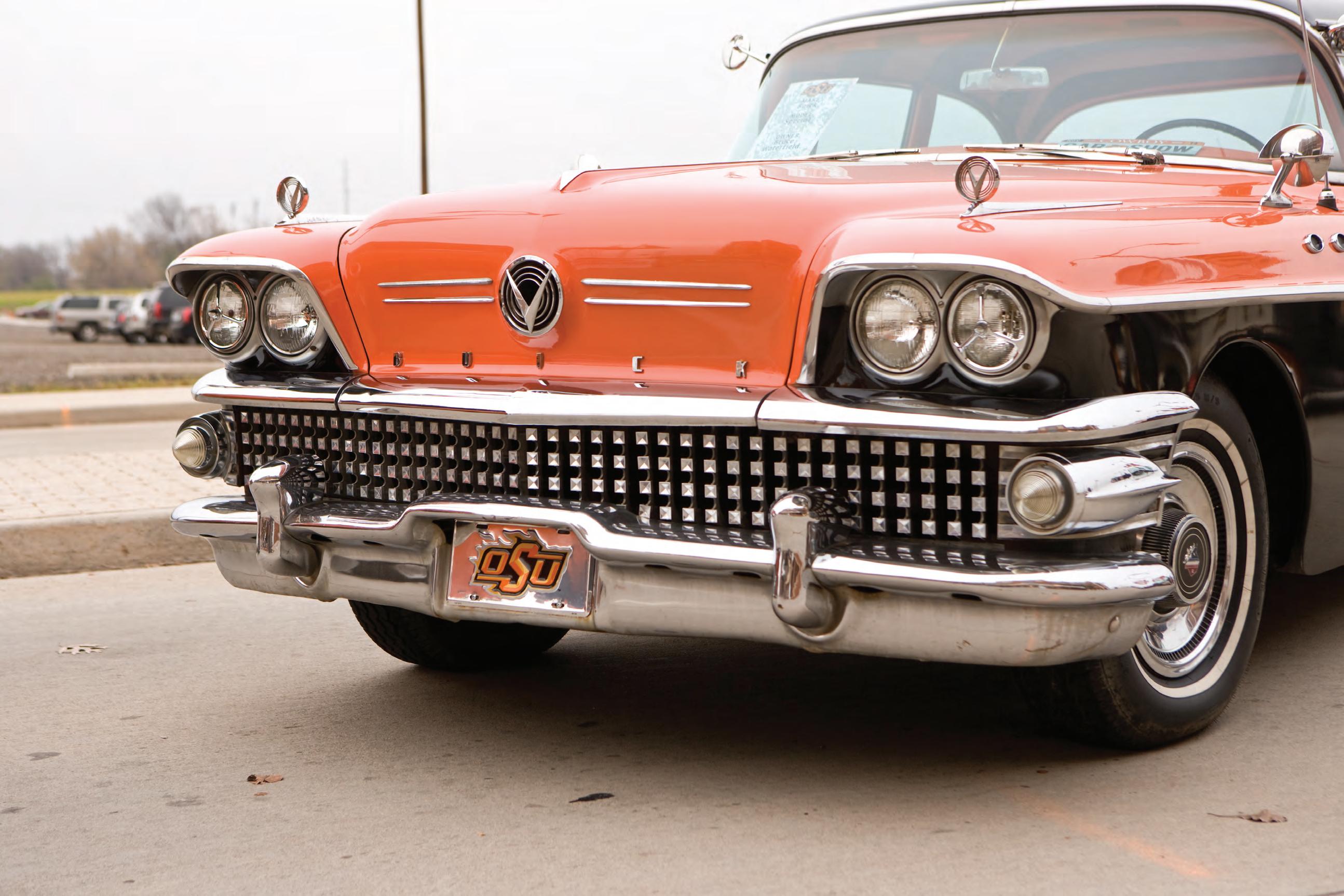
Pete head on the side of your ride. "Bullet," she says. "The car's name is Bullet."
The idea for Bullet came to the Costs when they were traveling in Europe a few summers back. They saw the Smart Cars and thought they "were really cute," says Cost. When the couple returned home, and the cars became available for pre-order in the States, they ordered one.
"It took about a year to get in," says Cost. "We thought it would be fun to have a gameday car. The plan was always to Poke it out and drive to town for games.
"I love Pistol Pete, and it just worked out that the big or Pete on the side was what we thought looked the best. We definitely wanted it to
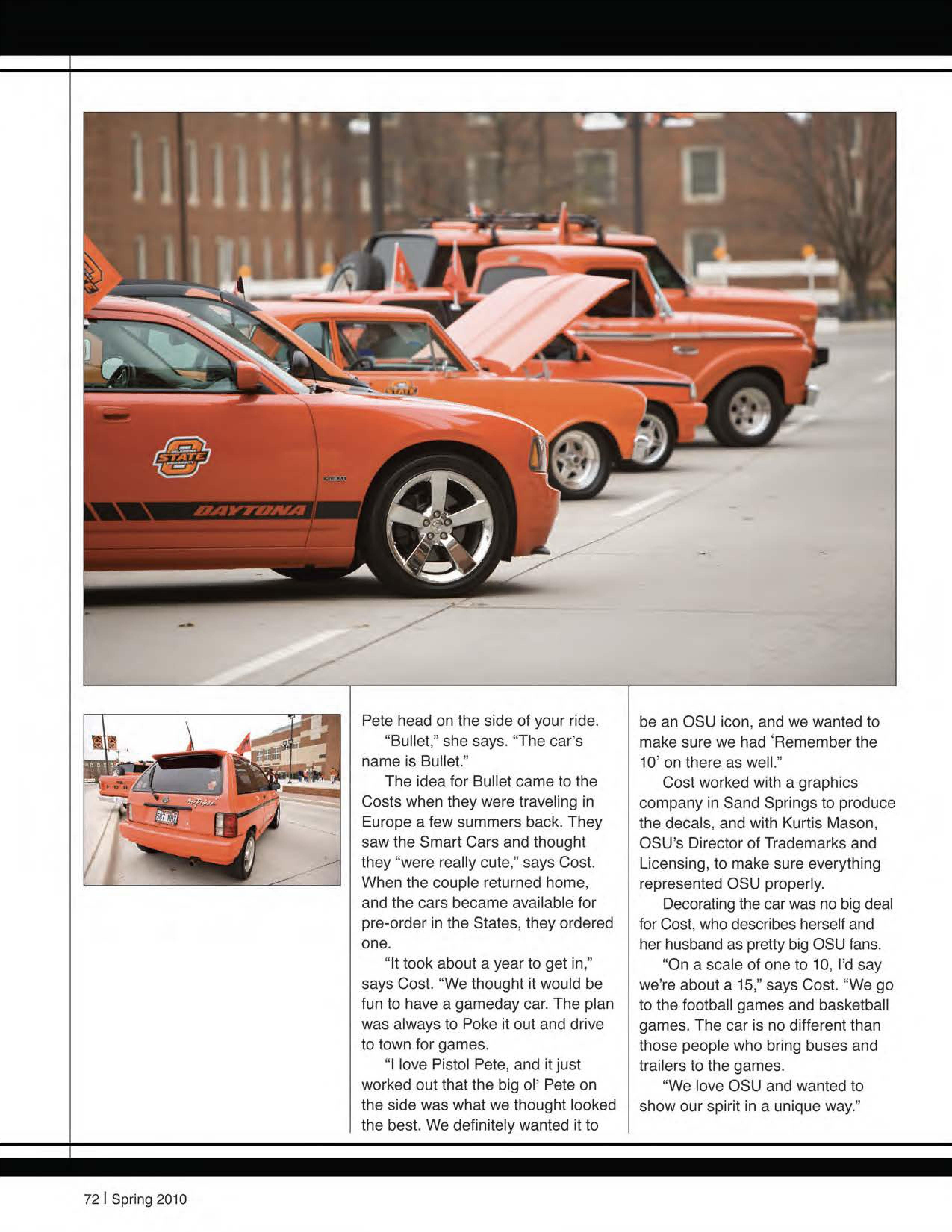
be an OSU icon, and we wanted to make sure we had 'Remember the 10' on there as well."
Cost worked with a graphics company in Sand Springs to produce the decals, and with Kurtis Mason, OSU's Director of Trademarks and Licensing, to make sure everything represented OSU properly.
Decorating the car was no big deal for Cost, who describes herself and her husband as pretty big OSU fans.
"On a scale of one to 10, I'd say we're about a 15," says Cost. "We go to the football games and basketball games. The car is no different than those people who bring buses and trailers to the games.
"We love OSU and wanted to show our spirit in a unique way."
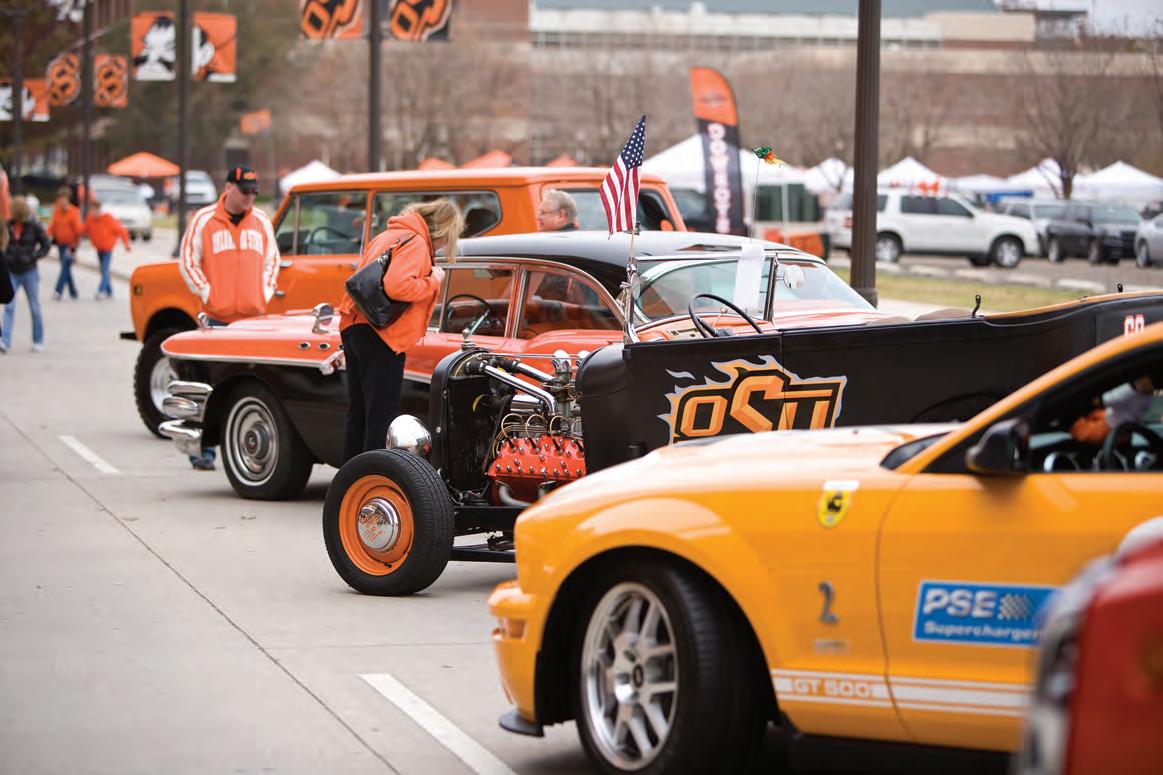


























As OSU alumni, we share your “Orange Pride” by designing OSU jewelry that will respectfully represent the quality and tradition of OSU.

“Made in Oklahoma” University approved and licensed designs produced right here in Oklahoma by experienced jewelers.





By Matt Elliott
Ray Penn’s freshman season at OSU is almost a story of what could’ve been. When he went down with a seasonending knee injury, he was learning Ford’s offense, ingratiating himself to fans and making a name for himself with on his the court toughness.
Nowhere was that more evident than when he limped exhausted out of the locker room following the team’s Jan. 9 drubbing of Texas Tech. Out in the lobby, little kids clustered around James Anderson. Keiton Page signed an autograph for a star-struck, blond and sweet-faced four-year-old wearing Page’s jersey and a cape. The Red Raiders shuffled out of the arena, stunned at their 81-52 defeat by a young Cowboy squad.
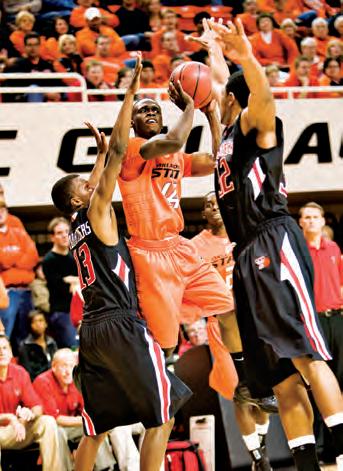
Penn, who until his injury just before the Jan. 23 game against Kansas State, was the starting point guard. He grimaced as he sat his wiry 5’ 9” frame down gingerly for a radio interview with Dave Hunziker. Afterward, he leaned over with his lips drawn back in pain and said, “Man, take a look at this.”
“This is what I’ve been playing on.” He removed his right shoe and sock, revealing a white and shriveled infected toe — minus its toenail — shocking passersby, drawing laughs and looks of amazement. The team’s athletic trainer, Jason Miller, stoped as he walks by.
“Ray, I want you to keep that thing covered up,” Miller said. “We need that to heal.” Penn protested wearily, “I know, but it’s throbbing, man.”
Since Penn came to OSU, he took his share of freshman knocks. In an interview a few days before the Tech game, he complained about nagging injuries and other new bits of adversity he’s had to learn to deal with. And the week before, a bout with the stomach flu savaged the team and laid him low, too. But it doesn’t take a genius to tell he welcomes this stuff in the way a football player awaits the first hit that gets them in the groove of a game.
Big 12 basketball can seem a lot like a football game. And Penn loved every second of it. The jabs. The kicks. The elbows. The fights for loose balls. Penn had 12 points and three assists against the Red Raiders. A couple of nights later, he would knock down 14 points in a tough loss to Oklahoma. His lightning-like quickness, ability to change direction on a dime and physical style drew some rare praise from the OU game’s ESPN analyst, Bob Knight.
The first Bedlam game, decided at 62-57 in overtime, was a bruising, brutal slugfest during which both offenses struggled. It gave Penn a bloodied lip and, at one point, his star forward, James Anderson, was on the bench, bleeding profusely from a head wound. Penn, who played more than 40 minutes of the game, was cramping up so bad afterward he had to be carried out of the post game media interviews by teammate Marshall Moses.
It’s not hard to imagine Penn saying, ‘Thank you sir, may I have another.’
“I’ve been looking forward to this my whole life,” Penn says. “You’ve got to really think it through. It’s more mental. At this level, everybody has talent.”
Up until his injury, Penn was playing just over 30 minutes per game, started 15 games and averaged more than three assists per contest. Part of Ford’s much-heralded first recruiting class, he scored 21 points and led all scorers during a loss to Tulsa and had a season high of seven assists during a victory over Colorado.
Penn also came on strong during the Cowboys’ trip to the Las Vegas Invitational, where he scored 14 points against a Bradley team that beat national powerhouse Illinois during the tournament which the Cowboys later won. Penn was one of three Cowboys named to the all-tournament team.
He knows he still has a long way to go.
“I feel like I’m at my best when I just play. My whole career, that’s been my deal. Lately, I’ve been thinking about it too much. I need to just play. I’ve been playing this position all my life and I’ve always been best at when I just play … I also need to work on my condi -
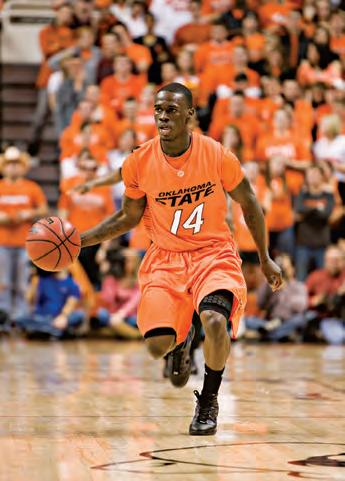
tioning. I get back on defense and I play with a lot of intensity, but on offense, I’m slower. I need to just get tougher and stop feeling down when I’m tired or hurting.”
Before he was hurt, his surge was part of some pretty strong play OSU had seen from its core of young guards during the first weeks of the season. Penn, fellow freshman Fred Gulley and sophomore Keiton Page dished out 83 assists and committed just 40 turnovers before conference play began.
Ford says Penn’s play, showing flashes of his capability at times, was what he expected to see.
“Ray Penn is a talented individual basketball player, no question about it,” Ford says. “In order to become a great player, he’s going to have to learn all the things that you’ve got to do on and off the court in order to succeed. We’re still looking for him to develop that leadership ability to play the point guard spot. All these things are not uncommon for freshmen. They’re part of the natural progression. So, we’ll see.”
Penn was a scoring machine in high school, averaging more than 21 points per game and four assists. Back in 2008 at the Reebok Summer Championships, he exploded for more than 35 points per game. Up until that point, most coaches in the nation didn’t know his name.
That performance was a big part of what got OSU interested in him. Penn says he visited Stillwater during Homecoming in
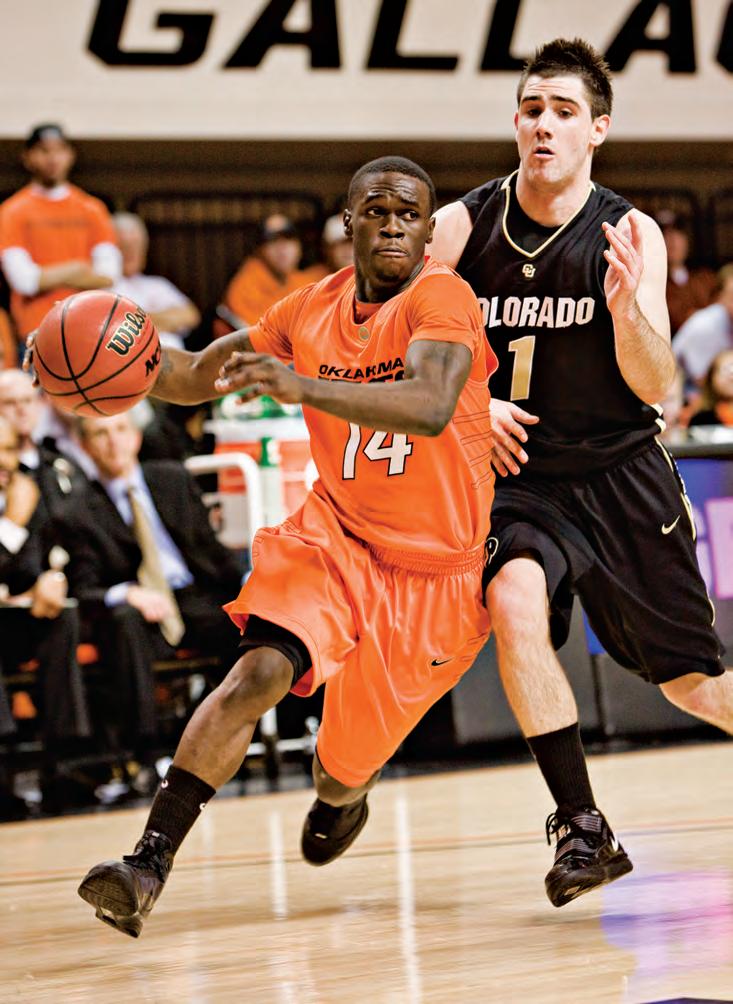
2008. He loved Ford’s up-tempo offense. He also liked that he’d be part of his inaugural recruiting class, he says.
“I figured, maybe we could kind of grow up together in Stillwater, he as a coach and me as a player,” Penn says. He admits he’s still learning Ford’s offense, but he says he’s already starting to feel comfortable in the system. “Some coaches will get on to you if you miss shots. Coach Ford doesn’t. He wants us to take open shots when we’ve got them and understands that we’ll miss sometimes.”
One of the biggest questions surrounding OSU’s team this year has been how it will respond with a young lineup minus last year’s heart and soul, point guard Byron Eaton. Before Penn went down, he showed he was more than up to the challenge. In fact, he invites it, relishes in it and demands it. With that attitude, and no small amount of coaching, the team’s future is so bright OSU fans will need sunglasses.
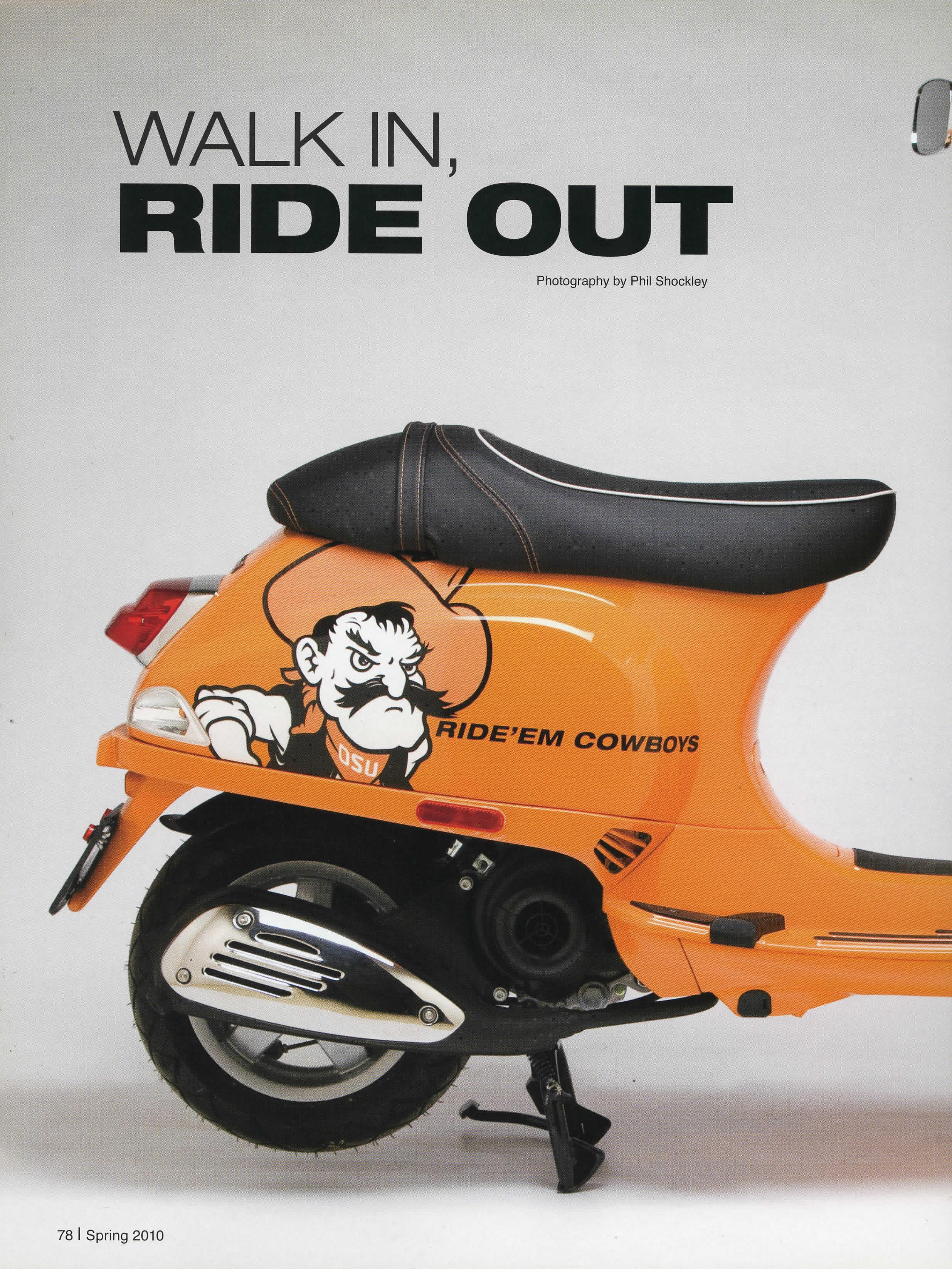
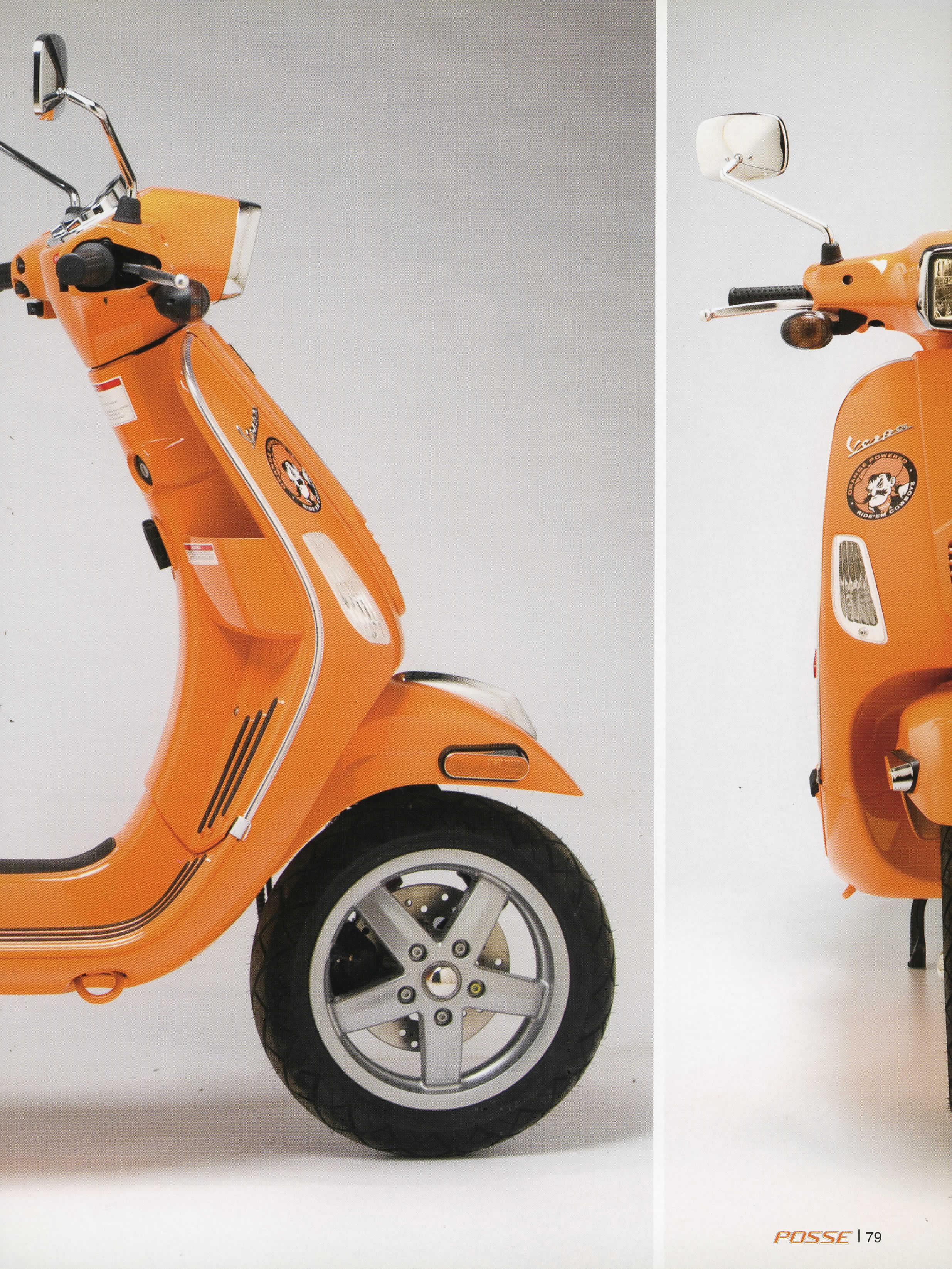

Giveaways are a fairly typical marketing ploy to entice people to attend an event.
You hear it all the time during radio commercials for minor-league baseball games. Usually, it’s something to the effect of, “The first 500 people get a collectible baseball bat!” Most the time, the “prize” isn’t really all that much of an incentive.
But what if it were a chance to win something cool, say an OSU-branded Orange Vespa scooter, and what if your odds for winning were significantly better than that of winning the lottery? Would that sway you to attend?
That was the question posed to the athletic department by Malone and Amy Mitchell. They wanted to do something to help increase student attendance, but they didn’t want to just give money. The Mitchells proposed giving away some Vespa scooters, one during each men’s and women’s home basketball games, and during each home wrestling match.
That’s 43 Vespas total, along with a helmet for each.
The Mitchells also asked for some stipulations. First, the scooters could only be given to students who actually attended
the event. Second, they wanted the scooters to be OSU-customized. Third, the wanted there to be some sort of contest to win the scooter, but those contests could not be “feats of strength.”
The latter became a test of the creativity of the athletic department’s promotions staff.
“That was the fun part for us,” says Leroy McCullough, promotions coordinator for the athletic department. “We’ve had to really be creative and get the entertainment value up.”
“We couldn’t have a guy and a girl compete in a shooting contest,” says Tia Scott. “What happens if the guy has never shot before and the girl was a high school All-American? We have to make it something simple and somewhat random, like a hula hoop contest.”
Scott and McCullough came up with some crafty contests. There were human hamster ball races, obstacle courses, and even giant, inflatable bowling.
“During one of the Cowboy wrestling meets, we had two little kids who and happened to be twins wrestle in between matches,” says McCullough. “One was representing each of the contestants, and whichever kid won, that contestant won the Vespa.”
It’s also been challenging getting the scooters to campus. While Orange is a color Vespa offers, it’s not a popular choice.
“I was freaking out ... just going crazy, jumping up and down and yelling at my friends. I’ve wanted one of these forever.”
— Taylor Hackett
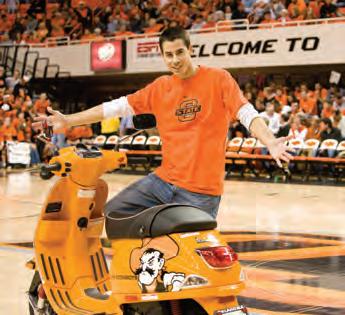
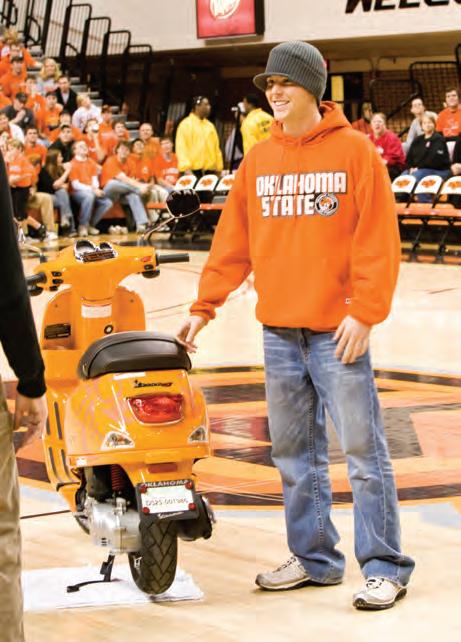
“Orange is not one of their common colors,” says Leroy McCullough, promotions coordinator for the athletic department. “They offer it, but it’s not one they keep stocked. They might have one in every dealership. Vespa had to alter its production process so we could get the quantity we needed.”
Once the scooters are on campus, they’re taken to the sign shop to be customized with one of nine designs that run the gamut from Pistol Pete to Cowgirl basketball head coach Kurt Budke’s autograph. After customization, they’re given to the students, along with
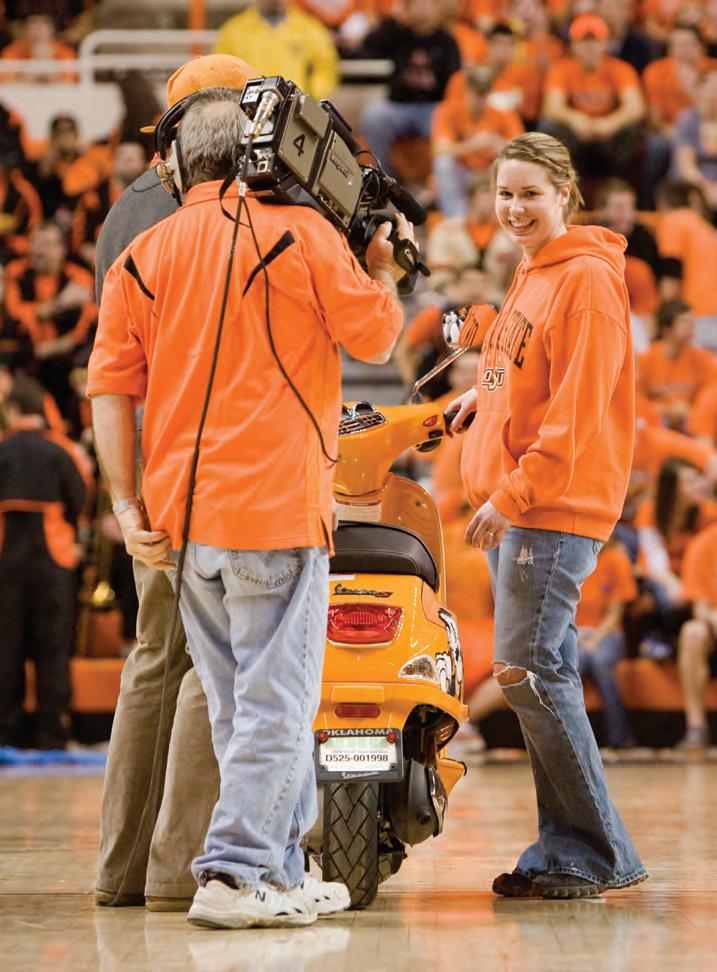
access to scooter driving training session from the Vespa dealership.
As of now, all 43 of the scooters have been given away, though some students are still awaiting delivery of their new ride.
So did it work? If you ask freshman Taylor Hackett, you’d have to conclude that it at least had some influence.
“I think it did,” says Hackett, who won a Vespa on Senior Night when the Cowgirls played Iowa State. “I think it got a lot more students together. It gave them something to look forward to.
“I’ve been to a few girls games before, and one of my friends asked me if I wanted to go that night. He said, ‘You’ll have a better chance of winning a Vespa.’ I had wanted to see Andrea Riley one more time, so I went.”
He went through the usual round of shock when his name was called.
“I was freaking out,” says Hackett, “just going crazy, jumping up and down and yelling at my friends. I’ve wanted one of these forever.”
BY: KYLE WRAY
You’ve got one, I’ve got one, and your next door-neighbor has one. They’re like personalities. Everybody owns one, and many are, well, messed up.
NCAA Basketball Tournament brackets are on everyone’s minds this time of year. The tournament has changed over the years (television coverage, play-in games and too short shorts, just for starters). With the discussion surrounding upgrading the field from 64 to 96 and the dismantling of the NIT, it sounds as if there are more changes on the way.
The one constant has been the tradition of painstakingly filling out the bracket. That beautiful collection of lines that articulately move our teams and egos through painful progression until we are forced to acknowledge the inevitable: we don’t know what in the heck we are doing.
If you really believe a person has to be an expert on college basketball to accurately predict the winner of the tournament, just take a gander at the prophetic individual who won your office competition last year. Chances are it’s someone who can’t dribble and chew gum at the same time. And if that person is you, come on; admit you borrowed from the wisdom of OSU alum and ESPN analyst, Doug Gottlieb for the majority of your “expertise.”
There are only a few strategies one can employ when choosing a champion. After all the discussion surrounding the upsets and the difficulty of the 8 versus 9 seeds, it comes down to two choices: Will you pick all the number one seeds to advance to the Final Four and subsequently try to predict a few unexpected setbacks for some of the higher seeded teams, or will you try to accurately foretell a few major upsets and create your
own “Frankenstein” version of a bracket in need of a bolt from the blue to bring it to life?
Either way, many of us find ourselves in the same boat after the first week of the tournament, our “upset specials” fall short and our “ace-in-the-hole” sure-fired lock to get to the finals gets torched. In fact, by the second week of action, many of us limp into the finals with one team still alive, hoping to catch lightening in a bottle and win despite how much damage all the losses dealt you.
For those of you placing money where your pencil is, one word of caution: Beware the Ides of March … or at least the 18th through the 21st. By the time you read this article, most of the pain will be over with anyway.
There is one more consistent issue relevant to the Final Four – one continuous and glorious color that will never change. The basketball is always orange! Go Pokes!
SIZES:YL-AXXL$30 a portion of all sales will go to the • ·amer1can cancer ~ociety
“Give yourself a break: take five.”




You’ll be amazed how much you’ll save when you take these five powerful steps to use energy wisely:

1. Replace lights with compact fluorescent light bulbs. They give just as much light, but last much longer and use 75 percent less electricity.


2. Replace your old heating and cooling system with a new, high-efficiency system. Consider a geothermal system — they’re about 200 percent more energy efficient, and may qualify for lowinterest financing.







3. Insulate, caulk and weatherstrip your home. Most people don’t realize that a third of their energy bill can come from air leakage alone.

4. Set your water heater thermostat at 120ºF. Adding a water heater blanket can cut water heating costs another 10 percent.

5. Shade your house. Plant trees that shed leaves to give shade in the summer and admit sunlight in the winter.











Saving energy and money is in our power