POSSEMAGAZINE
POSSE MAGAZINE STAFF
ASSOCIATE VICE PRESIDENT OF ENROLLMENT MANAGEMENT/MARKETING I' YLEWRAY
EDITOR-IN-CHIEF l ORYCHENE {
ART DIRECTOR I DESIGNER PAULV FLEMING
DIRECTOR OF PHOTOGRAPHY PHILSHU KLEY
CONTRIBUTING PHOTOGRAPHER uAR{ LAWSON
ASSISTANT EDITOR CL1-1Y Bl MAN
CONTRIBUTING WRITERS MATTELLIOT
coNTR1BuT1NG DESIGNERS, MARr PtNNIE,ELL'ABETH HAHN,Rnss MAUH-
ATHLETICS ANNUAL GIVING (POSSE) DEVELOPMENT STAFF
ASSISTANT ATHLETIC DIRECTOR I DEVELOPMENT IE SEMARTIN
ASSISTANT DEVELOPMENT DIRECTOR ELLE!~AYRES
PREMIUM SERVICES DIRECTOR KARYLHENRY
PUBLICATIONS COORDINATOR AYBIL MAN
PROGRAMS COORDINATOR I BENEFITS MPi LEW'
EVENT COORDINATOR I GAME DAY PARKING MANAGER ANDYSUMR/>,LL
ATHLETIC DEVELOPMENT ASSISTANT STEP!,ANILBO[SE
ATHLETICS MAJOR GIFT DEVELOPMENT STAFF
ASSOCIATE ATHLETIC DIRECTOR I DEVELOPMENT LARRYREF(!'
DIRECTOR OF DEVELOPMENT I ATHLETICS MAT GRANTHAM
PROJECT MANAGER SHAWN-AYL')R
OSU POSSE
102 ATHLETICS CENTER
STILLWATER, OK 74078•5070
r P 4C'i 744.730 I OR877 ?BF JSSt F4%741ri084
WWWOKSTATEPOSSE,COM POS.SE@OKSTATE EDL
ADVERTISING 405.744.7301
EDITORIAL 405.744.7192
I would like to personally say thank you to all of our POSSEMEMBERS and SE.II.SON TICKETHOLDERS for your continued support of OSU Athletics during the 2010-11 season. Your commitment makes it possible to provide quality educational opportunities for more than 450 student-athletes in our 18 varsity sports.
As we look back at what ended up being a great year, WHATW.11.SYOURFAVORITE MOMENTINOSUATHLETICS?
Was it Football's record-breaking season, which was capped off with a bowl game victory over Arizona and a share of the Big 12 south title? How about softball's run to the WCWS? Watching Soccer advancing to the Elite 8? Men's Cross Country winning its second consecutive national title? Maybe it was seeing OSU win one of our multiple Big 12 Championships? Who can forget Jordan Oliver's undefeated season en route to an NCAA Wrestling title? Maybe it was personally meeting one of OSU's coaches or student-athletes after a game or during the annual POSSE auction, or reading the list of Cowboys and Cowgirls who earned All-Conference and All-American academic honors.
Whichever was your best memory, if you're a member of the POSSE, you shared in each student-athlete's triumphs and successes. Not only was it a great year for them, but for you as a fan and supporter.
As great as it was, this year (which will be here before we know it) could be even better. Don't hesitate to jump at the chance to LIVEORANGE for the HIGHLY .l!.NTICIP.11.TED2011-12SE.II.SON by supporting our teams live and in person.
The 2011 Football season ticket renewal process is completed, and new season ticket options are on sale now. They are going at a record pace. If you do not have season tickets and are considering getting some, then the time is now. With the West End Zone having very limited seating availability, .I!.GREATTICKET OPTION is the 300-level of the main stadium for just $384, compared to $479 for the same seats last season, along with a number of prime donor and non-donor options.
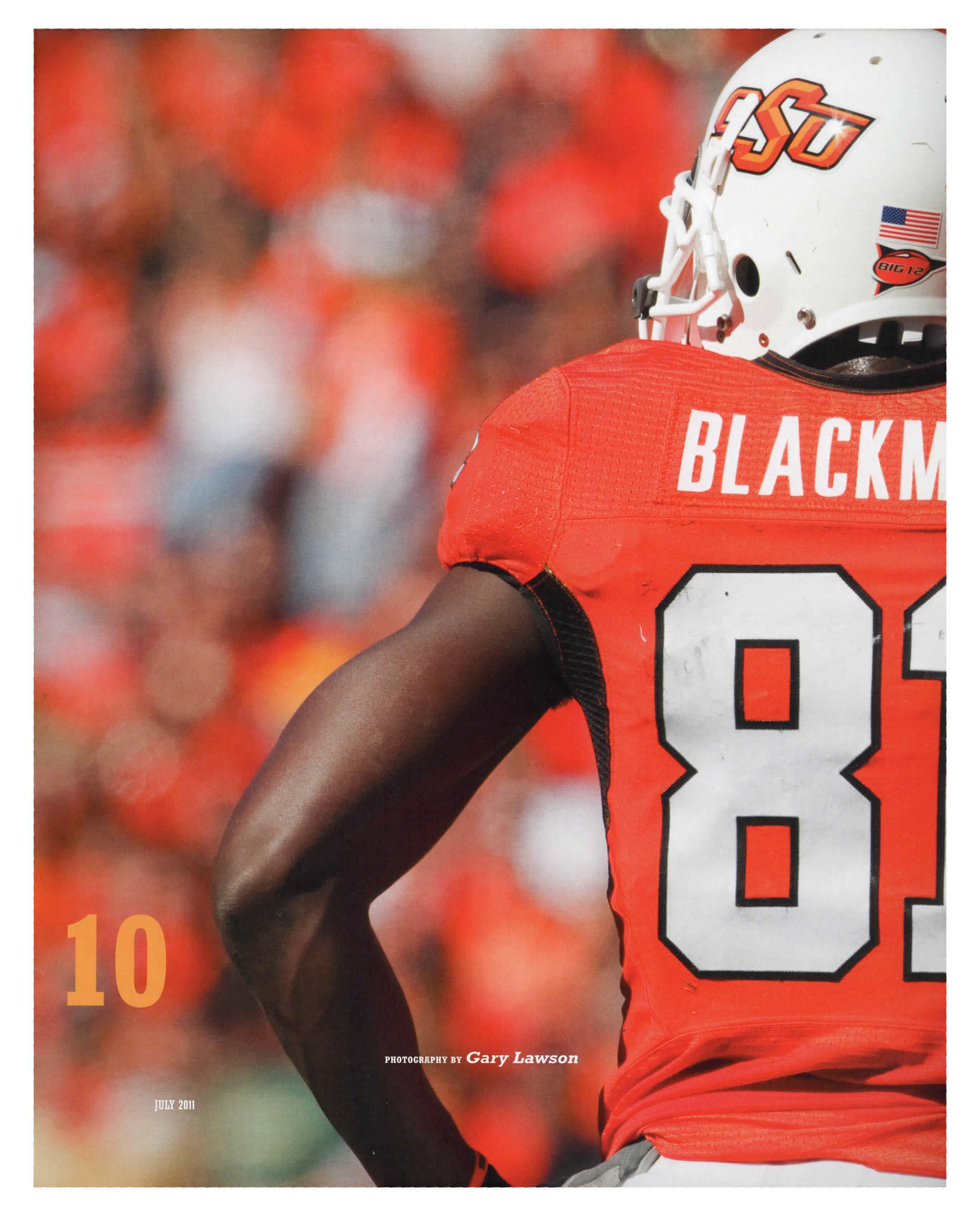
With the Cowboys coming off of a school record 11 wins in 2010 and HEISM.11.NBUZZ already generating around the dynamic duo of quarterback Brandon Weeden and receiver Justin Blackmon, can you really afford to miss a game?
As always, if you or someone you know would like to purchase season tickets or join the POSSE, please call us at 877-ALL-4-OSU(877-255-4678) or visit WWW.OKSTATE.COM. Annual donations to Athletics totaling $150 or more qualify for membership in the POSSE and include an annual subscription to the award winning POSSE Magazine, the POSSE star decal for your automobile and an educational tax deduction. Get your friends and family involved today! THEPOSSEIS
Martin
Assistant AD/ DevelopmentOklahomaState Athletics jesse.h.martin@okstate.edu 405-744-3322
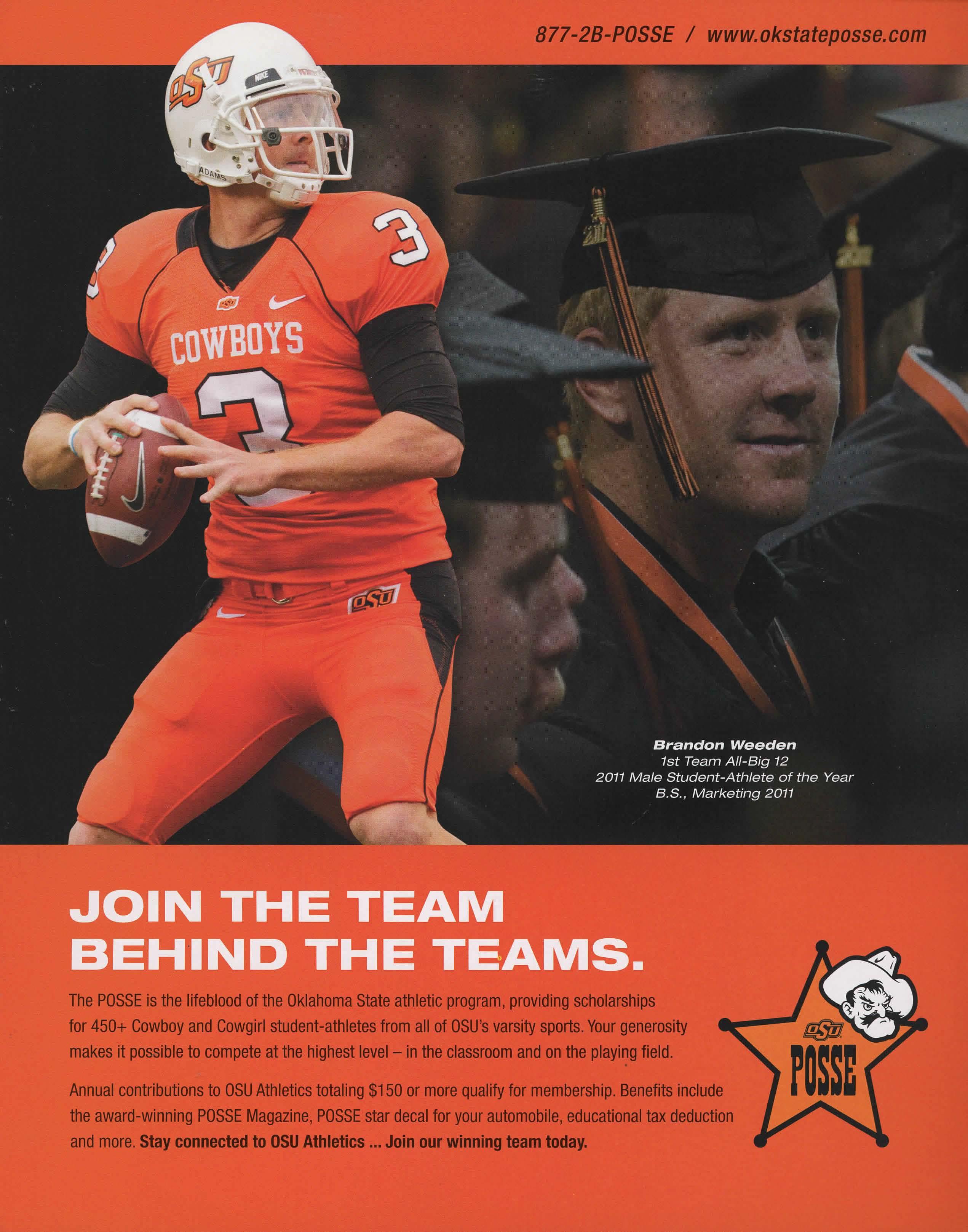
ThePOSSEis the lifebloodof the OklahomaStateathleticprogram,providingscholarships for 450+ CowboyandCowgirlstudent-athletesfromall of OSU'svarsitysports.Yourgenerosity makesit possibleto competeat the highestlevel- in the classroomandon the playingfield.
Annualcontributionsto OSUAthleticstotaling$150or morequalifyfor membership.Benefitsinclude the award-winningPOSSEMagazine,POSSEstardecalfor yourautomobile,educationaltax deduction andmore.Stayconnectedto OSUAthletics... Joinourwinningteamtoday.
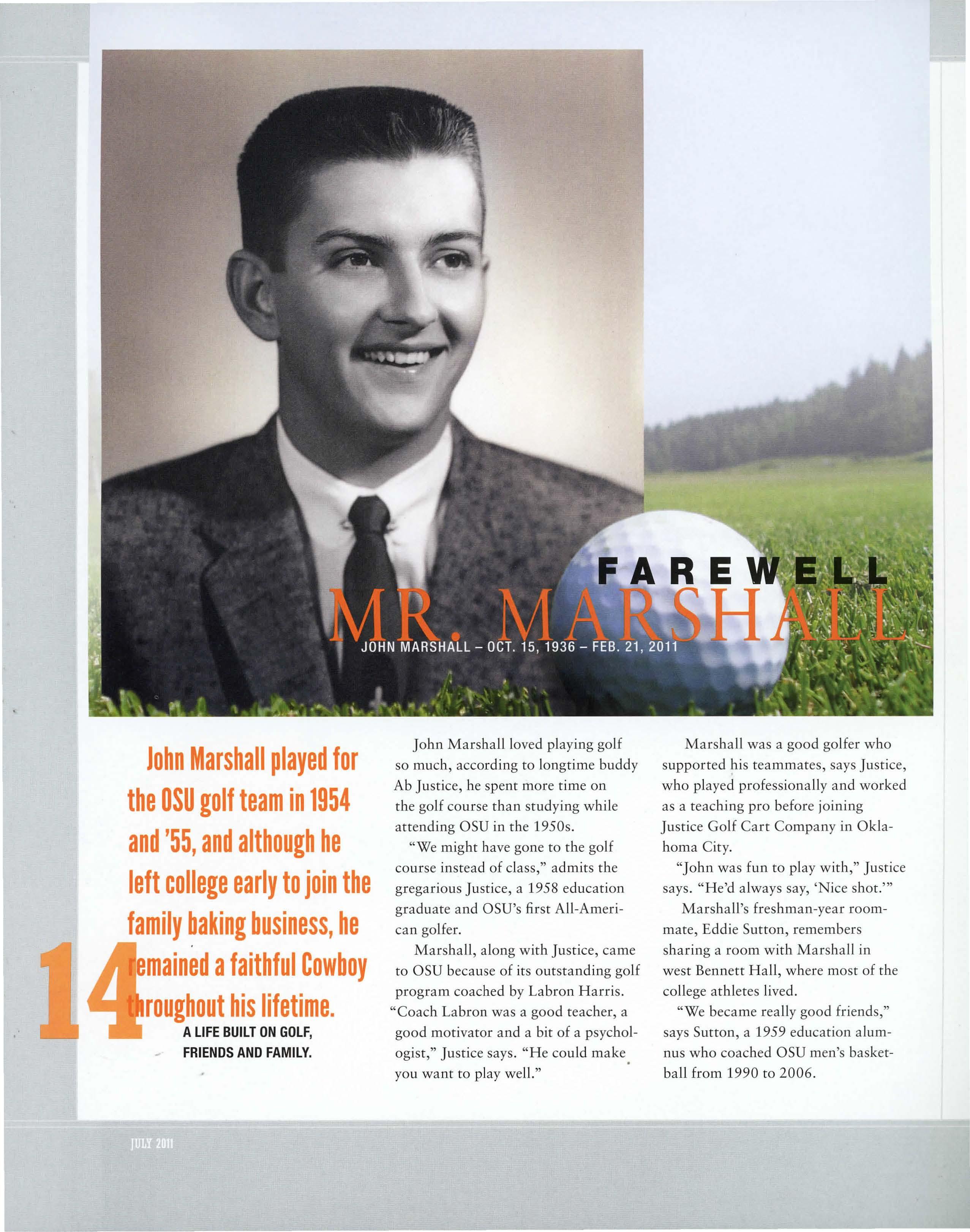
John Marshall loved playing golf
JohnMarshallplayed for theOSUgolfteamin1954 and'55,andalthough he leftcollegeearlytojointhe familybakingbusiness, he emainedafaithfulCowboy roughouthislifetime. A LIFEBUILTONGOLF, FRIENDSANDFAMILY.
so much, according to longtime buddy Ab Justice, he spent more time on the golf course than studying while attending OSU in the 1950s.
"We might have gone to the golf course instead of class," admits the gregarious Justice, a 1958 education graduate and OSU's first All-American golfer.
Marshall, along with Justice, came to OSU because of its outstanding golf program coached by Labron Harris. "Coach Labron was a good teacher, a good motivator and a bit of a psychologist," Justice says. "He could make_ you want to play well."
Marshall was a good golfer who supported his teammates, says Justice, who played professionally and worked as a teaching pro before joining Justice Golf Cart Company in Oklahoma City.
"John was fun to play with," Justice says. "He'd always say, 'Nice shot."'
Marshall's freshman-year roommate, Eddie Sutton, remembers sharing a room with Marshall in west Bennett Hall, where most of the college athletes lived.
"We became really good friends," says Sutton, a 1959 education alumnus who coached OSU men's basketball from 1990 to 2006.
"John had a pleasant personality and a positive attitude, and everyone liked him," Sutton says. "I can't remember any time he had a conflict or an argument with anyone."
Sutton acknowledges Marshall's ambivalence toward school. "I had to remind him occasionally that's why we were there."
After graduation, Sutton coached at Tulsa's Central High School through 1966 and often golfed with Marshall. "John was a great person, and he helped me improve my putting," Sutton says. "I never could beat him."
Marshall attended OSU a year and half before returning to Tulsa to continue his lifelong career with the family business, Barna Companies. He began by delivering pies as a boy and over the years experienced every aspect of the business from baking to sales, eventually retiring as executive vice president. His sister, Paula Marshall, heads the international company today.
Their father, Paul, elevated Barna into an industry leader by partnering with McDonald's to produce dessert pies for the fast-food giant.
Sutton says having a college roommate in the bakery business was advantageous. "We had a few pies," says Sutton, whose favorites were apple and cherry. "I had a sweet tooth, so he brought back a lot of them to Stillwater."
Marshall and his father worked closely during the 1960s calling on franchises and expanding the business. Still headquartered in Tulsa today, Barna has production facilities in the U.S. and China and supplies bakery products such as hand-held pies, biscuits and pizza crusts to the nation's leading fast-food restaurants.
Jerry, Marshall's wife of more than 50 years, started accompanying her husband on business trips after their children, Scot, Kevin and Kimberly, were grown.
"John was a people person," she says. "He had a good sense of humor. He cared about people, and he was easy to get along with. He made my life."
his passion. He loved his family, his friends and golf."
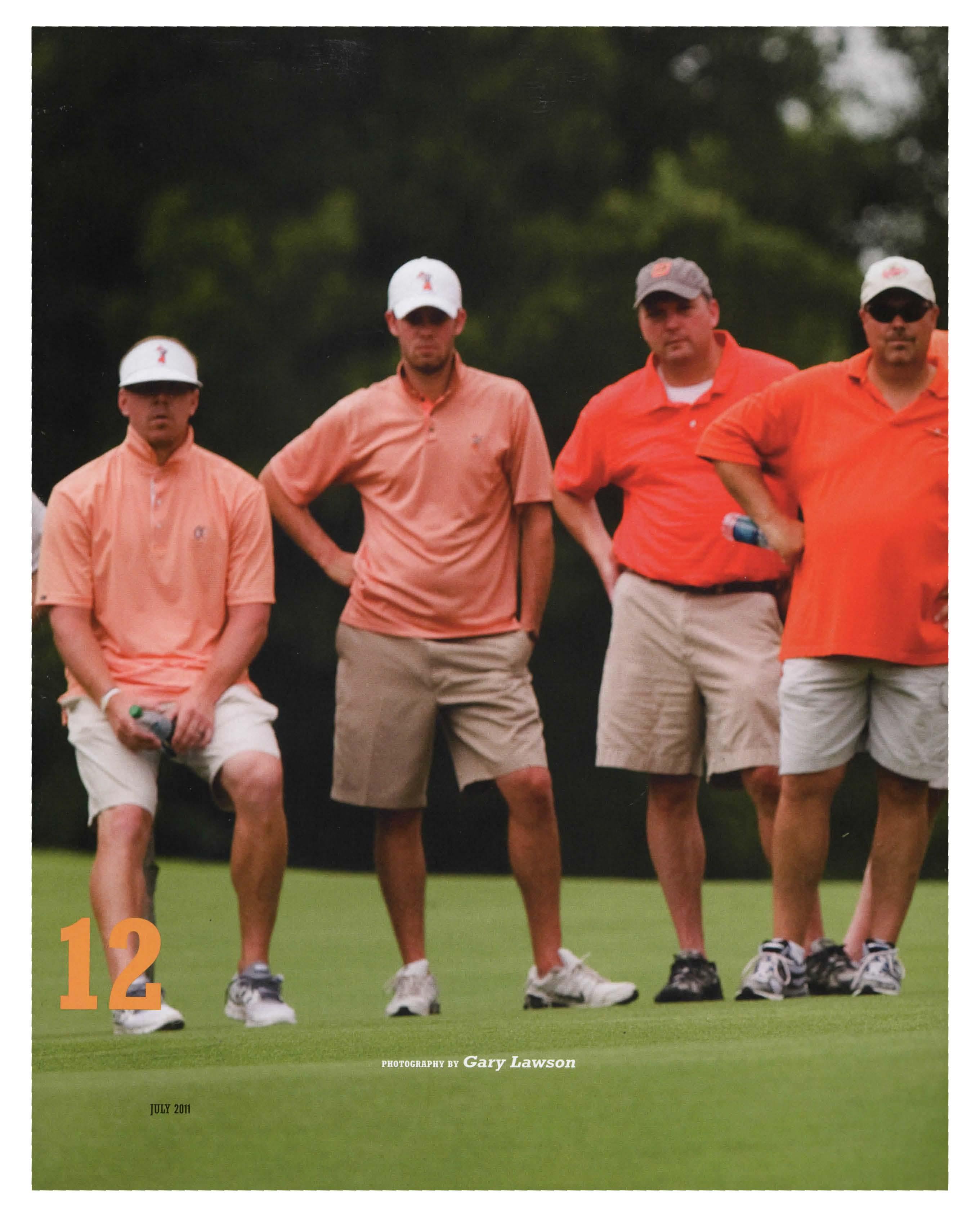
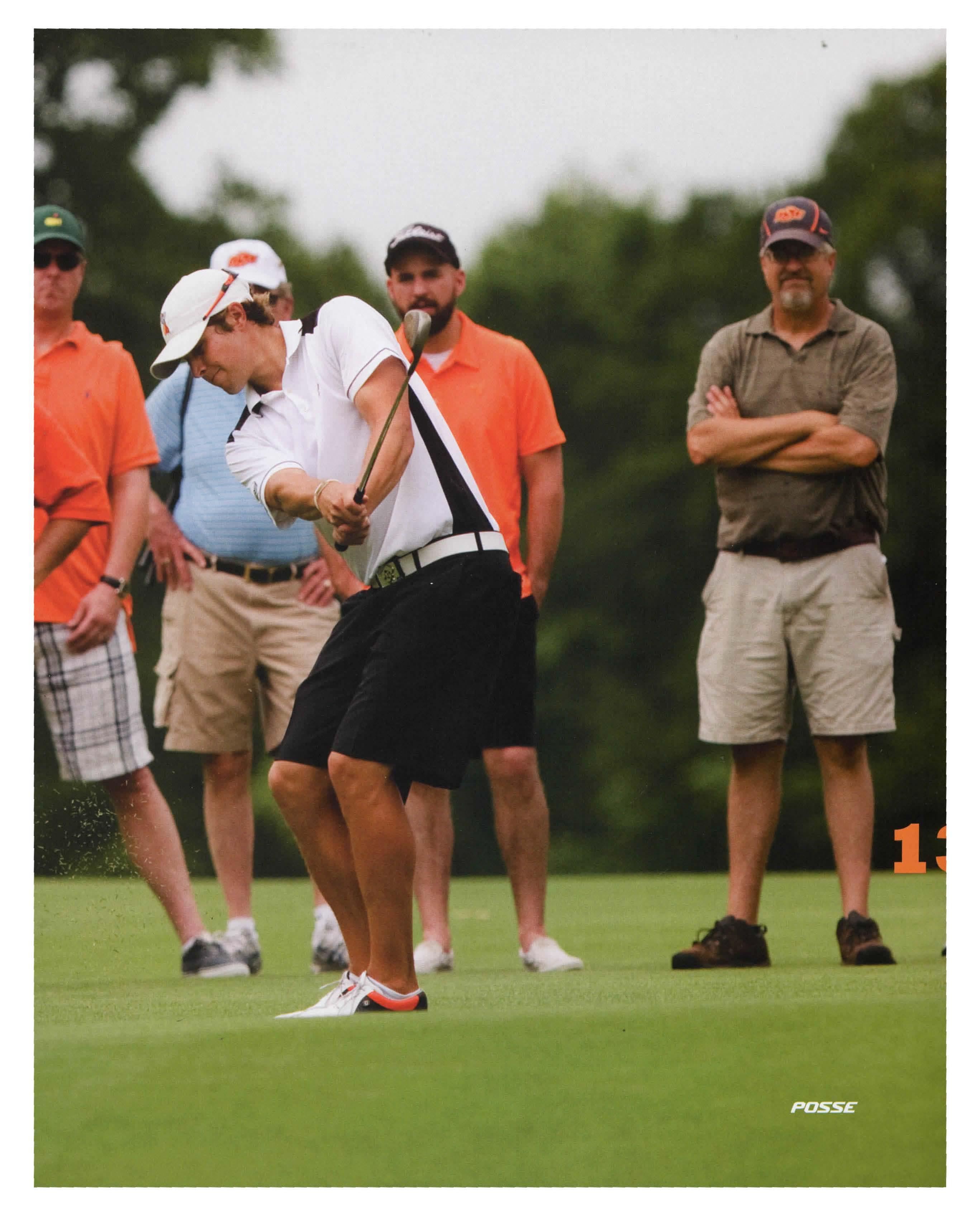
Throughout his life, Marshall supported numerous charities as well as OSU football, basketball and golf. Every year he assembled a team for the Cowboy Pro Am tournament to help raise funds for the OSU men's and women's golf programs.
"JOHNWASFUNTOBEWITHANDINTERESTING PEOPLEREALLYLIKEDHIMANDGRAVITATE TOWARDHIM.YOU'RELUCKYIFYOU HAVE A FEWREALLYGOODFRIENDS IN LIFE.AND(JOHN)WASONEOFTHEM.
Jerry says her husband's friendliness and fairness contributed to numerous business relationships, and he worked hard to expand Barna into an international company. "He was proud of growing the company," she says.
Marshall naturally incorporated golf into his business life, often inviting clients and associates to tee up.
Scot believes his father's philosophy on life mirrored his philosophy on golf. "I think he thought, 'You take it as it comes. If you hit the ball and it lands in the water, it wasn't meant to be. You try to do better next time."'
Scot, who attended OSU in the 1970s, always enjoyed golfing with his father. "It was always a treat to play together," he says. "That's why I learned to play when I was about 12 years old, to spend time with my dad.
"He was a good father and a good friend," says Scot, owner of Preferred Tape, a Tulsa-based distributor of pressure sensitive tape used in aerospace technology. "Golf was
His team typically included Scot, two or three college friends who could get away for the weekend and OSU alum Bobby Goetz as the team's pro.
"We tried our best during the Cowboy Pro Am," Justice says. "But the main thing was getting together and visiting."
Marshall was the glue that kept his college buddies together and inspired them to stay connected to OSU.
"He would call and see how we were doing," says Justice. Once, when Justice told Marshall he couldn't join him for golf because he was busy trying to sell insurance, Marshall responded, "Get in the car and come down here, and I'll buy some from you."
Justice says Marshall looked out for other people.
"John was fun to be with and interesting. People really liked him and gravitated toward him. You're lucky if you have a few really good friends in life," Justice says, "and he was one ofthem." llSiJ
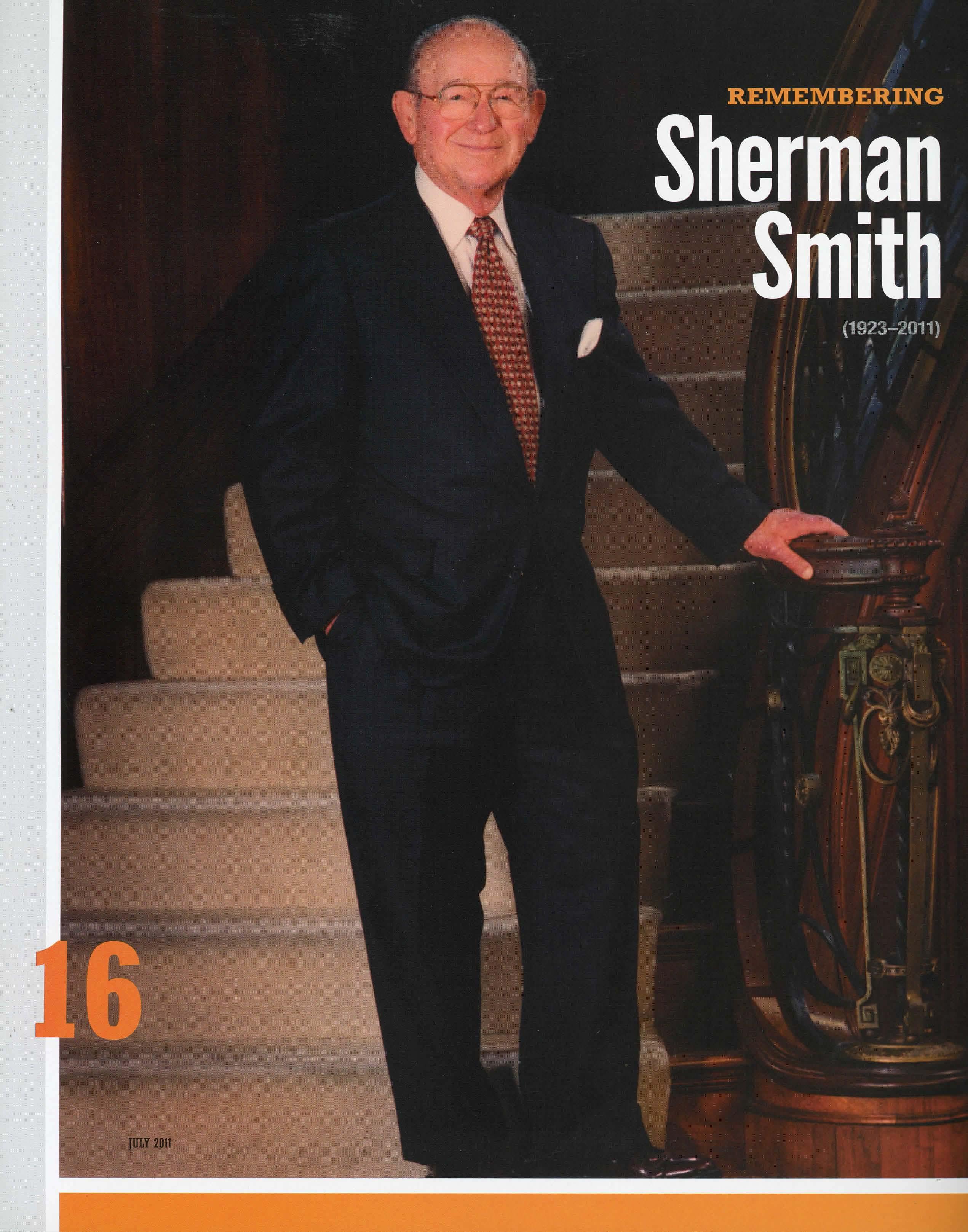
Sherman Smith was not a tall man, but he cast a large shadow.
From friendships to business to philanthropy, Smith will be remembered as a true gentleman, whose legacy will continue to impact future generations.
The 1948 Oklahoma A&M graduate passed away June 6, 2011, at the age of 88.
As a testament to his generosity, Smith's name will soon be a permanent part of the campus. Work will begin in August on the Sherman E. Smith Training Center, an essential indoor practice facility funded by his landmark donation in 2007. At the time, the $20 million gift made Smith the second largest private donor in OSU history.
The Smith Center will be located north of Hall of Fame Avenue, across from Boone Pickens Stadium.
"It's fitting that two of the most important structures for OSU Athletics will be across the street from each other and will bear the names of Sherman Smith and Boone Pickens," says OSU Athletic Director Mike Holder. "It puts bookends on the past and the future of OSU football, although the facility will be utilized by studentathletes from every sport."
"The first time I met Sherman was at an SAE (Sigma Alpha Epsilon) rush party," Pickens says. "He was the Eminent Archon, quite a
muckety muck, but really, he was just a regular guy. I was a newcomer to Oklahoma State, and he made me feel very welcome. I was struck by his leadership."
After earning a degree in mechanical engineering, Smith worked his way up the ranks at Service Drilling Company (SerDrilco, Inc.), which was co-founded by his father. He eventually became chief operating officer, president and chairman. Smith's company drilled a majority of the wells for Pickens' Mesa Petroleum operation.
"We made a lot of money together," Pickens says.
The pair also enjoyed golfing with one another.
"Along with our mutual friend, Jerry Walsh, we were the first three to play in the OSU Cowboy Pro-Am when it began in 1973. We made every one of them after that."
The seeds planted at that first Pro-Am would eventually grow into the creation of the Karsten Creek golf course, thanks in large part to the generosity of Smith, Pickens and Walsh.
"We wouldn't have gotten to where we did with the OSU golf program if it hadn't been for those three guys," says Holder. "Ultimately, that transcended golf and morphed into the whole athletic program, primarily
football. Any success that we enjoy going forward in football, you're going to have to talk about those three guys and the 1973 Cowboy Pro-Am as a significant moment in history."
Smith possessed a magnetic personality, adds Holder.
"HEWASA GREATFRIENDTO EVERYONE.ALWAYSHADA SMILEON HIS FACE.HEHAD AN INFECTIOUSLAUGH,AND YOUJUSTENJOYEDBEING AROUNDSHERMANSMITH."
Holder says Smith, a World War II veteran, exemplified what has become known as the "Greatest Generation."
"Sherman was a throwback to a different time in our country," he says. "He was the kind of person that made America such a great place to live. He had an outstanding work ethic and high principles. Sherman took over his father's business and grew it. He made a lot of money and gave a lot of it away. He was conservative, but also a risk-taker at the same time. I know that sounds like a contradiction, but to be in the drilling business, I think that's just part of your DNA.
"I think his entrepreneurial spirit, coupled with his willingness to give and his friendship with Boone Pickens, led him to do significant things for OSU."
"Sherman and I share the same birthday - May 22," Pickens says. "He was born in 1923 and I was born in 1928. We were partners on a lot of deals, and he was a lifelong friend. We shared many things, but on top of the list was a love for being generous and a love for Oklahoma State I'll miss you, Sherman."
As will the entire OSU family. !1$0
osu· Career Services
PHoTocRAPHY BY Gary Lawson
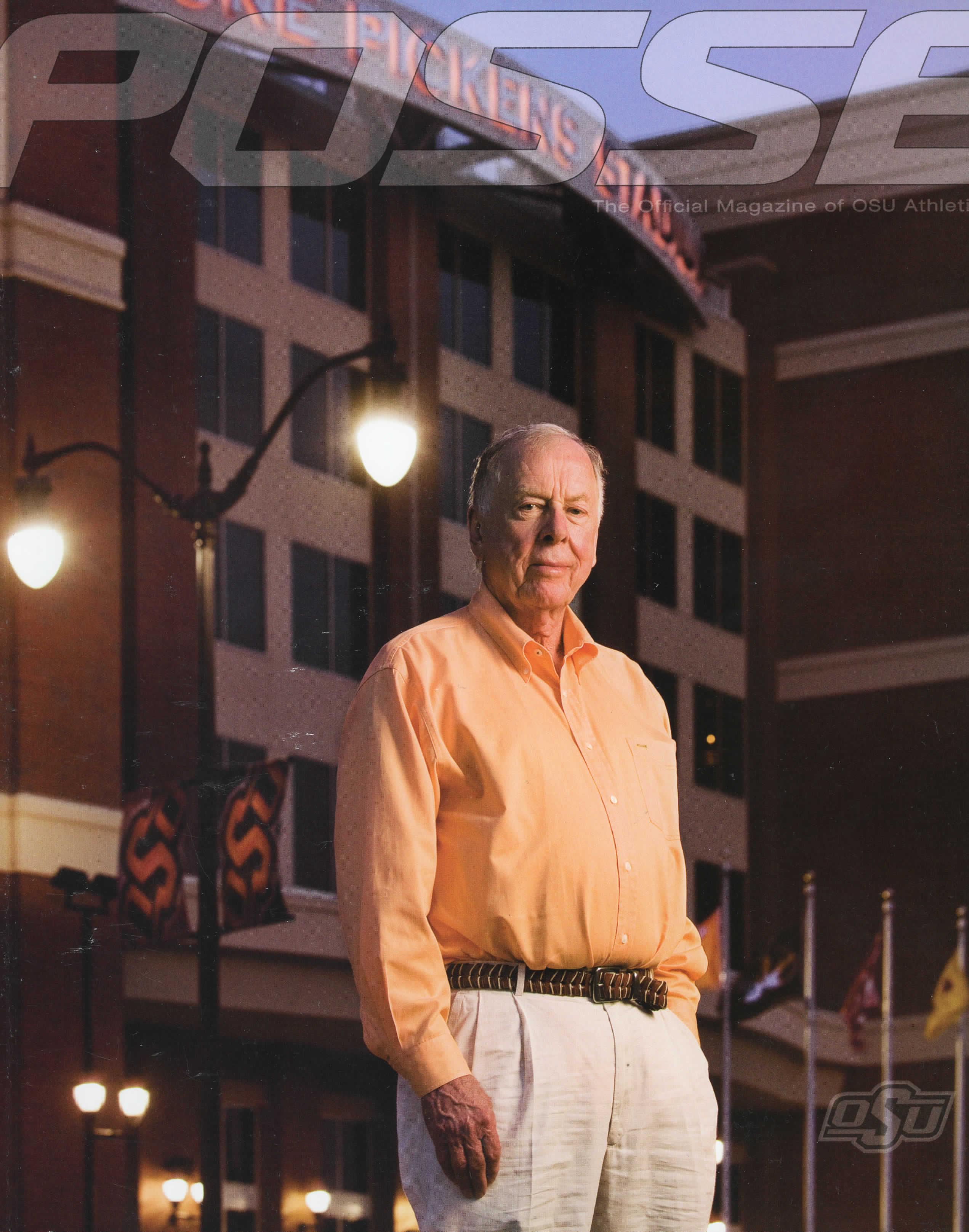
CatchingupwithBoonePickens,evenwhen
he'snotintownonbusiness,isn'taneasything.
In Stillwater, he's something akin to a rock star, one whose shadow looms large over the university. Pickens has redefined the term "donor support" at OSU, giving hundreds of millions of dollars for both academics and athletics. His name adorns the newly renovated football stadium. Every other donor we've interviewed for POSSE in the last four years has cited Pickens as part of the inspiration for their own gifts. But you know all that already. He's had numerous articles written about him in too many publications to count. He's had books written about him.
Fortunately for us, we weren't trying to write another book on Boone. The idea was to get him to sit down for a little while and pick his brain about the progress made on campus in the six years since his historic donation, and to, as Coach Holder put it, "find out what makes him tick."
The interview situation itself, however, was a little fluid. He knew we were going to interview him, but we weren't on his official agenda. Boone was in town for the 2011 NCAA Meri's Golf National
Championship. That Friday morning, he was being interviewed by a video crew for a piece on collegiate philanthropy that'll run closer to football season. First, they were taping him working out in the Gallagher-Iba weight room, then he was going to shoot some baskets.
When he finally arrived in GIA, we (university photographer Phil Shockley and I) cornered him and asked him about doing the interview.
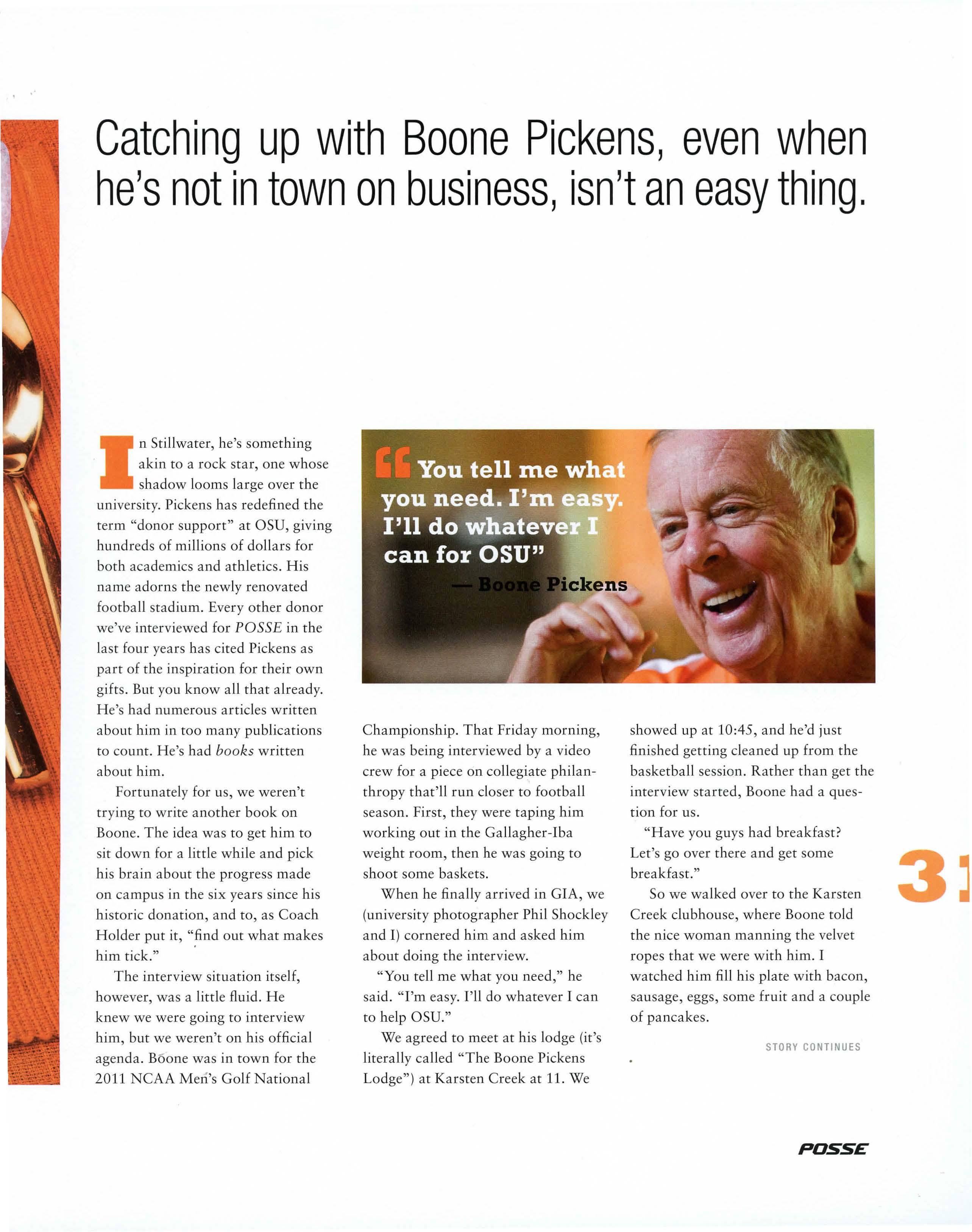
"You tell me what you need," he said. "I'm easy. I'll do whatever I can to help OSU."
We agreed to meet at his lodge (it's literally called "The Boone Pickens Lodge") at Karsten Creek at 11. We
showed up at 10:45, and he'd just finished getting cleaned up from the basketball session. Rather than get the interview started, Boone had a question for us.
"Have you guys had breakfast? Let's go over there and get some breakfast."
So we walked over to the Karsten Creek clubhouse, where Boone told the nice woman manning the velvet ropes that we were with him. I watched him fill his plate with bacon, sausage, eggs, some fruit and a couple of pancakes.
STORY CONTINUES
It was loud in the clubhouse, sitting there surrounded by players and coaches from all the other teams at the tournament. A few minutes after we sat down, the entire OSU golf team sat at two tables just behind us. I kept thinking this would be great to post on Facebook:"Just had breakfast with Boone Pickens." How often does a person get to have a meal with a billionaire?
There was some small talk throughout the meal, some initiated by Matt Grantham (Director, Major Gifts), who was there chauffeuring Boone around for the morning, some by Phil or me. But toward the end of the meal, Boone brought up the fact that there had been two negative articles published about him that morning, one by some guy in D.C. with whom
I'm a pretty good team builder, but I thought I really didn't want to get in that deal.
"I did kind of think at one time it would be a neat deal to run for Governor of Oklahoma and Texas at the same time."
There was some more small talk as the staff at Karsten cleared our table, some centered on the Sooners (whom he does not hate, but definitely wants to beat), then we got up to go back to the lodge to do the formal interview.
Sounds simple, right? Get up from a table, walk 300 yards back to the lodge, do a quick Q&A session, then get transcribing. Not so fast, my friend.
When we got up from the table, Boone stopped to talk to the Cowboy golf team. It was still loud, but I got he had never had any personal contact. the gist of it. After giving them a "I just don't understand these guys," he said. There was no malice, no real heat in his observation, just a sort of honest disbelief from someone who believes in what he's doing.
I said, "Does it really bother you?"
He thought about it for a minute, then said, "No. Well, they don't bother me because I know it isn't true. So what, then? I have enough confidence in myself that I think people know me for what I am, not what some guy in Washington writes about what I'm all about. I think anyone who knows me would look at that article and laugh."
"Did you ever want to get involved in Washi1;1gton?" I said.
"Did I want to," he responded, la ghing. "I am involved. I thought eriously about running for governor f Texas in '86 and again in '90. But __ .....,..eallydidn't think I was going to enjoy it. I thought it was going to be too hard to accomplish something.
version of the "do good" speech, he switched gears and began lecturing them on how important it was to represent OSU when they became professional golfers. That theme of giving back and "remembering where you came from" would come up again an hour later in our conversation. It's a central part of who Boone is.
He stopped two more times before we made it out of the clubhouse, then two or three more times before we got to the lodge. Once there, he told us he'd meet us inside in a few minutes. He had to talk to someone.
An hour later, we sat down with The Man and had 100 percent of his attention. I'm not even sure he had a cell phone with him. I wouldn't call it an interview so much as a barely directed conversation, one that he began by apologizing for taking so long talking to his. friends while we waited.
BOONE: You're standing out there, and they just keep coming by. Thing is, you enjoy talking to them. There are so many people out there that you have to talk to, you get hung up.
POSSE: Well,you'relikea rockstar aroundhere.
BOONE: I don't know what a rock star is for sure. But sure, everyone knows you. And you almost know them. It's kind of like home week. You show up, you're glad you got to come up here and see everybody and talk to them. Everyone has something to tell you. It's good.
POSSE: Is it relaxingto getto come backto OSU?
BOONE: Yeah, it is. Because it's a work day for me, and when I'm here, I forget about the work day. That's unusual for me. I used to do that when I was hunting quail. I could almost forget what day it was. Almost. And then I'd go back to the truck and call in and get the markets and everything.
I never did get, really, that way about golf, where I could go on the golf course and forget the day.
I got in trouble down in Augusta because the chairman saw me talking on the telephone on the golf course. When I got through, the pro took me back and said, "I hate to tell you this, but the chairman said Augusta is not a place to talk on the telephone, and said if your business is that critical or you have something you need to check on, it's probably best if you just stay at the office."
- Boone Pickens
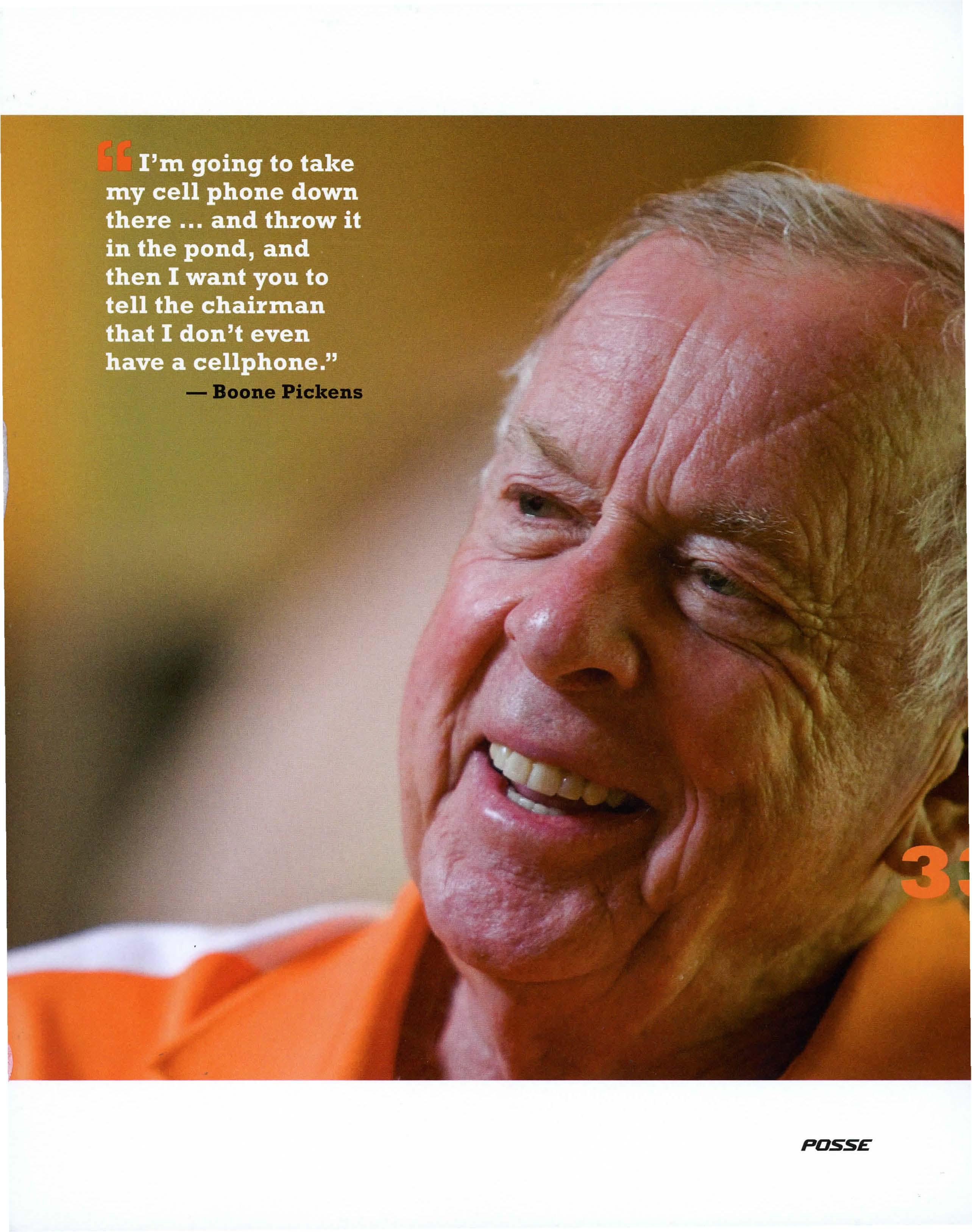
I said, "Okay. So get in the golf cart, we're going to 16." He said, "Why are we going to 16?" I said, "I'll show ya." We got in the golf cart and he asked me again, and I said, "I'm going to take my cell phone down there to 16 and throw it in the pond, and then I want you to tell the chairman that I don't even have a cellphone." He said that wasn't necessary, but I told him I'd leave it in the room tomorrow.
POSSE: Areyourweekends"weekends,"oraretheywork?
BOONE: They're weekends. I'm pretty normal on that because the market stops. When the market closes at 3:00 pm on Friday afternoon, I have a post-market meeting that goes from about 3:30 to 5:30, and then we're through for the weekend. My next call after that point, unless there's something critical breaking in the global economy - I have people who're watching that continuallywill be on Sunday at 5 minutes after 5, wherever I am. They'll give me markets over the weekend and what oil and natural gas, gasoline, are selling for, and any kind of breaking news around the world. That call is usually from 30 minutes to an hour.
On Monday morning, the first time I talk to my traders will be at 6:15. That call is usually 15 minutes.
POSSE: Whatis it aboutworkthat engagesyousocompletely?
OONE: I think the challenge of i , for one thing. I like to make money. I' 1 not a spender. I'm not a shopper. go shopping for clothes about every four years. I'll go in and buy three or four suits. I haven't bought a new suit JULY2011
since '06, so five years now, so I'm due to go buy some suits.
POSSE: It'sbeenfiveyearssinceyour initialbigcontribution to theathletic department,theonethatkick-started thestadiumcampaign.Areyoupleased withhoweverythinghasplayedout?Are youhappywiththeprogress?
BOONE: Yes. Every year has been better than the year before.
Running a public company, what the analysts liked to see was every year an increase in earnings per share. They prefer a nice, neat step up. I'm not so much for a nice, neat step up. I like spikes. Markets that are volatile have served me well over the years.
In a way, with the athletic program, we've had a nice stair step of progress.
POSSE: CoachHoldertoldustofind outwhatmakesyou"tick."In someof theprofilesonyou,you'vedescribed yourfatherassomewhatof a gambler. Howmuchof aneffectdidthathaveon yourcareer?Whatelsedidyourparents instillinyou?
BOONE: My mother was very calculating. She thought about what she was going to do before she did it. My dad was liable to decide to do something and do it very quickly. He could make decisions fast. And he made some bad ones. My mother didn't make many bad decisions. If you could ever fault her, it would be that she took too long to make up her mind.
I still remember about this coffee table. It's in the living room in my Holdenville house, which I moved to the Ranch. My dad said, "Grace, you keep talking about that coffee table; Get the coffee table if you go back to
OKC. I'm tired of talking about it for one, but you've used more gasoline now than the coffee table is worth. Make up your mind."
So she told me we were going to OKC the next day, and we drove up there and got the coffee table and brought it back. I think about that every time I walk past that table.
ThecoffeetablestoryremindedBoone of anotherstoryrelevantto thequestion, thisoneaboutworkingat thelocalPiggly Wiggly. It wasat thispointintheinterviewI realizedthatI couldsitandlisten to BoonePickenstellstoriesall day,one afteranother.
BOONE: I was head of the produce department at the local grocery store. I was 14. I was at Piggly Wiggly. I'm overstating what my position was. But it also meant I had to unload a boxcar once a month. I had to wrestle with 100-pound sacks. It was not easy. I had to get them down and on a handtruck. I was pitiful trying to unload that thing. It took probably four times longer than it should have. Maybe longer.
I was making 10 cents an hour. Safeway came in, apparently they checked and someone said, "That kid over at Piggly Wiggly will work." Either that or I'd worked with one of those guys at Safeway. Either way, they were hiring people and they offered me 35 cents an hour. I wondered if they knew I was making 10 cents an hour. They should've traded with me.
I went home. I was so excited, I told my mother. Immediately, she said, "Sit down, son, and we're going to talk about loyalty. Johnny Sellers and Piggly Wiggly hired you. He was the first one to give you a job other than STORY CONTINUES
POSSE
- Boone Pickens
mowing lawns and having a newspaper route. You need to be loyal."
I said, "But it's a big advancement."
She said, 'I'm not saying don't take it, but I want you to think about it. You think about Johnny Sellers and how important he's been to you the last year."
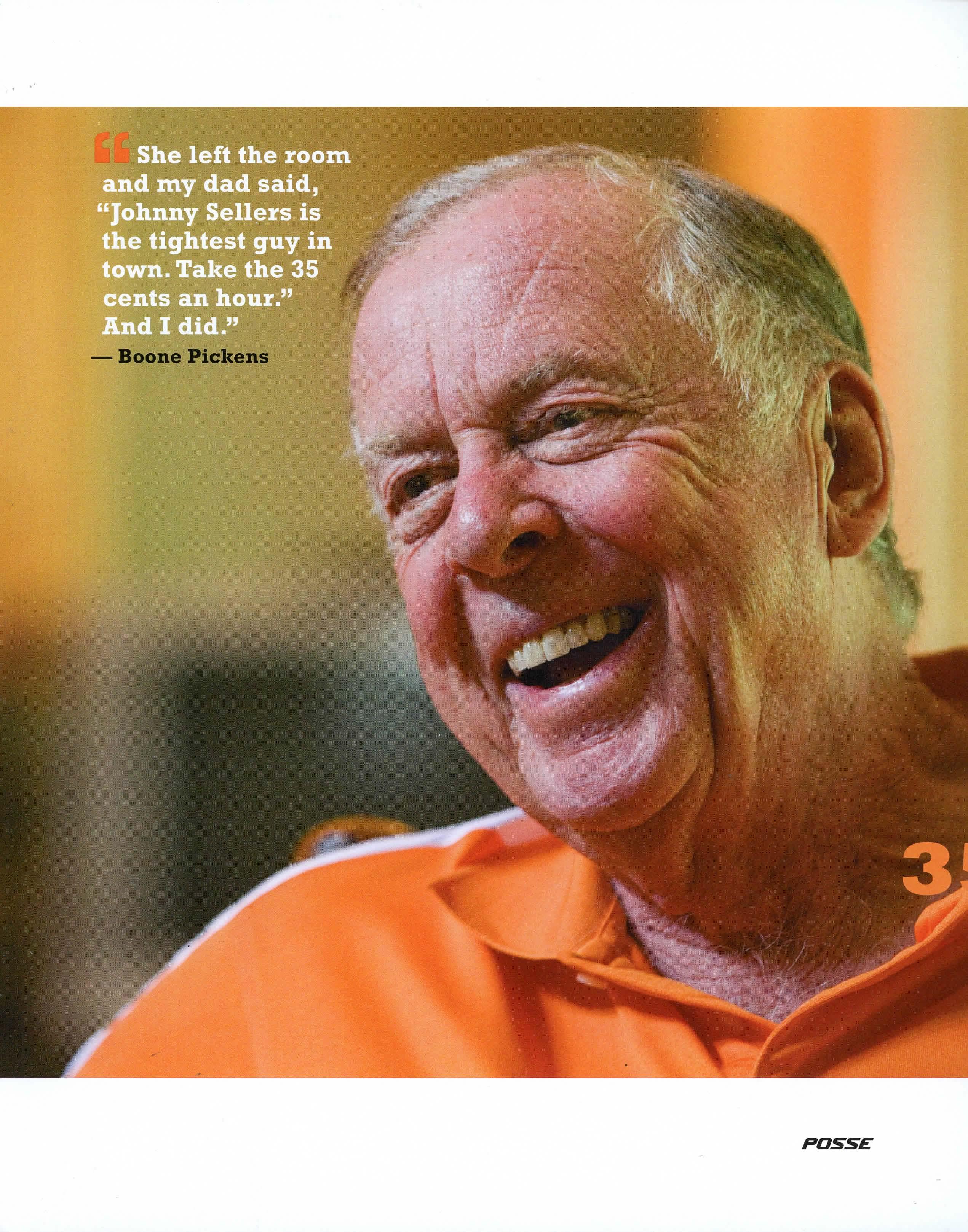
She left the room and my dad said, "Johnny Sellers is the tightest guy in town. Take the 35 cents an hour." And I did.
POSSE: Howdoyoulikebeingintown ontheeveofa possiblenationalchampionship,andwhatotherkindsofthings areyougoingto bedoingwhileyouare here?Isthisjustdowntimeforyou?
BOONE: I've been here before. 2003. It's exciting. I never come to this campus and it's humdrum or dull. I talked to Burns earlier. He was in Kansas City. He said he'd be back here by 2 o'clock. He was just getting ready to come back. We'll get together this afternoon and talk about things. It's interesting that people try to characterize it like you're trying to run the university, or you're trying to run the athletic program, or trying to run this or that. I said, "Why don't you look at it like this: I've given a lot of money. I'm very interested. But I've got a job. I'm not trying to run anything for anyone else."
Look at Phil Knight at Oregon. Can you imagine that they can call Phil Knight up and say, "Phil, we want to talk to you about something the university." And he says, "Okay, JUSta second," and clears out his o • ce, then says, "Okay, what do you w nt?" He cleared out his office and • 's ready to talk to you as long as you want to talk about what can make Oregon University better.
Imagine having a guy like that, who you don't pay a dime Why wouldn't you view him as an asset instead of someone you had to fool with, who's a pain in the neck?
I'm not a pain in the neck to him [President Hargis]. He knows it. If he wanted to talk to me about something, he'd feel comfortable calling Sally and asking,"When is he going to be free to talk?" If I am free, then I'm on the phone with Burns.
It's just amusing how the media likes to characterize that a large donor is trying to run the university. You see what I mean? Back to Phil Knight. Get him on the phone and talk about the business school, or marketing you've got a wealth of information. And I'll bet you the guy is never in a hurry for the school.
POSSE: Everytimewe interview a donorforPOSSE,wealwaysaskthem whatinspiredthemto giveback.They'll talkabouttheirexperiencetherewhile theywereinschool,andthey'lltalk abouttheirloveofOSUathletics.And thentheyalwayssay,"Booneinspired us."Well,whoinspiredyou?
BOONE: The way I was brought up. My grandmother, and I'm sure everyone has heard me tell this story, she said, "Don't ever forget where you came from." And she said it enough that it made me really think about what she meant by "where you came from." And what it means is all the places that you came from. For me, it's Holdenville. I lived in Amarillo for 40 years. It's OSU. You came from a lot of places. I live in Dallas. But you don't erase anything from the past. For me, the past was always enjoyable. It was fun. Here, I made a sizeable gift to the geology school in 2008.
It was because I had the money. That's it. I thought my gift would help the geology school.
OU had a good geology school. My dean at OSU was V.B. Monnett. His father was dean of the geology school, V.E. Monnett. They were very well known geologists in Oklahoma. So I called him one day, and we talked about having better facilities, and that would bring us students. From there, as I got more money, I just started expanding the idea. If we have better facilities, we'll get more and better students.
But then I got the idea to apply that to athletics.
Holder and I hunt together a lot. Mike had never hunted quail.
Well, you see, he doesn't have any hobbies. I played golf, but I was never very good at it. When I was 78, I eagled No. 11 at Augusta National. By the time I was 80, I didn't enjoy golf. I'd hit one good shot, but I couldn't follow it up with a good shot. If I'm going to shoot 100, then I don't want to play.
But it was easy because I enjoy working.
It was the same thing on hunting. When I first took Holder hunting quail. He'd do it, but he said, 'I don't have any interest in it. But he got interested. And that was one thing I saw that he really got into. Last hunting season, he was too busy to hunt. I don't hunt with him anymore, and I think that may be one reason. He has gotten into OSU athletics. Everything becomes secondary to that and I don't enjoy hunting anymore so I work instead.
Everything becomes secondary to my business. I know if I make money, I'm going to give it away.
JULY2011
Bill Gates and Warren Buffett came out with a deal. Bill Gates called me. He said, "Boone, we are going to put together, hopefully, a long list of people who will give half of their estates to charity. It can be their own charity, but they will give it away."
"Bill, why don't you join me in what I said I'd do back in 1984 in Fortune magazine?"
Atthispoint,Boonespentsometime recountingtheonsetofmaculardegeneration,somethingheinheritedfromhis father,andofshootingquailoutat his ranch.It'snotoftenyougetto listento storiesfromsomeonewho'shadsuchan interestinglife,sowewerein nohurry to endtheinterview.Buttimecaughtup withus,soweaskedonelastquestion, thenlethimgofollowthegolfteam.
He said, "What's that?"
"I said I'd give away 90 percent of my estate to charity."
He said, "No, we're just going to do 50."
I said, "Okay. Count me in. I'll do 50 percent."
He said, "Well, we just want you on record that you're going to do it."
I said, "I'll do it. I'll give more than that, but 50 percent is fine."
We met recently in Dallas. George Kaiser, Bill Gates, Warren Buffett and myself hosted a dinner. We brought 22 people in who are all going to, I think, give half of their estates to charity. George sat at one end, Gates at the other, then Warren and I sat across from each other, so we were all equally located in the room so that the conversation would always be on what we _wanted it to be on, which was giving.
POSSE: Howexcitedareyouaboutthe comingfootballseason?
BOONE: There's a lot there to be excited about. We'll see how they put it together. I think we'll have a very good year. Is it an ultimate year?
I don't think I can answer that. But I do think we're going to have a very good year. You've got a good football team. We'll see how our Defense does. We were really very very close last year.
You remember who the guy was last season with the press on opening day? They said, "What do you think?"
I said, "8-4." And they said, "That's better than anyone else has said."
I said, "If I err, it'll be better instead of worse." That was a pretty good prediction. Dallas Morning News gave us 6-6.
Now it just comes down to our players and coaches. Our facilities are the best in college football. And then they have great support from the alums and students. Everyone is on board. Hey, fellas, it's up to you.
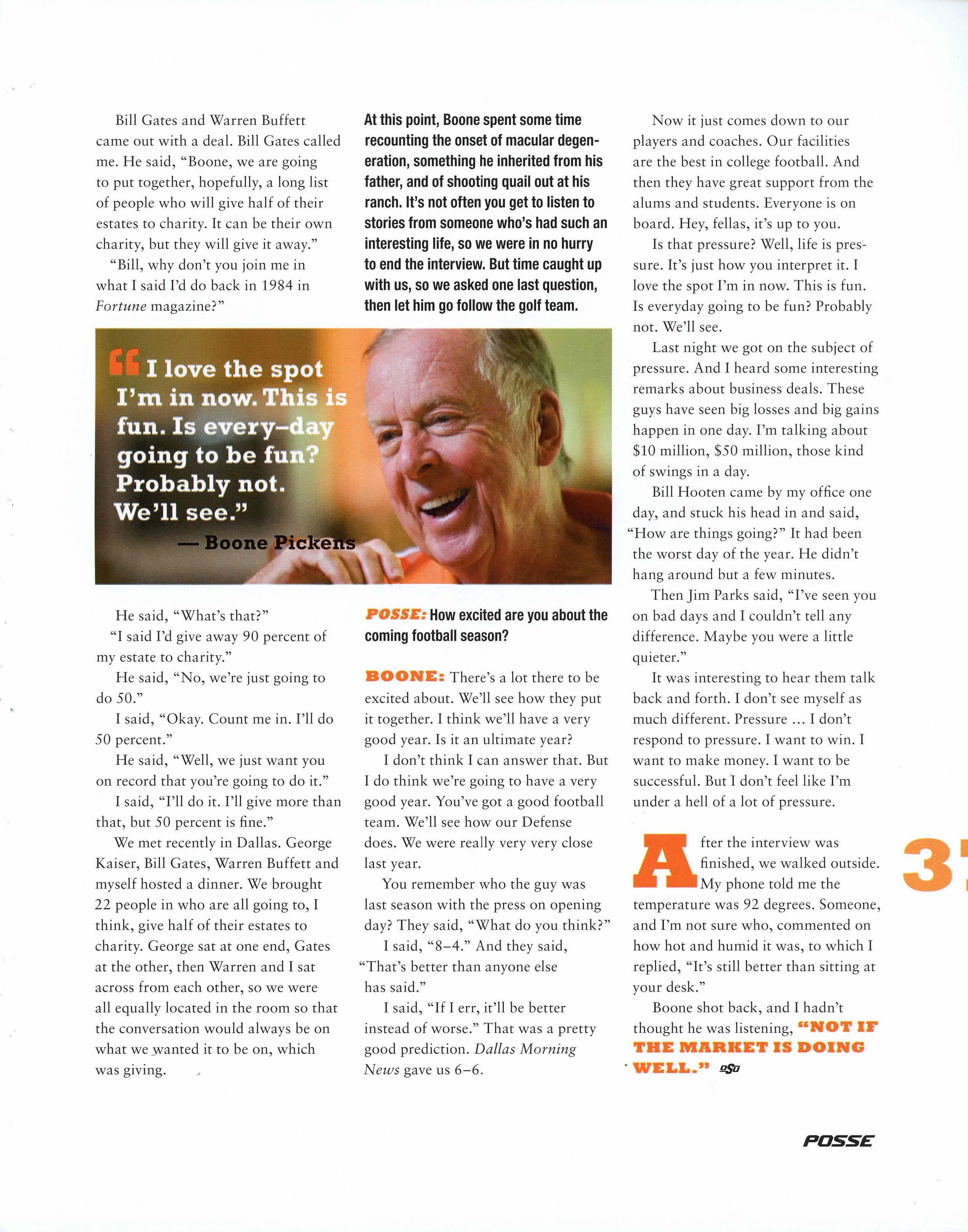
Is that pressure? Well, life is pressure. It's just how you interpret it. I love the spot I'm in now. This is fun. Is everyday going to be fun? Probably not. We'll see.
Last night we got on the subject of pressure. And I heard some interesting remarks about business deals. These guys have seen big losses and big gains happen in one day. I'm talking about $10 million, $50 million, those kind of swings in a day.
Bill Hooten came by my office one day, and stuck his head in and said, "How are things going?" It had been the worst day of the year. He didn't hang around but a few minutes.
Then Jim Parks said, "I've seen you on bad days and I couldn't tell any difference. Maybe you were a little quieter."
It was interesting to hear them talk back and forth. I don't see myself as much different. Pressure ... I don't respond to pressure. I want to win. I want to make money. I want to be successful. But I don't feel like I'm under a hell of a lot of pressure.
After the interview was finished, we walked outside. My phone told me the temperature was 92 degrees. Someone, and I'm not sure who, commented on how hot and humid it was, to which I replied, "It's still better than sitting at your desk."
Boone shot back, and I hadn't thought he was listening, HNOT IF THE MAR ET IS DOING ·WELL." !!$0 POSSE
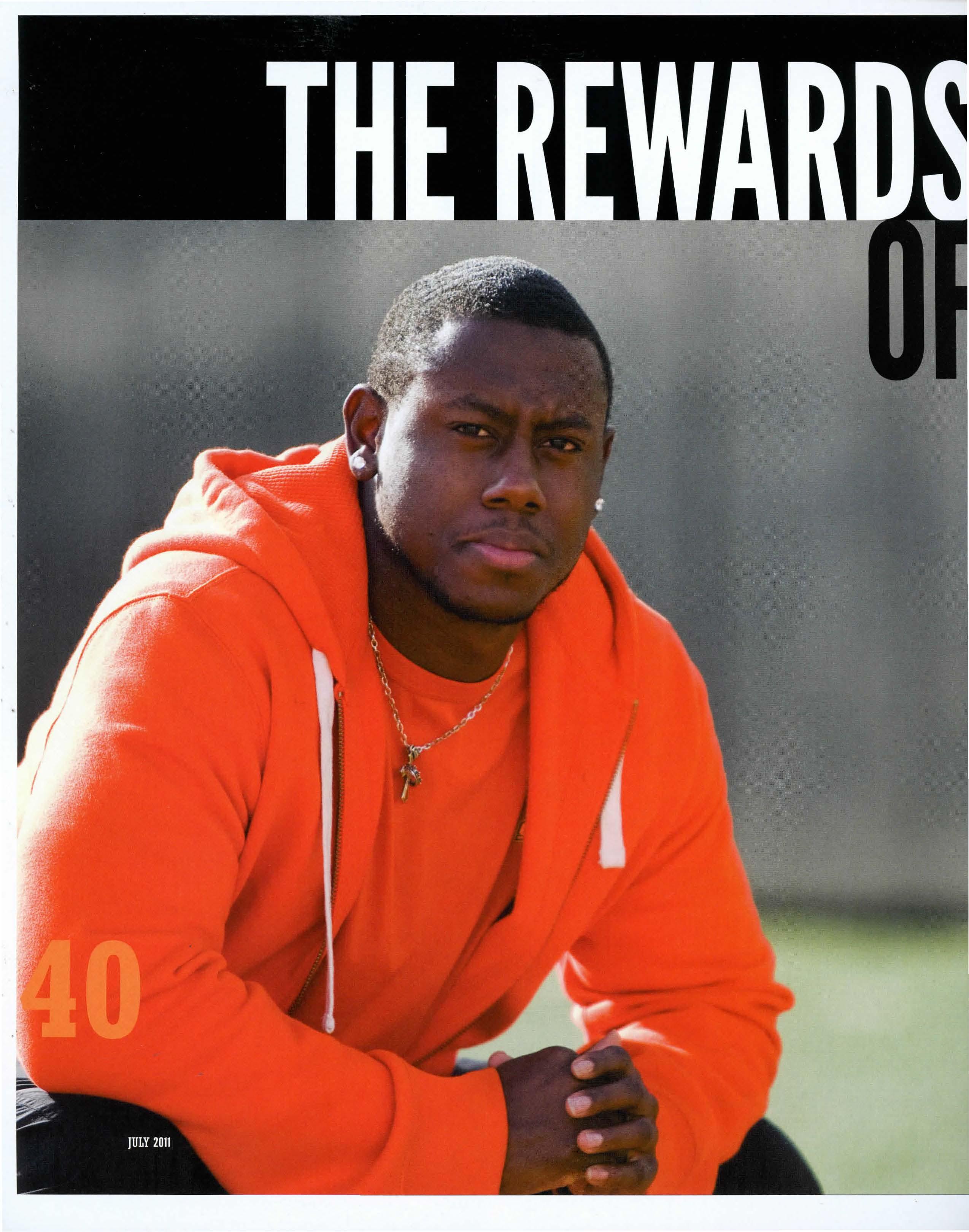
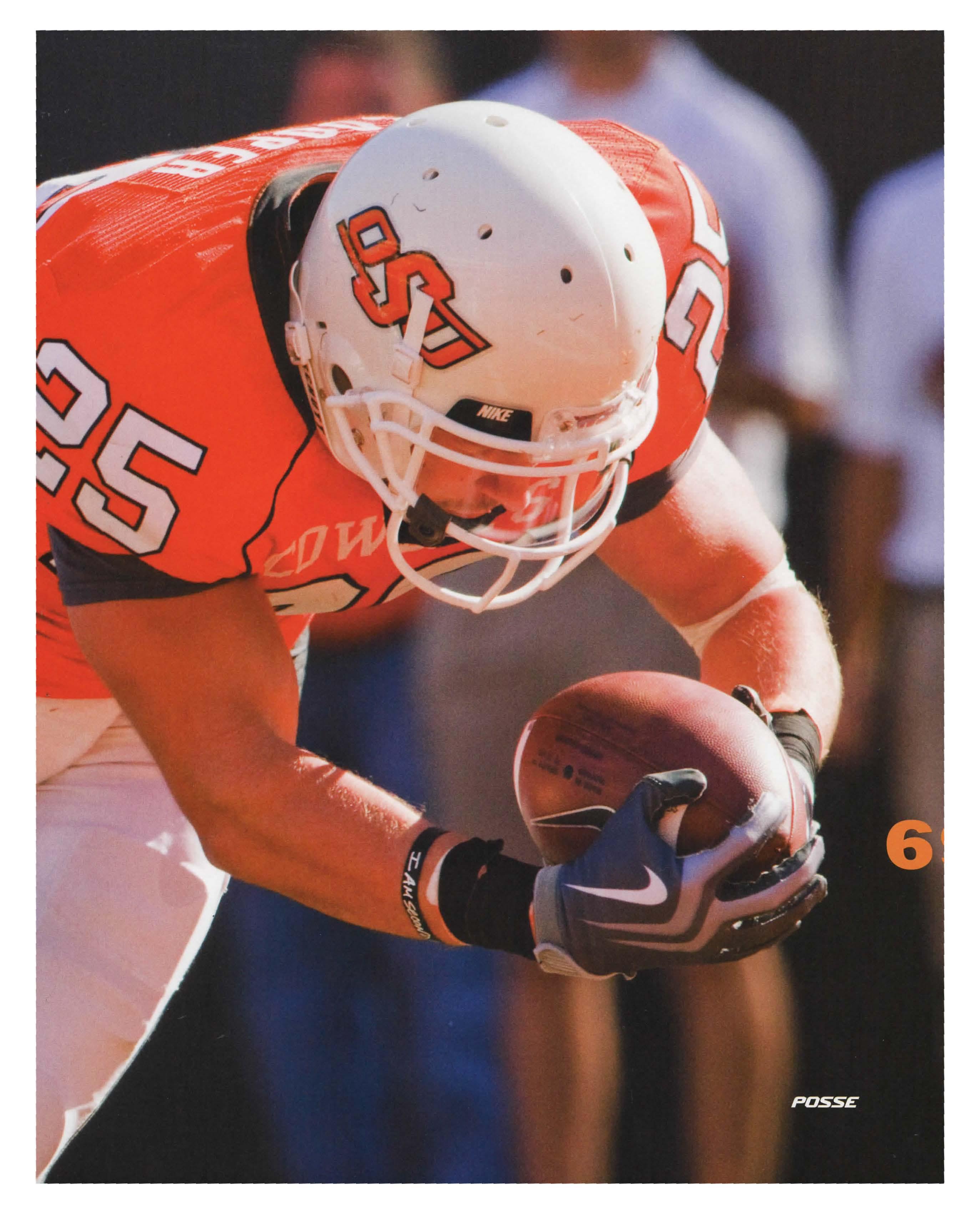
None of that matters to Kye Staley. What matters is that he's back doing what he loves - playing football.
Staley says he wasn't trying to impress anyone when he returned to the Cowboys this spring after an unusually serious leg injury.
"I'm just doing it to make me happy," says Staley, who returned to play during OSU's spring game scrimmage after a 2009 injury nearly left his right leg paralyzed below the knee.
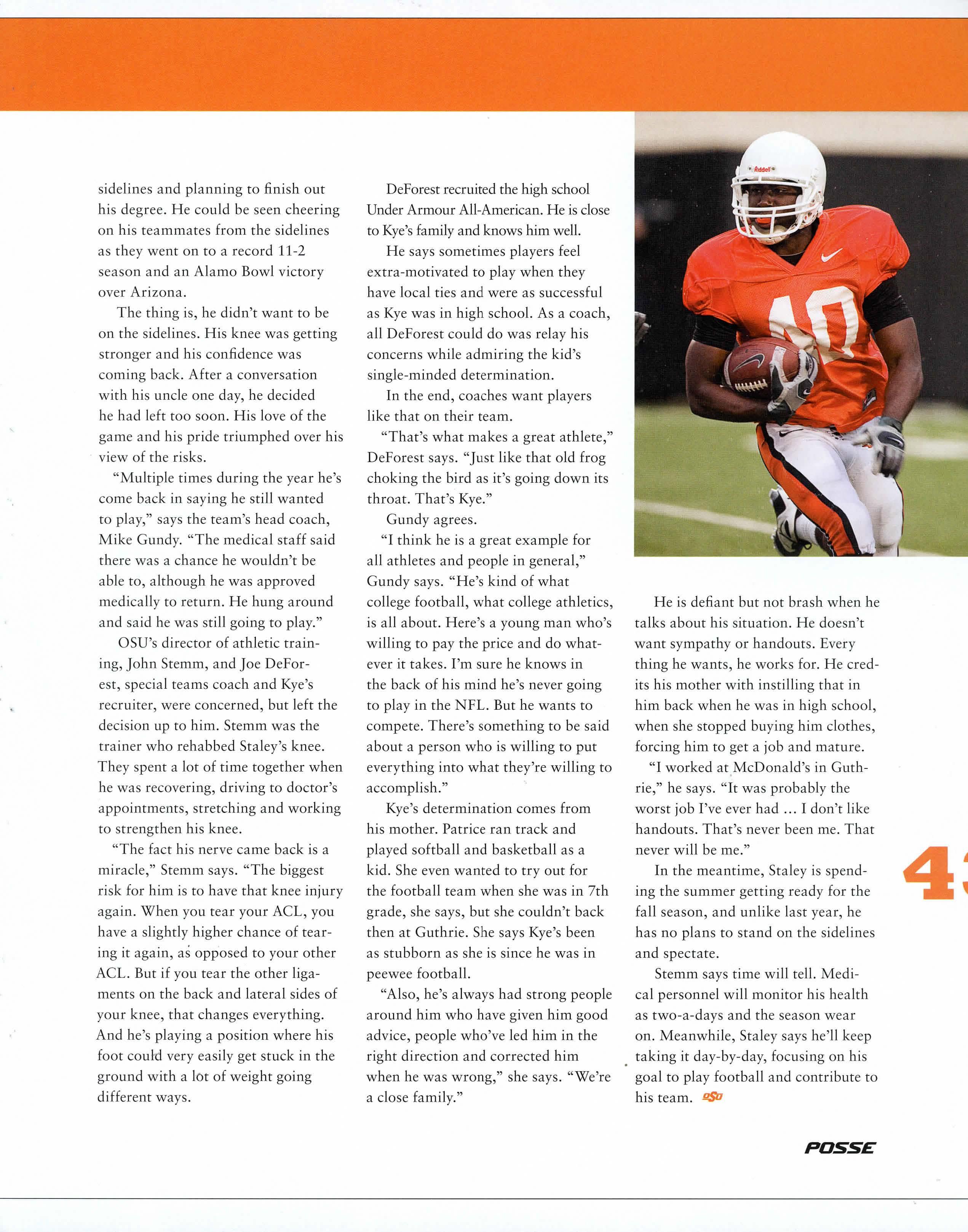
The spring game was the first time Staley had played in front of a crowd since he was at Guthrie High School and the top high school football player in Oklahoma. During the spring game, he led all runners, netting 55 yards on 11 plays. His return was big talk around the field that April day, and it made headlines all over the state.
"It was a chance for me to come out and show how I've come from point A to point B," Staley says. "I wanted to go out and have a lot of fun. It gave me a lot of confidence."
His mom, Patrice Staley, watched each play from the stands. She was on pins and needles. The entire OSU coaching staff was holding its breath.
"Every time he ran and got tackled, I'd be saying, 'Get up, Kye. Get up,"' she says.
OSU fans saw a bulkier but still nimble Staley that day. A month later, he was up to 220, he says, and slated to play fullback in an offense that should burn record books as well as opposing defenses once the 2011 season begins.
Nevertheless, Staley has no illusions about his chances. He's taking it one game at a time. He's just happy to be back on the field and to have his mind right, he says.
Two years ago he tore his anterior cruciate ligament, his medialcollateral ligament, his hamstring, his
meniscus and his calf muscle when he was tackled on a routine running play. He also damaged a nerve, causing him to lose all use of his right leg below the knee.
The team's orthopedic surgeon, Dr. Mark Pascale, put his leg back together, but could do nothing for the nerve except watch and wait. It would later regenerate, which is a rare event in medicine. By the time two-a-days came in August 2010, he was medically cleared to play.
He practiced with the team until he tweaked his knee. He quit the team once again after trying playing defensive back. Instead he became a student assistant, working the
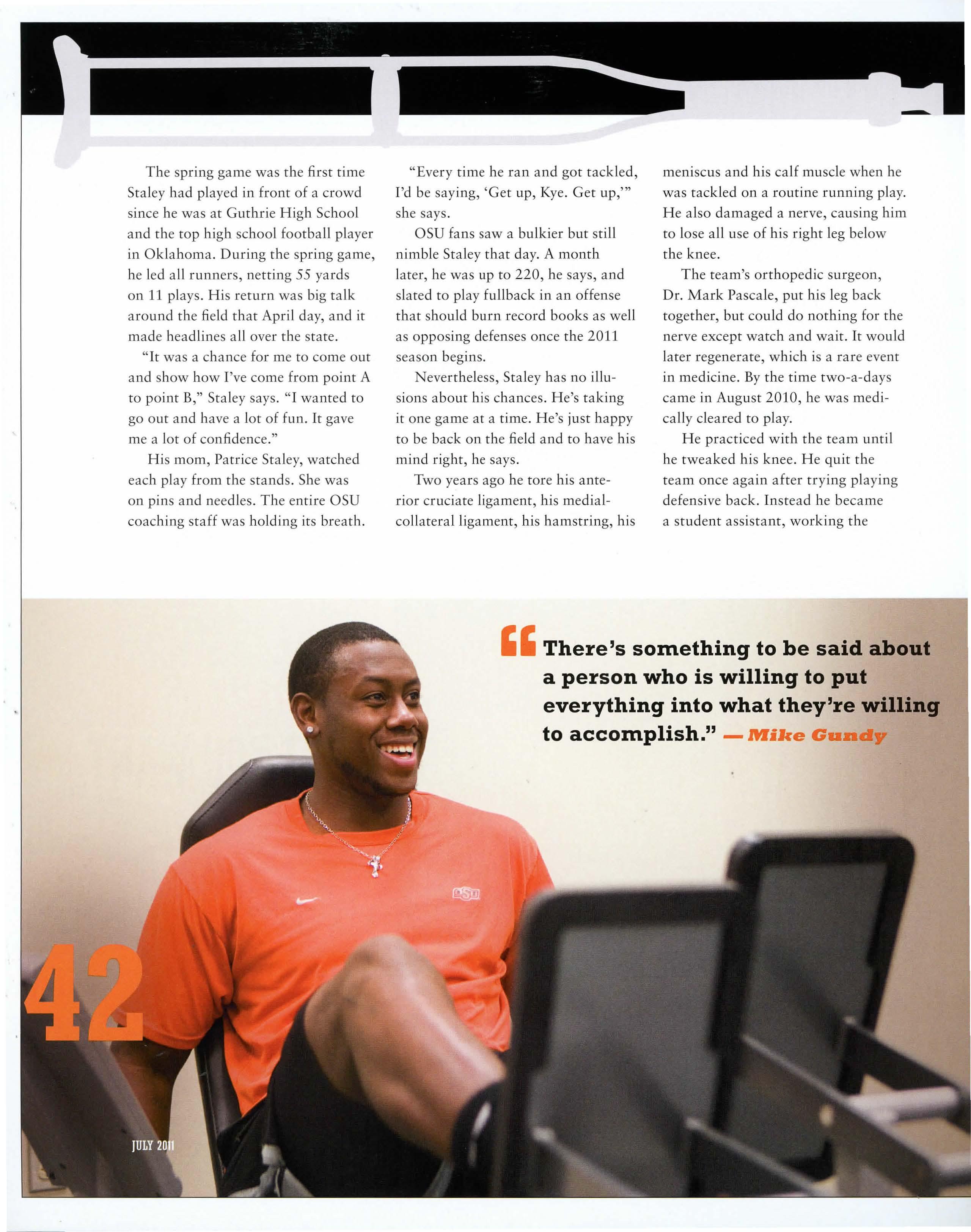
'' There's something to be said about a person who is willing to put everything into what they're willing to accomplish."
- Mike Gun
sidelines and planning to finish out his degree. He could be seen cheering on his teammates from the sidelines as they went on to a record 11-2 season and an Alamo Bowl victory over Arizona.
The thing is, he didn't want to be on the sidelines. His knee was getting stronger and his confidence was coming back. After a conversation with his uncle one day, he decided he had left too soon. His love of the game and his pride triumphed over his view of the risks.
"Multiple times during the year he's come back in saying he still wanted to play," says the team's head coach, Mike Gundy. "The medical staff said there was a chance he wouldn't be able to, although he was approved medically to return. He hung around and said he was still going to play."
OSU's director of athletic training, John Stemm, and Joe DeForest, special teams coach and Kye's recruiter, were concerned, but left the decision up to him. Stemm was the trainer who rehabbed Staley's knee. They spent a lot of time together when he was recovering, driving to doctor's appointments, stretching and working to strengthen his knee.
"The fact his nerve came back is a miracle," Stemm says. "The biggest risk for him is to have that knee injury again. When you tear your ACL, you have a slightly higher chance of tearing it again, as opposed to your other ACL. But if you tear the other ligaments on the back and lateral sides of your knee, that changes everything. And he's playing a position where his foot courd very easily get stuck in the ground with a lot of weight going different ways.
DeForest recruited the high school Under Armour All-American. He is close to Kye's family and knows him well.
He says sometimes players feel extra-motivated to play when they have local ties and were as successful as Kye was in high school. As a coach, all DeForest could do was relay his concerns while admiring the kid's single-minded determination.
In the end, coaches want players like that on their team.
"That's what makes a great athlete," DeForest says. "Just like that old frog choking the bird as it's going down its throat. That's Kye."
Gundy agrees.
"I think he is a great example for all athletes and people in general," Gundy says. "He's kind of what college football, what college athletics, is all about. Here's a young man who's willing to pay the price and do whatever it takes. I'm sure he knows in the back of his mind he's never going to play in the NFL. But he wants to compete. There's something to be said about a person who is willing to put everything into what they're willing to accomplish."
Kye's determination comes from his mother. Patrice ran track and played softball and basketball as a kid. She even wanted to try out for the football team when she was in 7th grade, she says, but she couldn't back then at Guthrie. She says Kye's been as stubborn as she is since he was in peewee football.
"Also, he's always had strong people around him who have given him good advice, people who've led him in the right direction and corrected him when he was wrong," she says. "We're a close family."
He is defiant but not brash when he talks about his situation. He doesn't want sympathy or handouts. Every thing he wants, he works for. He credits his mother with instilling that in him back when he was in high school, when she stopped buying him clothes, forcing him to get a job and mature.
"I worked at McDonald's in Guthrie," he says. "It was probably the worst job I've ever had ... I don't like handouts. That's never been me. That never will be me."
In the meantime, Staley is spending the summer getting ready for the fall season, and unlike last year, he has no plans to stand on the sidelines and spectate.
Stemm says time will tell. Medical personnel will monitor his health as two-a-days and the season wear on. Meanwhile, Staley says he'll keep taking it day-by-day, focusing on his goal to play football and contribute to his team. 9$0
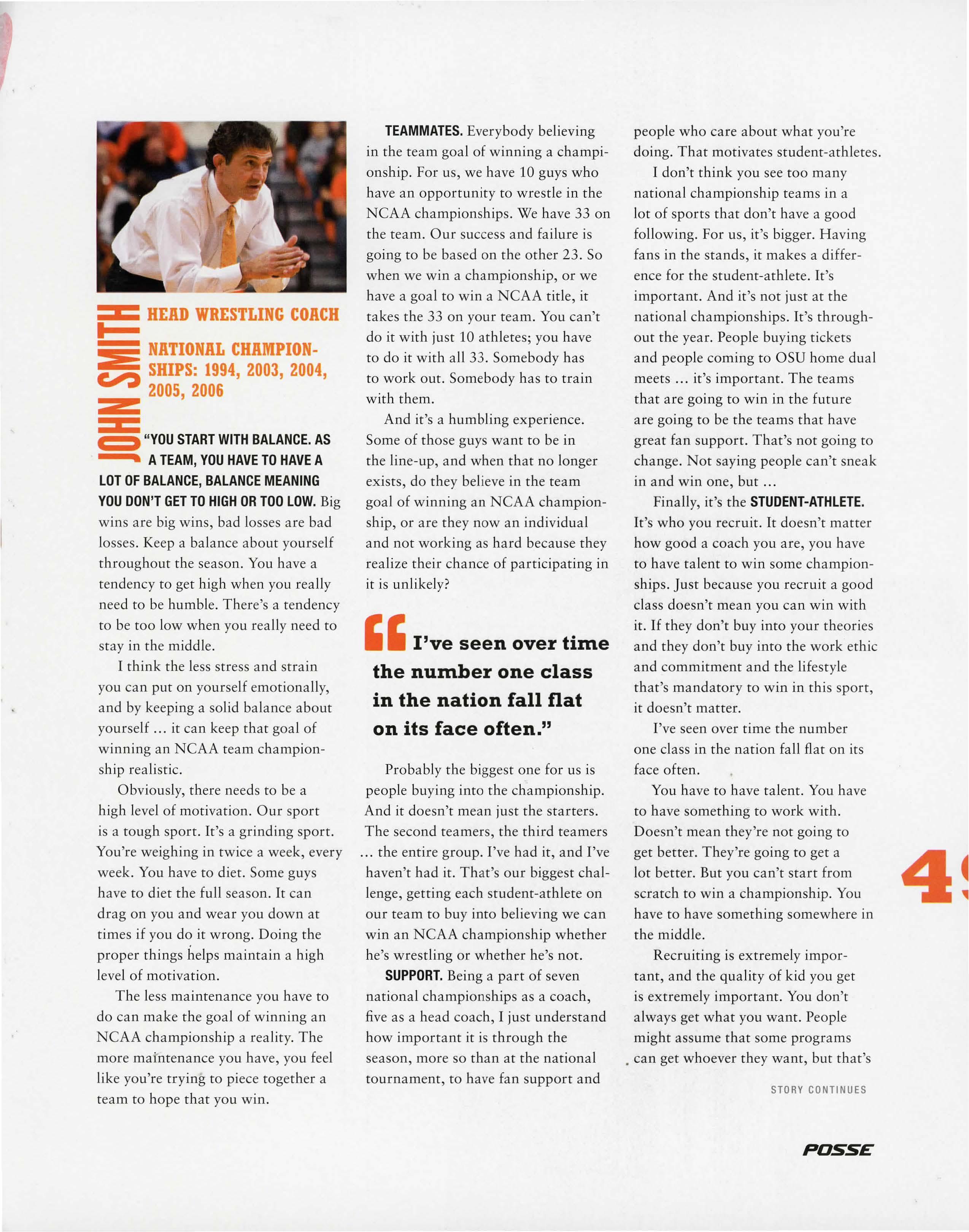
HEADWRESTLINGCOACH 1-NATIONALCHAMPIONSHIPS:1994,2003, 2004, 2005, 2006 ::Z! ::z:: c::»"YOUSTARTWITHBALANCE.AS --. A TEAM,YOUHAVETOHAVEA LOTOFBALANCE,BALANCEMEANING YOUDON'TGETTOHIGHORTOOLOW.Big wins are big wins, bad losses are bad losses. Keep a balance about yourself throughout the season. You have a tendency to get high when you really need to be humble. There's a tendency to be too low when you really need to stay in the middle.
I think the less stress and strain you can put on yourself emotionally, and by keeping a solid balance about yourself ... it can keep that goal of winning an NCAA team championship realistic.
Obviously, there needs to be a high level of motivation. Our sport is a tough sport. It's a grinding spore. You're weighing in twice a week, every week. You have to diet. Some guys have to diet the full season. It can drag on you and wear you down at times if you do it wrong. Doing the proper things helps maintain a high level of motivation.
The less maintenance you have to do can make the goal of winning an NCAA championship a reality. The more maintenance you have, you feel like you're trying to piece together a team to hope that you win.
TEAMMATES.Everybody believing in the team goal of winning a championship. For us, we have 10 guys who have an opportunity to wrestle in the NCAA championships. We have 33 on the team. Our success and failure is going to be based on the other 23. So when we win a championship, or we have a goal to win a NCAA title, it takes the 33 on your team. You can't do it with just 10 athletes; you have to do it with all 33. Somebody has to work out. Somebody has to train with them.
And it's a humbling experience. Some of those guys want to be in the line-up, and when that no longer exists, do they believe in the team goal of winning an NCAA championship, or are they now an individual and not working as hard because they realize their chance of participating in it is unlikely?
'' I've seen over time the number one class in the nation fall flat on its face often."
Probably the biggest one for us is people buying into the championship. And it doesn't mean just the starters. The second reamers, the third reamers the entire group. I've had it, and I've haven't had it. That's our biggest challenge, getting each student-athlete on our team to buy into believing we can win an NCAA championship whether he's wrestling or whether he's not.
SUPPORT.Being a part of seven national championships as a coach, five as a head coach, I just understand how important it is through the season, more so than at the national tournament, to have fan support and
people who care about what you're doing. That motivates student-athletes.
I don't think you see too many national championship teams in a lot of sports that don't have a good following. For us, it's bigger. Having fans in the stands, it makes a difference for the student-athlete. It's important. And it's not just at the national championships. It's throughout the year. People buying tickets and people coming to OSU home dual meets it's important. The teams that are going to win in the future are going to be the teams that have great fan support. That's not going to change. Not saying people can't sneak in and win one, but
Finally, it's the STUDENT-ATHLETE. It's who you recruit. It doesn't matter how good a coach you are, you have to have talent to win some championships. Just because you recruit a good class doesn't mean you can win with it. If they don't buy into your theories and they don't buy into the work ethic and commitment and the lifestyle that's mandatory to win in this sport, it doesn't matter.
I've seen over time the number one class in the nation fall flat on its face often.
You have to have talent. You have to have something to work with. Doesn't mean they're not going to get better. They're going to get a lot better. But you can't start from scratch to win a championship. You have to have something somewhere in the middle.
Recruiting is extremely important, and the quality of kid you get is extremely important. You don't always get what you want. People might assume that some programs . can get whoever they want, but that's
STORY CONTINUES
the furthest thing from the truth. It's about money. It's about how much scholarship they can receive. It's about location. Student-athletes want different things.
There are enough recruits out there who can give you that opportunity, but you have to be careful about making mistakes in recruiting. Mistakes cost you for years.
If you are not careful, you'll quickly spend two years of maintenance work before you can get them to the level they can help you. Yeah, you can win championships that way, but being consistent and really making a threat that you can be in the middle of it, have a hope that you can get there each and every year You can't have too much maintenance.
I've had my fair share. More than I wanted. But that's part of the game. It's
•Inot gomg to be perfect. You work with what you get. I always say, '" 'We recruited them, so let's not complain about it. Let's do what we have to do.' Recruiting is a challenge.
COACH
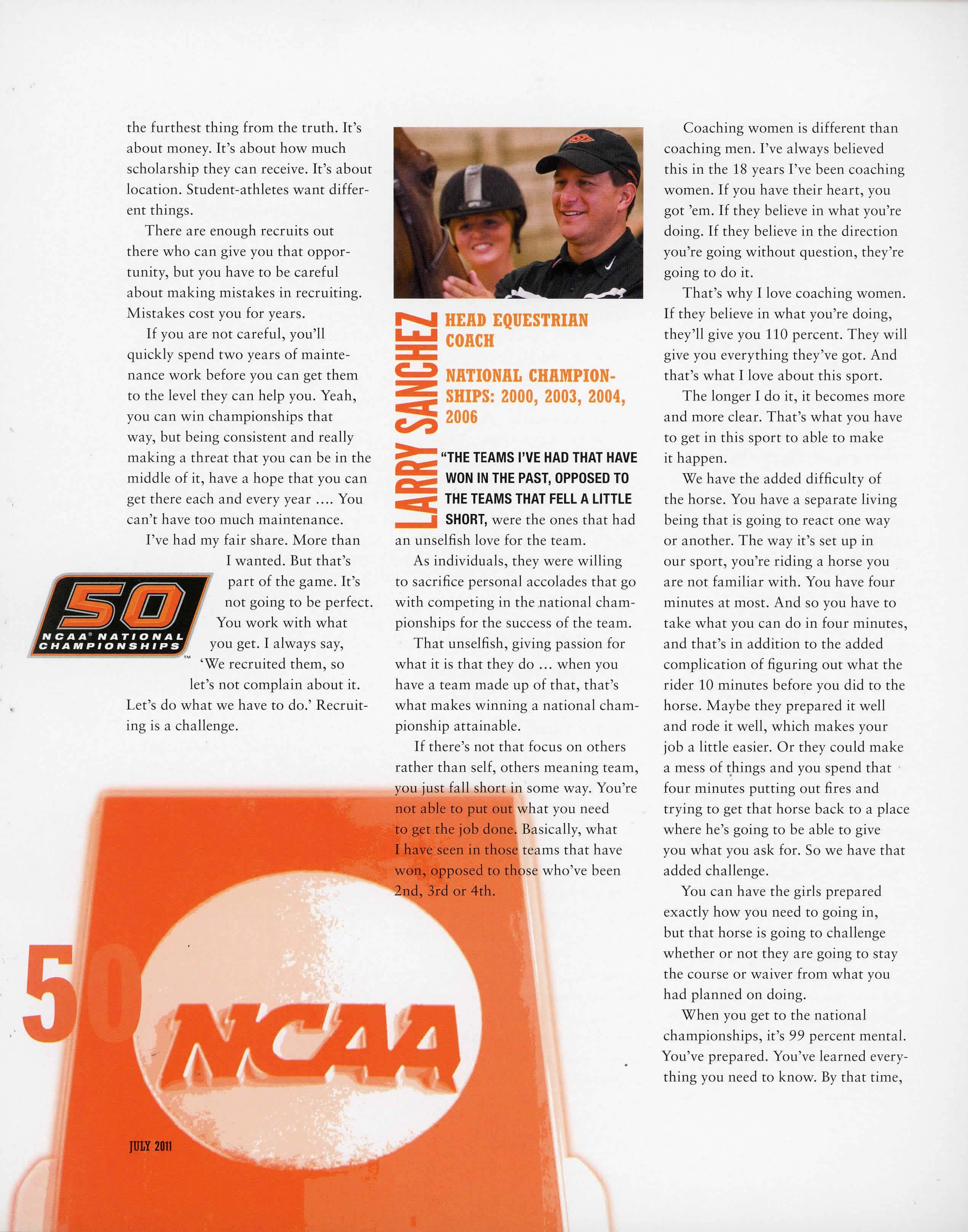
"THETEAMSl'VEHADTHATHAVE ,::::.:: WONIN THEPAST,OPPOSEDTO C::CTHETEAMSTHATFELLA LITTLE
....I SHORT,were the ones that had an unselfish love for the team.
As individuals, they were willing to sacrifice personal accolades that go with competing in the national championships for the success of the team.
That unselfish, giving passion for what it is that they do when you have a team made up of that, that's what makes winning a national championship attainable.
If there's not that focus on others rather than self, others meaning team, you just fall short in some way. You're not able to put out what you need to get the job done. Basically, what
won, opposed to those who've been 2nd, 3rd or 4th.
Coaching women is different than coaching men. I've always believed this in the 18 years I've been coaching women. If you have their heart, you got 'em. If they believe in what you're doing. If they believe in the direction you're going without question, they're going to do it.
That's why I love coaching women. If they believe in what you're doing, they'll give you 110 percent. They will give you everything they've got. And that's what I love about this sport.
The longer I do it, it becomes more and more clear. That's what you have to get in this sport to able to make it happen.
We have the added difficulty of the horse. You have a separate living being that is going to react one way or another. The way it's set up in our sport, you're riding a horse you are not familiar with. You have four minutes at most. And so you have to take what you can do in four minutes, and that's in addition to the added complication of figuring out what the rider 10 minutes before you did to the horse. Maybe they prepared it well and rode it well, which makes your job a little easier. Or they could make a mess of t,hings and you spend that • four minutes putting out fires and trying to get that horse back to a place where he's going to be able to give you what you ask for. So we have that added challenge.
You can have the girls prepared exactly how you need to going in, but that horse is going to challenge whether or not they are going to stay the course or waiver from what you had planned on doing.
When you get to the national championships, it's 99 percent mental. You've prepared. You've learned everything you need to know. By that time,
you're not going to learn anything new or be able to apply anything new. Most patterns last two to three minutes. We don't have a 20-minute half-time to work things out. I envy the sports that do.
When we assign our starting lineup, when they go in, if they're not on, you just have to live with it. You have to put up with the results you get. I've joked with Coach Budke before. It'd be nice to blow the whistle, pull that one out and put another one in who might be more on. I've wished I could do that at times. It just adds a challenge.
'' When you get to the national championships, it's 99 percent mental. You've prepared. You've learned everything you need to know."
I'd like to say I know the girls well enough to say who's on that day and who's not, and more times than not, we're pretty close. Every once in a while something will happen, either during that warm-up time with an unfamiliar horse, or Everyone sometimes wakes up in a different mood. You have to be able to, as a coach, change your gameplan.
The national championships, we set our starting line-up, and with the exception of a medical reason, you can't sub out before they ride. When I get there in the morning, and one of the girls who is supposed to compete is not on;I have to figure out how to get her on track before she throws her
leg over that horse. Sometimes you can do it, and sometimes it's difficult.
You hope you know your girls well enough, your team well enough, that you can change your approach.
It's also recruiting the right athletes, who have the mentality that you want. If you asked every equestrian coach in the country the same question, a lot of them will give you different answers. I've always been one to recruit those athletes who're going to have attitudes that'll fit into the way that I try to do things. If you have to try to coach one to change her whole outlook on things, it's harder than to recruit one in who tends to already thing that way.
Our sport is very much mental. The girls we recruit are already very accomplished in the competition arena. Most are world or national champions in our sport already. We're fortunate enough to be able to recruit those and get them here. So yeah, you can recruit a world or national champion, but they may not have the same outlook as you, and it's going to be a difficult time, even though they are very talented.
The recruiting game has already become more difficult than it was in the past, but we still have a good pool of riders. Two years ago, I went after X number of recruits and got a couple of them that I wanted. Last year, everybody I offered signed. So now I have freshmen coming in the fall, they're as tough a freshman class as I've ever had just because of the sheer numbers. I have a Canadian world champion coming in. I have reserve world champions coming in.
It's fun.
One thing that we did at the end of this season, I met with the girls coming back next year. Told them we
have a lot of girls coming in, and it's not that you won't have your spot, but you have to align your mind into 'I'm going to need to step things up.'
I like to think of John Smith's program. Most years, if the top wrestler gets injured or isn't performing, he has another one to put in. I see that now in football starting to have that depth.
When you have that kind of depth, it makes you better. You're either going to step up or someone's going to take your spot.
:::3I:;HEADGOLFCOACH
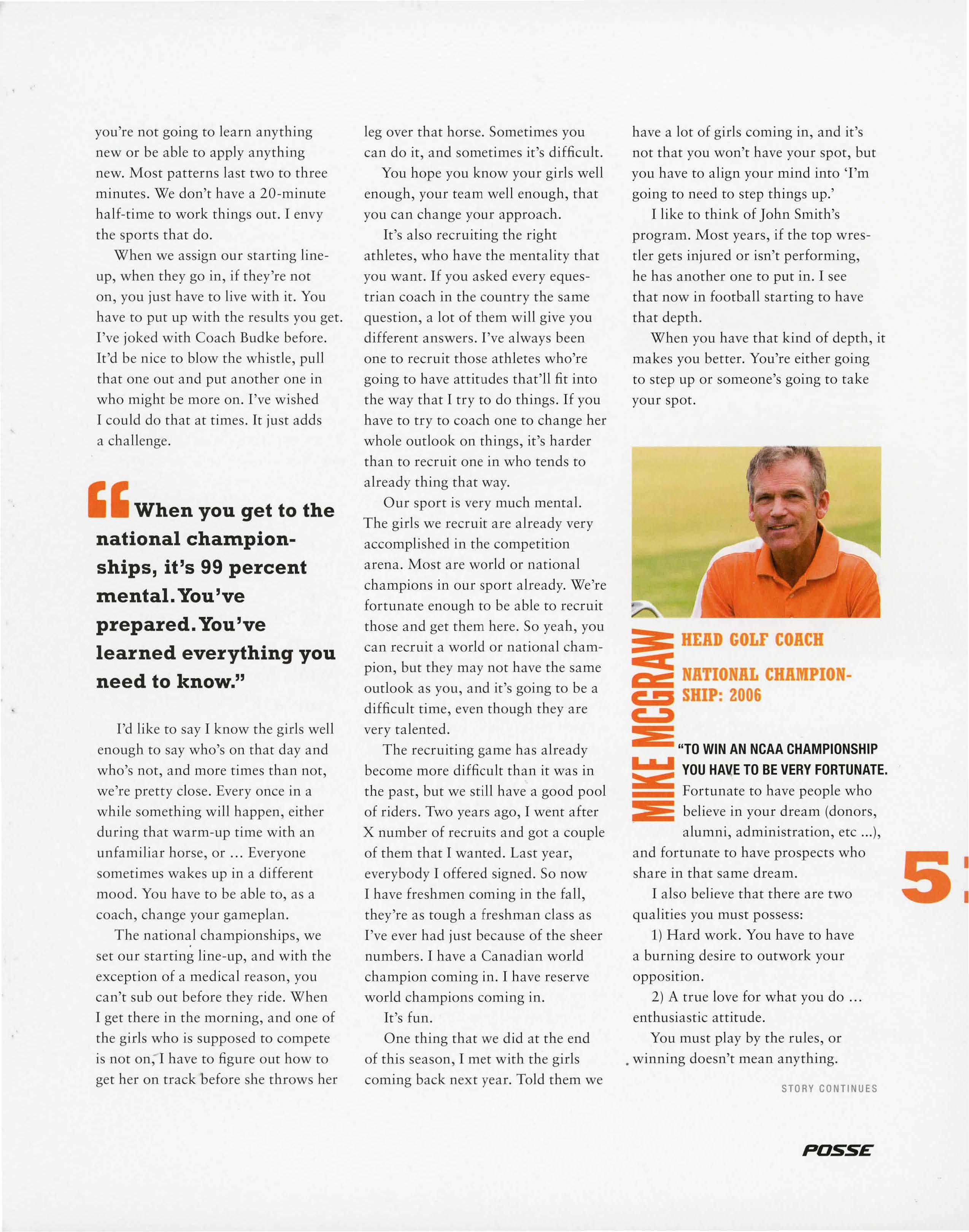
"TOWINANNCAACHAMPIONSHIP YOUHAVETOBEVERYFORTUNATE.
_ Fortunate to have people who ::::::l!!!i5::believe in your dream (donors, alumni, administration, etc ), and fortunate to have prospects who share in that same dream.
I also believe that there are two qualities you must possess:
1) Hard work. You have to have a burning desire to outwork your opposition.
2) A true love for what you do enthusiastic attitude.
You must play by the rules, or winning doesn't mean anything.
STORY CONTINUES POSSE
You must be goal-oriented and surround yourself with people who share those goals."
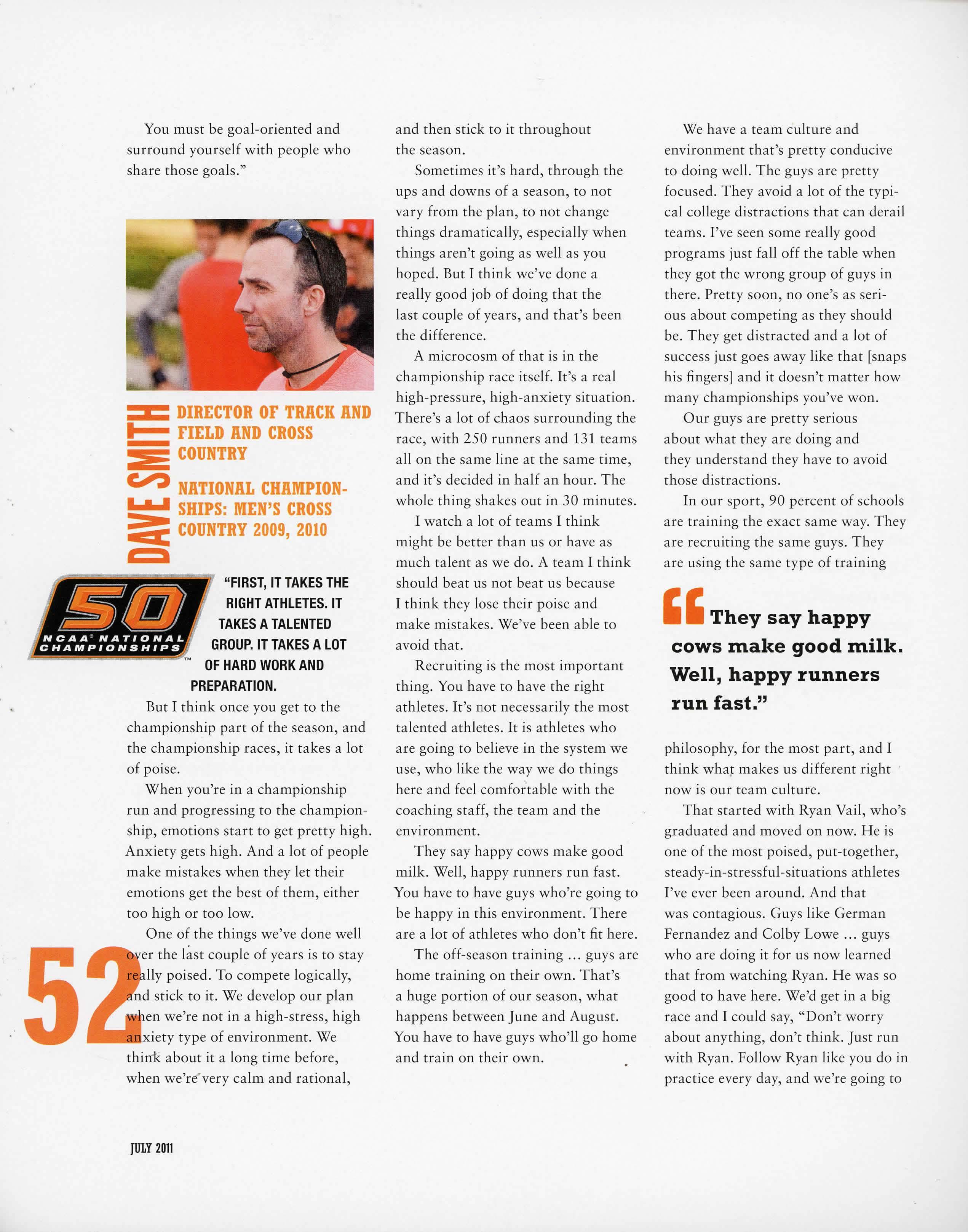
COUNTRY2009, 2010
OFHARDWORKAND PREPARATION.
But I think once you get to the championship part of the season, and the championship races, it takes a lot of poise.
When you're in a championship run and progressing to the championship, emotions start to get pretty high. Anxiety gets high. And a lot of people make mistakes when they let their emotions get the best of them, either too high or too low.
One of the things we've done well o er the l~st couple of years is to stay re lly poised. To compete logically, nd stick to it. We develop our plan w en we're not in a high-stress, high __ _....xiety type of environment. We think about it a long time before, when we're very calm and rational,
and then stick to it throughout the season.
Sometimes it's hard, through the ups and downs of a season, to not vary from the plan, to not change things dramatically, especially when things aren't going as well as you hoped. But I think we've done a really good job of doing that the last couple of years, and that's been the difference.
A microcosm of that is in the championship race itself. It's a real high-pressure, high-anxiety situation. There's a lot of chaos surrounding the race, with 250 runners and 131 teams all on the same line at the same time, and it's decided in half an hour. The whole thing shakes out in 30 minutes.
I watch a lot of teams I think might be better than us or have as much talent as we do. A team I think should beat us not beat us because I think they lose their poise and make mistakes. We've been able to avoid that.
Recruiting is the most important thing. You have to have the right athletes. It's not necessarily the most talented athletes. It is athletes who are going to believe in the system we use, who like the way we do things here and feel comfor.table with the coaching staff, the team and the environment.
They say happy cows make good milk. Well, happy runners run fast. You have to have guys who're going to be happy in this environment. There are a lot of athletes who don't fit here.
The off-season training guys are home training on their own. That's a huge portion of our season, what happens between June and August. You have to have guys who'll go home and train on their own.
We have a team culture and environment that's pretty conducive to doing well. The guys are pretty focused. They avoid a lot of the typical college distractions that can derail teams. I've seen some really good programs just fall off the table when they got the wrong group of guys in there. Pretty soon, no one's as serious about competing as they should be. They get distracted and a lot of success just goes away like that [snaps his fingers] and it doesn't matter how many championships you've won.
Our guys are pretty serious about what they are doing and they understand they have to avoid those distractions.
In our sport, 90 percent of schools are training the exact same way. They are recruiting the same guys. They are using the same type of training
'' They say happy cows make good milk. Well, happy runners run fast."
philosophy, for the most part, and I think whar makes us different right • now is our team culture.
That started with Ryan Vail, who's graduated and moved on now. He is one of the most poised, put-together, steady-in-stressful-situations athletes I've ever been around. And that was contagious. Guys like German Fernandez and Colby Lowe guys who are doing it for us now learned that from watching Ryan. He was so good to have here. We'd get in a big race and I could say, "Don't worry about anything, don't think. Just run with Ryan. Follow Ryan like you do in practice every day, and we're going to
be fine.' He could sort of coach during the race. We can't be there every step of the race, but he could.
That's what's made the difference between us and a lot of programs. We stay poised. We don't make a lot of mistakes. When we do make mistakes, things they don't want to do, you're the guys are emotionally mature liable to have a revolt. it was about the same thing. You have to get great players. enough to recover and minimize
The discipline starts with you as the effects." the coach. You have to do a lot of Chet Bryan was the baseball coach
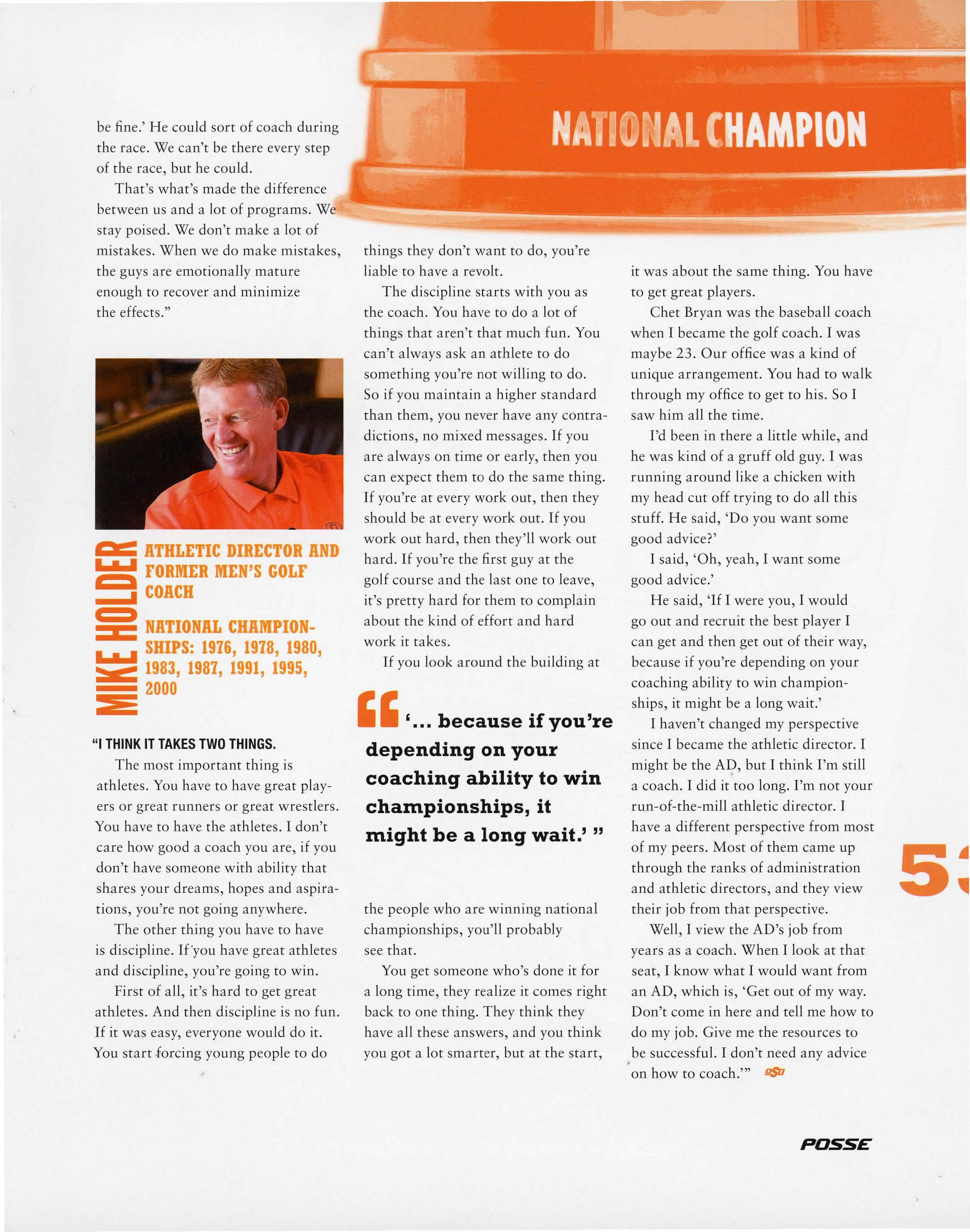
C.::::ATHLETICDIRECTORAND FORMERMEN'SGOLF
NATIONALCHAMPIONL&.I SHIPS:1976,1978,1980, :::-=1983,1987,1991,1995, :ii2000
"I THINKIT TAKESTWOTHINGS.
The most important thing is athletes. You have to have great players or great runners or great wrestlers. You have to have the athletes. I don't care how good a coach you are, if you don't have someone with ability that shares your dreams, hopes and aspirations, you're not going anywhere.
The other thing you have to have is discipline. If'you have great athletes and discipline, you're going to win.
First of all, it's hard to get great athletes. And then discipline is no fun. If it was easy, everyone would do it. You start forcing young people to do
things that aren't that much fun. You when I became the golf coach. I was can't always ask an athlete to do maybe 23. Our office was a kind of something you're not willing to do. unique arrangement. You had to walk So if you maintain a higher standard through my office to get to his. So I than them, you never have any contra- saw him all the time. dictions, no mixed messages. If you are always on time or early, then you can expect them to do the same thing. If you're at every work out, then they should be at every work out. If you work out hard, then they'll work out hard. If you're the first guy at the golf course and the last one to leave, it's pretty hard for them to complain about the kind of effort and hard work it takes.
If you look around the building at
'' ' ••• because if you 're depending on your coaching ability to win championships, it might be a long wait.' "
the people who are winning national championships, you'll probably see that.
You get someone who's done it for a long time, they realize it comes right back to one thing. They think they have all these answers, and you think you got a lot smarter, but at the start,
I'd been in there a little while, and he was kind of a gruff old guy. I was running around like a chicken with my head cut off trying to do all this stuff. He said, 'Do you want some good advice?'
I said, 'Oh, yeah, I want some good advice.'
He said, 'If I were you, I would go out and recruit the best player I can get and then get out of their way, because if you're depending on your coaching ability to win championships, it might be a long wait.'
I haven't changed my perspective since I became the athletic director. I might be the AD, but I think I'm still a coach. I did it too long. I'm not your run-of-the-mill athletic director. I have a different perspective from most of my peers. Most of them came up through the ranks of administration and athletic directors, and they view their job from that perspective.
Well, I view the AD's job from years as a coach. When I look at that seat, I know what I would want from an AD, which is, 'Get out of my way. Don't come in here and tell me how to do my job. Give me the resources to be successful. I don't need any advice on how to coach."' llStJ
sToRY BY Clay Bill:rnan
PHOTOGRAPHY BY Gary Lawson
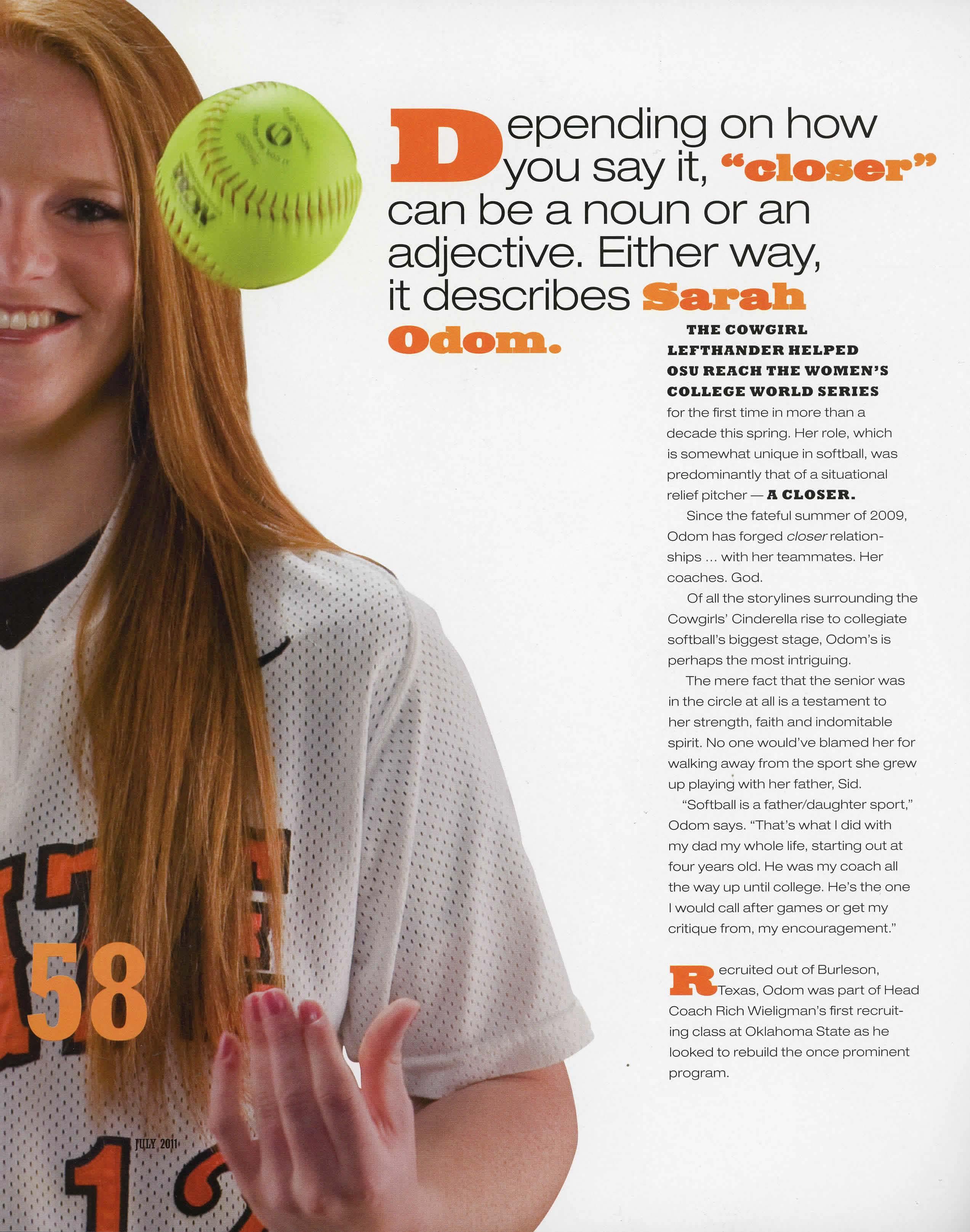
epending on ho\N you say it, "closer" can be a noun or an adjective. Either \Nay, it describes Sarab Odom.
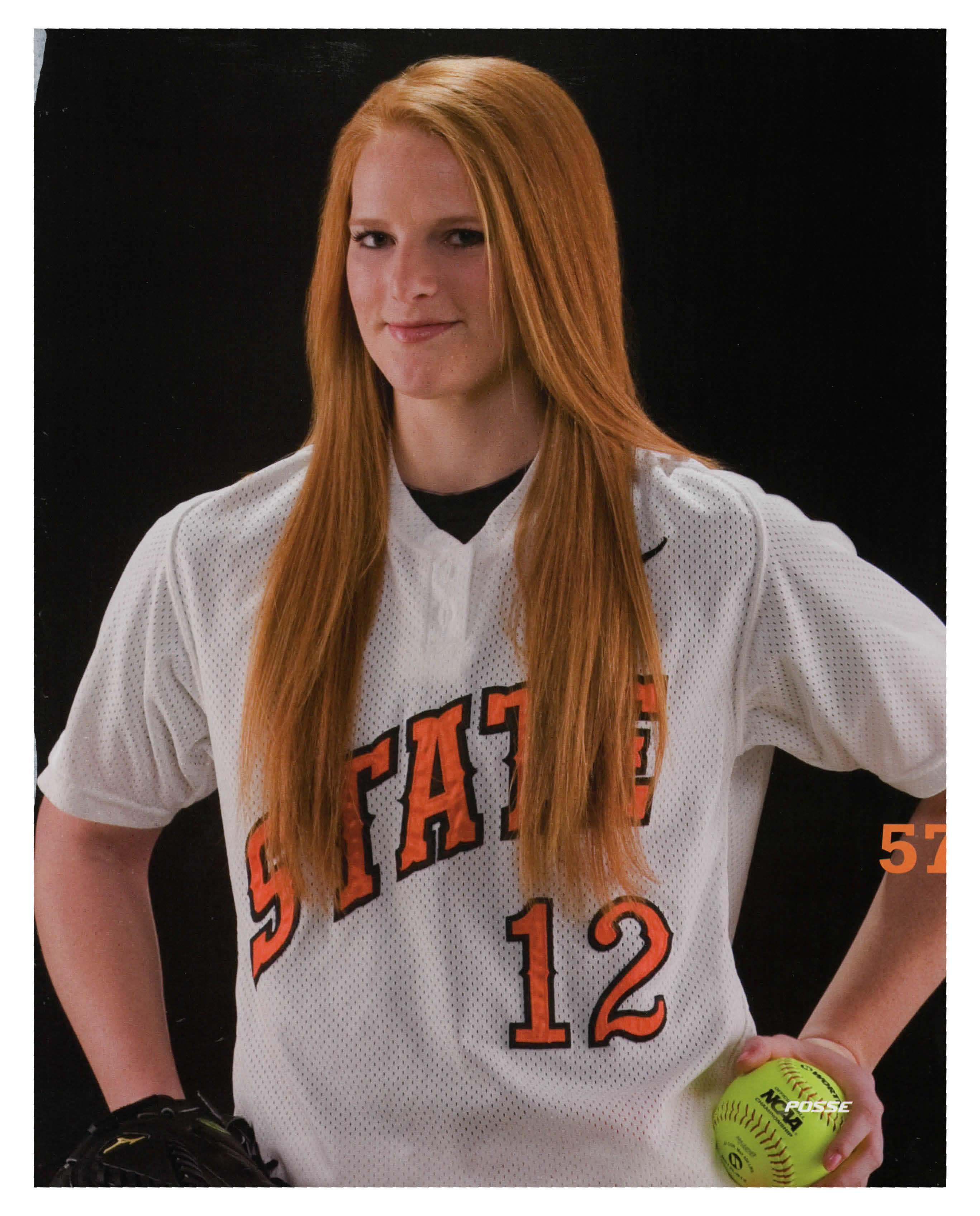
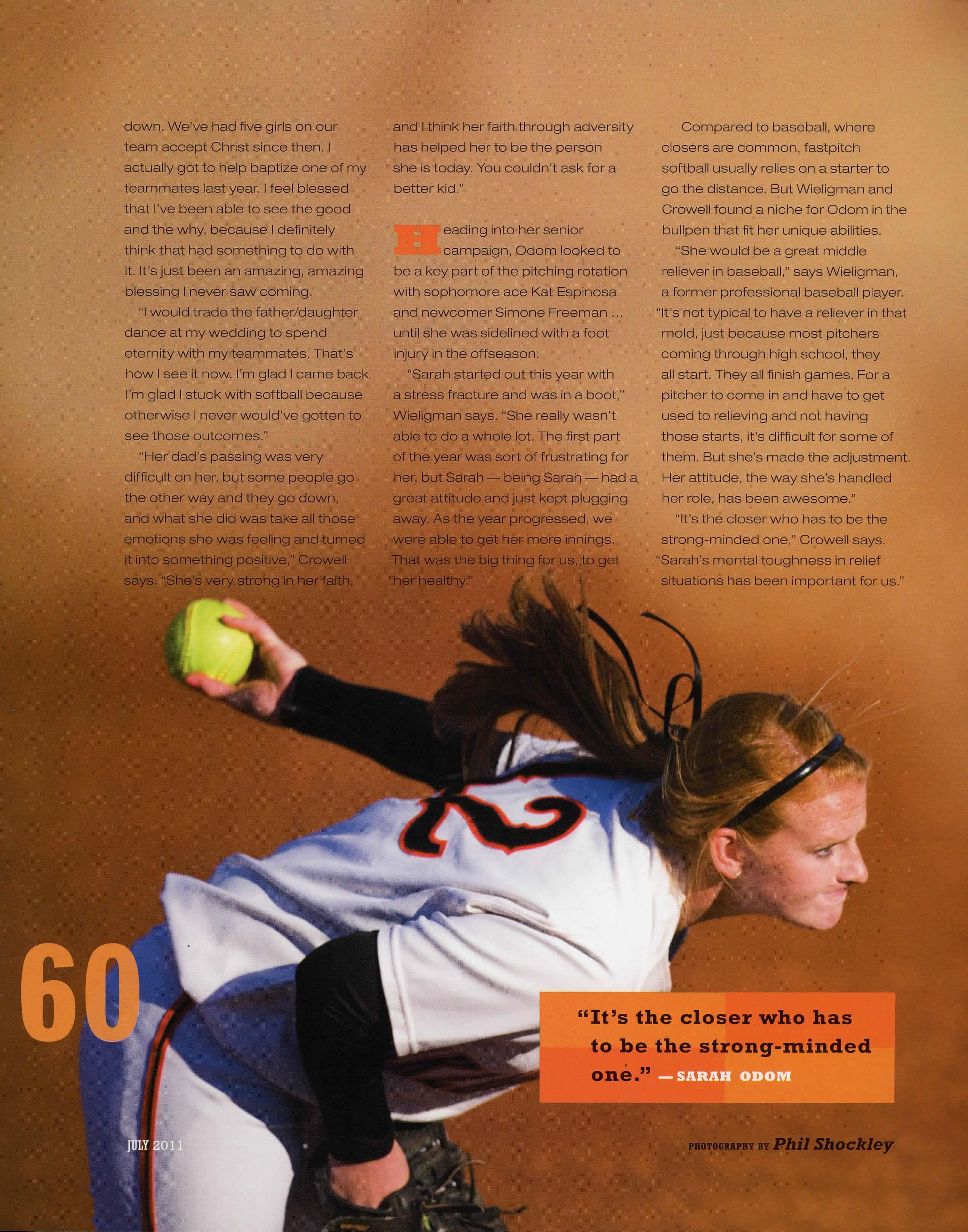
THE COWGIRL LEFTHllNDER HELPED OSU REllCH THE WOMEN'S COLLEGE WORLD SERIES for the first time in more than a decade this spring. Her role, which is somewhat unique in softball, was predominantly that of a situational relief pitcher - ll CLOSER.
Since the fateful summer of 2009, Odom has forged closer relationships with her teammates. Her coaches. God.
Of all the storylines surrounding the Cowgirls' Cinderella rise to collegiate softball's biggest stage, Odom's is perhaps the most intriguing.
The mere fact that the senior was in the circle at all is a testament to her strength, faith and indomitable spirit. No one would've blamed her for walking away from the sport she grew up playing with her father, Sid.
"Softball is a father/daughter sport," Odom says. "That's what I did with my dad my whole life, starting out at four years old. He was my coach all the way up until college. He's the one I would call after games or get my critique from, my encouragement."
'a9 ecruited out of Burleson, .-.-rexas, Odom was part of Head Coach Rich Wieligman's first recruiting class at Oklahoma State as he looked to rebuild the once prominent program.
"When I got here, I needed a pitcher," recalls Wieligman. "She was left-handed, and I had talked with her pitching coach and knew she had a big upside. She started for us the first couple of years and did a good job."
As a freshman, Odom pitched in 28 games, compiling an 8-6 record with two saves. Her sophomore season showed even more promise as she made 37 appearances (including 18 starts). She finished the 2009 season with a 13-6 mark and three saves.
In Stillwater, things were looking up. In Texas, a family's worst fears were surfacing.
"We had found out earlier that year my dad had an incurable lung disease," Odom says. "He just went in for allergies, and they ended up doing a test. Some people live with it their whole lives, and never really have any complications. But it was very fast-acting and shocked the doctors. His last day of work was in April. "
After the season ended in May, Odom returned home, unsure of her future.
"I didn't really plan on coming back to OSU because I was going to have to be the one who stayed home with him," she says. "I was his care-giver, the one who did the doctors appointments and stuff, because my mom was working and my sister is married and lives three hours away.
"He went into the hospital in June, so I didn't do anything softball-wise that summer. i didn't pitch. I didn't do any of the workouts or anything like that. I ended up practically living in the hospital for two months with him."
Sid passed away in July of 2009.
"That fall was tough," Wieligman says. "It's tough on kids losing
their dads. She had a super-close relationship with her dad through softball, and to lose that connection devastated her."
The Cowgirl coaching staff gave her time to cope with her grief.
"I didn't throw in the fall and I struggled," Odom says. "Normally when I struggle I can shake it off and move on. I had a harder time shaking things off, I guess."
Odom's stats show a dramatic downturn in 2010, with 13 appearances in the circle and a 1-1 record in only 27 innings pitched. Winning is important, but for her coaches, the focus was always on her psychenot her arm.
"It was just about getting her to stay in school and get back to herself," Wieligman says. "I think it took her a year to really get through it. It was tough the first time out in that circle without her dad. That was tough on her. But she's fought through it. She's a fighter. She's got this positive attitude. Her attitude is unbelievable."
"I wasn't successful my junior year on the mound, but I also think the coaches were really good at giving me a break," Odom says. "It was a first for them having a player lose a parent, so none of us knew what to do. None of us knew how to make it better. But I think we all kind of got through it together."
"Some days you didn't know if you wanted to just go over there and give her a hug or if you wanted to just keep it normal, so that she doesn't think about it," says OSU pitching coach Clarisa Crowell.
"It was definitely hard," Odom adds, "because it was a year of firsts (like the first college game my dad didn't come to) and a year of lasts (like remembering the last game my dad
ever saw me pitch or where my dad sat). Everywhere you go there's a memory, or you have those instincts where you go to text, 'Hey, I'm starting this game,' and you realize you can't send it."
he first time Odom pitched A since her father's death, she was given a standing ovation.
"We're very blessed with this team of great parents and great kids," she says. "The parents were super sweet to my mom when she was able to start coming to games again."
"I th i ta her a year tor rough it. It 1N'a:S
Her teammate, shortstop Chelsea Garcia, also helped in the healing process.
"Chelsea and I have a special bond, because her mom passed away when she was 10. It's just something that we understand. The bad times suck, and we understand that, and the good times suck and we understand that. We're able to feed off each other, like on Mother's Day she gets my mom, on Father's Day I get her dad - that kind of thing.
"Senior Day was really hard. I was the only one without both parents. He was definitely my best friend."
Odom says the tragedy has had a profound impact on a number of her teammates' personal faith.
"At my dad's funeral we had an invitation and a lot of the girls came STORY CONTINUES
down. We've had five girls on our team accept Christ since then. I actually got to help baptize one of my teammates last year. I feel blessed that I've been able to see the good and the why, because I definitely think that had something to do with it. It's just been an amazing, amazing blessing I never saw coming.
"I would trade the father/daughter dance at my wedding to spend eternity with my teammates. That's how I see it now. I'm glad I came back. I'm glad I stuck with softball because otherwise I never would've gotten to see those outcomes."
"Her dad's passing was very difficult on her, but some people go the other way and they go down, and what she did was take all those emotions she was feeling and turned it into something positiv "
and I think her faith through adversity has helped her to be the person she is today. You couldn't ask for a better kid."
eading into her senior campaign, Odom looked to be a key part of the pitching rotation with sophomore ace Kat Espinosa and newcomer Simone Freeman until she was sidelined with a foot injury in the offseason.
"Sarah started out this year with a stress fracture and was in a boot," Wieligman says. "She really wasn't able to do a whole lot. The first part of the year was sort of frustrating for her, but Sarah - being Sarah - had a great attitude and just kept plugging away. As the year progressed, we were able to get her more innings. w,as the big thing for us, to get
Compared to baseball, where closers are common, fastpitch softball usually relies on a starter to go the distance. But Wieligman and Crowell found a niche for Odom in the bullpen that fit her unique abilities.
"She would be a great middle reliever in baseball," says Wieligman, a former professional baseball player. "It's not typical to have a reliever in that mold, just because most pitchers coming through high school, they all start. They all finish games. For a pitcher to come in and have to get used to relieving and not having those starts, it's difficult for some of them. But she's made the adjustment. Her attitude, the way she's handled her role, has been awesome."
"It's the closer who has to be the strong-minded one," Crowell says. "Sarah's mental toughness in relief situations has been important for us."
"It's the closer who has to he the strong-minded one."
"That's the way I look at her," Wieligman adds. "She comes in and gets ground balls and does her thing. It's nothing special. It doesn't blow you away, but at the end of the day, it works."
"Whenever I first came here, I was always stressing out about how to get a ton of strikeouts like I did when I was younger," Odom says. "Coach Wigs kind of broke it down for me and said, 'I just want outs. I want you to have them hit it in the dirt.' It makes it a lot simpler if you just think ground ball instead of making them swing and miss three times.''
Coming out of the bullpen requires a different approach than being a starter, she says.
"It's a very weird mentality, because you have to be ready, but you don't want to have to go in, because that means things aren't going well. You've just got to be ready."
hen OSU hosted Bedlam this spring, Odom was ready when called upon.
The Cowgirls jumped out to a 2-0 lead over the Sooners on Tamara Brown's home run in the second inning. Espinosa kept the visitors at bay until the 5th inning, when a solo shot closed the gap. Coach Wigs decided that OU had seen enough of his starter.
"With OU, we were going to hold Kat until we felt like the hitters started timing her and seeing her a little bit better. That was obvious with the one pitch, and I was like, 'It's time to get Sarah in there."'
"I knew that if we got in trouble that I would be the first reliever to go in, so I was prepared," Odom says.
She made the most of her opportunity, retiring six straight Sooners
before surrendering a base hit in the top of the 7th. Odom then coaxed another ground out to bring the go-ahead run to the plate with two down and a runner on. This time, the ground-ball pitcher got the strikeout, clinching a 2-1 OSU victory and earning a save in front of a capacity crowd.
"With Sarah coming in, she's so different from Kat, being left-handed and what she does," Wieligman says. "I think one time through the lineup is all she had to do. We got those ground balls. Nobody really got on her.''
"I wasn't thinking about how big the game was," Odom admits, "I was just focusing on hitting my spots that Coach C was calling and getting ground balls and letting my defense work. I'm usually just thinking about the next pitch. See the pitch call. Visualize. Go. I guess I really didn't take on how big it was to get that win, but it was awesome. At the end of the game I finally absorbed it and enjoyed it. But when I was out there I definitely was not thinking Bedlam."
"I think it's awesome for her to come in her senior year against OU and finish a game like that," Wieligman beams.
"I've had a lot of great moments here at OSU," says Crowell, "but that's got to be one of my best memories, having Odie be the one to go in there and close it down. There is nobody who is more deserving of that moment than Sarah Odom.''
The closer role Odom played became even more significant as the underdog Cowgirls fought their way through the postseason.
In Tennessee, facing the No. 5-ranked Lady Volunteers in the NCAA Regional finals, Odom pitched three innings in relief and picked up
the win, sending OSU to the Super Regional round.
The Cowgirls hosted Houston in a best-of-three series with a trip to the WCWS on the line. OSU took game one 3-0 behind Espinosa's arm, but dropped game two. Freeman started the decisive game, but Odom was quickly called upon to keep the Cougars at bay.
The senior pitched four solid innings in relief to allow the Cowgirl bats to heat up. Protecting a 6-4 lead, it was a role reversal as Espinosa closed out the contest, preserving Odom's biggest career victory.
The Cowgirls had crashed the NCAA party, but the Cinderella spring ended with a pair of losses in Oklahoma City. OSU finished the season ranked eighth nationally by the National Fastpitch Coaches Association. It was the program's first Top 10 final ranking since OSU's last trip to the WCWS in 1998.
Odom's contributions to the 2011 team are no surprise to her coach.
"I've always believed that Sarah could go out there and do exactly what she did for us this season," Crowell says. "She finished the year strong.
"I've been blessed to have had the opportunity to work with her on a day-in, day-out basis for four years," the pitching coach adds. "All of my pitchers are something to me. I tell her that she is my Rock. She's been the one kid that I've had in the bullpen who's been consistent with the attitude and energy that she brings. There are not very many people who can bring something positive out of every single situation that she's put into, but that's the way Sarah Odomis.'' stSo
IM PETE
CHELSEAGARCIAHAS TO HAVE STRAIGHTA'S.
OK, really, the Cowgirl shortstop admits, she doesn't have to. Her dad has long since stopped threatening to "pull her out of softball" if she gets a B.
"Once I thought I was going to get a B, and I texted him to let him know," says Garcia, "He texted me back saying, 'It's okay. A 'B' stands for 'best."'
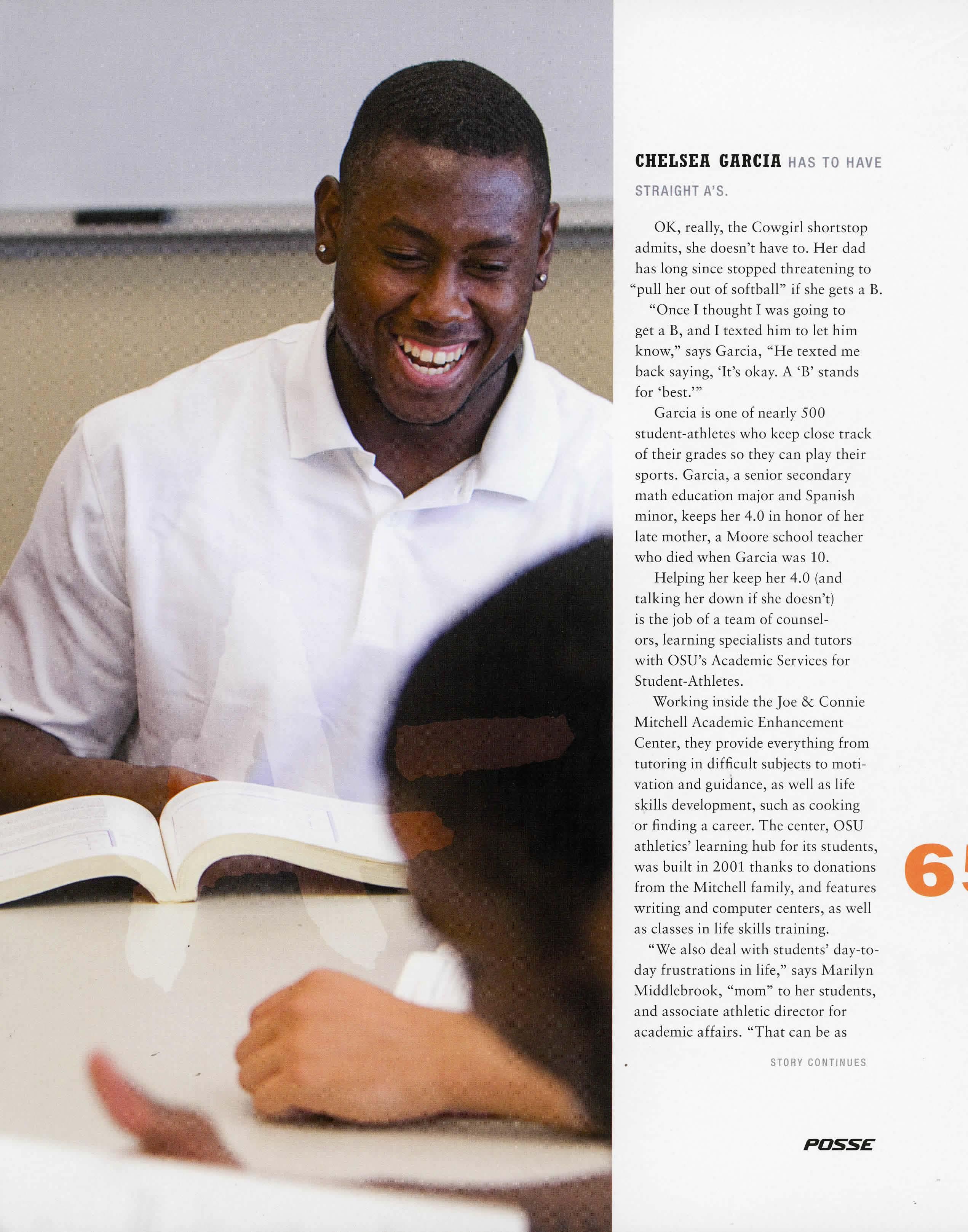
Garcia is one of nearly 500 student-athletes who keep close track of their grades so they can play their sports. Garcia, a senior secondary math education major and Spanish minor, keeps her 4.0 in honor of her late mother, a Moore school teacher who died when Garcia was 10.
Helping her keep her 4.0 (and talking her down if she doesn't) is the job of a team of counselors, learning specialists and tutors with OSU's Academic Services for Student-Athletes.
Working inside the Joe & Connie Mitchell Academic Enhancement Center, they provide everything from tutoring in difficult subjects to motivation and guidance, as well as life skills development, such as cooking or finding a career. The center, OSU athletics' learning hub for its students, was built in 2001 thanks to donations from the Mitchell family, and features writing and computer centers, as well as classes in life skills training.
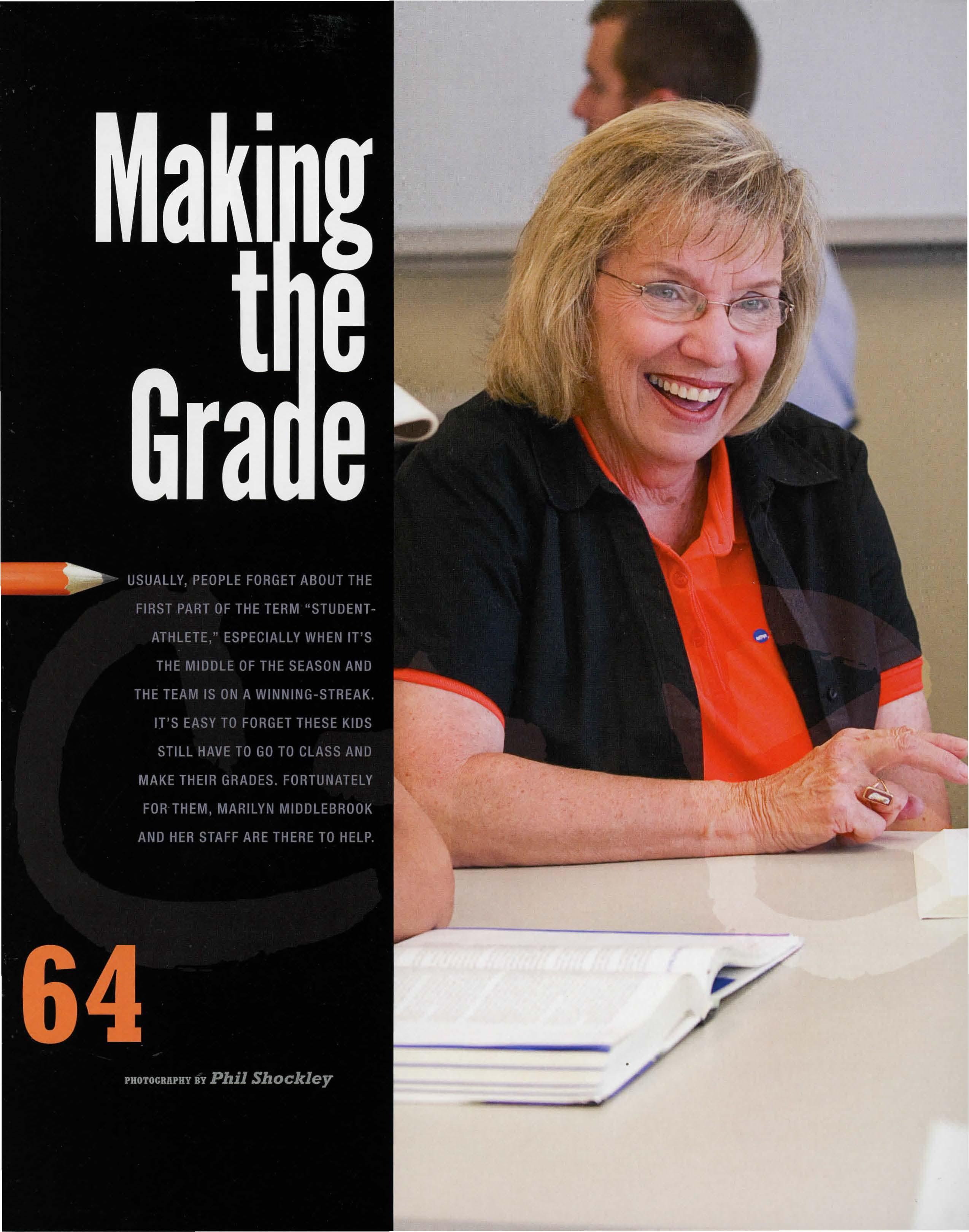
"We also deal with students' day-today frustrations in life," says Marilyn Middlebrook, "mom" to her students, and associate athletic director for academic affairs. "That can be as
STORY CONTINUES POSSE
simple as boyfriend or girlfriend problems or issues with roommates."
When the big sports, such as football and basketball are in session, the two-story building on the south side of Gallagher-Iba Arena is packed with students. But near the end of the spring semester is the busiest time, especially when finals take place, grades are due and reams of reports must be filed with the NCAA.
The athletes who use the services are just like regular students, except they have full-time jobs that wear them out physically and mentally. Getting 500 of them to open up about their needs, irks or quirks doesn't just happen. It requires gaining and building trust, which takes one-on-one time - and some rules.
No swearing is tolerated, Middlebrook says. Neither are things such as sagging pants.
None of that is a 9-5 job.
"The kids are the only reason we're here," Middlebrook says. "And if the staff doesn't feel the same way, we are not going to be successful."
Many of the students don't need much supervision, says Middlebrook, and her counselors, Agatha Adams and Terry Henley. But neither student is like the next, so no single approach works best. Also, all of their charges are still kids - like most college students - so they have the same problems most that age have with courses and responsibilities.
"A guy could be doing great one week and just disappear the next," enley says. "That's just something typical for that age group If I have t do anything, normally it's because a tu or is having an issue with somebody t showing up or behaving. I can usually handle it with a phone call." JULY2011
Middlebrook and Adams are former schoolteachers who came to the program after changing careers. Alan Good, another counselor, coordinates eligibility while working with men's baseball, men's golf and men's tennis as well as track and cross-country. Good has a background in athletic counseling. Jeremy Cook is in charge of the wrestling team's academics.
The sheer number of students means they all have to help in other areas, too.
Adams also coordinates admissions and enrollment for new students, in addition to other duties. Also, each helps during recruiting visits by meeting with recruits and their parents.
One of the students who understands the group's message of responsibility is football's Joseph Randle. Randle, a sophomore from Wichita, Kan., is an industrial engineering major. A talented running back, he's attending college to find a rewarding career outside of the gridiron. His brother is an engineer with the manufacturer Cessna Aircraft Co., and his sister is in medical school, so he doesn't want to be the one to slack off.
Balancing football with his courses is no small task. Randle says Henley, who's in charge of football counseling, Middlebrook and the others are always there for him. He said their welcoming attitude was part of why he chose OSU over other schools recruiting him, such as Missouri, Stanford and Texas A&M.
"Terry likes helping us with our problems," Randle says. "I come by their offices just to talk. Whenever I'm there, I always feel like I need to stop in and say what's up to Terry. He's like a teacher, but he knows what we're going through. You can't say that of all teachers."
Henley was a defensive back for the football team from 1988-93. Before he came to OSU in his current position, he was a counselor in Oklahoma City working with gang members.
Much of the long hours come when one of the group has to travel with a sport when it goes on the road. Middlebrook travels with football and men's basketball sometimes, in addition to her main responsibilities of running the academic program. Adams handles women's basketball, in addition to equestrian, soccer and women's tennis.
Despite the work's difficulty, Adams says their successes make it all worth it.
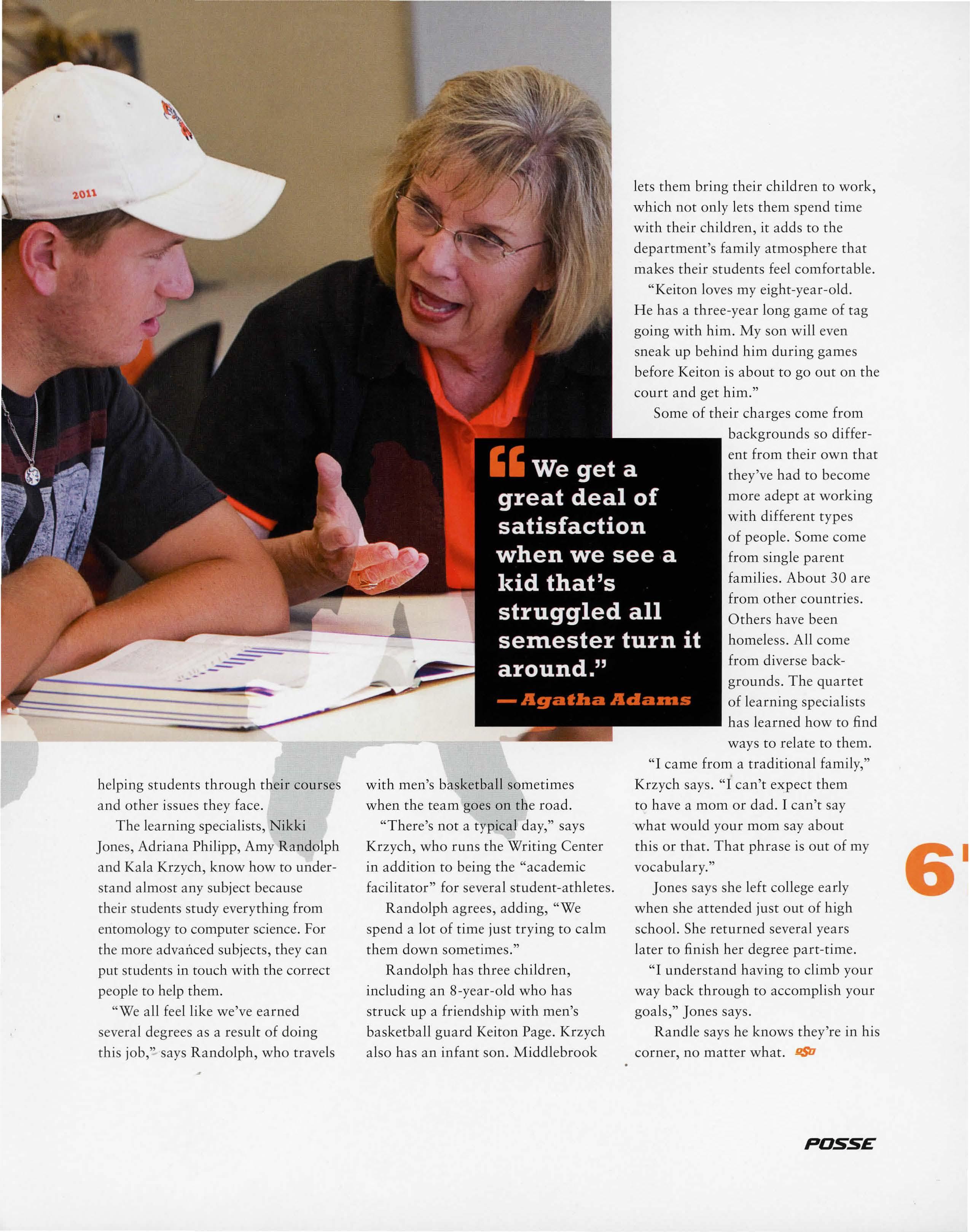
"We get a great deal of satisfaction when we see a kid that's struggled all semester turn it around," Adams says. She received an email recently from a former student-athlete of hers. He was a real headache when he attended OSU. In fact, he was so difficult she couldn't work with him after a while, and he had to be passed off to Henley.
"His email said how important I was to him and how much what I tried to do for him meant to him," says Adam~, adding the email brought her to tears. "It came on a day when I was thinking, 'Why am I doing this? I've been doing this too long."'
Successes like that can't be measured in numbers. Others can.
Baseball had five players make the Big 12's academic all-conference team in 2011. The same goes for seven softball players, 19 track athletes and four women's tennis players.
Joining the trio of counselors in creating that success are four learning specialists and about 55 tutors. They do the bulk of the hands-on work
helping students through their courses and other issues they face.
The learning specialists, Nikki Jones, Adriana Philipp, Amy Randolph and Kala Krzych, know how to understand almost any subject because their students study everything from entomology to computer science. For the more advanced subjects, they can put students in touch with the correct people to help them.
"We all feel like we've earned several degrees as a result of doing this job," says Randolph, who travels
with men's basketball sometimes when the team goes on the road.
"There's not a typical day," says Krzych, who runs the Writing Center in addition to being the "academic facilitator" for several student-athletes.
Randolph agrees, adding, "We spend a lot of time just trying to calm them down sometimes."
Randolph has three children, including an 8-year-old who has struck up a friendship with men's basketball guard Keiton Page. Krzych also has an infant son. Middlebrook
lets them bring their children to work, which not only lets them spend time with their children, it adds to the department's family atmosphere that makes their students feel comfortable.
"Keiton loves my eight-year-old. He has a three-year long game of tag going with him. My son will even sneak up behind him during games before Keiton is about to go out on the court and get him."
Some of their charges come from backgrounds so different from their own that they've had to become more adept at working with different types of people. Some come from single parent families. About 30 are from other countries. Others have been homeless. All come from diverse backgrounds. The quartet of learning specialists has learned how to find ways to relate to them.
"I came from a traditional family," Krzych says. "I can't expect them to have a mom or dad. I can't say what would your mom say about this or that. That phrase is out of my vocabulary."
Jones says she left college early when she attended just out of high school. She returned several years later to finish her degree part-time.
"I understand having to climb your way back through to accomplish your goals," Jones says.
Randle says he knows they're in his corner, no matter what. l1$D POSSE
OSU Cowboy wrestling and basketball battles as well as an Allied Art venue for such notables as Bob Hope, the Smothers brothers, Van Cliburn and General George Westmoreland, to name a few.
My feet had never bothered me this much in high school, but then we did not practice three to four hours a day, which seemed to be the norm for our legendary coach, Mr. Henry P. Iba, also known as the Iron Duke.
When my turn came, I climbed on an extended table and laid on my back, face up. Head trainer Byron Bird greeted me, "How're you doing rookie?" Bird asked, smiling.
Bird, who walked with a distinct limp, had the good looks and charm of a George Clooney, plus the machismo of old-time TV star Broderick Crawford. Dressed in freshly pressed khakis, black referee shoes
JULY2011
over groomed 39-year-old Bird smelled of Aqua Velva aftershave.
"Great," I replied, "food's almost as good as Mom's, found all my classes and they're not too bad, plenty of smiling coeds and, so far, Mr. Iba hasn't killed me, even though he yells at me plenty."
"At least he knows your name. But that's a good thing, the yelling. If he quits shouting at a player, word has it he's given up on him." Bird smiled roguishly, revealing perfect white teeth with which he could have starred in an lpana Toothpaste commercial.
His words helped me relax. "That makes me feel better," I sighed.
Bird surveyed my feet. "Only three blisters?"
I shrugged, feeling myself tense a bit, knowing he would soon slice them open.
opened the one on the heel of my left foot, allowing the clear liquid to squirt out. I flinched. "What's the matter rookie, does that hurt?" Bird smiled. Hell yes it hurt. What does he think, I wondered, but I kept my mouth shut, not wanting him to think me weak. Bird slit open the remaining blisters, trimmed and wiped them clean. He spread Vaseline over the balls of my feet and covered the greasy ointment with gauze pads, then taped over the pads and firmly wrapped my ankles.
"Done," Bird said as he patted me on the leg. I was ready for practice. Time to rock and roll again.
That day we were going to scrimmage the varsity for the first time, and I'm sure they were expecting to kick our collective freshmen butt. And that was probably what was going to happen, but it would be interesting to see what we could do against them.
And that's actually what happened, but it was pretty close.
A few days later, talking with senior varsity player Cecil Epperly, I asked a question about something that'd been bugging me.
"Cecil, did Bird call you rookie, sort of condescending like, when you were a freshman?"
"Absolutely," Cecil seemed to be trying not to laugh, but snickered. "If you notice, he doesn't say anything to some freshmen, so it's a good thing when he does. He wants to see if you're going to make it before he eases up. Don't worry about it, big boy."
I felt relieved, "Okay, thanks - by the way, what caused his limp?"
"You don't know? It's quite a story. A legend by now. The way I heard it, during WWII, somewhere in the Pacific, a Jap artillery shell exploded within a few feet of Bird, shattering his leg, particularly in the ankle area. The battle was so intense that he knew medics couldn't get to him before
it himself - cut it off with his own bayonet!"
My mouth dropped open as Cecil continued. "How does that compare to having our blisters doctored? That's like having a scratch on your car versus being hit by an eighteen wheeler."
"Holy-moly," I said. "It's bad enough to be lose a leg, but to cut it off yourself is unbelievable. I guess I won't be bellyaching anymore."
In 1921 - the year" Babe" hit 59 homeruns, Einstein won the Nobel Prize for physics, Warren Harding was President - Byron Jack Bird was born in the southeastern Oklahoma town of Heavener, the son of a coal miner.
After high school graduation, with football scholarship offers from both OU and Oklahoma A&M, Bird chose
coach Jim Lookal!l Bird, a 6'1", 200-po "fearless on the gridirol'.K,~Xii)Sllingas
better than plowing over a would-be tackler or doing double duty as a bone crushing linebacker."
Lookabaugh predicted that Bird's athletic prowess would pave the path to All-American honors and, potentially, a professional career. Bird was a handsome young man, with jet black hair, bright penetrating eyes and a contagious smile. He had a positive "can do" attitude that made him well liked and respected by his Aggie teammates and coaches.
STORYCONTINUES POSSE
U.S.MARINE
(NOV.1943) The most costly battle in Marine Corps history to date takes place in the South Pacific when the Marines storm and capture the small island of Tarawa atoll in the Gilbert Islands. Held by the Japanese, Tarawa is deemed vital to the safety of America's long s~a lanes of communic\tions.
While still a freshman Bird noticed a strikingly pretty, petite coedKathleen White - walking past his dorm and asked his teammates about her. He learned she was from nearby Pawnee, and he wasted no time securing a Coke date with her (though not before she checked him out). Soon they were going steady.
"We were both smitten," recalls Kathleen Bird, Byron's still attractive and petite 89-year-old widow. "He W?S always the nicest person, a
he made me laugh. He always keto tell."
lewar had been going several m0Aths when, in 1942, Bird and his brother decided to drive to the closest marine recruiting center, located in Ft. Smith, Ark., to enlist.
But first he had a serious conversation with Kathleen.
n d.idn';t want us to get fore he left," Kathleen told id it wouldn't be fair to me 1rtg happened and he didn't make it back, so we didn't. So many of the boys didn't come home and left widows with babies. It was sad."
The Corps suited the bravado of Bird just fine. After several months of physically exhausting and mentally challenging boot camp training, he, a!Dng with his squadron, shipped
y put ashore six weeks later on ~- a.miserable, tiny, steamy island~lose to the equator. Kathleen, who is half Pawnee Indian, finished her education degree the next year and moved to South Dakota where
she taught school on the Sioux Indian Reservation, a tribe that had financed her college education. Often she wrote to Byron and prayed for him daily, hoping he would return.
Saipan was a hotbed of brutally bloody battles with high casualties on both sides. Stubborn and well trained, the Japanese were taught it was a disgrace to surrender, and often elected to fight to the death.
Early one morning, during a fierce struggle in the sweltering jungle heat, Bird single-handedly took out a Japanese machine gun nest. The following day an enemy mortar shell exploded next to the young marine, crushing the lower half of his leg and ankle. His foot dangled, connected to his leg by only some muscle and skin.
Considering his options, and fearing gangrene, insects and the probably of bleeding to death, Bird cleaned his bayonet and managed to amputate his foot above the ankle.
ADMIRALNIMITZ,left, presenting, BIRD, nght, with the Silver Star medal.
Cited for extraordinary bravery, Byron was awarded the Silver Star by Pacific Fleet Commander Admiral Chester Nimitz, an honor second only to the Congressional Medal of Honor.
In part the citation read: "He led his platoon to the rescue of another platoon which had been pinned down by a numerically superior Japanese force, leading his platoon in a vigorous counter-attack, freeing the other unit to withdraw with its wounded men. On this occasion he personally put an enemy machine gun out of action. The next day he led his platoon in a four hour attack of the enemy. His conspicuous gallantry and intrepidity during action against the enemy were in keeping with the highest traditions of the naval service."
Returning to the states in 1945, Bird married Kathleen and went on to finish his degree at A & Min 1949. After a year as trainer for the San Francisco Dons professional football team, Bird was hired as a trainer by A&M football Coach Lookabaugh where Bird began his 35-year career at Oklahoma State. He and Kathleen raised three children.
"Byron enjoyed his job. I never heard him criticize any of the coaches," said Kathleen. "He liked being around the players and came home every day with an interesting story of the day's events or maybe a joke he'd heard. He had fun, was fond of the players. I know Mr. Iba depended on him a lot. Byron thought the world of Henry."
During his career Bird saw a lot of Aggie/Cowboy football as he worked with football coaches Jim Lookabaugh, "Ears" Whitworth, Cliff Speegle, Phil Cutchin, Gloyd Gass, Dave Smith, Jim Stanley and Jimmy Johnson - a real walk down memory lane for Cowboy fans.
I speak for a multitude of former Aggie/Cowboy athletes who considered Bird both friend and mentor. He was a man who genuinely cared about us and, though he never resisted the urge to chastise us for our own good, would give us a much needed word of encouragement or, if need be, ask us what's wrong all while taking care of our physical ailments in a skillful and professional manner.
From 1950 to 1983, Bird was an integral part of OSU's storied athletic history. That's 33 years of selfless service to a job with people and a University he loved. After a courageous battle with cancer, he died at age 62.
Byron Jack Bird was more than a trainer. Bird's legacy is not soon to be forgotten by those of us who knew him. To this day, if I get a blister on my foot, I think about Bird and do my best not to complain. Il$lJ
BRYONBIRD,left, reminisces with former OSU and Olympic basketball player, JAMESKING, center,and the author, GENEJOHNSON,right.
IN 1998, family had gathered in Stillwater for the funeral of Mary DeLozier, Elizabeth's grandmother and daughter of Henry G. Bennett.
As Oklahoma A&M president from 1928-51, the visionary Bennett marshaled a master plan that transformed the campus with his vision and leadership.
Then just a fourth grader, DeLozier was already aware of the special connection with the man whose statue overlooks the heart of the OSU campus. As a senior-to-be, she is often reminded of her great-grandfather's legacy while going to class.
If there's such a thing as orangeblooded royalty, DeLozier is most certainly an heir.
In addition to Dr. Bennett in the family tree, her great uncle was Labron Harris, Sr., the founder of OSU's prestigious golf program.
She is also the niece of former Cowboy Golf All-Americans Labron Harris, Jr. and Henry DeLozier. Her father, Phil DeLozier, was a 1974 letterman, as well.
"It's no secret I wanted to come to Oklahoma State since I was little," the Houston native says. "Just coming up here on random weekends with my dad and mom, along with all my sisters. We would come to basketball games and just run around town. Then we started getting into soccer here."
Initially, it was the Deloziers who recruited the OSU coaches, not the other way around.
"I first met the OSU coaches in 8th grade, when I started doing the Olympic Development Program (ODP) in Texas. They would come out and scout, and I would always look for them on the sideline. THEY WERE REALLY THE ONLY SCHOOL I TRULY CARED ABOUT BEING AT MY GAMES, but I was always kind of shy about going up to them."
Fortunately, Mary Pat Delozier isn't quite as shy as her daughter, says Cowgirl coach Karen Hancock.
"Before we even knew who Elizabeth was, her mom stopped me in the parking lot at a soccer complex where there was a big tournament going on," Hancock recalls. "She noticed me because I was wearing some OSU gear and just starting going on and on about how her husband had attended OSU and their daughter was a pretty good player and that we should really look at her at some point."
"MY MOM WOULD DO THAT," laughs Delozier. "She just kind of put my name out there."
"She was on the region team, which automatically tells everyone that she's playing at a certain level," Hancock says. "So we knew she bad to be a good player. Once we WQJldout she had the family ties, it stemed like a no-brainer to us that it would be a great fit."
"THATGOTHER01 OUR RADAR,"adds head coach Colin Carmichael.
"We watched her at the region camp, and right off the bat you could tell she was good enough for us. We brought the kid up for an official visit, and she stayed in Bennett Hall, which is named after her great granddad ... it was one of the easier recruiting deals for us."
During her recruitment, NCAA rules still allowed coaches to send text messages to prospects. Hancock remembers one two-word conversation in particular.
"One morning, out of the blue, I sent her 'ORANGE ...' in capital letters," she says. "I got a 'POWER' back withnMNktCl',&;Jlillllationpoint. She's one of11'i'fel ear-old kids e that with. There was always that kind of tie that we just didn't have with other recruits.''
"I honestly didn't visit another school for soccer," DeLozier says.
"I talked to a couple coaches here and there at tournaments, but from thebeginning, I knew my heart was t to come to OSU and become a irl. It was really an easy decision e, so I committed at the end of
DeLozier's coaches, teammates and fans don't often refer to Elizabeth by her first name. Everyone simply calls her "FLASH."The nickname has been with her since her earliest days on the pitch.
"When I was young, I was really short and would just be buzzing around with this curly hair," DeLozier says. "We had tryouts for a club team I played for and had to run through the cones to see who could do it the fastest. I just killed everyone doing it, and ever since then my coaches would always called me 'Flash.'
It stuck with me through club, through ODP, and now into my senior year at OSU. Everyone calls me that."
As she matured, DeLozier's game lost the speed of her youth. Although the nickname now borders on irony, the midfielder has trained hard to succeed at the college level.
"Flash has become a better athlete since she's been here.'' Carmichael says. "Thanks to our strength and conditioning staff and her hard work, Flash has quicker feet and is a little more mobile. Coming in, we knew that she reads the game very well, she's great in the air, her distribution is very good. Mobility was going to be the issue. Could she move around the field quickly enough to be effective? She's not the fastest kid on the team, but cenainly it's not a hindrance for her. She's able to play at this level.''
Flash has become a leader for a Cowgirl squad coming off its most successful season in program history.
Cowgirl FC (Football Club), as it's become known, compiled a 15-3-1 record (8-2-0 in league play), before capturing the 2010 Big 12 Tournament title. It was OSU's secondstraight postseason championship, to go along with the~ season crown in 2008.
On the strength of theu- impressive resume, OSU was named a No. 3 national seed and one of 16 regional hosts for the opening round of the NCAA Championships. With a pair of dramatic, come-from-behind wins over Michigan and Oregon State, OSU advanced to the Sweet 16 for first time.
"Getting to host was the best part," Delozier says. "Before one of our games, Colin said, 'LOOK AT THE CROWD. THE LINE FOR THE TICKETS RUNS ALL THE WAY TO THE BACK OF THE PARKING LOT.' I couldn't believe it how this place filled up. The fans have played such a role, and they need to know that we love it. We love that
Carmichael's Cowgirls had earned a No. 5 national ranking in the final National Soccer Coaches Association poll.
"This past season was such a cool feeling," Delozier says. "A lot of those games we were down a goal to start with, so we were having to make a comeback win and pull through. It was such a team effort.
neyby
eventual natio Notre Dame, 2-nil. dust settled,
No matter what the score was at halftime, we didn't give up. I've never seen a single girl on this team quit.
"I felt the chemistry was there, and everyone had the same goals. It was a total team effort. That's what I think
been key to this whole group's success. They work hard for each other. THEY'RE VERY ENCOURAGING TO EACH OTHER."
THETEAMCHEMISTRY
SHOULDCONTINUETHISFALL, as OSU returns 10 starters in 2011, including All-Americans AD Franch and Melinda Mercado, along with five all-conference performers.
Delozier expects her senior year just as special as last season.
"We're expecting to get farther than the Elite Eight, and I know we can," the senior says.
But Delozier knows the Cowgirls won't be flying under the radar this season.
"Coming into this season, knowing that we do have this big target on our back, it's just more of an incentive that every game we are going to play our best," she says. "We're going to get everyone's best shot. Just having that mentality, I feel like that's going to get us to the level that we want to be: Sweet 16, Elite Eight, Final Four ... the finals. It's a challenge that we are accepting, and we're ready to do it.
"WEHAVEJUSTWORKEDSO HARD,ANDI FEELLil{ETHIS IS GOINGTOBE OURYEAR. This team deserves it. Our coaching staff deserves it. I really can not wait until preseason starts."
Delozier says their coaches emphasize playing one game at a time.
"We need to focus game by game," she says. "We can't get too far ahead of ourselves that we're just focusing on the postseason. Colin always talks about that. We need to make sure every weekend we're stepping on that field Friday and Sunday and telling ourselves this is one game, and it can change it all, just winning or losing one game. That's just something that he's already ingrained in all of us, and it's our job to carry that mentality on throughout the entire season to get to that next level."
It's that type of attitude and leadership that made Delozier a team captain as a junior.
"SHEHASTHERESPECTOF HERTEAMFORHERPERSONALITY,WORKETHICANDALL THAT,"Carmichel says. "And she's pretty vocal. If she needs to speak up and tell you to do something, she 'II do ir.
"I was a captain on my club ream for seven years, and I've always tried to be the kind of person that people on the team can come and talk to if they're having an issue," DeLozier says. "On the field, I try ro bring rhe
energy by just talking to people. I'm not the best player on the field, but I know that I can be the best leader vocally and in a way that has played a role on this team."
DeLozier admits she often provides comic relief for her teammates.
"I'm prone to say random things and do crazy things. I get made fun of all the time. Everyone laughs at me, but that's just me. You have ro laugh at yourself sometimes."
Flash says she gets her positive attitude from her parents.
"I'm just a really happy person. I'm very optimistic. My parents are very optimistic people. Both played golf in college, so they've been through things with teammates and stuff, and I think I have grown a lot from hearing their stories. It's inspired me robe the best person I can be for this team, both on and off the field."
DeLozier says the program's recent success has not gone unnoticed by the Stillwater community.
"I'm so proud ro be a member of this team. It's just a great feeling walking around town and having people say, 'Hey, you're on the soccer team. Great game last night!' IT'S THECOOLESTFEELING. I NEVERPICTUREDTHAT WOULDHAPPEN."• ..-
“Well, there goes the neighborhood,” is what can typically be heard from inside homes as nosy neighbors remark about who is moving in across the street.
The over-packed U-Hauls pull up and everyone gets a bird’s-eye view of the avocado green couch with purple flowers and the contrasting recliners. Next is the rear projection big screen television and black velvet Elvis art.
As the parade of mismatched children’s furniture and the lopsided washer/dryer set that won’t ever be level finds new locations, people peering from next door want to know several things: Where did these people come from? What do they do for a living? And once they get settled in, what kinds of problems are they going to cause us? How many dogs can one family have, and will they send them to my yard to do their business? All important questions.
Once the new folks have been there a while, other things become apparent. Yes, they really are going to leave that old washing machine on the porch for the foreseeable future. Yes, it is July and their Christmas lights are still up. No, regardless of the car up on blocks in the front yard, it’s really not a used
auto lot. And no, they don’t plan on mowing the front yard more than once every eight weeks, regardless of how high the weeds grow. You feel compelled to call Jeff Foxworthy with new material.
THE BIG 12 CONFERENCE NEIGHBORHOOD looks a little different in 2011. And not because newbies are moving in, but because of who’s already vacated. Nebraska and Colorado packed up and left Dodge. They thought they’d just move out without even trying to get their deposit back. Mini-blinds dangling. Dust bunnies blowing. Walls maimed, carpet stained.
That’s what they thought. But like Lee Corso says, “not so fast my friends.” THE BIG 12 IS JUST FINE , thank you. The number of national championship trophies you took when you left were minuscule.
The remaining teams have a powerpacked number of student-athletes about to put on quite a show on a national stage in the next nine months in a myriad of sports. While schedules from teams in the north just got more difficult (welcome to the expanded Big 12 South), the benefits of every team playing the others is intriguing.
And finally, the new, lucrative television contract negotiated by the conference insures we have the funds to make any repairs to a slightly livedin house our former tenets vacated.
As for Nebraska and Colorado, good luck in the Big 10 and Pac 12. Ralphie will have to find a new backyard and those corncob hats, a new peg on which to hang. You’ll find teams in LA, Tuscon, Eugene, Columbus, Happy Valley, Madison and Ann Arbor might be watching from behind their living room curtains. Suspicious ... wary. Intent.
But not necessarily envious. Some neighborhoods are tough. The grass on the other side of the conference fence isn’t always greener. In fact, sometimes there is no grass at all. Too many dogs running around.
We like it in our own neck of the woods where the grass takes on a nice, mid-summer shade of ... ORANGE
KYLE WRAY
ASSOCIATE VICE
PRESIDENT
ENROLLMENT MANAGEMENT & MARKETING
GO POKES!