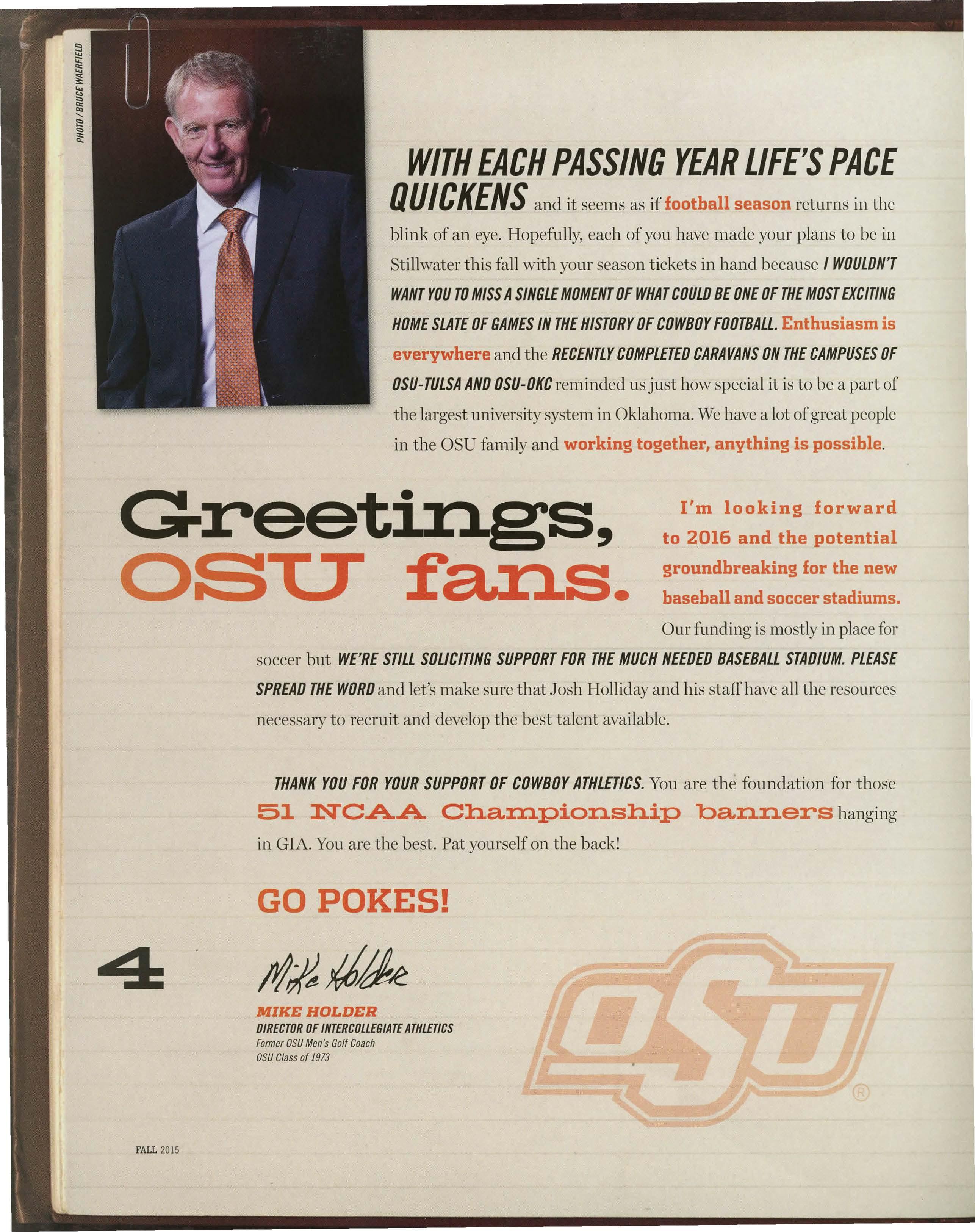
and it seems as if football season returns in the blink of an eye. Hopefully, each of you have made your plans to be in Stillwater this fall with your season tickets in hand because I WOULDN'T WANTYOUTOMISSASINGLEMOMENTOFWHATCOULDBEONEOFTHEMOSTEXCITING HOMESLATEOFGAMES IN THEHISTORYOFCOWBOYFOOTBALL.Enthusiasm is everywhere and the RECENTLYCOMPLETEDCARAVANSONTHECAMPUSES OF OSU-TULSAANOOSU-OKCreminded us just how special it is to be a part of the largest university system in Oklahoma. We have a lot of great people in the OSU family and working togethert anything is possible.
Greeti
OSU fai1..s.
Our funding is mostly in place for soccer but WE'RESTILLSOLICITINGSUPPORTFORTHEMUCHNEEDEDBASEBALLSTADIUM.PLEASE SPREADTHEWORDand let's make sure that Josh Holliday and his staff have all the resources necessary to recruit and develop the best talent available.
THANKYOUFORYOURSUPPORTOFCOWBOYATHLETICS.You are the foundation for those 51 NCAA Championship banners hanging in GIA. You are the best. Pat yourself on the back!
GO POKES!
Itm looking forward to 2016 and the potential groundbreaking for the new baseball and soccer stadiums. 4
MIKE HOLDER
DIRECTOROFINTERCOLLEGIATEATHLETICS
FormerOSUMen'sGolfCoach
OSUClassof 1973
thePLAYBQQK
At Oklahoma State University, compliance with NCAA, Big 12 and institutional rules is of the utmost importance. As a supporter of 0SU, please remember that maintaining the integrity of the University and the Athletic Department is your first responsibility. As a donor, and therefore booster of 0SU, NCAA rules apply to you. If you have any questions, feel free to call the OSU Office of Athletic Compliance at 405-744-7862. Additional information can also be found by clicking on the Compliance tab of the Athletic Department web-site at www.okstate.com.
Remember to always '~sh: Before You. Act."
Respectfully,
BEN DYSON ASSISTANTATHLETICDIRECTORFORCOMPLIANCE
POSSE PO:K:ES
POSSE MAGAZINE STAFF
VICE PRESIDENT OF ENROLLMENT MANAGEMENT/ MARKETING KYLEWRAY
EDITOR-IN-CHIEF I SENIOR ASSOCIATE ATHLETIC DIRECTOR KEVINKLINTWORTH
SENIOR ASSOCIATE ATHLETIC DIRECTOR I EXTERNAL AFFAIRS JESSEMARTIN
ART DIRECTOR I DESIGNER PAULV. FLEMING
LEAD DESIGNER DAVEMALEC / DESIGNER SHELBYALLYNHOLCOMB
PRODUCTION ASSISTANT I PHOTOGRAPHER BRUCEWATERFIELD
ASSISTANT ATHLETIC DIRECTOR I POSSE DIRECTOR ELLENAYRES
PREMIUM SERVICES DIRECTOR KARYLHENRY
PUBLICATIONS COORDINATOR CLAYBILLMAN
ASSISTANT DIRECTOR, ANNUAL GIVING JOENELSON
COORDINATOR, ANNUAL GIVING STEPHANIEBOESE
ATHLETICS MAJOR GIFT DEVELOPMENT STAFF
SENIOR ASSOCIATE ATHLETIC DIRECTOR I DEVELOPMENT LARRYREECE
DIRECTOR OF DEVELOPMENT I ATHLETICS MATTGRANTHAM
PROJECT MANAGER SHAWNTAYLOR
OSU POSSE 102 ATHLETICS CENTER STILLWATER, OK 74078-5070 405.744.7301 P 405.744.9084 F OKSTATEPOSSE.COM OKSTATEPOSSE POSSE@OKSTATE.EDU @OSUPOSSE
ADVERTISING 405744.7301 EDITORIAL 405.7441706
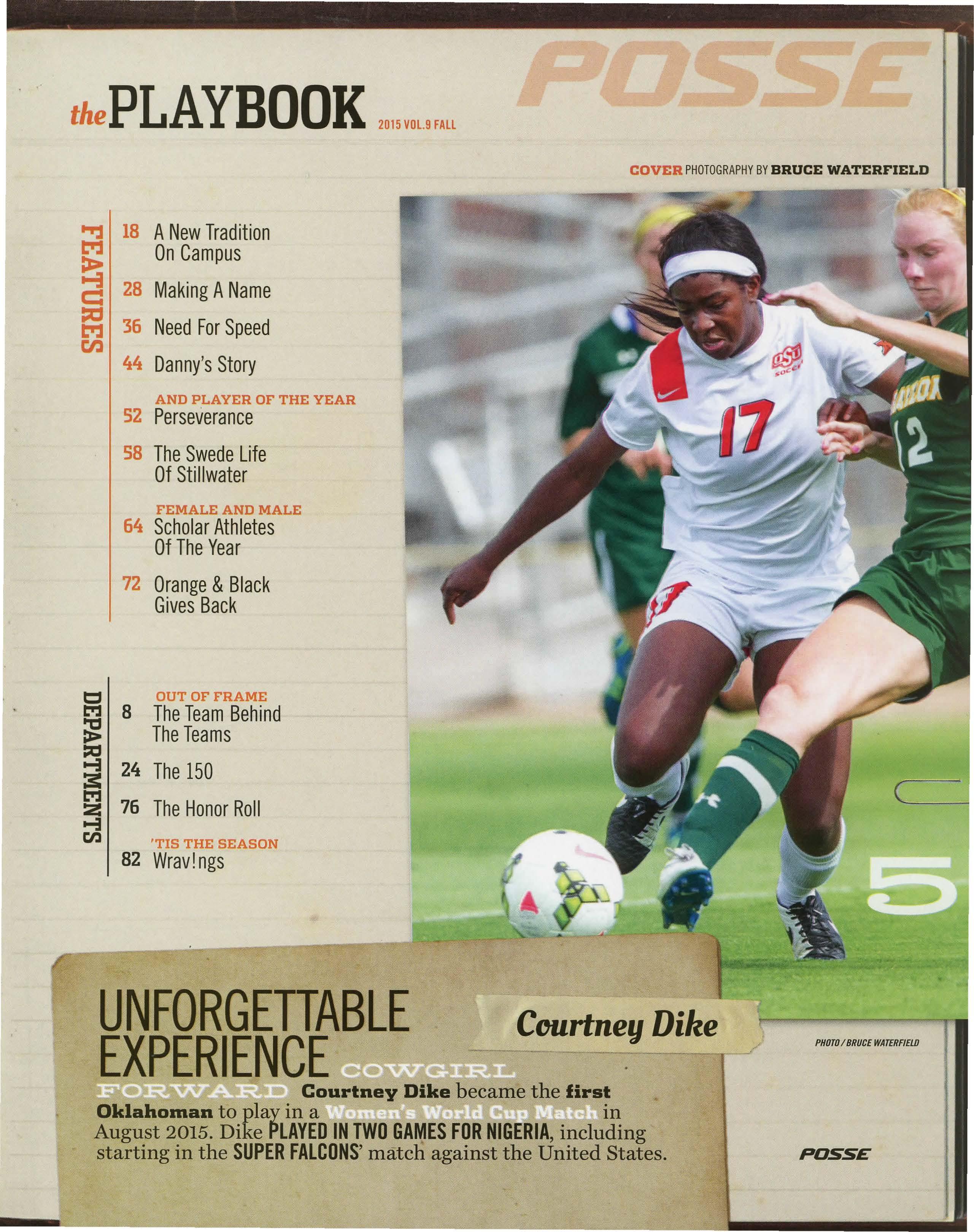
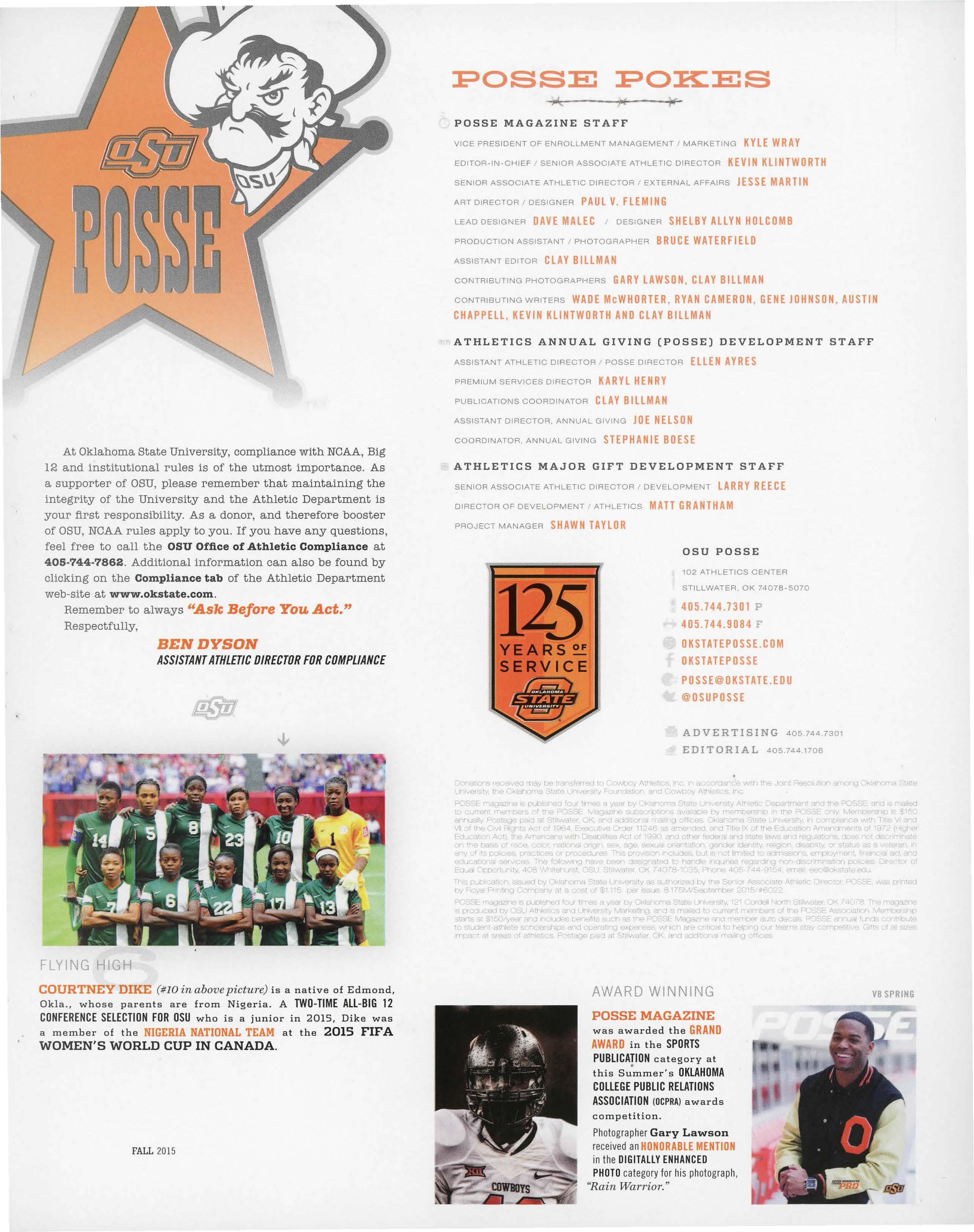
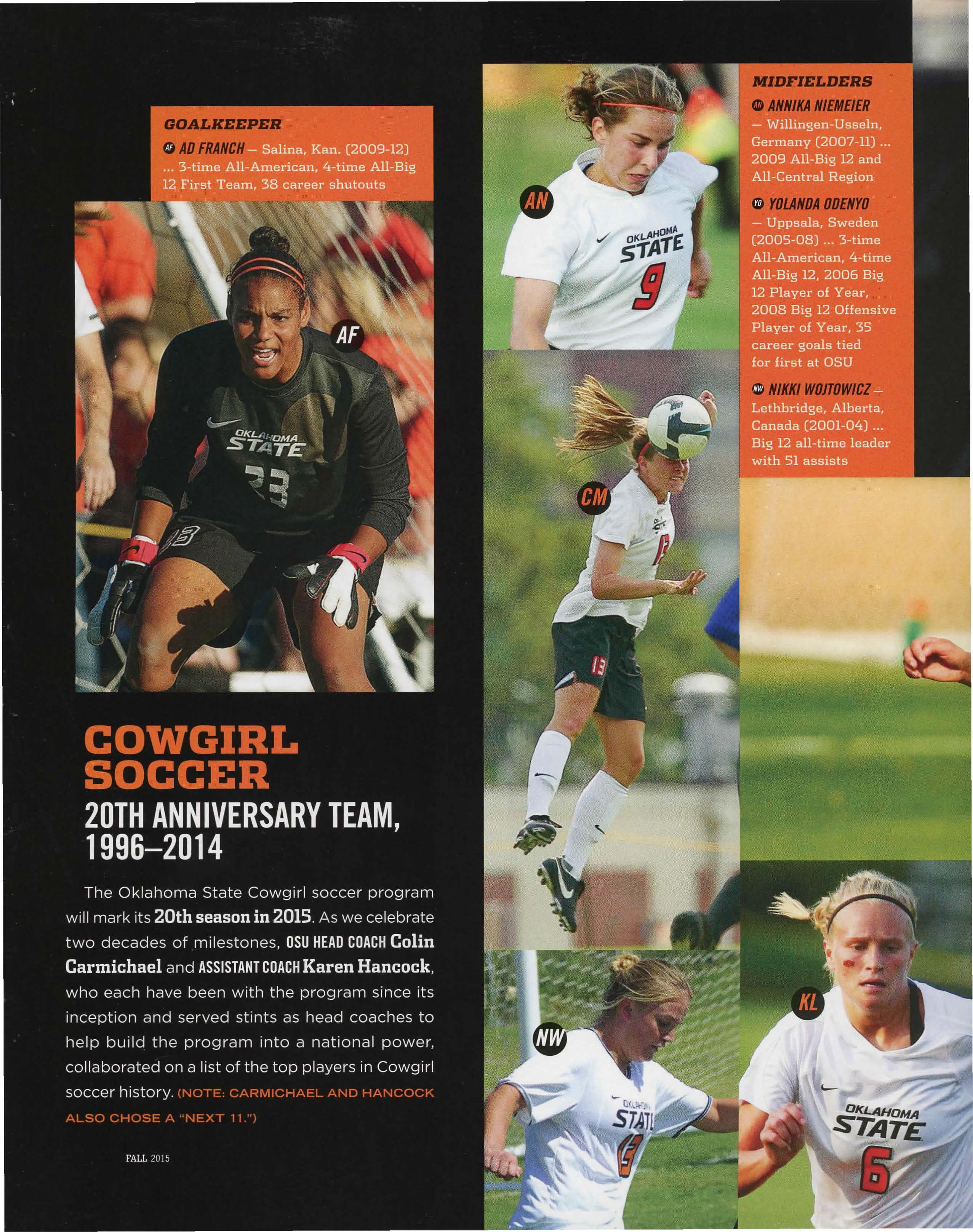
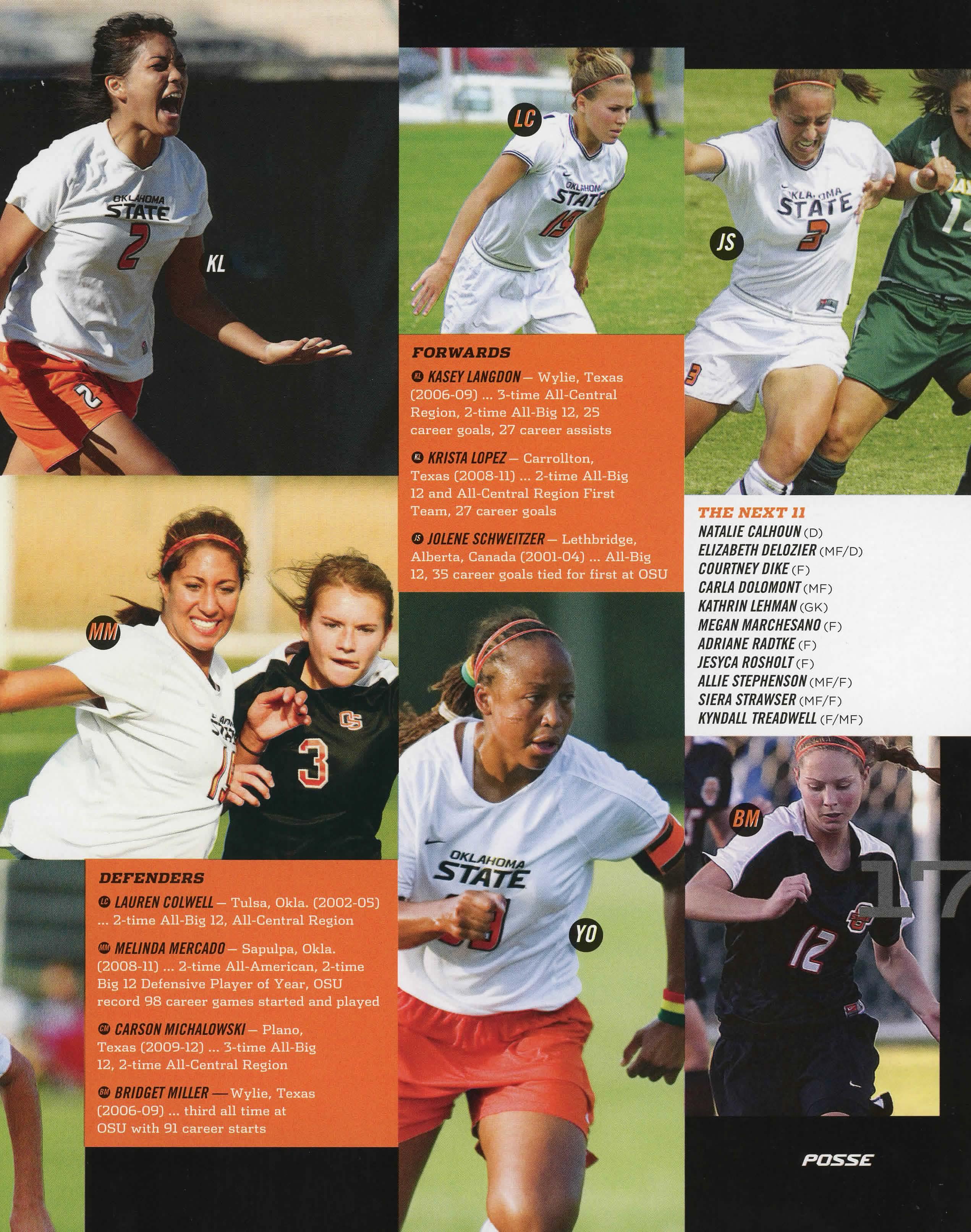
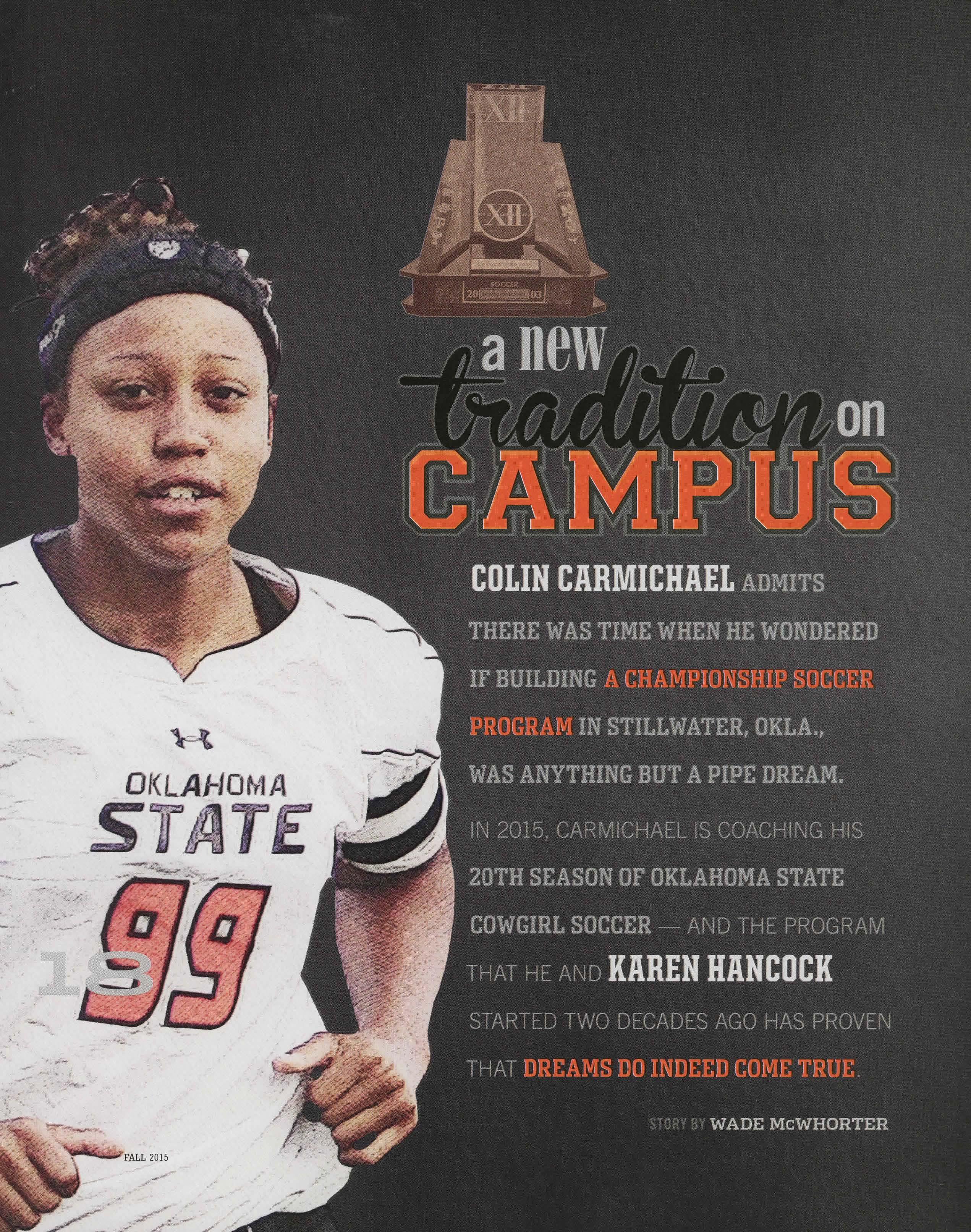
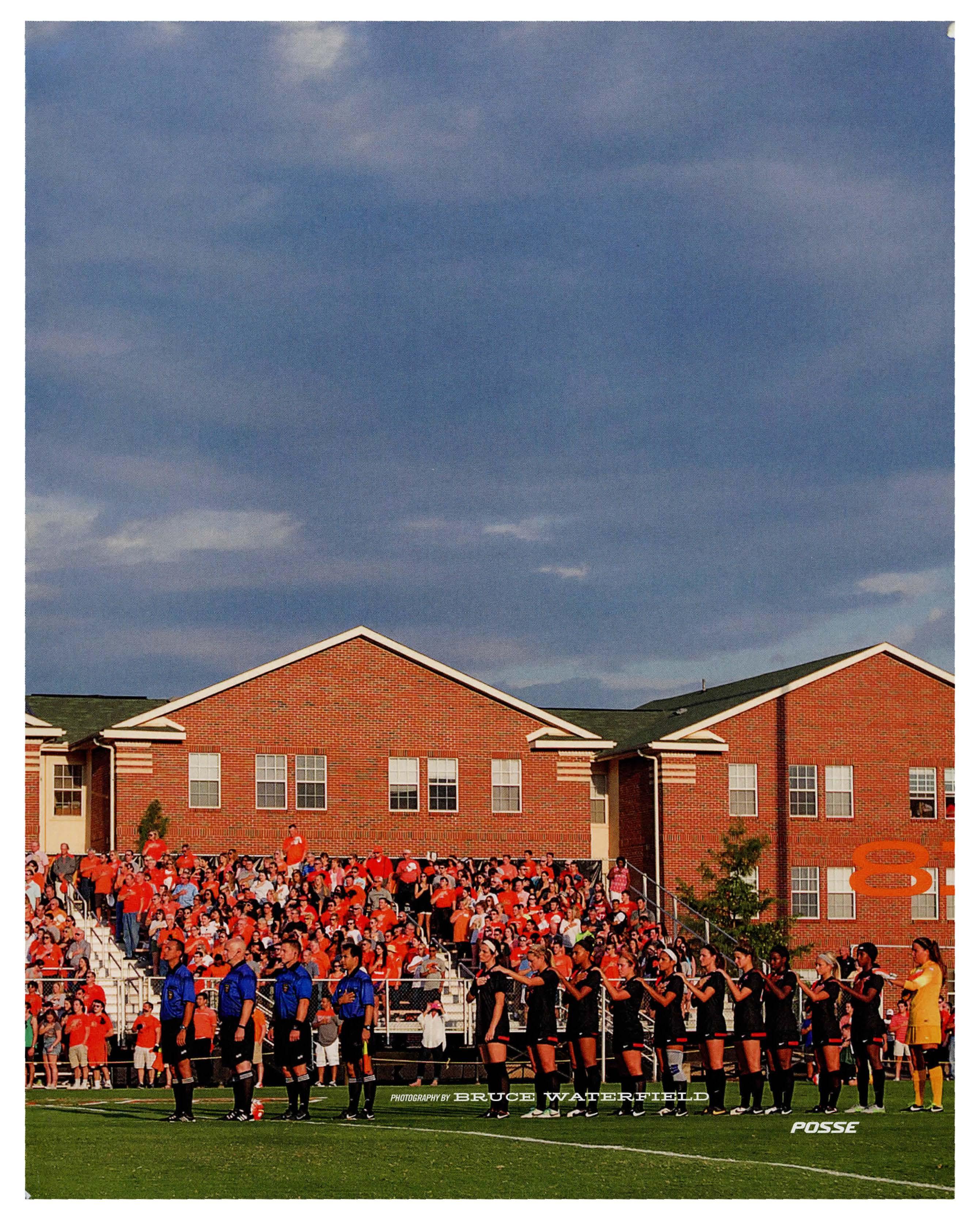
COURTNEY DIKE (#JO in above picture) is a native of Edmond, Okla., whose parents are from Nigeria. A TWO-TIMEALL-BIG 12 CONFERENCESELECTIONFOROSUwho is a junior in 2015, Dike was a member of the NIGERIANATIONALTEAM at the 2015 FIFA WOMEN'S WORLD CUP IN CANADA.
AWARD WINNING
POSSE MAGAZINE was awarded the GRANO AWARDin the SPORTS PUBLICATIONcategory at this su"mmer' s OKLAHOMA COLLEGEPUBLICRELATIONS ASSOCIATION(OCPRAlawards competition. PhotographerGary Lawson receivedanHONORABLEMENTION in the DIGITALLYENHANCED PHOTOcategoryfor his photograph, "Rain Warrior."
TEA::LVLS
OUT
Frame
REM EM BER
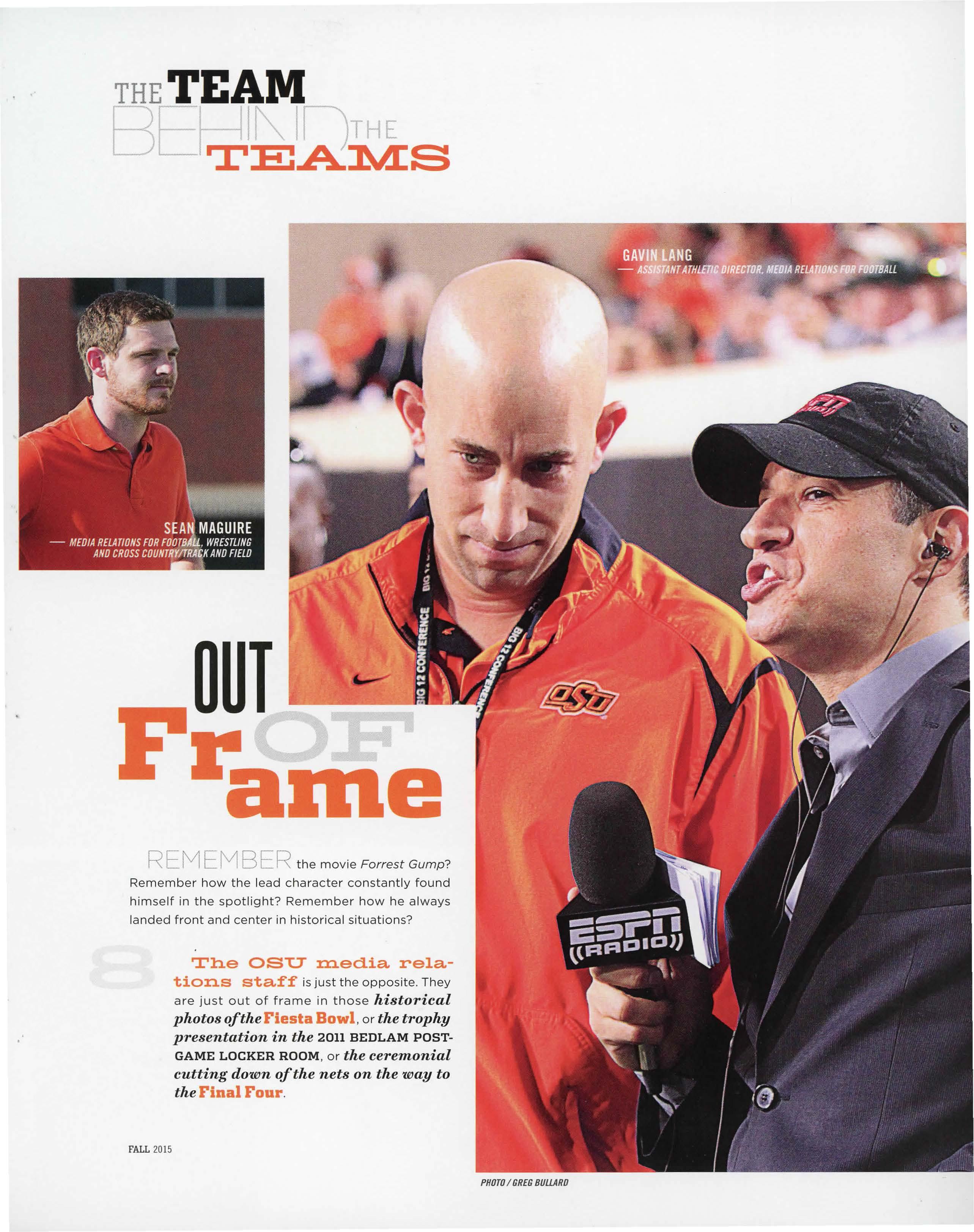
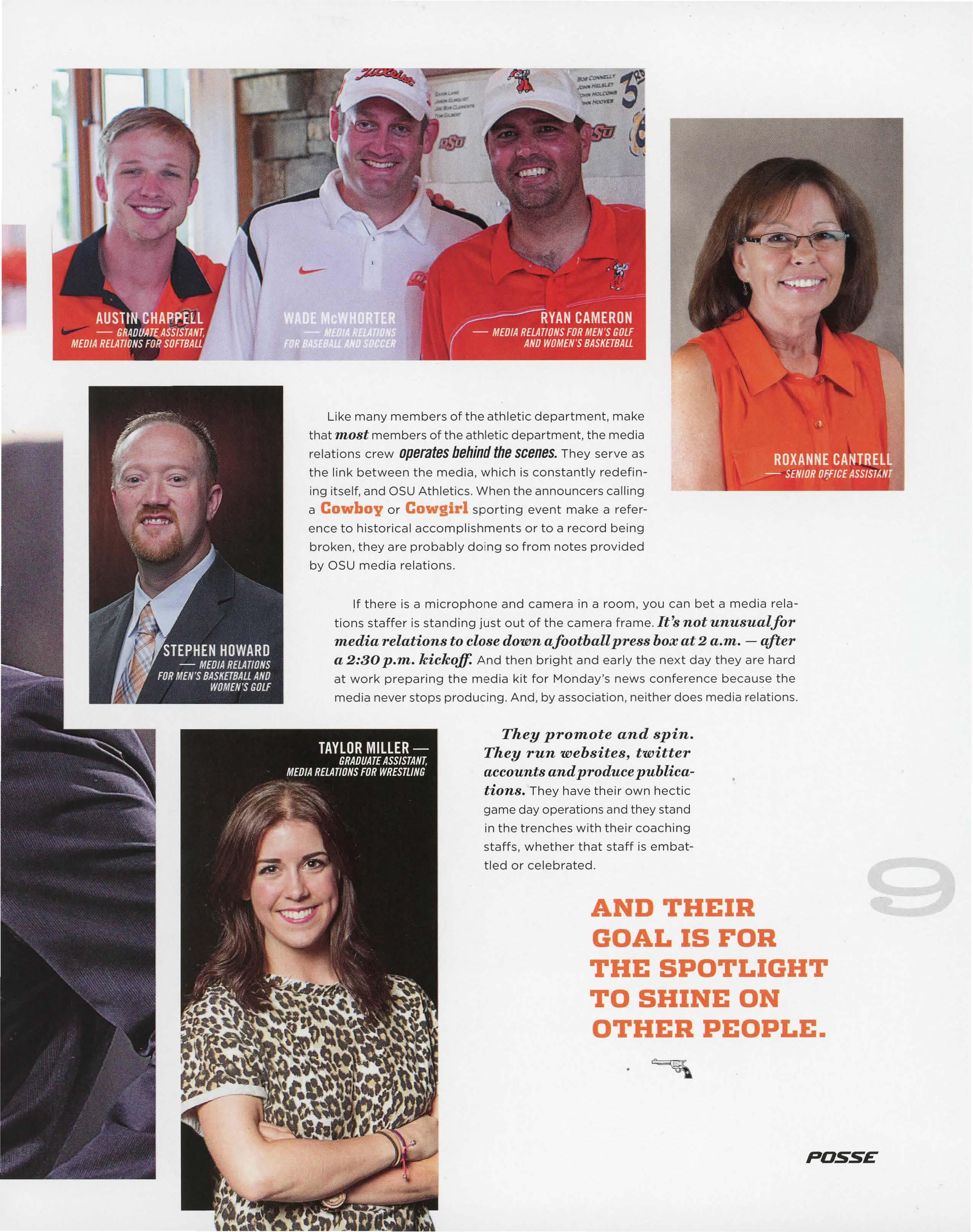
the movie Forrest Gump? Remember how the lead character constantly found himself in the spotlight? Remember how he always landed front and center in historical situations?
The OSU media relations staff is just the opposite. They are just out of frame in those historical photos of the Fiesta Bowl, or the trophy presentation in the 2011 BEDLAM POSTGAME LOCKER ROOM, or the ceremonial cutting down of the nets on the way to the Final Four.
PHOTO I GREGBULLARO
Like many members of the athletic department, make that most members of the athletic department, the media relations crew operates behind the scenes. They serve as the link between the media, which is constantly redefining itself, and OSU Athletics. When the announcers calling a Cowboy or Cowgirl sporting event make a reference to historical accomplishments or to a record being broken, they are probably doing so from notes provided by OSU media relations.
If there is a microphone and camera in a room, you can bet a media relations staffer is standing just out of the camera frame. It's not unusualfor media relations to close down afootball press box at 2 a.m. - after a 2:30 p.m. kickoff. And then bright and early the next day they are hard at work preparing the media kit for Monday's news conference because the media never stops producing. And, by association, neither does media relations.
They promote and spin. They run websites, twitter accounts and produce publications. They have their own hectic game day operations and they stand in the trenches with their coaching staffs, whether that staff is embattled or celebrated.
AND THEIR GOAL IS FOR THE SPOTLIGHT TO SHINE ON OTHER PEOPLE.
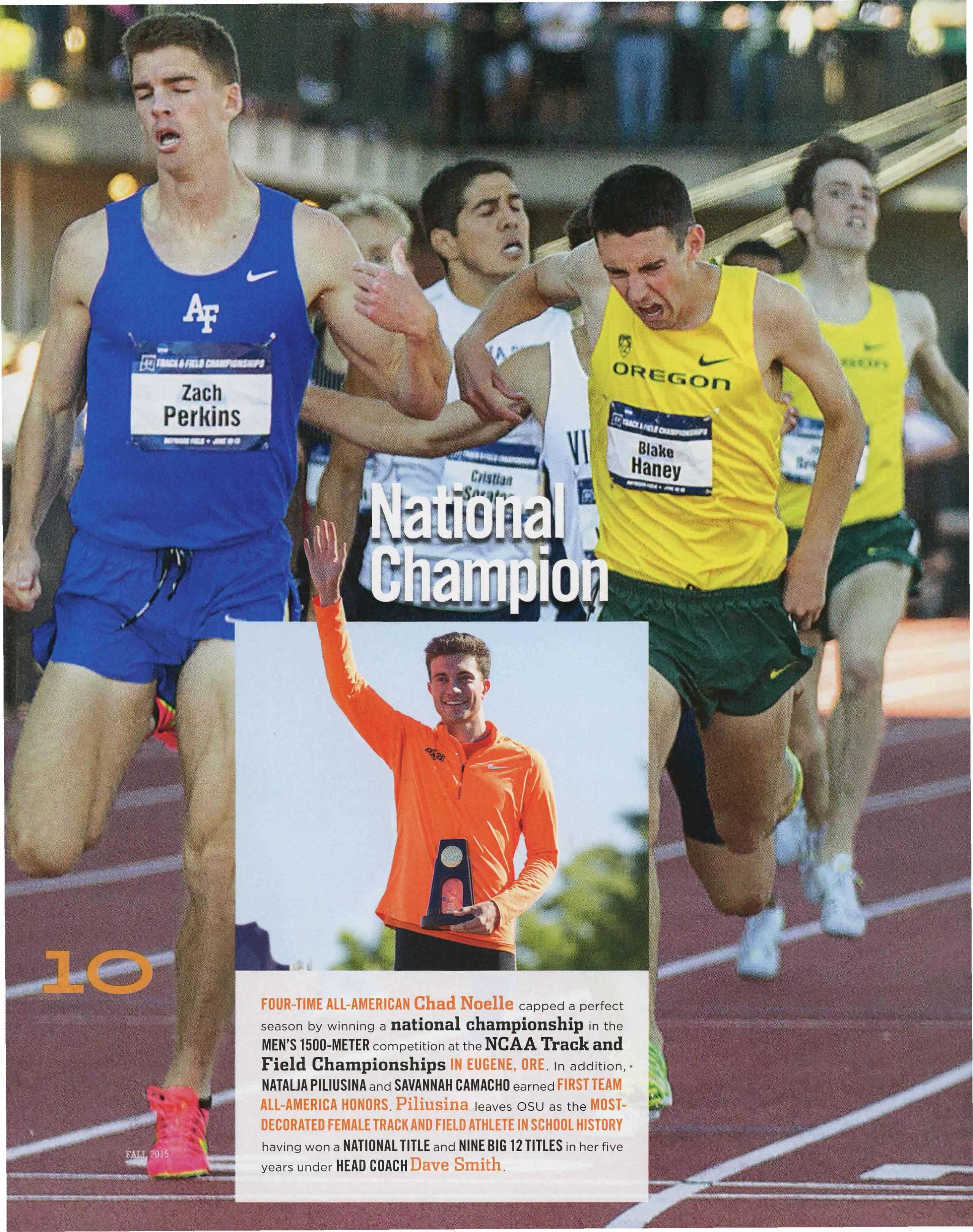
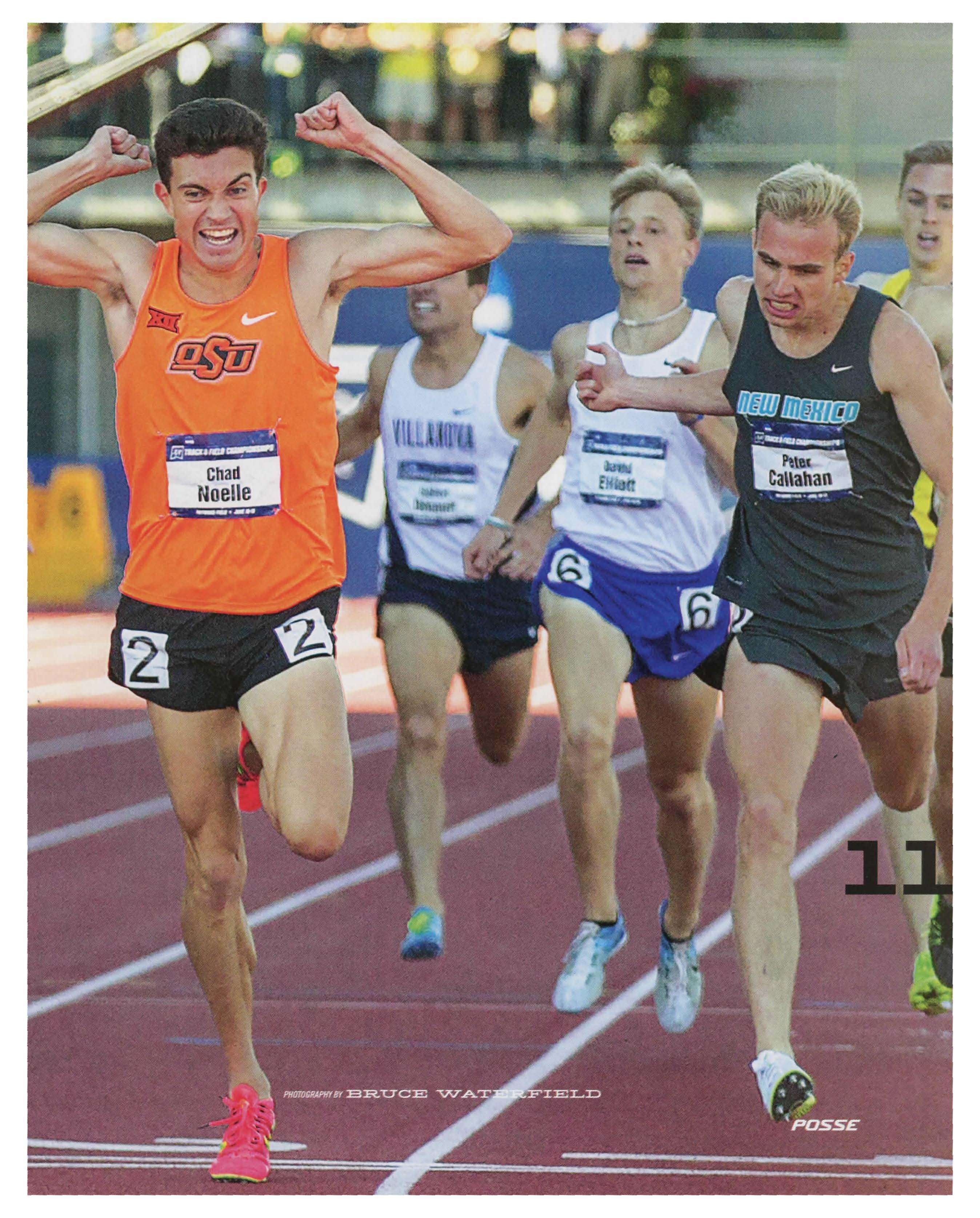
FOUR-TIMEALL-AMERICANChad Noelle capped a perfect season by winning a national championship in the MEN'S1500-METERcompetition at the NCAA Track and Field Championships IN EUGENE,ORE.In addition,. NATALJAPILIUSINAand SAVANNAHCAMACHOearned FIRSTTEAM ALL-AMERICAHONORS.Piliusina leaves osu as the MOSTDECORATEDFEMALETRACKANDFIELDATHLETEINSCHOOLHISTORY having won a NATIONALTITLEand NINEBIG12TITLES in her five years under HEADCOACHDave Smith.
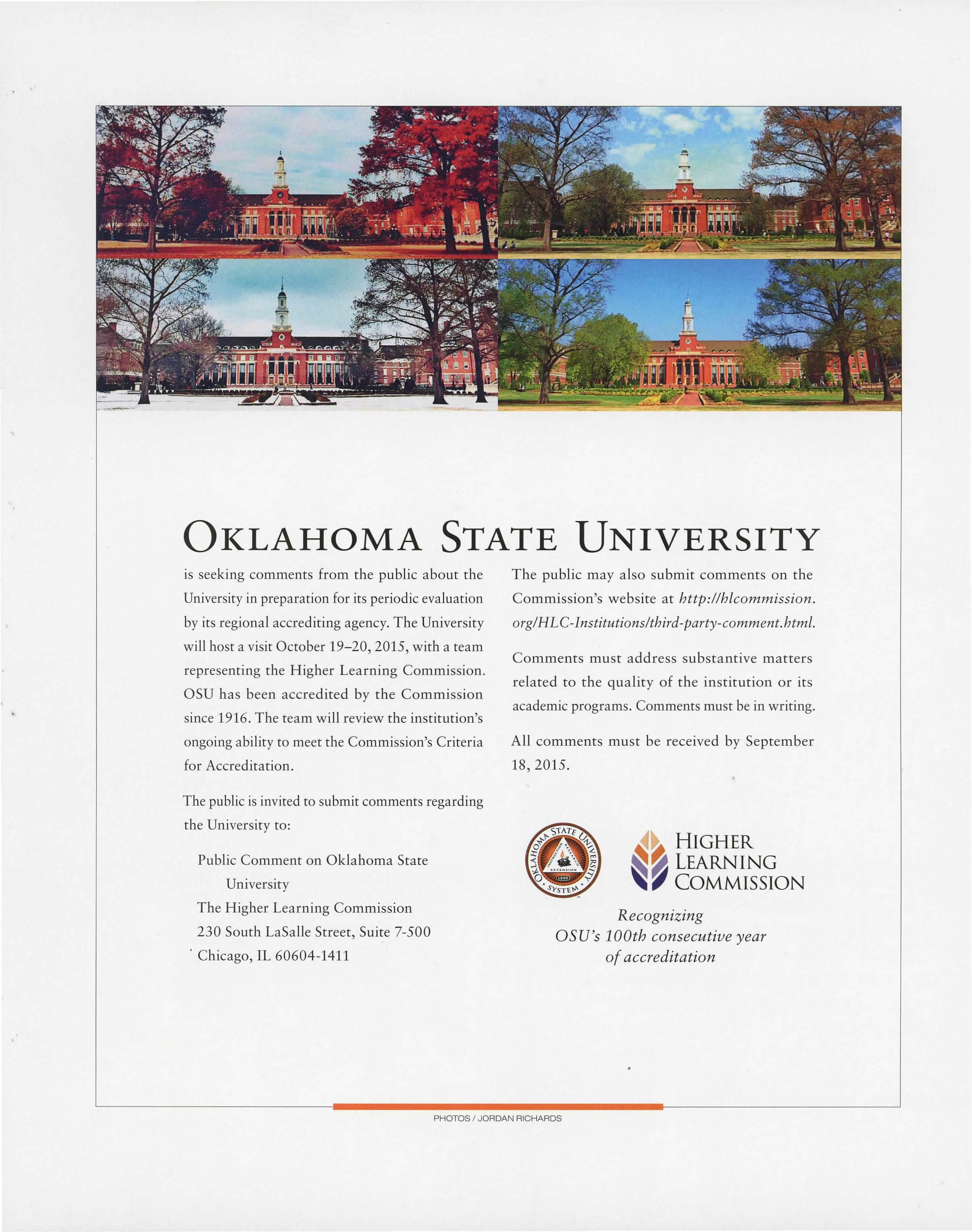
OKLAHOMA STATE UNIVERSITY
is seeking comments from the public about the University in preparation for its periodic evaluation by its regional accrediting agency. The University will host a visit October 19-20, 2015, with a team representing the Higher Learning Commission. OSU has been accredited by the Commission since 1916. The team will review the institution's ongoing ability to meet the Commission's Criteria for Accreditation.
The public is invited to submit comments regarding the University to:
Public Comment on Oklahoma State University
The Higher Learning Commission 230 South LaSalle Street, Suite 7-500 • Chicago, IL 60604-1411
The public may also submit comments on the Commission's website at http://hlcommission. org/HLC-Institutionslthird-party-comment.html.
Comments must address substantive matters related to the quality of the institution or its academic programs. Comments must be in writing.
All comments must be received by September 18, 2015.
Recognizing OSU's 100th consecutive year of accreditation
PHOTOS/ JORDAN RICHARDS
THENEXTJJ
NATALIECALHOUN CD)
ELIZABETHDELOZIERCMF/D)
COURTNEYDIKECF)
CARLADOLOMONTCMF)
KATHRINLEHMANCGK)
MEGANMARCHESANO CF)
ADRIANERADTKECF)
JESYCAROSHOLT CF)
ALLIESTEPHENSONCMF/F)
SIERASTRAWSERCMF/F)
KYNOALLTREADWELLCF/MF)
(D Colin Carmichael:
"The biggest challenge was to convince good players to come here. We didn't have any tradition or history. We didn't have a facility. We didn't have a locker room - we didn't have a whole lot to sell. We had to sell the university and ourselves, and at that point, that was pretty much it."
Those dreams were born nearly 20 years ago. The thought of moving close to home and building a program in the NEWLYFORMEDBIG12 CONFERENCEappealed to Hancock, a native ofTulsa who starred at Union High School and the University of Tulsa. Carmichael was not only looking for a new challenge, but also for full-time employment as an international student coming offhis student visa at South Alabama, where he'd played, graduated with a Master's degree and assisted Hancock in coaching the women's team at his alma mater.
Once settled on the plains of Oklahoma with Hancock as the Cowgirls' head coach and Carmichael her assistant, the duo began the task of building a soccer programfrom the ground up.
During those.first two seasons in 1996 and 1997, the Cowgirls won 19 games and
finished with winning records both years, thanks in no small part to several transfers that followed Hancock and Carmichael from Mobile to Stillwater.
But the honeymoon would end when the South Alabama transfers graduated, and THENEWTALENT the Cowgirls brought in COULDN'T MEASURE UP- OSU'swin totals dropped to seven in 1998, five in 1999 and then to just four in 2000.
"The kids we brought in to replace the ones we lost off those first two teams were not as good, and we took a pretty good dip," Carmichael said.
"At that point, I think we were all questioning whether we could get this thing going."
It's not as if the cupboard was completely bare - THEREWERE TALENTEDPLAYERSONTHECOWGIRL ROSTER - but stockpilingthe types of athletes needed to compete with the perennial NCAA top-10 programs in the Big 12 was a tall task. m
"The biggest challenge was to convince good players to come here," Carmichael said. "We didn't have any tradition or history. We didn't have a facility. We didn't have a locker room - we didn't have a whole lot to sell. We had to sell the university and ourselves, and at that point, that was pretty much it.
"So the hardest part was going out and trying to convince these young ladies to trust us, to come here and that we were going to be competitive.
''Back then, we were just trying to put a team on thefieldthat could compete with Texas A&M and Nebraska and Texas, some of the more established teams."
During those early years, OSU simply couldn't measure up against the likes of those squads and often found itself on the wrong end oflopsided scores.
But with the turn of the century came a group of Cowgirls that turned OSU's fortunes - and proved to the coaching staff that they could indeed get things going in Stillwater.
GAMECHANGERS
Both Hancockand Carmichael are quick to PINPOINTJUSTWHAT - or MOREACCURATELY,who- it wasthatgottheirprogramheadedinto ascension.
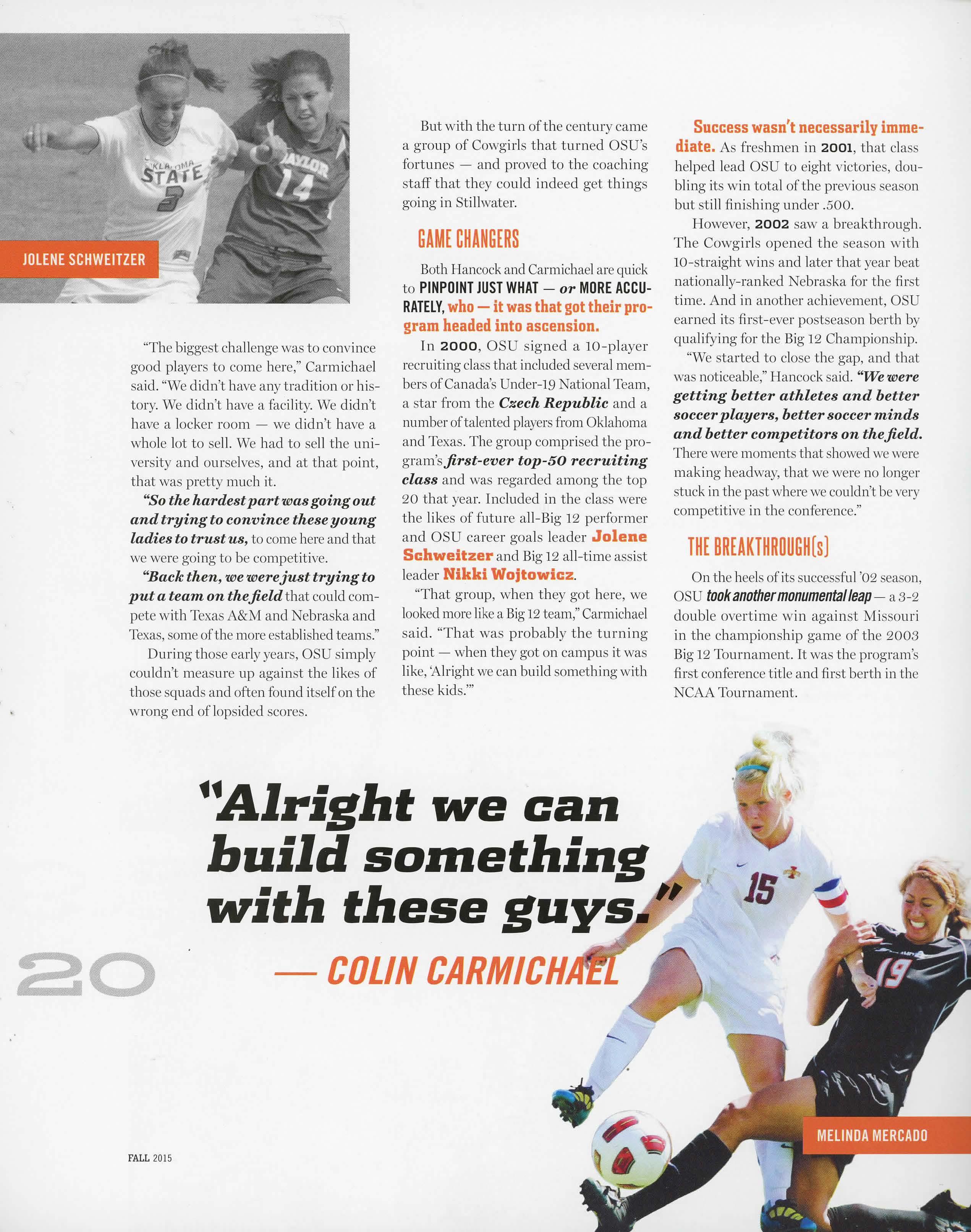
In 2000, OSU signed a IO-player recruiting class that included several members of Canada's Under-19 National Team, a star from the Czech Republic and a number of talented playersfrom Oklahoma and Texas. The group comprised the program'sfirst-ever top-50 recruiting class and was regarded among the top 20 that year. Included in the class were the likes of future all-Big 12 performer and OSU career goals leader Jolene Schweitzer and Big 12 all-time assist leader Nikki Wojtowicz.
"That group, when they got here, we looked more like a Big12 team," Carmichael said. "That was probably the turning point - when they got on campus it was like, 'Alright we can build something with these kids."'
Success wasn'tnecessarilyimmediate. As freshmen in 2001, that class helped lead OSU to eight victories, doubling its win total of the previous season but still finishing under .500.
However, 2002 saw a breakthrough. The Cowgirls opened the season with IO-straight wins and later that year beat nationally-ranked Nebraska for the first time. And in another achievement, OSU earned its first-ever postseason berth by qualifying for the Big 12 Championship.
"We started to close the gap, and that was noticeable," Hancock said. "We were getting better athletes and better soccer players, better soccer minds and better competitors on the.field. There were moments that showed we were making headway, that we were no longer stuck in the past where we couldn't be very competitive in the conference."
THEBREAKTHROUGH[s)
On the heels of its successfuI '02 season, osu tookanothermonumentalleap- a s-2 double overtime win against Missouri in the championship game of the 2003 Big 12 Tournament. It was the program's first conference title and first berth in the NCAA Tournament.
"It was the next big step that kind of put us on the map nationally," according to Carrn ichael.
OSU's march to national prominence included "lotsof little babystepsalong the way,''said Hancock, and following that '03 season, the Cowgirls waited three years to take another one when in 2006 they earned their first NCAA Tournament win against UNC Greensboro. SUCCESSINSTILLWATERFINALLYBECAME SUSTAINEDAS2006MARKEDTHEFIRSTOF SIXCONSECUTIVENCAATOURNEYAPPEARANCES,WITHOSUADVANCINGPASTTHEOPENINGROUNDINEACHOFTHEM.
Hancock said reaching that type of production is the biggest obstacle in building a winning program.
"Establishing some sort of consistent, high-level of play is not easy - it's easier being good one year or two years. IT'S REALLY DIFFICULT TO SUSTAIN A CERTAIN LEVEL OF EXCELLENCE. Even today, that's the most challenging part of the program."
Hancock added that the process of achieving success was key for establishing a consistent winner.
"Finally qualifying for the Big 12 tournament for the first time in 2002 - some people would think 'What's the big deal?
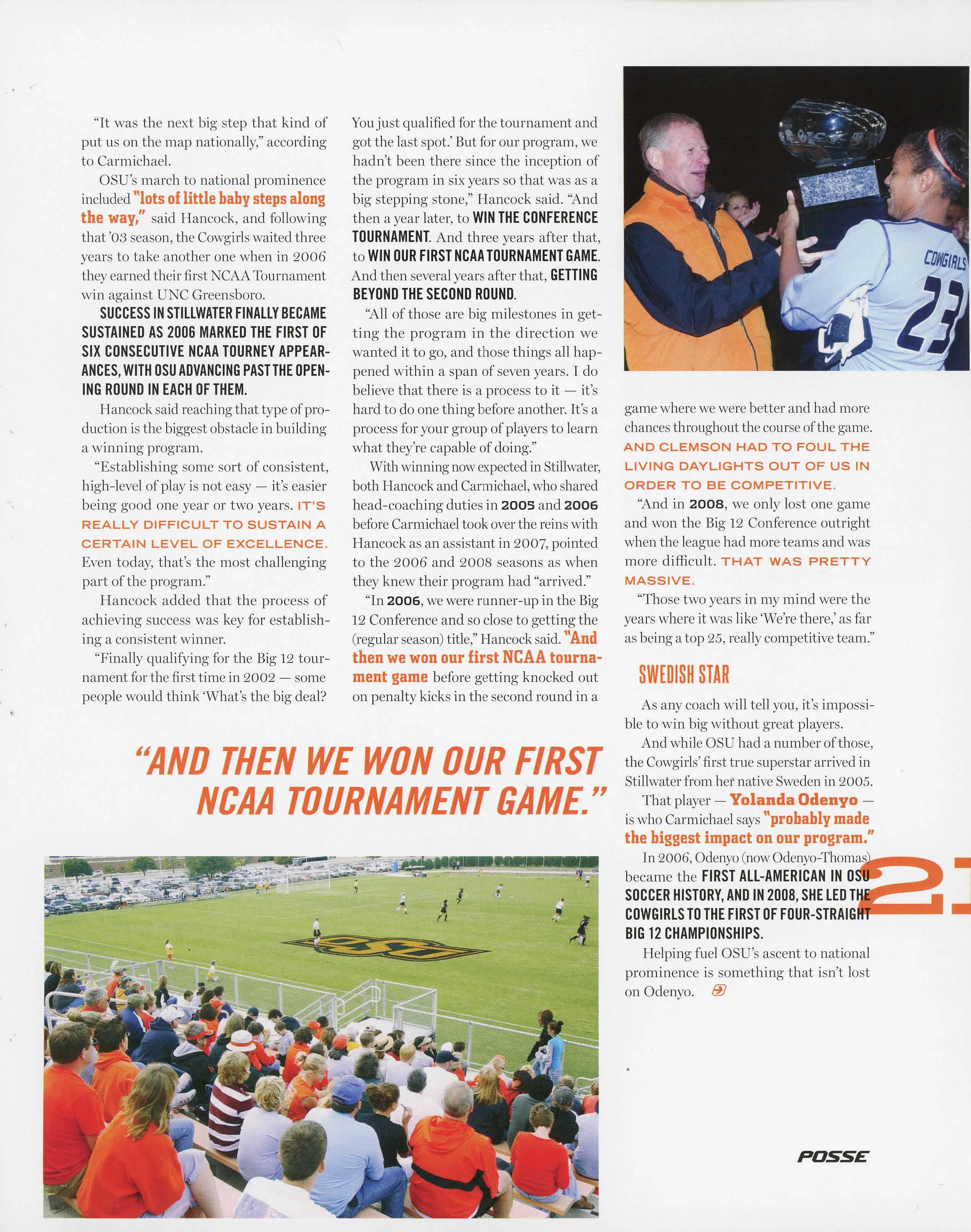
Youjust qualified for the tournament and got the last spot.' But for our program, we hadn't been there since the inception of the program in six years so that was as a big stepping stone," Hancock said. ''And then a year later, to WINTHECONFERENCE TOURNAMENT. And three years after that, to WINOURFIRSTNCAATOURNAMENTGAME. And then several years after that, GETTING BEYONDTHESECONDROUND.
''All of those are big milestones in getting the program in the direction we wanted it to go, and those things all happened within a span of seven years. I do believe that there is a process to it - it's hard to do one thing before another. It's a process for your group of players to learn what they're capable of doing."
With winning now expected in Stillwater, both Hancock and Carmichael, who shared head-coaching duties in 2005 and 2006 before Carmichael took over the reins with Hancock as an assistant in 2007, pointed to the 2006 and 2008 seasons as when they knew their program had "arrived."
"In 2006, we were runner-up in the Big 12 Conference and so close to getting the (regular season) title," Hancock said. ''And then we won our first NCAAtournament game before getting knocked out on penalty kicks in the second round in a
game where we were better and had more chances throughout the course of the game. AND CLEMSON HAD TO FOUL THE LIVING DAYLIGHTS OUT OF US IN ORDER TO BE COMPETITIVE.
''And in 2008, we only lost one game and won the Big 12 Conference outright when the league had more teams and was more difficult. THAT WAS PRETTY MASSIVE.
"Those two years in my mind were the years where it was Iike 'We're there,' as far as being a top 25, really competitive team."
SWEDISHSTAR
As any coach will tell you, it's impossible to win big without great players.
And while OSU had a number of those, the Cowgirls' first true superstar arrived in Stillwater from her native Sweden in 2005.
"ANDTHENWEWONOURFIRST NCAATOURNAMENTGAME."
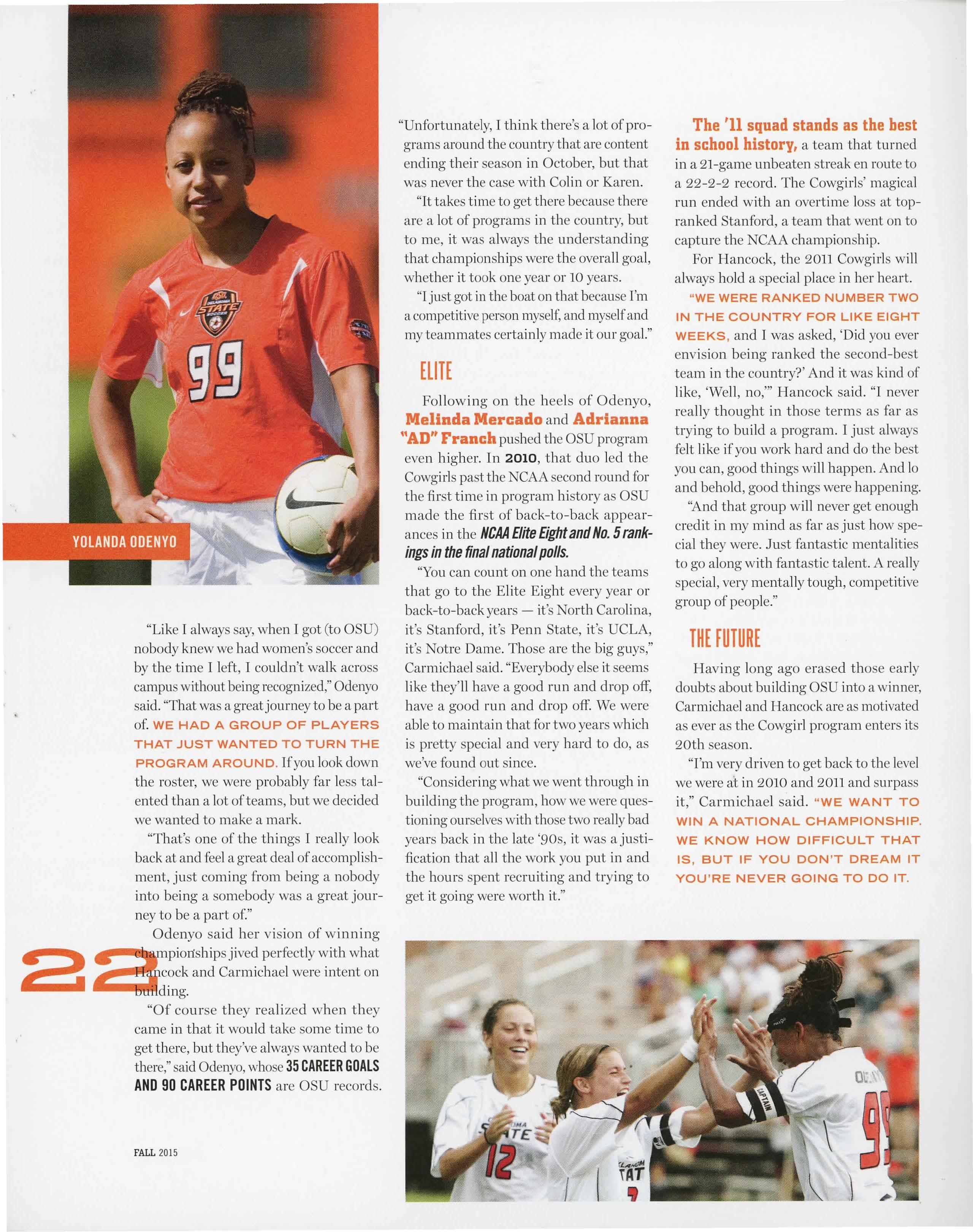
That player - Yolanda Odenyois who Carmichael says "probablymade the biggest impacton our program."
In 2006, Odenyo (now Odenyo-Thomas became the FIRSTALL-AMERICAN IN 0 SOCCERHISTORY,ANDIN2008,SHELEDT·~;;~~~~:U COWGIRLSTOTHEFIRSTOFFOUR-STRAIGIR BIG12CHAMPIONSHIPS.
Helping fuel OSU's ascent to national prominence is something that isn't lost on Odenyo.
a"Like I always say, when I got (to OSU) nobody knew we had women's soccer and by the time I left, I couldn't walk across campus without being recognized,"Odenyo said. "That was agreatjourneyto be a part of. WE HAD A GROUP OF PLAYERS THAT JUST WANTED TO TURN THE PROGRAM AROUND. If you look down the roster, we were probably far less talented than a lot of teams, but we decided we wanted to make a mark.
"That's one of the things I really look back at and feel a great deal of accomplishrnent, just corning from being a nobody into being a somebody was a great journey to be a part of."
Odenyo said her vision of winning
..:::::~ba111pi01ishipsjived perfectly with what ..,...._::fl~cock and Carmichael were intent on t.!::::=dnding.
"Of course they realized when they came in that it would take some time to get there, but they've always wanted to be there," said Odenyo,whose 35CAREERGOALS AND90 CAREERPOINTSare OSU records.
"Unfortunately, I think there's a lot of programs around the country that are content ending their season in October, but that was never the case with Colin or Karen.
"Tttakes ti me to get there becau e there are a lot of programs in the country, but to me, it was always the understanding that championships were the overall goal, whether it took one year or 10 years.
"I just got in the boat on that because I'm a competitive person myself;and myselfand my teammates certainly made it our goal."
nm
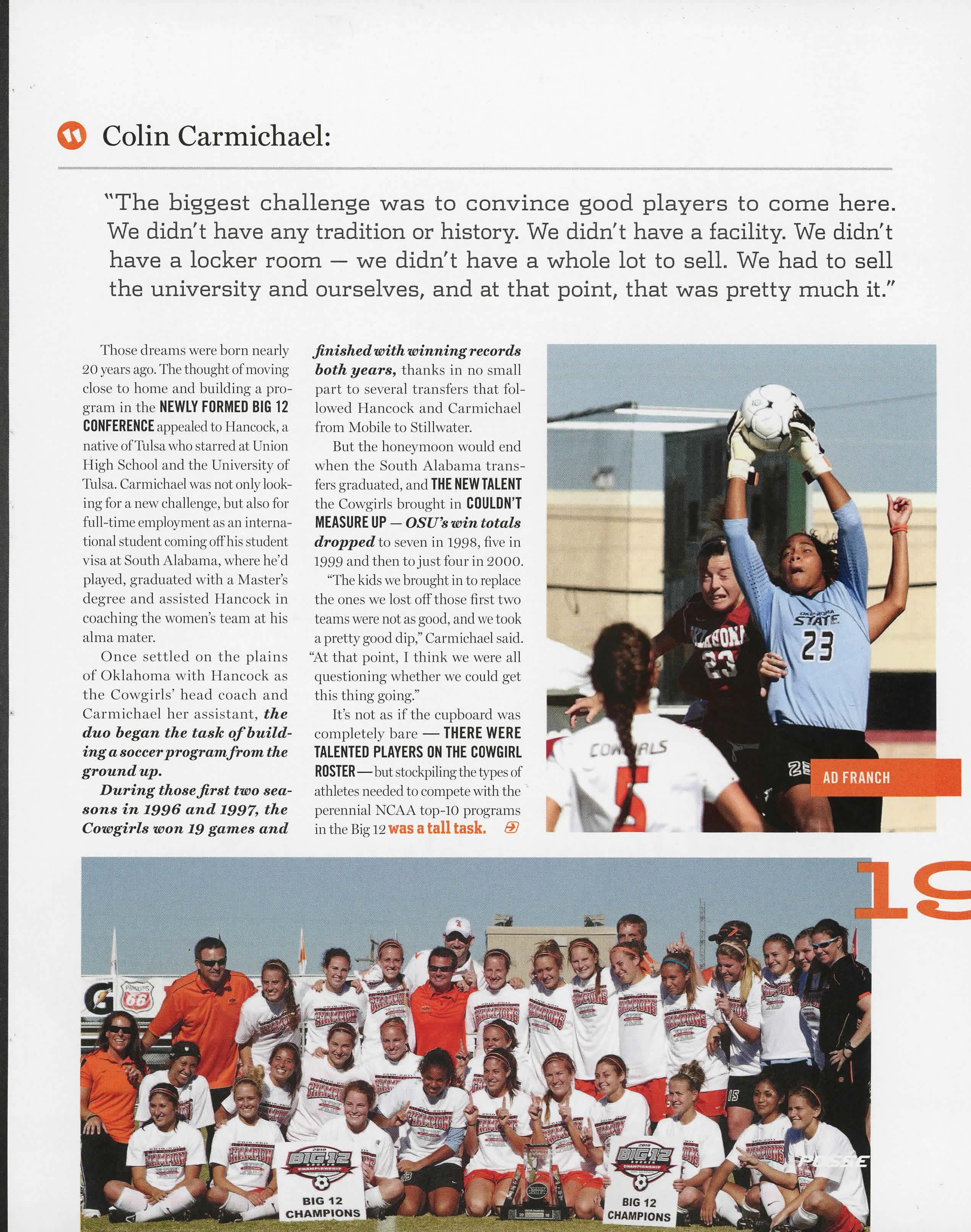
Following on the heels of Odenyo, Melinda Mercado and Adrianna ••AD'' Franch pushed the OSU program even higher. In 2010, that duo led the Cowgirls past the NCAA second round for the first time in program history as OSU made the fir t of back-to-back appearances in the NCAAEliteEightandNo.5 rankingsinthefinalnationalpolls.
"You can count on one hand the teams that go to the Elite Eight every year or back-to-back years - it's North Carolina, it's Stanford, it's Penn State, it's UCLA, it's Notre Dame. Those are the big guys," Cann ichael said. "Everybody else it seems like they'll have a good run and drop off, have a good run and drop off. We were able to maintain that for two years which is pretty special and very hard to do, as we've found out since.
"Considering what we went through in building the program, how we were questioning ourselves with those two really bad years back in the late '90s, it was a justification that all the work you put in and the hours spent recruiting and trying to get it going were worth it."
The '11squad stands as the best in school history, a team that turned in a 21-game unbeaten streak en route to a 22-2-2 record. The Cowgirls' magical run ended with an overtime loss at topranked Stanford, a team that went on to capture the NCAA championship.
For Hancock, the 2011 Cowgirls will always hold a special place in her heart.
"WE WERE RANKED NUMBER TWO IN THE COUNTRY FOR LIKE EIGHT WEEKS, and I was asked, 'Did you ever envision being ranked the second-best team in the country?' And it was kind of like, 'Well, no,"' Hancock said. "I never really thought in those terms as far as trying to build a program. I just always felt like if you work hard and do the best you can, good things will happen. And lo and behold, good things were happening.
"And that group will never get enough credit in my mind as far as just how special they were. Just fantastic mentalities to go along with fantastic talent. A really special, very mentally tough, competitive group of people."
THEfUTURE
Having long ago erased those early doubts about building OSU into a winner, Carmichael and Hancock are as motivated as ever as the Cowgirl program enters its 20th season.
'Tm very driven to get back to tbe level we were at in 2010 and 2011 and surpass it," Carmichael said. "WE WANT TO WIN A NATIONAL CHAMPIONSHIP. WE KNOW HOW DIFFICULT THAT IS, BUT IF YOU DON'T DREAM IT YOU'RE NEVER GOING TO DO IT.
"We're competing for Big 12 championships now - we want to get back to winning them. And then that should springboard us into hopefully competing for a national championship.
'Tm still very motivated to win here. Just like Karen, there have been opportunities to move my family and go start something somewhere else, but you take a lot of pride in what you've clonehere and I don't think the job is finished yet."
Says Hancock, "l'M THE LUCKIEST PERSON I KNOW IN THAT I GET TO WORK AT THE UNIVERSITY DOING WHAT I WANT TO DO WITH THE TEAM I WANT TO WORK WITH. l didn't want to go anywhere else and help another school get better. I've known for a very, very long ti me that I always wanted to work at Oklahoma State and help get OSU better.
"That's not lip service - this is where I want to be."
And Hancock added that Stillwater is now also a preferred destination for some of the nation's top players, a far cry from the early clays of Cowgirl soccer.
"WE'REABLETOATTRACTABETTERATHLETEANDABETTERPLAYERTHANWEWERE 10YEARSAGO,"Hancock said. "Having the Big 12 championships, the repeated appearances in the NCAA tournament, that has helped make us an attractive option to better players - players that really truly wouldn't have considered us JO years ago novvconsider us."
Also helping propel the OSU program into its next 20 years is a NEWMULTI-MILLIONDOLLARSOCCERFACILITYscheduled to break ground within the next year.
"For Colin and me, it's been a longtime in waiting to see something like this come to fruition," Hancock said. "It's not built quite yet, but it shou lclbe within a couple of years. And just seeing the drawings at times makes me a little bit emotional,just to see that it's getting very close to reality.
"To spend 20 years of your 1ife working at some place and see something 1ike that really starting to form and happen, it's a little bit overwhelming sometimes. It's overwhelming to have the support of our athletic director, and he believes in the program enough to go out and fundraise for this and make this a reality. It's a tremendous gift."
Adds Carmichael, "When (the new facility) comes on board, maybe that's the missing piece of the puzzle that will allow us to go out and recruit more of the top kids in the country and get them to Stillwater."
Regardless of what the future holds for Cowgirl soccer, those that built the program from scratch will look back on the fruits of their labor fondly.
"I TAKE A HUGE AMOUNT OF PRIDE IN THE FACT THAT WHEN WE CAME HERE, WE HAD NOTHING - we were operating on no tradition, no history, no facility-AND WERE ABLE BUILD IT UP INTO SOMETHING THAT IS RECOGNIZED NATIONALLY AS CERTAINLY ONE OF THE BETTER PROGRAMS OF THE LAST 10 YEARS," Carmichael said. "It's not easy - if it was easy, everybody would win championships in the Big 12 and go to the NCAA tournament and the Elite Eight. I take a lot of pride in that.
''Another thing that sticks with me is the people I get to work with. Karen and I have been here from the beginning, and we've had great assistants that have helped out in a lot of ways and that's pretty special.
"But the main thing is the relationships with the players. Youlook at the Iist of kids that have come through and played here, they're great athletes but they're really great people. You value the people you've hopefully had a positive impact on, and they've certainly had a positive impact on me.
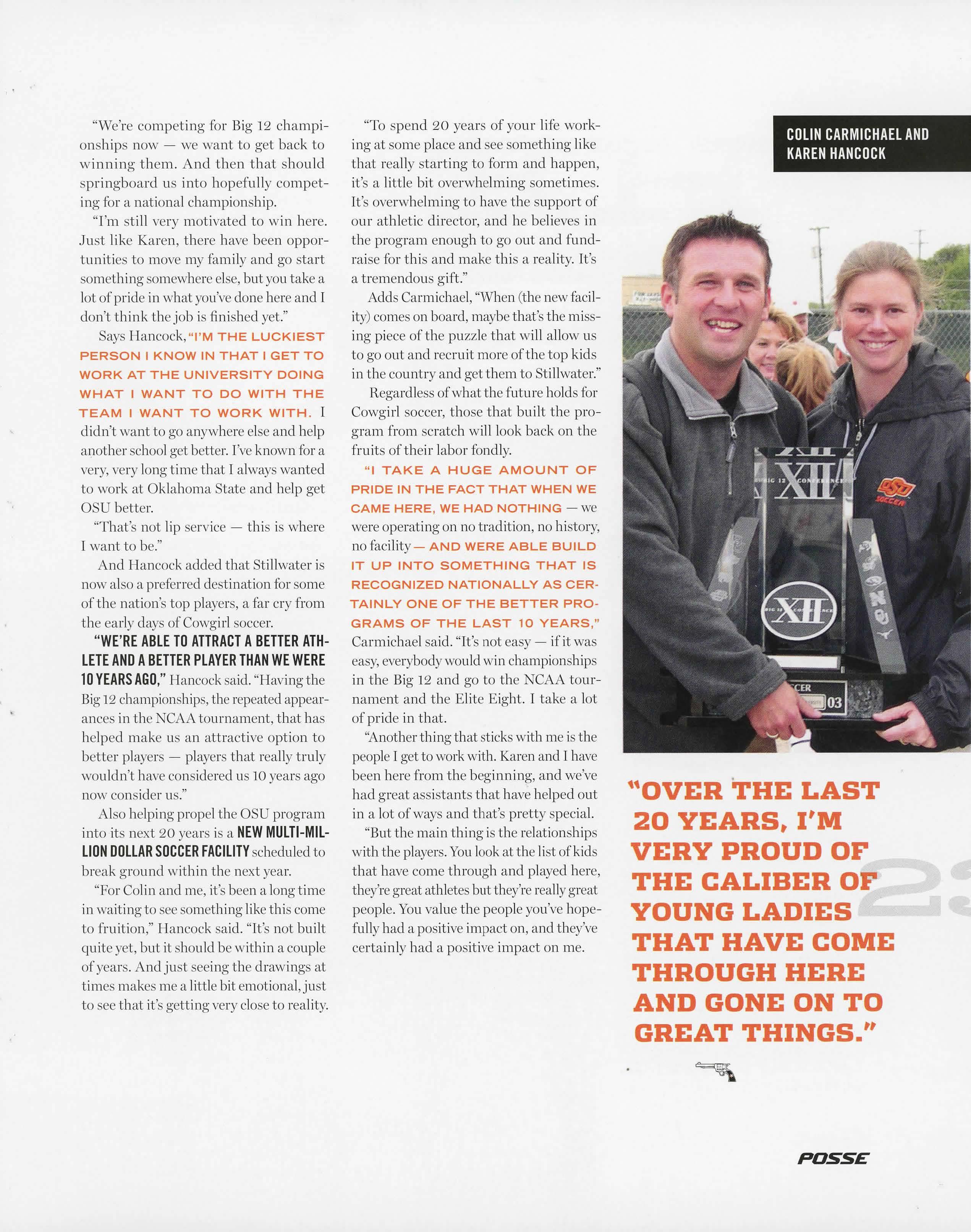
ttOVER THE LAST 20 YEARSt l'M VERY PROUD OF THE CALIBER OF YOUNG LADIES THAT HAVE COME THROUGH HERE AND GONE ON TO GREAT THINGS."
COLINCARMICHAELAND KARENHANCOCK
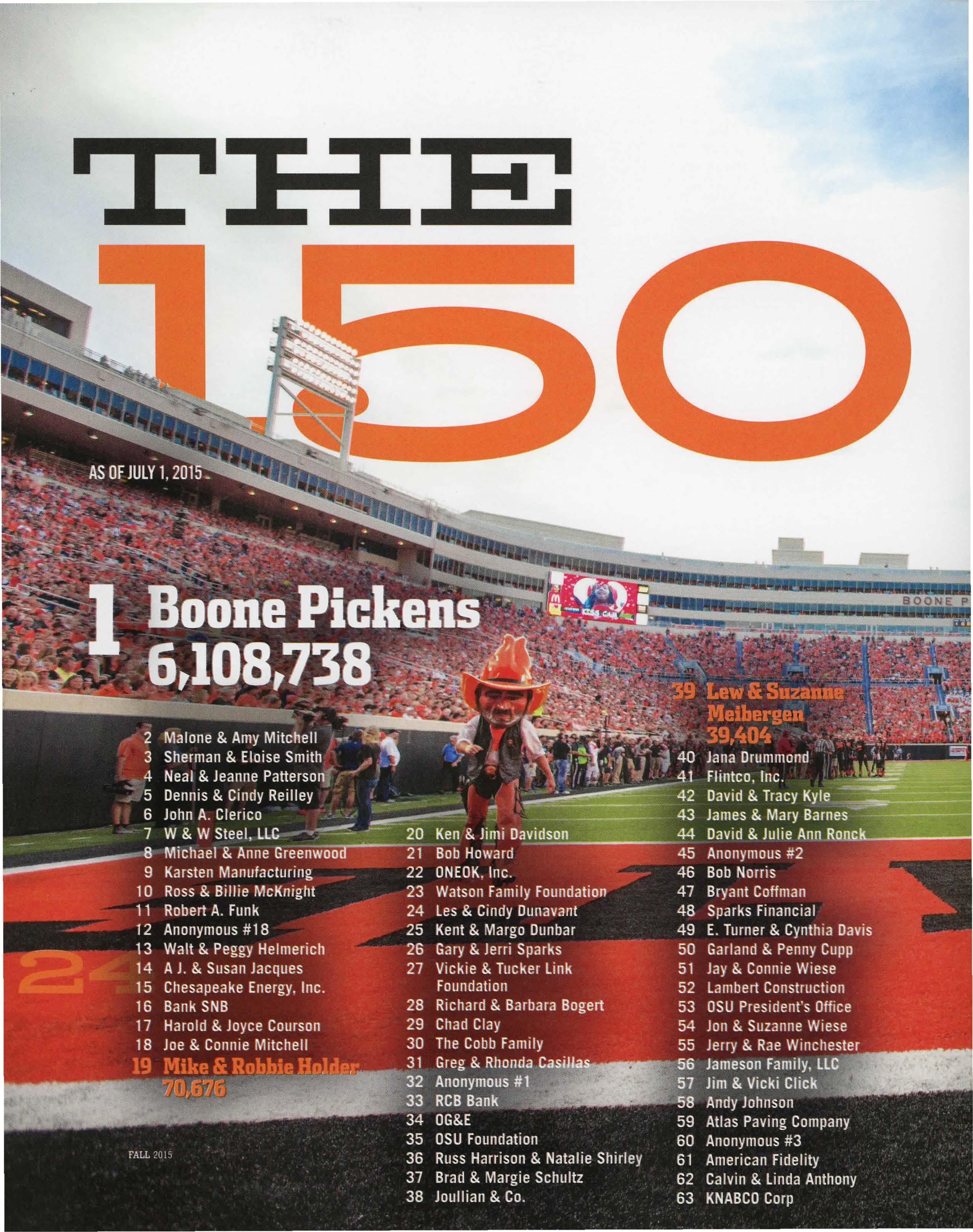
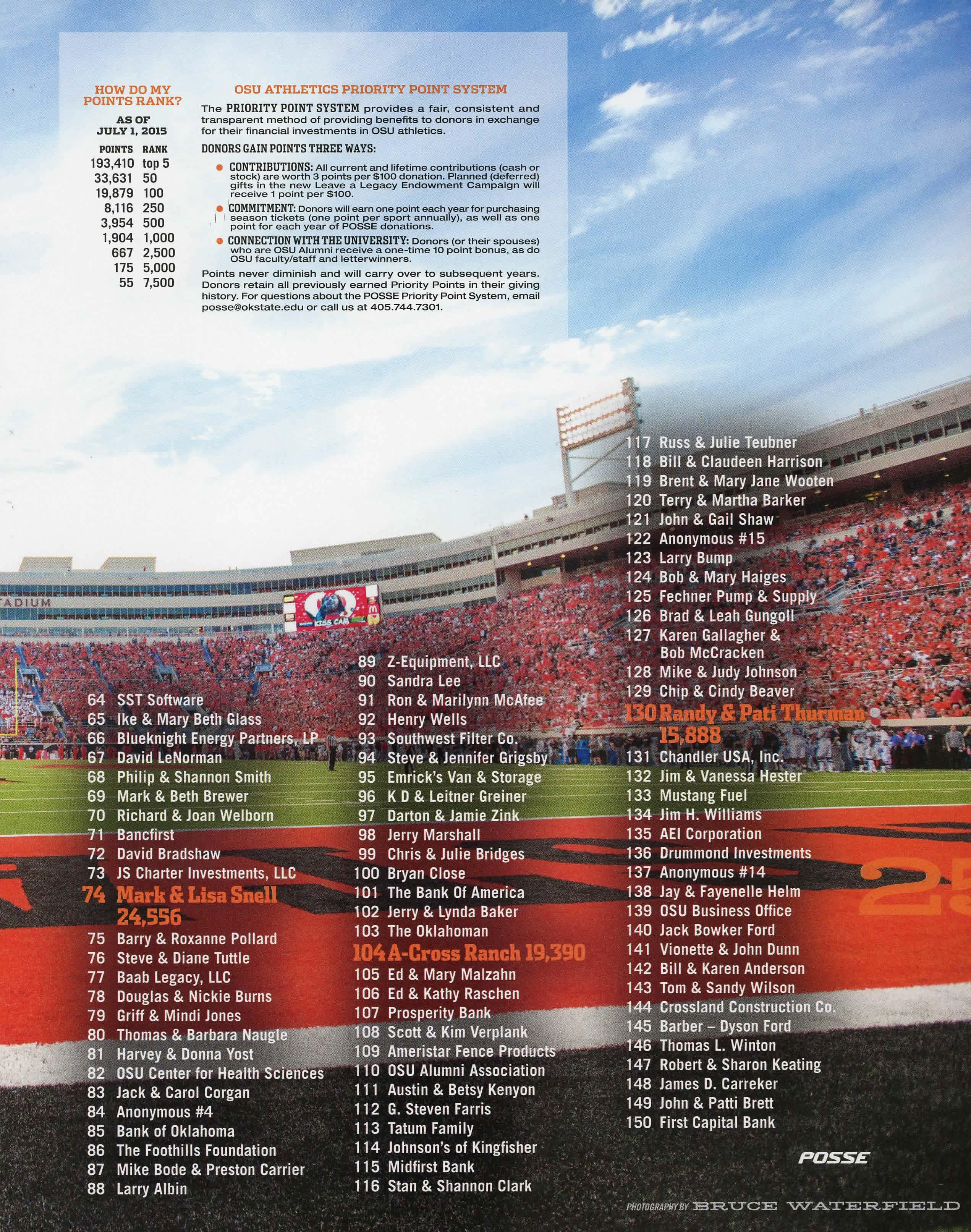
HOW DO MY POINTS RANK?
ASOF JULYl, 2015 POINTS RANK
top 5
5~
OSU ATHLETICS PRIORITY POINT SYSTEM
The PRIORITY POINT SYSTEM provides a fair, consistent and transparent method of providing benefits to donors in exchange for their financial investments in OSU athletics.
DONORSGAINPOINTSTHREEWAYS:
• CONTRIBUTIONS: All current and lifetime contributions (cash or stock) are worth 3 points per $100 donation. Planned (deferred) gifts in the new Leave a Legacy Endowment Campaign will receive 1 point per $100.
I• 1COMMITMENT:Donors will earn one point each year for purchasing I season tickets (one point per sport annually), as well as one I point for each year of POSSE donations.
• CONNECTIONWITHTHEUNIVERSITY:Donors (or their spouses) who are OSU Alumni receive a one-time 10 point bonus, as do OSU faculty/staff and letterwinners.
Points never diminish and will carry over to subsequent years. Donors retain all previously earned Priority Points in their giving history. For questions about the POSSE Priority Point System, email posse@okstate.edu or call us at 405.744.7301.
MAKING A
STORYBYKEVIN KLINTWORTH I PHOTOGRAPHY BYBRUCE WATERFIELD
THE ALL-TIMELEADINGSCORERIN THE HISTORYOF OKLAHOMASTATE FOOTBALL IS A FELLOWBY THE NAME OF DANBA/LEY. HE BEGANHIS COLLEGECAREERAS
A WALK-ON - A NON-SCHOLARSHIP MEMBER OFTHECOWBOYFOOTBALLTEAM.
HE ENDEDHIS CAREERAS THE WINNEROF THE LOU GROZAAWARD, PRESENTED ANNUALLY TO THE NATION'SBEST KICKER.
Bailey is now one of the most accurate placekickers in the history of the National Football League as a member of the Dallas Cowboys. And, incidentally, the person he unseated at the top of the OSU career scoring chart was A RUNNINGBACKNAMED Barry Sanders.
Brandon Weeden is one of the most celebrated quarterbacks in the history of OSU football. He began his college career as a walk-on. He went on to become an all-Big 12 quarterback, the signal caller for OSU's first Big 12 championship team and a first-round pick in the 2012 NFL Draft.
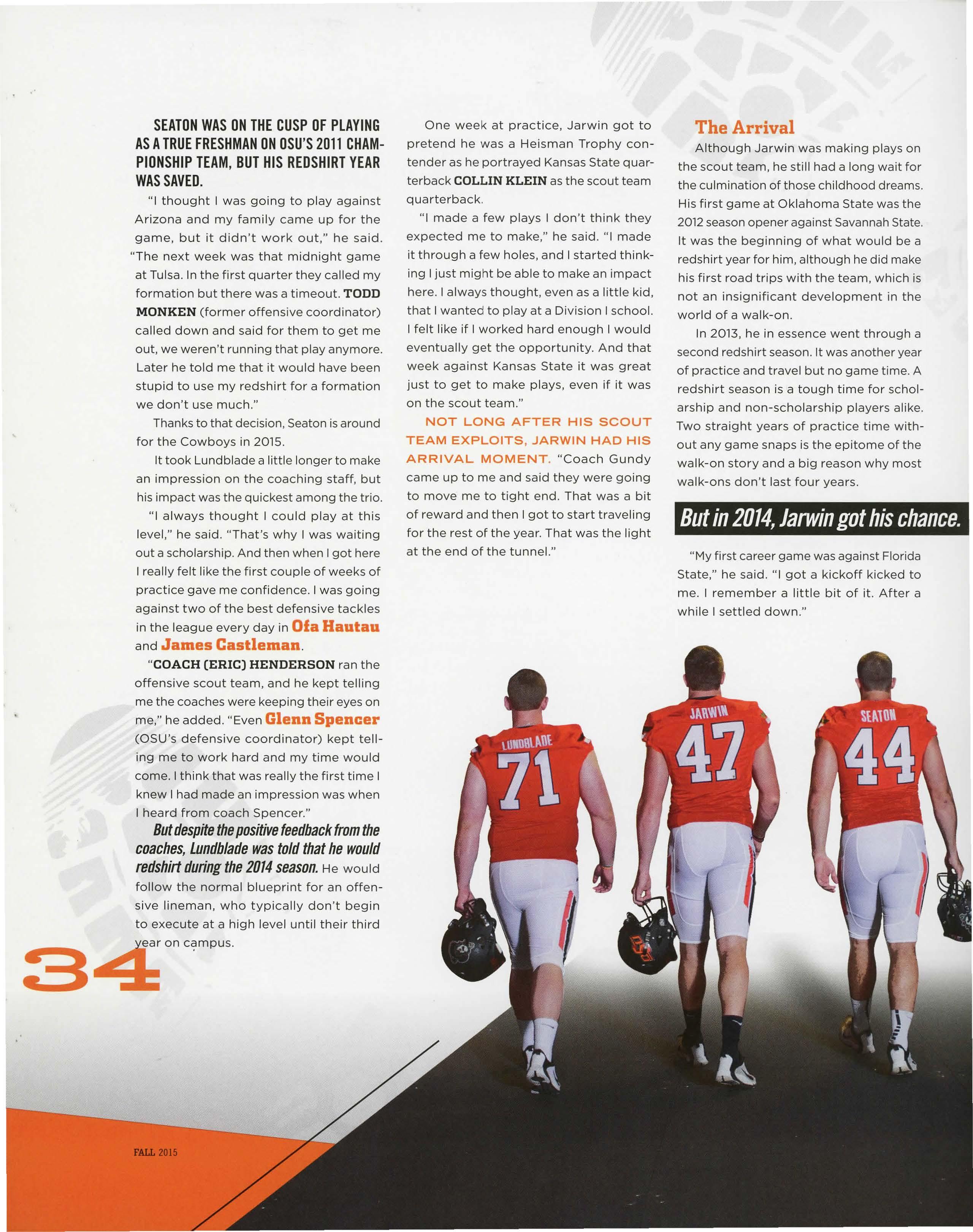
There are approximately 45walk-onsona typicalCowboyroster. estimates osu·s ASSISTANT DIRECTOR OF RECRUITING MIKE GROCE. Groce helps fill out the Cowboy roster with walkons, invited walk-ons and transfers. The non-scholarship players are important pieces of the puzzle. Without them, live practices which are already greatly reduced at OSU, would probably disappear. However, despite the importance of their presence on a daily basis, the numbers game works against walk-ons and their longevity with the program.
Bailey and Weeden, who were teammates in college and now in Dallas, are rare talents with rare stories. THEODDSOFCOLLEGE FOOTBALLWALK-ONSCASHINGNFLPAYCHECKSAREASTRONOMICAL.
The odds of a college football walk-on earning a scholarship are slim. The odds of a walk-on even making significant game-day contributions are stacked against him.
There are only 85 football scholarships available each year, per NCAA rules. Those are gobbled up on the much-ballyhooed National Signing Day each February when scholarship offers become official. THE ONLY HOPE A WALK-ON HAS FOR RECEIVING FINANCIAL AID COMES THANKS TO DEFECTIONS, INJURIES, GRADE CASUALTIES OR JUST A CHANGE OF A HEART BY A SCHOLARSHIP PLAYER. And when that rare event happens, the line for potential financial aid is 45 deep. flJ
Musical Schools
The first step, and perhaps the most critical for any walk-on, is making the decision of which college to attend. With no national letter of intent binding them to a university, the only real advantage of being a walk-on is the ability to school shop and.find the situation that best.fits you. It's not much different than college players who go undrafted by the National Football League and are then free to shop around and sign with the pro team of their choice.
"I started thinking about college football during my junior year," Seaton said. "I started growing a little bit and putting on more weight. During my sophomore year, I got interested in OSU because I thought I might play baseball.
"Before my senior year of high school I tried out for a pretty big baseball travel team that played in California, Florida and really all over the country," he added. "I would have been back (home) for two or three days every three weeks. THAT'SWHEN I KNEW I NEEDEDTODECIDEBETWEENBASEBALLANDFOOTBALL."
Not unlike Jarwin and Lundblade, Seaton could have punched his scholarship ticket at a lower level of college football. He was a bruising runner as a high school quarterback and played linebacker on defense. ,:==:~" was actually at a camp at OU and I was .-.::me top performer," Seaton said. "That's n a bunch of D-2 (Division II of NCAA football) and some of the I-AAs (Football Playoff Subdivision) scholarship offers started coming in."
But Seaton was at the tender age of 17 when he learned that life could turn on a dime.
"It was actually a crazy thing," he said. "My best friend from high school was going to OU and so it was between OU and OSU. And a girl I was talking to at the time happened to be babysitting (former OSU assistant Doug) Meacham's kids. I gave her my highlight tape, and she gave it to him. He actually gave me a call and said I would have a preferred walk-on spot, and he would give me a spot in camp."
In college footballthere are walkons and there are preferred walkons. Preferredwalk-onsare assured of one of the estimated45 walk-on spots. During fall camp, there are limits to the number of student-athletes who can report for preseason camp prior to the first day of school. Players who report in early August have a leg up on being a game-day contributor or at least an important part of the practice plan. And the staff usually knows their names.
"When (Meacham) told me I would be in the 105 (the number on the preseason camp roster prior to the beginning of the fall semester), I told him I would be there," Seaton said.
"My mom thought I was crazy," he continued. "I had these full-rides from smaller schools and I was turning them down. As soon as she got over that, she was 100 percent in. My dad has always been there. He knew if football didn't work out I would still get a good education here."
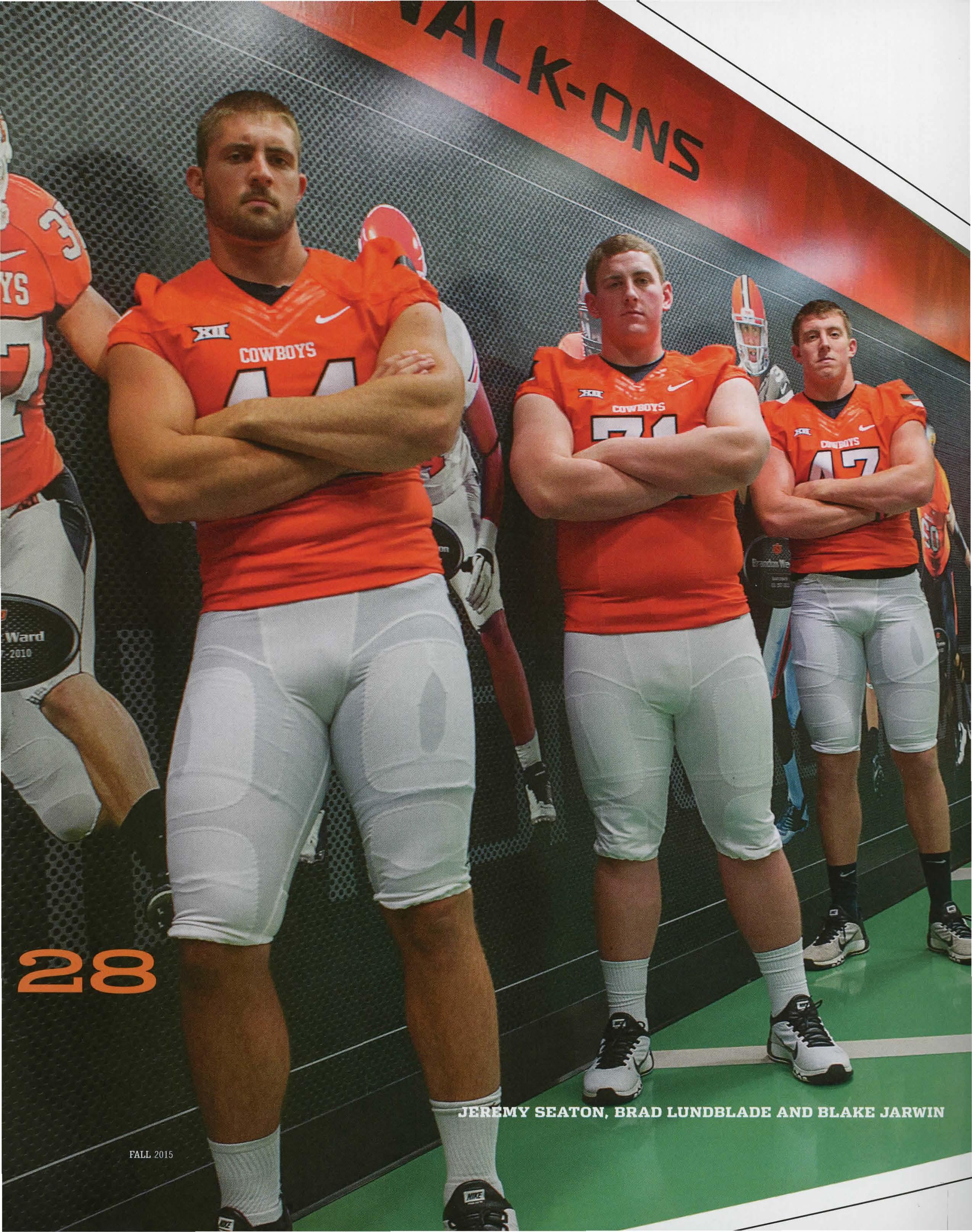
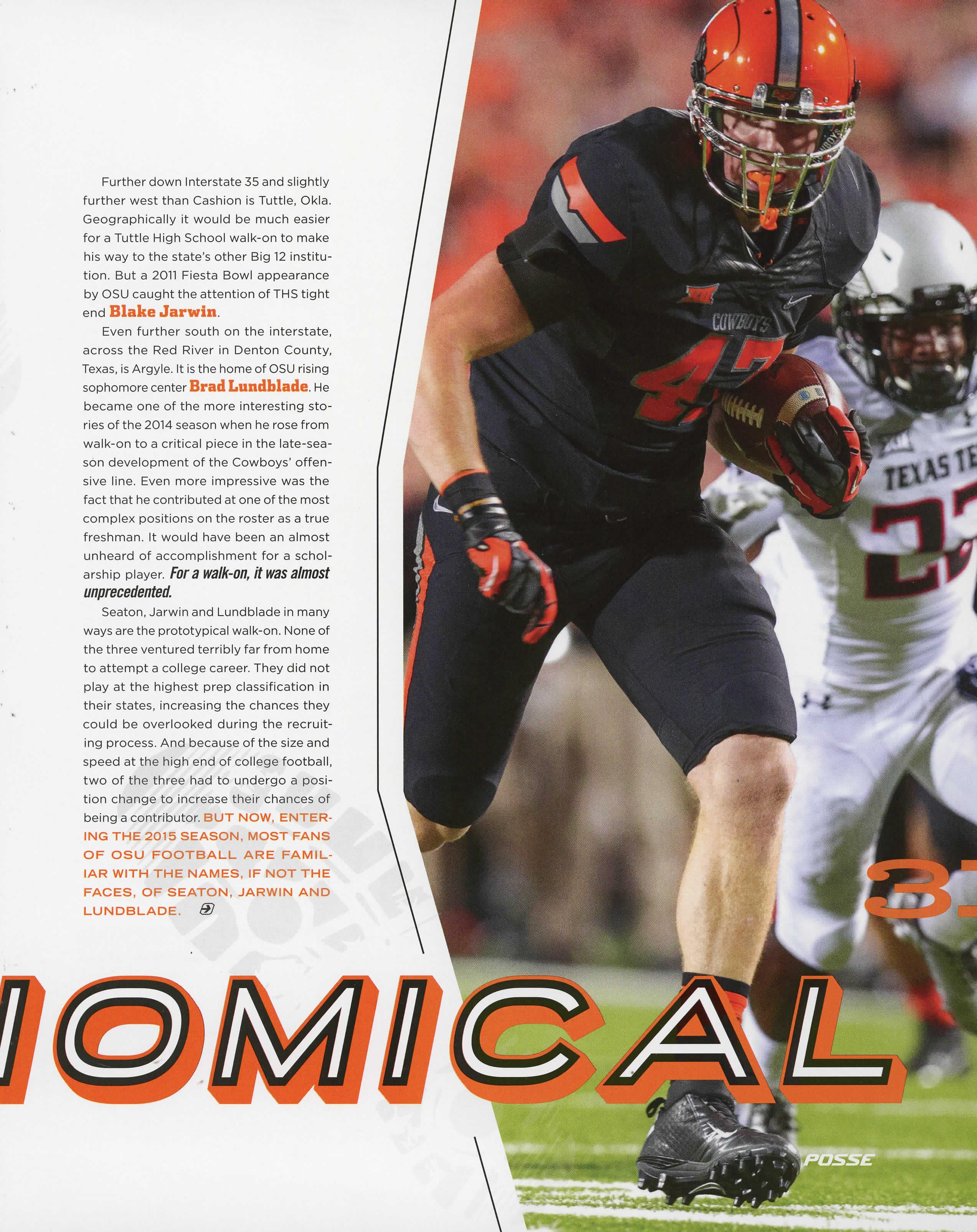
The typical OSU fan would consider Blake Jarwin a saved soul.
"I actually grew up an Oklahoma fan for a long time," he said. "Tuttle is about 20 minutes from Norman and (former OU quarterback) Jason White was sort of a hometown hero."
But Jarwin's fandom began to take a turn in 2011 when Oklahoma State rolled to the Big 12 title. The run to the BCS win over Stanford caught his attention and an orange-inclined family completed the switch.
"I always knew who COOPER BASSETT was," Jarwin said. "When I was in middle school he was the high school superstar, and I knew when he went to OSU he made all sorts of plays."
Cooper's younger brother, Dawson, is on the current OSU roster.
"I was talking to Dawson one day in the Tuttle weight room and he was telling me that all of those Division II offers were great and I could do that or I could try to win a Big 12 championship one day. That helped me make my choice to come here as a walk-on."
OklahomaStatehasbeenoneofthewinningestprograms in collegefootballsince thebeginningofthe2008seasonand that run of success not only caught the eye of Jarwin, but also of Lundblade.
"Around my junior year I started getting what I would guess to be mass recruiting mailers that they send out to a lot of people," he said. "My dad and I came to a game my junior year of high school, and I just really liked it. That was a time when OSU was really successful. We had always followed the Big 12 closely so once I started getting things from them in the mail, I really started paying attention.
"THISWASTHEONLYPLACE I CONSIDERED WALKINGON,"he added. "At that point I was getting recruited pretty hard here, and I thought I was really close to getting a scholarship offer. I sort of had my heart set on Oklahoma State, I guess like my dream school."
Lundblade had 11scholarship offers, including Tulsa, North Texas, Wake Forest and San Diego State. His position on the roster as a preferred walk-on and his spot on the early report list were a given.
WE ARE GOING TO PLAY THE PLAYERS THAT EARN THE RIGHT, REGARDLESS OF THEIR STATUS AS A WALK-ON OR SCHOLARSHIP PLAYER."
That Awkward Moment FOR EVERY COLLEGE FRESHMAN THERE IS A TRANSITION. It happens in the residence halls, in the Greek houses, maybe in a college classroom for the first time and CERTAINLY INSIDE A FOOTBALL COMPLEX - ESPECIALLY FOR A WALK-ON.
"I came in after school had started," Jarwin recalled of his freshman year at Oklahoma State in the fall of 2012. "I go to practice the first time and all of these guys are hopping around and they know exactly where to go. You just try to fit in, and follow everyone around. Probably that entire first year I just didn't really talk to people. I had played offensive line in high school because we were short on linemen and here I was trying to play tight end. I was just trying to make a name for myself and be a part of the team.
"I do remember the first time I was at a team dinner on a Friday night before a game. Coach Gundy said the seniors could go eat, and I didn't hear that part so I stood up and wondered why no one else was getting up. It took a second for me to catch on. That was embarrassing of course."
If ever there was a headliner walk-on it would be Lundblade, he of the 11 scholarship offers. But he was still a true freshman at OSUand a walk-on.
"I remember walking down the coaches' hallway really early on," Lundblade said. "I saw (offensive' coordinator MIKE) YURCICH coming down the other direction, and I spoke to him. He kind of nodded and said 'What's up' and kept walking."
"I know he had no idea who I was at that point. I was so new and not a scholarship player and I was going against the defense as part of the scout team offense every day and just wasn't really around him.
JOE WICKLINE had been my recruiting coach, and he wasn't around by the time I got here. But the coaches were always respectful and treated the walk-ons the same as the scholarship guys."
Seaton at least had his awkward moment in private.
"It was unbelievable because I came in July and was here for the workouts," he said. "I knew coming in I wouldn't be strong enough for these guys. I've never been very good in the weight room. I've never been one of those guys.
"I remember driving home with my elbows because I couldn't use my arms. I couldn't walk. I couldn't drive after those weight room workouts. The first four weeks here molded me more than anything I had done my entire life."
I Think I Can, I Think I Can
Every walk-on knows. Maybe he hasn't truly arrived yet. Maybe he still won't complete the climb from anonymous walk-on to hearing his named called by Larry Reece in the public address booth on game days. But every walk-on knows when it happens. They've made an impression on someone important. Suddenly, there are possibilities.
"I knew I wasn't a weight lifter. I knew I wasn't the fastest guy. I knew I wasn't the strongest guy. But I knew I could play football," Seaton said in what could be the motto of walk-ons everywhere. "/ just wantedtogetoutthere.
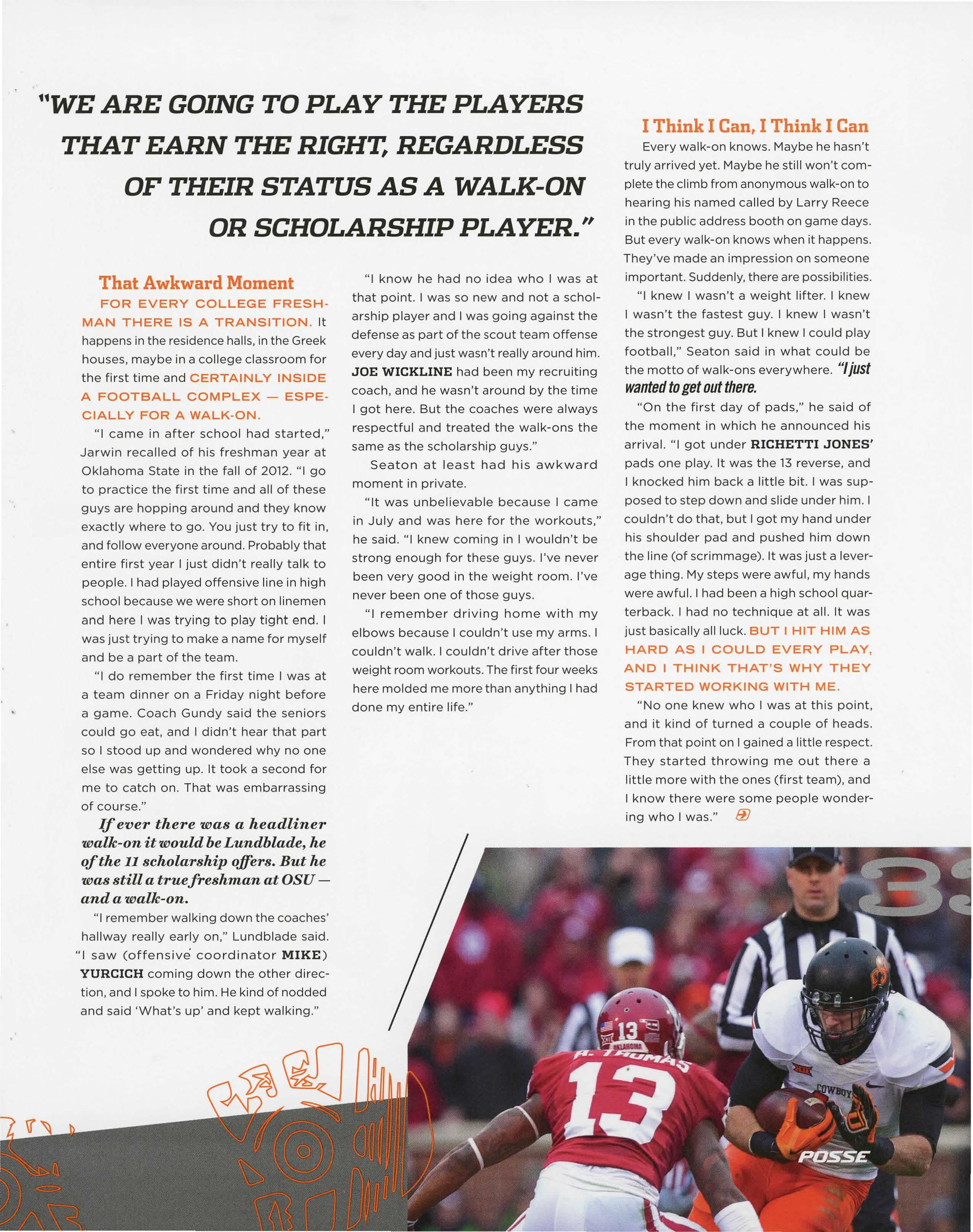
"On the first day of pads," he said of the moment in which he announced his arrival. "I got under RICHETTI JONES' pads one play. It was the 13 reverse, and I knocked him back a little bit. I was supposed to step down and slide under him. I couldn't do that, but I got my hand under his shoulder pad and pushed him down the line (of scrimmage). It was just a leverage thing. My steps were awful, my hands were awful. I had been a high school quarterback. I had no technique at all. It was just basically all luck. BUT I HIT HIM AS HARD AS I COULD EVERY PLAY, AND I THINK THAT'S WHY THEY STARTED WORKING WITH ME.
"No one knew who I was at this point, and it kind of turned a couple of heads. From that point on I gained a little respect. They started throwing me out there a little more with the ones (first team), and I know there were some people wondering who I was." ff)
"I thought I was going to play against Arizona and my family came up for the game, but it didn't work out," he said. "The next week was that midnight game at Tulsa. In the first quarter they called my formation but there was a timeout. TODD MONKEN (former offensive coordinator) called down and said for them to get me out, we weren't running that play anymore. Later he told me that it would have been stupid to use my redshirt for a formation we don't use much."
Thanks to that decision, Seaton is around for the Cowboys in 2015.
It took Lund blade a little longer to make an impression on the coaching staff, but his impact was the quickest among the trio.
"I always thought I could play at this level," he said. "That's why I was waiting out a scholarship. And then when I got here I really felt like the first couple of weeks of practice gave me confidence. I was going against two of the best defensive tackles in the league every day in Ofa Hautau and James Castleman.
"COACH (ERIC) HENDERSON ran the offensive scout team, and he kept telling me the coaches were keeping their eyes on me," he added. "Even Glenn Spencer (OSU's defensive coordinator) kept telling me to work hard and my time would come. I think that was really the first time I knew I had made an impression was when I heard from coach Spencer."
Butdespitethepositivefeedbackfromthe coaches,Lundbladewastoldthathewould redshiftduringthe2014season.He would follow the normal blueprint for an offensive lineman, who typically don't begin to execute at a high level until their third
One week at practice, Jarwin got to pretend he was a Heisman Trophy contender as he portrayed Kansas State quarterback COLLIN KLEIN as the scout team quarterback.
"I made a few plays I don't think they expected me to make," he said. "I made it through a few holes, and I started thinking I just might be able to make an impact here. I always thought, even as a little kid, that I wanted to play at a Division I school. I felt like if I worked hard enough I would eventually get the opportunity. And that week against Kansas State it was great just to get to make plays, even if it was on the scout team."
NOT LONG AFTER HIS SCOUT TEAM EXPLOITS, JARWIN HAD HIS ARRIVAL MOMENT. "Coach Gundy came up to me and said they were going to move me to tight end. That was a bit of reward and then I got to start traveling for the rest of the year. That was the light at the end of the tunnel."
The Arrival
Although Jarwin was making plays on the scout team, he still had a long wait for the culmination of those childhood dreams. His first game at Oklahoma State was the 2012 season opener against Savannah State. It was the beginning of what would be a redshirt year for him, although he did make his first road trips with the team, which is not an insignificant development in the world of a walk-on.
In 2013, he in essence went through a second redshirt season. It was another year of practice and travel but no game time. A redshirt season is a tough time for scholarship and non-scholarship players alike. Two straight years of practice time without any game snaps is the epitome of the walk-on story and a big reason why most walk-ons don't last four years.
Butin2014,Jarwingothischance.
"My first career game was against Florida State," he said. "I got a kickoff kicked to me. I remember a little bit of it. After a while I settled down."
Acoupleofweekslater,intheBig12opener againstTexasTech,thewalk-onfromTuttle enteredthescoringcolumn.He caught a 47-yard touchdown pass from Daxx Garman in the third quarter to extend OSU's lead to two touchdowns.
"Yeah it was a great feeling,'" he said. "I remember catching the ball and seeing nothing in front of me. I stumbled a bit thinking someone was going to be there so I lowered my shoulder and then I just kept going."'
He would end the season with five catches, including two against Texas and a 14-yarder in the Cactus Bowl win over Washington. And with the tight end returning to the OSU offense, his numbers.figure to rise during the course of his career.
Of this particular trio of walk-ans, Seaton is the oldest and the most accomplished. He saw the field often in 2012, but OSU was rarely in a "jumbo" formation, which would have included a fullback and/or a tight end.
"I took the tight end reps, which might be just two or three a game, and I split fullback reps with Kye Staley,'' he said.
The first offensive statistic of his career was a three-yard reception against West Virginia. Two weeks later he returned a kickoff 17 yards against Oklahoma. But his big moment came in the Heart of Dallas Bowl win over Purdue.
"It was something I wasn't sure would ever happen."
WHATHAPPENEDWASA16-YARDTOUCHDOWNRECEPTION.
"JUSTIN HORTON played his entire career as a tight end and never scored a touchdown.
"We practiced that play a lot, and they never threw the ball to me one time," Seaton added. "It always went to Kye out in the flat. I remember when I took off that the safety bit, and I might actually have a
chance. CLINT (CHELF) threw the pass, and I think I blacked out for a minute. I DON'T REMEMBER CATCHING IT. BUT I DO REMEMBER LINING UP FOR THE EXTRA POINT."
Since that time, Seaton has become an important part of the offense. In 2014, his junior season, he caught 13 passes, including three for 51 yards in the win at Oklahoma and four for 40 yards against Washington in the bowl game. He set up Cowboy touchdowns against the Sooners and Huskies.
While Seaton and Jarwin had a slow but steady ascent up the depth chart, Lundblade jumped from anonymity to the starting lineup seemingly overnight.
"It was always my goal to play as true freshman," Lundblade said. "But when they told me I was going to redshirt, I accepted the fact that they didn't want me to play this year and that I had a lot of developing to do under coach Glass."
But while Lund blade was taking his turn toiling on the scout team, the Cowboys were struggling up front and the OSU staff was constantly evaluating the roster. Following a closewinatKansas,Lundblade's lifechanged.
"It was TCU week," he said. "They brought me in on a Monday. Coach (Bob) Connelly texted me and asked me to come into the office. He had us in his office all the time so I didn't think that much about it. He pulls me in and says they are going to play me this week."
First thoughts?
"Whoa! It caught me off guard. I knew I was doing well and working hard, but I didn't really think I was going to play in a game. I called my roommate to come and pick me up," he added. "We were freaking out in the car. Then I called my dad, and he couldn't believe it.
"It was a lot of stress. I had been on the scout team during KU week and so I had a lot of questions. I was in the office a lot."
Lund blade split playing time with Paul Lewis at TCU and the two alternated at the position the rest of the season, including OSU's two-game winning streak to end 2014.
"It was crazy," Lundblade said of the 2104 stretch run. "I would guess the biggest crowd I played in front of in high school was 3,000. Our bench (at TCU) was right in front of their students so they were letting us have it the whole game. There was just so much going on and TV cameras and TV reporters. It was unlike anything I had experienced."
Before And After
Even though Lundblade has been in Stillwater just over a year, he feels transformed.
"I'm not even the same person, mentally or physical, that I was just last year," he said. "I was actually cleaning out my room the other day and found the playbook that I got when I first came to town. I saw all of my notes and my questions. It's amazing to think how far I've come. The coaches have done a great job with that. I've grown a ton in a year."
"There were definitely hard times, and I would call home and my mom would tell me just to stick it out and that I would get my chance," Jarwin said. "I think about that all the time. But at the same time I knew I had been blessed to even have this opportunity and now I laugh at what I was thinking before. I wouldn't give this up for anything now. I've worked too hard and come too far."
Leave it to the grizzly veteran, the senior fullback, to best describe the walkon experience.
"I remember looking back at when I first got here and wondering what the hell I was doing. This is awful. Why am I doing this?"
Seaton said. "But it gave me a work ethic and helped me with time management. Now I don't think there's anything I can't accomplish.
"I THINK IT WAS THE BEST DECISION OF MY LIFE."
Two weeks into the 2015 fall camp, OSU head football toach Mike Gundy announced in a team meeting that Blake Jarwin and Brad Lundblade were receiving the ultimate goal for walk-ans. Both were being awarded scholarships.Jeremy Seaton was placed on scholarship in 2013.
STORYBYCLAY BILLMAN
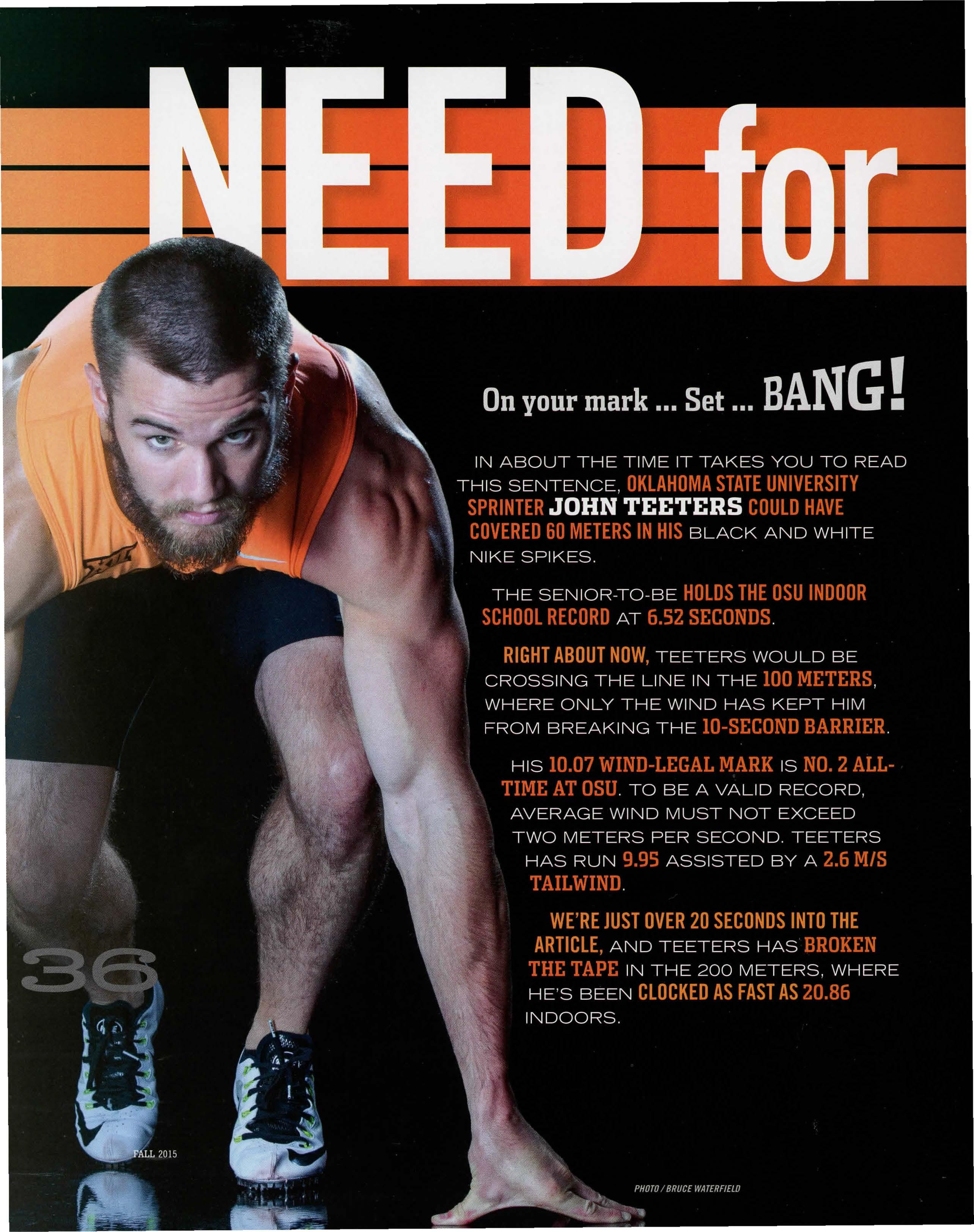
TOSAYTHECOWBOYSPRINTERIS ONTHEFASTTRACKWOULD BEANUNDERSTATEMENT - NOTTOMENTION A BADPUN.
FRESHSTART
But the fact is that Teeters, with the help of second-year sprints coach DIEGO FLAQUER,has put OSU sprinting back on the map after a 30-year hiatus.
In the early 1980s, a number of Cowboys were among the nation's - if not the world's - fastest athletes. Those squads included JAMES BUTLER, 1982 NCAA champion in the 200 meters and the world's top-ranked runner at that distance, along with fellow All-Americans STERLING STARKS and RON INGRAM.
In the three decades hence, OSU squads became more middle- and long-distanceoriented, featuring milers, SK and lOK runners who could also comprise a competitive cross country roster from a finite number of scholarships.
In recent years, OSU Director of Track and Field and Cross Country Dave Smith has sought to build a more wellrounded track and field program, allocating a larger share of financial aid to field events, as well as sprinters.
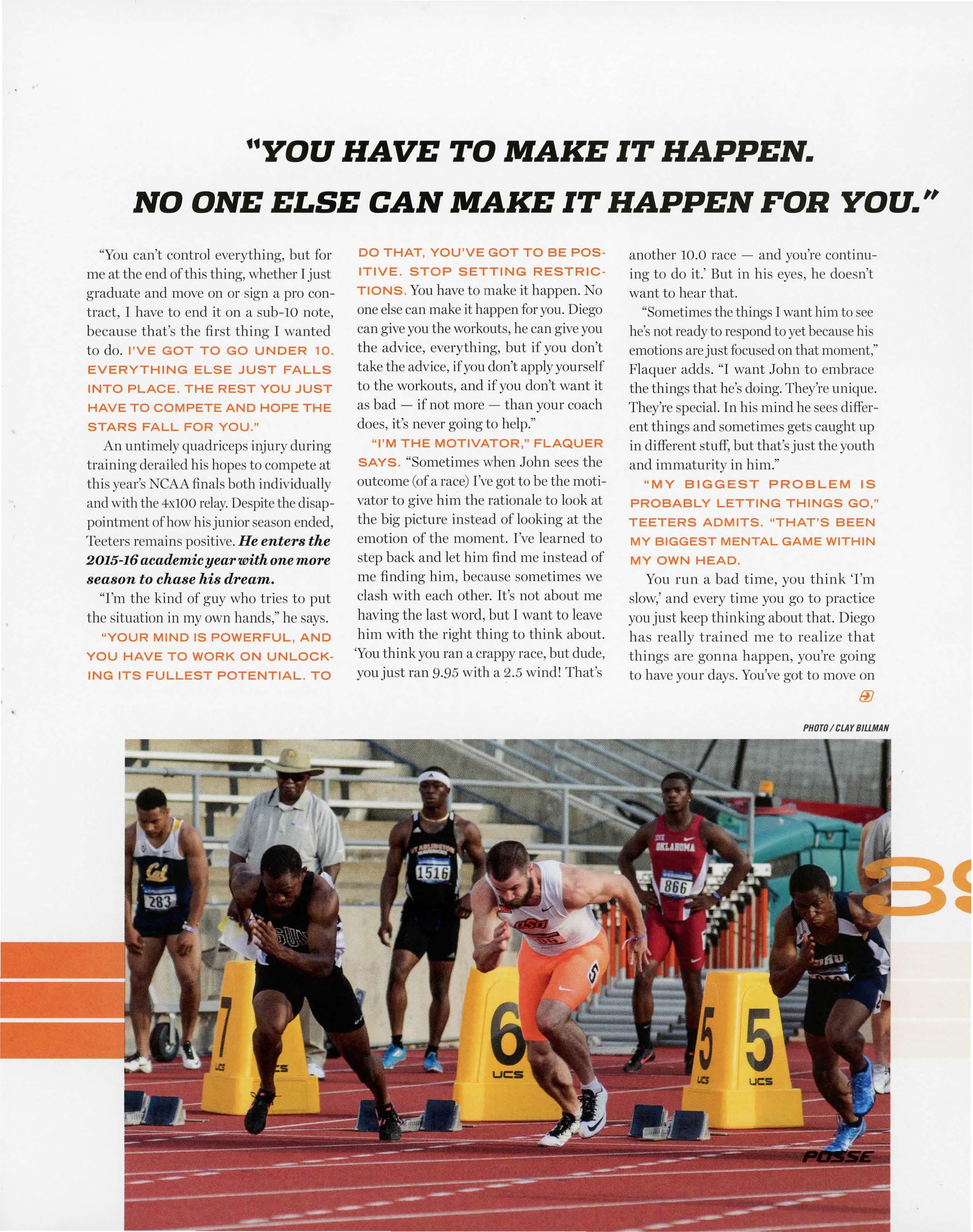
FLAQUERANDTEETERSARRIVEDINAUGUST OF2013,ASOSUDEBUTED A BRANDNEW TRACKANDFIELD"COMPLEX on the north end of the Athletic Village. The timely convergenceof a first-ratefacility,a dedicatedcoachanda rawtalent has helpedbring new life to the sprints program.
A 2012graduate of Edmond Memorial High School, Teeters ran a personal best of 10.55 in the 100 meters and was a two-time runner up in Class 6A. Along with his Bulldogteammate, Bryce Robinson, Teeters initially took his talents up the Turner Turnpike to the University of Tulsa.
"EDMOND HAS A REALLY BIG POOL OF TALENTED ATHLETES AND GOOD FACILITIES," Teeters says. "My junior year I got second at state, and the next year I was planning to win it. Then Bryce came after football season. He had been doing wrestling and baseball, but everyone (me included) said he needed to come out and run because he's fast as hell. So he came out and beat me - I got second again. It didn't really hurt, because our 4xl00 relay was fast and we won state."
The friendly rivalry continued at Tulsa. As freshmen, Teeters and Robinson competed day-in and day-out. It wasn't the healthiest situation for a young runner like Teeters.
"AT TULSA, PRACTICE WAS NOT PRACTICE. IT WAS A COMPETITION EVERY DAY," Flaquer says. "He never knew how to differentiate what a practice was versus a competition, because every day at practice John was thinking he had to beat Bryce. 'I gotta find a way
to beat Bryce. If I do that I'm going to be good' ... because Bryce had a very successful freshman year."
Teeters also showed flashes of potential with the Golden Hurricane, breakingthe schoolrecordin the 100 meterswith a personal best of 10.27. But despite a promising fresh man campaign, Teeters felt TU wasn't the right fit.
"I THINK IN THE BACK OF HIS MIND HE WANTED TO CREATE HIS OWN THING, HIS OWN IDENTITY," FLAQUER EXPLAINS.
''After deciding to transfer from Tulsa, I was looking at several different schools," Teeters says. "OSU didn't have any sprinters, but I kinda wanted to stay close to home, so I just thfow in one ofrny releases to OSU, like 'what the heck, let's see what happens.' When I first sent in my release form, there wasn't a new track facility yet. It was still the old one.
"I got a call from OSU, and they sai they didn't really have a sprint progra n"::''-======so l ruled them out. I was going to go somewhere else.
"After some turn of events, I ended up not having a school," Teeters adds.
"Some things happened in the recruiting process, and I was pretty much left hanging. I thought I'd end up at somejunior college or someplace I didn't want to be."
OSUannouncedFlaquer'shiring on AugustI. Teetersreceivedaphonecall shortlythereafter.
"Diego called me about a month before school started. He said, 'Hey, we have a sprint program now.' I looked at his resume and thought it was time to take a leap of faith. Let's give this guy a shot. I might as well try and invest in it, I have nothing else to lose. So, that's how I ended up at Oklahoma State."
"He and I talked a couple times," Flaquer recalls. "I told him what my situation was here, what we were trying to get going, where he fit in and things like that. We had a really good connection over the phone, and he came over right after my first or second day on the job.
"I JUST TOLD HIM, BASED ON HOW I SAW THE SITUATION HERE, THAT HE COULD VERY EASILY BECOME THE FACE OF THE SPRINT PROGRAM," FLAQUER SAYS. "HE TOOK A CHANCE ON US. HE TOOK A CHANCE ON ME."
Flaquer says it couldn't have worked out any better for both parties involved.
"I always joke around with John that I'm the best thing that's ever happened to him," Flaquer says. "He laughs, but I DO THINK WE WERE THE BEST SITUATION FOR HIM.
"Now that I've coached him over the last two years, knowing him, he probably wouldn't have made it at a more established sprint program. There are too many egos. He already has a very powerful personality, and that personality can clash with a lot of other people.HIS PERSONALITY IS SO HIGH STRUNG, AND HE'S SO DRIVEN, SO DETERMINED."
"We're both really chill, but when it comes to track we can get hot-headed. We're both really competitive," Teeters admits. "WHEN THE TWO ENERGIES GO TOGETHER, WHEN WE CONNECT, SPECIAL THINGS HAPPEN."
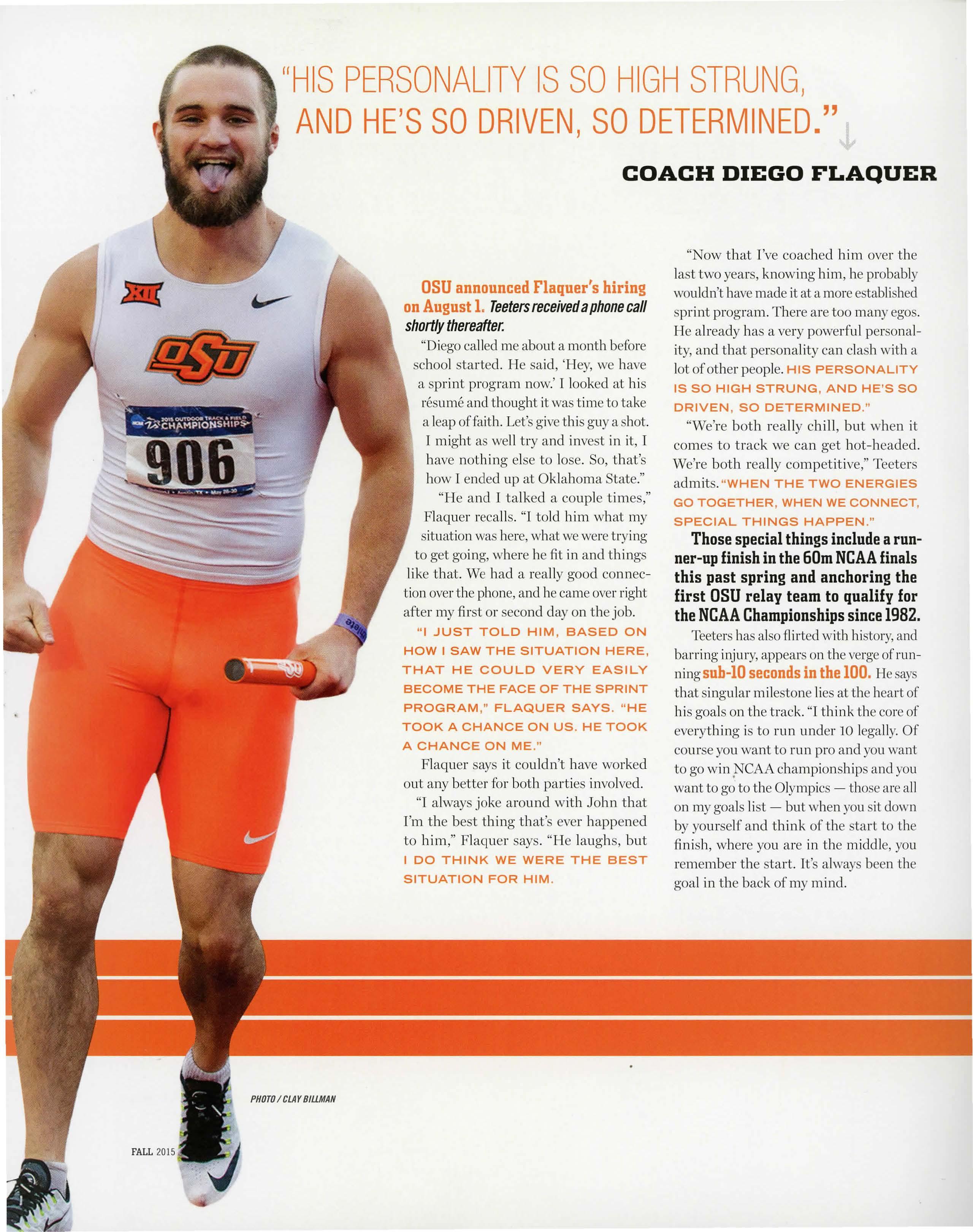
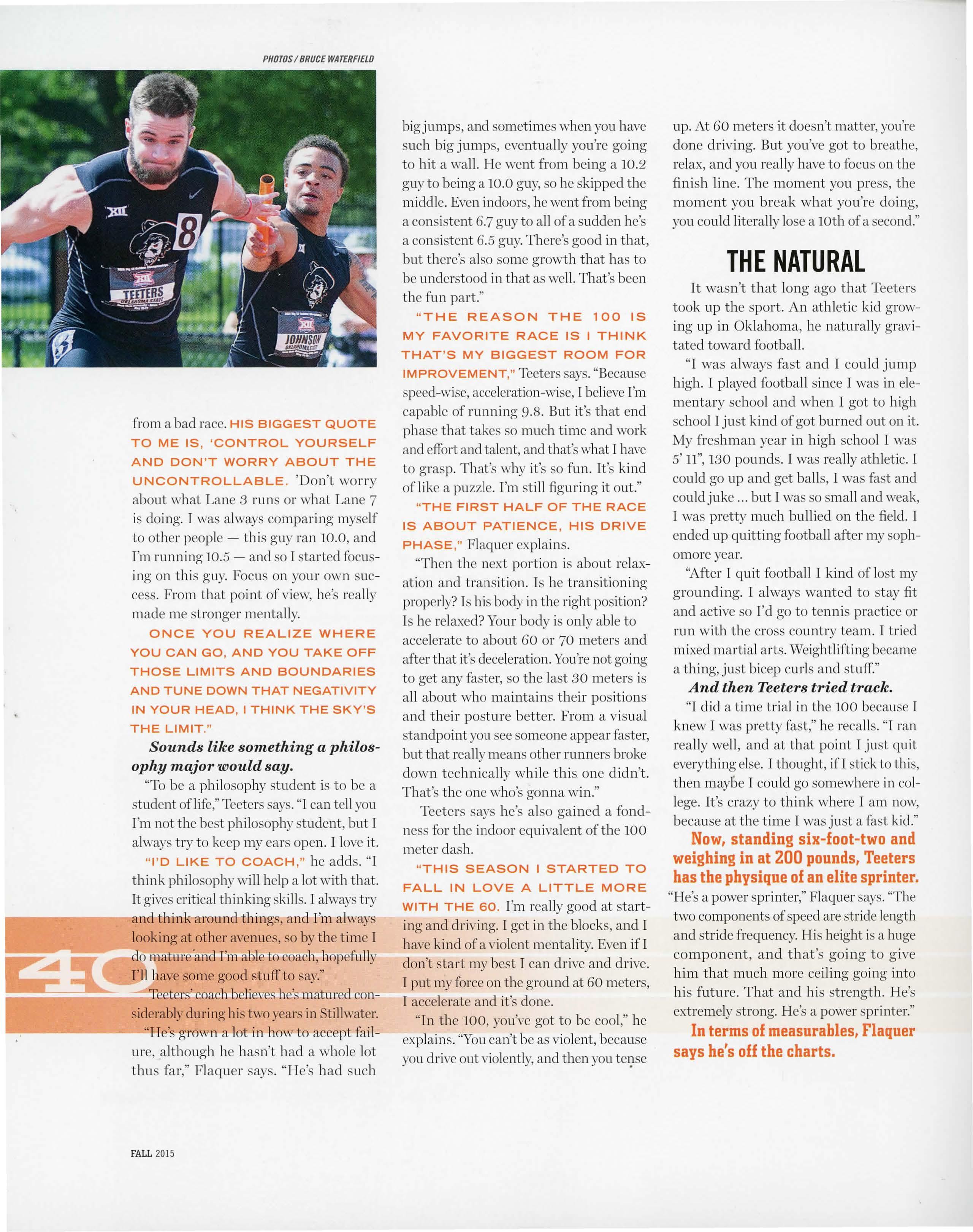
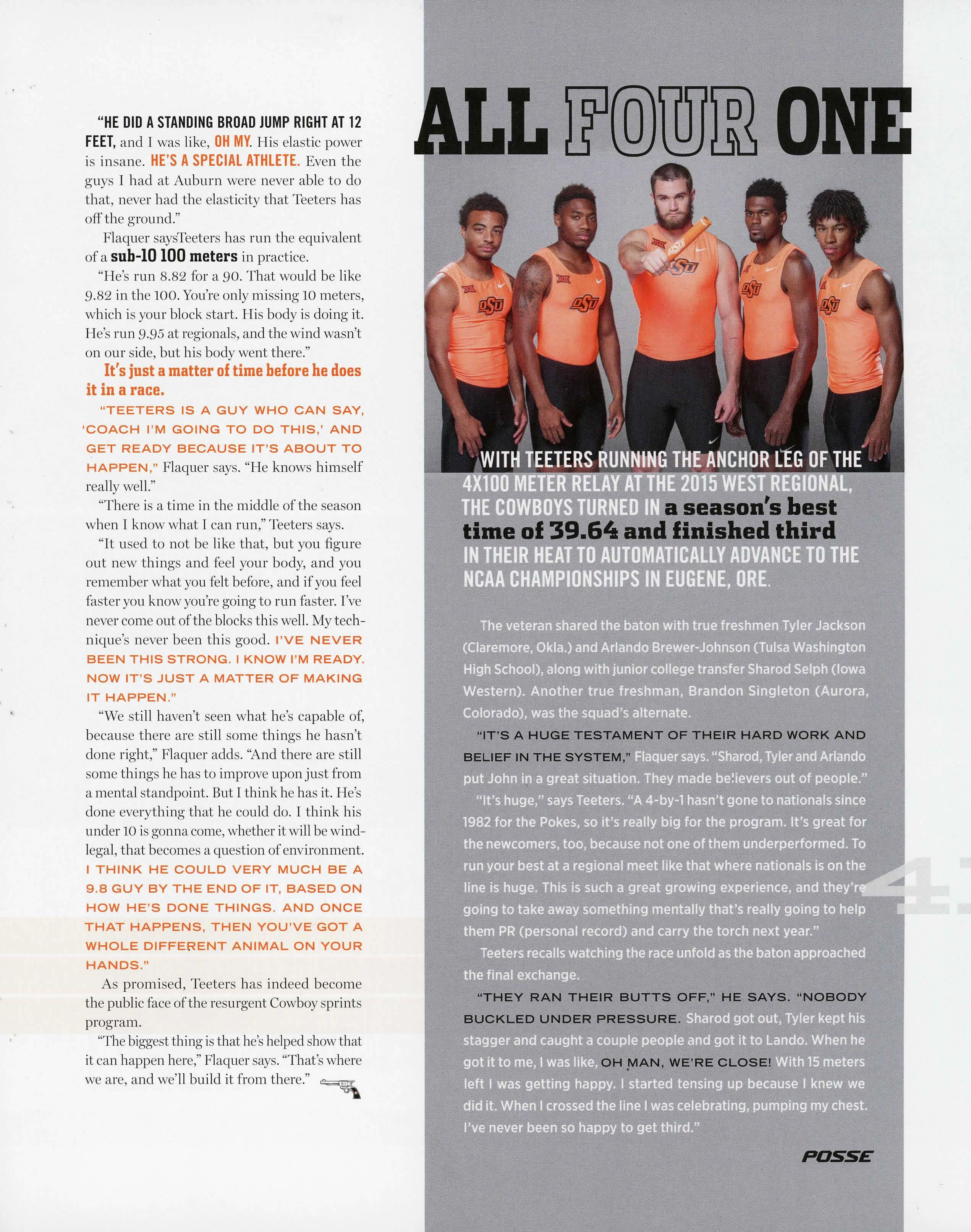
Thosespecialthingsincludea runner-upfinishin the 60m NCAAfinals this past spring and anchoringthe first OSUrelay team to qualify for the NCAAChampionshipssince 1982.
Teeters has also flirted with history, and barring injury, appears on the verge of running sub-IOsecondsin the100. He says that singular milestone lies at the heart of his goals on the track. "I think the core of everything is to run under 10 legally. Of course you want to run pro and you want to go win _NCAAchampionships and you want to go to the Olympics - those are all on my goals Iist - but when you it down by yourself and think of the start to the finish, where you are in the middle, you remember the start. It's always been the goal in the back ofmy mind.
11 YOU HAVE TO MAKE IT HAPPEN.
NO ONE ELSE CAN MAKE IT HAPPEN FOR YOU.##
"You can't control everything, but for me at the end of this thing, whether I just graduate and move on or sign a pro contract, 1 have to end it on a sub-IO note, because that's the first thing I wanted to do. l'VE GOT TO GO UNDER 10. EVERYTHING ELSE JUST FALLS INTO PLACE. THE REST YOU JUST HAVE TO COMPETE AND HOPE THE STARS FALL FOR YOU."
An untimely quadriceps injury during training derailed his hopes to compete at this year's NCAA finals both individually and with the 4xl00 relay.Despite the disappointment of how his junior season ended, Teeters remains positive. He enters the 2015-16 academic year with one more season to chase his dream.
"I'm the kind of guy who tries to put the situation in my own hands," he says.
"YOUR MIND IS POWERFUL, AND YOU HAVE TO WORK ON UNLOCKING ITS FULLEST POTENTIAL. TO
DO THAT, YOU'VE GOT TO BE POS· ITIVE. STOP SETTING RESTRIC· TIONS. You have to make it happen. No one else can make it happen for you. Diego can give you the workouts, he can give you the advice, everything, but if you don't take the advice, if you don't apply yourself to the workouts, and if you don't want it as bad - if not more - than your coach does, it's never going to help."
"l'M THE MOTIVATOR," FLAQUER SAYS. "Sometimes when John sees the outcome (of a race) I've got to be the motivator to give him the rationale to look at the big picture instead of looking at the emotion of the moment. I've learned to step back and let him find me instead of me finding him, because sometimes we clash with each other. It's not about me having the last word, but 1 want to leave him with the right thing to think about. 'You think you ran a crappy race, but dude, you just ran 9.95 with a 2.5 wind! That's
another 10.0 race - and you're continuing to do it.' But in his eyes, he doesn't want to hear that.
"Sometimes the things I want him to see he's not ready to respond to yet because his emotions are just focused on that moment," Flaquer adds. "I want .John to embrace the things that he's doing. They're unique. They're special. In his mind he sees different things and sometimes gets caught up in different stuff, but that's just the youth and immaturity in him."
"MY BIGGEST PROBLEM IS PROBABLY LETTING THINGS GO," TEETERS ADMITS. "THAT'S BEEN MY BIGGEST MENTAL GAME WITHIN MY OWN HEAD.
You run a bad time, you think Tm slow,' and every time you go to practice you just keep thinking about that. Diego has really trained me to realize that things are gonna happen, you're going to have your days. You've got to move on
PHOTO/CLAYBILLMAN
from a bad race. HIS BIGGEST QUOTE TO ME IS, 'CONTROL YOURSELF AND DON'T WORRY ABOUT THE UNCONTROLLABLE. 'Don't worry about what Lane 3 runs or what Lane 7 is doing. I was always comparing myself to other people - this guy ran 10.0, and I'm running 10.5 - and so I started focusing on this guy. Focus on your own success. From that point of view, he's really made me stronger mentally.
ONCE YOU REALIZE WHERE YOU CAN GO, AND YOU TAKE OFF THOSE LIMITS AND BOUNDARIES AND TUNE DOWN THAT NEGATIVITY IN YOUR HEAD, I THINK THE SKY'S THE LIMIT."
Sounds like something a philosophy major would say.
"To be a philosophy student is to be a student oflife,"Teetcrs says. "I can tell you I'm not the best philosophy student, but I always try to keep my ears open. I love it.
"l'D LIKE TO COACH," he adds. "I think philosophy will help a lot with that. It gives critical thinking skills. I always try and thi11lnuouncl things, and I'm always looking at other avenues, so by the time I do mature.and I'm able to coach, hopefully I' I have some good stuff to say."
Teeter 'coach beJieve he's111atmedconsiderably during his two years in Stillwater. &....,,-------- "He's-gl'0wn a lot in how to accept failure, although he hasn't had a whole lot thus far," Flaquer says. "He's had such
big jumps, and sometimes when you have such big jumps, eventually you're going to hit a wall. He went from being a 10.2 guy to being a 10.0 guy, so he skipped the middle. Even indoors, he went from being a consistent 6.7 guy to al I of a sudden he's a consistent 6.5 guy. There's good in that, but there's also some growth that has to be understood in that as well. That's been the fun part."
"THE REASON THE 100 IS MY FAVORITE RACE IS I THINK THAT'S MY BIGGEST ROOM FOR IMPROVEMENT," Teeters says. "Because speed-wise, acceleration-wise, I believe I'm capable of running 9.8. But it's that end phase that takes so much ti me and work and effort and talent, and that's what J have to grasp. That's why it's so fun. It's kind of like a puzzle. I'm still figuring it out."
"THE FIRST HALF OF THE RACE IS ABOUT PATIENCE, HIS DRIVE PHASE," Flaquer explains.
"Then the next portion is about relaxation and transition. Is he transitioning properly? Is his body in the right position? Ts he relaxed? Your body is only able to accelerate to about 60 or 70 meters and after that it's deceleration. You'renot going to get any faster, so the last 30 meters is all about who maintains their positions and their posture better. From a visual standpoint you see someone appear faster, but that really means other runners broke down technically while this one didn't. That's the one who's gonna win."
Teeters says he's also gained a fondness for the indoor equivalent of the 100 meter dash.
"THIS SEASON I STARTED TO FALL IN LOVE A LITTLE MORE WITH THE 60. I'm really good at starting and driving. I get in the blocks, and I have kind of a violent mentality. Even 1fl don't start my best I can drive and drive. I put my force on the ground at 60 meters, I accelerate and it's done.
"Tn the 100, you've got to be cool," he explains. "Youcan't be as violent, because you drive out violently, and then you tei:ise
up. At 60 meters it doesn't matter, you're done driving. But you've got to breathe, relax, and you really have to focus on the finish line. The moment you press, the moment you break what you're doing, you cou Id literally lose a 10th of a second."
THENATURAL
Tt wasn't that long ago that Teeters took up the sport. An athletic kid growing up in Oklahoma, he naturally gravitated toward football.
"I was always fast and I could jump high. I played football since I was in elementary school and when I got to high school I just kind of got burned out on it. My freshman year in high school I was 5' 11", 130 pounds. I was really athletic. I could go up and get balls, I was fast and could juke but I was so small and weak, I was pretty much bullied on the field. I ended up quitting football after my sophomore year.
"After I quit football I kind oflost my grounding. I always wanted to stay fit and active so I'd go to tennis practice or run with the cross country team. 1 tried mixed martial arts. Weightlifting became a thing, just bicep curls and stuff"
And then Teeters tried track.
"I did a time trial in the 100 because I knew I wa pretty fast," he recalls. "I ran really well, and at that point I just quit everything else. I thought, ifI stick to this, then mayoe I could go somewhere in college. It's crazy to think where I am now, because at the time I was just a fast kid."
Nowtstanding six-foot-two and weighingin at 200 poundstTeeters has the physiqueof an elite sprinter. "He's a power sprinter," Flaquer says. "The two components of speed are stride length and stride frequency. His height is a huge component, and that's going to give him that much more ceiling going into his future. That and his strength. He's extremely strong. He's a power sprinter."
In terms of measurablestFlaquer says hetsoff the charts.
"HEDIDASTANDINGBROADJUMPRIGHTAT12 FEET,and I was like, OHMY.His elastic power is insane. HE'SASPECIALATHLETE.Even the guys I had at Auburn were never able to do that, never had the elasticity that Teeters has off the ground."
Flaquer saysTeeters has run the equivalent of a sub-10100 meters in practice.
"He's run 8.82 for a 90. That would be like 9.82 in the 100. You're only missing 10 meters, which is your block start. His body is doing it. He's run 9.95 at regionals, and the wind wasn't on our side, but his body went there."
It'sjust a matterof timebeforehe does it in a race.
"TEETERS IS A GUY WHO CAN SAY, 'COACH l'M GOING TO DO THIS,' AND GET READY BECAUSE IT'S ABOUT TO HAPPEN," Flaquer says. "He knows himself really well."
"There is a ti me in the middle of the season when I know what I can run," Teeters says.
"It used to not be like that, but you figure out new things and feel your body, and you remember what you felt before, and if you feel faster you know you're going to run faster. I've never come out of the blocks this well. My technique's never been this good. l'VE NEVER BEEN THIS STRONG. I KNOW l'M READY. NOW IT'S JUST A MATTER OF MAKING IT HAPPEN."
"We still haven't seen what he's capable of; because there are still some things he hasn't done right," Flaquer adds. "And there are still some things he has to improve upon just from a mental standpoint. But I think he has it. He's done everything that he could do. I think his under 10 is gonna come, whether it will be windlegal, that becomes a question of environment. I THINK HE COULD VERY MUCH BE A 9.8 GUY BY THE END OF IT, BASED ON HOW HE'S DONE THINGS. AND ONCE THAT HAPPENS, THEN YOU'VE GOT A WHOLE DIFFERENT ANIMAL ON YOUR HANDS."
As promised, Teeters has indeed become the public face of the resurgent Cowboy sprints program.
"The biggest thing is that he's helped show that it can happen here," Flaquer says. "That's where we are, and we'll build it from there."
LLlr@lIDillON
"IT'S A HUGE TESTAMENT OF THEIR HARD WORK AND
"THEY RAN THEIR BUTTS OFF,'' HE SAYS. "NOBODY
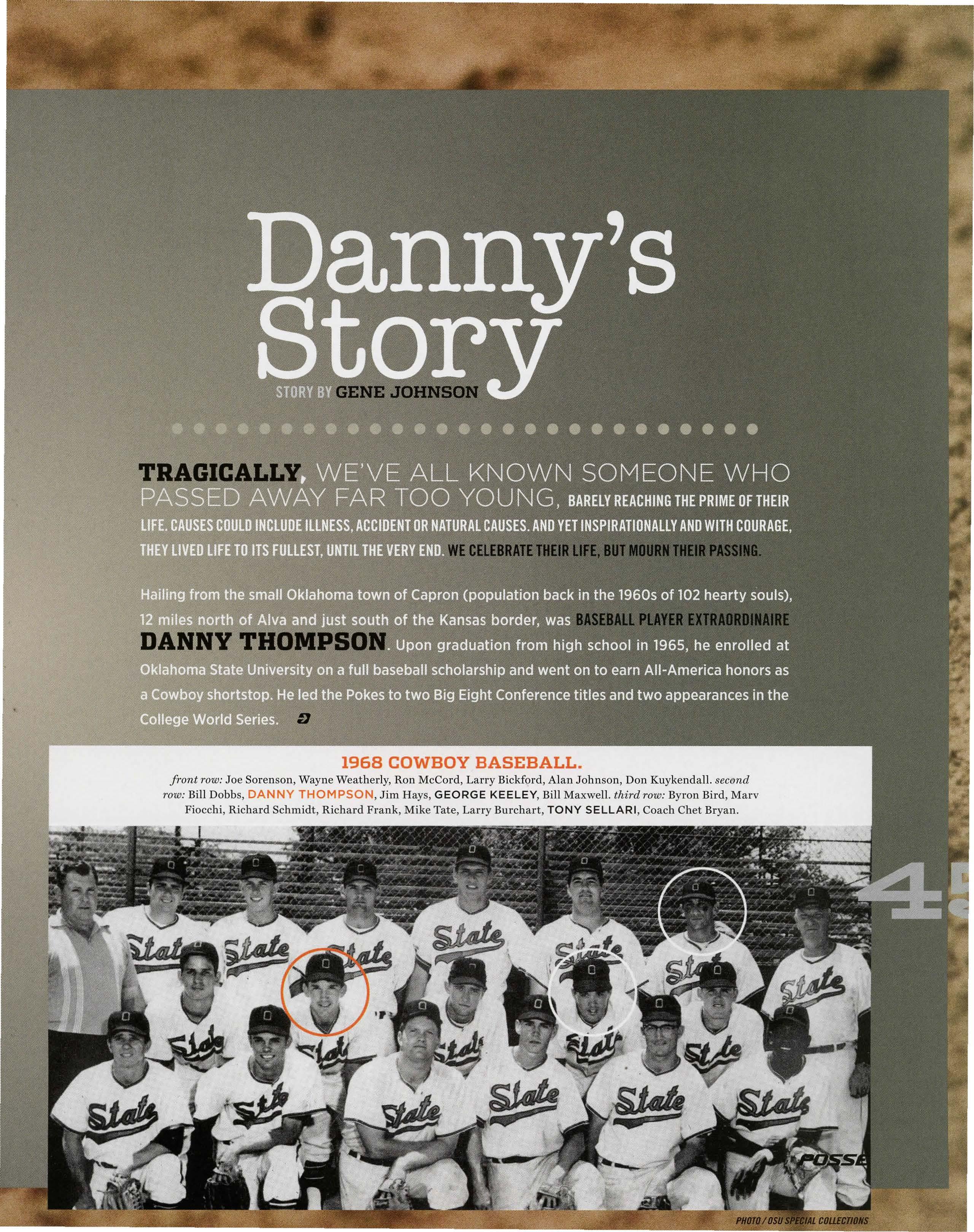
·ontrow: Joe Sorenson, Wayne Weatherly, Ron M
w: Bill Dobbs, DANNY THOMPSON, Jim Hays, Fioccbi, Richard Schmidt Richard Fr •
(D Tony Sellari:
Watching Danny at shortstop was pure poetry for me - the way he covered ground between second and third. His rifle arm was just as potent as his fielding ability. He had a quick release with accuracy, always threw a strike to first.
Following his junior year in 1968, Danny signed with the MINNESOTA TWINS for a $20,000 bonus, plus a $500 monthly salary, to join the TWINS' CLASS A FARM TEAM IN ST. CLOUD, MINN. After two seasons in the minor leagues, he made the Twins' big league roster as a second baseman, a position he'd never played before. But it wasn't long before he was switched to his natural position of shortstop.
Along the way, Danny contracted a slow-moving version of leukemia which eventually took his life. This story is Danny'sstory.
JAMES AND MARGARET THOMPSON had six children, Danny being the second of the bunch. The family ran a diversified business in Capron, a town so small that it didn't have a stoplight. In an old stucco building, the Thompsons sold sundry items and operated a cafe and beer joint. Several years after Danny arrived, the business was sold and Danny's father worked as a nurse's aide at the Wichita, Kan., veterans' hospital. His mom kept books for the local grain elevator during wheat harvest. Later the family ran a rabbitry, selling rabbits to packing houses in Rogers, Ark., and Ft. Hays, Kan. Because of a severe case of hay fever, Danny didn't work the fields with the rest of the kids.
SHEILA, Danny's younger sister by nine years, recalls being hauled many times in the back seat of the family sedan to ball game after ball game to watch Danny play.
"DANNY PLAYED LITTLE LEAGUE IN ALVA. ME AND MY YOUNGER SISTER, PHOEBE, STARTED MAKING THESE TRIPS WHEN WE WERE STILL IN DIAPERS," she laughed. "Then, as we got a little older, Mom and Dad would drive us to Enid to watch him play American Legion ball. I DON'T RECALL OUR FAMILY EVER MISSING A GAME. During those summers of Legion ball, Danny stayed in Enid with the Henderson and Beatty families. Both had boys on the team."
Brother MONTY, three years younger than Danny, also made most of those trips and would go on to play baseball his freshman year for the Pokes. Older brother JIMMIE, three years Danny's senior, excelled at basketball and spent
his summers working the wheat harvest. Another sibling, BENNY, was born 11 months after Danny, but passed away from asthma when he was 20-months-old.
"I recall one high school game that Danny pitched," said Jimmie. "He had a strong arm, struck out 28 batters and still lost 1-0. Danny's catcher dropped a lot of third strikes, which allowed several runners to get on base. Not many pitchers have struck out that many and didn't win."
Jimmie and Danny played one year of high school basketball together. "DANNY BECAME PRETTY GOOD AND AVERAGED 28 POINTS PER GAME AS A SENIOR," said Jimmie. "He was just a superb athlete, good coordination with huge strong hands, and always worked very hard. BUT FROM A VERY EARLY AGE, ALL DANNY EVER WANTED TO BE WAS A BASEBALL PLAYER."
After high school, Danny was six-feet tall, weighed 180 pounds, wore size 12 shoes and'was DRAFTEDBYTHENEWYORK YANKEES. He always joked that the doctor told him that if he ever grew into his hands, he'd be a large man.
"I don't know if it would be legal today, but before the draft a couple of guys from the LOS ANGELES DODGERS came and picked up Danny and drove him to somewhere in New Mexico where they worked him out for several days," Jimmie recalled. "But DANNY FIGURED THE BEST THING FOR HIM AT THE TIME WOULD BE TO ACCEPT A SCHOLARSHIP FROM OSU, which he did."
Later, while with the Twins.Danny coauthored a book, E-6,with Twins' sports writer BOB FOWLER. To anyone keeping a baseball scorecard, THETERME-6SIGNIFIESANERRORBYTHESHORTSTOP and if there was anything Dannyhated to do, it was commitan error.
In his book, Danny talks about high school: "There were only 29 students in the top four grades my senior year, and a total of four in my class, all of us boys. Needless to say; our senior prom was a dud. Also, I was salutatorian of my class which meant I was in the top 50 percent!"
According to sister Sheila, "DANNY'S SWEETHEART, JO LAYMAN, WAS FROM BURLINGTON AND HER PARENTS WERE BIG SOONER FANS SO JO ENROLLED AT OU with the intention of studying pre-med. But that only lasted a couple of years before she and Danny got married."
Former Cowboy teammate, catcher Tony Sellari, fondly remembers Danny. "I admired Danny on and off the field," he said. "HE WAS NEVER A SHOWBOAT OR A BASK-IN-GLORY GUY. HE WAS HUMBLE ... A PLAYER WHO DID HIS JOB IN QUIET FASHION. From my position, I got to see all the action on the field. Watching Danny at shortstop was pure poetry for me - the way he covered ground between second and third. His rifle arm was just as potent as his fielding ability. He had a quick release with accuracy, always threw a strike to first.
"I don't remember him making an error. As I watched him play, game after game, he amazed me. HIS HITTING WAS EXTRAORDINARY, but he could hit the ball to all fields and was a line drive hitter who seemed to always make solid contact. He madE; a lasting impact on me. I expected big things from him, and he didn't disappoint me. TO SUM IT UP, I LOVED WATCHING DANNY PLAY. I can still picture him moving smoothly to his right in a crouched position to field a hot grounder and come up ready to fire a bullet to first."
Former teammate George Keely said of Danny, "I REMEMBER DANNY AS A QUIET, GOOD NATURED GENTLEMAN WHO GOT THE JOB DONEnot shy, but mannerly and soft spoken. His throws were like a machine, always shoulder high great hands and strong. Danny was a good hitter, always got good wood on the ball and sprayed the ball."
OSU alum Bob Graalman, several years younger than Danny, was a member of Danny's fraternity. "Those frat brothers who were there with Danny recall his genuine small town warmth and generosity. Danny was asked to join the fraternity's volleyball team, which he did, and he became a skilled, hard hitting player on a championship intramural team."
Freshmen didn't play for the varsity in the 1960s. An All-Big Eight selection his sophomore and junior seasons, Danny hit .349 that second season and was chosen as a first-team All-American and made the College World Series all-tournament team. He was then drafted by the Twins and began his professional career.
In f-6, Danny tells the story of his first time on the infield with future Hall of Fame outfielder/first baseman HARMON KILLEBREW: "KILLEBREW CALLED ME CHICKY SINCE 1971. When I first came up to the Twins in 7970, I had a very strong arm. IN THOSE DAYS THEY CALLED ME SHOTGUN. And Harmon was the first to say something about it.
"When I made my major league debut in Milwaukee, I played second. And Harmon played first. On the first grounder hit to me, I forgot where I was. I charged the ball and gunned it to first like a shortstop would. Harmon had casually moved to the bag and turned for the throw, only to see the ball a few feet from him. He put up the glove quickly; I think in self-defense, and made the catch.
"Later, in the dugout, he sat next to me and said, 'You'vegot a prettygoodarm, don'tyou kid.'
'"Yeah," I said.'
'"Well, now that we've all seen it, take it easy on those throws from second."'
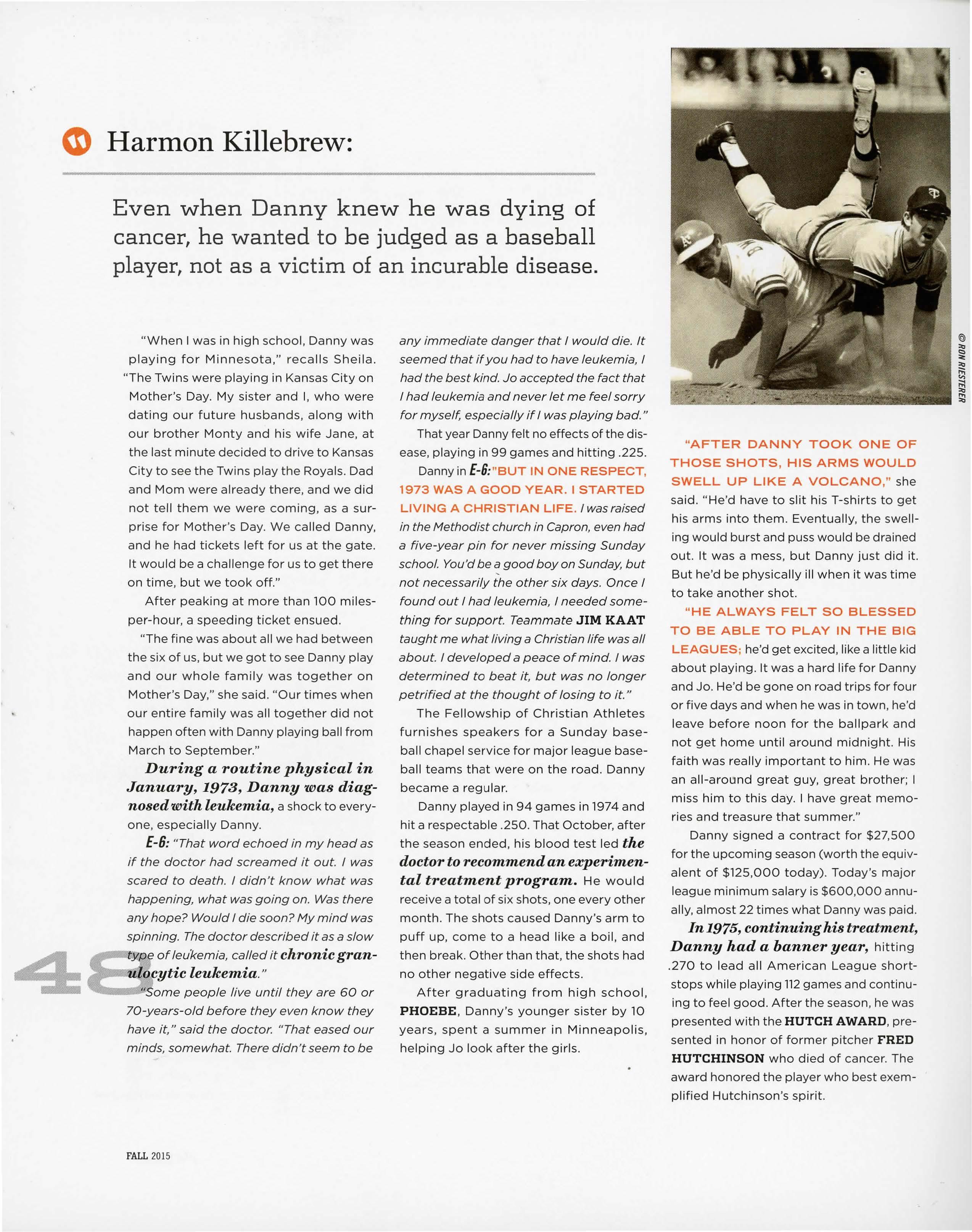
His rookie season Danny appeared in 96 games and hit .279. That year, he hit his first home run off the Athletics' VIDA BLUE, a perennial all-star pitcher. "I took my time running around the bases," recalled Danny. "In the dugout my teammates kidded me and CALLED MY JAUNT AROUND THE BASES THE THOMPSON TROT told me the league would probably give me a urine test."
Danny's mom mailed the weekly Kiowa News (the town closest to Capron with a newspaper) to Danny and, for fun, Danny enjoyed on occasion reading it to his teammates in the locker room. The stories usually included such items as who won the high school spelling bee, the arrival of a new baby and a list of those lucky enough to receive a speeding ticket.
The following season, Danny injured his throwing arm and played in 48 games with only 57 at bats, hitting .263. He established himself the next year, 1972, as a solid major leaguer, playing in 144 games and hitting .276.Along the way he and Jo added two daughters to the family: Tracy and Dana. E!J
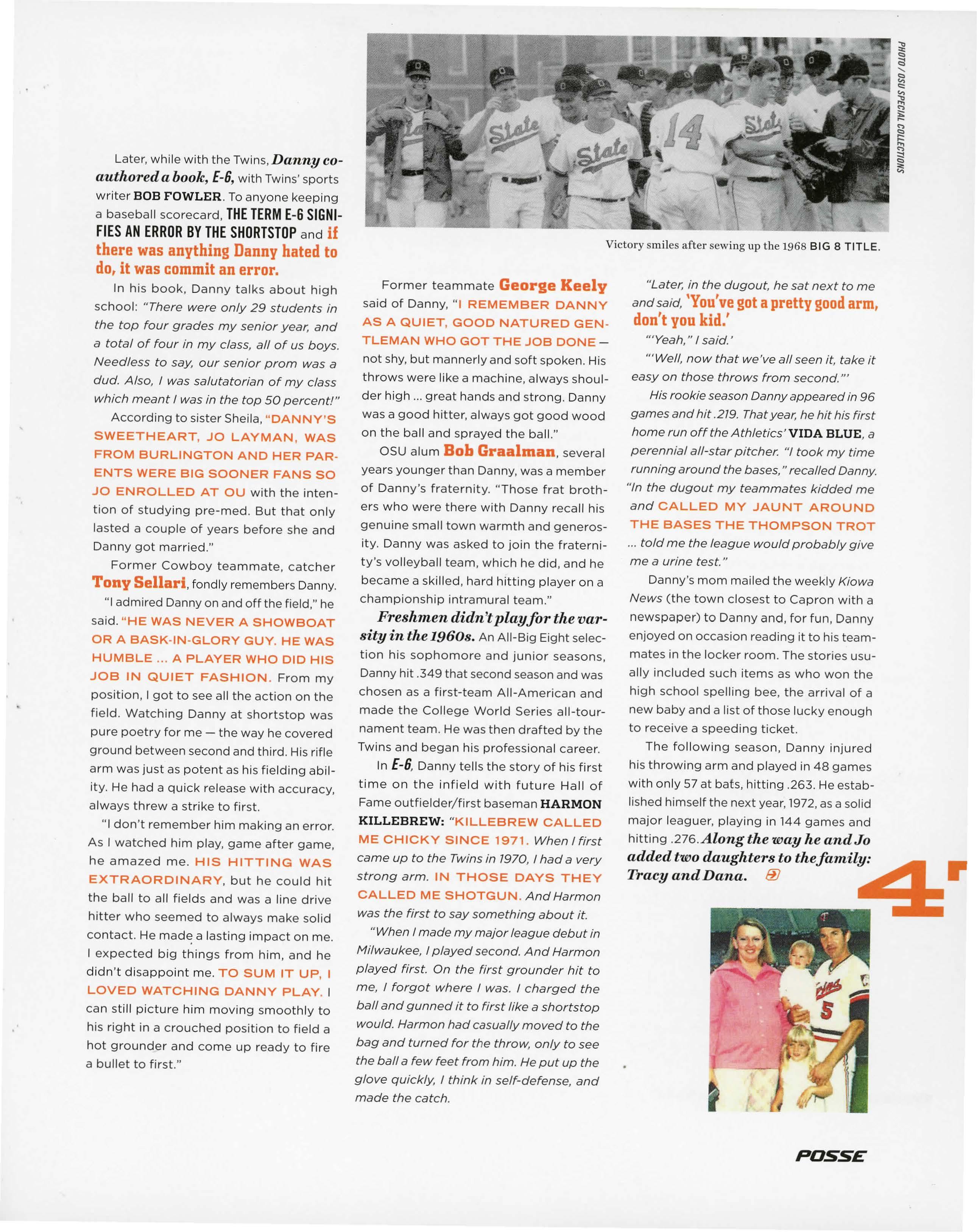
Victory smiles after sewing up the 1968 BIG 8 TITLE.
(D Harmon Killebrew:
Even when Danny knew he was dying of cancer, he wanted to be judged as a baseball player, not as a victim of an incurable disease.
"When I was in high school, Danny was playing for Minnesota," recalls Sheila. "The Twins were playing in Kansas City on Mother's Day. My sister and I, who were dating our future husbands, along with our brother Monty and his wife Jane, at the last minute decided to drive to Kansas City to see the Twins play the Royals. Dad and Mom were already there, and we did not tell them we were coming, as a surprise for Mother's Day. We called Danny, and he had tickets left for us at the gate. It would be a challenge for us to get there on time, but we took off."
After peaking at more than 100 milesper-hour, a speeding ticket ensued.
"The fine was about all we had between the six of us, but we got to see Danny play and our whole family was together on Mother's Day," she said. "Our times when our entire family was all together did not happen often with Danny playing ball from March to September."
During a routine physical in January, 1973, Danny was diagnosed with leukemia, a shock to everyone, especially Danny.
E-6:"That word echoed in my head as if the doctor had screamed it out. I was scared to death. I didn't know what was happening, what was going on. Was there any hope? Would I die soon? My mind was spinning. The doctor described it as a slow type of leukemia, called it chronic grani.;:=.z[l,ocytic leukemia."
'-===:.,<"Some people live until they are 60 or 70-years-old before they even know they have it," said the doctor. "That eased our minds, somewhat. There didn't seem to be
any immediate danger that I would die. It seemed that if you had to have leukemia, I had the best kind. Jo accepted the fact that I had leukemia and never let me feel sorry for myself, especially if I was playing bad."
That year Danny felt no effects of the disease, playing in 99 games and hitting .225.
Danny in f-6:"BUT IN ONE RESPECT, 1973 WAS A GOOD YEAR. I STARTED LIVING A CHRISTIAN LIFE. I was raised in the Methodist church in Capron, even had a five-year pin for never missing Sunday school. You'd be a good boy on Sunday, but not necessarily the other six days. Once I found out I had leukemia, I needed something for support. Teammate JIM KAAT taught me what living a Christian life was all about. I developed a peace of mind. I was determined to beat it, but was no longer petrified at the thought of losing to it."
The Fellowship of Christian Athletes furnishes speakers for a Sunday baseball chapel service for major league baseball teams that were on the road. Danny became a regular.
Danny played in 94 games in 1974 and hit a respectable .250. That October, after the season ended, his blood test led the doctor to recommend an experimental treatment program. He would receive a total of six shots, one every other month. The shots caused Danny's arm to puff up, come to a head like a boil, and then break. Other than that, the shots had no other negative side effects.
After graduating from high school, PHOEBE, Danny's younger sister by 10 years, spent a summer in Minneapolis, helping Jo look after the girls.
"AFTER DANNY TOOK ONE OF THOSE SHOTS, HIS ARMS WOULD SWELL UP LIKE A VOLCANO," she said. "He'd have to slit his T-shirts to get his arms into them. Eventually, the swelling would burst and puss would be drained out. It was a mess, but Danny just did it. But he'd be physically ill when it was time to take another shot.
"HE ALWAYS FELT SO BLESSED TO BE ABLE TO PLAY IN THE BIG LEAGUES; he'd get excited, like a little kid about playing. It was a hard life for Danny and Jo. He'd be gone on road trips for four or five days and when he was in town, he'd leave before noon for the ballpark and not get home until around midnight. His faith was really important to him. He was an all-arOLmd great guy, great brother; I miss him to this day. I have great memories and treasure that summer."
Danny signed a contract for $27,500 for the upcoming season (worth the equivalent of $125,000 today). Today's major league minimum salary is $600,000 annually, almost 22 times what Danny was paid.
In 1975, continuing his treatment, Danny had a banner year, hitting .270 to lead all American League shortstops while playing 112games and continuing to feel good. After the season, he was presented with the HUTCH AWARD, presented in honor of former pitcher FRED HUTCHINSON who died of cancer. The award honored the player who best exemplified Hutchinson's spirit.
Friend WILLIS COLSON remembers, "Danny was just an all-around genuine nice guy, one of a kind, knew where he was from. My wife and I had just finished building a new house. I had a basement and Danny knew I wanted a pool table to put down there, but we didn't have any money. Before long, he gave me one. That's just the way he was, do anything in the world for you. l'VE GOT ONE OF HIS LOUISVILLE SLUGGERS AND ALL HIS BASEBALL CARDS IN THAT BASEMENT."
In 1976, Danny got in 34 games before he and good friend BERT BLYLEVEN, a Hall of Fame pitcher and current radio analyst for Twins games, were traded to the Texas Rangers. Danny played another 64 games.
"A WARRIOR AND AN INSPIRATION," Blyleven said of Danny. "We both came up the same year, 1970, and were traded to the RANGERS at the same time. The first game for Texas, Danny went 4-for4. He had welts and scars on both shoulders, didn't want anyone patting him on the shoulder, a class man. When Danny was traded to Texas, the new general manager called Danny in and told him there was a problem, that the Twins were only paying him $27,500 and the minimum the Rangers paid for a season was $35,000, so for the rest of the season we need to prorate you at the higher rate and would that be OK?' They both laughed!"
DALE ROSS was from Dacoma, Okla., and played ball against Danny, "We quickly became good friends, and, after we both got married, we'd get together with our wives and play cards. We all loved to play cards. One night a snowstorm was moving in so Danny and Jo grabbed up their stuff and came over to our house so we'd be able to play cards the next day.
"WHEN HE GOT SICK, he told me he hoped he could play at least four years, that way he could be sure Jo and the girls would be taken care of because they'd get his pension. IT WASN'T ABOUT HIM. IT WAS ALL ABOUT HIS FAMILY."
"Today, as you drive into Capron, there's a memorial sign there for him," Ross said. "As a ballplayer, he never got excited. He'd always get the job done. DANNY GOT TO BE A GOOD PLAYER BECAUSE HE WORKED AT IT; I know that for a fact. After Danny and Jo had the girls, they couldn't have any more kids. Shortly after that, my wife and I had a son. We named him JOEY DAN, after Jo and Danny. We played cards the November night before Danny went back to the hospital because his leg was bothering him. I never saw him again. He was courageous.
"After a game, Danny always wanted to go out for a brownie and ice cream. He worked hard, hit line drives, a gamer. I liked to see him at the plate in a clutch situation. Danny and I were like brothers. I think of him often."
Danny and his family returned to Oklahoma immediately after the season. His leg was bothering him so he returned to Rochester and checked into the Mayo Clinic on November 16, underwent spleen surgery on Dec. 3, and died a week later from complications at St. Mary's Hospital. DANNYWASONLY29.Hundreds attended his funeral held in Burlington's high school auditorium.
"I sat beside Jo and his girls at the funeral," Ross said. "After it was over, I noticed Jo hadn't been crying and asked her if she was okay. She told me she'd been crying for the past five years and just didn't have any tears left. But she never got over losing him."
The Texas Rangers wore a black armband the following season in memory of Danny, and that same year Harmon Killebrew started the DANNY THOMPSON MEMORIAL GOLF TOURNAMENT in Sun Valley in Idaho, Killebrew's home state. The tournament is still held every year, and has raised $13.8 million over the past 38 years.
Killebrew, at the inaugural Danny Thompson Golf Tournament said, "Even when Danny knew he was dying of cancer, he wanted to be judged as a baseball player, not as a victim of an incurable disease."
In 2014tDannywasinductedinto the OSUBaseballHall of Fame.
Several years after Danny passed, Jo and the girls moved to Chicago where Jo became a counselor. She passed away in 2012. Today Danny's girls, TRACY AND DANA, live in the Washington, D.C., and Chicago areas, respectively.
Baseball Chapel established an annual award in Danny's name. Each year during the World Series, it is presented the major leaguer with exemplary Christian spirit in baseball. Past winners include MARK McGWIRE, JOE CARTER AND DAVE DRAVECKY.
Danny died 10 weeks to the day after he started his last game in the majors. He did his best to live life to its fullest andsucceededuntil the Lordcalled himhome.
Editor's Note: In 2011,Harmon Killebrew died of esophageal cancer, but the golf tournament in Idaho continues. It has since been renamed the KillebrewThompson Memorial Golf Tournament.
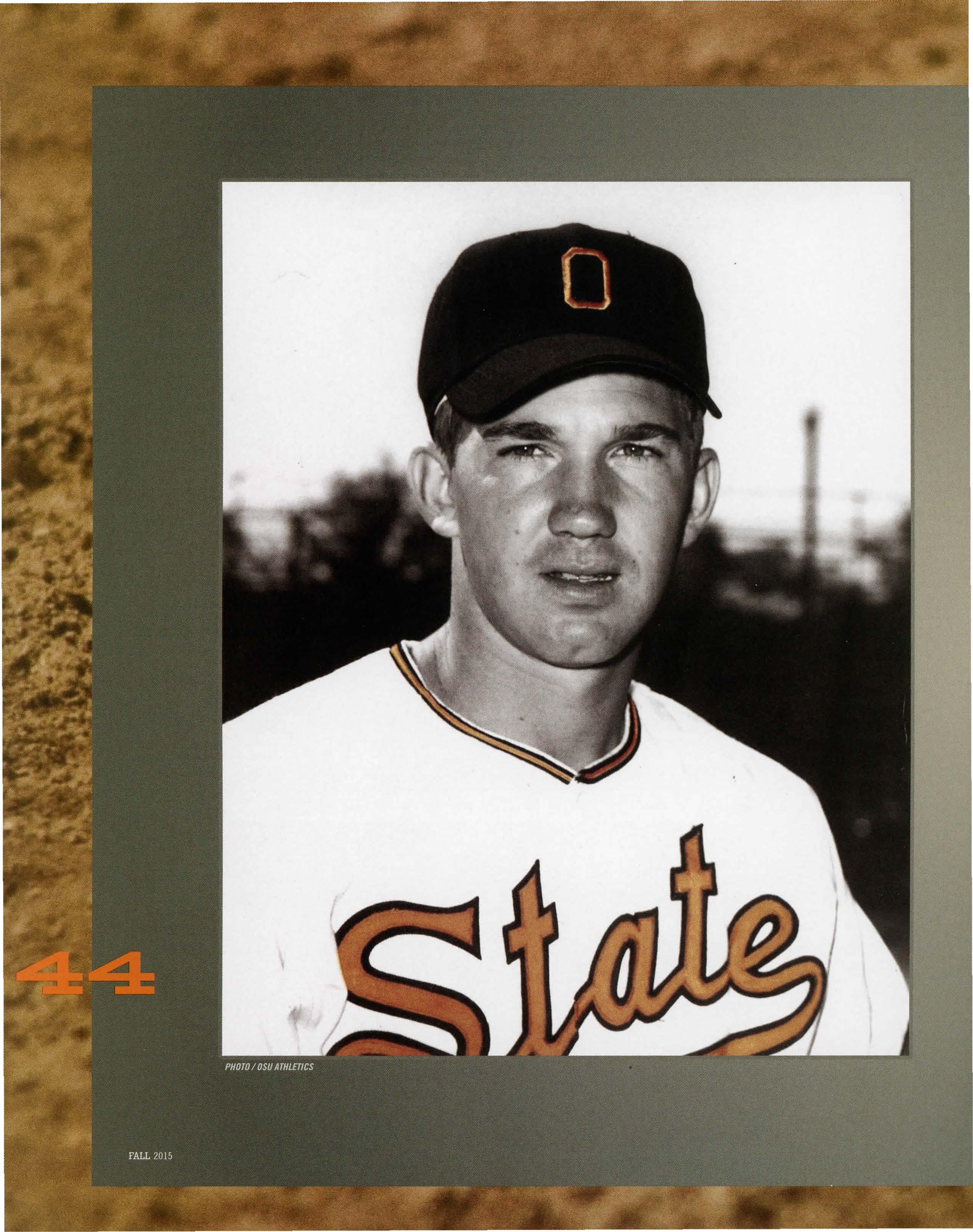
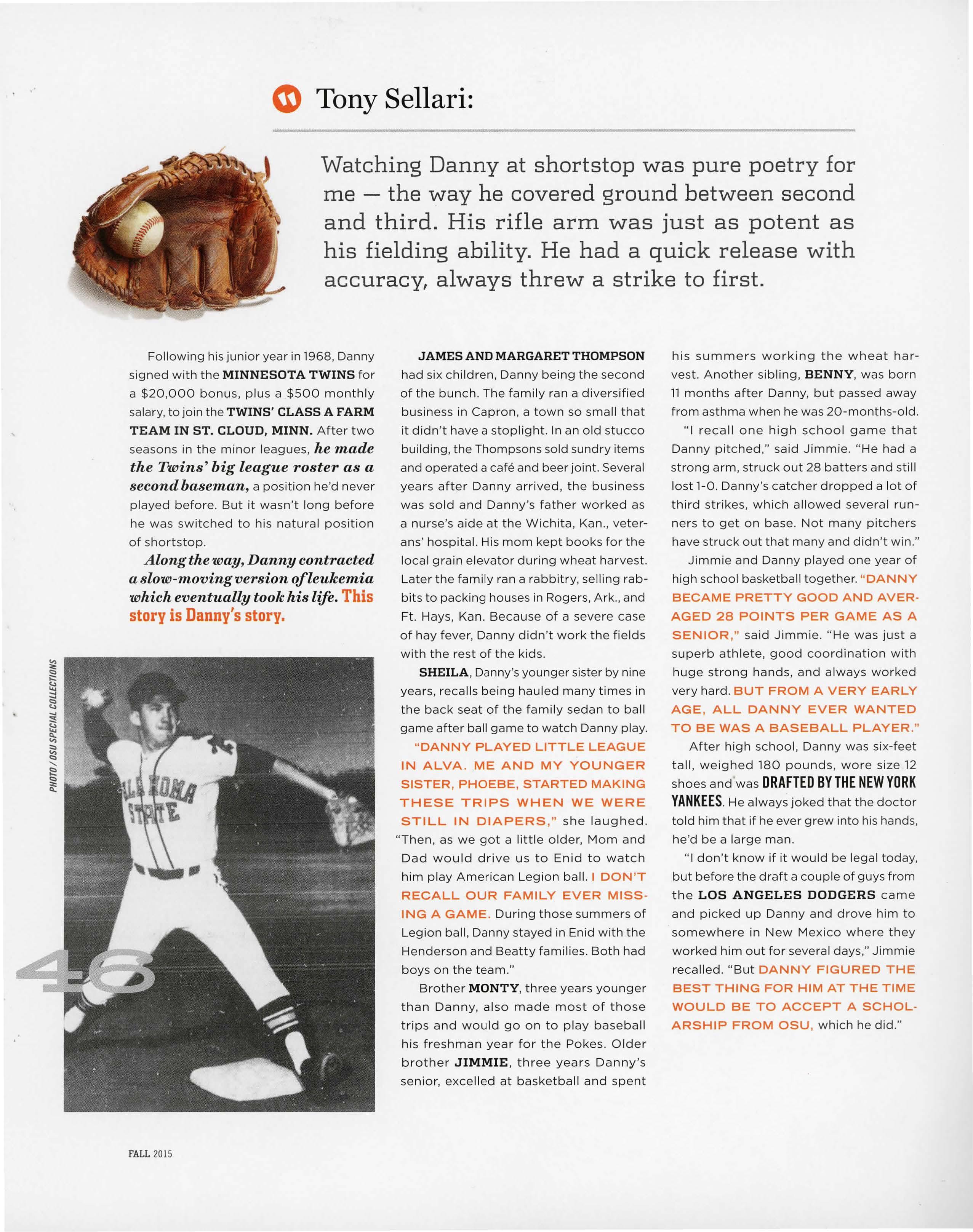
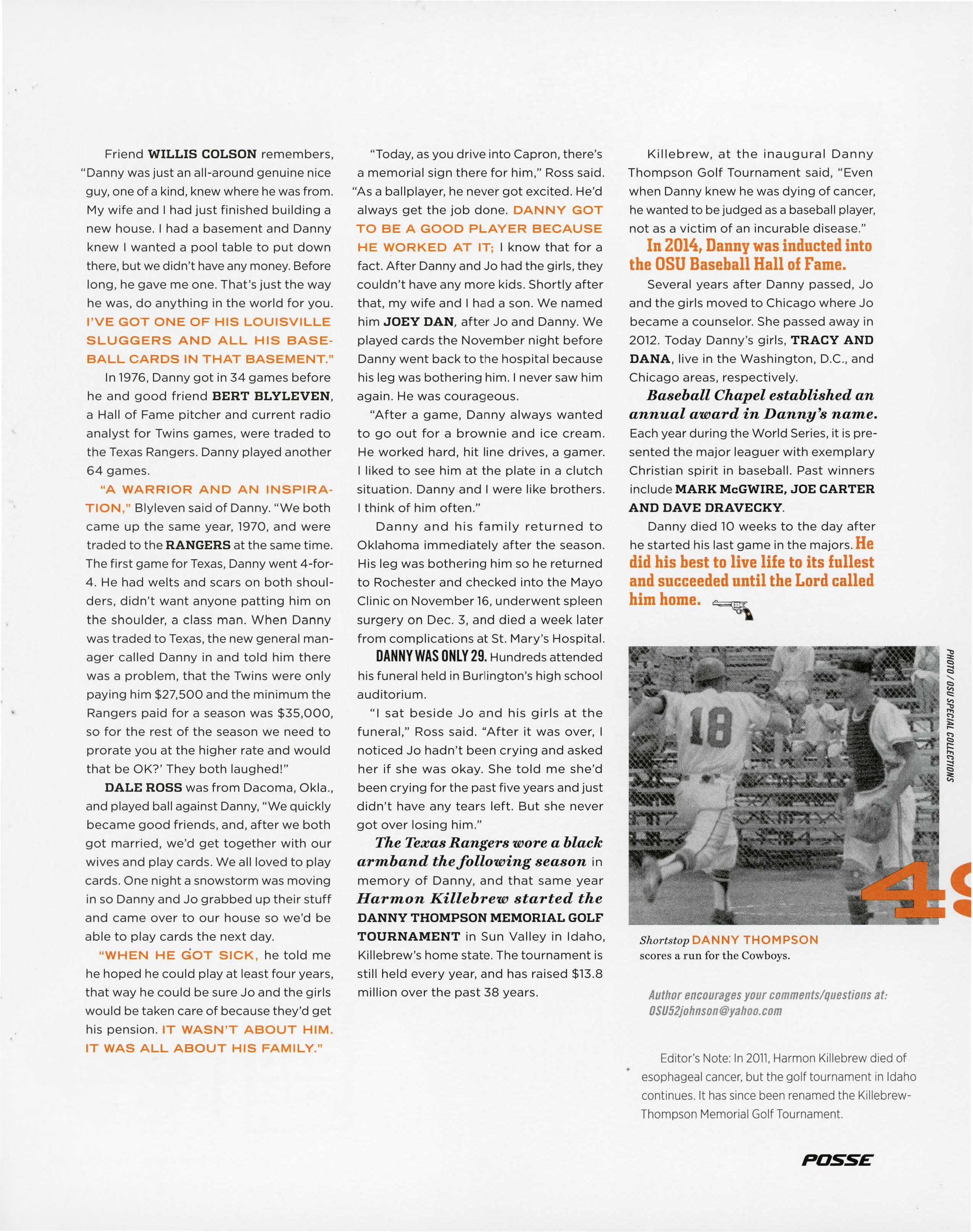
Shortstop DANNY THOMPSON scores a run for the Cowboys.
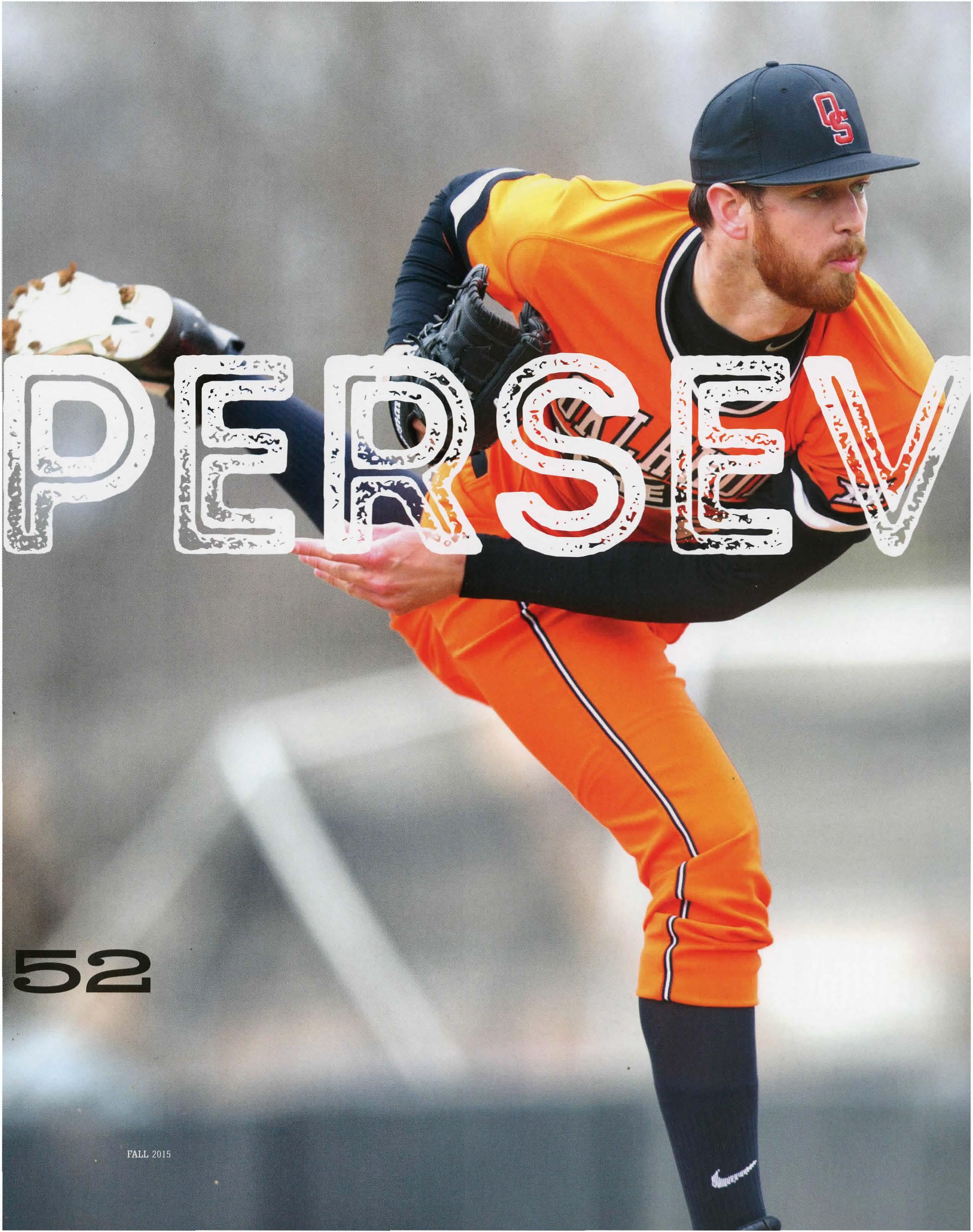
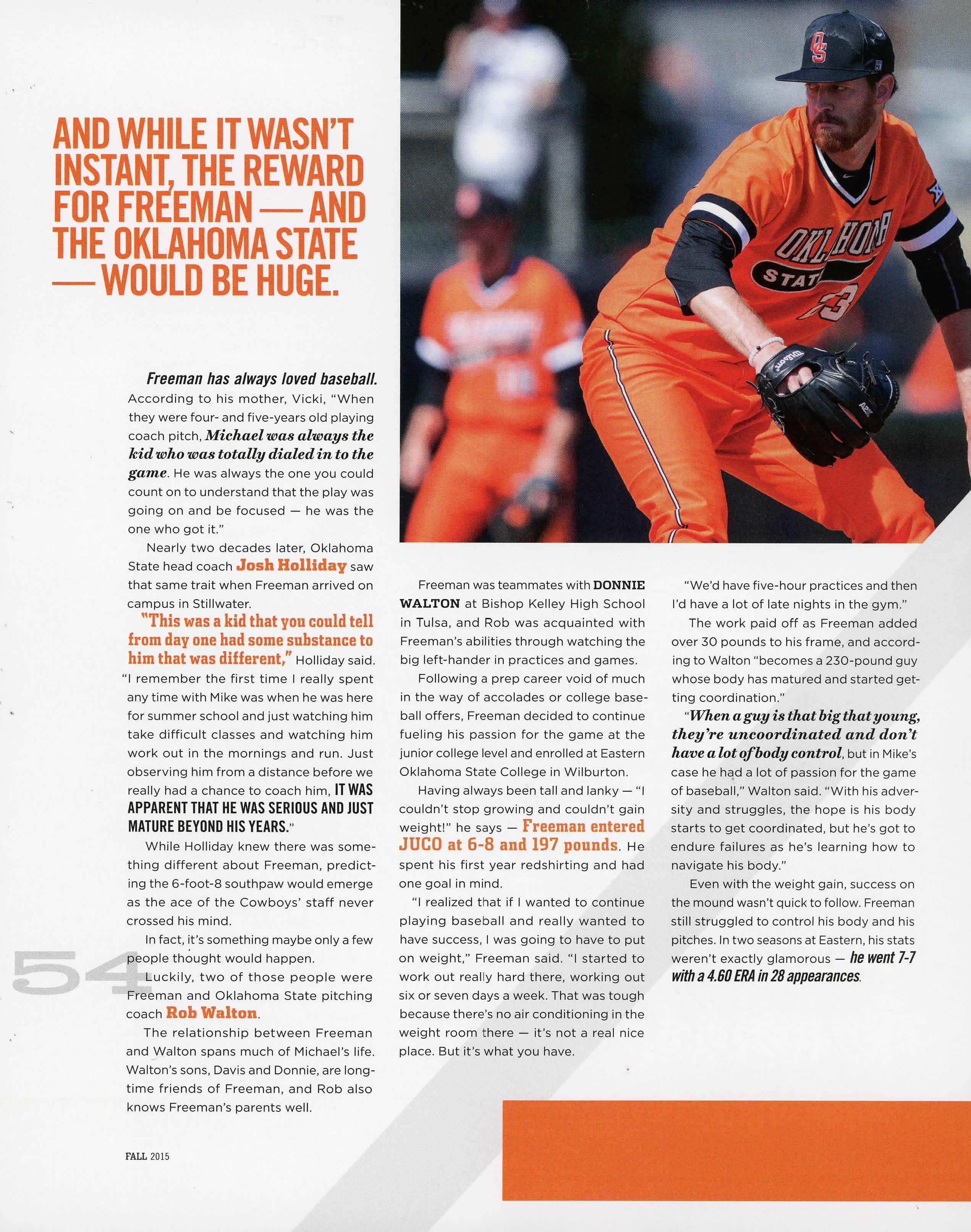
According to his mother, Vicki, "When they were four- and five-years old playing coach pitch, Michael was always the kid who was totally dialed in to the game. He was always the one you could count on to understand that the play was going on and be focused - he was the one who got it."
Nearly two decades later, Oklahoma State head coach Josh Holliday saw that same trait when Freeman arrived on campus in Stillwater.
"Thiswas a kidthat youcouldtell fromdayonehadsomesubstanceto himthat was different/'Holliday said. "I remember the first time I really spent any time with Mike was when he was here for summer school and just watching him take difficult classes and watching him work out in the mornings and run. Just observing him from a distance before we really had a chance to coach him, ITWAS APPARENTTHATHEWASSERIOUSANOJUST MATUREBEYONDHISYEARS."
While Holliday knew there was something different about Freeman, predicting the 6-foot-8 southpaw would emerge as the ace of the Cowboys' staff never crossed his mind.
In fact, it's something maybe only a few people thought would happen.
Luckily, two of those people were Freeman and Oklahoma State pitching coach Rob Walton.
The relationship between Freeman and Walton spans much of Michael's life. Walton's sons, Davis and Donnie, are longtime friends of Freeman, and Rob also knows Freeman's parents well.
FALL2015
Freeman was teammates with DONNIE WALTON at Bishop Kelley High School in Tulsa, and Rob was acquainted with Freeman's abilities through watching the big left-hander in practices and games.
Following a prep career void of much in the way of accolades or college baseball offers, Freeman decided to continue fueling his passion for the game at the junior college level and enrolled at Eastern Oklahoma State College in Wilburton.
Having always been tall and lanky - "I couldn't stop growing and couldn't gain weight!" he says - Freemanentered JUCOat 6-8 and 197 pounds. He spent his first year redshirting and had one goal in mind.
"I realized that if I wanted to continue playing baseball and really wanted to have success, I was going to have to put on weight," Freeman said. "I started to work out really hard there, working out six or seven days a week. That was tough because there's no air conditioning in the weight room there - it's not a real nice place. But it's what you have.
"We'd have five-hour practices and then I'd have a lot of late nights in the gym."
The work paid off as Freeman added over 30 pounds to his frame, and according to Walton "becomes a 230-pound guy whose body has matured and started getting coordination."
"When a guy is that big that young, they're uncoordinated and don't have a lot of body control, but in Mike's case he h 9 d a lot of passion for the game of baseball," Walton said. "With his adversity and struggles, the hope is his body starts to get coordinated, but he's got to endure failures as he's learning how to navigate his body."
Even with the weight gain, success on the mound wasn't quick to follow. Freeman still struggled to control his body and his pitches. In two seasons at Eastern, his stats weren't exactly glamorous - hewent7-7 witha 4.60ERAin28appearances.
In one of those games, Walton was in the stands and witnessed an outing in which Freeman surrendered four home runs.
"He didn't pitch very well, but he showed more body control and athleticismhe showed some things that were positives even though he struggled that day," Walton said. "I thought that since his body had matured and he still had the passion, that was the key. Then it was a matter of 'Can I put this guy in better positions to deliver the ball?'
"That's what it came to. He went through high school and junior college struggles, but he had the passion and the dedication. And once I saw more coordination and athleticism, that's what gave me the thought that, 'Hey, we could do this!'"
WALTON'S FAITH AND ABIL· ITY TO SEE WHAT OTHERS COULDN'T BROUGHT FREEMAN TO STILLWATER.
And while it wasn't instant, the reward for Freeman - and the Cowboys - would be huge.
Freeman's junior season at OSU offered a continuation of what had been the norm in his career - there were some good moments but nothing consistently positive.
He pitched in just 10 games in 2014, nine of those in relief, and recorded a 6.28 ERAin 14.1innings of work.
"Mentally it's tough because you're trying to find a role. And there's all kinds of roles, but I didn't have a significant role on the field and that was hard," Freeman said. "You just have to stay with it and keep trying to figure stuff out. That can be really difficult. But you just have to have faith in a plan and trust what the coaches tell you and understand that you can get better."
Walton'splanforFreemanwasradical - the lefty neededto changehis deliveryandmechanics.That process began upon his arrival at OSU but was something that wasn't a quick fix and was also much easier said than done.
"The hardest thing to change in all of baseball is somebody's arm action because it's ingrained in you since the first day you picked up a ball," Walton said. "A lot of people believe you can't change arm action. Now you can change it, but it'll take a year - I've done it so I know.
"With Mike, if he didn't make the changes, he wasn't going to be able to throw strikes consistently. He was in a delivery that just didn't allow him to throw enough strikes to be effective."
And with that, Walton and Freeman continued working to change what Walton said was "more arm path than arm action - (Freeman's) arm was really off-line."
"WITH ALL THE ADVERSITY, MIKE WOULD DO ANYTHING TO TRY AND GET HIMSELF ON TRACK," Walton said. "Being in a position like Mike, where you love the game so much and you haven't had much success, you're going to do whatever it takes.
"We set a premium on a windup that is going to give him as much balance and athleticism from start-to-finish as possible because with the long legs and long leverage, he's going to have more room for error. He has to be way more efficient fundamentally than a guy that's 6-2 or 6-3.
"We were asking him to do the hardest thing that you can do, and he was willing to go through that to make it happen."
Undergoing what he called "a complete overhaul," Freeman had abandoned his over-the-top pitching motion for a three-quarters, almost-sidearm angle that improved his alignment and allowed him to maintain balance.
Things finally began to click for Freeman the summer following his junior season with the Cowboys when he played for the ROCHESTER HONKERS in the Northwest League. He still lacked consistent command, but the improved movement on his pitches was allowing him to record outs on a regular basis.
"It started getting fun, and I got a lot more relaxed and not so stressed - just doing what I could and letting stuff happen," Freeman said. "I'd put in the work, and I finally trusted myself physically and trusted what I was doing. MYTHOUGHTSBECAME A LOTMOREFREE,NOTSOFORCED.
"The biggest thing was being able to repeat a motion and just stay within myself and not try to do too much, and I was finally comfortable with that."
"In Mike's case, he just worked on it diligently and then all of a sudden when he got it, the first thing he got was (ball) movement and then the movement was also in the strike zone," Walton said. "You could start to see the confidence build immediately, and I can remember by the end of the first year he was in a really good place and I was just praying that he could maintain it through the summer.
"In the summer, they go out, and they come back different; somebody else has tweaked them a little bit. But he came...---back and was in the exact same spot. was really, really encouraging."
While showing signs of mastering his new delivery, FREEMANBEGANWOWINGHIS COACHESDURINGPRESEASONPRACTICEand baffling OSU teammates who faced him during intrasquad scrimmages, the movement on his pitches leaving them shaking their heads as they returned to the dugout. :J
It was a trend that would continue throughout Freeman's storybook senior season.
Freeman's 2015 campaign was the stuff of dreams. In 15starts,hewent10-3witha 1.31ERA,tossingfourcompletegamesand rackingup97strikeouts in 109213inningsexceeding even the highest expectations.
"I thought he'd have a really good year, but arguably he had a better year than anybody in the country," Walton said. "There are guys with more strikeouts and wins, but I don't know if there was a more dominating guy than he was."
Armed with a three-pitch mix of fastball, slider and changeup, Freeman's pitches produced movement that Walton described simply as "special." And with that came what may be the most impressive stats of all - of all the outs Freeman recorded in 2015, 171came on ground balls and just 44 via fly ball. Factor in his 97 strikeouts and the dozen double plays he induced, and 86 percent of Freeman's outs came via ground ball or strikeout.
"His fly ball-to-ground ball ratio is something I've never seen or even heard of, at any level. It's probablythe best ratio of any pitcher that's ever stepped on the mound - it's phenomenal." ~11--"''1\ntl.tonsafd.
aid Holliday of Freeman's magical -..;:=:::::::::"a~son,"From start-to-finish, it was as good a display of consistent excellence that I've observed in a long, long time. I've been lucky to watch some kids have some great seasons, and Mike's was right there alongside the MIKE LEAKE 16-2
All-America season at Arizona State that I watched. (Leake) was special, and our Mike, Big Mike, was very similar.
"(Freeman) put an All-America season together and did it for a team that desperately needed another emerging starter. He took that on, pitched a number of outstanding games - carried us in many of his outings - and helped take us where we went."
OSUrodethe left armof Freeman to lofty heights,as the Cowboys finished second in the Big 12 Conference standings and were selected to host an NCAA regional for the second-straight year.
And Freeman was rewarded for his efforts as he became the second Cowboy to earn Big 12 Pitcher of the Year honors. HewasaconsensusAll-Americanandbecame the23rdplayerinOSU'sstoriedbaseballhistorytoachievefirst-teamAll-Americastatus.
"You always expect to have success, but to be considered the pitcher of the year in the Big 12 - there's a lot of really, really good pitchers in this conference - it's a huge honor," said Freeman, whose 1.31 ERA ranks as the fifth-lowest in a season in OSU history and was sixth in the NCAA in 2015. "To be able to do this stuff weekin and week-out and to have a team that always had my back was unbelievable. The guys behind me making plays made me look a whole lot better than I am.
"It was a lot of fun, and it's really a dream beyond anything I could have anticipated."
Freeman wasn't the only one who never saw it coming, which only added to the satisfaction.
Among Freeman's detractors along his baseball journey was a high school coach who famously told him that him playing Division I baseball would be like said coach playing in the NBA.
"He was told a lot of times that 'You aren't good enough to play,"' Walton said. "For him, it was definitely his perseverance and his passion for the game that allowed him to get to the point he's at right now. Knowing Mike as long as I have and knowing what he's gone through and the time and the effort, there's enormous satisfaction."
Freeman admits to questioning himself at times but says his passion for the game only made him that much more determined.
"I just love baseball and have always had a lot fun playing," Freeman said. "I never really thought about quitting baseball, but at times it was like, 'Maybe God has plans for me elsewhere, maybe baseball isn't the plan for me.' Obviously I can't tell you what those plans would be, but I knew I wanted to keep playing.
"Whenever I'm doing something I just do it to the best of my ability and try as hard as I can and put in the work. I DIDN'TEVER WANTTOQUIT.but you obviously never know what's in store and what's coming next.
"People always underestimated me and wanted to focus on what I couldn't do. It was nice to have some success and be in a position to play for such a good team and such an incredible, storied program. It was a dream come true and an opportunity that a lot of people don't get. Being able to take advantage of that and really contribute to the team was so much fun and something I'd always looked forward to."
His mother said it was Freeman's Tm gonna show you' attitude coupled with the numerous coaches who did believe in him that pushed him to greatness. And while there were many along the way, Walton will always have a special and unique bond with her son.
"One time during the season, I was talking to (Rob's wife) Michelle, and she said to me, 'Rob's as proud of Michael as he would be of Donnie,"' Vicki said. "That's kind of how I see their relationship being from here on out. Michael is always going to love Rob. He's always called Rob a baseball
genius, and there's no question that Rob will always be a mentor to him and that he will always seek out Rob's advice; he has such a tremendous amount of respect for him."
Freeman states matter-of-factly that all his success would never have occurred without Walton.
"Rob has always been somebody that you can go to, and he'll be straight up with you and tell you the truth," Freeman said. "He's an incredible baseball mind and him believing in me and giving me the opportunity to play here - he's helped me more than I can tell you.
"Then in terms of helping me change and be in a position to have success on a big stage, Rob has definitely been a very influential person in my career and in my life."
That career now extends to a place many would have considered highly unlikely not too long ago - professional baseball. Freeman was a seventh-round pick of the HOUSTON ASTROS in June's Major League Baseball Draft, and his mentor isn't putting limits on how far he can go.
"A lot of guys think he can get to the big leagues fast, can go to the big leagues in six months and get left-handed hitters out right away," Walton said. "It'll be interesting to see how it plays out. I think all 30 teams have a need for a guy like that. He's not the norm. He's the anomaly guy. There's a lot of 6-3, 6-4 guys throwing 90 to 95 - they're a dime a dozen.
"BUT THERE'S ONLY ONE MIKE. THERE'S ONLY ONE GUY THAT THROWS THAT WAY. THERE'S ONLY ONE GUY THAT GETS THAT KIND OF GROUND BALL. THERE'S ONLY ONE GUY THAT DOES WHAT HE DOES. He's made himself completely different from anyone else so his opportunity to play for a long time is probably very, very high.
"His story is gr.eat because Mike can really inspire a lot of people by what he's done - HE'SAPERFECTEXAMPLEOFWHY YOUNEVERQUITWORKING. A lot of guys will give up a little too early and then the next thing you know, they're 30 years old wondering shoulda, coulda, woulda.
"Even if it never happens, he's 30 years old and never looking back. You don't want regrets in life, and Mike's not going to have any now. He's a good role model and good inspiration for other guys that are having hard times and how you persevere through something."
And for that reason alone, Freeman will leave a lasting mark on the OSU program.
"This isn't just a kid who stumbled upon some success - this is a kid that was relentless and worked for it," Holliday said. "It took some time for him and Rob to find that happy place that he found where the work ethic and the body and the performance all came together for a tremendous year, but Mike all along had substance. You could sense it. And to see that all come together for him, what a great story.
"He left his legacy here, for sure. He'sa greatstorythatwillservetomotivateand inspireothers.As a coach, he reminds you that there's greatness within every kid if you can help them find it. It's just a real compliment to Mike Freeman the young man and his parents for their patience and belief in what he was trying to do. And it's a tremendous compliment to the program and to Rob for watching a young man develop into such a special performer.
"He's got a future in baseball now and a big-time future in life. He's just an awesome kid and what happened on the field just validated it for everyone else that didn't know Mike."
After being selected in the seventh round of the Major League Baseball Draft in June, Freeman began his professional career in the Houston Astros organization. He started out at the ClassA level before being promoted to the Astros' Class A-Advanced affiliate in August.
DESPITEBEINGSMALLINSIZEANDLONGON WINTERS,SWEDEN HAS BECOME ONE OF THE MOST PROMINENT GOLF NATIONS IN THE WORLD INLARGEPART TOPOSITIONINGITSPLAYERSFORSUCCESS WHILEUTILIZINGVESSELSSUCHASOSU.
"It was our goal in Sweden to give our players the absolute best possible conditions that existed regarding sport and studies. We knew that OSU was one of the very best and leading universities. THEY HAD THE BEST PLAYERS, THE BEST COACHES, PLAYED THE BEST COMPETITIONS, HAD THE BEST PRACTICE CONDITIONS AND THE COMPETITION WAS FIERCE. That made the choice easy for our best players," aid PETER SVALLIN, who FORMERLY SERVED AS THE SWEDISH MEN'S NATIONAL COACH.
Svallin was responsible for feeding the Cowboy roster with All-America talent such as LEIF WESTERBERG, ANDERS HULTMAN, ALEX NOREN and a Swede who would eventually make his way to the women's side in PAR NILSSON, the Cowgirls' current assistant coach.
"I had very good contact with Coach (Mike) Holder. He was a very skilled coach and has done a lot for our Swedish players over the years. For my own part, Stillwater has always been a place I loved to come back to. I've made about 15 visits over the years and each time I have felt at home and so have our players," Svallin added.
Of the 39 All-America honors earned in the history of the Cowgirl program, 17 HAVE COME COURTESY OF SWEDISH PLAYERS. The program's lone NCAA medalist and the most decorated player in program history, CAROLINEHEDWALL,hails from Lodclekopinge.In addition to 1-Iedwall,Swedish Cowgirls PERNILLA LINDBERGand KARIN SJODIN were both first-team AllAmericans before going on to LPGA success, while MARIA BODEN was a three-time Big 12 Player of the Year.
Additionally, two of the top teams in program history had a strong Swedish presence. The Cowgirls' 2004 squad, which was bolstered by Sji:idin's secondplace individual finish at the event, finished as the NCAA runner-up. OSU's 2009 squad posted a fourth-place showing at the NCAA Championship with a 1i neup anchored by three Swedes.
EVA DAHLLOF, a first-team AllAmerican in 1988, and KATRIN MOLLERSTEDT became the FIRST SWEDESTOCROSSTHEPONDIN 1986 AND 15 COUNTRYWOMENHAVESINCE FOLLOWED.The key to maintaining such a strong pipe! ine has been the experience provided by OSU, the opportunity to sharpen golf skills as well as an environment to excel academically.
"It means a lot for Swedish golf that our players have the opportunity to go to college in the United States and play for a team. We are a small country with winter six months a year and it is very important for us that our players get the opportunity and access to good practice, good practice facilities and the possibility to compete during winter, combined with studies,"said KATARINA VANGDAL, the CURRENT SWEDISH NATIONAL HEAD COACH.
While it may seem like an unconventional pairing initially, scratching below the surface reveals a mutually beneficial relationship. Not only has the Cowgirl program thrived in part due to its heavy Swedish influence, the community, in turn, embraced the golfers and eased the adjustment to life in the U.S.
"STILLWATER'IS A SMALL, QUIET, SAFE AND VERY PLEASANT TOWN WITH MANY FRIENDLY AND HELPFUL, WARM PEOPLE. You feel safe when you are out and everything you need is in the city.To feel at home offthe golf course was and is important," svallin said.
"Getting from Sweden to a completely different culture in the United States was a major adjustment for many and to feel at home and welcomed in Stillwater was very important and crucial. We knew that OSU was a very genuine and very respected university academically and in sports."
With the majority of the Swedesheading stateside arriving from small-town environments, STILLWATERHAS PROVEN TO BE IDEAL IN MINIMIZINGTHE TRANSITIONTOLIFEHALFA WORLD AWAYFROMHOME.
"I think the place itself maybe reminds a little bit of Sweden, not in nature, but in size. The intimacy and of course the facilities are absolutely fantastic," Vangdal said.
"It is simply a nice place and they feel home being there."
With Swede after Swede enjoying their experiences in Stillwater, word spread quickly and the best recruiters for OSUhave become the program's distinguished and growing alumni base of Swedish players.
"It has a good reputation.
"Knowing that a lot of Swedes had been here, they talked so much about it and had only GOOD THINGS TO SAY ABOUT OKLAHOMA STATE. The practice facilities at Karsten Creek are the greatest you can find. The school and everything is set up for success and for you to be able to focus on golf and school," Hedwall said.
The 2010 NATIONAL PLAYER OF THE YEAR, Hedwall's collegiate career bas served as an integral piece in her success as a pro and her continued pursuit to become the TOP-RANKEDPLAYER IN THEWORLD.f!J
It started with a couple of people and then it kept going because people enjoyed it and had a good time. Sweden is KARINSJODIN not a big country, so when they come back they talk about it and how good it is and spread the word about the place and how good it is,"current Cowgirl Linnea Johansson said.
"Caroline, Pernilla and I are from pretty small towns. COMING HERE AND GETTING THIS OPPORTUNITY IS A GREAT THING."
For Hedwall, the long line of Swedes was one of just several determining factors that attracted her to Stillwater.
"Practicing at Karsten Creek, those are the quickest greens I have ever putted on. Also, I thought the weather was great here for practice because you get everything. You get wind, you get rain and you get everything basically. It is just a great experience. Coming here, you play all over the U.S., which is great. When I came out on tour, I had played in California, I had played in Florida, in Ohio. It felt like I had been everywhere, so it prepared me for life on tour," Hedwall said.
"OBVIOUSLY, I WANT TO BECOME AS GOOD AS I CAN BE AND I BELIEVE I CAN BECOME WORLD NO. 1 ONE DAY. THAT IS MY VISION."
The message was resounding enough to convince Sjodin to sign with the school sight unseen.
"I think it was more of a safety thing for e and especially for my mom, knowing of Swedes had been here and every~::;::j2flft!was happy with what they had experienced in Oklahoma. I wasn't able to take my recruiting visits because of9/ll. I had scheduled everything that fall. I actually signed having not seen any U.S. school. At that point, when I hadn't experienced
anything on my own it was important to be able to trust people who had been here," Sjodin explained.
Like Sjodin, Lindberg knew the opinions of those who had come before her should weigh heavily into such a significant decision.
"So many Swedes talked so highly about the school and it gave me no doubts that I would like it, too. It was a big determining factor because it is a big decision when you are 18 or 19 years old to move halfway across the world to a different country. Knowing that many Swedes had liked it sure helped my decision," Lindberg said.
LINDBERG, A NATIVE OF BOLLNAS, FEELS THAT THE EMPHASIS PLACED ON THE SPORT BY OSU GOES HAND IN HAND WITH THE DESIRE OF A SWEDE LOOKING TO ACHIEVE AT THE HIGHEST LEVEL.
"A Swedish player who decides to go to college is very determined. Otherwise, you wouldn't movehalfway across the world if it wasn't for proper determination. I THINK THAT KIND OF DETERMINATION COMBINED WITH THE FACILITIES THAT ARE AT OKLAHOMA STATE ARE THE PERFECT MATCH AND I THINK THAT IS WHY WE HAVE HAD SUCH GOOD SUCCESS," She explained.
For Sjodin, she found Stillwater to her liking enough to reside in north central Oklahoma a decade after joining the professional ranks.Access to Karsten Creek and its top-notch practice facility has translated to LPGA successfor the Gothenburg native.
"At first, I stayed because this was the only place in the U.S. I knew anyone and of course the practice facilities. You can't get anything like this anywhere else. Even if you were able to find this kind of practice facility there would be a bunch ofother players using them," Sjodin said.
"Here I have everything I need. In the mornings, I can do the work on my own and in the afternoons, there are plenty of people to practice with ifI want matches or competition. I feel like it gives you the best of both worlds."
Once again, the relationship is a twoway street with Sjodin having the proper tools she needs to prepare for Iife on tour, while being able to play the 'big sister' role for those who have followed the Swedish path to Stillwater.
"The kids have a different perspective on golf and some of them are like sponges and ask questions and it is definitely rewarding to be able to help them," Sjodin said.
While she has not chosen Stillwater as her home base, the impact the OSU community made on Lindberg is equally significant and has played a key role in her success as a professional.
"I WOULDN'T BE ANYWHERE NEAR WHERE I AM NOW IF IT WASN'T FOR MY FOUR YEARS AT OKLAHOMA
CAROLINE HEDWALL, left, and PERNILLA LINDBERG in Sweden.
"ASwedishplayerwhodecidestogoto collegeisvery determined.Otherwise,youwouldn 1 t movehalfwayacross theworldif itwasn'tforproperdetermination."
CAROLINE HEDWALL
STATE. I always had the goal of playing on the LPGA TOUR, so to be in the United States and learn to live in the U.S. and to play college golf at such a high level was very important," Lindberg said.
"IT WAS A PRICELESS EXPERIENCE."
In addition to Johansson, fellow Swede ISABELLA DEILERThas also been a mainstay in the current Cowgirl lineup.
For Deilert a native of Stockholm, it was a former Swedish men's standout who brought OSU to her attention.
"I was around 12-years-old and it was through ALEX NOREN, because we are club mates and grew up together. When he was here, I was still little and I looked up to him and saw him wearing the orange," Deilert said.
"When I got older and started looking at college is when he told me that I needed to come visit and this was the best place to be."
While the small-town environment has provided many a comforting resemblance of home, it has served as a calming influence for Deilert for different reasons.
"I came from a big city and there is a lot of stress and things going on.
I wanted to go away somewhere I could have a stress reliever and I feel like this is the absolute best place to be. No traffic, not too many people around me and not too many distractions, and I can focus on golf and school and close friends around me," Deilert explained.
Johansson's route to Stillwater had an additional layover. THE ALMHULT NATIVE PLAYED A SEASON AT NOVA SOUTHEASTERN, A DIVISION II SCHOOL IN FLORIDA, BEFORE ARRIVING AT OSU FOR HER SOPHOMORE
CAMPAIGN. Even with the path she chose, Johansson was well aware of the Cowgirl program before getting the opportunity to don the orange and black.
"I knew about it beforeI even came to college. I was not really good enough to start here from the beginning, so I went to another school. I played really well there and I developed a lot," .Johansson said.
THAT DEVELOPMENT RESULTED IN A FRESHMAN CAMPAIGN
THAT SAW HER EARN FIRSTTEAM ALL-AMERICA HONORS, CONFERENCE PLAYER OF THE YEAR HONORS AND A NO. 2 NATIONAL RANKING TO END THE YEAR.
However, Johansson felt she needed a change of scenery to take her game to another level, thus turning her attention to the Cowgirl program.
"I really wanted to go somewhere where I knew it was going to be good. I didn't want to take a lot of risks and I knew things couldn't go wrong here because there are plenty of Swedes who did great here and really liked it, so why wouldn't I like it and why would I be different?," Johansson said.
"It is a nice atmosphere from the team to the reputation of everything, Karsten Creek, the practice facility. The coaches
know what they are doing and everything is in the system. If you come here, you really want to focus on your golf and if you want to focus on your studies it is a good place to be."
While it has remained healthy throughout the years, the Swedento-Stillwater connection looks to be one Vangdal would like to continue for theforeseeablefuture.
"IT IS IMPORTANT FOR US THAT OUR PLAYERS BE WELL TAKEN CARE OF DURING THEIR YEARS AT COLLEGE. THE RELATIONSHIP WITH THE PROGRAM (AT OSU) AND COACHES IS A KEY FACTOR FOR THAT AND WE WILL CONTINUE DOING THAT."
You can help us find the next generationof Cowboysby identifying potential students.You provide the contact information.We do the rest.
Recommend a futureCowboyonlinetoday.
SENIOR EQUESTRIAN
I KATY KRSHKAI
FemaleScholar-AthleteoftheYear
STORYBYAUSTIN CHAPPELL I PHOTOGRAPHY BYBRUCE WATERFIELD
FORCOLLEGEATHLETES, THE COMBINATIONOFANACADEMIC SCHOLARSHIPANDACHANCE TO CONTINUEANATHLETICCAREER IS VIEWEDASADREAM.
MANY GO ON TO HAVE SUCCESSFULLIVES,WHETHER IT BE IN HIS OR HER RESPECTIVESPORT,OR ON THE JOB.
HOWEVER, WHEN IT COMES TO TRULY MAKING THE MOST OF AN OPPORTUNITY, OKLAHOMA STATE EQUESTRIAN STAR KATY KRSHKA STANDS OUT FROM THE REST.
After one of the most decorated collegiate careers in school history, Krshka capped off her senior year by accepting the 2015 OSU Scholar Athlete of the Year award in May. The Yukon, Okla., native had an illustrious run with the equestrian squad and academically, culminating in a degree in agricultural sciences and natural resources and a minor in agricultural economics and agribusiness. flJ
What does that kind of major encompass, exactly?
"My undergrad was in animalscience witha businessoption so my classes were half business and half animal production," Krshka said. "The agricultural side came very easy, but I had to work a little harder at the business classes. Accounting classes definitely tested my patience more than once!"
Krshka's impact on her team is a marvel in itself, but her accomplishments in the classroom and contributions to the community illustrate an individual well-deserving of Oklahoma State's most prestigious honor for student-athletes.
Alongside a 3.75 GRADE-POINT AVERAGE, she racked up NATIONAL COLLEGIATE EQUESTRIAN ASSOCIATION (NCEA) FIRST-TEAM ACADEMIC ALL-AMERICA HONORS IN2014 AND 2015 and ACADEMIC ALL- r...11::::--...:.. BI 12 SELECTIONS IN EACH OF HER
Krshka says it wasn't always an easy process but credited her undying workethic as a motivational tool.
"I WANTED TO BE THE BEST IN EVERYTHING," Krshka said. "l'M A VERY COMPETITIVE PERSON SO EVEN IF I DIDN'T LIKE A CLASS, I STILL WANTED TO BE AT THE TOP OF THE CLASS.
"I had to learn how to make everything balance. Sometimes there is going to be that person that is better in a particular class than you, and I had to learn that."
Additional academic honors include multiple trips to the PRESIDENT'S HONOR ROLL, three spots on the DEAN'S HONOR ROLL and a whopping SEVEN BIG 12 COMMISSIONER'S HONOR ROLL selections.
With a nearly flawless four years under her belt, Krshka is now able to look back to the beginnings of a sensational career, which stem back to her time as a Yukon Miller.
Before she even stepped foot on the OSU campus, Krshka was destined for success. She entered the collegiate landscape as one of the most highly-touted equestrians in the nation, capping off a sensational junior career with TWO TOP-THREE FINISHES AT THE 2011 AMERICAN QUARTER HORSE YOUTH ASSOCIATION WORLD SHOW.
She immediately established herself as a mainstay with the Cowgirls, delivering a freshman campaign worthy of endless praise from head coach Larry Sanchez.
"With Katy being from Yukon, I had plenty of chances to scout her before she came to Stillwater," he said. "I IMMEDIATELY RECOGNIZED THE KIND OF
IMPACT SHE COULD MAKE FOR OUR PROGRAM AND HAD TO KEEP HER HERE IN OKLAHOMA."
"I remember looking forward to the start of her college career, not only for the contributions she would make for the team, but for the manner in which she would take advantage of a quality education and the college atmosphere."
Sanchez's initial goals for Krshka would be fulfilled as early as her freshman year. At the 2012 Big 12 Championships, Krshka went 3-1 overall and posted wins in both horsemanship and reigning during the title match, which proved to be a difference maker for the final outcome.
Thanks to Krshka's two victories, the Cowgirls were able to break an 8-8 deadlock with Texas A&M, win on a raw score tiebreaker and become the first team in Big 12 history to win multiple conference championships.
Krshka continued her outstanding freshman campaign at the NCEA National Championships two weeks later, winning her 11th head-to-head match up in her last 12 tries in the championship battle against Texas A&M.
The Cowgirls were unable to come away with a victory, but with one season in the books, Krshka said she began to learn how to effectively manage her time as a Division I athlete.
"IT TOOK SOME TIME AT FIRST TO REALIZE WHERE I NEEDED TO ALLOCAT._E MY TIME," Krshka said. "I always had the mindset that I needed to do well in academics in order for me to
compete. TIME MANAGEMENT WAS CRUCIAL, and I had to learn how to be a good planner while still being flexible."
With a stronger hold on life as a college student, Krshka was then able set her sights on the next season's goal; getting back to the national championship match and bringing home the title.
The Cowgirls did just that. After paving the way to its second of three-straight Big 12 titles, the OSU equestrian squad entered the 2013 NCEA Championships as the competition's top seed and overall favorite. After falling short in the Hunter Seat portion of the tournament, OSUbreezed its way through the Western competition with wins over Auburn, South Carolina and Kansas State, ending in the team's first national title since 2009.
Krshka was instrumental in the Cowgirls' success, posting four wins on the final day of the tournament en route to a perfect 6-0 record during the event. For her efforts, she was named the Big 12 Horsemanship Rider of the Yearfor the second-consecutive year.
Following the victory, Krshka's teammates and coaches were quick to credit her with the deserved attribution of leading the team to the top of the college equestrian world.
"SHE IS A VERY DETERMINED GIRL ANDSHEHASANAWESOMEWORK ETHIC," former teammate Rachel Houchin said. "It really pays off for her. SHE IS ALSO EXTREMELY HUMBLE FOR HOW WELL SHE DOES."
"After coming up short her freshman year, we all knew that Katy would be hungry for something greater down the road," Sanchez said. "She showed that in 2013, and she continues to show that to this day. The way she competes and conducts herself is exactly what you look for as a coach."
Now able to include a national title on her resume, Krshka headed into her junior year having already blazed a trail headed toward a bright future. At that point, she was more than halfway through her degree but didn't hesitate in showing gratitude to those who had helped her along the way.
KRSHKAGIVESAPORTIONOFTHATCREDIT
TDOSU'SJOEANOCONNIEMITCHELLACADEMIC
ENHANCEMENTCENTER,
an asset that has been vital to numerous student-athletes over the decades.
"My first two years, I was constantly there with tutors or with my advisor or facilitator," Krshka said. "My junior and senior years, I went less because I had been given the tools to go and do things on my own."
"They have an unlimited amount of resources available so it is extremely helpful to take advantage of them. If they can't help solve a problem, which is rare, they will find someone who can."
The rest goes out to the normal crowd - coaches, family and friends - as well as the community, where Krshka has been extremely active over the last four years. For starters, she served as a member of ALPHA ZETA, an honorary fraternity emphasizing scholarship and service. Other organizations she involved herself with include COACHES VS. CANCER, SAAC FOOD DRIVES and therapeutic riding centers.
In addition to being named team captain for the 2014-15 season, her influence on the community also helped her land a spot as one of Stillwater's most notable figures at Cowboy football games - the OSU Spirit Rider.
"The Spirit Rider adds a different aspect," Krshka said. "It's an awesome experience. You still have the adrenaline each and every time you go out there, and it was an absolute honor to be in that position."
Although her OSU Spirit Rider, Cowgirl equestrian star and undergrad days are complete, Krshka willstay at Oklahoma State to complete a Master's degree in international agriculture.
Her combined efforts with the community, university and athletics landed her an internship with the American Quarter HorseAssociation, an international organization dedicated to equine reproduction. Krshka's eight-week assignment with the AQHA provided her with the unique opportunity to travel across Europe and attend international horsemanship camps.
Back in Stillwater, she is known as the first seven-time All-American in Cowgirlequestrian history and an impactful individual on campus.
Krshka said she not only wants to use her experience to eventually pursue a career in the agricultural or equine industries, but to also be a positive influence for those who look at her as a model for success.
"(BEING) A STUDENT-ATHLETE WAS HECTIC AT TIMES BUT LIKE MOST OTHER ATHLETES WILL SAY, IT WAS TOTALLY WORTH IT," Krshka said. "I just had to make sure I made a plan on how to get everything done during different time spans, and I always looked at my schedule before trips so that I would be aware of everything I needed to accomplish while I was away.
11 1'D LOVE TO SHARE THAT ADVICE WITH INCOMING EQUESTRIAN RIDERS OR EVEN WITH OUR STUDENTATHLETE BODY ASA WHOLE."~
SENIOR BASKETBALL PLAYER
I CHRISTIEN SAGER I MaleScholar-Athlete
STORYBYAUSTIN CHAPPELL I PHOTOGRAPHY BYBRUCE WATERFIELD
SINCETHEBIG 12WASBORN IN1996,THE OKLAHOMA
IN ADDITION TO A FINALFOURRUNAND
BIG12 CONFERENCECHAMPIONSHIP IN 2004, SIXTOP-THREECONFERENCEFINISHESAND A STRINGOFAPPEARANCESIN THENATIONAL POLLS,THE COWBOYS HAVE ALSO SHOWN A STRONGPRESENCEIN THECLASSROOM.
STATEMEN'S BASKETBALL TEAMHAS BEENNO STRANGER TO SUCCESS.
SEVERALCOWBOYSHAVESHOWNPROWESSONBOTHSIDESOFCAMPUS.Former standouts Keiton Page, James Anderson and Stephen Graham have been sensations both on and off the court. It's afeatfor a student-athlete to maintain success in both areas, but some, like Christian Sager, are able to go the extra mile.
Sager, a 6'4" guard from Wichita Falls, Texas, graduated in May after four years with the cowboys. KNOWNASMUCHFORHISSMARTSASWELLASHISSKILLS,SAGER EARNEDANELECTRICALENGINEERINGDEGREE,MAINTAINEDAPERFECT4.0GRADEPOINT AVERAGEANOWASNAMEDTHE2015OSUMALESCHOLAR-ATHLETEOFTHEYEAR. @ POSSE
OSU HAS PUMPED OUT TWOORMORE ACADEMICALL-BIG12 SELECTIONSIN EACH OFTHELASTFOURSEASONS,A RUN THAT INCLUDEDA QUARTETOFHONOREESIN 2014. s s
"It was taught really tough at times/' Sager said of coupling the challenging course work with the demands of Big 12 basketball. "It took a lot of time management and knowing when to cut certain things out of my life.
"Sometimes I couldn't hang out with friends or play Xbox because I knew I had to get the important things done, like my schoolwork. THERE WERE A FEW ALL-NIGHTERS, and definitely plenty of nights where I was up until two or three in the morning."
Sager set himself up for success early on as an exemplary student-athlete at Rider
Earning playing time as a walk-on freshman is rare enough. Carrying the added weight of being the team's brainiac weighed on Sager's mind.
"When I got here my freshman year, it kind of seemed like that was going to be the case again," Sager said. "I WAS GOING TO BE THAT 'SMART' GUY WHO WAS ONLY GOING TO GET TO PLAY AT High School. He was the salutatorian of his THE END OF BLOWOUTS." class and scored a 33 on his ACT, sparking With only 51 minutes on the court during offers from prestigious academic institu- his freshman season, that seemed to be tions like Trinity University in San Antonio. the case.
His numbers were solid in the gym, as However, with the help of a few injuwell. Averaging 19 points, seven rebounds and four assists as a senior helped him surface on head coach Travis Ford's recruiting radar, eventually leading to a preferred walk-on spot with the Cowboys. ___ ,..
"irhat was something we'd been want·ng to do," Ford said, "Bring in a preferred walk-on, guys who are what we consider low Division I type players who maybe want to give it a shot at the higher level."
ries, 32 of those minutes came during the BIG 12 TOURNAMENT. The experience gained from those two games not only helped Sager build a foundation for himself, but also helped him earn the walk-on's ultimate reward- a scholarship.
"HE EARNED IT. HE REALLY DID," Ford said. "We could have kept it, taken someone at Christmas, but HE WORKED HIS TAIL OFF. We had one there, and I TOLD MY STAFF, 'LET'S DO TME RIGHT THING."'
From then on, Sager's minutes began to increase each year. He was also able to develop a crucial role on the team, serving as a scrappy, pesky defender with a seemingly limitless work-ethic.
His sophomore year, he drained a threepointer in OSU's early-season victory over sixth-ranked N.C. State. He even recorded his first-career block against 7'1" ISAIAH AUSTIN of Baylor. Most notably, he logged three minutes in the Cowboys' 85-80 win at No. 2 Kansas, coming in with 30 seconds remaining in a four-point contest.
"I knew I was never going to be a 15 or 20-minute guy, especially with all these great players coming in here every year," Sager said. "And I was OK with that."
"I think the best thing for me was just keeping a positive attitude through it all. If I hadn't kept a good attitude, I know I would have never seen any of the minutes that I saw."
His workon the court culminated in 52 games of action over his final two seasons, complete with numerous appearances in some of the Cowboys' most meaningful contests. IN MARCH,SAGEREVEN MADE HIS FIRST-CAREERSTART,TAKINGTHE FLOORTOAstandingovationin OSU's Senior DayBATTLEAGAINSTTCU.
Perhaps the most remarkable aspect of Sager's career, though, was the constant pull of his academic career during his time as a Cowboy.
Sager said there were times when he could have put in just enough work to receive a B, or even a C, especially during his junior and senior seasons when he was providing significant minutes in Big 12 competition.
"I could have just been like, 'I've got a 4.0 already. My GPA is good, so I could just go and get a B here and there,"' Sager said. "It washardtokeepmyselfgoingandkeepfightingforthatperfection, I guessyoucouldsay. To come to practice and have a good practice that same day made it even tougher.
"I can get really stressed out about work and making sure things are perfect. Sometimes, I wouldforgettoeat,so things like keeping my body in shape and keeping my mind healthy were tough challenges to balance."
Electrical engineering majors take classes that many students haven't even heard of, let alone would want to endure while juggling time as a Division I athlete.
Real-TimeDigitalSignalProcessing.Digital LogicDesign.Computer-BasedSystems.Those were just a few of Sage r's required courses. His toughest class?
"ElectromagneticFields,definitely," Sager said. "CommunicationTheorywasalso prettytough,too, but I just told people it was a speech class. It covers communicating wirelessly and theory behind all that."
Through it all, Sager maintained a perfect4.0 GPA while receiving a slew of accolades, including a 2014 OSUSenior of Significance honor and the BIG 12•s Gerald Lage Award. He made nine
appearances on the PRESIDENT'S HONOR ROLL, and was NAMED TO THE FIRST TEAM ACADEMIC ALL-BIG 12 TEAM IN EACH YEAR HE WAS ELIGIBLE.
It wasn't always easy, though.
During the Cowboys' trip to the Old Spice Classic in 2013, Sager went with the team to Florida to prepare for a tough tournament field of Akron, Tennessee and N.C. State. In addition to packing his usual gear, he also included one of the most important projects of his academic career.
"I remember one time in Florida, I had this big project due," Sager said. "It was actually making a Frogger game for one of my classes. It was pretty basic, just pressing a button and making him hop across the street."
"You get hit, you die. Pretty basic, but I actually had to make all of the code for that. I had to take a chip that I was working with and a monitor to Orlando just so I would be able to code it in the hotel room."
With an illustrious transcript and four years as a collegiate athlete under his belt, Sager was more than ready to take on the job world after graduating.
After a series of interviews with ExxonMobil, Sagerreceived a fieldengineer positioninTheWoodlands,Texas,where he will train for six months before likely accepting a full-time position at the company's Torrance refinery in Los Angeles.
He isn't the first member of the Cowboy basketball team with that story.
Mason Cox, a former Oklahoma State walk-on, received a similar offer with ExxonMobil before turning it down to pursue a career in Australian rules football. Once teammates, Sager and Cox became good friends, eventually leading to the energy mogul showing interest in Sager as well.
"After we played at Texas my junior year and Mason got in and had his coming out party, his recruiter emailed him and asked about the other engineer on the team," Sager said. "Mason gave him my info, and he emailed me and invited me to a dinner they have every April. It just kind of went from there, and now I'm going to be working there."
Sager reported on Aug. 15, launching a new chapter in his life that will test the best of his skills gained while at Oklahoma State. His basketball days are likely in the books, but the relationships and connections made through the Cowboy basketball squad have impacted Sager more than he ever could have imagined.
Out of all his experiences at OSU, Sager said four years with his teammates will remain with him for the rest of his life.
"Coach [Butch] Pierre was just talking to me about this the other day," Sager said. "Through my years here, I've been with a lot of different players and different people. I kind of agree that the biggest thing I'll take from that is learning how to mesh with different personalities and learning how to react to different situations.
rvE SEEN IT ALL SINCE rvE BEEN HERE. SO I AGREE WITH HIM."~
PETE'S
PARTNERS
PISTOLPETE'SPARTNERS is the officialOSUAthleticKidsClubdesigned to get kids excited about OSUathletics at a youngage so that they are fans for life!
Annualkids club membership[8th gradeandunder]is just $25per child.
Benefits include:
• FREE ADMISSION* to OSU wrestling, Cowboy basketball, Cowgirl basketball, baseball and softball
THERE WILL BE THOSE ARGUING to have preferential treatment because they are the blue bloods, the historic staples, the mainstays of power and prestige. And they believe those extraordinary pasts are reasons enough to punch their ticket to the next level. Some believe a JOHNNYCOME-LATELY, fresh face and new suit of clothes, will be the impulse to propel them into a discussion about a top tier spot. Fans will tum out in record number to scream at the top of their lungs in support of their favorites. The opposition will argue with equal fervor against those same people.
Yes it's time tor the political season. Debates and issues. The past and the future. Money versus experience. Humble beginnings versus silver spoons. Blue versus red. Elephants and donkeys. Independents' potential to ruin one party or another. Voter turnout. Media bias. It's enough to make a cowboy's head swim.
One thing is for certain, as the political season wears on, one by one candidates will fall by the wayside unti/thereareon/y two vyingtorthesameposition. There will be things which happen along the way that many could never have predicted and it will all be very entertaining.
THERE'SSOMETHINGABOUTTHATFEELINGINTHEAIR
WHICH MARKS THE OCCASION whenAmericasees the pageantry, color and the pomp and circumstance OF THOSE WHO ARE PRETENDERS OR CONTENDERS.
THESAMECANBESAIDFORTHENEWFOOT-
BALLSEASONwhich is upon us. Some programs which have had historic success will tumble. Others who like to change uniforms a lot, will soar to the front. Some teams at the top of the revenue and cost of attendance columns will falter and others who have more meager budgets will rise. /twill be orange versusgreen, purple versusred and alltheotherhueswhich inspire football followers to yearn for September through December.
Some MASCOTS will dust off their costumes and cause us to squint and try to figure out exactly what they are and how they could possibly represent the team on the field. By the way, there are elephants and donkeys. Other icons will have their coats washed or their manes combed and a hundred other pregame rituals reserved for LIVE ANIMALS as part of legend and lore of campuses across the country.
All athletic departments are concerned with season ticket sales and attendance of ticket holders for games. Some want you to believe they have sellouts when they don't. And it seems there are so many things pulling Americans in so many different directions that they forget THEYHAVE TICKETSTOONEOFTHEGREATESTSPORTINGSPECTACLESOFALLTIME:COLLEGE FOOTBALL.
In the same way some independents have thrown a monkey wrench into the best laid plans of one political party or another in the last 20 years, college football has its own version of Ross Perot: Notre Dame. Some are calling for the Fighting Irish to rain on the parades of the five power conferences and sneak into the four team playoff. Possible, yes. Probable, no. Does media bias matter in big-time college football? Of course. It happens in newspapers, in medium and large television markets as well as monstrous cable channels and conference networks. Then, you as the fans get to « WORK IT OUT» on message boards, in comment sections online and the hallways at work.
ONEWAYORANOTHER, as the season wears on, TEAMSWILLFALLBYTHEWAYSIDEuntil there are only two vying for the same position. Regardlessof whether it's black business suits or football uniforms, I like the ones with the accent of orange!