At Byford, we believe in priorities-and it's not surprising that we sell terrific cars you're on the top of that list We want and trucks at great prices. After all, what every customer who comes through our better way to make sure our customers are door to have the best possible experience happy? Come visit Byford Buick GMC and with us. And when you think about that, see for yourself.
POSSEMAGAZINE
OPOSSE MAGAZINE STAFF
VICE PRESIDENT OF ENROLLMENT MANAGEMENT/ MARKETING KYLEWRAY
EVENT COORDINATOR/ GAME DAY PARKING MANAGER JAMESBATLEY
ATHLETIC DEVELOPMENT ASSISTANT STEPHANIEBOE E
~ATHLETICS MAJOR GIFT DEVELOPMENT STAFF
ASSOCIATE ATHLETIC DIRECTOR/ DEVELOPMENT LARRYREECE
DIRECTOR OF DEVELOPMENT/ ATHLETICS MATTGRANTHAM
PROJECT MANAGER SHAWNTAYLOR
OSU POSSE
c:)102 ATHLETICS CENTER STILLWATER, OK 74078-5070 0P 405.744 7301 OR 877.2B.POSSE @»F405.744 9084
nt,WWW.OKSTATEPOSSE.COM ~POSSE@OKSTATE.EDU
EDITORIAL 405.744.7192
D:Yla:r:n :drr,ayWtr.ftSf,?.n"edfOeo..-.tx:'1/Alhl-l s.hc ra: -roa-~ew! th:: lcntHU_1•i:<1cl'TX)l"(l ltit!Ol'Tla .::,late lJr VE;'f'~ly, It;,:, C'H<'IF.!t---.crna .-.{iJ!f" U-1i•JP.rSty FouldatlCfl. :ifl(j I :.......to.,,Alt 1 , Ir POSS£:n1c.,19Lr.-;!,sput.:Jshedlu11~c!y0ctrbyO-ldl·cma.Stdf:"llr..,..._'ll ty/1.ti t '\-i: tr'm!:lf•l :1rxitneF'OSSE..ardf:. rT0l':'<j 1,- ,-:u-r-,111rr-~ ,.i tre p:-,sx t-:laga.zne su:scnp1K.if"\9-avat:it ct crty, 1\.,1-c•-r.t,._--,r J-~JtS 't150ar, ktlv Pcc1oooi:adat '2,tiWJT_•)f. OK.aru ':K)j1.i,: ,n31na.r"l:1 ;;tv n _::irnpa wU Tt'!::v1Qnj\/llut lte J,1H·i.i1tsA.t t 964 EY&-Alli _',r,j,._v1124•· l: t ·:nArner'o'T.en of m7 AmerK;Srs wtn r bries t,.r· 1y "'° ard -..:t'"B '':.'( ..-c1lal'I" na·a '7 the -.frac, ,)a natd:.dl c:loX'relg<·n ci6dbihty,,:f cl3tlt-:: a 1ll :e:,or pnx -,_. T~ Wt IS' a:¥0SSIC.rLS ernphyrrlerlL f•1F.111Cial3id at I)( <)f !he E,:i.Jc.;al ~I ;)fld,,. te unrvt31'51tyook:y P"otbl Ci:,c1rnn-1t ''< t>erei'.'S 1i>?reuoY tt"l>c-.t.r:vn~i'Yta;eci Arr,;persa-1{stu::lent f<">'u•yustnff)......t-,o ; ti:M·tie: ~j 1ribased n-ey 05CU~ tr'€!I' -, cerns ard filer. t< n ,·.:n t TIie IX wtt· l'"lEl ! 11 dn--:it,x. r--..,lf•::k~ /1, f::n:.1 JO, Dtr.- ! )f ,tole tJn\.:=-ru11y ,1fvvd 78, 105) 744 [{371 U (4"5) -;':.l\.r,r,76 \f l.X I.AfStv a.3 c!Ulr'(Xt.:B:.il't U--ie~--t:int AU--.i-:t,c )ioctor: PC6SL vvas pn\,30 P"lf' ffl.113 lotvl,'AJ:11:?Jr #411~
• Free estimates
• Expert packing & crating
• Local, long distance & international moves
• Record management center
• Commercial warehouse & distribution
• Specialties in handling electronic equipment moves
• Office moving
• Air freight
• Fireproof storage
Thank you for your contributions and su1)port for the POSSE
B
NEFIT AUCTION & NER.
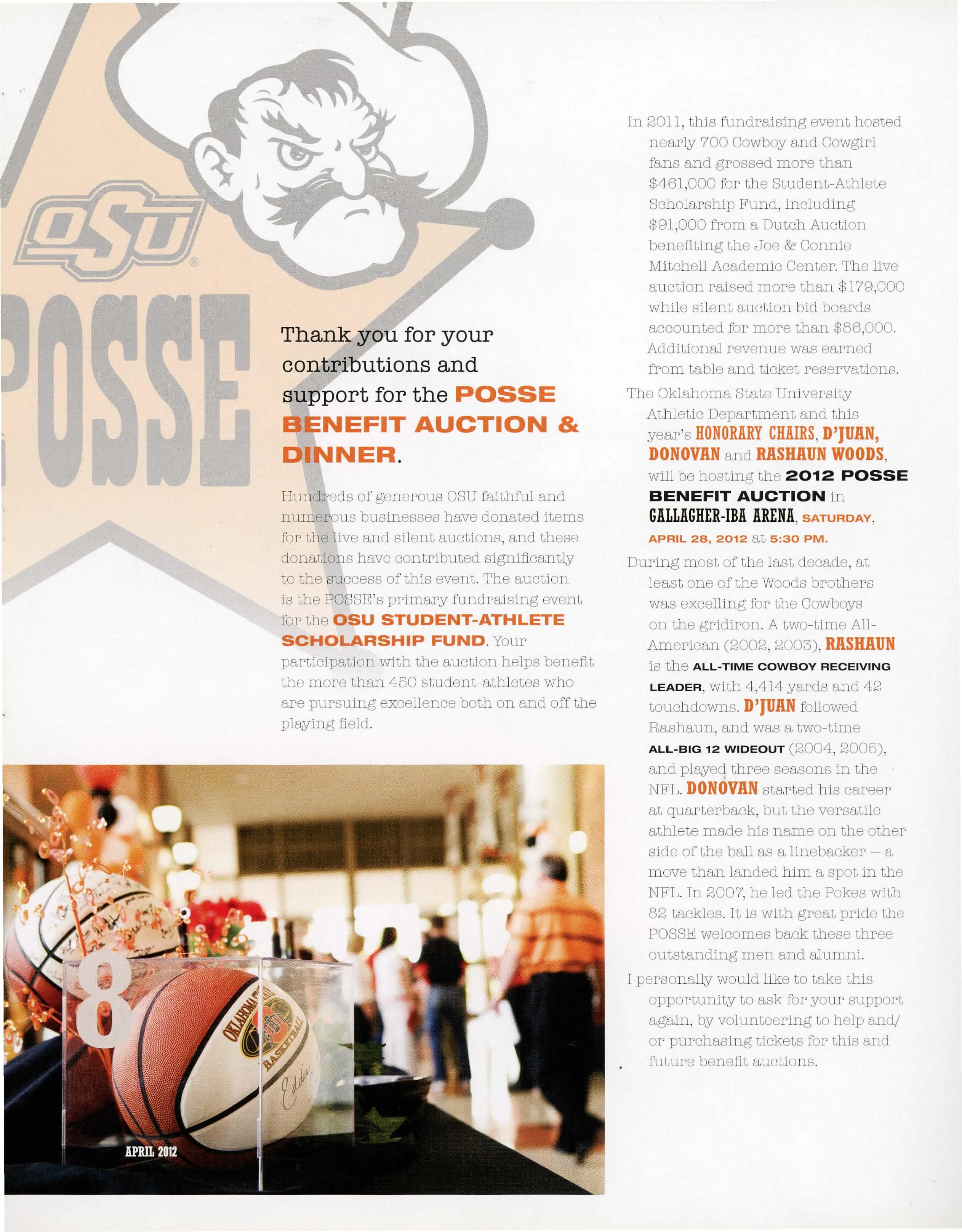
Hundreds of generous OSU faithful and numerous businesses have donated items for the live and silent auctions, and these donations have contributed significantly to the success of this event. The aucti.on is the POSSE's primary fundraising event for the OSU STUDENT-ATHLETE SCHOLARSHIP FUND. Your participation with the auction helps benefit the more than 450 student-athletes who are pursuing excellence both on and off the playing field.
In 2011, this fundraising event hosted nearly 700 Cowboy and Cowgirl fans and grossed more than $461,000 for the Student-Athlete Scholarship Fund, including $91,000 from a Dutch Auction benefiting the Joe & Connie Mitchell Academic Center. The live auction raised more than $179,000 while silent auction bid boards accounted for more than $86,000. Additional revenue was earned from table and ticket reservations.
The Oklahoma State University Athletic Department and this year's HONORARYCHAIRS,D'JU.AN, DONOVAN and RASH.AUNWOODS, will be hosting the 2012 POSSE BENEFIT AUCTION in GALLAGHER-IBAARENA,SATURDAY, APRIL 28, 2012 at 5:30 PM.
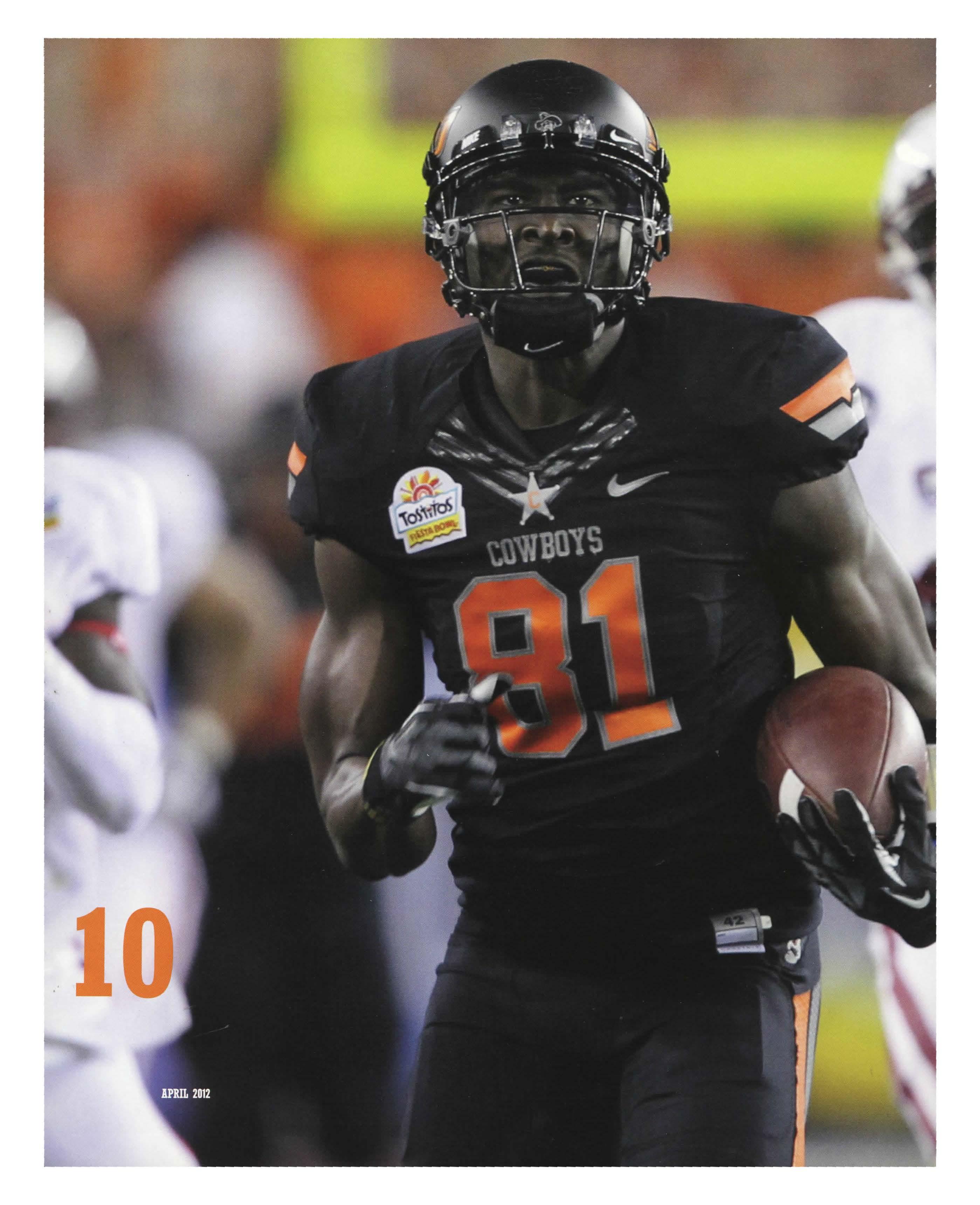
During most of the last decade, at least one of the Woods brothers was excelling for the Cowboys on the gridiron. A two-time AllAmerican (2002, 2003), RASH.AUN is the ALL-TIME COWBOY RECEIVING LEADER, with 4,414 yards and 42 touchdowns. D'JU.ANfollowed Rashaun, and was a two-time ALL-BIG 12 WIDEOUT (2004, 2005), and pla,yeq three seasons in the NFL. DONOVANstarted his career at quarterback, but the versatile athlete made his name on the other side of the ball as a linebacker - a move than landed him a spot in the NFL. In 2007, he led the Pokes with 82 tackles. It is with great pride the POSSE welcomes back these three outstanding men and alumni.
I personally would like to take this opportunity to ask for your support again, by volunteering to help and/ or purchasing tickets for this and future benefit auctions.
VOLUNTEERING TO HELP
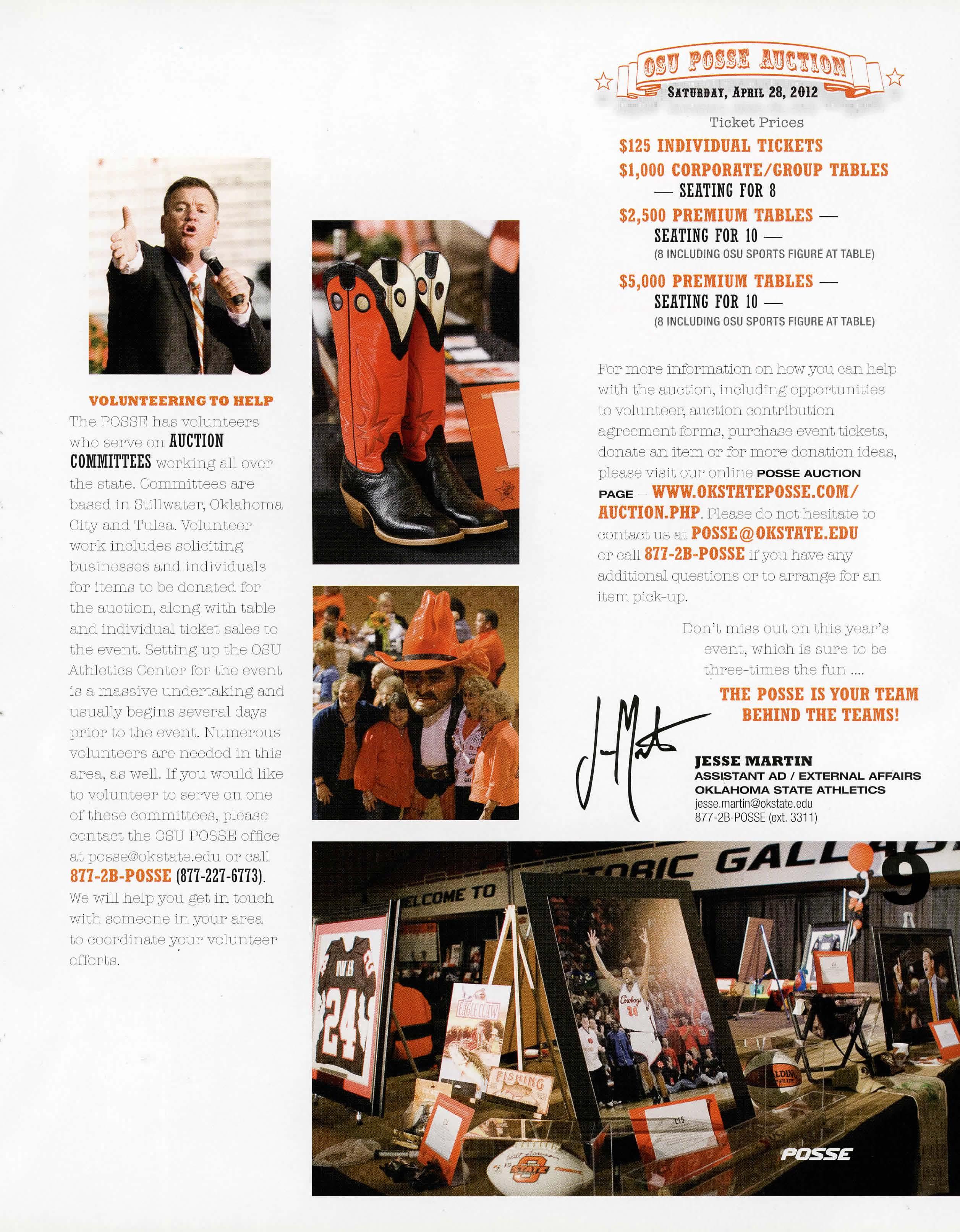
The POSSE has volunteers who serve on AUCTION COMMITTEES working all over the state. Committees are based in Stillwater, Oklahoma City and Tulsa. Volunteer work includes soliciting businesses and individuals for items to be donated for the auction, along with table and individual ticket sales to the event. Setting up the OSU Athletics Center for the event is a massive undertaking and usually begins several days prior to the event. Numerous volunteers are needed in this area, as well. If you would like to volunteer to serve on one of these committees, please contact the OSU POSSE office at posse@okstate.edu or call 877-2B-POSSE(877-227-6773).
We will help you get in touch with someone in your area to coordinate your volunteer efforts.
For more information on how you can help with the auction, including opportunities to volunteer, auction contribution agreement forms, purchase event tickets, donate an item or for more donation ideas, please visit our Online POSSE AUCTION PAGE - WWW.Ol{STATEPOSSE.COM/ AUCTION.PHP.Please do not hesitate to contact us at POSSE@Ol{STATE.EDU or call 877-2B-POSSE if you have any additional questions or to arrange for an item pick-up.
Don't miss out on this year's event, which is sure to be three-times the fun THEPOSSEIS YOURTEAM BEHINDTHETEAMS!
JESSE MARTIN
ASSISTANT AD / EXTERNAL AFFAIRS OKLAHOMA STATE ATHLETICS jesse.martin@okstate.edu 877-2B-P0SSE(ext.3311)
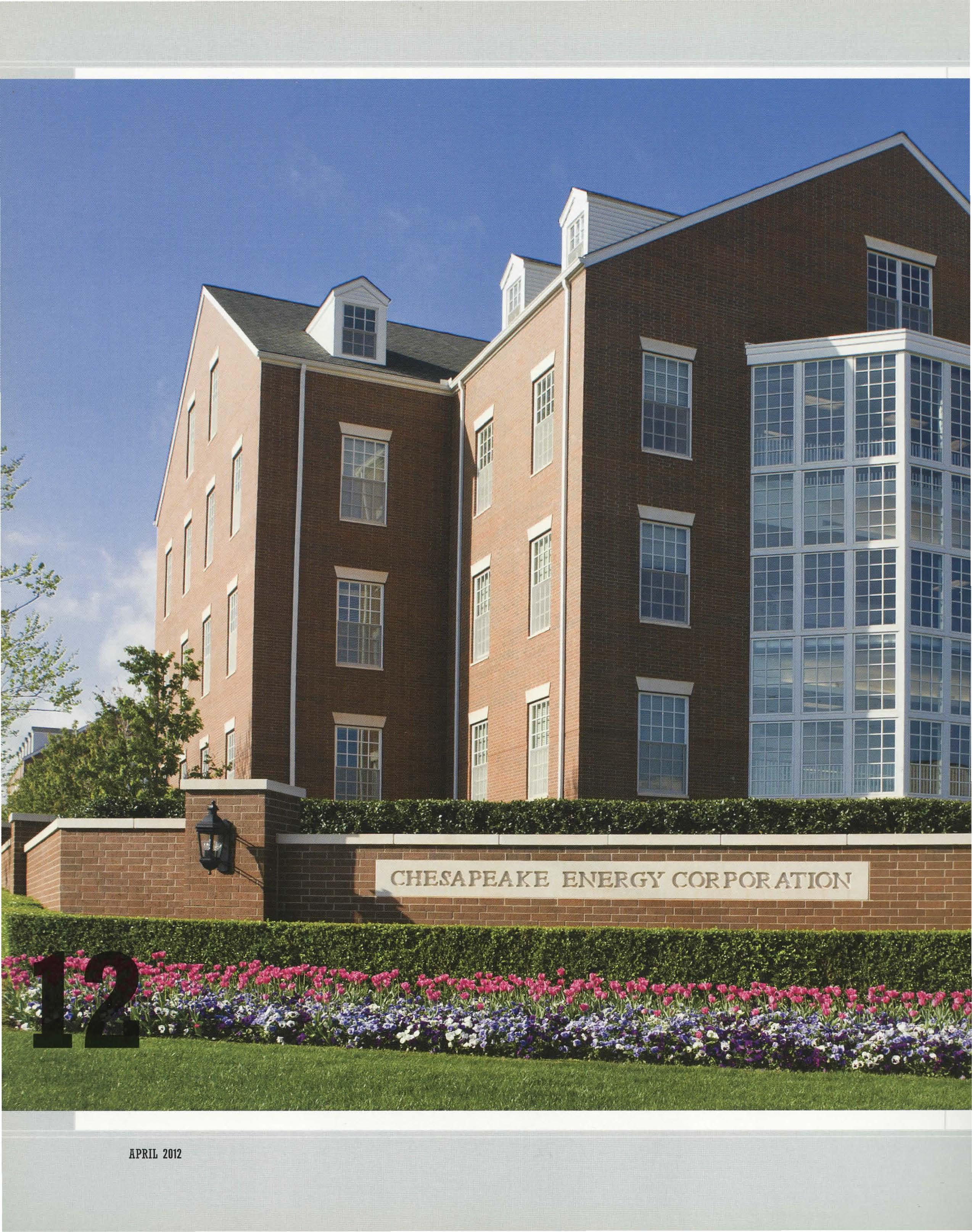
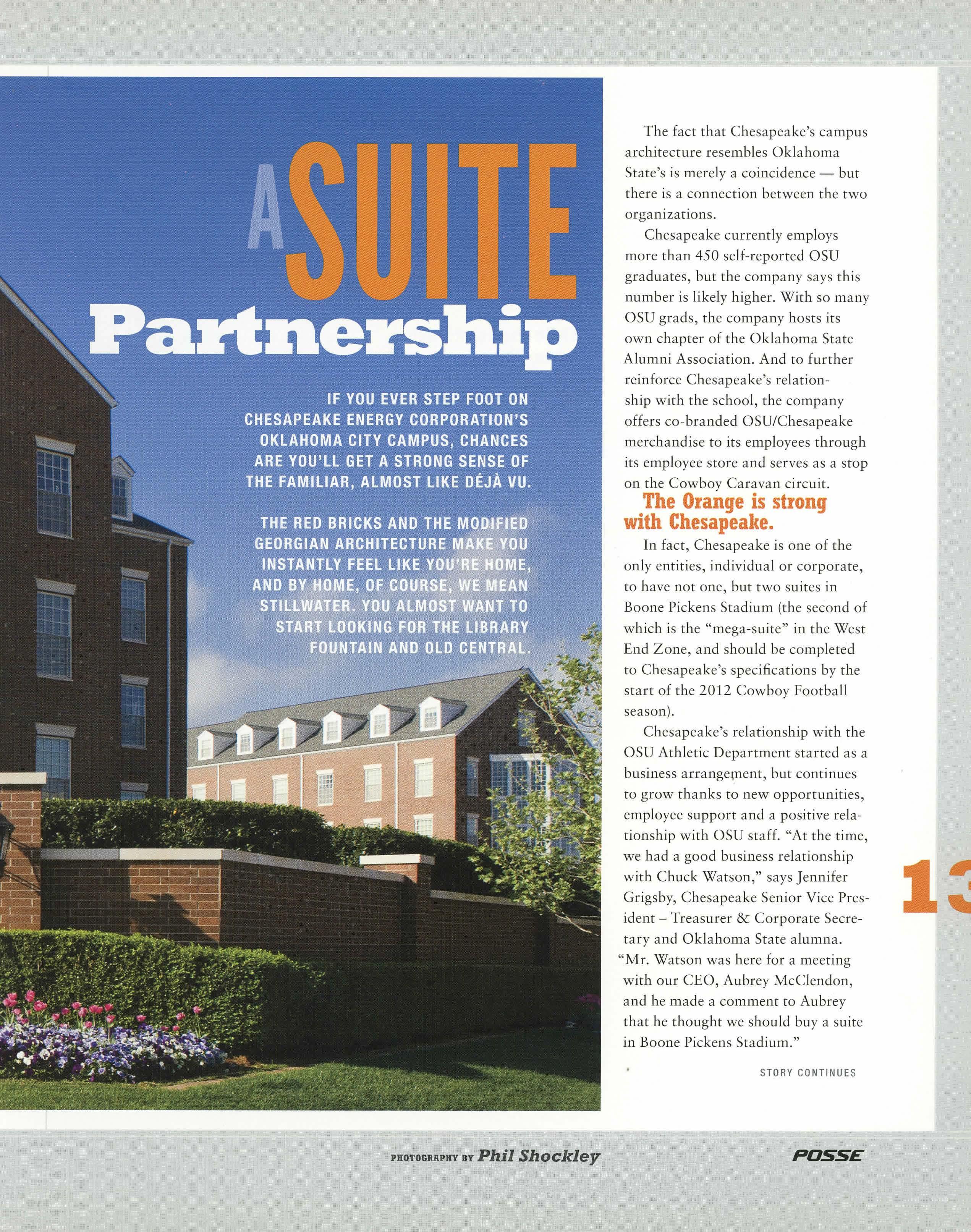
The fact that Chesapeake's campus architecture resembles Oklahoma State's is merely a coincidence - but there is a connection between the two organizations.
Chesapeake currently employs more than 450 self-reported OSU graduates, but the company says this number is likely higher. With so many OSU grads, the company hosts its own chapter of the Oklahoma State Alumni Association. And to further reinforce Chesapeake's relationship with the school, the company offers co-branded OSU/Chesapeake merchandise to its employees through its employee store and serves as a stop on the Cowboy Caravan circuit.
The Orangeis strong with Chesapeake.
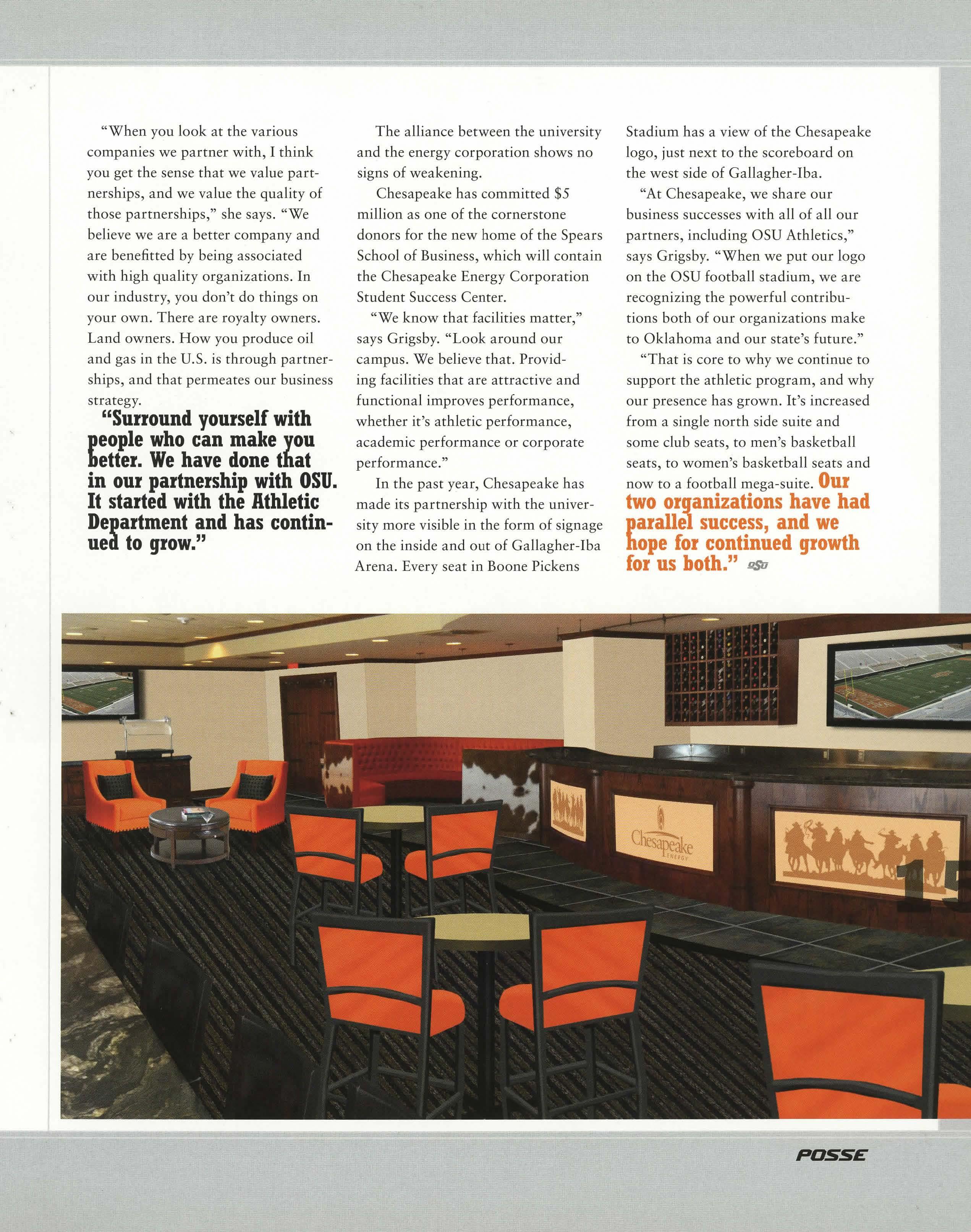
In fact, Chesapeake is one of the only entities, individual or corporate, to have not one, but two suites in Boone Pickens Stadium (the second of which is the "mega-suite" in the West End Zone, and should be completed to Chesapeake's specifications by the start of the 2012 Cowboy Football season).
Chesapeake's relationship with the OSU Athletic Department started as a business arrange{Tlent, but continues to grow thanks to new opportunities, employee support and a positive relationship with OSU staff. "At the time, we had a good business relationship with Chuck Watson," says Jennifer Grigsby, Chesapeake Senior Vice President - Treasurer & Corporate Secretary and Oklahoma State alumna. "Mr. Watson was here for a meeting with our CEO, Aubrey McClendon, and he made a comment to Aubrey that he thought we should buy a suite in Boone Pickens Stadium."
This was back in 2004, when the promise of what is now Boone Pickens Stadium was just a set of completed south side suites and architectural renderings of what the completed project would look like. That promise looked to Chesapeake like an opportunity, so the company committed to a suite and 16 additional club-level seats.
"Our true intention, when we bought the suite, was to use it for recruiting employees, as well as entertaining business guests," Grigsby says.
However, employee interest in the suite was strong, particularly when the company offered tickets to employees and their families. Demand quickly outstripped the supply.
"We care about the personal interests of our employees ," says Teresa Rose, Chesapeake Director of Community Relations. "In this case, we offer employees the opportunity to go to a game at OSU, to sit in a suite. It's something special and out of the ordinary that most people wouldn't be able to do on their own."
Chesapeake uses a lottery system to manage suite requests from their employees.
"We try to make sure that, of those who want to attend, we accommodate them for at least one game," says Grigsby. "We try to make it fair, and we give up to four tickets per employee, so families can go together."
Chesapeake also uses the suite to host its scholars, which adds further complexity when deciding who gets to occupy the suite on game day. The ddition ~f the mega-suite should 1ake finding enough tickets to meet
"It's going to allow us more oppornities to enhance all of our relationships," says Rose. "When you only have 26 tickets and more than 100
scholars you'd like to invite to a game, it's really hard to pick and choose.
"We'll host as many scholars as we can. It really is a tremendous benefit. We definitely see business value to being able to invite these students to experience a game in the Chesapeake suite. The mega-suite provides us a better chance to use the suites for all of our purposes."
Whilethe relationship betweenChesapeakeand OSUbeganwith athletics, it has since crossedoverto academics.
"Both Burns Hargis and Mike Holder have acknowledged that the Athletic Department is the front door of the university," says Grigsby. "It brings people together and connects them. So it makes sense that Chesapeake's partnership with OSU began with athletics, but that was really just the start. The partnership now is much deeper.
"We are really supportive of OSU's land-grant mission and the leaders the university is producing. As a land-grant university, the outreach programs OSU provides are also incredibly important to our company."
Both Rose and Grigsby describe the relationship between Chesapeake and OSU as a true partnership.
"It extends from geology, engineering and accounting scholarships to the training of compressor mechanics in Okmulgee at OSU-IT," says Grigsby.
"OSU's efforts make our state a better place and their graduates make a lasting impact on our world. That common goal - to support and improve the communities in which we operate is what really binds us with OSU."
"A year or so after we bought the suite, we started our first scholarship program with OSU," adds Rose.
"It was a rural scholars program. It wasn't in a specific discipline that we recruit. It was specifically supporting the land-grant mission, and was designed to provide four-year scholarships to young people in rural communities who would otherwise not be able to attend one of the major universities."
Chesapeake now supports nine different scholarship programs at OSU, covering a variety of academic focuses, including information technology and geology, but the natural gas compression program (OSU-IT in Okmulgee) perhaps best represents the working relationship between the two organizations.
Chesapeake saw an industry ed_ucational niche - natural gas compression training - that was not being filled by any state institution. The company approached OSU with an idea for a program to train students for work in a growing aspect of the natural gas industry. After a lot of work on both sides, the program is up and running.
"That's another example of the fantastic receptivity of Oklahoma State," says Rose. "We now have a program that's going to provide the skilled labor we need in a hard to fill niche. Heretofore, we'd just been doing it ourselves."
"We've been able to look and see those academic areas that are really strong at OSU, but are also hard-torecruit areas for Chesapeake. It has really been a great partnership."
"When you look at the various companies we partner with, I think you get the sense that we value partnerships, and we value the quality of those partnerships," she says. "We believe we are a better company and are benefitted by being associated with high quality organizations. In our industry, you don't do things on your own. There are royalty owners. Land owners. How you produce oil and gas in the U.S. is through partnerships, and that permeates our business strategy.
"Surroundyourselfwith peoplewho can makeyou better.Wehave donethat in our partnershipwith OSU. It startedwith the Athletic Departmentand has continueil to grow."
The alliance between the university and the energy corporation shows no signs of weakening.
Chesapeake has committed $5 million as one of the cornerstone donors for the new home of the Spears School of Business, which will contain the Chesapeake Energy Corporation Student Success Center.
"We know that facilities matter," says Grigsby. "Look around our campus. We believe that. Providing facilities that are attractive and functional improves performance, whether it's athletic performance, academic performance or corporate performance."
In the past year, Chesapeake has made its partnership with the university more visible in the form of signage on the inside and out of Gallagher-Iba Arena. Every seat in Boone Pickens
Stadium has a view of the Chesapeake logo, just next to the scoreboard on the west side of Gallagher-Iba.
"At Chesapeake, we share our business successes with all of all our partners, including OSU Athletics," says Grigsby. "When we put our logo on the OSU football stadium, we are recognizing the powerful contributions both of our organizations make to Oklahoma and our state's future."
"That is core to why we continue to support the athletic program, and why our presence has grown. It's increased from a single north side suite and some club seats, to men's basketball seats, to women's basketball seats and now to a football mega-suite. Our two organizationshave had parallelsuccess,and we hope for continuedgrowth for us both."
llSo
FRIDAY, APRIL28, 2012
GALLAGHER-IBAARENA
onovan and D'Juan the Honorary Co-Chairs
2 POSSE Auction April 28
in several years, they say, and admit they're looking forward to seeing some familiar faces.
"Just to be back in my college town, it's going to be exciting," says D'Juan, in an interview during a break from his job as a trainer/football skills coach in Las Vegas, Nev. "We love
that you guys haven't forgotten us Even though we didn't make it super big time in the NFL, or have big long careers or whatever. It's just very nice to see people still remember us."
The annual fundraiser hosts about 750 Cowboy donors who bid on items donated by businesses and others. Players are routinely seen interacting with fans and posing for photos during the event, tickets for which start at $125.
For many OSU fans, the Woods' brothers seven-year run at OSU
marked the beginning of the school's new-found prominence on the football field. None of them will forget Rashaun's acrobatic corner-of-theend-zone touchdown catch on the pump fake from quarterback Josh Fields that sealed Bedlam 16-13 in the waning seconds of the fourth quarter.
Rashaun,restarting the traditionof greatOSU receiverswhereHartLee Dykesleft
off, remains OSU's career leader with 4,414 yards receiving. D'Juan, Rashaun's bigger younger brother, is No. 4 on OSU's career receiving list, trailing Justin Blackmon at No. 2 and Dykes at No. 3.
(CONTINUES)
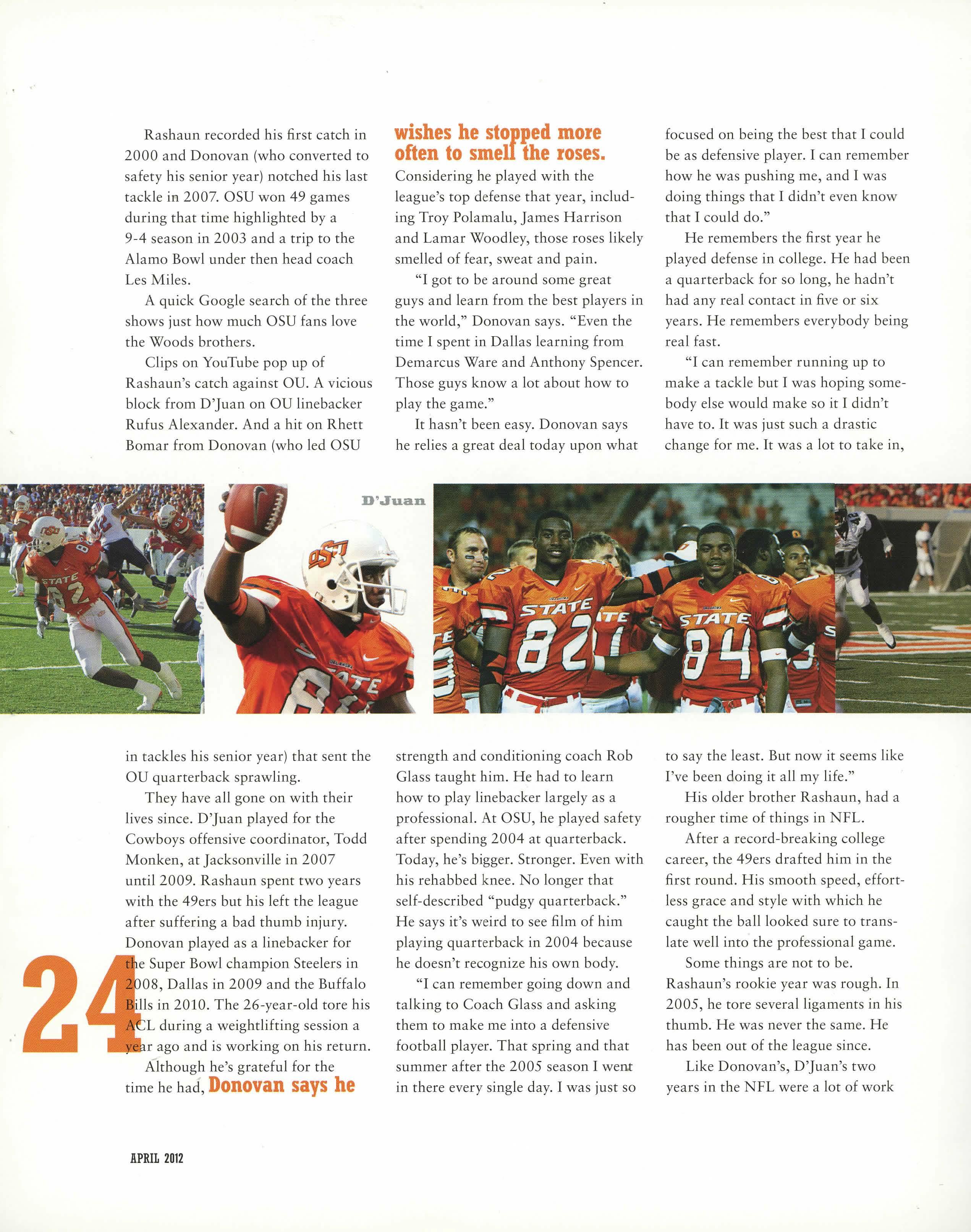
Rashaun recorded his first catch in 2000 and Donovan (who converted to safety his senior year) notched his last tackle in 2007. OSU won 49 games during that time highlighted by a 9-4 season in 2003 and a trip to the Alamo Bowl under then head coach Les Miles.
A quick Google search of the three shows just how much OSU fans love the Woods brothers.
Clips on YouTube pop up of Rashaun's catch against OU. A vicious block from D'Juan on OU linebacker Rufus Alexander. And a hit on Rhett Bomar from Donovan (who led OSU
wisheshe storpedmore often to smel the roses. Considering he played with the league's top defense that year, including Troy Polamalu, James Harrison and Lamar Woodley, those roses likely smelled of fear, sweat and pain.
"I got to be around some great guys and learn from the best players in the world," Donovan says. "Even the time I spent in Dallas learning from Demarcus Ware and Anthony Spencer. Those guys know a lot about how to play the game."
It hasn't been easy. Donovan says he relies a great deal today upon what
in tackles his senior year) that sent the OU quarterback sprawling.
They have all gone on with their lives since. D'Juan played for the Cowboys offensive coordinator, Todd Monken, at Jacksonville in 2007 until 2009. Rashaun spent two years with the 49ers but his left the league after suffering a bad thumb injury. Donovan played as a linebacker for e Super Bowl champion Steelers in 08, Dallas in 2009 and the Buffalo ills in 2010. The 26-year-old tore his L during a weightlifting session a r ago and is working on his return.
Although he's grateful for the time he had, Donovansays he
strength and conditioning coach Rob Glass taught him. He had to learn how to play linebacker largely as a professional. At OSU, he played safety after spending 2004 at quarterback. Today, he's bigger. Stronger. Even with his rehabbed knee. No longer that self-described "pudgy quarterback."
He says it's weird to see film of him playing quarterback in 2004 because he doesn't recognize his own body.
"I can remember going down and talking to Coach Glass and asking them to make me into a defensive football player. That spring and that summer after the 2005 season I went in there every single day. I was just so
focused on being the best that I could be as defensive player. I can remember how he was pushing me, and I was doing things that I didn't even know that I could do."
He remembers the first year he played defense in college. He had been a quarterback for so long, he hadn't had any real contact in five or six years. He remembers everybody being real fast.
"I can remember running up to make a tackle but I was hoping somebody else would make so it I didn't have to. It was just such a drastic change for me. It was a lot to take in,
to say the least. But now it seems like I've been doing it all my life."
His older brother Rashaun, had a rougher time of things in NFL.
After a record-breaking college career, the 49ers drafted him in the first round. His smooth speed, effortless grace and style with which he caught the ball looked sure to translate well into the professional game.
Some things are not to be.
Rashaun's rookie year was rough. In 2005, he tore several ligaments in his thumb. He was never the same. He has been out of the league since.
Like Donovan's, D'Juan's two years in the NFL were a lot of work
D'Juan
without a lot of playing time, but he still enjoyed it. Today, he's working with kids and area schools in football through his training business Super Prep-Star Elite. With former Cowboy linebacker Lawrence Pinson, he trains local Pop Warner teams in some of the finer skills of football.
But it's also about something more with him. In Las Vegas, he says, the kids' game there is largely about money. The coaches are not as concerned about their players, he says. His goal is to try to mentor kids and offer them something more than just instruction on how to play the game.
It was sweet watching the team succeed in 2011, they say. D'Juan, 27, lives in Las Vegas, so he made it over with the rest of his family to watch the Fiesta Bowl. They all caught the Bedlam game on TV. They were struck by just how good OSU looked in 2011. They also felt the bug come back and bite them. They wanted to be back on the field. And they miss being a part of the team on game day.
"Game day is the most exciting, most electrifying part of the whole experience at Oklahoma State," D'Juan says. "Just going out on that field with the sea of orange cheering
"It's a lot different out here than it was in Oklahoma," he says. "I just try to pass on stuff about being a better person. Being a good guy. That guy who stays out of trouble. Who does things to help. Because the familyat Oklahoma Statewas
real tight. Everyone reallygenuinelycared abouteach other. . . I talk to theni aboutbeing accountablefor yourself and for youractions. Being
a leader and things of that nature
That's part of the reason why we chose to go to Oklahoma State."
you on while you're playing against a rival team. The camaraderie with the fans and the players."
On Bedlam, he adds, "It's been a while since it happened like that. We definitely were excited to come out and get our wins, but I just think about the seniors last year, you know, to go out on a Bedlam win of that caliber. That's something you never forget."
Like his brothers, Donovan can't name just one favorite moment of his time at OSU. Just a few of those include Rashaun's senior day. Most of all he loves that he had the chance to play football with his brothers, even
though he wasn't taking snaps when Rashaun played.
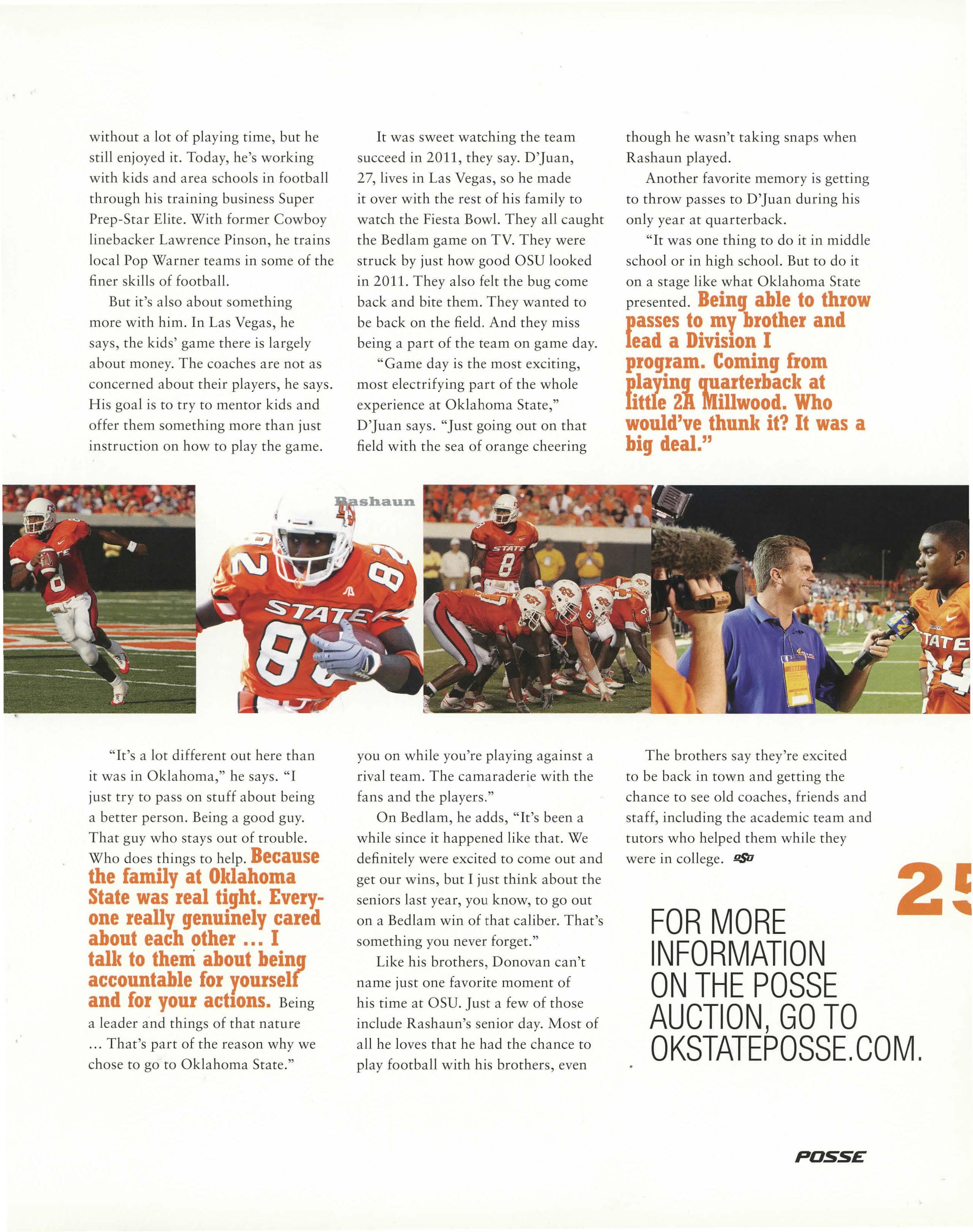
Another favorite memory is getting to throw passes to D'Juan during his only year at quarterback.
"It was one thing to do it in middle school or in high school. But to do it on a stage like what Oklahoma State presented. Being able to throw passesto my brotherand lead a DivisionI program.Comingfrom playingquarterbackat little 2A Millwood.Who would'vethunkit? It was a big deal."
The brothers say they're excited to be back in town and getting the chance to see old coaches, friends and staff, including the academic team and tutors who helped them while they were in college. I1$0
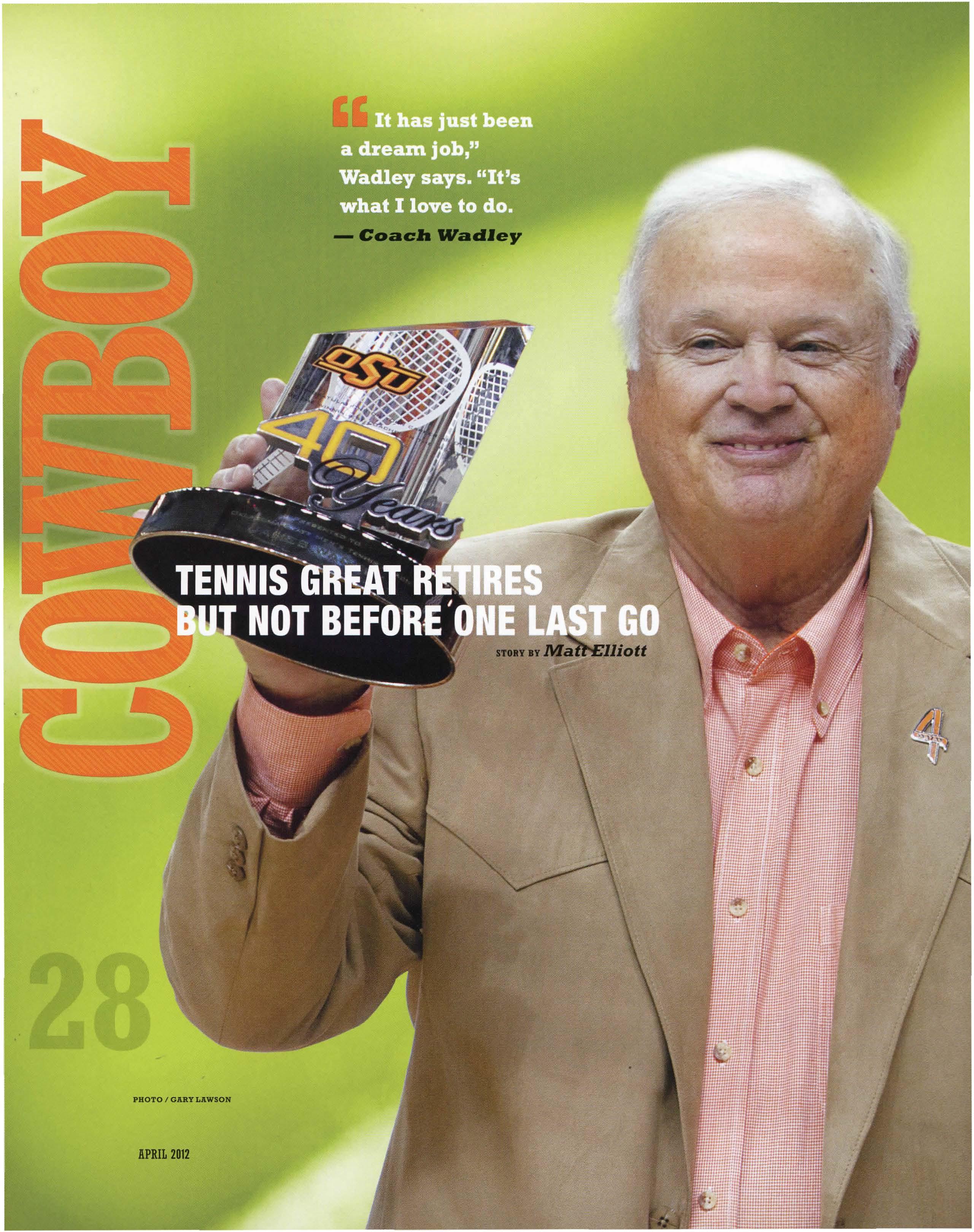
- Coac:la Wadley
MEN'STENNISCOACHJAMES
WADLEYHASBEENDOINGTHESAME THINGFOR40 YEARS.
His streak ends this year. The longest-tenured coach in OSU history retires after this season. WHAT'SONHISMIND? WINNING.
Well, that, and he's also a little worried he might drive his wife, Paula Wadley, crazy once he retires. Fortunately, he has five grandchildren to chase around.
"I've got 12 years to get them to Wimbledon," Wadley says. "That's kind of a challenge."
Wadley was an astounding 658-320 at the start of the 2012 season. That record includes 17 team trips to the NCAA tournament.
Hopefully his ride into the sunset won't come until after an 18th team appearance in the NCAA tournament. Then, Wadley, long weary of bemoaning facilities but never tired of talking up his players, can go out with a bang.
"We want to send him out on a good note," says senior team captain Eric West. "We want to have a fun year, not have any regrets, and go out there and play some good tennis."
He notes it's been a huge pleasure working with the same university, coaches and caliber of athletes for four decades. Assistant coach, former player, can't imagine what it will be like without Wadley coaching in Stillwater.
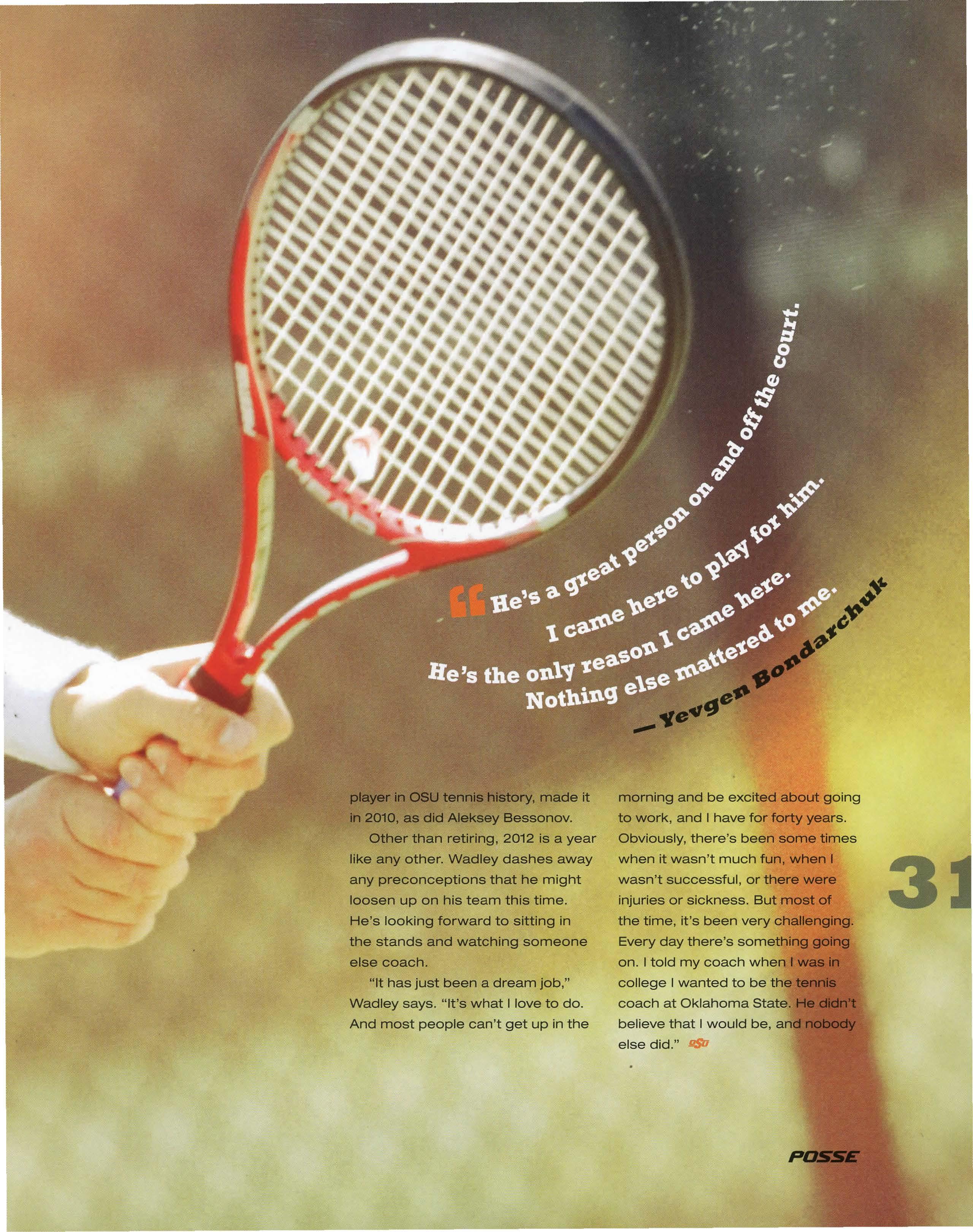
"It's been a great experience working with him," says Bondarchuk, who has worked with his coach for 10 years as a player and assistant. "He's a great person on and off the court. I came here to play for him. He's the only reason I came here. Nothing else mattered to me. He's a great guy. Hopefully who we find to take over for coach will be as good as he is."
As a player, Wadley got his start at Southeastern Oklahoma State and was a two-time All-American in the NAIA. As a coach, he is a 13-time conference coach of the year and was named regional coach of the year 11 times. Before 2012, he had 108 all-conference players and nine All-Americans.
"You only get your players for four years, and they all run together it seems like," Wadley says. "You're involved in a lot of people's livessometimes not positively, such as when you screw up, or push too hard, or didn't push hard enough, or make mistakes along the way.
Hopefully, I did more things right than I did wrong. It's not just about the record. That's what most people think of, 'championships won.' But really the influence you have on kids is what it's all about."
He was hired away to OSU in 1972 from a better-paying job coaching at Duncan High School. His first team went 16-14 before rattling off three straight 20-win seasons and three conference runner-up finishes.
From 1977 to 1991, his team won 12 conference championships. They were especially dominant from 1978 to 1987, when the Cowboys lost only twice during conference play.
He coached his share of national champions, too. Pavel Kudrnac won three of them. Martin Dvoracek. Fran Krepelka and Matt Prentice. His 2006 and 2007 team was ranked in the nation's top 10, a first for OSU.
It hasn't been easy. His teams' competitiveness has been astounding given the program's poor playing facilities.
Players practice and play on outdoor courts near the student gym - weather permitting. The courts have no locker rooms, bathrooms or shelter from Stillwater's famous wind. If OSU's players need to practice indoors, the team must travel more than an hour away to Tulsa or Ponca City. That wreaks havoc with players' class schedules.
In 2011, historic snowstorms and some of the coldest temperatures in decades battered Stillwater, causing some matches to be cancelled. The weather played a big part in the team's 5-14 record that year.
"We had a couple of matches cancelled that would have helped o.ut our ranking a lot," West says. "It's just how it is."
•s new training Is still in the works. Once
indoor courts will be welcome dltlons. Staff members in the
Hard work helps. So does recruiting the right players.
So does lying, Wadley says with a laugh.
"We tried to do the best with what we've had, tried to downplay the facilities, tell them courts are the same size everywhere, tried to convince them the wind is good and the dirt coming off all these new buildings isn't a challenge," Wadley says.
This season, the team is poised to finish strong.
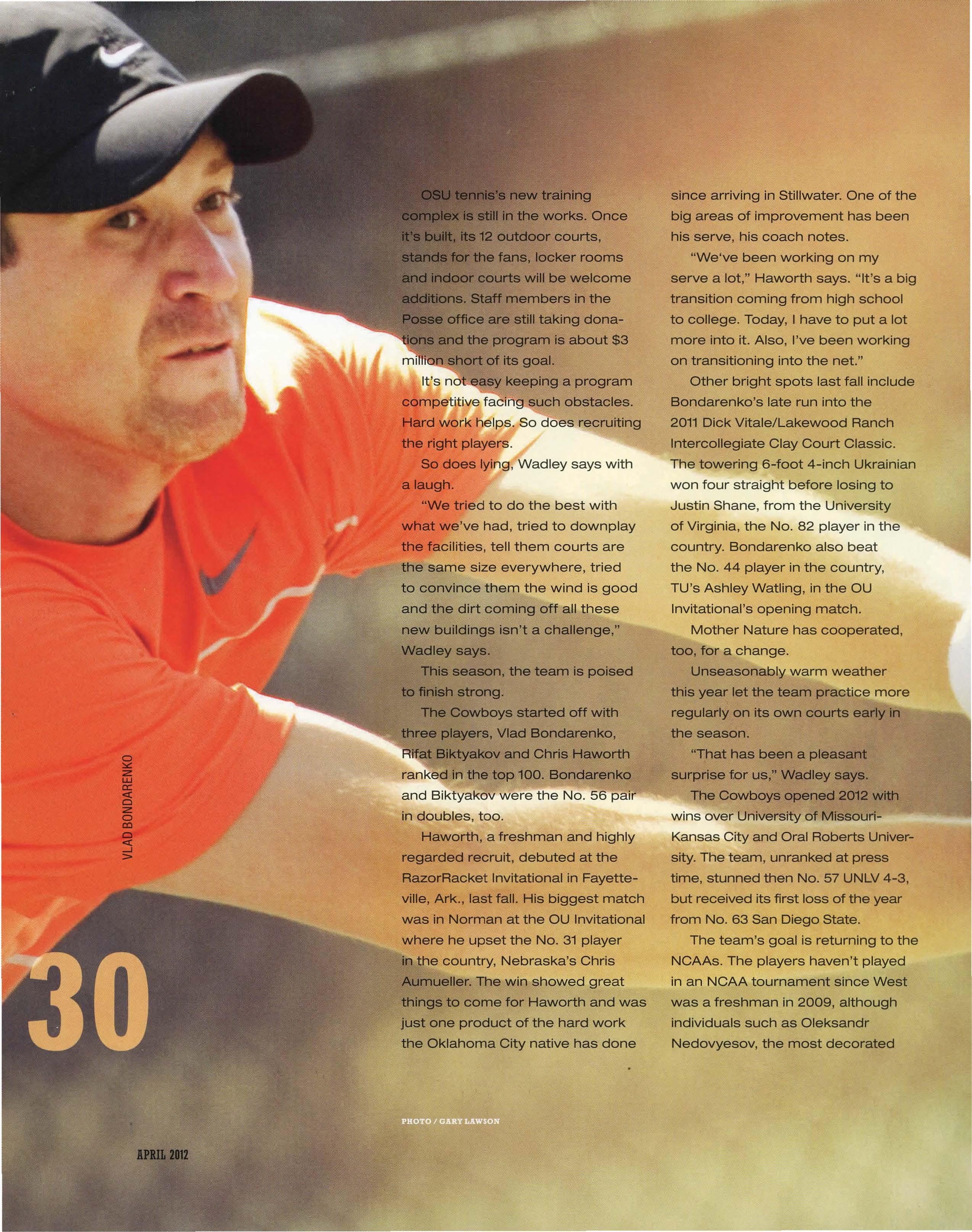
The Cowboys started off with three players, Vlad Bondarenko, Rifat Biktyakov and Chris Haworth ranked in the top 100. Bondarenko and Biktyakov were the No. 56 pair in doubles, too.
Haworth, a freshman and highly regarded recruit, debuted at the RazorRacket Invitational in Fayetteville, Ark., last fall. His biggest match was in Norman at the OU Invitational where he upset the No. 31 player in the country, Nebraska's Chris Aumueller. The win showed great things to come for Haworth and was just one product of the hard work the Oklahoma City native has done
since arriving in Stillwater. One of the big areas of improvement has been his serve, his coach notes.
"We've been working on my serve a lot," Haworth says. "It's a big transition coming from high school to college. Today, I have to put a lot more into it. Also, I've been working on transitioning into the net."
Other bright spots last fall include Bondarenko's late run into the 2011 Dick Vitale/Lakewood Ranch Intercollegiate Clay Court Classic. The towering 6-foot 4-inch Ukrainian won four straight before losing to Justin Shane, from the University of Virginia, the No. 82 player in the country. Bondarenko also beat the No. 44 player in the country, TU's Ashley Watling, in the OU lnvitational's opening match.
Mother Nature has cooperated, too, for a change.
Unseasonably warm weather this year let the team practice more regularly on its own courts early in the season.
"That has been a pleasant surprise for us," Wadley says.
The Cowboys opened 2012 with wins over University of MissouriKansas City and Oral Roberts University. The team, unranked at press time, stunned then No. 57 UNLV 4-3, but received its first loss of the year from No. 63 San Diego State.
The team's goal is returning to the NCAAs. The players haven't played in an NCAA tournament since West was a freshman in 2009, although individuals such as Oleksandr Nedovyesov, the most decorated
player in OSU tennis history, made it morning and be excited about going In 2010, as did Aleksey Bessonov. to work, and I have for forty years.
Other than retiring, 2012 is a year Obviously, there's been some times like any other. Wadley dashes away any preconceptions that he might loosen up on his team this time. He's looking forward to sitting in the stands and watching someone else coach.
"It has just been a dream job," Wadley says. "It's what I love to do. And most people can't get up in the
when it wasn't much fun, when I wasn't successful, or there were injuries or sickness. But most of the time, it's been very challenging. Every day there's something going
college I wanted to be the t coach at Oklahoma State. believe that I would be, an elsedid." 9$0
MILIARFAC
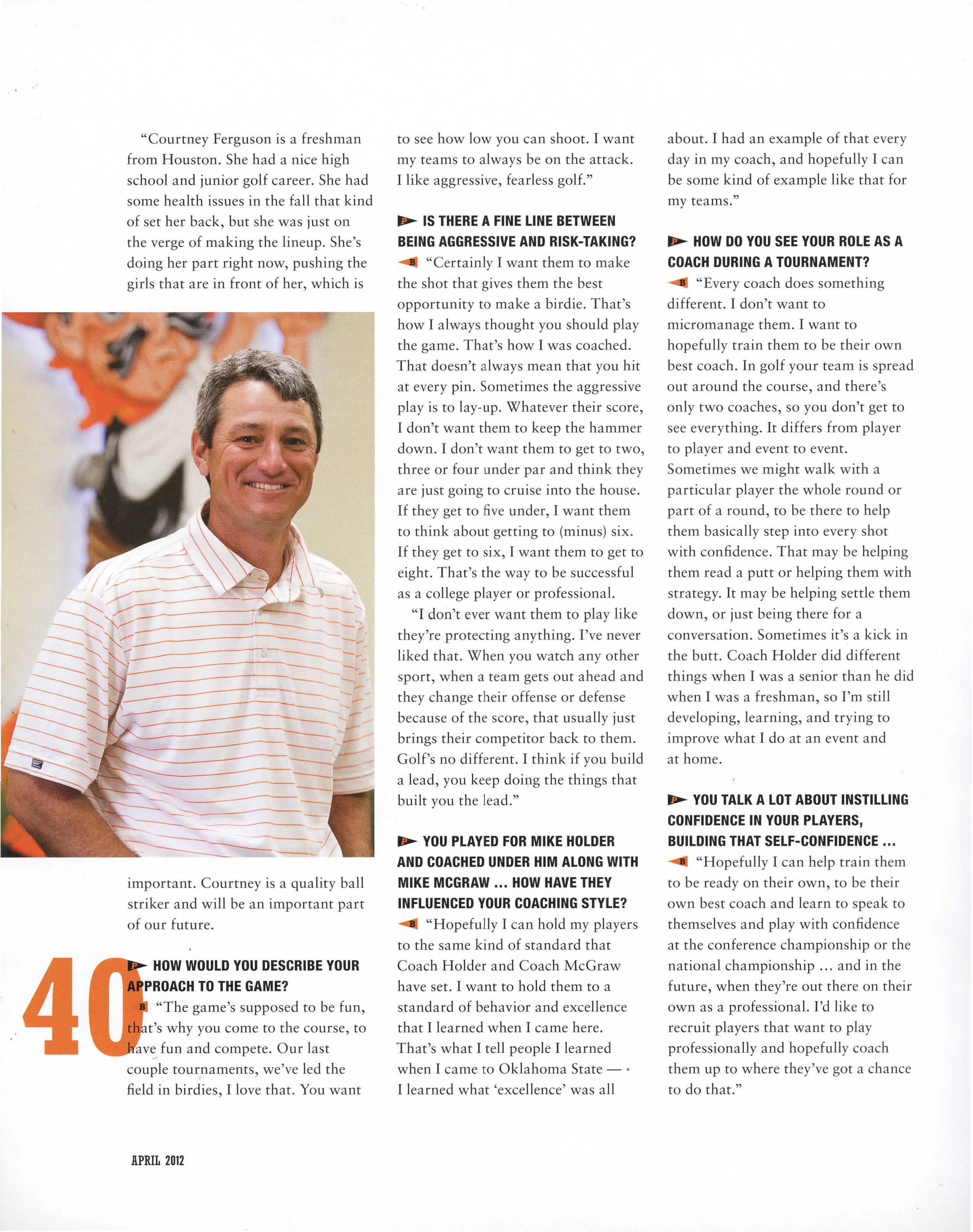
WhenOklahomaStateneededaheadcoach to takethereinsofitswomen'sgolfteamlast summer,AthleticDirectorMikeHolderdidn't havetolookfar.
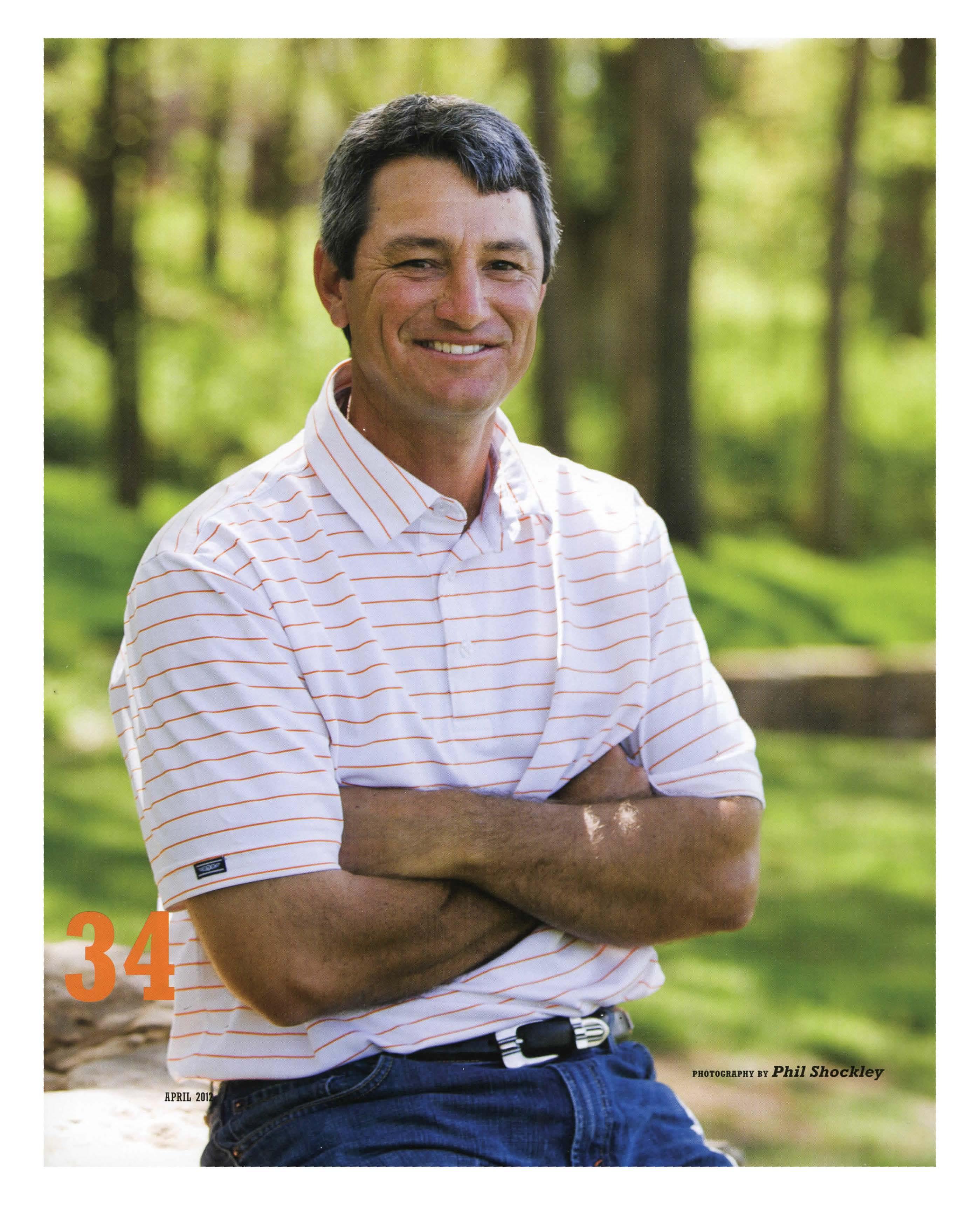
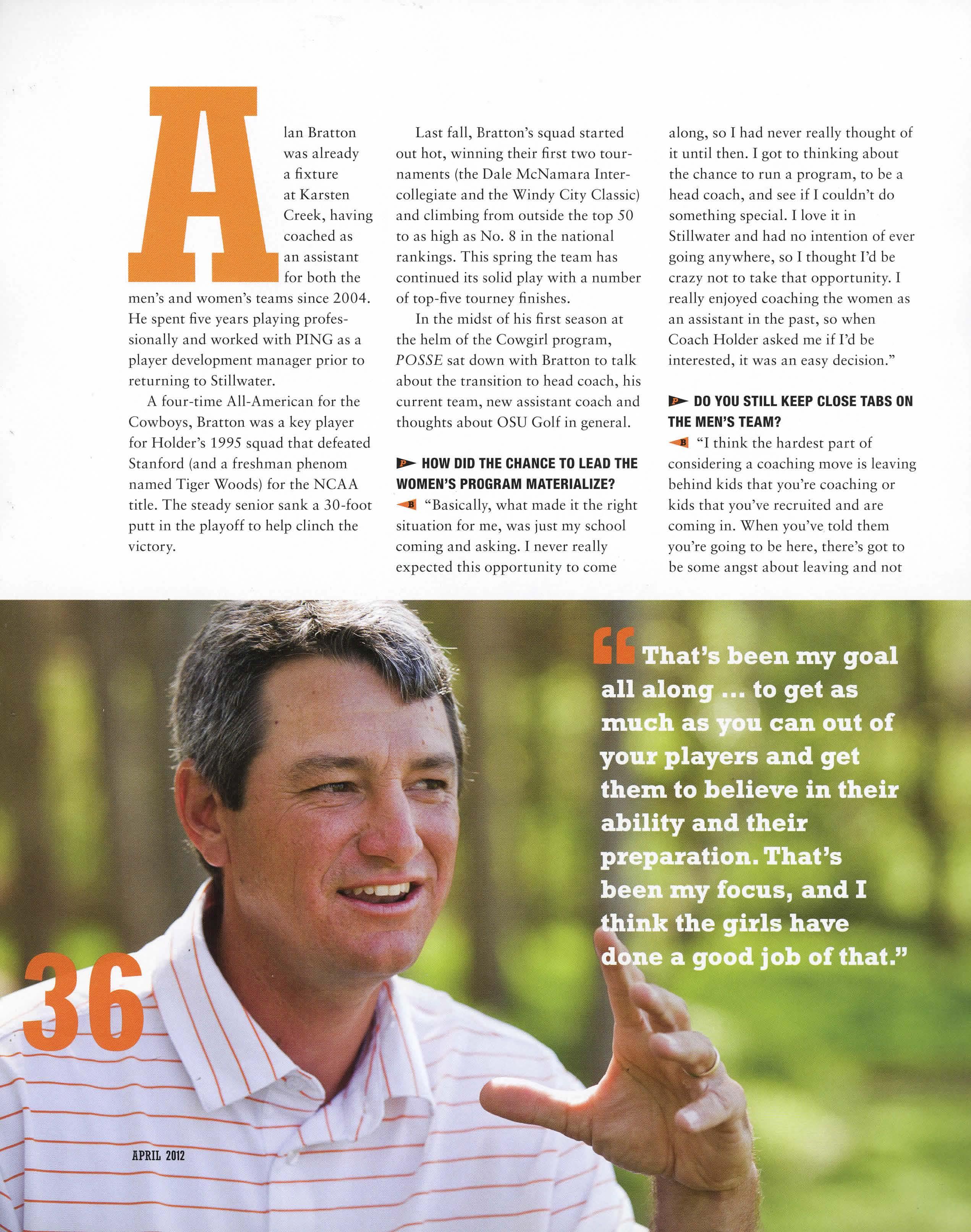
Ian Bratton was already a fixture at Karsten Creek, having coached as an assistant for both the men's and women's teams since 2004. He spent five years playing professionally and worked with PING as a player development manager prior to returning to Stillwater.
A four-time All-American for the Cowboys, Bratton was a key player for Holder's 1995 squad that defeated Stanford (and a freshman phenom named Tiger Woods) for the NCAA title. The steady senior sank a 30-foot putt in the playoff to help clinch the victory.
Last fall, Bratton's squad started out hot, winning their first two tournaments (the Dale McNamara Intercollegiate and the Windy City Classic) and climbing from outside the top 50 to as high as No. 8 in the national rankings. This spring the team has continued its solid play with a number of top-five tourney finishes.
In the midst of his first season at the helm of the Cowgirl program, POSSE sat down with Bratton to talk about the transition to head coach, his current team, new assistant coach and thoughts about OSU Golf in general.
"Basically, what made it the right situation for me, was just my school coming and asking. I never really expected this opportunity to come
along, so I had never really thought of it until then. I got to thinking about the chance to run a program, to be a head coach, and see if I couldn't do something special. I love it in Stillwater and had no intention of ever going anywhere, so I thought I'd be crazy not to take that opportunity. I really enjoyed coaching the women as an assistant in the past, so when Coach Holder asked me if I'd be interested, it was an easy decision."
DOYOUSTILLKEEPCLOSETABSON THEMEN'STEAM?
"I think the hardest part of considering a coaching move is leaving behind kids that you're coaching or kids that you've recruited and are coming in. When you've told them you're going to be here, there's got to be some angst about leaving and not
being around for their development. That was another positive with this job. I'm still around the men's program. I didn't have to completely walk away. While I'm removed from the men's program, I'm still right there, so I can help kids I care about in whatever way possible."
IS THEREA DIFFERENTAPPROACH IN COACHINGYOUNGWOMENVS. YOUNG MEN?
I really haven't changed my approach much at all. I've always tried to coach the individual, whether it's guys or girls, and I haven't found a significant difference. I'm probably a little more careful in what I say, but otherwise, I've simply coached the way I believe good players should be coached."
WHO'SMORECOACHABLE,GIRLS ORGUYS?
"It was my experience as an assistant coach that most of the time the girls were more receptive to coaching. That played into my decision when I had the opportunity to be the head coach. Had I not had the experience of helping the girls before, I don't know what I would've thought. But I really enjoyed working with them. They wanted help. They were just as competitive as the guys and were easy to be around, and that's continued to be the case. Hopefully I can keep earning their trust. We've had a lot of fun this year."
YOUSTARTEDOUTLASTFALL WINNINGYOURFIRSTTWO TOURNAMENTSAS A HEADCOACH NOTA BADWAYTO BEGINYOUR TENURE.
"The girls have just listened, and they've worked hard. They're the ones doing everything. Hopefully I've helped them believe in themselves a little more. I don't think there's been a major change in anything. Hopefully I've carried myself with confidence and that has carried over to them. That's been my goal all along, and that's the goal for any coach, to get as much as you can out of your players and get them to believe in their ability and their preparation. That's been my focus, and I think the girls have done a good job of that."
(CONTINUES) POSSE
IS YOURTEAMWHEREYOU THOUGHTTHEY'DBEATTHISTIME?
"I didn't really have a lot of expectations going into the year. We have three new faces, and I hadn't worked with the other girls the last couple of years, so I didn't exactly know what we had. Going into any year, I don't like to put limits on anybody. You try to win your conference every year and try to field a team that's competitive for a national championship. As a player going into tournaments, I never really had a goal of a specific finish or a ything like that, I just tried to get t best score I cou Id every day. I take I e same approach with any teams th t I've coached. Some days you've tagoodnumbcrinyouandsome days you don't ... As far as expectations, they showed me their
ability in the fall. If we can just keep getting better every day, there's no telling how good we might be by the end of the year."
"The strength of our team has been balance. I think we only have one player ranked in the top 50 right now, but our team is ranked 12th, so that's kind of a testament to that balance. While Kelsey Vines has been our No. 1, everybody has done their part. We've had two different girls shoot 64. We've had four girls shoot rounds in the 60s, which is important. Six of our kids have shot rounds of even par or better in tournament play. A lot of teams d9n't have that. They may have a dominant
player, but they don't have six or more players capable of shooting under par. Overall, we've done a nice job of picking each other up. If a girl has a bad score, teammates kind of cover for her that day, and she's there for them .the next day.
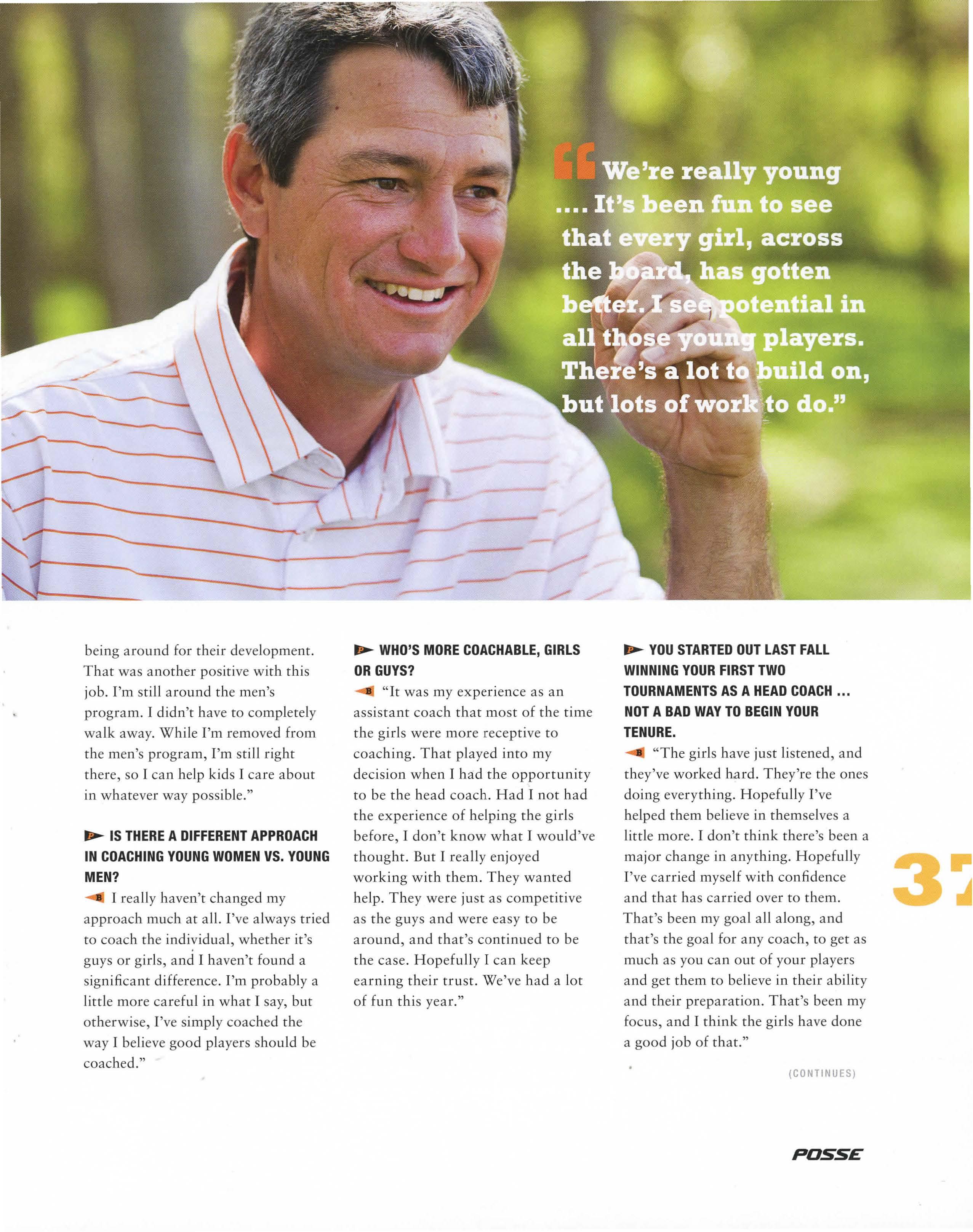
"We're really young with four sophomores, a freshman, two juniors and a senior. It's been fun to see that every girl, across the board, has gotten better. They've all either done something they've never done or had a career-best round, and all of their scoring averages are better than they were last year. I see potential in all those young players. There's a lot to build on, but lots of work to do."
CANYOUGIVEUSA SNAPSHOTOF YOURSQUAD?
"Kelsey Vines, a junior from Austin, has been our best player all year, without question. She's really solid. I think she has a bright future and has as chance to make a living playing golf. She's certainly been the leader on the golf course for our team and is on track to be an All-American this year.
"Jayde Panos has been a solid contributor. Jayde is a sophomore from Australia after arriving at semester last year. She is very talented. She's been a little inconsistent, but when she's good, she's really good. That's a nice foundation to build on.
"Josephine Janson, from Sweden, is another sophomore. She's a talented athlete with good speed in her swing and touch around the greens. She does
a great job in the weight room, hits the ball a long way, and is just starting to scratch the surface on how good she can be. She has lots of firepower, and just keeps adding to her skills. Josephine makes a lot of birdies and has a lot of fight.
"Joceyln Alford is our only senior. She is Canadian and transferred to OSU last year after two years at an NAIA school where she was a part of a National Championship team. She's been a steady performer and may be our most improved player. Excels in the classroom as well.
"Amy Ruengmateekhun is another sophomore, a transfer from SMU. She's been a real bright spot this year. She shot 64 for us in a tournament last fall. She's worked really hard and keeps getting better. I think she believes in her abilities a lot more now than she did a year ago. Gets along great with her teammates.
"Hillary Wood is a junior from Houston. She's really young in the game of golf. She didn't start playing until her freshman year of high school. It's been really exciting to see how much she's improved in the three years she's been here. She makes a lot of birdies and is ultra competitive.
"Lauren Falley is a sophomore from Kansas. Same kind of thing - young in college, but also in the game. She's gotten so much better. I think she expected to redshirt last year, but ended up breaking into the lineup her second semester. She's improved her ball-striking. Her short game's coming around. Everything's improved. She played an important role in our win last fall in Chicago.
(CONTINUES)
"Courtney Ferguson is a freshman from Houston. She had a nice high school and junior golf career. She had some health issues in the fall that kind of set her back, but she was just on the verge of making the lineup. She's doing her part right now, pushing the girls that are in front of her, which is
important. Courtney is a quality ball striker and will be an important part of our future.
HOWWOULDYOUDESCRIBEYOUR PROACHTOTHEGAME?
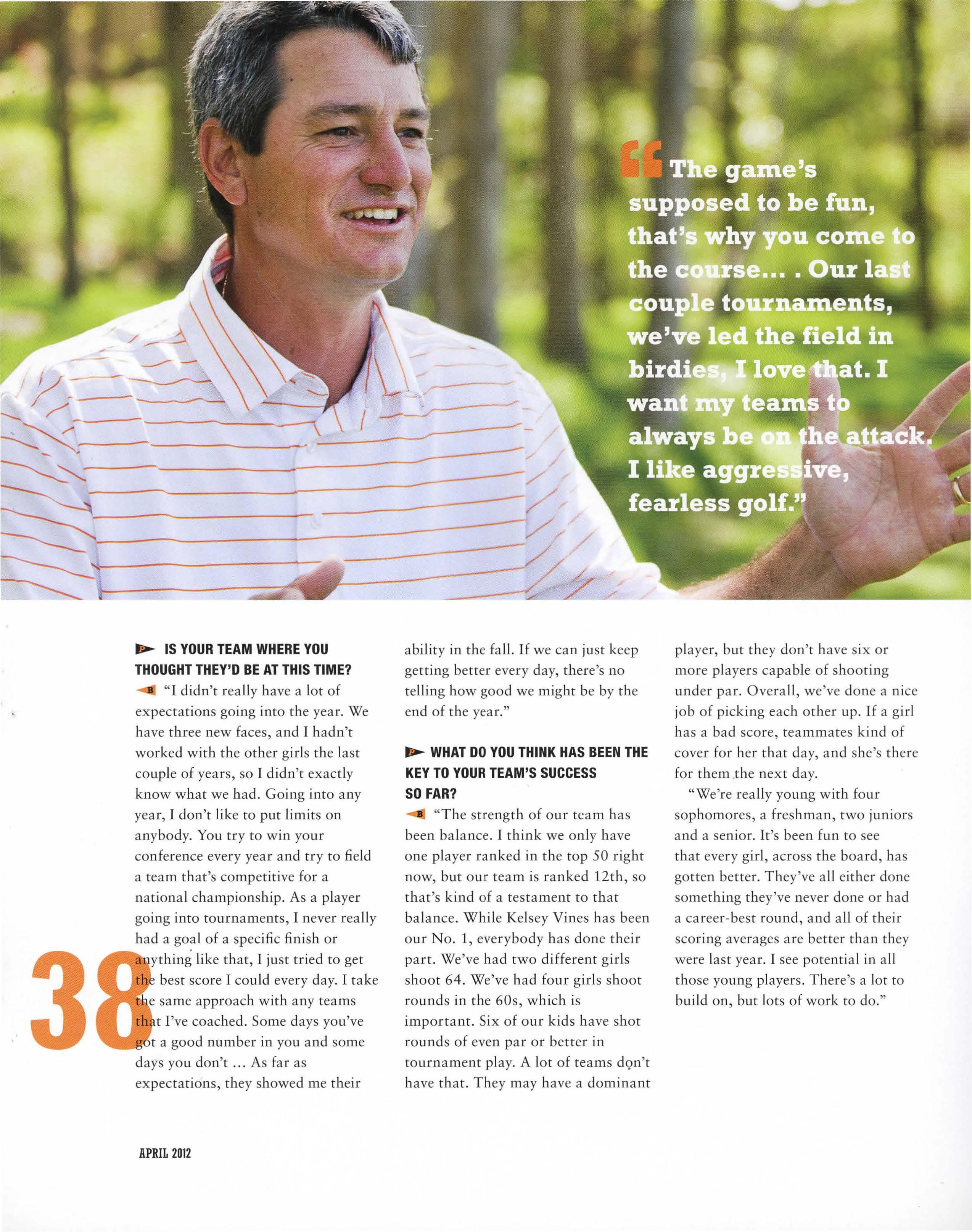
"The game's supposed to be fun, t's why you come to the course, to ave fun and compete. Our last couple tournaments, we've led the field in birdies, I love that. You want
to see how low you can shoot. I want my teams to always be on the attack. I like aggressive, fearless golf."
IS THEREA FINELINEBETWEEN BEINGAGGRESSIVEANDRISK-TAKING?
"Certainly I want them to make the shot that gives them the best opportunity to make a birdie. That's how I always thought you should play the game. That's how I was coached. That doesn't always mean that you hit
about. I had an example of that every day in my coach, and hopefully I can be some kind of example like that for my teams."
HOWDOYOUSEEYOURROLEAS
A COACHDURINGA TOURNAMENT?
"Every coach does something different. I don't want to micromanage them. I want to hopefully train them to be their own best coach. In golf your team is spread at every pin. Sometimes the aggressive out around the course, and there's play is to lay-up. Whatever their score, only two coaches, so you don't get to I don't want them to keep the hammer see everything. It differs from player down. I don't want them to get to two, to player and event to event. three or four under par and think they Sometimes we might walk with a are just going to cruise into the house. particular player the whole round or If they get to five under, I want them part of a round, to be there to help to think about getting to (minus) six. them basically step into every shot If they get to six, I want them to get to with confidence. That may be helping eight. That's the way to be successful as a college player or professional.
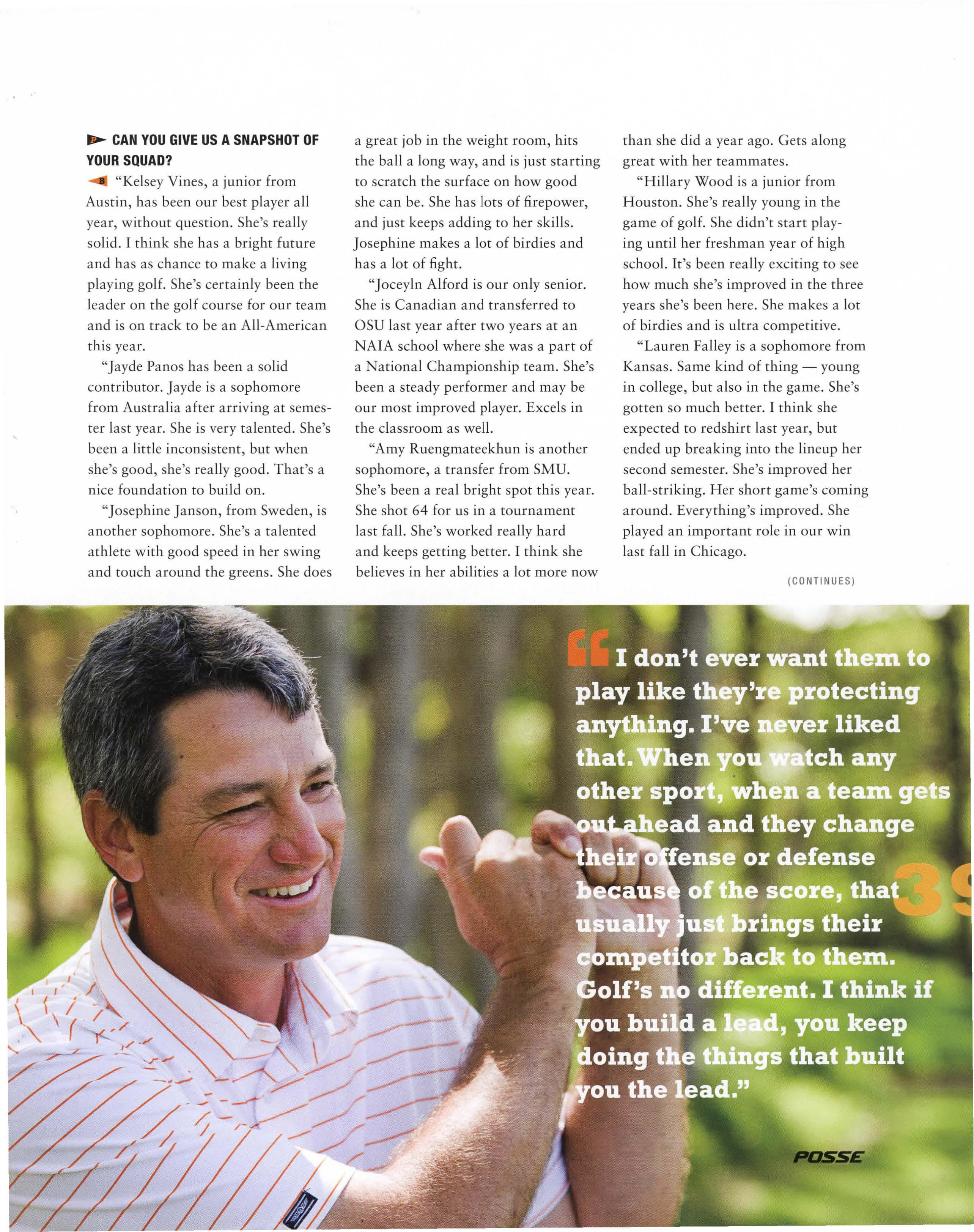
"I don't ever want them to play like they're protecting anything. I've never liked that. When you watch any other sport, when a team gets out ahead and they change their offense or defense because of the score, that usually just them read a putt or helping them with strategy. It may be helping settle them down, or just being there for a conversation. Sometimes it's a kick in the butt. Coach Holder did different things when I was a senior than he did when I was a freshman, so I'm still developing, learning, and trying to brings their competitor back to them. improve what I do at an event and Golf's no different. I think if you build at home. a lead, you keep doing the things that built you the lead."
YOUPLAYEDFORMIKE
HOLDER ANDCOACHEDUNDERHIM ALONGWITH MIKE MCGRAW HOWHAVETHEY INFLUENCEDYOURCOACHINGSTYLE?
"Hopefully I can hold my players to the same kind of standard that Coach Holder and Coach McGraw have set. I want to hold them to a standard of behavior and excellence that I learned when I came here. That's what I tell people I learned when I came to Oklahoma State - • I learned what 'excellence' was all
"Hopefully I can help train them to be ready on their own, to be their own best coach and learn to speak to themselves and play with confidence at the conference championship or the national championship ... and in the future, when they're out there on their own as a professional. I'd like to recruit players that want to play professionally and hopefully coach them up to where they've got a chance to do that."
"That's such a huge advantage for us all the way around. I've told the girls all year that it's not OSU Men's Golf or OSU Women's Golf - it's OSU Golf. They're a part of something big. I've talked to them about how many people care about what they're doing and want to see them succeed and help them do that, whether it be donors or alumni or former players After we won that tournament in Tuisa, all those supporters I was talking about made me look good, because the response was huge, whether it was phone calls or letters, the girls were really excited about articles being written about them and all the coverage they got. They really did see how many people pull for them, pay attention to what they're doing and care about the program. That's always a nice thing to have. You're all by yourself a lot in golf, whether you're out practicing or playing, and that extra drive sure helps your confidence and can be a real asset and a motivator when you're working on your own. In our case, we've got access to a lot of former Cowboys and Cowgirls, including current PGA and LPGA players, who have a lot of knowledge, whether that's Bob Tway, Caroline Hedwall, Rickie Fowler, Pernilla Lindberg, Karin Sjodin the list goes on. With Coach McGraw and Coach (Brian) Guerz and the players on the men's team, we've got a lot of resources to help _them.It's also pretty rare to have an athletic director who used to be the golf coach. That's the power of a tradition-rich program. I want the girls to understand that it's not separate. I think OSU Golf - the men and women - are really a unit that's together."
"We've got a nice history on the women's side that a lot of people don't know about. I think if you went and talked to most of the top young players in the U.S., the top boys all know that Oklahoma State's been good for a long time. But if you ask the girls, they wouldn't list us as one of the better programs, and we have been. We missed nationals last year for the first time in 10 years. Only a handful of schools could say they've been there nine out of the last 10 times. Part of my job is to get the word out and let people know about our history and keep building on that."
"I met Courtney when she worked for the AJGA the last five years running golf tournaments, so I had seen her work ethic and her outgoing personality. When I went to hire an assistant, I called some coaches that I respected around the country for recommendations. When Courtney's name came up, obviously that held some weight with me. When I thought about what I needed in an assistant, she fit the bill all the way around. She knew players from across the globe. She was organized. I knew she could relate to people. I didn't know much about her golf background until I began to visit with her through the interview process. "Courtney was a highly-recruited junior player, so she can relate to the players in that way. She played
college golf at Tulsa. She got hurt when she was in school, so her playing career didn't go the way she wanted it to, bur I think that will make her an even better coach. She can relate to what happens when things don't go as expected. I felt like I'd made a good hire, but since she's been here on the job, I don't think there could have been a better fit. She relates to the girls, she's young enough that she's not that far removed from what they're experiencing. She's super competitive. That's a huge asset as a coach, and she's kind of getting a second chance at the college golf thing. She wanted to be in this part of the country, and she was recruited to come play golf at OSU originally, so maybe she got it right the second time around."
"My children tell me that I used to be a champion, but I'm not anymore. And they're right. But I loved my time in college, and I look back on my amateur and professional career with a lot of great memories. That's why I wanted to be a coach, to give kids the same kind of experience. I love Oklahoma State and really feel blessed to be doing what I'm doing." llSD
Stillwater Families.
On-Demand Information Services.
Utilizing SST's FarmRite product, our customers can remain focused on their core competencies of agronomy, sales and customer service, while leaving most of the computer work to us. With our around-the-clock data processing service and lightning-fast turnaround-time, they can rest assured they're getting the information products they need when they need them.
Celebrateand honor the ten membersof the OSUmen's basketballpr perishedin a plane crash in 2001.
Rememberthe Ten Run benefactorsinclude OSUCounselingServic a new Rememberthe Ten Run ScholarshipProgram.
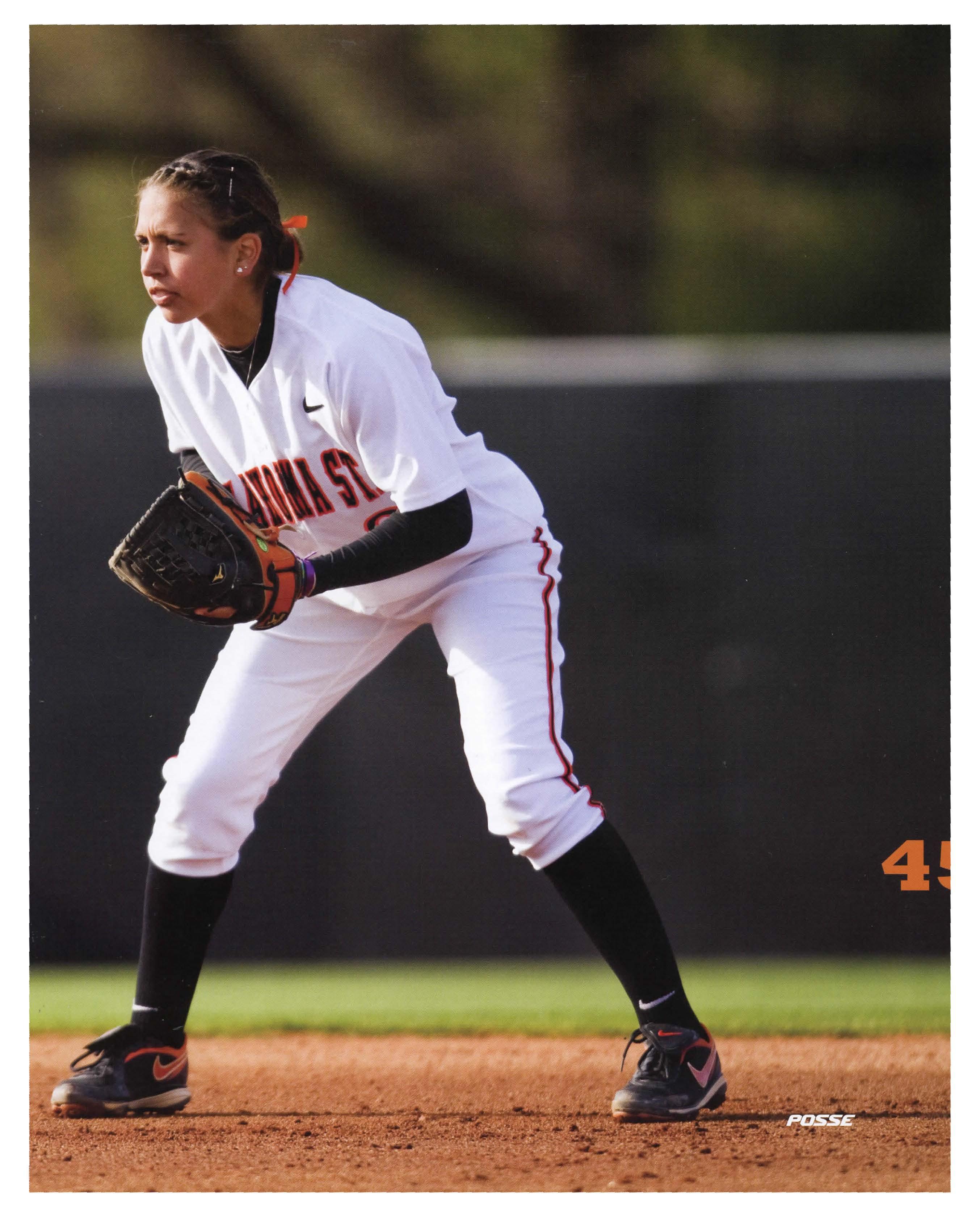
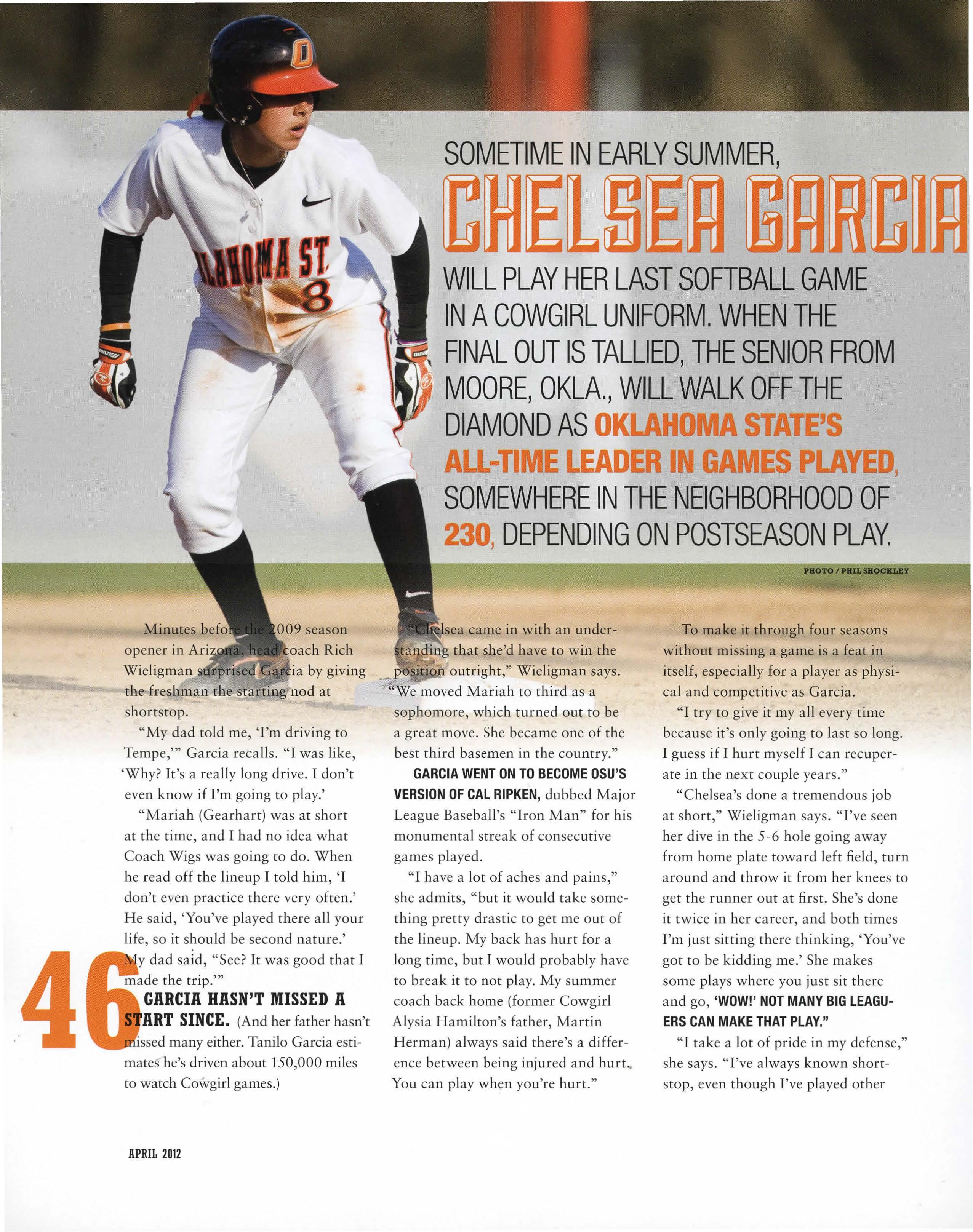
the freshman the.starting nod at shortstop.
"My dad told me, 'I'm driving to Tempe,"' Garcia recalls. "I was like, 'Why? It's a really long drive. I don't even know if I'm going to play.'
"Mariah (Gearhart} was at short at the time, and I had no idea what Coach Wigs was going to do. When he read off the lineup I told him, 'I don't even practice there very often.' He said, 'You've played there all your life, so it should be second nature.'
y dad said, "See? It was good that I made the trip."'
GARCIAHASN'TMISSEDA
issed many either. Tanilo Garcia estimates he's driven about 150,000 miles to watch Cowgirl games.)
a came in with an underhat she'd have to win the outright," Wieligman says. "We moved Mariah to third as a sophomore, which turned out to be a great move. She became one of the best third basemen in the country."
GARCIAWENTONTOBECOMEOSU'S VERSIONOFCALRIPKEN,dubbed Major League Baseball's "Iron Man" for bis monumental streak of consecutive games played.
"I have a lot of aches and pains," she admits, "but it would take something pretty drastic to get me out of the lineup. My back has hurt for a long time, but I would probably have to break it to not play. My summer coach back home (former Cowgirl Alysia Hamilton's father, Martin Herman) always said there's a difference between being injured and hurt You can play when you're hurt."
To make it through four seasons without missing a game is a feat in itself, especially for a player as physical and competitive as Garcia.
"I try to give it my all every time because it's only going to last so long. I guess if I hurt myself I can recuperate in the next couple years."
"Chelsea's done a tremendous job at short," Wieligman says. "I've seen her dive in the 5-6 hole going away from home plate toward left field, turn around and throw it from her knees to get the runner out at first. She's done it twice in her career, and both times I'm just sitting there thinking, 'You've got to be kidding me.' She makes some plays where you just sit there and go, 'WOW!'NOTMANYBIGLEAGUERSCANMAKETHATPLAY."
"I take a lot of pride in my defense," she says. "I've always known shortstop, even though I've played other
positions. I was the only one who could catch when I was a kid, so I was a first baseman, but short is where I feel comfortable."
While Garcia's glove has always been steady, the coach says her hitting has been a pleasant surprise.
"I knew she could swing the bat a little bit, but she just brings so much to the defense," Wieligman says. "Shortstop is a key position, and sometimes you lean a little bit toward defense versus offense at that position, but she's done a great job on both sides of the ball."
Last season Garcia helped lead the Cowgirls on a dramatic run to the WOMEN'SCOLLEGEWORLDSERIES.In addition to her stellar fielding, she hit .333 on the year, including 12 roundtrippers and 55 runs batted in.
"LASTYEARSHECOMES IN ANDLEADSTHETEAMIN HOMERUNSANDRBIS,"
Wieligman says. "Did I think I was going to get that out of her? No I didn't. I knew on the defensive side what we were going to get with her, but offensively, last season was unbelievable. I thought she deserved All-American recognition."
"I surprised myself for sure," Garcia says, "because I was never the greatest hitter. I work really hard on my hitting. I know I don't have a God-given ability to swing the bat. I came from a slow pitch background, so it was really hard for me to learn to hit fastpitch."
For Garcia, softball has always been a family a~fair.
"My wife and I played slow pitch," says Tanilo. "That was our recreational activity. It was inexpensive, and that's basically what we did for fun. The kids grew up with softball."
"My mom actually got us into playing," Chelsea says. "My dad told
her, 'If you're going to have them play softball, you're going to have to be ready for me to coach them. I'm going to make them the best player they can be, and I'm not going to give them any slack.' She said, 'Okay."'
Sometimes the girls didn't take the constructive criticism very well, particularly after games.
"I was pretty hard on them," Tanilo admits. "Coming from a military background, my goal was to tear them down and build them back up. Hard work is something that we've always taught. Nobody's going to give you anything. You're basically going to have to earn it."
The son of migrant farmers, all Tanilo wanted was a better life for his children than he experienced growing up.
"I had to work in the fields and hoe cotton in the summertime," he says. "I never had the opportunity to do athletics because my parents weren't that interested in it."
If the Garcias were going to do something, they were going all-in. Growing up, Chelsea and her younger sister Sydney were fixtures on the diamond. Traveling teams. Thousand-mile road trips to tournaments. Vacations planned around the slow pitch season.
"It's just something my wife and I wanted to enjoy as a family from day one," Tanilo says. "We knew we had to set a budget every year for travel. We'd go to South Carolina, Alabama to all these slow pitch tournaments. It was the joy of being with the girls. It's just like the MasterCard commercial: 'Bats and balls, $10 dollars; Spending ti me with your kids, priceless."'
IN SHORT,SOFTBALLWASLIFE. THENLIFETHREWTHEMA NASTYCURVEBALL.
Robin Garcia was diagnosed with cervical cancer when Chelsea was just nine years old.
"My mom was a teacher. I was in her fourth grade class," she recalls. "She had gone in for an examination, and when she got the results back she pulled me out of class and told me. I remember them saying she had the rapid-growth type. Radiation, chemo ... nothing worked. It took about a year."
Tanilo Garcia suddenly found himself a single father of four girls: Chelsea, her younger sister Sydney, and teenagers Tiffany and Jeanna.
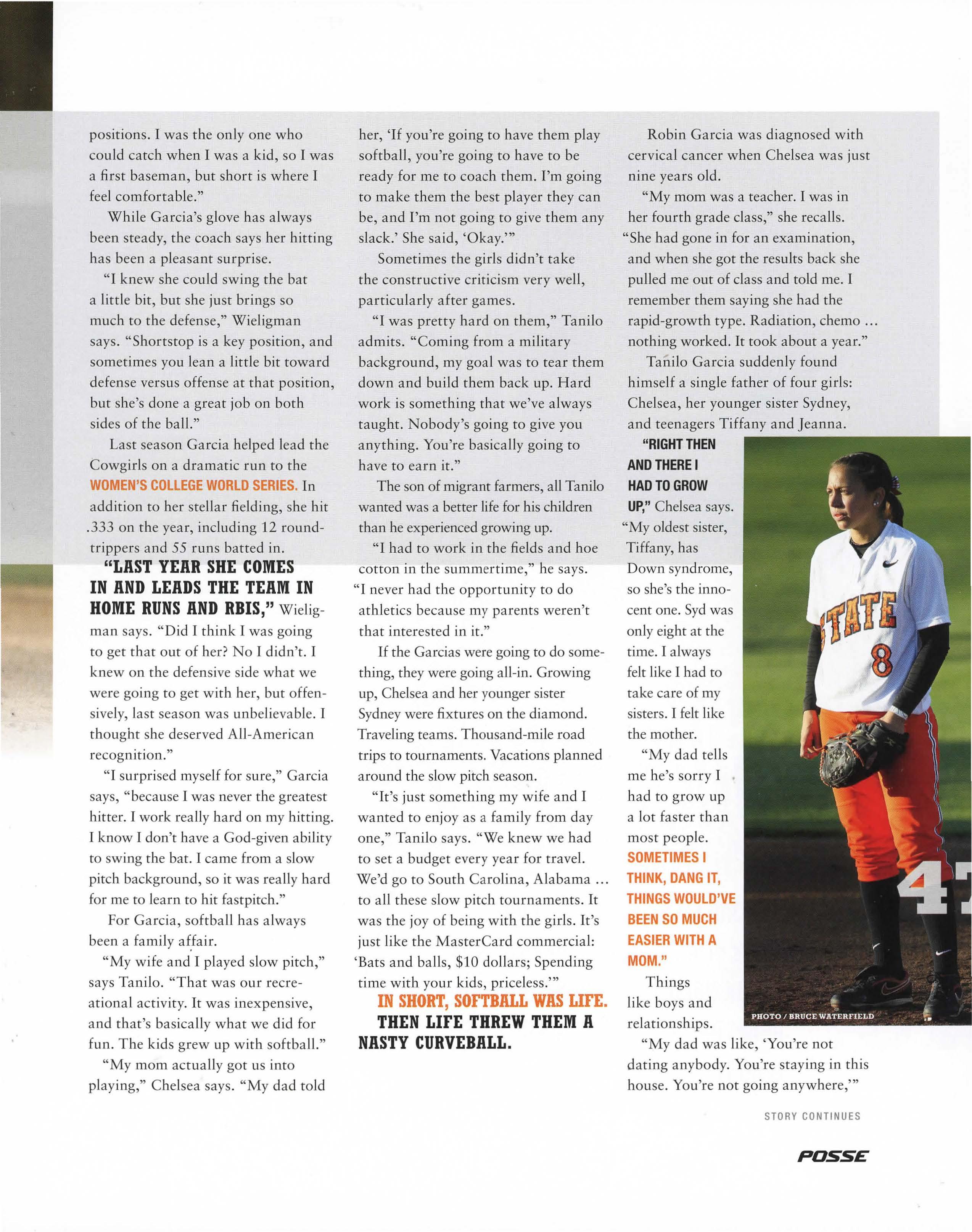
"RIGHTTHEN ANDTHERE I HADTOGROW UP,"Chelsea says. "My oldest sister, Tiffany, has Down syndrome, so she's the innocent one. Syd was only eight at the time. I always felt like I had to take care of my sisters. I felt like the mother.
"My dad tells me he's sorry I had to grow up a lot faster than most people. SOMETIMES I THINK,DANGIT, THINGSWOULD'VE BEENSOMUCH EASIERWITHA MOM."
Things like boys and relationships.
"My dad was like, 'You're not dating anybody. You're staying in this house. You're not going anywhere,"'
CONTINUES
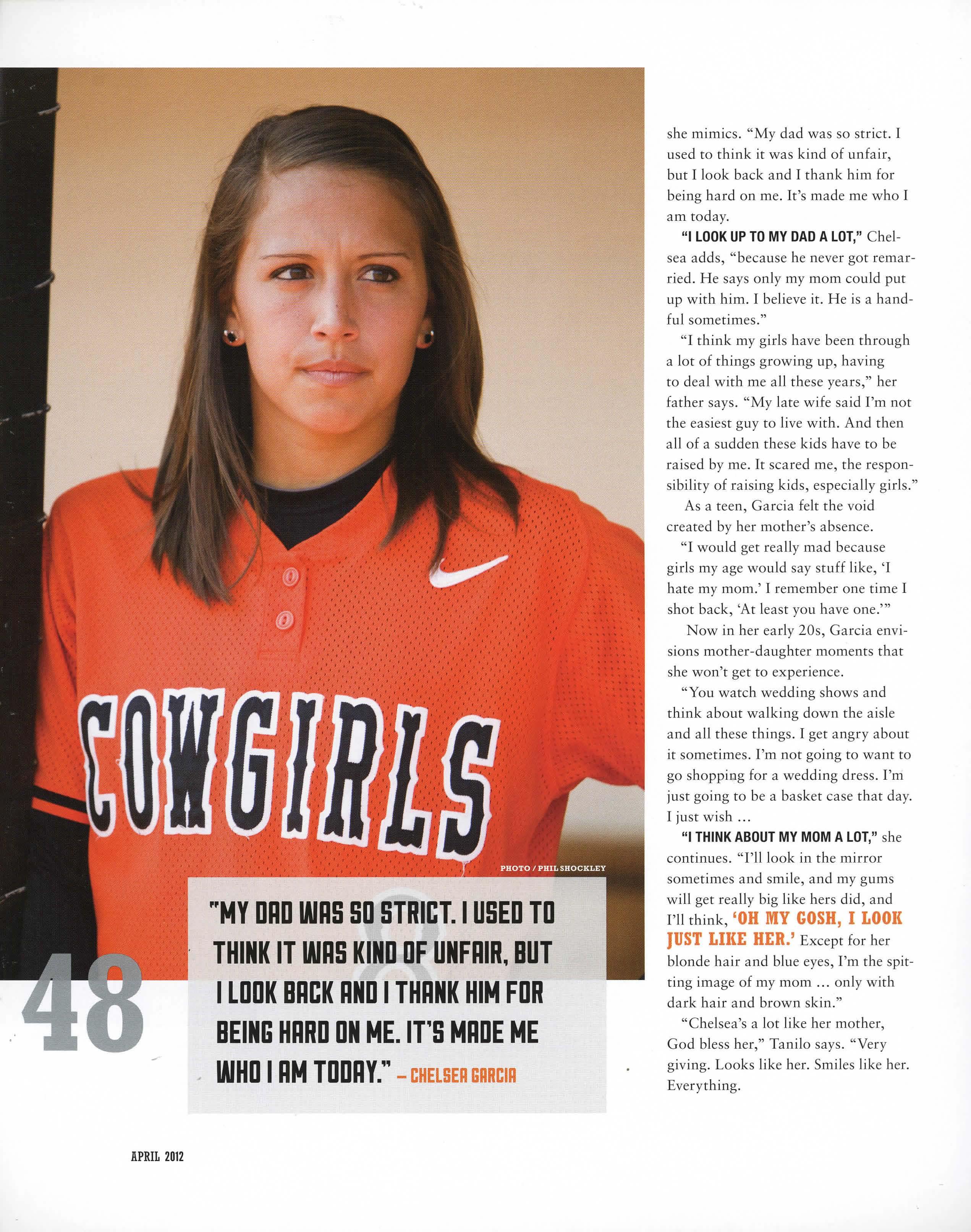
she mimics. "My dad was so strict. I used to think it was kind of unfair, but I look back and I thank him for being hard on me. It's made me who I am today.
"ILOOKUPTOMYDADA LOT,"Chelsea adds, "because he never got remarried. He says only my mom could put up with him. I believe it. He is a handful sometimes."
"I think my girls have been through a lot of things growing up, having to deal with me all these years," her father says. "My late wife said I'm not the easiest guy to live with. And then all of a sudden these kids have to be raised by me. It scared me, the responsibility of raising kids, especially girls."
As a teen, Garcia felt the void created by her mother's absence.
"I would get really mad because girls my age would say stuff like, 'I hate my mom.' I remember one time I shot back, 'At least you have one."'
Now in her early 20s, Garcia envisions mother-daughter moments that she won't get to experience.
"You watch wedding shows and think about walking down the aisle and all these things. I get angry about it sometimes. I'm not going to want to go shoppiog for a wedding dress. I'm just going to be a basket case that day. I just wish
"ITHINKABOUTMYMOMA LOT,"she continues. ''I'll look in the mirror sometimes and smile, and my gums will get really big like hers did, and I'll think, 'OHMYGOSH, I LOOI{ JUSTLll{E HER.'Except for her blonde hair and blue eyes, I'm the spitting image of my mom ... only with dark hair and brown skin."
"Chelsea's a lot like her mother, God bless her," Tanilo says. "Very giving. Looks like her. Smiles like her. Everything.
"SHEIS A PERFECTIONIST,"HEADDS. "SHEIS JUSTONEOFTHOSEKIDSTHAT WANTSTODOEVERYTHINGRIGHT.
That's something else she gets from her mother. I remember when she made that transition from slow pitch to fast. In slow pitch you're expected to hit 10 out of 10 balls because it comes in at 15 miles an hour. When she transferred to fastpitch, she expected to hit 10 out of 10. She hated to not get a base hit every time. As years progressed, she started to accept the fact that there is going to be failure. And what can be worse than losing a mom?"
"She's pretty cerebral," Coach Wieligman says. "She's probably too hard on herself. That's just her personality. SHEEXPECTSSTRAIGHT A'SALLTHETIME,IN EVERYTHING.Our game, unfortunately, is not built on straight A's. This game is pass/fail. If you hit .300, you're going to fail seven times to get three passing grades. So it beats her up a bit."
"My mom was the academic," Chelsea says. "When she passed away, my dad didn't know what else to do but tell us if we didn't get A's we'd have to quit softball. I guess that's ingrained in my brain. But also I feel like if I slack off I will regret it, because I didn't give it all I had. So I just put all I have into it, and if I get a B, I get a B."
"SHE'SALMOSTTOO PERFECT,"Wieligman says. "She takes her school very seriously. Even on the road she works hard, getting up in the morning and studying. She's not your typical kid ~t her age. I know I wasn't that way. I thought I was doing well when I brought my books on the road, even though they never got out of my backpack ...
"She never stops. For her to be able to do both things as well as she's done them, it's pretty impressive." •
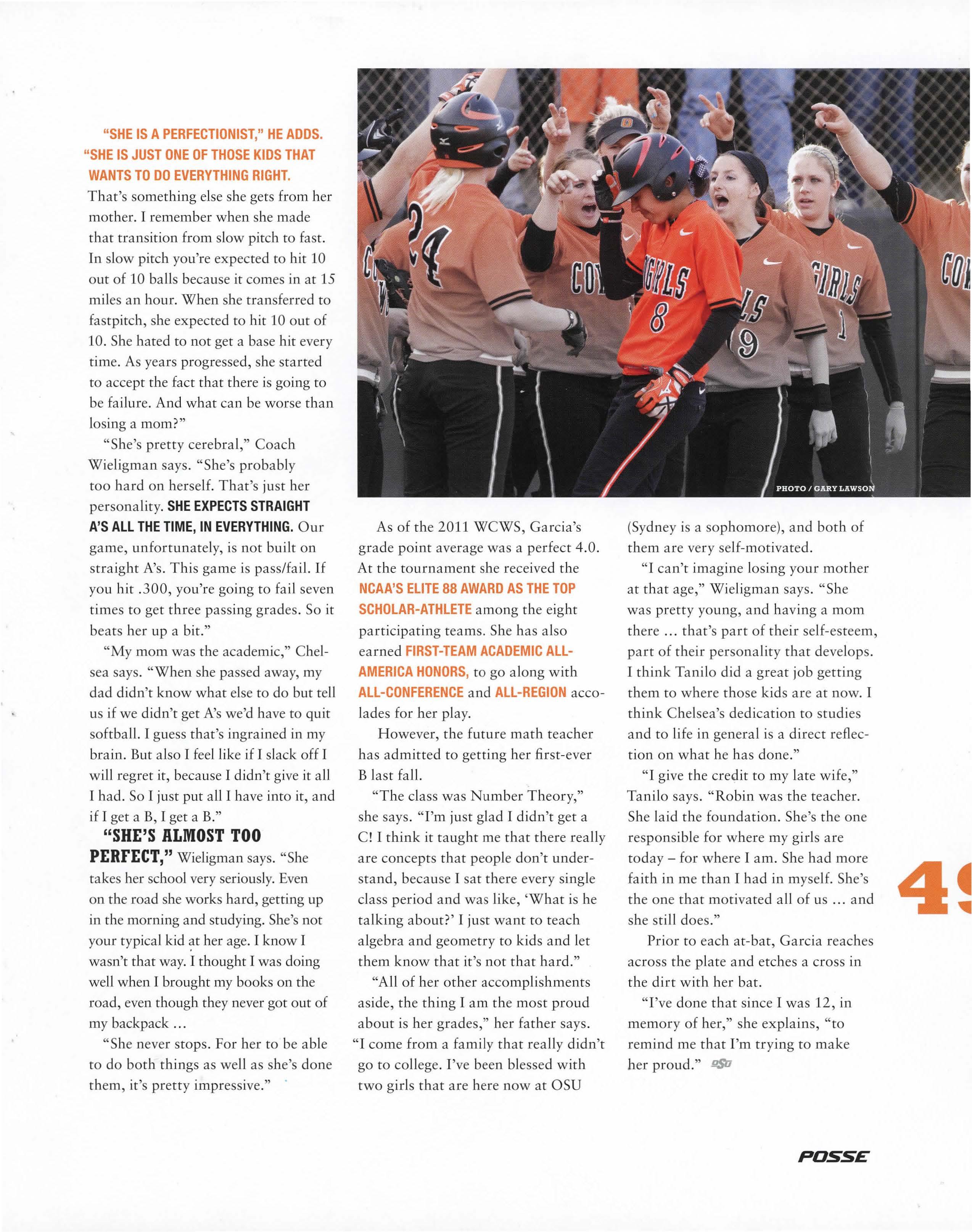
As of the 2011 WCWS, Garcia's grade point average was a perfect 4.0. At the tournament she received the NCAA'SELITE88 AWARDASTHETOP SCHOLAR-ATHLETEamong the eight participating teams. She has also earned FIRST-TEAMACADEMICALLAMERICAHONORS,to go along with ALL-CONFERENCE and ALL-REGIONaccolades for her play.
However, the future math teacher has admitted to getting her first-ever B last fall.
"The class was Number Theory," she says. "I'm just glad I didn't get a C! I think it taught me that there really are concepts that people don't understand, because I sat there every single class period and was like, 'What is he talking about?' I just want to teach algebra and geometry to kids and let them know that it's not that hard."
"All of her other accomplishments aside, the thing I am the most proud about is her grades," her father says. "I come from a family that really didn't go to college. I've been blessed with two girls that are here now at OSU
(Sydney is a sophomore), and both of them are very self-motivated.
"I can't imagine losing your mother at that age," Wieligman says. "She was pretty young, and having a mom there ... that's part of their self-esteem, part of their personality that develops. I think Tani lo did a great job getting them to where those kids are at now. I think Chelsea's dedication to studies and to life in general is a direct reflection on what he has done."
"I give the credit to my late wife," Tanilo says. "Robin was the teacher. She laid the foundation. She's the one responsible for where my girls are today - for where I am. She had more faith in me than I had in myself. She's the one that motivated all of us and she still does."
Prior to each at-bat, Garcia reaches across the plate and etches a cross in the dirt with her bat.
"I've done that since I was 12, in memory of her," she explains, "to remind me that I'm trying to make her proud." IJ$O
IM PETE
PHorocRAPHY BY Bruce Waterfield I osr1rEPHoro.coM
COWBOY COACHLETS PITCHER'S STARSHINE
THE
sToRY sY Matt Elliott
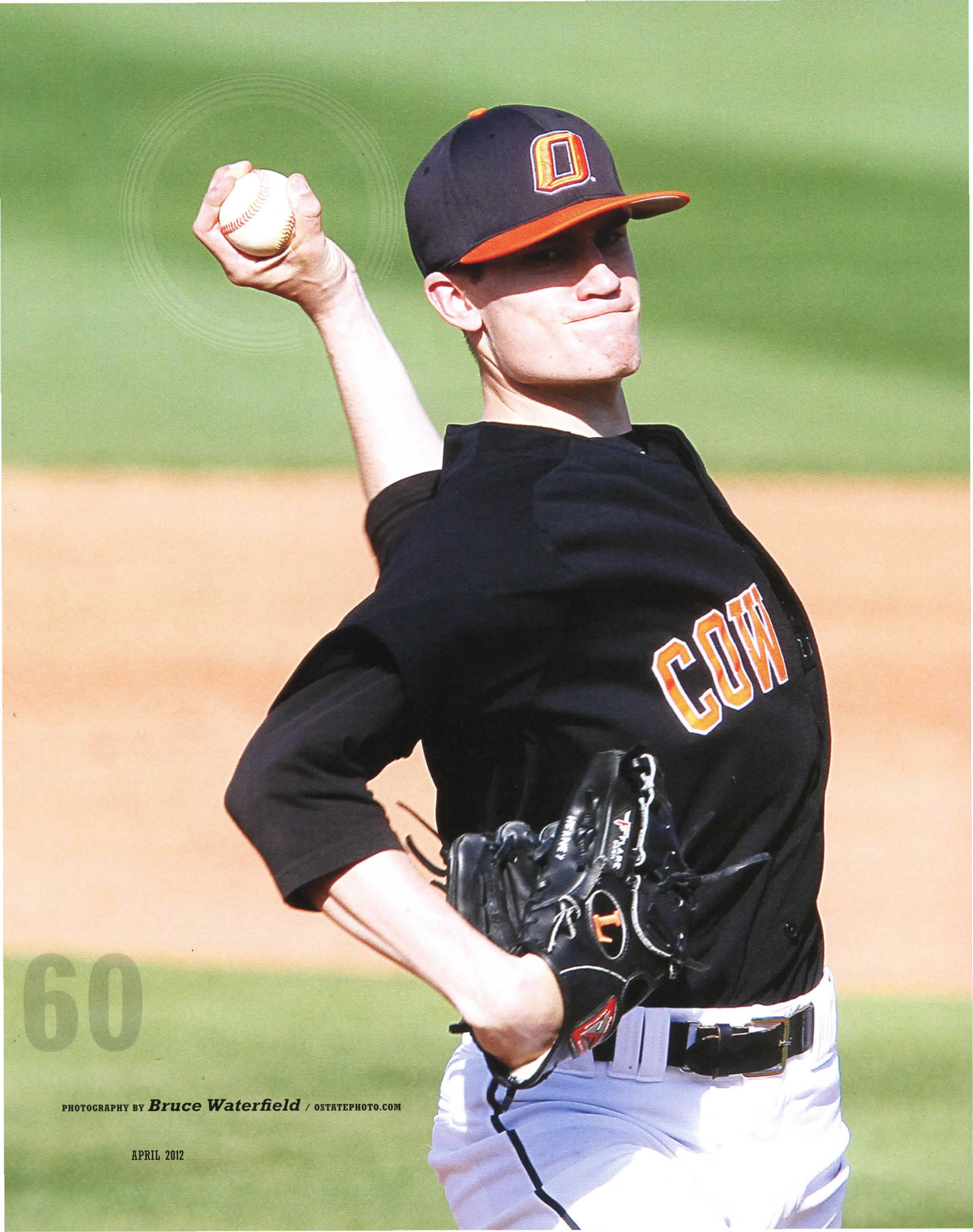
SU Baseball coach Frank Anderson gave it to his star pitcher straight. Andrew Heaney, a junior lefty from Putnam City High School in Oklahoma City, wasn't a finesse pitcher. Inside his lanky, 6-foor 2-inch frame and 170-pounds of wiry muscle lurked a power pitcher waiting to be unleashed.
Really, thought Heaney? A Big Unit? A Nolan Ryan? A C.C. Sabbarhia? Boy, was coach right.
"It's fun," Heaney says. "I've never really been able to strike out a guy. Frank,being the prophetthat he is, he told me my fresllmanyear, 'You'regoing to be a powerpitcher.'He was right."
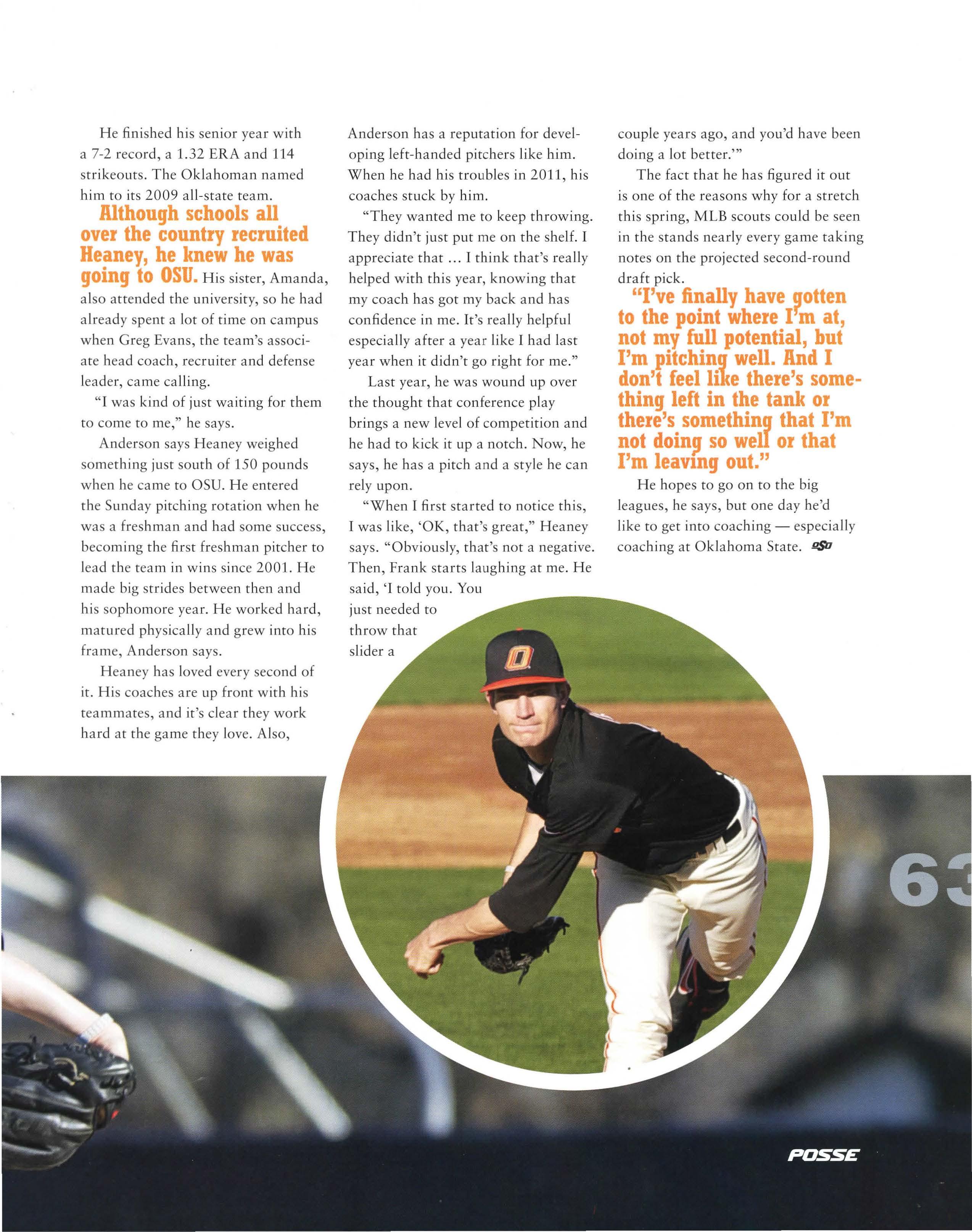
Heaney had a 1.69 earned run average at the _beginning of April. He was No. 3 in the nation in strikeouts with 69 and, at one point, led the nation in that category. He pitched his first shutout against Alabama A&M. He pitched another against Houston immediately following. And he did it in just 91 pitches.
"Someone told me during that game we didn't let anyone get to second base," he says.
The team was 16-14 at press time, nearly unbeatable at home with a 14-3 record there, but the Cowboys were 3-5 in conference play. The team played hard, notes head coach Frank Anderson, but has been unlucky on game-deciding plays. A narrow 5-4 13th-inning loss to the No. 18 Baylor Bears came in a contest in which the Cowboys were leading near the end and had outhit their opponents. When Big 12 play kicked off in March, the team lost its opening series to Missouri despite strong defense and a ninth inning two-run homer by Mark Ginther that sealed the team's only victory in the series.
At press time, it had been one of those years, notes the eighth-year coach who led his team to a 35-25 finish and the NCAA regionals in Nashville, Tenn., in 2011.
"It's a different game obviously in that you can't play the same lineups all the time," Anderson says. "But we've been snake bit a little. We dropped a pop up that would have won the game at TCU. We get calls that are kind of a game changer. I still think that this is a good ream. We need to swing the bat a little bit better, which we've started to
do for the mosr part. We're at the halfway point in the season now, and in the second half we're looking for things to turn our way because the kids have been playing hard. We just need to continue grinding."
Regardless, 2012 is a long way from 2011 for Heaney.
Last season, he torched batters during nonconference play, but when the conference schedule kicked in, the 20-year-old says he tried to do too much. His confidence was rattled during an early loss to Kansas, and before he knew it, he was questioning his entire approach to pitching. He finished with an ERA over 4.00.
Anderson encouraged him to develop his slider during the offseason, Heaney says. That's a famous pitch that breaks as it moves across the batter's field of view.
In other words, a fast slider will at first look a lot like a fastball to a batter. Bur then, through a little
trick of physics, the ball will suddenly break in a different direction.
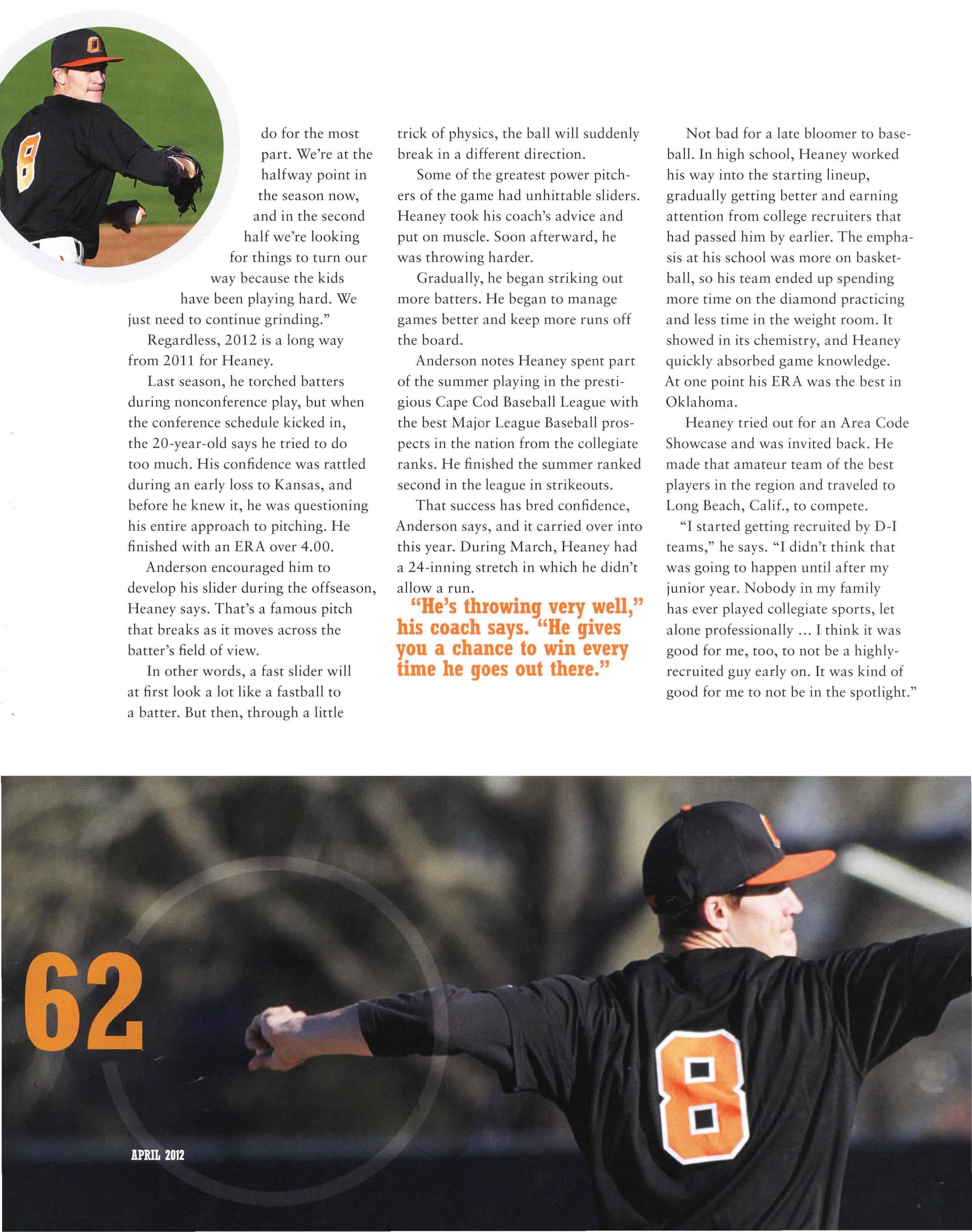
Some of the greatest power pitchers of the game had unhittable sliders. Heaney took his coach's advice and put on muscle. Soon afterward, he was throwing harder.
Gradually, he began striking out more batters. He began to manage games better and keep more runs off the board.
Anderson notes Heaney spent part of the summer playing in the prestigious Cape Cod Baseball League with the best Major League Baseball prospects in the nation from the collegiate ranks. He finished the summer ranked second in the league in strikeouts.
That success has bred confidence, Anderson says, and it carried over into this year. During March, Heaney had a 24-inning stretch in which he didn't allow a run.
"He'sthrowingverywell," his coach says. "Hegives you a chanceto win every time he goes out there."
Not bad for a late bloomer to baseball. In high school, Heaney worked his way into the starting lineup, gradually getting better and earning attention from college recruiters that had passed him by earlier. The emphasis at his school was more on basketba 11,so his team ended up spending more time on the diamond practicing and less time in the weight room. It showed in its chemistry, and Heaney quickly absorbed game knowledge. At one point his ERA was the best in Oklahoma.
Heaney tried out for an Area Code Showcase and was invited back. He made that amateur team of the best players in the region and traveled to Long Beach, Calif., to compete.
"I started getting recruited by D-I teams," he says. "I didn't think that was going to happen until after my junior year. Nobody in my family has ever played collegiate sports, let alone professionally I think it was good for me, too, to not be a highlyrecruited guy early on. It was kind of good for me to not be in the spotlight."
He finished his senior year with a 7-2 record, a 1.32 ERA and 114 strikeouts. The Oklahoman named him to its 2009 all-state team.
Althoughschoolsall overthe countryrecruited Heaney,he knewhe was going to OSU.His sister, Amanda, also attended the university, so he had already spent a lot of time on campus when Greg Evans, the team's associate head coach, recruiter and defense leader, ca me calling.
"I was kind of just waiting for them to come to me," he says.
Anderson says Heaney weighed something just south of 150 pounds when he came to OSU. He entered the Sunday pitching rotation when he was a freshman and had some success, becoming the first freshman pitcher to lead the team in wins since 2001. He made big strides between then and his sophomore year. He worked hard, matured physically and grew into his frame, Anderson says.
Heaney has loved every second of it. His coaches are up front with his teammates, and it's clear they work ha rd at the game they love. Also,
Anderson has a reputation for developing left-handed pitchers like him. When he had his troubles in 2011, his coaches stuck by him.
"They wanted me to keep throwing. They didn't just put me on the shelf. I appreciate that I think that's really helped with this year, knowing that my coach has got my back and has confidence in me. It's really helpful especially after a year like I had last year when it didn't go right for me."
Last year, he was wound up over the thought that conference play brings a new level of competition and he had to kick it up a notch. Now, he says, he has a pitch and a style he can rely upon.
"When I first started to notice this, I was like, 'OK, that's great," Heaney says. "Obviously, that's not a negative. Then, Frank starts laughing at me. He said, 'I told you. You just needed to throw that slider a
couple years ago, and you'd have been doing a lot better."'
The fact that he has figured it out is one of the reasons why for a stretch this spring, MLB scouts could be seen in the stands nearly every game taking notes on the projected second-round draft pick.
"I'vefinallyhave ?.otten to the pointwhereI m at, not my full potential,but I'm pitchingwell. AndI don'tfeel like there'ssomething left in the tank or there'ssomethingthat I'm not doin!Jso well or that I'm leaving out."
He hopes to go on to the big leagues, he says, but one day he'd like to get into coaching - especially coaching at Oklahoma State. Il$D
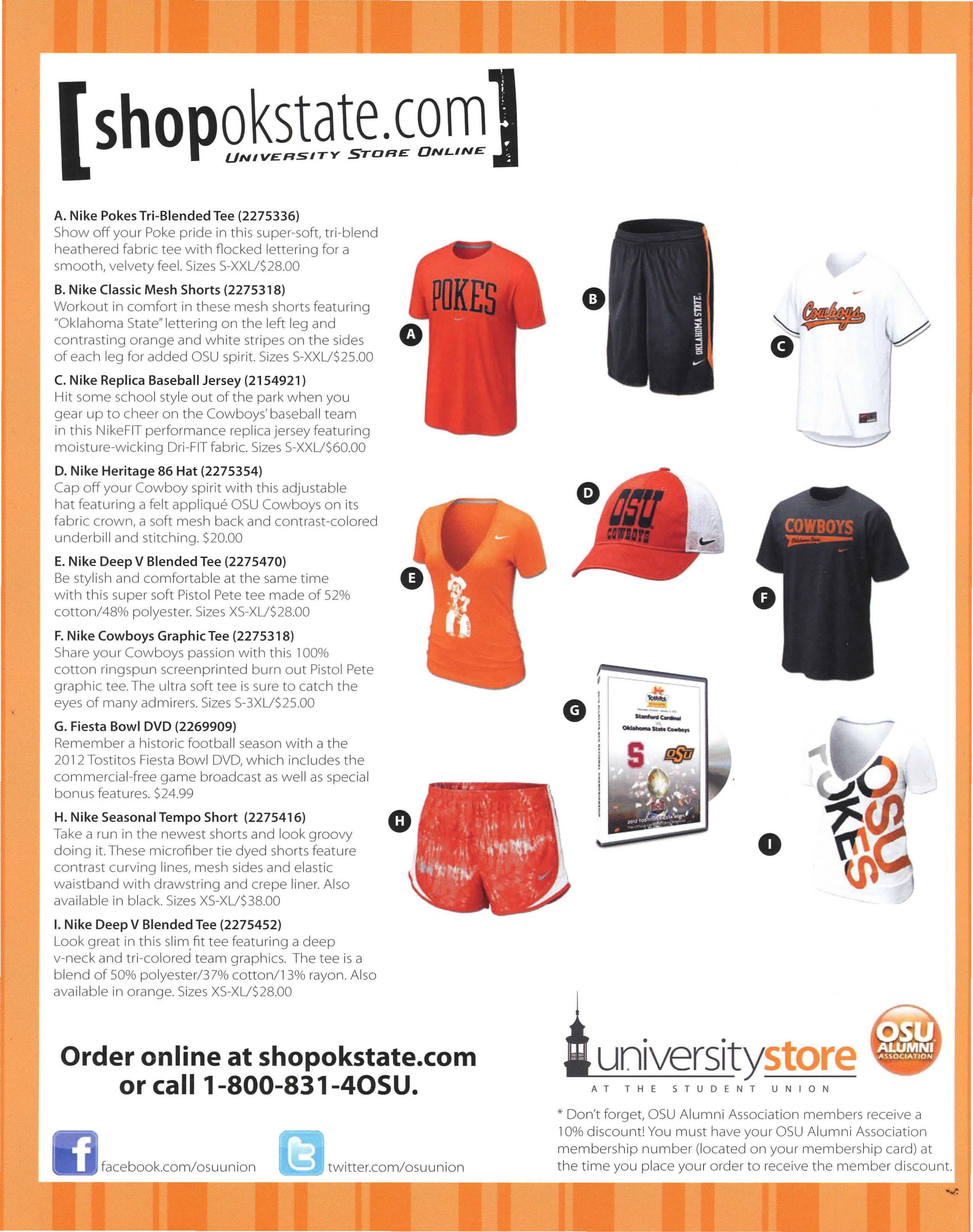
A. Nike Pokes Tri-Blended Tee (2275336)
Show off your Poke pride in this super-soft, tri-blend heathered fabric tee with flocked lettering for a smooth, velvety feel. Sizes S-XXl/$28.00
B. Nike Classic Mesh Shorts (2275318)
Workout in comfort in these mesh shorts featuring "Oklahoma State" lettering on the left leg and contrasting orange and white stripes on the sides of each leg for added OSU spirit. Sizes S-XXl/$25.00
C. Nike Replica Baseball Jersey (2154921)
Hit some school style out of the park when you gear up to cheer on the Cowboys' baseball team in this NikeFIT performance replica jersey featuring moisture-wicking Ori-FIT fabric. Sizes S-XXl/$60.00
D. Nike Heritage 86 Hat (2275354)
Cap off your Cowboy spirit with this adjustable hat featuring a felt applique OSU Cowboys on its fabric crown, a soft mesh back and contrast-colored underbill and stitching. $20.00
E. Nike Deep V Blended Tee (2275470)
Be stylish and comfortable at the same time with this super soft Pistol Pete tee made of 52% cotton/48% polyester. Sizes XS-Xl/$28.00
F. Nike Cowboys Graphic Tee (2275318)
Share your Cowboys passion with this 100% cotton ringspun screenprinted burn out Pistol Pete graphic tee. The ultra soft tee is sure to catch the eyes of many admirers. Sizes S-3XU$25.00
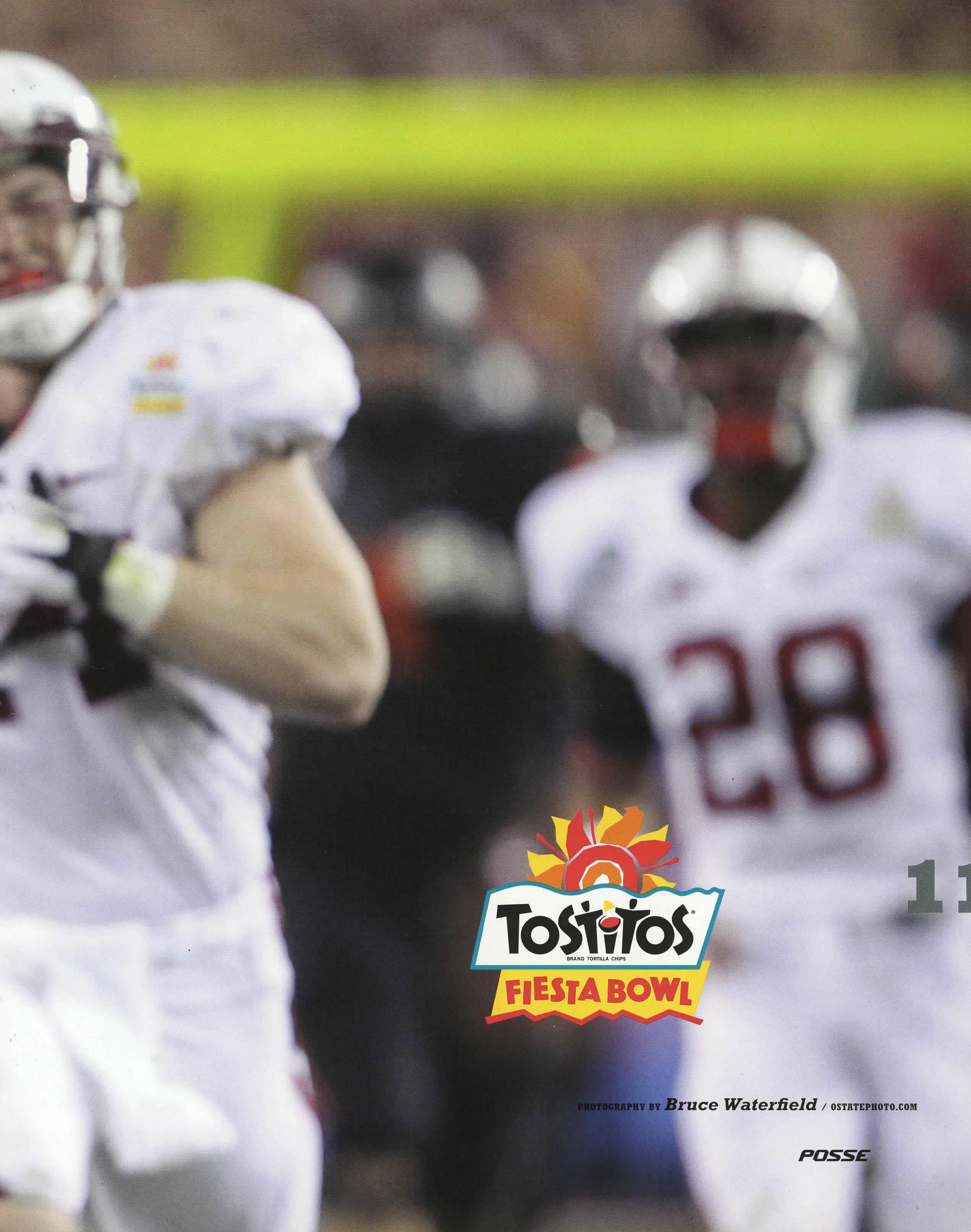
G. Fiesta Bowl DVD (2269909)
Remember a historic football season with a the 2012 Tostitos Fiesta Bowl DVD, which includes the commercial-free game broadcast as well as special bonus features. $24.99
H. Nike Seasonal Tempo Short (2275416)
Take a run in the newest shorts and look groovy doing it. These microfiber tie dyed shorts feature contrast curving lines, mesh sides and elastic waistband with drawstring and crepe liner. Also available in black. Sizes XS-Xl/$38.00
I. Nike Deep V Blended Tee (2275452)
Look great in this slim fit tee featuring a deep v-neck and tri-colored team graphics. The tee is a blend of 50% polyester/37% cotton/13% rayon. Also available in orange. Sizes XS-Xl/$28.00
By Gene Johnson
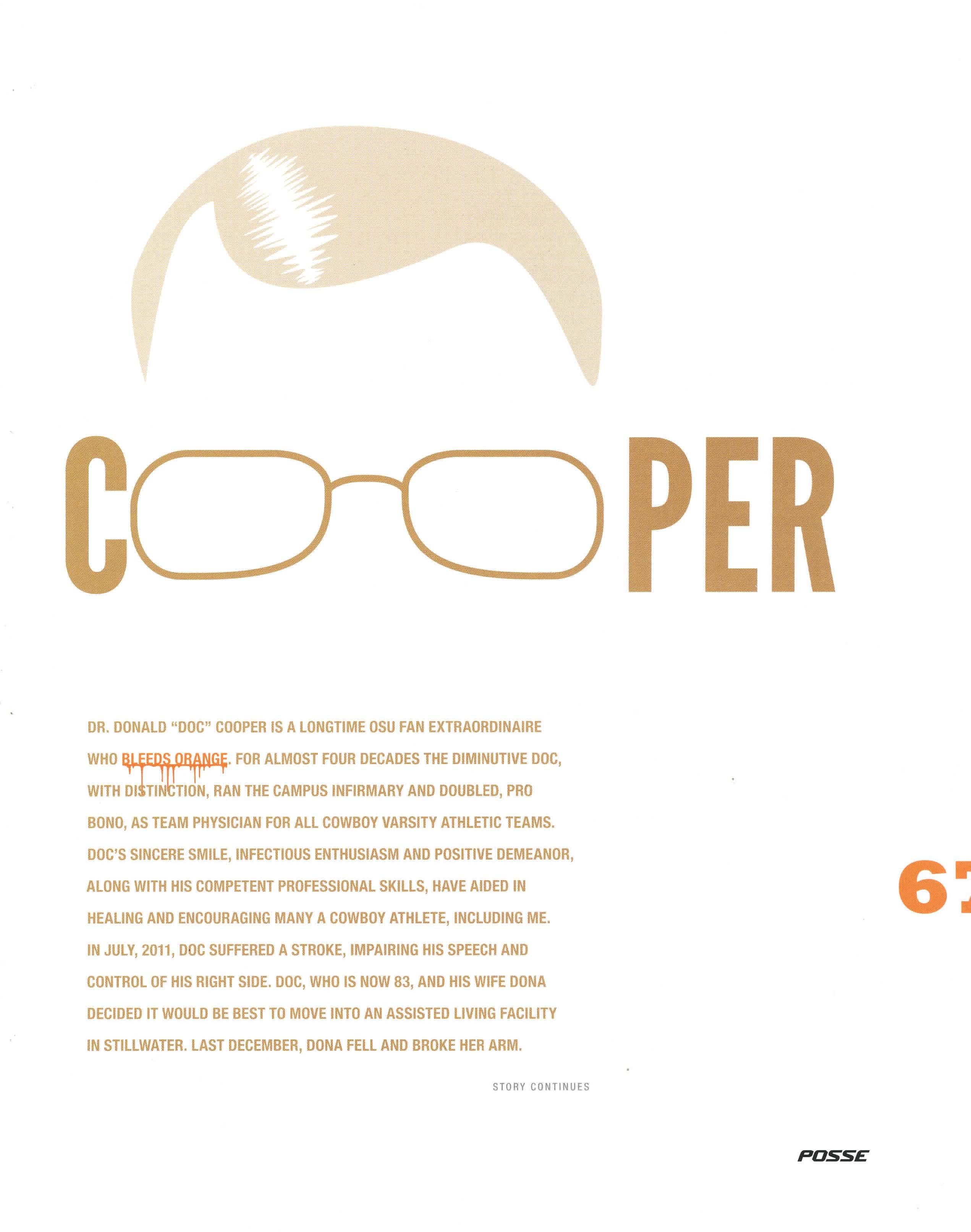
DR.DONALD"DOC"COOPERIS A LONGTIMEOSUFANEXTRAORDINAIRE WHO~~~~...,. FORALMOSTFOURDECADESTHEDIMINUTIVEDOC, WITHDI TIN TION,RANTHECAMPUSINFIRMARYANDDOUBLED,PRO BONO,ASTEAMPHYSICIANFORALL COWBOYVARSITYATHLETICTEAMS. DOC'SSINCERESMILE,INFECTIOUSENTHUSIASMANDPOSITIVEDEMEANOR, ALONGWITHHISCOMPETENTPROFESSIONALSKILLS,HAVEAIDEDIN HEALINGANDENCOURAGINGMANYA COWBOYATHLETE,INCLUDINGME. IN JULY,2011,DOCSUFFERED A STROKE,IMPAIRINGHISSPEECHAND CONTROLOFHISRIGHTSIDE.DOC,WHOIS NOW83, ANDHISWIFEDONA DECIDEDIT WOULDBEBESTTOMOVEINTOANASSISTEDLIVINGFACILITY IN STILLWATER.LASTDECEMBER,DONAFELLANDBROKEHERARM. STORY CONTINUES
LYFADES
68 years for me t what else I'd
I'm compiling a nces I'd Iike to et my maker, includ''-flg,~ltiJlg""::abook about OSU's 1965 Big 8 Championship basketball team and its main characters. To do this I need to interview several people instrumental to the accomplishments of that squad, including Doc Cooper.
DOCSERVEDAS DIRECTOROFOKLAHOMASTATEUNIVERSITY'SHEALTH CENTERANDASATHLETICTEAMPHYSICIANFOR39 YEARS,1960-99. Standing maybe 5'8" with a medium build, Doc, always smiling, was a constant bundle of energy, a rapid fire talker, was never boring, and quick to offer his thoughts on ballgames, politics, a good restaurant or whatever subject came up.
For some reason Doc seemed larger than the dimensions of his stature. WITHA SHOCKOFSTRAIGHTBLOND HAIRALWAYSNEATLYGROOMED,DOC WOREOUTSIZEDGOLDWIRERIMMED
GLASSESand one of his many fashionable plaid sport coats accessorized by the perfect tie, usually a shade of red. Doc smelled of a generous splash of good cologne. A handsome man in a caricature way, Doc's looks were complimented by his warm, engaging personality. Doc never met a stranger.
I first met Doc in the OSU infirmary. All the freshmen scholarship round ballers (that's a basketball term for you non-fans) - seven of usr orted for our pre-season physicals. A er each of us gave a urine specien, a nurse drew our blood, then we w ited outside Doc's small office to examined. Wanting to get it over, I was first in Iine.
Docopenedhisofficedoor."Boy,come in here,"Docbellowedto me,"What'syour name,son?"Docshookmyhand,displaying a vice-likegripfor a smallguy. "GeneJohnson,sir."
"Oh,yeah.You'rethe kid from Seminole, right?"heaskedas heshutthe door. "Yessir."
"Mr.lba'sprettyhighon this year's freshmangroup,hopehe'snotdisappointed," Docsaidwith a grin. _____..,...,___ _ "Metoo," I answered,soundingnervous. "OK,youknowwhyyou'rehere?"I nodded.
I obliged.In lessthana minute,that seemedmuchlonger,Doc,finished,said, "Youlookalrightto me,son."
-----------
"Good," I answeredasI dressed."Niceto meetyou,Doc."
"Youtoo,Gene,"Docsaidas he opened hisdoor."Nextman,"he said,thento me, "goodluck,big boy.Give'emhell.I'll seeyou on the court."
"Than Doc." I likedhim.
During my four years at Stillwater, Doc, as team physician, sat on the Cowboy bench at all home varsity basketball games. If one of us got banged-up, Doc was there to quickly address our ailment so we could return to the game. He was a constant cheerleader, giving us credit when we did something well, extolling us to get after them during the heat of the game, loudly blasting the refs when he thought they made a bad call or groaning when one of us made a bonehead play. Down deep in his heart Doc adored all collegiate athletics, loved us players unconditionally and was an asset to our squad. Doc was the ultimate fan and friend.
"Hey, Mrs. Cooper, this is Gene Johnson, from the old days, remember me?"
We exchanged pleasantries and I explained I'd like to drive up and see them, that I'd been doing a little writing and would like to include them in a story. "Sure," she laughed, "we'd be delighted. We both look forward to seeing you."
The next Thursday, entering Stillwater, and with the aid of my GPS, it took me about 10 minutes to find the right street. I rolled down my window as I drove down Doc's street to get some air, the pleasant aroma of pinion wood burning in someone's fireplace drifted in. Not a cloud in the blue sky, a brisk but comfortable March day. Several sparrows fluttered from a large leafless elm, a squirrel scampered across the street a great day to be alive.
I found the house, a well-kept 1960s sprawling ranch-style dwelling, built on a quarter-acre lot. Several mature oaks added character to the home's curb appeal.
Getting out of the car, I fumbled for my notebook and rape recorder, dropping my keys. I rang the doorbell. Dona opened the door, all 5 feet, 90 pounds of her, large dark sparkling eyes, short bobbed hair, more black than grey. She had aged gracefully, if at all. "Oh, Gene," she said, shaking my hand and giving me a half hug, "do come in." Her head was barely above my waist. "Donald, Gene is here."
Dona walked into the kitchen as Doc grabbed my hand with both his hands and shook it. "By golly, Gene, you old son of a gun, you don't show
too much wear and tear. Looks like you could still get up and down the court."
"Doc, your eyes must not be too good," I said as we both laughed. Doc escorted me to a comfortable leather chair in the living room. "Doc, this isn't your chair is it?" I asked.
"No, no, sit down. But over there," said Doc, pointing across the room to a folding chair with OSU's logo on the back. "That's Eddie's chair from the '94 Final Four in San Antonio. He asked me if I wanted it. I told him, 'Hell yes.' "
"That was nice of him, but I understand he's good at doing nice things," I said.
"Yep," Doc beamed, "he's always been a prince to me.''
The large living room, informal and tastefully decorated, included mementos and photos collected over six decades of marriage.
Dona returned with hot cider and fresh baked molasses cookies, still warm, which she passed to us. She sat next to Doc and said, "Don and I still go to most of the home ball games, provided the weather's not too bad."
Catching up, we exchanged information about each other's families. I learned that Doc and Dona's son, Chip, is a physician in Bristow and serves as team physician for the local high school sports teams. "Guess what's on his license plate?" he challenged me. I shook my head, not having a clue. "JOCDOC2," he said, answering his own question. "Mine's JOCDOC, and has been for thirty years or more," he beamed, "Chip's a chip off the old block." I grinned as Doc nodded his approval.
"We have three other children," Dona said. "Cathy, an artist, lives in Perkins. Cherie, an LPN is in Memphis, while Tad works with car
dealerships. And we're blessed with eight grandkids and 10 great-grand kids. What do you think about that?"
"Your family has gone forth and multiplied," I answered. Dona smiled.
I explained to Doc that I was writing a book and would like to include a story about him, then asked his approval. "Sure," he answered, grinning and looking a little embarrassed. "I'd be pleased."
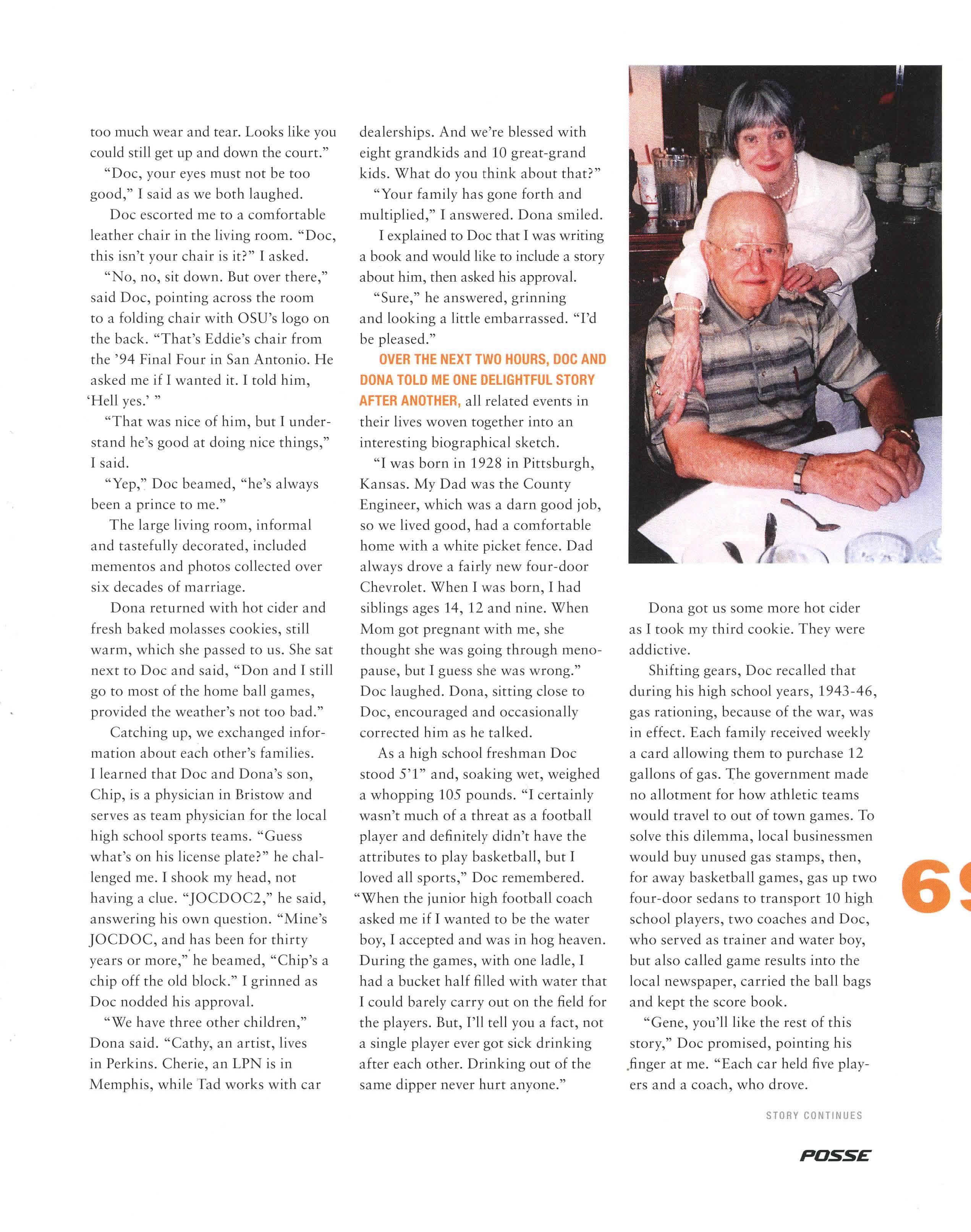
OVERTHENEXTTWOHOURS,DOCAND DONATOLDMEONEDELIGHTFULSTORY AFTERANOTHER, all related events in their lives woven together into an interesting biographical sketch.
"I was born in 1928 in Pittsburgh, Kansas. My Dad was the County Engineer, which was a darn good job, so we lived good, had a comfortable home with a white picket fence. Dad always drove a fairly new four-door Chevrolet. When I was born, I had siblings ages 14, 12 and nine. When Morn got pregnant with me, she thought she was going through menopause, but I guess she was wrong." Doc laughed. Dona, sitting close to Doc, encouraged and occasionally corrected him as he talked.
As a high school freshman Doc stood 5'1" and, soaking wet, weighed a whopping 105 pounds. "I certainly wasn't much of a threat as a football player and definitely didn't have the attributes to play basketball, but I loved all sports," Doc remembered. "When the junior high football coach asked me if I wanted to be the water boy, I accepted and was in hog heaven. During the games, with one ladle, I had a bucket half filled with water that I could barely carry out on the field for
jDona got us some more hot cider as I took my third cookie. They were addictive.
Shifting gears, Doc recalled that during his high school years, 1943-46, gas rationing, because of the war, was in effect. Each family received weekly a card allowing them to purchase 12 gallons of gas. "(he government made no allotment for how athletic teams would travel to out of town games. To solve this dilemma, local businessmen would buy unused gas stamps, then, for away basketball games, gas up two four-door sedans to transport 10 high school players, two coaches and Doc, who served as trainer and water boy, but also called game results into the local newspaper, carried the ball bags and kept the score book.
the players. But, I'll tell you a fact, not "Gene, you'll like the rest of this a single player ever got sick drinking story," Doc promised, pointing his after each other. Drinking out of the .finger at me. "Each car held five playsame dipper never hurt anyone.'' ers and a coach, who drove.
CONTINUES
The players took off their warm-up tops, which were heavy wool, and were a pretty darn good firecracker," he added, "a sight I'll never forget."
After the mili- place them in the trunk 16..of one of the cars. I'd Im,ij Gospel truth crawl in the trunk, on top '
tary, Doc and Dona spent several years in Manhattan. where of those uniforms, then the only thing I a coach would close the worried about Doc was in private practice for three years, then he took a position as the number two trunk and away we'd go!" Doc stopped, waiting for my reaction.
In disbelief I said, "Holy moly! Doc, did that really happen?"
"Gospel truth, the only thing I worried about was, if there's a wreck, I hoped someone would know to
was, if there's a wreck, I hoped
someone would know to open the trunk and
man at the K-State Health Center and was also the Athletic Team Physician. K-State get
me out."
open the trunk and get me out."
ATTHEAGEOFFIVE,DOCWITNESSED A PHYSICIANSETA BROKENLEGWITH PLASTEROFPARIS.DOCIMMEDIATELY INFORMEDHISPARENTSHEWASGOING TOBECOME A DOCTOR.
had recently built a state-of-the-art facil-
ity. Doc was in line to be the head man within two years. Oklahoma A&M's athletic director, Henry Iba, tried to hire Doc away, but he declined. OSU's facility was dated, almost archaic in some of the things they did, still handling their cash out
Graduating from Pittsburgh High of a cigar box. School in 1946, Doc started college in his Having second thoughts about hometown at Pittsburgh State, finishing turning down the job, Doc asked a his bachelor's degree in three years, then close friend what he thought about the entered the University of Kansas Medical School. He and Dona, the love of his life, married in 1950. Doc said, "Our first chjld was born just nine months and two days after our wedding. I'm a pretty efficient guy, don't you think?" He winked. I grinned.
The Korean Conflict was going full blast when Doc finished medical school in 1953. Being eligible for the draft, Doc knew the Army would send him to a MASH unit in Korea, so he joined the Air Force, spending time Albuquerque, New Mexico. While st tioned at Yucca Flats, over a twoye r span and from seven miles away, D c, peering through a black protecve sheet of x-ray film, witnessed the explosion of four atom bombs. "They
decision to turn down Mr. Iba's offer. The friend challenged Doc, telling him, "Sure, you can stay where you are and be comfortable, but your boss, who's close to retirement, is responsible for building this program at K-State. You can stay here, sit in your rocking chair and have an easy time of it. But, since you asked my opinion, I encourage you to accept this challenge, build your own program and establish your own legacy." Doc thought it over. THENEXT DAYDOCCALLEDMR.IBAANDACCEPTED THEPOSITION.
Doc went on, "I WOULDN'T
TRADEMYLIFEWITHANY
MAN.I'VE HADA BETTERLIFE THANI DESERVE." He looked at Dona who squeezed his arm.
"Mr. Iba was the finest man I ever met. Working for him was pure joy. He was a super human being, dynamic, yet down to earth. Treated everyone with respect," Doc said, "I can still hear that deep gravelly voice of his at practice telling his players to 'Cut that out!' He showed his appreciation for what you did and had a wonderful sense of humor. He particularly liked fishing stories. He was a friend, a good friend."
"What about some of the other coaches?" I asked.
Dona spoke up, "OH,DON,TELL HIMABOUTTHATTIMEWITHJIMMY JOHNSON."
"That Jimmy Johnson was a crackerjack," Doc said.
For quite a few years Doc, much in demand as an authority on sports medicine, gave 35 to 40 speeches a year, both in the U.S. and overseas. Doc had served as a team physician during the '68, '72 and '76 Olympic games.
Jimmy Johnson, the OSU football coach, saw Doc one afternoon in the hallway after football practice and said, "Doc, where in the hell were you yesterday when practice was going on?"
"I told him I had a speaking engagement in Oklahoma City," Doc said. Then Jimmy asked Doc what in the dickens he thought the football program was paying him for. Doc shot back, "The Athletic Department doesn't pay me a damn dime. I do it because I love it and know they don't have any money." Doc grinned as he proudly recalled the incident. "Jimmy shut up. Only time I ever saw him at a loss for words.
"IN MY CAREER,l'VEHADMANY HIGHLIGHTS,BUTONERIGHTATTHETOP WASBEINGA TEAMDOCTORATMY FIRST OLYMPICS,IN '68 IN MEXICOCITY.There
were only four doctors and we worked our tails off, but what an experience to be assisting those world class athletes and watch them compete. Today's U.S. Olympic team will have 40 or more physicians," Doc sighed.
"Only one coach I didn't get along with, and I won't name him," Doc began. "You might be able to guess. He was a nice person socially, but on the practice field he was an absolute monster. He'd kick the kids in the butt, and I mean kick them hard. One ball game, we were playing one of the Texas schools. There was a head-on collision between two players on our
side of the field, right i I'm standing. Both players
huff. I was so mad at him I could have spit nails." Doc shook his head.
"Doc, thirty-nine years you were here," I said.
"LOVEDEVERYMINUTEOF IT," DOCSAID,"WISHI COULD DOIT ALLOVERAGAIN,DON'T WEDONA?NOTSUREI'D DO ANYTHINGDIFFERENT."
Dona smiled. Doc went on, "Athletes are a special bunch, at least most of them. I got to sit in best seats in the house. That four-overtime game when you, King, Hawk, Labrue and the rest of that bunch kicked Kansas' butt was priceless."
"Doc, we won the game, but I ldn't say we kicked them," I said. ut it was sure sweet," iling. Returning his smile, ead in agreement.
ears, I said, "Doc, a lot players saw you as a role your positive attitude, nergy and dedication to
K'l'l---.r-meaningful way."
got the helmet off our boy, checked his breathing canal, and he was fine.
I hurried over to the other kid and began to carefully remove his helmet. I lifted his head to make sure he could breathe. Our blasted coach came
"Shucks. It was a real pleasure." Doc said. Dona offered me another cookie. Shortly after, we said our goodbyes and I drove off. A squirrel crossed my path. I took that as a good sign. The sun was shining. I felt good. running down the sideline, lickity- An old friendship had been revisited. split, and told me not to help that boy, Doc, God bless him, and I shared that he was the enemy! I stood, glared a part of an OSU journey together, at the miserable coach and said, yes, memorable for me and, I think, for and he's somebody's son and I'm going him. My four years in Stillwater was to help him! Our coach stared at me, better because Doc was there. I1$tJ then turned and walked away in a
Wins, especially on the national stage, benefit the university beyond simply having a nice win/loss record. It makes recruiting easier for the next couple of years. It brings in more money to the Athletic Department and the university. It puts OSU out there in front of people who might not ever see the brand.
At the beginning of the season, all the talk about the football team evolved around its potential and the w uniforms.
OSU fans sat around daydreaming about winning the Big 12 and getting a shot at a BCS game, possibly even a national championship. Prior to the first game, however, it wasn't about whether or not the team would win, but which new uniform combination it would be wearing when it did. Also, where could they get one of the new replica jerseys.
Then the season started and the wins began to pile up. More and more people bought record amounts of OSU gear, which in turn generated more and more revenue for the university.
"You don't sell a lot of replica jerseys in multiple colors without them being in demand because your team is winning," says Kyle Wray, vice president for enrollment management & marketing. "No one wants to wear those jerseys if your team goes 5-7. But as the team keeps winng? Absolutely.
"And there's a monetary benefit there. You could talk about ticket sales. We've done this when teams were 6-6, then 7-5. You don't have people buying more season tickets during the season if your team is heading for 6-6, but you do have people buying more season tickets and more single-game tickets as you're going 12-1 and winning the Fiesta Bowl."
But that's just the bottom line stuff. The more season tickets the football team sells, the more funds go back into the Athletic Department operating budget, which in turn allows the department to better fund the rest of the athletic programs. Make no mistake, operating an athletic department, especially in Big 12 country, is an arms race.
"We started off the fall ahead, so I don't know that I can attribute a whole lot of that to football, but I know it's a whole lot better when you're in that position than when you're not. It certainly doesn't hurt your application numbers.
"It doesn't hurt the Monday after Bedlam when all those high school sophomores, juniors and seniors, even fourth-graders, can wear their orange and stick their chests out and be proud. That's a big deal. There's a constant battle for hearts and minds in the high schools across the state, so when you win it, yes, I think it gives you a leg up."
"There's a general feel-good, popularity, public relations opportunity you have as well," says Wray. "Every time you tune into your local radio station, whether it's sports talk, your favorite local affiliate or ESPN and hear something like, 'Cowboys beat Arizona,' or 'Cowboys in Big 12 lead after win over Texas,' you'd have to pay millions in advertisements to get that exposure. It's what the Ohio States, the Alabamas, the LSUs of the world get year in and year out as a result of success in football.
"Well, we got that as a result of success in football this year. It's free advertising. It's positive things being said about your institution - football in this case - but your name is in there. It's guilt by association. EVERY TIMETHAT'STALKEDABOUTIN LOCAL, REGIONALORNATIONALNEWS,IT'SA POSITIVEFORTHEINSTITUTION."
We won't draw the line between football and enrollment definitively, but Wray and others believe there's a connection.
The increased national exposure by way of the success of the football team has come in conjunction with a rise in out-of-state applications. Again, it could be a coincidenc.e but, there's probably some correlation. When a piece of marketing material arrives in a prospective student's mailbox from OSU, even if they live out of state, there's the chance that they might be more receptive to the brand because of having seen and heard OSU in the media.
"EVERYSTATETHATWE
RI:CRUIT,THENlJMBI:RSAREUP,"
says Wray. "Texas is number one, obviously, and north Texas leads the way. We're seeing a huge increase there. The extra exposure we get in Dallas and Houston is paying big dividends. But we're also seeing increases in Arkansas, Missouri, Kansas, Colorado and New Mexico.
"You never go into a recruiting cycle for the institution saying, 'my best strategy is hoping the football Enrollment applications were up at the team does well. You can't do that. beginning of the school year, about 2000 We've done some other things. ahead of the same time last year, but last We've been proactive. The regional year's football team did pretty well, too. and national attention does not hurt.
When we do well in athletics, it gives us some marketing opportunities that we don't have to pay for, and that helps everybody.
"You're going to have a professor in the Spears School of Business who's going to have more students in his class this fall than before, and some of those students got a positive effect from the marketing opportunity created by success in football."
WHATSUCCESSIN
ATHLETICSDOESIS FOCUSMOREATTENTIONONTHESCHOOL ITSELF.People outside an institution don't see the athletic programs as separate from the institution, they see it as a part, as a representative. THERE'SNODIFFERENCEBETWEENOSU THESCHOOLANDOSUTHEATHLETIC DEPARTMENT.IT'SJUSTOSU.
"Are sports the most important thing going on at a university? Absolutely not," says Wray. "The most important thing we do is educate young people. OSU is 'Research, Instruction and Extension.' Athletics plays a supporting role in that, but the most important thing is educating young people, and then asking them to go out into communities and give back.
"When positive things happen as a result of winning in sports, we should just all just open our arms and say thanks. You can look at some of the other schools across the country who don't have success in athletics and they wish they were in our position.
"We try to market all the academic programs the best way we know how, and when we win in athletics and it gets that kind of attention, we hitch our wagon to that star a little bit." l1$D
PASSING YARDS PER GAME SECONDMOSTIN THENAIION)
DIFFERENT MAJOR STATISTICAL - CATEGORIES IN WHICH OSU LED THE BIG 12 ITH 0
TOUQIDOWN DRIViES-OF LESSTHAN NE MINUTE
DIFFEH~ PLAYERS TO SCORE.A TOUCHDOWN
PRESENCE,
The Oklahoma State Equestrian team chooses its own captains. All but freshmen are allowed to vote.
In the case of Caroline Daniels, the team chose the same person head coach Larry Sanchez would've picked.
"Caroline would be the one I'd choose, too," he says. "She's just a great kid."
Daniels, an All-American in 2011, is serving her second year as a captain. Being team captain wasn't something sbe aspired to, however. She didn't campaign. She didn't even throw her name out there.
"I think it's been a good thing," she says. "It's given me little extra responsibility. It's been a really good experience to stand up as an example for all the girls. I have never been interested in leading a group just by telling everyone what to do. I'm more apt to set a standard. I wasn't going to tell everyone to get a good grade point average if I wasn't doing the best I possibly could. "I wasn't going to tell anyone to try harder in workouts or practice if that's not something I was going to be doing as well."
You can sort of see why Sanchez would've chosen her.
Daniels is captain of OSU's reining team and is aware that if you've never attended an equestrian event, you probably don't know what reining is. On top of being a talented rider, she is comfortable being an ambassador for her sport and doesn't mind explaining what she does.
"Reining is completing a pattern on a horse," says Daniels. "There are 10 different patterns in the industry. When I go to a competition, they'll say, 'You're riding pattern 3. I've memorized it, and then. I go complete it. In equestrian, we ride head-to-head, so it's like a wrestling match. We ride the same horse as the other girl."
When the team travels, they ride the opposing team's horses.
"It is a home-field advantage, but at the same time, if you really know a horse, it can psyche you our a little bit. It can get in your head. 'I don't really like this one.' Sometimes it's better to get on one that you have no preconceived notions about."
Reining horses wear sliding plates on their hind feet, which are like flat horseshoes, allowing the animal to have less friction with the ground.
"We run really fast, and then we make a sliding stop. Then we do spins, which is kind of like a dancer pirouetting. We do fast circles and small circles. The maneuvers
are fast and slow, but always controlled. They are not based on speed, but correctness.
"You start with a score of 70 when you enter the arena," says Daniels. "From there, you are scored either plus or minus on your maneuvers. A 70 is a solid, correct run. Anything above that gets a higher score. There are things you can do to mark a penalty. For instance, if your horse kicks out, or if you touch the horse."
Daniels thrives on that competition.
"I
like everythingabout competition.It makesit worthgoinp to practice
everyday,' she says, adding that she's competitive almost to a fault. "I try to keep it under control, but Even when I go bowling, I have to beat everyone there, without a doubt."
It's a trait that's served her well at Oklahoma State, both in the arena and the classroom. That competitive streak reflects Daniels' innate desire to excel at the tasks she tackles. In her time on campus, she's become very good at focusing on what she wants to accomplish, and then doing so. Arriving at OSU came with not only a change in scenery, but a change in priorities.
As a high school student, she didn't aH ly hers.elf as well as she could have, s ;ys Sanchez.
"She didn't reach her full potential ancl was not a great student," he says. "But she has taken advantage of what we have-to offer here at Oklahoma State."
Daniels has maintained a 4.0 GPA since her freshman year. She finished her undergraduate degree in three years (which coach Sanchez says caused her to be overlooked for Seniors of Significance).
"I think of it like required reading in school," she says. "I always felt like I was in a really closed environment before. I just didn't want to do the work as much. And then I got here, and I looked at all the girls on my team who were graduating and going to med school and going to do incredible things. They were graduating with these phenomenal grades and had all the potential in the world. I thought, 'That's something I can do for myself."'
She credits the Joe and Connie Mitchell Academic Enhancement Center for much of her success.
"Academics are held to a higher standard here," she says. "A lot of times when people talk about athletics and academics, they think they're just trying to keep people eligible, that they're just trying to get studentathletes to keep the bare minimum GPA to keep them NCAA eligible. But for me, I saw that I could do really great things with the tools they were giving me."
Daniels finished her degree in political science with the intent of going straight to law school, but she hadn't expected to do so well on the equestrian team.
"I ended up doing really well my third year on the team. I was an A 11 American, so I thought, 'Well, I can't leave now. I've still got another year of scholarship and I haven't exhausted my NCAA eligibility.' I looked into the MBA program. A few girls on our team had done it and said really great things about it. I thought it might open a bunch of doors for me.
She's a bout to finish her first year in the program and has still maintained her perfect GPA. It has, however, changed her goals. Law school is no longer the plan.
"I'm currently looking for a summer internship, but I've interviewed with a ton of companies," she says. "I've looked at retail management. I've interviewed with a bunch of oil and gas companies for finance and
business analytics. I need to try something out. I don't think I'm going to know for sure until I get somewhere and they train me the way they want."
Until she can get working on her career as a future CEO, she's Iivi ng the life of a studentath lete, hustling from the moment her alarm goes off at 5:30 am until her head hits the pillow late at night. On any given Monday, she'll get up and go workout with the team. Then she'll go to her job (assistant to the graduate director for the OSU School of Mechanical and Aerospace Engineering). She leaves work at noon, and if she has time, she'll stop at home for lunch. If not, she'll head straight for the barn where she joins team practice for two hours. Then it's off to class. After class, homework.
PHorocRAPHY BY Phil Shockley
If that's not enough, she's also in a book club and serves as her MBA program's social coordinator.
"I can't stop getting things on my plate," she says. "It's a problem. This semester, I'm probably a little too busy, but it'll calm down. I'm interviewing right now (for an internship), so I've been busier than usual."
She gets away from the madness of her schedule by riding, of all things. When many student-athletes like Daniels talk about their sport, they speak of it, justifiably, as a job.
"I love riding,"she says," just becauseit gives me a breakfromstudying.
If I'm having a huge test that day, or I'm really stressed out at work, it's so nice to just go to the barn and do something that doesn't involve anything academic."
For Daniels, it's always been about riding, ever since the first time she got on a horse.
"My family is British, but no one had ever ridden horses," says Daniels. "My parents took me out to a farm once to ride. I was probably six or seven. I couldn't quit talking about it. I begged for a horse, and they finally got me one. I started riding at a little stable down by my house, and it took off from there."
She rode every day, getting coached by a trainer. She began to compete locally, then regionally, then nationally. At every step she had her parents' unwavering support.
"Riding is such an expensive sport, and you'll see riders who come from wealthy families. My family is not like that. My dad says he'd never take
it back, though. I would never get in trouble. I was always at the barn. I was always with good people and making good decisions. He says every penny was worth it."
Riding eventually led her to OSU. She researched many schools, but one visit to Stillwater was all it took for her to choose.
"OSUwas my first visit, and I lovedit," says Daniels."I didn'tgo on any othervisits. I only appliedto one school. This was it."
She says her college of choice went against the grain in her hometownAspen, Colo. Most of her friends went to schools on the coasts.
"At our graduation party, there were flags from all the different schools my friends were going to. There was one for Penn and GW, and then there was this big orange OSU flag. My mom had to get the biggest flag she could find."
Her parents have continued to support her, traveling to Stillwater several times a year and even following the team to the National Championships in Waco.
Daniels' decision to stay for her last year of eligibility has already paid off in the form ~fa second Big 12 Championship for OSU. She hopes the team carries the momentum into Nationals.
"We have the best team we've had since I've been here," she says. "I'm on the reining team, so I work with those girls every day. We've always
been real stable. We don't have a lot of inconsistencies. You can count on us to get the job done. I think a lot of the other parts of our team are finally coming together, which is really exciting. We have a lot of potential."
Daniels has become a fan of the other equestrian disciplines in her time at OSU.
"I've actually done the English riding. I enjoy watching them. The jumping is particularly exciting. I would never be able to get on a horse I didn't know and go jump over things. It's really edge-of-your-seat, kind of dangerous stuff. I wish more people would come out to watch.
"I really appreciate the horsemanship girls, which is the other western event. When I rode in high school, I only went to reining competitions, where that was all there was. I never saw the horsemanship. They are judged on their position, posture and finesse. My event is completely the opposite. It's, 'What can you make that horse do?' A lot of times, I'll be hanging off the saddle."
She supports her teammates like they're members of her family. In a way, they are. They train together. Study together. Travel together. Compete together.
"On the equestrian team, most of us are from out of state," she says. "You come here and you don't know anyone else. You're going to school, you're going to class, you're training, you live in a dorm That's all you have. You're a big family."
She says that familial feeling extends beyond the barn.
"Beingin athleticsat OSU is like being a part of this big family.
You're friends with everyone. I knew people on every single team. It's exciting. You get to
go cheer for everyone, and you feel so involved when they are doing well. We are one big family."
By the time this POSSE magazine arrives in mailboxes this spring, the national championship will already have been decided. Daniels' OSU riding career will be complete, and she'll be hitting the pavement looking to conquer the world. Daniels has no plans to ride professionally after her collegiate career is over, though that doesn't necessarily mean she won't still compete.
"I want to keep it as my hobby. I think I want to get another horse, and I'll probably always compete a little bit, but definitely not as a job. Being in sports, at least here, is definitely a job. That's what it feels like."
One thing that's lessened the stress of the workload, however, is Daniels' scholarship.
"It's made a huge difference. My parents always talk about how much that money has helped. It takes off a lot of the burden and lets you focus on your sport and the academics. I won't be coming out of school with any debt, and that's a huge deal."
Talk about free rein. D$lJ
RUMORHASIT
The ANDY GRIFFITH SHOW was, in my estimation, one of the all-time great television shows. The life lessons taught by Andy, Opie, Barney Fife, Aunt Bee, Floyd, Goober and the other gloriously normal citizens of Mayberry were classic.
One episode in particular stood out to me recently. Andy had tried to teach Aunt Bee about the pitfalls of gossip. Seems she and some of the other ladies around town liked to "read between the lines" and even make up some stuff now and then.
In retaliation, Aunt Bee decided to conduct a little experiment to see how men might respond to their own opportunity to spread rumors. A shoe salesman was in town to, of all things, sell shoes. Aunt Bee used the power of suggestion to prompt Andy to believe the shoe salesman might be a talent scout from LA looking for modern day American Idol
The erroneous hint spread like wildfire. Every father in town took their child to see the man about some shoes, with guitars, harmonicas and trombones in tow. Each father left with a new pair of shoes and the confidence their child would be receiving a call from Hollywood as "a star was born." The salesman set a company record for a single-day shoe sale total, and Aunt Bee got her revenge. The men of Mayberry got caught the gossip circle was complete.
MESSAGE BOARDS are today's gossip circles. Even worse, people (some of whom remain anonymous for years) can put up, make up and throw up any information they can think up on a myriad of themes. No topic is taboo, and there is no shortage of nameless individuals who insist on commiserating and commenting.
Of course, sports tend to motivate mob mentalities under normal circumstances anyway. When you include technology and free time, athletic message boards are a hotbed of activity. They are typically the same for every team, amateur and professional. Some people are optimistic, others are perpetually angry. When stating "facts," a high percentage of people are incorrect and the low percentage of people who are accurate probably shouldn't be posting what they know because they are breaking the trust of whoever told them in the first place. Part of the problem exists because anyone with an IPAD and an !OPINION can be viewed the same way as an official news outlet. So the onus is on the viewer, CAVEAT LECTOR (let the reader beware). Just realize, message boards are like David Letterman, Jay Leno, Bill O'Reilly and Rush Limbaugh. Funny? Sometimes. Entertaining? Yes. Irritating? Typically.
The last bastion of reliable, legitimate, responsible, objective journalism? Not even close.
Back in Mayberry, they used a phrase for when someone was stretching the truth or telling a white lie. Andy would say, "Son, he's green in' you." Well in this case it's ORANGE.
KYLEWRAY
VICE PRESIDENT ENROLLMENT MANAGEMENT
ThePOSSE is the lifebloodof the OklahomaStateathleticprogram,providingscholarships for 450+ CowboyandCowgirlstudent-athletesfromall of OSU'svarsitysports.Yourgenerosity makesit possibleto competeat the highestlevel- in the classroomandonthe playingfield.