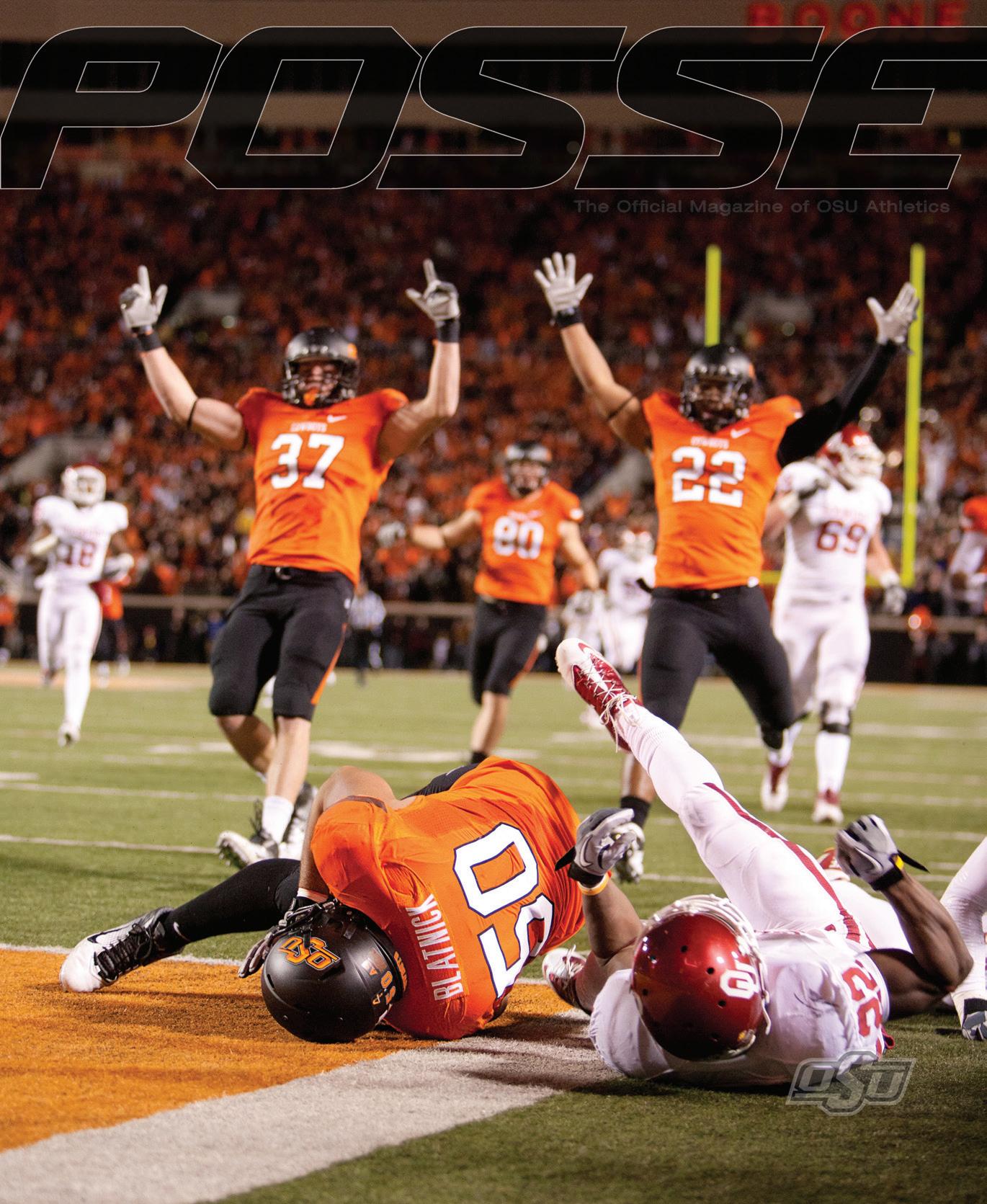
We will always remember and be grateful for your friendship.

Chickasha, OK
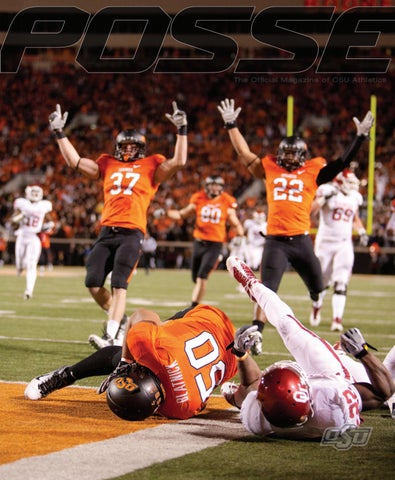
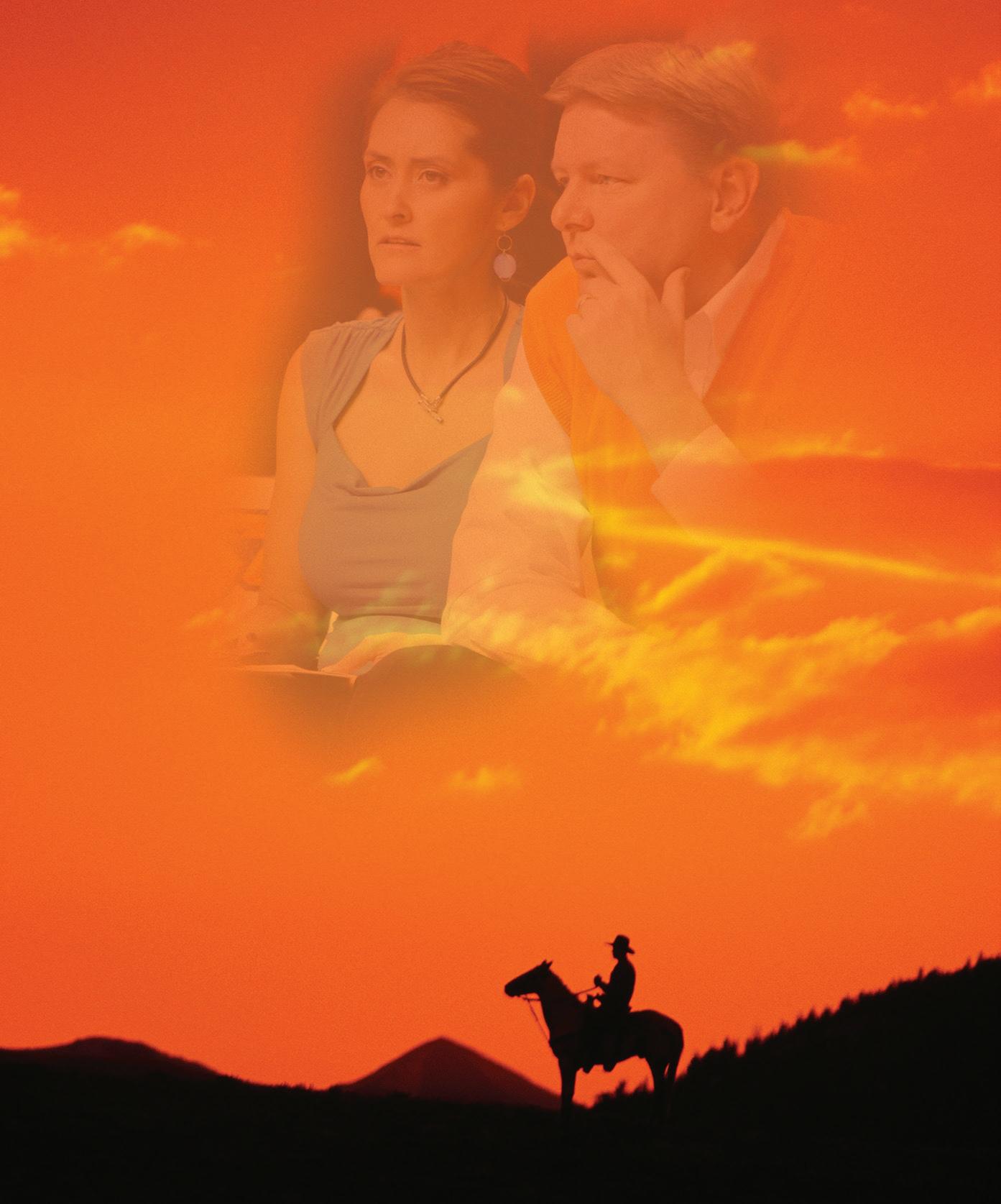
We will always remember and be grateful for your friendship.
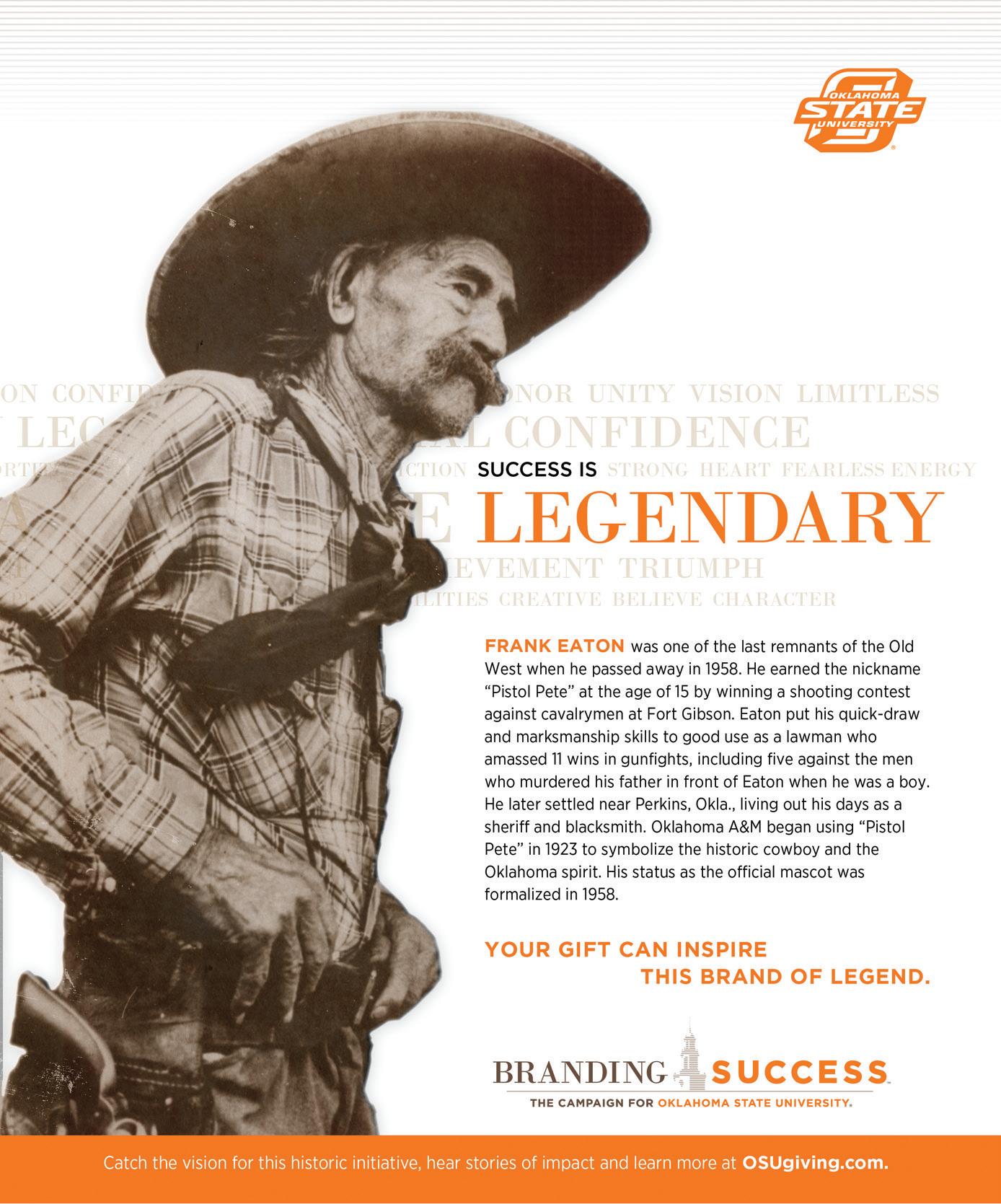
FRANK EATON was one of the last remnants of the Old West when he passed away in 1958. He earned the nickname "Pistol Pete" at the age of 15 by winning a shooting contest against cavalrymen at Fort Gibson. Eaton put his quick-draw and marksmanship skills to good use as a lawman who amassed 11wins in gunfights, including five against the men who murdered his father in front of Eaton when he was a boy. He later settled near Perkins, Okla., living out his days as a sheriff and blacksmith. Oklahoma A&M began using "Pistol Pete" in 1923 to symbolize the historic cowboy and the Oklahoma spirit. His status as the official mascot was formalized in 1958.
YOUR GIFT CAN INSPIRE THIS BRAND OF LEGEND.
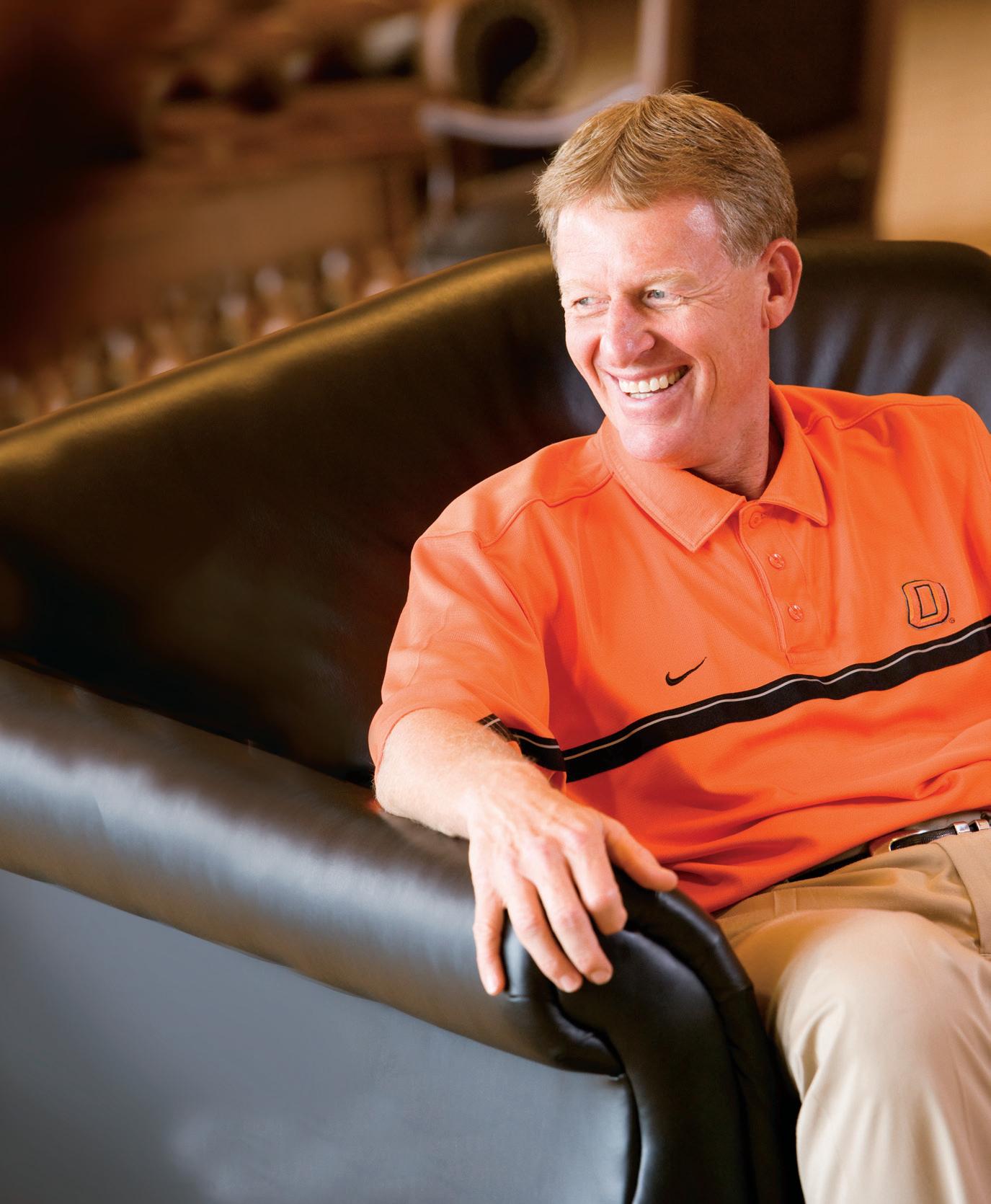
seems more and more these days, i get the opportunity to talk about how great our athletics programs are doing.
our football, soccer and cross country teams just finished excellent seasons. the cowboys took a trip to arizona to play in the tost itos fiesta Bowl. the men’s cross country team finished second at the nca a national tournament, and the cowgirl soccer team made another trip to the elite eight.
our student-athletes and teams have had a lot of success this year, and that is in no small part because of the support we receive from our donors and fans.
You can continue to support our studentathletes by buying season tickets. our men’s and women’s basketball teams are in the middle of their seasons as we speak, and the wrestling team is ranked high and again on a quest to attain a national championship.
thank you for your support of osU athletics. go Pokes!


0 0 0 8
and
and
only. Membership is $150 annually. Postage paid at Stillwater, OK, and additional mailing offices. Oklahoma State University, in compliance with Title VI and VII of the Civil Rights Act of 1964, Executive Order 11246 as amended, Title IX of the Education Amendments of 1972, Americans with Disabilities Act of 1990, and other federal laws and regulations, does not discriminate on the basis of race, color, national origin, sex, age, religion, disability, or status as a veteran in any of its policies, practices or procedures. This includes but is not limited to admissions, employment, financial aid, and educational services. Title IX of the Education Amendments and Oklahoma State University policy prohibit discrimination in the provision of services or benefits offered by the University based on gender. Any person (student, faculty or staff) who believes that discriminatory practices have been engaged in based upon gender may discuss their concerns and file informal or formal complaints of possible violations of Title IX with the OSU Title IX Coordinator, Mackenzie Wilfong, J.D., Director of Affirmative Action, 408 Whitehurst, Oklahoma State University, Stillwater, OK 74078, (405) 744-5371 or (405) 744-5576 (fax). This publication, issued by Oklahoma State University as authorized by the Assistant Athletic Director, POSSE, was printed by Southwestern Stationers at a cost of $0.9577 per issue. 10M/Dec 2011/#4112.


every day
we are coming up with new ways to enhance the experience of attending an OSU sporting event for our loyal fan s.
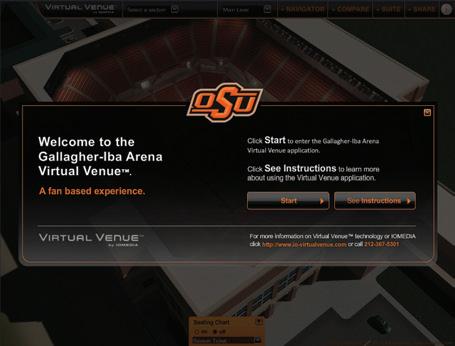
As the Internet continues to evolve we feel that it is important to have this technology seamlessly integrate with our season ticket purchasing process. In other words, we think our fans should have a fun and enjoyable process to purchase season tickets online for football and men’s basketball.
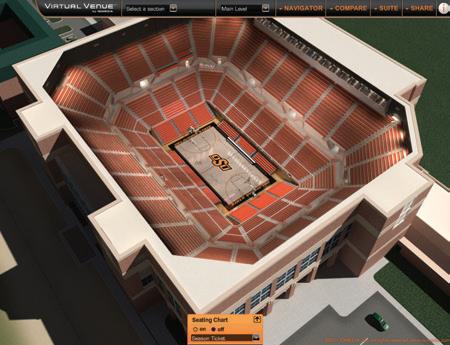
ImagI ne I f you could log on to okstate.com and immediately have access to a detailed virtual map of either g allagher-i ba a rena or boone pickens stadium . From that map, you could click on the section where you’d like to purchase tickets. A window would pop up showing the price of the season ticket, as well as any required POSSE seat donations.
e ven Better, once there, you could click on another section and see a price comparison.
Then the only thing that could top that would be if you could click on that window to see view from your prospective seat (minus the back of anybody’s head).
What would you think if I told you I’m not actually imagining it?
Here now.
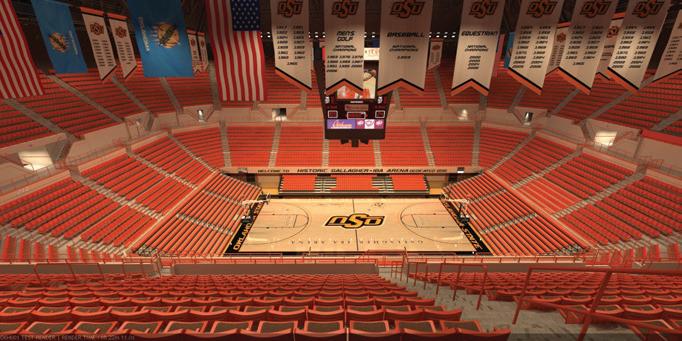
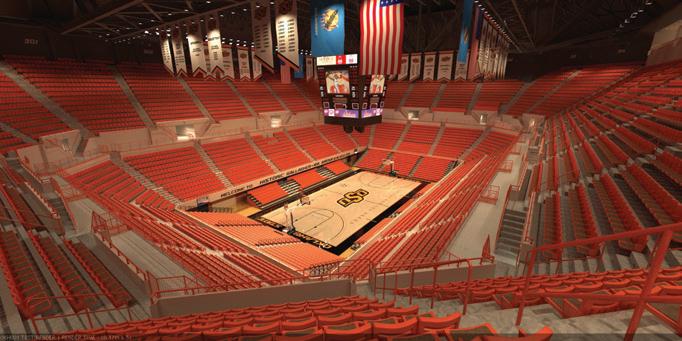
Last spring, we looked around the country to see how some professional sports organizations were handling their season ticket sales, which led us to IOMedia and their Virtual Venue.
With Virt Ual Ven U e , IOMedia takes a sports facility, such as Boone Pickens Stadium or GallagherIba Arena, and converts it to a 3D interactive map. That map is accessible from their client’s website, in our case, okstate.com . From there, customers can view the entire venue. They can select sections where they think they’d like to sit, and compare those sections in terms of cost and sightlines to other available sections. You can even pan the camera and see what the entire place looks like from your seat.
And, you can do all of this from the privacy and convenience of your home.
Plus, you also get online access to the various payment options available and “ mY os U acco U nt m anager ,” which allows you to forward, resell or even print your tickets electronically. Furthermore, buying a season ticket, whether you do it through the Virtual Venue or buy directly from the OSU Ticket Office, affords you the opportunity to keep your seats (or even move closer to the action) for the next season. Priority for the next year is given to current season ticket holders.
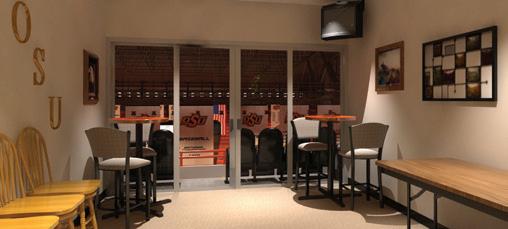
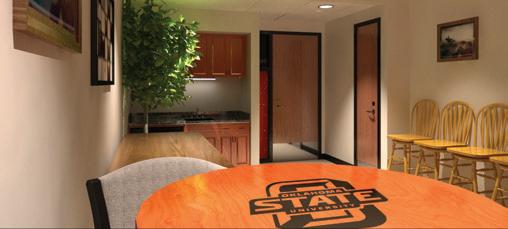
Buying a season ticket is of great benefit to the Athletic Department. The donations that accompany season ticket purchases go to fund the department’s student-athlete scholarship fund, which allows more than 450 Cowboys and Cowgirls an opportunity to pursue excellence on and off the field.
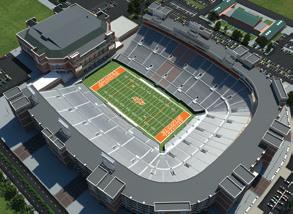
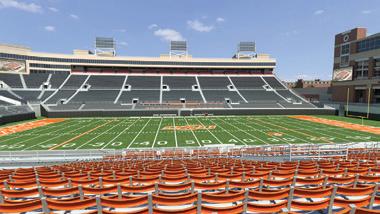
We hope to have Virtual Venue for Boone Pickens Stadium and Gallagher-Iba Arena fully integrated and ready to go for the 2012 Football and Men’s Basketball season ticket renewal period, which is just around the corner.
As always, if you or someone you know would like to purchase season tickets or join the POSSE, please call us at 877-all -4- osu (877255-4678) or visit www.okstate.com . Annual donations to Athletics totaling $150 or more qualifies for membership in the POSSE and includes a subscription to the award winning POSSE Magazine, the POSSE star decal for your automobile and an educational tax deduction. Get your friends and family involved today!
t he posse is your t eam behi nd the t eam s!
Jesse Martin
oklahoma
jesse.martin@okstate.edu
877-2B-POSSE (ext. 3311)
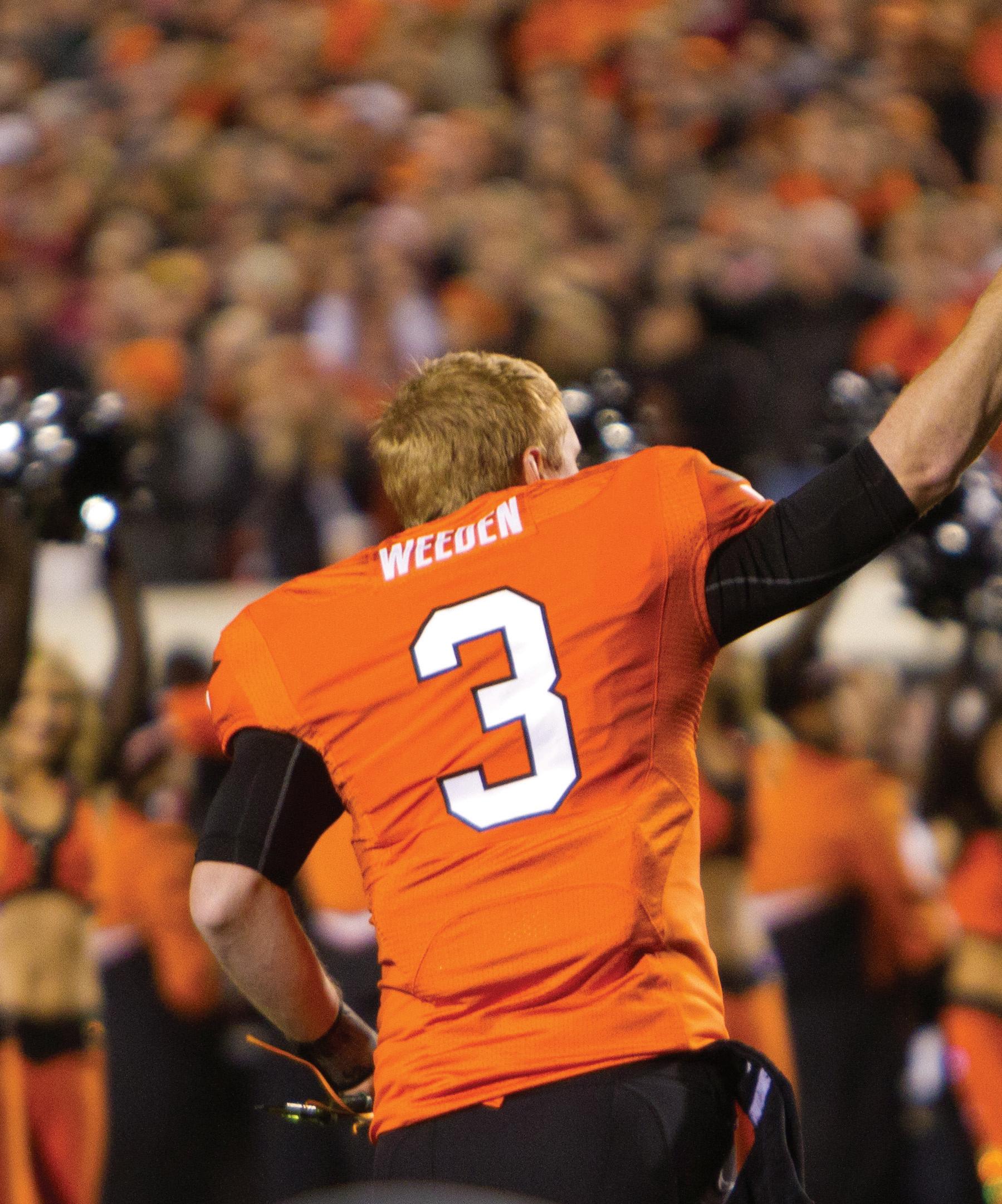
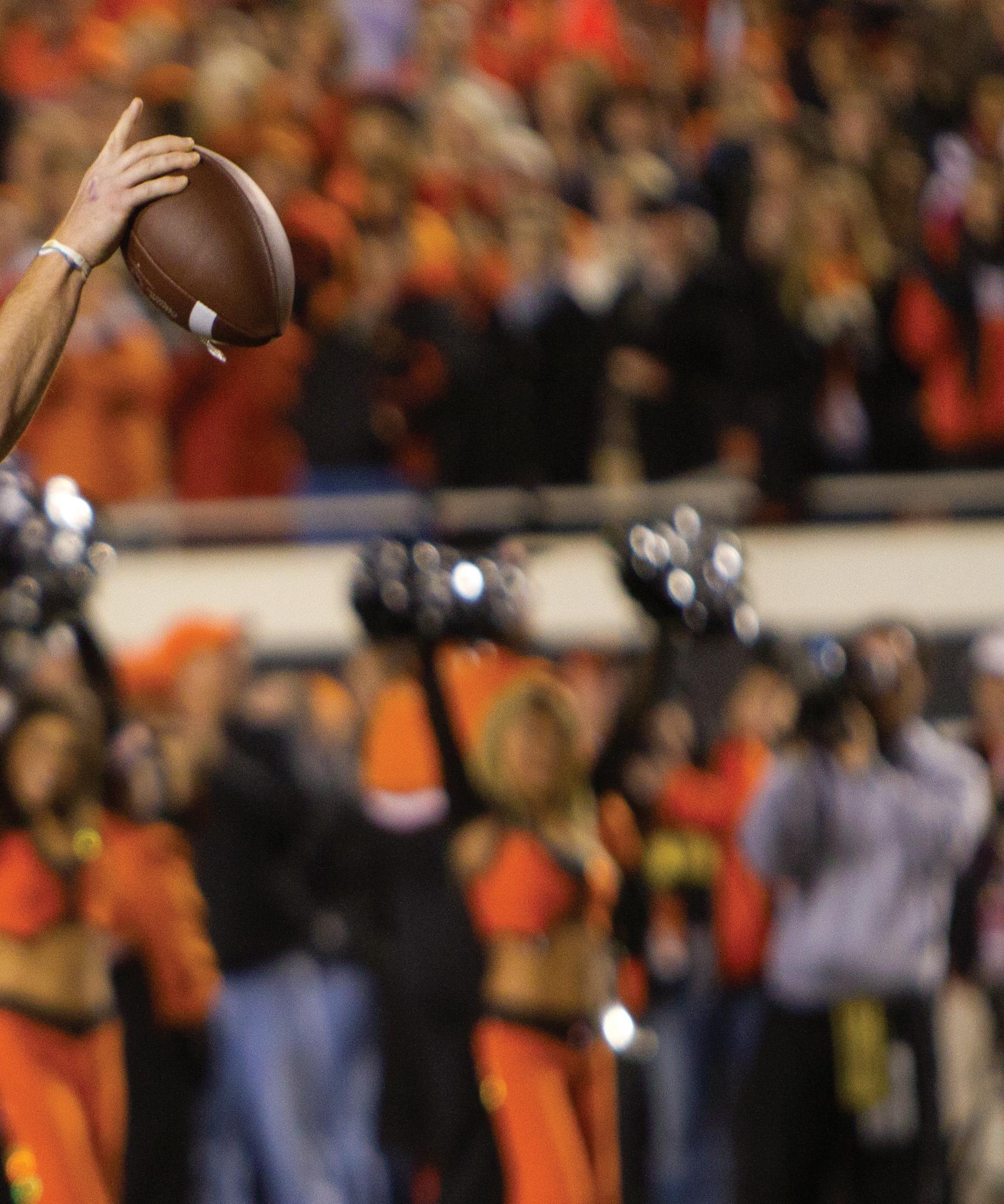
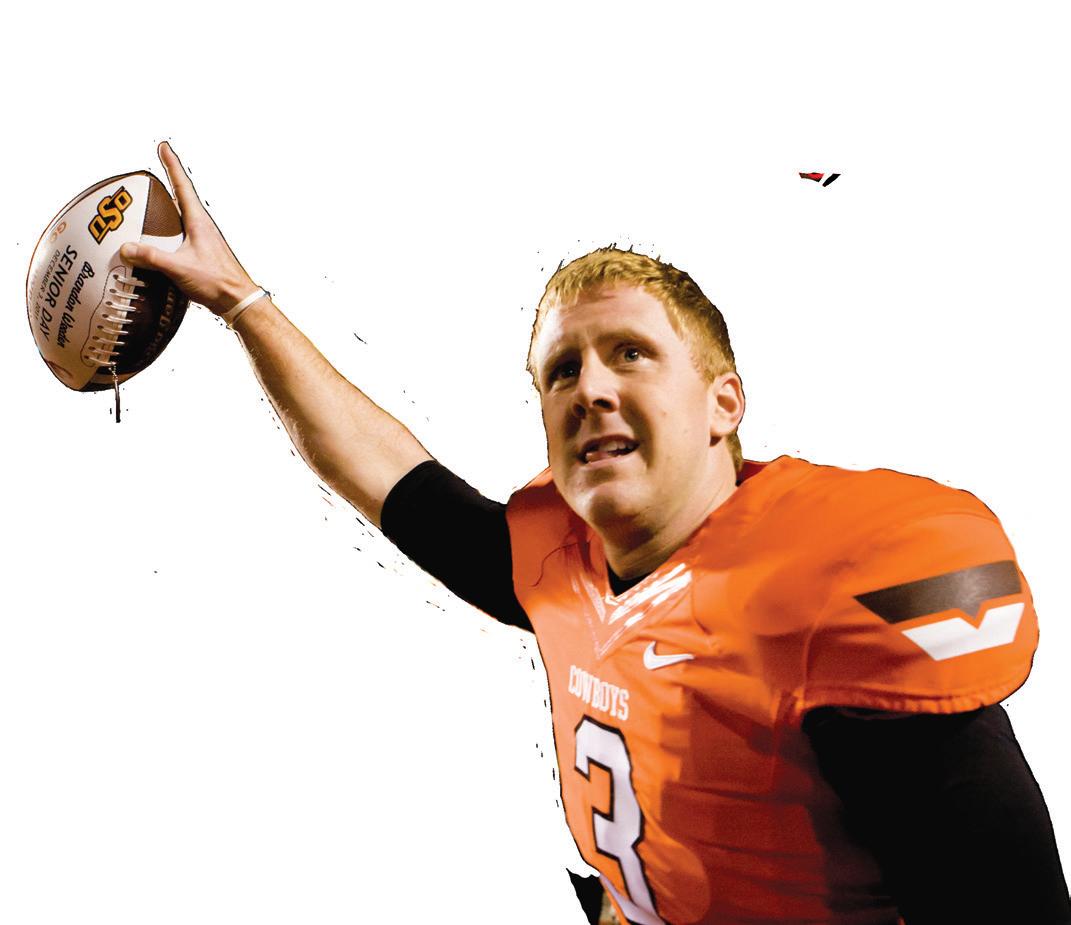
Brandon w ee den – QB
holDs the osU career recorDs for:
Passes comPleteD (737)
Passes attemPteD (1,060)
Passing YarDs (8,861)
Passing toUchDowns (72)
Passing efficiencY rating (158.94)
highest comPletion Percentage (69.5)
Passes comPleteD in a game (47)
Passes attemPteD in a game (60)
Passing YarDs in a game (502)
total offensiVe YarDs in a season (4,233)
Passes comPleteD in a season (379)
Passes attemPteD in a season (522)
Passing YarDs in a season (4,328)
Passing toUchDowns in a season (34)
comPletion Percentage for a season (72.6)
anD fills seVen of the toP 15 sPots for Passing YarDs in a game in school historY
You’re not going to graduate high school.
The principal saw a poor Air Force brat with five siblings from a lowerclass San Antonio neighborhood and a mom who didn’t speak English well. He saw a kid who would cut up in class and not do his homework.
The kid who probably egged his car. The kid who dug holes camouflaged in the alley behind his house for the city garbage truck to crash over.
In reality, King-Echevarria was a kid with gumption and a talent for building things out of the scrap metal, trash and discarded wood he found in the alley behind his family home. The thing is, he was hampered by dyslexia and a lack of support back home.
So almost no one noticed.
“I spent a lot of time out in the garage taking junk and making stuff,” King-Echevarria says. “I made a sailboat. Dug holes for the garbage truck to sink into in the alley. I made wooden airplanes. Kites. Gokarts. I used wood and steel. I didn’t know how to weld. Most of it was made with nuts and bolts and things like that.”
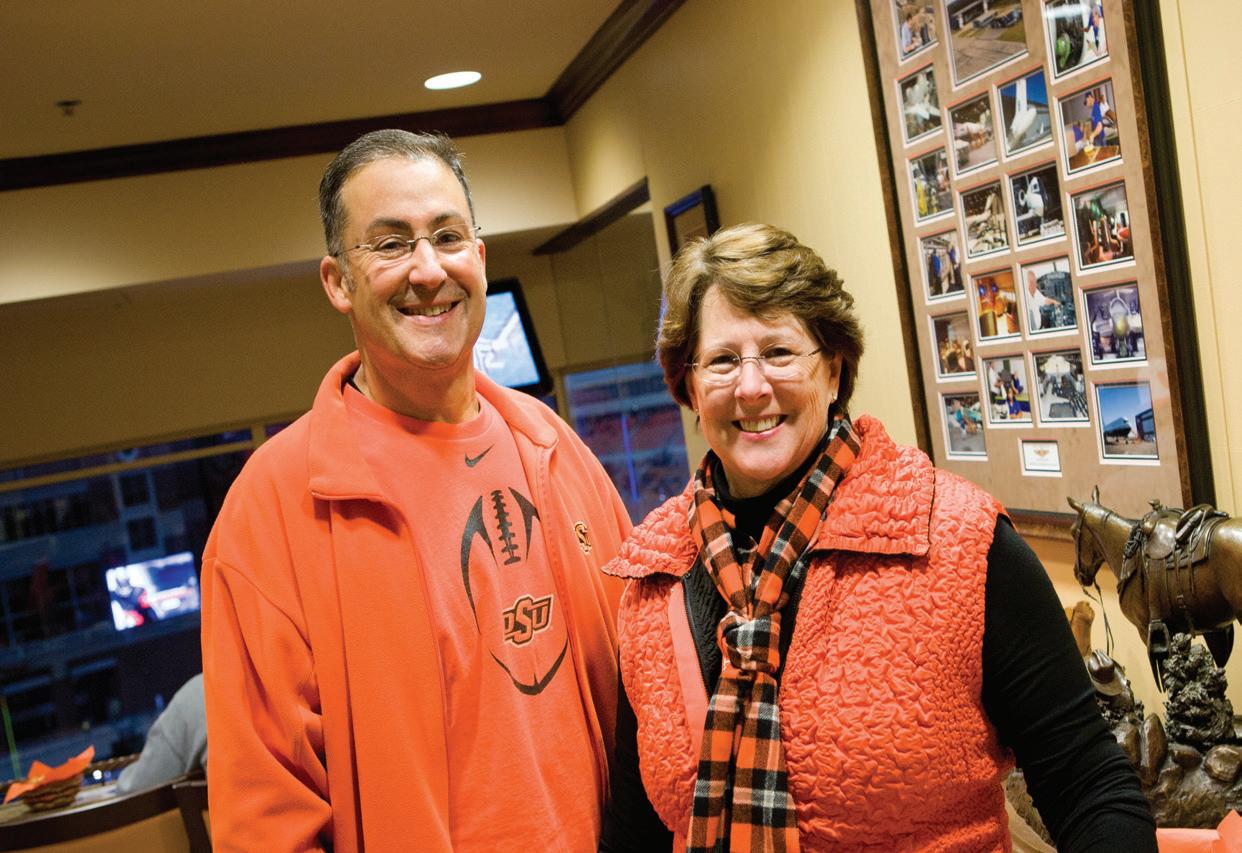
Now, King-Echevarria runs two aviation companies and is a donor to Oklahoma State athletics. One of his companies, King Aerospace Commercial Corp., modifies huge airliners for deep-pocketed customers, such as Saudi Arabian princes and foreign heads of state.
“I’ve put in Jacuzzis,” he says. “I’ve put in massage rooms. Casinos.”
The planes sometimes have rooms lined with precious stones. Tile floors made from malachite. Gold hardware.
That company is based in Ardmore and employs 100 people. His second company, Addison, Texas’s King Aerospace, Inc., is a government defense contractor that provides services such as maintenance and logistics for the U.S. Air Force and is a former contractor with a special missile testing program. Together his companies do many millions of dollars in business each year and employ more than 200 people.
He got his start in the industry in 1979 a few years after college, working for a company that worked with small airplanes. He ended up becoming one of its owners before he started King Aerospace.
King-Exchevarria has done well enough for himself that he owns a small ranch outside of Dallas. There he built a casino, saloon, chapel and an exotic animal ranch for people to rent for retreats, weddings and hunting.
“When I was a poor kid down in San Antonio, there were a lot of ranches down in south Texas. Big ranches. I was never invited. Being half Hispanic, I was kind of always on the outside looking in. I’d hear the little white boys talk about how they were going to go to their uncles’ or their relatives’ ranches on the weekend, but I never got invited. Now I’ve got my own ranch.”
How did the graduate of Southwest Texas State University (now Texas State) become an OSU fan?
He wasn’t familiar with OSU until he met former U.S. Representative Wes Watkins. King-Echevarria knew Watkins through his business as a defense contractor.
Watkins’ wife, Lou, is a member of the Oklahoma Agricultural and Mechanical Colleges board of Regents, the governing board for OSU and other public colleges in Oklahoma. The Watkinses, both OSU alumni, donors and Stillwater residents, often talked about OSU with his family.
The couple got to know KingEchevarria’s two children, Jacqueline and Jarid, and wowed them with their stories of OSU’s open campus, friendly environment and small-town setting. Once his daughter found out about the university’s rodeo team, she
was set on attending OSU after her senior year, he says. She later was one of the first students who flung open the big black metal gate for the football team before they ran on to the field for each home game. His son, Jarid King, became a walk-on defensive tackle for the football team.
King-Echevarria loves how the coaches, the players’ families, donors and fans are like a family.
When he and his wife suffered through several recent bouts of cancer, numerous people checked up on them throughout their recovery.
King-Echevarria is always at the games and offering advice to players he meets. In fact, he and his wife, Barbara, stand on the same street corner each game to greet the players during the Walk to the stadium.
During the away games, he tries to yell encouraging words from his seat just behind the team’s bench. He tries to encourage them, he says, because the small amount of encouragement he received during his youth went a long way with him.
“Some of these other kids have been told similar stuff to what I was told when I was a kid,” he says. “They need to hear that I came from the same kind of neighborhoods they came from.”
In fact, King-Echevarria helped out one of his son’s friends, Shane Jarka, by letting him work as an intern at his airfield in Ardmore. Jarka was looking for work experience after he graduated. King-Echevarria had just what he needed.
His idea was to teach Jarka some things he’d need later in life, things he wouldn’t learn in college. Stuff like
carpentry. How to weld. How to use a cutting torch. And how to use a posthole digger.
“He lost seventeen pounds the first ten days he worked with me. No exaggeration.”
Jarka says “Mr. King” taught him business lessons (such as “trust but verify”) and life lessons, too. He’s always available whenever he needs to talk. And once Jarka obtained a position with a Houston equipment and vehicle rental/financing company, he offered strong advice in business, as wel l.
“I really can’t say enough good things about Mr. King,” says Jarka, who admits he was a little mad when he found out his boss had a tractor with an auger on it that he could’ve used instead of the posthole digger.
“Even through all my workouts at Oklahoma State, all the stadiums, all the 6 a.m. runs and everything, it was probably one of the hardest things I’ve ever had to do. It was all day. It was digging in the Oklahoma dirt, which was hard as rock. We were having to chip away at it inches at a time to get down low enough and make the hole wide enough … The main thing I took away from working that summer was the value of hard work, trusting my instincts, trusting myself and persistence.”
Those are the values King-Echevarria believes in. And that’s why he believes in OSU.
“It’s almost like an extension of our family,” he says.
“It’s about mutual respect. It’s about accountability. It’s old fashioned values.”

Th E lE Av E A lEGACy
SC hOl ARS hi P E ndOWM E n T
T h E h A l FWAy POin T T h A n KS
TO MA ny OF OS U’S dE diCAT Ed A nd GEn ERO US dOnORS
It would probably be difficult to overstate the impact of a scholarship on a student-athlete.
Take Tom Wilson, for instance. Wilson came to OSU in 1955 on a football scholarship. He remembers having little hope of attending college when his high school coach, an OSU alumnus, told him OSU had come through with a scholarship offer.
“It was a great scholarship,” says Wilson. “It was room and board, books, tuition and some money. All I had to do was play football and go to school. Well, and do my job. Everyone had a job they had to do in the offseason back then. I had to go to every home basketball game and sit on the front row. Twice a game, at the beginning of each half, I had to run a dust mop over the floor. Pretty tough job, right?”
“I can remember sitting there watching us beat Wilt

Chamberlain and the no. 1 Kansas Jayhawks.”
Wilson used the education his scholarship gave him to pursue a graduate degree, then to excel in the pharmaceutical industry, and finally to start and operate his own business.
“My experience at OSU was great. And not only because I was able to go to school. The lifelong friends I made then, I’m still in contact weekly and monthly with. It also provided me the impetus to continue with school, which lead to a good career. None of that would’ve been possible without the scholarship from a quality university.
“It makes a difference. A huge difference. As you go through life, rarely do you get by without having help along the way,” says Wilson. “That was certainly my case.”
Wilson retired from the company he built in 1999, and he had always had it in his head to find a way to pay back the good that was given to him in the form of that scholarship those many years ago. It wasn’t until the Leave a Legacy campaign that he found his inspiration.
“Over the years, I thought about how I could say thank you,” says Wilson. “The scholarship was a way for me to get an education, and it jump started my life and career. A few years ago, I found the Leave a Legacy campaign, and I thought, ‘at some point, I would like to endow a football scholarship to pay back the one I had received.’”
It was not until Boone Pickens offered up $100 million in
matching funds that Wilson found himself able to make the commitment.
“Boone’s match got me off the sideline and into the game,” says Wilson. “It also allowed me to honor my mother, who’d been so instrumental in my life. It allowed me to establish a scholarship in her name for a senior at Davis High school to attend OSU.
“Boone’s a true gift. He’s a special gift to me and all the others who were able to contribute because of his generosity.”
there’s still work to be done
Many OSU supporters just like Tom Wilson have stepped forward to take the Leave a Legacy campaign from the drawing board to more than $57 million in scholarship endowments, which is, again, halfway to the $115 million goal.
In light of those numbers, it’s easy to forget that less than five years ago, OSU was dead last in scholarship endowments in the Big 12.
“I always like it when we’re number one in something,” says Larry Reece. “Well, we were dead last. We had $2.1 million in alltime endowments. We had never focused on it. We were at $2.1 million, and A&M was number one at $60 million.”
At that point, Coach Holder asked what it would take to endow all 229 OSU student-athlete scholarships. It was determined that a scholarship cost $500,000 to endow, and that lead to the $115 million campaign goal. It seemed
daunting, but in just four years, we are halfway there.
Endowing scholarships not only helps the student-athletes, but has a direct impact on the budget of the athletic department. Every year, the department pays $4.5 million to the university for scholarships. That money comes directly from the athletics budget. Every dollar saved through scholarship endowments goes back into providing our student-athletes everything they need to be successful on the field of play.
A large reason the Leave a Legacy endowment campaign has reached the halfway point is because of Boone Pickens’ matching funds.
“It not only made a difference in athletics, it made a difference on campus,” says Reece. “Boone Pickens came through for us again. He committed $100 million in matching funds for scholarship endowments. And then he upped it again. It ended up being $120 million that he would match for anyone donating at least $50,000 for a scholarship.”
It hasn’t been Boone alone. It’s taken everyone. Donors like Wilson, Dennis Wing, Calvin and Linda Anthony and more than 130 others. And it’ll take still more OSU diehards to help secure the future for generations of studentathletes to come.
“That’s really what it’s all about,” says Reece. “We’re trying to secure the future of OSU athletics and our student-athletes through endowments.”




t. Boone & madeleine Pickens
42.
1.6,086,319 AS OF DECEMBER 5, 2011
52. Andy Johnson
53. Atlas Paving Company
54. KNABCO Corp
55. David Bradshaw
56. Ike & Mary Beth Glass
57. JS Charter Investments, LLC
58. Griff & Mindi Jones
59. Anonymous #3
60. Thomas & Barbara Naugle
61. Calvin & Linda Anthony
62. Sandra M. Lee
63. Les & Cindy Dunavant
64. Lambert Construction
65. m ark & l isa Snell 20,424
66. Barry & Roxanne Pollard
67. Berkeley Manor Enterprises
68. Richard & Joan Welborn
69. David LeNorman
70. American Fidelity
71. Neal & Jeanne Patterson
72. Mark & Beth Brewer
73. K.D. & Leitner Greiner
74. Darton & Jamie Zink
75. Harvey & Donna Yost
76. Jerry & Lynda Baker
77. Scott & Kim Verplank
78. Ed & Mary Malzahn
79. Southwest Filter Co.
80. Wittwer Construction
136.
138.



The vision of head coach Chris Young and his assistant coach, Jamea Jackson, won her over. That was to build a new tennis power in the Midwest and write tennis history.
“I remember when I committed getting so many questions like, ‘what’s out there. What’s in Oklahoma,’” Blevins says. “It’s like people don’t give it enough of a chance.”
History is still unwritten. But the Cowgirls are working on their penmanship.
Blevins was the No. 10 recruit in the nation for 2011 according to Tennisrecruiting.net. She was a big part of a recruiting class, including No. 17 player Mary Jeremiah, that the site ranked as the nation’s fourth best. It was the highest ranking for a batch of recruits OSU tennis had ever received.
Add to that former No. 1 player, C.C. Sardinha, and Cowgirl tennis is stout.
“I felt like it was a challenge I wanted to take on – to go out and recruit the best American kids,” Young says.
Doing so was no small task. Young admits he didn’t realize how much of a challenge he was taking on. The
“facilities” OSU Tennis has consist of the same outdoor courts everyone else can play on just south of OSU’s intramural recreation building, the Colvin Center.
The courts, surrounded by greenhouses, feature no bathrooms and no locker rooms. They are dang-near impossible to play on when the wind picks up. As OSU fans know, the wind often does little else than “pick up” in Stillwater.
When the weather doesn’t cooperate, the team has to practice at private tennis clubs in Oklahoma City, Ponca City or Tulsa. Plus they have to be done by 4 p.m., when the clubs’ members show up to play. That wreaks havoc with studen-athletes’ course schedule.
“Last year we were driving the kids to Ponca City two or three times a day,” Young says. “The most difficult time is early in the season when teams have had more time on the court than us. It’s funny because every one wants to schedule us early. No one really wants to play us later in the season once we’ve got things going.”
There are some not-so-obvious pluses with OSU women’s tennis. Young, his team now loaded with players he recruited, has buy-in from his girls. Because there’s simply no other reason why the best players in the country would play here.
It’s a harsh fact, but it’s a very real one when one considers his players were recruited by the top schools in the country.
Imagine what he’ll be able to do once the team’s Tennis Complex is ready … Fundraising to make it a reality is what Young does when he’s not recruiting or coaching.
continues
I felt lIke It Was a challenge I Wanted to take on — to go out and recruit the best american kids”
“It’s probably easier for me than anyone else. I can share personal stories and examples of how we are directly affected and how donors’ contributions to this project can make such a big impact on our kids. I think that’s been a big part of the money that we’ve been able to raise.”
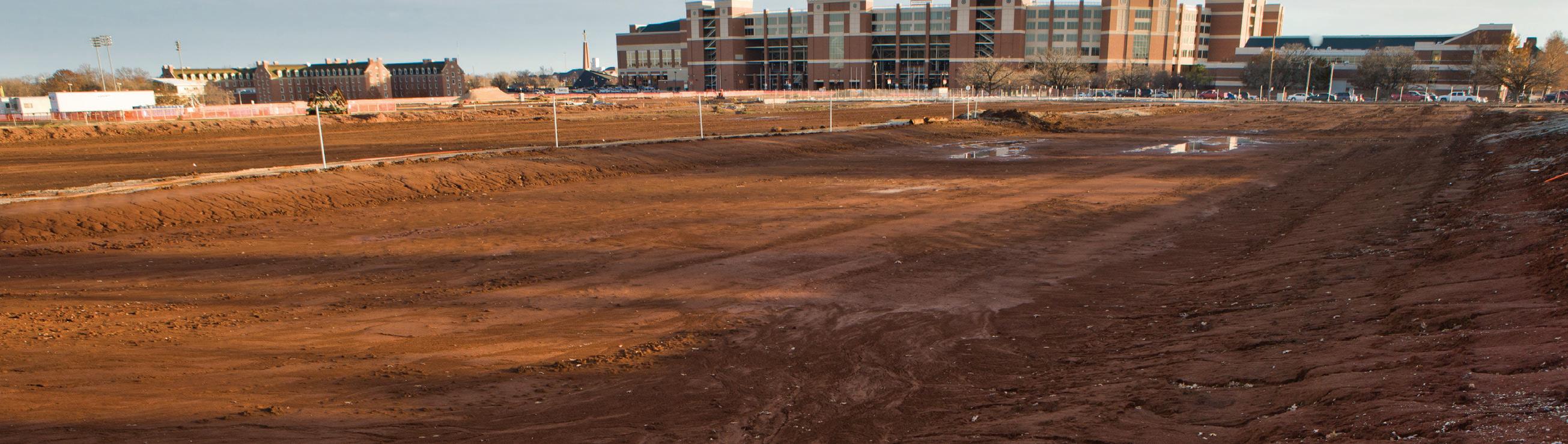
There’s a big red mud patch now where the Tennis Complex will be. But the mockups show 12 outdoor tennis courts, stands for the fans, locker rooms and indoor courts, too.
“We almost started crying when we saw the pictures of what it’s going to look like,” Blevins says.
The funding is there for the outdoor portion of the center, but the team is still about $3 million short for the new tennis center. Young has been working with Larry Reece, OSU’s associate athletic director for
development, and Matt Grantham, director of major gifts, to put them over the top. They are close.
“We have done the dirt work now and would like to start the indoor building as soon as we can, but we are still in the final stages of fundraising,” Young says. “We are hoping we can have a donor see our need, step forward and help us make it a reality.”
A historic recession hasn’t been helping much, but that’s nothing new for Young. At Wichita State, he raised money for an upgrade to the team’s building.
He also won a lot of games. With a 94-38 record, including 33-6 in the Missouri Valley Conference, the threetime conference coach of the year led the Shockers to conference championships in 2006, 2007 and 2009.
The team had never been nationally ranked nor had they beaten a ranked opponent. With Young at the helm,
they beat 20 and spent 43 straight weeks in the rankings.
Before Wichita State, he coached at his alma mater, Oklahoma Christian, initially starting as an assistant. After becoming head coach in 2003, his women’s team had eight NAIA AllAmericans. He coached the men’s team to a national championship that year. He made regional coach of the year in 2004
It hasn’t been the easiest row to hoe, but he believes it has made him a better coach. The experience helped him hit the ground running at OSU, even if it was challenging to just find ways to practice his players.
His first year at Oklahoma State, 2010, the Cowgirls finished at 13-10 in team play that spring, which was one of their best records in several years. Last season the team went 11-13, and that was a tough pill to swallow. He’s optimistic because he has some great
players and the program is close to building its new Tennis Complex.
“Before I came, it was said that we could only get international kids because they wouldn’t know the difference between how things are here and some of the other schools,” Young says.
Blevins doesn’t regret her decision one bit. She knows she’s in good hands. Her high school coach coached Jackson when she was younger, so she knew they shared the same values. Her teammates are playing well together this year, despite the difficulties they endure just to practice.
During singles and doubles play last fall, the team was playing well, especially headed into November’s Dick Vitale/Lakewood Ranch Intercollegiate Clay Court Tournament in Sarasota, Fla. Blevins, Sardinha and Jeremiah advanced to the competition’s final round. Sardinha won a
consolation final over Temple University’s Yana Mavrina.
Earlier that fall, Jeremiah and Blevins narrowly lost to OU in the championship doubles round of the USTA/ITA Central Region Championship. OSU knocked off four teams, including the No. 1 and No. 5 seeds, but lost in a tiebreaker needed to determine the winner of the match with the Sooners’ Marie Pier-Huet and Whitney Richie.
“I love the team,” she says.
“They’re amazing. I couldn’t ask for a better team. I’ve been struggling a little bit — getting homesick. But I’m excited to go home for the holidays. That’s the only thing. It gets lonely sometimes.”
Back home in Charleston, there was a beach she could frolic on.
There’s nothing like that in Stillwater, and the wind took some getting used to.
We almost started crying when we saw the pictures of what it’s going to look like.”
But according to Blevins, playing in the wind makes one “a baller.”
“It definitely should challenge our mental toughness because we play in a lot of conditions most teams would just go inside for,” Young says. “I think everything is what you make of it.”
The program can only recruit international players? You can’t compete without good facilities?
It’s safe to say he has made lemonade.
Just a little more help from the OSU family will help him turn lemonade into orange juice.
“We’re real proud of our players and proud of what they’re doing,” Young says.
“BIg 12 ChAmpIOns” … It hAs A nICE rIng tO It.
mAKE thAt FOUr rIngs.
photography by Phil Shockley
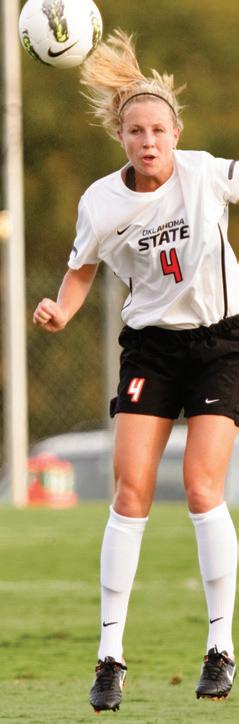
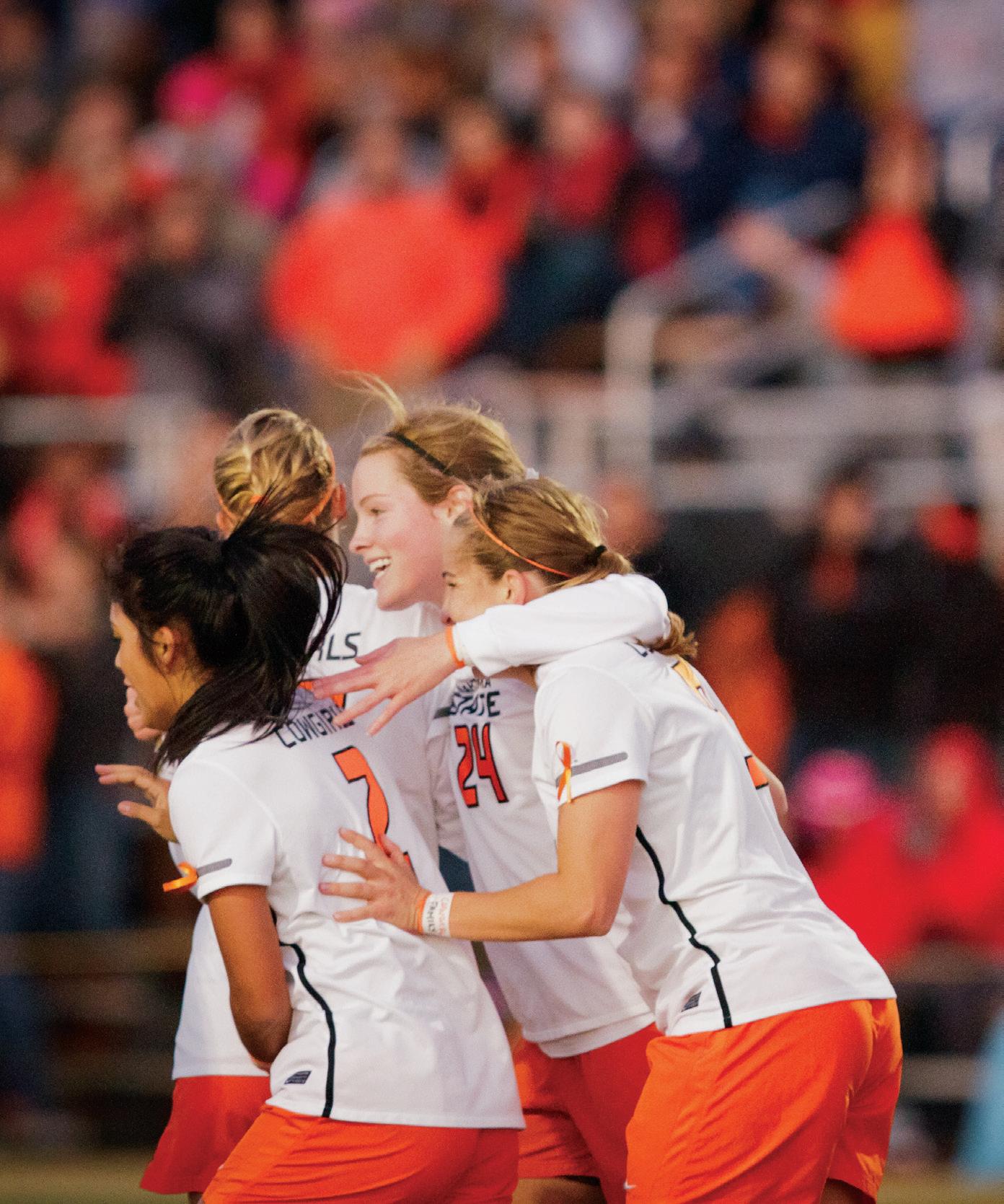
the Oklahoma State Soccer senior class completed a four-year run that includes two regular-season conference titles (2008, 2011), two league tournament titles (2009, 2010), four trips to the NCAA Tournament, and back-to-back Elite Eight finishes.
The OSU record book was seemingly tossed out each of the last four seasons as this special group of studentathletes helped elevate the program to new levels of success, individually and as a team.
Seniors Sarah Brown, Elizabeth “Flash” DeLozier, Colleen Dougherty, Krista Lopez, Melinda “Minnie” Mercado and Kyndall Treadwell, along with Annika Niemeier (a 6th-year senior due to medical hardship), were 75-14-10 (.808) since 2008.
“You can look at it statistically,” says head coach Colin Carmichael. “By mid-season they were the fourthwinningest senior class in the country, out of 330-some Division I programs. That’s a pretty telling stat right there. It’s not as if we play in a conference where you pick up an easy 10 wins every season. We’re playing some of the best teams in the country. That just shows how successful they’ve been.
“Beyond that, they’re just a great bunch of kids,” he adds. “These kids weren’t the highest recruited kids in the country. Notre Dame, UNC weren’t knocking down their door, but they were very, very good youth players. They’ve come in here, and through hard work and dedication and perseverance, made us an Elite Eight program. I can’t speak highly enough of what they’ve accomplished in their four years. It’s quite amazing.”
Carmichael says the 2011 seniors were a unique bunch.
“It’s a larger-than-usual group, and it’s a very talented group. Out of these seven, every single one of them were massive contributors.
“Minnie started from the get-go, as did Kyndall. Annika was injured and joined them later, but she’s been a starter her whole career when healthy. Krista had to work at it. It took her about a season-and-a-half to really find her feet. Flash was the same way, but once she got that opportunity she never looked back. Sarah was kind of on and off because of her injuries, but her senior year she was healthy and able to show everybody how good she is. Colleen didn’t start her freshman year, but after that was a fixture on the team.”
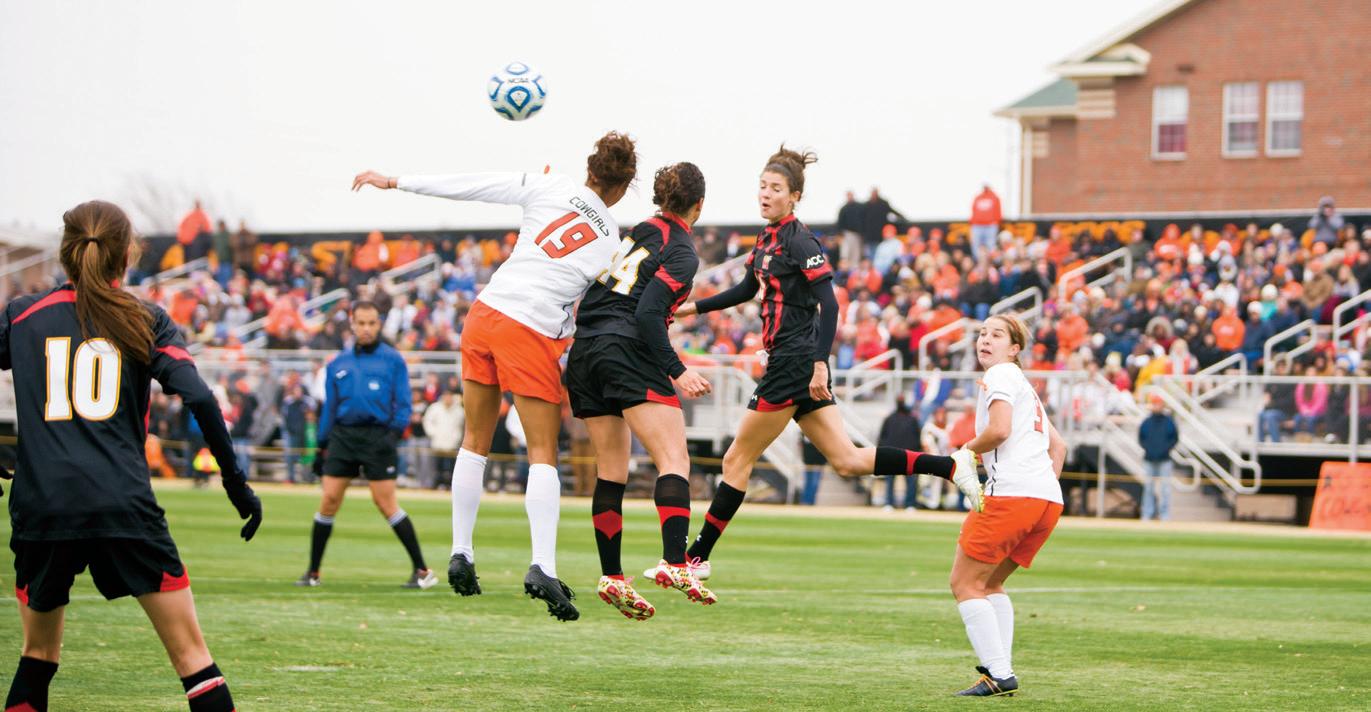
Coming off a surprising Elite Eight run a year ago, OSU players and coaches looked to go even further in 2011, especially with a large group of seasoned veterans on the squad.
“The way they handled the expectations this year was tremendous,” Carmichael says. “We tried to shield them as much as we can from the pressure, but they kind of took it head-on.”
When preseason polls were released, Coach Carmichael’s squad was ranked 13th nationally.
“When the national rankings came out, the girls were offended,” he says. “It doesn’t bother me very much as a coach. I kind of like it. You can work your way up. But the girls were mad. We finished fifth the year before, we return almost our whole team, and they drop us to 13 … I think they felt there was maybe a lack of respect for our program.”
“A lot of people doubted us and thought maybe last year was a fluke,” says Mercado, a first-team All-American defender. “We just wanted to prove to everyone that we’re as good as we believe we are.”
“I’d say they proved it,” Carmichael quips.
The Cowgirls finished the regular season undefeated, going 22-2-2 overall. They clinched the regular-season Big 12 title with a win over Texas Tech. The following week, they were nine seconds from overtime in the Big 12 tournament title game when Texas A&M scored the game’s only goal
“When you get to postseason, it’s a new season,” Carmichael says. “Really what you’ve done throughout the regular season gets you some sort of seeding, and beyond that it doesn’t matter. It’s a one-game season: you win, you go on. That’s our mentality. The regular season was awesome. We did a fantastic job. But what matters is what you do from here on out. So that was how we tried to approach it to get our team refocused.”
Carmichael says the team’s first loss of the season may have come at a good time.
“Obviously you never like to lose, especially in a championship game, but I think it refocused the team. It let them know they could lose and got them to focus on the NCAA tournament. Maybe in hindsight, it’s not such a horrible thing as far as it pertained to the postseason.”
Ranked as high as No. 2 nationally late in the season, OSU was awarded one of four No. 2 seeds in the NCAA Tournament. Many felt the Cowgirls deserved a No. 1 seed, or at the very least, a Regional bracket that didn’t feature a potential date with the overall No. 1, Stanford.
The Cowgirls earned home field advantage for the first three rounds and knocked off Arkansas-Pine Bluff, Illinois and Maryland on the way to the Elite Eight for the second year in a row. OSU took the top-ranked Cardinal to the wire in Palo Alto, losing 2-1 in overtime in a game that deserved to be in the Women’s College Cup, soccer’s version of the Final Four.
December 2011
“They handled the expectations, and in my opinion, exceeded them,” Carmichael says. “To go undefeated in the regular season, win the regular season championship, lose in the tournament final to a very good A&M team with nine seconds left, and then to be eliminated from postseason play by losing in overtime to arguably the best team in the country over the last four years … that’s nothing to be ashamed of.”
Despite losing in heartbreaking fashion, the two-time Big 12 Defensive Player of the Year says the Stanford game was a highlight of her career.
“You really wouldn’t think this was a high point, since we lost,” Mercado says, “but I was just so proud of our team, how we came out in the second half and showed that we can play with anyone in the nation and compete for a national championship. It sucks that we lost, but that’s probably one of my proudest moments here at OSU.”
In four years, Mercado and her teammates elevated Cowgirl Soccer from good to great.
OSU was 20-4-2 in 2010, losing to eventual national champion Notre Dame in the Regional final. OSU finished 15-7-2 in 2009 and 18-1-4 in 2008, losing NCAA tournament games in penalty kick shootouts both years.
“I remember being a freshman and Colin talking to us about just making the tournament,” Mercado says. “From then to where we are right now is just incredible. I just think a lot of it has to do with our mentality as a team. One of our strengths is our work ethic. We all work extremely hard, and we work for each other.
“I think it’s extremely unusual, especially being girls, for us to all get along so well. We all can hang out outside of soccer and get along extremely well. We all have different personalities. We’re all different in our own ways, but we all get along really well. I’m very thankful for that, because I know that’s not the case at a lot of other programs.”
Mercado also credits the older players she looked up to as an underclassman.
“Whenever I came in as a freshman, we had tremendous senior leaders, so I think that mentality and what they pushed for has really led us to where we are now,” she says. “Each year we’ve had significant seniors who really pushed us in the right direction, kept us focused on our goals and really stepped up in key positions and games.”
“They came into a very good program,” Carmichael says. “We had players like Yolanda Odenyo, Kasey Langdon, Siera Strawser, Bridget Miller—all very talented players—but
story continues
Uns U ng Cowgirl Defen D er n ot f org otten
the Cowgirl Soccer defense was stingy in 20 11, to say th e least.
Okl ahoma St ate’s 18 sh utouts wa s a sc hool record, an d th e team’s 0.337 goa ls-against average led th e nation. OS U was al so to ps in th e Bi g 12 in goals al lowed, let ting on ly ni ne sh ots reach th e back of the n et.
For th eir ef forts, several de fensive sta ndouts were recognized wi th a bevy of pos tseason ac colades.
AD Franch wa s on e of 15 semifinalists for th e Hermann Trophy fo r th e second con secutive year. Th e ju nior goalkeeper al so ear ned fir st-team Al l-America, Al l-Central Reg ion an d Al l-Conference ho nors. (S he hol ds OS U’s ca reer record fo r sh utouts with 32.)
Senior center back Me linda Mercado was al so na med fir st-team Al l-American by the National Soccer Coaches As sociation of Am erica. On her sh elf si t pl aques fo r Al lRegion, Al l-Tournament, an d Al l-Everything Els e awards. Sh e al so ea rned Bi g 12 Co nference De fensive Pl ayer of th e Year ho nors two years in a row.
Defender Ca rson Mi chalowski, a ju nior, was fir st-team Al l-Big 12 an d second-team All-Central Region.
Sen ior El izabeth DeLozier wa s a fir st-team All-Conference mi dfielder. Sh e al so ha s a great ni ckname: “Flash.”
OSU’s de fense wa s good—very good. Yo u get th e pi cture?
Well, maybe not th e en tire pi cture. So meone ha s been le ft ou t of th e co nversation.
Meet Co lleen Do ugherty.
story continues
this group took it a step further. To win four Big 12 Championships in four years is unbelievable. Ten years ago we couldn’t have envisioned that kind of success. For these kids to do that is awesome.”
In addition to earning four trophies in four years, the seniors were close to capturing even more hardware in that spa n.
“We were runners-up in the championship game this year. We were runners-up twice in the regular season, as well. So we’ve been right there for four years.”
Carmichael says the most rewarding part of his position is to getting to see his players grow up throughout their years in orange and black.
“It’s really rewarding to see a young freshman, an 18-year-old kid, come in here and then leave as a young lady. It’s one of the cool things about being a college coach as opposed to a professional coach. You get to see these kids grow up.
“Obviously, they’ll be missed,” he adds. “Every senior class that moves on, you miss them in different ways, but to say these kids will be missed is an understatement. They’ve been awesome. Their time here has been tremendous. Hopefully they’ll stay in touch and be really proud and continue to be part of our program. We’d love them to come back, come to games and talk to our current players, because they’ve definitely been a massive part of what we’ve done.”
Replacing seven players of that caliber is no easy task.
“That’s going to be the hardest thing. As opposed to replacing an individual, just replacing those collective minutes is going to be really tough for us.
“Having said that, from our perspective, the program goes on,” adds Carmichael. “Two days after our season ends, we start focusing on the spring and next season. Obviously the bar is set really high, and the kids coming in are going to have to work hard to not only try to maintain it, but improve on it … That’s just the nature of college athletics.”
Left Back, f rom page 31
You’ve probably seen her. But unless you’re a soccer-savvy fa n, yo u ju st mi ght not recognize her fo r wh at sh e means to th e team. Bu t her teammates an d coaches do
“Co lleen pl ays next to me an d makes my jo b 10 0 ti mes ea sier on th e le ft si de,” Mercado says. “It’s ha rd fo r me to take all th ose awards because I kn ow th at it really ha s nothing to do wi th me I’m jus t th e la st person be fore AD, so it ’s rea lly everyone in front of me th at does all th e di rty wo rk. I’m th ere to cl ean up whenever I have to Th at’s why I th ink the awards are really ju st team awards, especially wi th Co lleen an d Ca rson nex t to me We have so me ex tremely hard wo rkers, an d I do n’t th ink we’d be any where near as su ccessful as we are wi thout th em. An d th ey do n’t ever get recognition.”
Their coach ag rees.
“Colleen wa s as bi g a pa rt of th at defense as anybody over th e la st th ree yea rs, fo r su re,” says Co lin Ca rmichael.
“Sh e ju st goes ou t an d does her jo b. Fro m a coach’s st andpoint, an d maybe even from an op position coach’s st andpoint, we recognize how good Co lleen was Certainly from a fa n st andpoint, bec ause sh e doesn’t get th e st atistics and maybe is n’t as physically do minating as Mi nnie or Ca rson, yo u do n’t st and as mu ch.”
The le fty from Ok lahoma Ci ty certainly stood ou t to her coaches at practice.
“Wh en Co lleen ca me in as a freshman we kn ew th at sh e had a very good le foot. We kn ew sh e wa s a good athlete, but we weren’t su re how sh e’d ad apt col lege soccer. We di dn’t kn ow how wou ld deal wi th th e physical pl ay an d pos sibly th e speed of pl ay Bu t sh e jus t really motivated. Sh e wa nted to pl Once sh e made th at st arting spot he she never looked back.”

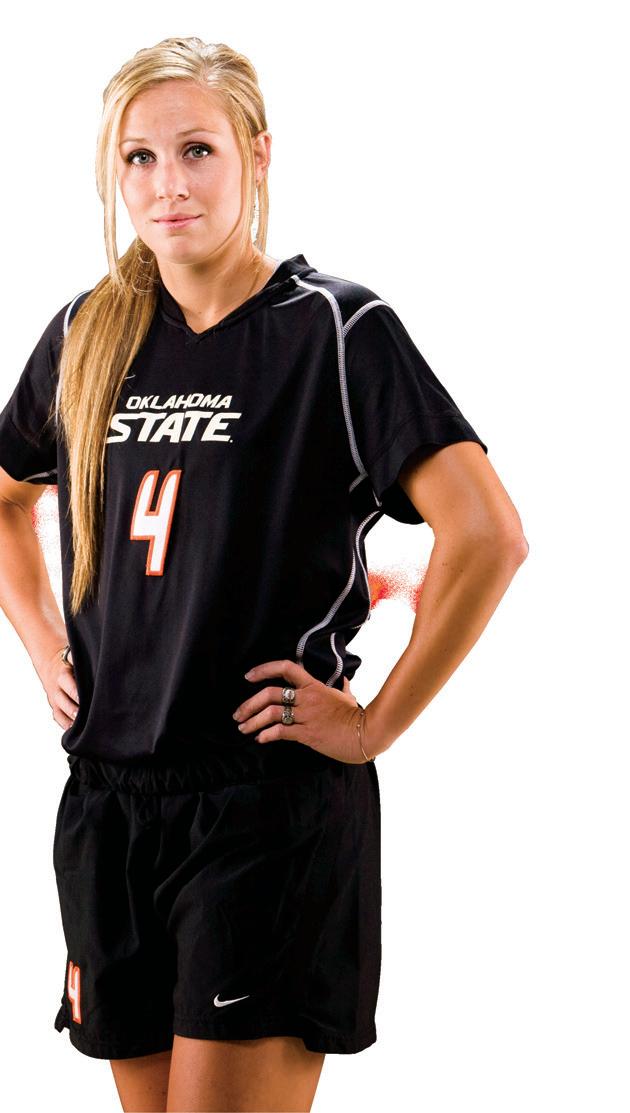
Dougherty became a fixture in th e s tarting l ineup at l eft back for th ree s easons, rarely l eaving the pi tch d ue to i njury o r exhaustion.
“Colleen i s a lways fi t, s he h ardly ever n eeds to come o ff the fi eld,” Ca rmichael s ays. “I c an’t remember her m issing a p ractice. S he’s j ust on e o f those k ids w ho s eemed to s tay h ealthy for m ost o f h er ca reer. S he kept h erself i n really good shape.”
Carmichael s ays that’s rare for a p layer i n h er position w ho h as to
Mercado s ays D ougherty i s a co mplete p layer.
“It’s j ust everything, really,” s he says. “It’s g reat w hen you h ave a l eft-footed person p laying that position. T hey c an s erve better ba lls, they’re m ore comfortable getting u p a nd d own the l ine a nd st aying w ide. M ost r ight-footed people would want to cut i nside, wh ich would c ause m ore traffic o n th e in side of th e fie ld Sh e’s fit Yo u wa nt a n o utside back w ho c an g et up a nd d own the l ine, a nd s he d oes ery rarely ever g ets beat sually s he’s g uarding the orward, s o s he a lways h as hat. I j ust think overall ery s olid l eft-back.” to work a s h ard a s I ougherty s ays. “I’m n ot the ot the m ost technical I j ust try to work really g ive u p. O bviously, eft-footed h elps a l ot.” tarted h itting o ur s et p lays oot a nd g ot s ome ecause o f n ice d eliveries icks a nd f ree k icks,” s ays.
Ironically, the d efender’s b rief n the s potlight c ame ffense this past s eason, of th at aforementioned w inning s treak i n the Cowgirls a nd BYU eadlocked 1-1 i n S tillwater. han a m inute remaining D ougherty c almly s ent orner k ick toward the It went i n. G ame over. h er s hining m oment,” armichael. “ We p robably hat g ame i f s he d oesn’t olleen to bend the ball corner, h opefully that
wi ll be a m emory s he’ll t ake w ith h er fo rever, a g olden g oal.”
The g oal was the fi rst a nd o nly of D ougherty’s Cowgirl c areer—not un usual for a person i n h er position, wh ich m ade i t a ll the m ore sweet.
“That was a mazing,” D ougherty says. “I wasn’t trying to s core. Ho nestly, n o. Because we h ave su ch g ood attackers, I j ust try to g et it s omewhere i n the box, a nd they’ll fin ish i t. I g uess i t h ad a l ittle m ore cu rve o n i t than u sual a nd j ust went ri ght i n.
“It’s s omething I’ll a lways remember. I’m g lad I g ot o ne g oal in because a s a d efender you do n’t really expect to, s o i t was a ni ce s urprise. To h ave i t h appen i n overtime, that m ade i t even m ore special.”
Speaking o f s pecial, D ougherty ha s been part o f a s enior c lass th at rewrote the record books at OS U, c laiming four conference crowns a nd back-to-back Elite Eight fin ishes. S he s ays s he d oesn’t m ind mi ssing o ut o n i ndividual h onors.
“Everyone o n o ur team w ho g ets th em d efinitely d eserves them,” s he says, “but h earing my coaches a nd my peers s ay those things (about me) m eans m ore.
“I could b rag a bout a ll o f o ur seniors. I think o ur c lass i s really special. We’ve formed f riendships th at we’ll h ave for the rest o f ou r lives.”
“We w ill m iss h er,” Carmichael says. “I think we’ll k now exactly h ow mu ch we’ll m iss h er n ext year w hen we’re trying to fi eld a n ew l eft back fo r the fi rst t ime i n four years. T hat’s wh en i t w ill p robably h it.”
There s he’ll be. Colleen D ougherty n oticeably a bsent.
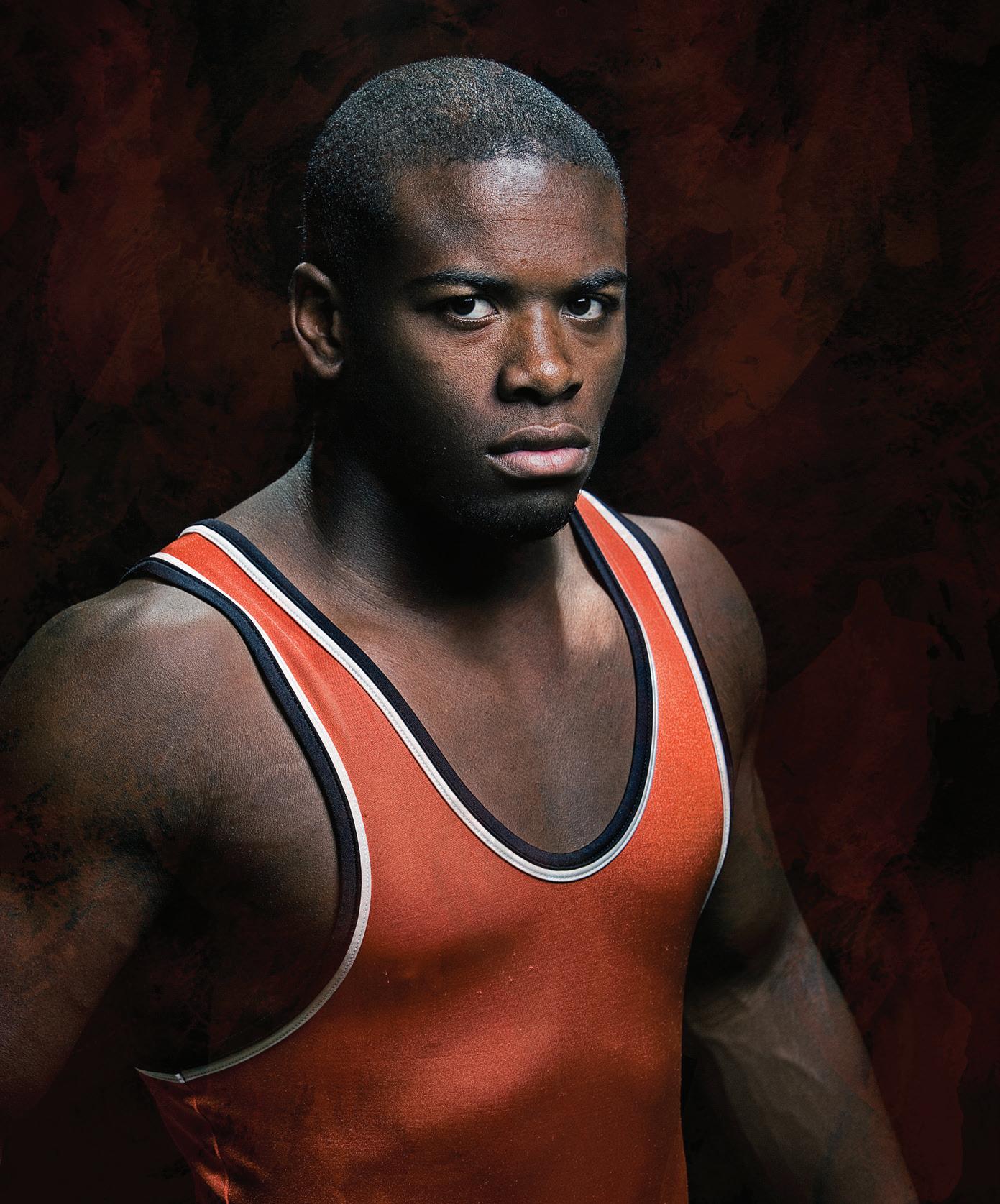

if it weren’t for w restling, he says, “i’d probably be in jail, prison or dead.”
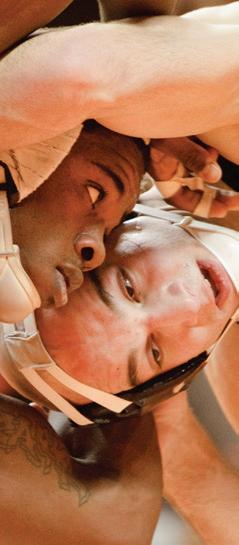
That’s not hyperbole. That’s not cliché. It’s the honest voice of a young man whose future was forever changed when he first heard the call of a junior high coach and discovered a sport that gave him direction … a purpose … a lifeline.
“Wrestling don’t owe me anything,” Parks says. “I owe everything to wrestling and the people who have helped me out. I don’t know where I’d be … I wouldn’t be working at McDonald’s, I can tell you that right now. Wrestling has given me a lot.”
His current coach agrees.
“No question, wrestling has saved him in a lot of ways,” says Oklahoma State head coach John Smith. “He’s in a lot better place because of t H e sport. He’s going to be in a lot better place w H en H e’s done H er e because of t H e sport.”
Growing up in Tulsa, Parks’ childhood was unstable, to say the least. Fatherless since age four, Parks and his mother clashed from an early age.
“We butted heads all the time,” he recalls. “She moved around a lot . She made promises to me and broke them multiple times … just a lot of stuff.”
His escape was athletics, primarily football. In a state where youth wrestlers often get their start in kindergarten, Parks was a stranger to the sport until 8th grade.
“It’s an interesting story,” he says. “I had just finished football, and the junior high coach was talking to everybody about wrestling. I came in at the tail end of it. All I heard was ‘wrestling.’ I was into WWE (pro wrestling) and stuff like that. I had never seen a real wrestling match. I didn’t even know what it was.
“The coach said, ‘You’ll be in the best shape of your life. It will help you for football.’ So I was like, ‘Why not? Football season is over. Why not try something new?’ I tried it and fell in love with it instantly.”
Part of the appeal at the time, Parks says, was the sport’s aggressive nature.
“i t was just like a fig H t,” he says. “It’s a funny thing. Up until I started wrestling, I was suspended for fighting almost every day I was in school. When I started wrestling and doing well, I never really had any more problems in school. I did better in school. I actually wanted to do better.
”When I first got into it, I didn’t have any expectations at all,” Parks adds, “but as I started getting better and better, I thought to myself, ‘How many times H av e i lost? n ot many.’ That’s when I realized I was good at it. After my 8th grade year I decided to stop football and focus my energy on wrestling, because I felt like it would take me the farthest.”
While he began to experience success on the mat, his home life continued to fall apart. By his freshman year at Union High School, Parks’ strained relationship with his mother finally came to a head.
“My mom moved away,” he says. “She left me with my sister at the beginning of my freshman year.”
Parks slept on the couch in the onebedroom apartment.
“w e didn’t H av e anyt Hing,” H e says. “w e pawned everyt Hing so we could H av e somet Hing to eat. It wasn’t the easiest life, but Christina did everything she could for me. She’s more like my mother than my sister.”
His high school coach, Corey Clayton (a former OSU wrestler under Smith), was keenly aware of Parks’ situation.
“One day we were loading up from a freestyle tournament, and he asked me if I wanted to come live with his family. That’s basically how it happened. I wasn’t expecting it. I didn’t ask him. I didn’t mind sleeping on a couch. He just asked me, and I said, ‘Okay.’
“It’s given me a lot. He was kind of a father figure in my life, giving me a male role model. He just showed me what I needed to do. Kept me on track. Kept me right. Wrestling has given me discipline like you won’t find anywhere else.”
Parks continued to excel on the mat, but still didn’t envision a future in the sport beyond high school.
“I never thought it would take me to college until my sophomore year when I won my first state title,” he says.
Parks would go on to win two more Class 6A titles for the Redskins, amassing a 138-12 prep record.
Named the state of Oklahoma’s Outstanding Wrestler, H e was widely regarded as t H e top prospect in t H e 13 5-pound weig H t class coming out of Hig H s cH oo l.
“That’s how I got here,” he says.
“here” is the oklahoma state university wrestling room, five years later.
The transition from high school star to Division I student-athlete hasn’t been smooth, however, on or off the mat.
“Jamal was obviously one of our top kids coming out of high school,” Smith says, “but we knew he was going to be a project wrestling-wise, because he really won a lot on speed and quickness and didn’t have a lot of skills on top or on bottom. It’s been a developmental process with him.
“In his personal life, there were some hard times for him,” Smith adds.
“He didn’t grow up in a traditional family, by any means—the furthest thing from it—and some of that I think carried over into college.”
Smith says Parks is still “a work in progress,” but is proud of strides he’s made.
“He sure H as grown up a lot, and H e’s got a great work et Hic. w e don’t ever worry about Him academically now. We don’t worry if he’s not getting up and going to class … There’s a level of responsibility that he’s taking on and we have a lot of confidence in his self-reliance with where he’s going.”
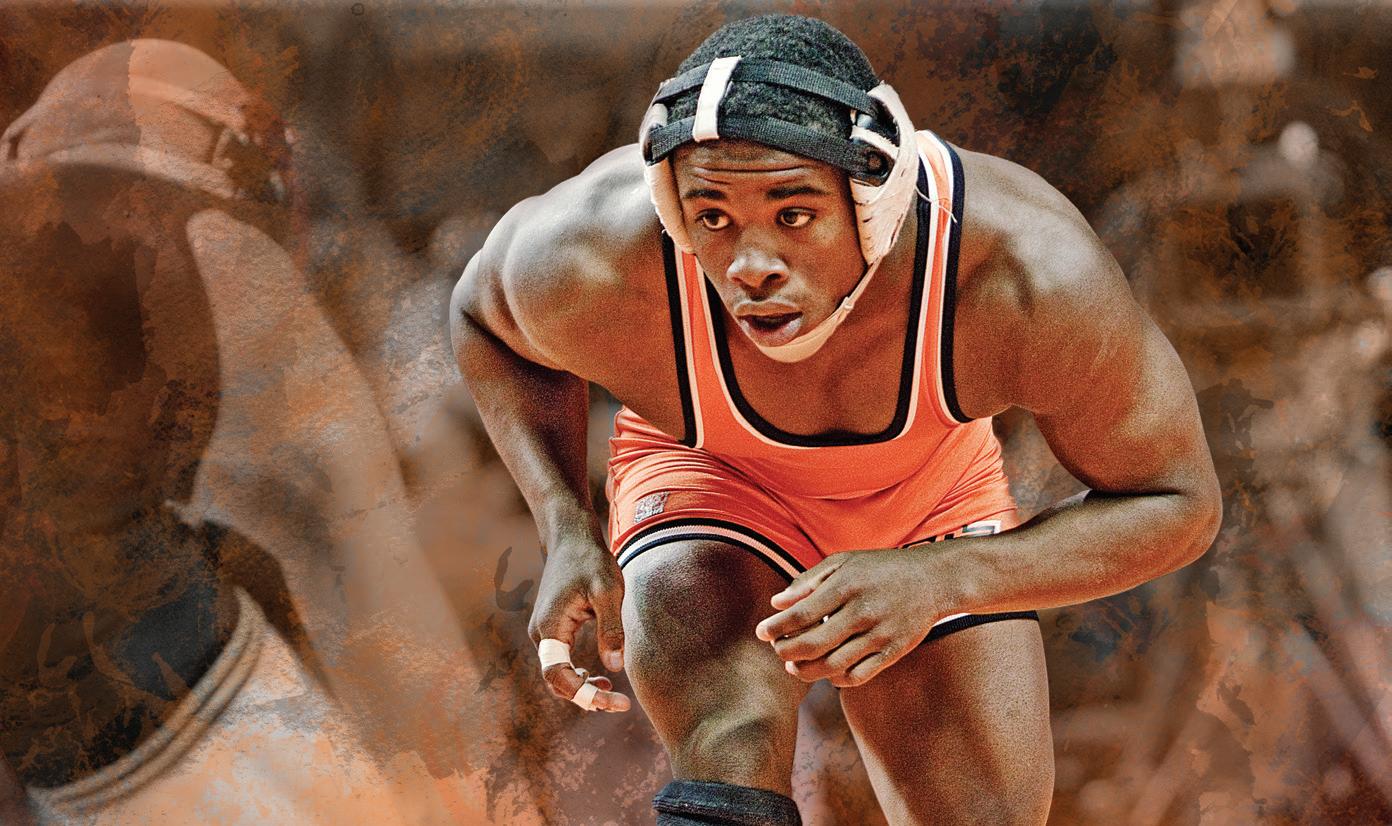
As a wrestler, Parks has become an integral part of OSU’s secondranked squad.
“Athletically, he’s obviously improved. He’s put himself in position as a senior now to be one of the best at the weight. It’s a very competitive weight, year-in and year-out, but he has high goals for his season this year.”
l ast season, par ks earned a lla me rica H on ors wit H a fift H p lace finisH at n at ionals . Smith says the key to making the leap to become a national champion is mental.
“You’ve got to see yourself as that person,” he says. “National champions can look in the mirror and see a person that can be the best. It’s about building that confidence and accepting responsibility that I am that person. And there can’t be fear of it. There’s a big difference between being an AllAmerican and an NCAA champion. There are seven others who are AllAmericans. There’s only one champ.” Parks possesses the tools to win it all, Smith says.
“jam al is doing a lot of t H e rig H t t Hings rig H t now, but he needs to continue to see himself in the mirror as that guy … a strong-minded person that deals with adversity, that can come from behind, that can stretch leads out, that can separate himself from 90 percent of the weight class. There can’t be any weaknesses.”
In high school, Parks dominated opponents with his athleticism and speed. At the collegiate level, he’s had to develop unfamiliar techniques in order to win.
“I’m still fairly new to the sport,” Parks says. “i’m still learning. I basically didn’t have to do that many moves in high school. I wasn’t used to people riding me or having to ride somebody or having to do anything critical in the match because I’d be so far ahead. But once I got here,
every guy is tough. Every guy has his strengths. My strength is on my feet, but I was weak on bottom and top. Now I can ride and get that minute (bonus).” That’s something I’ve had to work on, and I know I have to keep working on it. you just H av e to acknowledge w H at you’re not good at and build on it.”
Smith says Parks’ progression has been more of a struggle than most fans of the sport might realize.
“What people have misunderstood about Jamal more than anything, is how much development needed to take place,” he says. “I think everybody pictures him being athletic, quick … in wrestling that’s just a very small portion of what it takes. There are a lot of national champions who aren’t quick. It’s just an element of the sport. His speed and his quickness have got to be used in a style that allows him to be successful.
“i t Hin k people t Hin k jam al can take people down at will. tH at’s far from t H e trut H Jamal has to earn hard takedowns. I think there have been times that he’s held back a little bit. He came into a program that wanted him to be a dominating wrestler, and he struggled a little bit. But I don’t see him holding back much this year. I think he’s got a good level of confidence.”
As a redshirt sophomore, he showed flashes of his potential by winning t H e big 12 cH ampionsHip at 141 pounds, but failed to live up to his No. 2 national seed at the NCAA Championships.
“What kept me off the podium was a lot of things,” Parks admits. “Some bad habits. I was cutting too much weight. Some of it was mental. I just didn’t execute. It hurt really bad when I went in ranked second and didn’t


Without wrestling, without my diploma, I can’t do anything. I’m stuck … I need to wrestle.”
come out with anything. After that, I had to get my mind right and come back and improve.”
par ks admits H e made costly mistakes off t H e mat, as well.
“In high school I didn’t party, I didn’t drink. I didn’t do anything,” he says. “Wrestling was my party. Wrestling was my drink. It was everything. It was something that I’ve had to rediscover in college. You can’t live that lifestyle and expect to accomplish great things. Some people can get away with it. I’m not one of those people. basically i’v e H ad to live a pretty simple life to accomplisH t H e t Hings i want to accomplis H.”
Temptations are ever-present, he adds.
“You have to stay strong. There’s always temptation. My first couple years, I fell to those temptations, and

I did things that I shouldn’t have been doing. They’re not things that are very detrimental if you’re a regular, Average Joe student. I still made my grades … If I was a regular student, I would have been fine. But I’m not. And I want to do some things that will last forever, so it’s not even a sacrifice. I just have to keep doing what I have to do to accomplish what I want to accomplish.”
Coach Smith says he considered kicking Parks off the team more than once.
“I was done,” Smith says. “I was getting rid of him. I was just at the point where he had no more chances.”
“At first when Coach Smith said he was going to kick me off the team, I was like, ‘You’re bluffing,’” Parks says. “But when I saw he was serious, i t H oug H t i’d lost everyt Hing. Without wrestling, without my diploma, I can’t do anything. I’m stuck … I need
to wrestle. I need to get my diploma. I need to do something positive with my life. I can’t just act like I don’t care, because this is my life I’m talking about. It’s going to affect me for a long time, and I want to be involved in wrestling, so it really humbled me.”
“It’s hard to quit on someone who admits his mistakes,” Smith says.
“Half the people today won’t admit that they’re wrong, but Jamal would always be accountable. I appreciate that. He’s been worth the chances, because you know he wants it. You know that he doesn’t want to do some of the things that he did. We’re not perfect. We make mistakes. I’m not looking for perfection, but I expect big improvement.”
“that’s part of being a man,”
Parks says. “That’s part of growing up. You have to admit when you’re wrong. I wasn’t doing the right things and me denying it was me just lying to myself and lying to the Michael Jordan of our sport, basically. Constantly denying that you’ve done anything wrong is going to get you nowhere. You’re going to be in a freaking abyss for the rest of your life if you keep doing that.”
“You’ve got to constantly fight to make changes,” Smith says. “It’s scary and intimidating at times. Can I do it? Can I live up to it? He’s gone through all that, but the one thing that I really appreciate it is that he’s fought the whole way through.”
curr ently ranked n o. 2 at 149 pounds, Parks has his goals set on an individual championship and team title for the Cowboys.
“My goal is to help my team get better, first and foremost,” he says. “If we are going to make it to the top, it’s not just going to fall to the rankings. It’s not like football, it’s not a popularity contest … 1 and 2 don’t always face off. Unexpected things can happen. So we have to bring our A game.
“l ast year was really a good experience, getting over t H at H ump t o be a ll-a merican. It really gave me a taste of what I need to do. Rankings really don’t mean anything to me. In my mind I have to think of myself as the No. 1 guy, and everybody else is wrestling for second place. That’s basically how I have to look at it, and now it’s up to me to make it a reality.”
“There’s definitely a definition of a national champion,” Smith says. “He’s getting closer to that definition in a lot of ways with the changes he’s made
personally. I expect him to continue to fight, to make it as bloody as he has to for this opportunity.
“His work ethic in the room has changed from the time he was here until now. It’s unbelievable. I could literally not watch him in practice and know that he’s getting it done. That’s a good feeling as a coach.”
“It’s about character,” Parks says. “ you H ave to work H ard w H en no body’s looking. You can’t only go hard when your coach is hovering over you. That’s something that I’ve had to rediscover about myself.
“We have an outstanding staff with Zack Esposito, Coach (Eric) Guerrero and Coach Smith, along with Coach (Kenny) Monday. Those guys are the best of the best and point out things that I need to work on.”
“Early on he didn’t take a lot of advice,” Smith says. “There was a little bit of a struggle with listening and understanding. It hasn’t been an easy journey for any of us with Jamal. It’s been tough. But it’s been worth it. He’s going to be successful because of the commitment to making some changes, doing the right things and avoiding the temptations that can take you down.
“It’s easy to work with him now. It’s easy to be his coach now.”
park s will graduate in m ay wit H a degree in education, and H ope s to use w H at H e’s learned to H elp o t H ers in t H e s port.
“I’m definitely going to wrestle international after I’m done here, so I’ll still be training. But at the same time I’ll be coaching other people. That’s really my passion, teaching other people the sport. It feels good when you help somebody succeed
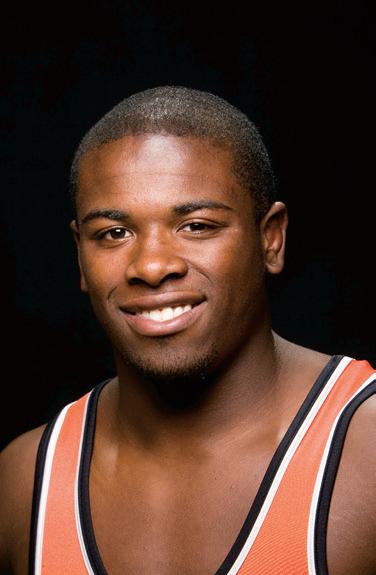
because of something you taught them. I don’t want to just keep my knowledge to myself.”
“He’s going to be successful t His ye ar and in t H e f uture,” Smith says.
“Wrestling has been the key in what he’s had the opportunity to do, and is going to do … I’m talking about getting a college education, possibly teaching and coaching anywhere he wants.”
Last year, Parks reunited with his biological father.
“He’s a firefighter in Kuwait. He came and visited me, and that’s the first time I’ve seen him since I was four. He got to watch me wrestle for the first time ever in the Bedlam match. That relationship is going well …”
(Thanks to wrestling.)


On-Demand Information Services.
Utilizing SST's FarmRite product, our customers can remain focused on their core competencies of agronomy, sales and customer service, while leaving most of the computer work to us. With our around-the-clock data processing service and lightning-fast turnaround-time, they can rest assured they're getting the information products they need when they need them.


Do you remember a special teacher who made a difference in your life?
Mike Gundy honors teachers for their support and influence
MIKE GUNDY
Frances Hadden was my 6th grade teacher at Ridgecrest Elementary.
I reflect back on how much effort she put into keeping me focused on learning and absorbing the information. She could have let me slide and just barely get by. Instead, she insisted that I reach my potential in the classroom. She was always enthusiastic about her job and had an approach that was very positive and encouraging.
Francis Hadden OSU, 1961

We are proud to say that both Coach Gundy and his wife Kristen are College of Education graduates, and their teachers are both OSU grads. Teachers are constantly coaching our children both in the classroom and some in the field of “life.”
Take time to recognize a teacher by giving a scholarship gift of $1,000, $500 or $100 and submit 50 words about your teacher to teachersrock@okstate.edu along with your name and contact information.
To make a gift to honor your teacher,contact:
Dr. Brenda Solomon, Senior Director of Development Oklahoma State University Foundation 400 S. Monroe | Stillwater, OK 74074 TEL 405.385.5156
EMAIL bsolomon@osugiving.com
Mike Gundy graduated from OSU in Secondary Education with an emphasis in Social Studies in 1990.

Thank you.
C. Robert Davis, Interim Dean College of Education
a
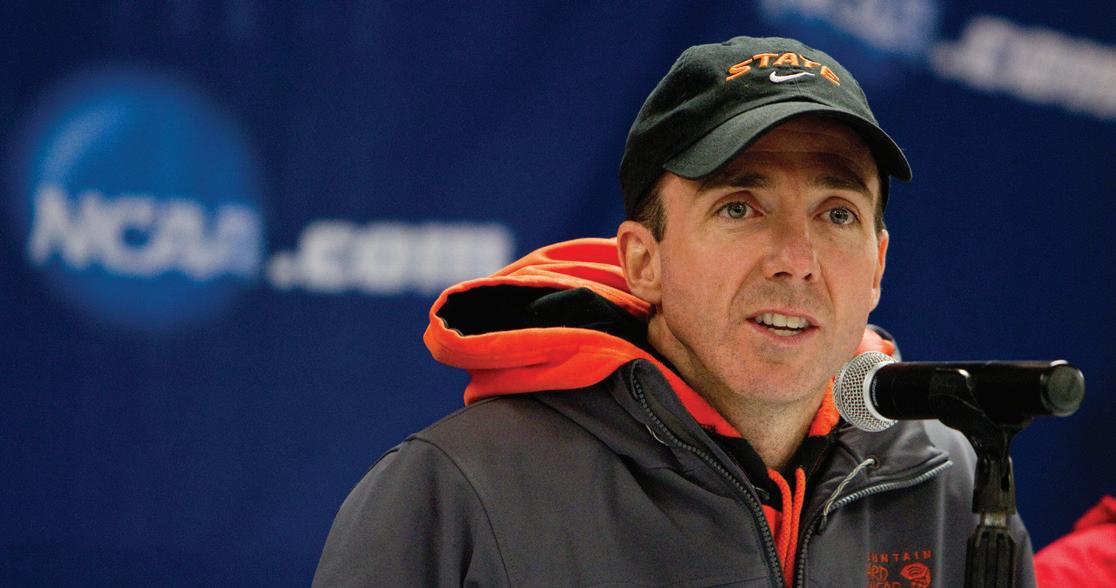
s a 40-degree drizzle collected on the outside the chartered tour bus, oklahoma state cross cou ntry coach dave smith addressed his team before the 2011 nc
aa
cross cou ntry cha mpionships.
t he speech was brief, yet sincere. t he message: “i’d rather lose with you guys than win with anybody else.”
with that, the Cowboys—led by senior stars Colby Lowe and German Fernandez—stepped out onto the familiar LaVern Gibson Cross Country Course at Indiana State University and began warming up in the chilly, mid-morning mist. As the home of eight straight championship meets, Terre Haute has dubbed itself “Cross Country Town, USA.” The Cowboys were looking to paint it orange for the third straight season. Smith’s squad was confident, yet cautious leading up to the meet. OSU had captured the 2009 and 2010 team championships and was ranked No. 1 to start the 2011 campaign. Since the competition began in 1938, 16 teams have won back-to-back titles, but only five have pulled off a three-peat.
r et urning a team t H at featured five a ll-a me ricans (top 40 finishers at the NCAAs), the Pokes had a chance to do just that.
Veterans Fernandez (8th), Lowe (9th) and Johnathan Stublaski (36th) were joined by redshirt sophomore Tom Farrell (29th) as low scoring threats. Added to the mix was Shadrack Kipchirchir, a transfer from Western Kentucky (27th a year ago). Rounding out OSU’s seven would be sophomore Joseph Manilafasha, who emerged as a strong runner last season, and Fabian Clarkson, a mature, 21-year-old freshman from Germany. While the Cowboys were claiming convincing wins at the Cowboy Jamboree, Chile Pepper Invitational, Big 12 Championships and NCAA
Central Regional, another elite team emerged on the scene. By the time Nationals rolled around, the traditionrich Wisconsin Badgers had taken the top spot in the rankings and the title of “team to beat.”
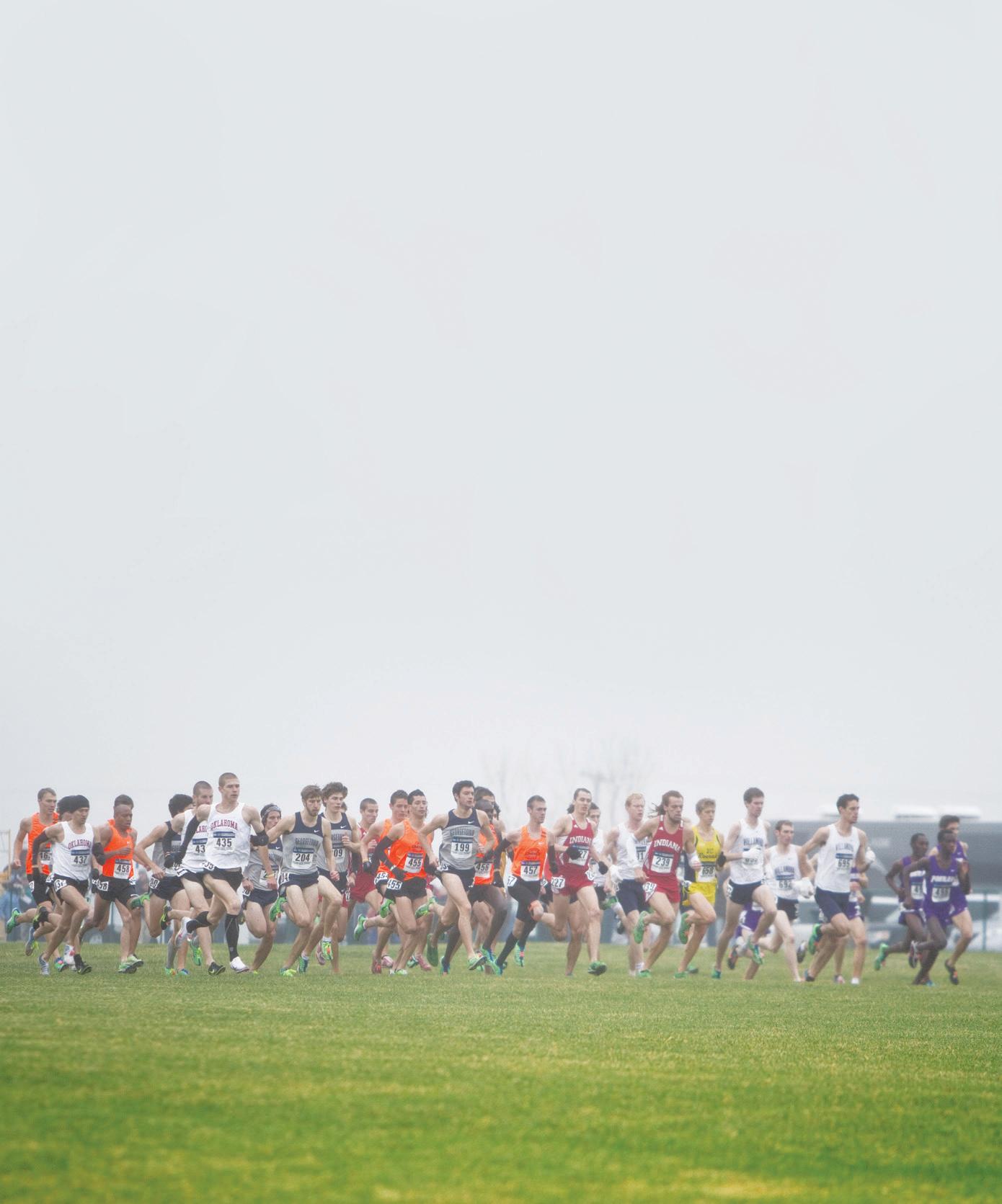
tH e start of any cross country race is a sig H t to beH ol d, but t H e scene at t H e ncaa cH ampionsHip s is extreme. Two hundred fifty of the nation’s elite harriers, comprised of 31 teams plus individual qualifiers, toe the line. Spread 50-yards wide, each team is confined to its own starting box, an array of multi-colored singlets painting the horizon.
When the starting gun sounds, the pack lurches forward like a battle scene in an epic motion picture. This is no ordinary spectator sport. A
hearty horde of die-hard fans (many shirtless and adorned with body paint) grabs a quick look at the first few hundred meters and suddenly sprints ahead to beat the runners to the next vantage point, and the next ... The runners will make two grueling laps around the 5,000 meter course, which serpentines back and forth across the soggy hilltop, as fans shout, wave flags and shake cowbells to motivate their favorites.
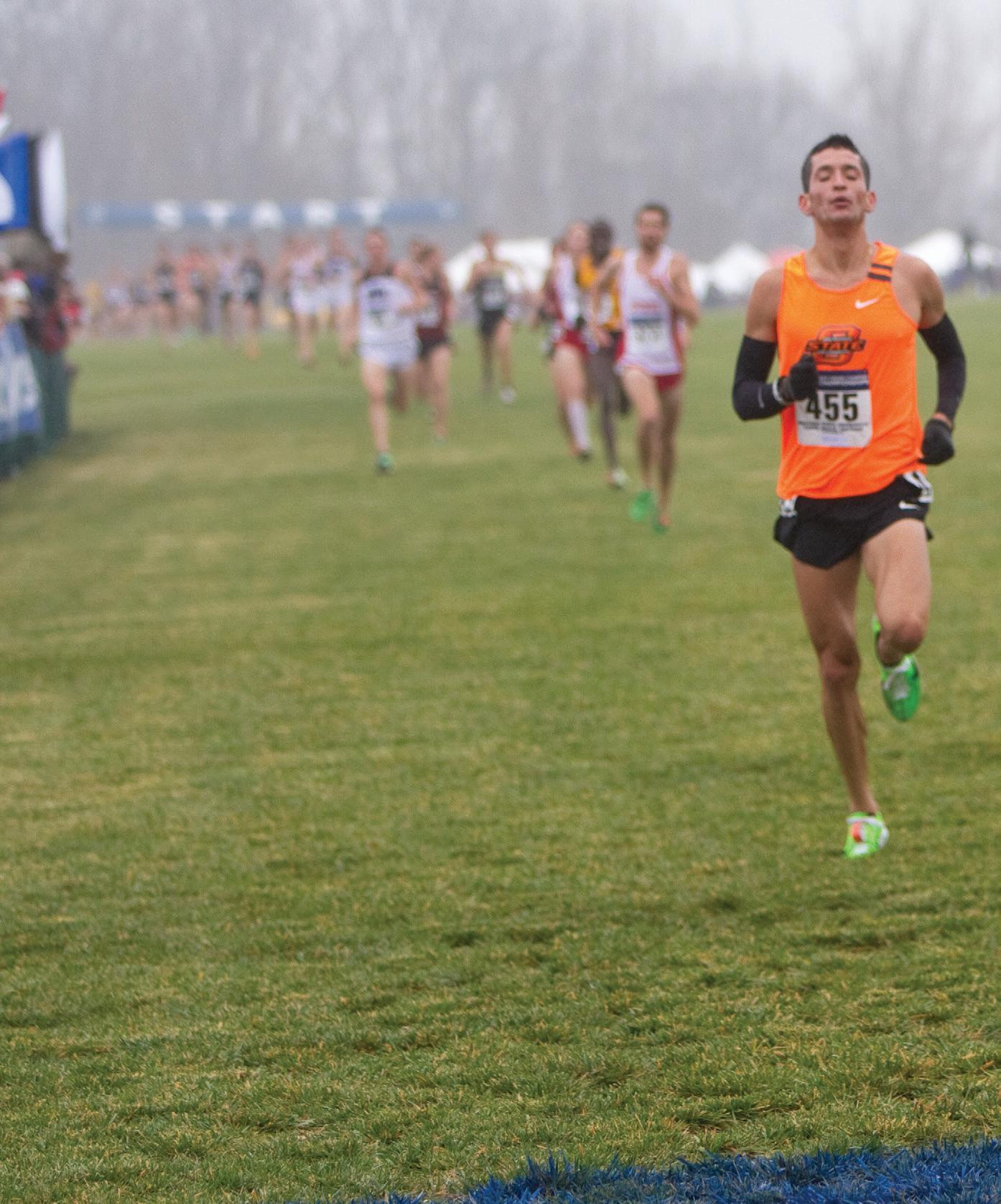
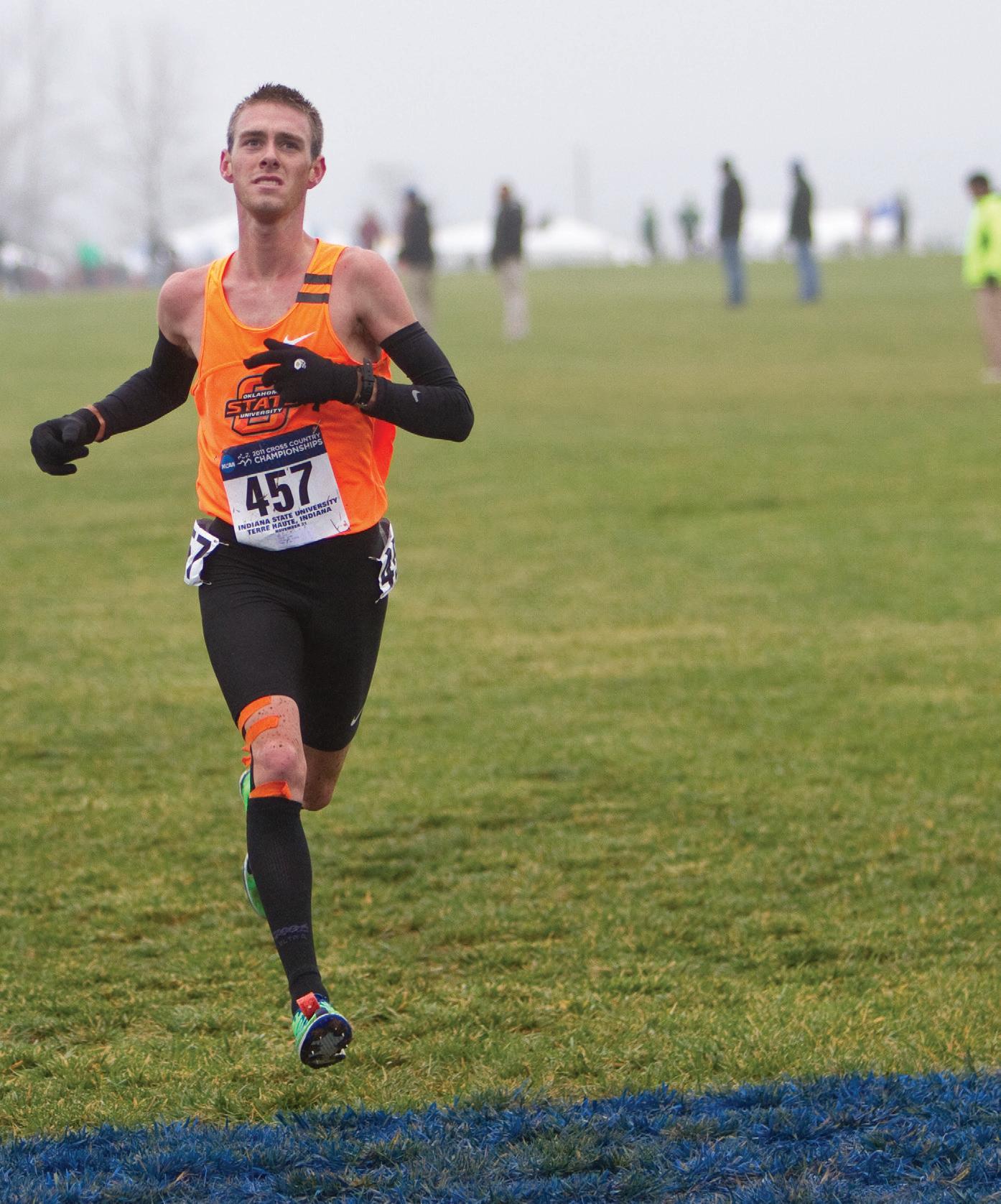
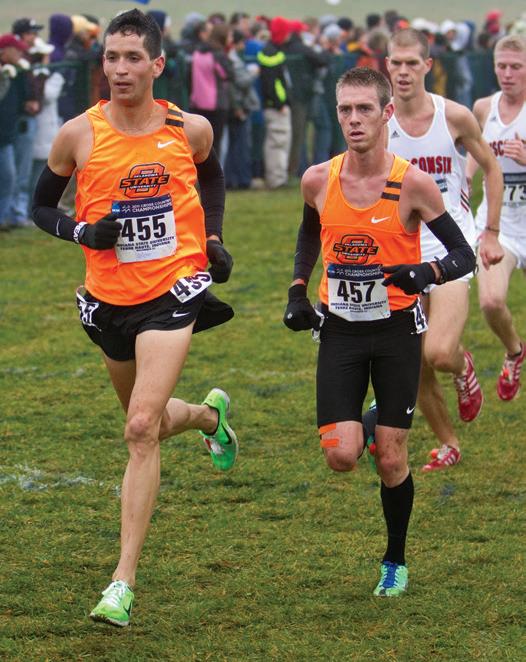
w earing t H eir signature dayglow orange tops, t H e c owboys are easy to spot at a distance, despite t H e l ifting fog. As the 800-yard straightaway narrows, Lowe and Fernandez settle in to a steady pace just off the front.
OSU’s gameplan was unchanged. Like they’ve done all season, similarly skilled teammates run together at a manageable pace, conserving energy for the final 2K and picking off runners toward the home stretch.
Wisconsin went out fast, as expected. By the halfway point, the Badgers were in the lead. OSU was in fifth as a team, but moving up on the field. Individually, freshman sensation Lawi Lalang of Arizona was on pace to break the course record. No one would catch him.
As the throng of frenzied fans pushes toward the cyclone fence to get a glimpse of the finish line, coaches and spectators do quick math in their heads, projecting finishing team scores. In cross country, a team’s top five runners are given a point for their place, minus unattached runners. Lowest team score takes the trophy.
The Badgers struck the first blow, with a 3rd place finisher. Twenty-five seconds later, two Pokes pass the electronic sensor in 7th and 8th place (Lowe in 29:32 and Fernandez just
a second behind). Then, two more Wisconsin runners (13th and 19th), followed by Farrell in 22nd.
Only two points separated the teams through the first three runners, but soon the outcome was clear, as a pair of white and red-clad runners came into view. Orange was too far back. Wisconsin’s fourth and fifth scorers earned 27 and 35 points, while Kipchirchir and Stublaski scored 39 and 63.
in t H e cH ute , t H e r esults were immediately known. Badger runners rejoiced, while disappointed Cowboys traded brief hugs and consoling nods. Few words were spoken after an exhausting 10,000-meter battle.
“The guys ran what they needed to run,” Smith says. “Colby, German and Tom ran good races. I thought the next three ran average races. Overall, I’m proud of that group. They did a good job.
“We’ve got a good group of kids,” he adds. “That’s what I meant when I said I’d rather lose with this group than win with anybody else. I like the group we have. They’re good kids, they do the right thing. They work hard. They go to school. They do well in the classroom … Honestly, we just ran up against a team that was kind of destined to win. As a coach I could feel the momentum they were gathering. They were building confidence and were on a roll like we were on last year.”
Wisconsin took the team title with 97 total points. There would be no three-peat, but a silver lining through the gray sky was a silver medal equivalent. The Cowboys had finished second overall, edging Colorado by five points, 139 to 144.
“We wanted to win,” Smith says. “We don’t want to lose anything. We lost to one team last year at the
regional meet. We lost to one team this year, Wisconsin at the national meet. Against Division I competition, we’ve been 99 and 1 both years. It just stinks that we let this one get away.”
“It was definitely a disappointment not winning,” Lowe says. “That’s what you always set out to do. But we know we went out there and did the best we could. t o end my ca reer with two national championships and being in contention to win another one—most people would dream to be in that position.”
His fellow seniors agree.
“a lo t of teams would kill for second place,” Stublaski says. “We’re disappointed, obviously, but for us to say we’re completely disappointed
n ow that we are at that level, we’ve got to maintain it.”
about second place, it would be kind of silly for the sport. It’s like king of the hill. We’ve been the king twice, and every single team in the NCAA is after us. That’s a lot of pressure, even if you’re a great team. If you have one, maybe two guys slip a few places, that’s game.”
“It’s not the outcome that we wanted,” Fernandez says, “but I was pretty happy with everyone’s performance. It wasn’t first place, but not many teams can say they’ve been on the podium three times in the past three years. We were ranked No. 2, we finished No. 2, so it wasn’t a horrible outcome.
“i’m just glad to be wearing orange and black and representing o kla H oma s tat e,” adds Fernandez.
“To say I’ve been a two-time national champion and took second … I will take that … I will take a team championship over an individual championship any day. As a runner, I have many opportunities for individual victories in the future if everything goes right for me. Team-wise, it’s once-in-alifetime to be on a college team.”
It may be hard to picture second place in the country as a letdown, but
2011
that is an indication of the state of the O-State program under Smith, who has taken OSU Cross Country to elite status since inheriting the program in 2006.
“over the last five ye ars, we’ve been third, eighth, first, first and now second,” Smith says. “That’s better than anybody in the NCAA over the last five years. I’m proud of where we are.
“Several years ago, Ryan Vail came here and elevated our program from a team that was happy if we qualified for Nationals to a team that was consistently in the top ten and fighting for trophy spots in the top four. German and Colby came and took us the next step, from a team that no longer is happy with top ten, but wants to be on the trophy stand every single year and is contending for the national championship every single year. I really love those guys for what they did for our program. They took a chance on us. When they came here we hadn’t won a championship in 50 years. We talked winning championships here, and they did that. It was a risk. They could’ve gone to places that
had won more recent championships, so I’ll be forever grateful to them.”
“That’s what Dave brought us in for,” Lowe says. “‘Do you want to start something and do something big?’ That’s what it was all about— coming in and helping build this program and make OSU a powerful distance school.”
Smith also lauded the efforts of Stublaski, who became a valuable contributor in the team’s top five.
“Stubs is a guy that I’m as proud of as any,” he says. “He has really matured a lot in the last two years and has become Mr. Dependable. I love John Stublaski. He’ll be part of the Cowboy family forever. He’s loyal. He’s the right kind of guy.”
r epl acing t H ose seniors is no easy task, Smith says.
“Now that we are at that level, we’ve got to maintain it. We have to find guys with the same attitude. Finding a German or a Colby is almost impossible. It is really, really hard to find those guys or everybody would be winning national championships. There are a lot of guys out there that look awfully good in high school, but it’s hard to transition that to consistently be
competitive at this level. That’s why those guys are so special. Colby was top ten three of his four years here, and that just does not happen.”
Next fall, the team will build around Farrell and Kipchirchir, with a host of fresh faces having the opportunity to step up and fill the shoes of this year’s outgoing seniors. Smith hopes Farrell will assume a leadership role on the squad.
“Tom is a guy that needs to grab this team and become the leader,” he says. “I think he has the right attitude, has the right work ethic, the right demeanor. He’s not afraid to confront guys who aren’t doing the right thing. He’s not shy. And he wants to win. He ran fine—he’s an All-American again—but he’s hurt that our team didn’t win. The program is important to him. After the race I said, ‘Tom, it’s time. You take the reins. They need to know what we’re all about, and you get it, so you teach them.’”
Despite losing three veteran runners, Smith isn’t lowering expectations for next fall. He plans to reload.
“In terms of our program, we’re gunning for the national championship next year. That’s our goal,” Smith says. “We’re not shy about saying that. I think we’ve got a really good team. We’ve got a lot of potential, and it’s time to develop that potential. It’s not going to be easy, but if it comes along the way I think it can, we’re going to be right back in the fight again for a national championship. I’m going to work as hard as I can, and get these guys to work as hard as they can, and hopefully next year we’re back on top.”
After the race, Smith spoke to his returning runners.
“I told them, ‘i t’s your time now. okla homa stat e is you. our program is you.’
We’ve got some guys that got here as freshmen and were kind of in awe of our program, in awe of their own teammates. They haven’t realized that
those guys had to work to get where they are, and they need to do the same thing. It’s time for them to realize they are the Germans and Colbys, and they are the ones we are counting on to win. That’s the challenge right now for me as a coach, to impart that sense of urgency on them.”
Fernandez says he’s proud of the legacy he and Lowe helped create, but now it’s time to pass the baton.
“I told the guys to represent us in a good way the next couple years and make it their legacy,” he says. “just keep oklaHoma state running at an elite level, bring in new recruits and win more national cHampionsHips for osu and coacH smitH tHe sky’s tHe limit.”
“These last four years have been some of the best times of my life,” Lowe says. “I’ve got a bunch of stories, a bunch of memories of being around these guys. This team is a family, and to be able to do what we’ve done, it’s something that doesn’t come along every day.”
wHen tHe oklaHoma state men’s and women’s cross country teams donned their trademark bright orange singlets on the morning of the 2011 NCA A Championships, they added a special feature: two bands of black tape across the lef t shoulder.
Just days after hearing news of the crash that took the lives of Cowgirl Basketball head coach Kur t Budke and assistant Miranda Serna, along with OSU alumni Olin and Paula Branstetter, the team ran with heav y hear ts.
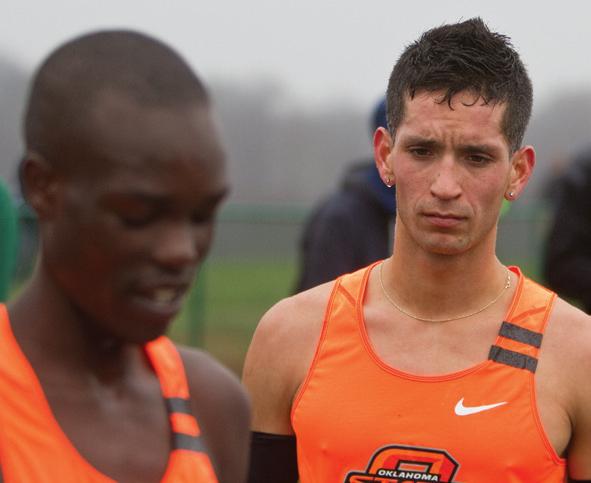
“When this tragedy happened, I think it brought us even closer,” Fernandez says. “I was thinking of Coach Budke and Coach Serna when I was in my race, you know. We were trying to bring home a national championship for them, just to bring a lit tle bit of happiness to Oklahoma State
“Of all the other colleges I’ve seen, I think Oklahoma State has the closest athletic department. All of the athletes hang around with each other. We all know who we are, what we’re doing, always ask ing each other, ‘How’d your game go? How’d your race go?’ Stu ff like that There’s not many words that can describe Oklahoma State athletics. We’re just a family.”
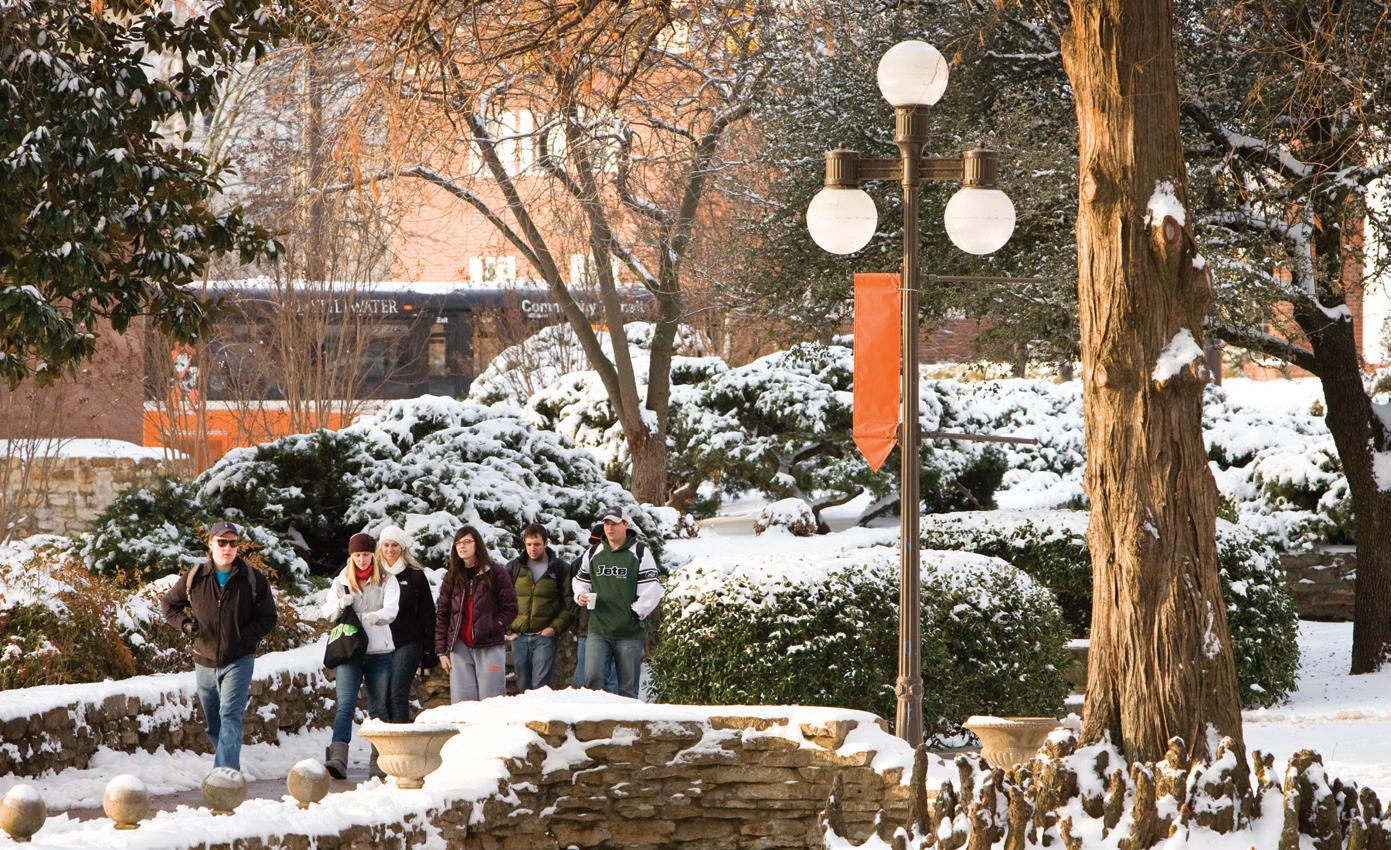
This holiday season, give the best gift you can give — an OSU education.
Encourage the high school senior you know to apply by the Feb. 1 scholarship and financial aid deadline.
Spread the orange! Recommend a future Cowboy. orangeconnection.com/knowafuturecowboy
Encourage a prospective student to visit OSU’s campus. admissions.okstate.edu/visit




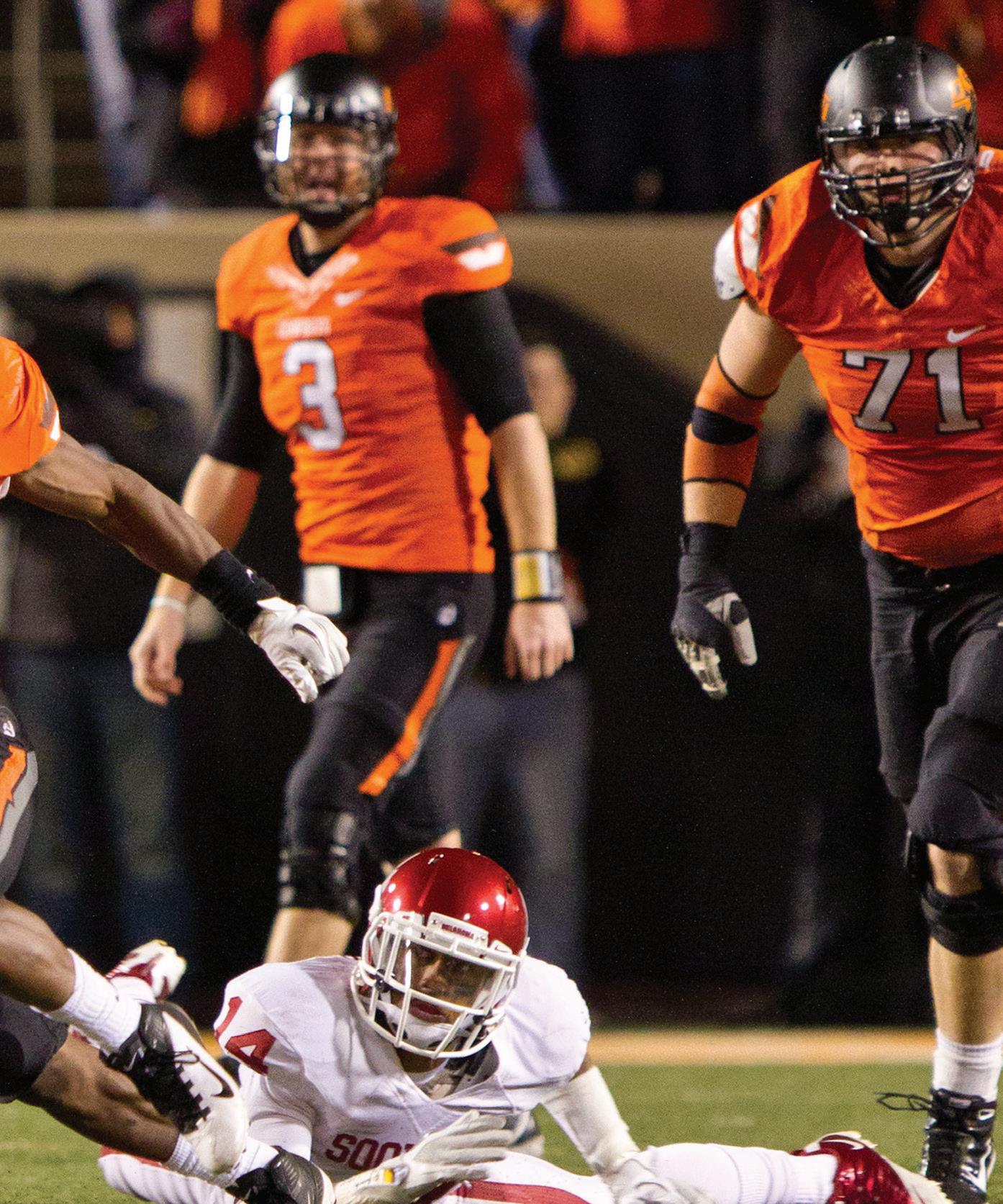
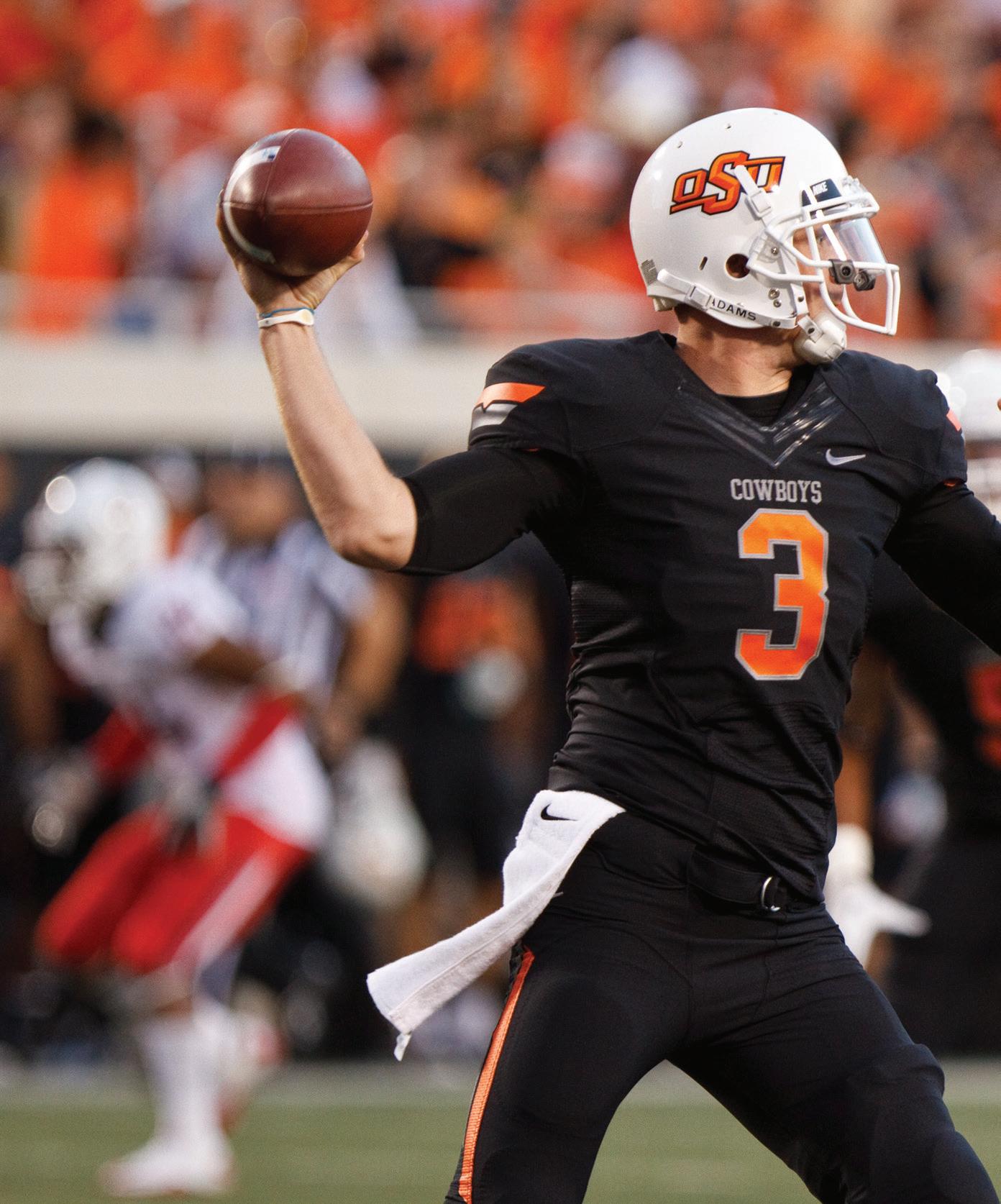
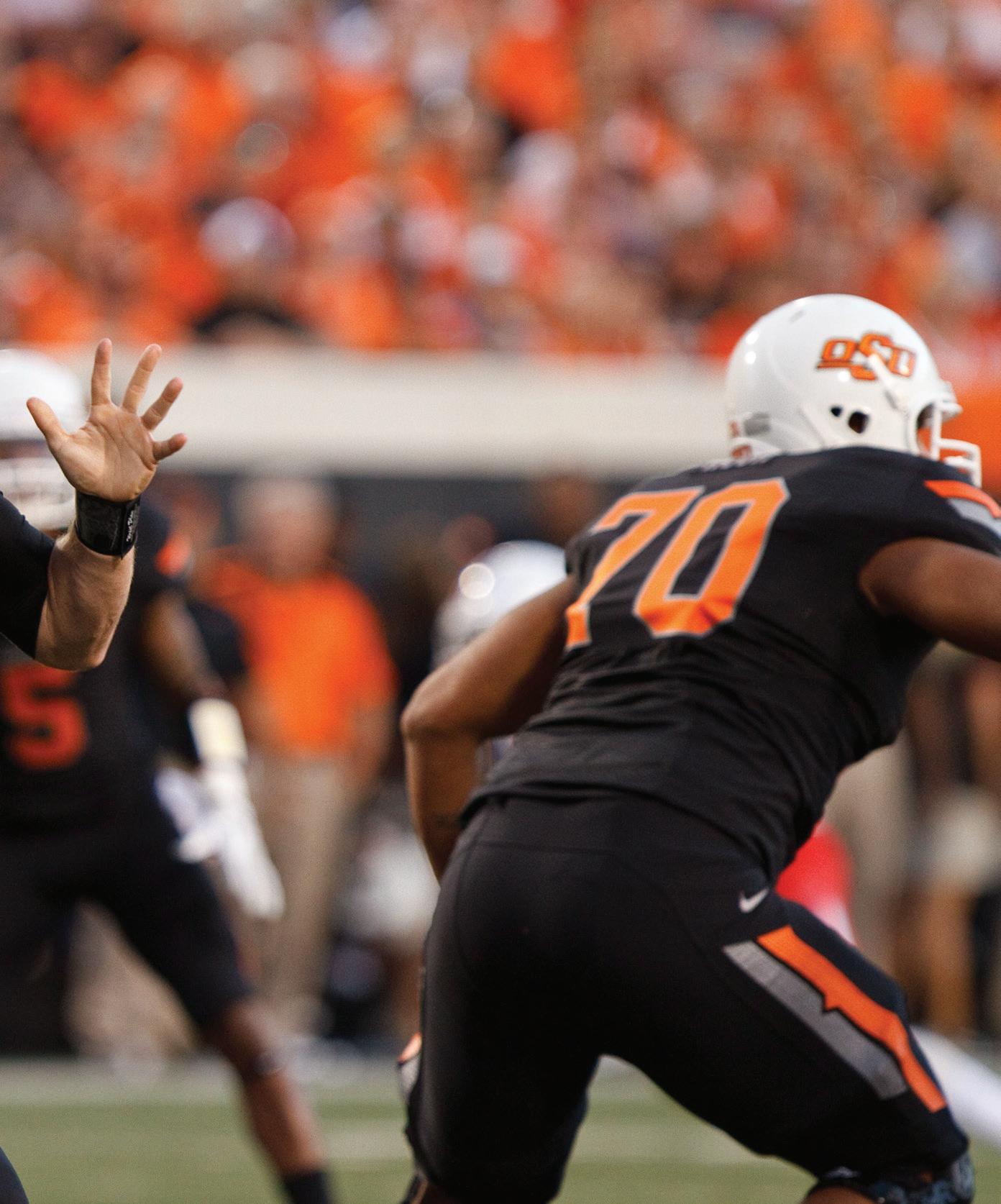
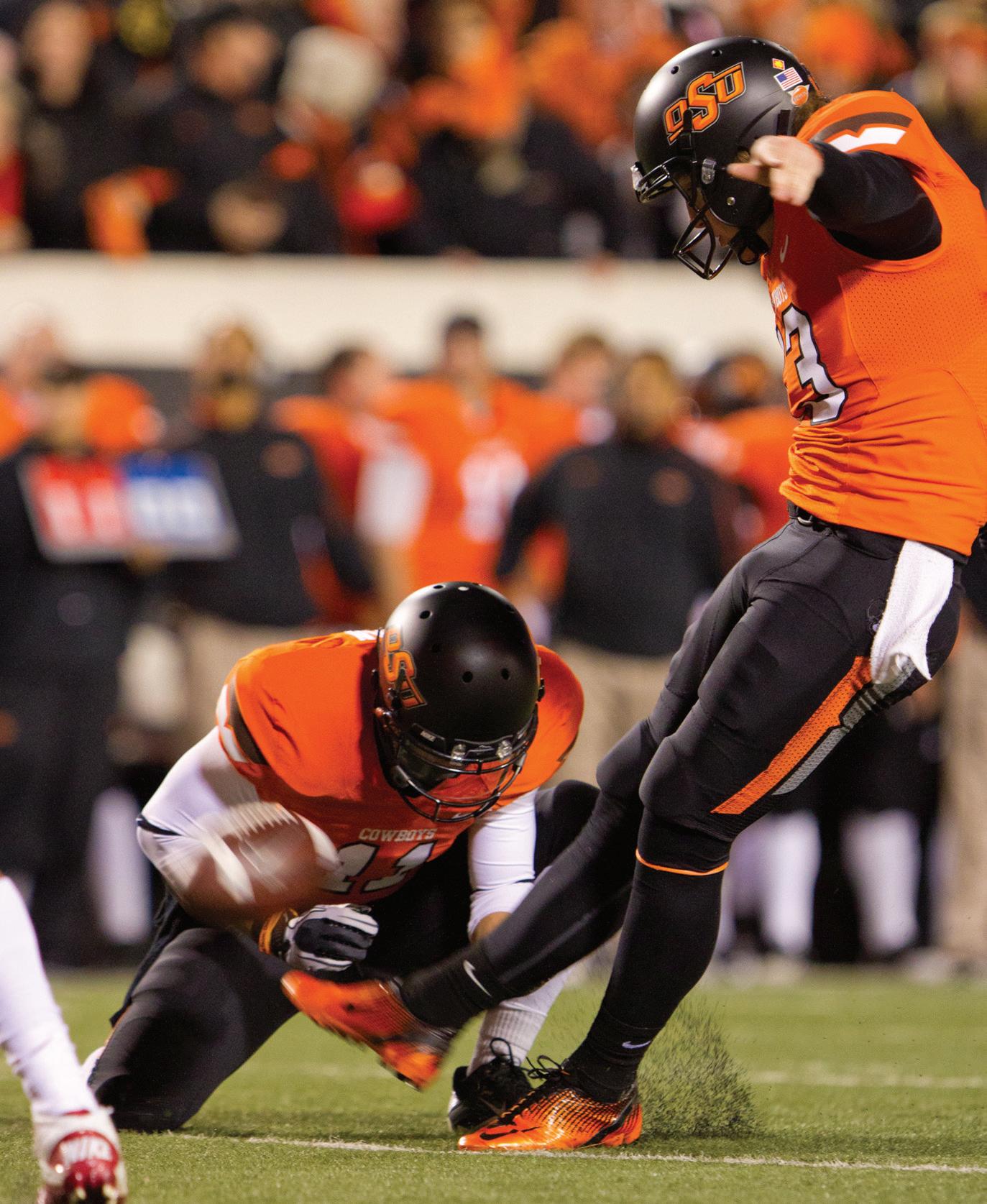
by Phil Shockley
F OREWAR d
“Squinky” was brought into this world by Brian Phillips in his column, “ nooooklahoma!: t he misery of rooting for the Oklahoma State cowboys,” on Sept. 23, 2011, the eve of the OS u vs. a &M game. Squinky came about in this particular paragraph:
Oklahoma State’s year isn’t going to be won or lost on stats, personnel, or even tactics. Those things have their place, but there’s something bigger where the Cowboys are concerned, something Oklahoma State fans pick up on from an early age, even if we don’t like to talk about it. It’s a hard thing to describe, so let me be as scientific as possible. Somewhere in the bones of the earth, coiling and uncoiling like the kraken, there lurks a malevolent power. And the whole purpose of this malevolent power, the entire aim of its wrathful soul, is to screw with Oklahoma State. This power has no name, so for the purposes of this article, I’m going to call it “Squinky.”
f ortunately for OS u f ootball fans, Squinky’s life was a short one. What follows is an excerpt from Phillips’ postgame column, which also appeared on grantland.com. Phillips was in Stillwater that Saturday evening in an official capacity for grantland, and watched the game from the press box. he’s put into words what a lot of us were probably feeling that night.
a
nd we pick up in the middle of the column …


By Brian Phillips c
… There’s no cheering in the press box. That’s the ground rule of the press box. You do not break it. I’ve never actually cheered in a press box, so I don’t know what happens if you lose your mind and try, but I’m picturing four enraged reporters kicking a prone man while a fifth murmurs stuff like, “3-for-4 on head shots … ribsplintering rate a little disappointing so far.”
So. Most important college football game of my life, my heart is fluttering like a hummingbird at the opera, and no matter what happens, I cannot react at all. To try to prepare for this, I started making a list of stuff that isn’t forbidden in the press box.
QUIETLY DISSOLVING INTO ATOMS.
This one wouldn’t disturb the other sportswriters at all. Oklahoma would score on a long touchdown run late in the fourth quarter to take a 35-31 lead, and all that would be left in my place would be a few wisps of smoke and a mysterious scent of cappuccino.
GOUGING OUT MY OWN EYES.
Somewhat tricky, mainly because it would be hard to keep from screaming, but I think it could be done. A 60-yard Sooners field goal would ricochet in off the upright with 10 seconds left for a 45-44 lead, and I would plunge my rolled-up press pass into my eye sockets, remaining utterly mute so as never to bear witness to what I had seen.
LOSING MY GRIP ON SANITY AND SLIPPING INTO AN ALTERNATE DIMENSION.
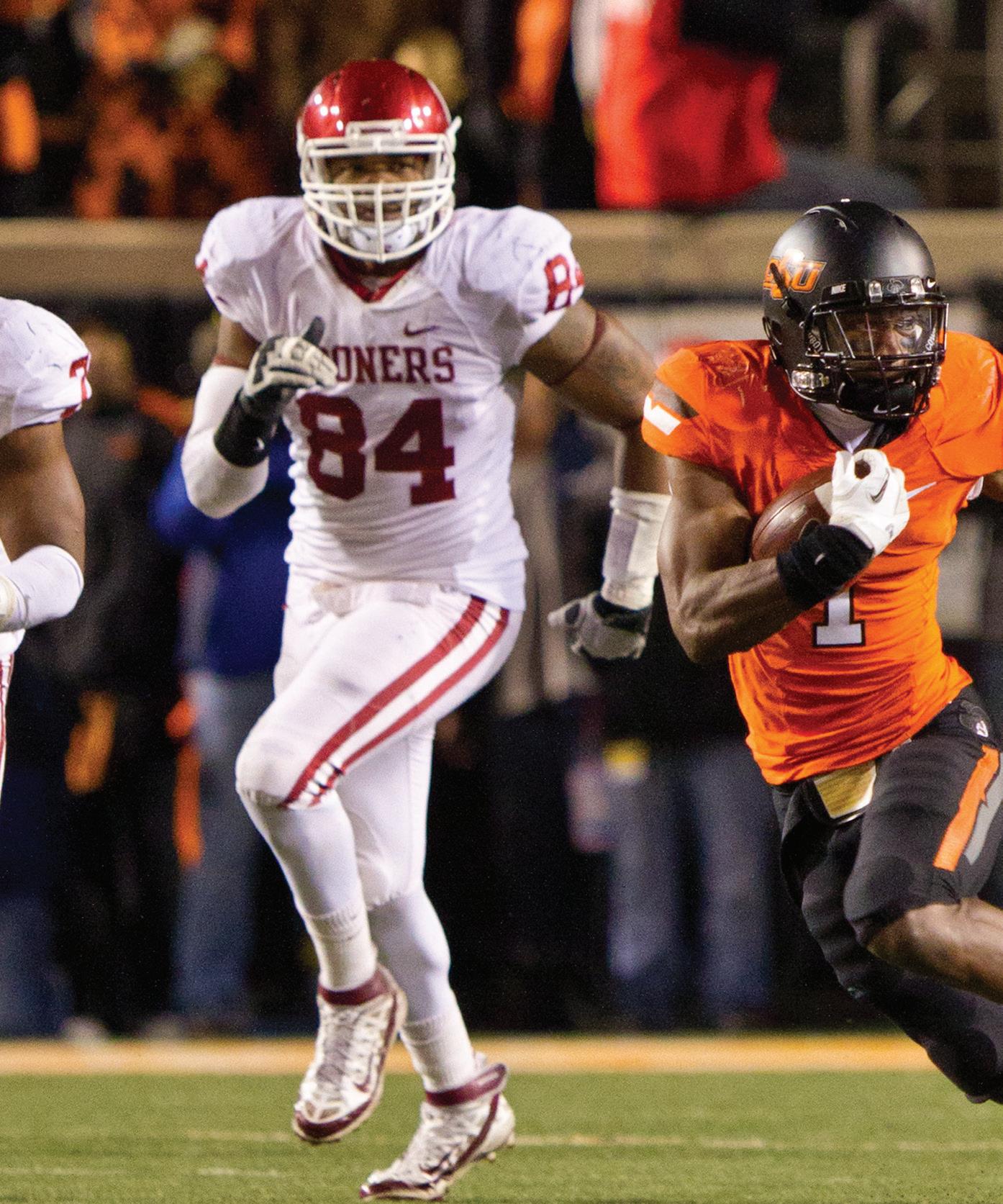
A real risk, because I couldn’t guarantee silence, but then technically no one ever said, “You can’t shriek hideously in a language not spoken by men in the press box.” A miscue while running out the clock would lead to Brandon Weeden being sacked in the end zone as time expired, the safety giving OU the 88-87 win, and I would simply go somewhere else. Probably somewhere terrible, but whatever. But then the game started, and it was … not horrible. OSU scored an early touchdown, and I … remained calm. Joseph Randle and Jeremy Smith kept breaking through the defensive line like a boxer knocking out teeth, and I … smiled softly to
myself. Actually, the no-cheering thing fit in pretty well with my natural consuming paranoia (so that was a plus). When your team always loses, when you’re a perennial also-ran whose rival is a perennial national power, you learn not to trust flimsy positives like a three-touchdown halftime lead. Every demon-octopus master-plan scenario called for OSU to surge out to an early lead before choking the game away late. So even when they started coming in bunches, each Cowboy touchdown felt alarmingly double-edged. Touchdowns are good! I wanted touchdowns. Outside the top of the SEC, people even say you need touchdowns to win. What fewer people point out is that you also need touchdowns to choke. And that’s the trouble with belonging to a traumatized fan base. You start interpreting every good development now as establishing the conditions for your eventual suffering later.
Early in the fourth quarter, with OSU leading 44-3, my head started spinning, and if a giant crack had opened at the 50-yard line and a tentacle had come rolling out Jules Verne-style, I’m not sure I would have blinked. I would have watched it flatten the goal posts and rip out the girders under the stands, and I would have jotted down the headline “OSU Football Plays Game.”
But the clock kept counting down, the press-box ladies brought out sugar cookies with “OSU” written on them in frosting, and the game remained … not unacceptable. The OSU defense, which I’d spent all year comparing to holograms and doormats, swarmed over the OU line, reducing the Sooners’ running game to rubble and then slamming Landry Jones down on top of the rubble. I kept my cool. At halftime, I glanced at the stat sheet and saw that Oklahoma had six yards on 10 rushing plays. I sat there, ferociously not cheering. At one point, I think it was somewhere in the third quarter, after the Richetti Jones touchdown that made it 34-3, the writer next to me leaned over and said, “We are about to find out for certain whether or not Squinky is real.”
It started as a joke, this Squinky business, just a lighthearted way to describe the torment of OSU fans. Just your average tentacled hell-beast serving its time in a metaphor. But you have to understand, I
had seen Oklahoma State lose to Oklahoma in every conceivable and numerous inconceivable ways over the years. I had seen leads eroded, leads obliterated, leads untended and left for dead. I had seen entire teams starve to death on the field. Early in the fourth quarter, with OSU leading 44-3, my head started spinning, and if a giant crack had opened at the 50-yard line and a tentacle had come rolling out Jules Verne-style, I’m not sure I would have blinked. I would have watched it flatten the goal posts and rip out the girders under the stands, and I would have jotted down the headline “OSU Football Plays Game.”
But it didn’t happen. I sat there not cheering as the two-minute mark came and went. I sat there not cheering as OSU took a 34-point lead into the final seconds.
“It’s OK to smile, Brian,” the sportscaster to my right, an Oklahoma legend whom I grew up watching on TV, told me, but I sat there, not cheering, as the clock showed 0:00, not cheering for OSU’s first Big 12 championship, not cheering for their first conference title since 1976. Not cheering as the crowd poured onto the field, not cheering as the goalposts came down, not cheering for the whole weird ballet that followed, as the goalposts sort of bent and wrenched apart as they floated on a sea of bouncing humanity. I didn’t cheer the best season in the history of Oklahoma State football.
But in case you ever find yourself in one, here are a few things you’re allowed to do in a press box. Tingle from head to toe. Feel like you’re floating three feet above your seat. Talk to people without knowing what you’re saying. See fireworks whenever you close your eyes.
I made it back to my parents’ house, where I’m crashing on this trip, around 2 a.m. My dad was still up. He hadn’t watched a minute of the game — couldn’t bring himself to face it, classic OSU-fan stuff — but had stayed awake reading about it until the small hours. We warmed up some chicken and sort of quietly exulted for a few minutes. This thing had really happened.
You can read the rest of Phillips’ column (and his other OS u -related works) on gra ntland.com. t hi s story is found at: www.grantlanD.com/storY/_ / iD/7319085/BeDlam-sqUink Y-Dies




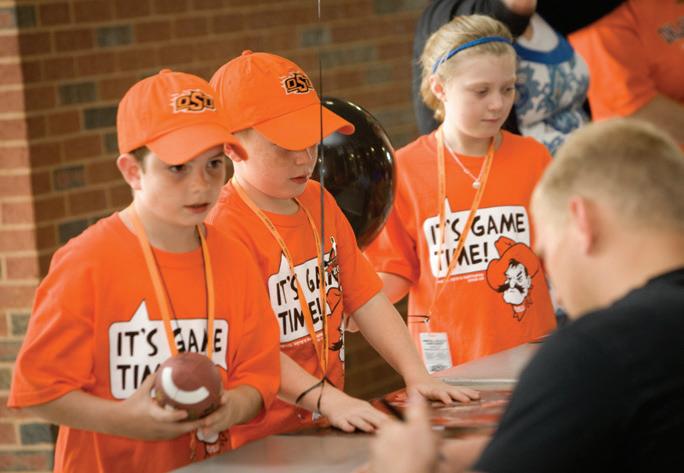
Annual kids club membership (8th grade & under) is just $25 per child.
Benefits include:
• FREE ADMISSION to OSU soccer, wrestling, women’s basketball, baseball & softball
• Exclusive members-only t-shirt & ID lanyard
• Invites to autograph parties & other special events
• Birthday card from Pistol Pete
• 5x7 photo of Pistol Pete and more ...
Enroll your child online at okstate.com/kidsclub or call 877-ALL-4-OSU.
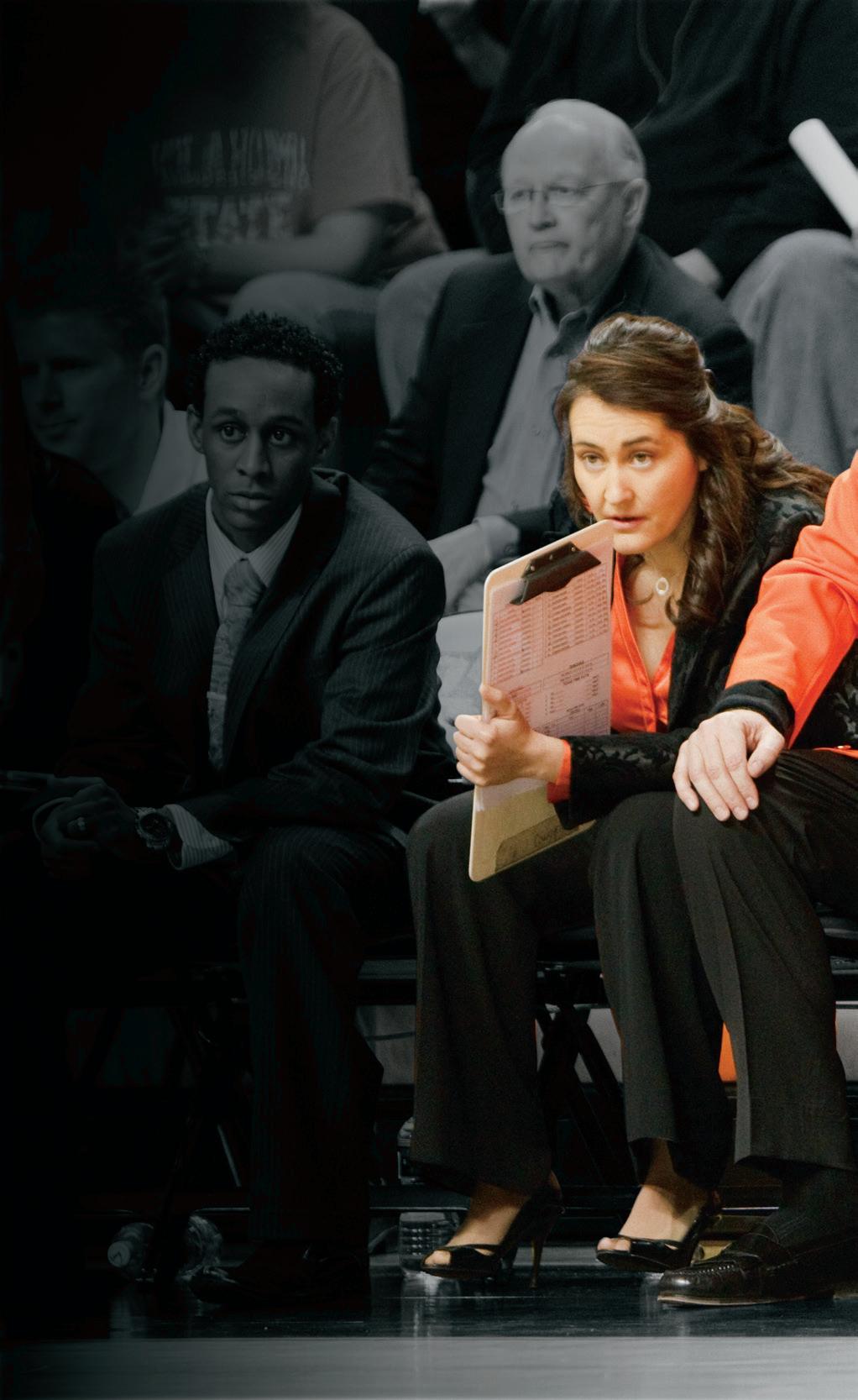
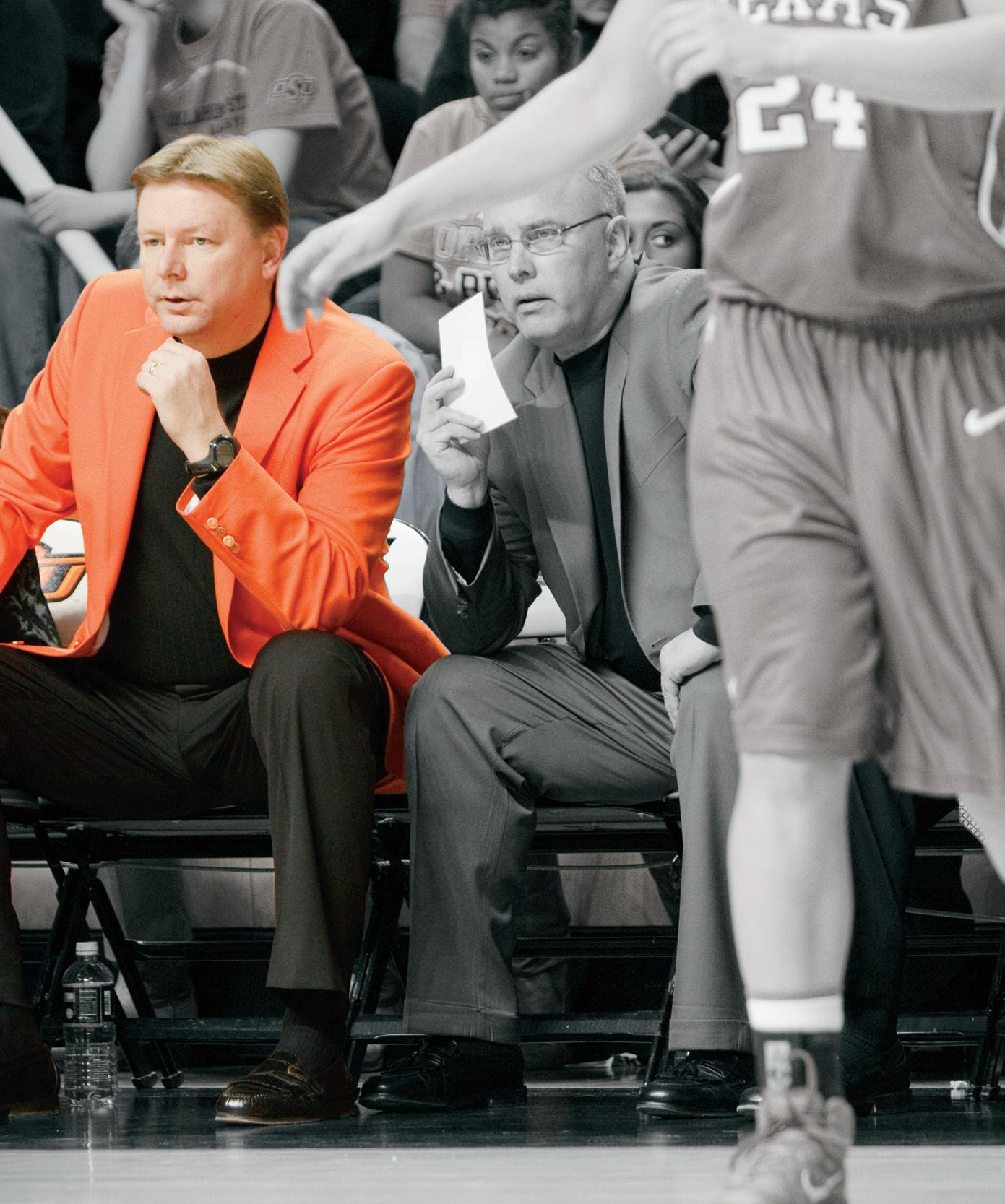
story by Matt Elliott
t his is the last interview CoaCh Kurt BudK e did with pos se. i t was conducted during september, and approved by budk e shortly a F ter. • w e debated whether or not to run the story, and the decision was made that on top oF it being his last interview, the story itsel F ca ptures the essence oF the man he was, and the eFFor t he put into doing the best job he could. • he wor ked tirelessly to make his team better. he str ived to be a great Father and
devoted husband. his was a life of relationships made with people, and you should count yourself fortunate if yours was one of the lives he touched.
It’ S a t HI ng of B eau ty, crammed I nto a fe W
P rec I ou S S eco nd fan S re H a SH , r eenact and re P lay over and over.
Coaches and players have no such luxury. Two seconds later it’s time to play defense. Get a stop, and it’s time to do it all over again.
“This is my 27th year,” says Cowgirl basketball coach Kurt Budke, his 6-foot 3-inch frame folded into a large black leather chair in his office. “There’s so much excitement in this game. It never leaves your mind. You’ve got to think, ‘What have I done today.’ And I ask my coaches this before they leave every night. ‘What did I do to make Cowgirl Basketball better today, and what can I do
tomorrow to be better.’ It never leaves your mind.”
It’s more than a sport. Cowgirl basketball is a 24-hour job, whether that’s in October, when practices start, or during AAU tournaments in July. And coaching is just a small part of it.
From October through March, Budke and his staff members work nonstop, making sure players are with it on the court and off, in addition to handling things such as studying future opponents.
Basketball takes up enough time on its own. Last year ended with the team’s fifth-straight postseason appearance under Budke. OSU’s young team overcame some serious growing pains to post a 17–15 record and made the second-round of the WNIT. But Budke and his staff couldn’t take a break then.
There’s recruiting – and that’s almost nonstop. And there are the camps for kids and teenagers.
Once tournaments end in March, April has recruiting weekends. If coaches are trying to sign anyone in the spring, then a few letters of intent will be inked.
It calms down in May. The players go home. Coaches and staff members can take vacations. Budke says he and his wife of 22 years, Shelley, went to Boston, Mass., with their children, Alex, a student at St. Gregory University in Shawnee, Brett, a high school student, and Sara, an OSU student.
“My son, Alex, has always been a Celtics fan. So besides touring the area, we went to Celtics and Red Sox games,” he says.
But the grindstone calls in June.
Flocks of kids from kindergarten through eighth grade travel to Stillwater to attend Budke’s overnight summer basketball camps, scuffing their little Nikes on the steps to Gallagher-Iba as they file inside. They get
story continues
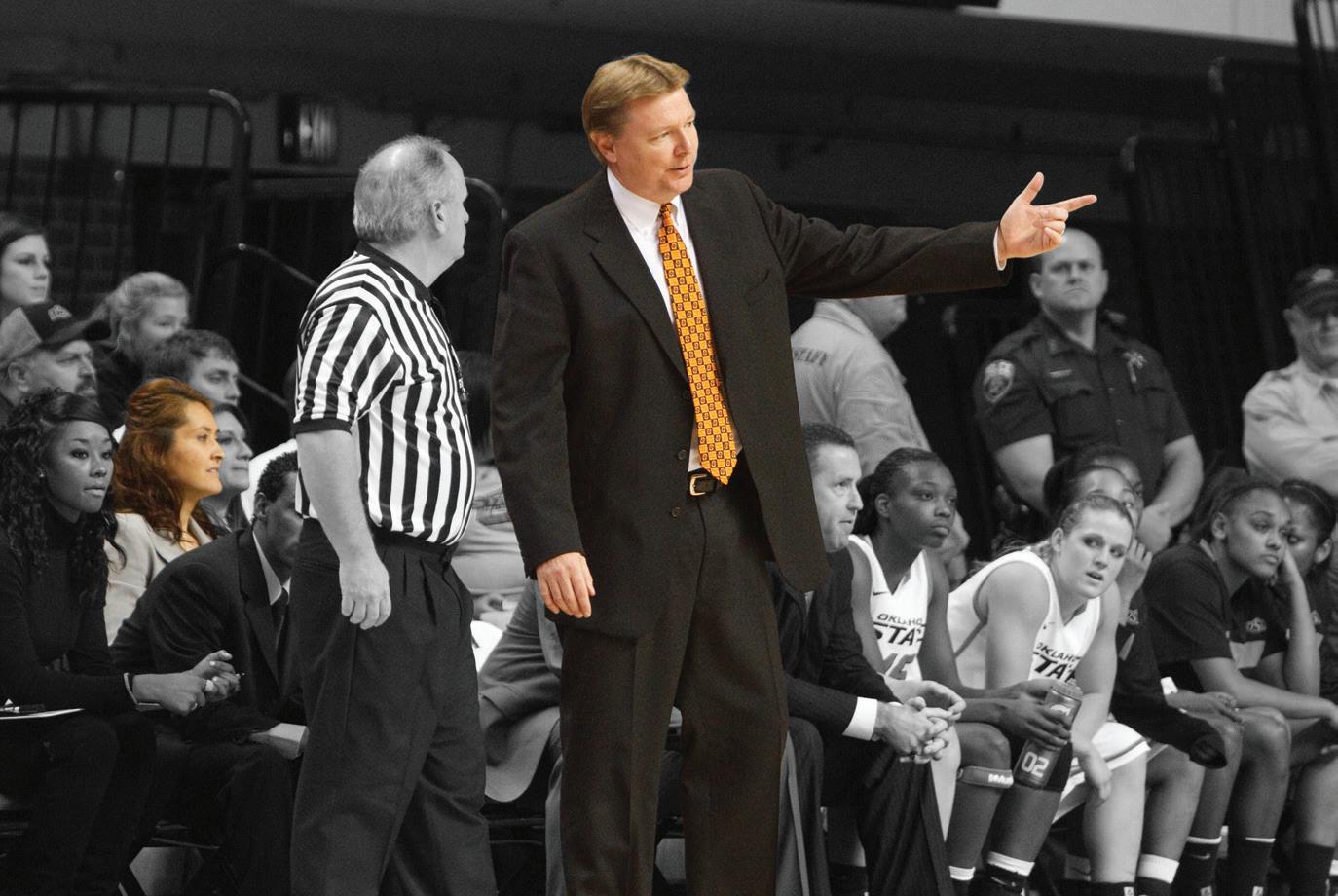
a nother day is gone, and this game now is eighteen days away. n ow it’s seven days away. n ow it’s four days away. It comes at such a rush. It comes so fast. t hat you don’t have time to breathe until m ay.”
one-on-one instruction from Budke, his coaches and former players he brings in to help.
Then there’s the elite camp, too, with some of the best high school players from a four-state area — mostly high school kids coming in to work on their game. There’s also a team camp for the older kids.
“You get them up for breakfast at seven. You have them out there on the court until 10 at night. It used to be a long week, but AAU ball is big these
days. You can’t get the great players if you have long camps. They’ve always got an AAU tournament. So we’ve shortened the camps down to three or four days now.”
That’s the Amateur Athletic Union. Its games, used by college coaches to scout recruits, kick off in July. NCAA rules don’t let college coaches talk to the students. So they attend summer AAU tournaments to watch their prospects, many of whom they’ve been following since the eighth grade (“Anymore, if you haven’t been on these kids since the eighth or ninth grade, it’s hard to get involved when they’re juniors,” Budke says.) The nation’s top players know that and play constantly as a result.
Accordingly, last July Budke logged more frequent flyer miles than most people see in a lifetime.
First, he was in Frisco, Texas, an affluent city north of Dallas for a twoday tournament with a load of recruits he had been following. Then, he flew more than 1,100 miles to Orlando, Fla., for another two-day visit. Then, Chicago for a day “just to look at one prospect.” Then, Nashville.
The hours are long. The food is bad. And flight delays can be a real beast.
“All four coaches can recruit, but only three can be out at a time. You can go home for a bit while the others hit the road. Once you’re locked in, you might as well stay out, because
you don’t want to take a breath for twenty-four hours. You just want to continue doing what you’re doing and do it the best way you can.”
Some tournaments are easier than others.
Frisco’s is in a massive gym that has 12 courts. Coaches can go from game to game and watch their recruits in one building, Budke says.
But others have games that are 20 miles apart. That means Budke might have to in a rush leave one game at halftime and risk angering a recruit. On the other hand, if he doesn’t do that, he’ll be late to the other game.
And there’s always one competing coach who’s quick to tell recruits who was late.
“You really have to sit down and map out your strategy and run with it,” he says. “Sometimes you’ll end up having two coaches in one city, but now you’re missing a tournament in a third city because you can only have three coaches on the road. July, it’s just a wild ride.”
The life of a basketball coach involves a fair amount of networking, too. High school and AAU coaches play a big role in helping college coaches recruit the best players. College coaches rely on their relationships with those coaches to get the inside scoop.
He depends on his assistant coaches to call their people and keep up with how the recruits and their teams are doing.
“They help me stay on top of things. I’ve got a good solid staff.”
Even as late as October, Budke was still recruiting, right up until practices started.
“I just got back from a four-day run of Salt Lake City, LA, Dallas and
home. Miranda Serna is in California right now.”
Also, football season is the most popular time for official visits. These days, nothing recruits like a football game.
“Football games are great recruiting weekends. To bring these girls in and take them down on the field before the game to sitting in the stands with sixty thousand orange shirts makes an unbelievable impression.”
He’s mostly interested in how they answer the question and whether or not it shows that education is important to them.”
that education is important to them.
“I’ll ask them about their team. Then, I’ll listen for if they talk about themselves the whole time, or if they talk about their teammates. I’ll ask about their coach. Sometimes they don’t realize that maybe we’ve known that coach for twenty years and that coach is pretty solid. So if they come in and speak negatively about him or her, then that’s not going to be good.”
During those visits, coaches and players are locked-down with recruits for the entire 48 hours they’re in town. Coaches will get the kids up in the morning for breakfast and take them back to their hotel at night.
During those visits, Budke says he always introduces his recruits to other sports’ coaches during official visits. He credits coaches Mike Gundy and Travis Ford for taking time out of their schedule to meet with his ath letes.
He also interviews his recruits pretty closely. But it’s not because he doesn’t know the answers to the questions he asks. Often, he knows everything about his recruits before they arrive. Usually, their coach has filled him in, or a coach who has coached against his recruit has said something (although he’s quick to admit that coaches will never be perfect in how they assess their recruits).
He always asks them about education. A lot of recruits have no idea what they want to study, and that’s fine with him, he says. He’s mostly interested in how they answer the question and whether or not it shows
Even so, every now and then coaches he has known for 20 years will swear by a player, but still something will go unnoticed.
“We don’t want to make mistakes. We want people that want to be here for four years, want to graduate and want to help us win a Big 12 championship.”
Just like a play on the court, when it all works great, it’s a thing of beauty. But success is fleeting. A second later, it’s time to play defense and do it all over again.
“We spent a good hour putting in a new fast break yesterday that we’ve never run here before. We’re going to introduce the second option of that today, and the third option tomorrow and put it all together Friday. As we’re doing this, we’re thinking, ‘We haven’t worked on breaking our press. We haven’t worked on presses. We haven’t worked on zone offense. We haven’t worked on zone defense. Another day is gone, and this game now is eighteen days away. Now it’s seven days away. We haven’t put an inbounds play in yet. Now it’s four days away. It comes at such a rush. It comes so fast. That you don’t have time to breathe until May.”

A. Basketball Practice Hoodie (2260675)
Find your inner basketball player with this heavyweight hoodie complete with a tackle twill with satin stitch edge OSU brand. Sizes S-XXL/$65.00
B. Women’s Seasonal Tee (2260844)
Show off your zealous devotion with a flattering, feminine fit tee featuring an oversized Cowboys name on the chest and logo near the bottom left hem for chic style. Sizes XS-XXL/$20.00
C. Rip Short (2260773)
Run circles around the competition, literally, in these hip athletic shorts. They feature layered stripes and the O-State brand with an elastic waist for a secure fit and two side pockets. Also available in orange. Sizes S-XXL/$32.00
D. Bump N’ Run Hoodie (2258102)
Make this 100% cotton hoodie one of your game day staples. The premium, heavyweight hoodie features a letterman-style chenile brand. Also available in black. Sizes S-XXL/$65.00
E. Rally Full Zip Hoodie (2260899)
Go for comfort with this seasonal, mostly cotton hoodie complete with a printed self applique on the back, a screen printed Oklahoma State on the arm and an OSU brand on the chest. Sizes XSXXL/$65.00
F. Vault Long Sleeve Tee (2261038)
Layer yourself in comfort with this 100% cotton v-neck long sleeve tee featuring a center front screenprint graphic with flock. Sizes XS-XL/$34.00
G. Vault Ringer Tee (2261010)
Prove your timeless OSU pride with Nike’s Vault 50% cotton/50% polyester ringer tee featuring the bronco rider printed between a bold school name and “Go Cowboys” lettering. Sizes XS-XXL/$26.00
H. Long Sleeve Shootaround (2260657)
Dress just like the players with this Dri-FIT fabric official on-court shooting top with tackle twill OSU brand at front left chest. Sizes S-XXL/$50.00
I. Crew Fleece Sweatshirt (2260880)
Radiate your exceptional OSU style during cold temps with this comfy pullover sweatshirt featuring Pistol Pete across the chest. Sizes XS-XL/$55.00






story by Matt Elliott
by Phil Shockley
osu went into the locker room at halftime at kyle field down 20-3. on the field, they looked sluggish and out-of-sync. but inside the locker room all was calm. osu had done it before. last year the team was down 14-7 against a&m and still came back to win. except this time, the cowboys were on the road, and a&m, the perennial media favorite over osu, was ranked no. 8 nationally, just below the then-no. 7 cowboys.
what happened in the second half set the tone for an 11-win conference championship season. the cowboys exploded for three touchdowns during the third quarter while shutting out a&m to take a 24-20 lead.
a&m pulled within three by the end of the fourth, but, as John madden once said, the team that scores the most points wins.
c oacHing, t H e t eam’s uncannily calm composure and play on t H e fie ld were H uge factors. But the Aggies looked physically beat in the second half. The notorious south Texas heat was baking Kyle Field when OSU, with its breakneck no-huddle offense, came out swinging at the top of the third.
A few A&M players were seen doubled over by cramps while the Cowboys seemed to be unfazed.
Cramps and heat exhaustion are caused by poor diet and dehydration. With conditioning, it affects athletes’ performance on the field. It affects their decision-making and the chances they’ll be injured.
“We did have a few guys close to cramping, but we got lucky with them, got them out of the game so we could sub in another guy for a series or two,” says Kevin Blaske, OSU’s head football trainer. “As you become dehydrated, you don’t even have to be cramping for your physical performance to go down.”
The Aggies’ poor physical condition at the time wasn’t lost on their coach, Mike Sherman, as indicated during his post-game interview.
“We just couldn’t get there in the second half,” said Sherman, responding to a question about his team’s
difficulties keeping pace with OSU quarterback Brandon Weeden. “Kids lost their legs and were cramping.”
If a defense’s front line can’t pressure a quarterback, especially good ones like Weeden, then its defensive backs have to cover wide receivers for longer lengths of time. Meanwhile, everyone is more likely to get blown off the line-of-scrimmage during the running game. And it only gets worse, because by the time conditioning starts affecting performance on the field, it’s already too late to get players back to normal.
“i think it was a difference in the game,” says John Stemm, OSU’s director of athletic training.
It takes a huge effort to win the conditioning/hydration battle. It takes an organization-wide commitment to keep the 70 players hydrated, from the 315-pound offensive lineman down to the running backs with six percent body fat.
f or a road game, t H e s trengt H and conditioning, training and equipment staff load one tractortrailer full of gear. That includes everything from cooling hoods that use ice-cold water to cool players to beverages, including special products such as Pedialyte, a children’s
therapeutic drink popular among athletes, to fight dehydration.
That also includes five cases of bottled water. And 900 pounds of Gatorade. The famous sports drink endorsed by celebrity athletes all over the world is the only thing other than water OSU athletes can drink (unless, of course, they’re diabetic).
“w e call it a production, loading up t H at truck,” s temm says. “i t’s l ike you’re a band going on tour.”
“You don’t need go to the weight room after that,” Blaske says.
There’s also a misting system and fans, as well as the entire training room, the equipment room, and trunks of prewash solution for the team’s uniforms (loaded by the equipment crew). As it gets colder, the load changes to cold weather gear such as coats and other items to keep players from getting too tight and chilled on the sidelines.
The truck usually leaves on Thursday along with seven student trainers (the ones who bound out on the field with green Gatorade bottles at each break in the action). Meanwhile, coaches, trainers and others ride the players all week to stay hydrated. They make sure players, whether they’re
story continues
in team meetings or in class, are constantly surrounded by water and Gatorade. tHe atHletes are also drinking fluids constantly, watching what they eat and monitoring their urine color. The training table, where they get their meals each day, is stocked all week with Gatorade. Hydration is preached during practices.
The kids, staff, coaches and others travel Friday. Later that day, the players do a walkthrough in the stadium. After walkthrough, they’ll check in, get settled, have a snack and another Gatorade.
Saturday starts with breakfast, more Gatorade and more water. If it’s a 2:30 p.m. game, within two or three hours they’ll come back to the hotel for their pregame meal. And two more Gatorades. This time, though, they mix their drink with Gatorlytes, a package of salts and electrolytes to boost what’s already in the drink (and make it taste like seawater).
“When they sit down for their pregame meal, they’ll have two bottles
of Gatorade at their setting,” Blaske says. “With it is a pack of Gatorlytes. Coach Gundy starts them off, tells everyone to mix up their Gatorlytes and Gatorades and to make sure they drink both of them.”
Kyle Field is one of the toughest places to play in the Big 12 (well, was one of the toughest places to play in the Big 12). Not only because of the Aggies, but because of the crowd and the heat. College Station is just north of Houston. tH e H umid air from t H e g ulf of mexico mixes wit H t H e s out H t exa s H eat for an awful mixture of suffocating H eat and H umidity t H at ma kes o kla H oma feel like paradise.
That was in full force on Sept. 24, as the Cowboys took the field against the favored Aggies, who should’ve had the advantage due to playing regularly in that environment.
“We’ve certainly been hotter here,” Stemm says. “But, at A&M, they put this black rubber matting down where it used to be just a path behind the sidelines that the ROTC soldiers there
would walk on. It was just sucking up the heat that was then just rolling off of it. You could feel it.”
After the first half, several A&M players were cramping and had to receive IVs at halftime.
Not so for OSU. On the sidelines, a rack of tubes was set up for players on the bench that ran a system spraying a cooling mist over them. OSU’s student workers passed water bottles to them.
“Our students, they do a lot of the hydrating for us,” says Parker, OSU’s assistant football trainer. “They carry the six packs of water and Gatorade. We take a very proactive approach. Give the guys water. Don’t wait for them to ask. If a guy comes off the field, you have the water right in their face so they’re not looking around for it. you have to always tell them, ‘hydrate, hydrate, hydrate, hydrate and‘hydrate,’ while they’re sitting on the bench. You have to walk by and say it. You’re constantly telling people, ‘I know you’re not thirsty. But if you’re thirsty, you’re already in trouble.’”
If players become dehydrated, OSU always has a volunteer paramedic from the Stillwater Fire Department there to rehydrate them intravenously.
“I think that’s really where the recognition comes in,” Parker says. “We knew it was going to be hot. So that’s why we really stress ahead of time that they hydrate throughout the week, starting Thursday and Friday.”
at H alf time, osu Hit t H e locker room and t H e p layers downed more bottles of g ato rade as coaches ran down their halftime adjustments. The trainers made their adjustments, too.
Parker says they started using Pedialyte in the second half, adding more Gatorade laced with Gatorlytes and
water that their student trainers gave to athletes on the field.
It’s ironic and probably just coincidental that this happened during the game against A&M. A&M’s famous former coach, hall of famer Paul “Bear” Bryant, was known for his brutal practices where he wouldn’t allow water breaks during the summer heat, a fact immortalized in the book The Jun ction Boys and an ESPN film starring Tom Berenger.
Many consider Bryant, who later coached at Alabama and won six national championships, the game’s greatest coach. OSU’s own Henry Iba, also known as “The Iron Duke,” wouldn’t allow water breaks during his basketball practices. The idea was to toughen players up.
It has taken years of sports science and sadly, deaths, to correct that, Parker says. In fact, de H ydr ated players play mucH, m ucH wo rse t H an t H ose w H o’r e in better condition.
“But, you have to remember the starting guard back then weighed 195 and didn’t have a lot of fat,” Stemm says. “The other thing is, those kids were a lot more acclimated because there wasn’t air conditioning. A lot of them were used to being out on the farm. So they were a lot more acclimated to the heat and they weighed half of what our guys weigh. Some of our O-line guys are 315. They’ve got a pretty good little amount of insulation on them that does nothing but cooks what’s inside if it gets too hot. Our safeties are 210. Back then, that was a defensive lineman.”
Blaske says most coacH es today understand t H e r elations Hip be tween H ydr ation and performance. It’s not rocket science. Athletes need proper diets, fluids and training to perform. So, if it’s not
rocket science, then why do teams fail at it?
Because many don’t make the organization-wide commitment as head coach Mike Gundy has.
“I was here with Les Miles, and he never talked about it,” Stemm says. “Our players today hear it from our head coach. Almost every single day they’re in front of coach Gundy, he says, ‘Eat good food, drink lots of fluids.’”
When it became clear last summer was going to be a scorcher, trainers talked to Gundy and the coaching staff, who agreed to hold practices earlier in the day when it was cooler. During those practices, coaches let players break for rest in the shade, take their pads off, drink plenty of Gatorade and had cool towels on hand for their heads.
Sounds sort of un-football-like. But as a result, last summer the team used the fewest number of IVs ever at OSU, Stemm says.
Gundy says it’s about emphasizing important things players can control to make them better. Players often can’t change their athletic ability, but taking care of themselves is one of the big things that can improve it. He talks about hydration, as well as personal hygiene and nutrition, with players several times per week.
was it t H e difference in t H e a & m ga me, t H e g ame t H at set osu on t H e pat H to a conference cH ampionsHip and a f ies ta bowl bert H?
Gundy isn’t sure.
“Against A&M, I don’t think there’s any question that we were in better condition and we were fresh,” Gundy says. “We push the importance of controlling the things that can make you a better football player.”

At times controversial for its sugar content, Gatorade is the only beverage other than water and Pedialyte, which tastes a lot like liquid chalk dust, OSU athletes are allowed to drink.
Today, it’s not just a sports drink. loaded with the potassium, salt and electrolytes athletes lose when they work, its most popular line, the G Series, comes in pre-, during and post-exertion products tailored to keep athletes hydrated.
Other products, such as its packets of Gatorlytes, are becoming common in nutrition retailers. Gatorade, owned by Pepsi Co., also has all-natural and lowcalorie product lines.
Gatorade was born in 1965 at the University of Florida when an assistant football coach there worked with doctors to figure out why his players were succumbing to heat-related problems. drs. Robert Cade, dana Shires, James Free and Alejandro de Quesada found Gator football players were losing fluids and electrolytes through perspiration. They also weren’t replacing the carbohydrates they were expending.
What’s an electrolyte? MedlinePlus’s website defines them as acids, bases and salts affecting the important processes that have to fire when we exert ourselves.
The Florida researchers devised a drink, laced with carbohydrates and electrolytes, to replace what the Gators were sweating out. They called it “Gatorade.”
Although it tasted a little funny at the time, the Gators started winning more games almost immediately and won the Orange Bowl after the 1966 season.
Today, Gatorade reports it’s used by more than 70 division i college sports teams and dozens of professional sports teams all over the world.
OSU head football trainer Kevin Blaske says it’s not for every player, but it has been shown to help keep athletes ready to play. diabetics, for example, can’t have Gatorade due to its sugar content.
Also, some players don’t lose as many minerals when they sweat, so water is all the fluid they need.
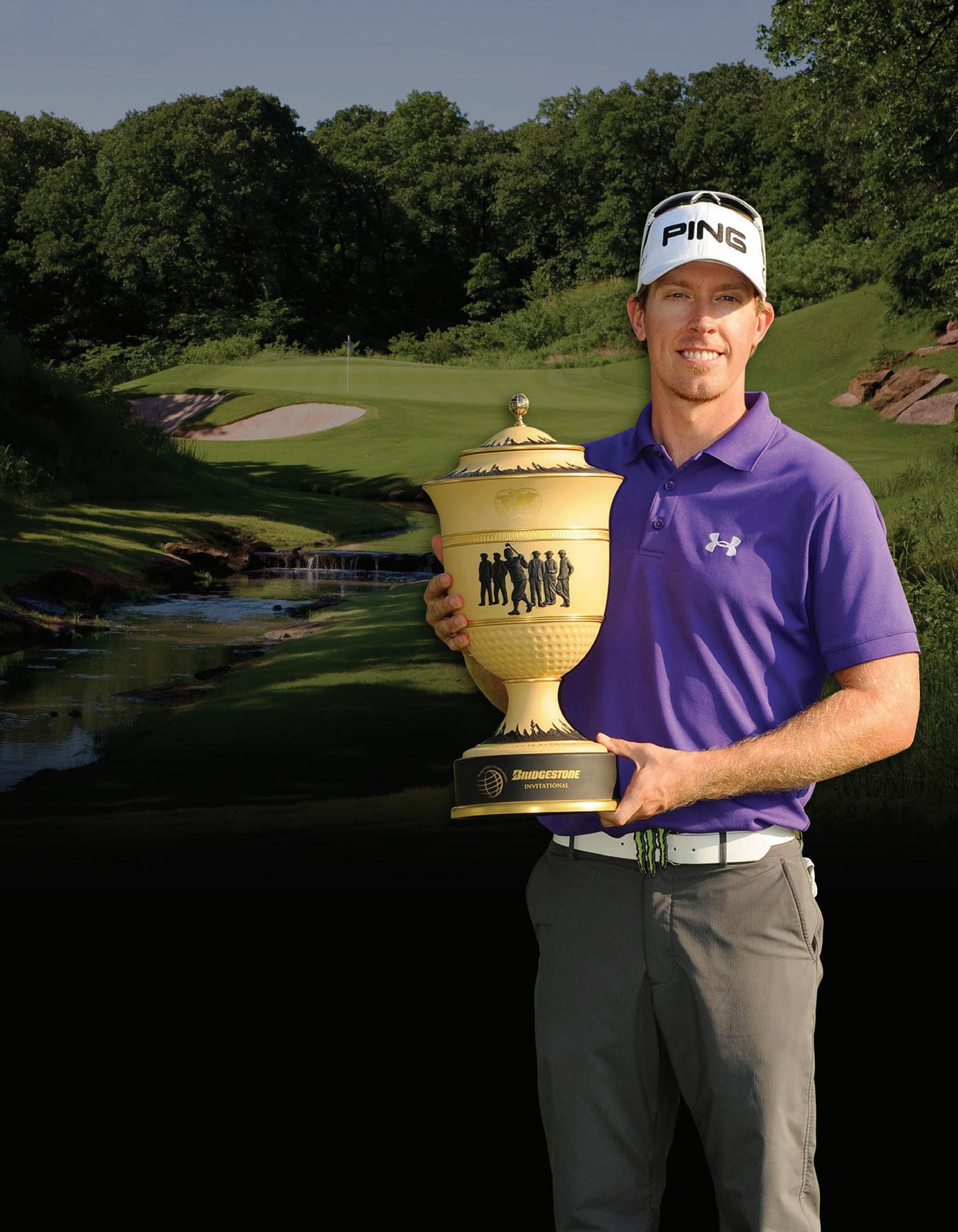
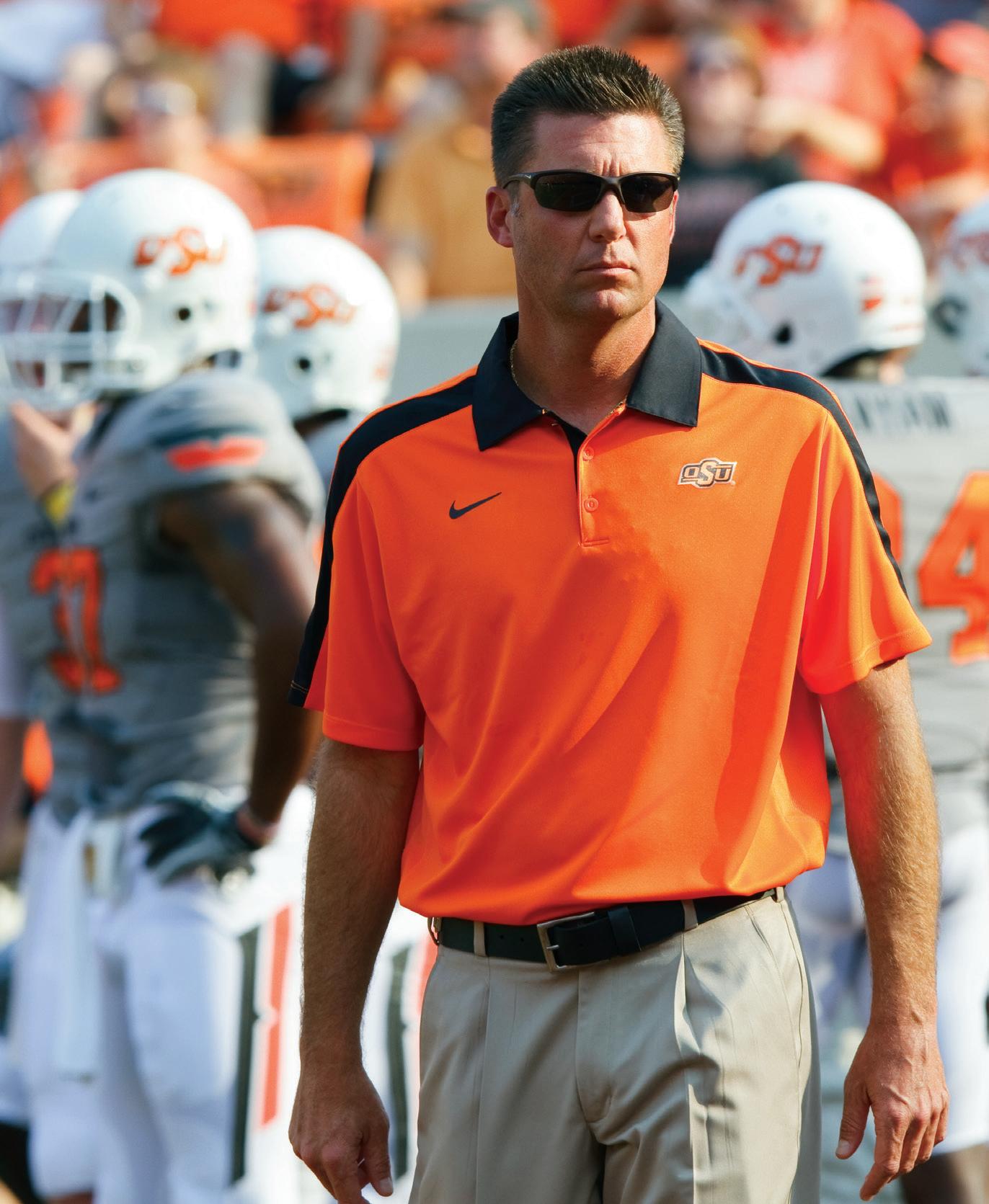
tH e f r I day B efo re t H e B edlam
foot B all game, P o SS e caug H t u P
WI t H c oac H f ord I n HIS of f I ce.
H e Wal K ed Stra I g H t out of a
meet I ng WI t H HIS coac H e S an d
S at doW n WI t H u S . H IS vo I ce Wa S
H oar S e, ra SP y a lmo St, and H e
loo K ed l IK e H e’d B een B urn I ng
t H e c andle at Bot H en d S .
outSI de HIS off Ice WI ndoWS , State HIgH Sc Hool foot B all P layoff S r aged,
WI t H a ll t H e Page antry of fan S I n t H e I r cold W eat H er gear and B andS
Belt I ng out f IgH t Song after f IgH t Song. It Woul d’ve Been ea S y to
get caugH t u P I n t H e foot B all , Part Icul arly I n l IgH t of t H e BIg ga me
Sc H edu led for t H e nex t day on t H at ve ry f I eld.
But W e W ere t H ere to tal K l I fe a nd B a SK et B all WI t H coac H ford. at t H e
t I me, HIS t eam Wa S SPort I ng a 4-2 record, WHIc H S a I d P len ty a Bout Bot H t H e te am’S Pote nt I al a nd I tS groWI ng Pa I n S . aS I t tu rn S out, groWI ng
Pa I n S a re Some t HI ng coac H ford IS comforta Ble WI t H a S t HIS y ear’S t eam
IS a grou P of H ardWor KI ng KI dS WHo ju St Want to get Bett er and WI n.
att I tude ma K e S a ll t H e dI ffe rence.

P l arry r eec e said a few weeks before the season started that this was the most giddy he had seen you the entire time you’d been here. w hy would he say that?
F i t’s probably more of me rea lly liking this tea m as far as the typ e of people they are i enj oy wor king with them every day The re wer e a lot of challenges on las t yea r’s tea m as far as getting eve ryone on the sam e pag e. w ith this tea m, we’ve see n thr ough summer wor kouts and pre season workouts that they’re good kid s. They’re eager. They have good attitudes.
m y excitement for thi s bas ketball team wasn’t nec essarily that we were going to go out and win 35 gam es, though that’s alw ays you r goa l. i t’s just looking for ward to wor king with a bas ketball tea m that to that poi nt had shown a willingness to learn, to get bet ter, and willingness to work hard.
P w hat’s been the challenge to getting those kinds of players?
photography by Gary Lawson
F i t took some adj usting to the roster of our tea m in the off season of this year to make sure we had the players that had the sam e goa ls and ideas that i had The tea m-first mentality, and that’s always a wor k in progress. it’s very natural for a 17, 18 or 19-year-old, or anyone for that mat ter, to be a lit tle bit se lfish. story continues
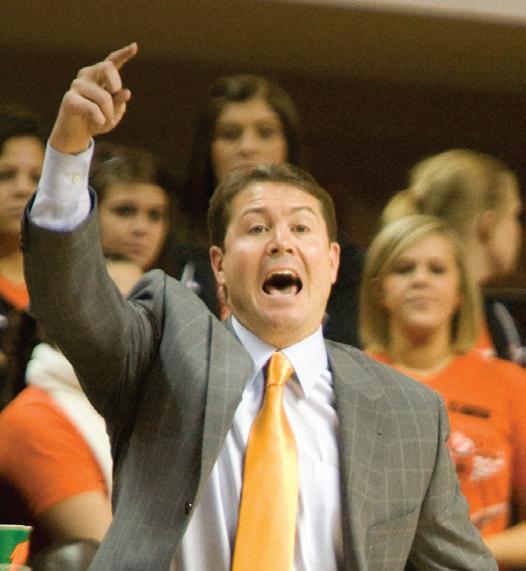
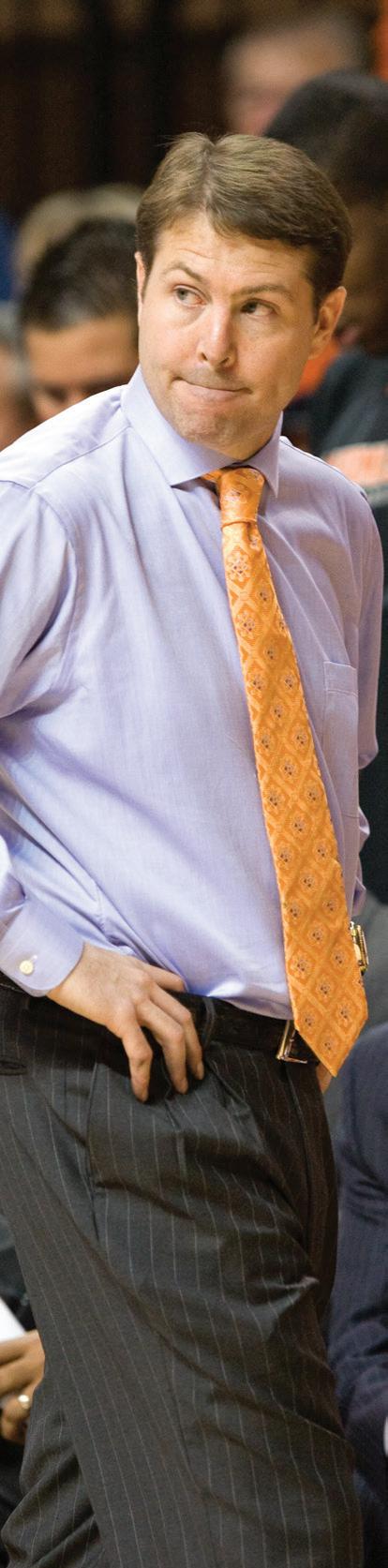
it’s not a complete science to put ting together a tea m. we don’t get to spe nd an enormous amo unt of tim e with our rec ruits to get to know the m as wel l as we wou ld like. you don’t want to make exc uses, bu t it ha ppens.
i t jus t takes tim e and patience, and i’m not the mos t patient per son in the world. After las t yea r, we rea lly sat bac k and took a loo k at our tea m and sai d, we needed to get our tea m’s attitude cor rect, and it too k som e adj usting to do th at.
P i s recruiting the hardest part of the job?
F i t is. i t’s a 24- hour-a-day, 365 -days-a-year job i t’s so tim e consuming. it’s jus t a com petitive wor ld out there. The re are so man y goo d programs. i t’s a cha llenge to find guys who really fit. you don’ t rea lly get to spend enough tim e wit h the m. you have to talk to oth er peo ple. i f we hea r about a kid, we’ll call one of his opposing coaches. “Te ll me abo ut thi s kid.” you have to try to get an unb iased opi nion as muc h as pos sible. The re are jus t so many different cha llenges. it never stops.
P h as the upgrade in facilities helped in recruiting? h ow big an impact does the new locker room have?
F i don’t know if i can put it in big eno ugh ter ms. i t’s a hug e fac tor. i t’s a must. i know coac h h old er has sai d, “A locker room has never won a gam e. A stadium has never won a gam e.” And he’s exa ctly rig ht, but he’d als o be the firs t one to tel l you that you nee d gre at fac ilities. you nee d the m to attract the rec ruits.
we’ve had peo ple neg ative rec ruit against us all the tim e. we hea r it fro m recruits. we always tell them, “ you come to Stillwater. you com e to cam pus. And then you judge it for you rself.” i can’t tel l you how many players we’ve rec ruited, including many of the m on our ros ter right now, that tel l us that they’ve com e
on visits just out of cou rtesy bec ause of how hard we’ve rec ruited the m, and they get here and say, “coac h, we had no idea. we did n’t rea lize you had all thi s. we didn’t rea lize abo ut the exc itement aro und the pro gram. we did n’t rea lize how nice ever yone is. we did n’t rea lize what a great college town this is.”
But once we get them here, and they see the closeness of thi s com munity and university. They see the fac ilities. w e haV e e V er Y thi ng the Y ne e D to Be sUccessfUl anD get YoU to where YoU want to Be athleticallY, acaDemicallY anD sociallY. we’Ve got the Best i think that is important. i thi nk if you bro ught rec ruits here and you don’t have rea lly goo d fac ilities, then you’re rea lly goi ng to have iss ues.
P e veryone keeps talking about this being a “young” team. w hat’s the impact of that lack of experience?
F i t’s the youngest tea m i’ve eve r coached. we have six players on thi s team who had never played a d ivi sion 1 game, and five of them are get ting good minutes a gam e. Our top three sco rers are two freshmen and a sophomore. Our one senior who’s been playing has been playing hurt the who le yea r. keiton has been hurt since the first game. A ser ious injury. At his bes t, he’s bee n 50 percent, and he may have bee n as low as 30 percent. And he missed two games. i t’s not a coa ches’ phr ase. i t’s the truth. n ow, i tel l our tea m all the tim e, that’s not an excuse. And nobody wants to win more tha n i do. As my staff tells me when i’m ups et or in meetings, “coac h, you’re dealing with six guys who’ve never been through thi s before,” and the guys who have bee n through it before are m arkel Brown, who’s a sophomore, and Fred g ulley, who’s a sop homore. we are a young bas ketball tea m. The re’s no way to get around that.
we don’t wan t to use tha t as an excuse. They’ve played hard every single game, except for one, the Sta nford
game. i was n’t hap py wit h tha t. Our team was mat ure eno ugh to loo k at that game afterward on film and sit there with gri maces on the ir fac e and say, ‘that’s not ve ry good.’
A lot of people have asked me if that was just a you ng tea m bei ng in awe of m adi son Squ are g ard en and bei ng on TV for the firs t tim e. Sure, if you wan t to use that exc use. But we exp ect a certain effort and attitude ever y gam e. now, when you’re dea ling with freshman, you don’t know what type of play you’re going to get. But i do expect every senior, freshman, a cer tain effort eve ry gam e. you just know that whe n you’re dea ling with a more experienced gro up, you’re going to get the effort and attitude, but they’re also goi ng to execute a lot bet ter on a consistent bas is. They’re mor e mature. They know me bet ter. They know what it takes bet ter. you can jus t go on down th e li ne.
it’s a YoUng groUP, BUt a gooD groUP
P w hat would you say you’ve learned about them as a team so far?
F we’ve learned a lot sin ce eve n practice sta rted. Fir st off, it’s hard to hold our tea m’s attention spa n for a long time. The firs t 30, 45 min utes of practice wil l be off the cha rt, and the n we’ll hit a lul l. The firs t wee k or so, we saw it and tho ught, wel l, they’re jus t getting tired. But whe n it kept com ing, we had to sto p and add ress it. we’ve seen that in gam es were we’ve got ten leads and los e leads. we’ve als o see n that they’ve bee n abl e to com e bac k. They don’t get deflated. They don’t thi nk about it, they jus t go. They don’t thi nk abo ut the fac t that we were jus t up 10 and two min utes later, we’re down fou r. i t’s goo d tha t they can do that, but it’s a tou gh way to be playing basketball. we’ve got to get to the point whe re we’re playing with focus and attention for 40 min utes, so we ca n be ou r be st.
story continues

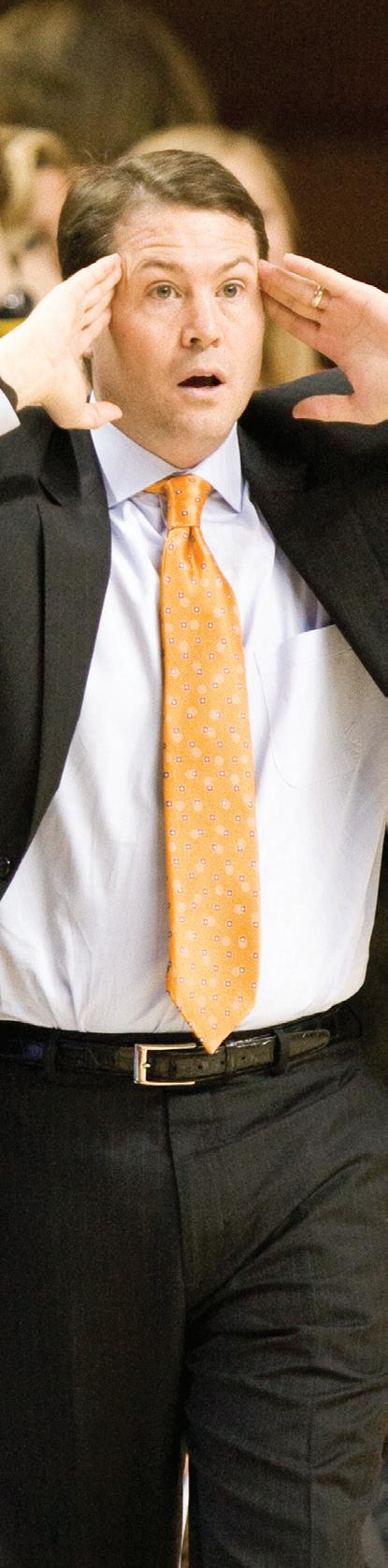
It’s easy to get spoiled because o S u basketball accomplished all the things e ddie Sutton accomplished, but that’s also what makes this place special. We want to get it back. We want to spoil them again.”
They play in big -time spu rts rig ht now. we have lea rned tha t it’s one of the closer tea ms that i’ve bee n aro und off the court, but it doe sn’t nec essarily reflect on the court. They haven’t figured each other out on the court yet.
P would you say this is your ki nd of team?
F it’s getting close. it’s mY kinD of team in terms of their Personalities anD the t YPe of attitUDe the Y haVe. i like the fight the Y haVe in them.
P w hat’s the biggest difference between coaching at os U and your past stops?
F For me, bec ause i’ve played at other universities, i’ve coached at oth er universities. m ost peo ple in Sti llwater, who live here and wor k here, they don’t know what it’s like in other places. you don’t rea lize how imp ressive it is here, the closeness, the loyalty and the support. i t’s not like tha t eve rywhere.
People know that that’s here, but they don’t realize. i t’s rea lly imp ressed me. i t’s not like that eve rywhere. i t’s fun to be around.
P Do you really feel a lot of support from the community?
F you always want more. i cam e to OS u because of the tradition. i knew about coach i ba. i knew wha t eddi e Sutton had accomplished. i had always been a great adm irer of eddi e Sut ton. i enjoyed wat ching his tea ms fro m afar. i knew c oac h Sut ton fro m liv ing in kentucky. i’d see n Okl ahoma State in the Final Four.
i knew about g all agher- i ba Are na to an extent fro m wha t i saw on TV. i ’d played in gi A bef ore it had bee n expanded. That’s what got me exc ited about coming here. i knew it had a great tradition.
we came in and went to back-to-back ncAA tournaments. we went ove r 20 wins each yea r. we had hug e gam es. we beat n o. 1 kans as. we’ve had a lot of bi g wi ns an d ac complished a lot.
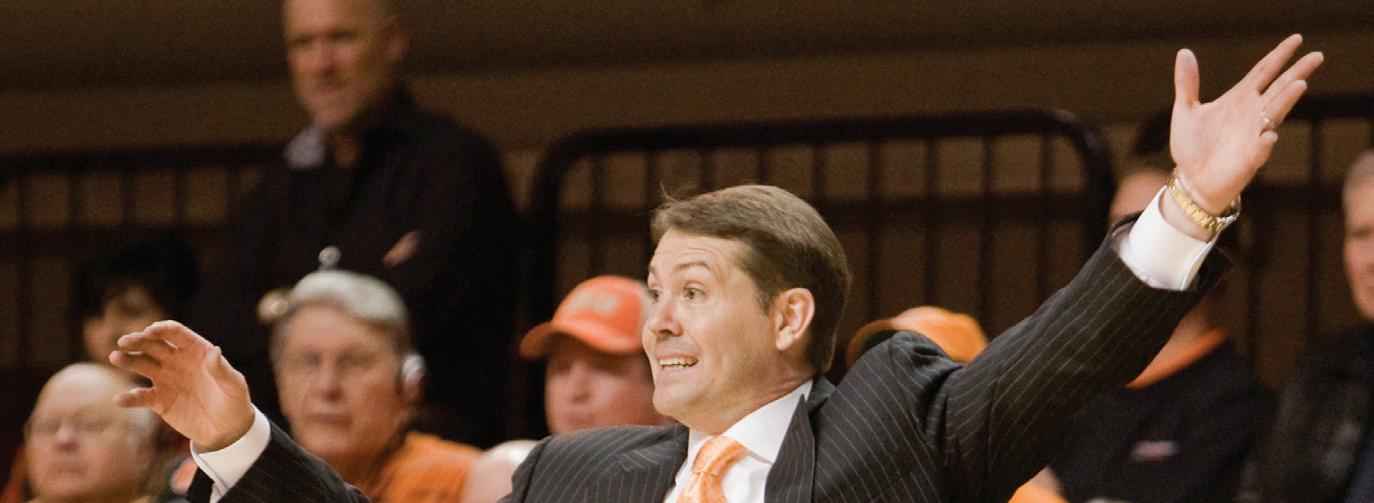
P w e’ve had pretty good ba sketball teams here in the past, and i th ink perhaps our fans don’t understand how difficult it is to get to a f ina l f our or even a s weet s ixt een. c an you put it into context?
F i t is tough. And tod ay, it’s harder tha n ever.
i always hear fro m peo ple, ‘Ju st win.’ well, i believe we’ve won enough. we’ve won at home. we’re 47-5. we’ve beaten kansas.
h ave we bee n to the Fin al Fou r yet? n o, but we’ ve bee n to pos tseason play every yea r, inc luding two ncAA tournaments. we’ve won hug e gam es here. we’ve had exc iting gam es. we’ve had some ups and downs.
we’ve done a lot of rea lly good things here, so far, but we want so muc h more. w here we’re headed, i’m exc ited about it. But it’s difficult.
it’s easy to get spoiled bec ause OSu basketball acc omplished all the thi ngs eddi e Sut ton acc omplished, but that’s
also what makes thi s place spe cial. we want to get it bac k. we wan t to spo il them again.
P Do you like it here?
F i do. m y fam ily loves it her e. i enjoy the peo ple i’m aro und eve ry day And my family enj oys it. They are the biggest c owb oy fan s in Ame rica. m y kids live and die with our games and the football games. Thi s is a special place to live, and a great place to raise a family. i know i get obs essed with my job i get obsessed with com ing in here. i get tunnel vis ion thi s tim e a yea r. i hea r it from my fri ends who cal l and leave me messages and don’t hea r bac k from me for two or three day s. i love the opportunity we have here.
i loVe Being here.
P i s it difficult being a public fig ure?
P Do make a lot of decisions that take you out of your comfort zone?
F don’t make a lot, but i’m cog nizant of the fac t that may be i nee d to at times. i’m an ana lyzer. But i’m not afraid to get out of my com fort zon e. i’ll do what i need to do.
i struggle wit h the bal ance of my job and family dai ly. And unfortunately, sometimes the job has to win out. luckily, i have a great und erstanding wife and kids. But i str ive not to neg lect my fam ily. it is the most important thing, by far
F well, it goes with the job i t’s jus t a different day and age with the internet and message boa rds fro m whe n i firs t got into it. i was 26. i don’t know if i would’ve sur vived. At c amp bellsville, first year we won 17. n ext yea r, we won 23. At e astern kentucky, my firs t yea r, we won seven gam es. On the internet, they’d have bee n kil ling me. And the n we won 11. And you keep bui lding it. And finally, people are like, “ wow!” we mad e it to the ncAA tou rney and alm ost beat kentucky.
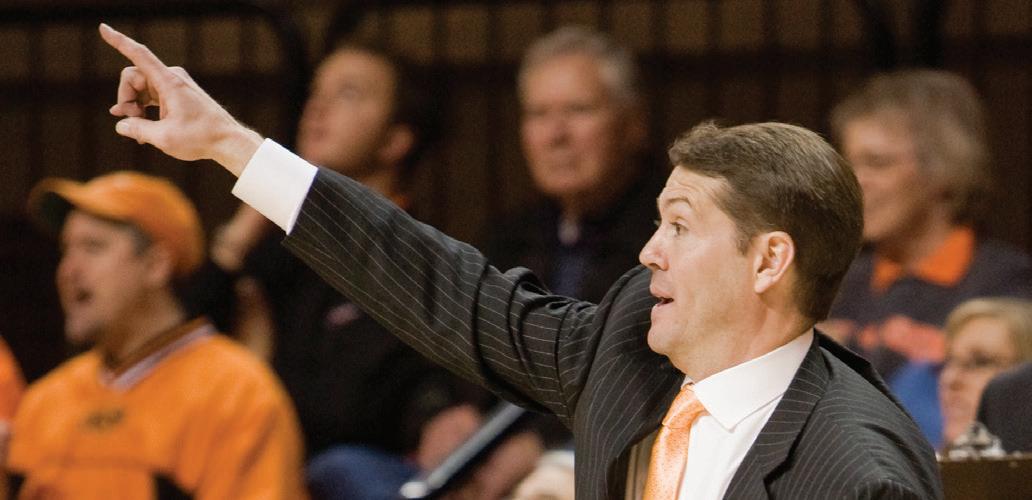
once when i was on vac ation, i saw on e of th ese fu nny cow boy si gns th at re ad, “i t ain’t br aggin if you can do it.”
well we di d it, di dn’t we? An d you so rt of get th e di stinct fe eling “i t” is not go ing to be a on e-and-done dea l. Th is su ccessful tr ip to th e to p of th e Bi g 12 conference ha s be en bui lding fo r a wh ile, an d it ’s not goi ng away.
we have se en th ings growning for Ok lahoma St ate u niversity over the la st few ye ars. Th ere ha s be en a wid ening of pe rspective an d ex pectations. i t ha s be en a process. Al l of you have be en, an d wi ll co ntinue to be, an integral pa rt. So me steps have bee n ug ly, others have be en gl orious. n o do ubt th ere wi ll be mo re of ea ch. But from tr ick-or-treat to th e Bi g 12 eli te, th e jo urney ha s provided both serendipity an d fu lfilled ex pectations. And li ke mo st tr ips, th e de stination was but one sma ll par t of the pro cess. The re al ed ucation wa s de livered dur ing th e ex pedition.
The cowb oy excursion ha s enc ountered do ubtful an d dis respectful en emies al ong th e way. d isrespect is a cu rious th ing. h ow many ti mes have we se en it in re al li fe, mov ies an d so ng? Ty pically, it doesn’t tur n ou t we ll fo r th e di srespecting par ty. you re member th e li ne from Tom bstone th at st arts wi th, “ you cal led down th e th under, we ll now you got it ”? contempt ca n be a motivator, an d it ca n stick around fo r a lo ng ti me.
i’ve he ard te ll of a re al li fe story abo ut a cowboy wh o fo cused fo r 19 yea rs on avenging hi s father’s de ath.
Several in dividuals di srespected
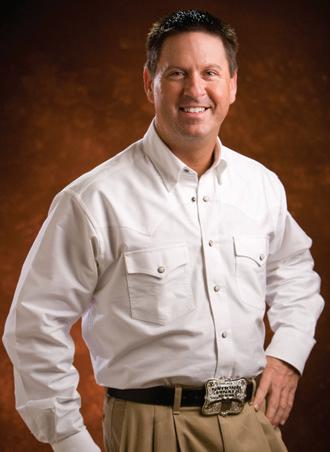
the lad’s dad. yes, di srespect is a cu rious th ing. So, i su ppose, is res pect fo r th at matter. r esp ect has to be ea rned, an d it ap pears we ear ned some.
But now th at we have it, let’s be sure an d re member ou r cowboy roots.
There is a cowboy code of th e w est, as laid down by James Owe n in Cowboy Ethics i t is as fol lows:
lI ve e ac H day WI t H cour age ta K e Pr I de I n your Wor K a lWay S fI n ISH WH at you Start do WH at Ha S to Be done Be tougH , But fa I r W H en you m a K e a Prom IS e, Kee P I t rI de f or tH e B rand tal K l e SS an d Say more r emem Ber tH at Some tHI ng S a ren ’t f or Sale KnoW W H ere to draW t H e lI ne
k yle w ray Vice PresiDent enrollment management & marketing i t’s a nice ti me to be a c owb oy, isn’t it, pa rticularly th e hu e of or ange spa nning th e st ate of Ok lahoma. cowb oys have al ways be en proud to we ar ou r co lors, bu t it se ems an eve n br ighter or ange wh en it ’s as sociated wi th a Bi g 12 c ham pionship.
GO POKES!
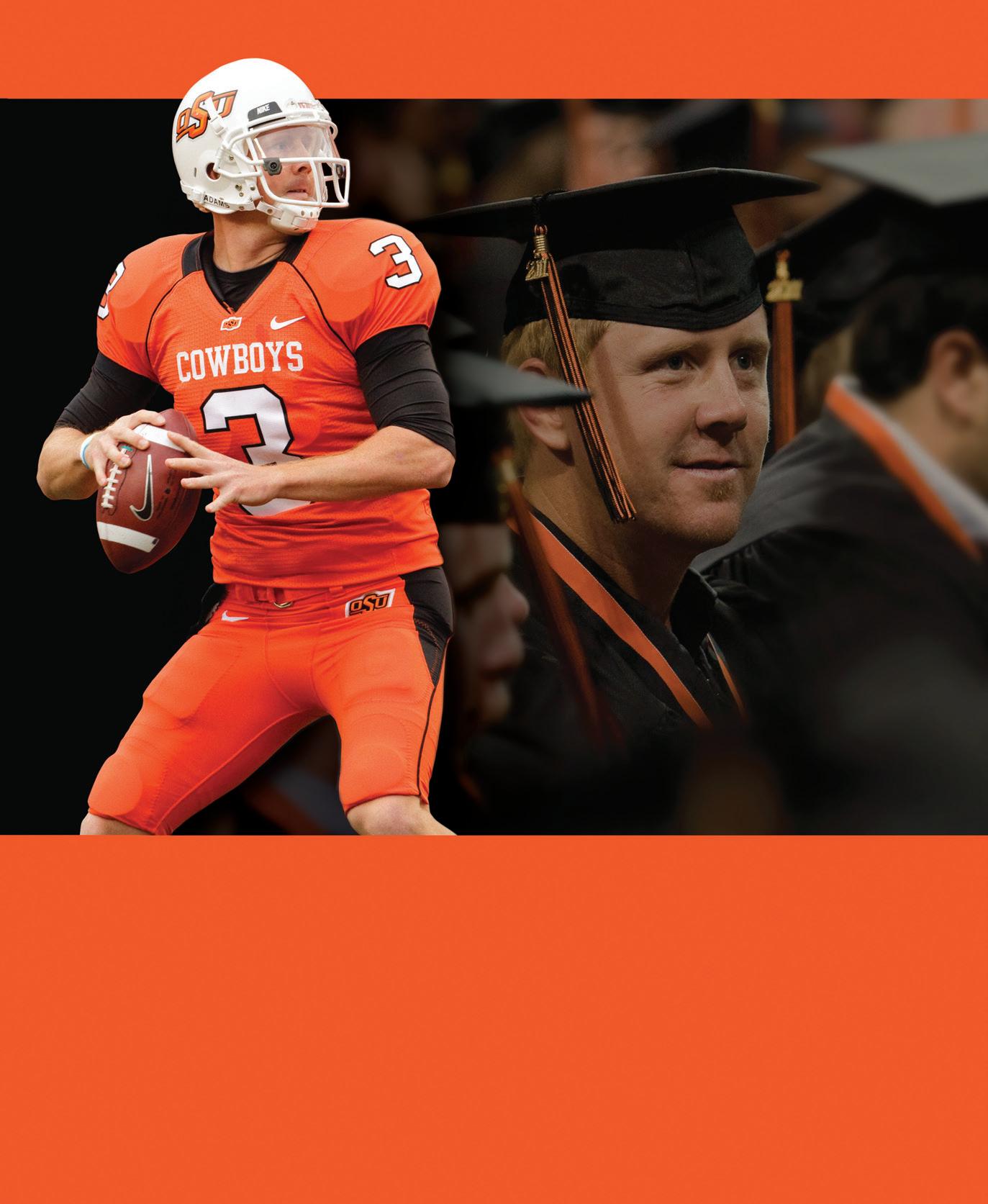
ThePOSSE is the lifebloodof the OklahomaStateathleticprogram,providingscholarships for 450+ CowboyandCowgirlstudent-athletesfromall of OSU'svarsitysports.Yourgenerosity makesit possibleto competeat the highestlevel-in the classroomandonthe playingfield.
Annualcontributionsto OSUAthleticstotaling$150or morequalifyfor membership.Benefitsinclude the award-winningPOSSEMagazine,POSSEstardecalfor yourautomobile,educationaltax deduction andmore.Stayconnectedto OSUAthletics... Joinourwinningteamtoday.