Volume II | Issue VI
February 14, 2018
Spring XVIII
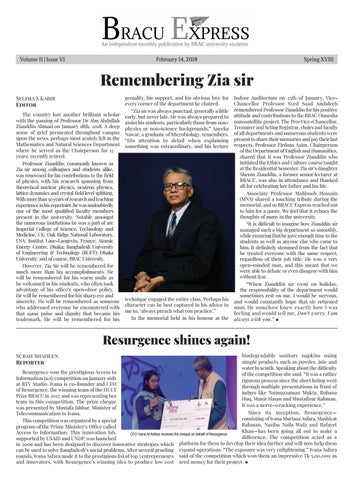
Remembering Zia sir Selima S Kabir Editor The country lost another brilliant scholar with the passing of Professor Dr Abu Abdullah Ziauddin Ahmad on January 18th, 2018. A deep sense of grief permeated throughout campus upon the news, perhaps most acutely felt in the Mathematics and Natural Sciences Department where he served as the Chairperson for 15 years, recently retired. Professor Ziauddin, commonly known as Zia sir among colleagues and students alike, was renowned for his contributions to the field of physics, with his research spanning from theoretical nuclear physics, neutron physics, lattice dynamics and crystal field level splitting. With more than 50 years of research and teaching experience in his repertoire, he was undoubtedly one of the most qualified faculty members present in the university. Notable amongst the numerous institutions he was a part of are Imperial College of Science, Technology and Medicine, UK; Oak Ridge National Laboratory, USA; Institut Laue-Langevin, France; Atomic Energy Centre, Dhaka; Bangladesh University of Engineering & Technology (BUET); Dhaka University; and of course, BRAC University. However, Zia Sir will be remembered for much more than his accomplishments. He will be remembered for his warm smile as he welcomed in his students, who often took advantage of his office’s open-door policy. He will be remembered for his sharp eye and sincerity. He will be remembered as someone who addressed everyone he encountered with that same poise and dignity that became his trademark. He will be remembered for his
geniality, his support, and his obvious love for every corner of the department he chaired. “Zia sir was always punctual, generally a little early, but never late. He was always prepared to assist his students, particularly those from nonphysics or non-science backgrounds,” Aneeka Nawar, a graduate of Microbiology, remembers. “His attention to detail when explaining something was extraordinary, and his lecture
technique engaged the entire class. Perhaps his character can be best captured in his advice to me to, ‘always preach what you practice’.” In the memorial held in his honour at the
Indoor Auditorium on 25th of January, ViceChancellor Professor Syed Saad Andaleeb remembered Professor Ziauddin for his positive attitude and contributions to the BRAC Onnesha nanosatellite project. The Pro-Vice-Chancellor, Treasurer and Acting Registrar, chairs and faculty of all departments and numerous students were present to share their memories and pay their last respects. Professor Firdous Azim, Chairperson of the Department of English and Humanities, shared that it was Professor Ziauddin who initiated the Ethics and Culture course taught at the Residential Semester. Zia sir’s daughter Shenin Ziauddin, a former senior lecturer at BRACU, was also in attendance and thanked all for celebrating her father and his life. Associate Professor Mahboob Hossain (MNS) shared a touching tribute during the memorial, and so BRACU Express reached out to him for a quote. We feel that it echoes the thoughts of many in the university. “It is difficult to imagine how Ziauddin sir managed such a big department so smoothly, while ensuring that he gave enough time to the students as well as anyone else who came to him. It definitely stemmed from the fact that he treated everyone with the same respect, regardless of their job title. He was a very open-minded man, and this meant that we were able to debate or even disagree with him without fear. “When Ziauddin sir went on holiday, the responsibility of the department would sometimes rest on me. I would be nervous, and would constantly hope that sir returned soon. He somehow knew exactly how I was feeling and would tell me, Don’t worry, I am always with you.” ■
Resurgence shines again! Subah Shaheen Reporter
biodegradable sanitary napkins using simple products such as powder, jute and water hyacinth. Speaking about the difficulty of the competition she said, “It was a rather rigorous process since the short listing went through multiple presentations in front of judges like Naimuzzaman Mukta, Rubana Huq, Munir Hasan and Mustafizur Rahman. It was a nerve-wracking experience.”
Resurgence won the prestigious Access to Information (a2i) competition on January 16th at BTV Studio. Ivana is co-founder and CFO of Resurgence, the winning team of the HULT Prize BRACU in 2017, and was representing her team in this competition. The prize cheque was presented by Mustafa Jabbar, Minister of Since its inception, Resurgence— Telecommunication to Ivana. consisting of Ivana Murtaza Asfara, Mashiyat This competition was organized by a special Rahman, Naziba Naila Wafa and Rafayet program of the Prime Minister’s Office called Khan—has been going all out to make a Access to Information. This innovation lab, CFO Ivana M Asfara receives the cheque on behalf of Resurgence. difference. The competition acted as a supported by USAID and UNDP, was launched platform for them to develop their idea further and will now help them in 2009 and has been designed to discover innovative strategies which can be used to solve Bangladesh’s social problems. After several grueling expand operations. “The exposure was very enlightening,” Ivana Asfara rounds, Ivana Asfara made it to the prestigious list of top 5 entrepreneurs said of the competition which won them an impressive Tk 5,00,000 as and innovators, with Resurgence’s winning idea to produce low cost seed money for their project. ■
2 | BRACU Express
February 14, 2018
CAMPUS NEWS
BRIEFS Get Up Speak Up wins 2nd place at Washington The team behind the Get Up Speak Up initiative placed in the finals of the EDVenture-Facebook Peer to Peer: Global Digital Challenge held in Washington, DC, USA. In a ceremony on January 31st, BRAC University students Zareef Tajwar Karim, Quazi Navila Zaman, Rojin Ammar, Fatimah Akhtar and Adeepto Intisar Ahmed were awarded 2nd place, over teams from Lebanon and Brazil. Get Up Speak Up is an online campaign to generate awareness and interfaith dialogue about matters of faith. Their workshops, titled accordingly, came to BRAC University’s campus and engaged students, teachers, and guests on topics related to faith and various religionbased issues within the society. 1st place went to the team from Germany for their campaign “Don’t be silent”, which worked to raise awareness about hate speech against Syrian refugees, and to create a platform for the “silent minority”.
178 bags of blood donated On January 29th, BRAC University Business Club (BIZ BEE) organized the Blood Donation Camp 2.0, in partnership with Bangladesh Thalassemia Foundation, at the BRACU Auditorium. Last year’s event saw Bangladesh Thalassemia Foundation collect, 153 bags of blood, which at the time was a record. The event started at 9.30 am, with Professor Iftekhar Ghani Chowdhury, PhD, Dean of BRAC Business School, and Mamoon Al Bashir, Senior Lecturer, BRAC Business School, inaugurating the event. The event ended at 4.00 pm, with students of BRACU having donated 178 bags of blood for patients of Thalassemia, beating their own previous record.
A workshop performance
on
theatre
BRAC University Drama and Theatre Forum (BUDTF) organised a workshop on January 24th, focusing on the basics of theatre and acting. This workshop was conducted by Monojit Kumar Ojha, currently Director of Finance of BRAC University. Having been a theatre performer, Director Kumar shared tips and practices for those looking to pursue a career in theatre. The workshop was open to all, with approximately 80 people in attendance during the session. The workshop included a special session for the existing performers of the club. This session covered intermediate level acting skills and the concept of theatrical performance for those who performed on a regular basis for the club and its events.
Code Fairies emerge victorious Antara Tarannum Correspondent
universities all over Bangladesh that were participating in the competition. They were among only 65 teams advancing to the next stage. Later, to fight for the trophy, the team had to overcome some of the most difficult programming processes. Code Fairies won with flying colors by solving 6 of the 9 problems that were given to them.
Team Code Fairies from BRAC University won the North South University (NSU) ACM-W (Association for Computing Machinery’s Council on Women in Computing) Student Chapter, an inter-university girls’ programming contest. Tahanima stated that some of the faculty from the The event was co-organized by the Bangladesh Open Source Department of Computer Science and Engineering had Network (BdOSN) and was held on January 26th. The team helped them with training sessions in the lab on Fridays and consisted of members Mahjabin Muntaha, Shaily Roy, led Saturdays. However, she also mentioned, “We weren’t given the by Tahanima Chowdhury, an level of support we expected alumnus and teaching assistant of BRACU, and hope they will at BRAC University. reappoint full time trainers Computer Science and in the near future. We also Engineering is one of the most wish for members of the flourishing sectors in the recent faculty to show their support times of Bangladesh. While the by accompanying teams to degree is equally popular with such competitions in the men and women, it is not often future.” that women are seen involved Tahanima encouraged in programming competitions. young programmers to All the members that participate in contests rather represented BRAC University than just focusing on a good (From L to R) Shaily Roy, Tahamina Chowdhury, and Mahjabin Muntaha. had previous experience of CGPA, as contests allow participating in different programming contests on the opportunities to gain experience and interest in their work. national stage. Upon asking about their motto, the team said To facilitate participation of more female programmers of they believed in three things: passion, practice and experience. Bangladesh, NSU Chairman in collaboration with Dancake, Team Code Fairies fought against 243 teams from 63 additionally awarded 28 teams under 4 categories. ■
Bani Archana 1424 Najibah Rahman Reporter “Bani Archana”, the offerings of sweets or “Proshaad”, and the Saraswati Puja, was celebrated on January 22nd, organized by the BRACU Hindu community and funded by the Office of Co-Curricular Activities. The Building 3 cafeteria was filled with students and members of the faculty alike who went there to receive blessings from Saraswati Maa, who is said to be the Goddess of knowledge and wisdom in Hinduism. The event hosted the presence of the honourable Pro Vice Chancellor, the Registrar and the Director of Office of Career Services and Alumni Relations. The statue of Goddess Saraswati or the “Protima” was brought to BRAC University the night before, and the student organisers spent the entire night decorating the cafeteria to pull off the successful puja. Saraswati Protima at the The puja started at Bani Archana 1424. 9.30 am on Monday, and the “anjali” was marked on the forehead of the followers around 11 am, after which the “proshaad” was distributed. These mark the blessings of the Goddess Saraswati, and it is believed that students who attend this puja will prosper academically and in their career paths. Being an anticipated event at an academic institution, the puja was celebrated by both Hindu students and non-Hindus. ■
IHF holds its 3rd annual science fair at BRACU Maisha Lubaba Correspondent It’s Humanity Foundation (IHF) organized its 3rd annual science fair “The Joy of Innovation” on January 27th, from 11.30 pm to 4 pm at BRAC University The theme of the fair was “global warming”, a growing global concern, so that the children could learn about it in an interactive manner. There were a total of 6 science projects presented on stage with a small stage-drama on the theme, followed by a live-music session by Aynus Tazwar Zeus. The chief guests of the event included Laora Pilet, Anfif Fatima, and Quentin Jouaville from The French School; Fabrice Bouley from Tape À L’oeil; Korean Councillor Kim Jeongki, and lastly Lee Junseok. Carlo Antonio Nino along with his Nino Abstract Consultancy, LLC sponsored the fair, and the venue was sponsored by BRAC University Office of Career Service and Alumni Relations. Magenta Advertising & Marketing Agency covered the entire event as the media partner; and BRAC University Natural Sciences Club helped organize the fair, while arranging free transportation for the children. With three campuses in Tongi, Saidpur and Dinajpur, IHF has educated over 650 underprivileged children, and looks forward to building a better Bangladesh where all underprivileged children have access to quality education, and all children are treated as equals. ■
February 14, 2018
OPINION & ACADEMICS BRACU stepping forward in “opening new horizons” Tasnuva Pushpita Correspondent BRAC University has recently signed a Memorandum of Understanding (MoU) with Grameenphone in an initiative aimed at fostering university-industry collaboration. BRACU Pro-Vice Chancellor, Professor Ansar Ahmed and Grameenphone Chief Human Resources Officer Quazi Mohammad Shahed signed the documents on behalf of the respective sides. This collaboration is also joined by North South University. A seminar titled, “BRACU-Grameenphone Collaboration: Opening New Horizons”, inaugurating the collaboration and inviting the public to learn more, was organised by the Department of Computer Science and Engineering and BRAC University Computer Club. It took place in the GDLN Conference Room at 9.30 am on January 14th. The event was attended by the Pro-Vice Chancellor, who applauded the initiative and urged students to participate in the opportunities offered. Chairperson Professor Abdul Mottalib sir opened the seminar with a discussion of the resources provided by the university for developing projects, urging students to utilise these facilities to the fullest. Following him was Azfar Adib, Architect, Internet of
Things (IoT), Grameenphone, who explained the dynamics of Industry-Academic collaboration and discussed the advantages of professional supervision provided by Grameenphone. He then moved on to discussing IoT Platform and Smart Service, showing a short video to explain the concepts. The IoT is a network of physical devices (for example, vehicles and home appliances) embedded with software, sensors, and network connectivity. This network enables objects to connect and exchange data, and enhance the users’ lifestyle. As an example of such work, Md Moinuddin Bhuiyan, Head of Service Design & User Experience, Grameenphone talked about their new project named “Koyel” (Grameen Intel project): a smart bangle for expecting mothers to guide them through their maternity phase. He also pressed on the importance of privacy-security of freelancers as a focus point for the next two years. The session also included a talk from alumnus Kalyan Banik, Algorithm developer, Codemen Solution Inc who motivated students to work on Big Data, HCL, IoT, Data Mining which are the current booming fields. Though common in developed countries, collaborations between universities and industries are rather rare in Bangladesh despite their incredible potential for innovation through knowledge exchange. ■
Thesis Spotlight: Rukaiya Binte Karim, Bachelor of Architecture Najibah Rahman Reporter Rukaiya Binte Karim, a thesis student of Fall 2017 of the Department of Architecture, talks to us about her final project and model, HOPE, that she presented in front of a jury last semester. Her project was based on a requirement from the Ministry of Education, for a school for autistic children. On a land of an area of 4.46 acres, she designed an entire school complete with classrooms, dormitories, administration building, teachers’ rooms, counselors’ rooms, therapy units and grounds for entertainment at Purbachal, Sector 8. “Autism is greatly misunderstood,” said Rukaiya, when asked about her rather specific project. “In most ways, they are more intelligent than you and I; and certainly no different in what they are due as human beings. When I was given an opportunity to choose what I wanted my final project to be, I thought that I should
Aerial view of HOPE.
A model of HOPE.
do something that would contribute to my society. Something that would be worthwhile and something on which there should be more focus.” Rukaiya’s model reflects her intent and the unique needs for autistic children. She wanted her project to be more of a meditation space and the go-to safe haven for the children, and she did exactly that, garnering much appreciation from the jury. Her path was not easy, echoing other thesis experiences. There were times when she had been ill and overworked, but the standing joke of the department prevailed: “There’s no time to even perish from overwork.” “I have not begun thinking about professional work, but the importance of research draws me to that sector,” said Rukaiya. “One thing I’ve learned while doing my thesis is how little thought and consideration goes into infrastructural planning. And consequently, we are unable to move forward and improve as a nation. I would like to be a reason, if not a pioneer, for change.” The most important takeaway for Rukaiya will be her classmates. The fresh graduate remembers the exhaustion and stress of undergraduate life and admits that without their bonds and friendship, those endless nights at the studio would have truly been unbearable. ■
BRACU Express | 3
UAP workshop on “Gender Issues” Sumaiya Tasnim Reporter A workshop was held at University of Asia Pacific where students from different private universities gathered in order to sit down and discuss gender awareness and related issues. Directorate of Students’ Welfare, University of Asia Pacific organized the daylong programme titled, “Workshop on Gender Issues” on January 27th at UAP Plaza. The Association of Commonwealth Universities supported the event. The facilitators of the workshop were Professor Firdous Azim, Chairperson of the Department of English and Humanities of BRAC University; Ainoon Naher, Professor of Anthropology at Jahangir University; Ayesha Banu, Associate Professor in the Department of Women and Gender Studies of Dhaka University; and Seuty Sabur, Associate Professor in the Department of Economics and Social Sciences of BRAC University. The director of UAP introduced the event and summarised the activities; followed by the key advisor of the event, Professor Azim, explaining the rationale behind the workshop. Professor Azim spoke eloquently on her personal experiences and the important aspects to understand the effects of women’s role in society. The academic session, conducted by Professor Sabur, discussed the concepts of gender, sex and sexuality within their social and cultural dimensions. The discussion had lively participation from the attending students, especially about the subject of the ‘third gender’ and their legal and human rights within our society. The discussion continued with Professor Banu on the women’s movement in Bangladesh throughout the years. Professor Banu emphasised the importance of studying the work of female writers, and engaged the idea of employing feminist ideas and attitudes not only in one’s academia, but in their lives as well. After lunch break, the workshop continued with a session on sexual harassment and violence against women, collaboratively taken by the facilitators. Ainoon Nahar then reviewed sexual harassment measures and the special provisions of women in cases of maternity leaves, child care facilities etc. The workshop closed with certificate giving and closing ceremony with a vote of thanks by the director of UAP. The idea of the workshop was an interactive session where everyone could talk about their experiences and participate on various subjects related to gender itself. Although the effects of feminism as a political movement are felt by us as a society, there is still a shortcoming on societal and cultural awareness about gender roles and gender inequality. The facilitators hope to continue such workshops in order to make thoughtful conversations and create awareness about such issues more commonplace. ■
4 | BRACU Express
February 14, 2018
SPECIAL FEATURE The significance of art in juxtaposition with the mundanity of our lives can sometimes be lost upon us. We can still for a moment or two to appreciate a pretty picture, but then speed along as usual, attending to the calls of our ordinary days. But to adore beauty, to feel its passion, to embrace it and create it, takes a special kind of dignity and talent. With such a diverse student body, it should come as no surprise that the talents of BRACU students reflects that diversity. When they are not stuck in classes and caught up in a pile of assignments, these artists of BRACU can be seen busily working at their canvases and capturing the colours of the world around them. Check out their pages for some soulful art that is sure to give you some food for thought.
Art for the Soul Growing up, Madiha Athar Khan had always appreciated painting. But she discovered that her true calling lied in art only after fooling around with her little brother’s poster colours. This was about two years ago. After that, her journey has been one of constant search for new techniques and finding a voice that resonated with her emotions. An organiser of “Art for the Soul”, art for Madiha, is therapeutic. It helps her retain emotional balance in her daily life. She paints to lose herself in a different world, to take a break from reality. She believes that art is for everyone. Her advice to aspiring artists would be to keep making art. “Do not worry about whether it is any good, there is an audience and market for every kind of art today.”
Left: Madiha Athar Khan’s Finding Beauty in Chaos Right: Madiha Athar Khan’s Orgasmic Galaxy (partially displayed) Below: Nuzhat Shama’s Dotted Musings
BRACU Express | 5
February 14, 2018
SPECIAL FEATURE TasmiArt
“It’s kind of intoxicating to see the colors flow and take shapes and blend,” says Tasmia Binta Mustafiz, as she describes her thrill for painting. “You take this blank piece of paper and create something magical.” Known as TasmiArt to viewers and followers, Tasmia’s received attention in proportion to her work after winning two Dhaka Comic Con competitions. Her style is primarily watercolours over canvas. Digital art is another area of interest for the biotech major, who spends a significant portion of her time completing commissioned artwork. Due to the great response to her creations, Tasmia plans on taking professional art courses to hone her natural skills. More competitions and exhibitions are in store for this promising artist.
Left: Tahseen Nur’s Inside Out
Mr Pencilist
Below: Tasmia Binta Mustafiz’s Stargazing
Right: Tahseen Nur’s Drifting stars and galaxies
For Tahseen Nur, juggling studies, he credits a certain artists’ meet hosted football practice and club work with by Liza Hasan (one of the first people to his ultimate passion of drawing has admire his talent) as the real moment never been a problem. With his ultimate that got him started professionally. philosophy being “if you really love With several more mediums and something, you’ll have time for it,” you themes to explore, Tahseen has a lot of can find him sketching during his free projects and plans up ahead, especially time. His page Mr Pencilist attracts with the launch of his signature people as much for its amazing art as designed tshirts, and moreover, his for its soulful captions. While astral art first solo exhibition sometime this year. with an intergalactic theme is his main forte, Tahseen amazes his audience with his artistic representations of human emotions and slice of life moments. Winning the prestigious Banani Wall Art competition and coming second in the Artwork belongs to the respective featured artists. DNCC shatrasta contest, Written by Tahseen’s work has been admired by some of the Nishat Shahara and Subah Shaheen leading names of the art scene in Bangladesh. In fact,
Brushes & Pencils Nuzhat Shama has been obsessed with drawing and colors for as long as she can remember. Even during her early childhood, Nuzhat was referred to as “the artist” by her friends and relatives, who took pleasure in the products of her creative outlet. She enjoys constantly challenging herself by trying out unfamiliar techniques such as photorealistic sketches and paintings. And if she is feeling particularly confident, she dabbles in semi-realism, a fusion of abstract and realism. She believes it gives her work more freedom for expression. Nuzhat had always dreamt of displaying her artwork. She was overwhelmed when she actually landed a 10 day solo exhibition last November in BRAC. “It was a humbling experience for me,” she says. She looks forward to making more time for her art and getting more opportunities to display her work.
Right: Nuzhat Shama’s Order Within Chaos
6 | BRACU Express
February 14, 2018
OFF CAMPUS & SPOTLIGHT 5 ways to ace your internship
Maisha T Iqbal Editor Not all degrees end with theses or dissertations; many of us get the opportunity to experience the ‘employed life’ before completing our undergraduate studies. Yes, being an intern may not sound as glamorous as working on one’s own research or project, but it can definitely have its own perks and lessons to teach. As a media major, I have always had an immense passion for print media. And it is that passion that led me to intern at ICE Today magazine. So first off: Select your major decisively. I knew that literature was not something that particularly excited me, and I did not waste time being confused about which direction to go with my degree. So simply to begin with, having a clear idea about which major area of your department interests you the most is very important. Get to know the people. For the next three months, you have to interact with new people and work
simultaneously. So keeping a good rapport with them will make the process easy and fun. And regardless of how your internship goes, it is always advisable to have networking skills and to use them. In Bangladesh, it is almost always about who you know.
When you hear the word ‘university’, what are the first thoughts that come to mind? Classes, deadlines, quizzes, social life, friends, part-time jobs, a love life, etc? Starting university life is daunting and challenging for every freshman out there. Going to university from high school is like stepping foot into another dimension. To make matters a bit easier for first year students, especially freshmen, BRACU introduced the First Year Advising Team (FYAT) programme in Spring 2014. Each FYAT group has a member of the faculty as an adviser and a senior student as a mentor. Being a FYAT Peer Mentor sounds intriguing. You have authority, get to work closely with members of the faculty and you become a well-known face eventually. But with great power comes great responsibility. We sat down to talk to Maisha Tarannum Iqbal, currently pursuing her last semester within the Department of English and Humanities, who became a FYAT mentor in Spring 2016. The requirements for a FYAT mentor is to have completed six semesters at BRAC University and have the required CGPA. Whenever there is a vacancy in the programme, interested students who meet the requirements can apply and be interviewed for the position. According to Maisha, a FYAT mentor must be aware of every event and announcement on campus and must know all the academic rules. They cannot afford to miss anything. As the FYAT
Learn to say no; okay, this might sound contradictory but hear me out. The quality of your work matters more than the quantity. Instead of taking on 5 tasks a day, politely explain to your supervisor if the workload is a little too much for you. And finally... Go easy on the social media. As much as you are dying to share that Harambae meme on your timeline, it would make you seem unprofessional and not earnest about your work. Save your downtime for that.
Speak up and show initiative. Remember how your course instructors would pull you out of your seat and make you speak in front of the entire class? Well, here no one is going to spoonfeed you. So speak up at every
In conversation with a Mentor Faiza Khondokar Reporter
opportunity that you get. Voicing out ideas is a great practice that will help you secure your position in the office, as well as build your image.
programme exists to help integrate new students into their campus life and encourage participation in both social and academic activities, the Peer Mentor has a crucial role in keeping the students in their group in touch with their campus goings-on, and help them learn how to navigate. “It can sound a bit dry and boring on paper,” says Maisha, “but really, the truth is that being a FYAT mentor is more like being a friend for the new students than anything else. People move through university so confidently that it can be a little nerve-wracking to ask for help from random strangers. That’s why we, the mentors, exist!” In her words, a FYAT mentor needs to be prepared for a wide variety of problems. From changing departments to helping students get to the stationery shop J&J, mentors have to deal with every tiny query. But a mentor must also be prepared to deal with situations that go beyond the mundane inconveniences. Maisha recalls a particular incident in which she had to assist a student in getting his confidence back when he was dealing with personal issues that he had no one to discuss with. The work of a mentor reflects such humane moments, and takes emotional sensitivity and resilience. Perhaps it could be said that mentoring is important for those very reasons. This certainly reflects the spirit of the FYAT programme: to help new students to adjust to a new culture and environment, but also to forge bonds of friendship across students, across years and mentorships. ■
Internships are only a bore if that is the attitude you bring with you. See them as an opportunity to branch out, experience new things and new people, all the while having the safety net of still being a student and not employed. And you will find that it is not only a great practical learning experience, but an opportunity that may help you with new discoveries about yourself too. ■
The expansion of university media Nishat Shahara Reporter Platforms for student selfexpression are not prevalent or common without particular events or sponsors. In time, students with creative bent spot these inadequacies and will aim to fill them. Such a project is UniTV, a media platform created by students for students. Co-founded by Touhid Kamal, Amid Sakif Khan, Sheikh Shefath Saadman, Afia Alam Toma, Faabiha Khan and Ahmed Jawad Khan, UniTV has recently gained popularity because of its YouTube videos titled “Tong Sessions”, where student musicians come together and jam in a tea-stall. We spoke to Jawad Khan about what UniTV is aiming to become.
Q. What was the main motivation behind creating this platform? We want to build a culture of student investment and inspiration. Campus life is so isolated and separate; the more lives we can touch, the more we consider ourselves successful. Q. What kind of people do you feature? Up until now we have focused mainly on BRACU students. We plan to expand and include other institutions in future. As long as you are a student with a particular skill and you have lots of positive energy, you are invited to work with us. Q. What future aspirations do you have for UniTV? We want to expand our boundaries and steadily increase our audience for now. Eventually, we want to open
Q. What exactly is UniTV? It is a media platform, nonprofit of course, created for students and artists who fly under the radar.Unlike other platforms in the university, UniTV intends to give everyone an opportunity to exhibit their talent. We also have segments that cover campus news and events. For instance, we recently did a live broadcast for the table tennis tournament held at BRAC University.
Tong Session in session.
a website and develop apps, and find ways to reach more people. Above all, we believe that we should not be separated by our universities and institutions because, as students, we hold the same ambitions and desires. ■
BRACU Express | 7
February 14, 2018
SPORTS NEWS
Basketball team just short of glory 25-41. Nevertheless, BRAC University still managed to get to the semi-finals along with Dhaka University,
Muntaqa W Bari Reporter On January 4th, BRAC University hosted its first ever Inter-University Basketball Tournament at the Bangladesh Basketball Federation Training School. The tournament was sponsored by Guardian Life Insurance Ltd and was covered by Channel 24. A total of eight universities participated in the tournament, namely BRAC University, Islamic University of Technology (IUT), Bangladesh University of Engineering and Technology (BUET), Jessore University of Science and Technology ( JUST), Notre Dame University Bangladesh (NDUB), American International University, Bangladesh (AIUB), Dhaka University (DU) and Jahangirnagar University ( JU). BRACU faced off against IUT and AIUB on the first day of the tournament and emerged victorious in both games with scores of 26-14 and 37-6, respectively. On the second day, BRACU played against NDUB only to face a bitter defeat with the final score reading
The second match of the day pitted JU against NDUB which ended with JU beating NDUB, 41-32. Both JU and DU advanced to the finals while BRACU again faced NDUB to fight for the third place. Unfortunately, history repeated itself as NDUB once again got the better of BRACU and won 32-25. The tournament ended with Dhaka University emerging as champions, defeating Jahangirnagar University with a score of 36-25. Ishtiaq Miraj of Dhaka University was named the MVP of the tournament. The tournament proved to be a bittersweet experience for the BRAC University Basketball Team. While it is true that the final outcome was not what any of us wanted, it should also be taken Pro-Vice Chancellor Professor Ahmed makes the opening shot of the tournament. into consideration that arranging an interJahangirnagar University, and Notre Dame University university basketball tournament was a significant Bangladesh. The semi-finals took place on January 6th, step in the history of BRACU’s journey in basketball. the first match of the day being BRACU versus DU. DU And hopefully, it will not be long before our team starts took the win over BRACU with a score of 37-23 to DU. bringing home championship trophies. ■
Defender of many goals Roshni Shamim Reporter Like most habits that grow with time, Mashiyat Rahman’s passion for football began when she was just 12 years old. Spending a summer abroad with male cousins, whose sole idea of recreation involved playing football, Mashiyat soon found herself not only involved but interested in the sport itself. Since then, her passion has brought her a long way. Being an active member of BRAC University’s football team, Mashiyat has represented the University on many occasions. The team has achieved success and high acclamation, and has made a name for themselves in the football field. She claims the key to their success rests on the team’s synergy, combining coordination and communication. Currently, the team is busy looking for new recruits to fill in the spots for those who have graduated or are about to. Apart from her active interest for the sport, Mashiyat is also involved in competitive swimming and has participated in competitions previously. Her passion for swimming has been ever present from the age of 7 and has grown over time. Aside from recreational activities, the stand for social welfare also plays a key role in Mashiyat’s professional interests. Being the CEO of her social enterprise, Resurgence, they stood
as runners up in the Hult Prize 2017 regional finals, and have big plans for expansion in the near future. Mashiyat is also a social consultant who travels professionally, providing assistance to organizations and firms for the planning and implementation of Sustainable Development Goals. When looking for a little relaxation from the everyday bustle of work and academics, Mashiyat prefers to spend her time developing her fascination for photography. She also works as a
Chess team shines at 22nd GACC in Malaysia Safir Zawad Reporter A team of chess players from BRAC University travelled to Malaysia to participate in the 22nd Grand Asian Chess Challenge (GACC), which was held from the 22nd to the 27th of January. The FIDE (World Chess Federation) rated tournament was organized by the University of Malaya in Kuala Lumpur, Malaysia. The tournament consisted of 72 teams from Bangladesh, India, Indonesia, Malaysia, and Sri Lanka, with BRAC
all currently undergraduate students at BRAC University. The team finished in 9th place. Both Md Shams Ud Duha and Ejaz Husain scored 5 points, the highest points scored by any member of the team. Md Sabbir Hossain drew with a Woman FIDE Master and a 2080 rated chess player. Rifah Nanjiba also drew with a FIDE rated chess player. The BRAC University chess team has repeatedly shown that they are capable of performing in top tier tournaments, and their recent showing at the 22nd
(From L to R) Mohammad Shakil; Rifah Nanjiba; Md Sabbir Hossain; Md Shams Ud Duha; and Syed Ejaz Hussain at the 22nd GACC in Malaysia.
part time professional photographer covering events, and enjoys the whole experience greatly. Currently, there are great plans in the horizon overall for Mashiyat. Buckling up for her last semester in BRAC University, she has high hopes to continue her interests with passion and integrity. ■
University being the only university to send a team from Bangladesh. The participants from BRAC University were Md Shams Ud Duha, faculty member of BIL and advisor of the BRAC University Chess Club; Syed Ejaz Hussain, a chess player studying MA in TESOL; Md Sabbir Hossain; Mohammad Shakil; and Rifah Nanjiba,
Grand Asian Chess Challenge cements that notion. When asked about the experience, Md Sabbir Hossain said, “I am blessed to represent my country and my university by playing chess in Malaysia. I believe that BUCC has created a milestone that will set the tone to promote chess throughout the country.” ■
8 | BRACU Express
February 14, 2018
ENTERTAINMENT
*Surprise! Editor-in-Chief Sayema S Hossain Managing Editor Selima S Kabir Senior Editor Zahra Mayeesha
News
Shabiba B Habib
Opinion & Academics
Adeepto I Ahmed
Feature Off-Campus Sports News Administrative Director Creative Director
Adiba M Proma Maisha T Iqbal Fahim Imtiaz Mahpara Sanjana Tasvir B Mahabub
Web Media Manager
Samiul H Mahin
Head Designer
Zahra Mayeesha
Reporters
Correspondents Designer Artist Administrative Social Media
Faiza Khondokar Muntaqa W Bari Najibah Rahman Nishat Shahara Roshni Shamim Safir Zawad Subah Shaheen Sumaiya Tasnim Antara Tarannum Maisha Lubaba Tasnuva Pushpita Anwarul Arefin Riya Prava Saadman Saif Sheikh Mastura Tashfia Zaman
Advisory Panel Roohi Huda Masnoon Khair Correction Policy BRACU Express will only accept corrections for any misquotes, misrepresentations, or factual errors for an article within the semester that it is printed. Email us at bracuexpress@gmail.com. Corrections in Vol. II Issue V We apologise for the following mistakes in our previous issue: The picture caption of the second article on the front page should have been “Champion team Dhum Dham presenting their plan on the stage�. Secondly, on page 6, we featured Polash Bilash, whose given name is Polash Biswas.