T
here’s an old story (probably embellished, possibly apocryphal) from Blackboard Jungle’s opening weekend. Not many people remember that 1955 teen drama starring Sidney Poitier and Glenn Ford, but everyone knows the song that made it famous: Bill Hayley & His Comets’ “Rock Around the Clock.” A watershed moment in pop music, if ever there was one, and it motivated a generation to dance. But movie theaters have little space to boogie, so the audience — composed primarily of teenagers
FOCUS FEATURES
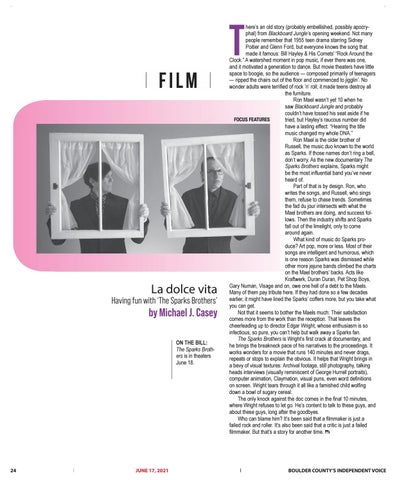
the furniture. Ron Mael wasn’t yet 10 when he saw Blackboard Jungle and probably couldn’t have tossed his seat aside if he tried, but Hayley’s raucous number did have a lasting effect: “Hearing the title music changed my whole DNA.” Ron Mael is the older brother of Russell, the music duo known to the world as Sparks. If those names don’t ring a bell, don’t worry. As the new documentary The Sparks Brothers explains, Sparks might heard of. Part of that is by design. Ron, who writes the songs, and Russell, who sings them, refuse to chase trends. Sometimes Mael brothers are doing, and success follows. Then the industry shifts and Sparks fall out of the limelight, only to come around again. What kind of music do Sparks produce? Art pop, more or less. Most of their songs are intelligent and humorous, which is one reason Sparks was dismissed while
La dolce vita
Having fun with ‘The Sparks Brothers’
by Michael J. Casey ON THE BILL: The Sparks Brothers is in theaters June 18.
on the Mael brothers’ backs. Acts like Kraftwerk, Duran Duran, Pet Shop Boys, Gary Numan, Visage and on, owe one hell of a debt to the Maels. Many of them pay tribute here. If they had done so a few decades earlier, it might have lined the Sparks’ coffers more, but you take what you can get. Not that it seems to bother the Maels much: Their satisfaction comes more from the work than the reception. That leaves the cheerleading up to director Edgar Wright, whose enthusiasm is so infectious, so pure, you can’t help but walk away a Sparks fan. The Sparks Brothers he brings the breakneck pace of his narratives to the proceedings. It works wonders for a movie that runs 140 minutes and never drags, repeats or stops to explain the obvious. It helps that Wright brings in a bevy of visual textures: Archival footage, still photography, talking heads interviews (visually reminiscent of George Hurrell portraits), down a bowl of sugary cereal. where Wright refuses to let go. He’s content to talk to these guys, and about these guys, long after the goodbyes.
24
l
JUNE 17, 2021
l
BOULDER COUNTY’S INDEPENDENT VOICE