In its context: Time and Place Alberti’s Sant’ Andrea is focused on divine and human proportions and thus works as a Renaissance model. Alberti aspired to an architecture of pure form. Sant’ Andrea is ordered as a Latin cross plan containing a long nave, transept extending from both sides of the crossing, and a choir area. In De re aedificatoria, Alberti discusses the full program of the ideal church of the Renaissance. The desirable shape of a temple—synonymous for church, begins with pure geometrical figures. This pureness is especially seen in the circle, as “nature enjoys the round form above all others,” and aspires to absolute perfection. Renaissance churches are generally inspired by classical structures. Emperor Constantine’s Rome attracted Alberti by the “pagan antiquity [that] was blended with the spirit of faith and purity of the early Church” (Wittkower 35). The basilica (a seat of jurisdiction in antiquity) was considered to be closely related to the temple. Proportions are the key to the law of harmony as this type of harmony represents absolute perfection, independent of subjective or transitory perception (Wittkower 9). The ‘Model Basilica’ Romans usually enclosed places of public assembly. The Basilica Nova was built at the time of Contantinian rule as a municipal building that housed the statues of Constantine, situated between the Forum and the Colosseum. It is one of the largest cross vault and barrel vault structures in Ancient Rome spanning 350 feet in length and 200 feet in width. It consists of three large halls, a central nave, two aisles (of equal width), apses and arches between grand vaults. The austere forms of columns with straight entablature were common for use in both theaters and basilicas (Dowden 70-4). The Arch and vault — Construction (stability) Unlike all previous basilicas, Basilica de Maxen-
12 ELISAVETA BOULATOVA
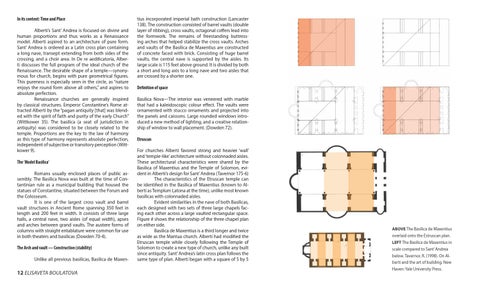
tius incorporated imperial bath construction (Lancaster 138). The construction consisted of barrel vaults (double layer of ribbing), cross vaults, octagonal coffers lead into the formwork. The remains of freestanding buttressing arches that helped stabilize the cross vaults. Arches and vaults of the Basilica de Maxentius are constructed of concrete faced with brick. Consisting of huge barrel vaults, the central nave is supported by the aisles. Its large scale is 115 feet above ground. It is divided by both a short and long axis to a long nave and two aisles that are crossed by a shorter one. Definition of space Basilica Nova—The interior was veneered with marble that had a kaleidoscopic colour effect. The vaults were ornamented with stucco ornaments and projected into the panels and caissons. Large rounded windows introduced a new method of lighting, and a creative relationship of window to wall placement. (Dowden 72). Etruscan For churches Alberti favored strong and heavier ‘wall’ and ‘temple-like’ architecture without colonnaded aisles. These architectural characteristics were shared by the Basilica of Maxentius and the Temple of Solomon, evident in Alberti’s design for Sant’ Andrea (Tavernor 175-6) The characteristics of the Etruscan temple can be identified in the Basilica of Maxentius (known to Alberti as Templum Latona at the time), unlike most known basilicas with colonnaded aisles. Evident similarities in the nave of both Basilicas, each designed with two sets of three large chapels facing each other across a large vaulted rectangular space. FIgure # shows the relationship of the three chapel plan on either side. Basilica de Maxentius is a third longer and twice as wide as the Mantua church. Alberti had modified the Etruscan temple while closely following the Temple of Solomon to create a new type of church, unlike any built since antiquity. Sant’ Andrea’s latin cross plan follows the same type of plan. Alberti began with a square of 5 by 5
ABOVE The Basilica de Maxentius overlaid onto the Estruscan plan. LEFT The Basilica de Maxentius in scale compared to Sant’ Andrea below. Tavernor, R. (1998). On Alberti and the art of building. New Haven: Yale University Press.