Annual Report
For the year ended 31st August 2025


For the year ended 31st August 2025
Reference and Administrative Information
Principal Office and Registered Office:
Third Floor
Charles House
5-11 Regent Street
St James’s
London
SW1Y 4LR
Charity Number: 1177681
Company Number: 11104438
Trustees (who are also the Directors of the Charitable Company)
Rachel Brodie (appointed 19 March 2025)
Mark Byrne (appointed 1 September 2024)
Paul Fletcher
Helen Jones
Philip Neal
Sharon Pindar (resigned 11 August 2025)
Chloe Wright
Patron
Sharon Pindar (appointed 1 August 2025)
Key Management Personnel
Current:
Emily Jack
Francis Smith
Daniel Oliver
Laura Burke
Emily Gibbons
Lauren Landi
Post holders during the period:
Dionne Campbell
Chief Executive Officer
Chief Finance and Operations Officer
Head of Marketing and Communications
Head of Fundraising (on sabbatical 23 September 2025)
Interim Head of Fundraising (joined 23 September 2025)
Head of School Delivery (joined 6 November 2024)
Head of Technology (left 4 April 2025)
Anna Croghan Head of Volunteering (left 22 November 2024)
Professional advisors
Independent Auditors Hazlewoods LLP, Staverton Court, Staverton Cheltenham GL51 0UX
Legal Advisors
Addleshaw Goddard LLP, One St Peter’s Square, Manchester M2 3DE
Bankers Santander, Bootle, Merseyside L30 4GB
Investment Managers Killik & Co, 46 Grosvenor Street, London W1K 3HN
This has been a landmark year for us here at Bookmark. Together, we have demonstrated what is possible when ambition, innovation and commitment come together.
From helping more children through our programmes, to being recognised nationally for our impact, we are firmly on course to transform literacy for hundreds of thousands of young people. We are pleased to announce 180,979 children have been supported this year through our programmes –a 92% increase year on year.
We are especially proud to have welcomed Sharon Pindar, our Founder, as Bookmark’s first Patron. Sharon’s move from Chair to Patron reflects both the strength of our organisation and her continuing belief in the importance of our mission. It also marks an important moment of maturity for us as we continue to grow.
Our achievements this year speak volumes. An incredible 96% of teachers noticed an increase in reading confidence among children in our One-to-one Reading Programme. In addition we distributed the millionth copy of The Story Corner magazine and delivered high-quality CPD training for teachers in partnership with Wandle Learning Trust. Our School Network Programme is now running in 78 schools, and we have rolled out new, innovative initiatives to inspire reluctant readers.
Building on this momentum, we will soon launch a Key Stage 1 book club in addition to our existing Comic Book Club and Fact Finding Club for Key Stage 2.

We are pleased to announce
180,979 children have been supported this year
We also expanded our Story Starter Programme, reaching 3,970 children across 84 schools. By combining the energy of corporate partners with the efficiency of fulfilment partners, we increased our impact in creative and cost-effective ways. Our Literacy Partner Programme also continues to deliver world-class results, achieving excellent Net Promoter Scores (NPS) of 96 and 98 from our schools. Independent evaluation by ImpactEd also found that our One-to-one Reading Programme makes measurable, positive differences for children, particularly those eligible for Pupil Premium or with Special Educational Needs (SEN).
This recognition has been mirrored externally. We secured national media coverage across BBC Breakfast, BBC Radio, ITV and GB News and were awarded Bank of America’s Charity of the Year, selected from more than 700 organisations. These validations are not only a testament to our work, but also vital in an environment where funders rightly expect clear, proven impact.
We partnered with 399 unique schools this year through our 10 literacy programmes.
Of course, the year was not without challenges. A national shortage of volunteers – with numbers having halved since 2018 according to NCVO – has placed real pressure on charities like ours. At the same time, financial pressures in schools continue to stretch resources, making it harder for them to provide the support children need. At Bookmark, we have responded with resilience and creativity: introducing Session Delivery Executives to ease the strain on volunteers, embedding smarter business planning and making data-driven decisions through new Power BI dashboards. These steps are helping us to adapt without losing sight of our mission.
We are also proud of the new ideas that flourished this year. Our new online quiz platform Kahoot! is enabling us to share free reading content with children at home and at school, while The Reading Room – our online community for volunteers – is building connection and engagement to aid us with retention. With school participation now at a record 95% active engagement, and with strong governance from our trustees and leadership across our teams, we are better placed than ever to deliver at scale.
Looking ahead, we remain united in our purpose and confident in our direction. Our goal for our threeyear strategy is clear: 500,000 children will benefit from our work by July 2027. Achieving this will require not only continued innovation but also resilience in the face of ongoing challenges. The progress we have made this year shows that we are more than capable of rising to this task.
Finally, we want to thank everyone who has made this possible – our staff, volunteers, schools, partners, donors and trustees. It is through your collective effort that we are changing life stories, one child at a time.
Together, we are building a future where every child can read.


We want every child to read.
We improve children’s literacy by promoting a reading for pleasure culture in primary schools, with a focus on supporting children in the most disadvantaged communities.

▶ We care deeply about what we do; it is our driving force.
▶ We believe in the potential of all children and the power of communities to support them.
▶ We fuel our work with optimism and a positive energy, supporting each other through challenges and celebrating our achievements.

▶ We are trusted to always keep safeguarding at the heart of what we do.
▶ We are honest and open within our teams and across our communities.
▶ We are professional and hold the highest expectations of ourselves and one another.

▶ We are interested and constantly learning so that we can adapt to improve the support we provide.
▶ We ask questions and contribute outside of our specialties to develop great ideas.
▶ We have the courage to challenge the norm in search of a better alternative.

▶ We work hard – and smart – to fulfil our promises and make an impact.
▶ We are proud of what we have achieved and we know there is always more to do.
▶ We each play an important role in Bookmark’s story and consider how our actions impact the charity’s vision.

We are a team
▶ We work together with our volunteers, schools, partners and supporters.
▶ We embrace diversity and celebrate differing perspectives and backgrounds.
▶ We listen well and communicate clearly to seek understanding and achieve better outcomes.
The Trustees of Bookmark Reading Charity have pleasure in presenting their report and financial statements for the year ended 31 August 2025.

The financial statements comply with the Charities Act 2011, the Companies Act 2006, the Memorandum and Articles of Association, and Accounting and Reporting by Charities: Statement of Recommended Practice applicable to charities preparing their financial statements in accordance with the Financial Reporting Standard applicable in the UK and Republic of Ireland (Charities SORP (FRS 102)).
At the heart of our mission is a simple yet powerful vision: we want every child to read. Since our beginning in 2018, we have been dedicated to addressing the literacy gap that means more than one in four children leave primary school without adequate reading skills.
Building on our success over seven years, we are now deepening our impact by fostering a love of reading among more children.
We have now delivered the first year of our ambitious new strategy, launched at the start of this financial year: to partner with 1,000 schools, with 500,000 children benefitting from a Bookmark literacy programme by 2027.
Our strategy explains how we will improve children’s literacy by promoting a reading for pleasure culture in primary schools, with a focus on prioritising children in disadvantaged communities, where the barriers to reading are greatest.


We will achieve our mission by implementing the following five pathways to reading:





This work will be underpinned by our 10 literacy programmes:
Children need us now more than ever

We have big ambitions to expand our reach and increase our depth of support for children in the most disadvantaged communities. Over the course of the next three years, we aim to have benefited 500,000 children across 1,000 schools by improving reading levels and engagement on both a one-toone and whole school level.
During the academic year 2024/25, we have embarked on the delivery of our ambitious three-year strategy.
We partnered with 399 schools this year through our 10 literacy programmes, with 180,979 children benefitting from one of our programmes.
We delivered:
40,239
one-to-one reading sessions

Here’s the progress we’ve made against our 2024-27 strategic aims:
One-to-one Reading Programme
Number of sessions
3,970 Story Starter Packs to 84 schools
70,329 high-quality, diverse books 132
Your Story Corner packs to schools in Derbyshire, Rochdale and Hull
563,256 copies of The Story Corner magazine 147 Book clubs

Before you, we had an uninspiring bunch of books. Thanks to you and your team, we now have lots and lots of inspiring and expressive books!”
Judith*, a child at a Bookmark partner school
Your Story Corner Programme
Number of schools
Story Starter Programme Number of packs
Literacy Partner Programme Number of new LPP schools The
Corner magazine
of
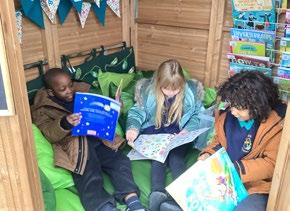
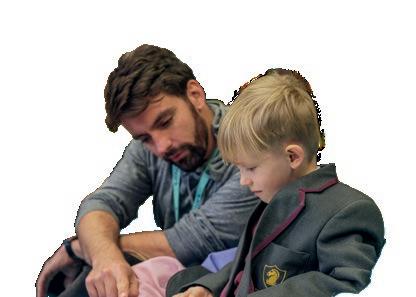
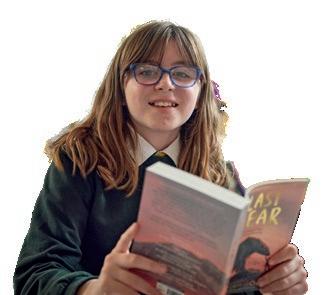
*Children’s names have been altered to protect their anonymity, and the photos used depict different children for the same purpose.
School Network Programme
of schools
Grants and Support Programme
We partner with schools to develop wholeschool reading cultures. Schools join us through a number of our literacy programmes and transition through programmes that best support their needs.
We align our support to our eligibility criteria, which prioritises schools that are:
• Below the national average for KS2 reading results.
• Above the national average for Pupil Premium % and the Income Deprivation Affecting Index (IDACI).

This year, we have partnered with 399 unique schools across the following programmes:
Schools delivered our One-to-one Reading Programme
Schools were supported through our Literacy Partner Programme
Bookmark has made a massive difference to the way the children view themselves as readers, they are now more positive and confident about their own reading abilities.”
Schools developed their whole-school reading cultures through our School Network Programme

Schools received our Story Starter Programme to engage new joiners ahead of the summer holidays

Schools started their Bookmark journey with a Your Story Corner Programme*
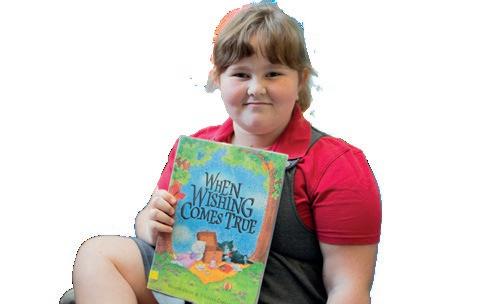
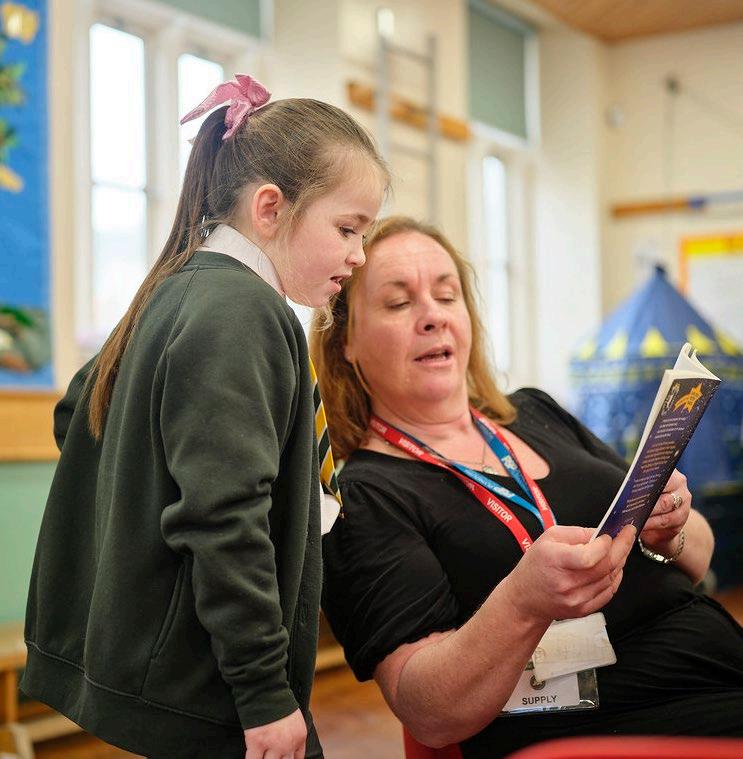
The delivery of our One-to-one Reading Programme would not be possible without the support of our volunteer community. Our volunteers deliver one-to-one sessions with children across our partner schools on a weekly basis, bringing fun and enjoyment to reading for children who would otherwise go without.
Our volunteers are split into three groups:
• Our core volunteering offer, where volunteers read twice a week for 30 minutes with a child.
• Our corporate volunteers, who read once a week for 30 minutes.
• Our Reading Mentors, volunteers aged 14 to 17, who act as reading role models, reading with a child for 30 minutes on a weekly basis.
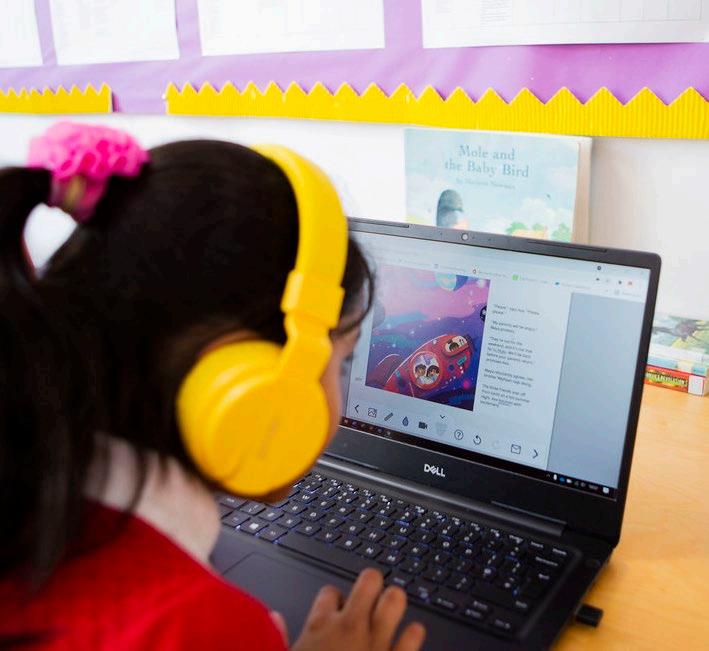
All volunteers are able to deliver sessions online or face-to-face, with the majority delivering these online through our reading platform, hosted by VEDAMO.
I’ve
been volunteering with Bookmark for a few years and find them an excellent organisation. The resources are great and the arrangements are clear. That means all volunteering time is spent directly supporting the reader. This is very unusual in volunteering, and is a very fulfilling experience for the volunteer, and I think for the reader too.”
Throughout this year, we have continued to develop our volunteer engagement and retention activity. We created a new volunteer ambassador role to support volunteers who are starting out with us. Our volunteer ambassadors are in turn each supported by a dedicated regional ambassador. Before the start of the summer holidays, we launched our new community engagement platform, The Reading Room, where volunteers can engage with staff and, importantly, each other. The ability to share experiences with others in the community has been vital in delivering peer-to-peer support.
Following this launch, we hosted a volunteer summer school, where volunteers had the opportunity to hear from both internal and external speakers about the work being undertaken by Bookmark and the broader literacy landscape.
During this year, we have reviewed the size of our volunteer community, providing some volunteers with the ability to join our alumni group if they need to take a step back from actively volunteering with us. This change has allowed us to better understand our community and deliver more for the children who need dedicated support the most.
Number of Volunteers
We are grateful for the time donated by our volunteers. Their generosity has meant more than 2,000 children have enjoyed a Bookmark reading programme in the past academic year.
We continue to attract new volunteers, using a mixture of digital marketing, targeted advertising campaigns, PR and word of mouth referrals from current volunteers.
This year, we supported 1,752 (2024: 1,842) children with at least one full reading programme of at least six sessions, while 2,242 (2024: 2,056) pupils received at least one reading session. We delivered this support through 40,239 (2024: 43,779) reading sessions, which is more than 20,000 hours of one-to-one reading support, equivalent to more than 830 days of continuous reading.
On average, children who we supported this year received 21 (2024: 22) sessions. Despite an 8% reduction in the number of sessions delivered, we only saw a 5% reduction in the number of children supported with at least one programme, reflecting the slight decrease in the average number of sessions they received.
We are happy that the number of sessions remains consistently high at 21, which reflects the view among schools that many pupils require multiple programmes to support their reading development. Following our study with ImpactEd, which was released at the start of this academic year, we know that a minimum of six reading sessions leads to impactful change for children on the One-to-one Reading Programme.


We carry out assessments that give a scaled score. Several children made significant progress in these assessments. In two cases, this time last year the children were significantly below the expected standard with scaled scores of 89 and 92. However, they both reached the expected standard this year with a scaled score of 101. We had another child who had a scaled score of 80 last year, which is the lowest scaled score possible. He ended up with a scaled score of 99 this year and so he was one mark below reaching the expected standard.”
A teacher in a partner school
23,870
40,239
40,100
43,779
Our three-year strategy is focused on five pathways to reading:
• One-to-one reading support and positive role models.
• Engaging reading spaces and high-quality, diverse reading resources.
• Teacher training and resources.
• Creating a reading buzz across the school.
• Family and parental engagement.
These pathways are underpinned by our 10 literacy programmes.
We create engaging reading spaces with high-quality reading resources. This includes 200 new books, teacher CPD resources and engaging materials. These spaces foster an environment for children to become confident young readers and inspire a lifelong love of reading.
The Your Story Corner Programme is rebranding to Roots to Reading from 1 January 2026 to reflect the development opportunities from this expanded programme.
This year, we expanded our Your Story Corner programme into three new areas:
I am writing to you today because I want to thank you. To thank you for all your book donations. I want to express my gratitude towards you. I think you are kind, lovely, and have a warm heart. All the books you donated changed me into a person who loves books.”
Mayank*, a child at a Bookmark partner school
Derby and Derbyshire 80 schools / 16,000 books
In total, we’ve supported 132 schools towards our target of 500 schools by 2027.
Following an in-depth literacy consultation, we provide a detailed and tailored action plan to each school to help them deliver improvements in whole-school reading cultures. This action plan is accompanied by targeted funding of up to £10,000 per school. Our Literacy Partner Programme is also an incubator for developing and evaluating new service lines. This gives us the opportunity to test different ways of embedding a whole-school reading culture in a school. Once new service lines have been tested on a small scale, and an effective impact has been seen, these service lines can be offered as part of one or more of our programmes.
We are partnering with 90 schools on our Literacy Partner Programme. In January 2025, we welcomed 50 new schools to the cohort, joining 40 schools from our first cohort. We have provided over 30,000 books to Literacy Partner Programme schools and over 65,000 magazines this year alone!
This year we’ve delivered hundreds of service lines, including:
• 51 planned author visits, engaging pupils with their reading.
• 85 schools received library furniture, transforming outside, inside or cosy corners into spaces for children to engage with reading.
• 142 book clubs, across our Comic Book and Fact Finding Clubs.
• 64 nighttime story walks, aimed at KS2 children.
• 43 fully funded book fairs, so that every child can choose and own a book.

I don’t normally get a book from the book fair. It was a real treat to be able to get a new book because I really love reading.”
Henry*, a child at a Bookmark
partner school


Our early years provision includes packs with resources for children aged four to five. This is to help ignite the joy of reading from an early age and equip children with resources before starting at one of our partner schools. These packs have been created by following the government’s non-statutory curriculum guidance for the Early Years Foundation Stage. They include a book, an early years version of our The Story Corner magazine, stationery, storytelling props and family engagement resources to inspire reading enjoyment at home and in the classroom. We want all children to start school with the resources they need to set them up for success.
This year 84 schools were provided with our Story Starter Programme. Ahead of the summer holidays, 3,970 children, up from 1,445 in the prior year, received a Story Starter bag which will have been taken home to use over the summer break.
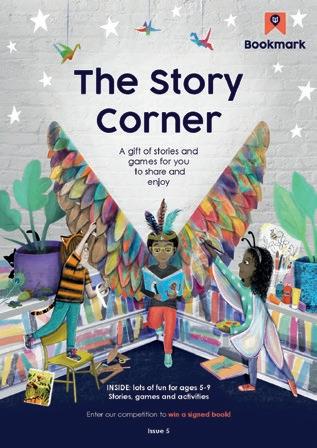
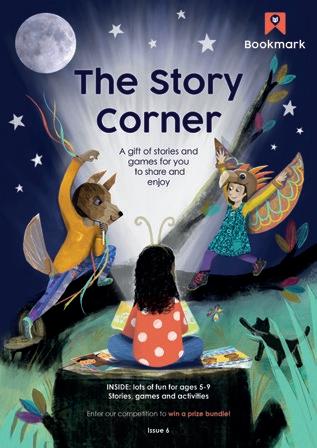
Our termly magazine provides high-quality reading materials for children to take home. The magazine is designed for and distributed to children who may not have a book at home to prevent learning loss outside school settings. It is distributed through schools and community settings, including food banks, warm banks, prisons, hospitals and refuges.
This year we celebrated printing and distributing our 1,000,000th copy. We distributed more than 559,000 magazines, an increase of 115,000 copies (+26%) on last year. Magazines we sent out included:
• Standard copies, issue 11-13
• Our Graphic Novel edition
• Our Early Years edition
Schools are sent termly packs of new, highquality and diverse books. Each of these packs is centred on a different theme, focusing on the type of books we know are often missing from school libraries (i.e. graphic novels, poetry, nonfiction). We invite a different figure or organisation, well known in the education or literacy space, to curate these book packs. The packs are sent out with our scrapbooks as part of a whole-school reading challenge to help with embedding a rich reading culture.
This year we sent 603 packs, a 56% increase from 385 in the prior academic year, distributing over 12,000 books. If these books were placed end-toend this would stretch 22 football pitches. This year, the themes included:
• The Wonders of Nature
• Animals
• World Building
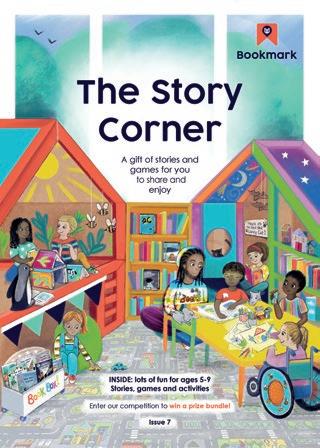
This year we celebrated printing and distributing our 1,000,000th copy of The Story Corner magazine
We distributed over 12,000 books. If these were placed end-to-end this would stretch across 22 football pitches
School Network Programme
This programme is designed to build on the foundations of the Your Story Corner initiative by providing sustainable ongoing support to schools. This is to continue the improvement of whole-school reading cultures. Each school within the network benefits from up to £1,000 of resources per year, plus access to resources and training developed by us. The programme will provide networking opportunities for teachers and literacy leads to collaborate and share best practice.

To build on the success of our Your Story Corner programme we launched the School Network Programme with 78 schools across Birmingham, Nottingham, Medway and Lincolnshire. We distributed nearly 4,000 books and more than 55,000 magazines alongside:
A Scrapbook Challenge to engage classrooms across the school.
Teacher CPD suggestions for literacy leads to engage with.
Access to author visits.
Reading for Pleasure and Oracy training, in partnership with the Wandle Learning Trust.
We delivered 147 of our book clubs this year across our schools
Grants and Support Programme
We provide schools with CPD grants and access to memberships with third-party organisations to assist them with embedding a whole-school reading culture. We also run webinars, distribute videos and provide other resources to help with teacher training.
We offered 44 grants across our partner schools this year to support teacher CPD and wholeschool reading culture initiatives. The grants will support literacy projects at the start of the new academic year. We sent 229 CPD books to schools to provide additional support for literacy leads.
In total, 111 teachers attended CPD events this year, spanning internal and external training sessions focused on Reading for Pleasure and Oracy.
3,600 children have access to a book club. That’s nearly enough children to fill the London Aquatics Centre
We are developing a range of book clubs to engage reluctant readers. Schools are provided with mini libraries in each genre, plus additional resources to spark a reading buzz. We provide a plan for 10 book club sessions so that teachers have a clear understanding of the outcome for each session. The book clubs have been designed to run termly.
We delivered 147 of our book clubs this year across our schools, up from 13 last year. This was spread across our Comic Book and Fact Finding Clubs and meant 3,600 children have access to a book club. That’s nearly enough children to fill the London Aquatics Centre.


In the upcoming year, we’re launching our new book club, The Page Explorers Club, a new picture book club aimed at younger, KS1 children.
We understand the challenges that many schools face with family engagement. We provide support in disadvantaged communities by distributing home resources and video content to empower family members to support their child’s reading for pleasure and become reading champions at home. We build strategic collaborations to enhance our work and amplify other organisations’ work in this area.
Through the Literacy Partner Programme, we have provided 15,937 families with access to literacy support.
This has included:
• 50 parental café packs, sent to schools to help them develop and improve parental engagement.
• Our Story Starter Programme, shared with 3,970 children, had step-by-step parental guidance videos included in the pack.
• We launched our Kahoot! platform to allow children and families to engage with specially developed readalong stories, games and quizzes. Launched in March, we have received more than 700 individual game plays to the end of the academic year, with over 1,300 participants.
As we enter the second year of our strategy, we will continue to deliver our 10 literacy programmes. Each programme contributes towards our five pathways to deliver our impact. As a team, we will:
Deliver more than
59,000
one-to-one reading sessions in our partner schools.
Welcome 50 more schools into the third cohort for the Literacy Partner Programme, while our first cohort will complete their two-year implementation period. We’ll provide more than 24,000 families with literacy support.
Print and distribute more than
750,000 copies of The Story Corner magazine to school and community-based settings across three new issues and our Graphic Novel and Early Years editions.
Distribute more than
150 of our book clubs, over 600 new themed Rocket Packs and more than 75 grants for schools to spend on CPD or to develop whole-school reading cultures.
Provide another 4,000
Story Starter Packs to children joining Reception in September next year on their transition days.
Support
180



schools with reading space provision through our Your Story Corner Programme, transitioning to its new name Roots to Reading. We are expanding into Oldham, South East London and Cheshire/Merseyside over the next academic year.
Ask
220
schools to join our School Network Programme, where they’ll access high-quality and diverse resources, CPD and networking opportunities.
Each of these activities will bring us closer to achieving our strategic ambition to partner with 1,000 schools and help
500,000
children to benefit from one of our literacy programmes.
At Bookmark, we support schools to develop a whole-school reading culture. We work with schools to support the children who need targeted support. We are committed to improving children’s attitudes towards reading (including reading confidence, enjoyment and motivation) with the aim that this will lead to improvements in their reading attainment.
Vital to achieving this is making sure that our programmes are based on data and research so that we can have the maximum impact. Our reading programme was designed using evidence-based recommendations from the Education Endowment Foundation, The Open University and the National Literacy Trust. Every year, we evaluate our impact in our Impact Report. This is available at the start of the calendar year following the end of the most recent academic year. The latest full report is available here.
Many children leave primary school with poor reading skills which directly contributes to poor educational attainment, lower literacy in adulthood and barriers to success in life.
Many children do not have opportunities for one-to-one reading or reading role models. Less able readers have fewer opportunities to improve their reading. Many children do not enjoy reading. Many children do not own their own book or have access to a library. Many children struggle to see themselves in what they read.
Schools have limited resources and support to develop reading for pleasure and wholeschool reading culture.
Our team – with strong expertise and experience of partnering with schools to develop offerings that are informed by data-driven insights, a strong evidence base, ongoing evaluation and impact measurement.
Our volunteers – who are enthusiastic, trained and supported by Bookmark to volunteer online and in-person.
Our technology – which is utilised to support effective and responsive programme booking and delivery, including via an online reading platform.
Our resources – curated, high-quality, and diverse books and reading resources.
Our training – CPD for teachers and support for family engagement.
Our reading programme, in which trained Bookmark volunteers deliver one-to-one reading sessions to children aged 5-10.
Curation and delivery of new, high-quality and diverse books and reading resources, including our own termly The Story Corner magazine, which enhance reading spaces in schools.
Provision of grants, literacy consultancy and training resources, with a focus on facilitating teacher training and access to CPD.
Organisation of events, such as book clubs and author visits, with a focus on schools to generate a buzz around reading.
Collaborating with schools to promote family and parental engagement.
Children attend reading sessions with a volunteer, engaging in one-to-one reading support.
Children and schools have brand new, diverse, high-quality books and reading resources, including The Story Corner magazine.
Schools access grants, literacy consultancy support and training resources to support reading for pleasure and build whole-school reading cultures.
Schools improve their one-to-one reading support and children connect with positive role models.
Schools improve their reading resources and reading spaces to encourage children’s reading for pleasure
Schools have access to quality teacher training and resources, which improve their approach to reading for pleasure.
Schools generate a buzz around reading.
Schools improve parental and family engagement with reading.
More children leave primary school having discovered the joy of reading, which better sets them up for success.
This year, Bookmark’s internal evaluation of our core programme continued to collect and analyse:
• The impact of the programme on children’s reading confidence, enjoyment, motivation, fluency and skills.
• Reading attainment data to assess improvements in reading levels of children who received Bookmark support.
• School and volunteer experiences with Bookmark.
We’re delighted to share that:
100% of surveyed teachers felt that the One-toone Reading Programme provided children with the opportunity to discover the joy of reading.
49%
of children who took part in the One-to-one Reading Programme were assessed as performing more positively against expected reading standards. This doesn’t just mean they made progress in reading, it means their rate of progress was stronger than typically expected, shifting how they are performing in relation to national benchmarks.
Almost all children on the programme made at least age-expected progress, with 96% either maintaining or improving their performance. For the 49% who improved, this reflects a more positive than expected trajectory, one that suggests accelerated progress.
Some of the children have made significant improvements in their reading confidence, largely thanks to the one-to-one support they receive – around 50 minutes a week through the programme. This dedicated time has really helped them feel more comfortable reading aloud, particularly during guided reading sessions with the whole class.”
A teacher in a partner school

86% of teachers noticed an increase in the reading skills of pupils on the One-to-one Reading Programme.
94% of teachers reported that the Your Story Corner Programme inspired them to develop their school’s reading for pleasure provision, their reading spaces or their wider whole-school reading culture.
Our Literacy Partner Programme has received an NPS of
85 & 96 across cohort 1 and cohort 2.

We have been communicating evaluation findings as concise, termly updates internally at Bookmark. This has ensured continuous improvement actions were identified and acted on as early as possible throughout the year.
We continue to evaluate each of our literacy programmes, to understand how they support the delivery of our five pathways.
This year, we concluded our study into the effectiveness of our Oneto-one Reading Programme. We commissioned ImpactEd to conduct a year-long study in partnership with our Impact and Evaluation team.
This assessed the reading progress of 265 pupils across 18 partner schools throughout the 2023/24 academic year. The study compared the performance of participating pupils, tracking changes in standardised reading scores*. The study evidenced that:
• Bookmark pupils’ average standardised reading scores increased from 91.2 to 97 over the 2023/24 academic year, exceeding expected progress by achieving an average increase of 5.8, and becoming much closer to the national average of 100.
• The programme makes a particular impact on disadvantaged children. Children eligible for Pupil Premium benefitted even more than their peers, with average scores increasing by 6.7, reducing the gap from 2.1 points to just 0.8. This demonstrates how Bookmark’s intervention is narrowing the gap between disadvantaged children and their peers.
• Pupils with special educational needs (SEN) also benefitted. SEN children gained 6.7 points on average, compared to 5.4 points for pupils without SEN.
• Progress was made across all groups. Regardless of gender, year group or first language, all pupils across the programme made notable progress.

The Literacy Partner Programme has significantly enhanced our school’s whole-school reading culture. One of the most notable improvements has been the dramatic elevation in the quality of the books available to our students. Access to diverse and engaging literature has undeniably revitalised our reading initiatives. Furthermore, the programme has provided invaluable resources for our Comic Book Club, fostering a love for reading among reluctant readers and enabling them to engage with texts in a dynamic manner.
*Standardised reading scores indicate how a pupil is performing in relation to where they are expected to be and are calculated so that progress over time is accounted for. This means that any increase in standardised reading score is an indication a pupil has made more progress than would be expected. A score of 100 indicates that a child is reading in line with the national average for their age.

Additionally, we have been able to enhance our reading spaces throughout the school, creating inviting areas that encourage students to immerse themselves in literature. These transformations have collectively contributed to a more vibrant reading culture, promoting not only literacy skills but also a genuine enthusiasm for reading among our students.”
Quote from a teacher in our Literacy Partner Programme
In January 2025, we launched our evaluation framework for closing the gap in how reading programmes are evaluated. We worked with Yaspia Salema, Lecturer in Education at University College London and Chapter One, to better understand how we can bring the voices of children into our work. Together we examined children’s reading attitudes and behaviours and developed a creative approach that puts children at the heart of our evaluation process.
We developed a two-step qualitative methodology that combines creativity, exploration and genuine participation with the goal of developing case studies about individual children. We are in the process of using this methodology and will be sharing our findings during this academic year.
The Literacy Partner Programme aims to support schools to develop whole-school reading cultures in order to foster a love of reading and improve literacy outcomes for children. This year, we have developed our monitoring and evaluation framework to understand how the service lines in our Literacy Partner Programme delivery lead to our expected outcomes. Tied to the start of our first cohort of schools in June 2024, we are looking forward to evaluating the impact when those schools complete their initial two-year period of implementation in June 2026.
We are actively exploring the relationship between Bookmark’s literacy programmes and KS2 reading attainment through a comprehensive, ongoing impact analysis project. By analysing a combination of national and internal data across all our literacy programmes, we are building a robust understanding of our contribution to school-level outcomes. We have completed the first iteration of this analysis. We know that seeing improvements in KS2 attainment will be a long-term outcome of our three-year strategy to support schools’ whole-school reading cultures. Though this data is reflective of Bookmark’s journey before the implementation of the strategy, schools supported under our needsbased criteria are showing promising trends.
We will continue to monitor and evaluate this data over time to inform our approach and ensure we are delivering meaningful, measurable change for the children who need us most.
A teacher who used pupil data to identify the group of children who would benefit most from the Comic Book Club explained: “I targeted our white British boys from years three and four because when looking at the data, we found that those were the children that seem to struggle with their reading the most. And not really engage. We actually did have some feedback from one of the children who said that literally the reason why he loves reading so much now is because of the Comic Book Club and he’s there every week. So that has been really successful.”
A teacher in a partner school
The change we want to make
• A positive impact on pupils’ reading attitudes, behaviours and skills.
• A positive impact on pupils’ reading attainment.
• A positive impact on whole-school reading culture.
• Changes in pupils’ reading attainment pre- and post-intervention.
• Changes in pupils’ reading attitudes, behaviours and skills.
• Changes in whole-school reading culture.
• School and volunteer experience of Bookmark.
• Programme outputs (e.g. the number of pupils supported).
• The long-term impact of Bookmark’s support in our partner schools.
• Pupil reading attainment data pre- and post-intervention.
• Changes in pupils’ reading attitudes, behaviours and skills as reported by teachers and volunteers in post-delivery surveys, case studies, interviews and focus groups.
• Improvements in whole-school reading culture as reported by teachers in pre- and post-delivery surveys, case studies, interviews and school observations. Experience of Bookmark as reported by teachers and volunteers in post-delivery surveys.
• Programme outputs as recorded by internal reporting systems (e.g. Salesforce).
• Reviewing publicly available KS2 reading data to consider changes in attainment within our partner school network.
• Piloting data collection methods to gather perspectives from senior staff, parents and children.
we will use what we learn
• Measure our impact and define the extent to which our activities meet our programme aims.
• Identify actions for continuous improvement that refine our programme delivery and ensure a more positive experience for schools and volunteers.
• Assess our progress towards strategic goals and confirm that our internal evidence supports the continued direction of travel.
• Understand the scope of our internal evaluation and any limitations to the current evaluation framework that need to be addressed.
• Inform programme design with evidence to deliver the most meaningful impact for children.
How we will communicate what we learn
• Our annual Impact Report, which is published each year, will evidence our impact, learnings and progress.
• We will continue to provide timely internal updates to promote continuous improvement actions and guide strategic decision-making.
The Trustees confirm that they have complied with the duty in section 4 of the Charities Act 2011 to have due regard to the Charity Commission’s general guidance on public benefit when reviewing our strategic aims and in planning the activities of the Charity. The Trustees have satisfied themselves that Bookmark meets the public benefits requirements, in particular:
• The objectives of the Charity are clear –Bookmark was set up to advance the education of children in the United Kingdom, in particular by promoting and supporting the development of literacy.
• The aims and activities of the Charity are directly related to its objective, as set out in this report.
• The people who receive support are entitled to do so according to the criteria set out in the Charity’s objectives – all of Bookmark’s work is focused on children in the UK who require additional reading support.

Bookmark’s total income decreased to £4.1m from £7.1m, returning to levels seen prior to 2023/24. In the prior year, we accrued a significant philanthropic gift which has been committed over the next five years. We have started releasing this in line with the Trustee designation, reducing the accrual by £500,000 this year.
Total expenditure of £4.2m was £0.2m higher than the previous year’s expenditure of £4.0m. The increase in expenditure is attributed to the expansion of our literacy programmes during the financial year.
We finished the year with a deficit of £0.1m and reserves of £5.0m. The deficit was delivered as we begin to draw down on the designated fund, which the Trustees designated in the prior year, to support the expansion of our literacy programmes under our three-year strategy. The closing balance of the Literacy Programme fund is £2.0m. The charity holds £0.4m as restricted reserves for programmatic activity in the upcoming academic year and a Fixed Asset designated fund of £nil. The remainder of our free reserves, £2.6m, is held to underpin our operations for the coming year and represents seven and a half months of our operational spend for the budgeted 2025/26 year.
This is within our reserves policy of 25% above or below six months forecast expenditure. We enter the year at the upper end of this limit as we plan to make commitments to new schools joining our School Network Programme, a year-long commitment, at the start of the academic year.
Our trading subsidiary, Bookmark Reading Trading Limited, produced a surplus of £29,773, which was recognised as income within the charity. Further information is included in Note 12.
A strategic priority of the fundraising team is to continue to grow income from sources beyond the Pindar family network to help to prevent an over-reliance developing on any one set of donors. The generous support from Literacy Capital and the Pindar family represents 44% of our income in the current financial year. We remain confident that the Pindar family and Literacy Capital plc will remain committed, longterm supporters as they care passionately about improving literacy in the UK. Sharon Pindar knows from personal experience how poor literacy can impact a person’s life and that of their family. We are delighted to have welcomed Sharon into her new role as Patron this financial year.
We are hugely thankful for the continued support from all of our donors; their financial support provides the income that enables us to continue our work and to future-proof our organisation to support more children on their reading journeys.
Bookmark Reading Charity is both a registered charity and a company limited by guarantee. It was incorporated as a limited company on 8 December 2017 and registered as a charity on 23 March 2018. The Charity changed its name from Bookmark Reading Limited to Bookmark Reading Charity on 28 January 2018. It is governed by its Memorandum of Association.
The Articles of Association require that there are not less than two and not more than eight Trustees , and at least one Trustee must be a natural person. A Trustee may hold office for a period of three years , and any retiring Trustee who remains qualified may be re-appointed. The Board of Trustees meets quarterly and ensures the Charity is well managed and operating within agreed policies, the law and its budget.
The Trustees have reviewed the Charity Governance Code during the academic year and are using the principles and recommended practice for good governance to effectively manage and control the charity. The Charity is governed by a Board of Trustees, comprising of the following individuals this year:
Rachel Brodie – Chair (appointed Trustee 19 March 2025 and Chair 11 August 2025)
Mark Byrne (appointed 1 September 2024)
Paul Fletcher – Treasurer
Helen Jones
Philip Neal
Sharon Pindar – former Chair (resigned 11 August 2025)
Chloe Wright
The Charity welcomed Sharon Pindar as our first Patron on 1 August 2025.
The Board delegates the day-to-day management of the Charity to the Chief Executive Officer and the Senior Leadership Team.
Bookmark Reading Charity is compliant with the standards set by the Fundraising Regulator in its ‘Code of Fundraising Practice’. We are pleased to make this commitment and feel it gives both our donors and supporters confidence in our fundraising practices. Bookmark’s fundraising team has experience in the Code of Fundraising Practice and associated Rulebooks.
We are mindful during our fundraising activities not to be unreasonably persistent or to apply undue pressure on anyone, or to intrude on anyone’s privacy. The Charity did not undertake any telephone, doorstep or lottery fundraising in the year.
The Charity received no complaints relating to its fundraising activities during the year.
The Trustees consider the Board of Trustees and the Senior Leadership Team to comprise the key management personnel of the Charity, in charge of directing and controlling, running and operating the Charity on a day-to-day basis.
All Trustees give of their time freely and no Trustee received remuneration or was reimbursed expenses in the year. Details of related party transactions are disclosed in note 20 to the accounts. The pay of the Chief Executive Officer and senior staff is reviewed annually based on performance and normally increases in accordance with average earnings.
The remuneration is set to ensure it is both fair but also will attract and retain staff of the appropriate calibre and experience required by the Charity.
At 31 August 2025 Bookmark had a team of 46 individuals (42 FTE). The Charity also had 2,001 vetted and trained volunteers.
In addition to the Charity’s Board of Trustees, Bookmark has established the following boards:
Corporate Partnerships Board
Technology Advisory Group (disbanded during the year)
Volunteer Advisory Board
Marketing Advisory Board
Primary School Advisory Board
Finance and Risk Committee (formerly Audit Committee)
Operations Board
Investment Committee
Responsible for devising and implementing plans to generate income for the Charity from the corporate sector and identifying sources of corporate volunteers.
The primary purpose of the Technology Advisory Group is to advise on how best to apply industry best practices and provide a comprehensive peer review and oversight of our current and future technology developments. They also ensure the Charity receives input from different technology sectors to support, confirm and challenge our decisionmaking and development. The group has been disbanded this year as the charity stablises its technology capabilities to deliver the current strategy.
Responsible for providing feedback, inspiration, challenge, guidance and occasional system testing to ensure Bookmark continues to provide a fulfilling and beneficial volunteer experience.
Responsible for providing strategic input into our marketing and communications strategy, including volunteer and school attraction, digital marketing, brand awareness and PR.
Primary School Advisory Board Responsible for providing feedback, inspiration, challenge and guidance to ensure that Bookmark provides what our customers need, i.e., schools.
The primary purpose is to ensure the integrity of the financial statements, oversee the appointment of the external auditor, oversee internal controls, assess risk/management processes and ensure compliance with standards of business conduct and other legal and regulatory matters.
The board supports exploring Bookmark’s ‘problem statements’ to aid solutions by generating innovative ideas for engaging with operational matters at Bookmark.
The board provides insights into new or innovative ways of working, enhancing Bookmark’s offering. This is to ensure Bookmark is a high-impact literacy charity that is data-driven, technology-led and runs efficiently.
The committee comprises our Chair, Treasurer, Chief Executive and Chief Finance and Operations Officer. This group oversees the Charity’s investments on behalf of the Board of Trustees.
These advisory boards have no delegated authorities, cannot pass resolutions on behalf of the Charity and cannot direct the Senior Leadership Team or other employees of the Charity.
All our staff, volunteers and supporting boards are vital to the work of the Charity , and they have contributed enormously to the success of the organisation and to the services it provides. The Trustees record their sincere appreciation of the contribution from all our staff, volunteers and supporting boards.
We are extremely grateful to the various organisations and individuals who have supported us. We have been provided with management consultancy, legal advice, technology and other incredibly helpful support.
While the Charity has continued to develop a range of income-generating activities to support its charitable activities, Bookmark Reading Charity is heavily reliant on voluntary donations. A significant proportion of this income must be newly generated each year. Bookmark’s donors to date have mainly comprised a small number of significant contributors, including trusts and foundations, major donors and corporate partners. To prevent an overreliance developing on any one set of donors, we plan to continue diversifying our income through engaging new supporters. Our emphasis remains on building long-term sustainable support from corporate donors and major givers.
The Trustees duly consider the uncertainties around funding when setting the Charity’s reserves policy. The Trustees aim to generate reserves that are sufficient to underpin the commitment to the continued growth and development of our services.
In the prior year, the Trustees have created a designated reserve to underpin our long-term commitment to our Literacy Partner Programme. This is shown separately to our free reserves.
The Charity reserves policy states that we aim to have reserves equivalent to ±25% of six month forecast expenditure over the coming 12 months. As at 31 August 2025, we have built up unrestricted, free reserves equivalent to seven and a half months of forecast expenditure and the Trustees are therefore content with this. We enter the year at the upper end of this limit as we plan to make commitments to new schools joining our School Network Programme, a year-long commitment, at the start of the academic year.
The Trustees are pleased to report that the Charity has a robust balance sheet, which will be used to continue to provide services to support its charitable objectives in the UK.



Following NCVO best practice, the risk management process has involved the identification, evaluation and control of risks. Whilst we cannot eliminate all risks entirely (this would be very difficult and not cost effective), we do aim to reduce the risk to a level that the Charity is comfortable with (the risk appetite).
When identifying risks, we assign risk owners and categorise them into the following areas:
• External and impact
• Regulatory and compliance
• Financial sustainability
• Governance
• Operational
• Safeguarding
• Fundraising
We then analyse and score the risks by likelihood (rare, unlikely, possible, probable, certain) and impact (insignificant, minor, moderate, significant, major). These scores are multiplied to give us our initial risk score. We then calculate our target risk score using similar measures to identify our risk appetite.
The Senior Leadership Team records all controls that are in place to mitigate each risk and then calculates the residual risk. If this is higher than the target risk, we identify further initiatives and actions to reduce the risk to an acceptable level.
As well as the work completed by the Senior Leadership Team, risk management and the risk register are discussed at Finance and Risk Committee meetings, where key risks are discussed as well as improvements and suggestions to the processes for risk management are tabled.
The register and a summary of key risks are shared at every Trustee meeting, forming part of a corporate governance and risk standing paper.
The organisation continues to discuss the risk with the delivery of its one-to-one reading sessions with the continued pressure on the number of volunteers required to meet the demand from schools for this programme. The NCVO’s Time Well Spent 2023 report found that the number of volunteers has dropped by 50% since 2018, while Charities Aid Foundation’s 2025 report, stated that one in 10 people said they volunteered in 2024, equivalent to around 5.6 million adults –a decline of about 1.5 million since 2023.
Demand for this programme from schools continues to grow, but the national shortage in volunteers has impacted us. To help deliver the sessions needed to support children at risk of falling behind, we’ve introduced a paid delivery model. Bookmark Session Delivery Executives, with a minimum delivery of 10 hours a week, alongside attraction activity, to cover hard-to-fill sessions running at unpopular times. The pilot will run until July 2027 and supports our goal of reaching 165,000 sessions by 2027, so we can continue expanding our one-to-one support for children across the country.
We continue to review the cost-effectiveness of this delivery model against our current volunteer-delivered sessions. Early indicators in our business planning process show that they are a cost-effective model to meet school demand.
We recognise that our partner schools continue to face financial pressures, impacting staffing resources. In 2024, a survey of 1,282 teachers conducted by The Sutton Trust and National Foundation for Educational Research found that 74% of primary headteachers reported cutting teaching assistants this year. We have noticed this impact in the schools we work with. Unfortunately, 14 partner schools, representing 11% of our school population, experienced staffing issues that negatively affected their ability to deliver the One-to-one Reading Programme. A new ring-fenced grant from 2025/26, administered by Bookmark but delivered by our partner schools, will allow schools to fund a session supervisor, such as extra hours to current staff, a parent or a trusted community member, for a limited number of hours each week.
The Charity Trustees (who are also Directors for the purposes of company law) are responsible for preparing a Trustees’ Annual Report and financial statements in accordance with applicable law and United Kingdom Accounting Standards (United Kingdom Generally Accepted Accounting Practice).
Company law requires the Charity Trustees to prepare financial statements for each year that give a true and fair view of the state of affairs of the Charitable Company and of the incoming resources and application of resources for that year. In preparing the financial statements, the Trustees are required to:
• Select suitable accounting policies and then apply them consistently.
• Observe the methods and principles in the Charities SORP.
• Make judgements and estimates that are reasonable and prudent.
• State whether applicable UK accounting standards have been followed, subject to any material departures disclosed and explained in the financial statements.
• Prepare the financial statements on the going concern basis unless it is inappropriate to presume that the Charity will continue in business.
The Trustees are responsible for keeping proper accounting records that disclose with reasonable accuracy at any time the financial position of the Charity and to enable them to ensure that the financial statements comply with the Companies Act 2006. They are also responsible for safeguarding the assets of the Charity and the group and hence taking reasonable steps for the prevention and detection of fraud and other irregularities.
The Trustees are responsible for the maintenance and integrity of the Charity and financial information included on the Charity’s website.
Each Trustee has taken steps that they ought to have taken as a Trustee in order to make themselves aware of any relevant audit information and to establish that the charity’s auditor is aware of that information. The Trustees confirm that there is no relevant information that they know of and of which they know the Auditor is unaware.
Hazlewoods have been appointed as Auditors for the year ending 31 August 2025 and they have confirmed their willingness to continue in office.
This report has been prepared in accordance with the special provisions for small companies under Part 15 of the Companies Act 2006.
This report was approved by the Trustees on 24 November 2025 and signed on their behalf.
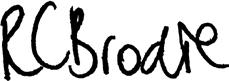
Rachel Brodie Chair of Trustees
Independent Auditors’ report to the Trustees and Members of Bookmark Reading Charity for the year ended 31 August 2025
We have audited the financial statements of Bookmark Reading Charity (the ‘charitable company’) for the year ended 31 August 2025 which comprise the statement of financial activities, balance sheet, statement of cash flows and the related notes to the financial statements, including a summary of significant accounting policies. The financial reporting framework that has been applied in their preparation is applicable law and United Kingdom Accounting Standards, including Financial Reporting Standard 102: The Financial Reporting Standard applicable in the UK and Republic of Ireland (United Kingdom Generally Accepted Accounting Practice).
In our opinion, the financial statements:
• Give a true and fair view of the state of the charitable company’s affairs as at 31 August 2025 and of its incoming resources and application of resources, including its income and expenditure, for the year then ended.
• Have been properly prepared in accordance with United Kingdom Generally Accepted Accounting Practice.
• Have been prepared in accordance with the requirements of the Companies Act 2006.
We conducted our audit in accordance with International Standards on Auditing (UK) (ISAs (UK)) and applicable law. Our responsibilities under those standards are further described in the Auditor’s responsibilities for the audit of the financial statements section of our report. We are independent of the charitable company in accordance with the ethical requirements that are relevant to our audit of the financial statements in the UK, including the FRC’s Ethical Standard, and we have fulfilled our other ethical responsibilities in accordance with these requirements. We believe that the audit evidence we have obtained is sufficient and appropriate to provide a basis for our opinion.
In auditing the financial statements, we have concluded that the Trustees’ use of the going concern basis of accounting in the preparation of the financial statements is appropriate.
Based on the work we have performed, we have not identified any material uncertainties relating to events or conditions that, individually or collectively, may cast significant doubt on the charitable company’s ability to continue as a going concern for a period of at least 12 months
from when the original financial statements were authorised for issue.
Our responsibilities and the responsibilities of the Trustees with respect to going concern are described in the relevant sections of this report.
The Trustees are responsible for the other information. The other information comprises the information included in the annual report other than the financial statements and our auditor’s report thereon. Our opinion on the financial statements does not cover the other information and, except to the extent otherwise explicitly stated in our report, we do not express any form of assurance conclusion thereon.
In connection with our audit of the financial statements, our responsibility is to read the other information and, in doing so, consider whether the other information is materially inconsistent with the financial statements or our knowledge obtained in the audit or otherwise appears to be materially misstated. If we identify such material inconsistencies or apparent material misstatements, we are required to determine whether there is a material misstatement in the financial statements or a material misstatement
of the other information. If, based on the work we have performed, we conclude that there is a material misstatement of this other information, we are required to report that fact.
We have nothing to report in this regard.
In our opinion, based on the work undertaken in the course of the audit:
• The information given in the Trustees’ Report, which includes the Directors’ Report prepared for the purposes of company law for the financial year for which the financial statements are prepared is consistent with the financial statements.
• The Directors’ Report included within the Trustees’ Report has been prepared in accordance with applicable legal requirements.
In the light of the knowledge and understanding of the charitable company and its environment obtained in the course of the audit, we have not identified material misstatements in the Directors ’ Report included in the Trustees’ Report. We have nothing to report in respect of the following matters in relation to which the Companies Act 2006 requires us to report to you if, in our opinion:
• Adequate accounting records have not been kept or returns adequate for our audit have not been received from branches not visited by us.
• The financial statements are not in agreement with the accounting records and returns.
• Certain disclosures of trustees’ remuneration specified by law are not made .
• We have not received all the information and explanations necessary for the purposes of our audit .
As explained more fully in the Trustees’ Responsibilities Statement set out in the Trustees’ Report, the trustees (who are also the directors of the charitable company for the purpose of company law) are responsible for the preparation of the financial statements and for being satisfied that they give a true and fair view, and for such internal control as the trustees determine is necessary to enable the preparation of financial statements that are free from material misstatement, whether due to fraud or error.
In preparing the financial statements, the Trustees are responsible for assessing the charitable company’s ability to continue as a going concern, disclosing, as applicable, matters related to going concern and using the going concern basis of accounting unless the Trustees either intend to liquidate the charity or to cease operations, or have no realistic alternative but to do so.
Our objectives are to obtain reasonable assurance about whether the financial statements as a whole are free from material misstatement, whether due to fraud or error, and to issue an auditor’s report that includes our opinion. Reasonable assurance is a high level of assurance, but is not a guarantee that an audit conducted in accordance with ISAs (UK) will always detect a material misstatement when it exists. Misstatements can arise from fraud or error and are considered material if, individually or in the aggregate, they could reasonably be expected to influence the economic decisions of users taken on the basis of these financial statements.
The extent to which our procedures are capable of detecting irregularities, including fraud is detailed below:
Irregularities, including fraud, are instances of non-compliance with laws and regulations. We design procedures in line with our responsibilities, outlined above, to detect material misstatements in respect of irregularities, including fraud. The extent to which our procedures are capable of detecting irregularities, including fraud is detailed below.
We considered the nature of the charitable company’s industry and its control environment and reviewed the charitable company’s documentation of their policies and procedures relating to fraud and compliance with laws and regulations. We also enquired of management about their own identification and assessment of the risks of irregularities.
We obtained an understanding of the legal and regulatory framework that the charitable company operates in and identified the key laws and regulations that had a direct effect on the determination of material amounts and disclosures in the financial statements, including the UK Companies Act and tax legislation, and, those that do not have a direct effect on the financial statements but compliance with which may be fundamental to the charitable company’s ability to operate or to avoid a material penalty.
We discussed among the audit engagement team regarding the opportunities and incentives that may exist within the organisation for fraud and how and where fraud might occur in the financial statements.
In common with all audits under ISAs (UK), we are also required to perform specific procedures to respond to the risk of management override. In addressing the risk of fraud through management override of controls, we tested the appropriateness of journal entries and other
adjustments; assessed whether the judgments made in accounting estimates are indicative of a potential bias; and evaluated the business rationale of any significant transactions that are unusual or outside the normal course of business.
In addition to the above, our procedures to respond to the risks identified included the following:
• Reviewing financial statement disclosures by testing to supporting documentation to assess compliance with provisions of relevant laws and regulations described as having a direct effect on the financial statements.
• Performing analytical procedures to identify any unusual or unexpected relationships that may indicate risks of material misstatements due to fraud.
• Enquiring of management concerning actual and potential litigation and claims and instances of noncompliance with laws and regulations.
• Reading minutes of meetings of those charged with governance.
Our audit procedures were designed to respond to risks of material misstatement in the financial statements, recognising that the risk of not detecting a material misstatement due to fraud is higher than the risk of not detecting one resulting from error, as fraud may involve deliberate concealment by, for example, forgery, misrepresentations or through collusion. There
are inherent limitations in the audit procedures performed and the further removed noncompliance with laws and regulations is from the events and transactions reflected in the financial statements, the less likely we are to become aware of it.
A further description of our responsibilities is available on the Financial Reporting Council’s website at: www.frc.org.uk/ auditorsresponsibilities. This description forms part of our auditor’s report.
This report is made solely to the charityʼs members, as a body, in accordance with Chapter 3 of Part 16 of the Companies Act 2006. Our audit work has been undertaken so that we might state to the charityʼs members those matters we are required to state to them in an auditorʼs report and for no other purpose.
To the fullest extent permitted by law, we do not accept or assume responsibility to anyone other than the charityʼs members as a body, for our audit work, for this report, or for the opinions we have formed.
Independent Auditors’ Report to the Trustees and Members of Bookmark Reading Charity for the year ended 31 August 2025 (continued)

Scott Lawrence FCA (Senior Statutory Auditor)
For and on behalf of: Hazlewoods LLP
Chartered Accountants and Statutory Auditors
Staverton Court, Staverton Cheltenham, GL51 0UX
Date: 26 November 2025
(Incorporating an income & expenditure account)
All income and expenditure is derived from continuing activities.
All gains and losses recognised in the year are included above.
The notes on pages 37–52 form part of these financial statements.
In approving these financial statements as Trustees of the company, the Trustees acknowledge their responsibility for complying with the requirements of the Act with respect to accounting records and for the preparation of accounts.
These financial statements have been prepared in accordance with the provisions applicable to companies subject to the small companies’ regime.
Approved by the Trustees on 24th November 2025
Rachel Brodie Chair of Trustees
Company Number: 11104438
B. Analysis of the cash and cash
The financial statements have been prepared in accordance with Accounting and Reporting by Charities: Statement of Recommended Practice applicable to charities preparing their financial statements in accordance with the Financial Reporting Standard applicable in the UK and Republic of Ireland (FRS 102) (effective 1 January 2019) – Charities SORP (FRS 102), the Financial Reporting Standard applicable in the UK and Republic of Ireland (FRS 102) and the Companies Act 2006.
Bookmark Reading Charity meets the definition of a public benefit entity under FRS 102. Assets and liabilities are initially recognised at historical cost or transaction value unless otherwise stated in the relevant accounting policy note(s).
These financial statements are prepared under the historical cost convention adopting the following principal accounting policies, all of which are in accordance with Statement of Recommended Practice applicable to charities preparing their financial statements in accordance with the Financial Reporting Standard applicable in the UK and Republic of Ireland (FRS 102) and the Companies Act 2006.
Preparation of the financial statements requires management to make judgements and estimates. The Trustees consider that the only significant area of judgement involved in preparing the financial statements is in relation to the allocation of shared costs between raising funds and charitable activities. The allocation of these costs has been determined by the amount of staff time spent.
The Trustees assess whether the use of going concern is appropriate, i.e. whether there are any material uncertainties related to events or conditions that may cast a significant doubt on the ability of the Charity to continue as a going concern. The Charity has robust controls and measures in place to ensure it closely manages all spend, receives value for money, and has adequate funding in place before entering into future commitments. The Charity uses its CRM system to track all funding opportunities, taking into account stage, probability of success and prudent close dates to calculate its probability weighted income forecast. This information is reflected in a detailed weekly cash forecasting exercise to ensure the Trustees and Senior Leadership Team have adequate oversight of the Charity’s projected cash position.
The Trustees make this assessment in respect of one year from the date of approval of the financial statements. On review, the Trustees have concluded that they are to adopt the going concern basis in preparing the annual financial statements.
Donations and legacies represent amounts received during the year. Gifts in kind for use by the Charity are recognised as incoming resources when receivable at a reasonable estimate of their value.
Donations and grants receivable for specific purposes are credited to the statement of financial activities in the year to which they relate as soon as conditions for receipt have been met.
General funds are unrestricted funds which are available for use at the discretion of the Trustees in furtherance of the general objectives of the Charity and which have not been designated for other purposes.
Designated funds are related to tangible and intangible fixed asset funds. This represents resources that have been used to acquire tangible and intangible fixed assets. The value of this fund at the end of the year, represents the net book value of those tangible and intangible fixed assets. The Literacy Programme Fund was designated by the Trustees to underpin the delivery of Bookmark’s three-year strategy.
Restricted funds are funds which are to be used in accordance with specific restrictions imposed by Donors or which have been raised by the Charity for particular purposes. The cost of raising and administering such funds are charged against the specific fund. The aim and use of each restricted fund is set out in the notes to the financial statements.
All expenditure is accounted for under the accruals basis of accounting.
Costs are allocated between charitable costs, cost of raising funds and governance costs. Shared costs have been apportioned across these three headings and where appropriate into restricted expenditure, according to best estimate of usage. The irrecoverable element of Value Added Tax is included with the item of expense to which it relates. Depreciation is allocated to expenditure headings on the basis of the use of the assets concerned.
Contributions payable on behalf of employees to the defined contribution pension scheme are charged to the statement of financial activities as they become payable in accordance with the rules of the scheme.
All expenditure on acquisition, enhancement, production and installation and all intangible fixed assets received by way of donation are capitalised as intangible fixed assets. Intangible fixed assets are stated in the balance sheet at cost less depreciation, or in respect of donated assets, at estimated value at the date of donation less depreciation.
Amortisation is calculated to write off the cost or valuation of intangible assets over their estimated useful lives at the following rates:
Software assets: 3 years straight line Assets under construction: Nil
Trade and other debtors are recognised at the settlement amount due after any trade discount offered. Prepayments are valued at the amount prepaid net of any trade discounts due.
Stock is stated at the lower of direct cost and net realisable value.
Cash at bank and cash in hand includes cash and short term highly liquid investments with a short maturity of three months or less from the date of acquisition or opening of the deposit or similar account.
Creditors and provisions are recognised where the Charity has a present obligation resulting from a past event that will probably result in the transfer of funds to a third party and the amount due to settle the obligation can be measured or estimated reliably. Creditors and provisions are normally recognised at their settlement amount after allowing for any trade discounts due.
The Charity only has financial assets and financial liabilities of a kind that qualify as basic financial instruments. Basic financial instruments are initially recognised at transaction value and subsequently measured at their settlement value with the exception of bank loans which are subsequently measured at amortised cost using the effective interest method.
The cost of and income from operating leases is charged and credited to the profit and loss account on a straight-line basis over the lease term.
All resources expended are classified under activity headings that aggregate all costs related to the category. Irrecoverable VAT is charged against the category of resources expended for which it was incurred.
Donated services or facilities are recognised as income when the Charity has control over the item, any conditions associated with the donated item and have been met, the receipt of the economic benefit from the use by the Charity of the item is probable and the economic benefit can be measured reliably. In accordance with the Charities SORP (FRS102), general volunteer time is not recognised. On receipt, donated services and facilities are recognised on the basis of the value of the gift to the Charity which is the amount the Charity would have been willing to pay to obtain services or facilities of equivalent economic benefit on the open market; a corresponding amount is then recognised in expenditure in the period of receipt.
Investments are held in the trading subsidiary, Bookmark Reading Trading Limited. Any other investments are managed by the Investment Committee, which has delegated authority from the Board of Trustees.
Investments are held to further the charitable objectives of the organisation.
Legacies:
The nature of donated services received during the year were:
Within Donated services, £19,180 was recognised as assets in the current and prior years, which was released in the current year.
Included in Restricted Income are funds received in the year ending 31 August 2025 of £372,623 relating to activities and expenditure due to be delivered in the year ending 31 August 2026.
The retained profits of Bookmark Reading Trading Limited for the year ending 31 August 2025 of £29,773 (2024: £82,164) were donated to Bookmark Reading Charity in the form of a Gift Aid donation.
6 Charitable expenditure
7 Expenditure by Activity (continued)
One-to-one Reading Programme (1)
Our reading programmes involve 30-minute sessions each week with a child who needs extra support with their reading. This can either be face-to-face in a local primary school or virtually through our secure online platform.
Broader Literacy Programmes (2)
Bookmark delivers nine other literacy programmes, outside of our One-to-one Reading Programme, to develop a whole-school reading culture. All other costs associated with the delivery of these programmes are included here, see page 13 for the delivery outputs this year.
One-to-one Reading Programme (1)
Bookmark Reading Charity’s six-week reading programme. Each programme involves two 30-minute, one-to-one sessions each week. Each session is clearly structured and comprises a combination of reading books, playing games and using their imagination for storytelling.
Broader Literacy Programmes (2)
During the year we delivered our established literacy programmes, including The Story Corner magazine, Your Story Corner, the Literacy Partner Programme, as well as our School Packages. This includes our impact and evaluation work which underpins our programmes.
(3)
During the year we launched new literacy programmes including our Story Starter Programme and our School Network Programme. Under our new three-year strategy, we have established 10 literacy programmes.
Governance costs include internal and external audit, legal advice for trustees and are associated with constitutional and statutory requirements, including the cost of preparing for and holding trustee meetings.
9 Staff costs and numbers
Activities
The average number of full-time equivalent employees (excluding Trustees) was:
The number of employees whose emoluments (salaries, wages and benefits in kind but excluding compensation for loss of office) for the year to 31 August 2025 fell within the following bands was as follows:
The current key management personnel of the Charity comprise the Chief Executive Officer, the Chief Finance and Operations Officer, the Head of Marketing and Communications, the Head of Fundraising and the Head of School Delivery. During the year, the following roles were present as members of the key management personnel: the Head of Technology and the Head of Volunteering.
Further details of changes in these individuals can be found on page 3. The total employee benefits of the key management personnel of the Charity for the year to 31 August 2025 were £558,526 (2024: £566,674) and represents the total cost for the individuals outlined on page 3 during their times of service.
The Charity is supported by volunteers who receive £nil remuneration. At 31 August 2025 we had 2,001 (2024: 2,937) trained and vetted volunteers. These volunteers are available to read with children on the Charity’s One-to-one Reading Programme.
In addition, during the financial year, volunteers also supported the Charity in other roles, through volunteer engagement activities, resource packing and library tidies.
The Charity is exempt from tax on income and gains falling within section 505 of the Taxes Act 1988 or section 252 of the taxation of Chargeable Gains Act 1992 to the extent that these are applied to its charitable objects.
During the year, the charity reassessed the carrying value of software previously recognised as an intangible asset. The Trustees have determined that the asset is no longer separately identifiable and therefore no longer generates separately measurable economic benefits, so does not meet the recognition criteria under FRS 102 Section 18.
The charity continues to utilise the functionality originally developed, but no standalone value is attributed to the original asset.
Accordingly, the carrying value of the software has been written down to £nil, resulting in an impairment charge of £98,228 recognised in the Statement of Financial Activities.
The wholly owned subsidiary, Bookmark Reading Trading Limited, is a company registered in England and Wales. It is used to operate the non-charitable activities of Bookmark Reading Charity.
Bookmark Reading Trading Limited has only one share of £1 in issue, which is held by Bookmark Reading Charity.
The activities and results of Bookmark Reading Trading Limited were:
At 31 August 2025, Bookmark Reading Trading Limited had the following assets and liabilities:
Consolidated accounts for Bookmark Reading Charity have not been prepared as the investment is not deemed to be material.
During the prior year Bookmark received a donation in the form of shares. These shares were held at market value, as at 31 August 2024. The shares were subsequently sold for cash on 5 September 2024, to support Bookmark’s programmatic plans.
The large accrued income balance relates to a donation from a philanthropic donor received in 2023/24. This multi-year gift has been recognised, in-line with the Charities SORP. It will be released over the next five years on an annual basis starting from 2025. In the current financial year, £500,000 cash or assets have been received, in relation to this gift as at 31 August 2025.
Stock relates to reading resources held at the Charity’s headquarters as at the end of the financial year.
The remaining deferred income of £1,532 (2024: £1,061) relates to donations received before the year end for a charitable event due to take place after the year end. These donations would only be recognised once the event has taken place or when the Charity was authorised to do so by the donor and would otherwise be repaid on demand if the event did not take place.
The increase in accrued expenditure relates to programmatic expenditure which has been committed to by Bookmark, with respect to Literacy Programmes, before the end of the financial year. This activity will take place in subsequent academic years.
Designated funds are related to:
• Tangible and intangible fixed asset funds. This represents resources that have been used to acquire tangible and intangible fixed assets. The value of this fund at the end of the year, represents the net book value of those tangible and intangible fixed assets.
• Literacy programme funds. This is income which the Trustees have designated to support the new three-year strategy to deliver our work across our 10 literacy programmes.
fund movements
All restricted funds support the delivery of our 10 literacy programmes, with the exception of the Bank of America – core fund which supports the delivery of our national charity partnership with the Bank of America.
Prior year analysis
Restricted fund movements (continued)
During the prior year we received restricted funding to support our Your Story Programme across three new geographic areas.
Funding received from a range of donors during the year supports a range of our ten Literacy Programmes.
The Company does not have a share capital as it is limited by guarantee. Each of the Members is a guarantor to the extent of £1 in the event of the Company being wound up whilst they are Members, in respect of debts and liabilities contracted before they ceased to be a Member. There were three Members at 31 August 2025 (3 Members at 31 August 2024).
At 31 August 2025 the Charity had total operating lease commitments of £32,808 (2024: £33,216) relating to the lease of the Charity’s office building and a photocopier.
The amount of non-cancellable operating lease payments recognised as an expense during the year was £130,808 (2024: £130,922).
During the year, the charity received £1,777,440 (2024: £1,500,114) from Literacy Capital plc in the form of corporate donations, grants and payments for charity events. Literacy Capital plc is a company in which Paul Pindar, spouse of former Trustee and current Patron Sharon Pindar, is a director. Of this amount, a total of £nil (2024: £303,896) was restricted income and £1,777,440 (2024: £1,196,218) was unrestricted income.
During the year, the charity paid £129,600 (2024: £129,600) to Literacy Capital plc in relation to rent for the Charity’s office building. At the year end, there was a balance of £10,800 (2024: £10,800) included in debtors in relation to prepaid rent.
During the year, the charity received £nil (2024: £100) from P Fletcher in the form of Gift Aid donations. Of this amount, a total of £nil (2024: £nil) was restricted income and £nil (2024: £100) was unrestricted income.
During the year, the charity received £nil (2024: £10,000) from P Pindar in the form of Gift Aid donations. Of this amount, a total of £nil (2024: £nil) was restricted income and £nil (2024: £10,000) was unrestricted income. Paul Pindar is the spouse of former Trustee and current Patron, Sharon Pindar.
Expenses relating to travel, reimbursed to Trustees during the year, amounted to £nil (2024: £73).
During the year, the charity received £29,773 (2024: £82,164) from its subsidiary, Bookmark Reading Trading Limited, in the form of a Gift Aid donation. The subsidiary is wholly owned. At the year end, the amount owed by Bookmark Reading Trading Limited to the charity to was £29,773 (2024: £82,164) owed to the charity by Bookmark Reading Trading Limited). In the current year, this amount represents the profits owed by Bookmark Reading Trading Limited.