TEST BANK
Managing Quality: Integrating the Supply Chain 7th Edition by
Thomas Foster, John Gardner
TABLE OF CONTENTS
Part 1 Understanding Quality Concepts
Chapter 1: Differing Perspectives on Quality
Chapter 2: Quality Theory
Chapter 3: Global Supply Chain Quality and International Quality Standards
Part 2 Designing and Assuring Quality
Chapter 4: Strategic Quality Planning
Chapter 5: The Voice of the Customer
Chapter 6: The Voice of the Market
Chapter 7: Quality and Innovation in Product and Process Design
Chapter 8: Designing Quality Services
Chapter 9: Managing Supplier Quality in the Supply Chain
Part 3 Implementing Quality
Chapter 10: The Tools of Quality
Chapter 11: Statistically Based Quality Improvement for Variables
Chapter 12: Statistically Based Quality Improvement for Attributes
Chapter 13: Lean and Six Sigma Management Principles and Tools
Part 4 Forever Improving the Quality System
Chapter 14: Managing Quality Improvement Teams and Projects
Chapter 15: Implementing and Validating the Quality System
TEST BANK
Managing Quality Integrating the Supply Chain, 7th Edition S. Thomas Foster, John W. Gardner
Chapter 1: Differing Perspectives on Quality
Multiple Choice
1) Which is true of perspectives on quality?
a) Understanding that different definitions and dimensions of quality exist allows measures to be taken to provide a good basis for communication and planning.
b) While perspectives may vary, managers‟ beliefs of quality typically align well with those held by most customers.
c) The contingency view of quality management acknowledges that differing quality perspectives exist, but these differing perspectives are minimal across various organizations.
d) The systems view of quality primarily emphasizes quality characteristics of product attributes and design.
Answer: a
Reference: What is Quality/Why Does it Matter that Different Definitions of Quality Exist Level: Medium
2) Which of the following is not a quality dimension identified by David Garvin of the Harvard School of Business?
a) Value.
b) Performance.
c) Features.
d) Durability.
Answer: a
Reference: What is Quality/Product Quality Dimensions Level: Easy
3) Which pair below accurately represents one of David Garvin‟s eight product quality dimensions?
a) Aesthetics/based upon a range of tolerance in design.
b) Durability/ease of repair for a product.
c) Conformance/numeric dimensions of product performance.
d) Reliability/attributes that supplement basic performance.
Answer: c
Reference: What is Quality/Product Quality Dimensions
Level: Medium
4) “Tolerance” in conformance refers to
a) wear and tear on products before product failure occurs.
b) allowable variations from product design specifications.
c) normalized cost over-runs on custom design work.
d) none of the above.
Answer: b
Reference: What is Quality/Product Quality Dimensions
Level: Medium
5) Three marketing professors from Texas A and M University, Parasuraman, Zeithamel, and Berry, published a widely-recognized set of service quality dimensions that include which of the following?
a) Durability.
b) Conformance.
c) Tangibles.
d) Features.
Answer: c
Reference: What is Quality/Service Quality Dimensions Level: Easy
6) According to Texas A and M professors Parasuraman, Zeithamel, and Berry, the service quality dimension of “assurance” refers to
a) caring, individualized attention from employees when providing service.
b) promptness in providing service to customers.
c) employees‟ ability to inspire trust and confidence when providing service.
d) all the above.
Answer: c
Reference: What is Quality/Service Quality Dimensions Level: Medium
7) Differing functional perspectives on quality include:
a) operations, engineering, marketing, strategic management, financial, and human resources.
b) define, measure, analyze, improve, and control.
c) consulting, administrative, compartmentalized, and control pluralistic.
d) management, assurance, and control.
Answer: a
Reference: Differing Functional Perspectives on Quality Level: Easy
8) Which is true about “supply chains” and “supply chain management?”
a) The concept of the “value chains” grew out of the theory that supply chains can be managed effectively.
b) Human resource, accounting, and information system functions are the primary participants in an organization‟s supply chain.
c) “Supply chain” refers to a process beginning with idea generation, includes product design and evaluation, and concludes with the implementation phase.
d) Supply chain management has become important because of quality improvement and cost savings opportunities.
Answer: d
Reference: Differing Functional Perspectives on Quality/A Supply Chain Perspective Level: Medium
9) A company is experiencing a reliability concern with shipping. In a supply chain, shipping and logistics are:
a) upstream activities, and the concern could be addressed with supplier development activities.
b) core activities, and the concern requires investigation within each activity in the supply chain.
c) downstream activities, and the concern requires investigation into handling, packaging, and/or transportation.
d) core activities, and the concern should be addressed within the production function.
Answer: c
Reference: Differing Functional Perspectives on Quality/A Supply Chain Perspective Level: Medium
10) Engineers apply statistical thinking to the problem of product reliability. If a product subcomponent has a high probability of failure, what solution may be applied?
a) Conversion.
b) Redundancy.
c) Concurrency.
d) Efficiency.
Answer: b
Reference: Differing Functional Perspectives on Quality/An Engineering Perspective Level: Medium
11) Concurrent engineering refers to
a) A methodology employed to slow product design and production with the goal of improving quality.
b) A backup system that is employed if a component or system has a high probability of failure.
c) A method that differentiates between common cause variation and special cause variation.
d) A system wherein product design, development, and evaluation activities can occur at the same time.
Answer: d
Reference: Differing Functional Perspectives on Quality/An Engineering Perspective Level: Medium
12) The view that product quality is the result of interaction of several variables, such as machines, labor, procedures, planning, and management, is most related to which perspective:
a) engineering.
b) operations.
c) human resources.
d) financial.
Answer: b
Reference: Differing Functional Perspectives on Quality/An Operations Perspective Level: Easy
13) Which is not true of quality-related strategic planning?
a) Quality-related strategic planning encompasses goals, tactics and strategies that are unconnected from the general strategic management process.
b) The goal of quality-related strategic planning is to assist in achieving a sustainable competitive advantage for the company.
c) Quality-related strategic planning should be considered in all the firm‟s business processes.
d) Quality should be addressed in strategic planning since an organization‟s mission and values influence the organizational culture, policies, and performance.
Answer: a
Reference: Differing Functional Perspectives on Quality/A Strategic Management Perspective Level: Medium
14) A focus on perceived quality of products most closely aligns with the a) human resources perspective.
b) operations perspective.
c) marketing perspective.
d) strategic management perspective.
Answer: c
Reference: Differing Functional Perspectives on Quality/A Marketing Perspective Level: Medium
15) Employees at your company are receiving management development training and are encouraged to be innovative in advancing quality. These measures most closely characterize which quality perspective? SOURCE: Browsegrades.net
a) Operations.
b) Human resources
c) Financial.
d) Strategic management.
Answer: b
Reference: Differing Functional Perspectives on Quality/The Human Resources Perspective Level Easy
16) Which of the functional perspectives of quality most aligns with the systems view of quality management thinking?
a) Engineering.
b) Human resources.
c) Financial.
d) Operations.
Answer: d
Reference: Differing Functional Perspectives on Quality/An Operations Perspective Level: Medium
17) W. E Deming
a) initiated the “customer and relationship management” trend which focuses on the goal of satisfying the customer and delivering value to the customer.
b) developed a strategic planning process which included a comprehensive environmental analysis of the organization‟s industry and competitors.
c) created the total quality management (TQM) movement and the related Six Sigma program.
d) linked quality improvement to reduction of defects and improved organizational performance.
Answer: d
Reference: Differing Functional Perspectives on Quality/A Financial Perspective Level: Medium
18) To relate quality improvement to the law of diminishing returns, one could say,
a) “There is a point at which investment in quality improvement will become uneconomical.”
b) “Investing money in a quality program at an end stage of the product life cycle is more prudent than investing in quality at an early stage of the product life cycle.”
c) “The cost decrease due to fewer errors and delays will always be less than the cost of quality improvements.”
d) “Optimum quality is the point where the total sum of losses and costs is greater than the total quality costs.”
Answer: a
Reference: Differing Functional Perspectives on Quality/A Financial Perspective Level: Difficult
19) The three spheres of quality described in Chapter 1
a) identify the order in which quality-related activities must occur from quality control to management.
b) ensure that the organization‟s quality control activities occur before quality assurance activities.
c) integrate quality control and quality assurance processes via quality management.
d) define the activities in each sphere, thereby lessening the need for communication within the framework.
Answer: c
Reference: The Three Spheres of Quality Level: Medium
20) Which best describes the spheres of quality?
a) Three spheres with overlapping functions.
b) Three spheres with quality management occurring before assurance and control.
c) Three spheres that occur linearly with one activity occurring before another can begin.
d) None of the above are true about the three spheres of quality.
Answer: a
Reference: The Three Spheres of Quality Level: Medium
21) An employee concerned with concurrent engineering, experimental design, and durability and product testing would be performing tasks related to which sphere of quality:
a) Quality management.
b) Quality assurance.
c) Quality control.
d) None of the referenced tasks occur within the spheres of quality.
Answer: b
Reference: The Three Spheres of Quality Level: Medium
22) The perspective that presupposes that there is no one theory or method for operating a business that can be applied in all situations is termed:
a) Theory of integrative quality management.
b) Variable quality control designation.
c) Adaptable (flexible) quality management.
d) Contingency theory.
Answer: d
Reference: Other Perspectives on Quality/Arriving at a Common Understanding of Quality Using a Contingency Perspective of Quality Level: Easy
23) A manager maintaining a value-added perspective of quality could ask,
a) “Would this adjustment be considered significant and worthwhile in the eyes of the consumer?”
b) “Should our company consider varied dimensions of quality since we operate in varied environments?”
c) “Will this action pay us financial benefits?”
d) “Will this action offer competitive advantage for many years to come?”
Answer: a
Reference: Other Perspectives of Quality/The Value-Added Perspective on Quality Level: Medium
24) Considering differences between cultures and nations may require
a) revision to product offerings offered.
b) adjustment to quality management techniques as they relate to employee autonomy and responsibility.
c) adaptation of quality assurance work activities.
d) all of the above.
Answer: d
Reference: Other Perspectives on Quality/Cultural Perspectives on Quality Easy
25) Which is not true of understanding quality theory and management careers?
a) They include positions such as supplier quality professionals and software quality engineers. SOURCE: Browsegrades.net
b) The management positions requiring knowledge of quality are very specific and, by definition, require a high degree of specialized training in quality attributes.
c) They include general managers who use quality management processes to improve the performance of their teams, departments, and divisions.
d) The various positions may require application of quality to managing people, budgets, and processes.
Answer: b
Reference: Other Perspectives on Quality/Employment in Quality Management Medium
Chapter 2: Quality Theory
Multiple Choice
1) For a theory to be complete, four elements must be in place in the model. Which is an accurate characterization of these elements?
a) “where” - direction and extent of the relationship among the variables in the model.
b) “why” - specific conditions set forth in the model.
c) “what” - variables or factors included in the model.
d) “how”- theory of the model implying causality.
Answer: c
Reference: What is Theory?
Level: Medium
2) Two ways to establish theories are:
a) reduction/proliferation.
b) deduction/induction.
c) abstraction/concentration.
d) instruction/abstraction.
Answer: b
Reference: What is Theory?
Level: Easy
3) A quality model based on prior research and following the scientific method is deemed to be:
a) A deductive model.
b) An instinctive model.
c) An inductive model.
d) A reductive model.
Answer: a
Reference: What is Theory?
Level: Easy
4) According to Danny Miller and John Hartwick (“Spotting Management Fads,” Harvard Business Review 80), which question below should be answered in the negative (no) when a company is interested in selecting a quality management tool?
a) “Does the approach deliver measurable outcomes?”
b) “Is the approach used in the real world?”
c) “Is the approach a one-size-fits all approach?”
d) “Does the approach address the root cause of the problem?”
Answer: c
Reference: A Closer Look at Quality 2-1, Quality and Management Fads
Level: Medium
5) The concepts of quality and quality management
a) were first introduced by Deming and Juran in Japan in the 1920s.
b) are practiced in the U.S. when Taylor and the Gilbreths introduced the concept of statistical process control in 1945.
c) were popularly expanded in the U.S. in the early 1970s with the Six Sigma movement.
d) are currently considered in the context of contingency theory.
Answer: d
References: History of Quality Management/History of Quality and Viewing Quality Theory from a Contingency Perspective
Level: Medium
6) W. Edwards Deming
a) commented that he had consulted worldwide and found that United States‟ commitment to quality was unparalleled.
b) stressed that consumers are well-served by insisting that service and product providers deliver high quality.
c) believed that the end point of quality was a final destination that, once obtained, could be sustained indefinitely with only minor effort.
d) affirmed that quality is created in a strong “quality department” who inspects the product.
Answer: b
Reference: Leading Contributors to Quality Theory: W. Edwards Deming Level: Medium
7) Which is a part of Deming‟s 14 Points for Management?
a) Instill a sense of competition among workers.
b) Create opportunities for mass inspection.
c) Eliminate slogans summoning new levels of productivity.
d) Increase work standards, moving toward management by numeric goals.
Answer: c
Reference: Leading Contributors to Quality Theory: W. Edwards Deming Level: Medium
8) Which was not a viewpoint of Deming?
a) Deming disdained personal performance appraisals because systems supporting the employees‟ goals are often not provided by management.
b) Deming felt that demanding workers to “get it right the first time” and “zero defects forever” could have the opposite effect on work quality.
c) Deming asserted that everyone in the company should be put to work in order to accomplish quality transformation.
d) Deming occasionally referred to the practice of self-directed work teams as, “Turning the asylum over the inmates.”
Answer: d
Reference: Leading Contributors to Quality Theory: W. Edwards Deming Level: Medium
9) A manager who urges quality in production vs. sheer number of units of production is
a) supporting workers pride in the quality of their work.
b) instituting a costly and burdensome economic policy.
c) disregarding the need for quality raw materials.
d) riding the slippery slope of “no layoffs” for workers even when circumstances indicate.
Answer: a
Reference: Deming‟s 14 Points for Management Level: Easy
10) Juran identified basic processes that are essential for managing to improve quality. They are:
a) Toyota Production System (TPS) and Just-In-Time production (JIT).
b) Planning, control, and improvement.
c) Total Quality Control (TQC) and Scientific Management (SMan).
d) Concept design, parameter design, and tolerance design.
Answer: b
Reference: Leading Contributors to Theory: Joseph M. Juran Level: Medium
11) As a high-level manager, you have been tasked with speeding a new product through design to market. On which of Deming‟s 14 points will you focus?
a) Institute education and self-improvement.
b) Break down barriers between departments.
c) Eliminate work standards.
d) Drive out fear.
Answer: b
Reference: Deming‟s 14 Points for Management
Medium
12) Which is the correct application of Juran‟s quality concept?
a) Control - continuous improvement excluding the discovery of breakthrough improvements.
b) Planning - a project-by-project approach to quality improvement.
c) Implementation - gathering data to ensure the process is consistent.
d) Reflection and redirection - the execution of the plan is reassessed.
Answer: b
Reference: Leading Contributors to Theory: Joseph M. Juran Level: Medium
13) Under Pareto‟s law (80/20 rule) one would expect that when customers are asked about a product‟s performance this result will occur:
a) eighty percent of customers will be dissatisfied with a product‟s performance.
b) eighty percent of customers will choose the same product problem as the cause of their dissatisfaction but only 20% of the time.
c) a uniform distribution of survey answers when the product possesses a few minor flaws and a few more serious flaws.
d) a majority (e.g., 80%) of quality problems cited would be related to just a few more serious quality problems.
Answer d:
Reference: A Closer Look at Quality 2-2, Juran on the Past Century of Quality Level: Difficult
14) The following diagram relates to
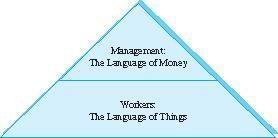
a) Juran – The Hierarchy of Languages.
b) Deming – 14 Points Aggregated by Language.
c) Taylor – Scientific Management.
d) Schonberger, Shingo, and Hall – Total Quality Management.
Answer: a
Reference: Leading Contributors to Quality Theory: Joseph M. Juran Level: Easy
15) Founder of the Japanese Union of Scientists and Engineers (JUSE), Kaoru Ishikawa SOURCE: Browsegrades.net
a) proposed three basic steps to improving quality: quality leadership, quality technology, and quality control.
b) provided analytical tools that work well with the Deming and Juran frameworks that are in use in the U.S. today.
c) cited four deadly “sins:” hothouse quality, wishful thinking, producing overseas, and confining quality to the factory.
d) Founded 19 steps of quality, including the use of statistical tools for improvement.
Answer: b
Reference: Leading Contributors to Quality Theory: Kaoru Ishikawa Level: Medium
16) Taiichi Ohno and Shigeo Shingo
a) authored the 19 steps of the total quality control (TQC) system.
b) adopted a human resources approach, similar to Deming.
c) were contributors to the Toyota Product System (TPS).
d) coined the term, “ideal quality” as a reference point for determining the quality level of a product or service.
Answer: c
Reference: Leading Contributors to Quality Theory: Taiichi Ohno and Shigeo Shingo Level: Medium
17) Armand Feigenbaum, author of Total Quality Control, cited four deadly “sins” which impede the process of approving quality. According to Feigenbaum, American firms that pursue protectionism to avoid competing on quality are impeding quality based on the mistaken idea of
a) hothouse quality.
b) producing overseas.
c) confining quality to the factory.
d) wishful thinking.
Answer: d
Reference: Leading Contributors to Quality Theory: Armand Feigenbaum Level: Medium
18) Which row below accurately represents quality improvement content variables found in the quality theories of these experts?
An x indicates the theme is supported as an important element that expert‟s theory. An empty cell indicates that the theme is not an important element of the expert‟s theory.
Deming Juran Ishikawa Feigenbaum
a) Leadership x x x
b) Strategic planning x x x
c) Quality assurance of productsand services x x x
d) Employee Improvement x x x x
Answer: d
Reference: Resolving the Differences in Quality Approaches: An Integrative View Level: Difficult
19) Which best describes Philip Crosby‟s approach to quality
a) Quality assurance of products and services, similar to Deming.
b) Information analysis, similar to Ishikawa.
c) Human resources, similar to Deming and Juran. SOURCE: Browsegrades.net
d) Role of the quality department, similar to Feigenbaum.
Answer: c
Reference: Leading Contributors to Quality Theory: Philip Crosby Level: Medium
20) Which of the following statements most closely aligns with the Taguchi‟s theory of quality?
a) “Ideal quality is a reference point for determining quality, but specifications need some allowances for tolerable deviations.”
b) “There is no loss to society if a measurement is near to being out of specification - but still within established specification limits.”
c) “Products and services should be designed so that they are inherently defect free.”
d) “Random noise in a process should be addressed in the same manner as any product or service variability.”
Answer: c
Reference: The Leading Contributors to Quality Theory: Genichi Taguchi Level: Medium
21) According to management consultant and author Stephen Covey, there are eight habits of highly effective people. The habits discussed support a basic premise that:
a) People should live a life that balances the professional aspect with personal and spiritual growth.
b) Work is essential to life and therefore, personal pursuits should be considered secondary to living a life that is worthwhile.
c) Highly effective people are those that rise early and create a habit of completing as many tasks in a day as efficiently possible.
d) The physical creation of work is first – mental creation will subsequently align.
Answer: a
Reference: Leading Contributors to Quality Theory: The Rest of the Pack Level: Easy
22) Michael Hammer and James Champy collaborated to write, “Reengineering the Corporation.” Problem(s) with the reengineering process include:
a) Extensive research and analysis are required in order to implement this process.
b) Employees must buy-in by composing a Harvard University business case and making recommendations.
c) “Finding your voice, and inspiring others to find theirs,” implies a life of corporate service.
d) Implementation of the new ideas is rapid, and attention to detail and analysis is absent.
Answer: d
Reference: Leading Contributors to Quality Theory: The Rest of the Pack Level: Medium
23) The variable cited as an important element in most quality improvement approaches is a) leadership.
b) short-term planning.
c) mass inspection of products.
d) quality councils within departments.
Answer: a
Reference: Resolving the Differences in Quality Approaches: An Integrative View Level: Easy
24) Select the answer that accurately represents the relationship of quality management content variables displayed in the table below: SOURCE: Browsegrades.net
Answer: d
Core
Inner Ring Outer Ring
a) Leadership Quality department focus Strategic planning
b) Customer role Philosophy Quality breakthrough
c) Quality assurance Quality breakthrough Team approach
d) Employee improvement Team approach Environmental characteristics
Reference: Resolving the Differences in Quality Approaches: An Integrative View Level: Hard
25) Many variables build the framework for quality management theory. Which is a true statement about the quality management content variables presented in Chapter 2?
a) The need to make large, breakthrough improvements precludes continuous improvement.
b) Cross-functional teams weaken the company‟s environment and infrastructure.
c) Organizational leaders have the authority and monetary capability to drive quality assurance and employee improvement.
d) Gathering and analyzing customer data is invasive and leads to poor quality management efforts.
Answer: c
Reference: Resolving the Differences in Quality Approaches: An Integrative View Level: Medium
Chapter 3: Global Supply Chain Quality and International Quality Standards
Multiple Choice
1) Which statement is true about international trade?
a) The U.S. trade deficit has risen exponentially over time.
b) The U. S. trade deficit is expected to decrease due to increased licensing opportunities.
c) Where an item has been produced has little to do with the price of the product sold in the U.S.
d) Both U.S. imports and U.S. exports have been increasingly steadily since 1960.
Answer: d
Reference: Managing Quality for the Multinational Firm (MNF) Level: Medium
2) There are many mechanisms that firms can use when globalizing. Which of the following is not a widely-used means of globalization?
e) Selling the same product with a different trademark in another country.
f) Entering joint ventures with international firms.
g) Establishing facilities in overseas countries.
h) Becoming an importer of international goods.
Answer: d
Reference: Managing Quality for the Multinational Firm (MNF) Level: Medium
3) When globalizing, companies
a) increase the level of standardization of the product.
b) obtain a high level of company central control.
c) adjust the product/service to cultural norms.
d) all of the above.
Answer: c
Reference: Managing Quality for the Multinational Firm (MNF) Level: Easy
4) One of the benefits of globalizing by exporting a product to international markets is:
a) Expansion in this manner provides greater control over the product.
b) Exporting avoids the marketing issues associated with joint ventures.
c) International standards of quality are met more easily if the product is made in the U.S. and exported elsewhere.
d) Globalization in this manner allows access to complicated distribution networks.
Answer: a
Reference: Managing Quality for the Multinational Firm (MNF) Level: Medium
5) The Baldrige Performance Excellence Program is a tribute to Malcolm Baldrige who was
a) an active entrepreneur and motivational speaker who coined the phrase, “quality in all things at all times.”
b) a U.S. secretary of commerce who worked to strengthen American industry‟s ability to compete internationally.
c) an elected official who experienced a significant business loss and learned about the impact of product quality through that loss.
d) an immigrant to the United States who grew a following by defining a business process of quality self-assessment.
Answer: b
Reference: A Closer Look at Quality 3-1, Who Was Malcolm Baldrige Level: Medium
SOURCE: Browsegrades.net
6)
Which is a correct description of the following Baldrige Program characteristics?
a) Goal-based diagnoses: analyzes down-time in factory production scheduling.
b) Company alignment of goals and processes: defines customer service and product refinement processes.
c) Non-prescriptive and adaptable criteria: prescribes Baldrige-specified tools and techniques needed for results.
d) Focus on business results: considers financial performance, service performance, customer retention, public citizenship.
Answer: d
Reference: The Baldrige Performance Excellence Program Level: Difficult
7) The Baldrige model measures results via analysis of information. A company wishing to demonstrate its commitment to corporate citizenry would substantiate the commitment in which area of the Baldrige framework?
a) Category 3 Customer Focus.
b) Category 5 Workforce Focus.
c) Category 7 Results.
d) Category 1 Leadership.
Answer: d
Reference: The Baldrige Performance Excellence Program Level: Medium
8) Which is true of the Baldrige award process?
a) Because of the sensitive nature of Category 7, “Results,” privately-held firms are exempt from this reporting requirement.
b) Examiners provide feedback to applicant companies as part of the award process.
c) “Baldrige-qualified” is the respectable term used to describe companies that have won Baldrige award.
d) The purpose of the site visit is to review the applicant‟s workspace(s) prior to scoring of the application.
Answer: b
Reference: The Baldrige Performance Excellence Program/The Baldrige Process Level: Medium
9) Under Baldrige scoring, 50% means
a) Little or no deployment of any systematic approach is evident.
b) The beginning of a systematic approach to the basic requirements of the item is evident.
c) An effective, systematic approach, responsive to basic requirements of the item is evident.
d) An effective, systematic approach, responsive to the overall requirements of the item, is evident.
Answer: d
Reference: The Baldrige Performance Excellence Program/Baldrige Scoring Guidelines Level: Easy
10) The number of applicants for the Baldrige award have
a) decreased over the years because entities realized how difficult it would be to win the award.
b) increased over the years because entities believe that similar state awards are “Baldrige-lite.”
c) stayed relatively stable year-to-year because the difficulty of the award is offset by the prestige of winning.
d) stayed relatively stable year-to-year because many Baldrige winners have previously won state awards.
Answer: a
Reference: The Baldrige Performance Excellence Program/State Awards Level: Medium
11) Considering the Baldrige Award, the Deming Prize, and the EFQM Excellence Award, which of the following is true?
a) The Baldrige Award is awarded to private and public businesses only.
b) The EFQM Excellence Award is awarded to European governmental and non-profit organizations only.
c) The Deming Prize is awarded to individuals, as well as groups.
d) None of the awards listed above can be presented to colleges or hospitals.
Answer: c
References: The Baldrige Performance Excellent Program/Baldrige Winners by Year Since 2010, and Quality Improvement: The Japanese Way/Comparison of the Baldrige Award, Deming Prize and the European EFQM Excellence Award Level: Medium
12) Japan‟s contribution to quality includes which of the following:
a) Japan set the world standard for workforce autonomy and empowerment during production.
b) Japan created competition through quality as their automobiles and electronic products were exported to the nations of the world.
c) Japanese companies reduced quality inspections by eliminating work in process inspections of products on the factory line.
d) Japanese companies increased profits by reducing preventive maintenance of factory equipment.
Answer: b
Reference: Quality Improvement: The Japanese Way Level: Medium
13) Industrial engineer Shigeo Shingo identified seven “wastes” that workers could address in the improvement process. Which of the following is not a waste identified by Shingo?
a) Waste of underproduction.
b) Waste of motion.
c) Waste of transportation.
d) Waste of waiting.
Answer: a
Reference: Quality Improvement: The Japanese Way/Lean Production/Lean as a Philosophy Level: Easy
14) Lean production is
a) a philosophical viewpoint: anything in a process that does not add value for the customers should be eliminated.
b) a systems viewpoint: lean is a group of techniques or systems focused on optimizing quality processes.
c) Both a philosophical and systems view as described in responses a) and b).
d) Neither a philosophical or systems view as described in responses a) and b).
Answer: c
Reference: Quality Improvement: The Japanese Way/Lean Production Level: Easy
15) Japanese Total Quality Control (TQC) allows workers to stop the assembly line when a step has a problem. This authority relates to which aspect of the Japanese approach?
SOURCE: Browsegrades.net
a) N = 2 technique: a time-saving alternative to acceptance sampling.
b) “Andon,” or warning lights: flashing lights call work teams to converge to identify and fix the cause of the defect.
c) Quality circles: natural work teams who brainstorm quality improvement methods.
d) None of the above.
Answer: b
Reference: Quality Improvement: The Japanese Way/Japanese Total Quality Control (TQC) Level: Medium
16) When sampling the supplier‟s shipment to ensure adherence to specifications, the N = 2 technique asserts:
a) Discovered defects greater than two per lot indicate the supplier‟s shipment should be rejected, regardless of the lot size.
b) Discovered defects should be multiplied by a factor of two, because in a sample, likely there will be other, undiscovered defects.
c) If no defects are discovered in the first and last items in the lot, then the entire lot should be considered as meeting specifications if the supplier‟s processes are in statistical control.
d) If no defects are discovered in the prior two shipments, then the samples size will be reduced downward since it is likely that few, if any, defects exist.
Answer: c
Reference: Quality Improvement: The Japanese Way/Japanese Total Quality Control (TQC) Level: Difficult
17) Which of the five S‟s is described accurately?
a) Seiso (shine): Organize and keep necessary items in set, identified locations.
b) Seiketsu (standardize): Stay disciplined in maintaining and improving upon the other S‟s, maintaining safety.
c) Seiri (sort): Identify and remove unnecessary items.
d) Seiton (straighten): Establish consistent methods and processes for sorting and shining.
Answer: c
Reference: Quality Improvement: The Japanese Way/Japanese Total Quality Control (TQC) Level: Difficult
18) Which is true of European quality?
a) While the quality of German customer service is considered low by American and Japanese standards, some European companies such as BMW, Mercedes, and Siemens produce goods that set the standard for quality.
b) Culture, in general, plays a lesser role in quality practices in Europe than it does in the United States.
c) It is accurate to generalize quality in Europe because of the great similarities in infrastructure, politics, and business practices among the various nations.
d) While the quality of French customer service has been considered poor, globalization has led to rapid and sustained quality improvements France over the last several years.
Answer: a
Reference: Quality Improvement: The European Way Level: Medium
19) Contrasting the European Foundation for Quality Management (EFQM) Excellence Award with the Baldrige Performance Award, the EFQM award focuses more upon quality
a) related to the workforce that leads to employee satisfaction vs. customer service.
b) that leads to minimizing governmental impacts on corporate activities.
c) ideas that relate to cutting-edge technology.
d) standards currently prevalent in Japan.
SOURCE: Browsegrades.net
Answer: a
Reference: Quality Improvement: The European Way/European EFQM Excellence Award Level: Medium
20) The EFQM evaluation is based on the acronym, “RADAR.” RADAR is:
a) Results, Approach, Deployment, Assessment and Refinement.
b) Results, Application, Deployment, Assessment and Refinement.
c) Results, Advocacy, Deployment, Assessment and Reduction.
d) Results, Application, Deployment, Assessment and Recruitment.
Answer: a
Reference: Quality Improvement: The European Way/European EFQM Excellence Award Level: Easy
21) Which of the following is true of ISO 9000-2015?
a) ISO 9000-2015 describes specific quality processes to use running a business or a firm.
b) The ISO standard was developed so that Switzerland would have a standard that could be applied to their specific culture.
c) The ISO 9000-2015 standard was developed by the International Organization for Standardization in under one year.
d) To use the ISO standard, a firm must plan processes, follow them, monitor them, correct deficiencies in them and continually improve them.
Answer: d
Reference: Quality Improvement: The European Way/ISO 9000-2015 Level: Medium
22) Elements of the ISO 14000 include all of the following except:
a) Legal and other requirements, document control, management control.
b) Information technologies, workforce engagement, customer engagement.
c) Environmental policy, communication, emergency preparedness and response.
d) Planning, records, structure, and responsibilities.
Answer: b
Reference: Quality Improvement: The European Way/ISO 14000 Level: Medium
23) Reasons total trade between the United States and China increased 500% from 2000 to 2020 include all of the following except:
a) The opening of the Chinese markets to foreign trade.
b) The lower cost of doing business in China.
c) The lower quality of Chinese goods.
d) The U.S. offshoring processes and services to China.
Answer: c
Reference: Quality Improvement: The Chinese Way
Reference: Easy
24) The quality of Chinese goods may be influenced by the following:
a) Awards and financial incentives given to Chinese firms who improve the quality of their products.
b) Workers who are uneducated or may not be familiar with the products they are producing.
c) “Guanxi” or influence, meaning the impact of personal relationships and bribery in Chinese business.
d) All of the above impact quality.
Answer: d
Reference: Quality Improvement: The Chinese Way Level: Medium
25) Which of the following is a correct match of quality approaches by culture?
a) Russian: ethic of consistency and emphasis on reduction of waste.
b) European: broad standards with focus on employee satisfaction and care for the environment.
c) United States: group technology to produce better products and improve production.
d) Japanese: quality must provide bottom-line results, or it is something that need not be pursued.
Answer: b
Reference: Are Quality Approaches Influenced by Culture Level: Medium
Part Two: Designing and Assuring Quality
Chapter 4: Strategic Quality Planning
Multiple Choice
1) When top managers use “management by dictate” to set numeric goals for lower managers to achieve, behaviors and results that may occur are:
a) Lower management may achieve the goal, leading to continued management by dictate policies.
b) Lower management may distort the data and/or distort the system, leading to false results and poor strategic decision-making based on those results.
c) Both a and b may occur.
d) Neither a nor b may occur.
Answer: c
Reference: The Importance of Time in Quality Improvement Level: Easy
2) To be effective, leadership must share its power. Forms of power include:
a) Superordinate power – the leader is perceived to have special knowledge or the highest intellect.
b) Legitimate power – the leader‟s position entails certain responsibilities and authority.
c) Referent power – the leader has power to bestow rewards on subordinates in response to desirable actions.
d) Coercive power – the leaders is charismatic or charming and is followed because he or she is liked.
Answer: b
Reference: Leadership for Quality Level: Medium
3) Sometimes performance measurements are distorted by employees who
a) appear to adhere to a required process but then manipulate performance data to protect themselves or colleagues.
b) circumvent processes and measurements for a more seemingly more efficient or sensible approach to their work.
c) Neither a nor b would lead to distorted performance measurements.
d) Both a and b would lead to distorted performance measurements.
Answer: d
Reference: A Closer Look at Quality 4-1 Bad Measurement Systems Result in Poor Outcomes Level: Easy
4) Leader skills include all of the following, except:
a) Planning: Rewarding power.
b) Vision: Identifying opportunities.
c) Communication: Assertiveness.
d) Knowledge: Ethics.
Answer: a
Reference: Leadership for Quality Level: Medium
5) Which is true about the quality of service or products and ethics?
a) The connection between quality and ethics is proportional. Every ethical business choice leads to a proportionate increase quality.
b) The connection between quality and ethics is direct. Providing quality service or products is SOURCE: Browsegrades.net
good ethics.
c) The connection between quality and ethics is inverse. One of the costs of quality is unethical employee behavior.
d) None of the above expresses the relationship between quality and ethics.
Answer: b
Reference: Quality and Ethics Level: Medium
6) Examples of appraisal costs described in the Prevention Appraisal Failure (PAF) Paradigm include all of the following except:
26) Laboratory acceptance testing.
27) Process engineering.
28) Losses because of destructive tests.
29) Supplier monitoring.
Answer: b
Reference: Quality as a Strategy/PAF Paradigm Level: Medium
7) Which of the following failure costs would be most difficult to compute?
a) Non-engineered scrap.
b) Defective products.
c) Consumer adjustments.
d) Lost goodwill.
Answer: d
Reference: Quality as a Strategy/Quality Costs in Action Level: Easy
8) Which of the following statements about failure costs is accurate?
a) The cost of internal failure will always exceed cost of prevention activities.
b) Increasing appraisal activities will cause a corresponding increase in the proportion of failure costs to appraisal costs.
c) Internal failure costs include the cost of product scrapped at product audit.
d) External failure costs are associated with product failure after the production process.
Answer: d
Reference: Quality as a Strategy/PAF Paradigm Level: Medium
Please use the following data to answer questions 9) and 10):
• Appraisal to failure costs is .09
• Prevention to failure costs is .092
9) The ratio of prevention and appraisal costs to failure costs is:
a) .002 to 1.
b) .022 to 1.
c) .182 to 1.
d) Indeterminable from data given.
Answer: c
Reference: Quality as a Strategy/Quality Costs in Action Level: Medium
10) Given the facts above, what would be most appropriate?
a) Increase prevention and appraisal activities. Although those costs would increase, failure
SOURCE: Browsegrades.net
costs could significantly decrease.
b) Decrease prevention and appraisal activities. Failure costs are already relatively low compared to prevention and appraisal costs above.
c) Increase appraisal efforts only. Increased appraisal activities are highly related to decreased failure costs.
d) Make no changes. A good balance between prevention and appraisal costs and the cost of failure are already in place.
Answer: a
Reference: Quality as a Strategy/Quality Costs in Action Level: Difficult
11) The Lundvall-Juran Quality Cost Model
a) displays the relationship between prevention and appraisal costs.
b) supports the concept of continuous improvement proposed by Deming.
c) suggests that as an increase in failure costs improves quality conformance.
d) states that as expenditures in prevention and appraisal activities increase, quality conformation should increase.
Answer: d
Reference: Quality as a Strategy/Lundvall-Juran Quality Cost Model Level: Medium
12) Three generic competitive strategies of cost, differentiation, and focus have been identified as important strategic decisions.
a) A differentiation strategy is achieved if the consumer perceives the product or service to be unique in some way.
b) A focus strategy is achieved when cost of production is decreased by emphasizing the use of off-shore labor to manufacture the product.
c) A cost-differentiation-focus blended strategy is achieved when costs are relatively low, products are similar, and customers are broad-based.
d) All of the above accurately explain generic strategies of cost, differentiation, or focus.
Answer: a
Reference: Quality as a Strategy/Differentiation through Quality/Focus through Quality Level: Medium
13) According to Terry Hill of the London Business School, there is a process for setting strategy that is centered on the identification of the order-winning criterion (OWC). Which is true of this process?
a) The OWC process is limited in that it can work well with service strategies but is not wellassociated with manufacturing enterprises.
b) Once the OWC is identified, then corporate objectives should be identified, planned, and executed.
c) Examples of order-winning criteria include return on investment, delivery speed, price, and quality.
d) Reaching consensus on the OWC is vital and involves segmenting the business into smaller markets that can each be identified with an OWC.
Answer: d
Reference: Quality as a Strategy/Order Winners Level: Medium
14) A core competency has three aspects. Which is typically not considered to be a core competency?
a) Ensures highest returns to investors.
b) Provides benefit to customers. SOURCE: Browsegrades.net
c) Helps company access markets.
d) Is difficult for other firms to imitate.
Answer: a
Reference: Quality as a Strategy/Quality as a Core Competency Level: Easy
15) Management is currently focused on identifying variables and the components of strategy such as time and leadership. We could say that the current strategy focus is a) assessment.
b) process.
c) content.
d) details.
Answer: c
Reference: Strategy Content and Quality Strategy Process Level: Medium
16) The forced-choice model of strategic planning
a) is best used as an adjunct model in firms already using sophisticated strategic models.
b) focuses on consensus between upper management, middle management, and employees as an essential part of the process.
c) requires upper management to assess firm strengths and weaknesses and then consider the firms relative position in the marketplace.
d) stipulates the identification of all stakeholders and their relative positions before continuous improvement choices can be made.
Answer: c
Reference: Quality Strategy Process/Forced-Choice Model Level: Medium
17) The Hoshin Kanri (Hoshin) planning process
a) requires senior executives develop and prioritize a three-to-five year plan along with the current year‟s annual objectives.
b) results in cascading of action plans developed by functional managers in conjunction with upper management.
c) Neither choice a nor choice b is reflective of the Hoshin process.
d) Both a and b characterize the Hoshin process.
Answer: d
Reference: Deploying Quality Level: Easy
18) ABC Co. is a company which has been successful in implementing an organization-wide quality strategy. ABC runs an annual management retreat each September to discuss company strategy. The retreat would likely involve all of the following activities except:
a) Review of the current year‟s performance against projections and adjustments to the current year‟s plan.
b) Review of, and extensive adjustments to, company mission, vision, and values.
c) Review of essential customer requirements and changes that may have occurred.
d) Review of key business factors and progress against these factors.
Answer: b
Reference: A Closer Look at Quality 4-2, A Mature Strategic Planning Process Level: Medium
19) As part of a strategic planning process, which of the following may be used for measures and SOURCE: Browsegrades.net
indicators?
a) Quality costs – customer adjustments.
b) Customer satisfaction – supplier payment schedules.
c) Financial measures – average return on dividends.
d) Any of the above measures may be used for strategy assessment.
Answer: a
Reference: A Closer Look at Quality 4-2, A Mature Strategic Planning Process Level: Medium
20) The effects of quality on business results are mixed. Some firms have been wildly successful with their quality efforts and others have been unsuccessful in gaining bottom-line results. All of the following could explain why financial results remained stagnate after initiating quality efforts, except:
a) Quality efforts were employed during an economic boom.
b) Quality improvement efforts were launched for obsolete products.
c) Quality improvement efforts were abandoned mid-stream when returns were not quick enough.
d) Quality programs were mismatched to the culture and industry.
Answer: a
Reference: Does Quality Lead to Better Business Results?/Quality and Price Level: Medium
21) The relationship between price and quality can be difficult to assess because:
a) There has been a decrease in price supports for various products and “dumping” practices by international firms.
b) There has been a decrease in the number of high-quality, low-priced goods over the past decades.
c) Different cultures perceive the price-quality relationship either positively or negatively, resulting in variations of financial performance.
d) The price-quality relationship counters the laws of supply and demand.
Answer: c
Reference: Does Quality Lead to Better Business Results?/Quality and Price Level: Difficult
22) All of the following are true of the relationship between quality and productivity, except:
a) Changes in processes and procedures often result in a temporary worsening of productivity.
b) The relationship between quality and productivity has not been demonstrated over time.
c) Elimination of waste results in higher productivity.
d) Simplification of processes results in flows that are simpler and of higher productivity.
Answer: b
Reference: Does Quality Lead to Better Business Results?/Quality and Productivity Level: Medium
23) Quality improvements may lead to
a) decreased environmental sustainability within a firm because environmentally friendly materials often cost more.
b) decreased environmental sustainability because quality improvements in production can require the use of more expensive materials.
c) increased environmental sustainability because quality improvements can lead to less production waste.
d) increased environmental sustainability because continuous improvement costs increase both fixed and variable costs of production.
Answer: c
Reference: Does Quality Lead to Better Business Results?/Quality and Sustainability SOURCE: Browsegrades.net
Level: Medium
24) Questions considered in supply chain strategy include all of the following, except:
a) Should we add a new plant?
b) Should we make subassemblies or purchase them?
c) Should we extend our customer base?
d) Should we stock more inventory?
Answer: c
Reference: Supply Chain Strategy Level: Easy
25) Which the following is a correct match of the question to the corresponding supply chain grouping?
a) Products. Where do we carry our safety stocks?
b) Logistics. How do we develop suppliers?
c) Inventory management. How do we win orders?
d) Suppliers. What is our process for supplier selection?
Answer: d
Reference: Supply Chain Strategy Level: Medium
Chapter 5: The Voice of the Customer
Multiple Choice
1) All of the following are reasons why customer opinions matter to a firm, except:
a) Service firms rely on repeat customers for 85%-95% of their business.
b) Eighty percent of new product and service ideas come from customer ideas.
c) A dissatisfied customer tells eight to ten people about a bad experience.
d) The cost of attracting a new customer is twice as much as the cost of keeping an existing customer.
Answer: d
Reference: Introduction Level: Medium
2) Which is a correct example of an internal customer relationship in a typical university setting?
a) The Management Information Systems (MIS) Department is an internal customer of the Admissions Department.
b) The Registration Department is an internal customer of the Security Department.
c) The Maintenance Department is an internal customer of the Student Services Department.
d) The Landscaping and Grounds Department is an internal customer of the Academic Dean‟s Office.
Answer: b
Reference: Introduction Level: Medium
3) Which is true of online customer reviews of merchandise?
a) The majority of online reviews of products states a negative opinion.
b) Retailers and designers can respond more quickly to online reviews because the customer feedback is instantaneous.
c) Even as online sales are increasing, elite luxury stores such as Neiman Marcus still prevent online reviews from customers.
d) Online reviews increase merchandise returns and reduce the percentage of browsers who buy the product.
Answer: b
Reference: A Closer Look at Quality 5-1, Online Review of Merchandise Level: Medium
4) Research regarding the reactive customer-driven quality (RCDQ) model indicates that
a) a supplier‟s quality performance decreases over time as customers‟ expectations increase over time.
b) customer service problems occur when quality and service improvements outpace customers‟ demand for higher levels of quality and service improvement.
c) as a supplier‟s competitors improve quality, customers may demand higher levels of quality and service.
d) the reactive posture engendered in the RCDQ approach allows the supplier stay ahead of customer quality and service expectations.
Answer: c
Reference: Customer-Driven Quality/The Pitfalls of Reactive Customer-Driven Quality Level: Medium
5) Closed-loop customer-relationship management (CRM) incorporates the following design elements:
a) Complaint resolution and feedback.
b) Service quality and gap analysis.
c) Tangibles and intangibles. SOURCE: Browsegrades.net
d) Perception and improvement.
Answer: a
Reference: Customer-Relationship Management Level: Medium
6) Per the closed-loop customer-relationship model,
a) effective guarantees given to the customer should be unconditional, meaningful, and understandable.
b) feedback pertains to both feedback to the customer that the problem has been resolved and feedback to the firm to support process improvements.
c) complaint resolution typically involves acknowledging the customer‟s loss of time, patience, and/or money.
d) All of the above are elements of the closed-loop model.
Answer: d
Reference: Customer-Relationship Management Level: Easy
7) After a firm has determined both the causes and costs of customers‟ dissatisfaction, the firm should
a) perform a Pareto analysis of the complaints.
b) employ a SERVQUAL instrument.
c) take a closed-loop correction action.
d) None of the above are appropriate next steps.
Answer: c
Reference: Customer-Relationship Management/Corrective Action Level: Medium
8) Your firm has performed a service quality gap analysis and has identified a large gap between customer and company perceptions of what the customer wants. An appropriate managerial response to this type of gap would be:
a) Identify what is causing the perception of poor service and then increase the level of quality of the current services provided to the customers.
b) Continue providing excellent quality services but change the types of services offered to what the customers desire.
c) Reassess the politeness, respect, consideration, and friendliness of the contact personnel and guide workers accordingly.
d) Improve the consistency of performance and dependability of the service personnel via education and training.
Answer: b
Reference: The “Gaps” Approach to Service Design Level: Medium
Use the diagram below to answer Question 9).
Customer Perceptions of Service Performance
Good
9) The elements that should be considered for improvement in the two-dimensional Gaps Model are located in quadrant:
a) I
b) II
c) III
d) IV
Answer: b
Reference: The “Gaps” Approach to Service Design Level: Difficult
10) Segmenting markets distinguishes customers or markets according to common characteristics in order to analyze and respond to differing groups of customers. Commercial market segments include:
a) Nationality, family life cycle, and social class.
b) Demographic age, sex, and family size.
c) Both a and b are typical ways to segment commercial markets.
d) Neither a nor b are typical commercial market segments.
Answer: d
Reference: Strategic Supply Chain Alliances Between Customers and Suppliers/Sample Commercial Market Segments Level: Medium
11) A strategic alliance with a single supplier can
a) decrease the variability among materials previously sourced from many different suppliers.
b) increase quality failure costs because competition is not present to drive costs lower.
c) decrease productivity because a variety of delivery systems are not employed.
d) increase material storage costs because vendor-managed inventory (VMI) requires large safety stocks.
Answer: a
Reference: Strategic Supply Chain Alliances Between Customers and Suppliers Level: Medium
12) A Process-Chain-Network (PCN) diagram is a tool that managers can use when designing service delivery systems. In PCN diagramming, an example of a surrogate interaction is:
a) Calling a supplier to request an item.
b) Accepting a customer‟s order at the counter.
c) Ordering product packaging materials online.
d) Re-designing product specifications.
Answer: c
Reference: Strategic Supply Chain Alliances Between Customers and Suppliers/Process-Chain-Network (PCN) Tool for Service Design Level: Medium
SOURCE: Browsegrades.net
13) Supply chains can be segmented to define customers. Which choice correctly explains the customer-supplier relationship in a process where candles are produced, packaged, distributed, and sold to a final customer?
a) The wax supplier receiving the order for wax is a customer of the product manufacturer.
b) The manufacturer of the candles is a customer of the packager.
c) The distributor of the packaged candles is a customer of the wax supplier.
d) None of the above is a correct depiction of the customer-supplier relationship.
Answer: b
Reference: Strategic Supply Chain Alliances Between Customers and Suppliers/The Role of the Customer in the Supply Chain Level: Difficult
14) Customer rationalization refers to pursuing customers who
a) are currently the most profitable.
b) purchase only one, standardized product.
c) offer the most helpful feedback.
d) add the greatest advantage and profits over time.
Answer: d
Reference: Communicating Downstream Level: Medium
15) Which is true of hard data and ordinal rankings?
a) The continuum of “strongly disagree-disagree-neutral-agree-strongly agree” is ordinal in nature.
b) The interval between disagree and neutral is equal to the interval between agree and strongly agree because this is a hard measure.
c) Both a and b are correct.
d) Neither a nor b are correct.
Answer: a
Reference: Actively Solicited Customer-Feedback Approaches Level: Medium
16) Which of the following accurately describes focus groups? Focus groups
a) draw individuals with varied characteristics to discuss specific subjects.
b) sequence questions from the more specific to the least specific in topic concentration.
c) require participants to persuade others to their viewpoints.
d) limit both topics and types of individuals within the group.
Answer: d
Reference: Actively Solicited Customer-Feedback Approaches/Focus Groups Level: Medium
17) The four steps to developing a useful customer service survey are:
a) identify firm domain, decide direct or indirect interaction, implement the survey, analyze results.
b) identify customer requirements, develop and validate the instrument, implement the survey, and analyze results.
c) identify purpose of the group, narrow the scope of questions, run multiple groups, and analyze results.
d) identify focus theme results, broaden the scope of questions, implement the survey, analyze results.
Answer: b
Reference: Actively Solicited Customer-Feedback Approaches/Customer Service Surveys Level: Medium
18) The statement, “If we receive an „excellent‟ rating from you, we will donate $1 to xxx charity,” is an example of survey language that could
a) bias results.
b) overstate the quality of the customer service provided.
c) lead to incorrect decision-making.
d) All of the above.
Answer: d
Reference: Actively Solicited Customer-Feedback Approaches/A Closer Look at Quality 5-2, Misusing Surveys Level: Easy
19) One way to evaluate the reliability of a survey instrument is
a) Seek validation by an outside party.
b) Substitute questions and retest.
c) Apply an interjudge assessment process.
d) Change question targets and retest survey.
Answer: c
Reference: Actively Solicited Customer-Feedback Approaches/Customer Service Surveys Level: Medium
20) Using a circle target as a measure of reliability and validity, survey respondents‟ answers are plotted about the circle. In a particular question, responses (points) were clustered away from center. This indicates the question was:
a) Reliable and valid.
b) Valid, but not reliable.
c) Reliable, and not valid.
d) Not reliable and not valid.
Answer: c
Reference: Actively Solicited Customer-Feedback Approaches/Customer Service Surveys Level: Difficult
21) When analyzing survey data, using simple analysis techniques may be preferable because:
a) Simple analysis of responses conveys the needed information, and more sophisticated techniques could be applied subsequently, if necessary.
b) Simpler analysis is easier to communicate to managers and coworkers who will use the findings.
c) Both a and b.
d) Neither a nor b.
Answer: c
Reference: Actively Solicited Customer-Feedback Approaches/Customer Service Surveys Level: Easy
22) An example of passively-solicited customer feedback tool is:
a) Toll-free complaint line.
b) Customer focus group.
c) Customer service survey.
d) Telephone survey.
Answer: a
Reference: Passively Solicited Customer-Feedback Approaches SOURCE: Browsegrades.net
Level: Easy
23) Customer retention can be improved by offering a) complaint mechanisms and corrective actions.
b) price discounts to new customers.
c) irregularity in product quality.
d) Both a and b.
Answer: a
Reference: Managing Customer Retention and Loyalty Level: Medium
24) Customer-relationship management Systems (CRMS) are used to manage the three phases of customer-relationship management: acquisition, retention, and enhancement. Which of the following is a correct match of description to the phase?
a) Enhancement – marketing automation.
b) Acquisition – churn reduction.
c) Retention – loyalty cards.
d) All of the above correctly match description to phase.
Answer: c
Reference: Customer-Relationship Management Systems Level: Medium
25) Ready-aim-fire refers to a marketing strategy used by companies
a) whose customers have voiced their product and service preferences through surveys and focus groups.
b) whose potential customers are seeking standardized, high-quality products and services.
c) who have employed quality management systems over time and offer tried-and-true products and services.
d) who have developed products based on technological advances and innovations rather than based on customer feedback.
Answer: d
Reference: A Word on Excellent Design Level: Medium
Chapter 6: The Voice of the Market
Multiple Choice
1) Benchmarking external customer service in another company may help an organization answer which of the following questions?
a) How should customer service specialists be trained?
b) How would customer complaints be settled?
c) How should refunds be managed?
d) All of these questions could be benchmarked to another company.
Answer: d
Reference: Introduction Level: Easy
2) To be a benchmark, a target must be willing to allow competitors to view its operations and tour its facilities. A target would be willing to allow this because
a) competitive advantage can be gained through creating psychological barriers to competition.
b) openness to competitors provides an impetus for continual improvement within the benchmark firm.
c) Both a and b.
d) Neither a nor b.
Answer: c
Reference: Gaining Insights Through Benchmarking Level: Easy
3) Which is true of the impact of benchmarking on the initiators, targets, their customers, and their shareholders?
a) Benchmarking is harmful to customers since competition among the targets and initiators ceases through benchmarking agreements.
b) Benchmarking is considered a gift from the target to the initiator because only the initiator benefits from their relationship.
c) Benchmarking is considered a mutually-beneficial relationship because the target firm often enters into a reciprocal agreement to observe the initiator firm.
d) Benchmarking is helpful only to corporate shareholders since the goal of benchmarking is profit maximization.
Answer: c
Reference: Gaining Insights Through Benchmarking Level: Medium
4) Which is a correct match of benchmarking type to an example of that type?
a) Performance benchmarking – examination of speed of concept to market.
b) Process benchmarking – implementation of reverse engineering to understand strengths and weaknesses of their product design.
c) Financial benchmarking – investigation of core processes used to enhance overall quality.
d) Strategic benchmarking – observation of industry-specific processes employed when designing new products.
Answer: a
Reference: Gaining Insights Through Benchmarking/Performance Benchmarking Level: Medium
5) Strategic benchmarking
a) involves a mix of strategies that makes firms within the same industry successful.
b) must involve target firms that have won prestigious honors, such as the Deming Prize.
SOURCE: Browsegrades.net
c) is typically less costly than other types of benchmarking processes.
d) offers an option for firms who cannot find targets within their industry.
Answer: d
Reference: Gaining Insights Through Benchmarking/Strategic Benchmarking Level: Medium
6) Focusing benchmarking efforts on only one area of operations is termed:
a) Process.
b) Functional.
c) Financial.
d) Performance.
Answer: b
Reference: Gaining Insights Through Benchmarking/Functional Benchmarking Level: Easy
7) Which is true about the costs, time commitments, and types of benchmarking activities?
a) As a firm matures and benchmarking activities progress, benchmarking activities typically cost less but take more time to execute.
b) Over time, the goals of benchmarking range from externally-focused purposes initially to internally-focused purposes later in the cycle.
c) To lay the foundation for other benchmarking activities, most firms begin with strategic benchmarking and move to other types of activities.
d) In financial benchmarking, time spent between the initiator and target is less extensive because the benchmarking data can be gathered using on-line databases.
Answer: d
Reference: Gaining Insights Through Benchmarking Level: Medium
8) Monitoring and comparing financial performance ratios across companies is
a) reliable, because all companies apply the same accounting rules in the same way.
b) meaningful, because companies possess detailed knowledge of how the ratio elements are computed within each company.
c) fractional, because managers need to focus not just on the comparative measures, but on the underlying causes of those results.
d) All of the above are true of financial performance ratios.
Answer: c
Reference: Difficulties in Monitoring and Measuring Performance/Computing Profitability Level: Difficult
Use the following data to answer questions 9) and 10). Firm X has gathered the following financial information for itself and a competing firm, Firm Y:
All numbers in 000s.
9) According to computations,
a) Firm Y is more energy-efficient than Firm X.
b) Firm X uses its plant assets more effectively than Firm Y.
c) Firm X and Firm Y have similar labor productivity ratios.
d) Firm Y is more productive overall.
Answer: c
Reference: Difficulties in Monitoring and Measuring Performance/Computing Profitability Level: Difficult
10) Assume energy costs increased by 20 percent for both Firm X and Firm Y. Which firm will experience a greater decline in total factor productivity?
a) Firm Y because Firm Y‟s energy costs are a greater proportion of total costs than Firm X.
b) Firm X because their energy costs before the increase are smaller than Firm Y.
c) Firm X because Firm Y‟s energy costs are a greater proportion of total costs than Firm X.
d) Firm Y because their energy costs before the increase are smaller than Firm X.
Answer: a
Reference: Difficulties in Monitoring and Measuring Performance/Computing Profitability Level: Difficult
11) Which is true of total factor productivity measures vs. individual measures?
a) Individual measures offer only partial understanding of a company‟s production efficiency.
b) Total factor productivity is more sensitive to differences in costing conventions and accounting practices.
c) Rising costs and/or decreasing sales will lead to higher productivity ratios.
d) All of the above statements are true.
Answer: a
Reference: Difficulties in Monitoring and Measuring Performance Level: Medium
12) Examples of operational measurements are:
a) Percentage of defectives, field repairs, and capability analyses.
b) Cycle times, lead times, and setup times.
c) Plant productivity, energy productivity, and materials productivity.
d) Work system performance, safety statistics, and turnover.
Answer: b
Reference: Commonly Benchmarked Performance Measures Level: Medium
13) Management has benchmarked elements of customer satisfaction. After concluding that customer satisfaction with the product is lower than in other firms, management discovers that product assembly instructions disseminated to customers are unclear. Which measurement(s) could have been used to determine that the assembly instructions are flawed?
a) Average employee response time to complete a sale.
b) Number of employees a caller must contact to resolve delivery issues.
c) Either a or b would have led to this discovery.
d) Neither a nor b would have led to this discovery.
Answer: d
Reference: Commonly Benchmarked Performance Measures Level: Medium
14) Company A benchmarked rates of employee absenteeism and effectiveness and found that the Company A employees are absent more frequently and for longer periods of time, on average, than employees at other, similar firms. In addition, employee effectiveness at given tasks is measured as lower than the other firms. Appropriate actions for Company A could include all of SOURCE: Browsegrades.net
the following, except
a) review of the composition of the workforce currently in place.
b) fire workers who have not performed well and who are chronically absent.
c) seek another union to represent the employees.
d) require training to improve employee skillsets.
Answer: c
Reference: Commonly Benchmarked Performance Measures Level: Medium
15) Which is true of key business factors (KBFs), key measures, and critical success factors?
a) Key business factors refer to factors that help determine success of the firm.
b) Critical success factors are important attributes of the business, such as mission and culture.
c) Key measures are used to quantify key business factors.
d) None of the above correctly expresses key business factors, key measures, and critical success factors.
Answer: d
Reference: Commonly Benchmarked Performance Measures/Key Business Factors Level: Medium
16) Alan Robinson‟s 5w2h derives its name from the
a) quality components considered to be “benchmark-able.”
b) questions that should be answered by a business process benchmarking project.
c) hierarchy of performance ratios that should be performed when benchmarking.
d) product conversion process from raw materials to finished goods.
Answer: b
Reference: Business Process Benchmarking Level: Easy
17) Which is a correct about the process model shown below?
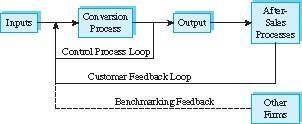
a) The data gathered in the control process loop is obtained via customer feedback.
b) The data used in the customer feedback loop is obtained from competitors through benchmarking.
c) The data from the benchmarking feedback loop is obtained only at the end of the conversion process.
d) None of the above correctly describes the model as displayed.
Answer: d
Reference: Business Process Benchmarking/Process Model Level: Medium
18) Management is concerned about performance in the billing processes. All of the following would be measures to benchmark except:
a) Length of time from product conversion to shipment.
b) Length of time from order completion to billing customer.
SOURCE: Browsegrades.net
c) Percent of invoices that are error free.
d) Percent of customers invoiced prior to order completion.
Answer: a
Reference: Business Process Benchmarking/Process Information, R. Camp, Business Process Benchmarking Level: Easy
19) The following selected benchmarking steps would occur in which order? Steps:
i. Communicate benchmarking findings and gain acceptance.
ii. Implement specific actions and monitor progress.
iii. Decide what to benchmark.
iv. Plan and conduct the investigation.
a) iv, iii, ii, i.
b) iii, iv, i, ii.
c) iii, iv, ii, i.
d) iv, ii, iv, ii.
Answer: b
Reference: Business Process Benchmarking/Robert Camp‟s Business Process Benchmarking Process Level: Medium
20) In benchmarking, the step, “project future performance levels,” is important because
a) action plans should not be developed without acceptance by those who are affected by results.
b) progress should be reported to management and stakeholders as implementation proceeds.
c) the company must consider and plan accordingly if the performance gap is expected to widen.
d) recalibrating benchmarks helps firms to identify new best practices.
Answer: c
Reference: Business Process Benchmarking/ Robert Camp‟s Business Process Benchmarking Process Level: Medium
21) Training is key to success in all quality management approaches. The following education, training, and skills would be necessary for benchmark participants, except:
a) Cross-functional benchmarking skills.
b) Team training.
c) Documents training.
d) Undergraduate studies in commercial law.
Answer: d
Reference: Leading and Managing the Benchmarking Effort/Training Level: Easy
22) A benchmarking target has a concern regarding the possible illegal restriction of trade as an unintended result of the benchmarking process. To lessen this concern, all of the following topics should be avoided, except:
a) Average days from order to delivery for suppliers.
b) Average cost of production, if costs are an element of pricing.
c) Market or customer allocation.
d) Price fixing of products sold.
Answer: a
Reference: A Closer Look at Quality, The Legal Environment of Benchmarking/The Benchmarking Code of Conduct Level: Easy
23) Which of the following reflects benchmarking norms and practices?
a) Costs should not be discussed with competitors if costs are an element of product pricing,
b) Confidentiality is important, but it is understood that information obtained from benchmarking SOURCE: Browsegrades.net
studies can be shared with other external parties.
c) Given the nature of benchmarking, the target is expected to share more comprehensive information than the initiator.
d) It is solely the target‟s responsibility to understand how the initiator‟s information should be managed as to privacy and legality.
Answer: a
Reference: A Closer Look at Quality 6-2, The Legal Environment of Benchmarking/The Benchmarking Code of Conduct Level: Medium
24) Baselining requires the monitoring of key internal performance measures over time to identify company improvement (or decline) to assist in managerial decision making. The impact of abrupt, organization-wide process changes will
a) not be captured in the measures because key performance measures are localized.
b) be observed in key performance level results – either positive or negative.
c) be observed within the measures but only if the changes led to decreased performance.
d) be observed within the measures but only if the changes led to improved performance.
Answer: b
Reference: Baselining and Process Improvement Level: Easy
25) Which of the following is not considered to be a key problem with benchmarking?
a) Obtaining cooperation from firms in the industry.
b) Lack of employee involvement within the benchmarking firms.
c) Difficulty in identifying benchmarking firms in other industries.
d) Large investment of time and money involved in benchmarking.
Answer: b
Reference: Problems with Benchmarking Level: Easy
Chapter 7: Quality and Innovation in Product and Process Design
Multiple Choice
1) When designing products, which of the following questions should be considered at the start of the design process?
a) What are the functions the customer wants? What are the capabilities of current products?
b) What are the limitations of the materials we have selected for the product? Are there better materials available?
c) How much will the product cost to make? How much must the product cost to make it successful in the marketplace?
d) All of the above are questions to be asked prior to designing a product.
Answer: d
Reference: Designing Products for Quality Level: Easy
2) Considering the performance dimension of quality, which performance characteristics would compete against each other when the product is a photo printer?
a) Printer cost and marketing options.
b) Print quality and print speed.
c) Both of these are competing performance characteristics.
d) Neither of these are competing performance characteristics.
Answer: b
Reference: Designing Products for Quality Level: Medium
3) Which is true of the product development process?
a) The design process always includes nine, interrelated phases.
b) The process begins with product generation and ends with manufacture, delivery, and use.
c) The process involves single designers working independently to achieve the best design possible.
d) The project‟s costs and scheduling are considered primarily at the beginning and end of the process.
Answer: b
Reference: The Design Process Level: Medium
4) Product idea generation ideas can be
a) considered as R & D push or marketing pull in nature.
b) generated internally - from industry experts, consultants, suppliers, and inventors.
c) customer-generated and therefore groundbreaking, risky, and innovative.
d) All of the above.
Answer: a
Reference: The Design Process Level: Medium
5) In the Kano Quality/Design Model below, the middle line shows a straight, upward trajectory. That line depicts:
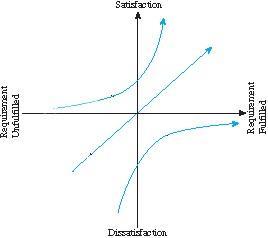
a) Performance quality.
b) Basic quality.
c) Exciting quality.
d) None of the above.
Answer: a
Reference: Designing Products for Quality Level: Medium
6) The line depicting exciting quality in the Kano Model may change due to shifts in
a) suppliers.
b) labor costs.
c) customer expectations.
d) taxlaws.
Answer: c
Reference: Designing Products for Quality Level: Easy
7) In the product idea generation phase of product development, marketing-generated ideas tend to be
a) built upon existing designs.
b) over-engineered.
c) groundbreaking and risky.
d) lessaligned with customers‟ needs.
Answer: a
Reference: The Design Process Level: Medium
8) An example of projecting customers‟ future needs is
a) a university bookstore purchasing textbooks in advance of fall term.
b) a local florist ordering roses in before Valentine‟s Day.
c) Disney contracting for the manufacture of Spider-Man ® action figures prior to movie release.
d) All of the above are examples of projecting customers‟ needs.
Answer: d
Reference: The Design Process Level: Easy
9) Which of the following is not considered in a technology feasibility statement?
a) Limitations in the physical characteristics of materials.
b) Conditions for quality-testing the product.
c) Strategies for marketing the product.
d) Changes in manufacturing technologies.
Answer: c
Reference: The Design Process Level: Medium
10) Which element would not be included in the product design specification (PDS) of a digital sports camera?
a) Zoom capabilities of lens.
b) Water proofness at varying depths of water.
c) Marketing plans.
d) Worker health insurance plans.
Answer: d
Reference: The Design Process Level: Medium
Use the Quality Function Deployment (QFD) Layout, House of Quality Model, below to answer questions 11) and 12).
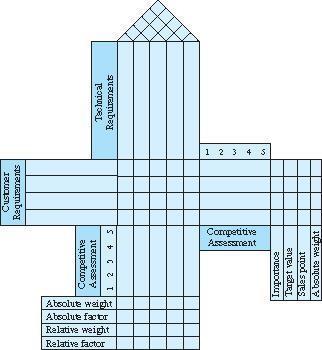
11) In the technical requirement stage, Dara‟s Doggie Day Care Center would likely find a high House of Quality correlation between which customer requirement and technical requirement?
a) Training of workers and air conditioning/heating requirements.
b) Yard for dogs to run/fencing specifications.
c) Vaccination requirements of pets/city zoning regulations.
d) Hours of operation/ease of pet drop-off.
Answer: b
Reference: Quality Function Deployment (QFD) Level: Difficult
12) At Dara‟s, the correlation between a soothing interior paint color and customer satisfaction is rated as 2, on a scale 1-9. We could say that there is a correlation between the chosen paint color and customer satisfaction.
a) strong, negative.
SOURCE: Browsegrades.net
b) weak, negative.
c) strong, positive.
d) weak,positive.
Answer: d
Reference: Quality Function Deployment (QFD) Level: Medium
13) The final House of Quality evaluation for Dara‟s Doggie Day Care as shown below indicates she should change the design of the facility by:
Range 1-5
1=no change to offering.
1=low effect on sales.
5=change from current offering. 2=high effect on sales. Correlation with
a) Enlarging the building because the amount of play time outside is very important to the customer and bears a high sales point.
b) Building a dog-proof fence because safety has high relative weight.
c) Adjusting the square footage of the building to match that of the competition.
d) None of the above. She should obtain further customer input through focus groups or surveys before changing any part of the design.
Answer: b
Reference: Quality Function Deployment Level: Difficult
14) Computer-aided design (CAD) systems support new and varied designs, simplify the design process, and allow for multiuser interface. Which of the following is not a use for CAD?
a) Needs identification.
b) Interference checking.
c) Geometric modeling.
d) Engineering analysis.
Answer: a
Reference: Technology in Design Level: Easy
15) Concurrent engineering
a) slows the design process because so many engineers are involved in the development process.
b) lessens the need for communication among various groups and team members since all are working together.
c) makes interference checking important to ensure that different components do not occupy the same space.
d) All of the above describe concurrent engineering.
Answer: c
SOURCE: Browsegrades.net
References: Other Design Methodologies/Organizing the Design Team & Technology in Design Level: Medium
16) Because product life cycles are shortening, companies should
a) ensure that changes to existing products are drastic and exciting in order to stay competitive.
b) recognize that product obsolescence arrives more slowly than it did in prior times.
c) prepare to offer complementary products which can co-exist with current products.
d) expect to increase productive capacity of all products as new ones are introduced.
Answer: c
Reference: Other Design Methodologies/Product Families and the Product Life Cycle & Complementary Products Level: Medium
17) “Now that we have designed it, can we make it?” refers to
a) Risk-minimized design.
b) Design for manufacture.
c) Reality in design and manufacture.
d) Design by objective.
Answer: b
Reference: Other Design Methodologies/Designing Products That Work Level: Easy
18) Considerations in product design include:
a) maintainability – ease of product production.
b) reliability – components that are easily replaced.
c) manufacture method – reduction in design cycle times.
d) All of the above.
Answer: c
Reference: Other Design Methodologies/Design for Manufacture Method Level: Medium
19) Which is true of reliability?
a) Component reliability refers to the probability that the system of components will perform the intended function over a specified product life.
b) System reliability is computed from the aggregation of multiple components that function in a series.
c) The two components of reliability, failure rate and time, can be applied to systems reliability, but not component reliability.
d) Measures for analyzing reliability include time-to-conversion and manufacturing cycle time.
Answer: b
Reference: Designing for Reliability Level: Difficult
20) Which of the following is not a methodology used to make designs more reliable?
a) Fault-tree analysis.
b) Failure modes and effects analysis.
c) Failure modes, effects, and criticality analysis.
d) Form-fault pathways and force analysis.
Answer: d
Reference: Reliability Analysis Tools Level: Easy
SOURCE: Browsegrades.net
21) Which is true about failure modes and effects analysis (FMEA)? FMEA
a) reduces product development costs.
b) answers the question, “How should management respond in the case of catastrophic failure?”
c) is used to test industry processes for failure after release of the product to customers.
d) None of the above are true of FMEA.
Answer: a
Reference: Designing for Reliability/Failure Modes and Effects Analysis Level: Medium
22) A FMEA form would include columns for:
a) Severity score – ease or difficulty of detection of failure.
b) Occurrence score – likelihood failure event will occur.
c) Detection score – effect of hazard or event.
d) All of the above.
Answer: b
Reference: Designing for Reliability/Failure Modes and Effects Analysis Level: Medium
23) Which is true about failure modes, effects, and criticality analysis (FMECA)? FMECA
a) criticality refers to how often a failure will occur and whether or not it can be fixed.
b) graphically renders the combinations of failures that lead to ultimate system failure.
c) is a quantitative graphical tool that can be evaluated qualitatively.
d) All of the above describe FMECA.
Answer: a
Reference: Designing for Reliability/Failure Modes, Effects, and Criticality Analysis Level: Medium
24) Which is true about reliability analysis?
a) Both FMEA and FMECA models address probabilities of fault occurrence, but the fault-tree analysis (FTA) model does not.
b) To avoid being included on the National Association of Manufacturers (NAM) list of hazardous products, a company must have a system in place for tracing its components.
c) The main difference between FMEA and FMECA is that FMECA adds “C,” causality, to the FMEA model.
d) Methodologies can predict where defects will occur and what their effects will be, but unforeseen defects can occur and can subject the firm to liability.
Answer: d
Reference: Designing for Reliability/Product Traceability and Recall Procedures Level: Medium
25) Green manufacturing concepts
a) concede that returns on investment will decrease with implementation of green design.
b) encourage designers to make inexpensive, single-use products.
c) promote disassembly processes that are used to sort product materials for reuse.
d) deny the costs associated with reuse, recycling, and disposal of products.
Answer: c
Reference: Environmental Considerations in Design Level: Medium
Chapter 8: Designing Quality Services
Multiple Choice
26) Which is true of high-quality service?
a) Quality service is an indicator of quality maturity.
b) A deep understanding of customer needs and desires is essential to providing high-quality service.
c) Service is a major differentiator that allows firms to beat competitors in the marketplace.
d) All of the above are true of quality service.
Answer: d
Reference: Introduction Level: Easy
27) Which is true of production of services?
a) The outputs of services are homogeneous and intangible in nature.
b) Customers are more involved in production of services than in production of goods.
c) It is not difficult to estimate the time required to serve customers.
d) Customers exert little control over the services they obtain in the marketplace.
Answer: b
Reference: Differences Between Services and Manufacturing Level: Medium
28) Which is not an example of an organization using an internal service?
a) A county government obtains police vehicle oil changes at the county maintenance center located west of town.
b) A hospital grants a franchise to sell snacks to hospital workers and visitors.
c) A university registrar uses the data processing department to maintain computer kiosks for student use.
d) A nursing home provides in-house beauty salon services to the residents.
Answer: b
Reference: Differences Between Services and Manufacturing/Internal versus External Services Level: Medium
29) Liability for service providers is
a) related to malpractice.
b) linked to a repair process.
c) indistinguishable from product liability.
d) easier to measure than product liability.
Answer: a
Reference: Differences Between Services and Manufacturing/How Are Service Quality Issues Different from Those of Manufacturing?
Level: Medium
30) Which of the following is not an attribute of leaders in services per Parasuraman, Zeithamel, and Berry?
a) Worker training - rewards for quality service.
b) High standards - quality with a focus on detail.
c) Service vision - quality as the force underlying business success.
d) In-the-field style of management - managers located where customer service occurs.
Answer: a
Reference: What Do Services Customers Want?
Level: Easy
31) One of the reasons that the SERVQUAL tool is used by many firms is that SERVQUAL
a) has been shown to be valid and reliable even when applied to diverse types of service entities.
b) is lengthy and extensive so as to thoroughly address the different dimensions of service quality.
c) is flexible and non-standardized, so it can be easily adapted to various service situations.
d) All of the above are attributes of the SERVQUAL tool.
Answer: a
Reference: SERVQUAL Level: Medium
32) Which correctly describes the SERVQUAL items and dimensions?
a) Responsiveness – Employees will have the customers‟ best interests at heart.
b) Tangibles – Employees will be neat-appearing.
c) Empathy – Employees will instill confidence in customers.
d) Assurance – Employees will perform the service right the first time.
Answer: b
Reference: SERVQUAL/Expectations Level: Medium
33) In SERVQUAL, both customer expectations and perceptions are assessed and analyzed for gaps. Gap analysis is important because
a) the smaller the gap between expectations and perceptions, the more valid and reliable the SERVQUAL findings will be.
b) the larger the gap between expectations and perceptions, the greater likelihood that marketing efforts will benefit the company.
c) the greater the gap between expectations and perceptions, the greater the potential for increasing customer satisfaction.
d) None of the above are correct interpretations of gap analysis.
Answer: c
Reference: SERVQUAL/Expectations Level: Medium
34) Gaps in communication and understanding can have a serious negative effect on the perceptions of service quality. SERVQUAL can measure differences in perception between:
a) Managers and other managers.
b) Customers and employees.
c) Employees and other employees.
d) All of the above.
Answer: d
Reference: SERVQUAL/Gap Analysis Level: Easy
Use the SERVQUAL gap diagram below to answers questions 10) and 11).
Management perceptions of customer expectations Gap 1 Expected Service SOURCE: Browsegrades.net
35) SERVQAUL results indicate that Gap 3 is large. An appropriate management response would be to
a) offer services that the customer actually desires.
b) train contact personnel to perform required quality services.
c) define a process to clarify customer expectations.
d) realigncustomers‟expectationswithmanagement‟sexpectations.
Answer: b
Reference: SERVQUAL/Gap Analysis Level: Difficult
36) A customer‟s comment, “They promised me one thing and gave me another,” would be reflected in which gap in the diagram?
a) 1
b) 2
c) 3
d) 4
Answer: d
Reference: SERVQUAL/Gap Analysis Level: Medium
Use the following SERVQUAL results data table to answer questions 12) and 13). The scale ranges from 1-7, with 7 representing the highest quality of service.
37) Assuming this data table describes service at a local nail salon, what would you infer? The salon is
SOURCE: Browsegrades.net
a) clean and attractive, but the workers are not skilled.
b) clean and attractive, but the workers themselves are ill-kempt.
c) not clean and attractive, but the workers are kind and perform good service.
d) not clean and attractive, and the workers are unskilled and slow at service.
Answer: a
Reference: SERVQUAL/Gap Analysis
Level: Medium
38) In order to improve the customers‟ experiences at the salon, management should consider which action(s) based on the data?
a) Hire more workers and train all workers.
b) Institute a hygiene policy and a basic dress code for workers.
c) Use a professional cleaning service on a regular basis.
d) All of the above.
Answer: a
Reference: SERVQUAL/Gap Analysis
Level: Difficult
39) Unrelated to preceding questions. The following selected data was gathered from 100 SERVQUAL customer surveys. What is the average score for the responsiveness dimension?
SERVQUAL Questions
a) 4.0
b) 4.4
c) 4.5
d) 5.0
Answer: a
Reference: SERVQUAL/Gap Analysis/SERVQUAL Differencing Level: Difficult
40) The two-dimensional difference plane below displays high expectations and high perceptions in which service dimension(s)?
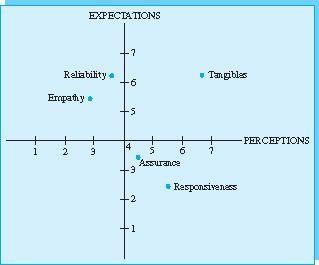
a) Reliability and Empathy.
b) Tangibles.
c) Assurance and Responsiveness.
d) None of the above.
Answer: b
Reference: SERVQUAL/Gap Analysis/Two-Dimensional Differencing Level: Medium
41) Services blueprinting is a tool to help with brainstorming activities that lead to customer service improvement. Which is true about services blueprinting?
a) Blueprints organize customer service data into tables for analysis.
b) Blueprints include only process activities seen by the customer.
c) Standard times should be established for each step in the blueprinted process.
d) All of the above are true of services blueprinting.
Answer: c
Reference: Designing and Improving the Services Transaction/Services Blueprinting Level: Easy
42) “Moments of truth” in service blueprinting
a) can happen face-to-face, over the telephone, through a machine, or through the mail.
b) can occur at various stages of the product life cycle.
c) are the fail points identified in a service blueprint.
d) All of the above describe service moments in truth.
Answer: d
Reference: Designing and Improving the Services Transaction/Moments of Truth Level: Easy
43) An example(s) of poka-yokes(fail-safe measures) is/are:
a) Parts that can only fit together in the proper way.
b) Auto-shut off of small electrical devices after a period of non-use.
c) Premeasured cooking ingredients.
d) All of the above are fail-safe measures.
Answer: d
Reference Designing and Improving the Services Transaction/Poka-yoke Level: Easy
44) The three Ts of fail-safe methods are:
a) Target, transaction, temperament.
b) Territory, talent, “take.”
c) Task, treatment, tangibles.
d) Transfer, trade, tune.
Answer: c
Reference: Designing and Improving the Services Transaction/Poka-yoke Level: Medium
45) A customer benefits package (CBP) includes
a) service content – the tangibles that define the service.
b) goods content – the intangibles that make up the service.
c) Both a and b are part of a customer benefits package.
d) Neither a nor b are part of a customer benefits package.
Answer: d
Reference: The Customer Benefits Package Level: Medium
46) According to Florida Gulf Coast University Professor David Collier, the objectives of customer benefits package design include all of the following except:
a) Ensure the chosen CBP attributes are the correct ones.
b) Enlarge the number of attributes offered in the package.
c) Evaluate the relative importance of each attribute in the customer‟s mind.
d) Speed each CBP and associated process and service encounter to the market.
Answer: b
Reference: The Customer Benefits Package Level: Medium
47) Which of the following is a correct match between CBP tangible and intangible attributes assuming the firms is a 3-D printer shop?
a) Tangible: Accurate, timely, and itemized billing.
b) Tangible: Timely pickup and delivery service.
c) Tangible: Flexible, custom designs.
d) Intangible: High quality plastic filament.
Answer: c
Reference: Service Transaction Analysis Level: Medium
48) Service quality challenges particular to governmental entities include all of the following except:
a) Quality improvements must be justified to, and funded by, taxpayers.
b) Citizen-customers often evaluate government services by comparing them to private-industry offerings and quality.
c) Governments may experience a lack of bipartisan involvement in design and support of quality initiatives.
d) Government workers and facilities are innately inferior to those in the private sector.
Answer: d
Reference: Improving Customer Service in Government Level: Easy
49) Which is true of health care today?
a) Health care is becoming more affordable because the cost of providing that health care to SOURCE: Browsegrades.net
consumers is decreasing.
b) Hospital operations are becoming less efficient because health maintenance organizations (HMOs) are taking the place of some, more traditional insurance plans.
c) The Affordable Care Act has mandated improvements to the delivery of health care but with increased regulation.
d) Most health care workers would prefer to see a focus on care efficiency vs. care reliability in order to reduce costs.
Answer: c
Reference: Quality in Health Care Level: Medium
50) Brigham Young University Professor Scott Sampson offers a unified theory for services management which includes the following proposition(s):
a) Customers supply little input into the production of services.
b) Customers often provide unreliable inputs to service suppliers.
c) Customers embrace technologies that improve the quality of the desired service.
d) Customers rarely provide product specifications and process design without the invitation of the service provider.
Answer: b
Reference: A Theory for Service Quality Management Level: Medium
Chapter 9: Managing Supplier Quality in the Supply Chain
Multiple Choice
1) Which is true of the supply chain?
a) The supply chain includes the upstream activity of customer cash collection.
b) The supply chain recognizes the connective relationship between suppliers, producers, and customers.
c) The term, “supply chain” is used interchangeably with the term, “value chain.”
d) All of the above are true of the supply chain.
Answer: b
Reference: Introduction and The Value Chain Level: Medium
2) Value chain activities include
a) inbound logistics, operations, outbound logistics, and marketing.
b) “hidden factory” and chain of customer activities.
c) accounting, legal, and advertising activities.
d) All of the above are considered to be value chain activities.
Answer: a
Reference: The Value Chain Level: Medium
3) In your cake factory, a baker mixes cake ingredients and bakes the cakes. A different worker creates cake decorations using specialize tools. Then, another worker assembles the cake and finally, one more worker boxes the cake for customer pickup or delivery. According to the “chain of customers” described by Schonberger, we can say:
a) The cake assembly worker is a customer of the packager.
b) The assembly worker is a customer of the decorator.
c) The baker is a customer of packager.
d) None of the above describes the “chain of customers” concept.
Answer: b
Reference The Value Chain/The Chain of Customers Level: Medium
4) In supplier alliances, relationships with suppliers are developed for all of the following reasons except to:
a) provide products with lower rates of defects.
b) become profitable subsidiaries of parent companies.
c) achieve more reliable delivery times.
d) reduce costs.
Answer: b
Reference: Supplier Alliances Level: Medium
5) The supply chain below displays:
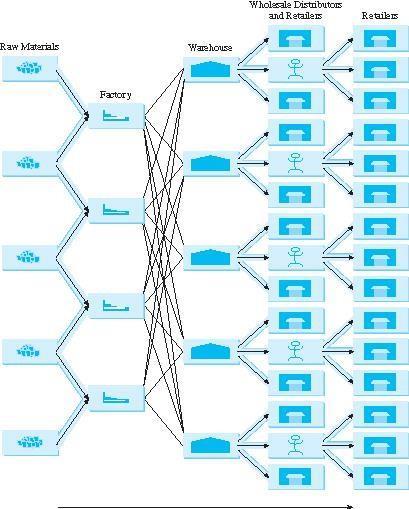
a) many distributors and retailers, but no customers.
b) each warehouse supplying each wholesale distributor.
c) only one raw material provider per factory.
d) multiple suppliers and multiple customers.
Answer: d
Reference: The Value Chain/Managing the Supply Chain/Figure 9-2 A Supply Chain Level: Medium
6) Supplier qualification (certification) programs
a) focus on developing the supplier via long-term training and support.
b) can involve long-term visits and evaluations of the supplier.
c) offer prizes to suppliers based on Baldridge criteria.
d) All of the above.
Answer: b
Reference: Supplier Alliances Level: Medium
7) Tools used to develop suppliers include all of the following except:
a) Supplier evaluation report cards which rate the supplier‟s quality and ability to meet schedule demands.
b) Supplier audits, which include visits to suppliers and a report of findings to customers.
c) Sole source filters, which are external validations of quality programs using ISO 9000 or Baldridge criteria.
d) Supplier development programs, which train suppliers quickly for short-term quality gains.
Answer: d
Reference: Supplier Alliances Level: Medium
8) All of the following are threats to the supply chain except:
a) Dual sourcing.
b) People.
c) Speed.
d) Quality issues.
Answer: a
Reference: Supplier Alliances/A Closer Look at Quality 9-1, Supply Chains Disruption and Risk Mitigation Level: Easy
9) Which of the following mitigates supply chain interruptions?
a) Lean processes.
b) Single suppliers.
c) Insurance.
d) Confidential supply chains.
Answer: c
Reference: Supplier Alliances/ A Closer Look at Quality 9-1, Supply Chains Disruption and Risk Mitigation Level: Easy
10) Successful single-sourcing relies upon
a) mutually exclusive production schedules.
b) very short lead times.
c) defective rates of not more than 5%.
d) sound contingency plans.
Answer: d
Reference: Supplier Alliances/Single-Sourcing Examples Level: Medium
11) Which is true of limiting the number of suppliers used in a given operation? Using fewer suppliers
a) decreases the appropriateness of vendor-managed inventory systems.
b) decreases time spent pursuing the best materials‟ prices.
c) increases material variability.
d) increases the overall rejection rate.
Answer: b
Reference: Supplier Alliances/Single-Sourcing Examples Level: Medium
12) When the Boeing 737 Max was grounded, Boeing slowed production. Supply chain participants responded to the disruption as follows:
a) Airline carriers – sought support and relief from Boeing while the orders for their planes were on hold.
b) Airline carriers – cancelled all current contracts with Boeing in anticipation of ongoing difficulties at Boeing.
c) U.S. suppliers of airplane parts – increased capacity and stored parts for Boeing in the hopes production would not only resume, but increase.
d) Global suppliers – cancelled all current contracts with Boeing in anticipation of ongoing difficulties at Boeing.
Answer: a
Reference: Supplier Alliances/Quality Highlight 9-1
SOURCE: Browsegrades.net
Level: Difficult
13) Advantages of multi-sourcing over single-sourcing include all of the following except:
a) Fairer pricing from suppliers due to competition.
b) Better protection from a single supplier‟s labor disputes.
c) Less reliance on matching production schedules.
d) Less variability in the product.
Answer: d
Reference: Supplier Alliances/Single-Sourcing Examples Level: Medium
14) Defense contractor, Lockheed-Martin, instituted a supplier program that required which of the following?
a) A 0% rejection rate at the point of inspection for six months.
b) A 98% concurrency to contract delivery schedules.
c) Both a and b.
d) Neither a nor b.
Answer: c
Reference: Supplier Alliances/Single-Sourcing Examples Level: Easy
15) Bose Corporation eliminated a large portion of its purchasing department by
a) outsourcing both payroll and purchasing functions to the same contractor.
b) using a single supplier for all raw materials.
c) enabling suppliers to write their own purchase orders.
d) creating proprietary software to manage the supply chain.
Answer: c
Reference: Supplier Alliances/Single-Sourcing Examples Level: Medium
16) Which of the following is not a typical supplier development action?
a) Process communication.
b) Partnership pairing.
c) Data sharing.
d) Supplier evaluation.
Answer: b
Reference: Supplier Development Level: Easy
17) The seven steps of supplier development are randomized below.
1. Define details of agreement.
2. Identify key projects.
3. Identify critical suppliers.
4. Monitor status and modify strategies.
5. Form cross-functional teams.
6. Identify critical products and services.
7. Meet with the supplier top management.
The correct chronological order of the first four steps is:
a) 2, 7, 5, 1.
b) 5, 2, 3, 4.
c) 6, 3, 5, 7.
d) 3, 5, 6, 1.
Answer: c
Reference: Supplier Development Level: Difficult
18) 3M‟s Dental Products Division
a) developed an information system that tracks the purchasing decisions of dentists.
b) created a customer satisfaction survey targeting a “good” rating for each product and service area.
c) reduced costs by offering products tailored to individual practices.
d) opted to focus on expert service and existing products rather than product innovation.
Answer: a
Reference: Supplier Development/Quality Highlight 9-2, Integrating Forward along the Supply Chain: 3M Dental Products Division Level: Medium
19) Features of 3M‟s Dental Product Division quality improvement include a (an)
a) employee performance plan that sets individual goals for business results and team effectiveness.
b) measurement system that includes a detailed and complex matrix linking measures to business goals.
c) systematic strategic planning approach that is grounded in ideas put forth by lower and middle level management.
d) All of the above describe 3M‟s Dental Product Division.
Answer: a
Reference: Supplier Development/Quality Highlight 9-2, Integrating Forward along the Supply Chain: 3M Dental Products Division Level: Medium
20) Supplier Relationship Management Systems (SRMSs)
a) are similar to customer management systems, but SRMS are used to manage upstream activities.
b) include natural disaster, cyber-attack, and international civil unrest assessment features.
c) Both a and b.
d) Neither a nor b.
Answer: a
Reference: Supplier Development/Supplier Relationship Management System (SRMS) Level: Medium
21) The IATF 16949 standard
a) is applicable only to automobiles manufactured in the United States.
b) is substantially different than the ISO 9001 standard.
c) emphasizes continual improvement and defect prevention.
d) All of the above describe IATF 16949.
Answer: c
Reference: A Supplier Development Program: IATF 16949 Level: Easy
22) Which is a correct match between an IATF 16949 section and its description?
a) Planning – documentation of the processes of making, designing, purchasing, and shipping of the product.
b) Operation – documentation of how performance is monitored, analyzed, and validated.
SOURCE: Browsegrades.net
Answer: c
c) Organizational context – documentation of the understanding of the firm, its quality management system (QMS), and processes.
d) Support – documentation of anticipated risks and risk analysis.
Reference: IATF 16949
Level: Medium
23) In the 16949 Model shown below:
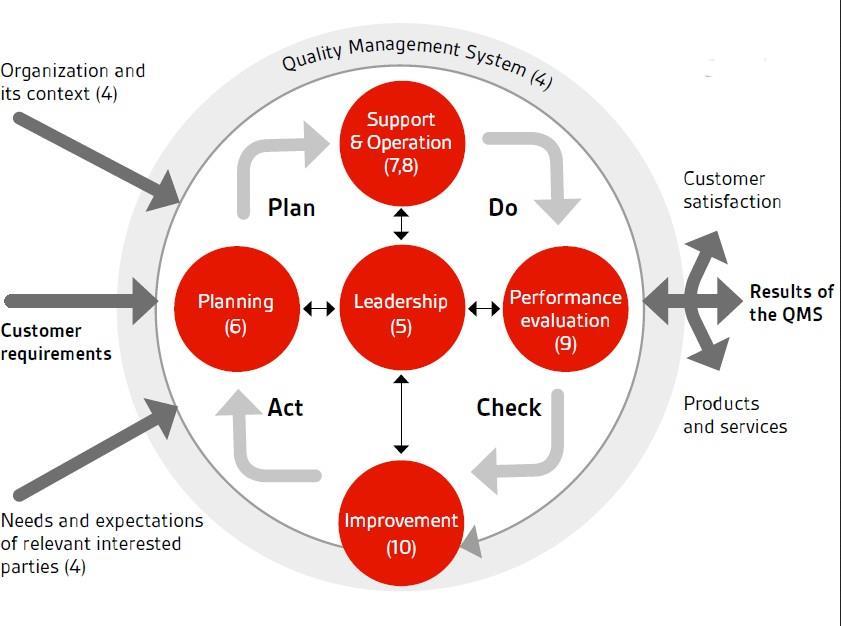
a) The loop to Improvement implies intermittent course corrections.
b) Performance evaluation is the check on Improvement.
c) The bi-directional arrows to leadership imply two-way communication.
d) All of the above are correct interpretations of the model.
Answer: c
Reference: IATF 16949
Level: Medium
24) In IATF 16949, using data for corrective action, error proofing, and warranty systems relate to:
a) Performance Evaluation.
b) Support.
c) Operations.
d) Improvement.
Answer: d
Reference: IATF 16949
Level: Easy
25) What can be said of supply chain quality management (SCQM)?
a) Engineering schools are placing more emphasis on concepts embedded in supply chain management.
b) The field of supply chain quality management seeks to leverage opportunities created by both upstream and downstream linkages with suppliers and customers.
c) Supply chain managers consider training, complaint resolution, data management, and supplier development to be valuable quality management tools.
d) All of the above pertain to SCQM.
Answer: d
SOURCE: Browsegrades.net
Reverence: Building an Understanding of Supply Chain Quality Management Level: Easy
Part Three: Implementing Quality
Chapter 10: The Tools of Quality
1) The quality system is an interconnected, interdisciplinary network of people, technology, procedures, markets, customers, facilities, legal requirements, reporting requirements, and assets that interact to achieve an end. The most important aspect(s) of the system is (are)
a) people.
b) technology.
c) reporting/legal requirements.
d) assets/facilities.
Answer: a
Reference: Improving the System Level: Easy
2) The basic seven (B7) tools of quality
a) are useful at all levels of the organization.
b) can be applied by people of different education levels.
c) can be used by individuals and in teams.
d) All of the above are true of the basic tools of quality.
Answer: d
Reference: Improving the System Level: Easy
3) The basic seven tools of quality are listed in random order below. They are required to be used in which order?
1. Control Charts
2. Pareto Analysis
3. Check Sheets
4. Cause & Effect Diagrams
5. Histograms
6. Process Maps
7. Scatter Plots
a) 1-7, as presented.
b) 7-1, as presented.
c) 6, 3, 5, 7, 1, 4, 2
d) None of the above.
Answer: d
Reference: Ishikawa‟s Basic Seven Tools of Quality Level: Difficult
4) Which is true of process mapping?
a) Process mapping should be prepared using the actions that “should be done” versus the actions that are actually being done.
b) It is helpful to chart processes from the customer‟s viewpoint as well as the worker‟s viewpoint.
c) Work steps found to be valueless during process mapping should be simplified.
d) Shadowing the workers as they perform tasks is not helpful because workers will modify their typical behaviors while being observed.
Answer: b
Reference: Ishikawa‟s Basic Seven Tools of Quality/Process Mapping Level: Medium
5) Which of the following descriptions most closely matches the processing activities shown in the flowchart below?
a) The inventory clerk receives the shipment, counts it, and decides where to shelve the items, north or south warehouse.
b) The machinist receives the raw material and decides to sew on machine A or machine B.
c) An office worker receives customer‟s order, enters it into the computer, and decides to assign the order to one of two workers who process the order.
d) The salesclerk enters the customer‟s order into the computer, looks up customer‟s payment history, and decides which of two brands to ship to the customer.
Answer: c
Reference: Ishikawa‟s Basic Seven Tools of Quality/Process Mapping Level: Difficult
The table below was derived from value stream mapping. Please use the table to answer questions 6) and 7).
6) The percent improvement of time spent in Work in Process is:
a) 80%
b) 25%
c) 20%
d) None of the above.
Answer: c
Reference: Ishikawa‟s Basic Seven Tools of Quality/A Closer Look at Quality 10-1, Extended Mapping of Supply Chains
SOURCE: Browsegrades.net
Level: Easy
7) What could explain the significant improvements shown in this table?
a) Workers at a key supplier went on strike.
b) Quality inspections were removed from the end of production process.
c) 25% of factory machines were shut down for routine maintenance.
d) Non-value production steps and materials were removed from the production process.
Answer: d
Reference: Ishikawa‟s Basic Seven Tools of Quality/A Closer Look at Quality 10-1, Extended Mapping of Supply Chains Level: Difficult
8) You have recently changed suppliers for a key raw material and would like to gather information about the new supplier‟s performance via computerized check sheet. Items you would likely measure include:
a) Number of, and percentage of, deliveries that were late.
b) Number of, and percentage of, raw material defects.
c) Number of, and percentage of, deliveries that were incomplete.
d) All of the above could be tallied via check sheet.
Answer: d
Reference: Ishikawa‟s Basic Seven Tools of Quality/Check Sheets Level: Easy
9) Which is true of histograms?
a) Histograms are used for categorical data and continuous numerical data.
b) Computing the mean and the standard deviation is helpful in histogram analysis.
c) Histogram bar widths vary by the number of observations reported in each bar.
d) All of the above are true of histograms.
Answer: b
Reference: Ishikawa‟s Basic Seven Tools of Quality/Histograms Level: Medium
10) Management plotted scatter points and drew a line through the points. The x axis is worker “performance points,” a combination points relating to quality and speed of work, with 500 points as the maximum points awardable. The y axis is the hours spent in worker quality training programs. Management may
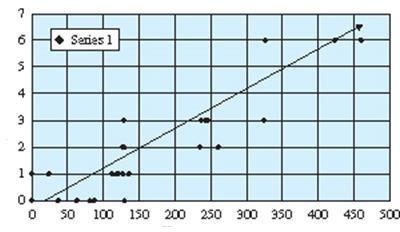
a) conclude that time spent in training improved worker performance, but only slightly so.
b) weigh the cost of worker training against the benefits of increased performance as a next step.
SOURCE: Browsegrades.net
c) Both a and b are sound actions.
d) Neither a nor b are sound actions.
Answer: b
Reference: Ishikawa‟s Basic Seven Tools of Quality/Scatter Diagrams Level: Difficult
11) The 80-20 rule is represented in which of the following tools?
a) Pareto charts.
b) Histograms.
c) Value stream mapping.
d) Flowcharting. Answer: a
Reference: Ishikawa‟s Basic Seven Tools of Quality/Pareto Charts Level: Easy
12) The following is an example of a:
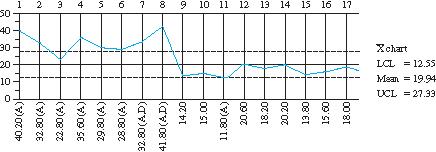
a) cause and effect (Ishikawa) diagram.
b) control chart.
c) frequency chart.
d) scatter diagram. Answer: b
Reference: Ishikawa‟s Basic Seven Tools of Quality/Control Charts Level: Easy
13) In a cause-and-effect (Ishikawa) diagram,
a) the problem to be addressed is placed along the backbone of the fish.
b) five “whys” may need to be asked in order to get to the root causes of the problem.
c) four common categories of effects are materials, machines, people, and methods.
d) All of the above are true of the cause-and-effect diagram. Answer: b
Reference: Ishikawa‟s Basic Seven Tools of Quality/Cause-and-Effect (Ishikawa) Diagrams Level: Difficult
14) Which of the following could be found at the head of a cause-and-effect (Ishikawa) diagram?
a) The zipper doesn‟t stay zipped.
b) Materials are inferior.
c) Pants are not unisex.
d) Machines are well-tuned.
Answer: a
Reference: Ishikawa‟s Basic Seven Tools of Quality/Cause-and-Effect (Ishikawa) Diagrams Level: Medium SOURCE: Browsegrades.net
15) Which of the following is a likely application of the 80-20 rule?
a) 80% of customer complaints come from a small number of quality problems.
b) 80% of customers will find quality problems 20% of the time.
c) 80% of inventory accounts for precisely 20% of the value.
d) 80% of inventory will have quality issues 20% of the time.
Answer: a
Reference: Ishikawa‟s Basic Seven Tools of Quality/Pareto Charts Level: Medium
Use the following data table to answer questions 16) and 17). Assume that the production line is moving slowly, and management is seeking to identify causes to improve production times.
Management has gathered the following data relating to 50 machine setups occurring over 140 days:
Type of problem
Frequency (Number of Times)
Machines jam raw material. 10
Setup procedures are not standardized. 50 Required safety equipment is not nearby. 140
Total 200
16) Using Pareto analysis, which would be the primary management action?
a) Tune factory machines and investigate the quality of raw materials used in the machines.
b) Standardize setup procedures and train workers on those procedures.
c) Make safety equipment more accessible by relocating safety items closer to workers.
d) None of the above.
Answer: c
Reference: Ishikawa‟s Basic Seven Tools of Quality/Pareto Charts Level: Easy
17) What other data would be helpful in assessing the problems listed in the table?
a) cost per type of delay.
b) time per type of delay.
c) Both a and b.
d) Neither a nor b would be helpful. Answer: c
Reference: Ishikawa‟s Basic Seven Tools of Quality/Pareto Charts Level: Easy
18) In Pareto analysis,
a) The marginal savings from correcting each problem increase as each problem is addressed.
b) The effort from correcting the most frequently occurring problem will be greater than the effort put forth in correcting the least frequently occurring problem.
c) Both a and b.
d) Neither a nor b is true of Pareto analysis.
Answer: d
Reference: Ishikawa‟s Basic Seven Tools of Quality/Pareto Charts Level: Difficult
19) Which of the following is not part of the new seven (N7) tools as developed by the Japanese Society for QC Technique Development?
a) The affinity diagram – a team creates a hierarchy of ideas on a large surface. SOURCE: Browsegrades.net
b) The interrelationship digraphs – shows interrelationships between different issues after an affinity diagram is constructed.
c) Process decision program chart – marks countermeasures to problems as either feasible or not feasible.
d) Prioritization matrices - interrelate process threats and their related consequences. Answer: d
Reference: The Seven New Tools for Improvement Level: Difficult
20) In the responsibility matrix diagram displayed below, which is not a cause of the billing errors?
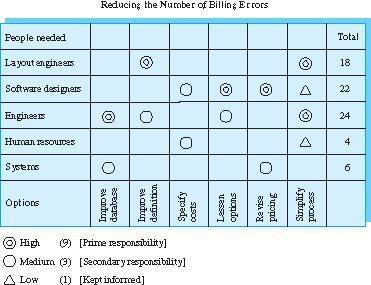
Answer:b
a) Non-current pricing.
b) Excessive costs.
c) Multiple options.
d) Billing processes.
Reference: The Seven New Tools for Improvement/Matrix Diagram Level: Difficult
21) The importance table is used in the prioritization grid tool. Using the table below, which of the following is true?
a) Expected life is ranked in importance above reputation.
b) Person 2 valued reputation far less than Persons 1 and 3.
c) No one worker‟s opinion dominates the weighted average score.
d) All of the above are true of the importance rating table.
Answer: c
Reference: The Seven New Tools for Improvement/Prioritization Grid Level: Medium
22) The critical path in the activity network diagram is the path of activities that is the
a) shortest in time from project beginning to the end.
b) longest in time from the project beginning to the end.
c) average of both the shortest estimated time and the longest estimated time.
d) None of the above describes the critical path.
Answer: b
Reference: The Seven New Tools for Improvement/Activity Network Diagram Level: Easy
23) The balanced scorecard
a) averages N7 and B7 tools offering an overall measurement of performance.
b) adds cost figures to N7 and B7 tools in order to measure the financial impacts of those processes.
c) measures employee satisfaction and customer satisfaction and identifies if goals in each area are being met.
d) All of the above are elements of the balanced scorecard.
Answer: c
Reference: Other Tools for Performance Measurement/Balanced Scorecards Level: Medium
24) Dashboards, huddle boards, and scorecards can be used together as follows:
a) Dashboards and huddle boards can report progress on metrics identified in the balanced scorecard.
b) The dashboard can be used to report the critical path identified in the scorecard.
c) The scorecard can be used to modify the dashboard shape into a bowtie or a turtle.
d) All of the above can be used together as described.
SOURCE: Browsegrades.net
Answer: a
Reference: Other Tools for Performance Level: Medium
25) The reasons why performance tools such as B7 and N7 are not successfully employed in all companies include:
a) Many of the tools are complex and require fairly extensive training.
b) Most of the tools are industry-specific and adaptation to a particular company is timeconsuming.
c) B7 and N7 added together offer 14 tools, and the choice of which ones to use is overwhelming to workers.
d) Cultural change is needed to ensure meaningful implementation after training has occurred.
Answer: d
Reference:Summary Level: Easy
Chapter 11: Statistically Based Quality Improvement for Variables
Multiple Choice
1) Statistical thinking is a decision-making skill demonstrated by the ability to draw conclusions based on data. Which of the following is part of the conceptual foundation of statistical thinking?
a) All work occurs in a system of interconnected processes.
b) All processes have variations, the amount of which tends to be overestimated.
c) Understanding and enlarging process variations are important keys to success.
d) All of the above are concepts underlying for statistical thinking.
Answer: a
Reference: Statistical Fundamentals/What is Statistical Thinking? Level: Medium
2) Sometimes, statistical tools do not achieve desired results. All of the following are reasons why statistical tools fail, except:
a) Organizations lack patience in collecting data.
b) A lack of knowledge about the tools leads to misapplication.
c) General disdain for all things mathematical creates a barrier to the use of statistics.
d) Statistical tools often focus on causes of problems rather than effects.
Answer: d
Reference: Statistical Fundamentals/Why Do Statistics Sometimes Fail in the Workplace? Level: Medium
3) In the study of quality, a Type I error can be termed, “producer‟s risk” and a Type II error can be termed, “consumer‟s risk.” Which is a correct matching of Type I or Type II errors and its description?
Answer: b
Type I – a nonconforming product is accepted.
a) Type I – a good product is rejected.
b) Type II – a good product is accepted.
c) Type II – a nonconforming product is rejected.
Reference: Statistical Fundamentals/Why Do Statistics Sometimes Fail in the Workplace? Level: Difficult
4) After taking numerous samples over time, management discovers that all samples have similar means, and the data is consistently dispersed around each sample‟s mean. These findings indicate that this process variation is
a) random variation with a cause that may be identified and controlled by management.
b) random variation and is uncontrollable by management.
c) nonrandom variation with a cause that may be identified and controlled by management.
d) nonrandom variation and is uncontrollable by management.
Answer: b
Reference: Statistical Fundamentals/Understanding Process Variation Level: Medium
5) Reasons for employing sampling techniques versus 100% inspection include all of the following, except:
a) Sampling allows the user to frame the sample.
b) Sampling may destroy the product.
c) 100% inspection costs less than sampling.
d) 100% inspection takes more time.
Answer: c
Reference: Statistical Fundamentals/Sampling Methods Level: Easy
6) Example(s) of instances where 100% inspection is appropriate include:
a) Acceptance sampling, where much material has been rejected in the past.
b) In-process inspection, where workers have been asked to inspect their own work as it is being performed.
c) Neither a nor b is an appropriate instance of 100% inspection.
d) Both a and b are appropriate instances of 100% inspection.
Answer: d
Reference: Statistical Fundamentals/Sampling Methods Level: Medium
7) A machine is used to create multiple products by the same machines, processes, and workers in sequence. Because there is not independence among the observations, which method of sampling would be inappropriate?
a) Random.
b) Systematic.
c) Rational Subgrouping.
d) None of the above would be appropriate.
Answer: a
Reference: Statistical Fundamentals/Random Samples Level: Difficult
Use the control plan below to answer the Question 8.
8) Locate the column labeled with a question mark. The title of that column is:
a) Specifications.
b) Sample Frequency.
c) Control method.
d) Reaction plan.
Answer: d
Reference: Process Control Charts/Control Plan Level: Medium
9) Which is true
b) The formulas to used to compute the upper limits, center line, and lower limits will be the same.
c) The data points from the samples will be different but all will be within the upper control limit and the lower control limit.
d) All of the above are true of process charts.
Answer: a
Reference: Process Control Charts/A Generalized Procedure for Developing Process Charts and Understanding Process Charts
Level: Medium
10) The null hypothesis is the product µ (mu) is 5.25 ounces, with the weight being considered a key critical characteristic. A sample of 20 products is drawn, and the sample mean is 5.15 ounces. If the control limits are plus or minus .2 ounces, the following may be stated:
a) The process is not in control.
b) The sample mean falls below the center line in the process chart.
c) The null hypothesis should be rejected.
d) None of the above may be stated.
Answer: b
Reference: Process Control Charts/Understanding Process Control Charts Level: Difficult
11) Dispersion of a process is one of two important variables typically measured for a particular product in a process. Which is true of charting process dispersion?
a) The x bar chart measures dispersion of a process and can be computed by measuring the difference between high and low values of a subgroup of items.
b) The R chart measures dispersion of a process and can be computed by measuring the difference between high and low values of a subgroup of items.
c) The R chart and the moving range chart must be used together to measure the dispersion within a process.
d) The x bar, R chart, and the moving range chart must be used to measure dispersion.
Answer: b
Reference: Process Control Charts/x bar and R Charts Level: Medium
12) Which of the following is correct regarding interpreting control charts? Assume a control chart employs three standard deviation limits and one point is outside the control limits.
a) The process will be termed an “out-of-balance situation.”
b) The variation is probably a random variation in the process.
c) The chance that the process is stable is less than 1%.
d) Management will not need to seek a cause for this “one-off” situation.
Answer: c
Reference: Process Control Charts/Interpreting Control Charts Level: Medium
13) Which is a correct match of terminology to description in a control chart?
a) Process run – five points above or below center indicate the process has shifted.
b) Process drift – seven points that are all either increasing or decreasing indicate that machines may be drifting out of alignment.
c) Erratic behavior – large jumps of more than three or four standard deviations.
d) All of the above are correct matches of term to description.
Answer: d
Reference: Process Control Charts/Interpreting Control Charts Level: Easy
14) Your variables control chart displays two points in succession farther than two standard deviations from the mean. You should:
a) Postpone action because it is likely that these are just random events in the process.
b) Construct and analyze an x bar chart to obtain further information.
c) Investigate and take action(s) because this is unlikely to be random variation.
d) Reconsider the definitions of variables vs. attributes to interpret these findings.
Answer: c
Reference: Process Control Charts/Interpreting Control Charts. Level: Medium
Use the following examples to answer Question 15.
Example 1
Example 2
3

4
5
6

15) Example 3 indicates
a) normal behavior.
b) progressive change.
c) process drift.
d) erratic behavior.
Answer: d
Reference: Process Control Charts/Interpreting Control Charts Level: Easy
16) Using the X and MR charts would be appropriate when
a) there are multiple subgroups available for sampling.
b) the process tested is rapid, and units are readily available for testing.
c) there are few units produced and therefore, sampling is not appropriate.
d) both a and b are characteristics of a process for which X and MR charts would be appropriate.
Answer: c
Reference: Process Control Charts/X and Moving Range (MR) Charts for Population Data Level: Medium
17) Which is true of an X chart?
a) The X chart reflects a sample‟s distribution.
b) X chart limits are termed “natural limits.”
c) The formula for the X chart is similar to that of the R chart.
d) All of the above.
Answer: b
Example
Example
Example
Example
Reference: Process Control Charts/X and Moving Range (MR) Charts for Population Data Level: Medium
18) For both the median chart and the x bar chart,
a) the larger the sample size, the better the chart is able to detect nonrandom events.
b) an odd sample size should be used for each sample taken.
c) subgroup averages should be calculated.
d) All of the above are true of both the median and x bar charts.
Answer: a
Reference: Process Control Charts/Median Charts Level: Medium
19) The s chart (standard deviation chart) would be useful in measuring dispersion when producing a) parts that work together as part of a machine.
b) tools used to measure the performance of other tools.
c) Both a and b.
d) Neither a nor b.
Answer: c
Reference: Process Control Charts/x bar and s Charts Level: Difficult
20) Which is true of control charts?
a) When upper and lower control limits become closer together, these limits should be expanded to allow for reasonable, random variation in the process.
b) The focus of control charts should be on continuous improvement with results of processes communicated to workers.
c) Both a and b.
d) Neither a nor b.
Answer: b
Reference: Some Control Chart Concepts for Variables/How Do We Use Control Charts to Continuously Improve? Level: Medium
21) When is it appropriate to change the control chart limits?
a) When the process deviates from the target.
b) When there is a change to the process.
c) When a data point exceeds either upper or lower control limits.
d) When erratic behavior occurs.
Answer: b
Reference: Some Control Chart Concepts for Variables/Tampering with the Process Level: Medium
22) A highly capable process
a) is the result of optimizing interactions between people, machines, raw materials, procedures, and measurement systems.
b) can be measured by parts per million (ppm) defect levels, with less than 100,000 defective parts.
c) eliminates all random variations in the process.
d) All of the above.
Answer: a
Reference: Process Capability for Variables Level: Medium
23) One would expect
a) much more variability in population distributions vs. sampling distributions.
b) process capability to be associated with sampling distributions vs. population distributions.
c) sample-based process charts limits to be compared to product specifications (tolerances).
d) variability to increase as the mean increases.
Answer: a
Reference: Process Capability for Variables Level: Difficult
24) Below is a list of some steps needed to perform a capability study. Which is the correct order of the steps listed?
i. Prepare a trial control chart to determine if process is stable.
ii. Compare natural tolerance limits with specification limits.
iii. Take samples.
iv. Compute upper and lower capability indexes.
a) i., ii., iii., iv.
b) ii., iv., iii., i.
c) iv., iii., ii., i.
d) iii., i., ii., iv,
Answer: d
Reference: Process Capability for Variables/Capability Studies Level: Medium
25) Which of the following is true about process capability and stability?
a) If common variation is high, a process could be stable but not capable.
b) If nonrandom variation is high, a process could be stable but not capable.
c) It is uncommon that a process could be stable but not capable.
d) All of the above are true about process capability and stability.
Answer: a
Reference: Process Capability for Variables/The Difference Between Capability and Stability Level: Medium
Chapter 12: Statistically Based Quality Improvement for Attributes
Multiple Choice
26) Which is true of attributes?
a) Attributes are highly correlated with the concepts of size and distance.
b) An attribute is a continuous measurement, such as weight, height, or volume.
c) Attributes and variables are terms that are used synonymously when testing for quality.
d) An attribute refers to a characteristic that either does, or does not, exist.
Answer: d
Reference: Introduction Level: Easy
27) Examples of questions relating to attributes include all of the following, except:
a) Are the financial statements fairly stated?
b) What is the average diameter?
c) Does the engine start?
d) All of the above are attribute questions.
Answer: b
Reference: Introduction Level: Medium
28) Which is a correct matching of the type of attribute to question posed?
a) Sensory attributes – Does the report seem complete?
b) Performance attributes – Did we meet the delivery schedule?
c) Structural attributes – Does the restaurant have a drive-up window?
d) Temporal attributes – Does the product accomplish what it is supposed to?
Answer: c
Reference: Introduction Level: Medium
29) Which is true of defects and defectives?
a) There can be one or more defect(s) in a defective.
b) There can be one or more defective(s) in a defect.
c) Defects and defectives are measured using critical operation charts.
d) Defects and defectives are measured using critical operation charts, unless measuring ethicaltype attributes.
Answer: a
Reference: Understanding Attributes Charts Level: Medium
30) Management is concerned that there may have been a shift in the proportion of late deliveries to total deliveries. Assuming that each of the 30 subgroups examined had 100 items, which chart(s) would be appropriate to use?
a) X and MR.
b) Median.
c) p or np.
d) g or h.
Answer: c
Reference: Understanding Attributes Charts/p Charts for Proportion Defective Level: Medium
a) 5-25 units
b) 50-100 units.
c) 100-150 units.
d) Any number greater than 100 units.
Answer: b
Reference: Understanding Attributes Charts/p Charts for Proportion Defective Level: Medium
32) When constructing a p chart, what can be done to ensure the most accurate findings if sample size is not constant?
a) Ignore the sample size differences because sample sizes should be varied when using a p chart.
b) Use an np chart instead of a p chart.
c) Compute the control limits using an average sample size.
d) None of the above.
Answer: c
Reference: Understanding Attributes Charts/p Charts for Proportion Defective Level: Medium
Use the following data to answer questions 8 through 10 on the following page.
Data for an np chart for accounting entries:
33) Find ? and ?? located in the table column titles on the preceding page. Assuming the data is to be graphed into an np chart, what are the labels for ? and ??, respectively:
a) Erroneous; np.
b) Correct; np.
c) Erroneous; p
d) Correct; p
Answer: c
Reference: Understanding Attributes Charts/np Charts Level: Medium
34) Without resorting to computation, the center line of the np chart would be closest to:
a) 1.0%
b) 3.0%
c) 5.5%
d) 6.0%
Answer: b
Reference: Understanding Attributes Charts/np Charts Level: Easy
35) Interpretations of the data in the table could include which of the following?
a) The improved performance in the later weeks was due to a change in processing method.
b) Nonrandom variation is present throughout all weeks.
c) The upper control limit is set too high and/or the lower control limit is set too low.
d) None of the above are correct interpretations of the data presented. Answer: d
Reference: Understanding Attributes Charts/np Charts Level: Medium
36) You would like to know the average number of defects per unit. You should graph a chart.
a) n
b) p
c) c
d) u Answer: d
Reference: Understanding Attributes Charts/c and u Charts Level: Easy
37) The c chart is a graph of the
a) actual number of nonconformities per standardized unit.
b) average number of defects per unit when the sample space is varied.
SOURCE: Browsegrades.net
c) average dispersion of measurements from the mean when measuring unit performance.
d) actual proportion of nonconformities per variant.
Answer: a
Reference: Understanding Attributes Charts/c and u Charts Level: Medium
38) In c charts:
a) The sampled units must be of a different metric - such as size, height, length, etc.
b) The area of opportunity for finding defects will be varied to increase the likelihood of capture.
c) The individual units in the sample will be grouped together as if they are one unit of a larger size.
d) All of the above.
Answer: c
Reference: Understanding Attributes Charts/c and u Charts Level: Medium
39) A careful review the u chart below indicates which of the following? Assume that this chart displays number of defects over 25 items, randomly selected in three styles.
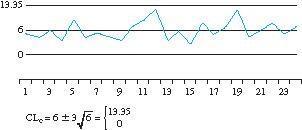
a) The process is in control; no investigation needed.
b) The process is not in control; some investigation needed.
c) The process is in control; some investigation needed.
d) The process is not in control; no investigation needed.
Answer: c
Reference: Understanding Attributes Charts/c and u Charts Level: Difficult
40) While using Excel to draw a c and u charts, you compute the lower limit to be a negative number. You should:
a) Recompute because there is something wrong with your computation.
b) Graph accordingly because this is not an uncommon occurrence.
c) Use the negative number for the c chart but not the u chart.
d) Use zero for the lower limit.
Answer: d
Reference: Understanding Attributes Charts/Using Excel to Draw c and u Charts Level: Medium
41) To select the correct attributes chart, p, np, c, or u, the manager should consider which of the following?
a) Defects or defectives?
b) Identical subgroup sample sizes or varied sample sizes?
c) Both a and b are distinguishing factors for the named charts.
d) Neither a nor b are distinguishing factors for the named charts.
SOURCE: Browsegrades.net
Answer: c
Reference: Choosing the Right Attributes Chart Level: Easy
42) When interpretating the bathtub-shaped hazard curve shown below, one would think this product
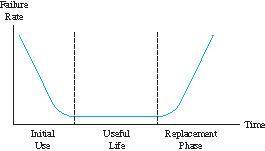
a) is likely to be highly unsatisfactory.
b) is more likely to fail during initial use and then again late in its life.
c) has experienced a decrease in failure rate over life.
d) All of the above are correct interpretations.
Answer: b
Reference: Reliability Models Level: Medium
43) In series reliability,
a) all parts must be physically wired together in sequence for the system to be in a series.
b) the entire system depends on all components functioning properly.
c) the reliability models assume dependence between failure events.
d) All of the above.
Answer: b
Reference: Reliability Models/Series Reliability Level: Medium
44) When a system requires high component reliability, and high reliability is not possible for every component,
a) some components in the system may be in series, and some may be parallel.
b) redundant systems may be employed except where failures are independent of one another.
c) the mean time to failure (MTTF) will be decreased by increasing the critical complexity of the system.
d) All of the above.
Answer: a
Reference: Reliability Models/Parallel Reliability Level: Medium
Use the diagram below to answer questions 20 and 21. Reliability factors are: A =.95 B =.99 C1=.90 C2=.90 SOURCE: Browsegrades.net
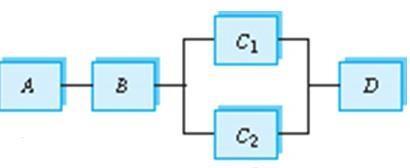
45) The overall reliability of the system is closest to:
a) 56%
b) 75%
c) 84%
d) 98%
Answer: d
Reference: Reliability Models/Parallel Reliability Level: Medium
46) The improvement to the overall system reliability by adding component C2 is closest to:
a) 2%
b) 14%
c) 23%
d) 70%
Answer: b
Reference: Reliability Models/Parallel Reliability Level: Difficult
47) Your company has six lathes, each of which ran 35 hours last week. What was the failure rate if the machines jammed a total 7 times?
a) Between 3 and 4%.
b) Between 9 and 10%.
c) Precisely 30%.
d) Not calculable with data given. Answer: a
Reference: Reliability Models/Measuring Reliability Level: Easy
48) Your company services 500 photocopier machines in the city, each of which is in use for an average of 20 hours per week, 52 weeks per year. If the mean time between failures (MTBF) is 600 hours per machine, approximately how many service technicians should your company employ?
a) 1
b) 2
c) 3
d) Not calculable.
Answer: b
Reference: Reliability Models/Mean Time to Failure (MTTF) Level: Medium
49) The following acronyms are used in reliability formulas: mean time to failure (MTTF); mean time before failure (MTBF); and mean time to repair (MTTR). Using these acronyms, system SOURCE: Browsegrades.net
availability is computed as:
a) MTBF/(MTBF + MTTR)
b) MTTR + MTBF/MTTF
c) MTTF/MTBF
d) 1 minus (MTBF + MTTR + MTTF)
Answer: a
Reference: Reliability Models/System Availability Level: Medium
50) Using the table below, which vendor would you choose based on system availability?
a) X
b) Y
c) Z
d) Indeterminable, because mean time to failure (MTTF) is not listed in the table.
Answer: a
Reference: Reliability Models/System Availability Level: Medium
Chapter 13: Lean and Six Sigma Management Principles and Tools
Multiple Choice
Use the following list of Lean and Six Sigma characteristics to answer Questions 1 and 2:
i. a production system used to create value
ii. project-based improvement
iii. focus on financial profits
iv. respect given to workers, the organization, customers
v. training and certification of workers
vi. influenced by Deming
vii. elimination of waste
viii. a methodology for process improvement
1) Which of the preceding items relate most to Six Sigma?
a) i., ii., iii, vii.
b) ii, iv., vi., viii.
c) iii., iv., v., vi.
d) ii., iii., v., viii.
Answer: d
Reference: Introduction Level: Difficult
2) Which of the preceding items relate most to Lean?
a) i., iv., v., vii.
b) iv., v., vi., vii.
c) i., iv., vi., vii.
d) iv., v., vi., vii.
Answer: c
Reference: Introduction Level: Medium
3) All of the following are primary characteristics in both Lean and Six Sigma, except:
a) Continuous improvement.
b) Worker certification.
c) Customer orientation.
d) Utilization of general quality tools.
Answer: b
Reference: Introduction Level: Medium
4) Lean Six Sigma is a blend of Lean and Six Sigma practices in what way? Lean Six Sigma emphasizes
a) the Six Sigma framework, but with increased focus on worker respect.
b) the Six Sigma framework, but with increased focus on waste reduction.
c) lean, but increased focus on profits.
d) lean, but increased focus on Deming methodology. Answer: b
Reference: Understanding Six Sigma Level: Medium
SOURCE: Browsegrades.net
5) All of the following are true of Six Sigma except:
a) Six Sigma began in Japan in 1982 and has since morphed into a quality improvement framework used internationally.
b) Adopters of Six Sigma often use consultants to train workers in Six Sigma practices.
c) Managers employing Six Sigma typically identify and prioritize projects to lower costs.
d) Six Sigma is much more profit-focused than traditional continuous improvement.
Answer: a
Reference: Understanding Six Sigma Level: Medium
6) Which is true of Six Sigma belts?
a) Green belts can be involved in critical projects, less-critical projects, or be among many workers who receive required training.
b) Yellow belts refer to workers who are familiar with basic Six Sigma improvement processes.
c) Using master black belts to train potential black belts can reduce an organization‟s costs.
d) All of the above are typical of Six Sigma belts.
Answer: d
Reference: Organizing Six Sigma Level: Easy
7) The DMAIC process in Six Sigma improvement cycle is:
a) Describe, mine (data), analyze, improve (process), constrain (costs).
b) Describe, maximize (value), analyze, increase (profits), constrain (costs).
c) Define, minimize (costs), analyze, increase (profits), control (performance).
d) Define, measure (process), analyze, improve (process), and control (performance).
Answer: d
Reference: DMAIC Overview Level: Medium
8) When defining the business case for a Six Sigma project, which is a question that should be asked?
a) Attainable?
b) Bearable?
c) Manageable?
d) Rational?
Answer: a
Reference: Define Phase Level: Easy
Please use the following for Questions 9-11.
Your company is performing a project risk assessment for a potential Six Sigma project. The following data has been gathered: Ratings: Yes=0; Uncertain=3; No=5
9) The risk rating for this project is closest to?
a) 43%
b) 46%
c) 51%
d) 57%
Answer: b
Reference: Define Phase/Project Evaluation
Level: Medium
10) Considering the relative weights given, which of the following is true? The data suggests that the a) defect has not been measured, and the customer will likely benefit from its measurement. b) project will likely benefit other processes, and other managers are supportive of this.
c) project could be worthwhile because the defect is currently measured later in the process.
d) All of the above are true of the assessment.
Answer: c
Reference: Define Phase/Project Evaluation Level: Difficult
11) Assume the return value for the above project is 70. This project would be considered to be a:
a) Star.
b) Dog.
c) Other.
d) ?
Answer: a
Reference: Define Phase/Project Evaluation Level: Medium
12) Your company considers the following items when estimating project return. Which of the following indicates a favorable project return?
a) Urgency: The postponement of the project will result in further competitive disadvantage to the company.
b) Growth: The project provides a modest degree of incremental sales with paying customers.
c) Both a and b.
d) Neither a nor b.
Answer: c
Reference: Define Phase/Project Evaluation Level: Medium
13) When using a process map as part of a Six Sigma study, the goal of the map is to identify
a) inputs and outputs via matrix.
b) non-value-added activities.
c) low-hanging fruit.
d) team member roles by belt.
Answer: b
Reference: Measure Phase Level: Easy
14) In gauge repeatability and reproducibility analysis, two-way ANOVA experiments are used to determine if the cause of a variation is due to:
a) the part being measured.
b) the measurement instrument.
c) Both a and b.
d) Neither a nor b relate to R & R two-way ANOVA.
Answer: c
Reference: Measure Phase/Gauge R & R Level: Medium
15) Which of the following steps is performed in the Six Sigma analyze phase?
a) Identify project risks.
b) Determine the business case.
c) Perform R and R.
d) Identify independent variables (Xs).
Answer: d
Reference: Analyze Phase/Identifying Xs Level: Medium
16) The Taguchi method
a) seeks the best combination of inputs to make a product or service.
b) targets information overload as a faulty strategy for quality improvement.
c) identifies and maps responsibility lanes.
d) defines and verifies Six Sigma and Lean processes.
Answer: a
SOURCE: Browsegrades.net
Reference: Taguchi Design of Experiments Level: Easy
17) Taguchi approaches design from four perspectives:
a) robust design – reduces variation after parameter design by tightening tolerances.
b) concept design – states products should be inherently defect-free and insensitive to random variation.
c) parameter design – selects control factors and determination of optimal levels for those factors.
d) tolerance design – examines competing technologies to produce a product including process design and technology choices.
Answer: c
Reference: Taguchi Design of Experiments/Robust Design Level: Medium
18) Aspects unique to the Taguchi method include all of the following, except:
a) Continuous improvement.
b) Quality loss function (QLF).
c) Robust design.
d) Ideal quality.
Answer: a
Reference: Taguchi Design of Experiments/Robust Design Level: Medium
19) Under the Taguchi method, “loss to society” is
a) a deviation from a target value.
b) includes scrap, rework, and pollution added to the environment.
c) a cost when a service is not performed as expected.
d) All of the above describe “loss to society.”
Answer: d
Reference: Taguchi Design of Experiments/Robust Design & Taguchi Definition of Quality Level: Easy
20) The following formula is used by Taguchi to compute the quality loss function (QLF):
L=K*V2 ($ per unit)
where:
L = the economic penalty incurred by the customers as a result of production deviation.
K = a constant.
V2 = the mean squared deviation from the desired target value.
If K is $500 and V is 1/5, what is the cost of the deviation?
a) $20 per unit.
b) $40 per unit.
c) $100 per unit.
d) $200 per unit.
Answer: a
Reference: Taguchi Design of Experiments/Quality Loss Function Level: Medium
21) Taguchi objectives are defined as:
a) The less the better – number of defectives or errors.
b) Nominal is best – the desired outcome usually relates to a measurement.
c) The more is better – the desired outcome is the opposite to less the better.
d) All of the above correctly described Taguchi objectives.
Answer: d
Reference: The Taguchi Process Level: Easy
22) In the Taguchi method, experimentation is used to identify factors that result in the closest-totarget performance. Which is a correct statement about that process?
a) Orthogonal arrays must be determined via brainstorming sessions early in the process.
b) If two alternatives for optimal levels are determined because of interactions, a full factorial experiment can be run to detect the interactions.
c) The Ross methodology can be used to expand the quantitative information under Taguchi when conducting service experimentation.
d) Online experimentation is a method used in the Taguchi process as a means of improving quality.
Answer: b
Reference: The Taguchi Process Level: Difficult
23) Lean principles and techniques include the following except:
a) Pull systems which strive to produce only what is needed, when it is needed.
b) RUMBA and project risk assessment.
c) Automation of work with quality inspection at the source of production.
d) Andon and Five S visual management techniques.
Answer: b
Reference: Understanding Lean Production Level: Medium
24) Wastes in processes have causes and consequences. Which of the following is a potential cause of waste and potential consequence of that waste?
a) Movement - Poorly designed work areas cause interruptions in the flow of products through the system and increase risk of injury.
b) Setup - Drive for economies of scale cause increases in inventory and storage costs.
c) Waiting - Shortages in supply chains cause decreases in workflow and delays in delivery.
d) All of the above describe causes and potential consequences of wastes in processes.
Answer: d
Reference: Understanding Lean Production/Reducing Waste Level: Easy
25) Value Stream Mapping (VSM) maps the flow of products or services through the system. Which is true of VSM? VSM
a) incorporates push production and vendor management.
b) identifies lines of responsibility for functional units.
c) often shows cycle times for tasks at each stage of process.
d) summarizes costs for each stage of production.
Answer: c
Reference: Lean Value Stream Maps Level: Medium
26) Reasons why Lean and Six Sigma fail to deliver desired results include all of the following, except:
a) Excessive data.
b) Resistance to change.
c) Faulty strategies for deployment.
d) Lack of appropriate culture for continuous improvement.
Answer: a
Reference: Lean and Six Sigma from a Contingency Perspective Level: Easy
Part Four: Forever Improving the Quality System
Chapter 14: Managing Quality Improvement Teams and Projects
Multiple Choice
1) All of the following are true of teams today, except:
a) Employees often dislike teamwork but find it necessary to collaborate with others in order to manage more complex work tasks.
b) Workplace complexity has driven workers from routine work to knowledge work, which often requires the use of teams.
c) Projects are important to the improvement of quality, and teams are part of that work.
d) Teams offer workers opportunities for personal development, achievement, and recognition.
Answer: a
Reference: Introduction & Why Employees Enjoy Teams Level: Easy
2) In a planning meeting, management met with your team and directed it to find the cause of a problem and correct the fault. Your team has been given access to all data necessary for you to determine the cause. The fault likely begins within a department outside your span of control. What precondition for empowerment was violated based on this scenario?
a) Adequate information for decision making.
b) Clear authority and accountability.
c) Participation in planning at all levels.
d) None of the above was violated in this case.
Answer: b
Reference: Leading Teams for Quality Improvement/Employee Empowerment and Involvement Level: Difficult
3) Organizational learning leads to a change in organization behavior in a way that improves performance. Organizational learning
a) includes continuous improvement projects as a governing principle for all team members.
b) requires a culture where employees do not express opinions or beliefs unless they fall within existing corporate norms.
c) Both a and b.
d) Neither a or b.
Answer: a
Reference: Leading Teams for Quality Improvement/Employee Empowerment and Involvement Level: Medium
4) Which is true of management hierarchies? Having multiple layers of management
a) simplifies decisions and reduces workloads.
b) increases participation in decision making for workers at all levels.
c) decreases time required to perform work.
d) None of the above.
Answer: d
Reference: Leading Teams for Quality Improvement/Flattening Hierarchies for Improved Effectiveness Level: Easy
Use Hersey, Blanchard, and Johnson‟s Situation Leadership Model below to answer questions 5 and 6.
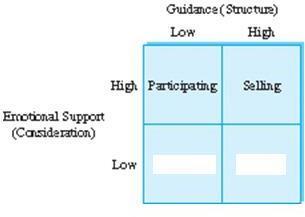
5) The lower two quadrants would be labeled as
a) Borrowing; Creating.
b) Delegating; Telling.
c) Participating; Hawking.
d) Piloting; Ruling.
Answer: b
Reference: Leading Teams for Quality Improvement/Team Leader Roles and Responsibilities/Hersey, Blanchard, and Johnson‟s Situational Leadership Model Level: Easy
6) To lead a team of workers who are untrained, less-confident, and reluctant to perform tasks, the leadership approach would be found in which quadrant?
a) Upper left.
b) Upper right.
c) Lower left.
d) Lower right.
Answer: d
Reference: Leading Teams for Quality Improvement/Team Leader Roles and Responsibilities/Hersey, Blanchard, and Johnson‟s Situational Leadership Model Level: Medium
7) “Task readiness” is a function of which variables?
a) Telling and selling.
b) Drive and commitment to task.
c) Job maturity and psychological maturity.
d) Technical skills and communication competency.
Answer: c
Reference: Leading Teams for Quality Improvement/Team Leader Roles and Responsibilities Level: Medium
8) Besides team leaders, there are a variety of roles that individuals occupy within teams. Which is true of Belbin‟s Team Roles?
a) The identified roles are mutually exclusive, meaning one worker cannot fulfill more than one role at a time.
b) Managers should consider each of Belbin‟s roles and then seek team members who fulfil those roles.
c) Each of the roles may be more relevant at different stages during a project.
d) All of the above are true of team roles.
Answer: c
SOURCE: Browsegrades.net
Reference: Leading Teams for Quality Improvement/Team Roles and Responsibilities Level: Medium
9) Below is a list of team development stages. Which letter presents the correct order of the stages from beginning to end?
i. Forming ii. Norming iii. Storming iv. Mourning v. Performing
a) i., ii., iii., v., iv.
b) i., v., ii., iii., iv.
c) i., iii., ii., v., iv.
d) i., v., iii., ii., iv.
Answer: c
Reference: Leading Teams for Quality Improvement/Team Formation and Evolution Level: Easy
10) Your team is exhibiting dysfunctional behaviors. Some members feel that their higher-level job titles should allow them to control the data, conversation (including extraneous conversation), and decision-making. This attitude has led to inhibited contribution within the group and backstabbing outside the group by the diminished members. Based on only this description, which of the following pairs of ground rules for effective teams has been subverted?
a) Disagree openly with any member of the group; and all members are expected to participate in the process.
b) Make decisions by consensus; and focus on interests, not positions.
c) Be specific – use examples; and define what important words mean.
d) Both a and b, but not c.
Answer: d
Reference: Leading Teams for Quality Improvement/Team Rules Level: Medium
11) Which of the following is a common type of team as described?
a) Tiger – employees from a variety of functional groups form a team to solve problems.
b) Process Improvement – employees work to improve processes and customer service, either under the direction of management or through self-direction.
c) Natural work groups – employees work in a loosely knit consortia that produces products and services but rarely physically meet.
d) All of the above are common types of teams.
Answer: b
Reference: Types of Teams/Process Improvement Teams Level: Medium
12) Which is true of facilitation and team building? A facilitator is a team member who should a) assign tasks to quiet or vocal team members based upon their respective temperaments.
b) take sides or positions only on key areas of content disagreement.
c) help key members reach points of agreement.
d) All of the above.
Answer: c
Reference: Implementing Teams Level: Medium
13) Structured processes help meetings stay focused, delve deeper into exploration, separate creative from evaluative activities, and encourage reflection. Which of the following structured process activities are evaluative in nature?
a) Sticky notes recording.
b) Silent writing.
c) Round-robin contribution.
d) Forcefields.
Answer: d
Reference: Implementing Teams/Meeting Management Level: Easy
14) It is claimed that leaders spend more than 20% of their time resolving conflict. Which of the following pairs are methods used by leaders to resolve conflict?
a) Confronting conflict and preventing conflict.
b) Dynamic conflict resolution and passive conflict resolution.
c) Competing resolution and accommodating resolution.
d) Interactive resolution and win-win resolution.
Answer: a
Reference: Implementing Teams/Conflict Resolution in Teams Level: Medium
15) A team leader observes a conflict within the team. Because this conflict will have significant impact on the project, the leader chooses to gather data and asks a disinterested observer to add weight to the claims of one of the conflicting parties. This type of resolution is termed:
a) Confronting conflict.
b) Choosing a winner.
c) Structured problem solving.
d) Win-win.
Answer: c
Reference: Implementing Teams/Conflict Resolution in Teams Level: Medium
16) Which is true about problem projects and failure of those projects?
a) Workers usually blame themselves when they see a project is failing.
b) Early project completion is one indicator that the project is either failing or has already failed.
c) Uncertainty is present in every project, but projects that fail typically have a risk factor of 15% or greater.
d) Helping a group decide how to change problematic behavior is a remedial step that a leader can take.
Answer: d
Reference: Implementing Teams/Conflict Resolution in Teams Level: Medium
17) Which of the following is not a key principle of Integrated Project Management?
a) Identification and consideration of the project‟s environmental impact bolsters cohesiveness within the team.
b) Successful work in project teams is built on mutual respect and helps both those leading and those receiving project services.
c) Quality must be a consistent focus when delivering a project and builds trust and confidence in those the team serves.
d) Maintaining an ethical, value-based culture is critical for managing project excellence.
SOURCE: Browsegrades.net
Answer: a
Reference: Managing and Controlling Projects/ Quality Highlight 14-1, Leading Project Excellence Level: Medium
Use the following to answer questions 18 and 19:
Your company would like to install 20 ordering kiosks in ten fast food restaurants (2 kiosks per store). Your team has identified the following costs in a project.
Data for cost benefit analysis and payback period calculations:
Initial costs: 20 kiosks @ $2,500 each
Ongoing costs and benefits: Maintenance ($5,000) per year Improved customer retention and up-sales
per year Wages avoided
per
18) Which costs are indirect?
a) Software licensing.
b) Employee training.
c) Kiosks.
d) Installation. Answer: b
Reference: Managing and Controlling Projects/Qualifying Projects Level: Easy
19) What is the payback period?
a) Between three and four months.
b) Between two and three months.
c) Between one and two months.
d) This project will not payback and should not be undertaken. Answer: a
Reference: Managing and Controlling Projects/Qualifying Projects Level: Medium
20) Using the following data for this project‟s force-field analysis, which of the following is true?
Score Scale: 1=weak and 5=very strong Forces for change: SOURCE: Browsegrades.net
a) There are significant forces in favor of this change.
b) Work will be needed in order to develop forces in favor of this change.
c) Scale scores indicate that this project is labor intensive.
d) All of the above are true.
Answer: b
Reference: Force-field Analysis Level: Medium
21) Using the following checklist below, when will this project be completed?
Work beginning on Monday, 9/17/xx. Five-day work week.
a) Nine days; finish 9/27.
b) Thirteen days; finish 10/3.
c) Fourteen days; finish 10/4.
d) Eighteen days; finish 10/10.
Answer: c
Reference: Work Breakdown Structure (WBS) Level: Medium
22) Refer to Question 21. If Task 2 started three days later than anticipated, the impact on the project would be:
a) No impact on time since the critical path is unchanged.
b) No impact on time since Task 2 has slack.
c) Both a and b are accurate statements.
d) Neither a nor b apply to this example.
Answer: c
Reference: Activity Network Diagrams Level: Difficult
23) Using the following data, what is the best estimate of expected time for this task? Expected time is computed as:
Data for computation:
Optimistic time: 2 weeks
Most likely time: 3 weeks
Pessimistic time: 16 weeks
a) 5 weeks, high variance.
b) 5 weeks, low variance.
c) 3 weeks, high variance.
d) 3 weeks, low variance.
Answer: a
Reference: Identifying Task Times Level: Medium
24) Which of the following is true of companies with multiple projects?
a) A multiple-project control form can be prepared detailing projects, members, and levels of responsibility for each.
b) Care should be taken that employees are not involved in so many projects that they are not effective.
c) Management‟s duty is to ensure that employees have ample time to work on projects, so successful completion is facilitated.
d) All of the above are true of managing multiple projects.
Answer: d
Reference: Managing Multiple Projects Level: Easy
25) The diagram below is a(n):
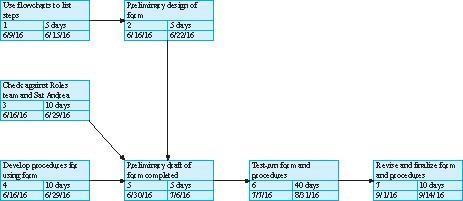
a) Activity-on-node (AON) diagram.
b) Project evaluation review technique (PERT) chart.
c) Gantt chart.
d) None of the above.
Answer: b
Reference: Arrow Gantt Charts Level: Medium
Chapter 15: Implementing and Validating the Quality System
Multiple Choice
1) The three spheres in the quality system model are:
a) Quality Planning & Organization; Quality Assurance; Quality Control.
b) Quality Planning & Management; Quality Assurance; Quality Control.
c) Quality Planning & Organization; Quality Pledging; Quality Control.
d) Quality Planning & Management; Quality Pledging; Quality Assessment.
Answer: b
Reference: Building Blocks for the System of Quality Improvement Level: Easy
2) A quality system depends on the interaction of many variables. Which of the following variables is the foundational building block of the quality system model?
a) People.
b) Culture.
c) Closeness to customers.
d) Quality planning and management.
Answer: a
Reference: Building Blocks for the System of Quality Improvement/People Level: Easy
3) Which of the following statements is true as it relates to people in a system?
a) A company that has a reputation for laying off people may find it difficult to attract new workers.
b) The capability for organizational learning decreases when the best employees leave due to job insecurity.
c) Employees must understand they are integral to the system for a quality system to function effectively.
d) All of the above are true.
Answer: d
Reference: Building Blocks for the System of Quality Improvement/People Level: Easy
4) All of the following are possible consequences of providing only minimal training to employees, except:
e) reduced costs related to training consultants.
f) increased organizational learning.
g) under-utilization of new technologies.
h) decreased consistency in operations and customer approaches. Answer: b
Reference: Building Blocks for the System of Quality Improvement/Organizational Learning and Knowledge Level: Medium
5) Suppose an institution of higher education instituted a policy whereby all employees must “clockin” for a minimum of 40 hours per week, all weeks per year, excluding spring break and the winter holiday between semesters. Prior to the change, professors had autonomy as to hours on campus - as long as courses were well-taught and students well-served. Assume the policy made no adjustment to salaries or job tasks.
This policy shift would have the most impact on which of the building blocks for the system of quality improvement? a) people and culture. SOURCE: Browsegrades.net
b) information and finance.
c) closeness to customers.
d) processes.
Answer: a
Reference: Building Blocks for the System of Quality Improvement/People and Culture Level: Medium
6) When trust among workers is absent and organizational decision-making is secretive and arbitrary,
a) employees become more sensitive to customers‟ current needs and emerging wants.
b) employees respond to customer requests more rapidly.
c) quality in services and products improves.
d) None of the above is true.
Answer: d
Reference: Building Blocks for the System of Quality Improvement/Culture & Closeness to Customers Level: Easy
7) Which is true of electronic data interchange (EDI)? EDI
a) links customers and suppliers to the organization‟s systems.
b) increases paper-based document transfers for backup control.
c) decreases the speed of customer service because of dual-layering.
d) All of the above.
Answer: a
Reference: Building Blocks for the System of Quality Improvement/Information and Finance Level: Easy
8) All of the following are reasons why financial resources are considered to be a building block of quality, except:
a) Financial resources are necessary in order to provide infrastructure and services that customers want.
b) Expensive, state-of-the-art technology is required to ensure quality in some industries.
c) Financial resources will yield higher dividend returns for corporate shareholders.
d) Employee training to ensure delivery of excellent goods and services can be costly.
Answer: c
Reference: Building Blocks for the System of Quality Improvement/Information and Finance Level: Medium
9) The three spheres of quality in the quality system model e) are unique spheres for service providers vs. product providers. f) are closely related to a business‟ unique core competencies.
g) provide the foundation for information and finance and closeness to customers, among other quality elements.
h) All of the above.
Answer: b
Reference: Building Blocks for the System of Quality Improvement/The Three Spheres of Quality Level: Medium
10) All of the following are true about customer service, except:
a) Customer service is both a goal and an outcome of systems.
b) The three spheres of quality are closely related to both enterprise capabilities and customer service.
c) The building block of customer service is especially important when providing products to customers.
SOURCE: Browsegrades.net
d) Companies that provide high quality products and services are increasingly able to focus on broad, customer-centered systems.
Answer: c
Reference: Building Blocks for the System of Quality Improvement/The Three Spheres of Quality and The Integrative Approach Level: Medium
11) Which is true about quality systems and the strategic frameworks?
a) Without a strategic framework, the quality system will lack focus and may not align with the strategic objectives of the organization.
b) Benchmarking to other firms is one process that commonly is used to align company strategy and quality systems.
c) Hoshin planning or policy deployment achieves system and strategy alignment via Six Sigma techniques.
d) All of the above.
Answer: a
Reference: Building Blocks for the System of Quality Improvement/Alignment between the Quality System and Strategy Level: Medium
12) Four stages are employed in a generic process for performing self-assessment. Which of the following is considered a categorizing activity in this process?
a) List strengths and weaknesses in the firm‟s value chain and prioritize them.
b) Examine the firm‟s value chain to label each competitively relevant resource as either a cost or uniqueness driver.
c) Reconceptualize the list of strengths and weaknesses in terms of strategic resources or strategic capabilities and complete deeper inspection.
d) Choose the appropriate generic strategy for the firm – cost leadership or differentiation. Answer: c
Reference: Internal Validation: Documenting and Assessing the Quality System Level: Medium
13) Your company uses a self-assessment questionnaire to measure leadership and strategic planning. Which of the following statements would be evaluated under the strategic planning category of the questionnaire?
a) My organization asks what I think.
b) Iknow my organization‟smission.
c) My organization lets me know what it thinks is most important.
d) I know how to tell if we are making progress on my group‟s part of the plan.
Answer: d
Reference: Internal Validation: Documenting and Assessing the Quality System/A Closer Look at Quality 15-1, A Simple Self-Assessment Tool Level: Medium
14) On a self-assessment questionnaire in your workplace, employees check-boxed the following statements as either “disagree” or “strongly disagree.”
i. My organization uses my time and talents well.
ii. I can get everything I need to do my job.
iii. I know how to measure the quality of my work.
iv. My organization obeys laws and regulations.
v. I have a safe workplace.
a) communicate the company mission and results of operations with employees.
b) convey all relevant data so employees can perform their tasks.
c) provide incentives to employees who follow all safety precautions.
d) All of the above.
Answer: c
Reference: Internal Validation: Documenting and Assessing the Quality System/A Closer Look at Quality 15-1, A Simple Self-Assessment Tool Level: Medium
15) Refer to the statements in question 14. Upon further investigation, management has linked statement iv. and statement v. to each other.
Likely, which law is being violated?
a) U.S Code Title 26 - Internal Revenue Code.
b) U.S Code Title 29 Chapter 8 § 206– Minimum Wage.
c) U.S. Code Title 29 Chapter 15 – Occupational Safety and Health Administration, Worker Rights and Protections.
d) U.S Code Title VI of Civil Rights Act of 1964 § X – Employment Coverage.
Answer: c
Reference: Internal Validation: Documenting and Assessing the Quality System/A Closer Look at Quality 15-1, A Simple Self-Assessment Tool Level: Medium
16) Refer to the statements in question 14. Assuming statements i., ii., and iii. relate to the same workers, management should conclude:
a) The workers have not been placed in positions that reflect their skills and training.
b) The workers have the correct materials and machines but not the training to do their work.
c) Quality inspections of work are done elsewhere in the organization.
d) None of the above would be accurate conclusions based on questionnaire results.
Answer: c
Reference: Internal Validation: Documenting and Assessing the Quality System/A Closer Look at Quality 15-1, A Simple Self-Assessment Tool Level: Difficult
17) All of the following are true of quality audits, except:
a) Quality audits study ways to improve customer service and ascertain whether current customer service processes are being performed.
b) Quality audits are compliance audits performed by internal auditing departments to ensure that employees are acting in accordance with ethical standards.
c) The quality audit process is based on a framework of standards, concepts, procedures, and reporting steps.
d) Steps for quality audits include familiarization, verification, evaluation, and recommendation.
Answer: b
Reference: Quality Audits Level: Medium
18) Quality audits
a) require the use of professional judgment and rely on convention.
b) must be performed according to generally accepted accounting principles (GAAP).
c) are designed to find the “right” evidence and ignore the “other” findings.
d) All of the above are true of quality audits.
Answer: a SOURCE:
Reference: Quality Audits Level: Medium
19) The General Standards of auditing include all of the following, except:
a) Sufficient, competent evidential matter is to be gathered and analyzed before delivery of the auditor‟s report.
b) The audit is to be performed by a person having adequate technical training and proficiency as an auditor.
c) Professional care is to be exercised in the performance of the examination and in preparation of the report.
d) In all matters relating to the assignment, independence in mental attitude is to be maintained by the auditor.
Answer: a
Reference: Quality Audits Level: Medium
20) The basic quality audit follows these steps in this order:
i. Preparation
ii. Audit team selection
iii. Develop checklists
iv. The opening meeting
v. Implementing the audit
vi. Analysis
vii. The exit meeting
viii. Reporting and corrective action
ix. Follow-up
x. Closure
Which of the following characterizes the exit meeting?
a) Managers are informed of the audit‟s finalized results, and detailed statistical data is communicated via oral presentation.
b) Managers consider the audit findings presented and rigorously defend positions on findings that blindside them.
c) Both a and b characterize the exit meeting.
d) Neither a nor b characterize the exit meeting.
Answer: d
Reference: Quality Audits/Quality Audit Process Level: Medium
21) Performance audits
a) include audits of a supplier‟s business, conducted by the firm purchasing the supplies.
b) can be performed by external consultants hired by the firm to help identify areas to be addressed in future quality plans.
c) can be led by the president of the company in search of quality improvement.
d) All of the above are types of performance audits.
Answer: d
Reference: Quality Audits/Performance Audits Level: Easy
22) Your company is seeking a Malcolm Baldrige National Quality Award and is undergoing their assessment process. This is a(n)
a) supplier audit.
SOURCE: Browsegrades.net
b) consultant audit.
c) presidential audit.
d) None of the above.
Answer: d
Reference: Quality Audits/Performance Audits
Level: Medium
23) Audits that compare current practices against structural measures are termed:
a) human resource audits.
b) cost-of-quality audits.
c) qualitative audits.
d) financial audits.
Answer: c
Reference: Qualitative and Quantitate Elements in Audits Level: Easy
24) Which is a correct match of process to description?
a) Develop your signature strategy – develop approaches that link current states to desired states and clearly identify methods for achieving the desired results.
b) Go over your results – report the evaluation of the quality manager‟s job performance and the current state quality improvements efforts to the team.
c) Assemble the right team – share the implementation plan and include time frames and costs.
d) All of the above are correct processes and descriptions to validate the quality system.
Answer: a
Reference: Validating the Quality System Level: Medium
25) Once a team has achieved role model status,
a) the company can pivot to lesser quality approaches that require little commitment, since areas of improvement will be difficult to find.
b) top management can improve its leadership in the area of quality management through the audit process and Baldrige self-assessment.
c) Both a and b.
d) Neither a nor b.
Answer: b
Reference:Summary Level: Medium