Kleiser and Delbert Strategy, 15th Edition By David, Susan, Consumer Behavior Building Marketing INSTRUCTOR SOLUTIONS MANUAL

CHAPTER 1: CONSUMER BEHAVIORAND MARKETING STRATEGY
LEARNING OBJECTIVES
LO1: Define consumer behavior
LO2: Summarize the applications of consumer behavior
LO3: Explain how consumer behavior can be used to develop marketing strategy
LO4: Explain the components that constitute a conceptual model of consumer behavior
LO5: Discuss issues involving consumption meanings and firm attempts to influence them
SUMMARY
LO1: Define consumer behavior
The field of consumer behavior is the study of individuals, groups, or organizations and the processes they use to select, secure, use, and dispose of products, services, experiences, or ideas to satisfy needs and the impacts that these processes have on the consumer and society.
LO2: Summarize the applications of consumer behavior
Consumer behavior can be applied in four areas, namely (a) marketing strategy, (b) regulatory policy, (c) social marketing, and (d) creating informed individuals. Developing marketing strategy involves setting levels of the marketing mix based on an understanding of the market and segments involved to create desirable outcomes. Developing regulatory guidelines involves developing policies, guidelines, and laws to protect and aid consumers. Social marketing is the application of marketing strategies and tactics to alter or create behaviors that have a positive effect on the targeted individuals or society as a whole. Creating more informed individuals involves educating consumers about their own consumption behaviors as well as marketers’ efforts to influence it in such a way as to create a more sound citizenship, effective purchasing behavior, and reasoned business ethics.
LO3: Explain how consumer behavior can be used to develop marketing strategy
The interplay between consumer behavior and marketing strategy involves five stages. First is market analysis which involves gathering data and tracking trends related to the company, competitors, conditions, and consumers. Second is market segmentation. A market segment is a portion of a larger market whose needs differ somewhat from the larger market. Firms segment their markets and choose a segment or segments that best fit their capabilities and market conditions. Third is marketing strategy which involves setting appropriate levels for the marketing mix as a function of the segments being targeted and the market conditions that exist. Fourth is the consumer decision process which is a series of steps starting with problem recognition and moving through information search, alternative evaluation, purchase, use, and post purchase evaluation. Marketing efforts can be targeted to these different stages. Fifth is
outcomes at the individual, firm, and societal level. And while profit maximization is often a goal at the firm level, possible adverse effects at the individual and societal level are of importance to firms, government organizations, and regulators. An understanding of consumer behavior theory and concepts is critical at each stage as marketers gather information, develop marketing strategies to influence consumer decisions, and evaluate the effects of their marketing efforts.
LO4: Explain the components that constitute a conceptual model of consumer behavior
The conceptual model of consumer behavior developed here can be broken into four interrelated parts. External and internal influences affect the consumer’s self-concept and lifestyle which, in turn, affects the decision process. External influences (Part 2 of the text) include culture, reference groups, demographics, and marketing activities. Internal influences (Part 3) include perception, emotions, attitudes, and personality. Self-concept is the totality of an individual’s thoughts and feelings about oneself. Lifestyle is, quite simply, how one lives, including the products one buys, how one uses them, what one thinks about them, and how one feels about them. External and internal factors operate to influence self-concept and lifestyle which, in turn, influences the decision process (Part 4). Overlaying these basic components is organizations (Part 5) and regulation (Part 6). Organizations or businesses can also be consumers as when Mercedes-Benz purchases dashboard subcomponents from a supplier. This type of marketing is often termed business-to-business (B2B) marketing to differentiate it from business-to-consumer (B2C) marketing that is the focus of much of this text. The special nature of organizations and how they behave warrants special attention. Regulation is an aspect of consumer behavior that permeates marketer actions relating to all parts of our model and it warrants special attention as well.
LO5:Discuss issues involving consumption meanings and firm attempts to influence them
Consumption has meaning beyond the satisfaction of minimum or basic consumer needs. Thus, consumers might purchase Nike sneakers not only to satisfy the functional needs associated with safety and support but also for symbolic needs associated with status, identity, and group acceptance. Some criticize marketers for their attempts to instill in, or amplify, consumer desires for products beyond minimum functional aspects. And while this criticism may hold true, it also seems likely that such desires and symbolic meanings are naturally assigned to objects even in the relative absence of marketing. Nonetheless, the ethical implications of marketers’ actions in this regard are important to consider.
LECTURE TIPS AND AIDS
1) It is important to get the student to believe that knowledge of consumer behavior can help managers understand why people behave as they do and that this understanding can help managers predict behavior. One rather simple ―gimmick‖ to help get this point across goes as follows: Before the start of class, pin up a card with the number 3 printed on it making sure that none of the students can see the number. Then, during the lecture, when you are pointing out that some behaviors can be predicted, ask the students to pick a number between 1 and 4 inclusive and record how many pick each number. A substantial majority should pick 3. You can then turn the card over and indicate that your prediction resulted from (1) past experience and/or (2) knowledge
that in situations such as this, when a person has no other clues to go on, they tend to pick a ―safe‖ middle number. (This is particularly true in multiple-choice tests!) The fact that not everyone in the class picked 3 allows you to explain that marketers will probably never be able to predict with 100 percent accuracy because human beings are unique. (Should the situation arise that more students choose a number other than 3, you could also use the example of imperfect prediction as well as the fact that sometimes even the best predictions are wrong!)
2) It should be pointed out that the model presented in the text is explanatory in nature, the purpose of which is to give the student an overall ―picture‖ of how the parts of behavior that they will study fit together. The analogy might be made to a graphical model of an internal combustion engine. It should also be pointed out that there are a number of consumer behavior models that one can use. However, it might also be noted that they all vary little in terms of real substantive issues and that none are really predictive in the managerial decision-making sense.
3) Have students select a product of interest and discuss how various components of the model could aid development of marketing strategies for various brands of the product.
4) If you allow any free-ranging discussion, students will generally ask about particular ads that they find annoying or otherwise distasteful. Many will claim that they will never buy the product because of the ad. It is worth your while to cause this discussion to occur. Ask the class to discuss why such an ad is being run. Three points should emerge from the discussion. First, marketers sometimes make mistakes. Second, annoying ads can still induce learning (your students have learned about the product in the ad in question), which might influence subsequent behavior. Third, and most important, the students are probably not part of the target market for the ad. The target market may find the ad quite acceptable. You need to drive hard the fact that college graduates with business degrees are very unique. When they use their tastes to judge marketing programs targeted at other groups, they are likely to make mistakes. This is one of the BIG takeaways from this class.
5) Initiate a discussion on injurious consumption and the responsibilities of marketers, consumers, and the government. After the students discuss harmful products such as alcohol or tobacco, point out that improper diets and excess eating are the major causes of health problems in this country. Should the advertising of snack food be limited or required to carry warning labels? What role should the education system play in teaching people how to be effective consumers?
REVIEW QUESTIONS
1) How is the field of consumer behavior defined?
It is the study of individuals, groups, or organizations and the processes they use to select, secure, use, and dispose of products, services, experiences, or ideas to satisfy needs and the impacts that these processes have on the consumer and society.
2) What conclusions can be drawn from the examples at the beginning of this chapter?
Successful marketing decisions require extensive information on consumer behavior theory. Consumer behavior theory provides the manager with the proper questions to ask. Managers, regulators, and others use consumer behavior and knowledge to make decisions.
3) What are the four major uses or applications of an understanding of consumer behavior? (1) Developing marketing strategy, (2) developing regulatory policy for marketing actions, (3) social marketing, and (4) understanding how societies function.
4) What is social marketing?
It is the applications of marketing strategies and tactics to alter or create behaviors that have a positive effect on the targeted individual and/or society as a whole.
5) What is customer value and why is it important to marketers?
It is the difference between all of the benefits derived from a total product and all the costs of acquiring those benefits. It is important because consumers choose those options that they believe will provide them the most value.
6) What is required to provide superior customer value?
The organization must do a better job of anticipating and reacting to customer needs than the competition. This requires knowledge of consumer behavior as well as technical and marketing skills.
7) What is a total product?
It is all aspects of the product including its price, package, distribution system, image, and so forth.
8) What is involved in the consumer analysis phase of market analysis in Figure 1–1?
The organization must be able to anticipate evolving consumer needs, which requires a complete understanding of the product-related behaviors of the market segments under consideration. This will often require extensive primary research.
9) What is involved in the company analysis phase of market analysis in Figure 1–1?
The firm must understand its ability to meet evolving customer needs better than the competition. This involves evaluating all aspects of the firm ranging from its financial condition to its general management skills to its reputation. This will generally involve both internal analyses and outside assessments.
10) What is involved in the competitor analysis phase of market analysis in Figure 1–1?
A firm should know its key competitors as well as it knows itself (see #6 above). For particular initiatives, the firm needs to determine which competitors will be harmed and their capability and likely means of responding. The firm’s strategy should be evaluated in light of these probable responses.
11) What is involved in the conditions analysis phase of market analysis in Figure 1–1?
This is an analysis of the state of the relevant economies, government regulations, the physical environment, and technological developments.
12) Describe the process of market segmentation.
Market segmentation has four steps: (1) identify product-related need sets, (2) group consumers with similar need sets, (3) describe each group (in terms of demographics, media preferences, and lifestyles), and (4) select attractive segments to serve.
13) What is marketing strategy?
Marketing strategy is the answer to the question: ―How will we provide superior customer value to our target market at a profit?‖ It is deciding how to meet the needs of a defined target segment. It involves structuring the marketing mix.
14) What is a marketing mix?
The marketing mix is the product, price, communications, distribution, and services provided to the target market. An important part of the concept is that these elements are deliberately blended to achieve a defined impact on the target market.
15) What is a product?
A product is anything a consumer acquires or could acquire to meet a perceived need. It is useful to think of a product in terms of the benefits it provides. It includes both physical products and primary services such as haircuts.
16) What does an effective communications strategy require?
It requires sound answers to these questions: (1) Who exactly do we want to communicate with? (2) What effect do we want our communication to have on the target audience? (3) What message will achieve the desired effect on our audience? (4) What means and media should we use to reach the target audience? (5) When should we communicate with the target audience?
17) What is a price? How does the price of a product differ from the cost of the product to the consumer?
The price is the amount of money one must pay to obtain the right to use the product. The cost of the product to the consumer includes the price plus other costs such as time and effort to acquire the product, finance charges, and maintenance expenses.
18) How is service defined in the text?
Service is defined not as a primary service such as a haircut, which is treated as product, but as an auxiliary service, which is performed to enhance the primary product or service. Thus, we consider car repairs to be a product but free pickup and delivery to be services.
19) What is involved in creating satisfied customers?
Creating satisfied customers requires that customers continue to believe that the brand purchased offers superior value after they have used it. It must deliver as much or more value than customers originally expected.
20) What are the major outcomes for the firm of the marketing process and consumers’ responses to it?
(1) A product position or image in the minds of the consumers, (2) sales and profits, and (3) satisfied (at some level) customers.
21) What are the major outcomes for the individual of the marketing process and consumers’ responses to it?
Some level of need satisfaction and, on occasion, injurious consumption (consumption that harms the individual)
22) What are the major outcomes for society of the marketing process and consumers’ responses to it?
(1) Economic impacts, (2) environmental impacts, and (3) social impacts.
23) What is product position?
It is what consumers think of and feel about a brand in relation to competing brands.
24) What is meant by injurious consumption?
Consumption that has negative consequences for the long-run well-being of the consumer.
25) What is meant by consumer lifestyle?
Lifestyle is how the consumer lives including the products that they purchase, how they use them, and what they think of them. It is the sum of past decisions and future plans.
26) Describe the consumer decision process.
Within the context of a situation, it involves some or all of the following sequence: problem recognition, information search, alternative evaluation and selection, outlet selection and purchase, and postpurchase processes.
DISCUSSION QUESTIONS
27) Why would someone shop online? Buy an iPad? Eat at Chili’s frequently?
a) Why would someone else not make those purchases?
b) How would you choose one outlet, brand, or model over the others? Would others make the same choice in the same way?
Discussion should focus on lifestyles and the role these products play in relation to various lifestyles. It is important to move the discussion beyond demographics. Students should be encouraged to discuss the needs and motives that lead to the benefits these products offer being desired. The reasons why some individuals have these needs and other individuals do not should be discussed. The ability to purchase as well as the time to use the product will play a role in Part b as will situational influences. The choice discussion should cover each stage of the decision process. You will probably need to force coverage of each stage.
28) Respond to the questions in Consumer Insight 1–1.
1. Answers will vary, but this question should get students thinking about the segments and applying these concepts to various people in their lives. Surely, all of them should be able to relate and contribute something to a discussion based on this question. This is a good activity for students to discuss in a small group.
2. Answers will vary. Most likely, the basic need sets of consumers will be similar whether in a holiday shopping time or general shopping time. For example, cost-conscious consumers would value bargains and deals throughout any time of the year and then fit in with the Black Friday shoppers during the holiday shopping season.
a. Steady Shoppers: Retailers should try to keep their brand at the top-of-mind awareness throughout the season through advertising and promotions like cash-back deals for return trips.
b. Early-bird shoppers: Retailers should emphasize that their inventory is diverse enough that shopping for consumers’ entire list can be done quickly and efficiently in their stores so that it does not take longer for consumers to shop around at different places.
c. Black Friday shoppers: Retailers should focus on this group’s need to find the best deal possible through special promotions with even bigger discounts for loyalty program members or e-mail subscribers. Since Black Friday shopping is often a social event, having shareable, friends and family discounts could be advantageous as well.
d. Last-minute shoppers: Retailers should make the shopping experience as easy as possible because these consumers are pressed for time. This can be done by emphasizing extended store hours, expedited ―Buy Online, Pickup in Store‖ (BOPIS) for brick-and-mortar retailers, and expedited free shipping and late shipping guarantees for online retailers.
29) Of what use, if any, are models such as the one in Figure 1–3 to managers?
Even though the model does not allow for prediction, point out the value of understanding how all of the parts of consumer behavior fit together. The practicing marketing manager needs to be aware of the relationships and interrelationships of the concepts of consumer behavior in order to develop an effective marketing strategy. It provides a guide to areas to investigate and questions to ask.
30) What changes would you suggest in the model in Figure 1–3? Why?
Students will probably find this to be a difficult question. Ask them whether it would be a better model if it were more specific. Then, point out the relative advantages and disadvantages of specificity. (Note that the marketing manager for a product sold to well-defined market segments can make the model specific to their marketing situation.) You might also discuss whether or not internal and external factors should both be considered as lifestyle determinants.
31) Describe your lifestyle. How does it differ from your parents’ lifestyle?
As this question will arise early in the semester, it may be difficult to get students to ―volunteer‖ this kind of information about themselves. If you are brave, use yourself as the example. (One of the authors does this using a great deal of literary license!) Or construct a ―typical student‖ such as Leonard Moffit.
Leonard is a senior majoring in marketing at a major state university. He lives in a fraternity and sees himself as an upper-middle-class person. He drives a 3-year-old Mustang convertible and likes to think of himself as somewhat of a sophisticated yet ―studly‖ guy. He drinks Michelob beer and lately has begun drinking wine, particularly at restaurants on dates. He likes popular music but has developed a small interest in classical music as the result of a class in music appreciation. He played football and ran track in high school but after coming to college has learned to play tennis and golf.
Leonard is from a small town in Illinois where his parents have a rather large pig farm. Neither of his parents went to college (in fact his dad did not graduate from high school), but they are relatively well-off financially. Both parents are fairly conservative and strongly religious people.
Ask the class what differences there might be in Leonard’s and his parents’ lifestyles and why they might have occurred (school, religion, and so forth). Also, ask them how Leonard’s lifestyle differs from their own. Encourage students to be creative.
32) Do you anticipate any changes in your lifestyle in the next five years? What will cause these changes? What new products or brands will you consume because of these changes?
The most obvious cause for change will be the taking of a job and/or the beginning of a family. Ask students how they see life changing if they become an IBM salesperson, a spouse, and so forth. Push for specific responses in terms of purchases for clothing, cars, and so forth. Also, have them describe how they think their hobbies, general attitudes, political beliefs, and so on will change.
33) Describe a recent purchase you made. To what extent did you follow the consumer decisionmaking process described in this chapter? How would you explain any differences?
Again, you may have to lead this discussion off with a purchase of your own. Be sure to pick a product relevant to students (e.g., most students aren’t buying homes at this stage in their life) such as a camera, a suit or dress for interviewing, and a spring vacation trip. Go through the process, indicating when and how you recognized a problem existed It is important to point out that the decision process will vary even for the same person depending on the product, problem, and situation faced. This is another good opportunity to establish rapport with the class.
34) Describe several ―total products‖ that are more than their direct physical features.
Products such as Coca-Cola or Bayer are good products to lead with. Point out that most consumers cannot easily tell Coke from private label beverages, yet Coke cost more and greatly still outsells private label brands. The same is true for Bayer aspirin. Push the students to analyze why this occurs and the implications it has for marketing strategy.
35) Describe the needs that the following items might satisfy and the total cost to the consumer of obtaining the benefits of the total product.
a) Digital video recorder (DVR)
b) Lasik eye surgery
c) Motorcycle
d) SUV
This is a fun question. The point is to illustrate how the same product can meet multiple needs of the same or different people. For example, a motorcycle could meet functional needs for some consumers interested in inexpensive transportation (they may choose a moped). Or, it could meet value-expressive needs for those wanting to look ―cool‖ or impress their friends (they may choose a Harley). The same is true for costs. Those who already know how to ride may find it easy to acquire and use a motorcycle, while those who don’t will likely have to invest time and money (lessons) to learn. Discuss the implications of this for market segmentation and strategy.
36) How would you define the product that the Hard Rock Cafe provides? What needs does it meet?
You can use a fun-oriented local restaurant or bar if your students are not familiar with Hard Rock Cafe. The product is much more than food; it is food and entertainment. Needs would include physiological (food and drink), fun, excitement, novelty, social interaction, and a host of others.
37) To what extent, if any, are marketers responsible for injurious consumption involving their products?
You can spend a large part of a class on this. If your students are mostly conservative, you may need to play a liberal role to encourage debate and thinking. You can keep discussion moving by debating or posing the opposite of whatever position your students take. Move them off of the obvious products such as tobacco. Point out that improper diets and excess eating are the major causes of health problems in this country. What are the responsibilities of the makers of Oreos or potato chips? Should the advertising of snack food be limited or required to carry warning labels?
38) How could social marketing help alleviate some of society’s problems?
Pick a particular problem such as improper diets among teenagers. After the class realizes the potential of social marketing (be sure they focus first on using consumer behavior theory and research to understand the causes of the problem and use this as a basis for the solution), move the discussion to the issue of funding social marketing. Suggest a tax on advertising as a means to create a fund to pay for social advertising and see how the students respond.
39) Respond to the questions in Consumer Insight 1–2.
Q1 There are many answers to this question. Consumers naturally imbue brands with personlike traits that are inferred from such aspects as packaging, design, and brand name. Experiences associated with a product (first gig played with a certain guitar) can create meaning. People associated with a product (a watch used by one’s grandfather) can create meaning. Chapters 10 and 12 in particular deal with these issues.
Q2 Students should be able to articulate such aspects as financial (debt and personal bankruptcy) to physical (too much plastic surgery, skin cancer associated with tanning salons) This can be linked to the issue of the regulation of marketing (Chapter 20) and how much, if any, regulation is warranted (a question on which answers will vary greatly).
Q3 Here, it can be useful to talk about what we mean by ―need.‖ Often, while a product doesn’t fulfill a physically necessary need to survive, it does serve a psychological or social need to fit in, stand out, or feel more fulfilled in one’s life. Getting students to talk about these alternative needs and their validity is useful. The ethical issues of using marketing to play off of these alternative ―needs‖ and motivations is an additional pathway for discussion.
40) Is the criticism of Nike for creating a shoe that is symbolic of success to some groups valid? Why or why not?
Most students will not see this as a problem, and many should point out that most societies throughout history have used expensive items as status symbols. However, push them to think what this means to low-income parents who cannot afford such products or what it might do to the self-image of children who do not have them.
41) Hershey-owned Robert’s American Gourmet Snack Foods (currently owned by Hershey) has produced herbal-based snacks such as Spirulina Spirals and St. John’s Wort Tortilla Chips, as well as Pirate’s Booty baked snacks. According to the company president, ―We’re selling like crazy. We don’t do research. We react as sort of a karma thing.‖i How would you explain the firm’s success? What are the advantages and risks of this approach?
The focus of this discussion should be on the trends that occur in consumer needs and desires and the use of intuition versus research to predict each. In the discussion of advantages and risks, it would be useful to direct the discussion toward the elements of the consumer behavior model. It is important that students recognize that for every successful intuitive business there are many, many unsuccessful ones that they don’t get to read about because they are no longer in business.
i M. W. Fellman, ―New Age Dawns for Product Niche,‖ Marketing News, April 27, 1998, p. 1, www.piratesbooty.com, accessed May 15, 2018; A. Gasparro,―Hershey To Buy Pirate’s Booty Maker for $420 Million,‖ September 12, 2018, www.wsj.com, accessed August 17, 2021.
CHAPTER 2: CROSS-CULTURALVARIATIONSIN CONSUMER BEHAVIOR
LEARNING OBJECTIVES
LO1: Define the concept of culture
LO2: Describe core values that vary across culture and influence behaviors
LO3: Understand cross-cultural variations in nonverbal communications
LO4: Summarize key aspects of the global youth culture
LO5: Understand the role of global demographics
LO6: List the key dimensions in deciding to enter a foreign market
SUMMARY
LO1: Define the concept of culture
Culture is defined as the complex whole that includes knowledge, beliefs, art, law, morals, customs, and any other capabilities acquired by humans as members of society. It includes almost everything that influences an individual’s thought processes and behaviors. Culture operates primarily by setting boundaries for individual behavior and by influencing the functioning of such institutions as the family and mass media. The boundaries, or norms, are derived from cultural values. Values are widely held beliefs that affirm what is desirable.
LO2: Describe core values that vary across culture and influence behaviors
Cultural values are classified into three categories: other, environment, and self. Other-oriented values reflect a society’s view of the appropriate relationships between individuals and groups within that society. Relevant values of this nature include individual/collective, youth/age, extended/limited family, masculine/feminine, competitive/cooperative, and diversity/uniformity Environment-oriented values prescribe a society’s relationships with its economic, technical, and physical environments. Examples of environment values are cleanliness, performance/status, tradition/change, risk taking/security, problem solving/fatalistic, and nature Self-oriented values reflect the objectives and approaches to life that individual members of society find desirable. These include active/passive, sensual gratification/abstinence, material/nonmaterial, hard work/leisure, postponed gratification/immediate gratification, and religious/secular.
LO3: Understand cross-cultural variations in nonverbal communications
Nonverbal communication systems are the arbitrary meanings a culture assigns actions, events, and things other than words. Major examples of nonverbal communication variables that affect marketers are time, space, symbols, relationships, agreements, things, and etiquette
LO4: Summarize key aspects of the global youth culture
There is evidence that urban youth around the world share at least some aspects of a common culture. This culture is driven by worldwide mass media and common music and sports stars. Emerging aspects include the importance of technology and the fact that U.S. teens and brands are no longer leading the way.
LO5: Understand the role of global demographics
Demographics describe a population in terms of its size, structure, and distribution. Demographics differ widely across cultures and influence cultural values (and are influenced by them) as well as consumption patterns.
LO6: List the key dimensions in deciding to enter a foreign market
Seven questions are relevant for developing a cross-cultural marketing strategy: (1) Is the geographic area homogeneous or heterogeneous with respect to culture? (2) What needs can this product fill in this culture? (3) Can enough people afford the product? (4) What values are relevant to the purchase and use of the product? (5) What are the distribution, political, and legal structures for the product? (6) How can we communicate about the product? (7) What are the ethical implications of marketing this product in this country?
LECTURE TIPS AND AIDS
1) Culture is a difficult concept for students to fully understand though they enjoy reading about it. It is difficult for them to see what culture is and what its influences are because they are typically unaware of their own culture. It is often best to start the culture lecture with an example of some completely different behavior in another culture (e.g., the necessity of women being veiled in strict Muslim cultures) to point up how culture ―tells‖ us what to do. However, it is important to move beyond amusing examples of cultural snafus and into an understanding of how culture functions.
2) Students from other cultures should be encouraged to describe the differences between their home cultures and the one they are in now. Domestic students who have lived in another culture should do likewise.
3) This is an excellent time to use a guest speaker. A professor from cultural anthropology or sociology, an executive with substantial international experience, or anyone who has lived at least one year in a different culture can provide a valuable learning experience.
4) Student Handout 1: TRANSLATION PROBLEMS IN INTERNATIONAL MARKETING
5) Student Handout 2: FEDEX CUSTOMIZES FOR THE LATIN AMERICAN MARKET
6) Student Handout 3: CULTURAL VARIATIONS IN HOLIDAY TRADITIONS
7) Student Handout 4: BOLLYWOOD GOES GLOBAL
STUDENT HANDOUT 1: TRANSLATION PROBLEMS IN INTERNATIONAL MARKETING
Chevrolet’s Nova is an inappropriate brand name in Spanish-speaking countries where ―no va‖ means ―it doesn’t go.‖
Chrysler couldn’t use its U.K. theme ―the Original‖ in Germany because ―Die Original‖ in German implies peculiar.
An American manufacturer of heavy-duty wrapping paper inadvertently translated its brand name into Japanese as ―He who envelops himself in 10 tons of rice paper.‖
American Motors ―Matador‖ translated as ―killer‖ in Puerto Rico a country with a high traffic fatality rate.
Johnson Wax introduced ―Pledge‖ in the Netherlands as ―Pliz.‖ Pliz is pronounced very much like ―piss‖ in Dutch. Since most Dutch also speak English, this caused serious problems.
Vicks is the most crude slang term for sexual intercourse in German. The company goes by Wicks in Germany.
The Dairy Association’s ―Got Milk?‖ heading was translated as ―Are you lactating?‖ in Spanish.
Other Examples may be found in S. Schooley, ―Lost in Translation: 10 International Marketing Fails,‖ Business News Daily, August 12, 2019, www.businessnewsdaily.com
STUDENT HANDOUT 2: FEDEX CUSTOMIZES FOR THE LATIN AMERICAN MARKET
The following describes how FedEx used a customized strategy to successfully target the Latin American market:
In the late 1990s, FedEx was not nearly as well known in Latin America and the Caribbean as it was in other parts of the world. Therefore, it decided to launch an ad campaign to build brand awareness among small- and medium-sized shippers. The ad agency was challenged to create a commercial that would work across this broad region with its differing cultures and languages. In addition, it would need to be presented in English and Portuguese in addition to Spanish without looking ―dubbed,‖ since shooting multiple commercials would be too expensive.
The 30-second commercial showed a young equipment manager for a soccer team, the dominant sport in the region, worried about the delivery of five boxes of uniforms he had shipped to Madrid for a major match. An older man assures him that all will be fine as long as he had shipped them via FedEx, which he had not. The next scene is a soccer field where the opponents are about to attempt a penalty kick. As the camera reveals the defenders, the audience sees that they are defending the goal without their uniforms or any other clothing. The tagline for the ad is: ―Let FedEx take the load off your shoulders.‖
Two versions of the last scene were shot, the nude version and a version with the men in their underwear. The underwear version was run in Mexico due to local restrictions on nudity in prime time. The theme (soccer), which resonates in most Latin American markets, along with a realistic situation and a humorous ending made this commercial memorable and successful. For example, awareness went up between 7 and 17 percent depending on the specific market.
Source: P. L. Andruss, ―FedEx Kicks Up Brand,‖ Marketing News, July 30, 2001, pp. 4-5.
STUDENT HANDOUT 3: CULTURAL VARIATIONS IN HOLIDAY TRADITIONS
Various holiday traditions get translated differently from country to country. Companies must understand cultural differences related to the celebration of such holidays when marketing across country.
For example, Halloween originated in Ireland, Britain, and northwest France. Over time, its celebration became limited to the United States, Canada, and Ireland. Now, however, it has gone global:
The Abominable Giant Man Eating Zombie Tea Party is the theme for a costume bash at a Singapore nightclub.
Japan held a Hello Halloween Pumpkin Parade in Tokyo.
In Paris, shops decorate their windows with goblins, spider webs, and skeletons; pumpkins are on sale at open-air markets; bakeries produce decorated Halloween cakes; McDonald’s gives out masks with kids’ meals; and some children go trick-or-treating.
When such holidays do not replace local traditions and are adapted to the local culture, they can enrich the lives of the populations that adopt them. However, such imports can also be disruptive or controversial. For example, American-style celebrations of Valentine’s Day are spreading throughout the world; but in countries such as India, they have been met with protests. Hindu and Indian beliefs generally restrict public displays of affection, and many find Valentine cards that show young couples embracing to be offensive.
Source: S. Gutkin, ―Spooky Fun Creeping around Globe,‖ Register-Guard, October 29, 2000, p. 16A.
STUDENT HANDOUT 4: BOLLYWOOD GOES GLOBAL
Bollywood. India’s Hollywood. India is the leading movie producer and consumer in the world (the United States is a distant second). No wonder then that Indian culture is hot stuff, especially among global teens. Consider the following:
With riffs off India’s cultural cachet showing up everywhere from Madonna’s use of mendhi, the traditional Indian henna art, to bhangra rhythms from northern India mixed into a Britney Spears single, advertisers are far from alone in embracing the colors and sounds of the subcontinent. The trend is even more entrenched overseas, where major campaigns with Bollywood themes are popping up from the Mediterranean to the South China Sea.
Marketers have not been shy about tapping this global hip status to market to teens in the United States, Asia, and Europe. A few examples include:
In the United States, Absolut vodka has a 12-minute online ―Bollywood ad‖ called Absolut Mulit.
In Asia, Nokia has a TV spot in which ―dozens of women clad in brightly colored saris … leap from a plane and skydive toward a bored-looking man standing on the side of the road. Alighting, they start gyrating to pulsating Indian music, while the man looks on in astonishment.‖
In Spain, Italy, and Portugal, Coca-Cola runs an ad in which a Hindu waiter gets everyone at a stuffy European party to dance and liven up by singing a Bollywood-style song after drinking a Coke.
Not everything coming out of Bollywood is good, however. A World Health Organization (WHO) study finds that over three-quarters of films coming out of Bollywood over the past 10 years contain smoking of some sort. In a country that accounts for one in three smoking-related deaths, WHO appears to have valid concerns.
Source: C. Prystay, ―It Is a Walk of Fame for Bollywood,‖ Wall Street Journal Online, December 24, 2004, www.wsj.com.
REVIEW QUESTIONS
1) What are some of the ethical issues involved in cross-cultural marketing?
Obvious issues include exporting potential harmful products such as cigarettes as well as products or services that disrupt the local economy. Altering cultural values and the lifestyles of countries in ways that may diminish the overall quality of life in the country are also issues.
2) What is meant by the term culture?
Culture is that complex whole that includes knowledge, belief, art, law, morals, custom, and any other capabilities and habits acquired by an individual as a member of society. It is important to marketing because culture indicates the approved ways of solving product-related problems for consumers.
3) What does the statement ―Culture sets boundaries on behaviors‖ mean?
Normally, the boundaries of behavior are outlined by the culture, and even some of these boundaries for certain kinds of behavior are vague. On the other hand, very important behaviors, such as the ways in which one person may force behavior in others, are very well defined. Consumptive behaviors also run the gamut from vague (purchase and use of food products for entertaining) to fairly specific (what clothes one should wear for specific occasions such as weddings or funerals).
4) What is a norm? From what are norms derived?
Norms are rules that specify or prohibit certain behaviors in specific situations and are based on or derived from cultural values.
5) What is a cultural value?
Cultural values are widely held beliefs that affirm what is desirable.
6) What is a sanction?
Sanctions are penalties ranging from mild social disapproval to banishment from the group and are imposed on those who violate cultural norms.
7) Cultural values can be classified as affecting one of three types of relationships other, environment, or self. Describe each of these, and differentiate each one from the others.
Other: Reflect a society’s view of appropriate relationships between individuals and groups.
Environment: Prescribe a society’s relationship to its economic, technical, and physical environments.
Self: Reflect the objectives and approaches to life that members of society find desirable.
8) How does the first of the following paired orientations differ from the second?
a. Individual/collective: Individual emphasizes individual initiative and activity, while collective appreciates group cooperation and conformity.
b. Performance/status: In performance orientation, opportunities, rewards, and prestige are based on an individual’s performance, while in a status orientation those things are based on the status associated with the person’s family, position, or class.
c. Tradition/change: Tradition values no or little change, while a change orientation sees change or progress as good.
d. Limited/extended family: Limited defines a family more tightly in terms of immediate relatives and imposes fewer obligations to respond to the needs of other family members than does an extended family orientation.
e. Active/passive: An active orientation reflects the expectation that people will take a physically active approach to work and play. Passive simply means much less of that expectation.
f. Material/nonmaterial: Whether the accumulation of material wealth is valued (material) or not (nonmaterial).
g. Hard work/leisure: Is work valued for itself, independent of external rewards (hard work), or is work merely a ―means to an end‖ (leisure)?
h. Risk-taking/security: Is the person who risks their established position or wealth on a new venture admired (risk taking) or considered fool hardy (security)?
i. Masculine/feminine: Are rank, prestige, and important social roles assigned primarily to men (masculine) or women (feminine)?
j. Competitive/cooperative: Is the path to success found by outdoing other individuals or groups, or is success to be achieved by forming alliances with other individuals and groups?
k. Youth/age: Are prestige, rank, and important social roles assigned to younger (youth) or older (age) members of society?
l. Problem-solving/fatalistic: Do people react to obstacles and disasters as challenges to be overcome (problem-solving), or do they take a ―what will be, will be‖ attitude (fatalistic)?
m. Diversity/uniformity: Does the culture embrace variation in religious beliefs, ethnic background, political views, and so forth?
n. Postponed gratification/immediate gratification: Is one encouraged to ―save for a rainy day‖ (postponed), or should you ―live for today‖ (immediate)?
o. Sensual gratification/abstinence: Is it acceptable to pamper oneself, to satisfy one’s desires for food, drink, or sex beyond the minimum requirement (sensual) or not (abstinence)?
p. Religious/secular: To what extent are daily activities determined by religious doctrine?
9) What is meant by nonverbal communications? Why is this a difficult area to adjust to?
Nonverbal communication refers to the transfer of information from one person to another without the use of language, spoken or written, such as using the size of an individual’s office as an indication of status. It is difficult to adjust to because we assign our own culture’s meanings to the nonverbal signs being utilized by another culture.
10) What is meant by each of the following as a form of nonverbal communication?
a. Time: The culture’s overall orientation to time and the way in which the meaning of time varies.
b. Space: The use people make of space and the meanings they assign to it.
c. Symbols: Different colors, numbers, and shapes acquire different symbolic meanings across cultures.
d. Relationships: The degree of rights and obligations imposed by relationships and friendships.
e. Agreements: The need to rely (or not to rely) on an extensive and, generally, highly efficient legal system for ensuring that business obligations are honored and for resolving disagreements.
f. Things: The assigning of meaning to the possession of various objects and the degree to which acquisition of goods themselves is valued.
g. Etiquette: Generally accepted ways of behaving in defined social situations.
11) What is guanxi?
Guanxi is literally translated as personal connections/relationships on which an individual can draw to secure resources or advantages when doing business as well as in the course of social life.
12) What is the difference between instrumental and terminal materialism?
Instrumental materialism involves the acquisition of products in order to achieve a goal (skis to allow skiing). Terminal materialism is the acquisition of products for the pleasure of owning the product (e.g., art).
13) What are the differences between a monochronic time perspective and a polychronic time perspective?
People are monochronic if they have a strong orientation toward the present and the short-term future. A person who is polychronic has a strong orientation toward the present and past. As a result of different time orientations, each type of person has a different orientation toward time, situations, and relationships.
14) What forces seem to be creating a global teenage culture?
The emergence of worldwide mass media is the strongest influence. Entertainers and sports heroes as superstars and the universal appeal of a variety of sports are also important.
15) What are demographics? Why are they important to international marketers?
Demographics describe a population in terms of its size, structure, and distribution. Demographics differ sharply across countries and cause needs to differ, as well as influence the ability of consumers to fulfill needs.
16) What is purchasing power parity?
It is a measure of the ability of consumers in different countries with various income levels to purchase a set of goods. Basically, it equates the income level in a country to the income in American dollars that could buy the same set of goods that the income will buy in its home country. It answers the question, ―how much would it cost in U.S. dollars to live the lifestyle that a given income will buy in another country?‖ This allows meaningful cross-country income comparisons.
17) What is glocalization? What factors affect the need to adapt to local considerations?
Glocalization is generally meant to refer to global localization. This generally pertains to the notion that global brands must adapt to local market considerations. And while there is debate as to the extent of local customization necessary, factors such as differing cultural values, verbal and nonverbal communication, and demographics are major factors influencing the need for customization.
18) What are the seven key considerations in deciding whether or not to enter a given international market?
a. Is the geographic area homogeneous or heterogeneous with respect to culture?
b. What needs can this product fill in this culture?
c. Can enough of the group(s) needing this product afford the product?
d. What values or patterns of values are relevant to the purchase and use of the product?
e. What are the distribution, political, and legal structure of this product?
f. In what ways can we communicate about the product?
g. What are the ethical implications of marketing this product in this country?
DISCUSSION QUESTIONS
19) Why should we study foreign cultures if we do not plan to engage in international or export marketing?
To better understand our own culture and the kinds of impacts it has on our consumers. In addition, all business is international or is at least affected by international business conditions and trends. Finally, one can hardly be considered educated without at least an appreciation of cultural differences.
20) Is a country’s culture more likely to be reflected in its art museums or its TV commercials? Why?
Probably in its TV commercials. They are more likely to show how people actually think, feel, behave, and act over a wider variety of real situations. Note that when archaeologists describe the culture of an ancient civilization, they probably do so more by its products (dishes, furniture, tools) than by its art.
21) Are the cultures of the world becoming more similar or more distinct?
There is no answer to this one, but it is a good vehicle to bring out questions about standardization of marketing strategies. Some students will argue that increased travel and communication, higher levels of education and income, and so forth cause breakdown in cultural boundaries. Others argue that there is an increased emphasis on retaining those boundaries with increased nationalism in many parts of the world. I believe that we are seeing some increase in similarity but not to the extent many students imagine.
22) Why do values differ across cultures?
Different social histories, physical environments, and religious influences create different values. It is fun to have students from different cultures describe their view of the forces that have shaped their cultural values.
23) The text lists 18 cultural values (in three categories) of relevance to marketing practice. Describe and place into one of the three categories two additional cultural values that have some relevance to marketing practice.
Simplicity/complexity: Are simple or complex stimuli, situations, and lifestyles preferred? Environment.
Health: Are individuals deeply concerned with their short- and long-run health? Self Involvement/noninvolvement: Are individuals deeply concerned or indifferent about occurrences that don’t affect them directly? Environment.
24) Select two cultural values from each of the three categories. Describe the boundaries (norms) relevant to that value in your society and the sanctions for violating those norms.
It is probably easiest to ask students to do this first for the masculine/feminine value and then let them volunteer other values that interest them. The masculine/feminine value is well known to them, and they are aware of the sanctions for violations. There are also noticeable differences across cultures that the students are likely to have noticed.
25) What are the most relevant cultural values affecting the consumption of each of the following? Describe how and why these values are particularly important.
a) Internet
b) Video games/consoles
c) Milk
d) Fast food
e) Luxury cars
f) Mobile phones
This question is a good way to cover the concept of values and their role in product consumption. Almost any value can affect consumption, but some will have a stronger or more logical relationship. Push the students to justify their answers and to explain how a manager could utilize knowledge of those values to improve the marketing program.
26) What variations between the United States and other societies, other than cultural variations, may affect the relative level of usage of the following?
a) Internet
b) Video games/consoles
c) Milk
d) Fast food
e) Luxury cars
f) Mobile phones
Any aspect of demographics could be relevant. Clearly, age and income are important across many of the products. Presence of children likely plays a role in fast food and milk, and so on. It is useful to have students rate the relative importance of demographic factors relative to cultural factors (from Question 25).
27) Why is materialism higher in Korea than in the United States, where given its collectivist culture one might expect materialism to be lower?
This requires students to see that certain aspects of materialism can reinforce collectivist values. In this case, Korea scores higher on the success dimension, which can be very important in uplifting the family. Such a focus on the family unit (rather than individuals) is a key aspect of collectivist cultures. Therefore, materialism, or different aspects of it, may act to reinforce different values in collectivist versus individualist cultures.
28) What values underlie the differences between Fiji Island and U.S. children in terms of the strategies they use to influence their parents’ decisions? What marketing implications emerge? This relates to the youth/age distinction but goes deeper to differences in collectivism, respect for authority, and seniority. The Fiji culture is less individualistic and places a higher value on respect and seniority compared to the United States. And this translates into differences in dealing with children in which Fiji parents are less tolerant and responsive to purchase ―demands‖ on the part of children than U.S. parents. At a minimum, parent and child portrayals in ads would need to be sensitive to these differences.
29) What are the marketing implications of the differences in the masculine/feminine orientation across countries?
Looking at the data on participating in sports and exercise indicates that Mexico, France, and South Korea show the largest differences in frequent participation based on gender. More specifically, the data show the changing orientation of women in traditionally masculine countries.
30) Respond to the questions in Consumer Insight 2–1.
a) Core values that can be discussed include both ―other-oriented‖ and ―self-oriented‖ values. For example, with ―other-oriented,‖ Coca-Cola’s global message may be better received in
cultures that are more collectivist and uniform. With ―self-oriented,‖ Cola-Cola appeals to different tastes (sensual gratification) by tailoring its products locally. Also, the company’s Ramadan campaign appealed to Turkey’s religious values.
b) Seven Global Considerations
i) Cultural homogeneity: Despite a global message, Coca-Cola does customize to local markets. Coca-Cola will use the same message if successful in one market in other local markets with same cultural tastes and preferences (e.g., Ramadan campaign in Turkey was replicated in other Muslim countries).
ii) Needs: Coca-Cola does offer flagship brands like Coca-Cola Classic and Sprite in most markets but customizes its products to meet the tastes and preferences within each culture. Innovations are created, such as Maaza Milkshakes in India, to adapt to the local culture’s tastes.
iii) Affordability: Coca-Cola products are sold in over 200 countries, varying in economic wealth.
iv) Relevant values: Values were discussed in Question 1 of this Consumer Insight.
v) Infrastructure: Coca-Cola uses local bottling and distribution operations in countries where the product is sold. In addition, local ingredients are used.
vi) Communication: Coca-Cola uses a global message, such as ―Taste the Feeling,‖ but then tailors the message locally. During the World Cup, the company had a consistent brand message but adapted each country’s web page with a local message incorporating local celebrities and culture.
vii) Ethical implications: Ethically, Coca-Cola considers the community by using local ingredients and local infrastructure.
b) Discussion by students to share their experiences with purchasing Coca-Cola and other beverages in different countries: Questions to be asked to prompt the discussion:
i) Have they tried a local variant of Coca-Cola in a foreign country?
ii) If they have tried Coca-Cola Classic or another flagship brand in a different country, how did it taste?
31) Why do nonverbal communication systems vary across cultures?
Different social histories, physical environments, and religious influences over time create different nonverbal communications systems. However, I am unaware of any systematic attempt to classify cultures and/or regions in terms of their nonverbal systems and to ―determine‖ ex post facto the causes of the differences.
32) Which, if any, nonverbal communication factors might be relevant in the marketing of the following?
a) Watches
b) Jewelry
c) Facial tissue
d) Laundry detergent
e) Lip balm
f) Women’s clothing
Students should discuss each of the nonverbal communication factors (time, space, relationships, agreements, things, symbols, and etiquette) for each of the products listed in the question. They need to consider each element of the marketing mix as well. The easiest discussion will be around advertising, and you may want to limit it to that area if time is short.
33) What are the implications of guanxi for a Western firm entering the Chinese market?
The most important issue is developing a deep understanding that these complex relationships exist. This understanding will emphasize the importance and value of guanxi and modify the approach a Western firm will use in penetrating the Chinese market. In most cases, a reevaluation of resources (relationships, time, agreements, etc.) is required.
34) To what extent do you think youth are truly becoming a single, global culture?
While there is no absolutely correct answer, the author’s experience of living in a variety of cultures with and without his teenage (at that time) children leads him to believe that this is indeed true for middle and upper class teenagers in urban areas.
35) Will today’s youth still be a ―global culture‖ when they are 40? Why or why not?
This is a very good way to explore what a culture truly is and how it develops and changes. It may also cause some to reconsider their answer to Question 34. If teenagers do indeed have a common culture including values, this is not likely to change radically as they enter adulthood.
36) How do demographics affect a culture’s values? How do a culture’s values affect its demographics?
Values have a stronger, more direct impact on demographics than vice versa. However, values are formed and evolve based on the history and environment of a culture. Demographics are part of that environment. Cultures with dense populations are likely to develop a collective orientation due to the requirements of living in close proximity. Societies that value risk-taking, hard work, and postponed gratification are likely to have high income and education levels.
37) What causes the differences between purchasing power parity and income as shown in the text?
Local cost structures, governmental provided health care, taxes, and other cost of living factors associated with the economic status of a particular country causes difference between raw income numbers and purchasing power.
38) The text provides a seven-step procedure for analyzing a foreign market. Using this procedure, analyze your country as a market for :
a) Laptop computers from Japan
b) Automobiles from Korea
c) Sunglasses from Italy
d) Wine from Chile
This question can provide an excellent method for presenting the material on cross-cultural marketing strategy. We recommend splitting the class into a multiple of seven groups and assigning each group one of the seven considerations listed in the text. Then, have each group evaluate one or more of the products listed above with respect to the key consideration it was assigned. When given time to prepare, a very good discussion that involves the entire class can be generated.
39) What are the major ethical issues in introducing prepared foods such as fast foods to developing countries?
The consumption of this product might divert resources from other, more important, food purchases. For example, high-fat, high-sodium burgers and fries may cost more and be less nutritious than fruits and vegetables. Disposal of the product may be more difficult and therefore create an environmental problem.
40) Should U.S. tobacco firms be allowed to market cigarettes or e-cigarettes in developing countries? Why or why not?
The answer depends more on one’s value system than on any set of facts. It is critically important to respect the views of all students in such discussions. You can play devil’s advocate, but it is sometimes easy to intimidate students this early in the term. If no one mentions it, an interesting point is that it is somewhat condescending for the United States to attempt to govern what occurs in another country.
41) How can developing countries keep their cultures from being overly Westernized or Americanized?
There is no answer to this question. Legal restrictions can have a modest impact. However, cultural change (or lack of change) cannot be legislated in the long run. Fortunately, while there are many trends toward Americanization, there are increasing forces supporting local traditions and cultures (including the increased sensitivity of at least some multinationals to local custom and values).
CHAPTER 3: THE CHANGINGAMERICAN SOCIETY: VALUES
LEARNING OBJECTIVES
LO1: Understand core American cultural values
LO2: Summarize changes in self, environment, and other-oriented values
LO3: Discuss values as they relate to green marketing
LO4: Discuss values as they relate to cause-related marketing
LO5: Discuss values as they relate to marketing to LGBTQ+ consumers
LO6: Discuss values as they relate to gender-based marketing
SUMMARY
LO1: Understand core American cultural values
Cultural values are widely held beliefs that affirm what is desirable. Three categories of values that affect behaviors are those related to the self, others, and the environment. Sometimes, numerous
values are at work in affecting a given trend; such is the case with organic consumption which is affected by values relating to family and nature.
LO2: Summarize changes in self, environment, and other-oriented values
In terms of self-oriented values, we place somewhat less emphasis on hard work as an end in itself although we continue to work some of the longest hours among industrialized nations. We are trending toward greater emphasis on sensual gratification. And, while the recent recession may have tempered spending, there appears to be a move back toward greater emphasis on immediate gratification. Finally, while religion is important, America remains a relatively secular culture.
Values that affect our relationship to our environment have become somewhat more performance oriented and slightly less oriented toward change. There is a strong and growing value placed on protecting the natural environment, and we increasingly value risk-taking.
In terms of those values that influence an individual’s relationship with others, Americans remain individualistic. We have substantially less of a masculine orientation now than in the past. We also place a greater value on older persons and diversity.
LO3: Discuss values as they relate to green marketing
Americans have shifted their view from one of overcoming nature to more of admiring nature. This translates into greater concerns regarding the protection of our environment and the emergence of green marketing. Green marketing involves (1) developing products whose production, use, or disposition is less harmful to the environment than the traditional versions of the product; (2) developing products that have a positive impact on the environment; or (3) tying the purchase of a product to an environmental organization or event.
LO4: Discuss values as they relate to cause-related marketing
Americans are high on the value of problem-solving. This makes us prone to want to put efforts toward causes that are important to us in an attempt to fix or improve the situation. Cause-related marketing is marketing that ties a company and its products to an issue or cause with the goal of improving sales and corporate image while providing benefits to the cause. Companies associate with causes to create long-term relationships with their customers, building corporate and brand equity that should eventually lead to increased sales.
LO5: Discuss values as they relate to marketing to LGBTQ+ consumers
The value placed on diversity continues to increase, including openness to LGBTQ+ households and families. The size of the LGBTQ+ market is estimated to be over 5 percent of U.S. adults, with purchasing power over $1 trillion. Many companies view the LGBTQ+ market as highly attractive and have committed considerable resources to targeting this market with specific products and promotional efforts. Supportive internal policies toward LGBTQ+ employees as well as support for important LGBTQ+ causes are among the critical factors in approaching this market.
LO6: Discuss values as they relate to gender-based marketing
The ongoing shift from a traditionally masculine view toward a balanced masculine–feminine view has resulted in changing gender roles. Gender roles have undergone radical changes in the past 30 years. A fundamental shift has been for the female role to become more like the traditional male role. Male roles are also evolving, with men beginning to take on what have traditionally been considered
female tasks. Virtually, all aspects of our society, including marketing activities, have been affected by these shifts.
LECTURE TIPS AND AIDS
1) Figure 3-1 provides a nice vehicle for discussion of changing values in our society. Students will disagree with some of the authors’ estimates and should be encouraged to voice these comments. This is an excellent way to again make the point that one of the problems with marketing management is that it is an art to the degree that we have no absolute proof that indicates exactly what is true with respect to any given value. Managers must make ―best estimates,‖ and those estimates will vary by age, background, and so forth of the marketers involved.
2) Before discussing this chapter, have all your students write one-page descriptions of themselves in 10 years. Compare the males’ descriptions with the females’ in terms of career versus home orientations, job types, and so forth.
3) An excellent starting point for discussing the depth of value changes in general, and gender role changes in particular, can be initiated by asking whether the results of the 35-year-old study described below would be obtained today.
Two thousand 3rd through 12th grade children were asked to react as if they woke up to find themselves members of the opposite sex. Girls wrote repeatedly how much better off they would be being male. ―I could do stuff better than I do now,‖ one said. ―My whole life could be easier,‖ said another. Boys, on the other hand, responded differently. ―I’d kill myself,‖ was the response of one. ―What was found was a fundamental contempt for being female. Boys felt they would lose choices if they’d been born female, where girls felt the sky was the limit if they’d been a boy.‖ (Source: J. Pendleton, ―Women Sustain Casualties in Sex-Role Fight,‖ Advertising Age, May 13, 1985, p. 100)
4) The following question will generally produce a good discussion:
What responsibilities do advertisers have to help change gender role (or other) stereotypes?
You might want to present the two basic sides to the issue:
(1) It is not the job of advertisers (nor, indeed, business in general) to change gender roles. That job belongs to the family, schools, and churches. Business’ only responsibility is to portray roles reasonably accurately, in a nondeceptive way. Besides, who is to determine which other values they should try to change?
(2) Advertisers must bring about changes in gender role stereotypes because they are at least partially responsible for developing and teaching them. Because of the power of these stereotypes, advertisers have an obligation to show gender roles as they ―should be.‖
5) This question can also produce a good discussion:
Who is to blame for the ―Big 3‖ auto manufacturers and their economic difficulties?
Some students will argue that it is the auto manufacturers who have built large, fuel-inefficient automobiles at the expense of investing in ―greener‖ more fuel-efficient alternatives.
Others may point out that consumers have some responsibility here as well. For example, historically, the F-150 has been the (or a) top selling auto across most age-groups.
REVIEW QUESTIONS
1) What is a cultural value? Do all members of a culture share cultural values?
Cultural values are widely held beliefs that affirm what is desirable. They impact our daily activities. They are not shared by all members. However, they are common to the main body of the culture even though there are significant variations between subcultures.
2) Describe the current American culture in terms of each of the 18 values discussed in this chapter.
a. Individual/collective: More collective than in the past but still strongly individualistic.
b. Performance/status: Moving back toward a strong performance emphasis.
c. Tradition/change: Hesitation to accept all change as positive, but still strongly changeoriented.
d. Masculine/feminine: Shifting away from a strongly masculine dominance.
e. Competition/cooperation: A reduction in the competitive orientation of the society but still basically competitive.
f. Youth/age: Movement away from youth toward more of an older orientation.
g. Active/passive: Strong active orientation remains.
h. Material/nonmaterial: Indications that some Americans are putting less emphasis on materialism though it is still a dominant value.
i. Hard work/leisure: Leisure activities are seen as being somewhat more rewarding and necessary than in the recent past.
j. Risk-taking/security: Somewhat reduced emphasis on security than in the recent past.
k. Problem-solving/fatalistic: People basically feel they can affect and, to some extent, control the world around them.
l. Admire nature/overcome nature: We are more prone to admire nature, to coexist with it, and to learn from it.
m. Diversity/uniformity: The orientation has shifted from uniformity toward diversity.
n. Postponed gratification/immediate gratification: Many Americans who postponed gratification during the recent recession are less willing to do so now even if their financial situation would suggest otherwise.
o. Sensual gratification/abstinence: Increased tolerance and acceptance of sensual gratification seems to be continuing.
p. Religious/secular: Generally, American society is secular though there are strong religious influences.
q. Limited/extended family: Americans have a limited family orientation compared to many other cultures.
r. Cleanliness: Cleanliness is viewed as being extremely important.
3) How is voluntary simplicity related to the materialism value? What are the marketing implications of voluntary simplicity? Do these implications vary by product class?
The United States continues to possess the characteristics of a consumption society. However, there is some evidence that the strong value on material possessions is moderating with some consumers due to role overload, burnout, and emotional exhaustion. These consumers are rethinking their priorities and consciously simplifying their lives. Although voluntary simplicity involves a small segment of the overall population, its growth holds economic and marketing consequences. For example, eBay and other outlets have helped to satisfy the demand for secondhand products. Marketers must track the needs of these consumers including increased demand for green products. Luxury products seem more likely to be affected by voluntary simplicity than are necessities, though within-category differences could also exist (voluntary simplicity increasing eating at home but decreasing meals at fancy restaurants).
4) What is green marketing?
Green marketing generally involves one or more strategies: (1) developing products whose consumption, use, or disposition is less harmful to the environment than traditional versions of the product; (2) developing products that have a positive impact on the environment; or (3) tying the purchase of a product to an environmental organization or event.
5) What values underlie green marketing?
Individual and environmental organizations often focus on a subset of five concerns: (1) solid waste disposal, (2) air/water pollution, (3) resource depletion, (4) chemical additives, or (5) harm to nature. These concerns are primarily based on the environment-oriented value of admiring nature.
6) How is enviropreneurial marketing related to new product success and market share? Link this to the value of green marketing in creating a competitive advantage.
Enviropreneurial marketing is environmentally friendly marketing practices, strategies, and tactics initiated by a firm to achieve a competitive differentiation. Research shows that such a marketing approach leads to increased new-product success and increased market share. Thus, like green marketing, enviropreneurial marketing taps into the environmentally conscious consumers’ values and can improve firm performance particularly among those segments of consumers concerned with the environment.
7) Describe the basic conflict between the environmental movement and many businesses.
The basic thrust of environmentalism is the ―three Rs‖ reduce, reuse, recycle. Two of the three core thrusts of the environmental movement thus conflict with the objective of most businesses, which is growth in sales and profits. This conflict between producing and conserving mirrors the conflict between the value Americans place on the environment and their materialistic orientation.
8) What is cause-related marketing? Why is it often successful?
Cause-related marketing (CRM) is marketing that ties a company and its products to an issue or cause with the goal to improve sales and corporate image while providing benefits to the cause. Companies associate with causes to create long-term relationships with their customers, building corporate and brand equity that should eventually lead to increased sales. Cause-related marketing is often effective because it is consistent with several strongly held American values. A common theme in most CRM programs is the presentation of a problem such as breast cancer, AIDS, or pollution and an action that individuals can take to help solve the problem. This theme ties directly into America’s strong problem-solving orientation. It is also consistent with a focus on individualism CRM programs tend to encourage individuals to take individual actions that can
contribute directly to the solution of the problem. The specific cause being promoted often taps other cultural or individually held values or concerns.
9) What are the major decisions a firm faces with respect to the LGBTQ+ market?
There are a number of decisions a firm faces with respect to any diverse group of consumers. The LGBTQ+ market is no different. Questions that need to be addressed by a firm include: Does the product need to be modified in any way to meet the needs of this market? Should we advertise in LGBTQ+ oriented media using our standard ads or LGBTQ+ themes? To what extent should we be involved in LGBTQ+ community activities? Should our major media ads include ads with LGBTQ+ themes?
10) What is meant by gender?
Sex and gender are used interchangeably to refer to whether a person is biologically a male or a female.
11) What is gender identity?
Gender identity refers to the traits of femininity (expressive traits such as tenderness and compassion) and masculinity (instrumental traits such as aggressiveness and dominance). These traits represent the ends of a continuum, and individuals have varying levels of each trait with biological males tending to be toward the masculine end of the continuum and biological females toward the feminine end.
12) What is a gender role?
Gender roles are ascribed roles based on a person’s gender. They are the behaviors considered appropriate for males and females in a given society.
13) How does an ascribed role differ from an achievement role?
A role is a prescribed pattern of behavior expected of a person in a given situation by virtue of the person’s position in the situation. Ascribed roles are based on an attribute over which the individual has no control; achievement roles are based on controllable performance criteria.
14) What is happening to male and female gender roles in America?
They are becoming more similar, with the female role moving closer to the traditional male role.
15) What are the differences between a traditional and a modern gender role orientation?
Traditional = a marriage with the husband assuming the responsibility for providing for the family, and the wife running the house and taking care of the children.
Modern = a marriage where the husband and wife share responsibilities each works and shares homemaking and child responsibilities.
16) Describe a segmentation system for the female market based on employment status and gender role orientation.
Traditional housewife: not employed outside the home and has a traditional gender role orientation and is generally content.
Trapped housewife: not employed outside the home but has a modern gender role orientation and is generally frustrated.
Trapped working wife: employed outside the home but has a traditional gender role orientation and is generally not content.
Career working woman: employed outside the home, has a modern gender role orientation, and is generally content.
17) What are some of the major marketing implications of the changing role of women?
Many products are losing their traditional sex typing. There is an increased importance on convenience, more independence in purchase decisions, increased male involvement in shopping and household duties, increased importance of leisure, and increased affluence of dual earner households.
DISCUSSION QUESTIONS
18) Describe additional values you feel could, or should, be added to Figure 3–1. Describe the marketing implications of each.
a. Involvement/noninvolvement: Are individuals deeply concerned or indifferent about occurrences that don’t affect them directly?
b. Complexity/simplicity: People may prefer complex or simple lifestyles, stimuli, and products.
c. Health: People may seek health-promoting products and avoid health-damaging products.
19) Pick the three values you feel the authors of this book were most inaccurate in the chapter in describing the current American values. Justify your answers.
Postponed gratification may come up, possibly due to the fact that many students see college as necessary for a better life but also as postponing enjoyment of life.
Risk-taking also may be judged inaccurately due to the relative youth and lack of experience (combined with a ―little to lose‖ attitude) of college students.
Students might feel that society is far closer to admiring nature than the authors do. Again, probably due to age.
Of course, all of our judgments are subjective and may be wrong!
20) Pick the three values you feel the authors were most inaccurate about in describing the emerging American values. Justify your answers.
Students are likely to pick as inaccurate youth/age, feeling that the shift is one of numbers not spirit (i.e., old people still want to ―be young‖).
Competition/cooperation may also be felt to be inaccurate, particularly for college students who may well be more competitive as a group than the general population.
Tradition/change might also be included, possibly because of the fact that students see change as more likely and attractive due to age and relative lack of experience.
21) Respond to the questions in Consumer Insight 3–1.
Q1 Answers will vary and depend on how truthful the green marketing is as well as other factors such as dedication to sustainability and length of dedication.
Q2 It depends on the company. Ensure that students discuss certain factors that could sway a company one way or another such as trends of consumers to buy sustainable versus nonsustainable products, length of increased cost in producing the product, and comparison to competitors.
Q3 Probably. This is an ideal situation for a company that has been an established institution in its industry for decades. If every company could get to this standard, that would help green marketing, but it is probably unlikely for smaller companies or start-ups.
22) Which values are most relevant to the purchase or use of the following? Are they currently favorable or unfavorable for ownership/use? Are they shifting at all? If so, is the shift in a favorable or unfavorable direction?
a) Dietary supplements
b) The Salvation Army
c) Financial investments (stocks, mutual funds, etc.)
d) Home theater systems
e) Tanning salon
f) Expensive jewelry
This is a good question to assign in advance with different students responsible for different products. Several values can be associated with each product activity. In addition to discussing the values and value shifts, discussion should focus on the relative importance of values to the success of the various products.
23) Do you believe Americans’ concern for the environment is a stronger value than their materialism?
Concern for the environment continues to increase, but overall, the American culture is highly material. This difference in values, however, will vary by region of the United States, and within region, across different segments of society.
24) What ethical issues do you see relating to green marketing?
The basic thrust of environmentalism is the ―three Rs‖ reduce, reuse, recycle. Two of the three core thrusts of the environmental movement thus conflict with the objective of most businesses, which is growth in sales and profits. Another issue is to state environmental claims in a manner that does not mislead consumers. In addition, marketers sometimes must choose between taking actions that only appear to benefit the environment or spending large sums to educate the public that other actions would be more beneficial in the long run.
25) Explain greenwashing and its possible role in the FTC’s revision of the Green Guides.
Greenwashing refers to situations whereby a firm promotes environmental benefits that are unsubstantiated and on which they don’t deliver. The FTC’s revision of the Green Guides seems to focus on protecting consumers from greenwashing by making firms specify and qualify their claims so that they can be verified and then also on emphasizing the verification process and its validity, particularly as it relates to third-party certification and seals.
26) Cause-related marketing is done to enhance the firm’s sales or image. Some critics consider such marketing to be unethical. What is your position?
Most business students will see this as a good thing. You may need to play devil’s advocate to get a good discussion going.
27) In which of the four categories of responders to cause-related marketing are you? Why?
This is a good question to follow the discussion of ethics in Question 24. Getting students to discuss both the marketers intention and their own perceptions of this practice typically leads to a well-rounded discussion of CRM. You may have to direct the discussion through all four categories to cover each perspective.
28) Suppose AT&T showed a same-sex couple using its cell service plan or P&G showed a same-sex couple using one of its laundry products in ads on network TV. In addition to advertisements, how else can these brands approach the LGBTQ+ market?
This may be a sensitive issue to discuss in an unstructured manner. The focus of the discussion should be on the relative impact of representing one diverse group in a major media ad. The use and acceptance of such advertising may garner different responses from different consumer groups. Students may also point to research discussed in the text regarding the more indirect approach of using symbols of the LGBTQ+ community as an alternative to overtly LGBTQ+ themes. Other approaches to communicating with the market may include creating new products, sponsoring events like Pride Month, donating to LGBTQ+ causes, hiring more LGBTQ+ employees, or using LGBTQ+ brand ambassadors.
29) Do you think stay-at-home mothers or fathers may be defensive or sensitive about not having employment outside of the home? If so, what implications will this have for marketing practice?
Probably. It may result in an increase in part-time jobs, volunteer work, crafts, hobbies, and so on, that ―justify‖ not working full time. This could mean increased markets for many types of products. Undoubtedly, advertisers will have to be very careful not to present the ―just a stay at home mom (or dad)‖ image.
30) Develop an advertisement for each of the six female market segments described in the chapter (see msp. 97 and 98).
a) Bicycles
b) iPad
c) Exercise equipment
d) Breakfast cereal
e) Vacation cruises
f) Cosmetics
To develop effective advertisements for these products and female segments, students have to first profile the key differences between females in these segments. These differences would include attitudes, lifestyle, values, and so on. Based on these differences, an ad-positioning strategy should reflect these differences in the theme of the ad and the context in which the product is shown being used. Content would include the attitude of the user and references to why the product/service is being used.
The key point to this question is for students to see the differences in basic appeals required for each segment. Then turn the tables and ask how they would develop an advertisement that would appear on TV and appeal to all segments. In the latter task, the ad would focus primarily on product features and not on the person using the product.
CHAPTER 4: THE CHANGINGAMERICAN SOCIETY: DEMOGRAPHICSAND SOCIAL STRATIFICATION
LEARNING OBJECTIVES
LO1: Understand the critical role that demographics play in influencing consumer behavior
LO2: Define the concept of generations and discuss the generations that exist in America
LO3: Explain the concept of social stratification and the role that socioeconomic factors play
LO4: Identify and discuss the major social classes in America
LO5: Understand how social class is measured
LO6: Discuss the role of social class in developing marketing strategies
SUMMARY
LO1: Understand the critical role that demographics play in influencing consumer behavior American society is described in part by its demographics, which include a population’s size, distribution, and structure. The structure of a population refers to its age, income, education, and occupation makeup. Demographics are not static. At present, the rate of population growth is moderate, average age is increasing, and southern and western regions are growing. In addition to actual measures of age and income, subjective measures can provide additional understanding of consumption in the form of cognitive age and subjective discretionary income
LO2: Define the concept of generations and discuss the generations that exist in America
An age cohort or generation is a group of persons who have experienced a common social, political, historical, and economic environment. Cohort analysis is the process of describing and explaining the attitudes, values, and behaviors of an age-group as well as predicting its future attitudes, values, and behaviors. There are seven major generations functioning in America today pre-Depression, Depression, Baby Boom, Generation X, Generation Y, Generation Z, and Generation Alpha.
LO3: Explain the concept of social stratification and the role that socioeconomic factors play
A social class system is defined as the hierarchical division of a society into relatively permanent and homogeneous groups with respect to attitudes, values, and lifestyles. A tightly defined social class system does not exist in the United States. What does seem to exist is a series of status continua that reflect various dimensions or factors that the overall society values. Education, occupation, income, and, to a lesser extent, type of residence are important status dimensions in this country. Status crystallization refers to the consistency of individuals and families on all relevant status dimensions (e.g., high income and high educational level).
LO4: Identify and discuss the major social classes in America
Although pure social classes do not exist in the United States, it is useful for marketing managers to know and understand the general characteristics of major social classes. Using Coleman and
Rainwater’s system, we described American society in terms of seven major categories upper-upper, lower-upper, upper-middle, middle, working class, upper-lower, and lower-lower
LO5: Understand how social class is measured
There are two basic approaches to the measurement of social classes: (1) use a combination of several dimensions, a multi-item index or (2) use a single dimension, a single-item index. Multi-item indexes are designed to measure an individual’s overall rank or social position within the community.
LO6: Discuss the role of social class in developing marketing strategies
Although social class may not play a role in all products or brands, it is obviously relevant in many situations. Brands such as Levi’s appear to use social class in terms of segmentation and targeted messaging to appeal to specific social class segments with specific lines and sub-brands. Targeting those in lower social classes can have ethical implications, and choices regarding what products to offer and what actions to take in this regard must be considered carefully.
LECTURE TIPS AND AIDS
1) It is important for students to recognize that generations are different. The person who is 65 today is very different from one who was 65 twenty years ago. Likewise, the person who is 45 today will not be like today’s 65 year olds in 20 years. For example, my grandparents were ―old‖ at 60 and they acted old. My 60- to 70-year-old friends today are on ski race teams, investigate pyramids in South America, and otherwise live very active ―young‖ lives.
2) Many students seem reluctant to really believe that social classes exist in any meaningful way in our society; somehow the idea does not seem very ―American.‖ Indicate to them that some form of social stratification has been found in every society that has been studied; even the most ancient, primitive ones. Social stratification was not a phenomenon invented by social scientists. Rather, it is a natural human behavior that has been observed and has been formally named and defined by social scientists because it helps them to better describe, understand, and predict human behavior.
A good way to get students to realize that social class does exist is to ask them to describe the town or city that they came from. Is there a part of town that doctors and lawyers live in? Is there another part where day laborers live, and so forth? Indicate when marketers use social class that there is no value connotation in the terms upper, lower, and middle. Students (and people in general) are sometimes reluctant to use social class because they feel they are making value judgments about people (e.g., lower-class people are ―bad‖ people). Once students realize that the distinctions upper, middle, and lower refer to position in a continuum of objective variables such as income, they become more comfortable with the concept.
3) Table 4–5 can be used in explaining social class measurement. Have students place a parent (or any other person of whom they have knowledge) on such a scale to arrive at a score. You can do this for yourself also. As an example of the potential disadvantages of multi-item indexes, present students with two scenarios:
A person with under seven years of school who started a small manufacturing firm which later grew into a medium-sized firm of which they are now president.
Occupational score (2 × 7 = 14); Education score (6 × 4 = 24); total score = 38 = Middle Class
A person with an MA in English owns and operates a very small bookstore located near the university specializing in classical literature.
Occupational score (4 × 7 = 28); Education score (1 × 4 = 4); total score = 32 = Middle Class
Both are in the same social class, yet the students will correctly argue that they have little in common and probably live very different lifestyles.
4) A good exercise for students is to develop their own measure of social status. I break the class up into groups and have them develop a measure of social class by determining what criteria they would use to stratify the population, how important each criterion is (weighted or unweighted), and what types of products their measure would be ideal for. If the class size allows, I usually write each group’s results up on the board and then have the class critique each one pointing out the pros and cons of each. Many groups will use the same criteria but for different reasons. This promotes thinking about why it would be useful to use social stratification and what factors would be most influential.
5) Student Handout 1 describes a view of social status based on cultural capital. After students read the handout, have them discuss these questions: Is this view of status in America accurate?
If this view of status is accurate, how will individuals high in cultural capital differ from those low in cultural capital in what, how, and why they (a) eat, (b) dress, (c) decorate, (d) read, (e) exercise, and (f) socialize.
STUDENT HANDOUT 1: CULTURAL CAPITAL: AN ALTERNATE VIEW OF SOCIAL STATUS
The traditional view of social class structure is based on the presumption that societies segregate into differential reputational groupings based on economic position and on noneconomic criteria such as morals, culture, and lifestyle that are sustained because people tend to interact with their social peers. The basis for this research was ―a Rockwellian image of small town life that represents a minuscule and declining fraction of the contemporary United States Status construction now must deal with the tremendous geographic mobility of American professionals and managers, the privatization of social life, the proliferation of media and travel, and the anonymity of urban environments ‖
An alternative view of social class and consumption was developed by Bourdieu and modified by Holt. This theory proposes three types of capital which individuals use to produce status. Social capital consists of relationships, organizational affiliations, and networks. Economic capital represents financial resources which are expressed through consuming goods and activities of material scarcity and inputted luxury. Cultural capital consists of a set of socially rare and distinctive tastes, skills, knowledge, and practices.
A high level of cultural capital is acquired in upbringing in families with well-educated parents whose occupations require cultural skills, interaction with peers from similar families, high levels of formal education at institutions that attract other cultural elites studying areas that emphasize critical abstract thinking and communication over the acquisition of particularized skills and knowledge. These reinforcing experiences become embodied as ways of feeling, thinking, and acting.
Cultural capital secures the respect of others through the consumption of objects that are ideationally difficult and so can only be consumed by those few who have acquired the ability to do so. For example, a dinner discussion of the directorial powers reflected in a current movie serves as a claim to particular resources such as knowledge of directorial styles in movies and the ability to analyze these styles. These resources provide reputational currency. Such actions are perceived not as explicit class signals but as bases for whom one is attracted to and admires, or not. Thus, status boundaries are expressed simply through expressing one’s tastes.
In addition to tastes expressed in actions, tastes and preferences expressed in product or service ownership or use also signal status. However, cultural tastes are signaled not in terms of the economic value of the items but from the inferred cultural aptitude on the consumer of the item. Thus, owning abstract art implies that the owner has the background and skills necessary to understand and appreciate the art.
The tastes of individuals low in cultural capital are organized to appreciate that which is practical; goods, services, and skills are valued for their functional benefits. Corporeal pleasures are preferred. As an example, these individuals want their houses and furnishings to be comfortable, functional, durable, and easy to care for. In contrast, the tastes of individuals high in cultural capital center on abstract benefits and self-expression. They view their homes as canvasses upon which they express their aesthetic sensibilities.
Source: D. B. Holt, ―Does Cultural Capital Structure American Consumption,‖ Journal of Consumer Research, June 1998, pp. 1-24.
REVIEW QUESTIONS
1) What are demographics?
Demographics describe a population in terms of its size, distribution, and structure.
2) Why is population growth an important concept for marketers?
If the growth of the total population slows or stops, many industries will face stable or declining demand. This could lead to the failure of firms, increased diversification, a more highly competitive environment, and increased emphasis on export sales.
3) What trend(s) characterizes the occupational structure of the United States?
Women are increasing their participation in the labor force. Jobs are shifting to white collar/technical and away from blue collar.
4) What trend(s) characterizes the level of education in the United States?
It continues to rise.
5) What trend(s) characterizes the level of income in the United States?
Cyclical: Growth in real (adjusted for inflation) per capita disposable income until stagnation in 1980s, followed by growth from 1995 to 2000, then a decline again early in this century, followed by slow growth from 2002 until the economic downturn in 2008. Given the age distribution of the United States, a greater proportion of disposable income will be among people over 50 years old. Many groups are not sharing in this growth, and the resulting income gap is causing increasing concerns, as shown in the post-Great Recession expansion (beginning in mid-2009).
6) What is meant by subjective discretionary income? How does it affect purchases?
Subjective discretionary income (SDI) measures how much money consumers feel they have available for nonessential purchases. If consumers feel (subjective assessment) that their discretionary income is low, they may postpone an expensive vacation, purchase of season sports tickets, or the purchase of a new car.
7) What trend(s) characterizes the age distribution of the American population?
The population is aging with the largest growth occurring in the 70+ groups. There is also growth in the under 10 and 30–39 age segments, though to a lesser degree.
8) What is cognitive age? How is it measured?
Cognitive age is defined as one’s perceived age, a part of one’s self-concept. It is most commonly measured by asking people what age they would associate with how they look, feel, and behave.
9) What is an age cohort? Cohort analysis?
An age cohort or generation is a group of persons who have experienced a common social, political, historical, and economic environment. Cohort analysis is the process of describing and explaining the attitudes, values, and behaviors of an age-group as well as predicting its future attitudes, values, and behaviors.
10) Describe each of the major generations in America.
a) Pre-Depression Generation
The pre-Depression generation refers to those individuals born before 1930. Some 3 million Americans are in this generation. As a group, they are conservative and concerned with financial and personal security. High mortality among this group is shrinking its size rapidly.
b) Depression Generation
The Depression generation is the cohort group born between 1930 and 1945. Most have or soon will retire. There are about 25 million individuals in this group. Many have accumulated substantial wealth in the form of home equity and savings. Those who still work often dominate the top positions in both business and government. Many in this generation are still in good health and are quite active. Nonetheless, this generation is dealing with the physical effects of aging.
c) Baby Boomer Generation
The Baby Boom generation refers to those individuals born during the dramatic increase in births between the end of World War II and 1964. There are about 72 million Baby Boomers. Most of this group grew up during the prosperous 1950s and 1960s. High education levels, high incomes, and dual-career households characterize Baby Boomers. Retirement is no longer in the distant future, and some have already made that step. However, surveys indicate that boomers plan to continue and expand the concept of ―active retirement‖ begun by the Depression generation. Numerous segmentation opportunities exist for this generation.
d) Generation X
Generation X was born between 1965 and 1976. It is a smaller generation than its predecessor or that coming after it, namely Generation Y. This generation reached adulthood during difficult economic times. They are the first generation to be raised in dual-career or single-
parent households. They are the first American generation to seriously confront the issue of ―reduced expectations.‖ This generation faced a world racked by ―regional conflicts,‖ terrorism, an environment that continues to deteriorate, and widespread health concerns such as HIV and cancer that threaten their lives. However, this generation is highly educated, with more Xer women highly educated than their male counterparts. This generation appears to be more entrepreneurial and less prone to devote their lives to large corporations. This group is relatively high in technology use.
e) Generation Y
Generation Y are the 80 million children of the original Baby Boomers, born between 1977 and 1994. It is the first generation to grow up with virtually full-employment opportunities for women, with dual-income households the standard, with a wide array of family types seen as normal, with significant respect for ethnic and cultural diversity, with computers in the home and schools, and with the Internet. It has also grown up with divorce as the norm, HIV, terrorism, visible homelessness, drug abuse, gang violence, and, until a few years ago, stagnant or declining purchasing power for many families.
f) Generation Z
This generation was born between 1995 and 2009. They are best characterized as teens and tweens. They have also been labeled the Digital Natives, Generation @, iGeneration, and the Net Generation due to the fact that none of the members of this cohort can recall a time before computers, the Internet and cell phones. This generation is dealing with global unrest, economic uncertainty, terrorism, the Virginia Tech massacre, cyberbullying, and global warming. Ethnic diversity is high among this group. They embrace multiculturalism, having grown up with the first Black president and the legalization of same-sex marriage.
g) Generation Alpha
This newest generation of 40 million Americans was born starting in 2010. They are the children of Generation Y, and likely to be an only child to their Millennial parents. It is expected that this generation will be the best educated, wealthiest, and most diverse compared to prior generations. And they are tech savvy. It is estimated that this group spends $18 billion a year on purchases for themselves and others. And over $10 billion is spent annually in the United States by companies advertising to children.
11) What is a social class system?
The hierarchical division of a society into relatively permanent and homogeneous groups with respect to attitudes, values, and lifestyles.
12) What is meant by the statement, ―What exists is not a set of social classes but a series of status continua?‖
Status continua reflect various factors that society values, such as income, education, and occupation. In our society, we judge or class people on various achievement-related continua.
13) What underlying cultural value determines most of the status dimensions in the United States? Achievement.
14) What is meant by status crystallization? Is the degree of status crystallization relatively high or low in the United States? Explain.
Status crystallization reflects the degree of consistency of an individual on all relevant status dimensions. It is moderate in the United States where we find many examples of high education, low income (teachers), and so forth.
15) Briefly describe the primary characteristics of each of the classes described in the text (assume a high level of status crystallization).
a. Upper-upper inherited wealth, highly educated but may not work, fine houses and original art, international travel, generally ―out-of-sight‖ except to lead charities or enter politics.
b. Lower-upper very high incomes earned in the current generation, often through sports, entertainment, or entrepreneurship. The nouveaux riches may engage in conspicuous consumption (e.g., expensive, cars, homes, yachts). However, others live a more middle-class lifestyle and invest.
c. Upper-middle generally comprised of families who have achieved social position by their occupation and career orientation. Careers (not jobs) are very important to these individuals. Respectable local leaders who live in the nice parts of town.
d. Middle class composed of white-collar workers (office workers, school teachers, low-level managers) and high-paid blue-collar workers (plumbers, factory supervisors). They generally live in modest homes and are more likely to get involved in ―do it yourself‖ projects. With limited income, they must balance their desire for current consumption with aspirations for future security.
e. Working class the husband’s occupation involves some degree of manual labor, either skilled or unskilled. Many did not complete high school. Job security is low. Working-class aristocrats dislike the upper-middle class and prefer products and stores positioned at their social class level.
f. Upper-lower contains people with low incomes, limited educations, no jobs (or at best menial ones), and who have come from families with similar backgrounds.
g. Lower-lower the very poor, least educated, and rarely employed. They live on social welfare on a day-to-day basis.
16) What is meant by the phrase class to mass and how does it relate to upward-pull?
A movement by retailers to offer less expensive ―new luxury‖ goods to less affluent segments. These products (e.g., expensive cup of coffee) and brands (lower end Mercedes) retain a status appeal that draws its cache in part from usage by the upper classes. The ―draw‖ of this aspirational influence creates the upward pull and allows class to mass to operate.
17) What ethical issues arise in marketing to the lower social classes?
Marketers frequently ignore these classes yet they have needs just as do other social groups. Marketers need to develop appropriate products and services for these groups. Marketers should not take advantage of the vulnerabilities (limited education and a frequent feeling of hopelessness) of these individuals but should not patronize them either. The debate focuses on the responsibility of individual firms versus that of the larger society (government).
18) What are the two basic approaches used by marketers to measure social class?
Multi-item and single-item indexes.
19) What are the advantages of multi-item indexes? The disadvantages?
Advantages can provide a more detailed, comprehensive measure of overall class standing because it considers more variables.
Disadvantages high score on one variable may offset low score on another, thus ―masking‖ real class status. Also a tendency for researchers to arbitrarily substitute a more convenient variable for one of the original factors.
20) Describe the Hollingshead Index of Social Position. Why is occupation weighted more heavily? Would this weighting hold in other cultures?
Occupation is rated on a seven-point scale and then weighted by multiplying the rating by 7. This score is then added to an educational score that was obtained by rating level of education on a seven-point scale and weighting by 4. Students will have different opinions on why, although some may note that occupation is, perhaps, more associated with our achievement mind-set (the notion of self-made success and so forth). Clearly, the weight might be reversed in other cultures, depending on how they value achievement (as indicated by occupation) and education. If there are students from other countries, it would be worthwhile getting their input.
DISCUSSION QUESTIONS
21) Which demographic shifts, if any, do you feel will have a noticeable impact on the market for the following in the next 10 years? Justify your answer.
a) Upscale restaurants
b) Botox treatments
c) Prescription drugs
d) Internet shopping
e) Green products
f) Newspapers
g) Charity contributions
For all except ―green‖ products, age will probably have the most impact. Have the students discuss how firms in each product category should plan for the age shifts that we know will occur in the next 10 years. Green products are probably most affected by education, which will also impact newspapers. Income will influence Botox treatments and upscale restaurant use.
22) Given the projected changes in America’s demographics, name five products that will face increasing demand and five that will face declining demand.
a. Increasing numbers of people in the 60+ age-group will strengthen the demand for (1) luxury cars, (2) nice restaurants, (3) financial services, (4) resort vacations, (5) health and diet foods and products, (6) in-home health care, and (7) pharmaceuticals.
b. Lower levels of growth in the younger age categories mean slower (than historical levels) growth for (1) moderate priced apartments, (2) ―singles‖ bars and resorts, (3) sports cars, (4) undergraduate and graduate education, and (5) major appliances.
23) Why do the regional differences shown in Figure 4–1 exist? What are the implications of such differences for marketers of products such as soft drinks?
There is more to geographic differences than distance. While students generally understand the American culture, it is important for them to realize that regional differences are vitally important. Recognizing subcultures across geographic regions can provide valuable insights into marketing strategy regarding elements like the type of promotion and distribution that is utilized. Even something that appears straightforward like soft drinks can experience perception and consumption differences by region.
24) Will the increasing median age of our population affect the general tone of our society? In what ways?
Yes. There may be a decrease in ―youth‖ orientation. This will be reflected in a decrease in demand for youthful products and probably less interest in and success with youth-oriented advertising appeals. Basically, one could expect to see a more settled, serious, and even ―tone‖ to our society. Change for change sake will not be as acceptable.
Students might also argue, however, that cognitive age, changes in quality of life for older consumers due to health care and so on, will stave off some of the serious or settled tone that might otherwise ensue. Also, the under 10 group is growing moderately (4 percent) despite slowing birth rates. This could signal a partial (though certainly not complete) offset to the aging trend.
25) Respond to the questions in Consumer Insight 4–1.
Q1a Technology consumption, media habits, cause marketing, age, sex, ethnicity, and general outlook were segmentation basis variables used in this study.
Q1b Answers will vary, but some example answers could be things like household size, whether they live on their own or are still dependent on parents, political affiliation, personality types, levels of spending, intrinsic/extrinsic motivation, and so on.
Q2 Answers will vary. Students will often be able to easily identify which of the segments into which they or another person would fall. The key is to have them discuss why. This could be a good exercise to have students discuss in small groups and then share their insights with the class. Sometimes, students may say that their target person actually fits more than one segment, which also provides for fruitful discussion.
Q3 Most students will disagree that these segments are mutually exclusive and exhaustive. They may suggest an example of a person who is accurately described by two or more segments. This also provides the basis for a good class discussion. If they feel like there is a missing segment, have them explain and describe that segment.
Q4 Answers will vary, but this question provides the basis for a class activity where small groups can come up with an answer and share it with the class.
26) Which demographic variable, if any, is most related to the following?
The answers below are the authors’ opinion and are not based on research.
a) Watching extreme sports on TV: age probably the major influence. Having teenage children at home may also encourage parents to watch.
b) Scuba diving: age, income, and then education because the product is clearly youth oriented, somewhat expensive, and is popular with health- and exercise-oriented individuals.
c) International travel: education then income. Occupation also is related.
d) In-home chef: education, income, and social class since clearly income is needed to afford this service, but social class attitudes may play a major part as well (even when income is sufficient).
e) Spa treatments: income, occupation, and education.
f) Going to a NASCAR event: This appears to have changed over the years from a lower income, blue-collar sport to being much more diffuse demographically. You may get varying opinions from students, and their answer may depend on whether they are talking about ―diehard‖ fans or not.
27) Describe how each of the following firms’ product managers should approach the (i) preDepression generation, (ii) Depression generation, (iii) Baby Boom generation, (iv) Generation X, (v) Generation Y, (vi) Generation Z, and (vii) Generation Alpha.
a) Pepsi
b) Panera Bread
c) The Golf Channel
d) dotdash.com
e) The Humane Society
f) iPod
g) Facebook
h) Crest Whitener System
We find it most useful to have the students do brief analyses of several of these rather than an indepth analysis of one. That helps drive home the point that strategy aimed at subcultures should be product specific. Another approach is to have teams of two or three students prepare and present a marketing strategy of one of the products for one generation. Different teams are assigned different generations. After the presentations, discussion focuses on the reasons for any differences across the strategies targeting the various generations.
28) Respond to the questions in Consumer Insight 4–2.
Q1 Answers may vary, but the younger generations are the main cause of the shift toward thrifting, and their motivations should be studied so more companies can adhere to this growing population of consumers.
Q2 Stores like ThredUp or Poshmark are secondhand luxury retailers that specialize in a more specific type of thrifting. They sell designer labels or more expensive brands and can help reduce
the demand in thrift stores. These stores may help not only to alleviate the need for price increases at thrift stores due to heightened demand but also to minimize product shortages or outages at thrift stores.
Q3 Shopping alternatives for sustainability purposes may include repurposing clothing, sharing among a community, and renting products or clothes (e.g., Rent the Runway), among other ideas
29) How will your lifestyle differ from your parents when you are your parents’ age?
This generates an interesting discussion that will integrate both age cohort differences and demographic changes. You may want to talk about how your lifestyle differs from your parents. Get the students to focus on the demographic differences they think will exist between them and their parents and to describe the impact of these differences on lifestyle differences. Then have them discuss cohort effects. Have students compare the influence of their age cohort to their demographic variables like education, income, and occupation.
30) How could a knowledge of social stratification be used in the development of a marketing strategy for the following?
a) Jeans
b) Expensive jewelry
c) Home security
d) Organic milk
e) International travel
f) Habitat for humanity
First, based on knowledge or research, determine the needs and desires of each social class or strata with respect to the product category under consideration. We would have the students use the descriptions of the classes in the text and then speculate on the needs of each relative to one or two of the products. You can assign teams of two or three students to prepare a marketing strategy for one of the products for one social class, another team for a second social class, and so forth. Then, have each team present their plans in class. Discuss the differences between the plans and the reasons for them. Be certain that the product positioning reflects benefits that are meaningful to the target social class. Be sure that the following points are covered.
The product would have to reflect benefits that are meaningful to the target social class.
The price should reflect their ability to pay as well as the degree to which price is used as an indicator of quality.
The promotion must utilize ad copy that reflects the lifestyle and use behavior of the target social class. The media used to reach the target social class must match the media habits of that social class.
The distribution must match the social class’ preference for type of retail purchase environment.
31) Do you think the United States is becoming more or less stratified over time?
Historically, increasing educational levels and increasing incomes for most Americans pointed to a less stratified society over time. However, in recent years, the gap between those ―making it‖ and those who are not is increasing. Absent major changes in American social policy, the changing
education/skill requirements for employment will create a large, permanent, disadvantaged ―underclass.‖
32) Do your parents have a high or low level of status crystallization? Explain.
You might start with an example of high (MD/$600,000 a year income/lives in best part of town) and low (lawyer/JD/$25,000 a year income working at a free legal clinic/modest apartment) status crystallization. It is also effective to use your own parents, particularly if they are somehow interesting or unique.
33) Based on the Hollingshead two-item index, what social class would your father be in? Your mother? What class will you be in at their age?
You might ask this question during the measurement discussion in your lecture, letting students work out their own answers. Discuss the implications of status differences between husbands and wives.
34) Name two products for which each of the three following demographic variables would be most influential in determining consumption. If you could combine two of the three, which would be the second demographic you would add to each? Justify your answer.
a. Income: luxury car, expensive original art collection, expensive vacation home, and firstclass airplane tickets all are expensive, nonnecessity items.
b. Education: magazine subscriptions, book club memberships, season ballet tickets, and educational toys for children all reflect preferences that usually result from higher levels of education.
c. Occupation: men’s suits, club memberships, vacations, and hobbies all reflect preferences that often result from a career/occupational orientation.
The addition of a second variable depends on the specific products the students are dealing with. This is a good time to have them discuss the notion of value versus diminishing returns when adding variables together.
35) Name three products for which subjective discretionary income might be a better predictor of consumption than actual income. Justify your answer.
SDI has proved to be a better predictor of purchase behavior. How much people perceive they have to spend is more important than their actual discretionary income. If they perceive that they have sufficient discretionary income, they will make certain discretionary purchases. SDI captures an element of intentions to spend. A family with considerable family income may perceive itself to have less SDI than a family with a lower family income. Hence, the family with a lower family income but higher SDI is more likely to make a nonessential purchase.
36) How do you feel about each of the ethical issues or controversies the text described with respect to marketing to the lower classes? What other ethical issues do you see in this area?
Be certain not to impose your view on the students though I find they appreciate it when I make my own view known (often after arguing from the opposite direction). The fundamental debate is between the responsibility of the firm versus that of the larger society (government) versus complete individual responsibility. Most students will agree that misleading ads and harmful products (fortified wines) should not be targeted at the lower classes.
One view is that marketers, like all citizens, have a responsibility to increase the abilities, wealth, and general standing of this class because of basic humanity, not to mention the increased advantages to the rest of society of raising the level of productivity, spending, and general selfworth of all citizens.
Specifically, product appeals need to take into account lower levels of education and experience. Pricing and credit policies need to be clear and simply stated. Retail stores need to be conveniently located and accessible. Appropriate products need to be developed and properly positioned.
37) Is it ethical for marketers to use the mass media to promote products that most members of the lower classes and working class cannot afford?
This should provide an interesting discussion for the class. The question really hinges on whether or not marketers are specifically trying to promote these types of products to those classes. Some will argue that incentives are created; others will argue despair and frustration are created. Controversy concerning expensive Nike shoes that became ―essential‖ among lower income groups is a good discussion point. I find most of my students to be conservative on this issue. I play a very aggressive ―devil’s advocate‖ no matter what they say. The objective is to get them to think about all the consequences of marketing activities.
38) Would your answer to Question 37 change if the products were limited to children’s toys?
Does this now make it a ―public policy‖ issue that is, protecting a group that cannot watch out for itself?
39) Name five products for which the upward pull strategy shown in Figure 4–3 would be appropriate. Name five for which it would be inappropriate. Justify your answers.
a. Appropriate use of ―Upward Pull‖ imported beer, high-status cars, expensive clothes, upscale restaurants, and American Express credit cards. These are products that easily symbolize the lifestyle of the upper class but can be positioned at prices the middle class can afford.
b. Inappropriate use gasoline, bread, cereal, dish soap, and soft drinks. These are staple products consumed across social classes. They have no unique social class association.
40) What ethical implications arise from urban renewal efforts such as those in Harlem?
Such efforts often replace affordable housing, restaurants, and shops with those that are more expensive and thus out of reach for those who traditionally have lived in the area. In the case of Harlem and other such areas, this can mean a boost in the popularity of the area but also work to the disadvantage of the traditionally lower-class residents who may ultimately be displaced by such efforts.
CHAPTER 5: THE CHANGINGAMERICAN SOCIETY: SUBCULTURES
LEARNING OBJECTIVES
LO1: Understand subcultures and their influence on unique market behaviors
LO2: Analyze the Black subculture and the unique marketing aspects it entails
LO3: Analyze the Hispanic subculture and the unique marketing aspects it entails
LO4: Analyze the Asian American subculture and the unique marketing aspects it entails
LO5: Analyze the Native American, Asian Indian American, Arab American subcultures and the unique marketing aspects they entail
LO6: Describe the various religious subcultures and their implications for marketing
LO7: Explain the role of geographic regions as subcultures
SUMMARY
LO1: Understand subcultures and their influence on unique market behaviors
The United States is becoming increasingly diverse. Much of this diversity is fueled by immigration and an increase in ethnic pride and by identification with non-European heritages among numerous Americans. Most members of a culture share most of the core values, beliefs, and behaviors of that culture. However, most individuals also belong to several subcultures. A subculture is a segment of a larger culture whose members share distinguishing patterns of behavior. An array of ethnic, nationality, religious, and regional subcultures characterizes American society. The existence of these subcultures provides marketers with the opportunity to develop unique marketing programs to match the unique needs of each.
Ethnic subcultures are defined broadly as those whose members’ unique shared behaviors are based on a common racial, language, or nationality background. Non-European ethnic groups constitute a significant and growing part of the U.S. population, from 45 percent in 2025 to 54 percent by 2045
LO2: Analyze the Black people subculture and the unique marketing aspects it entails
Black people represent a substantial non-European ethnic group at roughly 13 percent of the U.S. population. Although Black people are younger and tend to have lower incomes than the general population, their rapidly growing education, income, purchasing power, and cultural influence continue to attract marketers to this large and diverse subculture.
LO3: Analyze the Hispanic subculture and the unique marketing aspects it entails Hispanics represent the largest and fastest growing ethnic subculture in the United States. Even though Hispanics have a variety of national backgrounds (Mexico, Puerto Rico, Cuba, etc.), the Spanish language, a common religion (Roman Catholicism), and national Spanish-language media and entertainment figures have created a somewhat homogeneous Hispanic subculture.
LO4: Analyze the Asian-American subculture and the unique marketing aspects it entails Asian Americans are the most diverse of the major ethnic subcultures. They are characterized by a variety of nationalities, languages, and religions. From a marketing perspective, it is not appropriate to consider Asian Americans as a single group. Instead, Asian Americans are best approached as a number of nationality subcultures.
LO5: Analyze the Native American, Asian-Indian, Arab American subcultures and the unique marketing aspects they entail
Native Americans, Asian-Indian Americans, and Arab Americans are smaller but important subcultures. Each is diverse yet shares enough common values and behaviors to be approached as a single segment for at least some products. Geographic concentration and specialized media allow targeted marketing campaigns.
LO6: Describe the various religious subcultures and their implications for marketing
Although the United States is a relatively secular society, roughly 72 percent of American adults claim a religious affiliation and a majority state that religion is important in their lives. A majority of American adults identify themselves as Christian although the percentage has declined over time. And a variety of religious subcultures exist both within and across the Christian faiths and the Jewish, Muslim, and Buddhist faiths. Within each faith, the largest contrast is the degree of conservatism of the members.
LO7: Explain the role of geographic regions as subcultures
Regional subcultures arise as a result of climatic conditions, the natural environment and resources, the characteristics of the various immigrant groups that have settled in each region, and significant social and political events. Regional subcultures affect all aspects of consumption behavior, and sophisticated marketers recognize that the United States is composed of numerous regional markets.
LECTURE TIPS AND AIDS
1) This is usually a fun chapter for the students. If your class is ethnically diverse, you can generate a very interesting discussion around ethnic differences and similarities. You can also have students from various ethnic groups or religions analyze the accuracy of the text portrayal of their group.
2) Generational and acculturation issues are an important aspect to highlight in class discussions. For Asian-Americans and Hispanics, where immigration is a major driver of growth, language, identification, and core values evolve from first generation to second generation and beyond. You might have your American-born students imagine they will immigrate to another country which speaks predominantly a language other than English. Have them indicate the challenges they will face, how much they feel their core values and identity will change (or not), and so on. Ask them to predict how their children might differ on those dimensions if they were born and raised in that country.
REVIEW QUESTIONS
1) What is a subculture?
A subculture is a segment of a larger culture whose members share distinguishing values and patterns of behavior. The unique patterns of behavior shared by subculture group members are based on the social history of the group as well as on its current situation.
2) What determines the degree to which a subculture will influence an individual’s behavior?
The degree to which an individual behaves in a manner unique to a subculture depends on the extent to which the individual identifies with the subculture and the extent to which the subculture engages in unique behaviors.
3) Is the American culture more like a soup or a salad?
The traditional view was that America was a melting pot or a soup. Immigrants from various countries would come to America and quickly surrender their old languages, values, behaviors, and even religions. In their place, they would acquire American characteristics that were largely a slight adaptation of Western European, particularly British features. The base American culture was vast enough that new immigrants did not change the flavor of the mixture to any noticeable extent. While this view was a reasonable approximation for most Western European immigrants, it was never very accurate for African, Hispanic, or Asian immigrants. Nor did it accurately describe the experience of Native Americans.
Today, America is often described as a salad rather than a melting pot or a soup bowl. When a small amount of a new ingredient is added to soup, it generally loses its identity completely and blends into the overall flavor of the soup. In a salad, each ingredient retains its own unique identity while adding to the color and flavor of the overall salad. The soup analogy is probably most accurate for European immigrants and nationality groups, while the salad analogy most closely describes the experience of non-European immigrants and nationality groups. However, even in the salad bowl analogy, we should add a large serving of salad dressing that represents the core American culture and that blends the diverse groups into a cohesive society.
4) What is an ethnic subculture?
We define ethnic subcultures broadly as those whose members’ unique shared behaviors are based on a common racial, language, or nationality background.
5) How large are the major ethnic subcultures in America? Which are growing most rapidly?
Non-European ethnic groups constitute a significant and growing part of our population (45 percent in 2025 to 54 percent by 2045). All are growing faster than the population as a whole, and one estimate puts Hispanic growth at the highest at 73 percent.
6) What regions are the major sources of America’s immigrants?
North America excluding the United States (35.9%) and Asia (35.4%)
7) Are the various ethnic subcultures homogeneous or heterogeneous?
They are very heterogeneous not only in terms of demographics but also in terms of their identification with their home culture and their use of English.
8) Describe the influence of education on the Internet use of Black people. What are the marketing implications?
Recent estimates show that 91 percent of Black adults are online, which is only slightly lower than the overall percentage of U.S. adults online (93 percent). And 83 percent of Black adults own smartphones compared to 85 percent of all U.S. adults. Factors like education play a major role (indeed education is a much larger determinant of Internet use than is ethnicity), with Black college graduates having some of the highest Internet usage.
The role of education and other demographics on Internet usage and the shrinking role of ethnicity are discussed more in Chapter 15. Marketing to any segment with higher levels of education (including Black Americans) currently requires higher focus on Internet marketing options.
9) Describe the Black consumer groups found by the Yankelovich group.
New Middle Class (5 percent) Younger (25–44), highest education and income (1 in 4 earns $100k or more), most suburban, high tech use (55 hours a week internet), positive about future, self-describe as Black, feel ―Black slang‖ should be avoided.
Broadcast Black People (17 percent) Middle age (2 in 3 over 44), female, lowest income (71 percent under $25k), urban, single parent, lowest tech (4 percent online), confident, independent, value education, self-describe as Black American, feel ―Black slang‖ should be avoided, strongly support ―Buying Black.‖
Black Is Better (11 percent) Middle age (35–54), upper-middle income, urban, trend single parent, confident and positive, self-identify as Black American, strong emphasis on faith, career, and family, prefer being around people of their own ethnicity, highest spenders on clothing.
Black Onliners (7 percent) Younger (18–34), male, middle/upper income, brand conscious, place strongest importance on being around people of own ethnicity, most stressed about work, family, academics, and straddling Black and white worlds, heaviest users of such technology as blogs and IM.
Digital Networkers (7 percent) Younger (teens and early 20s), school or early career phase, unmarried, male, suburban, middle/upper income, heavy tech including social networking and IM, less in touch with Black solidarity, less confident attitudes, less religious, prefer to shop online.
Connected Black Teens (12 percent) Teens living at home, over half raised by single parent, embrace Black media, tech-savvy, brand conscious and want brands popular with their culture, music focused, positive life attitude, respect elders, not as focused on only interacting with those of same ethnicity.
Boomer Black People (6 percent) Oldest segment (average age is 52), upper middle class, heavily (90 percent) online, prefer Black advertising, religious, high mistrust in institutions and high awareness of prejudice, prefer being around people of their own ethnicity, strongly support ―Buying Black.‖
Faith Fulfills (10 percent) Trend older (35+) and female, parents, married, highly religious, spend most time volunteering for religious and nonprofit groups, upper middle class, have positive attitude about future, do not feel they have to hide their Blackness, use Internet but not tech forward.
Sick and Stressed (8 percent) Trend older (45–65), male, suburban, parents, lower-middle income (40 percent earn less than $25k), less optimistic, stressed about health and finances, least likely to lead healthy lifestyle and have health insurance.
Family Struggles (10 percent) Broad age-group, mostly female, parents, lower income status (half earn under $25k), heaviest TV, are mostly online but lighter users, associate heavily with those of same ethnicity, lower use of social network sites, price but not brand conscious.
Stretched Black Straddlers (7 percent) Young (18–34), female, middle income, trend unmarried, exposed to the greatest racial discrimination, self-identify as Black, report acting differently when around Black people than around other ethnicities, high stress over work, family, money, newer to technology.
10) What are the basic principles that should be followed in marketing to a Black market segment?
Marketing to Black people should be based on the same principles as marketing to any other group. That is, the market should be carefully analyzed, relevant needs should be identified among
one or more segments of the market, and the entire marketing mix should be designed to meet the needs of the target segments.
At times, the relevant segment of the Black market will require a unique product; at others, a unique package, advertising medium, or message. However, it is critical that the decision on how to appeal to this market be based on a sound understanding of the needs of the selected segments.
11) To what extent is the Spanish language used by American Hispanics? How does language and acculturation affect Internet use among Hispanics?
Seventy-two percent of first-generation Hispanic adults consider Spanish to be their primary language. Even though this decreases with subsequent generations, Hispanic teens (representing 20 percent of the teen population) often become bicultural; that is, acculturating by adding a second culture, not replacing their first culture.
For more acculturated, English-speaking Hispanics, Internet use is at 95 percent. For those born outside the United States and thus typically less acculturated, Internet use is at about 74 percent.
12) Can Hispanics be treated as a single market?
No. The Hispanic market is quite diverse. Care must be taken in the language and advertising themes used. It should be noted that Hispanics are diverse not only in terms of language and identification with the Hispanic culture but also in terms of demographics and other individual characteristics.
13) Describe the three Hispanic generational groups identified by the Pew Hispanic Center.
First-Generation Adults (63 percent) are those born outside the United States. This generation has the lowest income and education, is most likely to identify themselves as Hispanic (including country of origin), is most likely to have Spanish as their primary language (72 percent), and is most likely to possess traditional values including a masculine view of the family decision hierarchy.
Second-Generation Adults (19 percent) are those born in the United States to immigrant parents. Compared to the First Generation, this generation has higher income and education, is more likely to identify themselves as Americans (though 62 percent still identify as Hispanic), is equally split between bilinguals and English as primary language, and somewhat less likely to ascribe to traditional values.
Third-Generation (and beyond) Adults (17 percent) are those born in the United States to U.S. born parents. This group has the highest education and income, is most likely to identify as Americans (57 percent vs. 41 percent who identify themselves as Hispanic), is most likely to have English as the primary language (only 22 percent are bilingual; none are Spanish only), and also somewhat less likely to ascribe to traditional values.
14) How homogeneous are Asian Americans?
This is a very heterogeneous group with many languages, religions, and nationalities represented. In addition, they differ in terms of demographics and individual characteristics.
15) To what extent do Asian Americans use their native language?
Two-thirds of Asian Americans are immigrants, and the percentage of each nationality group that uses primarily its native language is generally high. Overall, 72 percent of Asian Americans feel
that they are proficient in English, but only one of three Asians speaks English exclusively at home.
Proficiency in English varies by national background. Adults of Japanese or Filipino descent are most proficient, whereas adults of Vietnamese descent are least proficient.
16) Describe three emerging aspects that may make the Asian American population somewhat easier to target.
1. Geographic concentration seems to be increasing.
2. Immigration of increased skilled workers from Mandarin-speaking regions of Mainland China, resulting in a gradual shift to Mandarin from Cantonese in Chinese communication.
3. The youth trend, with almost half of Asian Americans under the age of 35, and 20 percent under the age of 18.
17) Why is the United States considered to be a secular society?
The educational system, government, and political process are not controlled by a religious group, and most people’s daily behaviors are not guided by strict religious guidelines. Nonetheless, roughly 72 percent of American adults claim a religious affiliation, and a majority state that religion is important in their lives.
18) Describe the Roman Catholic subculture
Roughly 21 percent of American adults are Roman Catholic. The Catholic Church is highly structured and hierarchical. The pope is the central religious authority, and individual interpretation of scripture and events is minimal. A basic tenet of the Catholic Church is that a primary purpose of a marital union is procreation. Therefore, the use of birth control devices is prohibited, though many Catholics do not follow this. Nevertheless, a Pew Research study reported Catholic families tend to be larger than those of Protestants and Jews. A larger family size influences the types of products consumed by Catholics relative to many other religions.
The Catholic Church is ethnically diverse, with some 41 percent of its adult membership coming from ethnic subcultures. Recall from our earlier discussion that the predominant religion among Hispanics is Catholicism. Hispanics have fueled much of the Catholic growth since 1960. Thirtyfour percent of adult Catholics are Hispanic, 3 percent are Black, and 3 percent are Asian. Perhaps even more telling, 50 percent of Catholics under the age of 30 are Hispanic. Catholics tend to be concentrated in the Northeast and in areas with large Hispanic populations. Encuentro 2000: Many Faces in God’s House was a special event that embraced people of all ethnic and racial backgrounds for the first time at a national level. The conference included Latin music, an ethnic village, workshops reflecting the Asian experience, and speakers from various ethnic backgrounds. This was just one step. The U.S. Conference of Catholic Bishops has a Hispanic Affairs section on its website devoted to issues of education and outreach to the Hispanic community. On a more local level, the Archdiocese of Baltimore holds an annual Mass for Our Lady of Guadalupe, who was said to have appeared to an Indian peasant in 1531 near what is now Mexico City.
Like Protestants, Catholics vary in their commitment and conservatism. The more conservative members share many values and behaviors with Protestant religious conservatives. Catholics have few consumption restrictions or requirements associated with their religion. Marketers targeting this group can reach the more committed members through specialized magazines and radio programs. For example, the EWTN Global Catholic Network has a dedicated web page for
advertisers that states ―Let us help promote your apostolate, products, and services to millions of active, committed Catholics around the world.‖
19) Describe the born-again Christian subculture.
Born-again Christians have been referred to as the Christian Right, Religious Right, Conservative Christians, Evangelical Christians, and Fundamentalist Christians. Born-again Christians are characterized by a strong belief in the literal truth of the Bible, a very strong commitment to their religious beliefs, having had a ―born-again‖ experience, and encouraging others to believe in Jesus Christ
Born-again Christians tend to have somewhat lower education and income levels than the general population. They tend to have a more traditional gender role orientation. Born-again Christians are best known for their political stands on issues such as abortion, LGBTQ+ rights, and prayer in the schools. Their beliefs also influence their consumption patterns. They generally oppose the use of alcohol and drugs. They do not consume movies or TV programs that are overly focused on sex or other activities that they consider to be immoral. In fact, various groups of born-again Christians have organized or threatened boycotts against advertisers that sponsor shows they find inappropriate or corporations whose policies and procedures (e.g., those relating to same-sex couples) run contrary to their beliefs.
20) Describe the Jewish subculture
Judaism represents 2 percent of American adults and is unique in that historically it has been an inseparable combination of ethnic and religious identity. Historically, Jews in America tended to marry other Jews, although that has changed somewhat over time. In fact, a recent study of Match.com members found that 81 percent of Jewish single men and 72 percent of Jewish single women said they would date outside their race, ethnicity, or religion (these percentages were similar to those found for most other religions).
Jews are heavily concentrated in the Northeast but are increasingly dispersing throughout the United States, particularly into the South and West. American Jews tend to have higher-thanaverage incomes and education levels. In most ways, Jewish consumption patterns are similar to those of other Americans with similar education and income levels.
Like other religious groups, the committed, conservative Jews represent a distinct subculture from traditional Jews. Orthodox Jews have strict dietary rules that prohibit some foods such as pork and specify strict preparation requirements for other foods. They also strictly observe Jewish holidays, and many do not participate in even the secular aspects of the major Christian holiday, Christmas. Reformed Jews and Jews less committed to the strict interpretations of Judaism are less influenced by these practices.
21) Describe the Muslim subculture.
Muslims in America (representing roughly 1 percent of the American adult population) are culturally diverse including Arab Americans, Black people, Asian Americans, and Hispanics. Like the Protestants, there are a variety of Muslim sects with varying belief patterns, though all are based on the Koran. Like Protestants, Catholics, and Jews, the most obvious division among Muslims is the degree of conservatism and the importance attached to the literal teachings of the religion. As with the other religious groups in America, most Muslims’ lives are centered on work, family, school, and the pursuit of success and happiness.
In general, Muslims tend to be conservative with respect to drug and alcohol use and sexual permissiveness. In fact, many oppose dating. They also place considerable emphasis on the family, with the eldest male as the head of the family, and on respect for elders. The more devout Muslims avoid not only pork products but also any foods that have not been prepared in accordance with the strict rules of Islam. These beliefs conflict with the practices in the larger society and the images portrayed on TV and in the movies and are also a source of conflict between older Muslims who immigrated to America and their children who were raised here. Muslims in America have their own magazines, schools, social clubs, marriage services, and bookstores. There are more than 2,600 Muslim mosques and sanctuaries in America. In general, this subculture has not attracted the attention of marketers except as it overlaps with the Arab American subculture.
22) Describe the Buddhist subculture.
There are nearly as many Buddhists in America as there are Muslims. They are primarily Asian American or white, although Asian Americans are more likely to be Christian (roughly 34 percent) than Buddhist (roughly 14 percent). Buddhists tend to be slightly above average in income and education, and they are concentrated in the West.
There are a variety of Buddhist sects in America. All emphasize the basic idea that all beings are caught in samsara, a cycle of suffering and rebirth that is basically caused by desire and actions that produce unfavorable karma. Samsara can be escaped and a state of nirvana reached by following the noble Eightfold Path. This combines ethical and disciplinary practices, training in concentration and meditation, and the development of enlightened wisdom.
23) What is a regional subculture? Give some examples.
It is a geographic region with behaviors and values that differ from other areas of the country. The distinct cultures within each region arose due to climatic conditions, the natural environment and resources, the characteristics of the various immigrant groups that have settled in each region, and significant social and political events.
Many marketers break down the United States by regional subcultures (e.g., Northeast, Midwest, Southeast, Southwest, and Northwest) due to their distinct subcultures and resulting consumption patterns.
DISCUSSION QUESTIONS
24) Examine Table 5–1. Which of these differences are mainly caused by ethnicity or race and which are caused by other factors?
It is likely that students can find multiple influences for all or most products. They should be encouraged to discuss in a respectful way the different influences which appear to predominate in each case, and why.
25) Do you agree that America is becoming more like a salad than a soup in terms of the integration of ethnic groups? Is this good or bad?
Most students will agree with this. You will probably need to stress the huge percentage of shared values and interests across subcultures. Most will also agree that diversity is good to a point and then may become dysfunctional.
26) Do you agree with the following statement made at one point in time by a Miller Brewing representative regarding ethnicity? For what types of products is this view most correct? Least correct?
―We used to have an ethnic marketing department up until several years ago [But now we believe] the things that young Hispanic or young Black American or young white people have in common are much stronger and more important than any ethnic difference.‖
Most students will agree with this statement. They may sense that there is an ―Americanization‖ of youth. Or some may feel that just as in the global arena, there is a blending and sharing of culture, style, music, and so on, to the point that this age cohort shares many experiences that transcend the differences in ethnicity. However, it is also important to recognize that there remain very meaningful ethnic differences that are deeper than mere ―style.‖
27) Most new immigrants to America are non-European and have limited English-language skills. What opportunities does this present to marketers? Does this raise any ethical issues for marketers?
These consumers can become very brand loyal if provided value and consideration. This requires appropriate product features and at least some communications in the relevant languages. Wordof-mouth is critical in these groups so support of associations and activities associated with the groups can pay large dividends. Since many of these do not have shopping skills appropriate for the American marketplace, they are vulnerable to misleading practices.
28) Does a firm’s social responsibility play a role in marketing to consumers from various ethnic subcultures whose incomes fall below the poverty line? If so, what?
This can be a sensitive question that may elicit strong feelings among some students.
The fundamental debate is between the responsibility of the firm versus that of the larger society (government) versus complete individual responsibility. Most students will agree that misleading ads and harmful products should not be targeted at lower income consumers, regardless of ethnicity.
One view is that marketers, like all citizens, have a responsibility to increase the abilities, wealth, and general standing of lower income consumers on the basis of basic humanity, not to mention the increased advantages to the rest of society of raising the level of productivity, spending, and general self-worth of all citizens.
Specifically, product appeals need to take into account lower levels of education and experience. Pricing and credit policies need to be clear and simply stated. Retail stores need to be conveniently located and accessible. Appropriate products need to be developed and properly positioned.
29) Respond to the questions in Consumer Insight 5-1.
a) Answers will vary. However, one challenge could be that there is a lot of variation even within the Latina market. There are a variety of cultural backgrounds and preferences that are associated with the different countries of origin that are all considered Hispanic.
b) Answers will vary. A possible answer is in food tastes; foods like fajitas, burritos, and tortilla chips are now mainstream. Another possible answer is in music and entertainment; Latina performers such as Shakira and Jennifer Lopez are very popular across many non-Hispanic demographic segments.
c) Answers will vary, but this question provides the basis for a class activity where small groups can come up with an answer and share it with the class. Ideal answers should include something about using Spanish or Portuguese language, communicating on social media, and/or promotions that are easily accessed on mobile devices.
30) Although some of the following have very limited incomes, others are quite prosperous. Does marketing to prosperous members of these groups require a marketing mix different from the one used to reach other prosperous consumers?
a) Black people
b) Hispanics
c) Asian Americans
This depends on the product and the positioning strategy. The general approach can frequently be the same. However, unique media may be useful, and ads with models from the target group are probably essential.
31) Describe how each of the following firms’ product managers should approach (i) the Black, (ii) the Hispanic, (iii) the Asian American, (iv) the Asian-Indian American, (v) the Arab American, or (vi) the Native American markets.
a. Pepsi
b. Target
c. NBA
d. Sports Illustrated magazine
e. The United Way
f. Dell laptops
g. Google.com
h. Coach handbags
I find it most useful to have the students do brief analyses of several of these rather than an indepth analysis of one. That helps drive home the point that strategy aimed at subcultures should be product specific. Another approach is to have teams of two or three students prepare and present a marketing strategy of one of the products for one ethnic group. Different teams are assigned different ethnic groups. After the presentations, discussion focuses on the reasons for any differences across the strategies targeting the various ethnic groups.
32) What, if any, unique ethical responsibilities exist when marketing to ethnic subcultures?
Point out that the first responsibility occurs in general marketing activities, particularly advertising. That is to avoid negative and inaccurate portrayal of the members of any ethnic (or other) group and to use a reasonable diversity of ethnic groups in one’s advertising campaigns. Campaigns targeting ethnic groups should be respectful of the group’s culture and focus on meeting their unique needs.
33) Do you agree that the United States is a secular society? Why or why not?
This can generate a good discussion. Compared to strict Muslim countries, some predominantly Catholic countries, and our own past, we are quite secular. However, compared to China, Japan, and many European countries we are not.
34) Describe how each of the following firms’ product managers should approach the (i) Catholic, (ii) Protestant, (iii) born-again Christian, (iv) Jewish, (v) Muslim, and (vi) Buddhist subcultures.
a. Red Bull
b. Wendy’s
c. NBA
d. Maxim magazine
e. The United Way
f. Dell laptops
g. Facebook
h. Estée Lauder makeup
We find it most useful to have the students do brief analyses of several of these rather than an indepth analysis of one. That helps drive home the point that strategy aimed at subcultures should be product specific. Another approach is to have teams of two or three students prepare and present a marketing strategy of one of the products for one religion. Different teams are assigned different religions. After the presentations, discussion focuses on the reasons for any differences across the strategies targeting the various religions.
35) Will regional subcultures become more or less distinct over the next 20 years? Why?
There are countervailing forces at work here. Local and regional media seem to be gaining popularity, and people appear eager to identify with their local areas. A good discussion will focus on features driving homogeneity (mass media, chain stores, dominant national brands) versus those driving distinctiveness (regional media, local pride, a natural tendency to associate with a place).
36) Select one product, service, or activity from each category in Table 5–3 and explain the differences in consumption for the item across the regions shown.
The New Yorker: The demographics of the Northeast are part of the explanation as are the more liberal social attitudes that this magazine reflects.
College Football Fan: Tradition and a largely rural population make this popular in the Midwest and South.
Imported beer: Lifestyle, attitudes, and income levels make this popular in the Northeast and West.
Chili’s: The firm’s history and its Tex-Mex menu make this popular in the Southeast.
CHAPTER 6: THEAMERICAN SOCIETY: FAMILIESAND HOUSEHOLDS
LEARNING OBJECTIVES
LO1: Explain the concept of household types of households and their influence on consumption
LO2: Summarize the household life cycle’s various stages and marketing implications
LO3: Understand the family decision process
LO4: Describe the role that households play in child socialization
LO5: Explain the sources of ethical concern associated with marketing to children
SUMMARY
LO1: Explain the concept of household types of households and their influence on consumption
The household is the basic purchasing and consuming unit and is, therefore, of great importance to marketing managers of most products. The family household consists of two or more related persons living together in a dwelling unit. Nonfamily households are dwelling units occupied by one or more unrelated individuals. Family households are a primary mechanism whereby cultural and social class values and behavior patterns are passed on to the next generation.
LO2: Summarize the household life cycle’s various stages and marketing implications
The household life cycle (HLC) is the classification of the household into stages through which it passes over time based on the age and marital status of the adults and the presence and age of children. The HLC is a valuable marketing tool because members within each stage or category face similar consumption problems. Thus, they represent potential market segments.
The HLC/occupational category matrix is one useful way to use the HLC to develop marketing strategy. One axis is the stages in the HLC, which determine the problems the household will likely encounter; the other is a set of occupational categories, which provide a range of acceptable solutions. Each cell represents a market segment.
LO3: Understand the family decision process
Family decision making involves consideration of questions such as who buys, who decides, and who uses. Family decision making is complex and involves emotion and interpersonal relations as well as product evaluation and acquisition. Household member participation in the decision process varies by involvement with the specific product, role specialization, personal characteristics, and one’s culture and subculture. Participation also varies by stage in the decision process. Most decisions are reached by consensus. If not, a variety of conflict resolution strategies may be employed. Marketing managers must analyze the household decision process separately for each product category within each target market.
LO4: Describe the role that households play in child socialization
Consumer socialization deals with the processes by which young people (from birth until 18 years of age) learn how to become consumers. Children’s learning abilities are limited at birth, then slowly evolve with experience over time. Consumer socialization deals with the learning of consumer skills, consumption-related preferences, and consumption-related attitudes. Families influence consumer socialization through direct instrumental training, modeling, and mediation. Young consumers appear to go through five stages of learning how to shop. This learning takes place primarily in retail outlets in interaction with the parents.
LO5: Explain the sources of ethical concern associated with marketing to children
Marketing to children is fraught with ethical issues. The main source of ethical concern is the limited ability of children to process information and make sound purchase decisions or requests. There are also concerns about the role of advertising in forming children’s values, influencing their diets, and causing family conflict. However, ethical and effective marketing programs can be developed for children.
LECTURE TIPS AND AIDS
1) One good way to start the lecture on the household is to drive home the basic importance of the household to marketing managers. Although it seems to be completely obvious, students need to be reminded that in our society almost everyone is intimately involved with family and nonfamily households. You might point out that even individual purchases, say a pair of jogging shoes, has household implications because their purchase means that there is that much less for something else the household wants or needs.
2) The use of the HLC, particularly in conjunction with other variables, should be emphasized in lecture. Work through an example with students using Table 6–2.
3) It may be helpful to start this lecture off by asking students for examples of products where the actual purchaser of the product differs from the user within a household. Men’s cologne, for example, is purchased primarily by women. In many households, this is also true of men’s clothing (although this is a changing phenomenon). Therefore, a great deal of marketing effort has to be directed toward nonusers of the product who are the purchasers.
4) Table 6–2 is very powerful. One author’s colleague ran most of his course in consumer behavior and a successful consulting practice around this table. It is simple, does not require sophisticated analyses, and yet is predictive and rich in strategy insights. We strongly suggest you have your students work with it.
5) Use Student Handout 1 to direct a discussion of consumer socialization.
STUDENT HANDOUT 1: CONSUMER SOCIALIZATION AND BIRTHDAY PARTIES
A study of birthday parties for children aged three to five revealed that the mothers used the situation to (1) teach children how to plan a party, (2) indicate approval or disapproval of certain themes (e.g., Barbie, Ninja Turtles), (3) teach sharing and other positive values, and (4) instill social skills. The following examples indicate the instrumental nature of the process.
Planning Skills
She was involved in choosing some of the little prizes and the cake. We took her with us when we went to the store . . . that has a bakery and they make these birthday cakes on various themes . . . . [She] was allowed to choose which one.
He was pretty involved . . . he knew what he wanted on his cake . . . . I knew that if I just went and got something and he knew how he wanted it, it just did not work. So we did a lot together.
Theme Approval
[Explaining why she would not let her son have a commercial theme at his party.] It is not so much the money but the values I have about it . . . but I have to explain to Carl that we decided to do it this way because we think birthdays are very special, but we celebrate them differently than other people . . . that’s what we think is important that is the lesson we try to show.
We don’t encourage [Jake] to be into Ninja Turtles . . . in fact we discourage him. [When he requested a Ninja Turtle theme for his party] I was fighting it all the way . . . . I think I gave him some other options. I think they are too aggressive.
Positive Values
[I use] outdoor games . . . something where everybody wins. [In a treasure hunt] they all got in like one big cohort, and they all helped each other . . . . It was really nice, they really liked it, and everyone got a prize in the end.
[My daughter] has a class with 9 or 10 girls and I made it very clear that if it was a big group, we’d invite all of the girls even if we had to sacrifice. Rather than exclude three or four. It has been very hurtful to her in the last year where, you know, the majority is invited and a few are excluded.
Social Skills
I am petrified they are going to say something like, ―Hey, I already have this.‖ My eight-year-old would never do this because he knows I’ll take all his toys and give them to the Salvation Army if I find out . . . . With the four-year-old, I worry.
I think [birthday parties] should teach them to be good . . . . I’ve always emphasized the importance of thank-you notes.
Source: C. Otnes, M. Nelson, and M. A. McGrath, ―The Children’s Birthday Party,‖ in Advances in Consumer Research, vol. 22, eds. F. R. Kardes and M. Sujan (Provo, UT: Association for Consumer Research, 1995), pp. 622-27.
REVIEW QUESTIONS
1) The household is described as ―the basic consumption unit for consumer goods.‖ Why? Household units, not individuals, consume most consumer products. Additionally, the consumption patterns of individual household members are seldom independent of the other household members.
2) What is a traditional family? Can a single-parent family be a nuclear family?
The traditional family refers to a married couple and their own or adopted children living at home. The single-parent family is a variation of the traditional family.
3) How does a nonfamily household differ from a family household?
A family household consists of at least two members related by birth, marriage, or adoption, one of who is the householder (householder owns or rents the residence). A nonfamily household is a householder living alone or exclusively with others to whom they are not related.
4) How has the distribution of household types in the United States been changing? What are the implications of these shifts?
Table 6–1 provides a good breakdown of the types of households. There is a trend toward smaller and nonfamily households with continued growth in the number of households. In addition, there is an increasing number of singles as a result of delayed marriage as well as in sole survivors of the 65 and over population. This means that smaller sizes of many products will be important. The single-parent households will need products and services to support their demanding lifestyles.
5) What is meant by the HLC?
The HLC is the classification of a household into stages over time based on adult age, marital status, and the presence and age of children.
6) What is meant by the following statement: ―Each stage in the HLC poses a series of problems that household decision makers must solve‖?
Marital status and the presence and age of child place requirements on households such as the need for particular types of recreation, shelter, and food. Many of these problems are resolved by purchasing products and services.
7) Describe the general characteristics of each of the stages in the HLC.
a. Single I: (under 35) live alone or, more typically, with parents or with others they are not related to. The younger members of this group have limited incomes but limited expenses; those who are older tend to have more disposable income.
b. Young Couples, No Children: young couples (under 35) both generally working and are relatively affluent.
c. Full Nest I: married couples (under 35) with young children. Wife often does not work resulting in a decrease in family income.
d. Single Parent I: single parents (under 35) living with one or more young children. Generally a female head of household. Time and finances are scarce. However, as many as 40 percent may be from cohabitating unmarried parents.
e. Middle-aged Single: (35–64) live alone or sometimes with others they are not related to, high income to expense ratio.
f. Empty Nest I: middle-aged (35–64) couples with no children living at home. Most have dual careers with busy lifestyles but have free time and the money to spend on expensive vacations, second homes, luxury care, and time-saving services.
g. Delayed Full Nest I: middle-aged couples (35–64) with young children living at home. This group has significantly more income than the younger new parents.
h. Full Nest II: middle-aged (35–64) parents with children living at home. The children in this group are older and more independent, thus with different consumption needs, such as additional cars and more living space.
i. Single Parent II: middle-aged (35–64) single parents with child/children living with them. This group often faces serious financial pressures. However, choosing to have children (adoption or conception) is increasingly viewed as a lifestyle choice for older, more financially secure women.
j. Empty Nest II: older couples over 64 without children living in their household. This group has ample time on their hands.
k. Older Single: older adults (over 64) living alone or with another person not related to them, creating unique needs for housing, socialization, travel, and recreation.
8) Describe the HLC/Occupational Category matrix. What is the logic for this matrix?
Table 6–2 outlines the different stages of the HLC and different occupational categories. Each cell represents unique combinations that correspond to unique household needs. The theory is that the stages of the HLC pose problems, while occupation, income, education, or social class provides a range of acceptable solutions. One could apply the matrix to automobiles or vacations to illustrate its influences in understanding household needs.
9) What is meant by family decision making? How can different members of the household be involved with different stages of the decision process?
Decision making about consumption that involves all or part of the household (i.e., more than one household member). Different members become involved at different stages because of degree of involvement with the product, and so forth. They usually focus on different product attributes. For example, a child may recognize the need for a new computer, both parents may join the child in gathering information, the child may ―insist‖ on certain features, or the parents may set price limits and select the store and brand. Each family member may use it for different reasons.
10)How does family decision making differ from most organizational decision making?
Organizations have relatively objective criteria such as profit maximization which guide purchases. Families lack such explicit, overarching goals. Most industrial purchases are made by strangers or have little impact on those not involved in the purchase. Most family purchases directly impact the other members of the family. Most importantly, many family purchases are inherently emotional and affect the relationships between the family members. The decision to buy a child a requested toy or new school clothes is more than simply an acquisition. It is a symbol of love and commitment to the child. The decision to take the family to a restaurant for a meal or to purchase a new TV has emotional meaning to the other family members. Disagreements about how to spend money are a major cause of marital discord. The processes families use to make purchase decisions and the outcomes of those processes have important impacts on the well-being of the individual family members and the family itself.
11)The text states that the marketing manager must analyze the family decision-making process separately within each target market and for each product. Why?
First, household members make specific subdecisions or evaluations within the overall decision, and this varies by product category and by household characteristics such as stage in the HLC,
subculture membership, and demographics. Thus, who within a household makes which decisions with respect to a purchase depends on the product and the characteristics of the household.
12)What factors influence involvement of a household member in a purchase decision?
How family members interact in a purchase decision is largely dependent on the culture and subculture in which the family exists, the role specialization of different family members, the degree of involvement each has in the product area of concern, and the personal characteristics of the family members. Relative income of spouses has emerged as an important determinant of who is the dominant decision maker for major household purchases and finances.
13)How do family members attempt to resolve conflict over purchase decisions?
One study revealed six basic approaches that individuals use to resolve purchase conflicts after they have arisen (most couples generally seek to avoid open conflicts): (1) Bargaining: trying to reach a compromise; (2) Impression management: misrepresenting the facts in order to win; (3) Use of authority: claiming superior expertise or role appropriateness (the husband/wife should make such decisions); (4) Reasoning: using logical argument to win; (5) Playing on emotion: using the silent treatment or withdrawing from the discussion; and/or (6) Additional information: getting additional data or a third-party opinion. While this study did not include children, it seems likely that they would use the same set of strategies.
14)What is consumer socialization? How is knowledge of it useful to marketing managers?
Consumer socialization is the process by which young people acquire skills, knowledge, and attitudes relevant to their functioning as consumers in the marketplace. The role marketing plays in shaping the socialization of young consumers is important to both public officials and marketers. There is a fine line between what is effective marketing and potentially harmful influence on young children during their socialization.
15)What are Piaget’s stages of cognitive development?
There are four stages: (1) the period of sensorimotor intelligence (ages 0–2) primarily motor behavior, (2) the period of preoperational thought ages (2–7) development of language and rapid growth in conceptual capabilities, (3) the period of concrete operations (ages 7–11) able to apply logical thought to concrete problems, and (4) the period of formal operations (ages 12–15) able to apply abstract logic.
16)What do we mean when we say that children learn consumer skills, consumption-related attitudes, and consumption-related preferences?
Consumer skills are those capabilities necessary for purchases to occur such as understanding money, budgeting, and product evaluation.
Consumption-related preferences are the knowledge, attitudes, and values that cause people to attach differential evaluations to products, brands, and retail outlets.
Consumption-related attitudes are cognitive and affective orientations toward marketplace stimuli such as advertisements, salespeople, and warranties.
So, directly relevant behavior relates to learning necessary skills that involve shopping, buying, budgeting, evaluating, and so on. Children also learn indirectly relevant behavior that relates to their attitudes, preferences, and values. This may lead them to prefer a prestigious brand (e.g., Calvin Klein) because it represents a certain status association they have learned.
17)What processes do parents use to teach children to be consumers?
Children learn about becoming consumers from their parents, friends, classmates, and the media. While many parents provide explicit instructions to the children related to consumption (instrumental training and mediation), most learning probably involves observing one’s parents and/or siblings behaviors (modeling).
18)Describe each of the five stages children go through as they learn to shop at stores.
Stage I: Observing. Parents begin taking children to the store with them at a median age of two months. During this stage, children make sensory contact with the marketplace and begin forming mental images of marketplace objects and symbols. In the early months, only sights and sounds are being processed. However, by 12–15 months, most children can begin to recall some of these items. This stage ends when children understand that a visit to the market may produce rewards beyond the stimulation caused by the environment.
Stage II: Making Requests. At this stage (median age is two years), children begin requesting items in the store from their parents. They use pointing and gesturing as well as statements to indicate that they want an item. Throughout most of this stage, children make requests only when the item is physically present, as they do not yet carry mental images of the products in their minds. In the latter months of Stage II, they begin to make requests for items at home, particularly when they are seen on TV.
Stage III: Making Selections. Actually getting an item off the shelf without assistance is the first act of an independent consumer (median age is three and a half years). At its simplest level, a child’s desire is triggered by an item in their immediate presence, and this item is selected. Soon, however, children begin to remember the store location of desirable items, and they are allowed to go to those areas independently or to lead the parent there.
Stage IV: Making Assisted Purchases. Most children learn by observing (modeling) that money needs to be given in order to get things from a store. They learn to value money given to them by their parents and others as a means to acquire things. Soon they are allowed to select and pay for items with their own money. They are now primary consumers (median age is five and a half years).
Stage V: Making a purchase without a parent to oversee it requires a fairly sophisticated understanding of value as well as the ability to visit a store, or a section of a store, safely without a parent. Most children remain in Stage IV a long time before their parents allow them to move into Stage V (median age is eight years).
19)What ethical issues arise in marketing to children?
The major issue focuses on the limited ability of younger children to process information and to make informed purchase decisions. There are also concerns that marketing activities, particularly advertising, produce undesirable values in children, result in inappropriate diets, and cause unhealthy levels of family conflict.
DISCUSSION QUESTIONS
20)Respond to the questions in Consumer Insight 6–1.
a) What are some possible reasons for the dropping average number of children in households today?
There are several good possible answers for this question, including but not limited to: increasing educational attainment, labor force participation, improvements in contraception, and higher divorce rates.
b) Multi-partner fertility is increasing. What are some reasons that you suppose could be driving this shift?
The increase in divorces, separations, remarriages, and serial cohabitations has likely contributed to an increase in multi-partner fertility. Further, alternative family structures are becoming normalized as they become more and more prevalent. Therefore, greater social acceptance could also be playing a role in parents’ decisions to deviate from the traditional two parents in a first marriage household type.
c) What new challenges might marketingmanagers face in targetingvarioustypesofconsumer householdstodayversus several yearsago?
Answers will vary. However,one possiblegood answer isthat representationsoftraditional nuclear familiesinadvertisements couldpossiblybeoff-puttingtoparentsinalternative familystructures. Featuringa varietyoffamilyarrangementsintargeted promotional materials would provide an optimal mix totarget varioussegments in this evolvingmarket.
21)Canada has legislation giving cohabiting couples who have been living together for one year or more the same federal rights and responsibilities as married couples. Should the United States have similar legislation?
This issue will be based fundamentally on the beliefs and values of the students in class. In order to stimulate discussion, you may have students discuss the rights and responsibilities of married couples in the United States. Push students to consider the impact of similar legislation on the American society.
22)Rate the stages of the HLC in terms of their probable purchase of the following. Justify your answers.
a) Designer jeans
b) Trip to Cancun
c) Diapers
d) Breakfast bars
e) Contributions to SPCA
f) Golf clubs
Stage of HLC
1 = Very low probability of buying item to 5 = Very high probability. These are the subjective feelings of the authors; and your class should challenge them.
23)Pick two stages in the HLC. Describe how your marketing strategy for the following would differ depending on which group was your primary target market.
a) Minivan
b) Razors
c) Broadway show
d) Casino
For each product and HLC stage mentioned, the marketer would have to stress the benefits generally sought. For example, a minivan targeted at the full nest I should stress roominess, safety, and value-for-the-money benefits.
A useful approach is to have teams of two or three students prepare and present a marketing strategy of one of the products for one stage of the HLC. Different teams are assigned different stages. After the presentations, discussion focuses on the reasons for any differences across the strategies targeting the various stages.
24)Do you think the trend toward nonfamily households will continue? Justify your response.
Table 6–1 summarizes the size of the family and nonfamily households. As indicated in the text, the traditional family has declined over time. The class can discuss the various causes for this shift, for example, divorce, life expectancy, and preferences for living alone or with a companion. The aging of society, increased evidence of the benefits of families for the individuals involved, and a shift toward more conservative social attitudes suggest that this trend may not continue.
25)What are the primary marketing implications of Table 6–1?
Both family and nonfamily households are important considerations for marketers, which in some instances changes the demand for many products and services. For example, many residential developers plan their communities with diversified family needs in mind, that is, offering various sized homes with several layout and spacing options such as separate living areas for teens or older relatives.
26)How would the marketing strategies for the following differ by stage of the HLC (assume each stage is the target market)?
a) Smartphone
b) Scuba gear
c) Power tools
d) Children’s toys
e) Detergent
f) Colleges
Assign either individual students or small groups a stage of the HLC and have them prepare and present a marketing strategy for one of the products. Their strategies should include a product position and the appropriate marketing mix (product, price, promotion, and place). Discussion should then focus on the reasons for the strategy differences across the HLC stages. Then, challenge the students to develop a core strategy that will work for all or most of the segments.
27)What are the marketing implications of Figure 6–4?
Women are increasingly the more educated and higher earning partner in marriages. This is influencing decision making such that wife-dominated decisions are more common when a wife earns more than her husband. Traditional views of who controls the finances and spending in a family need to be challenged and examined in marketing research specific to the product or service being marketed.
28)What type of the following would be best suited for each cell in Table 6–2?
a) Hotel
b) TV program
c) Restaurant for the entire household
d) Lawn mower
Have the students speculate on the level of consumption, brands/activities consumed, reasons for consumption, and appropriate marketing strategies for each cell. For example, while many full nest I families have lawns to mow, decisions about whether to buy a lawn mower or hire a service will be affected by occupation (executive probably more likely to hire service). Decision about brand and price level would also likely be affected by occupation level which is influenced by income, education, and influences lifestyle.
29)Name two products for which the horizontal axis in Table 6–2 should be the following. Justify your response.
a) Occupational category
b) Income
c) Education
d) Social class
Having different students work on different HLC stages and then present brief reports can produce interesting insights and discussion on the interaction of factors like income, education, and occupation and HLC influences.
30)How can a marketer use knowledge of how family members seek to resolve conflicts?
Understanding what causes conflicts can lead to products and communications strategies that are designed to minimize their occurrence. Knowing how they may be resolved can help marketers design promotional campaigns and train sales personnel in a manner that will increase the likelihood that the resolution will result in a purchase.
31)Describe a recent family purchase in which you were involved. Use this as a basis for completing Table 6–3 for a marketer attempting to influence that decision.
Students should recognize and discuss the key household influences and their motivation at different stages of the decision process. For example, consider the decision to purchase a personal computer for a child:
Stage of Decision Process
Household Member
Problem recognition Parents
Child
Information search Parents
Alternative evaluation Family
Purchase Parents
Use/consumption Child
Disposition Parents
Evaluation
Parents Child
Motivation and Interest
Help children educationally
Computer games/Internet/homework
Minimize costs for needed features
Cost versus features
Price and terms
Play computer games, access Internet, do homework
Who to sell/give to
Did child use it/learn
Was it fun/useful
32)Describe four types of activities or situations in which direct instrumental training is likely to occur.
This would most commonly involve high-involvement products or products that directly affect children’s health and safety such as expensive toys, snacks, pets, and restaurant meals.
33)Describe four types of activities or situations in which modeling is likely to occur.
This would involve activities adults perform in front of children without thinking about their influence on the children such as smoking, consuming alcohol, shaving, and eating breakfast.
34)Describe four types of activities or situations in which mediation is likely to occur.
This would most commonly involve high-involvement products or products that directly affect children’s health and safety such as expensive toys, snacks, pets, and restaurant meals.
35)Respond to the questions in Consumer Insight 6–2.
Q1 Individual answers will vary. The key is that students link the growth in single young consumers who are entering the housing market. This presents housing builders and designers a new target market with unique housing wants and needs (flexibility, sustainability).
Q2 Students may have different answers. As younger generations (Gen Yers and Gen Zers) stay single longer, co-living and the tiny home movement may become legitimate trends (as opposed to a short-lived fad) in housing options. Owning a home might not be the end goal anymore for this market. You may also encourage students to come up with additional housing styles for this young and single market.
Q3 Again, student answers may vary. Co-living or tiny homes may appeal to consumers in the middle-aged or older stages of the HLC for a variety of reasons. As empty nest I and II begin to retire, they can purchase a tiny home which offers them the flexibility to travel to visit their children/grandchildren, to relocate to another part of the country, or to take an adventure across country. Co-living may appeal to those in Single III who have either lost a spouse or are divorced and do not want to live alone or with their children.
36)Are Piaget’s stages of cognitive development consistent with the five stages of learning to shop that McNeal identified?
They are quite consistent. The big difference is that McNeal’s work indicates the wide variation in the age at which children acquire different capabilities, while Piaget’s theory is often interpreted to have fairly fixed time periods.
CHAPTER 7: GROUP INFLUENCES ON CONSUMER BEHAVIOR
LEARNING OBJECTIVES
LO1: Explain reference groups and the criteria used to classify them
LO2: Discuss consumption subcultures, including brand and online communities and their importance for marketing
LO3: Summarize the types and degree of reference group influence
LO4: Discuss within-group communications and the importance of word-of-mouth communications to marketers
LO5: Understand opinion leaders (both online and offline) and their importance to marketers
LO6: Discuss innovation diffusion and use an innovation analysis to develop marketing strategy
SUMMARY
LO1: Explain reference groups and the criteria used to classify them
A reference group is a group whose presumed perspectives or values are being used by an individual as the basis for the individual’s current behavior. Thus, a reference group is simply a group that an individual uses as a guide for behavior in a specific situation. Reference groups, as with groups in general, may be classified according to a number of variables including membership, strength of social tie, type of contact, and attraction.
LO2: Discuss consumption subcultures, including brand and online communities and their importance for marketing
A consumption subculture is a group that self-selects on the basis of a shared commitment to a particular product or consumption activity. These subcultures also have (1) an identifiable, hierarchical social structure; (2) a set of shared beliefs or values; and (3) unique jargon, rituals, and modes of symbolic expression. A brand community is a nongeographically bound community, based on a structured set of social relationships among owners of a brand and the psychological relationship they have with the brand itself, the product in use, and the firm. Brand communities can add value to the ownership of the product and build intense loyalty. An online community is a community that interacts over time around a topic of interest on the Internet. Online communities have evolved over time to include online social network sites, which are web-based services that allow individuals to (1) construct a public or semipublic profile within a bounded system, (2) articulate a list of other users with whom they share a connection, and (3) view and traverse their list of connections and those made by others within the system.
LO3: Summarize the types and degree of reference group influence
Informational influence occurs when an individual uses the behaviors and opinions of reference group members as potentially useful bits of information. Normative influence, sometimes referred to as utilitarian influence, occurs when an individual fulfills group expectations to gain a direct reward or to avoid a sanction. Identification influence, also called value-expressive influence, occurs when individuals have internalized the group’s values and norms.
The degree of conformity to a group is a function of (1) the visibility of the usage situation, (2) the level of commitment the individual feels to the group, (3) the relevance of the behavior to the functioning of the group, (4) the individual’s confidence in their own judgment in the area, and (5) the level of necessity reflected by the nature of the product.
LO4: Discuss within-group communications and the importance of word-of-mouth communications to marketers
Communication within groups is a major source of information about certain products. Information is communicated within groups either directly through word-of-mouth (WOM) communication or indirectly through observation. WOM via personal sources such as family and friends is trusted more than marketer-based messages and can therefore have a critical influence on consumer decisions and
business success. Two-thirds of all consumer product decisions are thought to be influenced by WOM. Negative experiences are a strong driver of negative WOM for all consumers.
LO5: Understand opinion leaders (both online and offline) and their importance to marketers
Opinion leaders are highly knowledgeable about specific products or activities and are seen as the ―go-to person‖ for specific types of information. These individuals actively filter, interpret, or provide product- and brand-relevant information to their family, friends, and colleagues. A defining characteristic of opinion leaders is their enduring involvement with the product category which leads to their expertise and the trust people have in their opinions.
A special type of opinion leader is Market mavens. These are individuals who are general market influencers. They have information about many different kinds of products, places to shop, and other aspects of markets. These influencers can share information both offline and online.
Marketers attempt to identify opinion leaders primarily through their media habits and social activities. Identified opinion leaders then can be used in marketing research, product sampling, retailing/personal selling, advertising, and creating buzz. Various offline and online strategies exist for stimulating WOM, opinion leadership, and buzz. Online strategies include viral marketing and influencer marketing.
LO6: Discuss innovation diffusion and use an innovation analysis to develop marketing strategy
Groups greatly affect the diffusion of innovations Innovations vary in degree of behavioral change required and the rate at which they are diffused. The first purchasers of an innovative product or service are termed innovators; those who follow over time are known as early adopters, early majority, late majority, and laggards. Each of these groups differs in personality, age, education, and reference group membership. These characteristics help marketers identify and appeal to different classes of adopters at different stages of an innovation’s diffusion.
The time it takes for an innovation to spread from innovators to laggards is affected by several factors: (1) nature of the group involved, (2) type of innovation decision required, (3) extent of marketing effort, (4) strength of felt need, (5) compatibility of the innovation with existing values, (6) relative advantage, (7) complexity of the innovation, (8) ease in observing usage of the innovation, (9) ease in trying the innovation, and (10) perceived risk in trying the innovation.
LECTURE TIPS AND AIDS
1) The impact of conformity can be dramatized by physically going through the Asch study presented in the text. Draw the appropriate lines on the blackboard and ―walk‖ the students through the experiment. Many students will have merely skimmed the example in the text, and this should help in getting the conformity concept across.
2) Many people feel that conformity per se is bad and attach a personal meaning to it that implies being weak and dependent. Spend a few minutes discussing this false notion of conformity.
3) Violate a campus norm concerning dress or some other behavior the first day you cover this material. Describe to the students the reactions of your colleagues and have the students give their reactions as well.
4) We like to cover roles along with groups (see Student Handout 1). The concept of a role-related product cluster is particularly useful. Sometimes, it is easiest to do by asking students to define a role-related product for students. Functionally necessary products should be mentioned books, notebooks, calculators, computers, and so forth. Symbolically necessary products usually revolve around clothing styles, bicycles, automobiles, particular types of apartments, and perhaps cell phones. Individually, all of these products are purchased and used by other role types. But taken together, they are most relevant for the student role.
5) It is useful to have a number of students describe instances in which they gave or received information related to products, services, or shopping. Write brief summaries of each instance on the board. The class can analyze the common characteristics of opinion leadership.
6) Emphasize that most of the research and theory on the diffusion of innovations is based on discontinuous innovations, while most new consumer products are continuous innovations.
7) Table 7–3 is useful. The text authors have used this table as the basis for executive seminars and for consulting. It is well received and easily used.
8) Student Handout 2 can be used to measure opinion leadership/seeking. One activity would be to have students create measures related to product involvement and expertise and relate this to level of opinion leadership across several students they survey. The point is to emphasize the productspecific nature of opinion leadership which is related to product involvement and results in product-class expertise, WOM, and so on.
STUDENT HANDOUT 1: ROLES
Roles are defined and enacted within groups. A role is a prescribed pattern of behavior expected of a person in a given situation by virtue of the person’s position in that situation. Thus, while an individual must perform in a certain way, the expected behaviors are based on the position itself and not on the individual involved. For example, in your role as a student, certain behaviors are expected of you, such as attending class and studying. The same general behaviors are expected of all other students. Roles are based on positions, not individuals.
While all students in a given class are expected to exhibit certain behaviors, the manner in which these expectations are fulfilled varies dramatically from individual to individual. Some students arrive at class early, take many notes, and ask numerous questions. Others come to class consistently but never ask questions. Still, others come to class only occasionally. Role parameters represent the range of behavior acceptable within a given role. Sanctions are punishments imposed on individuals for violating role parameters. A student who fails to attend class or disrupts the conduct of the class generally is subject to sanctions ranging from mild reprimands to dismissal from school.
All of us fulfill numerous roles. Role overload occurs when an individual attempts to fill more roles than the available time, energy, or money allows. Occasionally, two roles demand different behaviors. A typical student might fill the roles of student, bookstore employee, roommate, daughter, sorority member, intramural soccer player, and many others. In numerous situations, this fairly typical student will face incompatible role demands. For example, the soccer team member role may require practice one evening, while the student role requires library research. This is known as role conflict. Most career-oriented individuals, particularly married females, experience conflicts between their role as a family member and their career. Two working women summarized the stress that this can produce:
I feel guilty, I mean there’s still that part of me that says I ought to be able to be Super Mom, I ought to be able to do it all. I mean, you know, it’s an ego blow to acknowledge to myself that I can’t do it all. I’ve learned over the years to deal with that better.
I used to feel guilty but it doesn’t bother me anymore, because I just don’t have the time or the energy or the sanity. If you come home and you’ve got so many things to do, and you’ve worked all day and you see all these things still ahead, you gotta cut back somewhere, or else I lose my patience, I end up turning into a witch with the kids. I just have to let it go somewhere. And they love pizza or Kentucky Fried Chicken, and that’s a real treat. That’s what they look forward to. So, its not punishment to them, and it helps me out.
The set of roles that an individual fulfills over time is not static. Individuals acquire new roles role acquisition and drop existing roles role deletion. Since roles often require products, individuals must learn which products are appropriate for their new roles. For example, the student described earlier may soon drop her roles as college student, roommate, intramural soccer player, and bookstore employee. She may acquire additional roles such as assistant sales manager, fiancée, and United Way volunteer. To be effective in her new roles, she will have to learn new behaviors and consume different products. For example, the clothing appropriate for the student role and her new work role will almost certainly differ.
Application of Role Theory in Marketing Practice
Role-Related
Product Cluster
A role-related product cluster (sometimes referred to as a consumption constellation) is a set of products generally considered necessary to properly fulfill a given role. The products may be functionally necessary to fulfill the role or they may be symbolically important. For example, the boots associated with the cowboy role originally were functional. The pointed toe allowed the foot to enter the stirrup quickly and easily, while the high heel prevented the foot from sliding through the stirrup. The high sides of the boot protected the rider’s ankles from thorns. Today, the ―cowboy‖ role still calls for boots, although few urban cowboys spend much time in the saddle. The boot now is symbolically tied to the cowboy role.
Role-related product clusters are important because they define both appropriate and inappropriate products for a given role. A major task for marketers is to ensure that their products meet the functional or symbolic needs of target roles and that they are perceived as appropriate for that role. Computer manufacturers have worked hard to make laptop computers an essential part of the rolerelated product cluster associated with the businessperson role. Insurance companies emphasize the importance of life insurance in properly fulfilling the parent role.
Evolving Roles
Role evolution occurs as the behaviors expected of a role change. Role evolution presents challenges and opportunities for marketers. For example, the shifting role of women now includes active sports. In response, numerous companies have introduced sports clothes and equipment for women. Likewise, the increasing number of businesswomen has resulted in garment bags designed to hold dresses. The location and operating hours of many retail outlets now reflect the changed shopping patterns caused by widespread female participation in the workforce.
Role Conflict and Role Overload
As roles evolve and change, new types of role conflicts come into existence. These role conflicts offer opportunities for marketers. Students are frequently advised of the existence of speed-reading courses that promise to improve classroom performance and reduce conflict between the student role and other roles by reducing the time required for studying. The following advertisement copy from an Evelyn Wood Reading Dynamics bulletin reflects this theme:
Why let the responsibilities that college demands deprive you of enjoying the college life? With Reading Dynamics you can handle both all the reading you’re expected to do and know, plus still have time to do what you want to do.
Role Acquisition and Transition
Role acquisitions and transitions present marketers with the opportunity to associate their products or brands with the new role. This is a particularly useful approach when major role changes occur for significant numbers of people. For example, the role change from young single to young married person happens to most people in our society and requires a significant shift in role-related behaviors.
Major life transitions such as graduation from high school and college, marriage, the birth of a child, divorce, the empty nest stage caused by the last child leaving home, and retirement all offer major opportunities for marketers to capitalize on role transitions. However, many other role acquisitions also offer opportunities. Promotions, memberships in new organizations, and even acquiring new items such as a home or a boat require new role-related behaviors and products. Therefore, they represent opportunities for marketers.
STUDENT HANDOUT 2: OPINION LEADERSHIP/SEEKING SCALES*
Instructions: This short questionnaire is about (product category). Please read each statement carefully. For each statement, please circle the number that most closely matches your view of the opinions stated. The items are scaled from 1 to 7, with a higher number meaning stronger agreement.
1. My opinion on seems not to count with other people.
2. When I consider buying a , I ask other people for advice.
3. When they choose a , other people do not turn to me for advice.
4. I don’t need to talk to others before I buy
5. Other people come to me for advice about choosing .
6. I rarely ask other people what to buy.
7. People that I know pick based on what I have told them.
8. I like to get others’ opinions before I buy a
9. I often persuade other people to buy the that I like.
10. I feel more comfortable buying a when I have gotten other people’s opinions on it.
*Even items measure opinion seeking, and odd items measure opinion leadership. Scoring needs to be reversed on some items for consistency.
Source: L. A. Flynn, R. E. Goldsmith, and J. K. Eastman, ―Opinion Leaders and Opinion Seekers,‖ Journal of the Academy of Marketing Science, Spring 1996, p. 146. © Academy of Marketing Science.
REVIEW QUESTIONS
1) How does a group differ from a reference group?
A group is two or more individuals who share a set of norms, values, and beliefs and have certain implicitly or explicitly defined relations to one another such that their behavior is interdependent. A reference group is that group whose presumed perspectives or values are being used by an individual as the basis for their current behavior.
2) What criteria are used by marketers to classify groups?
Marketers find four criteria useful: (1) membership, (2) strength of social tie, (3) type of contact, and (4) attraction.
3) What is a dissociative reference group? In what way can dissociative reference groups influence consumer behavior?
A group that serves as a negative (unattractive) reference point. The degree of desirability of group membership is negative. They influence behavior by the negative association they give to products and activities they embrace. That is, one tends to avoid products and activities used by dissociative reference groups.
4) What is an aspiration reference group? How can an aspiration reference group influence behavior?
Nonmembership groups with a positive attraction. They exert a strong influence on product aspirations because ownership of products used by the aspiration reference group makes one more like that group and may even be a prerequisite for membership.
5) What is a consumption-based group or a consumption subculture? What are the characteristics of such a group? How can marketers develop strategy based on consumption subcultures?
A consumption subculture is a distinctive subgroup of society that self-selects on the basis of a shared commitment to a particular product class, brand, or consumption activity. These subcultures also have (1) an identifiable, hierarchical social structure; (2) a set of shared beliefs or values; and (3) unique jargons, rituals, and modes of symbolic expression. Thus, these subcultures are reference groups for their members as well as those who aspire to join or avoid them.
For product-based groups, the firm must market the subculture itself as well as, or even instead of, the product. Groups based on activities obviously are markets for the requirements of the activity itself such as golf clubs for golfers. However, these groups develop rituals and modes of symbolic communication that often involve products or services. While these subcultures adopt consumption patterns in large part to affirm their unique identity, the larger market often appropriates all or parts of their symbols at least for a time. Thus, clothing initially worn by a group such as snowboarders as membership uniform may emerge as a style for a much larger group. Marketers such as Nike observe such groups closely for clues to new trends. Consumption rituals associated with consumption subcultures also offer marketing opportunities.
6) What is a brand community? What are the characteristics of such a group?
A brand community is a nongeographically bound community, based on a structured set of social relationships among owners of a brand and the psychological relationship they have with the brand itself, the product in use, and the firm. A community is characterized by consciousness of kind, shared rituals and traditions, and a sense of moral responsibility.
7) How can a marketer foster a brand community?
Research finds that certain practices or activities can enhance value for members of brand communities. These practices cluster around four categories, namely social networking, community engagement, brand use, and impression management. From the firm’s perspective, building a brand community involves establishing relationships with the owner and helping owners establish relationships with each other both online and offline.
8) What is an online social network site? What are the guidelines for marketers operating in online communities and social networking sites?
An online social network site is a web-based service that allows individuals to (1) construct a public or semipublic profile within a bounded system, (2) articulate a list of other users with whom they share a connection, and (3) view and traverse their list of connections and those made by others within the system.
Guidelines for marketers include (1) transparency as it is critical that companies identify themselves and any posted content as such, to avoid the risk of being ―found out‖ and subjected to criticism from the community; (2) to be part of the community, not just market to it; and (3) take advantage of the unique capabilities of each venue.
9) What types of group influence exist? Why must a marketing manager be aware of these separate types of group influence?
Informational influence, identification influence, and normative influence. The manager needs to be aware of which conformity type exists because it will affect the marketing strategy required.
10) What five factors determine the strength of reference group influence in a situation?
Product or brand use visibility to the reference group, the necessity/nonnecessity nature of the product, the level of commitment to the group, the relevance of the behavior/product to the group, and the individual’s confidence in their ability to make a sound decision.
11) What is the Asch phenomenon and how do marketers utilize it?
An example of the fact that people will conform to a group opinion even when there is clear, objective evidence that the group is wrong.
12) How can a marketer use knowledge of reference group influences to develop advertising strategies?
Marketers can and do use all three types of reference group influence (informational, identification, and normative) when developing ads. Informational influence is used in ads to show members of a group using product, with the implication that ―these types of people find this brand to be the best; if you are like them, you will too.‖ Identification influence is used in ads to demonstrate that a given product is consistent with the group’s, and therefore the individual’s, beliefs. Normative influence is not used in ads as often as in the past, due to ethical concerns of its use of implicit and explicit suggestions that using, or not using, the brand will result in members of a group you belong to or wish to join rewarding, or punishing, you.
13) What is an opinion leader? How does an opinion leader relate to the multistep flow of communication?
An opinion leader is the person who filters, interprets, or provides information on various subjects to the group members. The opinion leader acts as an information middleman between the marketer and the consumer (group member) in the multistep flow of communication.
14) What characterizes an opinion leader?
Opinion leaders have greater knowledge of and interest in the product category in question. They are exposed to more mass media and are more gregarious and outgoing. However, they tend to have the same demographic characteristics as their followers.
15) What determines the likelihood that a consumer will seek information from an opinion leader?
The two factors that influence the likelihood that a consumer will seek information from an opinion leader are product/purchase involvement and product knowledge. See Figure 7–5.
16) How does a market maven differ from an opinion leader?
The term market maven is used to describe individuals who are opinion leaders about the shopping process in general. An opinion leader is a specialist who possesses a high level of knowledge for a given product or class of products.
17) Explain the role of enduring involvement in driving opinion leadership?
Opinion leaders possess the characteristic of having a greater long-term involvement with a given product category than others in the group (known as enduring involvement), which leads to enhanced knowledge about and experience with the product category or activity. This knowledge and experience makes opinion leadership possible.
18) How can marketing managers identify opinion leaders?
Offline, opinion leaders can be targeted through specialized media sources. For example, Nike or Adidas could assume that many subscribers to Runner’s World serve as opinion leaders for jogging and running shoes. Online, opinion leaders such as high-profile bloggers can often be identified in terms of their activity and influence in a given arena.
19) How can marketers utilize opinion leaders?
The first task is to identify opinion leaders for a particular product or service. Then a portion of the marketing effort can be directed at those opinion leaders who will in turn influence other consumers. Opinion leaders play an important role in WOM communication. Thus, to the degree that marketers can positively influence opinion leaders, they are indirectly influencing many other consumers. Marketers can also engage in influencer marketing.
20) What is buzz? How can marketers create it?
Buzz can be defined as exponentially expanding WOM. It happens when ―word spreads like wild fire‖ with no or limited mass media advertising supporting it. Marketers create buzz by providing opinion leaders advance information and product samples, by having celebrities use the product, by placing the product in movies, by sponsoring ―in‖ events tied to the product, restricting supply, courting publicity, and otherwise generating excitement and mystic about the brand.
21) Compare and contrast mega, macro, and micro influencers?
Mega influencers, also known as celebrity influencers, have the largest following (over 1 million followers) with little engagement on their posts. Mega influencers are typically celebrities and promote brands because of their celebrity as opposed to their expertise. Macro influencers have a
following of over 100,000 people, but typically between 500,000 and 1 million followers. Despite the large following, these influencers have taken time to build their audience leading to higher engagement rates compared to those of mega influencers. Macro influencers promote brands using their experience and reputation in an industry. Micro influencers have the smallest following with up to 100,000 followers, but they tend to have the highest engagement. These influencers try to connect with their followers on a genuine level. They tend to have a high level of credibility and are trusted by their followers. These three influencers can be compared and contrasted on the number of followers they have, how engaged their followers are in terms of liking or commenting on posts, and how much they are paid. Other factors to compare and contrast are expertise and celebrity.
22) What is an innovation? Who determines whether a given product is an innovation?
An innovation is any idea, practice, or material artifact perceived by the potential market to be new.
23) What are the various categories of innovations? How do they differ?
Continuous, dynamically continuous, and discontinuous. They differ by degree and importance of behavior/attitude change required if they are adopted, with continuous requiring very little change and discontinuous requiring radical change.
24) What is the diffusion process? What pattern does the diffusion process appear to follow over time? The process by which innovations spread to the members of a social system. Over time, there is a period of relatively slow growth, followed by a period of rapid growth, followed by a final period of slower growth.
25) Describe the factors that affect the diffusion rate for an innovation. How can these factors be utilized in developing marketing strategy?
Type of group. Some groups are more accepting of change than others. In general, young, affluent, and highly educated groups accept change, including new products, readily.
Type of decision. The fewer individuals involved in the decision, the more rapidly the innovation will spread.
Marketing effort. The rate of diffusion is heavily influenced by the extent of marketing effort involved.
Fulfillment of felt need. The stronger the need that the innovation satisfies, the faster the diffusion.
Compatibility. The more the purchase and use of the innovation is consistent with the individual’s and group’s values or beliefs, the more rapid the diffusion.
Relative advantage. The better the innovation is perceived to meet the relevant need compared to existing methods, the more rapid the diffusion.
Complexity. The more difficult the innovation is to understand and use, the slower the diffusion. The key to this dimension is ease of use, not complexity of product. Complexity involves both attribute complexity and trade-off complexity.
Observability. The more easily consumers can observe the positive effects of adopting an innovation, the more rapid its diffusion will be.
Trialability. The easier it is to have a low-cost or low-risk trial of the innovation, the more rapid its diffusion.
Perceived risk. The more risk associated with trying an innovation, the slower the diffusion. Risk can be financial, physical, or social.
Marketers need to analyze new products on each dimension and develop strategies to overcome or minimize any weaknesses.
26) What are adopter categories? Describe each of the adopter categories.
They are groups based on the relative time at which the consumer adopts (buys) the product.
a. Innovators: venturesome risk takers. Younger, better education, and more socially mobile.
b. Early adopters: opinion leaders in local reference groups. Successful and well educated.
c. Early majority: cautious with respect to innovations. Socially active, but seldom leaders. Older, less well educated, and less mobile.
d. Late majority: skeptical about innovations. Older, less social status, and mobility.
e. Laggards: locally oriented and engage in limited social interaction. Relatively dogmatic and oriented toward the past.
27) How can a marketer use knowledge of adopter categories to develop marketing strategy?
Once defined, the marketing mix can be designed with the characteristics of each group in mind. Thus, when a product is introduced, messages should use themes and media appropriate for innovators and soon for early adopters, then early majority, and so forth.
DISCUSSION QUESTIONS
28) Respond to the questions in Consumer Insight 7–1.
Q1 Answers will vary. This is a good activity to have students break into small groups during class to perform. After a few minutes, let each of the groups share their findings with the rest of the class so that the students are exposed to several examples
Q2 Answers will vary. This is another good discussion topic for classroom participation
Q3 Answers will vary. One possible answer is that CGC campaigns that involve hashtags, reviews on external sites, or other content that is not easily filtered or controlled by the brand company are more authentic than those where content is submitted directly to the brand company and then selectively distributed.
Q4 Answers will vary. However, some possible answers could include being sure to monitor hashtags, especially if they begin to trend, attach your CGC campaign to a charitable or social cause, promote your CGC campaign with prizes to encourage consumer participation, and be sure to check for legal consequences before launching your campaign.
29) Using college students as the market segment, describe the most relevant reference group(s) and indicate the probable degree of influence on decisions for each of the following:
a) Brand of toothpaste: friends, roommates = Low
b) Purchase of an electric car: co-workers, friends = High
c) Purchase of breakfast cereal: family, roommates = Low (if for own use) to High (if group use)
d) Becoming a vegetarian: roommates, friends, family = Moderate
e) Choice of a smart speaker such as the Amazon Echo: family members, friends = Moderate to High
Answer Questions 30–33 using: (a) shoes, (b) barbecue grill, (c) car, (d) toaster, (e) iPad, and (f ) adopting a pet from a shelter.
It is useful to assign these questions or a subset of them to teams of two or three. Have each team answer for a different product and present their conclusions in class. The class should discuss each product after the report. This should generate useful and insightful discussion. In general, (a) and (c) and (e) should have the most group influence, (b) and (f) should be in the middle, and (d) should be limited. Obviously, students are encouraged to disagree with these assessments.
30) How important are reference groups to the purchase of the above-mentioned products or activities? Would their influence also affect the brand or model? Would their influence be informational, normative, or identification? Justify your answers.
Table 7–1 is a useful tool here for making judgments about product class versus brand influence. Visible purchases are most likely to involve normative influence, while private luxuries most likely involve identification influence.
31) What reference groups would be relevant to the decision to purchase the product or activity (based on students on your campus)?
These will likely be highly individualized answers.
32) What are the norms of the social groups of which you are a member concerning the product or activity?
These will likely be highly individualized answers. An interesting approach is to ask for the norms involved and the sanctions for not conforming.
33) Respond to the questions in Consumer Insight 7–2.
Q1 The Internet has made WOM and influencer marketing both actionable and measurable and scalable. Influencers can engage in WOM marketing efforts via social media in a much more efficient and effective way. It is easier for influencers to gain a widespread following through social media because of limited to no geographic constraints. The Internet also helps with the spread of WOM, as influencers can more frequently and quickly post content. Marketers are partnering with influencers to connect with customers through influencer marketing. This industry is expected to grow to $13 billion in 2021.
Q2 Seeding is getting free product in the hands of influential members of groups. It is a tool for reducing risk since experience is the single most trusted source of information about a product or service. Influential customers within a network then spread the word via WOM and eWOM.
Q3 As young consumers access social media, influencers may become a key source of information for these young and impressionable consumers. Influencers can promote and critique products without having any certification or qualifications to do so (e.g., not a doctor). These
young consumers may willingly trust the influencer’s testimonial and not verify the information from a qualified source. This could have negative consequences for the consumer and the product
34) Describe two groups that serve as aspiration reference groups for you. In what ways, if any, have they influenced your consumption patterns?
The answers to this will be individualized. This question is often difficult for students to answer. Ask them how they think they will be influenced as they begin to leave college and join workbased groups. Giving your personal answers to this question first will help get discussion rolling.
35) Describe two groups to which you belong. For each, give two examples of instances when the group has exerted (a) informational, (b) normative, and (c) identification influence on you.
The answers to this will be individualized. This question is often difficult for students to answer because reference group influence is often very subtle, particularly identification. Informational influence examples might involve a religious group, a team, a Greek organization, or any other group which an individual is deeply involved with.
36) Develop two approaches using reference group theory to reduce drug, alcohol, or cigarette consumption among teenagers.
Most students will follow the text examples and suggest ads that show that ―cool‖ kids laugh at or otherwise don’t want to associate with those who engage in this type of behavior. Another approach is to show a particular type of person such as an athlete stating that athletes don’t use these products.
37) What ethical concerns arise in using reference group theory to sell products?
The most common issue discussed is implying that one is liked or accepted by others because one uses or does not use certain products or brands. This is a very shallow portrayal of friendship.
38) Describe a consumption subculture to which you belong. How does it affect your consumption behavior? How do marketers attempt to influence your behavior with respect to this subculture?
Most students will be able to identify an activity-based consumption subculture and should be able to recognize the efforts of marketers in relation to it. Others will focus on entertainment subcultures such as following a sports team.
39) Do you belong to a brand community? If so, describe the benefits you derive from this group and how it affects your consumption.
You may find that a good way to begin discussion is to describe a relevant brand community for you (or use a brand community that they can relate to).
40) Do you belong to an online community? If so, describe the benefits you derive from this group and how it affects your consumption.
You may find that a good way to begin discussion is to describe a relevant online community for you (or use an online community that they can relate to).
41) Answer the following questions for: (i) Dyson bladeless fan, (ii) space flight, and (iii) mobile phone–based GPS.
a) Is the product an innovation? Justify your answer.
b) Using the student body on your campus as a market segment, evaluate the perceived attributes of the product.
c) Who on your campus would serve as opinion leaders for the product?
d) Will the early adopters of the product use the adoption process (extended decision making), or is a simpler decision process likely?
This is a fun and useful exercise that usually generates good discussion.
42) Describe two situations in which you have served as or sought information from an opinion leader. Are these situations consistent with the text?
A good way to start a discussion is to provide your own, personal answer. Or, give the students five minutes to write an answer in class, then call on a few to present their answers. Push the students (gently) as to why they were sought out (or volunteered) rather than someone else.
43) Are you aware of market mavens on your campus? Describe their characteristics, behaviors, and motivation.
Most dorms, fraternities, sororities, and other reasonably large ongoing groups will contain one or more market mavens for shopping activities relevant to the group.
44) Have you used Instagram recently? Why? Who did you use? How did it work? What marketing implications does this suggest?
Many students will have experience with Instagram. You could facilitate discussion by having them monitor Instagram and their use for a week prior to class and detail the marketing implications.
45) Identify a recent (a) continuous innovation, (b) dynamically continuous innovation, and (c) discontinuous innovation. Justify your selections.
The answer will change with time. However, be sure that the discontinuous innovation selections require a behavioral or attitudinal change of significance to the target audience. Students often confuse technical product changes for behavioral changes.
46) Analyze the Roomba (robotic vacuum cleaner) in terms of the determinants in Table 7–3 and suggest appropriate marketing strategies.
This is a fun and useful exercise that usually generates good discussion.
47) Conduct a diffusion analysis and recommend appropriate strategies for the innovation shown in Illustration 7–10.
Have the students use Table 7–3 for this fun exercise. You may need to point out that a real firm is spending real money in the belief that this product will succeed. You can tell them that it sells for several hundred dollars!
48) Assume that you are a consultant to firms with new products. You have members of the appropriate market segments rate innovations on the 10 characteristics described in Table 7–3. Based on these ratings, you develop marketing strategies. Assume that a rating of 9 is extremely favorable (e.g., strong relative advantage or a lack of complexity) and 1 is extremely unfavorable. Suggest appropriate strategies for each of the following consumer electronic products (see table).
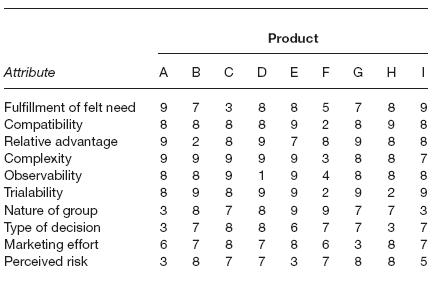
The basic strategy is to enhance the attributes that a product is weak on. Product C has a very low felt need. Ads, store choice and display, and so forth should be aimed at increasing felt need. Products A, F, H, and I all have several attributes with low ratings. These should each be corrected if there are enough resources. If not, choose the one that has the most impact on sales. For example, with Product H, the company may want to focus on making trial easier. Product F is low on many attributes and high on few. It should probably not be introduced without major changes.
APPLICATION ACTIVITIES
49) Find two advertisements that use reference groups in an attempt to gain patronage. Describe the advertisement, the type of reference group being used, and the type of influence being used.
50) Develop an advertisement for (i) teeth whitening strips, (ii) an energy drink, (iii) an upscale club, (iv) Red Cross, (v) scooters, or (vi) vitamins using the following:
a) An informational reference group influence
b) A normative reference group influence
c) An identification reference group influence
51) Interview two individuals who are strongly involved in a consumption subculture. Determine how it affects their consumption patterns and what actions marketers take toward them.
52) Interview an individual who is involved in a brand community. Describe the role the firm plays in maintaining the community, the benefits the person gets from the community, and how it affects the person’s consumption behavior.
53) Identify and interview several opinion leaders on your campus for the following. To what extent do they match the profile of an opinion leader as described in the text?
a) Local restaurants
b) Sports equipment
c) Music
d) Computer equipment
54) Interview two salespersons for the following products. Determine the role that opinion leaders play in the purchase of their product and how they adjust their sales process in light of these influences.
a) Smartphones
b) Golf equipment
c) Computers
d) Art
e) Jewelry
f) Sunglasses
55) Follow a brand on Twitter and Instagram for a week. What types of marketing strategies are they engaged in and how are they utilizing these social media platforms to facilitate brand awareness and solve customer problems.
CHAPTER 8: PERCEPTION
LEARNING OBJECTIVES
LO1: Describe the nature of perception and its relationship to consumer memory and decisions
LO2: Explain exposure, the types of exposure, and the resulting marketing implications
LO3: Explain attention, the factors that affect it, and the resulting marketing implications
LO4: Explain interpretation, the factors that affect it, and the resulting marketing implications
LO5: Discuss how perception can enhance strategies for retailing, branding, advertising, and packaging
SUMMARY
LO1: Describe the nature of perception and its relationship to consumer memory and decisions
Perception consists of those activities by which an individual acquires and assigns meaning to stimuli. Perception occurs in three stages, namely exposure, attention, and interpretation. If and when perception occurs, the meaning derived from a stimulus is typically transferred to memory where it is stored and can be later retrieved when consumers are making purchase decisions.
LO2: Explain exposure, the types of exposure, and the resulting marketing implications
Exposure occurs when a stimulus comes within range of one of an individual’s primary sensory receptors. People are exposed to only a small fraction of the available stimuli. And when consumers actively avoid certain marketing stimuli, this is referred to as selective exposure. Selective exposure in the advertising area is termed ad avoidance. Marketers try to overcome avoidance by using tactics such as product placement and hybrid ads. It should be noted, however, that consumers seek out some marketing stimuli voluntarily. Examples include Super Bowl ads, ads that go viral online, and company-based e-mails that consumers choose to receive through permission-based marketing
LO3:Explain attention, the factors that affect it, and the resulting marketing implications
Attention occurs when the stimulus activates one or more of the sensory receptors and the resulting sensations go into the brain for processing. People selectively attend to stimuli as a function of stimulus, individual, and situational factors. Stimulus factors are physical characteristics of the stimulus itself, such as contrast, size, intensity, attractiveness, color, movement, position, isolation, format, and information quantity. Individual factors are characteristics of the individual, such as motivation and ability. Situational factors include stimuli in the environment other than the focal
stimulus and temporary characteristics of the individual that are induced by the environment. Clutter and program involvement are situational factors of particular interest to marketers. Marketers can utilize all these factors to better develop stimuli that attract consumer attention in today’s cluttered environment.
Nonfocused attention occurs when a person takes in information without deliberate effort. Hemispheric lateralization is a term applied to activities that take place on each side of the brain. The left side of the brain is concerned primarily with those activities typically called rational thought and the ability to be conscious and report what is happening. The right side of the brain deals with pictorial, geometric, timeless, and nonverbal information without the individual being able to verbally report it.
A message presented so fast or so softly or so masked by other messages that one is not aware of seeing or hearing it is called a subliminal message. Subliminal messages have generated a great deal of interest but are not generally thought to affect brand choice or other aspects of consumer behavior in a meaningful way.
LO4: Explain interpretation, the factors that affect it, and the resulting marketing implications
Interpretation is the assignment of meaning to stimuli that have been attended to. Interpretation tends to be relative rather than absolute (perceptual relativity) and subjective rather than objective. Two general forms of interpretation are cognitive and affective. Cognitive interpretation appears to involve a process whereby new stimuli are placed into existing categories of meaning. Affective interpretation is the emotional or feeling response triggered by the stimulus.
Interpretation is largely a function of individual traits, learning, and expectations that are triggered by the stimulus and moderated by the situation. Stimulus characteristics are critical. Stimulus organization is the physical arrangement of the stimulus objects and relates to the perceptual principles of proximity, closure, and figure-ground. Marketers can use these principles to design effective communication strategies. Stimulus change and consumer reactions to it are also of concern and have consequences in relation to such strategies as ―weighting out,‖ whereby marketers attempt to reduce the quantity offered in increments that consumers won’t detect.
Interpretation often involves consumer inferences. Inferences go beyond what is directly stated or presented and help explain consumer use of quality signals (e.g., higher price means higher quality), their interpretation of images, and how they deal with missing information. Inferences also help explain how consumers can be misled by marketing messages even when those messages are literally true.
LO5: Discuss how perception can enhance strategies for retailing, branding, advertising, and packaging
Marketers use their knowledge of perception to enhance strategies in a number of areas including retailing, branding, advertising, and packaging. For retailing, issues surrounding store and shelf location are important determinants of perception. For branding, issues surrounding the selection of brand names, extensions, and appropriate logos have important implications for perception. Advertising strategies and media selection are heavily influenced by considering factors that enhance
exposure and attention. Packaging is a functional aspect of products, but also perceptual in that it can capture consumer attention and influence their brand interpretations.
LECTURE TIPS AND AIDS
1) Students enjoy discussing subliminal advertising, and some believe very strongly that it is both commonly used and very effective. Students may search the topic and find reference to the works of Wilson Bryan Key Subliminal Seduction (Signet, 1973) and/or Media Sexploitation (Signet, 1976) as ―evidence‖ that subliminal perception is being practiced on the American consumer daily. We feel that these books present an unsubstantiated opinion on the part of Key. Furthermore, they do not deal with subliminal perception. Rather, they deal with the planting of disguised symbols in ads that, if interpreted ―correctly,‖ have (in Key’s opinion) certain sexual meanings.
Have students use Key’s ―methodology‖ (subjectively looking at ads for sexual symbols) to find animals, stars, crosses, or other nonsexual symbols. If students examine enough ads, many of these symbols can be found.
2) Creating a sudden, loud noise or having a student talk loudly in the back of the room at a specified time in the lecture can establish the attention attracting power of stimuli.
3) Have students list their favorite magazines, TV shows, and sections of the newspaper or online news sources. Have them do the same for their parents. This exercise will show substantial differences between males/females and students/parents in terms of media exposure and thus media strategy.
4) The nature of interpretation can be shown by passing out the following statement to the class: ―It is absolutely essential that the worker make the key decisions in the workplace. They must determine the production process.‖ Give half the class the quote attributed to a popular capitalist such as Steve Jobs of Apple and for the other half have it attributed to a union leader or a socialist Have the students write a brief paragraph evaluating the idea. Then have several students read their paragraphs out loud. The impact of the source on interpretation will be obvious.
5) You can have students go to www.ftc.gov and search for deceptive ad cases and bring one or more to class to discuss. You can work on distinguishing between false claims and claim-belief discrepancy issues.
6) Student Handout 1: USING WEBER’S LAW: Can be used to explore the idea of just noticeable difference (j.n.d)
7) Student Handout 2: MARKETING CLASSIC: ATTRACTIVE MODELS: ATTRACTION OR DISTRACTION: Can be used to demonstrate how brand-irrelevant factors that attract attention can actually distract consumer focus from the brand and its critical features. Suggests that not all attention-getting stimuli are equal in their ability to drive attention to the brand.
STUDENT HANDOUT 1: USING WEBER’S LAW
STIMULUS
PITCH (at 2,000 cycles per second) .0030
DEEP PRESSURE (at 400 grams) .0130
VISUAL BRIGHTNESS (at 1,000 photons) .0160
LIFTED WEIGHTS (at 300 grams) .0200
LOUDNESS (.100 decibels, 1,000 cycles/second) .0909
SMELL OF RUBBER (at 200 olfacties) .1000
SKIN PRESSURE (at 5 grams per sq. millimeter) .1428
TASTE (saline at 3 moles per liter) .2000
The following illustration of the j.n.d. for weight may be useful:
Weber’s Law: kII
For lifting weights, .020 k
Therefore,
a. If the original weight were 10 pounds (I), the change in weight needed for one to detect a weight change is:
b. If the original weight were 100 pounds (I), the change in weight needed to detect a change would be:
c. Therefore, if one changed a 100-pound weight to a 99-pound or 101-pound weight, a person lifting the weight could not detect the change. More than 2 pounds would have to be added or taken away for one to detect the weight change.
STUDENT HANDOUT 2: MARKETING CLASSIC ATTRACTIVE MODELS: ATTRACTION OR DISTRACTION
Marketers often use intriguing headlines or attractive models to attract attention to their advertisements. How effective is this tactic?
An eye-tracking device is a combination of computer and video technology that allows one to record eye movements in relation to a stimulus such as a website, package, or commercial. The respondent sits in a chair at a table and reads a magazine, watches TV commercials, views a website, or observes
slides of print advertisements, billboards, shelf facings, point-of-purchase displays, and so forth. Respondents control how long they view each scene. The eye-tracking device sends an unnoticeable beam of filtered light that is reflected off the respondent’s eyes. This reflected beam represents the focal point and can be superimposed on whatever is being viewed. It allows the researcher to determine how long an ad or other marketing stimulus is viewed, the sequence in which it was examined, which elements were examined, and how much time was devoted to looking at each element.
RCA used an attractive model in a TV ad for its Colortrack TV sets. The model wore a conservative dress. Eye tracking revealed that the audience focused substantial attention on the product. Seventytwo hours later, brand name recall was 36 percent. In contrast, a similar commercial used an attractive female in a revealing dress. Eye tracking showed that the ad attracted considerable attention, but most of it was focused on the attractive model. Seventy-two hours later, brand name recall was only 9 percent!
What the Eye Does Not See, the Mind Does Not Remember, Telecom Research, Inc., undated.
REVIEW QUESTIONS
1) What is information processing? How does it differ from perception?
Information processing is a series of activities by which stimuli are perceived, transformed into information, and stored. Perception involves all but the storage function (memory). It involves exposure to the stimulus, attending to it, and interpreting it.
2) What is meant by exposure? What determines which stimuli an individual will be exposed to? How do marketers utilize this knowledge?
Exposure occurs when a stimulus is placed within range of sensory receptor nerves. The individual does not need to receive the stimuli for exposure to occur. Most exposure is self-selected, and we tend to expose ourselves to information we think will help us achieve our goals. Marketers should make media decisions, store location decisions, and layout decisions based on these exposure patterns.
3) What are zipping, zapping, and muting? Why are they a concern to marketers?
Zipping occurs when a viewer fast-forwards through a commercial on a prerecorded program. Zapping involves switching channels when a commercial appears. Muting is turning the sound off during a commercial. All three are extensive and greatly reduce the viewing and thus the impact of commercials.
4) What are infomercials? How effective are they?
Infomercials are long, often 30 minutes or more, commercials that frequently have an 800 number and/or web address through which to order or request additional information. These positively affect brand attitudes and purchase intentions. Infomercials are more likely to be viewed by early adopters and opinion leaders. This implicates a critical indirect influence of infomercials through word-of-mouth communications. This also highlights the role that information and relevance play in driving voluntary exposure to marketing messages
5) What is ad avoidance? How are DVR technology and SVOD (streaming) services affecting it? How are marketers dealing with this phenomenon?
Ad avoidance occurs when the consumer selectively avoids exposure to advertising messages, for example, zipping, zapping, and muting. Technologies such as the DVR and streaming services are giving consumers more control over exposure to TV commercials. In response, companies can utilize various strategies including paused ads, compressed ads, still-frame ads, hybrid ads, interactive ads, and dynamic ad placement. In addition, marketers are increasingly using nontraditional media to gain exposure for their messages. For example, marketers are increasingly placing ads on the sides of trucks and taxis as well as placing products in TV shows, videos, and movies.
6) What is meant by attention? What determines which stimuli an individual will attend to? How do marketers utilize this?
Attention occurs when the stimulus activates one or more sensory receptor nerves and the resulting sensations go into the brain for processing. Attention is determined by three factors: (1) the stimulus, (2) the individual, and (3) the situation. Marketers use their knowledge of the effects of manipulating these factors, alone and in combination, to bring about attention to ads, packages, and so forth.
7) What stimulus factors can be used to attract attention? What problems can arise when stimulus factors are used to attract attention?
Stimulus Factors
Size
Potential Problems
Smaller stimuli are more likely to be unnoticed
Intensity When using repetition, attention generally decreases across repeated exposures attention reallocation can occur.
Attractive visuals
Color and movement
Position
Isolation
Drawing attention to one element of an ad can detract from others, resulting in drawing attention from the brand and its selling points.
Dull color and stagnant items are less noticeable.
Items difficult to find and/or out of the visual field in a store will most likely lack attention. Print ads on the left-hand page receive less attention. It is also important not to place content within low impact zones.
In the extreme, can limit the amount of information presented.
Format Ads that lack a clear visual point of reference or have inappropriate movement increase the processing effort and decrease attention. Likewise, audio messages that are difficult to understand due to foreign accents, inadequate volume, or a speech rate which too fast also reduce attention.
Contrast and expectations
Interestingness
Information quantity
Consumers pay less attention to stimuli that blend in with their background. Packaging, in-store displays, and ads that coincide with our expectations tend to be unnoticed.
Consumers find unentertaining ads to be uninteresting
Information overload causes consumers to pay less attention they simply cannot pay attention to too much information.
8) What is adaptation-level theory?
Over time we adjust to (and no longer pay attention to) the level and type of stimulus to which we are consistently exposed.
9) What is information overload? How should marketers deal with information overload?
Information overload is when there is too much information available to be dealt with effectively. When more information is available than the consumer is comfortable with, they may ignore all the information and make inappropriate decisions. Marketers have to determine how consumers acquire information, and how much they are able to use effectively, if they want their messages to persuade consumers.
10) What impact does program involvement have on the attention paid to commercials embedded in the program?
Program involvement, particularly moving from low to moderate involvement, increases the attention paid to ads in the program, as shown in Figure 8–4.
11) What is a contextual cue? Why is it of interest to marketers?
Contextual cues present in a situation, such as the background color on a web page or the nature of the programming surrounding a brand’s ad, play a role in the consumer’s interpretation independent of the actual stimulus. Marketers must be aware of these cues to ensure ads are evaluated in the manner in which they are intended.
12) What is meant by nonfocused attention?
Nonfocused attention is a low-involvement scanning of the environment. It appears to be mainly a right-brain activity.
13) What is meant by hemispheric lateralization?
For most individuals, the left side of the brain controls cognitive activities and ―rational‖ thought, while the right side deals with nonverbal information.
14) What is meant by subliminal perception? Is it a real phenomenon? Is it effective?
Perception below the conscious-awareness level (A subliminal stimulus is used in a message whereby the stimulus is presented so fast or so softly or so masked by other messages that one is not aware of seeing or hearing it.). Although subliminal advertising has been a concern in the past, there is no evidence marketers are using subliminal messages.
15) What is meant by interpretation?
Interpretation is the assignment of meaning to sensations. Interpretation is related to how we comprehend and make sense of incoming information.
16) What determines how an individual will interpret a given stimulus?
Interpretation is a function of the gestalt, or pattern, formed by the characteristics of the stimulus, the individual, and the situation. Individual characteristics of traits, learning/knowledge, and expectations play a role as do situation characteristics. Also, stimulus characteristics such as stimulus traits and organization (proximity, figure-ground, and closure) play a role.
17) What is the difference between cognitive and affective interpretation?
Cognitive interpretation involves the process whereby new stimuli are placed into existing categories of meaning. Affective interpretation is an emotional response triggered by a stimulus such as an ad for wearing safety belts that depicts a rather ugly accident in which the driver was not wearing a safety belt.
18) What is the difference between semantic and psychological meaning?
Semantic meaning is the conventional meaning assigned to a word as it is found in the dictionary. Psychological meaning is the meaning assigned to a word based on experiences and the context or situation in which the word or other symbol is used.
19) What is sensory discrimination? What is a j.n.d.?
The ability of an individual to distinguish between similar stimuli is called sensory discrimination. The minimum amount that one brand can differ from another with the difference still being noticed is referred to as the j.n.d.. Marketers seeking to find a meaningful difference between their brand and a competitor’s must surpass the j.n.d. in order for the improvement or change to be noticed by consumers.
20) What is a consumer inference? Why is this of interest to marketers?
An inference goes beyond what is directly stated or presented. Consumers use available data and their own ideas to draw conclusions about information that is not provided. For example, consumers may use price and/or ad intensity as quality signals.
21) How does a knowledge of information processing assist the manager in the following:
a) Formulating retail strategy?
Retailers can structure the interior of their stores to minimize information overload and to maximize exposure to high-margin items. Shelf position and amount of shelf space can be used to attract attention to high-margin items. Point-of-purchase displays can fulfill the same task. A careful blend of store stimuli can be used to help consumers assign a positive meaning to the store.
b) Developing brand names and logos?
Knowledge of how words are interpreted, the visual images they convey, and the ease with which they are remembered are very useful in brand name selection. In designing logos, dimensions of naturalness, elaborateness, and symmetry are important.
c) Formulating media strategy?
The fact that exposure is selective, and is correlated with demographics, lifestyle, and product use, is the basis for media strategy.
d) Designing advertisements?
This knowledge can help us design ads that will both attract attention and provide the desired meaning.
e) Package design and labels?
As with ads, this knowledge can help us design packages and labels that will attract attention as well as provide the desired meaning.
22) What is co-branding? Is it effective?
Co-branding (also referred to as co-marketing, brand alliances, and joint marketing) is when two brands are given to a single product. Co-branding has been shown to modify attitudes toward the participating brands. However, the effects can be positive or negative and can differ for the two brands involved. Perceived fit will determine the success of the new brand.
23) What is cross-promotion retail strategy? Provide two examples.
Cross-promotion involves placing signage in one area of the store to promote complementary products in another area. For example, placing Stove Top stuffing signage in the chicken section of the meat counter or mustard coupons near or on the kielbasa packages in the meat/deli section of the store.
24) How can rhetorical figures enhance attention?
Rhetorical figures involve the use of an unexpected twist or artful deviation in how a message is communicated either visually in the ad’s picture or verbally in the ad’s text or headline. The unexpected nature of rhetorical figures attracts and holds attention as consumers decipher the ad’s meaning. A classic example of this is ―Bounty’s quicker picker upper.‖
25) What is a smart banner? How does this relate to selective attention?
Smart banners are banner ads that are activated based on terms used in search engines. There is evidence of preconscious screening among web surfers. It seems they are able to spot a banner ad without actually looking directly at it, thus decreasing direct attention. It seems that experience with the web allows consumers to build up knowledge about banner characteristics that is used to avoid direct attention. However, since smart banners present consumers with information they are more likely interested in, the subconscious filters are likely to pick up on that information and direct conscious attention toward those banners.
26) What is figure-ground?
Figure-ground involves presenting the stimulus in such a way that it is perceived as the focal object to be attended to, and all other stimuli are perceived as the background.
27) What ethical concerns arise in applying knowledge of the perceptual process?
Most of the ethical concerns in this area relate to the conflict between presenting one’s brand in a favorable light and presenting it completely accurately.
28) What is ambush marketing?
This is the term for a marketing approach in which firms attempt to associate their companies with an event such as the Olympics without becoming an official sponsor. It is ―any communication or activity that implies, or from which one could reasonably infer that an organization is associated with an event, when in fact it is not.‖
DISCUSSION QUESTIONS
29) Given that smoking scenes in movies increase the positive image and intention to smoke among youth, what regulations, if any, should apply to this?
This discussion is interesting when you develop a list of those groups or stakeholders that should care about this. From marketers to parents, the list of those who have an impact on this issue and youth is an interesting one for students to build. While regulations imply something formal, the conversation will probably focus more on ethical responsibility than policies or laws.
30) How could a marketing manager for (a) the Salvation Army, (b) smartphones, (c) Qdoba Mexican Grill, (d) Lucky Jeans, or (e) Belkin Wi-Fi equipment use the material in this chapter to guide the development of a national advertising campaign (choose one)? To assist local retailers or organizations in developing their promotional activities? Would the usefulness of this material be limited to advertising decisions?
A critical point that must be made is that the answer relies heavily on the definition of the target market and the firm’s objective (attract new customers, retain existing customers, etc.). If you use this for a written assignment, you may want to provide this information to the students.
Exposure: Will the target market seek out the information? Students should describe how their media selections will change based on whether or not the target market will actively seek the information.
Attention: As above, except that the emphasis is on the ad content and the use of stimulus factors to attract attention unless it is for a product that the target market will actively seek out.
Interpretation: Here, the student must be sure that the meaning assigned to the ad is consistent with the objectives of the firm.
The usefulness of the information is not limited to advertising. The product itself is subject to all the laws of perception. Its color, shape, and so forth give the consumer meaning that can influence the purchase decision. The personal sales presentation is also subject to perceptual concepts, as is store design and layout.
31) Respond to the questions in Consumer Insight 8–1.
a) Do you think that later adopters of DVRs or SVOD services will be less interested in ―ad avoidance‖ capabilities? Will this change as they ―learn‖ to use these technologies? If the current owners of DVRs are any indication, continued skipping and fast-forwarding of ads is a valid concern for marketers, as are SVOD services. Although evidence to support that even ―zipped‖ (fast-forwarded) ads are still noticed, and those who fast-forward TV ads are more engaged with the ads than those who did not.
b) Can you think of other strategies beyond those discussed that could be used to reduce consumers’ tendency to skip ads?
With strategies such as hybrid and interactive ads on DVR and automatic content recognition on streaming services, it will be interesting if this increased freedom of marketers will prove effective. YouTube TV’s blocking of DVR usage may signal hope for marketers, if other SVOD services do the same.
c) Do you agree that advertisers can be rewarded by embracing these technologies and the cordcutters?
Students may comment that if advertisers ignore these trends and stick with their ―old ways,‖ of forcing consumers to wade through massive amounts of irrelevant ads, consumers may retain their freedoms by reverting to DVRs or more may pay for SVOD services like Netflix that allows no advertising.
32) Hershey created a line of upscale chocolates called ―Cacao Reserve by Hershey’s.‖ The company created fancy packaging, priced the product at the high end, and did little mass marketing for its new product. Initial sales were disappointingly slow even though the premium chocolate market is growing nicely, with brands like Ghirardelli faring well. As a consequence, Hershey almost immediately (within six months) dropped its prices and started mass advertising. The product ultimately flopped and was discontinued. Using concepts in this chapter, why do you think Hershey failed in its move into the premium chocolate market? Do you think the adjustments were the most appropriate, or could Hershey have taken other steps?
Cacao Reserve by Hershey’s is an example of a brand extension. The problem here is ―perceived fit.‖ The Hershey name is certainly recognizable but not as a brand of premium chocolate. Consumers generally think of Hershey’s (core brand) as an everyday brand of chocolate, so consumers most likely found it difficult to categorize a chocolate with the Hershey name as a premium chocolate with a premium price. Hershey might have been more successful if it had taken Toyota’s strategy of a ―new name‖ when it went into the luxury market with Lexus.
33) Pick three brand names that utilize a morphemic approach and three that utilize a phonetic approach. Are the morphemes and phonetics consistent with the overall position of these brands?
Examples of morphemic approaches include NutraSweet, OfficeMax, and Kleenex. Examples of phonetic approach include Charmin (vs. Scott), Blackberry, and Quill office products. Quill is morphemic in that it might be taken to mean quill pens, old fashioned, and so on. The phonetics in the harsh Qu (―k‖) sound might relate to sharp, focused, clean designs for their office products.
34) Develop a brand name for (a) a voice-activated wireless speaker, (b) a sports apparel store, (c) an Internet grocery shopping service, (d) a mobile app, or (e) a pet walking service. Justify your name.
This is an enjoyable classroom project when individual students or groups are assigned one of the product categories. The name should consider the key benefits of the product and how you want target consumers to perceive and interpret the brand name. Push the students to articulate the perceptual principles they are using. A fun procedure is to have a contest for the best name (with best determined by a student vote that is based on the logic for the name).
35) Develop a logo for (a) a voice-activated wireless speaker, (b) a sports apparel store, (c) an Internet grocery shopping service, (d) a mobile app, or (e) a pet walking service. Justify your design.
This is a very enjoyable classroom project when individual students or small groups are assigned one of the product categories. The logo should take into account the key benefits of the product and how you want target consumers to perceive and interpret the logo. Push the students to articulate the perceptual principles they are using. A fun procedure is to have a contest for the best name (with best determined by a student vote that is based on the logic for the name).
36) Evaluate the in-text ads in Illustrations 8–1 through 8–10. Analyze the attention-attracting characteristics and the meaning they convey. Are they good ads? What risks are associated with each?
This is a fun exercise. The students will have numerous opinions on the effectiveness of the ads. You will need to remind them that they are not the target market for all of the ads and they need to evaluate them from the target market’s viewpoint.
37) Develop three co-branded products, one that would be beneficial to both individual brands, one that would benefit one brand but not the other, and one that would benefit neither brand. Explain your logic.
Because the effects of co-branding can be positive or negative and can differ for the two brands involved, it is important for the students to consider the target market views on the partner and that the two brand’s ―fit‖ together in a way that adds value to the product.
38) Find an ad that you feel might mislead consumers through a claim-belief discrepancy. What inference processes are you assuming?
This is a very enjoyable classroom project when individual students or small groups are assigned an ad to discuss. Push the students to articulate the inference processes they are assuming. A key distinguishing feature for claim-belief discrepancy is that the company doesn’t say anything that is literally false (if they do, then this puts it into the false-claim category).
39) Respond to the questions in Consumer Insight 8–2.
Q1 Students may or may not know of the insider messages. For those that did not, they may start paying more attention to logos to find them in other brands. Other brands with insider messages include Baskin Robbin’s hidden 31, Wendy’s ―mom‖ hidden on the collar to promote a home feel, and Toblerone’s hidden bear. These are a few examples that students could write, but there are others out there.
Q2 One of many examples a student could say: State Farm has a catchy jingle that can resonate over and over again in one’s head. As an insurance agency, State Farm has not always had such a catchy jingle, but now its jingle has a ―homey,‖ comforting feel and sound that help promote the
company as an insurance company that cares. Using the same example, State Farm utilizes its multisensory marketing with a catchy sound to be perceived as homey and therefore trustworthy, an adjective important to be associated with an insurance company.
Q3 With clearer cameras and more realistic digital effects, companies could really utilize technology to enhance the senses of their products. ASMR could help associate a sound with a product, while more vibrant colors could help a product be more memorable. Commercials can become more intricate with multiple senses being engaged, helping multisensory marketing grow as a means of promoting products.
CHAPTER 9: LEARNING, MEMORY,AND PRODUCT POSITIONING
LEARNING OBJECTIVES
LO1: Describe the nature of learning and memory
LO2: Explain the types of memory and memory’s role in learning
LO3: Distinguish the different processes underlying high- and low-involvement learning
LO4: Summarize the factors affecting information retrieval from memory
LO5: Understand the application of learning to brand positioning, equity, and leverage
SUMMARY
LO1: Describe the nature of learning and memory
Learning is any change in the content or organization of long-term memory (LTM) or behavior and is the result of information processing. Information processing is a series of activities by which stimuli are perceived, transformed into information, and stored. The four activities in the series are exposure, attention, interpretation, and memory. Thus, memory is both an outcome of learning and a part of the process of learning. For example, when interpreting the price of a brand, consumers may retrieve information about competitor prices (prior learning) and, once the comparison is made, store their price perception about the new brand in memory (new learning).
LO2: Explain the types of memory and memory’s role in learning
Memory is the result of learning, which involves information processing. Most commonly, information goes directly into short-term memory (STM) for processing, where two basic activities occur maintenance rehearsal and elaborative activities. Maintenance rehearsal is the continual repetition of a piece of information in order to hold it in current memory. Elaborative activities are the use of stored experiences, values, attitudes, and feelings to interpret and evaluate information in current memory. LTM is information from previous information processing that has been stored for future use. LTM undergoes continual restructuring as new information is acquired. Information is stored in LTM in associative networks or schemas. Consumers often organize information in LTM around brands in the form of brand schemas. These schemas represent the brand’s image in terms of key attributes, feelings, experiences, and so on.
LO3: Distinguish the different processes underlying high- and low-involvement learning
Consumers learn in various ways, which can be broadly classified into high- versus low-involvement learning. High-involvement learning occurs when an individual is motivated to acquire the information. Low-involvement learning occurs when an individual is paying only limited or indirect attention to an advertisement or other message. Low-involvement learning tends to be limited as a result of a lack of elaborative activities.
Learning can also be classified as either conditioned or cognitive. There are two forms of conditioned learning classical and operant. Classical conditioning attempts to create an association between a stimulus (e.g., brand name) and some response (e.g., behavior or feeling) and is generally low involvement in nature. Operant conditioning attempts to create an association between a response (e.g., buying a brand) and some outcome (e.g., satisfaction) that serves to reinforce the response and is generally high involvement in nature.
The cognitive approach to learning encompasses the mental activities of humans as they work to solve problems, cope with complex situations, or function effectively in their environment. Cognitive learning includes iconic rote learning (generally low involvement), vicarious learning/modeling (low or high involvement), and analytical reasoning (generally high involvement).
Stimulus generalization is one way of transferring learning by generalizing from one stimulus situation to other, similar ones. Stimulus discrimination refers to the opposite process of learning responding differently to somewhat similar stimuli. The ability of consumers to differentiate and generalize is critical for successful brand positioning and leverage.
LO4: Summarize the factors affecting information retrieval from memory
Once learned, information is retrieved from LTM for use in evaluations and decisions. Retrieval failures or extinction of a learned response represents a reduction in marketing effectiveness. Retrieval depends on strength of initial learning, memory interference, and the response environment. Strength of learning depends on six basic factors: importance, message involvement, reinforcement, mood, repetition, and dual coding. Importance refers to the value that the consumer places on the information to be learned greater importance increases learning and retrieval. Message involvement is the degree to which the consumer is interested in the message itself the greater the message involvement, the greater the learning and retrieval. Reinforcement is anything that increases the likelihood that a response will be repeated in the future the greater the reinforcement, the greater the learning and retrieval. Mood is the temporary mental state or feeling of the consumer. Learning and memory appear to be greater in positive mood conditions. Repetition refers to the number of times that we are exposed to the information or that we engage in a behavior. Repetition increases learning and memory but can also lead to wearout. Dual coding involves creating multiple complementary pathways to a concept in LTM. Dual coding increases learning and retrieval.
Memory interference occurs when consumers have difficulty retrieving a specific piece of information because other related information in memory gets in the way. A common form of memory interference is due to competitive advertising. Competitive interference increases with increased advertising clutter. But it can be reduced by avoiding competitive clutter, strengthening learning, reducing similarity to competitor ads, and providing retrieval cues.
The response environment can also be critical to retrieval. Matching the response environment to the learning environment, or matching the learning environment to the response environment, can enhance the ease and likelihood of retrieval.
LO5: Understand the application of learning to brand positioning, equity, and leverage
Brand image, a market segment or individual consumer’s schematic memory of a brand, is a major focus of marketing activity. Product positioning is a decision by a marketer to attempt to attain a defined and differentiated brand image, generally in relation to specific competitors. A brand image that matches a target market’s needs and desires will be valued by that market segment. Such a brand is said to have brand equity because consumers respond favorably toward it in the market. In addition, these consumers may be willing to assume that other products with the same brand name will have some of the same features, which relates to how consumers learn to generalize from one stimulus to another. Introducing new products under the same name as an existing product is referred to as brand leverage or brand extension.
LECTURE TIPS AND AIDS
1) A good way to illustrate semantic memory is to provide a handout to the class such that one-third of the class receives a piece of paper with a brand name at the top, one-third receives a product category, and one-third receives a ―need‖ such as hungry or lonesome. Give students three or four minutes to write down all the words and phrases that come to mind when they see the key word. Have several students with each type of word write their lists on the blackboard. Discussion can center on the similarities and differences between individuals and between types of key words.
2) A good way to underscore the importance of understanding the learning process for the student is to describe advertisements as ―learning situations encapsulated.‖ In effect, many ads try to show the viewer an entire learning process: what the problem is, cues as to how brand purchase can solve the problem, appropriate reinforcement, and satisfaction evaluation. In other words, how consumers ―learn‖ to be satisfied by the purchase of a brand.
3) Before class, ascertain the price of several items students would commonly purchase at a nearby store such as the course textbook, pen, soft drink, quart of milk, or notebook. In class, ask the students how much these items cost. This can lead to a discussion of why some students have learned the prices of some items while others have not.
4) The concept of imagery, one of the general characteristics of learning brought out in the chapter, provides an interesting and useful application of learning to direct marketing practice. Brand names, logos, brand symbols, package design, and ad copy and layout all use the concept of imagery heavily. Pick a product such as automobiles and ask students which brand names have high imagery potential and which do not.
5) Extinction can be illustrated by asking for the names of recent defeated vice presidential candidates, losers of recent Super Bowls or World Series, and the name of the author of the textbook used in the basic marketing class.
REVIEW QUESTIONS
1) What is learning?
Learning is any change in the content or organization of LTM and/or behavior.
2) What is memory?
Memory is the total accumulation of prior learning experiences.
3) Define STM and LTM
STM or working memory is that portion of total memory that is currently activated or in use. LTM is that portion of total memory devoted to permanent information storage.
4) Discuss the nature of STM in terms of its endurance and capacity
STM has a limited capacity to store information and sensations and is short-lived in nature.
5) What is maintenance rehearsal?
This is the continual repetition of a piece of information in order to hold it in current memory for use in problem-solving or transferal to LTM
6) What is meant by elaborative activities?
The use of previously stored experiences, values, attitudes, beliefs, and feelings to interpret and evaluate information in working memory as well as to add relevant previously stored information.
7) What is meant by imagery in working memory?
This involves concrete sensory representations of ideas, feelings, and objects. Imagery processing involves the recall and mental manipulation of sensory images, including sight, smell, taste, and tactile sensations.
8) What is semantic memory?
It is the basic knowledge and feelings we have about an object or event.
9) How does a schema differ from a script?
Schema, often referred to as schematic memory or a knowledge structure, is a complex web of associations linking a variety of concepts and episodes to a particular object or event. A script is a memory of how an action sequence should occur.
10) What is episodic memory and how does it relate to flashbulb memory?
This is the memory of a sequence of events in which a person participated. These personal memories of events such as a first date, graduation, or learning to drive can be quite strong. Flashbulb memories are vividly detailed and highly enduring over time; they contain specific situational detail; they are held with a high degree of confidence and are perceived as special and different from other ordinary or mundane experiences. As such, they are a type of episodic memory.
11) Describe low-involvement learning. How does it differ from high-involvement learning?
A low-involvement learning situation is one in which the consumer has little or no motivation to learn the material. High-involvement learning occurs in situations where the individual is highly motivated to learn the material. Low-involvement learning can involve the same processes as high-involvement learning, but classical conditioning, iconic rote learning, and modeling are most common. Repetition appears to be particularly important in low-involvement situations (iconic
rote learning). Operant conditioning and analytical reasoning are common learning processes in high-involvement situations.
12) What do we mean by cognitive learning, and how does it differ from the conditioning theory approach to learning?
Cognitive learning encompasses all the mental activities of humans as they work to solve problems or cope with situations. It involves learning ideas, concepts, attitudes, and facts that contribute to our ability to reason, solve problems, and learn relationships without direct experience or reinforcement. Cognitive learning can range from very simple information acquisition (iconic rote learning) to complex, creative problem-solving (as in analytical reasoning). Unlike conditioning theory, it does not require any form of conditioning (rewards or unconditioned stimuli).
13) Distinguish between learning via classical conditioning and learning that occurs via operant conditioning.
Classical conditioning refers to the process of using an existing relationship between a stimulus and response to bring about the ―learning‖ of the same response to a different stimulus that consistently appears with the original stimulus. Operant conditioning (or instrumental learning) differs in that the learner must first engage in the desired behavior and then receive an appropriate reward.
14) What is iconic rote learning? How does it differ from classical conditioning? Operant conditioning?
It is the learning of an association between two concepts in the absence of conditioning. That is, the association is formed without a direct reward (operant conditioning) or pairing the stimulus with an unconditioned response (classical conditioning).
15) Define modeling.
Modeling (or vicarious learning) relates to how consumers do not need to experience rewards or punishments directly to learn. Instead, they can observe the outcomes of others’ behaviors and adjust their own accordingly. Similarly, they can use imagery to anticipate the outcome of various courses of action.
16) What is meant by analytical reasoning?
Analytical reasoning is the most complex form of cognitive learning, involving individuals engaging in creative thinking to restructure and recombine existing information as well as new information to form new associations and concepts. Information from a credible source that contradicts or challenges one’s existing beliefs will often trigger reasoning.
17) Describe analogical reasoning.
Analogical reasoning allows consumers to use an existing knowledge base to understand a new situation or object. The use of analogy is a form of analytical reasoning.
18) What is meant by stimulus generalization? When do marketers use it?
Often referred to as the ―rub-off-effect,‖ once we have learned a particular response that works for us, we are able to capitalize on that learning by transferring it to similar learning situations or stimuli (generalizing). This is particularly useful to marketers in branding, where the use of a
family brand allows consumers to learn product quality and performance via stimulus generalization.
19) Define stimulus discrimination. Why is it important?
Stimulus discrimination (or differentiation) refers to the process of learning to respond differently to somewhat similar stimuli. Discrimination is important because it is the process by which buyers strengthen their attachment to a particular brand and thus become brand loyal.
20) Explain extinction and retrieval failure and why marketing managers are interested in them.
Extinction (associated with conditioned learning) and retrieval failure (associated with cognitive learning) is the process of forgetting that which has been learned and occurs for various reasons including lack of reinforcement or memory interference. It is important to marketing managers because they do not want consumers to forget their brand names or positive attributes, but they sometimes do want them to forget bad experiences with the brand or store.
21) What factors affect the strength of learning?
Strength of learning is enhanced by six factors: importance, message involvement, mood, reinforcement, repetition, and dual coding. Generally, learning will come about more rapidly, and last longer, the more important the material to be learned, the more motivation to learn, the more favorable mood to learn, the more reinforcement received during the process, the greater the number of stimulus repetitions (or practice) that occurs, and the more imagery the material contains.
22) How does self-referencing relate to strength of learning and retrieval?
Self-referencing is a message involvement strategy used to highlight a brand’s personal relevance to the consumer. For example, ads using nostalgia appeals which encourage the consumer to remember past personal experiences can be very powerful.
23) What is memory interference, and what strategies can marketers use to deal with it?
Memory interference occurs when consumers have difficulty retrieving a specific piece of information because other related information in memory gets in the way (e.g., competitive ads). Marketers use a number of strategies to decrease competitive interference, including avoiding competing advertising, strengthening initial learning, reducing similarity to competing ads, and providing external retrieval cues.
24) Why is it useful to match the retrieval and learning environments?
Research indicates that individuals are better able to recall learned material if the situation in which they need to recall it is similar to the situation in which they learned it.
25) What is a brand image? Why is it important?
Brand image refers to the schematic memory of a brand. It contains the target market’s interpretation of the product’s attributes, benefits, usage situations, users, and manufacturer/marketer characteristics. It is what we think of and feel when we hear or see a brand name. Company image and store image are similar except they apply to companies and stores rather than brands. Consumers tend to prefer brands and outlets with images that meet their needs and expectations.
26) What is product positioning? Repositioning?
Product positioning is a decision by a marketer to try to achieve a defined brand image relative to competition within a market segment. That is, marketers decide that they want the members of a market segment to think and feel in a certain way about a brand. This is generally expressed in relation to a competitive brand or a usage situation. The term product positioning is most commonly applied to decisions concerning brands, but it is also used to describe the same decisions for stores, companies, and product categories.
Product repositioning refers to a deliberate decision to significantly alter the way the market views a product. This could involve its level of performance, the feelings it evokes, the situations in which it should be used, or even who uses it. Repositioning can be very difficult and costly, requiring consumers to unlearn old associations and replace them with new ones, taking years to accomplish.
27) What is perceptual mapping?
Perceptual mapping offers marketing managers a useful technique for measuring and developing a product’s position. This involves mapping how consumers perceive the similarity and dissimilarity between a set of competing brands or products. The closer two brands are in a perceptual map, the more they are perceived to be similar. The farther away any two brands are in the map, the more dissimilar they are perceived to be. The dimensions of the perceptual map are used to understand the attributes consumers use to compare brands.
28) What is brand equity?
Brand equity is the value consumers assign to a brand above and beyond any specific functional characteristics of the product. Thus, there is a halo effect associated with the reputation of the brand such that it has added value or meaning to consumers.
29) What does leveraging brand equity mean?
Brand leverage refers to marketers capitalizing on brand equity. This can be achieved with family branding, brand extensions, and umbrella branding, as well as licensing a brand name for other marketing promotions. The degree to which leveraging brand equity works depends upon the degree of stimulus generalization.
DISCUSSION QUESTIONS
30) How would you determine the best product position for the following:
a) A brand of tablet computer
b) A mobile phone targeting children
c) A local animal shelter
d) A line of power tools targeting women
e) A brand of toothpaste
The essential first step is a definition of the target market and its needs. Then, one needs to determine if high- or low-involvement learning is most likely. Most image development occurs in a low-involvement situation. Iconic rote learning and classical conditioning would be the main factors in most low-involvement advertising campaigns. Reasoning would be a good approach if a high-involvement approach were selected. All aspects of the marketing mix must be consistent with the desired product image.
31) Is low-involvement learning really widespread? Which products are most affected by lowinvolvement learning?
Low-involvement learning is probably very widespread, but this is difficult to document. Products that are heavily advertised, and in which most people have little interest, are most likely to be affected by low-involvement learning. One could argue that much supposedly low-involvement learning actually occurred under fairly involving conditions. The learned material is retained, and the situation in which it was first learned is forgotten.
32) Almex and Company introduced a new coffee-flavored liqueur in direct competition with Hiram Walker’s tremendously successful Kahlua brand. Almex named its new entry Kamora and packaged it in a bottle similar to that of Kahlua, using a pre-Columbian label design. The ad copy for Kamora reads: ―If you like coffee you’ll love Kamora.‖ Explain Almex’s marketing strategy in terms of learning theory.
Basically, this is learning via stimulus generalization. They appear to want consumers to generalize the positive aspects of Kahlua to their brand (one could argue that they want consumers to mistake their brand for Kahlua). Make sure students point out how Almex is bringing about generalization (signify name, bottle shape, etc.) and the ethical problems with such a strategy.
33) Describe the brand images the following ―brands‖ have among students on your campus:
a) Samsung Galaxy smartphone
b) Your student government
c) Coke Zero
d) Toyota Prius hybrid
e) The United Way
f) Jeep Wrangler
The discussion of brand images is always an interesting discussion among students. While there will be agreement across most students on most brands, you may find discrepancies among your class relative to the diversity of the students. For example, geographic differences in students usually is a factor in differing images.
34) In what ways, if any, would the brand images you described in response to the previous question differ with different groups, such as (a) middle-aged professionals, (b) young blue-collar workers, (c) high school students, and (d) retired couples?
Assign students different brands from Question 33 and specific segments outlined above. Arrange presentations by brand such that discussion can revolve around how different product positioning could exist for different target segments. Obviously, there will be sharp differences in how these ―products‖ are viewed by different groups. Push for the causes of these differences and marketing insights suggested by them. It is important to note that there will be differences in how the product is perceived AND how the same perception is valued. That is, some may see their student government as fair and open for idea discussion and others as closed-mined and dictatorial.
35) What role does dual coding play in the learning process?
Dual coding involves storing the same information in different ways resulting in more internal pathways (associative links) for retrieving information. This in turn can increase learning and memory.
36) Respond to the questions in Consumer Insight 9–1.
Q1 Answers will vary, but some examples students could give would be soft drink companies like Coca-Cola or Pepsi bringing back retro cans, or Coca-Cola’s ―Unbelievable Double Take‖ ad campaign during ―March Madness‖ (showing iconic moments from tournament history), sports teams wearing retro jerseys for games, or Apple using Sesame Street characters to promote its products.
Q2 Again answers will vary. People who agree can make reference to the positive impact it has had on companies already or to the COVID-19 pandemic during which people have been wishing for the past, both making a case for why nostalgia marketing could see a boost in the future. People who disagree could focus on the fact that this strategy is effective for current customers (e.g., Millennials) but may not be effective for future customers (e.g., Gen Zers or Gen Alphas) who may not appreciate nostalgia.
Q3 Disadvantages could include the cost to produce such campaigns or companies who stay ―stuck in the past‖ and do not update products. In addition, this strategy may not work for all industries. Also, for nostalgia marketing to be effective, companies will need to invest in new ad campaigns, packaging, or products so that they can be used as part of a future nostalgia marketing campaign. For example, Nike has produced more eccentric jerseys for the professional sports leagues in hopes that they will be viewed as popular retro jerseys in the future.
37) Evaluate the Illustrations 9–1 through 9–5 in light of their apparent objectives and target market. Answers will vary. The key is that students use the insights and concepts of the chapter as they apply to each.
38) Respond to the questions in Consumer Insight 9–2.
Q1 The intention of the repositioning effort was to satisfy consumers’ interest in the brand’s social responsibility. This reflects one of the positive outcomes of brand equity increased market share by appealing to younger consumers. Unfortunately, there is a fine line with how much to reposition without losing the brand altogether, and Ben’s Original kept most of the original design, just changing the name and image. This could deter consumers by not doing enough to reposition, but the increased efforts for inclusion and diversity proves the credibility of the repositioning. Therefore, Ben’s Original could help with brand equity.
Q2 Different car companies are creating a more environmentally friendly image: examples include BMW and Volvo. Victoria’s Secret has repositioned away from the Angels to include women of more diverse body types. Other brands such as Mrs. Butterworth and Land O’ Lakes have changed their imagery for packaging. Team names such as the Atlantic Braves or Kansas City Chiefs could be considered for repositioning in upcoming years.
Q3 Answers may vary. One main reason could be the lack of say from the racial minorities who are being featured. Some may not want the change and appreciate the recognition, with the majority taking over and silencing their opinions. Repositioning could be necessary, but completely erasing the minorities being represented may be more harmful than helpful.
CHAPTER 10: MOTIVATION, PERSONALITY,AND EMOTION
LEARNING OBJECTIVES
LO1: Define motivation and summarize the motivation sets put forth by Maslow and McGuire
LO2: Articulate motivation’s role in consumer behavior and marketing strategy
LO3: Define personality and the various theories of personality
LO4: Discuss how brand personality can be used in developing marketing strategies
LO5: Define emotions and list the major emotional dimensions
LO6: Discuss how emotions can be used in developing marketing strategies
SUMMARY
LO1: Define motivation and summarize the motivation sets put forth by Maslow and McGuire
Consumer motivations are energizing forces that activate behavior and provide purpose and direction to that behavior. There are numerous motivation theories. Maslow’s need hierarchy states that basic motives must be minimally satisfied before more advanced motives are activated. It proposes five levels of motivation: physiological, safety, belongingness, esteem, and self-actualization.
McGuire developed a more detailed set of motives the needs for consistency, attribution, categorization, objectification, autonomy, stimulation, desired outcomes (teleological), utility, tension reduction, expression, ego defense, reinforcement, assertion, affiliation, identification, and modeling.
LO2: Articulate motivation’s role in consumer behavior and marketing strategy
Consumers are often aware of and will admit to the motives causing their behavior. These are manifest motives. They can be discovered by standard marketing research techniques such as direct questioning. Direct advertising appeals can be made to these motives. At other times, consumers are unable or unwilling to admit to the motives that are influencing them. These are latent motives. They can be determined by motivation research techniques such as word association, sentence completion, and picture response (see Appendix Table A–1). Although direct advertising appeals can be used, indirect appeals are often necessary. Both manifest and latent motives are operative in many purchase situations.
Involvement is a motivational state caused by consumer perceptions that a product, brand, or advertisement is relevant or interesting. Consumer needs play a strong role in shaping involvement, and marketers must adapt their strategies depending on the level (high vs. low) and type (enduring vs. situational) of involvement exhibited by their target audience.
Because of the large number of motives and the many different situations that consumers face, motivational conflict can occur. In an approach–approach conflict, the consumer faces a choice between two attractive alternatives. In an approach–avoidance conflict, the consumer faces both positive and negative consequences in the purchase of a particular product. And finally, in an avoidance–avoidance conflict, the consumer faces two undesirable alternatives.
Regulatory focus theory suggests that consumers react differently depending on whether promotionfocused or prevention-focused motives are most salient. When promotion-focused motives are more salient, consumers seek to gain positive outcomes, think in more abstract terms, make decisions based more on affect and emotion, and prefer speed versus accuracy in their decision making. When prevention-focused motives are more salient, consumers seek to avoid negative outcomes, think in more concrete terms, make decisions based more on factual substantive information, and prefer accuracy over speed in their decision making. Which motive set is more salient, can depend on individual and situational factors, and has numerous marketing implications?
LO3: Define personality and the various theories of personality
The personality of a consumer guides and directs the behavior chosen to accomplish goals in different situations. Trait theories of personality assume that (1) all individuals have internal characteristics or traits related to action tendencies, and (2) there are consistent and measurable differences between individuals on those characteristics. Most of these theories assume that traits are formed at an early age and are relatively unchanging over the years.
Multitrait theories attempt to capture a significant portion of a consumer’s total personality using a set of personality attributes. The Five-Factor Model of personality is the most widely used multitrait approach. Single-trait theories focus on one aspect of personality in an attempt to understand a limited part of consumer behavior. Various traits related specifically to consumer behavior include consumer ethnocentricity, need for cognition, and consumers’ need for uniqueness.
LO4: Discuss how brand personality can be used in developing marketing strategies
Brands, like individuals, have personalities, and consumers tend to prefer products with brand personalities that are pleasing to them. Consumers also prefer advertising messages that portray their own or a desired personality. Brand personality can be communicated in a number of ways, including celebrity endorsers, user imagery, and executional ad elements such as tone and pace.
LO5: Define emotions and list the major emotional dimensions
Emotions are strong, relatively uncontrollable feelings that affect our behavior. Emotions occur when environmental events or our mental processes trigger physiological changes such as increased heart rate. These changes are interpreted as specific emotions resulting from the situation. They affect consumers’ thoughts and behaviors. The major dimensions of emotion are pleasure, arousal, and dominance (PAD). Each of these major dimensions has specific emotions and feelings associated with it.
LO6: Discuss how emotions can be used in developing marketing strategies
Marketers design and position products to both arouse and reduce emotions. In addition, consumers must cope with stressful marketing situations such as service and product failures. The various coping mechanisms can be beneficial or detrimental to the firm depending on various factors and requires that marketers consider not only their responses to failure but also service-setting design to reduce consumer stressors. Advertisements include emotion-arousing material to increase attention, degree of processing, remembering, and brand preference through classical conditioning or direct evaluation.
LECTURE TIPS AND AIDS
1) Prior to beginning the lecture on motivation, ask students to think of the various motives that different consumers might have for purchasing the same product (e.g., the purchase of a golden retriever puppy). Ask the students to role-play one of these three consumer types: (1) a parent of a family of two children, both under six years old, (2) a 20-year-old single person who is very independent and outdoor-oriented, or (3) an older couple, retired, with no children or grandchildren living near them.
It should be relatively easy to point out different motives for the purchase of the same product. Even when the same motive is present for more than one consumer type, it is probably ranked differently. Additionally, you may be able to make the point that very different consumers may have similar purchase motives for the same product (e.g., the young single person and the old retired couple may both purchase partially for companionship).
2) At the start of your lecture on personality, and before you define the concept, you might ask the students to describe (other than physical appearance) some person they are all familiar with. It will soon become apparent that they are describing the person by using personality traits. After you have compiled a list of traits, you may begin a discussion pointing out that, regardless of some theoretical arguments as to the validity of personality research, most people use personality to categorize, define, and explain other people in their environment.
3) Have the students describe the ―personality‖ of a particular brand of car, beverage, store, or other object which most will be familiar with. Most students will have little trouble doing this. Now, ask them the marketing implications of the fact that they can do this easily and the specific personality they attributed to the item.
4) A scale for measuring the Big Five Personality Dimensions is reported in Saucier, Journal of Personality Assessment, 63, no. 3, pp. 506-16. You can use this in various ways, including having students access the article and create a survey to measure personality dimensions and administering it to several other students who volunteer to participate. Students can then report on the usefulness, issues, and challenges of personality measurement.
5) Student Handout 1: PERSONALITY AND BEER PREFERENCES is a great Classic example of the role that personality can play in driving responses to ads. It shows that in many instances consumers are susceptible to various perceptual biases (it’s the same beer, but the beer personality portrayed in the ad sets up expectations that bias perceptions of the taste itself).
6) Student Handout 2: BRAND PERSONALITY SCALE can be used in a number of ways. You might have students prepare a questionnaire and collect data on the personality of a brand. You might assign groups of students a given brand/product so that a number of brands and products are represented. Then, during class discussion, the differences in personality across brands/products can be explored, along with the techniques the companies can/should use to foster/improve their personality.
7) Student Handout 3: GSR MEASURE OF EMOTIONAL AROUSAL is a nice handout to use in discussing physiological measures of emotion. In this case, galvanic skin response (GSR) was better than verbal evaluations in predicting market responses.
STUDENT HANDOUT 1: MARKETING CLASSIC PERSONALITY AND BEER PREFERENCES
Anheuser-Busch created four commercial advertisements for four new brands of beer. Each commercial represented one of the new brands and was created to portray the beer as appropriate for a specific ―drinker personality.‖ For example, one brand was featured in a commercial that portrayed the ―reparative drinker,‖ a self-sacrificing, middle-aged person who could have achieved more if he had not sacrificed personal objectives in the interest of others. For this consumer, drinking a beer serves as a reward for sacrifices. Other personality types such as the ―social drinker‖ who resembles the campus guzzler, and the ―indulgent drinker‖ who sees himself as a total failure were used to develop product personalities for the other new brands of beer in the study.
These commercials were watched by 250 beer consumers who then tasted all four brands of beer. After given sufficient time to see each commercial and sample each beer, they were asked to state a brand preference and complete a questionnaire which measured their own ―drinker personality.‖ The results showed that most consumers preferred the brand of beer that matched their own drinker personality. Furthermore, the effect of personality on brand preferences was so strong that most consumers also felt that at least one brand of beer was not fit to drink. Unknown to these 250 consumers was the fact that all four brands were the same beer. Thus, the product personalities created in these commercials attracted consumers with like personalities.
R. L. Ackoff and J. R. Emsoff, ―Advertising at Anheuser-Busch, Inc.,‖ Sloan Management Review, Spring 1975, pp. 1-15.
STUDENT HANDOUT 2: BRAND PERSONALITY SCALE
Not at all
Descriptive 1 2 3 4
Charming Original
Cheerful Outdoorsy
Confident Real
Contemporary Reliable
Cool Rugged
Corporate Secure
Daring Sentimental
Down-to-earth Sincere
Exciting Small-town
Family-oriented Smooth
Feminine Spirited
Friendly Successful
Glamorous Technical
Good Looking Tough
Hard Working Trendy
Honest Unique
Imaginative Upper Class
Independent Up-to-date
Intelligent Western
Leader Wholesome
Masculine Young
Extremely Descriptive 5
Source: J. L. Aaker, ―Dimensions of Brand Personality,‖ Journal of Marketing Research, 34, pp 34756.
STUDENT HANDOUT 3: GSR MEASURE OF EMOTIONAL AROUSAL
The GSR has been used to measure emotional arousal. GSR involves fitting the respondent with small electrodes that monitor the electrical resistance of the skin. This resistance changes with the slight changes in perspiration that accompany emotional arousal. The most well-known application of GSR is the lie detector test.
The validity of the GSR for marketing applications is controversial, but evidence is beginning to suggest that it can be a useful measure. Consider the results shown in the table below. This study was conducted for Better Homes and Gardens and shows that, in this case, the GSR results were a better predictor of market response than were verbal evaluations of the ads.
Table: Emotional Arousal and Mail Response Rates*
*The higher the score, the higher the arousal.
†Predicted market response.
Source: P. L. LaBarbera and J. D. Tucciarone, ―GSR Reconsidered,‖ Journal of Advertising Research, September 1995, p. 45.
REVIEW QUESTIONS
1) What is a motive?
A motive is a construct representing an unobservable inner force that stimulates and compels a behavioral response and provides specific direction to that response.
2) What is meant by a motive hierarchy? How does Maslow’s hierarchy of needs function?
A motive hierarchy simply means that some motives are more important or basic than others. Maslow’s hierarchy of needs approach is based on four premises: (1) all humans acquire a similar set of motives through genetic endowment and social interaction, (2) some motives are more basic or critical than others, (3) the basic motives must be satisfied to a minimum level before other motives are activated, and (4) after basic motives are satisfied, more advanced motives come into play.
3) Describe each level of Maslow’s hierarchy of needs.
Physiological: the basic requirements for existence, such as food, water, and shelter.
Safety: physical security and protection from bodily harm.
Belongingness: needs for acceptance, love, and friendship.
Esteem: desire for status, self-respect, and prestige.
Self-actualization: the desire for self-fulfillment, to reach one’s potential.
4) Describe each of McGuire’s motives.
Need for consistency: A basic desire is to have all facets or parts of oneself consistent with each other. These facets include attitudes, behaviors, opinions, self-images, views of others, and so forth.
Need to attribution: This set of motives deals with our need to determine who or what causes the things that happen to us.
Need to categorize: We have a need to be able to categorize and organize information and experiences in some meaningful yet manageable way. So we establish categories or mental partitions which allow us to process large quantities of information.
Need for objectification: These motives reflect needs for observable cues or symbols which enable us to infer what we feel and know. Impressions, feelings, and attitudes are subtly established by viewing our own behavior and that of others and drawing inferences as to what we feel and think.
Need for autonomy: The need for independence and of self-government is a characteristic of the American culture as described in Chapter 2. It is likely that all individuals have this need at some level. Americans are taught that it is proper and even essential to express and fulfill this need.
Teleological need: This motive propels us to prefer mass media such as movies, TV programs, and books with outcomes that match our view of how the world should work (the ―good guys‖ win, the hero gets the heroine, and so forth).
Utilitarian need: These theories view the consumer as a problem solver who approaches situations as opportunities to acquire useful information or new skills.
Need for stimulation: We often seek variety and difference simply out of a need for novelty. Marketers refer to the outcome of this motive as variety-seeking behavior.
Need for tension-reduction: We encounter situations in our daily lives that create uncomfortable levels of stress. In order to effectively manage tension and stress in our lives, we are motivated to seek ways to reduce arousal.
Need for expression: This motive deals with the need to express one’s identity to others. We feel the need to let others know by our actions, including the purchase and display of goods, who we are and what we are.
Need for ego-defense: When our identity is threatened, we are motivated to protect our selfconcept and utilize defensive behaviors and attitudes.
Need for reinforcement: We quite often are motivated to act in certain ways because we are rewarded for doing so. This is the basis for operant learning as described in the previous chapter.
Need for assertion: The need for assertion reflects a consumer’s need for engaging in those types of activities that will bring about an increase in self-esteem, as well as esteem in the eyes of others.
Need for affiliation: Affiliation is the need to develop mutually helpful and satisfying relationships with others. The need here is to share and to be accepted by others.
Need for identification: These theories view the consumer as a role-player. Thus, you may play the role of college student, sorority member, bookstore employee, fiancée, and many others. One gains pleasure from adding new, satisfying roles and by increasing the significance of roles already adopted.
Need for modeling: The need for modeling reflects a tendency to base behavior on that of others. Modeling is a major means by which children learn to become consumers.
5) Describe attribution theory.
Attribution theory relates to consumers having a need to attribute an underlying cause to a given outcome. This approach to understanding the reasons consumers assign particular meanings to the behaviors of others has been used primarily for analyzing consumer reactions to promotional
messages (in terms of credibility). When consumers attribute a sales motive to advice given by a salesperson or ad message, they tend to discount the advice. In contrast, similar advice given by a friend would likely be attributed to a desire to be helpful and might therefore be accepted.
6) What is meant by motivational conflict, and what relevance does it have for marketing managers?
Most behaviors, including purchase and use, are subject to multiple motives, and there are many situations where these motives come in conflict with each other. The resolution of conflict can affect consumption patterns and, therefore, is of interest to marketing managers. Three types of conflict are approach–approach conflict, approach–avoidance conflict, and avoidance–avoidance conflict.
7) What is a manifest motive? A latent motive? How is each measured?
Manifest motives are known to the individual and are freely admitted. Latent motives are unknown to the individual or are such that they are reluctant to admit them.
Manifest motives can be measured by direct questions. Latent motives may require projective techniques or other indirect approaches.
8) How do you appeal to manifest motives? Latent motives?
Manifest motives can be appealed to directly when appropriate, for example, through detailed product performance and benefits.
Latent motives must often be appealed to indirectly via symbolism (sophisticated model) that speaks to the motive being targeted (wealth, power, and status).
9) Describe the following motivation research techniques (see Appendix A and Appendix Table A–1 for details): (a) Association, (b) Completion, (c) Construction.
a. Association techniques:
Word association: Consumers respond to a list of words with the first word that comes to mind.
Successive word association: Consumers give the series of words that come to mind after hearing each word on the list.
b. Completion techniques:
Sentence completion: Consumers complete a sentence such as ―People who buy Cadillacs .‖
Story completion: Consumers complete a partial story.
c. Construction techniques:
Cartoon techniques: Consumers fill in the words and/or thoughts of one of the characters in a cartoon drawing.
Third-person techniques: Consumers tell why ―a typical woman,‖ ―most doctors,‖ or ―people in general‖ purchase or use a certain product. Shopping lists (a person who would go shopping with this list) and lost wallets (a person with these items in their wallet) are also third-person techniques.
Picture response: Consumers tell a story about a person shown buying or using a product in a picture or line drawing.
10) What is the relationship between involvement and motivation?
Involvement is a motivational state caused by consumer perceptions that a product, brand, or ad is relevant or interesting.
11) Describe regulatory focus theory.
Regulatory focus theory suggests that consumers will react differently depending on which broad set of motives (promotion-focus or prevention-focus) is most salient. The following briefly characterizes the differences:
a. Promotion-focused motives which revolve around a desire for growth and development and are related to consumers’ hopes and aspirations. When promotion-focused motives are more salient, consumers seek to gain positive outcomes, think in more abstract terms, make decisions based more on affect and emotion, and prefer speed versus accuracy in their decision making.
b. Prevention-focused motives which revolve around a desire for safety and security and are related to consumers’ sense of duties and obligations. When prevention-focused motives are more salient, consumers seek to avoid negative outcomes, think in more concrete terms, make decisions based more on factual substantive information, and prefer accuracy over speed in their decision making.
12) What is personality?
Personality is the characteristic and relatively enduring ways that people have of responding to the situations they face, which include responses to marketing strategies.
13) What is consumer ethnocentrism and why is it important to global marketers?
Consumer ethnocentrism reflects an individual difference in consumers’ propensity to be biased against the purchase of foreign products.
14) How can knowledge of personality be used to develop marketing strategy?
Brands, like individuals, have personalities, and consumers tend to prefer products with brand personalities that are pleasing to them. Consumers also prefer advertising messages that portray their own or a desired personality.
15) What is an emotion? What are the basic dimensions of emotion?
Emotions are strong, relatively uncontrollable feelings that affect our behavior.
Some researchers have suggested that three basic dimensions PAD underlie all emotions. Specific emotions reflect various combinations and levels of these three dimensions (see Table 10–4).
16) What physiological changes accompany emotional arousal?
Physiological changes that accompany emotions include increased perspiration, eye pupil dilation, increased heart and breathing rate, and elevated blood sugar level.
17) What factors characterize emotions?
Emotions can be categorized by the environmental events or internal processes that trigger them, the cognitive thoughts, physiological changes, subjective feelings, and unique behaviors that are associated with them.
18) What is consumer gratitude, and what outcomes are associated with this emotion?
Gratitude in a consumer context is the emotional appreciation for benefits received. Firms can create it by making relationship marketing investments. The outcomes include higher levels of trust, purchase, and consumer-based reciprocity that aids the firm in terms of more and broader sales and positive word-of-mouth (WOM).
19) How do marketers use emotions in product design and advertising?
Marketers design and position products and services to activate emotions (a thrilling movie) or to reduce emotions (relaxing vacation sites). Emotional content in advertisements enhances their attention–attraction and maintenance capabilities. Emotional messages are processed more thoroughly and trigger greater liking of the ad itself than ads without emotional content.
20) What is coping, and what are the general types of coping mechanisms used by consumers?
Coping involves consumer thoughts and behaviors in reaction to a stress-inducing situation, designed to reduce stress and achieve more desired positive emotions. Coping mechanisms include (1) active coping, (2) expressive support seeking, and (3) avoidance.
Discussion Questions
21) How could Maslow’s motive hierarchy be used to develop a marketing strategy for the following? (a) American Bird Conservancy, (b) Redken shampoo, (c) Purell hand sanitizer, (d) Chipotle Mexican Grill, (e) Chromebook, (f) Crest Whitestrips.
Assign several students each ―product‖ and have them give a three- or four-minute summary of their results. It should become clear that more than one level of need could be satisfied by each of these products. However, a marketing program geared toward one level may make the brand/product inappropriate for other levels. For example, positioning American Bird Conservancy donations as a status activity might reduce its desirability as a self-actualization activity.
22) Which of McGuire’s motives would be useful in developing a promotional campaign for the following? Why? (a) Honda CR-V, (b) Supercuts (hair salon chain), (c) Samsung Galaxy smartphones, (d) Just for Men hair coloring, (e) Twitter, and (f) Habitat for Humanity.
The approach for Question 21 should be used here also.
23) Describe how motivational conflict might arise in purchasing, patronizing, or giving to the following: (a) Greenpeace, (b) Tesla Model Y, (c) Walmart, (d) Red Bull energy drink, (e) Taco Bell restaurant, and (f) ADT home security system.
Push the students to move beyond approach–avoidance (I want the benefits but don’t want to give up the money). For many of these purchases, there are probably other attractive alternatives that could be involved. If you take it to the brand level, that is almost certainly the case. Have the students describe how they would determine if and what type is likely, and what marketing strategy could be used to deal with it.
24) Describe the manifest and latent motives that might arise in purchasing, shopping at, or giving to the following: (a) Toyota Prius, (b) Saks Fifth Avenue, (c) Bose sound system, (d) A kitten, (e) Mercedes Benz convertible, and (f) iPhone.
This is a fun exercise. Students have little problem identifying potential latent motives. After you get a list of each type for one of the products on the board, have the students discuss the marketing actions they would take if they had evidence that this motive was widespread in their target market.
25) Do marketers create needs? Do they create demand? What ethical issues are relevant?
The answer depends in part on what is meant by the term need. If need is used to refer to a basic motive such as those described earlier in this chapter, it is clear that marketers seldom, if ever, create a need. These common motives involve much more than the first two levels of Maslow’s need hierarchy. Long before marketing or advertising appeared, individuals used perfumes, clothing, and other items to gain acceptance, display status, and so forth. Marketing and advertising are not the cause of these basic human motives. However, marketers do create demand.
This does not mean that there are no ethical issues involved in how marketers create demand as well as in the consequences of the demand that is created. Critics feel that creating demand by stressing threats to consumers’ esteem or affiliation needs is unethical.
26) Respond to the questions in Consumer Insight 10–1
Q1 Retail therapy is good in moderation because it allows consumers to have control in one aspect of their life (shopping), while other aspects may be causing stress. If shopping relieves that stress, then the retail therapy has done its job. However, retail therapy leads to spending money, and going over a budget or spending more than one can afford can lead to more stress. Retail therapy does not need to result in overspending. Consumers need to find the balance to utilize retail therapy to improve one’s mood and not induce more stress.
Q2 Answers may vary. Any company that utilizes Sephora’s strategy of product placement could be a good example, such as Nordstrom Rack, TJ Maxx, and Forever 21. All of these companies use their checkout line to promote smaller items a consumer can easily pick up and put in their cart. Alternatively, answers of websites that utilize any of Amazon’s tactics could be listed as well. For example, Shein promotes free shipping above a certain purchase amount, as well as free returns on any item.
Q3 Students will have varying opinions here. Some students could see no ethical issues in encouraging impulse buys because companies want to sell their products and make a profit. As long as there is no illegal coercion, there is no ethical issue. However, other students could argue that companies should not target consumers who are stressed and do not need certain products. It could be seen as a form of manipulation. Students should agree that there is a risk of decreasing profits due to the encouragement of impulse purchases because consumers could return the product and get their money back, or consumers could develop negative associations with the company because they were not satisfied with the product. This could lead to the customer not purchasing again from the company, generating negative WOM for the company, both potentially resulting in lost sales from current and future customers.
27) How might knowledge of personality be used to develop an advertising campaign for the following? (a) Rainforest Action Network (an environmental group), (b) Smartphones, (c) American Express travel services, (d) Ready-to-drink iced tea, (e) J. Crew women’s shoes, and (f) Clinique cosmetics.
The key is to carefully specify each target market and then develop ads that portray product personalities that are consistent with or pleasing to the target market(s). It makes for a more interesting discussion if you specify that college students are the target market. Then, you can discuss what would constitute an appropriate product personality and how one could be developed.
28) Using Table 10–3, discuss how you would use one of the core personality source traits in developing a package design for an organic, shade-grown coffee.
The same approach used for Question 27 is appropriate here.
29) How would the media preferences of those on each end of the consumer need for uniqueness continuum differ?
The practice of deliberate scarcity is a good example of those who strive for uniqueness. In terms of media preferences, more specialized approaches would be more effective in accessing this group. Those who are not driven by a need for uniqueness would be more apt to prefer more traditional, mainstream approaches in media.
30) How would the shopping behaviors of those on each end of the ethnocentrism continuum differ?
Consumers high in ethnocentrism tend to be less open to other cultures, more conservative, and more likely to reject foreign-made products in favor of domestics. Consumers low in ethnocentrism tend to be more open to other cultures, less conservative, and more likely to accept foreign-made products.
31) How would you use emotion to develop marketing strategy for each of the following? (a) Visa card use, (b) Skydiving, (c) Orthodontist, (d) Silk (soy milk), (e) Ford Escape Hybrid, and (f) Iceland.
This discussion question can be approached in a variety of ways. Students should be encouraged to think of ways to tie emotion arousal or reduction to the purchase or use of the product as well as ways to use emotional appeals in advertising the product.
32) List all the emotions you can think of. Which ones are not explicitly mentioned in Table 10–4? Where would you place them in this table?
Students may use different terms or concepts to describe their emotions. Those emotions not listed in Table 10–4 can then be discussed with respect to where they would fit in the table, and what indicators/feelings could be used to describe this emotion.
CHAPTER 11: ATTITUDESAND INFLUENCINGATTITUDES
LEARNING OBJECTIVES
LO1: Define attitude and its role in consumer behavior
LO2: Summarize the three components of attitudes
LO3: Discuss attitude change strategies associated with each attitude component
LO4: Describe the elaboration likelihood model of persuasion
LO5: Describe the role of message source, appeal, and structure on attitudes
LO6: Discuss segmentation and product development applications of attitudes
SUMMARY
LO1: Define attitude and its role in consumer behavior
Attitudes can be defined as the way people think, feel, and act toward some aspect of their environment. A result of all the factors discussed so far in the text, attitudes influence, as well as reflect, the lifestyle individuals pursue.
LO2: Summarize the three components of attitudes
Attitudes have three components: cognitive, affective, and behavioral. The cognitive component consists of the individual’s beliefs or knowledge about the object. It is generally assessed by using a version of the multiattribute attitude model. Feelings or emotional reactions to an object represent the affective component of the attitude and can be assessed in various ways, including AdSAM®. The behavioral component reflects overt actions and statements of behavioral intentions with respect to specific attributes of the object or the overall object. In general, all three components tend to be consistent with each other. However, a number of factors can create inconsistencies, and marketers must understand and incorporate these in their marketing research and communications strategies.
LO3: Discuss attitude change strategies associated with each attitude component
Attitude change strategies can focus on affect, behavior, cognition, or some combination. Attempts to change affect generally rely on classical conditioning. Change strategies focusing on behavior rely more on operant conditioning. Changing cognitions usually involves information processing and cognitive learning. It can involve changing beliefs about such things as a brand’s attribute levels, shifting the importance of a given attribute, adding beliefs about new attributes, or changing the perceived ideal point for a specific attribute or for the brand concept overall.
LO4: Describe the elaboration likelihood model (ELM) of persuasion
The ELM is a theory about how attitudes are formed and changed under varying conditions of involvement. The ELM suggests different communications strategies depending on involvement. In general, detailed factual information (central cues) is effective in high-involvement, central route situations. Low-involvement, peripheral route situations generally require limited information and instead rely on simple affective and cognitive cues such as pictures, music, and characteristics of people in the ad (peripheral cues). The ELM has found general support. However, what is perceived as relevant can depend on the situation (e.g., attractive model and hair may be ―central‖ in shampoo ad but ―peripheral‖ in car ad), and the nature of competition can bolster the role of peripheral cues even under high involvement.
LO5: Describe the role of message source, appeal, and structure on attitudes
Three communication characteristics are important to attitudes. They are source characteristics, message appeal characteristics, and message structure characteristics.
In terms of source characteristics, source credibility is composed of two dimensions: trustworthiness and expertise. Persuasion is much easier when the message source is viewed as highly credible. Celebrities are widely used as product or company spokespersons. They are most effective when their image matches the personality of the product and the actual or desired self-concept of the target market.
In terms of message appeals, the appeals used to change attitudes are important and are varied. Fear appeals use the threat of negative consequences if attitudes or behaviors are not altered. Humorous appeals can also be effective in influencing attitudes. However, the humorous message must remain focused on the brand or main selling point to be maximally effective. Comparative ads produce mixed results. They are most effective for unknown brands having a strong functional advantage. The decision to use a value-expressive or utilitarian appeal depends on whether the brand fills valueexpressive or utilitarian needs. However, this is complicated when the brand fills both types of needs. Emotional appeals have been found to have a strong effect on attitudes toward both the ad and the product.
Message structure has three facets. Two-sided (vs one-sided) messages can increase trust and message acceptance, but effects depend on the characteristics of the individual and situation. Message framing effects presenting equivalent value outcomes either in positive (positive framing) or negative (negative framing) terms depend on the type of frame. Positive attribute framing tends to work best, whereas negative goal framing tends to work best. Nonverbal aspects of the ad, such as pictures, surrealism, and music, also affect attitudes.
LO6: Discuss segmentation and product development applications of attitudes
Consumer evaluations, feelings, and beliefs about specific product features form the basis for market segmentation strategies, such as benefit segmentation, and for new-product development strategies.
LECTURE TIPS AND AIDS
1) Have students note on a piece of paper, individually, those attributes they would consider in the purchase of a new car. Then have them specify their ideal performance for each attribute using a five-point scale. Also, have them specify the importance of each attribute using a 100-point constant sum scale. Collect this work and randomly select several students’ specifications and write them on the blackboard. This exercise can then be used to accomplish the following in class discussion:
a) Illustrate how different individuals are in terms of their attitudes (i.e., differences in attributes, ideal performance levels, and importance weights).
b) Illustrate how certain types of cars should appeal to certain types of consumers based on their evaluative criteria (attributes listed), ideal performances, and relative importance.
c) Illustrate how attitude scores could be computed for different automobiles based on different beliefs.
d) Illustrate how different components of the attitude model could be modified to change attitudes (either negatively or positively).
e) Discuss how the ideal points and importance weights of different attributes could be used to design a product concept.
2) Discuss how various celebrities are selected to endorse certain products. In this discussion, you may ask students:
a) What component of attitude is most affected by these endorsements: cognitive, affective, or behavioral?
b) What role does cognitive consistency play in using celebrities to influence attitudes?
c) How were these celebrities selected? Why not others?
REVIEW QUESTIONS
1) What is an attitude?
An attitude is an enduring organization of motivational, emotional, perceptual, and cognitive processes with respect to some aspect of our environment. It is the way one feels, thinks, and acts toward an object.
2) What are the components of an attitude?
The cognitive components of an attitude consist of an individual’s beliefs and knowledge about an object. The affective component represents one’s feelings or emotional reactions toward an object. The behavioral component consists of overt actions and/or statements of behavior related to an object.
3) Are the components of an attitude consistent? What factors reduce the apparent consistency among attitude components?
All three components of attitude tend to be consistent and reinforce a particular attitude. That is, a favorable attitude is generally composed of positive cognitions (beliefs), positive feelings (affective), and intentions to use, recommend or support (behavioral).
There are six factors found to reduce the apparent consistency among attitude components: lack of need, lack of ability, failure to consider relative attitudes, attitude ambivalence, weakly held beliefs and affect, and failure to consider interpersonal and situational influences.
4) What is a multiattribute attitude model?
The elements of a multiattribute attitude model include beliefs about an object’s attributes, ideal or desired levels of performance for each attribute, and the relative importance attached to each attribute.
5) What is attitude ambivalence?
Consumers sometimes hold mixed beliefs and/or feelings about an attitude object (e.g., seafood). These attitudes are less stable over time and less predictive of behavior.
6) What strategies can be used to change the following components of an attitude?
Affective: Various forms of classical conditioning, affect toward the ad or website (using humor, celebrities, or emotional appeal), and mere exposure (simply presenting a brand to individuals on a large number of occasions).
Behavioral: Operant conditioning and ―shaping‖ are most effective.
Cognitive: Cognitive learning, including iconic rote learning, is important in this area. Strategies used to alter the cognitive structure of a consumer’s attitude include change beliefs, shift importance, add beliefs and/or change ideal.
7) What is meant by mere exposure?
The theory that simply presenting a brand to an individual on a large number of occasions might make the individual’s attitude toward the brand more positive. Thus, the continued repetition of advertisements for low-involvement products may well increase liking and subsequent purchase of the advertised brands without altering the initial belief structure. The mechanism appears to be heightened familiarity which enhances liking.
8) What is the ELM?
The ELM suggests that involvement is a key determinant of how information is processed and attitudes are changed. High involvement results in a ―central route‖ to attitude change by which consumers deliberately examine and process those message elements that they believe are relevant to a meaningful and logical evaluation of the brand. Low involvement results in a ―peripheral‖ route to attitude change in which consumers form impressions of the brand based on exposure to the readily available cues in the message regardless of the relevance of those cues to the brand itself. Cue relevance and competitive considerations need to be considered before relying solely on general ELM conclusions that central cues (product information) should be used under high involvement and peripheral cues (e.g., celebrity endorser) are only effective under low involvement.
9) What strategies can consumers use to resist persuasion? Which consumers are most likely to do so?
Loyal consumers engage in discrediting, discounting, and containment strategies to resist persuasion from competitors. These involve the following:
a. Discrediting loyal consumers’ first strategy is to discredit negative information through counterarguments, whereby the consumers look for weaknesses in competitor attacks.
b. Discounting when discrediting does not work, loyal consumers will often resort to discounting, whereby the consumers protect their brand by decreasing the importance they put on the attribute in question.
c. Containment if a brand attack cannot be discredited, loyal consumers also engage in containment, whereby consumers ―seal off‖ the negative information as a way to quarantine it and avoid having it spill over and spoil their existing positive attitude.
10) What are the two characteristics of the source of a message that influence its ability to change attitudes? Describe each.
Source credibility and celebrity sources. These are described in the answers to the next two questions.
11) What is source credibility? What causes it?
A credible source is one that the target market believes will provide accurate information. Trustworthiness and expertise are key factors in establishing source credibility. To be credible, a source should have no apparent reason to provide anything other than complete, objective, and accurate information, and it should have the ability to do so.
12) Why are celebrity sources sometimes effective? What risks are associated with using a celebrity source?
Celebrities attached to the message enhance their ability to draw one’s attention, increase message believability, may share their image with the product, and fans may buy the product to emulate the celebrity. However, not everyone will like any given celebrity, and the celebrity may do something to generate negative publicity.
13) Name five possible characteristics of an appeal that would influence or change attitudes. Describe each.
Fear appeals, humorous appeals, comparative ads, emotional appeals, and valueexpressive/utilitarian appeals are types of appeals that affect attitudes. They are described in response to the next five questions.
14) Are fear appeals always effective in changing attitudes? Why?
Fear appeals make use of the threat of negative consequences if attitudes or behaviors are not altered. For fear appeals to be successful, the level of fear must not be so great as to cause the consumer to distort or reject the message. In addition, the message must be believable in that the source of the fear-arousing message is viewed as highly credible.
15) What characteristics should humorous ads have?
Though a humorous appeal may gain great attention and viewer satisfaction, to be effective, information must still be communicated. As a result, the humor should be related to the product or usage situation and generally should be used only for ―nonserious‖ products.
16) Are emotional appeals effective? Why?
Emotional ads are designed to elicit a positive affective response rather than to provide information or arguments. Emotional appeals are often effective. These types of ads may enhance attitude formation or change by:
a. increasing the ad’s ability to attract and maintain attention.
b. increasing liking of the ad.
c. increasing product liking through classical conditioning.
d. increasing product liking through high-involvement processes.
17) Are comparative appeals effective? Why?
Comparative ads are often more effective than noncomparative ads in generating attention, message and brand awareness, greater message processing, favorable sponsor brand attitudes, and increased purchase intentions and behaviors. However, they can also have negative consequences for the sponsor brand, such as lower believability, lower attitude toward the ad and sponsor brand, and more positive attitude toward the competitor brand(s).
18) What is a value-expressive appeal? A utilitarian appeal? When should each be used?
Value-expressive appeals attempt to build a personality for the product or create an image of the product user. Utilitarian appeals involve informing the consumer of one or more functional benefits that are important to the target market. Utilitarian appeals are most effective for functional products (such as toilet tissue), and value-expressive appeals are most effective for products designed to enhance self-image or provide other intangible benefits (such as a designer watch).
19) What are the three characteristics of the message structure that influence its ability to change attitudes? Describe each.
The three characteristics are one- versus two-sided messages, positive versus negative framing, and the nonverbal components of the message.
One- versus two-sided message: One-sided message, only a positive point of view is expressed. In a two-sided message, both good and bad points are expressed, which can enhance effectiveness.
Message framing: Refers to presenting one of two equivalent value outcomes either in positive or gain terms (positive framing) or in negative or loss terms (negative framing). The best valence depends on type of frame. For attribute frames, positive framing is best. For goal frames, negative frames tend to work best.
Nonverbal components include pictures, music, surrealism, and other nonverbal cues used for attitude change.
20) What is meant by positive message framing and negative message framing? How does the effectiveness of a positive versus negative frame vary depending on whether it is a goal frame or attribute frame?
Message framing refers to presenting one of two equivalent value outcomes either in positive or gain terms (positive framing) or in negative or loss terms (negative framing).
In goal framing, the object is to stress either the positive consequences of performing (better general health by exercising) an act or the negative consequences of not performing the act (developing chronic illness from lack of exercise). In goal framing, the negative message is generally more effective, most likely due to the risk-averse nature of consumers coupled with the risk-enhancing nature of the negative goal frame.
In attribute framing, a single attribute is the focus of the frame. A classic example is describing ground beef as either 80 percent fat free (positive frame) or 20 percent fat (negative frame). In attribute framing, the positive message is usually more effective because it emphasizes the desirable aspects of the specific attribute.
Framing effects can vary across products, consumers, and situations, and so, marketers should base their decision to use positive or negative framing upon research for the specific product and market.
21) What are the nonverbal components of an ad? What impact do they have on attitudes?
Pictures, music, surrealism, and so on, are nonverbal components of ads. By arousing an emotional response, the nonverbal components can affect attitude. Likewise, they can provide meaning that is not possible to convey with words.
22) When is a two-sided message likely to be more effective than a one-sided message?
The effectiveness of one- versus two-sided messages depends largely on the product type, the situational variables, and the ad format. However, two-sided messages are generally more
effective than one-sided messages in changing a strongly held attitude (partly due to the consumer’s increased trust toward the advertiser as a response to the advertiser presenting the two sides!) and are particularly effective with highly educated consumers.
23) How can attitudes guide new-product development?
Ideal performance levels, by attribute, provide a particularly useful guide for new-product development.
24) What is a benefit segment?
A segment based on needs or sought benefits. Importance ratings are a way to measure what consumers feel is important. Clustering those who rate the importance of product features the same allows the marketer to group consumers based on attribute importance and benefits sought.
DISCUSSION QUESTIONS
25) Which version of the multiattribute attitude model and which attributes would you use to assess student attitudes toward the following? Justify your answer.
a) Student health system
b) Target store
c) Hybrid automobile
d) Cats as pets
e) Energy drinks
For each product category, the class needs to discuss which multiattribute model (beliefs only, weighted beliefs, or weighted difference between ideal and belief) would be most appropriate. The more important and complex the decision and product, the more complex the model with respect to number of attributes, weights, and need to consider the difference between belief and ideal. Attitudes toward products such as prunes can usually be accurately represented with a simple model. Attitudes toward the student health system (higher involvement decisions) usually require a more complex model.
26) Respond to the questions in Consumer Insight 11–1.
Q1 Answers will vary. For example, the cereal industry has lots of mascots, from the Frosted Flakes tiger to the Froot Loops toucan. The effectiveness of making the cereal recognizable with a mascot is like how insurance companies utilize their mascots. However, there is not the same humorous aspect of the cereal mascots as there is with the insurance mascots. The mascots of each industry do a good job of creating brand recognition, just in different ways and to different consumers.
Q2 This is a debatable point. Humor appeals are useful in terms of brand recognition and relating to audiences. With insurance, first-time consumers (Gen Y and Gen Z) are less familiar with the product category and brands, and therefore they may have different preferences than older customers (e.g., Gen X). The humor helps to introduce these younger consumers to the different insurance companies and to make the brands memorable. However, to learn more about the unfamiliar companies, these younger consumers may prefer WOM and talking with family members or friends about which insurance to buy. The insurance companies are doing all that they
can with their advertising and becoming recognizable, but WOM may be more influential with this new wave of consumers.
Q3 Student answers will vary depending on the ads found. They will likely discuss the humorous aspect, while also the ads’ ability to get their message across. Students might discuss how the ads are relatable to them, as they are the target market for insurance companies. Students could also mention the information they learned from the ads in addition to the humorous appeal.
27) Assume you wanted to improve or create favorable attitudes among college students toward the following. Would you focus primarily on the affective, cognitive, or behavioral component? Why?
a) ASPCA
b) BMW motorcycles
c) Organic (cage-free) eggs
d) Skydiving
e) Not driving after drinking
f) Using the bus for most local trips
g) Oreo cookies
h) Volunteering for Habitat for Humanity
The cognitive component could be effectively used with all of the above, although perhaps less so for d. An affective appeal would also work well with most of the products though b, e, f, and h might also require cognitive appeals as well. Behavioral change through free samples could work with the food and beverage products. However, in all cases, the answer would depend on the nature of the target market, their current attitude toward the product, and the objectives of the attitude change strategy. It should also be clear that a combination of approaches might be required in some cases.
28) Suppose you used the multiattribute attitude model and developed a fruit-based carbonated drink that was successful in the United States. Could you use the same model in the following countries? If not, how would it have to change?
a) India
b) Chile
c) Qatar
It would be extremely unlikely that the same attributes, ideal points, and importance weights would exist across cultures for a beverage. It is fun to speculate on how they would differ. You can substitute other products in this example with good results. This is a good chance to get your international students involved in the discussion (I find it useful to forewarn them in advance).
29) Suppose you wanted to form highly negative attitudes toward smoking among college students.
a) Which attitude component would you focus on? Why?
b) Which message characteristic would you use? Why?
c) What type of appeal would you use? Why?
Students will generally choose either the cognitive or affective component. Either could work. A fear appeal would go well with either approach. Punishments might be stressed in a cognitive approach, while pictures of the consequences of drug consumption might work in an affective approach.
30) What communication characteristics would you use in an attempt to improve college students’ attitudes toward the following?
a) Buick
b) Levi’s
c) Volunteering at a local shelter
d) Yahoo!
e) MADD
f) White water rafting
Construct a table like the one below, and for each product, have students name and justify which characteristics would be most effective. Specify the target audience first. Then, change the target audience and see how students’ judgments of the best appeals change.
TYPE OF APPEAL
Highly credible source
Celebrity source
Fear appeal
Humor appeal
Comparative ad
Emotional appeal
One-sided message
Two-sided message
Value-expressive appeal
Utilitarian appeal
Nonverbal features
31) Is it ethical to use fear appeals to increase demand for the following?
a) Complexion medication among teenagers
b) Dandruff-control shampoos
c) Emergency response devices among elderly consumers
d) Weight loss supplements for young women
This can generate very good discussion. You may need to play devil’s advocate if the early discussion leans heavily toward one view without sufficient thought.
32) Name two appropriate and two inappropriate celebrity spokespersons for each of the products or causes in Question 27. Justify your selection.
Answers will vary. It is best if you specify the target audience (college students works well particularly if you then shift the target to senior citizens). Students should explain why they chose each spokesperson. The explanation should have to do with the match between the image of the celebrity, the product image, and the self-image of the target audience.
33) What benefit segments do you think exist for the following?
a) Sundance Film Festival
b) NASCAR
c) Major art museums
d) Jazz concert
Have the students name all the reasons they can think of for attending such an event. List them on the board. See if any of them seem to ―go together ‖ Then have the students speculate on the characteristics of people seeking each benefit cluster and the appropriate marketing strategies for each.
CHAPTER 12: SELF-CONCEPTAND LIFESTYLE
LEARNING OBJECTIVES
LO1: Describe self-concept, how it is measured, and how it is used to position products
LO2: Define lifestyle and its relationship to the self-concept and to psychographics
LO3: Explain specific lifestyle typologies and summarize those for luxury sports cars and technology
LO4: Explain general lifestyle typologies and summarize those for VALSTM and PRIZM®
LO5: Discuss international lifestyles and one existing segmentation scheme
SUMMARY
LO1: Describe self-concept, how it is measured, and how it is used to position products
The self-concept is one’s beliefs and feelings about oneself. There are four types of self-concept: actual self-concept, social self-concept, private self-concept, and ideal self-concept. The self-concept is important to marketers because consumers purchase and use products to express, maintain, and enhance their self-concepts. Marketers, particularly those in international marketing, have found it useful to characterize individuals and cultures by whether they have a predominantly independent selfconcept (the individual is the critical component) or an interdependent self-concept (relationships are of primary importance).
An individual’s self-concept, the way one defines oneself, typically includes some of the person’s possessions. The self-concept including the possessions one uses to define oneself is termed the
extended self Marketers can position products and brands as a means to enhance an individual’s selfconcept in terms of the extended self. Sometimes products and brands can be positioned to help maintain the self-concept as when the ideal and actual self-concepts are consistent. At other times, products and brands can be positioned to enhance the self-concept as when the actual self-concept is lower than the ideal.
LO2: Define lifestyle and its relationship to the self-concept and to psychographics
Lifestyle can be defined simply as how one lives. It is a function of a person’s inherent individual characteristics that have been shaped through social interaction as the person moves through the person’s life cycle. It is how an individual expresses one’s self-concept through actions.
Psychographics is the primary way that lifestyle is made operationally useful to marketing managers. This is a way of describing the psychological makeup or lifestyle of consumers by assessing such lifestyle dimensions as activities, interests, opinions, values, and demographics. Lifestyle measures can be macro and reflect how individuals live in general, or micro and describe their attitudes and behaviors with respect to a specific product category or activity.
LO3:Explain specific lifestyle typologies and summarize those for luxury sports cars and technology
Lifestyle measurements can be constructed with varying degrees of specificity. At one extreme, firms can conduct very specific lifestyle studies focused on those aspects of individual or household lifestyles most relevant to their product or service. For these studies, lifestyle measurement is product or activity specific. Porsche conducted a lifestyle segmentation study for its brand and found various segments with very different purchase motives. Experian examined technology users and found very different groups in terms of their attitudes, usage, and adoption of emerging technologies.
LO4:Explain general lifestyle typologies and summarize those for VALSTM and PRIZM®
At the other extreme, marketers can study the general lifestyle patterns of a population. These general lifestyle approaches are not specific to any one product or activity, so they have broad applicability in developing marketing strategies for a wide range of products and brands. General approaches include VALS and PRIZM.
The VALS system divides the United States into eight groups Innovators, Thinkers, Believers, Achievers, Strivers, Experiencers, Makers, and Survivors. These groups were derived on the basis of two dimensions. The first, primary motivation, has three categories: ideals (those guided by their basic beliefs and values); achievement (those striving for a clear social position and influenced by others); and self-expression (those who seek self-expression, physical activity, variety, and excitement). The second dimension is the physical, mental, and material resources to pursue one’s dominant motivation.
Geo-demographic analysis is based on the premise that individuals with similar lifestyles tend to live near each other. PRIZM is a system that examines demographic and consumption data down to the individual household with 68 lifestyle segments organized around four social groups (based on urbanization, which incorporates population density, where people live, and the lifestyles they lead) and three lifestage groups (based on age and presence of children)
LO5: Discuss international lifestyles and one existing segmentation scheme
In response to the rapid expansion of international marketing, a number of attempts have been made to develop lifestyle measures applicable across cultures. Experian’s Mosaic™ Global analyzed hundreds of millions of households across the world and found 10 global lifestyle segments based on core similarities in demographics, lifestyle, and behavior.
LECTURE TIPS AND AIDS
1) Have the students rate their own actual self-concept, their desired self-concept, the product concept of their favorite beverage, and the person concept of their favorite celebrity of the same gender using Malhotra’s scales (Table 12–2). Next, have them assess the consistency of these four concepts. For most, they will be fairly consistent. Discuss what this consistency (or lack of consistency) means to marketers.
2) A useful beginning is to have the class identify four to seven major student lifestyles on your campus. Write brief descriptions of each on the board. Have the students discuss the causes of each lifestyle and describe the marketing implications of each. Ask what type of lifestyle the students with each student lifestyle will have five years after graduation.
3) Discuss the technology segments presented in the chapter. Then have the students describe what they feel are the dominant technology segments among students on your campus. Then have them broaden it out to include other (a) social classes, (b) occupational groups, or (c) generational cohorts. It should quickly become apparent that college students tend to have lifestyles dominated by technology more than some other segments of the population. Have the students discuss the causes of each lifestyle and describe the marketing implications of each.
4) Have the students identify a TV character that fits each of the eight VALS profiles. This is a good way for students to grasp the role of lifestyle in behavior. List on the board the eight lifestyle segments and ask the class to think of lifestyles portrayed on TV that fit each. Identify those aspects of the TV characters’ lifestyles that make them a fit for a particular VALS segment.
5) Have the students take the VALS survey at www.strategicbusinessinsights.com/vals/surveynew.shtml. This will give them a good insight into the VALS process.
REVIEW QUESTIONS
1) What is a self-concept? What are the four types of self-concept?
It is the totality of one’s thoughts and feelings toward one’s self. It is one’s attitude toward one’s self. The private self refers to how I do or would like to see myself. The social self refers to how I am or would like to be seen. The actual self refers to how I think I am now, and the ideal self is how I would like to be.
2) How do marketers use insights about the self-concept?
Marketers attempt to create product images that are consistent with the self-concept of their target market.
3) How can one measure the self-concept?
A 15-item semantic differential scale (see Table 12–2) has been developed for this purpose. It contains terms such as rugged-delicate, thrifty-indulgent, and rational-emotional.
4) How does an interdependent self-concept differ from an independent self-concept?
An independent construal of the self is based on the predominant Western cultural belief that individuals are inherently separate. The independent self-concept is characterized by an emphasis on personal goals, characteristics, achievements, and desires.
An interdependent construal or the self is based more on the common Asian cultural belief in the fundamental connectedness of human beings. The interdependent self-concept is characterized by and emphasis on familiar, cultural, professional, and social relationships.
5) What is the extended self?
The extended self consists of the self plus possessions. That is, we tend to define ourselves in part by our possessions. Thus, some possessions are not just a manifestation of our self-concept; they are an integral part of our self-identity. We are, to some extent, what we possess. If we lost key possessions, we would be somewhat different individuals.
6) What is a brand engagement?
Brand engagement refers to the extent to which an individual includes important brands as part of their self-concepts.
7) What ethical issues arise in using the self-concept in marketing?
Marketers have been criticized for focusing too much attention on the importance of being beautiful, with beautiful being defined as young and slim with a fairly narrow range of facial features. While virtually all societies appear to define and desire beauty, the intense exposure to products and advertisements focused on beauty in America today is unique. Critics argue that this concern leads individuals to develop self-concepts that are heavily dependent on their physical appearance rather than other equally or more important attributes.
8) What do we mean by lifestyle? What factors determine and influence that lifestyle?
Lifestyle is defined simply as how one lives. It is determined by our past experiences, innate characteristics, and current situation. It influences all aspects of our consumption behavior. One’s lifestyle is a function of inherent individual characteristics that have been shaped and formed through social interaction as one moves through the life cycle. Thus, lifestyle is influenced by culture, values, demographics, subculture, social class, reference groups, family, and individual characteristics such as motives, emotions, and personality. It is how we enact our self-concept.
9) What is psychographics?
Psychographics refers to attempts to measure consumer lifestyles quantitatively. These studies typically measure the following:
Attitudes: evaluative statements about other people, places, ideas, products, and so forth.
Values: widely held beliefs about what is acceptable and/or desirable.
Activities and interests: nonoccupational behaviors to which consumers devote time and effort, such as hobbies, sports, public service, and church.
Demographics: age, education, income, occupation, family structure, ethnic background, gender, and geographic location.
Media patterns: which specific media the consumers utilize.
Usage rates: measurements of consumption within a specified product category. Often consumers are categorized as heavy, medium, light, or nonusers.
A large number of individuals, often 500 or more, provide the above information. Statistical techniques are used to place them into groups. Most studies use the first two or three dimensions described above to group individuals. The other dimensions are used to provide fuller descriptions of each group. Other studies include demographics as part of the grouping process.
10)When is a product- or activity-specific psychographic instrument superior to a general one?
A product- or activity-specific psychographic instrument is superior to a general one when a marketing manager is interested in positioning (or repositioning) a product or developing an advertising strategy. General ones are of more value for identifying market segments and opportunities.
11)What are the dimensions on which VALS is based? Describe each.
The two dimensions of VALS are primary motivation and resources. There are three primary motivations that determine the types of goals and behaviors that an individual will pursue: (1) ideals motivation, (2) achievement motivation, and (3) self-expression motivation. The second dimension, resources, examines the full range of psychological, physical, demographic, and material resources necessary to achieve a particular self-orientation.
12)Describe the VALS system and each segment in it.
Using measures of motivation and resources, VALS divides the United States into eight groups:
Innovators are successful, sophisticated, take-charge people with high self-esteem. They are change leaders and are the most receptive to new ideas and technologies. Their purchases reflect cultivated tastes for upscale, niche products and services.
Thinkers are mature, satisfied, comfortable, and reflective. They tend to be well educated and actively seek out information in the decision-making process. They favor durability, functionality, and value in products.
Believers are strongly traditional and respect rules and authority. Because they are fundamentally conservative, they are slow to change and technology averse. They choose familiar products and established brands.
Achievers have goal-oriented lifestyles that center on family and career. They avoid situations that encourage a high degree of stimulation or change. They prefer premium products that demonstrate success to their peers.
Strivers are trendy and fun loving. They have little discretionary income and tend to have narrow interests. They favor stylish products that emulate the purchases of people with greater material wealth. Many Strivers believe that life is not fair.
Experiencers appreciate the unconventional. They are active and impulsive, seeking stimulation from the new, offbeat, and risky. They spend a comparatively high proportion of their income on fashion, socializing, and entertainment.
Makers value practicality and self-sufficiency. They chose hands-on constructive activities and spend leisure time with family and close friends. Because they prefer value to luxury, they buy basic products. Makers prefer to ―buy American.‖
Survivors lead narrowly focused lives. Because they have the fewest resources, they do not exhibit a primary motivation and often feel powerless. They are primarily concerned about safety and security, so they tend to be brand loyal and buy discounted merchandise.
13)What is geo-demographic analysis?
Analyses that focus on the demographics of geographic areas are based on the belief that lifestyle is largely driven by demographic factors. These analyses are used for target market selection, promotional emphasis, and so on.
14)Describe the PRIZM system.
PRIZM, by Claritas, incorporates extensive data on product consumption and media usage patterns and Census data to classify down to the level of the individual household. The output is a set of 68 lifestyle segments.
15)Describe the global lifestyle segments identified by Experian’s Mosaic Global.
Sophisticated singles (8 percent) Urban and wealthy: young and social people, mostly single and well educated, who enjoy life in large cities, are international in their outlook, and innovative in their lifestyle and purchases. European countries, such as Finland and France, are overrepresented in this group.
Bourgeois prosperity (9 percent) Suburban and wealthy; middle to late middle-aged people, who are well-educated, married and with older children, and living in big houses in traditional, quiet suburban locations. Many have worked their way up to leadership positions in their companies. Australia and the United Kingdom are overrepresented in this group.
Career and family (9 percent) ―Second City‖ and wealthy; younger people, married and with young children, enjoying good careers in technology, and living in new, modern-decorated private estates. Family members are early adopters of technology. Hong Kong, Norway, and the United States are overrepresented in this group.
Comfortable retirement (3 percent) Rural and wealthy; people who are retired or close to retirement, with a significant nest egg, living in communities with others in similar lifestage but often away from their grown children. Leisure activities include gardening and supporting the arts. Europeans, especially from The Netherlands, are overrepresented in this group.
Routine service workers (9 percent) Suburban with average wealth; people at various stages in their life cycle, living in older houses, and working in white-collar service jobs. They are relatively well informed about social trends but not quick to innovate. Asians and the Irish are overrepresented in this group.
Hard working blue collar (11 percent) Suburban with average to low income/wealth; people with families, employed in craft or manual skill positions. Leisure time spent on home improvement and outdoor activities. New Zealand leads the group in over-representation.
Metropolitan strugglers (19 percent) Urban with low income; people who live in rental units in transient areas with high levels of crime and drug addiction, are employed in low-skill jobs, and have limited to no access to a car or consumer credit. Retail options are limited to discount stores. Hong Kong, Sweden, and the United States are overrepresented in this group.
Low income elders (6 percent) Urban to suburban with low income; people who are retired or close to retirement, rely on the government for their income, rent small houses or apartments, and live modest lifestyles. They enjoy watching TV and visiting their grown children. Spain, and other European countries, are overrepresented in this group.
Post industrial survivors (12 percent) Town and rural with low income; people living in older, single-family houses in towns traditionally dependent on coal, steel, and chemicals and working as manual laborers. They are slow to adopt innovative products and take few vacations. European countries are overrepresented in this group.
Rural inheritance (15 percent) Rural with average to low income; people who live far away from big cities, are self-employed, and working in agriculture and tourism. They do not regularly eat in restaurants, have their clothes dry cleaned, or have their children tutored. Greece and Ireland are overrepresented in this group.
DISCUSSION QUESTIONS
16)Use Table 12–2 to measure your four self-concepts. To what extent are they similar? What causes the differences? To what extent do you think they influence your purchase behavior?
This is interesting with college students though it can be a bit embarrassing. Do not force anyone to answer. Most students can relate to buying products that will make them more like the person they want to be or want others to see them as.
17)Use Table 12–2 to measure your self-concept (you choose which self-concept and justify your choice). Also measure the images of three celebrities you admire. What do you conclude?
It probably makes most sense to choose the ideal self. Most students’ celebrities will be somewhat like their ideal self on at least some key dimensions. This is a good exercise for you to go first on. You can also add their favorite soft drink and their favorite brand (in general). Have them mark each image with a different letter. Then have them discuss the similarities and differences in the images.
18)Respond to the questions in Consumer Insight 12–1.
Q1 Many of your students will have likely seen the Dove campaigns and may be eager to share their initial reaction as well as that of their friends. Ask students if they were aware of the ensuing parodies, criticisms, and support that followed the debut of the campaigns. Probe to see if this altered initial reactions.
Q2 Students answers will vary. Students will most likely bring up issues that impact them personally. Examples could include flaunting certain brands to feel/look better (wearing designer brands), portraying a happy facade on social media that differs from reality, or feeling left out
based on other people’s posts. Industries could promote the importance of mental health and awareness to combat these negative issues.
Q3 Students will likely choose either side with valid reasons on both. Students could argue that the gap is being narrowed by bringing awareness to these issues and discounting stereotypes across all audiences. However, Dove is a beauty brand trying to sell its products, so students could argue that the underlying motivations of the campaigns could be harmful and inauthentic.
19)What possessions are part of your extended self? Why?
This leads to interesting discussions that clarify this rather abstract concept. It is another good one for you to go first on. (I still have and use the briefcase I bought as a grad student 30 years ago. I have become deeply attached to it although it is old, ugly, cheap, and wearing out.)
20)Is your self-concept predominantly independent or interdependent? Why?
The key here is to interpret how they are describing their self-concept. Independent descriptions will be in terms of what they have done, what they have, and their personal characteristics that make them distinct from others. Interdependent descriptions will focus on social roles, family relationships, and commonalities with other members of one’s groups, including ethnic and nationality groups.
21)What ethical concerns are associated with ads that portray a standardized ideal image of beauty?
Marketers have been criticized for focusing too much attention on the importance of being beautiful, with beautiful being defined as young and slim with a fairly narrow range of facial features. While virtually all societies appear to define and desire beauty, the intense exposure to products and advertisements focused on beauty in America today is unique. Critics argue that this concern leads individuals to develop self-concepts that are heavily dependent on their physical appearance rather than other equally or more important attributes.
22)For each of the following products, develop one ad that would appeal to a target market characterized by predominantly independent self-concepts and another for a target market characterized by predominantly interdependent self-concepts.
a) Amazon.com
b) MINI Cooper automobile
c) Timex
d) Tommy Hilfiger clothing
The illustration of these self-concepts should be straightforward. In fact, students will have an easier time coming up with commercials than they will discussing conceptual differences. The key here is to force them to explain everything associated with their ads in terms of self-concept.
23)Use the self-concept theory to develop marketing strategies for the following products.
a) The National Alzheimer Association contributions
b) Tesla
c) Army ROTC recruitment
d) A&W root beer
e) Purell
f) Disney Cruise Line
The key is to identify the target market and determine their self-concepts. Then develop a concept for the brand that is consistent with that target market.
24)Does VALS make sense to you? What do you like or dislike about it?
For most applications, the answer should be yes. VALS provides an insightful breakdown of the U.S. population. It has been successfully tied to a wide variety of other databases to relate the eight VALS segments to product consumption and media habits. Many marketers are using it and view it favorably.
However, VALS also has some limitations that should be recognized:
a. VALS is an individual measure of lifestyle; many consumption decisions are household decisions that may incorporate more than one lifestyle.
b. Few individuals are 100% in terms of a single self-orientation. Thus, the degree of dominance may vary across individuals and, possibly, in different consumption situations.
c. The VALS system may be inappropriate in some situations. A product- or activity-specific lifestyle measure may be more appropriate. The VALS system may be best in relationship to the purchase of ego-oriented products and services.
25)How would one use VALS to develop a marketing strategy?
For a specific product, one would first determine to which VALS segment the dominant consumer belongs. Then, media and demographic core characteristics for that VALS segment would be determined. This would allow for the development of a marketing mix targeting that specific VALS segment.
26)Develop a marketing strategy based on VALS for:
a) Starbucks
b) Grand Canyon Kayak vacation
c) SiriusXM satellite radio
d) Kawasaki Jet Ski
e) Triumph motorcycles
f) NBA
Create a multiple of six groups and assign one of the product categories above to each group. For a given category, the student group should select the appropriate VALS segment and develop a marketing strategy for that VALS segment. The first step is to clearly identify the needs of each VALS segment relevant to the product category. Then themes and positioning strategies can be developed around the general lifestyle of each group as well as the specific needs for this product. The tables in the chapter provide demographic and media data that can help.
Point out that it is not always wise to target the current heavy user segments. They already own the product, and competition is generally stiff. Sometimes it is more profitable to develop a segment that does not currently use the product.
27)Develop a marketing strategy for each of the eight VALS segments for:
a) Verizon wireless
b) Beach vacation package
c) DaVinci Gourmet coffee syrups
d) CNN
e) Facial cleansers
f) Walmart
This is a more challenging assignment than Question 26. It is best if small teams focus on one product and develop strategies for all eight segments. The process is described in the note for Question 25. The key learning point here is the need for unique marketing programs for the same product based on the lifestyle of the target market.
28)Does PRIZM make sense to you? What do you like or dislike about it? Is it really a measure of lifestyle?
In general, most will say yes. The PRIZM system is based on demographic and consumption differences organized into 68 lifestyle segments.
It taps important geographic differences (urbanicity) and lifestage (think HLC) differences strongly tied to consumer lifestyle and behaviors. It generally allows marketers to merge its system with their consumer database to provide even finer-grained analyses and insights.
29)How would one use PRIZM to develop a marketing strategy?
For a specific product, one would first determine to which PRIZM segment the dominant consumer belongs. Then, media and demographic core characteristics for that PRIZM segment would be determined. This would allow for the development of a marketing mix targeting that specific PRIZM segment.
30)Develop a marketing strategy for each of the Mosaic Global lifestyle segments for the products in Question 26. What challenges do you face in trying to market these products to global market segments?
Create a multiple of six groups and assign one of the product categories above to each group. For a given category, the student group should select the appropriate Mosaic Global segment and develop a marketing strategy for that Mosaic Global segment. The first step is to clearly identify the needs of each Mosaic Global segment relevant to the product category. Then, themes and positioning strategies can be developed around the general lifestyle of each group as well as the specific needs for this product.
Point out that it is not always wise to target the current heavy user segments. They already own the product, and competition is generally stiff. Sometimes it is more profitable to develop a segment that does not currently use the product.
31)The following quote is from Paul Casi, president of Glenmore distilleries: ―Selling cordials is a lot different from selling liquor. Cordials are like the perfume of our industry. You’re really talking high fashion and you’re talking generally to a different audience I don’t mean male versus female I’m talking about lifestyle.‖
a) In what ways do you think the lifestyle of cordial drinkers would differ from those who drink liquor but not cordials?
b) How would you determine the nature of any such differences?
c) Of what use would knowledge of such lifestyle differences be to a marketing manager introducing a new cordial?
The fact that Mr. Casi states that they are ―really talking high fashion‖ means that we are talking about a particular consumer lifestyle that reflects high fashion. This would be reflected in those psychographic statements endorsed by consumers seeking high fashion and social status. Therefore, the product positioning of cordials should occupy a similar image and position in the minds of target-market consumers.
In order to identify those psychographic characteristics that differentiate consumers of cordials from consumers of liquor, psychographic data could be obtained from each set of consumers and analyzed to determine which aspects of lifestyle (i.e., psychographics) differ. Recognizing those psychographic dimensions that are characteristic of cordial consumers, a marketing manager introducing a new cordial would want to focus closely on those characteristics to ensure that the new cordial is properly perceived by the desired target market. Within the target market, the manager may focus on one particular aspect of the product or consumer lifestyle in an attempt to differentiate the new brand from competing brands of cordials.
32)How is one likely to change one’s lifestyle at different stages of one’s household life cycle? Over one’s life, is one likely to assume more than one of the VALS lifestyle profiles described?
Most students will feel that resources will increase with age at least to a point. However, is this likely to be true for lower class individuals? Likewise, many will feel that orientation will change over time. Ask them how their own will change. It is fun to plot potential routes through these systems but have the students identify exactly what will cause the changes they are suggesting.
33)To which VALS category do you belong? To which do your parents belong? Which will you belong to when you are your parents’ age?
First have the students speculate on this. Then have them visit the VALS website and determine the categories. A useful discussion of the differences can result.
34)Generalizing from the global fashion lifestyles in the chapter opener, develop a marketing strategy for:
a) A spa
b) Makeup
c) Jewelry
d) Shoes
e) Clothes
The key is to clearly identify the needs of each segment relevant to the product category and to develop appropriate strategies based on those needs. The lifestyle segments should be ranked in terms of their attractiveness as a target for the product/brand. Since the segments are specifically fashion/clothing, students will have to extrapolate some on the other categories. However, the emphasis on style, luxury, and so on should give them ample information to run with.
CHAPTER
13: SITUATIONALINFLUENCES
LEARNING OBJECTIVES
LO1: Define situational influence
LO2: Explain the four types of situations and their relevance to marketing strategy
LO3: Summarize the five characteristics of situations and their influence on consumption
LO4: Discuss ritual situations and their importance to consumers and marketers
LO5: Describe the use of situational influence in developing marketing strategy
SUMMARY
LO1: Define situational influence
Situational influence as all those factors particular to a time and place that do not follow from a knowledge of the stable attributes of the consumer and the stimulus and that have an effect on current behavior.
LO2:Explain the four types of situations and their relevance to marketing strategy
Four categories of situations are communications, purchase, usage, and disposition situations. The situation in which consumers receive information is the communications situation. The situation in which a purchase is made is the purchase situation. The situation in which the product or service is used is the usage situation. The situation in which a product or product package is disposed of either after or before product use is the disposition situation. Each type of situation has marketing implications such as what programming to advertise within (communications situation), the effect of other people on an individual’s shopping behavior in-store (buying situation), the ability to expand beyond traditional uses for a given product (usage situation), and the factors contributing to recycling behavior (disposition situation).
LO3:Summarize the five characteristics of situations and their influence on consumption
Five characteristics of situations have been identified. Physical surroundings include geographical and institutional location, decor, sound, aromas, lighting, weather, and displays of merchandise or other material surrounding the product. Retailers are particularly concerned with the effects of physical surroundings. The sum of all the physical features of a retail environment is referred to as the store atmosphere or environment. Atmospherics is the process managers use to manipulate the physical retail environment to create specific mood responses in shoppers. Atmosphere is referred to as servicescape when describing a service business such as a hospital, bank, or restaurant.
Social surroundings deal with other persons present who could have an impact on the individual consumer’s behavior. The characteristics of the other persons present, their roles, and their interpersonal interactions are potentially important social situational influences.
Temporal perspectives relate to the effect of time on consumer behavior, such as effects of time of day, time since last purchase, time since or until meals or payday, and time constraints imposed by commitments. Convenience stores have evolved and been successful by taking advantage of the temporal perspective factor.
Task definition reflects the purpose or reason for engaging in the consumption behavior. The task may reflect different buyer and user roles anticipated by the individual. For example, a person shopping for dishes to be given as a wedding present is in a different situation from a person buying dishes for personal use.
Antecedent states are features of the individual person that are not lasting or relatively enduring characteristics. Moods are temporary states of depression or high excitement, and so on, which all people experience. Momentary conditions are such things as being tired, ill, having a great deal of money (or none at all), and so forth.
LO4: Discuss ritual situations and their importance to consumers and marketers
A ritual situation can be described as a set of interrelated behaviors that occur in a structured format, that have symbolic meaning to consumers, and that occur in response to socially defined occasions. Ritual situations can range from completely private to completely public. They are of major importance to marketers because they often involve prescribed consumption behaviors.
LO5: Describe the use of situational influence in developing marketing strategy
Situational influences may have direct influences, but they also interact with product and individual characteristics to influence behavior. In some cases, the situation will have no influence whatsoever, because the individual’s characteristics or choices are so intense that they override everything else. But the situation is always potentially important and, therefore, of concern to marketing managers.
LECTURE TIPS AND AIDS
1) Table 13–2 is a convenient way to discuss how a situation can be used to understand needs and to segment markets and position products. It is useful to conduct the following in-class exercise.
a) Select a product such as soft drinks, coffee, milk, or another product of interest.
b) Identify a group such as college students that is likely to have unique needs that the product can meet.
c) Generate a list of relevant occasions on which this group might consume this product.
d) Identify the key benefits sought in each use situation.
e) Identify all the products that might provide those benefits.
f) Repeat b through e for other groups of interest.
g) Discuss how this information could be used in product positioning and how the marketing mix should be structured to achieve the desired positioning.
REVIEW QUESTIONS
1) What is meant by the term situation? Why is it important for a marketing manager to understand situational influences on purchasing behavior?
A situation is a set of factors outside of and removed from the individual consumer, as well as removed from the characteristics or attributes of the stimulus object that the consumer is taking action on. Managers must look for situational influences because those influences can have impacts on consumers that may negate or work against marketing strategies.
2) What are physical surroundings (as a situational variable)? Give an example of how they can influence the consumption process.
Surroundings are those apparent, physical (real) aspects of any situation such as sound, light, and configurations of merchandise. The decor of a restaurant affects (or can affect) consumers and influences their purchase (choice) and consumption.
3) How does crowding affect shopping behavior?
As more people enter a store and/or as more of the space of the store is filled with merchandise, an increasing percentage of the shoppers will experience a feeling of being crowded, confined, or claustrophobic. Most consumers find these feelings to be unpleasant and will take steps to change them. The primary means of doing this is to spend less time in the store by buying less, making faster decisions, and using less of the available information. This in turn tends to produce less satisfactory purchases, an unpleasant shopping trip, and a reduced likelihood of returning to the store.
4) What is store atmosphere?
The sum of all the physical features of a retail environment is referred as the store atmosphere or environment.
5) What is atmospherics?
Atmospherics is the process managers use to manipulate the physical retail environment to create specific mood responses in shoppers.
6) What is a servicescape?
Atmosphere is referred to as servicescape when describing a service business such as a hospital, bank, or restaurant.
7) What are social surroundings (as a situational variable)? Give an example of how they can influence the consumption process.
Social surroundings deal with the other people present that could have an impact on the individual consumer’s behavior. Shopping with one’s parents will often produce different behaviors and purchases than shopping with one’s friends.
8) What is temporal perspective (as a situational variable)? Give an example of how it can influence the consumption process.
Temporal perspectives deal with the effect of time on consumer behavior. For example, the length of time available for a grocery shopping trip will have an effect on the amount of purchasing one does, as well as on the store one selects.
9) What is task definition (as a situational variable)? Give an example of how it can influence the consumption process.
Task definition is the purpose or reason for engaging in the consumption behavior. Buying a product for self-use versus as a gift has a substantial effect on the amount of shopping done and the features considered.
10)Why do people give gifts?
Consumers give gifts for many reasons. Social expectations and ritualized consumption situations such as birthdays often ―require‖ gift giving independent of the giver’s actual desires. Gifts are also given to elicit return favors either in the form of gifts or actions. And, of course, gifts are also given as an expression of love and caring.
11)How might the receipt of a gift affect the relationship between the giver and the receiver?
The nature of a gift can signify the type of relationship the giver has or desires with the receiver. A gift of stationery implies a very different desired relationship between two individuals than does a gift of cologne.
12)What are antecedent conditions (as a situational variable)? Give an example of how they can influence the consumption process.
These are features of the individual person that are not lasting characteristics. They are momentary moods or conditions. Being angry or upset, for example, might well influence reaction to a sales presentation and, therefore, affect buying behavior.
13)What is a mood? How does it differ from an emotion? How do moods influence consumption behavior?
Moods are transient feeling states that are generally not tied to a specific event or object. They are less intense than emotions. Moods may affect all aspects of a person’s behavior; however, they generally do not completely interrupt ongoing behavior as an emotion might.
14)How do people manage their moods?
We often seek situations, activities, or objects that will alleviate negative moods or enhance positive ones. Products and services are on means consumers use to manage their mood states. Thus, a person feeling sad or ―down‖ might watch a comedy on TV or Netflix, go to a cheerful movie, visit a fun store, eat at an upbeat restaurant, or purchase a new video game, shirt, or other fun product.
15)How do moods differ from momentary conditions?
Moods are transient feeling states that are generally not tied to a specific event or object. They tend to be less intense than emotions and may operate without the individual's awareness. While moods may affect all aspects of a person's behavior, they generally do not completely interrupt ongoing behavior as an emotion might. Whereas moods reflect states of mind, momentary conditions reflect temporary states of being, such as being tired, being ill, having a great deal of money, and being broke.
16)What is meant by the statement, ―Situational variables may interact with product or personal characteristics?‖
Normally, no one variable will be totally responsible for behavior. Some combination of two or all three variables will usually be present. For example, the personal characteristic of urban or rural background may interact with the social surrounding situation of crowding (or the perception thereof) to influence behavior.
17)Are individuals randomly exposed to situational influences? Why?
No. Most people create the situations they face. In other words, consumers normally choose to engage in certain activities and therefore expose themselves to the situation.
18)What is a ritual situation? Why are they important?
A ritual situation can be described as a socially defined occasion that triggers a set of interrelated behaviors that occur in a structured format, that have symbolic meaning. Ritual situations can range from completely private to completely public. They are of major importance to marketers because they often involve prescribed consumption behaviors. Every major American holiday (ritual situation) has consumption rituals associated with it. Even such religious holidays as Easter involve meals and clothing purchases.
19)Describe a process for developing a situation-based marketing strategy.
Individuals do not encounter situations randomly. Instead, most people ―create‖ many of the situations they face. This allows marketers to consider advertising and segmentation strategies based on the situations that individuals selecting given lifestyles are likely to encounter. After determining the influence of different situations on purchase behavior for a product category, a marketer must determine which products or brands are most likely to be purchased when that situation arises. Then an appropriate positioning strategy can be developed. Table 13–2 illustrates the first part of this methodology for suntan lotion. Lecture Tip 1 provides a guideline for doing this in class.
DISCUSSION QUESTIONS
20)Discuss the potential importance of each type of situational influence in developing a marketing strategy to promote the purchase of (gifts to/shopping at)
a) National Audubon Society
b) Subway
c) iPhone
d) Coke Zero Sugar
e) 7-Eleven
f) Ray-Ban eyewear
This is a good question to open discussion. Students can generally name numerous situational influences. Write them on the board and have them place each in the appropriate category. Push the students to think about who will encounter the situation they have described and how different types of people will respond to the same situation. What should marketers do with this knowledge?
21)What product categories seem most susceptible to situational influences? Why?
As a general category, service-type products (restaurants, theaters, and so forth) seem particularly susceptible to situational influences. Traditional gift items such as flowers and candy will also be mentioned. Products designed in part to meet situational needs such as sports drinks or coffee should also be discussed.
Necessities that are privately consumed and purchased, such as toothpaste, probably are less susceptible to situational influence as a class.
22)Flowers are ―appropriate‖ gifts for women for many situations but seem to be appropriate for men only when they are ill. Why is this so? How might 1-800-FLOWERS change this?
This discussion could revolve around attitudes and how marketers can change attitudes toward a product. This discussion can tie back nicely to the material on changing values and gender roles from Chapter 3 and attitude change in Chapter 11.
23)How could the store atmosphere at the following be improved?
a) The main library on campus
b) The bank lobby near campus
c) A diner near campus
d) A convenience store near campus
e) The student career services office
Force students to apply what they know about the physical surroundings of these establishments in making realistic improvements. Often times this is a very creative and fun exercise.
24)Speculate on what a matrix like the one shown in Table 13–2 would look like for the following:
a) Tablet computers
b) Eyewear
c) Ice cream
d) Shoes
e) Motor scooter
f) Coffee
Students find this difficult and it is best done in small groups. Students sometimes find the following instructions helpful:
a. Identify a group that is likely to have unique needs that the product can meet.
b. Generate a list of relevant occasions on which this group might consume this product.
c. Identify the key benefits sought in each situation.
d. Identify all the products that might provide those benefits.
e. Repeat a through d for other groups of interest.
f. Identify (1) those benefits that are sought across most situations by all groups, (2) those that are sought across most situations by unique groups, (3) those that are sought across all groups for the same situation, and (4) those that are unique to a situation and group.
25)Does Table 13–1 have implications for outlets other than restaurants? If yes, which ones and why?
Yes. Assuming that the type of music would cause people to linger or accelerate the time spent in a store, most retail outlets should play slow music to encourage lingering (and more unplanned purchases). However, as the text indicated, matching the music to the preferences of the target audience is probably more important than tempo for most outlets. Of course, this should be verified by experiment for a particular type of store before full implementation. And, restaurants that rely on fast turnover would likely want to use fast-paced music (and other elements such as bright colors and hard seats to encourage fast turnover).
26)Do your shopping behavior and purchase criteria differ between purchases made for yourself and purchases made as gifts? How?
Students will generally give replies similar to those described in the text. Push them to think of differences in how they shop for gifts for different people and why those differences exist.
27)Describe a situation in which a mood (good or bad) caused you to make an unusual purchase.
Write the responses on the board. After you have 20 or so, see if you can generalize in terms of type of moods that cause purchases or types of products that are purchased. Then discuss the marketing strategy implications of these generalizations.
28)Describe a relatively private ritual that you or someone you know has. What, if any, consumption pattern is associated with it?
This will vary widely across students, but they should have little trouble naming several. Write them on the board. This will illustrate how pervasive rituals are. Direct the discussion to the marketing implications.
29)Describe the consumption rituals your family has associated with the following
a) Family birthdays
b) Summer vacations
c) Thanksgiving
d) Halloween
e) Mother’s Day
f) Father’s Day
g) New Year’s Eve
This will vary widely across students, but they should have little trouble describing several. Write them on the board. This will illustrate how pervasive rituals are. Direct the discussion to the marketing implications.
30)Respond to the questions in Consumer Insight 13–1.
Q1 Answers will vary, but it is safe to assume most students will answer yes to their phone providers having a trade-in program. This could be a good class discussion to ask students if they
felt more incentivized to buy a new phone because of the program. Advantages can include the favorable disposition situation provided and the ability to get the latest technology for a lower price. Disadvantages include feeling ―locked in‖ to an indefinite contract with one provider or a high cost to switch, and the unintended environmental consequences if more phones are thrown away as a result.
Q2 Again, answers will vary, but good examples could be other Apple products such as iPads, Apple Watches, or MacBooks. GameStop will pay customers for old video games. Some websites will accept items such as CDs or DVDs, as well as more obscure items such as Legos. It could be a good discussion if students consider stores such as ThredUp or consignment stores as a trade-in program, because they pay consumers for their old clothes.
Q3 There are ethical drawbacks with overproduction, no matter how an old phone can be recycled. Production can cause environmental harm through factories, shipping, or the waste created from production. While recycling old phones can lower the amount of waste once a phone is made, a higher demand can have other consequences.
CHAPTER 14: CONSUMER DECISION PROCESSAND PROBLEM RECOGNITION
LEARNING OBJECTIVES
LO1: Describe the impact of purchase involvement on the decision process
LO2: Explain problem recognition and how it fits into the consumer decision process
LO3: Summarize the uncontrollable determinants of problem recognition
LO4: Discuss the role of consumer problems and problem recognition in marketing strategy
SUMMARY
LO1: Describe the impact of purchase involvement on the decision process
Consumer decision making becomes more extensive and complex as purchase involvement increases. The lowest level of purchase involvement is represented by nominal decisions: A problem is recognized, long-term memory provides a single preferred brand, that brand is purchased, and only limited postpurchase evaluation occurs. As one moves from limited decision making toward extended decision making, information search increases, alternative evaluation becomes more extensive and complex, and postpurchase evaluation becomes more thorough.
LO2: Explain problem recognition and how it fits into the consumer decision process
Problem recognition involves the existence of a discrepancy between the consumer’s desired state (what the consumer would like) and the actual state (what the consumer perceives as already existing). Both the desired state and the actual state are influenced by the consumer’s lifestyle and current situation. If the discrepancy between these two states is sufficiently large and important, the consumer will begin to search for a solution to the problem.
LO3: Summarize the uncontrollable determinants of problem recognition
A number of factors beyond the control of the marketing manager can affect problem recognition. The desired state is commonly influenced by (1) culture/subculture, (2) social status, (3) reference groups, (4) household characteristics, (5) financial status/expectations, (6) previous decisions, (7) individual development, (8) emotions, (9) motives, and (10) the current situation. The actual state is influenced by (1) past decisions, (2) normal depletion, (3) product/brand performance, (4) individual development, (5) emotions, (6) government/consumer groups, (7) availability of products, and the (8) current situation.
LO4: Discuss the role of consumer problems and problem recognition in marketing strategy
Before marketing managers can respond to problem recognition generated by outside factors, they must be able to identify consumer problems. Surveys and focus groups using activity, product, or problem analysis are commonly used. Human factors research approaches the same task from an observational perspective. Emotion research focuses on the role of emotions in problem recognition and resolution. And, as Consumer Insight 14–1 points out, tracking of consumer problems posted to online brand communities and social media is proving to be an increasingly powerful tool as well.
Once managers are aware of problem recognition patterns among their target market, they can react by designing the marketing mix to solve the recognized problem. This may involve product development or repositioning, a change in store hours, a different price, or a host of other marketing strategies.
Marketing managers often want to influence problem recognition rather than react to it. They may desire to generate generic problem recognition, a discrepancy that a variety of brands within a product category can reduce, or to induce selective problem recognition, a discrepancy that only one brand in the product category can solve.
Attempts to activate problem recognition generally do so by focusing on the desired state. However, attempts to make consumers aware of negative aspects of the existing state are also common. In addition, marketers attempt to influence the timing of problem recognition by making consumers aware of potential problems before they arise.
Finally, managers may attempt to minimize or suppress problem recognition by current users of their brands.
LECTURE TIPS AND AIDS
1) Many times the following classification of problem types is useful
a) Routine problems that are expected to occur and that require an immediate solution.
b) Emergency problems that are not expected and that require an immediate solution.
c) Planning problems that are expected and that do not require an immediate solution.
d) Evolving problems that are not expected and that do not require an immediate solution.
It is important for marketing managers to be aware of the type(s) of problem recognition that lead(s) to the purchase of their products since the type of problem recognition influences the type and amount of information search.
2) It is very important that students understand how purchase involvement influences the decision process. This is easiest to do by having them describe their decision process for various levels of purchase involvement (new running shoes vs a soft drink between classes).
3) In discussing problem recognition, you can ask the students the following questions:
a) What is the difference between a desired state and an actual state?
b) How can a situation and consumer lifestyle influence desires for, and perceptions of, actual levels of performance? Desired levels?
c) When a discrepancy between desired and actual states occurs, what alternatives does the consumer have in resolving this discrepancy?
d) Under what conditions would a consumer engage in search in order to resolve a recognized problem?
4) Students generally have little trouble understanding the concept and causes of problem recognition. However, it is important to focus their attention on the marketing strategy implications of this process.
REVIEW QUESTIONS
1) What is meant by purchase involvement? How does it differ from product involvement?
We define purchase involvement as the level of concern for, or interest in, a particular purchase. Purchase involvement is not the same as product involvement. A person may be very involved with a brand and have a very low level of involvement with the purchase process because of brand loyalty. Or a person could have a rather low level of involvement with a product but have a high level of purchase involvement because of a desire to set an example for a child or impress a friend who is on the shopping trip (situational factors). There are individual differences in general involvement level and in the involvement response to particular situations.
2) How does consumer decision making change as purchase involvement increases?
As purchase involvement increases, decision making becomes increasingly complex: more and different sources and types of information are used, more alternatives are evaluated on more dimensions using more complex decision rules, and a more thorough postpurchase evaluation occurs.
3) What is the role of emotion in the consumer decision process?
Emotions can influence both desired and actual states of problem recognition. People attend sports events in anticipation (desired state) of positive emotional responses (cheering, winning, having fun). Consumers may seek alternative products or services (sell your season tickets until the college gets a new coach) when the emotional response they hope to achieve does not occur (actual state.) Desired and actual emotional experiences can be tied to many products, which can in turn lead to different states of problem recognition.
4) How do nominal, limited, and extended decision making differ? How do the two types of nominal decision making differ?
Nominal decision making, in effect, involves no decision per se. That is, a problem is recognized, internal search (memory) provides a single preferred solution (brand), that brand is purchased, and an evaluation occurs only if the brand fails to perform as expected. Limited decision making covers the middle ground between habitual decision making and extensive decision making. In its simplest form (lowest level of purchase involvement), it is very similar to nominal decision
making. Extended decision making is the response to a very high level of purchase involvement Extensive internal and external information search is followed by a complex evaluation of multiple alternatives. After the purchase, doubt as to its correctness is likely, and a thorough evaluation of the purchase takes place.
Nominal decisions include repeat purchases and brand loyal purchases. Brand loyalty involves repeat purchases because of an emotional commitment to the brand. Repeat purchases are made from habit, because no other options are available, and so forth.
5) What is problem recognition?
Problem recognition occurs when the consumer perceives a discrepancy between a desired state and the actual state that is sufficient to arouse and activate the decision process.
6) What influences the motivation to resolve a recognized problem?
The degree of discrepancy between the existing (actual) solution and desired solution to a problem and the relative importance of the problem both contribute to a motivation to resolve that problem. A large discrepancy for a very important problem would have the greatest motivation for resolution, while a small discrepancy for a very unimportant problem would have a low motivation for resolution.
7) What is the difference between an active and an inactive problem? Why is this distinction important?
An inactive problem is one of which the consumer is not aware. An active problem is one of which the consumer is aware.
Marketers who have a solution to a specific consumer problem of which the consumer may not be aware (i.e., an inactive problem) must both stimulate awareness of the problem (recognition) and guide the consumer decision process to the purchase of this product as a solution. For an active problem, the marketer need only demonstrate that the brand will solve the problem.
8) How does lifestyle relate to problem recognition?
Pursuit of a particular consumer lifestyle is a major determinant of the desired state for individuals as well as an important influence on their current state.
9) What are the main uncontrollable factors that influence the desired state?
a) Changes in household characteristics: The birth of a first child greatly alters one’s lifestyle and creates new problems which need solutions.
b) Changes, or expected changes, in financial status: Receiving, or expecting to receive, a relatively large sum of money may alter desires for the kind of car one drives and lead to a large discrepancy between what is desired and what exists.
c) Changing reference groups can have a major effect on consumer lifestyle and, hence, the desired performance of products that are purchased. Joining a business firm following graduation from college requires adapting to a new reference group and, subsequently, a new lifestyle that may demand a different style of dress and behavior.
d) Previous decisions: Although the desired performance of a product and actual performance of a product may be in balance, a consumer may purchase another product simply because a change is desirable.
e) Changing situations: The situation may influence problem recognition. For example, in hot weather people prefer cold drinks and in cold weather they prefer hot drinks.
f) Individual development: As one evolves through different stages of socialization, their lifestyle changes. As a result, a choice of vacations could be expected to be different for a 12-year-old, a 25-year-old, and a 65-year-old.
g) Culture/subculture: These variables set broad boundaries on desired states. In the United States, cleanliness is a highly desired state, as are products that associate one with one’s subculture.
h) Social status: The various dimensions of social status lead to preferences for specific activities and products. Highly educated individuals desire sophisticated humor, serious drama, and comprehensive news for TV viewing.
i) Motives: Maslow suggests that as lower-level motives are satisfied, high-level motives dominate the desired state.
j) Emotions: Most people desire a near neutral but slightly positive emotional state most of the time but occasionally desire a high level of excitement, fear, or even (temporary) sadness.
10) What are the main uncontrollable factors that influence the existing state?
a) Normal depletion: Examples of normal depletion include a tire wearing out, running out of beer, or a need to change the oil in a car.
b) Product/brand performance: After purchasing a particular brand of shampoo, you find that its performance (actual state) is far below what you expected and you do not like the way your hair looks. Thus, the shampoo’s performance would affect your perceptions of the actual state.
c) Individual development: The normal process of individual development can also influence our perception of an actual state. For example, a 6-year-old has a different perception of toys included in a cereal box than a 12-year-old. As a result, the 6-year-old is more likely to be satisfied with the toy (the actual state) than the 12-year-old.
d) Emotions: Emotions are major components of the actual state. Individuals in an unpleasant emotional state recognize this as a problem and often buy or consume products as a response.
e) Governmental and consumer groups: These groups may provide information to the public that would alter their perception of actual performance (state). Information on an automobile’s safety may alter your perceptions of the actual state of certain automobiles.
f) Past decisions: These determine one’s set of problem solutions and resources. They provide the framework for the actual state.
g) Product availability: The absence or lack of awareness of products/brands or inability to afford certain products affect the actual state. For example, the relative lack of sodium-free food products in the United States has a major impact on the actual state of health of many consumers.
h) Situation: The presence of others, physical conditions, and antecedent states are key elements of the actual state.
11) How can you measure problem recognition?
a) Activity analysis and product analysis: Activity analysis focuses on a particular activity, such as preparing dinner, maintaining a lawn, or lighting a fireplace fire. This method attempts to determine what problems the consumer encounters in performing a particular activity. Product analysis is similar except that it focuses on a product of interest rather than an activity.
b) Problem analysis: This method takes an opposite approach in that it starts with a list of problems and asks consumers to indicate activities, products, or brands that are associated with these problems.
c) Human factors research: This approach looks at the capabilities of humans and attempts to design products in light of these capabilities.
d) Emotion research: Focus groups and projective techniques are beginning to be used to help us understand the role of emotion in problem recognition.
e) As indicated in Consumer Insight 14–1, emerging forms of online brand communities and social media tracking are also being used to understand general and brand-specific problems.
12) In what ways can marketers react to problem recognition? Give several examples.
a) Modify the marketing mix (product, price, place, or promotion) to resolve a particular problem and improve on the existing level of performance (actual state).
b) In the case of latent problem recognition, the marketer may stimulate problem recognition and direct search, evaluation, and purchase of a product that resolves the problem.
c) For a problem recognition of little importance, the marketer may bring greater attention to this problem (increase its perceived importance) while indicating a solution to this problem.
d) In some instances, a marketer may try to either reduce the discrepancy that is the cause of the problem recognition or attempt to reduce the importance attached to it, thereby reducing the intensity of the problem. Many cigarette manufacturers attempt to do both in their cigarette advertising.
13) How does generic problem recognition differ from selective problem recognition? Under what conditions would a firm attempt to influence generic problem recognition? Why?
Generic problem recognition refers to a problem that a particular type of product (like milk or tuna) can solve. Selective problem recognition refers to a problem that can only be solved by a specific brand or product like Dean’s DairyPure Milk or Bumble Bee Tuna.
Generally, a firm will attempt to influence generic problem recognition when the problem is latent or of low importance and: (1) It is early in the product life cycle, or (2) The firm has a very high percentage of the market, or (3) External search after problem recognition is apt to be limited, or (4) It is an industry-wide cooperative effort.
14) How can a firm cause problem recognition? Give examples.
Problem recognition is a function of the (1) importance and (2) magnitude of a discrepancy between the desired state and an existing state. Thus, the firm can attempt to influence the size of the discrepancy by altering the desired state or the perceptions of the existing state. Or, the firm can attempt to influence the perception of the importance of an existing discrepancy.
Marketers often advertise the benefits their products will provide, hoping that these benefits will become desired by consumers. It is also possible to influence perceptions of the existing state through advertisements. Many personal care and social products take this approach. ―Even your best friend won't tell you . . .‖ or ―Kim is a great worker but this coffee . . .‖ are examples of messages designed to generate concern about an existing state.
15) How can a firm suppress problem recognition?
Advertisements can be designed that will aid in the suppression of problem recognition. Such an ad would directly or indirectly indicate that a potential problem is not really a problem. Some would say that ads showing healthy, active people smoking cigarettes isan attempt to suppress problem recognition about health and smoking. Also, effective quality control, distribution, packaging, and package inserts are commonly used for this purpose.
DISCUSSION QUESTIONS
16) What products do you think generally are associated with nominal, limited, and extended decision making? Under what conditions, if any, would these products be associated with a different form of decision making?
Nominal: Inexpensive, frequently purchased items, particularly those with an image component, such as soft drinks, beer, and cigarettes.
Limited: Most medium-priced items and many inexpensive items that have limited image components such as coffee, school supplies, and alarm radios.
Extended: Major, infrequent, or important purchases such as a new car, a sailboat, or a wedding ring.
Situational factors such as time pressure, other people present, or fatigue could change any of these. Individual characteristics such as prior product knowledge or a strong or weak shopping orientation could also change them.
17) What products do you think generally are purchased or used for emotional reasons? How would the decision process differ for an emotion-driven purchase compared to a more functional purchase?
Have the class identify products that are purchased or used to elicit an emotional response. Products, such as perfume, fancy lingerie, evening dresses, ornate jewelry, and sports cars, are often purchased or used to elicit a desired emotion. Services such as restaurant meals and movies are also often consumed primarily for emotional reasons.
In general, emotion-based purchases involve less cognitive thought and less focus on product attributes. Current or future feelings and the estimated reactions of others tend to dominate. However, even decisions that are heavily emotional may involve substantial cognitive efforts. For example, we may agonize over a decision to take a cruise even though the need being met and the criteria being evaluated are emotions or feelings rather than attributes per se and are therefore typically fewer in number with less external information available.
18) What products do you think generally are associated with brand-loyal decision making and which with repeat purchase decision making? Justify your response.
Products such as Coca-Cola, Honda, and iPhone have high levels of brand loyalty because, in large part, they have a strong image component that relates to the self-concept of those who are loyal to them. Frequently purchased items with limited or no image component, such as salt,
ketchup, and detergents, are often bought based on habitual decision making (it has worked in the past and I do not want to invest time/energy in evaluating alternatives) without any brand loyalty or commitment to the brand.
19) Describe a purchase you have made using nominal decision making, one using limited decision making, and one using extended decision making. What caused you to use each type of decision process?
This discussion generally follows the text inexpensive, frequently purchased items are bought using nominal decisions, while important (often defined as expensive) items that are purchased infrequently involve more extended decision making. Generally, you will get an example of nominal, or at least very limited, decision making for a major item. This can be used to discuss situational and individual influences on the decision process.
20) Describe two recent purchases you have made. What uncontrollable factors, if any, triggered problem recognition? Did they affect the desired state, the actual state, or both?
The answers will vary widely by student but are generally straightforward.
21) How would you measure consumer problems among the following?
a) College students
b) Children aged two to four
c) Online shoppers
d) New residents in a town
e) Vegans
f) Newly married couples
Provide a context for the research, such as a food products firm. List across the top of the board these six target-consumer groups. Then list the four major methods of measuring problem recognition (activity and product analysis, problem analysis, human factors research, emotional research) down the side of the board. Instruct the class to discuss which method is most relevant for each target group, and whether a survey, focus group, or observation (including online) is most appropriate for collecting the needed information.
22) How would you determine the existence of consumer problems of relevance to a marketer of the following?
a) Health spa
b) Internet retail outlets
c) Online health food store
d) Public library
e) Hawaiian vacation resort
f) Mountain bikes
For all the products, activity and product analysis would be appropriate. For b, d, and f, human factors research would also be appropriate. For a, e, and f, emotional research would also be valuable.
23) Discuss the types of products that resolve specific problems that occur for most consumers at different stages of their household life cycle (HLC)
Construct the following table on the board or assign it as homework. Instruct students to identify the major sorts of problems facing households at different stages of the HLC and the kinds of products they may purchase to resolve these problems. A useful approach is to ask what problems occur across all stages (a need for entertainment or housing) and then look at how the required solutions change due to the stage in the HLC. Then ask for problems that tend to be unique to one or a few stages (such as child care or dating opportunities).
STAGE OF HOUSEHOLD MAJOR PRODUCT LIFE CYCLE PROBLEMS SOLUTIONS
YOUNGER (<35)
Single I
Young married (no children)
Full nest I
Single parent I
MIDDLE-AGED (35–64)
Single II
Delayed full nest I
Full nest II
Single parent II
Empty nest I
OLDER (>64)
Empty nest II
Single III
24) How would you activate problem recognition among college students for the following:
a) Volunteering time at the Salvation Army
b) Student recreation center
c) A vegan diet
d) Rooms To Go
e) Using a designated driver if drinking
f) Laundry service
Discussion should begin with whether it is better to focus on the current (actual) or desired state to create a disparity between the two and, hence, create problem recognition. The relative importance of the product could also be discussed, since any discrepancy between current and desired states for very important products would intensify problem recognition. For a, d, and f, selective problem recognition is essential. For the others, generic or selective might work. The discussion should turn to specific techniques for affecting the desired or actual state. This discussion should be grounded in information from the chapters on information processing, learning, and attitude change.
25) How would you influence the time of problem recognition for the following?
a) Fire alarm battery replacement
b) Gift basket
c) Car oil change
d) Air conditioner filters
e) Health insurance
f) Vitamins
The need for all of these products is, to some extent, driven by situations (e.g., gift basket) or are solutions to problems that are often not recognized in time for an easy solution (health insurance). Some of these situations are predictable, such as a season in the year (summer), while others are not (expensive illness that health insurance would cover). The general approach for problems such as these is advertising showing the negative consequences of not having the problem solution available when the need arises. Placing the product on sale and providing point-of-purchase support prior to the normal time it would be needed is also common for products such as air conditioner filters
26) Respond to the questions in Consumer Insight 14–1.
Q1 Online and social media tracking likely lead to faster recognition of problems, particularly specific problems with a brand or product. The organic and interconnected online world allows for a relatively organic (natural) groundswell of ideas, wherein those that resonate most, and with the most people, are likely to rise to the top in terms of volume of postings. No cost comparisons are available that we are aware, though the constant and wide-ranging monitoring and ―real-time‖ adaptation to consumer problems would appear to be heavily resource consuming, though highly useful.
Q2 Students can pick an array of companies, but what matters is their reasoning for picking them. Some examples of brands with good social media presence include Chipotle with its popularity on TikTok, Wendy’s with its witty humor on Twitter, or Playstation, which continues to update consumers with creative posts and brand updates. Reasons for good social media presence would be timely responses to consumers, well-known sites for brand recognition, or informational posts that help consumers navigate products or issues.
Q3 Brand communities are meant to build loyalty to a brand. If consumers are constantly using these communities as a place to make complaints, it could turn away consumers from using products. Brand communities are good for existing customers who are already loyal and can see these complaints as useful guides to fixing their problems, but for potential customers, these complaints could drive them away from using any of the products. A company must be responsive
to complaints within brand communities. Responding to complaints signals to customers the company’s transparency with problems and good faith to fix problems. Otherwise, customers may feel the company is hiding something or is putting the company (and profits) before the customer. And ignoring these complaints, the company could turn customers away for good, instead of gaining customers and their loyalty.
CHAPTER 15: INFORMATION SEARCH
LEARNING OBJECTIVES
LO1: Discuss internal and external information search and their role in different decision types
LO2: Summarize the types of information consumers search for
LO3: Describe the categories of decision alternatives relating to the evoked set
LO4: Discuss available information sources and the role of online and mobile search
LO5: Discuss the major cost–benefit factors driving the amount of external search
LO6: Summarize the marketing strategies based on information search patterns
SUMMARY
LO1: Discuss internal and external information search and their role in different decision types
Following problem recognition, consumers typically engage in some form and amount of search. Internal search is accessing relevant information from long-term memory to be used to determine if a satisfactory solution is known, what the characteristics of potential solutions are, what are appropriate ways to compare solutions, and so forth. If a resolution is not reached through internal search, then the search process is focused on external information relevant to solving the problem. This is external search, which can involve independent sources, personal sources, marketer-based information, and product experience. Internal information tends to dominate in nominal decision making, whereas external search tends to dominate in extended decision making. For limited decision making, external search can play a moderate role in some instances.
LO2: Summarize the types of information consumers search for
Information may be sought on (1) the appropriate evaluative criteria for the solution of the problem, (2) the existence of various alternative solutions, and (3) the performance of each alternative solution on each evaluative criterion.
LO3: Describe the categories of decision alternatives relating to the evoked set
From the set of all possible alternatives that could solve a consumer problem, there are the following categories of decision alternatives. There are alternatives that consumers are aware of (awareness set), alternatives that consumers are aware of and view in a neutral manner (inert set), alternatives that consumers are aware of and view negatively (inept set), and alternatives that consumers are aware of and view positively (evoked set). The evoked set (also called the consideration set) represents the alternatives that the consumer seeks additional information on during the remaining internal and external search process. Therefore, marketers are first concerned with making sure their brand is in the awareness set. But, since awareness does not equal consideration and since consideration is necessary for a
chance at being chosen, marketers are also very concerned about moving their brands into consumer evoked sets and must engage in persuasive messaging and other strategies to do so.
LO4: Discuss available information sources and the role of online and mobile search
Consumer internal information (information stored in memory) may have been actively acquired in previous searches and personal experiences, or it may have been passively acquired through low-involvement learning. In addition to their own memory, consumers can seek information from four major types of external sources: (1) personal sources, such as friends and family; (2) independent sources, such as consumer groups, paid professionals, and government agencies; (3) marketing sources, such as sales personnel and advertising; and (4) experiential sources, such as direct product inspection or trial. Each of these sources of information can be accessed through the Internet or mobile devices. Internet and mobile search options are dramatically changing the way in which consumers search for information prior to a purchase and provide marketers with many unique opportunities and challenges.
LO5: Discuss the major cost–benefit factors driving the amount of external search
Explicit external information search after problem recognition is often limited. It is often suggested that consumers generally should engage in relatively extensive external search prior to purchasing an item in order to reap higher benefits of the purchase, such as higher brand quality or lower price. However, this view ignores the fact that information search is not free. It takes time, energy, and money and can often require giving up more desirable activities. Therefore, consumers should engage in external search only to the extent that the expected benefits, such as a lower price or a more satisfactory purchase, outweigh the expected costs. Numerous aspects affect the perceived costs and/or benefits of search. They can be market characteristics (e.g., number of brands), product characteristics (e.g., price), consumer characteristics (e.g., prior search and learning), and situational characteristics (e.g., time availability).
LO6: Summarize the marketing strategies based on information search patterns
Sound marketing strategy takes into account the nature of information search engaged in by the target market. The level of search and the brand’s position in or out of the evoked set are two key dimensions. Based on these two dimensions, six potential information strategies are suggested: (1) maintenance, (2) disrupt, (3) capture, (4) intercept, (5) preference, and (6) acceptance.
LECTURE TIPS AND AIDS
1) Figure 15-1 provides a useful framework for a discussion of why and how consumers go through information search. The discussion might include how this process would work for a routine purchase such as gasoline, an important purchase such as a mountain bike or new skis, and an emotional purchase such as a new outfit for a special occasion.
2) Have each student list their awareness, evoked, inert, and inept sets for toothpaste, mouthwash, and soft drinks. Summarize the results on the board. A discussion can be developed around the
sizes of the awareness and evoked sets of various class members. You can also do this for products with gender relationships and generate a good discussion.
3) Have each student describe the sources and types of information they used in a recent major and a recent minor purchase. Have them classify it in terms of Figure 15-4. Ask the students to explain why they used the information and information sources they did use, and why they did not use other sources and types. Online sources will surely be a part of this discussion.
4) Your students are probably very active Internet users. Stress that they are not necessarily typical but also how differences in Internet usage are diminishing. Have students go to Pew Internet & American Life Project website trends section (www.pewinternet.org/trends.asp) and report on where the differences continue to persist and where they are going away.
5) Figure 15–5 is a good way to discuss how people search online (the search terms used) and the strategic implications for online marketers who rely on search engines to direct traffic their way.
REVIEW QUESTIONS
1) When does information search occur? What is the difference between internal and external information search?
Information search occurs in response to a recognized problem that is deemed important enough to resolve. Because an internal information search is much easier, less timeconsuming, and less expensive than an external search, internal search generally occurs first. This involves bringing relevant information from what is retained in long-term memory into current memory. If no satisfactory solution can be obtained, then an external information search would follow if warranted by the nature of the problem and its importance. Information search also occurs on an ongoing basis for products and activities with which an individual is involved.
2) What kind of information is sought in an external search for information?
An external search for information can include (a) the appropriate evaluative criteria for the solution of the problem, (b) the existence of various alternative solutions, and (c) the performance of each alternative solution on each evaluative criterion.
3) What are evaluative criteria, and how do they relate to information search?
Evaluative criteria are those characteristics that are important to the consumer in the evaluation and choice of alternatives. Evaluative criteria guide information search by specifying what information should be sought in order to resolve a particular problem.
4) How does a consumer’s awareness set influence information search?
An awareness set includes those alternative solutions (alternative brands) that the consumer is aware of. The consumer generally searches for information on a subset of the brands in the awareness set (the evoked set).
5) What roles do the evoked set, inert set, and inept set play in a consumer’s information search?
Those brands that a consumer is aware of (i.e., in their awareness set) can be classified as belonging to either an evoked, inert, or inept set. Consumers’ evoked sets (or consideration sets) include brands that they would readily consume. Brands in their inert sets are brands they are aware of but are indifferent toward and not likely to consume as long as brands in their evoked set are available. Brands in their inept sets are brands they are aware of, but dislike enough that they would not consume them.
Consumers will focus their information search on brands in their evoked sets. Marketers of brands in a target consumer’s inert set have to work hard to get the consumer to process information that might affect the inclusion of the marketer’s brand in the consumer’s evoked set. Consumers will rarely accept favorable information on brands classified as inept. The formation of these sets depends on the information each individual consumer is exposed to over time, their experiences with the product category and brand, and their unique needs and situation.
6) What are the primary sources of information available to consumers?
The primary sources of information available to consumers are (1) memory of previously acquired information, (2) personal sources such as friends and family; (3) independent sources such as consumer groups, government agencies, and nonpartisan organizations; (4) marketing sources such as advertising, promotion, packaging, and sales personnel; and (5) experiential sources such as direct product inspection or trial.
Memory is generally searched first and the other sources are searched if memory does not produce a satisfactory solution. While there is significant individual and product class variation, it appears that personal sources are the most important immediately prior to a purchase.
7) What is behavioral targeting?
Behavioral targeting involves tracking consumer click patterns on a website and using that information to make decisions regarding banner ad placement.
8) What is search engine optimization?
Search engine optimization (SEO) involves techniques designed to ensure that a company’s web pages ―are accessible to search engines and focused in ways that help improve the chances they will be found.‖ An example is Google’s Ads (formerly Adwords) program, in which companies pay for ―sponsored‖ listings for specific search terms. Voice search is also beginning to influence and become part of a company’s SEO strategies.
9) What is local mobile search?
Local mobile search is defined as searches for information from a mobile device pertaining to the current (or future planned) geographic location of a consumer.
10) How do nonsearchers, limited information searchers, and extended information searchers differ in their search for information?
Nonsearchers tend to use little or no information prior to search, limited information searchers are more comprehensive in their search and evaluation, and extended information searchers exhibit a high level of information search
The search effort most appropriate for any given individual depends on the perceived benefits and costs of different levels of search effort. For nonsearchers, the perceived benefits of a search are apparently less than the expected costs of that search. On the other hand, extended information searchers have a much different perception of benefits and costs, as they exhibit considerable effort before feeling a purchase decision can be made.
11) What factors might influence the search effort of consumers who are essentially one-stop shoppers? How do these factors differ in terms of how they influence limited information searchers and extended information searchers?
In terms of perceived benefits, one-stop shoppers may not perceive much price or quality difference between alternative brands. In addition, they may attribute a higher cost to the search effort. That is, the human cost of each search effort may exceed the expected benefit, even when accurately perceived.
Those who seek considerable information prior to purchase generally perceive the expected benefits of the search to be greater than the perceived costs of that search effort. Likewise, those who engage in limited information search generally perceive the costs of extended search to exceed the benefits of that search.
12) What factors have to be considered in the total cost of the information search? How might these factors be different for different consumers?
The total cost of a search includes direct costs such as transportation, parking, and babysitting, and indirect costs such as time loss, fatigue, and psychological stress.
Individuals have different perceptions of the direct and indirect costs of search, differing values for time, and differing tolerances for the potential frustrations of information search.
13) Explain how different market characteristics affect information search.
a. Price range: The higher the price difference between brands, the greater the financial benefit of a search effort.
b. Number of alternatives: The larger the number of alternative solutions (brands and products), the greater the search.
c. Store concentration: The density of retail trade outlets affects search such that a lower density increases the cost of visiting a number of retail outlets and, hence, reduces the level of prepurchase information search. High store density lowers this cost and thus increases the likelihood of a search effort.
d. Information availability: The more information available, the greater the search, unless the ready availability of information has already produced sufficient learning. Information availability is increased by (1) advertising, (2) point-of-purchase displays, (3) websites, (4) sales personnel, (5) package information, (6) other experienced consumers, and (7) independent sources.
14) How do different consumer characteristics influence a consumer’s information search effort?
a. Learning and experience: A satisfying experience and repeat purchase of a particular brand of product has the effect of reducing prepurchase information search.
b. Shopping orientation: Shopping is a part of everyone’s lifestyle, and individuals develop unique and consistent approaches to shopping for a particular type of product.
c. Perceived risk: The greater the perceived risk in a particular purchase (whether financial or psychological), the greater the motivation to find a satisfactory choice and, hence, the greater prepurchase search.
d. Social status: Using occupation, education, and income as measures of status, information search has been found to be greater for those higher in status.
e. Product involvement: Consumers who are highly involved with a product category generally seek information relevant to the product category on an ongoing basis.
f. Age and household life cycle: Age and stage of household life cycle have been found to be inversely related to information search. That is, younger consumers and those in early stages of the household life cycle exhibit greater prepurchase information search than older consumers and those in later stages of the household life cycle.
15) How do product characteristics influence a consumer’s information search effort?
a. Price: The higher the price of the object, the greater the level of search.
b. Product differentiation: The greater the product differentiation (i.e., difference in product benefits among brands), the greater the benefits of a search effort.
c. Positive/negative products: Consumers generally enjoy shopping for positive products, whose acquisition results in positive reinforcement such as hobby items. Consumers do not like to shop for negative products, those whose primary benefit is negative reinforcement, such as car repairs.
16) How do situational characteristics influence a consumer’s information search effort?
a. Time availability: The more time available for the purchase, the greater the search.
b. Purchase for self: Gift purchases generally evoke more search effort than purchases for self.
c. Pleasant surroundings: Increase search within that store or mall but may reduce total search.
d. Social surroundings: May increase or decrease search depending on the nature of the social situation.
e. Physical/mental energy: Increase search compared to a fatigued situation.
17) Describe the information search characteristics that should lead to each of the following strategies:
a) Maintenance: Habitual decision (no search), brand in evoked set.
b) Disrupt: Habitual decision (no search), brand not in evoked set.
c) Capture: Limited decision (limited search), brand in evoked set.
d) Intercept: Limited decision (limited search), brand not in evoked set.
e) Preference: Extended decision (extensive search), brand in evoked set.
f) Acceptance: Extended decision (extensive search), brand not in evoked set.
18) Describe each of the strategies listed in Question 17.
Maintenance Strategy
If the brand is purchased habitually by the target market, the marketer’s strategy is to maintain that behavior. This requires consistent attention to product quality, distribution (avoiding out-of-stock situations), and a reinforcement advertising strategy. In addition, the marketer must defend against the disruptive tactics of competitors. Thus, it needs to maintain product development and improvements and to counter short-term competitive strategies, such as coupons, point-of-purchase displays, or rebates.
Morton salt and Del Monte canned vegetables have large repeat purchaser segments that they have successfully maintained. Budweiser, Marlboro, and Crest have large brandloyal purchaser segments. They have successfully defended their market positions against assaults by major competitors in recent years. In contrast, the tobacco company, Liggett & Myers, lost 80 percent of its market share when it failed to engage in maintenance advertising. Quality control problems caused Schlitz beer to lose substantial market share.
Disrupt Strategy
If the brand is not part of the evoked set and the target market engages in nominal decision making, the marketer’s first task is to disrupt the existing decision pattern. This is a difficult task since the consumer does not seek external information or even consider alternative brands before a purchase. Low-involvement learning over time could generate a positive product position for our brand, but this alone would be unlikely to shift behavior.
In the long run, a major product improvement accompanied by attention-attracting advertising could shift the target market into a more extensive form of decision making. In the short run, attention-attracting advertising aimed specifically at breaking habitual decision making can be successful. This advertising might be targeted via online and social media as well with a strong but simple benefits-based approach. Free samples, coupons, rebates, and tie-in sales are common approaches to disrupting nominal decision making. Thus, participation in local mobile coupon app programs could be helpful. Likewise, striking package designs and point-of-purchase displays may disrupt a habitual purchase sequence.i Comparative advertising is also often used for this purpose. Volvo used this strategy in a recent Superbowl and saw an increase in sales by 70 percent in the month following the game.
Capture Strategy
Limited decision making generally involves a few brands that are evaluated on only a few criteria, such as price or availability. Much of the information search occurs at the point-of-purchase or in readily available media prior to purchase. If the brand is one given this type of consideration by the target market, the marketer’s objective is to capture as large a share of the purchases as practical.
Because these consumers engage in limited search, the marketer needs to know where they search and what information they are looking for. In general, the marketer will want to supply information, often on price and availability, in its website, mobile apps, in local media including efforts related to local mobile search, and at the point of purchase through displays and adequate shelf space. The marketer will also be concerned with maintaining consistent product quality and adequate distribution.
Intercept Strategy
If the target market engages in limited decision making and the brand is not part of the evoked set, the objective will be to intercept the consumer during the search for information on the brands in the evoked set or during general search for related information. Again, the emphasis will be on local media with cooperative advertising and at the point of purchase with displays, shelf space, package design, and so forth. Coupons can also be effective. The marketer will have to place considerable emphasis on attracting the consumers’ attention, because they will not be seeking information on the brand. The behavioral targeting strategy used by Neutrogena for a new sunscreen is a great example of an online intercept strategy. The company targeted potential customers using sun and UV conditions, time of day, and store locations. As one digital expert stated:
Imagine browsing your phone on an unexpectedly hot summer’s day. You flick through Facebook and see a Neutrogena advert. You head to your nearest store and, surprise, surprise, it sells Neutrogena. Which sunscreen will you purchase? I’m going to bet it’s Neutrogena
Preference Strategy
Extended decision making with the brand in the evoked set requires a preference strategy. Because extended decision making generally involves several brands, many attributes, and a number of information sources, a simple capture strategy may not be adequate. Instead, the marketer needs to structure an information campaign that will result in the brand being preferred by members of the target market.
The first step is a strong position on those attributes important to the target market.i This is discussed in considerable detail in Chapter 16. Next, information must be provided in all the appropriate sources. This may require extensive advertising to groups or influential online participants (e.g., bloggers) who will recommend it to others (e.g., pharmacists for over-the-counter drugs, veterinarians, and county agents for agricultural products). Independent groups should be encouraged to test the brand, and sales personnel should be provided detailed information on the brand’s attributes. In addition, it may be wise to provide the sales personnel with extra motivation (e.g., extra commissions paid by the manufacturer) to recommend the product. Point-of-purchase displays and pamphlets should also be available. A well-designed website is essential.
Acceptance Strategy
Acceptance strategy is similar to preference strategy. However, it is complicated by the fact that the target market is not seeking information about the brand. Therefore, in
addition to the activities involved in the preference strategy described above, the marketer must attract the consumers’ attention or otherwise motivate them to learn about the brand. This can be difficult, but various automakers over the years have gone as far as to pay customers to test drive their cars (Chrysler) or loan their cars to opinion leaders (Ford) in an effort to move their brand into consumer consideration sets by encouraging trial and or positive WOM.
The Internet can play an important role in an acceptance strategy. Since keyword searches prior to a purchase tend to be generic, this opens up important opportunities for companies that are not in the evoked set to engage in search engine optimization strategies to give their brand exposure to the consumer during the decision process hopefully, to the point of moving the brand into consumers’ evoked sets. Obviously, a well-designed website is a critical part of this strategy.
Long-term advertising designed to enhance low-involvement learning is another useful technique for gaining acceptance. Extensive advertising with strong emphasis on attracting attention can also be effective. The primary objective of these two approaches is not to sell the brand; rather, the objective is to move the brand into the evoked set. Then, when a purchase situation arises, the consumer will seek additional information on this brand.
Discussion Questions
19) Pick a product/brand that you believe would require each strategy in Table 15–2 (six products in total). Justify your selection. Develop a specific marketing strategy for each (six strategies in total).
List the six strategies (maintenance, disrupt, capture, intercept, preference, and acceptance) on the board and have students discuss the types of products and brands for which each is appropriate. Note that the target market and firm objective may be more important than the product category. For example, Coke could target consumers who have it in their evoked set or consumers who do not. Both types of consumers tend to exist for all products. As discussed earlier, search tends to increase as purchase importance (often related to price) and product complexity increases, and brand-specific knowledge decreases. Thus, search would tend to be highest for new, expensive, complex products.
20) Which product classes are most likely to have evoked sets of one? Relate this to the type of decision process
Convenience products, such as soda, facial tissue, and laundry detergent, are likely to have evoked sets of one brand. These products are low involvement and frequently purchased. Decision type is most likely to be nominal that is, consumers are loyal or repeat purchases of a single brand that they recall from memory when they need to replenish their supply.
21) Use a shopping service such as Bizrate to help you choose a brand of coffee maker In what way does it help you form your evoked or consideration set? Is information overload a problem? Explain.
Many students will be quite familiar with using shopping service sites. This will provide an opportunity for them to analyze the consumer behavior aspect of using these sites. Using the shopping service is likely to help consumers to become more aware of the coffee makers on the market and broaden their consideration set (finding more favorable options to choose from). This can be quite a time-saver, since comparative information can often be found in a few clicks. Information overload can become an issue here. Consumers not familiar with the technological features and terminology (e.g., French press, single-serve system) can get bogged down and quickly become discouraged. In addition, too many options (alternatives) can cause overload.
22) Do you use a specific app to conduct local searches on a mobile device? If so, what is your evaluation of it? If no, why not?
There will be a varying amount of use of these apps among students, although younger consumers are more likely to have them, and this will only keep increasing. Student evaluations will vary by site and functionality. It could be interesting to draw out the reasons students do not use them in terms of their general technology attitudes, or attitudes about the value of these apps specifically. In addition, they may not use a specific app for local search because the mobile device’s browser works well.
23) What information sources do you think students on your campus use when acquiring the items listed below? Consider the various sources listed in Figure 15–4 in developing your answer. Do you think there will be individual differences? Why?
a) Movies
b) Restaurants
c) Apartment
d) Computer
e) Fitness equipment
f) A charity contribution
g) Dress clothes
h) Smartphones
Create a table similar to the following to suit the possible information sources a college student might use prior to purchasing the product or service. Use a 0 being never used to 10 being always used rating scale to rate each of the information sources. Since most of the students will have purchased most of these products, they can use their own experience to provide answers. Explore why different students use different numbers and types of sources.
PRODUCT
SOURCE
PERSONAL
Friends Roommates
Family Classmates
Internet (user groups, blogs, and social networks)
INDEPENDENT SEARCH
Store visits
Trial purchase
Rent
Internet (consumer group and government agency)
MARKETING
Advertising
Sales personnel
Internet (corporate website)
24) What factors contribute to the size of the awareness set, evoked set, inert set, and inept set?
The size of awareness, evoked, inert, and inept sets are a function of (1) the number of alternatives on the market in a particular product class; (2) consumers’ product knowledge the greater a consumer’s knowledge and use of a particular product category, the larger the set; (3) the level of marketing activity the more aggressively the firms market products in the category, the larger the set.
25) Discuss factors that may contribute to external information search and factors that act to reduce external search for information before purchase of the following:
a) Car insurance
b) International travel
c) Exercise club
d) Formal wear
e) Eyewear
f) Counseling services
Place each of the factors affecting information search across the top of the board (see the answers to Questions 13–16 or Table 15–1). Place the six products on the side of the board. Define a target market, such as college students. Have the students indicate the impact each would have on search using a 3 (reduce search) to +3 (increase search) scale. Discuss the logic that supports their numbers.
26) Is it ever in the best interest of a marketer to encourage potential customers to carry out an extended prepurchase search? Why or why not?
Discussion of this question must focus on the relative position of the marketer. If in a position of strength, where the marketer’s brand is known, the marketer may want to limit and direct search to their brand or product. On the other hand, if the firm’s brand is unknown, that firm’s strategy may be to encourage search, evaluation, and comparison, since this activity could lead to a favorable evaluation and a greater probability of purchase of the lesser known brand.
27) What implications for marketing strategy does Figure 15–2 suggest?
Figure 15–2 suggests the critical importance of obtaining not only brand awareness but also brand acceptance (being in the evoked set). Marketing strategy, and measures of marketing and advertising effectiveness, should focus on acceptance, not awareness (unless awareness is viewed as an intermediate step).
28) What implications for online marketing strategy does Figure 15-5 suggest?
In all four categories, information search is based primarily on generic key word searches. In terms of search engine optimization, Figure 15–5 suggests the importance of generic terms in linking to a company’s online marketing efforts, particularly early in the search process. Thus, generic terms linked to the brand can help get that brand into the awareness (if not evoked) set of consumers who might not otherwise have considered that brand.
29) What role, if any, should the government play in ensuring that consumers have easy access to relevant product information? How should it accomplish this?
The steps that the government has already taken to ensure that consumers have relevant product information, such as requiring labeling of ingredients on food products and the truth-in-lending law, should be discussed. Students should be encouraged to devise other actions that could be taken, and the advantages and disadvantages of these should be discussed.
30) Respond to the questions in Consumer Insight 15–1.
Q1 Generic information is static and does not change from consumer to consumer. The Internet allows for real-time personalization either via algorithms that predict customer characteristics and underlying needs or via directed action on the part of the customer via an interactive tool. Generic information is much less valuable to customers because it is much less applicable to their specific needs and wants and situations.
Q2 Engagement is created, in part, by relevance. We are interested in, and pay more attention to, information with greater relevance. Personalization creates that relevance.
Q3 As students will find later in this section, the role of the salesperson can decrease in some ways (information provider) and increase in other ways (problem solver).
Salespeople and firms that fail to understand this are likely destined to fail. Tech-savvy customers have little need for a salesperson who wants to spout ―facts‖ that are readily available online. Solving their problems and providing value-added service in that way is effective, however, since it does not replicate what is already being done online.
31) Describe a recent purchase in which you engaged in extensive search and one in which you did little prepurchase search. What factors caused the difference?
In general, the differences tend to include importance of purchase, amount of money involved, when the item was needed to be used, experience in buying this kind of product, perceived risk in buying the product, number of alternatives considered, and number of product features sought.
32) Respond to the questions in Consumer Insight 15–2.
Q1 Answers will vary. There are many ethical concerns about marketing toward children, especially with younger children being on social media, allowing their data to be tracked at a young age and targeted specific ads for them. Facebook just got in trouble recently for having a specific target market for kids ages 6–9. It is an ethical dilemma whether kids should be marketed to, and if so, in what ways it is most appropriate.
Q2 There are many mobile marketing approaches as phone users increase their time online. Many companies offer online shopping as an easier, more accessible way for their consumers to buy products. Also, as more companies create apps for their users to enjoy, loyalty programs are being created to incentivize consumers to buy more of a company’s product. Companies such as Starbucks and Chipotle have rewards programs to build customer loyalty through free drinks/meals, as a consumer accrues points.
Q3 Many challenges can arise for companies as marketing continues to span a wider range of interfaces. Marketers need to specialize for each kind of interface, which can take time and money, and there are more consequences if marketing strategy is not successful. It is easier to lose consumers over a mistake when marketing can vary across interfaces and be seen by so many more people. Companies must get their marketing right the first time, or the consequences could be extreme.
33) What is your awareness set, evoked set, inert set, and inept set for the following? In what ways, if any, do you think your sets will differ from the average member of your class? Why?
a) Automobiles
b) Energy drinks
c) Car insurance providers
d) Jewelry stores
e) Book stores
f) Laptop computers
g) Restaurants
This is a good exercise to use to draw from the class the causes of evoked set size (see the answer to Question 24). It is also an excellent way to focus on individual differences. Give the students a few minutes to write down their answers for several of the products. Then identify students with large and small sets and have them explain why they think their sets are unusually large (small).
CHAPTER 16: ALTERNATIVE EVALUATIONAND SELECTION
LEARNING OBJECTIVES
LO1: Discuss how actual consumer choice often differs from rational choice theory
LO2: Summarize the types of choice processes consumers engage in
LO3: Explain evaluative criteria and their measurement
LO4: Describe the role of evaluative criteria in consumer judgment and marketing strategy
LO5: Summarize the five decision rules for attribute-based choice and their strategic relevance
SUMMARY
LO1: Discuss how actual consumer choice often differs from rational choice theory
Rational choice theory assumes that (1) consumers seek one optimal solution to a problem and choose on that basis, (2) consumers have the skill and motivation to find the optimal solution, and (3) the optimal choice does not change as a function of the situation. However, all of these assumptions have been shown to be incorrect for at least some consumer decisions. Reasons include that consumers have alternative metagoals, consumers are subject to bounded rationality, and situations actually influence consumer perceptions of the optimal choice.
LO2: Summarize the types of choice processes consumers engage in
Affective choice tends to be more holistic in nature. The brand is not decomposed into distinct components, each of which is evaluated separately from the whole. Decisions based on affect use the ―How do I feel about it‖ heuristic or decision rule and tend to occur in response to consummatory motives
Attitude-based choice involves the use of general attitudes, summary impressions, intuitions, or heuristics; no attribute-by-attribute comparisons are made at the time of choice. Lower purchase involvement, scarce information, and certain situational factors such as time pressure increase the likelihood of attitude-based choice.
Attribute-based choice requires the knowledge of specific attributes at the time the choice is made, and it involves attribute-by-attribute comparisons across brands. This is a much more effortful and timeconsuming process than the global comparisons made when affective and attitude-based choice is involved. It also tends to produce a more nearly optimal decision. Higher purchase involvement, easily accessible brand-attribute information, and situational factors such as lower time pressure increase the likelihood of attribute-based choice.
LO3: Explain evaluative criteria and their measurement
Evaluative criteria are the various features or benefits a consumer looks for in response to a specific problem. They are the performance levels or characteristics consumers use to compare different brands in view of their particular consumption problem.
The measurement of (1) which evaluative criteria are used by the consumer, (2) how the consumer perceives the various alternatives on each criterion, and (3) the relative importance of each criterion is a critical first step in utilizing evaluative criteria to develop marketing strategy. The measurement task is not easy, although a number of techniques are available including perceptual mapping, the constantsum scale, and conjoint analysis.
LO4: Describe the role of evaluative criteria in consumer judgment and marketing strategy
The ability of an individual to distinguish between similar stimuli is called sensory discrimination. Some evaluative criteria such as price, size, and color can be judged easily and accurately by consumers. Other criteria, such as quality, durability, and health benefits, are much more difficult to judge. In general, research indicates that individuals typically do not notice relatively small differences between brands or changes in brand attributes. In addition, the complexity of many products and services as well as the fact that some aspects of performance can be judged only after extensive use makes accurate brand comparisons difficult. In such cases, consumers often use price, brand name, or some other variable as a surrogate indicator of quality. Marketers can use surrogate cues as a means to affect consumer choice in situations where consumers find it difficult to make accurate assessments of alternatives. Marketers can also attempt to influence the relative importance of attributes in such a way as to favor their brands through advertising as well as position in regard to specific usage occasions.
LO5: Summarize the five decision rules for attribute-based choice and their strategic relevance
When consumers judge alternative brands on several evaluative criteria, they must have some method to select one brand from the various choices. Decision rules serve this function. A decision rule specifies how a consumer compares two or more brands. Five commonly used decision rules are disjunctive, conjunctive, lexicographic, elimination-by-aspects, and compensatory. The decision rules work best with functional products and cognitive decisions. Marketing managers must be aware of the decision rule(s) used by the target market, because different decision rules require different marketing strategies.
LECTURE TIPS AND AIDS
1) Have each student describe the characteristics of the next car the student will buy. Have them describe the characteristics they think (1) a 55-year-old bank president, (2) a 23-year-old, single male blue-collar worker, (3) a 30-year-old married, no children, female school teacher, and (4) a 35-year-old couple, both working at professional jobs, with five preteenage children would want. The discussion can then focus on the differences in evaluative criteria and the desired performance on the evaluative criteria among the students in the class as well as the differences across the listed individuals.
2) Student Handout 1 is a quote from a letter from Benjamin Franklin to a friend. Distribute it to the class and have them characterize the decision rule being recommended. Discussion can focus on the following:
a) Motives in this case are evaluative criteria, for example, aspects of a product’s negative features (e.g., its cost) and positive features (e.g., its value).
b) Pro and con judgments are made with respect to each motive (evaluative criteria) associated with a particular stimulus.
c) Franklin’s discussion of respective weight is analogous to our use of the relative importance of different evaluative criteria.
d) Franklin’s decision rule is analogous to the compensatory decision rule discussed in brand selection.
3) Student Handout 2 discusses the compromise effect, which challenges rational decision making by consumers. Questions are provided at the end of the handout with answers below:
a) The compromise effect contradicts rational choice theory because rational choice theory predicts that choices will be invariant of context (such as the addition of other alternatives). The compromise effect shows this assumption to not be true.
b) Other reasons why consumers might find the compromise alternative more attractive is because it fits better with their self-concept (I feel average or have normal tastes) or because consumers are risk averse to ―extreme‖ alternatives.
c) Answers to the ethics question will vary. Some students will point out that it is pure manipulation to offer up products, particularly those not truly or readily available for sale (as in the case of the real estate example) in order to ―manipulate‖ consumer decisions. Some students may also correctly note that caution would be important to not mislead consumers by promoting a brand that is essentially not available (which could be judged as a misleading communication).
4) Blind taste tests of any type of food or beverage product are fun and revealing. Students will not believe how difficult it is to distinguish various brands until they try. For example, use Coca-Cola, Pepsi, and RC Cola in unmarked cups. Quite often, it is the smell that differentiates taste perceptions, so using lids over cups, and straws, makes the taste differentiation much more difficult.
Student Handout 1: BENJAMIN FRANKLIN’S DECISION PROCESS
―I cannot, for want of sufficient premises, advise you what to determine, but if you please, I will tell you how. My way is to divide half a sheet of paper by a line into two columns; writing over the one Pro, and over the other Con. Then, doing three- or four-day consideration, I put down under the different heads short hints of the different motives, that at different times occur to me for or against the measure. When I have thus got them all together in one view, I endeavor to estimate the respective weight, and where I find reason pro equal to some two reasons con, I strike out the three. If I judge some two reasons con, equal to some three reasons pro, I strike out the five; and thus, proceeding find at length where the balance lies; and if, after a day or two of further consideration, nothing new that is of importance occurs on either side, I come to a determination accordingly. And, though the weight of reasons cannot be taken with the precision of algebraic quantities, yet, when each is thus considered, separately and comparatively, and the whole matter lies before me, I think I can judge better, and am less liable to make a rash step; and in fact I have found great advantage for this kind of equation, in what may be called moral or prudential algebra.‖
From a letter from Benjamin Franklin to his friend Joseph Priestly. London, September 19, 1772.
Student Handout 2: SITUATIONAL INFLUENCES ON CONSUMER CHOICE
Rational choice theory suggests that consumer choices and preferences should be independent of the context. As a simple example, it is assumed that consumers will evaluate a $5 discount the same way regardless of context. However, this is not the case. Consumers tend to perceive the value of the $5 discount as higher when it is on a product originally priced at $10 and lower on a product originally priced at $100. The reason goes back to Chapter 8 and relative preferences. Consumers appear to evaluate the $5 savings in the context of or relative to the original price of the product.
In a similar way, consumers are affected by the competitive context in which they make choices, or what we referred to in Chapter 13 as the purchase situation. There are numerous context effects on consumer choice. Here we will discuss the compromise effect i We begin with Choice Set 1 (left graph) in which there are two apartments (A and B) evaluated on two attributes (distance from campus in miles and quality on a 1–100 scale where 100 is best). As the graph on the left shows, Option A is further from campus (a negative) but higher quality (a positive), while Option B is nearer to campus (a positive) but lower quality (a negative). Choosing between these apartments involves a compensatory choice process in which distance and quality must be traded off against each other. As configured here, the apartments split the market equally. That is, 50 percent of the students chose Option A (presumably weighting quality more heavily), and 50 percent chose Option B (presumably weighting distance more heavily).
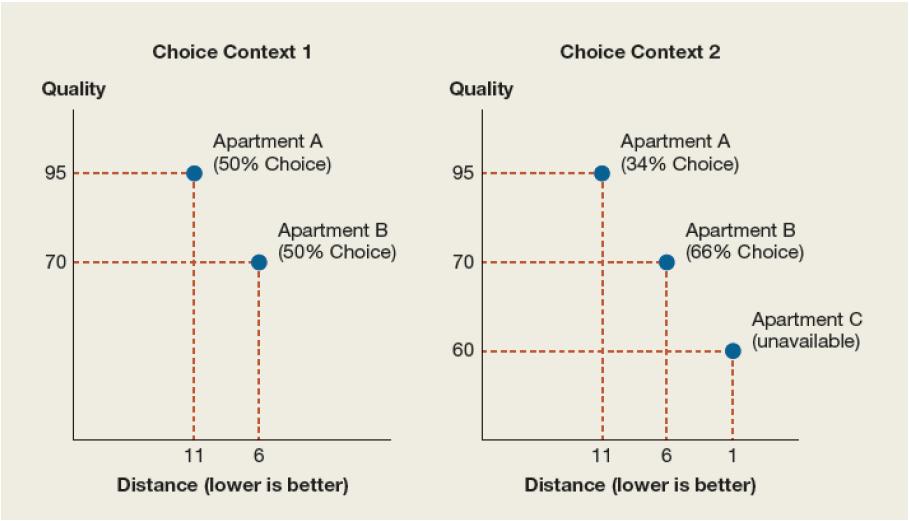
Now consider Choice Set 2 (right graph). In this context, there is a third apartment that consumers are aware of but that is not currently available. It is closer than A or B in terms of distance (a positive) but poorer than A or B in terms of quality (a negative). Rational choice theory assumes that if an option such as C is included, consumers should still prefer the brands the same way as they did previously. Particularly since Option C is not even available, rational choice theory would suggest that Options A and B would hold steady at 50 percent of the market each. However, this is not what happens. Instead, adding Option C, even though not available for rent, increases B’s share up to 66 percent!
This is called the compromise effect, because, adding option C made option B the compromise solution. It is a compromise between the two extremes of A (furthest away, best quality) and C (nearest, worst quality). Consumers prefer compromise options and find them easy to justify (a metagoal). The compromise effect seems strongest when the compromise brand is the more familiar brand in the set.
The compromise effect has important implications for marketers. Real Estate agents who want to sell a particular property might first show their clients an unavailable property that makes their available property seem like the compromise option to increase the chances their client will purchase it. For retailers, since consumers often search and evaluate alternatives online and then go to a physical store to purchase the selected brand, an ―online only‖ option (option C) could be created to make their instore options seem like compromise options to increase their choice share.
Discussion Questions
1. Why does the compromise effect contradict rational choice theory?
2. Beyond being easy to justify, can you think of other reasons why consumers prefer compromise options?
3. Do you see any ethical issues related to strategies designed to position brands as compromise alternatives? Explain.
REVIEW QUESTIONS
1) What is rational choice theory?
The task in rational choice theory is to identify or discover the one optimal choice for the decision confronting the decision maker. The decision maker simply collects information on the levels of the attributes of the alternatives, applies preexisting values to those levels, applies the appropriate choice rule, and the superior option is revealed.
2) What is meant by bounded rationality?
Bounded rationality is defined as a limited capacity for processing information.
3) What is a metagoal?
A metagoal refers to the general nature of the outcome being sought.
4) What are three common metagoals for consumer decisions?
One metagoal is maximizing the accuracy of the decision. This is the only metagoal assumed in rational choice theory.
A second relates to how consumers often seek to minimize the cognitive effort required for the decision. This is often the goal in nominal and limited decision making. Athird metagoal is to maximize the ease with which a decision can be justified.
5) What is affective choice, and when is it most likely to occur?
Affective choices do not lend themselves well to either the attribute-based or the attitude-based choice approaches. The evaluation of such products is generally focused on the way they will make the user feel as they are used. The evaluation itself is often based exclusively or primarily on the immediate emotional response to the product or service. Affective choices tend to be more holistic in nature.
6) What is the difference between consummatory motives and instrumental motives?
Consummatory motives underlie behaviors that are intrinsically rewarding to the individual involved. Instrumental motives activate behaviors designed to achieve a second goal.
7) How does attribute-based choice differ from attitude-based choice? When is each most likely?
Attribute-based choice requires the knowledge of specific attributes at the time the choice is made, and it involves attribute-by-attribute comparisons across brands. Attitude-based choice involves the use of general attitudes, summary impressions, intuitions, or heuristics; no attributeby-attribute comparisons are made at the time of choice.
Greater purchase involvement, more available information, and lower time pressures all contribute to greater attribute-based choice and lesser attitude-based choice.
8) What are evaluative criteria and on what characteristics can they vary?
Evaluative criteria are the various dimensions, features, or benefits a consumer looks for in response to a problem. They can vary in terms of type (objectively specified vs. subjectively), number (can depend on situation), and importance (usually, one or two are much more important to a consumer).
9) How can you determine which evaluative criteria consumers use?
You can utilize either direct or indirect methods. Direct would include asking consumers what information they use or, in a focus-group setting, observe what consumers verbalize about products and their attributes. Indirect methods, such as projective techniques, allow a person to indicate what ―someone else‖ (probably that person) might do. Perceptual mapping is also a useful indirect technique.
10) What methods are available for measuring consumers’ judgments of brand performance on specific attributes?
They include rank ordering scales, semantic differential scales, and Likert scales.
11) How can the importance assigned to evaluative criteria be assessed?
Either by direct (constant sum scale, e.g) or indirect (conjoint analysis) measures.
12) What is sensory discrimination, and what role does it play in the evaluation of products? What is meant by a just noticeable difference (j.n.d)?
Sensory discrimination refers to an individual’s ability to distinguish between similar stimuli. This plays a major role in the evaluation of products that may differ in characteristics. For example, one stereo may be technically superior in sound characteristics, but this difference may not be sensed by listening to this stereo and one of lesser technical quality.
The j.n.d. is the minimum amount of variation that would have to take place in a given stimulus such that a difference could be detected.
Marketers attempting to differentiate their brand of product must find a level of performance between their brand and competitors’ brands that surpasses the j.n.d. On the other hand, a marketer may want to change a product or price but not have consumers perceive any change, and, hence, not surpass the j.n.d.
13) What are surrogate indicators? How are they used in the consumer evaluation process?
An attribute used to stand for or indicate another attribute is a surrogate indicator. For many products, it is difficult to assess a product’s quality; consumers may therefore use the price of the product as a basis for inferring the product’s quality.
Marketers of clothing and alcoholic beverages use the price of these goods in product positioning because consumers often use the price of these goods as a surrogate indicator of quality. Thus,
marketers of products which are difficult to differentiate on the basis of physical characteristics will use surrogate indicators to imply quality.
14) What factors influence the importance of evaluative criteria?
The usage situation, the competitive context, and advertising effects.
15) What is the conjunctive decision rule?
Selects establishes the minimum required performance standard for each evaluative criterion and selects the first or all brands that meet or exceed these minimum standards.
16) What is the disjunctive decision rule?
Establishes a minimum level of performance for each important attribute (often fairly high). All brands that meet or exceed the performance level for any key attribute are considered acceptable.
17) What is the elimination-by-aspects decision rule?
Rank the evaluative criteria in terms of importance and establish satisfactory levels for each. Start with the most important attribute and eliminate all brands that do not meet the satisfactory level. Continue through the attributes in order of importance until only one brand is left.
18) What is the lexicographic decision rule?
Rank the evaluative criteria in terms of importance. Start with the most important criterion and select the brand that scores highest on that dimension. If two or more brands tie, continue through the attributes in order of importance until one of the remaining brands outperforms the others.
19) What is the compensatory decision rule?
Select the brand that provides the highest total score when the performance ratings for all the relevant attributes are added together (with or without importance weights) for each brand.
20) How can knowledge of consumers’ evaluative criteria and criteria importance be used in developing marketing strategy?
Because information processing and decision making are guided by those evaluative criteria consumers consider important in a purchase; marketers must know which criteria are important and how they are used in decision making. This tells marketers the features they need to design into their products and what they should stress in their ads.
21) How can knowledge of the decision rules consumers might use in a certain purchase assist a firm in developing marketing strategy?
Knowing the predominant decision rule used in brand selection for a particular product class can guide development of marketing strategy. The following strategies would be appropriate for different decision rules:
a. Disjunctive: Product positioning should establish a level of performance on one or more of the important evaluative criteria above the desired performance level.
b. Conjunctive: Product positioning should ensure that all evaluative criteria exceed the target market’s minimum desired level.
c. Lexicographic: Product positioning should focus on the most important criteria. If competition is keen, it must meet competition on the most important criterion and beat competing alternatives on the second most important evaluative criterion (or third, etc.).
d. Elimination-by-aspects: Ensure that the brand meets the target market’s desired level of performance on all the important attributes that competition can meet, plus one more.
e. Compensatory: Product positioning should focus on strong points of the brand in terms of evaluative criteria and attempt to shift more weight to them such that these criteria will more than compensate for fair or poor performance on other criteria.
DISCUSSION QUESTIONS
22) Respond to the questions in Consumer Insight 16–1.
The center-stage and decoy effects contradict rational choice theory because rational choice theory predicts that choices will be invariant of context (such as the addition of other alternatives). Both of these effects show this assumption to not be true.
Other reasons why consumers might find the middle alternative more attractive is because it fits better with their self-concept (I feel average or have normal tastes) or because consumers are risk averse to ―extreme‖ (e.g., the highest or lowest priced), alternatives which are often placed on the outside of the three options.
Answers to the ethics question will vary. Some students will point out that it is pure manipulation to offer up products, particularly those that are intentionally inferior in order to ―manipulate‖ consumer decisions. Some students may also correctly note that caution would be important to not mislead consumers by promoting a brand that requires additional ―hidden‖ costs to make it acceptable (which could be judged as a misleading communication).
23) Would you use an attribute-based or an attitude-based decision approach to purchasing (or renting or giving to) the following? Which, if any, situational factors would change your approach?
a) Adopting a pet from a shelter
b) A movie
c) An e-reader
d) A BBQ grill
e) A personal trainer
f) Athletic shoes
g) A new shampoo
h) An apartment
i) A smartphone
j) Habitat for Humanity
Ask students which evaluative criteria would be important in the purchase of one of the above products or services when buying for their own use. Then (where appropriate) discuss how these criteria might change if the purchase were for a gift for someone else. Have the students weigh their criteria using either a rating or constant sum scale.
24) Repeat Question 23, but speculate on how your instructor would answer. In what ways might your instructor’s answer differ from yours? Why?
Answers will vary widely depending on your characteristics. The ―why‖ will focus on different lifestyles and situations for professors and students (some will even imagine that you have
sufficient income to assign price a very low importance rating). It is useful for you to have prepared a PPT slide with your weighted evaluative criteria for two or three of the above. Don’t show this until after the discussion.
25) For which, if any, of the options in Question 23 would you make an affective decision? What role would situational factors play?
Affective choice tends to occur when motives are consummatory (vs instrumental). Have students put each product into one of the two categories and also discuss individual differences that might occur in the type of motive for the same product. Then have them discuss how well the type of motive drives the affective choice.
26) What metagoals might you have, and what would be their relative importance to you in purchasing (or renting or giving to) the options in Question 23?
This is a good way to get students to think about how metagoals operate. You might try varying the situation in which the decision is being made to illustrate how situations affect the goals consumers seek.
27) List the evaluative criteria and the importance of each that you would use in purchasing (or renting or giving to) the options in Question 23. Would situational factors change the criteria? The importance weights? Why?
It may be useful to set up a table with evaluative criteria in the rows and the options across the columns. This is useful because it will illustrate how different options are evaluated. Also, when incorporating different situations, it will be apparent that the weighting of criteria may change dramatically.
28) Repeat Question 27, but speculate on how your instructor would answer. In what ways might their answer differ from yours? Why?
This draws out the differences that may exist across consumer segments.
29) Describe a purchase decision for which you used affective choice, one for which you used attitude-based choice, and one for which you used attribute-based choice. Why did the type of decision process you used vary?
The key is to force the students to support the decisions made with the choice strategies.
30) Identify five products for which surrogate indicators may be used as evaluative criteria in a brand choice decision. Why are the indicators used, and how might a firm enhance their use (i.e., strengthen their importance)?
Listed below are five products and surrogate indicators that may be used in brand evaluation.
PRODUCTS
CRITERIA SURROGATE INDICATORS
Premium beers Social status Price, package, country of origin
Stereo equipment Quality Price, brand name, country of origin
Perfume Quality Price and brand name
Clothing Quality Price, brand name, and retailer
Insurance agent Reliability Location and personnel
In each case, a surrogate indicator is used because the criterion of interest (evaluative criterion) cannot be accurately evaluated by consumers. As a result, criteria that are assumed to be related are substituted because they are more easily and accurately evaluated.
31) The table below represents a particular consumer’s evaluative criteria, criteria importance, acceptable level of performance, and judgments of performance with respect to several brands of motor scooters. Discuss the brand choice this consumer would make when using the lexicographic, compensatory, and conjunctive decision rules.
Evaluative Criteria
Note: 1 = very poor; 2 = poor; 3 = fair; 4 = good; and 5 = very good.
Using a lexicographic decision rule, this consumer would first focus on the most important evaluative criterion specified on the table, gas economy (a relative weight of 35) and find that Kymco excels and, therefore, would be selected.
A compensatory rule that weights each score by its importance produces the following scores: Kymco–420, Aprilia–335, Vespa–355, Honda–300, Piaggio–315, and BMW–340. Therefore, Kymco would be selected.
A conjunctive decision rule would produce no choice as no brand meets all the minimum performance levels. Additional search, lower standards, or a different rule are required.
32) Describe the decision rule(s) you used or would use in buying, renting, or giving to the options listed for Question 23. Would you use different rules in different situations? Which ones? Why? Would any of these involve an affective choice?
One way to discuss this question is to construct the table below on the board. Ask a student to verbally describe a last purchase or how such a purchase would be made. Have the other students then decide which decision rule (or combination of rules) was used in the purchase decision. Because students may approach the purchase of a product differently, it is important to emphasize that there is no one rule that is right or wrong. This is set up to lead students to choose one of these rules. Hopefully, some students will argue that several of these decisions will involve affective choice for which these rules might not be appropriate.
Choices
Conjunctive Disjunctive Elim.byAspects Lexicographic Compensatory
Pet
adoption
Movie
e-reader
BBQ grill
Personal trainer
Athletic shoes
Shampoo
Apartment
Smartphone
Habitat for humanity
33) Describe your last two major and your last two minor purchases. What role did emotions or feelings play? How did they differ? What evaluative criteria and decision rules did you use for each? Why?
In general, the minor purchases will involve fewer criteria and simpler rules than the major purchases. The discussion should center around why this is the case (greater knowledge, fewer needs being met, and lower cost if a suboptimal choice is made).
34) Discuss surrogate indicators that could be used to evaluate the perceived quality of the products or activities listed in Question 23.
Listed below are some potential surrogate indicators for the products and services mentioned. Students will suggest others and consider some of those listed to be irrelevant. To get a good discussion started, have the class name as many as possible for each product/service and then force the class to agree on the one surrogate indicator that is most likely to be used. One can then discuss how the most important surrogate indicator could be used in developing a positioning strategy.
a. Pet adoption
Cleanliness of facility, outlet reputation
b. Movie Actors
c. e-reader
d. BBQ grill
e. Personal trainer
f. Athletic shoes
g. Shampoo
h. Apartment
i. Smartphone
Brand name, price, country of origin, online user reviews
Price, brand, outlet reputation
Price, brand name, outlet reputation, clientele base
Brand name, country of origin, price
Price, brand name, packaging
Price, agents’ reputation, and other characteristics
Brand name, country of origin, price, outlet reputation
j. Habitat for Humanity Companies involved, volunteer base
CHAPTER 17: OUTLET SELECTIONAND PURCHASE
LEARNING OBJECTIVES
LO1: Describe how retailing is evolving
LO2: Discuss the relationship among retail outlets as part of omni-channel shopping
LO3: Explain the retail and consumer attributes that affect outlet selection
LO4: Summarize the in-store and online influences on brand choice
LO5: Understand how purchase plays a role in the shopping process
SUMMARY
LO1: Describe how retailing is evolving
Retail outlet refers to any source of products or services for consumers. Retailing has moved well beyond traditional physical stores and catalogs to include the Internet, interactive TV ads, and mobile shopping apps. Computers learn and recall consumer information and preferences; full-body scanners allow for custom-fit apparel; and interactive TV ads and shows do or will allow for product information search and purchase from the ad or show. The Internet and mobile phones and apps are changing the way consumers shop both prior to, and during, a store visit in unprecedented ways that are influencing the stores and brands that consumers choose.
LO2: Discuss the relationship among retail outlets as part of omni-channel shopping
While store-based retailing continues to dominate in terms of overall sales, online and mobile retailing as well as other forms of in-home retailing including catalogs are increasingly important retail outlets to shoppers. Consequently, most retailers are engaging in multi-, or omni-channel marketing to reach their customers. The need for omni-channel marketing reflects shifts in consumer shopping. Consumers are increasingly likely to be omni-channel shoppers that is consumers who browse and/or purchase using multiple channels Omni-channel shoppers can use the various retail channels in many ways while searching for and purchasing a product. Omni-channel shoppers who search online and ultimately buy a product at a physical store engage in webrooming Showrooming is the opposite. Omni-channel shoppers have higher incomes and spend more than single-channel
shoppers. Retailers like Crate&Barrel are implementing omni-channel strategies to court these customers
LO3: Explain the retail and consumer attributes that affect outlet selection
The decision process used by consumers to select a retail outlet is the same as the process described for selecting a brand. The only difference is in the nature of the evaluative criteria used. Retail outlet image is an important evaluative criterion. Store-based image and online retailer image are both important, although the dimensions consumers use to judge them vary. Store brands can both capitalize on a store’s image and enhance, or detract from, it. Outlet location and size are important, with closer and larger outlets generally being preferred over more distant and smaller ones. Consumer characteristics such as perceived risk and shopping orientation are also important determinants of outlet choice.
LO4: Summarize the in-store and online influences on brand choice
While in a retail outlet, consumers often purchase a brand or product that differs from their plans before entering. Such purchases are referred to as unplanned purchases. Most of these decisions are the result of additional information processing induced by in-store or online stimuli. However, some are impulse purchases made with little or no deliberation in response to a sudden, powerful urge to buy or consume the product. Such variables as point-of-purchase displays, price reductions, outlet atmosphere, website design, mobile and mobile apps, sales personnel, and brand or product stockouts can have a major impact on sales patterns.
LO5: Understand how purchase plays a role in the shopping process
Once the outlet and brand have been selected, the consumer must acquire the rights to the item. This often involves credit. Whether purchasing is in-store, online, or via mobile or social media, the retailer’s job is to simplify the process since it will enhance the likelihood of purchase and enhance their image.
LECTURE TIPS AND AIDS
1) Have the students write down and rank order the characteristics (evaluative criteria) they look for in a store when (a) on a major grocery shopping trip, (b) buying a quart of milk when in a hurry, (c) buying a suit, (d) buying a watch, and (e) buying a birthday card. Use their answers to discuss the product, individual, and situational influences on desired outlet evaluative criteria.
2) Repeat Question 1 as they think the following people would respond: (a) a middle-aged doctor, (b) an unemployed mechanic, (c) a retired school teacher. Use their responses as a basis for additional discussion of individual variation in desired outlet characteristics.
3) Have each student describe a recent stockout experience and their total response to it.
4) C. Mathwick, et al., Journal of Retailing, Vol. 77(1), pp. 39-56, provide a measure to evaluate websites. Assign ahead of time and have students create a survey which includes this measure, pick a website, and rate each dimension on a 1 being strongly disagree to 5 being strongly agree scale. Have them offer a general report to the class to include a discussion of areas where the website could be improved. This should reinforce student appreciation of online image and atmospherics.
5) Ask students to describe their shopping habits involving the use of the Internet and mobile apps. Generate a list of functionalities (evaluative criteria) that students want from the Internet and mobile apps when it comes to shopping.
6) Ask students to provide the names and functions of the various mobile shopping apps they use. Have them evaluate how much of a role these apps play in influencing their ―in-store‖ buying behavior.
7) Student Handout 1 discusses the challenges of converting Internet users to online buyers. Questions are provided at the end of the handout with answers below:
a) Students should be encouraged to list additional elements not covered in the insight that could be used to turn browsers to buyers.
b) Students will have varying opinions regarding the need for enhanced social elements and this will make for interesting discussion. Some students will argue that retailers will need to accommodate the needs of the social shoppers in order to be successful with this market segment. Others may think it a bit odd to shop online with a friend. You might try drill down into the hedonic motives for shopping of the different students to help understand differences.
c) ―Recapture‖ strategies for consumers who started but abandoned shopping carts online are likely successful because creating a shopping cart means they were already interested in the items and relatively serious about making a purchase. E-mail campaigns that focus on key issues such as price or shipping charges are likely to be most effective since these are some of the major reasons consumers abandon carts online to begin with.
STUDENT HANDOUT 1: CONVERTING WEBSITE VISITORS TO BUYERS
With about 90 percent of U.S. adults online and roughly two-thirds having made an online purchase, online sales will only grow by increasing how frequently and how much consumers buy online. The following provides a set of guidelines for online retailers to help them convert website visitors to buyers.
Appropriate Landing Page. Bad landing pages can be purchase killers. An example is clicking on an Esurance-sponsored link after searching for homeowner’s insurance and having the landing page be about auto insurance. Companies are trying to target their landing pages specifically to the type of consumer who is clicking through. For example, Elite Island Resorts set up two landing pages to target different travel buyers.i
Deal with Privacy and Security Concerns. Online privacy and security is a top online buying deterrent and represents billions in lost sales. Online privacy concerns relate to consumer fears regarding how personal information about them that is gathered online might be used. Online privacy concerns include targeting children, being inundated with marketing messages, and identity theft.i
Four approaches to reducing online privacy concerns seem possible. First is direct control through ―opt-in‖ features that let consumers choose directly how their information is used.i Second is the use of direct trust signals such as privacy statements and the incorporation and communication of security verification systems such as VeriSign.i These signals can increase trust, reduce privacy concerns, and enhance purchases, but sometimes do not. A third approach is to use an indirect signal relating to a firm’s investment in its website. An example would be a firm that uses ―Shockwave technology to allow a user to experience an online demonstration and roll over the product image to gather additional information,‖ versus one that conveys the same information but does so ―through text and static graphics.‖ Research shows that when consumers perceive that firms have invested more in their website, that this increases trust and online purchase likelihood.i A final approach is to use brand as an indirect signal of trust. Research shows that consumers are more likely to provide transaction-specific information to a trusted retailer than to one they are unfamiliar with.i
The approach a firm should use depends on the type of web visitor, with searchers (search-task directed) more responsive to the indirect website investment signal and browsers (pleasure directed) more responsive to the direct privacy statement signal.
Deal with Lack of Touch. The lack of touch or ability to physically handle, test, or try products prior to purchase is a top concern and affects product categories such as apparel and home decorating, where it can be difficult to simulate experience attributes (e.g., fit for apparel, color, and texture for home decorating).i Internet marketers are becoming much more sophisticated in terms of creating virtual product experiences using such techniques as 3-D simulations and rich media, made practical by the increased penetration of broadband. In the apparel area, for example, ―virtual try-on‖ functionality allows consumers to see how clothing looks on a model. MVM (My Virtual Model) allows consumers to create their own model and try on various fashion brands and styles.i
Deal with Lack of Social Element. In-store retailing allows for the social element, which is a major shopping motive and lacking in many online shopping sites. To deal with this, some online retailers are creating sites that incorporate a social shopping experience. One example is Kaboodle, which combines online shopping with social networking to allow consumers to shop online with their friends. Also, online retailers like Lands’ End are increasingly adding video and text chat with a sales associate. An even more social dimension is being created by ―humanlike‖ online assistants such as IKEA’s Anna. Such assistants lead to perceptions that the website is more social which creates positive emotions and increases purchase intentions.i
Deal with Shopping Cart Abandonment. Roughly 70 percent of all shopping carts that consumers start get abandoned prior to a purchase. That’s a lot of revenue left on the table and marketers are seeing the opportunity. One recent study found that e-mail campaigns that are specifically targeted (e.g., mention the items abandoned, promote core brand values, provide some sort of promotion since price and delivery charges are often major factors) and timed (after 24 hours, 90 percent of abandoned carts will stay that way. Done correctly, one estimate is each e-mail (or series in a campaign) to a consumer who abandoned an online cart yields an average of $17.90, meaning those who abandon carts can be reengaged and converted to buyers.i
Critical Thinking Questions
1. What other strategies can online retailers use to increase the purchase likelihood of website visitors?
2. Do you think the social element even matters online? Explain.
3. Why do you think campaigns targeting shopping cart abandonment are so successful?
REVIEW QUESTIONS
1) The consumer faces the problems of what to buy and where to buy it. How do these two types of decisions differ?
In any purchase decision, a consumer faces two very basic decisions: which brand to buy and where to buy it. What differentiates these decisions is mainly in what criteria they use and this is motivated by the goals they have in each decision. Consumers might select a given brand because it has the best performance. They might select a particular retailer to buy that brand from because that retail carries the brand at the lowest price, or offers good credit, easy returns, good service, and so on.
2) How is the retail environment changing?
Retail outlet refers to any source of products or services for consumers. Retailing has moved well beyond traditional physical stores and catalogs to include the Internet, interactive TV ads, and mobile shopping apps. Computers learn and recall consumer information and preferences; fullbody scanners allow for custom-fit apparel; and interactive TV ads and shows do or will allow for product information search and purchase from the ad or show. The Internet and mobile phones and apps are changing the way consumers shop both prior to, and during, a store visit in unprecedented ways that are influencing the stores and brands that consumers choose.
3) Describe online retailing.
Online retailing is selling products and services through the Internet directly to consumers. It accounts for just about 9% of total retail sales.
4) Describe mobile retailing.
Mobile retailing is selling products and services through the Internet or an app which are accessed by a consumer on their phone. Smartphone users can access the retailer’s mobile website or download a mobile app to shop and make purchases. Mobile retailing accounts for 34 percent of online retailing. Multichannel shoppers are those who browse and/or purchase in more than one channel. Research suggests that this is common. It means that marketers can use multiple channels in different and complementary ways. Websites can be used to drive in-store traffic for consumers who do not want to wait, in-store can be used to provide ―touch‖ and allow consumers to consider their purchase and buy online later with shipping direct to their homes. Students should be encouraged to consider how multichannel retailers should (re)design various outlets in light of multichannel shopping.
5) What are the concerns for consumers in using online retailing and mobile apps?
Barriers exist for buying products online and through a mobile app. These include preference for seeing product in person, not wanting to pay shipping fees, not wanting to wait on delivery, online prices are too high, preference for talking to salesperson in person, inadequate product descriptions, and poor product images. Retailers are beginning to address these barriers, including the ―see it in person‖ which is often due to an inability to touch. Innovative technology now helps simulate the experience for online shoppers (see Chapter 11) with expectations of converting them to online buyers.
6) What is omni-channel shopping, and what implications does it hold for retailer strategy?
Omni-channel shoppers are consumers who browse and/or purchase in more than one channel. Mobile phones and apps allow consumers to search for information, prices, coupons, and discounts, while standing in a physical store. Omni-channel consumers spend more at a given retailer than single-channel consumers and retailers are designing platforms to maximize their cross-channel shopping.
7) What is meant by showrooming and webrooming? Why are they important issues for retailers?
Omni-channel shoppers who search online and ultimately buy a product at a physical store engage in webrooming. Showrooming is the opposite. As discussed in Chapter 4, showrooming is common among Gen Yers who go to the brick-and-mortar store to touch, try out or try on a product, and then buy it online. Showrooming has gained momentum among consumers looking for a deal. The Internet facilitates price comparisons (see Chapter 15), and often the cheapest price is found online, not in-store. Nevertheless, webrooming is more common (69 percent of consumers) than is showrooming (46 percent).i
8) What is a store image, and what are its dimensions and components?
Store image is the overall perception of a retail outlet that is formed on the basis of impressions of that store, and comparable stores, in terms of the attributes commonly used to describe that particular type of retail outlet. One study found nine dimensions to a store image: merchandise, service, clientele, physical facilities, convenience, promotion, store atmosphere, institutional (reputation), and post-transaction.
9) Describe online retailer image and compare/contrast it with store image
Online retailer image is the online counterpart to store image that is, ―the target market’s perception of all the attributes associated with a retail outlet.‖ While different dimensions may be important across these different channels, there are numerous commonalities including merchandise quality and selection, and so on. Students should be pushed to see that while the labels of the in-store and online dimensions presented in the two tables in the text are somewhat different, there is considerable overlap in the underlying features.
10) What is a store brand? How do retailers use store brands?
A store brand is a brand with the same name as the store or a special name developed by the store. At the extreme, the store or outlet is the brand. Patagonia, Victoria’s Secret, and Body Shop International are examples. All the items carried in the store are the store’s own brand. Traditionally stores carried only manufacturers’ brands and only a few, such as Sears and Wards, developed their own house or store brands. In the 1970s, many stores began to develop store brands as low-price alternatives to national brands. However, increasingly powerful retailers such as Walmart are developing and promoting high-quality brands with either the store’s name or an independent name. Such brands not only provide attractive margins for these outlets. If they are developed appropriately, they become an important attribute of the outlet. That is, they are another reason for consumers to shop that store which enhances store loyalty.
11) What key decisions do retailers make with respect to retail price advertising?
Retail price advertising attracts people to stores, generates sales of the advertised items, and increases sales of other, unadvertised items in the store. In addition, both price and nonprice advertising affect the store’s image.
12) What is meant by the term spillover sales? Why is it important?
Sales of additional items to customers who came to purchase an advertised item are referred to as spillover sales. They represent a difficult to measure but major benefit from retail advertising. One study found that spillover sales to people who came to the store to buy the advertised item equaled the sales of the advertised item.
13) How does the size and distance to a retail outlet affect store selection and purchase behavior?
The larger a retail store or shopping center, the greater the selection and opportunity to fulfill needs. This is a shopping benefit unless quickness or convenience is particularly important. However, the farther the distance or travel time to a retail store or shopping center, the greater the cost. Recognizing these costs and benefits, the law of retail gravitation, or retail attraction model, attempts to represent the power of attraction of a given retail center on the basis of its size and distance to target markets relative to competing outlets and their respective size and distance to target markets.
14) How is store choice affected by the perceived risk of a purchase?
Perceived risk in a purchase situation produces a tendency to shop in established, well-known stores.
15) What is meant by social risk? How does it differ from economic risk?
Social risk is the danger of the product not providing the desired amount of social acceptance or recognition from peers. Economic risk does not present a threat to one’s public image but relates to the risk of purchasing a product that does not physically or functionally perform as desired thus causing financial loss
16) What is a shopping orientation?
It is the way a person approaches shopping in general or for a particular type of product. It includes the person’s activities, motivations, and attitudes.
17) Describe six motivation-based shopping orientations across retail types.
Orientation Percent Characteristics
Bargain Hunter 22
These ―precision shoppers‖ stick to a strict budget and often put their family’s needs ahead of their own.
Knowledge Seeker 21 These ―ratings and review junkies‖ do their homework online before making a purchase and may or may not buy it in-store.
Practical Player 17 These ―no-nonsense shoppers‖ tend to buy the basics, keep within their means, and want a fast, easy, and convenient shopping experience.
Store Reassurer 16
Brand Desirer 16
These consumers prefer to shop at a store rather than online. They can touch and feel the product and be more confident they are buying the right thing.
These shoppers choose brands that reflect their status and values, and like to buy the very latest, often being the first to discover and try new things. Quality is a priority over price for this group.
Mobile Warrior 9 For these consumers, the smartphone is the most important weapon in their shopping arsenal, whether it is used to store coupons, research alternative products, or make purchases.
Note: Due to rounding, numbers add to over 100 percent.
Source: Y&R BAVLabs, ―Shopperstates™: Six Dimensions of the New American Shopper,‖ December 2015. Copyright 2015
18) What is meant by an in-store purchase decision? Why is it important?
An in-store purchase decision occurs when an important part of the decision is made on the basis of information gained in the store. Purchases can be specifically planned (complete decision made before entering the store), generally planned (the product type selected in advance but the brand or specific item selected in the store), substitute (a change from a specifically or generally
planned purchase to a functional substitute), and unplanned (the purchase of an item that was not considered before entering the store). They are important because most purchase decisions for most product categories are made at least partially in-store.
19) What is meant by an impulse purchase? Why is it important?
This type of purchase occurs when a consumer sees a product in the store and purchases it with little or no deliberation as the result of a sudden, powerful urge to have it. This is important when considering Point-of-purchase (POP) displays and store layout issues.
20) Once in a particular store, what in-store and/or online characteristics can influence brand and product choice? Give an example of each.
a. POP displays can attract attention to a brand and produce a greater likelihood of purchasing that brand. For example, an end-of-aisle display featuring a particular brand of snack food can be expected to increase purchases of this brand over normal shelf sales.
b. Price reductions and promotional deals (coupons, multiple-item discounts, and gifts) offer an economic purchase incentive. This is done quite often in the promotion of frequently purchased products like orange juice.
c. Outlet atmospherics can also affect brand purchase as well as the total in-store expenditure. Grocery stores are arranged to maximize exposure to items not routinely purchased while obtaining normal grocery purchases.
d. Stock-outs of a particular brand or product can lead to brand switching or store switching. For example, if a retail outlet were out of a shopper’s brand of cigarettes, most would buy elsewhere.
e. Sales personnel can often persuade a consumer to purchase or not purchase a particular brand. Manufacturers often provide some form of direct payment to retail sales personnel for sales of specified items.
f. Website functioning and requirements influence likelihood of making a purchase. Shopper concerns include complex buying processes and costly shipping charges attached to online purchases. Amazon Prime is one example of how shipping charges can be reduced for frequent buyers as a way to encourage online purchases and offers a ―One-click checkout‖ to simplify and speed up the buying process.
g. Retailing using mobile websites and mobile apps is on the rise. Smartphones and mobile apps are influencing how consumers shop both inside and outside the store environment. Retailers do not want to be left behind, as omni-shoppers generate more sales.
21) Describe the impact of POP displays on retail sales.
Although the sales impact of displays varies widely by product type and location and between brands within a product category, there is generally a strong increase, or lift, in sales.
22) Describe the impact of price reductions and deals on retail sales.
Price reductions and promotional deals (coupons, multiple-item discounts, and gifts) are generally accompanied by the use of some point-of-purchase materials. Therefore, the relative impact of each is sometimes not clear. Nonetheless, there is ample evidence that in-store price reductions affect brand decisions.
23) What is meant by store atmosphere? Online atmosphere? How do they affect consumer behavior?
The store’s atmosphere or internal environment affects the shoppers’ mood and willingness to visit and linger in the store. The atmosphere is influenced by such attributes as lighting, layout, presentation of merchandise, fixtures, floor coverings, colors, sounds, odors, dress and behavior of sales personnel, and the number, characteristics, and behavior of other customers. Websites also have atmospheres that deal with similar things only in a digital environment in which tactile experiences (ability to touch merchandise) and social aspects of other customers are limited. Factors such as color, design, ease of navigation, helpfulness of online digital assistants (if present) are all a part of online atmosphere.
24) What is a servicescape?
Atmosphere is referred to as servicescape when describing a service business such as a hospital, bank, or restaurant.
25) Why do consumers planning to make a purchase at an online outlet frequently fail to do so?
One reason for this is the practice of consumers looking at products on the web and then buying them in traditional stores (multichannel shopping). However, other issues include credit card security concerns, complex process, and so on (see the answer to Question 26).
26) What are frequent problems consumers encounter while shopping online?
A number of factors lead to shopping cart abandonment and are seen as consumer problems with the online shopping/buying experience. These are listed below.
issues that consumers want higher performance online are:
27) What can happen in response to a stockout?
Stockouts, the store being temporarily out of a particular brand, can obviously affect a consumer purchase decision in that the consumer must then decide whether to (a) buy the same brand but at another store, (b) switch brands, (c) delay the purchase and buy the desired brand later at the same store, or (d) forego the purchase altogether. They can also produce negative attitudes and/or word-of-mouth (WOM) concerning the original store or positive attitudes and/or WOM concerning the substitute store or brand.
DISCUSSION QUESTIONS
28) Name two mobile apps that affect the choice of brands in the store?
Answers will vary and evolve as the apps evolve and improve. Apps currently include price comparisons and coupons which clearly can influence which brands are purchased.
29) Does the image of a retail outlet affect the image of the brands it carries? Do the brands carried affect the image of the retail outlet?
This depends on the strength of the initial brand image. An unknown brand may take on many of the image attributes of the store in which it is encountered, while a well-known brand might well be unaffected. The same is true for the second question.
30) What challenges face omni-channel retailers in managing their image across the channel?
Managing one image in one channel is difficult enough. Managing across channels is a whole other issue. It requires a careful IMC (integrated marketing communications) approach wherein each channel is managed to be consistent with the overarching image but also designed to complement the other channels. This dual challenge (how to stay consistent but also to complement across channel) is likely one of the major issues.
31) Respond to the questions in Consumer Insight 17–1.
Answers will vary based on students’ opinions and personal experiences. However, this question sets the stage for a discussion about mobile retailing, consumers’ motivations to use mobile retailing, and the reasons consumers avoid mobile retailing. You could also incorporate diffusion of innovations from Chapter 7 into this as part of a class discussion.
Answers will vary on this question as well based on the students’ individual experiences, but this will facilitate a class discussion about the specific emerging trends in mobile retailing. It is highly likely that the majority of them will have had personal experience with at least a few of the trends listed in the insight. This is a good discussion to hold in small groups and then have the groups share insights with the class as a whole in a larger discussion.
Several consumers have ethical concerns about trust and privacy of their data when using mobile retailing. Retailers could reassure consumers of their data security precautions. Another concern is that AI and conversational commerce may limit consumer choices as an AI bot or chatbot would make specific recommendations that lead to some brands being presented while others are not. Retailers could have the bots make suggestions to consumers but also ask consumers if they would like to hear additional options.
32) How are social and economic risks associated with the following products likely to affect the outlet choice behavior of consumers? How would the perception of these risks differ by consumer? Situation?
a) Sports car
b) Athletic shoes (for running)
c) Wine (as a gift)
d) Hairdresser
e) Mountain bike
f) Mouthwash
g) Smartphone
h) Movie for a date
Construct the table below on the board and discuss the degree to which economic or social risk are important dimensions of purchase for each of these products. It is best if you specify a target market such as college students. After discussing one target market, specify another such as middle-aged blue-collar workers and discuss the reasons for any differences in the students’ assumptions about risk.
Product Category
a. Sports car
b. Athletic shoes
c. Wine (gift)
d. Hairdresser
e. Mountain bike
f. Mouthwash
g. Cell phone
h. Movie for a date
Economic Risk
Social Risk Reduction Strategy
33) Describe an appropriate strategy for an online store such as Target for each of the motivationbased shopping orientations described in the text.
Have the students form groups and formulate strategies. It may be more useful to assign each group of students one motivation orientation. This will facilitate different approaches and illustrate how differently the same example can be approached.
34) Describe an appropriate strategy for a mobile app of a retailer such as Starbucks for each of the motivation-based shopping orientations described in the text.
See the answer to Question 33.
35) Suggest other methods for developing motivation-based shopping orientations.
One study used projective techniques to ascertain the ways college students approach shopping. It had consumers ―[t]hink about an animal that best describes you as a shopper… [and] explain what it is about your behavior that makes this animal an appropriate metaphor.‖ This projective approach uncovered six shopping orientations, one of which was Chameleons who indicated that their shopping styles are situation-specific or constantly changing. Their shopping approach is based on product type, shopping impetus, and purchase task.
You might turn this into an exercise in itself where you have students in the class interview a few friends using this technique and then consolidate their responses on the board to create a typology. Once developed, you could have students generate marketing/retailing implications around each shopper type.
36) How should retailer strategies to encourage unplanned purchases differ based on the type of unplanned purchase generally associated with the product category?
See Table 17–2 for unplanned purchases by category. Depending on the category, POP, price reductions, and promotions can be used to encourage unplanned purchases, whether they are reminder or impulse buys.
37) Respond to questions in Consumer Insight 17–2.
Q1 If the student answers yes, answers may vary as to the differences between a pop-up and permanent store. Students should discuss the attributes discussed in the chapter related to in-store atmospherics, and other factors related to in-store shopping.
Q2 Answers may vary, but some products that are web-only could be online services such as TurboTax or online tutoring. These types of online services should remain web-only because there are physical alternatives, but people appreciate the convenience of these services online. On the contrary, Rent The Runway is a fashion business that could do well establishing a pop-up or even a permanent physical store. While they had stores in the past and decided to close them, there is an advantage to trying on clothes in the store than guessing which size will fit from online dimensions.
Q3 If the student answers yes, make sure they discuss topics from the chapter/insight that go further than just the convenience of the shopping.
38) What in-store characteristics could retailers use to enhance the probability of purchase among individuals who visit a store? Describe each factor in terms of how it should be used, and describe its intended effect on the consumer for the following products:
a) Perfume
b) Ice cream
c) Coffee after a meal
d) Flowers from a supermarket
e) B12 drinkable shots
f) Motor oil
Construct the table below and discuss the degree to which each in-store influence plays a role in the purchase of the products listed.
IN-STORE INFLUENCE
P-O-P
Price deals
Layout Personnel
Stockouts Web
Mobile apps
PRODUCT
Perfume Ice cream Coffee Flowers B12 Shots Motor oil
39) What site characteristics could online retailers use to enhance the probability of purchase among individuals who visit their sites? Describe each factor in terms of how it should be used, and describe its intended effect on the consumer for the following products:
a) Dorm furniture from Target.com
b) Electronics from Amazon.com
c) Laptop from HP.com
d) Backpack from REI.com
e) Apparel from JCPenney.com
f) Cosmetics from Macys.com
g) Tools from Sears.com
Have the students identify specific factors that would influence the purchase of products online. It will be interesting to push students to consider underlying issues like security, trust, etc.
40) What type of store atmosphere is most appropriate for each of the following retailer types? Why?
a) Bookstore serving college students
b) Cosmetic section of Sears
c) Auto dealership service department
d) Consumer electronics
e) Mercedes automobiles
f) Inexpensive furniture
g) Thai food restaurant.
This is a fun exercise. The answers and discussion of atmosphere for these products will be straightforward, but you need to provide a target market for the class to focus on. Push the students to be very specific about how they would create the desired atmosphere. You may need to remind them that cost is also relevant.
41) Repeat Question 39 (except for c and g) for online retailers.
Have the students focus on the interface the firms provide for consumers. They can use the dimensions detailed in the in-text table relating to online retailer image.
42) How would you respond to a stockout of your preferred brand (or model) of the following? What factors other than product category would influence your response?
a) SUV
b) Cereal
c) Deodorant
d) Dress shirt/blouse
e) Perfume/aftershave lotion
f) Soft drink
Construct a matrix as below and have the class estimate which action they would most likely take. Also determine the situational factors that would influence their chosen action. Also, ask for instances in which they have experienced stockout and what they did.
Another brand/same store
Delay purchase Forego purchase Same brand/another store Negative original store WOM
Positive new store WOM
Positive new brand WOM Original store attitude reduction New store attitude increase New brand attitude increase
CHAPTER 18: POSTPURCHASE PROCESSES, CUSTOMER SATISFACTION,AND CUSTOMER COMMITMENT
LEARNING OBJECTIVES
LO1: Describe the various postpurchase processes engaged in by consumers
LO2: Define and discuss postpurchase dissonance
LO3: Discuss the issues surrounding product use and nonuse and their importance to marketers
LO4: Summarize disposition options and their relevance to marketers and public policy
LO5: Explain the determinants and outcomes of satisfaction and dissatisfaction
LO6: Describe the relationship between satisfaction, repeat purchase, and customer commitment
SUMMARY
LO1: Describe the various postpurchase processes engaged in by consumers
Purchase is followed by a number of processes including use, evaluation, and in some cases satisfaction, and consumer responses related to satisfaction including repurchase, positive word-ofmouth (WOM), and loyalty. Evaluation can also lead to dissatisfaction which is sometimes associated with complaining, as well as erosion of loyalty, brand switching, and negative WOM.
LO2: Define and discuss postpurchase dissonance
Following some purchases, consumers experience doubts or anxiety about the wisdom of the purchase. This is known as postpurchase dissonance. It is most likely to occur (1) among individuals with a tendency to experience anxiety, (2) after an irrevocable purchase, (3) when the purchase was important to the consumer, and (4) when it involved a difficult choice between two or more alternatives.
LO3: Discuss the issues surrounding product use and nonuse and their importance to marketers
Whether or not the consumer experiences dissonance, most purchases are followed by product use. This use may be by the purchaser or by some other member of the purchasing unit. Monitoring product usage can indicate new uses for existing products, needed product modifications, appropriate advertising themes, and opportunities for new products. Product liability laws have made it increasingly important for marketing managers to be aware of all potential uses of their products.
Product nonuse is also a concern. Both marketers and consumers suffer when consumers buy products that they do not use or use less than they intended. Thus, marketers frequently attempt to influence the decision to use the product as well as the decision to purchase the product.
LO4: Summarize disposition options and their relevance to marketers and public policy
Disposition of the product or its package may occur before, during, or after product use. Understanding disposition behavior is important to marketing managers because of the ecological concerns of many consumers (and resulting green marketing efforts, see Chapter 3), the costs and scarcity of raw materials, and the activities of federal and state legislatures and regulatory agencies. Ewaste is an emerging area of concern related to disposition.
LO5: Explain the determinants and outcomes of satisfaction and dissatisfaction
Consumer perceptions regarding satisfaction and dissatisfaction are a function of a comparison process between consumer expectations of performance and their perceptions of actual performance. When expectations are met or exceeded, satisfaction is likely to result, and in some cases, commitment or loyalty is developed. When expectations are not met, dissatisfaction is the likely result. Service is a major determinant of customer satisfaction even when the core purchase involves a physical product. Service and product failures, failure to adequately address product and service problems, and bad pricing are key factors that lead to dissatisfaction.
Dissatisfaction can lead to many undesirable responses from the perspective of the firm, including erosion of loyalty, negative WOM, and switching brands. One positive response for the firm is customer complaining, although customers often are reluctant to complain and companies are often not well prepared to act on those complaints when they do occur.
LO6: Describe the relationship between satisfaction, repeat purchase, and customer commitment
Satisfaction results in a number of positive outcomes including repeat purchases, positive WOM, and, in some cases, loyalty. Not all satisfied customers are loyal. Simply meeting expectations (passive satisfaction in the language of Consumer Insight 18–1) is typically not enough to generate the psychological commitment that is associated with loyalty. Repeat purchasers are also not necessarily loyal customers. Repeat purchasing can occur out of habit (it is what I always buy) or necessity (it is the only option out there) and not out of a commitment to the brand. Repeat purchasers who are not committed customers are vulnerable to competitor attempts to steal them away. Thus, brand loyalty or customer commitment, defined as a willingness to repurchase coupled with a psychological commitment to the brand, is critical to marketers. As online retailing continues to grow, marketers are examining ways in which e-satisfaction and e-loyalty can be bolstered. Relationship marketing and loyalty programs are strategic efforts on the part of the firm that can be used to bolster satisfaction, repeat purchases, and, in some cases, loyalty.
LECTURE TIPS AND AIDS
1) A good way to begin is to have each student describe in writing their own postpurchase processes for three recent purchases. Selected students can then read their descriptions. Class discussion can then focus on the factors that lead to differing postpurchase processes.
2) Have the students describe two brands of which they are nonloyal repeat purchasers and two for which they are brand loyal or committed. Discussion can focus on the factors that lead to loyalty versus those that lead only to repeat purchasing.
3) Have the students describe two product categories in which they exhibit multibrand loyalty or repeat purchasing and two in which they exhibit unibrand loyalty or repeat purchasing. Discussion can focus on the factors (generally situational) that lead to the unibrand versus the multibrand situation.
4) Have the students describe a recent purchase that produced postpurchase dissonance and one that did not. Discussion can focus on the factors that lead to dissonance.
5) Have the students report examples of nonstandard product use. What, if any, marketing strategies are suggested by the reports?
REVIEW QUESTIONS
1) What are the major postpurchase processes engaged in by consumers?
Following a major purchase, consumers are likely to experience some postpurchase dissonance. With or without dissonance, product use and package disposition generally occurs. This is normally followed by product disposition. Evaluation of the purchase experience, the product, and the disposition of the product and package occurs simultaneously with and following each of these events. This evaluation produces some level of satisfaction that in turn causes brand switching, increased product/brand use, repeat purchases, or committed customers.
2) How does the type of decision process affect the postpurchase processes? Habitual decisions involve product use, disposition, and very limited evaluation and generally maintain a high level of repeat purchase motivation. Extended decision making also involves product use and evaluation. However, it is likely to also involve postpurchase dissonance, a thorough evaluation of the product and the purchasing process, and a more complex impact on repeat purchase motivation. Postpurchase processes for limited decisions generally fall between these extremes.
3) What is postpurchase dissonance?
Postpurchase dissonance refers to an after-purchase psychological condition in which the purchaser experiences some doubt or worry about the wisdom of the purchase just made.
4) What characteristics of a purchase situation are likely to contribute to postpurchase dissonance?
Characteristics of the purchase situation which are likely to contribute to postpurchase dissonance include:
a. The degree of commitment or irrevocability of the decision. The easier it is to alter the decision, the less likely one would experience dissonance.
b. The importance of the decision to the consumer. The more important the decision is to the consumer, the more likely dissonance will occur.
c. The difficulty of choosing among alternatives. The harder it is to select from among the alternatives, the more likely one will experience postpurchase dissonance.
5) In what ways can a consumer reduce postpurchase dissonance?
By increasing the desirability of the brand purchased, one can reduce feelings of postpurchase dissonance, decreasing the desirability of rejected alternatives, decreasing the perceived importance of the purchase, or reverse the purchase decision (return the product before use)
6) What is consumption guilt?
Consumption guilt occurs when some negative emotions or guilt feelings are aroused by the use of a product or service.
7) What is use innovativeness?
Use innovativeness refers to a consumer using a product in a new way. Marketers who discover new uses for their products can greatly expand sales.
8) What is a reasonably foreseeable use of a product, and why is it important to companies?
Companies need to anticipate these reasonably foreseeable uses by consumers, which may take the form of useful innovations. Consumers’ use innovativeness leads to off-label use, whereby consumers use a product for which it was not originally intended. For example, consumers have expanded the uses for Bounce dryer sheets to include keeping trash cans smelling fresh. Furthermore, stringent product liability laws and aggressive civil suits are forcing marketers to examine how consumers use the products for the primary purpose and other potential uses
9) What are effective ways for a company to get at innovative product uses by customers?
Increasingly, the Internet can be used to track innovative product uses. Online observation and measurement are offering substantial insight in real-time ways that traditional methods may not. While traditional surveys can provide useful information and are easier than ever to conduct (given that many are conducted online), observation, depth interviews, and case studies often provide deeper insights.
10) What is meant by product nonuse, and why is it a concern of marketers?
Product nonuse occurs when a consumer actively acquires a product that is not used at all or used only sparingly relative to its potential use. Nonuse can occur due to postpurchase dissonance. Marketers are concerned because nonuse does not produce a satisfied customer, repeat sales, or positive WOM communications.
11) What is meant by the disposition of products and product packaging, and why does it interest governmental regulatory agencies and marketers?
Disposition of a product and/or its packaging refers to how the product and/or packaging is disposed of before, during, or after product use. Consumer disposition behavior is important to governmental agencies like the Environment Protection Agency (EPA) because of potential harm disposed products and/or their packaging present to the environment.
Product disposition is important to marketing strategy because (a) sometimes disposition must precede product use due to financial or space limitations, (b) certain disposition strategies may give rise to a used or rebuilt market, and (c) difficult or unsatisfactory disposition alternatives may cause some consumers to withdraw from the market for a particular item.
12) What is e-waste, and why is it a growing concern?
E-waste consists of cell phones, personal computers, and various other personal electronic devices. Rapid innovation and product obsolescence are combining to create a huge volume of ewaste.
13) What factors influence consumer satisfaction? In what way do they influence consumer satisfaction?
A consumer’s evaluation of a purchase is influenced by the purchase itself, postpurchase dissonance, product use, and product disposition. The outlet or the product or both may be involved in the evaluation. Consumers may evaluate each aspect of the purchase ranging from information availability to price to retail service to product performance. A particular alternative, such as a product, brand, or retail outlet, is selected because it is thought to be a better overall choice than other alternatives that were considered in the purchase process. Whether that particular item was selected because of its presumed superior functional performance or because of some other reason, such as a generalized liking of the item, consumers have some level of expected performance that it should provide. After (or while) using the product or outlet, the consumer will perceive some level of performance. This perceived performance level could be noticeably above the expected level, noticeably below the expected level, or at the expected level. Satisfaction with the purchase is primarily a function of the initial performance expectations and perceived performance relative to those expectations
14) What is the difference between instrumental and symbolic performance, and how does each contribute to consumer satisfaction?
Instrumental performance relates to the physical functioning of a product, while symbolic performance of a product relates to the aesthetic or image enhancement performance of a product. Dissatisfaction is most likely to be caused by a failure of instrumental performance, while complete satisfaction requires instrumental performance plus symbolic performance at or above expected levels.
15) What is affective performance?
Affective performance is the emotional response that owning or using the product provides. It may arise from the instrumental and/or symbolic performance or the product. That is, a suit that produces admiring glances or compliments may produce a positive affective response. Or, it may be the primary product benefit, such as an emotional movie or novel.
16) What courses of action can a consumer take in response to dissatisfaction? Which are used most often?
When dissatisfaction occurs, a consumer can either take action or take no action. When no action is taken, a less favorable attitude is likely to result. Action can involve: (1) complain to the store
or manufacturer, (2) stop buying that brand or at that store, (3) engage in negative WOM, (4) complain to private or government agencies, or (5) initiate legal action.
17) What determines satisfaction for online retailers?
Four dimensions have been identified as follows:
Website Design and Interaction: Includes factors such as information quality, navigation, price, merchandise availability, purchase process, and order tracking.
Security and Privacy: Includes factors related to security such as fraud and identity theft and privacy related to unwanted marketing efforts.
Fulfillment and Reliability: Includes factors such as timely delivery, order accuracy, billing accuracy, and the quality of the merchandise.
Customer Service: Includes factors relating to service level such as customer support, ability, and ease of communication, as well as factors relating to returns such as clear and fair return policies.
18) What would marketers like consumers to do when dissatisfied? How can marketers encourage this?
When a consumer is dissatisfied, the most favorable consequence is for the person to communicate this dissatisfaction to the firm but to no one else. This alerts the firm to problems, enables it to make amends where necessary, and minimizes negative WOM communications. Firms must (a) make complaining relatively easy and nonconfrontational and (b) respond to complaints quickly and appropriately. This may require specialized training of frontline employees.
19) What is churn? How does it affect profits?
Churn is a term used to refer to turnover in a firm’s customer base. If a firm has a base of 100 customers and 20 leave each year and 20 new ones become customers, it has a churn rate of 20 percent. It typically costs more to obtain a new customer than to retain an existing one, and new customers generally are not as profitable as longer-term customers.
20) What are the sources of increased profits from longer-term customers?
Price premiums since repeat and particularly committed customers tend to buy the brand consistently rather than waiting for a sale or continually negotiating price. Referrals generate profits by new customers acquired due to recommendations from existing customers. Lower costs occur because both the firm and the customer learn how to interact more efficiently over time. Finally, customers tend to use a wider array of a firm’s products and services over time.
21) What is the relationship between customer satisfaction, repeat purchases, and committed customers?
Customer satisfaction with a brand or store is generally necessary for repeat purchases to occur. If other alternatives are readily available, consumers not satisfied with a brand/store's performance will generally try them in the future. However, satisfaction is not sufficient to produce committed customers. The customer must come to identify with the firm/brand and/or believe that it, to some extent, is committed to them.
22) What is the difference between repeat purchasers and committed customers?
Repeat purchasers continue to buy a brand out of habit, lack of choice, because it is the cheapest or for other reasons, but they feel no attachment to the brand. A committed customer comes to
identify with the firm/brand and/or believe that it, to some extent, is committed to them. Brandloyal purchasers are psychologically or emotionally committed to the brand.
23) What are switching costs?
These are the costs involved in finding, evaluating, and adopting another solution (product).
24) Why are marketers interested in having committed customers?
Loyal customers are somewhat immune to competitors' actions and are more likely to purchase the brand at full price. They also tend to be receptive to line extensions and new products from the same firm.
25) What is the Net Promoter Score?
Net Promoter Score measures the percentage of a firm’s promoter customer base left after subtracting out the firm’s detractors
26) What is relationship marketing? What strategies are involved?
Relationship marketing attempts to develop an ongoing, expanding exchange relationship with a firm’s customers. In many ways, it seeks to mimic the relationships that existed between neighborhood and country stores and their customers many years ago. In these relationships, the store owner knew the customers not only as customers but also as friends and neighbors. The owner could anticipate their needs and provide help and advice when needed. Relationship marketing attempts to accomplish the same results but, because of the large scale of most operations, must use databases, ―customized mass communications,‖ and advanced employee training and motivation. Relationship marketing has five strategy elements: (1) developing a core service or product around which to build a customer relationship; (2) customizing the relationship to the individual customer; (3) augmenting the core service or product with extra benefits; (4) pricing in a manner to encourage loyalty; and (5) marketing to employees so that they will perform well for customers.
27) What are loyalty programs? What do most of them actually do?
Loyalty programs are intended to encourage repeat purchases. Many are designed to generate repeat purchases rather than committed customers.
28) What factors influence e-loyalty?
Research has identified customization/personalization, interactivity, convenience, and online community as factors that drive e-loyalty.
DISCUSSION QUESTIONS
29) How should retailers deal with consumers immediately after purchase to reduce postpurchase dissonance? What specific action would you recommend, and what effect would you intend it to have on the recent purchaser of (gift to) the following?
a) PBS donation
b) A condominium
c) Dance lessons
d) An electric automobile
e) Microwave oven
f) Tropical fish
To discuss this question, you should first get the class to determine which products are likely to create the greatest postpurchase dissonance. Use a matrix like the one below and rate each product on each factor with 1 being no dissonance and 5 being maximum dissonance increase. It will quickly be clear that dissonance is not likely for PBS donation and not very likely for microwave oven. Next, discuss what kind of strategies retailers could employ, shortly after purchase, to reduce dissonance for high dissonance products. These would generally involve a direct mail or phone contact with the customer thanking them for their business, inviting them to call or come in with any questions, and indicating that they made an excellent choice in their purchase. You could also discuss the impact these efforts would have on WOM communication and repeat purchases.
Irrevocability Importance Choice difficulty Individual anxiety
PBS donation
A condominium
Dance lessons
An electric automobile
Microwave oven
Tropical fish
30) What type of database should your university maintain on its students? In general, what ethical concerns surround the use of such databases by institutions and companies?
The use of information is the area of most concern when dealing with ethical issues. Many may feel harassed if frequent, unnecessary contact was made with consumers/students.
31) How should manufacturers deal with consumers immediately after purchase to reduce postpurchase dissonance? What specific action would you recommend, and what effect would you intend it to have on the recent purchaser of the following?
a) Smartphone
b) Expensive watch
c) Laptop computer
d) Corrective eye surgery
Basically, the same approach used in Question 29 could be used.
32) How do some companies capitalize on the concept of use innovativeness?
Companies are using contests, web-based suggestion boxes, and social media tracking to understand potential uses for their products and services. Liability issues are of concern and seeking legal counsel regarding off-label uses tends to be a prudent approach.
33) Discuss how you could determine how consumers actually use the following. How could this information be used to develop marketing strategy?
a) Microwave
b) Wristwatches
c) Online banking services
d) Movies on demand
e) Hair color
f) Hotel reward points
Standard questionnaires, projective techniques (How does the average person use ______?), focus groups (How many ways can ________ be used?), use diaries, and observation (online via social media comments and offline) can all be used. Product features and marketing communications can be altered to expand the use situations deemed appropriate for the product.
34) How would you go about measuring consumer satisfaction among purchasers of the following? What questions would you ask, what additional information would you collect, and why? How could this information be used for evaluating and planning marketing programs?
a) Cell phone service
b) Walmart.com
c) Car insurance
d) Six Flags theme parks
e) Health-related services
f) Exercise bike
For each product listed, the class should discuss dimensions of instrumental performance and symbolic performance. For each product, determine which is more important in achieving satisfaction. Then discuss how one would go about measuring satisfaction for each component of each product. Generally, some sort of rating scale can be created using important attributes of instrumental and/or symbolic performance.
Other measures, such as ―probability of repeat purchase‖ or ―to what degree would you recommend this product/service to a friend,‖ also provide indirect measures of satisfaction. To better understand which consumers are likely to encounter dissatisfaction, one would also collect demographic data and use behavior so that any strategies that are developed are directed at appropriate customers.
35) What level of product dissatisfaction should a marketer be content with in attempting to serve a particular target market? What characteristics contribute to dissatisfaction, regardless of the marketer’s efforts?
This discussion question can focus on what level of consumer satisfaction is practical in serving consumers with diverse needs, perceptions, experiences, and personalities. Discussion could first look into how each of these factors can vary among individuals such that high satisfaction for an entire market may be impossible. The cost–benefit ratio to the firm should be discussed. The problem is that it is very easy to measure the costs of keeping customers satisfied in terms of free services, extended warranties, and so forth; but very difficult to measure either the gains from
satisfied customers in terms of WOM communications, full-price purchases, and so on or the cost of dissatisfied customers in terms of negative WOM, resistance to line extensions, and so on
36) Describe the last time you were dissatisfied with a purchase. What action did you take? Why?
Answers will vary. Many students will not remember a specific instance of dissatisfaction, which indicates that most of us are satisfied with most of our purchases. Point out to the students that they are most likely to remember an unsatisfactory purchase if they took some action in response to it.
37) Are you a mere repeat purchaser of any brand, service, or outlet? Why are you not a committed customer? What, if anything, would make you a committed customer?
Students will enjoy this exercise. First, specify the objective of the program. Is it to build brand loyal customers or repeat purchasers. If repeat purchasers, is frequency or volume more important. The program should attract and retain the most profitable type of customer. Most students will suggest frequent eater programs. A few will come up with some very creative ideas.
38) Respond to the questions Consumer Insight 18–1.
The reason has to do with the underlying factors that drive consumers to engage in positive WOM, which appear to relate to having an emotional commitment (attitudinal loyalty) toward the firm or brand.
Profits may not be as straightforward. Satisfied or even delighted customers may not always be profitable. Only when that condition is met will NPS also be correlated with profits. If it costs more to delight these customers than the revenues they generate, then profits will actually be lower even though they will be promoters of a firm’s brand. This goes back to the ongoing debate over chasing growth at the expense of profits, which many firms make the mistake of doing.
When consumers cannot act on their underlying attitudes, then NPS probably would not work very well as a predictor of growth. For example, in monopoly-like industries such as cable, even though customers may hear about other great providers, they would not be able to switch to them, and therefore NPS should not be a major predictor of growth.
39) What are some of the negative consequences of ―firing‖ customers?
Students should be encouraged to discuss their emotional responses They likely range from sadness to anger to rage. Push students to think of effective communication procedures for letting customers go in a way that would minimize such emotions.
40) Are you a committed customer to any brand, service, or outlet? Why?
This is a good initial question in order to get students to think about the difference between committed and repeat behavior.
41) Design a customer loyalty program for the following:
a) High-end hotel chain
b) Grocery store chain
c) Cosmetics line
d) Catering service
There are many different customer loyalty programs that are well established and publicized. Frequent flier programs are good examples that most people are at least moderately familiar with. This question challenges students to consider the factors that would make consumers loyal to a given product/service/brand/outlet Most successful loyalty programs are for more functional products. Using a more experiential product/service forces students to be more creative and analytical with their program.
CHAPTER 19: ORGANIZATIONAL
BUYER BEHAVIOR
LEARNING OBJECTIVES
LO1: Describe the organizational purchase process
LO2: Summarize the external factors that influence organizational culture
LO3: Summarize the internal factors that influence organizational culture
LO4: Explain the influence of organizational buyer segments on marketing strategy
SUMMARY
LO1: Describe the organizational purchase process
Like households, organizations make many buying decisions. In some instances, these buying decisions are routine replacement decisions; at other times, they involve new, complex purchase decisions. Three purchase situations are common to organizational buying: straight rebuy, modified rebuy, and new task. Each of these purchase situations will elicit different organizational behaviors.
The organizational decision process involves problem recognition, information search, evaluation and selection, purchase implementation, and postpurchase evaluation. While functional attributes such as price and quality certainly play a critical role, brand image can also be important, in some cases even increasing the prices that organizational buyers are willing to pay.
Purchase implementation is more complex, and the terms and conditions are more important than in household decisions. How payment is made is of major importance. Finally, use and postpurchase evaluation are often quite formal. Many organizations will conduct detailed in-use tests to determine the life-cycle costs of competing products or spend considerable time evaluating a new product before placing large orders. Satisfaction depends on a variety of criteria and on the opinions of many different people. To achieve customer satisfaction, each of these individuals has to be satisfied with the criteria important to them.
LO2: Summarize the external factors that influence organizational culture
Organizations have a style or manner of operating that we characterize as organizational culture. Firmographics (organization characteristics such as size, activities, objectives, location, and industry category, and characteristics of the composition of the organization such as the gender, age, education, and income distribution of employees) have a major influence on organizational culture. The process of grouping buyer organizations into market segments on the basis of similar firmographics is called macrosegmentation
Reference groups play a key role in business-to-business (B2B) markets. Reference group infrastructures exist in most organizational markets. These reference groups often include third-party suppliers, distributors, industry experts, trade publications, financial analysts, and key customers. Lead
users have been shown to be a key reference group that influences both the reference group infrastructure and other potential users.
Other external influences on organizational culture include the local culture in which the organization operates and the type of government it confronts.
LO3: Summarize the internal factors that influence organizational culture
Internal factors affecting organizational culture include organizational values, perception, learning, memory, motives, and emotions. Organizations hold values that influence the organization’s style. Individuals in the organization also hold these values in varying degrees. Organizations also develop images, have motives, and learn. Seller organizations can affect how they are perceived through a variety of communication alternatives. Print advertising, direct mail, sales calls, and online are common. Whereas organizations have rational motives, their decisions are influenced and made by people with emotions. A seller organization has to understand and satisfy both to be successful.
LO4: Explain the influence of organizational buyer segments on marketing strategy
Each of the factors discussed in this chapter is important for marketing strategy because each contributes to the type of buyer that an organization faces. One important way to segment organizational buyers is in terms of transactional versus relational exchanges. Transactional exchanges involve single transactions, are short-lived, involve few investments by the buyer and seller in the relationship, and involve low loyalty. Alternatively, relational exchanges involve multiple events, occur over an extended period of time, involve significant investments by the buyer and seller, and involve higher levels of loyalty. Factors such as industry structure, decision-making culture and structure, risk tolerance, and the nature of the purchase influence whether a buyer takes a relational or transactional approach. Marketers must adjust their strategies, particularly as they regard relationship marketing depending on the type of buyer they face. Periodic audits can be helpful in ensuring that buyers are getting the value desired from a relationship.
LECTURE TIPS AND AIDS
1) A good way to begin this chapter is to have students discuss the organizational similarities and differences between two distinctly different organizations, such as the Red Cross and IBM. After listing obvious differences, discuss how these organizations might differ and how they would be the same in how they collect information, make decisions, and evaluate their satisfaction with respect to a given purchase decision.
2) For a high-involvement purchase, such as a new car, have students describe how a household might make that decision. Then discuss how a commercial firm would make the same car purchase decision for a company car to be driven by a salesperson. Then discuss the similarities and differences in each decision process and purchase environment.
3) Invite the purchasing agent for the university or a nearby firm to class. Have the purchasing agent describe the process the agent goes through for various types of organizational purchases.
4) Have students discuss how households and organizations might differ in their postpurchase analysis of an important purchase decision.
REVIEW QUESTIONS
1) How can an organization have a culture? What factors contribute to different organizational cultures?
Organizations have a type of self-concept in the beliefs and attitudes the organization members have about the organization and how it operates. Likewise, organizations have a type of lifestyle in that they have distinct ways of operating. We characterize these two aspects of an organization as its organizational culture. Organizational culture is much like lifestyle in that organizations vary dramatically in terms of how they make decisions and how they approach problems involving risk, innovation, and change. The term corporate culture is often used to refer to the organizational culture of a business firm. Organizational culture reflects and shapes organizational needs and desires, which in turn influence how organizations make decisions.
2) How would different organizational activities and objectives affect organizational culture?
The activities and objectives of organizations influence their style and behavior. However, we cannot assume two organizations have the same organizational culture just because they share common objectives or activities. Organizational objectives can be categorized as commercial, governmental, nonprofit, and cooperative. The general nature of organizational activity is described as routine, complex, or technical. Commercial firms can be usefully divided into public (stock is widely traded) and private (one or a few individuals own a controlling share of the firm) firms. In public firms, management is generally expected to operate the firm in a manner that will maximize the economic gains of the shareholders. While this is seldom completely the case, these organizations do face consistent pressures to make economically sound, if not optimal decisions. However, about half of all business purchases involve privately held firms whose CEO is often the controlling shareholder. In this situation, the firms can and frequently do pursue objectives other than profit maximization.
3) What are organizational values? How do they differ from personal values?
Organizations have values with respect to risk-taking, competition, hard work, problem-solving, individualism, decision making, change, and performance, among others. An organization’s values are shaped by its founder, its history, and its current leaders. Unlike personal values, these are the result of a collection of individuals operating in a unique environment over time that leads to a particular set of organizational values.
4) What are firmographics, and how do they influence organizational culture?
This refers to the size, location, industry category, type of ownership, and employee demographics of an organization. Each of these impacts an organization’s culture in unique ways. For example, West Coast firms tend to have more informal cultures than do East Coast firms. Different combinations of these firmographics help create unique organizational cultures.
5) Define macrosegmentation, and describe the variables used to create a macrosegmentation of an organizational market.
Organizations with distinguishing firmographics can be grouped into market segments. These segments, based on differences in needs due to firmographics, are called macrosegments.
6) What types of reference groups exist in organizational markets?
Lead users, trade associations, financial analysts, and dealer organizations all influence an organization’s decision to buy or not buy a given product, or to buy or not buy from a given supplier.
7) What are lead users, and how do they influence word-of-mouth (WOM) communication and the sales of a new product?
Lead users are innovative organizations that lead change and try new products and process early. Other organizations often imitate their actions. As a result, lead users are often asked for their opinions and can greatly accelerate or slow the sales of a new product they may be evaluating.
8) What is a decision-making unit? How does it vary by purchase situation?
A group of individuals assigned the task of participating in an organizational decision. The size and structure of the decision-making unit typically varies by firmographics (larger firms have more members and more specialists involved), stage in the decision process (different members at different stages), and by type of decision (complex, new purchases have more members than simple repurchases).
9) How can a seller organization influence perceptions of a buyer organization?
The stages of exposure, attention, and interpretation are the same whether for organizations, households, or individuals. Therefore, the basic principles of the perception process apply. In general, while organizations can be influenced through advertising, personal contact plays a larger role in marketing to organizations.
10) What are organizational motives?
Organizations have motives such as profit, security, and effectiveness. Likewise, individuals have personal motives such as security, self-importance, and individuality. Often a selling organization such as IBM can appeal to a buyer organization's sense of security by offering the security of buying from a well-known supplier. This is similar to individuals seeking to satisfy a less observable motive or emotion.
11) What is a two-stage decision process?
A two-stage decision process involves two discrete stages of decision making. The first stage uses one set of criteria often coupled with a conjunctive decision rule to determine which vendors to consider in a purchase. The second stage would involve different criteria and a generally more complex decision rule (although often price is the primary criterion at this stage) to select from among the vendors that survived the first screening.
12) What is the distinction between relational and transactional exchanges?
Transactional exchanges involve single transactions, are short lived, involve few investments by the buyer and seller in the relationship, and involve low loyalty. Alternatively, relational exchanges involve multiple events, occur over an extended period of time, involve significant investments by the buyer and seller, and involve higher levels of loyalty.
13) What are the three purchase situations commonly encountered by organizations? How do organizations typically respond to each situation?
Straight Rebuy: This situation occurs when the purchase is of minor importance and is not complex. This is generally the case when reordering basic supplies and component parts. In such cases, the reordering process may be completely automated or done routinely by clerical
personnel. Such purchases are often handled under a contract that is reviewed and perhaps rebid periodically. Price and/or reliability tend to be the dominant evaluative criteria. No consideration is given to strategic issues.
Modified Rebuy: This strategy is used when the purchase is moderately important to the firm and/or the choice is more complex. This typically involves a product or service that the organization is accustomed to purchasing but the product or the firm’s needs have changed. Or, because the product is important to the firm (it is simple but the firm uses a lot of it or it is an important component of the firm’s output), the firm may periodically reevaluate brands and/or suppliers.
New Task: This approach tends to occur when the buying decision is very important and the choice is quite complex. This would involve decisions on such areas as an initial sales automation system or a new advertising agency (for a firm such as Nike). The buying organization will typically have had little experience with the decision and perhaps with the product or service.
14) In what ways does the Internet play a role in the organizational decision process?
Just as the Internet has become a major force in consumer decisions, so too is it an important tool in organizations. In fact, B2B e-commerce is currently estimated at $1 3 trillion in the United States, and over $7.3 trillion worldwide. The Internet can play a variety of roles in the decision process from lead generation, to information provision, to efficient and automated order fulfillment. Search marketing is currently the dominant approach in B2B contexts, with two-thirds of B2B sellers using search engine marketing. This is because B2B buyers utilize online search extensively at all stages of the decision process.
DISCUSSION QUESTIONS
15) Describe three organizations with distinctly different organizational cultures. Explain why they have different organizational cultures and the factors that have helped shape the style of each.
a. The EPA is a government organization with a technical activity. The combination of these two characteristics contributes to a unique set of objectives, activities, and organizational style.
b. United Way is a nonprofit organization whose activities might be classified as routine. Their employees, activities, objectives, and organizational style would differ considerably from the EPA's.
c. GE is a commercial business seeking to make a profit with complex products, technologies, and customer applications. Because they have unique activities, objectives, and employees, they operate distinctly as an organization with a unique organizational style.
16) Respond to the questions in Consumer Insight 19–1.
Answers will vary, but the main point is for students to demonstrate that they have applied their knowledge of firmographics and organizational culture to these practical contexts. One example of a response could be that Google has a large size and has had to adapt its culture as it has grown.
Answers will vary in this exercise. However, students will likely find a great difference in the stated organizational values of companies even within the same industry, similar to the example from the text about Apple and HP. Those values should inform each of the two chosen companies’ organizational cultures.
Answers will vary on this question as it will be dependent upon students’ own life experiences. However, this is a good group discussion starter for a classroom activity. One good approach
(especially in large classes) is to break students into small groups to share their thoughts and then have each group choose a good example to share with the class in a larger discussion.
17) Describe how Hewlett-Packard might vary in its organizational culture from the following. Justify your response.
a) Dell computer
b) Lenovo
c) Apple
Students may find it particularly easy to compare and contrast the cultures of HP with Dell and Apple. Dell is likely more like HP in terms of being large, conventional organizations. Apple on the other hand tends to have a more entrepreneurial culture that is the signature of its founding leader Steve Jobs. This can lead to a discussion of the role of leaders in terms of instilling culture.
18) Discuss how the following pairs differ from each other in terms of organizational activities and objectives. Discuss how these differences influence organizational cultures.
a) Walmart, Target
b) FedEx, the U.S. Post Office
c) Amazon.com, Banana Republic
d) Mercedes-Benz, Kraft Foods
Students will have little trouble describing the differences between these organizations. There are obvious differences due to activities and for b objectives. Take the discussion further to look at other factors that would cause differences. Push them to focus on how these differences will impact purchasing behavior.
19) What role does brand/brand image play in the organizational decision process?
Brand image and equity play a role in the evaluation process for organization. Obviously, brand can be a surrogate indicator of quality. And research suggests that while brand may not always be the most important consideration, it can result in organizational buyers paying a higher price.
20) Discuss how Acer might use a macrosegmentation strategy to sell computers to businesses. Acer could segment businesses on the basis of size and type of business activity (industry). These differences, if meaningfully related to differences in needs, could greatly aid their marketing and sales efforts.
21) Discuss how a small biotechnology firm could influence the reference group infrastructure and the lead users to accelerate the adoption of its products in the market.
By placing information and making contacts with all members of the infrastructure, a firm can greatly aid awareness and interest in its product. Many such firms spend considerable effort cultivating relationships with key members of the infrastructure. They could also develop marketing strategies to encourage product evaluation and usage by lead users so that these lead users could develop knowledge and experience that they could communicate to others in the marketplace. Lead users are opinion leaders; when they adopt a new product or technology, others in the industry are likely to take note and seek information on that new product or technology.
22) ―Industrial purchases, unlike consumer purchases, do not have an emotional component.‖ Comment.
Most will quickly agree that organizations are simply collections of people, and because people have emotions, these emotions will be reflected by the organization. For example, a purchasing manager who interacts with a salesperson over time is likely to have an emotional attachment (liking) to that salesperson. The purchasing agent may well give the salesperson extra time to submit a bid, information about other bids, or the benefit of the doubt if something goes wrong. Likewise, as people identify with the organization they work for, they (and thus the organization) will have emotional responses to actions by competitors, customers, and the government.
23) For each of the three purchase situations described in the chapter (Table 19–2), describe a typical purchase for the following:
a) Wendy’s
b) Mercedes-Benz
c) Target
d) Your university
e) Publix
This is a good question to develop an understanding of the nature of the types of purchases firms make. The three basic purchase situations are described in the answer to Question 13.
24) Respond to the questions in Consumer Insight 19–2.
Q1 Customers are more valuable as they are more loyal and as they are lower cost to serve. Such customers are termed ―most valuable customers‖ they generate the most profits and they are likely to engage in positive WOM. This does not mean they are not demanding, only that they are worth the effort to satisfy.
Q2 Answers will vary, so have students discuss the different options and what types of businesses are most common. Main differences that could be discussed are more immediate incentives/rewards, not as personalized design, or the different rewards based on the type of loyalty program.
Q3 Answers will vary. If students think they will be a staple, reasoning could include the personalization or long-term setup already implemented into the system. To continue the success, companies will have to become creative and learn about what their clients do and do not like. With newer technology and data collection, loyalty programs could stick around if utilized correctly. If students answered no, reasoning could include differing preferences and values of younger generations of buyers within organizations. Clients might not value a company that requires longterm commitments or offer cash-based incentive programs. Social responsibility-based programs may appeal more to Gen Y or younger corporate buyers.
CHAPTER 20: MARKETING REGULATION AND CONSUMER BEHAVIOR
LEARNING OBJECTIVES
LO1: Explain the two major concerns in marketing to children that CARU deals with
LO2: Describe the various marketing activities aimed at children that are controversial
LO3: Discuss new guidelines by the FTC regarding online privacy protection for adults
LO4: Explain marketing communication issues related to adults including deceptive advertising
LO5: Discuss regulation concerns when marketing to adults as they relate to product and price
SUMMARY
LO1: Explain the two major concerns in marketing to children that CARU deals with Marketing to children is a major concern to regulators and consumer groups. One major reason for this concern is evidence based on Piaget’s theory of cognitive development that children are not able to fully comprehend commercial messages. Comprehension here has two dimensions. The first is that children often do not understand the persuasive intent of commercials. The second is that children often do not comprehend specific words and phrases. A second reason for concern over marketing to children is the potential effects it has on their safety and values. CARU (Children’s Advertising Review Unit of the Better Business Bureau) has specific voluntary guidelines by which it evaluates advertisements targeted at children.
LO2: Describe the various marketing activities aimed at children that are controversial
There are a number of marketing activities aimed at children other than TV advertising that cause concerns. Marketing to children through mobile devices is an emerging concern. Corporate programs that place strong sales messages in ―educational‖ materials supplied to schools have also come under attack. Children’s advocates are now particularly concerned about marketing to children on the Internet. The federal government has passed legislation to protect children’s online privacy called COPPA (Children’s Online Privacy Protection Act). CARU also has guidelines on this topic.
LO3: Discuss new guidelines by the FTC regarding online privacy protection for adults
With adult privacy issues, the FTC has been hesitant to craft specific legislation. However, in response to the rapidly changing online environment, and in particular in response to the increased use of ―covert‖ behavioral tracking and targeting of consumers online, the FTC has put forth a framework and guidelines that deal with designing privacy into organizations, simplifying consumer choice in the area of privacy, and offering greater transparency and simplicity to privacy practices and statements.
A major aspect of privacy relates to consumer choice to have their online searching and browsing behavior tracked. The FTC is supportive of a Do Not Track approach to this issue which would allow consumers to opt out if they wish.
LO4: Explain marketing communication issues related to adults including deceptive advertising
There is concern about the cumulative effect of advertising on adult values just as there is with children. In addition, regulators and businesses alike are concerned that adults receive accurate and adequate information about products. Accuracy of information relates to deceptive advertising and it is important to keep in mind that the FTC examines ads in terms of the truthfulness of both direct claims and implications. Pragmatic implications are one form of implication and are the implied meanings (that are neither directly stated nor logically implied) that consumers derive when interpreting language in a ―practical‖ way.
Regulation is also focused on the amount of information provided. The assumption that appears to much of this legislation is that more or full information is desirable. However, intuition and research suggest that too much information can lead to overload and suboptimal consumer outcomes.
LO5: Discuss regulation concerns when marketing to adults as they relate to product and price
The focus of consumer concern and regulation of products is twofold: Are they safe? and Are they environmentally sound? Concern with pricing is that prices be fair and accurately presented in a manner that allows comparison across brands.
LECTURE TIPS AND AIDS
1) This is a fun chapter. On the issue of regulation, you will probably have students with vastly differing views and philosophies from each other and from yours. Obviously, you must be careful not to ―put down‖ the views of any of your students. We tend to play devil’s advocate (in a very obvious manner) to any view expressed by any student. We try to force them to think a bit and defend their positions rather than blindly repeat a philosophy such as ―government regulation is bad‖ or ―big business is evil ‖ At the end of class, we generally state our basic beliefs on the topic (many feel you should not do this but students seem to appreciate it).
2) It is important that your students realize that they are unique. While this varies by campus, business students are generally much less inclined to see a need for government regulation of business than are other students. It can be fun to bring in an articulate student radical (in the sense of being antibusiness) and let that student address the class.
3) Invite a consumer lawyer from the state attorney general’s office to speak to your class. The lawyer can describe the types of issues they deal with. If you are in an urban area, the same can be done with the Better Business Bureau.
4) Contact the public relations department of one or more major firms and ask them to provide a speaker on the impact of environmental regulations on their business. Or request a speaker from the marketing department of a firm that markets green products.
5) The nutritional labeling requirements are supposed to help consumers make sound diet choices. Label changes address serving sizes, added sugars, and fats. Note how the percentage of fat is presented. It is in terms of the percent of an ―average‖ person’s daily fat requirement that one serving of the product will provide. However, for people who eat more or less than the average daily calories (and the variance is huge), this percent is not very useful. Further, many diets stress that fat should be below a certain percent of one’s total calories. Thus, consumers need to know the percent of the product that is fat. Many will assume that the fat percent provided on the label is the percent of fat in the product. However, a product could be pure fat (i.e., oil) and if the serving size is small, show a percent of daily requirements of two or three percent. To determine the percent of calories in the product that are fat (the information most people on restricted diets need), one must look at the number of grams of fat per serving, multiply this times nine (the calories in a gram of fat), and divide this result by the total calories in a serving. A similar analysis could be done for added sugars and serving sizes. It could be argued that the labels are not very ―user friendly ‖
6) Find several ads that demonstrate the notion of pragmatic implications. Many ads use ―hedge‖ words and phrases such as ―can,‖ ―aid,‖ ―fight,‖ and ―fight the signs of‖. One ad the author found particularly humorous (but scary) was an ad that stated something to the effect ―When you use XYZ, you are telling your skin, look younger, feel stronger.‖ There is also a category called uniqueness implication. A brand may claim to be calorie free. Alone and without other that information this might sound amazing. It could turn out that all brands of a specific product are calorie free. At one time, Perrier made this claim about its water, which implied that its water was special but all (unaltered or natural) water is calorie free! Students should have fun seeing examples of how marketers appear to try to say more about their products (implications) without
really saying anything directly (direct claims). You might ask students if they believe on the whole that companies purposefully design their ads to generate pragmatic implications.
REVIEW QUESTIONS
1) What are the major concerns in marketing to children?
The major concerns are children’s ability to comprehend the selling intent and the content of commercials, the impact of commercials on children’s values and health, the potential for commercials to generate unhealthy family conflict, the use of promotional materials in the classroom, marketing to children and gathering data from children on the Internet, as well as mobile marketing (i.e., cell phone promotions and ringtones)
2) What are the main issues concerning children’s ability to comprehend advertising messages?
(1) Do children understand the selling intent of commercials? (2) Can children understand specific aspects of commercials, such as comparisons?
3) What is CARU? What does it do? What are some of its rules?
CARU is the Children’s Advertising Review Unit of the National Advertising Division (NAD) of the National Council of Better Business Bureaus. It passes guidelines and issues rulings on ads aimed at children. It is voluntary and does not have the force of law, but most firms comply with its rules. Examples of rules are ―do not portray adults or children in unsafe situations,‖ ―do not unduly exploit a child’s imagination,‖ and ―do not urge that children ask their parents to purchase the advertised product ‖
4) What are the major concerns about the content of commercial messages targeting children?
The impact of commercial messages on children’s values and the impact of commercial messages on children’s health and safety.
5) What are the issues concerning the impact of advertising on children’s health and safety?
Safety issues arise when a child tries to imitate an action shown in an ad (often an ad aimed at adults) that might result in injury. Health issues are based on the extensive promotion given ―junk food,‖ sugared products, and high-fat products on shows aimed at children.
6) What are the issues concerning the impact of advertising on children’s values?
Advertising is frequently criticized as fostering overly materialistic, self-focused, and short-term values in children. Examples include the consistent pressure to buy and own things, thus producing negative values in children, and the increase in the desire to look thin and the presence of eating disorders in children as young as 6, with many finding this general shortening of childhood and the related body image problems to be inappropriate.
7) Why are consumer advocates worried about online marketing to kids?
Two major concerns emerge: invading children’s privacy and exploitation of children through manipulative techniques. First, unlike other media that children confront, the Internet is less easily subject to adult supervision. Second, the Internet is interactive. It can respond to you based on how you respond to it. This is qualitatively different from other media. Third, the Internet can ―learn.‖ Internet programs and data tools can record and recall past interactions with consumers. This allows fully customized messages.
8) What are the concerns associated with mobile and social media marketing to children?
Sometimes known as the ―third screen,‖ mobile devices, including tablets, are an increasingly integral part of our lives, including our children’s lives; and marketers see younger children as the next big growth market. Various types of promotional efforts are being used, including ringtones, mobile games, text-in contests, and celebrity ―tweets.‖ The ability for marketers to infiltrate yet another media domain with promotions and materials that are seen as further blurring the line between advertising and entertainment has many parents and consumer advocate groups concerned.
9) What is meant by ―commercialization of schools?‖ What are the various areas in which commercialization can occur and what are the major concerns?
Schools are often motivated by money as budgets continue to be tight. The issue of commercialization covers a broad sphere of activities. Consumers Union has the following classification system:
In-school Ads Ads in such places as school buses, scoreboards, bulletin boards, as well as coupons and free samples. Other aspects might include schools selling naming rights to companies and covering lockers with ads.
Ads in Classroom Ads in classroom magazines and television programs. This also includes ads in magazines distributed in school libraries. Channel One has created substantial controversy in this area. It provides 12 minutes of news to participating schools but contains two minutes of commercials, for which there is evidence of influence.
Corporate-sponsored Educational Materials and Programs Also called sponsored educational materials or SEMs. SEMs are teaching materials provided by corporations, usually for free. They come in various forms including posters, activity sheets, and multimedia teaching aids.
Corporate-sponsored Contests and Incentive Programs When companies gain access through various contests and incentives including prizes such as travel and free pizza.
Another area of great concern includes direct sales, usually by food products companies. Carbonated beverages are increasingly under pressure as a result of health concerns related to obesity and diabetes
10) Describe the key provisions of The Rule under COPPA.
The primary goal of COPPA is to place parents in control over what information is collected from their young children online.
The Rule applies to operators of commercial websites and online services (including mobile apps) directed to children under 13 that collect, use, or disclose personal information from children, and operators of general audience websites or online services with actual knowledge that they are collecting, using, or disclosing personal information from children under 13. The Rule also applies to websites or online services that have actual knowledge that they are collecting personal information directly from users of another website or online service directed to children. Nonprofits are not covered.
Privacy Policy Post a clear and comprehensive online privacy policy describing their information practices for personal information collected online from children.
Parental Notice Provide direct notice to parents and obtain verifiable parental consent, with limited exceptions, before collecting personal information online from children.
Parental Consent Give parents the choice of consenting to the operator’s collection and internal use of a child’s information but prohibiting the operator from disclosing that information to third parties (unless disclosure is integral to the site or service, in which case, this must be made clear to parents).
Parental Access Provide parents access to their child’s personal information to review and/or have the information deleted.
Parental Prevention Give parents the opportunity to prevent further use or online collection of a child’s personal information.
Confidentiality Maintain the confidentiality, security, and integrity of information they collect from children, including by taking reasonable steps to release such information only to parties capable of maintaining its confidentiality and security.
Data Retention and Deletion Retain personal information collected online from a child for only as long as is necessary to fulfill the purpose for which it was collected and delete the information using reasonable measures to protect against its unauthorized access or use
Participation Not condition a child’s participation in an online activity on the child providing more information than is reasonably necessary to participate in that activity.
NOTE: COPPA and its interpretation under the law continue to evolve. Check www.ftc.gov for updated information on COPPA.
11) How would you go about deciding if COPPA has been effective?
Students may come up with a ―pre‖ and ―post‖ approach in which conformance was measured prior to COPPA and then after and at intervals One year after, the Rules seemed to be working. No work that we are aware of has revisited this issue specifically, although COPPA is currently under review and the FTC has requested public comment on its current validity given the quickly changing online environment.
12) What are the major concerns with marketing communications targeting adults?
Regulation of marketing activities aimed at adults focuses on privacy, marketing communications, product features, and pricing practices. There is increasing demand for regulation to protect the privacy of adults, particularly on the Internet.
13) What are the issues concerning the impact of advertising on adults’ values?
The concern is the same as for advertising directed at children the long-term effect of a constant flow of messages stressing ownership and/or narcissistic values may be negative for both individuals and society.
14) What is a pragmatic implication and how does it relate to information accuracy and deception?
Pragmatic implications are one form of implication and are the implied meanings (that are neither directly stated nor logically implied) that consumers derive when interpreting language in a ―practical‖ way. The FTC views pragmatic implications as claims by the firm. If a pragmatic implication is false or the company does not have adequate evidence supporting it, it may be deemed by the FTC as deceptive. NOTE: We say ―may‖ because these are not the only criteria used by the FTC in its assessment. See www.ftc.gov for more information or refer to Ivan Preston’s 1994 book ―The Tangled Web They Weave ‖
15) What are the concerns with consumer information adequacy?
The concern is that each consumer has reasonable access to all the information they require to make an informed decision. Most feel this requires the firm to bring to consumers’ attention important information that they might not know to seek out. To ensure information adequacy, a number of laws have been passed, such as the federal truth-in-lending legislation. The problem is to do this without causing information overload (see Question 16).
16) What is information overload?
This occurs when there is so much information or the information is so complicated that the individual cannot or will not process it. The consumer then withdraws from the decision or makes a random or other simple choice.
17) What is corrective advertising?
Corrective advertising is advertising run by a firm to cause consumers to ―unlearn‖ inaccurate information they acquired as a result of the firm’s earlier advertising.
18) What are the FTC’s general guidelines for ―clear and conspicuous‖ disclosure in an online setting?
Place the disclosure near the claim it is qualifying; make the disclosure prominent; avoid having other aspects distract from the disclosure; repeat the disclosure if ad length warrants it; make sure disclosures are adequate in volume, size, and duration; and make the language of the disclosure understandable to the intended audience.
19) What are the major regulatory issues with respect to products?
Consumer groups have two major concerns with products Are they safe? And Are they environmentally sound? Increasingly, groups are also concerned with the conditions provided to the workers during the production process.
20) What are the major regulatory issues with respect to prices?
Consumer groups want prices that are fair (generally defined as competitively determined) and accurately stated (contain no hidden charges or inaccurate reference prices).
21) What is a reference price? What is the concern with reference prices?
An external reference price is a price provided by the manufacturer or retailer in addition to the actual current price of the product (Technically, this is an external reference price. A consumer’s belief about what an item should or generally costs is an internal reference price ). Such terms as Compare at $X, Usually $X, Suggested retail price $Y Our price only $X are common ways of presenting reference prices. The concern arises when the reference price is one at which no or few sales actually occur.
DISCUSSION QUESTIONS
22) A television advertisement for General Mills’ Total cereal made the following claim: ―It would take 16 ounces of the leading natural cereal to equal the vitamins in 1 ounce of fortified Total.‖
The Center for Science in the Public Interest filed a petition against General Mills claiming that the advertisement is deceptive. It was the center’s position that the claim overstated Total’s nutritional benefits because the cereal is not 16 times higher in other factors important to nutrition.
a. Is the claim misleading? Justify your answer.
Have students analyze using the information in the chapter related to direct claims and implied claims The direct claim appears to be true. There appears to be no logical implication since it does not logically follow that being better on one aspect of nutrition necessarily means it is better
on other aspects. But if the center is correct and consumers believe that the product is 16 times higher on other factors important to nutrition (and that is not true), then a pragmatic Implication that is likely ―material‖ in nature (affects the choice) would appear to exist and therefore this ad may be deemed deceptive by the FTC.
b. How should the FTC proceed in cases such as this?
Probably conduct research to see if people actually bought Total because they thought it was 16 times more nutritional on all factors important to nutrition.
c. What are the implications of cases such as this for marketing management?
Managers should be able to foresee where confusion or concern might arise and pretest their messages to be certain that they do not mislead the audience
23) Turkey ham looks like ham and tastes like ham, but it contains no pork; it is all turkey. A nationwide survey of consumers showed that most believed that the meat product contained both turkey and ham. The USDA approved this label based on a dictionary definition for the technical term ham: the thigh cut of meat from the hind leg of any animal. Discuss how consumers processed information concerning this product and used this information in purchasing this product. (One court ruled the label to be misleading but was overruled by a higher court.)
a) Is the label misleading?
b) How should the FTC proceed in such cases?
a. Is the label misleading?
This will generally elicit a variety of views. Have the students justify their opinions based on material from Chapter 9. For example, stimulus generalization would explain why many people would feel that ham means pork. As with the example in Question 22, it appears as if a pragmatic implication was drawn in which case the label appears to be misleading. On the grounds of this evidence, the FTC might also deem this label deceptive.
b. How should the FTC proceed in such cases?
Probably conduct research to see if people are buying the product because they think it contains pork.
24) How much and what type, if any, advertising should be allowed on television programs aimed at children?
a) under 6
b) 6 to 9
c) 10 to 12
This can generate a completely wide-open debate. I play devil’s advocate to whatever is suggested or against whichever side of the class seems to be predominant. If our children are our most important asset as a country, it makes sense to invest in them in a variety of ways including some control over access to them through mass media. It is interesting to notice the differences between those students who have children and the rest of the class.
25) Are the self-regulatory attempts by the food and beverage industry enough in regard to regulating food marketing to children? What, if anything, additional would you propose? Explain.
Childhood obesity continues to be a major concern and given the enormous amount of time children spend with all forms of media, many students will most likely feel that self-regulation by
the industry to combat this issue is not enough because the food marketers will do less than parents and lawmakers might want in the name of profits.
However, there is evidence that self-regulation works . . . evidence suggests that the vast majority of ads meet CARU guidelines, and that 95 percent of issues are resolved. This can create a balanced discussion of this topic.
26) Does advertising influence children’s values? What can the FTC and/or CARU do to ensure that positive values are promoted? Be precise in your response.
Many believe that the FTC and the CARU need even tighter rules concerning the types of behaviors and values that can be shown or implied in ads targeting children. Of course, one must be careful about insisting that students must share one’s view of what should be.
27) What rules, if any, should govern mobile marketing to children? What about social media marketing?
This is a great question for open debate. Many students have been marketed to via their mobile devices and will probably have some feelings toward these activities toward children. Many will believe the promotional efforts targeted toward children should meet standards at least as strict as those imposed on television ads for kids.
28) What rules, if any, should govern online marketing to kids?
The key provisions set forth by COPPA are clearly fundamental to any online marketing aimed at children.
29) What rules, if any, should govern advertising and promotional messages presented in the classroom?
Students may suggest working closely with the companies to curb some of the overuse of commercial content in materials; others will want legislation developed to mandate less use of ads in schools. As noted in the text, these are very difficult decisions, as many schools are making choices to work with companies based upon the lack of funds in their budgets to provide many of the items covered by these companies.
30) Does advertising influence or reflect a society’s values?
The answer is both. While most advertising reflects the values of at least a large portion of American’s, by reflecting these values it reinforces them. Suppose most medical doctors are male and most nurses are female. Advertising that consistently shows this situation (and similarly for other occupations) reflects reality. However, children seeing these ads are also being taught that this is the way things should be. This debate was very intense in the 1960s over the way Black Americans were shown in ads.
31) Do you agree that beer advertisements portraying groups of active young adults having fun while consuming beer teach people that the way to be popular and have fun is to consume alcohol?
This will generally elicit a variety of views. Have the students justify their opinions based on material from Chapter 7 (such as aspiration reference group).
32) Respond to the questions in Consumer Insight 20–1.
Q1 Answers will vary. The goal is for students to be able to identify and discuss a virtual influencer they have encountered. It would be interesting to see where virtual influencers are most commonly found, on a certain social media platform or website/online game. Pose the
discussion of how a student’s or young person’s perception of virtual influencers and an older adult’s may differ.
Q2 Based on the studies, there is a good chance people do not always know a virtual influencer is computer-generated. This could lead to issues with truth versus opinion in what consumers believe to be real versus fantasy, which leads to an issue of trust between consumers and brands. In general, an intent to deceive in any form regarding advertising is an ethical issue. And this could have consequences for a brand using virtual influencers Consumers could be unfairly influenced to buy a product based on an influencer they did not know was virtual or fake. These are a few examples, but students may come up with other examples as well.
Q3 Answers will vary. Students should discuss deception and effectiveness from the three stakeholders’ perspectives (creator, brand, and consumer).
33) Do you think corrective advertising works? Evaluate the three corrective messages described in the text.
Although the effectiveness of corrective advertising has been debated, the FTC considers it a useful tool in protecting the public.
34) ―Since riding tricycles is a major cause of accidental injury to young children, the product should be banned.‖ State and defend your position on this issue (the first part of the statement is true).
This is a challenging question. Children spend a lot of time on tricycles so they may not be the most dangerous on a ―per hour of use‖ basis. The real question is at what point does a product represent enough of a danger to children that the government rather than the parents should make the decision to ban it.
35) To what extent, if at all, do you use nutrition labels to guide your purchases? Why?
Answers will vary widely. It is a good chance to discuss the importance of individual and situational variables on consumer behavior.
36) Do you believe reference prices generally reflect prices at which substantial amounts of the product are normally sold? Does this vary by store, season, or other circumstances?
Answers will vary widely. It is a good chance to discuss the importance of individual and situational variables on consumer behavior.
PART II
CASE SOLUTIONS
CASE 2-1 IKEA USES MARKET RESEARCH TO ADAPT FOR GLOBAL MARKETS
1) IKEA spends a considerable amount of time researching new markets before entering them. What are some issues that IKEA should be considering?
Is the geographic area homogeneous or heterogeneous with respect to culture?
What needs can this product or a version of it fill in this culture?
Can enough of the people needing the product afford the product?
What values or patterns of values are relevant to the purchase and use of this product?
What are the distribution, political, and legal structures for the product?
In what ways can we communicate about the product?
2) Chapter 2 discusses individual versus collective other-oriented values.
a) China is one of the countries discussed in this case. On face value, would you expect China to have a more individual or collective orientation?
b) The text discusses how cultural values evolve and individualism is on the rise in some Asian countries, especially among younger consumers. What evidence do you see in this case of both individualism and collectivism?
a) China is a classic example of a country having a collective orientation.
b) Collectivism is represented by the Chinese consumers napping together in groups of families and strangers in the store. Individualism is represented by Chinese consumers preferring to spend more money for conspicuous consumption of Western goods.
3) Another cultural value discussed in Chapter 2 is tradition/change. In most of the cultures described in this case, it is traditional for furniture to be already assembled upon purchase, and perhaps even delivered.
a) In which of the countries mentioned in the case would the consumers likely have the hardest time dealing with the change of purchasing furniture in a flat-packed form that needs assembly?
b) How does IKEA overcome this discomfort?
a) The case mentions that ethnography revealed that Indian consumers particularly do not favor the do-it-yourself culture.
b) IKEA emphasized ancillary products of delivery, assembly, and installation so that the do-ityourself aspect is no longer a consideration.
4) IKEA’s model of purchasing furniture that is flat-packed and then assembling it yourself at home is a new and different way of doing things for consumers in many countries.
a) In terms of innovations (see Chapter 7), what type of innovation would this be considered?
b) Does your answer for part a change if the furniture is delivered and assembled or installed by IKEA?
a) Because there is some amount of learning and a moderate change in behavior involved in assembling furniture, IKEA furniture could best be categorized as a dynamically continuous innovation.
b) However, if the delivery, assembly, and installation is included in the purchase of the furniture, then it is best categorized as a continuous innovation since there is really no learning or behavior change required from purchasing the traditional already assembled furniture from other retailers.
5) Consider the ten factors that affect the spread of innovations discussed in Chapter 7 (see Table 7-3 for quick reference).
a) Which of these factors would play a positive role in how quickly acceptance of shopping for furniture using the IKEA model would spread? Explain your answer(s).
b) Which of these factors would play a negative role in how quickly acceptance of shopping for furniture using the IKEA model would spread? Explain your answer(s).
a) Answers will vary. However, examples of acceptable answers are relative advantage and trialability. IKEA furniture is relatively less expensive than that of its competitors. Also, IKEA has samples of their furniture set up throughout the stores so that customers can experience it before making a purchase decision. In China, for example, consumers spend a considerable amount of time trying out the beds!
b) Answers will vary. However, examples of acceptable answers are type of decision and observability. Furniture purchases are often group decisions within a family, which can slow the spread of innovation. Also, furniture is typically kept in one’s home and not easily observable in public.
6) Perform a search on the internet to discover the list of countries where IKEA is currently located (hint: in early 2022, there are over 60). Find a country that is not listed and imagine that you are an executive at IKEA. Brainstorm ideas of how you would need to adapt the products, communications, pricing, etc. to fit the culture of your chosen country.
Answers will vary, but there should be some incorporation of the values discussed in Chapters 2 and 3
7) Chapter 5 discusses marketing to the Hispanic subculture in America. IKEA made an effort to better understand American Hispanics in California through ethnography.
a) What adaptations did IKEA make to better target the American Hispanic segment?
b) Based on your knowledge of this subculture from reading the text and your personal experiences, what suggestions would you give a marketing manager at IKEA to best target this segment?
a) IKEA modified products in stores in that region to have more bold colors and elaborate picture frames.
b) Other ideas that IKEA could do would be to use Spanish language in catalogs, promotions, and other communications. Also, employing bilingual salespeople would make this segment feel more welcomed and that IKEA was ―in-culture.‖
CASE 2-2: SOMETHING CRAFTY IS BREWING IN THE BEER INDUSTRY
1) Chapter 2 discusses several cultural values in three categories, from an international perspective. Chapter 3 discusses the same set of values and categories, except from the perspective of the United States. Various craft beer-related topics in this case can relate to various values from each of the three categories. Decide which of the values in each of the following categories best relates to craft beer, as well as its production, marketing, and/or consumption. Then, describe those relationships between the case and relevant values.
a) Other-oriented values
b) Environment-oriented values
c) Self-oriented values
Many of the values could be possible correct answers depending on the justification provided by the student. However, here are some likely responses. Of the self-oriented values, religious/secular values come into play in regard to the consumption of alcohol and some religions (and religious governments in some countries) discourage or prohibit its use. Of the Environment-oriented values, tradition/change could play a role in the popularity of craft beer because it is a newer type of beer that may be less appealing to traditionalists. Of the other-oriented values, youth/age could be applicable because the case explains that younger consumers like Millennials are driving the growing popularity of craft beer.
2) Chapter 4 provides descriptions of various generational age cohorts. The case notes that Millennials (Gen Yers) are a significant segment of consumers for the craft beer market. Consider how other generational groups may perceive craft beer similarly or differently than the other groups. Choose at least three of the generational groups from Chapter 4 and create a table to compare and contrast your idea of how each group is most likely to perceive aspects of the craft beer revolution and subculture.
This is an open-ended discussion topic that could produce a number of correct possible responses. If this activity is performed outside of class, then students could perform brief interviews with members of different generations to make a more in-depth comparison. The Gen Y/Millennial group clearly accounts for much of the excitement over craft beers. Gen Y are big sharers on social media and helpful in creating consumer-generated buzz for their favorite craft beer brands. Generation Z are somewhat risk avoidant, and as such, many of this generation are under the legal drinking age and are not qualified prospects. However, for those that do drink alcohol, Gen Z likes multicultural things with variety, so the wide selection of craft beers from a variety of places would be appealing to this group. Generation X is less traditional than prior generations and generally more accepting of diversity and alternate lifestyle choices. Therefore, Gen Xers may be more willing to try out different types of craft beers that are unfamiliar. Baby Boomers and older generations are more likely to have developed strong brand loyalties to mainstream beers that are well-established. Further, as consumers age older, there is an emphasis on maintaining health and fitness, which does not support heavy drinking or experimenting with new types of alcohol.
3) The case describes several demographic and psychographic descriptors of consumers who are part of the craft beer subculture. Choose and describe two different market segments that could belong to the general target market for craft beer. Next, consider how you could best market to each of the segments. Finally, discuss how marketing messaging could be differentially tailored to either segment (e.g. design copy or graphics for advertisements, adjustments to packaging or retail location outlets, product adjustments, etc.).
Answers will vary. The rationale and justification are the most substantial aspect.
4) Chapter 7 discusses consumption subcultures, which are distinctive subgroups of society that self-selects on the basis of a shared commitment to a particular product class, brand, or consumption activity. Reference the chapter text to review the three listed criteria for a consumption subculture to be a reference group for its members as well as for those who aspire to join or avoid them.
a) What are the three criteria for a consumption subculture to be a reference group?
b) Based on your answer in part a., do you think that the craft beer subculture is indeed a reference group or not? Justify your response.
a) An identifiable hierarchical social structure, a set of shared beliefs or values, and unique jargon, rituals, and modes of symbolic expression.
b) Yes, but the justification is the most important part.
5) Please refer to the information in Table A to learn more about the consumer market for craft beer. Imagine that you are designing an advertising strategy for a new craft beer brand. Describe the strategic elements that you would use to be most effective. Justify your reasoning.
Answers will vary. The explanation is the most important part.
CASE 2-3: MOVIEPASS TRANSFORMS ―THE MOVIES‖ BEFORE RECEIVING A ―PASS‖
1) Chapter 1 discusses market segmentation and Chapter 4 discusses several demographic variables that are often used as a basis to segment an overall market and focus on the groups that are most likely to subscribe to an app-based movie ticket subscription program. Consider several of the demographic variables and develop a description of a market segment that you feel would make an excellent target market. Explain your reasoning.
Answers will vary, but the explanation for the choices is what matters.
2) Chapter 3 describes many cultural values in society and groups them into three categories (self-oriented, environment-oriented, and other-oriented). Review the list of values within each category. Which of the three categories relates best to app-based movie theater subscription services?
Of the three categories, the one that relates the most is the self-oriented values category. Particularly the hard work/leisure and postponed gratification/immediate gratification could be connected to attending entertainment activities like movies.
3) Chapter 6 discusses family decision making. What members of the household are likely to play each of the following roles in the purchase decision for a movie theater subscription (that does not treat consumers unethically), such as AMC’s Stubs A-List? Provide an explanation for your answers.
a) Initiators
b) Information gatherers
c) Influencers
d) Decision makers
e) Purchasers
f) Users
Answers will vary, but the explanation for the choices is what matters.
4) Chapter 7 covers three broad categories of innovations. Which of the categories best fits appbased movie theater subscriptions? Explain your answer.
App-based movie theater subscriptions are best categorized as dynamically continuous innovations because there is a modest amount of learning required for a consumer to use this service. However, it does not radically alter the experience of going to the movies. It primarily a shift in the purchase process and distribution outlet of the marketing mix.
5) Perform primary data collection to investigate consumer perceptions and experiences with movie theater subscription programs. Assemble a small group of consumers who have had some experience or knowledge of this product category and industry. If you have trouble locating enough people to make a small focus group, then you can perform an in-depth interview with one participant who has experience as a consumer of movie theater subscriptions. What is the general sense about these subscriptions? Are they satisfied with the services? Would they recommend the service to a friend, and why or why not? What is their favorite aspect and what is their least favorite? How do they feel the service could be improved? Prepare a brief summary of your findings and be prepared to share.
Answers will vary. The experience of performing the primary data collection in itself will be valuable for students. This is a good activity to assign students as a homework assignment and then come share their findings with the class for a group discussion.
CASE 2-4 HOW SOCIAL MEDIA NEARLY BROUGHT DOWN UNITED AIRLINES
1) When Dave Carroll posted his video on YouTube, it went viral. What American value do you feel motivated consumers to pass along this ―video complaint‖ to others?
One of the American values discussed in Chapter 3 that applies to this situation is the value of problem-solving. Many Americans take pride in solving problems and feel that most problems can be fixed with enough persistence. After persisting in his attempts to reason with United Airlines for nine months, Carroll found another way to solve his problem: by spreading negative WOM through his online videos. Aside from finding the videos entertaining, others who viewed Carroll’s videos may have felt a sense of providing aid to Carroll in solving his problem by spreading his videos to others.
Another American value that students may mention is immediate gratification. Passing along ―juicy‖ information may provide some influence with an immediate sense of pleasure.
2) When Mr. Bridges posted the video of the passenger being forcibly removed from the plane, he mentioned how he felt it was necessary that people see it. How do you think social media
influencers played a role in helping the video go viral? What type of influencers do you think helped the most?
Social media influencers played the role of helping spread the video to their followers, who could then continue to spread it to their family and friends. As the influencers saw Mr. Bridges video, they posted it to their social networks, exposing the video to a large audience that would see the video and continue to pass it along. The influencers who helped the most in making the video viral are most likely the micro influencers and macro influencers who have a dedicated following that are most likely to see the video and react to it.
3) Based on your answers to 1 and 2, develop a marketing strategy for United to ―recover‖ from their service failure. Specifically, address the following:
a) What ―message‖ should United be sending to the general public?
United Airlines was shamed (and their stock took a dive) in response to Dave Carroll’s videos telling the world how they provide terrible service from the baggage handlers to the customer service representatives. The same could be said for the United Airlines’ response to the David Dao situation. So United should focus their message on apologizing for the failure and letting consumers know that their service will be better in the future. Consumers need to trust that United will address their issues appropriately, should any issues arise. Research suggests that apology and problem correction (in this case reimbursing Carroll for his loss, or Dao’s treatment) can be effective in handling a problem or failure.
b) What ―media‖ outlets (traditional, online, and/or social) should they be using?
Because the attack on their brand was launched via online social media, that same outlet should be one of the most heavily used in a damage control/image rebuilding campaign. However, other types of media may be used in conjunction with online social networks to reinforce the message.
c) Develop a video or ad concept that United could place on social media that could help offset consumer anger over its service failure.
Student responses will vary. However, the key is that their proposed message should be consistent with their previous answers.
d) Identify if United Airlines should use influencers to help recover, and if so, what type they should use.
United should use influencers to recover as they have a massive social influence on consumers. United should use influencers that have the most social reach and credibility, so the macro influencers would be best for them. Most celebrities have private planes and would not be credible marketing for a commercial airlines, and micro influencers have too small of a following to help United recover from such massive backlash. The macro influencers would be a realistic group that could spread the word and have credibility
4) Chapter 7 defines and discusses opinion leaders. Are the individuals that create viral complaint videos opinion leaders? Why or why not?
The key aspect of opinion leaders is that they are product specific based on enduring involvement with the product category. Influencers, as discussed in this case, do not meet this criteria. They are general influencers who are interested in numerous categories of information, news, and
gossip. Indeed, it appears that the ―gossip‖ value, not enduring involvement with airlines or guitars, was the motivation behind the videos going viral.
5) Chapter 7 also discusses guiding principles that marketers should use when engaging in social media. How have United Airlines or other companies who have had similar issues operate based on these principles?
The text lists three guiding principles: transparency, being part of the community, and leveraging the unique characteristics of the venue.
Clearly, United and others who find themselves embroiled in a product or service failure situation need to clearly and honestly communicate about what went wrong and how they plan to fix it (transparency). Being part of the community can simply in these types of cases mean that the marketer ―monitor‖ online ―chatter‖ about the situation in order to better understand and respond to consumer reactions. It may also mean that recovery is not a one-time campaign, but an ongoing conversation about the progress being made by the company with the online community at large over time. Students will have various suggestions about the unique characteristics of each venue. Facebook fan pages offer the ―wall‖ for posting of ongoing news items and Twitter feeds can allow the company to push their recovery message to large numbers of users quickly.
6) Several companies are using crowdsourcing as a way for customers to help solve one another's problems. How might companies harness the power of crowdsourcing to combat instances of viral negative WOM?
Companies can use crowdsourcing in multiple beneficial ways. The most relevant to this case is for companies to set up forums in which customers can seek advice from one another, provide ideas for product improvements, and provide feedback. It is important that companies monitor these forums for signs of discontent among the users and address their issues promptly before dissatisfied customers start a negative WOM campaign. Another beneficial use for crowdsourcing is to hold contests for consumer-generated advertising, which is engaging to the participants and saves the company promotional funds that would have been spent at an advertising agency
7) Besides being a method of communication, online social networks are also innovations that are being diffused. Are online social networks continuous, dynamically continuous, or discontinuous innovations?
Students may suggest that online social networks are dynamically continuous or discontinuous innovations. Either of those options could be correct if the student gives a logical rationale.
8) Describe the typical user of each of the seven social networks described in Table A.
Facebook: Users are more likely to be female, younger, with higher incomes, more educated, and more urban. The ethnic groups are roughly even.
YouTube: Users are more likely to be Hispanic or black, younger, higher incomes, more educated, and urban. Men and women are roughly even.
Instagram: Users are more likely to be female, black or Hispanic, younger, more educated, and urban. Two of the income groups are close for the highest percentage: $30,000-$49,999 and $75,000+
Pinterest: Users are more likely to be female, younger to middle-aged white, higher income, more educated, and suburban.
Snapchat: Users are more likely to be female, Hispanic, younger, with some college, and urban. There is little difference in incomes.
LinkedIn: Users are more likely to be black or white, middle-aged, higher income, more educated, and suburban. Men are slightly more likely to use LinkedIn than women.
Twitter: Users are more likely to be black, younger to middle-aged, more educated, and urban with a higher income. There is little difference on if the user will be male or female.
TikTok: Users are more likely to be black or Hispanic, younger, middle income, and less educated. Women are more likely to use TikTok than men.
WhatsApp: Users are more likely to be Hispanic and from an urban area with more education. The users tend to be middle-aged and from a higher income bracket. Men are slightly more likely to use WhatsApp.
CASE 2-5 GRACE AND FRANKIE: THE INVISIBILITY OF BABY BOOMER WOMEN
1) Chapter 3 discusses several values in American society.
a) Which of those values relate to the situations described here in this case study? Why?
b) How well do you feel the values you described in part a of this question match with the textbook’s interpretation of each value’s placement of current, traditional, and emerging states in Figure 3-1 in Chapter 3? Justify your response.
a) Age/Youth and Sexuality/Abstinence are obvious answers. However, other answers such as immediate/delayed gratification could also work. The key is that students explain their reasoning.
b) Answers will vary due to this being an opinion-based question. There may be some discussion about how the combination of older age with sexuality has been somewhat of a taboo topic in the past but is now emerging to be more normalized.
2) Chapter 2 examines values from a cross-cultural perspective, while Chapter 3 examines those same values from an American perspective. The value placed on aging can vary from culture to culture. This particular case is written in an American culture context, where youth is valued over age. Do you think the story would be different in another country, such as Japan, that places a greater value on age? Explain your answer.
Answers will vary. However, an article about Japanese advertising to Baby Boomers, found here (http://www.dw.com/en/advertising-to-the-baby-boomers/a-5213937) details how advertisers are paying lots of attention to Baby Boomers in Japan. They are respected and recognized as a powerhouse of spending in this country. Aside from cultural reasons, the majority of the Japanese population are Baby Boomers or older.
3) The case highlights how Baby Boomer women are largely invisible and forgotten by marketers, especially at New York Fashion Week. Why do you think this once sought after and valuable segment of women is now virtually ignored?
Answers will vary. However, the case suggests the neglect of Baby Boomer women is not intentional, but marketers simply maintain their focus on a younger age range and the Baby Boomers have aged out. Another explanation could be that marketers believe that using older models in advertisements for products could deter younger buyers, whereas using younger models would be less likely to deter older buyers.
4) Baby Boomers have not become invisible to all marketers and companies. Brainstorm and research an example of a company that actually is targeting Baby Boomer women. Write a brief summary of: a) the name and background of the company, b) describe the product the company makes targeting these women, and c) how is this product being received by Baby Boomer women.
Answers will vary. However, one good example is Unilever and its product Dove. Dove targets women that includes Baby Boomers with its ―Campaign for Real Beauty,‖ originally launched in 2004. This campaign features models of a variety of ages and ethnic groups, including several older women. Within two months of the campaign’s initial launch, sales rose 600% in the U.S.
5) Chapter 4 discusses many different generational groups.
a) According to what you read in the case, which of these generational groups is most and which is least targeted by marketers?
b) What are some suggestions that you would give marketers on how to reach out and be more appealing to Baby Boomer women.
a) Millennials are popularly known as the coveted generation. They are still at a youthful and vivacious stage of life. The older part of this generation has settled into careers that provide a fair amount of disposable income. Finally, this is the largest of all generations, in part due to being the children of the Baby Boomers in many cases.
b) Answers will vary. However, some good options might be to create ads with older women as models in them or otherwise have the advertisements targeted toward Baby Boomer women in other ways that recognize their unique needs and wants.
6) Perform primary data collection yourself to investigate this phenomenon. Assemble a small focus group of Baby Boomer women. If you have trouble locating enough participants, perform a depthinterview with one Baby Boomer woman. Ask them/her about their/her opinion as to whether marketers are ignoring their segment. Using the Grace and Frankie example could be a good way to start the conversation. Ask them/her about how they/she feel(s) about being ignored (if that is the sentiment). Ask them/her what they/she would prefer marketers and advertisers do differently in order to better target Baby Boomer women. Write a brief summary of your findings.
Answers will vary on this item. The experience of performing the primary data collection in itself will be valuable for students. This is a good activity to assign students as a homework assignment and then come share their findings with the class for a group discussion.
CASE 2-6: GILLETTE: THE BEST A MAN CAN (GET) BE
1) Perform a brief search online for the ―We Believe: The Best a Man Can Be‖ video. After watching it for yourself and reading about the mixed reactions and controversy surrounding it, answer the following:
a) What is your personal opinion about the ad itself and the consumer reactions?
b) Do you feel that the ad was truly a success or not and why?
Answers will vary, but the justification in part b is most important.
2) Chapter 3 describes four consumer types with respect to their responses to cause-related marketing. Describe how each of the following groups would have a different perspective on cause-related marketing and how they would react to the Gillette Super Bowl ad described in the case.
a) Skeptic.
b) Balancer.
c) Attribution-oriented.
d) Socially concerned
a) Skeptics feel the ad is just virtue signaling and Gillette does not really care.
b) Balancers appreciate the thought of being more positive to others, but not enough to make a difference in purchasing.
c) Attribution-oriented can appreciate a cause but question the motives.
d) Socially concerned are just happy that a company is taking on toxic masculinity and will support that company for it.
3) Chapter 4 discusses several generational groups.
a) Which generational group do you think that Gillette targeted with this Super Bowl ad?
b) Provide an explanation for your answer in part a.
c) How do you think the ad might be adapted if a different generational group were the target (i.e. content, copy, strategy, etc).
The Generation Y or Millennial group was the target of this Super Bowl ad. Gillette executives expressly stated that it purposely was trying to connect with these younger adult consumers. Answers will vary for the other generational groups.
4) Chapter 6 describes various stages in the household life cycle. Which of these stages would serve as the best target market for Gillette razors based on this Super Bowl ad? Does your response change if the question were just about Gillette razors in general without regard to the Super Bowl ad? Explain your responses.
Answers will vary. Students could make a case for any of the household stages, but here is a possible solution. The best household cycle to be a target for the Super Bowl ad is one from the younger (less than 35 years old) category since that stage most closely lines up with the Millennial generation that was actually targeted by the ad. Good answers for general razor usage are the Full nest II and Delayed Full Nest I because households are more likely to have the most members who are in the age range to use razors.
5) In the discussion of gender-based marketing in Chapter 3, it is noted that only 1 in 4 men feel like ads are designed to speak to them. Perform a primary data collection. Create a short survey or interview to investigate whether or not men feel this ad speaks to them. Be sure to note the profiles of the men with their responses. Prepare a summary of your findings.
Answers will vary. The experience of performing the primary data collection in itself will be valuable for students. This is a good activity to assign students as a homework assignment and then come share their findings with the class for a group discussion.
CASE 2-7: GENERAL MOTORS’ FUTURE IS ELECTRIC!
1) What is your personal level of experience or exposure to EVs (drove, rode, view in person, view via media, etc.)? What is your impression of EVs as a consumer? Do you feel that EVs are inevitably going to be the ―normal‖ of the future? Why or why not?
Answers will vary. However, a traditional college age group of students are likely to have a positive perception regarding EVs
2) Table 3-1 in Chapter 3 describes a green segmentation scheme of consumers that includes psychographic and demographic information. Choose four of the eight segments and describe the likely reaction that each segment will have to the introduction of EVs as mainstream and affordable vehicles.
Answers will vary, but the main point of this activity is establishing a framework for creative thinking in regard to approaches to appeal to multiple target market segments simultaneously.
3) Chapter 7 discusses diffusion of innovations. Identify whether the electric vehicles that GM plans to introduce are continuous, dynamically continuous, or discontinuous. Explain your answer.
EVs are dynamically continuous innovations in that there is a moderate amount of learning involved for consumers when adopting the innovation (e.g., maintaining the battery charge is novel, but basic driving skills are the same). Some students could make a legitimate argument for discontinuous innovations depending on the particular vehicle and whether substantial consumer learning is necessary.
4) The case states that adoption of EVs is further along the adoption of innovation curve in different markets.
a) In what category or categories of adopters discussed in the adoption of innovation model in Ch. 7 would European EV consumers belong?
b) In what category or categories of adopters discussed in the adoption of innovation model in Ch. 7 would EV consumers in the U.S. belong?
c) Recall the cultural values discussed in Chapter 2. Which of the values listed could be vary based on whether the consumers were from the United States or Europe that might explain the discrepancy (if any) between the responses in part a and part b of this question?
a) Early adopters (may change depending on the year)
b) Innovators (may change depending on the year)
c) Example responses may include Nature, Problem solving/fatalistic. Other possible correct responses may be provided, depending on the explanation.
5) Chapter 7 discusses influencers. Who are likely to be the influencers for GM’s new line of electric vehicles? How can GM best target and utilize them?
Answers will vary. However, one possible response is that influencers in the 20-40 age groups who have large social media following (YouTube, Instagram, and TikTok) who could provide reviews or recommendations, product placement, media mentions, etc. They can be found through their respective social media platforms.
6) Review the information presented in Table A about consumer sentiment involving EVs.
a) Write a paragraph or a few summarizing the data in the table.
b) What trends or themes do you notice in the data? What possible explanations could there be for these trends? Explain your response.
c) Imagine that you are a marketing executive at an automobile manufacturer that is a competitor of GM. Describe the target market(s) that you would pursue, the advertising objective and sample messaging that you would choose to best communicate with your chosen target market.
Answers will vary. It is the explanation of reasoning that is important.
7) As a consumer yourself, consider the news that EVs are coming and will be gradually taking over the passenger car market as gasoline-powered vehicles’ useful life expires and are replaced by a variety of solely EV options for new vehicles.
a) What is your opinion about GM’s conversion into primarily EV passenger vehicles in a number of years? How receptive are you to the idea of driving an EV?
b) What would be barriers to adoption that would discourage many consumers from a favorable perception of EV?
c) What are some of the added benefits would encourage consumers many consumers to increase the rate of adoption and spread of the innovation?
a. Answers will vary. It is the depth of the explanation and reasoning that is important.
b. Infrastructure is not well-established making finding charging stations somewhat inconvenient, especially when traveling in unfamiliar and rural areas. The pricing seems expensive, at least for now. Their power and reliability is questionable to many consumers.
c. Answers may include: environmental friendliness, savings on fuel costs, being up-todate with modern technology
CASE 2-8 HISPANIC MARKETING IN ONLINE AND MOBILE FORMATS
*Questions 3 and 4 could be the basis of a longer-term project. *
1) What are the opportunities and challenges facing marketers that are targeting the lucrative Hispanic market through online and mobile marketing?
A great opportunity for marketers relates to the size, growth, and purchasing power of the Hispanic market. Table A shows that the Hispanic market is more likely than average consumers to use certain social network (e.g., Quizlet, Ask.fm, Tumblr, Twitter, and Facebook). Further, the Hispanic market’s attitudes and purchasing behaviors are influenced by social media to a greater degree than non-Hispanics on almost every dimension in Table B. Also, Table D shows that Hispanics use social networks and blocks to a higher degree than non-Hispanics
One primary challenge for marketers is language. Rather than simply translating English messages into the Spanish language, communication should be completely reworked in order to be more meaningful to Hispanics. Table B shows that Hispanics are less likely to pay attention to ratings and reviews than non-Hispanics are. Also, Table E displays several product categories in which Hispanics are less likely to make purchases than all adults.
2) Based on the information in Tables A, B, C, D, and E, develop an overall marketing strategy for targeting the Hispanic market.
This is an interesting and useful exercise. Students should be encouraged to combine information from Chapter 5 along with information in the tables to identify core marketing strategy issues, opportunities, and challenges for the Hispanic market.
3) Based on the information in Tables A, B, C, D, and E, develop an advertising campaign include (i) overall positioning strategy and core theme, (ii) key advertising copy points, (iii) visual elements, and (iv) key media outlets.
This is an interesting and useful exercise. Students should be encouraged to combine information from Chapter 5 along with information in the tables to identify core marketing strategy issues, opportunities, and challenges for the Hispanic market.
4) Based on the information in Tables, A, B, C, D, and E, develop training materials for entrylevel marketing professionals to enhance their interactions with consumers and to enhance their selection of media outlets when communicating with consumers.
This can drive interesting and useful discussions relating to the communications challenges across ethnic subcultures (both verbal and nonverbal) and how these issues then can be incorporated into training materials. You might encourage students to interview local marketing professional who target the Hispanic market, when possible, as a way to gain specific insights into the opportunities and challenges involved.
PART iii CASE SOLUTIONS
CASE 3-1 PATAGONIA CATERS TO GREEN-APPAREL SHOPPERS
1) Using the information provided in the tables, whichconsumersstudiedbyCotton International would you target if you were marketing a clothing line in each of the following situations. Explain your choices.
a) Well-known brand name that is moderately environmentally friendly but has potential for mass appeal.
Using Table C, students may identify consumers who are not as concerned about brand names and environmentally friendliness is not the main driver for their purchase. From Table B, students may suggest targeting consumers from Germany who are somewhat concerned about sustainability in their clothing.
b) Well-known brand name with a track record of environmental friendliness, and a high natural fiber content.
Using Table C, students may identify consumers who value environmentally friendliness as a main driver for their purchase. From Table B, students may suggest targeting consumers from India and China who value sustainability in their clothing and in general.
c) Moderately well-known brand name, with low prices, that has been cited in the past for behaving in ways that are not environmentally friendly.
Using Table C, students may suggest targeting consumers who do not care about brand names or environmentally friendliness, but place importance on price. From Table B, students may suggest targeting consumers from the U.S. or U.K. who don’t place as much importance on sustainability as do the other countries studied.
2) Compare and contrast the Categorize the Patagonia customer according to the green segmentation scheme described in Table 3–1 of the text. Explain your reasoning.
Answer may vary. However, students should refer to all characteristics of the Patagonia customer profile, beyond the green attitudes. For example, the Patagonia customer may be deemed to be similar to the ―Respectful Stewards‖ segment in Table 3-1. This segment is most highly concerned about environment. Beliefs reflected in their consumption behaviors. Will pay more for eco-friendly products.
3) The case mentions that celebrities like Jennifer Garner, Harry Styles and Prince Harry have been spotted in the media wearing Patagonia clothing. In what ways is this potentially positive for the brand?
When celebrities such as Jennifer Garner, Harry Styles and Prince Harry consume a brand’s products but are not an official endorser, there is still an implicit endorsement of the brand and its
values that occur. Thus, all of the positive aspects of celebrity endorsements such as attention, attitude, and meaning transfer can occur.
4) Consider that Patagonia was going to sign a celebrity endorser or social media influencer to their brand.
a) What factors should Patagonia consider when choosing a celebrity endorser or influencer?
Some factors that Patagonia should consider when they search for the right celebrity endorser include the celebrity’s attention getting ability, trustworthiness, expertise, image, and fit with the brand.
b) What celebrity endorser or influencer would be effective for Patagonia? Justify your answer.
A variety of answers are acceptable here, but the main criterion is that it should be a celebrity who could be associated with the outdoors and environmental friendliness in order to be consistent with the brand personality of Patagonia. Students should be encouraged to consider the ―match-up‖ or fit as depicted in Figure 11-4.
5) Chapter 12 outlines the VALS lifestyle segments. Which of these lifestyle segments is the most likely target market for Patagonia products? Could more than one group be a good target market? Justify your answer.
Experiencers are good candidates to make up a target market for Patagonia apparel because they are the group that is most likely to be outdoors and engaging in extreme sports. Another VALS group that would make a good target market for Patagonia is the Thinkers group because they are motivated by ideals which may include environmental preservation. The makers and believers may share the self-expression and ideals motivations with the Experiencers and Thinkers, but they do not make a good target market because they lack the resources that are required for premium brands, such as Patagonia.
6) In terms of Cotton Incorporated’s study of green attitudes and behaviors across seven countries, describe a product positioning approach for Patagonia aimed at
a) One of the countries with weaker green attitudes and behaviors.
b) One of the countries with stronger green attitudes and behaviors.
Product positioning has to do with Patagonia’s ability to achieve a defined brand image relative to competition within a market segment. For a positioning approach for one of the countries with lower green attitudes and behaviors, Patagonia will first need to identify relevant outdoor apparel competitors in the identified country(ies). And then determine how consumers perceive Patagonia relative to those competitors such that it can differentiate itself from those competitors in a meaningful way for those consumers. In countries with lower green attitudes such as the U.S. or U.K., Patagonia may choose to differentiate itself on quality, comfort fit and price (key drivers identified in Table C), and not focus as much on sustainability. But for countries with stronger green attitudes like India or China, the point of differentiation should reflect sustainability.
NOTE: Students can be asked to do a competitive analysis, and create a perceptual map for their chosen countries.
3-2 REPOSITIONING MCDONALD’S
1) Chapter 8 talks about package design and labeling. One of the changes McDonald’s made as part of its reimaging was changing the packaging of the bags and containers. How might these changes influence consumer perceptions?
The new bags and packaging in the reimaged are meant to provide a cleaner, more streamlined look. Rather than the golden arches, the new packaging focuses on the lettering of the McDonald’s brand name in a font that reminds the consumers of the lettering on the iconic outdoor McDonald’s signs. Further, the background color of the bags is light brown rather than the former white, which points to the shift in color within the stores as well as the increased environmentally friendliness. This sleeker, more modern, yet reminiscent, design is meant to appeal to Millennials.
2) Chapter 9 discusses brand image, positioning, and repositioning. Reflect on McDonald’s brand image prior to and after its repositioning efforts.
a) Make a list of several of McDonald’s competitors
b) Construct a perceptual map that includes McDonald’s prior to repositioning versus its competitors.
c) Construct another perceptual map that includes McDonald’s after repositioning versus its competitors.
d) Compare and contrast the two perceptual maps and write a brief description summarizing your findings.
Answers will vary on this item. However, the main benefit is the critical thinking and exercise of constructing the perceptual maps.
3) Chapter 9 tells us that repositioning of a brand or product is a deliberate decision to significantly alter the way the market views the brand or product. In your opinion, are these changes enough to constitute a significant change in public perceptions of McDonald’s? Justify your response.
Answers will vary on this discussion question. The key is the justification.
4) What difficulties may McDonald’s face when repositioning its brand image?
McDonalds already has a well-established image in the mind of most consumers. One of the difficulties they may face is that many consumers already view McDonald’s in a negative way. Because people are resistant to change, McDonald’s may have to work even harder to change their attitudes about the company.
5) Chapter 7 discusses different types of innovations (continuous, discontinuous, and dynamically continuous). McDonald’s in incorporating several new technologies as part of the repositioning effort. What types of innovations are the following? Why?
a) Mobile App
b) Kiosks
c) UberEATS delivery
All three of these innovations are dynamically continuous innovations because while there is a limited amount of learning and adaptation involved for consumers, there is nothing that dramatically shifts their behavior. Most consumers are already familiar with using mobile apps, touch screens, and food delivery services. For some consumers who are not familiar with smart phones and current technology may view these as discontinuous innovations.
6) Chapter 10 discusses brand personality.
a) Describe McDonald’s traditional brand personality.
b) Describe McDonald’s new brand personality based on its repositioning efforts.
c) What recommendations would you give McDonald’s in terms of communicating its new brand personality?
Answers will vary on this item. However, the old brand personality could be described as the Ronald McDonald character that is brightly colored, unhealthy, and cheap. The new brand personality could be described as hip, socially and environmentally conscious, and healthier. Student recommendations will vary, but could include issues relating to celebrity endorsers, user imager, and executional factors.
CASE 3-3 DOES THE RISE OF THE INFLUENCER MEAN THE FALL OF THE CELEBRITY ENDORSER?
1) Consider your own experience as a consumer. Also, review the typology of influencers described in the case and Table A. Do you recall any personal experience where you saw an endorsement for a good or service? Was the endorser an influencer or a celebrity? Which of the 10 types best fits the endorsement that you saw? Can you recall any other endorsements of the other type that you’ve seen? What were your overall impressions? (If you cannot recall any endorsements, perform a brief online search and view some for context).
a) Write a paragraph (or a few) describing your experience and thought process.
b) Investigate the identified influencer’s following. Based on the number of followers, would you classify this person as a mega, macro or micro influencer as discussed in Chapter 7?
c) Be prepared to share your answers with your classmates.
Answers will vary. However, the explanation provided in the response is the important part, more so than the students’ individual opinions.
For part b, mega Influencers, also known as celebrity influencers, have the largest following (over 1 million followers) with little engagement on their posts. Mega influencers are typically
celebrities and promote brands because of their celebrity as opposed to their expertise. Macro Influencers have a following of over 100,000 people, but typically between 500,000 and 1 million followers. Despite the large following, these influencers have taken time to build their audience leading to higher engagement rates compared to those of mega influencers. Macro influencers promote brands using their experience and reputation in an industry. Micro Influencers have the smallest following with up to 100,000 followers, but they tend to have the highest engagement. These influencers try to connect with their followers on a genuine level. They tend to have a high level of credibility and are trusted by their followers.
2) Chapter 11 discusses fit between celebrity endorser and the product that he or she endorses. Table A also provides information about fit for different types of endorsers/influencers. Consider the idea of fit between an endorser and the product that he or she is endorsing.
a) How important is fit for a celebrity endorser? How important is fit for an influencer endorser? What difference is there and how might it matter? Discuss.
b) Perform an online search to find an example of a product category that is endorsed by each type of endorser. You may need to find different brands in the same product category. Compare and contrast the two endorsements in terms of fit (and other factors that you notice).
It is highly likely that the idea of fit between the product and the endorser is much more important and valued in the case of an influencer endorsement rather than a celebrity endorsement. The expertise, experience, knowledge, and access related to product categories is what fuels their power in their own niche area. If a product does not fit well and is therefore outside of the niche, then the endorsement would no longer carry much relevance to the target audience composed of that particular influencer’s followers. This is an excellent activity for the class to break apart into small groups to find examples and then bring them back to the class as a whole for general discussion.
3) Chapter 9 discusses schemas and brand image, which also are known as schematic memories and knowledge structures. Perform an internet search to find an example of a branded product that is endorsed by a celebrity. Then, find an example of another branded product in the same or similar category that is endorsed by influencers. Create a schematic memory diagram for each example that you found. Write an explanation comparing and contrasting your diagrams. Please be prepared to share both your diagrams and written response with the class, as well as engage in discussion about your classmates’ findings.
This discussion question could be expanded into a class discussion as well as a larger semester project. Answers will vary widely, as it begins with the students’ creativity and imagination. It is the explanation and justification that is important.
4) Chapter 9 also discusses perception and Table A includes consumer data on reach, resonance, and relevance to consumers of various types of influencers. Imagine that you are a branding manager for a popular brand in the categories below and must make decisions on how to allocate your endorsement budget. How would you allocate your moderately-sized budget to different types of influencers and/or celebrity endorsers to have the greatest impact on the product positioning in the minds of consumers? Explain your rationale for each response.
a) laptop computer
b) monthly beauty box subscription
c) cookware sets
d) auto insurance
e) weight loss/exercise plans
f) home security systems
g) video game streaming service subscription
h) craft beer
i) gardening fertilizer
j) living room furniture
k) another product category of your own choosing
Answers will vary, but this activity ought to produce some lively discussion for the class as students are likely to give a variety of ―correct‖ responses while other students disagree. A group class activity can be based on this discussion by splitting the class into small groups to discuss and come up with a team answer and rationale. Then, each group can present their recommendations to the whole class. In cases where there are conflicting responses (most of them), have the rest of the class vote on which response and rationale was the best (reserve the veto vote or the largest weighted vote as the instructor). At the end of the activity, the team with the most points wins. Also, please note that the product categories listed are merely examples. Instructors could use a completely different or modified list of product categories for this activity as well.
CASE 3-4 ATTENTION MILLENNIALS! AUTOMOBILE MANUFACTURERS ADAPT FOR YOU
1) Chapter 8 discusses factors that affect consumer attention. How do the following situational factors play a role in Millennials’ attention to Chevrolet’s promotions?
a) Clutter
b) Program Involvement
a. Millennials, as well as all consumers, encounter a lot of clutter in a crowded promotional landscape. In addition to other advertisements, consumers are often multitasking while consuming promotions. For example, Table B shows that over eighty percent of Millennial consumers multitask during commercial breaks.
b. Program involvement refers to how interested viewers are in the program or editorial content surrounding the ads. In the new promotions that Chevrolet uses to target Millennials, the ―advertising‖ is the program content (i.e., using real people and not actors). In an effort to engage Millennials’ attention, Chevrolet makes its content authentic and experience focused.
2) Chapter 11 discusses appeal characteristics in advertising. Use Google Videos or Google Images to find examples of the advertisements for one of Chevrolet’s products (e.g., Chevy Bolt, Chevy Spark, Chevy Trax). Evaluate those advertisements based on:
a) Appeal characteristics
b) Message structure characteristics
Answers will vary depending on which advertisements the students find.
3) Chapter 8 discusses stimulus factors in advertising. Use Google Videos or Google Images to find examples of the advertisements for one of Chevrolet’s products (e.g., Chevy Bolt, Chevy Spark, Chevy Trax). Evaluate those advertisements based on the following stimulus factors:
a) Size
b) Intensity
c) Attractive visuals
d) Color and movement
e) Position
f) Isolation
g) Format
h) Contrast and Expectations
i) Interestingness
j) Information Quantity
Answers will vary depending on which advertisements the students find.
4) Evaluate the information displayed in the Tables A and B. Imagine you are a marketing manager for an automobile manufacturer that is targeting Millennials. Your goal is to gain the attention of your target market. Use that information to answer the following questions.
a) Based on the information in Table A, how should you allocate spending to live television advertising to target Millennials?
b) Based on the information in Table B, what advertising behaviors should you engage to gain the attention of Millennials?
c) Assume that television advertising is a part of your promotional mix. How would you handle the fact that a large part of your target market is multitasking while watching television?
d) Imagine that your target market is a different demographic, how would your answers to the previous parts of this question change?
a. Fewer Millennials are watching live TV and are paying to switch to streaming services without commercials. Money on advertising should be spent on other platforms such as social media.
b. Advertisements should be placed before a show starts. Also, advertisements should be tailored to be similar to the show being watched.
c. Table B shows that Millennials are often surfing the internet on a computer or mobile device and using social media while watching television. Therefore, it is advisable to engage consumers on multiple screens at the same time. Some advertisers are
experimenting with promoted tweets and posts on Twitter and Facebook that are displayed during the same time as their advertising is presented on television.
d. Answers will vary.
5) Chapter 9 discusses strength of learning. Chevrolet is hoping that Millennials learn that Chevrolet is focused on their needs and wants. So far, it appears to be working. Strength of learning is enhanced by the following six factors. Evaluate Chevrolet’s marketing to Millennials on these factors.
a) Importance
b) Message involvement
c) Mood
d) Reinforcement
e) Repetition
f) Dual coding
a. Importance refers to the value that consumers place on the information to be learned. This is not particularly high for most Millennials, as this group is more comfortable than others with using public transportation. However, as this generation grows older, information about automobiles will become increasingly important.
b. Chevrolet is focused on messages that appeal to Millennials, such as environmental consciousness and authenticity. The company reinforces these messages throughout Chevy’s advertising and the various campaigns.
c. By taking a realistic approach with ―Real People, Not Actors‖ in commercials, Chevrolet is able to convey trust and authenticity to consumers.
d. Chevrolet promises positive reinforcement to Millennials because many of the features in its automobiles are tailored to suit their wants and needs.
e. Chevrolet strengthens learning through repetition of advertisements on various media that Millennials frequently use.
f. Seeing Chevrolet advertisements in various contexts encourages dual coding for Millennials.
6) Chapter 9 also discusses brand image and product positioning. Think about Chevrolet and other automobile manufacturer’s brand images. Then, construct a perceptual map that includes several automobile manufacturers that are targeting Millennials.
Answers will vary, depending on the automobile manufacturers chosen and the student’s perception of those manufacturers’ brand images. It is important that students identify key dimensions for the perceptual map that are relevant to Millennials.
7) Chapter 10 discusses Maslow’s hierarchy of needs. Which of those needs does Chevrolet attempt to cater to when marketing to Millennials? (Hint: more than one answer is correct)
Answers will vary, but safety is a common answer because Chevrolet includes many safety features in the new models. Another common answer is esteem because owning a new vehicle conveys status.
3-5 MEAL KITS ARE SHIFTING HOW CONSUMERS SHOP FOR FOOD
1) Chapter 8 talks about co-branding. Which of the meal kit companies mentioned in the case uses co-branding and how?
Two of the meal kit companies use co-branding. Martha & Marley Spoon uses co-branding with celebrity chefs and Home Chef uses co-branding with Kroger groceries.
2) Chapter 9 discusses schemas, schematic memory, and schematic diagrams. See figure 9-2 for an example.
a. Draw a schematic diagram for ―meal kits‖ in general.
b. Choose a brand of meal kits for which you are familiar. If you are not familiar with any, then choose one; do a brief online search, and become familiar. Then, draw a schematic diagram for that particular brand of meal kit.
c. Write a brief description of how the schematic diagram for the generic meal kits is similar and different from the schematic diagram for a particular brand of meal kit.
The specific diagrams that the students draw is less important than the experience of constructing the diagrams. The descriptions will vary but should reflect their diagrams. The main differences should relate to the particular niche that the chosen meal kit brand serves.
3) Chapter 9 discusses conditioning as a form of learning. Several brands of meal kits offer free trials before consumers commit to a subscription. What type of conditioning are meal kit marketers using when they do this? Why?
This free trial practice is operant conditioning because consumers will cook the meal kit and hopefully enjoy a nice meal which will reinforce that obtaining meal kits brings rewarding meals.
4) Chapter 10 discusses Maslow’s Hierarchy of Needs. Which of the needs could be satisfied with subscribing to a meal kit plan? Why? (Hint: there is more than one correct answer).
Several of the Maslow’s needs could be satisfied with meal kits. One obvious answer is physiological needs since they actually include food that is needed for sustenance. Another need that could be satisfied is belongingness because meal kits help people provide home cooked meals for their families and enjoy the group bonding time of family dinners, which is associated with love and group acceptance. Finally, meal kits could help consumers satisfy esteem needs because successfully preparing gourmet meals could lead to a sense of accomplishment.
5) Chapter 12 discusses the VALS psychographic segmentation scheme. Which of the VALS segments are most likely to subscribe to meal kit plans? Which of the VALS segments is least likely to subscribe to meal kit plans? Justify your responses.
Answers may vary here, and multiple answers could be correct, depending on justification. One potential answer is Achievers because they have goal-oriented lifestyles that center on family and career and they have high resources. This segment of people like the idea of cooking family meals, but they lead busy lives and could benefit from the convenience that a meal kit provides. They also have higher resources so they can afford premium prices.
6) Chapter 10 discusses using projective techniques, such as laddering, to discover latent and manifest motives. Assemble a small group of consumers who have used meals kits and conduct a focus group about their perceptions and motivations for purchasing meal kits. If you cannot find enough people for a focus group, a depth interview with one person would also work. Why did they purchase or subscribe to a meal kit? What were their feelings and experiences? Which one(s) did they try? Why? Would they try the same brand or another brand again? Why or why not? These are some sample questions to start moderating the focus group, but there are many more you could ask to facilitate a conversation. Write a brief description of your process and findings.
Answers will vary on this item. Discovering consumers’ motives through qualitative research is an important aspect of this exercise.
7) Chapter 7 discusses diffusion of innovations. What type of innovation is the meal kit concept?
Meal kits are dynamically continuous innovations because there is a small amount of learning and behavioral modification required of the consumers to change the way that they gain access to the foods and cook the recipes.
8) Imagine you were going to launch a meal kit business. The case mentions several meal kits companies that serve market niches, such as vegan and plant-based cuisines. Brainstorm an idea for a meal kit plan. Then, using the information in the tables, information from the text, and your own knowledge, describe a target market that would be a good fit with the market niche your meal kit plan would best satisfy.
Answers will vary. The main point is that students’ answers should incorporate information from the tables and the textbook.
3-6 STICKINESS OF COVID-19 PANDEMIC SHIFTS IN CONSUMER BEHAVIOR
1) When the COVID-19 pandemic began, many nations shut down their borders to most international travel to attempt to mitigate the spread of the virus. Chapter 2 discusses cross-cultural variations in consumer behavior. Despite the wide variations in culture throughout the world, all people everywhere had to face similar heath threats of the virus. Social distancing, masking, and healthcare were suddenly crucial topics across all cultures.
a) Consider the other-oriented, environment-oriented, and self-oriented values discussed in chapter 2. Which of these values were most related to the consumer behavior shifts in various
cultures? In what ways were the trends the same in different cultures? In what ways was the consumer behavior different between particular cultures? Justify your response.
b) Chapter 2 also discusses nonverbal communications. How were these affected by the pandemic?
Answers will vary on both part a and b, but the main point is that students explain their reasoning and logic needed to arrive at their responses. In particular, popular responses for part b include space (social distancing), things and etiquette (mask wearing). Facial expressions as part of communication were also altered due to masks.
2) Chapter 7 discusses diffusion of innovations. Choose any of the industries mentioned in the case and draw a picture that represents the diffusion curve for that industry covering time from 2019 until the present. An internet search of data sources to justify your graphical representation is highly suggested. Explain your reasoning for the shape of the curve you draw.
Answers will vary widely. What is important is that the student understands the diffusions of innovations process and curve well enough to be able to synthesize real world information and produce an accurate graphical representation with justification.
3) Chapter 8 discusses perception and marketing strategy, and Chapter 9 discusses brand image and product positioning. Imagine that you are in charge of making strategic marketing decisions for a company in the industries listed below. Describe how would you position your brand and what brand image would create to have the greatest impact on consumer perception in the ―new normal‖ and/or ―next normal?‖ What advertising, retail, and media strategy elements would you use? Explain your reasoning.
a) Digital videoconferencing software
b) Consumer packaged goods
c) Campground resort
d) Organic grocery delivery subscription service
Answers will vary here, but the main point is that students explain their reasoning and logic needed to arrive at their responses. This is an excellent activity for small group work in the classroom followed by general discussion.
4) Chapter 10 discusses Maslow’s Hierarchy of Needs. Discuss how the COVID-19 pandemic altered the position in the at hierarchy of billions of consumers. What groups of people moved lower in the hierarchy? Which consumers moved up in the hierarchy? Explain how and why this movements occurred.
Answers will vary. However, the general direction should be along the lines of physiological needs for health and food become extremely important with the virus spreading disease and the economic downturns impacting purchasing power and availability of food for the majority of consumers. Many consumers felt an increased sense of belongingness as small groups of people socially distanced together in pandemic pods or bubbles. Some consumers may have actually flourished in the pandemic through financial or professional success of being in an essential or
suddenly high-demand industry. Likewise, many consumers took up hobbies and outdoor pursuits during the shutdowns that could actually lead to a greater sense of happiness and selfactualization.
5) Please refer to Table A and Table B.
a) Consider the categories and trends listed in the tables. Perform an internet search and find a recent news article with a real-life example of one or more of these trends in action and be prepared to share with the class for discussion. How sticky was that trend? Were the predictions made in 2020 correct or incorrect? Discuss your findings.
b) Table A includes broad information that relates to consumer behavior trends across major areas of life. However, it is by no means exhaustive. What other consumer trends have you observed that are not listed in this table? How would you rate the stickiness of the trend that you noticed?
c) In 2020, marketing researchers at McKinsey & Co. were unsure about whether or not those trends listed in the ―Questionable‖ column of Table B would be sticky and enduring. Now that more time has passed between 2020 and the present time in which you are reading this textbook, reflect on which column you would place those trends in now.
Answers will vary on all three parts of this question. A variation on either part to extend classroom discussion would be to ask the students to describe personal examples from their own experience that align with the consumer trends in Table A. One possible correct answer for part b includes the popularity of comfortable clothing due to remote working and the inability to try on clothes in store dressing rooms in many places. Also, mask wearing and teleconferencing had less sticky impacts on the cosmetics industry. Another possible answer is the suburban sprawl as consumers left the large cities to socially distance and many were able to relocate due to remote work. This trend has implications for real estate, automobile ownership, etc.
CASE 3-7 IT IS PAST TIME TO AX THE PINK TAX
1) Chapter 8 discusses perception and marketing strategy and Chapter 11 discusses attitude change strategy. Perform an internet search for the ―Bic Made for Any Body‖ campaign promotional materials and view the associated video advertisement.
a) Analyze this marketing campaign strategy, particularly in terms of factors that impact perception.
b) Some critics have commented that Bic and Amazon might be ―trying too hard‖ to appear as if they are not engaging in the Pink Tax and are merely ―virtue-signaling‖ to take advantage of increased consumer awareness of the Pink Tax rather than authentically caring about the issue. Research current prices of various gender-targeted products from these brands. How well do the anti-Pink Tax values of this campaign generalize to their other products? What is your opinion on this issue? Explain your reasoning.
Video can be found here in 2021: https://youtu.be/Av7l76VucB4
a. Answers will vary. However, good answers will reference some combination of stimulus factors, the brand/product name, aspects of the advertisements like stimulus factors and appeal characteristics, attitude change, package design and labelling.
b. Answers will vary, but the explanation is the important part.
2) Chapter 9 discusses brand image and product positioning. Create a perceptual map of various brands that relates to the Pink Tax. Make one axis of the perceptual map the ―degree to which the Pink Tax is present in the brands’ pricing structure‖ and make the other axis ―Authenticity of marketing messages about Pink Tax‖ (If there are no marketing messages applicable for a brand, then the score would be the minimum of the scale.). Then, plot the brands mentioned in this case on the perceptual map (Bic, Amazon, Boxed, Target). As an extension, research other brands that either implement the Pink Tax and/or reference the Pink Tax in their promotional materials.
Answers will vary. Students should notice a negative relationship between implementation of the Pink Tax and authentic promotional messages about the Pink Tax.
3) Chapter 12 discusses the VALS System and lifestyle segments. Review the various segments. Which of the segments would be most likely to join the movement and become an activist against the Pink Tax? Explain your responses.
Answers may vary. However, the Ideal-motivated segments (Thinkers and Believers) are most likely to be driven by beliefs and principles. Experiencers are also apt to take up activist roles for the thrilling aspects. Innovators are another likely group since they are partially ideals motivated.
4) Chapter 6 discusses the ability of children to learn and the consumer socialization process.
a) At which stages of Piaget’s stages of cognitive development are young people best able to learn about the Pink Tax.
b) Consider the process of consumer socialization. What are some ways that parents could impart consumer skills, consumption-related preferences, and consumption-related attitudes about the Pink Tax to their children?
a. Stage 3 and stage 4 are the best stages for this since the children have developed the ability to apply logical thought.
b. Answers will vary. However, good answers should make mention of one or more of the following: instrumental training, modeling, or mediation.
5) Review the information in Table A of the 2015 gender-pricing study by the Department of Consumer Affairs in New York City.
a) Write a paragraph that summarizes what trends you see in the data.
b) Choose a category or product type from the table and sample the current day prices of several product(s) in the same category. Create a table similar to table B to display your results. Write a few paragraphs explaining your sampling process, results, and a comparison between New York City in 2015 and your current results.
a. Answers will vary, but this exercise should at least prompt some recognition that the Pink Tax is real and a pervasive problem.
b. Answers will vary, but the explanation is the important part.
3-8 THE TALE OF TWO EMOTIONAL ADS
1) Chapter 10 discusses the use of emotion in advertising. The three primary emotional dimensions are pleasure, arousal, and dominance, but there are many other various emotions under each category. Review table 10-4 and determine which emotions each of the two advertisements mentioned in this case elicit.
The ―Lost Dog‖ ad uses a mix of emotions. There is arousal at the beginning when the puppy sneaks into the horse trailer because the viewer doesn’t know what will happen. Later, dominance is used as sadness and fear are evoked when the puppy is lost and the dangerous wolf approaches. Finally, pleasure is used when the Clydesdales save the puppy, and everyone is joyful. The ―Make Safe Happen‖ ad brings up several emotions, but the biggest area is in the dominance category with fear, sadness, or even guilt.
2) Chapter 8 discusses several stimulus factors in advertising that can increase attention to ads. Look up ―Lost Dog‖ and ―Make Safe Happen‖ and view them online. Evaluate and compare these two ads based on the stimulus factors in the text.
Both of the advertisements use attractive visuals (either a puppy, Clydesdales and a farm scene, or a boy experiencing adventures like soaring through the air). They both employ quite a bit of movement and a high degree of interestingness. However, the Nationwide ad has more contrast in expectations than the Budweiser ad. Consumers expect the happy ending that met the Budweiser puppy, but some described the graphic imagery of the accident scenes where the young boy is implied to have died as a ―sucker punch.‖
3) Chapter 8 discusses exposure, in terms of selective exposure and voluntary exposure. What type of exposure do you think most consumers who viewed the two ads discussed in this case experienced? Explain your reasoning.
Since these two ads were shown during the Super Bowl, it is more likely that consumers experienced voluntary exposure than they would for many other ads (that are more likely selective exposure). Many people specifically watch the Super Bowl for the advertisements more so than the actual football game. Others may have watched each of the ads online after they initially aired due to the positive and negative WOM buzz that they created or the point that they were each associated with several news articles and ranking lists of the best and worst ads of the Super Bowl.
4) Chapter 9 discusses schemas, schematic memory, and schematic diagrams. See figure 9-2 for an example.
a. Draw a schematic diagram for Budweiser with ―Lost Dog‖ in mind.
b. Draw a schematic diagram for Nationwide with ―Make Safe Happen‖ in mind.
c. Write a brief description comparing and contrasting your schematic diagrams for part a and part b.
Answers will vary based on students’ creativity. The process of creating the schematic diagrams and comparing them can make for an interesting class discussion.
5) Chapter 11 discusses communication characteristics that influence attitude formation and change. Discuss ―Lost Dog‖ and ―Make Safe Happen‖ in terms of:
a. appeal characteristics
b. message structure characteristics
a. The ―Make Safe Happen‖ ad uses a heavy dose of fear appeal to deter parents from creating environments that are prone to life threatening accidents. ―Lost Dog‖ focuses on emotional appeal because it elicits a positive affect rather than really providing any product information.
b. ―Make Safe Happen‖ uses negative framing and goal framing. ―Lost Dog‖ uses positive framing. Both ads use extensive imagery as nonverbal components.
6) Chapter 7 discusses WOM communications and opinion leadership. How did these concepts play a role in the respective success and failure of ―Lost Dog‖ and ―Make Safe Happen.‖
For both of these advertisements, celebrities and everyday consumers alike immediately began posting commentary on social media outlets like Twitter and Facebook. Celebrities are considered opinion leaders since they typically have expansive followings on social media. Thousands upon thousands of consumers see their postings and when they have positive or negative comments about a brand it creates exponential expansion of WOM, or buzz. Very quickly, even people who did not see the initial airings of the two ads were watching them through links and internet searches and forming similar opinions to the ones they see in social media.
CASE 3-9 THE WORLD SHARES A COKE
1) Chapter 10 discusses Maslow’s hierarchy of needs. Which of the needs does the ―Share a Coke‖ satisfy? Explain your answer.
Multiple answers could be correct. The best answer is that ―Share a Coke‖ satisfies the belongingness need because it indicates that by sharing with others, there is affiliation and acceptance with a friend or acquaintance. Another answer that students may give is physiological need since it is a drink that provides both water and calories. That answer is technically correct, but not the best answer.
2) Likewise, chapter 10 discusses McGuire’s psychological motives. Which of these motives might lead consumers to be influenced by the ―Share a Coke‖ campaign? Explain your answer.
Again, multiple answers could be correct depending on the explanation. Need for affiliation could be satisfied as this campaign allows consumers to build affection and acceptance by others with altruistic behavior of gifting sodas. Another need that could be satisfied is the need for expression in cases where consumers sought out Coca-Cola bottles with their own names on them and then displayed them in their homes or workplaces.
3) Chapter 11 discusses the three components of attitude (cognitive, affective, and behavioral). Which of these components does Coca-Cola focus on in the ―Share a Coke‖ campaign? Does your response change based on the context of country in which the campaign is being used? For example, before the initial Australian 2011 campaign, roughly half of young people had never tried Coca-Cola, whereas most people in the U.S. had tried Coca-Cola many times before the campaign was launched there. Explain.
The ―Share a Coke‖ campaign includes a specific call to action, to share it with someone else, even in its title. In all contexts, this places a heaving emphasis on the behavioral component. In contexts where Coca-Cola was not as already widely adopted, the campaign also had to make strides in the affective component to encourage consumers to like the brand as well.
4) Chapter 11 discusses sources characteristics, and particularly celebrity sources.
a. How did Coca-Cola use celebrity sources?
b. Why would these celebrity endorsers be effective?
a. In each country where the campaign was launched, Coca-Cola sent promotional samples to celebrities, like American Actress Emma Roberts, and Bollywood actor Tahir Raj Bhasin, with their names on them to create a buzz. These celebrities often posted selfies with the products bearing their names on social media.
b. Celebrities attract attention, transfer meaning, have aspirational aspects, and have an element of trustworthiness especially when they organically make social media posts without being paid for endorsing a product.
5) Chapter 12 discusses possessions and the extended self. Discuss how the ―Share a Coke‖ campaign incorporated the concept of self to encourage sales of its products.
The ―Share a Coke‖ campaign encourages self-expression by providing consumers with highly personalized products. Many people took photos with their personalized Coca-Cola products and kept them as mementos to display rather than consuming the drinks. The mere ownership effect also comes into play because often people received the products as gifts being ―shared‖ by a friend. Simply by receiving and owning a Coca-Cola product, those consumers would then feel more favorably toward the brand.
6) Chapter 4 discusses generational groups. Which of these segments is Coca-Cola targeting with ―Share a Coke‖ and why?
Coca-Cola targets Millennials, or Generation Y, with the ―Share a Coke‖ campaign. The case gives a clue about this by stating that the names selected for the promotion are drawn from the most popular Millennial names. Also, this generation places great importance on selfexpression and independence, which is catered to by the personalized nature of this campaign. Finally, Millennials are very active with social media and taking selfies, so the use of the hashtag, #shareacoke, facilitates them spreading buzz about the brand among their peers.
7) Coca-Cola appears to have no plans to discontinue the ―Share a Coke‖ expansions in the near future. What recommendations would you have for future iterations?
Answers will vary. One example could be to target Generation Z instead of Generation Y on a future round. Generation Z consumers are starting to become young adults now and making their own purchasing decisions. Further, with the threat of so many non-soda competitors becoming popular, it is more important than ever to capture younger generations. Another example could placing personalized labels on non-soda products, such as Dasani water and Powerade.
PART VI CASE SOLUTIONS
CASE 6-1 IS CRUDE PUPPET MOVIE HITTING A DEAD END ON SESAME STREET?
1) Chapter 20 discusses corrective advertising. Sesame Workshop demanded that STX Entertainment run corrective advertising as part of the lawsuit.
a) Why would Sesame Workshop want the corrective advertising?
b) Do you think corrective advertising would be effective? Why or why not?
a) Sesame Workshop wanted STX Entertainment to run corrective advertising to make sure that consumers know there is no association, connection, or endorsement between the Sesame Street show and The Happytime Murders movie.
b) Answers will vary. Here is one potential answer: corrective advertising could effectively help consumers make the distinction between the children’s television program and the adult movie. However, it may just serve to further promote the movie anyway.
2) Use YouTube to look up and view the trailer for The Happytime Murders. (Note: there is some adult and offensive content, so skip viewing it if you feel uncomfortable to do so. You can still answer this question based on the case content alone). Pay special attention to the written copy that mentions ―Sesame‖ and ―Muppets‖ on the trailer and the style of the felt puppets. Although the tagline says ―No Sesame,‖ would you as a consumer have the impression that there is actually not an association or endorsement by Sesame Street? Why or why not?
Answers will vary on this opinion-based question. However, it is likely that most students will find the Henson puppets in the movie trailer to be highly similar to the muppets in Sesame Street. The ―no‖ of ―No Sesame‖ is almost tongue in cheek. Further, the heavy and repeated mention of the word ―muppet‖ at the beginning of the trailer implies a connection. Most consumers do not realize that Jim Henson’s muppets in Sesame Street and The Jim Henson Company are completely separate legal entities.
3) Chapter 20 discusses the CARU guidelines. Examine the actions of STX Entertainment from the perspective of the CARU guidelines. Which of the guidelines (if any) most relate to the situation presented in this case?
Answers will vary. Some students may argue that STX is not targeting children with this movie since it is R-rated. However, just like with Joe Camel and candy-flavored e-cigarettes, advertisers have been known to explicitly not be targeting teens and children, while doing so in subtle ways. One could argue that The Happytime Murders does, in fact, target older children and teens with its heavy use of Henson-style puppets. One CARU guideline that could apply is that ―advertising should not portray or encourage behavior inappropriate for children (e.g. violence or sexuality).‖
4) Chapter 3 discusses several key values in American society. Which of these values is most relevant to the situation described in this case?
Multiple values could be correct answers here. Sensual gratification versus abstinence is one good answer. The Happytimes Murders puppets lean heavily toward sensual gratification with their drug use and sexual promiscuity, whereas the Sesame Street muppets display the opposite values. Another option is tradition versus change because Henson puppets have traditionally been associated with wholesomeness and seeing them in a darker light is a change to most consumers’ existing schema. Finally, competitive versus cooperative values are illustrated by the companies’ behaviors toward one another. Instead of working together in some capacity, they are competing by filing lawsuits and creating puppet lawyers to poke fun of the other.
5) Chapter 7 describes Word-of-Mouth (WOM) and buzz marketing. How did STX Entertainment use this type of marketing to capitalize on this legal dispute with Sesame Workshop?
STX Entertainment maintained a playful, tongue-in-cheek approach in responding to the Sesame Workshop lawsuit. The creation of the puppet lawyer, Fred Esq. was comical and made light of the lawsuit. Fred’s twitter posts created buzz and publicity for the movie itself, while simultaneously defending STX Entertainment’s legal position in the public’s eye.
6) The lawsuit by Sesame Workshop against STX Entertainment for using the tagline ―No Sesame. Just Street.‖ was eventually dismissed. How do you feel about the outcome? Was the final outcome the best decision? Why or why not?
The answer to this question will vary. However, it provides the basis for a good classroom discussion. The box office failure of the movie may play into students’ responses.
CASE 6-2 COPPA EVOLVES, BUT TECHNOLOGY INDUSTRIES EVOLVE FASTER
1. Do you feel that the COPPA provisions found in The Rule are sufficient to safeguard children’s privacy online? Why or why not?
Answers will vary. One common answer will be that the provisions are sufficient. Others may feel that is it sufficient for now but will need constant updating. Finally, some students may suggest stricter rules to cover even more evolving technologies, such as virtual reality.
2. Do you feel that the Federal Trade Commission’s enforcement of COPPA is sufficient? Why or why not? What policy recommendations would you make that could improve industry compliance and government enforcement?
Answers may vary. However, most students will feel that the enforcement of COPPA by the FTC is far from sufficient. The problem is likely the amount of resources available at the disposal of the FTC is tiny in comparison to the massive and ever-growing number of websites and apps that target children. Policy recommendations may include things such as stiffer penalties for non-compliance and greater allocation of tax dollars to the FTC for policing of COPPA provisions.
3. What advice would you have for parents of young children in regard to using websites and apps?
Answers will vary. A good possible answer is for parents to remain involved and vigilant when it comes to what websites and apps their children are using. Parents should examine the COPPA compliance for each of them and make a judgement as to whether they feel that their children’s privacy is indeed safeguarded.
4. Visit at least three websites that are designed to appeal to children under 13 and
complete the COPPA Evaluation Grid.
Students should be encouraged to justify their recommendations based on the specific criteria of The Rules under COPPA. However, they may find it difficult to quantify or verify some of the dimensions.
5. Download and use three apps that are designed to appeal to children under 13 and complete the COPPA Evaluation Grid.
Students should be encouraged to justify their recommendations based on the specific criteria of The Rules under COPPA. However, they may find it difficult to quantify or verify some of the dimensions.
6. Prepare a report using the COPPA Evaluation Grid results from the previous two questions and discuss the following:
a. How well did the websites you researched in #4 appear to be adhering to The Rule under COPPA?
b. How well did the apps you researched in #5 appear to be adhering to The Rule under COPPA?
c. Draw comparisons and contrasts among the websites versus the apps.
d. Are there areas in which you see room for improvement? Explain.
Answers will vary widely depending on the websites and apps that students choose to evaluate.
PART IV CASE SOLUTIONS
CASE 4-1 SCENT MARKETING REACHES CONSUMERS’ EMOTIONS
1) Chapter 13 discusses aromas as a situational characteristic that influences consumer behavior. Assemble a small group of consumers and perform a focus group about their impressions of scent marketing. Also, investigate what effects consumers believe these scents have with their behavior. Compare and contrast these conscious reactions with what behavioral effects we know that scents have based on existing research.
Answers will vary.
2) Chapter 14 discusses the nature of problem recognition. Discuss the role that scent marketing might play in problem recognition in terms of actual state and desired state.
Scents can affect both the actual and the desired state of consumers. For example, a shopper in a mall may smell the aroma of Cinnabon’s cinnamon rolls coming down the hallway, which might impact his or her desired state and influence subsequent purchase. Alternatively, digital scents in non-food retailers may influence the actual state of customers through various feelings of tranquility and nostalgia.
3) Chapter 16 discusses consumer choice processes. Does scent marketing most impact affective choice, attitude-based choice, or attribute-based choice? Justify your answer.
Scent affects the emotional center of the brand and impacts more holistic evaluation, which is consistent with affective choice.
4) Chapter 16 also discusses bounded rationality, which is consumers’ limited capacity for processing information. Many retailers who use scent diffuser use such small amounts of scent that consumers may not realize that the retailer’s scent is playing a role. Discuss the ethical implications.
Answers may vary. In a group setting, students could be organized into groups that either feel this is an ethical concern or not. Then, an in-class debate could be held.
5) When it comes to the ethical implications of scent marketing, do you feel that there is a difference in retailers that use natural scents (like food retailers baking in the retail space) versus retailers that use artificially manufactured scents?
Answers will vary.
6) Brainstorm a short list of brands, make sure that some are typically involved with nominal decision making and others are typically associated with extensive decision making. Then, imagine you are a marketer for those brands and describe the types of aromas that would match with each brand.
Answers will vary.
7) Visit a local shopping mall and the lobbies of several major hotel chains. Pay attention to the smells that you encounter while in each retail establishment. Prepare a short report that compares and contrasts the scents that you encounter in each location.
Answers will vary.
CASE 4-2 CARVANA’S VENDING MACHINES AND GROWTH OF ECOMMERCE FOR USED VEHICLES
1) Chapter 15 discusses information search. Describe how consumers’ information search processes would differ based on whether they buy a ____ vehicle in a ____ setting. It may be helpful to organize these categories into a 2 by 2 matrix.
a) New & Online
b) Used & Online
c) New & In-person at a dealership
d) Used & In-person at a dealership
a. Search: Internet search of dealership websites, new vehicle reviews and consumer reports, engage in dialogue either through social media or otherwise to gain word-of-mouth recommendations.
Purchase: Acquire independent financing online or through a dealership website. Take possession of new vehicle either through dealership delivery or in-person pickup.
b. Search: Internet search of digital-only and physical brick-and-mortar websites dealership websites for available used vehicle inventory, searching vehicle reviews and consumer reports, searching the VIN number of particular vehicles of interest to check for prior accident history, engage in dialogue either through social media or otherwise to gain word-of-mouth recommendations.
Purchase: Acquire independent financing online or through a dealership website. Take possession of new vehicle either through seller delivery or inperson pickup.
c. Search: In-person visit to car dealerships, meeting with salespeople/finance officers/other dealership staff, possible internet search of dealership websites, new vehicle reviews and consumer reports, engage in dialogue either through social media or otherwise to gain word-of-mouth recommendations.
Purchase: Acquire independent financing or through a dealership finance department. Take possession of new vehicle in-person at the dealership.
d. Search: In-person visit to used car dealerships, meeting with salespeople/finance officers/other dealership staff, possible internet search of used inventory of dealership websites, searching vehicle reviews and consumer reports, searching the VIN number of particular vehicles of interest to check for prior accident history, engage in dialogue to gain word-of-mouth recommendations.
Purchase: Acquire independent financing or through a dealership finance department. Take possession of new vehicle in-person at the dealership.
Note: There are other considerations that present opportunities and challenges here. Many consumers use omnichannel retailing, meaning using multiple channels. Some engage in showrooming, which is shopping in brick-and-mortar stores to experience products in a
tactile manner, and then purchase them online for lower prices. Others often research products online and then buy them in stores for immediate gratification.
2) Chapter 16 discusses evaluative criteria and Chapter 18 discusses post-purchase cognitive dissonance. What are some things that Carvana does and/or could do to aid consumers in making decisions about a product and the evaluative criteria for the product they are considering purchasing? How could this help make consumers feel more comfortable about purchasing a product online and reduce post-purchase guilt and dissonance?
Answers will vary, but Carvana does offer an inspection and Carfax report prior to purchase. Carvana could do other things to encourage purchases online as well. First, Carvana could increase the quantity of evaluative criteria on each product. Carvana could offer product reviews of various types of vehicles that would facilitate the information search process. It could also offer videos of the actual product in use in addition to the 360 photographic view. The more evaluative criteria consumers have, the better they can make an educated purchase decision. The more Carvana can help validate the consumption of the product through reviews, insightful videos and product information better, it could aid in eliminating post purchase guilt and dissonance.
3) Chapter 17 discusses perceived risks. What perceived risk(s) is Carvana reducing with this new purchase process and distribution method? How? Explain your response.
Carvana is rethinking its value proposition to consumers and addressing consumers’ perceived risks of time cost related to time and effort cost, through offering an easy to complete the process of purchasing a vehicle from the comfort of the consumer’s home. This model also avoids health costs, due to less exposure to coronavirus or other contagious diseases circulating in the public.
4) Chapter 17 also discusses characteristics of shoppers and provides a typology of shopping orientation segments. Justify your response. (Hint: Multiple segments could be correct depending on your justification.)
a) Which of these segments would be most likely to purchase a used vehicle online from a company like Carvana?
b) Which of these segments would be least likely to purchase a used vehicle online from a company like Carvana?
a. Answers may vary, however here is one answer. Mobile Warriors are likely to use Carvana because they are more likely than average to use mobile apps to shop. Bargain Hunters and Practical Players may also be attracted to Carvana due to convenience, financial savings, and ease of use.
b. Answers may vary. Store Reassurers are less likely than average to make purchases online. That aversion to online shopping would likely transfer to this context as well.
5) Chapter 13 discusses situational characteristics. Which situational characteristics might play a role in a consumer’s decision to purchase through company like Carvana? Explain.
Temporal perspectives are situational characteristics that deal with the effect of time on consumer behavior. The convenience of Carvana would be appealing for consumers who have little time to visit multiple car dealerships to do shopping because of its quick delivery. Also, Carvana would be appealing because it would offer a much wider selection of product choices in than consumers could find by shopping in brick-and-mortar dealerships, given the same amount of time for shopping.
6) Chapter 7 discusses types of innovation. Is Carvana best described as a continuous, dynamically continuous, or discontinuous innovation?
Carvana is best described as a dynamically continuous innovation because consumers have to engage in a moderate amount of learning to make a vehicle purchase through its alternative purchase and distribution method. However, the process of shopping online and the process of purchasing a used vehicle independently are both things that consumers have some familiarity with from prior experience. It’s just that now they are combined.
7) Please review the information in Tables A, B, and C. How have consumer attitudes and behavioral trends progressed in the time after what is described in the tables? Assemble a small focus group or develop a brief survey of consumers to investigate these issues. Be prepared to present your results to the class.
Answers will vary here based on what the future holds. However, it is a good exercise for engagement and practicing marketing research.
CASE 4-3 NISSAN GOES AFTER THE DOG LOVER NICHE
1) Chapter 14 discusses the nature of problem recognition. Imagine you are a marketing manager for Nissan X-Trail 4Dogs and designing a marketing strategy to stimulate problem recognition:
a) Would you focus on the actual state or the desired state? Why?
b) Describe a sample advertisement or promotional communication that you might use in a campaign based on your answer for part a.
a) Either answer is acceptable for this question, assuming that the student provides an accompanying explanation.
b) If a student chose to focus on the actual state, an ad could feature a dog lover struggling to get his heavy dog into the vehicle and getting mud all over the upholstery. If a student chose to focus on the desired state, an ad could feature a happy and carefree dog owner and dog riding in comfort and style while watching each other on the two-way cameras.
2) Chapter 14 also discusses different approaches for discovering consumer problems. Which of these approaches do you think Nissan used when creating the concept for the X-Trail 4Dogs? Justify your response.
Again, multiple answers could be correct, depending on the explanation. One possible answer is that Nissan used emotion research when creating the X-Trail 4Dogs concept with surveys, focus groups, and/or personal interviews. Most dog owners have a very emotional attachment to their dogs and consider them to be part of the family. Nissan likely did emotional research that showed dog owners will purchase products that are designed to be pet friendly because they have their pet’s best interests in mind.
3) Chapter 15 discusses marketing strategies based on information patterns. Which strategy would you recommend that marketers of the Nissan X-Trail 4Dogs use?
The preference strategy is a good option. Purchasing a car involves extended decision making, often within the evoked set of car brands. Consumers are going to do research of different brands that offer similar cars to see what attributes each offers, and which are most important to them. By offering a campaign that shows care for dogs’ needs, Nissan should stand apart as one of a small group of vehicles in an evoked set that is well suited for transporting canine family members.
4) Chapter 16 discusses different types of consumer choice processes. Which choice process would the consumer likely use when making a car purchasing decision?
Attribute-based choice would be the main process used when purchasing a car. Consumers would do research to determine which attributes are most important to them and then find the car that has all the important attributes. In the case of the Nissan X-Trail 4Dogs, one of the attributes would be that it is dog-friendly. The consumer would compare what dog friendly features other cars offer and would ultimately decide on the car that is the most dog-friendly.
5) Chapter 6 discusses family decision making and the household lifecycle. Many dog owners consider their dog or dogs to be part of their family and consider them when making purchases. Which of the family purchase roles could a dog play in the decision-making process for a family vehicle?
Dog owners who consider their dogs to be family members often treat them similarly to children who cannot speak, sometimes even referring to them as their dog children. Therefore, dogs could serve as influencers and as users.
6) Using the information you learned from the textbook and this case, describe some demographics and psychographics of a consumer that you feel would be a member of the ideal target market for the Nissan X-Trail 4Dogs.
Answers will vary here. However, a good answer is that the person would come from the Millennial generation since they have the highest rate of dog ownership. To purchase a vehicle that is specifically made to transport dogs in comfort, the person would likely value their pet(s) as close family members and view them as a source of affection. As such, this person likely spends above average amounts on other purchases for the pet as well, such as dog treats and gifts, dog-themed accessories, health insurance, vitamins, electronic tracking services, etc. It is also reasonable to assume this person has a decent amount of disposable income and may even make charitable donations to animal rescue organizations.
CASE 4-4 WAWA DOMINATES WITH ITS MOBILE APP
1) Chapter 13 discusses the nature of situational influences in terms of communication situations, purchase situations, use situations and disposition situations. How might a consumer’s experience with mobile ordering with the Wawa app be impacted by situational influences?
Answers will vary. However, a potential answer could mention that in terms of the communications situation, marketers at Wawa could communicate directly with consumers through the app and to tailor those communications to specifically target the consumers’ needs based on saved data on his or her purchase patterns in terms of the particular products and time of day that they are usually purchased. The purchase situation could be improved in terms of reducing the time waiting in lines for the consumer’s food to be prepared with mobile ordering.
2) Chapter 14 discusses the types of consumer decisions.
a) Which type(s) of decision making would purchasing a sandwich from a quick service restaurant (QSR) be?
b) Which type of decision making are marketers at Wawa hoping that the mobile app will encourage consumers to purchase a sandwich from a QSR to be?
c) Assume that purchasing a sandwich from a QSR is categorized as nominal decision making in a given situation. Which of the two categories of this type of decision making is purchasing a sandwich from a QSR most likely to be? Why?
a) Purchasing a sandwich from a QSR could be considered limited decision making or nominal decision making.
b) Marketers at Wawa are hoping the mobile ordering function of the app helps visiting Wawa for sandwiches become part of consumers’ routines and purchases of a sandwich from Wawa becomes always nominal decision making.
c) The two categories are brand loyal purchases and repeat purchases. Either could be correct, but what is important is that the student gives a rationale. A sample answer could be that brand loyal purchasing is the most likely because a consumer could like the taste of Wawa sandwiches and generally like the company. Another sample answer could be that repeat purchase is the most likely category if the consumer has simply gotten into a routine of mobile ordering from Wawa because that is what is available. If a competitor sandwich shop had mobile ordering, the consumer might switch.
3) Chapter 17 discusses unplanned purchases and impulse purchases. Convenience stores like Wawa earn a substantial portion of revenue from unplanned and impulse purchases from customers in stores.
a) What effect could mobile ordering have on unplanned and impulse purchasing by Wawa consumers?
b) What could Wawa do to combat any reduction in impulse purchasing?
a) If customers have completed their payment using mobile ordering before entering the Wawa store to pick up their food, then it is less likely that they will make additional impulse purchases since there would need to be another transaction.
b) Wawa could make the final payment be completed after the customers enter the stores to pick up their food.
4) Chapter 17 discusses how mobile apps are often used in omni-channel shopping. Brainstorm some ideas about how the Wawa app could be used to encourage more instore purchases, as well as those made on mobile ordering from other places?
Students could use their creativity to come up a variety of acceptable answers. However, one example is that Wawa could use location-based technology that could prompt coupons or other promotions to pop up on consumers’ phones as notifications while they are in the stores to pick up their mobile ordered food.
5) Chapter 18 discusses repeat purchasing and loyalty programs. The chapter tells us that there is a difference in loyalty programs; those that simply generate repeat purchases and those that generate committed and loyal customers. The case mentions that Wawa uses a loyalty program called Wawa Rewards.
a) What does the chapter suggest makes the difference for a loyalty program to generate committed and loyal customers?
b) Do you feel that Wawa Rewards is generating repeat purchases or committed and loyal customers? Explain your answer.
a) The text indicates that generating committed customers requires a customerfocused attitude in the firm that must be translated into actions that meet customers’ needs.
b) Wawa Rewards is doing the right things to generate committed and loyal customers by creating various types of conveniences for consumers with its mobile app. Also, the customer-focused attitude is reflected in the quote from Wawa’s Executive Vice President.
6) Chapter 3 discusses American cultural values and illustrates the traditional, emerging, and current state of those values. Which of the values relates to this case and do you feel the representation in Figure 3-1 fits with the information in this case?
Two of the values in chapter 3 relate to this case. First, the immediate gratification of using mobile ordering is specifically mentioned. Figure 3-1 shows that American values are trending towards immediate gratification and away from postponed gratification, which is consistent with the case. The second related value is tradition/change and Figure 3-1 shows that the culture is shifting back toward tradition, which is not consistent with this particular case.
CASE 4-5 ARTIFICIAL INTELLIGENCE: THE NEW ELECTRICITY
1) Examine the information in Table A about the degree of support for AI development.
a) Write a description of the demographic profile of the group who is most in support of AI development.
b) Imagine that you are a marketer for a national chain of brick-and-mortar general merchandise retail stores and you are tasked with promoting AI integration to encourage wider consumer acceptance. What is the demographic profile of the target market(s) you would choose for your campaign and what type of information would you include in your messaging? Explain your response.
Part a should include a combination of the demographic variables that are denoted with an asterisk in the table (or the bullet point list in the case). Gender, income, and age cohort are especially significant. For part b, lot of responses could work. For example, one could further target those who are already accepting of AI with buzzy/cool information and let word-of-mouth drive growth. Also, one could target those who are not already accepting and try to build awareness of the benefits and safety of AI.
2) The case tells us that artificial intelligence is already a part of the consumer experience in many ways. However, many consumers are not even aware that it is already here and making consumer experiences easier. Take a few minutes to reflect on that point. Describe ways that AI is integrated into good and/or services that you personally use.
This is a discussion starter. There are plenty of ―correct‖ answers. However, some examples that are likely include using a chatbot on a retail website, using Siri/Alexa/Google voice recognition,
automated cashiers, Netflix and Amazon suggestions, lane-keeping assistance and adaptive cruise control in personal vehicles.
3) As with any new industry in the early stages, there are ethical concerns over potential for misuse and/or negative unintended consequences, which makes regulation critical. However, typically there is a lag of time between when concerns are recognized and regulation can be put into place.
a) From an ethical standpoint, what concerns or negative consequences can you see that could be problematic?
b) What types of regulation and/or government support do you think would be appropriate to mitigate those concerns?
c) Perform a brief online search of what regulations have been put in place already. This is a swiftly evolving industry, so new developments of this nature ought to be appearing in many countries and localities. Briefly report your findings.
There are multiple areas where artificial intelligence could pose risks and reason for ethical concerns. For example, privacy issues are a hot topic. Many consumers are willing to trade their personal data for benefits (e.g. loyalty programs), but when computers are making the decisions about what to do with that data and cross-referencing it with other data to find insights that could seem a little too close for comfort. Also, automation already displaced many manufacturing jobs in the previous decades (and centuries) and some places like Detroit had their economies decimated. Many consumers remember these events and hold animosity toward companies that are involved in the job eliminations and are weary of technology striking again to replace human workers. AI expert Andrew Ng suggested that the federal government subsidize retraining and education for displaced workers to find new career paths. However, he stopped short of suggesting regulations, which makes sense due to him being the behind the development of AI. Students might support the federal reparation response he suggested and others may support regulations to limit the reach of AI. However, any response on what the federal government ought to do should also include reflection on how to pay for the federal response and what other unintended consequences could play out. In late 2020, the U.S. White House provided guidance on artificial intelligence with ―Executive Order 13859: Maintaining American Leadership in Artificial Intelligence.‖
4) Chapter 15 discusses marketing strategy based on information search. AI is already a part of many search processes (e.g. suggested products within websites and apps based on click and purchase history). As AI continues to help tailor and personalize offerings and customize messages and content to each individual consumer, how might this affect information search in the consumer decision process? How does the level of consumer awareness of this AI customization make a difference? If online search results return a list of choices that the AI thinks will most likely appeal to you individually based on your prior behaviors, is that positive or negative? Can you think of any situations where it might not always positive or negative?
Answers will vary widely, but the justification is the important part. Many students will think it is great that offerings will be customized for them personally, but others will be concerned over inequities of information and options across different people. Another consideration is that people change over time and may be making an effort to alter their lives and/or thinking in some way, which would conflict with the prior info that the AI would be using to target them. Or, what if there are multiple users of an account or device? Etc.
5) Chapter 17 discusses the nature of unplanned purchases. How might artificial intelligence play a role in each of the following? Explain your responses.
a) Planned purchases
b) Unplanned purchases
Many AI applications could play a substantial role in both planned and unplanned purchases. However, those that make product suggestions based on the consumer’s other interests and behaviors could be especially fruitful for unplanned purchases. Often, consumers do not realize that there are options available to them that would create value, and thus can benefit from a marketer (or an AI on behalf of a marketer) stimulating need recognition. A familiar example of this in action are the product suggestions at the bottom of the page for many retailers. These suggestions are based on data analysis of what items are often purchased together or by similar customers.
6) Chapter 7 discusses types of innovations. Is artificial intelligence best described as a continuous, dynamically continuous, or discontinuous innovation? Why?
Discontinuous innovation best describes AI since it requires significant learning and adaptation by the consumer for the new paradigm. It is the new electricity, after all.
CASE 4-6 TESLA’S NOVEL AND ENVIRONMENTAL APPROACH DRIVES AMAZING BRAND LOYALTY
1) Chapter 9 discusses schemas, which are also known as schematic memories and knowledge structures. Construct a schema diagram for Tesla.
Answers will vary, but likely answers will involve something to do with environmental friendliness, innovation, and shifting mainstream paradigms.
2) Describe at least two segments of the market for Tesla electronic vehicles. List the different needs, demographics, and psychographics for owning a Tesla for each of these segments.
Students should be encouraged to create a grid in which they list various segments and then their demographic, psychographic, and felt-need characteristics.
3) Based on your analysis in the previous question, develop ads for each segment. Be
sure to include key positioning statements, key copy points, visuals, and so forth for each and defend your decisions.
The key here is that students make reasonable choices backed up with their rationale and evidence in the previous question.
4) Evaluate at least one of the following Tesla websites: www.tesla.com, www.shop.tesla.com, www.engage.tesla.com
Always check the site prior to assigning this question The homepage provides information on buying one of the vehicle models as well as on other products offered by the company (e.g., solar roofs). However, the most recent look and feel of Tesla’s shopping, forum and engage websites are reflective of the innovative brand image and focus on brand enthusiasts. The engage website is devoted to customer stories, blogging, and meet up events.
5) In this age of $3-per-gallon gasoline and concerns about carbon emission, discuss how Tesla can be both a utilitarian decision and a value-expressive decision.
The high price of fuel can be a utilitarian factor. The climate issue can be a dimension on which to position more on a value-expressive basis.
6) In general, how do gas prices or fuel costs factor into the decision-making process for consumers in terms of influencing the consideration set and decision-making rule used in selecting a transportation option? In the context of Tesla’s high sticker price, does your answer change? If so, how? Detail and explain. (Hint: consider the marketing strategies based on information search patterns in Chapter 15).
High fuel costs increase the likelihood that electric vehicles are in the consideration set. Since this is an extended decision context, then a preference strategy (Chapter 15) should be used if Tesla is in the evoked set and an acceptance strategy if they are not.
In terms of decision rules, it is possible that consumers utilize a compensatory rule and are starting to put more weight on fuel costs. However, it is also possible that fuel costs are now a non-compensatory factor and can eliminate certain options (e.g., a large SUV or truck) before the decision really gets started.
7) To which of the eight ―Shades of Green‖ segments discussed in Chapter 3 does Tesla appeal most? Explain you answer.
Several of the segments could be correct, but the important part is that students justify their answers.
Eco-centrists – high environmental concern backed up by consistent behaviors. Also, this group has a high income and would be likely able to afford a Tesla
Respectful stewards – highly concerned with the environment and willing to pay more for ecofriendly products.
Skeptical individuals – global warming is a big issue with them and income allows purchase of the Tesla. Also, they live are likely to live in urban coastal (like Palo Alto, CA the location of the company’s headquarters before relocating to Austin, TX) where Tesla’s are more common-place.
8) Chapter 7 discusses types of innovation. Is a Tesla best described as a continuous, dynamically continuous, or discontinuous innovations? Explain your answer.
A Tesla electric vehicle is best described as a dynamically continuous innovation because most consumers are already familiar with driving traditional vehicles. However, some learning would be required to adapt to the idea of ―fueling‖ the vehicle with electricity rather than gasoline.
CASE 4-7 THE RISE OF SUBSCRIPTION COMMERCE ECONOMY
1) Define loyalty as you understand it from the text. Do you think the subscription economy helps create loyalty? Explain.
Loyalty in terms of brand loyalty is the propensity for customers to become repeat purchasers over a period of time and possess a preference for that brand. Subscriptions have good potential for brand loyalty due to a few factors: customer satisfaction with the products themselves, financial incentives through discounts, and the ease of forgetting to cancel subscriptions. However, subscription boxes in particular are heavily subject to cancellation if the contents fail to delight or surprise customers or if the customers perceive that the contents are not valuable enough to justify continued subscription. Also, some consumers seek the novelty aspect of subscription boxes and simply lose interest as the novelty wears off and may switch to a different subscription box after a short period.
2) Chapter 17 discusses online retailing and provides a typology of online shopping styles or orientation.
a) Name two of the shopping orientation segments that you think is most likely to consume products via a subscription and explain why you chose them.
b) Which of the segments is least likely to consume products via a subscription? Why did you choose your response?
a. Brand desirers are likely to order subscription boxes for prestige-branded and newly released products. Practical players are likely to use replenishment subscriptions like ―subscribe and save‖ to save time, money, and recurring effort. Other answers could also work depending on the explanation.
b. Store Reassurers are less likely to order subscriptions online for products that are also available in brick-and-mortar stores. Digital only content, like streaming, may be a different story. Other answers could also work depending on the explanation.
3) Chapter 18 discusses relationship marketing, brand loyalty, and repeat purchases. Proponents of subscription commerce economy say that the recurring payments associated with subscriptions help build consumer relationships and loyalty. Do you agree with the idea that subscriptions lead to increased loyalty and deeper relationships? Explain your reasoning.
This is somewhat opinion-based, so answers may vary. However, generally it is true that more contact over time as the subscription continues and creates repetitive value and positive engaging experiences for the consumers, loyalty and stronger long-term relationship should develop.
4) Chapter 15 discusses information search, evaluative criteria, and information sources. Based on the information in Table B that shows information about what led consumers to make the purchase decision. Imagine you are a marketing manager tasked to promote a new subscription box and you have a moderate, but limited budget. Which evaluative criteria are most important? Which source or sources of information do you feel would be most beneficial to include in your promotional plan? Justify your response.
Answers may vary. However, one good response would be to focus on word-of-mouth marketing using influencers because recommendations are the strongest reason for curated subscription purchases.
5) Take an inventory of your personal experience with the subscription commerce economy.
a) For each of the 6 types of subscription-based models, make a list of subscriptions that you either currently or have had in the past. Make sure to denote on each item whether you currently are a subscriber or if your subscription is cancelled.
b) Review the information in Table A. Describe how well your list from part a aligns with the top ten overall subscriptions and with the top ten subscriptions of whichever of the genders you best fit.
c) Review the information in Table B. How do the reasons for initiating subscriptions align with your reasons for subscribing to the items in your list in part a? Be sure to include which of the three types of subscriptions in the table are applicable in your explanation.
d) Review the information in Table C. How do the reasons for continuing subscriptions align with your reasons for continuing to subscribe to the items in
your list in part a? Be sure to include which of the three types of subscriptions listed in the table are applicable in your explanation.
e) Review the information in Table D. How do the reasons for cancelling subscriptions align with your reasons for cancelling your past subscriptions in your list in part a? Be sure to include which of the three types of subscriptions listed in the table are applicable in your explanation.
f) Be prepared to share your analysis with the class for discussion.
Answers will vary widely. The important parts are the explanation and completeness of the responses, as well as the ability to critically think about the information in the tables to apply it to their own lives.
4-8 ALBERTSONS DITCHES SELF-CHECKOUT ONLY TO BRING IT BACK
1) The presence of self-service checkout lanes and/or service employees are part of the physical surroundings in Albertsons’ store atmosphere, or environment.
a) Using the Typology of Service Environments in Figure 13-2, describe where Albertsons would be positioned within the grid.
A typical shopping trip to Albertsons is relatively short in duration and may serve both utilitarian and hedonic motives. Consumers require food, but they may also enjoy the shopping experience and the feelings they associate with the servicescape. Thus, the average Albertson’s shopping trip is most likely in the top row, center cell of the typology.
b) Does having more human contact and fewer self-checkout lanes influence Albertsons’ position?
Having more human contact could satisfy social needs and influence customers’ behavior by transforming the service environment into a social surrounding. Therefore, this increased social aspect may lead to more hedonic, social motives being satisfied. Albertsons’ with more human contact may shift their position on the typology to the right (toward the hedonic end of the spectrum).
2) Chapter 17 discusses the relationship between involvement, sales personnel, and the likelihood of self-service. Cashiers are a basic form of sales personnel. Describe Albertsons service environment in terms of involvement and the appropriateness of sales personnel versus self-service.
According to the text, self-service is predominant in low-involvement purchases, and the likelihood of a salesperson increases as involvement increases. Grocery shopping can be
a routine and low-involvement activity, like buying milk, or a highly involving activity, such as planning a holiday meal. Cashiers who are knowledgeable about food and cooking and can build rapport with customers are especially helpful for the segment of customers who could be classified as high-involvement. For those who are making quick trips for mundane necessities are less involved and may prefer more self-service options.
3) Interpret the information in Tables A and B.
a) What are the primary needs that grocery stores and in-store grocery shopping apps satisfy for those customers who prefer in-store shopping?
The primary need that is fulfilled for the segment of customers who prefer self-checkout options is convenience and time-savings. Self-checkout is especially helpful for those who want to make a quick trip for a few items and desire little social interaction.
b) What other industries present the best opportunities for the self-service checkout industry to grow?
Answers may vary, as students will need to look into other industries. Nevertheless, several other industries are poised for growth of self-service technology, especially as smart phones become more and more popular. Other than grocery stores, banks and the air travel industry show a strong self-service following. Yet, there is room for growth, as not all customers are fully engaging self-service checkout.
4) Chapter 10 discusses Maslow’s hierarchy of needs. What need was Albertsons attempting to fulfill by increasing the company's human contact with its customers? Explain.
By shedding self-checkout in favor of more human contact, Albertsons was attempting to activate and fulfill belongingness need. Belongingness relates to social interaction, affiliation, and acceptance, all of which develop as a result of increased interpersonal interaction. Students may also say that Albertsons was satisfying the physiological need for food by selling groceries. While that point is true, the goal of removing the selfcheckout lanes was to increase face-to-face contact between customers and employees.
5) Chapter 7 discusses categories of innovations. What type of innovation is self-service checkout technology?
Self-service technology does require a moderate change in behavior as consumers must learn to use the equipment. However, self-service technology is designed to be intuitive, so the adjustment is not major. Thus, self-checkout technology would be best considered as a dynamically continuous innovation.
PART V CASE SOLUTIONS
CASE 5-1: CUTIES: HOW COMMODITY FRUITS BECAME A BRANDED SENSATION
1) Chapter 19 describes various purchase situations.
a) When McDonald’s originally made the agreement with Sun Pacific to incorporate Cuties in Happy Meals in 2014, what type of purchase situation was that? Explain.
b) In 2016, when McDonald’s reincorporated Cuties into Happy Meals, what type of purchase situation was that? Explain.
a. In 2014, McDonald’s made a new task purchase as it was the first time it bought Cuties.
b. In 2016, McDonald’s likely was in a modified rebuy situation. This is because the purchase was moderately important to the firm and McDonald’s had bought Cuties before. However, this time the needs changed because it was not for a temporary promotional relationship.
2) Chapter 19 discusses the organizational decision process. Consider the various stages the decision-making process that may have taken place within McDonald’s to arrive at the choice to incorporate Cuties into the Happy Meals and the a la carte menu. While it is impossible to know the proprietary information on exactly how this decision was made, you could speculate as to some aspects of how it may have taken place.
a) What factors likely may have led to the problem recognition?
b) What other alternatives might McDonald’s have considered in the alternative evaluation?
c) Why do you think Cuties were eventually selected as the purchase decision?
a. Answers will vary. However, one good option is that McDonald’s needed to find healthier offerings for the Happy Meals than french fries to honor its word to provide healthier nutrition to children.
b. A variety of other healthy food options may have been considered, including various fruits and vegetables.
c. Cuties may have prevailed over the other alternatives because it is a wellknown brand and matches the same target market of Happy Meals.
3) Chapter 19 discusses the differences between transactional exchanges versus relational exchanges and various factors that influence whether business relationships would be more likely to be one or the other (industry structure, decision-making culture, decision-making structure, risk tolerance, and nature of purchase).
a) Do you think grocery retailers are engaged in transactional or relational exchanges with Sun Pacific? Explain your reasoning relative to the factors listed in the text and case.
b) Do you think McDonald’s is engaged in transactional or relational exchanges with Sun Pacific? Explain your reasoning relative to the factors listed in the text and case.
a. In regard to industry structure, there are many retail grocery buyers relative to the number of mandarin sellers. In fact, there since Sun Pacific successfully branded Cuties, there is no other seller of this particular brand of mandarins which could be important to grocers whose customers seek this particular brand. This indicates that a relational exchange would be advantageous. In regard to the nature of the purchase, grocery retailers typically should be engaging in a straight rebuy purchasing situation, which would not be a very complex purchase and could work with a transactional exchange. The case does not give indication of decision-making culture, decision-making structure, or risk tolerance. On the whole, some grocery retailers may have a transactional exchange with Sun Pacific. However, it would be better for most grocers to maintain relational exchanges with Sun Pacific.
b. In regard to industry structure, there is only one buyer (McDonald’s) relative to the number of mandarin sellers. However, Sun Pacific is the only of the mandarin suppliers that provides branded Cuties. While McDonald’s could purchase other mandarins, those fruit would lack the brand name of Cuties that is so well-known and liked by the same target market that purchases its Happy Meals. This indicates that a relational exchange would be advantageous. In regard to the nature of the purchase, after initial set up, McDonald’s would be engaging in a straight rebuy purchasing situation, but still has the potential for a need of after-sale support. The case does not give indication of decision-making culture, decision-making structure, or risk tolerance. It is most likely that McDonald’s engages in relational exchanges with Sun Pacific.
4) Are buyers of Cuties just ―paying more for the name‖ or is it due to the economic benefits associated with the name? What, if any, economic benefits accrue to buyers of Cuties?
While Cuties themselves are mandarins and clementines that are physically highly similar to those fruit produced by Sun Pacific’s competitors, there is a value in buying the brand name. Buyers are paying for the benefits accrued by stocking Cuties in their stores, namely the brand equity, widespread consumer brand awareness, and a reputation for a quality product
that is conveniently easy to peel and without seeds. Cuties, the brand name, is simply a symbol of those benefits and an easy way for retailers to communicate those benefits to the end consumers.
5) The case distinguishes push and pull strategies. The case mentions that Sun Pacific heavily uses a pull strategy because the promotions targeted the end consumers of the supply chain. However, they would also have to promote to the retailers (B2B) customers as well to ensure they stock the product on their stores and outlets. Design promotional materials, including key selling points that Sun Pacific could use to ―sell‖ their product successfully to their B2B customers.
Answers will vary, but the key is that students understand that while B2C consumers want aspects of the product itself (taste, texture, sweetness, etc.), B2B customers often want very different things. In this case, B2B customers would be highly influenced by the brand recognition and popularity of Cuties, the high and consistent demand for Cuties, and the popularity of the brand with key market segments since these are the things relating to the amount of sales and profits they can expect Cuties to provide for their retail stores and outlets.
6) Executives of Sun Pacific explicitly state that advertising and promotions are targeting Millennials as part of the pull strategy. In what ways do the promotions for Cuties, as well as the product itself, appeal to this generation?
Many Millennial (and Generation X) consumers are parents of young children and are concerned with providing healthy nutrition while simultaneously suiting the children’s preferences. Cuties are promoted as a healthy snack that children like and are easy to for them to peel. This generation also is known for technology use and an interest in music and pop culture. Promotions, such as the ―100 Days of Summer‖ appeal directly to these interests by incorporating a Snapchat contest, pop culture celebrities, and iHeartradio.
CASE 5-2 FARMERS’ BRAND LOYALTY FOR HEAVY FARM EQUIPMENT MACHINERY
1) Define brand loyalty as you understand it from the text. How does John Deere (or any of the other three major brands) create loyalty? Explain.
From the text:
A consumer loyal to a brand (store or service), or a committed customer, has an emotional attachment to the brand or firm. The customer likes the brand in a manner somewhat similar to friendship. Consumers use expressions such as ―I trust this brand,‖ ―I like this outlet,‖ and ―I believe in this firm‖ to describe their
commitment.
Brand loyalty can arise through identification, where a consumer believes the brand reflects and reinforces some aspect of his or her self-concept.
Research in services has also found that loyalty can arise from consumer comfort. Consumer comfort is ―a psychological state wherein a customer’s anxiety concerning a service has been eased, and he or she enjoys peace of mind and is calm and worry free concerning service encounters with [a specific] provider.‖ Service employees likely play a strong role in developing comfort given the highcontact nature of many services.
Brand loyalty may also arise through performance so far above expected that it delights the customer. Such superior performance can be related to the product, the firm itself, or, as mentioned earlier, the manner in which the firm responds to a complaint or a customer problem. Delight has been demonstrated for high involvement services as well as for more mundane customer Web site visits.
From the case, it is clear that John Deere (as well as the other three major brands) command a high degree of brand loyalty. Several factors weigh in to this loyalty, including: family tradition, quality products, and excellent service quality of the dealers.
2) Chapter 19 describes various purchase situations (straight rebuy, modified rebuy, and new task).
a) What type of purchase situation did the Farrell brothers engage in when they bought their New Holland tractor? Explain.
b) What type of purchase situation did the Farrell brothers and their preceding two generations of farmers engage in when they bought their John Deer tractor? Explain.
c) What type of purchase situation would someone who just purchased a farming operation as a new venture and has had no prior farming experience engage in when that person seeks to purchase a tractor? Explain.
a. The Farrell brothers engaged in a modified rebuy when they deviated from their normal John Deere brand to purchase a New Holland tractor. A tractor is an important purchase to them that they are accustomed to purchasing in the past. However, the feature of saving $40,000 was attractive enough for them to reevaluate their brand selection.
b. Given the complexity and risk and expense plus a typically significant lag between purchases that occurs allowing for innovation and change, the buying situation is likely minimally a ―modified rebuy‖ even if they are only searching within one brand. This is because different and new models and features may be examined within the brand they are loyal to and thus lead to significant investment in time and consideration when buying.
c. For first-time buyers, buying a tractor is a new task purchase that would be a complex process of weighing the many available brands.
3) Using all possible sources of information including the case, the internet, and direct contact with heavy farm equipment machinery dealers, develop what you think the decision making unit looks like for a heavy farm equipment machinery purchase, such as a tractor. Does its size depend on the size of the company or other factors? Explain.
This is a huge capital outlay to investigate and answers will vary depending on the size of the firm(s) students choose to examine. One would expect that the DMU is relatively large for the more sizeable farming operations. However, in smaller family farms, there could be just one or two individuals who would make the decisions
4) Explain the role of reference groups for heavy farm equipment machinery brands, such as John Deere.
Reference groups play a huge role in this context. Farming operation owners, like the Farrell brothers, who are loyal buyers are likely to engage in word of mouth (WOM). Also, the purchase is often visible to others in the area, as the machinery is seen in the fields of the farm.
5) Chapter 19 discusses the difference in transactional exchanges and relational exchanges. Which of these types do you think is most common in the heavy farm equipment machinery industry and why?
It is most likely that the majority of the exchanges are relational because farmers often make significant investments with the dealers within multiple events over an extended period of time and develop a high level of loyalty.
6) Chapter 15 discusses marketing strategies based on information search patterns and makes recommendations of preferable strategies based on decision-making pattern and the position of a brand (whether it is in the evoked set).
a) Which strategy should one of the top four brands listed in the Farm Equipment survey use when attempting to gain new customers from their competitors?
b) Which strategy should one of the top four brands listed in the Farm Equipment survey use when attempting to retain their existing brand loyal customers?
c) Which strategy should a brand that is NOT listed in the Farm Equipment survey use when attempting to gain new customers?
a. These brands should use the preference strategy because heavy farm equipment machinery is a purchase that typically would use extended decision making and they are in the evoked set.
b. These brands should use a maintenance strategy because they are in the evoked set and the extreme brand loyalty of customers makes the purchases more similar to a nominal decision making.
c. These brands should use the acceptance strategy because heavy farm equipment machinery is a purchase that typically would use extended decision making and they are not in the evoked set.