theirfuture Service Parents’ Guide to Boarding Schools
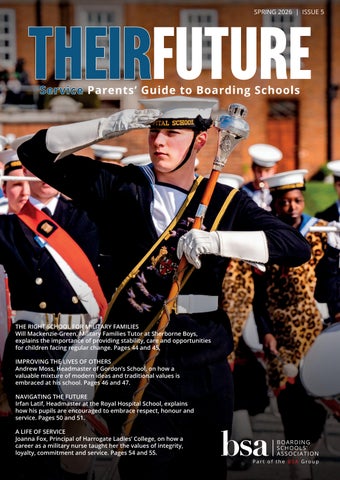
THE RIGHT SCHOOL FOR MILITARY FAMILIES
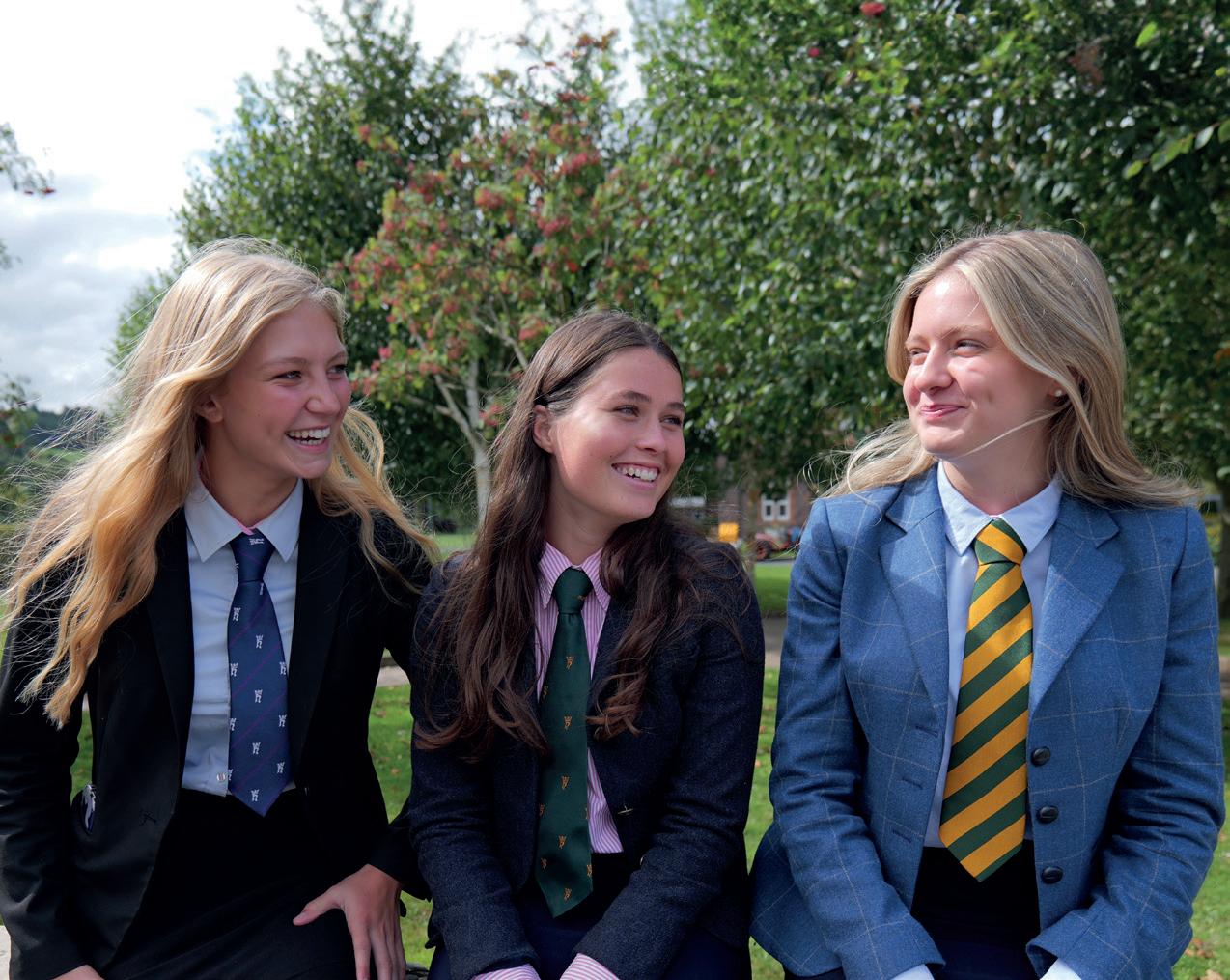
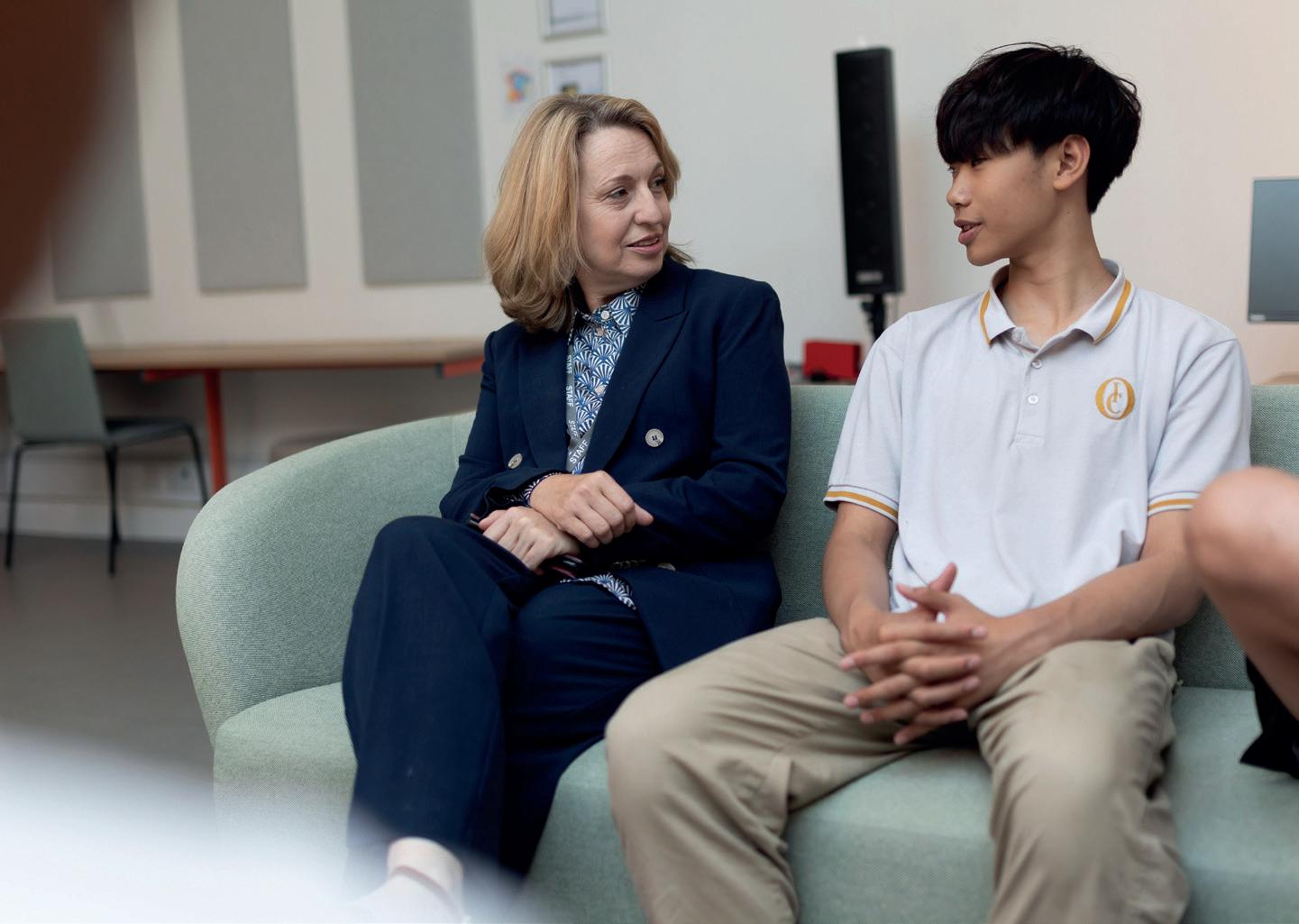
Will Mackenzie-Green, Military Families Tutor at Sherborne Boys, explains the importance of providing stability, care and opportunities for children facing regular change. Pages 44 and 45.
IMPROVING THE LIVES OF OTHERS
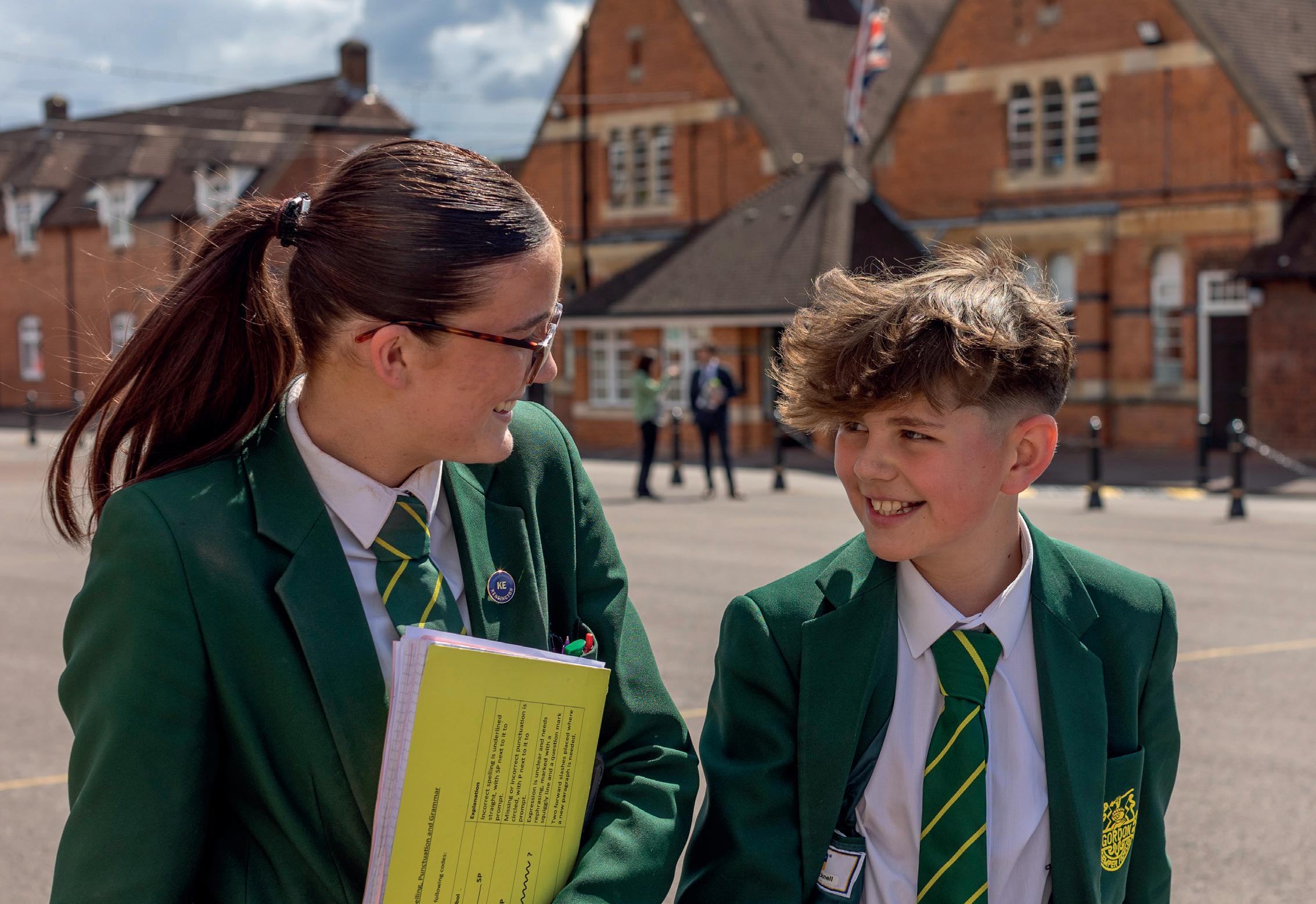
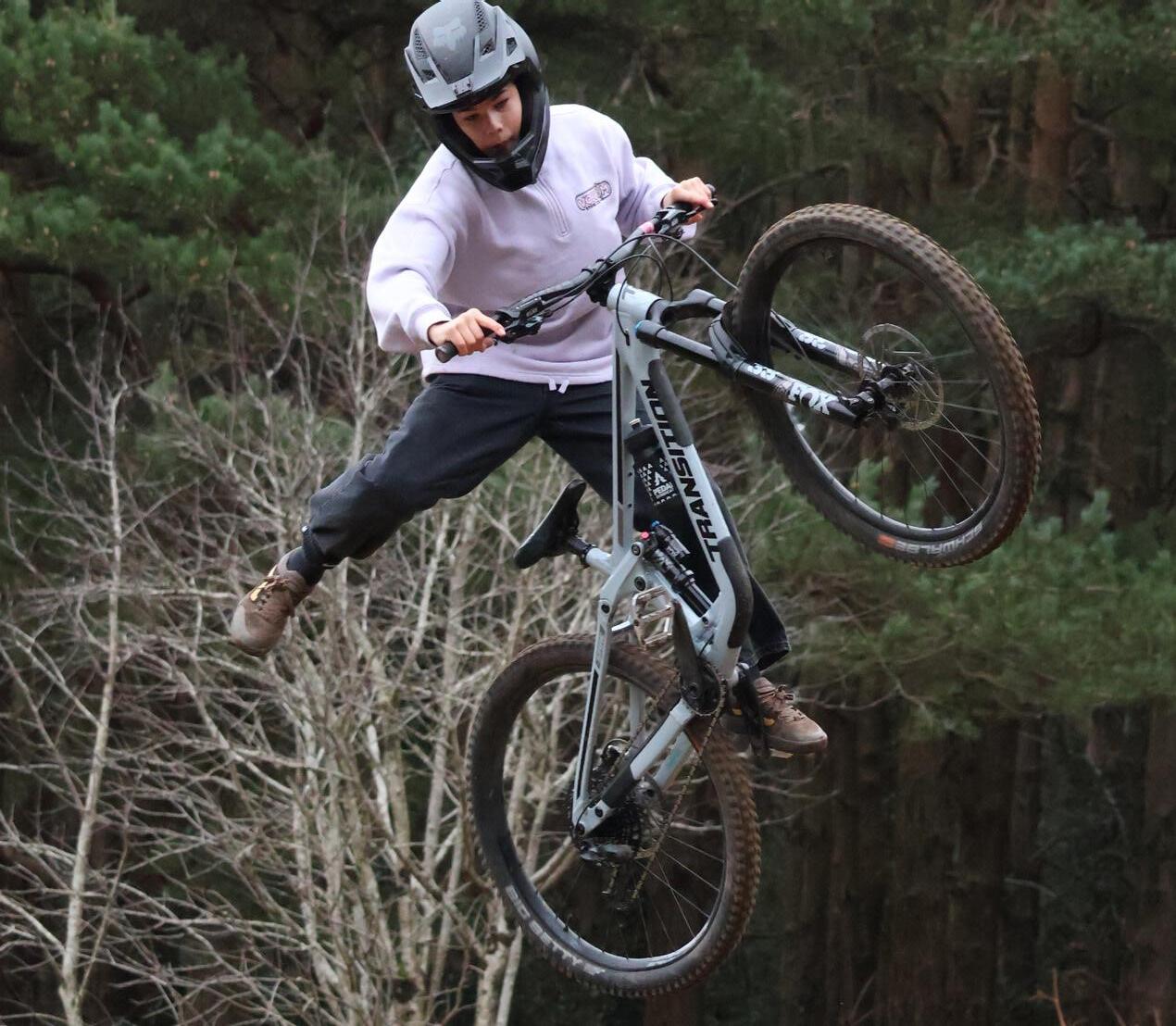
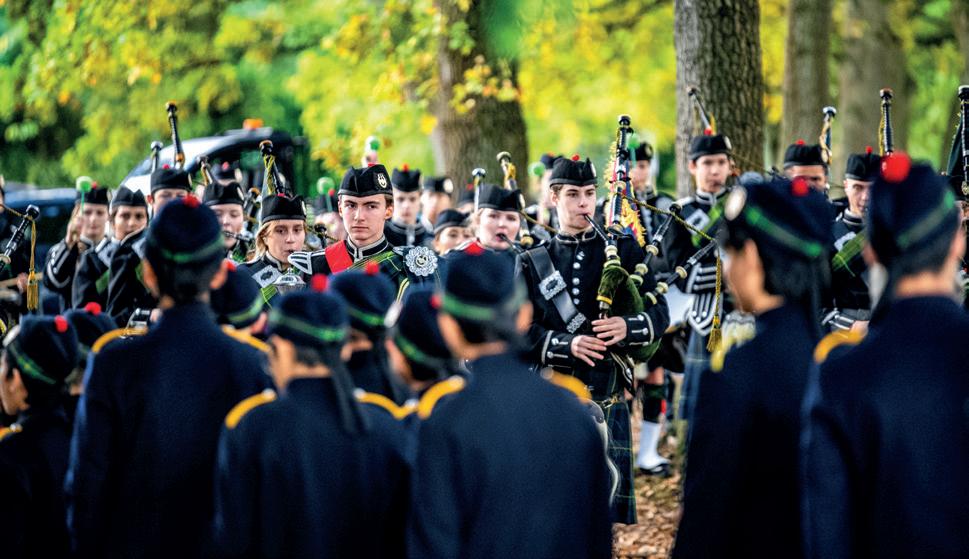
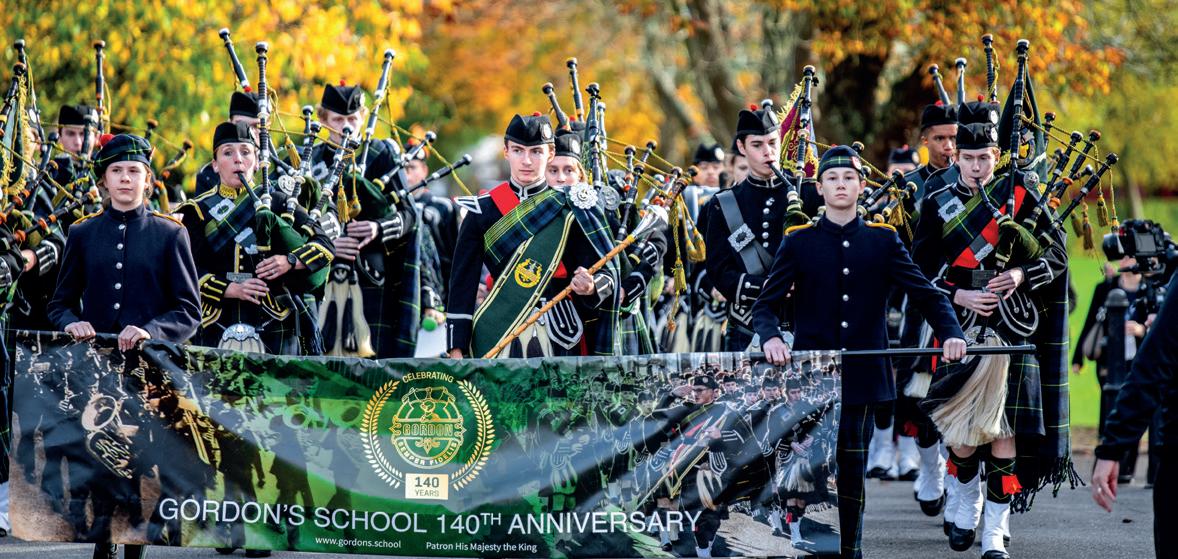
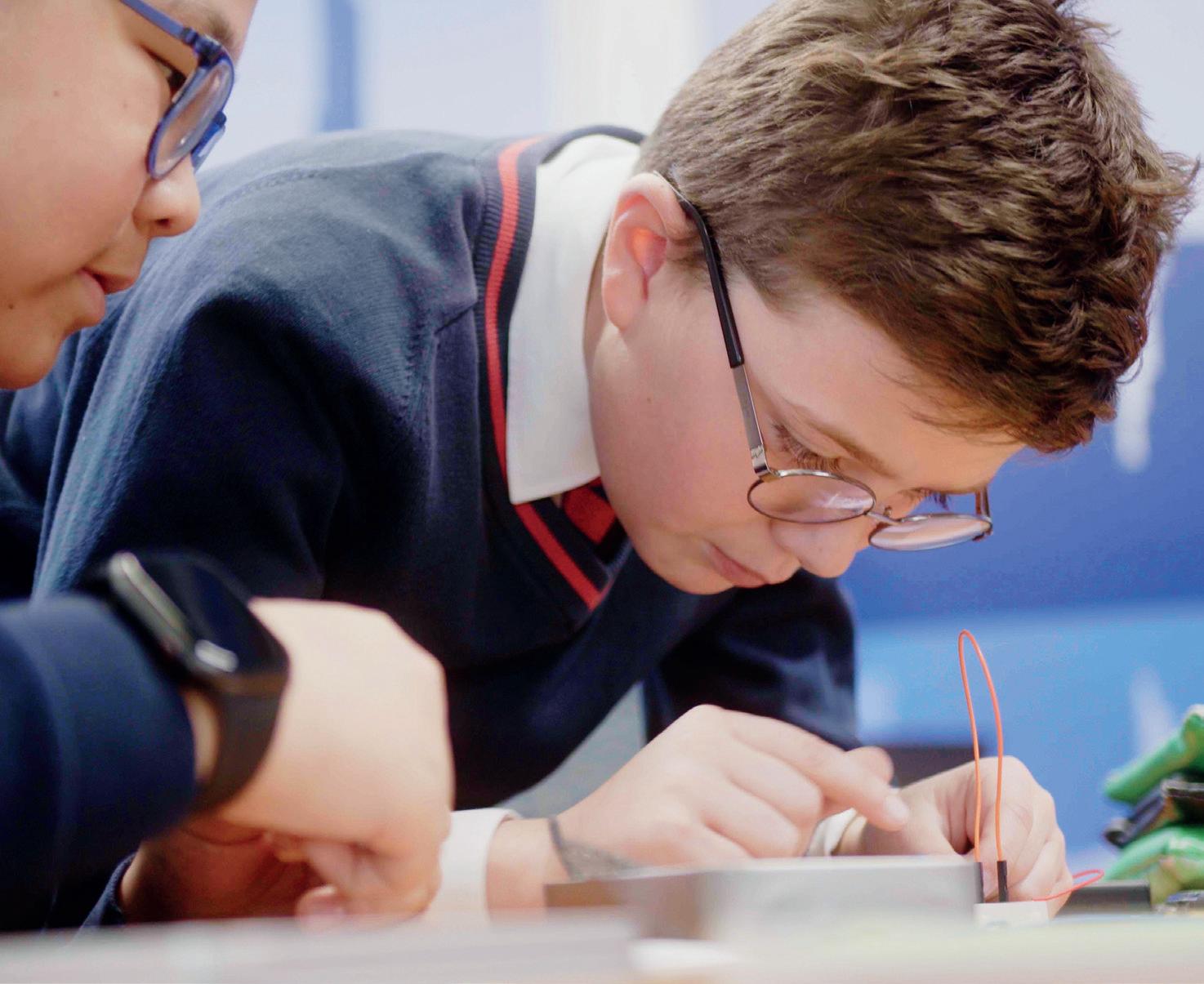
Andrew Moss, Headmaster of Gordon’s School, on how a valuable mixture of modern ideas and traditional values is embraced at his school. Pages 46 and 47.
NAVIGATING THE FUTURE
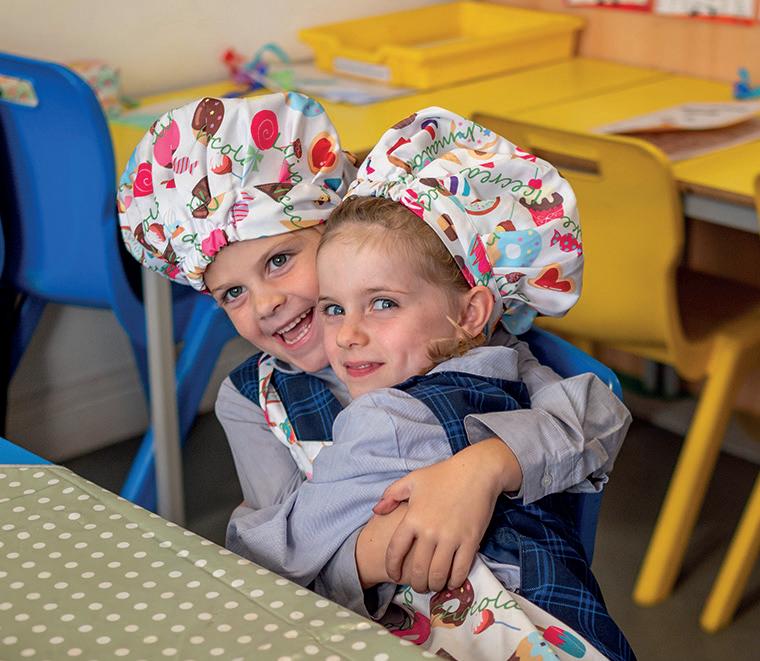
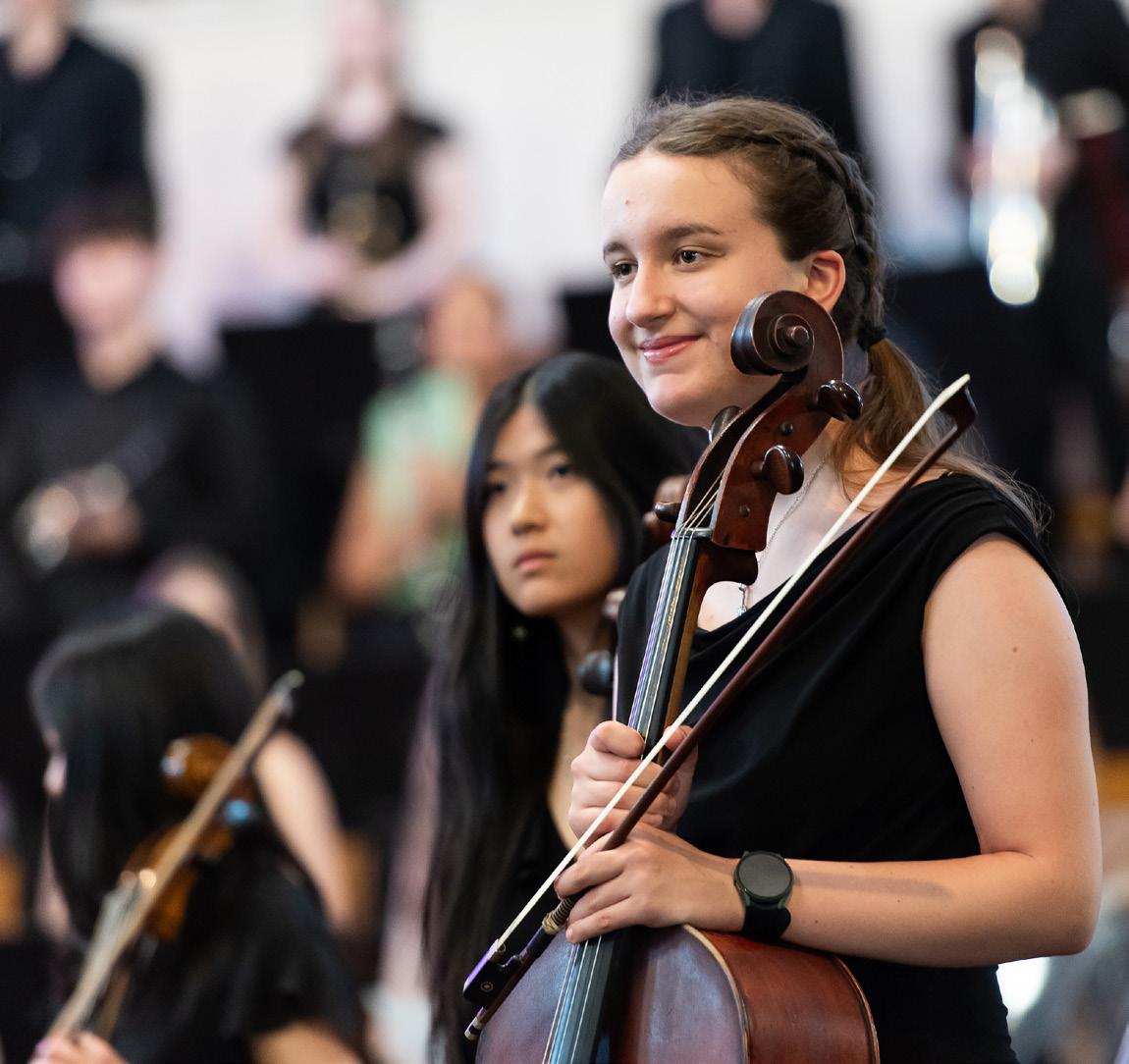
Irfan Latif, Headmaster at the Royal Hospital School, explains how his pupils are encouraged to embrace respect, honour and service. Pages 50 and 51.
A LIFE OF SERVICE
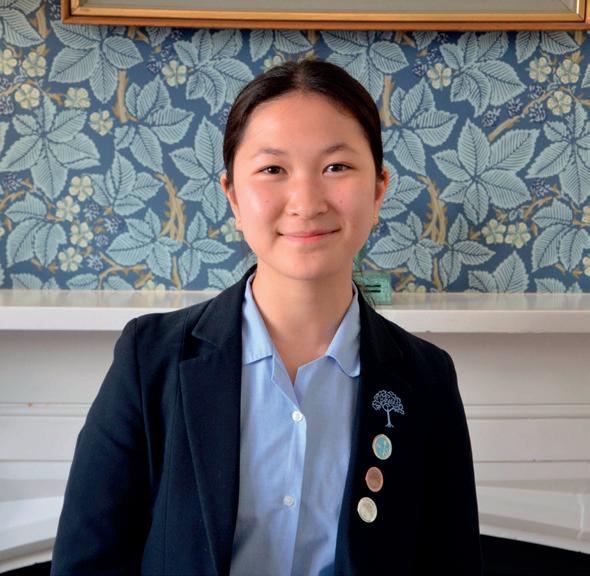
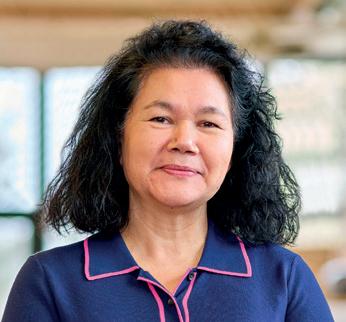
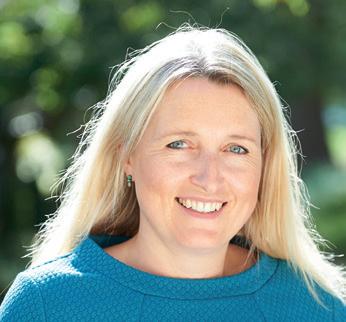
Joanna Fox, Principal of Harrogate Ladies’ College, on how a career as a military nurse taught her the values of integrity, loyalty, commitment and service. Pages 54 and 55.
Foreword
Henry Price, BSA Chair 2026 and Headmaster, Oakham School
It is a pleasure to welcome readers to this latest edition of BSA’s TheirFuture magazine. I am delighted to have taken up the role of BSA Chair for 2026, a position which represents the boarding school community and champions the sector’s many strengths and successes.
Choosing the right boarding school is one of the most important decisions a family can make and one that can open up a world of opportunity for your child. With such a diverse range of schools to consider, each offering its own distinctive character, ethos and strengths, this Guide has been created to help you navigate that journey with confidence.
Across the UK and beyond, boarding schools come in many forms - from smaller communities with a family feel, to large, internationally renowned institutions, all committed to nurturing young people with dedicated adults around them. Schools specialise in music, sport, STEM or the arts, while others provide a broad and balanced curriculum that supports every aspect of a young person’s development.
Increasingly, boarding schools now offer greater flexibility through full, weekly, and flexi-boarding options, making it easier to find an arrangement that fits your family’s lifestyle and circumstances. This adaptability, combined with outstanding pastoral care, ensures that every pupil feels supported, valued and at home.
Whether you are beginning your search or refining your shortlist, this Guide will help you explore the many possibilities that boarding education offers. I hope it provides a useful starting point and inspires you to find a school where your child can grow and thrive in these precious years and long into the future.
□ Henry has been Headmaster of Oakham School since September 2019. A Classics graduate of Oxford University, he brings over 30 years of experience in the boarding sector. A boarder himself and former housemaster, Henry has worked at Sherborne, Rugby, Wellington School and Oakham. Henry is a strong advocate of the value of boarding and its benefits to pupils and families, and deeply committed to all the staff who support and enrich these precious communities.
Dear parent
David Walker Director, BSA
The academic year 2025-26 marks the 60th anniversary of the Boarding Schools’ Association (BSA), six decades in which boarding has evolved beyond recognition.
While the warmth of community, the strength of friendships, and the commitment to pastoral care remain at the heart of boarding life, today’s schools offer an experience that is more flexible, inclusive, and forward-looking than ever before.
In my role as BSA Director, I am fortunate to visit many of our member schools and to see first-hand the exceptional environments they create for their pupils. From historic campuses nestled in the countryside to vibrant schools in urban settings, the breadth and quality of boarding across our membership never fail to impress me.
Each school offers something unique, whether that’s a specialism in the arts, sport, science, or outdoor education, but all share a deep commitment to helping young people flourish both academically and personally.
Choosing a boarding school is a significant decision, and it should be one that feels right not only for you but especially for your child. I hope this Guide helps you to explore the possibilities, ask the right questions, and ultimately find the school where your child will feel a sense of true belonging and purpose.
We’re delighted to support you on this exciting journey, and we hope you find the pages of this Guide both helpful and inspiring.
□ David joined BSA Group in August 2023. He has over 20 years of experience in boarding schools and has worked in a range of schools in the UK and Africa, alongside being a prep school governor and a trustee of a multi academy trust. Before taking up his BSA post, David was Deputy Head Pastoral at a large co-ed independent school in the south-east.
• Accredited online training
• Two-day familiarisation visit to a BSA member school
•
• Associate (ATIOB) membership of The Institute of Boarding
• Prole shared with BSA member schools.
Published
BSA Group 167-169 Great Portland Street 5th Floor London W1W 5PF
Head of Commercial: Neil Rust neil.rust@bsagroup.org.uk
Senior Commercial Consultant: Laura
Belhaven’s new head
A FORMER army Colonel has been appointed as the new Headmaster of Belhaven Hill School, the boarding and day school in East Lothian, Scotland.
Mr Neil Tomlin is starting what will be is his second headship from August 2026, succeeding Olly Langton, the school’s current Headmaster.
He will move to Belhaven with his wife Eugenie from his headship at Hall Grove in Surrey, a large, family-owned co-educational prep school that offers both day and boarding.
Mr Tomlin has a degree in Geography and an MA in Defence and War Studies. He was once in the Scotland U18 rugby squad and played representative rugby as a student.
He said: “Eugenie and I are sincerely honoured to have been selected to lead such a remarkable school. The more we learn about Belhaven, the more deeply we feel that we have found somewhere truly special.
“It is hugely important to us that Belhaven continues to place great value on the seemingly small things: good manners, behaviour, kindness and strength of character. These principles may appear modest, but together they define a culture and shape young people for life.”
Mr Tomlin’s own education started in Hong Kong, followed by prep school and public school in southern England. Before taking up his post as
Headmaster at Hall Grove in 2021, he had a distinguished 24-year career in the British Army.
He was commissioned into The Black Watch in 1998, received a Queen’s Commendation in 2012 and the OBE in 2019, as commander of the 4th battalion, the Royal Regiment of Scotland. He ended his service leading teams working on strategic reviews of finance, defence and security at the Ministry of Defence.
Mr Tomlin’s decision to go into education was inspired by teaching at Staff College, and working as a governor of two schools. Under his leadership, Hall Grove has grown significantly in numbers.
Mr Tomlin is a qualified rugby coach and referee, as well as a keen cricketer. He enjoys leading pupils on expeditions and champions outdoor learning. His wife Eugenie has worked in recruitment, public relations and marketing. The couple have two children, both of university age, and a Labrador called Nala.
Athlete returns to Belhaven
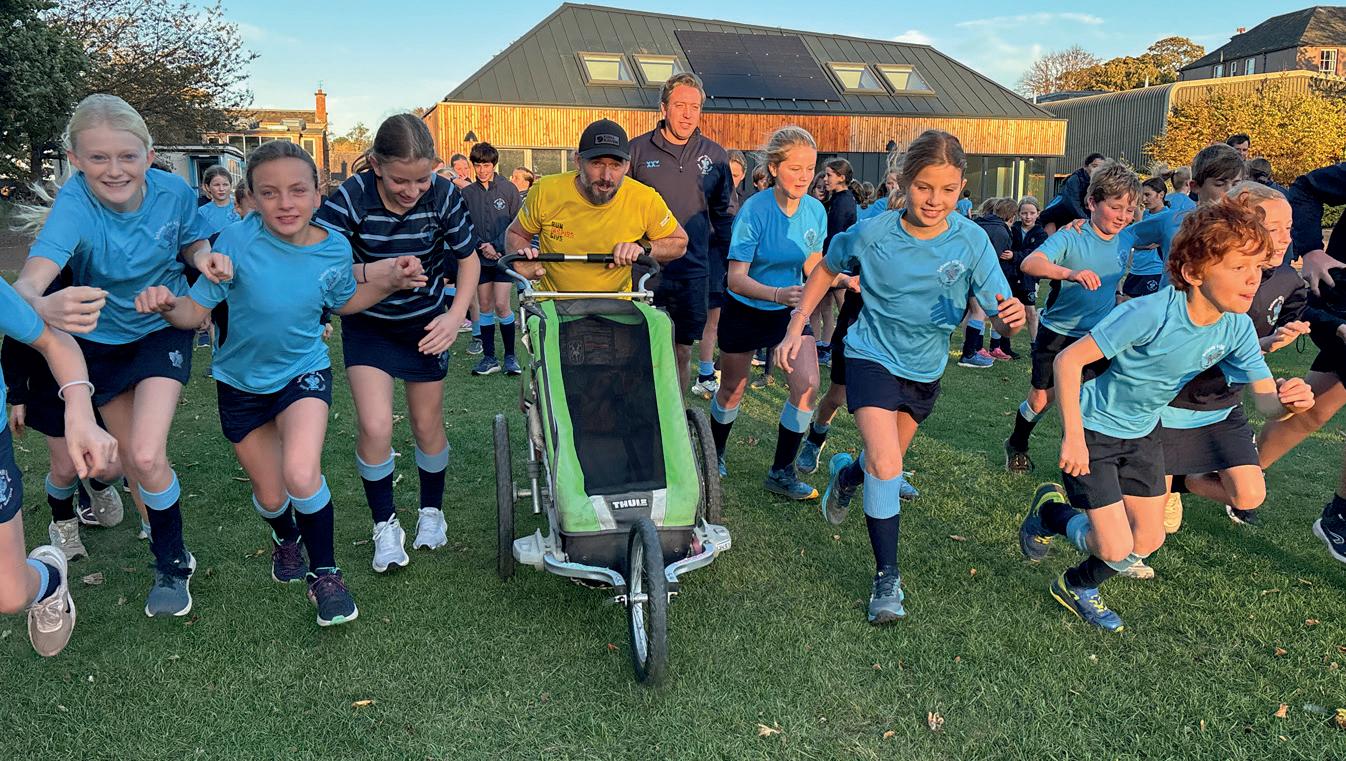
BELHAVEN Hill School welcomed the adventurer and former pupil Jamie Ramsay back to his old school to lead a school run and share tales from his 17,000km expedition.
Ramsay talked to an audience of over 160 pupils and parents about his experience in ‘Running the Americas’ and his belief in the power of physical challenge as an antidote to mental ill health.
He opened the school’s inaugural Wellbeing Weekend during his visit, and led a Belhaven run with over 100 pupils before joining them for tea.
Ramsay explained how he decided he had had enough of working in finance in 2013, having followed his peers, rather than his dreams, into the City.
His passion for running gave him the confidence to plan an audacious adventure – an unsupported run from Vancouver to Buenos Aires, a journey of 17,000km designed to finish on New Year’s Eve 2014.
Ramsay now runs his own enterprise, called ‘Ramsay Adventure’, and has now completed 54,000km under his own steam.
Olly Langton, Belhaven Hill School’s current Headmaster, said: “Jamie spoke brilliantly, weaving humour and pathos into stories that scale the peaks and troughs of elation and despair.
“His tales mixed the thrills of sledging at 60kmph down a Venezuelan volcano with the misery of injury and illness, the loneliness of an empty stretch with the solitude of a beautiful expanse.
“These were regaled as important and complex experiences, sensitively delivered to an audience that hung on his every word.
“As the opening event of our first Belhaven Wellbeing Weekend, we could not have hoped for a better introduction: an old boy achieving something remarkable having been inspired by his passion for running while at Belhaven.
“In an age of instant gratification and decreasing physical activity, this was a great boost to our encouragement towards a healthy body and a healthy mind.”
Marching into boarding
A NEW scheme to help service personnel work in education has been launched by the Boarding School Association (BSA).
The Accredited Service Personnel into Residential Education project (ASPIRE) offers a training and induction pathway for serving or former service personnel to explore roles in boarding. Applicants will receive a range of benefits, including:
• Interview to assess suitability to work in boarding
• Online training: introduction to boarding in 2025
• A day’s training on boarding schools, roles, regulations and safeguarding
• An induction visit to a BSA member school
CV and application support
• Promotion of candidacy to BSA member schools
• Affiliate memberships of the BSA’s Accredited Boarding Practitioner scheme and The Institute of Boarding
• An accreditation certificate.
Mark Mortimer, the BSA’s Director of Defence and Military Services, said: “I have long believed that many of the qualities valued in the military are just as important and relevant in a boarding environment. For example: optimism, resilience, initiative, perseverance and flexibility.
“Equally, both sectors are driven by shared values and high standards and thrive by developing people and relationships. They have a great deal more in common than might at first be apparent.”
Alex Foreman, Principal of the Duke of York Royal Military School, said: “Supporting ex-service personnel into boarding roles is a win-win. Students will benefit enormously from the resilience and life experience of participants, who will in turn embark upon a fulfilling career mentoring and nurturing young people.”
The ASPIRE programme is currently available at an introductory price of £750. An Individual Resettlement Training Costs grant of up to £534 may be available to those who have served within the last two years and completed six years of fulltime service. For more information and to register, visit boarding.org.uk/aspire
Success in Japan
RUGBY School Japan (RSJ) has reached a major milestone with 300 pupils enrolled in its third academic year, 55% of whom are boarders.
RSJ was established in 2023 and is the first British day and boarding school to be located in Tokyo.
The school aims to be educating 500 students by 2027, and to reach its full capacity of 780 within five years.
RSJ’s first leavers have progressed to world-class universities, including University College London, King’s College London, Edinburgh University,
Waseda University in Tokyo, Hong Kong University, Peking University, and McGill University in Quebec.
Rugby School Japan is part of the Rugby School Group along with Rugby School Thailand, which opened in 2017, and Rugby School Nigeria, which opened in 2025.
Rugby School’s partner in Japan is Clarence Education Asia which has Clarence International School, for pupils aged 18 months to five years, and Phoenix House International School, for pupils aged six to 11, in its group.
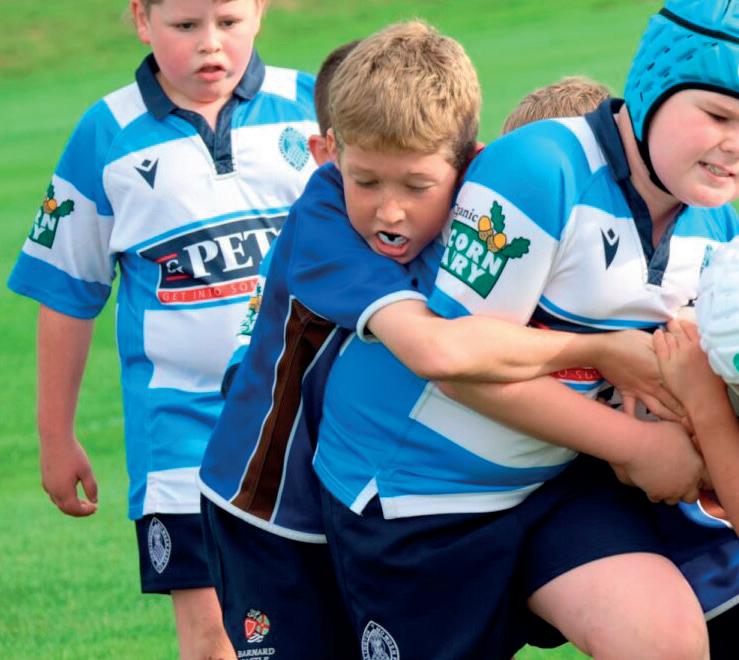
Barnard Castle’s sporting festival
THE next generation of sporting talent showcased their skills in two days of top-flight competition at Barnard Castle School.
The sporting festival involved the school’s senior rugby players with teammates from Yorkshire to take on the might of a touring side from New Zealand.
Lower and upper sixth students were joined by players from St Peter’s School, York, in a 40-strong squad to play a touring side from Lindisfarne College, Hastings, in New Zealand, under the floodlights at Darlington Mowden Park RUFC.
Barnard Castle’s first XV fell just short against a side containing some players tipped to be the next generation of All Blacks.
Martin Pepper, second master and rugby coach at Barnard Castle School, >>>
<<< said: “We enjoyed hosting the boys from New Zealand and it was good to share our rugby cultural values and create memories and friendships for life.”
The following day it was the turn of rugby and hockey players from Barnard Castle Preparatory School who hosted an annual competition, now in its 15th year, attracting young athletes from all over the country.
Next day U10 and U12 girls from around the region competed on the school’s astro pitch against six other teams for the Seddon Cup, named after retired teacher Sue Seddon, and the Ewart Cup, after former headmaster David Ewart.
On the rugby pitches six teams, one from as far away as Scotland, others from across the North East and Yorkshire, competed in the Clegg Festival, named after Old Barnardian Rory Clegg, who went on to play fly half for Newcastle Falcons and Harlequins. The U12s competed in the Tait 10s, named after Old Barnardians Alex Tait, who played for Newcastle Falcons, and Mathew Tait, a back for Leicester Tigers and England. Laura Turner said, Headmistress at the prep school, said: “We love hosting this annual sporting festival which attracts children from across the country all with a common love of sport.”
David Cresswell, Headmaster of Barnard Castle School, added: “It is always an absolute pleasure to host players from other parts of the country and the world. It is a reminder that the lessons of sport, such as resilience, teamwork and courage, reach far beyond the final whistle.
“Win or lose they have been part of something bigger and they will have left the field knowing that they had the courage to try.”
Biscuit the Bear
MEET Biscuit, the Boarding Schools’ Association’s very own teddy who is on a nationwide adventure to celebrate BSA’s 60th anniversary.
Biscuit is spending a week at different member schools until May 2026, joining lessons, heading out on trips, and taking part in pupils’ favourite boarding activities.
David Walker, Director at the BSA said: “Biscuit Bear is here to make new friends and learn what boarding life is all about. We can’t wait to see where the bear goes and what memories are made along the way.”
Schools had the chance to sign up to host Biscuit at the Prep Boarding Conference. A naming ceremony took place on LinkedIn, giving everyone the chance to vote for their favourite name, which was Biscuit.
Biscuit then officially started his journey with Millfield Prep, his first host school. All other host schools received Biscuit in the post with a special welcome pack and, after a fun-filled week of boarding adventures documented across social media, he then travels to his next school.
Schools can follow Biscuit’s adventure, making new memories and friendships traveling school to school, by searching #BSABear.
BSA supports excellence in boarding through training, guidance and advocacy for member schools. In 2025–26, BSA is celebrating 60 years with special events, campaigns and stories highlighting the joy of boarding. Read more at www.boarding.org. uk/60-years/.
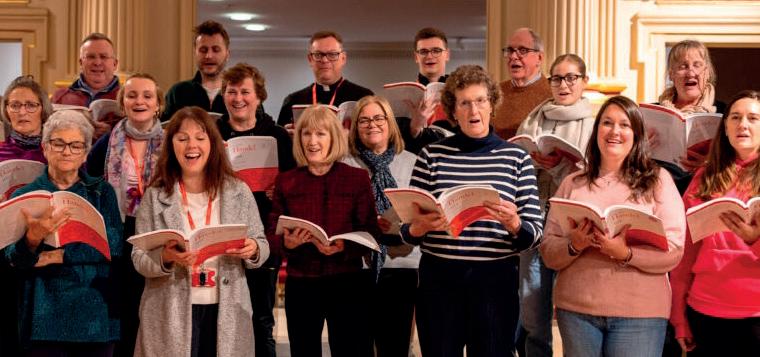
New Hall launches community choir
NEW Hall School in Chelmsford has launched a new community choir called the Beaulieu Park Singers which includes local residents, parents, students, staff and members of the boarding community.
The choir has more than 30 members and meets every Tuesday in the school’s historic chapel. Rehearsals are now underway as the choir prepares for a performance at New Hall’s annual Gala Concert, to be held at Chelmsford Cathedral in March.
The Beaulieu Park Singers will join forces with the school’s senior choir to perform Handel’s Messiah.
Father Andrew Robinson, priest chaplain at New Hall and member of the Beaulieu Park Singers, said: “Tuesday evening rehearsal is the highlight of my week! It feels as though we are part of something special, and I am grateful that it has opened my eyes and ears to something new.”
Mr Turner, director of music at the school, added: “Music has an incredible ability to bring people of all ages together. Watching students, parents, staff, and members of the wider community unite in song is inspiring.
“Our historic chapel provides a beautiful and atmospheric setting for rehearsals, enriching both the sound and the sense of togetherness that the choir embodies.”
Founded in 1642 and with a rich choral and liturgical tradition, New Hall’s music provision is centred on its historic chapel. The school was recently accredited by the Royal College of Organists.
A spellbinding performance
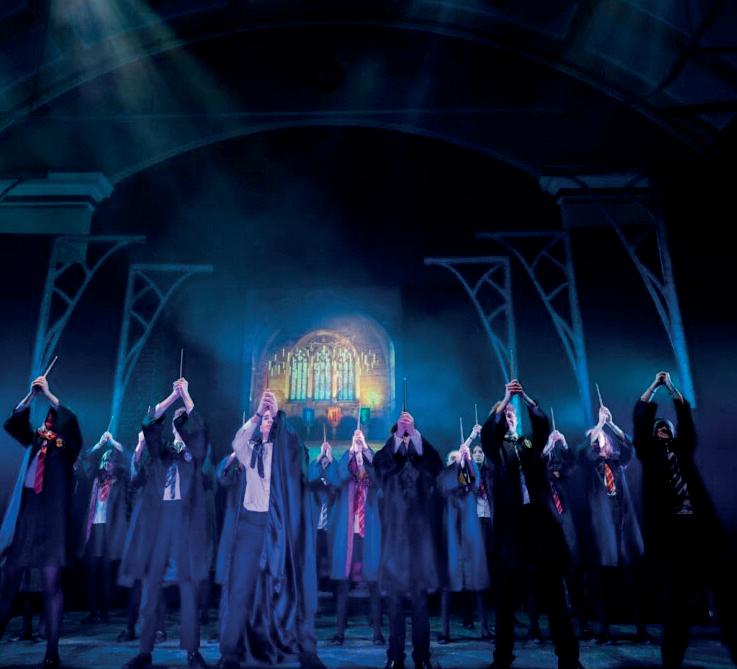
FELSTED School in north Essex was among the first in the country to stage a production of Harry Potter and the Cursed Child.
120 young actors took part in an ambitious version of the much-loved book, which was written specifically for schools by playwright Jack Thorne.
Three casts with pupils aged 13 to 18 spent seven weeks in rehearsals and a week before the opening night they were treated to a visit by television and stage actor Jamie Glover, who played the title role in the West End production.
Glover joined the students in rehearsal and shared some tips on approaching roles, learning lines, working with others and getting into professional acting.
There were then six spellbinding performances of the tale, which focuses on the adventures of Harry Potter’s son Albus as he follows in his father’s footsteps at Hogwarts.
These were watched by more than 2,000 friends and family, plus an invited group of 250 pupils from local schools, in Felsted’s historic, ivy-clad Grignon Hall.
Carly Bartlett, head of drama at Felsted, said: “We asked a lot from our students to put together this show, and they rose to the challenge spectacularly. They worked incredibly hard on the stage and behind the scenes, and it was such a pleasure to see the friendships and camaraderie between different year groups.”
Drama is on Felsted’s curriculum for pupils aged four to 14 and is a popular option at GCSE and A-level. Pupils stage a large-scale production every year and many other performances take place in school or in the community each term.
Drama scholarships are available for pupils who show particular promise, and individual or group drama lessons leading to the national LAMDA exams are also taken up by pupils of all ages.
Several former Felsted pupils have gone on to enjoy successful professional careers on stage, including James Doherty and Tom Newland, and playwright Alecky Blythe.
And they’re off!
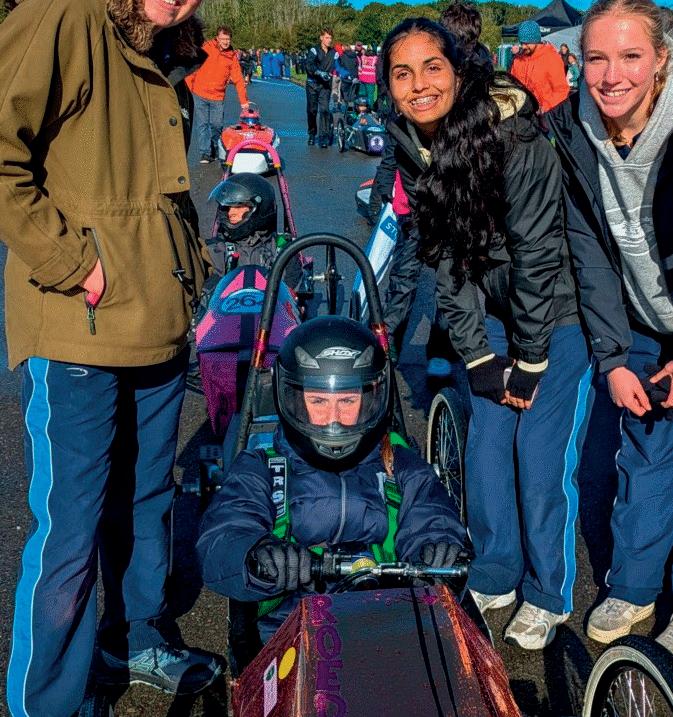
STUDENTS at Roedean School in Sussex got the chance to put their STEM work into practice when they raced an F24 electric car they had built.
A group of Year 11 and 13 girls travelled to Dunsfold Aerodrome in Surrey – the same racetrack that TV’s Top Gear team use as a test track.
They competed with their F24 against many much older teams, as the age group category of 16 to 24 meant university students were also competing.
The event was organised by the Greenpower Education Trust, a charity set up to use motorsports to encourage young people into STEM. More than 10,000 people participate in the event each year across the age groups.
He said: “It was quite a race! We didn’t win, but we finished, the car performed without any problems, and the drivers managed the difficult conditions like they’d been doing it for years.
“The competition from teams with far more experience was fierce. We achieved our pre-race day aims, and everyone had a great day out.”
New BSA Chair
HENRY Price, Headmaster of Oakham School, has been appointed as new Chair of the Boarding Schools’ Association (BSA) for 2026.
Mr Price takes over from Chris Pyle, Headmaster of Lancaster Royal Grammar School, who completed his term as Chair in December 2025.
Mr Price said: “I am delighted to take on the role of BSA Chair. I look forward to working with colleagues across the sector to celebrate what makes boarding so special, while continuing to advocate for the highest standards of care and education for our pupils.”
The role as Chair will see Mr Price working closely with the BSA team and member schools to continue championing excellence in boarding, strengthening the sector’s collective voice and supporting boarding communities across the UK and internationally.
Teacher Steve Hawthorn took the girls to the event and watched them 37th out of 50.
Prestfelde merges with Shrewsbury
PRESTFELDE School has become the newest member of the Shrewsbury family of schools.
Founded in 1929, Prestfelde School is a leading prep school that has been part of the Woodard Corporation since 1949. It has now transferred to the ownership of Shrewsbury School and the two educational charities are to become one entity under the governance of Shrewsbury School.
Prestfelde is the third prep school to become part of the Shrewsbury Family of Schools. Packwood Prep School joined in 2019 and Terra Nova School in Cheshire became part of the family in August 2025. The pathway from Prestfelde to Shrewsbury has been a popular and successful choice for pupils and parents for generations. There are currently 125 former Prestfelde pupils at Shrewsbury, and two of the current Shrewsbury Heads and Deputy Heads of School are Old Prestfeldians.
The membership of the Shrewsbury School family is aimed at bringing security and investment to Prestfelde, benefitting its pupils, parents and staff. Prestfelde will retain its distinctive identity and continue to prepare its pupils for admission to a range of senior schools.
Matty Thavenot, Headmaster at Prestfelde School, said: “In the Shrewsbury School family, we have educational partners that will help grow and develop our already outstanding school. We will continue to operate in the same manner that all Prestfeldians,
past, present and future, expect, know and love, whilst benefitting from all that Shrewsbury School has to offer.”
Rex Sartain, Chair of Governors at Prestfelde School, said: “Prestfelde Governors have considered joining a senior school for some time. Prestfelde is making this move from a position of strength and this is yet another step to realising ambitions for both the school and our pupils.”
Shrewsbury School was founded by Royal Charter in 1552. It was named Independent School of the Year in 2020 and has been consistently listed in the top 25 independent schools in the UK.
Leo Winkley, Headmaster at Shrewsbury School, said: “Shrewsbury and Prestfelde have been living together for many, many years. Now, we are finally tying the knot!
“I feel sure that our exceptionally close relationship will go from strength to strength as we work together to provide world class, whole person education from nursery to sixth form. Together, we can offer a wealth of connections and opportunities.”
James Pitt, Chair of Governors at Shrewsbury School, said: “At a time of considerable change in the independent education sector, it is important that schools closely aligned in educational aims and ethos come together to form the strongest alliances.
“We are delighted that Prestfelde is joining the Shrewsbury School family and look forward to working together for the benefit of both our communities.”
Gordonstoun painter on TV
TALENTED teenage artist
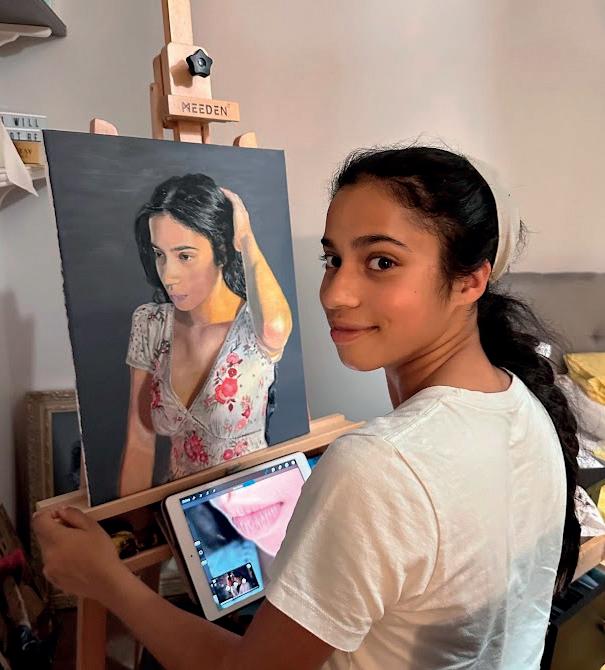
Ruby Mitcham, a student at Gordonstoun, was chosen to appear on the new TV series of Portrait Artist of the Year.
The 18-year-old has quickly established herself as one of the most promising UK artists of her generation. In 2024, she became the youngest ever artist to feature at the Society of Scottish Artists Annual Exhibition in Edinburgh, which has previously featured work by Raeburn, Picasso and Munch.
Ruby, who only began oil painting when she was aged 15, is now among several emerging artists to feature in the prestigious Sky Arts programme, hosted by actor and comedian Stephen Mangan.
TV cook Dame Mary Berry was among a series of several well-known faces to sit as a subject for the 12th series of Portrait Artist of the Year. Succession actor Brian Cox, Bridgerton actress Adjoa Andoh, former Boyzone star Shane Lynch and astronaut Tim Peake were also captured on canvas.
Ruby was invited to apply for the show when she was on a school exchange in Canada. The producers were so impressed by her entry, that she was invited to be one of a select number of artists on the programme. She then painted her sitter live at Battersea Arts Centre in front of a studio full of cameras.
Ruby, in her final year of a two-year senior Art and Music scholarship at >>>
<<< Gordonstoun, said: “The first look at the set was incredible. It looks the same as it does on TV but with lots of cameras and people. Everyone was really nice, and it was bizarre seeing the judges for the first time, who were all very kind and friendly.
“It was exciting to meet the other eight artists in my heat and although it was a competition, it didn’t feel like that in the slightest. I really enjoyed painting the sitter and was pleased with the challenge of a short time for a painting.
The audience was really supportive, and the day was one I’ll never forget.”
Ruby has picked up a series of accolades in the past year. She was also shortlisted for the Scottish Portrait Awards at 16 and nominated for Young Fine Artist. She has already had her paintings hung twice in the Royal Scottish Academy (RSA).
Wendi Van-Hoof, Gordonstoun’s Head of Art, said: “Ruby’s appearance on such a prestigious TV show is a worthy recognition of her burgeoning talent. She is a joy to teach and the sky’s the limit for Ruby. Her grasp of portraiture is akin to someone much older and I’m looking forward to seeing how she develops not only her technical skills but her creative insight in her final year at Gordonstoun.”
Ruby is also an accomplished musician, playing the violin and singing soprano. Sky Arts Portrait Artist of the Year Season 12 was on Freeview Channel 36 and on all Sky platforms. Ruby painted in episode 5.
Rugby School Group expands to Suffolk
SUFFOLK’S leading boarding prep school, Old Buckenham Hall School, has this year joined forces with the historic Rugby School Group.
Old Buckenham Hall (OBH) is a coeducational day and boarding prep school in the Suffolk countryside, established in 1862, with 220 pupils aged between three and 13.
Rugby School is a co-educational day and boarding senior school in the town of Rugby in Warwickshire, established in 1567, with 890 students.
The two schools have always enjoyed a strong relationship, with many Old Buckenham Hall pupils joining Rugby for their senior school. Like Rugby, OBH is known for its excellent all-round education and high-quality pastoral care, focused on building character and values, and valuing sport and outdoor spaces for pupils.
The merger will see Rugby School Group making a seven-figure investment in OBH’s site, facilities and infrastructure, resulting in a range of new opportunities for pupils, both in academic studies and co-curricular pursuits.
James Large, who has been Headmaster of Old Buckenham Hall School since 2023, said: “This partnership will enable OBH to enhance the education we offer to our pupils.
“Rugby shares our values and ambitions, and respects our identity and
the strong relationship we have with our community. We are delighted by the opportunities the merger represents for our children.
“Both schools are keen to work together to promote best practices in teaching and learning. OBH pupils, who go on to many of the country’s most prestigious senior schools, will visit Rugby to enjoy its superb facilities.
“Rugby staff will visit OBH to share expertise in a range of subjects, including academic projects, sports coaching from former professional players, including former England rugby captain, Dylan Hartley, and the creative and performing arts.”
Gareth Parker-Jones, Head Master of Rugby School since 2020, said: “In growing the Rugby School Group, our goal is not to centralise, but to support a small number of outstanding UK prep schools that share our goals.
“The merger with OBH – the pre-eminent prep school in East Anglia – is a vote of confidence in everything that the school represents, academically, pastorally and culturally.”
Old Buckenham Hall School will be the third prep school to become a member of Rugby School Group, joining Bilton Grange, with which Rugby merged in 2020, and Aysgarth School, with which Rugby merged in 2025.
TO BELONG TO BE A PILGRIM
The Pilgrims’ School is a day and boarding school for boys aged 4-13 An hour from London in the heart of Winchester.
Let Pilgrims’ be the next step on your son’s journey. Find out more at thepilgrims-school.co.uk
You Can at Calne
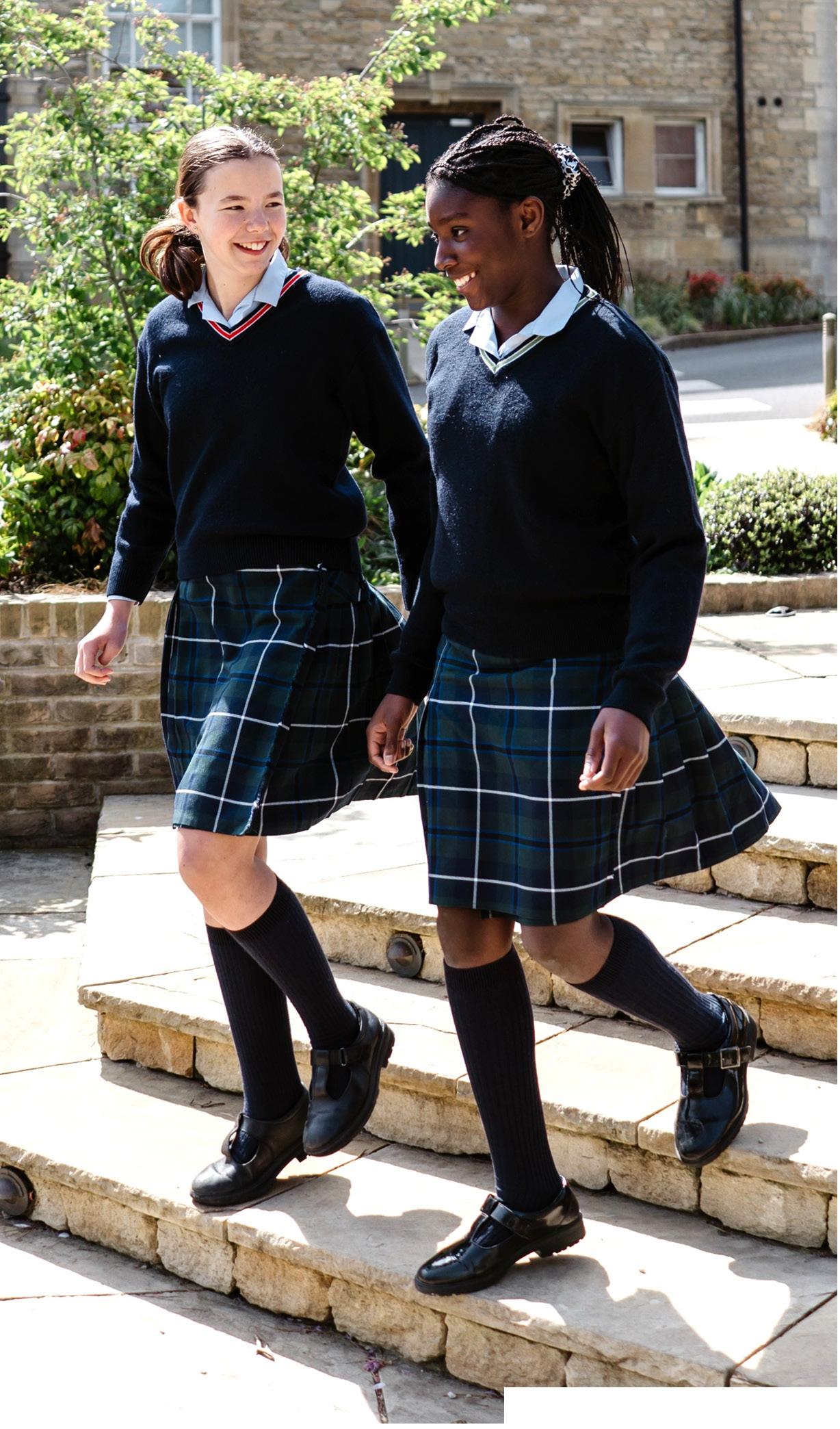
St Mary’s Calne is an exceptional school in Wiltshire offering boarding for girls aged 9 to 18.
Popular with military families for our nurturing environment where pupils flourish academically, personally and socially.
Proud to support HM Forces families with CEA + 10% or 10% fee discount for other qualifying UK military personnel.
‘The school has excellent pastoral care. My heart is completely at ease when my girls are at school,’ current parent.
St Mary’s Calne is a Sunday Times Parent Power 2025 top academic ranking school.
Ardvreck makes a splash
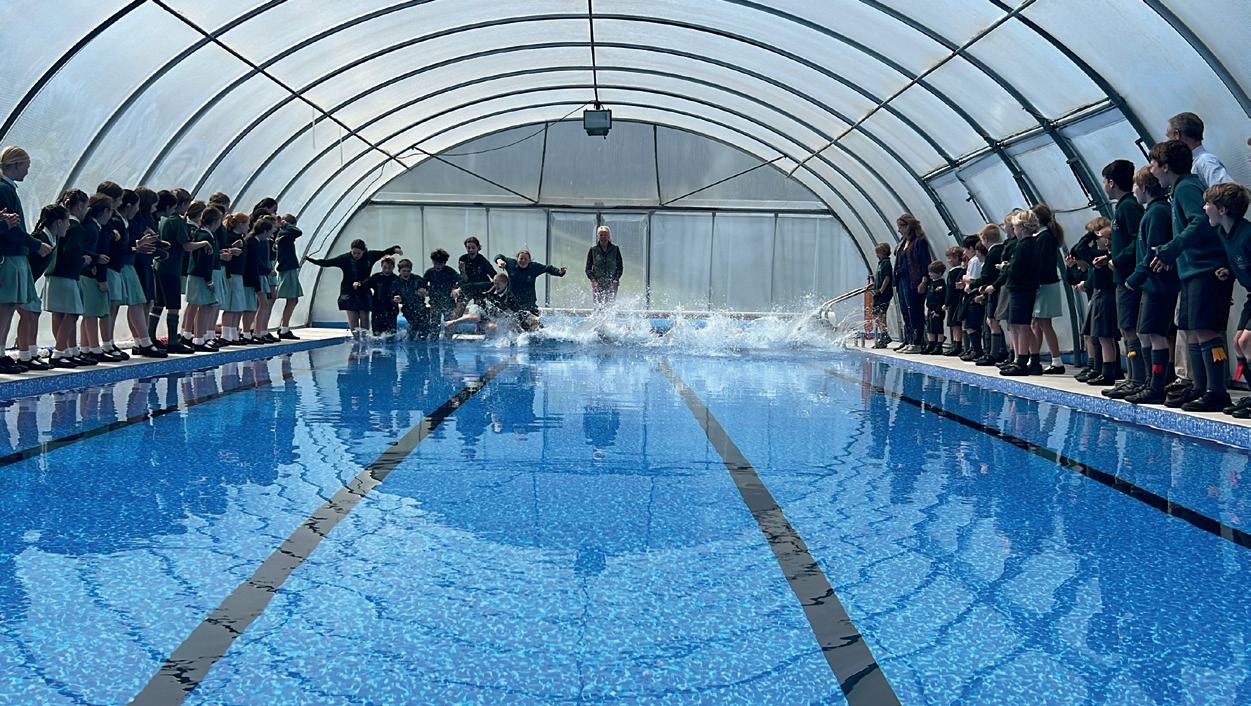
PUPILS at Ardvreck School and the local community in Crieff, Scotland have been enjoying the school’s newly refurbished on-site swimming pool.
The newly upgraded, heated facility provides a safe, welcoming and ideal environment for younger children to learn how to swim and build water confidence. Designed with pupils in mind, the refurbished pool is the perfect depth for beginners, ensuring children can develop vital swimming skills in a supportive and comfortable setting.
Swimming forms an important part of Ardvreck’s holistic approach to education, with regular lessons helping to build resilience, coordination, and life-saving water safety skills from an early age. Ardvreck has also extended the use of the swimming pool to local
community groups and organisations. The pool is now available to book throughout term time, offering valuable opportunities for local clubs, schools, and youth organisations. Ali Kinge, Headteacher at Ardvreck, which was named ‘Best Prep School’ by Tatler 2025, said: “We were thrilled to reopen our beautifully refurbished swimming pool. It’s a fantastic resource for our pupils,
and we are equally excited to share it with our wider community.
“Ardvreck is passionate about strengthening connections with local groups, and we hope this facility will enhance our community network and provide a safe, enjoyable space for children to learn, play, and stay active.”
Traditional Values Modern Approach
Small school, big family
Christ College Brecon is a supportive school with a big family feel. Our motto “they achieve because they believe they can” encourages self-confidence and a love of learning. With exceptional pastoral care, a warm welcome, and a compassionate community, pupils thrive in an environment where kindness, respect, and personal growth are at the heart of everything.
Service parents pay only 10% of our boarding fee in addition to CEA. Find out more at our Open Afternoon on Monday 4th May 2026. Day places from age 4; full, weekly and flexi boarding for girls and boys aged 10-18 in the peaceful Brecon Beacons National Park.
‘Friends I’ve made are like family’
In every edition of TheirFuture, we highlight pupil’s stories of how much they love their boarding education … and some of the reasons why.
BADMINTON SCHOOL, BRISTOL
Riley, Year 8
“Boarding has played a huge role in developing my independence, responsibility and communication skills. It offers so many opportunities that help us discover our passions and explore leadership roles we might not have considered before. Even though I sometimes miss home, I know that boarding has made me into a stronger, more capable person. It challenges me every day and prepares me for the future, which is why I love being here.”
Helena, Year 9
“My boarding house is like my second home. There’s always something fun happening, and the friends I’ve made are like family. We spend so much time together that it’s easy to feel comfortable and supported. One of the best parts is the trips we go on. They’re always exciting, whether it’s a day out in nature, visiting a shopping centre, or just doing something fun as a group. These outings help us bond and make school life even more enjoyable. On weekends, we go out, a nice break from the routine and a chance to relax, hang out with friends or go into town. It’s a good balance of independence and structure.”
Sasha, Lower Sixth
“Boarding has simply given me a second home, and a community that supports me at school. From arriving as a nervous Year 7 student to growing into a confident Sixth Former, boarding at Badminton has been filled with laughter, growth and unforgettable memories. I love boarding because of lifelong friendships, built through shared experiences like late-night chats, celebrating birthdays and supporting each other through exams. I’ve always felt surrounded by people who genuinely care.
“Whether taking part in trips to escape rooms, dancing the night away at silent discos, or sipping hot chocolate at the Bath Christmas Markets, every moment has strengthened our bond. Evenings are never dull: baking together in the kitchen, singing our hearts out during karaoke, or winding down with a movie night has made boarding feel warm, fun and full of life. Boarding allows us unique access to facilities like the gym, sports centre, library and music block right on our doorstep, which means I’ve been able to stay active, pursue hobbies and keep on top of my studies with ease.”
Teresa, Year 10
“Becoming a boarder has helped me so much in developing independence, resilience and courage. I’ve gained friendships that will last a lifetime, and valuable experiences that I will never forget. It has reminded to be grateful for things, like the memorable moments in life, and the care and support from the people around me including my friends and teachers. It is the most rewarding experience of my school life so far and I look forward to the many years of boarding ahead!”
Michelle, Year 11
“What I love most about boarding is the strong sense of community it creates. My friends have become such a big part of my life — we share everything, from prep nights to fun, spontaneous moments. Boarding has given me the chance to make so many memories I know I’ll cherish forever. One of the highlights is the range of weekend trips. My favourite was Thorpe Park, where we went on countless rides and enjoyed countless snacks! But honestly, it’s the small things that make boarding truly special – going out with friends at weekends or baking together in the kitchen. These moments shape all the unforgettable memories of boarding. I can’t imagine school life without it.”
Jaime, Year 9, from Spain
“I like the style of teaching and learning, and the fact that the teachers really support and help me. I also like the friendships and feeling of belonging between students. The amount of different sports and co-curricular activities are great, as I can try new things all the time.
“I felt very welcomed and comfortable from the moment I arrived, and all the other boys in the house supported me. We had an ‘adventure day’ in my first week, where the entire year group does activities in the Brecon Beacons, like hill walking and climbing. I made friends with lots of other students that day. I don’t just have friends from my house, but in other houses and year groups as well because the students and teachers are very friendly.”
Ben, Year 9, China
“My boarding house feels like family. The older boys really look after me and lead the house positively. Similarly, my houseparent is very caring and supportive. Everyone has been very welcoming, and I have made lots of good friends since arriving. My hope is to become a house leader in Year 13 and serve the school community. Orchard House is in my heart.”
Daniela, Year 10, from Spain
“It was very welcoming. All the teachers and other pupils really looked after me. If I didn’t know where I was supposed to be or what I was supposed to be doing, they took time to help me and made sure I was okay. It was obviously difficult in the beginning, but I felt really cared for.”
Lena, Year 12, from Germany
“The attitude to learning is really positive. I feel students really want to learn, and teachers really want to support that. The teachers here give their time up outside lessons to help.”
Mario, Year 13, from Hong Kong
Mario, Year 13, from Hong Kong
“The best thing is the boarding community, the friendships and the memories I have made. In Hong Kong I had friends from school, but we never had the same bond or sense of camaraderie as I have with other boarders here.”
Ava, Third Form
“I could be like every other boarder and say: ‘I enjoy boarding because it’s like a sleepover every night’. And yes, that’s true, but there’s so much more to boarding. For instance, the people around you who become a family, people you might never have spoken to if it weren’t for boarding, or the exciting weekend activities, or maybe the delicious meals each night. “The community here is so refreshing and kind. All the different year groups talk and get along, forming unexpected friendships. Manor creates so many new, beautiful bonds, and those bonds turn into long-lasting relationships. “I’m now about to leave Manor, and I will miss it, but I know it has prepared me for whatever comes next, and for so many exciting adventures. For me, boarding is like your favourite song: you can play it over and over again without getting tired of it. Even though the song gets older, you’ll always know and love it.”
Immy, Lower Sixth
“My parents gave me the choice to board or be a day student. I can confidently say that choosing to board is a decision I will never regret. Boarding is truly the heart of the school, and I know that because of the lifelong memories and friendships I’ve already made here. “Living with your friends creates a unique and welcoming community, making your house feel like a true home away from home. Weekends are especially fun – whether
CHRIST COLLEGE BRECON
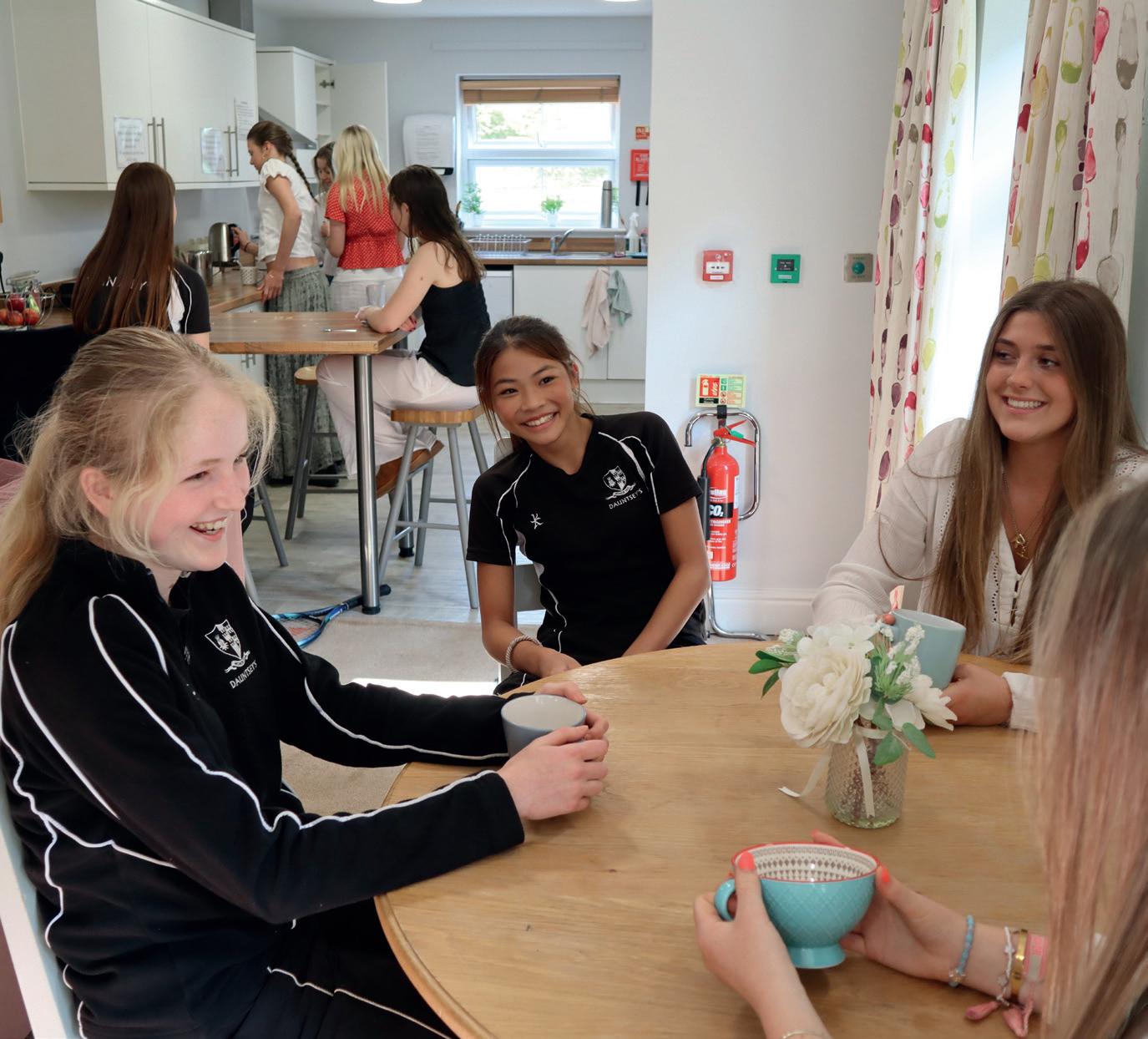
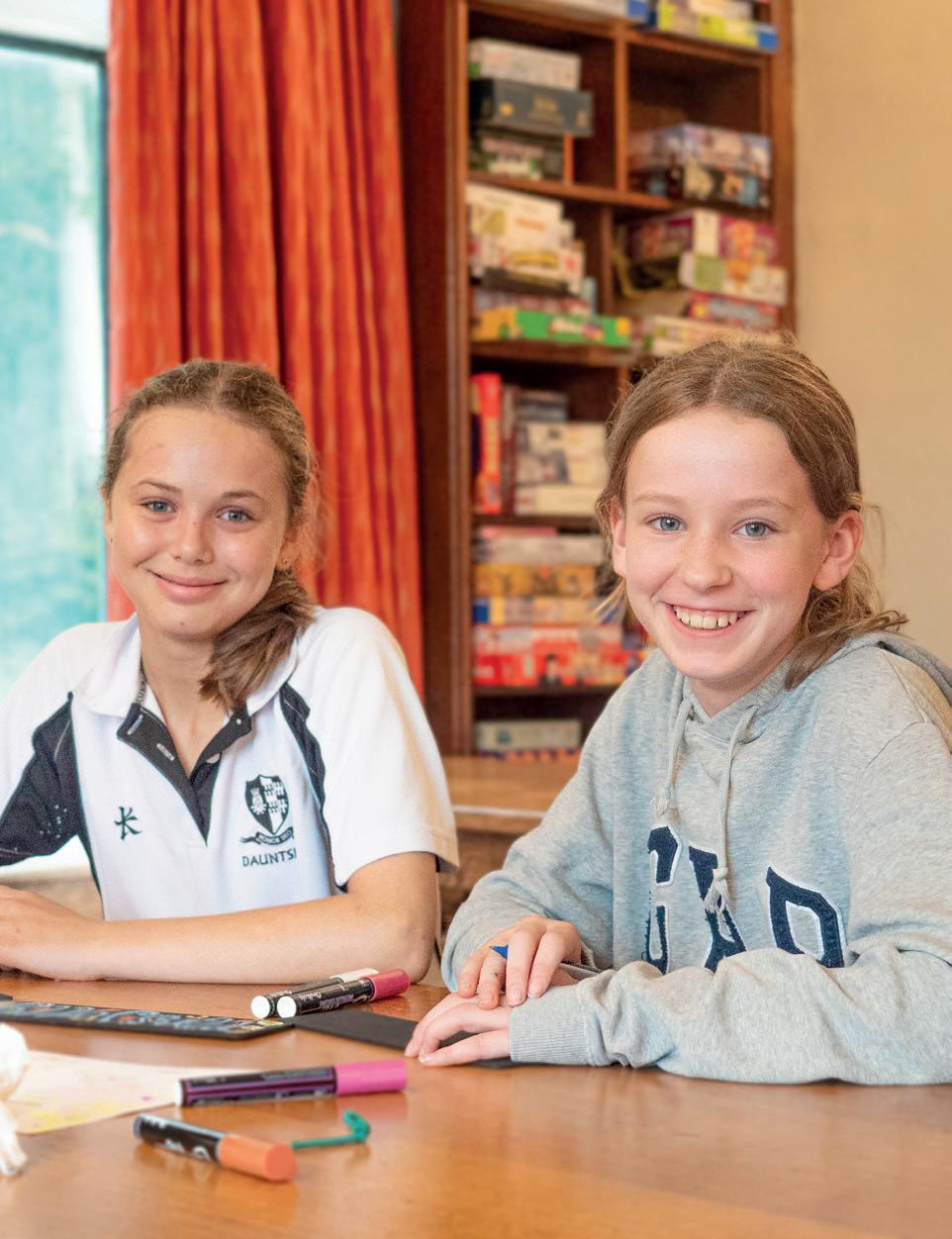
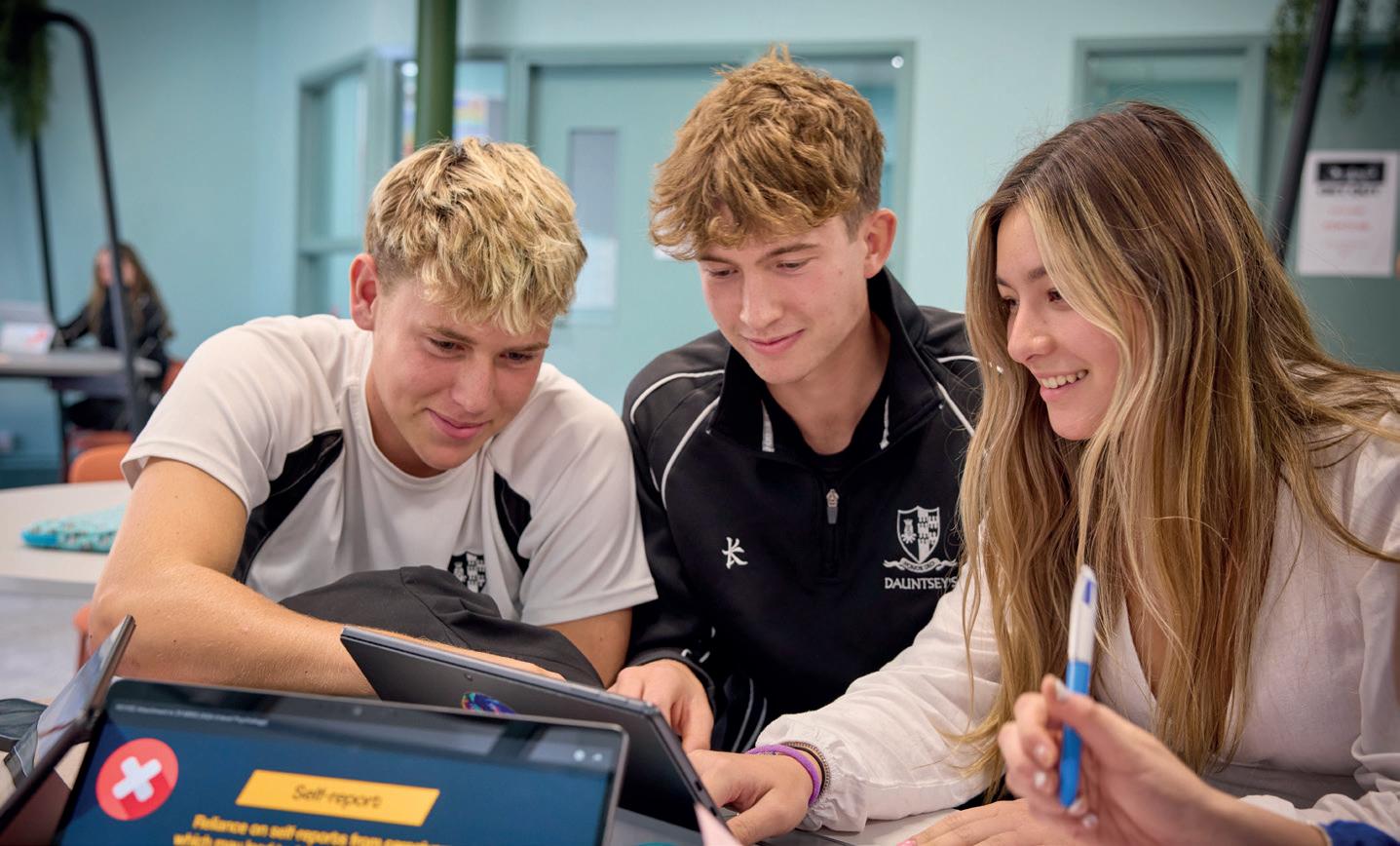
DAUNTSEY’S SCHOOL, WILTSHIRE
Saturday nights at The 17 Club for Sixth Form, or Sunday morning bread-making workshops with the Head Master! The spirit and sense of belonging has been reinforced by the incredible and compassionate house staff, who work tirelessly to make everyone’s boarding experience the best it can be.”
DULWICH COLLEGE, LONDON
Owen, Year 10, Orchard Boarding House
“I’m able to share my interests with my friends, work together on projects and get help on academic studies. Spending my time with my friends every day motivates me to overcome challenges and put more effort into schoolwork. In my free time, whether it’s cooking, sports or making music, we learn from each other and grow together, enjoying the opportunities boarding life offers.”
David, Year 12, Blew Boarding House
“Boarding is unique for several reasons. Primarily, it’s the melting pot of cultures and ideas that open you up to new languages, ways of life and unforgettable people from all over the world. I’ve had the opportunity to play Polish card games, eat Armenian snacks and learn to order a sandwich in Cantonese – small things in the grand scheme of things, but incredibly beneficial in opening my eyes to a world beyond the British Isles.”
Gordon, Year 12, Ivyholme Boarding House
“I love my boarding house, a community built on friendship. As a keen chess player, I enjoy spending my free time in the common room, playing games and exchanging discoveries with friends. The relaxed environment makes it easy to connect and, over time, close bonds are knit through shared moments and conversations. A sense of belonging has been engraved in my heart through these shared experiences, celebrating our cultures, pursuing shared dreams, and working together to make our house welcoming for all.”
FRAMLINGHAM COLLEGE, SUFFOLK
a PE teacher so we have extra support and access to PE and sports coaching. Our matron is always there to help with laundry or sewing.”
Millie M-O, Year 13 flexi-boarder
“The transition from being a day pupil at my previous school to boarding four days a week at Framlingham was definitely an adjustment. However, it was one of the best decisions I have made. My house mistress and all the other girls made me feel so welcome and there is a strong sense of belonging and ‘home-away-from-home’ feel.
“Managing academic with boarding life is easy to organise and balance. Our prep time from 7-8.45pm helps dedicate time to homework and revision, and you feel ready for the next day. There are also plenty of hubs after school to help transition from school to hobbies and social life, and plenty of activities for flexi-boarders in the evening. All boarders, flexi and full, come together for activities, such as friendly sports matches, movie night, crafting, or house competitions like dance and singing, which create a wonderful atmosphere.”
Zumi K, Year 11, full boarder
“Our house has lots of full boarders so there’s people to talk to and hang out with throughout the day. At the weekends we go on school trips, like go-karting, ice skating, or theme parks. We have fun competitions between the seven boarding houses, including dance, singing, rugby, cricket, hockey, football and tennis.
“There’s so much support – from your head of house and prefects to house master/mistress and matron. Every house master or mistress is also a teacher so you can get extra support from them in certain subjects. My HM is
Malou K-M, recent boarder from Demark
“I attended Framlingham for one term during 2024/2025. I had the best time, enjoying everything so much, and I miss it lots. The school is beautiful. From my daily runs around school grounds to attending morning chapel on Tuesdays and Fridays, and of course all my amazing friends. I still keep in touch with all of them and look forward to visiting soon. I can’t wait to see everyone again.”
Paula L, boarder from Germany in 2022/2023
“I went to Framlingham almost two years ago, but it feels like yesterday that Pembroke House was my second home, and it will always stay part of my heart. Now I’ve left, I am a proud Framlinghamian and feel very grateful to be part of this college. It gave me an incredible year and unforgettable memories.”
QUEEN’S COLLEGE, TAUNTON
Sudem, Year 9
“I chose Queen’s because it feels like a stage where I can grow both academically and artistically. Anyone can fit right into Queen’s. I’ve enjoyed the various cocurriculars as well as the student-led events. These show the students that anyone can achieve anything they want. I’ve always been drawn to the performing arts from a young age. Queen’s made me believe that it wasn’t all just in my head by providing various opportunities to partake in school productions.”
Sunny, Year 13
“I chose Queen’s College for its beautiful campus and outstanding academic results, and it has been one of the best decisions I’ve made. Coming from Hong Kong, I’ve had incredible opportunities here, becoming both a Sixth Form and boarding prefect, developing a love for sport, and preparing to study it at university with my teachers’ support.”
CASE FOR BOARDING
What about boarding schools?
Adaptability, resilience, and global competence are paramount in today’s world. DAVID WALKER, Director of BSA, explains how boarding school education prepares pupils for the future world of work.
MANY of the best schools in the UK offer boarding. There are many parents who see the school and the boarding aspects as two separate, coexisting aspects of the same institution. You yourself might love a school and accept the boarding as something of an afterthought. But in today’s rapidly evolving world, parents are increasingly considering the boarding aspect itself as the best pathway to prepare their children for the future.
Beyond academic considerations, boarding schools offer unique opportunities to cultivate skills and characteristics crucial for success in the dynamic world of work. What is unique to a boarding education which equips students with the tools they need to thrive in the future?
INTERNATIONALISM
Boarding schools provide a global environment that fosters cultural understanding and adaptability—qualities essential in the modern workforce. By
living and learning alongside peers from diverse backgrounds, students develop intercultural competence and empathy, preparing them to collaborate effectively in multicultural settings. Exposure to different perspectives nurtures creativity and innovation, qualities highly valued in today’s global economy.
According to the Independent Schools Council Annual Census 2024, there are some 26,000 overseas students with parents living overseas in UK independent schools, with about half of those pupils coming in the 6th form. These groups of students show cultural diversity at its most authentic.
RESILIENCE
Living away from home challenges students to navigate unfamiliar situations and overcome obstacles independently. Boarding school life instils resilience, teaching students to adapt to change, manage stress, and bounce back from setbacks. These experiences build resilience muscles that are invaluable in
navigating the uncertainties and challenges of the professional world, where our ability to overcome obstacles often determines success in the face of adversity.
INDEPENDENCE
Boarding schools empower students to take ownership of their learning and personal development. Away from the immediate support of family, students learn self-reliance, time management, and decision-making skills. This independence nurtures a strong sense of accountability and initiative—traits essential for thriving in the workplace, where self-motivation and autonomy are highly prized.
MORE FREE TIME
Boarding school environments offer abundant opportunities for students to engage in longitudinal learning beyond the classroom. They offer the gift of time –evenings and weekends are opportunities to dig deep into problems and challenges. Workshops, sports and extracurricular activities provide platforms for students to explore their passions, develop new skills
Photo with kind permission of Taunton School
and tackle real-world challenges together. Participation in hackathons, for example, encourages new ideas, problem-solving, and teamwork – skills highly sought after by employers in the digital age.
CONNECTIONS AND COMMUNITY
Schools cultivate tight-knit communities where students form lasting friendships and professional networks. These connections extend beyond graduation, providing students with a lifelong support system and access to a diverse array of resources and opportunities. Alumni networks often serve as valuable career resources, offering mentorship, job referrals, and networking opportunities – a testament to the enduring bonds forged in the boarding school experience.
CHOOSING A BETTER FIT
A boarding school also opens doors to a wider range of educational opportunities, enabling parents to choose a school that best aligns with their child’s interests, talents, and aspirations. Whether it’s a specialized STEM academy, an arts-focused institution, or a leadership-oriented programme, boarding schools offer tailored educational experiences that cater to diverse learning styles and career paths. By selecting the right boarding school, parents can provide their children with a
Aim
Clifton College is an independent co-educational day and boarding school nestled in the heart of Bristol, for pupils ages 3-18 years. Proudly offering a modern education set amongst historic grounds.
customised educational journey that equips them for success in their chosen field. In a world where adaptability, resilience, and global competence are paramount, boarding school education stands out as a transformative pathway to preparing students for the future world of work. Through internationalism, resilience, independence, longitudinal learning and community connections, boarding schools equip students with the skills, mindset, and networks they need to thrive in the everevolving landscape of the professional world.
As parents consider the best educational path for their children, boarding school emerges as a compelling choice. It not only prepares students academically but also empowers them to excel in the dynamic world beyond the classroom.
□ David joined BSA Group in August 2023. He has over 20 years of experience in boarding schools and has worked in a range of schools in the UK and Africa, alongside being a prep school governor and a trustee of a multi academy trust. Before taking up his BSA post, David was Deputy Head Pastoral at a large co-ed independent school in the south-east.
1st May Preschool - Year 6 Friday 8th May Year 6 - Year 9
If you can’t make it to one of our Open Events, contact our Admissions team to book a personal tour at a time convenient to you!
Photo with kind permission of Woodbridge School
Where every pupil creates their own story
BOARDING FROM YEAR 3 - 13 FULL, WEEKLY OR FLEXI OPTIONS AVAILABLE A WELCOMING HOME-FROMHOME FOR PUPILS TO GROW, ASPIRE AND ACHIEVE WE OFFER A SPRINGBOARD FOR INDEPENDENCE, FRIENDSHIP AND OPPORTUNITY
Boarding at Framlingham: A Home for Service Families
For families in the armed forces, boarding at Framlingham offers stability, continuity, and a welcoming home-away-from-home . We understand the unique challenges of service life and provide tailored flexibility to suit your family needs. From Year 3 to Year 13 , our boarding provision: Flexi, Weekly and Full , provides a vibrant, supportive environment where pupils can grow, thrive, achieve and aspire.
START YOUR CHILD’S JOURNEY TODAY Spaces available for September 2026 and beyond. Discover Framlingham College on one of our Open Days or book a private visit today. Visit framlinghamcollege.co.uk or contact admissions@framlinghamcollege.co.uk, 01728 723789
BECOME A DUKIE
A co-educational school for students aged 11-18-years
Tenacity, respect & humility
Learning and belonging happen most powerfully when creatures are nestled within a living community, an esteemed naturalist wrote back in 1902. WILLIAM GOLDSMITH, Head of Packwood School in Shropshire, reflects on how this concept neatly aligns with contemporary boarding.
AMONG the books on the coffee table in my study is a recently republished copy of The School of the Woods, by William J. Long. This wonderful title, now over 120 years old, describes how young forest animals learn to live in an environment shaped by rhythm, instinct and example. The author portrays the forest as teacher: the dawn chorus setting the day’s rhythm, changing seasons providing structure, and the very act of living alongside others empowering timeless values such as tenacity, respect and humility.
As it happens, those are the same values that underpin ‘The Packwood Way’ here in idyllic, rural Shropshire. Long’s belief that learning and belonging happen most powerfully when creatures (and in our case young human beings) are nestled within a living community neatly aligns with the benefits of contemporary boarding.
DAILY STRUCTURE
Like all Heads and Houseparents, I bang the drum for what I see from happy boarding communities in schools like mine. We promote lifelong friendships, independence, increased responsibility and learning to live and get along with different people, plus the fun and nurture of the boarding house. All are very true,
but having reflected on the messages within Long’s book, I would put forward a much deeper and more interesting case for the true power of boarding within a noisy, rushed and, at times, insecure world. Through structure, pace and belonging, life in a boarding house provides a unique and unrivalled apprenticeship for young children in becoming the people they will aspire to be as teenagers and adults.
How? The daily structure of house life, so yearned for in children, builds tenacity almost unnoticed and entirely cultivated by the environment, rather than adults. Early wake-ups, organising one’s belongings and contributing to communal responsibilities, to name a few examples. Similarly, the inevitable small dilemmas such as mislaid kit, negotiating different personalities and taking responsibility for one’s actions develops crucial agency in young people where they need to act rather than wait for adults to throw safety nets down.
Proximity also nurtures respect. Living closely with peers enables children to read moods, recognise unspoken needs, and practise kindness in practical ways, none of which come close to being replicated on screens through gaming, social media or AI. Nor can it be so powerfully learned through PSHE (personal, social, health
and economic) schemes. Just as Long’s young forest dwellers develop relational awareness by living alongside their own kind, children in a boarding house internalise the rhythms and responsibilities of community simply by being part of it.
BEING HUMBLE
One of our core school and boarding community values is humility. I believe there is no greater moral purpose for educators than to teach and role model the very simple act of being humble. Boarding houses depend on small acts of contribution and generosity of spirit, where celebrating the success of others is more important than your own ego. How about self-development? Tenacity, respect and humility in a boarding community are priceless lessons that cannot be timetabled and are wholly focused around being a force for good. Rightly so. However, the anchorage in ourselves is also important, and a boarding community provides the space and time to develop a sense of self away from stress, anxiety and the constant rush that so often defines childhood.
DEEPER CALMNESS
Many families today grapple with relentless logistics: car journeys, screen interruptions and extracurricular commitments scattered across different locations. Daily rhythm
becomes fragmented, and children can be surrounded by fluster, lists and an unnerving feeling of being rushed. Boarding restores a sense of cadence, allowing children to settle, focus and feel at home. When the tempo of life is consistent, children feel a deeper calmness, allowing them the emotional breathing space to take risks, make mistakes and grow, all away from the constant fussing of others.
Long believed that the woods taught young inhabitants a grounding sense of belonging in their environment. In a similar way, a boarding community roots children and teaches them the qualities needed to live well together. This is a powerful counterbalance to the dislocation many young people feel as society moves at a pace.
When children return home at weekends, exeats and at the end of term, they carry something of that formation with them – entrenched values such as tenacity, respect and humility, alongside a stronger sense of self and a rootedness that will serve them long beyond childhood. Excellent boarding offers young people something increasingly rare in 2025: time, space and an environment intentionally shaped to provide an apprenticeship for life.
□ William has been Head of Packwood School since 2024. He was previously Head of St George’s School Windsor
and Leonards Junior School, St Andrews. William has a background in emotional wellbeing and mental health, and strongly believes in the value of learning outside the classroom. He is passionate about a skills and mindset-based learning philosophy. William has a Masters in Learning and Teaching from the University of Oxford, is a founding fellow of the Chartered College of Teaching, and fellow of the Royal Society of the Arts. He is also Chair of the Education Committee of an HMC School, a board member of ISEB and IAPS, and Vice-Chair of the Executive Board of The Institute of Boarding, part of the BSA Group.
Castle,
What makes a good boarding school?
Integrity and humility, independence and ambition are just some of the qualities excellent boarding will bestow on its pupils. JAMES
JOHNSON, Headmaster of Taunton School,
explains more.
MANY key ingredients need to come together to create an excellent boarding experience. A school where students also live is at once a place of inspirational learning and a child’s second home. It is where daily classroom demands and deadlines have to be balanced with space to unwind and time to explore extracurricular interests.
That’s why boarding provides a unique educational experience. At its best, boarding gives pupils an exceptional opportunity to discover their true potential in a nurturing, supportive environment. But how can a parent assess whether a school is not only doing a great job, but is also the right one for their child? At Taunton School
we have worked hard as a senior leadership team to define what it is we do well and to ensure we continue delivering the highquality education our parents expect. We believe there are four key ‘pillars’ underpinning everything we do and which prospective parents might find useful to ask as they search for the right school. They are as follows:
Does a school foster a culture of ambition?
• Does it cultivate a mindset for life?
• Do pupils feel a sense of belonging to a school community?
Does the school embrace a global outlook?
Every boarding school is different, but essentially students will thrive academically,
socially and emotionally if a school is delivering across these key categories. At Taunton School, with its nursery, pre-prep, prep, senior and international schools on the same site, we have a large boarding community of 450 pupils with very different needs. For many of our pupils it is often the whole family’s first experience of boarding. Parents need as much regular contact and reassurance from committed house staff as their children.
Adapting to life in the UK for our international students is not just about mastering English, but getting to grips with a new culture, its quirks and traditions. Staff go the extra mile to make sure pupils do not become homesick and instead settle in to a welcoming and inclusive family, rooted in kindness and compassion.
Given that a boarding school is a pupil’s home-from-home, access to a wide choice of extra-curricular activities is imperative to fill the hours outside the classroom and allow students the freedom to find their true selves. Whether it is on the sports pitches, on the stage, or in the music room, extracurricular activities after school and at the weekend help build a sense of belonging and develop resilience in the long term.
We have 150 extra-curricular clubs at Taunton. This wealth of opportunities unearths passions and hidden potential, weaving strong connections across our
community – connections which last long after leaving school. Whatever a child’s story and their background, boarding schools should be special places where diverse communities come together to make a greater and more powerful collective.
At their heart should be an outstanding pastoral care system. Students should feel supported by housemasters and mistresses, their teachers and counsellors in a wraparound approach. This enables them to thrive fully in the knowledge that there is always someone to turn to.
Of course, the best way to find out if a school is measuring up to the promises of its prospectus is to visit. For some parents, just walking through the front door is enough to convince them they have found the right school for their child – or not, as the case may be.
There is no doubt that an inspiring learning environment which celebrates each individual child is a compelling offer. Talking to students and observing how they interact with one another and with all staff – from the catering team to the headteacher – will tell you a lot about a school. Do the children show respect for all members of their community? Are the boarding houses warm and welcoming, the teachers calm and engaged?
While schools might not be able to itemise the exact ingredients of a great boarding experience, the proof that their
approach is working is in the students themselves. Integrity and humility, independence and ambition are just some of the qualities excellent boarding will bestow on its pupils, creating wellrounded individuals who make a positive impact on the world.
□ James became Headmaster of Taunton School in September 2022, having previously been Head of Senior School at Ardingly College, Sussex. He has spent more than 20 years working in boarding schools, firstly as an English teacher and boarding tutor at Cheltenham College, then as a Housemaster at Tonbridge School in Kent, before joining Ardingly in 2016.
Work hard, rest and play
A good boarding school is a place to work hard, rest and, most importantly, play, in a space that values both freedom and responsibility. HENRY PRICE, Headmaster of Oakham School and BSA Chair 2026 reports.
A GOOD boarding school is a warm, wonderful village – a community built not just to educate but to raise young people in partnership with their parents. It carefully weaves together rules, routines and rhythms that allow pupils to feel safe, supported and at home, while providing the structure they need to grow and thrive.
Boarding schools foster lifelong bonds – between pupils who live and learn together, and with staff who challenge, support and guide them, sometimes with exasperation, always with care. The shared experiences, from the everyday to the extraordinary, forge friendships and memories that last well beyond school years.
THE EXTRA MILE
While house systems differ from school to school, it’s the people within them who shape the experience. Housemasters and Housemistresses, resident staff, tutors, matrons, cleaners and others all contribute to the ethos and success of a boarding house. Training is important, but a genuine desire to care and go the extra mile for young people are essential. Great boarding staff understand the subtle balance between professional boundaries and personal warmth – the mix of structure and informality that makes school life feel both safe and joyful.
Facilities play their part, but there is no single blueprint. Single rooms and en suite showers have their place, but so
too does sharing in well-thought-out and well-maintained spaces. These must be age-appropriate and in line with National Minimum Standards, linking to the communal spaces where pupils and staff gather formally and informally, for roll calls and House meetings, but also to sit, chat, laugh, cook and connect.
ALWAYS CARING
The Latin phrase in loco parentis – in place of a parent – still holds true. At Oakham, the HM often takes on this role: advising, encouraging, cajoling, sometimes reprimanding, but always supporting and always caring. There may be a medical issue, such as appendicitis, where the school must act in loco parentis, but most of the time, boarding staff work cum parentibus –with parents – recognising that even when families aren’t physically present, they are deeply involved in their children’s lives.
Regular communication is vital, sharing academic and pastoral updates, celebrating successes, and working through challenges together. Whether parents are nearby or overseas, the connection is maintained through emails, phone calls, social media and newsletters – keeping them involved in the big and the small. Good schools strike the right balance with technology. They manage mobile phone use thoughtfully, encouraging connection with home, while prioritising healthy interaction, rest and sleep. One of
boarding’s strengths is the extended day and week. More time means more opportunity, but it must be used wisely. The academic, pastoral and co-curricular pillars of school life need to be integrated with space for downtime. Evening talks, plays, concerts and house events all enrich the experience, but pupils – and staff – also need time to unwind and recharge. Timetables matter, and great boarding schools shape them with care.
VIBRANT AND INCLUSIVE
Whilst fewer schools maintain Saturday School, a great boarding school, like Oakham, sees the weekend as intrinsic to the rhythm of all pupils, both day and boarding. Full lessons in the morning mean the whole school is on site, with a full programme of afternoon sport and activity, making the weekend a vibrant and inclusive part of the week. These days offer opportunities not just for competition and camaraderie, but for engaging with parents through sports events or discussions on academic choices, and important pastoral topics relevant to pupils’ wellbeing. Saturday evenings and Sundays are equally well-planned, with trips, social events, but also time to unwind, enjoy lieins and a slower pace before the new week begins.
STRONG VALUES
The best boarding schools build communities that are inclusive, diverse, and rooted in strong values. A mix of nationality, culture
and faith coming together is a powerful learning experience. But equally powerful is learning to adjust to different characters and interests. They cultivate and celebrate relationships, helping children learn to live in a group beyond their own family. When I was a Housemaster, I used to tell pupils: “You do not have to be best friends, but you do need to get along and to see each other’s strengths and weaknesses.” In truth, the firmest and longest of friendships are often found in boarding.
The old Mars Bar slogan ‘Work, rest and play’ still encapsulates a good boarding school. A place to work hard – yes academically, but also at music, sport, drama and relationships. A place to rest, where being on site allows for better sleep and a real sense of home. And, most importantly, a place to play: to have fun, try new things, and grow up in a space that values both freedom and responsibility.
□ Henry has been Headmaster of Oakham School since September 2019, bringing more than 30 years of experience in the boarding school sector. Prior to Oakham, he was Headmaster of Wellington School in Somerset, and a previous Housemaster at Rugby School. Henry is a lifelong advocate for boarding, and is passionate about its power to shape confident, wellrounded individuals. He champions the unique academic, social and personal opportunities that boarding provides, helping school years to be joyful and transformative.
Striving for excellence
A rigorous academic programme at prep school, coupled with a focus on personal development, ensures that graduates are well-equipped for future success.
TOM ROGERSON, Headmaster of Cottesmore School,
explains more.
LAST-MINUTE, whole-school water fights. Barbecues by the school’s lake. Impromptu tree-climbing competitions. Playing cricket until the shadows lengthen across the square. These are the hallmarks of a boarding prep school experience –or at least they are at Cottesmore.
Boarding prep schools are second to none for providing huge opportunities for ‘self-actualisation’. Self-actualisation is a concept derived from humanistic psychology, primarily associated with Abraham Maslow’s hierarchy of needs. It is a process of realising one’s potential, talents and abilities, achieving personal growth, self-awareness and fulfilment. This may sound a little high-minded, but high levels of self-actualisation are at the crux of every excellent boarding prep school’s success.
ENGAGING EVERYONE
Boarding is fun too. There is so much going on every day, and the multi-
faceted approach and philosophy ensures that everyone is engaged. Cottesmore, a boarding prep school founded in 1894, has a golf course on site, a paddle boarding lake – and even a ten-pin bowling alley. The grass tennis courts get huge amounts of use in the summer, and the beautiful gardens and grounds provide a glorious backdrop.
Boarding schools in the UK offer unique and enriching experiences, providing a blend of rigorous academic and holistic development in a pastoral environment. Cottesmore boasts outstanding academic results alongside a rich array of extracurricular activities, ensuring a well-rounded education for all girls and boys aged 8 to 13. The school’s ‘family’ size allows for individualised attention, ensuring each student receives tailored support and guidance, helping them to achieve their full potential.
The length of the day ensures that a detailed and broad curriculum is fully
serviced, allowing the teaching team the time to foster a love for learning, intellectual curiosity and critical thinking skills. This bespoke environment helps students build strong academic foundations, preparing them effectively for senior school entrance exams and future educational challenges.
Beyond academics, prep schools emphasise holistic development, giving generous amounts of time to a diverse range of extracurricular activities including sports, arts, music and drama. These activities allow children to explore their interests and talents, promoting creativity, physical health and emotional well-being. Such varied pursuits help the development of well-rounded personalities, teaching important life skills such as teamwork, effective communication, discipline and resilience.
TRANQUIL AND INSPIRING
The countryside setting of many UK boarding prep schools provides a tranquil and inspiring environment. Cottesmore exemplifies these benefits, but with effective transport links to London. Proximity to nature allows children to engage in outdoor activities such as mainstream team sports, gardening and animal care, which have been shown to enhance cognitive function and emotional health. These activities instil a sense of environmental stewardship and teach valuable lessons about the natural world.
Safety is a paramount concern for parents, and countryside boarding schools provide a secure environment, far removed from the frenetic whirlwind of urban life. Boarding schools also have robust pastoral care systems and sophisticated medical teams, ensuring each child’s emotional and physical wellbeing is closely monitored and
supported. Boarding prep schools encourage independence and selfreliance. Living away from home, children learn to manage their time, take responsibility for their personal space and navigate social relationships independently. These experiences build character, fostering confidence and selfdiscipline. The structured environment of boarding schools provides a balance of clear parameters and freedom, essential for the development of independent, well-adjusted individuals.
Boarding prep school life builds a strong sense of community. With students living and learning together, close-knit bonds form quickly, leading to lifelong friendships. The shared experiences of boarding life create a supportive network, providing emotional and social support. This sense of belonging is vital for children’s social development and helps them feel secure and valued.
WARM AND NURTURING
As a family-owned school, Cottesmore offers a warm, nurturing environment, where each child’s well-being is a top priority. Staff members at Cottesmore understand the seriousness of their role in loco parentis and are expected to take a genuine interest in the welfare of every student, creating a supportive, caring atmosphere that helps children feel safe and valued.
Cottesmore places a strong emphasis on character education, instilling values such as integrity, respect and responsibility. Through various programmes and activities, children learn the importance of these values, helping them become considerate and responsible individuals. The school’s ethos encourages students to strive for excellence in all areas of their lives: social, sporting, spiritual and intellectual.
Cottesmore instils a love for learning and a strong moral compass, preparing students for the challenges of senior school and beyond. The school’s rigorous academic programme, coupled with its focus on personal development, ensures that graduates are wellequipped for future success.
□ Tom has been working in the independent school sector for 35 years and is in his 18th year of Headship at Cottesmore School, on the border of Surrey and Sussex. His only other aspiration is to become a rock star and he hopes to pick up on this in retirement. He is in a rock band called The Replicant Saints who met at school. He would like to start a group made up of heads, but he can’t find a drummer. Tom’s wife wants him to get rid of some of his 24 guitars.
RICHARD
The Royal School
Wolverhampton
Gold Medal Standards
“ e Royal has been integral in providing the environment and opportunities for me to win Olympic Gold”- Matt Richards.
*State boarding provision* Award winning pastoral care
*Easy access to major UK travel hubs *Centrally located within the UK
*Excellent GCSE & A Level results
Together we go further
Being part of a ‘through school’ offers junior boarders some incredible advantages, according to MIKE MARIE,
Headmaster of Bromsgrove Prep and Pre-Prep Schools.
MY FIRST ever encounter with the notion of boarding was at the age of 10. As a young boy, seeing the dormitories of Pileforth Academy for Girls was quite enlightening, as was the account of what a boarding school education is like from the austere Headmistress Miss Elspeth Lomax. Of course this image was presented to me via the ‘big screen’ in the box office hit Three Men and a Little Lady
Boarding in the 21st century couldn’t be further from the trope trotted out in decades gone by. Boarding houses today are modern, even if sometimes in old stately buildings. The focus on pastoral care, student wellbeing and creating a home-from-home environment means boarders have 24/7 access to a wonderful fusion of home and school life. Medical assistance is on hand immediately, as are counselling services. A thriving boarding community provides an entire support network at times of need.
IMPORTANCE OF CONSISTENCY
One of the most important benefits of boarding is the consistency provided for families. At Bromsgrove, we have a strong military contingent within our boarding community. Given the nature
of the employment of the families involved, knowing that their children are well looked after, cared for, and safe is critical to them being able to provide the service that they do for their country. Our international community is also an integral part of what makes boarding at Bromsgrove brilliant. The world is ever more global, with industries spreading across continents, connected by technology that grows exponentially. This means our children’s futures are more likely than ever before to include travel, employment overseas and a need for a greater understanding of a wide variety of cultures and customs. Beginning that authentically by being part of a truly diverse community found at boarding schools is a huge plus.
Bromsgrove School doesn’t offer flexiboarding, primarily due to the strong demand for full and weekly boarding that exists. However, it is important to recognise the place that flexi-boarding has in the sector and the need for it to remain a healthy and viable option for schools and parents. Flexi-boarding gives children the opportunity to see the benefits of boarding without the full financial and time commitments that full boarding entails.
LEARNING AND THRIVING
Boarding in Prep Schools should be about children growing up, learning and thriving in an environment surrounded by friends and adults who care deeply about them. This is certainly true at Bromsgrove. We are unashamedly child-centred, but this does not mean that our boarders rule the roost. Pupil Voice is a thriving group at Bromsgrove and an essential part of our boarding offer. We encourage boarders to have their say on what boarding looks like for them, but when we have to say ‘no’, we do so with an explanation. Recent reductions in mobile phone usage, for example, were not immediately a hit with the youngsters. However, discussing with them the rationale behind such a decision helps to demonstrate that we have their best interests at heart.
At Bromsgrove, we do not have Exeat weekends. This means that the children stay with boarding staff throughout the term’s duration. They can even stay in our Guardian Angel care during holidays, also overseen by familiar faces from the school staff. This is a particular favourite of some of our international families, but also represents a lifeline to some UK families who do not have relatives to call on for childcare in every holiday.
SUPERB ROLE MODELS
Being part of a ‘through school’ offers our boarders some incredible advantages. Our Prep Boarding house used to be a Sixth Form boarding house, and many of our Year 7 and 8
boarders get to enjoy dual occupancy en-suite rooms. The boarding house opens out into the vast acreage of the Senior School campus and is adjacent to the fabulous music concert hall and practice rooms, plus two full-size Astro-turfs that boarders can play on out of hours. Early morning swimming sessions are available, and boarders are catered for in our exceptional Senior School dining facility. Some of our senior boarders – particularly those with Prep School siblings – visit the house every evening to check in on younger boarders. They are superb role models for prep boarders and are able to talk about their experiences of boarding both when they were younger and as senior boarders.
Remembering that film again, I’m sure Tom Selleck’s character, Peter, would have been much more inclined to consider boarding for young Mary had Miss Lomax been showing off Bromsgrove.
□ Mike graduated from Hull University with a PGCE and joint honours degree in Maths and Sports Science in 2002. He began his career in the state sector at a selective grammar school, before moving to Witham Hall – a rural standalone Prep School. At Witham, Mike was Head of Maths and then Deputy Head, running the boarding house for five years with his wife, Natasha. Mike moved to Bromsgrove Prep School in 2016 as Deputy Head and has been Head since 2021.
Creating a ‘home from home’
The best junior boarding schools support and nurture students with a family-like atmosphere, structured routines, personalised care and enriching activities. PADDY MOSS, Headmaster of Dean Close Preparatory School, explains more.
CHOOSING to send a child under the age of 10 to a boarding school is a significant decision for any parent. Understandably it can be challenging, both for the young child adjusting to life away from home, and for the parents entrusting their child's well-being to the school.
However, many UK independent prep schools are renowned for their exceptional junior boarding houses that create a nurturing and enriching environment, offering numerous benefits to young boarders.
Naturally, one of the key features of the best junior boarding houses is their ability to create a ‘home from home’ atmosphere. Boarding parents extend their nuclear family to include their boarding family, ensuring children feel safe, loved and supported. The environment is carefully structured to mirror the warmth and comfort of a family home, helping to ease the transition for both the child and the parents. Individualised attention is paramount, and each child’s eccentricities are known.
Birthdays are celebrated with parties and lashings of cake, individual achievements are recognised with house points and various home traditions are maintained, such as the excitement of a lost tooth. Our house parents also constantly build their own family traditions into the week such as ‘Friday Hi-5’s’ (sometimes with music, bubbles or stickers), and bedtime routines including story times, prayers and a ‘thumb-kiss’ goodnight.
SPECIAL AND VALUED
Each child is made to feel special and valued, fostering a strong sense of selfworth and happiness, and a boarding experience tailored to meet their specific needs.
Another key element of junior boarding is maintaining familiar routine. In our setting we are fortunate to have separate boarding houses that enable our younger full-time boarders to be separated from older children and flexi-boarders at key points in the day, such as directly after school and at bedtime. This set up is fundamental to a successful boarding structure as it avoids unnecessary disturbances and inconsistencies for the children, ensuring they have a stable environment, which in turn helps them feel secure.
All that being said, time to build close connections with the wider boarding community is also an important part of weekly routines. Children will spend plenty of time with older siblings and friends, and develop relationships with the house parents of senior houses to aid transitions as they move up the school.
Facilities in our boarding houses are designed with the needs of the children in mind, including well-equipped kitchens, work areas, inviting playrooms, and comfortable bedrooms. Children also have designated spaces to keep their personal belongings. Encouraging children to collaborate with bed-making, care of the house pets and activities such as baking all adds to the sense of belonging and community. By living away from home, children learn to manage their time, take care of their personal belongings, and develop essential life skills. These experiences build resilience and self-reliance, preparing them for future challenges.
FREEDOM TO CHOOSE
Beyond facilities, opportunities for fun activities, both indoors and outdoors, are plentiful. Children have the freedom
to choose what they would like to spend their free time doing, pursuing hobbies such as sewing, art, sports, team games and reading. Exciting trips over weekends are another benefit of junior boarding. These outings are not only enjoyable, but also provide educational experiences, support children’s social and emotional development and enable children to bond with their peers in new settings.
A healthy staff-to-pupil ratio is another hallmark of high-quality junior boarding houses. Staff must be consistent, building trusted and close relationships with the children. They are trained to offer empathy and support when young boarders feel homesick, always comforting and reassuring them. This understanding and compassionate approach helps children navigate their feelings and gradually become more comfortable with boarding life. Alongside this, we regularly listen to boarders’ opinions. We hold house forums, have a confidential ‘Thoughts and Concerns’ postbox, and involve the children in planning weekend activities.
Lastly, parent partnership is key and paramount to success. Parents must feel listened to and communicated with regularly, with respect and awareness of the pressures and anxieties that some families may feel as they are separated
from each other. House parents are always readily available to converse with them, making the boarding experience more transparent and less daunting.
KEY SKILLS
In conclusion, whilst it is undoubtedly challenging to embark on the journey of junior boarding, the best schools offer an environment that supports and nurtures young boarders. They provide a family-like atmosphere, maintain structured routines, ensure personalised care and offer enriching activities. In this way, junior boarding becomes not only a positive experience, but one that develops key skills, such as independence, responsibility and resilience to prepare our young people for their futures.
□ Paddy joined Dean Close in 2015 from Kenya, after nine years as Headmaster of a premier Britishcurriculum preparatory boarding school. A Canadian by birth, Paddy grew up in the west of England and studied Geography and Economics (SOAS, London University), before completing his teacher training in Canterbury. Paddy has a passion for outdoor activities and enjoys the freedom of long-distance cycle rides across the country. He and his wife, a maths and PE teacher, have three daughters who all attended Dean Close School.
STATE SCHOOLS
Revealed: the ‘state secret’ of UK education
STATE boarding schools are that unusual combination of being maintained by the state whilst offering boarding places to their students. The attraction of state boarding is becoming increasingly compelling – especially now that VAT is being added to fees for independent boarding schools. State boarding schools are not subject to any additional taxes, and parents effectively ‘only’ pay for board and lodging – with the education provided free of charge by the state.
Many state boarding schools have long histories, in Cranbrook’s case over 500 years. The original thinking behind offering boarding places to state educated pupils was the need to educate students from inaccessible, often rural settings, such as the children of farmers, and those whose parents served overseas as public servants in the foreign office or the military. The rationale for these schools, mainly at secondary level, was to provide
There has never been a better time for parents to consider state boarding schools, according to DAVID CLARK, Headmaster of Cranbrook School. Here he reveals the unexplained ‘secret’ of UK education.
continuity of education during children’s crucial GCSE and A level years via an affordable and state-sponsored alternative to the independent sector.
OASIS OF CARE
There are more than 30 state boarding schools in the UK, and their benefits go far beyond the financial. Firstly, a good boarding school often provides much needed stability during what can be complicated and stressful times for both child and parent. This oasis of care, compassion and calm is critical in the lives of young people.
Boarding houses provide important structure and routines for teenagers and,
done properly, this enhances educational outcomes on a significant scale. Good friends are crucial for teenagers, and having access to those friends in a controlled community setting cannot be underestimated. What I call the big brother or big sister syndrome is equally important. I have lost track of how often an older boarder has acted as a mentor, tutor or listening ear to younger students in vulnerable situations, or who simply need trusted advice about key decisions on their educational journeys. Another indispensable benefit of boarding is how the environment and culture help develop crucial soft skills in young people. Boarders interact with each other and understand how they are expected to
‘get stuck in’ and connect deeply with the wider community. This helps to explain why boarders usually leave school better prepared for life and better able to exhibit key qualities that are increasingly valued in society. All boarders learn to become more independent: how to do their laundry, how to cook, how to manage money – all critical for being able to cope after leaving home.
VOICES VALUED
The student voice is also valued, with boarders at Cranbrook expected to negotiate and problem solve on a regular basis to improve their day-today experience of living in a community. With their voices valued, they are given more responsibility over themselves and younger students and, slowly but surely, they learn to be team leaders. To thrive in a boarding setting, students have to take their eyes off themselves and to focus on others – more critical than ever in the modern age. After all, this is the ‘selfie’ generation, and the teenagers most vulnerable to suffering from anxiety or depression are those ‘on their phone and on their own’ – which is almost impossible in a boarding school setting. Students therefore develop unrivalled levels of emotional intelligence, an incredibly useful additional dividend of state boarding schools. By their very nature, state
boarding schools bring together children who would not normally mix or interact. For example, more than 20 nationalities from all over the world are represented at Cranbrook amongst our 230 boarders. As we coach students with facing up to the challenges ahead, this exposure to people from other countries and cultures is essential in giving them a head start for a global future.
Often forgotten in discussions about boarding is the day element of any school. We are proud that Cranbrook’s day pupils represent a truly broad cross-section of local society who mix really well with their boarding counterparts. And we’re thrilled that our boarding provision has been judged ‘Outstanding’ in every category following a recent inspection.
Being state educated is increasingly seen as positive too – especially for universities and employers. State boarding schools offer a unique hybrid that, I believe, give their students an additional edge in enhancing their career and life chances.
For parents considering a secondary school for their child, I would strongly recommend looking at one of the UK’s state boarding schools. I am confident that if you visit us at Cranbrook, you will be
hugely impressed with our students and the all-round education on offer.
□ David Clark was himself a boarder from the mid-1970s, which he recalls as “not a pleasant experience” at the time. He went on to study at both Exeter and Cambridge Universities. He is a teacher of history and politics and has worked in both the private and state sectors, with Cranbrook being his third boarding school. David loves the energy, humour and camaraderie of the classroom, where he still teaches across the age range. He is a keen supporter of school sport and all that takes place outside of the classroom and is passionate about enhancing his students’ boarding experience.
State boarding schools
If you are considering boarding, a state boarding school may be an option. As always, it is important to do your research and above all, see the school in action before you make any choice. State boarding schools provide free education but charge fees for boarding. Some state boarding schools are run by local councils and others are run as
academies or free schools. These schools give priority to children who have a particular need to board and will assess children’s suitability for boarding. At state boarding schools and academies, including sixth-form colleges, parents pay between £12,000 and £23,000 per year for their children to board, with an average of £15,000 per year.
In England there are 28 mainstream members of the BSA State Boarding Forum (SBF), including academies and free schools. For more information on state boarding schools go to www.boarding.org.uk/for-parentspupils/types-of-boarding-school/
Beechen Cliff School, Somerset, South West □ Brymore Academy, Somerset, South West □ Burford School, Oxfordshire, South Central
Colchester Royal Grammar School, Essex, East England □ Cranbrook School, Kent, South East □ Dallam School, Cumbria, North West
Exeter College, Devon, South West □ Gordon’s School, Surrey, South East □ Haberdashers’ Adams, Shropshire, West Midlands
Hockerill Anglo-European College, Hertfordshire, East England □ Holyport College, Berkshire, South East □ Keswick School, Cumbria, North West
Lancaster Royal Grammar School, Lancashire, North West □ Liverpool College, City of Liverpool Borough, North West Old Swinford Hospital, Metropolitan Borough of Dudley, West Midlands □ Peter Symonds College, Hampshire, South Central
Reading School, Berkshire, South Central □ Richard Huish College, Somerset, South West □ Royal Alexandra & Albert School, Surrey, South East
Sexey’s School, Somerset, South West □ St George’s School, Harpenden Academy Trust, Hertfordshire, East England
Steyning Grammar School, Sussex, South East □ The Duke of York’s Royal Military School, Kent, South East
The Royal Grammar School, High Wycombe, Buckinghamshire, South Central
The Royal School, Wolverhampton, Metropolitan Borough of Wolverhampton, West Midlands
The Thomas Adams School Shropshire, Shropshire, West Midlands □ Wymondham College, Norfolk, East England
Wymondham College Prep School, Norfolk, East England
Life at a state boarding school
The best state boarding schools offer world-class teaching and keen pastoral care. They are also more affordable, as students only pay for boarding. DR CHRIS PYLE, Head of Lancaster Royal Grammar School, BSA Chair 2025, explains more.
ENGLAND’S state boarding schools have a very special place in our education system. They often have an ‘independent’ ethos and education is free. Boarding fees are typically around a third of the cost of independent boarding schools with no VAT added.
State boarding schools come in all shapes and sizes, from non-selective schools in rural settings to grammar schools in towns and small cities. A few are single sex while others are co-educational. Several are very ancient – Lancaster Royal Grammar School (LRGS) traces its roots back to the 13th century – while others have been established recently to meet demand in this vibrant sector.
All state boarding schools are united by a shared belief in the opportunities of boarding. There is a consistent concern for the wellbeing and personal development of young people in our schools. Wraparound pastoral care
creates a very special environment where friendships and shared activities become for many the defining privilege of their teenage years.
Co-curricular opportunities are a particular strength. After-school activities flourish in a residential community with no commuting required. Many pupils play competitive sport against independent schools, and some schools offer outstanding debating and music. Others, including
LRGS, place a high value on thriving Combined Cadet Force Army, Naval and RAF sections as a mainstay of outdoor and leadership programmes.
Academic results are a major factor for parents in choosing a school, and the state boarding sector punches above its weight. ‘Value-added’ analysis shows our boarders tend to do better than day pupils at GCSE, because of the support and encouragement from boarding staff who engage with academic challenges during and outside prep times.
At LRGS, around half of our 120 boarders live within an hour of the school, but growing numbers are from London and elsewhere. We have about 50 overseas students, who must have UK passports or right of UK residence. Bilingual or expat families from Europe to the Middle East, and from Hong Kong to West Africa are all well represented.
MODERN LIFE
Most of our families are ‘first generation’ boarders. They may not initially have considered boarding or even been aware that exceptional state schools offer this opportunity. Boarding fits modern life for many families living with the realities of commuting, travel commitments, divided families or older siblings away at university. A mother bringing up her son on her own told me how boarding allows her to manage her growing business, while her son benefits from positive role models. “We have the best weekends ever!” said the mother of another weekly boarder.
The boarding experience changes with age. Younger boarders are in light and airy shared dorms of four to six. The emphasis is on establishing excellent habits in boarding and the classroom. The housemaster and the matrons lead pastoral care. Their days include reuniting pupils with lost property and supplying toast! Evening tutors supervise prep, with young sports grads and sixth-form mentors often on hand. Plenty of summer evenings are spent chasing either a ball or each other round the fields. Junior boarding has the excitement
of a secret society: boarders and day pupils are indistinguishable in school, but boarders have the key to an extra world – while many day pupils face long journeys home.
In GCSE years, boarders normally share a dorm with another pupil, and sixth form boarders share rooms in lower sixth with the intention of single rooms for upper sixth (not guaranteed). Revision season sees pupils working together – with occasional encouragement to head out for an impromptu barbecue or game of dodgeball to relieve pressure.
STEPPING STONES
Parents increasingly see sixth-form boarding as an excellent stepping stone to university. We encourage all our senior boarders to take on leadership positions and to engage with the local community – from planting trees to hosting our local residents’ Christmas party.
State boarding is very much a shared enterprise between parents and school, with open communication evolving quickly in recent years. “I Facetime my dad twice a day,” one
overseas boarder told me recently –although most teenagers struggle to communicate quite so frequently!
A school’s website and reputation tells you a certain amount, but it is important to visit and meet staff and students if you can – at open days, a tour on a normal school day, and perhaps an evening taster session. Come and see what makes us special.
A recent Ofsted visit resulted in boarding at LRGS being awarded ‘Outstanding’. Inspectors said: “The boarding experience at this school has a profound positive impact on the lives of children. Boarders make exceptional progress because of the commitment of the staff team and their experiences of staying at the school.”
□ Dr Chris Pyle has been Head of Lancaster Royal Grammar School since 2012. He was state-educated in Oxfordshire and went on to complete a degree and PhD in Geography at Cambridge University, before working in the water industry. He was previously Deputy Head at the Perse School, Cambridge. He is a Fellow of the Royal Geographical Society, and regularly writes resources for schools on natural hazards and environmental change.
The benefits of sixth-form boarding
SIXTH-FORM colleges provide high-quality academic education pupils aged 16 to 18, enabling them to progress to university, the workplace or higher-level vocational education. Sixth Form Colleges in the UK offer an extensive range of academic, vocational and professional courses, as well as apprenticeships.
Sixth-form colleges have a reputation for academic excellence, where students achieve exceptional progress and top national results. However, they do not have a history of offering boarding accommodation – something we have changed at Richard Huish College in Taunton. While state boarding schools are well established, boarding at a sixth-form college is a relatively rare concept.
Each year, state boarding schools regularly outperform other state schools with a good number topping academic league tables around the
Excellent state-funded education in a boarding community makes the most of pupils’ talents and abilities. EMMA FIELDING, Principal at Richard Huish College, reports.
country. The combination of an excellent state-funded education and a boarding community enables pupils to make the most of their talents and abilities. However, these schools offer Level 2 (GCSE) and Level 3 (A level) qualifications and are for pupils aged 11 to 18, while a sixth-form college only has pupils who are aged between 16 and 19 years.
Whilst many sixth-form colleges offer homestay accommodation, few offer full boarding facilities operated by the college in the way that Richard Huish College does.
ALL WELCOME
At Richard Huish College, based in Taunton, the boarding house opened its doors to pupils in September 2017. The house has 53 study bedrooms, all with ensuite bathrooms. The college has been welcoming pupils from the UK and around the world for many years. But it knew that while homestay parents do an amazing job of nurturing pupils to settle, there were also some pupils who would prefer the boarding experience.
The boarding house means the college can offer choice and flexibility to
pupils and their parents – essentially offering an independent school sixthform experience at a fraction of the cost. Sixth-form boarding at a state college is also an option for UK pupils who travel long distances daily. Flexi-boarding or weekly boarding is a great option when a late sports fixture or exam preparation needs to take priority. Many of our pupils live rurally – parents see the advantages of flexi-boarding while pupils are excited by the opportunity of becoming more independent.
Boarding at a sixth-form college, FE college or state boarding school, your
young person can expect plenty of home comforts and a warm welcome from the houseparents. Their confidence and independence will be nurtured and the experience will give them essential preparation for university life. Boarding students make a great circle of friends in the boarding house, often friends for life. A rigorous set of boarding standards is adhered to, ensuring the pastoral welfare and academic development of all pupils.
IT’S AFFORDABLE
Boarding at sixth form can be affordable if you expand your search criteria to include the state sector. Many state boarding
colleges have specific areas of expertise you may wish to access, such as the links with Huish Tigers Basketball Club, Bristol Bears Rugby and Somerset Country Cricket Club at Richard Huish College.
Your child will have the best of both worlds. A dynamic college environment brings together talented and aspirational young people to explore their independence, while still providing a controlled and safe setting.
Admission to Richard Huish College is for pupils who hold a full UK passport, pupils from UK military families based in the UK or abroad, or pupils who can meet the eligibility funding criteria of the ESFA, for example British Nationals Overseas, Dependents. For further information, go to www.huish.ac.uk/boarding.
□ Emma Fielding became Principal at Richard Huish College in August 2020, taking over from John Abbott who moved to become Chief Executive Officer of the Richard Huish Trust. Emma began her career in education as an Educational Researcher at the University of Cambridge before going on to train as a History and Sociology Teacher. She has since worked in the Post-16 educational sector for 20 years.
Choosing the right school for military families
When family life involves regular change and separation, a boarding school with the right environment provides the stability, care and opportunities children need to thrive.
WILL MACKENZIE-GREEN, Military Families Tutor and Senior Housemaster at Sherborne Boys, explains more.
CHOOSING the right boarding school is always important, but for military families it is mission critical decision to get it right, first time. Supporting them means more than simply offering good pastoral care: it’s about shared values and mutual understanding.
Schools that identify and support pupils from His Majesty’s Armed Forces (HM Forces) know what a remarkable group of young people they are. Like any parent, serving families want strong academic teaching, outstanding co-curricular opportunities and a community that brings out the best in their children. From my experience, pupils from HM Forces’ backgrounds often make the most of everything independent schools offer. They are adaptable, resourceful and full of enthusiasm.
Independent schools and the Armed Forces share a strong cultural alignment. The Royal Marine Commando values of integrity, self-discipline and humility instilled in me when training as a young officer are echoed in the ethos of all good schools. Both institutions aim to develop character and service to others, embedding values that last a lifetime. This shared outlook helps military families feel understood and reassured that their children are being shaped in an environment that reflects the principles they believe in.
PASTORAL FIRST
When speaking with serving parents, one priority always stands out: pastoral support. A solid, full boarding community follows closely behind. Military families need to know their children will be cared for, guided and encouraged, particularly when one or
both parents are deployed for extended periods.
Frequent moves and saying goodbye to friends can be challenging. A full boarding school provides stability, continuity and belonging. With a rich weekend programme, a community that doesn’t ‘empty out’, and trusted adults always on hand, Service children can truly feel at home.
House staff and the makeup of a boarding House is incredibly important. The steady guidance of a houseparent accompanied by a warm House team and much-loved matron are an important combination. This and a vertical House system offers a full family atmosphere which envelopes military children into a home from home.
Flexibility is also essential. Families cannot always control when
deployments end or when rest and recuperation leave falls. Schools that can flex their usual routines to allow families to spend quality time together during these windows help to strengthen relationships and provide important emotional balance.
SUPPORTING THE FAMILY
Deployments to demanding or dangerous environments can bring understandable anxiety. The media often highlights the risks, and children may carry that worry silently. Teachers and tutors need to recognise when a pupil’s emotions are connected to these concerns and respond with sensitivity and understanding. Communication is vital too. Good schools maintain regular contact with the parent at home and find creative ways to stay connected. Providing updates on wellbeing and showing empathy for pressures they face, livestreamed concerts and additional phone calls when needed. Parents want reassurance that in loco parentis really means something, that someone will notice if their child looks tired, needs encouragement, or simply just craves a bit of extra attention.
BROADER COMMUNITY
While some families prefer schools with a high number of military pupils, many parents tell me they value broader communities. They want their children to build friendships and grow up alongside peers from across the UK and overseas, gaining wider perspectives and long-term stability. A strong, full boarding culture provides that breadth, ensuring every weekend offers purposeful activity, companionship and fun.
SHERBORNE APPROACH
As a former Royal Marines Commando, I am deeply committed to supporting military families, and Sherborne Schools Group shares that commitment. Many of our staff have military backgrounds, particularly those in pastoral roles, giving us a genuine understanding of the complexities of Service life.
We know that Service children do not seek special treatment, they simply want to be understood. Honest communication, empathy and consistency help build trust between school, pupils and parents. Our Military Families Tutor works closely with each family to ensure every child feels supported, whether a parent is away or returning from deployment.
Military children bring so much to our community. Their resilience, loyalty and sense of purpose often make them natural leaders and supportive friends. They are used to change, yet they approach it with confidence, inspiring others and enriching the life of our school.
At Sherborne Schools Group, we feel privileged to welcome military families into our full boarding community. We understand the sacrifices and commitments that Service life demands, and we are proud to offer places where children can thrive, feel secure, supported and surrounded by opportunity, wherever their parents’ next posting may take them.
□ Will was educated at Malvern College and went on to study Ancient History at the University of Nottingham. He joined the Royal Marines as an officer and served for eight years, including deployments to Afghanistan, India and America. After leaving the military he worked in the maritime security business before training as a teacher at Exeter University and becoming a history teacher at King’s College, Taunton. Will joined Sherborne Boys in 2019 and became Housemaster of The Green in 2022. He leads the Royal Marine Combined Cadet Force detachment, coaches senior rugby and enjoys surfing and long distance running.
Improving the lives of others
A valuable mixture of modern ideas and traditional values is embraced at Gordon’s School, as Headmaster ANDREW MOSS explains.
GORDON’S School is the national memorial to General Charles Gordon, a British war hero, philanthropist and martyr. It was built by public subscription more than 100 years ago at the insistence of Queen Victoria, who become the first in an unbroken line of sovereign patrons.
Originally opened as a home for ‘necessitous boys’, today Gordon’s is a successful non-selective, co-educational, day and residential state boarding school, set in 50 acres of Surrey countryside. It is listed as one of the UK’s outstanding schools by His Majesty’s Chief Inspector and was recognised as Boarding School of the Year by the Times Educational Supplement in 2022.
While the school embraces modern ideas, General Gordon’s legacy of traditional values remain – improving the lives of others and championing those less advantaged. As a school we strive to be one of the finest in the world, not just for our achievements, but for the calibre of young people we develop –the progress they make, the lives they lead and the difference they make to the lives of others.
Our sixth-form pupils achieve three or more A levels, with 88 per cent of entries graded A* to C. This puts the school in the top five per cent nationally for academic achievement at A levels. But we also have successes in drama, the arts, debating, public speaking, dance, sport and for the Duke of Edinburgh’s Award (DofE) and Combined Cadet Force (CCF).
The original Gordon Boys’ Home was run along military lines. This is continued today with marching, parades and Pipes and Drums. Dressed in their ceremonial Blues uniform, pupils parade around eight times a year. We are the only school permitted to march along Whitehall and pupils carry out this annual tradition in remembrance of General Gordon with pride.
THOROUGH PREPARATION
General Gordon’s life as a philanthropist, leader, scholar, adventurer and soldier is at the heart of our traditional character values of courtesy, integrity, diligence, enthusiasm and resilience. We strive for more than the best possible examination results – we also want to give our pupils a thorough preparation for life. The emphasis is on working as a team and
putting back. Each pupil is assigned a house and the interhouse competitions in sport, the arts, cooking, debating –even marching – are enthusiastically contested with everyone encouraged to ‘have a go’.
Underpinning any participation is that high performance without good character is not true success. These inter-house competitions, together with competitive sport against other schools and participation in DofE or CCF, take pupils out of their comfort zone. Taking part builds pupils’ confidence and allows them to develop new skills as well as leadership, perseverance, endurance, teamwork and problem-solving ability –all necessary qualities for adult life.
Around half the school’s residential boarders are from Service families, attracted by the location and the school’s understanding of military life. Military families are given priority for places and counsellors and tutors work to plug any gaps in their education. Residential boarders coming into the school aged 11 are housed together in a bespoke boarding house for a year before joining their senior boarding houses. Houseparents have
considerable experience of caring for children from military families and pupils from similar backgrounds.
All pupils benefit from an extended school day, with day pupils staying for supper and prep with boarders. Charges are kept to a minimum, with boarding fees from under £8,500 per term. The school accepts Continuity of Education Allowance (CEA) and offers bursaries and scholarships in sport and the creative arts.
A Gordon’s education is not an ordinary education; it does not aspire to be. Gordon’s is a school at the leading edge of holistic education, combining legacy with leadership and service, high expectations and standards in an inspiring environment. We are not the standard education model and we do not want Gordonians to be standard citizens. We want them to earn their success through hard work. We champion success based not on privilege or advantage, but on how hard people work for themselves and others. Such people are more likely to make the world a better place and lead happier lives.
□ Andrew Moss has been Headmaster of Gordon’s School since 2010. He started teaching in 1992 and has worked in a variety of boarding and day schools, including most recently a headship in a Cognita independent school. Before that he was a Deputy Head in Hampshire and Director of Studies and Housemaster at Wymondham College, also a state boarding school.
Exceptional education, outstanding opportunities
When a student feels seen, understood and supported, there’ s no limit to what they can achieve, according to ALEX FOREMAN, Principal of The Duke of York’s Royal Military School. Here he explains his school’s commitment to unlocking the potential in every child.
THE Duke of York’s Royal Military School is a full-boarding school offering high-quality, all-round education and excellent pastoral care for pupils aged 11 to 18. Located in Dover, Kent the school is an ideal choice for those living in the UK and Europe due to its proximity to the ferry port and Eurotunnel, and an hour’s train journey from London St Pancras. Set in 150 acres of Kent countryside, your son or daughter will thrive in our close-knit Dukie community.
EXCEPTIONAL EDUCATION
Founded in 1803, the school is ranked in the top 5% of schools nationally with students making outstanding progress at GCSE. The school offers a vast range of GCSE, A Level and BTEC options, with 88%
of pupils moving onto university; 52% of which were Russell Group Universities. The curriculum is constantly under review and staff respond positively to pupil feedback.
PASTORAL CARE
By choosing to live and study here, your child is choosing to become part of a very special community. It’s extremely important to staff that pupils enjoy boarding and are able to forge strong friendships. Experienced housemasters and housemistresses offer excellent pastoral care and support, alongside an in-house team of tutors, pastoral leaders and housekeepers. It’s a busy and vibrant place, especially on weekends, with around 450 students (over 200 of which are from Forces families) staying onsite and partaking in various activities and trips on offer.
OUTSTANDING OPPORTUNITIES
A good school is about much more than what is learnt in the classroom – sports, outdoor activities, the Duke of Edinburgh’s Award Scheme and the Combined Cadet Force continue to play a leading role in the lives of all pupils. Vast co-curricular opportunities include more than 60 weekly clubs and societies, while all the key sports are played here including rugby, netball, hockey, cricket and athletics.
£24.9m INVESTMENT
A recent £24.9 million build and refurbishment project included a new sports centre, accommodation and teaching blocks, plus a performing arts centre. Our facilities include an indoor heated swimming pool, Duke Box fitness suite, flood-lit astro turf hockey pitches and squash courts. There are also hard and
lawn tennis courts, Olympic-standard athletics track, band hall, dance studio with Harlequin flooring, and performing arts centre.
FEES & SCHOLARSHIPS
As the country’s only state full-boarding school, parents can benefit from lower fees that are outside the scope of VAT, as the government funds the education. With flexi-boarding fees at £4,360 per term, and full boarding at £7,400 per term for September 2025 to 26. Armed Forces families eligible for the MOD’s Continuity of Education Allowance pay only 8 per cent of the fee (£592 per term, there are three terms per year). The school offers academic scholarships into sixth form for pupils who excel in their GCSEs, and
sports scholarships to pupils who excel in the school’s major sports.
DUKIE EXPERIENCE
We believe every pupil should be the best they can be and have a pupilcentred approach, supporting, advising and guiding pupils on their chosen paths. Being a Dukie is an amazing credential to have and pupils meet their friends for life here. This is demonstrated with hundreds of alumni returning to site every year for reunion dinners and important Dukie events such as Remembrance Weekend. Pupils benefit from a staffing team that work across the school, in classrooms and boarding houses, an on-site medical centre and a fantastic catering provider.
APPLCIATIONS
The school welcomes applications throughout the year in Years 7, 8, 9, 10 and 12, from both serving and non-serving families. The school is nonselective until Sixth Form, when entry is based on a minimum GCSE requirement. All pupils are invited to a ‘suitability for boarding’ interview as part of the application process.
We encourage you to visit our extraordinary school and we look forward to welcoming you as your start your Dukie journey.
For more information, contact admissions@doyrms.com or go to our website www.doyrms.com
□ Alex gained his Theology & Philosophy degree from Surrey University, initially teaching PE and Religious Education at Uppingham School in Rutland. He became Head of Year at an allboys comprehensive in Leicester and then went on to become Assistant Headteacher and later Headteacher, at King’s School, an MoD school based in Germany. Alex joined the Duke of York’s Royal Military School in 2017. He has an indestructible attachment to Leicester Tigers and highlights of the year are playing the pupils’ First XIs at cricket and hockey, where he still thinks ‘he’s got it!’.
Navigating the future
Pupils are encouraged to embrace the values of respect, honour and service at the Royal Hospital School. Headmaster IRFAN LATIF reports.
STANDING proud on the edge of the Stour estuary in Suffolk, the Royal Hospital School (RHS) is a beacon of educational excellence. With a legacy that dates to 1712, when the school was established by Royal Charter by King William III and Queen Mary II, RHS has evolved from its naval roots to become a modern and outward facing school that meets the needs of the 21st century learner.
Founded on the principles of discovery, exploration and challenge, RHS extends beyond conventional learning paradigms. As a leading 11-18 co-ed boarding and day school, of 556 pupils, the school offers a creative and inclusive curriculum that is globally oriented, diverse and modern in its approach. It prepares pupils from all walks
of life to navigate the complex waters of the future with confidence and readiness.
RHS’s maritime heritage is more than a historical footnote; it is a living tradition that continues to inspire its approach to education and is continually evolving to reflect society’s needs. RHS has a long history of welcoming pupils from service families, including those in receipt of CEA, and offer tailored financial, academic and pastoral support. RHS cultivates a learning environment where tradition inspires originality.
WELLBEING
A commitment to small class sizes allows for personalised learning which ensures that pupils receive the necessary guidance and tailored support they need to
flourish. Sector-leading work in wellbeing and pastoral care sets RHS apart from other schools – understanding that academic success is intrinsically linked to a pupil’s overall wellbeing. This holistic approach ensures that every pupil receives personalised support to foster their mental, physical and emotional health.
A dedicated team of pastoral staff works tirelessly to ensure that every pupil feels heard, valued and supported. Initiatives such as mindfulness sessions, wellbeing workshops, and one-to-one counselling are integral parts of the RHS philosophy, and this is also reflected in their boarding provision.
The boarding experience is central to the school’s educational philosophy – a moral compass for personal development. RHS offers boarding options to suit different needs, from full boarding to flexible arrangements to meet the needs of modern family life. Boarding houses are designed to be welcoming and homely, providing pupils with a safe space where they can grow, flourish and be themselves. The sense of camaraderie and lifelong friendships forged in these houses is a testament to the school’s commitment to creating a supportive and loving community.
I firmly believe that education extends far beyond the confines of the classroom. The vast co-curricular programme that RHS is renowned for provides unique learning opportunities. Sports, arts, music, drama, Duke of Edinburgh’s Award, world-class
sailing and community service are just some of the activities that ensure all pupils can explore their passions and discover new talents.
The co-curricular experience also reflects the World Economic Forum’s ‘Top 10 job skills of tomorrow’ by offering activities such as coding, leadership and enterprise. Having a ‘future ready’ focus will give our pupils that competitive edge which will enable them to thrive and compete in this rapidly evolving world long after they leave RHS.
POSITIVE IMPACT
Leadership development is another cornerstone of RHS’s educational approach and philosophy. The school offers numerous leadership opportunities, from prefect roles to positions on pupil committees. These not only provide practical experience but also help pupils develop a sense of responsibility towards their peers and the wider community. Service is equally important at RHS. The school has a strong tradition of community engagement and social responsibility. Pupils are involved in various charitable initiatives, learning the importance of giving back and making a positive impact on society.
VISION
September 2025 marked a transformative new chapter for the school, reflecting an ambitious vision to elevate every aspect of the pupil experience. The new Super Saturday programme offers a dynamic series of supra-curricular short courses and workshops, designed to develop
key employability skills such as creativity, collaboration, communication, and critical thinking.
A later start to the day promoted wellbeing whilst tailored flexibility supports pupils to balance commitments, also benefitting from a distinctive RHS weekend programme.
The school’s capital investment programme will drive strategic upgrades to facilities and infrastructure - refurbishing senior boarding houses, the Assembly Hall, RHS Clubhouse, and Sailing Hub to support the school’s growth over the next decade and beyond.
September also saw the opening of a new Sixth Form Centre—a space that blends greater pupil autonomy with structured support, helping to prepare young people not just for exams, but for life. The school remains firmly committed to supporting pupils in thriving emotionally, socially, and academically in an ever-changing world.
□ Irfan joined the Royal Hospital School as Headmaster in 2024. He was previously Principal of DLD College London, Headmaster of Sexey’s School and Deputy Head (Academic) at Bedford School. Irfan studied Chemistry at King’s College, University of London and gained a Masters in Educational Leadership from the University of Buckingham. The son of a bus conductor, Irfan was awarded a scholarship at Emanuel School, London where he was an officer in the Combined Cadet Force, played representative rugby, cricket and enjoyed rowing. Married with two children, he now enjoys marathon running, cooking, ballroom dancing, travelling and supporting Arsenal.
Negotiation, trust and understanding
STONEHENGE stands a few miles down the road from our school. I am no historian but have always been fascinated by the mystery surrounding the ancient monument. Famously, it continues to attract crowds twice a year at the solstice. It also continues to draw attention and research into how it was built, and how on earth an ancient tribal civilisation might have been able to transport and arrange stonework of such magnitude and beauty.
cooperate and co-exist with one another. We are not the strongest or fastest beings on the planet. Our competitive advantage for millennia has been in our social capacities. In an increasingly fragmented world, boarding schools stand as one of the few institutions that still prioritise and nurture our fundamental need for deep communal relationships.
In an increasingly fragmented world, boarding schools are one of the few institutions that still prioritise and nurture our fundamental need for deep communal relationships. JOHN DAVIES, Head
I watched a documentary recently on the henge that emphasised a different question: why was it built? What was its function? And whilst there are numerous answers to those questions, one of the key ideas is that it was built as a gathering place for a wider community. Indeed, its location may have had something to do with a particularly large community living nearby. It is also likely that Stonehenge acted as a wider community place, with people travelling far and wide to meet there.
Master
of Dauntsey’s School, explains how this prepares pupils for life.
COMMUNAL RELATIONSHIPS
This ancient truth about human community remains just as vital today. We are tribal by nature, and our survival and progress as a species is due mostly to our ability to
For me, boarding schools remain places where young people learn the lessons that have led to human flourishing since the stone age: cooperation, kindness, forgiveness and joy. In my mind, there is nothing quite as wonderful as young people sharing their lives with one another. At Dauntsey’s, I see this daily – whether it’s our senior boarders mentoring the younger ones, or how our International Society draws together pupils from 21 different countries to share their lived experiences and traditions.
At schools like Dauntsey’s, we recognise that the boarding community benefits everyone. In my experience, great schools with boarding have the most powerful cultures. Leaders at boarding schools have the opportunity to shape culture beyond the confines of the typical school timetable, and
I have always believed that those cultural norms agreed upon over breakfast or in late evening conversations tend to spill over into the day-to-day. Boarding pupils typically absorb and live out the school values in a deep way; after all, school for them is also a home and a family.
DEEPER EMPATHY
Of course, choosing boarding means entrusting others with your child’s daily care – a decision that requires considerable faith. But the best boarding communities extend rather than replace family bonds, creating a wider network of support and belonging. Parents often tell me they’re amazed by how their children return home with deeper empathy, stronger communication skills, and a mature understanding of others’ perspectives.
I also believe that boarding pupils are particularly set up for the next stages of their lives. Sometimes, young people who leave the brilliantly nurturing and supportive environments that many independent schools offer then struggle at university, or in the workplace, when some of those support structures are taken away. Boarding can build independence and self-confidence in a way that better prepares young adults for independent living. They are equipped to live in community, be that in university halls, shared houses or in the workplace. Boarders know how to connect, and they know how to compromise.
EMOTIONAL INTELLIGENCE
The workplace of tomorrow will increasingly need people who can build trust across cultures, who understand that the best solutions come from genuine teamwork, and who have the emotional intelligence to navigate complex human dynamics. These aren’t skills you can learn from a textbook – they’re forged through lived experience, through countless small negotiations and shared moments that boarding life provides.
As distrust grows and borders sharpen globally, leading to conflict in many regions, it seems more important than ever that the next generation learn the principles of negotiation, trust and understanding across cultures. Arguing over who stole snacks from the fridge may seem a ludicrously long way
from a United Nations’ negotiating table, but we all have to start somewhere.
If, fundamentally, education is about how to live a good life, and living a good life means sharing it with others, then a boarding house may well be the best classroom.
□ John Davies became Head Master of Dauntsey’s, Wiltshire, in September 2024. Prior to this, he was Senior Deputy Head and Vice Principal at Kingswood School, Bath, where he spent seven years. John has a wealth of experience within education, including serving as Director of Teaching and Learning at Abingdon School and Assistant Director of Studies at Shiplake College. In addition, he is an ISI School Inspector and a member of the HMC AI/Ed Tech Working Group. John read English Language and Literature at Oxford University and holds a Masters in Educational Leadership from Buckingham University.
A life of service
A career as a military nurse which included front line service in the First Gulf War taught JOANNA FOX the values of integrity, loyalty, commitment and service. She is now Principal of Harrogate Ladies’ College, which becomes Duchy College from September 2026.
BACK in 1961, more than 200 Fijian men and women embarked on a journey halfway across the world to join the British Army, making a significant contribution to the Crown and to Fiji’s history. Among the 212 loyal Fijians was my father, Jonasa Jang. This background as the daughter of one of those Fijians led me to the front line in the first Gulf War as a nursing officer, and then into a career in education now spanning 20 years.
I recall my father often repeating his enlistment story to the whole family, both with humour and a little guilt. He didn’t tell his own father he’d enlisted, as he thought he would be angry and refuse him permission to go, as my grandfather relied on his eldest son to help with the family business. However, the names of the 212 Fijians who had enlisted were announced on the radio and when my grandfather heard my father’s name being read out he chased him down the road with a cleaver!
INTEGRITY AND CAMARADERIE
My father’s decision to enlist not only shaped his life, but mine, too. Born into a military family, we moved often
and my siblings and I grew up in a community where integrity, camaraderie and service were hallmarks of everyday life. When I was 16, my father was in hospital for a routine operation at the Queen Elizabeth Military Hospital in Woolwich. I visited him and began talking to a staff nurse on the ward. That was the lightbulb moment for me: I knew immediately I wanted to be a military nurse, as the role had the purpose for which I had been searching.
At the age of 18, I followed in my father’s footsteps, joining the British Army and qualifying as a staff nurse, then commissioned as a Nursing Officer in 1989. I served mainly in military hospitals in the UK and British Army of the Rhine, but I was also on the front line in the resuscitation and pre-op department in 32 Field Hospital during the First Gulf War. This was a sobering experience, but was where our training and the values of integrity, loyalty, commitment and service instilled in us really came to the fore.
Reflecting on my military journey as I now lead Harrogate Ladies’ College into its new co-educational era, there seems to be a common thread. It’s called
service, perhaps a slightly old-fashioned value nowadays, but such an important lesson for all young people.
EMOTIONAL AND PROUD
In November 2025, for the first time, I had the honour of marching in the Remembrance Parade at Whitehall, representing both my late father’s time in the 212 and my British Army service. This was a significant honour, and an incredibly emotional, proud moment. I marched with the British Fijian Veterans’ League, many also representing their fathers who had proudly served in the British Army. My dad passed away a year ago, so representing him and the 212 on such an important day felt very special.
The journey from military nursing to education and leading a school might seem improbable to some. But to me, it felt a natural transition, as both are about caring for others and helping them develop. In both roles, you spend all day, every day with people, so teamwork, tolerance and compassion are essential. These values are also the foundation for ensuring pupils flourish as individuals whilst having a deep regard for each other.
This individuality and inclusion are key elements of my tenure at Harrogate Ladies’ College, forming the basis of our school’s community, which is one of its greatest strengths. Inclusion at our school feels natural, not forced. We want our staff and pupils to be their
authentic selves, confident and secure in who they are because, for pupils to succeed academically and in life, they must feel safe and supported. I hope I embody the very values we seek to instil in our pupils: resilience, individuality and authenticity.
SIGNIFICANT EVOLUTION
Harrogate Ladies’ College becomes Duchy College from September 2026, embarking on a new era of extending its co-ed provision. I genuinely believe my military background and the values I learnt have helped me lead the school through a significant evolution for the whole community. As in the military, you need to be bold and brave when making significant decisions, but also
sensitive to the whole community’s needs. Throughout its history, Harrogate Ladies’ College has always been forwardthinking, and this is the next step towards its future.
□ Joanna joined Harrogate Ladies’ College in 2020 as Senior Deputy and the Designated Safeguarding Lead. She successfully led the team during the school’s ISI Inspection in 2024 and introduced the ‘Flourish’ pastoral care programme. Joanna was previously a key member of the leadership team at Ipswich High School, where she introduced boarding and was the pastoral lead. She also spent almost 10 years working at The Royal Hospital School, where she had responsibility for 300 pupils as Head of Lower School. Joanna spent 10 years at the start of her career as a military nurse in the British Army.
Inspiring pupils to succeed
Full boarding is more than an educational model. It is a life-enriching experience that inspires and enables pupils to thrive. It is an engine of social mobility, equipping young people with adaptability, resilience and purpose. LEO WINKLEY, Headmaster of Shrewsbury School, reports.
CHARLES Darwin, a former Shrewsbury pupil, famously wrote: “A man [or woman] who dares to waste one hour of time has not discovered the value of life.” As a schoolboy, Darwin struggled with Latin and preferred dipping for newts to classroom routines. His doodling in an atlas in our library hints at a restless, free-range mind constrained by the rigid classical education of his day.
I like to think Darwin would relish contemporary Shrewsbury, especially as a boarder. Why? Because boarding offers the fullest expression of whole person education. It provides time, the greatest gift, to learn, grow and thrive. Today’s boarding culture is inclusive,
caring and deeply invested in pupils’ success. It promotes what I call ‘survival of the kindest’, combining academic challenge with pastoral depth and co-curricular richness in a caring and inclusive community.
FULFILLED LIVES
In a fast-paced, AI-driven world, preparing young people for fulfilled lives matters more than ever. Boarding schools are uniquely placed to be both pro-tech and pro-human: managing digital access, instilling values and educating for life beyond exams. Staff choose boarding as a vocation. Teachers are mentors, coaches and guides, living examples of how to be human. This ‘professional love’
creates a safe, trusting environment, where pupils can take risks and grow. Boarding develops social maturity and emotional intelligence. Living in close quarters teaches cooperation, conflict resolution and empathy. Pupils learn when to assert and when to yield, how to navigate differences and how to contribute to collective well-being. These skills underpin success at university, in careers and in life. Alongside this, lifelong friendships are forged through shared experiences, meals, sports, rehearsals and late-night conversations.
Shrewsbury is a member of the 500 club. We have over 600 full boarders in school on a Saturday night, which means a seven-day culture of learning. Idleness is
counter-cultural; participation is the norm. Structured study, access to teachers beyond lessons and teamwork with peers accelerate academic and personal growth. Pupils learn time management, goal-setting and independence within a nurturing framework. Consistent routines and fewer distractions allow deep focus, leading not only to strong grades but creating a genuine love of learning.
BUILDING CONFIDENCE
Boarding schools are still the global old standard of whole-person education. With evenings and weekends available, pupils immerse themselves in music, drama, sport, debating and adventurous pursuits. These experiences build confidence, leadership, creativity and resilience. Boarding can work for every personality, from the quiet thinker to the exuberant extrovert because contemporary boarding means being part of a caring, nonhierarchical extended family.
Pastoral care is woven into daily life. Housemasters, tutors and support staff are always present, guiding and encouraging. Academic support is equally strong, with teachers accessible outside lessons for
homework, (or what we call ‘Top Schools’ at Shrewsbury), help and enrichment. Boarding schools celebrate effort and progress across a technicolour spectrum of achievement – academic, artistic, athletic and altruistic.
Our communities are diverse and global, fostering cultural understanding and a borderless mindset. Boarding schools encourage pupils to think beyond themselves, emphasising service, sustainability and leadership.
Independence is another transformative outcome: pupils learn to manage schedules, make decisions and advocate for themselves. By the time they leave, boarders are well-prepared for life after school – and adulthood.
CHARACTER AND CONFIDENCE
These accelerator benefits endure long after school. Former boarders speak of deep friendships, formative experiences and personal growth. Strong alumni networks provide mentorship and opportunity. Pupils leave not just with qualifications but with the character and confidence to fully navigate life’s journey.
Full boarding is more than an educational model. It is a life-enriching experience that inspires and enables pupils to thrive. It is an engine of social mobility, equipping young people with adaptability, resilience and purpose.
Boarders tend to achieve their goals with hearts and minds, not elbows.
Darwin’s five years on The Beagle were a voyage of intellectual discovery, much like the five-year journey of senior school boarding. It is about whole person flourishing: Floreat, as we say at Shrewsbury. We see this growth every day before our eyes. Just imagine what Darwin might have achieved if he’d been a boarder!
□ Leo has been Headmaster of Shrewsbury School since 2018. He was Chair of the Boarding Schools Association in 2017 when Headmaster of St Peter’s School in York. Leo grew up in a boarding school where his father was a Housemaster. He attended Cranleigh School as a boarder and has worked in boarding schools for 32 years.
Schools together in partnership
INDEPENDENT schools have been connecting with their local communities and working with state schools for many years. Thousands of mutually beneficial partnerships now exist between independent and state schools, unlocking new educational experiences for all involved.
This work was reinforced in a ‘Joint Understanding’ with the Department for Education announced in 2018, outlining the commitment of independent schools to voluntarily develop mutually supportive collaborations with maintained schools.
CHARITABLE STATUS
There has been an amount of political interest in charitable status over the years. In April 2025, we were saddened to see independent schools with charitable status lose their business rates relief. There were - and still are - many misconceptions about charitable status, and the media often portray schools as having unfairly benefited from ‘tax breaks’. In fact, the allocation of bursary awards far exceeds the business rates relief that was granted to schools which are run by charities. Even schools that are not charities have taken steps to broaden access, with increased bursary assistance for those who might not otherwise have been able to afford independent school fees. In the 202425 academic year, ISC schools provided £547 million in means-tested fee assistance for pupils.
A 2011 judicial review ruled that education is of itself a charitable activity. The trustees of schools that are charities have a duty to report their school’s work for the public benefit to the Charity Commission. This work can include awarding bursaries on a means-tested basis for disadvantaged children, children on the edge of care and looked-after children. It can also involve support for academies and partnership work to provide learning and development opportunities to children who would otherwise miss out.
It is important that trustees retain flexibility to fulfil any school’s public benefit activity according to local needs, and in appropriate ways for schools according to individual capacities. Many schools do not have extensive facilities to share with state schools, plus there are geographic and other barriers to consider.
Successful partnerships between independent and state schools help to give communities a deeper understanding of each other, supporting social cohesion. JULIE ROBINSON, Chief Executive Officer of the Independent Schools Council, reports.
PARTNERSHIP ACTIVITIES
The Schools Together website, schoolstogether.org, details many excellent projects between independent and state schools, encouraging, showcasing and inspiring partnership working.
The website was launched in 2016 and, although involvement is voluntary, more than 5,500 projects have been featured. The projects span academia, drama, governance, music, teacher development, sport and design technology. Many different types of partnerships are underway, involving large and smaller schools that provide impressive and exciting educational opportunities for all pupils and staff involved. These range from full academy sponsorship, such as Harris Westminster and the London Academy of Excellence, to arts projects with local primary and special schools; and from careers guidance and university preparation, to inclusion in dramatic productions and sports tournaments.
WORKING TOGETHER
Schools can benefit from economies of scale and working together to procure services, including sharing specialist teachers and training. A visiting author or speaker can be enjoyed by pupils beyond the host school, and schools can share specific expertise and policies.
Partnership work can also support vulnerable subjects, such as modern foreign languages, Latin, music and physics. Pupils meeting each other can develop a new way of seeing the world. Inter-school visits can allow new subject areas, sports, musical instruments and experiences to be shared, broadening the horizons of all taking part. Successful partnerships help to give communities a deeper understanding of each other and support social cohesion. The pooling of resources enhances the overall
educational offer for all schools involved, and sharing experiences can provide teachers with effective professional development. Some schools work in pairs or small clusters, while others enjoy large partnership groups across areas such as York or Birmingham.
These mutually supportive groupings develop initiatives over time and forge strong links for communities involved, with projects growing according to schools’ needs and strengths. The School Partnerships Alliance (S.P.A.) is a charity that actively promotes best partnership practice across state and independent schools. The S.P.A. brings schools and other stakeholders together to create a national network, drawing on key examples of sustainable and meaningful partnership work.
THE FUTURE
The fast-tracked imposition of VAT on school fees from January this year has put partnership work under pressure, particularly in smaller schools with fewer resources. However, collaboration is an essential part of independent schooling and a valued aspect of the educational offer, so they will do all they can to preserve - and grow - their partnership programmes.
The 2025 ISC Census shows that 9,301 partnership activities took place last year, involving 1,079 ISC schools. This demonstrates the sector’s ongoing commitment to widening access to educational opportunities.
□ Before joining the ISC, Julie was a teacher, housemistress and Head of Ardingly College Junior School and then Vinehall Prep School in Sussex. After these headships, she was Education and Training Director for the Independent Association of Preparatory Schools. She is governor of a state school and an independent school.
Fresh Air, Fresh Thinking
World-class day and boarding education for girls and boys in the heart of Cornwall.
Top 10% nationally for A-Level value added success. HM Forces families pay only 10% of our boarding fee in addition to CEA.
Confidence and kindness
All students should be encouraged to continually improve, reflecting their self-belief, passion, inspiration and focus. Ultimately, a good school’s best measure are the students it sends out into the world. SHONA NORMAN, Head of Woodbridge School, reports.
A GOOD school is a place where confident, kind and proactive free thinkers gain the confidence, knowledge and skills to become everything they are meant to be. Here at Woodbridge School, founded in 1662, we offer students aged from four to 18 an exceptional education, combining the best of tradition and new ideas.
Our independent, co-educational day and boarding school is set in a spectacular
location, with 45 acres of beautiful, wooded grounds overlooking the historic and picturesque town of Woodbridge, in Suffolk. Our boarding house is located at the heart of the school and is home to a range of British and international students. Woodbridge has also been ranked as one of the happiest places to live in the UK, and our campus offers a wealth of open and safe places to explore as well as the town and surrounding countryside.
SCHOOL VALUES
All girls and boys at Woodbridge are guided by our values of character, kindness, community and excellence. These values instil a love of learning and of life, and are embedded in everything we do. They help to develop character through self-belief and respect, while ensuring kindness is at the heart of all of our behaviours. Our students are supported to strive to be the best they can be – now and in the future. They are encouraged to continually improve, reflecting their self-belief, passion, inspiration and focus.
Boarders are an integral part of life at Woodbridge School, with our values at the heart of all they experience and do. Alongside these values, we understand that a proactive, pre-emptive and consistent pastoral system is essential to ensure that
all our students feel supported and safe. The strength, care and professionalism of our tutors and teachers helps our students have pride in themselves and the community which they are a part of.
EXCEPTIONAL RELATIONSHIPS
Students can expect to develop exceptional relationships with teachers, working together to take every opportunity to discover and nurture their own talents. Here they will find the right balance of creative challenges and academic success. Alongside a rigorous and varied curriculum, students have access to more than 100 different clubs and societies. From learning hockey with a double Olympian and playing chess with an International Grandmaster, to performing on stage in our professional theatre, and so much more.
Our Combined Cadet Force (CCF) is timetabled for Year 9 students every Friday afternoon. The CCF has Army, RAF and Royal Navy sections and is made up of more than 240 students, providing them with real opportunities to develop powers of leadership through activities and training that promote responsibility, selfreliance, resourcefulness, endurance, perseverance and a sense of service.
The transformation and impact it can have and how it can help them to find their sense of self is incredible. From developing as an individual to creating memories from overnights that will stay with them for a lifetime, CCF has a wonderful ability to get to the heart and truth of a person, showing their real potential that does not always come through in the rigidity of a classroom.
Ultimately this provides students with the opportunity to learn some of the greatest skills they can acquire: to believe in themselves and never give up.
BEST RESULTS
There is so much more to share about Woodbridge School. But perhaps a summary of our students’ achievements best describes and explains our aims to support them throughout their time with us. Last year we were delighted to celebrate our students achieving the best A-level and GCSE results in the county. And over the last two years, eight students have gone on to study at Oxford and Cambridge universities. Other students are going on to take planned gap years and apprenticeships with businesses such as JP Morgan and EDF.
At Woodbridge, we believe the best measure of a school is the students it sends out into the world. It is clear that our students are encouraged to explore a whole range of different opportunities, experiences and career paths. We are also extremely proud of our ISI rating of ‘Excellent’ in all areas. This just confirms what we already know to be true, that Woodbridge School is an exceptional place to live and learn.
□ Shona joined Woodbridge in 2002 as an English Teacher, then housemistress, before becoming Deputy Head (Pastoral), and Senior Deputy Head. She was appointed Head in 2020. Shona graduated from the University of London with a BA (Hons) in English, and completed a PGCE in Secondary English at the University of Cambridge. She also holds a Masters in Educational Leadership and School Improvement from the University of Cambridge, when she visited schools across the UK and overseas to understand best practice. Shona has a strong background in leadership and development, mental health and wellbeing, and safeguarding.
The power of adventure
By treating the natural world as an extension of the classroom, our students are not just academically proficient, but fully rounded, resilient individuals ready to face the complexities of life. FRANK THOMPSON, Head of Windermere School, reports.
IN THE pursuit of academic excellence, traditional wisdom often relies on classroom hours, textbooks and examination practice. Improvements are made by doing more of the same. While these elements are undeniably important, they represent only one facet of a truly holistic and successful education. At Windermere School, we champion a philosophy that recognises a powerful, often underutilised, catalyst for scholarly achievement: adventure and outdoor education.
The correlation between a challenging, immersive outdoor experience and the development of key academic skills is not merely anecdotal, it is a profound educational truth. Our approach is not just letting children “let off steam”. It is a carefully calibrated programme designed to foster self-confidence, motivation and focus, directly translating into better learning outcomes in the classroom.
AGILE THINKERS
The modern educational landscape demands far more than rote learning. Students must be agile thinkers, resilient problem-solvers and effective collaborators. Crucially, they must also be equipped with tools to manage the significant pressures of modern life and study. These essential skills and emotional anchors are often best
forged not at a desk, but on a mountain, or in a kayak.
Consider a small group of students navigating a challenging trail in the Lake District National Park, a UNESCO World Heritage Site. They must work together, share information, overcome physical obstacles and make real-time decisions. This process directly cultivates problemsolving skills and teamwork in a high-stakes, authentic environment.
Beyond educational gains, time spent in nature actively supports wellbeing and mental health. A 2021 study found that 85% of young people agree that being in nature makes them very happy. The natural environment has a proven calming effect, helps reduce stress and anxiety, common inhibitors of academic success. Less emotional strain allows for greater focus and attention span, skills demonstrably enhanced by regular exposure to the natural world.
When students return to the classroom to tackle complex science experiments or challenging mathematical problems, the refreshed state of mind and confidence gained from successfully negotiating outdoor challenges inform their approach. They know they possess the resilience and strategic capacity to persevere. The simple act of
taking calculated risks outdoors, whether ascending a crag, scrambling down a ghyll or sailing across the lake, instils a powerful sense of determination. The outcome is immediate, tangible and personal, cultivating the motivation and grit necessary to stick with difficult academic subjects. It teaches them that effort directly leads to reward, and that setbacks are merely part of the journey.
BALANCED EDUCATIONAL
We are fortunate in our location. This environment allows us to integrate our unique adventure programme, often cited as a key factor in parental choice, directly into the curriculum. Students participating in the Duke of Edinburgh’s Award, the Royal Yachting Association training, or simply tackling challenging peaks, is as important as strong grades in their GCSEs and International Baccalaureate scores.
However, this principle applies to all schools, regardless of geography. The underlying mechanism is the same: providing opportunities for students to lead, fail safely and be responsible for their own success. When students are empowered to make critical decisions in an adventurous setting, they develop genuine leadership qualities. They learn the nuances of influencing, supporting and motivating their peers, indispensable skills in any group project, debate, or team learning task.
ACHIEVEMENT
Ultimately, the goal of adventure education is to create better learners. The improved selfconfidence gained from achieving challenging physical feats doesn’t stay confined to the water’s edge or the mountainside. It permeates their entire existence, leading to increased willingness to participate in class discussions, tackle harder assignments, and face examinations with composure.
Adventure strips away the comfort blanket of the classroom and requires students to engage their intellect, emotion and physique simultaneously. In these moments of challenge, they discover their true potential. The ability to concentrate and maintain focus on the task at hand under pressure, the unwavering determination to reach the summit, and the strategic planning required are the same executive functions required to excel in their studies. They are also essential attributes for the modern workplace.
By treating the natural world as an extension of the classroom, we ensure that our students are not just academically proficient, but fully rounded, resilient individuals ready to face the complexities of life. This balanced approach, where academic rigour is underpinned by the vital development of character and wellbeing through adventure, is the true pathway to excellence. It is how we, as educators, prepare the next generation to not just learn about the world, but to confidently and capably lead in it.
and the values of
is passionate about the importance of outdoor education, combining academic achievement with the school’s signature spirit of adventure in the
□ Frank joined Windermere School as Head in late 2023, bringing a wealth of knowledge to the role after leading multiple schools across the independent sector. He is a strong advocate of internationalism and is committed to the International Baccalaureate
Round Square. Frank
Lake District.
Phone control means genuine conversations
Young people are set to spend at least 25 years on smartphones, according to new research. GARETH PARKER-JONES, Head Master at Rugby School, explains how controlling access to phones results in more sociable students.
MOST of the tours of Rugby School for prospective parents are, as is the case at most independent schools, hosted by pairs of senior students. They are relaxed, unscripted sessions and the questions cover a wide range of issues. One of the most asked questions is about access to phones.
Parental approval of our strict limits on the use of mobiles is probably predictable, especially concerning children who are hoping to come to the school in Year 9 when, in their first term, access is only one hour a week. Perhaps less expected is the support shown by the students.
When we introduced a ban on phones in the classroom, and strict rules for use elsewhere, varying between year groups, we expected some grumbles. But very quickly everyone accepted the new situation. Rugby students are not acquiescent. They are expected, encouraged even, to (politely) challenge! Yet they realised they were all in the same
boat, at least while they were at school. There was no place for tricky arguments about different families’ views on screens and the cries of “everyone else has one”.
‘DIGITAL
SERVITUDE’
Unregulated access to smartphones has done, and continues to do, significant damage to children, and it is reassuring that most schools in the UK have now imposed restrictions on them. Recent research conducted this year by Fluid Focus into young people’s screen time revealed that if their habits do not change, they can expect to spend at least 25 years of their life on their smartphones. This was described memorably by The Times as “two and a half decades of digital servitude”. The Journal of the American Medical Association (2025) has reported evidence of the level of children’s addiction to their mobile phones and their consequent anxiety. Any kind of addiction is worrying but, at a young age, its control over behaviour can only lead to problems. It is horrifying that a child can be afraid
of being left out of life unless they are gripping a smartphone.
LIVELY HOUSES
Controlling access to phones is much easier to do in a boarding school, especially a ‘full’ boarding school like Rugby where we have no weekly or flexi arrangements. Our day students are often here until after supper, doing their prep, using the school facilities and socialising with the boarders. Boarders are
accustomed to living in a community.
Our boarders live in Houses of about 50, with around 10 from each year group so that they enjoy friendships across the ages of 13 and 18. They eat all their meals in their Houses, joined by House staff, teachers and visitors so that they quickly become accomplished hosts. The Houses socialise at weekends so that the boys and girls can be with each other outside the classroom. Houses are lively, sometimes rowdy places, with lots of talking, laughing and sometimes squabbling. But there are quiet times too. The concentration of a game of chess is a preferable silence to that of a room of children passively scrolling.
ADVENTUROUS PLAY
Many children born in this millennium have experienced a childhood where the perceived
risks in the real world have been greatly exaggerated, while the genuine risks of the online world have been ignored. At a boarding school students are safe. There is usually lots of space for the activities, especially outside, that constitute an important part of what we all offer under the heading of ‘co-curricular’. These include sport, of course, as well as Duke of Edinburgh’s Award expeditions, organised visits to museums and galleries, service programmes, music and drama. Not only do they learn to manage the dynamics of group performances and team games, but they have the chance to take part in adventurous play, or to seize opportunities where an element of risk is involved.
GENUINE CONVERSATION
At a boarding school there is time and space to take part in informal
games or enjoy free time with each other, forging real-time friendships, discovering what they are good at and what they like doing without other-world distraction. Face-to-face communication helps people to live together successfully, with kindness, respect, curiosity and tolerance. These are skills and attitudes that are needed in most workplaces and certainly ensure happy personal relationships and social confidence. Being interested in people is how we start to communicate, talking to them and, importantly, listening –genuine conversation.
Perhaps the greater difficulty is persuading adults to control their own dependence on the smartphone. How many conversations – engaged, sensitive, funny, important – are destroyed by the words “Just got to take this call”?
□ Gareth went to school in Bristol, boarding for his last two years. He studied History at Pembroke College, Oxford, and remained at Oxford to complete his PGCE. His first teaching job was at Harrow where he taught History, coached Rugby, Hockey and Cricket, and was a Deputy House Master. He then moved to University College School, where he was responsible for the school’s academic enrichment programme. While working at UCS, he also completed a Masters Degree in Colonial and PostColonial Societies with the University of London. Gareth moved to Sevenoaks as Head of History, then in 2015 to Rugby as Deputy Head (Academic), becoming Head Master in 2020.
70 years of making a difference to young people’s lives
It’s a huge mission: to help young people build belief in themselves, take on challenges, follow their passions and discover unknown talents.
RUTH MARVEL, Chief Executive of The Duke of Edinburgh’s Award charity, explains more.
SINCE The Duke of Edinburgh’s Award (DofE) was founded in 1956, it has helped generations of young people to develop the skills, resilience and self-belief they need to overcome whatever life throws at them. Prince Philip himself described it as a ‘do-it yourself growing up kit’.
Now, in our 70th anniversary year, our mission remains the same: to help all young people build lifelong belief in themselves, supporting them to take on their own challenges, follow their passions and discover talents they never knew they had. In 2024 to 25, more than 340,000 young people, the highest in our history, started their DofE journey – having fun, gaining skills to enhance their employability, and growing in independence and resilience. To date, more than seven million young people in the UK have completed their DofE, achieving a highly respected Award.
The Duke of Edinburgh’s Award is open to any young person aged 14 to 24. Participants build their own programmes –choosing activities and a cause to volunteer for in order to achieve a Bronze, Silver
or Gold DofE Award. In 2024 to 25, DofE participants gave 5.2 million hours of volunteering to their local communities –worth an estimated £33.4 million.
The DofE has evolved and expanded to reflect young people’s changing lives. In 1958, the Award – originally only open to young men – was extended to girls. In 1988, The Duke of Edinburgh’s International Award, now in its 38th year, was established to bring the DofE to more young people globally, and this is now offered in more than 120 countries.
We know that the disruption of the past few years has had a huge impact on young people’s mental health, education and job opportunities. But in seven decades of the charity, we’ve learnt one thing: never doubt what young people can do. Time and time again, we’ve seen that when young people are given the chance to prove to themselves what they’re capable of, there’s no limit to what they can achieve – even when external circumstances are tough.
The DofE pushes young people to the next level, giving them skills and experiences they cannot learn in classrooms or from
textbooks, and readying them to move from adolescence to adulthood. DofE programmes provide an opportunity to excel and achieve regardless of a young person’s interests or abilities. They choose their own challenges, follow their passions and discover new skills. It provides a chance to escape, have fun and make friends for life – while working towards a highly respected Award.
Employers see so-called ‘soft skills’ as essential – and participants tell us their DofE gives them transferable skills like teamwork, problem-solving, communication and time management, which are invaluable as they start their careers. This makes a DofE Award a widely recognised mark of achievement that can help young people stand out and thrive during that challenging transition from education to employment.
Even more importantly, activities like the DofE broaden young people’s horizons. Young people step out of their comfort zone, learn through practical experience, give time to causes they care about, and meet people they might never have met otherwise. They prove to themselves they can achieve things they never thought possible.
Since I joined the DofE, we have strived to make it more accessible and appealing. We now reach more marginalised young people through partnering with community organisations, prisons, and organisations supporting young people with additional needs.
In 2021, we set ourselves an ambitious target of reaching one million young people across the UK with the Award by 2026. Incredibly, we achieved that target two years ahead of schedule. This is a fitting legacy for our Founder, and an ambition shared by HRH Prince Edward, The Duke of Edinburgh, who became our new Patron in 2023.
Looking ahead, we’ll stay true to the DofE’s mission – widening access, breaking down barriers and giving every young person access to a life-changing DofE experience – while embracing new ways to strengthen our impact and relevance.
Those first Award achievers back in the 1950s could not have dreamt of doing
e-sports or coding for their DofE – or updating their progress on smartphones with the DofE app, as happens today.
But they would still recognise the heart of the DofE – a ‘do-it-yourself growing-up kit’ to help young people get the most out of their lives, whoever they are and whatever they choose to do.
For more information, visit DofE.org/run or email DofE.org/contact-us or call 01753 727400.
□ Ruth has led The Duke of Edinburgh’s Award since 2019, having previously held senior leadership roles at Girlguiding and Scope. She is also a Trustee of the National Council for Voluntary Organisations, Chair of Trustees for the Co-op Foundation, and a Fellow of the Clore Social Leadership Programme and the Windsor Society of Leadership Fellows. Ruth is passionate about social justice. She has a particular interest in advancing opportunities for young people, social innovation, and the power of design thinking to solve social problems. Ruth was awarded an OBE for services to young people in 2024.
PhotoDuke of Edinburgh’s Award (DofE) Jonny Sanders
PhotoDuke of Edinburgh’s Award (DofE) Rachel Palmer food bank
PhotoDuke of Edinburgh’s Award (DofE) Rachel Palmer
GIRLS IN BOARDING
‘Welcome to Barbieland!’
In girls-only boarding, girls truly can be anything. Because of that freedom, they grow into women who go on to do everything. JENNY PRICE, Head of Boarding at Prior’s Field School, explains why all-girls boarding is the pinnacle of the boarding experience.
JULIA Huxley, founder of Prior’s Field School, established her vision with admirable clarity: “To educate girls to become strong, compassionate women who are ready to make their mark on the world.” Over a century later, that vision remains at the heart of what all-girls boarding schools continue to achieve – and will continue to do for generations to come.
The summer of 2023 brought with it a cultural phenomenon: the Barbie film. As a Housemistress at the time, I approached the film with some trepidation. Would watching it make me appear anti-feminist? Would I be doing a disservice to the girls in my care if I enjoyed it? One week and two viewings later, I had my answer. I loved
it. Not only did it resonate deeply, but it contributed to my pastoral approach. And it even served as the inspiration for a whole-school assembly I led in September that year with the theme of self-respect.
Now, as Head of Boarding at Prior’s Field School, I often return to a conversation with a fellow educator who described leaving an all-girls school as “leaving Barbieland”. This analogy struck a chord. Within the safety and support of an all-girls environment, young women develop an unshakable confidence, a quiet expectation that they will be respected and treated as equals in all spheres of life. Whether or not this reflects the broader reality of the modern world is another question entirely, but one thing is certain: an all-girls education is an exceptional place to begin.
SPACE TO LEARN
It is well-documented that girls and boys often approach learning differently during adolescence. In co-educational settings, this can unintentionally lead to comparison, with girls sometimes adapting their approach to fit a ‘boy-centred’ learning model.
This is not a criticism of teachers or male students, it is an observed pattern from the recognised research.
Girls are more likely to speak up and take initiative when not competing, or sharing attention, with boys. This lack of comparison allows for open conversation and development of self-esteem away from the constant need to ‘measure up’ to boys.
In contrast, within an all-girls environment, students are free to learn, speak and grow without competing for the different types of attention often needed for boys and girls. They take risks, find their voices, and develop self-assurance unclouded by this need to “measure up”. In boarding, this effect is magnified. Boarding houses become homes, places where girls’ voices are heard, where their needs are prioritised, and where emotional safety allows them to flourish both academically and personally.
ROLE MODELS
Vertical boarding structures allow older pupils to serve as role models and mentors to younger students. This responsibility is taken very seriously. Sixth Formers relish leadership opportunities and model confidence, integrity and empathy. In all-girls settings, leadership roles need not be divided by gender; every position of responsibility is open to every girl.
Girls’ schools often face the challenge of retaining students beyond GCSEs, as some families are tempted by co-educational
sixth forms. At Prior’s Field School, however, we are proud to be bucking this trend. Our Lower Sixth intake this year has surpassed recent figures, with 75% of the cohort choosing to board, whether full, weekly or flexi. This step towards independence is clearly recognised as a valuable part of personal development. Within an all-girls environment, boarders experience genuine sisterhood, a shared journey through adolescence, strengthened by mutual support, understanding and laughter.
BEYOND STEREOTYPES
One common misconception about all-girls boarding is that it reinforces gender stereotypes. In truth, it does the opposite. Freed from the pressures of societal expectations, girls can explore every aspect of their identity – academic, creative, athletic or otherwise – without constraint. Having worked in both singlesex and co-educational environments, I can attest to the uniquely calm, assured confidence of girls leaving all-girls boarding after a seven-year journey. This is not to dismiss individual cases of the same selfassurance among girls from co-educational
settings. However, this trait appears far more widespread in all-girls environments. To return to the analogy that inspired this reflection, and to quote the Barbie film itself: “Because Barbie can be anything, women can be anything.” In girls-only boarding, girls truly can be anything. And because of that freedom, that unfiltered belief in possibility and, more importantly, in themselves, they grow into women who not only can be anything, but who go on to do everything.
□ Jenny became Head of Boarding at Prior’s Field School in September 2025. Her first experience of boarding was as a pupil, albeit as a day pupil, at Bloxham School. After completing her undergraduate degree in Theology at the University of Birmingham, Jenny worked as a graduate assistant at Rye St Antony School. She then completed her PGCE with the University of Buckingham while teaching Religious Studies (RS) and being an assistant housemistress at Downside School. Before Prior’s Field, Jenny was housemistress at Wycliffe College. Alongside leading boarding, Jenny teaches RS at Prior’s Field and oversees the PSHEE education programme.
Why co-education works
Last year, Christ College Brecon marked the 40th anniversary of co-education, four decades since a single courageous girl stepped into what had been a school for boys for more than four centuries. GARETH PEARSON, Head of Christ College Brecon, reports.
THE story of co-education at Christ College Brecon began in 1985, when one pioneering sixth former arrived feeling both excitement and apprehension. She was not only the first girl but also the only girl, marking a profound cultural shift. Soon afterwards, the first girls’ boarding house opened, then new houses were established and existing ones adapted. Traditions such as the House Music competition, once performed almost exclusively to male audiences, began to evolve as girls stepped onto the stage. Co-education became, over time, the natural and defining rhythm of the school.
Passing the 40th anniversary prompted me to reflect on what we have learned and, more importantly, what those lessons might mean for the future of boarding education. This has shaped my own understanding of why co-education works so powerfully in boarding schools, not just at Christ College, but in schools across the sector.
REAL LIFE
Boarding schools are immersive by design. Pupils learn, eat, socialise, rehearse, celebrate, debate and sometimes disagree within the same community. They inhabit a world that mirrors the real one more closely than any timetable can show. Making such a community co-educational, undoubtedly, strengthens it. It requires partnership across genders as it is not an engineered experience but an everyday reality.
In classrooms, mixed groups bring broader perspectives and varied approaches to problem-solving. In activities, boys and girls support each other’s ambitions, challenging stereotypes simply by sharing the same spaces. And in less structured moments – house competitions, concerts, social events –pupils experience the richness of genuine interaction rather than separation.
ASPIRATIONAL HORIZONS
I have seen, again and again, how coeducation contributes to a healthier academic culture. Mixed classes help lift expectations: pupils see subject choices,
leadership roles and academic pathways unbounded by gender. When the first girls at Christ College joined rehearsals for the House Music competition, or entered subjects rarely chosen by them in previous decades, it signalled more than participation, it expanded what could be imagined.
Today, boarding schools with strong co-educational models report the same trend. Boys thrive in areas once stereotyped as ‘for girls’, and girls flourish in fields traditionally dominated by boys. The result is a richer learning environment, encouraging inquiry, confidence, and the freedom to explore.
EMOTIONAL MATURITY
Boarding schools carry a profound pastoral responsibility. Pupils do not simply attend; they belong. Coeducation adds depth to that sense of belonging because it requires young people to develop a broader range to their emotional intelligence in a natural, grounded way. In adolescence, when friendships, identity and confidence are taking shape, learning to interact
supportively across genders is invaluable. It helps pupils understand a wider range of perspectives, challenge assumptions, and build meaningful and mutually respectful relationships. Co-education can liberate both boys and girls to discover more about who they are.
This strength of community is often most clearly articulated by pupils themselves. Mario, one of our sixth formers, captured it perfectly when asked what he valued most about life at Christ College: “The boarding community, the friendships and the memories I have made. In Hong Kong I had friends from school, but we never had the same bond or sense of camaraderie as I have with other boarders here.”
Such testimonies reveal what coeducational boarding environments do best: they create shared experiences, trust and camaraderie. One of the most striking aspects of our 40-year co-educational journey has been the continuity of purpose across successive heads and staff teams.
Each generation made decisions that built upon the last: establishing new houses, expanding opportunities for girls, appointing the school’s first female head, and embedding co-education as an unquestioned norm. This continuity reflects something important about co-education: it is not a quick transformation, but a cultural one. It requires vision and patience, but once embedded, it can strengthen every aspect of school life.
LOOKING AHEAD
The world our pupils are entering –universities, workplaces, communities – is unequivocally co-educational. Young people who grow up learning and living alongside one another become adults who can listen, mediate, empathise and lead in diverse teams. They recognise talent before gender, communicate without self-consciousness or stereotype. Co-education is not simply a structure, it is a philosophy, asserting that boys and girls flourish not in parallel, but in partnership. It enriches academic life, strengthens pastoral care, and
prepares young people for a future of connection and teamwork. If the past four decades have taught us anything, it is that boarding schools are among the best environments in which to nurture this philosophy.
□ Gareth grew up in Dorset before studying Mechanical Engineering at Loughborough University and serving as a Royal Marine Officer. He entered the independent sector in 2004, teaching Mathematics at Millfield and later serving as a Housemaster at Wellington College. After becoming Senior Deputy Head at Lord Wandsworth College, he was appointed Head of Christ College Brecon in 2017. His work is shaped by a belief in nurturing confidence, inspiring pupils to achieve their best, and building a community grounded in kindness, respect, and outdoor learning.
Pictures: (clockwise from far left) an early informal picture of girls and boys together in 1989; girls and boys socialising in 2025; Sally Stewart, the first girl to attend Christ College Brecon when she joined the Sixth Form in 1985; playing cards; and college grounds.
Educating future-ready leaders
Schools must review their curriculum offerings for students to develop micro-credentials with short, targeted qualifications in key areas such as financial and digital literacy, leadership, communication and presentation skills. RACHEL REES, Principal at Westbourne International, explains more.
EDUCATION has remained largely unchanged for more than two decades. Classrooms may look sleeker, and textbooks may have shifted to screens, but the fundamental structure of rows of desks and exam-driven learning has stood still, while the world has surged ahead. Today, our global landscape is more complex, unpredictable and interconnected than ever before. Political tensions, economic uncertainty and the rapid integration of artificial intelligence into the workplace are reshaping how we live and work.
If schools are to remain relevant, they must evolve, urgently, to prepare students not just for today’s challenges, but for a future that is constantly being rewritten. The answer lies in building future-ready learners: individuals who are adaptable, innovative and equipped with the skills to thrive in a rapidly changing world. Education must move beyond traditional notions of success, beyond rote memorisation and standardised testing, towards developing thinkers, creators, and problem-solvers.
SHAPING THE WORLD
In the past, knowledge itself was power. Today, the ability to apply, interpret and innovate with that knowledge holds
far greater value. Artificial intelligence has automated many of the analytical and procedural tasks once reserved for humans. Entire industries are being redefined, and new careers are emerging faster than universities can create degree programmes. The World Economic Forum predicts that by 2030, more than a billion people will need to reskill due to technological disruption.
Meanwhile, the global political and economic landscape continues to evolve, demanding global-minded citizens who can navigate diversity, uncertainty, and ethical complexity. Students must not only understand the world, they must be ready to shape it. Yet, while the world races forward, too many schools remain stuck in the past. Traditional curricula continue to prioritise repetition and recall over creativity and collaboration. The education system must now become as dynamic and agile as the world it serves.
Being future-ready isn’t just about integrating technology, it’s about reimagining what and how we teach. Schools must review their curriculum offerings to ensure they are not only meeting examination requirements but also equipping students with the skills they need to make a difference beyond the classroom.
TARGETED QUALIFICATIONS
Future-ready education means embedding opportunities for students to develop microcredentials. This means short, targeted qualifications that build competency in key areas such as financial literacy, digital literacy, leadership, communication and presentation skills. These are not peripheral extras, they are fundamental to thriving in today’s global economy. Education, at its best, should be about empowering young people to become changemakers capable of addressing real-world problems with creativity and confidence.
At Westbourne School, our vision is clear: to develop future-ready leaders with the curiosity, creativity and capability to shape a rapidly developing world. Innovation is not an add-on, it’s embedded in everything we do. Digital technology plays an integral role in how we deliver learning, connect our communities, and empower our students. Our Global Classroom enables learners to collaborate seamlessly with peers and teachers across our international schools, breaking down geographical barriers and broadening perspectives. We’ve brought the future into our classrooms through hologram teachers and speakers – live, interactive experts who can teach, inspire, and engage with students in real time, regardless of location. This global access
to expertise ensures that every learner experiences world-class education, every day. Our commitment to innovation was recently recognised at the Independent School of the Year Awards where we picked up the prize for Best Use of Technology in Education for our pioneering KnowvaCoach App. Designed specifically for IB students, the app uses higher-order thinking strategies to support personalised revision and reflection, helping students develop critical and metacognitive skills essential for success in an AI-driven world.
QUESTIONING TRADITION
Schools that are open to change, questioning tradition, embracing innovation and taking risks, will be the ones that truly stand out. These institutions will be the differentiators, shaping a generation of learners ready to lead with purpose and vision. The responsibility of educators today is not simply to deliver content, but to cultivate mindsets: the curiosity to question, the courage to experiment, and the confidence to act.
As we look to the future, it is clear that standing still is no longer an option. Education must be bold, forward-thinking, and relentlessly studentcentred. The future belongs to those who are ready for it and it is our collective responsibility, as educators and parents, to ensure our learners are not only prepared for what lies ahead but capable of shaping it.
□ Rachel became Principal at Westbourne School Penarth in September 2025, having previously been Head of Senior School at Haberdashers’ Monmouth School. She began her career in Bromley, teaching at The Ravensbourne School and Langley Park School for Boys, before moving back to South Wales where she grew up. She has 25 years’ educational experience teaching modern foreign languages and has held a variety of senior management roles including Deputy Head (Pastoral) and Director of Sixth Form. Rachel completed a MEd in Educational Leadership and Management at Buckingham University in 2022.
Specialist music schools
A shared sense of purpose and passion makes it natural for pupils at specialist music schools to meet and form friendships, be themselves and thrive. NICOLA SMITH and TOM REDMOND, Joint Principals at Chetham’s School of Music, explain more.
THE benefits of boarding have been written about plenty of times: there’s no commute or effort required to go home and do homework, exercise or eat meals. All facilities are on site and available to students, who receive outstanding care from dedicated and highly trained house teams, medical staff and tutors. But what’s distinct about boarding at a specialist music school?
With a shared sense of purpose and passion, it’s easy and natural for pupils at specialist music schools to meet and form friendships, and
everyone has a sense of belonging. This helps to create a home away from home where pupils can be themselves and thrive.
The wonder of music is that it can have a profound effect on quality of life. Singing, playing or listening to music is shown to improve wellbeing, and there is an abundance of this in music schools. Walk through Chetham’s grounds at any time of the day and you might hear one of Prokofiev’s piano sonatas coming from a practice room, or choristers rehearsing harmonies together in the garden after classes. It’s a wonderful
and unique environment to learn and live in, and one of the many reasons Chetham’s received a glowing report from the Independent School’s Inspectorate in 2024.
At Chetham’s, a typical school day includes around three scheduled hours of music alongside academic learning. There are individual lessons on study instruments, performance classes and ensemble rehearsals as well as aural training, choral work, academic music, community arts programmes, supported practice, composition and music technology.
A series of ‘masterclasses’ provides rare behind-the-scenes insights into the craft of professional musicians and emerging artists, which is inspirational. There are also opportunities to discover and explore new musical avenues, from jazz to composition. The pupils’ journeys develop as their tastes and interests do – one of our pupils joined as a chorister and is leaving as an up-andcoming recorder player. The path is not rigid.
Emphasis is also placed on academic excellence and every year our pupils go on to study a variety of subjects at top universities. It is fantastic to see former pupils thrive in the musical world and beyond, with our alumni community including neuroscientists, journalists and politicians.
Academic learning also gives musicians the practical skills to succeed as performers and influencers, and a deeper understanding of the world in which they play, helping them to interpret and explore society through their art.
Specialist music schools typically host hundreds of performances per school year to make sure every pupil begins playing to audiences early, learning to present music, listen back, review and improve. Performance is an important skill for many different careers and there’s no better place to hone this than at a music school. By the time they leave, pupils are extremely well versed in getting on stage and building a rapport with peers and audiences.
Talent should not be confined to the school, and music schools help pupils to share their gift. For example, there are opportunities to give back to the local community by performing in care homes, other schools and public spaces. At Chetham’s, we invite new audiences in to see student performances and take part in workshops. The mission is to bring people together and ensure as many people as possible have access to music and the wellbeing it brings. It is important that pupils are at the heart of this civic mission as they develop into well-rounded individuals.
Although music unites everyone at Chetham’s, pupils come from diverse backgrounds. Entry to the school is based solely on musical ability and potential, never on background or ability to pay, thanks to generous bursaries through the government’s Music and Dance Scheme. Minds are constantly being expanded and pupils are encouraged to ask questions and engage in debate.
Music teachers are committed to educating new generations of musicians and thinkers and equipping pupils with the skills they need to make a success of their adult lives, whatever they choose to do. We believe in the power of music to unite people, and this makes specialist music schools truly unique and inspirational places to live, learn and make connections.
□ Nicola worked in the maintained sector for 18 years as a performing arts specialist, and in school leadership roles responsible for safeguarding, curriculum, assessment, pastoral care and wellbeing. Tom was a member of the Hallé for 14 years and has performed across the world with ensembles including the Philharmonia, City of Birmingham and London Symphony Orchestras.
Homework for the future
What can we learn from Homer and Marge’s reaction to Bart’s teacher complaining about his lack of homework in The Simpsons? KATE SCORER, an Assistant Head at Sherborne Girls, explains how it should be purposeful, challenging but not too difficult.
THERE’S an episode of The Simpsons in which Bart’s teacher sends a letter home complaining that Bart has not done his homework. Homer, Bart’s father, in an uncharacteristic moment of strict parenting, not only decides that Bart should do this homework, but do more. Mum Marge, meanwhile, is worried that completing this homework could dampen Bart’s enthusiasm for learning. Homework is clearly a ‘wedge issue’, dividing people who otherwise agree. Should children do homework at all? Why? And what should it look like?
In a recent academic study of homework, it was argued that: “Teachers should not abandon homework. Instead, they should improve its instructional quality.” When homework is used effectively, it benefits pupil outcomes. Exemplary homework should be purposeful, challenging but not too difficult. And an appropriate quantity of homework should be set, not taking pupils away from other cocurricular and social activities.
HIGH-INTENSITY TASKS
At Sherborne Girls, we have adopted a new approach to homework for pupils aged 11 to 14. In a nutshell, they have less homework, with nothing scheduled for completion between Friday and Sunday. Importantly, what homework involves has changed too. In the world of fitness, high-intensity training (HIT) workouts have long been popular. The key idea is that short bursts of HIT can produce better results than longer, less-focused exercises. We’ve adopted the same approach with homework, with girls completing high-intensity tasks (our version of HITs) in their academic subjects. These activities take 15 to 20 minutes and require a high level of engagement from pupils. Tasks might include learning new verb endings for French, completing five tricky algebra questions for Maths, or evaluating an experiment for Chemistry.
Hand-in-hand with this and at the very heart of our homework strategy are our matrix tasks. Pupils complete one project per subject each term, and can select their projects from a menu of
four tasks, each one linking to one of the four Cs (Communication, Collaboration, Critical Thinking and Creativity), identified by the World Economic Forum as the set of skills 21st century employers consider most important in prospective employees, and skills which underpin learning at Sherborne. These tasks are designed to be open-ended, to stretch and challenge the most able pupils whilst allowing every girl to select options which engage and excite them.
MATRIX TASKS
At the time of writing, pupils in Year 7 are completing matrix tasks in History. These range from creating labelled illustrations of a medieval village at the time of the Black Death, to writing an essay assessing how whether the medieval pandemic had a positive impact on society. Year 8 pupils are grappling with Macbeth in English, preparing presentations, and reenacting the story from the perspective of Macduff. Meanwhile, Year 9 pupils are completing tasks for Geography focusing on the impact of the global fashion industry. Teachers have commented on how pupils are really going above-and-beyond in their matrix tasks, routinely producing work which showcases first-rate thinking and effort.
And whilst homework is sometimes accused of stifling creativity, our matrix tasks have done the opposite. Creative subjects including Music and Drama, previously excluded from the homework rota, have set tasks too. Pupils have produced a silent film for Drama and created documentaries outlining the orchestral instruments and their families for Music. Importantly, by embracing a mantra of quality not quantity when it comes to homework, students have more time to read, to socialise and to spend time outside.
CONCENTRATED WORK
Our homework policy is also designed to help our pupils make a smooth
transition to their GCSE study and A-level study. HIT preps help the girls to develop strategies for learning content, enable them to focus on tricky questions for maths and science, and to be familiar with excellent analysis in English and the Humanities. Teachers continue to set HIT preps in Year 10 and beyond, confident in the efficacy and importance of these bursts of concentrated work. Through the matrix tasks, pupils develop independence, confidence in their own abilities and interests, and a lasting sense of pride in their work.
Adopting the right approach to homework is so important, helping our pupils by meeting the needs of future employees. To quote one girl in Year 9: “Matrix tasks are better than normal homework because they make you think critically, solve problems, and apply knowledge in creative ways. They make preps more engaging and impactful. I love them!”
□ Kate is currently Assistant Head (Academic Enrichment and Aspiration) at Sherborne Girls, where she also teaches History and Sociology. She was previously Head of History at Bruton School for Girls, and is a vocal advocate of the merits of single-sex education. Kate read Modern History at Keble College, Oxford, and she also holds a Masters in Educational Leadership. Kate’s professional interests are driven by her desire to see every pupil find their métier and take pride in their academic achievements, with particular focus on homework, academic scholarship and tutoring.
CHOOSING SCHOOLS
Three questions
for school visits
What are the crucial questions that all parents need to ask when choosing a boarding school for their child? TOM LEIGHTON, Head of Boarding at Oxford International College (OIC) Brighton, explains.
WHETHER you are in pursuit of a high-quality education, want to encourage your child’s personal growth or build their independence, there are many reasons why you might consider a boarding school for your child. Finding a school that suits your child’s individual needs is a significant factor in how enjoyable your child’s experience is. It goes beyond academics and should focus on identifying the environment where your child will personally thrive.
Attending a school’s ‘open house’ or booking a tour will help you gauge whether the school is where your child will flourish, both personally and academically. Below are three key questions you should be prepared to ask during your visit.
Q. What’s the school’s approach to teaching?
Understanding what curriculum the school offers, and whether that is the National Curriculum or an international programme of education such as IGCSE, will help you to understand how it will support your child to achieve their aspirations and interests. In addition to exploring the curriculum, it is useful to ask about the school’s pedagogical approach to teaching and learning. For instance, is there an emphasis on independent study, exam results or a combination of both?
You will also want to know what the teacher-to-student ratio is and typical class sizes. Often, smaller class sizes can mean more contact time with a teacher, which many children find beneficial. At
OIC Brighton, our college day is structured to ensure our students’ personalised pathways feature three pillars: academic excellence, personal growth and career preparation. All our students benefit from classroom time, one-to-one mentoring with a strategy tutor, independent study time and university preparation sessions.
Q. How will my child be supported in the evenings and weekends?
At boarding school, time spent outside of the classroom is just as important as time spent within the classroom. How your child’s evenings and weekends are structured is crucial for their wellbeing, as they need opportunities for rest and recreation outside of their academic pursuits.
You should consider the balance of weekend activities available as well as the flexibility for downtime. Will your child have time to pursue hobbies and interests outside of studying? Will they have opportunities to form friendships with classmates? How will they be supported if they feel homesick?
Bedtime is often when feelings of homesickness can be prevalent, so this question will help you learn how the pastoral team will support your child with their feelings. At the college, we closely monitor students’ wellbeing using a data-driven approach to monitor any changes over time, and we have a counsellor available
for students who find being away from home challenging. Our wider wellbeing programme focuses on helping students learn to cook and care for themselves, which encourages independence and agency.
Q. What does a typical day look like when students are not in the classroom?
This question will help you understand how well a school encourages a balanced lifestyle and supports your child to develop healthy habits. Our Super Curricular programme ensures that students can participate in clubs and societies that interest them beyond their daily studies, and this is scheduled into their timetable.
To balance our school day and independent evening study, students can take advantage of our rural surroundings with regular walks, runs, paddleboarding and kayaking planned. Regular visits to Brighton also provide opportunities for relaxation and forming friendships.
In addition to asking questions, open days and school tours enable you to meet current students to see whether they feel comfortable and relaxed with the staff showing you around the school.
It can be particularly beneficial to see their relationships with house parents and classroom teachers. Seeing
students’ rooms can also provide useful insights into the types of social activities offered at a school through the display of photographs and other mementoes.
A peek into students’ rooms also shows how they are building relationships with their peers and whether they are encouraged to create a physical space they feel comfortable in. This is especially important for those students who are living away from home for the first time, as it can support with the transition from home life to school.
Choosing the right school for your child is a significant decision and, whilst academic success is important, you should consider more than this. The right school will also support your child’s emotional wellbeing and personal growth to prepare them for a successful future. By asking the right questions during your visit, you will select a school that meets you and your child’s needs and expectations.
□ Tom has more than 14 years’ experience in independent schools across the UK and has been at OIC Brighton since April 2025. He is a member of the Institute of Boarding and a Boarding School’s Association Level 4 Practitioner.
How boarding schools are inspected
ENGLAND
All UK boarding schools, state and independent, have boarding facilities inspected, prioritising outcomes for children and young people, and focusing on other key areas like premises, facilities, policies and procedures. DALE WILKINS, Executive Director at BSA and BSA Group, explains the details.
THE Independent Schools Inspectorate (ISI) now inspects all boarding schools that are members of one of the five independent school associations (GSA, HMC, IAPS, ISA, Society of Heads) every three years, under the framework.
Boarding inspections are carried out by a specialist team of ISI boarding inspectors, and this takes place alongside the inspection of education provision. The framework is published on the ISI website, along with all current and future school inspection reports for each provider.
State boarding providers and all independent providers who are not members of one of the associations listed above have their boarding inspected by Ofsted, using Ofsted’s Social Care Common Inspection Framework (SCCIF). Boarding is inspected by a team of specialist social care inspectors. This is separate from the inspection of education provision by the relevant Ofsted team.
A small number of independent boarding schools are classified as special schools, and these have an annual social care inspection. Ofsted reports are publicly available, although most schools have separate reports for their boarding and education provision, and these can sometimes be difficult to navigate.
Common to both inspctorates are the National Minimum Standards for Boarding Schools, published by Department for Education (DfE) and last updated in 2022. Part A of the 2022 standards focuses on governance, leadership and management. The aim is that “the leadership, management and governance of the school enables a culture to thrive which is child-centred, safeguards children’s wellbeing and is ambitious for the progress of every child. Monitoring and accountability is strong and adds value.” Further sections of the standards highlight:
boarding provision health and wellbeing
• safeguarding
• health and safety
• boarders’ rights, advocacy and complaints promoting positive behaviour and relationships
• activities and free time
• staff recruitment and checks on other adults, and lodgings and host families.
The other key document is Keeping Children Safe in Education, also published by DfE. This is updated every September and applies to all schools.
If a school is found to be non-compliant, DfE may direct the inspectorates to
conduct additional or progress monitoring inspections. The school may also be required to produce an action plan showing how the shortfalls identified will be rectified.
SCOTLAND
Education Scotland inspects all education provision in Scotland. The Care Inspectorate inspects boarding, using both the Health and Social Care Standards and its own quality framework. Schools are assessed against a six-point scale for: quality of care and support
• quality of environment
• quality of staffing, and
• quality of management and leadership.
Schools are also required to follow other guidance, such as the National Guidance on Child Protection.
WALES
Estyn, the education and training inspectorate, inspects the education provision of independent and state schools in Wales. Boarding schools in Wales have additional residential inspections from Care Inspectorate Wales, using the National Minimum Standards for Boarding Schools (Wales) as a baseline. At the time of writing, these standards are being reviewed and may change. Reports comment on wellbeing, care and support, leadership and management and the school environment.
NORTHERN IRELAND
There are very few boarding schools in Northern Ireland, and these receive visits from the Regulation and Quality Improvement Authority (RQIA). RQIA evaluates the degree to which care at the school is safe, effective, compassionate and well led.
ISLE OF MAN
The Isle of Man also has a separate set of boarding standards.
OUTSIDE THE UK
Boarding schools outside the UK can use BSA’s own set of voluntary accreditation standards.
SUPPORTING BOARDING SCHOOLS
BSA liaises closely with the relevant government department and with the inspectorates to support boarding
schools. BSA Group also provides targeted training and bespoke consultancy across the whole range of quality and compliance issues which boarding schools face.
This includes an extensive range of webinars, day seminars and conferences, both face-to face and virtual, with the majority now online. We serve 4,500 organisations and individuals in more than 50 countries.
At the programme’s core is the ground-breaking series of certificate and diploma courses, which have been at the heart of best practice in the sector for 25 years. These are central to BSA Group’s mission to support excellence in boarding, safeguarding, inclusion and health education.
& Accredited/ Compliance). He worked in boarding for 31 years, with roles in junior, senior, boys’ and girls’ houses, and in senior leadership in both state and independent schools. He has been a boarding inspector and a local authority safeguarding trainer. He joined BSA in 2017 with responsibility for safeguarding and standards, having been a course tutor since 1998. He leads on all BSA safeguarding and inspection matters, including the Commitment to Care Charter. Dale has also developed BSA Accreditation for international members. He liaises with ISI, Ofsted and DfE on compliance and inspection standards, and oversees BSA Group’s work in Wales and Scotland. He has compiled the BSA Self-Assessment toolkit since 2002.
Photo with kind permission of Clayesmore School
□ Dale is the BSA’s Executive Director (Scotland/Wales
BSA Certified Agent and Guardian schemes
The BSA provides reassurance to schools and families that they are dealing with the best agents and guardians. DAVID WALKER, Director BSA Group, reports.
FINDING a suitable educational agent or guardian can be a time-consuming process for parents, but it is vital. Even when parents have a good knowledge of the UK education system, this may not be up to date and it is almost impossible to have an informed overview of all the different schools available.
This is where the BSA Certified Agent and Guardian schemes can help. We only certify agents and guardians who have the highest standards of safeguarding, safer recruitment and training of staff and host families, knowledge of the UK education system and careful liaison with schools.
Being a BSA Certified Agent is sufficient evidence for UK Visas and Immigration (UKVI), so schools do not need to do their own due diligence on these agents. The scheme also acts as parents’ due diligence, ensuring agents demonstrate a clear and current understanding of:
the UK education system different types of schools
• getting to know a child’s and family’s needs
• recommending schools that are right for individual children, and maintaining the highest standards of integrity in placing and supporting each child.
For international pupils, an educational guardian who provides high quality support and guidance is invaluable.
Pupils are much more likely to reach their full potential if they feel emotionally and physically safe, and there is good communication and relationships between them and the adults looking after them. This is a vital aspect of a successful school experience.
Parents can choose a BSA Certified Guardian with confidence, secure in the knowledge that the guardian has met the high standards required through a rigorous inspection process. Knowing the guardian is committed to providing a high-quality service can really make a difference to their child’s school journey.
For more information about the BSA Certified Agent scheme and a full list of Certified Agents, visit https://www. boarding.org.uk/bsa-initiatives/bsacertified-agent-scheme/.
For more information about the BSA Certified Guardian scheme and a full list of Certified Guardians, visit https://www. boarding.org.uk/bsa-initiatives/bsacertified-guardian-scheme/
Lists of Certified Agents and Guardians are also on the opposite page.
BSA certified guardians BSA certified agents
Academic Families www.academicfamilies.com
Access UK Education www.access-edu.co.uk
Alderwood International (provisional) www.alderwood.io
Anglo International Student Centre www.sino-uk.org/school ApplyEasyPro www.aepcn.cn Arthur-Reese Education Consultancy www.arthur-reese.com Aston Education www.aston.edu.hk
Athena Tuition Limited (China, Hong Kong, Usa, Europe) www.athenatuition.co.uk
Baltic Council for International Education www.balticcouncil.org/en/sakums Barbara Glasmacher Internationale Schulberatung www.glasmacher.de Beach Education (Bermuda) www.beacheducation.com
Kulturwerke Deutschland Sprachreisen www.kulturwerke-deutschland.de Leo Education www.leoedu.co.uk/ London Family Office (China) en.lfoedu.co
Maple Overseas Education Centre (Hong Kong) www.mapleedu.com.hk
Mark Brooks Education www.markbrookseducation.com Meridian Group www.meridian.lv/sakums Navigator Education Consultancy (Hong Kong, China, Japan) www.navigatoreducationasia.com
Next Step Education www.nextstepeducation.group
One School Group www.oneschool.co
Orpington Education Group http://orpingtoneducation.com
Overseas Personal Development Services www.opds.co.uk
Oxbridgecrew Education www.orpingtoneducation.com
Panoba Ltd www.panoba.co.uk
Pen Students www.penstudents.com
Petra Heinemann Internationale Schulberatung www.heinemann-schulberatung.de QED Education Group www.qededucationgroup.com
Quest Tokyo www.questtokyo.com/welcome-1
Rise Smart Overseas Education Centre www.risesmart.com.hk
RV Sport and Education www.rvgs.golf/education
Sarah Jochums Internatsberatung www.sarah-jochums.de Say Languages (Spain) www.saylanguages.com Schoolsgroup Uk (Grandvision Education) (China & Uk) www.schoolsgroup.com
Sino-UK Arts & Cultural Bridge www.sino-uk.org
Sishu Connect (China) www.sishu-chinese.com
Test Education Centre testeducationcentre.com
The Independent Education Consultants www.independenteducationconsultants.co.uk Toechter and Soehne (Germany) www.internate.org
UKEI (China) www.ukei.org
UK Academics & Guardianship (UKAG) www.ukag.co.uk/welcom-to-ukag
UCAC International www.ucac.info
UK Cloud Primary School www.ukcloudprimary.com
UK Education Guide Ltd www.ukeducationguide.com
UK Epsom Education en.ukepsomeducation.com
UK Schooling Experience
UK Pioneering Education Ultra Education Services www.ultra-edu.com/en
UM Education www.umeducation.com
Unibridge International Education http://en.ubedu.com.cn
Watanabe Office www.woffice.jp
Which Boarding School www.which-boarding-school.com
Which British School – WBS www.whichbritishschool.com
Wonmillion Education www.wonmillionedu.uk/en
SPECIAL NEEDS
How CReSTeD helps boarding families
CReSTeD is a valuable resource for parents, educational advisors and schools. KOEN CLAEYS, the Principal and Education Director at Cavendish Education and the new Chair of CReSTeD, reports.
THE Council for th e Registration of Schools Teaching Dyslexic pupils (CReSTeD) is a charity set up in 1989. It aims to help parents and those who advise them to choose schools for children with Specific Learning Difficulties (SpLD). It is a valuable resource for parents, educational advisers and schools, acting as a source of information f or parents.
The main SpLD is dyslexia, but dyslexia rarely exists in isolation. The latest research demonstrates a high level of co-occurrence with other difficulties including dyspraxia, dyscalculia,
attention deficit disorder (ADD), as well as pragmatic and semantic language difficulties.
The CReSTeD Council includes representatives from a wide area of SpLD provision including Dyslexia Action, the British Dyslexia Association, Helen Arkell Dyslexia Centre, the Dyslexia-SpLD Trust and schools.
THE REGISTER
CReSTeD publishes the Register, an annual list of both state and independent schools and centres accredited for their provision for pupils with one or more SpLD. The vast
majority of schools on the Register are mainstream, offering a wide range of teaching styles, environments and facilities. The Register is free of charge to parents. SpLD provision is divided into six broad categories. Of these, five are for schools:
• Dyslexia Specialist Provision (DSP) schools established primarily to teach pupils with Dyslexia.
• Learning Support Centre (LSC) schools with designated units providing specialist tuition on a small group or individual basis, according to need.
• Maintained Schools (MS), local authority schools able to demonstrate an effective system for identifying pupils with dyslexia.
• Specialist Provision (SPS) schools specifically established to teach pupils with dyslexia and other related SpLDs.
• Withdrawal System (WS) schools which help dyslexic pupils by withdrawing them from appropriate lessons for specialist tuition.
The remaining category is called Teaching Centre (TC), noting a designated centre providing specialist tuition on a small group or individual basis, according to need.
The categories give guidance on the type of provision offered by a school. One category should not be seen as ‘better’ than another. Children have different requirements and personalities and the categories help to match each child to the type of provision needed. A report from an educational psychologist or a specialist teacher who holds an Assessment Practising Certificate should offer parents guidance on the level of provision their child requires.
For example, a child at the severe end of the dyslexia spectrum may require a DSP school, whereas a child with only some slowness in spelling skills may be suitably provided for in a school from the WS category. The Register includes a checklist to help parents decide whether a school or centre can meet their child’s educational needs in relation to SpLD. It also provides a geographical index.
CRESTED CRITERIA
Every school and centre on the CReSTeD Register has been independently verified for SpLD provision by CReSTeD consultants, which is not the case for all other lists. Schools must complete the CReSTeD registration form and provide supporting documentation, such as dyslexia policies. This form covers staff development, admission policy, organisation of the school week, specific arrangements for SpLD pupils, and examination results for the whole school. For SpLD pupils in particular, the form cover resources and includes parents’ details so the consultant can gain feedback about the school or centre.
The criteria include the provision of relevant and high quality information technology resources, and Joint Council for Qualifications (JCQ)-approved training qualifications for teachers. Also included is the awareness of dyslexic pupils’ needs on the part of non-specialist staff, and arrangements to obtain and provide special provision for examinations.
During a visit to a school or centre, the consultant checks whether this information is accurate and ensures the school or centre meets the criteria set by CReSTeD Council. Schools and centres are visited on a three-year cycle, with possible earlier visits if there are substantial changes, which should always be swiftly communicated to CReSTeD. If the head of a CReSTeD school changes, the school must inform CReSTeD and the new head must confirm that the school intends to continue with the SpLD provision in
Council for the Registration of Schools Teaching Dyslexic Pupils
Our aim is to help parents, and also those who advise them, to choose an educational establishment for students with Specific Learning Difficulties (SpLD).
Schools and centres listed in the CReSTeD Register are accredited for their SpLD provision.
We offer:
• For schools / teaching centres, a visit by a consultant to assess your provision against our specific criteria.
• For parents, a free Register of schools and teaching centres approved for their SpLD provision.
For further information regarding accreditation or for a free copy of our Register please contact CReSTeD via email: crested.admin@crested.org.uk
Registered charity no. 1052103
accordance with the CReSTeD criteria. This enables CReSTeD to retain the school’s details in the Register without the need for an extra visit.
CReSTeD Council initiates ‘responsive’ visits if it has any cause for concern about a particular school.
ONLINE HELP
The CReSTeD website www. crested.org.uk contains all the information in the Register. It is updated when new information is received, or when new schools are approved. It also contains links to registered schools and centres’ websites, ands to other websites that may be helpful to parents of children with one or more SpLDs.
For further information email admin@crested.org.uk
□ Koen was elected the new Chair of CReSTeD in March 2025. At Cavendish Education, he oversees strategic leadership and operational management, and leads a project to develop AI to secure best outcomes for learners. Koen was born and educated in Belgium, where he started his teaching career. He moved to the UK in 2002 to teach languages, spending 13 years at St James’ Senior Boys School, where he became Deputy Head. He was then Headmaster of Bredon School in Gloucestershire, a dyslexia specialist school. Koen has been an ISI Inspector since 2017 and became a Reporting Inspector in 2023.
Provision in the independent sector for pupils with special educational needs and disabilities
Pupils with SEND continue to be very well educated within the independent sector and this is undoubtedly one of the sector’s strengths. Many parents of children with special educational needs and disabilities take them out of the maintained sector because the class sizes are too big and they feel there is not enough individual support. The independent sector offers a range of choice not available within the maintained sector. Specialist Provision Schools (SPS) are approved for specific learning difficulties, with associated language difficulties, such as dyspraxia and attention deficit hyperactivity disorder (ADHD).
Dyslexia Specialist Provision Schools (DSP) are established primarily to teach pupils with dyslexia. There are also mainstream boarding schools with designated units or centres providing specialist tuition on a small group or individual basis. In January 2015, 66,026 pupils (33,311 boarders) were identified as having SEND. The most common SEND is dyslexia (321,169) followed by information processing (9,053), dyspraxia (5,459), gross and fine motor skills (3,720) and Asperger’s syndrome (3,597). The table below lists independent boarding schools on the CReSTeD Register providing support for pupils with SEND.
Independent boarding schools on the CReSTeD Register providing support for pupils with SEND
Specialist Provision Schools (SPS) are approved for specific learning difficulties, and associated language difficulties, dyspraxia and ADHD.
Category School Town Website
SPS Appleford School Salisbury www.applefordschool.org
SPS More House School Farnham www.morehouseschool.co.uk
Dyslexia Specialist Provision Schools (DSP) are established primarily to teach pupils with dyslexia.
Category School Town Website
DSP Bredon School Tewkesbury www.bredonschool.org
DSP Bruern Abbey School Chesterton, Oxfordshire www.bruernabbey.org
DSP Frewen College Rye www.frewencollege.co.uk
DSP St David’s College Llandudno www.stdavidscollege.co.uk
Some mainstream boarding schools have a designated unit or centre providing specialist tuition.
Millfield School Street, Somerset www.millfieldschool.com
Millfield Preparatory School
Slindon College
Walhampton School
Wycliffe College Preparatory School
Wycliffe College
Glastonbury, Somerset www.millfieldprep.com
Arundel, Sussex www.slindoncollege.co.uk
Lymington, Hampshire www.walhampton.com
Stonehouse, Gloucestershire www.wycliffe.co.uk
Stonehouse, Gloucestershire www.wycliffe.co.uk
School
fee planning
Finance is one of the biggest things to consider when sending your child to boarding school, and it is right to want clarity and reassurance about the costs involved and support available.
GILES BRAND, the Bursar at St Mary’s School Ascot, sets the scene and highlights the help that might be available.
OPERATING a school is expensive. Around two-thirds of costs relate to staff – the most valuable resource any school has. Money is also needed to pay for facilities, utilities, insurance, network services, food and teaching resources. Since January 2025, both schools and parents have also had to adjust to the impact of VAT being applied to school fees.
There will be a range of fees charged by the schools you might be considering for your son or daughter. It is therefore important, when reviewing fees, to ensure you are comparing ‘apples with apples’ rather than ‘apples with oranges’. For example, some schools will vary the fee for different age groups, whilst others will take a ‘one size fits all’ approach. Some schools will look to charge for some meals, whilst others will have an ‘all inclusive’ approach. It is important to ask what ‘extras’ can be expected on the school fee invoice so there are no nasty surprises.
FORWARD PLANNING
Planning early and taking professional advice can make school fees significantly more manageable and help families avoid unnecessary pressure later on. Fees for a boarding education from 13 to 18 vary from around £60,000 (in a state boarding school where tuition is paid by the state, and where no VAT is charged on the boarding fee) to more than £250,000 including VAT, in independent boarding schools. In January 2025, the Independent Schools Council census reported that the average termly
boarding fee was £14,154. This was before the introduction of VAT, which has since led to higher prices and greater price differentiation between schools, as each has adjusted to these new circumstances in different ways. It is therefore important to prepare for paying fees. Financial planning can help reduce the burden, so do take professional advice. Planning should consider the following.
SPREADING THE COST
Commercial schemes can help spread fee payments over a longer period to make them more affordable. One way of doing this is utilising the equity in the family house and thereby spreading the cost of the school fees over the term of the mortgage. Schools do not generally offer this option directly.
LUMP SUMS
Early investment reduces the need to use earnings to pay for fees in later years. This approach can be tailored to individual requirements. Some schools offer schemes for advance fee payment. If you have a lump sum available, this is worth exploring, especially given recent volatility in interest rates. Many schools offer a modest discount for fees paid in advance.
REGULAR SAVING
Regular saving should start as soon as possible. The longer you save, the less the reliance on earnings when fees fall due.
PAYMENT PROTECTION
It is important to ensure the payment of fees can continue in the event of a change in
Photo with kind permission of St George’s School Windsor Castle
circumstances. A lump sum can be provided by: life insurance; income protection plans which can provide income in the event of specified illnesses or accidents; and pupils’ absence insurance schemes can provide cover in the event of absence through illness or accident.
TRUST PLANNING
Trust planning can be useful to make provisions for school fees and achieve inheritance tax benefits. Financial advice should be sought when establishing trusts.
FINANCIAL ASSISTANCE
• Bursaries: many schools offer bursaries to help parents pay fees. These are awarded after a ‘means test’ when parents will be asked to complete an application form providing details of their financial circumstances with supporting evidence. This will not only look at income but also savings, investments, housing, loans and even pensions. As part of the means-test, some schools may ask questions about lifestyle factors such as holidays or car ownership. Bursaries may be awarded in addition to a scholarship where financial need is demonstrated, and the child would otherwise be unable to enter the school.
• Grants: charitable trusts can help in cases of need. For example, the Royal National Children’s SpringBoard
Foundation (RNCSF) supports children in the UK who live in challenging circumstances. The charity helps by providing grants and boarding school places for children who have suffered trauma, tragedy or neglect in their young lives. More details about the RNCSF are here: www.royalspringboard. org.uk. Details of other grant-making trusts can be found in the directory of grant-making trusts at www.dsc.org.uk.
• Scholarships: many schools offer scholarships to attract talented pupils. A scholarship is awarded for academic promise or based on ability in music, art or another specialism, or for all-round merit. Scholarships are usually awarded after a competitive examination process and interview and take no account of financial need. They vary in value – they may be honorary accolades that come with no fee discount. In general, schools limit the value of scholarships such that any extra funding being awarded is strictly subject to financial need.
• Other educational awards: many schools offer awards to children of members of the Armed Services, the clergy, teachers or other professions. Some support children of former pupils, single-parent families and orphans, or offer concessions for siblings.
There is much to consider, but there is also a great deal of financial help available. Do take time to read this guide carefully, and explore the websites of the schools you are considering. Above all, do not be afraid to ask schools how they may be able to support your family. The process can take time, but for many families it proves to be both worthwhile and reassuring. Planning early and seeking professional advice can make a real difference.
FURTHER INFORMATION
You may wish to find out more about financial support, and the Independent Schools Council is a useful source of information: www.isc.co.uk/information-for-parents/ school-fee-assistance-scholarships-andbursaries
□ Giles was educated at Stonyhurst College, the University of Leeds and the Royal Military Academy Sandhurst. His first career was as an army officer in the Corps of Royal Engineers. He has now been an independent school bursar and clerk to the governors for 20 years – currently at St Mary’s School Ascot.
Photo with kind permission of Woodbridge School
BSA member schools
UK MEMBERS
Abbey College, Cambridge
Abbey College, Manchester
Abbotsholme School
Abingdon School
Ackworth School
ACS International School Cobham
Adcote School
Aldenham School
Aldro School
All Hallows School
Alliance Francaise
Amesbury School
Ampleforth College
Appleford School
Ardingly College
Ardvreck School
Atlantic College
Aysgarth School
Badminton School
Barnard Castle School
Barnardiston Hall Preparatory School
Bath Academy
Battle Abbey School
Beachborough School
Beaudesert Park School
Bedales (incl Prep)
Bede’s Preparatory School
Bede’s Senior School
Bedford School
Beech Grove School and Academy
Beechen Cliff School
Beechwood Park School
Beechwood Sacred Heart School
Beeston Hall School
Belhaven Hill School
Benenden School
Berkhamsted School
Bethany School
Bilton Grange School
Bishop’s Stortford College (incl Prep)
Bloxham School
Blundell’s School
Bootham School
Bosworth Independent College
Boundary Oak School
Bournemouth Collegiate School
Brambletye School
Bredon School
Brentwood School
Brighton College
Brighton College Prep Handcross
Brockhurst And Marlston House Schools
Brockwood Park School
Bromsgrove School (incl Prep)
Bruern Abbey School
Bryanston School
Brymore Academy
Buckswood School
Burford School
Burgess Hill Girls
Caldicott Preparatory School
Campbell College
Canford School
Cardiff Sixth Form College
Cardiff Sixth Form College, Cambridge
Cargilfield Preparatory School
Carsterton Sedbergh Preparatory School
Caterham School
CATS College, Cambridge
CATS College, Canterbury (Worthgate School)
CATS College, London (Guildhouse School)
Charterhouse School
Cheam School
Cheltenham Ladies’ College
Cherwell College Oxford
Chetham’s School of Music
Chigwell School
Christ Church Cathedral School
Christ College, Brecon
Christ’s Hospital School
City of London Freemen’s School
Claremont School
Clayesmore Preparatory School
Clayesmore School
Clifton College
Clifton College Preparatory School
Cobham Hall School
Colchester Royal Grammar School
Concord College
Copthorne Preparatory School
Cothill House School
Cotswold Chine School
Cottesmore School
Cranbrook School
Cranleigh School (Incl Prep)
Culford School (Incl Prep)
Cumnor House School
Cundall Manor School
d’Overbroeck’s
Dallam School
Darul Uloom Dawatul Imaan
Darul Uloom London School
Dauntsey’s School
David Game College
Dean Close Preparatory School
Dean Close School
Dean Close St John’s
Denstone College
DLD College, London
Dollar Academy
Dorset House School
Dover College
Downe House School
Downside School
Dragon School
Dulwich College
Dulwich Prep & Senior
Durham School
Earlscliffe
Eastbourne College
Edgeborough School
EF Academy Oxford
Ellesmere College
Elmfield Rudolf Steiner School
Elmhurst Ballet School, Birmingham
Elstree School
Embley
Epsom College
Eton College
Exeter College
Fairview International School
Farleigh School
Farlington School
Farringtons School
Felsted School (incl Prep)
Feltonfleet School
Fettes College (incl Prep)
Finborough School
Foremarke Hall, Repton Preparatory School
Forres Sandle Manor School
Framlingham College
Frensham Heights School (Incl Junior)
Frewen College
Fyling Hall School Trust LTD
Giggleswick School
Glenalmond College
Godstowe Preparatory School
Gordon’s School
Gordonstoun (Incl Junior)
Gresham’s School (incl Prep)
Haberdashers’ Adams
Haberdashers’ Monmouth School
Haileybury
Hall Grove School
Handcross Park School
Hanford School
Harrogate Ladies’ College
Harrow School
Hatherop Castle Prep School
Hazlegrove Preparatory School
Headington Rye Oxford
Heath Mount School
Heathfield School
Hereford Cathedral School
Highfield and Brookham School
Hockerill Anglo-European College
Holmewood House School
Holmwood House School (incl Prep)
Holyport College
Horris Hill School
Hurstpierpoint College
Hurtwood House School
International School of Creative Arts
Ipswich High School
Ipswich School
Jamea Al Kauthar
Jersey College for Girls
Junior King’s School, Canterbury
Kensington Park School
Kent College, Canterbury
Kent College, Pembury (Incl Prep)
Keswick School
Kimbolton School
Kimichi School
King Edward’s School, Witley
King William’s College, Isle of Man
King’s College School, Cambridge
King’s College, Taunton
King’s Hall School
King’s High School, Warwick
King’s School , Rochester (Incl Prep)
King’s School, Bruton
King’s School, Ely (Incl Junior)
Kingham Hill School
Kingsley School
Kingswood Preparatory School
Kingswood School
Kirkham Grammar School
Kitebrook Prep School
Lambrook School
Lancaster Royal Grammar School
Lancing College
Langley School
Lathallan School
Leighton Park School
Leweston School (Incl Prep)
Lime House School
Liverpool College
Llandovery College
Lockers Park School
Lomond School
Longridge Towers School
Lord Wandsworth College
Loretto School (Incl Junior)
Loughborough Grammar School
Luckley House School
Ludgrove School
LVS Ascot
Malvern College
Malvern St James
Marlborough College
Marlborough House Vinehall School
Marymount London
Mayfield School
Merchiston Castle School
Mill Hill School Foundation
Millfield Preparatory School
Millfield School
Milton Abbey School
Monkton Combe Preparatory School
Monkton Combe Senior School
Moor Park School
More House School
Moreton Hall School
Moulsford Preparatory School
Mount Kelly School (Incl Prep)
Mowden Hall School
Moyles Court School
MPW London
Myddelton College
New College Worcester
New Hall School
North London Grammar School
Northbourne Park School
Oakham School
Old Buckenham Hall School
Old Swinford Hospital
Orwell Park School
Oswestry School
Oundle School
Oxford International College
Oxford International College Brighton
Packwood Haugh School
Pangbourne College
Papplewick School
Perrott Hill School
Peter Symonds College
Pinewood School
Plymouth College
Pocklington School (Incl Prep)
Port Regis Preparatory School
Prestfelde School
Prior Park College
Prior’s Field School
Queen Anne’s School
Queen’s College, London
Queen Ethelburga’s Collegiate
Queen Mary’s School
Queen Victoria School Dunblane
Queen’s College, Taunton (Incl Prep)
Queenswood School
Radley College
Ratcliffe College (Incl Prep)
RGS Surrey Hills
Reading School
Reddam House Berkshire
Reed’s School
Rendcomb College
Repton School
Richard Huish College
Rikkyo School in England
Rishworth School
Rochester Independent College
Rockport School
Roedean School
Rossall School
Royal Alexandra & Albert School
Royal High School, Bath
Royal Hospital School
Royal Russell School
Rugby School
Ruthin School
Rydal Penrhos School
Ryde School with Upper Chine
Rye St Antony School (Incl Prep)
S.Anselm’s Preparatory School
Saint Felix School
Saint Ronan’s School
Salisbury Cathedral School
Sandroyd School
Scarborough College
Scarisbrick Hall School
Seaford College (Incl Prep)
Sedbergh School
Sevenoaks School
Sexey’s School
Shebbear College
Sherborne Girls
Sherborne Preparatory School
Sherborne School
Sherfield School
Shiplake College
Shrewsbury School
Sibford School
Sidcot School
Slindon College
St Andrew’s College, Cambridge
St Andrew’s Preparatory School, Eastbourne
St Andrew’s School, Pangbourne
St Bees School
St Catherine’s, Bramley
St Christopher School
St Clare’s, Oxford
St David’s College, Llandudno
St Edmund’s College & Prep School, Hertfordshire
St Edmund’s School, Canterbury (Incl Junior)
St Edward’s Oxford
St Francis’ College
St George’s School, Ascot
St George’s School, Harpenden
St George’s School, Windsor
St George’s, Edinburgh
St Hugh’s Prep School, Lincolnshire
St Hugh’s Prep School, Oxfordshire
St John’s Beaumont Preparatory School
St John’s School, Leatherhead
St John’s School, Sidmouth
St John’s College School, Cambridge
St Joseph’s College (Incl Prep)
St Lawrence College (Incl Junior)
St Leonards School, Fife
St Margaret’s School, Bushey
St Mary’s Calne
St Mary’s Music School
St Mary’s School, Ascot
St Mary’s School, Cambridge
St Michael Abbey School
St Michael’s School
St Paul’s Cathedral School
St Paul’s School, London
St Peter’s School, York (incl St Olave’s)
St Swithun’s School
St Teresa’s School
Stamford Endowed Schools
Stamford Junior School
Stanborough Secondary School
Stephen Perse Foundation
Steyning Grammar School
Stoke College
Stonar School
Stonyhurst College
Stover School (Incl Prep)
Strathallan School (Incl Prep)
Summer Fields School
Sunningdale School
Sutton Valence School (incl Prep)
Swanbourne House School
Talbot Heath School (Incl Junior)
TASIS, The American School in England
Taunton Preparatory School
Taunton School
Teikyo Foundation School
Terra Nova School
Terrington Hall School
Tettenhall College
The Downs Malvern
The Duke of York’s Royal Military School
The Elms School
The Hammond School
The King’s School, Canterbury
The Leys School
The Marist School
The Montessori Place, Hove
The Mount School
The National Mathematics and Science College
The New Beacon School
The Oratory Preparatory School
The Oratory School
The Pilgrims’ School
The Purcell School for Young Musicians
The Read School
The Royal Ballet School
The Royal Grammar School, High Wycombe
The Royal Masonic School for Girls
The Royal School, Armagh
The Royal School, Dungannon
The Royal School, Wolverhampton
The Thomas Adams School
The Wellington Academy
Thomas’s College
Thornton College
Tonbridge School
Trent College
Tring Park School for the Performing Arts
Truro School
Tudor Hall School
Twyford School
Uppingham School
Vinehall School
Walhampton School
Warminster School (Incl Prep)
Warwick School
Wellington College
Wellington College Prep (Eagle House)
Wellington School
Wells Cathedral School (Incl Prep)
West Buckland School
West Hill Park School
Westbourne House School
Westbourne School
Westminster Abbey Choir School
Westminster Cathedral Choir School
Westminster School, Westminster
Westonbirt School (Incl Prep)
Whitgift School
Winchester College
Winchester House School
Windermere School
Windlesham House School
Wisbech Grammar School
Witham Hall School
Woldingham School
Woodbridge School
Woodhouse Grove School
Worksop College
Worth School
Wrekin College
Wychwood School (Oxford) Ltd
Wycliffe College (incl Prep)
Wycombe Abbey
Wymondham College
Wymondham College Prep School
Yehudi Menuhin School
EUROPEAN MEMBERS
A+ World Academy, Switzerland
Aiglon College, Switzerland
Amadeus International School, Austria
American Academy Private School Limassol, Cyprus
Apex 2100, France
Bandon Grammar School
Berlin Brandenburg International School, Germany
Blackrock College, Ireland
Brillantmont International School, Switzerland
Cabella International Sahaja School, Italy
Canadian College Italy (CCI), Italy
Clongowes Wood College, Ireland
College Alpin Beau Soleil, Switzerland
College Champittet, Switzerland
College du Leman International School, Switzerland
Cologne International School
Ecole d’Humanité, Switzerland
Ecole Jeannine Manuel, France
Exupery International School, Latvia
Glenstal Abbey School, Ireland
Hamelin Laie International School
Institut Montana Zugerberg, Switzerland
International School Eerde, Netherlands
International School of Milan
International School San Patricio Toledo
John F. Kennedy International School, Switzerland
Kilkenny College, Ireland
King’s College School Cascais, Portugal
King’s College, The British School of Madrid, Spain La Garenne, Switzerland
Leysin American School, Switzerland
Lundsbergs Skola, Sweden
Lyceum Alpinum Zuoz, Switzerland
Midleton College, Ireland
Open Gate Boarding School, Czech Republic
Préfleuri International Alpine School
Rockwell College, Ireland
Sage College
Saint Charles, Switzerland
Sigtunaskolan Humanistiska Läroverket, Sweden
Sotogrande International School, Spain
St Columba’s College, Ireland
St George’s International School, Switzerland
St Gilgen International School GmbH, Austria
St John’s International School, Belgium
St. Stephen’s School, Rome, Italy
Surval Montreux, Switzerland
The Island Private School of Limassol, Cyprus
The Kings Hospital, Ireland
The Koc School, Turkey
Verbier International School, Switzerland
Villiers School, Ireland
Wilson’s Hospital School
WORLDWIDE MEMBERS
Aga Khan Academy
Asheville School
Asheville School, USA
Braeburn Garden Estate School
Branksome Hall, Canada
Bromsgrove International School, Thailand
Charterhouse Lagos
Deerfield Academy, USA
Episcopal High School, USA
Epsom College in Malaysia
Fettes Guangzshou
Frensham, Australia
Haileybury Bhaluka
Harrow Appi Japan
Harrow Innovation Leadership Academy Chongqing
Harrow Innovation Leadership Academy Nanning
Harrow Innovation Leadership Academy Zhuhai
Harrow International School Bangkok, Thailand
Harrow International School Bengaluru
Harrow International School Haikou
Harrow International School Shenzhen Qianhai
Harrow International School, Hong Kong
Hulli School Nantong
Idyllwild Arts Academy, USA
International School Brunei, Brunei
IQanat High School of Burabay, Kazakhstan
Jerudong International School, Brunei
John F. Kennedy International School
Kaiyo Academy
Keystone Academy, China
Kincoppal-Rose Bay, Australia
King Henry VIII College, Malaysia
King’s Academy
Kolej Tuanku Ja’afar, Malaysia
Lady Eleanor Holles International School Foshan, China
Luderitz Blue School, Namibia
Marlborough College, Malaysia
Michaelhouse, South Africa
New Summit Academy Costa Rica
Ningbo British International School, China
Nord Anglia Guangzhou Panyu School
North London Collegiate School, Jeju, Korea
NUCB International College, Japan
Oldfield’s School
Peponi School, Kenya
Planet Spiti Boarding School
Prem Tinsulanonda International School, Thailand
Prince of Wales Island International School, Malaysia
Pymble Ladies’ College, Australia
Useful contacts
GENERAL INFORMATION Boarding Schools’ Association (BSA) www.boarding.org.uk
Independent Schools Council (ISC) www.isc.co.uk
Department for Education (DfE) www.education.gov.uk
Based in the glorious Somerset countryside, Millfield, Europe’s largest independent boarding school, boasts facilities and professional coaching staff that are the envy of any university.
Millfield is known for sport and has been named the UK’s Best Sports School for the 11th time in 12 years.
Thirty sports are available to students at recreational level through to competing on the national and international stage. Over 200 sports staff are experts in their field with 90% holding the highest qualification in their sport. This, supported by outstanding facilities, including an Olympic-sized swimming pool, indoor golf and cricket centres and an equestrian centre, sets the school apart.
Football is Millfield’s highest participation sport with more than 300 boys and girls playing throughout the year. The programme offers provision in coaching, facilities and competition on par with professional club football academies.
The programme is delivered by 12 UEFA A or B licensed coaches, and unparalleled facilities include 11 pitches and an equivalent Premier League Category Two Standard First Team Pitch.
Staff give students limitless sporting opportunities without compromising academic progress. Recent leavers have been awarded professional contracts at Premier League and Women’s Super League clubs.
In 2025, 29 students secured places at prestigious US universities, earning scholarships worth over $11 million with destinations including Princeton, Stanford and Yale. Inspiration isn’t short to come by with alumni including Aston Villa (Captain) and England player Tyrone Mings, former Brentford player Romeo Beckham, Formula One World Champion Lando Norris, Olympic gold medallist swimmer James Guy and Rio Olympic medallist Helen Glover.
OPENING DOORS since 1662
Co-educational day and boarding School in Suffolk, founded in 1662. Record exam results in 2025, and over 100 co-curricular clubs. Opportunity behind every door. scan me!