eolas magazine - Issue 64 Digital Government report
Fresh Thinking
Where to now for successful digital government in 2024?
Two years ago, the Government introduced the Connecting Government 2030 strategy, aiming to create a trusted, human-driven, intuitive, and inclusive digital government service by 2030. The ambitious objectives include having 90 per cent of applicable services consumed online and 80 per cent of eligible citizens using MyGovID by 2030, writes Aine McCarthy, Head of Project and Portfolio Management, Fexco Advisory Services.
In November 2023, Fexco hosted a round table with key stakeholders from the public, semi-state, and private sectors to discuss enhancing citizen and business engagement amid pervasive digital disruption. The focus was on the steps necessary to achieve the vision set out in the strategy.
In December 2023, the Government followed up with the Designing Better Public Services action plan prepared by the Department of Public Expenditure, NDP Delivery, and Reform in Ireland. It outlined a comprehensive roadmap for embedding design principles and practices into public service delivery from 2024 to 2025. The plan emphasises a human-centric, collaborative, and innovative approach to redesigning public services to address contemporary challenges such as fiscal constraints, climate change, social inequality, and evolving demographics.
Where are we now? With so much change and disruption as new technologies make their presence felt, what does that mean for designing these engaging services for the public?
Designing for public buyin
Evolution is crucial. Whether for public or private sector services, expectations are changing at an unprecedented pace. At its core, these expectations revolve around the human experience.
Citizen and business engagement thrives when the human experience is prioritised in service design, allowing technology to enhance personal human experiences rather than replace them. Providing good service involves not only convenience but also personalisation. Governments and semi-state agencies must design scalable services that cater to individual experiences.
During our session in November, participants discussed how citizens now expect personalized services across all sectors, driven by advancements like generative AI, which require robust data and processes to be effective and secure. They also emphasized the need for agility and openness to change from both technological and cultural perspectives.
How do you reflect these decisions in
Fresh Thinking
“Governments and semi-state agencies must design scalable services that cater to individual experiences.”
Aine McCarthy, Head of Project and Portfolio Management, Fexco Advisory Services
designing services for the public? From a Fexco perspective, we would suggest the following principles as the top 10 rules for designing services:
• Put people first in design.
• Design services to be inclusive.
• Design our services together with key stakeholders.
• Design for user trust.
• Design in such a way that knowledge can be reused and shared.
• Challenge assumptions and design with evidence.
• Design from the top down and bottom up.
• Design to deliver value in all its forms.
• Always build, test, learn, and iterate.
• Design to make things simpler.
A good example is the Passport Service home and renew their passports within a week, improving trust and satisfaction. The service builds on these principles and has seen demand rise with over 480,000 passports issued already in 2024.
Key design drivers: Enhancing user experience
As Ireland continues to digitally transform its public sector, several key trends shape the landscape, with a focus on designing to enhance user experience, promoting sustainability, and ensuring inclusive access to digital public services. These trends highlight the importance of customer-centric approaches and practical steps the government can take to drive digital transformation effectively.
Digital infrastructure: The National Broadband Plan aims to provide gigabit connectivity to all Irish households and businesses by 2028 and ensure 5G coverage in all populated areas by 2030. This will be a vital milestone that will see rapid adoption by the public of new services.
Digital skills and literacy: According to the most recent CSO Digital Literacy Report, in 2023, 35 per cent of internet users accessed information stored about them by public authorities, such as checking their pension or employment status. Additionally, 16 per cent accessed publicly available information in electronic databases like property 4
Fresh Thinking
registers. Over 44 per cent made appointments or reservations via websites or apps with public services, such as library bookings or government appointments. Six in 10 users sought information online about benefits, entitlements, services, and laws, with females more likely than males to request benefits or entitlements. Around 16 per cent requested official documents or certificates.
This report is encouraging. However, any service should not only cater to growing demand but also be accessible to people whose digital literacy levels may fall below the standard, ensuring that elderly and vulnerable adults are catered for. Over time, the Government’s 10-year Adult Literacy for Life Strategy will promote high-level digital skills through higher education and training programs.
Data utilisation and privacy: Effective use of data is crucial for improving public services. The Government plans to implement robust data management structures that respect privacy and enhance the reuse of data to inform policymaking and service delivery.
Optimising customer experience
A central theme in Ireland’s digital government strategy for public service design is creating a usercentric experience, which involves understanding user needs, simplifying service access, and ensuring consistency across various platforms. Prioritising a human-driven digital experience makes services more intuitive and accessible, engaging users to gather feedback and improve service design and delivery. Simplifying service delivery through an ecosystem of standards, resources, and tools, including the “once-only” principle where citizens provide information once for reuse across services, enhances efficiency.
Ensuring digital services are inclusive is critical, with a digital inclusion roadmap supporting those lacking internet access or digital skills to ensure no one is left behind.
Practical frameworks for effective public sector design
To enhance the design of digital government services effectively, several practical steps are essential. First, establishing strong governance structures is crucial to oversee digital transformation efforts. This includes creating cross-sectoral groups and digital leaders’ forums to ensure cohesive and collaborative leadership across all levels of government.
Next, continuous investment in digital skills and literacy programs for both public and civil servants is necessary. This ensures the workforce is wellequipped to handle new digital tools and processes, fostering a culture of innovation and adaptability within government services.
Engaging with stakeholders through regular consultations is another vital step. By gathering feedback from citizens, businesses, and other stakeholders, the Government can adjust strategies to better meet the needs of all users. This collaborative approach helps build trust and ensures that digital services are user-centric. However, despite these steps, this is an enormously complex task and without a clear structure and process, public sector service providers could find themselves overloaded with demands and considerations to balance, and potentially design something that may not achieve any of those needs.
Focusing on digital and user experience is crucial today, as public service consumers’ demands and expectations are at an all-time high as we continue to effectively modernise its public services through a human-centric lens, across a wide range of public services such as an efficient tax system. As an operator of services on behalf of both the public and private sector that interacts with millions of individuals and businesses in Ireland on an annual basis, Fexco has a clear view of what makes a good user experience, and we have defined our definition and framework of what digital is which may help when designing public services.
From our decades of working with both the public and private sector, we have devised a framework can inform and guide critical steps and milestones for successful design.
D.I.G.I.T.A.L Framework
Design for personalised experience, at scale.
• Segment the user base into logical personas or groupings.
• Design services to ensure a positive, personal experience per segment.
• Integrate services and data to personalise the experience to the individual. Involve and learn from your users.
• Hold user focus groups during design and use customer feedback to improve continuously.
• Regularly map the customer journey and be open to adjusting business processes for better experiences.
Gather and use data to determine what is possible in the future but harnessing the power of the past.
• Record and analyse user behaviour to define the optimal journey.
• Track channel shifts to identify broken journeys gather and act on user feedback and insights.
• Use predictive analytics models for future experience requirements.
• Integrate and share systems and data:
Fresh Thinking
1. Design all new services to share relevant data.
2. Seek and integrate relevant systems and data to enhance the user experience and supporting a personalised experience.
3. Continuously challenge and remove barriers to sharing.
• Try new things:
1. As the world around us evolves, so too will the tools and technology around us. AI, IoT, quantum computing are examples of current disruptors, but will be accompanied by many more advancements in the future.
2. Embrace the change and try the new, focusing on identifying real improvements for the user experience.
• Automate:
1. Seek opportunities to automate processes that will improve a user experience, either in an assisted or unassisted capacity.
2. Automate user interactions that are trusted and provide certainty to customers, but design to allow for human interaction if required. Learn and adapt in an agile manner.
3. Continuously review and learn from the past to help shape the future.
4. Leverage learning from other industries to shape your own.
5. Be curious and challenge the status quo.
6. Be agile and change fast if the need arises.
Finally, implementing robust monitoring and evaluation frameworks is essential to track progress and measure the impact of digital initiatives. By ensuring that goals are met and identifying areas for improvement, the Government can maintain a high standard of digital service delivery and continually refine its strategies to adapt to changing needs and technologies.
Conclusion
Ireland’s journey towards a leading digital government is well underway, driven by a comprehensive strategy that prioritises user experience, sustainability, and inclusivity. However, it is always a good idea to sense check that progress aligns with the overarching strategy, and where necessary to be flexible to ensure that the result is readily adopted by the public.
With a rapidly changing environment driven by technology, it is tempting to adopt the latest technology, but without consideration of the public’s needs, you could find yourself in a technologically designed cul-de-sac that will drain resources and not be utilised by the public. This should inform your design framework, to ensure the design process does not flounder due to excessive and competing agendas.
Two years (and three round tables later), we see that with these key trends combined with taking practical steps to implement them, the Irish Government can design and enhance public services, support economic growth, and contribute to a more sustainable future.
W: www.fexco.com
Fresh Thinking
Web 3.0: Driving digital public services
Government Chief Information Officer (CIO), Barry Lowry, discusses the role of Web 3.0 in driving digital transformation of public services.
Lowry believes that Web 3.0 will pose challenges and opportunities to the delivery of digital public services but, more broadly, will have an impact on every citizen, business, and government body.
Although multiple definitions of Web 3.0 exist, Lowry suggests the one he finds most accurate is as “the third phase in the evolution of the internet, characterised by decentralisation, ubiquity, and artificial intelligence”.
Mapping the scale of change that has taken place in the past 30 years from the emergence of Web 1.0, which was dedicated to users searching for data and made up of static pages connected to a system via hyperlinks, to Web 2.0, which is more focused on the principles of participation and broader contribution with multi-device access, Lowry says that Web 3.0 represents a move away from the centre.
“We have gone through a cycle where
everything has been pushed into the centre, through things like hybrid clouds, but now everything is being pushed out again, driven by the Internet of Things (IoT). That will drive edge computing, edge clouds, and enable the integration of artificial intelligence.”
Two key phrases aligned to Web 3.0, which Lowry believes will present both challenge and opportunity, are: Trustlessness: You do not need to place
your sole trust in any one stranger, institution, or other third party for a network or payment system to function.
Permissionless: The users and developers of the network do not need permission from anyone to transact and use. Theoretically, anyone can use a permissionless network without access being granted by a centralized authority.
The evolution of Web 3.0 is happening in the context of the European Union’s move to put digital as central to delivery.
Lowry describes the European Commission President Ursula von der Leyen’s State of the Union speech on 15 September 2021, which described digital as a “make or break issue”, as a major milestone.
Two particular pieces of regulation point to the recognition by the EU that digital government is going to be somewhat decentralised. Alongside the single digital gateway, the eIDAS 2.0 regulation is the enabler of the single digital wallet.
“In other words, it is the first step that Europe has made to say that the running of government is going to be decentralised into our own hands and pockets going forward. It is a real gamechanger for how every government service is going to be provided.”
Lowry is somewhat critical of the European Commission’s adoption of a new strategy on Web 4.0, believing that the EU’s desire to lead the conversation can often overshadow the requirement for substantial debate and understanding of policy creation.
“AI is a good example of this. The EU’s AI Act has gotten to a good place but the early iterations included elements that were not plausible. Similarly, before creating policy around Web 4.0, there needs to be an understanding of Web 3.0 and how it can deliver.”
Echoing concerns raised by Forrester’s Principal Analyst, Martha Bennett, in an article entitled Web 4.0? Let’s figure out Web 3.0 first, Lowry says: “Complete decentralisation is neither possible nor desirable. What we need is a constructive debate on what ‘decentralisation’ means and why certain central control points or trusted third parties may be unavoidable, not the pretence of ‘decentralised’ and the seemingly unthinking parroting of those claims.”
A further point raised by Lowry relates to the need to recognise and manage risks
Fresh Thinking
within Web 3.0. Using the assumption of Blockchain as a means to remove fraud as an example, he says: “Phrases like ‘known as the technology of trust’ just perpetuate the myths around the technology. Blockchains are not inherently more secure, and data on a blockchain is only trustworthy if one can be sure that it was truthful and correct at the time of recording.
“We need to set the controls right,” he states, “There needs to be a balance between a good user service, and a really secure, managed user service.”
Lowry says that this approach is central to Ireland’s advances in digital public services. The Digital Decade Policy Programme out to 2030 is underpinned by three key pillars of:
• cultural change: Recognising that an analogue public service is not suitable for a digital 3.0 world;
• EU regulatory adherence: Building on Ireland’s digital influence within the EU and maintaining that influence by acting as a leader in creating and implementing regulation; and
• achieving quick wins: Maintaining political support through demonstrating how the move from eGovernment, which was simply computerising manual process, to
Life Events Programme
digital government, has enabled a rethink of services completely.
Lowry contextualises that often the public’s perception of digital government is centred on life events, which often require multiple public services. “Good public services will enable people to tell us their information once, where that information is managed and as a result, an environment is created whereby more services can be provided on the basis of that information. This approach is very much linked to the design principles for government launched at the start of 2023, which put the person at the core of everything we do.”
Concluding, Lowry points out that the Government is already embracing potential opportunities. At the end of 2023, a pilot scheme of the Government’s digital wallet was launched and includes four credentials.
“The early outcomes show the benefits that exist from the power of government verifying your identity, which can then be used for a multitude of things, is a gamechanger.”
The digital wallet pilot, while not mandatory, is expected to be extended to the wider public service and public across 2024.
On 5 June 2024, Minister for Public Expenditure, NDP Delivery and Reform, Paschal Donohoe TD announced that the Cabinet has agreed to advance the development of the Government’s ‘Life Events’ Programme.
Aiming to make public services to be more accessible, proactive, convenient, seamless both online and in line with the Better Public Services strategy.
The Life Events programme aims to address the disjointed nature of government services around major life events ranging from births to death.
The Minister says that three key initiatives that are underway “will work together to provide a seamless and integrated experience, making public services easier to navigate,” including:
Digital wallet: A secure mobile app that will house digital versions of personal government documents related to various life events. From as early as the end of 2024, the public will begin to have the option to access interactive digital copies on their phones through the Digital wallet.
Life events: An online platform where the public will access services grouped around life events. Users will interact with one services website instead of multiple websites and other platforms.
Service redesign: Work to understand unmet needs, uncover opportunities and redesign key services based on life events. The programme also focuses on simplifying complex services, making them easier to navigate and access.
Access to the old eTenders website has now been extended into 2025. Public procurement buyers should act now to retain past competition records in advance of this deadline.
In 2023, Ireland’s national electronic tendering website, eTenders, switched to a different service provider and a new eTenders website was launched.
Public buyers and suppliers have since been able to access both the new and old eTenders websites. Following stakeholder engagement and consultation, access to the old eTenders website has been extended into 2025. This will support contracting authorities as they work to complete the archiving process. Public buyers now have until 31 January 2025 to close, archive and download their files on the old eTenders website. After 31 January 2025, all tenders will be automatically moved to an archive state. Public buyers will continue to have the option to download their archived files until 21 May 2025. For more details on specific milestones within that extension timeline, public buyer users should visit gov.ie/ogp
The OGP is encouraging anyone who used the old website to take action now to ensure that they retain the procurement competition files they require. This is particularly important for public buyers.
Maintaining procurement competition records
Each year, thousands of EU- and national-level competitions are posted on the eTenders website. Using the eTenders website allows public buyers to procure electronically in a way that is compliant with public procurement regulations.
Contracting authorities and public buyers have to comply with data protection, data retention and legal and policy requirements. They are tasked with maintaining appropriate records throughout the purchasing process and beyond.
While eTenders was never intended as a facility for long-term record keeping, over the years, many buyers have become accustomed to the convenience of using eTenders to store and access competition files.
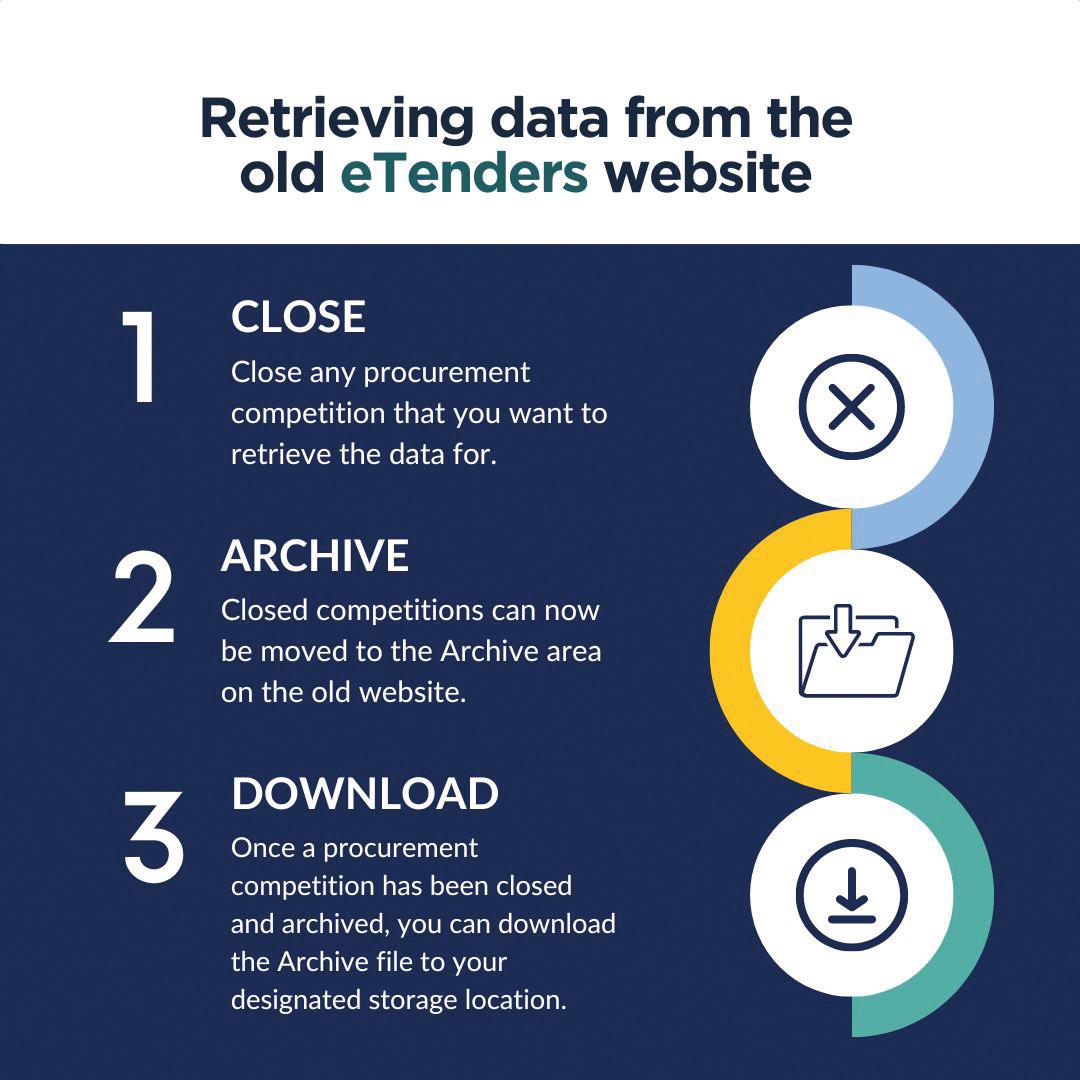
With access to the old site ending soon, the OGP is asking public buyers to take three key steps to save their past competition files before the January 2025 deadline so that they can continue to meet their record keeping and data retention obligations.
Key steps to retrieving data from eTenders
1. Close: Close any procurement competition on the old site that you want to retrieve data for.
2. Archive: Move closed competitions to the Archive area on the old eTenders site.
3. Download: Once a procurement competition has been closed and moved to the Archive area, download the archive file to your designated local storage location.
After 31 January 2025, all tenders will be automatically moved to an archive state and public buyers will continue to have the option to download their archived files until 21 May 2025.
A detailed guide with further information on how to close, archive and download procurement competition files from the
old eTenders website is available, visit gov.ie/ogp
The Office of Government Procurement
eTenders is managed by the Office of Government Procurement (OGP). The OGP is the national authority for public procurement and is responsible for driving the public procurement reform programme in Ireland. The OGP is a division of the Department of Public Expenditure, NDP Delivery and Reform.
For further information: W: www.etenders.gov.ie www.gov.ie/ogp nd Reform.
Strengthening Ireland’s cyber resilience
Brendan Ring, Digital Engagement Lead in the National Cyber Security Centre, outlines the challenges of strengthening Ireland’s cyber resilience.
In meeting the challenge of strengthening Ireland’s cyber resilience, Ring cites three key challenges:
1. the changing cyber threat landscape;
2. implementing the NIS2 Directive; and
3. meeting the findings of the National Cyber Risk Assessment.
Cyber threat landscape
Ring states that the cyber threat landscape has “changed significantly in a few short years”.
“We have had Covid, the HSE cyberattack, Russia’s invasion of Ukraine and subsequent supply chain attacks highlighting new and unpredictable threats.”
With the coming of the NIS2 Directive, the specific role and remit of the National Cyber
Security Centre (NCSC) will be altered. The NCSC was formally created by government in 2015, with a mandate which includes:
• reducing the vulnerability of critical systems and networks within the State to incidents and cyber-attacks;
• effectively responding when such attacks occur;
• responsibility for the protection of critical information infrastructure; and
• establishing and maintaining cooperative relationships with national and international partners.
Ring describes the role as “leading Ireland’s response to cyber risks”. “We are defending today, responding to incidents, taking down actors, and building networks. We build these networks nationally, globally, and regionally,” he explains.
Fresh Thinking
NIS2 Directive
The “comprehensive” NIS2 Directive – which replaces the 2018 NIS Directive – will create national competent authorities for various sectors — such as telecoms and energy — which the NCSC will provide guidance to and oversight, while keeping a direct brief over the Government and key entities.
NIS2 provides that: “Member states shall ensure that the management bodies of essential and important entities approve the cybersecurity risk-management measures taken by those entities… oversee its implementation and can be held liable for infringements by the entities of that Article.”
With Ring citing the cost of implementation as “very significant”, he asserts that meeting the Directive’s obligations will be a challenge as it applies to all businesses classified as medium or above in scope, In other words, those with over 50 employees or a turnover of €10 million.”
National Cyber Risk Assessment 2022
The National Cyber Risk Assessment 2022 report, concluded in May 2022, examined the systemic cyber risks faced by the State’s critical services from a range of threats. It examined espionage, destructive cyberattacks from nation states, and criminal actors.
In terms of the main lessons being drawn from the National Cyber Risk Assessment, Ring lists off the introduction of a suite of legal measures such as the Network and Information Systems (NIS) Directive and its upcoming replacement NIS2, the Cyber Security Act for certifying products and services, and the upcoming Cyber Resilience Act which seeks to embed security into products.
All of these initiatives, he asserts, will “place an emphasis on organisations to ensure services and products are created and delivered with embedded security from the outset”.
The Digital Engagement Lead further outlines that, as a result of the findings of the assessment, “risk profiles of individual suppliers can be assessed on the basis of several factors, notably, the likelihood of the supplier being subject to interference from a non-EU country”.
Such interference may be facilitated by, but not limited to, the presence of the following factors:
• a strong link between the supplier and a government of a given third country, the third country’s legislation, especially where there are no legislative or democratic checks and balances in place, or in the
absence of security or data protection agreements between the EU and the given third country;
• the characteristics of the supplier’s corporate ownership, the ability for the third country to exercise any form of pressure, including in relation to the place of manufacturing of the equipment;
• the supplier’s ability to assure supply; and
• the overall quality of products and cybersecurity practices of the supplier, including the degree of control over its own supply chain and whether adequate prioritisation is given to security practices.
More broadly, Ring states that a trend in recent years is a “blurring of the lines between the three categories of threat actors”. Threat actors can be categorised as: cybercriminals, nation states, and hacktivists.
On this blurring of lines, Ring explains: “The Russian invasion of Ukraine has accelerated this trend; you have the coopting of cybercrime groups with state-sponsored actors featuring strongly, along with hacktivists.
“The rise in the use of indiscriminate ransomware in recent years by cybercriminals is motivated by financial gain and continues to leave a trail of destruction and devastation and has elevated the threat from this group to nation state actors across all our target types from operators of critical national infrastructure, to large and small businesses, to individual citizens.”
He continues: “State-backed actors are expected to continue to pursue their strategic objectives via cyber operations for intelligence gathering for advantages in decision-making, stealing intellectual property, and prepositioning of military and critical infrastructure [preparation of the operational environment] for future conflicts.”
Ring suggests that it is “very likely” that hacktivism will continue to encompass a variety of political ideals, particularly in countries experiencing civil unrest or war.
“Some of these groups will remain active for a longer period of time,” he states, “where others will dissolve, and their members will continue operations under the umbrella of other groups”.
Concluding, Ring states that while there is an increased understanding of the cyber risk landscape, boosting resilience by raising the cybersecurity ‘bar’ across all elements of the technology ecosystem remains the most effective means of reducing risk to critical services.
Securing the next wave of digital transformation in the public sector
It is crucial that public sector organisations are seeking to leverage technological transformation to enable ongoing transformation of service delivery, writes Gary Comiskey, EY Ireland Government and Health Partner.
Across both public and private sector, today’s modern technology leaders are focused on ensuring that the technology upon which their core business functions operate seamlessly, that their systems are protected from ever more complex cyber threats, and that the correct digital infrastructure is in place so that their organisation can quickly seize new growth and service delivery opportunities. Each year EY Ireland engages with 150 senior tech leaders across the public and private sector, to understand what is front of mind for them right now and what the challenges and opportunities are as they look to the future. This year’s Tech Leaders Outlook Survey uncovered three key trends –cybersecurity, cloud adoption and the potential of artificial intelligence and generative AI (GenAI):
1. Cybersecurity is front and centre
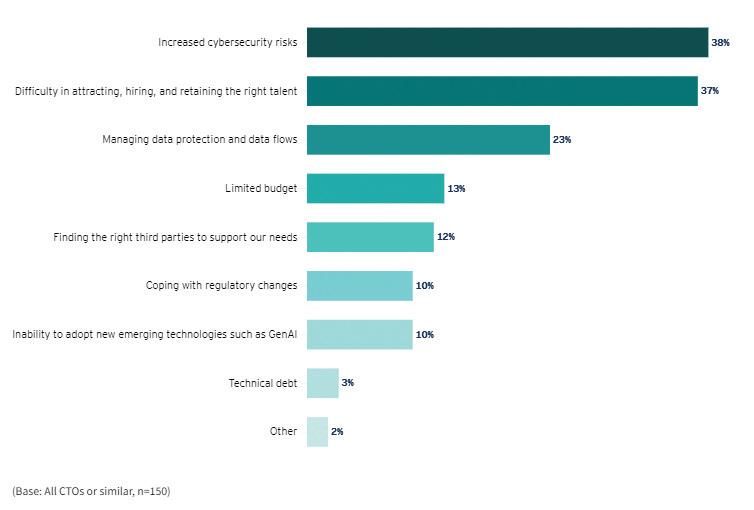
Across all sectors, cybersecurity risks have emerged as the top issue for tech leaders in 2024, with almost four-in-10 (38 per cent) rating this as their most significant challenge.
Turning to the specific elements of cybersecurity, elevated cyber risks and management of data protection and flows were identified by 61 per cent of respondents as a critical challenge. A quarter of respondents pointed to their organisation’s vulnerability to cyberattacks as an area of concern.
Cybersecurity attacks can have a significant and detrimental impact on business operations and public services, as for example, when the HSE suffered the most significant cyberattack on an Irish state agency in May 2021. Lessons continue to be learned from this and in
this context the significantly increasing investment in the National Cyber Security Centre is very welcome. The survey also highlighted that technology leaders are renewing their focus on cybersecurity with hackers and other bad actors now adding generative AI (GenAI) and other advanced tools to their malign arsenal.
2. Confidence in cloud adoption soars
While traditionally the public sector has been cautious in the use of cloud technology, this hesitation is subsiding and, confidence in cloud technology has surged across all sectors, with more than 80 per cent of organisations (public and private) covered in the survey either on the cloud or in the process of migrating to it. These results indicate increased trust and confidence in cloud technology. This rise in cloud adoption underscores the recognition of its benefits, such as scalability, flexibility and cost-effectiveness.
3. Discovering the hidden potential of AI and GenAI.
The public sector is continuing to explore opportunities to improve efficiency and deliver greater value for money and ultimately better service delivery for citizens. The adoption of AI is increasingly viewed by organisations as a key enabler to drive innovation. AI has the potential to change how government works, increasing operational efficiency, automating routine tasks and enhancing citizen service.
Our research finds that organisations are very interested in AI. However, this strong interest is not yet turning to action for the majority of organisations, with more than six in 10 (62 per cent) saying they are not yet investing in AI technologies and do not have an AIrelated strategy in place. To further encourage AI within organisations it is imperative that robust AI policies are developed. Integrating governance with innovative AI applications can also help organisations unlock new opportunities.
Gary Comiskey, Government and Health Partner at EY Ireland.
The most significant challenges facing Irish tech leaders today
Technological transformations
To capitalise on these opportunities, public sector organisations are undertaking a range of technological transformations. Some of the key transformation initiatives where EY has supported government include:
• Modernising and integrating disparate IT systems to foster collaborative and interconnected ways of working – Many government departments and state bodies face challenges with siloed and legacy systems. There is a growing need to adopt a ‘Whole-ofGovernment’ approach to offer joined-up and seamless services. EY are supporting the public sector to develop digital strategies and common standards to integrate siloed data and create common governance frameworks. Once a strategy is developed the next step is to enable interoperability of different systems through a flexible architecture and standards to enable data exchange.
• Embracing data-centricity to better understand and serve changing needs of citizens – Across governments, data-driven insights are increasingly a central part of decision making. All departments –from HR to operations, service delivery to the finance function –are data-hungry and want to be served data that monitors performance and how they can improve. EY is supporting departments and agencies to integrate data into operations to drive better citizen outcomes, offer more tailored services and adopt a human-centric approach for service delivery.
• Investing in digital skills and transforming organisational culture to create a future-fit workforce –Investment is required to adopt dynamic workforce planning through a long-term view of capacity and capability needs which EY has been supporting right across government. There is also a need to scale digital capabilities through partnerships with external experts, to rethink conventional recruitment, onboarding and training methods to foster digital leadership and culture.
There has been a dramatic acceleration in digital service delivery and citizen interactions across many areas of government, in particular since the pandemic. Most citizens see greater use of digital technologies as a key way for government to improve:
• Convenience – more easily accessible services, organised around key life events;
• Personalisation – services that are tailored to meet citizens’ individual needs;
• Equality of access – support for the digitally-excluded and more equal provision of services;
• Transparency – showing citizens how Government is performing and tax money is spent; and
• Responsiveness – a means of providing feedback on public services, policymaking and service delivery.
Successful government departments and agencies will be those that focus on embedding new practices and finding new ways to serve the needs of 21stcentury citizens. Technology and transformation can play a crucial part in this and the time to embrace this is now.
Gary Comiskey, EY Ireland Government and Health Partner
Gary Comiskey is a partner in EY Ireland, working with the advisory team to deliver services to government and health sector clients. He leads a wide range of complex projects enabling public sector and health care transformation initiatives across central government and other public sector bodies.
For more key insights about EY Ireland Tech Leaders Outlook Survey 2024, visit: W: ey.com/ie/TechSurvey
Source: EY Ireland Tech Leaders Outlook 2024
Ireland’s digital decade progress in numbers
In Ireland, the share of ICT specialists in total employment is 6.2%
• above the EU average of 4.6%
The proportion of graduates who study ICT programmes is 8%
• almost double the EU average of 4.2%
• female ICT specialists, while above the EU average, is less than 20% of all ICT specialists
Digital infrastructure
Fixed very highcapacity network (VHCN) coverage in Ireland grown from 67% in 2020 to 84% in 2022
Digital skills
70% of adults in Ireland have at least basic digital skills
• well above the EU average (54%)
• not far from the EU 2030 target (at least 80%)
€200 million worth of funding committed in the National Development Plan
• EU 2030 target of 100% 5G coverage 84% above the EU average of 81%
• making progress towards achieving the EU 2030 target of 100% coverage
At 56%, Ireland performs better than the EU average concerning 5G coverage on the 3.4-3.8 GHz spectrum band
1 direct participant active in manufacturing Microelectronics and Communication Technologies
Ireland has over 100 semiconductor companies exporting €13.5 billion worth of products annually
Fresh Thinking
Digitalisation of business
85% of SMEs demonstrate at least a basic level of digital intensity
• significantly higher than the EU average of 69%
• very close to the 2030 EU target of more than 90%
The uptake of digital technologies by enterprises in Ireland:
• big data 23% in 2020
• cloud 47% in 2021
• AI 8% in 2021
Digitalisation of public services
Public services provided to business scored at 100
Public services provided to general public in Ireland scored at 81
Over 1.88 million verified accounts of digital identity service to access digital public services
• 49% of the adult population
Source: 2023 Report on the state of the Digital Decade
The Irish Prison Service has identified a business need within its strategic priorities to modernise its services through digital development and transformation.
The new Strategy Statement 2023-2027 provides a roadmap for embedding continuous quality improvement across all areas of the Irish Prison Service. In addition to its vision, mission, and values, the strategy outlines five strategic pillars and a number of objectives. The pillars are:
• prisoner pathways;
• employee experience;
• new business processes;
• digital platforms; and
• governance.
The digital platforms pillar supports the objective that will modernise the Prison Service’s services through digital development that enable more transparent and tailored services, support innovation and improve efficiency and effectiveness in a cohesive and holistic manner.
Aims associated within the pillar include:
1. Employee Digital Tools:
• improve staff experience through reducing non value add manual tasks and enhancing system productivity;
• implement a service wide targeted organisation dashboard as an internal performance enhancement tool;
• provide more autonomy to staff on self-detailing, rosters, schedules, and leave; and
• enable online learning and development for staff.
2. Digitalise Prisoner Services:
• design and implement a digital prison services operating model that enhances the prisoner journey, that balances the digital agenda and the need for human interaction and that improves productivity across the estate; and
• fully leverage digital innovation for the benefit of prisoners and staff while understanding and mitigating for digital abilities.
Digital transformation as a universal phenomenon has created a new reality in prisons. The use of technology in custodial settings transforms rehabilitation and services, promotes digital literacy, digital citizenship, social skills, self-esteem, and re-integration into society. Current rehabilitation practices and policies in our prisons are mostly offline and do not cater for the digital realms.
The use of digital to support rehabilitation will facilitate transition back into society and ensure an improved post-prison quality of life in a technologically advanced society. The technology-dependent world that people exiting custody must now re-enter requires the use of touch screens, computers, and the internet, but many have not received training in how to operate these types of internet-enabled processes.
In recent years, the Prison Service has pivoted its focus to how it can use technology to create and deliver modern services in its prisons. Four broad areas where technology supports a modern service include:
• digital service delivery for people in care;
• digital service delivery for staff and partners;
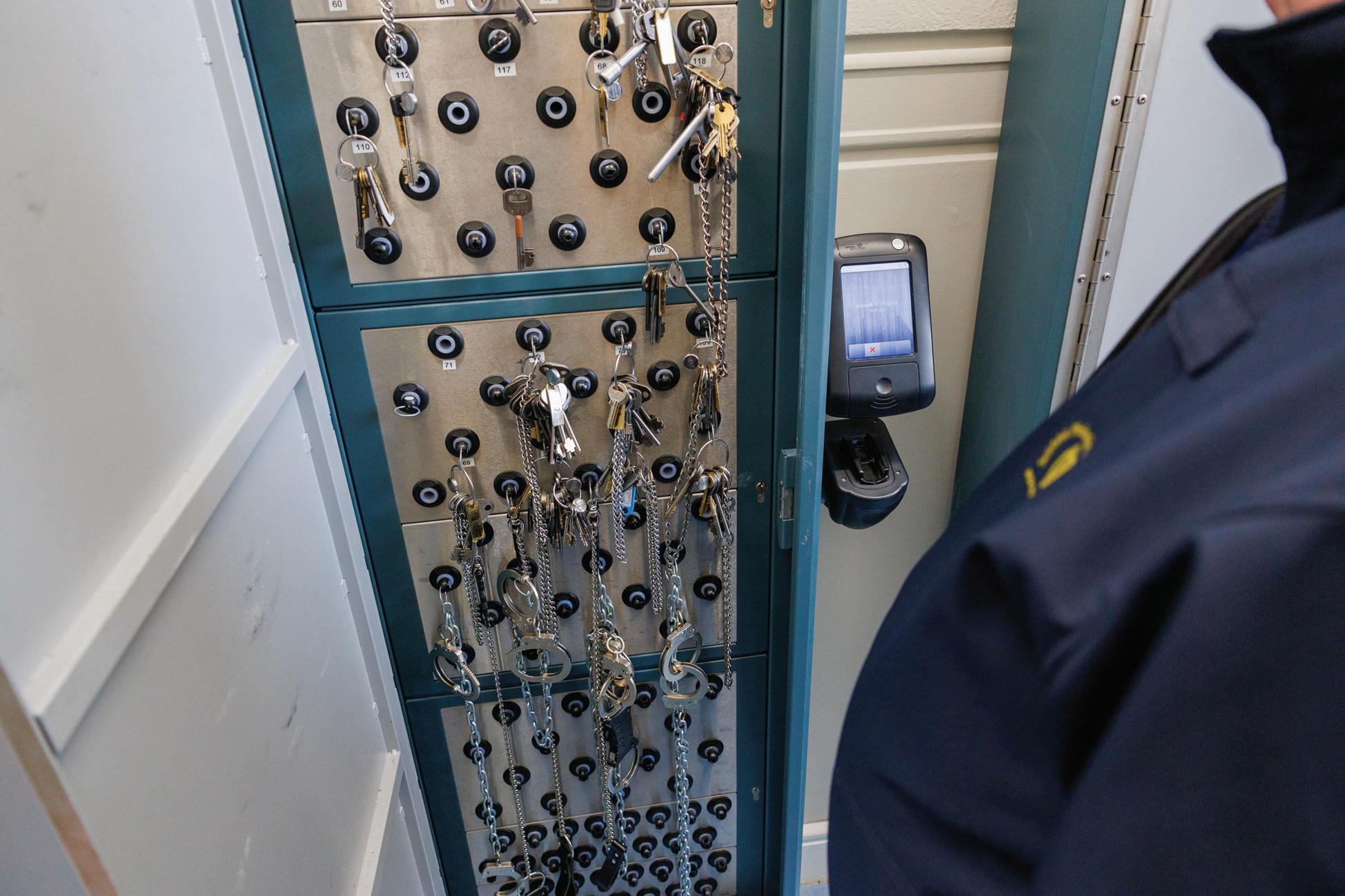
• electronic security of prisons; and
• digital prison building management.
Delivery and access to services for people in custody encompasses health and wellbeing, education, language, culture and identity, prison operations, such as biometric movement; selfserviced kiosks; and visits.
Digital service delivery for staff and partners includes the enablement of digital ways of working for staff and other people onsite in Ireland’s prisons to help them do their jobs more safely and accurately, for processes such as viewing essential prisoner information, prisoner sentence management, building maintenance, and inventory management.
Managing the long-term maintenance and sustainability of a prison, including optimising physical workflow can be supported through the use of digital tools such as monitoring environmental conditions through sensors and enable control and automation of operational processes and optimisation of electricity usage within cells and other spaces.
The benefits under this agenda will support an improved safety environment in the prison through increasing time available for staff to have meaningful engagements with people in their care; enable real-time access to information, reducing time spent completing paperbased tasks. Using digital to support rehabilitation will prepare people in the Prison Service’s care to adapt to a digitally enabled environment and prepare them for using online learning tools and increase connectedness with the outside world and preparation for life outside in an easy to use and accessible format.
The Prison Service’s approach to implementing digitally supported service delivery is about using technology to make services available to people where and when they will make the most impact on that person’s life or work. For people in care, this should mean making the most of services known to have a humanising and rehabilitative impact, and ensuring they are available and accessible. For staff and partners, greater use of technology in day-to-day activities will help improve safety and contribute to the Prison Service’s wider drive to modernise its ways of working.
The Irish Prison Service is currently drafting a technology and change delivery plan for the short, medium, and long term objectives of the Strategy Statement, specifically to include:
• technology, change, and digital transformation development from a holistic perspective;
• digital maturity dimensions;
• IT management and governance strategies;
• innovation and project design supports; and
• project management.
The Prison Service has acknowledged the important role ICT solutions play in the delivery of its mission. Moreover, the increased importance digital technologies play in today’s society and the speed on how those technologies shape the modern society in which prisons operate provoke an urgent need to act more proactive, anticipate the change, and approach digital from a holistic perspective.
Change through digital is often referred to as digital transformation, a process that encompasses an ambition to do better and explore how new technologies can support the organisation in doing so. Organisations that embrace transformation want to do more with digitalisation than just build a better version of their current selves. Therefore, the aimed transformation should be seen as a process that includes an openness to rethink the existing, explore digital possibilities and analyse the impact a digital society has on the organisation and its mission.
Prison services are unique settings which makes this confrontation with a changing society quite challenging: it requires a thorough and balanced investigation into what options exist to use technology meaningfully, purposefully, and safely to support the entire organisation: the people who work in it, the many different stakeholders and the detainees who need support during their journey to return successfully to a digital society.
Dan Brember, Deputy Director of GOV.UK Content for the UK Government’s Government Digital Service (GDS), tells eolas about how the UK Government is aiming to reclaim its former status as a pioneer in the delivery of digital services for citizens.
With GOV.UK now over 11 years old and Government Digital Service (GDS) over a decade old, the world at large in a state of flux following the seismic reverberations of events such as Brexit and Covid-19, and the constant progress of both technology and society, Brember says that GDS are taking the opportunity to reflect.
“One of the things that we are asking ourselves at the moment is what are the big things we have perhaps taken for granted or assumed have remained true that we need to revisit and consider whether or not there are opportunities for us to change,” he says.
“One of the big touching points for us has been our relationship with other peers around the world, looking at what they are doing well. Many of them are solving similar challenges to us in their
contexts and we, for a long time, considered ourselves to be among the world leaders and that is probably no longer true, so there is something that we can learn there.”
Considering the recent social, political, technological, economic, and legal developments, Brember says that GDS asks the question: “What should the next generation of government digital services look like?” A redesign of the interface is thus central to GDS’ efforts to improve the citizen digital experience.
“For many people, the main user interface is GOV.UK. The 2012 Digital Efficiency Report said that digital services are very often better for the users and cheaper for the taxpayer. However, internet years are sort of like dog years and 10 years on the internet is probably more like 30 years in any
other sphere. We need to look again at what the central paradigm is for digital services in the UK.”
Central to the improvement of this paradigm are already existing GDS applications within the GOV.UK umbrella, such as GOV.UK Pay, which allows users to make a payment through a separate platform that does not appear to be separate at the point of use. Similar products such as GOV.UK Notify keep users updated on the status of applications.
“GOV.UK remains a wonderful service despite the fact that we are a decade old, and it is something that we need to protect and develop,” Brember says. “Every time we meet peers from other nations, they are envious of the fact that we have managed to consolidate a
Fresh Thinking
single user experience for the many government services and websites that could potentially exist. There are still thousands of services where a user has to download a PDF and post it. Imagine that you are extremely low income, with no laptop or printer, and you are faced with forms with over 100 questions.
“Services that require you to post in documents that we already have somewhere else are extremely frustrating. People who fill in these forms and send them in at their own expense have got to wait weeks or months for a decision, which is very poor. That being said, digital services across government are mostly good. So, why do we need to reconsider and challenge that paradigm?”
The economic context that these changes are happening within is “obviously changing”, Brember says, with the victor of the next UK general election inheriting “a very challenging economic reality to deal with”, which will mean “continued pressure for more efficiency” in how the civil service delivers services. Against these pressures, the “promise of transformational efficiencies through digital services has not been fully realised”, Brember says.
“The civil service has continued to grow and the cost of running services is still far too high. This is partly because of Brexit, partly because of Covid-19, and the gradual increase in the UK population. It is also partly because we have made the front-end services better while not fundamentally fixing the back end. It takes too long, is too hard, and takes too much energy to do simple things.”
Pointing to broader trends of dissatisfaction and disillusionment with
“A great digital experience is often mobile app-based, highly personalised, ruthlessly simple for the user – which in practice means fewer than 10 clicks to do whatever it is you need to do.”
Dan Brember, Deputy Director of GOV.UK Content
politics and the very concept of democracy, Brember states that there is also a growing satisfaction gap with regard to GOV.UK. This gap does not surprise him: “The in-browser/onplatform experience of the web is a declining medium. Younger audiences are used to apps, personalised experiences, and short-form videos. A large website with forms is fundamentally not a good user experience.
“This trend is not surprising: in 2016, most visits to GOV.UK were on a desktop computer; but by 2021, 65 per cent of visits were on a mobile phone, and for major services such as Universal Credit today, that number is as high as 90 per cent.
“A great digital experience is often mobile app-based, highly personalised, ruthlessly simple for the user – which in practice means fewer than 10 clicks to do whatever it is you need to do – and finally, integration with user data, particularly the data the organisation already holds about the user.”
Falling behind in this regard has led to the UK falling from first in the UN’s
eGovernment Index to 11th, and Brember says that GDS’ “big bet” is a pivot towards a single GOV.UK app. “In GDS, we talk a lot about user needs, asking what the specific problem is that we have to solve. We have had to pivot slightly, and we are now thinking around user utilities: what are the common things that people need to do with government that we can provide through an app?” Such common things would include identification, passport and driving license renewals, MOT, booking for appointments as is already seen on the NHS app, and notifications to remind citizens of pressing matters such as upcoming appointments or Universal Credit [UK social security] balance.
“There is nothing more personal, intrinsic, commonly used by people than their native smartphone, so why can we not release the benefits of that to support people to do things more quickly?” Brember asks, before concluding: “These are the things that we have already got the power to do, we just need to bring things together to make it happen.”
LocalGov Drupal and why it is so popular with councils
few years.
The rise in popularity of the LocalGov Drupal CMS among local authorities has shaken up the public sector digital sphere. Its numerous benefits are underpinned by the philosophy of Build to Share, which is key to the Government’s digital strategy, writes Stella Power, Managing Director, Annertech.
The innovation, security, flexibility, and economy of the Drupal CMS has ensured its rapid take-up among the public sector over the past few years.
In fact, Drupal was recently named the most popular content management system (CMS) among councils in Ireland and the UK. This is according to the
latest updates to the LocalGov CMS Directory, which lists the content management systems that councils currently use.
One of the driving forces for this increase in popularity is the take-up of LocalGov Drupal. Known as ‘the CMS for councils by councils’, LocalGov
Drupal is built on Drupal but has been customised to serve councils and their users. It is a tried and tested CMS that is based on user research and councils’ needs.
LocalGov Drupal in Ireland
Although LocalGov Drupal started in the UK, it has had a sustained uptake in Ireland, starting with Tipperary County Council.
Carlow County Council, Laois County Council, and Galway City Council have also joined the LocalGov Drupal family. Carlow.ie was the most recent Irish LocalGov Drupal website to go live in January 2024, combining a gorgeous design with custom development to ensure that the new website would be customer-centric and service-orientated.
The LocalGov Drupal project aligns with the Irish Government’s Build to Share initiative, which forms part of the Government’s Better Public Services, the Public Service Transformation 2030 Strategy
Its goal is for the public sector to share code in order to save valuable resources like time and money. And they are – Carlow.ie was designed and built in just 11 months. This included some custom-built features, which allow the council a flexible way to showcase vacancies, present minutes of council meetings and display the county’s leaders.
LocalGov Drupal can reduce the cost of building a new council website by up to 80 per cent. Some councils use the budget savings that they achieve by using this open source CMS to add new features to it.
Carlow funded the addition of the Irish Planning Notices extension to the LocalGov Drupal offering, which will be of interest to any Irish councils contemplating moving over their websites.
The LocalGov Drupal CMS has risen in popularity over the past
This gives councils an easy way to add and manage these notices, and for users to be able to filter the notices by year and week number. It also allows these notices to be posted in Gaeilge, boosting the crucial multilingual functionality of LocalGov Drupal sites.
Other features
Other hallmarks of the LocalGov Drupal project are:
• content and functionality is designed to meet or exceed WCAG 2.1 level AA so it is accessible out of the box;
• because it is an open source CMS there are no licence fees or vendor lock-in;
• its content formats and patterns are based on Government Digital Service standards and user research, and have been tried and tested by the public sector;
• the platform is updated regularly with the latest security updates and features. So not only is it secure, but it uses the latest technology;
• the platform also supports full Irish translations of councils’ services and the website’s content – this was funded by Tipperary County Council;
• LocalGov Drupal has an extension, also funded by Tipperary County Council, that imports the services that a council offers from the Irish Service Catalogue. It gives councils a good launching point for their content, because it lists and imports all the services (and their translations), creates a page for each of them and structures the content throughout the site;
• the HTML Publications extension gives councils the opportunity to finally ditch PDFs and other large document files. PDFs are popular among councils, but they are clunky to use and pose accessibility difficulties for users. Instead, documents can now be presented as web pages. It will make things so much easier for users, especially those on mobile phones or using assistive devices; and
• the standalone Microsites Platform
offers users a way of managing an entire fleet of microsites from one place. It is not just for councils – it can be used by any organisation that runs more than one website or microsite.
Conclusion
The LocalGov Drupal philosophy of ‘build to share’ resonates with public sector organisations, who save time and money by pooling their resources.
Currently, there are 45 live council
About Annertech
websites built on LocalGov Drupal, and more are in development. As this CMS continues to thrive and grow, so too does the depth of its offering. New features, based on the real-world needs of councils, are being created all the time.
T: 01 524 0312
E: hello@annertech.com
W: www.annertech.com/localgovdrupal
Annertech is Ireland’s leading open-source digital agency and has become the go to expert for Drupal and LocalGov Drupal. Founded in 2008, Annertech works with many clients in both the private and public sectors.
In 2021 Annertech UK opened to service a growing number of clients and staff members in the UK. Annertech’s mission is to help companies to embrace open-source technology to deliver ambitious digital experiences for their customers.
Their work has won all of Ireland’s most prestigious digital awards, including multiple Spider Awards (including the coveted Grand Prix award), National Digital Awards and Digital Media Awards.
Stella Power is Managing Director of digital agency Annertech.
Fresh Thinking
Exploratory innovation within the public sector
Strategic Partnerships Lead of GovTech Lab
Lithuania, Kamilla Gasinska, highlights how innovative companies and the public sector can work together to build GovTech solutions.
With the pace of new technologies increasing, thus causing increased citizen expectations on the public sector, Gasinska explains how GovTech Lab Lithuania has successfully ran over 97 projects to adapt and modernise the public sector through exploratory innovation.
Contextualising the need for modernisation within the public sector, Gasinska believes that collaboration with innovative companies is key to the public sector delivering during challenging times and crises. Pointing to crises such as the Covid-19 pandemic and the ongoing conflict in Ukraine, she states that consistent development and modernisation are key to create innovative solutions during unprecedented global challenges.
GovTech Lab Lithuania, established in 2019, is a part of Lithuania’s Innovation Agency under the Ministry for Economy and Innovation. Through its successful experience in creating innovative GovTech solutions, the organisation has produced a process called the GovTech Challenge Series; a “structured innovation process that facilitates cooperation between the public sector and startups/innovative companies to build digital solutions that solve government’s challenges”.
GovTech Challenge Series
Gasinska outlines how the process is successfully implemented in Lithuania to produce exploratory innovation. “At the
Fresh Thinking
very beginning, we have an open call to look into the current challenges within the public sector. It could be within a ministry or an agency, or it can be in a library, school, or hospital. At the start of this process, we are gathering all of those problems and selecting the most pressing ones.”
The second stage, aims to address the specific problem within the public sector and transform it into an innovative challenge that will “spark the creativity, innovation, and interest of the start-up community”. At this second stage, Gasinska states GovTech Lab Lithuania is also helping to prepare the public sector for innovative procurement.
Stage three, focuses on procurement within the process. Gasinska outlines that during this stage, a design contest is used to produce further creativity within the innovative companies.
Gasinska states: “At this stage, you rate the idea and not the team,” and explains further, “if the idea is great, you can pitch prices for the best ideas and encourage the small teams. Then, you are collaborating with an innovative pilot with the best team and the best idea that you have selected.”
The next stage is called “pilot development”, where considerations are made for the public sector team and the start-up team through team-building exercises. This process typically entails three-to-six months of cooperating on the creation of the pilot solution.
“The public sector is learning about how start-ups work, and at the same time, the private sector is learning how the public sector works.
“From the very beginning, we have been helping the public sector with expertise, with templates for procurement, and with workshops. GovTech Lab Lithuania host workshops with the private sector on how to take part in the procurement. We try to help and guide them through this process,” she says.
Through this process, Gasinska highlights that the private sector in return is further educated on “how the public sector works, why the processes are so long, what the actual bureaucracy means, and why it is there”.
Furthermore, the process encourages the companies to apply for other public
procurements because they can “understand the mindset of the public sector,” according to Gasinska. Due to this, the public sector is more flexible after running this process.
Successful collaborations
To explicate the success of this strategy, Gasinska illustrates challenges that were solved when involving the GovTech Lab Lithuania through collaboration with Lithuania’s public sector and start-up companies, including a project which aimed to make the internet safer for children by automatically detecting illegal content, a collaboration that integrated forest cover monitoring using advanced algorithms, and a solution to automate data collection from market participants necessary for supervision.
“One thing that we are focusing on is pilot solutions. The public sector is normally willing to go for the big budget into full-scale solutions. Here, we are asking them to stop for half a year to see if the solution they are looking for is the solution that is needed.”
Gasinska outlines that the complete process takes around nine months before the organisation is selected. Furthermore, the projects are run in batches rather than case-by-case.
“Projects are coming together from diverse backgrounds and different cities. In this way, they can learn from each other because some have faced similar problems previously. Due to this, both parties can share their experience along the way.”
Progressing digital government
Gasinska outlines that GovTech Lab Lithuania provide funding for experimentation, professional support and operate on common values to ensure that everyone is “on the same page”.
Through the utilisation and collaboration of start-up companies to further modernise and transform the public sector, Gasinska concludes exploratory innovation within GovTech solutions is crucial to produce a progressive digital government in short- and long-term timescales.
EU Cyber Regulations may overwhelm Ireland’s regulators and service providers
Ireland’s digital services companies are at risk of being illprepared for the approaching tsunami of EU regulations.
These regulations include the Digital Services Act (DSA) and the Digital Services Markets (DSM) which apply to platforms and search engines, (initially those with more than 45 million customers each); the Digital Operations Resilience Act for the fintech sector; and eIDAs which are relevant for e-certificate providers – NIS2 and the Critical Entities Directive (CER) – which apply largely to critical infrastructure providers of essential services, which citizens rely on.
It has been estimated that the scope of NIS2 could encompass between 2,500 and 3,000 entities in Ireland. This scale has the potential to overwhelm
regulators in Ireland, and the companies in the sectors soon to be regulated for the first time. With less than five months until the mandatory implementation date of October 2024, preparations for NIS2 will be intensive, expensive and resource heavy.
The cybersecurity measures included in the Directive are designed to help organisations to protect their data, systems and processes. Compliance will not merely prevent sanctions, but also guide organisations towards achieving a cybersecurity maturity that will shield them from cyberattacks, which could have devastating effects on the company and on its customers. The
objectives are laudable and essential, given the scale and impact of cyberattacks, especially ransomware.
Some of the main provisions of NIS2 include the need for cybersecurity risk management measures which are required for essential and important entities to prevent or minimise the impact of cyber incidents. There will also be increased corporate responsibilities for top management in relation to cybersecurity, as well as a harsher penalty regime. Furthermore, stringent reporting requirements will be imposed for notification of incidents.
Practical steps to strengthen your cybersecurity position
Organisations should begin by performing an inventory or audit of their entire architecture and systems landscape, to establish a foundation for its risk management processes. This includes implementing a risk management framework that ensures continuous assessment, evaluation, and treatment of threats against its data. Additionally, crisis management planning should be initiated to limit the impact and duration of any crisis that may arise.
To further enhance resilience, it is crucial to establish business continuity and disaster recovery procedures, ensuring critical processes can continue operating at an acceptable level during disruptions. Top management must be actively engaged in the cybersecurity strategy of the organisation to prioritise security initiatives. Supply chain risks should be addressed by involving suppliers and service providers in risk assessments.
Finally, a structured incident management process should be defined to document and classify cybersecurity incidents, ensuring a swift response. These integrated measures collectively strengthen the organisation’s cybersecurity readiness to address emerging threats and challenges.
.ie and NIS2
As the trusted national domain registry for over 330,000 domain names, .ie is already designated by the Government as an operator of essential services (OES) under NIS1, the predecessor directive to the imminent NIS2. Its ISO certification ensures that .ie is already compliant with the cybersecurity requirements of the new Directive. In addition, the company has longestablished DNS abuse protocols with many national regulators to assist them in tackling issues with .ie domains that are alleged to engage in technical abuse or criminal activity.
The scope of NIS2 will apply to all toplevel domains for the first time –including .com .net. and .org and to all of the country code top level domains (ccTLDs) across Europe. Accordingly, Ireland’s registrars and resellers which operate cross-border, will need to
Fresh Thinking
comply with NIS2 legislation applicable in all of those countries. For example, they will need to have a dedicated database of complete and accurate information of any registrant who signs up for a domain name. This also means that registries and registrars will need to have verification processes.
To date, there has been speculation that the National Cyber Security Centre will delegate regulatory authority to regulators in situ, essentially a “federated approach” to regulation, thereby placing much of the regulatory burden on existing regulators, such as ComReg. However, this has not been confirmed by the Government, and it is important and urgent that the intended regulator is identified and commences its work without undue delay.
Conclusion
At .ie we are committed to demonstrating leadership for our sector and providing good governance. This includes meeting all regulatory requirements, including NIS2. It is not an easy task for the channel, but .ie has a multi-stakeholder Policy Advisory Committee that ensures its technical and registration policies and procedures are consensus-driven and will help .ie navigate rough regulatory waters ahead.
On this matter, .ie will leverage its established relationships with government departments to advocate for its stakeholders with national policymakers. Through its international partnerships, the company will continue to liaise and coordinate with crossborder partners and Council for European National Top Level Domain Registries (CENTR) officials to advocate that the concerns of registrars, resellers and internet users are reflected in Europe’s implementing acts and in the national legislation.
W: weare.ie
Fresh Thinking
Government aiming for 5G in ‘all populated areas’ by 2030
The Government has published its roadmap for a digital decade in line with requirements under the EU Digital Decade strategy, including digital skills targets for the labour force and for all populated areas to be covered by 5G no later than 2030.
Fresh Thinking
The first Report on the State of the Digital Decade was published by the European Commission on 27 September 2023. The report, which includes EU wide and member state-specific recommendations, takes stock of progress towards a successful digital transformation.
The National Strategic Roadmap for the EU Digital Decade Policy Programme, published in May 2024, sets out targets on skills, digital infrastructure, digital transformation of business, and digitalisation of public services.
Regarding skills, the Government aims to produce a “digitally skilled population” where at least 80 per cent of people aged between 16 and 74 have at least “basic digital skills”, with a further aim of achieving gender balance. Government is also aiming to increase the number of graduates with digital skills to over 12,400.
Within digital infrastructure, the Government states that all Irish households and businesses must be covered with gigabit network no later than 2028. On data, the Government states that there will be 23 public sector edge notes by 2025, and that Ireland will play its part in the EU having its first computer with quantum acceleration by 2025, ensuring that the EU plays a leading role in the innovation of quantum capabilities by 2030.
Additionally, on the digital transformation of business, the Government has outlined targets of 90 per cent of SMEs acquiring a basic digital intensity level by 2030, and enterprise take-up of 75 per cent in cloud computing, big data, and AI by 2030.
The Government is further targeting that at least 800 business are supported by 2026 under the €85 million Digital Transition Fund to support businesses in digitalising. At least 35 per cent of state funding for startup and early-stage businesses are invested in “innovative digital businesses” as of 2022.
Focusing on the vision of the digitalisation of public services, the Government states that 90 per cent of all government services will be available online by 2030.
On eHealth, the digitalisation of public services aims to ensure that 80 per cent of Irish citizens have access to core components of their digital health record. It is also aimed for 80 per cent of citizens to be using MyGovID by 2030.
Speaking on his vision for public services in the decade ahead, Minister for Public Expenditure, NDP Delivery and Reform Paschal Donohoe TD said in May 2024 that Ireland is “using IT to deliver a digital understanding of delivering our public services in an innovative way”. Donohoe has also said that artificial intelligence (AI) must be utilised and that “we need to look at how we can use AI and how we can integrate it into public services”.
“We need to look at how we can use AI and how we can integrate it into public services.”
Minister for Public Expenditure, NDP Delivery and Reform, Paschal Donohoe TD
Empowering public sector success with the Project Foundry
Leading in the public sector demands more than visionary ideas; it requires effective implementation strategies. Balancing business as usual with delivering transformational outcomes across multiple functions, technologies, and initiatives is no easy feat.
At the Project Foundry, we specialise in tailoring solutions to assist senior public sector leaders in achieving their objectives. Our Strategy to Execution transformation model offers an adaptable framework and a repository of best practice tools, tailored to meet you where you stand. We build the skills necessary for transformation, value creation, and successful execution.
As a smart alternative to traditional consulting giants, we specialise in driving transformations, fostering digital prowess, and enhancing execution capabilities. Committed to unlocking the fullest potential of organisations and their leaders, we expedite value realisation, prioritising our clients at the forefront of our endeavours.
Challenges
Did you know that 70 per cent of largescale projects fall short of their goals due to missing crucial elements in the plan? Despite having sound strategies, 67 per cent of companies face setbacks due to flawed execution and a lack of clear vision. In addition, 70 per cent of technology investments fail to deliver expected returns.
Having worked with a diverse clientele spanning various sectors, including life sciences, financial services, technology, Telecommunications, and the public sector, the Project Foundry is uniquely positioned to drive meaningful change and deliver tangible results – ensuring your organisation has the support, skills,
and capabilities to be in the 30 per cent of successful projects. Grounded in design thinking, our methodology optimises business outcomes, ensuring sustainable growth and enhanced capabilities for our clients.
Transformation partnering with clients throughout their journey, we specialise in organisational transformation and future business model development. Collaborating closely with clients, we redefine models for sustainable growth, enhance collaboration, digital and data capabilities, and transformational skills, elevating overall organisational effectiveness. Our change management solutions help deliver and embed operational efficiencies at a tactical or strategic level.
Digital and data transformation transcends technology; it is about your people, supporting changing mindsets, agility, and fostering innovation in organisations. Progressive companies are embracing agility to stay ahead of the curve in an era of rapid change, and that is where the Project Foundry comes in.
We understand that change can be challenging, which is why we are dedicated to facilitating seamless transitions. By aligning structures with objectives and fostering a culture of collaboration, we empower organisations to embrace change and emerge stronger than before.
“At the Project Foundry, we are committed to turning strategic vision into reality. We pride ourselves on fostering a culture of continuous improvement.”
Understanding and leveraging these technologies are indispensable for businesses aspiring to lead in a digitalfirst world.
Cloud advisory
Our Cloud Transformation and Advisory Service provides everything needed to reach your goals. From Cloud Architecture to Cloud Transformation and adoption, we accelerate cloud automation, enhance efficiency, and reduce risk and cost.
Execution
Execution is paramount, and we ensure it is done right. Our meticulously designed plans, coupled with resource allocation, facilitate efficient and effective goal attainment.
In the dynamic business world, achieving effective execution excellence is crucial.
The Value of Service for Our Clients
data products, and how the budget is distributed.
PPM
Our services ensure effective utilisation of PPM technology through process streamlining, organisational change, and technology adoption, enabling sustainable outcomes.
Ongoing support
At the Project Foundry, we are committed to turning strategic vision into reality and delivering value to our clients. We pride ourselves on fostering a culture of continuous improvement. We understand that transformation is not a one-time event but an ongoing journey. With that in mind, we provide ongoing support and guidance to our clients, even after the initial implementation phase, ensuring the project is sustainable and successful.
Our ability to compete in a Fast-Changing Market
Recognising the uniqueness of each organisation, we offer tailored solutions to address specific challenges. Whether it is budget constraints or resourcing challenges, we collaborate with clients to devise solutions that align with their circumstances. Transforming vision into reality is our specialty, and our structured approach, combined with a focus on accountability and clear outcome measurement ensures no detail is overlooked.
Digital enablement
Cutting-edge technology serves as the central point around which modern business revolves. The Project Foundry leverages advancements like AI, robotics, blockchain, and the metaverse to reshape the future of various industries.
Our execution team supports clients in delivering meaningful programmes, projects, and initiatives, driving long-term success.
Data
A data strategy is imperative to ensure that you ask the right questions across the business to utilise your data as an asset. In order to deliver the ‘how’ of unlocking your data using tools such as AI, this is your foundation that needs to be solid. This involves considering strategic alignment, how the use of data aligns with the business strategy and understanding peoples’ expectations of the data and associated services. It also involves determining who prioritises which data product and service is built first, who pays for the development of the
Our commitment to long-term success means that we work collaboratively with our clients to adapt strategies, address emerging challenges, and seize new opportunities as they arise.
With our unwavering dedication, expertise, and personalised approach, we empower organisations to thrive in a dynamic, digital-first world.
Find out more about what we can do for your organisation: E: Info@theprojectfoundry.com
Optimal
Fresh Thinking
World leading public services: A Danish perspective
Kristian Vengsgaard, CEO of Kombit A/S, an IT company supporting the digital change of Denmark’s municipalities, discusses the values of centralisation and trust in delivering digitalisation of public services.
Denmark sits atop of almost every report and survey on public sector digitalisation, underpinned by the decision to move early as a digital-first nation.
Denmark’s 98 municipalities are the largest by scale and responsibility of the country’s three layers of government, which also includes the State and regions. The economic importance of this layer can be seen by the fact that six out of 10 public servants are employed by the municipalities, while each municipality employs around 10 per cent of its citizens.
Vengsgaard explains that the municipalities have responsibility for much of the public sector work ranging from employment through to childcare,
and public schools, however, a national conversation is ongoing around whether a reallocation of the responsibilities of the regions and the municipalities is required.
Despite being a digital leader, Denmark faces many similar challenges to other European countries with respect to the future of its public services. For example, recognition of an ageing population has opened up a discussion on the ability of the public sector and the availability of personnel to care for the elderly adequately.
“At the heart of this discussion is the technology versus people debate,” explains Vengsgaard, who frames it as the more commonly used Danish term of cold hands versus warm hands.
Fresh Thinking
Fortunately, discussions are starting to turn to the fact that digitalisation and technology are not ‘cold hands’, but enablers of the right solutions for making the warm hands warmer, and do more warm work than would be possible.”
Alongside a recruitment challenge, Denmark also has rising welfare expectations from its citizens, made more difficult by the fact that the Danish culture has a broad definition of welfare, much of which is largely delivered by the public sector.
In addition, as like most of its European counterparts, the Danish governmental structure and democracy in general is under greater pressure. Despite Denmark recording one of the highest rates of confidence in public services of any EU member state, social agitation and misinformation campaigns have contributed to falling public trust levels in government.
This is happening in parallel with changing security concerns. Vengsgaard says that Russia’s invasion of Ukraine and subsequent changes to European and global security dynamics has destabilised how the Danes consider their security. This instability also relates to cyber security, where cyber has become a central component of warfare.
“As digital people, we need to understand that it is not all about security and developing new products. It is also about understanding that risk is quite different than it used to be.”
Early movers
Returning to the origins of Denmark’s digital journey, Vengsgaard admits that Danish citizens have benefitted from the timing of the Danish Government’s decision to digitalise in the early 2000s because, at the time, digitisation was not a hot political topic.
“Someone had the foresight to see that we could do much of the difficult things without the context of difficult political discussions. We were able to lay some of the groundwork quite early and we have been benefiting from that ever since.”
Some examples of those early moves include:
• digital post: Digital is mandatory for government-citizen interaction;
• NemKonto: All citizens and companies registered in Denmark are required to have a NemKonto, a mandatory bank account to receive payment from the public sector;
• MitID: A resident’s personal key to digital services in Denmark;
• digital income and tax; and
• digital driver licenses, digital health ID, and a digital school/parent communications platform.
Vengsgaard offers three considerations for the delivery of digital public services. The first is the need for an alliance between legislation and IT, working in advance to ensure that legislation is IT and digitise-ready, making it easier to implement and roll out solutions.
The second consideration is to ensure that technology delivers value for citizens. The CEO highlights an existing scenario where the capabilities of technology such as AI are being demonstrated, but these capabilities are not necessarily delivering benefits for citizens and exhibiting transformational change.
This, he explains, is linked to the third point, and the need for public digitalisation to solve global challenges. To this end, he asks the question: “If we have been using digital to do things more efficiently for the past 30 years, where has all that extra time gone?”
“It is an interesting question that we need to pose to ourselves in the next wave,” he states.
“Because while we talk about AI being transformative, how do we ensure that does not mean even more work for us to do?
“We need to ensure that technology and human beings go hand in hand. That is more difficult than it sounds because the potential exists for technology to evolve faster than we can understand it.”
Concluding, Vengsgaard says: “In Denmark, we are struggling on the conversation to digitalise or not digitalise elements of the public service in a very different way than we used to. Similar to our neighbours, we are seeing a higher polarisation of the discussion.
“That means that we, as digital people, need to think about how we talk about this in a way that will continue to focus on the benefits for humans and not for the technology itself.”
The
role
of
Salesforce in transforming public sector organisations
Find out how Salesforce empowers the public sector with cutting-edge transformation, enhanced citizen engagement, streamlined operations, and robust data security.
In today’s fast-paced technological landscape, the imperative for transformation is more evident than ever. Embracing digital transformation brings numerous benefits, from improved service delivery and operational efficiency to significantly enhanced citizen experiences and engagement. Salesforce stands at the forefront of this evolution, providing public sector organisations with the tools they need to modernise and thrive.
As the engine of the Irish economy, the public sector interacts with and supports thousands of citizens daily. Each citizen has unique needs and preferences, making it challenging to deliver personalised, effective, and scalable services. Data is often scattered across various organisations and silos, while processes remain manual, inconsistent, and reliant on individuals to function smoothly. Decision-making can be hard
due to a lack of trusted data and insights, leading to delays, inactivity, and poor decision-making.
Citizens are increasingly demanding higher levels of service, inspired by the capabilities of commercial organisations. While each government agency has unique needs and missions, they share common requirements for accelerating digital transformation. A scalable and extensible platform is key. Also the ability to quickly stand up environments and easily configure them with low code or no code. Leveraging pre-built data models, processes, templates, and analytics tailored for government use allows for faster implementation. Finally, we must remember that 70 per cent of transformations are driven by people and processes.
Salesforce’s public sector solutions (PSS) is designed to meet the unique needs of the public sector, offering a
rich portfolio of case management applications. Solutions from grants management to license, permit and inspection to composable case management, PSS addresses a wide range of use cases. Its modular, evergreen approach ensures continuous innovation with three upgrades per year, keeping you ahead of evolving requirements, including AI capabilities already available today.
PSS allows you to serve constituents better by:
• deploying IT solutions faster with pre-built components;
• creating new solutions faster with low code tools;
• increasing case worker productivity with automation; and
• reducing time spent on administrative tasks – with AI.
John Stobie, Regional Vice President of Public Sector Sales for Salesforce Ireland.
A recent Salesforce Customer Success metrics survey showed the following results while using PSS:
• 21 per cent faster application development;
• 22 per cent decrease in IT costs; and
• 20 per cent decrease in custom development projects.
In a recent research note, IDC recommended that government agencies consider solutions such as publics sector solutions for many reasons – including customer experience. Additionally, Forrester recently published a Republic of Ireland study showcasing a nine-month payback period for government case management, along with other value drivers.
Ultimately Salesforce’s tools automate routine tasks, manage workflows, and improve data sharing across departments. By connecting disparate systems, data flows seamlessly between departments, minimising errors, and accelerating decisionmaking. This automation frees employees to focus on strategic, valueadded activities, boosting productivity and service quality. Streamlined operations reduce costs, ensuring public funds are used effectively, delivering better value for money.
To increase engagement, Salesforce can unify your communication strategy to allow you to be more proactive. This multi-channel approach means citizens engage with services in a way that suits them best. By consolidating data from
across the organisation and even consuming external data sources into cohesive profiles, agencies can offer personalised services, anticipate needs, and respond proactively. This citizencentric approach builds trust and satisfaction, ensuring that public services are accessible, responsive, and tailored to individual needs. Not only does this enhance service levels, but engaged citizens also use services more efficiently, saving effort for the organization and reducing the overall workload. Salesforce recently helped a number of UK police forces adopt a victim journey approach which has led to significant time savings and enhanced citizen satisfaction.
Data security and compliance are paramount in the public sector, and Salesforce prioritises data protection, adhering to stringent security standards and regulations. With features such as encryption, multi-factor authentication, and continuous threat monitoring, public sector organisations can confidently manage and safeguard citizen data. This enhances trust and credibility while reducing the risk of breaches.
At Salesforce we believe in the principle of think big, start small, scale fast, transforming how public sector organisations approach digital transformation. This strategy enables agencies to envision bold, comprehensive goals while taking manageable, impactful steps toward achieving them.
Thinking big involves recognising the potential for comprehensive transformation. Reimagine service delivery, aim for a future where citizen
engagement is seamless, operations are efficient, and data security is paramount.
Starting small begins with focused, achievable projects. Salesforce’s lowcode and no-code development tools enable public sector agencies to quickly implement solutions for specific issues, such as launching a citizen service portal or automating routine administrative processes. These smallscale initiatives deliver immediate improvements and provide valuable insights and feedback.
Scaling fast capitalises on the agility and scalability of Salesforce’s platform. Once initial projects prove successful, they can be rapidly expanded and integrated into broader systems. This approach ensures that public sector organisations can quickly respond to changing needs and technologies, continuously evolving and improving their services.
In conclusion, embracing this transformation is not merely a strategic choice but a fundamental necessity for delivering efficient, effective, and citizencentric public services. This approach enhances citizen engagement, streamlines operations, improves data security, fosters innovation, enables data-driven decision-making, facilitates collaboration and transparency, and optimises resources in a fast time to value and scalable way.
T: 0800 086 8949
E: jstobie@salesforce.com W: www.salesforce.com
Fresh Thinking
Ireland continues to exhibit strong digital indicators
The second progress report published for Harnessing Digital, states that Ireland has a leading position in the EU on several enterprise, skills, connectivity, and public services indicators. However, scope for progress remains.
Harnessing Digital: The Digital Ireland Framework, published in early 2022, reflects Ireland’s ambition to continue to be a “European and global digital leader”, and affirms government’s strong commitment to “progressing the digital transformation of our economy and society”.
The second progress report, published by the Department of the Taoiseach in January 2024, states that while positive developments have taken place over the last 12 months, the scope for progress abounds in areas such as driving higher levels of enterprise adoption of AI, cloud and big data, continuing to meet the demand for high quality digital skills across the economy, and progressing
citizen access to digital health records.
The report states that progress towards the State’s national and EU-level connectivity targets through the implementation of the Digital Connectivity Strategy is on track.
“The delivery of fibre to the home broadband is making strong progress, with 70 per cent of premises in commercial areas now upgraded, and over 600,000 premises now have full fibre subscriptions,” the report says, referring to statistics provided by ComReg.
Under Harnessing Digital, the Government has approved the development of legislation to establish
the National Cyber Security Centre on a statutory basis aiming for it to be completed by October 2024 as part of the transposition of the NIS2 Directive.
What is Harnessing Digital?
The Harnessing Digital strategy was developed in line with the EU’s Digital Decade strategy setting out a roadmap to advance the digitalisation of enterprise and public services, enabled by digital infrastructure and digital skills provision at all levels, whilst complementing work towards reaching Ireland’s climate objectives.
Recognising Ireland’s significant role in enforcing digital regulation, Harnessing Digital reinforces government’s commitment to a modern, cohesive, well-resourced regulatory framework to effectively oversee and enforce existing and new regulations.
Harnessing Digital is designed to institute a cross-government approach to progressing the State’s digital agenda, strong implementation structures under the Cabinet Committee on the Economy and Investment aimed at ensuring “coherent and impactful delivery”.
The report includes regular consultation and engagement with stakeholders, including with industry through the Enterprise Digital Advisory Forum, and with regulators through the Digital Regulators Group.
“Strong political leadership across the broader digital agenda, including at EU and international level, plays a key role in delivery,” the report states.
This cross-government approach, with extensive engagement, is particularly important in the context of the fastpaced evolution of AI, which the report asserts has both potential to enhance Ireland’s socioeconomic wellbeing, enable innovation, and advance productivity, while also bringing risks and challenges. The Government has stated a continued commitment towards an ethical and human rights-based approach to AI that is people-centric, and emphasises fairness, transparency and building public trust, as reflected in the National AI Strategy, AI – Here for Good
While Ireland holds a leading position in the EU on several enterprise, skills, connectivity, and public services indicators, the report affirms that there is work to do to reach our targets in some areas.
The Government has committed to continue to “focus on working to deliver in these areas in particular, to ensure we reach our national, and EU-level digital targets”.
Fresh Thinking
Harnessing Digital: 2023 in numbers
€85 million Digital Transition Fund has helped nearly 300 businesses.
4 new European Digital Innovation Hubs operational: CeADAR (AI innovation hub); FactoryxChange; DATA2SUSTAIN; and ENTIRE.
€2.7 billion National Broadband Plan.
200,000+ premises passed with full fibre broadband.
€10 million committed to a national Quantum Communications Infrastructure network.
2.3 million verified MyGovID accounts.
2 additional commissioners for the Data Protection Commission.
€27.9 million for the DPC under Budget 2024.
Broadband Connection Points now in place at nearly 300 locations.
Limerick City and County Council: Pioneering digital solutions for a smarter future
Limerick City and County Council has emerged as a trailblazer in digital transformation, propelling the region into a new era of innovation and connectivity.
Over the past decade, the council has embraced cutting-edge digital solutions, setting the stage for a resilient and forward-thinking city. This article delves into Limerick’s ambitious digital journey, highlighting key initiatives, challenges, and future goals.
A transformative journey begins
The amalgamation of Limerick City Council and Limerick County Council marked the beginning of a transformative journey. Under the leadership of the Chief Executive, a comprehensive change management program was launched to challenge the status quo of local authority operations.
This initiative focused on consolidating customer service operations and implementing a unified digital tool for all
council interactions. A pivotal moment came with the introduction of a customer relationship management (CRM) system, which established the foundation for continued innovation.
Overcoming economic challenges
In the aftermath of the 2008 global economic crisis, Limerick faced significant challenges. The council, alongside local industry leaders, spearheaded efforts to rejuvenate the economy. Today, Limerick enjoys close to full employment across a variety of diverse sectors, has a thriving economy, and a vibrant housing market. With 30,000 students graduating annually from its universities and several large-scale projects underway, Limerick is poised for sustained growth, driven by innovation.
Post-Covid digital transformation
Post-Covid, Limerick City and County Council has embarked on an ambitious digital transformation journey, building on their solid foundations. The focus is on embracing modern technology solutions to meet European and National digital objectives, as outlined in the EU’s Digital Decade plan, Harnessing Digital – The Digital Ireland Framework, and the Local Government Management Agency’s Digital and ICT Strategy. In Limerick, we have a tech-forward mindset and an entrepreneurial spirit that seeks to change the mould of how we are perceived and importantly, how we operate.
River Shannon, Limerick City Credit: Bobby Nowak.
From data-aware to data-driven
Like all local authorities, we are an information-heavy organisation, and in IT terms, we are currently data-aware. Across our nearly 1,000 services, we use available data to drive service outcomes, but our goal is to transition from being data-aware to data-driven. Being datadriven involves systematically integrating data into decision-making processes and growing a culture where data is central to strategy and operations. This means putting the right data in front of the right people at the right time efficiently, ultimately allowing the organisation to become more proactive and efficient.
Building a data infrastructure
Creating enterprise-scale data and dashboard infrastructure is essential for enhancing decision-making, service delivery, and transparency. This infrastructure integrates multiple data sources, providing a comprehensive view of operations and community needs. It must be robust, scalable, cost-effective, secure, and maintainable. Upskilling the IT team is crucial to managing this sophisticated system, requiring training in cloud services, data strategy, and governance. This process is underway, bringing private sector norms and first hand experience to the table.
Service design and delivery
Digital transformations are complex, requiring harmony between people, processes, and technology. Limerick City and County Council’s focus on service design ensures that digitised processes are optimised first. Our goal is to ensure that the citizen experience can start on the phone, continue in person, and finish over email (or other digital channel). This will also cater for the digitally excluded who should expect that same efficient delivery of their service.
At the core of this is a future lens that will position us for future omnichannel case
management, virtual chatbots, and other technological advancements like AI. This upgrade will enhance our cybersecurity posture and place us in an optimal position to develop new online services, aligning with the council’s digital goals.
Consolidating forms and workflows into centralised platforms reduces confusion and improves efficiency. For IT support, fewer systems to maintain and troubleshoot result in quicker issue resolution and less downtime.
Digitalising back office work will improve service delivery, but more importantly, it has the ability to release capacity from council staff so that they can spend more time doing more valuable work. This in turn can enhance succession planning in a highly mobile work environment, where staff frequently move. It becomes a simpler task to show the new person on the team how to press a button than explain a lot of manual steps. In this age of hyper-automation and AI, the sky is the limit in what we can achieve.
The role of a directly elected mayor
A key differentiator for Limerick is the election of a directly elected mayor
(DEM) in 2024, who will possess executive powers. This pioneering role is expected to transform Limerick, elevating its status both nationally and internationally. The DEM will play a crucial role in driving digital initiatives and fostering a culture of innovation.
Looking to the future
Limerick City and County Council’s journey toward digital excellence is a testament to its commitment to innovation. By embracing enterprisescale solutions and modernising its tech infrastructure, Limerick is setting a benchmark for other cities. The future is bright, with the council’s ongoing efforts promising to enhance the quality of life and economic prosperity for all residents.
As Limerick continues to innovate, the city stands as a beacon of what is possible through strategic digital transformation, paving the way for a smarter, more connected future.
T: +353 61 556000
E: customerservices@limerick.ie W: Limerick.ie
King John's Castle, Limerick City Credit: Ewan Fenton.
Fresh Thinking
Ireland’s digital governance ranks in OECD top 10
Ireland ranks eighth when comparing to other digital governance across the globe in the 2023 OECD Digital Government Index (DGI).
Despite ranking third as a data-driven public sector and fifth in relation to its digital by design dimension, the State fails to feature in the top 10 regarding two dimensions: Government as a platform and open by default.
The OECD states that the overall best performing countries in the 2023 Digital Government Index include: South Korea; Denmark; United Kingdom; Norway; Australia; Estonia; Columbia; Ireland; France; and Canada.
The index focuses on six “dimensions”.
The first dimension, “digital by design” ranks Ireland fifth globally and focuses’ on digital by design measures “efforts to institutionalise digital government in the machinery of government.”
The second dimension, data-driven public sector measures government’s advancements in developing foundations needed to facilitate data access and
sharing across the public sector. Ranking third, the OECD suggests this is due to scoring well in strategic approach, policy levers, and implementation.
Ireland’s Government ranks 17th when analysing the digital government as a platform dimension, which focuses on “deployment of common building blocks such as guidelines, tools, data, digital identity and software”. The finding suggests that more work is needed in overseeing the adoption of the Government’s identity in the public sector, and development of digital public infrastructure.
Furthermore, the DGI states that Ireland broadly struggles to fully embrace the open by default dimension, as it ranks 13th overall. Open by default measures “the openness beyond the release of open data”. The OECD recommends that countries would benefit from the
development of policy levers, including formal requirements for open government data and stronger monitoring mechanisms.
Ireland ranks ninth when comparing with countries across the world in having a user-driven dimension. This dimension measures “governments’ capacity to place user needs at the core of the design and delivery of public bodies and servants”. Whilst the country ranks in the top 10, recognition in the significance of engaging users in the design of public services and further monitoring of experience of users with public services is needed.
Ireland’s digital government also ranks ninth regarding the proactiveness dimension, which measures “governments’ capacity to anticipate the needs of users and service providers to deliver government services proactively”.
Fresh Thinking
The OECD states there is significant room to improve governments’ capacity to better use data and AI to anticipate user needs, design and deliver public services.
What is the DGI?
Comprising of 33 countries, the 2023 OECD Digital Government Index (DGI) aims to present findings which “benchmarks efforts made by governments to establish the foundations necessary for a digital transformation of the public sector that is coherent and human-centred”.
Building on a pilot exercise conducted in 2020, the DGI aims to support comprehensive policy reforms in digital transformation of government to increase government productivity, enhance government services and improve people’s lives.
Achieving a high ranking requires a transformation to enable greater interoperability, integration, and collaboration, within and across sectoral boundaries and levels of government, as well as beyond national borders.
On a general basis, countries globally attain overall results in adopting a strategic approach to digital government, and perform worst taking a monitoring approach, highlighting the need to take concrete actions to focus
OECD
on effective implementation of digital government policies, to ensure goals are achieved and stakeholders remain accountable.
Commenting on the report in May 2024, Minister for Public Expenditure, NDP Delivery and Reform, Paschal Donohoe TD said:
“This is a great result not only for digital teams in government but for the people of Ireland. Our digital transformation is increasing productivity, enhancing services and improving people’s lives. The public rightly hold government digital services to the highest standards of safety, security and ease of use and Ireland scores highly in these areas.”
The six dimensions of the OECD Digital Government Index
Source: OECD, Digital Government Policy Framework
2023 Digital Government Index, composite results by country
Source: OECD, Digital Government Policy Framework.
Setting up for digital success: Public sector transformation with the end user in mind
Digital transformation is no longer the buzzword it once was. It has become an organisational imperative, necessary for continuing to deliver services effectively in an increasingly digital world. It can, however, be a time-consuming and expensive process, making it difficult to justify failures, writes
Ronan Laffan, Head of Digital Advisory, Version
Digital transformation failures still happen on a regular basis. Only last year, an expert evaluation of the UK Government’s commitment to digitise the National Health Service (NHS) found progress to be inadequate. Given the budget constraints facing the public sector and the importance of the services it provides, more needs to be done to ensure the success of its transformation projects.
A key element of this is taking a usercentric approach from the very beginning. Embarking on a transformation project for the sake of it, or for the sole purpose of updating old technology, is not enough. To ensure success, organisation leaders must put people at the centre of their transformation efforts and ensure that any technology introduced is there to serve user needs.
1.
The need for a different approach
Part of the challenge with digital transformation in the public sector is that it often arises out of necessity, rather than a proactive approach to improving services. It is frequently triggered by legislative changes, the need to replace outdated technology, or in response to risk – such as the cyberattack on Ireland’s health service in 2021.
Yet, while this reactive approach may still help with achieving compliance, it overlooks the core of what digital transformation should be about: improving services for citizens. This can often lead to failure in addressing the problems faced by end users, resulting in non-adoption of the new technology, and wasted expenditures and efforts that do not yield the intended benefits.
Additionally, viewing transformation from a purely technical standpoint can severely limit its longevity. Technology is developing at an accelerated pace and if you are upgrading tech solely because it is outdated, chances are it will soon become outdated again.
Of course, that is not to say that the technology is not an important part of the process – it absolutely is – but public service organisations must also consider the holistic experience of end users and how digital services can provide continuous and integrated experiences.
Setting off on the right foot
To improve the chance of success, the digital transformation process needs to be realigned. The capabilities of modern technology have evolved considerably, offering organisations incredible new efficiencies, but to really reap the benefits, organisations must first establish goals linked to business outcomes and user needs; then introduce technology as a means of achieving them.
This will, of course, require research before any transformation is started. Whether this takes the form of surveys or focus groups, organisations should begin by establishing the pain points users are facing, how they can improve the service, and what is needed to deliver that change.
Additionally, businesses need to have a firm understanding of their current IT landscape before implementing any changes. Knowing the ins and outs of their current applications, infrastructure, processes, AI maturity level, and data will provide organisations with a reliable
benchmark and a great way to measure future success.
Not only will this help government bodies make more informed decisions now, but it can also encourage a more futureforward approach. Conducting research regularly will highlight how preferences and needs are changing, providing organisations with the insights needed to stay agile and pivot services further down the line.
This approach not only applies to systems used by citizens, but it should also be taken when upgrading services for public sector employees. By involving staff from the beginning of the transformation process, organisations can benefit from their knowledge of current technology and processes –including where any potential bottlenecks might be – and use this to tackle the major challenges they are facing.
The path to success
The success of digital transformation in the public sector hinges on a commitment to address the needs of users, rather than just the integration of new technologies. It requires a user-centric approach from the beginning, so government organisations can pinpoint exactly what the transformation is expected to achieve, greatly mitigating the risk of failure and non-adoption.
Continuous research and feedback from users will help to ensure transformations meet with their needs, as well as putting organisations in a better position to adapt quickly to any future changes.
Furthermore, given the extremely complex, and costly nature of a transformation project, it is crucial to have a full understanding of the IT landscape that is being transformed, including the applications, infrastructure, business processes and data.
Version 1’s enterprise architects play a vital role across its customer base as they help determine and redefine the enterprise IT landscape, establish architecture principles and develop enterprise frameworks to catapult organisations swiftly into the digital age.
If you would like to learn more about how Version 1 and its public sector clients are leveraging Enterprise Architecture effectively, especially in areas like cloud adoption, data management, application development, and optimising business processes, visit: www.version1.com/enterprisearchitecture-round-table/
E: ronan.laffan@version1.com W: www.version1.com
Fresh Thinking
Managing cyber threats to public services
Jessica Figueras, Chief Executive of cybersecurity consultancy Pionen and Vice Chair of Trustees at the UK Cyber Security Council, talks about the challenges facing public sector organisations in managing cyber threats.
With significant increases in ransomware and phishing attacks, Figueras emphasises that all public bodies are targets of hackers.
“With the use of generative AI, attacks are becoming even more sophisticated. Not so far in the future, we are going to be having deepfakes which are going to make attacks much more sinister,” she says.
Speaking in the aftermath of an intergovernmental conference in early 2024 which focused on controlling the privileged proliferation of commercially focused bad actors, Figueras states that the main challenge is a new generation of hackers who “are being very entrepreneurial and selling the tools that they have developed and their services to other bad actors,” which she describes as “hacking as a service”.
“We are all in the firing line,” she observes, adding: “The harm to citizens that can come about as a result of these threats is something which we cannot ignore. In Australia, for example, there was a very significant breach of private healthcare data, which meant the private medical details of 10 million citizens were posted on the dark web.”
Contrasting the constant advancement of innovation among hackers, Figueras compares this with the pace of cybersecurity action from governments throughout the world.
“Governments and institutions do not tend to move fast,” she says, adding: “We are struggling with the inability to recruit enough skilled cybersecurity professionals we need to do to do the actual work.
“Cybersecurity in the public sector has often suffered from a very piecemeal approach which is inherently reactive. We need to think about a proactive capacity, which evolves each year and is insulated against the winds of change, through budget cycles, and through boom-and-bust economics. The way we are going to do that is by focusing on people, process, and technology.”
Technology
“Cybersecurity is primarily first and foremost a risk management discipline, Figueras asserts. “At the heart of risk management is the idea that we have to not only
Fresh Thinking
“We live in a world where it is a reality of when – not if –we will face cyberattack.”
Jessica Figueras, UK National Cyber Security Council
know what all of our risks are, we need to know which are most important so we can rank them.”
The main focus, according to Figueras, at the moment for public service organisations is the idea of being secure by design. Looking at new service development, she explains the nature of data-driven cyber defence which is driven by risk.
“It is about understanding intelligence and quickening the pace at which we can pull in information about threats and vulnerabilities and ensuring that we are prepared to respond more quickly.
“To ensure that there is an avenue for this, central agencies, such as the UK’s National Cyber Security Centre, are going to be hearing from –and also increasingly between – governments and trusted international partners, sharing these insights working to defend as one.”
Process
“Almost every large organisation that has been around a while will have accumulated an awful lot of technology over the years and a lot of security controls too,” Figueras contextualises.
With some public sector bodies holding more sensitive citizen data than others, Figueras asserts that there is a need for organisations to ensure that frameworks are developed in a way which is “very specific to the organisation”.
“We live in a world where it is a reality of when –not if – we will face cyberattack. We need to detect incidents and events as they happen so that we can respond to them in real time. We need to be able to recover data and we need to we plan proactively for what recovery means because the warning signs are there.”
People
Figueras says that, within the cybersecurity sector, there is a tendency to “fixate on technology” while not enough focus is placed on “the human beings who actually do the important job of protecting us every day”.
“Amongst cybersecurity professionals, there are high levels of stress of burnout. There are really high levels of mental health challenges. As a result, staff turnover in that sector is high and this is a big part of the reason why organisations in every sector find it really hard to recruit and hold on to their cybersecurity professionals,” she says.
Asserting that cybersecurity professionals are often made “scapegoats” when major incidents occur, she argues: “Professionals need to be valued and supported because we need more of them.
“We need more upskilling, we need to build our capability, and we are not going to do that if we scapegoat, and leave them to their own devices.”
Concluding, Figueras states that adapting a working culture towards supporting people is the key to sustainable success in the cybersecurity sector.
“We are now in a place where we are starting to build security and from the start. To keep this momentum, we need engaged leadership which is accountable and interested in sustainable success while supporting its staff.”
Geospatial data science: Improving public services
Geospatial technologies offer a practical and cost-effective way to improve public services, writes Vivienne Kelly, Managing Director of Compass Informatics.
Public sector bodies are eager to share data and are open to new initiatives to deliver better outcomes. They face many challenges, however, including inability to access data and concerns about the quality of the data.
Public sector bodies have a wellestablished culture of data sharing and data quality management. More importantly, they are open to new initiatives to harmonise the re-use of data to create efficiencies. That is according to a 2023 survey by the Office of the Government Chief Information Officer (OGCIO). In my experience with
Compass Informatics, working with more than 50 public sector organisations, this is true. There is a genuine appetite among those working in state bodies to take a pragmatic and cost-effective approach to data sharing.
Innovative public sector bodies face challenges, however, in their quest to get the best from the wealth of data that exists. The OGCIO survey found that the potential for data re-use is hampered by the difficulty of accessing the data. In addition, the quality of the data is inconsistent, and duplication can inhibit efficiencies.
Geospatial data science, Geographic Information Systems (GIS) and emerging Earth Observation technologies offer public service bodies an accessible way to overcome these obstacles. Using these innovations, we can take disparate datasets representing real world features and combine them with geographical, environmental, socio-economic and infrastructural perspectives. Furthermore, geospatial data science and earth observation can be augmented by machine learning processes in powerful, cloud computing environments to carry out analysis on big geospatial datasets in a more rapid manner than ever before.
The GeoIntelligence Service provided by Compass Informatics offers a complete process to incorporate disparate datasets from multiple sources, create a geospatial profile and apply machine learning and AI algorithms to earth observation data, delivering deeper insights and near real time change detection directly to an organisation’s existing GIS and business intelligence applications.
Much can be achieved by combining existing data in meaningful ways, without the need to gather large amounts of new data. Because Compass Informatics works across multiple public sector bodies, we are able to identify and access disparate data streams. We are doing just this with Healthy Ireland Local Government, a new initiative in partnership with the Department of Health. We are re-using existing data from across the public sector to build understanding of community wellbeing. The only new data that will be created for this programme will be specific measurements of the impact of community wellbeing actions.
The National Transport Authority (NTA) has also availed of our technical expertise to gain fresh insights by
combining existing datasets. We are combining transport infrastructure data with socio-economic data to allow the NTA to understand how communities access services such as GPs and dentists as well as opportunities for education and employment. This wider lens supports the NTA in planning for more equitable access to public transport.
The problem of inconsistent data quality seems like a wicked one but with our expertise, public bodies have successfully addressed it. We have supported the Marine Institute to develop a data management quality management framework that defines data process quality and provenance. This data management quality management framework is internationally recognised as a benchmark that can be applied across multiple sectors. Creating datasets with strong data quality principles is just one side of the coin. Through a deeper understanding of data provenance, even poorer quality data can be harnessed, as long as the quality is factored in. Addressing data quality is ever more important with the advance of AI.
Thanks to these new data technologies, policymakers, regulators, and planners have access to a deeper understanding than ever before of how real-world features are influenced by their locale. But they can also quantify how changes they make to that locale impact the world around them. The beauty of this new capability is how quickly organisations can see results. We can assess the impact of public service initiatives in a rapid cycle of plan-do-check-act.
Compass Informatics applies machine learning processes to geospatial and earth observation fields, and this enables us to identify changes more rapidly and across a larger area than previously possible.
!"#53&)62(2* 78 9: 9#;")
5+$'##%$'(6,+7'*2( 8/+#2)%)
4+$$'*/( 4*'0%9$%-/ !"#$%&"''()"%*"
We are implementing this approach as lead partners in the Area Monitoring System, an EU initiative of the Common Agricultural Programme and the Department of Agriculture, Food and the Marine (DAFM). In this programme, we combine earth observation processes and satellite imagery to monitor agriculture at a national level. This framework could readily be applied to monitor change across land use, infrastructure, environment and much more.
!"#<3'"))(4"31"* 9(1.#*$".=(1"2
Our experience as partners with multiple public sector organisations has been extremely positive and productive. People in the public sector are, indeed, hungry to innovate by sharing and re-using good quality data, and by augmenting that data. They understand the power of the insights gleaned from this process, how they can use them to inform strategy and
Compass Informatics is providing the technical expertise to empower public bodies to realise these ambitions in a cost-effective way.
Compass Informatics
Vivienne Kelly is managing director of Compass Informatics, a geospatial consultancy service, providing expertise in geographic information systems (GIS), data science, custom application development and geospatial data strategies.
Geospatial data science is an interdisciplinary practice that seeks to understand why patterns and trends exist in the context of the world around them.
Geographic information systems (GIS) applications can be used to map where features exist and how trends are distributed spatially. Geospatial data science then looks for the correlation and causation trends between them. This way, we can understand the real-life impact of actions taken.
For example, Compass Informatics, working with the Environmental Protection Agency, detailed the potential impact of infrastructural engineering works on overall river quality. This helps us understand how protecting the natural shape of the river can support good river health. By combining data on the impact of engineering works with the data on discharge from industrial and agricultural sources, we can provide a more nuanced understanding of water quality and what can be done to safeguard it.
Fresh Thinking
Coimisiún na Meán granted investigatory powers
Following the passage of the Digital Services Act 2024, Coimisiún na Meán and the Competition and Consumer Protection Commission (CCPC) have been granted powers to carry out investigations and take enforcement actions, including the imposition of significant financial penalties for non-compliance.
Passed in February 2024 after the Digital Services Regulation came into force in EU law in November 2022, the new legislation designates the organisations as having “competent authority for online marketplaces under the EU Digital Services Regulation”.
The Digital Services Act (DSA) is directly applicable across the EU and applies in full across all EU member states from 17 February 2024.
The original EU regulation aims to regulate online intermediaries and platforms such as marketplaces, social networks, content-sharing
Fresh Thinking
platforms, app stores, and online travel and accommodation platforms. Its main goal is to prevent illegal and harmful activities online and the spread of disinformation. It ensures user safety, protects fundamental rights, and creates a fair and open online platform environment.
Additionally, organisations for which the DSA applies to are required to:
• provide greater transparency on their services;
• adopt procedures for handling take down notices, informing users in certain circumstances and addressing complaints; and
• refrain from certain practises, such as profiling, and/or improve control for users of their service.
While as an EU regulation it has direct legal effect in EU member states, it was necessary to have national legislation to implement those provisions of the EU Regulation.
In this context, the Digital Services Act 2024 fulfils Ireland’s obligations in this regard and was signed by the President Michael D Higgins in February 2024.
Furthermore, each member state designates a competent authority as their digital services coordinator (DSC). In Ireland, the DSC is Comisiún na Meán, and the Competition Protection Commission (CCPC) is the competent authority for articles related to online marketplaces.
Announcing the commencement, then-Minister for Enterprise, Trade and Employment Simon Coveney TD said: “Enactment and commencement of this legislation has been a priority for me since the Digital Services Regulation was adopted by the EU at the end of 2022. The aim of this regulation is to protect consumers online, make it easier to find and remove illegal content and safeguard the fundamental rights of users –including freedom of expression.
“I am proud that we were one of the first member states to identify and resource our digital services coordinator and Coimisiún na Meán has been preparing for this day since early last year [2023]. I wish both Coimisiún na Meán and the CCPC well in the task ahead.”
Minister of State in the Department of Enterprise, Trade and Employment, Dara Calleary TD said: “The Digital Services Act provides the legal basis for the effective implementation of the EU Digital Services Regulation in a balanced and proportionate manner… Ireland stands ready to play its part in the regulation of the online world.”
“The Digital Services Act provides the legal basis for the effective implementation of the EU Digital Services Regulation in a balanced and proportionate manner.”
Minister of State Dara Calleary TD
Embracing technological evolution: A roadmap for Ireland’s public sector
In recent years, technology has become the catalyst for monumental change, reshaping our world and the tech industry itself. The rise of cloud computing, the data explosion, mass digitalisation, and the emergence of generative AI have collectively forged a path of ‘positive disruption’.
This disruption has unlocked countless opportunities but it has also cast a spotlight on the critical need for organisations across all sectors to evaluate their IT investments and ensure they have robust data management and security protocols in place.
The result of this ‘positive disruption’ on the public sector has been, and will continue to be, transformative. Irish citizens are more connected and more data literate than ever before, and in turn more demanding of advanced digital services of the highest quality. This puts increased pressure on all government services. The public sector, as a bedrock of Irish society, must also foster trust with the public to deliver better outcomes,
especially when it comes to data protection and the security of personal information. Add to this the ongoing pressure to optimise costs and efficiencies, enhance customer experiences, adopt emerging technologies, and meet compliance standards.
Subsequently, optimisation is a prevailing theme for public sector CIOs and IT decision-makers, especially when it comes to optimising their existing IT investments, multi-sourced infrastructure and resources. This is why working with trusted IT partners forms such a crucial part of the sector’s wider IT strategy. With a 30-year legacy working with Ireland’s public sector, Ergo brings together
expertise from its six core service areas of digital, cloud and infrastructure, security, license management, productivity, and managed services, offering the collective breadth and depth of IT solutions aimed at digital transformation to optimise the operational models of the sector.
Optimisation of existing investments and infrastructure
Secure, accessible, and compliant architectures are key to public sector innovation, leading to improved services and community outcomes. The strategic implementation of hybrid and multi-cloud management aligns with Ireland’s progressive ‘cloud-first’ ambition.
By adopting a hybrid and multi-cloud framework, public bodies can achieve a balance of cost-efficiency, performance, security, and scalability. This approach not only leverages the strengths of diverse cloud services but also optimises their return on investment by exploiting their existing legacy systems. The deployment of sophisticated tools and strategies is crucial for the effective administration of intricate hybrid and multi-cloud ecosystems, ensuring that data is not merely stored but is also refined for peak accessibility and fortified security. This forward-thinking approach empowers public bodies to remain at the forefront of technological advancement and public service excellence.
Optimisation of data
The technological landscape is in constant flux and organisations are amassing data at an unprecedented rate. The digital transformation journey for the public sector, and the realisation of its full potential, hinge on the ability to optimise data in a manner that ensures security and privacy are compliant, efficient and cost-effective while delivering greater outcomes for citizens.
Pictured (L-R): the leaders of Ergo’s Public Sector Centre of Excellence, John Molloy, General Manager of Northern Ireland, John Clancy, Managing Director of Managed Services, Shelah McMahon, Head of Public Sector, Stephen Foley, Managing Director of Micromail, Derek Kehoe, Managing Director of IT Resourcing, and Brendan Dunleavy, Director of Digital Practice.
This era of data explosion presents a unique set of opportunities and challenges. As data grows in volume, variety, and velocity, we empower the public sector with sophisticated data management strategies, platforms and applications. These encompass comprehensive solutions for data integration, governance and security, mitigating risks while facilitating deep insights into public needs, enabling the public sector to make informed decisions that benefit broader society.
AI augmentation plays a crucial role in this endeavour. By enabling and leveraging AI, we can streamline data analysis and management processes, making it easier for the public sector to access and utilise their data. Our commitment to ethical AI ensures that these advancements are made with a focus on data privacy, bias prevention, and trust and fairness.
Optimisation of industry expertise and trusted partnerships
As Ireland’s largest indigenous IT solutions company, with a strong track record of partnering with the public sector, Ergo deeply understands the challenges facing state bodies as they look to redefine governance and the efficient delivery of public services with the power of technology.
Ergo: A partner for digital government
At Ergo’s Public Sector Centre of Excellence, we are deeply committed to guiding our public sector clients through the ever-changing technological landscape. We are dedicated to harnessing technology’s power, not just for operational efficiency, but to create a lasting legacy of progress and better outcomes.
Our IT experts take a holistic approach towards understanding the unique challenges the public sector operates in and can demonstrate how to use digital solutions to release bottlenecks and drive efficiencies.
We have unrivalled sectoral expertise, with business practices across digital, cloud and infrastructure, security, license management, and productivity, all underpinned by a robust and enterpriseclass managed services offering. Ergo is uniquely positioned to support and partner with the public sector with our expertise in augmented resourcing, consultancy and design, and our alwayson, 24/7/365 managed services. Further, we unify licensing and business value
Ergo’s Public Sector Centre of Excellence
ligning with Connecting Government 2030 Connecting Government 2030
realisation of technology investments with Micromail, one of Ireland’s largest licensing solution partners, an Ergo company and a long-standing partner to the public sector.
Ergo is a team of more than 700 IT professionals across nine offices on four continents. More importantly, Ergo has been very proud to partner with the public sector in Ireland, delivering bespoke solutions to meet its needs.
For more information, please get in touch with Shelah McMahon, Director of Public Sector, Ergo: E: shelah.mcmahon@ergotechnologygroup.com W: www.ergotechnologygroup.com
With a cloud-first, secure-by-design and user-centric approach, we partner with central and local government, education and healthcare to undertake progressive digital transformation for better outcomes
Human-driven Digital Experience
Frictionless hybrid cloud-based platforms and portals for citizens
User-centric design and experience
Enabling citizen engagement over digital channels
Data management strategies with AI powered analytics
Informing greater decision-making for the government
Data-protection and governance to preserve citizens’ trust
1. 4. 2. 5. 3. 6.
Evolving through Innovation
Expert consultancy to future proof citizen needs
Access to industry expertise in emerging tech
Utilising AI for greater eciency and innovation
Strengthening Digital Skills Harnessing Data E昀ectively
Enabling government sta昀 to adopt new ways of working
Embracing tech adoption through change management and training
Overcome resource constraints with access to skilled IT talent
Optimising hybrid cloud and full cloud adoption strategy
Using cloud platforms to make service delivery more scalable and agile
Modernising legacy applications
Focusing on Governance and Leadership
Experienced program delivery for greater success
Data security, risk and governance while maintaining user privacy
Sectoral expertise based on decades of public partnerships Government as a Platform
AI FORUM
ARTIFICIAL INTELLIGENCE
2024
Thursday 24 October • The Gibson Hotel, Dublin
2021’s AI: Here for Good strategy was founded on three core principles: adopting a human-centric approach to the application of AI; staying open and adaptable to new innovations; and ensuring good governance to build trust and confidence for innovation to flourish. The 2023 progress report outlined the actions taken to date, however, given the significant changes since this strategy was launched, there are some additional actions already under way and others being planned for the coming months. When it comes to AI, the pace of change is now faster than we have ever seen before. What transformative effects will it have on the delivery of our public services?
The release of ChatGPT at the end of 2022 has brought huge focus and meant that AI has really entered the public consciousness and discourse. In March 2024, the European Parliament adopted the Artificial Intelligence Act – the first-ever legal framework on AI, which addresses the risks of AI and positions Europe to play a leading role globally. 2024 has also seen the creation of Ireland’s AI Advisory Council, independent of government, made up of fourteen experts.
Sponsorship and exhibition opportunities
4 Bridging the gap between the public and an understanding of AI
4 Regulating AI amid the rapid pace of evolution
4 Addressing the skills shortage
4 Issues around trust 4 Managing expectations
4 Not a replacement: Supporting and augmenting human capabilities
4
Privacy and security
4 The impact of the digital divide
4 The role of data in AI
4 Embedding AI into existing systems and business workflows
4 The transformational benefits and opportunities
4 Delivering the core principles: trustworthy, people-centred and ethical
There are a limited number of opportunities to become involved with this conference as a sponsor or exhibitor. This is an excellent way for organisations to showcase their expertise and raise their profile with a key audience of senior decision makers from across Ireland’s public services. This interactive conference provides an excellent opportunity for making contacts and networking. For further information please contact Lynda Millar on 01 661 3755 or email lynda.millar@eolasmagazine.ie.