Geneva Watchmaking Guide
Genève, capitale mondiale
delahautehorlogerie
La Fondation Genève Tourisme & Congrès et la Fondation de la Haute Horlogerie vous invitent à explorer l’univers horloger genevois à travers ce guide unique en son genre.
Berceau des mouvements et complications qui capturent le temps, Genève incarne depuis plusieurs siècles un savoir-faire d’exception, transmis de génération en génération. Cette tradition façonne l’identité de notre destination et contribue autant à son rayonnement international qu’à son attrait touristique.
Au fil des pages, découvrez les lieux emblématiques de cette tradition vivante : monuments iconiques, musées, ateliers participatifs, parcours thématiques ou encore événements annuels. Le Geneva Watchmaking Guide rassemble, dans un format pratique et illustré, l’essentiel pour comprendre ce qui fait battre le cœur du temps à Genève.
Conçu pour les passionnés comme pour les curieux, cet ouvrage allie approche pédagogique, richesse documentaire et suggestions d’expériences uniques. Vous y trouverez les fondements de l’horlogerie – du fonctionnement d’une montre aux métiers qui la façonnent, en passant par le Poinçon de Genève –ainsi qu’une sélection d’adresses et d’activités pour une immersion complète dans cette tradition née à Genève. Nous remercions la Fondation de la Haute Horlogerie pour cette collaboration, ainsi que toutes celles et ceux qui, par leur précision, leur créativité et leur passion, perpétuent l’identité horlogère de Genève et la partagent avec le monde.
Nous vous souhaitons une belle immersion dans cet univers d’exception.
Adrien Genier Directeur général
Fondation Genève Tourisme & Congrès
Geneva, world capital offinewatchmaking
The Geneva Tourism & Conventions Foundation and the Fondation de la Haute Horlogerie invite you to explore the many facets of watchmaking in Geneva, with this very special guide.
Home to the movements and complications that capture time, Geneva has for centuries epitomised exceptional expertise passed down through generations. This tradition shapes our city’s identity and contributes to its international renown, as well as its appeal as a tourism destination.
Page after page, you will discover the symbols of this living tradition, whether landmarks, museums, workshops, walking tours or annual events. Presented in a convenient format, the Geneva Watchmaking Guide gathers everything there is to know about what makes the heart of time tick in Geneva.
Designed for serious watch enthusiasts as much as laypeople, it offers a wealth of information, illustrations and suggestions for unique experiences. Here, you’ll find all the essentials, from how a watch works and the skills that bring it to life to an explanation of the Hallmark of Geneva, along with a selection of addresses and activities to dive into this most Genevan tradition.
Our thanks go to the Fondation de la Haute Horlogerie for this collaboration, and to all those whose precision, creativity and passion carry Geneva’s identity as the home of watchmaking into the future and across the world.
We hope you enjoy this immersive journey into a fascinating universe.
Adrien Genier CEO Geneva Tourism & Conventions Foundation
Etsil’horlogerie
genevoise
m’étaitcontée…
Projet ambitieux, ludique et didactique, ce guide de la Genève horlogère est une réalisation à laquelle la Fondation de la Haute Horlogerie s’est associée avec enthousiasme. Non seulement la cité genevoise peut s’enorgueillir d’un héritage indéniable dans la mesure du temps mais elle occupe aujourd’hui encore une place incontournable dans l’horlogerie contemporaine. C’est exactement ce que nous avons voulu raconter au travers de ce guide avec un peu d’histoire, un zeste de technique et un soupçon d’économie pour mieux découvrir cette Genève horlogère au passé séculaire.
Le Geneva Watchmaking Guide est ainsi né de la volonté d’offrir une visite guidée et documentée des sites qui forment à travers la ville un canevas dense et varié de son histoire horlogère, de Jean Calvin et Jean-Jacques Rousseau à nos jours. Autant dire qu’une telle démarche correspond parfaitement à la mission de la Fondation dont la volonté est de promouvoir la culture horlogère sous toutes ses formes. En parcourant la ville guide en main, c’est une autre manière de comprendre qu’une montre au poignet, c’est aussi et surtout un univers à part entière dont les codes et pratiques doivent s’apprivoiser.
En organisant ses activités autour de la connaissance horlogère accessible à tous, la Fondation propose justement d’entrer dans cette « quatrième dimension ». Là où Genève dévoile des trésors cachés ! Là où les montres deviennent des objets de passion !
Aurélie Streit
Vice-Présidente
Fondation de la Haute Horlogerie
Geneva watchmaking astorytobetold
The Fondation de la Haute Horlogerie is an enthusiastic partner to this project for a comprehensive, educational and engaging guide to watchmaking in Geneva. Our city not only prides itself on an irrefutable heritage in time measurement, it also retains a central place in contemporary watchmaking. This is precisely what we set out to share in this Geneva Watchmaking Guide, with a touch of history, a dash of technique and a hint of economics to better discover Geneva and its centuries-long history in measuring time.
These pages offer an informative tour of the many sites across the city that form the tapestry of a rich and varied horological past—from John Calvin to Jean-Jacques Rousseau—and present. Needless to say, this aligns perfectly with the Foundation’s mission to promote the culture of watchmaking in all its forms. Exploring the city, guide in hand, is another path to understanding that the watch on your wrist is a world in itself, and that it would serve us well to get acquainted with its codes and practices.
With activities designed to make watchmaking knowledge accessible to all, the Foundation is ready to take you into this “fourth dimension”, where Geneva reveals hidden treasures and where timepieces become objects of passion!
Aurélie Streit Vice President Fondation de la Haute Horlogerie
Histoire History
La Genève des Réformateurs
Geneva in the Reformation
Dès le 16e siècle, la ville de Genève commence à se faire un nom dans les instruments de mesure du temps. À tel point que la ville est aujourd’hui considérée comme le berceau de l’industrie horlogère suisse. Cette réputation et ce savoir-faire, c’est au réformateur Jean Calvin (1509-1564) que la ville les doit. Adepte de l’austérité, il est en effet à la base d’une série de lois interdisant à Genève dès 1541 toute forme de luxe ostentatoire. Les orfèvres de la cité, réputés pour leur art, ont alors dû se reconvertir. Ils ont donné naissance à l’horlogerie genevoise.
As early as the sixteenth century, Geneva became associated with instruments that measure time: a reputation that grew to the point that the city is now considered the cradle of the Swiss watch industry. One man would, unwittingly, contribute greatly to this renown. The reformer John Calvin (1509-1564), an advocate for austerity, initiated a series of laws in 1541 banning ostentatious displays of luxury, including jewellery. Famed for their talent, the city’s goldsmiths were forced to seek a new outlet for their artistry. Geneva watchmaking was born.
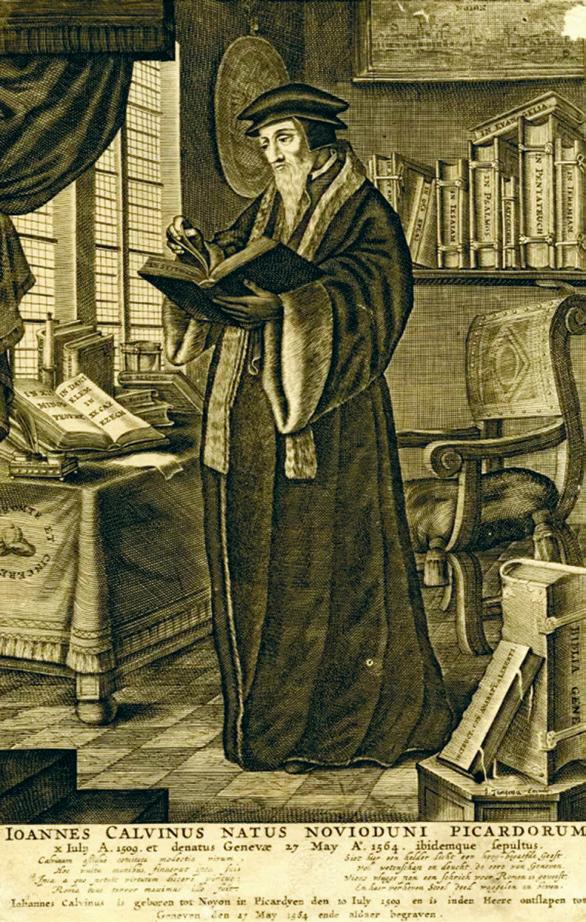
Jean Calvin dans son cabinet de travail, vers 1680-1690
John Calvin in his study, circa 1680-1690
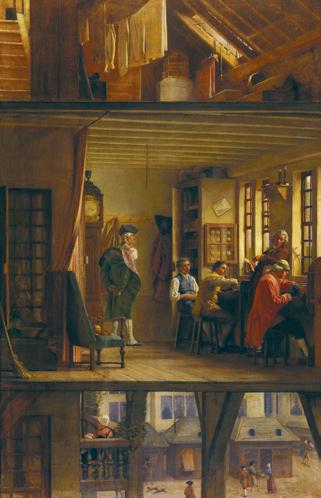
Our Watchmakers of the 18th Century, oil on canvas, Geneva, 1876 or 1879
Les guerres de Religion qui ravageaient le royaume de France depuis 1562 ont exercé une grande influence sur l’essor de l’horlogerie suisse. En 1685, la révocation de l’édit de Nantes, qui accordait la liberté de confession aux protestants, en a incité plus d’un à s’expatrier. Les grandes fortunes protestantes désertent le pays ainsi qu’une foule de soldats, médecins et artisans talentueux. Parmi eux, nombre d’horlogers ont pris le chemin de Genève et de l’arc jurassien. Cet apport d’horlogers huguenots français a été décisif pour l’essor de l’horlogerie genevoise.
The Wars of Religion, which ravaged the Kingdom of France from 1562 onwards, would play a crucial role in the rise of Swiss watchmaking. In 1685, following the revocation of the Edict of Nantes, which had allowed Protestants to practice their faith, many sought refuge elsewhere. Wealthy Protestant families fled the country, as did innumerable soldiers, doctors and talented artisans. Among them were watchmakers, who settled in Geneva and the Jura mountains. This arrival of French Huguenot watchmakers would be a turning point for the rise of watchmaking in Geneva.
Christophe François de Ziegler, Nos horlogers du XVIIIe siècle, huile sur toile, Genève, 1876 ou 1879
Au début du 17e siècle, la ville de Genève comptait déjà un grand nombre de professionnels actifs dans la production de montres. En 1601, ils créent la première corporation au monde sous le nom de « Maîtrise des horlogers de Genève ». Pour la rejoindre, il fallait présenter des travaux de maîtrise dont certains ont été conservés.
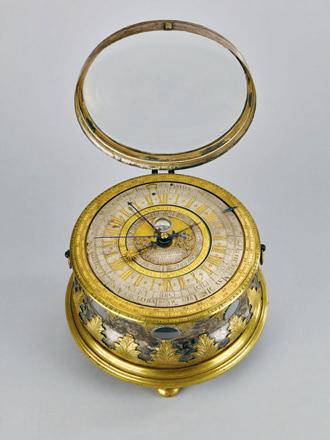
Ces pièces, qui témoignent déjà d’un rare savoir-faire, comprennent des montres à sonnerie ou à quantième ou encore des montres dites « astronomiques » affichant notamment les lunaisons, le calendrier solaire, les jours de la semaine et l’ordre d’apparition des planètes dans le ciel. Un siècle plus tard, en 1716, les graveurs créaient leur propre corporation.
In the early seventeenth century, a great many people were employed in watch production in Geneva. In 1601, they formed the Watchmakers Guild of Geneva, the first guild of its kind. Members were required to present a “masterpiece”, some of which have been conserved. Showcasing rare and refined expertise, these remarkable works include watches that chime the hour, timepieces with calendars and even “astronomical” watches displaying the phases of the moon, the solar calendar, the days of the week and the order of the planets in the sky. A century later, in 1716, the city’s engravers went on to establish a guild of their own.
Horloge astronomique de table, André Millenet, Genève, 1712-1713 Astronomical table clock, André Millenet, Geneva, 1712–1713
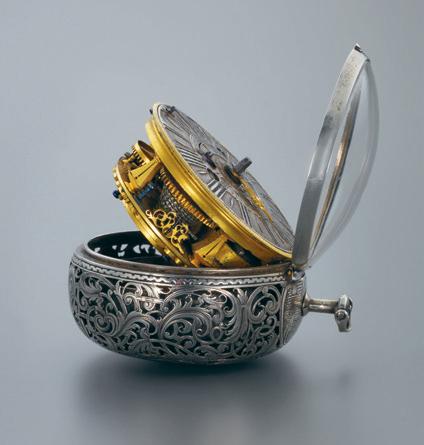
Lesaviez-vous ?
La plus ancienne montre connue signée d’un horloger genevois date du milieu du 16 e siècle et porte le nom de Duboule, patronyme typiquement genevois. A l’époque, ces garde-temps ne disposaient pas d’une autonomie allant au-delà de 15 à 16 heures. Il fallait donc sans cesse les remonter. Les progrès de l’horlogerie genevoise n’en seront pas moins rapides. Dès le 17e siècle, les montres genevoises rivalisent avantageusement avec la production française, allemande ou anglaise, autant de centres horlogers réputés de l’époque.
?know Didyou
The oldest known watch made in Geneva dates from the mid1500s and bears the signature Duboule, a common surname in Geneva. At that time, watches would run for no more than 15 or 16 hours before they needed winding. The city’s watch industry would progress as quickly as these watches unwound! By the seventeenth century, Geneva watches were serious rivals to those of France, Germany and England: countries renowned for the quality of their production.
Jean Chais, Montre réveil à double boîte, Genève, 1695-1700
Double case watch with alarm, Geneva, 1695-1700
La Fabrique
« La Fabrique qui fleurit le plus à Genève est celle de l’horlogerie ; elle occupe plus de 5’000 personnes, c’est-à-dire plus de la cinquième partie des citoyens ». Tels sont les termes utilisés dans L’Encyclopédie de Diderot et d’Alembert pour parler de Genève en 1757. Le mot « Fabrique » fait référence alors à cette multitude d’horlogers, orfèvres, bijoutiers et artisans de tous les métiers annexes dont les « cabinets », situés sous les toits pour une meilleure lumière, fleurissent aux abords du Rhône. A cette époque, Genève est un immense atelier voué à la mesure du temps, à la bijouterie et à la décoration d’objets d’art qui fonctionne en réseau avec une main-d’œuvre hautement qualifiée.
In an entry in Diderot and d’Alembert’s Encyclopédie, published in 1757, we can read that “Geneva’s most thriving Fabrique is watchmaking. It employs more than 5,000 people, which is over one fifth of the citizens.” The term Fabrique refers to the multitude of watchmakers, goldsmiths, jewellers and other artisans whose workshops or cabinets, often tucked high under the eaves where natural light was the strongest, lined the banks of the Rhône. The city itself became a vast workshop devoted to the production of timepieces, jewellery and decorative objects with its highly skilled workforce operating as an interconnected network.
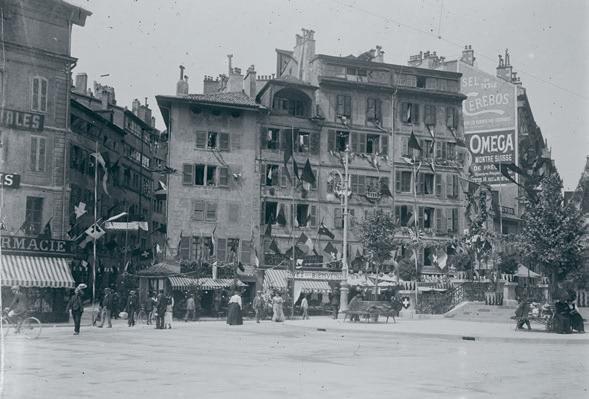
La Fabrique, qui a fait la réputation de Genève dans toute l’Europe, repose sur une stricte division du travail entre petits ateliers où travaillent des cabinotiers. Ceux-ci répondent aux commandes d’un établisseur qui fournit l’argent et les matières premières nécessaires aux artisans. Appelés à voyager, ces établisseurs ont pour tâche de répondre aux goûts de la clientèle étrangère à qui ces produits genevois sont destinés. En 1790, Genève exporte déjà plus de 60’000 montres et compte près de 400 patrons cabinotiers installés sur les rives du Rhône.
Famed across Europe, Geneva’s Fabrique was built on a finely tuned division of labour among countless specialised workshops. The cabinotiers employed there depended on commissions from an établisseur, who supplied the necessary funds and raw materials. These établisseurs were expected to travel, keeping abreast of the fashions and tastes of the international clientele who sought out Genevan watches. By 1790, the city was already exporting more than 60,000 timepieces a year, with nearly 400 cabinotiers clustered along the banks of the Rhône.
Genève, place de Saint-Gervais entre 1906 et 1910 Geneva, Place de Saint-Gervais between 1906 and 1910
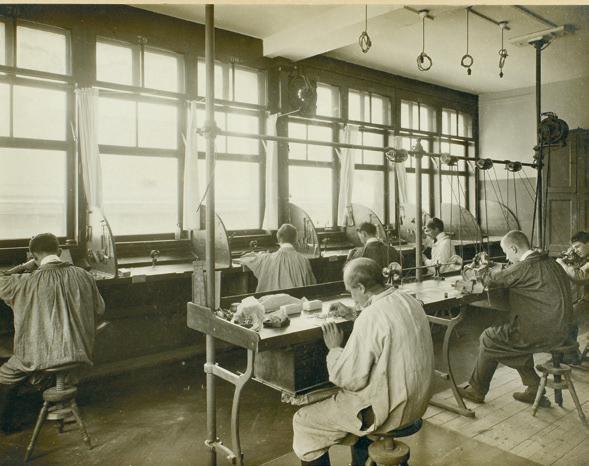
Si la Fabrique a connu son âge d’or jusqu’au 19e siècle, l’arrivée de la production mécanique en série dans de grands ateliers mettra fin à ce modèle artisanal. De plus, au début du 20e siècle, les montres de poche commencent progressivement à céder du terrain au profit des modèles de poignet nettement plus « démocratiques » pour lesquels le partage des tâches prend une tournure nettement plus industrielle.
The Fabrique would thrive into the nineteenth century, but could not compete with the emerging model of serial production in much larger workshops. By the early twentieth century, demand was also shifting away from the traditional pocket watch towards the far more “democratic” wristwatch—a product whose manufacture required a distinctly more industrial organisation.
Genève, rue Necker : école d’horlogerie, après 1878 Geneva, Rue Necker: watchmaking school, post-1878
Lesaviez-vous ?
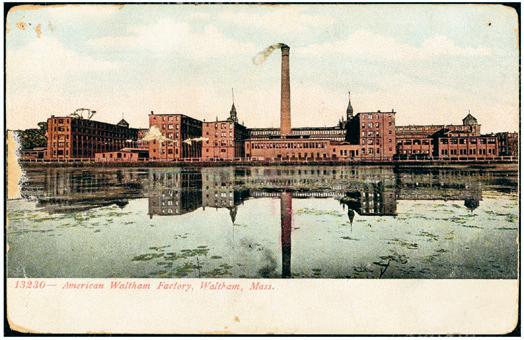
En 1850, deux Américains, Edward Howard et Aaron Lufkin Dennison, fondent l’American Waltham Watch Company, dont le concept est révolutionnaire pour l’époque : produire de manière industrielle des mouvements avec une précision suffisante pour que toutes les pièces soient complètement interchangeables. Une organisation du travail à l’opposé de l’établissage artisanal encore en vigueur en Suisse. Sur ces bases, les horlogers américains gagnent des parts de marché au détriment des Suisses qui mesurent non sans stupeur leur retard lors de l’Exposition universelle de Philadelphie de 1876. À tel point que Jacques David, ingénieur suisse chez Longines, aura ces mots : « Messieurs les horlogers suisses, réveillez-vous ! ».
?know Didyou
In 1850, Edward Howard and Aaron Lufkin Dennison founded the American Waltham Watch Company based on a revolutionary concept: the mass-production of movements using mechanised means and interchangeable parts. This could not have been further from the artisanal établissage system that was still in use in Switzerland. Thanks to this new method, American watchmakers won market share from the Swiss who, when visiting the 1876 Centennial Exposition in Philadelphia, were astounded to discover how far behind their American rivals they were. The message delivered by Jacques David, an engineer at Longines, was clear: “Swiss watchmakers, wake up!”.
Manufacture des montres américaines Waltham, Waltham Massachusetts
American Waltham watch factory, Waltham, Massachusetts
Les émaux de Genève
L’émaillage consiste à créer ou reproduire des motifs à l’aide d’émaux, une matière issue de la famille du verre qui se présente sous forme de poudre fine. Différentes techniques ont été développées au cours des âges champlevé, cloisonné, grisaille, plique-à-jour ou peinture miniature—pour décorer des cadrans et boîtiers de montre par la liaison de l’émail au métal lors de passages au four à environ 800°C. Comme chaque couleur doit être « cuite » pour être vitrifiée, les passages au four se multiplient en fonction de la complexité du motif, soit autant d’opérations délicates car chacune peut altérer les couches d’émail déjà appliquées.
Geneva enamels
Enamelling is the art of creating or reproducing a design in enamel a form of finely powdered glass. A range of techniques champlevé, cloisonné, grisaille, plique-à-jour and miniature painting—are used to decorate watch dials and cases, firing the enamel so that it bonds with the metal surface. Each colour must be heated to 800°C for the enamel to vitrify. The more intricate the design, the greater the number of firings, and with each firing comes the risk of altering or damaging the previous layers.
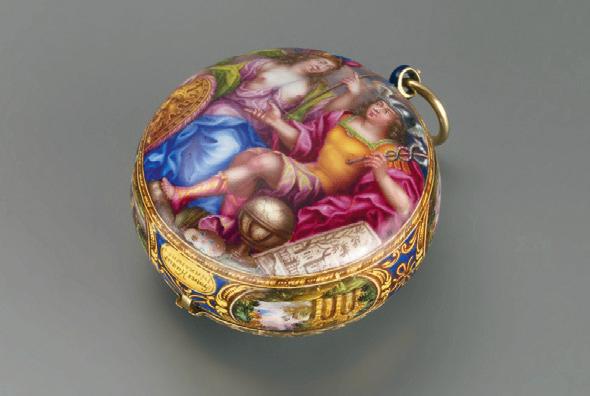
Dès le 16e siècle et grâce à leur maîtrise technique, les horlogers ont réalisé des chefs-d’œuvre d’émaillage. S’il est vulnérable aux chocs, l’émail est un matériau robuste, voire inaltérable, dont la vivacité des couleurs chatoyantes a vite été appréciée pour l’ornementation des montres et bijoux. Genève, dont l’horlogerie est déjà reconnue à l’international à cette époque, se forge alors une réputation avec ses « émaux de Genève » réalisés par de célèbres peintres miniaturistes.
From the sixteenth century, Geneva was famed for the skill and artistry of its enamellers. Despite being vulnerable to impacts, enamel is a remarkably durable and virtually inalterable substance whose vibrant colours readily lent themselves to watches and jewellery. With Geneva’s watches already enjoying an international reputation, the city soon became equally well known for its enamels, thanks to the work of its master painters and miniaturists.
Montre de poche Minerve et Mercure, peinture sur émail, Amy et Jean-Pierre Huault, Genève ; mouvement par Fromanteel, Londres, vers 1680 Minerva and Mercury pocket watch, enamel painting by Amy and Jean-Pierre Huault, Geneva; movement by Fromenteel, London, circa 1680
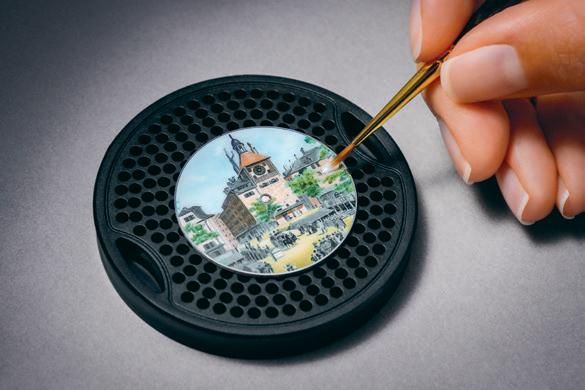
A hand-painted miniature in Grand Feu enamel depicting the Tour de l’Île in Geneva,
Les émaux de Genève représentent une technique particulière de peinture miniature en émail grand feu sous fondant. L’émail grand feu est vitrifié, c’est-à-dire transformé en verre par fusion dans un four chauffé entre 800 et 1200°C, d’où l’appellation « grand feu ». Quant au « fondant de Genève », il consiste à ajouter une ultime protection transparente et incolore qui protège les motifs ou peintures émaillées, tout en leur conférant brillance et profondeur. Les montres de poche, soumises à des frottements répétés, ont été les premières à bénéficier de cette technique.
Geneva enamel refers to a specific technique of miniature painting in Grand Feu enamel under a layer of fondant. Grand Feu enamel is vitrified: the enamel is transformed into glass by fusion in a furnace at a temperature of 800°C to 1,200°C— hence the name “Grand Feu” or “great fire”. As for the fondant, this final layer of transparent and colourless enamel protects the painted motif while adding depth and brilliance. Pocket watches, which were constantly exposed to friction against fabric, were the first to benefit from this innovation.
Peinture miniature émail Grand Feu réalisée à la main représentant la Tour de l’Île à Genève, Vacheron Constantin
Vacheron Constantin
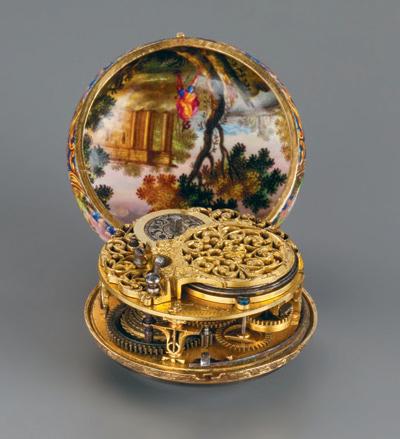
Montre de poche Minerve et Mercure, peinture sur émail, Amy et Jean-Pierre Huault, Genève ; mouvement par Fromanteel, Londres, vers 1680 Minerva and Mercury pocket watch, enamel painting by Amy and Jean-Pierre Huault, Geneva; movement by Fromanteel, London, circa 1680
Lesaviez-vous ?
Au 17 e siècle, on distingue les émailleurs qui travaillent pour la Fabrique et se spécialisent dans le décor des garde-temps, des bijoux et des tabatières. Souvent formés à l’orfèvrerie, ils se spécialisent dans un deuxième temps dans la peinture sur émail. Il y a ensuite les peintres sur émail miniaturistes qui signent leurs créations en tant que portraitistes ou comme auteurs de scènes de genre. L’idée d’appliquer l’émail peint au décor d’une boîte de montre revient à Pierre I Huault (vers 1612–1680), père de 11 enfants dont 3 fils prendront sa succession.
?know Didyou
In the seventeenth century, enamellists working within the Fabrique decorated timepieces, jewellery and snuffboxes. Many had first trained as goldsmiths, later specialising in enamel painting. They were distinct from enamel miniaturists, who signed their work, whether portraits or genre scenes. The idea of painting an enamel decoration on a watch case came from Pierre Huault I (c. 1612–1680). He was the father of eleven children, and he was succeeded by three of his sons.
Le Poinçon de Genève The Hallmark of Geneva

L’aigle noir couronné à l’aile déployée, symbole de ville impériale, et la clé de saint Pierre ouvrant le Royaume des cieux, tels sont les emblèmes officiels du canton de Genève. Ils sont repris pour le Poinçon de Genève, certification d’excellence garantissant aussi bien la provenance des montres que leur bienfacture, leur fiabilité et leur précision.
Historiquement, le Poinçon de Genève a été instauré en guise de protection anti-contrefaçon à une époque où l’horlogerie genevoise avait déjà le vent en poupe. En 1886, pour contrôler et identifier la provenance des montres, le Grand Conseil du canton adopte ainsi une nouvelle loi sous l’appellation « Contrôle facultatif des montres de Genève ». Pour obtenir le Poinçon, les montres fabriquées et réglées à Genève doivent dès lors remplir 12 critères stricts aux niveaux technique et esthétique.
The canton of Geneva’s coat of arms features a crowned black eagle with outstretched wing— the sign of an imperial city—alongside St. Peter’s key to the kingdom of heaven. These same emblems appear on the Hallmark of Geneva, which guarantees the origin of a watch and attests to the excellence of its craftsmanship, reliability and precision.
The original purpose of the Hallmark of Geneva was to protect Geneva’s reputation for the finest quality watches against counterfeits. In 1886, the canton’s Grand Council passed a law for the voluntary inspection of Geneva watches. Henceforth, for a watch to be awarded the Hallmark of Geneva, it had to be made and adjusted in Geneva, and comply with twelve stringent technical and aesthetic criteria.
Logo du Poinçon de Genève Hallmark of Geneva logo