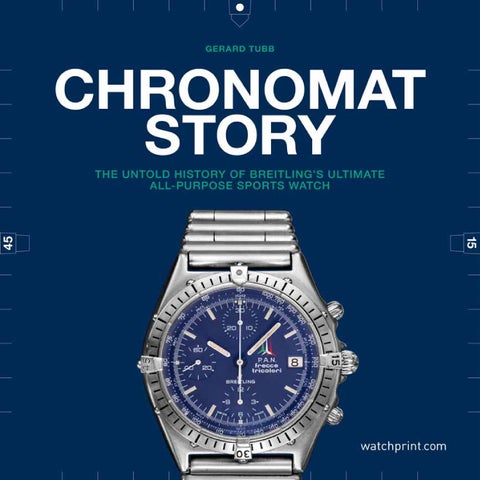
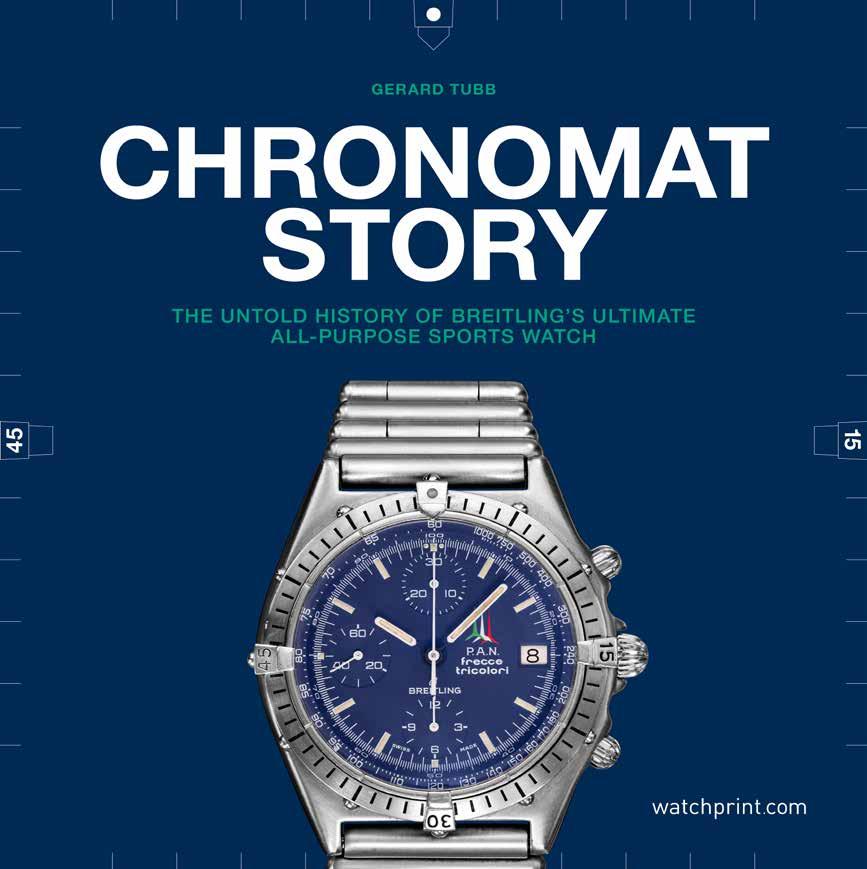
All rights reserved. No part of this publication may be reproduced in any manner whatsoever. The texts and illustrations in this book have been chosen independently and solely for editorial purposes by the company Watchprint.com Sàrl. Breitling SA is in no way involved in or responsible for these choices.
ISBN 978-2-940506-66-8
Author: Gerard Tubb
Historic Advisor: Fred Mandelbaum
Editor: Natasha Mekhail
Publishing Manager: Anne-Lise Ensminger
Contributing Editor: Philip Blumer
Collection Advisor: Ralf Messmer
Watch Photographer: Elias Hartmann
Photo Editor: Simona Girella
Research Catalogers: Tanja Jedlitschka, Christoph Kainzner
Design: Images3
Printing: Graphius, Belgium
See our watch and jewelry-themed publications on our website, www.watchprint.com
CHRONOMAT TIMELINE 1983
Since 1983, the Chronomat has been refined from every angle. This timeline traces that evolution, inside and out, focusing on stainless-steel models for consistency. While it includes various strap and bracelet options, the focus remains on the dial, case, and movement. The selection shows core models only, which dictates the defining functionality of the model: time, chronograph, and date.
The Chronomat’s life cycle reveals how early consistency eventually gave way to new demands and shifting trends before returning to its roots. Today’s models unite everything that has made the Chronomat remarkable—distinction, robustness, versatility—while also serving as a canvas for creativity and collaboration.
FRECCE TRICOLORI CHRONOGRAPH
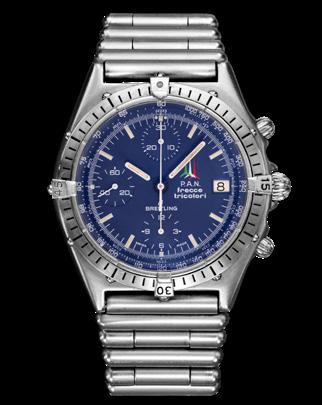
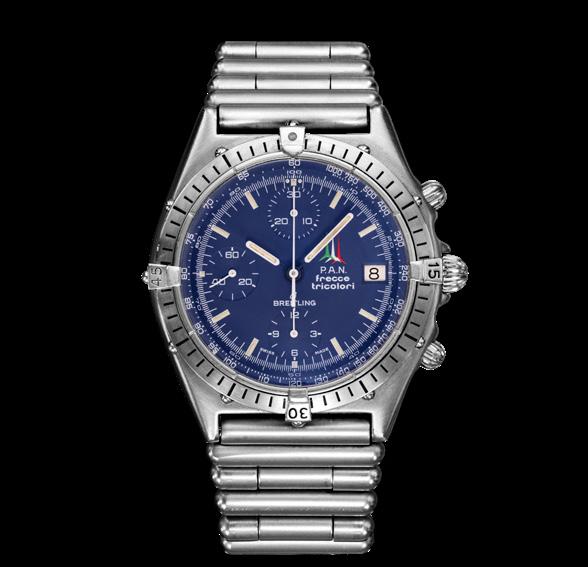
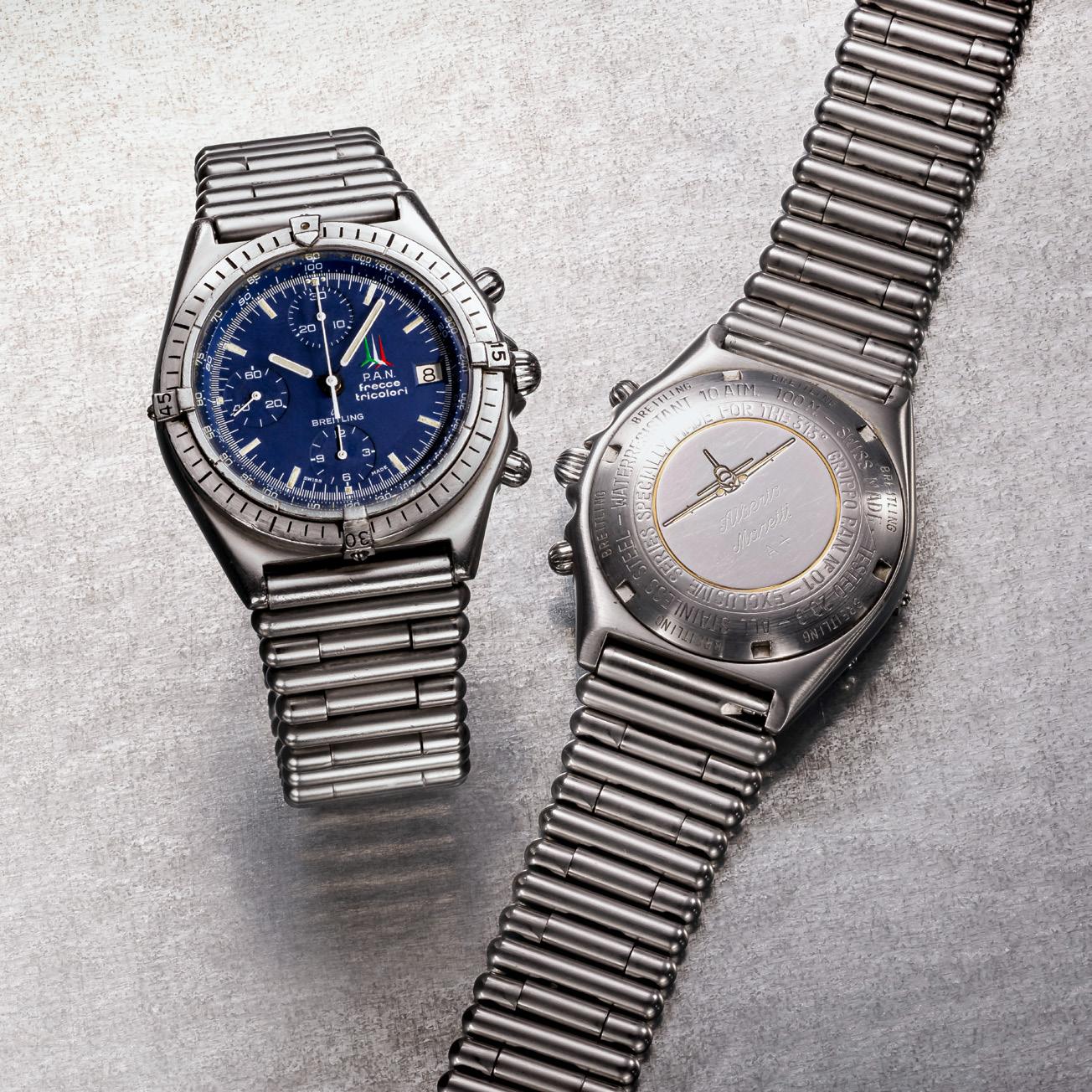
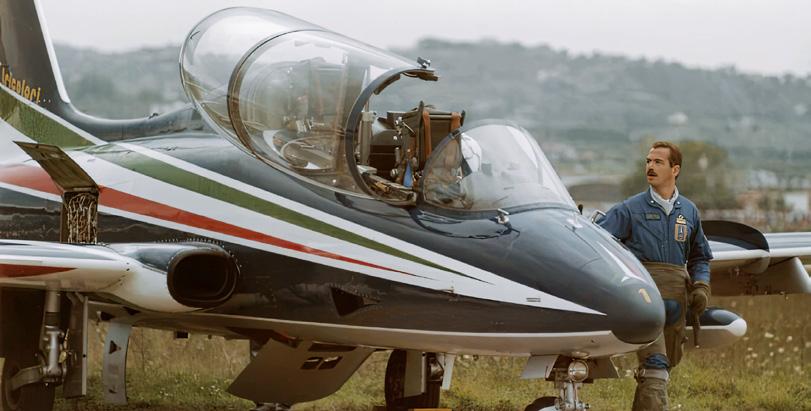
Developed for Italy’s Frecce Tricolori aerobatic team, the automatic chronograph that kickstarted Breitling’s resurgence under Ernest Schneider. Built to military specifications in 1983 and gifted to the squadron in 1984. It was exclusive to DPW, the private label that commissioned the design.
REF. 80950
1987 1985 1984
CHRONOMAT
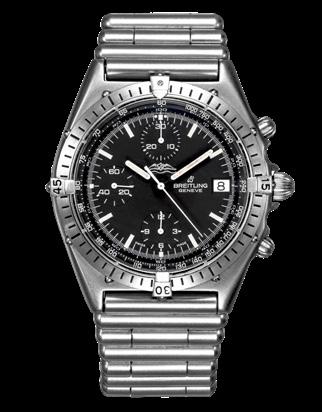
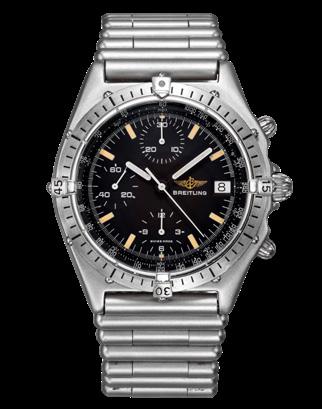
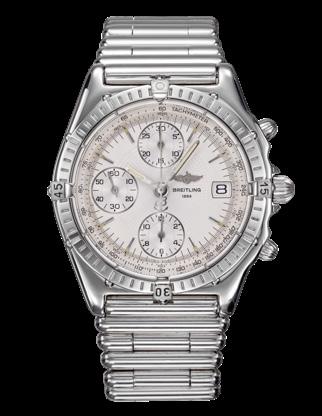
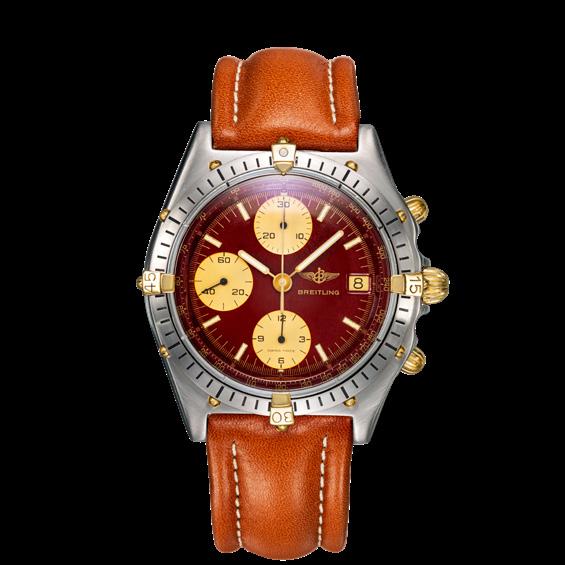
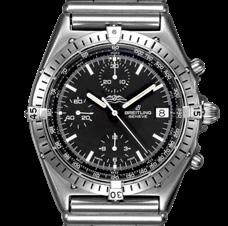
Identical to the squadron’s watch except for the dial color, logo, and caseback. With the AOPA-style logo and lumed dots flanking the 12 o’clock index, it was produced for less than a year. There were six dial combinations in stainless steel and two-tone.
CHRONOMAT
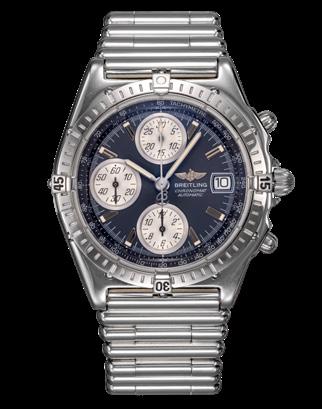
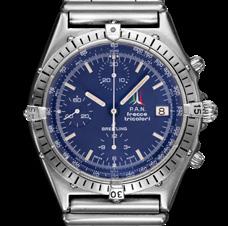
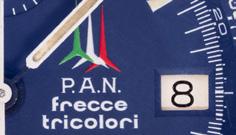
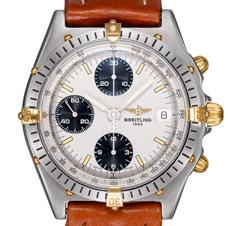
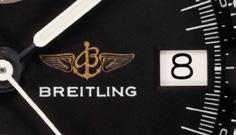
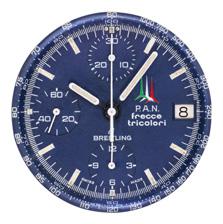
The 1985 catalog introduced Breitling’s wings-and-anchor logo. The dial evolved alongside it with bigger subdials and removal of the lumed dots at 12 o’clock. A small DPW run followed, distinguished by a blue dial and the Frecce Tricolori logo.
CHRONOMAT
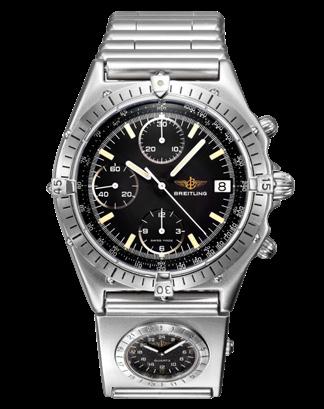
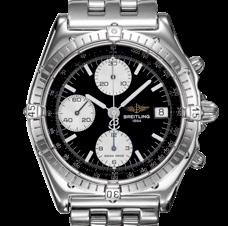
Contrasting rings surrounded the subdials. This example shows the UTC module introduced the same year. The reference number changed to 81.950 in 1988, then to 13047 in 1989, when a prefix letter was added to denote the case material. REF. 81950 A
1996 1992 1994
CHRONOMAT
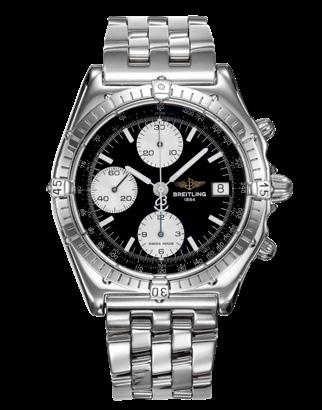
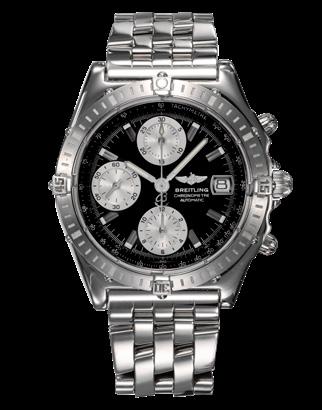
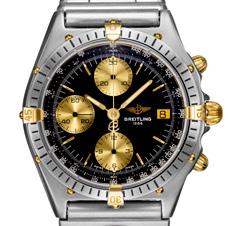
Polished cases were first introduced in 1990, then bezel screws replaced the screw-headed studs. Tapered baton hands and a sweep hand with “B” counterweight were soon joined by thicker subdial hands. Plated rider tabs, pushers, and crown later gave way to solid gold.
CHRONOMAT
On the Chronomat’s 10th anniversary, the reference changed to 13050. Commemorative models featured special casebacks engraved with a front-facing MB-339, reminiscent of early Chronomats. Offered in three case metal variants, each was limited to 1,994 pieces and engraved “1884–1994” along with its limitation number.
CHRONOMAT
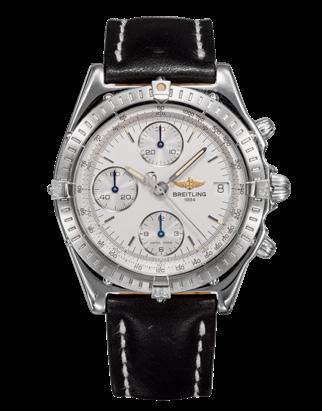
“Tachymeter” was printed on the top right of the rehaut, along with a line around the date window. Subdial hands gained a short counterweight and the number of subdial numerals increased. The rehaut and dial moved to one piece, necessitating a modified case.
REF. 13050.1
2004 1997 2000
CHRONOMAT GT
The collection split into two variants. Large subdial numerals defined the GT, for “Grand Totalizer,” while western Arabic hour numerals distinguished the Vitesse. In 1999, both GT and Vitesse changed to ref. 13350, with the central “3” denoting COSC-certification.
CHRONOMAT 2000
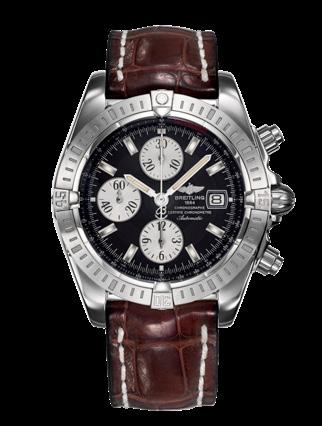
The first model exclusively to use COSC-certified calibers. All other Breitling watch lines followed shortly after. The change was identified by the “Chronometre” below the logo. The bezel returned to its original brushed finish, and subdials introduced radial numerals.
CHRONOMAT EVOLUTION
For Breitling’s 120th anniversary, almost every aspect of the watch got an update. The diameter increased to 43.7mm and thickness to 17mm. With the introduction of screw-down pushers, water resistance was upgraded to 300m.
REF. 13356
WILLY’S PASSION—TO SUCCEED, TO PROTECT THE FAMILY HERITAGE, TO DO THE RIGHT THING— ONLY ADDED TO THE PRESSURE.
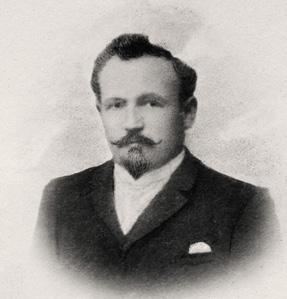
1. Leon Breitling, who founded the company in 1884.
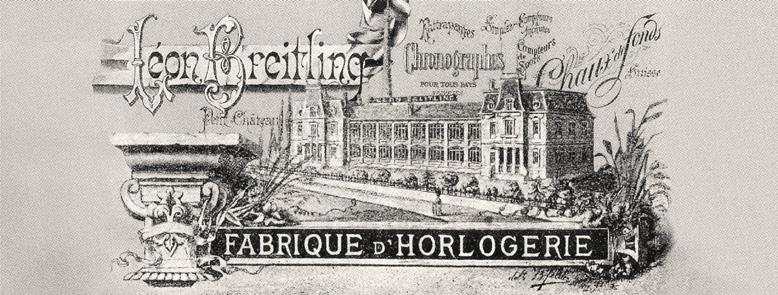
2. Leon shared his Ruelle Montbrillant factory with other manufacturers and traders. In the custom of the day, the Breitling sign and chimney were added by the engraver.
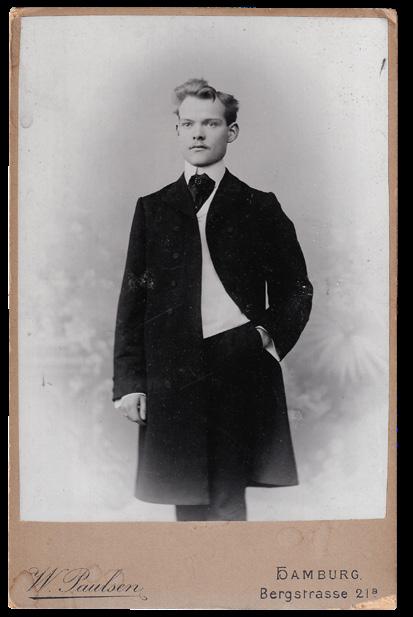
3. Gaston Breitling, Leon’s son, credited in 1915 with inventing the first wrist-worn chronograph with an independent pusher at two o’clock.
“Willy was a skilled watchmaker and an innovative creator,” said Caspari, who knew Breitling’s owner better than perhaps anyone outside his family—first in La Chaux-deFonds after the war, then as close neighbors in Geneva in the early 1950s. “He was the most passionate person I have ever known.”
Willy’s passion—to succeed, to protect the family heritage, to do the right thing—only added to the pressure. Looming large in his thoughts was Breitling’s Montbrillant factory in La Chaux-de-Fonds. It was his childhood home as well as the center of his professional life.
The factory had been the pride and joy of his grandfather, Leon Breitling, who moved there in 1892, eight years after founding the business. Perched on high ground on the Boulevard du Petit-Chateau, the building stood on the edge of an old rural estate, with views over fields and woodland. Shared with other watchmakers, it was flanked by two imposing villas—one of which would remain the Breitling family home for four generations.
For Leon, the location signaled his growing status and ambition. Trade grew when mains electricity arrived in the city five years later, and he became a commercial landlord, renting warehouse and workshop space in what was described as the most beautiful location in the city.
When a new road, Ruelle Montbrillant, was built behind the factory, Leon renamed the business “L. Breitling, Montbrillant Watch Manufactory.” Proud of his achievements, he commissioned an engraving of the building with an imagined “Leon Breitling” sign and a fictitious factory chimney for added effect.
Leon died suddenly at 54, leaving behind a legacy of innovation in timekeeping for the industrial age. His son Gaston succeeded him, creating the first wrist chronograph with a pusher at two o’clock to start, stop, and reset. But tragedy struck again when Gaston died at 43. His son Willy was only 14; it would be five years before he could take over. When he did, he too made his mark, patenting a second independent pusher at four o’clock, a design that became the form of the modern chronograph.
“Willy had been torn between his dream of becoming a pilot and the reality of having to run the family business,” Caspari was quoted as saying in a 2005 Breitling publication. “But he chose the path of watchmaking, and the ambition inherited from his grandfather and father did not die out. It’s no exaggeration to say Willy was the one who developed it most powerfully.”
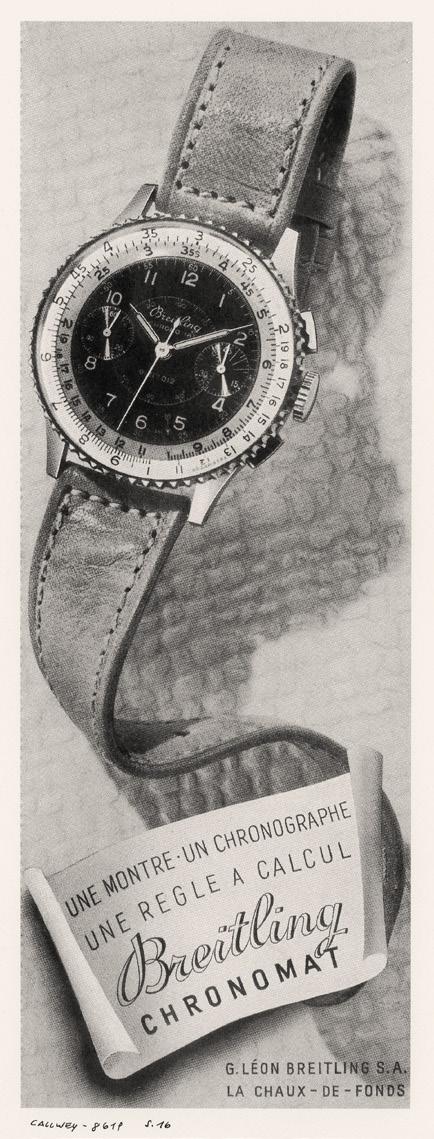
In 1938, Willy established the Huit Aviation department to develop cockpit instruments and wrist chronographs for professional pilots. This work led to the 1941 launch of the original Chronomat—a “Chronograph for Mathematicians”—featuring a patented circular slide rule for performing calculations.
In the 1950s, he developed the Navitimer as a third-party commission for the Aircraft Owners and Pilots Association (AOPA). Its success amongst pilots, and subsequent 1955
Willy Breitling’s 1941 Chronomat—a Chronograph for Mathematicians—featured a patented circular slide rule that was later adapted for the Navitimer.
release as a Breitling core collection model, cemented Breitling’s reputation in commercial aviation. By the 1960s, Willy was leading a chronograph revival with models like the SuperOcean and Top Time.
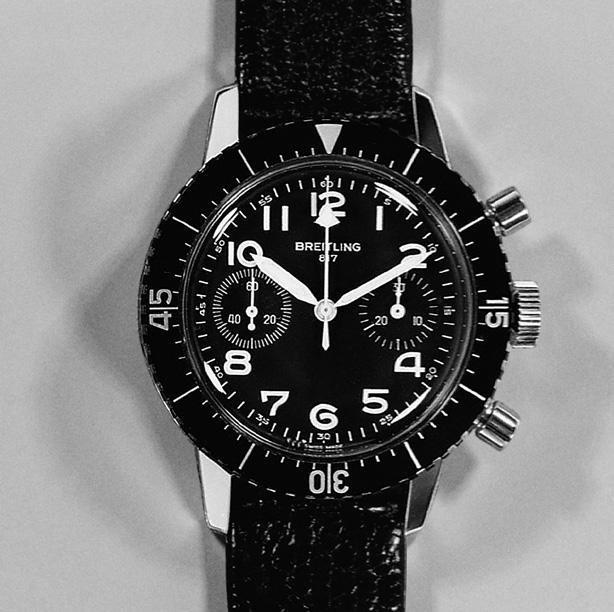
But history offered no shield from the quartz crisis. Losses mounted, and in 1974 he was forced to cut his highly skilled workforce. Refusing to give up, he turned again to the third-party market. In 1975, he created the ref. 817 for Italian Army pilots and paratroopers from the elite Folgore brigade. Designed to meet the army’s CP-1 and CP-2 class requirements, it was never sold to the public. For Willy, it must have been like going back to the wartime commissions of the Huit Aviation department.
Despite all his efforts, a heart attack left him dispirited and vividly aware of his father and grandfather’s early deaths. By 1978, he had no choice but to close Montbrillant.
Still, his search for a buyer continued. Caspari remembered Willy’s strict conditions: “The successor had to understand the mechanism of the chronograph, be able to handle the new trend of cutting-edge technology such as quartz, and above all, love airplanes.”
Under pressure from the quartz crisis in 1975, Willy Breitling created the ref. 817 for the Italian Army’s elite Folgore paratroopers brigade.
An unexpected phone call Grenchen, Switzerland, 1978
If you love airplanes like Ernest Schneider did, an office in Grenchen was hard to beat. On the edge of Switzerland’s Jura mountains with their spectacular scenery and fresh mountain air, it had an all-important airport where he could park his Beechcraft Bonanza plane. For the aviator-entrepreneur, it was the perfect base for his growing watch company, Sicura.
“Ernest Schneider commutes by private plane between [Sicura’s] four assembly factories at
Grenchen, Bonfol, Salvan, and Melano,” the company catalog proudly proclaimed. “The designs of this dynamic collection are inspired by Mr. Schneider and are appreciated most by the 16 to 35 year age group.”
The expensive plane was a symbol of the success the 57-year-old had earned since he spoke at the 1968 La Chaux-de-Fonds meeting on the threat of foreign competition. He had been better equipped to capitalize on the
1. The spectacular scenery of the Jura Mountains was on the doorstep of Ernest Schneider’s office. It was the perfect backdrop for flights in the private plane he adored.
2. Ernest Schneider was obsessed with flying, and in awe of aerobatic pilots.
Enter Federico Parodi
Genoa, Italy, 1979
As the Breitling family era closed in Geneva, events 300 kilometers away in Genoa were setting the stage for the brand’s revival.
Federico Parodi—the Italian watch supplier who would knock on the door of the Frecce Tricolori in 1982—was leaving behind a career in maritime law to set up a watch business in his home city.
Parodi had been a major in the Folgore paratroop brigade, the same unit that Willy Breitling had provided with the ref. 817 military watch in 1975.
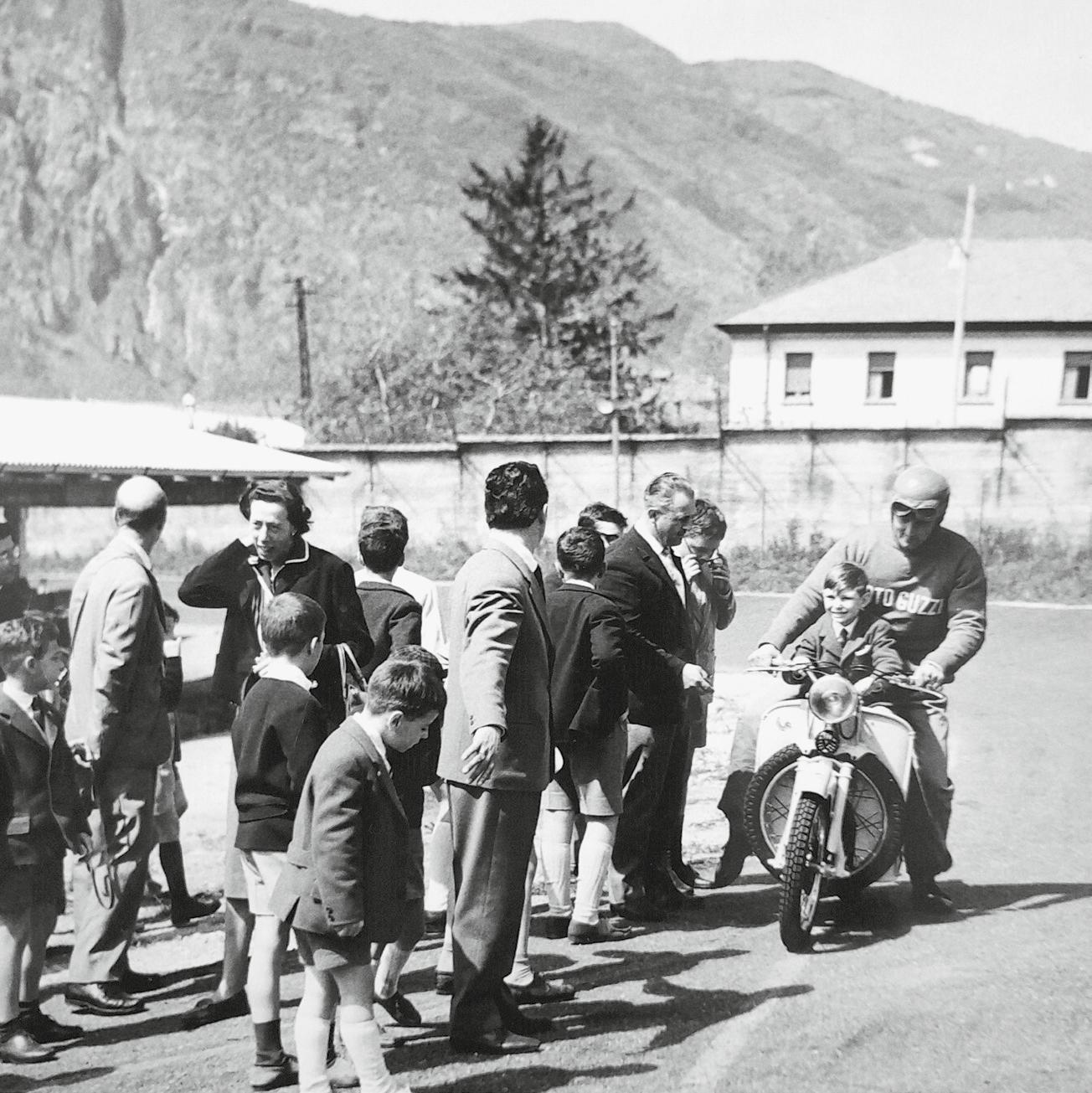
At 29 years old, he had the confidence, contacts, and resources befitting the son of a prominent Genoese family. His uncle, Giorgio Parodi, was a decorated military aviator, immortalized in a statue overlooking Genoa’s historic Piazza della Vittoria. Giorgio had co-founded the Moto Guzzi motorcycle company in 1921
1. Federico Parodi, aged eight, in 1958 on a Moto Guzzi Galletto—the model that was released on the day he was born. The fame and influence of his family was crucial to his early success in the watch industry.
2. Parodi in 1975 with an Aeritalia G.222 transport plane. He was an officer in the elite Folgore paratroopers brigade. 2.
with fellow airman Carlo Guzzi and Federico’s financier grandfather Emanuele Vittorio Parodi. Federico’s own father, Enrico Parodi, later joined the firm, helping to build it into Italy’s largest motorcycle manufacturer and a major supplier to the military.
Following in his family’s footsteps, Federico set out to supply the military as well—only his product would be watches, not motorcycles.
2
1982–1984 ORIGIN STORY
Fulfilling a promise
The Frecce Tricolori commission galvanized Ernest Schneider to produce the best watch of his career. The timing could not have been better. In 1982, after years of quartz dominance, Schneider knew a shift was coming. “I had to keep my promise to Willy Breitling to protect the tradition of mechanical chronographs,” he said in a 2005 interview for Breitling Japan. His son Theodore later recalled that his father had always believed mechanical movements had “that something extra, that personality, that little bit of soul.”
Rising prosperity was putting disposable income in customers’ pockets, and cheap electronic watches were starting to feel just that—cheap. Mechanical watches, by contrast, were reemerging as status symbols and Breitling’s competitors were already working on new models. Conspicuous consumption was all the rage, and a valuable mechanical wristwatch could set you apart. The average price of a Swiss quartz watch was about to fall, while the price of mechanical timepieces was poised to surge. On a graph, the crossover point coincided exactly with Breitling’s decision to accept Federico Parodi’s order.
Schneider later said he was already sketching designs for a new mechanical chronograph when the Frecce Tricolori opportunity came up, and that he had flown to Italy to consult the squadron: “In order to protect the Breitling tradition that Willy Breitling had built, it was an absolute requirement for me to meet the pilots and hear their specific requests.”
It was an echo of a claim about Willy Breitling made by the brand’s advertising mastermind Georges Caspari: “Willy was pursuing the ideal chronograph for pilots,” Caspari was quoted as saying in 2002. “He personally traveled to England and America to listen to the opinions of many pilots. The Navitimer was created by collecting their opinions.” That
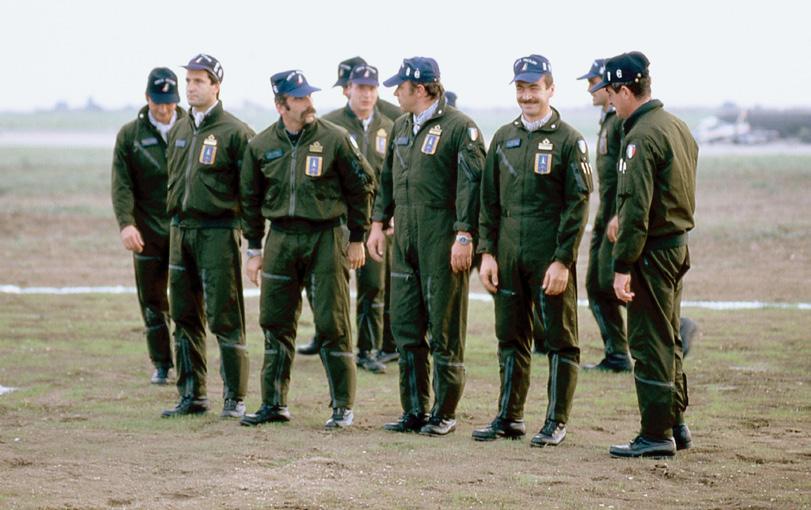
November 1984. The earliest known photo of Frecce Tricolori pilots wearing their exclusive ref. 80950 chronographs.
Italian flair
The big question about the Chronomat has always been: Where did it come from? How did Ernest Schneider’s tiny Breitling team that lacked any professional designers create an all-new watch that shocked the industry in 1984 and has continued to turn heads ever since? The answer lies in Schneider’s energetic efforts to turn a profit.
The Frecce Tricolori request was the third commission to reach Breitling in just a few months. The other two could not have been more different. One was a fashion watch for the sportswear label Ellesse. The other was a technically demanding professional dive watch. Without these two projects, the Chronomat as we know it would never have been created.
The Ellesse commission was a coup for Breitling—the sportswear brand was both high profile and the height of fashion. At the Wimbledon tennis tournament the previous summer, both Women’s Singles finalists had worn prominently-branded Ellesse clothing.
To create the watch, Ellesse engaged Claudio Giovagnoni, an architect and the co-founder
of a trendy Italian design studio called Archap. “I decided to entrust its production to Breitling,” Giovagnoni recalled. “We thought it appropriate to involve a watchmaking expert as consultant, and chose Gino Macaluso.”
A trained architect, former rally champion, and the son of a watch distributor, Macaluso had stepped into the family business when his father died in the mid 1970s. He was 34 when Giovagnoni introduced him to Schneider. Once again in the history of the Chronomat, the stars aligned. Not only were two professional designers working closely with Schneider in the crucial months of the Chronomat’s creation, but Macaluso was ideally positioned to seize the opportunities it offered, on the way to becoming one of the most influential figures in Swiss watchmaking.
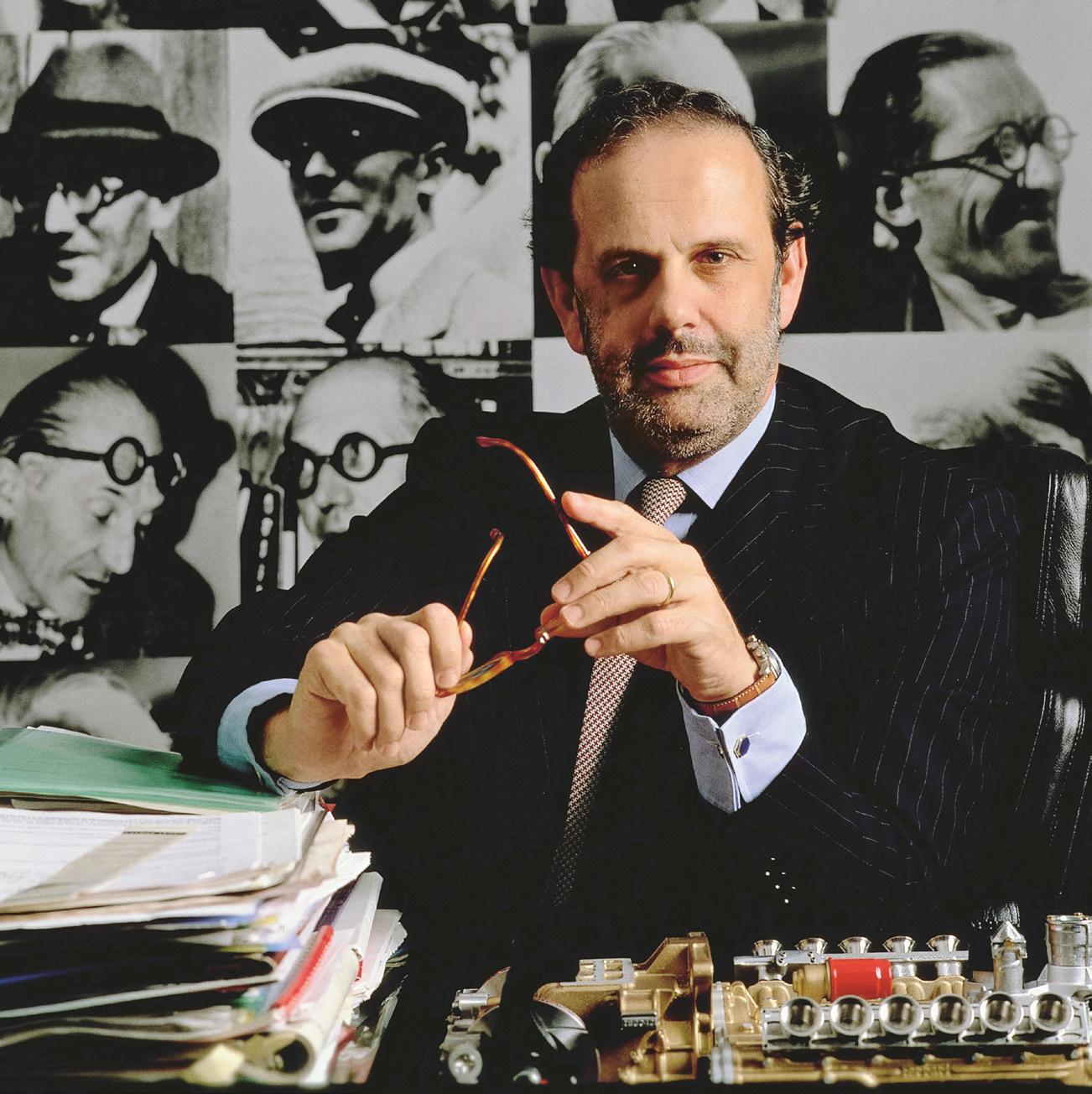
Macaluso, pictured in the 1990s.
Gino
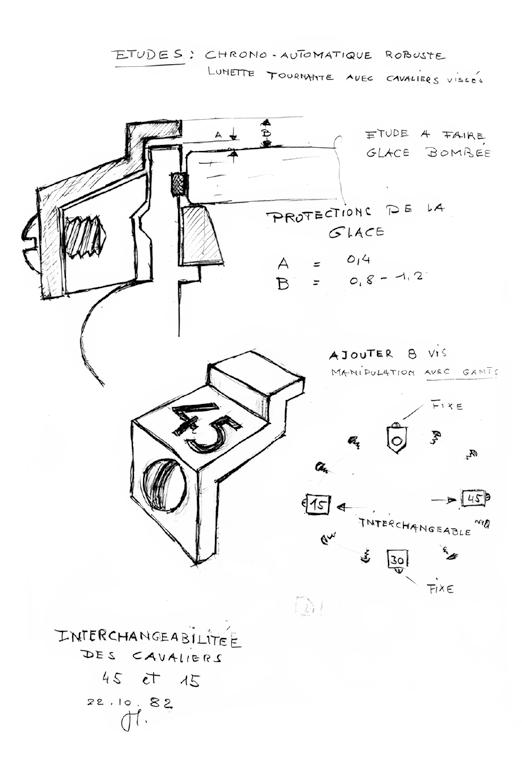
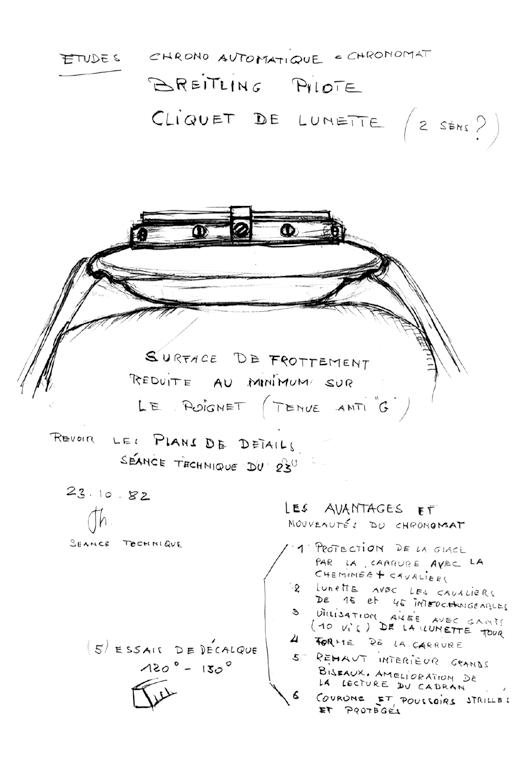
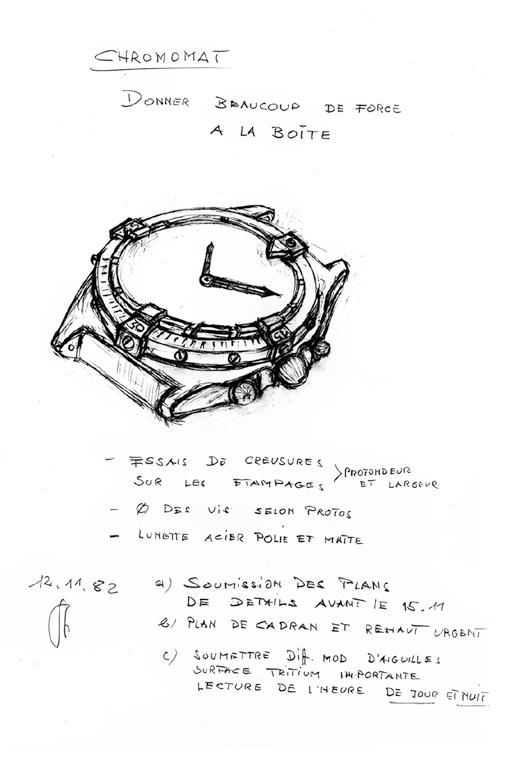
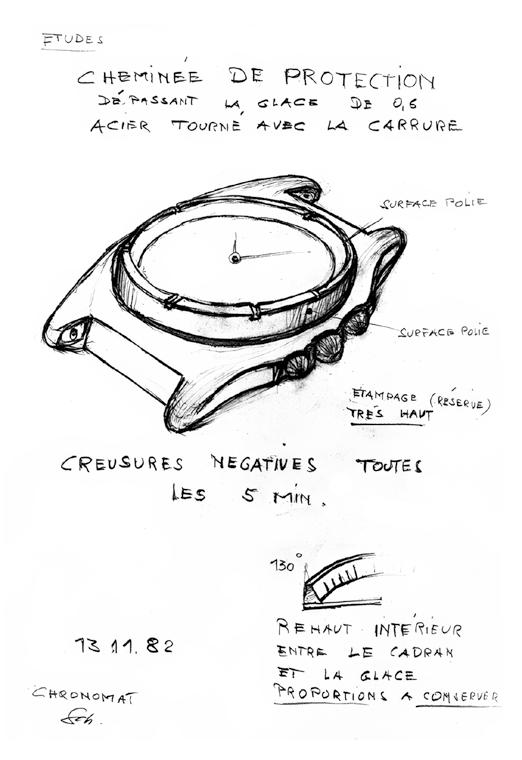
SCHNEIDER’S DRAWINGS
SHOW THE 15- AND 45-MINUTE RIDER TABS WERE DESIGNED TO BE INTERCHANGEABLE.
Schneider’s drawings of the Chronomat reveal just how much the design—and even the name—was in flux leading up to the November 1982 deadline.
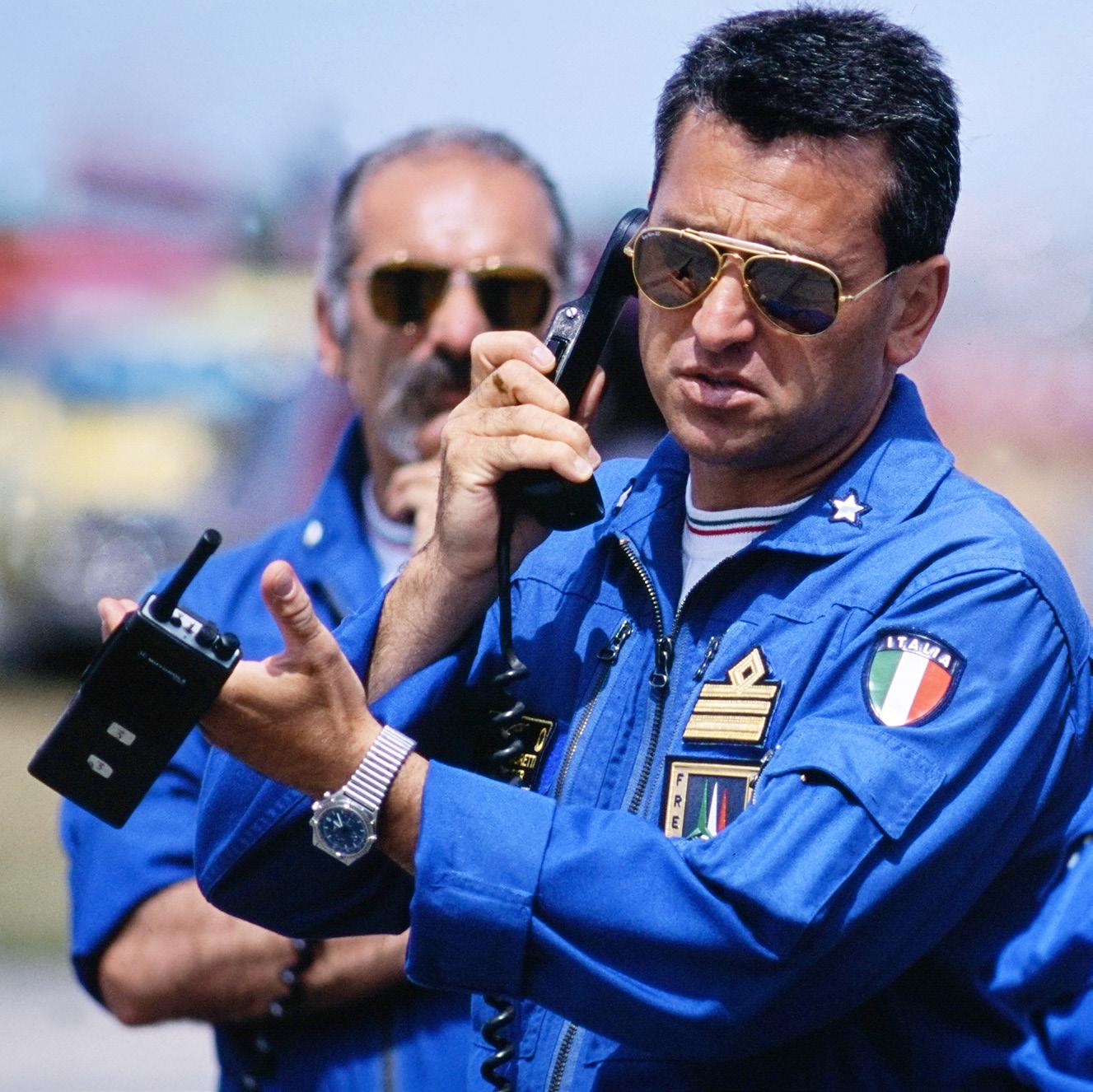
pilot.’” For team leader, Vito Posca, the moment carried special weight: “It was a very nice watch, and the first time that a civilian enterprise was allowed to use the Frecce logo. That was a really big thing.”
Parodi left the most lasting impression on squadron liaison officer Gianfranco Da Forno—later a brigadier general. “He was very
anxious to show the characteristics of the watch, especially the bracelet,” Da Forno recalled, still laughing at the memory of Parodi claiming the bracelet could prevent slipping in winter. “He was showing us we could put it under our feet to walk on the snow!” Forty years later, the image of his prized Chronomat being used for traction remains as vivid as it is endearing.
1. Federico Parodi’s exclusive squadron chronographs were assembled by Breitling without serial numbers. Parodi numbered the first 22 sequentially, and says he gave two the number 0.
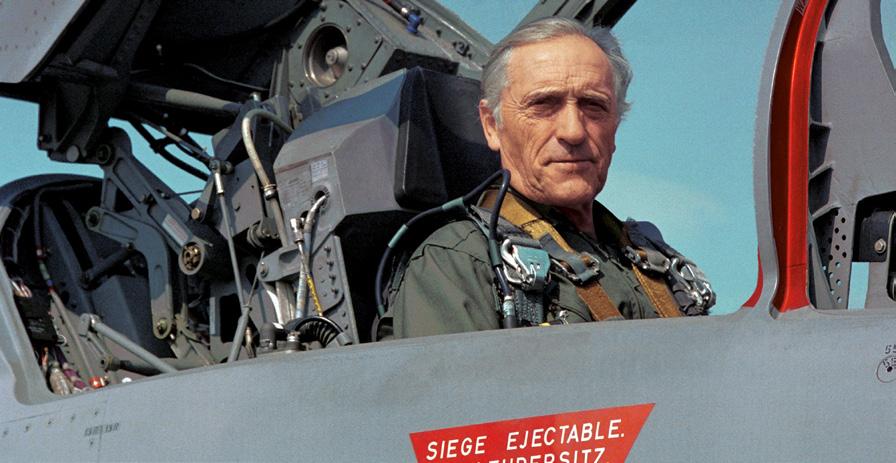
2. Major Vito Posca, team leader of the Frecce Tricolori when the squadron was presented with its exclusive Chronomats. His watch is pictured far left.
2.
3
1984–1990 CATCHING FIRE
In step with its improvements in distribution, Breitling was launching adventurous Chronomat-centered partnerships that gave retailers stories to tell and signaled that Breitling was once again a brand of ambition.
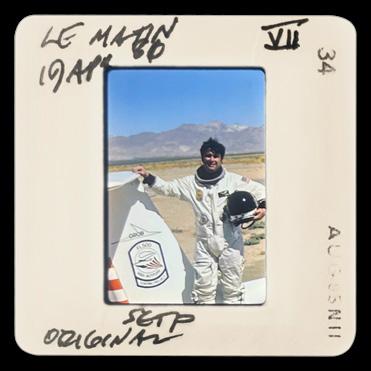
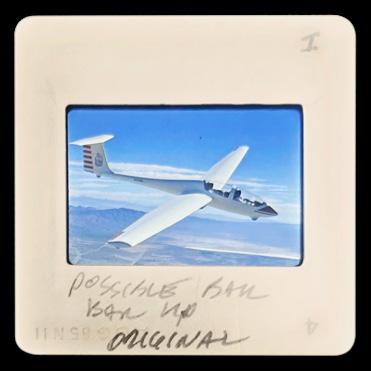
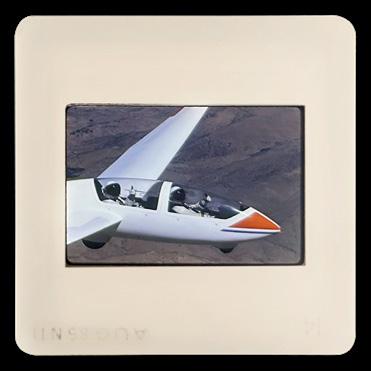
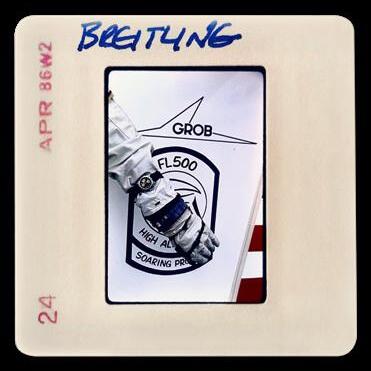
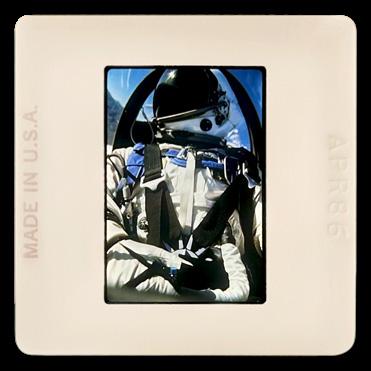
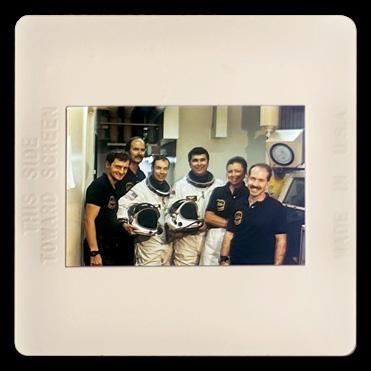
At the 1986 Basel fair, extreme-altitude pilots
Bruce Brosi and Ed Peerens posed at the Breitling booth with the $250,000 US space suits used in their record-attempting FL500 glider project. Their unpressurized glider would climb above 14,000m (46,000ft), with Breitling Chronomats—specially lubricated to withstand -55°C—providing vital timekeeping.
“We used liquid oxygen and there were all kinds of battery requirements that we had to keep track of during the flight, so those Chronomats supported a lot of the mission,” Brosi said. The pair ultimately lost the altitude record to solo adventurer Bob Harris, but the Chronomat had proved itself capable of being pushed to the limit.
The FL500 altitude record for a Chronomat stood until 1992 when French astronaut Michel Tognini wore his on board the Mir space
station as a crew member of the French-Soviet Antares mission, making the Chronomat the second Breitling watch in space, after Scott Carpenter’s Cosmonaute in 1962.
Increased exposure helped get the Chronomat into more stores. In the Netherlands, Hans van Langerak still has the catalog he picked up in 1986, with the price of the Chronomat—3,695 Dutch guilders ($1,900 US) on a Rouleaux bracelet and 3,195 ($1,650 US) on leather—scribbled next to the picture of the watch he bought and still wears today.
Van Langerak was a 34-year-old advertising agency owner and could have been a poster boy for the Chronomat’s target audience.
“I just loved the design,” he said, “it was a technical tour de force.”
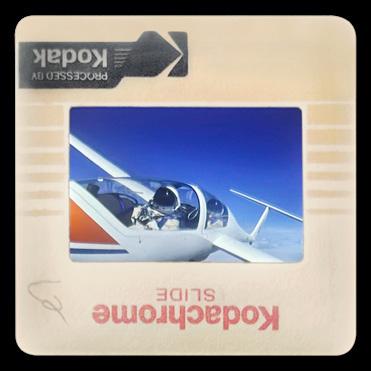
Promotional slides from the FL500 project, a NASA-assisted attempt to set a new world record for high-altitude glider flying. It was the Chronomat’s first sponsorship tie up. Pilot Bruce Brosi is pictured top left.
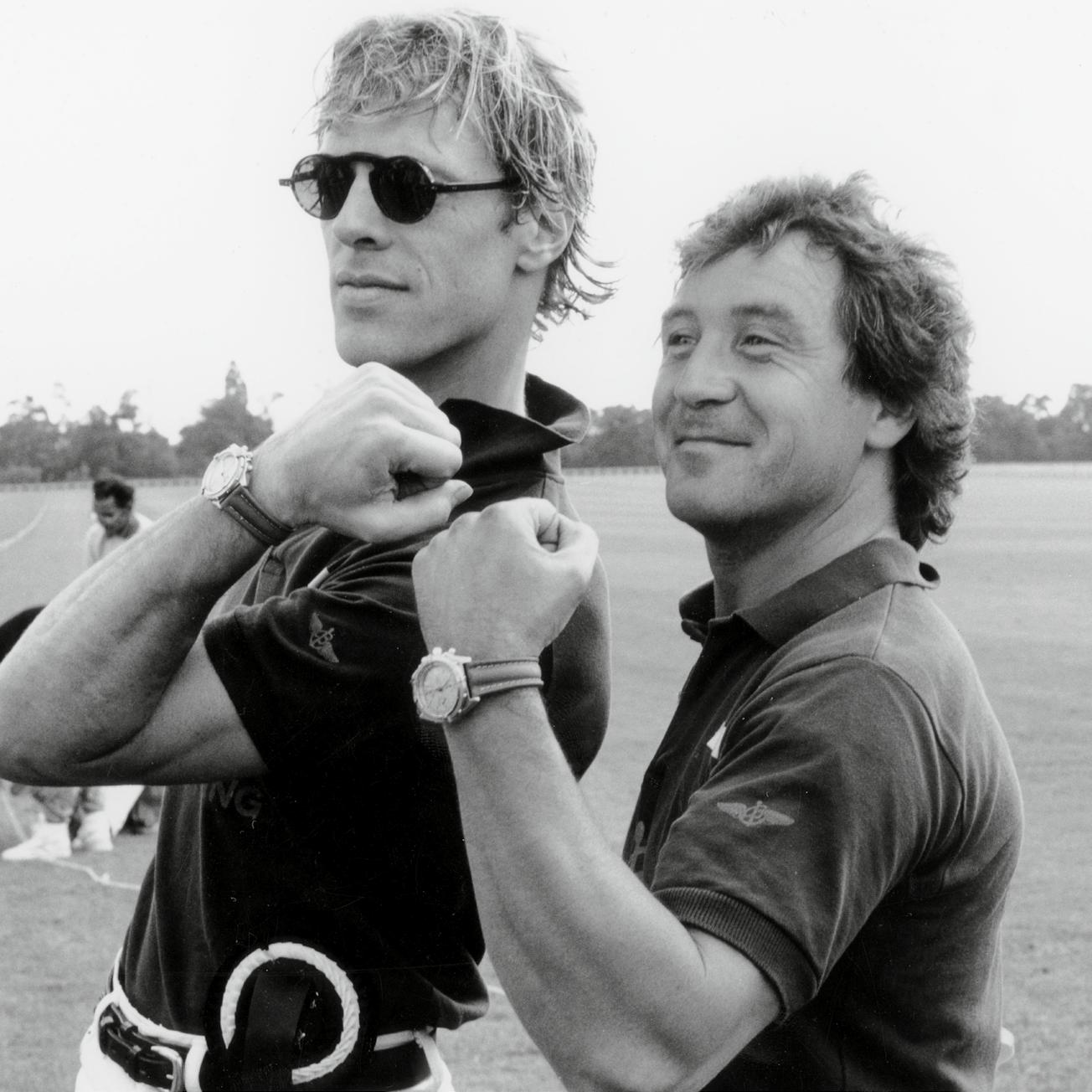
Drummers Stewart Copeland of the Police (left) and Kenney Jones of the Who with their winners’ Chronomats at the 1988 All Stars Rock and Roll Polo Day in Berkshire, England.
In the U.K., Schneider went all out for high society. Renowned watch collector Prince Ernst of Hanover set up The Watch Gallery in London with his wife, Grace Kelly’s daughter Princess Caroline of Monaco. Breitling was added to their stable—either to complement the aristocratic connections of Macaluso and Parodi in Italy, or because of them.
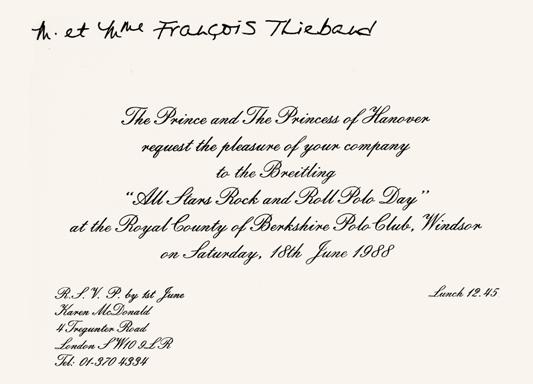
“You might see Michael Schumacher there, negotiating in the downstairs bar over a glass of champagne, or Madonna popping in to hold the hand of Guy Ritchie,” reported Tatler magazine. One of Prince Ernst’s first Breitling events was the All Stars Rock and Roll Polo Day in 1988 at the Royal County of Berkshire Polo Club founded by music mogul Bryan Morrison.
Dressed in Breitling polo shirts, the winning team—comprising Morrison, Genesis
Guitarist Mike Rutherford, and drummers
Kenny Jones of The Who and Stewart Copeland of Police—collected Chronomats, while invited guests went home with their monogrammed invitations from The Prince and Princess of Hanover.
Around the Mediterranean, demand followed the travels of the fashionable jet set. When the managers of an English high-street jewelry chain attended a sales conference in Mallorca in 1989, they gazed with amazement at the Chronomats in the windows of highend jewelers. One of them was watch specialist Jonathan Scatchard “They had black dials, with brown straps,” he recalled. “And we said, ‘Nobody’s ever done that before!’”
High society connections raised the Chronomat’s image across Europe. In the U.K., Breitling was promoted by Prince Ernst of Hanover and his wife Princess Caroline of Monaco.
A global phenomenon
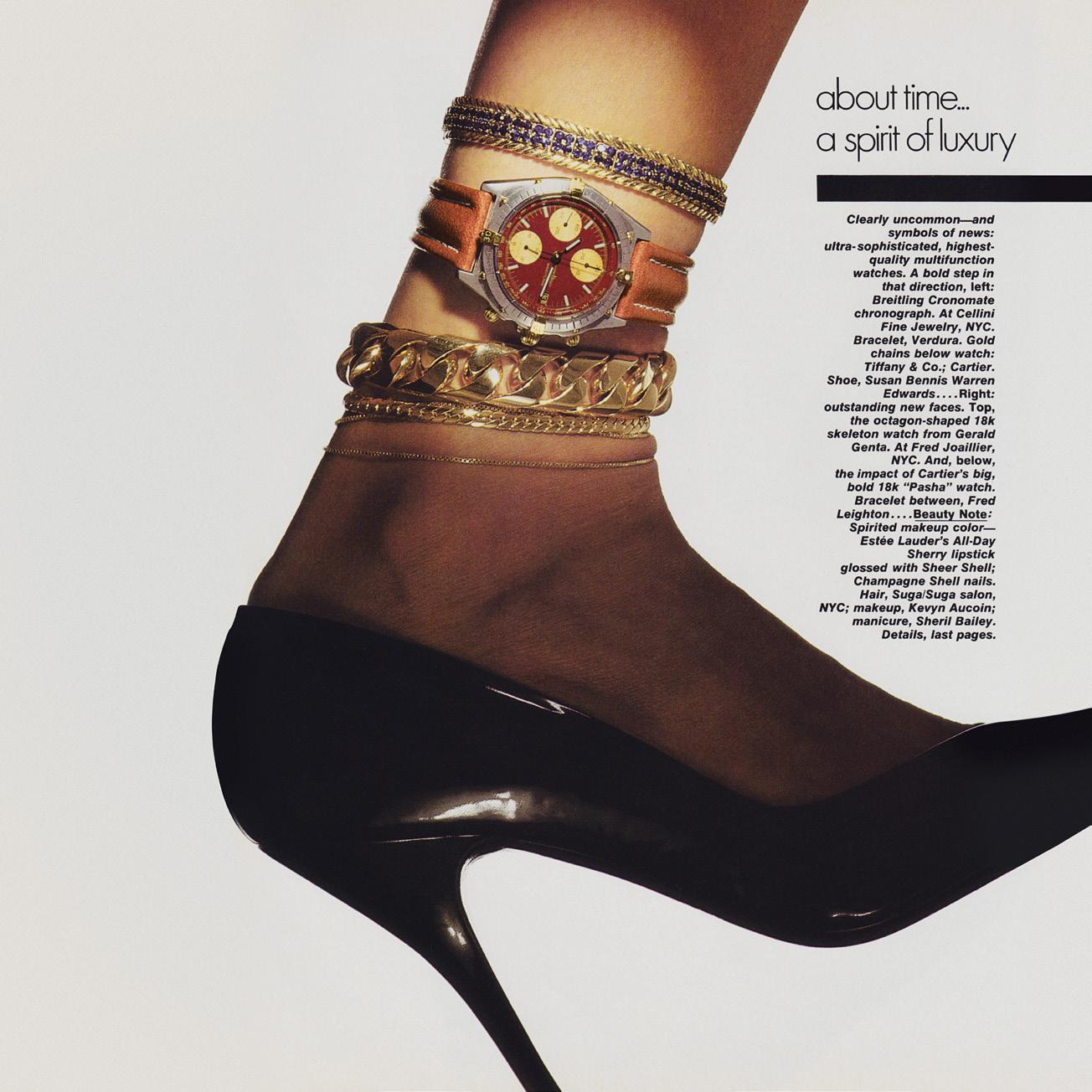
The Chronomat defined the 1990s, just as Anna Wintour’s American Vogue had predicted. Wearing one was the fastest way to signal your status. Kenny and Steve Grazi opened the world’s first dedicated Breitling boutique on New York’s Madison Avenue—a tiny space just 11 feet wide by 18 feet long— where the Chronomat took pride of place as Breitling’s bestselling model.
The big, heavy chronograph seemed to be everywhere as the fashion world splashed it across editorials. Nine out of 10 Breitling advertisements in Vanity Fair magazine at the
start of the decade featured the Chronomat, and month after month it dominated the back cover of London’s International Wristwatch.
In Japan, home to the quartz revolution that had threatened to sink the Swiss watch industry a decade earlier, a Breitling marketing campaign taught consumers to appreciate the intricacies of mechanical watches [See Big in Japan, p. 134], and Chronomats quickly became a must-have accessory.
Celebrity chef Gordon Ramsay made the yellow-dial version of the 37mm Chrono Cockpit a collector favorite.
THE FAMILY OF CHRONOMAT-INSPIRED MODELS GREW WITH EACH CATALOG AND ATTRACTED THEIR OWN DEVOTEES.
Back in Europe, where Italian boutiques and French celebrities had first made the Chronomat famous, sales went off the scale. Switzerland’s Bilanz rich list included not only the Schneider family, but Gino Macaluso, whose leather strap and Italian distribution had been so central to the Chronomat’s rise.
Professional sport joined the movement too. When Leeds United won the English Football League championship in 1992 and qualified for the European Cup, the Chronomat was the team’s watch of choice. “We presented one to manager Howard Wilkinson, and another to the captain, Gordon Strachan,” Breitling salesman Jonathan Scatchard recalled. “Then everyone wanted one. It was huge.”
The family of Chronomat-inspired models grew with each catalog and attracted their own devotees. Celebrity chef Gordon Ramsay wore his yellow-dialed steel Chrono Cockpit in shows like Hell’s Kitchen that made him a household name. On the debut episode of Friends in 1994, Courteney Cox’s
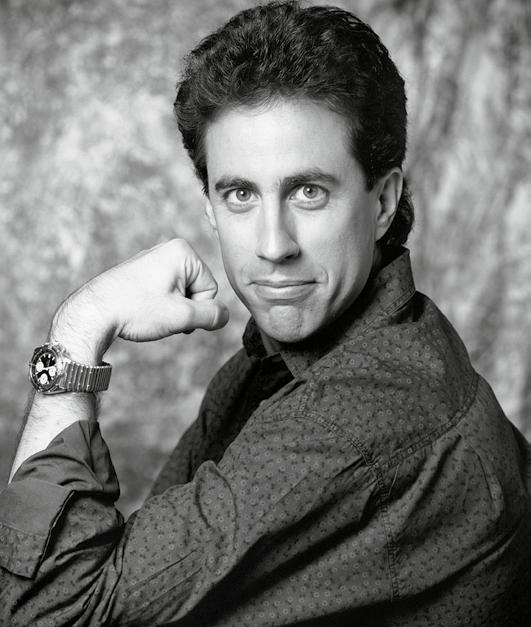
character Monica Geller wore the Chronomat-spinoff Sextant. And when 78 million Americans tuned in for 1998 finale of Seinfeld, the watch on Jerry Seinfeld’s wrist was the Chronomat.
1. Courteney Cox wore the Sextant, a Chronomat-derived model, on Friends
2. Jerry Seinfeld wore Chronomats throughout the nine-year run of his hit TV show Seinfeld.
Big in Japan The Chronomat lands in Tokyo
One market that came late to the Chronomat party was Japan, where mechanical chronographs had fallen out of favor after Seiko introduced the first quartz watch in 1969. Ernest Schneider and his son Theodore set out to change public opinion. In 1991 they recruited Atsushi Kimbara to head up a new Breitling Japan team tasked with creating a desire for traditional timepieces.
Kimbara knew that Japanese culture prized technical details and respected heritage. “We started at the beginning,” he said. Kimbara meant it literally, publishing a Breitling Handbook that began, “Mecha-
nical watches tell time through the meshing of springs and gears.”
Glossy magazines and informative books followed, explaining how chronographs are made and why they are worth the added cost: they “teach us the charm and excitement of mechanical timekeeping,” revealing “a sense of human wisdom and skill.”
To provide the vital back stories, Ernest Schneider broke the habit of a lifetime to give rare interviews in 2002 and 2005. Theodore Schneider, designer Eddy Schoepfer, and advertising executive GeorgesCaspari all lent their voices. Edited
in Switzerland, and only ever published in Japan, they remain the only occasion Ernest Schneider has gone on record about the Chronomat’s development.
Japan’s unique marketing effort—including a Breitling Club for owners that is still running today—was a success. By the end of the 1990s, the Breitling Handbook had gone through five editions and the Chronomat was as coveted in Tokyo as it had been in Turin more than a decade earlier. Kimbara recalled selling up to 9,000 of the watches annually by 1997.
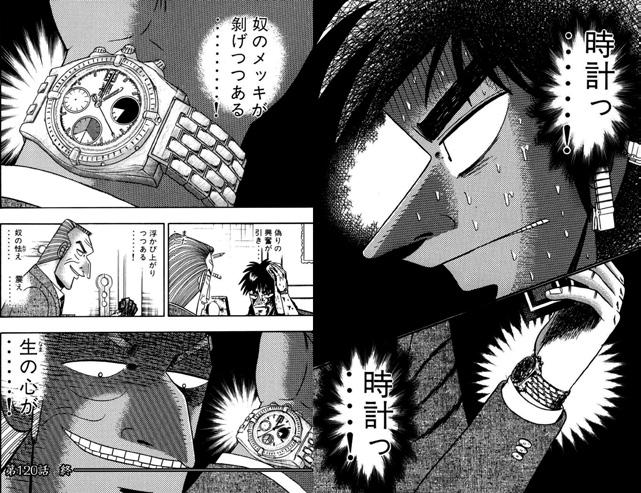
That same year, manga artist Nobuyuki Fukumoto featured the Chronomat in his
hit Kaiji series, famous for its stark portrayals of risk and survival—a work later cited as an influence for Squid Game.
In an unconscious echo of Schneider’s history of gadget watches, the Chronomat appeared as a kind of futuristic smart device, its subdials tracking Kaiji’s vital signs. On the wrist of the impeccably tailored antagonist Yukio Tonegawa, the Chronomat became shorthand for authority, power, and style.
Artist Nobuyuki Fukumoto chose the Chronomat for his Kaiji manga series because of its prestige. Breitling had invested heavily to promote mechanical chronographs in Japan.
The new Chronometrie rose at breakneck speed and was fully operational by the end of 2001. Its Swiss architect, Alain Porta, drew inspiration from the oversized windows of traditional watchmaking workshops by introducing long glazed bands that flooded the interiors with light. He clad the walls in Italian pietra dorata, a warm golden stone that became a hallmark of Breitling’s Schneider-era architecture.
Behind its distinctive facade, the factory was state of the art. Medical-grade ventilation replaced the air every 10 minutes, while positive pressure in the most sensitive areas eliminated two principal enemies of a watch movement: moisture and dust.
As production ramped up, Theodore’s insistence that the Chronometrie was vital to Breitling’s success was soon vindicated. In 2002, the Swatch Group announced it would stop supplying ETA movements to third-party brands by 2006. Switzerland’s anti-monopoly committee stepped in to delay the cutoff to 2010. But even with the extension, the announcement added urgency
to Theodore’s long-term plans. For Girardin the Chronometrie was a bricks-and-mortar expression of Breitling’s slogan: “The factory itself is an instrument for professionals,” he told guests.
Only five years after setting out its new strategy, Breitling had built more than an assembly line. It had created a home for the future of Swiss chronometry.
“THE FACTORY ITSELF IS AN INSTRUMENT FOR PROFESSIONALS.”
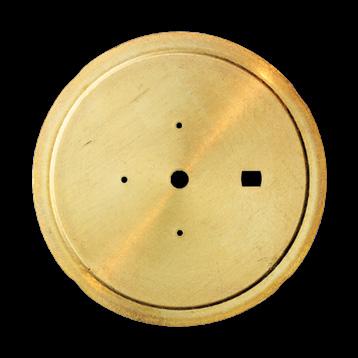
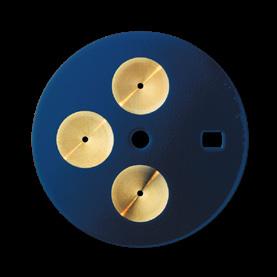
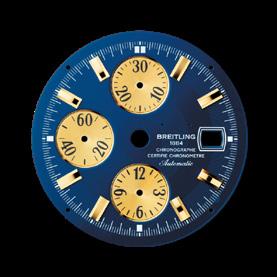
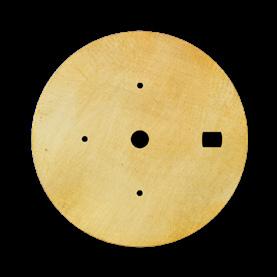
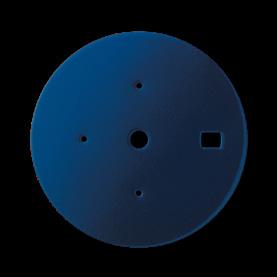
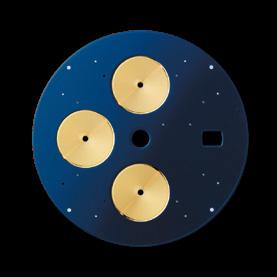
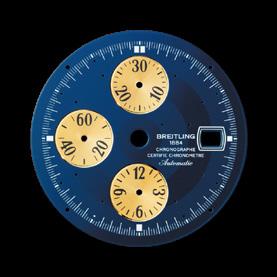
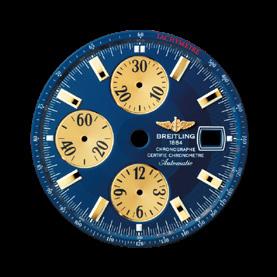
The creation of a Chronomat Evolution dial, from the brass blank to finished product, a journey that involved up to 80 processes.
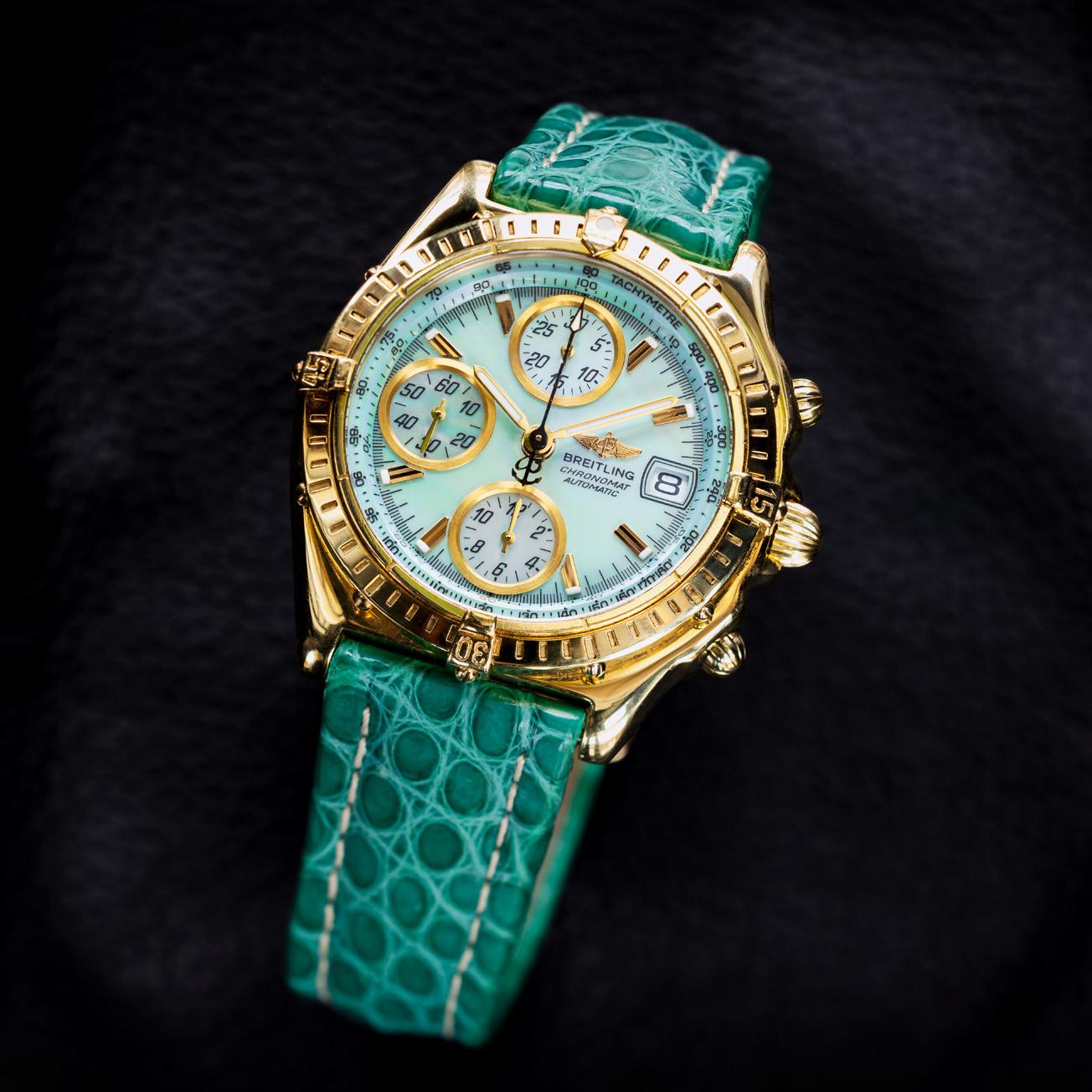
1. Chronomat GT, ref. K13050.1, 1997, 18k gold.
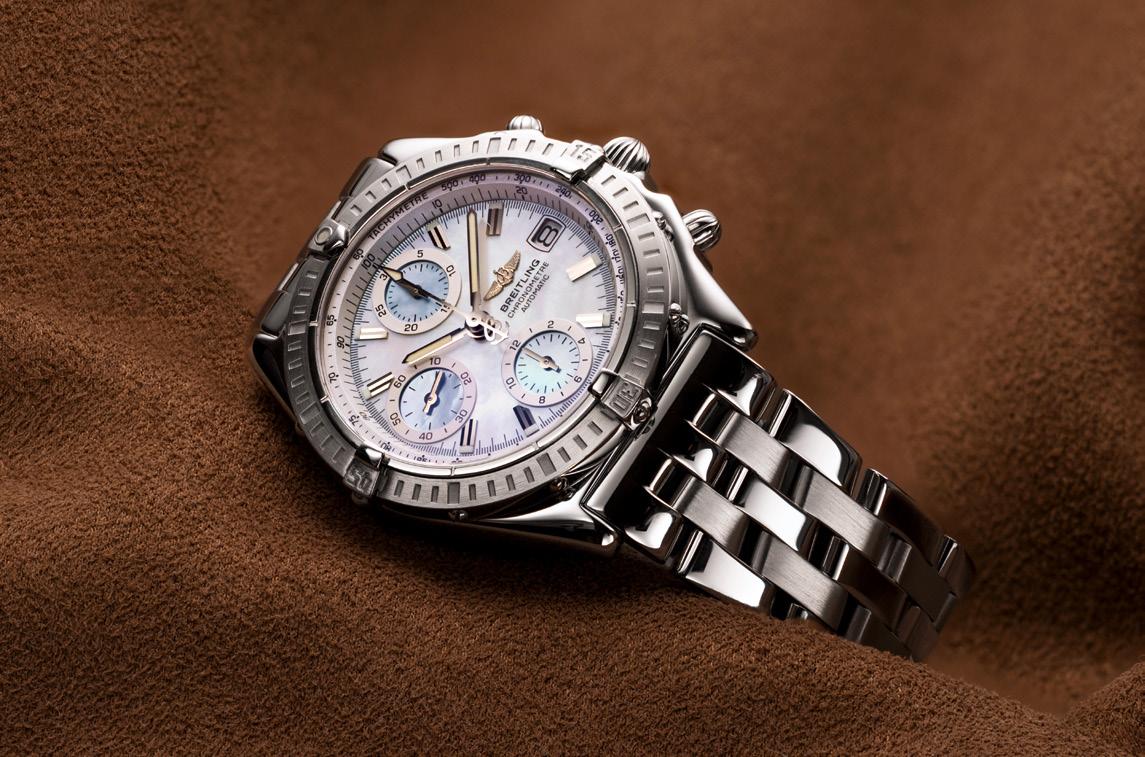
2. Chronomat, limited edition, ref. A13352, 2001
2.
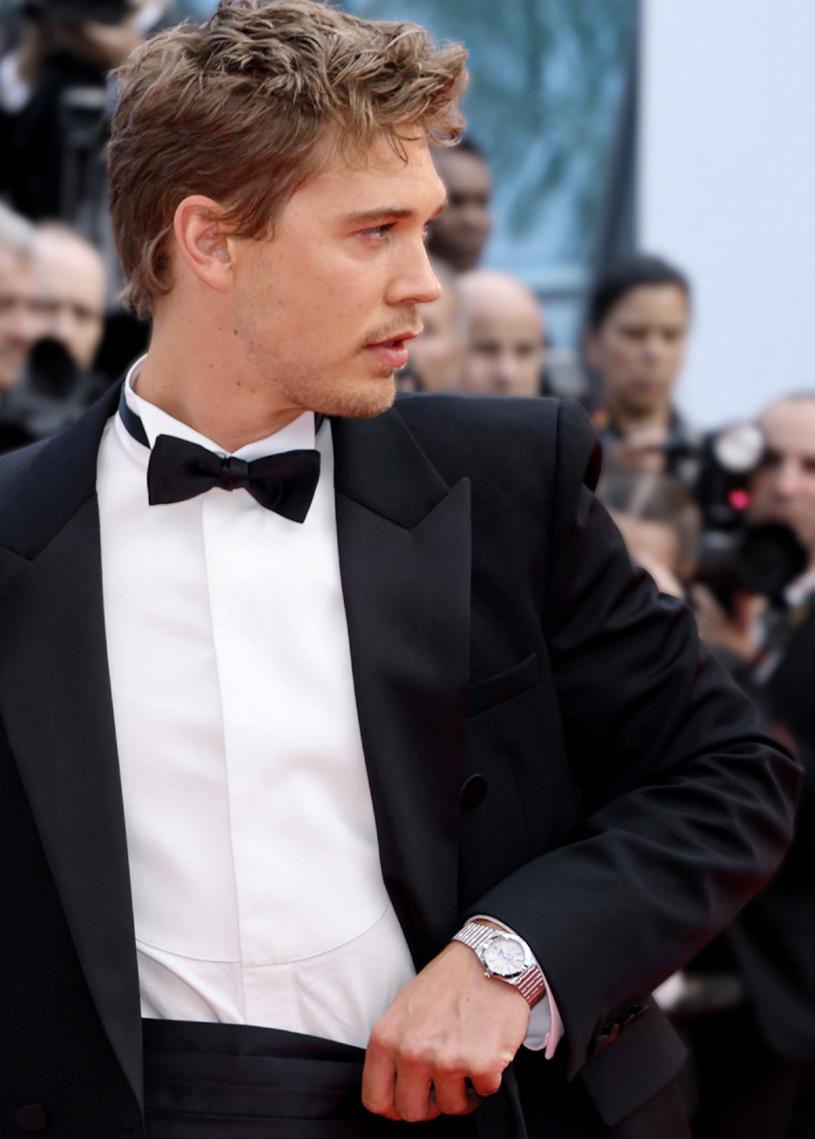
1. Breitling ambassador and Oscar-nominated actor Austin Butler on the Cannes Film Festival red carpet, wearing the Chronomat 32, ref. A77310101A2A1
In November 2023, long-time Chronomat fan Ivan Greguitch became Breitling’s product development director. Greguitch had worked with Kern at Tag Heuer in the 1990s, when the original Chronomat was at the height of its popularity. “People said if you want to be fashionable and show your social status, you had to buy a Chronomat,” he recalled. “They were selling like crazy in Europe.” Thirty years later, his experience of the Chronomat’s heyday was channeled into the 2026 redesign.
As the 2026 Chronomat took shape, Pablo Widmer and his designers kept returning to questions that stretched back to 1982, when Ernest Schneider set out to create the special status symbol chronograph that Federico Parodi delivered to the Frecce Tricolori pilots. “Does the new Chronomat have the spirit it had back then?” he asked his team. “And does it have the spirit now, for this time we’re living in?”
Designers, he explained, work within “frames”—the boundaries of how far you can
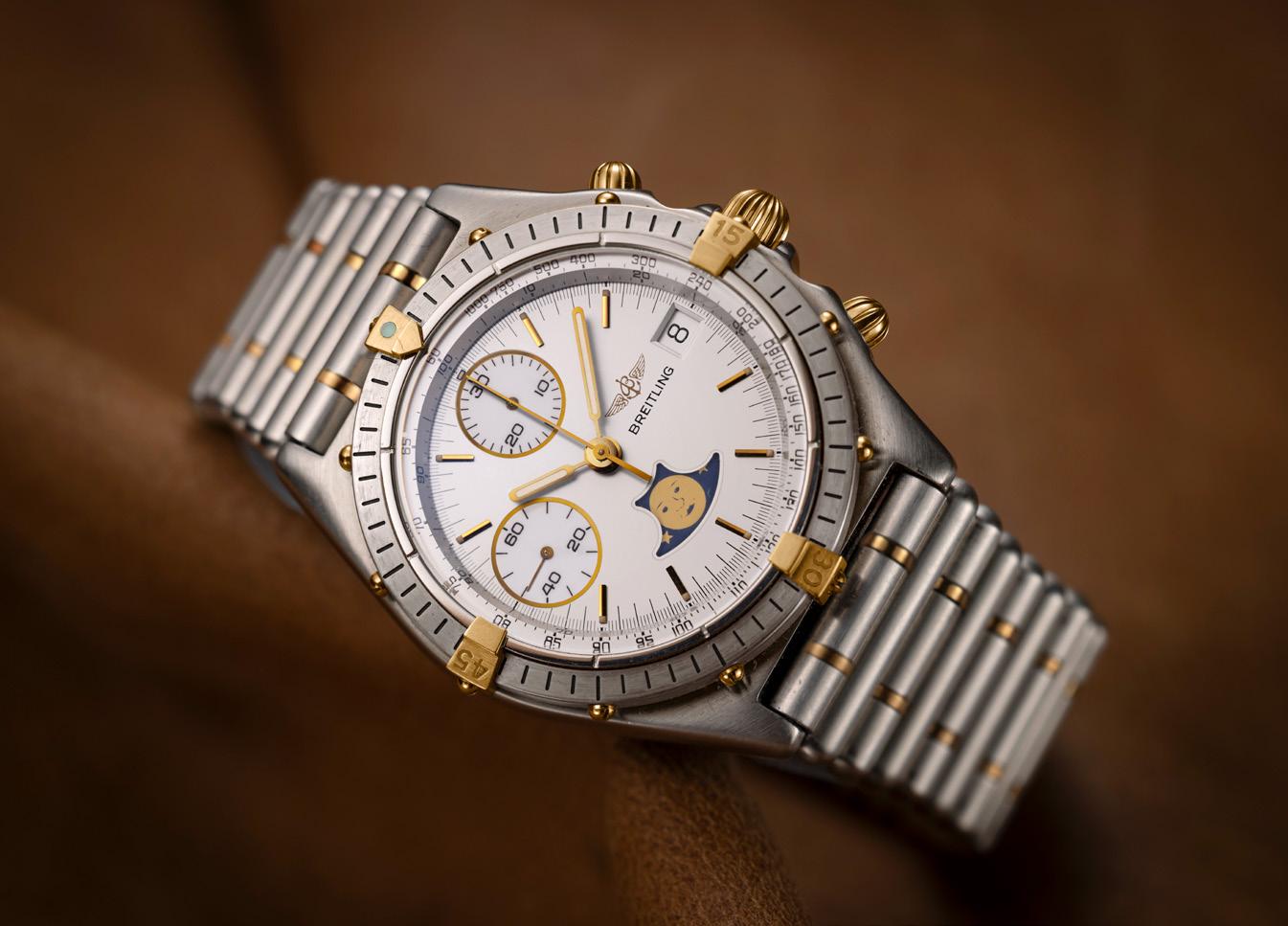
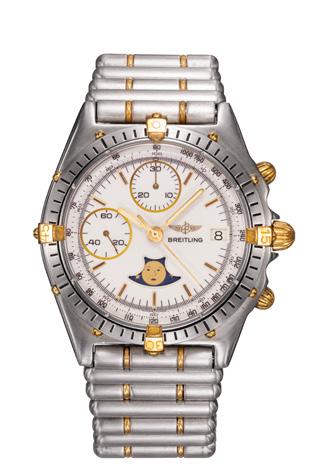
Chronomat La Luna 1989
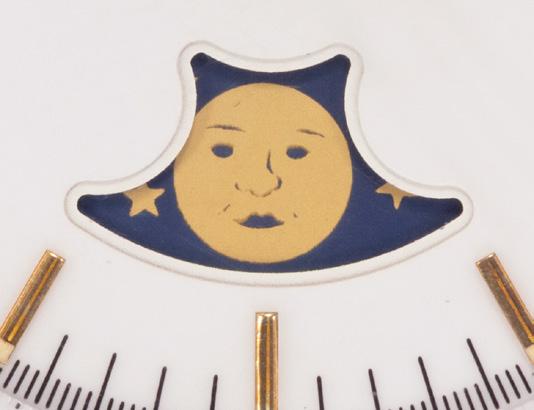
Like all pre-1990s Chronomats, the La Luna carried the 81950 reference, despite being aesthetically and functionally distinct from the core models. Its 6 o’clock hour subdial was replaced with a moonphase aperture.
Launched at the end of the decade, it came in a two-tone case with black or white dials. Uncommon and unusual, the La Luna stood out for pairing the Chronomat’s sporty character with a decidedly dressier complication.
2024
Super
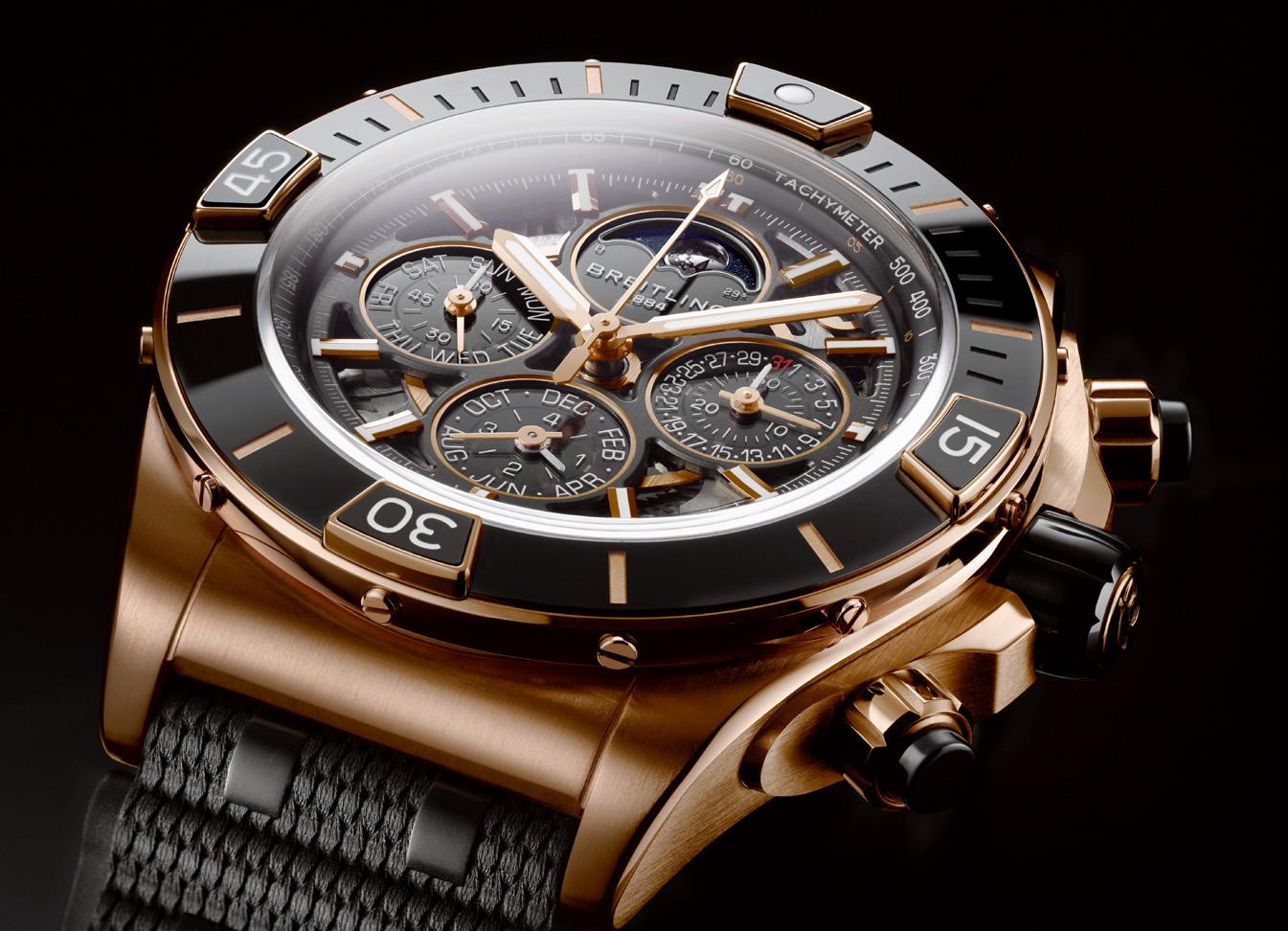
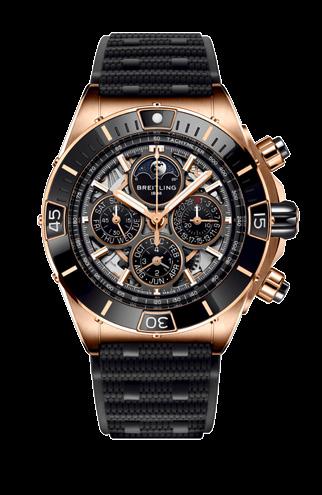
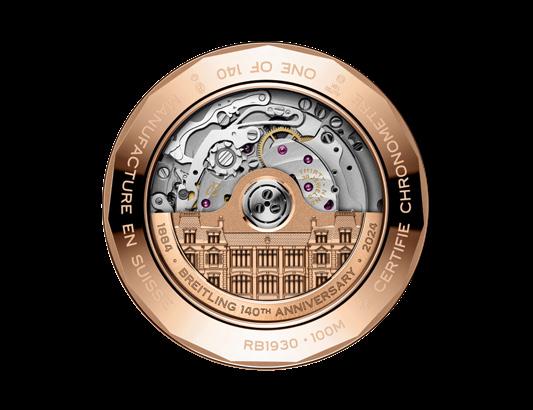
Chronomat B19 140th Anniversary Edition
To mark its 140th anniversary, Breitling introduced three commemorative pieces: a Navitimer, a Premier, and this Super Chronomat. What set it apart was the debut of the B19 caliber, a perpetual calendar chronograph with a moonphase at 12 o’clock. The combination of these complications is usually reserved for the industry’s top price bracket, where such movements are almost always manually
wound. The B19, by contrast, is automatic with a remarkable 96-hour power reserve, a particularly practical feature for a perpetual calendar that takes time to set. The watch also stood out for its case design. Compared to the standard Chronomat, it grew from 42 to 44mm and added a ceramic bezel insert and screw-down pushers. Most strikingly, it featured a skeletonized dial—the first of its kind for Breitling.
COLLECTOR’S TOOLBOX
The following pages provide the information required to identify automatic Chronomats from the launch in 1984 to 2009, a timeframe that covers the neo-vintage ETA 7750 and Breitling caliber B13 powered models.
This is the first time that variations to dials, hands, and casebacks have been identified and assigned to a production date, providing an invaluable resource for collectors and enthusiasts alike.
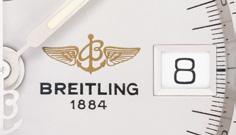
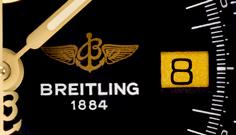
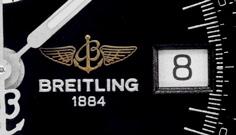
MK2 DIALS, see page 275. Markings: Wings and anchor, BREITLING.
MK2 & MK2A DIALS, see page 275; MK3 DIALS, see page 276. Markings: Wings and anchor, BREITLING.
MK1A CASEBACK Exclusive to the first-edition Frecce Tricolori Chronograph, see page 283. Case finish: sandblasted; Case diameter: 39mm; Bezel: brushed, 37mm (w/o riders); Height: 14mm; Lug-to-lug length: 44mm; Lug width: 20mm.
MK1 HANDS, see page 282. Main hands: rounded tip lumed baton; Chrono sweep: tapered thin baton with widening counterweight; Subdial hands: straight thin baton.
MK1 CASEBACK, see page 283. Case finish: sandblasted; Case diameter: 39mm; Bezel: brushed, 37mm (w/o riders); Height: 14mm; Lug-to-lug length: 45mm; Lug width: 20mm.
MK1 CASEBACK, see page 283. Case finish: early production sandblasted, then brushed; Case diameter: 39mm; Bezel: brushed, 37mm (w/o riders); Height: 14mm; Lug-to-lug length: 45mm; Lug width: 20mm.
MK2 & MK2A DIALS, see page 275; MK3 DIALS, see page 276. Markings: Wings and anchor, BREITLING.
MK1 HANDS, see page 282. Main hands: rounded tip lumed baton; Chrono sweep: tapered thin baton with widening counterweight; Subdial hands: straight thin baton.
/
MK2 & MK2A DIALS, see page 275; MK3 DIALS, see page 276. Markings: Wings and anchor, BREITLING, some late pieces with 1884.
MK2 & MK2A DIALS, see page 275; MK3 DIALS, see page 276. Markings: Wings and anchor, BREITLING, most with 1884.
MK2 AND 2A DIALS, see page 275; MK3 DIALS, see page 276. Markings: Wings and anchor, BREITLING, 1884.
MK1 HANDS, see page 282. Late transition to Mk2.
MK2 & 2A CASEBACK, see page 283.
Case finish: brushed, late transition to polished: Case diameter: 39mm; Bezel: brushed, 37mm (w/o riders); Height: 14.4mm; Lug-to-lug length: 45mm; Lug width: 20mm.
MK2A CASEBACK, see page 283. Case finish: brushed and polished; Case diameter: 39mm; Bezel: brushed, 37mm (w/o riders); Height: 14mm; Lug-to-lug length: 45mm; Lug width: 20mm.
MK2 HANDS, see page 282. Main hands: tapered tip lumed baton; Chrono sweep: tapered with B anchor counterweight; Subdial hands: straight thin baton.
MK2A & MK3 CASEBACK, see page 283. Case finish: polished (some early brushed); Case diameter: 39mm; Bezel: brushed, 37mm (w/o riders), script B on side; Height: 14.5mm; Lug-to-lug length: 45mm; Lug width: 20mm.
MARK I DIALS, FULL SET
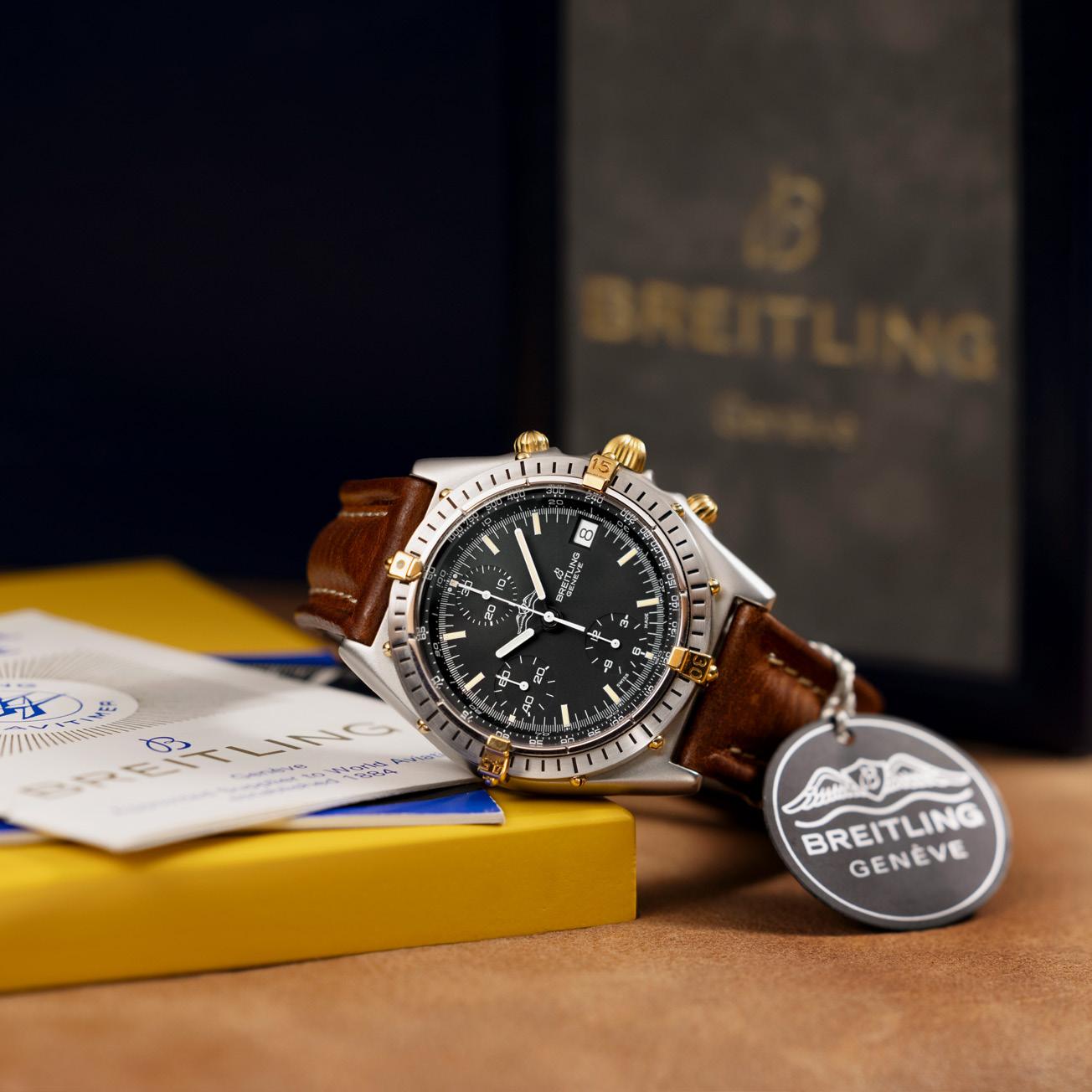
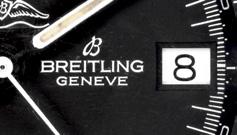
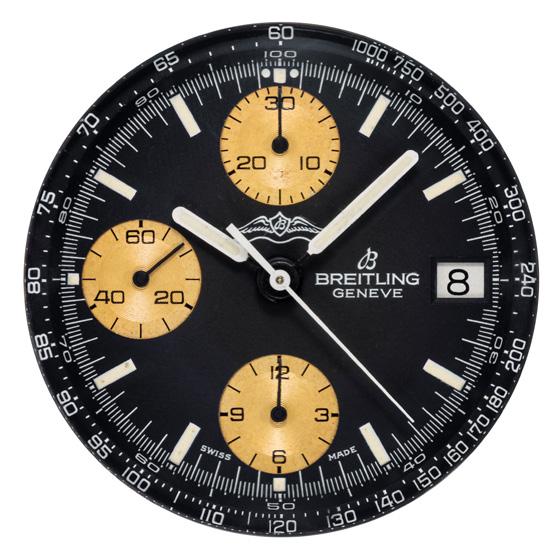
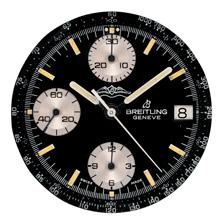
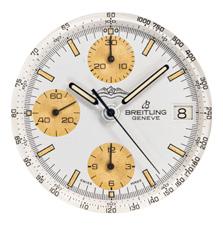
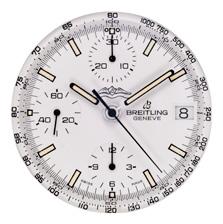
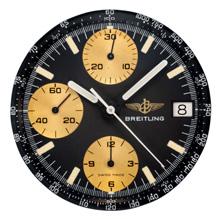
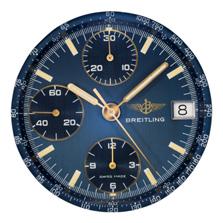
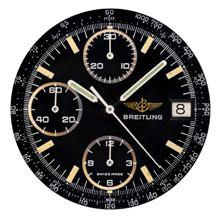
Instrument-panel look in blue created for the Frecce Tricolori with lumed dot on each side of 12 index and “Swiss Made” on each side of 6 subdial. The retail Chronomat, first in black (see picture on page 268), then white and two-tone, displayed the AOPA-style logo, with script B and BREITLING at 3.
MARK II DIAL EXAMPLES
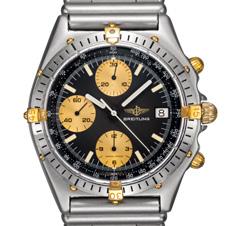
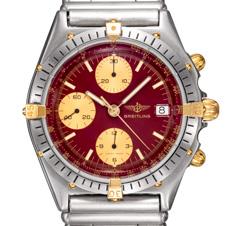
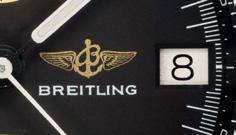
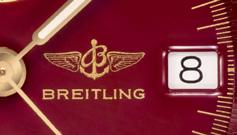
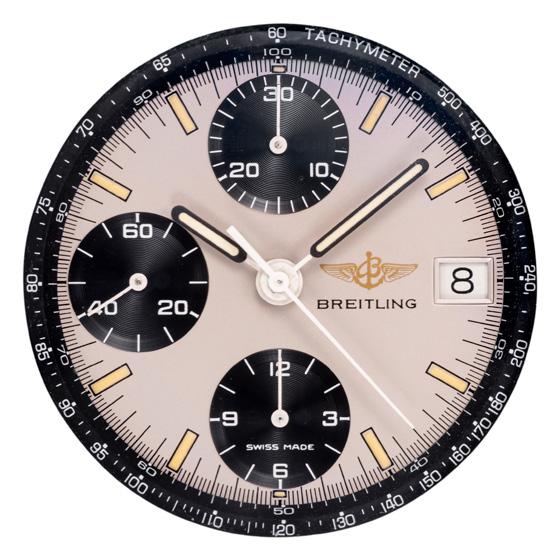
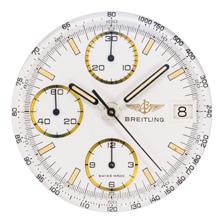
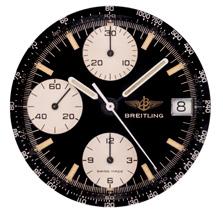
Wings-and anchor logo with BREITLING, no lumed dot on each side of the 12 o’clock index, larger subdials delete the 9 index, “Swiss Made” inside bottom subdial. Also produced as Frecce Tricolori version. Later, 1884 added beneath BREITLING. Mark IIA gained subdial rings.