Althoughsometradenamesmaybe mentionedinarticlescontainedinthis publication,noendorsementisintendedor impliedbytheOntarioGolfSuperintendents’ Association
Building with Intention
As we begin a new year with the OGSA, I would like to express my sincere gratitude to everyone who contributed to the incredible success of the 2026 OGSA Turfgrass Management Conference Seeing 565 members come together in Collingwood was truly inspiring an energizing start to the year and a strong reflection of the engagement, relevance, and strength of our association. The addition of the Equipment Managers Track, along with expanded opportunities to earn IPM points, created broader and more inclusive educational experiences, and the level of participation across all sessions was remarkable. We are also deeply grateful for the continued support of our industry partners, whose contributions play a vital role in enhancing the quality of education, networking, and overall conference experience for our members
I would also like to take a moment to recognize Ian McQueen for his exceptional leadership and dedication to the OGSA serving as president over the past two years. Ian, your steady leadership, guidance, and commitment have been instrumental in moving our association forward, and we are sincerely grateful for the vision you brought to the role
It is a privilege to serve as president of the OGSA in 2026.
I am thankful for the trust you have placed in me and mindful of the strong leadership that has come before Those who previously served have built a solid foundation that has positioned our association for success and growth, supported by a dedicated and passionate office team who work tirelessly to deliver our programs, offerings, and events. Together, this collective effort has led the OGSA to where it is today.
Our goal is to solidify what we have built, identify opportunities for improvement, and ensure long-term stability before continuing to expand.
Our association is currently experiencing a record-high membership a milestone that speaks to the value, relevance, and strength of our organization While this growth is encouraging, your board is committed to ensuring it is managed with intention and care As we look ahead, we will focus on strengthening governance, refining our infrastructure, and enriching the
programs and services our members rely on Our goal is to solidify what we have built, identify opportunities for improvement, and ensure longterm stability before continuing to expand. We are fortunate to have a strong, collaborative board, and together we will continue to move the OGSA forward with purpose and integrity. I encourage all members to become involved in initiatives that help elevate our profession and strengthen its future whether through programs like First Green, contributing to the completion of BMPs, or supporting research through Rounds for Research. Each of these efforts plays an important role in supporting education, research, and awareness across our industry
On behalf of the entire OGSA, we look forward to serving our members in 2026 and building on the momentum we have created together. I am excited for the year ahead and look forward to working alongside you as we continue to grow, evolve, and strengthen our association
The Today in Ontario photo contest is well underway for 2026
Thirteen finalists will have their photos featured in the annual OGSA calendar, with winners formally recognized at the OGSA Annual Awards Ceremony during the OGSA Turfgrass Management Conference. We encourage all members to participate in this campaign, which highlights the dedication of superintendents to the game, beauty, and sustainability found on Ontario golf courses.
2026 TURFGRASS SHORT COURSE WINNER
Congratulations to the Turfgrass Management Short Course student with the highest grade at an Ontario‐based course (drum roll) Mason Timson from Manitou Ridge Golf Club! An outstanding achievement and a testament to Mason’s hard work and dedication to the profession.
MEET YOUR
April 15, 2026
Norm McCullum Entrance Scholarship
June 30, 2026
William Sansom Distinguished Service Award
Sept 2, 2026
OGSA Professional Development Bursaries
OGSA Heritage Awards
April 1, 2027
OGSA Turfgrass Education Awards
Paul Brown Internship Award
2026 Board of Directors
Ian McQueen, St. George’s G&CC, Immediate Past President GTA
Kevin Collier, RiverBend Golf Community President SWO
Andrew Nieder, Freed Golf Vice-President North
Paul Snider Blue Mountain C&CC Secretary-Treasurer Central
Brad Hutchinson Warkworth GC, Director East
Ken Tilt Club at North Halton, Director - Central
Matt Davidson Islington GC Director - GTA
Jason Crawford Weston G&CC Director - GTA
Greg Brown Maple City G&CC Director - SWO
WHAT’S NEW GCSAA Celebrates 100 Years
OGSA donates $5000 USD to support Centennial Campaign
The Ontario Golf Superintendents’ Association has generously donated $5,000 to the GCSAA Foundation, the philanthropic organization of the Golf Course Superintendents’ Association of America (GCSAA), to support the new Col. John Morley Centennial Campaign. GCSAA will turn 100 on Sept. 13, 2026, and it has embarked on a centennial fundraising campaign to establish a new endowment honoring GCSAA’s founder, Col John Morley, with a goal of raising $1 million to fund new and innovative initiatives for the next 100 years
The Ontario GSA is supporting the centennial campaign at the Chapter Legacy Leader Level, which recognizes donations of $5,000 or more. With this donation, the Ontario GSA is a new member of the Foundation’s Platinum Tee Club, which recognizes organizations that donate $5,000 or more annually to the GCSAA Foundation.
“Thank you to the Ontario GSA for supporting the future of the game and the profession through its donation to the foundation’s centennial campaign,” GCSAA CEO Rhett Evans said “The generosity shown by the Ontario GSA undoubtedly strengthens the association and, in turn, the success of this campaign. GCSAA is grateful for the support from the Ontario GSA.”
“The OGSA is proud to celebrate a century of golf course superintendent leadership and innovation, standing on the shoulders of the giants who built our profession We know the choices we make today will shape the next 100 years and it is our privilege to support this important initiative and the enduring legacy of the GCSAA” - Kevin Collier, OGSA President, Superintendent, RiverBend Golf Community.
Canadian Golf Industry Reaches Record Participation
NGCOA Canada’s 2026 Pulse Report Highlights Strong Performance and Measured Outlook
March 5, 2026 - Ottawa, Ontario
The National Golf Course Owners Association (NGCOA) Canada has released key findings from its 2026 Pulse Report, presented by Priswing The report analyzes performance across Canadian golf course operations during the 2025 season while providing an outlook for the 2026 golf season.
The findings show the Canadian golf industry continuing its strong trajectory, with participation reaching a new national record and revenues exceeding projections for the third consecutive year
Rounds played increased 7 9% in 2025, marking the fifth increase in the past six years and pushing national participation 36.4% above 2019 levels, reinforcing that the surge in golf participation that began in 2020 has stabilized at a higher longterm baseline
“This year’s Pulse Report confirms that golf’s growth is not a short-term trend but a structural shift in participation,” said Jordan Vizena, Managing Director of Research & Membership for NGCOA Canada. “Operators across Canada have successfully converted increased interest in the game into sustained engagement and stronger business performance”
KEY INSIGHTS:
Gross revenues increased 10 0%, nearly doubling the pre-season
projection of 5 4%
Green fee and cart revenues rose 11.5%, driven largely by higher participation rather than pricing alone.
Membership revenues increased 6 6%, while food and beverage revenues grew 9 0%
Staffing conditions improved significantly, with 92% of facilities reporting full staffing, easing the labour shortages experienced earlier in the decade.
Participation growth was particularly strong across Western and Atlantic Canada, with several provinces posting double-digit increases in rounds played.
2026 OUTLOOK
Gross revenues are projected to increase 4 9% in 2026
Average rate per round is expected to rise 4.2%.
Labour costs are forecast to increase 4.8%, reflecting stabilization in staffing markets.
EMERGING TRENDS
The report also highlights several emerging operational trends shaping the business of golf in Canada:
Sustainability adoption - more than 40% of operators indicating
sustainability is very important to their operation.
Interest in electric turf equipment is growing, with 58.5% of facilities either exploring or planning adoption
Artificial intelligence is gaining traction, with more than half of operators either using or planning to implement AI tools in their operations.
A diversified distributor of golf course management products and services in Ontario, Allturf has more than 30 years of experience supplying golf courses, municipalities, sod farms, and driving ranges Allturf provides a wide range of high-quality products along with a team of professional and knowledgeable sales representatives who are always ready to provide technical expertise. Allturf fosters the development and adoption of IPM, a science-based approach to managing pests in ways that generate economic, environmental, and human health benefits
Kerry Whale MEMBER SINCE 2002
Retired
Written by Andrew Marsan, Turf Technical Sales, Plant Products
Kerry Whale
A Guiding Light
Kerry Whale has always approached her work with a simple, steady mindset: “What is the worst that can happen?” It’s a question that carried her through more than three decades in the turf industry, where she turned chance encounters into lasting partnerships, navigated a traditionally male-dominated field with quiet confidence, and built a legacy defined by trust and unwavering support for those who followed Very few in this game have left a mark as lasting as Kerry Whale.
Now retired from AllTurf Ltd , she reflects on a career defined not by headlines, but by the people she met, the problems she solved, and the doors she opened that paved the way for women in the industry. In handwritten notes shared for this profile, she offered glimpses of that journey – from her first steps in horticulture to the friendships that made the long road worthwhile Her story is long overdue and well worth the wait.
Photos provided by
Kerry Whale presenting Ian Hiltz, Fire Rock GC with the OGSA Superintendent Recognition Award for hosting the 2025 Summer Games, with Kevin Collier, Superintendent, RiverBend Golf Community
IN THE HOT SEAT
Q. FAVOURITE PIECE OF EQUIPMENT?
A. Expedite - The older generation will remember this
Q. FAVOURITE MEAL?
A. Prime Rib and ice cream.
Kerry attended the University of Arizona and later transferred to the University of Waterloo, gaining experiences that shaped her approach to work and life She first entered the industry at the age of 22, taking a summer job at a garden centre in Oakville The role awakened a genuine passion for nurturing growth – a quality that would define her entire career. What started as a temporary position quickly turned into a longterm opportunity, and she eventually worked her way up to manager.
Her path unfolded steadily She took a position with Nutrite as a sales representative and then spent 20 years at Plant Products, beginning in the greenhouse sector before moving to the turf division. The turf team there, led by Harold Van Gool, proved the biggest influence on her career. In turn, Kerry became a humble mentor who shared knowledge generously and fostered a true team atmosphere
Q. FAVOURITE SONGS?
A Brown Eyed Girl, Chicken Fried, Paradise by the Dashbrown Light
Q. FAVOURITE ICECREAM SHOP?
A. Shaw’s in St. Thomas.
Q. FAVOURITE BAKERY ON THE ROAD?
A The Gingerbread House in Komoka – best raisin bread
Q. FAVOURITE “SMART ASS” CUSTOMER?
A. Hands down… Tim Webb.
She was instrumental in building the division into what it is today Her final 14 years at AllTurf allowed her to continue that work, becoming a trusted resource for turf managers and superintendents who appreciated her insight, reliability, and the warmth she brought, which made her a favourite among clients and colleagues alike.
The work brought many joyful moments: bobsledding at the CGSA in Calgary with Neil Acton, Ian
Bowen, and Rhod Trainor, Plant Products baseball tournaments and pumpkin-growing contests, outdoor pianos in Colorado, the lively Blazing Pianos in Florida when Chris Dew and Keith Bartlett joined the stage, and Jerry Richard's "Klingon" costume in California. Golf was a highlight; she played happily with just about anyone who would put up with her! Some favourites included Ian McIsaac, Scott Thompson, Scott Dyker, Robert Cowen, Bill Martel, and Tracy Fowler
Kerry isn’t just a trailblazer for women in golf; she is a pillar of our industry. I’m confident that I’m not the only one who owes her a great deal of gratitude for the kindness, knowledge, and friendship she has shared. Kerry is quick to help, to smile, and to care, which has made her a fan favourite amongst customers, colleagues, and even competitors It is truly a rare feat to be both so widely adored and respected. I owe Kerry a great deal of thanks for creating a place for me, as a woman, in the industry I love, and even more so for helping me find my place in it. -Emma McQueen, Plant Products
Family first: Kerry alongside her sons, Jordan (35) and Andrew (31).
GC HIGHLIGHT | MEMBER PROFILE
These moments reveal the warmth, energy, and connection Kerry brought to everyone she worked with. For many, Kerry didn’t just build relationships. She built belonging.
Jason Harris, superintendent at Orr Lake Golf Club and a former colleague at Plant Products, echoes that sentiment: “Kerry Whale has been a mentor to me and many others throughout my career She would be the first person to invite a non-customer to join her group at an event if she saw them by themselves. She didn’t like just having a customer get-together without some extra fun – for those of you that remember the Plant Products Blazing Pianos event in Florida She knew all her customers’ and coworkers’ birthdays and family events Kerry was instrumental in creating and maintaining the team environment of the turf department.”
There really aren’t enough words I can say to express the enormous respect I have for Kerry both as a sales representative and as a human being.” That sense of inclusion and joy wasn’t accidental; it was something Kerry cultivated deliberately over decades.
Matt Hewitt, Director of Golf Course Maintenance at Deer Creek Golf Club – who has known Kerry since his first steps in the industry – adds, “Kerry is a legend. She built relationships and brought kindness and professionalism to every visit. Her retirement is well-deserved, and she will be greatly missed.”
Retirement has ushered in a new chapter for Kerry - one she says has kept her busier than ever Travel has always sparked joy She loves going anywhere, with recent trips to Croatia and New Zealand standing
out. Far from slowing down, she has new adventures already lined up: first Greece, then Portugal, alongside plenty of cottage time, gardening, tennis, volleyball, crafting, pickleball, and time with nds Family anchors her – two dren, one daughter-in-law, and high-maintenance black lab e, who keeps her on her toes ry day.
m that Oakville garden centre to pected roles at Nutrite, Plant ducts, and AllTurf, Kerry ale's career was about showing positively and fostering growth connection She leaves the turf ustry warmer for her humble ntorship, team-building energy, the quiet doors she opened for ers. As she moves forward with same guiding spirit, it's clear influence will continue not ough fanfare, but through the ng bonds she created and the mple she set of thoughtful, fun, resilient professionalism
Enjoying a swim in the Adriatic Sea during a recent visit to Croatia
Education Sessions
IN PARTNERSHIP WITH SYNGENTA
The OGSA Turfgrass Management Conference held at Blue Mountain Conference Centre, in Collingwood ON., on January 20 - 22, 2026, continues to grow with 565 delegates in attendance! This strong turnout reflects the value of the conference’s robust and diverse education program, featuring leading industry experts, timely technical sessions, and practical learning opportunities for turf professionals at every career stage OGSA sincerely thanks Syngenta for their continued support and sponsorship, which plays a vital role in delivering a high-quality conference experience and advancing professional development within the turfgrass industry
Networking Events
IN PARTNERSHIP WITH TURF CARE, MILWAUKEE, & FLIGHTLINE
The best ideas and inspiration are often generated organically through conversations in the hallway, shared experiences over a coffee, or informal discussions after a session These connections help build a trusted network of support that professionals can rely on throughout the golf season and beyond OGSA extends sincere thanks to Flightline for sponsoring the Day 1 Welcome Reception, and Milwaukee for hosting the Day 1 Social at Side Launch Brewery, each providing an outstanding setting to kick off the conference and encourage meaningful connections Another thanks to Turf Care for hosting the Day 2 Social immediately following the education sessions a perfect way for delegates to relax, unwind, and continue conversations after a full day of learning.
OGSA Awards Luncheon IN PARTNERSHIP WITH
Celebrating our industry’s up-and-coming professionals, high achievers, innovators, and those who generously give their time and expertise is a vital part of OGSA’s mandate. These individuals help elevate our profession and strengthen the game of golf across the province. We are grateful to Envu for their their continued commitment to recognizing excellence within the turfgrass industry
Editorial Award
Each year members are asked to vote for their favourite articles written by members which qualify for the Barry Endicott Article of the Year Award This year’s recipient is Aaron Hill, Assistant Superintendent at TPC Toronto at Osprey Valley, for his article “2025 RBC Canadian Open - Behind the Ropes,” published in the August issue of ONCourse.
25 Year Members
Year Member
A special thank you to George Bannerman on 60 years of active OGSA membership and dedicated service to the golf community.
#Today in Ontario
Thank you to Chad Vibert, Mad River GC, and Mike Pellerin, Cobble Beach CG, above, and to all 2026 -25 year service members for their ongoing commitment to the industry
WadeBeaudoin,StThomasG&CC
BrianCarver,GardenCityGC
AnthonyFrake,CranberryGR
PatrickGreenman,OakdaleG&CC
JasonHannah,CreditValleyG&CC
TroyHumphries,SenjanWoodsGC
TylerPatroch,PointGreyG&CC
RyanL.Scott,BeverlyG&CC
PhilScully,GraniteGC
EdWagner,HawthorneValleyGC
Thank you to everyone who participated in this year’s Today in Ontario campaign Your submissions continue to showcase the beauty, creativity, and passion that define Ontario’s turfgrass industry. This year’s award recipients are:
rd
3 : “Rolling Greens” by Jeremy Krueger, Cherry Hill GC.
nd
2 : “After the Rain” by Jesse Nichols of Coppinwood GC.
1 : “Making It Rain” by Peter Sinuita from Copetown Woods GC st
Scholarship Awards
Turfgrass Education Professional Development Paul Brown Internship Award
The OGSA proudly congratulates this year’s Turfgrass Education Award recipients, Hayden Gouin and Aaron Brock, both students in the University of Guelph DTM program. These awards recognize outstanding scholastic achievement and demonstrated potential for leadership in turfgrass management.
Congratulations to the Professiona Development Bursary recipients Ryan Mueller, Assistant Superintendent at Springfield G&CC, and Dawson Riml, Associate Superintendent at The Club at North Halton, in recognition of their leadership and professional accomplishments. Presented in partnership with Syngenta and in memory of Hugh Kirkpatrick
Brown Internship Award, named in memory of long-time OGSA member Paul Brown. Congratulations to this year’s recipient, Palmer Spoorenburg of the University of Guelph, recognized for his dedication and potential within the turfgrass profession.
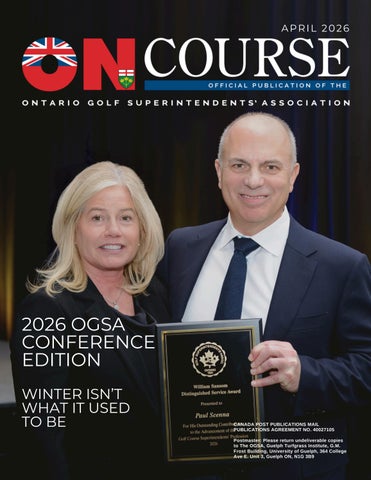
Paul Scenna Receives the 2026 William Sansom Distinguished Service Award
The William Sansom Distinguished Service Award recognizes individuals who demonstrate exceptional leadership, long-standing service, and a lasting impact on the turfgrass industry Paul Scenna’s, superintendent at The Toronto Golf Club, nomination reflects the deep respect and admiration he has earned from peers across Ontario.
Paul’s career-long contributions to the turfgrass industry exemplify the spirit and significance of this prestigious award His impact on golf course management in Ontario is both far-reaching and enduring, defined by leadership, innovation, and an unwavering commitment to professional excellence
Throughout his career, Paul has demonstrated outstanding leadership not only in his day-to-day work as a superintendent, but through the successful execution of major projects that have set new standards for course conditioning and sustainability At Donalda Club, he led an extensive greens renovation in the late 1990s and early 2000s, a project that showcased both vision and precision and elevated course performance In 2009, he oversaw the installation of a state-of-the-art irrigation system, requiring significant technical expertise and coordination.
From 2009 to 2019, Paul’s influence continued at Beacon Hall Golf Club, where he guided numerous improvement initiatives that strengthened the course’s character, playability, and long-term sustainability. Under his leadership, Beacon Hall successfully hosted several
prestigious events, including the Copa de las Americas International Amateur Championship and a U S Open Qualifier, reinforcing its reputation as a world-class golf facility
Beyond an impressive career, Paul’s most lasting legacy may be his mentorship of future industry leaders. The number of professionals who credit him with shaping their careers is extensive, and his influence has played a significant role in developing the next generation of turfgrass managers
A CGSA Master Superintendent, Paul also served as President of the OGSA during a pivotal period in the association’s history. In 2004, he led the launch of the first independently organized OGSA conference, introducing a free, full-day seminar that established a lasting precedent for value and member engagement.
Paul championed to move the conference to Niagara, demonstrating strategic leadership and responsiveness to members and industry partners Paul helped to guide events to foster camaraderie, professionalism, and meaningful relationships within the board connections that continue to influence the association today.
Paul’s lasting impact is reflected in the courses he elevated, the professionals he mentored, and the OGSA he helped guide through meaningful change leaving a legacy of leadership, service, and excellence that continues to shape our industry
Rob Ackermann, General Manager and Superintendent at Weston Golf Club and 2025 William Sansom Distinguished Service Award recipient, presents Paul Scenna, Superintendent at The Toronto Golf Club, with the 2026 William Sansom Distinguished Service Award.
OGSA Future Leaders
A highlight of this year’s conference was the continued inclusion of the Future Leaders Program, delivered in partnership with BrettYoung. The OGSA was pleased to welcome 26 Future Leaders aspiring superintendents currently enrolled in the first- and second-year classes of the University of Guelph DTM Program who attended the conference in full. Their presence added unique energy and perspective to the event, and delegates embraced the opportunity to connect with the next generation of turf professionals. This long-standing partnership remains a cornerstone of OGSA & BrettYoung’s commitment to encourage young talent to pursue careers in golf course management, while providing meaningful networking experiences that benefit both students and members
Equipment Manager Education
IN PARTNERSHIP WITH IN PARTNERSHIP WITH
The conference also marked the introduction of an exciting new partnership with Milwaukee, which supported the launch of the Equipment Manager Education Series. This brand-new stream added valuable, targeted education to the conference schedule, recognizing the critical role equipment managers play in golf course operations. Sessions were hosted in the Petun Room on the second level of the Blue Mountain Conference Centre, and provided practical, hands-on learning opportunities focused on tools, technology, and best practices The program was well received and represented an important step forward in expanding education offerings and supporting the full turfgrass management team
Industry Showcase
LUNCHEON IN PARTNERSHIP WITH GC Duke
OGSA’s supplier partners play a vital role in the success of the Turfgrass Management Conference, and we are grateful for their continued support and engagement With more than 120 suppliers in attendance and 43 companies participating in the Industry Showcase, the conference offers an unparalleled opportunity in Ontario for networking and collaboration The Industry Showcase remains a cornerstone of the event, allowing superintendents and their teams to connect with trusted partners, discover new products and innovations, strengthen long‐standing relationships, and build new connections. OGSA is proud to provide this valuable experience, bringing together suppliers and golf course professionals to support the continued growth and advancement of our industry.
Managing Golf Course Trees
Creating a Tree Management Plan and Earning Member Support
Written by Dawson Riml, Associate Superintendent, The Club at North Halton & Steven Mann A Ag, DCS Agronomic Services
Trees are among the most defining and emotionally charged features on a golf course. They frame holes, influence strategy, contribute to environmental value, and often carry deep sentimental meaning for members At the same time, unmanaged or poorly placed trees can compromise turf health, alter architectural intent, increase maintenance costs, and create safety concerns. For modern golf facilities, developing a comprehensive tree management plan is essential but its success depends as much on member support as it does on agronomic science
Many golf courses were designed with far fewer trees than what exists today. Over decades, natural growth, memorial plantings, and beautification efforts have
significantly increased tree density. While often well-intentioned, this expansion has led to excessive shade, restricted airflow, and root competition.
Architecturally, encroaching trees can narrow fairways, eliminate strategic options, and obscure original sightlines which fundamentally change how a course is meant to be played. Add in safety and liability concerns from aging or structurally compromised trees, and the need for proactive management becomes clear
A tree management plan is a longterm, strategic framework that guides decisions about planting, pruning, preservation, and removal. Rather than reacting to individual problem trees, the plan aligns tree
management with agronomic goals, architectural values, and environmental stewardship.
The foundation of the plan is a thorough inventory and assessment Each tree or stand of trees should be evaluated by health, structural integrity, and impact on turf and playability.
Common goals include improving sunlight and airflow, enhancing turf health, restoring design intent, increasing safety, protecting specimen trees, and promoting ecological balance These objectives should reflect the club’s identity and long-term vision
Equally important is phasing. A multiyear implementation plan minimizes visual shock, spreads costs, and
Club at North Halton Tree Plan
allows members to see benefits develop gradually The plan should be documented and reviewed regularly as course conditions evolve
Even the most carefully constructed tree management plan can face resistance if member concerns are not addressed. Trees are deeply personal. Members may have planted them, watched them mature, or associate them with favourite holes and memories Removing a tree can feel like erasing part of the club’s history
Recognizing this emotional attachment is critical. Tree management is not just a maintenance issue; it is a cultural one. Success depends on trust, communication, and respect for member sentiment
The most effective tree management programs begin with education Before any trees are removed, members should understand how trees affect turf health, playability, pace of play, and long-term costs.
Visual tools such as shade studies, airflow diagrams, and before and after photos are particularly effective in illustrating these relationships
Framing is essential. Tree management should be presented to improve golf, not as an attack on trees. Healthier turf, firmer playing surfaces, restored strategy, and improved aesthetics resonate far more than technical explanations alone
Visual tools such as shade studies, airflow diagrams, and before and after photos are particularly effective in illustrating these relationships. Framing is essential. Tree management should be presented to improve golf, not as an attack on trees Healthier turf, firmer playing surfaces, restored strategy, and
improved aesthetics resonate far more than technical explanations alone
Trusted voices strengthen the message While the superintendent often leads the effort, support from the golf professional, course architect, or an independent arborist adds credibility. A unified message from club leadership reassures members that decisions are thoughtful and well-informed
Transparency builds confidence Sharing maps, marking trees under consideration, and clearly explaining why specific trees are targeted, helps prevent speculation and misinformation. Just as important is highlighting what will remain. Emphasizing specimen trees and environmentally valuable areas reinforces that the plan is balanced
Phased implementation allows members to experience tangible improvements, often within a single growing season. Increased sunlight, healthier turf, improved drainage, and stronger playing conditions are difficult to argue with once they are visible and playable
These early successes often shift the conversation from opposition to support. What begins as skepticism can evolve into appreciation as members see the course improve. Inviting feedback along the way, while maintaining commitment to the plan’s goals, further strengthens trust and engagement
When a tree management plan is well designed and well communicated, its benefits extend far beyond the trees themselves. Maintenance becomes more sustainable, budgets more predictable, and future boards less likely to reverse progress and trust grows between the membership and course leadership
Before and after shots of tree work completed during the Club at North Halton Tree project, on hole #16
Winter Isn’t What It Used to Be
Written by Chris Lecour, Turf Sales Specialist, BASF
Two decades ago, golf courses across Ontario and Quebec could count on a familiar winter pattern: deep cold, persistent snow cover, and then a slow, steady thaw in spring Under a snow cover that could last for months, disease pressure on cool‐season turf was more predictable and straightforward The threat of gray and speckled snow mold was predominant with some pink snow mold flaring up in regions that experienced milder temperatures and less permanent cover. Since gray and speckled snow mold are not active in temperatures below 0°C, a final snow mold fungicide application in the fall, along with frozen turf and natural insulation from the snow, was all the insurance needed for superintendents to produce an acceptable playing surface the next spring. Changing weather patterns over the last two decades have made it more challenging to protect against winter turf pressures. Winters along the Great Lakes and St.Lawrence corridor are now shorter, warmer, and wetter.
There are more rain and wet snow events, frequent freeze-thaw cycles, and far less reliable lake ice and snowpack Fusarium or pink snow mold is becoming more common and problematic than it used to be twenty years ago in this region Researchers estimate the Great Lakes have lost roughly 14 winter days since the mid‐1990s, a significant shift that leads to more winter rainfall, runoff, and mid‐season thaws Those conditions create two challenges for superintendents: a hospitable environment for snow mold incubation, while making it physically difficult to reach areas that require a fungicide application.
Gray and speckled snow mold are active between 0°C and 3°C under high soil moisture and high humidity conditions, just the type of winters that courses near the Great Lakes have been experiencing recently. Microdochium has a wider temperature range (0°C –8°C, even up to 18°C under prolonged high moisture conditions) and can thrive on unfrozen turf with or without snow cover, making it a real problem for Ottawa and Montreal area golf courses in recent years.
It would be one thing if a mid-January thaw melted all the snow on the golf course AND the ground firmed up enough to support the weight of a sprayer Unfortunately, this is rarely the case Exposed turf in January that might benefit from a supplemental snow mold application (the high unexpected and not-inthe-budget application cost notwithstanding) would
2026 OGSA TURFGRASS MANAGEMENT CONFERENCE
be difficult to reach with a fully loaded sprayer and would inevitably damage the turf it was trying to protect along with other areas of the golf course Snow mold outbreaks are not the only issue with warmer winters Increased rain and melt events with fluctuating high and low temperatures increase the risk of ice formation and crown hydration injury on sensitive turf areas Bentgrass is better suited to survive these fluctuating winter conditions, but Poa dominant turf can suffer damage quickly Poa will begin to de-acclimate at the onset of warmer temperatures in as little as 48-72 hours.
CLIMATE DRIVEN ISSUES TO HAVE ON YOUR RADAR
Gray snow mold may be more inconsistent, but it has not disappeared.
Gray snow mold still matters in areas that retain deep, persistent snow, but its severity is increasingly variable as winter conditions can fluctuate. Differentiating Microdochium (fusarium) from gray and speckled snow molds (typhula spp ) remains essential for product choice, application timing, and expectations
Microdochium keeps working—even without snow.
With fewer long, continuous snowpacks, Microdochium nivale has shifted from the “classic” pink snow mold under snow to Microdochium patch during open, cool, and wet periods from late fall through early spring Expect activity whenever temperatures are 0°C-8°C with prolonged leaf wetness, particularly on Poa annua and close‐mown bent surfaces. That means visible injury in December through March even in winters with little or no snow.
Freeze–thaw volatility raises the stakes for crown hydration and ice.
Warmer winters with intermittent thaws and mid‐winter rain tend to de‐acclimate turf and re‐hydrate crowns Subsequent refreezes can rupture cells. Ice encasement also limits oxygen at the surface, and even short-duration events can injure Poa‐dominant greens in low, poorly drained or shaded sites. These damage prone sites should be evaluated well before winter, and conditions improved focusing on improving surface and subsurface drainage, air flow and shade issues
Using distinct FRAC groups in multiple fall applications is key to reducing the risk of snow mold and Microdochium patches on golf turf as winter approaches Snow mold pathogens particularly Microdochium nivale and the Typhula species thrive under prolonged moisture, low light, and extended snow cover Rotating and combining fungicides that are effective on snow mold with different modes of action, such as FRAC groups 3, 11, 12, and 19 along with a contact fungicide reduces selection pressure on any one chemistry and prevents resistance development, ensuring longer-term product efficacy Multiple applications prior to snowfall provided a layered protection strategy: early fall sprays suppress existing inoculum, while late-fall applications provide residual control that persists into and through snow cover. Combine systemic and contact actives to improve disease suppression under severe or long snow cover. Diversified disease control programs and well-timed fall applications maximize disease control, improve turf winter survival, and ensure healthier surfaces on opening day
Canadian superintendents face more shoulder‐season management and fewer “set‐and‐forget” winters. Shorter winters with less consistent snow cover and more rain events require a winter program that addresses microclimate issues and recognizes the value in a multi-pronged snow mold fungicide program that uses multiple FRAC groups for short and long-term success