Page W4 · Richmond Review
Wednesday, February 12, 2014
City of Richmond
5 Year Financial Plan (2014–2018)
5 Year Financial Plan (2014–2018)
www.richmond.ca
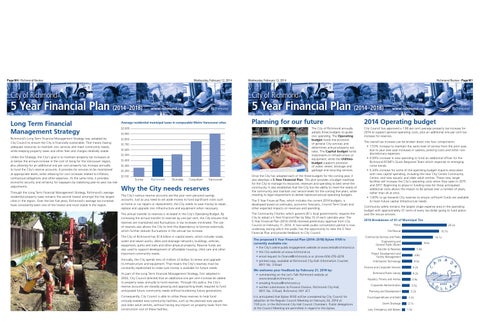
Average residential municipal taxes in comparable Metro Vancouver cities
Richmond’s Long Term Financial Management Strategy was adopted by City Council to ensure the City is financially sustainable. That means having adequate resources to maintain civic services and meet community needs, while keeping property taxes and other fees and charges relatively stable.
$1,800
Through the Long Term Financial Management Strategy, Richmond’s average residential property taxes remains the second lowest amongst the five largest cities in the region. Over the last five years, Richmond’s average tax increases have consistently been one of the lowest and most stable in the region.
Richmond Review · Page W1
City of Richmond
Long Term Financial Management Strategy
Under the Strategy, the City’s goal is to maintain property tax increases at or below the annual increase in the cost of living for the Vancouver region, plus allowing for an additional one per cent property tax increase annually to fund the City’s reserve accounts. It provides for services to be maintained at appropriate levels, while allowing for cost increases related to inflation, contractual obligations and other expenses. At the same time, it provides economic security and certainty for taxpayers by stabilizing year-to-year tax rate adjustments.
Wednesday, February 12, 2014
Planning for our future The City of Richmond annually adopts three budgets to guide civic spending. The Operating budget funds the provision of general City services and determines annual property tax rates. The Capital budget funds investments in infrastructure or equipment, while the Utilities budget supports provision of water, sewer, drainage and garbage and recycling services.
$2,000 $1,900
$1,700 $1,600 $1,500 $1,400 $1,300 $1,200 $1,100
Surrey
Richmond
Burnaby
Coquitlam
Vancouver
Why the City needs reserves The City’s various reserve accounts are like your own personal savings accounts. Just as you need to set aside money to fund significant costs such as home or car repairs or replacement, the City needs to save money to repair, replace and upgrade civic infrastructure and equipment when necessary. The annual transfer to reserves is included in the City’s Operating Budget. By increasing the annual transfer to reserves by one per cent, the City ensures that reserves are maintained and fluctuations in tax increases minimized. The use of reserves also allows the City to limit the dependency to borrow externally, which further reduces fluctuations in the annual tax increase. The City of Richmond has $1.8 billion in capital assets, which includes roads, water and sewer works, dikes and drainage networks, buildings, vehicles, equipment, parks and trails and other physical property. Reserve funds are also used to support development of affordable housing, child care and other important community needs. Annually, the City spends tens of millions of dollars to renew and upgrade its infrastructure and equipment. That means the City’s reserves must be constantly replenished to make sure money is available for future needs.
Once the City has adopted each of the three budgets for the coming year, it also develops a 5 Year Financial Plan. This plan provides a budget roadmap for the City to manage its resources, revenues and spending to best serve the community. It also establishes that the City has the ability to meet the needs of the community and maintain civic service levels for the coming five years, while meeting its legal requirement to deliver balanced annual operating budgets. The 5 Year Financial Plan, which includes the current 2014 budgets, is developed based on estimates, economic forecasts, Council Term Goals and other expected impacts on revenues and spending. The Community Charter, which governs BC’s local governments, requires the City to adopt a 5 Year Financial Plan by May 15 of each calendar year. The 5 Year Financial Plan (2014–2018) received preliminary approval from City Council on February 11, 2014. A two-week public consultation period is now underway during which the public has the opportunity to view the 5 Year Financial Plan and provide feedback to City Council. The proposed 5 Year Financial Plan (2014–2018) Bylaw 9100 is currently available via: the City’s online public engagement website at www.letstalkrichmond.ca the City website at www.richmond.ca email request to finance@richmond.ca or phone 604-276-4218 printed copy, available at Richmond City Hall–Information Counter, 6911 No. 3 Road
As part of the Long Term Financial Management Strategy, first adopted in 2003, City Council directed that an additional one per cent increase be added to property taxes annually to fund reserves. Through this policy, the City’s reserve accounts are steadily growing and approaching levels required to fund anticipated future community needs without burdening future generations.
We welcome your feedback by February 21, 2014 by: commenting on the Let’s Talk Richmond website at www.letstalkrichmond.ca emailing finance@richmond.ca written submissions to Finance Division, Richmond City Hall, 6911 No. 3 Road, Richmond, V6Y 2C1
Consequently, City Council is able to utilize these reserves to help fund critically-needed new community facilities, such as the planned new aquatic and older adult centres, without having any impact on property taxes from the construction cost of these facilities.
It is anticipated that Bylaw 9100 will be considered by City Council for adoption at the Regular Council Meeting on February 24, 2014 at 7:00 p.m. in the Richmond City Hall Council Chambers. Public delegations at the Council Meeting are permitted in regard to this bylaw.
www.richmond.ca
2014 Operating budget City Council has approved a 1.96 per cent average property tax increase for 2014 to support general operating costs, plus an additional one per cent tax increase for reserves. The overall tax increase can be broken down into four components: 1.53% increase to maintain the same level of service from the prior year, due to year over year increases in salaries, policing costs and other nondiscretionary expenses. 0.09% increase in new spending to fund an additional officer for the Richmond RCMP’s Quick Response Team which responds to emerging crime trends. 0.34% increase for some of the operating budget impacts associated with new capital spending, including the new City Centre Community Centre, and new aquatic and older adult centres. These new, larger facilities will increase the City’s operating costs when they open in 2015 and 2017. Beginning to phase in funding now for these anticipated additional costs allows the impact to be spread over a number of years, rather than all at once. 1.00% to go towards City reserves to ensure sufficient funds are available to meet future capital infrastructure needs. Community safety remains the largest single expense area in the operating budget with approximately 37 cents of every tax dollar going to fund police and fire rescue services. 2014 Breakdown of $1 of Municipal Tax Police
20.2¢
Fire Rescue
16.7¢
Community Services and Parks
14.1¢
Engineering and General Public Works
9.0¢
Transfer to Reserves
5.8¢
Project Development and Facility Management
4.8¢
Information Technology
4.6¢
Finance and Corporate Services
4.2¢
Richmond Public Library
4.2¢
Aquatics, Fitness and Arenas
3.9¢
Corporate Administration
3.5¢
Planning and Development
3.2¢
Fiscal Expenditures and Debt
2.2¢
Storm Drainage
2.1¢
Law, Emergency and Bylaws
1.5¢
Page W2 · Richmond Review
Wednesday, February 12, 2014
City of Richmond
5 Year Financial Plan (2014–2018)
Wednesday, February 12, 2014
Richmond Review · Page W3
City of Richmond www.richmond.ca
5 Year Financial Plan (2014–2018)
www.richmond.ca
ECONOMIC DEVELOPMENT
Council Term Goals 2011–2014 Council has 13 term goals which guide all City initiatives, including spending priorities. Here are some recent highlights of new programs and other achievements funded by the City as a result of these goals.
23,000+ Hotel room night stays in Richmond in 2013 secured through Sport Hosting Program.
To see the complete list of Council’s Term Goals, visit the City’s website at www.richmond.ca
COMMUNITY WELLNESS
5.6
COMMUNITY SAFETY
5
New fire halls to be completed between 2005-2017.
Length in kilometers of new Railway Greenway trail development to be completed in 2014.
COMMUNITY SAFETY
264 Police and civilian staff located at Richmond Community Safety Building, opened in 2011 as the new home for Richmond RCMP.
FACILITY DEVELOPMENT
$76.9 million Funding allocated to build a new Aquatic Centre and Older Adult Centre in Minoru Park.
40,000 Green Carts provided to Richmond homes in 2013 for organics recycling, helping to increase waste diversion rates from landfills to nearly 70%.
COMMUNITY SOCIAL SERVICES
SUSTAINABILITY
500+
ARTS AND CULTURE
COMMUNITY WELLNESS
28,000 Sport and fitness registrations at the Richmond Olympic Oval since its opening, along with 3.5 million visitors and more than 5,000 members.
New affordable housing units secured for Richmond since 2011.
40,000 Visitors to the 10th annual Richmond Maritime Festival in 2013.
ECONOMIC DEVELOPMENT FINANCIAL MANAGEMENT COMMUNITY SOCIAL SERVICES
200+
New child care spaces secured through new development approvals.
$2.3 billion Construction value of new building permits issued since 2010.
$140 million New land purchases for community needs since 2010, including the 55-hectare (136-acre) Garden City Lands.
SUSTAINABILITY
330 tonnes Reduction to date of greenhouse gas emissions through use of thermal heat produced by the City’s Alexandra District Energy Utility.
Page W2 · Richmond Review
Wednesday, February 12, 2014
City of Richmond
5 Year Financial Plan (2014–2018)
Wednesday, February 12, 2014
Richmond Review · Page W3
City of Richmond www.richmond.ca
5 Year Financial Plan (2014–2018)
www.richmond.ca
ECONOMIC DEVELOPMENT
Council Term Goals 2011–2014 Council has 13 term goals which guide all City initiatives, including spending priorities. Here are some recent highlights of new programs and other achievements funded by the City as a result of these goals.
23,000+ Hotel room night stays in Richmond in 2013 secured through Sport Hosting Program.
To see the complete list of Council’s Term Goals, visit the City’s website at www.richmond.ca
COMMUNITY WELLNESS
5.6
COMMUNITY SAFETY
5
New fire halls to be completed between 2005-2017.
Length in kilometers of new Railway Greenway trail development to be completed in 2014.
COMMUNITY SAFETY
264 Police and civilian staff located at Richmond Community Safety Building, opened in 2011 as the new home for Richmond RCMP.
FACILITY DEVELOPMENT
$76.9 million Funding allocated to build a new Aquatic Centre and Older Adult Centre in Minoru Park.
40,000 Green Carts provided to Richmond homes in 2013 for organics recycling, helping to increase waste diversion rates from landfills to nearly 70%.
COMMUNITY SOCIAL SERVICES
SUSTAINABILITY
500+
ARTS AND CULTURE
COMMUNITY WELLNESS
28,000 Sport and fitness registrations at the Richmond Olympic Oval since its opening, along with 3.5 million visitors and more than 5,000 members.
New affordable housing units secured for Richmond since 2011.
40,000 Visitors to the 10th annual Richmond Maritime Festival in 2013.
ECONOMIC DEVELOPMENT FINANCIAL MANAGEMENT COMMUNITY SOCIAL SERVICES
200+
New child care spaces secured through new development approvals.
$2.3 billion Construction value of new building permits issued since 2010.
$140 million New land purchases for community needs since 2010, including the 55-hectare (136-acre) Garden City Lands.
SUSTAINABILITY
330 tonnes Reduction to date of greenhouse gas emissions through use of thermal heat produced by the City’s Alexandra District Energy Utility.
Page W4 · Richmond Review
Wednesday, February 12, 2014
City of Richmond
5 Year Financial Plan (2014–2018)
5 Year Financial Plan (2014–2018)
www.richmond.ca
Average residential municipal taxes in comparable Metro Vancouver cities
Richmond’s Long Term Financial Management Strategy was adopted by City Council to ensure the City is financially sustainable. That means having adequate resources to maintain civic services and meet community needs, while keeping property taxes and other fees and charges relatively stable.
$1,800
Through the Long Term Financial Management Strategy, Richmond’s average residential property taxes remains the second lowest amongst the five largest cities in the region. Over the last five years, Richmond’s average tax increases have consistently been one of the lowest and most stable in the region.
Richmond Review · Page W1
City of Richmond
Long Term Financial Management Strategy
Under the Strategy, the City’s goal is to maintain property tax increases at or below the annual increase in the cost of living for the Vancouver region, plus allowing for an additional one per cent property tax increase annually to fund the City’s reserve accounts. It provides for services to be maintained at appropriate levels, while allowing for cost increases related to inflation, contractual obligations and other expenses. At the same time, it provides economic security and certainty for taxpayers by stabilizing year-to-year tax rate adjustments.
Wednesday, February 12, 2014
Planning for our future The City of Richmond annually adopts three budgets to guide civic spending. The Operating budget funds the provision of general City services and determines annual property tax rates. The Capital budget funds investments in infrastructure or equipment, while the Utilities budget supports provision of water, sewer, drainage and garbage and recycling services.
$2,000 $1,900
$1,700 $1,600 $1,500 $1,400 $1,300 $1,200 $1,100
Surrey
Richmond
Burnaby
Coquitlam
Vancouver
Why the City needs reserves The City’s various reserve accounts are like your own personal savings accounts. Just as you need to set aside money to fund significant costs such as home or car repairs or replacement, the City needs to save money to repair, replace and upgrade civic infrastructure and equipment when necessary. The annual transfer to reserves is included in the City’s Operating Budget. By increasing the annual transfer to reserves by one per cent, the City ensures that reserves are maintained and fluctuations in tax increases minimized. The use of reserves also allows the City to limit the dependency to borrow externally, which further reduces fluctuations in the annual tax increase. The City of Richmond has $1.8 billion in capital assets, which includes roads, water and sewer works, dikes and drainage networks, buildings, vehicles, equipment, parks and trails and other physical property. Reserve funds are also used to support development of affordable housing, child care and other important community needs. Annually, the City spends tens of millions of dollars to renew and upgrade its infrastructure and equipment. That means the City’s reserves must be constantly replenished to make sure money is available for future needs.
Once the City has adopted each of the three budgets for the coming year, it also develops a 5 Year Financial Plan. This plan provides a budget roadmap for the City to manage its resources, revenues and spending to best serve the community. It also establishes that the City has the ability to meet the needs of the community and maintain civic service levels for the coming five years, while meeting its legal requirement to deliver balanced annual operating budgets. The 5 Year Financial Plan, which includes the current 2014 budgets, is developed based on estimates, economic forecasts, Council Term Goals and other expected impacts on revenues and spending. The Community Charter, which governs BC’s local governments, requires the City to adopt a 5 Year Financial Plan by May 15 of each calendar year. The 5 Year Financial Plan (2014–2018) received preliminary approval from City Council on February 11, 2014. A two-week public consultation period is now underway during which the public has the opportunity to view the 5 Year Financial Plan and provide feedback to City Council. The proposed 5 Year Financial Plan (2014–2018) Bylaw 9100 is currently available via: the City’s online public engagement website at www.letstalkrichmond.ca the City website at www.richmond.ca email request to finance@richmond.ca or phone 604-276-4218 printed copy, available at Richmond City Hall–Information Counter, 6911 No. 3 Road
As part of the Long Term Financial Management Strategy, first adopted in 2003, City Council directed that an additional one per cent increase be added to property taxes annually to fund reserves. Through this policy, the City’s reserve accounts are steadily growing and approaching levels required to fund anticipated future community needs without burdening future generations.
We welcome your feedback by February 21, 2014 by: commenting on the Let’s Talk Richmond website at www.letstalkrichmond.ca emailing finance@richmond.ca written submissions to Finance Division, Richmond City Hall, 6911 No. 3 Road, Richmond, V6Y 2C1
Consequently, City Council is able to utilize these reserves to help fund critically-needed new community facilities, such as the planned new aquatic and older adult centres, without having any impact on property taxes from the construction cost of these facilities.
It is anticipated that Bylaw 9100 will be considered by City Council for adoption at the Regular Council Meeting on February 24, 2014 at 7:00 p.m. in the Richmond City Hall Council Chambers. Public delegations at the Council Meeting are permitted in regard to this bylaw.
www.richmond.ca
2014 Operating budget City Council has approved a 1.96 per cent average property tax increase for 2014 to support general operating costs, plus an additional one per cent tax increase for reserves. The overall tax increase can be broken down into four components: 1.53% increase to maintain the same level of service from the prior year, due to year over year increases in salaries, policing costs and other nondiscretionary expenses. 0.09% increase in new spending to fund an additional officer for the Richmond RCMP’s Quick Response Team which responds to emerging crime trends. 0.34% increase for some of the operating budget impacts associated with new capital spending, including the new City Centre Community Centre, and new aquatic and older adult centres. These new, larger facilities will increase the City’s operating costs when they open in 2015 and 2017. Beginning to phase in funding now for these anticipated additional costs allows the impact to be spread over a number of years, rather than all at once. 1.00% to go towards City reserves to ensure sufficient funds are available to meet future capital infrastructure needs. Community safety remains the largest single expense area in the operating budget with approximately 37 cents of every tax dollar going to fund police and fire rescue services. 2014 Breakdown of $1 of Municipal Tax Police
20.2¢
Fire Rescue
16.7¢
Community Services and Parks
14.1¢
Engineering and General Public Works
9.0¢
Transfer to Reserves
5.8¢
Project Development and Facility Management
4.8¢
Information Technology
4.6¢
Finance and Corporate Services
4.2¢
Richmond Public Library
4.2¢
Aquatics, Fitness and Arenas
3.9¢
Corporate Administration
3.5¢
Planning and Development
3.2¢
Fiscal Expenditures and Debt
2.2¢
Storm Drainage
2.1¢
Law, Emergency and Bylaws
1.5¢