Northern Secwepemc te Qelmucw
Shuswap People of the North
Lexey’em “to tell a story” December 2012 - Pellteteq’em (Cross Over Month, winter solistice)
Ira Sandy – Continues To Be An Inspiration giving me another day to make a better life; and before I go to sleep, I ask for forgiveness for all the people I have hurt. I put those prayers out there in the universe and I know they will be answered. The power of western medicine kept me alive and I attribute my miraculous recovery to my family’s strong belief in our culture, language, Spirituality and Indian medicine. Also, the Indian doctors who helped me, those who held sweats, pipe ceremonies, prayed and Nancy Sandy and her son Ira out on a WLIB community Cultural Field trip last Fall, which was organized by Rick Gilbert.
By Ira and Nancy Sandy [This update is about Ira Sandy’s recovery from a brain injury he acquired as a result of a hunting accident. It was written by his Mom, Nancy Sandy. She interviewed him on a trip to Kamloops recently when he went for an examination to see if he could get his driver’s license. It has been written to capture Ira’s manner of speech. He collaborated with Nancy on this story to get it right!]
The accident happened seven years ago on December 26th. I am beginning a new phase of my life and I think it is important to tell my story to inspire others to overcome whatever challenges they might face. I consider the accident as a blessing in disguise because before it happened I was on a road of self-destruction. Everything I did was for my personal satisfaction to the detriment of my children, my family and my health. I usually had an ulterior motive to get what I wanted from family and friends. I wasn’t all bad as I was always ready to help people in need. Like getting a car started, helping family and friends move, making wood, fishing and hunting for Elders, or for funerals. But, my addictions started taking over and this was causing problems. The way I think about the accident is the ole Ira died out on the land that day. My recovery was a triumph – because I wasn’t expected to live. The doctors and nurses were always surprised when they came back on shift and I was still there. Each morning I say kukstemc to the Creator for
sundanced for me, and the Indian medicine given to me by Della Fellhauer of Whispering Pines. People who heard about the accident said “if anyone can do it Ira can”. I will never give up in my physical rehabilitation in honour of all the help I received. I always relied on my brute strength to get me where I wanted or what I wanted. Now, I strive for the kind of inner strength my Mom has – quiet, methodical, determined and powerful. I now understand all the things I learned and all the good things I have done in my life has contributed to my recovery. The safety measures in my employment as a carpenter apprentice, a forestry technician, a fisheries technician (heck even an explosives assistant) helps me with my walking, swimming and driving my scooter. Sure I have accidents along the way but they make me more aware of my mistakes and check my ego. My sister, Dancing Water, got me into silviculture which is odd since she grew up in Vancouver and all she knew about forestry was there are lots of trees. From that experience I learned to look after the land through spacing, tree planting, and creek restoration. I reconnected to the land and at my best I was able to plant over 2,000 trees in a day. My late Uncle Pie and my hunting brother, Andrew Meshue taught me all about wildlife habitat, patience in the hunt, all the animal parts and their use. They taught me never to take more than I needed from the land. In return, Mother Earth took care of me on that cold, snowy day by keeping my body temperature hypothermic, and the snow packed my wound so I didn’t bleed out.
Continued on pages 6 & 7
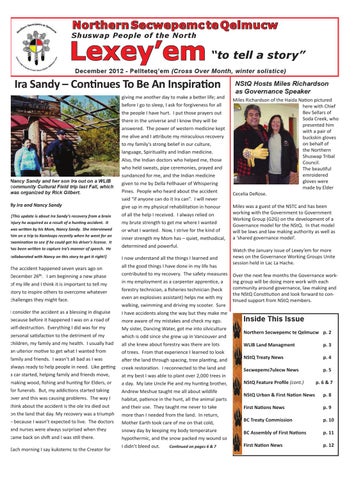
NStQ Hosts Miles Richardson as Governance Speaker Miles Richardson of the Haida Nation pictured here with Chief Bev Sellars of Soda Creek, who presented him with a pair of buckskin gloves on behalf of the Northern Shuswap Tribal Council. The beautiful emroidered gloves were made by Elder Cecelia DeRose. Miles was a guest of the NSTC and has been working with the Government to Government Working Group (G2G) on the development of a Governance model for the NStQ. In that model will be laws and law making authority as well as a ‘shared governance model’. Watch the January issue of Lexey’em for more news on the Governance Working Groups Unite session held in Lac La Hache. Over the next few months the Governance working group will be doing more work with each community around governance, law making and the NStQ Constitution and look forward to continued support from NStQ members.
Inside This Issue Northern Secwepemc te Qelmucw p. 2 WLIB Land Managment
p. 3
NStQ Treaty News
p. 4
Secwepemc7ulecw News
p. 5
NStQ Feature Profile (cont.)
p. 6 & 7
NStQ Urban & First Nation News
p. 8
First Nations News
p. 9
BC Treaty Commission
p. 10
BC Assembly of First Nations
p. 11
First Nation News
p. 12
Northern Secwepemc te Qelmucw
Pellteteq’em p.2
Principal Negotiator’s Report By Jim Doswell, Principal Negotiator
Activities in Support of Negotiations 1. The NStQ Ratification Process - A ratification approach has been developed and discussed by the treaty team, and will be presented to Leadership and to the NSTC Board of Directors in January. 2. Recommendations Regarding the range of issues to be negotiated – The Leadership were provided with the most recent update list of ‘outstanding issues’ being discussed or negotiated at the NStQ table. It is the intent to have this list completed by the Spring.
3. The development of a Work Plan – In a tripartite process the work plan is developed by the three parties and is subject to constant change. The current Work Plan is to complete the work around lands and to address the issues within the Outstanding Issue List. 4. Preparation of concise and accurate written information - This will be done on subjects as requested the NSTC Board. There were a number of completed and legally reviewed chapters presented to the December Leadership meeting. 5. Preparation On negotiation positions – The preparation for negotiations has always been a team effort between the
NStQ Hires CopperMoon to Help With Treaty Process Communications
By Jacob Beaton
The NStQ recently hired CopperMoon Communications to ensure its members will receive and understand enough information about the treaty process in order to make an informed decision about whether or not to proceed to negotiating a final agreement. CopperMoon is a First Nations communications company known for effective communications and award-winning design. They specialize in community engagement, communications plans, branding and logot, websites, booklets, presentations and print materials. Communications planning includes understanding the people they are communicating with and creating a strategy to ensure those members receive information and understand it. CopperMoon and NStQ recently launched a survey for members, so that we could understand how familiar NStQ members are with the NStQ treaty, the best way to communicate with members and to learn more about what questions they have about the treaty. Yhe online version of the survey can be found at – www. nstqsurvey.com. We are pleased with the results of the survey to date. We have received 197 responses. We
will take the valuable feedback received through this member survey and integrate it into our communications work ahead to ensure NStQ members have al of their questions answered and their concerns addressed. See page e of this issue for a write-up on the Kamloops Urban meeting held on Wednesday evening, Deceember 12. The Vancouver Urban meeting was held the following evening. Carl Archie a Tsq’escen’ member coordinated the Kamloops meeting and Cheryl Chapman of Xatsull organized the Vancouver meeting. We look forward to discussing the treaty process and to our work on the Agreement in Principle with the members. When the vote takes place to move from the AIP stage to Final Agreement Stage, we hope that with the additional meetings and information going out to the members over the next couple of months, the members will be able to make an informed decision. CopperMoon is working closely with the NStQ Communications Committee, which includes Allan Tweedie, the NSTC Treaty Team Coordinator; Agness Jack,Communications Assistant; the community communications team - Kellie Louie of Xats’ull, Rick Archie of SXFN, Kirk Dressler of T’exelc, Irene Gilbert of Tsq’escen’; and Chief Bev Sellars who is the political representative.
treaty team and myself. In between negotiations the treaty team meet with their community working groups to discuss topics being negotiated. The results of these discussions is brought to the NStQ Treaty Team meeting prior to negotiations in order to develop a common approach which is taken to the negotiation table with Canada and BC. 6. Preparation on concepts on treaty issues – The concepts were developed over the past 20 years and we are now at the point of negotiating the details of what is possible given the positions of all three parties. We are working with Canada and BC on a new approach to certainty. These discussions are being held at the common table as well. 7. G2G Negotiations – The negotiation of a G2G agreement has progressed somewhat this month. I feel that such an agreement would benefit NStQ greatly and be a start of a good working relationship with the province. I am confident, after speaking to Mark Lofthouse, we can get a good start on a road to meaningful co-management of the NStQ territory. Mark is the new Chief Negotiator for BC and is their best negotiator and has been assigned to NStQ to close the AIP and the Final Agreements. This is a positive steip in our negotiations. 8. Two Treaty Related Measures to be put before Canada – The Ranch TRMS will be continued, there will also be a Land Use, and Water TRMs and recently an Economic Opportunities TRM has been added.
The Lexey’em is brought to you by the Northern Shuswap Tribal Council and The Williams Lake Tribune Publisher: Lisa Bowering,The WLTribune Editor: Agness Jack, NSTC Advertising: The WL Tribune Lexey’em is an independent community newspaper, published monthly, by the Williams lake Tribune and the Northern Shuswap Tribal Council.
2 - 2 Col. Ads
“Dedicated to providing fast, courteous & informative prescription service” 250-398-8177 366 Yorston Street
www.treadpro.ca Sugar Cane Treadpro Willie Sure, Manager P: 250.296.4453 F: 250.296.4473
2579 Cariboo HWY 97 S Williams Lake
The circulation is 500, and it is distributed to the NStQ members through the community treaty offices, to various businesses in Williams Lake and it is mailed out to the NStQ members throughout B.C. and North America. It is also available on the Northern Shuswap Tribal Council website at http://www.northernshuswaptribalcouncil.com/ & by e-mail to NStQ members. If you would like to receive the Lexey’em by e-mail please forward your e-mail information to a.jack@nstq.org.
Will iams Lake Indi an Ban d New s
December 2012
p.3
WLIB Begins First Nations Lands Management Community Discussions by Kirk Dressler
On November 29th, The WLIB Economic Development and Natural Resources departments presented to the Membership regarding the First Nations Lands Management Initiative (FNLM). On January 23, 2012, WLIB, along with 18 other Nations from across the country, were announced as the next rounds of entrants into FNLM. What this announcement means is that WLIB can immediately begin moving toward a form of self-governance that will allow it to remove itself from the sections of the Indian Act that deal with Lands Management. What happens is that WLIB develops what is called a “Land Code,” which is type of constitution dealing with lands management. That Land Code replaces the lands management provisions of the Indian Act and sets out the basic rules for the Band’s own land and resource administration, including the authority to pass other land laws in the future. The Land Code will be developed by the community, because it must reflect the community’s vision for land management. When we’re done developing the Land code, the community will have the opportunity to “ratify” (or approve) the code through a vote. If the vote goes through, it means we have accepted the terms of the FNLM Framework Agreement. Sugar Cane Reserve looking southwest. The main benefit of the Williams Lake WLIB also has to sign off on what is called an “Individual Transfer Indian Band devloping its own ‘Land Code’ is that the WLIB will have authority Agreement” with Canada. The Individual Transfer Agreement will set over reserve lands, natural resources and revenues on its reserve land base. out the details of the transfer of administration of reserve lands from Canada to WLIB. It will also set out the level of operational funding that Canada will provide to WLIB and the specifics of the transfer of land Courses offered administration. in Partnership
So why do we want to do this? What’s the big deal about opting out of the lands management provisions of the Indian Act? There are numerous benefits associated with taking over control of lands management. The main benefit is that the WLIB will have authority over reserve lands, natural resources and revenues on its reserve land base. Immediate benefits include: • filling legislative gaps in the Indian Act in areas such as environmental laws, matrimonial real property laws and enforcement of laws on reserve; • cleaning up and correcting historical deficiencies; • developing sound land use and land management plans; and • Improving the designation and leasing processes. In the long term, FNLM will pay huge dividends in the areas of economic and social development. The Indian Act system is slow and cumbersome and bureaucratic, and it has the effect of destroying opportunities before we have the chance to realize them. Through FNLM, we can create our own system -- one that is efficient and business-oriented, but reflect the unique needs of the community. So what happens next? What happens next is that we will be developing a draft Land Code. There are numerous issues that will arise in developing that code that will require detailed community input. We will be scheduling regular meetings in the New Year to engage members on these issues and begin shaping the WLIB Land Code. We need to have our Land Code more or less complete by late 2013, as our timeline calls for a vote on the Land Code in 2014. So over the next year or so, we will be calling on all WLIB members and asking for their assistance and support in this important task! Please help us out!! For more information, contact Kirk Dressler or Aaron Higginbottom at the WLIB Band Office.
Northern Shuswap Tribal Council
University College Entrance Prep Courses
YMCR 5140-Microsoft Office Excel- Spreadsheets on the Microcomputer
This course will teach you how to create and format spreadsheets so you can analyze and share information. Basic spreadsheet concepts such as file management, sorting, columns and rows, ranges, moving and copying data, formatting worksheets. Introduction to Excel functions, and formulas, referencing and absolutes, charts, using Excel 2010. Dates: January 15- February 19th Instructor: Leona Lang
Tuesdays and Wednesdays 3:30 pm – 6:30 pm Place: Room 1291 TRU
This course can be used as credit towards the TRU Microcomputer Certificate Program.
_______________________________________________________________________
YMCR 6150-Microsoft Office-PowerPoint-Professional Presentations
This course will teach you how to present meaningful, memorable and captivating information. You will gain skills and techniques required using Microsoft Power Point program. Business presentations, and teaching presentations, slides for meetings are just a few of the possible applications. Power Point has consistency is color, design, layout, and templates that help to present creatively and effectively. Dates: February 26-March 27th Instructor: Leona Lang
Tuesdays and Wednesdays 3:30 pm -6:30 pm Place: Room 1291 at TRU
This course can be used as credit towards the TRU Microcomputer Certificate Program.
_____________________________________________________________________
NAST 600- First Nations Studies
An Overview of Major Issues in First Nations Studies (6,0,0) 4 credits ABE – Provincial: This course provides students an opportunity to explore issues related to the role of elders, women, and leaders in matters pertaining to health, education, justice, and economic development. Topics for research will be generated after an introduction to general literature in the field. Time: to be announced (TBA) Instructor: TBA
Dates: January-April 2013
Prerequisite: ENGL 0500 or equivalent **May be Ancillary fees and textbook fees for this course payable to TRU.
**Tuition Free (Priority will be given to NSTQ members) Students may register at TRU. Call 250-392-8000 (registrations) for more information. Or Contact: Cindy -NSTC-Skills Development Coordinator Phone: 250-392-7361 Ext. 221 Email: c.charleyboy@nstq.org *Priority will be given to NSTQ membership-Please Call for more Information
NStQ Treaty News
Pellteteq’em p.4
NStQ Hosts Urban Meetings in Kamloops and Vancouver
Photos of the NStQ members who attended the Kamloops Urban Meeting. - photos were taken by Irene Gilbert
There was an urban meeting held in Kamloops on Wednesday evening, December 12, and there was a very good turnout. Along with the 45 members in attendance a number of the treaty team attended and Jacob Beaton and Andrea Zazzi from Coppermoon. The meeting opened with a prayer and a welcome followed by a dinner and presentations by Coppermoon on their findings of where the NStQ are in negotiations. This included some history. Charlotte Gilbert did a presentation on the Governance Survey that was carried out in the four communities. If anyone wishes to take part in the survey it is available on the Northern Shuswap Tribal Council website or you can contact your Band treaty office. Coppermoon handed out the first of the NStQ publications they will produce, along with the survey which most of the members present filled out. For anyone interested the power point presentation is available through your treaty office or you can contact NSTC Communications for a copy. The questions asked were: - How is the ratification vote going to take place? - Is there any representation for off-reserve members at the negotiating table? - Can they start mining on our land after the treaty? - It sounds like an Indian Act type of government, is that our model? - How do off-reserve members stay on top of what’s going on? - Are members going to be taxed on the land they purchase after the treaty? - There is talk about trying to assimilate First Nations in bill C-45, does this affect us? - Are we available to sell our houses/property; will it be fee simple after the treaty? A couple comments made: - Some members were disappointed that there was no representation from any of the Band Councils in attendance - Want to make sure the economic development doesn’t get overwhelming and people start focusing only on dollar signs. We need to protect our people, the land, and water. The following evening there was an Urban meeting held in Vancouver with 15 members in attendance. Three of the chiefs also attended as well as treaty team members. Look for more coverage in the next issue which will include answers to the questions from both Urban Meetings.
Northern Secwepemc te Qelmucw
Northern Shuswap Tribal Council
17 South First Avenue, Williams Lake BC V2G 1H4 Ph: 250-392-7361 Toll free: 1-888-392-7361 Fax: 250-392-6158 Executive Director - Yvonne Smith Treaty Team Coordinator - Allan Tweedie Executive Assistant - Frieda Belleau Consultation, Accommodation & Reconciliation Coordinator–Vacant Communications Coordinator - vacant Communications Assistant - Agness Jack Stswecem’c/Xat’tem First Nation (formerly known as Canoe Creek Band) General Delivery, Dog Creek BC, VOL 1J0 Ph: 250-440-5649 Toll free: 1-888-220-4220 Fax: 250-440-5672 Treaty Manager - Ernest Kroeker Governance - Allan Adams Treaty Assistant/Comm. - Rick Archie Tsq’esecn’ (Canim Lake Band) PO Box 1030, 100 Mile House BC VOK 2E0 Ph; 250-397-2002 Toll free: 1866-797-2277 Fax: 250-397-2769
“There’s a great little business I’d love to buy. But How?”
2 2 Col Ads
If you’re interested in buying a successful business, come see us at Community Futures. We’ve got a lineup of services for the entrepreneur who sees opportunity waiting.
250-392-3626 • 266 Oliver Street, Williams Lake www.cfdccariboo.com
Unbelievable Passenger Tire Prices All Your Tire & Mechanical Needs
Treaty Manager - Elizabeth Pete Governance - Helen Henderson Treaty Assistant - Melody Henderson Mapping Tech/Communications - Irene Gilbert Xat’sull/Cmetem’ (Soda Indian Band) 3405 Mountain House Road, Williams Lake BC V2G 5L5 Ph: 250-989-2323 Fax: 250-989-2300 Treaty Manager- Gord Keener Governance - Cliff Thorstenson Treaty Assistant -Kellie Louie T’exelc (Williams Lake Indian Band) 2672 Indian Drive Williams Lake BC V2G 5K9 Ph: 250-296-3507 Toll free: 1-877-856-3507 Fax: 250-296-4750 Treaty Manager - Chris Wycotte Governance - Charlotte Gilbert Communications - Kirk Dressler Treaty Assistant - Judy Boston
250-296-4116 Behind the 150 Husky Centre
Secwepemc7ulecw News Christmas Greetings from: Canim Lake Band Council to: community members living in urban centres; our Elders; our Youth and Children; From Tsq’escen’ Elders to: Stswecemc/Xgat’tem Elders, Texelc Elders, Xats’ull/Cmetem’ Elders Eliza Archie Memorial School to: Rosie Seymour School, Dog Creek School, Little Chiefs Daycare A Message of Goodwill to You All Canim Lake Band - Council (l-r) Jesse Archie, Greg Archie, Chief Mike Archie, Edward Dixon & Andrea Boyce
December 2012
p.5
Christmas time – a time of getting together with family and friends, of storytelling, of sitting down together with a meal, of remembering good times, and of gift exchanges (where possible) Christmas – a time of sharing whatever one has with those who may have less, of giving comfort with those who may be alone, of time spent with those living away from their home and family Christmas: a time of visiting family and friends, of laughter, of singing Christmas songs and listening to favorite Christmas carols, and of listening to children singing Christmas – a time of thanking the creator for the gift of time for the past year, the gift of life for ourselves and others, of this special time for ourselves to be here, and of looking forward to a new year – a year of hope for better things Chief Mike Archie - Always remember to be thankful for what we have today and be mindful that what we have today is because of the hard work of our ancestors. Our future looks good as we build leadership in our men,
Eliza Archie Memorial School staff
TIB readies for first loan guarantee By Jeremy Deutsch - Kamloops This Week August 24, 2011
For most Canadians, home ownership is the ultimate dream, but that goal can be difficult to reach for many First Nations. A new housing program will make that dream easier to attain for members of the Tk’emlups Indian Band (TIB) who want to build a new home on the reserve. Two years ago, the TIB applied to be a member of the First Nations (FN) Market Housing Fund and, in the coming weeks, the band is expected to provide its first loan guarantee. “It’s another option for our members to look at getting a house they want Soda Creek Indian Band to build,” TIB Chief Shane Gottfriedson said, Employment Opportunity adding the loans would be for leased property Job Title: Band Administrator for 99 years. Job Summary: The Band Administrator is responsible for the The market-housing fund is a federal program designed to help broaden the range of housing options for residents of FN communities. Shane explained it took longer for band members to get home financing under the traditional system, which was run by Aboriginal Affairs ministry. The band has been negotiating with four banks, including Bank of Montreal, Peace Hills Trust, Vancity Savings and Valley First Credit Union. Shane said the new program is important because it’s always been a challenge for members to get financing on the reserve. The chief hopes many members will take advantage of the new program, noting there are many young band members who are working and can afford the opportunity. The lending program also covers home renovations. To qualify for a loan, a band member must be 19 or older, must have access to a serviceable lot on the TIB reserve, must meet one of the approved lenders minimum credit requirements and must have no default with the band longer than 30 days.
successful leadership and general management of the organization according to the vision, objectives, and strategic direction set in conjunction with the governing body. The Band Administrator is responsible for the efficient management of all programs and departments, setting goals and measuring the achievement of the organization’s objectives by leading the community’s governing body as a skilled administrator who is a positive role model. This role focuses on establishing effective working relationships with community groups, funding agencies and other external contacts, the efficient financial responsibilities of the organization, economic development, treaty negotiation and other improvements for the organization. Education and Experience: Diploma in Business, Health or Social Work, or a related field Five to seven years of progressively responsible program management experience preferably in the community social service sector or with First Nations groups Experience supervising and managing staff as well as developing and managing budgets Knowledge of legislation on Labour Code, Occupational Health and Safety, Privacy & Human Rights Knowledge of financial and reporting requirements for AANDC Knowledge and experience in human resources and financial management, governance procedures, and the treaty process Skills and Abilities: • Ability to work independently and build effective interpersonal relationships • Ability to work collaboratively with the leadership team in the establishing of goals, and preparation of budgets and funding proposals • Ability to self-regulate, meet deadlines, have attention to detail • Recognizes and respects all cultural diversity and has an understanding of Aboriginal culture Type of Employment: 35 hours per week, subject to 90-day probation – full benefit package after completed probationary period. Working Conditions: Must be able to obtain and maintain a Criminal Records Check Must be able to obtain and maintain a valid BC Driver’s License Must provide a vehicle in good operating condition and appropriate vehicle insurance to meet program requirements Salary: As per company salary grid, this position is Pay Grade 8 For a complete job description and application package contact: Roxanne Stobie, Office Manager r.stobie@xatsull.com Soda Creek Indian Band 3405 Mountain House Road Williams Lake, BC V2G 5L5 (250) 989-2323 FAX (250) 989-2300
Applications will be accepted by email, hand delivery, fax, or by post. Please provide a cover letter with salary expectations and availability. Application Deadline: January 9, 2013. 4:00 PM **NOTE** Applications received after 4:00 PM on January 9, 2013 will not be considered. Only those selected for an interview will be contacted. Preference will be given to persons of Aboriginal ancestry as per Section 16(1) of the Canadian Human Rights Act.
NStQ Citizen Data Base The NStQ Citizen Data Base is up & running. The NSTC needs your current information. To have your information included, s ee the ‘contact’ person for your community. Northern Shuswap Tribal Council Dave Feil Contact person Ph: 250-392-7361, Ext, 206 Fax: 250-392-6158 Canim Lake (Tsq’escen’) Jesse Archie Ph: 250-397-2227 Fax: 250-397-2769 E-mail: eas@canimlakeband.com Stswecem’c Xat’tem First Nation Loni Fastlin Ph: 250-440-5645 Fax: 250-440-5679 E-mail: socdev@canoecreekband.ca Soda Creek (Xats’ull) Roxanne Stobie Ph: 250-989-2323 Fax: 250-989-2300 E-mail: r.stobie@xatsull.com Williams Lake (T’exelc) Shawna Philbrick Ph: 250-296-3507 Fax: 250-296-4750 E-mail: shawa philbrick@williamslakeband.ca The Citizen Data Base will assist in areas such as planning for funding needs for Citizen training & education programs.
NStQ Community News The brain injury affected the left side of my body much like when a person has a stroke. This recovery is the biggest challenge of my life. I had to learn to sit up, balance myself so I could
Pellteteq’em
p.6
Ira Sandy – Continues To Be
One of the hardest things for me is the affect the brain injury has had on my vision. My vision
mirror and talk to your people.” You can see we both share the same twisted humour. She
was better than 20-20 even at night, but now the peripheral vision on my left gets blurry at a certain point. Just because my vision is affected it doesn’t mean I don’t see people for who they
got across to me I had to learn how to express my anger in a way that doesn’t hurt others.
the universe to be recycled as positive energy. I am thankful for social media which helps me stay connected. I have a couple of real good
do. Before I would plot and scheme, today I plan and execute. I am so glad she taught me and my sisters and brother to figure things out for
are because there were times when I was a wolf in sheep’s clothing. People with ulterior motives can’t fool me. The other constant challenge has been with my short term memory. When I wake up I don’t know what time it is, what day it is, or what I am supposed to do until I get my bearings. I keep track of time with a day-timer and I have a journal for people to write in when they visit me. In my former life I developed
ourselves. She would tell us “FIGURE IT OUT” and only when we had tried many times would she come and show us how to do it or show us
ways to remember things or recall facts and these tools help me now. It usually takes telling me something three times before it becomes
how to fix something. My employer and mentor, Ken Michel has said “Ira was the problem solver on the worksite. We could always count on him to figure things out for us.” That makes me
stored as a long term memory. I repeat myself often when telling stories and I appreciate when people have patience and listen again. The good thing is if the ole Ira’s thinking starts to
proud.
resurface I can control those thoughts by Control Alt Delete and its gone again. I can erase it from my memory bank. It also helps to hear my late Uncle Pie saying “Mr. Hayes, you don’t wanna be doing that”.
stand before I could walk. I even had to learn to eat again, and to dress myself because I don’t have full use of my left arm or hand. One day my Mom gave me my clothes and told me to dress myself – I contorted, grunted and groaned but I made it. She reminded me I always did my best when I had a goal to achieve. That is the way I approach every challenge now. I decide on my goal, break it down into achievable steps within a given time, and I do what I’ve been told I can’t
I miss my ability to come and go as I please. I miss dancing and going out with my friends. The blessing is I don’t feel afraid or ashamed to walk through my community on Monday morning anymore because of what I might have done on the weekend. I pay my bills on time, take pride in my home and support my children. I am proud I have set up an education fund for my children and my nephew and the only way they can get it is if they further their education. I am teaching them the value of education. In my arrogance I used to think my Mom was supposed to give me money anytime I needed it. Then she sat me down and said “I work very hard to earn that money, I earned it, and it’s my money to spend how I want to spend it”. She tried to get me to value my education but I chose another path. I am making up for that by getting my high school diploma through the G.R.O.W. Centre and I am proud to have achieved an 85% average. I started in Grade 10 in 2006, and I am now close to graduation. Since I wasn’t able to be as physically active I decided I might as well exercise my brain and occupy my mind. Doing my school work is a slow and tedious process because it takes longer to read the material and my brain gets very fatigued.
I am blessed to have retained my long term memory and can recall the minutest things from years past. For instance, I can remember all the lessons my late Kye7e, Anastasia Sandy taught me. Anytime I need her, her voice comes into my head and she reminds me what to do. She once told me “When people come to your house you give them the best of what you have, food or drink; and, if you don’t have anything, then you tell them a story. That way when they have nothing they will always have your story to make them feel better”. The home I live in now was her old house and her presence comforts me immensely. I have a sense of humor and like to tell people jokes or stories to see the smiles on their faces. Once when my Mom was frustrated with me a former band councilor told her “Ira’s job in this world is to take away the black clouds over people’s heads”. My sense of humour has been a life saver. Another time when I was angry and frustrated my Mom told me “Ira, when you feel that way you go in the bathroom, look in the
So I journal those feelings and then I burn the paper. That way the negative energy is gone to
friends who stay in contact with me although it still upsets me the people who I thought were my friends have disappeared. It confirms they used me for my brute strength to protect them or get what they wanted. I feel I am a burden on people when I ask them to take me for an outing and they say they can’t for whatever reason. But those hurt feelings also propel me forward to regain my independence. I swim twice a week and my fastest time is 36 seconds a lap and that is with one arm and one leg. When I started swimming I had to use a life jacket, but now I use a belly belt and a noodle tube to help keep me afloat. I also had to be hooked up to the hydraulic lift, where it ran on a track then lowered me gently into the pool. Now I can walk in and out of the pool and in and out of the hot tub after my session is over. I joined the “Swim The Great Lakes Challenge” and swam 36 laps toward its completion. If I knew about it sooner I know I would have swam all of the lakes. Mostly I swim on my back but recently I began swimming on my stomach. You know when a garden hose has a crick in it and the water gets blocked. Once you release the crick the water flows – well, I figured that is what is happening with my spine. So, I started seeing a chiropractor to release that crick and it has given me the courage and confidence to start swimming on my stomach. It’s a doggy paddle, but that is how I started out until I could swim 20 laps easy in my former life. Water like the land has been my healer. Hydrotherapy helped me walk straighter and taller, and keep my balance. Doing stretches in the pool allowed me to lift my left arm over my head and into a Jesus-pose whereas before it was painful to lift my arm higher than my waist. My left hip and knee now hinge at the joints where there used to be no control, and I had to swing my leg out to the side to take a
NStQ Community News
An Inspiration -
step. Because of the muscle development in my left calf I had to change my leg brace five times. The core strength I developed has given me so much confidence in my ability to walk. It takes an incredible amount of energy for my brain to get my left side to work and that is why I don’t walk full time. I was honoured to be a medal carrier for the Rick Hansen 25th Anniversary Relay and walked the length of the main village at Sugar Cane. My Mom takes me out on the land and I walk all over the uneven surface. I do that because I still have dreams of being able to
work out on the land again. Being out there is the best therapy as it calms all my anxieties. She also takes me to the river so I can sit and listen to the soothing water. She is constantly thinking of ways to get me down to the river to dipnet and those plans get quite elaborate. I have a whole team of people who helped me. I call them the I.R.A. – Ira’s Rehabilitation Army. My Aunty Amy quit her job to go to Kamloops and help my Mom when I first got hurt. She is teaching me Secwepemtsín after I started talking Secwepemc one day after the accident. Speaking the language helped develop my facial muscles, and got my tongue accustomed to movements it needed to make for clear speech. My sisters, Dancing Water and Carmen looked after my children and did fundraising to help with expenses. My cousin, Storme Sandy and her husband Dave Cady looked after my children right after the accident. My children, Arron Sandy and Doris Nelson, loved me through the trauma and they weren’t afraid to ask the delicate questions about my recovery. One day Arron tucked his left arm in his pocket and made his left leg lifeless to see how difficult it was to get around with only the right side working. Their curiosity made me more determined to heal because I want to be a role model for them. I am proud my nephew, William Lulua will never see me drunk. William was four months old when the accident happened so he knows and loves me for who I am now – he has never known the other Ira. He puts out his little hand to hold my left hand to walk me in my house. I hope I taught him to love without judgment and to be a compassionate person. He and I will make our great escape one day – we started walking together, then riding on our bikes,
December 2012
p.7
cont. from front the page
and soon our Mom’s will be getting a call that we are on an adventure and be home in a few days. When Dancing Water asked my Mom why I had such a quiet son and she had such a rambunctious one Mom said “the Creator decided you both needed to learn how to deal with the opposite personality from your own”. I told Dancing Water it was because William was my “re-indarnit”. I am happy I retained my quick wit and a way with words to challenge people to be on their toes around me. My cousins, Rosemary and Grace Howse brought dinner to my family for the first couple of weeks I was at the hospital. Other family members helped with making sure I had traditional food and medicines, they prayed for me, and thought positively about my recovery. The Williams Lake Indian Band contracted my brother-in-law, Eric Mckay to renovate my house. He takes a lot of pride in his work and builds to code. Anyone who enters my home comments on its calmness and beauty. The Williams Lake Home Support workers help me make my meals, assist with laundry, bed making and personal care. My Occupational Therapist, Sue Woods and Rehab Assistant Leigh Werhun constantly adjust my physiotherapy to challenge me and help me get to another level of physical independence. Sue designs the physio program and is a powerful advocate for me. Leigh is the one who works with me in the pool, helps me with shopping, school work, and doing all my personal business and finances. Cecelia Setah from Three Corners Health Services puts up with soooo much from me and I appreciate all she does to help me keep a clean home and for the personal care. Cecilia picks me up so I can participate in the Adult Day Program at Sugar Cane. Victoria Scott from Three Corners helps me work through the emotional challenges – the anxiety, anger, frustration and depression that are normal emotions for one with a brain injury. My little dog, Daisy, is my constant companion and learned how to be my therapy dog by instinct. In fact, she does the Jedi mind trick to make me do what she wants – like giving her one more biscuit. More importantly, she herds me into the bedroom when it is time to rest my brain. I take her on daily outings and we visit in the community. She is always there
Ira walked the length of the main village during the Relay for Life last Spring
to comfort me and she guards me, my scooter and my home. There are many people who have helped in ways I don’t know about and I thank them very much. In her travels, my Mom always brings home gifts for our family she knows we will appreciate. For me it could be a little trinket like the dice she brought me from Monte Carlo or a big gift like the leatherman she got me from Switzerland. I asked how they used to make the dip net frames, and she drew from memory how my great grandfather, Eneas Oregon Johnny used to make them. So I made her one with that leatherman. She taught me to be thoughtful of others and the more you give the more blessings you receive. I am proud to say I help my Mom out now in whatever way I can. It could be little things like getting her a newspaper or buying her special gifts for Mother’s Day, her birthday or for Christmas or gifts on whim I know she will appreciate. In my healing journey, I am thankful for all she has done for me, and I thank her every day. Despite my brain injury and the challenges I am happy where I am at in my life. I get anxiety around the anniversary of the accident. I hold no grudges because I was reborn that day out on the land. I have my bad days or bad moments but I choose to think positively. I do get lonely and yearn for a healthy spousal relationship. My story is proof miracles happen and the relationships one develop help determine one’s destiny. I continue to have my hopes and dreams. I have always been most at home on the land and on the dance floor. My dream is to put out my hand and say these five little words to a lucky lady “Would you like to dance?”
SSLCS Language & Culture
Pellteteq’em p.8
Language & Culture Society Celebrate Their Annual Snicwem ”Winter Celebration” by Cody William, SSLCS Language Coordinator
On December 7th, Johnny Cash’s Christmas tunes could be heard from the Lac La Hache Hall as the Spi7uy Squqluts Language a Culture Society (SSLCS) celebrated their annual Snicwem ”Winter Celebration”. The event was well attended considering the snow storm and highway conditions. The Snicwem opened with a drum song and prayer led by Margaret Gilbert of Esk’et and was followed by prayers by Elders Cecelia DeRose and Bridget Dan. SSLCS president Phyllis Webstad did the welcome and made some opening comments. Secwepemctsin speakers and long time Language teachers Cecelia DeRose and Bridget Dan then reviewed some of the work carried out by the society over the years and spoke a bit about the progress made since the hiring of a coordinator, Cody William of T’exelc. Jean William, also a long time Language teacher and member of the society talked about the history of the group and the activities that were carried out over the years. She spoke about the struggles the language speakers have had with very little funding support and that much of the monies for assisting with travel to language meetings came from the members contributing to and supporting their own loonie auctions. SSLCS Secretary, Heather McKenzie, welcomed everyone and talked about some of the plans being worked on by the coordinator and the need for continued funding support. SSLCS Vice President, Elizabeth Pete, went far back in history to a time when individuals like her late mother May Dixon and Mary Palmantier worked with Aert Kuipers to develop the Shuswap Language Dictionary and Alphabet. She talked about how the language group has worked on translating documents for various Secwepemc groups, including the recent work on translating the NStQ constitution into Secwepemctsin. Nancy Sandy, T’exelc, also spoke about the dedication of the language teachers over the years to keep the language alive and that it is time for the younger generation to step up to the plate to become language teachers and to assist in developing materials for use in the schools. Nancy also had her “Sugar Cane Aromatherapy” display set up for anyone who wanted to purchase or learn more about aromatherapy. Elder Sally Wynja from T’exelc also had her crafts on display and for sale, and she raffled off a basket of home made goodies. Violet Alphonse had some of her pine needle basketry on display. There were many donations made to the SSLCS loonie auction which was overseen by Jean William. The loonie auction raised $196.00. There were also numerous items donated for door prizes, including goodie trays, a Christmas hanging made of fir boughs, some balsam bark, dry meat and swamp tea. It was unfortunate that there was an accident
on Highway 97 a few kilometres south of the Enterprise Road turnoff which prevented some members from atttending.
Esket and Xatsull band vans, some of the SSLCS board members and some of the language students from TRU could not attend due to the highway closure. A special thank you to the following for the turkey luncheon - the Northern Shuswap Tribal Council’s Skills Development Department, Northern Shuswap Treaty Society, Williams Lake Band, and Canim Lake Band. A big thank you to Helen Sandy and Barb Duncan, both of T’exelc, for preparing the lunch and cleanup of the kitchen and hall. The highlight of the gathering was a performance by Kenthen Thomas of Neskonlith (SmitsmalphSalmon Arm) and 3 Sek’lep (Coyote) Stories. These Coyote stories provided a lot of laughter and some life lessons. The first story was “How We Got Day and Night” and the second was “How Sek’lep and the Animal People Got Fire from the Sky People” and the last performance was ”How Sek’lep got his Name”. Ken is one of the grandsons of the late Elder Dr. Mary Thomas from Neskonlith and he is currently a Student at Thompson Rivers University. For bookings for Kenthen, you can contact the Language Coordinator at shuswaplanguagecoordinator@hotmail.com or call our office at 250-392-7361. The SSLCS would like to thank everyone who attended this event and who made arrangements to attend but couldn’t because of the weather. This gathering was put together to let people know that our Society is re-establishing ourselves and to provide information on our progress. We will be holding another similar event in March 2013 and will have posters and notifications out as soon as dates are set. Kukwstsetsemc and we look forward to seeing you at our future gatherings and meetings watch for posters and notifications of these.
From the Top - 1. Opening Drum 2. Bridget, Cecelia & Phyllis 3. Jean, Elizabeth & Ken 4. Elders - Evelyn Sellars & Lena Jack 5. Sally with her crafts 6. Nancy with her Aromatherapy 7. & 8 (left)- NStQ Elders & members
First Nations News
December 2012
FNWARM Stands with the Kaska in Defence of Title & Rights WILLIAMS LAKE, BC, Nov. 22, 2012 /CNW/ -
First Nations Women Advocating Responsible Mining (FNWARM) supports the Kaska in its stand against efforts by the Yukon Government to renege on written agreements and undermining aboriginal Title and rights. “If a government cannot be trusted to keep its written promises, and believes it can change laws to suit its own purposes when it sees fit, then how can we have faith in any negotiations or agreements,” said FNWARM Chair Bev Sellars, Chief of the Xat’Sull (Soda Greek) First Nation. Chief Sellars noted the Kaska are not in conflict with the mining companies with whom they have agreements and are interested in pursuing responsible development opportunities. “This is a case of a territorial government creating conflict by trying to change the rules. As always happens in such situations, this can only create uncertainty and lost opportunities for genuine economic opportunities,” Chief Sellars said. “Our FNWARM members stand fully with the Kaska on this matter.” FNWARM is an association of First Nations women from communities in north central BC and South Yukon who have extensive experience with mining issues in their territories, and who seek to work together to promote responsible mining practices that respects aboriginal tile, rights and culture, and the environment.
p.9
Courses offered in Partnership Northern Shuswap Tribal Council
DSTC-Teacher Education Program
TRU- EDLL 3100- Language and Literacy I (3 credits)
This course introduces key concepts related to language and literacy learning in the elementary language arts classroom and across the curriculum. This will give teacher candidates the knowledge required to implement a language program, with emphasis on reading and teaching process. Dates: January 12- April 6 Alternate Saturdays 9 am – 4 pm Instructor: Tacey Ruffner Place: Room 1321 at TRU Tuition: 375.00 per seat This course can be used as credit towards the DSTC Program.
SFU-FNLG 232
Introduction to Secwepemctsín Language II (3 credits)
This is a continuation of the introductory course in a First Nations language, including phonetics, vocabulary, word formation, and grammatical constructions. Based on a designated language and will usually be chosen from the Northwest Coast area. Prerequisite: FNLG 231 (or LING 231) in the same language. Students who have completed LING 232 for a designated language may not complete this course for further credit for the same designated language. Dates: January 18- March 15 Fridays 2 pm – 7 pm Instructor: TBA Place: TBA Tuition: 375.00 per seat This course can be used as credit towards the DSTC Program.
SFU-FNLG 130-3 Practical Phonetics for First Nations Languages (3 credits) Practical training in the description of sounds used in language Dates: January 18-March 15 Times: TBA Instructor: Dr. Lorna Fadden Tuition: 375.00 per seat This course can be used as credit towards the DSTC Program.
SFU: Simon Fraser University (have one time application fee) TRU: Thompson Rivers University (have one time application fee)
Students must register at NSTC-Skills Development for SFU courses Please contact your Band Education for tuition support (or come in and speak with SD Coordinator) Contact: Cindy -NSTC-Skills Development Coordinator Phone: 250-392-7361 Ext. 221 Email: c.charleyboy@nstq.org *Priority will be given to NSTQ membership-Please Call for more Information
SOURCE: First Nations Women Advocating Responsible Mining For further information: Media Contact: Chief Bev Sellars. Ph: 250-989-2323. Cell: 250267-6924 Soda Creek Indian Band Employment Opportunity
Book Review: History
The true story of Native North America
Richard Wagamese - Special to The Globe and Mail, Friday, Nov. 30 2012
Job Title: Finance Assistant Job Summary: The Finance Assistant contributes to the overall success of the organization by providing
effective provision of financial services to the organization. The Finance Assistant provides professional, accurate and timely information, reports and solutions to accounts receivables, payables and payroll, as well as annual reporting requirements. The Finance Assistant must have strong working relationships with staff and external clients and have the ability to verify information and process payments following appropriate protocols.
Book Title: The Inconvenient Indian, A Curious Account of Native People in North America by author Thomas King
Education and Experience:
The story of Canada is the story of her relationship with Native people. Despite the history that starts with “discovery” goes into brave “explorers” and into the notion of “two founding nations” – the real history of Canada begins with Native people.
Skills and Abilities:
Cherokee/Greek author Thomas King offers us The Inconvenient Indian: A Curious Account of Native People In North America. Though it is built on a foundation of historical fact, King insists the book is an “account,” resting more on storytelling technique than a true historian’s acumen. This accounting dredges up little-known facts that illuminate the lack of comprehension about the role of Native people on the national consciousness of both Canada and the US. In an examination of treaties, and the perception of Canada and U.S. governments as benevolent and generous, King declares, “The idea that either country gave First Nations something for free” is malarkey. Later, in a look at what Indians want, King refocuses the question on what white people want, he lays it out without question: “Whites want land. The issue has always been land.” The book is ultimately about healing. As much as he uncovers the dirt of history, King shines a light on what is possible in the advancement of Indians to an equal place in both countries. It is essential reading for everyone who cares about Canada and who seeks to understand Native people, their issues and their dreams. We come to understand Indians are inconvenient because, despite everything, we have not disappeared.
Diploma in Accounting or related field Minimum two years accounting experience Ability to work independently and build effective interpersonal relationships Proficiency in the use of computer programs for accounting, word processing, databases, spreadsheets, email and the internet to the intermediate level (capable of using a large number of functions and feel confident using the program) Ability to self-regulate, meet deadlines, have an acute attention to detail Prioritizes work assignments to balance multiple demands Recognizes and respects all cultural diversity and has an understanding of Aboriginal culture
Type of Employment: 35 hours per week, subject to 90-day probation – full benefit package after completed probationary period. Working Conditions: Must be able to obtain and maintain a Criminal Records Check Must be able to obtain and maintain a valid BC Driver’s License Must provide a vehicle in good operating condition and appropriate vehicle insurance to meet program requirements Salary: As per company salary grid, this position is Pay Grade 5 For a complete job description and application package contact: Roxanne Stobie, Office Manager r.stobie@xatsull.com Soda Creek Indian Band 3405 Mountain House Road Williams Lake, BC V2G 5L5 (250) 989-2323 FAX (250) 989-2300 Applications will be accepted by email, hand delivery, fax, or by post. Please provide a cover letter with salary expectations and availability. Application Deadline: December 19, 2012. 4:00 PM **NOTE** Applications received after 4:00 PM on December 19, 2012 will not be considered. Only those selected for an interview will be contacted. Preference will be given to persons of Aboriginal ancestry as per Section 16(1) of the Canadian Human Rights Act.
BC Treaty Commission News
Pellteteq’em
p.10
Learning from our Success – BC Treaty Commission Annual Report Note: This is an excerpt taken from the BC Treaty Commission’s 2012 Annual Report
The Path to a Better Future First Nations are striving to once again govern their own affairs, and return to economic selfsufficiency in a way that reflect the unique cultures and traditions of their people. To succeed in being self governing, First Nations agree on the need to have land, resources and capital on which to build economically and socially sustainable communities. Following are a selection of comments from six First Nations in BC that have signed a treaties under the BC Treaty Process. The Northern
Shuswap Tribal Council is working on completing an Agreement in Principle in 2013, after which time negotiations on a Final Treaty for NStQ will begin.
For those witha foot in both worlds, the treaty is seen as an opportunity to renew or re-establish communities and, if necessary, provide new places where the people can gather for culture, language and tradition.
Bring Our People Back Home Tsquaht and Uchucklesaht want to re-establish communities where only a few of their people now live. The people envision a cultural and administrative building, a residential subdivision and various tourist amenities including an expanded marina and campground and new accommodation. “The reason for choosing the land along the coast is so that we can bring our people back home to build up our culture and get back to the land base,” said Tsquaht Hereditary Chief Anne Mack.
The Future is Looking Good “I think the future is looking good for us,” said Uchuklesaht Chief Councillor Charlie Cootes. “there are so many more opportunities than there were prior to treaty. You can go the litigation route and try and get your rights recognized either in a piece of land or resource like the fishery. Or try and gain more land. And it’s going to cost you up to $28 million on an issue. Well, our nation spent about $20 million in achieving our treat which is comprehensive, with 26 chapters, which cover fisheries, lands, governance and resources, and so many more things. We’ve got certainty on those areas, that were negotiated and agreed to by three parties.” Huu-ay-aht Councillor John Jack, in his early 30s, was a boy when treaty negotiations began. It is his generation that will be tasked with implementing the treaty for the future of the community. “We do our best to make the right decisions to allow our community’s standard of living to go up and the way we go about doing that is objectively better than how it was done before treaty,” said Jack.
Free from the Indian Act “Our treaty is the right fit for our nation,” said former Tsawwassen chief Kim Baird. More land, cash and resrouves provide us the opportunity to create a healthy and viable community, free from the constraints of the Indian Act. We now have the tools to operate as a sel-governing nation for the first time in 150 years. In BC treaty making is the only process that gives you full self-government. “To me that was really the prize of the treaty. It’s what’s going to transform our community. It already has. So from that perspective, I’m a big proponent of treaty making.” The biggest demand for Tsawwessen right now is to support education and training for citizens. The challenge is getting our people to train for the economic development that is taking place, in the areas of commercial, residential and industrial, there are all kinds of opportunities.
Opportunity To Excel Ucluelet First Nation President Chuck McCarthy says the treaty is not the answer to everything but at least the First Nation is in charge of its own destiny. Yale First Nation Chief Robert Hope say’s “It’s going to mean a lot to our people to be on our opwn and self sufficient and to provide for ourselves with our own resources, land, and our water. We have resourceful young people coming up that show signs of leadership, and want to work. The treaty is for the young people, so hopefully they’ll take it and run with it.” Megan will graduate in 2013 and is excited about the Yale treaty. Her great grandfather Lawrence Hope once said, “We think that we have accepted you as people. You have taken up the land and use it for your own good. Now give us the chance to use some of that land for our own good. And improve our economy and dignity. And not only my dignity, but your dignity also.”
We Have a Lot to Contribute Community Relations Officer and member Vern Shanoss says the In-SHUCK-ch people are “like the standing fir trees that we see around us. We’re here, we always have been. We had never wanted for anything, and we’re here. We want to go back to the notion that ithis land, which has always provided for us,w ill continue to do so for future generations.” He added, “I feel our contribution to this country called Canada will be enhanced... because we have a lot to give, and so far we have been contained under the Indian act, and when that has been thrown out, and we sign on that means we can in fact contribute the wisdom of our Elders, the knowledge that as always been there.”
Countdown to Independence Gerald Wesley is chief negotiator for the Tsimshian First Nations of Kitsumkalum and Kitselas Nations. He is a member of the Raven
Clan and has been a negotiator since 1994 when their treaty negotiations began. Wesley says, “We’re gong to have different authorities in place, that we establish. I say that to anybody who says we need government to look after us, well we’ll still have resources for health care and education. Servies available to any Indian people across Canada will be available to us. The excitement is we ‘re going to be able to complement it with our own services.” Kitsumkalum negotiator Alex Bolton said, “We’ve always told our people we have land, we have our resources, but we don’t really have it. We need to own it. We need enough land and resources and authority to be self-sufficient, selfreliant, and self governing in the future. That’s what we see coming out of this treaty making process.”
Land is Something You Can Hand Down to Future Generations Melissa Quocksister, granddaughter to K’moks Chief Ernie Hardy, said, “We do need a treaty because what is happening here today doesn’t work for me and it’s not going to work for my children or my grandchildren. Cash comes and goes. It will slip right through your fingers like the sand we are standing on. Land is forever and land is sustainable. Land is something you can hand down to future generations.”
Moving Forward with Momentum On July 10, 2012, the Tla’amin people ratified a final treaty agreement which includes provisions for self-governance, ocean front land near Powell River, capital, resources management and revenue sharing. Sliammon Chief Clint Williams encouraged First Nations to learn from each other’s successes and struggles throughout the treaty process. Williams also reflected on the healing that is important, and shouldn’t be overlooked and forgotten. “We want to move forward as a whole community and the development of a longhouse right in the community will help that.”
About the Interviews Of the 30 people of all ages who were interviewed by the treaty Commission most were confident that life under a treaty would be far better than life under the Indian Act. Most agreed a self-governing First Nation has more economic opportunity when decisions can be made quickly and locally. Programs and services can be targeted to meet the community needs. Treaty making focuses people on their needs and priorities now and in the future. Planning is no longer limited to the two to four year cycles. However, leaders offered a word of caution that change will not happen overnight and a treaty is only as good as the people who successfully take advantage of the opportunities it presents. The entire report is on BCTC’s website: Learning from our Success – BC Treaty Commission Annual Report 2012
BC Assembly of First Nations
December 2012
p.11
Jody Wilson-Raybould Re-elected as BCAFN Regional Chief By Daphne Bramham, Vancouver Sun November 29, 2012
Jody Wilson-Raybould stayed under the radar during her first three-year term as BC regional chief of the Assembly of First Nations (AFN). That will change following her re-election. The issues facing First Nations in BC - not the least of which is the Northern Gateway pipeline - will require her to speak up, as will the federal government’s legislative agenda, which Wilson-Raybould says runs contrary to the rights and needs of Aboriginal people. Jody was raised to lead, following a long line of ancestors - both men and women. The Kwakwaka’wakw is a matrilineal culture. When she was eight, her grandmother held a naming potlatch. Puglaas, or “woman born to noble people” was the name that Puugladee, a.k.a. Ethel, chose for her granddaughter.
Jody is one of those daughters. Now 41, it’s fitting that she and Trudeau’s son, Justin, may soon be discussing many of the same issues that bedevilled their fathers. “When I was younger, I worshipped my father. We’re similar, yet very different ... We have an interesting and challenging relationship.” She praises her father for his work, his legacy, for taking her to council meetings when she would have rather been out playing with her friends, for teaching her to never back down and to stay strong. Like her father, the regional chief has both an undergraduate degree and a law degree. Unlike him, she practised law, working as a crown prosecutor at Vancouver’s Main Street courthouse where she loved the speaking, arguing and advocating. In 2003, she was “dragged away” to work for the B.C. Treaty Commission by Haida leader Miles Richardson, who was then the chief commissioner.
Puugladee taught her the laws of the big house and how to use her skills and abilities to improve the quality of life of others. It’s Puugladee and her mother, Sandy, whom Jody credits with teaching her who she is and where she comes from.
Two years before she went to work for the commission, her father, in an interview with the Sun’s Ian Mulgrew, railed against the treaty process as having distracted native leaders and fostered a white-dominated consulting industry.
There is no question that when Jody speaks, it is for the overwhelming majority of B.C. First Nation communities. On Tuesday, she won the support of 78% of them, which is the largest margin any B.C. regional chief has achieved.
She married Tim Raybould, a Caucasian with a doctorate in indigenous governance from Cambridge and together they run an international consulting business.
“My mother is a bit worried about me in this political world,” Wilson-Raybould said in an interview right after taking her oath of office. And, with reason. Being the only female chief on the AFN national executive for the past three years has been “challenging,” says Jody. “There are different perspectives and views on the roles women have in leadership. But for everyone who speaks negatively, there are usually five others who speak up in support.” The chief’s re-election is based on her past performance and a 24-page platform she handed out and is available on her re-election website Her platform addresses four main areas: strong and appropriate governance, fair access to lands and resources, improved education and individual health.
“The apology (from the Harper government) for residential schools and signing on to the UN Declaration on the Rights of Indigenous People are only as good as the actions that follow,” she says. Nothing in the Conservatives’ legislative agenda, she insists, supports individual First Nations rebuilding their own economies and making decisions for themselves. Instead, she sees only roadblocks. Jody isn’t the only leader trained by Puugladee to try to break those barriers down. Puugladee also prepared her son, Bill Wilson, who is one of Canada’s fiercest, most outspoken and controversial leaders. Widely credited with convincing Pierre Trudeau and the premiers to recognize Aboriginal rights in the Constitution, Wilson is said to have told Trudeau during one heated debate that not only did his two daughters deserve the chance to be prime minister, either or both might well be some day.
COUPON
1 - 2 col. Ad
1
$ 00
OFF
Car/Truck Wash (Timed Wash Only) Limit 1 per customer
Blacky’s Truck & Car Wash 1130 Boundary Street • 250-398-8274
“Jody is so clear. So positive,” says Richardson. “She’s a leader who could galvanize B.C. First Nations.” But Jody dreams beyond that. She thinks it’s possible that shared values, especially a concern for the environment, may finally lead to real reconciliation between British Columbia’s first peoples and those who came after.
News Bulletin
GFSD
November 2012 Announcements On November 9th, the Stsmémelt Project Working Group met in Williams Lake. At this meeting, the project team presented an up-to-date progress report of their work and discussed the various options to moving this project forward. The next Working Group meeting will take place on February 8th, 2013 in Kamloops. A meeting is being requested, to take place in January 2013, with officials from the Ministry of Child and Family Development (MCFD), Ministry of Aboriginal Relations and Reconciliation (MARR), Aboriginal Affairs and Northern Development (AANDC), Stsmémelt Project staff and Secwepemc Chiefs to discuss ongoing support and partnerships for the project.
Tek’wémiple7 Research Unit
The Tek’wemiple7 Unit has been busy drafting a report on the traditional Secwepemc laws and values which have come out through the storytelling research completed to date. This report will be prepared for early Spring 2013. Currently, we are busy sharing the results of this work and getting feedback on it. In November, we held two community workshops in Soda Creek and Stswecem’c Xgat’tem where this information was shared. We are planning to get more feedback on this piece to help prepare the final report.
As well, we are currently identifying and articulating legal foundations for exercising jurisdiction of child welfare; reviewing and updating legal opinions and ongoing assessment of evidentiary requirements, methodology and strategic direction; including an inventory and assessment of the evidence compiled to date and further evidentiary requirements as a foundation for litigation (initiated or defended) and; demonstrating capacity and application for political, policy and other negotiation that will also take place.
Séwem ell s7éytsen Séwem: How will the Secwepemc Nation achieve the goal of full Nation-Based jurisdiction? S7éytsen: The project team is working hard on analyzing and presenting options that are available to move the Secwepemc Nation forward to meet the goal of full jurisdiction.
Community Engagement The individual community plan process for participating communities is nearing the final stages with the deadline for the final plan draft as December 15. We held a northern coordinators meeting in Williams Lake, on Nov 21 to share plans and discuss challenges. In the south, on Dec 4th, Ts’kw’aylaxw is hosting a community meeting to present a proposed framework for community feedback. Once all the plans have been submitted to us, the next step will be to identify core needs and develop a collective cost analysis of the proposed plans.
Planning a future for our children and families
CONTACT US:
Stsmémelt Project, 680 West Athabasca Street, Kamloops, BC V2H 1C4
Jody Beckett, Administrative Assistant, Phone: 778.471.8210 / Fax: 778.471.5804 E-mail: stsadmin@shuswapnation.org Website: www.shuswapnation.org/departments/stsmémelt
First Nations News
Pellteteq’em
p.12
Supporting Secwepemc Nation Health and Wellness Re Knúcwens te Secwepemc te Qelmucw e Cwelcwélt Briefing Note: BC Services Card Changes To Your BC CareCard Coming in Early 2013 Over the next 5 years a new BC Services Card will be phased in to replace the existing CareCard for the Medical Services Plan (MSP). The new card will be made available at all ICBC Drivers Licensing locations. Changes: Security features such as: photo ID, a card expiry date, anti-forgery features, and a security chip Ability to be a combined Driver’s License/BCID – BC Services Card or remain a stand-alone card The new BC Services Card will expire every 5 years in sync with your Driver’s License or BCID, or the issuing date of your new card if you don’t have either of these IDs Gold CareCards for those 65 years of age and over will no longer be issued because age will be identified on the card. Implementation: A new BC Services Card will be issued upon your next Driver’s License/BCID renewal If you don’t have a Driver’s License/BCID you will be required to re-enroll with MSP and have a new card issued at a ICBC Driver’s Licensing location before the expiry of your current Care Card in 2018, or you will no longer be covered by MSP There will be no fee for the new BC Services Card, however existing replacement fees remain for lost or damaged cards There will be no data contained on the card other than the magnetic stripe which contains the information displayed on the front of the card The Freedom of Information and Protection of Privacy Act prevents sharing of information across agencies, therefore not allowing health care providers to be able to see your driving record, and police officers or ICBC clerks will not have access to your health records. BC Service Cards for minors will not have photographic identification Advantages: Option of combining Driver’s License/BCID and CareCard Access services that need a photo ID Reduction in fraudulent use of cards Foundation for online access to a range of provincial government services (The de-linked BC Services Card will be identical but without a Driver’s License number, height, weight, eye colour, or restrictions. The card for minors will have none of these identifiers or a photo.) More detailed information will be provided throughout the implementation period including a Youtube Video, print and digital brochures. More Information can be found at:
Your local Government Agent or @ BCServicesCard.ca
Automobile, Home, Business, Contractors and Travel Insurance
2 -
2 Col
Agencies Group
CUSTOMER SERVICE FIRST
& FOREMOST!
Ph: 250-398-9033 • Toll Free:1-888-696-1855 Fax: 250-398-9063 • williamslake@jmins.com 180C North 3rd Avenue, Williams Lake
Ads
Bruce Charbonneau Certified Picture Framer/Artist
Custom Picture Framing Heirlooms • Collections Memorabilia • Artworks Phone 250-392-3996 35 First Ave South Williams Lake, BC V2G 1H4
Computer Corner by Dave Feil NStQ Technology Training Coordinator Organize your Outlook Email Important emails from important senders should stand out from the chaos that’s usually our Inbox. The easiest way is to of course put them in a separate category. The second easiest visually striking way is to mark them by color. Select a message from the important contact. From the menu, click on Tools >Organize. This opens a section on top. Choose the second option ““Using Colors. Select your preferred color and click on Apply Color. You can also pick a color for Show messages sent only to me as a way to mark out messages that’s only for you and not a group mail. Further, you can click on Automatic COUPON Formatting to apply more rules and to use a different font.
1
$ 00
OFF
Car/Truck Wash (Timed Wash Only) Limit 1 per customer
Blacky’s Truck & Car Wash 1130upper Boundary Streetcorner • 250-398-8274 Click the close button [X] in the right hand after you are done.
2
Lo’s Florist
124B North 2nd Avenue Williams Lake, BC V2G 1Z6 Ph: 250-392-4633 Fax: 250-392-5420 Toll Free: 1-877-588-4633 Tammy French & Wendy McPhee
2 Col
www.losflorist.com
RANCHING RODEO HISTORY BC COWBOY HALL OF FAME
Ads
History of Williams Lake
Museum of the Cariboo Chilcotin
Open Year Round
Monday to Saturday 10 am - 4 pm
250-392-7404
Located downtown Williams Lake Web: cowboy-museum.com At the corner of 4th & Borland Email: mccwl@uniserve.com