80
d
Richmo n
oice Ch fo 's r
Ye a r s
1
years 9
3 2 - 2 0 1
RICHMONDREVIEW.COM
2
the richmond
Bunny brouhaha 3
REVIEW
Restaurateur rejects shark fin ban
FRIDAY, JULY 13, 2012
36 PAGES
Fun in the sun
‘Chinese people are part of the food chain’ keeping sharks in check, owner says by Matthew Hoekstra Staff Reporter A possible shark fin ban in Richmond has the stomachs of some local restaurant owners churning. David Chung, owner of The Jade Seafood Restaurant on Alexandra Road, vows to put up a fight if city council follows Toronto’s lead of banning the sale and consumption of the Chinese delicacy used in soup. “Shark fin soup is a tradition that we don’t want to break. It’s something we treasure,” said Chung in an interview with The Richmond Review. The Jade offers four types of shark fin soup on its dinner menu, ranging from $24 to $63, and it’s a popular choice on banquet menus. But elected officials are now mulling a ban on shark fins, following an activist’s plea at city hall Monday. DAVID CHUNG The B.C. Asian Restaurant and Cafe Owners Association, which represents nearly 100 restaurants in Richmond, Vancouver and Burnaby, met Wednesday and agreed a ban on shark fins wouldn’t hurt their bottom line, but would infringe on their rights, said Chung, who is the association’s president. “Nobody likes the idea of banning this eating of shark fin because it’s our right to eat things like this.” Proponents of a ban say shark finning is inhumane, with poachers catching their prey, cutting off the fins and throwing the sharks overboard. They also say the demand for fins is threatening many shark species with extinction. But Chung believes only a small portion of harvesters treat the animals as activists claim, adding government shouldn’t focus on such a “little” issue. “The reason for it is so minor and these activists make such a big deal out of it. It’s just totally unfair,” he said. “If the federal government decided we can import shark fin, we should be able to eat it.” See Page 6
Martin van den Hemel photo John Burwood and his two-year-old daughter Olivia watch as a toy is pushed along by the water of an artificial winding river at Garden City Park on Wednesday afternoon. After a wet Juneuary, Richmond residents enjoyed a hot, sunny week.
Long strike at Olympic oval averted Engineers and building service workers land tentative deal for first contract at Olympic venue by Matthew Hoekstra Staff Reporter Unionized workers at the Richmond Olympic Oval held a brief strike this week on the eve of a Yonex Canada Open 2012 badminton tournament. Pickets went up late Monday, as 29 engineers and building service workers walked off the job. By Tuesday night, pickets came down after a tentative deal was reached between the Richmond
BE
twitter.com/richmondreview
NEWS@RICHMONDREVIEW.COM
ST
Olympic Oval Corporation and International Union of Operating Engineers, local 882. “It needs to be ratified by both sides, but that’s fully expected,” said oval spokesperson Aran Kay Thursday. Union spokesperson Saundra Taylor said the workers were certified April 2011, but hadn’t been able to come to terms with the oval corporation for a contract. With bargaining repeatedly stalling, Taylor organized a strategic strike vote—ahead of an international tournament—and won 100 per cent support from members. “It was the only clout I had at the time, and let me tell you that was the shortest picket line in history since I’ve been in the labour movement,” said Taylor.
The Yonex Canada Open is attracting some of the world’s best badminton players from 35 countries, making it one of the largest international tournaments since the 2010 Winter Games. Workers will vote on the contract Monday, July 16. Taylor said she expects workers to accept the three-year deal, which takes them through to June 2015. The threat of contracting out was a key issue, said Taylor, who noted the contract offers job security, improved sick time and better wages. Workers didn’t, however, achieve their goal of wage parity with city employees. Taylor declined to say what wage gains were made, only noting the oval corporation had a limit of six per cent over three years.
R REALTO
Call me to find out how I consistently sell homes faster for the best price! OFFICE: 604-247-3700
DELIVERY: 604-247-3710
CLASSIFIED: 604-575-5555
NEWS: 604-247-3730
Page 2 路 Richmond Review
Friday, July 13, 2012
Friday, July 13, 2012
Richmond Review · Page 3
Author nets accolades for self-help book Calvin Helin began helping aboriginal people, but broader life purpose has since crystalized by Matthew Hoekstra Staff Reporter
Calvin Helin is author of two books aimed at providing people with the knowledge to break free from dependency.
Some warned Calvin Helin he was wading into dangerous waters by putting his ideas to paper. Publishers, in turn, scoffed. But his ideas would hit the mark. Helin borrowed $100,000 to publish his first book Dances With Dependency, a volume with strategies to eliminate welfare dependency and help eradicate poverty among First Nations. It is now a seven-time bestseller and continues to be one of the most influential books on indigenous issues. He wrote about corruption, the need for electoral reform and the desire for change. Aboriginal people, he said, were made purposely
dependent on the federal government as a means of controlling them, their land and resources. The bold ideas kept flowing in his second book, The Economic Dependency Trap: Breaking Free to Self-Reliance, which recently earned a gold medal at the 16th annual Independent Publisher Book Awards. “I started off by writing my first book just as an effort to help out aboriginal people,” said Helin. “My life purpose has since crystalized— to help people help themselves by providing the knowledge for them to do so through my books.” Helin is a 30-year Richmond resident and member of the Tsimshian Nation. He accepted his Independent Publisher Book Award, known as an IPPY, on June 4 in New York City. It’s the fourth award his book has garnered. “At the end of the day, it is nice to receive awards of acknowledgement, but it is most gratifying to know that my books are making a difference in the lives of people who read them.” Helin, also a lawyer and an entrepreneur, reveals in The Economic Dependency Trap the strings attached to handouts at every level, from households to the global economy. He presents a plan for transforming economic dependency into healthier out-
The Economic Dependency Trap: Breaking Free to Self-Reliance recently won a gold medal at the 16th annual Independent Publisher Book Awards.
comes throughout society, from minority groups to middle-class populations. His newest book, The Empowerment Mindset: Success Through Self-Knowledge, is due out in July as an ebook. The volume aims to take readers on a journey of selfdiscovery so they can transform unfulfilled lives to ones that reflect happiness, success and empowerment.
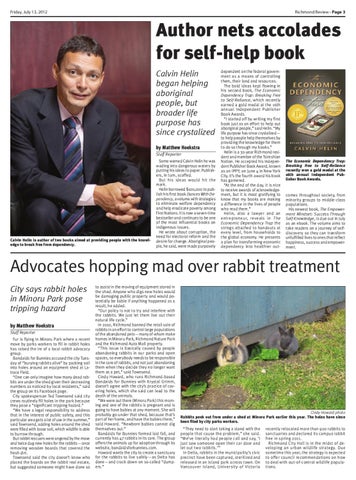
Advocates hopping mad over rabbit treatment City says rabbit holes in Minoru Park pose tripping hazard by Matthew Hoekstra Staff Reporter Fur is flying in Minoru Park where a recent move by parks workers to fill in rabbit holes has raised the ire of a local rabbit advocacy group. Bandaids for Bunnies accused the city Tuesday of “burying rabbits alive” by packing soil into holes around an equipment shed at Latrace Field. “One can only imagine how many dead rabbits are under the shed given their decreasing numbers as noticed by local residents,” said the group on its Facebook page. City spokesperson Ted Townsend said city crews routinely fill holes in the park because they pose a “significant tripping hazard.” “We have a legal responsibility to address that in the interest of public safety, and this particular area gets a lot of use in the summer,” said Townsend, adding holes around the shed were filled with loose soil, which wildlife is able to burrow through. But rabbit rescuers were angered by the move and twice dug new holes for the rabbits—once removing wooden boards that covered the fresh dirt. Townsend said the city doesn’t know who placed the boards on the rabbit real estate, but suggested someone might have done so
to assist in the moving of equipment stored in the shed. Anyone who digs new holes would be damaging public property and would potentially be liable if anything happened as a result, he added. “Our policy is not to try and interfere with the rabbits. We just let them live out their natural life cycle.” In 2010, Richmond banned the retail sale of rabbits in an effort to control large populations of the abandoned pets—many of whom make homes in Minoru Park, Richmond Nature Park and the Richmond Auto Mall property. “This issue is basically caused by people abandoning rabbits in our parks and open spaces, so everybody needs to be responsible in the care of rabbits, and not just abandoning them when they decide they no longer want them as a pet,” said Townsend. Cindy Howard, who runs Richmond-based Bandaids for Bunnies with Krystal Grimm, doesn’t agree with the city’s practice of covering holes, which she said can lead to the death of the animals. “We were out there (Minoru Park) this morning and one of the rabbits is pregnant and is going to have babies at any moment. She will probably go under that shed, because that’s part of her home, and have the babies there,” said Howard. “Newborn babies cannot dig themselves out.” Bandaids for Bunnies formed last fall, and currently has 47 rabbits in its care. The group offers the animals up for adoption through its website, bandaidsforbunnies.com. Howard wants the city to create a sanctuary for the rabbits to live safely—as Delta has done—and crack down on so-called “dumpers.”
Cindy Howard photo Rabbits peek out from under a shed at Minoru Park earlier this year. The holes have since been filed by city parks workers.
“They need to start taking a stand with the people that cause the problem,” she said. “We’ve literally had people call and say, ‘I just saw someone open their car door and let out two rabbits.’” In Delta, rabbits in the municipality’s civic precinct have been captured, sterilized and released in an island park across town. On Vancouver Island, University of Victoria
recently relocated more than 900 rabbits to sanctuaries and declared its campus rabbit free in spring 2011. Richmond City Hall is in the midst of developing an urban wildlife strategy. Due sometime this year, the strategy is expected to offer council recommendations on how to deal with out-of-control wildlife populations.
Page 4 · Richmond Review
Friday, July 13, 2012
Cops dropped ball in failing to trap lobster fraudster Rash of phone frauds targets Atlantic seafood vendors by Martin van den Hemel Staff Reporter Richmond Mounties had a chance to catch a lobster-loving local fraudster red-handed, but in dropping the ball, may have enabled the culprit to victimize several other Atlantic Canada seafood vendors. In May, Ken MacKay, a salesman with Yarmouth Bar Fisheries Ltd., contacted Richmond RCMP after he learned his firm had been twice targeted by a fraudster. MacKay told The Richmond Review that the fraudster was about to
pick up a 200-pound shipment of lobster at a local Fed-Ex cargo facility at Vancouver International Airport. So he called the Richmond RCMP to let them know, only to be bogged down with red tape that ended up proving costly for him and possibly three other seafood vendors. “They had the chance to catch the guy right there on the spot,” a frustrated MacKay said. “They basically said, ‘Well no, we can’t do anything about it.’” A frustrated MacKay said it was in May when his firm had been called for a first shipment of lobster to a Lower Mainland buyer, and after ensuring the credit card was valid, processed and shipped out the $1,800 order. Then on May 16, the
same customer called again to say the first shipment was great, and wanted to make another order for a weekend party he was planning. After processing that second shipment, worth $2,400, MacKay got a call from a North Vancouver man, the rightful owner of the credit card, who said he’d never ordered the lobster. MacKay took immediate action, but by this time, the lobster was already in transit, scheduled to arrive at Vancouver International Airport. So he called Fed Ex to ensure they didn’t release the lobster, but knew that the fraudster was unaware he’d been found out. MacKay then called the Richmond RCMP, only to be told that he first needed to file a statement with
his local Mounties in Nova Scotia. This process took hours, and by that point, the fraudster arrived at the Fed Ex facility on Sea Island. But when he was told the lobster wasn’t going to be released to him, he simply turned around and left, no questions asked. But the story doesn’t end there. Subsequent to MacKay’s firm being hit, they heard on a Yarmouth radio station last week that other seafood vendors had been struck too, and that Mounties out east were cautioning the public. MacKay and his colleagues are now wondering whether the guy who targeted them was also responsible for these other thefts. RCMP Sgt. Duncan
Pound said the federal commercial crime section is in contact with the Richmond detachment about the lobster fraud. He said last week’s press release was the result of a commercial crime unit
federal commercial crime section warned Atlantic Canada seafood vendors about a “rash of credit card fraud that starts over the phone.” Meanwhile, Richmond RCMP are apologetic. Sgt.
“They just dropped the ball.” - Wade Nickerson
investigation that was focusing in on a “target group of suspects.” Those investigators were aware a group of criminals was making phone calls to the Maritimes for seasonal products. He said merchants taking phone orders should take down the customer’s name and billing address along with the credit card number and security code, and then call the bank to ensure these match bank records for that credit card. Last week, the RCMP’s
Cam Kowalski said a local police cruiser should have been dispatched to the airport when the call first came in. “We should have sent a unit to meet with the individual picking up the shipment, identified him, arrested him if grounds exist, or detained him for investigation,” Kowalski said. Kowalski said local investigators now have extra incentive to catch the fraudster, and are digging up surveillance footage from Fed Ex. “It’s not like, oops, we
missed our opportunity, and now there’s nothing we can do. We’re backtracking, picking up the pieces, looking for information to further our investigation.” Kowalski said credit card fraud is a worldwide problem worth billions of dollars, and it’s likely that for the people behind this particular fraud, it’s not their first, last or only such criminal endeavour. Steps have also been taken at the local detachment to ensure something like this doesn’t slip through the cracks again. Meanwhile, though the second lobster shipment was eventually sold to another customer, Yarmouth Bar Fisheries owner Wade Nickerson is still out thousands of dollars from the first shipment. “They just dropped the ball,” Nickerson said of the Richmond Mounties’ failure to catch the fraudster. “At least it would have kept it from snowballing.”
Beautiful Taiwan Expo Arts Strategy Open House The City is updating its 2004 Arts Strategy to reflect today’s opportunities and challenges. The purpose of the strategy is to help facilitate the growth of the arts in Richmond by creating an environment and culture in the city that ensures the arts play a strong role in placemaking, community building, tourism and economic development.
Saturday, July 14 & Sunday, July 15 Join Lansdowne Centre and the Taiwan Chamber of Commerce this weekend for a celebration of Taiwanese culture! Enjoy live entertainment, traditional art and photographs from Taiwanese artists, and more on Saturday, July 14 from 11am – 3:30pm and Sunday, July 15 from 12 – 3:30pm in Centre Court. Lansdowne Centre: unique stores, great people.
We invite you to provide your feedback at one of the three Open Houses where highlights will be presented on the City’s Draft Arts Strategy. Thursday, July 12 Friday, July 13 Saturday, July 14
3:00 - 9:00 p.m. 9:00 a.m. - 5:00 p.m. 9:00 a.m. - 1:00 p.m.
Richmond Cultural Centre Rotunda 7700 Minoru Gate The Open Houses are your opportunity to be part of the process. Your input is appreciated. For more information, email communityservices@richmond.ca
5300 No. 3 Road in Richmond • Lansdowne Canada Line Station • Customer Service: 604-270-1344 Find us at lansdowne-centre.com and on Facebook & Twitter.
Friday, July 13, 2012
Richmond Review ¡ Page 5
Pricey purses stolen in home invasion Richmond RCMP looking for four men involved in attack of 50-year-old woman A woman was tied up, assaulted and robbed of seven pricey Hermes purses in a midday home invasion in Richmond, police said Thursday. At around 1:30 p.m. two men knocked on the door of a home in the 7000 block of Petts Road. A 50-year-old woman answered and let the men into her home after they told her a bogus story about an insurance claim involving her vehicle. Richmond RCMP say the two men—one described as Asian, the other as South Asian— grabbed the woman, tied her up and as-
FUN • FRIENDS • FREEDOM
MOVE IN TODAY
Richmond RCMP are searching for these suspects, believed to be in their early 20s.
saulted her. Two other men, one Asian and the other of unknown ethnicity, then entered the home. The foursome then stole numerous suitcases and bags filled with the victim’s property and high-end handbags, including seven Hermes purses with values of $5,000 to $15,000, police say. The woman freed herself and called police. Officers arrived at 3 p.m. to find the woman in the home with minor injuries to her face. Although police released the information and surveillance photos of the suspects Thurs-
day, the incident took place Tuesday, June 26. Investigators believe the men range in age from 20 to 25, and say they’re linked to a silver or charcoal-grey SUV, possibly a Ford Explorer. Police are asking anyone who is offered to buy a Hermes bag, or otherwise sees one for sale by an individual, to contact police. Anyone else with information about the incident or the suspects is asked to call police at 604-278-1212 or, to remain anonymous, Crime Stoppers at 1-800-222-8477.
No Waiting List
4071 Chatham St., Steveston
604.277.4519
Call for a private tour
DISCOVER INDEPENDENT LIVING IN STEVESTON • Bright Spacious Suites
• Weekly Housekeeping
• Safe & Secure
• Delicious Home Cooked Meals
• All Suites with Balcony or Patio • Recreational and Social Activities, including Bus Trips • Studio, 1 Bedroom, 1 Bedroom + Den, 2 Bedroom Suites
Tour & Tea
Every Thursday @ 1pm Hermes purses were stolen from a home.
(Limited Space, please call 604-277-4519 to reserve your spot)
W W W. T H E M A P L E R E S I D E N C E S . C O M
LET’S FILL UP OUR GREEN CANS THIS SUMMER!
Enjoy Summer Swimming Indoors or Outdoors Daily public swimming is available at all of Richmond’s pools. Visit our website for complete schedule details www.richmond.ca/aquatics
14300 Entertainment Blvd 604-448-5353
7560 Minoru Gate 604-238-8020
10100 South Arm Place 604-718-8035
4151 Moncton St. 604-238-8030
Note: Registration for summer swim lessons is in progress. Program opportunities for children & youth still available. City of Richmond | 6911 No. 3 Rd. Richmond BC V6Y 2C1 | Tel: 604-276-4000
www.richmond.ca
Let’s trim our waste!
Adding BBQ leftovers, soiled paper plates and yard trimmings helps: t 5VSO GPPE TDSBQT BOE ZBSE USJNNJOHT JOUP DPNQPTU o B WBMVBCMF SFTPVSDF GPS TPJM t %JWFSU BCPVU NPSF XBTUF GSPN MBOEm MM t 4IPX MFBEFSTIJQ JO DPNNVOJUZ SFDZDMJOH -FU T LFFQ PVS OFJHICPVSIPPET MPPLJOH UIFJS CFTU 1MFBTF SFNFNCFS UP QMBDF ZPVS (SFFO $BO BOE QBQFS ZBSE XBTUF CBHT BU UIF DVSC CZ B N PO ZPVS DPMMFDUJPO EBZ PS BGUFS Q N UIF OJHIU CFGPSF BOE LFFQ JU JO BO BMUFSOBUF TUPSBHF MPDBUJPO UIF SFTU PG UIF XFFL &OWJSPONFOUBM 1SPHSBNT *OGPSNBUJPO -JOF XXX SJDINPOE DB SFDZDMF
Page 6 · Richmond Review
Friday, July 13, 2012
City is probring a shark fin ban Calling for Nominations for the
NOMINATIONS CLOSE AT NOON MONDAY, SEPTEMBER 10, 2012 The Business Excellence Awards recognize Richmond’s outstanding leaders in business and the community. Finalists are announced October 14th. Save the date for this gala awards ceremony on Wednesday, November 21, 2012 at the River Rock Casino Resort. Doors open at 5:30pm with a no host reception. • Young Entrepreneur • New Business Of The Year • Business Of The Year - Three Categories (1) Enterprise 1 - 25 Employees (2) Enterprise 26 to 75 Employees (3) Enterprise 76+ Employees • Innovation Award • Business Leadership Award • Outstanding Workplace Award • Association Of The Year
To Nominate a Richmond business go to richmondchamber.ca
#BEA35
Frmo Page 1 Chung said shark finning provides jobs for people in developing countries and balances the food system. As a top predator, if sharks are left unchecked, they’ll consume more and more fish, he said. “If they’re not being hunted or they’re not being killed, a lot of things would change too. The way I see it, the Chinese people have become part of the food chain that keeps things in check.” Toronto’s ban, on the possession, sale and consumption of shark fin products, goes into effect Sept. 1, imposing fines of $5,000 for a first offence, $25,000 for a second conviction and $100,000 for subsequent ones. Six other Ontario cities have also agreed to bans. In Metro Vancouver, Coquitlam, Port Moody and the City of North Vancouver have also banned possession and use of shark fins. Activist Anthony Marr presented his case for a ban to Richmond council Monday. He hopes to also convince Burnaby and Vancouver to adopt a ban. “It’s cruel. The analogy is if some aliens abducted you, cut off your four limbs and dumped you back onto the road. That’s what we do to the sharks, by cutting off their fins and dumping them back into the water,” Marr told The Review. According to ocean conservation group Oceana, 50 of the 307 shark species in the world are vulnerable or endangered, and Marr said it’s impossible for shark fin consumers to know what poached products they’re buying.
Civilian oversight agency to open in September B.C.’s new Independent Investigations Office will open Sept. 10, providing a civilian-led unit to probe deaths and incidents of serious harm involving police officers. The opening comes several months late and two years after the province first committed to creating a police investigations agency headed by civilians, so police forces no longer investigate each other. “The goal of the IIO is to conduct fair, competent, bias-free investigations in a timely fashion and publicly report on the results of our investigations,” said IIO chief civilian director Richard Rosenthal. Twenty-six investigators have been hired so far and the unit is to have a total of 60 investigators, management and other administrative staff once fully operational. Investigators must not have served as police officers in B.C. within the last five years, and police are compelled by law to report incidents under its mandate.
Transit pass forgers busted Two Vancouver men are accused of making and selling counterfeit transit passes. Transit Police say James Stuart Richardson, 47, and Daniel Blair, 65, are charged with forgery and related offences after a six-month investigation into the circulation of high-quality made-to-order fake transit passes that are normally issued by the Ministry of Social Services and Housing. Officers conducted a sting that led to the arrest of two suspects and the seizure of computers, laminators, printers and several dozen passes ready to sell. It’s estimated the forged passes denied the transit system more than $200,000 in lost revenue.
Overtime ban begins at ICBC Unionized ICBC workers have begun an overtime ban as part of job action aimed at spurring the auto insurer to give ground in contract talks. The ban began July 6 and follows a Labour Relations Board ruling that found ICBC was bargaining in bad faith by refusing to discuss wages and benefits until a provincial review of the corporation concludes.
Our own frozen s blueberrie
BLUEBERRY KICK OFF JULY 14TH Lots of activities for the entire family! l ffor Kid •B Bouncy CCastle Kids • Face Painter/Balloon Twister • Sample Tasters • FREE hot dog & pop with minimum purchase, while quantities last
SATURDAY, JULY 14TH 11AM-3PM
FRESH BLUEBERRIES ARE NOW IN! Okanagan Cherries Now In! Lots of other fresh produce!
CORNER OF BLUNDELL AND SIDAWAY (look for the red barn) RICHMOND, BC
Friday, July 13, 2012
Richmond Review 路 Page 7
NO HST ON REMAINING ITEMS!!
LAST 7 DAYS!!
SOF A FR S $ OM
499
Page 8 · Richmond Review
Friday, July 13, 2012
opinion the richmond
REVIEW #1 - 3671 VIKING WAY, RICHMOND, B.C. V6V 2J5 • 604-247-3700 • FAX: 604-247-3739 • RICHMONDREVIEW.COM TWITTER.COM/RICHMONDREVIEW • FACEBOOK.COM/RICHMONDREVIEW
PUBLISHER MARY KEMMIS, 604-247-3702 publisher@richmondreview.com
EDITOR BHREANDÁIN CLUGSTON, 604-247-3730 editor@richmondreview.com STAFF REPORTERS MATTHEW HOEKSTRA, 604-247-3732 mhoekstra@richmondreview.com MARTIN VAN DEN HEMEL, 604-247-3733 martin@richmondreview.com SPORTS EDITOR DON FENNELL, 604-247-3731 sports@richmondreview.com
ASSISTANT ADVERTISING MANAGER ELANA GOLD, 604-247-3704 elanag@richmondreview.com SALES ROB AKIMOW, 604-247-3708 roba@richmondreview.com COLLIN NEAL, 604-247-3719 collinn@richmondreview.com LESLEY SMITH, 604-247-3705 lesley@richmondreview.com TORRIE WATTERS, 604-247-3707 torrie@richmondreview.com JAMES TENG, 604-247-3714 jamest@richmondreview.com
Detail from The Gateway to Inkameep, one of Irvine Adams’ scenes of sacred aboriginal sites in the Okanagan-Similkameen
Nuggets from Bill Barlee’s gold pan CIRCULATION MANAGER RACHAEL FINKELSTEIN, 604-247-3710 circulation@richmondreview.com CIRCULATION JR TUAZON, ROYA SARWARY, 604-247-3710 circulation@richmondreview.com
B.C. Views Tom Fletcher CREATIVE SERVICES MANAGER JAANA BJORK, 604-247-3716 jaana@richmondreview.com CREATIVE DEPARTMENT GABE MUNDSTOCK, 604-247-3718 gabe@richmondreview.com PETER PALMER, 604-247-3706 peter@richmondreview.com JAMES MARSHALL, 604-247-3701 james@richmondreview.com The Richmond Review is a member of the B.C. Press Council, a self-regulatory body governing the province’s newspaper industry. The council considers complaints from the public about the conduct of member newspapers. Directors oversee the mediation of complaints, with input from both the newspaper and the complaint holder. If talking with the editor or publisher does not resolve your complaint about coverage or story treatment, you may contact the council. Write (include documentation) within 45 days to B.C. Press Council, 201 Selby St., Nanaimo, B.C. V9R 2R2. For information, phone 888-687-2213 or go to www.bcpresscouncil.org Published every Wednesday and Friday by Black Press Ltd.
S
hortly after word came of the death of B.C. historian and politician Bill Barlee, my wife searched through her seemingly endless trove of B.C. books and produced half a dozen of his original self-published quarterlies, known as Canada West magazine.
The earliest one is Winter 1970, where the publisher’s note advises that subscription rates were
increasing 20 cents per year to $2.95. Subscriptions were up to more than 1,600 and counter sales were increasing, but costs were also up and Barlee refused to accept either display advertising or U.S. subscriptions. The only colour pages in the issue are high-quality prints of four majestic paintings commissioned for the magazine. Irvine Adams’ scenes of sacred aboriginal sites in the Okanagan-Similkameen include The Gateway to Inkameep, where Barlee remarks: “Today that stream which once teemed with redfish no longer surrenders its once-valued harvest and the perimeter of the desert is gradually being eroded by man’s questionable progress.” With the typography of Old West wanted posters, Barlee provided tightly sourced accounts of B.C.’s legends. “Lost gold mine at Pitt Lake” analyzes and adds to earlier accounts that begin
with an aboriginal miner known as Slumach, who would periodically arrive in New Westminster to squander a small fortune in gold, then disappear up the remote tidal lake. Slumach was hanged for murder in 1891 and in the next 70 years, 11 more men would die trying to find his secret. A scientist as well as a storyteller, Barlee concluded that the area’s geology is wrong and the fabled gold-laden creek “probably does not exist.” A passion for prospecting runs through the magazines, and hints at Barlee’s aversion to treasure-seeking Americans. They overran B.C. in historic waves to take gold, and according to Nelson Starreporter Greg Nesteroff, Barlee believed they continued to loot Canadian heritage sites. Nesteroff was inspired by Barlee’s work, and traced his lonely mission to restore the ghost town of Sandon, “the mining capital of the Silvery Slocan.”
Barlee bought a surviving block of buildings in an effort to make Sandon another Barkerville, but heavy snow collapsed them. As tourism minister, Barlee found money to build replicas, and construction began on three. But Barlee lost his Penticton seat to Bill Barisoff in the 1996 election, and today only half-built shells remain. “He was still selling Sandon’s restoration as an economic saviour for the region when he ran for federal office in 2000,” Nesteroff writes. “But by then he was ridiculed for it, and finished a distant second.” Barlee’s 1972 Canada West profile of the boomtown of Hedley would resonate in his career as an NDP MLA and cabinet minister in the 1990s. Hedley’s Nickel Plate and Mascot mines produced fortunes in gold, silver and copper before they played out, and Barlee led the fight to preserve their history.
Today you can tour the Mascot mine, a proud historical site with a spectacular climb up the rock face that serves as the Grouse Grind of the B.C. desert. I first discovered Barlee as a reporter at the Kelowna Capital News in the early 1980s, when he did a weekly history show on CHBC television called Gold Trails and Ghost Towns. A bare-bones studio affair with tales and artifacts displayed for host Mike Roberts, the show lasted a decade. Barlee didn’t lack courage, quitting a teaching career in Trail and Penticton in 1969 to start his magazine. On subscription fees and a few classified ads, he built a life’s work that allowed him to walk the boardwalks of history and the halls of power. Tom Fletcher is legislative reporter and columnist for Black Press newspapers. He can be reached at tfletcher@blackpress.ca.
Friday, July 13, 2012
Richmond Review · Page 9
letters High density won’t work in Hamilton
Time to patch up potholes
Editor: Re: Hamilton area plan update. The idea of high density in Hamilton does not work. What was done in Steveston works because Steveston is an established village with shops, restaurants, pool, high school, sport fields, large community centre, Garry Point, fishing docks, location on the river and more than one road in and out. Hamilton has one elementary school, which is full, one restaurant, a small fitness centre and one church. Hamilton is a hamlet, and it has nothing to offer high density or medium density. The only difference between the three proposals is the type
Editor: The potholes at the Alderbridge/ Garden City crossroad have been there for as long as I could remember, and I’m talking about years. When are the authorities going
of plants and asphalts used. Nothing is brought to the table other than more residents. In all the options shown none of the beautiful trees along Westminster Highway and throughout Hamilton were incorporated in the plans. The trees cut down the noise from Highway 91A, keep the dust down and give us the country feel. Perhaps the proponent could rethink his approach and make his plans into more of a park-like setting around the trees, a few condos, a village street with shops with living space above, or keep the shopping centre we have now and get some tenants into the empty shops. What impact study has been done as to how Richmond
can cope with another 12,000 residents from Hamilton? Can the school system, ice rinks, swimming pools, sport fields, health care, restaurants, fitness centres, library, shopping centres handle the increase? With Hamilton having nothing to offer its residents the traffic back and forth into Richmond will be a nightmare getting the kids to their entire practices, nice carbon footprint you are adding. What about the youth of Hamilton nothing was addressed in the plan, where are they to hang out? I hope you aren’t planning on Queensborough to handle Richmond’s mistakes for inadequate planning. Betty Carr Hamilton
to patch them up? It has become increasingly hazardous, particularly when motorists swerve suddenly to avoid the potholes. Leo Daniel Richmond
Does it hurt to say hello? Editor: Would it hurt to nod, smile, or say hello? We now can enjoy sunshine and gentle evening walks throughout Richmond parks, dykes, and neighbourhood sidewalks. With no need for protective umbrellas or downward stares to avoid the drips and puddles, we have perfect opportunities to connect with “strangers” along our way. We may wave briefly, our eyes meeting. We may nod, smile, greet, or share a comment. Or, we remain absorbed by our electronics, engaged in a private conversation; avert our gaze, or mutely stare at nothing in particular. Recent and unprecedented investment, growth, and immigration continue to impact every level of the Richmond community, including connections between strangers. The insularity of personal electronic devices, the chill of perceived “stranger danger,” and increased daily stressors can further weaken our fabric of social cohesion. Regardless of the reasons, I am tired and fed-up with anti-social walkers. I feel sad, frustrated, angry, and worried for our community. This is not an issue of superficial politeness. Given the reality that we are briefly sharing the same path, why not offer at a civil, if not friendly, salutation? Heck, cyclists and joggers can join in as well! As the Vancouver Foundation’s recent research emphasizes, when we feel we belong in our community and trust our neighbours, we feel safer and happier. So do our kids. We need each other. Would it hurt to smile, nod, or greet a passing stranger? Maybe a little. Would it help? Maybe a lot. Jo Anne Gray Richmond
Behind every work zone cone is a worker in a vulnerable position. Each cone stands for someone’s father, mother, son, or daughter. Slow down and drive with care when approaching a “Cone Zone.”
ConeZoneBC.com
FOOT PAIN? We can help
Has Your Portfolio not Delivered? Are you anxious to find an alternative? Are high fees a source of concern?
LASER TREATMENT
Are you looking for a professional, cost effective Investment Advice & Portfolio Management Solution?
AVAILABLE FOR PAIN MANAGEMENT • Foot Care • Corn • Calluses • Warts • Abnormal Toenails • Sports, WCB & ICBC Injuries • Bacterial and Fungal Infections • House & Hospital Visits • Custom Made Foot Orthotics
FOOT ORTHOTICS 2 FOR 1 CUSTOM
DR. SYD ERLICHMAN Doctor of Podiatric Medicine Diplomate of American Academy of Pain Management
TWO LOCATIONS TO SERVE YOU: 1110-750 West Broadway, Vancouver • 604-876-7744
309-301 East Columbia St., New Westminster • 604-526-2748
Shaun Rickerby Portfolio Manager Investment Advisor
For more information on how we can solve your investment challenges please visit our website at www.rickerbywealthgroup.com Rickerby Wealth Group consists of Shaun Rickerby, Vice President, Investment Advisor, Branch Manager, Associate Portfolio Manager; Sean Millington, Investment Advisor and Joanne Palma, Sales Assistant. Rickerby Wealth Group is a part of TD Waterhouse Private Investment Advice. TD Waterhouse Private Investment Advice is a division of TD Waterhouse Canada., a subsidiary of The Toronto-Dominion Bank. Trade-mark of The Toronto-Dominion Bank. TD Waterhouse is a licensed user. TD Waterhouse Canada Inc.
Sean Millington Investment Advisor
Page 10 路 Richmond Review
Friday, July 13, 2012
RENTALS LAST REMAINING RENTAL HOMES AVAILABLE FOR MOVE IN TODAY
CALL (604) 353-RENT
14088 Riverport Way, Richmond BC apply online www.riverportflats.com
Friday, July 13, 2012
Richmond Review ¡ Page 11
news
Reading
by Martin van den Hemel Staff Reporter A former ďŹ nance manager of a Richmond ďŹ rm has been sentenced to 18 months in prison for defrauding his former employer of more than $100,000. Karim Rajabally Manji was sentenced in North Vancouver provincial court last May after pleading gulity to one count of fraud over $5,000 and one count of theft over $5,000. North Vancouver provincial court judge Carol Baird Ellan sentenced Manji to one year in prison for fraud, and 18 months in jail for theft over $5,000. Manji was hired in September 2004 to be the manager of administration and avionics at PaciďŹ c Avionics and Instruments in Richmond. He was solely responsible for the ďŹ nancial management of the ďŹ rm. Within six weeks of being hired, he cut himself an unauthorized cheque for $2,500, according to the judgement, and over a period of two years, used company funds to buy jewelry, used a company credit card for personal purposes, overpaid himself, and wrote himself unauthorized corporate cheques. “The total defalcation to which he admits exceeds $100,000,â€? Baird Ellan wrote. “Some of the funds were used to pay for metal detection equipment Mr. Manji required for a security position he had for the visit of the Aga Khan.â€? After initially making excuses, Manji ultimately gave a statement, and then promised to repay what he took, though nothing had been repaid at the point of the May 14 judgement. Manji’s offences came to light in 2006, at which point he was ďŹ red. At that point, it was Manji’s ďŹ rst criminal offence. But his second offence came in 2007 in North Vancouver, a case that came to court sooner. At the time, his employer was High Output Sports. He plead guilty to fraud and was Look for these flyers in the richmond
REVIEW *Limited distribution
Best Buy* Future Shop PriceSmart Foods Save On Foods Shoppers Drug Mart*
sentenced to a nine-month conditional sentence and he was ordered to pay $22,789.92 in restitution. His third employee-related fraud came in 2007, in Vancouver. He was sentenced to six months in jail and was ordered to pay $29,000 in restitution, which still hasn’t been paid. His fourth offence occurred in 2008, and involved Aqua Guard Spill Response in North Vancouver, and involved a fraud worth between $70,000 and $80,000. He was hired from a Craigslist ad. According to Aqua Guard, the fraud forced the company to lay off ďŹ ve full-time employees, with the remaining staff taking a 10-per-cent salary cut. Manji’s criminal actions began in 2004, at a “time when Mr. Manji was experiencing ďŹ nancial stress. He and his wife had lost their life savings in the business they had started and had creditors demanding to be paid...It seems the rational for the second (offence) was similar to the ďŹ rst and there was a snowball effect,â€? the judgement states.
Lo Bok
Call: 604-276-2898 or contact
Scott Russell
Fine Motor Skills
Research has proven that children who develop strong reading skills early in life learn better, are less likely to fall behind, and are more successful students. Our Little ReadersŽ program, for ages 3 to 5, gives your preschooler a head start toward school success. Small, half-day classes combine the perfect balance of reading, writing, math, and fun. :K\ QRW WDNH WKDW LPSRUWDQW À UVW VWHS ULJKW QRZ"
Call today, today, or or visit visitoxfordlearning.com oxford.learning.com 604.233.5566 604.233.5566
7380 Westminster Westminster Hwy., Richmond 7380 Hwy., Richmond (near Minoru Blvd.) (near Minoru Blvd.)
NOW ENROLLING FOR SUMMER CAMPS
49¢
39¢
/lb
99¢
/lb
Banana
/lb
Tung Choy
$
55¢
/lb
$
Large Black Plum
Watermelon
Pork Feet
Make a breakout move by joining our award-winning team today.
Listening
Fresh Values in Store This Week!
Source by Circuit City* The Brick* Walmart*
JOIN THE SUTTON TEAM!!!
Math
Early readers make better learners
Manager gets jail for fraud Karim Rajabally Manji gets 18 months in jail
Phonics
1.29
/lb
Tomato
79¢
1.99
/lb
/lb
Beef Flank Steak
Silkie Chicken
$
$
3.88
/lb
3.99
/lb
ABC Lactic Acid Bar
Golden King Mixed Fruit Drink
Shirakiku Red Bean
850ml
340ml
340g
$
59¢
$
Three Horses Beancurd Preserved
LKK Sesame Oil Blended w ith Soybean Oil
GF Bailing Mushroom
99¢
99¢
$
1.20
/ea
/ea
/ea
320g
/ea
207ml
1.00
/ea
850g
1.25
/ea
General Manager via email at srussell@sutton.com
GARDEN CITY RD. LESLIE RD
ODLIN RD
CAMBIE RD
program for new and experienced agents.
China World Supermarket ALDERBRIDGE WAY
ALEXANDRA RD
It’s true! We have a Àrst rate training
8777 Odlin Road Richmond
Sun.-Thurs. 10am-8pm Fri.-Sat. 10am-9pm
JULY 13 - JULY 16, 2012 Specials valid while stock lasts and are subject to change.
Fun
Page 12 · Richmond Review
EET SWJUICY&
Friday, July 13, 2012
Fresh Local
Strawberries $ 1 - 10 lb Box 20 2 - 10 lb Boxes $30 4 - 10 lb Boxes $50
Delivering Freshness From Our Family to Yours
U-PICK
100lb
$
WITH THE MIN. PURCHASE OF 5 LBS
All specials valid until July 16, 2012. *Due to error, last month’s coupon ad is no longer valid. This coupon reflects current pricing.
604-339-9335 Open 7 days 9am-9pm INCLUDING HOLIDAYS
Bridgeport Road
Cambie Road
No. 6 Road
(near Cambie)
Knight Street
4200 No. 6 Road
bcstrawberries.com • birakfarms.com
Our thoughts and condolences go out to the Lomas family on the passing of Joe Lomas. Dr Lomas built The Richmond Animal Hospital in 1955 and cared for the farm and companion animals of Richmond for many years. Many people have fond memories of working with Dr Lomas or bringing their childhood pets to him. He was a very special man and he will be deeply missed. Sincerely, The Doctors and Staff at The Richmond Animal Hospital
news
Metro’s high congestion ranking called deceptive Region rated worst on continent after Los Angeles by Jeff Nagel Black Press Metro Vancouver is Canada’s most congested urban area and second only to Los Angeles in North America, according to a report. The rankings by GPS maker TomTom – based on data gleaned from the traffic movements of its subscribers – found Vancouver drivers take on average 30 per cent longer to make a trip at congested times than when roads and highways are free flowing. Los Angeles was worst among North American cities – with a 33 per cent delay – while Miami, Seattle, Tampa and San Francisco ranked third through sixth at around 25 per cent. Toronto was ninth at 22 per cent. For Vancouver, TomTom estimated congestion translates into a 34-minute delay for each hour driven in peak periods, adding up to 83 hours over the course of a year for motorists with a 30-minute daily commute. But TransLink spokesman Drew Snider said the findings are deceptive. Metro Vancouver has fewer highways and therefore lower overall traffic speeds than Los Angeles, he said. That means a 10 kilometre per hour reduction in the speed of
For Vancouver, TomTom estimated congestion translates into a 34-minute delay for each hour driven in peak periods.
moving traffic is a bigger proportional delay here compared to U.S. cities with more freeways, giving Vancouver a worse ranking. “We made the choice not to punch freeways through the centre of Vancouver and that’s made the region more livable,” Snider said. He said TransLink is working to expand transit – as well as cycling and pedestrian infrastructure – to offer alternatives to car use in more of the region. SFU City Program director Gordon Price said the rankings more accurately reflect the plight of drivers in areas where cars dominate, but not where transit is frequent and more viable. “Car congestion is not a measure of mobility,” he said. “So long as you have choices, you don’t have to be hung out in traffic.” Price said the region will soon see what a huge increase in highway
capacity achieves when the new Port Mann Bridge, expanded Highway 1 and South Fraser Perimeter Road all open. Highway congestion should be cut, at least initially, he said, although he forecasts it will spur more car use and new construction geared for drivers rather than transit, potentially undermining efforts to expand transit South of the Fraser. He also predicts the tolls on the Port Mann will increase congestion on arteries within Surrey as some drivers seek to avoid paying and more South of Fraser drivers try to stay on their side of the river. Price said the City of Vancouver’s decision to shun freeways has paid off because large numbers of car trips have shifted to transit, walking or cycling. “We’re down to 1965 levels of traffic coming in and out of downtown Vancouver.”
richmond’s newest
Japanese
all you can eat buffet
IZUMI-TEI JAPANESE BUFFET
Lunch or Dinner Seniors (65 & Over) Children (9 & Under) 3 & Under
$11.99 $10.99 $5.99 FREE
OPEN DAILY FROM 11:30AM-8PM | DINING TIME 1 HOUR 9220 #3 Road, Richmond, BC 604-277-3161 www.richmondanimalhospital.ca info@richmondanimalhospital.ca
IZUMI-TEI JAPANESE BUFFET “Building Lifelong Partnerships With Pets and Their People”
160-7971 ALDERBRIDGE WAY RICHMOND BC • 604-303-1171
Friday, July 13, 2012
Richmond Review · Page 13
news
TaxiSaver subsidies won’t be scrapped, TransLink says Officials didn't understand impact until user backlash by Jeff Nagel Black Press TransLink has abandoned its plan to phase out subsidized cab rides for elderly and disabled HandyDart clients, saying it failed to fully grasp the need for the TaxiSaver program. Eliminating the $50 per month subsidy for halfprice taxi fares would have saved $1.1 million that TransLink intended to reinvest into the oversubscribed HandyDart custom-transit service to provide more rides that way. But the transportation authority was besieged with protests from angry users, who complained they could at least use TaxiSavers to get a taxi on short notice when HandyDart is unavailable or booked up. In other cases they could get to an appointment with HandyDart but there was no guarantee of a return ride. TransLink board chair Nancy Olewiler said the authority has learned from its error. “The TaxiSaver program is reinstated in its entirety,” she said Wednesday. “I regret any angst we caused for people who were fearful their program would not continue and they would not have the access they did.” Olewiler said the goal of the change was always to improve service. “It wasn’t a cost saving,” she said. “We actually thought, believe it or not, we were going to make
A Metro Vancouver transit user on a scooter gets a lift up into a HandyDart vehicle.
By the numbers •HandyCard users who qualify for TaxiSavers: 32,000 •TaxiSaver purchasers in last year: 7,200 •Portion of conventional bus fleet that’s accessible: 100 % •Share of bus stops that are accessible: 63.4 % the system better.” TransLink had consulted through its Access Transit Users Advisory Committee, but Olewiler said they later realized how some clients use TaxiSavers in combination with HandyDart and how the taxi coupons provide much more convenience and flexibility. “We didn’t understand the integral nature of TaxiSavers to the whole program,” Olewiler said. “We just didn’t have that depth of understanding.” The planned cancellation of TaxiSavers – sales were to stop this summer and remaining ones were to expire next June – was put on hold pending more consultation by TransLink in May. More than 18,000 HandyDart trip requests were denied last year because the service was oversubscribed and that problem has worsened this year.
TransLink also wanted to crack down on unauthorized use of TaxiSavers because the coupons are often sold on the black market to people who don’t qualify for the program. “As with the U-Pass, we’ve seen people selling TaxiSavers on Craigslist,” Olewiler said. “There is fraud.” TransLink is exploring ways to bolster identification requirements as part of the rollout of TransLink’s Compass smart card. The decision comes as TransLink is in the midst of a search for savings on multiple fronts to free up money to satisfy its independent commissioner as well as a provincial audit. CEO Ian Jarvis said that process is “consuming” the organization this summer. He pledged a financial plan set for release
in September will shed more light on what costcutting measures may be pursued. “There are risks that come with these opportunities,” Jarvis said, adding TransLink needs to assess the potential impact on reliability and quality of transit services. TransLink must carve about $50 million a year out of its budget to offset a denied fare increase and to make up for area mayors’ vote to rescind a property tax increase. Promised express bus routes from Langley to Burnaby over the new Port Mann Bridge and down King George Boulevard in Surrey are on hold as a result. Mayors Council vicechair Peter Fassbender said he hopes TransLink consults carefully as it decides where to cut. “They’re looking at the rationalization of various service levels, unproductive routes, issues on maintenance and a whole host of complex and far-reaching things,” he said. Fassbender said those decisions need to consider communities’ needs, not just “business cases and numbers.”
Siberian smoke fades, U.S. fires may add to haze The phenomenon of smoke wafting here from wildfires in Siberia is no longer a significant factor behind hazy skies over the Lower Mainland, according to Metro Vancouver officials. Russian fires were blamed Monday by Metro air quality officials for a near-doubling in fine particulate levels over the past weekend.
“The situation is now changing,” Metro Vancouver spokesman Glenn Bohn said Wednesday. “The influence of smoke from the Asian fires has mostly ended. The concentrations of fine particulates have decreased.” But he said fires burning in Washington, Oregon, Idaho and California could send more smoke into B.C. in the days ahead, depending
on the weather. So far Metro officials are watching conditions and haven’t yet issued any air quality advisories. Air quality experts recently unveiled a new website that rates air visibility at key sites around the Lower Mainland using a network of automated cameras. The ratings and images can be viewed at clearairbc.ca.
SAVE BIG!
HOT DEAL!
YOUR KONTINENT
RICHMOND INTERNATIONAL FILM & MEDIA ARTS FESTIVAL 07.20 - 22. 2012
50
% OFF
Buy* Online Click on Shop of Deals at www.BCDailyDeals.com
*Deal effective July 13 to 17
3 DAY FILM FESTIVAL PASS
buy at $
15
value
30
$
Page 14 · Richmond Review
Friday, July 13, 2012
news
ADVERTISING FEATURE
Lower Speed, Fewer Problems? In mid-April 2012, the the severity of the resulting Medical Officer of Health injuries for cyclists and for the City of Toronto, Dr. pedestrians. Small increases David McKeown, reported in traffic speeds results in on the results of a Toronto a disproportionately large Public Health study to increase in pedestrian “identify strategies and fatalities. For example, specific opportunities pedestrians have an for improving health and estimated 85% chance of quality of life by increasing dying when hit by a car Cedric Hughes Barrister & Solicitor travelling at 50 km/hr but the use and safety of active www.roadrules.ca transportation throughout fatality rates decrease to Toronto.” ‘Active transportation’ refers to walking less than 5% when the car travels at 30 km/hr.” and cycling. It would be a stretch to describe this The report also cited the following statistics study’s findings as even approaching ‘surprising.’ from other jurisdictions: “A review of 19 trafficIf they didn’t know so already, Torontonians calming initiatives (emphasis added) in four learned that “physical activity from active European countries found that injuries caused transportation generates important health by collisions for all road users fell by 41-83%, benefits.” What may have been new, however, while fatalities dropped by 14-85%. After 30 were the numbers. On the savings side: an km/h zones were introduced (emphasis estimated 120 deaths per year prevented by 2006 added) in London, these zones experienced a levels of walking and cycling, and $110 to $160 42% reduction in fatalities. In 1988 the Town million in reduced health care spending. On of Baden, Austria restricted speeds to 30 km/ the cost side: over $53 million from pedestrianhr for about 75% of its road network. This and vehicle collisions and over $9 million from other measures reduced the rate of casualties cyclist-vehicle collisions. by 60%. New York City is now piloting reduced Accordingly, the report concluded that, by neighbourhood speed zones, with speed limits of improving safety for pedestrians and cyclists and about 30 km/hr.” thereby reducing or eliminating collision costs More particularly, it was Toronto Mayor Rob and by increasing “walking and cycling to levels Ford’s reaction to the report’s recommendation of other leading North American cities such as to reduce speed limits—stated to be a nonVancouver and Portland,” additional annual supportive view—that grabbed the news benefits could reach anywhere from $100 million headlines. As a populist, however, Mayor Ford to $400 million. Even in times when trillions are might be expected to reflect the average voter’s commonly bandied about, numbers like these still opinion on many fundamentals. In this case, merit attention. one can’t help but doubt. Road Rules readers, The biggest attention grabber, however, was Dr. we hope, and, presumably, the majority of McKeown’s recommendation for achieving these Torontonians intuitively know that slowing down numbers by “reducing vehicle speed limits to 30 may increase safety. km/hr on residential streets and adopting a citywide speed limit of 40 km/hr … unless otherwise …by Cedric Hughes, Barrister & Solicitor posted.” The report noted that: “Higher vehicle with regular weekly contributions from speed increases the risk of a collision as well as Leslie McGuffin, LL.B.
THE ROAD RULES
Personal Injury Law, ICBC Claims “Experienced representation for serious injuries” 604-273-8518 • Suite 300-5900 No. 3 Road, Richmond Law Corporation
www.hughesco.com • Free Initial Consultation
Stinky food waste composters face Metro odour fees Region plans to charge plant operators based on smell by Jeff Nagel Black Press Industries such as organic composting plants that stink up a local neighbourhood may soon pay fees to Metro Vancouver based on the severity of the odours they emit. The fees are being proposed on a polluter-pay basis to recover what Metro says is hundreds of thousands of dollars a year expended in staff time responding to industrial odour complaints. “What we’re saying is you can emit the odour but we’re going to charge you based on what impact that odour has,” said Ray Robb, Metro’s air quality division manager. The details are set out in a Metro discussion paper that proposes to categorize different emitters based on high, medium and low risk of posing an odour problem. Officials will consider how much odour is emitted, as well as how well it is dispersed and the proximity to people it might offend. “If you put a stinky thing in the middle of nowhere and put it up
ARTfestival
a tall stack and nobody smells it, who cares?” Robb said. “Put that same emission source in the middle of a community – maybe at the bottom of a hill where it drifts up a hillside and ruins everybody’s weekend – that’s a substantially different matter.” Industries deemed high risk – which include compost operations with more than 10,000 cubic metres of compostibles on site and animal renderers – would be charged $5 per year for every person they expose to a specified level of smell. Metro estimates the fees might add up to $110,000 per year for the worst offenders. Robb said about six operators might now be in the high-risk category, but added more new sources are coming on stream as cities divert more organic waste from landfills. Moderate risk facilities would pay a $500 registration fee and have to develop an odour management plan, which could be subject to review and higher fees if Metro decides the odour is offending the community. Low-risk sites face no fees or requirements. Robb said it’s an important issue to address now because Metro’s decision to mandate curbside organic waste pickup means huge volumes of food waste will be composted at facilities that will be built in the region. Fraser Richmond Soil and Fibre is
9th Annual FRASER RIVER
SUNDAY, JULY 15
10am to 4pm
Original O riginal Art Works for Sal Sale by over 25 Local Artists Live Music by the S Steveston Folk Guild Kids P Paint In
Richmond Artists Guild Potters Club Gem & Mineral Club
LONDON HERITAGE FARM 6511 Dyke Road, Richmond BC refreshments www.richmondartistsguild.com Supported by the City of Richmond
the existing operator taking some food waste already but more are expected to spring up. All organics will be banned from the region’s dumps and transfer stations by 2015 and residents will be required to put all their food waste in a green bin instead of the garbage. Metro’s discussion paper says smelly emissions can interfere with sleep, add to stress and anxiety, disrupt family barbecues and cause health impacts ranging from nausea and watery eyes to headaches and sore throats. It’s not the first time air quality regulators have tried to slap fees on stinky industries. But a previous effort by Metro to actually regulate or outlaw extreme odours was struck down by an environmental appeal board. This time, the region is just trying to recover costs through fees, rather than trying to enforce limits. Robb said the odour response costs are being unfairly borne either by other air polluters through fees on their contaminants or else by taxpayers. The region is seeking feedback on the plan and the Metro board would have to vote on any bylaw imposing the fees. Metro’s own sewage treatment plants would be exempt from the odour fees. Robb said they aren’t subject to Metro’s air quality rules because they are regulated separately by the province.
Friday, July 13, 2012
Richmond Review · Page 15
arts & entertainment
Join Us Sat., July 14 1-5pm
featuring demonstrations of local products and food samples
SPIN
toWinWIN prizes with a spin of the wheel, by donation
HOT DOG SALE Tim Matheson photos A scene from ‘Salmon Row,’ a site-specific play that premiered at Britannia Heritage Shipyard last summer. Producers are bringing it back in 2013.
Theatre returns to Britannia in 2013 Salmon Row, a history of Steveston’s canneries gets another run by Matthew Hoekstra Staff Reporter Salmon Row will return to
Britannia Heritage Shipyard in the summer of 2013, Mortal Coil Performance Society announced Tuesday. The society mounted its first theatrical production at the city-owned shipyard in 2011, and thanks to a recent city council grant of $100,000, the site-specific play is now set to return. The ambitious play explores the history of Steveston’s canneries on the Fraser River. Its first run of several sold-out
performances shared that history through the use of masks, stilts, large puppets, First Nations dancers, a four-piece band and cast of actors. The show is written by Nicola Harwood with original music by Tobin Stokes and directed by Peter Hall. Salmon Row is Mortal Coil’s second full length site-specific production. Mortal Coil is also known for its work in producing the Stanley Park Ghost Train and Bright Nights events.
(includes drink and potato chips) Proceeds benefit BC Children’s Hospital
COUPON Bring this coupon to the store and enter to win a $150.00 Save On Foods gift cardd Valid only on July 14, 2012 at Terra Nova location only. Name: ______________________________________ Phone: ______________________________________ Email:_______________________________________
TERRA NOVA LOCATION ONLY
3673 Westminster Highway, Richmond Store Hours: 7am - 11pm everyday • 604-273-5755 • Pharmacy 604-273-3939
YOUR KONTINENT
RICHMOND INTERNATIONAL FILM & MEDIA ARTS FESTIVAL 07.20 - 22. 2012
ykfestival.ca
FEATURED ARTIST MARGARET DRAGU a retrospective exhibition and live performance “YOU+ME” YOUTH MEDIA DAY featuring Zero Silence: A Film About the Free Wo(r)ld DIGITAL CARNIVAL presenting young hip hop artists Dela Dope & Gentlemen's Vibe DIM SUM MOVIE combining film and fine dining at Shiang Garden ૪ฐ THEATRE UNDER THE SKY screening new film The Soul of Bread ุڅᚎ̹ᄦ GET A $10 COUPON FOR DIM SUM MOVIE AT www.ykfestival.ca Richmond Cultural Centre 7700 Minoru Gate Richmond INFO 604-247-8300 or info@cinevolutionmedia.com media sponsor co-presenters
Media Arts Society
TICKETS ON SALE NOW!
Friday, July 13, 2012 Page 16 · Richmond Review
ELANTRA TOURING GL 5-SPEED MANUAL. DELIVERY & DESTINATION INCLUDED.
SONATA GL AUTO. DELIVERY & DESTINATION INCLUDED.
2012
INCLUDES: AIR CONDITIONING ■ EZ LANE CHANGE ASSIST ■ DOWNHILL BRAKE CONTROL AND HILLSTART ASSIST ■ MOTOR DRIVEN POWER STEERING ■ REAR SPOILER ■ iPOD®/USB/MP3 AUXILIARY INPUT JACKS
TUCSON
2012
INCLUDES: AIR CONDITIONING ■ POWER SUNROOF ■ HEATED FRONT SEATS & MIRRORS ■ CRUISE CONTROL ■ XM RADIO WITH BLUETOOTH® HANDS FREE PHONE SYSTEM ■ 18" ALLOY WHEELS
HyundaiCanada.com
5-year/100,000 km Comprehensive Limited Warranty 5-year/100,000 km Powertrain Warranty 5-year/100,000 km Emission Warranty
OpenRoad Hyundai OpenRoad Hyundai 13171 Smallwood PAPER TO INSERT DEALERPlace TAG HERE 13171 Smallwood Place,604-606-9033 Richmond, 604-606-9033 Richmond,
D#28516
FINANCING FOR 48 MONTHS
0
24,995
$
INCLUDES AUTO & AIR
HIGHWAY 7.2L/100 KM 39 MPGʈ
SANTA FE PREMIUM PKG.
†
29,459
Limited model shown
INCLUDES AIR CONDITIONING
%
ʕ
NOW
$
WAS
FINANCING FOR 48 MONTHS
0
†
17,995
21,759 $ Limited model shown
0 INCLUDES AUTO & AIR
HIGHWAY 7.4L/100 KM 38 MPGʈ
TUCSON L 5-SPEED MANUAL. DELIVERY & DESTINATION INCLUDED.
SANTA FE GL 2.4 PREMIUM PKG. DELIVERY & DESTINATION INCLUDED.
TM The Hyundai names, logos, product names, feature names, images and slogans are trademarks owned by Hyundai Auto Canada Corp. †Finance offers available O.A.C. from Hyundai Financial Services based on a new 2012 Elantra Touring GL 5-Speed Manual/2013 Sonata GL Automatic/2012 Tucson L 5-Speed Manual/2012 Santa Fe GL 2.4 Premium Pkg. with an annual finance rate of 0%/0%/0%/0% for 48/48/48/48 months. Bi-weekly payment is $154/$222/$174/$241. No down payment is required. Cost of Borrowing is $0/$0/$0/$0. Finance offers include Delivery and Destination of $1,495/$1,565/$1,760/$1,760. Registration, insurance, PPSA, fees, levies, charges, license fees and all applicable taxes are excluded. Delivery and destination charge includes freight, P.D.E., dealer admin fees and a full tank of gas. Financing example: 2013 Sonata GL Automatic for $22,995 at 0% per annum equals $222 bi-weekly for 48 months for a total obligation of $22,995. Cash price is $22,995. Cost of Borrowing is $0. Example price includes Delivery and Destination of $1,565. Registration, insurance, PPSA, fees, levies, charges, license fees and all applicable taxes are excluded. Delivery and destination charge includes freight, P.D.E., dealer admin fees and a full tank of gas. †ʕPrices for models shown (after deducting price adjustment): 2012 Elantra Touring GLS Manual/2013 Sonata Limited/2012 Tucson Limited AWD/2012 Santa Fe 3.5 Limited AWD is $18,644/$28,064/$30,109/$32,059. Delivery and Destination charges of $1,495/$1,565/$1,760/$1,760 included. Registration, insurance, PPSA, fees, levies, charges, license fees and all applicable taxes are excluded. Delivery and destination charge includes freight, P.D.E., dealer admin fees and a full tank of gas. ʈFuel consumption for 2012 Elantra Touring GL 5-Speed Manual(HWY 6.4L/100KM; City 8.9L/100KM)/ 2012 Sonata GL Auto (HWY 5.7L/100KM; City 8.7L/100KM)/2012 Tucson L 5-speed (HWY 7.4L/100KM; City 10.1L/100KM)/2012 Santa Fe GL 2.4 Auto (HWY 7.2L/100KM, City 10.4L/100KM) are based on Energuide. Actual fuel efficiency may vary based on driving conditions and the addition of certain vehicle accessories. Fuel economy figures are used for comparison purposes only. ‡Price adjustments are calculated against the vehicle’s starting price. Price adjustments of $3,699/$2,569/$3,764/$4,464 available on 2012 Elantra Touring GL 5-Speed Manual/2013 Sonata GL Automatic/2012 Tucson L 5-speed Manual/2012 Santa Fe GL 2.4 Premium Pkg. Price adjustments applied before taxes. Offer cannot be combined or used in conjunction with any other available offers. Offer is non-transferable and cannot be assigned. No vehicle trade-in required. †ʕ‡Offers available for a limited time, and subject to change or cancellation without notice. See dealer for complete details. Dealer may sell for less. Inventory is limited, dealer order may be required. ^Based on Natural Resource Canada’s 2012 ecoEnergy award for most fuel efficient full-size car. ʆGovernment 5-Star Safety Ratings are part of the U.S. National Highway Traffic Safety Administration’s (NHTSA’s) New Car Assessment Program (www.SaferCar.gov). ††Hyundai’s Comprehensive Limited Warranty coverage covers most vehicle components against defects in workmanship under normal use and maintenance conditions.
INCLUDES: AIR CONDITIONING ■ HEATED FRONT SEATS & MIRRORS ■ 6 AIRBAGS WITH FRONT ACTIVE HEAD RESTRAINTS ■ CRUISE CONTROL ■ XM RADIO WITH BLUETOOTH® HANDS FREE PHONE SYSTEM
% ʕ NOW
$
WAS
FINANCING FOR 48 MONTHS
22,995 $
INCLUDES AIR CONDITIONING
†
25,564 AWARDED THE HIGHEST GOVERNMENT CRASH SAFETY RATINGʆ U.S. NATIONAL HIGHWAY TRAFFIC SAFETY ADMINISTRATION
THE MOST FUEL-EFFICIENT FULL-SIZED CAR – NATURAL RESOURCE CANADA’S 2012 ECOENERGY VEHICLE AWARD^
0
% ʕ WAS
$
NOW Limited model shown
FINANCING FOR 48 MONTHS
15,995
HIGHWAY 5.7L/100 KM 50 MPGʈ
SONATA 2013
†
NOW
HIGHWAY 6.4L/100 KM 44 MPGʈ
INCLUDES: AIR CONDITIONING WITH GLOVE BOX COOLER ■ HEATED FRONT SEATS & MIRRORS ■ 6 AIRBAGS WITH FRONT ACTIVE HEAD RESTRAINTS ■ CRUISE CONTROL ■ REMOTE KEYLESS ENTRY ■ POWER WINDOWS, DOORS, LOCKS & MIRRORS
% ʕ
19,694
FOR UP TO 48 MONTHS
A ADVANT
$
$ GLS model shown
FINANCING
0 LOWER PRICES
I A D N HYU GE
WAS
%
THE
ELANTRA TOURING GL 2012
†
Friday, July 13, 2012
Richmond Review · Page 17
fitness
Local golfer runs to pick up his game on the Canadian PGA Tour
Christine Blanchette
I
t’s no secret to many professional golfers that incorporating cardio workouts into your lifestyle can improve your game. A perfect example is Tiger Woods, arguably the most buffed golfer out there. The link between running and golf – both sports require discipline and skill to achieve winning results – is the individuality of going alone against the elements and the competition. Another example of a golfer who reaps the benefits of running is Ca-
RESTAURANT AND SAFEWAY GROCERY STORE
AUCTION WED., JULY 18th – 10 AM
Viewing Tues., July 17th – 10am-5pm 1650 Marine Drive, West Vancouver – 1-877-481-1900 Details and photos at www.reidsauction.com Online bidding at www.proxibid.com REID’S AUCTION CANADA INC.
mostly of running and biking. I have found that strong legs are extremely important for my game. To be able to stay strong for a full round of golf I run or bike about four to five times a week…usually two days of each. Not much weight training, I do a lot of core stuff with medicine balls and cable machines.” He adds, “Fitness helps in a lot of areas, such as endurance, how far you hit the ball, injury prevention. However, many guys don’t do any physical fitness and still are able to perform at a high level. At this point, the 10 best PLEASE READ THE FINE PRINT: Offers valid until July 31, 2012. See toyota.ca for complete details on all cash back offers. In the event of any discrepancy or inconsistency between Toyota prices, rates and/or other information contained on toyotabc.ca and that contained on toyota.ca, the latter shall prevail. Errors and omissions excepted. *0% finance for 60 months, upon credit approval, available on 2012 Yaris, Corolla, Matrix, RAV4, Tundra and Venza. Down payment, first monthly payment and security deposit plus HST on first payment and full down payment are due at lease inception. A security deposit is not required on approval of credit. †$8000 Non-stackable Cash Back available on 2012 Tundra Crewmax models. $3000 Non-stackable Cash Back available on 2012 Corolla Sport, LE and XRS models. $3000 Non-stackable Cash Back available on 2012 Matrix AWD and XRS models. $4000 Non-stackable Cash Back available on 2012 RAV4 V6 4WD models. Non-stackable Cash Back offers may not be combined with Toyota Financial Services lease or finance rates. Vehicle must be purchased, registered and delivered by July 31, 2012. See toyota.ca for complete details on all cash back offers. ‡Informational 60 month APR: Corolla 6.43% / Matrix 5.35% / RAV4 4.11% / Tundra 8.55%. Government regulation provides that the Informational APR includes the cash customer incentive which is only available to customers who do not purchase finance/lease through Toyota Financial Services at a special rate, as a cost of borrowing. If you would like to lease or finance at standard TFS rates (not special rates), then you may be able to take advantage of Cash Customer Incentives. Visit your Toyota BC Dealer or www.toyotabc.ca for more details. Some conditions apply; offers are time limited and may change without notice. Dealer may lease/sell for less.
A Runner’s Mind
nadian PGA Tour member, Nathan Leonhardt. At 27, he regularly combines biking and running into his workouts. A native of Richmond, now residing in Glendale, Arizona, Leonhardt revealed his fitness strategies in a recent e-mail interview. Having only picked up golf as a 16-year-old, he is a rising talent in a world saturated with competition. A two-time athlete of the year at North Miami’s Johnson and Wales University, his last collegiate event was a victory at the NAIA Classic. He earned his Canadian tour card last year at qualifying school in California, making his tour debut at the Mexican PGA Championship in Mazatlan. “I used to be a Sunday golfer (who got tired) on the back nine,” Leonhardt began. “I’ve been one of them. That’s what showed me how important fitness and conditioning really is— especially when tournament rounds take about five hours!” He continues, “My fitness regime consists
players in the world are all physically fit and work at fitness on a daily basis. Tiger definitely works on his fitness as much as, or more than anyone. Being fit helps a lot competing on a weekly basis.” Leonhardt obviously is excited and proud to be on the Canadian Tour, saying, “It’s still very new to me, even though it’s my second year, because I haven’t been playing golf for that long, so to be playing on our nation’s professional stage is pretty cool.” On the game as it evolves, he notes, “The shoes are as comfortable
as running shoes. People think they’re stiff and uncomfortable but companies have designed golf shoes (much better)... “One of the biggest changes I’ve seen is the ability to alter club heads. If we are hitting our drivers too far right, we can now use a tool to help straighten it out. I think that’s pretty amazing.” Leonhardt points out, “I like to take certain things from different PGA Tour players and incorporate what they do well into my own game. I have always been a fan of Steve Stricker. He was ready to quit the game awhile ago and
now he is one of the best players in the world… just shows that commitment and hard work can really pay off.” “I will be trying to qualify for the Web.com Tour (formerly the Nationwide Tour) and the PGA Tour this October,” Leonhardt said, adding, “I feel that with the progress I’ve been making that if not this year than next year is my goal to make it to the Web.com Tour.” Leonhardt explains: “If you don’t play amazing, you don’t make any money. So while the best players in the world have these glamorous lives,
those trying to make it have to go through a long tough process and only the hardest workers and most committed players will persevere. Having people support you is a huge help. It’s very tough and expensive out here, so sponsors for money and mental support from friends and family is huge.” For more information, see his website at www. NathanLeonhardt.com. Christine Blanchette is a Richmond runner and writer. Follow her on Twitter (@christineruns) and at www.christineruns.
now that’s more like it.
0
2012
purchase financing from *
corolla ce auto*
% 2012
matrix f wd*
60 mo.
2012
RAV4
base 2WD*
OR CHOOSE UP TO
2012
tundra
4x4 Crewmax SR5 5.7L*
8000
$
C A S H BA C K ON SELECT VEHICLES †
toyotabc.ca JIM PATTISON TOYOTA DOWNTOWN 1290 Burrard Street (604) 682-8881
JIM PATTISON TOYOTA NORTH SHORE 849 Auto Mall Drive (604) 985-0591
LANGLEY TOYOTATOWN LANGLEY 20622 Langley Bypass (604) 530-3156
OPENROAD TOYOTA RICHMOND Richmond Auto Mall (604) 273-3766
DESTINATION TOYOTA BURNABY 4278 Lougheed Highway (604) 571-4350
SUNRISE TOYOTA ABBOTSFORD Fraser Valley Auto Mall (604) 857-2657
WEST COAST TOYOTA PITT MEADOWS 19950 Lougheed Highway (866) 910-9543
SQUAMISH TOYOTA SQUAMISH 39150 Queens Way (604) 567-8888
30692
18732
9497
7825
9374
5736
7662
31003
GRANVILLE TOYOTA VANCOUVER 8265 Fraser Street (604) 263-2711
JIM PATTISON TOYOTA SURREY 15389 Guildford Drive (604) 495-4100
OPENROAD TOYOTA PORT MOODY 3166 St. John’s Street (604) 461-3656
PEACE ARCH TOYOTA SOUTH SURREY 3174 King George Highway (604) 531-2916
REGENCY TOYOTA VANCOUVER 401 Kingsway (604) 879-8411
VALLEY TOYOTA CHILLIWACK 8750 Young Road (604) 792-1167
WESTMINSTER TOYOTA NEW WESTMINSTER 210 - 12th Street (604) 520-3333
6978
6701
7826
30377
8507
8176
8531
Page 18 · Richmond Review
Friday, July 13, 2012
HOLISTIC PET CLINIC IN
STEVESTON UPDATE
Steveston Village
FREE DENTAL EXAM
www.littlepawsvet.com
BRIAN “ELVIS” SIMPSON
FRI. JULY 20 & SAT. JULY 21 ALMOST “ALAN JACKSON”
RECEIVE
20%OFF EXPIRES JULY 31, 2012
WE CARE FOR BUNNIES AND POCKET PETS TOO!
Little Paws Animal Clinic
DR. JOSEPH MARTINEZ, DVM
130-12011 2ND AVENUE, RICHMOND 604.241.PETS (7387) littlepawsvet@yahoo.ca
MARKET
CATERING
CLAUDETTE TOLD ME TO HIT THE ROAD!!
IN HOME CATERING, DINNERS TO GO, BBQ’S, DROP OFF MEALS Now booking in home or office Xmas Parties 12251 No. 1 Rd. Richmond 604-277-7444 Reservations Recommended
SING! DANCE! ACT
NOW! APP TODALY Y!
The original, largest and still the best network of performing arts schools in the world.
LIVE GOOD MUSIC 8PM FRI. JULY 13 & SAT. JULY 14
OPEN SUNDAYS
HOLISTIC SURGERY SENIORS RECEIVE DENTISTRY ACUPUNCTURE 30 % OFF HERBAL HOUSE CALLS FIRST TIME VISITS DENTAL CLEANING WITHOUT ANESTHESIA OR SEDATION
Steveston’s Original & Best Fish & Chips
SIGN UP FOR SUMMER CAMPS TODAY!
604-537-3669 richmond@stagecoachschools.ca www.stagecoachschools.ca
Handcrafted Jewellery, Artwork and Clothing On the Pier in Steveston - www.robertsgallery.ca
EYE EXAMS AND EYEWEAR
Now Open In Steveston 12420 No 1 Road, Ste 190 Tel: (604) 274-2020 www.VisionPlusBC.com
Join us July 24th for our interactive murder mystery dinner theatre show
Book online at www.stevestoneseafoodhouse.com or call 604-271-5252. The Luxury is on the Plate
OPENING SOON! AUGUST 2012!
After 35 years in Surrey we are proud to open our 2nd location in historic Steveston! • New & Rebuilt Appliance Sales • Scratch & Dent Units • In-Home Repair Service • Parts Phone us TODAY for in-home service or appliance sales!
604-271-0666 www.budgetappliances.ca
OPEN EVERYDAY FROM 11AM NEW EXTENEDED HOURS FOR THE SUMMER Eat In or 3460 Moncton St. 604-271-755 Take Out DAVESFISHAND CHIPS.COM
MEET UP AT OUR MEAT DRAWS
Every Fridays & Saturdays starting at 5:00pm
ARMY NAVY & AIRFORCE 284
UNIT 105 - 11900 NO. 1 RD., STEVESTON Office: 604-277-5444 Canteen: 604-277-7350 New Memberships Available
Maritime Festival sails into Britannia Aug. 10-12 Families will be able to seize the treasure of memorable summer fun from August 10 to 12 at the 9th Annual Richmond Maritime Festival. Together with Crabby the Crab, the Shipheads, and other characters, guests will be able to explore the Britannia Heritage Shipyard through a whole new scope. The City of Richmond and the Richmond Arts Coalition will transform the picturesque paradise into a seafaring celebration, featuring live music, performers, painters, wood carvers, potters, storytellers, and more. Children will get the chance to meet friendly pirates as well as an array of sea characters who may be floating by. This free event combines kid-friendly adventure with the natural and historic bounty of British Columbia’s largest shipyard. Visitors will have the opportunity to admire the beautiful ships and boats that line the 190-metre long dock, and imagine the olden days of the fishing industry that brought life to the warehouses and tension into the Chinese Bunkhouse. This year’s festival will set sail with concert from 7 p.m. to 9 p.m., featuring
The Richmond Maritime Festival returns to Britannia Heritage Shipyard on Aug. 10-12.
drumming and other musical performances which embrace the
multiculturalism that populated the Steveston waterfront.
Other festival activities take place from 11 a.m. until 6 p.m.
Steveston goes mobile with new app Explora Labs designs application packed with community information Steveston Village is historic, but connecting with it is now strictly 21st century. Ricardo Rosado’s Explora Labs has created an application for
mobile Apple and Blackberry devices that allows users to access a host of information about the community. Information for visitors, interactive maps, events calendar, coupons, shop and restaurant listings and a service directory are all included on the free app, dubbed “The Steveston Village.” Explora designed the application with the co-operation of Steveston Community Society and other local organizations. It’s compatible with iPhone 3GS, 4 and 4S; iPod touch 3rd and 4th generation; and iPad.
Friday, July 13, 2012
Richmond Review · Page 19
STEVESTON FREE PARK JULY 16, 18, 20
DAILY DRINK & FOOD SPECIALS
12:30-3:00PM
Children use their imagination while trying fun arts, crafts and activities. Meet and play with your neighbourhood friends!
JULY 27 COMMUNITY BARBECUE 5-7PM Drop by & have a free hot dog and watermelon!
COLDEST BEER IN TOWN!
NOW TAKING RESERVATIONS.
BBQ SEASON HAS STARTED! Pick up your BBQ Sausages here
BAR & GRILL 604 447 5545
STEVESTON COMMUNITY CENTRE PARK 4111 Moncton Street • 604-238-8080 www.stevestoncommunitysociety.com
Unit 130-12000 First Ave. Richmond www.doriginalsausagehaus.ca
3880 STEVESTON HWY AT A NO. 1 RD. 604-274-1268 CAESARSGRILL.COM M
OPEN 4PM DAILY
A murder mystery with your meal
“WE CATER TO COWARDS!” • Emergencies • Fillings • Crowns • Bridges
• Dentures • Orthodontics • Implants • Hygiene
DR. JAMES CADIGAN, DMD
|
• Cosmetic Bonding • Laser Therapy
604.271.5622
211-3740 CHATHAM ST. RICHMOND www.chathamdental.ca
Ample Free Parking • Wheelchair Accessible • Dentistry for Ages 1 to 101 • New Patients Welcome!
by Jamie Peng Contributor
Your destination for specialty compounding
W
hat do you get when you put together a savvy businesswoman, an ambitious “woman of the world,” a naive gentleman with questionable intentions, and lots of strawberries?
You get a murder to solve while you enjoy dinner at the Steveston Seafood House. The three-hour event combines a four-course meal with servings of suspense and suspicion. Dinner guests will have the opportunity to find clues and guess the identity of the culprit in an interactive murder-mystery show, set in a strawberry distribution group called Berry Succulent. The genius behind the show is writer and director Trevor Jenkins, who has spent a lifetime creating comedic murder-mystery plays for his company, Grim Reaper Mysteries. He says that its success and popularity is due to the natural attraction between people and mystery. “It’s an ancient art, since the days of Stephen Sondheim.” The inclusion of the audience in interactive mystery-solving adds another element of allure into the show. Jenkins says that it is a participatory theatre
(Bio-identical hormones, veterinary, dental, dermatology...etc.)
• Vitamins and Supplements • FREE Prescription Delivery • Compression Stockings
Steven Chang, B.Sc. Pharm Pharmacist/Owner
11 - 3993 Chatham Street Richmond, BC COMPOUNDING PHARMACY
778.297.5777
MUSIC AT THE CANNERY Friday Nights at 6:30pm Until August 31st T. 604-664-9009 gulfofgeorgiacannery.com keithwestcoasthomes.com
Keith Liedtke
Your Steveston area Real Estate Specialist! Voted Richmond’s Best Realtor – 2011
Jamie Peng photo Berry Succulent is Trevor Jenkins’s latest dinner murder mystery.
in which people crave to get involved. “It’s usually the seniors who really get involved, but everyone participates somehow. They participate as soon as they step in the door.” Jenkins admits that the active participation of the guests sometimes results in adults who may not act like adults anymore. He
recounts having once observed a woman and her husband in the audience. “The woman was saying she had a clue in her bra. She tried to take her shirt off in front of the whole audience. We stopped it, of course, but this is just an example of what happens when you get a group of people together in a room for
three hours and close the door.” Upcoming showings of the murder-mystery spectacle are on July 24, July 31, and August 28. Doors open at 6 p.m., and showtime begins at 7 p.m. Make your reservations at 604-271-5252 or at www.steveston seafoodhouse.com.
Want to Reach More Customers?
exploresteveston.com Shop. Dine. Browse. The Village - it’s yours to explore!
Here’s How:
Call Torrie Watters at 604.247.3707 to reserve your ad space in the next Steveston Update section. Call or email Torrie now at torrie@ richmondreview.com to find out how this section can benefit your business.
STEVESTON UPDATE
$4 FOR 20oz. PINT OF CANADIAN EVERYDAY
WEEKEND BRUNCHES 10AM-3PM
Page 20 · Richmond Review
Friday, July 13, 2012
sports
Nass, Roadrunners close in on titles A pair of titles are on the line when the Richmond Roadrunners take to the floor tonight in Ladner. Both the Roadunners and their star offensive player Cody Nass hope to secure B.C. Intermediate A Lacrosse League honours this weekend, with strong performances in the team’s final game of the regular season Friday at the Ladner Leisure Centre. Game time is
8:30 p.m. Nass is currently tied for the individual scoring lead with Victoria Shamrock Jake Cullen, each with 85 points, while as a team the Roadrunners are the driver’s seat for regular-season bragging rights as a victory over the host Delta Islanders can secure Richmond the league pennant. But while Delta may have only two wins in 15 games, Richmond (14-
CODY NASS
3) would be wise not to take their hosts lightly. A loss, coupled with victories by Coquitlam (also 14-3) and or Victoria (13-4) could see the Roadrunners finish as
low as third place. The Roadrunners need only look to their final home game Tuesday for inspiration. Despite a 14-7 victory over the visiting Burnaby Lakers, Richmond had trouble with the eighth-place team which has only four wins in 16 games. Burnaby never gave up, though each time they rallied Richmond pulled away. Nass scored six goals and added two assists
against Burnaby. He now has 47 goals on the season. Spencer Bromley added four goals and three assists, while Joshn Mclaughlin, Alex Morghese, Reed Leclaire and Ryan Vogrig rounded out the Richmond scoring. Griffen Leclaire, Brad Hoffman and Jordan Gilles combined for seven assists while Ryland Hood stood tall in net making 35 saves. Richmond was coming
The 18-Month GIC at % 2 .00 1
off an 11-5 win over the Salmonbellies Sunday in New Westminster. Shawn Hanley (while anchoring a superior defence) and Nass each
scored hat tricks for Richmond, with Nass also helping to set up four goals. Goalie Jack Woodhouse made 32 saves.
Richmond Roadrunner goalie Ryland Hood turns aside one of 42 shots he faced in a 14-7 win over Burnaby on Tuesday.
Laptop Screen Broken? Call: Monitor King 604-551-1851 Service Items -Laptop Screen Replacement -LCD Monitor/TV Repair -Computer upgrading -Data Backup/Transfer
-Laptop Motherboard Repair -PC/MAC OS Installation -Virus and Spyware Removal
Bring us your old electronics!
MONITOR KING MK COMPUTER INC. 103-11500 Bridgeport Rd. Richmond, BC V6X 1T2 Tel: 604-270-2677 Fax: 604-270-2630 www.monitorking.com Email:monitor@monitorking.com
Let Us Do The Cooking! Home Delivered Meals Home Cooked Delivered Meals
3 Course Dinner for only
$6.00
*
*minimum order applies VAC Health Identification Cards accepted
Put your money where your sizzling rate of return is.
to inquire or order call toll free BETTER MEALS
1-888-838-1888
Serving Our Communities Since 1993
www.bettermeals.com
DR. HENSON PO N e w P a t i e n t s We l c o m e
With a rate this hot on our 18-Month GIC, you can really heat up your savings. And it’s guaranteed, so you can grow your money while reducing your risk. But just in case you need a little more flexibility, the Better-than-cash™ GIC is redeemable with interest after December 31, 2012 and still gets you 1.75%2. Plus, our Haggle-free Guarantee® means you always get our best rate without having to negotiate. For more information, visit www.coastcapitalsavings.com or call us at 1.888.517.7000.
Gentle & Caring Staff Most Dental Plans Accepted
DENTISTRY FOR THE WHOLE FAMILY
EARLY MORNING APPOINTMENTS AVAILABLE 604-277-3155 Rates as at July 1, 2012 and subject to change without notice. 1Interest rate calculated on a per annum basis. 2 GIC can be redeemed anytime but with no interest if redeemed prior to January 1, 2013.
info@drhensonpoinc.com Services available in English, Tagalog, Fujian and Hebrew Suite 171-6180 Blundell Rd. Richmond @ No. 2 Rd
Friday, July 13, 2012
Richmond Review ¡ Page 21
sports
Bob Schmitz W E S T M A R
604.908.2045
www.bobschmitz.net
#17 – 4800 TRIMARAN DR • $415,000 Summer in Steveston starts here! Spacious 1410 sq ft 2-level TH in Steveston’s Birchwood Estates, a family and pet-friendly complex ideally located near Railway & Steveston Hwy (just 65 units on over 5 acres of land!). Quiet location within complex with private fenced south backyard overlooking greenbelt (city park area with trail for walking & biking). • GREAT NEW PRICE • Patio off dining room for easy BBQ access. Country kitchen has room for table or small island. Sideby-side washer/dryer. Rare wood-burning ďŹ replace. Dramatic high ceiling in upper hallway with skylight. Great schools nearby: Westwind & McMath. Pets OK (no size restriction for dogs). Rentals also OK. Two reserved parking spots near unit (both numbered 17). Storage room & shed. New roof 2009.
7831 WATERTON DRIVE
Don Fennell photo Coach Charmaine Lum discusses strategy with Richmond Islander Jillian Marshall. The Islanders 98A are hosting the provincial under-14 girls’ softball championships this weekend at London Park.
Old Isles passing lessons on to next generation by Don Fennell Sports Editor It is mid August, 2004 and Charmaine Lum has just earned most valuable player honours. With her steady and sometimes spectacular play at third base and at the plate, the Richmond Islanders have wrapped up the Western Canadian Junior B ladies’ softball championship in Strathmore, Alta. Fast forward to mid July 2012 and Lum is back with the Islanders, only now playing the role of a mentor. With another former Islander great Briana Adams (one of the top pitchers in the Richmond Girls’ Softball Association during the 2000s), Lum is co-coach of the Richmond Islanders 98A which this weekend is hosting the provincial under-14 (formerly known as Peewee) championships at London Park. “Jessica Mack (yet another former Islander standout from the last decade) is also a huge part of our coaching staff,â€? says Lum. “She played college ball (in St. Louis) as an outďŹ elder.â€? While they’re able to draw on their own playing experiences, all three are also teachers—a bonus when it comes to effectively communicating with their young players. “We had 12 players at the end of last season
(as a ďŹ rst-year Peewee team) and a few chose to pick basketball instead,â€? Lum says. “We respected
that. They were transitioning into Grade 8 and we didn’t know what the commitment would be
like (for this season). But we’ve worked it out.� See Page 23
Thank you to all of those who contributed this year to our 3rd annual golf tournament at Richmond Family Place
&+#/10& 5210514
TGZ"TGZJWC EQO
2.#6+07/ 2.75 5210514
• $1,298,000
Welcome to Maple Lane. One of Richmond’s premier locations for all levels of school and easy access to transportation. This beautiful and big split level home has been amazingly remodelled and cared for. Located on a big 70’ x 118’ fully fenced west facing and private rear yard. This family home boasts 4/5 large bedrooms, 3 full baths, generous rec room ideal for the home ofďŹ ce. Gleaming hardwood oors abound, new plush carpeting, and ceramic tile too. The gorgeous custom built kitchen is bright and wide open with all new stainless appliances and granite. Truly a property you will call home for many years to come.
6880 WHITEOAK DRIVE • $938,000
• GREAT NEW PRICE •
Park Lane West. Tudor style home in a very desirable location with lots of new home development underway. Great sized 66’x 106’ lot ideal for a new build of that luxury home. Excellent location to all levels of schools and transportation.
Some of the most efficient Furnaces and Heat Pumps on the market. BUY BE F JULY 31 STORE AND RECEIV E AN ADD UP TO IT $600.00 IONAL INSTAN T REBATE
)1.& 5210514 the richmond
REVIEW
5+.8'4 5210514 &T &GPKU -KO
'NGCPQT 6CP
/[ '[G &QEVQT CV 2GCTNG 8KUKQP
4Q[CN .G2CIG
6KPC )QP\CNG\
5WVVQP )TQWR 5GCHCKT 4GCNV[
(QQVGZ
&T Ĺ?U 'TKE %JCP 6CYP[C 9CTF 0&
.CPUFQYPG 2NCEG /GFKECN %NKPKE
$410<' 5210514 /KUV[ /QWPVCKP
&T 4CPF[ 5JGY
0KMMK 6CVG
-KO 5VCEG[
Thank you for contributing to our 3rd annual golf tournament to help ensure that every child in Richmond meets their full potential. London Drugs Mojo On-the-go Coffee Dr. Alan Lau Payworks River Rock Casino Resort Air North Lulu Lemon Browns Social House Four Points Sheraton – Victoria Kebab Grill Tapenade Restaurant Diner No 1. Restaurant YVR Airport Authority DJPA Photography All Tune Car Care West Richmond Community Center Price Smart Foods Torre & Tagus Nando’s Canada Vancouver Umbrella Bacchus Group
Mary Francis Sephora Black Bond Books Steveston Seafood House Richmond Auto Mall Go Bananas Fairmont Vancouver Airport 6pk – Indoor Beach Beerthirst Safeway 3 Road & Williams Groupon Arts Nursery Benjamin Moore Love Your Cake Winners West Richmond Dental Dan D Pak Costco Wholesale H.R. MacMillan Space Center Katrina Tough Louise Yeoh
Lana McClelland Sheri Caine Kim Winchell Richmond Animal Hospital Nancy Dunnigan Jim Winchell Manning Park Resort BC Lions Ironwood Chiropractic Nationwide Leasing Carla Smith Future Shop Children’s Organ Transplant Society Grapes 2 Wine Admin. at Lansdowne Mall Crème de la Crème Bill McNulty Chat-r Clover Hair Salon Disney Online Studios Tim Hortons Golf Town
Canadian Tire Rickey Mann Piano Steve Nowak Zone Bowling Crystal Glass John Vu Sip Wines Maria Robinson Capilano Suspension Bridge Delta Sun Peaks Resort Lindt and Sprungli (Canada), Inc. University Golf Club Bashir’s Ceili’s Benjamin Moore – Bridgeport Road Spicy Szechuan Planet Woman – Garden City Vancouver Whitecaps Barbara Dirnfeld Silver Reef Casino Air Canada Vancouver Canadians
Receive Up To $1600.00 in BC Live Smart and TECA Rebates
3 Months, No Interest, No Payments OAC Visit www.york.com for a participating dealer nearest you or call 604-202-4485
Page 22 · Richmond Review
Friday, July 13, 2012
the final release from award-winning Morgan Crossing
MOVE IN NOW | TWO BEDROOM CONDOMINIUMS FROM $264,900*
YOUR OWN PRIVATE ROOFTOP OASIS & VILLAGE LIFE AT YOUR DOORSTEP! Condo living doesn’t have to mean giving up the great outdoors. The Summit House at Morgan Crossing extends your living space outside with the private rooftop plaza; spanning over an acre, it’s designed to bring people together. Garden enthusiasts will love growing organic veggies & herbs in the community garden, where going green is easy. Endless party options abound with the fully furnished BBQ deck and fire pit, the perfect spot for hosting friends. Or soak up the rays and practice sun salutations on the sunning lounge, surrounded by tranquil lush landscape and panoramic mountain views. Enjoy outdoor living in your backyard, and a dynamic community at your doorstep. The Summit House is tucked away in the most private corner of the walkable Morgan Crossing village, the neighbourhood hotspot where locals get together. Discover the distinct ease of village life with over 60 shops, services, entertainment, & fitness amenities just steps away.
LEARN MORE ABOUT THE UNIQUE FEATURES AT THE SUMMIT HOUSE Visit the Real Estate Presentation Centre: Open Daily (except Fridays) noon – 5pm 103-15775 Croydon Dr., South Surrey, next to Thrifty Foods in the village.
MORGANCROSSING.CA | 604.582.1336 WINNER 2011
BEST MULTI-FAMILY LOW RISE DEVELOPMENT Morgan Crossing
Sales + Marketing
DEVELOPED BY
*Plus applicable hst, subject to availability. Prices & specifications subject to change without notice. This is not an offering for sale, such an offering can only be made by way of a disclosure statement. E.&O.E.
Friday, July 13, 2012
Richmond Review · Page 23
sports
Multi-sport athletes dominate host Richmond lineup From Page 21 Giving the other 13 teams that will participate in the provincial championships their due, Lum believes the Islanders are more than capable of challenging for the title. But she cautions several factors will ultimately decide the order of finish. “I hope we can make it into the playoffs, but that also depends on the draw. There are some very strong teams and in softball anything can happen. As long as the girls play hard, it doesn’t matter (where they place).” The Islanders are made up a talented group of local athletes, most of whom are equally gifted in other sports such as basketball and volleyball. But for this weekend, at least, their attention is focused on softball. Tia Tsang is described by Lum as a “phenomenal athlete” who just may be the best basketball player in her age group. Tall and strong, Tsang brings a great attitude to the ball park and a powerful swing to the plate. When she’s not pitching, she’s usually playing shortstop. Though she was initially apprehensive about becoming a catcher, Claire Siquiera is settling into the role nicely and also contributes offensively hitting third or fourth in the batting order. Natalie Cook is the Islanders’ back-up catcher and also pitches on occasion, but plays mostly in the outfield. “She doesn’t look very traditional at the plate,” says Lum. “She’s small but very powerful and has become a great hitter.” Kate Ferguson, whose older sister Claire plays on the Islanders’ Midget Division team, is the lead-off hitter and just completing her firstyear of Peewee. The Islanders have benefitted greatly from her athleticism, employing her skills at shortstop, first base and on the hill. Second base is the domain of Jenessa Miyazaki, whose confidence is only beginning to emerge. A hard worker with great range, she’s also learning to hit from the left side of the plate and earlier in the week went 5 for 6 in a warm-
up game. Jessica Jones is another of the multi-sport athletes. Bating fifth in the order, she boasts an impressive on-base percentage and last year was the team’s lead-off hitter. “She’s so smart at-bat and such a good utility player because she’s such a good athlete,” Lum says. “You could play her anywhere, even catcher.” As it is, she pitches and plays first and short. With good quickness, Nicola Houle has become a fixture at third base and her alwayspositive nature is infectious, says Lum. Initially a catcher, Jillian Marshall has found a home with the Islanders at first base. Lum says she’s also fearless at the plate and clutch— the kind of player you can’t afford not to have on the field. Affectionately called “Little ‘Em” by Lum, Emily Yee has gone from the bottom of the batting order to the top— or at least second in the order. And she’s not there simply to bunt. “She’s capable of putting it over the fence,” Lum says of Yee, who thanks to the working closely with coach Mack is also taking ownership in the outfield. Tiara Dhillon is another of the Islander outfielders who’ve benefitted from Mack’s instruction, and her hard work at batting practice is paying off too in her share of doubles and triples. In addition to being a talented athlete, Jus-
Don Fennell photo The Richmond Islanders 98 have high hopes in this weekend’s provincial girls’ softball championships at London Park.
tine McCaskill brings a unique maturity and calmness to the Islanders, says Lum, while Carley Winter is “one of those kids you love on your team, reminding everyone they’re all still kids.” “And she’s been stepping it up on defence over the last couple of weeks too (in right field and at second base).” With the championship draw not decided until late Thursday (following The Review’s press deadlines), a tournament schedule was unavailable. But the Islanders were slated to play their first game Friday morning at either
9 a.m. or 11 a.m. Play continues throughout the day, Saturday and Sunday, with the top four teams on each of the draw advancing to the playoffs. The tournament then becomes a double knockout, with the championship game scheduled for 5 p.m. Sunday. The remaining participating teams are: Victoria Devils 98 and 99, North Shore Stars 98, White Rock Renegades 98 and 99, Surrey Storm 98 and 99, Abbotsford Outlaws 98, Fraser Valley Fusion 99, Ridge Meadows Pride 99, Delta Heat 98 and 99 and Ladner Lightning.
®
Therapy Service Clinic Acupressure and Reflexology
OPEN DAILY 10AM - 11PM ((INCLUDING O 0 C U G HOLIDAYS) O S)
Big Feet Wellness Clinic Now Open St., Vancouver 8179 Granville G St
604-558-3689
NEW SERVICES: Acupuncture* & Colon Hydrotherapy at this location *We accept WCB, MSP & Extended Health Insurance for acupuncture
GRAND OPENING DEAL Buy 10 acupressure coupons get 3 FREE, plus 1hour complimentary acupuncture (value $60) Professional Therapists, Traditional Techniques, Unbeatable Pricing
Three other locations to serve you: 5333 No. 3 Rd., Richmond 604-303-0665 7950 Granville St., Vancouver 604-266-6080 4880 Victoria Dr., Vancouver 604-568-3890
Recycle Your Small Electrical Appliances, Power Tools & More
AUGUST 2012! After 35 years in Surrey we are proud to open our 2nd location in historic Steveston! • • • •
New & Rebuilt Appliance Sales Scratch & Dent Units In-Home Repair Service Parts
As of July 1st, you can recycle more than 300 different household electrical products such as small appliances, power tools, exercise equipment and sewing machines at one of over 120 ElectroRecycle drop-off locations across B.C. For a complete list of accepted products or to find a drop-off location near you, visit electrorecycle.ca or call the Recycling Council of BC’s hotline at 1-800-667-4321 or 604-732-9253 in the Lower Mainland.
www.budgetappliances.ca
Phone us TODAY for in-home service or appliance sales!
604-271-0666
www.electrorecycle.ca
100+ FREE Drop-Off Locations Across B.C.
Page 24 · Richmond Review
Friday, July 13, 2012
sports
Mariners scoop up B.C. Squirt softball title by Don Fennell Sports Editor Seven years ago, Dawn Stadel began coaching a small group of first-year players in the Richmond Boys’ Fastball Association. Today, they’re provincial champions. The Mariners (21-2-1)
capped the season undefeated in 18 games following a 13-10 victory over 100 Mile House in Sunday’s under-12 final at Fleetwood. “We started as a house team and watched them develop year by year,” said Stadel, whose sons Mitchell and Anthony
Armstrong played integral roles in the Mariners’ success this season. Mitchell, who also plays for Bill Merrell’s Peewee Mariners, dominated on the mound for the Richmond Squirt Division team along with fellow pitcher Brett Shubrook. “At least a few of the
TIRED OF LOW RETURNS? Find out what over 10,000 investors already know
returns up to
8%
CAREVEST MORTGAGE INVESTMENT CORPORATIONS: Investing in Canadian Real Estate RRSP/RRIF/TFSA Eligible Monthly Income or Compounding Geographic mix of mortgages
For information call our exempt market dealer, CVC Market Point:
Phone: 604-638-2631 Toll Free: 1-800-826-4536
“ Building Investors Wealth for over a Decade”
www.carevest.com
This advertisement does not constitute an offer to sell or a solicitation of an offer to purchase the securities referred to herein, which is being made under an Offering Memorandum available from our office to qualified purchasers in specified jurisdictions. There are risks associated with this investment and this investment is not guaranteed or secured. Historical yields may not be representative of future yields. Please read the Offering Memorandum before investing. The issuers referred to herein are related issuers of CVC Market Point Inc.
boys have really promising futures,” said Stadel, whose team mercied every one of its opponents at the provincials save for the final game. “There’s a lot of talent and dedication and a few of the boys live and breathe sports.” Stadel is now looking forward to being able to put her feet up and simply be a spectator for the next several months. Mitchell will be playing for Zone 4
(Richmond-Delta) in the B.C. Summer Games next weekend (July 19-22) in Surrey. Then she’ll become a soccer mom again, with Mitchell and Anthony both returning to the “other” pitch. The remaining Mariners are: Quinn Buter, Nathaniel Antiporda, Davey Purewal, Joshua Purewal, Jason Zhai, Brandon Woo, Douglas Cheung, Thomas Gorelik and Josh Mann.
Richmond Mariners celebrate their provincial Squirt boys’ championship Sunday at Fleetwood.
Dunfee takes positive out of Olympic disappointment by Don Fennell Sports Editor Evan Dunfee may have come up shy in his bid for a place on Canada’s Olympic team at this summer’s London Games, but the 21-year-old Richmond man isn’t wasting any time stewing over it. Fresh off his victory
over good friend and training partner Inaki Gomez—who is going to compete in London— in the men’s 10 kilometre race walk at the Canadian Track and Field Championships two weeks ago in Calgary, Dunfee won the North American, Central American and Caribbean (NACAC) Under-23
Championships last weekend in Guanajuato, Mexico in one hour, 26 minutes, 15.32 seconds over 20 kilometres. Now his sights are set on the International Association of Athletics Federations (IAAF) World Junior Championships this weekend in Barcelona, Spain. On his twitter account, Dunfee said, “Altitude calculator I found says my NACAC performance at 5,700 feet is equivalent to 1:22.13 at sea level. Don’t believe it. But...” He needed to earlier turn in a time of 1:22.5 over 20 kilometres to qualify and be considered for the Canadian Olympic team. After he realized his goal of competing at this year’s Olympic Games had been dashed, Dunfee told his parents he had
three immediate goals— to win nationals, medal at NACACs, and compete in a 50-kilometre race in Edmonton in September. He’s already achieved two of the three.
Don Fennell photo Evan Dunfee hopes to make it three wins in a row this weekend in Spain.
PROTECT YOUR
HOME or BUSINESS
Need auto insurance? Trust the specialists. MEMBERS SAVE UP TO *
$40
You trust BCAA to keep you on the road, so trust us when it’s time for your auto insurance. With more auto insurance choices than ever before, we can help you find the coverage that’s right for you. We offer a choice in Optional Auto Insurance coverage with our Member-exclusive BCAA Advantage Auto.
• • • • • •
Security Systems CCTV Cameras DVRs Investigations Consulting Debugging
Members, combine your auto and home insurance and save up to $40*. Ask for details.
To learn more call 604-268-5850, click on bcaa.com/auto or visit BCAA Richmond at Lansdowne Centre, 5300 No. 3 Road.
Auto Insurance is sold through BCAA Insurance Agency and underwritten by Royal & Sun Alliance Insurance Company of Canada and the Insurance Corporation of British Columbia. *Some restrictions apply. Maximum of $40 savings are with a combination of BCAA Advantage Auto Insurance and BCAA Advantage Home Insurance. Savings are on an annual basis and will be pro-rated when added mid-term.
Phone: 604 - 251 – 2121 Email: okaban@telus.net
Friday, July 13, 2012
Richmond Review · Page 25
Adera wins at international building awards
Ultima takes home a Gold Nugget Adera Development Corporation was a big winner at the Gold Nugget Award ceremony last month, winning seven awards for three of their developments. The Gold Nugget Awards honour creative achievements in architectural design and land use planning for residential, commercial and industrial projects in the United States and internationally. Adera was the recipient of a Grand Award for Multi-Family Housing Project – over 50/acre for their Ultima project at UBC. This is the fourth year in a row that Adera has taken home a Grand Award. “This year’s Gold Nugget Awards
is Adera’s best yet,” says Adera President Norm Couttie. “To be recognized with six awards of merit is phenomenal at this high level of competition, but to win a Grand Award at (an) international building awards (ceremony) is thrilling.” Adera also won Awards of Merit for Multi-Family Housing Project – over 50/acre for seven35, On the Boards MultiFamily Community for Sail, Green Sustainable Residential Community for seven35, Residential Project of the Year – Attached Product in an Urban Setting for seven 35, and International Residential Project – Attached 1.0 FAR and over for seven35 and Ultima.
‘This is really something out of the ordinary’
Solo David has views and architecture all in one by Kerry Vital
Standing on your front steps outside Solo David by Mosaic Homes, you see the Lower Mainland stretching before you. Situated in a fantastic location on Coquitlam’s Burke Mountain, the views are simply out of this world. “Architecture, views, value: it’s all there,” says Mosaic’s Brandon Trent. “This is really something out of the ordinary.” He’s not exaggerating. With large windows and Solo David’s northsouth facing location, you’ll be able to see beauty from every angle. Built in a classic Tudor style, with recessed entries, oversized eight-foot doors, wood trim and a stucco finish, the exteriors themselves are almost like works of art. Each home is three storeys. Two-car garages are at the rear with a walk-out entrance to the main floor and a fenced backyard.
“
These homes won’t last,” says Mosaic’s Brandon Trent. “They’re exclusive and unique to the mountainside.”
With only 16 three-storey homes in the project, ranging from 3,516 to 3,522 square feet, Solo David is an exclusive community that is perfect for families of all sizes. With the ability to add a suite or an extra bedroom, it’s easy to make your home fit your lifestyle. “It’s really flexible for families,” Trent says. Inside, the homes are modern and contemporary, with laminate flooring and an open-plan layout. Buyers are able to choose between a threeand four-bedroom configuration, depending on your needs. The lower level offers plenty of options for customization, whether you want to build a mortgage helper, a large entertainment space or a home office. The possibilities are endless, Trent says. Heading up the stairs, the main living area opens before you. With nine-foot ceilings, the sense of space is incredible. The kitchen is huge, with tons of storage space and elegant quartz countertops. “This is a massive dining room,” says Trent. The show home features a table set for eight, but you could fit at least 10 people in the space. Beside it, the living area is complemented by the large bay window and a flex space that can be used as a library or extra living space. Upstairs, the master bedroom is the
Submitted photos
Solo David by Mosaic Homes features Tudor-style architecture, above, coupled with modern touches. The kitchens, middle, are spacious and include plenty of storage space, from chic cabinets to the ability to have a built-in pantry, top.
epitome of comfort, with its walkin closet and coffered ceilings that continue in the ensuite bathroom. “This is a stunning bedroom,” Trent says. “There’s just nothing like it.” One of the fabulous features here is the large window seat that affords you yet another beautiful view. Those views will never disappear, Trent says, since Mosaic will also be building Riley, a collection of Tudor rowhomes which complements the streetscape and does not impede the scenery. The other bedrooms on the upper floor are spacious and inviting. A flex space is featured up here as well, so you can decide to close it off to make a fourth bedroom, or leave it open to use as a playroom or office space. The grand opening will take place on Saturday, July 14 at noon, and Mosaic is expecting a great turnout. “These homes won’t last,” says Trent. “They’re exclusive and unique to the mountainside.” Homes start at $699,900. For more information, visit www.solohomes.ca or call 604-878-SOLO (7656). The Home Store is located at 3471 David Avenue.
Page 26 · Richmond Review
Friday, July 13, 2012
NEW GROWTH. DEEP ROOTS. Meet Bluetree – a seriously friendly builder. We come from ParkLane Homes and its 30+ years of award-winning quality and customer service. Our approach is as unique as the homes we build. And we’re growing. There are now Bluetree communities all over the Lower Mainland, and more to come. Register online and be first to know: bluetreehomes.ca
MOVE IN TODAY
NOW SELLING
Kanaka Creek
Bishop Creek
MAPLE RIDGE
SURREY
3 & 4 BED TOWNHOMES FROM $304,900
2 & 3 BED TOWNHOMES FROM $339,900
Open daily 12 - 5 11176 Gilker Hill Road 604-476-1188
Open daily 12 - 5 15788 104 Ave 604-588-0005
COMING THIS SUMMER
OPENING THIS SUMMER
Main Street
Mackin Park
VANCOUVER
COQUITLAM
1 & 2 BED APARTMENTS FROM THE MID $300,000’s
1 & 2 BED APARTMENTS FROM THE LOW $200,000’s
Register now
Register now
bluetreehomes.ca 604-877-1116
bluetreehomes.ca 604-939-8874
COMING SOON
COMING THIS FALL
Brewery District
Citadel Heights
NEW WESTMINSTER
PORT COQUITLAM
HIGH-RISE APARTMENTS
Register now
SINGLE FAMILY HOMES FROM THE HIGH $700,000’s
bluetreehomes.ca
Register now
bluetreehomes.ca 604-468-2169
1
Coquitlam
Burnaby
Mackin Park
Vancouver
Port Coquitlam
Main Street
Kanaka Creek Citadel Heights New Westminster
Brewery District
99
Prices are subject to change without notice. HST not included. This is not an offering for sale. Such an offering can only be made by way of a disclosure statement. E.&O.E.
Pitt Meadows Haney
1
Bishop Creek
91
Richmond
Maple Ridge
Surrey
See more at bluetreehomes.ca
Friday, July 13, 2012
Richmond Review 路 Page 27
Page 28 · Richmond Review
Friday, July 13, 2012
T R A D I T I O NA L ST Y L E & CO N T E M PO R A RY E L EGA N C E
NOW SELLING
2, 3 & 4 BEDROOM GEORGIAN TOWNHOMES from the mid $300,000’s With a world of shopping, dining and recreation surrounding you at every turn, at Abbey Road you’ll never have to venture far from home. Set amongst large mature trees and extensive landscaping, open green spaces, private yards and muse entranceways, Abbey Road gives ϐ Ǥ ϐ ǯ togethers with friends and family, as well as a traditional English garden with secure play area for little ones, and Abbey Road is more than a place to call home, it is a community within a community that brings every convenience and amenity right to your door step.
ABBEY ROAD
COME TOG E THER
REGISTER TODAY WOODBRIDGE HOMES
|
www.abbeyroadliving.com
|
24th Avenue & 164th Street South Surrey
Park Ridge g Homes
L T D.
This is not an offering for sale. Abbey Road is developed in joint venture by Woodbridge Homes and Park Ridge Homes. The developer reserves the right to make modifications and changes to the information contained herein without notice. Rendering is representational only. E.&O.E.
GRAND OPENING
Set on Coquitlam's Burke Mountain, each of Kingston's spacious 4-bedroom homes feature oversized backyards that border a protected green belt, luxurious details, elegant finishes and the craftsmanship
Highland Drive Marguerite Ave
N
Pin etre eW
ve
Coquitlam Centre
ghe
ed
With only 26 homes available in this exclusive enclave, Kingston will be a community of true distinction.
Galloway Ave
id A
Lou
of Morningstar, giving you and your family everything you're looking for in a home.
Queenston Ave
Coast Meridian Rd
Johnson St 7
Dav
Princeton Ave
Hw
y
David Av
e
Gislason Ave
Kingston St
ay
BURKE MOUNTAIN
GRAND OPENING ON NOW! Open Daily Noon - 6 PM (Except Friday)
7
1345 Kingston Street, Coquitlam BC 604.469.1648 | mstarhomes.com
Friday, July 13, 2012
Richmond Review · Page 29
sports
HELEN PETTIPIECE 604.341.7997
TORI MOSHER Seafair Realty
8071 MIRABEL COURT
On the ball
NEW LISTING!
Playing for the Vacouver Whitecaps, Richmond’s Declan Rodriquez is on the ball against the Victoria Highlanders during under-23 men’s soccer action last weekend at Minoru Park. Victoria won 2-1. Don Fennell photo
#111–12871 RAILWAY AVE. NEW PRICE!
I RYNA
5051 MONCTON STRET
EXTRA LARGE LOT
OPEN SUNDAY 2-4
OPEN SATURDAY 2-4
FABULOUS FAMILY HOME
604.787.2788
Choice Neighbourhood. PRESTIGIOUS & quiet, sought after cul-de-sac. Close to great schools, parks, and central Richmond shopping and amenities. Spacious 4 bdrm, AND games room, 3 1/2 baths, situated on large corner lot with sunny west facing yard. Excellent neighbourhood near SUNNYMEDE WEST and HUNTLEY WYND. $889,900
Super spacious 1 bedroom apartment at WESTWATER VIEWS in Steveston. Features 9’ ceilings, wood floors, gas fireplace, renovated kitchen with stainless steel appliances and granite counters. Large bedroom, laundry/ storage room. Western exposure. Lovely patio. Two parking stalls. $384,900
PRIME PROPERTY
#411-6611 MINORU BLVD.
#337 - 4280 MONCTON ST.
#210-11771 DANIELS ROAD
Lovely, spacious and bright 2 bedroom corner suite at REGENCY PARK TOWERS. Centrally located, this apartment features an updated kitchen, an open floor plan, enclosed balcony, new flooring and spacious master bedroom. $359,900
Choice corner 2 bedroom, 2 bathroom south facing suite overlooking the tranquil gardens in THE VILLAGE. Features high ceilings, gourmet kitchen and an absolutely AMAZING 300 SQUARE FEET PRIVATE DECK.
“SUPER-SIZED” DECK
Wonderful value for a large 2 bedroom, 2 bathroom suite in adult oriented CHERRYWOOD MANOR. Roomy floor plan, quiet outlook, loads of amenities, all in a fully rainscreened building! $315,000
CENTRAL LOCATION
300 SQ.FT. DECK!
SOLD!
www.IRYNAS.com
#207 - 7295 MOFFATT ROAD
#211-8535 JONES ROAD 2 bedrooms, 2 bathrooms CATALINA
2 bedrooms, 1 bathroom DORCHESTER CIRCLE. Great for investor or first-time buyer.
OPEN HOUSE SATURDAY 2-4
— OFFERED @ $248,800 — For A Complimentary Market Evaluation contact
— OFFERED @ $299,000 — I RY N A today at 6 0 4 . 7 6 3 . 3 6 6 9 for details.
$499,000
w w w.h el enp etti pi ece. co m
Sutton Group – Seafair Realty • #550-9100 Blundell Road • Richmond • 604.273.3155
PANORAMIC VIEWS 1-64 ° 3"3& ."45&3 #&%300. 0/ 5)& ."*/ '-003
7*4*5 063 /&8 PRESENTATION CENTRE
Finally you can have what you’ve been looking for! Introducing a limited collection of home plans that feature the master bedroom on the main living area. Check out these unique plans, and let us help you personalize your home. You’ll love the spaciousness of the well-planned interiors, and you won’t be able to keep your eyes off the amazing views.
47073 MacFarlane Place, Chilliwack 0QFO UP QN %BJMZ FYDFQU 'SJEBZ
Don’t miss your chance to live in Chilliwack’s most desirable location: the Summit Residences. Discover truly exceptional value in our three-bedroom single-family homes – all featuring quality craftsmanship and superior finishes. Surrounded by walking trails and the beauty of natural parkland, yet close to all amenities, this is the lifestyle you deserve!
604 824 6473 www.summitresidences.ca
3 BEDROOM SINGLE-FAMILY HOMES PRICED FROM
$
INCL. 508,000 HST
Page 30 · Richmond Review
Friday, July 13, 2012
www.
SuttonSeafair.com SUN 2 - 4
2 BDRM inlaw suite D JUST SOL
Simon Hanemaayer 604-273-3155
#401 - 8060 Jones Rd., RMD $379,000
6231 Woodwards Rd., RMD $1,438,000
Emily Ching
Simon Hanemaayer 604-273-3155
604-722-9655
Emily Ching 604-722-9655
Migin Kan
3160 Springthorne Cres., RMD $855,000 Merilee McCaffery 604-307-9722
Merilee McCaffery
#1 - 9700 Patterson Rd., RMD $512,500 Vipin Bajpai 604-839-7547
Vipin Bajpai 604-839-7547
QUICK… PRICE LOWEST $498,000 Well-maintained 4 bdrm 18 yr old TOWNHOUSE #51 - 12411 Jack Bell Dr. MIGIN KAN 604-760-9192
604-760-9192
604-307-9722
#23 - 7088 Lynnwood Dr., RMD $455,000 Jose (Joey) Ong 604-351-2142
204 Dawe St., NEW WEST $665,000 Jose (Joey) Ong 604-351-2142
SUN 2 - 4
Updated 2 bedroom condo Walk to Skytrain $249,900 SOLD! SOLD! SOLD! MIGIN KAN 604-760-9192
Pam Sutherland 604-802-0227
5493 Wildwood Cres., TSAW $635,000 Pam Sutherland 604-802-0227
Tina Gonzalez 778-837-1144
5411 McColl Cres., RMD $725,900
Jose (Joey) Ong
Tina Gonzalez 778-837-1144
604-351-2142
SUN 2 - 4
#111 - 12871 Railway Ave., RMD $384,900
Karen Will 604-838-9900
Helen Pettipiece 604-341-7997
SAT 2 - 4
#306 - 14100 Riverport, RMD $368,000 Diana Dickey 604-618-7060
4340 Coventry Dr., RMD $1,298,000 Diana Dickey 604-618-7060
Diana Dickey 604-618-7060
10391 Scotsdale Ave., RMD $899,000 Diana Dickey 604-618-7060
#337 - 4280 Moncton St, RMD $499,000
Helen Pettipiece 604-341-7997
Helen Pettipiece 604-341-7997
VIEW!!
2 BED/ 2 bath 1,092 sq ft
JUST LISTED!
8071 Mirabel Ct., RMD $889,900
773 SQ FT
D JUST SOL
3411 Springfield, RMD $184,900 Louise Uy 604-788-4549
9288 Keefer Ave., RMD $515,800 Louise Uy 604-788-4549
#503 - 8160 Lansdowne, RMD $625,000 Louise Uy 604-788-4549
Louise Uy 604-788-4549
#1104 - 8160 Lansdowne, RMD $438,800 Louise Uy 604-788-4549
Helen Pettipiece 604-341-7997
D JUST SOL
1420 Hatton Ave., BURNABY $925,000 Jeanie Ho 604-783-0859
#106 - 15165 Marine Dr., $599,000 White Rock Rosemarie Vaughan 604-314-6912
Rosemarie Vaughan 604-314-6912
#117 - 8655 Jones Rd., RMD $249,900 Rosemarie Vaughan 604-314-6912
11311 Seaton Rd., RMD $818,000 Steve Baker 778-833-1201
#29 -11160 Kingsgrove, RMD $345,000 Steve Baker 778-833-1201
D JUST SOL
Jeanie Ho 604-783-0859
4070 Albert St., BURNABY $638,000 Jeanie Ho 604-783-0859
#205 - 10662 151A St., Guildford $189,000
#208 - 8591 Westminster, RMD $260,000
Rosemarie Vaughan 604-314-6912
Rosemarie Vaughan 604-314-6912
10651 Seaham Cr., RMD $889,000 Steve Baker 778-833-1201
Steve Baker 778-833-1201
SEAFAIR OPEN HOMES. COM!!! Sutton Group - Seafair Realty . #550 - 9100 Blundell Road . Richmond, BC . V6Y 1K3 . phone: 604.273.3155
Friday, July 13, 2012
Richmond Review · Page 31
Hurry! is Phase 4
the strength of teamwork…
SOUTH SURREY
Eric Wolf
RANCHERS FOR 50+
90% SOLD!
The Reputation for Results!
Call Eric Today 604.808.3501
350 - 174 Street
FEATURE HOME OF THE WEEK
Sun-Sational Community where you can downsize with style and elegance. Rancher Style Townhomes offer carefree living. Open Daily Noon-4pm (Closed Tues/Wed) Call Sally Scott 604-619-4902 www.thegreensatdouglas.ca MacDonald Realty Olympic
OPEN HOUSE 12-2PM SUNDAY JULY 15, 2012
#25 – 7740 ABERCROMBIE DR.
$478,000
JIM HINCHCLIFFE 604-328-1164 jhinchcliffe@sutton.com
Rarely available 3 bedroom unit. 2 level townhouse with 1 1/2 baths. Quiet and well managed complex. Many updates including new carpets, bathroom, paint, European tiles, custom cabinets w/ slow close drawers, stainless steel appliances and crown mouldings. Gorgeous garden with automatic water gardening system. Roof has been recently updated. 2 parking stalls and vistors parking available. Central location. Pets allowed but no rentals.
— Serving Richmond since 1984 —
E PRIC CED! REDU
#1504 - 4900 FRANCIS RD.
11531 PINTAIL DRIVE
POPULAR COUNTRYSIDE.Three bdrm end unit TH. Nice clean condition, newer kitchen appliances, generous room sizes. Private south exposed yard. Call Jim to view! 604-328-1164.
GREAT 3 BEDROOM HOME IN POPULAR WESTWIND. Private west yard. Walk to Westwind Elementary and Steveston Village. Call Jim to view! 604-328-1164.
Offered at $449,900
Offered at $859,900
WESTCOAST
Visit www.ericwolf.com to view other HOT listings
Seafair Realty – #550-9100 Blundell Road, Richmond – 604-273-3155
GURDIAL S. (DALE) BADH HOME SELLING TEAM 604-303-SOLD (7653)
®
eric@ericwolf.com
• REBGV Top 1% Team • MLS President’s Club – 6 Yrs Top 1% • Re/Max Chairman’s Club. • Re/Max Platinum Club Member • MLS Medallion Life Time Member
Real Estate Services
YOUR REAL ESTATE CONSULTANT FOR LIFE!
Please view www.gurdialbadh.com for photo tours of each listing below Languages spoken: English • Punjabi • Cantonese • Mandarin • Hindi• Vietnamese 11214 Kingcome Ave.
11311 Granville Ave.
#12 - 22800 Windsor Crt.
NEW LISTING!
NEW LISTING!
NEW LISTING!
10471 Bissett Dr.
12260 Westminster Hwy
11651 Woodhead Rd.
NEW LISTING!
OPEN SUNDAY 2-4 • • • •
Over 2,800 sq.ft. home 5 Bedrooms and 3 Bathrooms Cozy fireplace, 2 car garage, 2 patios Central Location close to everything
• • • •
Quality built 3-level triplex style TH 3 BR +2.5 baths + office down Extensive finishings throughout Close to shops/Hamilton Elementary
• Over 5,000 sq.ft. mansion on 0.433 acre lot • 6 bedrooms, 5.5 bathrooms • Newer roof, hot water tank, boiler, kitchen • 50 blueberry bushes ideal for hobby farm
• 6 bedrooms & 4 bathrooms • Lower level: 2 suites, great mortgage helper • 60’ x 120’ lot backing into blueberry field • Close to schools/bus/Ironwood Plaza
~ Asking $828,888 ~
~ Asking $418,800 ~
~ Asking $1,548,888 ~
~ Asking $838,900 ~
• Custom built home on 1/2 acre lot • Over 5,700 sq.ft. of luxury living space • Modern features & open layout • Located on quiet side of the street ~ Asking $1,599,900 ~
#603 - 5380 Oben St.
10280 McLeod Crt.
4978 59th St. Ladner
6540 No. 5 Rd.
22540 Gilley Rd.
• Custom built luxury home • 7 bedrooms, 7 luxurious bathrooms • Int 5,990 sq.ft. & Lot 15,800 sq.ft. • Across from California Point S/division
~ Asking $1,789,000 ~
#1 - 7820 Ash St.
NEW LISTING!
OPEN SATURDAY 2-4 • Bright 1 BR + Den at Collingwood Village • Quiet side of the complex w/view of park • New laminate flooring and paint • Close to Skytrain/shops/restaurants ~ Asking $318,800 ~
• 2,879 sq.ft. home on 6,370 sq.ft. lot • 4 bdrms & 3 baths PLUS games room up • New maple kitchen, granite counters, paint, flr • Hot tub ideal for entertainment
• Custom family home, close to schools & park • 4 bedrooms, 4 bathrooms • Open concept w/trendy modern design • Gourmet kitchen, crown mouldings, HRV system
• Executive home on 3,36 acres lot • Over 4,400 sq.ft. of living space • 3,200 SF steel barn w/concrete floor & blueberries • Close to Westminster Hwy & Hwy 99
~ Asking $799,900 ~
~ Asking $799,900 ~
~ Asking $3,599,900 ~
~ Asking $899,900 ~
~ Asking $529,000 ~
4791 Dumont St.
1516 8th Ave.
8160 Ash St.
12433 Barnes Dr.
Farms Farms Farms ~ RICHMOND ~ • 4 acres organic blueberry farm • 7.4 acres mature blueberry farm
Lots For Sale ~ RICHMOND ~ 13411 Blundell Road 66’x330’ lot $929,900
~ LADNER ~ • 20 & 47 acres next to City Hall
~ LANGLEY ~ 21789 100th Avenue, 10 acres $880,000
NEW LISTING!
• • • •
Beautifully 5 bedroom family home Newer kitchen, paint & flooring, etc. Large west facing backyard Walk to shopping, bus, parks
• 1,865 sf bungalow on 9,273 sf lot (66x140.5) • Popular West End of New Westminster • View of Fraser River • Close to school/shopping/transit
~ Asking $839,900 ~
~ Asking $799,000 ~
• • • •
Fabulous 3 bdrm, family home Garden City plaza neighbourhood New roof saves you thousands Private backyard w/patio for BBQ ~ Asking $799,900 ~
THINKING OF BUYING OR SELLING?
• Beautiful custom built home • Well kept by original owners • 4 bedrooms, 4 bathrooms • Close to central Richmond ~ Asking $918,900 ~
• Over 3,200 sq.ft. house on 11,748 sq.ft. lot • R1/B Zoning for TH development or subdivision • Gorgeous mountain view w/country setting • Close to school, community ctr, shopping
~ LANGLEY ~ • 60 acres. Asking $2.35M
SOLD
• 3 level detached townhouse • 4 bedrooms & 4 bathrooms • Dble garage, S/S appliances, granite counters • Close to Richmond Centre/school/transit
~ CLOVERDALE ~ 5367 164th Street, 3.5 acres $579,900
PLEASE CALL 604-303-7653 FOR QUICK RESULTS
Page 32 - Richmond Review
Friday, July 13, 2012
FAMILY ANNOUNCEMENTS
INDEX IN BRIEF 7
FAMILY ANNOUNCEMENTS . . . . . . . . . 1-8 COMMUNITY ANNOUNCEMENTS . . . . 9-57 TRAVEL . . . . . . . . . . . . . . . . . . . . . . 61-76 CHILDREN . . . . . . . . . . . . . . . . . . . . 80-98 EMPLOYMENT . . . . . . . . . . . . . . . 102-198 BUSINESS SERVICES . . . . . . . . . . 203-387 PETS & LIVESTOCK . . . . . . . . . . . 453-483 MERCHANDISE FOR SALE . . . . . . 503-587 REAL ESTATE . . . . . . . . . . . . . . . . 603-696 RENTALS . . . . . . . . . . . . . . . . . . . 703-757 AUTOMOTIVE . . . . . . . . . . . . . . . . 804-862 MARINE . . . . . . . . . . . . . . . . . . . . 903-920
CHILDREN
OBITUARIES
98
bcclassified.com cannot be responsible for errors after the first day of publication of any advertisement. Notice of errors on the first day should immediately be called to the attention of the Classified Department to be corrected for the following edition. bcclassified.com reserves the right to revise, edit, classify or reject any advertisment and to retain any answers directed to the bcclassified.com Box Reply Service and to repay the customer the sum paid for the advertisment and box rental.
108 BUSINESS OPPORTUNITIES E-COMMERCE Bus opportunityLearn & work from home. Earn $500 - $3000/mo. Free Info session - Sat. @ 9:45 am. Wed. @ 5:45 pm. Unit # 103- 8140 Scott Rd. Surrey. RSVP: kjessica2010@hotmail.com
Advertisers are reminded that Provincial legislation forbids the publication of any advertisement which discriminates against any person because of race, religion, sex, color, nationality, ancestry or place of origin, or age, unless the condition is justified by a bona fide requirement for the work involved.
COMMUNITY ANNOUNCEMENTS 21
CLASS 1 & 3 DRIVERS
Langley Location: info@spautopia.ca Fax: (604)533-8472 North Vancouver Location: nvinfo@spautopia.ca Fax: (604)980-3922 Pan Pacific Vancouver: panpacificinfo@spautopia.ca Fax: (604)641-1381
LOST AND FOUND
Web: spautopia.ca No phone calls please
FOUND: small child’s 2 wheel bicycle with training wheels on Steveston Hwy. approx. 2 weeks ago (604)277-3321
7
OBITUARIES
Stop in to find out what makes SUPER SAVE the Right Choice for YOU... WE OFFER: · Excellent Equipment · Dedicated Dispatch Team · Safe Driving Reward Program · Referral Bonus Program · Great Benefits and more! · Pension Plans
Qualified candidates will enjoy a hybrid commission/hourly pay package, Extended Health Care, bonuses, gratuities, in-house benefits, paid training, growth opportunities, a fun team environment, and a successful business culture. If you enjoy giving your best to your career and clientele we invite you to send your resume to:
7
OBITUARIES
SCRIMGEOUR Robert (Bob) Lloyd
Copyright and/or properties subsist in all advertisements and in all other material appearing in this edition of bcclassified.com. Permission to reproduce wholly or in part and in any form whatsoever, particularly by a photographic or offset process in a publication must be obtained in writing from the publisher. Any unauthorized reproduction will be subject to recourse in law.
Robert (Bob) Lloyd Scrimgeour passed away July 9 at Richmond General Hospital. Born at Grace Hospital, Vancouver November 19, 1953. Predeceased by his father Max, survived by his mother Vivian and brothers Al (Ella) and Doug and niece Julia, also close friends the Johnston family. Bob graduated from Steveston high school and later from Simon Fraser University. A gathering will be held at Richmond Funeral home 8420 Cambie Road, Richmond Saturday July 14 at 1pm. Donations in lieu of flowers to the Rotary Hospice House.
ON THE WEB:
Richmond Funeral Home
HELP WANTED
FOSTER/SOCIAL CARE
130
HELP WANTED
Holbrook Dyson Logging Ltd/ Newcastle Timber Have vacancies in the following job: 1)Heavy Duty Mechanic 2)Driller/Blaster 3)Swamper 4)Hydraulic Log Loader Operator 5)Yarder Operator. Details can be seen at http://hdlogging.com/ Fax resume to 250-287-9259 LANDS & RESOURCES COORDINATOR: F/T position with Kwakiutl Band Council in Port Hardy. Senior position. Email for job description: casey.larochelle@kwakiutl.bc. ca or call 250-949-6012 Deadline 07/27/12
131
Please e-mail resumes: dispatch@supersave.ca or call: 604.533.4423 Super Save is committed to Employment Equity and Diversity.
114
DRIVERS/COURIER/ TRUCKING
DRIVER. Class 1 Drivers wanted. Offering top pay. Close to home. Home most weekends. Family comes first! 1 year flat deck exp. & border crossing a must. Fax resume & driver abstract to 604-853-4179.
HOME CARE/SUPPORT
Wanted: LIVE-IN CAREGIVER for 68 yr/old senior in Richmond. Incl some household duties. Call for more information: 604-241-7734.
We’re offering Exciting careers for
w/ Clean Drivers Abstract
ALIVE To THRIVE - Join this amazing Success and Exploding Home business in Beautiful Steveston Village - Tao Spa July 24 7:30PM. Learn how to change your health and wealth with our thriving community. International Life Coachers and Leaders :Ron Ackerman and Ron Druyan Dr. Guy Arad and Dr. Regev. Free Audio books for attending - The business of the 21 st century/ Robert Kiyosaki. RSVP below now as space is Limited (Free presentation) http://www.eventbrite. com/event/3842270334 Website lifemax.net/guyarad Guy Arad . guyaradster@gmail.com 778-558-0322
125
130
An Alberta Construction Company is hiring dozer, excavator and labour/rock truck operators. Preference will be given to operators that are experienced in oilfield road and lease construction. Lodging and meals provided. The work is in the vicinity of Edson, Alberta. Alcohol & Drug testing required. Call Contour Construction at 780-7235051.
19395 Langley Bypass Langley BC V3S-6K2
21st Century Flea Market. JUL 22 10am-3pm. Croatian Cultural Ctr. 3250 Commercial Dr. Adm $5.
WE ARE NOW ACCEPTING APPLICATIONS. Full time & part time positions are available at all Spa Utopia locations, for the following positions: Guest Service Representatives, Skin Care Therapists, Hair Designers and Registered Massage Therapists.
DRIVERS/COURIER/ TRUCKING
EMPLOYMENT/EDUCATION
Mon. - Fri. 6a.m. - 6p.m.
COMING EVENTS Health and Wellness Center
114
EMPLOYMENT/EDUCATION
bcclassified.com TO SUPER SAVE’S OPEN HOUSE & RECRUITMENT FAIR!
109 CAREER OPPORTUNITIES
COPYRIGHT
Advertise across Advertise across the the Advertise across the Lower Mainland Mainland in Lower in lower mainland in the 18 best-read the 18 best-read thecommunity 17 best-read community community newspapers and newspapers and newspapers. dailies. 53 dailies. ON THE WEB:
We Are Growing & You’re Invited:
Tired of sales? Teach from home. Your financial future in the Health & Wellness industry, online train/support. www.trainerforfreedom.com
BC CANCER
EMPLOYMENT/EDUCATION
ATLAS POWER SWEEP DRIVERS Power sweeping and water truck drivers. Air ticket or class 3 required. Must be hard working with a good attitude. Burnaby based. Must be available to work nights and weekends. Good driving record required. mail: jobs@atlasg.net or Fax 604-294-5988
EMPLOYMENT/EDUCATION
42
DISCRIMINATORY LEGISLATION
109 CAREER OPPORTUNITIES
ENERGETIC Nanny to care for 3 children after school 5 days a week & before school 2 days a week, flair for cooking an asset. Start Aug. 27 15/25 hrs. Driver’s license, clean abstract, first aid cert. & criminal record check req. Email for more info kirstenwallace15@gmail.com
AGREEMENT It is agreed by any Display or Classified Advertiser requesting space that the liability of the paper in the event of failure to publish an advertisement shall be limited to the amount paid by the advertiser for that portion of the advertising space occupied by the incorrect item only, and that there shall be no liability in any event beyond the amount paid for such advertisement. The publisher shall not be liable for slight changes or typographical errors that do not lessen the value of an advertisement.
PRE-SCHOOLS
EMPLOYMENT/EDUCATION
Some great kids aged 12 to 18 who need a stable, caring home for a few months. Are you looking for the opportunity to do meaningful, fulfilling work? PLEA Community Services is looking for qualified applicants who can provide care for youth in their home on a full-time basis or on weekends for respite. Training, support and remuneration are provided. Funding is available for modifications to better equip your home. A child at risk is waiting for an open door.
Make it yours. Call 604-708-2628 www.plea.bc.ca
130
HELP WANTED
$100-$400 CASH DAILY for Landscaping Work! Competitive, Energetic, Honesty a MUST!
PropertyStarsJobs.Com
All Unemployed Start Now! F/T employment on our promotions team. Great hours, great pay, great atmosphere. We want 6 new people by next week! Call today start tomorrow.
Call Erica 604 777 2195
Looking for a “SUPER” employee? Advertise in the best-read community newspapers 604-575.5555
138
LABOURERS
WORK with water pumps, willingness to learn and understand technical instructions, attention to details, capable of working in a fastpaced environment and willing to go the extra mile. Fax resume to: 604324-0086
109 CAREER OPPORTUNITIES
e
109 CAREER OPPORTUNITIES
Classified Sales Representative Full Time Position Classified Business Centre Black Press is one of Canada’s largest independent media companies. We publish over 100 award–winning newspapers, host over 75 websites and create value for communities across British Columbia. We have a passion for growth and are courageous innovators. Black Press Classified Business Centre has a full time Classified Outbound Sales Representative position available immediately. Are you interested in: • 5 day work week ( Mon-Fri) • No weekends or holidays • Great earning potential • Opportunity for advancement You will work as an integral part of the dynamic classified sales team to achieve both departmental & personal goals. Your main focus will be to develop new classified business as well as building on an existing client base. You will have a professional manner, a passion for serving people and the desire to “WOW” customers. You will understand the basic elements of classified advertising and have a proven track record in sales. To apply, please send a covering letter with your resume to Lisa Farquharson, Classified Manager, lisa@blackpress.ca or mail your resume with covering letter to Black Press Classified Business Centre, #100, 5460 152nd Street, Surrey, B.C. V3S 5J9. Closing date is August 1, 2012.
www.blackpress.ca
Friday, July 13, 2012 EMPLOYMENT/EDUCATION SALES
156
Richmond Review - Page 33 EMPLOYMENT/EDUCATION 158
SHIPPING/RECEIVING
Shipper/Receiver
Required Immediate for full time work in a small warehouse in Richmond. Min. 1yr. exp. req. Must be in good health, speak fluent English & posses a clean valid driving license. No criminal record. Good Wage w/ Benefits. Mon.-Fri. daytime work.
M.A. Stewart & Sons Ltd.
Please visit our website www.mastewart.com & click careers or fax/e-mail your resume 604-594-9271 careers@mastewart.com WANT TO REACH THE REST OF CANADA? Advertise in 600+ community newspapers across Canada. Call 604-575-5555
115
EDUCATION
164
160
TRADES, TECHNICAL
PLUMBING & HEATING • Foreman • Journeyman • Apprentices
Respected local Mechanical Contractor requires Plumbing & Heating Foreman, Journeyman & Apprentices for all aspects of Commercial Institutional Mechanical work (New Construction). Previous experience an asset. Team Environment. Long Term Opportunity. Competitive Wages, & Excellent Benefits. Fax: 604.576.4739 or E-mail: mike@dualmechanical.com
115
BECOME AN OPTICIAN IN ONLY 6 MONTHS Optical Dispensing is a high-growth industry with good pay and job security. Train for a “Career With Vision”. START YOUR OWN BUSINESS!!
Sept. 10th, • 6-month program . . . starts starts Feb. 20th, 20122012 • Financial assistance available • Hurry . . . enrolment limited!!
BC B.C.COLLEGE COLLEGEOF OFOPTICS OPTICS #208 - 10070 King George Blvd., Surrey, BC www.bccollegeofoptics.ca
604.581.0101
281
HOME/BUSINESS SERVICES
GARDENING
288
GARDENING SERVICES 21 yrs exp. Tree topping, pruning, trimming, power raking, aeration, cleanup. $15/up. Michael 604-240-2881
PERSONAL SERVICES
MAAN LANDSCAPING
MOVING & STORAGE
1PRO MOVING & SHIPPING. Real Professionals, Reasonable. Rates. Different From the Rest. 604-721-4555.
Patios, Ponds & Waterfalls, Drains, Retaining Walls, Pruning, Hedging, Trimming 30 yrs. exp. 604-864-8682 or 604-835-4498
LOVE TO SING?
HOME REPAIRS
GENERAL SMALL HOME Repairs plus Pressure washing (sidewalks). (Richmond)Reynaldo 778-318-8769
320
~ NEW LAWNS ~ FENCES - Chain Link & Cedar
ABBA MOVERS & DEL. Res/com 1-4 ton truck, 1 man $35/hr, 2 men from $45. Honest, bsmt clean up. 25 yrs of experience.604-506-7576
AFFORDABLE MOVING
Professional vocal teacher in Richmond is accepting new students
Local & Long Distance
$45/Hr
From 1, 3, 5, 7,10 Ton Trucks Licenced ~ Reliable ~ 1 to 3 Men Free estimate/Seniors discount Residential~Commercial~Pianos
• All ages and levels • Voice development, technique, staging • Private studio
GET BACK ON TRACK! Bad credit? Bills? Unemployed? Need Money? We Lend! If you own your own home - you qualify. Pioneer Acceptance Corp. Member BBB. 1-877987-1420. www.pioneerwest.com
188
HELP WANTED
130
CELEBERATE Showhomes Sale Lots of Beautiful Decor! Saturday July 14th 10am-1pm 120-12051 Horseshoe way RMD
Sat. & Sun. July 14 & 15 9am -4pm 9360 Piermond Rd. Richmond NEB. Real Quality - Clothing, household, yard, decorative, etc.
SPARTAN Moving Ltd. Fast & Reliable. Insured Competitive rates. Wknd Specials. Call Frank: (604) 435-8240
11680 KINGFISHER DR. ( 1 blk. W. of # 2 Rd: South of Steveston Hwy. ) EVERYTHING MUST GO! Sat, July 14th - 9am to 3pm RICHMOND, Multi Family Garage Sale, 7720 Malahat Ave. Sat., July 14,- 9am to 1pm. Bike, TV & more...
329 PAINTING & DECORATING 283 GUTTERS & DOWNSPOUTS
MILANO PAINTING & RENOS. Int./Ext. Prof. Painters. Free Est. Bonded & Insured. 604-551-6510 RONALDO PAINTING (Since 1981) Fully insured, WCB, Licensed 778-881-6478
GUTTER Cleaning Service, Repairs Free Est, 20 yrs exp, Rain or shine. 7 days/week. Simon 604-230-0627
287
Northstar Painting Ltd.- The Residential Specialists. BIG jobs, Small jobs - We do it all! Interior and Exterior Projects. Master Painters at Students Rates. WCB Safe, Reliable, Efficient & Quality Paint. 778.245.9069
HOME/BUSINESS SERVICES 341
LEGAL SERVICES
POWER WASHING, Bird Control Resi/Com. Lic/Insur. Free Est: Call Dean 604-839-8856
HOME IMPROVEMENTS
POWER WASHING GUTTER CLEANING SAME DAY SERVICE AVAILABLE
Concrete, Forming, Framing & Siding. Crews available for new construction & additions Patrick 604-218-3064
Kids and Adults Needed
A-1 PAINTING CO. 604.723.8434 Top Quality Painting. Floors & Finishing. Insured, WCB, Written Guarantee. Free Est. 20 Years Exp.
Papers are delivered to your door. No need to insert flyers either! Deliver 2x week, Wednesdays and Fridays, right in your neighbourhood. Call our circulation department for information.
Call Roya 604-247-3710 Boundaries
• Residential • Office Services • Move-In & Move-Out * Trusted * Reliable * Licensed Incls. Supplies, Free Estimate.
353 ROOFING & SKYLIGHTS A EAST WEST ROOFING & SIDING CO. Roofs & re-roofs. BBB & WCB. 10% Discount, Insured. Call 604-812-9721, 604-783-6437
Number of Papers
242
Running this ad for 8yrs
DBathrooms DKitchens DCountertop Replacement DEntrance Doors DFrench Doors DSiding DSundecks DLaminate Floors DEnclosures DCeramic Tile DCustom Mouldings DReplacement Windows DInterior Painting
Daisy 604-727-2955
or email us at circulation@richmondreview.com
Route
Best CLEANERS Around Offering Top Notch Service’s & Rate’s
EXCEL ROOFING LTD. New Roof, Reroof, Repairs.
3 rooms for $299, 2 coats any colour
Free est.
(Ceiling & Trim extra) Price incls Cloverdale Premium quality paint. NO PAYMENT until Job is completed. Ask us about our Laminate Flooring & Maid Services. www.paintspecial.com “
no-hassle Service Backed by Professional Installation and our no-nonsense Home Improvement Warranty
CONCRETE Removal /Replace. Garages, sidewalks, patios. Call Santino (778)892-5559
All kinds of roofing work.
PAINT SPECIAL
WE GUARANTEE
CONCRETE & PLACING
(778) 878 - 2617 FIVE STAR ROOFING All kinds of re-roofing & repairs. Free est. Reasonable rates. (604)961-7505, 278-0375
GL ROOFING. Cedar shakes, Asphalt Shingles, Flat roofs, WCB Clean Gutters. $80. 604-240-5362
ABOVE THE REST “ Int. & Ext., Unbeatable Prices, Professional Crew. Free Est. Written Guarantee. No Hassle, Quick Work, Insured, WCB. Call (778)997-9582
10000 Blk No 4 Rd
65
14301143
Hollymount Dr, Hollymount Gate
60
14304071
6000 Blk Williams Rd
72
STAMPED CONCRETE
14302277
8000 Blk of Railway Ave
24
14304072
Gilbert Cres, Neill Pl , woodwards pl
42
CALL FOR A FREE IN HOME ESTIMATE
14304052
9000 Blk of No 2 Rd
67
FPatios FPool Decks FSidewalks FDriveways FForming FFinishing FRe & Re All Your Concrete Needs 30yrs exp. Quality workmanship Fully Insured
14402451
Ash Str, Pinewell Cres, Pl
57
Danny 604 - 307 - 7722
15102996
2000 blk Shell Rd, River Dr
55
LOOKING FOR A NEW JOB?
14500483
Ash St, Boyd Crt, Dolphin Ave, Crt
100
Rona Building Centre 7111 Elmbridge Way Richmond, BC
HOOT & OWL
356
Kids and Adults Needed Papers are delivered to your door. No need to insert flyers either! Deliver 2x week, Wednesdays and Fridays, right in your neighbourhood. Call our circulation department for information.
Call JR 604-247-3712
Route
Boundaries
Number of Papers
14100244 Second, Third, Fourth Ave, Georgia St (steveston) 14100243 3000 Blk Garry St (steveston) 14100241 Broadway St, Fifth ave (steveston) 14100177 Second, Third, Fourth Ave (steveston) 14100232 Second, Third, Fourth Ave (steveston) 14100230 First Ave, Chatham St (steveston) 14201115 Springthorne Cres 14201085 Springmont Gt, Springwood Cres, Crt 14201126 Cornerbrook Cres, St Brides, St.Vincents 14201130 Annapolis Pl, Campobello Pl, Louesburg Pl 14201154 5000 blk Williams Rd 14901174 5000 Blk Blundell Rd 14901118 Emerald Pl, Pearl Crt 14901036 Turquoise Dr 14903060 Easterbrook Rd, Murchison Rd, Reeves Rd, Webster Rd 14903074 McCallan Rd, Tilton Rd 14903079 Hankin Dr, Musgrave Cres
ELECTRICAL
SCOTGUARD ELECTRICAL LTD.
124 77 77 45 30 27 57 35 60 52 71 62 61 50 54 31 94
269
or BATHROOMS
Reno’s/Additions/Kitchens
338
Drywall work/rubbish removal
PLUMBING
Email: hoot&owl@telus.net
OF Home (604)501-9290
bradsjunkremoval.com
Haul Anything... But Dead Bodies!! 604.
220.JUNK(5865)
Serving The Lower Mainland Since 1988
FREE! Scrap Metal Removal...FREE!!! *Appliances *BBQs *Exercise Equip *Cars/Trucks/Trailers *Hotwater Tanks *Furnaces * Restaurant Equipment All FREE pickup!
778-233-4949 T & K Haulaway
359 SAND, GRAVEL & TOPSOIL
SUNDECKS
Residential & Commercial Services
Aluminum patio cover, NO HST Summer Sale. 604-782-9108 www.PatioCoverVancouver.com
374
TREE SERVICES
Improvements,
Tree removal done RIGHT!
MIN. EXPRESS PAGING SYSTEM Reasonable Rates 604-270-6338
• Tree & Stump Removal • Certified Arborists • 20 yrs exp. • 60’ Bucket Truck • Crown Reduction • Spiral Pruning • Land Clearing • Selective Logging ~ Fully Insured • Best Rates ~
• Portable Toilets • Fencing • Containers • Waste Management • Storage
We Recycle! GO GREEN!
FLOOR REFINISHING/ INSTALLATIONS
www.centuryhardwoodfloors .com
Rubbish Removal, Caring for the Earth. Professional Quality Service at Great Rates. 604-787-8782
Gary 604-339-5430 MLG ENTERPRISES All Aspects Landscaping & Garden Solutions
S & S LANDSCAPING & FENCING
Century Hardwood Floors 604-376-7224
RECYCLE YOUR JUNK!
RUBBISH REMOVAL
DISPOSAL BINS
CUSTOM TILE WORK
Factory Direct Cedar Fence Panels for Sale & Installation. 8291 No. 5 Road, Richmond. 604 275-3158
✶ Repairs & Staining ✶ Installation ✶ Free Estimates
604.587.5865
www.recycleitcanada.ca
Use bcclassified.com - Employment Section 100’s
FENCING
HARDWOOD FLOOR REFINISHING
On Time, As Promised, Service Guaranteed!
372
AAA PRECISION PAINTING. Quality work. 778-881-6096.
PARM LANDSCAPING LTD. Cedar fencing installed, gates, repairs, complete lawn maint. Comm/Res. 604-271-5319
275
• Estate Services • Electronics • Appliances • Old Furniture • Construction • Yard Waste • Concrete • Drywall • Junk • Rubbish • Mattresses & More!
Always! deliver Top soil, bark mulch, sand & gravel. 7days/wk. Simon 604-230-0627 will spread
Custom decks/Concrete work
Expert In Electrical Repairs & Troubleshooting • Panel Upgrades • Reno’s * Guart. Work * Licensed * Bonded * BBB Approved ~ No job too small ~
YOUR ELECTRICIAN $29 Service Call Lic #89402 Same day guarn’td We love small jobs! 604-568-1899
JUNK REMOVAL Recycled Earth Friendly
604-244-9153
604-720-9244
or email us at circulation@richmondreview.com
RUBBISH REMOVAL
RECYCLE-IT!
JJ ROOFING SPECIALIZING IN RE-ROOFING WCB Insured. 3rd Party Liability, BBB Member. Jas 604-726-6345
14401544
260
356
SIDEWALK Pressure Washing Parking Areas, Driveways, Patios $5 Million Liability. WCB. 604-802-9033
1-8-NOW-PARDON (1-866-972-7366) RemoveYourRecord.com
THE FILIPINO TOUCH
HOME/BUSINESS SERVICES
Call Ian 604-724-6373
Guaranteed Record Removal since 1989. Confidential, Fast, & Affordable. Our A+BBB Rating assures EMPLOYMENT & TRAVEL FREEDOM. Call for FREE INFO. BOOKLET
CLEANING SERVICES
PRESSURE WASHING
Always!pressure washing, window cleaning, Gutter, lawn maintains, yard clean-up. Simon 604-230-0627
COMPLETE Handyman Services. Tile, drywall, carpentry, paint, flooring. All repairs. Dan 604-761-9717
CRIMINAL RECORD?
236
UNIT #14, 6800 LYNAS LANE. Sat. July 14, 10am - 2pm. New & used plus sz. 5-6x clothing
GARAGE SALE
HOME/BUSINESS SERVICES
HELP WANTED
GARAGE SALES
12371 FLURY Dr. Richmond, Sat. July 14, 8-4pm. Camping, fishing gear, antiques. Lots of everything!
A-TECH Services 604-230-3539
130
551
30 Years of Stuff - Downsizing!
DO YOU OFFER HOME SERVICES?
FINANCIAL SERVICES
GARAGE SALES
RICHMOND Steveston area: MOVING SALE, Saturday, July 14, 9am-3pm. 3960 Garry Street.
MOVING? NEED BOXES? Rent Moving Totes Instead www.SayNoToBoxes.com
www.elenasteele.com Home Improvements, Landscaping, Rubbish Removal, etc... Call today to place your ad bcclassified.com 604-575-5555
551
RICHMOND
604-537-4140
ELENA STEELE VOICE STUDIO 604-241-9367
182
EDUCATION
WAREHOUSE
HOME/BUSINESS SERVICES
P/T Warehouse/Shipping person, 20 hrs/week. Forklift ticket required. Resumes to fax # 604-273-1844 or barb@softstuffcreations.com
Reply with resume to: hr@fabricana.com
Inside Sales, Quotations & Actuation Professional An International valve and fitting company headquartered in Surrey, B.C. has an immediate opening for a qualified Inside Sales, Quotations and Actuation Professional to our growing team full-time.
EMPLOYMENT/EDUCATION
www.EconPro.com 604-882-2733
www.treeworksonline.ca treeworkes@yahoo.ca 10% OFF with this AD
PETS 477
PETS
BERNESE MOUNTAIN puppies, 2 females, 3 males, born March 12/12 604-869-5073
#1 AAA Rubbish Removal
CATS GALORE, TLC has for adoption spayed & neutered adult cats. 604-309-5388 / 604-856-4866
1ST CALL Plumbing, heating, gas, licensed, insured, bonded. Local, Prompt and Prof. 604-868-7062
21 Years Serving Rmd. Residential & Commercial Clean Courteous Service
German Shepherd pups, ckc reg, 1st shots, deworm, parents gd temp. $600. 604-796-3026 no sun calls
10% OFF if you Mention this AD! *Plumbing *Heating *Reno’s *More Lic.gas fitter. Aman: 778-895-2005
FREE ESTIMATES Joe 604-250-5481
NEW & REPAIR. Bath & Kitch, flrs, tiles, moulding, dry-wall, painting, plumbing, wiring. Job guaranteed. WCB ins. Patrick 778-863-7100.
Classifieds is your best location for information about new homes and apartments. Check out bcclassified.com listings in the 700’s.
604-787-5915, 604-291-7778
NEED A GOOD HOME for a good dog or a good dog for a good home? We adopt dogs! Call 604856-3647 or www.856-dogs.com
Page 34 - Richmond Review
Friday, July 13, 2012
the richmond
HOME SERVICE GUIDE PLUMBING & HEATING
RENOVATIONS
• Plumbing Service & Repairs • Boilers & Furnaces • Gas Work
HOT WATER TANKS Installed from $699
604-868-7062
REVIEW
Licensed, Insured & Bonded Local Plumbers www.1stcallplumbing.ca
BULK DELIVERIES We deliver up to 3 yards of soil and bark and up to 1 yard of sand.
M.S. MAINTENANCE & RENOVATIONS
Plumbing • Electrical • Woodwork • Drywall • Bathrooms • Painting • Handyman • Textured Ceilings • FREE Quotes Door Repairs: Patio • Pocket • Bi-folds • Shower Insured / WCB and I’m a Nice Guy! Mike Favel • 604-341-2681
P L A N T L A N D
Call 604-278-9580
PLUMBING/HOME IMPROVEMENTS
We s t w i n d
• New 4�, 5�, 6� Seamless Gutters & Downpipes • Leaf-Grate & Leaf Protection System • Gutter Repairs & Cleaning • Best Prices • No HST - July, August & September • Customer Service Since 1968 (45 Years) • Fully Insured
Call George 778 886-3186
HOME IMPROVEMENTS
Plumbing * Heating * Electrical * Carpentry * Painting * Tiling
www.westwindhome.ca Fully Licensed, Insured, WCB RENTALS
PETS 477
PETS
SMOOTH MINI DACHSHUNDS, born May 11, too cute, family raised, 1st shots, dewormed. $750. 604-855-6176.
MERCHANDISE FOR SALE 533
FERTILIZERS
WEED FREE Mushroom Manure $160/13 yds or Well Rotted $180/10 yds. Free Delivery Richmond area. 604-856-8877
542
FRUIT & VEGETABLES
STRAWBERRIES
u-pick $1.50/lb, ready-pick $2/lb
4200 #6 Rd. Richmond 50 Acre Farm (near Cambie)
Open 7 days/week, 8am-9pm. www.birakfarms.ca
548
FURNITURE
ALL NEW Queen MATTRESS SET Still in Original Plastic! Must Sell. $150 - CALL: 604484-0379 MATTRESSES starting at $99 • Twins • Fulls • Queens • Kings 100’s in stock! www.Direct Liquidation.ca (604)294-2331
560
MISC. FOR SALE
HOT TUB (SPA) COVERS. Best price. Best quality. All shapes & colours available. 1-866-652-6837 www.thecoverguy.com/newspaper?
REAL ESTATE 627
HOMES WANTED
WE BUY HOUSES! Older House • Damaged House Moving • Estate Sale • Just Want Out • Behind on Payments Quick Cash! • Flexible Terms! CALL US FIRST! 604-657-9422
660 LANGLEY/ALDERGROVE
736
HOMES FOR RENT
RICHMOND WEST, 5/bdrms, 2.5 baths, 2 car garage. 7 yrs old. 2300 sq ft. Avail now. $2600/mo. TJ @ Sutton Proact, (604)728-5460
746
ROOMS FOR RENT
RICHMOND CENTRAL #3/Blundell Rooms for rent: $450 & up. N/P. Smoking outside only. Shr f/s, w/d & washrm. Immed. 604-274-7264.
750
SUITES, LOWER
Mike Stanley, Field Tech Richmond BC
806
ANTIQUES/CLASSICS
1966 CHEVELLE SS 396, 375HP 4/spd, $26,700. 604-862-3439. www.thecanadiandecorator.com 1969 Ford Falcon Futura $13,500 Immac. paint/body 302 Cu In/auto. p/s front disc brakes, numerous high performance enhancements. Local BC car. Must be seen to be appreciated. Call 604-307-0201, pictures at: www.photobucket.com/69falcon 2010 Toyota Corolla XRS 2.4L, 5/spd auto, $19,900. 604-862-3439. www.thecanadiandecorator.com
AUTO FINANCING
Auto Loans or We Will Pay You $1000
CARS - DOMESTIC
1987 CAMARO 2.8, just AirCared, looks excellent and runs excellent, $1495. Call: (604)866-6168.
RICHMOND, bachelor suite, hotplate, fridge, shrd lndry, Avail Now. $650/mth. Call (604)279-0754.
2003 FORD FOCUS 2 dr., 5 spd., 124K, twin cam, Air Cared, $4900 obo (778)565-4334
RICHMOND, Garden City/Francis. New renov. 1 bdrm suite. Park backyd. N/S. No dogs. Avail. immed. $950 + utils. 604-277-9942.
2009 Saturn Astra XE, 4 dr h/b. Automatic. Options. Silver. 18,000 kms. $8300/firm. 604-538-4883
RICHMOND, SHELL RD. 1 Bdrm, brand new 1 bdrm ste. Avail now. Close to Ironwood Plaza. N/S. N/P. $800 incl utils. Call 778-847-4803.
821 CARS - SPORTS & IMPORTS
SUITES, UPPER
RICHMOND #5/Cambie. 3 Bd, new bth, lrg updated kit, own lndry, d/w, gas f/p. Nr shop/schl/bus. NS/NP. $1350/mo + utils. (604)780-1594
TOWNHOUSES
1989 S-CARGO (NISSAN). New Paint & sunroof. Aircare Certified. Right hand drive. Well maint. Great Marketing Opportunity! A real attention Grabber! Call 604-968-0856. $4500 OBO
RICHMOND QUEENSGATE GARDENS Conveniently Located
2005 Honda Civic LX sedan, Black. 1 owner. A/C S/rf. p/w, p/l. No acc low mileage. $8400. 604-535-7440.
Close to schools & public transportation. Spacious 2 & 3 bdrm townhouses. 6 Appl’s., balcony, 2 car garage, 2 full baths, gas f/p. 1 Year lease required. No Pets.
828 COMMERCIAL VEHICLES
Professionally Managed by Colliers International Call 604-841-2665
1990 Dodge Diesel Tow Truck. 5sp Runs exc, needs work, some whl lift parts missing lows km’s Pic’s avail $1900 or sell/parts 604 - 996 - 8734
830
MOTORCYCLES
2007 Kawasaki Vulcan 900 Classic, mint, 24,000km, studded paniers, wind scrn,$5,500obo.604-209-1039
RENT TO OWN
838
RECREATIONAL/SALE
1986 - 33’ Empress Motorhome, 60,000 Km. Excellent cond., $14,000 obo. Phone 604-765-0182.
810
AUTO FINANCING
APARTMENT/CONDO
HOMES FOR RENT
BROADMOOR executive 4 bdrm., 2.5 baths, well kept, 5 appl., $2800 mo. Sept. 1. C.21 Prudential 604351-9452
TRY A BCCLASSIFIED.COM CLASSIFIED AD. THEY ARE INEXPENSIVE AND THEY WORK HARD!
All Makes, All Models. New & Used Inventory.
• No QualiďŹ cation-Low Down • ABBOTSFORD - 2087 Lonsdale, HANDY MAN SPECIAL HOUSE, 3 bdrm. w/ 2bd. Suite,$1,588/MO.
736
SCRAP CAR REMOVAL
851
TRUCKS & VANS
2 hr. Service www.a1casper.com (604)209-2026
GUARANTEED
1980 THUNDERBIRD - 2 dr coupe-80% rebuilt. Must sell. $1000/obo. (604)825-6793
RICHMOND: 2 Bdrm grnd lvl ste, very private, approx 1100 sf. Avail now. $950+ 1/3 utils. Ph: (604) 2704465, 226-4567, 226-6444.
STOP RENTINGRENT TO OWN
706
845
SCRAP CAR REMOVAL
TOP CA$H PAID TODAY For SCRAP VEHICLES!
1-800-910-6402
RENTALS
TSAWWASSEN CENTRE, very attractive 720 s.f. 1 bdrm., insuite ldry., 4 pce. bath, big Whistler style covered deck, n.gas BBQ. Call Terry (604)866-0515 Amex Broadway West.
845
TRANSPORTATION
TRANSPORTATION
www.PreApproval.cc DL# 7557
818
www.dannyevans.ca
www.HomeBuyingCenter.ca
TRANSPORTATION
851
Must be employed w/ $1800/mo. income w/ drivers license. DL #30526
Homelife Benchmark Realty Corp. Langley
Call Kristen 604-786-4663
185-9040 BLUNDELL ROAD, RICHMOND “HAUL ANYTHING‌BUT DEAD BODIES!â€?
The Scrapper
DreamCatcher Auto Loans “0� Down, Bankruptcy OK Cash Back ! 15 min Approvals
HOMES FOR SALE-SUPER BUYS
700
SUPPORT LOCAL
4 SAME DAY SERVICE!
www.raincentre.com
www.greatcanadianautocredit.com
RICHMOND 1 bdrm suite nr Cambie Plaza, bus, park, schools, ns/np, no laundry, $750/mo incl utils & cable. Avail now. Call 778-8559904 or 604-279-9904.
752
OVER 2O YEARS SERVICE
2003 CHEV SUBURBAN Z71, black, rebuilt trans. w/warranty, used eng. new B.J. & brakes. Inspected $8400obo 604-826-0519
MARINE
1-888-229-0744 or apply at:
2 BDRM BSMT Suite for Rent $700/month No Smoking/pets! Close to #5 Rd + Blundell Contact (778) 688-2648.
751
810
BradsJunkRemoval.com 6 220.JUNK(5865) 0
(24/7) 604-874-8158 TRANSPORTATION
RENTALS
GARBAGE/JUNK REMOVAL
1989 FORD E250 Van Amera camper van, fridge, stove, furn. bathrm. Only 142,000 km. New front brakes. Everything works. $5500 obo: (604)520-6512
845
SCRAP CAR REMOVAL #1 FREE SCRAP VEHICLE REMOVAL ASK ABOUT $500 CREDIT $$$ PAID FOR SOME 604.683.2200
Autos • Trucks • Equipment Removal FREE TOWING 7 days/wk. We pay Up To $500 CA$H Rick Goodchild 604.551.9022 AAA SCRAP CAR REMOVAL Minimum $150 cash for full size vehicles, any cond. 604-518-3673
TRUCKS & VANS
1996 FORD RANGER, ext. cab, 2 whl. drive, auto, ArCrd, 3LV6, canopy, CD, $2500. obo 604-812-1278 2005 GM SAVANA cargo van, V8, 128,000km. $10,800. (604)5875566 2011 NISSAN VERSA 4/dr h/back, auto, 25,000/km, red, many options, $9000/firm. 604-538-9257.
912
BOATS
12’ DOUBLE HAUL Fiberglass boat, 3 seats, oars, rod holders & canopy. On eze-load trailer. Very safe. $2,500. 604-850-7143
Friday, July 13, 2012
Richmond Review · Page 35
Visit our website to check out and register for hundreds of parks, recreation and cultural programs.
kudos
www.richmond.ca/ register
The 2nd annual TD Playoff Hockey Pool for the Richmond Food Bank raised $4,400. At the cheque presentation were Margaret Hewlett, Richard Rand, Jeff Froh (Campbell Froh), Chris Appleby, Kris Dahl, and Todd Laycraft (TD Commercial Banking), Matthew May, Pro West Transport Ltd) and Rick Aulik ( TD Private Investment Counsel).
Kudos is a weekly feature showcasing announcements, achievements and good deeds happening around town. E-mail submissions to news@richmond review.com
Capt. Meghan Anderson photo Air Cadet Lydia Choi of Richmond shakes hands with Albert Head Summer Training Centers Commanding Officer, Lt-Col. Richard Mudryk and Training Centre Chief Warrant Officer Mike Turcotte. Choi was promoted to Warrant Officer First Class (WO1). She was selected amongst her peers as the top Advanced Training Cadet at the training centre this summer. The A.R. MacNeill Secondary grad has been a cadet at 655 Richmond Squadron for six years and will enter her first year at UBC Saunder School of Business in the fall.
Brian Coe and Taylor Hull check Kyle Chan for loose change at Mayfair Lakes. During the month of June – ALS Awareness month, 88 golf pros from 34 golf courses located throughout B.C. participated in the PGA of B.C. Golfathon for ALS presented by the uniPHARM & Medicine Centre Pharmacies Charitable Foundation. They golfed from Sunrise to Sunset, raising awareness and funds for ALS. In Richmond, pros from Quilchena Golf & Country Club, Richmond Country Club and Mayfair Lakes Golf & Country Club raised more than $6,700.
Recycle Your Electronics at NO COST! Display Products & Accessories
Printing , scanning & Multifunction Devices
Audio Products & Accessories
Video Gaming Systems & Accessories
Video Products & Accessories
Non-Cellular Telephones & Answering Machines
Aftermarket Vehicle Audio & Video Systems
Electronic Musical Instruments
Non-Alcohol Alcohol
Air ir Tr Treatment, reatment DDesk & Tabletop Fans
OPEN EVERYDAY MONDAY TO SUNDAY 8:30AM TO 6:00PM CLOSED ON ALL STATUTORY HOLIDAYS
Fl Floor Care
Garment Care
Kitchen Counter top
Personal Care
Time Management
Weight Measurement
Designated Very Small Items
OK BOTTLE DEPOT
up to and including 1L (litre) $0.05
$0.10
larger than 1L (litre)
$0.20
Best of
RICHMOND r
Recycling is Simple with OK Bottle Depot!
8151 CAPSTAN WAY
$0.20
the richmond
REVIEW
Medical Monitoring & Control Devices
We Pay Full Cash Refund for ALL Your Empties OK BOTTLE DEPOT
2012
604-244-0008 www.okbottledepot.com
EASY PARKING • NO LIMIT • BOTTLE DRIVE SPECIALIST
IT & Telecom Devices
ROAD
NO. 3 RD
Portable Computers & Accessories
RIV ER
Desktop Computers & Accessories
N
CAPSTAN WAY Cdn Tire
Page 36 路 Richmond Review
Friday, July 13, 2012