april 2013 newspaper
How is the Prison Industrial Complex harmful to survivors?
From Communities Against Rape and Abuse (CARA-Seattle.org)’s “Making Connections” pamphlet: Although the lion’s share of public funding dedicated to addressing domestic and sexual violence goes to the prisons and policing, most survivors never access the criminal system for protection or justice. In the meantime, the prison industrial complex is actually having a terrible impact on many survivors of rape and abuse: • The War on Drugs has incarcerated thousands of survivors of rape and abuse. Women who have experienced abuse are more likely to use drugs as a coping mechanism. For example, rape victims with posttraumatic stress disorder (PTSD) are 26 times more likely than non-rape victims to have two or more major serious drug abuse problems. Women who have abusive partners that sell or abuse drugs are sometimes threatened by their partners to participate. Also, women who are poor because of domestic violence sometimes turn to drug-related income sources. • Prisons are a location for intensely high rates of sexual violence and exploitation. Many women, men, and children are raped and sexually exploited by prison guards as well as other inmates while in prison. The number of sexual assaults in prison is three to four times higher than the number outside prison walls. Juveniles in adult prisons are especially vulnerable to sexual assault. Also prison rape is resulting in increasingly high rates of HIV and other STDs among prisoners. • Increasing collaboration between federal immigration law enforcement (ICE) and local police endangers immigrant survivors. The U.S. continues its expansion of ICE influence and activities into local policing and incarceration. The “War on Terrorism” has resulted in the detainment and deportation of thousands of immigrants, effectively decreasing the trust immigrant survivors have for any law enforcement. • Of women convicted of violent crimes, the vast majority were convicted for defending themselves or their children from abuse. In California alone, there are 600 women in prison for killing their abusers in self-defense. Average prison terms are twice as long for killing husbands as for killing wives. Also, mandatory arrest laws and untrained police officers sometimes result in survivors of domestic violence being arrested for domestic violence crimes instead of the perpetrators. • Prisons waste critical public resources. The exorbitant cost of prisons limits national resources that ought to be used for economic justice. Social services – including services for survivors of rape and abuse – are cut in order to make more room in state and federal budgets for the maintenance of the prison industrial complex. Survivors are left without the critical resources we need to address our experience of abuse. Communities also need those resources to create our own safety and accountability strategies. • Prisons don’t work. Prisons do not help to transform abusive people. When people who batter or rape are incarcerated, they are not set up with the services they need to ensure that, when they are released, their behavior will have changed. Instead, prisons isolate, de-humanize, and humiliate inmates. Sometimes prisoners may even change for the worse after they have experienced incarceration. After they are released, they can sometimes be more dangerous to the community than they were originally.
On the HRC Marraige Equality Logo Facebook Frenzy
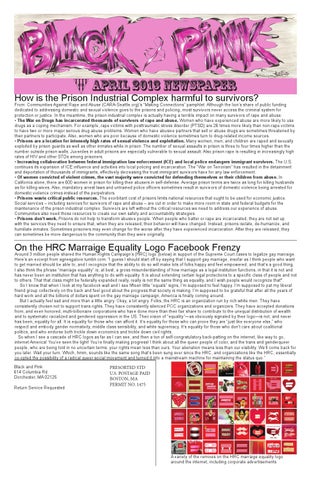
Around 3 million people shared the Human Rights Campaign’s (HRC) logo (below) in support of the Supreme Court cases to legalize gay marraige. Here’s an excerpt from agnesgalore.tumblr.com: “I guess I should start off by saying that I support gay marriage, insofar as I think people who want to get married should be able to, and I recognize that the ability to do so will make lots of folks happy and feel empowered, and that’s a good thing. I also think the phrase “marriage equality” is, at best, a gross misunderstanding of how marriage as a legal institution functions, in that it is not and has never been an institution that has anything to do with equality. It is about extending certain legal protections to a specific class of people and not to others. That that class might be federally expanded really, really is not the same thing as equality, and I wish people would recognize that*. So I know that when I look at my facebook wall and I see fifteen little “equals” signs, I’m supposed to feel happy. I’m supposed to pat my liberal friend group collectively on the back and feel good about the progress that society is making. I’m supposed to be grateful that after all the years of hard work and all the billions of dollars spent on the gay marriage campaign, America is finally coming around. But I actually feel sad and more than a little angry. Okay, a lot angry. Folks, the HRC is an organization run by rich white men. They have consistently chosen not to support trans rights. They have consistently silenced POC organizations and organizers. They have accepted donations from, and even honored, multi-billionaire corporations who have done more than their fair share to contribute to the unequal distribution of wealth and to systematic racialized and gendered oppression in the US. Their vision of “equality”—as obviously signaled by their logo—is not, and never has been, equality for all. It is equality for those who can afford it. It’s equality for those who can prove they are “just like everyone else,” who respect and embody gender normativity, middle class sensibility, and white supremacy. It’s equality for those who don’t care about coalitional politics, and who endorse both trickle down economics and trickle down civil rights. So when I see a cascade of HRC logos as far as I can see, and then a ton of self-congratulatory back-patting on the internet, like way to go, internet America! You’ve seen the light! You’re finally making progress! I think about all the queer people of color, and the trans and genderqueer people, who are being told in no uncertain terms: your rights mean less than ours. Your alienation means less than our visibility. We’ll come back for you later. Wait your turn. Which, hmm, sounds like the same song that’s been sung ever since the HRC, and organizations like the HRC, essentially co-opted the possibility of a radical queer social movement and turned it into a mainstream machine for maintaining the status quo.” Black and Pink 614 Columbia Rd Dorchester, MA 02125 Return Service Requested
PRESORTED STD U.S. POSTAGE PAID BOSTON, MA PERMIT NO. 1475
A variety of the remixes on the HRC marraige equality logo around the internet, including corporate advertisements
What’s Inside Page 2 A Message from Jason Page 3 Letters to our Family Call for Erotica Submissions Page 4 Trans Folks Down for the Fight Page 5 Struggling for Rights! Page 6 Art from the Heart Page 7 Stories of Harm and Survival Pen-Pal Form Page 8 News Addresses
Just Another Love Poem Love is the ability to venture past one’s superficial imperfections To delve deeper, to the heart and soul of the matter Love has no eyes to judge or discriminate only compliments for one’s good traits Love bares no amount of money to buy or sell Love’s like the house that God built not from mortar, sticks, or steel it’s one-hundred percent spiritual It’s how you make me feel inside that counts Love is loving you! -Douglas, Colorado
A Message from Jason
Page 2
Dear friends, I hope as you turn the pages of our third newspaper you are doing as well as possible. As we pull this issue together we are also working on the details for our first regional gathering of formerly incarcerated, convicted, court-involved, and policed LGBTQ people. We are getting excited about The Summit and look forward to sharing with all of you what comes out of this gathering. We are particularly hopeful about the growing partnership with the Hispanic Black Gay Coalition and our shared efforts coordinating this event. We have sent out a survey to all New England Black and Pink members with the intention of including their feedback throughout the day on April 27th. Also of note, in this issue you will see that we have changed our address. The Community Church of Boston (CCB) has been incredibly wonderful to us for years allowing us to fill up their mailbox with your letters. We are now receiving all of our mail at our office and we are incredibly grateful to everyone at Community Church for their support. If you feel moved to write a thank you note we would love to send those to the congregation, you can mail them to the office address with the tag line “THANK YOU CCB.” This April marks the 12th annual Sexual Assault Awareness Month. What began as “Take Back the Night” events in the 1970s by feminist organizations has grown to a nationally collaborative celebration of survivor resilience and community education. Black and Pink free world members in Boston took part in the annual Walk for Change organized by the Boston Area Rape Crisis Center. We carried signs that read, “Strip Searches = Sexual Violence,” “End Rape Culture! Abolish Prisons!,” “Prison = Sexual Violence,” among others. We wanted to join in the walk as a reminder to attendees and others who saw the walk that prisoners are victimized by sexual violence as well. Our newspaper often includes stories of survivors of sexual harm behind the walls writing about what has happened to them. We know that prison guards perpetrate the majority of these sexual assaults. We know that other prisoners also sexually assault our family members. While some herald the passage of the Prison Rape Elimination Act, we have had multiple submissions from Black and Pink members who speak the truth about its symbolic nature. Prison officials can claim to have implemented PREA policies without actually changing anything for the lived experience of prisoners, whether they identify as LGBTQ or not. As we think about the evolution of Sexual Assault Awareness Month we need to also evolve our own understanding of what sexual assault looks like within prisons and jails. The complete control, forced submission, and shackling of limbs embodied by the prison industrial complex is itself a form of sexualized harm. Prisoners do not have the ability to say no to the touch of a prison guard. Prison staff have the state-sanctioned right to invade the body of prisoners, to restrict movement, to discipline sexuality, to supervise showering and to strip off prisoners’ clothes. The power of the officials lies within sexual violence, thus eliminating sexual violence in prison would require the abolition of the prison itself. The Prison Rape Elimination Act would be more adequately named the Prison Rape Minimal Reduction Act. During this month of awareness raising we have the responsibility to do our own exploration and story telling. We need to reflect on how we have had control over our bodies taken from us. In order for us to begin to heal from sexual violence we need to be able to name our experiences. Healing work inside prison walls seems nearly impossible. When we tell each other stories and support one another, healing becomes more and more possible. Let me close this month with an excerpt from the poem, “A Litany For Survival”, by Audre Lorde. Read together and remember that once there were no prisons, that day will come again. Love, Jason
And when the sun rises we are afraid it might not remain when the sun sets we are afraid it might not rise in the morning when our stomachs are full we are afraid of indigestion when our stomachs are empty we are afraid we may never eat again when we are loved we are afraid love will vanish when we are alone we are afraid love will never return and when we speak we are afraid our words will not be heard nor welcomed but when we are silent we are still afraid So it is better to speak remembering we were never meant to survive
Letters to our Family
Dear Black & Pink Family, I read the Newspaper and I was so very touched by these letters that I cried. First off, I’d like to issue my deepest & most sincere concern for all of your current situations. I do pray, father God, make life more bearable in our current predicaments, now I do also pray God’s grace befall B&P this day forth. Well, I’m just trying hard to maintain in these hard circumstances. This place seems to kills a person from the inside out, but I still try to smile, even while I feel like crying and dying. I get inspiration from your missives. Believe it or not the hope in them keeps the fire of tenacity still blazing in me when my small embers want to die out. I had wanted to be free of problems, but when I read the letters of struggle, I was happy to have problems, for I’ll remember the brother & sister who has not a worry anymore and who is alone. So I decided to write you all to say please continue to write and don’t forget me, because it’s your hope, your attitudes of love and friendship, that keep me going. Yours Truly, Yohana aka Peniel
Page 3 Black & Pink Family, What’s poppin? I hope and pray all is well. For me I got to honestly admit Black & Pink is the bomb, the Newsletters and now Newspaper have been a burden lifter. I’ve been receivin’ the Newsletter since November 2011, and the poems and letters have been medicine to my soul, each word has soothed my pain of mental distress, while I’m confined to a one man cell 24/7. I’ve learned so much from the Newsletters, it has put me up on myself and the corrupt system I’m secluded to. I don’t consider myself Gay or Bi, I’m Tri, ‘cause I’ll try anything :) So big ups to all the freaks, stay true. All I have to say is Black & Pink, continue to make the Newspaper what it is- powerful. Never allow anything get you back, let all haters drown in their hatred, ‘cause if they join the Black & Pink family , their hate will fade. So never let up, never be ashamed of who you are, be you and stay true. Truly, Slice, Florida Editor’s note: Check out Slice’s artwork, “A Black and Pink Movement” in the “Art from the Heart” section!
Dear Black & Pink Family, I am new to the Black & Pink Family and have only received one Newspaper so far. I’m a bisexual white male that has been in the closet most of my life until very recently. I had the pleasure of being introduced to the transgender world through a pen pal in 2009. Sadly, because of prison rules against writing to/with another offender in prison, our letters were cut short. From her letters, I’ve come to know and love the transgender community. I’m now an avid supporter. Being in prison and not having anyone on the outside to help me find places to write within the community, I’ve been in the dark. But now that the door to the GLBTQI community has been opened to me through Black & Pink, Wow! The thing that stood out the most from the Newspaper was the fact that there are people out there that care. The photo of people holding signs really spoke to me. My mother died while I have been in prison. She was the only person in my entire family who supported me, who cared about me, who loved and even wrote to me. I’ve always had it in my heart that I was now alone in the world, that I had to give up on anyone caring for me again. What a way to love your life right? But the articles and pictures showed me there are people out there that do care, I’m not alone! What wonderful news! I’m very much Bisexual. I live as masculine man. I grew up in a strict family where it was punishable to be gay. However, I and my best friend Jason grew up together and from the ages of 5 to 14 were sexually active together. At 15 I was forced to move far away and was then very afraid to allow my attraction to boys show, so I dated girls. As I grew older I became attracted to both girls and to certain types of man. I grew to like and love both sexes equally. To all those in prison, you are not alone. The Black & Pink family is your family and we all love you and support you. You are cared for by others and are accepted by us for who and what you are. Don’t be afraid to stand up or stand out. Just because you walked through those gates doesn’t mean you have lost all of your basic human rights and your rights to the U.S. Constitution. With all love, I support and encourage you today and tomorrow. Steven, Oklahoma Hello! My name is Billy, but my friends call me Face. I’m still in the Intensive Management Unit (IMU) on an Intensive Management Status (IMS) program in Washington State. Back in Tennessee when I was around 14 or so was when I first realized that I liked boys as well as girls. Still, since there was always girls around, it was easier for me to grow in sexual experiences with them while fumbling the few experiences I got with boys. Before I came out, I still didn’t have too many encounters with guys, but felt it was necessary to identity as a bisexual man. Growing up in the Midwest and South where people talk bad and look down upon non-whites and homosexuals, and even worse to interracial relationships of any kind, one can grow accustomed to such stereotypes and contradictions. Like has been written before, it was easy for me to fall into the “White Power” propaganda since that was the culture I grew up around. Only time and experience and prison sentences later was I able to see through the lies, deceit, and hypocrisy of the ones I had surrounded myself with. As the years rolled on by, I saw that the most realest people in prison are the Out Gay ones. Granted, I saw people pick on and talk shit to them, but to me they’ll always be the hardest cats in the yard because it’s never easy being who you are in the face of adversity. I came out not too long after because I cherished that realness that I had sought in others. I had seen that by not identifying myself as part of the community, others were suffering from my hesitation. Since power is in numbers, and so people would know what time it was, I got LGBTQ PRIDE blasted down the outside of my forearms. Well, LGBTQ on my right with PRIDE going down my left, with skulls connecting each letter into a sick-ass pattern. But don’t get it twisted, there are still people who hate me, but there are more who respect me. This goes out to all the ones out there who hate me- “You can suck it.” I sometimes feel a dilemma in being bisexual. There are feelings of guilt, worry, shame, insecurity, fear, and intimidation at not living just as a heterosexual or homosexual. Coming out can be delayed by hiding behind our lies while engaging in and reinforcing the mainstream heterosexual identity. To not identify myself openly as a member of the community does nothing but harm the community and reinforce the mainstream’s identity. It harms the adults of yesteryear, the teenagers of today, and the children of tomorrow who will be looking up to us, who will be identifying with us, and who will be looking to society for their reflections of us reinforcing who and what they are. Look, all I’m saying is: It’s time to put the combat boots back on! Much Respect, Face, Washington State
Dear Black & Pink Brothers and Sisters, Long time reader, first time writer. I love reading the stories of others like myself, gay and locked away, but finding a way to survive. I’m also amazed at the number of writers from Texas. I don’t consider Texas nearly as enlightened as California when it comes to gay equality, and any outlet to make ourselves heard is a blessing. I want to say thank you to the people of Black & Pink for making this possible and for taking this publication to a full-fledged Newspaper through sweat and determination alone. I’m gay, though still in the closet, but not by choice here on my Unit. I’m a Native American and in the Native American program. Most of our elders are hard-line “Traditionalists” who believe that gays should be killed so that they don’t taint the purity of the Sacred Circle. I guess you understand why I’m still in the closet on this unit. As you can imagine, this is hard to deal with, hearing them talk this way about me and my brothers and sisters and not being able to defend us in any meaningful way without being ostracized by my own people. I know what most would say- stand up, be proud, speak out, but now isn’t the time. I want to learn to run a Sacred Circle on my own and then invite the brothers and sisters on the unit to create a separate Circle, thereby making it safer for us all to be out. Believe it or not, there are more of us than there are of them, and making our own Circle only makes sense. Sacred Circles are all about balance and harmony, so having our own Circle is probably best for everyone. So, all of my brothers and sisters who have been avoiding meetings because of the homophobic environment- come back, let’s unite, and be a part of our people again. Like the Beatles said so aptly, brothers and sisters, “All you need is love.” So spread it around. -J., Texas
Call for Submissions to New Erotica Zine! Seeking erotic short stories and poems by Black & Pink incarcerated and free-world family members for a new ‘zine. Please send submissions to our new address, ATTN: Gabrielle. This is a voluntary project, and no money will be offered for submissions, but you might get the chance to share your spicy story with many others! To subscribe to receive erotica, write to our new address, Topic Tag “Erotica”.
Trans Folks Down for the Fight
Page 4
Letter to Harvard Prison Legal Assistance Project, submitted January 26, 2013 from Jennifer G., B&P Incarcerated Leader, for the Feb. 25th Panel on Solitary Confinement: Dear distinguished friends, Greetings from California! As a transgender woman prisoner and activist, I welcome this opportunity to contribute to the panel discussion on Solitary Confinement. Initially, I was convicted for the crime of armed robbery and sentenced to seven years in state prison. Subsequently, however, that “7 years” was extended to an indeterminate term of 104 years-to-life under the draconian “Three Strikes” law for prison behavior (e.g. weapon possession, assault, etc.) I have now been incarcerated for over 22 years, including more than 14 years of experience in solitary confinement at Pelican Bay State Prison and other institutions, and never raped or killed anyone. As a survivor myself, I can state from personal experience, there is no question that long-term isolation in prison “control units”, under severe punitive conditions, is TORTURE! I’ve suffered beatings, food deprivation, inadequate medical and mental health care, and other forms of inhumane treatment similar to the abuses described in the case of Madrid v. Gomez, 889 F.Supp. 1146 (N.D. Cal. 1995). Thanks to that legal victory, due in part to the expert testimony of Dr. Stuart Grassian, I was released from the Pelican Bay Security Housing Unit (SHU) in 2003, and my exacerbated mental illness improved after being provided acute psychiatric care for suicide attempts, post-traumatic stress symptoms, and Gender Identity Disorder. Although my current prison circumstances have improved, and I now have the prospect of a sentence reduction under California’s newly passed Proposition 36 (the “Three Strikes Reform Act of 2012”), thousands of other inmates continue to languish in long-term solitary confinement. Since the Pelican Bay Prisoner Hunger Strike began in 2011, more than 12,000 prisoners in thirteen different California prisons have participated in intermittent hunger strikes to protest the conditions of solitary confinement. At least three inmates committed suicide. (Footnote 1) On February 2, 2012, inmate Christian Gomez died during a hunger strike at Corcoran, which houses 1400 in the SHU, and an additional 350 in the Administrative Segregation Unit (ASU). (Footnote 2) The continued and expanded use of extended solitary confinement in control units across the United States, and particularly in California where the courts have found illegal and inhumane conditions, violates international human rights law, the Convention Against Torture (CAT), and the Standard Minimum Rules for the Treatment of Prisoners. (Footnote 3) Furthermore, in the case of transgender inmates, the use of non-disciplinary safety concerns or refusal of unsafe housing unit/cell assignments to justify placement in solitary confinement violates the Prison Rape Elimination Act of 2003 (PREA) national standards (recently adopted federal regulations, of the U.S. Department of Justice). In conclusion, I urge the esteemed panel members and audience to please join the struggle to ABOLISH CONTROL UNITS in the United States, which hold at least 25,000 prisoners in isolation at various supermax prisons, and an additional 50,000 to 80,000 in restrictive segregation units. (Footnote 4) The 2006 U.S. Report of the Commission on Safety and Abuse in American Prisons noted that beyond about 10 days of solitary confinement there’s practically no benefit to be found and the harm is clear. The Center for Human Rights and Constitutional Law has prepared a petition to the United Nations Working Group on Arbitrary Detention, Human Rights Council, United Nations General Assembly, with 22 main plaintiffs at different California prisons, ranging from one year in segregation up to 39 years in complete isolation based solely on a prisoner’s affiliations. Or associations. Finally, I welcome anyone that may be interested to contact me through personal correspondence concerning this issue, or concerning my campaign for release. Specifically, I need your personal assistance and support for my individual legal defense case, to be moved to either a women’s facility or other community-based housing that accommodates trans-women, and eventually released. Thank you, Jennifer G. 1. http://prisonerhungerstrikesolidarity.wordpress.com 2. Sal Rodriguez, “Inmate Dies During Hunger Strike at California’s Corcoran State Prison”; http://www.solitarywatch.com 3. Adopted by the First United Nations Congress on the Prevention of Crime and the Treatment of Offenders, held at Geneva in 1955, and approved by the Economic and Social Council by its resolutions 663C (XXLV) of 31 July 1957 and 2076 (LXII) of 13 May 1977. 4. See “Hellhole”, The New Yorker, March 30, 2009. My B&P Sisters & Brothers, Hey! It’s me Deirdre, out in crappy old Nevada. Sorry for not writing you all in so long, I truly am. I’ve been busier than the proverbial “cat in a sandstorm!” But believe me when I say that you are all in my heart and on my mind, all the time. I want to express my deepest respect and gratitude to all of us that are Fighting for fueling me and inspiring me in my own fight against the deeply transphobic Nevada Department of (In-)Corrections. And to each of you sisters and brothers that I don’t know (yet?), I give my love and my yearning for our place in the equality promised to us by the U.S. Constitution. We, especially us transgendered prisoners, must fight. Yes, it sucks to be us in a lot of ways. But we must turn our pain, our fear, our sadness- turn it into what burns inside us and give it all back to our “enemies,” our detractors. Crying has its place, sure. Do it in the privacy of your “alone time,” or on the shoulder of a loved one. But for Goddess’ sake, we must not ever give our precious tears to those who hate on us or misunderstand us. For them we have no shame in showing exactly what we are made of; the strength of our gods and the protectiveness of our goddesses. I want to say our enemies deserve no forgiveness, no pity. But I won’t. I’m a better person than that, and so can you. Why? Because simply to exist as we do, being transgender, means that we strive constantly to love and embrace ourselves as we are. It takes a very uncommon courage to survive as transgenders, does it not? And if you, right now, don’t see it that way? Pray, meditate, manifest... whatever you do, to see it that way. The bravery it takes to change and evolve ourselves- medically, surgically, psychologically, and spiritually- that’s our love for ourselves, that’s our strength. Use all of that to stand tall in the face of it all, and fight! I don’t care if you’re feminine or butch or somewhere in between- fight dammit! Fight! Grievances, lawsuits, not letting them see our pain, correcting them EVERY time they use the wrong pronoun- fight! It is up to each of you to give them chaos in the face of their “structure,” and show them calm in the face of their hate. Fight for yourselves, for me, for each other, and especially for those who will come after us so they might not feel our pain. Fight! As for me, I’ve been taking my E.H.T.’s for seven months now. I feel and look wonderful, and they hate it! Good for them and better for me! Wait till they see what’s next from me to them. I’m following in the footsteps of Miss Kosilek and Miss De’lonta. My turn next! To each and every one of you, my incarcerated sisters and brothers- I don’t care what color, what religion, or if you’re trans, gay, lesbian, or what- I give all my love & fire to you. Use it and use it well. Stand up for yourselves and for each other, because no one else will. Let that love and compassion that separates us from them be our greatest strength of all. Love and compassion within ourselves and for each other. Until next time I get an itch (ha-ha), always remember I love you each and I love you all; and fight. Blessed be. In Love & Strength, Deirdre, Nevada Incarcerated B&P Leader
Loving and playful flirtations & salutations, hugs, and kisses, dear family, from your B&P leader in Texas, Lady Mystique Let me try to make this as brief as possible. I was deeply touched & moved, motivated and encouraged by you all, my brothers' and sisters' struggle, pain, and endurance from the abuses, suffering, tribulations, and inhumane oppression inside this U.S. PIC. I myself also live in a prison of my own making- that of mental/ emotional/spiritual constructs, due to my religious/ Christian indoctrination. Because of my Christian beliefs, I struggle with shame, guilt, confusion, and self-hatred for being gender non-conforming and effeminately pan-sexual. I know many of ya'll Christians and non-Christians believe that it's okay to be LGBT and Christian, but it's not that easy for me. I dislike that it became this way 11 years ago, but it brings me great happiness when I do let my hair down and give in the Lady Mystique, letting her make her presence felt. I struggle with deep confusion and double mindedness, but each time I receive my B&P Newsletter (now a Newspaper, awesome!), and read of everyone's struggles and perseverance and pride, I am encouraged to persevere and be proud myself, even if I do seem to have two spirits or separate identities within me, warring for dominance. Bless you all. In love and Solidarity, Ms. Harlequinne Mystique, Texas
Editor's Note: Mystique included many lovely direct responses to letters in the last Newspaper, which we are unfortunately unable to publish, to avoid “promoting inmate to inmate communication,” which can get the Newspaper blocked from certain prisons. In summary, Mystique is thinking dearly of everyone who wrote in.
Struggling for Rights!
Dear Black & Pink, My name is Justin, I’m a 30 year old Bi male serving time in Texas. I was 12 when I came out to my parents that I was Bi. My Dad nearly beat me to death that day. My Mom lives in Florida and was more supportive. For 6 years me and my Dad butted heads. He would go off about the smallest thing and chew me out hard core, blaming everything on the fact that I was Bisexual. After I graduated High School, I joined the Army. This was before they lifted the “Don’t Ask, Don’t Tell” policy. I got married when I was 24 and was open with her. She didn’t mind as long as I didn’t leave her for a guy. Ironically, she left me for another guy and had his kid. Then I got popped for Indecent Exposure by a neighbor while pissing off my back porch, drunk. She was 62 and the Misdemeanor went to Felony. Now I’m serving 10 years. The guy I was seeing, Stephen, doesn’t write me and all my friends have abandoned me. My family hardly writes and inmates try to take advantage of me, but I put a stop to them real quick-like. To the many of us suffering from being taken advantage of and the usage of our bodies, you are not alone. I encourage you to stand up and put a stop to it too. I love each and every one of you and can’t wait to see the Prison-Industrial Complex (PIC) crumble to the ground and burn. I’ll bring the marshmallows and chocolate, LOL.
I’m a Wiccan High Priest, and I make protection talismans. I would be happy to make a talisman for anyone for protection measures. To those who need some prayer, I have a prayer list I’ve made with the names of everyone, so far, who has gotten a letter published in the Newsletter. I wish we could write to each other between prisons so I could pray for you all by name.
To everyone behind bars, I love you and pray for the B&P Family. Keep your head up and keep fighting the PIC ‘till it, one day, Crumbles and Burns. In Solidarity, xoxoxo Justin, Texas
Page 5
Dearly Beloved Family of Black & Pink, It brings me great pleasure to say that the pig-pen shot callers caved. For those that didn’t know, they felt the need to confiscate my legal work and property on 2/13/13 under the pretext of a bogus transfer. Yes, they told me to pack out, that I was being transferred to another facility. I got excited and nervous, for it has been some 11+ years since I had any interaction in General Population. However, it was not to be, there would be no transfer nor would my legal work be returned until today. They still have quite a bit of copyrighted material: manuscripts, song lyrics, poetry, new products & inventions, clothing, and designs, all which I have worked on for many years, a couple for 20+ years. So hell yes, I’m still hurtin’ for certain, but I’m not looking to take hostages first chance I get. I want to point out a couple of things. First, why do you think they confiscated my property? Ahhh! You see, it’s not because they didn’t have something better to do which leads me to one of three choices: 1. They were looking for drugs or weapons; 2. They were seeking to incite a negative response that would lead to new charges; or 3. They flat out fear me and were looking for any piece of correspondence they could take out of context to create a “conspiracy.” Yes, it was a fishing expedition in search of “something” to justify this patently illegal incarceration. Hey, I spent 3 ½ years in a Colorado jail fighting battle, after battle, because I refused to accept responsibility for a crime I most certainly did not commit. Believe me, I didn’t go quietly! No no no! Oh, the judiciaries have fought, and I fought harder and smarter, and bottom line is I am going to own a piece of Colorado. Check this out, prior to 12 jerks convicting me, I was taken to a mediation hearing and “promised a conviction” based solely on “conservative politics.” What? The judge said, “Look, it doesn’t matter how innocent you are. Just like a guy a couple of weeks ago, I believe he may have been innocent, however, we are in the top 5% of conservative counties in America, and you will be found guilty of something, and as a result you could spend the rest of your life in prison.” Wow! Yeah, I was offered a 20 year sentence. Yes, I was given Life Without. Stupid? Yeah, like a fox, because I will be walking out earlier than I would have had I accepted 20 years on a totally bogus beef that had been case-fixed from the onset. No they do not want the public to see what a corrupt DA and police force they have. Oh yes, it’s like that, exactly like that and I have it in black & white, not my documents, but official documents from the District Attorney’s office as well as court transcripts. Enough said. I have been seeing some hate in some of the stories I’ve been reading in B&P. Hey, exercise your emotion, but let’s not run out and act negatively on anger. We must always be available mentally and academically smarter and wiser, knowing what fights/wars we choose to do battle in. Then there’s the best approach to battle, etc. The Art of War is lost when hastily fools rush in. Hey, I have the scars that I wear proudly, but if I had to do it all again, I would use this weapon I’m pressing against paper that I’ve come to realize is sharper and more deadly than any other weapon known to man. The thought is projected from the brain to the hands, arms, legs. If we use our brains and our hearts to the best of our abilities, we’ll be better equipped to deal with those pressing back at us. Hey, I’m in it for the love, and love changes everything. I figure I have 25-35 good years left, and I’ll leave you with my heart open. Peace, and God bless you all, always in all ways. Eugene, Colorado Dear Black & Pink I hope this brief letter finds our Black & Pink family doing well and in the best of health and spirits. I just wanted to write and show my gratitude for the January/February Newspaper. I’m truly grateful that I have been added to the family. I get so inspired by what I read, now I find myself looking forward to the Newspaper every month. I feel special to be a part of such a wonderful organization. To have a special group of people showing so much love to the Gay community. I’m so excited that the Black & Pink family has so much support and is still growing. What a great idea to have this published as a Newspaper. I want to truly thank everyone for contributing to making the Newspaper happen each month. My love truly goes out to each and every one of you. I’m also happy that the Tamms Supermax prison no longer exists. As you know, I’m from Illinois, and I’m presently housed in Southern Illinois and the local news still talks about the closure of Tamms and how the community is financially suffering, yet they don’t even mention the inhumane conditions that the prisoners went through for 15 years. That’s truly a sad state of affairs. Society looks at prisons now as a big business. I’m happy that the Black & Pink family signed a new agreement with Out Now. I’m also excited that sex change lawsuits are being pursued against states. I am encouraged by the stories of people coming out and not staying in the closet. It just feels so much better to be yourself and not try to be something that you are not. I agree that you can get more respect being out than hiding and trying to be somebody’s friend that really wouldn’t like you if they really knew the truth. Why would you want a friend like that anyway? I wish everyone could come out and make the movement more powerful. Strength in numbers. I’ve been out, however only 3 years ago I came out to my family. They have been very supportive and since then it has not been an issue at all. At the same time, I feel better. As far as my prison experience, I been out 30 years in prison and I get so much respect with everybody. In fact a lot of the guys tell me that they respect me more because I’m out and not hiding it. And they know where I stand. So it’s not an issue at all. I also did some research regarding the issue of Administrative Segregation and HIV status. The Illinois DOC has Administrative Directive 04.03.115: “4. Management of high risk offenders with HIV disease. D) Offenders who are HIV infected and who engage in or who are determined likely to engage in behavior which may pose a significant health risk to others may be separated from the general population in special housing. Special housing shall remove the offender from general population and restrict the offender’s access to general population. Special housing may include confinement in cells, living areas, segregation, of any other area designated by the chief administrative officer. But does not require placement in an infirmary setting.” I have been incarcerated for 30 years and in 8 different prisons in IDOC, and I’ve never heard of this policy being enforced in this state. I also found case law supporting MDOC (Michigan) policy. See Onishea v. Hopper, 171 f.3d 1289, 162 A.L.R. Fed. 651(11th Cir. 1999), which upheld involuntary segregation of HIV positive inmates on the grounds that a significant risk of HIV transmission existed for any prison program in which HIV positive inmates participated. Also C.F.R. & 549.10 to 549.20, and 28 C.F.R. & 541.60 to 541.68, where segregation is permitted where there is “reliable evidence” that the inmate “engages in conduct posing a health risk to others.” Perhaps for an individual, it would be best to challenge the circumstances of the individual situation, rather than the policy. In closing, I want to send my love to all my gay brothers and sisters. Also I want to thank Black & Pink for making me part of the family and part of the Newspaper. Sincerely, Charles, Illinois
Art from the Heart
Page 6
Dear Black & Pink, Thanks for your continued support, advocacy, and all the work you do! It really does mean so much to me. I love this community so much, and I try and do anything I am capable of to support, encourage, and inspire the LGBTQ people. The latest Newsletter inspired me to write a poem. It brought back memories of what it was like for me, growing up in Philadelphia as an African American young man who was, is, and always will be a Queen! I could only hope that my words will reach someone in their time of need, while going through a situation or doubts themselves. Once again, thanks Black & Pink.
To my beautiful community: Love is all we got And if we don’t have it for each other Our struggles would be for not Keep hope alive! And don’t give up on your dreams That’s what they want from us But remember, I’m on your team To support you all I can In everything you do Explore your heart’s desire Because I’m not giving up on you If we stand behind one another And lend a shoulder to cry on We’ll be lifting each other up And reinforcing ourselves to be strong Because being weak is not an option We’ve been in the shadows way too long Our voices are to be heard And not suppressed by what they’re doing Know that you are a star And have the capability to shine! Step up, to your potential Because now is our time! With Love, Nahbeel, Pennsylvania
Last month, Black & Pink co-sponsored an incredible event hosted by Black & Pink volunteerstwo queer South Asian “artivists” shared two hours of moving, fierce, radical poetry as part of a poetry tour. Alok is “committed to building radical queer movements and bodies that resist white supremacy and imperialism and like making art that thinks about these, and other what ifs” and Janani likes “thinking about apocalypse, decolonizing the food system, and making space for quantum queers everywhere”. The audience donated several hundred dollars to support us!
When Life Isn’t Easy, May You Remember This Quintessential Feelings May you know, in your heart, that I am always thinking of you May you always have rainbows that follow the rain May you celebrate the wonderful things about us And when tomorrow comes, may you do it all over for me again May you remember how full of smiles we have been May you believe that what you search for, we have found together May you find time to smell the flowers, and to share the beauty of you with me May you envision today as a gift, and tomorrow as another May you add a meaningful page to your diary each new day And may you make “living happily ever after” Something that will come true And may you always keep planting the seeds of your dreams Because if you keep believing in them, they’ll keep growing and growing into a beautiful blossom for you Dedicated to the man that I love and will always love forever and ever. -Nelson aka Nikki, Pennsylvania
Art by Slice, FL
Without you I’m alone wondering deep in a torrent of pain The feelings for my love causes Tears to fall like rain Didn’t you see or understand that your heart is my treasure? The giving of my unconditional love is a commitment Forever? Are my feelings in vain Because I failed an impassable test? This heart throne is where my Queen reigns above The rest My Queen Know your King loves you And before you kneeling through eternity I will give you all my heart’s Quintessential feelings -Speedy, Florida
Stories of Harm and Survival
Page 7
MAIL TO: Black and Pink– Form, 614 Columbia Rd, Dorchester, MA 02125
__________________________________________________________________________________________
__________________________________________________________________________________________
__________________________________________________________________________________________
HIV Status (private)
-Juicy, Pennsylvania
Your address, email and phone upon release (if applicable) so that we can keep you involved in the family:
Release Date?
Mama I thank you For caring for me Mama I thank you For helping me Through the storms Mama I thank you For raising me all by yourself With no help Mama I thank you for guiding me Along the way Mama before you leave I have to say that I thank you
__________________________________________________________________________________________
Non‐English Language
I know that I wasn’t perfect But I have something to tell you, here it goes Something like this Mama before you leave me I have to say that I thank you For loving me
__________________________________________________________________________________________
Faith
Before you leave I have to say Mama I thank you You cared for me before I was born Then when you had me, you took care of me All by yourself While my father wasn’t around
Names and email addresses of any current pen-pals so we can involve them in Black and Pink:
Sexuality
Before you Leave
Do we have permission to display a picture of you from a corrections website? ______Yes ________No
Gender
If you have a webpage: www._________________________________________________________________
Race
Tell us about who you are (for example, your background, hobbies and interests, beliefs, situation, etc!) :
Yes, I can! No, I can’t! Can you get mail from / write to all other prisoners?
Does anyone write you now? How many people write? Specic types of pen‐pals you are looking for: (Most pen‐pals want non‐roman�c friendships)
In Solitary Connement? / / Age & Birth date
Please provide this optional information if you want! People can search most of these items on our website:
Having a pen‐pal romance Wri�ng sexy/ero�c le�ers Having a pen‐pal friendship Wri�ng about social jus�ce or ac�vism
Please check the types of pen-pal relationships you are interested in: (Please note most “free world” pen-pals that visit our website are not interested in romance or sexy letters)
_________________________________________________________________________________________
_________________________________________________________________________________________
Address:__________________________________________________________________________________
Your Legal Name:_____________________________________#:____________________________________
Preferred Name: ______________________________________Pronoun (she/he/ze):___________________
“I agree to this information being posted online.” Sign:__________________________ Date_______________
If you have not done so in the past 12 months (to reduce mail so we reply faster), please mail this form to Black and Pink –Form, and include a picture & “first letter” written to a potential new pen-pal for us to scan if you wish!
Black & Pink Pen-Pal Information Form!
Hello Black & Pink, This letter is my first submission to the Family. Hopefully there will be many more to come. Well, my story is a tough situation to talk about. However, I’ve been able to embrace my past and in some ways be a leader of encouragement to others who have been unfortunately dealt the cards of sexual assault. My story starts off very sad. But being a strong individual, I have overcome my trials and tribulations. First off, my name is Nyckoyo, I was born and raised in Poughkeepsie, New York. My parents split when I was 3 years old and my Dad decided to forget I was his son and left out of my life altogether. So my mother raised me. I would die before I ever hurt my mother, and it’s safe to say she is my best friend, even when I have been behind the wall on this term. Well, I was sexually abused by my older brother from the ages 6 to 8. During that time I had attempted to commit suicide twice. However, after my second hospitalization I had my first experience with this kid in my neighborhood at the age of 9. It was all I knew at the time. So it just felt like I was doing the right thing. Then I was placed in a group home called “the Poughkeepsie Children’s Home.” It may sound weird, but I told a lot of the kids there about my situation and was surprised at how many of the kids had been raped and sexually abused in general. I honestly felt like I had a family besides my Mom and siblings. So I started to look out for those who were like me. I would always fight with other kids who tried to hurt those who had similar background as me. Over the next 6 years from age 9 to 15 I felt confused. I would have sex with both boys and girls. However, I would always front and make fun of people who were Gay, Lesbian, or Bisexual when around my friends who were straight. As my time there at the group home passed I had to eventually come full circle and deal with my past abuse by my brother. In the Spring of 2000 I was in a relationship with a female at the group home who I had been sexually intimate with. Unfortunately, after being persuaded into saying I raped her, I was on the list at the group home of the sex offenders. I was humiliated, and felt more confused as I vowed to myself to never mess with a female again, but I always had those feelings of sexual attraction to females. After my release from the group home I chose to stand up and embrace my bisexuality. Even now at the age of 27 and a mixed male in prison I still embrace my bisexuality. Please excuse my language but my motto is, “If they can’t defeat us, they might as well f***ing join us.” I’ve only been part of the Black & Pink family for about 6 months. However, I felt like I am in need of more friends who share the experiences of being sexually preyed upon. That should never happen to anybody. I’ve been able to forgive my brother. It was hard, yet I’ve always felt that my hatred towards him would destroy me, so I decided to live and not choose to die, that’s why I forgave him. So now I am proud to say I am happily bi-sexual. Later this year I am being released from prison, September 2013 to be exact. I’ll be living in Plattsburgh, NY, upon release. However, other than my Mom and Stepfather I do not have any type of support system or anybody to help keep me focused. Hopefully my release info will be on the website and we can keep in touch with facebook. Thank you for the love and support that the Black & Pink Family has shown to those in the Free World and for those of us who are currently incarcerated. I personally want to say I love all of my brothers and sisters in the LGBTQI Family. I will pray for all of you. Keep up the good work. God Bless! Love xoxoxo Nyckoyo aka Scheme, New York
News
Page 8
Four Burning Questions for Dean Spade, professor, lawyer, civil rights activist
Posted on Monday, April 8, 2013, By McGill Reporter Staff, http://publications.mcgill.ca Dean Spade is a lawyer, civil rights activist, and Associate Professor at Seattle University School of Law, where he teaches Administrative Law, Poverty Law, and Law and Social Movements. Before joining the faculty at Seattle, he taught classes related to sexual orientation, gender identity, and law and social movements at UCLA Law School and Harvard Law School as a Williams Institute Law Teaching Fellow. In 2002, Spade founded the Sylvia Rivera Law Project, a nonprofit law collective that provides free legal services to transgender, intersex and gender non-conforming people who are low-income, people of color, or both. His book Normal Life: Administrative Violence, Critical Trans Politics and the Limits of Law was published in 2011. This year it’s ten years since same-sex marriage was first possible in Canada and the US Supreme Court will soon rule on the question. What is so troublesome about the push for same-sex marriage? The same-sex marriage agenda in the U.S. has been heavily critiqued by a wide variety of queer and trans activists because it fails to meaningfully address the key material problems facing queer and trans people, such as criminalization, immigration enforcement, poverty, health care access and homelessness, while it consumes enormous resources. It also has been a conservative shift in queer and trans politics, which has moved away from feminist and anti-racist critiques of marriage as a terrible and unfair way to distribute life chances and toward a conservative celebration of marriage as key to healthy families. This has happened alongside a right wing push in the U.S. to blame poverty on people’s failure to marry and to further cut poverty alleviation programs. In the U.S., after same-sex marriage is legal, queer and trans people will still face the same problems of a racist and violent growing immigration enforcement system, a growing wealth divide, and racist mass imprisonment. Some people who have immigration status or wealth to share with a partner will benefit, but the queer and trans people in the worst situations will still be facing the same dangers. You’ve expressed serious concerns about trans people’s push for formal legal equality, such as their inclusion in protection from hate crime. What’s wrong with that goal? Hate crime laws that provide more resources to law enforcement and/or enhance criminal penalties have been critiqued by many trans organizations and activists because they do nothing to prevent attacks against trans people but they expand the criminal punishment system which is the most significant source of violence against trans people in the U.S. They build that system in our names, and that system has been growing rapidly for several decades, such that now the US is the most imprisoning country in the world, with five per cent of the world’s population and 25 per cent of the world’s prisoners. A trans movement that is really about reducing harm and violence to trans people has to be an anti-criminalization movement, and a movement that doesn’t just try to get the law to say something our lives are meaningful, but instead seeks to dismantle legal systems that are killing us. In your organizing and activism, you follow a different approach. Tell us about that. I’m part of trans activism and organizing that centers poverty and racism. This work aims to analyze what is actually shortening trans people’s lives and work on changing those material conditions, so it centers trans people experiencing imprisonment, poverty, immigration enforcement and other life and death issues. It seeks to provide immediate support to people in those conditions, to dismantle systems that create those dangers, and to build systems and ways of being together that actually give people what they need. What would be a major victory or advance for you on the path towards greater justice for trans people? I’ll name a few of the things people in the US are working on that would be a significant benefit to trans people’s well-being: decriminalizing prostitution, stopping federal programs where local police forces turn immigrants they arrest over to the immigration authorities, ending exclusion of trans health care from health insurance programs, getting rid of surgery requirements for changing gender on ID, decriminalizing drugs, ending “3 strikes” laws, getting rid of sex offender registries. These are all vitally important efforts to address the violence trans people are facing, and they are part of broader trans political visions of a world without prisons, border, or poverty.
Addresses: Please note our new address for all mail! If you would like to request:
Newsletter Subscriptions (Start or Stop) Newsletter Submissions (Poems, Art & Stories) “Outside” Free Pen-Pal Request (Please note: Pen-Pal Request Form will be in this newsletter quarterly) Address Change (Will take time to update; at this time, we are mostly unable to send back issues.) Black & Pink Organization Feedback Request Erotica Religious Support
Please use this topic tag, and we’ll do our best: Black & Pink - topic tag c/o The City School 614 Columbia Rd Dorchester, MA 02125 Newsletter Subscriptions Newsletter Submissions Pen-Pal Address Change Developing Leadership Erotica Religion
Volunteering (Send thank you cards to donors, etc.) Volunteer Advocacy Requests (include details about situation and thoughts about Advocacy how calls or letters might help) Art: Reed apologizes that the art project is currently not accepting artwork for sales until we have a solid volunteer base. You can send in artwork for use in the newseltter! Use topic tag Newsletter Submissions. Feel free to include a description of your drawing! LEGAL: Consider writing to Lambda Legal for support or referrals with legal issues that you are having. “Lambda Legal is a national organization committed to achieving full recognition of the civil rights of lesbians, gay men, bisexuals, transgender people and those with HIV through impact litigation, education and public policy work.” Lambda Legal, National Office 120 Wall Street, Suite 1500, New York, NY 10005, 212-809-8585 New! Assistance with legal research and preparing for disciplinary and parole hearings. Hotline (9am-5pm EST): 617-495-3127, and by mail: Prison Legal Assistance Project, 6 Everett Street, Suite 5107, Harvard Law School, Cambridge, MA 02138 Another resource to turn to, if you can afford the subscription ($24 yearly, payable with new stamps), is Prison Legal News. This resource was costarted by a former gay prisoner and Men Against Sexism organizer, Ed Mead, though now it is run by Paul Wright. You can reach them by writing to: Prison Legal News, P.O. Box 2420, West Brattleboro, VT 05303 SURVIVORS: Just Detention International provides support for prisoners who are survivors of sexual abuse. Write them at the legal address below for a packet. Each packet includes an introductory letter, a list of local resources, fact sheets, publications about recovery from sexual abuse, and a letter of hope from another survivor. Ms. Chris Daley, Esq., 3325 Wilshire Blvd., Suite 340, Los Angeles, CA 90010 BLACKANDPINK.ORG BLACKANDPINKMEMBERS@GMAIL.COM