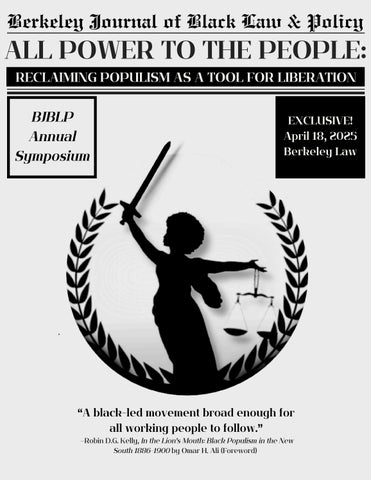
symposium booklet 24-45

Page 1


Honoring Professor Edley

Christopher Edley Jr. served as the dean of Berkeley Law from 2004 to 2013, becoming the first Black dean of a T-14 law school. A distinguished scholar of administrative law, education policy, and civil rights, Professor Edley’s legacy is marked by his unwavering commitment to justice, democracy, and education. During his tenure at Berkeley Law, he increased financial support for public interest students, implemented structural reforms within the law school, and made lasting contributions to educational institutions across the country.

This year, the Berkeley Journal of Black Law & Policy (BJBLP) honors Professor Edley by centering conversations on education. He instilled in many of us the belief that a just society requires equitable access to high-quality education. Guided by that principle, we have committed ourselves to elevating scholarship and ideas that move us closer to that vision. In our Spring symposium, this commitment is reflected in Panel 4, and in Volume 25 of our publication, through our educationfocused article, Abolishing Fourth Amendment Dead Zones: Strengthening Protections in School Cell Phone Search Policies.

BJBLP members had the privilege of experiencing Professor Edley’s mentorship, thoughtfulness, and deep dedication to education both in and beyond the classroom. We are proud to dedicate this Symposium and the forthcoming Volume of our publication to his memory and legacy.

9:30 - 9:50 a.m.

Program

Registration & Check-In

Charles A. Miller Lobby

10:00 - 10:10 a.m. Welcome & Symposium Introduction Room 100

10:10 - 10:25 a.m.

10:30 - 11:05 a.m.

11:10 - 11:45 a.m.

Panel 1

Populism: Power or Peril? Cihan Tuğal

Panel 2

The “Black Vote,” Democratic Party, and Political Complacency

Keynote 1

The Pigford Cases and Rebellious Lawyering

Dylan Penningroth Russell Robinson

Stephen Carpenter

12:00 - 12:45 p.m. Lunch & BJBLP Announcements Room 140

Keynote 2

1:00 - 1:30 p.m.

1:35 - 2:10 p.m.

2:15 - 2:50 p.m.

3:00 - 4:00 p.m.

Racial Capitalism and a Path Forward

Panel 3

“Serve the People”: Cooperative Economics and Lessons from the Black Panthers

Panel 4

Black University: Reimagining Higher Education in a Populist Era

Malaika Jabali

Xavier Buck

Malaika Parker Veryl Pow

Jonathan Glater

Cameron Clark

Maria Echaveste Shani Shay

Closing Remarks & Reception Steinhart Courtyard

BerkeleyJournalofBlack Law&Policy

AboutUs

TheBerkeleyJournalofBlackLaw&Policy(BJBLP)iscommittedtopublishing worksdedicatedtoaddressingsocial,political,andeconomicissuesaffecting theBlackdiasporawhilepromotingtheworksofscholarsofmarginalized identities,activists,andattorneys.Topicsincludeinstitutionalracism,social, political,andeconomicinequality,andanti-Blackracism.

OurPurpose

TheJournalseekstopublishsocialpolicyandlegalscholarshipaddressing economic,political,philosophic,andsociologicalissuesaffectingBlackpeople. Asweseeit,thechallengefacingtheJournalisthreefold:

First,theJournalaimstodisruptthecenteringofwhitenessinlegal academia.WehopeourjournalwillultimatelyserveBlackcommunitiesby infusingintellectualdiscoursewithprovocativeandinnovativescholarship, thusdeepeningthinkingaboutpolicyoptionsandchoices.

Second,theJournalwillgiverisetothevoicesofemergingscholars, organizers,andadvocates.TheJournalwillbringthesefolksinto conversationwithcommunitymembers,professors,judges,policy-makers, andpractitioners.

Finally,weseetheJournalasatraininggroundwherestudentscansharpen theireditingandwritingskills,andgainexperienceincriticalthinkingby wrestlingwithideasrevolvingaroundBlackliberation,equality,andjustice.

AWordfromourEditors-in-Chief

ThankyousomuchforattendingourSpringsymposium!Wetakepridein producinganeventthatwasplannedandexecutedpurelybybusy,fulltime BerkeleyLawstudents Focusingonthelegal,social,andpoliticalissuesfacing theBlackcommunityisofutmostimportancebecausetheBlackcommunityhas representedthemostmarginalizedandscapegoatedcommunityinthiscountry sinceitsinception.Mostofthelegalwinsachievedforeveryothermarginalized communityintheUnitedStateshavebeentheresultoftheadvocacyofBlack Americans.RemediesthatliberatetheBlackcommunitywillinherentlyliberate all.WeurgeyoutosupportBJBLPhoweveryoucan!Asof2024,Black attorneysrepresentabout5%ofthelegal professionintheUSdespiteBlackpeoplemaking upalittleunder14%oftheU.S.population. SustainingthefewexistingBlacklawjournalsis alargeresponsibilityontheshouldersofa disproportionatelysmallnumberofBlacklaw students Weareincrediblygratefulforyour engagementandparticipationandwehopeyou continuetoengagewithourprogramminginthe future.Thankyouforyourcontributionsthat helpmakethisprogrammingpossible!

Symposium Panels

Panel1

Populism:Poweror Peril?

Since the 2016 election of Donald Trump, political discourse in the US has increasingly focused on populism its appeal, its dangers, and its potential for transformative change. Alongside Trump’s right-wing populism, Bernie Sanders’ progressive populism demonstrated the potential of populist rhetoric to mobilize people around issues like wealth inequality, healthcare, andeconomicjustice.The2024 presidential election further underscored the widespread dissatisfaction with entrenched inequality, economic precarity, and political disenfranchisement that fuels both left- and right-wing populistmovements.

This session will define populism and explore its relationship with democracy, drawing on examples from both American and global populist movements. From the Colored Farmers’ Alliance to the People’s Party to Occupy Wall Street, we will examine how marginalized groups have used populism to challenge power structures, while also addressing potential pitfalls of populistrhetoric.

Panel2

The“BlackVote,” DemocraticParty,and PoliticalComplacency

This session will explore the role of Black identity in constructivepoliticalaction.

Joe Biden’s administration will be remembered for (at least) two historic appointments of Black women: Kamala Harris as Vice President and Ketanji BrownJacksontotheSupreme Court. However, these milestones have not been accompanied by significant departures from the political status quo or the delivery of meaningful change Since the Civil Rights Act of 1964, Black voters have been the Democratic Party’s most reliable constituency. Yet, the Democratic Party’s increasingly transparent reliance on tokenism and representation appears to be evolvingintoabarriertomultiracial solidarity, emphasizing symbolic gestures over systemic change. Nonetheless, identity politics, as originally envisioned by the Combahee River Collective in 1977, emerged from Black Marxist feministthoughtasacritiqueof thefailuresofwhite-andmaledominated political culture to addresstheuniquestrugglesof Blackwomen.

Keynote1

ThePigfordCasesand RebelliousLawyering withStephenCarpenter

This keynote will discuss the Pigford discrimination class action settlements, providing an example of how Black Americans have been systematically denied economic opportunity and relief even in federally funded programs designed to provide support to the working class, specifically for rural farm workers. The Pigford cases were among the largest civil rights class action suits in US history, due to the "united effort on the part of farmers andtheirsupporters,aswellas legal teams and social justice organizations.” Discussion of these cases will explore the racial and economic circumstancesofruralAmerica that have informed the gross disparity between Black and white farm workers, and how this history is interconnected with the histories of various populistpoliticalmovements

Symposium Panels

Keynote2

RacialCapitalismanda PathForward

In this keynote address, MalaikaJabaliwillexaminethe structural roots of workingclass struggles and systemic injustice, arguing that capitalism lies at the heart of both. As a system grounded in profit maximization and labor exploitation, capitalism prioritizes profit over people, relying on low wages, weakened labor protections, and the privatization of essential public goods such as healthcare and education. These dynamics contribute to widespreadeconomicprecarity and erode trust in government and social institutions Capitalism’s emphasis on individualism and competition renders it fundamentally incompatible with a more cooperative, equitable, and sustainable future. Jabali will invite audience members to critically interrogate the limitationsofourcurrentsocioeconomic system and consider alternative frameworks as a path toward collective liberation.

Panel3

“ServethePeople”: CooperativeEconomies andLessonsfromthe BlackPanther

This panel aims to look out howcommunitiescantakecare of themselves through cooperativeeffortswhenfailed by social and economic institutions of power. Panelists will delve into the Black Panther Party’s extensive community survival programs and vision of cooperative selfdetermination. Additionally, they will examine cooperative economic models rooted in both law and organizing, assessing their relevance to address the social and economic perils communities face today, as well as their potential to bring about more equitable futures by reshaping societyasawhole.

Panel4

BlackUniversity: ReimaginingHigher EducationinaPopulist Era

The powerful college campus Palestine protests of 2024 have underscored a profound disconnect between the values of universities and the communities they are meant to serve. As universities increasingly adjust to rightwing political norms, administrative control over curriculum and campus expression has tightened It is clear that the role and structure of higher education in our society demand urgent re-evaluation

This panel will examine how education can transcend its current role as a gatekeeping institution, entrenched in meritocratic and competitive frameworks,andbecomeatool for cooperation and communal transformation. Drawing on WEB Du Bois’s conception of the “Black University” and the radical independent schools movement that flourished during the Black Power era, this session will challenge traditionalnotionsofeducation as a mechanism for ‘opportunity’ i.e. individual advancement. Instead, it will explore how higher education can serve as a hub for community and shared worldmaking.

Symposium Speakers

CihanTuğal

UCBerkeley (he/him)

Cihan Tuğal studies social movements, populism, capitalism, democracy, and religion In his recent publications, he discusses the far right, neoliberalization, state capitalism, and populist performativity in Turkey, the United States, Hungary, Poland, India, and the Philippines.Tuğaliscurrently working on a book that will incorporate these case studies, along with an analysisofpopulisminBrazil. Based on fieldwork in Egypt and Turkey as well as historical analysis, Tuğal’s previous book Caring for the Poor examines the emergence,globalization,and decline of liberal welfare ethics. His ongoing work explores ethical, religious, and spiritual alternatives to the rationalization and individualization of care and well-being.

BerkeleyLaw (he/him)

Dylan C. Penningroth is professoroflawandMorrison Professor of history at Berkeley, and an Affiliated Research Professor of the American Bar Foundation. Currently serving as Associate Dean of the PrograminJurisprudenceand Social Policy (JSP), he specializes in African American history and legal history. In Before the Movement: The Hidden History of Black Civil Rights, he revises the conventional story of civil rights to tell a forgotten pre-history of the marches of the 1960s and recovers a rich, broader vision of Black life allied with, yet distinct from, the freedom struggle. Penningroth reveals that African Americans have thought about, discussed, and used the law going as far backasslavery.

BerkeleyLaw (he/him)

Prior to joining UC Berkeley, Russell Robinson was Professor of Law at UCLA. Robinson graduated with honors from Harvard Law School (1998), after receiving his B.A. summa cum laude from Hampton University (1995) Robinson’s scholarly andteachinginterestsinclude anti-discrimination law, race and sexuality, law and psychology, constitutional law, and media and entertainmentlaw.

Symposium Speakers

Group(FLAG) (he/him)

Stephen Carpenter is a graduate of Drury College in Springfield, Missouri, and of Stanford Law School At the Farmers’ Legal Action Group (FLAG), much of Stephen’s work has centered on discrimination in agricultural lending, debtor-creditor issues for farmers, and federal farm and farm loan programs He served as Senior Counsel in theOfficeoftheMonitorinthe Pigford case and as the courtappointed Ombudsman for the In re Black Farmers Discrimination case. His law review writing discusses rebellious lawyering on behalf of farmers, discrimination litigation against the United States Department of Agriculture (USDA), the future of agricultural law, lawyering for family farmers in poverty, and sustainable agriculture. Other academic writing discusses federal farm policy, populist farm protest, and equalityinagriculture.

MalaikaJabali Journalist,Author,& PublicPolicyAttorney (she/her)

MalaikaJabaliisapublicpolicy attorney, journalist, and author.Herdebutbook,It’sNot You, It’s Capitalism: Why It’s Time to Break Up and How to Move On, was named by the Boston Globe as one of the Best Books of 2023, and her debut political feature, “The Color of Economic Anxiety,” published in Current Affairs Magazine, was awarded the 2019 New York Association of Black Journalists Media Award for Newspaper/ Magazine feature. A Columbia Law School graduate, Malaika was an Articles Editor for the Columbia Journal of Race & Law and is the former Senior News and Politics Editor of ESSENCE magazine. Prior to law school, she received her M.S. from the Columbia University School of Social Work, studying social welfare policy, criminal justice, and socialenterprise

Dr.HueyP.Newton Foundation (he/him)

Xavier Buck, Ph.D., is the founder of the Black Panther Party Museum in Oakland, California, established through his visionary leadership as Executive Director of the Dr. Huey P. Newton Foundation. Passionate about preserving and sharing the legacy of the Black Panther Party, Dr. Buck directs all aspects of the museum’s operations, including fundraising, exhibitions, educationinitiatives,andpublic programming. Through groundbreaking projects and globalsocialjusticecampaigns, Dr Buck inspires audiences across generations to learn from history and work toward amoreequitablefuture Heisa graduate of St. John’s University and the University ofCalifornia,Berkeley.

Symposium Speakers

BlackOrganizing Project (she/her)

Malaika Parker has demonstrated her commitment to BIPOC communities in the SF Bay Areafor25years,workingto address issues of police accountability,racialjusticein education, environmental justice and race-based inequitiesinthechildwelfare system. Malaika is the founder of Hummingbirds Urban Farming Collective, a project that works at the intersection of race and ecological justice, promoting food sovereignty and an ancestralconnectionbetween Black children and the communities that raise them Malaika currently serves as the Executive Director of Black Organizing Project, an Oakland based organization that is fighting for racial, social and economic justice through grassroots communitybasedorganizing.

SustainableEconomies LawCenter (he/they)

Veryl Pow is a movement lawyer at the Sustainable EconomiesLawCenterand,in the words of Joy James, a “guerrilla” scholar and law professor. Veryl’s conception of movement lawyering was inspired by his tenure in Baltimore, where community members have creatively and resiliently built urban farms, cooperatives, and community land trusts in response to neoliberal conditions of disinvestment, immiseration, and death. He encourages movement lawyers to support such grassroots prefigurative efforts that reshape social relations between land and people from extraction and competition to stewardship and mutual aid. Veryl's current legal work involves supportingtherematriationof land back to Indigenous groups, building a local solidarity economy ecosystem, and decommodifyinghousing

BerkeleyLaw (he/him)

Jonathan Glater’s research focuses on the ways that law promotes and limits access to education, especially higher education,andtheimpactthat education debt has on educational opportunities. Glater is a faculty co-director of the Center on Consumer Law and Economic Justice at Berkeley Law. He is also cofounder and co-director of the Student Loan Law Initiative, an interdisciplinary partnership with the Student Borrower Protection Center devoted to the study of the effectsofstudentdebt.

Symposium Speakers

CameronD.Clark ClinicalSupervisor, PolicyAdvocacyClinic BerkeleyLaw (they/them)

Cameron D. Clark is a Clinical Supervisor in the Policy Advocacy Clinic, pursuing legislative reforms to abolish administrative fines and fees imposed on youth who are involved in the criminal legal system. Cameron received their law degree from Harvard Law School, where they were managing editor of the Harvard Blackletter Law Journal Cameron’s research interests are at the intersections of critical race theory,queertheory,andlegal ethnography. They hope to developinnovativeapproaches to legal theory and practice that are informed by the legacies of resistance led by Black, Indigenous, queer, disabled, and other marginalized communities. In their free time, Cameron supports mutual aid organizing and consults with marginalized communities to expand access to the legal academy and professionalcareers

D r BerkeleyLaw (she/her)

Maria Echaveste is the Policy and Program Development Director at the Chief Justice Earl Warren Institute on Law and Social Policy. Maria Echaveste joined University of California’s Berkeley School of Law as a Lecturer after cofoundingastrategicandpolicy consulting group, serving as a senior White House and U.S. Department of Labor official. She has worked as a community leader and corporate attorney. She is also a Senior Fellow with the Law School’s Chief Justice Earl Warren Institute on Race, Ethnicity and Diversity. Ms. Echaveste is also a nonresident fellow of the Center for American Progress working on issues such as immigration, civil rights, education and Latin America. She continues to provide strategicandpolicyadvicetoa varietyofcorporate,non-profit and union clients through her consultingfirm,NVG,LLC

ScholarsIncarceration toCollegeProgram

Shani Shay is the director and founder of Incarceration to College and Pathways to College. She is a 2022 graduate of UC Berkeley with a Bachelor’s in AfricanAmerican Studies and a minor in education, and a 2024 Harvard University graduate with a Master's in Education Shani forwards educational access through systemic change She serves as the President of Black Underground Scholars to recruit, retain, and advocate for black previously incarcerated students in the UC system. As a 2021 Firebaugh Scholar, her research focused on effective teaching methods for incarcerated and marginalized youth.SheusesBlackFeminist Pedagogies to increase the educational aspirations of incustody and marginalized youth and hopes to create spaces where educational practices meet the liberatory needsofsociety.

BerkeleyJournalofBlackLaw&Policy 2024-25BoardofEditors

Editors-in-Chief

AlexisTatum

KaelaAllen

ManagingEditor

KennedyEdwards

History&Communications

Editor

AlyssaYoung

PublishingEditors

BaileyMalveaux

SeniorArticlesEditor

GraceOyenubi

SeniorSymposium

Editor

MetyiaPhillips

ArticlesEditors

AaniyahHicks

DominickWilliams(FallSemester)

NailahEdmead

HalehJeddi

BenRegas

KhiariNeal

TreniteeWesley

MichaelJohn

UchechiDuruji

JordanPerry

AssociateEditors

NyangaNyandemoh

AdriannaFerguson

CharylBowens

AmberFarrell*

CharylBowens

JeffreyGreerIV

JoshuaMcDaniel

LianaHarris*

*1LEditors

SidneyWright

MarHelire

GraceWilson

CamerynBryant

SarinaAddy

ZusiEmafo

AgborTabe

BerkeleyJournalofBlackLaw&Policy

Thank you for attending our annual symposium! BJBLP is grateful to our wonderful panelists and sponsors for helping us host this event. Additionally, thank you to our student members for helping make this event and forthcoming publication come to life. Finally, thank you to our guests! We hope this symposium has inspired you to learn more about the work of our panelists. We look forward to sharing our Spring Volume 23 publication with you soon.

If you would like to support the journal in curating future events, please consider the following:

Donations to our journal can be donated in one of two ways: Credit card: Law firm employees/contacts can make a donation by calling in to the Gift Processing folks at 510643-9789. For wire or EFT instructions, please contact gifts4law@law.berkeley.edu; or sending the payment to the address below.

1. By check payable to "UC Regents" and should include the Journal name in the memo field of the check. The checks should be sent to: 2. Berkeley Law Journal Black Law & Policy

c/o UC Berkeley Gift Services 1995 University Ave; Ste. 400 Berkeley, CA 94704-1070

ThankYoutoOurCo-Sponsors!

The Henderson Center connects students, professors, lawyers, activists, and thinkers across and beyond campus to make relevant, vibrant conversations about law, power, equity, subordination, and privilege part of intellectual and social life at Berkeley Law.

We focus on building our students’ capacity to be effective social justice advocates for the long-haul, and we are proud to be the home of this school’s active, diverse, and ever-growing social justice community.

Each week, we enrich the law school by hosting a guest practitioner, alumni, or circle of experts to converse with students and faculty about social justice issues, policies, and skills. We create symposia, workshops, teach-ins, and mentorship opportunities for social justice students, and collaborate with an array of student organizations, from First Generation Professionals to Coalition for Diversity to the California Law Review. We also support students’ summer employment financially through the Thelton E. Henderson Racial Justice Fellowship, and administer two certificates that recognize students’ who complete focused curriculums through the Race and Law Certificate and the Public Interest and Social Justice Certificate.

We are named after the Honorable Thelton E. Henderson (Class of ’62) and were established in response to California’s Proposition 209. For nearly 20 years, we’ve helped train thousands of lawyers to serve the least visible and least powerful with passion and expertise. We welcome anyone to our table who believes that advancing social justice is an integral part of the legal profession. If social justice interests you, then join us. Share your voice. You are welcome here.

ThankYoutoOurCo-Sponsors!

BJBLP would also like to specially acknowledge members of our community that contributed vital donations to our February crowdfund to help make this event possible. Thank you to:

Monique Liburd

Jasmine Anderson

Shannon King

June Jeffries

Mark Sims

Marsha Nettles

Taylor Dewberry Sorace

Johnsenia Brooks

Sherri Evans Harris

Tiffany Thomas

TheBerkeleyJournalofBlackLaw&PolicyispublishedannuallyeachSpringby studentsoftheUniversityofCalifornia,Berkeley,SchoolofLaw.

ContactInformation

Ifyouhaveanyquestionsorcomments,pleasefeelfreeto contactus.

(Emailisthemostefficientmeansofcommunication).

UniversityofCalifornia,Berkeley BerkeleyLaw

BerkeleyJournalofBlackLaw&Policy

6LawBuilding#7200 Berkeley,CA94720-7220

Email:bjblp@berkeley.edu

checkoutourwebsiteandstayconnected

Turn static files into dynamic content formats.

Create a flipbook