4 | Systems in Industrial Buildings This chapter discusses complete building systems in terms of
Ultra-lightweight
their characteristics as modular systems, as well as buildings and projects that can be generally placed under the headings of prefabrication and standardisation. A complete system is a building that is provided as a whole unit by a single manufacturer. Standardised building, on the other hand, is based on the use of prefabricated components. This is an important criterion and a feature that distinguishes standardised building from complete
Modular
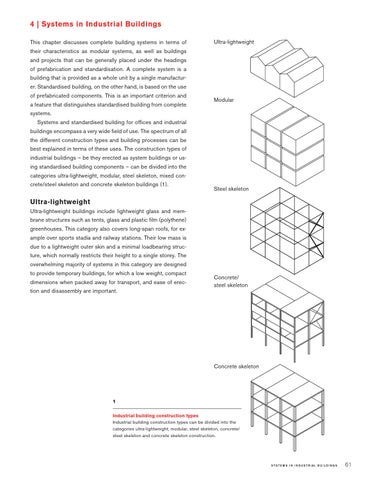
systems. Systems and standardised building for offices and industrial buildings encompass a very wide field of use. The spectrum of all the different construction types and building processes can be best explained in terms of these uses. The construction types of industrial buildings – be they erected as system buildings or using standardised building components – can be divided into the categories ultra-lightweight, modular, steel skeleton, mixed concrete/steel skeleton and concrete skeleton buildings (1).
Steel skeleton
Ultra-lightweight Ultra-lightweight buildings include lightweight glass and membrane structures such as tents, glass and plastic film (polythene) greenhouses. This category also covers long-span roofs, for example over sports stadia and railway stations. Their low mass is due to a lightweight outer skin and a minimal loadbearing structure, which normally restricts their height to a single storey. The overwhelming majority of systems in this category are designed to provide temporary buildings, for which a low weight, compact dimensions when packed away for transport, and ease of erection and disassembly are important.
Concrete/ steel skeleton
Concrete skeleton
1
Industrial building construction types Industrial building construction types can be divided into the categories ultra-lightweight, modular, steel skeleton, concrete/ steel skeleton and concrete skeleton construction.
SYSTE M S I N I N DUSTR IAL B U I LDI NG S
61