8
2
3
4
OLD & NEW
INTRODUCTION
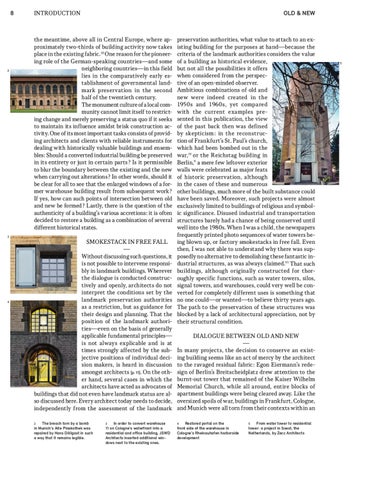
the meantime, above all in Central Europe, where approximately two-thirds of building activity now takes place in the existing fabric.III One reason for the pioneering role of the German-speaking countries—and some neighboring countries—in this field lies in the comparatively early establishment of governmental landmark preservation in the second half of the twentieth century. The monument culture of a local community cannot limit itself to restricting change and merely preserving a status quo if it seeks to maintain its influence amidst brisk construction activity. One of its most important tasks consists of providing architects and clients with reliable instruments for dealing with historically valuable buildings and ensembles: Should a converted industrial building be preserved in its entirety or just in certain parts ? Is it permissible to blur the boundary between the existing and the new when carrying out alterations? In other words, should it be clear for all to see that the enlarged windows of a former warehouse building result from subsequent work ? If yes, how can such points of intersection between old and new be formed ? Lastly, there is the question of the authenticity of a building’s various accretions: it is often decided to restore a building as a combination of several different historical states. SMOKESTACK IN FREE FALL — Without discussing such questions, it is not possible to intervene responsibly in landmark buildings. Wherever the dialogue is conducted constructively and openly, architects do not interpret the conditions set by the landmark preservation authorities as a restriction, but as guidance for their design and planning. That the position of the landmark authorities—even on the basis of generally applicable fundamental principles— is not always explicable and is at times strongly affected by the subjective positions of individual decision makers, is heard in discussion amongst architects [p. 11]. On the other hand, several cases in which the architects have acted as advocates of buildings that did not even have landmark status are also discussed here. Every architect today needs to decide, independently from the assessment of the landmark 2 The breach torn by a bomb in Munich’s Alte Pinakothek was repaired by Hans Döllgast in such a way that it remains legible.
AN_Layout_final_250810_TT.indd 8
3 In order to convert warehouse 11 on Cologne’s waterfront into a residential and office building, JSWD Architects inserted additional windows next to the existing ones.
preservation authorities, what value to attach to an existing building for the purposes at hand—because the criteria of the landmark authorities considers the value of a building as historical evidence, but not all the possibilities it offers when considered from the perspective of an open-minded observer. Ambitious combinations of old and new were indeed created in the 1950s and 1960s, yet compared with the current examples presented in this publication, the view of the past back then was defined by skepticism : in the reconstruction of Frankfurt’s St. Paul’s church, which had been bombed out in the war, IV or the Reichstag building in Berlin,V a mere few leftover exterior walls were celebrated as major feats of historic preservation, although in the cases of these and numerous other buildings, much more of the built substance could have been saved. Moreover, such projects were almost exclusively limited to buildings of religious and symbolic significance. Disused industrial and transportation structures barely had a chance of being conserved until well into the 1980s. When I was a child, the newspapers frequently printed photo sequences of water towers being blown up, or factory smokestacks in free fall. Even then, I was not able to understand why there was supposedly no alternative to demolishing these fantastic industrial structures, as was always claimed.VI That such buildings, although originally constructed for thoroughly specific functions, such as water towers, silos, signal towers, and warehouses, could very well be converted for completely different uses is something that no one could—or wanted—to believe thirty years ago. The path to the preservation of these structures was blocked by a lack of architectural appreciation, not by their structural condition.
5
DIALOGUE BETWEEN OLD AND NEW — In many projects, the decision to conserve an existing building seems like an act of mercy by the architect to the ravaged residual fabric : Egon Eiermann’s redesign of Berlin’s Breitscheidplatz drew attention to the burnt-out tower that remained of the Kaiser Wilhelm Memorial Church, while all around, entire blocks of apartment buildings were being cleared away. Like the oversized spoils of war, buildings in Frankfurt, Cologne, and Munich were all torn from their contexts within an 4 Restored portal on the front side of the warehouse in Cologne’s Rheinauhafen harborside development
5 From water tower to residential tower : a project in Soest, the Netherlands, by Zecc Architects
25.8.2010 18:17:13