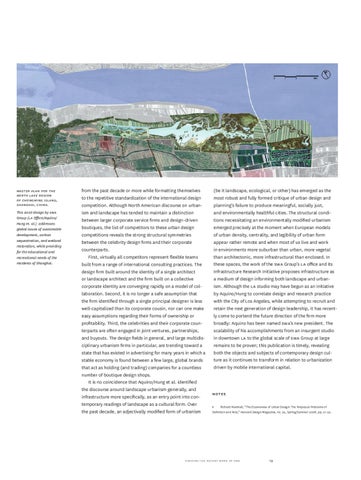
master plan for the north lake region of chongming island, shanghai, china. This 2007 design by swa Group (la Office/Aquino/ Hung et. al.) addresses global issues of sustainable development, carbon sequestration, and wetland restoration, while providing for the educational and recreational needs of the residents of Shanghai.
from the past decade or more while formatting themselves to the repetitive standardization of the international design competition. Although North American discourse on urbanism and landscape has tended to maintain a distinction between larger corporate service firms and design-driven boutiques, the list of competitors to these urban design competitions reveals the strong structural symmetries between the celebrity design firms and their corporate counterparts. First, virtually all competitors represent flexible teams built from a range of international consulting practices. The design firm built around the identity of a single architect or landscape architect and the firm built on a collective corporate identity are converging rapidly on a model of collaboration. Second, it is no longer a safe assumption that the firm identified through a single principal designer is less well-capitalized than its corporate cousin, nor can one make easy assumptions regarding their forms of ownership or profitability. Third, the celebrities and their corporate counterparts are often engaged in joint ventures, partnerships, and buyouts. The design fields in general, and large multidisciplinary urbanism firms in particular, are trending toward a state that has existed in advertising for many years in which a stable economy is found between a few large, global brands that act as holding (and trading) companies for a countless number of boutique design shops. It is no coincidence that Aquino/Hung et al. identified the discourse around landscape urbanism generally, and infrastructure more specifically, as an entry point into contemporary readings of landscape as a cultural form. Over the past decade, an adjectivally modified form of urbanism
(be it landscape, ecological, or other) has emerged as the most robust and fully formed critique of urban design and planning’s failure to produce meaningful, socially just, and environmentally healthful cities. The structural conditions necessitating an environmentally modified urbanism emerged precisely at the moment when European models of urban density, centrality, and legibility of urban form appear rather remote and when most of us live and work in environments more suburban than urban, more vegetal than architectonic, more infrastructural than enclosed. In these spaces, the work of the swa Group’s la office and its Infrastructure Research Initiative proposes infrastructure as a medium of design informing both landscape and urbanism. Although the la studio may have begun as an initiative by Aquino/Hung to correlate design and research practice with the City of Los Angeles, while attempting to recruit and retain the next generation of design leadership, it has recently come to portend the future direction of the firm more broadly: Aquino has been named swa’s new president. The scalability of his accomplishments from an insurgent studio in downtown la to the global scale of swa Group at large remains to be proven; this publication is timely, revealing both the objects and subjects of contemporary design culture as it continues to transform in relation to urbanization driven by mobile international capital.
n ot e s 1 Richard Marshall, “The Elusiveness of Urban Design: The Perpetual Problems of Definition and Role,” Harvard Design Magazine, no. 24, Spring/Summer 2006, pp. 21–32.
reading the recent work of swa
SWA_00_frontmatter FINAL.indd 13
13
06.12.10 16:02