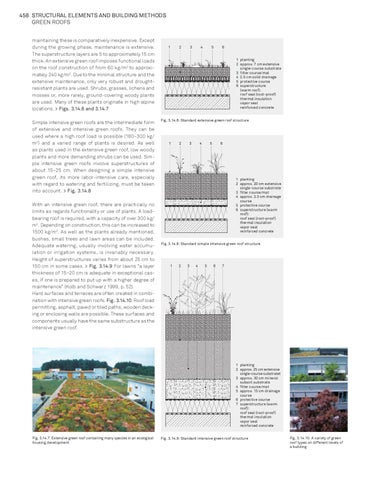
458 STRUCTURAL ELEMENTS AND BUILDING METHODS GREEN ROOFS maintaining these is comparatively inexpensive. Except during the growing phase, maintenance is extensive. The superstructure layers are 5 to approximately 15 cm thick. An extensive green roof imposes functional loads on the roof construction of from 60 kg/m2 to approximately 240 kg/m2. Due to the minimal structure and the extensive maintenance, only very robust and droughtresistant plants are used. Shrubs, grasses, lichens and mosses or, more rarely, ground-covering woody plants are used. Many of these plants originate in high alpine locations. > Figs. 3.14.6 and 3.14.7 Simple intensive green roofs are the intermediate form of extensive and intensive green roofs. They can be used where a high roof load is possible (180–300 kg/ m2) and a varied range of plants is desired. As well as plants used in the extensive green roof, low woody plants and more demanding shrubs can be used. Simple intensive green roofs involve superstructures of about 15–25 cm. When designing a simple intensive green roof, its more labor-intensive care, especially with regard to watering and fertilizing, must be taken into account. > Fig. 3.14.8 With an intensive green roof, there are practically no limits as regards functionality or use of plants. A loadbearing roof is required, with a capacity of over 300 kg/ m2. Depending on construction, this can be increased to 1500 kg/m2. As well as the plants already mentioned, bushes, small trees and lawn areas can be included. Adequate watering, usually involving water accumulation or irrigation systems, is invariably necessary. Height of superstructures varies from about 25 cm to 150 cm in some cases. > Fig. 3.14.9 For lawns “a layer thickness of 15–20 cm is adequate in exceptional cases, if one is prepared to put up with a higher degree of maintenance” (Kolb and Schwarz 1999, p. 52). Hard surfaces and terraces are often created in combination with intensive green roofs. Fig. 3.14.10. Roof load permitting, asphalt, paved or tiled paths, wooden decking or enclosing walls are possible. These surfaces and components usually have the same substructure as the intensive green roof.
1
2
3
4
5
6 1 planting 2 approx. 7 cm extensive single-course substrate 3 filter course/mat 4 2.5 cm solid drainage 5 protective course 6 superstructure (warm roof): roof seal (root-proof) thermal insulation vapor seal reinforced concrete
Fig. 3.14.6: Standard extensive green roof structure
1
2
3
4
5
6
1 planting 2 approx. 20 cm extensive single-course substrate 3 filter course/mat 4 approx. 2.5 cm drainage course 5 protective course 6 superstructure (warm roof): roof seal (root-proof) thermal insulation vapor seal reinforced concrete Fig. 3.14.8: Standard simple intensive green roof structure
1
2
3
4
5
6
7
1 planting 2 approx. 25 cm extensive single-course substratet 3 approx. 30 cm mineral subsoil substrate 4 filter course/mat 5 approx. 15 cm drainage course 6 protective course 7 superstructure (warm roof): roof seal (root-proof) thermal insulation vapor seal reinforced concrete Fig. 3.14.7: Extensive green roof containing many species in an ecological housing development
Fig. 3.14.9: Standard intensive green roof structure
Fig. 3.14.10: A variety of green roof types on different levels of a building