STRUCTURAL ELEMENTS AND BUILDING METHODS 243 STEPS
3.3 STEPS
OUTDOOR STEPS Steps are a special element within a path. They make it easier to walk at places where a marked longitudinal incline would make a climb too difficult, and they create a pedestrian connection between areas of significantly different height. They structure the run of a pathway or a terrain, forming an important creative resource for contouring relief and for bordering or accentuating areas.
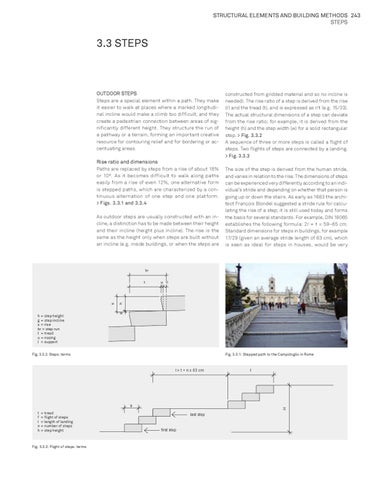
constructed from gridded material and so no incline is needed). The rise ratio of a step is derived from the rise (r) and the tread (t), and is expressed as r/t (e.g. 15/33). The actual structural dimensions of a step can deviate from the rise ratio; for example, it is derived from the height (h) and the step width (w) for a solid rectangular step. > Fig. 3.3.2 A sequence of three or more steps is called a flight of steps. Two flights of steps are connected by a landing. > Fig. 3.3.3
Rise ratio and dimensions Paths are replaced by steps from a rise of about 18% or 10º. As it becomes difficult to walk along paths easily from a rise of even 12%, one alternative form is stepped paths, which are characterized by a continuous alternation of one step and one platform. > Figs. 3.3.1 and 3.3.4 As outdoor steps are usually constructed with an incline, a distinction has to be made between their height and their incline (height plus incline). The rise is the same as the height only when steps are built without an incline (e.g. inside buildings, or when the steps are
The size of the step is derived from the human stride, and varies in relation to the rise. The dimensions of steps can be experienced very differently according to an individual’s stride and depending on whether that person is going up or down the stairs. As early as 1683 the architect François Blondel suggested a stride rule for calculating the rise of a step; it is still used today and forms the basis for several standards. For example, DIN 18065 establishes the following formula: 2r + t = 59–65 cm. Standard dimensions for steps in buildings, for example 17/29 (given an average stride length of 63 cm), which is seen as ideal for steps in houses, would be very
br b
h = step height g = step incline s = rise br = step run t = tread u = nosing l = support Fig. 3.3.2: Steps: terms
l
h
u
g
s
ta
h= g= s= b=
Stufenhöhe Stufengefälle Steigung Stufenbreite
a = Auftritt u = U nterschneidung l = Auflager
Fig. 3.3.1: Stepped path to the Campidoglio in Rome
l = t + n x 63 c m
t
H
a t f l n h
= tread = flight of steps = length of landing = number of steps = step height
Fig. 3.3.3: Flight of steps: terms
la s t s te p
fir s t s te p