OTL

Page 1


ON THE LEVEL

bipolarscotland.org.uk

Disclaimer: On The Level works in good faith with a range of subject-matter experts and official bodies to produce accurate and well-researched content. While every effort is made to ensure the reliability and accuracy of the information presented, errors may occasionally occur. Where necessary, we will issue corrections or clarifications.

Please note that the views and opinions expressed in On The Level are not necessarily those of Bipolar Scotland.

We would also love your feedback about On The Level. Send us an email or reach out to us on social media. You can find us on Instagram (@bipolar_scotland) and Facebook (@bipolarscotland) Winter 2025

Submissions: If you would like to submit a piece of writing, a photo or an idea to be considered for future issues of On The Level, please get in touch with petes@bipolarscotland.org.uk

©Bipolar Scotland 2025 Scottish Charity No. SC021705 Company No. 163305

T: 0141 560 2050 E: info@bipolarscotland.org.uk bipolarscotland.org.uk

Conference Reflections!

Our first conference in many years is over, but here are some thoughts on the day!

Work is a Four Letter Word

Our regular columnist David Carr pulls no punches in his tales from the world of work.

Monkey & Me

Dr. Leo Whyte talks about the two dominantand sometimes competing - forces within his mind: his logical self and the unpredictable Monkey.

Get Yourself Elected! Learn about the Access to Elected Office Fund.

Editorial November 2025

Hello everyone and welcome to the latest edition of On the Level!

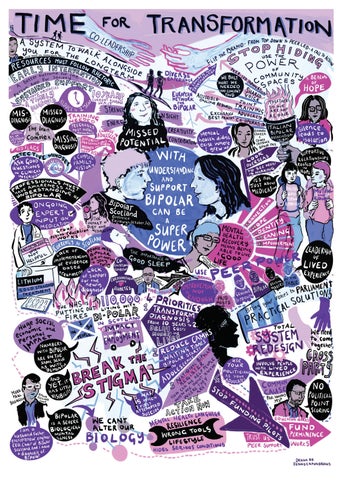
It has been a very exciting (if exhausting!) past couple of months, with our Time for Transformation Conference finally taking place in Edinburgh at the beginning of October. It was an amazing day and all of us here at Bipolar Scotland thoroughly enjoyed it! It was great meeting so many people, hearing such a wide range of speakers and getting a chance to engage with the stimulating workshops on offer. I have gone into a bit more depth about it all on pages 10 &11.

The theme for this edition is ‘work’. This theme was partly inspired by our new programme Momentum Works (about which more on page 8), which offers a huge range of workplace support for both those with bipolar and their employers. The issue of employment is something that I think about a lot.

Before I was diagnosed, I expended a tremendous amount of energy masking and trying to keep things together, but now I know what I suffer from, things have become significantly better. I’m aware that a lot of people with bipolar can’t work and I know I certainly couldn’t for quite some time. But I feel that the world of work and how it relates to bipolar

disorder is still worth investigating and hopefully there is still something to be gained from this issue for those it might not be directly relevant to.

We have a great article by guest contributor Ellen Blunsdon from Inclusion Scotland about the support that they can provide for people with disabilities who are keen to run for elected office. If this sounds like you, then head on over to pages 18 & 19 to get the lowdown. And we also have a wonderfully imaginative take on bipolar and work from Dr. Leo Whyte and his pal the monkey (!) on pages 14 & 15.

And last, but very much not least, we have our usual excellent contributions from our regular columnists David Carr (pages 12 &13) and Graham Morgan (pages 22 &23).

Happy reading!

November 2025

Jamie’s Diary

Hello Everyone!

I have taking a few trips away lately.

I went to see my brother in Brighton, and went to a music festival at Butlins.

Getting away has been great for me, I had a great time. I dip at this time of year, we have discussed this but it is inevitable that mood shift is here for a few months.

I am taking vitamin D to counter this and I have also bought a Sad lamp.

I have written how it is important to look after yourself during the winter months but I urge you to really do that, I need to take my own advice too – these are choppy waters for me personally.

But that does not mean there are not happy times ahead the next little while too.

Life is busy and my mind is tracking itself, more aware of potential mood swings.

But even with all of that moaning – I am grateful for everything in my life.

I got asked if I was 25 in Brighton (and I wasn’t in an opticians waiting room!) - Very cool and I have loads to look forward too!

Its a brilliant time to snuggle up with a blanket, cup of tea and watch your favourite movie. Get some good shoes too - it is icy out there!

Please take care of yourself and I will see you very soon.

Love Jum xx

ChristmasAppeal 2025!

While many of us look forward to the holidays, this time of year can be especially hard for those struggling with their mental health. Your support can make a real difference — helping us to keep our peer support groups running, to train new volunteers, and to reach more people who need support from others with lived experience. Every donation, no matter the size, helps us spread a little light, comfort, and connection this festive season. ”

The impact that Bipolar Scotland has

Other Ways You Can Support Bipolar Scotland

• Become a Volunteer Fundraiser

Take part in bucket collections, host a bake sale, or run your own sponsored challenge — whatever suits you! We’ll give you all the tools and encouragement you need.

• Join a Fundraising Event

We’re building our biggest-ever team of Kiltwalkers this year — come and join us! We’ll cover the cost of your ticket. https://www.thekiltwalk.co.uk/

• Get Your Workplace Involved

Does your company have a Charity of the Year or ‘matched giving’ scheme? Partner with us to make a bigger impact together.

Contact Kimberley at kimberleyl@bipolarscotland.org.uk to find out more.

Legacy Giving

This Christmas, please consider leaving a lasting gift to Bipolar Scotland by including us in your Will. A legacy - any size - helps ensure that people living with bipolar, and their families, can access compassionate support, informed guidance, and community connection long into the future.

Gifts in Wills sustain our peer training, support groups and advocacy by providing steady foundations when public funding is uncertain. If you’d like friendly confidential information on how to leave a legacy to Bipolar Scotland, please contact us by phone 0141 560 2050 or email: info@bipolarscotland.org.uk

“...realising that I’m not alone. In 30 years of being diagnosed I have not yet spoken to someone who has said they have bipolar…”

Momentum Works is an exciting new project from us here at Bipolar Scotland. It provides peer-led support to help people at any early stage of dealing with their bipolar manage their mental health at work, build confidence in their abilities, and take positive steps towards their career goals.

Whether you’re just starting out in the world of work, returning after time off, or facing challenges in the workplace, our goal is to offer early, practical support that makes a lasting difference.

This support can be difficult to achieve because most people in the UK work for a small business (up to 200 staff) and these small businesses tend not to have separate HR departments or occupational health specialists. As a result, the support that a lot of employers can offer perhaps isn’t as comprehensive as that which you might receive at a much larger company. In order to help with this, we also offer information and advice for employers themselves.

Momentum Works is rooted in peer support, and all peers have lived experience of bipolar. The projects can

help you and your employer set reasonable adjustments for the performance of your job. A lot of these reasonable adjustments don’t cost your employer anything but they can make a big difference to your day-today life!

You can get 12 peer support sessions (maximum one hour), take advantage of our drop-in sessions, or just arrange a single peer support session if you have a specific thing you’d like to discuss.

There’s also support available for selfemployed people, those facing stigma or discrimination at work and much more!

If this sounds like something you could benefit from, please do get in touch! Check out our website

bipolarscotland.org.uk/momentum-works/

REFLECTIONS 2025

Here at Bipolar Scotland, we’ve all just about recovered from last month’s conference. It was a great day, but I’m not afraid to admit, we were all pretty knackered afterwards!

This year’s Time For Transformation conference was the first event that Bipolar Scotland has held in years. As such, we had lots to do and say and one of the biggest problems we had was deciding what to cut out due to time constraints.

We’ve had some great feedback from the day and we hope that all of you who managed to attend enjoyed it and got a lot out of it. I know I did!

For me, it was great to meet people in real life (or IRL as the kids say! Or used to say I suppose…) and that didn’t just apply to our members. Staff here at Bipolar Scotland all work remotely, so we rarely get the chance to meet up in three dimensions so, from a personal perspective, that was also really great.

I’m constantly surprised by the fact that there’s always more to learn when it comes to bipolar. Just when I think I’ve got a handle on it I’ll hear a talk like the one Danny Smith gave or speak to someone else with lived experience and I’ll find out something new. It’s a bitter-sweet realisation because, whilst it’s affirming and cathartic to learn new things, it reminds me how far we still

have to go in educating the general public about bipolar.

But, that’s what events like the conference are all about. If not educating others directly, we are at least learning more about ourselves and the illness we live with, or our loved ones live with, which will in turn help us educate others.

One of the main things I learned from the conference was perhaps the most surprising. That our Board Chair MarkPaul Buckingham is in fact a talented juggler!

He entertained a few of us during the lunch break with his skills, and we were very impressed. Sadly I don’t have any pics of this so you’ll have to take my word for it! Who knows, maybe next conference the staff will treat you all to some of our hidden talents! I’m already practicing my unicycling (which is not going very well at all).

Thank you all again for coming and hopefully we’ll do it again soon!

Pete, Editor OTL.

My education was in an arcane discipline called ergonomics. I helped engineers and designers to make products that fit in with people’s lives. My career started near London in a creative design environment - think lots of Steve Jobs clones - where I worked on designs as diverse as photocopiers, Manchester trams and a software system for Heineken breweries.

But we wanted to move to Glasgow. In Scotland, the only ergonomics jobs were in defence, which I was reluctant to do. Nevertheless, I sold my soul and took a job with an engineering consultancy, figuring that it would be a foothold.

As soon as I started, I realised my mistake. The work environment was hostile, uncaring, masculine. My first office bully - there would be othersprecipitated the earliest of a succession of episodes of depression. In the coming years I would regularly be absent. I was constantly in fear of losing my job.

So why didn’t I just change jobs? Well - by now I believed myself to be unemployable. Who would hire me with my sickness record? How would I cope with finding my feet once more with a new employer? Would they be just as bad? I stayed put, in a stasis of terrified inertia. For years.

For a period, my work required me to travel to Bristol, week in week out. There I encountered the worst of

David Carr

Work is a four letter word.
I was good at my job. But my job wasn’t good for me.

my bullies - an extremely unpleasant project manager who, in revenge for my challenging his racist language, made life hell for me.

My reaction to this was my first severe hypomanic episode. One symptom was excessive after-work partying. This put a strain on my marriage. We had young twins and I would arrive home at weekends exhausted by work, by travel - and by partying - to find my wife exhausted by childcare and with two babies still to be looked after.

The wave of hypomania broke and an episode of depression put me in hospital. My tormentor engineered things so that I was bumped off the project. A ‘reasonable adjustment’ was made so that I didn’t have to spend so much time away from home - but back in Glasgow and without a large project I faced the omnipresent threat of redundancy.

It wasn’t all bad. One admittedly satisfying part of the job was when I had to present at conferences. By some epic wrangling I found myself in quick succession in front of large audiences in Orlando and Prague. The combination of stress and the hyperstimulation was my undoing. I was again in hypomania. I moved rapidly up the mood scale and by Prague my behaviour had becomechallenging - bizarre - erratic - unsafe. I probably shouldn’t have been smoking hashish at a major NATO conference, but I was in fine form - and my presentation went down a storm.

A week later, after various further adventures, I was sectioned.

Throughout the rest of my time there would be many highs and lows. Months long absences made me constantly fear for my job. Financial commitments, lack of opportunity and the destruction of my self-confidence tied me to it.

My illness made my employment precarious. Never mind the sickness record, in my wilder moments I somehow got away with any number of sackable offences - not a single one of which I regret. I survived simply because I was also uniquely capable at what I did.

Towards the end I worked with a Swedish university - a professor I met at a conference had been won over by another of my presentations - perhaps less barnstorming than the Prague affair. Not only did this get me out of defence for a while, but I found myself at home in a more creative, more nurturing - more feminine - environment.

Never once did my colleagues send me a get well card, so I was touched when, during one of my depressions, my professor phoned to ask after me. She didn’t have to do that. She wasn’t my

employer or manager. She acknowledged and accepted my illness - astutely commenting that I could sometimes be ‘over productive.’

I was finally made redundant. People think I am retired - I let them think that. Redundancy triggered yet more serious and long-lasting episodes and I found myself unable to work. Although I no longer work for money, I volunteer, teaching English to asylum seekers. It doesn’t pay the bills - but job satisfaction is off the scale.

To Philip Larkin, work was a toad that squatted on his life. This I can relate to. I see myself as talented, creative, pragmatic. In a better and more humane work environment, I could have thrived. My work caused me a lot of pain. It didn’t have to be that way and I feel justified anger at the way my illness was dealt with. Or not.

I leave you with a line from Capital: ‘The realm of freedom begins only when mundane labour ceases.’

David blogs on Substack as The Monkey Whisperer

Monkey & MeThe Reality of Living and Working with Bipolar 2

When I say I live with Bipolar 2 most people think of one of three things.

• Some think of me making skipping my meds to boost my productivity and making crazy diagrams on the wall with pins and red strings between lots of bits of paper, al la Carrie Mathison in Homeland (who, for the record, lived with Bipolar 1 not Bipolar 2)

• Others think that I’m just overly sensitive to the day to day ups and downs in moods that everyone struggles with sometimes. They treat me like I’m a bit fragile and pathetic.

• Then there’s the third extreme where I’m perceived to be always unwell. People question every little thing I do and attribute it to my bipolar. They question every decision I ever make, dismiss my opinions and feel

that my judgment can never be sound since I’m “clearly unstable”.

None of these are the reality of living with Bipolar 2. Bipolar is something that I manage, something I live with but not something that defines me. It’s also not something that affects my ability to work nor impairs my judgement at all times. What it does mean is that sometimes I need some small adjustments and flexibility to help me through a particular cycle.

If you don’t live with (or care for) a chronic, incurable and/or hidden disability it can sometimes be hard to understand what it’s really like.

Let me break it down a little for what the experience is like for me personally.

My Two Selves and the Control Room

Stealing some popular imagery from Disney’s “Inside Out” movies, imagine your mind as a busy control room.

At the main panels sit two essential operators: Logical Me and Monkey. They’re responsible for keeping everything running smoothly, making sure I can navigate the world safely and effectively.

Logical Me is the big thinker, the reasoner. He processes information, weighs pros and cons, and makes considered choices. He’s the one who plans out my day, works on projects, and thinks through conversations. He’s what I perceive life through. He’s the voice of “me” in my head.

Monkey is the one who acts on immediate

emotions. His job is to watch for danger and react instantly to keep me safe. He’s faster than Logical Me, so in a crisis, he can trigger a fight-or-flight response before I’ve even had a chance to think. He also takes care of emotional responses, you know, that need to cry when you’re sad, that red wave that comes over you when you’re angry. He also takes care of some of the crucial tasks that take a bit less…let’s say intelligent reasoning. Things like energy management, walking, talking or eating.

This dynamic is normal and we all have it.

But for me, living with bipolar means my Monkey is a bit different. He’s not only fast, but he’s also overly sensitive to what he perceives as a threat. And what’s more, he’s prone to extreme emotional states—deeply depressed or highly manic.

When Monkey Pushes the Wrong Buttons

90% of my time is spent in a balanced state. This is the same day to day ups and downs we all feel. The normal state of things where Monkey and I work together with ease, each doing their own jobs and things running optimally.

In a depressed state though, Monkey stops helping. He sits under the desk and mutters unhelpful things like “Why bother?”, “Just go back to bed”, “Give up” and, in very extreme cycles, “I just want to die.” He pushes buttons that can make me unable to speak, leaving me feeling numb and detached. Logical me has to pick up the slack on all of Monkey’s usual jobs as well as trying to make Monkey feel better and trying to ignore his unhelpful invasive thoughts. Logical me is not very good at Monkey’s jobs so they all take extra effort. Walking feels like I’m moving through tar and talking takes extreme effort to get the words out.

In a hypomanic state, he pushes all the “go” buttons at once—making me impulsive, overly talkative, and restless. It’s like a critical overload in the control room, with sparks flying everywhere. He’s so fast that Logical Me can’t always keep up. Sometimes Monkey is so fast that Logical me doesn’t even know that he’s pushing extra buttons. Other times he’s desperately trying to hold Monkey back, whilst also trying to work out which buttons he’s pushed (if any) and undo it.

So Logical me has a lot of extra work to do when Monkey is in these different states. This however is not the end of his extra jobs unfortunately. On top of everything else, he has to constantly monitor Monkey, even when in a balanced state.

He has to watch for his mood swings and be ready to react and tell him to stop before he pushes the wrong buttons. He has to try and ensure that we are doing all the right things to maintain the balanced state (eating healthily, exercising, getting enough sleep, etc).

When he spots the first signs of a change in Monkey’s state, he has to make sure we take action to shift his mood back in the right direction, like listening to upbeat or calming music, going for a walk to burn off energy or boost my vitamin D or even just having a snack.

This constant vigilance is mentally exhausting.

What This Looks Like in the Real World

Understanding this framework I hope you can see why people who live with Bipolar 2 might need some flexibility and reasonable adjustments at work or in daily life.

Some examples for me include (but everyone is different and others may need something different).

When Monkey is depressed: My logical self is drained from trying to keep things together. This is when I might need some extra time to complete a task, a flexible schedule, or the ability to step out of/reschedule meetings when I can’t talk. My communication might be slower or more reserved than usual because it takes a lot of effort just to respond.

When Monkey is hypomanic: My logical self is trying to rein in a lot of extra energy. This is when I might need help focusing or channeling that energy into productive tasks. A manager might need to help me prioritize and break down large projects into smaller steps to prevent me from getting overwhelmed or distracted by multiple ideas.

Holidays - I enjoy my work. I enjoy the difference my work makes to real people’s lives. People who also live with the constant vigilance of managing a chronic condition. That means sometimes though that I forget that time off to rest is really important for me. A little nudge here and there to ensure that I’m using (or at least have a plan for when I’m using) all my holidays is therefore helpful, if it feels like a while since I took time off.

Travel - Travel away from home presents some additional considerations for me in managing Monkey. I’m away from my support network who play a crucial role in helping Logical Me spot the subtle signs that Monkey is leaning one way or another. Good sleep and recuperation time is also essential for me to keep things balanced.

Ultimately, this is my reality. I am a capable, hard working and thoughtful person, but I also live with the constant, extra thought process of managing my own mood. It’s a lot to handle, but with the right support, I can keep both operators at their panels and ensure my control room stays online.

Adjustments aren’t needed every day. I’m pretty skilled at managing it all these days but I’m still human and not perfect so sometimes need a little extra flexibility and compassion. I’m lucky enough to have an employer that understands this and supports my needs.

Just remember though, all employees are entitled to reasonable adjustments at work by law so don’t be afraid to campaign for your needs.

Get Yourself Elected!

Politics can seem like something distant, a world of debate chambers, party conferences and policy papers. But at its core, politics is about people. It is about shaping the communities we live in and making decisions that affect daily life. For disabled people, including people living with bipolar, civic participation is not only a right but a vital act of representation. Each time we get involved in public life, we bring experiences that challenge assumptions, inspire others, and change what leadership looks like.

Activism can take many forms. It might mean emailing your local representatives, campaigning for better access, or simply refusing to stay silent when something isn’t right. These small acts ripple outward, showing others that engagement is possible, valuable, and even joyful. When disabled people take up space in civic life, they show that change does not always happen from parliament. Sometimes, it begins with one person deciding that their perspective is worth hearing.

When disabled people step into political roles, everyone benefits. Lived experience of barriers and discrimination brings crucial insight into how systems really

work. Policies become more inclusive; communities become more equitable. And at the same time, individuals can gain confidence, new skills, and a sense of pride in what they have contributed. Representation builds capacity both within the individual and across society. It reminds us that politics can be personal, hopeful, and deeply human.

For some, involvement might begin with volunteering or joining a local party branch. For others, it might lead to standing as a councillor or even as a Member of the Scottish Parliament. Whatever the path, participation itself matters. Each disabled person who takes part helps pave the way for others to follow, showing that political life is not out of reach. And while activism often begins in small, everyday acts, it can gradually grow into more formal roles in decision-making. Every step of that journey deserves support.

That’s where the Scottish Government’s Access to Elected Office Fund comes in. The Fund, administrated and delivered by Inclusion Scotland, exists to make sure practical barriers never stand in the

way of progress for disabled people who want to stand as candidates in upcoming elections. It provides financial support to cover the additional costs of running for office, such as communication support, transport, or assistive technology. The Fund is currently open to candidates planning to stand in the 2026 Scottish Parliament election and/or the 2027 local council elections.

However, whatever stage you are at, Inclusion Scotland can help you access the support you need to take part. Through our Access to Politics work, we offer guidance to disabled people who want to become more involved in political life, whether that means joining a political party, starting a campaign, or preparing to stand for elected office and beyond. We can also offer guidance to your party and other political spaces, if they are not getting it right for you. You can always get in touch to see what’s possible.

Disabled people’s involvement in political life is good for us and good for the world. It makes politics richer, fairer, and closer to the reality of the communities it serves. Change happens when those most affected by decisions have the power to shape them. And that begins with getting involved.

If you’d like to apply for the fund, please get in touch with Inclusion Scotland using these contact details and someone will guide you through the process.

Email: civicparticipation@ inclusionscotland.org

Phone: 0131 370 6700

Website: https://inclusionscotland.org/ Instagram: https://www.instagram.com/ inclusionscotland/

This is your space to share your creative writing. If you’d like to submit a poem, story or piece of writing, please email us on info@bipolarscotland.org.uk with the subject line ‘On The Level Submission’.

Over to you LIVING WITH BIPOLAR

This is a poem sent in by Bipolar Scotland member Rose O’Doherty, which was written by her late partner Suzanne.

Suzanne was born in Bradford in 1959 moving to Scotland in later life. Suzanne and Rose met in 2013 and became firm friends. An avid poetry writer, this is one she wrote about observing bipolar ( in Rose) first hand.

Suzanne passed in December 2024. She lives on in Rose’s heart…

The phone rings, I know it is you again Without seeing the number or display I wonder what will be in your refrain The next scene in our perpetual play

You’re brighter now, a lightness in your phrase But still talking loud, your voice has risen I wonder if you realise it’s been days That you’ve been locked in your little prison

Something to make you smile, then the phone rings…

TRANSFORMATION

Regular On the Level contributor

Colette MacFadyen has written this wonderful poem about her experiences at last month’s conference.

What does this mean

Is it a personal transformation

To let go of anger, fear and shame

To come out of the bipolar closet

To stand up and say – see me!

I am a person, I matter

Life can be difficult for me

But it can be wonderful too

Don’t let bipolar define me

I am more than this

I matter and how I feel matters

I can be very creative

I can be very sensitive too

Sensitive to stigma and discrimination

Sensitive to harsh words and rejection

I want to be transformed

I want to be born anew

To live in a world

Where I can be me

In all different moods And be accepted and loved And to be set free!

I’ve been on a compulsory community treatment order for the last fourteen years and have remained in employment for all that time. In some ways I could be a poster boy (or old man; I’m sixty two) for mental illness and work.

I have an MBE for services to mental health; I have worked most of my adult life. I attended the Royal College of Psychiatrists award ceremony in London this week where I was runner up as Patient Contributor of the year. I have helped shape the legislation that affects us and spoken in forums such as the United Nations Committee against Torture, or the Kings College International Symposium on Human Rights or this summer, at the British Academy.

I don’t want to be a poster boy for the fact that we can work and should be able to work and should be free from discrimination and prejudice and the half seen micro moments of otherness we all get when we work and are known to have mental health problems. We need that but the liberation and the wellbeing and the therapy that work brings us? It sticks in my throat to be honest. Ok for some but not all of us.

I currently work for the Mental Welfare Commission for Scotland, and mentor a professor at Glasgow University, as well as doing author events and earning a tiny income as a writer. I also do voluntary work with Jeans Bothy; the mental health and wellbeing hub I go to for my own wellbeing and have a regular Substack post on mental health and my family.

In Jeans Bothy we have just started our own podcasts and one of the people I interviewed really had an impact on me.

Employment, the holy grail or the worst of the worst?

His words chimed with what I have been thinking more and more recently. He talked about the horrendous impact of bullying in school in his childhood and the harm that has remained with him all his adult life and as he said it, he mentioned that people can be harmed and oppressed because of difference and that our assumption that we always need to strive for success means that many of us who do not succeed and do not fit in, remain forever stuck in the role of failure and, for that matter, those who are seen as successful are rarely if ever content, always needing to prove themselves over and over again.

He also talked about being self employed and trying to create the sort of working life where he could work but also stop working when his mental health needed that. I liked that.

I have recently been off sick for a few months, a strange form of sickness. I just couldn’t do it anymore; I saw no point in what I was doing. I spent a lot of time sleeping and walking the dog and trying somehow to regain some sort of perspective and, as I got better, I resumed work on a memoir I am writing about my childhood.

One part of that memoir is about what most people see as a life of privilege and elitism and unearned power. I was sent away to boarding school at the age of nine and remained there until I was sixteen. I do not approve of such places for lots of reasons. Childhood is for love and cuddles and safety; not for rows of beds in dormitories and a life ruled from the moment you are woken, by the school bell

and loneliness and trying to pretend you are glad you have been sent away from all the people you know and love for reasons you do not understand at all.

And I do not believe the propaganda we were constantly fed that we were the elite; the best of the best; destined to lead our country and people less fortunate than us in the world as we grew up. In fact, I think it led to leaders who are emotionally damaged, unable to feel or express their emotions, determined to succeed and succeed and succeed in ways they never really questioned but which are unhealthy and harmful.

I thought I discarded that when I got ill at University and failed my degree but the more I think of this; the more I remember the letters and the media reports of that time of Thatcher: that people like me were benefit scroungers, a burden to society and all we hold good in the world.

I have a terrible feeling that the shame of so-called failure and of mental illness has made me try over and over again to prove and prove and prove that I am capable and that I can contribute and that I do have value.

And I am pretty certain that this determination to succeed, where even when I had been sectioned, I would be working on work reports while on

constant obs, or going back into the office within a week of being discharged; flew in the face of all I believe in, if I had just paused a bit to think.

I think in my old life, if I had been less obsessed, my family would have been happier, and now that I live with Wendy and her children and Dash the dog, I believe this even more. For us life is about kindness and safety; it is about being silly and it is about being outrageous because we have no fear of ridicule. You do not get kindness, not really, when everything is about achievement. Kindness is saying we contribute in a multitude of ways. For some of us this is work and for some of this it is in friendship or in laughter or in just allowing ourselves to be accepted.

It is not kind to force those of us into work who cannot do so and who would struggle everyday in such an environment. It is not kind to say all we need are more possessions or meals out or holidays; sometimes it is much better to appreciate a silly telly program or the dawn or the sun on the water.

It is not kind to perpetuate the lie that work and achievement is always good for our wellbeing; for me that comes when Wendy gives me a kiss or when Dash the dog snuggles up on the couch or when Louie says she loves me or when James makes fun of my eccentricity. And in this warmth, we learn what it is to be truly human; something I would like our politicians to work on instead.

The value of love and friendship and the ways that these bind our families and friends and communities together. The need to stop poverty from inadequate benefits and that harsh sadness of loneliness and isolation. That, to me, is far more important. Not that mantra that work heals us and makes us feel wonderful. That we all need to work forever and ever until we no longer have the energy to take one more step forward and instead sit down blankly saying, ‘Why?’

Graham Morgan https://substack.com/@grahammorgan

WELCOME TO ONE OF OUR NEW BOARD MEMBERS! JENNIFER BROWNE!

Over the next few editions, we will be introducing our new board members. And this issue, we begin with Jennifer Browne! Welcome aboard Jennifer!

I am a community midwife employed by the same NHS trust for 25 years and I have been living with the diagnosis of bipolar disorder type 2 (rapid cycling) since a year into my university training as a midwife.

I have had many experiences on my bipolar journey including maintaining a profession with a diagnosis that was considered taboo, particularly for a registered health professional.

I am passionate about high quality support for the initially diagnosed bipolar individual. I have encountered judgement and prejudice from medical professionals solely based on my bipolar diagnosis but have also experienced refreshing forward thinking and compassion from professionals and colleagues from those same groups. I have been very fortunate to have the support of the same GP from diagnosis, who, after 25 years, is still a reliable supporter.

I am keen for there to be more support for bipolar women during pregnancy, childbirth and menopause and the changing experiences these important life phases bring to the complex bipolar journey.

I would like to help reduce stigma to allow open dialogue for all sufferers so they can seek the support they need without fear of judgement - particularly in employment. I am very happily married to my husband, who is a pilot, and we have two beautiful children, a huge Newfoundland dog and two lively Maine Coon kittens!

BIPOLAR SUPPORT GROUPS ACROSS SCOTLAND

We run online and in-person peer support groups across Scotland – friendly, safe spaces for anyone living with or affected by bipolar. Here’s a full list of all our groups running during December and January. Why not talk to people who get it?

To access an online support group, please visit https://bipolarscotland.org.uk/gethelp/support-groups/ to sign up.

SCOTLAND-WIDE (ALL ONLINE)

BIPOLAR BLETHER: For anyone living with or affected by bipolar in Scotland. Sunday 7 December and Sunday 4 January, 3-4pm.

18-30: For anyone aged 18-30 affected by bipolar in Scotland. Wednesday 26 November, Wednesday 10 & 24 December and Wednesday 7 & 21 January, 7-8pm.

FRIENDS & FAMILY: For carers and loved ones. Monday 15 December & Monday 19 January, 7-8pm.

REGIONAL

AYRSHIRE & DUNDEE

Ayrshire & Dundee online group: Tuesday 2 December & Tuesday 6 January, 7-8pm.

• Dundee in-person (Dundee Volunteer and Voluntary Action, 10 Constitution Rd, Dundee, SS1 1LL): Thursday 4th December and Thursday 8 January, 7-9pm.

BORDERS

• Borders online group: Wednesday 3 &17 December and Wednesday 7 & 21 January, 7-8pm.

DUMFRIES & GALLOWAY

• Dumfries & Galloway online group: Tuesday 16 December & Tuesday 20 January, 7-8pm.

FIFE & FORTH VALLEY

• Fife & Forth Valley online group: Tuesday 9 & 23 December and Tuesday 13 & 27 January, 7-8pm.

GLASGOW

• Glasgow City online group: Sunday 28 December and Sunday 25 January, 7-8pm.

• Glasgow City in-person (Premier Inn, Glasgow City, 187 George St, Glasgow, G1 1YU): Wednesday 10 December & Wednesday 14 January, 7-9pm.

• Glasgow West online group: Sunday 14 December & Sunday 11 January, 7-8pm.

• Glasgow West in-person (Partick Trinity Church, 20 Lawrence St, Partick, Glasgow, G11 5HG): Wednesday 16 November and Wednesday 17 December, 7-9pm.

HIGHLANDS & ISLANDS

• Highlands & Islands online group: Thursday 18 December & Thursday 15 January, 7-8pm.

• Highlands & Islands in-person (Café 1668, 86 Church St, Inverness, IV1 1EP): Thursday 4 December and Thursday 8 January, 7-9pm.

NORTH LANARKSHIRE

• North Lanarkshire in-person (Coatbridge Community Centre, 9 Old Monkland Rd, Coatbridge, ML5 5EA): Monday 8 December & Monday 12 January, 7-9pm.

PAISLEY

• Paisley online group: Monday 8 December & Monday12 January, 6-7pm.

• Paisley in-person (Methodist Central Hall, 2 Gauze St, Paisley, PA1 1EP): Monday 22 December & Monday 26 January, 6-7.30pm.

WEST DUNBARTONSHIRE

• West Dunbartonshire online group: Wednesday 10 December & Wednesday 14 January, 7-8pm.

• West Dunbartonshire in-person (Concord Community Centre, Dumbarton, St Mary’s Way, G82 1LJ): Wednesday 26 November & Wednesday 17 December, 7-9pm.

WEST LOTHIAN

• West Lothian in-person (Bathgate Community Centre, Lindsay House, South Bridge St, Bathgate, West Lothian, EH48 1TS): Thursday 11 December & Thursday 8 January, 7-9pm.

EAST LOTHIAN

• East Lothian online group: Thursday 27 November, Thursday 18 December & Thursday 22 January, 7-8pm.

Image: Vecteezy.com

Want to get in touch with us?

Our postal address is:

Studio 10

Anchor One 7 Thread Street Paisley PA1 1JR

You can contact us by phone between 9.30am – 3:30 pm, Monday to Thursday, on: 0141 560 2050, or by email on info@bipolarscotland.org.uk

We’re also on Instagram: (@bipolar_scotland), and Facebook: (bipolarscotland1)

Charity Number: SC021705 Company Number: 163306 bipolarscotland.org.uk

Turn static files into dynamic content formats.
Create a flipbook
Issuu converts static files into: digital portfolios, online yearbooks, online catalogs, digital photo albums and more. Sign up and create your flipbook.