BOHR International Journal of Current Research in Optometry and Ophthalmology 2022, Vol. 1, No. 1, pp. 1–2 Copyright © 2022 BOHR Publishers https://doi.org/10.54646/bijcroo.001 www.bohrpub.com
MMR-Rare Can Be There Dr. Anubhav Chauhan∗ (M.S Ophthalmology), Medical Officer (Specialist), Dr. Deepak Kumar Sharma (M.S Ophthalmology), Assistant Professor and Dr. Pankaj Kumar Thakur (M.S Ophthalmology), Assistant Professor Deptt. of Ophthalmology, Shri Lal Bahadur Shastri Government Medical College and Hospital, Nerchowk, Distt. Mandi, Himachal Pradesh, India ∗ E-mail: chauhan.anubhav2@gmail.com Abstract. We report a case of a 10-year-old male who had megalocornea with mental retardation (Neuhauser syndrome). It is a rare syndrome with a few cases reported in literature. These patients also require a thorough systemic examination as many diseases are often associated with megalocornea.
Introduction Neuhauser syndrome is an extremely rare genetic disease, the specific cause is unknown and has it has no diagnostic test. The diagnosis in childhood is usually performed by oculo-neurological criteria [1].
Case
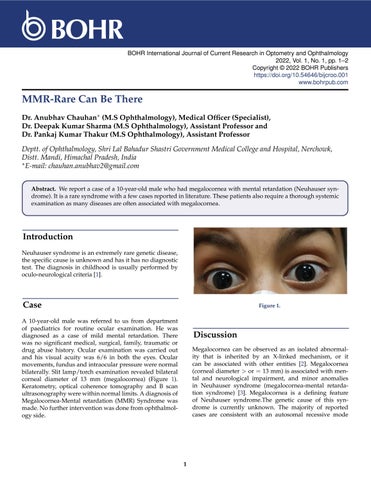
Figure 1.
A 10-year-old male was referred to us from department of paediatrics for routine ocular examination. He was diagnosed as a case of mild mental retardation. There was no significant medical, surgical, family, traumatic or drug abuse history. Ocular examination was carried out and his visual acuity was 6/6 in both the eyes. Ocular movements, fundus and intraocular pressure were normal bilaterally. Slit lamp/torch examination revealed bilateral corneal diameter of 13 mm (megalocornea) (Figure 1). Keratometry, optical coherence tomography and B scan ultrasonography were within normal limits. A diagnosis of Megalocornea-Mental retardation (MMR) Syndrome was made. No further intervention was done from ophthalmology side.
Discussion Megalocornea can be observed as an isolated abnormality that is inherited by an X-linked mechanism, or it can be associated with other entities [2]. Megalocornea (corneal diameter > or = 13 mm) is associated with mental and neurological impairment, and minor anomalies in Neuhauser syndrome (megalocornea-mental retardation syndrome) [3]. Megalocornea is a defining feature of Neuhauser syndrome.The genetic cause of this syndrome is currently unknown. The majority of reported cases are consistent with an autosomal recessive mode
1
Anubhav Chauhan et al.
2
of inheritance [4]. Megalocornea, mental retardation, and, presumably, hypotonia, are the major manifestations for diagnosis [5]. Various conditions which can be associated with megalocornea are Axenfeld-Rieger syndrome, Peters anomaly, Primary congenital glaucoma, Aniridia, Congenital hereditary endothelial dystrophy, Sclerocornea, FrankTer Haar syndrome, Buphthalmus, Crouzon syndrome, Marfan syndrome, Albinism, Ritscher-Schinzel syndrome, Wolfram-like syndrome, Lamellar ichthyosis and Osteogenesis imperfecta [6].
Source of Support-None The paper being submitted has not been published, simultaneously submitted, or already accepted for publication elsewhere.
Conflicts of Interest The authors declare that they have no competing interest.
Financial Disclosure(s) The authors have no proprietary or commercial interest in any material discussed in this article.
References [1] Aviña-Fierro JA, Hernández-Aviña DA. Síndrome de Neuhauser: su fenotipo facial dismórfico [Neuhauser syndrome: the facial dysmorphic phenotype]. Rev Med Inst Mex Seguro Soc. 2016 JanFeb;54(1):106–8. Spanish. PMID: 26820212. [2] Gutiérrez-Amavizca BE, Juárez-Vázquez CI, Orozco-Castellanos R, Arnaud L, Macías-Gómez NM, Barros-Nuñez P. Neuhauser syndrome: a rare association of megalocornea and mental retardation. Review of the literature and further phenotype delineation. Genet Couns. 2013;24(2):185–91. PMID: 24032289. [3] Verloes A, Journel H, Elmer C, Misson JP, Le Merrer M, Kaplan J, Van Maldergem L, Deconinck H, Meire F. Heterogeneity versus variability in megalocornea-mental retardation (MMR) syndromes: report of new cases and delineation of 4 probable types. Am J Med Genet. 1993 Apr 15;46(2):132–7. doi: 10.1002/ajmg.1320460206. PMID: 8484397. [4] Davidson AE, Cheong S-S, Hysi PG, Venturini C, Plagnol V, et al. (2014) Association of CHRDL1 Mutations and Variants with X-linked Megalocornea, Neuha user Syndrome and Central Corneal Thickness. PLoS ONE 9(8): e104163. doi: 10.1371/journal.pone.0104163 [5] Santolaya JM, Grijalbo A, Delgado A, Erdozaín G. Additional case of Neuhäuser megalocornea and mental retardation syndrome with congenital hypotonia. Am J Med Genet. 1992 Jun 1;43(3):609–11. doi: 10.1002/ajmg.1320430321. PMID: 1605258. [6] Moshirfar M, Hastings J, Ronquillo Y. Megalocornea. [Updated 2021 Jul 25]. In: StatPearls [Internet]. Treasure Island (FL): StatPearls Publishing; 2021 Jan.