
Red Pine plans new resource, downplays alleged assay fraud at Ontario gold project
BY COLIN MCCLELLLANDRed Pine Exploration (TSXV: RPX, US-OTC: RDEXF) says its ex-CEO did more reputational damage than harm to the company’s Wawa gold project in northern Ontario when he allegedly altered hundreds of drill core assays used in a resource estimate.
Quentin Yarie, the CEO from July 2015 before stepping down on Feb. 21 this year in an unrelated move, according to the company, oversaw a data collection process where he was the sole recipient of emailed assay results from Activation Labs. Red Pine alleges Yarie changed 532 assays out of 98,000 before forwarding them to staff for use in project modelling its 2019 resource update and marketing.
“Look, in the end, it could have been a lot worse in terms of timing and the impact,” incoming CEO Michael Michaud said on a conference call on May 19. “We still believe in the potential of the asset. This is the reason why I joined Red Pine, this is the reason why I’m here today and am looking forward to becoming the CEO.”
“We still believe in the potential of the asset. This is the reason why I joined Red Pine, this is the reason why I’m here today and am looking forward to becoming the CEO.”MICHAEL MICHAUD, INCOMING CEO, RED PINE EXPLORATION
The scandal for the junior, which lost 60% of its share price when assay discrepancies were first revealed on May 1, may bring to mind the Bre-X Minerals fraud of the 1990s, but it’s on a much lower scale. Red Pine estimates the doctored assays aimed to marginally increase grade and could lower its Wawa project

DST is engaged in the development and commercialization of environment-friendly technologies for the treatment of materials in the mining industry. Through the development of patented, proprietary processes, the CLEVR and GlassLock processes, DST extracts precious and base metals from mineralized material, concentrates and tailings, while stabilizing contaminants such as arsenic, which could not otherwise be extracted or stabilized with conventional processes because of metallurgical issues or environmental considerations.


resource by as much as 12%. Bre-X involved blatant salting of core samples with incompatible gold nuggets that drove the company’s market value to $6 billion.
“Certainly, though there was some manipulation of the assets, they were mostly embellishments,” Michaud said. “I’m not really terribly upset about the 10 or 15% because we’ll get that back easy.”
New resource
Red Pine suspended planned drilling and said it would trim costs at the site as it prepares to issue a new resource update with completely verified assays from as much as 70,000 metres in drilling since the last update. It didn’t give a potential completion date.
“Sending the original assay certificates only to one recipient (the former CEO) and not to the qualified person who signs the press releases and controls the database was a clear lapse in judgment,” Joe Mazumdar, a geologist who publishes the Exploration Insights newsletter from Vancouver, wrote in a posting. “Red Pine management has since taken corrective actions, but it will take time to regain investor trust.”
Shares in Red Pine were at 9¢ apiece in Toronto at press time, valuing the company at $16.3 million. They plunged to 8¢ apiece
from 21¢ on May 1 when the company first described the assay inconsistencies in a release. They had traded in a range of 16¢ to 24¢ this year until May.
Red Pine referred the alleged fraud to the Ontario Securities Commission. A spokesperson for the commission said it wouldn’t comment as a matter of policy.
The explorer didn’t mention any legal action of its own against Yarie. He hasn’t didn’t replyied to a request for comment from The Northern Miner
The commission didn’t reply to a phone message and email seeking comment at press time.
The project lies beside the town of Wawa and near the northeast shore of Lake Superior, about 220 km north of Sault Ste. Marie. The site hosts several historical mines that produced about 120,000 oz. gold.
Red Pine acquired the project in 2014. It produced a resource for the Surluga deposit in 2015 and later merged that report with one on a historical mine area, Minto, in 2018.
New CEO
The company on April 22 announced the appointment of Michaud as CEO. He is to take office around July 19. The leadership change had nothing to do with the alleged assay manipulation, chair-
man and interim CEO Paul Martin (not the former Prime Minister) repeated on the conference call.
“In all cases, the manipulation that occurred was to increase the grade,” Martin said. “However, in virtually all cases, the manipulated grades were defendable at the time, based on among other things, the visual inspection of the core and assessment of the mineralogy, and one reason why the selective manipulations were not easily brought to light at the time.
“The changes were supported by the nuggety effect of the property as represented in the overwhelming number of unmanipulated assay results, often near where the selective manipulations were done.”
Red Pine staff first noticed a discrepancy between a certified assay result received from Activation Labs and the corresponding assay result contained in the company’s database on April 29. An investigation determined the assay altering was done from the spring of 2015 until Jan. 30 this year. TNM
GLOBAL MINING NEWS THE NORTHERN MINER | JUNE 2024 1
our DC event / 10 905 841 5004 | geotech.ca VTEM™ | ZTEM™ | Gravity | Magnetics Geotech_Earlug_2016_Alt2.pdf 1 2016-06-24 4:27:20 PM WWW.SGS.COM/MINING MINERALS@SGS.COM DELIVERING QUALITY EXPERTISE GLOBALLY ACROSS THE ENTIRE MINING LIFE CYCLE expert advice from exploration to closure .com JUNE 2024 / VOL. 110 ISSUE 6 / GLOBAL MINING NEWS • SINCE 1915 / $7.99 / WWW.NORTHERNMINER.COM PM44082538
US officials detail critical minerals strategy at
PROBE
Muddy Waters targets Mayfair / 8 specialfocus GOLD AND SILVER Silver powers higher; plus precious metals M&A, exploration and development highlights / 31–35
| Regulator to investigate former CEO
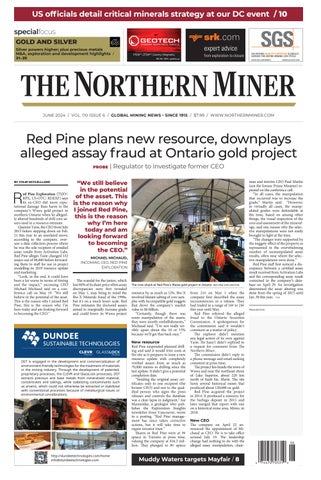
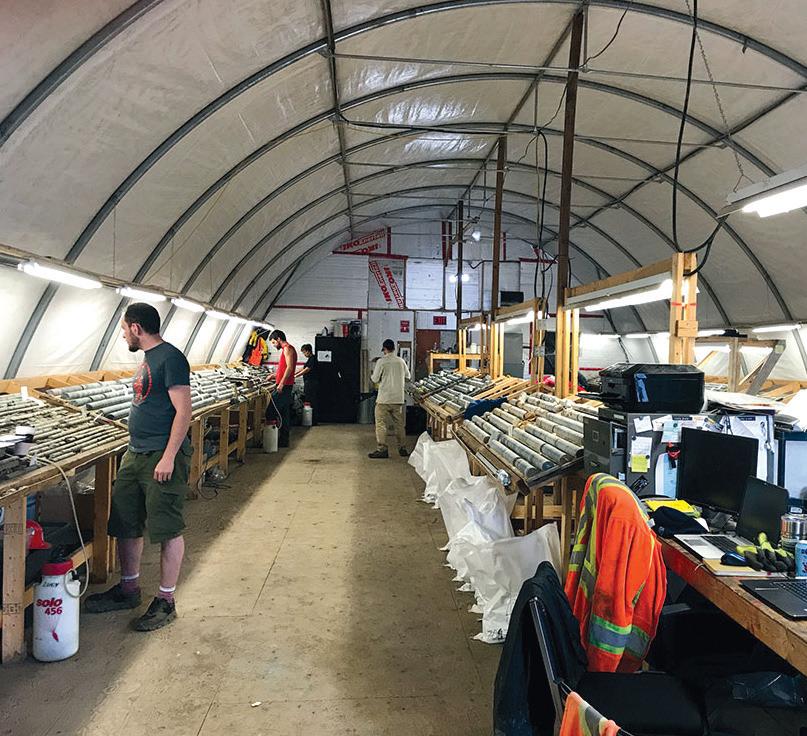
The core shack at Red Pine’s Wawa gold project in Ontario. RED PINE EXPLORATION
http://dundeetechnologies.com/home info@dundeetechnologies.com
Curved thread system Packed with power
If you want to significantly increase productivity, reduce energy consumption, and extend tool life you need the most advanced top hammer tool system ever made. Meet the curved thread CT55 and CT67 for hole sizes from 89 to 140 mm.







2 JUNE 2024 | THE NORTHERN MINER www.northernminer.com
rocktechnology.sandvik
ed line to profit
Delegates
the
n Utah tops Fraser ranking
Utah has taken over the No.1 spot in the Fraser Institute's global ranking of jurisdictions for mining investment, beating out previous winner and neighbour state Nevada.
The 2023 ranking encompasses 86 jurisdictions around the world, based on their geologic attractiveness and government policies that spur or deter exploration and investment, including permitting times.
The Fraser Institute surveyed around 2,045 mining-related firms between Aug. 16, 2023, and Jan. 9, 2024 on both mineral endowment and policy factors.
Rounding out the top five was Saskatchewan and Quebec, followed by Western Australia, which topped the list in 2021. Overall, Canada has the most jurisdictions within the top 10.
On the other end of the scale, the least-attractive jurisdiction was Niger, followed by China, Solomon Islands, and Argentina: La Rioja. Of the 10 least-attractive jurisdictions globally, four are in Africa. BY
n Copper to reach US$40,000?
Copper prices could reach as high as US$40,000 per tonne (US$18.18 per lb.) in the next few years, hedge fund manager Pierre Andurand told the Financial Times in May.
The metal has risen almost 20% this year, reaching a record $11,000 per tonne (US$5.20 per lb.) on May 20.
“We are moving towards a doubling of demand growth for copper due to the electrification of the world, including electric vehicles, solar panels, wind farms, as well as military usage and data centers,” the top trader told the newspaper. Andurand, a former Goldman Sachs trader who co-founded BlueGold Capital before launching Andurand Capital, manages about US$2 billion in assets.
The record-high prices for copper come amid rising demand for critical minerals needed in the green energy transition.
In another bullish analysis, Jeff Currie, former Goldman
DEPARTMENTS
Sachs executive and more recently chief strategy officer of Energy Pathways at asset manager Carlyle, told Bloomberg in mid-May that copper “is the highest conviction trade I have ever seen.”
Currie sees copper prices reaching US$15,000 (US$6.80 per pound).
BY MINING.COM STAFFn Rio Tinto structure ‘clunky,’ Palliser says
Rio Tinto should switch its primary listing from the London stock market to Australia's, a move that could boost the miner's share price by “nearly 40%,” a U.K.-based activist investor said on May 23.
Palliser Capital, which oversees roughly US$850 million in assets, said Rio Tinto’s dual corporate structure has made it harder for the world’s second largest miner to pursue allstock takeovers. It noted Rio’s London-listed entity is currently at a US$27 billion discount to its Australian one, the Financial Times reported.
Bringing together the entities and merging the main listing in Sydney, as rival BHP did two years ago, would result in the FTSE 100, an index that tracks the 100 companies listed on the London Stock Exchange (LSE) with the highest market capitalization, losing another big company.
Shell said in April it was considering leaving the LSE due to European investor apathy — if not outright hostility — toward fossil fuels.
With a market capitalization of £98 billion (US$125 billion), Rio Tinto is currently the ninth biggest company on the FTSE 100.
The undervaluation can be traced to an "extremely clunky and outdated dual-listed corporate structure," Palliser’s chief investment officer James Smith said at the Sohn Hong Kong investment conference, according to Financial Times. He added he believed there was upside of “nearly 40 per cent” in Rio Tinto’s shares.
n Apple faces pressure on conflict minerals
Lawyers representing the government of the Democratic Republic of Congo (DRC) said on May 22 that they had new evidence from whistleblowers that deepened concerns that Apple could be sourcing minerals from conflict areas in eastern Congo.
The Amsterdam & Partners LLP law firm has been investigating claims that minerals mined in DRC by several companies and armed groups are being smuggled through Rwanda, Uganda, and Burundi.
Congo’s lawyers notified Apple CEO Tim Cook on April 22 about concerns regarding its supply chain, and also wrote to Apple subsidiaries in France, demanding answers within three weeks.
“It is more urgent than ever that Apple provide real answers to the very serious questions we have raised, as we evaluate our legal options,” said lawyer Robert Amsterdam.
“The absence of a response is an implicit admission that the questions we asked Apple were relevant,” added William Bourdon, another lawyer representing the country.
In the May 22 release, the DRC’s lawyers painted Apple’s silence "as a testament to the company’s embarrassment in providing accurate answers beyond the banal and predictable rhetoric of denial served up by Apple’s spokespersons four weeks ago."
Apple has said in the past that it does not directly buy or source primary minerals, and it has been auditing its suppliers for several years and publishing its findings. BY MINING.COM STAFF
GLOBAL MINING NEWS THE NORTHERN MINER | JUNE 2024 3 in
brief
3 In Brief 4 Op-Ed 7 Commentary & Analysis 8 In Depth 17 Done Deals 18 Project Updates 20 Eye on Australia 21 Mining, Metals & Markets 6 Politics & Policy 37 Company Index SPECIAL SECTIONS » Gold and Silver 31
pages 10-13
CREDIT: PENDA PRODUCTIONS
at
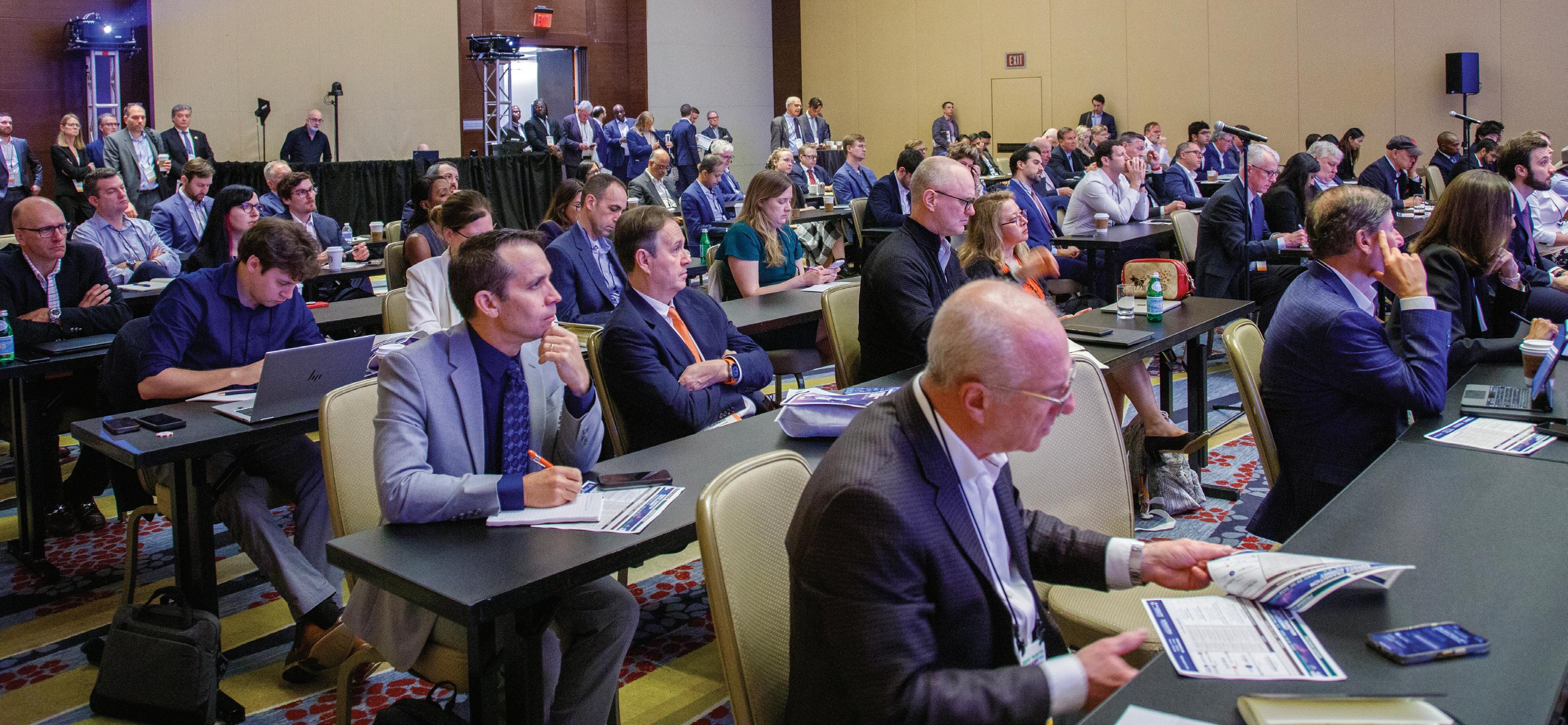
Energy Transition Metals Summit in Washington, D.C., in April. See
for coverage.
MINING.COM STAFF
BY MINING.COM STAFF
Find full news articles at www.northernminer.com
PHOTO
OF THE MONTH
GLOBAL MINING NEWS • SINCE 1915 www.northernminer.com
PRESIDENT THE NORTHERN MINER GROUP: Anthony Vaccaro, CFA, MBA avaccaro@northernminer.com
EDITOR-IN-CHIEF: Alisha Hiyate ahiyate@northernminer.com
MANAGING EDITOR: Colin McClelland cmcclelland@northernminer.com
WESTERN EDITOR: Henry Lazenby hlazenby@northernminer.com
COPY EDITOR AND PRODUCTION EDITOR: Blair McBride bmcbride@northernminer.com
PODCAST HOST: Adrian Pocobelli apocobelli@northernminer.com
ADVERTISING: Robert Hertzman (416) 898-6654 rhertzman@northernminer.com
Michael Winter (416) 510-6772 mwinter@northernminer.com
SUBSCRIPTION SALES/ APPOINTMENT NOTICES/ CAREER ADS
George Agelopoulos (416) 510-5104 (Toll free) 1-888-502-3456, ext. 43702 gagelopoulos@northernminer.com
PRODUCTION MANAGER: Jessica Jubb (416) 510-5213 jjubb@northernminer.com
CIRCULATION/CUSTOMER SERVICE: (416) 510-6789 | 1-888-502-3456 northernminer2@northernminer.com
REPUBLISHING: (416) 510-6768 jmonteiro@northernminergroup.com
ADDRESS: Toronto Head Office
69 Yonge St, Toronto, ON M5E 1K3 (416) 510-6789 tnm@northernminer.com
SUBSCRIPTION RATES: Canada: C$130.00 one year; 5% G.S.T. to CDN orders.
7% P.S.T. to BC orders
13% H.S.T. to ON, NL orders
14% H.S.T. to PEI orders
15% H.S.T. to NB, NS orders
U.S.A.: C$172.00 one year Foreign: C$222.00 one year GST Registration # 809744071RT001 (ISSN 0029-3164)
CANADA POST:
EDITORIAL
Mining’s EV halo dims
 BY ALISHA HIYATE
It wasn’t supposed to be this way.
Mining’s association with planet-saving EVs was supposed to make mining, if not cool, at least more acceptable. Maybe even virtuous.
But EVs have come under attack from both the political left and right — showing that mining can’t count on a halo effect from EVs to rehabilitate its image.
In March, activists staged an arson attack at Tesla’s gigafactory in Grunhëide, 35 km outside of Berlin, that took out its power supply for almost a week. Tesla has plans to expand the facility, its only EV plant in Europe, to produce 1 million cars per year from just under 400,000.
The Volcano Group, in a nearly 2,500-word letter, said it targeted the Tesla plant because it “consumes Earth, resources, people, labor and spits out 6,000 SUVs, killer cars and monster trucks per week.”
In addition to being against “forced mining” of EV minerals, including “rare” lithium, the letter claimed the arson “lit a beacon against capital, patriarchy, colonialism and Tesla. We are countering the ongoing rape of the earth with sabotage.”
Tesla CEO Elon Musk questioned the logic behind targeting EVs rather than gas-powered cars. He responded on X by calling the group “either the dumbest eco-terrorists on Earth or they’re puppets of those who don’t have good environmental goals.”
Two months after the infrastructure attack, hundreds of protesters, many of whom had been camped in a forest outside the factory grounds for a week, tried to get onto the Tesla site. Police pushed them back. “Instead of SUVs for the few, we must build buses and trains for the many,” a spokesperson for the group Disrupt Tesla told Sky News on May 10.
Main street concerns
The problem is the anti-capitalist fringe aren’t the only ones upset by the gigafactory. Grunhëide residents also oppose the plant’s expansion, with 65% voting against it in a non-binding survey conducted in February. The results, and the high turnout of around 70%, reflect concerns over water pollution. The the local water authority has warned the company “repeatedly” that it’s discharging more phosphorus and nitrogen in its wastewater than its permits allow, the German newspaper Stern reported earlier this year.
In mid-May, however, local councillors voted to allow the expansion. Here in Canada, Swedish battery maker Northvolt has also been targeted by acts of sabotage — despite the welcome mat rolled out by the federal and provincial governments.
Politics is one of the factors that’s recently dampened EV sales.
In May, home-made fire-bombs were found planted under heavy machinery at the company’s planned first stage 30-GWh battery facility site 30 km east of Montreal. Northvolt announced the $7-billion project in September with the federal and provincial governments kicking in around $1.3 billion in funding and agreeing to up to $4.6 billion in additional incentives to match manufacturing production credits under the United States’ Inflation Reduction Act (IRA). Northvolt expects to start producing battery components in late 2026.
The site just outside of Montreal is controversial because it’s situated in a wetlands area and critics say the province circumvented its own environmental rules to allow the plant’s approval without a review by the Bureau d'audiences publiques sur l'environnement (BAPE). The Mohawk Council of Kahnawá:ke also says it hasn’t been consulted about the project. A suit it brought against the province in January was rejected by the Quebec Superior Court.
EV elites
While activists target specific facilities for mainly environmental reasons, EVs also face a growing backlash fed by right-of-centre politicians ahead of upcoming elections this year in the European Union, U.K. and U.S.
Eager to tap into voter discontent over the cost of living and job loss fears, some politicians have seized onto the pricey vehicles as an irresistible culture war symbol combining their distaste for government intervention in the economy, “liberal elites,” and anything ESG-related. Former U.S. president Donald Trump, for one, has vowed to kill the IRA and its EV incentives if he wins a second term in November.
Analysts say the IRA will be too difficult to dismantle, and like Obamacare under Trump, would largely remain in place through a change in government. But politics is still one of the factors that’s recently dampened EV sales. Goldman Sachs cited uncertainty over continued political support for the sector in its recently updated forecast that says EV sales could actually fall by 2% this year, under a worst-case scenario.
In comparison, its base case scenario sees EV sales rising by 21% this year.
For some added perspective, according to the International Energy Agency, one in five cars sold last year were electric. That’s a 35% increase over 2022 — and a sixfold increase from 2018.
To be sure, there are some valid concerns behind the current hostility toward EVs — affordability, sustainability, and transparency about government resources, among others. They need to be addressed.
In the meantime, it’s clear that if automakers were nervous about the reputation of the miners that are now central to their business plans, it’s no longer a one-way street. Miners, too, need to turn the lens on their partners — whether buyers or governments. TNM
COMMENTARY
Aluminum: the copper grid alternative
 BY JAMES COOPER
From the humble drink can to the airframe of an F-16 fighter jet, aluminum’s role in the global economy is diverse and critical.
Like copper, aluminum is used in established industries, such as manufacturing and housing construction. Yet, it is also leveraged to growth sectors.
With superior corrosion resistance, aluminum is widely used in solar installations as frames, wires, and support structures.
According to some sources, the ability to withstand the elements gives aluminum a service life exceeding 70 years.
Corrosion resistance also makes it ideal for offshore wind farms. Tower platforms, transformer stations, and turbines are all made from aluminum.
For these reasons, the United States and the European Union have classified the metal as a critical mineral. Yet, one of the biggest growth drivers could come from the mass build-out of the global power grid.
Few have considered the limitations of the existing energy grid in the relentless move toward renewables. However, this is the critical link connecting power generation to the end consumer, and aluminum is set to play a crucial role.
Move over copper
Aluminum is already widely used in power grid installations as an alternative to copper. This is not a new phenomenon.
The decision to find an alternative to copper dates back more than 80 years, taking shape in the early days of the Second World War.
At the time, the copper supply was being funnelled into manufacturing shells, bullets, and other war munitions. Recycling wasn’t an option — copper was literally being blown out of the circular economy!
In desperation, the U.S. began minting steel coins to divert more copper to the war effort.
With the stakes high, engineers were tasked with testing another metal, with similar conductive properties. Aluminum offered a viable alternative.
Although up to 40% less efficient than copper, aluminum can conduct electricity long distances. After passing initial trials, aluminum was incorporated into power utilities and other electrical wiring, including homes and factories.
Since then, aluminum has continued to play an important role in energy transfer.
That raises an important question: Could mass global electrification drive strong demand for aluminum?
Cousins in electrification
Aluminum doesn’t receive as much attention as its high-profile base metal cousin, copper. But they share similarities.
While copper has fared bet-
The ability to withstand the elements gives aluminum a service life exceeding 70 years.
ter since coming off the resourcewide peak in 2022, both metals appear to be marching to the beat of a similar drum, gaining strong momentum in 2024.
Like copper, interest is picking up for this base metal.
According to the London, U.K.based International Aluminium Institute, demand has been forecasted to grow by 33.3 million tonnes over the next decade, rising from 86.2 million tonnes in 2020 to 119.5 million tonnes in 2030.
Around 37% of this growth is expected to come from China, through manufacturing, construction, and the country’s ambitious power grid upgrade to accommodate electrification.
And like copper, supply will play a critical role in this metals outlook.
Supply dynamics
Aluminum ore, known as bauxite, is not typically rare.
The formation is similar to laterite nickel deposits, where high volumes of rainfall remove ‘mobile’ elements from the soil, leaving behind a natural concentration of the less mobile elements. That includes nickel, iron and aluminum.
Copper deposits, on the other hand, form through mineralization of primary ore deposits deep below the surface, making them harder to find and more expensive to extract.
That’s why, pound-for-pound, the per-unit value of copper will always exceed that of aluminum.
While bauxite deposits are relatively common, supply problems emerge at the processing level. Aluminum production is energy intensive. About 17,000 kWh of electricity is required to produce just 1 tonne of refined metal.
Rising energy costs can impact supply, as witnessed across Europe in 2022.
When war broke out in Ukraine and Putin restricted gas supplies, energy prices spiked. In response, aluminum smelters slowed operations and curtailed output.
Given that bauxite is relatively common, the upside for miners may be limited.
Similarly, unless refiners have access to a cheap energy source, companies will be hostage to higher operating costs.
Investing in a dedicated aluminum ETF could be the most strategic option for gaining upside here. Given the added risks, ETFs could offer the best opportunity. That’s not to say there aren’t company-specific opportunities, though — with high-purity alumina (HPA), a form of aluminum oxide, offering some exciting opportunities.
TNM
James Cooper runs the commodities investment service Diggers and Drillers. You can also follow him on X (Twitter) @JCooperGeo.
4 JUNE 2024 | THE NORTHERN MINER www.northernminer.com
Return undeliverable Canadian addresses to Circulation Dept. c/o The Northern Miner 69 Yonge St., Suite 200 Toronto, ON M5E 1K3 Publication Mail Agreement # 44082538 Periodicals Postage Rates paid at Niagara Falls, NY, 14304. U.S. office of publication 2424 Niagara Falls Blvd, Niagara Falls, N.Y. 14304. U.S. POSTMASTER: send address corrections to: Northern Miner Box 1118 Niagara Falls, N.Y. 14304.-7118 THE NORTHERN MINER is published monthly by The Northern Miner Group, a division of EarthLabs Media Inc., a leading media and technology company serving the mining industry. From time to time we make our subscription list available to select companies and organizations whose products or services may interest you. If you do not wish your contact information to be made available, please contact us by one of the following methods: Phone: 1-888-5023456; Fax: (416) 447-7658; Mail to: Privacy Officer, The Northern Miner, 69 Yonge St., Suite 200, Toronto, ON M5E 1K3
opinion
BY NORTHERN MINER STAFF
G2 Goldfields set for meteoric growth in heart of regional M&A boom
G2 Goldfields (TSXV: GTWO; US-OTC: GUYGF) updated its resource for the OKO-Aremu project in Guyana in April and plans to do so again by year’s end to reflect the increase in contained metal related to ongoing drilling.
The latest resource updates the OKO Main zone and provides a first estimate for the adjacent Ghanie zone at the project 120 km west-southwest of the South American country’s capital city, Georgetown. G2 increased total contained gold by 69% to 2 million oz. and quadrupled total indicated gold to 922,000 oz. compared with an initial estimate in 2022.
“We can potentially double the size of Ghanie’s contained gold just by drilling, filling out along strike there,” CEO Dan Noone said. “Our current focus is expanding the resource at Oko Northwest and Ghanie with the intent of publishing an updated resource in December. Further prospective targets along strike include Tracy and the historic Aremu area.”
The combined OKO Main zone open pit and underground resource holds 2.4 million indicated tonnes grading 9.03 grams gold per tonne for 686,000 oz. gold. It has 2.4 million inferred tonnes at 6.38 grams for 495,000 oz. gold.
Ghanie’s combined open pit and underground resource holds 3.3 million indicated tonnes grading 2.2 grams for 236,000 oz. gold, according to the resource issued in April. It has 12.2 million inferred tonnes at 1.54 grams for 604,000 oz. gold.
Drilling down
To date, the deepest drilling at Ghanie is to about 500 metres depth in the central area. At Ghanie North, drill hole GDD-93 returned 24.5 metres grading 5.3 grams from 124 metres downhole, including 4.5 metres at 25.2 grams. Currently three rigs are drilling at Ghanie, targeting mineralization to a depth of 500 metres along Ghanie’s entire 1.5 km of surface expression. The company is also targeting north and northwest of the OKO Main zone for much of its planned 75,000 metres this year, the CEO said.
“It does add ounces and mine life when you go deeper than 500 metres,” Noone said. “But it doesn’t change your net present value and, importantly, it doesn’t change the scope of the size of the mine that you’re going to build.”
G2 first reported a discovery in February at OKO Northwest, 3 km from the Main zone, with drill hole NWOD-1 intersecting 10.3 metres grading 3.7 grams gold from 37.7 metres depth and hole NWOD-22 returning 15 metres at 6.3 grams gold from 21 metres downhole.
Scratching the surface
“The best use of funds at the moment is to find more nearsurface ounces,” Noone said.
The OKO Main zone is a narrow series of five shear veins being envisioned as an underground mine for its highgrade near-surface ore. Ghanie is a more disseminated style of mineralization that could probably be half open pit and underground. OKO Northwest has sheeted veins in shear zones 20 to 50 metres
wide, grading on average 0.8 gram gold per tonne as well as highergrade zones in discrete shear veins similar to OKO Main, the CEO said.
“Oko Northwest is looking very promising as far as being the next zone which we consider has the same potential as the OKO Main/ Ghanie trend, Noone added.
Coveted assets
The Ghanie zone is the same deposit as the abutting Oko West project. This year, G Mining Ventures (TSX: GMIN; US-OTC: GMINF) agreed to buy Reunion Gold (TSXV: RGD) for $875 million.
G2 Goldfields is advancing the 112-sq.-km OKO project for an eventual buyout expected within a year, Noone says. It plans to spin out unrelated assets, including several targets within a 20-km radius of the OKO project, into a proposed company called G3 later this year.
“We believe the best value creation for shareholders is to transact with a third party and then move on to the spin-out company,” the CEO said. “As G2 and Reunion Gold progress toward attaining mining permits for the respective concessions of each company, it would make sense to
take a course of action with the view that these concessions would conceivably coalesce at some stage.”
G2’s founders financed and developed Guyana’s largest gold mine, Aurora, before it was eventually sold to China’s Zijin Mining in 2020 for US$238 million.
AngloGold Ashanti (NYSE:AU), the fourth-largest gold producer, bought an 11.7% stake in G2 for $22.5 million in December. G2 insiders own 27% of the company.
Gondwana to Guiana The Proterozoic Guiana Shield cuts across the continent’s northeastern region. In Guyana, the shield hosts the OKO project, the Aurora gold mine (6.5 million oz. in global resources) and the Omai gold mine (which produced 3.7 million oz.) and Aris Mining’s (TSX: ARIS; US-OTC: TPRFF) Toraparu project. In neighbouring Suriname, Iamgold (TSX IMG; NYSE: IAG) sold the Rosebel mine to Zijin Mining in 2022 and Newmont (NYSE: NEM; TSX: NGT) has the Merian gold mine.
The Guiana Shield is considered a continuation of geology found in West Africa where some 300 million oz. of gold have been discovered versus about a third
G(3)-force
G2 has announced that it intends to spin out its non-core assets into G3 this year. The new company will focus on the former Peters mine, the country’s highest grade gold producer, which ran from 1905 to 1910. It returned roughly 41,000 oz. of gold with mill head grades of more than 1 oz. per tonne. Most of the output was from less than 60 metres deep, allowing the opportunity to discover more highgrade mineralization below the previously mined areas.
“We’re still an exploration company, we’re not a mining company,” the CEO said. “If M&A comes along, as it certainly has on our southern border, we’re prepared for it.”
as much on the South American side, of which 60 million oz. are in Venezuela, Noone said.
“The rest of the shield is amazingly underrepresented statistically,” he said. “Guyana, as far as the shield goes, is in the sweet spot for a series of discoveries not unlike Venezuela in the 1990s, save for ensuing state sanctioned actions.”
Venezuela’s socialist President Hugo Chavez nationalized the country’s gold industry in 2011. His successor, Nicolás Maduro, resurrected a unilateral territorial dispute with Guyana and vowed in December to annex two-thirds of its neighbour, including the resource rich Essequibo region which intersects the recent oil discoveries. The Venezuelan leader’s claims have been widely discredited as nationalistic posturing.
Infrastructure is expanding rapidly in Guyana following ExxonMobil’s 2015 discovery of 11 billion barrels of offshore oil reserves. Petroleum development is propelling the country to be one of the world’s fastest-growing economies with 34% growth forecast this year, according to the International Monetary Fund. Mining companies might also benefit from the former British colony’s rule of law and English language, Noone said.
Noone says the G3 team will aim for a resource of a few million ounces at Peters mine as opposed to the 100,000 or so ounces the World Bank estimated from a single shoot in 1966. Drilling in the 1990s returned gold intervals supporting the site’s potential.
“We’re quite excited to get out there and find things other than the Peters mine itself,” he said.
“There’s a lot of work to do as far as figuring out exactly what the controls are, but we think our knowledge of these systems has come a long way in the last 15 or 20 years.”
Noone, who is originally from Australia and lives in Canada, first went to Guyana nearly 20 years ago. He was following G2 Executive Chairman Patrick Sheridan, who had been exploring there since 1993.
“Once I went down there, the opportunity was staring me in the face,” he said. “I had worked in Papua New Guinea and Indonesia for eight years, and people suggested Guyana’s jungles were tough. In fact, it’s rather a pleasant environment to work in and I was immediately captivated by the immense potential which we continue to re-discover.”
The preceding Joint Venture Article is PROMOTED CONTENT sponsored by G2 Goldfields and produced in co-operation with The Northern Miner. For more information visit www.g2goldfields.com.
GLOBAL MINING NEWS THE NORTHERN MINER | JUNE 2024 5
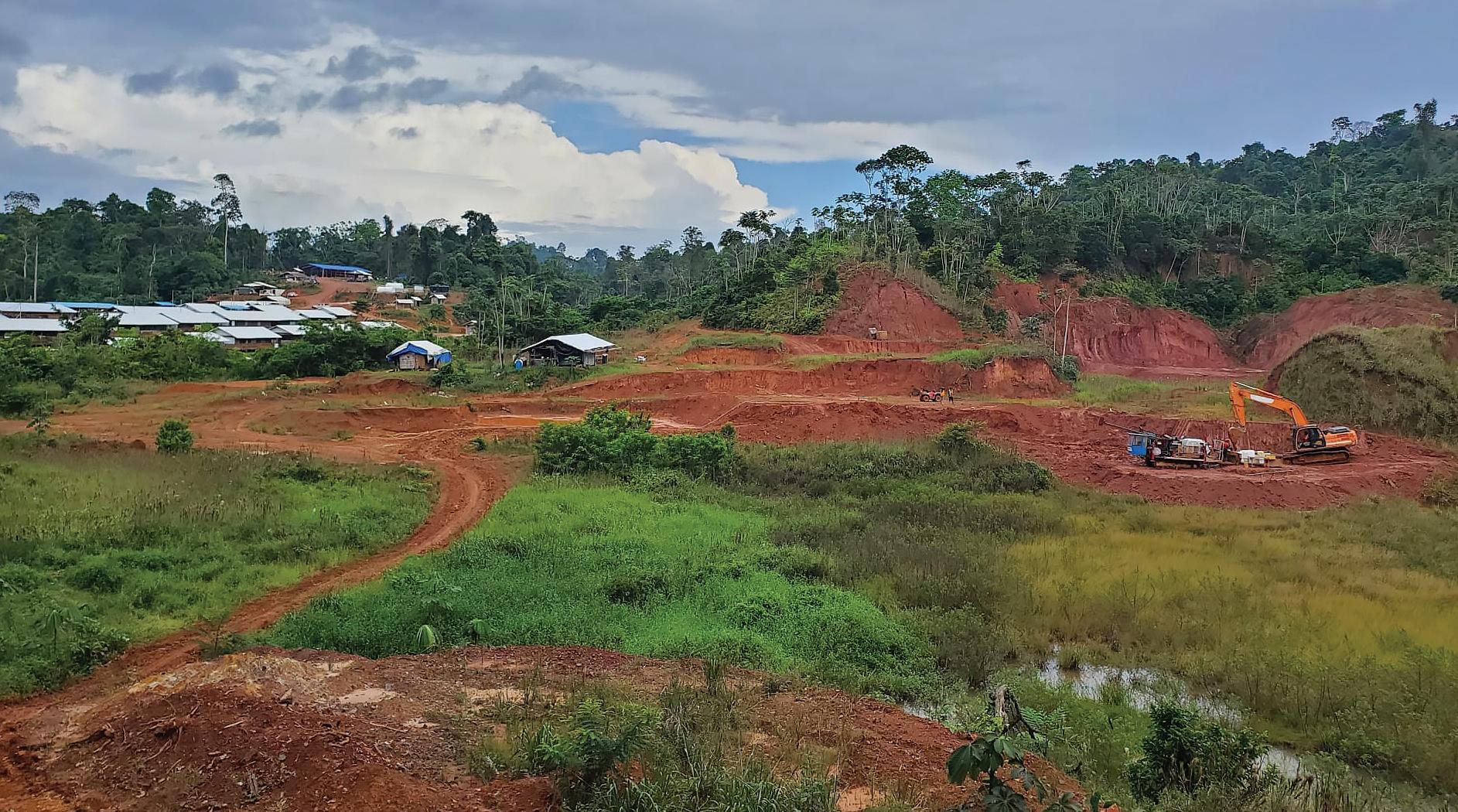
Top: View of G2 Goldfields' Oko Main gold project in Guyana.
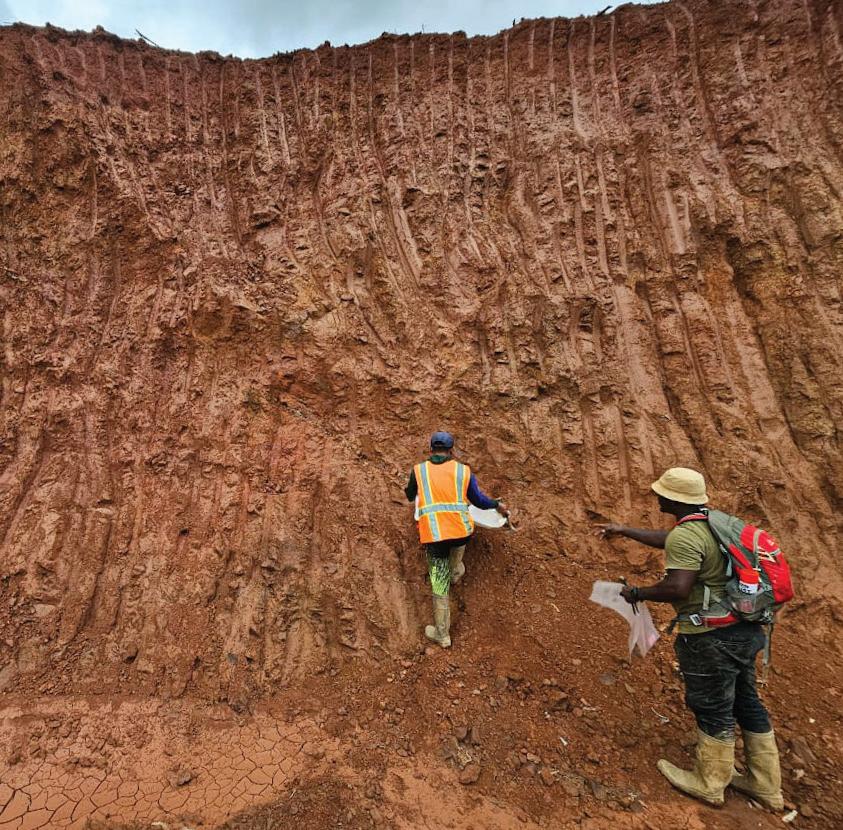
Above: Examining a drilled rock face at Oko Main.
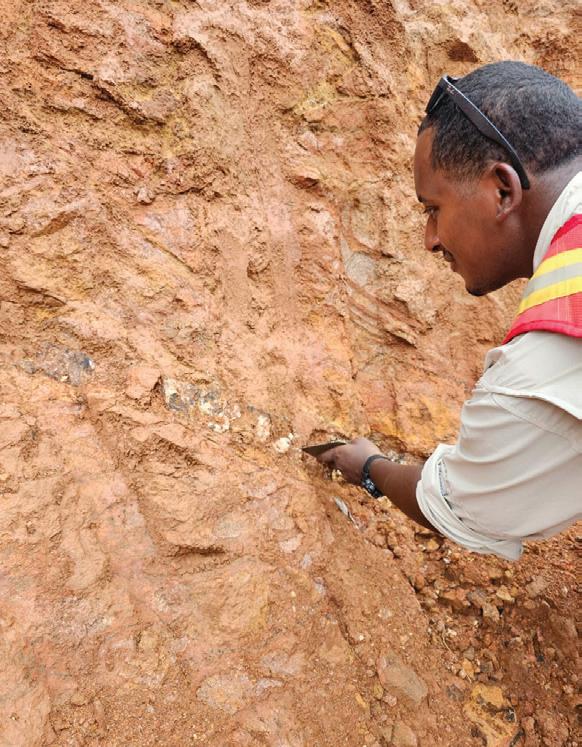
Left: A section of Oko Main where drilling had taken place.
JOINT VENTURE ARTICLE
G2 GOLDFIELDS
Ottawa’s revised environmental rules won’t reduce permitting stage, lawyers say
REGULATIONS | Industry groups critique jurisdictional issues in proposals
BY COLIN MCCLELLANDThe federal government’s proposed changes to environmental rules for resource projects could limit Ottawa’s oversight, but probably won’t shorten approval times, according to a law firm’s analysis.
The proposed amendments address concerns raised by Canada’s Supreme Court in October. It ruled the Impact Assessment Act is unconstitutional because the federal government was overstepping its jurisdiction into provincial areas. The Liberal government’s budget speech in mid-April said the suggested modifications were coming, but it wasn’t immediately clear how long it would take to enact them.
The proposals likely will be adjusted through a public consultation process, lawyers for Torontoheadquartered law firm Osler said in a May report. The essential procedures, timelines and authorities in the act would remain unchanged by the amendments, said the firm,
which represented the Alberta Business Council as an intervenor in the Supreme Court case. The proposals do contain provisions for retroactive application to projects already being assessed under the act, it said.
“It is uncertain whether they will result in meaningful changes to how the current act has been administered,” the firm said. “The amendments also fail to address the criticisms from project proponents that the current act deters investment in new projects because its applicability, timelines and decision-making powers are uncertain and unpredictable.”
Veteran entrepreneur Pierre Lassonde said there should be only one environmental assessment under provincial jurisdiction with defined objectives and a set timetable.
“The new revised, modified rules are more of the same if not even more ambiguous, open-ended and fully discretionary,” Lassonde told The Northern Miner by email. “These have been written by people who don’t know a thing about
“These (rules) have been written by people who don’t know a thing about natural resource development and how difficult and costly it is.”PIERRE LASSONDE CO-FOUNDER, FRANCONEVADA
natural resource development and how difficult and costly it is.”
One assessment
The amendments allow for provinces to substitute their assessments for a federal process as long as it includes federal aspects and concerns. This should place more emphasis on locals such as provincial and Indigenous governments,
but will depend on negotiating between the jurisdictions, Osler said. Ottawa-based resources industry critic MiningWatch Canada objected to the concept.
“Beyond the uncertainty created by a patchwork of inconsistent provincial requirements, the provinces are simply not equipped, or not willing, to take environmental assessment seriously,” Jamie Kneen, a program leader at MiningWatch Canada, said in a release. “The role of the federal government is crucial in protecting the public interest.”
The Canadian Mining Association said the government should amend its list of mining industry activities that are subject to federal environmental review. But it sees enthusiasm for more efficient and timelier permitting with improved cooperation and reduced duplication. There are 20 mining projects in federal assessment now, it said.
“We are cautiously optimistic,” the association said by email in early May. “These amendments have the potential to accelerate improvements in federal project reviews.”
Jeff Killeen, director of policy and programs at the Prospectors and Developers Association of Canada, said the government must focus on implementation that treats jurisdictions fairly and improves job opportunities.
“The government must be committed to finding efficiencies when putting the new legislation into practice,” Killeen said by email. “We want to ensure that measuring the extent of the effect of a project in public interest decisions is a balanced process.”
Greenhouse gases
Osler said the act would still involve federal authority for projects that cause water pollution across provincial and international borders, but not greenhouse gases (GHG) under the proposed amendments.
“Importantly, this definition would no longer apply to extra-provincial effects of greenhouse gas emissions or other air pollution, and would no longer permit deci-
Ottawa P38 >
BC jade mining ban could push business to Afghanistan, says gem miner
REGULATORY | Customers view Canada as ‘unreliable source’ of jade
America.
BY BLAIR MCBRIDEBritish Columbia has banned any new jade mining in its northwest, citing harm to alpine environments, a move that has one industry player scratching his head.
The province issued an Environment and Land Use Act order in early May prohibiting jade mining activities on new tenures, but current tenure holders listed in the order will be able to continue jade mining for five years with enhanced reclamation requirements.
While the ban is not surprising, it is confusing, says Cassiar Jade Contracting president Tony Ritter.
“The way (the government)’s going about it, it’s kind of difficult to understand. It’s very vague,” he told The Northern Miner by phone.
Cassiar had already been barred from mining the green gem since 2020. In May that year, the government began deferring jade mining permits under the Environment and Land Use Act, and kept extending the order after it expired.
Cassiar and Glenpark Enterprises in March filed a civil claim against the province seeking financial damages. Ritter said he’s unable to comment on the lawsuit.
The new ban does not impact other mining operations in the region, or affect existing or new jade tenures in other areas of the province, the Ministry of Energy, Mines and Low Carbon Innovation said in a news release on May 10.
Jade is currently mined in the
Dease Lake, Mount Ogden, and Cassiar regions. The cumulative impact of jade mining in northwestern B.C. is harming sensitive alpine environments, the ministry said. It added that the practice is also creating regulatory challenges for permitting, compliance and enforcement because many of the activities take place in locations accessible only by helicopter.
The order will ensure that environmental impacts can be addressed, while existing tenure holders listed in the order continue mining for five years with adequate time to wind down operations, the ministry said.
The ministry said it has been working with local First Nations and gathering input from industry to address concerns regarding the environmental impacts to sensi-
tive alpine environments from jade mining in the Turnagain region. It also said the order is needed to protect these areas from further harm and disturbance.
‘Punishing entire industry’ Cassiar Jade has mined the mineral east of Dease Lake for about 20 years. Most of its customers are in Taiwan and China, with some in New Zealand and across North
Before May 2020, Ritter said he would mine between 60 and a few hundred tonnes per year of jade.
The ongoing ban has soured Ritter’s customers, who he said no longer view Canada as a reliable jade source, and have offered him an unlikely potential business partner: the Taliban.
“Afghanistan has jade but they’re having difficulty on the production end,” he said. “My customers invited me to Afghanistan to help develop the industry with the Taliban. I’m supposed to be there right now but there’s a few security issues so we had to postpone our trip.”
The years of inactivity have reduced the value of his company and its jade tenure to “less than zero,” Ritter said.
“It’s now a liability. They de-valued our business.”
The nearby Tahltan Nation has called jade mining “unregulated and unethical.” Ritter said he understands those concerns, adding his company has had good relations with the Tahltan, who supported Cassiar’s reclamation efforts. He feels the government is punishing the industry for the actions of a few bad operators who disregarded environmental regulations.
Ritter’s next step is joining an industry working group on the regulatory changes to jade mining. He told the government he would only join the group if he didn’t have to sign a non-disclosure agreement, he said.
6 JUNE 2024 | THE NORTHERN MINER www.northernminer.com politics&policy
TNM — With files from Mining.com.
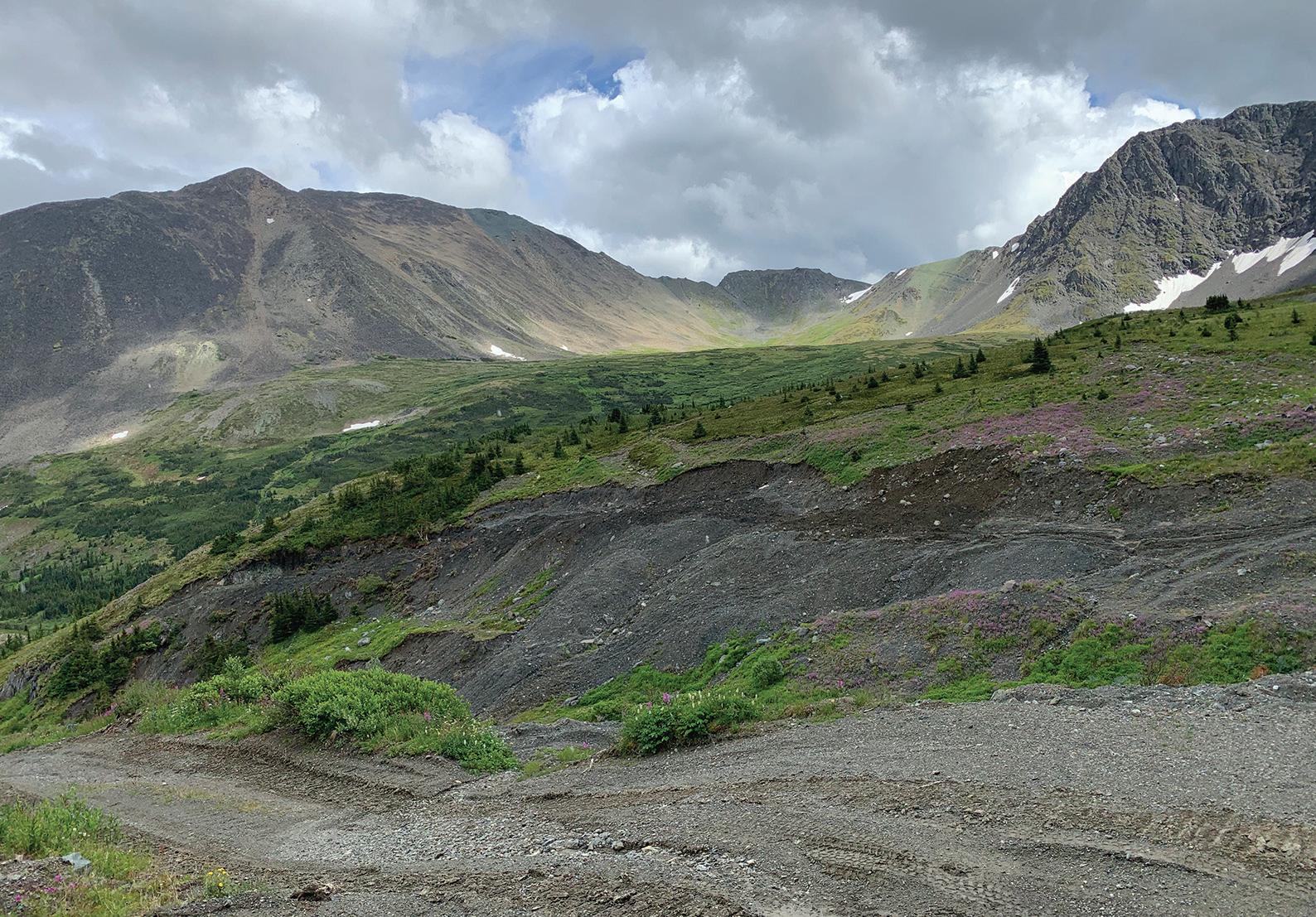
Former tenure and mined areas of Cassiar Jade Contracting, east of Dease Lake, B.C. CASSIAR JADE CONTRACTING
commentary &analysis
The US must close an Inflation Reduction Act loophole that could benefit Indonesian nickel
PROFILE | Energy transition presents ‘generational opportunity’ for industry
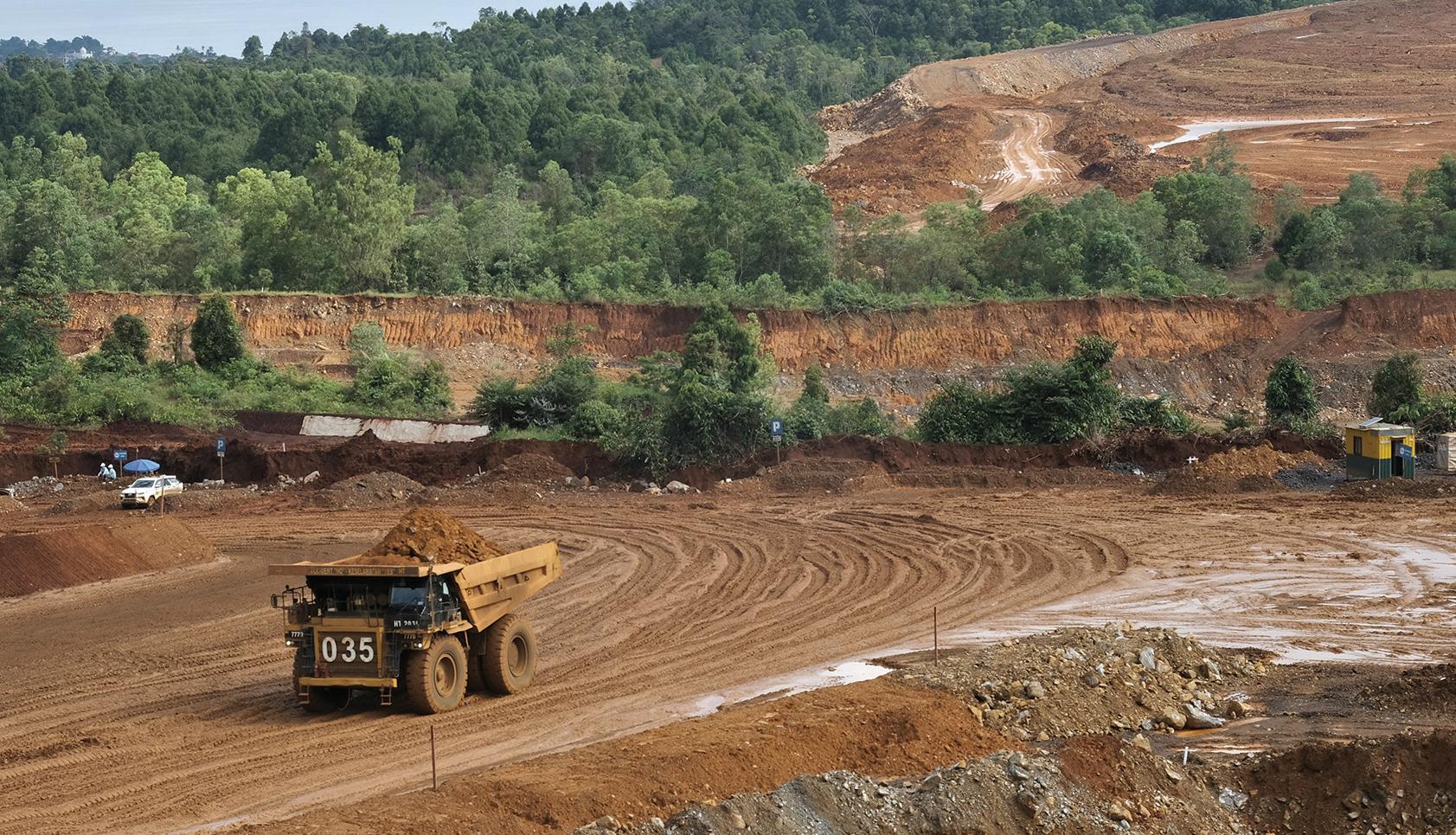
BY GREGORY WISCHERThe U.S. Inflation Reduction Act (IRA) established new incentives for “clean” electric vehicles (EVs) to source minerals from the United States and free trade agreement countries, like Australia and Canada. But newly finalized U.S. government rules mean other countries — such as Indonesia, the world’s largest nickel producer with significant Chinese investment, weaker labour protections, and lower environmental standards — could also benefit.
Specifically, the IRA includes a US$3,750 critical minerals tax credit for U.S. taxpayers who purchase qualifying EVs meeting certain content requirements. To be eligible for this tax credit, the content of the value of the battery’s critical minerals from the U.S. and free trade agreement countries must be at least 40% for EVs placed in service in 2023. This critical mineral content threshold rises to 50% for cars that hit the road in 2024 and increases by 10 percentage points every year until 80% for vehicles placed into service in 2027 and onwards. The battery also can’t contain any minerals from “foreign entities of concern.”
Earlier in May, the U.S. Department of Energy released its final rule on the foreign entity of concern definition, and the U.S. Department of the Treasury released its final rule on the tax credit. While the Department of Energy rule contains a loophole in its definition of a foreign entity of concern, the Department of the Treasury rule has a loophole in its definition of a free trade agreement country. Under the current Treasury rule, minerals produced in countries without comprehensive U.S. free trade deals could be eligible to contribute to the content requirements for the critical minerals tax credit.
The text of the IRA states that “any country with which the United States has a free trade agreement in effect” is an eligible source to contribute to the content requirements of the critical minerals tax credit. West Virginia U.S. Senator Joe Manchin, a Democrat and the tax credit’s key architect, has reiterated that a “free trade agreement” means a comprehensive free trade agreement, “in which each [signatory country] removes tariff and other restrictions on ‘substantially’ all trade between the parties, not just a mineral here or a mineral there.”
Yet, the Treasury Department has expanded the free trade agreement definition to include countries with which the U.S. has signed “critical minerals agreements,” like Japan, in order “to expand the incentives for taxpayers to purchase new clean vehicles.” The White House has also said that it is negotiating critical minerals agreements with the European Union and the United Kingdom and that it seeks to begin negotiations with Indonesia. Argentina and the Philippines are also reportedly interested in pursuing critical minerals agreements. If a critical minerals agreement is signed with
Indonesia, for example, a U.S. EV would not only be eligible but also benefit tax-wise by containing minerals produced by Chineseconnected entities in Indonesia, like the Singaporean subsidiary of China’s Zhejiang Huayou Cobalt.
The U.S. government must close this loophole by restricting the definition of free trade agreement countries to those that have signed comprehensive free trade agreements with the U.S. Alternatively, instead of updating the existing rule, the White House could simply pause negotiations of new critical minerals agreements and rescind its critical minerals agreement
with Japan, although that would prove damaging diplomatically. Nonetheless, the original intent of the IRA was to bestow advantages to free trade agreement countries with comprehensive free trade agreements, not those with critical minerals agreements.
In conclusion, the critical minerals tax credit was intended to limit the eligible foreign sources of critical minerals to countries with comprehensive free trade agreements. However, the final Treasury rule on the Section 30D tax credit allows EVs with batteries containing minerals produced in countries with critical minerals agreements
— possibly including Indonesianorigin, Chinese-produced minerals — to benefit. Thus, the final rule ignores the original intent of the IRA, as Manchin has noted, and opens the opportunity for countries with significant Chinese investment and much weaker labour and environmental standards to benefit from the critical minerals tax credit as a bipartisan group of US senators has warned.
Ultimately, the final Treasury rule undermines the purpose of the tax credit, which is to incentivize the development of reliable and sustainable mineral supply chains within America. To fulfill the law’s
original intent, the U.S. government should close this loophole and specify that the only eligible foreign sources that can contribute to the content requirements for the critical minerals tax credit are countries with comprehensive U.S. free trade agreements. TNM
Gregory Wischer is the founder and principal of Dei Gratia Minerals, a Washington, D.C.–based critical minerals consulting firm. The firm provides research support on critical minerals issues to policy think tanks and Greg regularly briefs U.S. government officials on related critical mineral supply chain issues.
GLOBAL MINING NEWS THE NORTHERN MINER | JUNE 2024 7
A haul trucks transports mining material at a PT Vale Indonesia nickel operation in Sorowako, South Sulawesi, Indonesia. ADOBE IMAGES/MIRWANTO
indepth
Mining M&A slips as regulators hamper deals
DEALS | Anglo American proposals dominate current crop
BY COLIN MCCLELLANDGlobal mining dealmaking is falling this year but political drama and litigation are escalating in the United States and Canada, while other trends include paying premiums to get copper and guarding against liability at former mine sites.
The value of proposed, pending, completed and terminated mergers and acquisitions in the industry declined 12.5% to US$74.2 billion this year to mid-May compared with the same period last year, according to Bloomberg data. The figures were presented at a May 20-22 conference in New York run by the Society for Mining, Metallurgy & Exploration.
Bids valued at US$51.2 billion to acquire Anglo American (LSE: AAL), including US$39.6 billion by BHP (NYSE: BHP; LSE: BHP; ASX: BHP) and US$10.9 billion in a proposal with undisclosed details by Rio Tinto (NYSE: RIO; LSE: RIO; ASX: RIO), dominate the total, the data show.
M&A across all industries rose 16%, Todd Sibilla, a commodity applications specialist at Bloomberg, told the conference. But deals with diversified miners, like Glencore (LSE: GLEN) buying Teck Resources’ (TSX: TECK.A, TECK.B; NYSE: TECK) coal assets last year, plunged 94% this year compared with 2023, Sibilla said.
The Canadian uproar last year over Glencore’s interest in buying Teck, while the Swiss giant employs more Canadians than homegrown Teck, was cited as an example of a rising trend of misguided resource nationalism leading to court cases over blocked deals, according to a panel of lawyers at the annual conference on trends in mining finance. The panel also pointed to the bipartisan opposition in America to Nippon Steel buying U.S. Steel while Japan is a major Western ally.
Court battles
An increasing number of deals are in litigation against the U.S. government to overturn decisions and the number of abandoned deals in the last two years hit a record, said George Karafotias, partner in the M&A group at Shearman & Sterling in New York.
“It is a worrying trend and it’s the number one issue that we think about when we advise clients on bigger strategic deals,” he said. “A lot of work goes into anticipating and planning for an extensive regulatory review and part of that can also include coming up with a litigation strategy.”
U.S. Steel shareholders approved Nippon Steel’s US$14.9-billion takeover in April. The target company, formed more than a century ago, was the world’s biggest corporation, accounted for two-thirds of all steel produced in the U.S. during the Second World War and
employed 340,000 people.
Now, its contribution to defence is minor, it employs 23,000 and needs investment to modernize, Karafotias said. Nippon is not state-owned and Japan is a strong Western ally, he added.
President Joe Biden opposes the deal but hasn’t vowed to use executive authority to block it, though Donald Trump has.
“It begs the question: if Nippon Steel is an unacceptable buyer of this company, then who is?” Karafotias asked. “It may chill investment or further foreign investment in certain sectors in the U.S., so hopefully common sense prevails and we get there on this deal.”
Nippon has promised to keep the U.S. Steel name, the headquarters in Pittsburgh, not to transfer jobs or productions overseas and to increase capital spending and technology sharing, the lawyer said. However, he noted Nippon operates in China and shares technology there.
“It wouldn't surprise me if these aren't things that can be sort of worked through and measures put in place to protect U.S. interests,” he said. “Come November and once we get past the election, there may be scope to see this deal get done.”
'Not normal' North of the border, Glencore’s pursuit of all of Teck was interesting for the political drama that B.C.
Premier David Eby and federal opposition leader Pierre Pollievre created, even though they had no role in regulatory approvals, said Steven McKoen, a partner at law firm Blake, Cassels & Graydon in Vancouver.
“However, if you've got the person who might be the next prime minister and the person who is the premier of the province where the headquarters of the company you're trying to acquire are, those are pretty formidable opponents to have a transaction,” McKoen said. “Very remarkable, not normal. This is not something you'd typically see in getting a transaction.”
Newmont’s (NYSE: NEM; TSX: NGT) US$19.1 billion all-share acquisition of Newcrest at a 30.4% premium, sought synergies and gave copper exposure to a gold company in tier one jurisdictions, John Wilkin, a partner at Blake, Cassels & Graydon in Toronto, told the conference. They’re trends that may drive acquisitions over the next few years, Wilkin said.
“We've had the largest gold merger in history, but what was one of the most important factors to sell the premium: the company’s focused on copper,” he said. “Part of the strategy here is to create this tier one portfolio and selling off some of the assets.”
Newmont said in February it was selling some of its properties, though they have turned out to be ones it held before acquiring
Newcrest. The company is pivoting away from Ontario and Quebec to focus on the Golden Triangle in northwest B.C. where Newcrest had the Red Chris and Brucejack mines and the Saddle North and Galore Creek copper-gold projects.
Brownfields
Redeveloping old sites is becoming more prevalent in M&A as rising metal prices and technology improve economics, but they bring concerns about liability, Carolyn McIntosh, senior partner at Cleveland-based law firm Squire Patton Boggs, told the panel.
“If you buy a previously mined area, you may be stuck with the responsibility for remediating it,” McIntosh said. “Understanding what that scope of potential liability may be is a critical part of your M&A.”
Miners in the U.S. must be aware of the Comprehensive Environmental Response Compensation and Liability Act, the Clean Water Act and the Resource Conservation Recovery Act, she said. Not just governments, but non-governmental organizations and citizens can lodge complaints to seek enforcement, the lawyer said.
“If your technology will recover metal then you're going to be doing cleanup as you go along,” McIntosh said. “But all of those things should be taken into account to make sure that the investment is not underwater from the outset.” TNM
Muddy Waters targets Mayfair Gold
M&A | Hedge fund seeks control of northern Ontario project
BY COLIN MCCLELLANDMuddy Waters Capital, the American hedge fund that often short-sells companies, is instead taking a long position in plans to take over Mayfair Gold (TSXV: MFG) and its prefeasibility stage Fenn-Gib project in northern Ontario.
Patrick Evans, CEO of the roughly $200-million market cap Mayfair, and chairman Harry Pokrandt are urging shareholders to reject Muddy Waters’ plan to install its own chairman and slate of directors at the company’s annual general meeting on June 5 in Vancouver.
Mayfair increased Fenn-Gib’s indicated mineral resource by 63% since the company went public in March 2021 at a drilling cost of less than US$10 per added oz., Pokrandt said by email on May 16. The stock trades at a price-tonet asset value premium to its peer group (Osisko Mining (TSX: OSK), Skeena Resources (TSX, NYSE: SKE), Probe Gold (TSX: PRB; OTC: PROBF) and Tudor Gold (TSXV: TUD) among others), he added.
“We have a team of seasoned veterans who have added significant value by every measure,” the chairman said. “In stark contrast, Muddy Waters has made its name as an activist short seller best
“We have a team of seasoned veterans who have added significant value by every measure. In stark contrast, Muddy Waters has made its name as an activist short seller best known for value destruction, not long-term growth.”
HARRY POKRANDT CHAIRMAN, MAYFAIR GOLDknown for value destruction, not long-term growth.”
But at least 51% of shareholders support the takeover, according to an April 19 letter to Mayfair from Muddy Waters. The hedge fund controls almost 17% of what it’s built up over a few years while Mayfair co-founder Henry Heeney, a New York-based investment
banker, is supporting the move with his nearly 13%. Other shareholders make up the remaining 21% backing the plan for a new board.
Independent proxy advisory firm ISS recommends that shareholders vote for Mayfair’s current slate of directors, including Pokrandt and Evans, Mayfair noted in a May 23 news release.
Co-founder resigns
Mayfair co-founder Sean Pi, a partner in Heeney Capital, declined to comment when The Northern Miner reached him in New York by phone on May 16. Mayfair said on March 27 that Pi resigned as a director from the company’s board.
Anthony Jew, head lawyer for Muddy Waters, didn’t reply to an email seeking comment.
The Fenn-Gib project 80 km east of Timmins holds 113.7 million indicated tonnes grading 0.9 gram gold per tonne for 3.8 million oz., according to a resource update last June. The company says it intends to issue a prefeasibility study this year with a resource update.
Since San Francisco-based Muddy Waters first announced its plan on March 19, shares in Mayfair rose from $2.10 apiece to a near record high of $2.60 in April before sliding back to $1.96, valuing the company at $197.5 million near press time.
Evans, a previous CEO of Mountain Province Diamonds (TSX: MPVD), said May 9 Mayfair’s share price is up 27% compared to the average of its peer group, which he says is down 19%. The company contends its share price has outperformed the 17% increase in the price of gold during the same period and its price-to-net asset value multiple of 0.56 exceeds its peer group average of 0.26.
Poison pill
Mayfair says it will proceed with a poison pill attempt to thwart the takeover by exercising clauses in executive pay contracts that would wipe out the company’s roughly $4 million in cash. The proposed shareholder vote would trigger a change in control of the company, and Evans, chief financial officer Justin Byrd, vice-president of exploration Howard Bird and some other employees would take the payouts and quit, it said.
Muddy Waters said it would go after any employees who take change-of-control payments to return the money, according to the April 19 letter.
The Muddy Waters directors proposed for a reconstituted board are the hedge fund’s founder and chief investment officer, Carson Block; Freddy Brick, a partner at Muddy Waters who leads its
resource investments; chief counsel Jew; and Darren McLean, a former vice-president at Torontobased hedge fund K2 & Associates Investment Management.
K2 & Associates backed the removal of a CEO at GT Gold, which held the Tatogga gold-copper project in northwest British Columbia, before Newmont (TSX: NGT; NYSE: NEM) bought the company for US$393 million in 2021. The hedge fund also supported last year’s all-share merger of Moneta Gold and Nighthawk Gold , two juniors with development projects in Canada, to form STLLR Gold (TSX: STLLR).
Muddy Waters contends Mayfair rejected its earlier proposal to appoint a new chairman and one board member nominated by the fund. It also says the board emptied the options pool within two years of going public, threatened to raise its pay and said it would deny a co-founder a board seat, all showing a fear of oversight.
“Our trust in the board had deteriorated over the previous four months,” McLean said in an April 2 letter to shareholders. “Our patience ran out, and the chairman’s seat needed to be occupied by somebody whom shareholders trusted.” TNM
8 JUNE 2024 | THE NORTHERN MINER www.northernminer.com
Anglo American to sell De Beers, Amplats after latest BHP bid
M&A | Anglo rejects third, US$49.2B offer
BY CECILIA JAMASMIEAmid a takeover saga with BHP (ASX: BHP) lasting more than a month so far, Anglo American (LSE: AAL) yielded to pressure from investors and announced plans to sell some of its legacy assets in an attempt to protect itself from current and future bids.
The sweeping breakup plan, disclosed on May 14, will see Anglo American sell its diamond business De Beers, its South Africabased Anglo American Platinum (JSE: AMS) and its steelmaking coal assets.
The company, which on May 22 rejected a third takeover offer by BHP that valued the company at US$49.2 billion (£38.6 billion) is keeping its copper, iron ore and crop nutrients businesses. The second takeover offer of US$43 billion was made on May 13.
Though Anglo rejected the third bid, BHP agreed to extend the deadline for the world’s largest miner to make a formal, binding offer to May 29. BHP is also working on a radical business overhaul that will see it divest its less profitable coal, nickel, diamond and platinum units.
‘Highly valued’ after revamp
The next step in the asset sale will be to find strategic investors who can support the resumption of fullscale operations at the Woodsmith polyhalite project in England, starting in 2026, Anglo CEO Duncan Wanblad said on a conference call.
While the 107-year-old miner was already in the midst of its own
“We need more companies like Anglo that are willing to grasp the opportunities of operating in emerging and developing markets such as Africa, not fewer.” CHURCH OF ENGLAND PENSIONS BOARD
review of assets, the timeline had to be sped up after BHP’s sweetened bid, Wanblad said. He described the overhaul as a “clear, compelling and decisive plan,” that will unlock value for shareholders by creating a “radically simplified” company focused on world-class assets.
“These actions represent the most
radical changes to Anglo American in decades,” Wanblad added.
The CEO said Anglo American will be “extremely highly valued” by the end of 2025 when the restructuring is complete.
The sudden announcement is viewed by some analysts as a strategy to attract interest from other potential buyers for the company's non-core divisions, and also to discourage BHP's aggressive takeover attempts.
“Those assets that would be put up for sale will most certainly appeal to competitors, some in aggregate (perhaps forcing an offer for the group, like BHP is attempting, before it breaks itself up) and some in part,” Quilter Cheviot energy and mining analyst Jamie Maddock, said in a note.
BMO analyst Alexander Pearce said that just reducing the spend on Woodsmith may be enough for a reasonable re-rating on Anglo American.
He noted that Anglo’s plans have a target of US$1.7 billion in cost savings thanks to the new portfolio
configuration, including US$800 million in cost savings from the end of 2025.
Lost sparkle
De Beers, the world’s largest diamond producer by value, was partially owned by the Oppenheimer dynasty, which also founded Anglo American, until the family sold their 40% stake to Anglo American itself in 2012. De Beers held a dominant position in the global precious stones market in terms of both overall sales and public perception due to the long-lasting impact of its “A diamond is forever” campaign from the 1940s. The diamond sector, and De Beers in particular, has faced challenges in the past three years due to declining sales, a sluggish global economy, and the rise of lab-created alternatives to diamonds.
Wanblad said De Beers remained "a great business" and noted the unit had already attracted interest from prospective investors.
He also expressed confidence that the "structural issues" facing the diamond industry will pass.
Anglo’s bold move may thwart BHP’s plans of turning itself into a copper giant, controlling about 10% of the metal global production at a time when an urgent shift to a greener economy is boosting both prices and demand.
South African mining minister Gwede Mantashe told the Financial Times that he would prefer Anglo’s restructuring plan over a BHPdriven split and takeover.
“I am happy with the rejection of the BHP deal and I hope it will continue, then Anglo can restructure itself to optimize value for shareholders,” he said.
The minister's support is crucial as it reflects the government's stance on the restructuring of a major player in the country's mining industry.
The Church of England Pensions Board, a long-time shareholder in Anglo, has also come out against a potential merger.
“We need more companies like Anglo that are willing to grasp the opportunities of operating in emerging and developing markets such as Africa, not fewer,” it said in a statement. “As a U.K. pension fund, we are keen that the London Stock Exchange remains a premium market for mining companies.”
47% premium
BHP’s third offer for Anglo American valued its shares at £29.34 based on the April 23 closing price, representing a 47% premium, BHP said.
“BHP has put forward a final offer that would provide Anglo American shareholders with 17.8% of a combined BHP and Anglo American,” CEO Mike Henry said.
“The revised proposal is underpinned by BHP’s disciplined approach to mergers and acquisition and our focus on delivering long term fundamental value,” Henry noted.
Anglo American said its board continued to have serious concerns with the structure demanded by BHP, as "it is likely to result in material completion risk and value impact that disproportionately falls on Anglo American’s shareholders," it said.
Shares in Anglo American traded at £26.28 at press time, leaving the company with a market capitalization of US$45 billion. TNM
NGO sues Norway over deep sea mining plans
LEGAL | Move breaks law, ignores environmental concerns, WWF says
BY CECILIA JAMASMIEEnvironmental activists have once again turned to the Norwegian courts, this time suing the government over its plans for seabed mineral exploration, which they claim has been approved without testing its possible impacts.
The case, led by the World Wildlife Fund (WWF), argues the decision breaches national law, goes against the counsel of the government’s own advisers, and sets an alarming precedent.
“We believe the government is violating Norwegian law by now opening up for a new and potentially destructive industry without adequately assessing the consequences,” Karoline Andaur, CEO of WWFNorway, said in a statement. “It will set a dangerous precedent if we allow the government to ignore its own rules, override all environmental advice, and manage our common natural resources blindly.”
Despite opposition from environmental advocates and global appeals for a temporary ban on
deep sea mining, Norway became in January the first country to approve mineral exploration in the seabed for commercial purposes.
First licences in 2025
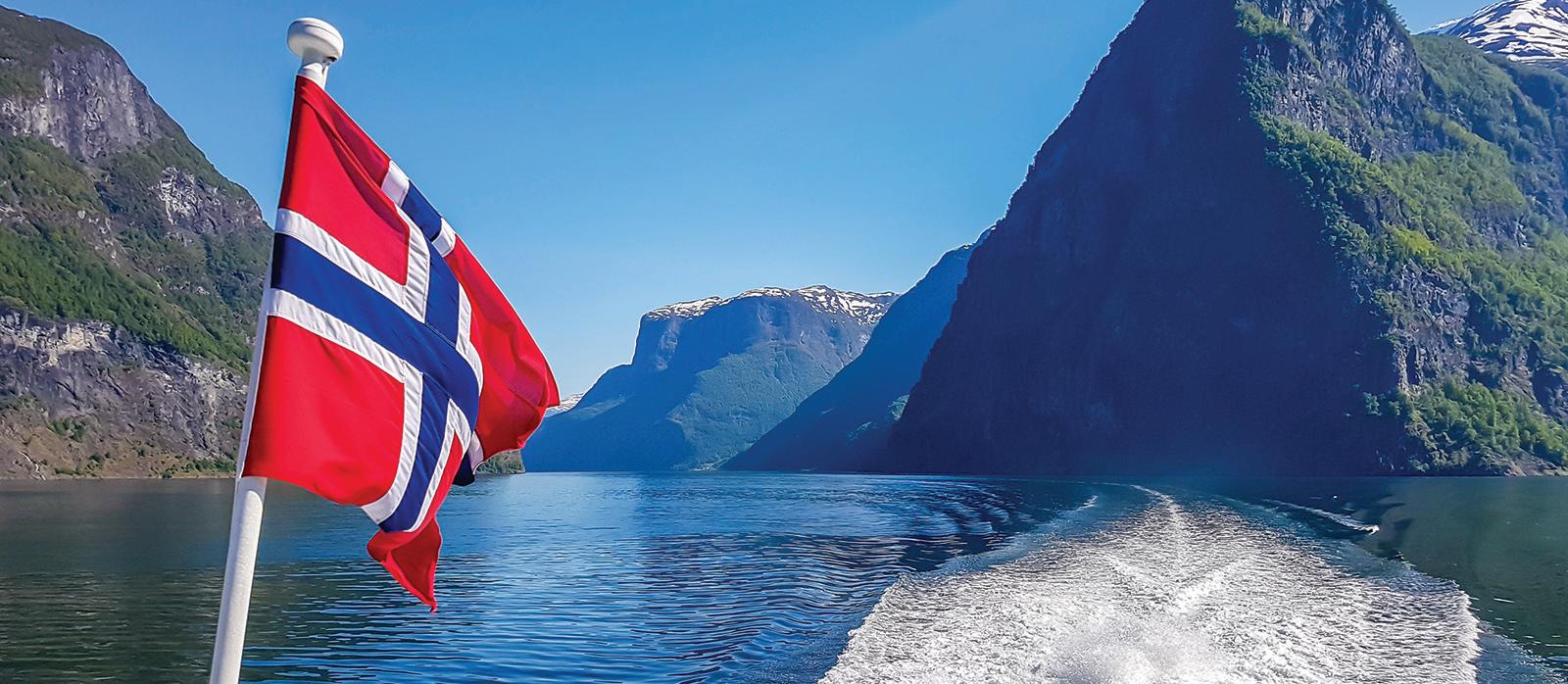
The planned activities will be carried out across 280,000 sq. km of the nation’s Arctic continental shelf. First licences are expected to be issued in 2025. Mining will not
start before 2030, and will require Norwegian lawmakers' approval.
WWF said that the assessment by the Norwegian energy ministry, which underpinned the government’s decision to go ahead with deep sea mining, failed to meet the minimum requirements outlined in the country’s Seabed Minerals Act.
bon economy and could come at a lower environmental cost than terrestrial mining.
Scientists say very little is known about the depths of the oceans — only a small fraction of which humans have explored — and many are concerned about the impacts on these ecosystems already affected by pollution, trawling and the climate crisis.
Environmental groups Greenpeace Nordic and Young Friends of the Earth Norway filed in 2017 an application to the Supreme Court, arguing Norway had breached fundamental human rights by allowing new oil drilling amid a climate crisis. The case was dismissed in late 2021.
The NGOs applied to a local court in November last year in a bid to thwart the development plans at the Breidablikk, Tyrving and Yggdrasil oil and gas fields. The Oslo District Court ruled in their favour in January. TNM Norway is opening up more than 280,000 sq. km of Arctic Ocean seabed to mining exploration. ADOBESTOCK/CHRIS
At least two companies have
applied for licences, as Oslo emphasizes the importance of deep sea mining the Arctic to increase Europe’s supply of essential rare earth minerals and battery metals such as copper, nickel, and manganese. Proponents of deep sea mining argue that extracting raw materials from the seafloor will enable a faster transition to a low-car-
Following a series of unsuccessful appeals, the groups took their case to the European Court of Human Rights.
GLOBAL MINING NEWS THE NORTHERN MINER | JUNE 2024 9
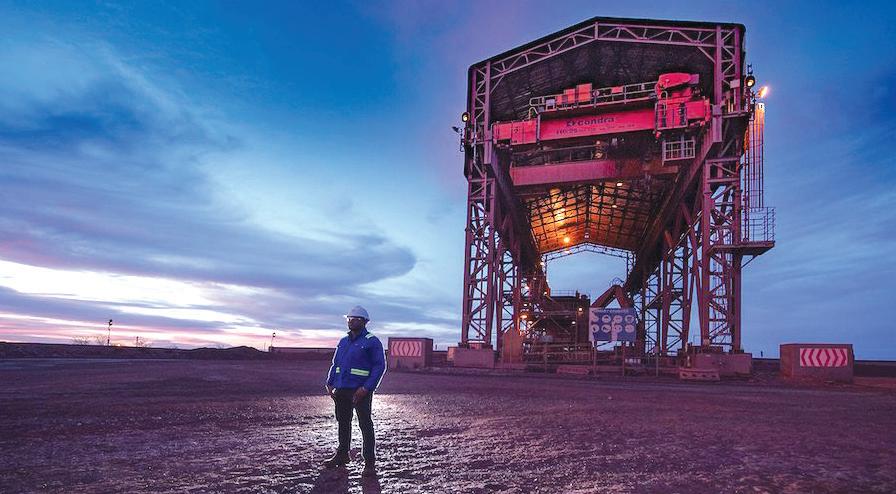
Anglo American subsidiary Kumba Iron Ore's Kolomela mine in Northern Cape Province, South Africa. ANGLO AMERICAN | FLICKR
in
depth
indepth
How the West wields laws to thwart critical mineral supply chain risks
ETMS | US is throwing billions in funding to build domestic production
BY HENRY LAZENBYThe United States is brandishing billions of dollars in funding from recent laws to reduce the security threat from the West’s dependence on China for critical minerals, panellists told the Energy Transition Metals Summit in Washington, D.C. in April.
The Inflation Reduction Act, the Bipartisan Infrastructure Law, the Defense Production Act (DPA) and the National Defense Authorization Act are helping boost domestic production and processing capabilities. These include tax credits for mineral processing and battery manufacturing and consumer credits for clean vehicles sourced from allied nations.
“The U.S. is import-reliant on more than half of the fifty critical minerals identified by the U.S. Geological Survey, with a significant portion sourced almost exclusively from China,” Alex Jacquez, special assistant to the President for Economic Development and Industrial Strategy, said in an April 30 session. “If supply chains are disrupted, it could impact our ability to produce essential defence materials and technologies, leaving us vulnerable during conflicts and crises.”
At the event, organized by The Northern Miner’ and Precious Metals Summit Conferences, the panel explored the implications
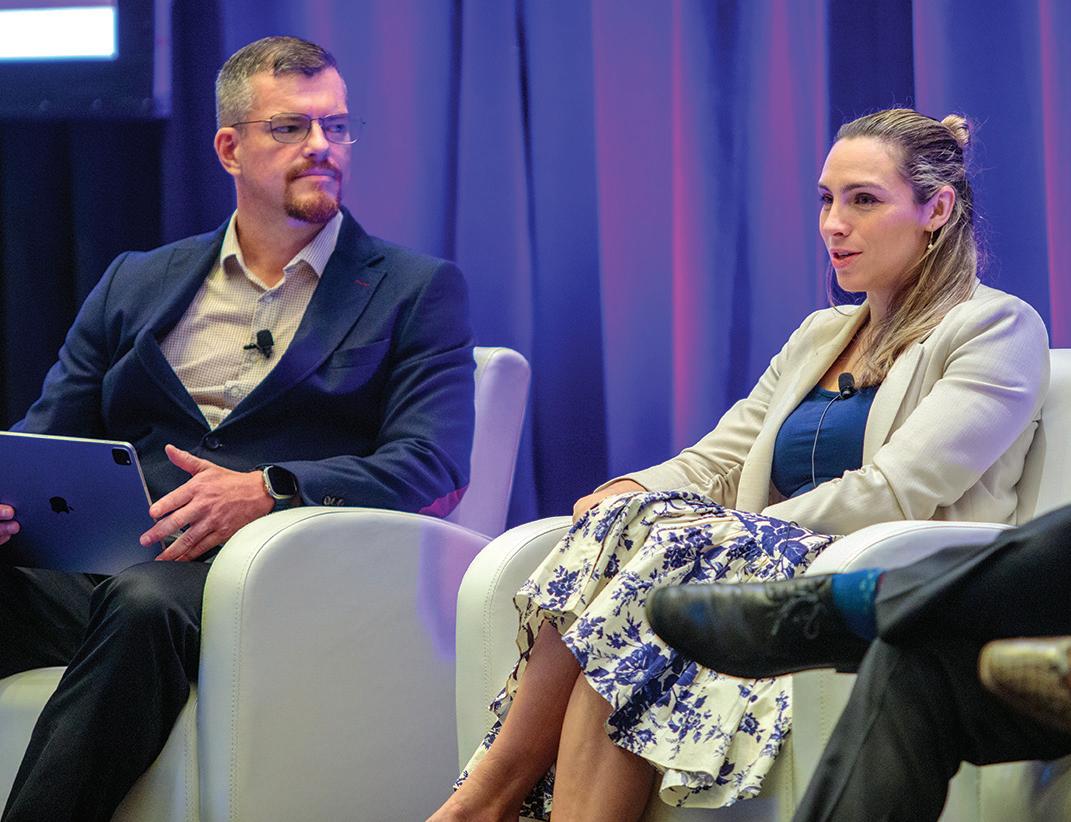
of China’s market dominance and how the U.S. and its allies are mitigating risk and ensuring access to critical minerals. The panel’s experts noted an urgent need to develop transparent, sustainable, and secure supply chains for critical minerals, assessing key government policies driving the change.
“We are focusing on building resilient supply chains and creating markets protected from lower-cost, lower-standard production,” Jacquez told The Northern Miner’s western editor, Henry Lazenby.
Abigail Hunter, of SAFE’s Ambassador Alfred Hoffman Jr. Center, said the U.S. needs to prioritize high-standard projects to create a diverse and secure supply chain.
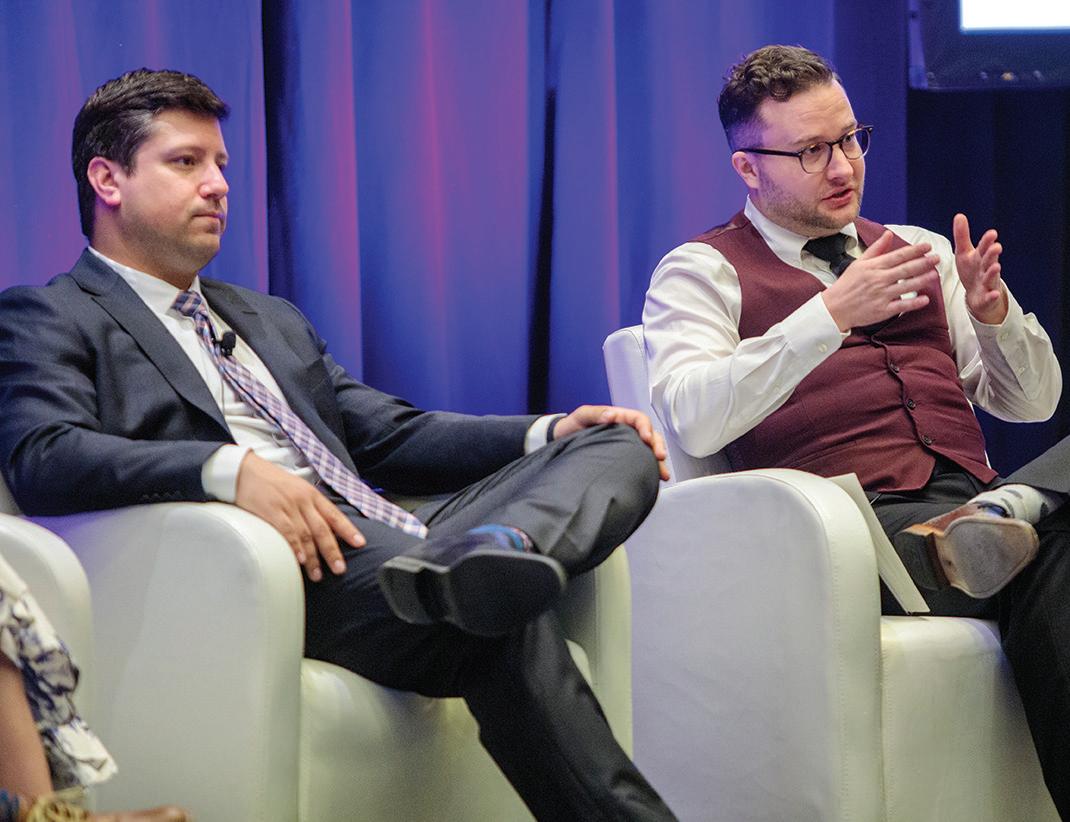
“We must capture the real cost of extracting, mining, and processing these materials to establish a resilient system,” Hunter, the director of the non-governmental organization’s Center for Critical Minerals Strategy, told delegates.
In November, the minerals centre and the State Department signed the Minerals Investment Network for Vital Energy Security and Transition. The MINVEST initiative was designed to bring together public sector finance tools, such as export credit agencies and development finance institutions, with private sector capital.
The program aims to create resilient and diverse supply chains for critical minerals while ensuring
JV CONTENTprojects meet stringent environmental and ethical standards.
One example of a successful U.S. government collaboration is the partnership between Ultium Cells and the Department of Energy’s Loan Programs Office, which has created 4,000 jobs and aims to strengthen the U.S. battery supply chain by shifting from reliance on Asian sources to more domestic and North American feedstock.
National security
Joe Sopcisak, a technical officer for the Assistant Secretary of Defense, described the DPA’s role as providing investment for companies across the supply chain, from exploration to final production.
“We are providing investment for companies across the supply chain, from exploration to end-component production,” Sopcisak said.
The Department of Defense has made investments ranging from single million-dollar amounts to over US$100 million, covering various supply chain stages, including pilot projects, feasibility studies, and mine construction.
Meanwhile, the 2024 National Defense Authorization Act expanded the definition of domestic sourcing in the DPA to include the United Kingdom, Australia and Canada to bring allied supply chains into the fold.
This includes grants, purchase commitments and other tools to spur investment and ensure the U.S. military has the resources it needs. Sopcisak said the defence stockpile can mitigate supply chain risks but has its limitations.
“The stockpile can only hold materials identified as shortfalls, and we need new legislation to create a broader national security stockpile,” he explained.
The panel also discussed the urgent need for workforce development to meet future demands and meet the nations’ energy transition goals.
“We aren’t graduating enough geologists or mining engineers to meet our 2030, 2035, and 2040 goals,” Sopcisak said. TNM
Quebec seizes golden opportunity in critical minerals
ETMS | 2020 strategic plan has boosted province’s place in new EV battery supply chains
BY ALISHA HIYATEQuebec has always enjoyed a reputation as a top-tier mining jurisdiction, but until recently, gold has run the show.
Since it released its critical minerals strategy in 2020, however, spending on critical minerals exploration has jumped to $470 million, up from $60 million, said Jocelyn Douhéret, director of the mining policies office at Quebec’s Natural Resources Ministry.
“It’s a more than 600% increase in four years,” he noted, citing the raft of supports the province has implemented, from financial tools and programs to direct investment in projects.
Critical minerals exploration claims have also increased by more than 110%.
Douhéret was part of a sponsored panel on Quebec at the Energy Transition Metals Summit in Washington, D.C., in late April.
While Quebec is best known as a gold producer, it also hosts many base metals and iron ore camps, said Killian Charles, president and CEO of lithium explorer Brunswick Exploration (TSXV: BRW).
“We forget all the iron ore that was produced for Detroit. You know, Iron Ore Company of Canada was created from all these iron ore mines that were owned by car manufacturers in Quebec.”
Charles said that in one sense, the province is reclaiming a past identity with the current focus on critical minerals.
“Quebec is blessed with a productive geology from a critical minerals perspective. Those critical minerals have changed over the course of history, but they remain at the forefront,” he said. “We are redeveloping something that was already quite core to the identity of Quebec, to develop these areas for minerals that are used directly in the global economy.”
The province is already starting to see the results of its critical minerals strategy, which it put in place before any other jurisdiction in Canada, or even the federal government.
“The main focus in 2020 was to develop a supply chain from mining to battery cell,” Douhéret said. “I can say that today, all the pieces are in place from mining, midstream and downstream with GM, Ford, and Northvolt.”
Last year saw three major investment deals into electric vehicle (EV battery) manufacturing facilities in Quebec. GM and South Korea’s POSCO announced the development of a $600-milion cathode active material (CAM) plant in Bécancour, about 150 km northeast of Montreal. Ford announced it would build its own CAM plant valued at $1.2 billion, also in Bécancour. And Sweden’s Northvolt said it would build a $7-billion EV battery plant.
Together, the provincial and federal governments have committed billions to support the plants.
Quebec Inc.
Quebec institutions support mining across all stages, from exploration through development and beyond. But the Quebec advantage starts with the province’s geological database, Charles said.
“There is nothing like the ecosystem that exists in Quebec to support mining companies,” Charles, a former mining equity analyst and a geologist, said.
While the province’s funding ecosystem already includes many institutional funds, such as SIDEX, Investissement Québec, and the provincial pension fund Caisse de
dépôt et placement du Québec, a new fund focused on exploration in northern Quebec was created last year.
Sylvain Lépine, general director of NQ Mining Investment said the fund is focused on critical minerals in the territory north of Val-d’Or. It’s different from existing funds in that the money comes from the same region they will be invested in.
The initial $20 million in funding came from two local organizations — James Bay Development Organization (SDBJ) and James Bay General Administration (ARBJ).
“The fund would like to be a kind of an example of the quality of projects in the north, Lépine said. “In 2023, more than $600 million was spent in this territory for lithium and nickel, copper, gold.”
A geologist with a long history in mineral exploration, Lépine said the fund is looking for more sponsors to support investment in the vast region.
NQ’s criteria for investment includes location, project quality and management, and a strong focus on sustainability and community. So far, it’s invested in two lithium companies.
“We would like to invest in good companies that understand where they are, they understand the local community and they are there to participate not just in the mining
10 JUNE 2024 | THE NORTHERN MINER www.northernminer.com
Left: The Northern Miner western editor Henry Lazenby, left, and Abigail Hunter. Right: Alex Jacquez, left, and Joe Sopcisak speak at the Energy Transition Metals Summit in Washington, D.C. PENDA PRODUCTIONS
Quebec Panel P38 >
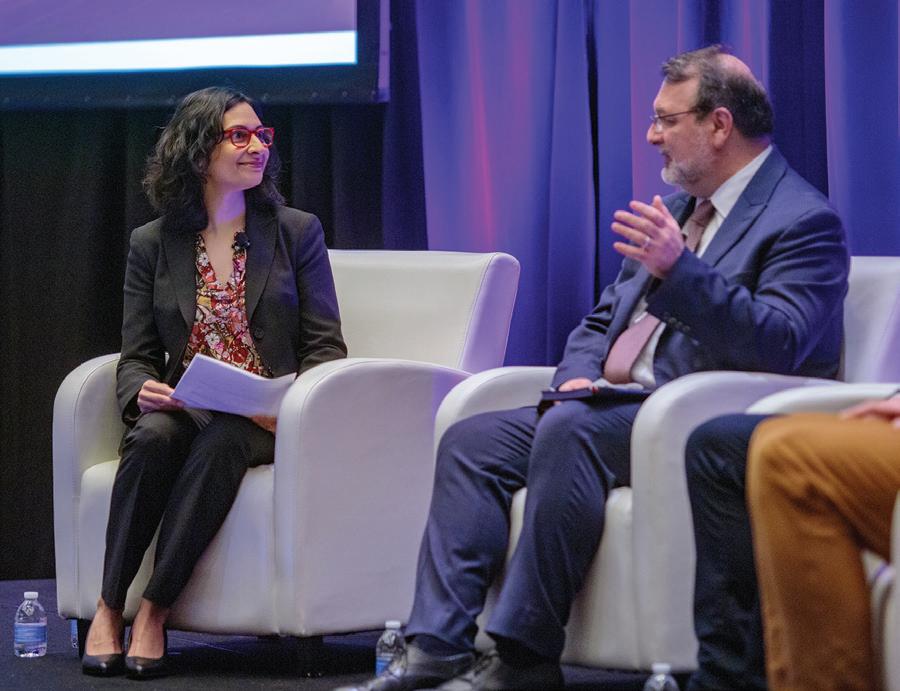
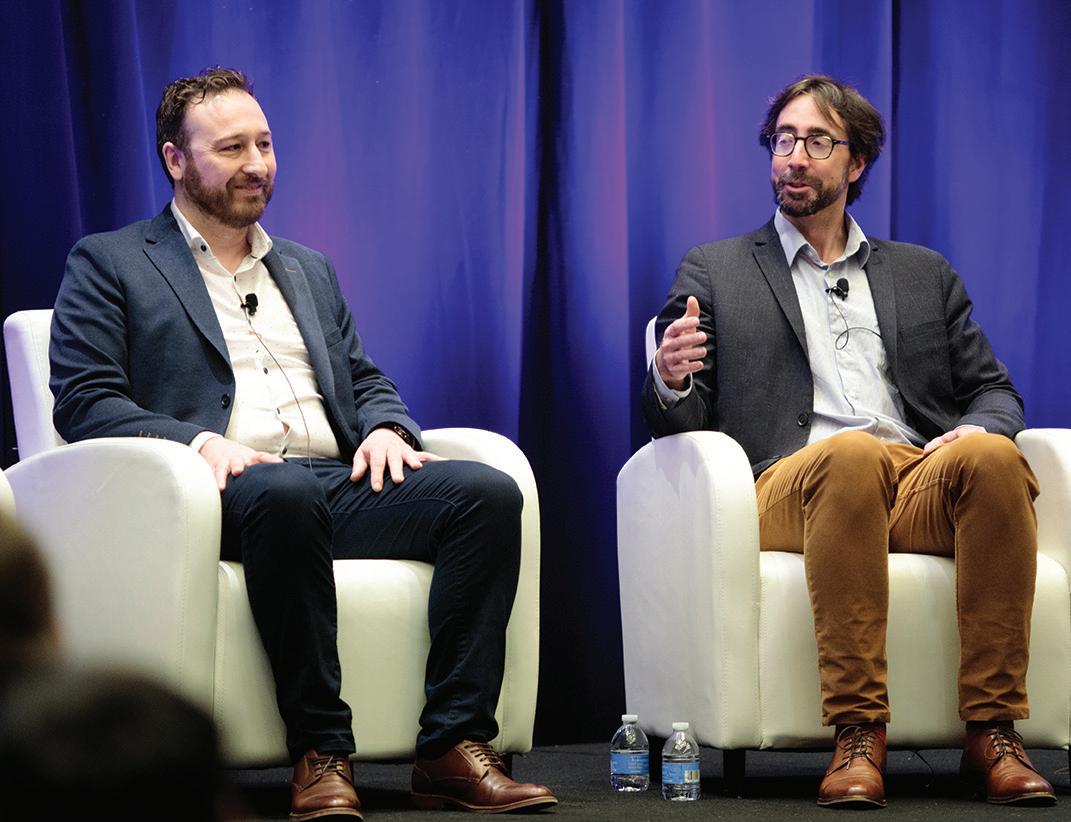
Left: The Northern Miner's Editor-in-Chief Alisha Hiyate with Jocelyn Douhéret. Right: Sylvain Lépine, left and and Killian Charles speak on the Quebec panel at the Energy Transition Metals Summit. PENDA PRODUCTIONS
Investors wait to see how battery tech shifts will shake out
ETMS | Hazy battery metals forecast slows mining investment
BY JAX JACOBSENShifting battery metals chemistries present a real challenge for all players in the battery ecosystem, from mineral producers to investors to end-stage users such as automobile manufacturers, panellists said at the Energy Transition Metals Summit in Washington, D.C.
One of the reasons why so many of the players in battery metals ecosystems are struggling is because it remains unclear which battery metals will remain a critical component of batteries and which will fall by the wayside.
The United States is working closely with industry experts to determine “not just where the puck is, but where the puck is going,”
Abby Wulf, Executive Chair of the American Batteries Initiative at the Department of Energy, said in an April 30 session.
The U.S. is taking a “commodity by commodity approach” when making investments, she said, adding that the government coupled a “short term view and a long, longterm view” to manage the uncertainty in battery composition.
There will always be a mismatch between what miners produce and what end-users require, Andy Leyland, managing director of EV battery consultancy Supply Chain Insights, said.
“Typically [automotive manufacturers] are making decisions on what vehicles they’re going to pro-
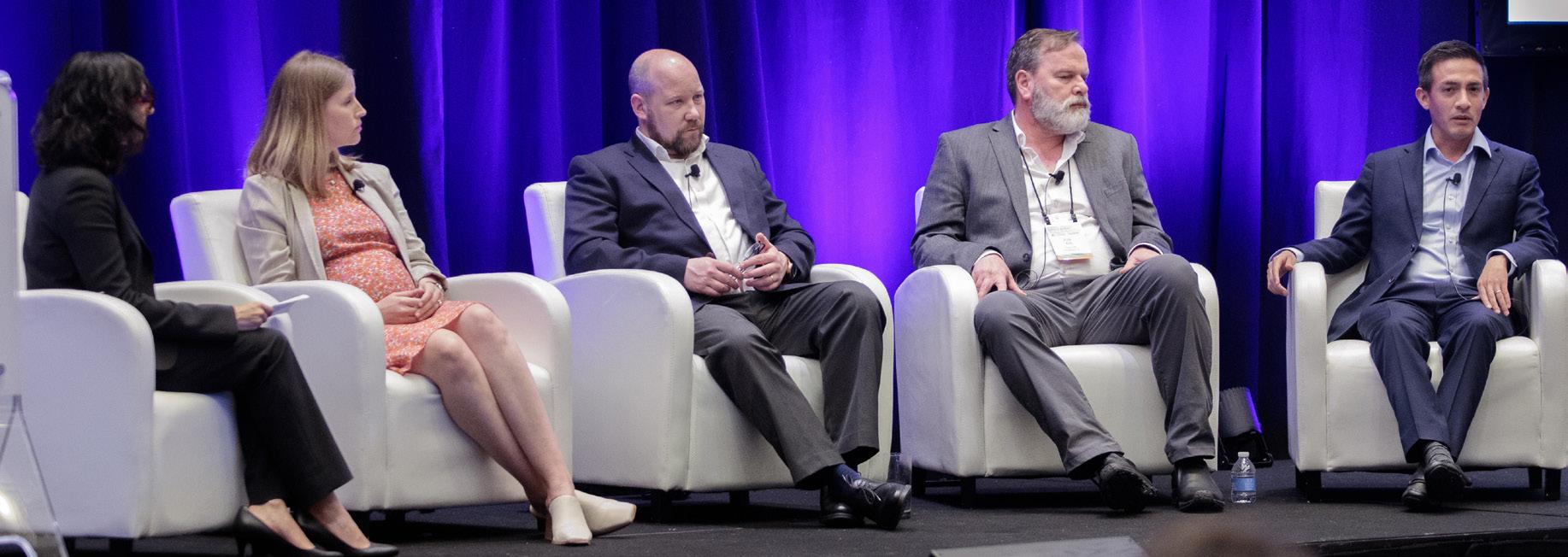
duce, and what batteries and what chemistries will go in there on a three- to four-year timeframe,” he said. “That’s not enough to bring out a full supply chain.”
Adding to the complexity is how quickly certain markets, such as electric vehicles, are evolving, Frik Els, head of news at strategic metals and minerals advisory Adamas Intelligence, added.
“It’s barely four years ago that Tesla said they are moving from lithium to phosphate. A month later in 2020, [Chinese electric carmaker] BYD came in with the Blade battery.”
BYD’s Blade is a lithium iron phosphate (LFP) battery — a much cheaper, but less powerful chemistry that dominates Chinese production.
End users of batteries will need to be prepared to adjust to supply chain shifts, as it’s difficult to predict which metals will dominate the
battery market more than five years out.
This uncertainty is directly impacting investment in mineral production, with generalist investors unwilling to take on the risks inherent in the market.
Ernie Ortiz, president & CEO of Lithium Royalty Corp., says most investors don’t understand the way the market works.
“The generalist investor assumes that because the price is down 80%, that then that implies that demand was also down a significant growth rate, which is not the case,” he said. Investors need to be educated about the risks, but that’s to be expected for such a young industry still prone to “boom and bust” cycles, he added.
Mainstay minerals
While battery makeup is constantly changing due to research advances, the panel agreed there are metals
that would be in demand for the long haul.
Lithium is one such commodity, Leyland said.
“Lithium doesn’t face a huge number of substitution challenges,” he said. However, high price spikes in one commodity generally leads to battery metals researchers developing batteries that rely less on expensive commodities.
“We had a price hike in cobalt in 2018, and then, for numerous reasons, saw cobalt being largely engineered out of batteries,” he said. A similar process happened with nickel following a price increase for that commodity.
However, lithium will remain a mainstay of battery composition because its competitor, sodium ion, is slightly weaker on certain metrics, such as energy density.
Lithium is the lightest metal on the periodic table, which lends itself to electric vehicles, Ortiz said.
“Lithium-ion battery technology continues to improve and continues to get more affordable over time, and get better energy density, better range, and lower costs.”
“If we don’t get the investment in lithium – which I think we will –we’re going to see sodium ion coming and taking some of that market away, but typically lithium ion will be the winning technology.”
There will be challenges for nickel-manganese-cobalt batteries as these commodities are harder to source.
“We’re finding it incredibly difficult to get the nickel and cobalt projects up and running,” Wulf said. Developing these projects in a timely way to meet ever-shifting demand remains a challenge. “If you need to bring a new cobalt mine online, is it going to be online on time, and if not are you going to still need it?”
The unclear future for battery metals is having an impact on end users and their willingness to invest in raw materials, Leyland said.
“Automotive companies do not want to be mining companies,” Leyland said. “That is a problem.”
Some are beginning to opt for buying Chinese cells just to sidestep investing to develop their own supply chains. Likewise, investors do not want to be subject to large impairment charges due to a collapse in lithium prices, he said.
“They’re in a position where they need to encourage supply,” he said. “They do that by taking a long-term off-take contract.” TNM
Peartree tracks financial trends that show exploration spending drop in BC
BY BLAIR MCBRIDEExploration spending in British Columbia is down by more than 45% since 2022, the biggest drop of any jurisdiction in Canada, PearTree Financial managing director Kendra Johnston said at the Energy Transition Metals Summit in Washington, D.C. in April.
“We see quite a large decrease over the three years in British Columbia,” said Johnston, a former president and CEO of the Association for Mineral Exploration (AME) in the province. Spending in B.C. dropped to $543.6 million this year from $764.6 million last year and $996.8 million in 2022, she said at the event.
“There are a number of regulatory changes that are happening… there is some uncertainty related to the Mineral Tenure Act and the Mines Act and some of the activities related to how well we’re going to be able to explore in that province.”
The B.C. Supreme Court last September gave the province 18
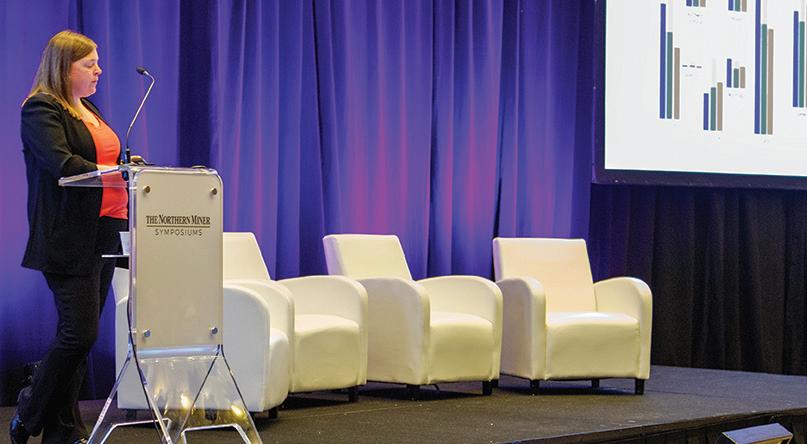
months to align the mineral claims process under the Mineral Tenure Act (MTA) with the duty to consult Indigenous groups.
The AME has since criticized the province for not properly engaging with the mining industry as it works on its reforms. Some companies in B.C., such as Taranis Resources (TSXV: TRO; US-OTC: TNREF), have also been frustrated by what it considers a politicized permitting process. The company finally secured an exploration permit for its Thor project in April after a court
dispute and almost two years of waiting.
Johnston’s presentation on April 29, sponsored by PearTree Canada, touched on the federal Critical Mineral Strategy, released in 2022, and how and where exploration dollars are being spent across the country.
In contrast with B.C., Ontario leads the country in spending with $1.1 billion, with Quebec’s next at $904.2 million, Johnston said, citing data from the federal government. That’s out of the cross-Canada
total this year of $4.1 billion, which includes $2.7 billion in exploration and $1.4 billion in deposit appraisals, already more than the $3.9 billion spent last year.
Alberta and Saskatchewan are on track to clock their highest spending in three years, with lithium brine exploration pushing up investment in Alberta to $50.1 million this year, Johnston said, and uranium activity in Saskatchewan amounting to $442.8 million.
Flow-through flowing
In terms of equity financing, Johnston pointed to data from the TMX Group and the Prospectors and Developers Association of Canada showing that flow-through shares funding, a uniquely Canadian type of financing that carries an attached tax benefit, has risen over the last decade. PearTree dominates flow-through financings in Canada.
The proportion of flow-through to non-flow-through financing for mineral exploration reached its highest levels in the last three years, at 83% in 2021, 78% in 2022 and 83% again last year.
“(And) of that 83%, 90% is char-
ity flow through,” Johnston said, referring to the flow-through system where investors buy shares and then donate them to a Canadian charity. “That is a significant component of how projects are financed across the country. That works out to 74% of all financings done by charity flow through.”
Because of the exploration sector’s dependence on flow-through dollars, changes to the alternative minimum tax introduced in federal budget 2024 may harm the sector disproportionately, PearTree has warned. The new tax regime will target high income Canadians who contribute to most flow-through financings. PearTree fears it could cut financing for mineral exploration by one-third.
Almost half of the total $1.2 billion in flow-through financing raised in 2021 was in Ontario, at $467 million; 29% or $353 million were bought in Quebec; and 20% or $243 million were bought in B.C. The remaining $140 million were bought in other jurisdictions.
Johnston explained that the per-
GLOBAL MINING NEWS THE NORTHERN MINER | JUNE 2024 11
Peartree P38 >
indepth JV CONTENT
From left: Alisha Hiyate, Abby Wulf, Andy Leyland, Frik Els and Ernie Ortiz at the Energy Transition Metals Summit. PENDA PRODUCTIONS
CANADA | Regulatory shakeups slowing investment in province
Kendra Johnston speaks at the PearTree Financial session. PENDA PRODUCTIONS
indepth
Billionaire-backed KoBold, Midnight Sun team up for Zambia copper discovery
ETMS | Zambia-focused partnership uses AI to hunt for hidden deposits
BY HENRY LAZENBYKoBold Metals, a U.S.based startup supported by high-profile investors such as Bill Gates and Jeff Bezos, is expanding its holdings in Zambia’s rich copper belt. In February it partnered with Canada’s Midnight Sun Mining (TSXV: MMA) to explore the promising Dumbwa target within the Solwezi copper project.
This strategic alliance will leverage KoBold’s advanced data science techniques and Midnight Sun’s extensive local experience. The goal is for KoBold to earn a 75% stake in the Dumbwa target by investing US$15 million in exploration and making US$500,000 in cash payments over 4.5 years.
“Partnering with KoBold allows us to explore this vast property with the necessary capital and expertise,” Midnight Sun’s marketing and communications director Adrien O’Brien told the Energy Transition Metals Summit in Washington, D.C. in April. “Their tech-driven approach combined with our local knowledge creates a powerful syn-
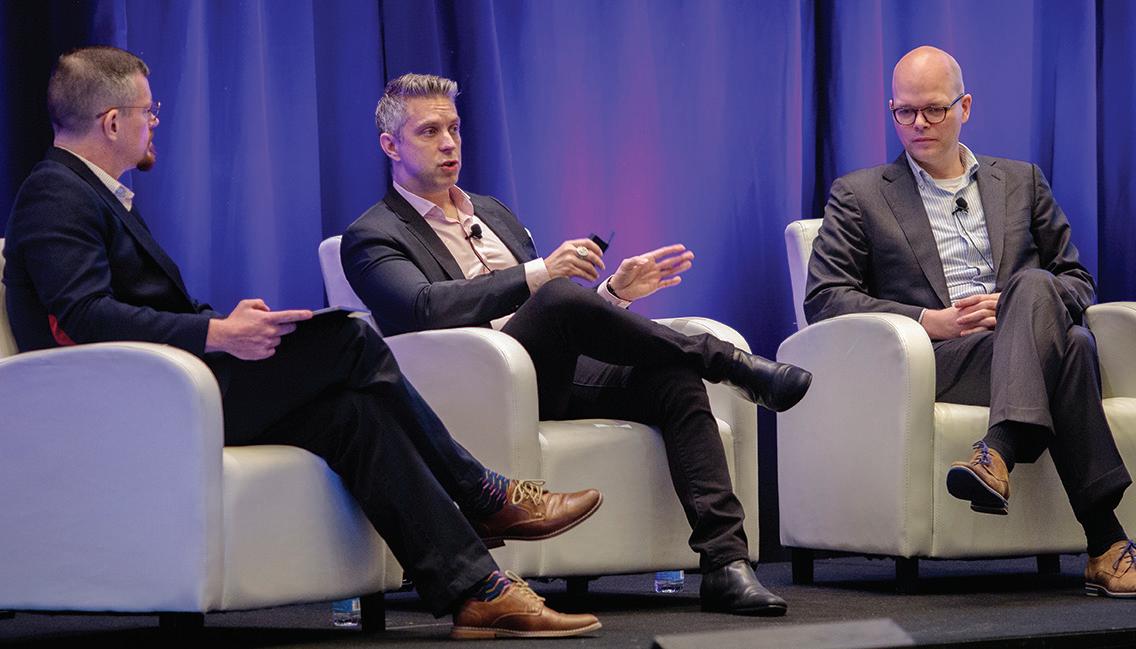
ergy aimed at unlocking Dumbwa’s full potential.” KoBold also holds the prefeasibility stage Mingomba copper project in Zambia.
Kobold’s chief strategy officer, Daniel Enderton, lifted the lid on KoBold’s data-driven approach to mining during an April 30 session moderated by The Northern Miner’s western editor, Henry Lazenby.
“KoBold isn’t just targeting copper; we’re focused on all critical minerals and metals essential for
the energy transition,” Enderton explained. “Our journey began about four years ago in Canada when we acquired rights to an area in northern Quebec, just south of Glencore’s Raglan nickel mine, where we identified lithium deposits.”
Backed by the billionaires’ interest in energy transition metals, KoBold invested US$50 million in exploration last year, Enderton said.
Today, KoBold has 60 active projects in Africa, North America,
JV CONTENT
Australia, and Asia.
“Using artificial intelligence, our goal is to create a ‘Google Maps’ of the Earth’s crust, specifically to locate copper, cobalt, nickel, and lithium deposits,” Enderton said.
KoBold collects and analyzes data streams, from historical drilling results to satellite imagery, to gain insights into where new deposits might be found. “Our algorithms detect geological patterns that indicate potential deposits of cobalt, which is often found alongside nickel and copper,” Enderton explained. “This technology allows us to identify resources that might have been missed by traditional methods and helps miners decide where to acquire land and drill.”
Prospective copper belt
The Central African Copperbelt is one of the most mineral-rich regions globally, with potential for new discoveries. The Dumbwa target is in Zambia’s Domes Region close to several large copper mines including First Quantum Minerals’ (TSX: FM) Sentinel mine, Barrick Gold’s (TSX: ABX; NYSE: GOLD) Lumwana mine,
and Ivanhoe Mines’ (TSX: IVN; US-OTC: IVPAF) Kamoa-Kakula project just across the border in the Democratic Republic of Congo.
This region is a hotspot for copper exploration and production, making it a strategic location for KoBold and Midnight Sun Mining’s joint venture.
“Dumbwa is a 20-km-long soil anomaly with visible copper grades,” O’Brien said. “Partnering with KoBold allows us to explore this vast property with the necessary capital and expertise.”
Drilling will begin mid-year, with results expected later in 2024 Zambia: A mining hub KoBold’s investment in Zambia underlines its confidence in the region, where six projects are underway.
“Our investors believe in our data science approach,” Enderton said. “Their support allows us to invest through commodity cycles for sustainable growth.”
Both panellists praised Zambia’s mining-friendly environment, noting its strong infrastructure and skilled workforce.
Ontario comes out ahead in mines to EV race
ETMS | Province targets billions for critical mineral supply chain
BY BLAIR MCBRIDEIn the global competition for investment in the new, low-carbon economy, Ontario stands out as an existing centre of both mining and auto manufacturing, the conference in Washington, D.C. heard in April.
“We’re really uniquely positioned to have a lead role in the energy transition,” Canada Nickel (TSXV: CNC) CEO Mark Selby, said.
“Because of a long history of mining, we have well-established infrastructure. We have rail lines that go from our mines to the automobile factories.”
Selby was part of an Ontario-sponsored panel at the Energy Transition Metals Summit on April 29 that included project developers, a mining researcher, and Ontario Mines Minister George Pirie. The event took place April 29-30.
Pirie said there’s an “easy” answer to questions about Ontario’s advantages in the energy transition.
“We have the minerals, we have the energy, we have the green grid,” he said. “We have generations of people that are involved with the mining sector. We know how to mine sustainably, we know how to minimize the carbon footprint.”
Billion-dollar investments
Less than two weeks before the event, Honda Motor announced a $15-billion investment to build four new battery and vehicle plants in southern Ontario. The investment came alongside $2.5 billion from the federal government and up to $2.5 billion in incentives from the provincial government.
“I think that that brings the total investment in the EV sector to over
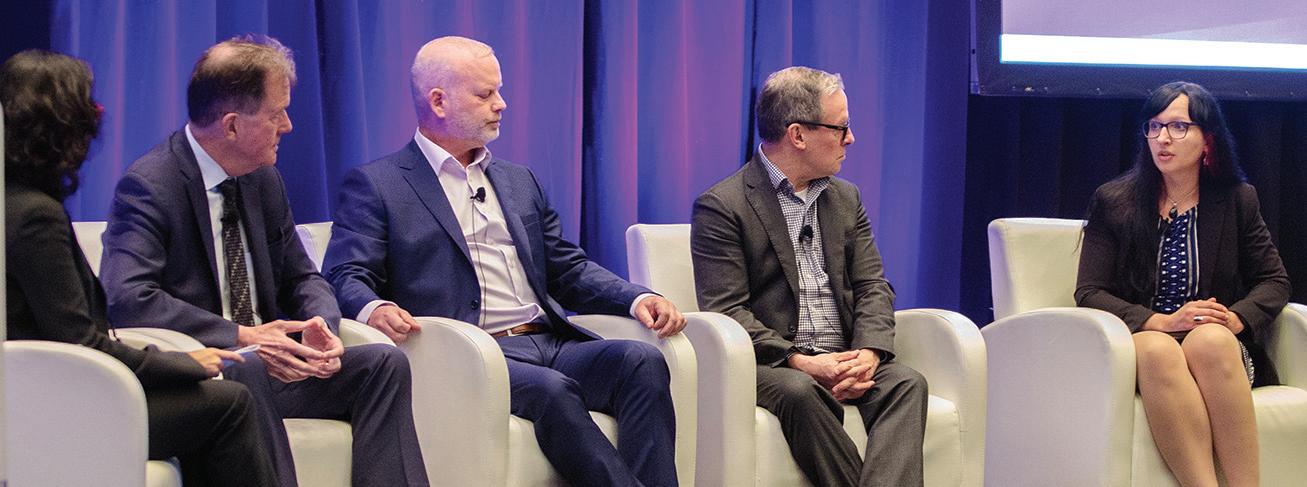
$43 billion. And that’s because this is what Ontario has to offer,” Pirie said.
David Ewing, vice-president of sustainability with Frontier Lithium (TSXV: FL; US-OTC: LITOF), said the wider policy and regulatory environment puts the province in a strong place for developing critical minerals. The Ontario government was out of the gate early, Ewing said, mainly through the development of its Critical Minerals Strategy in March 2022 and also through investments and collaboration with industry.
“We’re building on a fantastic foundation in Ontario, whether that be with skilled workforces, whether it be with knowledgeable governments, we have a strategy that’s backing it, we have funding,” he said. “It really does enable us to take mine projects from exploration through to production more rapidly than we’ve seen in the past.”
Frontier is developing the prefeasibility-stage PAK lithium project in northwestern Ontario. In March, Japanese automaker Mit-
subishi invested $25 million for a 7.5% stake in a Frontier subsidiary, with an option to increase to 25% after a definitive feasibility study for PAK is completed this year.
In addition, the province has targeted faster permitting for new mines through its Building More Mines Act passed last year.
Free geophysical data from the Ontario Geological Society has also made discovering new critical minerals deposits easier and less expensive.
“We basically (discovered) potentially 20 deposits, which could be the world’s largest nickel sulphide district, using just the provincially available geophysics data,” Selby said. His company is developing the Crawford nickel project near Timmins, which hosts the world’s second-largest nickel resource, according to a Wood Mackenzie analysis.
Funding woes
But critical mineral projects in Ontario still face obstacles, and Selby and Ewing highlighted the
mismatch between capital markets and government support for critical minerals.
Selby noted that provincial and federal funding available in Ontario means companies like his can get 30¢ to 40¢ of every dollar needed for their projects.
“The disconnect right now in the capital markets is so profound,” he said. “(If an industry) said, ‘You can take $1 of your equity and you’re going to have multiple levels of government give you four or five additional dollars of equity to leverage your one and then build assets that last for thirty, forty, sixty years.’ It seems like a no-brainer investment. The market just hasn’t woken up to it.”
Green innovation
The industrial and economic magnitude of the energy transition calls for speed and innovation because the technologies of yesterday aren’t suited to the demands of a zero emissions future.
Moderator and The Northern Miner editor-in-chief Alisha
Hiyate, asked Nadia Mykytczuk, president and CEO of Mining Innovation, Rehabilitation and Applied Research Corp. (MIRARCO) about the role that innovation plays in developing critical mineral supply chains.
Mykytczuk, whose non-profit organization is a research arm of Laurentian University in Sudbury, responded that the pace of research into new technologies needs to move faster than it has in the past. That requires government support for such initiatives.
“We really have to make a concerted effort to fund and accelerate the movement of new technologies,” she said. “We have to think zero waste solutions that have much lower carbon footprints in being able to meet the energy demands of the future, but not by compromising the environment and leaving a very long legacy of mine waste.”
MIRARCO has partnered with such companies as Vale (NYSE: VALE) and BacTech Environmental on research into bioleaching technologies that recover critical minerals from tailings, which remain an issue in the Sudbury area. Mykytczuk estimates there’s $8 to $10 billion worth of nickel, cobalt and copper in those decadesold tailings.
“We’re looking at a zero-waste solution using a low-carbon, low-energy biotechnology,” she said. “And we’ve got industry partners, government, academia all working together to accelerate these solutions.” TNM
This article was based on a panel organized by The Northern Miner and sponsored by Ontario. It was not reviewed by the sponsor before publication.
12 JUNE 2024 | THE NORTHERN MINER www.northernminer.com
From left: Henry Lazenby, Adrien O’Brien and Daniel Enderton. PENDA PRODUCTIONS
Alisha Hiyate, Minister George Pirie, David Ewing, Mark Selby and Nadia Mykytczuk. PENDA PRODUCTIONS
indepth
Nuclear will help but fossil fuels aren’t leaving, JDS Resources’ Gilchrist says
ETMS | ‘Infatuation’ with wind and solar slowing energy transition, he contends
BY COLIN MCCLELLANDThe world will never be able to produce enough metals for a green energy transition without fossil fuels and more nuclear plants, says Brent Gilchrist, CEO of investment firm Deans Knight Capital Management and president of JDS Resources.
Global copper production was about 21 million tonnes last year, but the energy transition requires 4 billion tonnes for the first generation of fossil fuel phase-out, Gilchrist said at the Energy Transition Metals Summit in Washington, D.C. Lithium output was 100,000 tonnes in 2023 but a billion tonnes is required for the first generation of infrastructure that will phase out fossil fuel, he added.
The world has spent US$6 trillion mostly on solar, wind and energy storage over the last four years to make them 6% of the power grid, he said, citing the International Energy Agency.
“The solution is we have to move to more nuclear. We have to learn how to use our fossil fuels more efficiently,” Gilchrist said in a solo
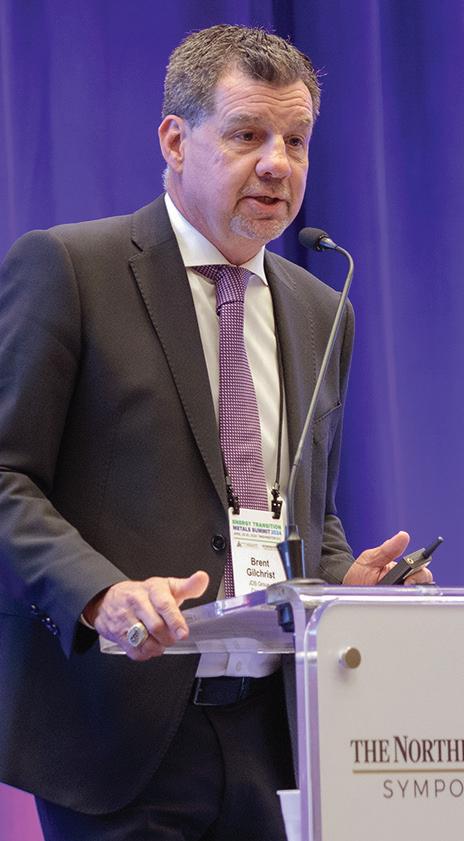
presentation April 29 at the event organized by The Northern Miner
“The infatuation
with
solar and wind is slowing real progress down. I’m not saying that solar and wind
“I'm not discounting the fact that how big mining is going to have to become to put any dent in fossil fuel consumption. We're talking about minerals as the new oil.”
BRENT GILCHRIST, CEO, DEANS KNIGHT CAPITAL MANAGEMENT
aren’t part of the solution, but no chance the energy molecules we produce from wind and solar can run this planet. And it can’t feed and house eight billion people.”
The summit, run in coordination with Precious Metals Summit Conferences, attracted some 500 delegates and 64 companies over April 29-30.
Entire economy
The mining industry would be the planet’s entire economy if it had to produce 4.7 billion tonnes of copper every year, Gilchrist said. JDS previously developed and later sold the Silvertip mine on the Yukon-Brit-
JV CONTENTish Columbia border and holds the Harmony gold project in B.C.
He said the four modern pillars of our civilization are steel, plastics, cement and ammonia for fertilizer, according to the book How the World Really Works. It’s by Vaclav Smil, a distinguished professor emeritus in the faculty of environment at the University of Manitoba in Winnipeg.
“We really don’t have a legitimate way to produce any of those materials without fossil fuels at this time,” Gilchrist said. “I’m not saying in the future that it’s impossible, but we’re not really scratching the surface.”
Commodities outlook
He said he doesn’t forecast commodity performance but is bullish on most of them. Hydroelectric power is great where it can be produced, but there should be discussions about building more nuclear plants, he said.
China is building nuclear reactors, but they’re also building scores of coal-fired plants.
“We have to get the politicians to listen and regulations just have to be changed. It has to be easier to permit these things. It has to be easier to build them. The level of safety and the engineering is insane,” he said. “We know all three nuclear accidents that have happened in the last 60 years. We know them all. That’s damn safe if we can name them.”
Fossil fuels will be sticky to replace considering that the 100 million barrels consumed every day would take the energy of 500 billion workers to replace, he said.
“I’m not discounting the fact that how big mining is going to have to become to put any dent in fossil fuel consumption. But that’s what we’re talking about, right? We’re talking about minerals as the new oil.” TNM
Social engagement speeds permits, but some milestones earn little, experts say
ETMS | Some sustainability standards are too strict to be practical, panel hears
BY HENRY LAZENBYEarly and constant engagement, transparency and trust building can make or break mining project approvals and remain best practice for achieving sustainable mining, a panel told The Northern Miner’s Energy Transition Metals Summit in Washington, D.C.
But several industry standards intended to aid permitting fail to reward companies that follow them, panellists said. Those standards include the Initiative for Responsible Mining Assurance (IRMA), the Global Industry Standard on Tailings Management, the Mining Association of Canada’s Towards Sustainable Mining program and Copper Mark. While the standards are important for the industry, they should have realistic and attainable goals, they said.
“Standards need to be attainable and reflect the realities of modern-day mining,” Mckinsey Miller Lyon, vice-president of external affairs at Perpetua Resources (TSX: PPTA; NASDAQ: PPTA), told the April 30 sponsored panel on community engagement and social licence to operate. She suggested that overly exacting requirements could be counterproductive.
Moderated by Adam Hawkins, president of Global External, the panellists criticized standards like IRMA for often being too stringent, making full compliance impractical for mining operations. These stan-
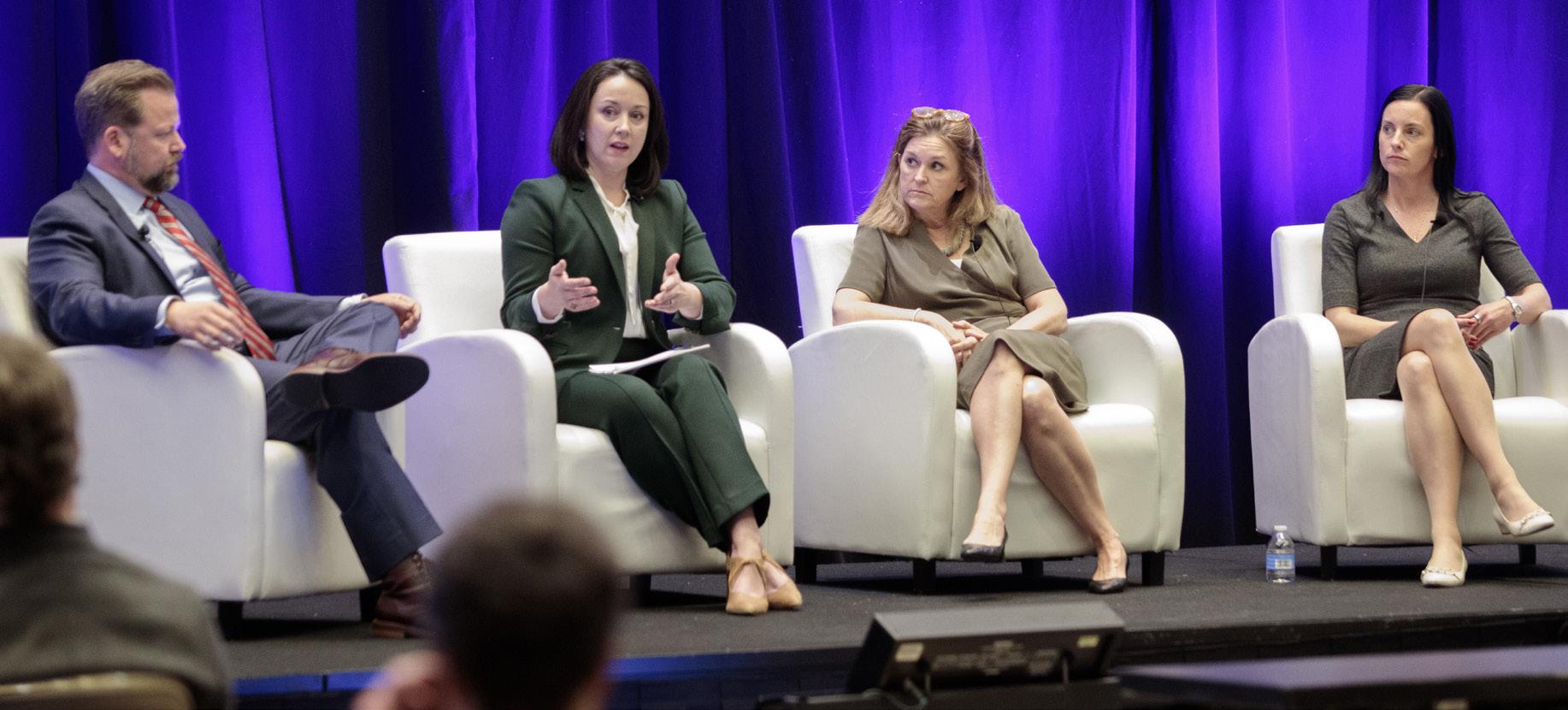
dards can be overly complex and burdensome, especially for smaller companies, and apply a one-sizefits-all approach across regions with different regulatory environments.
The panellists also questioned the value of meeting these standards, saying they're unclear and offered no obvious market advantages or premiums for companies.
The requirements may prove to be too expensive to meet in the current market, they said.
“One of the issues is it’s not clear what a standard gets you,” Judy Brown, South32’s (LSE: S32; ASX: S32) head of external affairs for the Americas, said. “I mean, if you comply with IRMA at 95%, does that make it a green premium? Probably not. So, they can be quite onerous.”
Early engagement is best
Even so, the panellists said miners must engage with communities early and listen to concerns. Starting engagement well before entering regulatory processes allows for more responsive and effective project planning, they said.
“When we listen, it helps us challenge assumptions, inform us on risks, and build trust,” Lyon said.
Community engagement and social licence to operate are critical for miners to build trust, manage risks and ensure the long-term sustainability and local acceptance of their projects. These practices can protect miners’ reputations, ensure local benefits, and also prevent conflicts that could lead to costly delays or project cancellations.
While the panellists agreed that there is no single best approach to community engagement, they highlighted the importance of transparency, accountability and formalizing commitments.
Lyon mentioned that when Perpetua became serious about developing its Stibnite gold project in west-central Idaho, it entered into a community partnership agreement that established an advisory council. It also set up a foundation to support communities over the long term.
“We started community engagement six years before we entered into NEPA (National Environmental Policy Act) permitting, which helped us build trust and resiliency with the communities,” she said.
“This approach ensures that community voices are integrated into decision-making processes.”
Perception management
Managing scrutiny and misinformation remains a major challenge for miners. Angela Johnson, vice-president of corporate development and sustainability at Faraday Copper (TSX: FDY; US-OTC: CPPKF) compared it to foxes nipping at their heels.
“The scrutiny we’re under, especially with the rise of social media, can be quite frustrating, especially when there’s misinformation circulated,” Johnson said.
The panellists agreed that clear communication and consistent engagement are essential to address these challenges.
South32’s Brown noted that internal alignment, particularly among leadership, is just as critical to get projects moving ahead. Engagement staff need to be well-resourced and supported by top management, she added.
“Your community relations teams are the face of your company every single day,” Brown said.
“I will not work for a company that does not have social performance around the CEO leadership table.” TNM
This article was based on a panel organized by The Northern Miner and sponsored by Global External. It was not reviewed by the sponsor before publication.
GLOBAL MINING NEWS THE NORTHERN MINER | JUNE 2024 13
Brent Gilchrist speaks at the Energy Transition Metals Summit. THE NORTHERN MINER
Adam Hawkins, Mckinsey Lyon, Judy Brown and Angela Johnson at the Energy Transition Metals Summit. PENDA PRODUCTIONS
The Northern Miner announces its first ever Gold and Silver Giveaway
The Northern Miner has reported on the ups and downs of the mining and metals sector for over a century, and we want to celebrate our history by giving away some gold and silver.
But our first ever gold and silver contest is not just about us. It is also an acknowledgment of the enduring significance of precious metals and a heartfelt token of appreciation to our valued readers.
With this giveaway, we hope to emphasize the lasting value of precious metals and the profound impact they have had on the course of human history. From the ancient civilizations of Mesopotamia to today’s bustling financial markets, gold and silver have remained steadfast beacons of stability and strength.
Now, as the world navigates ever-changing geopolitical challenges, they shine through yet again reminding us of their intrinsic value as a safe haven in turbulent times.
The Northern Miner Gold and Silver Coin Giveaway represents more than just a chance to win precious metals; it is a testament to the enduring legacy of mining and the timeless allure of gold and silver.
In a similar way that you can count on precious metals as a store of value, you can also continue to count on The Northern Miner for the best independent news coverage of the mining sector. We extend our gratitude to our readers who have accompanied us throughout our storied history. Since 1915, The Northern Miner has been at the forefront of mining news, delivering unparalleled insights and analysis to industry professionals and enthusiasts alike. Your support has been the cornerstone of our success, and it is with great pleasure that we dedicate this giveaway as a symbol of our appreciation for your loyalty and trust.
While we would love to extend this opportunity to our global audience, logistical constraints necessitate that the giveaway be limited to residents of Canada and the United States at this time. However, rest assured, dear readers, that we have not forgotten our international community. Stay tuned for future contests later in the year, where we will be thrilled to include participants from around the world in our celebrations.
To participate, simply scan the QR code and follow the instructions to enter. Winners will have the opportunity to own a piece of history — a tangible embodiment of wealth and prosperity.
Join us in honouring this timeless tradition and celebrating the remarkable journey of The Northern Miner. To our readers in Canada and the U.S., we wish you the best of luck, and to our global audience, stay tuned for exciting opportunities to come.
Sincerely,
Anthony Vaccaro President, The Northern Miner Group


14 JUNE 2024 | THE NORTHERN MINER www.northernminer.com
ENTER HERE

THE NORTHERN MINER’S
GLOBAL MINING NEWS THE NORTHERN MINER | JUNE 2024 15
GOLD AND SILVER GIVEAWAY
PRIZE 1 oz. Canadian Maple gold coin
PRIZE 10 oz. Germania silver bar
PRIZE 1 oz. Canadian Silver coin
FIRST
SECOND
THIRD
indepth
Canadian mining industry rallies to support Afghan women scholars
PEOPLE | UBC welcomes 10 students who fled Taliban restrictions
ous environments.
BY AMANDA STUTTSome of the biggest names in Canadian mining have come together in an initiative that brought 10 women scholars from Taliban-ruled Afghanistan to pursue graduate studies in mining and geology at the University of British Columbia (UBC).
Miners have raised nearly $500,000 to help the students — with several finishing up their first semesters in graduate studies at the university this spring.
The story began in 2022. After completing undergraduate degrees at universities in Kazakhstan, and with their student visas expiring, the women were about to return to Afghanistan. But the Taliban notoriously banned girls from attending school past grade six after taking control of the country in 2021. It is now illegal for women to attend university in the country, or to travel alone.
Facing dismal prospects if they returned to their homeland, the women sought help so that they could continue their studies.
David Awram, senior vice-president at Sandstorm Gold Royalties (TSX: SSL; NYSE: SAND) and Imola Gotz, the company’s VP mining & engineering, first learned about the plight of 11 Afghan women students in 2022.
They teamed up with Friba Rezayee, founder of the non-profit Women Leaders of Tomorrow (WLOT), to work with UBC to get the women emergency acceptance and student visas. They also liaised with Kazakh officials and the Canadian Embassy to manage the paperwork, and joined forces with Nadine Miller, VP, operational technologies at JDS Mining.
Miller rallied financial support

from the industry, which responded with donations totalling nearly $500,000.
“Despite the uncertainty, everyone who heard the story immediately became engaged, sympathetic, and aware of the short timeline,” Awram said. “It was very heartwarming and rewarding to have so many volunteer their time and energy to help.”
Founding donors Osisko Gold Royalties (TSX: OR; NYSE: OR), Wheaton Precious Metals (TSX: WPM; NYSE: WPM; LSE: WPM), and Teck Resources (TSX: TECK.A, TECK.B; NYSE: TECK), which also provided internships for the students, provided initial support, with Pan American Silver (TSX: PAAS; NYSE: PAAS), Hecla Mining (NYSE: HL) and others also donating funds. Every department at UBC that was asked to help said yes, and 20 staff at the university are dedicated to the initiative.
“It is amazing to help these scholars achieve their desire for education in the mining industry,” Awram said. “Having motivated students chasing technical degrees in mining that have their perspectives is
exactly what our industry requires.”
Ten of the women were issued student visas to travel to Canada, and one woman returned to Afghanistan alone. She has not been heard from since.
Celebrating student success
The cohort who recently completed their first semesters at UBC was celebrated at an event in Vancouver on May 10.
Rezayee, who was the first Afghan female Olympian, competing in judo in Athens in 2004, and now a Canadian, delivered a moving speech on the importance of removing barriers to accessing education for female scholars who have been banned from academia in their homelands.
“The only way to fight the Taliban is to educate girls,” Rezayee said.
The women, who are not being named to protect their privacy and safety, cannot return to Afghanistan. It was not clear if their families would try to join them in Canada.
Opportunities are available in the mining industry, Miller emphasized, adding that their academic
accomplishments are already piling up.
One of the scholars, in UBC’s master’s in mining engineering program, is studying how minerals processing can reduce plastic usage. Her goal is to pursue project management in sustainable mining practices, and she has secured an internship at Teck.
Another student is working on a project about water efficiency in mining, which has been approved for presentation at SME’s International Mineral Processing Congress in Washington D.C. in September. She’s also working on a paper on artisanal gold mining’s impact on water resources.
Scholars at Risk
UBC has now formalized the program started two years ago, naming it the Female Scholars at Risk initiative. In addition to Afghan women, the newly established program will offer a safe haven at UBC for women from around the world who are looking for an opportunity to enter graduate studies but are trapped in situations of armed conflict, disaster, or other danger-
In parallel with UBC’s initiative, Rezayee established a partnership with Laurentian University to create the WLOT Mining Engineering Program, which will open the door to five Afghan women to embark on a two-year study program leading to either a masters of geology or masters of mine engineering this fall.
After securing funding for entire two-year programs, Miller is now raising funds for the next cohort together with WLOT and the former minister of mining for Afghanistan, who is a refugee in Canada.
“These are all women who have selected mining as their industry,” Miller said in an interview. “These are women that as soon as the Taliban took over, can never go home.
“All these women already have degrees in mining or geology. They’re unbelievable. They are so excited. They’re all going to be graduating by December and need to find jobs.”
The students are all doing their internships this summer at Teck while working the maximum number of hours that their visas will allow.
Miller is currently working on getting transportation funded for students to do research in the Yukon. She emphasized that WLOT and the former Afghanistan mining minister have identified about 600 displaced women around the world as candidates for future cohorts.
“Our limitation on how many women we can bring in is money and space,” Miller said.
“This is a case for diversity beyond gender. Right now, topics at board levels are diversity beyond gender. And this is it. These are our future board members.” TNM
For more information or to donate, email Nadinem@jdsmining.ca.
Canuck carbon firms vie for Musk-funded US$100M
INNOVATION | Xprize recognizes top carbon capture tech solutions
BY COLIN MCCLELLANDArca, a company that’s signed a deal with BHP (LSE: BHP; NYSE: BHP; ASX: BHP), is one of three Canadian technology firms in the running for the US$100-million Xprize carbon removal competition.
The Vancouver-based company is among several entries focusing on mining in the top 20 listed on May 9 by Los Angeles-based Xprize, which organizes global technology challenges. The prize, funded by the Musk Foundation and started by Tesla and SpaceX CEO Elon Musk, is to be awarded next year. It holds US$50 million for the winner and lesser amounts for finalists. The contest began with 1,300 entrants in 2021.
Arca formally agreed in November to work with BHP on the world’s first carbon dioxide (CO2) mineralization project using mine tailings at the Mount Keith nickel mine in Australia. The two had been testing the process since at least 2020. The startup has preliminary agreements
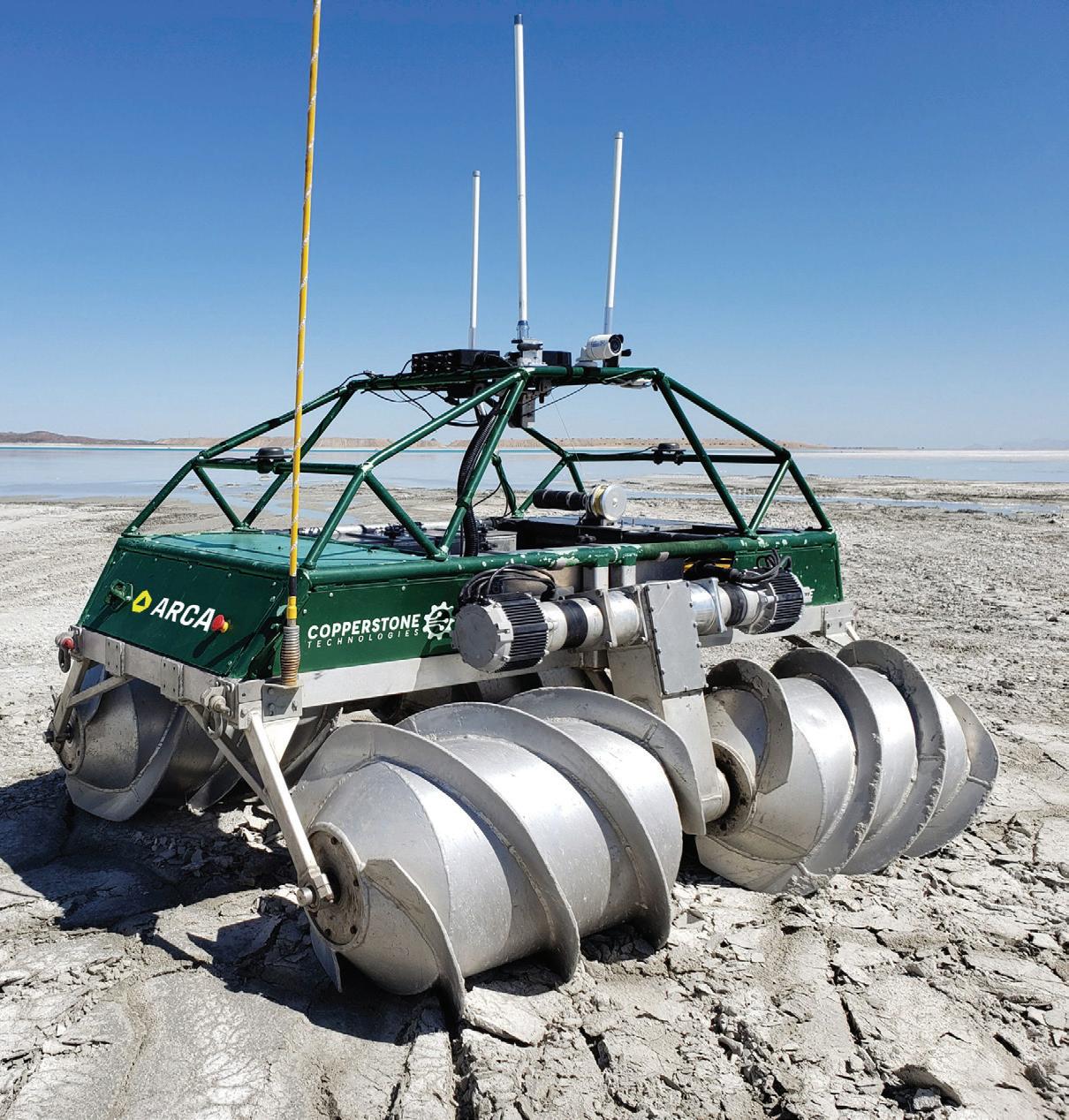
with Vale (NYSE: VALE), Stillwater Critical Minerals (TSXV: PGE; US-OTC: PGEZF), IGO (ASX: IGO), EV Nickel (TSXV: EVNI) and Talon Metals (TSX: TLO).
“We leverage historical mine waste to remove atmospheric CO2 safely and permanently,” Arca CEO Paul Needham said in a release.
“Our pathway has giga-tonnescale potential, yet makes no new demands on land or precious water resources because we operate within existing industrial footprints.”
Carbon tax
Carbon capture is gathering steam among mining companies to meet their own net-zero commitments as environmental concerns deter large investors despite the need for metals to decarbonize the economy. Carbon capture is also one way to lessen or avoid Canada’s $80 per tonne tax on industry greenhouse gas emissions. Economists rate the carbon tax as the most efficient and market-driven approach to put a price on pollution and reduce climate change, despite what some politicians claim.
Dartmouth, N.S.-based Planetary Technologies and Skyrenu Technologies of Sherbrooke, Que. are the other two Canadian companies among the Xprize finalists. Skyrenu is working to decarbonize asbestos mining in Quebec, CEO Martin Brouillette said by email. Its process filters CO2-rich air through units in stackable shipping containers.
“We are currently working on asbestos mine tailings in Quebec, but the technology is applicable to a wide variety of mining environments,” Brouillette said.
Planetary’s technology enhances ocean water’s natural decarbonizing capability in an inexpensive option, CEO Mike Kelland said by email. It accelerates the highest scale process the earth uses to manage excess CO2, the weathering of rocks into the ocean, he said.
“We work with miners who have alkaline byproducts — generally lime, magnesia and silicate based –and process those into safe antacids for the ocean, Kelland said. “We look to partner with mines that are
16 JUNE 2024 | THE NORTHERN MINER www.northernminer.com
Imola Goltz, VP Mining & Engineering with Sandstorm Gold Royalties, far left; sixth from left, Nadine Miller, VP, operational technologies at JDS Mining; David Awram, SVP, Sandstorm Gold; and far right, Friba Rezayee, founder, WLOT with UBC mining students from Afghanistan. WENDY DELAMONT
XPRIZE P38 > A rover churns tailings to maintain mineralization rates at BHP's Mount Keith mine in Western Australia. ARCA
donedeals
US, Canada team up to fund graphite junior Lomiko
QUEBEC | $15M in funding a first for crossborder cooperation on metals
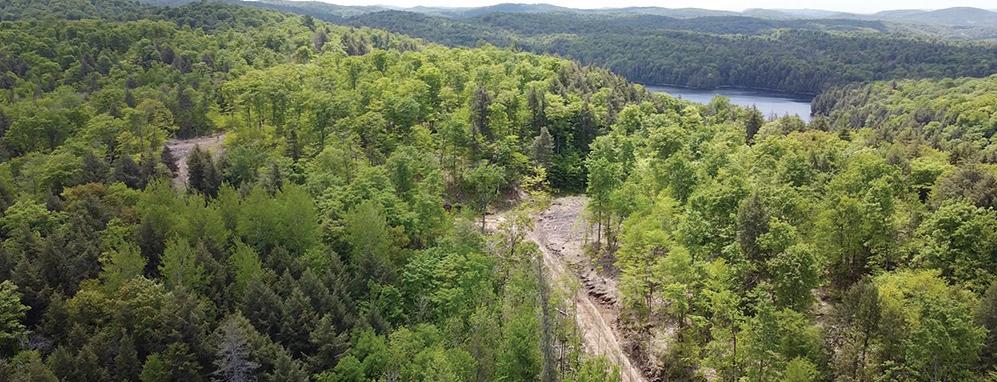 BY CECILIA JAMASMIE
The United States and Canada are, for the first time, joining forces to support the development of critical mineral mines by Canadian companies as both governments step up efforts to reduce their reliance on Chinese supplies of energy transition minerals.
Graphite junior Lomiko Metals (TSX: LMR) has been granted about $15 million — $3.6 million from Ottawa and US$8.4 million from Washington — to advance its La Loutre project in southeastern Quebec.
“To achieve these concurrent Canadian and American funding opportunities is a win for Quebec, Canada, and the United States as we approach a next phase of studies,” Lomiko CEO Belinda Labatte said in a statement.
“It will help advance supply chain resilience and create job opportunities in Canada,” Labatte added. Lomiko’s mine is also
expected to generate high-quality graphite for defense applications and the growing electric vehicle (EV) market in North America.
The other Canadian junior to receive a shot in the arm is Fortune Minerals (TSX: FT; US-OTC: FTMDF) which had already been granted funds — last December and in March this year — to advance its longstanding NICO cobalt-gold-bismuth-copper project in the Northwest Territories.
The Canadian contribution is part of a larger US$2.8 billion fund for the critical minerals sector that was announced in the Canadian federal government's 2023 budget.
The U.S. portion comes from the Department of Defense, acting under the Defense Production Act created by President Joe Biden in 2022.
The funding to both companies follows Washington’s decision in mid-May to slap major new tariffs on Chinese EVs, advanced batteries, solar cells, steel, aluminum and medical equipment. TNM
Kenorland stock surges as Centerra Gold takes 9.9% stake
M&A | $9.9M to be spent on exploration
BY JACKSON CHENCenterra Gold (TSX: CG) is taking a 9.9% stake in Kenorland Minerals (TSXV: KLD; US-OTC: KLDCF), joining Sumitomo Metal Mining as one of the junior's biggest investors.
Centerra is acquiring the interest in Kenorland by participating in a $9.9-million private placement financing. Kenorland plans to issue roughly 8.3 million flowthrough common shares to subscribers in Quebec, Manitoba and elsewhere in Canada at different prices. The average issue price will be $1.186 per share.
Kenorland’s shares surged to a 52-week high of 90¢ on the news. The company has a market capitalization of $54.6 million.
Kenorland said it will use the funds to advance its exploration projects across Canada, many of which are under partnerships.
The company is already working with Centerra on the Hunter project in Quebec. Centerra can earn an initial 51% interest in Hunter by spending $5 million on exploration
and a further 19% by delivering a million-ounce resource.
“Having partnered with Centerra on the Hunter project since 2022, we look forward to continuing to build on this relationship as we expand our exploration footprint in North America,” CEO Zach Flood said in a news release.
“The proceeds of this premium financing will go directly towards advancing, and expanding upon, multiple greenfields exploration initiatives, including the completion of several large-scale, property-wide and follow-up geochemical surveys in Quebec, Ontario and Manitoba.”
In addition to Centerra, the company is working with majors including Newmont (TSX: NGT; NYSE: NEM; ASX: NEM), Freeport-McMoRan (NYSE: FCX), Barrick Gold (TSX: ABX; NYSE: GOLD) and Antofagasta (LSE: ANTO) on various projects. It had also partnered with Sumitomo on the Frotet gold project in Quebec, before converting its JV interest into a 4% net smelter return royalty in January. TNM
‘Counterproductive’
review derails $130M Zijin deal, Solaris says
CRITICAL MINERALS | Junior blames slow review process in Ottawa
BY HENRY LAZENBYSolaris Resources (TSX: SLS; NYSE: SLSR) on May 21 cancelled a $130-million investment by China’s Zijin Mining Group after the financing got stuck for four months in the Canadian government’s national security review. The company said that its stock price has risen by 35% since the deal, priced at a 14% premium, was announced. As such, the deal “no longer adequately reflects market value.”
The investment, first announced in January and priced at $4.55 per share, would have given Zijin a 15% stake in Solaris and its Warintza project in southeast Ecuador.
“That this transaction cannot be completed in a reasonable timeframe signals that Canada’s critical minerals policy is counterproductive in relation to foreign assets,” Solaris president and CEO Daniel Earle said in a news release.
The deal would have provided enough capital for Solaris to deliver a larger and more technically robust project, and been seen as a strong endorsement, according to BMO Capital Markets mining analyst Rene Cartier.
Foreign involvement in Canada’s natural resources sector has faced increased scrutiny, particularly after Russia’s invasion of Ukraine underscored the risks of relying on energy supplies from hostile nations.
In November 2022, the Canadian government ordered three Chinese companies to divest their investments in Canadian lithium mining companies, citing national
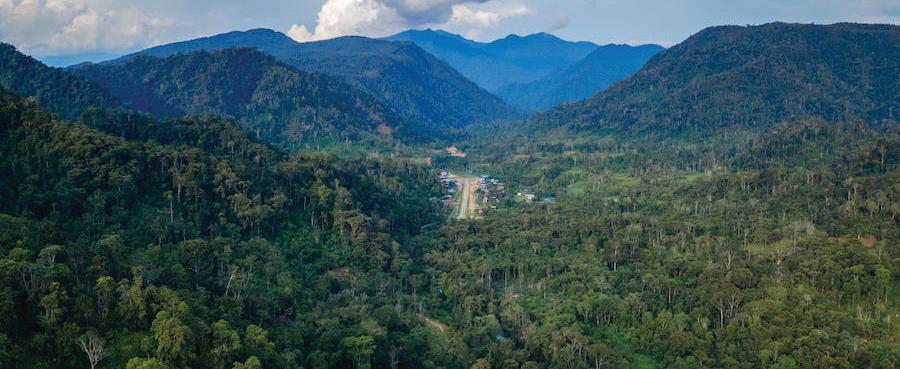
security concerns.
The U.S. and Canada have begun making joint investments in Canadian critical minerals companies to strengthen North American supply chains. At the same time, the U.S. has imposed new tariffs on Chinese critical minerals, citing unfair trade practices by China.
Solaris shares fell after the news and were down 10.1% to $4.67 apiece before press time, giving it a market capitalization of $706.4 million. Its shares traded in a 52-week range of $3.61 and $6.62.
In a separate statement on May 21, Solaris said it had agreed to sell 7.2 million shares at $4.90 each for about $35 million, with an option to sell another 1 million shares, to fund exploration and drilling at Warintza. The offering was expected to close on June 10.
Focus on catalysts
With Zijin out of the picture, Solaris can use its improved flexibility going forward to deliver on critical catalysts at Warintza, BMO’s Cartier said. The deal would have resulted in more equity dilution at a lower share price.
Solaris remains funded for its 2024 and 2025 baseline Warintza
programs, the analyst says. The company has about $29 million in cash on its balance sheet and about $40 million available through the US$80 million in funding from Orion Mine Finance Management signed in December.
Upcoming milestones for Solaris include an updated resource estimate, expected in early July. Its 2024 exploration program comprises 30,000 metres of resource growth and infill drilling.
Warintza’s central deposit has 579 million indicated tonnes grading 0.47% copper, 0.03% molybdenum and 0.05 gram gold per tonne (0.59% copper equivalent), according to an April 2022 resource update. It has 887 million inferred tonnes grading 0.39% copper, 0.01% molybdenum and 0.04 gram gold (0.47% copper equivalent).
An Ecuadorian consultant will direct an environmental impact assessment, which is scheduled for delivery by the second half of this year. A prefeasibility study is expected by the second half of 2025. Solaris has also started fieldwork on a 4,000-sq.-km plot next to Warintza, which the Ecuadorian state-owned mining company has given it the option to buy. TNM
Fortune Minerals secures $16M in Canada, US funding
NWT | NICO project holds three critical minerals
BY JACKSON CHENShares of Fortune Minerals
(TSX: FT; US-OTC: FTMDF) hit a 52-week high on May 16 after the critical minerals developer announced it had secured additional funding from the Canadian and United States governments for its flagship NICO project.
The domestic funding, courtesy of Natural Resources Canada, amounts to $7.5 million for the cobalt-gold-bismuth-copper project in the Northwest Territories. This is expected to cover 75% of the $10 million in additional engineering and test work for the project, Fortune said.
Separately, the company has been awarded US$6.3 million ($8.6 million) by the US Department of Defense to expand the capacity and production of cobalt for the battery and high-strength alloy supply chain. This grant was delivered under the Defense Production Act Title III program. It also received $714,500 of federal investment in March to help it produce cobalt sul-
phate and bismuth.
The total amount of non-dilutive funding that Fortune expects to receive is $16.2 million. This important cross-border initiative, says the company, is aligned with the Canada-U.S. joint action plan on critical minerals.
“The demand for critical minerals needed for the energy transition requires new vertically integrated domestic production from non-traditional ores and concentrates. Bilateral Canadian and U.S. government investment is therefore important to align mineral production with changes in new technologies, ensure security of supply, and support North American industrial competitiveness," Fortune CEO Robin Goad said.
Fortune Minerals shares rose 37% to 13¢ apiece on May 27, touching a new 52-week high. Its market capitalization is $62.1 million.
Advanced-stage asset
NICO is an advanced-stage project located 160 km northwest of Yellowknife. Anchoring the mine is a cobalt-gold-bismuth-copper
deposit containing 33.1 million tonnes in total reserves grading 0.11% cobalt, 1.03 gram gold per tonne, 0.14% bismuth and 0.04% copper.
Fortune, which first discovered the asset in 1996, plans an open pit and underground mine, plus an onsite concentrator. It aims to deliver a vertically integrated operation by building a hydrometallurgical refinery in Alberta that will process concentrates from NICO to produce cobalt sulphate, gold doré, bismuth ingots and copper.
To date, Fortune has spent more than $137 million to advance NICO to a near shovel-ready project with a positive feasibility study in 2014, which it expects to update this year, and environmental assessment approval and the major mine permits for the facilities in the territory. With 12% of global bismuth reserves, NICO could provide a domestic alternative for products used in the automotive and pharmaceutical industries. It also contains more than 1 million oz. of gold as co-product to mitigate critical mineral price volatility. TNM
GLOBAL MINING NEWS THE NORTHERN MINER | JUNE 2024 17
Lomiko Metals' La Loutre graphite project in Quebec. LOMIKO METALS
Solaris Resources' Warintza copper-gold project in Ecuador. SOLARIS RESOURCES
projectupdates
Power Nickel outlines ‘special’ new discovery at Nisk
QUEBEC | High-grade assays lift junior’s shares
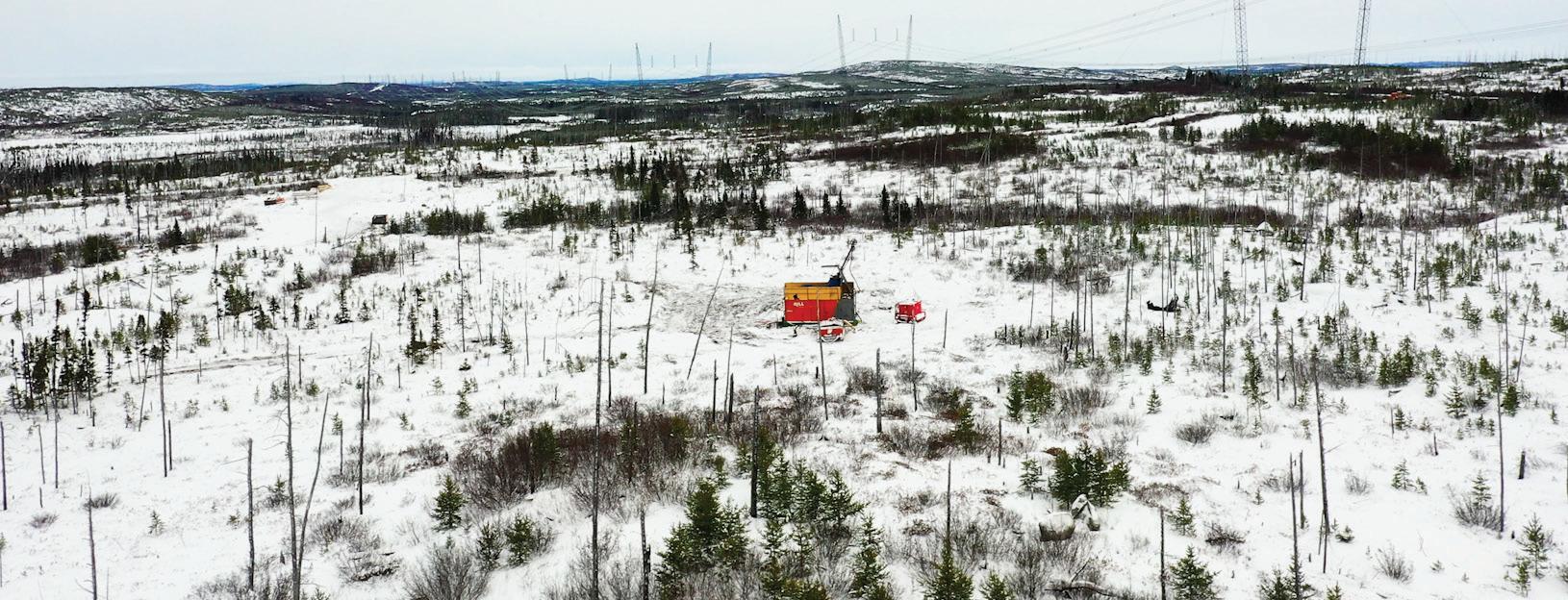 BY JAX JACOBSON
Power Nickel (TSXV: PNPN; US-OTC: PNPNF) reported more high-grade drill results from the recent Lion discovery at its Nisk project in Quebec in May, sending its shares nearly 13% higher to 70¢ apiece.
Drill hole PN-25-055 returned 15.4 metres of 0.44 gram gold per tonne, 22.04 gram silver, 5.06% copper, 13.12 grams palladium, 3.35% platinum and 0.015% nickel (9.5% copper equivalent) from 75.5 metres depth.
The intersection contained 5.1 metres of 0.61 gram gold per tonne, 50.29 grams silver, 13.27% copper, 24.62 grams palladium, 6.73 grams platinum and 0.33% nickel.
In turn, that section contained 3.4 metres of 0.7 gram gold, 60.36 grams silver, 17.26% copper, 25.02
grams palladium, 3.61 grams platinum and 0.37% nickel.
“This is a special discovery. These are big intersections to be that high grade and we are seeing a pattern here,” Power Nickel CEO Terry Lynch said in a new release on May 21. “This intersection is in the highgrade wheelhouse that is plus or minus 100 metres wide and seems to have a prospective mineralized halo around it of 50-70 metres.”
Power Nickel completed 15 holes at Lion as part of its winter drilling program; its summer drill program will continue at Lion to follow up on these holes, which mark its deepest discovery at the site thus far.
In April, Power Nickel completed an 80% earn-in on Nisk from Critical Elements Lithium (CRE: TSXV), after filing a resource estimate in November.
The project hosts underground
resources of 4.9 million indicated tonnes grading 0.78% nickel, 0.05% cobalt, 0.42% copper, and 0.78 gram palladium per tonne for 38,300 tonnes nickel, 2,400 tonnes cobalt, 20,500 tonnes copper and 123,100 tonnes palladium.
Open pit resources total 519,000 indicated tonnes at 0.63% nickel, 0.04% cobalt, 0.3% copper and 0.56 grams palladium for 3,300 tonnes nickel, 200 tonnes cobalt, 1,600 tonnes copper and 9,400 tonnes palladium.
Power Nickel first optioned the project, located in the James Bay region of Quebec, in 2021. The Nisk deposit was first discovered by Inco, now Vale (NYSE: VALE) in 1962.
Power Nickel shares traded at 65¢ apiece at press time, giving it a market cap of $106.7 million. The shares have traded in a 52-week range of 18¢ to 73¢. TNM
US$1B project forces Horizonte into administration
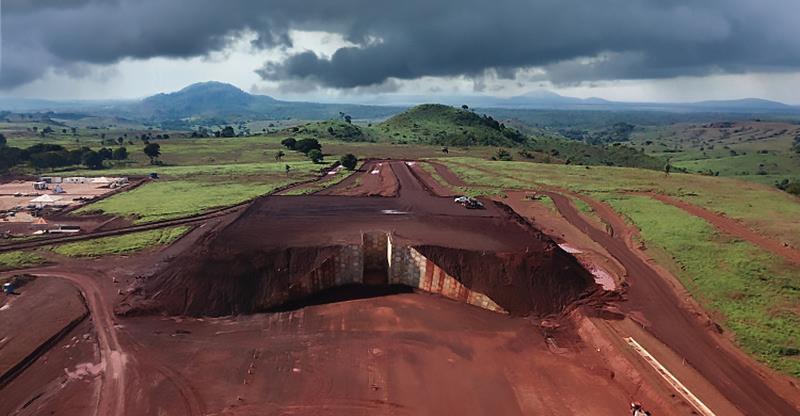 BY BRUNO VENDITTI
Horizonte Minerals (TSX: HZM; AIM: HZM), backed by Glencore (LSE: GLEN) has been placed into administration following its failure to secure the necessary financing to finish building its US$1 billion Araguaia nickel project in Brazil.
Horizonte’s board has appointed Geoff Rowley and Chad Griffin from FRP Advisory as administrators. Their mandate is to assess the company’s situation to secure the best possible outcome for its creditors. This decision seeks to maintain the business’s value for creditors and other stakeholders.
Discussions with secured creditors and existing and potential new investors regarding alternative scenarios will continue, Horizonte said.
Potential outcomes include raising financing at the subsidiary level, disposing of the Araguaia project while it’s in care and maintenance, liquidating the project’s assets, or considering other options available under Brazilian law.
Horizonte has already requested a suspension of trading in its ordinary shares on the London Stock Exchange.
The company began construction of the mine, located in Pará State, in May 2022, with the aim of producing up to 29,000 tonnes of nickel a year for the stainless steel market.
In April, however, it announced that it had failed to secure the additional financing needed to complete the construction of the project, following an 87% increase in the estimated cost to build the mine to more than US$1 billion. TNM
BY BLAIR MCBRIDEPatriot Battery Metals (TSX: PMET; US-OTC: PMETF; ASX: PMT) has found a new, high-grade zone at its CV13 target, part of its Corvette lithium project in Quebec.
On May 6, the company reported just one hole from CV13 that returned 34.4 metres of 2.9% lithium oxide (Li2O) from 130.9 metres depth, including 21.9 metres grading 3.58% Li2O from 143.5 metres downhole. The interval (CV24470) included 15 high-grade samples of more than 3% Li2O, eight samples at more than 4% Li2O and five grading higher than 5% Li2O. The highest-grade interval cut 6.33% Li2O over 0.9 metre.
The results sent Patriot shares up more than 20% to $8.12 on May 7.
Hole CV24-470 was among 166 holes drilled at CV5 and CV13 as part of Patriot’s 2024 winter drilling program. The assays came almost one week after the company reported similarly high-grade assays from the project’s main CV5 pegmatite.
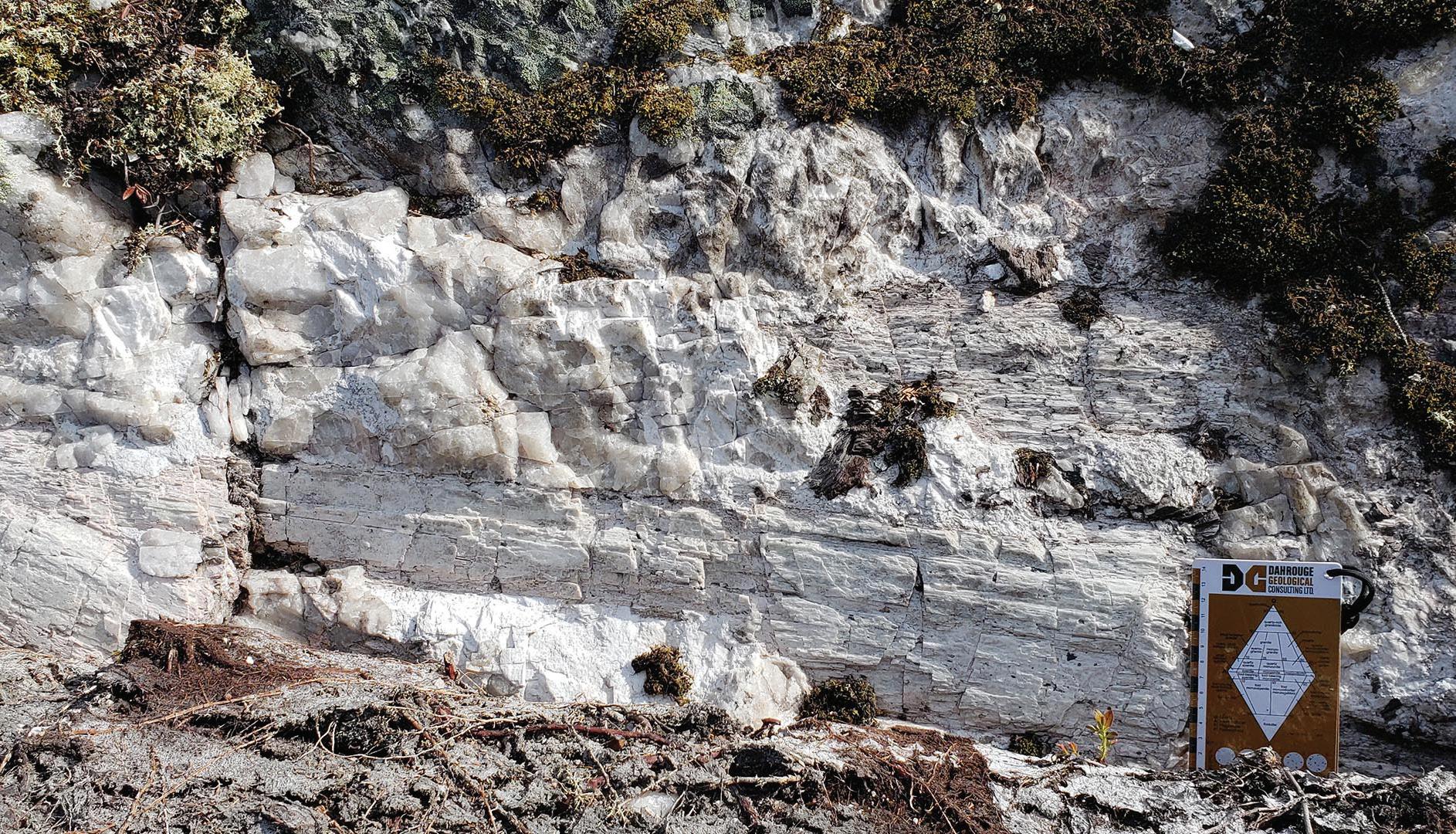
“To put it mildly, the team is very excited about this new highgrade discovery at CV13, which is open in multiple directions and broadens our view on potential in the area significantly,” Darren L. Smith, Patriot’s vice-president of exploration said. “This hole (CV24470) is the widest, most well-mineralized drill hole to date from CV13 and includes multiple samples over 5% Li2O. This discovery supports
our belief that we continue to only scratch the surface of what Corvette has to offer.”
Patriot shares climbed even higher, to $9.60 apiece on May 17, after the company reported more high-grade results at CV5.
Highlights included hole CV24405, which returned 122.5 metres grading 1.42% Li2O, including 35.8 metres at 2.15 Li2O from 148.7 metres depth. Hole CV24-435 cut 71.4 metres at 1.57% Li2O, including 14.2 metres at 3.15% Li2O from 256.2 metres. And hole CV24-414 returned 68.7 metres at 1.56% Li2O and 22.5 metres at 1.04% Li2O from 109.4 metres downhole.
The infill drilling at CV5 continues to meet expectations, Smith said.
“Coupled with the new highgrade discovery at CV13, the 2024 winter program’s results continue to demonstrate the quality and scale on show at Corvette,” he said. An initial resource for CV13, which extends for at least 2.3 km, is slated for the third quarter, along with a resource update for CV5. CV13 lies about 3 km southwest of CV5, in Quebec’s Eeyou Istchee James Bay region. CV5 holds 109.2 million inferred tonnes at 1.42% Li2O, and 160 parts per million tantalum, according to an initial resource from last June. That amounts to 1.6 million tonnes of contained Li2O, or 3.8 million tonnes of lithium carbonate equivalent. It’s said to be the largest lithium pegmatite resource in the Americas.
Of the 166 holes (62,518 metres) in the winter drilling program now completed, 121 (or 50,961 metres) were at CV5 and 45 (11,557 metres) were at CV13. Another 111 holes remain to be reported.
Patriot shares traded at $8.52 at press time, giving it a market capitalization of $1.6 billion. Its shares traded in a 52-week range of $5.77 and $9.76. TNM
18 JUNE 2024 | THE NORTHERN MINER www.northernminer.com
Horizonte Minerals' Araguaia project in Para state, Brazil. HORIZONTE MINERALS
NICKEL | Construction at Araguaia halted
Patriot uncovers new high-grade
Corvette QUEBEC | Shares hit five-month high after more strong results at CV5
lithium zone at
Winter drilling at Power Nickel's Nisk project in the James Bay region of Quebec. POWER NICKEL
Pegmatites at Patriot Battery Metals' Corvette lithium project in Quebec. PATRIOT BATTERY METALS
Solitario soars on gold finds in South Dakota
EXPLORATION | Sampling points to three new zones
BY JACKSON CHENSolitario Resources’ (TSX: SLR; NYSE: XPL) share price surged to its highest in over three years on May 17 after the discovery of multiple high-grade gold zones at its Golden Crest project in South Dakota.
The new zones — named Holland, Top Dollar and Wildcat — yielded gold values as high as 57.9, 50.2, 42.7, 32.3 and 21.1 grams per tonne gold from reconnaissance rock sampling of outcrop, sub-crop and float, the company said.
These results are among the highest-grade samples collected during a first-pass sampling program at a newly discovered target zone in the history of Golden Crest, CEO Chris Herald said.
He went on to say that there is a high probability that these three zones may coalesce into a single massive zone with additional work. Drilling is being planned for early June.
The three new gold zones, all at surface, are found within an area of about 4 sq. km, between the Downpour and Sleeping Beauty targets. All five zones are located on Solitario's new Ponderosa plan of operations in the easternmost portion of the Golden Crest property.
The Ponderosa area is a contiguous group of claims separate from
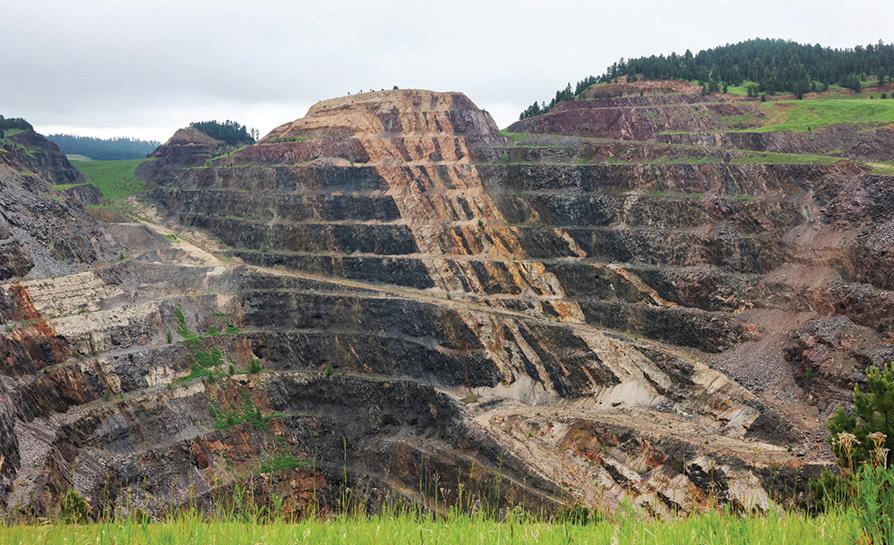
and not covered by the original Golden Crest plans, but is a part of Solitario's 100%-owned Golden Crest project area in South Dakota. The new Ponderosa plan of operations proposes low-impact core drilling to test these new gold targets.
At press time, shares of Solitario traded at $1.22 apiece, for a market capitalization of $100.3 million. Its shares traded in a 52-week range of 65¢ and $1.29.
Target-rich project
Solitario acquired the Golden Crest project, located in a gold district with historic production from mines that included Homestake, in August 2021.
Q2 Metals extends mineralization at Mia in Quebec
EXPLORATION | Drill program probes 10-km trend in James Bay region
Classified as a rare kind of gold deposit that contains more than 58 million oz. and known as a super giant, Homestake produced over 42 million oz. between 1876 and 2001. The mine’s previous owner identified five drainage areas in the western part of the district with anomalous gold, four of which had completely unexplained bedrock gold sources, outside of known mined areas.
Solitario now controls all four of these likely gold sources. All of its land holdings are along the western and southwestern extensions of the Homestake-Wharf mining district that has produced around 52 million oz. of gold and contains another 30 million oz. in historical resources. TNM
Troilus Gold shares fall on Quebec project feasibility
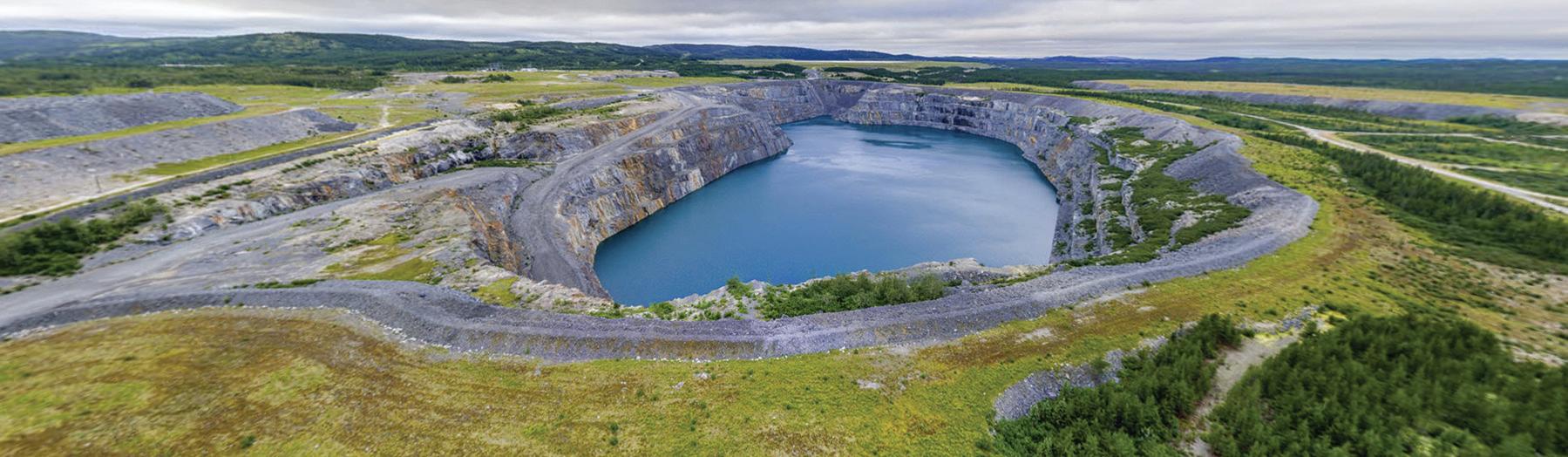 BY JACKSON CHEN
Troilus Gold (TSX: TLG) shares lost more than 12% of their value after it released a feasibility study on May 14 outlining an open-pit gold-copper operation in Quebec with capital costs that outstripped its net present value (NPV) by 21%.
The Troilus project has an estimated post-tax NPV (at a 5% discount) of US$884.5 million in a base case scenario, with initial development capital costs of nearly US$1.1 billion. The study calculated its internal rate of return (IRR) at 14%, reflecting long-term forecast prices of US$1,975 per oz. gold, $4.05 per lb. copper and US$23 per oz. silver.
"The (study) outlines a generational-scale asset, with a 22-year mine life and compelling economics, both at discounted and current metal prices," Troilus CEO Justin Reid said. "The project has reasonable capex and capital intensity,
including bottom quartile operating costs among the major Canadian gold mines."
Troilus Gold shares fell to 41¢ on the news. They traded at 39¢ apiece at press time, for a market capitalization of $109.6 million.
In May, copper, gold and silver all touched highs not seen in years, with copper hitting US$5.20 per lb., its highest in more than two years; gold trading at a historic high of US$2,426 per oz. on May 20; and silver rising to nearly US$32 per ounce.
The feasibility study gives the Troilus project a payback period of 5.7 years, based on cumulative aftertax cash flows of US$2.2 billion. It would produce 5.4 million oz. of gold, 382 million lb. of copper and 9.9 million oz. of silver over its life.
Average annual production of payable metal is pegged at 244,600 oz. of gold, 17.3 million lb. of copper and 446,700 oz. of silver annually, peaking at 456,100 oz. gold, 31.8 million lb. copper and 613,600
oz. silver in year seven.
With the feasibility study complete, Troilus will now move towards the project's environmental and social impact assessment, which it hopes to complete by the end of this year. Also in progress are the provincial and federal permitting processes, which it began in May 2022.
The company is also continuing exploration of the 435-sq.-km property in north-central Quebec with an eye to expanding the scale of the project. The proposed openpit mine will have a processing capacity of 50,000 tonnes per day, a 43% increase on the 35,000 tpd contemplated in the 2020 preliminary economic assessment.
Mining will occur from four main zones of mineralization that together hold 380 million tonnes in reserves grading 0.49 gram gold per tonne, 0.058% copper and 1 gram silver. Contained metal totals 6 million oz. gold, 484 million lb. copper and 12.2 million oz. silver. TNM
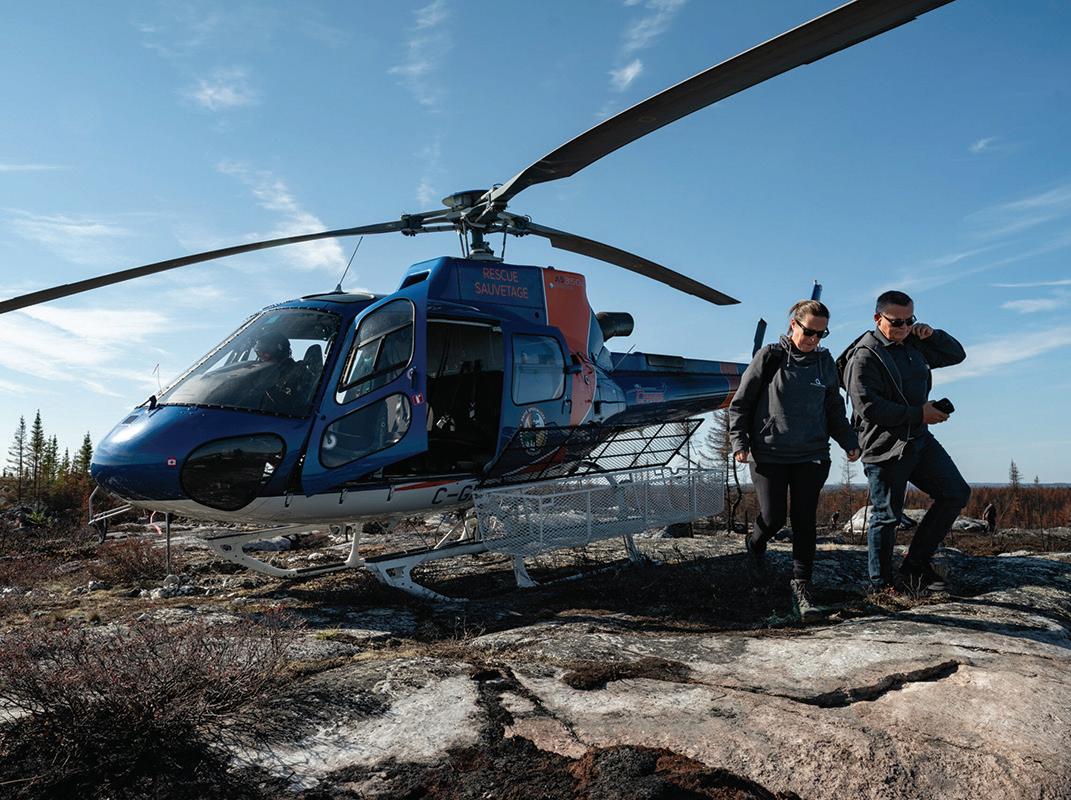 BY COLIN MCCLELLAND
Q2 Metals (TSX.V: QTWO; US-OTC: QUEXF) says winter drill results confirmed mineralization across several zones at the Mia lithium project in northern Quebec.
Highlights include drill hole MIA24-033, which cut 13.7 metres grading 1.28% lithium oxide (Li2O) from 88.9 metres depth, including 9.1 metres at 1.79% Li2O from 89.9 metres downhole, the company said on May 10.
Drill hole MIA24-039 returned 8.8 metres at 1.33% Li2O from 39.5 metres depth, including 5.8 metres grading 1.71% Li2O.
The 87-sq.-km property is located in the Eeyou Istchee James Bay territory, 22 km from the Billy Diamond Highway, near a major hydro-power line and all-season road infrastructure.
The company completed 8,685 metres over 50 drill holes at Mia in its fall and winter drill programs. The more recent campaign focused on the western end of the Mia trend.
The Mia trend comprises a roughly 10-km-long series of sub-parallel pegmatite intrusions, of which 11 are mineralized with spodumene at surface, Q2 said. The individual pegmatite bodies vary in thickness between a few metres and more than 20 metres in some cases.
“Our modest winter drill program continued to successfully confirm the continuity of the mineralization encountered during our fall drill program at the Mia 1, 2 and 3 zones,” Neil McCallum, vice-president of exploration, said in a release.
“These results have provided us with information about what is happening across the broader Mia trend and will be used to vector towards areas where we will test for thickening and higher-grade mineralization.”
Q2 plans two weeks of mapping and sampling this summer to probe for an extension of the Mia trend, as well as the Bruce and Lady trends identified late last year. Q2 logged several high-priority targets with high-resolution aerial imagery and LiDAR data, but last year’s severe fire season shortened the company’s time in the field.
Drill results at the Mia zone confirmed spodumene mineralization within a continuous pegmatite zone that dips gently to the north.
Cisco property
The company is also planning to start drilling this season on the 113-sq.-km Cisco property, about 250 km south of Mia. It bought two sets of claims on the site in February for a total of $2.4 million, 60 million shares and $12 million in exploration spending. It re-analyzed drill core results done by the previous owners last fall with slightly stronger results.
Drill hole CS-23-05, previously reported at 1.21% Li2O, returned 115.4 metres grading 1.4% Li2O and 139 parts per million (ppm) of tantalum. Hole CS-23-06, previously reported at 1.27% Li2O, cut 7.8 metres at 1.44% Li2O and 130 ppm tantalum.
Six holes totalling 1,287 metres at one of six mineralized zones were completed, confirming a strike length of about 220 metres open along strike and down-dip.
Gentle dip
Drill results at the Mia zone confirmed spodumene mineralization within a continuous pegmatite zone that dips gently to the north, the company said. The mineralized zone extends roughly 600 metres east-west and roughly 375 metres north-south. The pegmatite body appears to be open to the west, east and north.
Drilling showed some grade variability at the northern portions of the pegmatite at depth, with several holes lacking significant lithium grades, it said. Shares in Q2 Metals traded at 30¢ apiece at press time, valuing the company at $26.9 million. Its shares have traded in a 52-week range of 17¢ to $1.08. TNM
GLOBAL MINING NEWS THE NORTHERN MINER | JUNE 2024 19
projectupdates
At Q2 Metals' Mia lithium project in northern Quebec. Q2 METALS
STUDY | Capital costs exceed net present value by 21%
The Homestake mine in Lead, South Dakota. ADOBESTOCK
The Z87 pit at Troilus Gold's namesake project in Quebec. TROILUS GOLD
eye on australia
Oz budget projects mining-linked surplus
POLICY | New industry incentives met with lukewarm response
BY HENRY LAZENBYFor the second consecutive year, the Australian government has announced a budget surplus mainly owing to a vibrant mining sector, this time projected at A$9.3 billion, though some in the mining industry say it falls short.
The budget, unveiled in May, included new supports for the sector, including the critical minerals production tax incentive (CMiPTI). The A$7-billion initiative over 10 years provides a 10% refundable tax offset on eligible processing costs for critical minerals, starting July 2027.
“A CMiPTI is the cornerstone of the ‘Future Made in Australia’ strategy and sends a clear message to Australians and the world that Australia means business,” Warren Pearce, CEO of the Association of Mining and Exploration Companies (AMEC), said in a statement.
The 2024-25 budget also includes A$566.1 million over 10 years for geological mapping and introduces the A$10.2million Critical Minerals National Productivity Initiative (CMNPI) that will identify potential facilities for downstream processing, recycling and reprocessing
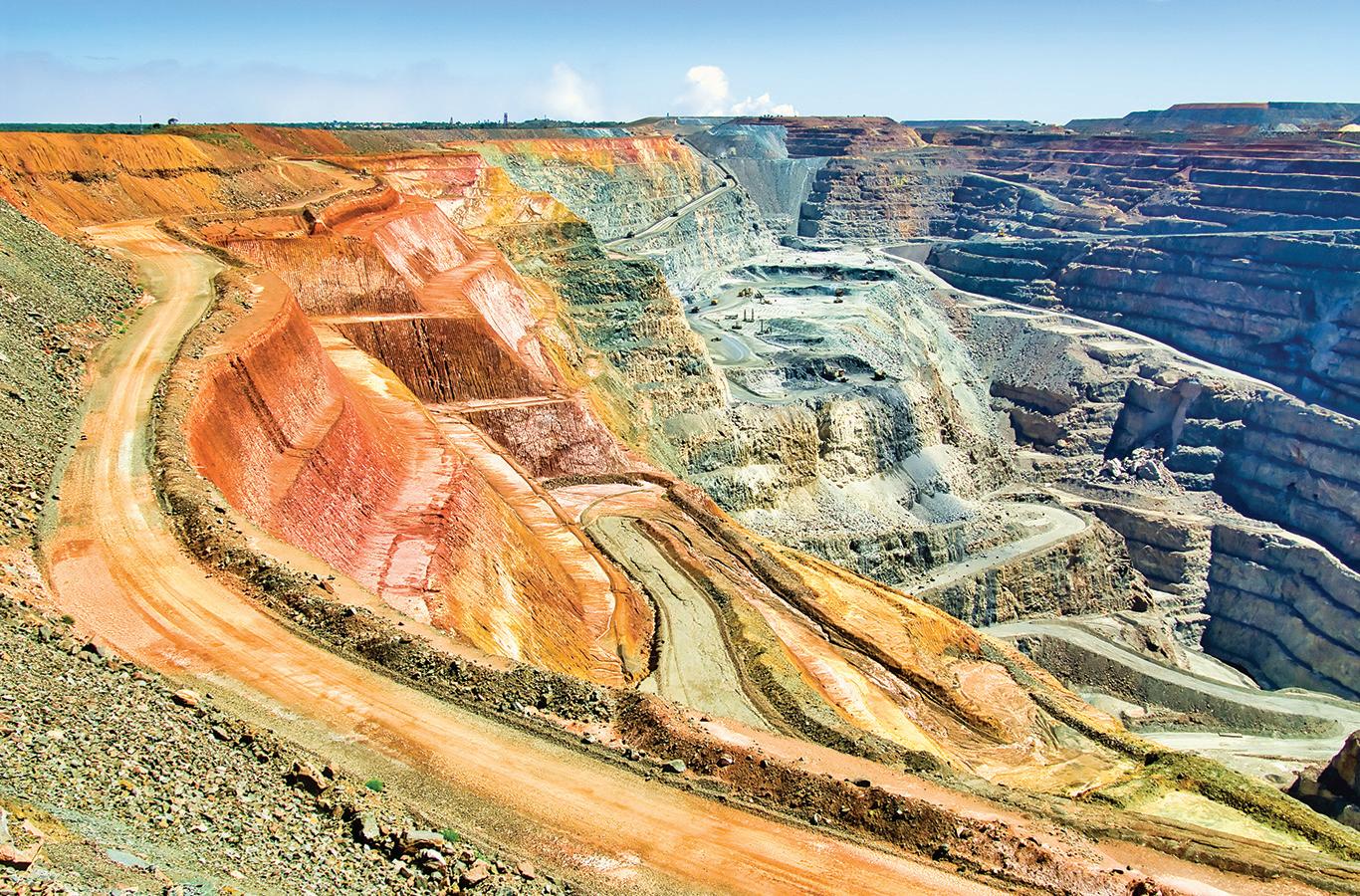
efforts. Like the United States and Canada, Australia now also invests in the downstream components of projects, giving A$840 million to Arafura Rare Earths’ (ASX: ARU) Nolans project in the Northern Territory and A$400 million for the Alpha High Purity Alumina (ASX: A4N) project in Queensland.
Mining leader Australia is the world’s top lithium producer and home to major mining giants like BHP (ASX: BHP) and Rio Tinto (NYSE: RIO; LSE:
n Auto train derails
Rio Tinto (NYSE: RIO; LSE: RIO ASX: RIO) said on May 13 that one of its fully loaded autonomous iron ore trains had crashed with a set of stationary wagons in Western Australia’s Pilbara region.
The incident, the second of its kind this year, took place about 80 km outside the town of Karratha. While there were no people within the vicinity and no injuries, 22 wagons and three locomotives were impacted, a Rio spokesperson told the Australian Broadcast Corp.
Australia’s Office of the National Rail Safety Regulator said a recovery train crashed into the driverless iron ore train it was dispatched to retrieve, after a mechanical failure.
An unloaded autonomous train derailed in February at the Dampier port, where Rio Tinto ships iron ore through Cape Lambert, involving 38 wagons.
A similar incident occurred with an autonomous Rio Tinto train last June, when as many as 30 wagons left the tracks about 19 km from Dampier.
Rio Tinto’s peers, BHP (NYSE: BHP; LSE; BHP ASX: BHP) and Fortescue (ASX: FMG) have also reported derailments at their iron ore operations in recent months..
n Rinehart portrait row
Australian billionaire Gina Rinehart may have drawn more attention than she intended after she reportedly asked the country’s national gallery to remove a seemingly unflattering portrait of her.
The portrait is displayed alongside that of 20 other famous people in a single exhibition by Indigenous artist Vincent Namatjira. The exhibition opened at the National Gallery of Australia (NGA) in Canberra in March and will run until July 21.
The exhibition also features the late Queen Elizabeth II, American musician Jimi Hendrix, former Australia Prime Minister Scott Morrison, and even the artist himself. All portraits were painted in Namatjira’s distinctive style, which often employs humour and exaggerated features to interrogate the rich and powerful.
According to reports from news sources including the Sydney Morning Herald, Rinehart and her associates at Hancock Prospecting have made multiple approaches to the NGA to take down her portrait, found right next to Namatjira’s own portrait.
In response, the NGA told various media outlets that it would welcome the public’s dialogue on its collection and displays. The Gallery also shared a statement from Namatjira, who said his intention was to paint “people who are wealthy,
RIO ASX: RIO) which underscores its advanced status in the industry.
While Canada’s mining sector views Australia as a leader in critical minerals development and mining supports, critics in Australia’s industry said more could be done to ensure the country keeps its mining edge.
Minerals Council of Australia
CEO Tania Constable pointed to continued high land transfer, payroll and corporate rate taxes as growth barriers for the country’s miners.
“At a time when Australia grapples with decaying productivity and looming long-term structural fiscal deficits, the government is imposing regressive policies on the sector that dampen the investment growth critical to achieving our economic potential,” Constable in a statement. “Unfortunately, this budget only scratches the surface of what is needed to ensure the Australian minerals industry remains competitive.”
The current corporate tax rate of 30% is a deterrent for businesses to invest and innovate within Australia, Constable said. In comparison, Canada has a 15% corporate tax rate, and combined with provincial rates, the total ranges from about 23%-31%. In British Columbia, a major mining region, the combined rate is around 27%.
“More favourable returns can be found elsewhere, making it decisive to reconsider this rate,” she said.
The AMEC’s Pearce said Australia had to act swiftly in the race to decarbonize, pointing out that "doing nothing simply isn’t an option" to maintain Australia’s competitive edge.
No time to lose Constable flagged environmental approval uncertainties, long per-
powerful, or significant – people who have had an influence on this country, and on me personally, whether directly or indirectly, whether for good or for bad.”
In 2017, the mining magnate, now Australia’s wealthiest person, was also painted standing beside the artist in another standalone portrait in a separate series.
n Greatland weighs Havieron buyback
Greatland Gold (LSE: GGP) says it’s in a strong position to buy back a majority stake in the Havieron gold-copper project in Western Australia from Newmont (NYSE: NEM; TSX: NGT) if the gold giant decided to sell it.
Newmont owns 70% of Havieron, one of the assets the world’s largest gold miner said it might offload after it bought Australia’s Newcrest Mining in November.
The asset is Greatland’s main project and the Australian junior says it has a right of refusal over the Newmont interest in the event of a sale. Greatland discovered Havieron in 2018 and the company has been working on it since. The property is located 45 km from the Telfer mine, another former Newcrest asset that Newmont plans to sell.
Total underground development at Havieron to date exceeds 3,060 metres, representing nearly 80% of the vertical distance through to the top of the orebody.
If a feasibility study confirms viability and Havieron’s owners decide to mine it, the project will use the current Telfer infrastructure and processing plant. The move is expected to lower development risk and capital investment.
n NexGen taps Oz market
NexGen Energy (TSX: NXE; NYSE: NXE; ASX: NXG) has raised $224 million in the Australian market to fund the continued development of its Saskatchewan uranium projects.
The CHESS Depository Interests (CDIs) consisted of about 20.2 million shares at $11.11 per shares.
CDIs are instruments that allow companies incorporated outside of Australia to trade on the Australian Stock Exchange.
NexGen’s properties include the Rook I project that hosts the Arrow deposit, in Saskatchewan’s Athabasca Basin. Arrow is considered to be the largest development-stage uranium deposit in Canada.
A 2021 feasibility study for Rook 1 outlined an initial 11year mine capable of producing 29 million lb. of uranium
mitting times, rising energy costs, and recent changes to industrial relations policies as reducing the country’s investment allure. New policies introduced by the Labor Party government include stricter rules on hiring, tougher workplace safety requirements, and giving unions more power.
This has led to higher compliance costs and more operational difficulties, making it harder for companies to stay competitive, she explained.
“The mining industry contributed over half of all company tax collected from large companies and continues to play a crucial role in funding the government services we rely on,” Constable said.
The CMiPTI and other initiatives may provide a short-term boost, but long-term competitiveness will require addressing structural challenges. As global competition intensifies, Australia must maintain its edge in the clean energy transition, leveraging its rich mineral resources to secure economic prosperity, she added.
The budget also seeks to improve trade partnerships, allocating A$5.8 million over three years and enhancing foreign interference safeguards with an A$1 million injection. TNM
oxide (U3O8) per year during the first five years. The initial capex is estimated at $1.3 billion.
In March, NexGen discovered uranium 3.5 km from its Arrow deposit. The new mineralization is on a previously untested conductor segment of the Patterson Corridor East.
n Lucapa to sell Mothae stake
Australia's Lucapa Diamond (ASX: LOM) is looking for buyers for its 70% stake in the Mothae mine in Lesotho, and is discussing options for the 30% held by the country’s government.
The diamond miner’s board said it was “considering all options for the divestment” and finalizing a data room for interested parties.
“On review, it is clear the company should streamline the portfolio to focus on our core assets in Africa and Australia,” chairman Stuart Brown said in a statement.
Lucapa expects there will be “significant interest” from those within the diamond industry and on a wider scale for Mothae, he added.
Production at Mothae, which the Perth-based company acquired in early 2017, began almost six years ago. It’s known to produce large, high-value diamonds, making it the world’s second highest dollar-per-carat kimberlite diamond mine.
According to Lucapa’s December 2023 figures, the mine has 180,000 carats of indicated resources and 960,000 carats of inferred resources, with a calculated value of US$606 per carat. It's located only 5 km from Gem Diamonds’ (LSE: GEMD) Letšeng, the world’s highest dollar-per-carat kimberlite diamond mine.
n Regis OKs new mines
Gold miner Regis Resources (ASX: RRL) has greenlit construction of two new underground mines, forecast to deliver between 100,000 oz. and 120,000 oz. of the precious metal per year from 2027.
The development of the Garden Well Main and Rosemont Stage 3 mines are part of the company’s strategy to expand underground operations at its Duketon project in Western Australia, Regis said.
Regis will spend between A$120 million and A$150 million (US$80 million to US$99 million) to build the new mines, with development starting immediately. First ore from stopes is scheduled between July and September of 2026.
20 JUNE 2024 | THE NORTHERN MINER www.northernminer.com
The Super Pit or Fimiston open pit, the largest open pit gold mine of Australia, along the Goldfields Highway in Kalgoorlie, Western Australia. ADOBESTOCK/HANS
mining, metals & markets

ETF assets 22 Global gold funds data
Capital raisings
Drill results
30 Mining events contents
Warrants & shorts
Market data
29 Market news
*Data may not be comprehensive and is provided on a best-efforts basis as of press time. Investors are responsible for their own due diligence.
Delivering fit-for-purpose solutions across the entire project life cycle
Delivering fit-for-purpose solutions across the entire project life cycle
Delivering fit-for-purpose solutions across the entire project life cycle
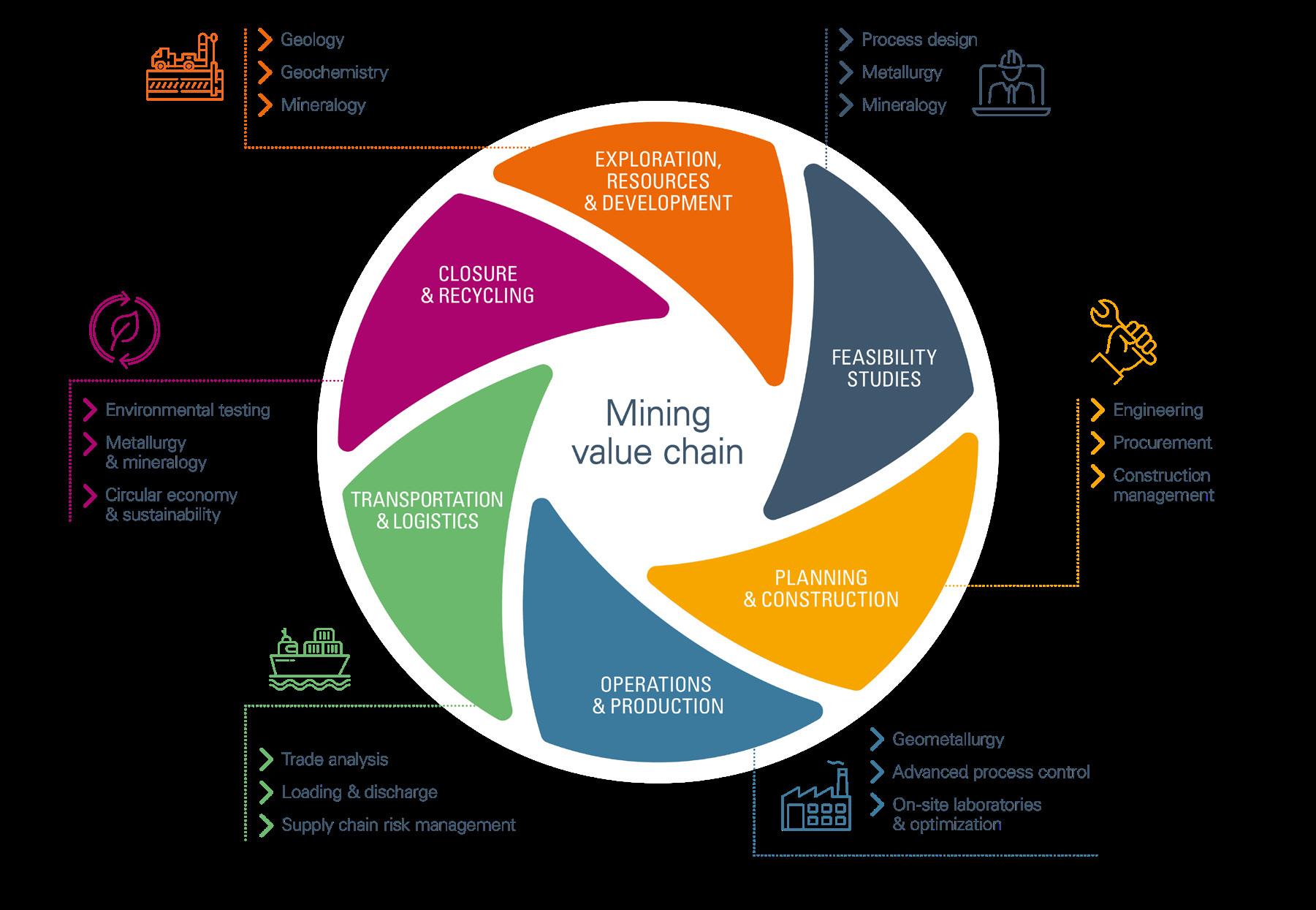
Our fit-for-purpose solutions encompass the skills of qualified geologists, geostaticians, analytical chemists, mineralogists, metallurgists, process engineers and mining engineers and inspectors brought together to provide accurate and timely mineral and process evaluation services across the entire project life cycle.
Our fit-for-purpose solutions encompass the skills of qualified geologists, geostaticians, analytical chemists, mineralogists, metallurgists, process engineers and mining engineers and inspectors brought together to provide accurate and timely mineral and process evaluation services across the entire project life cycle.
Our fit-for-purpose solutions encompass the skills of qualified geologists, geostaticians, analytical chemists, mineralogists, metallurgists, process engineers and mining engineers and inspectors brought together to provide accurate and timely mineral and process evaluation services across the entire project life cycle.
Our fit-for-purpose solutions encompass the skills of qualified geologists, geostaticians, analytical chemists, mineralogists, metallurgists, process engineers and mining engineers and inspectors brought together to provide accurate and timely mineral and process evaluation services across the entire project life cycle.
WWW.SGS.COM/NATURALRESOURCES NAM.NATURALRESOURCES@SGS.COM
WWW.SGS.COM/NATURALRESOURCES NAM.NATURALRESOURCES@SGS.COM
WWW.SGS.COM/NATURALRESOURCES
WWW.SGS.COM/NATURALRESOURCES NAM.NATURALRESOURCES@SGS.COM
GLOBAL MINING NEWS THE NORTHERN MINER | JUNE 2024 21
NAM.NATURALRESOURCES@SGS.COM Delivering fit-for-purpose solutions across the entire project life cycle
28
27
23
26
25
IMAGE: ADOBE STOCK/PETERSCHREIBER.MEDIA
2
1
1
22 JUNE 2024 | THE NORTHERN MINER www.northernminer.com
data Source: mineralfunds.com WORLD’S LARGEST GOLD EQUITY FUNDS: ASSET ALLOCATION AVERAGE ASSET ALLOCATION OF THE TOP 10 GOLD EQUITY FUNDS GLOBALLY Source: mineralfunds.com UNITED STATES | TOP FUNDS (USD) Rank Fund Name Sum of Assets 2024-05-15
gold fund
First Eagle Gold Fund $2.25B 2 Invesco Gold and Special $1.65B Minerals Fund (USA) 3 Fidelity Select Gold Portfolio $1.24B 4 Franklin Gold and Precious Metals $0.97B Fund (USA) 5 Sprott Gold Equity Fund $0.83B LUXEMBOURG | TOP FUNDS (USD) Rank Fund Name Sum of Assets 2024-05-15 1 BlackRock Global Funds $3.34B World Gold Fund 2 Konwave Gold Equity Fund $0.56B 3 Schroder International Selection $0.48B Fund Global Gold 4 Ninety One Global Gold Fund (Lux) $0.47B 5 CPR Invest – Global Gold Mines $0.45B UNITED KINGDOM | TOP FUNDS (USD) Rank Fund Name Sum of Assets 2024-05-15 1 BlackRock Gold & General Fund $1.18B 2 WS Ruffer Gold Fund $0.67B 3 Ninety One Global Gold Fund (UK) $0.36B 4 Quilter Investors Precious $0.33B Metals Equity Fund 5 SVS Sanlam Global Gold & $0.05B Resources Fund CANADA | TOP FUNDS (USD) Rank Fund Name Sum of Assets 2024-05-15
Dynamic Precious Metals Fund $0.73B
RBC Global Precious Metals Fund $0.42B
Dynamic Strategic Gold Class $0.14B
CI Precious Metals Fund $0.13B 5 Mackenzie Precious Metals Fund $0.11B FRANCE | TOP FUNDS (USD) Rank Fund Name Sum of Assets 2024-05-15 1 Crédit Mutuel CIC Global Gold $0.45B 2 Rothschilds et Compagnie Mines $0.20B d'or Thématiques 3 Ixios Gold Fund $0.10B 4 Amundi Actions Or $0.09B 5 Tocqueville Gold $0.06B IRELAND | TOP FUNDS (USD) Rank Fund Name Sum of Assets 2024-05-15 1 Jupiter Gold & Silver Fund $0.81B $10.47B $1.89B $2.62B 6.99B $1.00B $0.81B $1.71B 54.7% 55.6% 15.9% 13.7% 9.2% 8.4% 4.8% 5.6% 3.0% 5.3% 0.4% 0.8% 0.3% 0.1% 9.2% 8.2% Canadian Equities Australian Equities USA Equities South African Equities UK Equities China Equities Mexican Equities Cash & Bullion May 15, 2024 Sept. 30, 2023 TOP GOLD FUNDS BY DOMICILE MAY 15, 2024 | SUM OF ASSETS IN $ USD
CREDIT: JAMES ALAFRIZ
3
4
CREDIT: JAMES ALAFRIZ
CAPITAL RASINGS | 12-MONTH ROLLING AVERAGE
$2,500M
$2,000M
$1,500M
$1,000M
$500M
$0M
6/23–5/24 6/22–5/23
Investing in the Canadian Resource Sector at Reduced Cost of Capital
PearTree is a Canadian Securities Dealer and Investment Fund Manager advancing over (CAD) $500 million annually for resource exploration and mine development in a uniquely Canadian structure which results in as much as $2.00 of capital deployed for every $1.00 invested by global institutions and family offices.
Watch our video in English, Français, Deutsch, and Español on our website.
Expanding the universe of exploration capital.
GLOBAL MINING NEWS THE NORTHERN MINER | JUNE 2024 23 capitalraisings
JUN JUL AUG SEP OCT NOV DEC JAN FEB MAR APR MAY $705.47 $276.11 $526.32 $1,183.54 $279.48 $495.88 $1,423.68 $132.05 $1,956.98 $283.15 $962.93 $801.68 $657.29M $380.66M $362.09M $377.51M $1,573.53M $530.82M $792.63M $567.86M $558.46 $756.93 $598.43 $772.41
in USD peartreecanada.com
$ in USD $
2
4
24 JUNE 2024 | THE NORTHERN MINER www.northernminer.com capitalraisings $275.0M LITHIUM AMERICAS CORP. $1,582.4M RAISED APR 16, 2024 – MAY 15, 2024 $227.2M DE GREY MINING LTD. $219.1M EQUINOX GOLD CORP. $83.8M I‐80 GOLD CORP. $164.4M NEXGEN ENERGY LTD. $144.8M DEEP YELLOW LTD. $33.4M WESTERN COPPER AND GOLD CORP. $83.4M CALIBRE MINING CORP. $21.1 SNOWLINE GOLD CORP. $311.5M ALL OTHERS $18.7M ADVENTUS MINING CORPORATION TOP FINANCINGS CREDIT: NICHOLAS LEPAN/JAMES ALAFRIZ Rank Company Ticker Final Amount (US$) Closed Date Agents Activites Grade 1 Lithium Americas Corp. TSX: LAC $275,000,000 Apr 22, 2024 BMO Capital Markets|Canaccord Genuity Corp.| Cormark Securities Inc.|Eight Capital|Evercore ISI| Goldman Sachs & Co. LLC|J.P. Morgan|Scotiabank| Stifel Canada|Tuohy Brothers Exploration
De Grey Mining Ltd ASX: DEG $227,186,862 May 10, 2024 Argonaut PCF Limited|Argonaut Securities Pty Ltd| Azure Capital Limited|Canaccord Genuity (Australia) Ltd.| Gilbert + Tobin Exploration|Working Capital
Equinox Gold Corp TSX: EQX $219,136,632 Apr 26, 2024 BMO Capital Markets|Canaccord Genuity Corp.| CIBC World Markets Inc.|Cormark Securities Inc.| Desjardins Securities Inc.|Haywood Securities Inc.| ING Bank N.V.|Merrill Lynch Canada Inc.| National Bank Financial Inc.|RBC Dominion Securities Ltd.| Scotiabank|TD Securities Inc. Exploration
3
NexGen Energy Ltd TSX: NXE $164,385,683 May 14, 2024 Canaccord Genuity Corp. Exploration|Working Capital 5 Deep Yellow Ltd ASX: DYL $144,802,575 May 02, 2024 Aitken Mount Capital Partners|Bell Potter Securities| Jett Capital Advisors LLC Exploration|Working Capital
i-80 Gold Corp. TSX: IAU $83,836,429 May 01, 2024 BMO Nesbitt Burns|Canaccord Genuity Corp.| Cormark Securities Inc.|National Bank Financial Inc.| PI Financial Corp.|RBC Dominion Securities Ltd.| Scotia Capital Inc.|Stifel Nicolaus Canada Inc. Exploration| Working Capital 7 Calibre Mining Corp TSX: CXB $83,395,885 Apr 16, 2024 BMO Capital Markets|Canaccord Genuity Corp.| Cormark Securities Inc.|Haywood Securities Inc.| Scotia Capital Inc. Exploration|Working Capital 8 Western Copper & Gold Corp TSX: WRN $33,400,619 Apr 30, 2024 BMO Capital Markets|Canaccord Genuity Corp.| CIBC World Markets Inc.|Cormark Securities Inc.| Echelon Wealth Partners Inc.|Eight Capital| H.C. Wainwright & Co., LLC|Haywood Securities Inc.| National Bank Financial Inc.|Raymond James Ltd.| RBC Dominion Securities Ltd. Exploration|Working Capital
Snowline Gold Corp TSX-V: SGD $21,068,529 Apr 25, 2024 BMO Capital Markets|Canaccord Genuity Corp.| CIBC World Markets Inc.|Cormark Securities Inc.| National Bank Financial Inc.|Paradigm Capital Inc.| SCP Resource Finance LP Exploration 10 Adventus Mining Corp TSX-V: ADZN $18,682,595 May 01, 2024 Debt Reduction|Exploration| Working Capital https://soundcloud.com/northern-miner http://www.northernminer.com/tag/podcast/
6
9
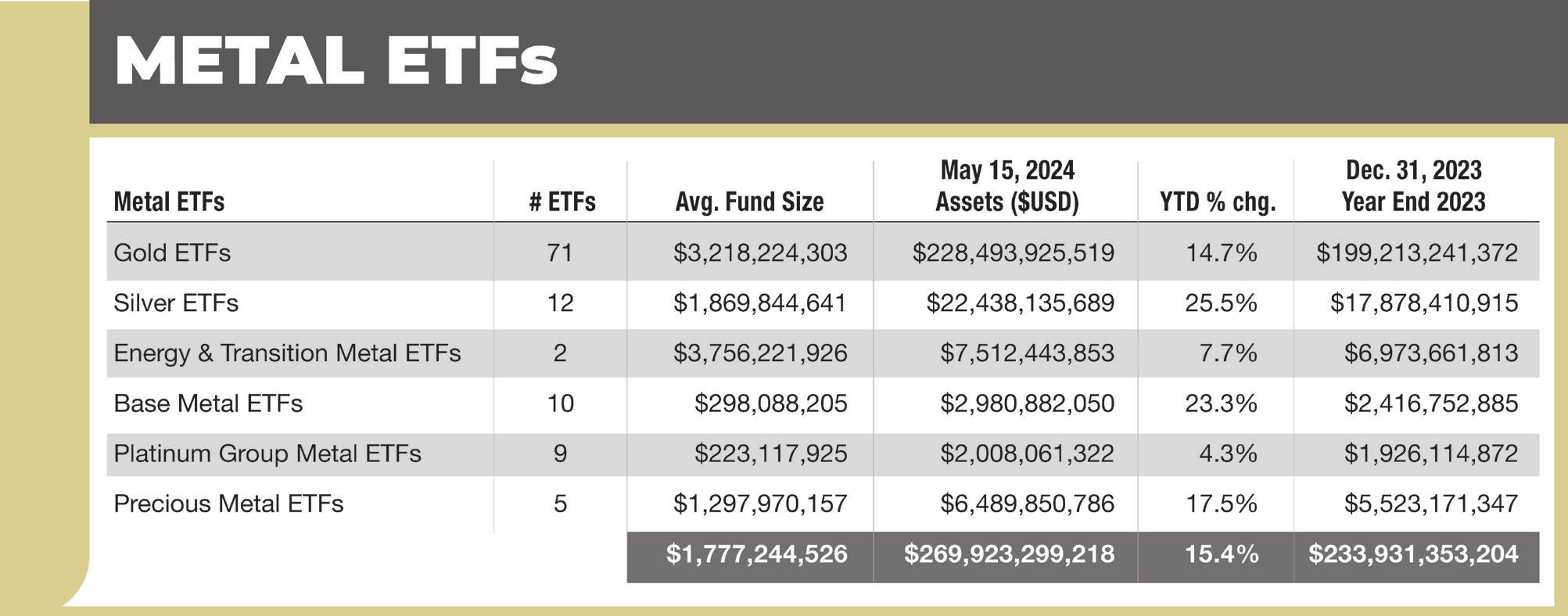
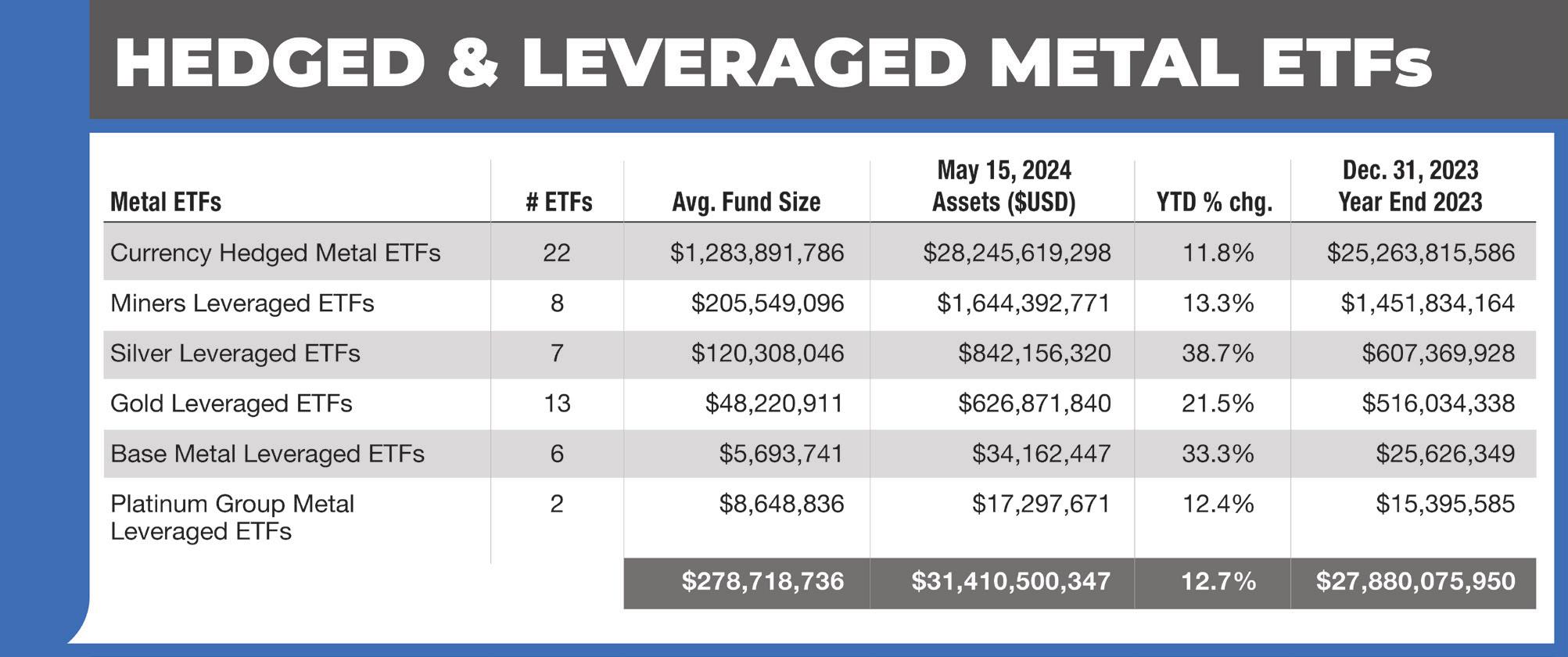
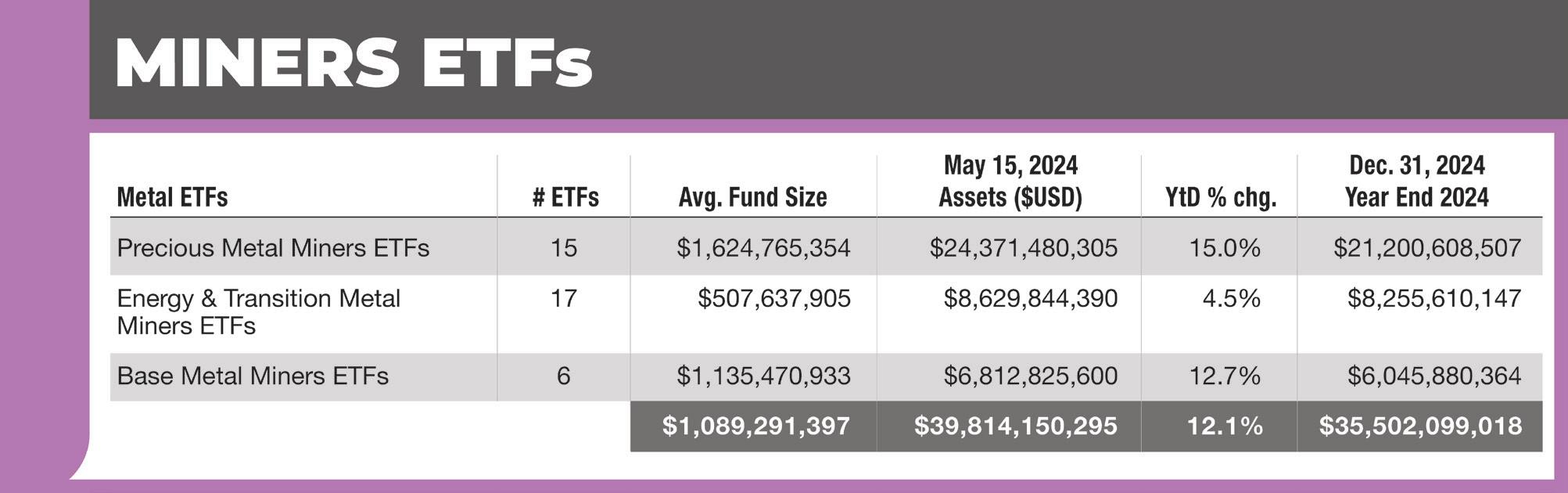
GLOBAL MINING NEWS THE NORTHERN MINER | JUNE 2024 25 ETFassets METALS & MINING SNAPSHOT $ IN USD TOTAL ETFS 205 $1,040,243,584 $341,147,949,860 14.7% $297,313,528,172 Gold Silver Energy + Transition Metal Platinum Group Metals Base Metals Gold Silver Base Metal Platinum Group Metals Currency Hedged Metals Precious Metals Base Metals Miners Energy & Transition Metal Miners Precious Metals Miners TOP TEN: MOST ACTIVE GOLD ETFs Source: mineralfunds.com Miners Leveraged SPDR Gold Shares iShares Gold Trust Invesco Physical Gold ETC iShares Physical Gold ETC Xetra-Gold Zurcher Kantonalbank Gold ETF Sprott Physical Gold Trust SPDR Gold MiniShares Trust WisdomTree Physical Gold Credit Agricole Amundi Physical Gold ETC $68.20B $5.19B Remaining Gold ETF Market $35.71B $5.46B $7.33B $7.53B $11.64B $17.12B $17.27B $18.14B $32.97B TOTAL GLOBAL GOLD ETFs $226.53B Apr. 16, 2024 – May 15, 2024 CREDIT: NICHOLAS LEPAN/JAMES ALAFRIZ CREDIT: ADAM BEREZUK Source: mineralfunds.com Note: These are consolidated volumes for all exchanges on which the ETF trades. $ IN USD
drillresults
TNM DRILL DOWN: TOP ASSAYS OF THE MONTH
Our TNM Drill Down features the top 10 gold, copper and silver assays of the past month. Drill holes are ranked by grade x width, as identified by Mining Intelligence.
Apr. 16, 2024 – May. 15, 2024
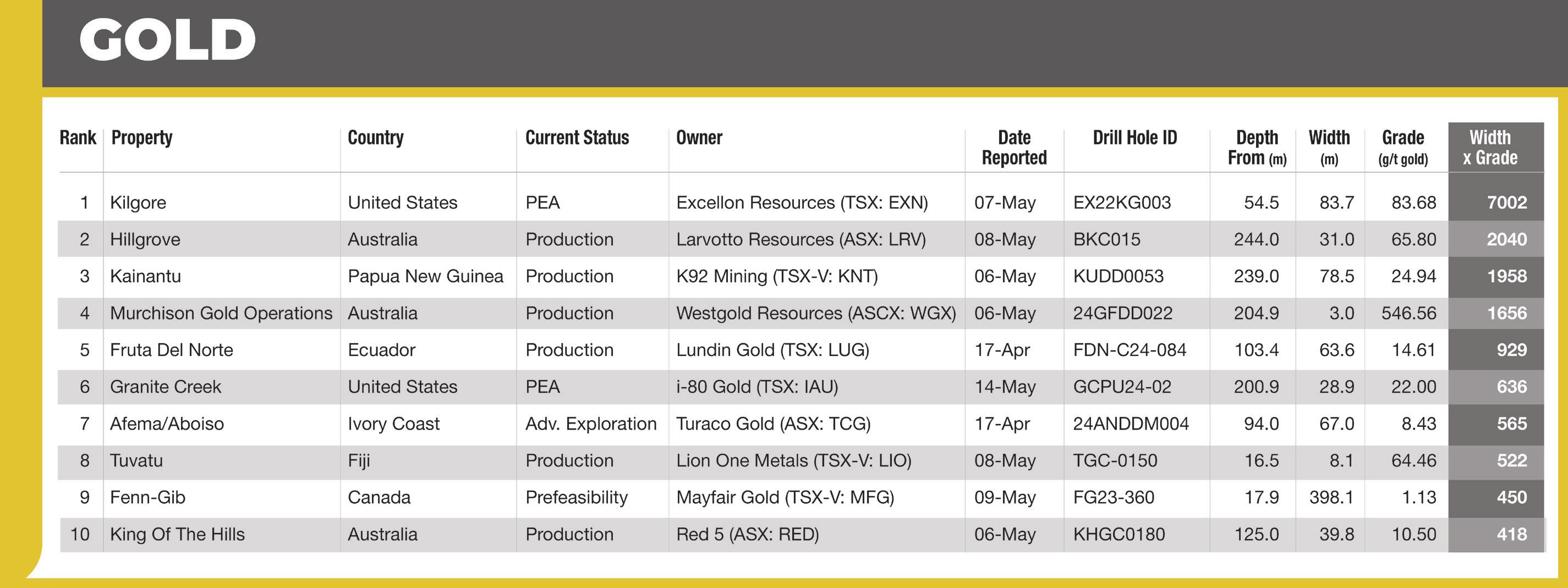
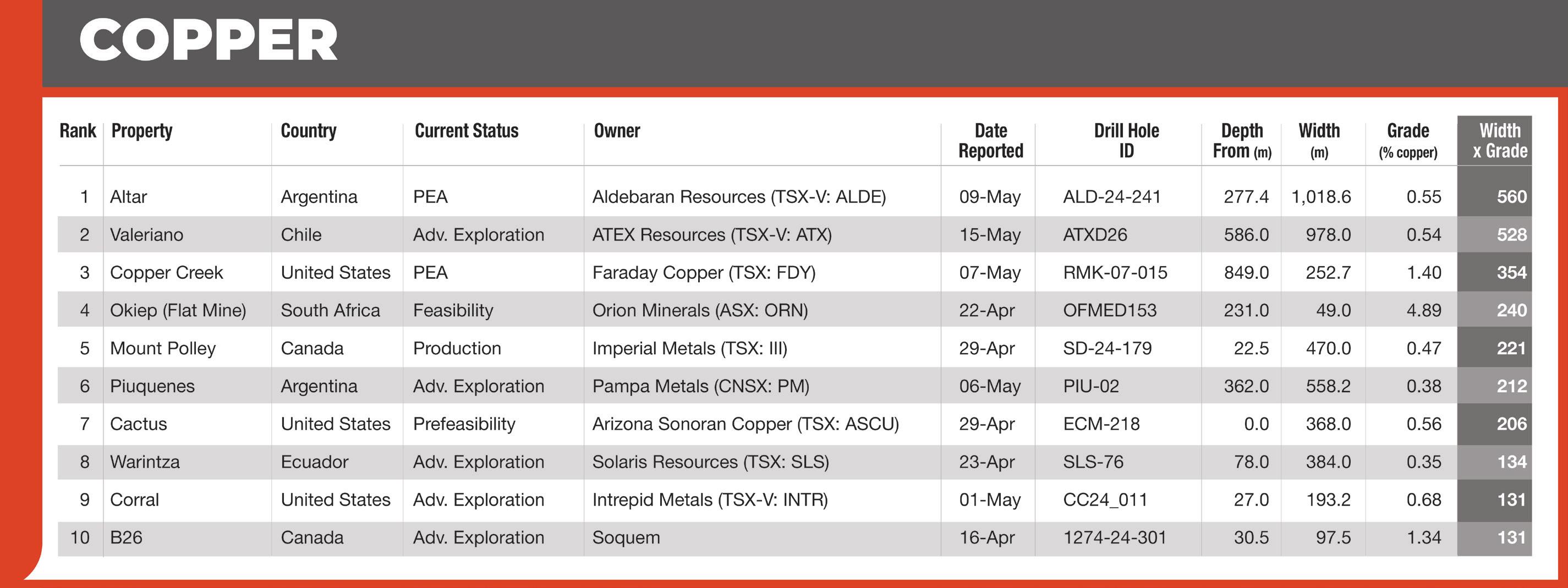
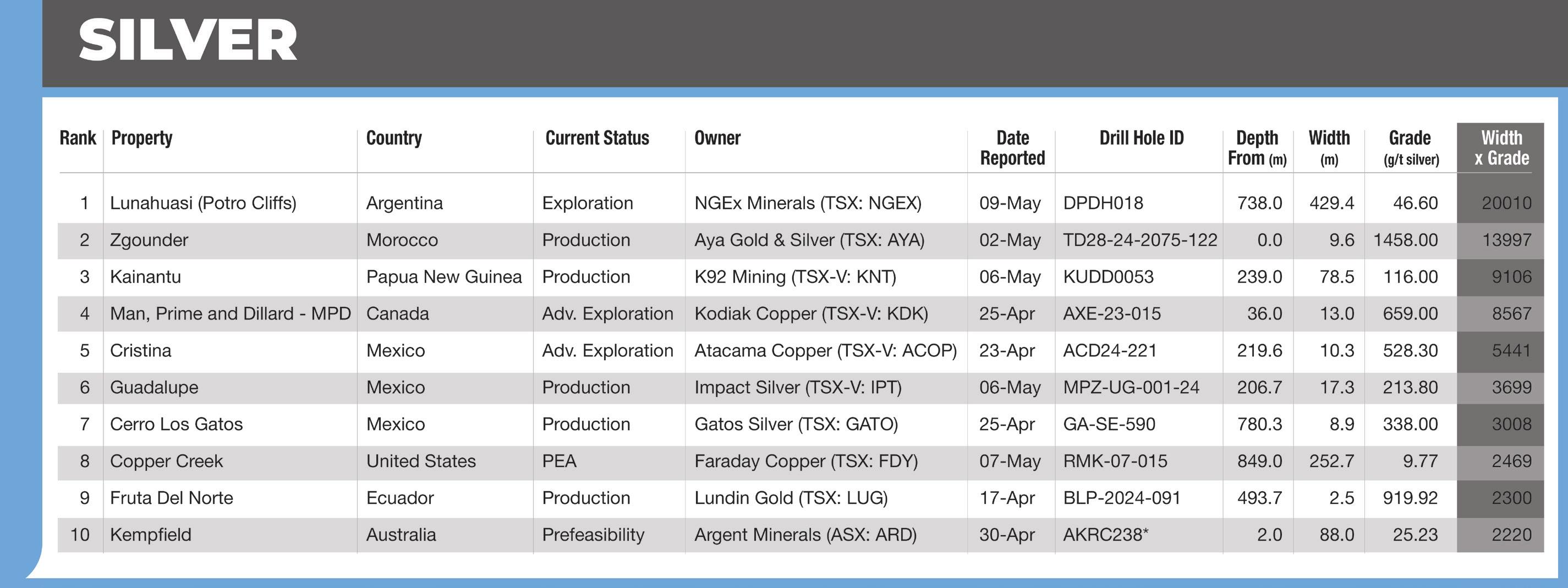
26 JUNE 2024 | THE NORTHERN MINER www.northernminer.com
All data supplied by Mining Intelligence for the period of April 16, 2024 – May 15, 2024 for public companies from exploration stage to production. * indicates reverse circulation; otherwise all holes are diamond drill holes. Reported lengths are not necessarily true widths. Only the best hole per property is shown. Grade x widths calculations may differ slightly due to rounding.
warrants&shorts
TSX WARRANTS
Aris Gold Corporation ARIS.WT One Warrant to purchase one Common 7-29-2025 Share of the Issuer at $2.75 until expiry.
Name Symbol Subsciption Terms Expiry Date
Giga Metals Corporation GIGA.WT One warrant to purchase one common 04-23-2024 share at $0.60 per share.
Millennial Precious MPM.WT One warrant to purchase one common 06-16-2024 Metals Corp. share at $0.50 per share.
Mexican Gold Corp. MEX.WT One warrant to purchase one common 07-15-2024 share at $0.12 per share.
Giga Metals Corporation GIGA.WT.A One warrant to purchase one common 02-08-2025 share at $0.45 per share.
LithiumBank Resources LBNK.WT One warrant to purchase one common 02-16-2025 Corp. share at $2.00 per share.
Total Helium Ltd. TOH.WT.A One warrant to purchase one common 05-01-2025 share at $0.75 per share.
Caldas Gold Corp. CGC.WT One warrant to purchase one common 07-29-2025 share at $2.75 per share.
Rock Tech Lithium Inc. RCK.WT One warrant to purchase one common 08-19-2025 share at $4.50 per share.
Lion One Metals Limited LIO.WT One warrant to purchase one common 11-11-2025 share at $1.25 per share.
Silver Mountain AGMR.WT.A One warrant to purchase one common 02-09-2026 Resources Inc. share at $0.45 per share. Name
Osisko Development ODV.WT.B One warrant to purchase one common 03-02-2026 Corp. share at $8.55 per share.
Denarius Silver Corp. DSLV.WT One warrant to purchase one common 03-17-2026 share at $0.80 per share.
Aurania Resources Ltd. ARU.WT.B One warrant to purchase one common 10-21-2026 share at $2.20 per share.
Freeman Gold Corp FMAN.WT.U One warrant to purchase one common 11-29-2026 share at US$0.65 per share.
Osisko Development ODV.WT.A One warrant to purchase one common 03-02-2027 Corp. share at $14.75 per share.
Integra Resources Corp. TR.WT One warrant to purchase one common 03-13-2027 share at $1.20 per share.
Elevation Gold Mining ELVT.WT.A One warrant to purchase one common 03-24-2027 Corporation share at $0.70 per share.
Osisko Development ODV.WT.U One warrant to purchase one common 05-27-2027 Corp. share at US$10.70 per share.
Bear Creek Mining BCM.WT One warrant to purchase one common 10-05-2028 Corporation share at $0.42 per share.
TSX SHORT POSITIONS
Short positions outstanding as of May 15, 2024 (with changes from Apr 30, 2024)
Largest short positions
Company Ticker Short position Change
Ivanhoe Mines IVN 26738134 -5377447
Suncor Energy SU 18000428 -4291442
Lundin Mng LUN 17142697 -1207606
Barrick Gold ABX 14228236 -502004
i-80 Gold IAU 12899962 -23227008
Denison Mines DML 12832375 955863 New Gold NGD 12433665 996884
Equinox Gold EQX 11150290 -244170
First Quantum FM 9551601 1861547
Calibre Mng CXB 9149207 2717622
Kinross Gold K 8701151 -119850
B2Gold Corp BTO 8204552 -1503161
HudBay Min HBM 7229276 491299
IAMGOLD IMG 7210830 392255
Osisko Mng Inc OSK 7189187 245908
Largest increase in short position
First Mg Fin FF 4619703 3049508
Calibre Mng CXB 9149207 2717622
Karora Res KRR 6254395 2428364
First Quantum FM 9551601 1861547
Fortuna Silvr FVI 6858873 1834882
Largest decrease in short position
i-80 Gold IAU 12899962 -23227008
Argonaut Gold AR 2959217 -8001979
Ivanhoe Mines IVN 26738134 -5377447
Suncor Energy SU 18000428 -4291442
B2Gold Corp BTO 8204552 -1503161

Symbol Subsciption Terms Expiry Date
TSX
TSX VENTURE SHORT POSITIONS hort
outstanding
Largest
Company Ticker Short position Change West Red Lake WRLG 7157590 6804132 New Found Gold NFG 2525556 1102382 F3 Uranium FUU 2204155 409284 GoviEx Uranium GXU 2089364 566016 Premier Amer U PUR 1766335 151272 Thesis Gold TAU 1592376 1539183 Azarga Metals AZR 1506955 1505295 Osino Res OSI 1503961 1462873 IMPACT Silver IPT 1427344 1202872 Montero Mg&Ex MON 1311755 -40186 American Eagle AE 1295942 1067369 Revival Gold RVG 1265778 390426 Awale Res ARIC 1251530 425808 EnCore Energy EU 1224689 -153248 Li-FT Power LIFT 1198204 1159224 Largest increase in short position West Red Lake WRLG 7157590 6804132 Thesis Gold TAU 1592376 1539183 Azarga Metals AZR 1506955 1505295 Osino Res OSI 1503961 1462873 IMPACT Silver IPT 1427344 1202872 Largest decrease in short position Guanajuato Sil GSVR 103856 -7617936 Minaurum Gold MGG 264909 -5756822 BonTerra Res BTR 60863 -1783663 Reyna Silver RSLV 69788 -1490437 Adventus ADZN 45045 -514526 Name Symbol Subsciption Terms Expiry Date
VENTURE WARRANTS
positions
as of May 15, 2024 (with changes from Apr 30, 2024)
short positions
07-29-2025
Name Symbol Subsciption Terms Expiry Date
Aris Gold Corporation ARIS.WT.A One Warrant to purchase 0.5 of one
Common Share of the Issuer at $2.75 until expiry
www.northernminer.com GLOBAL MINING NEWS THE NORTHERN MINER | JUNE 2024 27 Canadian Mining Journal’s 2024 Media Kit and Editorial Calendar is now available. Contact Robert Seagraves at rseagraves@canadianminingjournal.com or George Agelopoulos at gagelopoulos@northernminer.com or call 1-416-510-6891 to request your copy. www.canadianminingjournal.com/advertise
Aluminum: US$1.21/lb.
Cobalt: US$12.32/lb.
Gold: US$2,332.30/oz.
Iron Ore 62% Fe CFR China-S: US$119.50
Nickel: US$9.22/lb.
Silver: US$30.24 per oz.
Zinc: US$1.39 per lb.
marketdata
COMMODITY PRICES | Prices current May 22, 2024
Coal: Central Appalachia, 12,500 Btu, 1.2 S02-R,W: US$74.75 Coal: Powder River Basin, 8,800 Btu, 0.8 S02-R, W: US$13.70
Copper: US$4.76/lb.
Iridium: US$4,775/tr oz.
Lead: US$1.05/lb.
US$15.17/lb.
Copper: CME Group Futures July 2024: US$4.76/lb.;
August 2024: US$4.75/lb.
Lithium carbonate: US$14,800/tonne
Ruthenium: Mid-mkt US$425 per oz.
Uranium: U 3O 8, Trading Economics: US$91.65 per lb.
28 JUNE 2024 | THE NORTHERN MINER www.northernminer.com
oz.
Rhodium: Mid-mkt US$4,725/tr.
Tin:
CANADIAN GOLD MUTUAL FUNDS Fund Name May 24 May 17 Change Change YTDChange MER TotalAssets ($) ($) ($) (%) (%) (%) (M$) BMO Prec Mtls Fd A 27.82 28.73 -0.91 -3.15 9.80 2.40 68.78 BMO ZGD 92.99 95.91 -2.92 -3.04 16.63 0.62 58.84 BMO ZJG 80.94 83.45 -2.51 -3.01 9.98 0.62 63.13 CA:GLCC 26.16 26.87 -0.71 -2.64 7.29 0.78 CANL Prec Mtl Fd A 20.82 21.61 -0.78 -3.63 15.13 2.60 159.85 CI Gld+ Gnts CovC A 10.76 11.03 -0.26 -2.40 0.97 2.56 CI Pre Met Fd A 56.81 58.27 -1.46 -2.51 8.31 2.31 198.08 CIBC Prec Metal Fd A 16.55 16.95 -0.41 -2.40 9.23 2.25 52.39 Dyn Prec Metls Fd A 13.88 14.26 -0.38 -2.65 10.27 2.69 511.09 Hamilton AMAX 19.37 19.91 -0.54 -2.70 Harvest HGGG 29.70 30.51 -0.80 -2.64 6.84 0.68 14.88 iShares XGD 20.40 21.05 -0.65 -3.07 9.53 0.61 1272.83 NBI PrecMetFd Invt 20.11 20.76 -0.65 -3.13 10.02 2.19 23.66 NP Silver Equ A 7.34 7.56 -0.22 -2.92 12.47 2.97 NPT Go&PrMinFd A 51.88 53.08 -1.20 -2.26 11.81 3.19 RBC GblPreMetFd A 57.14 58.87 -1.73 -2.94 11.59 2.08 602.56 TD Prec Mtl Fd Inv 54.84 56.46 -1.62 -2.87 7.86 2.26 116.84 $11 $10 $9 $8 $7 $6 $30 $28 $26 $24 $22 $20 $2,500 $2,400 $2,300 $2,200 $2,100 $2,000 $1,900 $1,800 $1,700 $5.50 $5.00 $4.50 $4.00 $3.50 $3.00 $11 $10 $9 $8 $7 $6 $30 $28 $26 $24 $22 $20 $2,500 $2,400 $2,300 $2,200 $2,100 $2,000 $1,900 $1,800 $1,700 $5.50 $5.00 $4.50 $4.00 $3.50 $3.00 $11 $10 $6 $30 $28 $26 $24 $22 $20 $2,500 $2,400 $2,300 $2,200 $2,100 $2,000 $1,900 $1,800 $1,700 $5.50 $5.00 $4.50 $4.00 $3.50 $3.00 $11 $10 $9 $8 $7 $6 $30 $28 $26 $24 $22 $20 $2,500 $2,400 $2,200 $2,100 $2,000 $1,900 $1,800 $1,700 $5.50 $5.00 $4.00 $3.50 GOLD PRICE (US$ PER OZ.) Commodity Prices 12-Month Trend SILVER PRICE (US$ PER OZ.) COPPER PRICE (US$ PER LB.) NICKEL PRICE (US$ PER LB.) Index Name May 24 High Low S&P/TSX Composite 22,320.87 22,554.98 18,692.06 S&P/TSXV Composite 607.95 634.25 506.65 S&P/TSX 60 1,335.33 1,348.19 1,122.19 S&P/TSX Global Gold 325.09 340.38 238.95 DJ Precious Metals 261.09 275.75 190.38 52 weeks NORTH AMERICAN STOCK EXCHANGE INDICES LEGEND A - ASX C - CSE L - LSE N - NYSE O - US OTC Q - NASDAQ T - TSX V- TSXV X - NYSE-AM * Price in US$ May 15 Jun. 15 Jul. 15 Aug. 15 Sep. 15 Oct. 15 Nov. 15 Dec. 15 Jan. 15 Feb. 15 Mar. 15 Apr. 15 May 15 25 New Highs AbraSilver Res Adventus Aftermath Silv* Agnico Eagle Alamos Gold Alcoa* Aldebaran Res* Almonty Ind Alta Copper Alumina Ltd* Amerigo Res Anfield Energy* Antofagasta* Apex Res * Artemis Gold Aura Minerals Avino Silver Aya Gold Bannerman Egy* Black Mammoth Borneo Res Inv* Buenaventura* Bunker Hill Calibre Mng Cameco Corp CaNickel Mng* Capstone Mng Carolina Rush Cascadero Copp Centerra Gold Cerro de Pasc * China Gold Int Class 1 Nickel Coeur Mng* CONSOL Energy* Denison Mines Discovery Silv District Metal Dolly Vard Sil Dundee Prec Mt East Africa Eldorado Gold EMX Royalty Endeavr Silver Enduro Metals* Engold Mines* Equity Metals* Erdene Res Dev Ero Copper Filo Corp First Nordic* First Uranium Foran Mining* Fortuna Silvr Freeport McMoR* Galiano Gold Gatos Silver Giant Mining* Glencore Plc * Globex Mng Gold Reserve* Goldcliff Res Golden Pursuit* GoldON Res Goldshore Res GR Silver Greenridge Exp Harmony Gold* Hecla Mining* HFX Holding Hochschild Mg* HudBay Min Intl Iconic* Ivanhoe Mines K9 Gold* K92 Mining Karora Res Kenorland Min Kesselrun Res Kinross Gold KO Gold Koryx Copper Lavras Gold Loncor Res Lundin Gold Lundin Mng MAG Silver Mako Mining Mantaro Prec Marimaca Cop* Midnight Sun Minera Alamos Mineral Hill Mineral Res* Montage Gold* NevGold* New Gold Newcore Gold Newmont Corp Nexa Resources* Norden Crown Orex Mnrls Orogen Roy Outcrop S&G Pace Metals Paladin Energy* Pampa Metals Pan Am Silver Patagonia Gold* Perseus Mng Platinum Gp Mt Prime Mining* Regulus Res Reunion Gold* Rio2 Limited Robex Res Royal Gold* Rusoro Mng Sandstorm Gold Saville Res Sierra Metals Silver Eleph* Silver Storm Silver Tiger Silver Wolf Silvercorp Met SilverCrest* Solitario Res* Southern Copp* Southern Emp* Southern Silvr Stellar Africa Sterling Metal* Stroud Res Suncor Energy Surge Copper Talisker Res* Taseko Mines Teck Res Tonogold Res* Trifecta Gold* Triple Flag U.S. Gold* Wesdome Gold Wheaton Prec White Gold World Copper 13 New Lows AbraSilver Res* Adyton Res* Auric Min Beyond Min Fathom Nickel* FE Battery* i-80 Gold Lithium Amer* Lithos Group Strathmore Traction Uran* Tudor Gold Wealth Mnrls (* denotes US price) $2,371.80 US$/oz. (+$355.41 vs. YA) $28.82 US$/oz. (+$4.73 vs. YA) $4.93 US$/Lb. (+$1.19 vs. YA) $8.87 US$/Lb. (-$1.24 vs. YA) May 15 Jun. 15 Jul. 15 Aug. 15 Sep. 15 Oct. 15 Nov. 15 Dec. 15 Jan. 15 Feb. 15 Mar. 15 Apr. 15 May 15 May 15 Jun. 15 Jul. 15 Aug. 15 Sep. 15 Oct. 15 Nov. 15 Dec. 15 Jan. 15 Feb. 15 Mar. 15 Apr. 15 May 15 May 15 Jun. 15 Jul. 15 Aug. 15 Sep. 15 Oct. 15 Nov. 15 Dec. 15 Jan. 15 Feb. 15 Mar. 15 Apr. 15 May 15 NEW 52-WEEK HIGHS AND LOWS MAY 15, 2024
May 21-24, 2024
Gold rally hits new high
Nutrien,
By Henry LazenbyGold rose to a record US$2,450.05 per oz. on May 21, boosted by central bank purchases and strong Asian demand. Analysts say the market anticipates two rate cuts by the Federal Reserve this year. However, the rally was short-lived and gold closed at a still-respectable US$2,342.70 per oz. on May 24.
The S&P/TSX Global Gold Index started the holiday-shorted May 21-24 trading week strong but quickly lost momentum, ending the week 13.7 points or 4% lower at 325.09.
The S&P 500 rose to 5,321.41 on May 21 by computer chip maker Nvidia’s stock following its strong earnings
report and positive outlook driven by the booming artificial intelligence technology market. The Dow Jones closed 2.3% lower at 39,069.59 after closing at a record 40,0003.59 on May 17.
The S&P/TSX Composite Index closed the week at 22,320.87, down 0.6%. The S&P/TSX Global Mining Index fell 3% week on week to 124.17.
The week’s biggest value change on the TSX was Nutrien, adding $1.86 to close at $80.44 apiece. On the NYSE, coal producers Arch Resources and Consol Energy steamed ahead, each adding US$9.32 to close at US$170.60 and US$6.32 to US$97.01 per share, respectively.
GLOBAL MINING NEWS THE NORTHERN MINER | JUNE 2024 29 marketnews
Greatest Percentage Change Largo Res LGO 787 2.84 2.11 2.76 + 27.8 Loncor Res LN 349 0.53 0.39 0.49 + 25.6 Verde AgriTech NPK 743 1.16 0.64 0.92 + 24.3 Century Global CNT 2 0.03 0.00 0.03 + 20.0 Gold Mountain GMTN 638 0.04 0.03 0.04 + 16.7 Fortune Min FT 8014 0.10 0.08 0.09 + 12.5 Erdene Res Dev ERD 1087 0.48 0.41 0.47 + 12.0 NextSource Mat NEXT 853 1.03 0.73 0.88 + 10.0 Ascendant Res ASND 667 0.06 0.05 0.06 + 9.1 Serabi Gold SBI 44 1.10 1.01 1.10 + 8.9 Silver Eleph ELEF 919 0.54 0.41 0.41 - 21.2 Solaris Res SLS 2257 5.49 4.33 4.35 - 19.9 Western Potash WRX 292 0.10 0.09 0.09 - 15.0 Patriot Batt PMET 1302 9.76 8.16 8.28 - 13.8 Star Diamond DIAM 1465 0.08 0.07 0.07 - 13.3 Novo Res NVO 753 0.17 0.14 0.14 - 12.9 IAMGOLD IMG 18339 6.24 5.29 5.48 - 11.2 New Pac Metals NUAG 525 3.35 2.75 2.79 - 10.9 Skeena Res SKE 2003 7.31 6.12 6.17 - 10.2 Belo Sun Mng BSX 226 0.05 0.05 0.05 - 10.0 VOLUME WEEK (OOOs) HIGH LOW CLOSE CHANGE Greatest Value Change Nutrien NTR 5250 80.44 + 1.86 Aura Minerals ORA 136 12.90 + 0.72 Triple Flag TFPM 1419 24.25 + 0.66 Largo Res LGO 787 2.76 + 0.60 Suncor Energy SU 61727 55.06 + 0.49 Perpetua Res PPTA 96 8.12 + 0.44 Fortuna Silvr FVI 7470 8.31 + 0.37 McEwen Mng MUX 242 15.52 + 0.36 Silvercorp Met SVM 3853 5.58 + 0.22 Verde AgriTech NPK 743 0.92 + 0.18 Franco-Nevada FNV 1597 166.72 - 8.03 Teck Res TECK.B 6061 70.19 - 3.03 Teck Res TECK.A 29 70.16 - 3.01 Agnico Eagle AEM 6381 92.53 - 2.91 Newmont Corp NGT 1175 57.41 - 2.19 Ivanhoe Mines IVN 14899 19.39 - 1.69 Filo Corp FIL 1605 24.99 - 1.67 Ero Copper ERO 1631 31.14 - 1.37 First Quantum FM 15237 18.10 - 1.33 Patriot Batt PMET 1302 8.28 - 1.3 VOLUME WEEK (OOOs) CLOSE CHANGE
Arch Resources and Consol week’s big winners
Most Active Issues VOLUME WEEK (OOOs) HIGH LOW CLOSE CHANGE TORONTO VENTURE EXCHANGE VOLUME WEEK (OOOs) HIGH LOW CLOSE CHANGE HFX Holding HXC.H 128 0.03 0.00 0.03 + 500.0 Noble Metal NMG.H 137 0.01 0.00 0.01 + 100.0 Saville Res SRE 64 0.16 0.00 0.14 + 92.9 Norden Crown NOCR 40 0.10 0.00 0.10 + 90.0 Sylla Gold SYG 199 0.08 0.05 0.08 + 66.7 Odyssey Res ODX.H 6 0.03 0.00 0.03 + 66.7 Argentum Silvr ASL 68 0.05 0.00 0.05 + 66.7 Kermode Res KLM 251 0.02 0.00 0.02 + 50.0 Jaxon Mining JAX 290 0.02 0.00 0.02 + 50.0 Gabriel Res GBU 6921 0.02 0.01 0.02 + 50.0 Intl Prospect IZZ 30 0.05 0.00 0.01 - 77.8 Copper Road CRD 564 0.04 0.00 0.02 - 69.2 Millennium Sil MSC 1516 0.01 0.01 0.01 - 50.0 Guardian Exp GX 525 0.08 0.00 0.04 - 50.0 G.E.T.T. Gold GETT 1349 0.01 0.01 0.01 - 50.0 Pac Imperial PPM 94 0.02 0.00 0.01 - 50.0 Copper Fox Mtl CUU 6921 0.63 0.22 0.23 - 46.4 Centurion Mnls CTN 67 0.03 0.00 0.03 - 37.5 Volcanic Gold VG 1730 0.14 0.05 0.08 - 36.0 AFR NuVenture AFR 515 0.02 0.00 0.01 - 33.3 VOLUME WEEK (OOOs) HIGH LOW CLOSE CHANGE Regulus Res REG 312 1.99 + 0.27 Artemis Gold ARTG 1296 10.81 + 0.26 Gold Reserve GRZ 19 4.80 + 0.25 Black Mammoth BMM 50 0.80 + 0.22 Orogen Roy OGN 1319 1.30 + 0.17 Vizsla Silver VZLA 5922 2.38 + 0.13 Bravo Mining BRVO 156 2.18 + 0.12 Andean Prec APM 1576 1.02 + 0.12 South Star Bat STS 73 0.71 + 0.11 Mayfair Gold MFG 746 2.04 + 0.10 Sigma Lithium SGML 153 22.29 - 2.21 Highwood Asset HAM 6 6.40 - 0.45 Los Andes LA 41 10.10 - 0.30 Li-FT Power LIFT 150 3.92 - 0.23 AbraSilver Res ABRA 6848 2.53 - 0.22 New Found Gold NFG 1057 4.91 - 0.21 Copper Fox Mtl CUU 6921 0.23 - 0.20 Snowline Gold SGD 679 5.99 - 0.19 Amex Expl AMX 346 1.67 - 0.18 Dolly Vard Sil DV 2797 1.04 - 0.16 VOLUME WEEK (OOOs) CLOSE CHANGE NEW YORK STOCK EXCHANGE VOLUME WEEK (OOOs) HIGH LOW CLOSE CHANGE Intrepid Pot* IPI 602 27.85 24.98 27.63 + 11.1 CONSOL Energy* CEIX 1868 98.48 90.21 97.01 + 7.0 Arch Resources* ARCH 1617 175.06 161.45 170.60 + 5.8 Nexa Resources* NEXA 173 7.94 7.35 7.90 + 5.5 Peabody Enrgy* BTU 12257 23.82 22.51 23.53 + 4.4 Fortuna Silvr* FSM 36814 6.14 5.63 6.08 + 4.1 Buenaventura* BVN 8880 18.84 17.12 17.87 + 2.5 CONSOL Energy* CNX 10779 24.95 24.14 24.83 + 2.2 Nutrien* NTR 7574 60.87 58.00 58.86 + 1.9 Mosaic* MOS 17196 32.29 30.25 30.98 + 1.2 Lithium Amer* LAC 36544 4.48 3.68 3.91 - 12.5 IAMGOLD* IAG 66515 4.59 3.85 4.00 - 11.5 First Majestic* AG 45374 8.09 7.00 7.17 - 9.7 Sibanye-Stillw* SBSW 35847 5.91 5.06 5.22 - 8.3 Hecla Mining* HL 49400 6.29 5.60 5.63 - 7.7 Coeur Mng* CDE 40134 6.03 5.29 5.44 - 7.5 Southern Copp* SCCO 7698 129.79 115.37 117.51 - 6.3 HudBay Min* HBM 30902 10.49 9.20 9.63 - 6.2 Harmony Gold* HMY 22888 10.25 9.12 9.25 - 5.2 Franco-Nevada* FNV 2434 129.84 120.49 122.01 - 5.0 VOLUME WEEK (OOOs) HIGH LOW CLOSE CHANGE Arch Resources* ARCH 1617 170.60 + 9.32 CONSOL Energy* CEIX 1868 97.01 + 6.32 Intrepid Pot* IPI 602 27.63 + 2.75 Nutrien* NTR 7574 58.86 + 1.10 Peabody Enrgy* BTU 12257 23.53 + 1.00 CONSOL Energy* CNX 10779 24.83 + 0.53 Buenaventura* BVN 8880 17.87 + 0.43 Alcoa* AA 29691 41.64 + 0.42 Nexa Resources* NEXA 173 7.90 + 0.41 Mosaic* MOS 17196 30.98 + 0.37 Southern Copp* SCCO 7698 117.51 - 7.84 Franco-Nevada* FNV 2434 122.01 - 6.47 Chevron Corp* CVX 26719 157.75 - 4.92 Freeport McMoR* FCX 85812 51.53 - 2.70 Teck Res* TECK 15965 51.36 - 2.43 Agnico Eagle* AEM 10855 67.71 - 2.40 Black Hills* BKH 1994 54.86 - 1.92 Newmont Corp* NEM 39333 41.98 - 1.76 Rio Tinto* RIO 14922 71.85 - 1.76 MartinMarietta* MLM 1908 579.16 - 1.5 VOLUME WEEK (OOOs) CLOSE CHANGE TORONTO STOCK EXCHANGE Most Active Issues Most Active Issues Greatest Percentage Change Greatest Percentage Change Greatest Value Change Greatest Value Change Vale* VALE 106350 13.14 12.50 12.60 - 0.39 Barrick Gold* GOLD 87358 18.10 16.91 17.02 - 0.87 Freeport McMoR* FCX 85812 55.24 50.60 51.53 - 2.70 Kinross Gold* KGC 84887 8.23 7.81 8.07 + 0.07 IAMGOLD* IAG 66515 4.59 3.85 4.00 - 0.52 Hecla Mining* HL 49400 6.29 5.60 5.63 - 0.47 First Majestic* AG 45374 8.09 7.00 7.17 - 0.77 Coeur Mng* CDE 40134 6.03 5.29 5.44 - 0.44 Newmont Corp* NEM 39333 44.59 41.00 41.98 - 1.76 Fortuna Silvr* FSM 36814 6.14 5.63 6.08 + 0.24 Suncor Energy SU 61727 56.69 53.93 55.06 + 0.49 Kinross Gold K 19960 11.22 10.70 11.04 + 0.16 Barrick Gold ABX 18394 24.48 23.23 23.27 - 1.06 IAMGOLD IMG 18339 6.24 5.29 5.48 - 0.69 B2Gold Corp BTO 17248 4.02 3.74 3.75 - 0.19 Capstone Mng CS 17025 11.51 10.08 10.24 - 0.96 New Gold NGD 16715 3.00 2.56 2.69 - 0.21 HudBay Min HBM 15817 14.33 12.65 13.18 - 0.80 First Quantum FM 15237 20.76 17.63 18.10 - 1.33 Ivanhoe Mines IVN 14899 21.32 18.72 19.39 - 1.6 Cornish Metals CUSN 27655 0.12 0.10 0.12 + 0.01 Rusoro Mng RML 16771 1.51 1.36 1.39 + 0.01 Guanajuato Sil GSVR 15759 0.29 0.23 0.27 + 0.04 Lomiko Mtls LMR 12590 0.04 0.03 0.03 - 0.01 Koryx Copper KRY 9720 0.21 0.13 0.20 + 0.06 Pac Ridge Expl PEX 8437 0.08 0.06 0.07 unch 0.00 Adventus ADZN 7915 0.56 0.49 0.55 + 0.03 Sokoman Min SIC 7447 0.05 0.04 0.05 + 0.01 GR Silver GRSL 7420 0.25 0.20 0.21 - 0.02 Cons Lithium CLM 7238 0.05 0.04 0.05 + 0.01
2024 n June
June 2-5
miningevents
American Society of Reclamation Sciences — Knoxville, Tenn.
VENUE: Knoxville Convention Center
MORE INFORMATION: www.asrs.us/2024conference/
June 3-4
121 Mining Investment — New York
VENUE: TBA
MORE INFORMATION: www.weare121. com/121mininginvestment-new-york/
June 4-6
The Mining Investment of the North — Quebec City
VENUE: Quebec City Convention Centre
MORE INFORMATION: www. themininginvestmentevent.com
June 5-6
Canadian Mining Expo 2024 — Timmins, Ont.
VENUE: McIntyre Complex
MORE INFORMATION: https://virtex. canadianminingexpo.com
June 6-7
MiningForum 2024 — Berlin
VENUE: TBA
MORE INFORMATION: www.the-miningforum.com/ home.html
June 11-13
Indonesia Critical Minerals Conference and Expo — Jakarta
VENUE: TBA
MORE INFORMATION: https://ni-co-ev-indonesia. metal.com/home
June 12-14
10th International Conference on Tailings Management – Santiago, Chile
VENUE: Sheraton Santiago
MORE INFORMATION: www.gecamin.com/tailings/ index?idioma=ingles
June 17-18
Future of Mining — Perth, Australia
VENUE: Pan Pacific Perth
MORE INFORMATION: www.future-of-mining.com/ fomperth
June 27-28
Victorian Minerals Round-up 2024 — Ballarat, Australia
VENUE: Ballarat Goods Shed
MORE INFORMATION: www.aig.org.au/events/ victorian-minerals-round-up-2024/
June 27-29
China International Mining Expo — Shenyang, China
VENUE: Shenyang International Exhibition Center
MORE INFORMATION: www.bjminexpo.com
n July
July 8-12
12th International Kimberlite Conference — Yellowknife
VENUE: Explorer Hotel and Chateau Nova Hotel
n August
August 5-7
Diggers and Dealers Mining Forum — Kalgoorlie, Australia
VENUE: TBA
MORE INFORMATION: www.diggersndealers.com.au
August 7-9
2024 Beijing International Coal and Mining Exhibition — Beijing, China
VENUE: China International Exhibition Center
MORE INFORMATION: www.en.ciceme.com
August 19-22
63rd Annual Conference of Metallurgists — Halifax, N.S.
VENUE: Halifax Convention Centre
MORE INFORMATION: www.metsoc.org/2024
August 26-28
Critical Minerals Conference 2024 — Brisbane, Australia
VENUE: Brisbane Convention and Exhibition Centre
MORE INFORMATION: www.ausimm.com/ conferences-and-events/critical-minerals-2024/
n September
September 2-4
International Future Mining Conference — Sydney, Australia
VENUE: TBA
MORE INFORMATION: https://int.ausimm.com/ conferences-and-events/future-mining/
September 2-6
Electra Mining Africa 2024 — Johannesburg, South Africa
VENUE: Johannesburg Expo Centre
MORE INFORMATION: www.electramining.co.za
September 11-14
Mining Indonesia - Jakarta
VENUE: Jakarta International Expo
MORE INFORMATION: www.mining-indonesia.com
September 15-18
Gold Forum Americas 2024 — Colorado Springs, Colo.
VENUE: Broadmoor Hotel and Resort
MORE INFORMATION: www.goldforumamericas.com
September 17-19
Central Asian International Exhibition — Almaty, Kazakhstan
VENUE: Atakent International Exhibition Centre
MORE INFORMATION: https://miningworld.kz/en/ exhibition/about-the-exhibition
September 24-26
International Conference on Deep and High Stress Mining — Montreal
VENUE: Hotel Bonaventure
MORE INFORMATION: www.acgdeepmining.com
September 24-26
MINExpo International – Las Vegas
VENUE: Las Vegas Convention Center
MORE INFORMATION: www.minexpo.com
September 25-27
MINExpo 2024 — Dar-es-Salaam, Tanzania Diamond Jubilee Expo Center
n October
October 9-10
Western Australia Mining Conference and Exhibition – Perth, Australia
VENUE: Perth Convention and Exhibition Centre
MORE INFORMATION: www.waminingexpo.com.au/ en-gb.html
October 10-11
TNM International Metals Symposium — London, U.K.
VENUE: ETC Venue
MORE INFORMATION: https://events.northernminer. com
October 28-31
Xplor 2024 – Montreal
VENUE: Le Westin Montreal
MORE INFORMATION: www.xplor.aemq.org/en/
October 29-30
Mining Tech North America Expo - Vancouver
VENUE: Delta Hotels Burnaby Conference Centre
MORE INFORMATION: www. miningtechnorthamerica.com
October 29-31
IMARC - Sydney, Australia
VENUE: ICC Sydney
MORE INFORMATION: www.imarcglobal.com
n November
November 6-7
Mining Investment North America — Toronto
VENUE: DoubleTree by Hilton Toronto Downtown
MORE INFORMATION: www. mininginvestmentnorthamerica.com
November 10-13
Tailings and Mine Waste Conference 2024 — Colorado
VENUE: TBA
MORE INFORMATION: www.thetailingsnetwork. com/tailings-conferences/tailingsminewaste2024
November 14-15
121 Mining Investment — London, U.K.
VENUE: TBA
MORE INFORMATION: www.weare121.com/events/#
November 25-26
Peru Rocks, the Awakening of a Giant — Lima, Peru
VENUE: Country Club Lima Hotel
MORE INFORMATION: www.chilexploregroup.cl/ PERU_ROCKS/
n December
December 1-2
International Metals Symposium — London, U.K.
VENUE: ETC Venues
MORE INFORMATION: events.northernminer.com/ international-metals-symposium-2024/
December 3-5
Mines and Money — London, U.K.
VENUE: TBA
MORE INFORMATION: www.minesandmoney.com/ london/index

30 JUNE 2024 | THE NORTHERN MINER www.northernminer.com
Stay competitive
comparing your wages, benefits, and bonuses to those of other mining companies
MINE SALARIES, WAGES AND BENEFITS REPORT
by
U.S.
GOLD AND SILVER
China’s solar panel surge powers silver price
ANALYSIS | Slipping supply, investor and Indian demand also contribute
BY COLIN MCCLELLANDSilver has broken through a mental price barrier to its highest level in more than a decade, driven in part by China’s surging solar panel industry and investor demand, analysts say.
The spot price hit more than US$30 an oz. in May, its strongest since February 2013. China doubled its investment in solar photovoltaic panels from 2022 to 2023 to control 80% of the world’s manufacturing capacity, according to an International Energy Agency report last month.
Toronto-based asset manager Sprott, which holds US$5.3 billion in physical silver, says this year’s 1 billion oz. in global supply will fall 265 million oz. short of meeting demand because of declining production and rising industrial use, especially in solar panels. Photovoltaic demand may hit 370 million oz. by 2030 out of global silver demand approaching 1.4 billon oz., it said.
“You take a stagnating mine supply, you add to that a very healthy growth in demand and then that translates to dwindling inventories,” Maria Smirnova, a portfolio manager at Sprott, said on a May 14 conference call. “Well, that is exciting. This is why we’re starting to see the price move.”
Silver is key for solar panels because it’s an efficient conductor and reflective metal. The drive for green energy and government incentives are accelerating solar power adoption. But manufacturers are embracing more efficient panel technologies such as TOPCon, or tunnel oxide passivated contact, and heterojunction technology, known as HJT, which can use more than twice as much silver as earlier efforts.
Ramp up
Companies such as Pan American Silver (TSX: PAAS; NYSE: PAAS), Wheaton Precious Metals (NYSE: WPM; TSX: WPM) and Gatos Silver (TSX: GATO; NYSE: GATO) are benefitting from the price rise after reporting stronger than expected first-quarter results. Hecla Mining (NYSE: HL) restarted its Idaho mine Lucky Friday in January after a fire last year and the company is ramping up output from Keno Hill in the Yukon.
Although central banks don’t typically buy silver like they buy gold, individual investors seeking safety are buying lower-priced silver, said Jeffrey Christian, managing partner at commodities researcher and investment bank CPM Group, in an interview with The Northern Miner on May 22 in New York, where he’s based. That’s especially been the case as silver has followed gold to all-time highs in May around US$2,425 per ounce.
“Solar panels are using more silver, but that’s not what’s driving the price up,” Christian said at a conference run by the Society for Mining, Metallurgy & Exploration. “It’s investment demand.”
However, silver prices should ease this year, Christian said.
“You’ll see less increased silver use this year, not as dynamic as
“SOLAR PANELS ARE USING MORE SILVER, BUT THAT’S NOT WHAT’S DRIVING THE PRICE UP. IT’S INVESTMENT DEMAND.”
JEFFREY CHRISTIAN, MANAGING
PARTNER,
CPM GROUP

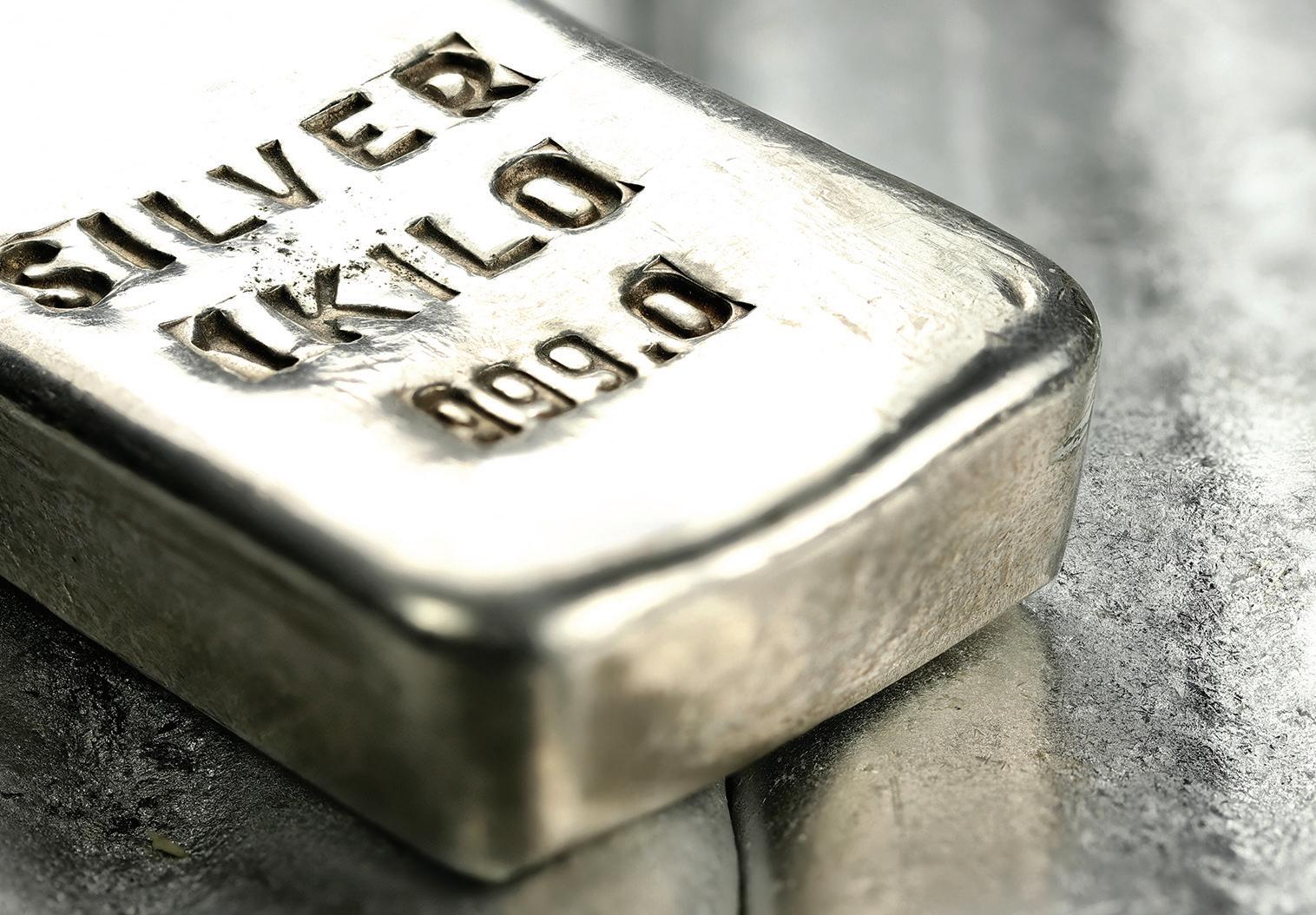
last year,” he said. “The solar panel industry overbuilt so they have a large inventory of unsold panels that they’ll be living off of the core part of this year.”
Spot metal prices are gaining on growing optimism the United States Federal Reserve will cut interest rates after inflation eased more than expected, BMO Capital Markets said in a note on May 20.
“Moreover, the sense of rising geopolitical tensions in the Middle East has helped to boost gold’s safe-haven appeal,” Colin Hamilton, BMO’s managing director of commodities research, said.
“Consequently, silver prices have also jumped to an 11-year high.”
India record
Hecla, the largest silver producer in the United States, said the solar
“EVEN THOUGH SILVER COMES WITH USUALLY LEAD, ZINC, COPPER OR GOLD, IT’S GETTING HARDER AND HARDER TO FIND AN ECONOMIC DEPOSIT.”
MARIA SMIRNOVAPORTFOLIO
MANAGER, SPROTT
industry and Indian demand helped it meet analysts’ forecasts for the first quarter. Global solar panel investments rose 12% last year to US$393 billion and the industry accounts for 16% of silver demand, CEO Phillips Baker said during an earnings call on May
9, citing Bloomberg data. India imported a record 77 million oz. of silver in February and the first quarter exceeded all of last year, according to the Mumbai-based Economic Times newspaper.
“As you put the solar and the Indian demand together, it’s about 35% of silver’s global demand, and they are both growing,” Baker said.
“The three-year deficit is now over 500 million oz. and I expect more deficit this year and into the foreseeable future. Silver’s fundamentals are unlike any time in its history.”
Still, the amount of silver bullion in exchange traded funds in the West declined to about 700 million oz. this year from more than 1 billion oz. in 2021, Smirnova said. The spot price disconnected because it climbed from late 2022 even as fund holdings fell. However, trading volumes in Shanghai doubled last year and traders paid a premium of as much as a US$4 per oz. to get the physical metal, not just on paper, she said.
“That’s a very important factor because silver is used in many different ways, especially in industry but in small amounts,” she said. “In a lot of these uses you don’t recover the silver back, so the fact that the silver is physical ounces, it’s likely we’re never going to see them again.”
Supply and demand
Over the past decade, global silver production slid by 51 million oz., about 6%, to 831 million oz., according to the Washington, D.C.-
based Silver Institute. Recycling and other sources bring the total supply to about 1 billion oz. this year.
Industrial demand grew by 261 million oz. from 2014 including a 76-million oz. jump from 2022 to 2023 in photovoltaic use. Global demand including a forecast uptick in exchange traded products this year approaches 1.3 billion ounces. The 265-million oz. projected deficit might require 20 new mines to erase, Smirnova said.
“Even though silver comes with usually lead, zinc, copper or gold, it’s getting harder and harder to find an economic deposit,” she said. “Grades are coming down. Geopolitics are playing a role because many countries are becoming more difficult to work in.”
Silver equities, which are inexpensive, and the metal don’t have as many investors and money backing them in the West as they should, the portfolio manager said. Company stocks could triple in value when the Federal Reserve eases interest rates, judging by reactions during the dot-com crash in 2001, the financial crisis in 2008 and the commodity collapse in 2016, Smirnova said.
“These are the kinds of gains that we can see in these equities when there’s a turn in policy and when the sentiment changes for the better,” she said. “I’ve named a lot of reasons why we like silver and why we think it’s going in the right direction and sooner or later the equities will start to reflect that.” TNM
GLOBAL MINING NEWS THE NORTHERN MINER | JUNE 2024 31
specialfocus
Silver is a key component in the manufacturing of solar panels. ADOBE / CR
ADOBE / BJÖRN WYLEZICH
Dundee Precious Metals rushes Serbian gold discovery to high-margin PEA
EUROPE | Company targets 2028 production start for Balkan mine
BY HENRY LAZENBYIn just 18 months, Dundee Precious Metals (TSX: DPM) assembled a study backing development for its Čoka Rakita gold discovery in Serbia.
With an initial investment of US$381 million and at a US$1,700 per oz. base gold price, Čoka Rakita would have an after-tax net present value (at a 5% discount) of US$588 million and an internal rate of return of 33%, according to the preliminary economic assessment (PEA), released on May 1. Over its 10-year life, the mine would inject US$891 million of free cash flow into Dundee’s coffers.
The proposed 129,000-oz.-peryear mine would have all-in sustaining costs (AISC) of US$715 per oz. of metal, according to the PEA. That figure would put it in the industry’s lowest-cost quartile.
“The PEA highlights an executable, high-margin project that provides a much-needed boost to Dundee’s growth profile and to some extent alleviates investor concerns around the efficient use of Dundee’s robust and growing cash reserves,” BMO Capital Markets mining analyst Raj Ray wrote in a note to clients.
Dundee aims to fast-track Čoka Rakita, kicking off a prefeasibility study in the first quarter of next
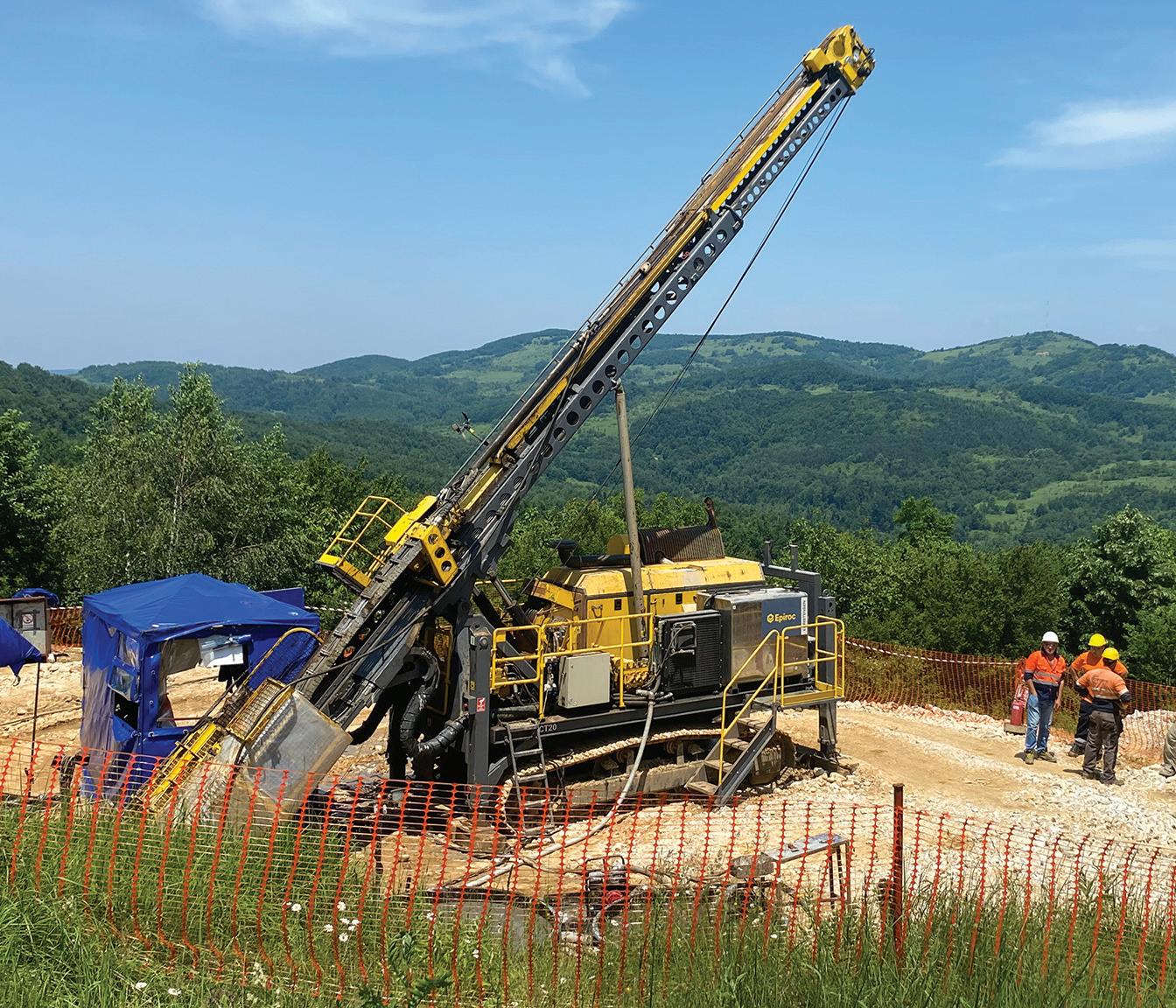
year, construction by mid-2026 and output two years later. Ray maintains an outperform rating and a target price at $16 per share on the company’s stock.
“The PEA confirms our view that Čoka Rakita is a very robust project with the potential to add strong economic returns and very high-margin gold production growth to our portfolio,” CEO David Rae said in a release.
Dundee, which operates the
Chelopech and Ada Tepe gold-copper mines in Bulgaria, has the Čoka Rakita gold-copper and Timok gold projects in its development pipeline in neighbouring Serbia, where it has been operating since 2004.
Balkan jewel Čoka Rakita is essential to the company’s growth. Dundee forecasts average production of around 240,000 oz. over the next three years, with Ada Tepe expected
to ramp down in 2026 as it nears the end of its life. The company expects gold AISC to remain below US$1,000 per oz. over the next three years.
The company-wide copper production outlook is about 33 million lb. per year.
Dundee released an initial resource for Čoka Rakita in December, outlining an inferred 9.8 million tonnes grading 5.7 grams gold per tonne and 1.21 grams silver for 1.8 million oz. of gold and 382 million oz. of silver.
With an 850,000-tonne-a-year processing facility, sustaining capital over the life of the mine is expected to be US$83 million, and closure costs are projected at US$31 million. Payback would be in 2.4 years thanks to the accelerated average of 164,000 oz. per year in the first five years of the mine plan.
The project is about 160 km southeast of the capital Belgrade and 320 km from Chelopech. This location offers easy access to roads, power lines and technical support, leveraging the region’s rich mining history and the company’s experience in underground mining.
Emerging mining camp
Since drilling started in November, Dundee has completed about 12,000 metres, adding to the 81,000 metres underpinning the resource estimate. The Čoka Rakita deposit
remains open to the northeast and southwest, and Dundee is also pursuing other skarn targets on four neighbouring licences.
BMO’s Ray says camp-scale potential exists at the Čoka Rakita licence. Scout drilling at Dumitru Potok, 1.5 km from Čoka Rakita, has confirmed the potential for high-grade skarn copper-gold mineralization, he said in a February note. Intercepts then included 26 metres grading 3.54% copper and 3.03 grams gold per tonne from 1,155 metres depth.
Dundee has budgeted at least US$20 million for exploration activities in Serbia this year. In February, Dundee walked away from Osino Resources (TSXV: OSI), after launching a US$287-million cashand-shares offer for the company that was beaten by a $368-million bid from China’s Yintai Gold.
In March, Dundee sold the noncore Tsumeb smelter in Namibia for US$49 million. Acquired in 2010, the smelter processed concentrate from the Chelopech mine. However, advances in the global smelting market and changes in concentrate quality now allow Dundee to use other third-party facilities on more favourable terms, it said.
The company’s shares traded at $11.26 apiece close to press time, valuing the company at $2 billion. Its shares traded between $7.79 and $11.34 over the last year. TNM
Newcore hikes Enchi project value 75%
BY HENRY LAZENBYNewcore Gold (TSXV: NCAU, US-OTC: NCAUF) shares jumped to a 12-month high in late April after it released an updated economic study that raised the net present value (NPV) for its Enchi gold project in Ghana by 75% over a 2021 study.
An updated preliminary economic assessment (PEA) shows an after-tax NPV of US$371 million (discounted at 5%) and an internal rate of return (IRR) of 58% based on a gold price of US$1,850 per ounce. These figures compare with the previous assessment’s NPV of US$212 million and IRR of 42% using a gold price of US$1,650 per ounce.
The new study ups annual forecast production by 36% to 121,839 ounces. The project could cost US$106 million to build, slightly higher than the earlier US$97 million estimate.
“Enchi is in its own efficiency class,” president and CEO Luke Alexander said in an interview with The Northern Miner. “These figures equate to an NPV-to-capital ratio of 3.5 times. I challenge you to find another development-stage project with such metrics.”
Alexander argues that most modest-sized gold development projects today involve capital outlays ranging from US$400 to US$500 million, with NPVs typically yielding ratios of only between one and two times the capital costs.
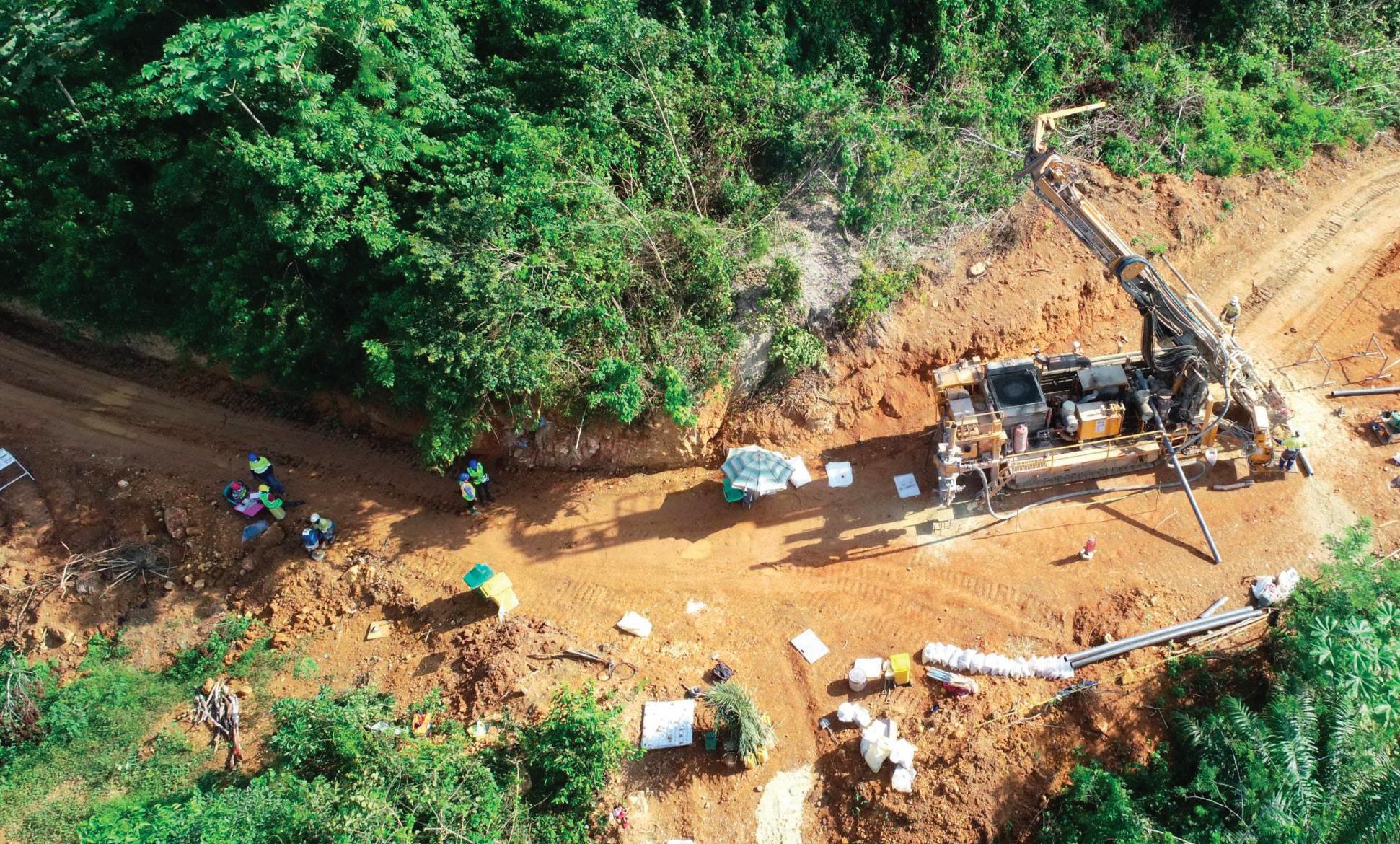
He points out that at spot gold prices around US$2,350 per oz., the post-tax NPV rises to US$632 million and the IRR to 92%. It is generally understood that investors’ risk aversion eases at project IRR rates above 35%, with anything more than 15% still deemed worthy of a look.
Ghana is Africa’s top gold producer, according to World Gold Council data, and is considered a tier one jurisdiction. Newmont (TSX: NGT; NYSE: NEM) invested more than a billion dollars in the Ahafo North project there. In
April, Galiano Gold (TSX: GAU; NYSE-AM: GAU) bought full control of the 130,000-oz.-per-year Asanko mine from Gold Fields (NYSE: GFI; JSE: GFI) for US$170 million.
Newcore shares traded at 35¢ apiece before press time, in a 52-week range of 9¢ and 34¢. The stock has gained more than 21% over the past 12 months, giving the company a market value of $60.4 million.
An updated resource estimate, calculated at US$1,650 per oz. underpins the PEA. Enchi hosts
41.7 million indicated tonnes grading 0.55 gram gold per tonne for 743,000 oz. of metal. Inferred resources add another 46.6 million tonnes of 0.65 gram gold for 972,000 ounces.
Better economics
The PEA, prepared by Lycopodium Minerals Canada, plans for an 8.1-million-tonne-per-year openpit operation over nine years using heap leaching. That compares to 6.6 million tonnes per year over 11 years as assessed in the previous study. The waste-to-ore strip ratio
is estimated at 2.67 and the heap leach feed grade at 0.6 gram gold. The operation expects to hire mining contractors.
Over the mine life, the study outlines production of just over a million ounces at all-in sustaining costs of US$1,018 per oz., lower than the US$1,066 in the previous study. The PEA update also budgets for higher sustaining capital of US$92 million versus US$23 million, and closure costs of US$18 million versus the earlier estimated US$22 million.
Newcore is to build the heap leach facility in three stages, with extra capacity planned for future expansion. Trucks are to carry ore from five deposits (Sewum, Boin, Nyam, Kwakyekrom, Tokosea) to a central crushing and heap leach facility between the Boin and Sewum deposits, which hold about 76% of the resources. The plan assumes that secondary crushing capacity will only be necessary when processing transitional and fresh rock in the latter half of the mine life, thereby reducing initial capital costs.
Alexander says the company will proceed to a prefeasibility, but a definite timeline has not yet been established.
In February, Newcore increased Enchi’s size to 248 sq. km by adding the Omampe licence, where the company plans to identify early-stage drill targets.
The company has also completed an updated environmental and social baseline study. TNM
32 JUNE 2024 | THE NORTHERN MINER www.northernminer.com GOLD AND SILVER
A drill rig at the Čoka Rakita project in Serbia. DUNDEE PRECIOUS METALS
GHANA | Updated PEA ups forecast output, gold price
A crew conducts drilling work at Newcore’s Enchi gold project in Ghana. NEWCORE GOLD
Treasury Metals to buy Giustra-backed Blackwolf Copper and Gold
M&A | All-share deal to help advance Goliath Gold complex in Ontario
BY JACKSON CHENTreasury Metals (TSX: TML; US-OTC: TSRMF) is bolstering its balance sheet and management with a deal to acquire Alaska-focused Blackwolf Copper and Gold (TSXV: BWCG; USOTC: BWCGF) and its development-stage Niblack project.
Treasury expects the deal will help advance its prefeasibility-stage Goliath Gold complex in northwestern Ontario to production. It aims to achieve that through a strengthened balance sheet and a new capital markets strategy led by Canadian mining financier Frank Giustra — a cornerstone shareholder in Blackwolf.
Treasury said on May 2 it will offer 0.607 of a common share for each common share of Blackwolf. At the time of the announcement, Treasury’s stock traded at 20¢ apiece, while Blackwolf’s shares were priced at 13¢ each, with respective market capitalizations of $29.7 million and $15.9 million.
The deal will leave existing Treasury and Blackwolf shareholders with around 68.3% and 31.7%, respectively, of the combined company.
“This is a tremendous win-win opportunity for Blackwolf and Treasury shareholders,” Blackwolf CEO Morgan Lekstrom said. Lek-
strom is expected to become president of the combined company.
“Treasury has done an incredible job of advancing the (Goliath) project through the start of engineering and permitting, and we are optimistic that it can evolve into a major Canadian gold camp.”
The merger, which has the support of senior officers and directors in Blackwolf, as well as Giustra, remains subject to a vote from Blackwolf shareholders.
Giustra said he believes this is “a strong transaction” that puts the company on the path of a buy-andbuild strategy that he has implemented many times.
New gold camp
The Goliath complex is a 65-km trend within a 330-sq.-km land package that hosts three distinct projects within the Wabigoon greenstone belt. The main Goliath project includes an open-pit and underground gold mine and associated milling facility located 20 km east of Dryden, Ont.
A February 2023 prefeasibility study gave the Goliath complex a 13-year mine life, producing 109,000 oz. of gold annually at a cash cost of US$892 per oz. and at an all-in sustaining cost of US$1,037 per oz. during the first nine years. The study projected a net present value of $493 million at a 5% discount rate, and an internal
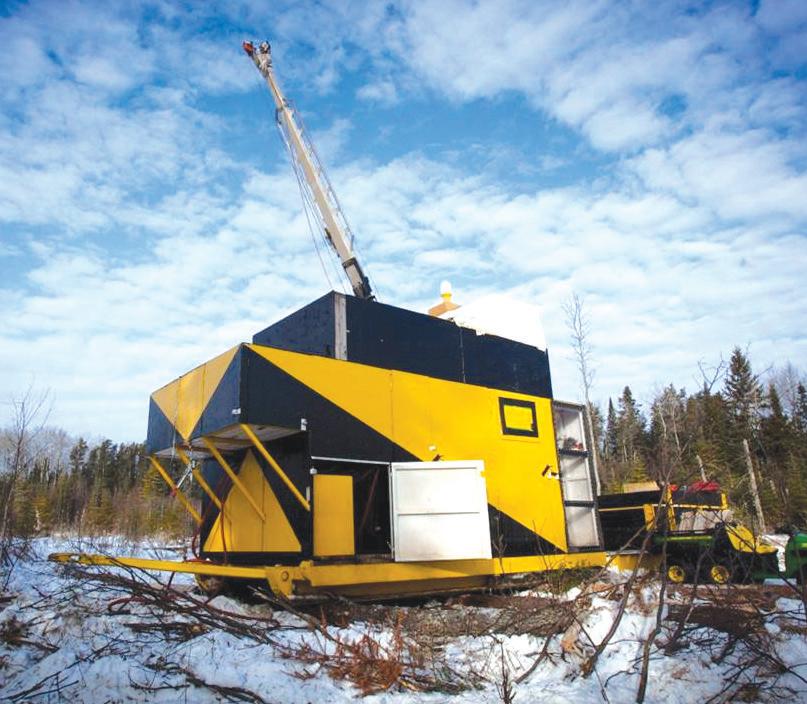
rate of return of 33.5% based on a gold price of US$1,950 per ounce. Federal environmental approval for the project was obtained in 2019. The final feasibility study and permitting processes are currently underway.
Giustra financing
Concurrent with the merger, Treasury Metals will raise up to $6.4 million through a private placement of roughly 27.7 million flow-
Pan American sells La Arena gold project to Zijin Mining
PERU | US$295M deal includes 1.5%
BY AMANDA STUTTPan American Silver (TSX: PAAS; NYSE: PAAS) is selling its La Arena gold mine in Peru to China’s Zijin Mining for US$245 million cash upfront and a US$50-million contingent payment.
The La Arena property is in the country’s northwest La Libertad province and holds the mine and the La Arena II advanced exploration project. The open pit mine has operated since 2011.
As part of the deal Pan American will retain a life-of-mine gold net smelter return royalty of 1.5% for the La Arena II project, it said on May 1.
Jinteng Mining, a Singapore-based subsidiary of Zijin, will oversee the property, the companies said.
“With the sale of La Arena, we continue to deliver on our strategy to optimize our portfolio following the Yamana transaction, while maintaining future upside through the retention of royalties,” Pan American CEO Michael Steinmann said in a news release.
“Proceeds from the transaction will further strengthen our financial position and allow us to deliver on our capital allocation priorities of investing in high-quality assets, debt reduction and returning capital to our shareholders.”
The sale was expected, BMO Capital Markets mining analyst Jackie Przybylowski wrote in a note to clients on May 2.
“This transaction is accretive to Pan American as the purchase price was well above our value of the asset, and it is consistent with
“We are encouraged that Pan American could sell a stake in La Colorada Skarn for strong value in the future.”
JACKIE PRZYBYLOWSKI, MINING ANALYST, BMO CAPITAL MARKETS
PAAS’ portfolio optimization strategy,” she wrote. “We are encouraged that Pan American could also sell a stake in La Colorada Skarn for strong value in the future.”
The company released a preliminary economic assessment for its La Colorada silverlead-zinc project, in Zacatecas, Mexico, in December. The study envisioned a 17-year, sub-level caving operation that would cost US$2.8 billion to build.
Since acquiring the mine from Tahoe Resources in 2019, Pan American said it has added 535,521 oz. of gold through exploration and extended the mine life to 2026 from 2021, with potential for further extension.
Pam American completed its acquisition of four Yamana Gold mines a year ago March. The deal added the Jacobina complex in Brazil, the El Peñón and Minera Florida mines in Chile, and Cerro Moro mine. It also added the MARA development project in Argentina to its portfolio.
Shares in Pan American Silver traded at $30.17 apiece at press time for a market cap of $11 billion. Its shares traded in a 52-week range of $16.50 and $30.67. TNM
through units at 23¢ per unit. Each unit consists of a common share and one warrant exercisable at 35¢.
After the merger process is completed, the combined company plans a four-for-one share consolidation.
Giustra is expected to be the lead subscriber and become the company’s largest shareholder.
Net proceeds will be used to advance Goliath project and select exploration programs across the
combined portfolio.
Sprott Resources Streaming and Royalty has agreed to waive quarterly minimum payments from Treasury over the next four quarters to provide financial flexibility. In exchange, the quarterly minimum payment will increase from US$500,000 to US$675,000, and the deadline of the last payment will be moved forward, once the payments resume.
Treasury will also look to develop the newly acquired Niblack project located on Prince of Wales Island in southeast Alaska. The project covers 25 sq. km. and is located adjacent to tidewater.
Past exploration on the Niblack property has led to the discovery of six copper-gold-zinc-silver mineralized areas. Two of those have resource estimates totalling 5.9 million indicated tonnes grading 0.94% copper, 1.83 grams gold per tonne, 1.73% zinc and 29 grams silver, containing 345,800 oz. of gold equivalent.
Blackwolf acquired the Niblack project through an option agreement with Teck Resources (TSX: TECK.A, TECK.B; NYSE: TECK) back in 2006. Under that agreement, Blackwolf is obliged to pay Teck $1.25 million in cash upon a change in project ownership; the parties have now entered an agreement to allow Blackwolf to pay in shares. TNM
Alpha drill results expand gold zones at former Italian mine area
ERITREA | 20,000-metre program underway at
Kerkasha
BY COLIN MCCLELLANDAlpha Exploration (TSXV: ALEX) says drill results extend mineralization at the Kerkasha gold project in Eritrea with a double-digit grams assay.
Drill hole ABRD113 cut 5 metres grading 11.03 grams gold per tonne from 174 metres depth in the Aburna prospect’s Northeast target, Alpha said on April 26. Drill hole ABRD118 returned 4 metres at 5.94 grams gold at the Central target; and hole ABRD105 cut 22 metres at 1.71 grams gold in the same target.
Alpha has completed its first stage of more than 6,000 metres in a 20,000-metre drilling program at the site 135 km from Asmara, the capital of the northeast African country. The drilling was designed to test mineralization down plunge of the current mineralized lenses at Aburna, the company said in a release.
“Drill hole ABD113 in the Northeast area has further confirmed the plunging high grade mineralized orientation at Aburna, extending the principal shoot down plunge,” president and CEO Michael Hopley said in a release. “The company is now well funded to accelerate exploration on the Aburna gold prospect as well at the other principal projects on our licence.”
Former mines
The Kerkasha site holds four Italian gold mines dating from the 1890 to 1941 colonial period. AngloGold Ashanti (NYSE: AU) explored the site during 2010-13,
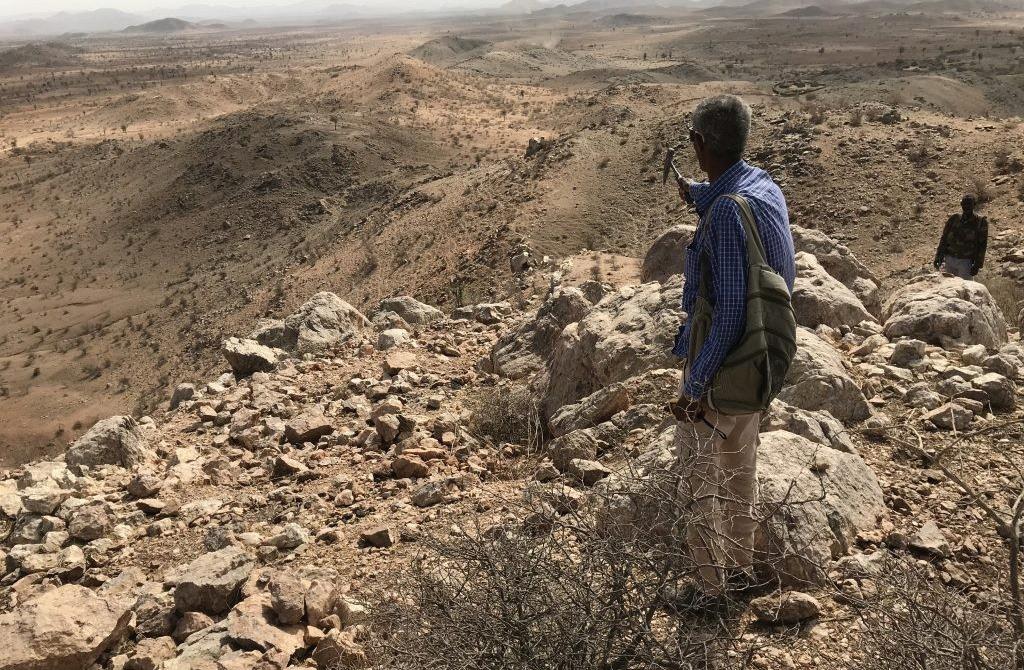
leaving data for Alpha to use in AI-assisted computer modelling. The area’s portion of the Nubian shield, which stretches north to Egypt and east across the Red Sea, is also being explored by Royal Road Minerals (TSXV: RYR), Centamin (TSX: CEE; LSE: CEY) and Saudi Arabia’s state-owned Ma’aden.
In March, Alpha reported reverse-circulation drill hole ABD012 cut 18 metres grading 15.33 grams gold from 114 metres depth at the Hill 52 target; hole ABD013 returned 49 metres at 2.75 grams gold from 18 metres down hole at the same target including 7 metres at 14.9 grams gold. The company also raised $7 million in a stock offering in March. Alpha is also drilling the Anagulu gold-copper prospect and advancing the Tolegimja volcanogenic massive sulphide copper-zincgold prospect in the same licence area. Shares in Alpha Exploration traded at 94¢ apiece at press time, valuing the company at $85.2 million. The shares traded in a 52-week range of 54¢ to 94¢. TNM
GLOBAL MINING NEWS THE NORTHERN MINER | JUNE 2024 33 GOLD AND SILVER
A drill rig at the Goliath gold complex in northwestern Ontario. TREASURY METALS
NSR royalty
Alpha Exploration’s Kerkasha gold project in Eritrea. ALPHA EXPLORATION
GOLD AND SILVER SNAPSHOT: Eight companies combing the globe for the precious metals
BY NORTHERN MINER STAFFGold and silver have played an important role in society for centuries, and now, the green energy transition is fuelling demand for silver. Here’s a list of eight companies exploring for more sources of the highly coveted metals.
n Aftermath Silver
Aftermath Silver (TSXV: AAG; US-OTC: AAGFF) has projects in in Chile (Challacollo and Cachinal) and Peru (Berenguela).
Challacollo is a low-sulphidation epithermal deposit in Region I of northern Chile, 130 km southeast of the port city of Iquique and 30 km east of the Pan American Highway. The project can be accessed via Teck Resources’ (TSX: TECK.A; TECK.B; NYSE: TECK) Quebrada Blanca copper mine road.
Challacollo hosts 6.6 million indicated tonnes grading 165 grams silver per tonne and 0.27 gram gold for 35.2 million oz. contained silver and 58,000 oz. gold. Inferred resources add 2.8 million tonnes averaging 124 grams silver and 0.17 gram gold, for 11.1 million oz. contained silver and 15,000 oz. gold.
Aftermath’s Chachinal low-sulphidation epithermal project is in Chile’s Region II, about 40 km east of the Pan American Highway and 16 km north of Austral Gold’s (TSXV: AGLD; ASX: AGD; USOTC: AGLDF) Guanaco gold-silver mine.
Aftermath has defined a shallow resource of 5.1 million indicated tonnes grading 101 grams silver and 0.13 gram gold for 16.3 million oz. silver and 21.7 million oz. gold. Inferred resources add 530,000 tonnes averaging 145 grams silver
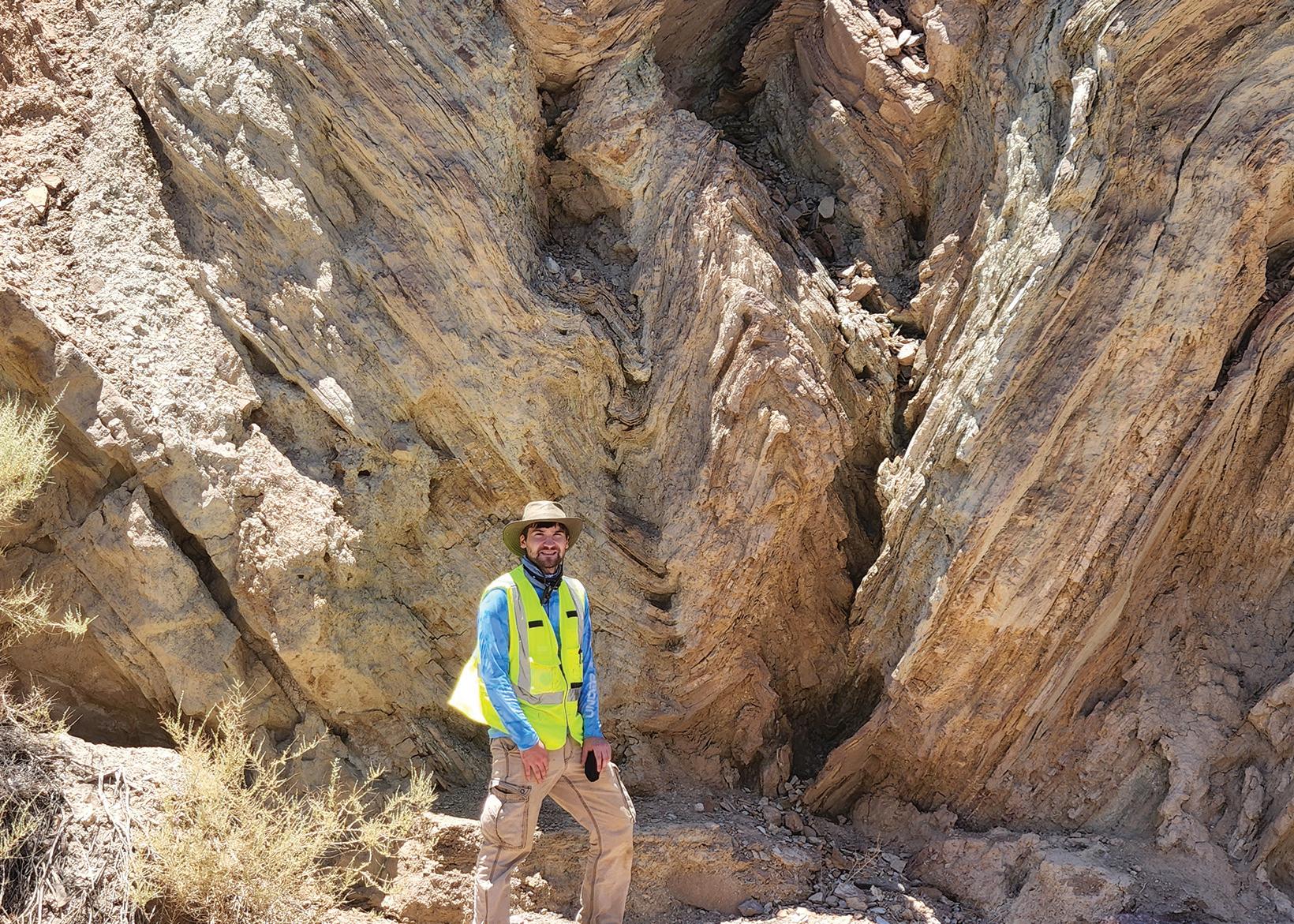
and 0.15 gram gold for 2.5 million oz. silver and 2.6 million oz. gold.
In Peru, Berenguela is a carbonate replacement deposit 350 km by rail from the port of Matarani. Mineralization outcrops and metallurgical test work is underway to confirm flow sheets for silver doré, copper cathode and manganese sulphate. In February, the company reported producing battery grade 99.98% pure manganese sulphate crystals, which assayed 31.9% manganese (high purity manganese sulphate monohydrate).
Berenguela holds 40.2 million measured and indicated tonnes grading 78 grams silver, 6.1% manganese, 0.67% copper and 0.34% zinc for contained metal of 101.2 million oz. silver, 2.5 million tonnes manganese, 589 million lb. copper, and 299.3 million lb. zinc.
Inferred resources total 22.3 million tonnes grading 54 grams silver, 3.57% manganese, 0.42% copper and 0.25% zinc for 38.8 million oz. silver, 800,000 tonnes manganese, 204.3 million lb. copper and 123 million lb. zinc.
Aftermath Silver has a market cap of about $66.3 million.
n Apollo Silver
Apollo Silver (TSXV: APGO; USOTC: APGOF) is a pure play silver explorer focused on its Calico project in California’s San Bernadino County, about 15 km northeast of Barstow.
The project consists of two adjacent properties, Waterloo and Langtry, both of which have near-surface resources.
Waterloo hosts 34.2 million
measured and indicated tonnes grading 100 grams silver for 110 million oz. contained silver and another 290,000 inferred tonnes grading 77 grams silver for 720,000 silver ounces. In addition to silver, Waterloo has an inferred resource of 70,000 oz. of oxide gold contained within 4.5 million tonnes grading 0.5 gram gold.
Pan American Silver (TSX: PAAS; NYSE: PAAS) has a 2% net smelter return royalty on the Waterloo property.
Langtry has inferred resources of 19.3 million tonnes averaging 81 grams silver for 50 million oz. contained silver.
The company believes that barite could become a significant byproduct credit at Calico. Results from a 2022 metallurgical test program for Waterloo produced a concentrate
with 94.6% barite via flotation. Barite is on the United States’ 2022 critical minerals list and is used in domestic applications in the energy industry. About 90% of the barite sold in the U.S. is used as a weighting agent in petroleum drilling, Apollo says.
In January, the company reported that it had received both its drilling permit for Waterloo and results from this year’s assay testing program, which will be used to define barite assaying for an initial barite resource.
A historic resource estimate in 1979 for in-ground barite at Waterloo by the American Smelting and Refining Company (ASARCO), a U.S.-based subsidiary of Grupo Mexico, estimated there were 33.9 million tonnes of barite mineralized rock, grading 13.4% bar-
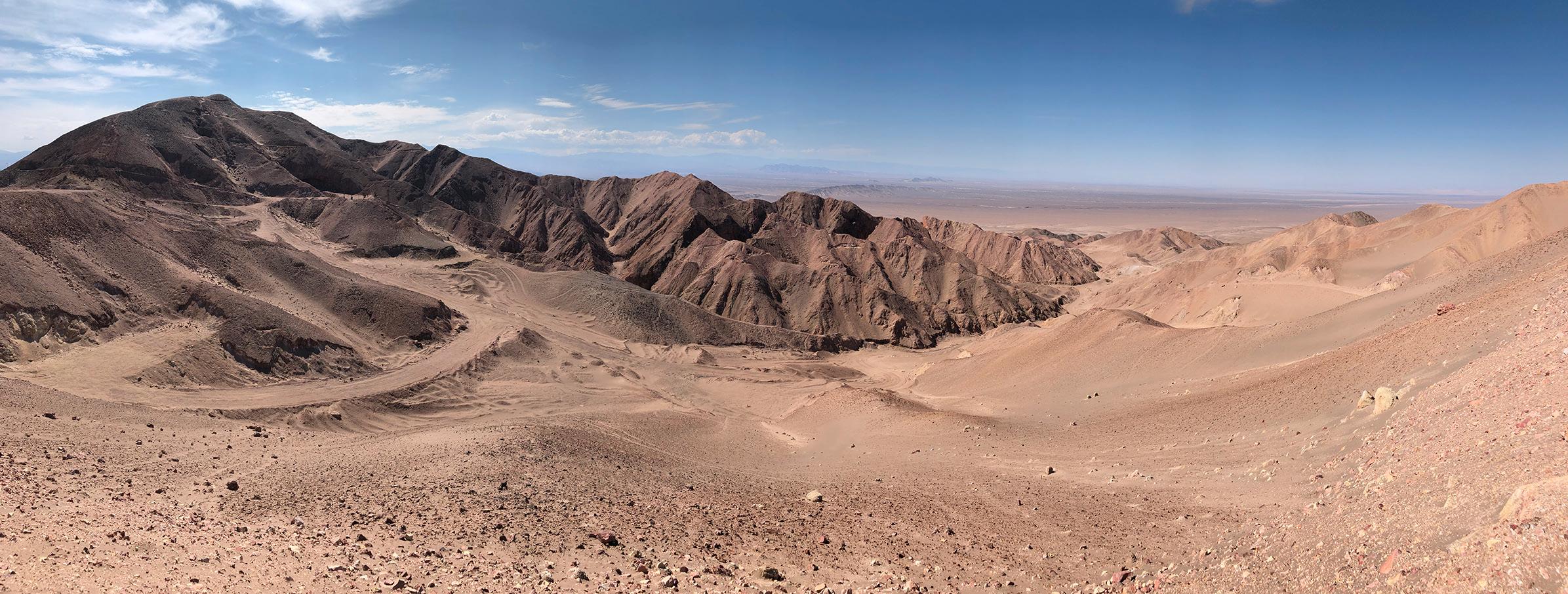
34 JUNE 2024 | THE NORTHERN MINER www.northernminer.com GOLD AND SILVER
At Apollo Silver’s Calico project in southern California. APOLLO SILVER
Below: Panoramic view of the old stopes at Aftermath Silver’s Challacollo project in Chile.
AFTERMATH SILVER
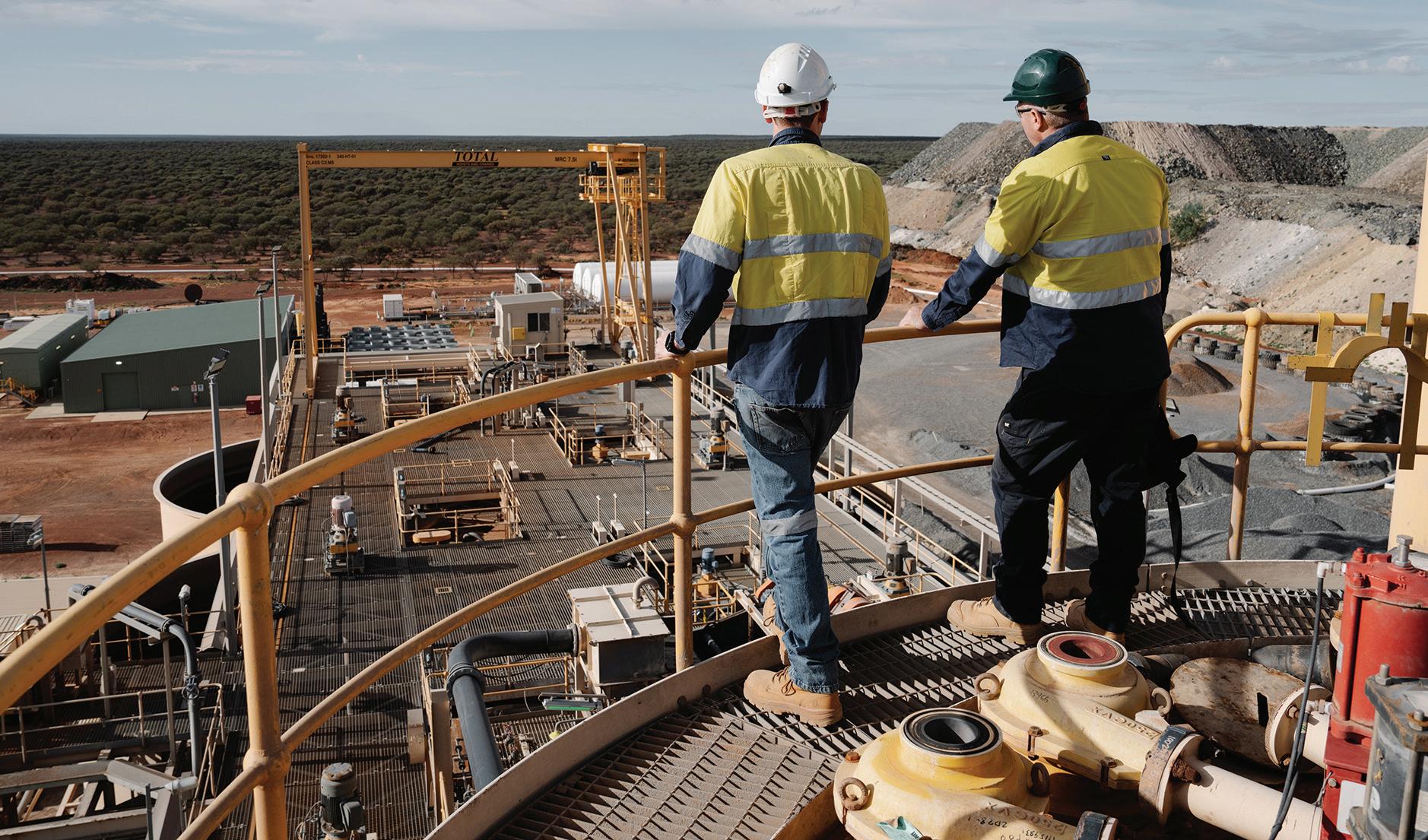
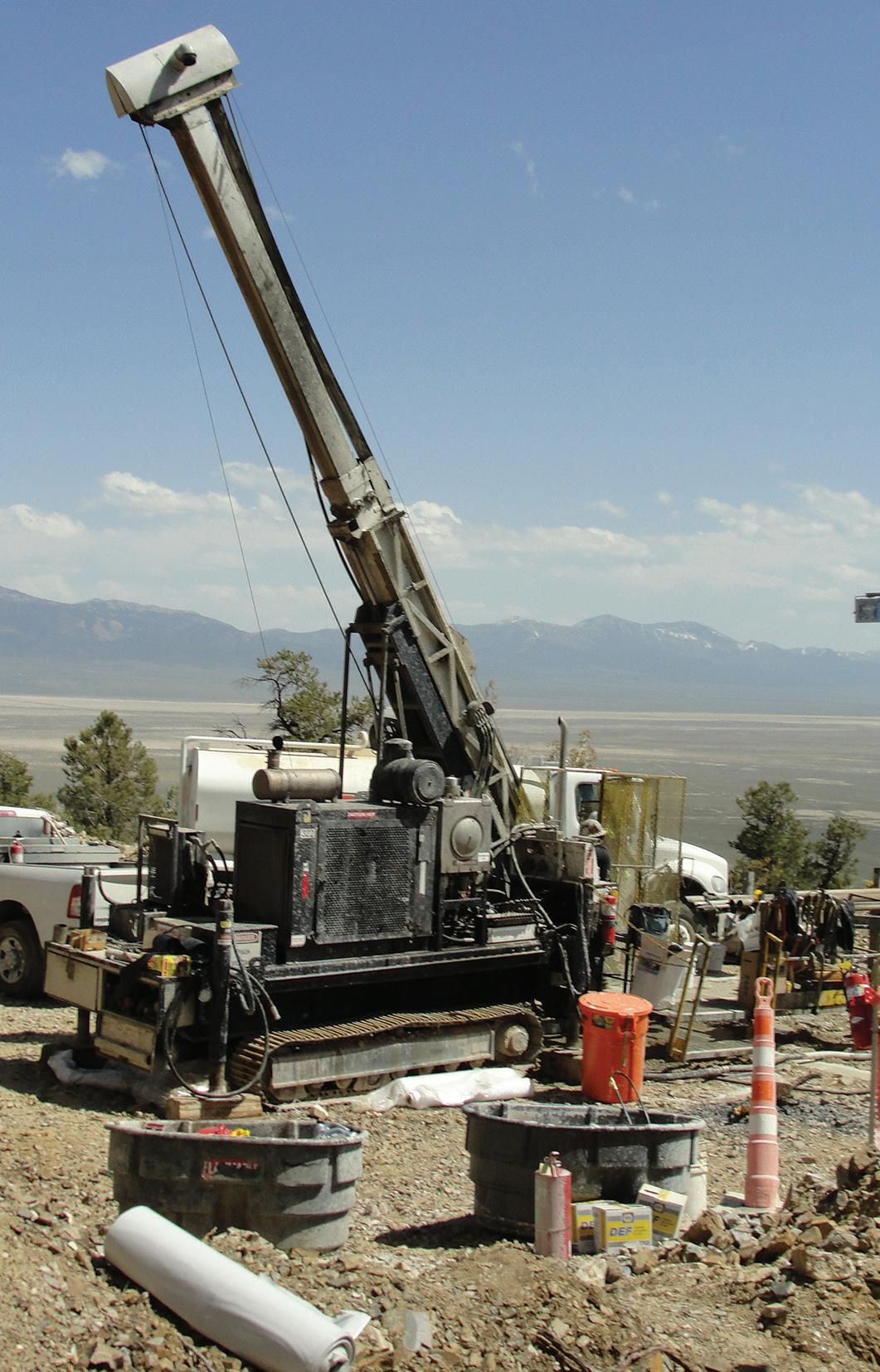
ite for a total of 4.5 million tonnes.
ASARCO estimated that a concentrate grade of 93% could be produced at a barite recovery of 50% via flotation of cyanide tailings. Apollo Silver has a market cap of about $28 million.
n Kingsmen Resources
Kingsmen Resources (TSXV: KNG; US-OTC: KNGRF) is focused on the Las Coloradas silvergold-lead-zinc-copper project in Mexico, about 38 km from the city of Hidalgo de Parral in northern Chihuahua state.
ASARCO conducted mining in the Las Coloradas project area between 1944 and 1952 with production from the La Soledad, Santo Nino, Eva and Rosario veins.
The project consists of shallow, high-grade silver-gold-lead-zinccopper quartz-calcite veins and the company notes that mineralized structures have not been explored to depth or along strike. This year the company is planning an initial 8,000-metre drill program and more IP and magnetics.
Mineralization at Las Coloradas is located on the southeastern flank of a prominent aeromagnetic high
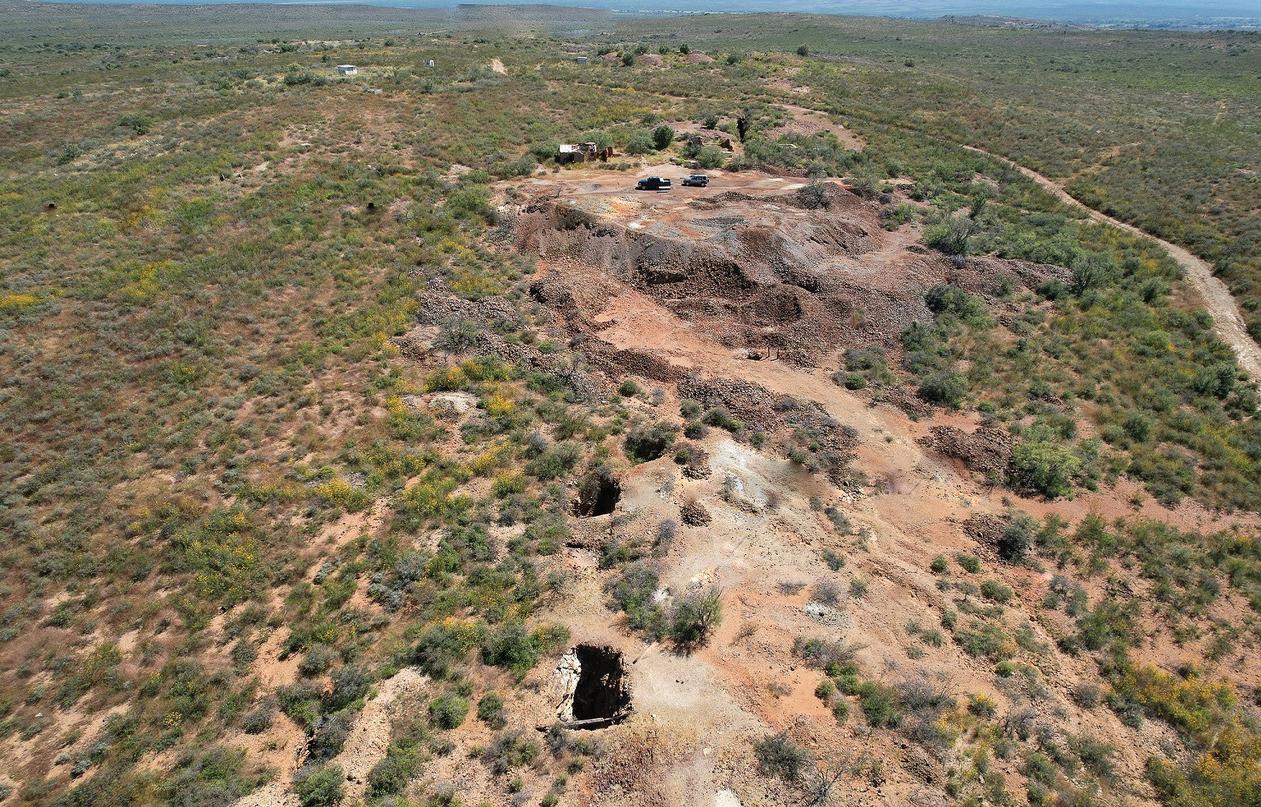
400 grams silver; one exceeded 300 grams silver; another one was greater than 200 grams silver and another returned more than 100 grams silver.
At Soledad II, four of 21 samples returned greater than 300 grams silver; two exceeded 200 grams silver and another two returned 100 grams silver.
In addition to Las Coloradas, Kingsmen has a 1% net smelter return royalty on the Trini property, which is part of the Los Ricos gold project operated by GoGold Resources (TSX: GGD; Us-OTC: GLGDF).
Kingsmen Resources has a market cap of about $8 million.
n Pasofino Gold
Pasofino Gold (TSXV: VEIN; USOTC: EFRGF) is developing the Dugbe gold project in southern Liberia, about 76 km from the port of Greenville.
A feasibility study completed in June 2022 by DRA Global forecast production of 2.3 million oz. gold from two open pits over a mine life of 14 years with average annual production of 200,000 oz. during the first five years. Life-of-mine all-in sustaining costs were pegged at US$1,005 per ounce.
interpreted to be a buried felsic intrusive body with potential porphyry, skarn and epithermal vein mineralization.
The company has identified two key areas of silver mineralization: two are located on the 1.7-km-long Soledad structure and another is on the 1-km-long Soledad II structure.
Kingsmen has completed confirmatory sampling of remnant mineralization in accessible old workings along the Soledad and Soledad II structures. Highlights from 39 samples from Soledad Southeast included two greater than 500 grams silver; four greater than 200 grams silver; and nine greater than 100 grams silver.
At Soledad Northwest, of 24 samples, two were greater than
The two pits — Tuzon and Dugbe F — are situated about 4 km apart and will feed a central processing plant midway between the deposits. The economic study forecast a post-tax net present value (at a 5% discount rate) of US$524 million and a post-tax internal rate of return of 23.6% at a base case gold price of US$1,700 per ounce. Pre-production capex was estimated to run to US$379 million excluding US$37 million owners’ costs for a 5-million-tonne-per-year processing plant. Payback could be achieved in just over three years.
A resource estimate in November 2021 showed the Tuzon and Dugbe F deposits hold 75.2 million measured and indicated tonnes

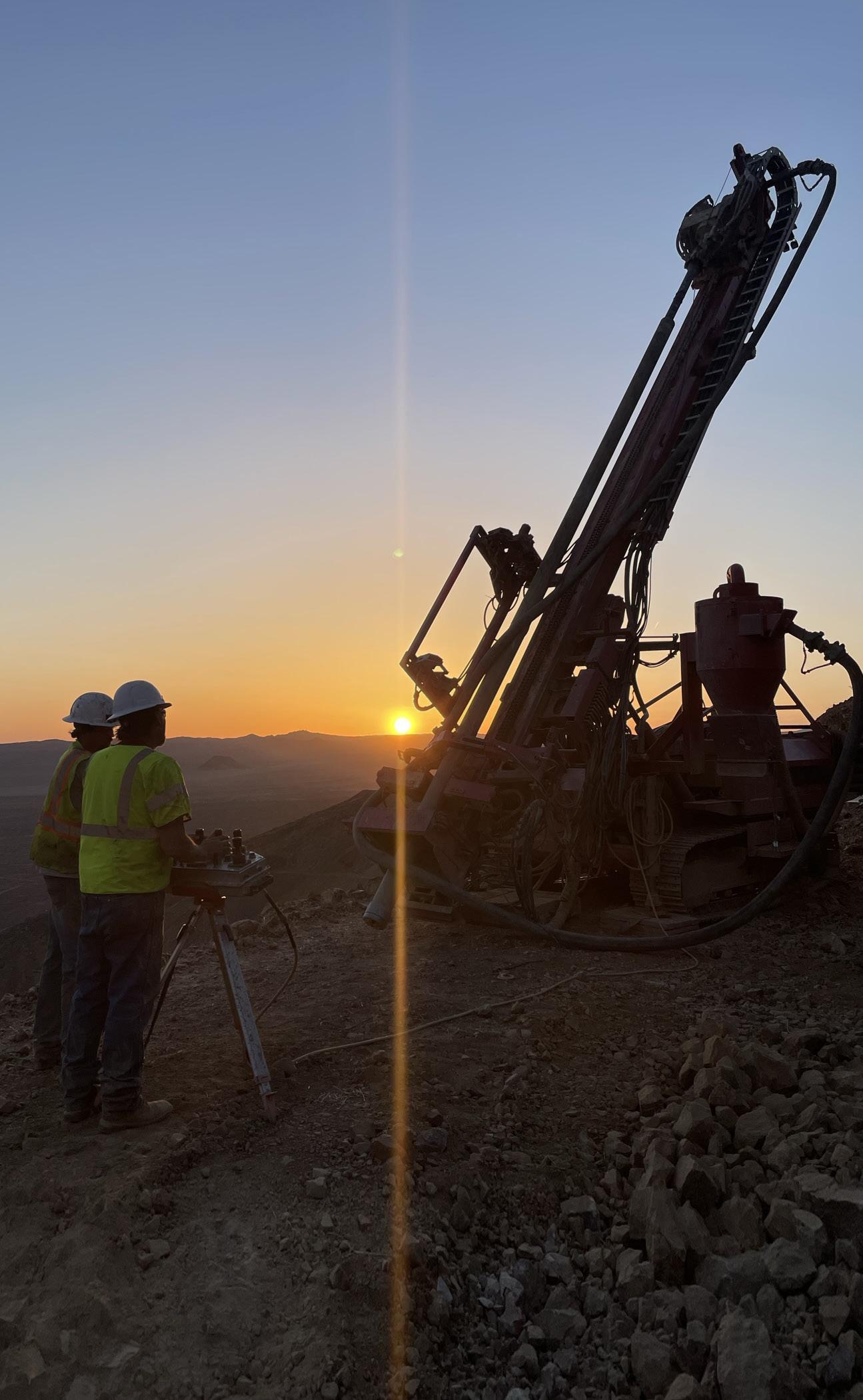
GLOBAL MINING NEWS THE NORTHERN MINER | JUNE 2024 35 GOLD AND SILVER
Below: Kingsmen Resources’ Las Coloradas silver-gold-lead-zinccopper project in northern Mexico.
KINGSMEN RESOURCES
Above: Spartan Resources’ Dalgaranga project in Australia. SPARTAN RESOURCES
Left: A drill rig at Viscount’s Cherry Creek gold project in Nevada. VISCOUNT MINING
Contact: info@apollosilver.com TSX.V:APGO / OTCQB:APGOF / Frankfurt:6ZF0 • Advancing Calico Silver Project, one of the largest undeveloped silver projects in the US. • Tremendous leverage to silver. • 90 million ounces Measured, 20 million ounces Indicated, additional 51 million ounces Inferred. • Stable jurisdiction, private lands with vested mining rights in San Bernardino County. A NEW DAWN FOR SILVER IN AMERICA
Snapshot on P36 >
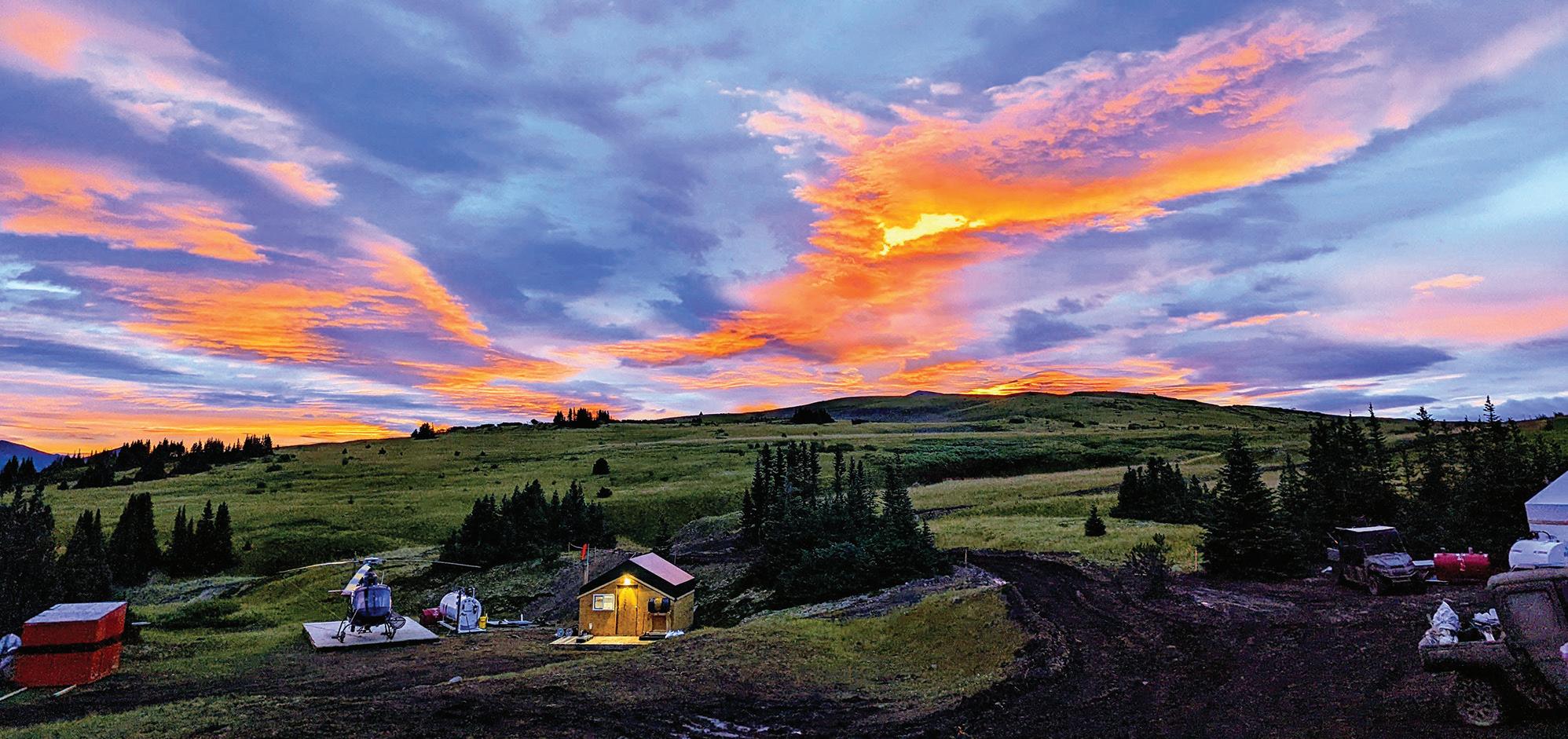
grading 1.37 grams gold for 3.3 million oz. of contained gold and 14.9 million inferred tonnes of 1.23 grams gold for 588,000 oz. gold.
The project, in West Africa’s prospective Birimian geological region, has numerous gold prospects within a 10-km radius of the existing deposits. Pasofino is drilling and trenching at targets including the Tuzon-Sackor trend, Nemo Creek South and Bukon Jedeh, where it started drilling in April.
The government of Liberia has a 10% free carried interest in the project and has issued mining rights for 25 years.
Pasofino has a market cap of about $61.7 million.
n Spartan Resources
Spartan Resources’ (ASX: SPR) flagship is Dalgaranga, a gold project in the Murchison region of Western Australia, 475 km northeast of Perth.
The project includes a fully developed mining operation, which produced 71,153 oz. gold during the 2022 financial year. The company placed Dalgaranga on care and maintenance in November that year to focus on a new strategic plan.
Now the company’s centre of attention is on its high-grade Never Never deposit, which it discovered two years ago about 1 km from Dalgaranga’s main open pit, and 2.5-million-tonne per year carbonin-leach processing plant.
Spartan has three diamond drill rigs at Never Never. The top intercepts so far include 59 metres of 12.5 grams gold from 138 metres in drillhole DGRC1110; 12.6 metres of 34.5 grams gold from 397 metres in hole DGDH032; and 11.5 metres of 36.77 grams gold from 875 metres in hole DGDH052.
In April, the company reported the new, high-grade Pepper prospect south of Never Never, where drilling cut 17.5 metres at 15.86 grams gold from 522 metres depth, including 9.2 metres at 27.89 grams gold, in hole DGRC1432-DT.
Just a week before, Spartan reported that deep drilling at Never Never hit visible gold at a depth of more than 1 km in drillhole DGDH064, about 400 metres down plunge from the current resource. Visible gold was logged in two areas in a 20-metre downhole intercept. Assays are pending.
The company plans to update the Never Never resource estimate
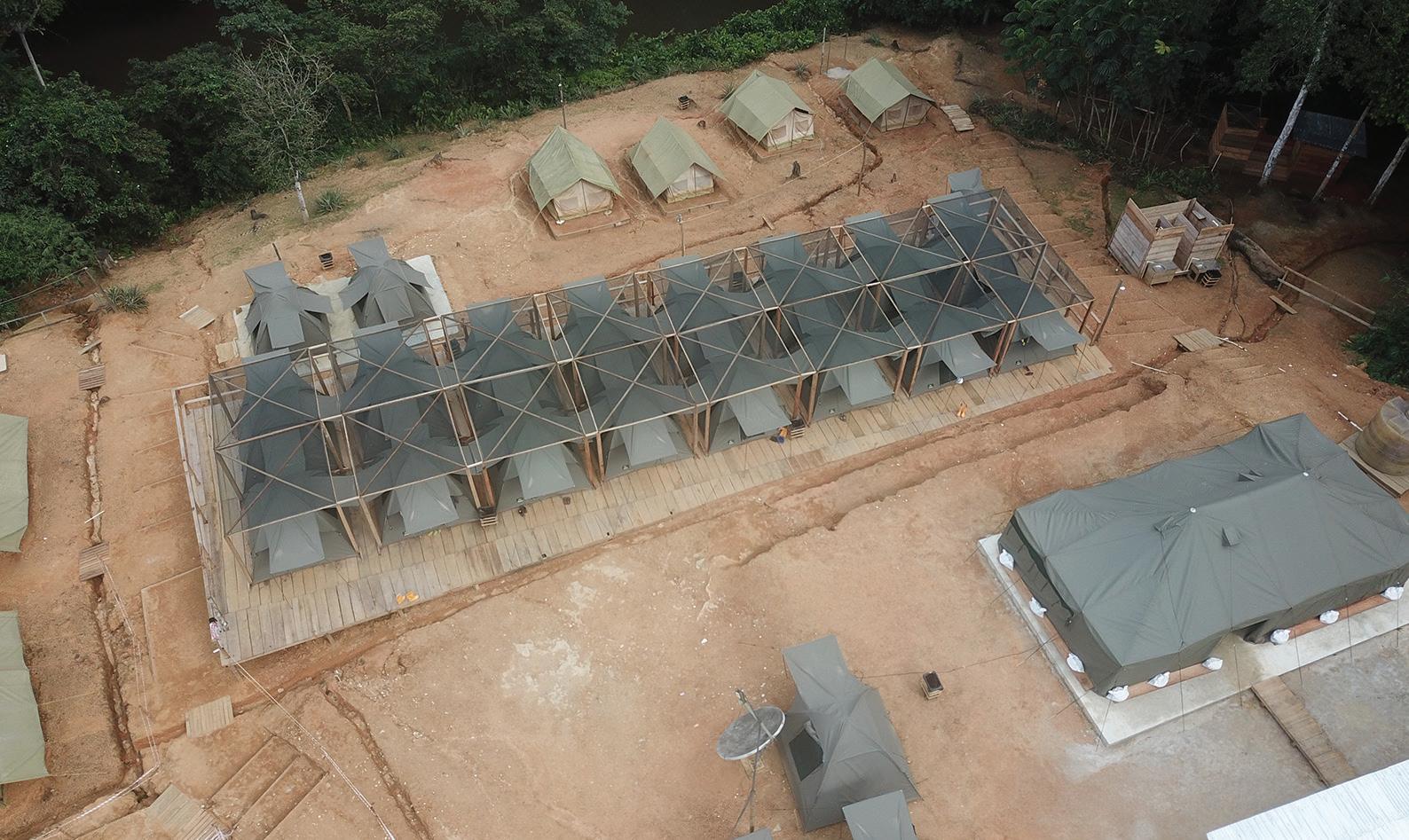
by mid-year. The deposit contains 3.7 million indicated tonnes grading 5.93 grams gold for 700,700 oz. contained gold and 1.5 million inferred tonnes grading 5.28 grams gold for 252,100 gold ounces.
Drilling is also targeting Never Never’s ‘lookalike’ prospects such as Four Pillars, West Winds and Sly Fox. Highlights from Sly Fox include 23.6 metres of 2.45 grams gold from 457 metres depth, including 7 metres of 4.07 grams gold in drillhole DGRC1408-DT.
Spartan is also exploring the Yalgoo gold project 110 km from Dalgaranga; and the Glenburgh-Mt. Egerton project, 300 km north of Dalgaranga.
Spartan Resources has a market cap of A$624 million (US$413 million).
n Summa Silver
Summa Silver (TSXV: SSVR; USOTC: SSVRF) is exploring the Mogollon project in southwestern New Mexico, about 120 km from Silver City, and the Hughes project in Nevada’s historic Tonopah district, about 338 km from Las Vegas and 362 km from Reno.
Between the 1880s and 1942, Mogollon produced an estimated 16.4 million oz. silver and 339,000 oz. gold at grades of 298 grams silver and 6.16 grams gold from small-scale underground mines.
The project covers a silver-gold bearing epithermal vein field and current drilling is testing just two of 77 km of potentially silver-bearing
vein length on the property.
In April, results from a step-out hole in an untested vein about 200 metres below the past-producing Eberle mine returned 421 grams silver and 8.8 grams gold (1,133 grams silver-equivalent per tonne) over 1.7 metres from 483 metres down hole in drill hole MOG23-21.
Another hole testing the South Queen target, between the Deadwood and Eberle mines, intersected 64 grams silver and 3.9 grams gold (393 grams silver-equivalent) over 7.4 metres from 2,422.4 metres downhole in drill hole MOG23-20
The Hughes project, about 80 km from Kinross Gold’s (TSX: K; NYSE: KGC) Round Mountain mine, hosts the historic Belmont mine, which produced between 1903 and 1929.
Drill results in the Belmont target area include 2.8 metres of 2,252 grams silver and 21.6 grams gold (4,408 grams silver-equivalent) from 431 metres in drill hole SUM21-30; and a 0.9-metre interval grading 1,301 grams silver and 7.86 grams gold (2,087 grams silver-equipment) from 342 metres in hole SUM21042 in the Belmont target area.
Last year, Summa made three new vein discoveries in six exploration holes. These zones, open in all directions, have been intersected up to 4.7 km east along strike from the Tonopah mining district. Highlights included 3 metres of 147 grams silver and 3.04 grams gold (392 grams silver-equivalent) starting from 323 metres in drill hole SUM23-60.
Summa Silver has a market cap of about $40 million.
n Thesis Gold
Thesis Gold (TSXV: TAU; USOTC: THSGF) is focused on its Lawyers and Ranch gold-silver projects in the Toodoggone mining district of north-central British Columbia. The adjacent projects are 45 km northwest of the tie-in to the power grid at Centerra Gold’s (TSX: CG; NYSE: CGAU) Kemess mine.
The company updated its resource estimate for the newly combined projects on May 1, outlining 82 million measured and indicated tonnes grading 1.1 grams gold and 31.9 grams silver (1.51 grams gold-equivalent) for 2.9 million oz. contained gold and 84 million oz. silver (4 million gold-equivalent ounces). Inferred resources add 12.4 million tonnes grading 1.48 grams gold, 20.9 grams silver, 0.06% copper (1.82 grams gold equivalent) for 590,000 oz. gold, 8.3 million oz. silver, and 8,000 tonnes copper (727,000 oz. gold equivalent).
An updated preliminary economic assessment (PEA) integrating the Ranch project is due in the third quarter of this year. A 2022 PEA for the Lawyers project alone projected an open-pit mine producing about 163,000 gold-equivalent oz. a year over 12 years.
Thesis Gold acquired the Lawyers project in 2018 and the Ranch project in 2020.
The company is exploring across more than 30 targets on the
495-sq.-km land package. Thesis has a market cap of about $118.4 million.
n Viscount Mining
Viscount Mining (TSXV: VML; US-OTC: VLMGF) has gold and silver projects in Nevada and Colorado in the United States. Its Cherry Creek project is about 81 km north of the town of Ely in Nevada. The project area includes more than 20 past-producing mines (the three biggest: Ticup, New Century/Exchequer and Star). The company says these could potentially indicate a large mineral system related to a buried acid intrusive pluton. In January 2021, Viscount signed an option agreement with Centerra Gold (TSX: CG; NYSE: CGAU). Centerra can earn 70% in the project by spending US$8 million on exploration over four years. In February 2023, Centerra identified three vertically stacked carbonate replacement deposit features. Drill intercepts included 1,456 grams silver over 1.5 metres from 203 metres in hole CC22-09 and 349 grams silver over 1 metre from 258 metres in CC-22-07. Plans for this summer’s drill program include 10 reverse-circulation drill holes for 2,500 metres.
Viscount’s second asset, Silver Cliff, is a 9.4-sq.-km project about 71 km from Pueblo, Colo. It’s thought to overlie a large caldera and porphyry system. Previous exploration (1967-1984) was completed by Freeport-McMoRan (NYSE: FCX), Hecla Mining (NYSE: HL), Homestake, Moly Corp, Coca Mines and Tenneco Minerals.
Top silver intercepts at Silver Cliff include 231 grams silver over 21 metres, including 6.1 metres of 542.3 grams silver from 32 metres in K16-8; and 703 grams silver over 15 metres, including 1,259 grams silver over 7.6 metres, starting 15 metres downhole in DDH-20-03.
Silver Cliff’s Kate deposit contains 4.1 million measured and indicated tonnes grading 71 grams silver for 10.3 million oz. silver and 9 million inferred tonnes averaging 52 grams silver for 14.2 million silver ounces. Management and insiders own 60% of the company.
Viscount Mining has a market cap of $22 million. TNM
36 JUNE 2024 | THE NORTHERN MINER www.northernminer.com
> Snapshot from P35
Above: A core shack at Thesis Gold’s Ranch project in north-central British Columbia during its 2023 drill program. THESIS GOLD
GOLD AND
The exploration camp at Pasofino Gold’s Dugbe project in Liberia. PASOFINO GOLD
SILVER


GLOBAL MINING NEWS THE NORTHERN MINER | JUNE 2024 37 GEOPHYSICS WEEKLY REPORT Email Newsletter for Mining Professionals Join thousands of high-performing mining professionals already receiving The Northern Miner’s free Weekly Report update. SUBSCRIBE FOR FREE For more information about reserving space in our Professional Directory, please contact: ROBERT HERTZMAN 416-898-6654 Toll free from North America: 1-888-502-3456 rhertzman@northernminer.com professionaldirectory COMPANY INDEX Aftermath Silver 34 Alpha Exploration 33 Anglo American 9 Apollo Silver 34 BHP 9, 16, 38 Blackwolf Copper and Gold 33 Centerra Gold 17 Dundee Precious Metals 32 Fortune Minerals 17 Greatland Gold 20 Horizonte Minerals 18 Kenorland Minerals 17 Red Pine Exploration 1 Regis Resources 20 Rio Tinto 20 Solaris Resources 17 Solitario Resources 19 Spartan Resources 34 Summa Silver 34 Thesis Gold 34 Treasury Metals 33 Troilus Gold 19 Viscount Mining 34 Kingsmen Resources 34 Kingsrose Mining 38 Lomiko Metals 17 Lucapa Diamond 20 Mayfair Gold 8 Newcore Gold 32 NexGen Energy 20 Pan American Silver 33 Pasofino Gold 34 Patriot Battery Metals 18 Power Nickel 18 Q2 Metals 19 www.canadianminingjournal.com SUBSCRIBE TO: CANADA’S FIRST MINING PUBLICATION Mining and Mineral Processing news Since 1882. Print edition is FREE for Canadians involved in mining. Digital Edition and Daily News is FREE.
> Fed EA from P6
sion-makers to trigger assessments or impose conditions on projects based solely on a project’s emissions,” the firm said.
Environmentalists criticized the proposals for allowing too many emissions especially from oil and gas projects, such as oilsands operations in Alberta and proposed mining projects in Ontario’s north. Fourteen environmental groups including Ecojustice, West Coast Environmental Law and MiningWatch Canada wrote a letter about their concerns to the federal cabinet in May.
“Some projects’ climate effects are not otherwise regulated, such as projects in the Ring of Fire area that could disturb peatlands that store more carbon than all of Canada’s forests, releasing dangerous amounts of methane and carbon dioxide,” the groups said in the letter. “Federal oversight of the significant GHG emissions of major projects is critical.”
The proposals offer minimal changes aside from removing greenhouse gases, and may leave the act open for constitutional challenges again, Keerit Jutla, president and CEO of the Vancouverbased Association for Mineral Exploration, said by email.
“The amendments have done little to move away from the federal government regulating whole projects within provincial jurisdiction, which was a major criticism by the Supreme Court,” Jutla said by email. “It is not clear that Canada did anything to substantively address the court’s significant concerns about the public interest decision required to be made at the end of the impact assessment process.”
Altered definitions
The amendments would replace the existing definition of “effects within federal jurisdiction” by adding the word adverse to it. The new definition would apply to “non-negligible adverse” effects or changes, rather than positive or negative changes or impacts regardless of materiality, the law firm said. The language in the proposals is ambiguous enough to create uncertainty when a project
would trigger a federal assessment or what factors would influence decisions, the firm said.
Companies with a project may be able to avoid a federal impact assessment if they mitigate potential adverse effects that are under federal jurisdiction, Osler said. For example, altering a project so it doesn’t harm a fish habitat might prevent the Impact Assessment Agency from ordering an assessment, it said.
The proposals also get rid of a requirement for a proponent to show detailed project descriptions following the planning stage, unless the agency says it’s needed for review. It streamlines the process but also adds uncertainty, Osler said.
Assessment alternatives
The agency would consider if another means could serve instead of an assessment to address potential adverse effects in federal authority, according to the suggested amendments. The other means could be run by separate federal authorities and agencies as well as Indigenous and provincial governments. But the decision to forego an assessment would depend on how the act was implemented, the lawyers said.
The proposals would change a final decision on a project to a two-stage process. The Minister of the Environment (or an appointee recommended by the cabinet if it’s a panel doing the review or a referral from the minister) must first decide how significant any adverse impacts within federal authority are likely to be.
Then the minister or their surrogate must rule if the adverse impacts are justified in the public interest. The language would be changed to focus on the effects of a project rather than assessment of the project itself, Osler said.
“It remains debatable whether these revisions differ meaningfully in their practical and legal effect from the single, highly politicized public interest determination under the current legislation,” the law firm said. “We expect the federal government will continue to engage in consultation on the proposed amendments.” TNM
> Quebec Panel from P10 ecosystem but in the local economy.”
Quebec’s funding infrastructure helps companies weather the boom and bust mining business and volatile commodity prices, Charles said.
“When you have funds that can support the industry through the thinner parts of a cycle, it allows consistency and allows that internal expertise to be maintained, he said. “It allows you to build more resilient companies.”
Province’s potential Quebec’s critical minerals potential is immense. Even though the province has only recently become the focus of exploration, Quebec already hosts 7% of global lithium reserves, Douhéret said. He said the resources in the province could supply 20% of the world’s natural graphite.
Quebec is working with allies that include the U.S. and Europe to develop the sector, he added. “We could be a secure, sustainable, reliable partner and supplier for the local economy around us. And of course, we want to add
value to the product before it leaves Quebec.”
While the province has come a long way in four years, there are still challenges ahead, such as building minerals refining capacity.
The West hasn’t built refining facilities since the 1970s, Charles said, making the idea of building a spodumene refinery “quite shocking” as we’re used to shipping everything to China for processing.
“That’s where I get very excited and interested because we are talking about redeveloping how Quebec, and all these areas interact with the global economy.
“It’s going to take a lot of political willpower because politics is often measured in seconds, minutes and days, and mining and manufacturing is measured in quarters, months, years, decades. These things are long term and have to be consistent over long periods of time.” TNM
This article was based on a panel organized by The Northern Miner and sponsored by Quebec. It was not reviewed by the sponsor before publication.
donedeals
BHP, Kingsrose to jointly explore Norway and Finland
EXPLORATION
| BHP to fund up to US$56M for regional program
BY CECILIA JAMASMIEBHP (ASX: BHP; LSE: BHP; NYSE: BHP) and Australian junior Kingsrose Mining (ASX: KRM) inked two joint agreements on May 22 to explore and develop nickel and copper assets in Norway and Finland.
As part of the alliance with Kingrose, which participated in BHP’s accelerator Xplor program, the world’s largest miner will spend as much as US$56 million over the next decade to earn up to a 75% stake in the smaller firm’s assets.
The agreement, to be carried out in three stages, will first see BHP fund up to US$20 million in regional generative exploration over four years across areas of interest in the two Nordic countries. This gives BHP the exclusive right to select the targets it wants to see developed as projects.
Kingsrose has been building a portfolio of critical minerals exploration projects targeting nickel, copper and platinum group metals in Norway and Finland.
In the second phase, BHP may earn up to 75% in two stages by providing up to a further US$36 million over seven years.
Kingsrose will operate the ventures in both phases and will be
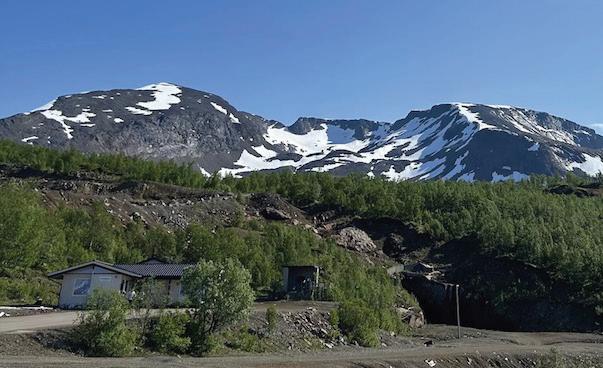
As part of the alliance with Kingrose, BHP will spend as much as US$56 million over the next decade to earn up to a 75% stake in the smaller firm’s assets.
entitled to charge a management fee to cover overhead costs.
The agreement with BHP excludes Kingsrose’s Penikat and Råna projects, which the junior expects to continue advancing
simultaneously. Shares in Kingsrose traded at A4¢ apiece at press time for a market value of A$35.4 million (US$23.5 million). Its shares traded in a 52-week range of 2¢ and 7¢. TNM
> Peartree from P11 copper was at the top in 2023 for the number of exploration projects, at just over 40, though that’s down by about 10 from 2022. Uranium saw the largest increase, to almost 20 projects in 2023 from less than five the year before.
son buying the flow-through shares needs to be in the same province or territory where the dollars are being spent, leaving jurisdictions with smaller populations at a disadvantage.
Critical minerals rising Base and precious metals exploration together dominate spending at more than $3 billion, though that’s down by more than $500 million from 2022. Spending on uranium and critical minerals, on the other hand, more than doubled to over $250 million last year from 2022.
“When we look at 2023 compared to 2022 numbers, we saw a very small increase in exploration projects,” Johnston said. “But interestingly, a decrease in the number of companies that were exploring, and almost a 25% decrease in the amount of drilling that was going on.”
By individual critical minerals,
> Xprize from P16
located as close to the ocean as possible to do this.”
1,000-tonne goal
The finalists were selected on their performance in three areas: operations, sustainability and cost, according to the organizers. The finalists showed they could approach the goal of removing 1,000 net tonnes of CO2 in the competition’s final year. They also outlined a viable pathway to reach a mega-tonne scale within a few years and eventually a gigatonne scale while understanding
The nuclear metal also posted the highest increase in critical mineral exploration dollars last year, at $150 million, a more than 90% rise over 2022. Lithium led all spending in 2023, at almost $275 million, though down from almost $350 million in 2022.
Expanding Indigenous presence
Another trend Johnston pointed to is the growing participation of First Nations groups in exploration projects.
She noted there are more than 500 agreements made with Indigenous groups across the country, ranging from letters of intent to more advanced impact benefit and revenue sharing agreements.
environmental and social impacts, Xprize said.
Canada has the most companies in the running for the prize after the U.S., with seven. Others ranged from the United Kingdom with two to single entries from Ireland, Denmark, the Netherlands, France, Oman, Kenya, India and China. Arca may face some challenges if BHP decides to mothball the Mount Keith mine. The miner said in February it was considering the move after nickel prices fell about 40% last year. An Arca spokesman referred questions on the issue to BHP, which didn’t immediately reply.
“When you look at how many projects there are, it’s more than half of the major projects that are out there,” Johnston said. “We have moved past the realm of consent and consensus and we’re moving now into a space of full participation, (including) equity participation… from jobs and training, right through to ownership.”
Citing three Indigenous-owned companies in the space, including the recently formed Nations Royalty, she said their emergence shows Indigenous people are now taking leading roles in the industry.
“They have geologists, they have engineers, they have accountants and lawyers and CEOs and the whole gamut of individuals, and many of them are entirely First Nation employees.” TNM
This article was based on a panel organized by The Northern Miner and sponsored by PearTree. It was not reviewed by the sponsor before publication.
The technology company uses carbon mineralization developed over two decades by professor Greg Dipple at the University of British Columbia’s CarbMin Lab. It worked with dozens of mining companies and based the process on how 99% of the Earth’s carbon is stored in rocks, he said.
“That’s why we’re focusing on carbon mineralization, the natural process that transforms carbon into rock,” company co-founder Dipple said in a release. “We have developed the technology to accelerate mineralization and we’re now deploying this on site.” TNM
38 JUNE 2024 | THE NORTHERN MINER www.northernminer.com
www.northernminer.com
Kingsrose Mining's Råna brownfields nickel-copper-cobalt project in Norway. KINGSROSE MINING
GLOBAL MINING NEWS THE NORTHERN MINER | JUNE 2024 39 STEP INTO THE FUTURE OF MINING.
work gets done.
products,
business
Only MINExpo INTERNATIONAL 2024® connects you with the innovations that will transform the way your
With a focus on mining (and only mining), you’ll find the
solutions and connections to future-proof your
at the world’s largest global mining event. Register Now at MINExpo.com

















40 JUNE 2024 | THE NORTHERN MINER www.northernminer.com Good luck to all applicants! www.ympscholarships.com scholarships@youngminingprofessionals.com ACQUIRE | DISCOVER FINANCE | BUILD | OPERATE The YMP Scholarship Fund is awarding $225,000 over 44 scholarships. Thank you to our partners for supporting mining’s future leaders! Toronto more sponsors welcome