Private equity signals battery metals spending spree / 27
THE NORTHERN MINER | FEBRUARY 2024
GLOBAL MINING NEWS
Geotech_Earlug_2016_Alt2.pdf 1 2016-06-24 4:27:20 PM
specialfocus
.com
ENERGY METALS Green metals project, market and finance news / 27–36
expert advice VTEM™ | ZTEM™ | Gravity | Magnetics 905 841 5004 | geotech.ca
from exploration to closure
DELIVERING QUALITY EXPERTISE GLOBALLY ACROSS THE ENTIRE MINING LIFE CYCLE WWW.SGS.COM/MINING
MINERALS@SGS.COM
FEBRUARY 2024 / VOL. 110 ISSUE 2 / GLOBAL MINING NEWS • SINCE 1915 / $5.25 / WWW.NORTHERNMINER.COM
At Saudi Arabia’s Future Minerals Forum, the buzz word is partnership BATTERY METALS
| Kingdom sees itself as financial hub atop Africa, near-Asia super region
BY COLIN MCCLELLAND IN RIYADH
B
arrick Gold’s (TSX: ABX; NYSE: GOLD) Mark Bristow and Vale’s (NYSE: VALE) Mark Cutifani like Saudi Arabia’s plan to be a regional financial partnership hub because others racing to develop critical mineral projects won’t be able to afford everything they want in a depressed funding market. The kingdom, with its vast oil wealth, wants to retain its energy dominance into the green metals era. It’s positioning itself as the leader of what it calls a super region that includes Africa and the Middle East and stretches into Asia to host a third of global resources. The country’s third annual Future Minerals Forum Jan. 9-11 attracted about 15,000 delegates and may have generated some US$20 billion in deals, according to organizers. Barrick CEO Bristow said it was unrealistic for every country to expect they can participate fully in the industry’s four main sectors of exploring, producing, processing and supplying, but that’s what he heard at a ministerial meeting. They don’t have enough cash and will end up slashing budgets for their other sectors like education and health care. “For those countries that are still building a nascent mining industry, start with the first two steps, exploration and mining,” he said on a conference panel. “Downstream investment is a tough business: big skills gaps, the infrastructure you
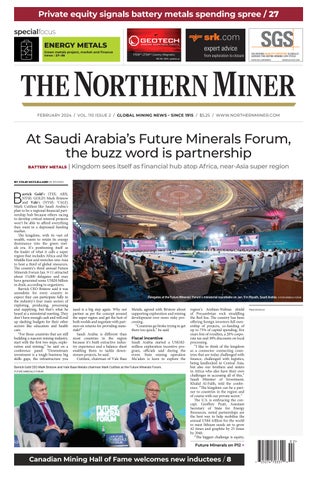
Delegates at the Future Minerals’ Forum’s ministerial roundtable on Jan. 9 in Riyadh, Saudi Arabia. FUTURE MINERALS FORUM
need is a big step again. Why not partner as per the concept around the super region and get the best of both worlds and negotiate with partners on returns for providing materials?” Saudi Arabia is different than most countries in the region because it’s built extractive industry experience and a balance sheet enabling them to tackle downstream projects, he said. Cutifani, chairman of Vale Base
Metals, agreed with Bristow about supporting exploration and mining development over more risky processing. “Countries go broke trying to get there too quick,” he said. Fiscal incentive Saudi Arabia started a US$182million exploration incentive program, officials said during the event. State mining operation Ma’aden is keen to explore the
Barrick Gold CEO Mark Bristow and Vale Base Metals chairman Mark Cutifani at the Future Minerals Forum. FUTURE MINERALS FORUM
region’s Arabian-Nubian shield of Precambrian rock straddling the Red Sea. The country has been offering foreign investors full ownership of projects, co-funding of up to 75% of capital spending, five years free of royalties, a 20% corporate tax and 30% discounts on local processing. “I like to think of the kingdom as a connector connecting countries that are today challenged with finance, challenged with logistics, being landlocked in Central Asia, but also our brothers and sisters in Africa who also have their own challenges in accessing all of this,” Saudi Minister of Investment, Khalid Al-Falih, told the conference. “The kingdom can be a partner to countries in the region and of course with our private sector.” The U.S. is embracing the concept. Geoffrey Pyatt, Assistant Secretary of State for Energy Resources, noted partnerships are the best way to help mobilize the annual US$4 trillion for the world to meet lithium needs set to grow 42 times and graphite by 25 times by 2040. “The biggest challenge is equity, Future Minerals on P12 >
Canadian Mining Hall of Fame welcomes new inductees / 8
PM40069240
1
2
FEBRUARY 2024 | THE NORTHERN MINER
www.northernminer.com
AutoMine® Core, a comprehensive automation platform for mass mining applications with solutions to support customers in their journey of ramping up operations from manual to fully autonomous production. Built on Sandvik’s proven AutoMine® Fleet and Manual Production Monitoring (MPM) solutions, AutoMine® Core provides users with multiple levels of interoperability for Sandvik and third-party OEM fleets.
AutoMine® Core for mass mining applications
THE NORTHERN MINER | FEBRUARY 2024
GLOBAL MINING NEWS
3
inbrief QUOTE OF THE MONTH
“Business and life in general is all about people and there is nothing more important and rewarding than establishing trust and good relationships.” — CLAUDIA TORNQUIST, PRESIDENT AND CEO OF KODIAK COPPER
see Q&A, page 38 DEPA RT MENTS
3
In Brief
4
Opinion
6
Commentary & Analysis
8
10
Awards & Accolades
In Depth
13
15
Done Deals
Project Updates
17
Mining, Metals & Markets
38
Executive Q&A
38
Company Index
SPECIAL SECTIONS » Energy Metals 27 JOINT VENTURE ARTICLE
Grounded Lithium lands Denison Mines as partner to advance Kindersley brine project BY NORTHERN MINER STAFF
Grounded Lithium (TSXV: GRD; US-OTC: GRDAF) has reached an important milestone for the development of its Kindersley lithium brine project in southwestern Saskatchewan. The company signed an option agreement with Denison Mines (TSX: DML; NYSE: DNN) on Jan. 15, giving it the option to earn up to a 75% interest in the project. The deal entails Denison funding in aggregate up to $15.1 million comprised of cash payments of up to $3.2 million and project spending of up to $12 million through a structured earn-in option. “Denison is a multi-billiondollar company saying we like this project,” Grounded Lithium president and CEO Gregg Smith said. “They completed a lot of due diligence on us, and we will be stronger with them by virtue of their financial support and technical expertise.” Alberta-based Grounded Lithium zeroed in on the Kindersley lithium project in late 2021 because of the relatively shallow depth of its reservoir. “From our deep roots in the oil and gas industry, we knew that the most important thing is to be a low-cost operator, so we purposely went out and found an area that is shallow, which really reduces our costs,” explained Smith, who was honoured as Saskatchewan Oilman of the Year in 2009.
Gregg Smith (left), president and CEO of Grounded Lithium, with Greg Phaneuf, SVP corporate development and CFO. GROUNDED LITHIUM
The top of the reservoir at Kindersley is at a depth of 900 to 1,000 metres whereas the depth to the target in most other areas in the lithium-rich brines of Western Canada are at depths of 2 km and more. The Kindersley location also has no oil and gas or hydrogen sulphide in the brines, which are contaminants for lithium extraction. Strong economics “So, it’s a highly economic project with price resilience that still gives us a positive NPV down to below a price of US$8,000 per tonne (lithium hydroxide),” Smith said. Grounded published its preliminary economic assessment (PEA) for Kindersley in August 2023, when the price for lithium hydroxide was US$25,000 per tonne, which produces a net
present value (NPV) of US$1 billion after tax using an 8% discount rate, and an internal rate of return of 48.5%. The price has plummeted since then to US$15,000 per tonne, forcing high-cost producers to curtail operations, but Smith expects the price to recover as stockpiles are depleted. At US$25,000 per tonne lithium hydroxide, the project generates after-tax free cash flow of $200 million per year. If Denison exercises its 75% option, that would leave Grounded Lithium with a quarter of that cash flow, but Denison’s funding frees it from raising money in the public markets and diluting shareholder ownership. “Being a low-cost operator gives us a strategic advantage that allows us to survive when the price is low and do very well when
it goes up,” said Smith. The Kindersley PEA projects annual production of 11,000 tonnes of battery-grade lithium hydroxide monohydrate per year, a project life of 20 years and total capital costs of $447 million. The PEA was focused on the initial phase of a multi-phased ramp up that would double production in a second phase. Kindersley boasts a total resource of 4.2 million tonnes of lithium carbonate equivalent of which 1 million tonnes is in the measured and indicated category, based on a November 2023 update to the PEA. Grounded Lithium chose to produce lithium hydroxide monohydrate as opposed to lithium carbonate based on the anticipated demand for the former as battery chemistry preferences evolve. Mineral extraction innovation Current plans call for the use of Koch Technology Solutions’ proprietary and trademarked Li-Pro in-situ extraction technology following extensive research and initial results from testing thousands of litres of brine pumped from the Kindersley reservoir. Denison is pioneering in-situ extraction technology at its Wheeler River uranium project in northern Saskatchewan and will be able to share that experience and expertise at Kindersley. Smith sees huge potential for lithium production derived
from brines in Western Canada’s sedimentary basins because of the lower cost of production and less onerous permitting compared with mining hard rock lithium deposits. “I’m not saying don’t do hard rock as well, but we think there’s a strategic advantage to mining lithium from brines,” he said. Although still a minor player in global lithium production compared with many other jurisdictions, Canada has several advantages in developing new supply, including stable governments and high environmental standards. Additionally, said Smith, Canadian producers like Grounded Lithium would benefit from the United States’ Inflation Reduction Act, which grants credits to consumers for the purchase of battery powered vehicles on critical minerals sourced and processed in a country that is not a foreign entity of concern for the U.S. “Next steps for the Kindersley project,” said Smith, “include a pilot plant and a feasibility study, leading us eventually to pursue offtake agreements along with project financing for possible construction starting as early as 2026.” The preceding Joint Venture Article is PROMOTED CONTENT sponsored by Grounded Lithium and produced in co-operation with The Northern Miner. Visit: www.groundedlithium. com for more information.
4
FEBRUARY 2024 | THE NORTHERN MINER
www.northernminer.com
opinion
GLOBAL MINING NEWS • SINCE 1915
www.northernminer.com
PRESIDENT THE NORTHERN MINER GROUP: Anthony Vaccaro, CFA, MBA avaccaro@northernminer.com EDITOR-IN-CHIEF: Alisha Hiyate ahiyate@northernminer.com WESTERN EDITOR: Henry Lazenby hlazenby@northernminer.com SENIOR STAFF WRITER: Colin McClelland cmcclelland@northernminer.com COPY EDITOR AND PRODUCTION EDITOR: Blair McBride bmcbride@northernminer.com PODCAST HOST: Adrian Pocobelli apocobelli@northernminer.com ADVERTISING: Robert Hertzman (416) 898-6654 rhertzman@northernminer.com Michael Winter (416) 510-6772 mwinter@northernminer.com SUBSCRIPTION SALES/ APPOINTMENT NOTICES/ CAREER ADS George Agelopoulos (416) 510-5104 (Toll free) 1-888-502-3456, ext. 43702 gagelopoulos@northernminer.com PRODUCTION MANAGER: Jessica Jubb (416) 510-5213 jjubb@northernminer.com CIRCULATION/CUSTOMER SERVICE: (416) 510-6789 | 1-888-502-3456 northernminer2@northernminer.com REPUBLISHING: (416) 510-6768 jmonteiro@northernminergroup.com ADDRESS: Toronto Head Office 69 Yonge St, Toronto, ON M5E 1K3 (416) 510-6789 tnm@northernminer.com SUBSCRIPTION RATES: Canada: C$130.00 one year; 5% G.S.T. to CDN orders. 7% P.S.T. to BC orders 13% H.S.T. to ON, NL orders 14% H.S.T. to PEI orders 15% H.S.T. to NB, NS orders U.S.A.: C$172.00 one year Foreign: C$222.00 one year GST Registration # 809744071RT001 (ISSN 0029-3164) CANADA POST: Return undeliverable Canadian addresses to Circulation Dept. c/o The Northern Miner 69 Yonge St., Suite 200 Toronto, ON M5E 1K3 Publication Mail Agreement #40069240 Periodicals Postage Rates paid at Niagara Falls, NY, 14304. U.S. office of publication 2424 Niagara Falls Blvd, Niagara Falls, N.Y. 14304. U.S. POSTMASTER: send address corrections to: Northern Miner Box 1118 Niagara Falls, N.Y. 14304.-7118
THE NORTHERN MINER is published monthly by The Northern Miner Group, a division of EarthLabs Media Inc., a leading media and technology company serving the mining industry. From time to time we make our subscription list available to select companies and organizations whose products or services may interest you. If you do not wish your contact information to be made available, please contact us by one of the following methods: Phone: 1-888-5023456; Fax: (416) 447-7658; Mail to: Privacy Officer, The Northern Miner, 69 Yonge St., Suite 200, Toronto, ON M5E 1K3
EDITORIAL
COMMENTARY
Cash crunch has junior miners feeling ‘despondent’
A roadmap for green metals after a brutal 2023
A
ccording to Mining Intelligence data, financings tumbled by 23% last year after falling off 45% the previous year. Meanwhile, TSX Venture trading volumes, which collapsed in spring 2022, are now so low as to be near non-existent. Last year saw a dramatic slide in lithium and nickel prices (down 80% and more than 40%), both much-hyped battery metals that are now in B Y A L I S H A H I Y A T E oversupply. Brokers are struggling to raise cash for anyone — unless they’re in uranium, which was at 16-year highs of US$106 per lb. at press time. The mood in the junior mining industry has deteriorated accordingly. “When people struggle to raise money of late, there are a few people despondent, that’s for sure,” Russ Cranwick, head of opportunities funds with mining-focused private equity group Resource Capital Funds, said in January. Even before the latest market turn, Canada’s junior miners were having a tough go of it. With the exception of an all-too-short pandemic battery metal boost in 2020-21, the general trajectory of the junior sector since the 2012 bust has been downward. RCF, which was established in the late 1990s and now has $2.5 billion in assets under management, invests globally and across the spectrum of early stage, late stage, private and public projects and companies. So Cranwick is well positioned to pinpoint why the juniors have been so unloved. Many of the reasons he gives are familiar. Competition from other speculative investment options (tech, crypto, etc). A lack of big, generational discoveries in the past 10-20 years. Fewer retail brokers focused on mining to tell companies’ stories. And a bloated number of public companies listed in Canada all seeking cash from a shrinking pool of investors. “There are way too many juniors. The investing public just can’t support a massive number of choices and it can’t keep them all alive — private equity can’t either,” Cranwick said. There’s also the fact that there have been so few winners in the space. “The industry has not historically generated good returns on capital,” says Canada Nickel president and CEO Mark Selby. “If we see some more successes again that will help unlock some of that capital and hopefully some of that will come back into the sector.” Canada’s rival in junior mining, Australia, has done much better in supporting its industry — and as a result has more winners. The country overtook us in mining equity capital raised in 2020, and boasts several advantages, including mandated support for mining from its pension funds and better infrastructure that reduces capital costs for development. At the sentiment level, it’s a confidence booster for retail investors that Australian billionaires who made their money in mining in the 1990s and 2000s are plowing their returns back in high-profile deals, Selby adds, citing Gina Rinehart, Andrew Forrest and Mark Creasy. The only comparable in Canada is Eric Sprott. Cranwick notes that Australian juniors also tend to be run by management teams with more operational experience than their Canuck counterparts. “In Canada companies are run by explorationists,” Cranwick said. “They’re very strong technically and have a good track record of discovery, less so of developing mines and putting them into production.” In the era of critical minerals — now elevated in importance from being merely base metals and industrial metals — all of these factors are working against us. It’s keeping Canada from capitalizing on its obvious opportunities in critical minerals, noted Marilyn Spink, director of operations with the Canadian Critical Minerals & Materials Alliance said recently. Canada’s traditional model of making discoveries then selling them to someone else to develop and operate means “there’s a lot of value extraction versus value creation out of the markets,” she told a recent Rocks and Stocks event organized by CIM in Toronto. “A lot of the world is looking to Canada and they’re shocked, actually. I have a lot of conversations with people in the EU, and they go, ’What do you mean, junior miners don’t develop their properties?’” New funding prospects It’s not all hopeless, though. New funding models are emerging in the critical minerals space, most notably direct investment from end users that know they’ll need the product in the future. And in the near-term, Selby sees things improving once the federal government starts to dole out its promised spending on critical minerals. While the big money in Canada has so far gone to battery and EV plants, details on mining-specific funding are imminent. “You will see that stuff really start to happen in the next 12 to 24 months where the governments are going to provide fairly significant chunks of equity,” Selby says. “Because the public markets haven’t been responding, we’re likely not going to respond quickly enough to be able to get the critical mineral supply chains built.” Ultimately, Cranwick says a junior revival will come when commodity prices recover, particularly when end users start experiencing supply shortages. “When you get a few of those commodities where everybody wants to be in them, I think those are as good as a discovery historically with an area play,” he says. “I think that could really drive the junior market.” TNM
BY JAMES COOPER
L
ast year was a bloodbath for mining stocks tied to the green energy transition. With markets rallying in the early part of 2024, ‘green miners’ continue to lag. Unfortunately, that doesn’t bode well for a sharp turnaround in 2024. Dampening that outlook further is the string of negative news in January. Mining billionaire Andrew Forrest’s privately owned Wyloo Metals announced a shutdown of its nickel operations in Western Australia due to falling prices. Lithium giant Albemarle (NYSE: ALB) revealed job and capital spending cuts. It also unloaded its stake in Liontown Resources (ASX: LTR) after last year’s failed takeover bid. Liontown’s stock price has now plunged more than 44% since the new year. Even the insiders have lost faith. Pilbara Minerals (ASX: PLS) CEO, Dale Henderson, sold around 1.2 million shares following the company’s latest earnings result. But to get a handle on what 2024 looks like, we should first clarify why green metal stocks sold down so heavily in 2023. You see, mega renewable energy projects are expensive. So too are the mining developments which supply the raw materials for these metal intensive projects. Given we’ve just embarked on one of the most hawkish monetary regimes in modern history, it explains why the sector plummeted last year. But according to the former chief of commodities at Goldman Sachs, Jeff Currie, ‘green’ metals could return with a vengeance this year. That’s based primarily on expected rate cuts. You see, rising rates have diminished the public’s appetite for extravagant renewable mega-projects. It’s perhaps one of the reasons why crude came back into focus last year. Fossil fuels are energy dense, making them a relatively cheap option. We could also add uranium to the list, another energy-packed commodity that can supply reliable, base load power. But the key point from Currie is this: in a high-cost environment, traditional energies reign. He labels them the ‘brown’ commodities. So why could 2024 see a major pivot back to ‘green’ metals? It’s simple really. The idea of capital-intensive green energy projects becomes a difficult pill to swallow in an economy struggling against the rising cost of living. This observation seems rather obvious in hindsight, just look at 2023. As the narrative of ‘higher for longer’ took effect last year, Brent crude surged to US$94 per barrel and uranium erupted into multi-year highs. Meanwhile, metals tied to the green energy transition like lithium, rare earths, and graphite, fell through the floor, eliminating most of the gains that emerged during the early 2020s.
According to the former chief of commodities at Goldman Sachs, Jeff Currie, ‘green’ metals could return with a vengeance this year. But, with rate cuts looming, could the narrative from 2023 make a dramatic U-turn? In other words, will investment flood out of the brown commodities back toward the green? It’s certainly possible. We saw oil and gas stocks tumble in the final weeks of 2023 as expectations of rate cuts grew in the U.S. Large-cap lithium producers then (briefly) emerged from heavily sold-off levels. But don’t expect a smooth recovery in the green metal market. We’re living through a period of elevated geopolitical tension. The Middle East conflict is ripe for escalation. That means crude oil prices could erupt, bringing an inflationary spike. We’ve already seen several prominent shipping companies divert vessels away from the Red Sea following attacks by the Houthis on foreign cargo vessels and oil tankers in December. With ships re-routing around the Cape of Good Hope, on the southern tip of Africa, delivery times have increased by up to two weeks. With that comes higher freight costs and more inflationary pressures on the global economy. Geopolitics is a key reason why we could see a continuation of the arm wrestle between inflation versus deflation this year. There’s no clear path that signals one will win over the other. But despite the geopolitical risks, there are potentially huge opportunities on offer. According to The Economist, 2024 is set to be the biggest election year in history. Almost half the world’s population is lining up to vote, from India to the U.S. This is going to be a colossal year in politics. With incumbent governments looking to extend their time in office, expect extravagant infrastructure announcements this year. Renewables could be a major focus. So, how do you prepare a portfolio for potential boom conditions in a year that promises plenty of geopolitical instability? Focus on beaten-down sectors. As resource investor Rick Rule says, you’re either a contrarian or a victim. Right now, green metals have lost their flavour. But that could offer ripe pickings for investors betting against the herd. TNM James Cooper runs the commodities investment service Diggers and Drillers. You can also follow him on X (Twitter) @JCooperGeo
THE NORTHERN MINER | FEBRUARY 2024
GLOBAL MINING NEWS
5
inbrief INFOGRAPHIC OF THE MONTH:
Western governments invest in decarbonization Huge investment and policy interventions are being enacted to supercharge the energy transition.
C
n
n
Nunavut gains resource powers
Ontario First Nations ask for pause
Christopher Twigge-Molecey, a professional engineer and mining industry leader, died on Jan. 8 at the age of 76. Born in London, U.K., Twigge-Molecey studied Mechanical Sciences at Cambridge University before moving to Canada in 1968 to pursue a PhD in Fluid Mechanics. He worked for Hatch as a professional engineer for five decades and was recognized as a leader and technical innovator in the minerals and metallurgical field. His innovations included developing a new way to maximize arsenic removal in gold processing and creating a novel approach to ventilating large complex industrial buildings. His work on capital project risks was internationally recognized. While at Hatch, he started new specialties for the company (Industrial Acoustics and Fluid Mechanics and Heat Transfer), and he also expanded Hatch’s reach internationally. He was an engaged leader in many industry associations, as well as an expert on the Chinese Belt and Road Initiative and its potential implications for Canada. He will also be remembered for his love of travel.
Nunavut has inked a deal with the federal government that gives it more control over lands and resources. The Nunavut Lands and Resources Devolution Agreement, signed Jan. 18, hands more decision-making power over public lands, freshwater and non-renewable resources to the territorial government and residents. Transfer of control becomes effective on Apr. 1, 2027. “Namminiqsurniq, or devolution, is one more step towards the vision of a self-reliant Nunavut,” said Nunavut Premier P.J. Akeeagok. The deal contemplates that Nunavut might impose a tax on mineral exploration, production and development that is separate from corporate income tax and royalties, law firm Osler wrote in a Jan. 24 note. “Devolution may signal a spike in resource investments in Nunavut, as it has in other territories,” its lawyers wrote. They cited the Northwest Territories, where, two years after its devolution agreement in 2013, year-over-year privatesector capital spending rose by 25.9%, driven mainly by a 40% increase in mining and oil and gas spending.
The Chiefs of Ontario in late January urged the province to call an immediate 365-day moratorium on the Mining Lands Administration System (MLAS). The move follows an exponential rise in the number of mining claims being staked over the past year on First Nations territories – some as high as 30% — the highest annual number of mining claims staked in Ontario over the last six years, according to the Chiefs. The organization said the increase in claims lead to an “insurmountable” administrative burden for First Nations communities responsible for reviewing and responding to the mining claims. A resolution calling for the pause was passed at the Chiefs Assembly in the fall. In 2022, the Anishinabek Nation made a similar request, which the Ministry of Mines declined. Under the current MLAS system, prospectors are not required to engage or consult with First Nations when staking online claims, even those that are within their territories.
BY NORTHERN MINER STAFF
BY NORTHERN MINER STAFF
OBIT: Christopher Twigge-Molecay
n
BY NORTHERN MINER STAFF
6
FEBRUARY 2024 | THE NORTHERN MINER
www.northernminer.com
commentary&analysis
How miners can pass their ESG exams COMMENTARY
| Why context matters as much as data in sustainability typically extrapolate future return potential based on past performance. But this is yet to become the norm with ESG data as it makes little sense to predict future contributions to a more sustainable world solely based on historical information. Third, and interconnected, much ESG data collated via questionnaires merely outlines relative performance compared to an often-nebulous benchmark. Essentially, this does not prove that a company is doing well but rather that it is doing less harm than some arbitrary and meaningless average.
BY KEVIN PCJ D’SOUZA
A
s many miners will testify, there has been a rather burdensome focus on ESG data and disclosure in recent years. They must navigate multiple, and sometimes conflicting, disclosure frameworks accompanied by an alphabet soup of acronyms and needless jargon. Miners, especially those with operations in more than one jurisdiction, must report under multiple frameworks to satisfy heightened and more stringent reporting regulations. Accurate and verifiable data are required to support their corporate sustainability claims, prove they are taking tangible steps toward their targets, and avoid accusations of ‘greenwashing’ or ‘greenhushing’. The demand for timelier and detailed ESG data is resource-intensive and many miners simply aren’t focused on what counts. Their internal ESG professionals — passionate, engaged people committed to making a difference — are increasingly incentivized to focus on data collation and completing humdrum ESG questionnaires that magically produce an ESG score. No wonder it feels like ESG disclosure and getting a rating has become the “exam-passing” hurdle for sustainability in our industry. So perhaps we need to pause and ask whether all this data drives improved ESG performance or progress on mine sites. ESG data and disclosure are not discretionary and are critically important, but only to a certain level of detail. Ultimately, number-crunching becomes purely accounting and has little to do with authentic ESG performance, especially in the mining industry. For many miners, especially juniors, there is an unavoidable labour tradeoff between gathering ESG data and being able to act on it. Increasingly, scarce resources are being poorly spent on inconsequential data-chasing exercises or wearying debates over the optimum way to slice and dice the ESG data that does not result in better performance or outcomes on mine sites. More granular ESG data, analysis and disclosure will likely fail to create the desired change for our industry or increase societal trust, even becoming counterproductive: If we’re ending the freefall part of a skydive, we should be trying to pull the ripcord for the parachute, not studying our altimeter and figuring out whether we’re going 100 or 120 miles an hour. Inscrutable ratings Wishful beliefs contend that strong ESG ratings can somehow miraculously help miners develop both “brand” awareness and build confidence with different stakeholder groups, even helping secure a social licence to operate. Although there is growing integration of ESG data into the decision-making processes of conventional investors, many are still struggling to approach ESG as a strategic value driver, instead treating it as a reporting, compliance, and marketing issue. Their continued reliance on relatively shallow, incomplete, and one-dimensional ESG data provides limited insight into a miner’s real ESG
A narrow focus on ESG data and scores risks losing focus on what matters for miners, says Kevin PCJ D’Souza. ADOBE STOCK/ SUPATMAN
“For many miners, especially juniors, there is an unavoidable labour trade-off between gathering ESG data and being able to act on it. ” strategy, risks, impacts or opportunities, primarily due to a lack of contextualization and informed analysis. Often investors do not get the whole story, especially when they rely on inscrutable ESG ratings that are data-driven or derived by overlaying qualitative factors. – and where there is still no single source of truth given the huge biases and inconsistencies of the ESG rating agencies’ approaches and scores. ESG is not a competitive sport where the score is the only thing that matters. The simple fact is that bona fide ESG comparability is unattainable in our industry without proper context and narrative, to facilitate more meaningful interpretation and make educated decisions about investments and capital allocation. There is no shortcut, and it is nonsensical to have some random standardized criteria to be judged against and then awarded a score. It is not a beauty pageant. To get such a complete picture requires one to
gain first-hand insights into a company’s ESG culture, strategy, risks, operational practices, and jurisdictional context from mine sites to the corporate office. ESG data is not an end in itself, it is simply a tool to help us deliver on sustainability objectives. It needs to be examined. Is complete, reliable, and verifiable ESG data truly available from mine sites and corporate offices? Do miners have consistent measurement methodologies, uniform conventions and accepted definitions that are customary in the finance world? How often do miners rely on proxies instead of actual site-sourced ESG data? What does the disclosed ESG data and actual data tell analysts, and do they genuinely care? How do investors ensure the long-term viability of their assets, rather than focusing on short-term value extraction? Do we know the right ESG data to evaluate company performance or determine what long-term positive impact miners make? If the answers to some of these questions lead us to stop and ponder, then could we perhaps be making erroneous choices, adopting a haphazard approach, or overlooking vital elements of what ESG really is? The award-winning business journalist Simon Caulkin summed up the work of academic V.F. Ridgway as: “What gets measured gets managed — even when it’s pointless to measure and manage it, and even if it harms the purpose of the organization to do so.” While miners continue to be scrutinized and try to steer themselves based on more and more ESG data, compete for higher ESG ratings, and achieve some predefined targets, their actual ESG performance increasingly misses the mark. The reality is that even if something is measured, it only really is acted upon if the output is deemed important — which historically has seldom been the case with ESG. The ESG landscape is dynamic and evolving, and efficient ESG data management and reporting are struggling to keep pace. In addition, many ESG-related issues are recondite, abstract, and diffi-
cult to quantify, especially many social and governance aspects. For instance, it is easy to brag about a “social licence” in an annual sustainability report full of deftly written text and photos of community faces, but who defines it and how does one measure it? So arbitrarily attaching a score to many ESG issues is essentially just an opinion that in reality is neither meaningful nor consequential. As the eminent sociologist William Bruce Cameron profoundly stated, “Not everything that counts can be counted, and not everything that can be counted counts,” which should be a reminder to us all. Where data falls short Based on such arguments, it is clear that enhancing existing ESG data practices is necessary, but it is not the sole solution for several reasons. First, ESG data is patchy and typically fails to establish boundaries or thresholds, thus allowing compensation for sub-standard behaviour. Aggregated ESG scores offer an incomplete and obfuscating narrative, as it is possible to offset poor site biodiversity performance with commendable social or corporate governance practices. Even worse, we may tolerate ESG risks deemed not “financially material.” Focusing solely on such an economic stance and neglecting ethics will not help build the elusive societal trust we so desire. Before each crisis, was cultural heritage financially material to Rio Tinto; tailings management financially material to Vale; sexism, racism, and harassment financially material to BHP; labour relations financially material to Newmont; or legacy issues and human rights financially material to Barrick? It is worth remembering that this term is from financial sector parlance and denotes issues that may not harm financial performance but can still be inherently undesirable. Second, virtually all ESG data is retrospective, focusing on past ESG performance. This is akin to investing in a company solely based on historical production and financial results — a practice no savvy investor would endorse. Analysts
Context-driven approach If we aim to use ESG data to effectively safeguard actual performance rather than pursue scores, an innovative approach to data and associated decision intelligence and prescriptive analytics is required – to guide our industry towards where we need to be, not where we have been. If we want to gain a factual understanding of how miners are truly performing, we need to embrace a more context- and narrative-driven approach to ESG performance comparisons. For some people, ESG data is kind of an end in itself — an effort to pass their “ESG exam.” They want miners to improve their ESG disclosure and scores as they equate this with becoming better companies. And if you are a financier, investor, ESG rating firm, listing agency or ESG data service provider this makes a degree of sense. But for those in the trenches, ESG data and subsequent disclosure are just the byproducts of a wholesome ESG approach. ESG data is pointless without ESG leadership competence, industry knowledge and wisdom to provide the indispensable narrative and help bridge the gap between knowing what to do and making it happen. The irrefutable fact is that company culture trumps everything, and there must be a fit-for-purpose ESG strategy and an appropriate internal governance structure to deliver effectively. This may seem rather obvious, but because fundamental concepts behind genuine ESG performance are still new to some, coupled with the increasing compliance nature of ESG disclosure requirements, companies tend to take a laggard approach and do the minimum. Conversely, leading miners determine how ESG can create and protect value and thereby future-proof the business. In the mining ESG world — culture, strategy, structure, and data are an inseparable and symbiotic foursome. To be credible and resilient, miners need all four, particularly if they are aiming to raise finance, secure permits, improve investors’ returns, or maintain their sought-after social licence to operate. There is a positive feedback loop here and “doing ESGby-numbers” — shortsightedly focusing on ESG data and vanity scores — is simply letting the tail wag the dog. TNM Kevin PCJ D’Souza is a mining ESG executive and advisor with more than 30 years of experience in the mining industry. He has worked in more than 50 countries. kevinpcjdsouza@gmail.com
THE NORTHERN MINER | FEBRUARY 2024
GLOBAL MINING NEWS
7
commentary&analysis
Mining’s top ten ESG trends for 2024 OUTLOOK
| Environmental and social issues to take centre stage as economy, climate woes exert pressure
BY ELIZABETH FREELE AND RACHEL DEKKER
A
range of sustainability and ESG forces will shape the business of mining in 2024, building on the trends of 2023, a year characterized by a surge in investor scrutiny, regulatory action, and a significant uptick in mining sustainability performance expectations. Against the backdrop of continued geopolitical and inflationary pressures, 2023 saw some ESG backlash influence investor narratives in certain jurisdictions, though less so their practices. ESG took the top spot again in key mining industry risk reports, while community protests and governance issues made news in regions worldwide, many based on ESG issues. Globally, we saw a growing entrenchment of ESG and corporate sustainability principles in expectations of how the industry conducts its business. For 2024, the World Economic Forum’s managing director has forecasted “an unstable global order characterized by polarizing narratives and insecurity, the worsening impacts of extreme weather, and economic uncertainty.” This sets the stage for what promises to be an unpredictable year, with environmental and social issues remaining a core focus. We know that spotting trends to inform strategic action can be challenging, so here are our top 10 mining ESG trends that mining companies should take note of and take action on in 2024. 1. Net-Zero Acceleration Climate change risk and decarbonization are likely to remain a key focus in 2024. Net-zero commitments are becoming a standard expectation, and industry leaders are moving from covering only scope 1 and 2, to also include scope 3. According to Net Zero Tracker, half of the world’s largest companies have now adopted net zero targets, though doubts remain about how attainable they are. Investors will increasingly pressure companies to demonstrate adequate and credible climate plans. 2. Beyond Carbon: Biodiversity rising With incontrovertible evidence of the vicious circle that interlocks climate change and nature loss, biodiversity is now a rapidly rising topic. This shift is driven by a growing awareness of the scope of crisis before us and the associated material risks to business and society. This year will see leading companies begin to align with the Taskforce on Nature-related Financial Disclosures (TNFD) recommendations, which aim to integrate nature into financial decision-making and disclosure. 3. Tailings Management A Critical Focus. Tailings management, having entrenched its position in the investor spotlight in 2023, will remain a key focus. After ICMM members’ first disclosure on alignment with the Global Industry Standard on Tailings Management (GISTM) last year, there will be escalating pressure on the rest of the industry to follow suit, with the new Global Tailings Management Institute (GTMI) spearheading enforce-
ment, assurance, and oversight. Rapid commercialization of a range of technological advancements will help companies move towards more responsible management, too. 4. Practical EDI Gaining Ground. Mirroring a global shift towards workplace inclusivity, the mining sector will make further progress on Equity, Diversity, and Inclusion (EDI, or DEI) initiatives in 2024. The new TSM Equitable, Diverse, and Inclusive Workplaces Protocol and ICMM member DEI position statement and commitment have spurred renewed focus and action, as the industry acknowledges the need for greater efforts to tackle its ongoing workforce and talent management challenges. 5. Standardization of ESG Reporting for Capital Markets The widespread adoption of the IFRS Foundation’s new disclosure standards will transform voluntary sustainability reporting in 2024. The IFRS has now taken over responsibility for the Sustainability Accounting Standards Board (SASB) and the Task Force on Climate-related Financial Disclosures (TCFD), both well-known by investors. The new, single, global baseline of sustainability disclosures designed for capital markets will rapidly become the global reference for ESG disclosure, expected to bring much-needed consistency and comparability. 6. Global Regulations Require Adaptation A wave of new and updated sustainability regulations is sweeping across the globe, and the mining industry will face the challenge of adapting to new regulatory requirements across various jurisdictions, especially those linked to the European Union. High-profile emerging mandatory regulations include disclosure on climate change and modern slavery in multiple jurisdictions and broad standardized non-financial reporting in the EU. Meanwhile, at least 64 jurisdictions are analyzing how to integrate the IFRS Foundation disclosure standards in their regulations. 7. Surging Investor Demands and Shareholder Activism Echoing global public sentiment, investors will continue to ramp up pressure for robust ESG performance and transparency. A 2023 KPMG survey found that over half of M&A dealmakers have cancelled deals due to material findings of an ESG due diligence process. And headlines such as Glencore’s climate plan being rejected by investors, attempts to sue Shell directors personally for climate risk mismanagement, and the Global Investor Mining Commission on Mining 2030 announcing strong support from investors with US$11 trillion in assets under management signal a clear trend. Meanwhile, a recent proxy firm policy survey shows the “double materiality” debate continues, but climate-related risk disclosure will be central to investor demands and shareholder activism. TCFD alignment is becoming a standard expectation in the face of increasingly frequent and severe extreme weather events worldwide.
The top 10 mining ESG trends come amid an “unstable global order” in 2024, says the World Economic Forum’s managing director. ADOBE IMAGES/MARUTSTUDIO
8. Growing Executive and Board Competency Risk Surveys from PwC, BCG, and the INSEAD Corporate Governance Centre during 2023 found that only 27-47% of board directors understand ESG risks and have sufficient ESG competence, on topics ranging from climate change to human rights and EDI. Such findings expose a growing disconnect between evolving investor expectations of fiduciary duty and oversight, and the ESG capabilities of directors and company leaders. ESG upskilling to ensure effective management and governance is expected to be a priority for many companies in the year ahead. 9. Technological Innovation Enabling Performance and Assessment. Technological innovations are likely to play a key role in advancing sustainability priorities. Current commercialization of relevant technologies ranges from the use of AI and data analytics to assess and oversee ESG performance, manage cybersecurity risks, and support health and safety outcomes, to innovative solutions for resource optimization and tailings management (e.g. biomining, bioremediation, waste-to-value, satellite and other real-time monitoring). Along with innovations in materials movement and renewable energy solutions including hydrogen and solar, we are likely to see more rapid innovation foster improved sustainability outcomes and assessment. 10. Focus on Sustainable and Responsible Supply Chains Many companies mapping their supply chains in response to pressure to do so, are struggling immensely. Yet further progress in responsible sourcing and supply chain transparency is likely, given regulatory trends and amplified investor expectations to focus on sustainability across the entire value chain. This year will see many companies venture into under-
standing their Scope 3 emissions and human rights risks, especially. As the work and disclosure of sustainability continues to mature, rumblings of ESG fatigue and discontent continue as well, with some starting to favour the language of “responsible business” instead. Either way, the core principles of prioritizing risk management, responsible governance, and resilience stand firm; embedding sustainability in how we mine and invest is a trend set to persist despite rising polarization and politicization, war and contentious elections, and unpredictable market behaviour in 2024. Many mining companies will continue to grapple with increasing ESG performance and reporting expectations, but this will also offer strategic opportunities. The ESG
commitments of both investors and miners will be tested in the year ahead. Those who deploy the principles underpinning ESG in risk management and business strategies will better position themselves to strengthen both social licence and financial performance. TNM Sympact has compiled a complimentary report at www. sympact.ca: Mining ESG: 2023 in Review and What to Expect in 2024.
Rachel Dekker and Elizabeth Freele are the co-founders and managing partners of mining sustainability think tank and ESG consultancy Sympact. Sympact supports companies in ensuring their social performance meets growing expectations.
NOTICE TO CREDITORS MYRA FALLS MINE LTD. RE: NOTICE OF CCAA FILING NOTICE IS HEREBY GIVEN that on December 18, 2023, Myra Falls Mine Ltd. sought and obtained an order (the “Initial Order”) from the Supreme Court of British Columbia under the Companies’ Creditors Arrangement Act, R.S.C. 1985, c. C-36, as amended (the “CCAA”) under court file number S-238572. Pursuant to the Initial Order, FTI Consulting Canada Inc. has been appointed as monitor (the “Monitor”). PLEASE TAKE NOTICE that a copy of the Initial Order and other public information concerning these CCAA proceedings can be found on the Monitor’s website at http://cfcanada.fticonsulting.com/myrafalls, or may be obtained by contacting the Monitor at:
FTI Consulting Canada Inc.
Monitor of Myra Falls Mine Ltd. Suite 1450 – 701 W. Georgia St. Vancouver, BC V7Y 1B6 Attention: Huw Parks Toll Free: 1-833-516-8999 Email: myrafallsmine@fticonsulting.com
8
FEBRUARY 2024 | THE NORTHERN MINER
www.northernminer.com
awards&accolades Canadian Mining Hall of Fame celebrates industry-making feats of five new inductees AWARDS
| Legacies range from standards making to junior financing
BY BLAIR MCBRIDE
T
From office workers to standard-makers The first new members of the night were William E. Roscoe and John T. Postle, joint inductees whose eight decades of combined work formed the system of mining consulting and standards development the industry now relies on. Roscoe, an exploration geologist by training and Postle, a mining engineer, had both developed their own careers in mining before they first met in 1967, at Cominco’s Wedge mine in New Brunswick. The two men also came from mining families. After receiving his CMHF award on stage, Roscoe told the audience about his father and grandfather — both mining engineers. His grandfather Harry L. Roscoe, who was educated in the United States, helped develop Noranda Mines in Ontario and Quebec and was inducted into the CMHF in 2007. Postle’s father Larry also trained in the U.S. as a mining engineer and emigrated to Canada in 1929, said John’s daughters Kristen and Tricia Postle, who accepted the award on behalf of their father. Postle was unable to attend the gala due to poor health. Postle and Roscoe later recon-
PHOTOS: CANADIAN MINING HALL OF FAME
he Canadian Mining Hall of Fame (CMHF) held its 36th annual induction ceremony on Jan. 11 at the Metro Toronto Convention Centre, welcoming five new honourees, and bringing total membership up to 208. The celebration, attended by 720 people, was hosted by Northern Miner Group president Anthony Vaccaro.
Attendees at their dinner tables inside the Metro Toronto Convention Centre.
The 36th annual Canadian Mining Hall of Fame induction ceremony was held on Jan. 11 at the Metro Toronto Convention Centre. The evening saw five new honourees join the CMHF, bringing total membership up to 208. The celebration was attended by 720 people.
William E. Roscoe
One of the highest achievements of their work was in Postle’s role in developing the CIM reserve/ resources definition standards that became part of the industry standard of National Instrument 43-101, in 2000. “If you want to get yourself a good partner, look for Bill Roscoe,”
Tricia Postle and Kristen Postle nected in the 1980s when they worked for consultancy David S. Robertson & Associates, and during lunch they would brainstorm about starting their own company. That became a reality in 1985 when they founded Roscoe
Postle Associates (RPA). “We really had no vision. We just hoped we could make a living,” Roscoe said in a video tribute. As RPA grew, it reached a peak of 60 employees and formed a reputation as the gold standard for
technical reporting. On the side, the pair volunteered on committees with the Canadian Institute of Mining, Metallurgy and Petroleum (CIM), where they helped develop standards for the industry.
Dante Bell
Postle said in the video, with a laugh. “I think we had a good partnership,” Roscoe added. “[It started] out with the two of us in the same office space and the way things progressed from there, I think it’s kind of beyond our wildest expectations.” Simple beginning leads to great discoveries The second inductee was David Ross Bell, an exploration geologist from northern Ontario who’s credited with discovering and developing the Hemlo gold deposit on Lake Superior. Thoroughly a child of the northern bush, Bell was born and raised in Kirkland Lake and attended what he described as a “two-room public school” for his first eight years of schooling.
THE NORTHERN MINER | FEBRUARY 2024
GLOBAL MINING NEWS
9
awards&accolades “No running water. But anyway, I got educated,” he said in a video presentation. In high school, Bell was introduced to the mining industry through a prospector friend of his father’s. “In a way I enjoyed that. I didn’t get paid for it. But I think in the long run I got well paid for it,” he said with a laugh. After completing a four-year geology program in three years at Carleton University, he went on to work at the Dome mine and then in 1980 he founded his own consulting company. His first contract was with Corona Resources and he was sent to Hemlo, a deposit that had yielded limited success in the past. Corona founder Nell Dragovan recalled Bell being calm, methodical and honest. “I really thought about all these majors that have been there before and they turned it down,” she said in a video. “All these companies that had been there, probably would have said ‘no.’ But we said we would explore this property.” Despite challenges with exploration at Hemlo, Dragovan trusted Bell’s assessment of the orebody’s potential. Eventually, three mines were developed, including one named after Bell. They would produce about 22.4 million oz. of gold. Hemlo is still producing today. In accepting Bell’s award on his behalf, his grandson Dante said he appreciated Dragovan for her trust and patience in him during those early exploration days at Hemlo. Bell was unable to attend the gala due to illness. Bell’s persistent exploration activity helped lead to the creation of thousands of jobs in northern Ontario and stimulated local economies for more than three decades. “That was one thing the mining industry did,” Bell said in a video. “They made sure in the early days, that their people were housed, they made a family and they made a community and I’m glad I was a part of that.” On the shoulders of giants Ross D. Lawrence is a founding partner of Watts, Griffis and McOuat (WGM) geology and mining consultancy. His induction into the CMHF makes him WGM’s fourth member to join the hall of fame ranks. After receiving his award on stage at the ceremony, Lawrence cited the 1973 Broadway show A Little Night Music and its song “Send in the Clowns.” He explained
Ross D. Lawrence
Anthony Vaccaro that the song means to send in clowns when the show isn’t going well, a fitting remark for his self-effacing acceptance speech where he mostly praised the accomplishments of his partners at WGM, rather than his own. Educated in geological engineering and mining finance at the University of Toronto in the 1950s, Lawrence went on to work with Murray Watts and John (Jack) McOuat on an asbestos project in northern Quebec. After it became a mine, the men were offered jobs with Asbestos Corp. “We kind of looked at each other and said, ‘We don’t want to work for a big company. Why don’t we form a consulting firm?” he said in a video. Tom Griffis joined as well and WGM was born. As the firm grew, its exploration work helped with the discovery of several mines, including Mary River, Raglan and Voisey’s Bay. Soon Lawrence was working in the Middle East as WGM widened its focus internationally. His skills with economic analysis for feasibility studies served him well while exploring for ilmenite in Madagascar and helping with geological mapping in Iran.
Janice Zinck
CMHF board chair.
He recalled a project that was financed by the World Bank where he advised the government of Yemen on policies that could promote the mining industry. Being people-oriented, Lawrence thrived while acting as a mentor to young Yemeni geologists. He credited Watts with instilling in him “the restless urge to travel and venture out into the unknown.” He praised Griffis for his 18 years of work with WGN and for bolstering its reputation internationally. And for McOuat, whom Lawrence called his university classmate, consulting partner for 51 years and best friend, he said he was best known for his “indomitable persistence” and support of good projects. “I am indebted to (them) for helping me build the road that lead me here tonight,” he said. “So please help me celebrate as we send in the clowns.” An accountant among geologists The last inductee of 2024 was Eric Sprott, the founder of finance company Sprott Securities (later Sprott Asset Management) that is regarded as a lifeline for junior miners. An accountant by training,
Sprott briefly worked in auditing and then in research analysis with Merrill Lynch, before he started his mining investment firm in 1981. In a tribute video, he recalled how demanding the work could be. “It’s not an eight-hour job,” he said. “I would be in here in the office at four in the morning, many mornings. But then you didn’t have the benefit of computers, so you had to do all your own reading of the various newspapers!” Sprott also acknowledged that the mining industry produces more losers than winners, and seeing a project from exploration to production can take at least a decade. But the winners can enjoy “very, very large” payoffs. As the years passed, his firm drew more interest and more clients and by 2010 he had worked with hundreds of companies, including in exploration, development and mining. “They’d come through here by the dozens from all over the world looking for that Sprott cheque,” said SCP Resource Finance CEO Peter Grosskopf, in a video. Grosskopf was CEO of Sprott from 2010 until 2022. “And it was the money, but it was also an endorsement and almost always it caused share prices to go
Eric Sprott
up. So that’s what companies were looking for. I can’t think of another individual who has contributed as much money and investment and investment expertise to the sector than he has,” Grosskopf said. Receiving his award on stage, Sprott said the event made it one of the happiest days of his life. The veteran financier went on to caution about the dangers of unequal wealth distribution and short selling of stocks in Canada, South Korea and the U.S. But looking on the positive side of the industry as a whole, he noted its economic benefits for the country, provinces and Indigenous people. “I was quite impressed when it was suggested that this industry employs so many First Nations people,” he said. “That was most impressive.” He also said that he’s a chartered accountant among geologists, even though he said many might ask how he found so much success in mining without having much skill in mining. “And I always make the comment that, the geos are very busy trying to figure out: why is that rock there? And (I’m) sitting there saying, Hey, I don’t care what the rocks are, what the hell’s it worth?” TNM
10
FEBRUARY 2024 | THE NORTHERN MINER
www.northernminer.com
indepth Exclusive: Ivanhoe’s Congo copper is what
everyone’s after, Cloete says
FUTURE MINERALS FORUM BY COLIN MCCLELLAND IN RIYADH
I
vanhoe Mines (TSX: IVN) receives a constant stream of peers keen on learning its secrets of success in the Democratic Republic of Congo but it won’t sign a partnership deal on new discoveries as quickly as it did with Kamoa Kakula, president Marna Cloete says. “Everybody’s been knocking on our door, trying to understand what we are doing, trying to see how we did it,” Cloete said in an interview on Jan. 9 with The Northern Miner in Riyadh. “Kamoa is going to throw off significant cash flow in the near future, so why dilute ourselves? We’ve got the know-how in-country, so why bring in a thirdparty player to complicate matters further?” Ivanhoe, founded by industry billionaire Robert Friedland, plans to start production from its Kipushi zinc mine in the DRC in the second quarter. It wants to expand output three months later at Kamoa Kakula, the even joint venture with China’s Zijin Mining, to as much as 490,000 tonnes of copper from 393,551 tonnes last year. Ivanhoe’s Platreef platinum project in South Africa is due to start at the same time. The Vancouver-based company is exploring the Western Forelands region in the DRC’s south. Drill results at the area’s Kitoko discovery include 3.4 metres of 3.54% copper and 6.4 metres of 4.92% copper. Companies such as Barrick Gold (TSX: ABX; NYSE: GOLD) are keen to increase their copper output with mergers and acquisitions on expectations the metal becomes more valuable as part of the green energy transition. Cloete wouldn’t say if Barrick CEO Mark Bristow has come to call, though
| Friedland-founded firm approaches three milestones this year
“The Western approach is much more cautious: do a lot of study work upfront, overthink things a little bit. The Chinese approach is much more bullish, they go for it, they build it… If there’s a problem, they’ll fix it afterwards.” MARNA CLOETE PRESIDENT, IVANHOE MINES
both attended the Future Minerals Forum in Saudi Arabia Jan. 9-11. She did say Ivanhoe would have waited longer to sell a stake in Kamoa Kakula if it had a do-over and it would have remained in charge. But the collapse in commodity prices crushed other funding opportunities in 2015 when the US$412 million deal occurred, she said. “If we had to do that transaction today, it probably would have been different,” Cloete said. “It would have been a much bigger price tag and we probably would have ensured that we maintained operational control.” Managing risk With a 50-50 partnership, consensus can take time when there are different ways to build projects. Nonetheless, the joint venture has worked well to manage risk while achieving goals by combining Western and Chinese approaches
Marna Cloete
in a staggered approach intent on entering its third stage this year, she said. “The Western approach is much more cautious: do a lot of study work upfront, overthink things a little bit,” she said. “The Chinese approach is much more bullish, you know, they go for it, they build it, they get it done. If there’s a problem, they’ll fix it afterwards.” Ivanhoe is installing back-up power of 200 megawatts at Kamoa Kakula and securing an additional 30 MW from neighbouring Zambia to avoid disruptions that last year reduced copper output to the lower end of guidance. It’s also helping make US$450 million in loans available to the DRC to upgrade the grid. Industry practice, despite the lack of advanced infrastructure in Africa, is to install back-up power only to ensure critical needs, not a large mine at full production, Cloete said. “Kamoa Kakula is well-posi-
tioned for improved performance once power stability is achieved,” BMO Capital Markets mining analyst Andrew Mikitchook said in a note on Jan. 8. “Together with phase three expansion expected ahead of schedule in the third quarter, Ivanhoe is positioned to deliver significant 2024 production growth.” The DRC could have some of the continent’s largest power generation. Its Grand Inga hydroelectric project has been in the works for decades, eating up billions of dollars, but it still lacks a timeline for completion when some 80% of the population lives without electricity. Assessing governance The country, considered by some political analysts to be ungovernable because of its large size and poor roads, produces the world’s most cobalt. Ivanhoe’s copper and zinc assets at least benefit from being more than 1,000 km away from
the numerous armed militias in the country’s troubled eastern region abutting Rwanda. On Jan. 10, the DRC’s Constitutional Court confirmed the re-election of President Felix Tshisekedi after a December vote, even though independent observers criticized the balloting as irregular. “It’s probably not an ideal election,” Cloete said, noting the previous vote was similar and that operating a company in the country requires accepting the baby steps of a young democracy. “It’s about spending the time and the hours in the saddle to understand the landscape. And then it’s about doing things the right way. For example, if you get asked for supporting an election, you can say ‘we can build a university.’” Western governments such as the United States, Canada and the European Union are handing out billions of dollars for critical minerals development, but those projects can be just as risky as those in Africa when considering permit reviews or anti-mining activism, Cloete said. Operating in jurisdictions perceived as risky such as the DRC and South Africa, which is plagued with power outages, often requires more spending on roads and electricity than other regions. It also means community development work, and local recruitment and procurement, she said. Ivanhoe’s contribution to the DRC economy last year is expected to be a double-digit percentage of its gross domestic product. “I’m from Africa and that’s my backyard. That’s what we know how to do. That’s what we do well, so others see risky jurisdictions and we see an opportunity,” she said. “It’s really transformative what a discovery like Kamoa Kakula can do to the economy.” TNM
Vale’s US$10B for Canada targets existing potential FUTURE MINERALS FORUM
| Asset review plans to identify items for efficiency drive General Motors, she said. “There’s just a clarity and a certainty in regulation and Canada is a mining country and with that comes a lower risk, and equally you have the wonderful benefit of renewable and clean power,” Olson said. “Canada has a great opportunity to further establish itself as a leader in our industry with community and Indigenous rights leaders.”
BY COLIN MCCLELLAND IN RIYADH
V
ale (NYSE: VALE) is spending US$10 billion in Canada over the next decade to keep operations running in a district it values for its low-carbon production. The funds are part of US$30 billion to be split evenly among the northern country, Vale’s homeland of Brazil and nickel hotspot Indonesia, Emily Olson, the company’s chief sustainability and corporate affairs officer, said in an interview with The Northern Miner in Riyadh on Jan. 10. The funds were first announced in September. “There’s a lot more to do with our existing operations and that’s where we would invest,” Olson said. “In terms of being greenfields, not right now.” Vale Base Metals chairman Mark Cutifani is undertaking a unit-
Vale Base Metals chairman Mark Cutifani. FUTURE MINERALS FORUM
wide asset review that will likely find more potential at the company’s operations in Sudbury, Ont., Thompson, Man., and Voisey’s Bay and Long Harbour, N.L.,
Olson said. Vale also may have an announcement soon on the Bécancour nickel sulphide processing project it’s advancing to supply 25,000 tonnes of nickel a year to
Saudi conference Olson chatted at the third annual Future Minerals Forum, a conference attended by some 15,000 delegates. Vale CEO Eduardo Bartolomeo stood nearby, but declined to speak informally to the media as part of company policy. Vale, with a stock market value of about US$68 billion, is one of the world’s largest producers of nickel, copper and cobalt. It sold 10% of its base metals unit in July to Saudi state-owned Manara Minerals and
San Francisco-based investment firm Engine No. 1 for US$3.4 billion. The deal is part of growing interest in Saudi Arabia as it swings vast oil wealth towards finding minerals to power the green energy transition. In Indonesia, Vale’s agreement to sell 14% of its business to comply with foreign ownership rules is due to be completed within weeks. The country is preparing for an election this month as President Joko Widodo steps down after two terms. Some mining operations by other companies in the country have been criticized for environmental, social and governance (ESG) issues. “We very much are a leader in how ESG can be done right in Indonesia,” Olson said. “It’s part of who we are there and it will evolve and grow over time, just like you’ve seen in every other country when it comes to this.” TNM
THE NORTHERN MINER | FEBRUARY 2024
GLOBAL MINING NEWS
11
indepth
Centamin propels modern mining rules in Egypt FUTURE MINERALS FORUM BY COLIN MCCLELLAND IN RIYADH
C
entamin (TSX: CEE; LSE: CEY) has helped Egypt develop a new mining law due for passage within weeks as it seeks to expand the Sukari gold mine in the ancient land’s southeast. The London-based company, consultants Wood Mackenzie and Barrick Gold (TSX: ABX; NYSE: GOLD) advised the country which began revising regulations in 2018, Centamin CEO Martin Horgan said in an interview with The Northern Miner in Riyadh, Saudi Arabia. “You had all this untapped geological potential available, but the old-style oil and gas concessions didn’t really work,” Horgan said on Jan. 10 at the Future Minerals Forum. “We’ve been negotiating the final details to a new royalty, taxation, free-carry model, basically bringing Egypt in line with pretty much the rest of the world.” Centamin is investing in Egypt as wider interest in the Nubian Shield straddling the Red Sea gathers pace following neighbour Saudi Arabia’s third annual Future Minerals Forum focused on developing an exploration super region stretching from Africa to Asia. Sukari, south of Luxor between the Nile and the Red Sea, has produced more than 5 million oz. of gold since it started production in 2009. Artisanal output dates from 2,500 BC. Egypt’s current mining regulation was based on profit sharing with the government. The proposed law is to be a 5% royalty, a 22.5% tax rate and a 15% govern-
| New law due soon as miner explores to expand Sukari
ment free-carry stake. Over the life of a project, returns to the company and the state are about equal, Horgan said. “Where we ended up is not quite as good as Western Australia or Canada, about the same as Côte d’Ivoire, and probably a bit better than Ghana,” Horgan said. Grid savings Centamin spent some US$750 million over the past four years to improve efficiency at Sukari, Egypt’s only modern gold mine. It plans to connect the mine to the country’s electrical grid and company solar panels this year, cutting US$41 million a year in diesel costs. It wants to expand Sukari with nearby discoveries. It is exploring 3,000 sq. km in the eastern desert area near the mine. It’s also planning 15,000 metres of reverse-circulation drilling for the new area, metallurgical testing, a conceptual resource estimate and an optimization study to steer drilling. It posted first results on Jan. 9 showing 46 metres grading 3.3 grams gold per tonne from 91 metres down drill hole LSRC030 and 77 metres at 1.84 grams from 44 metres depth in drill hole LSRC012 at the Little Sukari prospect, 28 km west of the Sukari mine. At the Umm Majal prospect 23 km west of the mine, drill hole UMRC006 cut 18 metres grading 2.33 grams from 21 metres depth and drill hole UMRC003 returned 15 metres at 1.46 grams from 4 metres down. “Pretty happy with the firstpass results, good widths, grades,”
Centamin is exploring a new 3,000-sq.-km area near its Sukari gold mine in Egypt. CENTAMIN
Horgan said. “Depending on how that continues to develop from here, clearly we want to see the potential for a satellite feed to be sort of augmenting the Sukari abilities.” Sukari, with a projected mine life to 2035, holds 194 million proven and probable tonnes grading 1.23 grams per tonne for 7.7 million oz. of contained gold, the company said last month. The mine also holds 392 million measured and indicated tonnes at 1.06 grams per tonne for
13.4 million oz. of contained gold. Côte d’Ivoire Centamin is advancing the Doropo gold project in Côte d’Ivoire to a feasibility study by mid-year. It might produce 200,000 oz. a year over a decade after US$400 million in construction costs, Horgan said. The company is poised to invest in a new project that could be exploration, developing or producing, somewhere in Africa or the Middle
East in or near the London time zone, Horgan said. It was visiting the Saudi Arabia forum on a fact-finding mission, he said. Outside of Egypt, any project would likely have a gold component, he said. “There’s obviously lots of potential here, lots of ground that is to be explored. We think we’ve got the skill set, the knowledge and the financial wherewithal to be able to do that so we’re here to look at opportunity.” TNM
BC’s first critical minerals strategy has some asking, ‘Is it enough?’ AME ROUNDUP BY HENRY LAZENBY
B
ritish Columbia launched its Critical Mineral Strategy at Vancouver’s AME BC Roundup on Jan. 22, proposing 11 actions to boost the mineral sector and attract investment, though some question the plan’s substance. “The world needs a stable, free, democratic, high-standard producer of the metals and minerals needed to battle climate change,” Premier David Eby declared as he announced the strategy’s first-phase rollout. He underlined B.C.’s “generational opportunity to seize, to build wealth and protect the planet simultaneously,” to rousing applause. The launch of the plan, which was only broadly outlined at Roundup, comes after Quebec, Ontario, Saskatchewan and Manitoba have already laid out their own strategies. The strategy comprises nearly a dozen first-phase action points, including developing a B.C. critical minerals atlas; engaging and aligning with First Nations on strategy and infrastructure; and opening a dedicated project advancement office to offer streamlined support services — including a concierge, project management, and First Nations negotiators.
| Coming changes to province’s carbon pricing flagged as uncompetitive
The strategy further aims to tackle obstacles impeding project development and workforce stability. Additionally, for critical mineral geoscience initiatives, $3.9 million is allocated over four years, starting in 2022-23. A new critical minerals advisory committee will provide guidance. Fiscal policy missing However, the Mining Association of British Columbia’s (MABC), president and CEO Michael Goehring, suggests the premier may have his priorities backwards. The association, which represents B.C.’s steelmaking coal, metal and mineral producers, smelters and advanced development companies, is concerned that the strategy lacks a crucial component: a competitive fiscal policy. In particular, he cited the government’s new output-based carbon pricing system, which was announced last fall and will come into effect in April, as a barrier to mining. “The B.C. government’s shift to an ‘output-based carbon pricing system (OBPS) spells trouble,” Goehring told The Northern Miner in an interview. He said that while the mining and smelting sector in B.C. favours car-
bon pricing, it faces the highest carbon tax rates in Canada (up to three times that of Ontario or Quebec) and globally despite having the lowest greenhouse gas emissions. Compounding matters, the industry can’t reduce emissions further at present because technologies for zero-emission haul trucks are not expected to be market-ready until the end of the decade. “It is essential that the carbon tax rates for existing and future critical mineral mines in B.C. are competitive with those in other provinces. Otherwise, the OBPS could negatively affect investment decisions in B.C., counteracting the objectives of the province’s critical minerals strategy,” he said. AME BC president and CEO, Keerit Jutla, agrees that while the first-phase strategy announcement was a “step in the right direction,” he would also like to see more language on things that matter. “We understand this as a preliminary phase-one strategy. We anticipate a more substantive announcement with complete details to be released soon,” he told The Northern Miner. The government has tasked the B.C. Ministry of Energy, Mines, and Low Carbon Innovation (EMLI) with filling out the details of the strategy, giving it a $6-million bud-
get and three-year timeline. “We appreciate the government’s acknowledgement that more action is required to facilitate the development of new critical mineral projects. It is imperative that greater emphasis is placed on competitiveness and the fiscal and regulatory policies that will attract investment,” he said. Jutla stated that while awaiting further developments, the members of AME BC will collaborate with the newly formed Critical Minerals Project Advancement Office. They will advocate for more assistance with permitting and regulatory procedures and seek advice on cooperating effectively with First Nations.
follows on the heels of a Jan. 16 announcement of a $36-billion provincial investment in the next decade for expanding B.C.’s electricity infrastructure, critical for mining industry expansion. Momentum is building elsewhere for the local critical minerals sector. In late 2023, B.C. announced a $1.1 billion partnership between E-One Moli and the governments of B.C. and Canada to bring lithium-ion battery cell production to Maple Ridge, part of Metro Vancouver, and create 450 permanent jobs. In the 2022 budget, Ottawa allocated about $3.8 billion to its critical minerals strategy.
Infrastructure investment In a Jan. 8 release, the MABC argued up to $36 billion of investment (which compounded over several decades could amount to $800 billion) is at risk in the province because the development of 16 proposed critical mineral mines hinges on the provincial government establishing more competitive fiscal and regulatory policies. Eby says that under EMLI Minister Josie Osborne, the ministry has achieved a 52% reduction in the backlog of permit applications. The premier’s announcement
Exploration spending Eby also gave the official government 2023 figures for exploration spending in the province, revealing a strong performance. Total mining production in 2023 was $15.9 billion, and exploration spending amounted to $643.5 million. He said that exploration has amounted to $2.5 billion over the last five years, with mining production totalling $54.6 billion. B.C.’s mining sector employs over 35,000 workers, contributed $7.3 billion to gross domestic product in 2023, and is a significant exporter. TNM
12
FEBRUARY 2024 | THE NORTHERN MINER
www.northernminer.com
indepth
What can Canada do amid sale of Canadian rare earths to Chinese firm? CRITICAL MINERALS BY BLAIR MCBRIDE
F
oreign participation in critical minerals projects in Canada raises questions about why Canadians aren’t providing the funding, says the head of the Northwest Territories and Nunavut Chamber of Mines. A planned sale of stockpiled rare earths mined in the Northwest Territories to a Chinese miner for about A$2.6 million ($2.3 million) shows that too many explorers are struggling to raise money for critical mineral exploration and development, Tom Hoefer, executive director of the chamber, told The Northern Miner in mid-December. “That is puzzling given the huge societal demand for minerals to address climate change,” Hoefer said in an emailed response to questions. “China seems able and willing to supply much of that money.” Vital Metals (ASX: VML) said on Dec. 18 it will sell rare earths from its Nechalacho project, about 110 km southeast of Yellowknife, to Chinese miner Shenghe Resources. The transaction is part of the sale of 588.9 million Vital shares to Shenghe for A1¢ each, or about A$5.9 million, giving Shenghe a 9.9% stake in the Australian company. The money represents a lifeline for the company after its Canadian subsidiary, which had been building a processing plant in Saskatoon, went bankrupt in September. Vital intended to sell processed rare earth carbonate to Norwegian producer REEtec, but plans stalled last year as plant costs doubled and the company deemed demonstration-scale mining at North T uneconomic. A feasibility study for the project hasn’t been completed, and the company only has permits for small-scale extraction. As part of the financing, Shenghe has the right to nominate one person for appointment as a non-exec-
> Future Minerals from P1 ensuring that the benefits and the costs of the energy transition are distributed in a way that is sustainable so we don’t end up with one story in wealthy countries and another in the developing world,” Pyatt said. “The biggest opportunity is to reshape global supply chains, leveraging the kind of partnerships that my team is to build.” Big barriers Other obstacles include policy to quicken permits times, innovation in recycling, batteries and extraction technologies to narrow the gap in metals supply and demand, and investment, Saudi vice-minister of mining, Khalid Al Mudaifer, told the forum. In Saudi Arabia alone, 3 trillion riyals ($1.1 trillion) must be invested in mining, refining and smelting by 2030 plus 1 trillion riyals each for infrastructure and power generation, Al Mudaifer said. “That’s almost more than three times the current investment level,” he said. “More than that, we need 200 to 400 engineers and mining professionals.”
| Vital to sell $2.3M of rare earths to Shenghe Resources
utive director to Vital’s board. The share plan had been announced in October. The share subscription also came as Vital on Dec. 18 resumed trading on the ASX after a halt in April, amid management changes and a review of its now-shuttered rare earths processing facility in Saskatoon, Sask. “We are appreciative of the strong vote of support shown by Shenghe in the company’s projects,” Vital chairman Richard Crookes said in a release. “The A$5.9 million in funding provides the company with the capital to continue to progress development of the world-class Tardiff deposit.” Vital said Shenghe has no preferential rights over future production from Nechalacho. Proceeds will help it complete a resource update for Nechalacho this year, a scoping study for the adjacent Tardiff deposit, reinterpretation of lithium deposits at Nechalacho and permitting studies in the rare earths supply chain, it added. The company expected the sale of the stockpile to close in January. Securing supply chains? The sale and financing highlight the significance of Nechalacho — Canada’s only demonstration-scale rare earths project — as Western countries work to secure critical mineral supply chains outside the influence of China. The East Asian country dominates the mining and processing of the 17 rare metals used in cellular phones, computers and magnets for green energy technologies. The only producing rare earths mine in the Americas is MP Materials’ (NYSE: MP) Mountain Pass project in California. The company sells rare earth concentrate to Shenghe under an offtake agreement. The sale also comes just over one year after the federal government announced a stricter approvals
“Why are we not seeing Canadians investing in these projects? Why is there such a big disconnect between the global demand for critical minerals and the inability of explorers and developers to raise money?” TOM HOEFER, EXECUTIVE DIRECTOR, NORTHWEST TERRITORIES AND NUNAVUT CHAMBER OF MINES
process for transactions by foreign state-owned enterprises in the critical mineral sector. On the plus side, Hoefer said the stockpile and share deal will at least allow Vital to continue advancing the project. “It is good for the N.W.T. and Canada to see that work continuing,” he said. However, in the bigger picture, the deal points to more questions about Canada’s capacity and management of critical mineral development. “There are questions we should ask, e.g., ‘Why are we not seeing Canadians investing in these proj-
“What we need is for the senior mining companies and/or countries like the kingdom to partner with the junior explorers. Because you have to find this stuff. And it’s really hard to raise the money.”.” — FRANK GIUSTRA, CEO OF FIORE GROUP
Landlocked Zambia wants to see more collaboration among countries and to retain more wealth from mining, the country’s minister of mines and minerals development, Paul Kabuswe, told a panel. “We haven’t seen the benefit that we must see as a country endowed with those minerals,” Kabuswe said. “We have a lot of impoverished people. And this must come to an end. How does it come to an end? It’s through collaboration.” Zambia and the Democratic Republic of Congo (DRC) signed a battery metals development partnership in Washington in 2022. Amos Hochstein, a special advisor
to U.S. President Joe Biden, spoke of how the administration plans to boost investment in the Lobito rail corridor cutting across Angola to the Atlantic from the copper belt of Zambia and the DRC. How risky? Investment is more attracted to reduced risk. But it’s difficult to find consistent long-term policies to serve the industry’s 30-year project timeframes when there’s a resurgence of coups, civil wars and disputed elections in Africa. Gareth Penny, chairman of investment firm NinetyOne, said perceived risk holds too much sway
The Nechalacho open pit mine in the Northwest Territories. VITAL METALS/BILL BRADEN
Testing the limits Citing a recent United Kingdom government report that flags the vulnerability of that country’s critical mineral supply chains to dependence on autocracies like China, Hoefer said Canada needs to speak up if its resources are also vulnerable. He added that it would be helpful if the government could clarify where its boundary sits on foreign participation. Canada showed in 2020 that it couldn’t accept 100% ownership of a project by a Chinese state-owned company, after it blocked Shandong Gold Mining’s bid to take over TMAC Resources and its Hope Bay gold mine in Nunavut. “Silence suggests that the gov-
ernment is supportive or has no concerns with China’s participation in (Nechalacho). At least at this level of 9.9%.” Sean Benmor, spokesperson for the Department of Innovation, Science and Economic Development Canada, said in an email that the Investment Canada Act provides for a national security review of any foreign investment into Canada, regardless of the value. “The confidentiality provisions of the Investment Canada Act mean the government cannot comment on reviews under the act,” he said. “The government has not hesitated and will not hesitate to take action on transactions that would be injurious to Canada’s national security.” Vital hasn’t specified the grade or weight of the stockpile to be sold to Shenghe. The company had not responded to questions by deadline. Company shares traded at A0.05¢ at press time, valuing Vital at A$14.7 million. TNM
over real risk when the loss from his company’s US$2-billion infrastructure fund over 19 years and 19 African projects was less than 1%. Tom Kendall, a managing director at ICBC Standard Bank, a joint China-South Africa venture, said companies, governments, nonstate actors and institutions need to align their perceptions of risk to shorten project times. But he said he’s excited to use Saudi as a mining finance hub to springboard into the region. Frank Giustra, CEO of Fiore Group, sees partnerships as a way around the funding bottleneck created by equity investors abandoning cash-poor explorer stocks while cash-rich senior mining companies are too risk-averse to invest. “What we need is for the senior mining companies and/or countries like the kingdom to partner with the junior explorers,” he said. “Because you have to find this stuff. And it’s really hard to raise the money.” Vale CEO Eduardo Bartolomeo said nations and industry must prioritize to improve permitting times and be more collaborative between nations, governments and the private sector.
China slowdown Jeremy Weir, CEO of metals trader Trafigura, said short-term prices for lithium and other battery metals are suffering from slower capital flows partly because of a sluggish Chinese economy. “My biggest concern on a longterm basis is what happens in the three-to-five-year period,” he said. “If we don’t see the market move now, we have a real issue and do we price ourselves out of any transition in the five-year time frame?” Andrew Trahar, partner at Vision Blue Resources, a Guernseybased private equity firm, lauded Saudi Arabia for a clear vision and strategy to seek investments after banks and equity capital providers reduced mining funding over the past decade. “This is a very refreshing feeling,” said Trahar, who founded Vision Blue with former Xstrata CEO Sir Mick Davis. “We’ve had a huge number of meetings here, fantastic engagement, lots of support from the Ministry of Industry and Resources, so we’re going away with the next steps identified and we’re back in a month already.” TNM
ects? Why is there such a big disconnect between the global demand for critical minerals and the inability of explorers and developers to raise money? What can our governments do to help with their critical mineral goals?’”
THE NORTHERN MINER | FEBRUARY 2024
GLOBAL MINING NEWS
13
donedeals Canadian nickel juniors partner up
Gold mid-tiers target Quebec juniors in January deals
| Canada Nickel cuts deal with Samsung, FPX with Sumitomo CRITICAL MINERALS
PRECIOUS METALS
| Alamos buys Orford; Eldorado takes Amex stake
BY NORTHERN MINER STAFF
T
FPX Nickel’s Baptiste project in east-central British Columbia. FPX NICKEL
BY STAFF WRITER
C
anada Nickel (TSXV: CNC; US-OTC: CNIKF) welcomed a new investment from South Korean battery manufacturer Samsung SDI in January, while FPX Nickel (TSXV: FPX; US-OTC: FPOCF) received about $14.4 million from Sumitomo Metal Mining Canada for an equity stake in the company. Both juniors have development projects in Canada, with Canada Nickel advancing the Crawford nickel sulphide project in Ontario’s Timmins-Cochrane mining camp, and FPX the Baptiste awaruite (nickel-iron) project in British Columbia. Under a Jan. 12 subscription agreement, Samsung agreed to purchase US$18.5 million worth of Canada Nickel’s common shares at a price of $1.57 per share. The deal will give it 8.7% of the company’s outstanding shares. Samsung will also gain the right to purchase a 10% stake in Crawford for US$100.5 million, once a construction decision is made. This would give it the right to 10% of nickel-cobalt production over the life of mine at terms to be negotiated. It could also work out a deal for an additional 20% offtake for 15 years. Canada Nickel started the year off with a $23.1-million investment from Agnico Eagle Mines (TSX: AEM; NYSE: AEM), which gave Canada’s largest gold producer a 12% stake in the nickel developer. Last February, Anglo American (LSE: AAL) bought a 9.9% stake in Canada Nickel for $24 million. Crawford hosts the world’s second-largest nickel resource, totalling 2.5 billion tonnes at 0.24% nickel for 13.3 billion lb. of contained nickel, according to a feasibility study issued in October. The study pegged the project’s after-tax net present value (8% discount) at US$2.6 billion and internal rate of return at 18.3%. The proposed open pit operation comes with a big price tag. The feasibility pegged the total capital cost of the two-phase project at US$3.5 billion. Over a 41-year project life, total metal production is calculated at
3.5 billion lb. of nickel, 52.9 million lb. of cobalt, 490,000 oz. of palladium and platinum, 58 million tonnes of iron, and 6.2 million lb. of chromium. First production is targeted for 2027. The mine would be a net negative contributor to global carbon dioxide (CO2) emissions, thanks to its ability to geologically sequester 1.5 million tonnes of carbon per year. The company’s shares traded as high as $1.73 on the news, and were at $1.57 at press time. Canada Nickel has a market cap of close to $223 million. Sumitomo invests in FPX Nickel Sumitomo’s $14.4 million investment in FPX came via a private placement of 30.1 million shares, priced at 48¢ per share, giving Sumitomo a 9.9% interest in the nickel junior. The companies also plan to enter an investor rights agreement that would give Sumitomo the right to participate in future equity financings. A two-year standstill agreement would limit the company to a 14.9% holding in FPX. FPX’s Baptiste nickel project is a large greenfield discovery of naturally occurring awaruite (Ni3Fe) located in the Decar nickel district of east-central B.C., northwest of Fort St. James. A prefeasibility study completed last year gave the project an after-tax net present value with an 8% discount of $2.8 billion. Capital costs are pegged at $2.2 billion and the after-tax internal rate of return is 18.6% using a nickel price of US$8.75 per lb. (The current spot price is US$7.20 per lb.) Sumitomo also has the right to negotiate offtake agreements at market prices for up to 60,000 tonnes of nickel from Baptiste. Any agreements would be secondary to FPX’s May 2023 offtake agreement with Finnish stainless steel producer Outokumpu Oyj that brought in $16 million and also gave the company the right to negotiate an offtake for up to 60,000 tonnes of nickel. FPX stock tumbled 10.8% or 3.5¢ on the news to 29¢ apiece. It’s traded between 25¢ and 61¢ over the past year and at press time had a market cap of $83 million. TNM
wo of Canada’s mid-tier gold miners turned their sights to Quebec-focused gold juniors in separate deals this January. Alamos Gold (TSX: AGI; NYSE: AGI) said on Jan. 15 it will acquire Orford Mining (TSXV: ORM) in an all-share transaction valuing the company at $24 million or 10¢ per share. Orford has early stage exploration projects in Nunavik’s Qiqavik district. Meanwhile, Eldorado Gold (TSX: ELD; NYSE: EGO) is buying almost 10% of Amex Exploration (TSXV: AMX; US-OTC: AMXEF) to advance the Perron gold project in the same northern Quebec district as Eldorado’s record-producing Lamaque Complex. Orford Mining Alamos’s deal for Orford will give it the Qiqavik gold project, a campscale property covering 438 sq. km in the Cape Smith Belt. Alamos already owns 27.5% of Orford’s shares. If the acquisition is approved by Orford shareholders at a meeting scheduled for March, they will receive 0.005588 of an Alamos share for each Orford share held. The offer represents a 114% premium to Orford’s closing price on Jan. 12. Alamos operates two mines in Ontario (Young-Davidson and Island) and one in Mexico (Mulatos), as well as development projects in Manitoba, Turkey and Oregon. However, the Orford deal will be the first in Quebec for the $6.9-billion market cap miner. In a release, Alamos president and CEO John A. McCluskey said the acquisition was consistent with its strategy of building a pipeline of high-quality, long-term projects in good jurisdictions. “We see excellent long-term potential within the underexplored Qiqavik district and look forward to building off Orford’s success
A drill rig at Orford Mining’s Qiqavik gold project in Nunavut. ORFORD MINING
with a larger and sustained exploration program,” he said. Qiqavik covers the 40-km-long Qiqavik Break, a major crustal-scale structure controlling gold mineralization on the belt. Early-stage exploration completed to date indicates that high-grade gold occurrences are controlled by structural splays off the Qiqavik Break, which extends along strike over the 40 km length of the project. Amex buy Eldorado’s $15-million purchase of Amex shares, announced on Jan. 16 was expected to close by Feb. 2. The financing is part of a non-brokered private placement of 11.3 million flow-through shares priced at $2.35, giving Amex Exploration $26.7 million. Lamaque produced 177,069 oz. gold last year, it’s most ever and the largest among Eldorado’s assets. The mine, just outside of Vald’Or, is about 200 km southeast of Amex’s Perron project in the same Abitibi gold belt. “Eldorado Gold’s investment is consistent with our strategy of continuing to build out our business opportunities in Quebec, where we already successfully operate the Lamaque Complex in Vald’Or,” president and CEO George Burns said in an emailed statement. “Our funds will be used to support a more systematic approach to exploration across the Perron gold
project property.” Study due Amex said it plans to issue a resource estimate on Perron followed by a preliminary economic assessment. The project has potential for a bulk-tonnage, open-pit and high-grade underground mine, according to the company. “This investment represents a strong endorsement of the work conducted at the Perron project to date and leaves us well capitalized to pursue a dual strategy of advancing known zones of gold mineralization while continuing to unlock significant exploration potential through targeting new discoveries,” Amex president and CEO Victor Cantore said in a release. Eldorado, which also operates mines in Turkey and Greece, has a market cap of $3.3 million. At the 456-sq.-km Perron property, Amex reported in January that drilling cut 4.3 metres grading 23.81 grams gold per tonne from about 1,100 metres depth in hole PE-21318W3. Drill hole PE-21-318W4 returned 6.5 metres at 9.57 grams from 1,150 metres down hole. Amex’s drilling over a 4-km strike since at least 2017 discovered the gold zones named Eastern, Denise and Gratien as well as the Central polymetallic zone and the Grey Cat zone. The site, 110 km north of Rouyn-Noranda, includes the historical Normetal gold mine. TNM
Teck inks JV deals with juniors AbraSilver, Condor SOUTH AMERICA
| Teck can earn majority interests in projects
BY JACKSON CHEN
T
eck Resources (TSX: TECK.A/ TECK.B; NYSE: TECK) will be part of two new copper-gold joint venture projects in South America, its partners announced separately in early January. In Argentina, a Teck subsidiary has a deal to buy as much as 80% of AbraSilver Resource’s (TSXV: ABRA; US-OTC: ABBRF) La Coipita project by spending US$20 million over five years. In Peru, Teck can acquire three-quarters of Condor Resources’ (TSXV: CN) Cobreorco project for at least
US$10 million. La Coipita is a district-scale property consisting of over 700 sq. km in Calingasta department, and about 16 km north of McEwen Mining’s (TSX: MUX; NYSE: MUX) Los Azules prject. In addition to spending $20 million on exploration at AbraSilver’s project, Teck agreed to make staged cash payments and an equity placement totalling US$3 million. That includes an initial payment of US$500,000, and up to US$6.3 million in optional cash payments to the underlying project vendors. Initial drilling at La Coipita in 2022 encountered a continu-
ous copper-gold porphyry zone of 226 metres grading 0.43% copper equivalent. Drilling last year at the Yaretas target returned 694.3 metres grading 0.16% copper and 81 parts per million (ppm) molybdenum. Teck will act as operator. In Peru, Teck can earn an initial 55% in Condor Resources’ earlier stage Cobreorco copper-gold project in the central department of Apurimac. It will need to spend US$4 million on exploration and pay Condor US$500,000. Teck can increase its interest to 75% by spending US$6 million more and making additional payments totalling US$500,000. TNM
14
FEBRUARY 2024 | THE NORTHERN MINER
www.northernminer.com
donedeals China’s Zijin invests $130M in Solaris
Codelco secures its first lithium asset with Aussie firm buy CHILE
| Pays A$385M for Lithium Power International
COPPER
| Deal for 15% stake subject to federal review
BY MARILYN SCALES
A Evaporation ponds at the Maricunga salar in Chile. LITHIUM POWER INTERNATIONAL
BY CECILIA JAMASMIE
C
hilean state-owned miner Codelco, the world’s largest copper producer, has bought its first lithium asset in the home country after shareholders with Australia’s Lithium Power International (ASX: LPI) approved the firm’s takeover. The A$385-million ($341.7 million) acquisition of the Sydneybased miner hands Codelco the Maricunga lithium project, located on the namesake salt flat, which is Chile’s second largest salt-encrusted field in terms of reserves of the battery metal. Maricunga is estimated to contain about 1.9 million tonnes of
lithium carbonate equivalent. The transaction, which now only needs the Federal Court of Australia’s backing, is expected to conclude on Feb. 23, Codelco said on Jan 23. “With this purchase, Codelco moves forward with its mandate of becoming leaders in the production of critical minerals for the energy transition,” chairman Máximo Pacheco said in a statement. Chile gave the copper giant a key role in the new public-private model for the sector, announced in April last year, which calls for public-private partnerships on future lithium projects. The relatively straightforward path of this deal contrasts with a recent string of failed acquisi-
tions in the Australian lithium junior space. Mining billionaires there gatecrashed a series of deals in the latter half of 2023, including Albemarle’s (NYSE: ALB) A$6.6billion attempt to buy Liontown Resources (ASX: LTR) and SQM’s (NYSE: SQM) bid for Azure Minerals (ASX: AZS). Chile is already the world’s No. 2 producer of lithium after Australia and holds the world’s largest known deposits of the coveted battery metal. In late December, Codelco entered its first lithium business tie-up with SQM for the future development and production of the metal in the Atacama salt flat, the only area where lithium is currently extracted in Chile. TNM
Steppe to create Mongolia’s largest gold producer with Boroo merger M&A
| All-share deal expected to triple Steppe’s production
BY CECILIA JAMASMIE
M
ongolia-focused Steppe Gold (TSX: STGO; USOTC: STPGF) is set to triple its annual production and elevate its status as the country’s largest and leading gold producer with the acquisition of Boroo Gold LLC. In a Jan. 22 news release, Steppe said it had signed a binding term sheet to acquire Boroo in an all-share transaction. The share exchange ratio will give Boroo shareholders a 58.8% interest in Steppe. In addition, Boroo and/or its associates will have a right of first refusal to acquire the Tres Cruces gold project located in Peru at fair market value. This right is valid for six months following completion of the transaction. Steppe is the only TSX-listed precious metals producer in Mongolia, a country the International Monetary Fund identifies as one of the most promising of the 29 resource-rich developing countries due to its natural resource endowment. The Mongolian government has over the past decade introduced investor-friendly changes to make the country a more favourable destination for foreign investment. Established in 1997, Boroo’s main asset is its namesake gold mine in the northern province of Selenge, as well as the adjacent
n affiliate of China’s Zijin Mining Group is investing about $130 million in Solaris Resources (TSX: SLS; USOTC: SLSSF) for a 15% stake in the company, which owns the Warintza copper project in southeast Ecuador. Zijin agreed to buy around 28.5 million common shares of Solaris in a private placement for $4.55 each, a 14% premium to the closing price at the end of day on Jan. 10. Its minority stake will give Zijin the right to appoint a member of the board. “We take tremendous pride in announcing our new strategic partnership with Zijin and look forward to leveraging its deep technical expertise and financial capacity in delivering the full potential of one of the last remaining greenfield copper districts at low elevation and adjacent to infrastructure available globally,” said Solaris president and CEO Daniel Earle. Zijin’s investment will add to its significant footprint in South America, where it holds partial or whole interests in projects in Colombia, Suriname, Guyana, Peru and Argentina across various commodities including gold, copper and lithium. However, the deal is subject to scrutiny under the Investment Canada Act, which the federal government tightened in 2022, targeting acquisitions by state-owned enterprises. In November 2022, it ordered three
Barrick, Antofagasta to spend US$95M on copper exploration CHILE
| JV focused on northern Atacama
BY NORTHERN MINER STAFF
C Steppe Gold’s main ATO mine in eastern Mongolia. STEPPE GOLD
Ulaanbulag mine. Together, they have an average gold production of over 60,000 oz. per year and an expected mine life beyond 2030. These will effectively triple Steppe’s existing annual production of 30,000 oz. from the ATO (Altan Tsagaan Ovoo) gold mine. In the longer term, however, the company said it’s targeting 200,000 oz. per year, taking into account the ATO Phase 2, adding that annual production could reach 160,000 oz. as soon as 2026. Moreover, the transaction is expected to add to the over 4 million oz. of gold equivalent to Steppe’s existing resource base. Last July, Steppe signed a binding term sheet to provide up to US$150 million to fully fund the construc-
tion of the ATO phase two expansion. During this phase, the ATO mine will recover 103,000 oz. of gold-equivalent over a 12-year span. In a release, Steppe CEO Bataa Tumur-Ochir also said that the deal provides shareholders with “improved optionality” at Tres Cruces while maintaining the company’s focus on growing its production profile in Mongolia. A definitive agreement between Steppe and Boroo will be negotiated over the coming weeks, with the exclusivity period ending on Mar. 18. Shares of Steppe Gold traded at 64¢ at press time in Toronto, valuing the company at $66.8 million. Its shares traded in a 52-week range of 60¢ and $1.25. TNM
Chinese companies to divest their stakes in three lithium juniors. The Warintza property is located close to hydroelectric and other infrastructure. The central resource is estimated at 579 million indicated tonnes grading 0.47% copper, 0.03% molybdenum, and 0.05 gram gold per tonne (0.59% copper equivalent). The inferred resource is 887 million tonnes at 0.39% copper, 0.01% molybdenum, and 0.04 gram gold (0.47% copper equivalent). Solaris has also outlined at Warintza central a high-grade starter pit of 180 million indicated tonnes grading 0.67% copper, 0.03% molybdenum, and 0.07 gram gold (0.82% copper equivalent). There are also 107 million inferred tonnes at 0.64% copper, 0.02% molybdenum, and 0.05 gram gold (0.73% copper equivalent). The company says it plans to publish updated resource numbers by the middle of this year. The Warintza deposit was discovered by David Lowell in 2000 but sat dormant for two decades due to a breakdown in social acceptance from local communities. In mid-2019, Solaris undertook extensive dialogue to understand the root causes of the conflict and to resolve them. An impact and benefits agreement was signed in 2020 and updated in 2022. Solaris shares were down 1.2% to $3.92 apiece in Toronto at press time, valuing the company at $591.1 million. Its shares traded in a 52-week range of $3.75 and $7.50. TNM
Canada’s Barrick Gold (TSX: ABX; NYSE: GOLD) and Chilean miner Antofagasta (LSE: ANTO) have partnered up to explore for copper and other metals in the Alto del Carmen area of the country’s northern Atacama region. Through the newly formed Minera El Encierro, the companies will invest about US$95 million to deploy 60 drilling platforms on a property comprising 94 sq. km. Drilling will be carried out over five years and each campaign will last around 10 months, El Encierro said in its environmental impact application to the Chilean regulator. Data from Antofagasta shows the prospective area is a classic copper-gold-molybdenum type porphyry, with the superposition of an intermediate sulphidation epithermal system. The project represents one of the few occurrences of highgrade porphyry type mineraliza-
tion in the El Indio-Pascua belt. To date, drilling has been done on only 15% of the property. Antofagasta is the majority shareholder and operator. Barrick has said it’s looking at its growth portfolio to double its copper production by 2031 to 1 billion pounds. . The company has stepped up its game in Pakistan, where its US$7billion Reko Diq mine is expected to reach commercial production in 2028 at an initial rate of 550 million lb. of copper and 300,000 gold oz. per year. It has committed US$2 billion to the development of the Lumwana super pit expansion in Zambia, expected to reach an annual output of 530 million lb. in 2028. Barrick is also said to have spoken with some major investors of fellow Canadian miner First Quantum Minerals (TSX: FM) for a potential takeover. The move follows the sudden closure of its flagship mine in Panama, which has cost First Quantum more than half its market value. TNM
THE NORTHERN MINER | FEBRUARY 2024
GLOBAL MINING NEWS
15
projectupdates McClean Lake mine headed for 2025 restart
Bluestone permit in jeopardy GUATEMALA
| Junior mulls sale of Cerro Blanco gold project
| Orano- Denison JV suspended production in 2008 URANIUM
BY CECILIA JAMASMIE
D
enison Mines (TSX: DML; NYSE: DNN) and joint venture partner Orano Canada said on Jan. 24 they will restart the McClean Lake mine, located in the uranium-rich Athabasca Basin in northern Saskatchewan, amid improving project and commodity economics. Mining is planned to restart at the McClean North deposit in 2025, with a target of about 800,000 lb. of uranium that year, the partners said. Activities this year are focused on readying the site and equipment for continuous commercial operations, they noted. Operations at McClean Lake, which is 77.5% owned by operator Orano, were suspended in 2008 in response to weak uranium prices. The partners continued to explore the licence and invested in a proprietary mining method named SABRE, which is designed to selectively extract high-grade uranium ores from surface. “The successful mining test of the SABRE method in 2021 provided the JV with important information about the productivity and cost of the operation,” Denison’s president and CEO David Cates said in a release. “This information suggests an incentive price meaningfully lower than current uranium prices, which has provided the JV with a strong basis to make a restart decision for mining.” Uranium prices have recently hit their highest in more than 16 years, after the world’s larg-
est miner of the nuclear fuel, Kazakhstan’s Kazatomprom (LSE: KAP), highlighted production risks. BMO Capital Markets uranium analyst Alexander Pearce said in a note in January the decision to restart McClean Lake is positive for Denison because it could help with modest near-term cash flow as it develops Wheeler River. “The announcement also demonstrates that current spot prices are supportive of brownfield restarts,” he said, adding that a sizable near-term supply deficit is still expected considering the time it takes to bring on restarts. The JV partners will also install eight pilot holes for the first mining cavities planned for excavation. The companies noted they have identified the availability of around 3 million lb. of yellow cake for potential additional production from a combination of the McClean North and Caribou deposits during 2026-2030. Orano Canada’s president and chief executive, Jim Corman, said the JV’s current ability to capitalize on the strengthening uranium and nuclear markets is the result of a long-term investment in research and development to secure continued activities at McClean Lake. The property, about 750 km north of Saskatoon, consists of four mineral leases covering an area of 11.5 sq. km and 13 mineral claims over an area of 31.1 sq. km. Denison shares traded at $2.58 apiece at press time in Toronto, valuing the company at $2.2 billion. Its shares traded in a 52-week range of $1.28 and $2.85. TNM
Falco deal with Glencore paves way to develop Horne 5 QUEBEC
Underground at Bluestone Resources’ Cerro Blanco gold project in Guatemala. BLUESTONE RESOURCES
BY NORTHERN MINER STAFF
J
ust two weeks after Guatemala’s new President Bernardo Arevalo took office on Jan. 15, the country’s Mines Ministry said on Jan. 27 that it would review all recent decisions related to mining exploration, exploitation and export licences. At the same time, the Guatemalan Ministry of Environment and Natural Resources said it would review Bluestone Resources’ (TSXV: BSR) Cerro Blanco operation. The company had just received the green light to develop the contentious project as an open pit mine just on Jan. 9. The news sent its stock down nearly 15% to 41¢. The company’s shares had previously doubled on news of the open pit approval less than two weeks earlier. The Vancouver-based company, which is 26% owned by the Lundin family trust, is proposing the US$572-million project that environmentalists are fighting. Located near the border with El Salvador, it would produce 2.7 million oz. gold
CRITICAL MINERALS
BY NORTHERN MINER STAFF
F
Environmental opposition Environmentalists contend the
project, which Bluestone acquired from fellow Canadian miner Goldcorp in 2017 for $18 million plus shares valued at roughly 9.9% of Bluestone, will pollute the Güija lagoon and Lempa river, the main water source for San Salvador, the Salvadoran capital. Hemstead says the local community supports the project. The project has an after-tax net present value of US$1.1 billion at a 5% discount rate and an internal rate of return of 30%, according to the feasibility study. It also forecast output of 10.2 million oz. silver from processing 53.9 million tonnes of ore in a three-stage development. Arevalo ran on a pro-democracy and anti-corruption campaign. His opponents tried to use the courts to prevent him from taking office after his landslide victory in August. Elements of the military, the judiciary and conservative political parties attempted to annul the election and suspend Arevalo’s Semilla party. Although the party holds only 23 of the legislature’s 160 seats, a member was elected Congress president. TNM
Aclara study pegs Brazil rare earths project NPV at US$1.2B
| Shares gain 41%
alco Resources (TSXV: FPC) and Glencore (LSE: GLEN) have signed an agreement that will facilitate development of the junior’s Horne 5 copper-zinc mine in Rouyn-Noranda, Que. The Jan. 24 deal, which gives Falco access to some of Glencore’s lands, clinches a preliminary deal signed between the two companies in 2021. For Falco to access the deposit at Horne 5, it has to rehabilitate a shaft owned by Glencore, which holds the mining concession. Falco holds mineral rights below 200 metres and surface rights around the shaft. BMO Capital Markets analyst Alex Pearce said in a note the operating licence and indemnity agreement with Glencore is a key achievement. “Falco will be able to meaningfully advance the development of Horne 5,” he wrote. The deal, combined with life-of-mine copper-zinc concentrate offtakes with Glencore allows Falco to advance Horne 5, said Falco president and CEO Luc Lessard. It’s moving forward with permitting and financing. According to a 2021 feasibility study, the US$844.2-million, 15-year mine would produce 220,300 oz. of gold annually. After taxes, the project has a net present value (at 5% discount) of US$1.3 billion and an internal rate of return of 27.3%. It has proven and probable reserves of 80.9 million tonnes grading 0.17% copper, 0.77% zinc, 1.44 grams gold, and 14.14 grams silver per tonne. Falco shares gained as much as 41% on the news. Its stock traded at 21¢ per share at press time, near the high end of its 52-week range of 8¢ and 24¢. It has a $57-million market cap. TNM
over 14 years, according to a feasibility study issued in early 2022. In July, the company began a review to sell its assets, including Cerro Blanco. According to local media, the new head of the ministry, Víctor Hugo Ventura, announced the mines review in response to multiple complaints regarding bribes, corruption and other illegal activities taking place within the country’s mining sector. To deal with bribery and corruption accusations, the minister requested the support of the Comptroller General of Accounts, as well as information from interested parties, including countries such as the U.S. Ventura cited U.S. sanctions on local subsidiaries of Swiss-based Solway Investment Group that were applied in 2022. These sanctions were lifted in the third week of January 2024 and Guatemalan authorities are asking for further information to re-authorize Solway’s operations.
| Carina PEA estimates mine life of 17 years
BY CECILIA JAMASMIE
I
nitial costs for Aclara Resources’ (TSX: ARA) Carina Module rare earths project in Brazil are estimated at US$576 million, with a US$1.2 billion net present value (NPV), according to a new preliminary economic assessment (PEA). The PEA gives the ionic clay project in the central Goiás state a 29% internal rate of return over a 17-year life and a 3.6-year period to recover the investment after commissioning, projected to start in 2029. The recovery of rare earths from Carina is compatible with the technology patented and being executed on a pilot scale at Aclara’s Penco Module project in Chile, the company said. “The project design emphasizes eco-friendly practices, avoiding
explosives and milling, maximizing water recirculation, and employing a common fertilizer as the main reagent,” CEO Ramon Barua said in a statement. The PEA marks another milestone in the rare earths space in Goiás, where last month Serra Verde declared commercial production at its Pela Ema project, making it the second producing rare earths mine in the Americas, behind MP Materials’ (NYSE: MP) Mountain Pass mine in California. Aclara’s PEA outlines annual production of 208 tonnes of dysprosium and terbium, representing about 13.7% of China’s 2023 official production, and 1,190 tonnes of neodymium and praseodymium. The concentration of rare earths in the mixed carbonate is estimated to be 91.9%. In a research note on Jan. 24,
Canaccord Genuity analyst Katie Lachapelle said the PEA is a positive development because among other reasons, it gives Aclara another avenue for future growth amid permitting challenges at Penco. Lachapelle added that Canaccord is confident Aclara will be able to permit Carina Module after Goias state’s support for Pela Ema. According to an initial resource published in December, Carina hosts an estimated 168 million inferred tonnes of material grading 1,510 parts per million (ppm) total rare earth oxides, containing average dysprosium and terbium grades of 42.1 ppm and 6.9 ppm, respectively. Shares in Aclara traded at 54¢ apiece at press time, valuing the company at $88.1 million. Its shares traded in a 52-week range of 35¢ and 60¢. TNM
16
FEBRUARY 2024 | THE NORTHERN MINER
www.northernminer.com
projectupdates American Lithium PEA triples Falchani project value to US$5B PERU
Nevada Sunrise posts Gemini resource
| Falchani could have 43 year life, cost $681M
LITHIUM
| Site hosts one of biggest resources in US
BY HENRY LAZENBY
A
preliminary economic assessment (PEA) for American Lithium’s (TSXV: LI) Falchani project in Peru has tripled its net present value (NPV) to US$5.1 billion over the 2019 estimate of US$1.5 billion, the company said on Jan. 10. The new assessment uses a lithium carbonate equivalent (LCE) price of US$22,500 per tonne, a large increase from over the $12,000 per tonne LCE in the 2019 PEA. The after-tax internal rate of return is 32%. “The low operating cost potential at Falchani, with costs of less than US$5,100 per tonne lithium carbonate equivalent (LCE), puts it among the lowest cost next-tier lithium projects under development globally,” said CEO Simon Clarke in a statement. At an initial cost of US$681 million, the Falchani project plan spans a 43-year operational life, which includes 32 years of active mining and 11 years of processing stockpiled resources. Over its lifetime, the project will produce 2.6 million tonnes of high-purity LCE. Production is planned in phases, with an initial LCE output of 23,145 tonnes per year, increasing to 45,084 tonnes per year in the second phase and reaching 72,624 tonnes per year in the third phase.
The Gemini project is located in the Lida Valley of Nevada, about 320 km northwest of Las Vegas. NEVADA SUNRISE METALS American Lithium’s Falchani project in southwest Peru. AMERICAN LITHIUM
Juniors like American Lithium have been racing to build the world’s next lithium mines in Peru and elsewhere as the first building block of a supply chain that underpins the energy transition. However, the price of lithium has plummeted by 80% over the past year to around US$13,300 per tonne LCE. The company reported a 476% increase in the measured and indicated LCE resource base in late October to 5.5 million tonnes LCE held in 447 million tonnes of material grading 2,327 parts per million (ppm) lithium. It includes 3.9 million inferred tonnes of LCE at 1,481 ppm lithium.
The Falchani project, located in Puno in the country’s southwest is set to use sulphuric acid leaching and other industry-standard techniques to produce battery-grade, high-purity lithium carbonate. In mid-November, Peru’s top court confirmed American Lithium’s subsidiary as the rightful owner of key concessions, paving the way for the country’s first lithium mine in 2027. American Lithium shares traded at $1.28 apiece at press time in Toronto, giving it a market capitalization of $274.7 million. Its shares traded in a 52-week range of $1.27 and $4.90. TNM
FireFly Metals cuts bonanza copper grades at Green Bay NEWFOUNDLAND
| Resource update slated for Q3
BY HENRY LAZENBY
N
evada Sunrise Metals (TSXV: NEV; US-OTC: NVSGF) released its first resource estimate on Jan. 23 for its Gemini clay lithium project that “exceeded expectations” given the limited drilling the company has done to date. The resource outlined 1.3 million tonnes of lithium (or 7.1 million tonnes of lithium carbonate equivalent) in 1.2 billion inferred tonnes of mineralized clay at an average lithium grade of 1,130 parts per million (ppm). A cut-off grade of 400 ppm lithium was used. The $8.2-million market cap junior says the resource is the fourth largest in the U.S. and one of the world’s largest. Shares in Nevada Sunrise were up 40% to 7¢ apiece on the news of the resource. Nevada Sunrise CEO Warren
Stanyer noted in a press release that only five holes have been drilled to date in just 15% of the project area. The deposit remains open in all directions and at depth. The resource estimate was based on geochemical analyses for lithium from composite samples of material collected from reverse-circulation drilling. The 22.7-sq.-km Gemini property is situated about 320 km northwest of Las Vegas within the Lida Valley, a flat, arid basin that has similar geological attributes to the better-known Clayton Valley basin, where Albemarle (NYSE: ALB) operates the Silver Peak lithium brine mine. Nevada Sunrise acquired Gemini by claim staking in 2015. There are no clay lithium deposits yet in production, with the most advanced project being Lithium Americas’ (TSX: LAAC) Thacker Pass, also in Nevada. TNM
American Eagle Gold hits lengthy intercept | 300-metre copper-gold hit at NAK propels shares higher
BC
P
erth-based FireFly Metals (ASX: FFM) released in mid-January assays of up to 19.4% copper-equivalent from its Green Bay project in Newfoundland, part of a 40,000-metre drill program that will lead to a resource update in the third quarter. The latest results extended the Noranda-type volcanogenic massive sulphide- (VMS) hosted mineralization by 350 metres deeper, and showcased high-grade copper and gold intervals that could enhance the project’s resource. Among the highlights were 46.4 metres grading 5.6% copper-equivalent (4.6% copper, 1.2 grams gold per tonne), 17.8 metres at 6.6% copper-equivalent (4.4% copper, 2.2 grams gold), and 2.7 metres at 19.4% copper-equivalent (13.5% copper, 7 grams gold). Tim McCormack, an analyst at Canaccord Genuity Capital Markets, anticipates a surge in updates from FireFly as it ramps up exploration activities at Green Bay. “With a second rig now on site (three planned) and 170 metres of the planned 750 metres exploration drive complete, further drilling will be conducted from new underground drill platforms, expected to commence this
BY JACKSON CHEN
BY HENRY LAZENBY
A A drill rig at FireFly Metals’ Green Bay project in Newfoundland. FIREFLY METALS
month, allowing for more favourable drilling orientations and accelerated news flow,” he wrote in a note to clients. FireFly changed its name from Auteco Minerals in late 2023. Its first phase of drilling at Green Bay involves down-plunge extension testing of the VMS and lower footwall zone, and downhole geophysics. Plans for a second-phase program of about 60,000 metres of underground drilling are set to kick off by midyear. It will continue until the end of 2025, with resource updates projected for March and December 2025. FireFly acquired Green Bay, in north-east Newfoundland’s Baie Verte district, last August
for A$65 million ($57.5 million). The main asset at the property is the past producing Ming underground mine. Operational from 1972 to 1982 and from 2012, Ming produced 134,000 tonnes of copper. Rambler Metals mined it until early 2023 before entering creditor protection in last February. Auteco then acquired it and the Nugget Pond mill for A$65 million ($57.5 million) in September, with FireFly assuming ownership soon after in a cash-and-stock transaction of equal value. FireFly shares traded at A53¢ apiece at press time, having touched A33¢ and A94.5¢ over the past 12 months. It has a market cap of A$192.2 million. TNM
merican Eagle Gold (TSX: AE; US-OTC: AMEGF) shares jumped by 85% on Jan. 8 after the company reported 302.1 metres of 1.09% copper equivalent at its NAK project in central British Columbia. Hole NAK23-17 included 0.53 gram gold per tonne, 1.27 grams silver and 0.4% copper within a longer 606.2 metres of 0.74% copper equivalent (0.35 gram gold, 1.14 grams silver and 0.3% copper) starting at 98 metres downhole. That extends the high-grade mineralization 250 metres westward of NAK23-11. “When it comes to results like 300 metres at 1% copper, it becomes internationally meaningful,” CEO Anthony Moreau told The Northern Miner in an interview. “Not only does it become notable in global hotspots like Chile and the Democratic Republic of Congo, but also in stable and mining-friendly British Columbia, especially in today’s political climate.” Company shares traded at 40¢
apiece at press time — after setting a new 52-week high at 51¢ on the news. It has a market cap of $44.4 million. Last summer’s drill program of more than 7,000 metres expanded on previous drilling with east-west step-out drilling, giving a glimpse of the potential true scale of the NAK deposit. Previous shallow drilling identified a near-surface copper-gold system spanning more than 2.3 sq. km. Moreau adds that the team interprets hole NAK23-17 as confirming the continuity of high-grade mineralization at NAK, both vertically and horizontally, building evidence of a large, near-surface copper and gold porphyry system. The company’s discovery momentum has been boosted with an endorsement from Teck Resources (TSX: TECK.A/TECK.B; NYSE: TECK), which has invested in American Eagle three times for a total 19% stake in the company. American Eagle plans to expand the mineralized South Zone and explore connections between it and other high-grade areas in the NAK system. TNM
THE NORTHERN MINER | FEBRUARY 2024
GLOBAL MINING NEWS
IMAGE: ADOBE STOCK/PETERSCHREIBER.MEDIA
mining, metals & markets
contents 18
19
21
22
23
24
25
26
Global gold funds data
Capital raisings
ETF assets
Drill results
Warrants & shorts
Market data
Market news
Mining events
*Data may not be comprehensive and is provided on a best-efforts basis as of press time. Investors are responsible for their own due diligence.
TSX-V: LIT | OTC: PNXLF | FSE: 0AY2
ENERGY FROM EXPERIENCE Argentina Lithium Closes US$90 Million Investment by Stellantis in ARS$ Equivalent
Argentina Lithium & Energy Corp is focused on advancing high quality lithium projects towards production to meet the growing global battery sector demand. The management group has a long history of success in Argentina and has assembled a first rate team of experts to acquire and advance the best lithium properties in the world renowned “Lithium Triangle”.
www.argentinalithium.com
17
18
FEBRUARY 2024 | THE NORTHERN MINER
www.northernminer.com
gold funddata TOP GOLD FUNDS BY DOMICILE JAN 15, 2024 | SUM OF ASSETS IN $ USD
$10.28B UNITED STATES | TOP FUNDS (USD) Rank
Fund Name
Sum of Assets 2024-01-15
1
First Eagle Gold Fund
$2.10B
2
Invesco Gold and Special Minerals Fund (USA)
$1.65B
3
Fidelity Select Gold Portfolio
$1.32B
4
Franklin Gold and Precious Metals Fund (USA)
$0.95B
5
VanEck International Investors Gold Fund
$0.76B
CANADA | TOP FUNDS (USD) Rank
Fund Name
1 2
8.01B
$2.68B $1.51B $1.02B $0.81B $1.57B
UNITED KINGDOM | TOP FUNDS (USD)
LUXEMBOURG | TOP FUNDS (USD) Rank
Fund Name
Sum of Assets 2024-01-15
1
BlackRock Global Funds World Gold Fund
$3.98B
2
BAKERSTEEL Precious Metals Fund
3
CPR Invest – Global Gold Mines
4
Konwave Gold Equity Fund
$0.51B
5
Ninety One Global Gold Fund (Lux)
$0.50B
Rank
Fund Name
Sum of Assets 2024-01-15
1
BlackRock Gold & General Fund
$1.18B
2
WS Ruffer Gold Fund
$0.70B
$0.66B
3
Ninety One Global Gold Fund (UK)
$0.36B
$0.52B
4
Quilter Investors Precious Metals Equity Fund
$0.33B
5
SVS Sanlam Global Gold & Resources Fund
$0.05B
FRANCE | TOP FUNDS (USD) Sum of Assets 2024-01-15
Rank
Fund Name
RBC Global Precious Metals Fund
$0.44B
1
Crédit Mutuel CIC Global Gold
$0.45B
Dynamic Precious Metals Fund
$0.34B
2
Rothschilds et Compagnie Mines d'or Thématiques
$0.20B
3
Ixios Gold Fund
$0.10B
3
CI Precious Metals Fund
$0.13B
4
Dynamic Strategic Gold Class
$0.13B
5
Mackenzie Precious Metals Fund
$0.11B
Sum of Assets 2024-01-15
4
Amundi Actions Or
$0.09B
5
Tocqueville Gold
$0.06B
IRELAND | TOP FUNDS (USD) Rank
Fund Name
1
Jupiter Gold & Silver Fund
CREDIT: JAMES ALAFRIZ
Sum of Assets 2024-01-15
$0.81B
Source: mineralfunds.com
WORLD’S LARGEST GOLD EQUITY FUNDS: ASSET ALLOCATION AVERAGE ASSET ALLOCATION OF THE TOP 10 GOLD EQUITY FUNDS GLOBALLY
57.4%
Canadian Equities
55.6%
14.4%
Australian Equities
13.7%
9.0%
USA Equities
8.4%
South African Equities
4.5%
UK Equities
4.2%
5.6%
5.3%
China Equities
0.8%
Mexican Equities
0.5%
Cash & Bullion CREDIT: JAMES ALAFRIZ
0.8%
0.1%
9.2%
Jan 15, 2024
Sept. 30, 2023
8.2%
Source: mineralfunds.com
THE NORTHERN MINER | FEBRUARY 2024
GLOBAL MINING NEWS
capitalraisings $26.0M $17.7M
CANADA NICKEL COMPANY INC. ATHA ENERGY CORP.
$10.9M AERIS
RESOURCES LTD
$429.5M
$9.7M
CANYON RESOURCES LTD
$9.3M
IVANHOE MINES LTD
ATACAMA COPPER CORP
$8.1M
SKEENA RESOURCES LTD
$7.5M
ABITIBI METALS CORP.
$7.5M
TOP FINANCINGS
PROBE GOLD INC.
$7.2M
CANYON RESOURCES LTD
$675.4M RAISED
$141.8M
CREDIT: NICHOLAS LEPAN/JAMES ALAFRIZ
DEC 16, 2023 – JAN 15, 2024
ALL OTHERS
Rank
Company
Ticker
Final Amount (USD)
Closed Date
1
Ivanhoe Mines Ltd
TSX:IVN
429,521,405
Dec 18 2023
BMO Capital Markets
Exploration|Working Capital
2
Canada Nickel Company Inc.
TSX-V:CNC
26,033,709
Jan 02 2024
Scotiabank
Exploration
3
Atha Energy Corp.
CNSX:SASK
17,730,117
Dec 28 2023
Canaccord Genuity Corp.|Eight Capital
Exploration|Working Capital
4
Aeris Resources Ltd
ASX:AIS
10,871,711
Dec 18 2023
Bell Potter Securities|Jefferies (Australia) Pty Limited
Working Capital
5
Canyon Resources Ltd
ASX:CAY
9,700,244
Dec 27 2023
Not Disclosed
Exploration|Working Capital
6
Atacama Copper Corp
TSX-V:ACOP
9,344,294
Jan 11 2024
Cormark Securities Inc.|Stifel Nicolaus Canada Inc.
Exploration|Working Capital
7
Skeena Resources Ltd
TSX:SKE
8,126,297
Dec 27 2023
Non-brokered
Exploration
8
Abitibi Metals Corp.
CNSX:AMQ
7,546,487
Dec 29 2023
Non-brokered
Exploration
9
Probe Gold Inc.
TSX-V:PRB
7,530,767
Dec 22 2023
BMO Capital Markets|Canaccord Genuity Corp.| CIBC Capital Markets|Laurentian Bank Securities Inc.| SCP Resource Finance LP
Exploration
10
Canyon Resources Ltd
ASX:CAY
7,171,200
Dec 27 2023
Not Disclosed
Exploration|Working Capital
Agents
Activites Grade
Delivering fit-for-purpose solutions Delivering fit-for-purpose solutions Delivering fit-for-purpose solutions Delivering fit-for-purpose solutions across the entire project life cycle across across the entire life cycle theproject entire project life cycle across the entire project life cycle
Our fit-for-purpose solutions encompass the skills of qualifiedthe geologists, geostaticians, Our fit-for-purpose solutions encompass skills of qualified geologists, geostaticians, Our fit-for-purpose solutions encompass the skills encompass of qualified geologists, geostaticians, Our fit-for-purpose solutions the skills of qualified geologists, geostaticians, analytical chemists, mineralogists, metallurgists, process engineers and mining analytical chemists, mineralogists, metallurgists, process engineers and mining analytical chemists,analytical mineralogists, process engineers and process mining engineers andmetallurgists, inspectors brought tobrought provide accurate and timely mineral engineers and together inspectors together to provide and timely mineral and chemists, mineralogists, metallurgists, engineers andaccurate miningand engineers and inspectors brought to provide accurate andtoproject timely mineral and project process evaluation services across the services entire life cycle. process evaluation across the entire life cycle. engineers andtogether inspectors brought together provide accurate and timely mineral and process evaluation process services across the entire project life cycle. evaluation services across the entire project life cycle. WWW.SGS.COM/NATURALRESOURCES WWW.SGS.COM/NATURALRESOURCES WWW.SGS.COM/NATURALRESOURCES NAM.NATURALRESOURCES@SGS.COM NAM.NATURALRESOURCES@SGS.COM WWW.SGS.COM/NATURALRESOURCES NAM.NATURALRESOURCES@SGS.COM
NAM.NATURALRESOURCES@SGS.COM
19
20
FEBRUARY 2024 | THE NORTHERN MINER
www.northernminer.com
capitalraisings CAPITAL RASINGS | 2- ON H ROLLING A ERAGE $2,500M
$2,000M
$1,500M
$1,000M
$500M
$0M
FEB
MAR
APR
MAY
JUN
JUL
AUG
SEP
OCT
NOV
DEC
$1,182.01M
$279.75M
$495.88M
$1,406.36M $64.78M
2/23–1/24
$546.03M
$756.93M
$598.43M
$772.41M
$698.64M
$276.05M
$526.32M
2/22–1/23
$941.02M
$2,089.91M $695.66M
$570.18M
$657.29M
$380.66M
$362.09M $377.51M
$1,573.53M $530.82M
Market Intelligence, Simplified.
2.0 AI Powered Search TNM Marco Polo’s integrated chatbot lets you quickly and easily search more than 2,600 global mining companies and 13,900+ properties by just asking a question.
5,000+ Site-level Contacts Search more than 13,900 global mining properties for the right contact and connect with them directly through a single click. Learn more at marcopolo.tnm.global
SCAN ME
$792.63M
JAN
$567.86M
THE NORTHERN MINER | FEBRUARY 2024
GLOBAL MINING NEWS
21
ETFassets TOP TEN: MOST ACTIVE GOLD ETFs Dec. 16, 2023 – Jan. 15, 2024 57.32B SPDR Gold Shares
TOTAL GLOBAL GOLD ETFs
192.64B
Source: mineralfunds.com Note: These are consolidated volumnes for all exchanges on which the ETF trades. Data year-to-date ending Dec. 6, 2023
27.70B
iShares Gold Trust
15.31B
Invesco Physical Gold ETC
14.57B
iShares Physical Gold ETC
14.44B
Xetra-Gold
9.85B
Zurcher Kantonalbank Gold ETF
6.30B
Sprott Physical Gold Trust
6.15B 4.61B 4.38B
WisdomTree Physical Gold
SPDR Gold MiniShares Trust
Credit Agricole Amundi Physical Gold ETC
CREDIT: NICHOLAS LEPAN/JAMES ALAFRIZ
32.00B Remaining Gold ETF Market
METALS & MINING SNAPSHOT Silver
Energy + Transition Metal Base Metals Platinum Group Metals Precious Metals
Gold
Miners Leveraged
Silver Gold Base Metal Platinum Group Metals
Currency Hedged Metals
Energy & Transition Metal Miners
TOTAL ETFS
CREDIT: ADAM BEREZUK
208
$885,392,917
$284,314,363,972
-4.4%
$297,313,528,172
Precious Metals Miners
Base Metals Miners
Source: mineralfunds.com
22
FEBRUARY 2024 | THE NORTHERN MINER
www.northernminer.com
drillresults TNM DRILL DOWN: TOP ASSAYS OF THE MONTH Our TNM Drill Down features the top 10 gold, copper and silver assays of the past month. Drill holes are ranked by grade x width, as identified by Mining Intelligence. Dec. 16, 2023 – Jan. 15, 2024
All data supplied by Mining Intelligence for the period of December 16, 2023 – January 15, 2024 for public companies from exploration stage to production. * indicates reverse circulation; otherwise all holes are diamond drill holes. Reported lengths are not necessarily true widths. Only the best hole per property is shown. Grade x widths calculations may differ slightly due to rounding.
THE NORTHERN MINER | JANUARY 2023
GLOBAL MINING NEWS
warrants&shorts TSX WARRANTS
Name
Symbol
Subsciption Terms
Expiry Date
Aris Gold Corporation
ARIS.WT.B
One Warrant to purchase of one Common 04-30-2024 Share of the Issuer at $2.21 until expiry
Gran Colombia Gold
GCM.WT.B
One warrant to purchase one common share of the Issuer at $2.21 until expiry
04-30-2024
Novo Resources Corp.
NOVO.WT.A One Warrant to purchase one common share of the Issuer at $3.00 until expiry.
05-04-2024
Name
Symbol
Subsciption Terms
Expiry Date
Novo Resources Corp.
NVO.WT.A
One Warrant to purchase one common share of the Issuer at $3.00 until expiry.
05-04-2024
Aris Gold Corporation
ARIS.WT
One Warrant to purchase one Common 07-29-2025 Share of the Issuer at $2.75 until expiry.
Aris Gold Corporation
ARIS.WT.A
One Warrant to purchase 0.5 of one Common Share of the Issuer at $2.75 until expiry
07-29-2025
TSX VENTURE WARRANTS
Name
Symbol
Subsciption Terms
Expiry Date
Name
Symbol
Subsciption Terms
Expiry Date
Hot Chili Limited
HCH.WT
One warrant to purchase one common share at $2.50 per share.
01-31-2024
Caldas Gold Corp.
CGC.WT
One warrant to purchase one common share at $2.75 per share.
07-29-2025
Silver Mountain Resources Inc.
AGMR.WT
One warrant to purchase one common share at $0.70 per share.
02-02-2024
Rock Tech Lithium Inc.
RCK.WT
One warrant to purchase one common share at $4.50 per share.
08-19-2025
Millennial Lithium Corp. ML.WT
One right to purchase one common share at $4.80 per share.
02-11-2024
Lion One Metals Limited LIO.WT
One warrant to purchase one common share at $1.25 per share.
11-11-2025
Star Royalties Ltd.
STRR.WT
One warrant to purchase one common share at $1.00 per share.
02-19-2024
Silver Mountain Resources Inc.
AGMR.WT.A One warrant to purchase one common share at $0.45 per share.
02-09-2026
Aurania Resources Ltd. ARU.WT.A
One warrant to purchase one common share at $4.25 per share.
04-01-2024
Osisko Development Corp.
ODV.WT.B
One warrant to purchase one common share at $8.55 per share.
03-02-2026
Giga Metals Corporation GIGA.WT
One warrant to purchase one common share at $0.60 per share.
04-23-2024
Denarius Silver Corp.
DSLV.WT
One warrant to purchase one common share at $0.80 per share.
03-17-2026
American Lithium Corp. LI.WT
One warrant to purchase one common share at $0.30 per share.
05-11-2024
Aurania Resources Ltd. ARU.WT.B
One warrant to purchase one common share at $2.20 per share.
10-21-2026
Millennial Precious Metals Corp.
MPM.WT
One warrant to purchase one common share at $0.50 per share.
06-16-2024
Freeman Gold Corp
FMAN.WT.U One warrant to purchase one common share at US$0.65 per share.
11-29-2026
Mexican Gold Corp.
MEX.WT
One warrant to purchase one common share at $0.12 per share.
07-15-2024
Osisko Development Corp.
ODV.WT.A
One warrant to purchase one common share at $14.75 per share.
03-02-2027
Giga Metals Corporation GIGA.WT.A
One warrant to purchase one common share at $0.45 per share.
02-08-2025
Elevation Gold Mining Corporation
ELVT.WT.A
One warrant to purchase one common share at $0.70 per share.
03-24-2027
LithiumBank Resources LBNK.WT Corp.
One warrant to purchase one common share at $2.00 per share.
02-16-2025
Osisko Development Corp.
ODV.WT.U
One warrant to purchase one common share at US$10.70 per share.
05-27-2027
Total Helium Ltd.
One warrant to purchase one common share at $0.75 per share.
05-01-2025
Bear Creek Mining Corporation
BCM.WT
One warrant to purchase one common share at $0.42 per share.
10-05-2028
TOH.WT.A
www.northernminer.com
TSX SHORT POSITIONS
TSX VENTURE SHORT POSITIONS
Short positions outstanding as of Jan 15, 2024 (with changes from Dec 29, 2023)
Short positions outstanding as of Jan 15, 2024 (with changes from Dec 29, 2023)
Largest short positions
Largest short positions
Company
Ticker
Short position
Change
Company
Ticker
Short position
Change
Ivanhoe Mines Suncor Energy Lundin Mng Barrick Gold Kinross Gold Denison Mines Equinox Gold Calibre Mng First Quantum Fission Uran Taseko Mines New Gold Nexgen Energy HudBay Min IAMGOLD
IVN SU LUN ABX K DML EQX CXB FM FCU TKO NGD NXE HBM IMG
29760751 16501334 14683414 14575089 12703006 11965144 11934195 11748709 10569783 8006449 7651172 7313113 7243698 6972811 6522488
1827066 427116 827578 1198786 470987 745829 -347096 268791 -1717147 2835719 -319102 603585 438347 26635 815282
EnCore Energy Osino Res Blackrock Silv F3 Uranium Hercules Sil GoviEx Uranium West Red Lake Reunion Gold New Found Gold Founders Metal Artemis Gold Aston Bay Alphamin Res Surge Battery NGEx Minerals
EU OSI BRC FUU BIG GXU WRLG RGD NFG FDR ARTG BAY AFM NILI NGEX
5790343 5261211 4187780 3188071 2671354 2634539 2294084 1536952 1429192 1241825 1123016 1113037 1013133 898371 830276
622458 137316 1333000 2375234 632381 -1853310 -27928 503603 101235 -844919 138357 570560 254973 -442022 41086
Largest increase in short position
Fission Uran Ivanhoe Mines Dundee Prec Mt Nutrien Barrick Gold
FCU IVN DPM NTR ABX
8006449 29760751 4966337 4113269 14575089
Largest increase in short position
2835719 1827066 1402522 1211833 1198786
Largest decrease in short position
B2Gold Corp First Quantum Perseus Mng Americas Silvr Fortuna Silvr
BTO FM PRU USA FVI
4308405 10569783 7302 1614958 5663941
F3 Uranium Blackrock Silv Hercules Sil EnCore Energy Aston Bay
FUU BRC BIG EU BAY
3188071 4187780 2671354 5790343 1113037
2375234 1333000 632381 622458 570560
Largest decrease in short position
-3373296 -1717147 -1652286 -998416 -595435
IMPACT Silver GoviEx Uranium Romios Gold Rs Bayhorse Silvr Founders Metal
IPT GXU RG BHS FDR
55201 2634539 8737 180420 1241825
-2484286 -1853310 -1476552 -1082163 -844919
23
24
FEBRUARY 2024 | THE NORTHERN MINER
www.northernminer.com
marketdata
$2,200 $2,100 $2,000 $1,900 $1,800 $1,700 $1,600
GOLD PRICE (US$ PER OZ.)
Commodity Prices 12-Month Trend
$2,200 $27 $2,100 $25 $2,000 $23
$2,028.35 US$/Lb. (+$112.72 vs. YA)
$1,900 $21 $1,800
$2,200 $19
$1,700 $17
$2,100
$2,000 $1,600
$15 $1,900 $1,800
Dec. 22
Jan. 23
Feb. 23
Mar. 23
Apr. 23
May. 23
Jun. 23
Jul 23
Aug. 23
Sep. 23
Oct. 23
Nov. 23
Dec. 23
$1,700
SILVER PRICE (US$ PER OZ.)
$1,600
$2,200
$4.40
$2,100 $4.20 $27 $2,000
$4.00
$25 $1,900
$22.92 US$/Lb. (-$1.36 vs. YA)
$3.80
$27 $23 $1,800
$3.60 $25
$1,700 $21 $3.40 $23
$1,600 $3.20 $19 $21
$3.00 $17 $19 $17 $15
Dec. 22
Jan. 23
Feb. 23
Mar. 23
Apr. 23
May. 23
Jun. 23
Jul 23
Aug. 23
Sep. 23
Oct. 23
Nov. 23
Dec. 23
$15
COPPER PRICE (US$ PER LB.)
$27 $15
$4.40 $25 $4.40 $14
$4.20 $4.20
$23 $13
$3.76 US$/Lb. (-$0.37 vs. YA)
$4.00
$4.00
$12 $21
$3.80
$3.80
$11 $3.60 $19
$3.60 $3.40 $10
$17
$3.20 $3.40 $9
$3.00 $15
$3.20 $8
$7 $3.00
Dec. 22
Jan. 23
Feb. 23
Mar. 23
Apr. 23
May. 23
Jun. 23
Jul 23
Aug. 23
Sep. 23
Oct. 23
Nov. 23
Dec. 23
$6
NICKEL PRICE (US$ PER LB.)
$4.40 $15
$4.20 $14 $13 $4.00 $15 $12 $3.80 $11 $14 $3.60 $10 $13 $3.40 $9 $12 $3.20 $8 $11 $7 $3.00 $6 $10
$9
$7.20 US$/Lb. (-$5.13 vs. YA) Dec. 22
Jan. 23
Feb. 23
Mar. 23
Apr. 23
May. 23
Jun. 23
Jul 23
Aug. 23
Sep. 23
Oct. 23
Nov. 23
Dec. 23
$8 $7 $6 $15 $14
COMMODITY PRICES | Prices current Jan. 26, 2024
$13 $12
$11 Aluminum: US$1.03/lb. $10 Cobalt: US$13.21/lb. $9 Gold: US$2,017.19/oz. $8 $7 Iron Ore 62% Fe CFR China-S: US$136.60 $6 Nickel: US$7.42/lb. Silver: US$22.74 per oz. Zinc: US$1.17 per lb.
Coal: Central Appalachia, 12,500 Btu, 1.2 S02-R,W: US$72.00 Copper: US$3.85/lb. Iridium: US$5,000/tr oz. Lead: US$0.98/lb. Rhodium: Mid-mkt US$4,550/tr. oz. Tin: US$12.02/lb.
NORTH AMERICAN STOCK EXCHANGE INDICES 52 weeks
Index Name S&P/TSX Composite S&P/TSXV Composite S&P/TSX 60 S&P/TSX Global Gold DJ Precious Metals
Jan. 26
High
Low
21125.28 550.86 1272.86 260.89 210.69
21161.22 644.49 1275.29 345.05 278.90
18692.06 506.65 1122.19 244.14 193.92
LEGEND A - ASX C - CSE L - LSE
N - NYSE O - US OTC Q - NASDAQ
T - TSX V- TSXV X - NYSE-AM * Price in US$
Coal: Powder River Basin, 8,800 Btu, 0.8 S02-R, W: US$14.00 Copper: CME Group Futures Mar 2023: US$3.85/lb.; Apr 2023: US$3.87/lb. Lithium carbonate: US$13,300/tonne Ruthenium: Mid-mkt US$440 per oz. Uranium: U3O8, Trading Economics: US$1.06 per lb.
CANADIAN GOLD MUTUAL FUNDS
Fund Name
Jan 26 ($)
Jan 19 ($)
Change ($)
Change (%)
YTDChange (%)
MER (%)
TotalAssets (M$)
BMO Prec Mtls Fd A BMO ZGD BMO ZJG CANL Prec Mtl Fd A CI Gld+ Gnts CovC A CI Pre Met Fd A CIBC Prec Metal Fd A Dyn Prec Metls Fd A Harvest HGGG Horizons GLCC iShares XGD MacGlbPrcMtlFdA NBI PrecMetFd Invt NP Silver Equ A NPT Go&PrMinFd A RBC GblPreMetFd A TD Prec Mtl Fd Inv
22.52 67.98 63.18 15.82 9.36 45.76 13.23 10.63 24.19 21.50 16.32 13.27 16.31 5.22 40.81 45.03 44.89
22.28 67.16 63.02 15.51 9.22 45.37 13.10 10.71 23.98 21.11 16.17 13.01 16.24 5.13 39.97 44.47 44.24
0.24 0.83 0.16 0.30 0.13 0.39 0.14 -0.08 0.22 0.39 0.15 0.26 0.07 0.09 0.83 0.57 0.65
1.08 1.23 0.25 1.96 1.44 0.85 1.04 -0.72 0.90 1.84 0.93 2.01 0.43 1.78 2.09 1.27 1.47
2.94 9.26 6.90 3.59
2.40 0.62 0.62 2.60
4.79 1.48 5.21 4.02 6.35 3.75 3.34 1.63 -15.42 -0.99 -1.38 3.00
2.31 2.25 2.69 0.68 0.79 0.61 2.61 2.19 2.95 3.11 2.08 2.26
66.24 52.22 62.24 147.07 1.08 193.44 50.60 484.53 14.59 1082.13 120.45 22.42 563.24 112.12
NEW 52-WEEK HIGHS AND LOWS JAN. 22-26, 2024
25 New Highs Altai Resource Arch Resources* Centurion Mnls District Metal* EnCore Energy ESGold Corp* Falco Res G Mining Vent Gold Reserve Goliath Res Goliath Res*
Greenridge Exp Intrepid Metal Ivanhoe Mines Ivanhoe Mines* Lexston Mining* MartinMarietta* Pacific Empire* PJX Res Power One Q-Gold Res Temas Res* Troy Minerals
United Battery* Xcite Res 65 New Lows Alma Gold* Altius Mnrls Altius Mnrls * American Lith American Lith* AmmPower* Atlas Salt Avalon Advance
B2Gold Corp B2Gold Corp* Bluejay Mining* Brixton Metals* Century Lith Century Lith* Cosa Resources* Critical Elem E3 Lithium E3 Lithium* Endeavour Mng Endeavr Silver
Endeavr Silver* Frontier Lith Gratomic Guanajuato Sil Guanajuato Sil* Heritage Mg Lake Resources* Lithium Amer Lithium Chile* Lynas Corp* MAG Silver Magna Mining
Maple Gold Moneta Gold Nevada Copper* New Found Gold New Pac Metals New Pac Metals* Newmont Corp NextSource Mat NovaGold Res NovaGold Res* Nrthn Graphite Nrthn Graphite*
Pac Bay Mnrls* Pan Am Silver Patriot Batt Patriot Batt* PPX Mining* RecycLiCo Batt RecycLiCo Batt* Red Canyon Res Rock Tech Lith Sayona Mining* Silver One* Southern Silvr*
SSR Mining SSR Mining* Syrah Res* Triple Flag TRX Gold* United Battery* United States A* Wealth Mnrls* Zacatecas Silv*
25
THE NORTHERN MINER | FEBRUARY 2024
GLOBAL MINING NEWS
marketnews Jan. 22-26, 2024
S&P sets new record
Broader markets rose during the week ending Jan. 26 as investors expected the Federal Reserve to stand pat on interest rates at its Jan. 31 meeting while hoping for a cut in March. Concerns grew about a potential overvaluation of “Magnificent Seven” tech stocks (including Apple and Amazon) that have pushed the S&P 500 to record highs. The Dow Jones Industrial Average gained 245.63 points or 0.6% to 38,109.43. The S&P 500 hit an all-time high of 4,890.97, rising 51.16 or 1.1%. The S&P/ TSX Composite Index climbed 218.8 points or 1% to 21,125.3. Decliners for the week were the TSX Venture Index, inching 1.47 points or 0.3% lower to 550.86, and the price of gold, which lost US$10.10 or 0.5% to US$2,018.45 an oz.
TSX Venture and gold inch lower By Alisha Hiyate
TORONTO STOCK EXCHANGE
TORONTO VENTURE EXCHANGE
Most Active Issues
B2Gold Corp Calibre Mng Suncor Energy Barrick Gold Kinross Gold Ivanhoe Mines First Quantum Nexgen Energy IAMGOLD Denison Mines
BTO CXB SU ABX K IVN FM NXE IMG DML
WEEK
(OOOs)
HIGH
LOW
CLOSE
CHANGE
23787 19857 19504 13361 12194 10965 10729 10260 8935 8450
4.03 1.33 44.05 21.97 7.69 14.95 12.88 10.32 3.59 2.75
3.56 1.18 41.88 20.62 7.14 13.05 11.95 9.57 3.06 2.53
3.70 1.32 44.02 20.89 7.46 14.37 12.70 9.89 3.26 2.57
- 0.20 + 0.10 + 1.72 - 0.09 + 0.20 + 1.08 + 0.15 - 0.32 + 0.13 - 0.09
VOLUME (OOOs)
WEEK
VOLUME
(OOOs)
HIGH
LOW
CLOSE
CHANGE
26416 8274 7513 7398 6730 6534 6425 4686 4672 4620
0.04 0.14 0.88 0.45 0.10 0.93 0.21 0.93 0.07 0.03
0.02 0.05 0.65 0.42 0.09 0.84 0.18 0.82 0.01 0.01
0.03 + 0.01 0.05 - 0.09 0.87 + 0.10 0.45 unch 0.00 0.09 unch 0.00 0.88 - 0.01 0.21 + 0.01 0.93 + 0.11 0.06 + 0.05 0.02 + 0.01
VOLUME CHANGE
(OOOs)
HIGH
LOW
CLOSE
829 0.26 0.19 491 0.02 0.02 1701 2.20 1.74 93 0.67 0.58 8107 6.93 5.99 1357 16.58 14.43 36 0.18 0.00 913 0.18 0.13 817 0.49 0.41 5572 0.55 0.44 1206 0.04 0.00 1370 0.05 0.04 1132 4.82 3.79 445 0.03 0.02 3547 0.04 0.03 5772 3.84 3.20 664 0.49 0.44 136 0.05 0.00 549 0.10 0.09 157 2.03 1.82
0.26 0.02 2.16 0.67 6.90 16.54 0.18 0.15 0.49 0.55 0.04 0.04 3.81 0.02 0.03 3.37 0.44 0.05 0.09 1.82
+ 41.7 + 33.3 + 20.0 + 13.6 + 12.9 + 12.9 + 12.5 + 11.5 + 11.5 + 10.0 - 22.2 - 22.2 - 20.5 - 20.0 - 14.3 - 11.5 - 10.3 - 10.0 - 10.0 - 9.9
Q-Gold Res QGR 4672 Milner Con Slv MCA.H 5 Altai Resource ATI 2567 Commander Res CMD 1970 Arianne Phosph DAN 2177 Canadian Silv AGH.H 100 E-Tech Res REE 42 Bonanza Mining BNZ 43 Rex Res OWN 255 Hanstone Gold HANS 2 Decade Res DEC 8274 Goldhills Hldg GHL 66 Alturas Min ALT 3 Ultra Resource ULT 1076 Power Group PGP 1053 Adex Mining ADE 37 Candelaria Mg CAND 216 Arcland Res ADR.H 135 QcX Gold QCX 18 Richmond Mnls RMD 152
0.07 0.03 0.11 0.08 0.38 0.03 0.03 0.03 0.05 0.04 0.14 0.05 0.01 0.04 0.01 0.01 0.01 0.07 0.02 0.04
0.01 0.00 0.00 0.00 0.19 0.00 0.00 0.00 0.00 0.00 0.05 0.00 0.00 0.02 0.00 0.00 0.00 0.00 0.00 0.00
0.06 + 450.0 0.03 + 400.0 0.10 + 90.0 0.07 + 75.0 0.34 + 74.4 0.03 + 66.7 0.03 + 66.7 0.03 + 66.7 0.05 + 66.7 0.04 + 60.0 0.05 - 64.3 0.03 - 50.0 0.01 - 50.0 0.02 - 50.0 0.01 - 50.0 0.01 - 50.0 0.01 - 50.0 0.05 - 41.2 0.02 - 40.0 0.03 - 40.0
CVX AA SCCO RIO TECK GFI SU BTU FCX CNX ARCH CEIX MLM CCJ NTR EGO NEM NXE NC SA
CHANGE
42863 33292 5187 17078 18545 23900 13745 42728 89217 23531 1433 2441 1006 21785 10041 7381 52864 25896 86 1483
149.14 30.61 83.20 70.77 40.21 14.02 32.74 27.05 39.59 20.56 178.39 94.90 501.60 46.36 50.86 12.20 34.21 7.36 36.50 10.40
+ 6.90 + 3.25 + 2.11 + 2.02 + 1.70 + 1.37 + 1.25 + 0.97 + 0.82 + 0.75 - 7.36 - 6.02 - 3.88 - 0.63 - 0.59 - 0.44 - 0.37 - 0.24 - 0.19 - 0.16
Los Andes NGEx Minerals Chesapeake Gld Arbor Metals Gold Reserve Goliath Res IsoEnergy Ltd Artemis Gold Andean Prec Arianne Phosph Sigma Lithium Li-FT Power Snowline Gold Great Pacific Highwood Asset Nouveau Monde Callinex Mines American Lith West Vault Sailfish Rylty
LA NGEX CKG ABR GRZ GOT ISO ARTG APM DAN SGML LIFT SGD GPAC HAM NOU CNX LI WVM FISH
LOW
Vale* VALE 163592 14.47 13.53 14.17 Freeport McMoR* FCX 89217 40.99 37.47 39.59 Barrick Gold* GOLD 87657 16.36 15.33 15.53 Kinross Gold* KGC 58593 5.73 5.30 5.54 Newmont Corp* NEM 52864 36.39 34.16 34.21 Chevron Corp* CVX 42863 149.26 140.92 149.14 Peabody Enrgy* BTU 42728 27.15 25.27 27.05 IAMGOLD* IAG 38734 2.67 2.28 2.42 Cleveland-Clif* CLF 35123 18.81 17.57 18.42 Alcoa* AA 33292 30.70 26.77 30.61
+ 0.37 + 0.82 - 0.08 + 0.14 - 0.37 + 6.90 + 0.97 + 0.10 + 0.69 + 3.25
(OOOs)
WEEK HIGH
LOW
CLOSE
Alcoa* AA 33292 30.70 26.77 30.61 Harmony Gold* HMY 22767 6.42 5.51 6.29 Gold Fields* GFI 23900 14.32 12.43 14.02 HudBay Min* HBM 8318 5.78 5.10 5.65 Sibanye-Stillw* SBSW 22722 4.93 4.35 4.84 Nexa Resources* NEXA 181 7.00 6.50 7.00 Gatos Silver* GATO 1156 6.52 5.82 6.33 DRDGOLD* DRD 1181 7.91 7.25 7.77 Chevron Corp* CVX 42863 149.26 140.92 149.14 Teck Res* TECK 18545 40.90 37.93 40.21 CONSOL Energy* CEIX 2441 101.04 92.80 94.90 Endeavr Silver* EXK 13332 1.80 1.61 1.61 Arch Resources* ARCH 1433 187.45 173.20 178.39 Eldorado Gold* EGO 7381 12.93 11.96 12.20 Nexgen Energy* NXE 25896 7.68 7.13 7.36 Nouveau Monde* NMG 402 2.25 2.07 2.13 Sandstorm Gold* SAND 9243 4.95 4.66 4.67 Seabridge Gld* SA 1483 10.68 10.18 10.40 Cameco Corp* CCJ 21785 48.81 45.47 46.36 Nutrien* NTR 10041 52.16 50.12 50.86
CHANGE
+11.9 +11.5 +10.8 + 7.8 + 7.8 + 6.4 + 5.9 + 4.9 + 4.9 + 4.4 - 6.0 - 5.8 - 4.0 - 3.5 - 3.2 - 2.7 - 1.9 - 1.5 - 1.3 - 1.1
Greatest Value Change VOLUME
CLOSE
CHANGE
CHANGE
Greatest Value Change (OOOs)
HIGH
VOLUME
CLOSE
WEEK
WEEK CLOSE
WEEK
LOW
VOLUME
(OOOs)
Greatest Percentage Change
Greatest Percentage Change
Greatest Value Change
Chevron Corp* Alcoa* Southern Copp* Rio Tinto* Teck Res* Gold Fields* Suncor Energy* Peabody Enrgy* Freeport McMoR* CONSOL Energy* Arch Resources* CONSOL Energy* MartinMarietta* Cameco Corp* Nutrien* Eldorado Gold* Newmont Corp* Nexgen Energy* NACCO Ind* Seabridge Gld*
Libero Copper LBC Decade Res DEC Hercules Sil BIG F3 Uranium FUU Anfield Energy AEC Rusoro Mng RML GoviEx Uranium GXU Alphamin Res AFM Q-Gold Res QGR Universal Cop UNV
WEEK HIGH
Most Active Issues
VOLUME
Greatest Percentage Change
Generation Min GENM Nickel Creek NCP Prime Mining PRYM Trilogy Mtls TMQ Capstone Mng CS Lundin Gold LUG Karnalyte Res KRN Treasury Metal TML Troilus Gold TLG Ascot Res AOT Sulliden Mng SMC Fortune Min FT NovaGold Res NG Scandium Intl SCY Euro Sun Mg ESM Global Atomic GLO Freegold Vent FVL Xanadu Mines XAM Avalon Advance AVL New Pac Metals NUAG
NEW YORK STOCK EXCHANGE
Most Active Issues
VOLUME
Calibre Mining rose 10¢ to US$1.32 on completing its all-share takeover of Newfoundland-focused developer Marathon Gold on Jan. 24. Tin producer Alphamin Resources rose 11¢ to 93¢ after announcing record tin production (up 1% to 12,568 tonnes) at its operations in the Democratic Republic of Congo last year. It expects to begin processing from an expansion project that will boost its output by 60% in March. South Africa-based Harmony Gold rose 11.5% to US$6.29 on the New York Stock Exchange after reporting a 14% increase in production for the second half of 2023. The rise came on higher grades at its South African mines and strong performance from its operations in Papua New Guinea.
WEEK
VOLUME
(OOOs)
CLOSE
CHANGE
8 401 19 2142 27 1743 2130 727 763 2177 41 326 561 724 13 300 37 924 18 198
11.60 8.30 1.98 0.91 4.33 1.10 4.66 5.92 0.75 0.34 30.62 5.76 5.21 0.85 4.10 2.86 1.53 1.28 0.87 1.12
+ + + + + + + + + + -
0.45 0.34 0.29 0.23 0.22 0.21 0.21 0.18 0.16 0.15 1.57 0.45 0.24 0.18 0.15 0.14 0.12 0.12 0.10 0.10
Chevron Corp* Alcoa* Southern Copp* Rio Tinto* Teck Res* Gold Fields* Suncor Energy* Peabody Enrgy* Freeport McMoR* CONSOL Energy* Arch Resources* CONSOL Energy* MartinMarietta* Cameco Corp* Nutrien* Eldorado Gold* Newmont Corp* Nexgen Energy* NACCO Ind* Seabridge Gld*
CVX AA SCCO RIO TECK GFI SU BTU FCX CNX ARCH CEIX MLM CCJ NTR EGO NEM NXE NC SA
WEEK
(OOOs)
CLOSE
42863 33292 5187 17078 18545 23900 13745 42728 89217 23531 1433 2441 1006 21785 10041 7381 52864 25896 86 1483
149.14 30.61 83.20 70.77 40.21 14.02 32.74 27.05 39.59 20.56 178.39 94.90 501.60 46.36 50.86 12.20 34.21 7.36 36.50 10.40
CHANGE
+ + + + + + + + + + -
6.90 3.25 2.11 2.02 1.70 1.37 1.25 0.97 0.82 0.75 7.36 6.02 3.88 0.63 0.59 0.44 0.37 0.24 0.19 0.16
26
FEBRUARY 2024 | THE NORTHERN MINER
www.northernminer.com
miningevents 2024 n February February 5-6 Mining 121 – Cape Town, South Africa VENUE: The Welgemeend MORE INFORMATION: www.weare121. com/121mininginvestment-cape-town/ February 5-8 Mining Indaba – Cape Town, South Africa VENUE: Cape Town International Convention Centre MORE INFORMATION: www.miningindaba.com/ home February 22-23 Mines and Money – Miami VENUE: James L. Knight Center MORE INFORMATION: www.minesandmoney.com/ americas/ February 25-28 Mine Exchange – Phoenix, Arizona VENUE: Phoenix Convention Center MORE INFORMATION: www.smeannualconference.org February 26-27 Critical Minerals and Energy Investment North America – Brisbane, Australia VENUE: TBA MORE INFORMATION: www.criticalmineralresources. com
n March March 1-2 Metals Investor Forum – Toronto VENUE: Delta Hotel MORE INFORMATION: www.metalsinvestorforum. com/conferences/metals-investor-forumtoronto-2024/ March 3-6 PDAC – Toronto VENUE: Metro Toronto Convention Centre and Fairmont Royal York Hotel MORE INFORMATION: www.pdac.ca/convention March 20-21 Arctic Energy and Resource Symposium – Calgary VENUE: Hotel Arts MORE INFORMATION: www.canadianinstitute.com/ arcticenergy/ March 20-21 Swiss Mining Institute – Zurich, Switzerland VENUE: The Dolder Grand MORE INFORMATION: www.swissmininginstitute. ch/program-march-20-2024/
n April April 10-13 Women In Mining USA National Conference 2024 – Elko, Nev. VENUE: Elko Convention and Conference Center MORE INFORMATION: www.wim-usa-2024conference.org April 17-18 Saskatchewan Mining Supply Chain Forum – Saskatoon VENUE: Prairieland Park MORE INFORMATION: www.mscf.ca/sask-mining/Home April 17-18 Critical Minerals and Energy Investment North America – New York City VENUE: New York Marriott Marquis MORE INFORMATION: www. criticalmineralsnorthamerica.com/conference
April 29-30 Mining 121 – Las Vegas VENUE: Park MGM MORE INFORMATION: www.weare121. com/121mininginvestment-las-vegas/ April 29-30 Energy Transition Metals Summit – Washington, D.C. VENUE: TBA MORE INFORMATION: www.events.northernminer. com/energy-transition-metals-summit-2024/
n May May 2-5 Mining Turkey 2024 – Istanbul, Turkey VENUE: Tuyap Fair Convention and Congress Center MORE INFORMATION: www.madenturkiyefuari. com/en/ May 7-8 International Mining Geology Conference 2024 – Perth, Australia VENUE: Perth Convention and Exhibition Centre MORE INFORMATION: www.ausimm.com/ conferences-and-events/mining-geology/ May 7-9 2024 Canaccord Genuity Global Metals and Mining Conference – Palm Desert, Calif. VENUE: TBA MORE INFORMATION: www.canaccordgenuity.com/ capital-markets/events-and-conferences/2024global-metals-and-mining-conference/ May 12-15 CIM Convention and Expo 2024 – Vancouver VENUE: TBA MORE INFORMATION: www.cim.org/events/ May 12-15 Minefill 2024 – Vancouver VENUE: TBA MORE INFORMATION: www.minefill2024.cim.org May 16-17 121 Mining Investment – London, U.K. VENUE: TBA MORE INFORMATION: www.weare121. com/121mininginvestment-london/ May 20-21 International Conference on Mining Technologies – Berlin VENUE: TBA MORE INFORMATION: www.waset.org/miningtechnologies-conference-in-may-2024-in-berlin May 21-23 The Electric Mine – Perth, Australia VENUE: Crown Perth MORE INFORMATION: www.theelectricmine.com/ event/efa3c1b1-b8eb-42fd-bc22-f7a8b7fdc10f/ summary May 28-29 Mining Transformed – Sudbury, Ont. VENUE: Norcat Underground Centre MORE INFORMATION: www.miningtransformed. norcat.org May 28-30 Euro Mine Expo – Skellefteå, Sweden VENUE: Skellefteå Kraft Arena MORE INFORMATION: euromineexpo.com May 29-30 Digitalization in Mining North America – Toronto VENUE: Sheraton Centre Toronto Hotel MORE INFORMATION: www. mininginnovationnetwork.swoogo.com/DMNA2024
June 4-6 The Mining Investment of the North – Quebec City VENUE: Quebec City Convention Centre MORE INFORMATION: www. themininginvestmentevent.com June 5-6 Canadian Mining Expo 2024 – Timmins, Ont. VENUE: McIntyre Complex MORE INFORMATION: www.virtex. canadianminingexpo.com June 6-7 MiningForum 2024 – Berlin VENUE: TBA MORE INFORMATION: www.the-miningforum.com/ home.html June 17-18 Future of Mining – Perth, Australia VENUE: Pan Pacific Perth MORE INFORMATION: www.future-of-mining.com/ fomperth June 27-28 Victorian Minerals Round-up 2024 – Ballarat, Australia VENUE: Ballarat Goods Shed MORE INFORMATION: www.aig.org.au/events/ victorian-minerals-round-up-2024/ June 27-29 China International Mining Expo – Shenyang, China VENUE: Shenyang International Exhibition Center MORE INFORMATION: www.bjminexpo.com
n July July 8-12 12th International Kimberlite Conference – Yellowknife VENUE: Explorer Hotel and Chateau Nova Hotel MORE INFORMATION: www.12ikc.ca July 23-25 Queensland Mining and Engineering Exhibition – Mackay, Australia VENUE: Mackay Showgrounds MORE INFORMATION: www. queenslandminingexpo.com.au/en-gb.html
n August August 5-7 Diggers and Dealers Mining Forum – Kalgoorlie, Australia VENUE: TBA MORE INFORMATION: www.diggersndealers.com.au August 7-9 2024 Beijing International Coal and Mining Exhibition – Beijing, China VENUE: China International Exhibition Center MORE INFORMATION: www.en.ciceme.com August 19-22 63rd Annual Conference of Metallurgists – Halifax, N.S. VENUE: Halifax Convention Centre MORE INFORMATION: www.metsoc.org/2024 August 26-28 Critical Minerals Conference 2024 – Brisbane, Australia VENUE: Brisbane Convention and Exhibition Centre MORE INFORMATION: www.ausimm.com/ conferences-and-events/critical-minerals-2024/
n September
April 17-18 MMEC 2024 – Mozambique International Mining and Energy Conference and Exhibition – Maputo VENUE: Joaquim Chissano International Conference Centre MORE INFORMATION: www.mmec-moz.com
n June June 2-5 American Society of Reclamation Sciences – Knoxville, Tenn. VENUE: Knoxville Convention Center MORE INFORMATION: www.asrs.us/2024-conference/
September 2-4 International Future Mining Conference – Sydney, Australia VENUE: TBA MORE INFORMATION: www.int.ausimm.com/ conferences-and-events/future-mining/
April 25-27 International Conference of Geotechnical Engineering – Hammamet, Tunisia VENUE: TBA MORE INFORMATION: www.icge24.com
June 3-4 121 Mining Investment – New York VENUE: TBA MORE INFORMATION: www.weare121. com/121mininginvestment-new-york/
September 2-6 Electra Mining Africa 2024 – Johannesburg, South Africa VENUE: Johannesburg Expo Centre MORE INFORMATION: www.electramining.co.za
THE NORTHERN MINER | FEBRUARY 2024
GLOBAL MINING NEWS
27
specialfocus
ENERGY METALS Private equity firms are poised to invest billions in battery metals FINANCING
| Long-term view sees investing opportunities in low commodity prices value-add.” RCF used a growth strategy on Khoemacau Copper in Botswana where it invested US$72 million for a 11.9% stake and Chinese miner MMG bought the whole operation for US$1.9 billion in November. “There’s not as many copper mines coming into production,” Murray said. “That’s the right time to fund a growth project that’s going through construction and create a company that once it’s operating, there’ll be lots of other companies interested in it.”
BY COLIN MCCLELLAND
P
Passive funds The amount held by passive investment funds, such as exchangetraded and mutual funds which track large-cap stocks on market indexes, overtook active manager-directed funds that can invest in smaller companies in 2018, according to Bloomberg. Kinterra co-managing partner Cheryl Brandon says there are fewer active funds focused on resource investing and most passive funds skip companies valued at less than US$2 billion. “Unfortunately, it’s leaving the junior mining sector orphaned,” Brandon said by phone in Toronto. “The generalist investors are nowhere to be found. The commodity specific resource-oriented investors – those funds have disappeared — and a lot of the capital has gone passive.”
Quebec nickel Kinterra invested an undisclosed amount in Nion Nickel which is advancing the fully-permitted Dumont project in Quebec towards a construction decision next year. Pilbara Minerals’ Pilgan lithium plant in Western Australia. PILBARA MINERALS The project might produce 39,000 tonnes a year of nickel in sulphide — developing projects — and value concentrate for 30 years, enough — capturing an asset that may be in for about 780,000 electric vehicles distress or needs capital to advance. annually. The project combines the It can be appropriate to lend to stable jurisdiction the investor seeks companies when their cash flows and a combination of post-exploraare strong, so risk is lower. Equity tion risk, large scale assets at low cost investing would target companies and downstream potential. with lower valuations, she said. “We are not competing with Battery metals can’t be treated BHP (NYSE: BHP; LSE: BHP; ASX: all the same since the lithium mar- BHP) and Rio Tinto (NYSE: RIO; ket is much smaller and shows LSE: RIO; ASX: RIO) to buy the impacts much quicker than the far tier-one assets that exist in the world larger copper market, for instance, because that’s not feasible,” Brandon Murray said. RCF invested US$54 said. “But we are looking to buy the Michael Scherb, CEO of Appian Capital Jacqueline Murray, manager of Resource million in Pilbara Minerals (ASX: higher quality next tier down assets Advisory. APPIAN CAPITAL ADVISORY Capital Fund VIII. RCF PLS) in 2020 before lithium prices and be opportunistic about that.” rose quickly. It’s all forced some project own- want exposure to.” Kinterra co-managing partner “Companies then were not dis- Kamal Toor sums up the current Appian isn’t focused on battery ers to seek development financing from alternative sources such as metals but recognizes certain com- similar to what we’re seeing right battery metals market for private royalties, streaming, debt and pri- modities are forecast to be in short now with some going on care and equity. supply. An asset’s quality and the maintenance or having to pare back vate equity. “We see a lack of capital upstream Mining industry private equity likelihood of improving its efficien- costs,” she said. “That company, it and we see a fundamental, strong, deals soared in last year’s third cies — what Scherb calls technical had a good balance sheet, was man- developing demand long-term FOR OFFICE USE ONLY DATE aged INVESTMENT well. We NEWS funded it to acquire Sales quarter to US$5.2 billion from arbitrage — are more important RESOURCE downstream,” Toor said. “That Rep Final Approval US$352 million three months ear- than gaining a market increase in its neighbour that was in financial makes for an exceptionally compellier, according to London-based a commodity, or beta value, when distress, creating synergies, lots of ling opportunity.” TNM GlobalData, although the asset the fund invests three to five years class is difficult to quantify because before a project is even slated to many deals aren’t disclosed. One start production, he said. The longer-term horizon insuof the quarter’s largest deals was www.windfallgeotek.com TSX,V WIN OTCQB WINKF US$1.6 billion for H2 Green Steel, lates private equity companies in a Swedish low-carbon steelmak- general from the volatility of coming start-up, from a group of funds modities, and the stability can be including the Singapore govern- attractive for some mining companies. Even so, private equity can ment’s GIC and Temasek. have a reputation of heartless dismemberment of a founder’s conVertical integration In October, Appian invested a “sig- cept, an unwavering focus on profit GOLD PROJECTS WEINNEED 72 NEW WORLD FAMOUS JURISDICTIONS nificant” amount in graphite pro- and illiquidity as a privately-held INCLUDING THENICKEL GOLDEN TRIANGLE, ANDTO RED LAKE ONTARIO MINES cessor Urbix in Arizona so it can operation versus widely available MEET PROJECTED 2030 be fed the material from Appian’s shares on a stock market. One benEV DEMAND. THAT’S Graphcoa mine in Brazil as the efit can be freedom from market GREAT NEWS FOR investor advances vertical inte- expectations. POWER NICKEL “Whenever a CEO is tired of pergration. The same month, Appian BATTERY NICKEL DEMAND bought mineral sands deposits and haps the short-termism of the marIS FORECASTING MAJOR infrastructure in Virginia for an kets’ over-punishing bad news or TSX.V: PNPN | OTC: PNPNF | FRA: IVV GROWTH BY 2030. POWER PowerNickel.com undisclosed amount from Iluka putting pressures on management NICKEL IS IN AN EXCELLENT Resources (ASX: ILU). The site is teams and geologists to put out sexy POSSITION TO CAPITALIZE. geared to produce ilmenite and zir- drill results frequently, all that stuff • Automakers to double EV battery spend to $1.2 trillion by 2030 – Nickel is irrelevant to us,” Scherb said. con after further construction. Demand Expeted To Explode. Last month, the investor commit- “We have a medium- to long-term • Power Nickel’s Nisk deposit has the lowest market cap per pound of NiEQ ted US$230 million to U.S. Strategic view and we’re going to be backing TO FROM in ground – with Class 1 nickel. Metals to develop an underground a project all the way through to proat Lynn Lake (22m tons) and FAX • An ”ultra mafic” deposit with comparables No Pages cobalt-nickel mine and battery met- duction, good times or bad.” Voisey’s Bay (50m+ tons), which sold for $4.5 billion. als recycling plant in Missouri. DATE SENT • Located in Quebec – a top North American ADjurisdiction SIZE for mine “We like the fact that it’s a brown- Growth vs value development with financing incentives. DATE RECEIVED field project, it’s likely to attain gov- Resource Capital Funds typically SIGNATURE year TO BE RUN ernment support and subsidies, makes three large investments a ISSUES Investor Catalyst: Drill results expected January through July. it’s near-term production,” Scherb in the $50 million to $100 million CVMR Benchmark Results Q1, Spinout Copper/Gold Assets Q2, said. “It suits our credit strategy range, Murray said. The company COPY OK COPY OK WITH REVISIONS Nisk Feasibility Study Q3. really well in a part of the world we divides its strategy between growth
PROSPECTOR
THE
rivate equity firms say they will boost investments in battery metal projects this year as depressed company valuations, plunging commodity prices and slumbering stock market financings create opportunities. London-based Appian Capital Advisory, with US$3.6 billion in assets under management, Resource Capital Funds, which manages US$2.5 billion from Denver, and Kinterra Capital of Toronto controlling US$565 million are among mining-focused private equity investors saying they’re preparing for more deals. “There’s an over-selling of commodities given interest rate perspectives and China’s slowdown,” Appian CEO Michael Scherb said by phone from London on Jan. 24. “It’s a great time as a long-term investor to be deploying capital, so you’ll see Appian probably be the most active out of all the funds out there in terms of capital deployment this year and next year.” For almost a decade, a widening gap between commodity prices such as gold and mining company valuations has made buying stock in junior miners less attractive for investors. At the same time, some large lenders such as banks and pension funds have pulled back from the industry over environmental, social and governance concerns. The S&P/TSX Global Mining Index is down 13% over the past year. “Ideally, when everyone else is flooding out is when the market starts to get a bit more interesting for us,” Jacqueline Murray, manager of the Resource Capital Fund VIII, said by phone from Denver. “The risk-reward trade off starts to become interesting in some of those metals that were potentially valued a bit lofty just even a couple of months ago.” Battery metals lithium and nickel have plummeted 82% and 46%, respectively, over the past 12 months. Copper is down about 9%, cobalt 40%. Meantime, the gold price increased about 5% to US$2,022 per oz. by late January.
© WINDFALL GEOTEK 2020. All Rights reserved
Fax your approval / revisions to (604) 990-1093 or phone (604) 639-5495 If no changes have been noted or this proof is not returned, this ad will run as shown
28
FEBRUARY 2024 | THE NORTHERN MINER
ENERGY METALS
www.northernminer.com
How LFP batteries brought EV metal markets back to earth ANALYSIS
| What the dominance of lithium iron phosphate chemistries means for nickel and cobalt
BY FRIK ELS
How LFP hammered nickel, cobalt, manganese demand
W
Nickel, cobalt and manganese (100% basis) in the batteries of newly registered electric vehicles including plug-in and conventional hybrids
hen Elon Musk first announced Tesla’s move to LFP (lithium iron phosphate) batteries in February 2020, many were skeptical. LFP didn’t seem to fit with Tesla’s luxury and sporty carmaker image. Back then, the cathode chemistry contributed less than 50 tonnes to overall battery metal demand, according to Torontobased research consultants Adamas Intelligence, which tracks demand for EV batteries by chemistry, cell supplier and capacity in over 110 countries. NCM (nickel-cobalt-manganese) and Tesla-Panasonic’s NCA (nickel-cobalt-aluminum) batteries dominated the market for electric cars at the time. The 50 tonnes of LFP batteries used were a fraction of the nearly 13,000 tonnes of lithium, graphite, nickel, manganese and cobalt that found their way into the batteries of electric passenger cars sold during that month four years ago. LFP fares badly against ternary cathode batteries (NCM and NCA) in terms of energy and power density and therefore charging time and range. LFP’s cold weather performance is also significantly worse, but it’s hard to beat when it comes to cost, and has better thermal stability (as in not catching fire) and a longer lifespan. But in just a few short years, LFP has come to dominate the EV market. Battery metals demand from LFP has grown to 27,000 tonnes per month. LFP-NCM combo batteries, which are finding their way into more and more EVs, add another few hundred tonnes. From just over 33% in 2019, nickel’s share of global active battery material demand has now fallen below 25%. From a nicely carved niche of 8% in 2019, cobalt clings on at less than 5% now. Manganese is down from almost 9% to 6%. Nickel’s waning battery metal share comes despite the rapid adoption of nickel-rich chemistries for NCM batteries. Since lithium carbonate equivalent (LCE) tonnages and LCE prices are almost always quoted in industry literature it’s easy to forget that tonne for tonne, nickel is in fact the battery metal and on a 100% metal content basis total demand for cobalt and manganese is not that far behind lithium. So how did LFP come to dominate the battery market? Build your nickel, cobaltfree dreams Musk had long voiced concern about nickel supply — once saying that he called up all the big mining CEOs to ask them to please make (sic) more nickel. Thrifting out cobalt was also a priority, with Musk saying publicly that Teslas were virtually cobalt-free while simultaneously inking offtakes with Glencore. In 2020, LFP was associated with tiny and tinny city runabouts like the Wuling Hongguang Mini EV Macaron, end-mile delivery vans, buses and other special purpose vehicles. Range then as now was a top concern for those looking to electrify and the Mini EV only managed
From just over 33% in 2019, nickel’s share of global active battery material demand has now fallen below 25%. From a nicely carved niche of 8% in 2019, cobalt clings on at less than 5% now. around 100 miles in lab conditions. But the Mini EV surpassed the Tesla Model 3 as China’s bestselling EV in 2020. A sticker price of less than US$6,000 clinched it. LFP received an even bigger boost in March 2020, when BYD “unsheathed to safeguard the world” its Blade batteries. The Shenzhen-based auto and battery manufacturer’s breakthrough technology compensated for the inherent energy density limitations of LFP by cramming more cells into battery packs. BYD, which now sells one out of every five EVs around the world, has shifted its entire range to LFP. During the first 10 months of 2023 LFP cornered 31% of the global EV battery market in GWh terms despite virtually zero LFP manufacturing capacity outside China. Nickel and cobalt containing batteries are now cut out of over half the Chinese market in GWh terms. LFP is now also firmly in the driver’s seat at Tesla. The vast majority of newly sold Model 3s around
the world this year have been LFPpowered. The cost advantage of LFP shrank considerably as lithium flirted with US$80,000 a tonne in 2022, but the decline has been swift since then, turning LFP cheap and cheerful again. Blade runners So what would a world look like without blade runners like BYD’s Dolphin, Seal, Han, Song and YangWang and Fangchengbao luxury and off-road brands? What if Tesla opted to employ NCM and NCA for all their vehicles? Or if the LFP cells supplied by CATL — the world’s biggest EV battery maker by a country mile — did not displace a third of its NCM output? On an annual basis, potential nickel tonnes lost in 2023 is likely to top 107,000 tonnes. For cobalt, the metal that went unwanted because of LFP would be more than 38,000 tonnes or roughly 20% of global production last year. Producers of manganese for the battery supply chain would have enjoyed 58,000 tonnes greater annual demand. Add tonnes lost to LFP to actual use for the year, and you get to 94,000 tonnes of cobalt demand from the EV sector. That’s more than half of cobalt mined each year ending up in the EV industry. For nickel that number is 375,000 tonnes and manganese 127,000 tonnes. Adamas crunched the numbers on the basis of mid-market NCM 5-Series being the battery doing the work of LFP, not NCM 811. Under the latter scenario, the what-could’ve-been for nickel miners would naturally be even more eye-watering. Also keep in mind the kilograms that end up in every EV are fractions of what would have been procured upstream. A factor that is sometimes omitted from estimates of metal requirements is low yields in the conversion and manufacturing process. CATL disclosed 50% yield in its
factories early on, exacerbated by ramp up challenges, but even at a steady state the average cell producer turns as much as 30% of the metals entering factory gates into black mass. Between the mine mouth and the gigafactory, many more tonnes are never recovered. Battery bulge Despite the havoc wreaked by LFP, other trends are nickel and cobalt’s friends. The combined battery capacity of EVs sold last year surged by 45% year on year, according to Adamas data. Battery capacity is a better gauge of metal demand than unit sales alone and not only are packs bulking up, the shift to high-nickel batteries has some way to go. Last year, the sales-weighted average full EV — including LFPpowered units — sold globally contained just under 25 kg of nickel in its battery, 7% more than in 2022. The average battery in plug-in hybrids, which are soaring in popularity, particularly in China, had 6.4 kg of the devil’s copper, a 12% year on year jump. The big battery bulge is also keeping cobalt weightings from falling more quickly amid ongoing thrifting. On average, full electric cars sold globally in 2023 contained 4.8 kg and plug-in hybrids 2.2 kg up 5% and 2%. US, EU 2, Affordable Chinese EVs 0 Other developments that could keep the LFP wolf from the door on markets outside China a bit longer are geopolitics and a growing mercantilist approach to trade in the world’s largest economies. While Chinese-made EVs have close to zero presence in the U.S., Europeans can and often do choose them over homegrown automakers. The EU’s probe of Beijing’s subsidies to its EV industry is likely to result in tariffs and other measures to limit access to EU car markets
while in the U.S. Meanwhile, longawaited new rules on so-called foreign entities of concern (FEOC) all but eliminates direct Chinese involvement. Next year in the U.S., EVs that contain any lithium, nickel, cobalt and graphite or other battery metals produced by, or which make their way through China, will not be eligible for the U.S. federal tax credit of up to US$7,500. Rare earths used in nearly 90% of all EV motors are already subject to IRA rules. New guidelines may allow U.S. automakers to cut licensing and technology deals with Chinese companies. This should give a green light to ventures like Ford’s partnership with CATL for its LFP plant in Michigan, and Tesla’s venture in Texas with the Chinese behemoth. Given Tesla and BYD’s success with LFP, U.S. automakers are bound to follow in their tracks. FEOC FOMO The new EV provisions pit automakers against mining firms, with the former arguing that barring China from directly participating in the U.S. mine-to-megawatt supply chain would be close to impossible given the short timelines and would delay EV adoption by Americans by pushing up costs. The FEOC rules are intended to complement the IRA’s requirement that any EV subsidy is conditional on a percentage of all material inputs being sourced either domestically or from a U.S. free trade partner. Currently the threshold is 30% and will rise to 80% in 2027. An exception was made for foreign subsidiaries of privately-owned Chinese companies in friendly countries, like Australia and Indonesia, but even these entities may fall afoul of the rules if they are deemed to be under the control of the Chinese government. Offtake agreements with Chinese buyers could also be deemed to bring too much CCP influence to bear. The one-two punch by U.S. and European authorities may end up bringing the much talked about — and yearned for — premium pricing for metals and minerals supplied by Western firms. What it won’t do is make EVs cheaper or reignite sales growth in these markets. Lithium, graphite could be next The arrival of EVs has also exposed the industry to the vagaries of technological change like never before. LFP has severely dented nickel and cobalt prospects and after all, metal pricing is all about the marginal tonnes. The next thing to come out of a lab could turn the mine that took decades to build into a white elephant. Substitution has and will keep miners awake at night. It’s possible that sodium-ion batteries could do to lithium-ion what iron phosphate did to nickel and cobalt. Or sodium-ion or solid-state could threaten graphite’s seeming immunity to changes in battery chemistries. TNM Frik Els is editor at large with MINING.COM. This piece has been edited for length. For the full version, visit www.mining.com.
GLOBAL MINING NEWS
ENERGY METALS
THE NORTHERN MINER | FEBRUARY 2024
29
30
FEBRUARY 2024 | THE NORTHERN MINER
ENERGY METALS
www.northernminer.com
Uranium developer Denison options Saskatchewan lithium brine project PRAIRIES
| $15M deal gives Denison right to earn up to 75% of Grounded Lithium’s Kindersley
BY BLAIR MCBRIDE
U
ranium-focused Denison Mines (TSX: DML; NYSE: DNN) and lithium explorer Grounded Lithium (TSXV: GRD; US-OTC: GRDAF) have signed a deal that bets on low-cost extraction methods in Saskatchewan. The agreement gives Denison the option to earn up to a 75% interest in Grounded’s Kindersley lithium brine project in western Saskatchewan, the companies said in a joint news release on Jan. 16. Denison, which is exploring for uranium further north in the Athabasca Basin will pay up to $15.1 million for the interest, in cash payments of up to $3.1 million. It will also fund project costs of up to $12 million through an earn-in option. The cash is expected to offer more than enough funding for a field pilot at the Kindersley lithium project that both companies plan to advance. Kindersley, located just north of the namesake town near the Alberta border, sits on top of the Leduc/Duperow formations that underlie the Prairie provinces. “This is very significant for us in terms of helping us unlock the value of our project,” Grounded CEO Gregg Smith told The Northern Miner in an interview. “Denison is also doing first-of-a-kind uranium mining in Saskatchewan, where they’re doing in-situ extraction of uranium. That really reduces the cost. It’s a very innovative approach to it and it will be first of its kind in Canada. It kind of goes to the heart of what their company is.” Denison CEO and president David Cates said in a statement the company views lithium as a complementary mineral to Denison’s core uranium business, with both identified as critical minerals for the clean energy transition. “Combining our deep local
Denison Mines’ feasibility field test site at its Phoenix uranium project in Saskatchewan. DENISON MINES
technical capabilities with the Grounded team’s experience on (Kindersley) has the potential to create an incredible environment to incubate the (project) to emerge as a premier lithium project in a top mining jurisdiction,” he said. Momentum has been building for lithium brine projects on the Prairies, with Grounded having released a preliminary economic assessment (PEA) for Kindersley last July that showed it could produce 11,000 tonnes of lithium hydroxide annually over a 20-year life. EMP Metals (CSE: EMPS; US-OTC: EMPPF) is also advancing a lithium brine project in Saskatchewan, along with E3 Lithium (TSXV: ETL; US-OTC: EEMMF) and Volt Lithium (TSXV: VLT), in neighbouring Alberta. Low-cost solution extraction Denison’s investment in lithium comes as prices for the battery metal have tanked, while prices of its principal commodity have risen to highs not seen since 2007. On Jan. 26, the spot price hit
US$106 per lb. The price increase is being driven by rising demand for nuclear energy projects as well as limited supply. Denison is also emerging as a potential pioneer of in-situ recovery (ISR) mining in the Athabasca Basin, after a final set of field tests last November showed it could be successfully deployed on a commercial scale at the Wheeler River project. ISR involves pumping a solution underground, where it separates uranium from the ore and is later pumped back to the surface. It costs less than underground mining, doesn’t require digging pits and has a smaller environmental footprint. In that test, Denison recovered 14,400 lb. of uranium oxide (U3O8) in solution in the leaching and neutralization phases, and recovered over 99.99% of the contained uranium in the solution management phase. Previous tests going back to 2019 also returned positive results, including one in 2022 that Denison called ‘history in the making.’ While both processes involve pumping a solution to the sur-
face, Grounded uses direct lithium extraction to draw lithium-containing brine from historic oil wells underground. The extracted solution is purified in a plant on the surface to bring out the high-grade lithium carbonate and lithium hydroxide. Canaccord Genuity analyst Katie Lachapelle told The Northern Miner that if Denison successfully obtains its permits to mine, Wheeler River could open up new possibilities for uranium projects across the country. “It’ll unlock a lot of 20, 50, 60 million lb. deposits in Canada that otherwise wouldn’t have been considered super economic, or that you wouldn’t want to put the capital into building a shaft. So, I think it’s a game changer,” she said. Kindersley details According to Grounded’s early stage study, Kindersley’s first phase has an after-tax net present value (at 8% discount) of US$1 billion and an internal rate of return of 48.5%. The initial capital costs are estimated at US$335 million, with a
payback period of 3.7 years. The project hosts 979,000 measured and indicated tonnes of lithium carbonate equivalent (LCE), and 3.1 million inferred tonnes, all grading at 74 mg of lithium per litre. Under the earn-in deal, Denison will increase its cash payments to Grounded from $800,000 in the first phase of Kindersley to $3.1 million in the third, in line with an increase in Denison’s interest from 30% to 75%. Project spending will generally be wholly funded by Denison. The agreement will last until Denison opts to acquire its working interest and converts it to a formal joint venture, or until either June 30, 2028 or another date agreed by the companies. Denison has also bought a 5% gross overriding royalty on Kindersley for $800,000, which would drop to 2% after all approvals for the project are received, and be removed entirely 15 months after the earn-in agreement closes. The two companies have established an area of mutual interest for lands acquired within 10 km of any properties contained within Kindersley that are prospective for lithium. “Their investment is helping us de-risk by putting in place the pilot,” Smith said. “That allows us to fine tune our engineering studies and produce the feasibility so then we can start to march forward towards commerciality.” Denison shares traded at $2.70 at press time, giving it a market capitalization of $2.4 billion. Its shares traded between $1.28 and $2.82 over a 52-week window. Grounded Lithium shares traded at 8.5¢ apiece at press time on the option deal, valuing the company at $7.6 million. Its shares have traded between 7¢ and 50¢ over the past year. TNM
Winsome looks to quickly scale up Adina in Quebec LITHIUM
| First resource demonstrates a ‘large, high-quality’ resource
BY HENRY LAZENBY
J
ust months after unveiling an initial resource for its Adina lithium project in Quebec, Perth-based Winsome Resources (ASX: WR1) is gearing up to grow the deposit, which is located in the emerging battery metals hub of Quebec. The resource, released in December, totals 59 million inferred tonnes grading 1.12% lithium oxide for 1.6 million tonnes of lithium carbonate equivalent, placing it among the most significant hard rock deposits on the continent. “Winsome is one of the very few lithium developers around the world with a large high-quality resource in a Tier 1 mining jurisdiction, which can integrate directly into the North American electric vehicle supply chain,” Chris Evans, Winsome’s managing director, told The Northern Miner. As the energy transition accelerates, Quebec is becoming a
Winsome managing director Chris Evans at the Adina project. WINSOME RESOURCES
key player due to its rich lithium deposits, crucial for electric vehicle batteries, and support for downstream development. Companies like Perth-based Winsome strategically target Quebec for its mining-friendly environment and to tap into the need for local lithium to feed the region’s fast-developing EV supply chain. Noting the heavy presence of
Australian companies exploring in Quebec, Evans says they are the logical people to lead the Quebec projects forward, given their experience at home with hard rock lithium mining. Evans himself brings to Winsome nearly two decades of experience managing large construction and mining projects in various commodities, with a strong focus on lithium and civil engineering. He served as the chief operating officer responsible for building and operating the Pilgangoora lithium mine and processing facility, later acquired by Pilbara Minerals (ASX: PLS) for over A$200 million ($178 million). Later, as managing director of a lithium development company listed on the ASX, he played a key role in establishing and maintaining important relationships with financial and offtake partners. Winsome made the discovery of Adina in 2017/18. It took 27,600 metres of drilling to establish the initial resource, with five rigs cur-
rently conducting infill and extensional drilling at the site. Over 25,000 metres of completed infill and extensional drilling at Adina, with assay results expected in early 2024, are set to further enhance the resource. An update is planned in the first half of 2024. The company has identified lithium mineralization over a 3.1-km strike length and across two primary zones, Main and Footwall, with significant expansion potential in all directions, Evans said. Ongoing drilling is exploring these extensions, linking Adina Main with adjacent areas. At the same time, the company is advancing preliminary development studies, including initial mine designs and environmental assessments, in collaboration with local Eeyou Istchee James Bay Cree and Quebec stakeholders. Process engineering plans are also moving forward, leveraging previous successful metallurgical testing, with further core collection scheduled for the current quarter.
Evans believes the Adina project’s unique composition of two nearby spodumene-bearing pegmatite zones positions it for efficient development. While Patriot Battery Metals (TSXV: PMET; ASX: PMT) has garnered attention for its nearby Corvette discovery, made in late 2021, Evans notes Winsome made its find several years earlier and says the discoveries were unrelated. Looking ahead, Winsome has prepared a busy plan for Adina. With a financial war chest of A$60 million, the company is planning over 50,000 metres of infill and step-out drilling in 2024. “As we progress into 2024, Adina is poised to become a cornerstone in the North American lithium supply chain,” Evans said. Winsome shares have been on a roller-coaster ride over the past 12 months, touching a high at A$2.52 and a low at A68.5¢. It traded at A70¢ at press time, giving it a market capitalization of A$128.2 million ($114.6 million). TNM
ENERGY METALS
GLOBAL MINING NEWS
THE NORTHERN MINER | FEBRUARY 2024
31
Kazakhstan exports most uranium in 8 years NUCLEAR BY COLIN MCCLELLAND
K
azakhstan, the world’s leading uranium producer, has reported its highest sales of the nuclear fuel since 2015 but a lack of refinery supplies means further gains are unlikely this year and next. The sales jump was driven mainly by China’s increase in demand as it rivals France for the second-most reactors in operation. However, sulphuric acid shortages and construction delays at new deposits could knock output for as much as two years, state-owed uranium producer Kazatomprom (LSE: KAP) said in January. The total value of uranium sales abroad for the first 10 months of 2023 surged by a third to US$2.5 billion compared to the same period in the previous year, according to the country’s First Credit Bureau as reported by The Astana Times in the nation’s capital. China, which has 55 reactors to France’s 56 and 93 in the United States, increased its buying of Kazakh uranium by 2.2 times to US$992.7 million during the period. The former Soviet republic also hiked shipments to Russia by 72% to US$1.2 billion, the data show. The increases came at the expense of trade with Canada, which dropped 70% to US$168.5 million.
| Yet supply chain snag will hamper output growth, Kazatomprom says
The eastward shift in Kazakh nuclear fuel comes as the U.S. and Russia square off in a new Cold War over uranium after the material’s spot price has doubled since May to US$106 a lb. in January. The eastward shift in Kazakh nuclear fuel comes as the U.S. and Russia square off in a new Cold War over uranium after the material’s spot price has doubled since May to US$106 a lb. in January, the highest since US$136 per lb. in 2007. The Biden administration may pass a law within weeks banning imports of Russian uranium by 2028. Meantime, a leading Russian supplier has cautioned that Moscow might move first to ban
State-controlled Kazatomprom mines uranium in Kazakhstan both independently and through joint ventures. KAZATOMPROM
exports to the U.S., according to Bloomberg. Acid shortage Producers favour sulphuric acid to extract uranium from rock due to its low cost and efficiency across ore types. But growing demand from farms and industry plus scarcity in local and foreign markets combined to reduce supplies for Kazatomprom. The price increase has been driven in part by the superpower tensions over the war in Ukraine and by China’s plans to build a world-leading 22 more nuclear plants to power its economic
The spot price of uranium, the main component of refined yellowcake, rose by almost 70% in 2023. KAZATOMPROM
growth while fighting smog. Since the 2011 Fukushima disaster, there’s been a nearly global re-appraisal of atomic energy — except in Germany — because it limits greenhouse gas emissions. Despite the uranium price hike, Cameco (TSX: CCO; NYSE: CCJ), Canada’s leading producer and now a builder of nuclear plants after the acquisition of Westinghouse, said the price is still too low to support most greenfield projects. A lack of sellers rather than financial market buyers caused spot market tightness, Cameco CFO Grant Isaac told BMO Capital Markets last month. The market is only
at a point where brownfield restarts are required, with supply responding only when there is committed demand, he said. Utilities are contracting for nuclear fuel below the replacement rate but they’re starting to look for larger contract volumes and longer tenures, pushing the term price higher, Isaac said. “You see the U.S. taking steps in Congress,” CEO Tim Gitzel said during a webcast presentation in December. “So that gives us a lot more confidence and probably puts a lot more pressure on utilities to go out and secure longer-term contracts with companies like ours.” TNM
Lotus Resources eyes 2025 Malawi mine restart URANIUM
| Company to sell into a market hungry for nuclear fuel in a mid-January note to clients. The analyst suggested these factors should help reduce equity dilution as it seeks to finance the restart. Spot uranium prices have steadily risen over the past year, recently reaching highs not seen since 2007, driven by utility and financial group demands. The price gain and recognition of a coming supply gap has buoyed uranium juniors. The Sprott Junior Uranium Miners ETF (NASDAQ: URNJ) touched an all-time high at US$29.29 on Jan. 16, up 45% since its inception in February 2023. It’s risen by 66% in the past six months.
BY HENRY LAZENBY
A
ustralia-based Lotus Resources (ASX: LOT; USOTC: LTSRF) is on track to revive the mothballed Kayelekera uranium mine in Malawi by late 2025 while it works to tap into the longer-term potential of its Letlhakane uranium project in Botswana. The company is planning an US$88-million restart of Kayelekera. It’s finalizing financing and offtake agreements, negotiating power supply arrangements with ESCOM (Malawi’s electricity utility), and engaging in front-end engineering and design, it said on Jan. 16. The company is also in talks with the Malawi government regarding a mine development agreement. If Lotus can restart the mine, which has been on care and maintenance since 2014, it will be selling into a market hungry for uranium supply. “Lotus is testing the debt market and is focused on undertaking the necessary planned activities to prepare Kayelekera for a potential restart in late 2025 when the supply gap for the nuclear utilities is forecast,” Lotus managing director Keith Bowes said in a release. Red Cloud Securities mining analyst David Talbot says Lotus is making headway towards a final investment decision to restart Kayelekera within 15 months. “Strong and rising uranium prices, ample resources and nearterm production potential have
Lotus Resources’ Kayelekera mine in northern Malawi . LOTUS RESOURCES
“Strong and rising uranium prices, ample resources and near-term production potential have helped Lotus rank as one of our top picks.” DAVID TALBOT, MINING ANALYST, RED CLOUD SECURITIES
helped Lotus rank as one of our top picks and amongst the top of its developer peer group in share price
performance over the past three and twelve months (up 62% and 42%, respectively),” Talbot wrote
Economic dynamo Kayelekera, located in the Karonga District, is Malawi’s most significant mining operation. It produced about 11 million lb. of uranium oxide from (U3O8) 2009 to 2014, when it was put on care and maintenance due to low uranium prices. However, the current market conditions and ownership restructuring could mean a second chance for the mine. Lotus Resources acquired an initial 65% stake in Kayelekera in 2020 from 85% owner Paladin Energy (ASX: PDN) in return for A$5 million ($4.4 million) in cash and scrip. Lotus later acquired a 20% stake in the mine from Lily Resources. The Malawian government holds 15%. An August 2022 feasibility study concluded that restarting Kayelekera would cost US$88 million, up from US$50 million predicted in the 2020 scoping study. The increased estimate incorporates additional costs for new features
like ore sorting, a grid connection, and a new acid plant, all crucial for reducing operational expenses. The company’s study details a plan to mine 2.4 million lb. U3O8 over 10 years at cash costs of US$29.1 per lb. and an all-in-sustaining cost of US$36.2 per lb. for the first seven. Kayelekera hosts proven and probable reserves of 15.9 million tonnes grading 660 parts per million (ppm) U3O8 for 23 million lb. of yellowcake. Botswana scale Lotus holds the third-largest uranium resource among ASX-listed miners in its portfolio, a combined 241 million lb. of U3O8 across Kayelekera and Letlhakane. While Kayelekera holds nearterm production potential, Letlhakane is one of Africa’s largest undeveloped uranium projects. It hosts 269 million tonnes at 321 ppm U3O8 for 190 million lb. of the radioactive metal, 22% of which is in the measured and indicated categories and the bulk is inferred. Lotus is working towards a preliminary economic assessment, focused on developing the deposit’s higher-grade components. Lotus has also diversified by acquiring a majority stake in the Wilconi nickel-cobalt project in Western Australia in October. Lotus shares traded at A30¢ apiece at press time in Toronto, just over one week after it achieved a fresh 12-month high of A35.3¢ per share, up about 50% over the past 12 months. It has a market capitalization of A$562.4 million. TNM
32
ENERGY METALS
FEBRUARY 2024 | THE NORTHERN MINER
Top lithium miners eye partnerships with Chile SOUTH AMERICA
| Tianqi, LG Energy Solution, Eramet in talks
www.northernminer.com
High-grade results ‘bode well’ for Graphite One feasibility ALASKA
| 2023 drill program largest yet
Brines in the middle of Chile’s Salar de Atacama contain the world’s highest known concentrations of lithium and potassium. SQM BY CECILIA JAMASMIE
S
ome top lithium miners including China’s Tianqi Lithium Corp., South Korea’s LG Energy Solution and French critical mineral producer Eramet SA have met with Chilean government representatives in the past two months to explore potential partnerships to develop the country’s vast resources of the battery metal. Data released on Chile’s transparency platform shows the three companies and Tesla’s representatives held meetings with government authorities to discuss the new public-private lithium exploitation model announced in April. Tianqi has operations across China and in Australia and holds a 23.7% stake in Chile’s SQM (NYSE: SQM); LG Energy Solution has lithium supply deals with major manufacturers, while Eramet holds the Centenario lithium production plant in Argentina. Under President Gabriel Boric’s ambitious plan, any company wishing to explore for or mine lithium
Workers test direct lithium extraction technology in Chile. ALBEMARLE
in the mineral-rich nation must be in a partnership with the government, and the state would hold a controlling stake. The strategy aims to expand the extraction of lithium while using pioneering environmentally friendly technology and including the consent of local Indigenous communities. Executives from Tianqi discussed investment intentions in a meeting in December. LG Energy did as well, while Eramet had approached authorities in November to explore a possible alliance for the the 1,200-sq.-km lithium
concession it owns in the Atacama region. According to local paper El Mercurio, Tesla’s regional business development manager, Eugenio Grandio, also met with government officials to talk about strategies for electric mobility. Tesla executives had met with the ministers of foreign affairs and mining in early 2023, just weeks before Boric announced the country’s new lithium strategy. The two largest lithium producers, Albemarle (NYSE: ALB) and SQM, already have operations in the country, which is the world’s second largest producer of the battery metal. Only a day before the end of 2023, Chilean lithium miner SQM managed to ink a deal with copper giant Codelco for the future development and production of the metal in the Atacama salt flat, in a tie-up set to kick off in 2025 and run through 2060. Albemarle’s current contract with Chile expires in 2043, but CEO Kent Masters has said he is open to negotiating before the deadline. TNM
China’s CMOC attains cobalt output crown DRC
| Kisanfu mine started up in Q2 last year
BY COLIN MCCLELLAND
R
ising output from a new African mine helped China’s CMOC Group become the world’s largest cobalt producer over Glencore (LSE: GLEN). CMOC produced 55,526 tonnes of cobalt last year in the Democratic Republic of Congo (DRC), a 170% increase over 2022, the company said in an early January filing. The Kisanfu mine started in the second quarter and the Tenke Fungurume mine recovered production, it said. Glencore in October forecast its 2023 cobalt output at 42,000 tonnes, slightly less than the previous year’s production. Cobalt prices have plunged 40% from a year ago even as producers stockpiled output to prevent it from reaching markets. The price was US$12.90 per lb. in mid-January for the metal used in mobile phones and electric vehicle (EV) batteries. BMO Capital Markets predicts more price falls or supply sidelining this year. “This dramatic rise in supply
At CMOC’s Tenke Fungurume mine in the Democratic Republic of Congo. CMOC GROUP
has not been matched by demand growth,” BMO commodities analyst Colin Hamilton said in a January note. “Greater cobalt production cuts will be required in 2024 to bring this market back towards balance.” Indonesia is also a rising cobalt producer. It doubled output to 5,000 tonnes in 2022. S&P Global forecasts the country will beat neighbour Australia by a nose as the No. 2 producer this year and mine 10,100 tonnes of the metal. That’s up from an estimated 7,600 tonnes last year. Australia is fore-
cast this year to produce 10,000 tonnes vs. 9,500 tonnes in 2023. Joko Widodo, whose Indonesian presidency ends this year because of term limits, has boosted cobalt output as part of the domestic EV supply chain. The country in 2019 banned nickel exports, prompting four Chinese nickel refiners to invest in local operations. S&P forecast DRC production this year at 227,000 tonnes vs. 196,900 tonnes in 2023; Zambia at 8,500 tonnes vs. 8,200 tonnes; and Russia at 5,400 tonnes vs. 5,100 tonnes. TNM
Drilling at Graphite One’s Graphite Creek project in Alaska. GRAPHITE ONE
BY BLAIR MCBRIDE
G
raphite One (TSXV: GPH; US-OTC: GPHOF) says results from its summer drilling program have returned high-grade mineralization at its Graphite Creek project in western Alaska and will help it speed up the completion of a feasibility study later this year. The results from about 8,730 metres across 52 drill holes were part of Graphite One’s largest exploration program in the company’s history at the project, the explorer said in a news release on Jan. 8. Highlighted results include 9.4 metres grading 13.87% graphitic carbon (Cg) from 10.3 metres depth in hole 23GC110; 6.5 metres at 19.02% Cg from 47.4 metres and 10.1 metres grading 12.3% from 61.6 metres in hole 23GC127; and 11.9 metres at 7.07% Cg from 53 metres in hole 23GC115. The results demonstrate exceptional consistency of a near-surface, high-grade graphite deposit that remains open to the east, west and down dip of the resource estimate, the company said. “We see these results as another indication that Graphite Creek is a truly generational strategic resource for a world hungry for graphite, and we continue to strengthen our position to deliver a feasibility study in late 2024,” said Graphite One president and CEO Anthony Huston. Despite being highly-sought as a key ingredient in electric vehicle batteries, there are only a handful of graphite exploration projects in North America, and only one producing mine — Northern Graphite’s (TSXV: NGC; US-OTC: NGPHF) Lac des Iles in Quebec. Graphite took on added geopolitical significance after China last November announced stricter export controls over the material. The East Asian country is the world’s top graphite producer and
exporter and refines more than 90% of the critical mineral. Largest US resource In a research note on Jan. 9, Red Cloud Securities mining analyst David Talbot said the latest results bode well for Graphite One’s feasibility study and build on the 2022 prefeasibility study. It outlined a mine with a 23-year life and a planned manufacturing plant in Washington state with a 26-year operating life. It has an initial capex of US$1.1 billion, an after-tax net present value (at an 8% discount) of US$1.3 billion and an internal rate of return of 22%. Operating expenses were estimated at US$3,590 per tonne, “We look forward to seeing additional improvements to the size and economics of the Graphite Creek project, which already hosts the largest known flake graphite resource in the U.S.,” Talbot said. He also noted that only about 10% of the mineralized trend at Graphite Creek, located in the Kigluaik Mountains, about 60 km north of Nome, Alaska, has been drilled so far. The project hosts 32.5 million measured and indicated tonnes grading 5.25% Cg for 1.7 million tonnes, and 254.7 million inferred tonnes at 5.11% Cg for 13 million tonnes. The estimate used a cutoff grade of 2% Cg. The Vancouver-based company’s work on a feasibility study was boosted last July with a US$37.5-million grant from the U.S. Department of Defense, funded through the Inflation Reduction Act. The U.S. Geological Survey almost one year ago confirmed Graphite Creek as containing the country’s largest known graphite resource and among the largest in the world. Shares in Graphite One were up 2.5% to 80¢ at press time, for a market cap of $105.8 million. Its shares traded in a 52-week range of 76¢ and $1.97. TNM
ENERGY METALS
GLOBAL MINING NEWS
Bolivia hopes Chinesefunded plant will crack DLE puzzle LITHIUM
| Standard brine production ill-suited to country’s salt flats
THE NORTHERN MINER | FEBRUARY 2024
33
First Quantum to halt Ravensthorpe nickel mine for two years AUSTRALIA
| Sales from stockpiles will continue
An evaporation pond in the Salar de Uyuni, Bolivia. MARTINSEB/ADOBE STOCK BY CECILIA JAMASMIE
B
olivian state-owned lithium company Yacimientos de Litio Bolivianos (YLB) has inked a new deal worth US$90 million with a Chinese consortium to install a pilot plant at the vast Uyuni salt flat. The project, using direct lithium extraction (DLE) technology will see the construction of a 2,500 tonne-per-year lithium carbonate facility. The plant is to be operated by the CBC consortium, formed by Contemporary Amperex Technology Limited (CATL) and its subsidiary BRUNP, and CMOC, previously known as China Molybdenum Co. CATL is the world’s largest battery maker for electric vehicles, BRUNP is focused on recycling technologies and CMOC is the largest molybdenum producer in mainland China. The partners, which expect lithium production from the project within 18 months, hope that the pilot plant will demonstrate the feasibility and profitability of extracting the coveted light metal from the brine under the salt crust using DLE technology, and pave the way for larger-scale operations in the future. The fresh deal between Bolivia and CBC follows a similar one inked in January last year for US$1.4 billion for the construction of two industrial DLE plants with a combined capacity of 25,000 tonnes per year. The typical method to extract lithium involves pumping brine into ponds and processing the lithium salts that crystallize once the water has evaporated.
The Bolivian state has invested more than US$800 million in this method in the past two years, but has admitted to relatively poor results. Evaporation ponds work well enough in the salt flats of neighbouring Chile and Argentina, but seem less suited to Bolivia, where the brine has high levels of impurities and the salt flats experience a rainy season of several months. DLE methods pull lithium straight from brine, potentially eliminating the need for solar evaporation, and also reducing water consumption and dependency on the weather. The South American landlocked country has a history of unfulfilled lithium dreams. It has tried and failed to develop its industry several times since the 1990s, producing an accumulated 1,400 tonnes since 2018. World output of lithium carbonate equivalent, a semi-processed form of the metal, hit 737,000 tonnes in 2022 and preliminary data shows it reached 985,000 tonnes last year, according to the latest report from Australia’s Department of Industry, Science and Resources. Bolivia has signed agreements with two other Chinese companies, CBC and Citic Guoan, as well as with Russia’s Uranium One Group, to build lithium carbonate production facilities. The government has also tied up with Altmin, an Indian firm, to develop the technology of cathode materials for lithium batteries. TNM
First Quantum Minerals’ Ravensthorpe mine in Western Australia. FIRST QUANTUM MINERALS BY CECILIA JAMASMIE
C
anadian miner First Quantum Minerals (TSX: FM), which is reeling from the forced closure of its giant copper mine in Panama, will halt mining at its Ravensthorpe nickel operation in Western Australia for two years. The company said in mid-January it would continue to sell nickel from its stockpiles while reducing its workforce by about 30% or roughly 125 people. The stockpiles are estimated to last between 18 months and two years, after which mining will resume at the Hale Bopp and Halleys orebodies at Ravensthorpe, it said in a statement published by the Australian Financial Review. The move came after the mine lost US$66 million in the nine months to Sept. 30 and as nickel prices have continued to decline. The Ravensthorpe nickel mine has always been a relatively high cost operation, and was previously suspended in 2017-19. Last year, it produced about 30,000 tonnes of nickel in mixed hydroxide precipitate, and close to 1,000 tonnes of cobalt. BMO analysts said the decision made sense in the current environment, with an oversupply of both metals and further supply cuts are necessary to balance markets this year.
The announcement follows the closure of Panoramic Resources’ (ASX: PAN) Savannah nickel mine in the Kimberley region of Western Australia. The decision, announced in early January, will eliminate 140 jobs. In 2021, First Quantum sold a 30% stake in the Ravensthorpe mine for US$240 million to South Korea’s Posco, one of the world’s largest steel producers. The Toronto-based miner retained a 70% stake in Ravensthorpe and continued to be the operator. Prices for nickel, traditionally used in steelmaking and increasingly in the manufacturing of batteries, have been hovering around two-year lows, and stood at US$16,357 per tonne at press time. The global nickel market recorded its 18th consecutive monthly surplus in October according to the International Nickel Study Group, recording a cumulative surplus of 193,200 tonnes in the first 10 months of 2023. Fastmarkets analysts, meanwhile, have forecast the market to record a further annual surplus of 170,000 tonnes in 2024. The metal was the worst performer among the base metal complex on the London exchange and the Shanghai Futures in 2023, losing more than 40% of its value on both markets. TNM
Sayona Quebec CEO out as lithium miner looks to slash costs in line with market retreat LITHIUM BY MARILYN SCALES
S
ayona Mining (ASX: SYA; US-OTC: SYAXF) is responding to the crash in lithium prices with a cost review of its North American Lithium (NAL) operation in Quebec. The mine is held by a joint venture between Sayona (75%) and Piedmont Lithium (ASX: PLL). As part of the review, Guy Belleau, former CEO of Sayona Quebec has left the company. COO Sylvain Collard will assume direct management of NAL, reporting to Australia-based interim CEO James Brown. Sayona has also laid
| North American Lithium mine lays off 14 staff amid review
“While current market conditions are challenging, we are confident that the long-term outlook for lithium remains positive as the energy transition gains momentum and the shift to an electrified world continues.” JAMES BROWN, SAYONA’S INTERIM CEO
off an additional 14 staff in Quebec. “This review of our Quebec operations is focusing on reducing our cost base, enhancing productivity and improving Sayona’s abil-
ity to continue to produce lithium throughout the market cycle,” Brown said in a release on Jan. 24. “As the only operating hard rock lithium mine in North America,
NAL is well positioned to remain a strategic source of lithium for the North American battery and EV market. While current market conditions are challenging, we are confident that the long-term outlook for lithium remains positive as the energy transition gains momentum and the shift to an electrified world continues.” Sayona’s moves are aimed at cutting costs, managing cash flow and enhancing financial sustainability as lithium prices have dropped more than 80% over the past year. According to the Australian Department of Industry, Science and Resources, the spot price of spodumene concentrate will fall to
US$2,200 per tonne in 2025 from an average of US$3,840 per tonne last year. The figures come from the department’s quarterly report issued in December 2023. Sayona began shipping spodumene from NAL in August 2023. The mine has struggled to maintain production under previous owners Canada Lithium, RB Energy and a joint venture between China’s Jilin Jien Nickel and battery giant CATL that went bankrupt 2021. Sayona shares have mirrored the lithium price freefall, losing 86% of their value over the past year. At press time they traded at A4¢ apiece. The company has an A$453-million market cap. TNM
34
FEBRUARY 2024 | THE NORTHERN MINER
ENERGY METALS
www.northernminer.com
ENERGY METALS SNAPSHOT: Eight companies hunting for green technology metals BY NORTHERN MINER STAFF
Green metals are critical to new decarbonization technologies including lithium-ion batteries and electric and hybrid vehicles, while rising uranium spot prices gives impetus to nuclear energy projects. Here are eight companies to watch. n ATHA Energy
AATHA Energy (CSE: SASK; USOTC: SASKF) holds a 14,000 sq. km package of prime uranium exploration grounds in Saskatchewan’s Athabasca Basin, plus a 10% free-carried interest on key parts of land owned by NexGen Energy (TSX: NXE; NYSE: NXE; ASX: NXG) and IsoEnergy (TSXV: ISO; US-OTC: ISENF). In December, the junior announced plans to grow even larger with the acquisition of Latitude Uranium (CSE: LUR) and 92Energy (ASX: 92E). If the proposed acquisition is completed (shareholder votes are slated for the first quarter), ATHA’s portfolio would more than double to 29,000 sq. km and the company would have about $55 million for exploration. ATHA shareholders will own about 47.4% of the combined company, with 92E and Latitude shareholders each owning 24.4%. 92Energy owns the Gemini project, a basement hosted discovery about 60 metres below surface in the Athabasca Basin, where intercepts have included 43 metres of 0.62%
ATHA Energy will double its uranium exploration grounds in Canada if its three-way merger with Latitude Uranium and 92Energy is approved this year. ATHA ENERGY
U3O8 starting at 174 metres downhole, including 6 metres of 2.17% U3O8 within 18 metres of 1.16% U3O8 in drillhole GEM22-025. Drilling 65 metres south of Gemini last year returned 1.47% U3O8 over 5 metres starting from 263 metres in hole GEM23-61. That interval included a sub-interval of 4.69% U3O8 over 1.5 metres, which in itself included 9.66% U3O8 over 0.5 metres. Gemini, discovered in Septem-
A drill rig at Chalice Mining’s King’s project in Western Australia. CHALICE MINING
ber 2021, is located on the eastern margin of the Athabasca Basin, 27 km southeast of the McArthur River uranium mine and 60 km northeast of the Key Lake uranium mill. Latitude is focused on the Angilak project in Nunavut, and the CMB uranium project in the Central Mineral belt of Newfoundland and Labrador. Historic resources hosted at both projects comprise 43 million inferred lb. U3O8 at An-
gilak (at a grade of 0.69% uranium oxide) and 14 million indicated and inferred lb. U3O8 in several deposits at CMB. Highlights from recent drill results at Angilak include 7.54% U3O8 over 1.6 metres in drill hole 23LC-005 from 218 metres depth. At the end of December, ATHA closed a private placement for proceeds of about $24 million. ATHA has a market cap of roughly $146 million. n Chalice Mining
Chalice Mining (ASX: CHN) owns the Gonneville deposit, the first discovery within its 100%-owned nickel-copper-platinum group element (PGE) Julimar project in Western Australia, about 70 km northeast of Perth. Flagging weak market conditions, the company said in late January that it planned to reduce spending by 40% this year compared to last. It still plans to release a prefeasibility study for Gonneville during the second quarter. Discovered in 2020, Gonneville is a magmatic PGE-nickel-copper-cobalt-gold sulphide deposit that starts at surface. The company says it’s the second-largest undeveloped nickel sulphide resource in Australia. Over the last three years Chalice has drilled more than 1,000 holes (about 275,000 metres) and last August released a scoping study. The study evaluated two scenarios: a 15-million and a 30-milliontonne-per-year open-pit operation, which would produce roughly 280,000 or 470,000 oz. palladium/ platinum/gold; 9,000 or 16,000 tonnes of nickel; 10,000 or 16,000 tonnes of copper; and 800 or 1,400 tonnes of cobalt annually over 18-19 years.
Preproduction capex was estimated at A$1.6 billion for the smaller-scale operation or A$2.3 billion for the larger option ($1.4 billion or $2 billion); the post-tax net present value (6.5% discount) at A$2.8 billion or A$4.2 billion ($2.5 or $3.7 billion), and the internal rate of return in both cases at 26%. The company continues with step-out drilling and scoping level study work on potential early underground mining options, as well as flowsheet optimization. The flowsheet currently envisaged targets production of a copper-PGE-gold concentrate, a battery-grade nickel-cobalt mixed hydroxide precipitate (MHP) and a PGE-gold doré. Gonneville hosts 2.7 million measured tonnes grading 1.1 grams palladium, 0.24 gram platinum, 0.03 gram gold, 0.23% nickel, 0.18% copper and 0.019% cobalt (0.85% nickel-equivalent). Indicated resources total 300 million tonnes grading 0.7 gram palladium, 0.15 gram platinum, 0.03 gram gold, 0.16% nickel, 0.09% copper and 0.015% cobalt (0.54% nickel-equivalent), with inferred resources adding another 250 million tonnes at nearly identical grades. The resource has defined the deposit over a strike length of 1.9 km and from surface to a depth of about 800 metres. Gonneville remains open at depth. The Perth-based company has a market cap of A$576 million ($516.1 million). n European
Energy Metals
European Energy Metals (TSXV: FIN; US-OTC: EUEMF), formerly known as Hilo Mining, is conducting early stage exploration for lithium, cesium and tantalum on its
GLOBAL MINING NEWS
more than 5,000-sq.-km land package in Finland. The Central Finland lithium project lies about 15 km from Sibanye-Stillwater’s (NYSE: SBSW) Keliber lithium mine and production complex, where production is expected to start in the second half of 2025, and about 400 km north of the capital Helsinki. European Energy Metals concluded its initial exploration program in December. The junior found multiple lithium bearing pegmatites on its concessions and took a total of 1,099 rock chip gram samples. At its Nabba exploration licence, which lies about 8 km to the west of Keliber’s spodumene concentrator plant, the company discovered a 350- by 110-metre spodumene-bearing boulder field in the Kyrola zone, where 49 rock chip samples ran from 0.003% lithium oxide (Li20) to 3.84% Li20, and 15 of the 49 samples returned grades greater than 0.5% Li20. The boulders at Kyrola were also “weakly anomalous” in cesium, tantalum, beryllium and tin. At Nabba’s Kaitnabba zone, the company found a spodumene-bearing boulder cluster, where two rock chip grab samples returned 1.57% and 1.01% Li20. At Kaitnabba, the boulders range in diameter from 0.2 to 0.4 metre. In addition, they are anomalous in cesium, tantalum, beryllium and tin. Both zones at Nabba appear to be mineralogically similar to Keliber, the company says. At its Lappajarvi East concession in the Pisto zone, rock chip samples from an outcropping two-mica granite and quartz-feldspar-muscovite-tourmaline pegmatite swarm mapped over several kilometres, returned lithium samples in the hundreds of parts per million (ppm) with a highlight value of 250 ppm lithium. The company believes the geochemistry at Lappajarvi East “shows similarities to one of the lithium-bearing pegmatite zones” at Keliber. In addition, arsenic associated with the lithium at Pisto is also common at Keliber’s Kellokallio prospect, about 11 km to the east, the company says. European Energy Metals has a market cap of $10.7 million.
ENERGY METALS
THE NORTHERN MINER | FEBRUARY 2024
The exploration camp at Forum Energy Metals’ Thelon project in Nunavut. FORUM ENERGY METALS
measured and indicated tonnes grading 0.38% copper, 0.11 gram gold per tonne, 0.45 gram silver and 93 ppm molybdenum (0.47% copper-equivalent). Inferred resources add 202 million tonnes averaging 0.3% copper, 0.06 gram gold, 0.31 gram silver, 66 ppm molybdenum (0.36% copper-equivalent). In July, Hot Chili executed a US$15-million investment agreement with Osisko Gold Royalties (TSX: OR; NYSE: OR) for a 1% net smelter return royalty (NSR) on copper and a 3% NSR royalty on gold. Hot Chili recently added three holdings near Costa Fuego to its portfolio. In November, the company said it will earn 100% of two historic copper areas 10 km southwest of Costa Fuego’s planned central processing hub. The properties, Marsellesa and Cordillera, were exploited historically for shallow copper oxide and sulphide material. In August, it picked up an option on Bastion Minerals’ (ASX: BMP) Cometa project, 15 km southeast of Costa Fuego. Hot Chili has a market cap of about $108 million. n Neo Energy Metals
Neo Energy Metals’ Henkries uranium project in South Africa’s Northern Cape province. NEO ENERGY METALS
n Forum Energy
Metals
Forum Energy Metals (TSXV: FMC; US-OTC: FDCFF) is exploring for uranium, copper, nickel and cobalt in the Athabasca Basin and for uranium in Nunavut’s Thelon Basin. It also has a cobalt project in the United States. In Nunavut, its Thelon project, 100 km west of Baker Lake, is on trend with the Kiggavik uranium deposit, one of the world’s largest undeveloped uranium deposits. Thelon’s Tatiggaq deposit has shown high-grade, unconformity-style uranium mineralization along a 250-metre trend with intercepts including 2.25% U308 over 11.1 metres; 1.01% U308 over 6.2 metres and 0.4% U308 over 12.8 metres. Tatiggaq is about 100 km west of Baker Lake, and the company describes the uranium mineralization at Tatiggaq as similar in style to NexGen’s Arrow deposit and Cameco’s (TSX: CCO; NYSE: CCJ) Eagle Point project. The Qavvik deposit, 15 km west of Tatiggaq, has returned grades of 0.62% U308 over 5.1 metres; 0.81% U308 over 0.9 metre; and 0.66% U308 over 13.6 metres, including 1.45% U308 over 1.5 metres and 2.76% U308 over 0.9 metre. Qavvik, and the Ayra prospect, 20 km west of Tatiggaq, are to be drilled in 2024. In Saskatchewan, Forum has nine
35
Left: Drilling at Power Nickel’s Zulema project in Chile. Right: Core samples at Zulema. POWER NICKEL
drill-ready uranium projects. Three of the projects —Wollaston, Costigan and Maruice Point — are 100% owned. Another four are joint ventures: Henday (60%-owned by Uranium Energy Corp. (NYSE-AM: UEC); Fir Island (51% Orano Canada); Clearwater (25% VEC); and Northwest Athabasca (26.3% Cameco, NexGen 18.7% and Orano 11.7%). In addition, it has two option agreements on its 100%-owned Highrock project with Sassy Gold (CSE: SASY; US-OTC: SSYRF) and its 100%-owned Grease River project with Traction Uranium (CSE: TRAC; US-OTC: TRCTF). Forum’s other critical metals projects in Saskatchewan and Idaho are all 100%-owned. Four of
the projects are in Saskatchewan: the Janice Lake copper project; the Love Lake copper-nickel project; the Still nickel-cobalt project and the Fisher copper-zinc project. In Idaho it owns the Quartz Gulch cobalt project. Forum Energy Metals has a market cap of about $35 million. n Hot Chili
Hot Chili’s (TSXV: HCH; ASX: HCH; US-OTC: HHLKF) Costa Fuego copper-gold project sits in the coastal range of Chile’s Atacama Region, 600 km north of Santiago. A preliminary economic assessment last June outlined a 16-year open pit and underground mine.
It could produce an average of 112,000 tonnes of copper-equivalent a year (248 million lb. copper-equivalent) during the first 14 years at C1 cash costs of US$1.33 per lb. copper net of byproduct credits. The study outlined a posttax net present value (8% discount) of US$1.1 billion, with an internal rate of return of 21%. Startup capital of about US$1 billion could be paid back within three-and-a-half years, and the initial phases of open pit mining could fully fund development of a bulk underground operation. Hot Chili expects to complete a prefeasibility study in the second half of this year and a resource update in the first half of 2025. Resources now stand at 725 million
Neo Energy Metals (LSE: NEO) owns 70% of the Henkries uranium project in South Africa’s Northern Cape province, about 80 km north of the mining town of Springbok and immediately south of the Orange River and the border with Namibia. Anglo American (LSE: AAL) completed a feasibility study on the project based on more than 700 drill holes (9,693 metres) after discovering Henkries in the 1970s. Anglo also mined 211 pits and processed a 254-tonne bulk sample at South Africa’s National Institute of Metallurgy. Neo Energy is now working on updating Anglo’s feasibility study. With about US$30 million spent on historic exploration, Neo Energy expects an “accelerated development and production timetable” and a “clear pathway to low-cost production.” Uranium mineralization at Henkries is hosted in soft paleochannel sediments mostly within five to 10 metres of surface. The project consists of Henkries Central, North, and South, and the Central and North deposits occupy less than 10% of the project’s 743-sq.-km concession. At Henkries Central, about 80% of the uranium is in a continuous layer that is 3.6-km long, up to 1.1 km wide and up to eight metres thick. More than 800 holes have been drilled at Henkries Central, with average grades of 436 ppm U308. At Henkries North, the uranium lies within six zones, the largest 1 km in length. The two deposits have been defined along a 12-km section of the paleochannel. Henkries South extends over 24 km of the same 37 km paleochannel hosting the Central and North deposits. A JORC-compliant resource from January 2022 estimated Henkries Central hosts 2 million indicated tonnes averaging 635 ppm U308 and 1.7 million inferred tonnes grading 211 ppm U308. Henkries North has 1.6 million inferred tonnes averaging 315 ppm. Neo Energy Metals has a market cap of £11.11 million ($18.9 million). n Power Metals
Power Metals (TSXV: PWM; USOTC: PWRF) is exploring for lithSnapshot on P36 >
36
ENERGY METALS
FEBRUARY 2024 | THE NORTHERN MINER
www.northernminer.com
> Snapshot from P35 ium, tantalum and cesium at its Case Lake property in northeastern Ontario, about 80 km east of Cochrane near the border with Quebec. Lithium mineralization at Case Lake is hosted by spodumene in pegmatite dykes, and the project consists of a pegmatite swarm of six spodumene dykes known as the North, Main, South, East and Northeast dykes on the Henry Dome, and the West Joe dyke on a new tonalite dome, collectively forming a known 10-km mineralization trend. Power Metals drilled 15,700 metres at Case Lake between 2017 and 2022 and in 2018 discovered that in addition to lithium mineralization, its Joe West pegmatite contained cesium mineralization. Last year the company identified several new pegmatites through prospecting, sampling and mapping. It also acquired high-resolution airborne magnetic and LiDar data, identifying regional structures that it says control the emplacement and distribution of LCT pegmatites at the project, and plans to drill test targets this year. In August Power Metals acquired two strategic lithium properties in Quebec from Winsome Resources (ASX: WR1), bringing Winsome’s 9.9% stake in the company to 19.6%. The properties, Decelles and Mazerac, are about 350 km from Case Lake. In May the company sold a 2% gross overriding revenue royalty on Case Lake to Lithium Royalty
Left: European Energy Metals’ Central Finland lithium project. Right: An overhead view of the Central Finland project. EUROPEAN ENERGY METALS
Corp. (TSX: LIRC) for $1.5 million. Power Metals has a market cap of about $38 million. n Power Nickel
Power Nickel (TSXV: PNPN; USOTC: PNPNF) is focused on the Nisk project, a nickel-copper sulphide deposit near Nemaska in Quebec’s James Bay region. The company can earn up to 80% of the project from Critical Elements Lithium (TSXV: CRE) and currently owns a 50% stake. At the end of November, Power Nickel released its first resource es-
timate for Nisk. Open-pit indicated resources stand at 519,000 tonnes grading 0.63% nickel, 0.04% cobalt, 0.3% copper and 0.56 gram palladium per tonne (0.84% nickel-equivalent) and underground indicated resources measure 4.9 million tonnes grading 0.78% nickel, 0.05% cobalt, 0.42% copper and 0.78 gram palladium (1.07% nickel equivalent). Inferred underground resources come to 1.7 million tonnes grading 0.98% nickel, 0.06% cobalt, 0.45% copper and 1.11 grams palladium (1.35% nickel-equivalent). The company also has a staged
deal with CVMR for the battery and defence supplier to help advance engineering studies at Nisk. Elsewhere in Canada, Power Nickel owns the Golden Ivan project in British Columbia’s Golden Triangle. The property hosts two mineral showings and a portion of the past-producing Silverado mine, which operated between 1921 and 1939. In Chile, Power Nickel owns 202.3 sq. km in the northern iron-oxidecopper-gold belt and a 3% NSR on future production from Teck Resources’ (TSX: TECK.A/B; NYSE:
TECK) Copaquire copper-molybdenum deposit, which borders its Quebrada copper mine. Teck retains the right to acquire one-third of the 3% NSR at any time. In July, Power Nickel said it planned to “optimize its non-core assets” so it could focus on the Nisk project. The plan envisages spinning out the company’s B.C. and Chilean projects into Consolidated Gold and Copper via a plan of arrangement, and to put the Copaquire royalty up for sale. Power Nickel has a market cap of $34 million. TNM
Core Lithium halts mining on ‘tough’ market conditions AUSTRALIA
| Finniss mine operations stop amid lithium price rout
Core Lithium’s Finniss hard-rock lithium complex in Australia’s Northern Territory. UBS recently warned that lower lithium prices could halve ASX-listed lithium producers’ profits in 2025. CORE LITHIUM
BY CECILIA JAMASMIE
A
ustralia’s Core Lithium (ASX: CXO) halted production at its Finniss operations early this year and flagged a hefty write-down on the value of its assets as the effect of the battery metal’s weak prices becomes evident among producers. The company, the only lithium miner in the Northern Territory, had announced a review of its operations in December, suspending early works on its proposed second mine BP33, due to “tough” market conditions.
On Jan. 5, Core said that, as result of the review, it would revert to processing stockpiled ore and suspend operations at its Grants open pit mine, part of the multi-mine Finniss hard-rock lithium complex. The producer said it had about 280,000 tonnes of ore stockpiled, which would allow its processing plant to continue operating until mid-2024 without any further mining. The Grants mine is Australia’s newest lithium operation and the only one outside of Western Australia. It opened in October 2022 and began producing and selling spodumene concentrate in February 2023.
Price declines expected Lithium prices collapsed last year, defying even the most conservative forecasts. According to analysts from Fastmarkets, spodumene concentrate traded at US$950 a tonne in mid-January, compared with about US$8,000 a tonne a year ago. Lithium hydroxide traded at US$14,850 per tonne. The government in Australia forecasts the spot price of spodumene will drop to US$2,200 per tonne in 2025 from an estimated average of US$3,840 per tonne last year, according to a quarterly report by the Department of Industry, Science and Resources issued
in December. About half of the world’s lithium was mined in the country in 2022, Experts predict that lithium carbonate prices in top consumer and producer China could fall by more than 30% this year from December 2023 levels, as increasing supply from all major producers is set to outpace the rise in demand from battery users. The price rout will likely take its toll on high-cost lithium producers first, before reaching the world’s top miners of the battery metals, analysts said. UBS expects the amount of global lithium supply to jump by
40% in 2024, to more than 1.4 million tons of lithium carbonate equivalent. Output in top producers Australia and Latin America will rise 22% and 29% respectively, UBS said. Production in Africa is expected to double, driven by projects in Zimbabwe, the bank said. Chinese production will also jump 40% in the next two years, said UBS, driven by a major CATL project in southern Jiangxi province. The bank warned that lower lithium prices will likely result in a potential halving in ASX lithium company profits in 2025. TNM
e h
THE NORTHERN MINER | FEBRUARY 2024
GLOBAL MINING NEWS
37
professionaldirectory ASSAYERS
GEOPHYSICS
C.F. Mineral Research Ltd.
Highest Precision Magnetometers in the World
INDEPENDENT SPECIALISTS IN HEAVY MINERAL GEOCHEMISTRY
1677 Powick Road Kelowna, B.C. Canada V1X 4L1 Tel: 250-860-8525 Fax: 250-862-9435 info@cfmresearch.com www.cfmresearch.com
INSTRUMENTATION
Offering the industry leading precision, absolute accuracy and sensitivity for Optically Pumped Potassium, Overhauser and Proton Precession Magnetometers/Gradiometers with new add-on or standalone VLF-EM systems for resistivity depth sections.
• Diamond Indicator Heavy Minerals Extraction • Precious and Base Metals Extraction • Electron Microprobe Precision Analyses • Best Diamond Indicator Mineral Classification • Microdiamond Recovery and Characterisation • High Quality / Low Cost / Quick Turnaround
UAV - Airborne – Ground Solutions
SERVING THE EXPLORATION SECTOR WORLDWIDE SINCE 1977
Visit the website or call for a QUOTE today DRONEMag™
CONCRETE SOLUTIONS
Leading the World of Magnetics since 1980
www.gemsystems.ca • info@gemsystems.ca • Tel: +1.905.752.2202 • +1.888.635.1829
Shotcrete - Concrete Paste Backfill
FOR MORE INFORMATION ABOUT RESERVING SPACE IN OUR PROFESSIONAL DIRECTORY, PLEASE CONTACT:
www.sika.com/mining
ROBERT HERTZMAN 416-898-6654 Toll free from North America: 1-888-502-3456 rhertzman@northernminer.com
CONSULTANTS 1,800+ CLIENTS | 10,000+ PROJECTS 40 YEARS’ EXPERIENCE Corporate Consultancy Geotechnical Engineering
Geology Mining Engineering
amcconsultants.com
SUBSCRIBE FOR FREE
WEEKLY REPORT SUBSCRIBE TO:
CANADA’S FIRST MINING PUBLICATION
Email Newsletter for Mining Professionals Join thousands of high-performing mining professionals already receiving The Northern Miner’s free Weekly Report update.
Mining and Mineral Processing news Since 1882. Print edition is FREE for Canadians involved in mining. Digital Edition and Daily News is FREE. www.canadianminingjournal.com
MAKE SENSE OF THE MINING INDUSTRY
Published by:
M
Mining Explained is a 164-page reference manual (written in layman’s language) that includes the following chapters:
Min
Basic Geology • Ore Deposits • High-Tech Prospecting Sampling & Drilling • Mining Methods • Processing Ore • Mining & the Environment • The Mining Team • The Business of Mining • Feasibility: Does it Pay? • Metal Markets • Making Sense of the Numbers • Investing in Mining • Glossary of Mining Terms
Order Your Copy Today!
Call 1-888-502-3456 or email info@northernminer.com
Bas the of t
Now Available in Spanish
38
FEBRUARY 2024 | THE NORTHERN MINER
www.northernminer.com
Q&A Mining some tales with… Claudia Tornquist A Weak equity markets. As a
QUESTIONS BY COLIN MCCLELLAND
public company executive you are exposed to them but don’t have control over them which can be very frustrating.
Every month, The Northern Miner gets to know a different
Q What are you really into these
executive in the mining
days?
industry by asking them
A Studying languages every day.
about everything —
I also really love skiing and playing polo.
except mining. This month, we feature
Q What are you avoiding? A People with a big ego who talk
Claudia Tornquist, president and CEO of
at you rather than with you.
Kodiak Copper.
Q What’s your biggest fear? A Not sure I have a biggest fear.
Q What was your first job? A My first job was as a math
Maybe that we’ll see more and more catastrophic weather events. Or more and more polarization and ideology in politics, rather than compromise and cooperation.
tutor when I was at high school.
Q If you weren’t in mining, where
Q Who is your mentor, guide or
A In the automotive industry.
A My mother. She lost her eye-
would you be?
guru?
That’s where I started out after university, before life took me to the resource sector.
CLAUDIA TORNQUIST
Q What is the most used app on your phone?
PRESIDENT AND CEO, KODIAK COPPER
A For work I use Mail, Messages, WhatsApp and Stocks, and otherwise BBC News and Duolingo.
VANCOUVER, B.C.
Q What’s your favourite reading? A The Economist
“My favourite car is our vintage 1981 Porsche Targa convertible. You might also see me at the helm of a big rig, pulling a horse trailer with our F350 truck.”
Q What do you drive? A My favourite car is our vintage
1981 Porsche Targa convertible. You might also see me at the helm of a big rig, pulling a horse trailer with our F350 truck.
younger like Rita Mitsouko, Elmer Foot Beat or Niagara.
Q Marvel or Quentin Tarantino? A Quentin Tarantino.
Q Favourite band? Q What’s the last song you A That’s a difficult one, I like listened to on your music app? Q Window or aisle seat? lots of music. Anything that’s upbeat and up-tempo, whether it’s A Make A Circuit With Me by A Definitively window. Even pop, rock, dance... At the moment am listening to lots of old French music that I used to like when I was
sight as a teenager due to an illness and never let it hold her back. She became a music teacher and ran a music school, while managing our household and family at the same time. Seeing her succeed despite the adversity she faced gave me confidence that if you want to achieve something you should just go for it! And if you are smart and work hard you have a good chance of getting there.
The Polecats.
after many miles in the air I find looking out of an airplane window never gets old.
Q What have you learned along the way?
A Hopefully a lot, I’ve been at it
Q Favourite sports team? A The Canucks. When I still lived
in Germany where I grew up, I was a big fan of an underdog soccer team in Hamburg called FC St. Pauli. I lived right next to the stadium and followed all their games.
for a couple of decades after all . The first thing that comes to mind is that business and life in general is all about people and there is nothing more important and rewarding than establishing trust and good relationships.
Q What’s your next task? A Making a great return for our shareholders at Kodiak. TNM
Q What’s your kryptonite?
COMPANY INDEX AbraSilver Resource ....................................... 13 Aclara Resources............................................. 15 Alamos Gold ..................................................... 13 Albemarle ......................................................... 32 American Eagle Gold...................................... 16 American Lithium............................................. 16 Amex Exploration ............................................ 13 Antofagasta....................................................... 14 ATHA Energy ................................................... 32 Barrick Gold ...................................................1, 14 Bluestone Resources ..................................... 15 Canada Nickel.................................................. 13
Centamin ............................................................ 11 Chalice Mining................................................. 32 Condor Resources .......................................... 13 Core Lithium..................................................... 36 Denison Mines .......................................... 15, 30 Eldorado Gold .................................................. 13 European Energy Metals .............................. 32 Falco Resources .............................................. 15 FireFly Metals ................................................... 16 First Quantum Minerals................................. 33 FPX Nickel......................................................... 13 Glencore ..................................................... 15, 32
Forum Energy Metals .................................... 33 Graphite One................................................... 32 Grounded Lithium........................................... 30 Hot Chili ............................................................ 33 Ivanhoe Mines.................................................. 10 Kazatomprom ................................................... 31 Lithium Power International .......................... 14 Lotus Resources .............................................. 31 Neo Energy Metals......................................... 33 Nevada Sunrise Metals.................................. 16 Orford Mining ................................................... 13 Piedmont Lithium............................................ 33
Power Metals................................................... 33 Power Nickel.................................................... 34 Sayona Mining................................................. 33 Solaris Resources............................................ 14 SQM ................................................................... 32 Steppe Gold...................................................... 14 Teck Resources................................................ 13 Vale ..................................................................1, 10 Vital Metals........................................................ 12 Winsome Resources...................................... 30
THE NORTHERN MINER | FEBRUARY 2024
GLOBAL MINING NEWS
TIM GITZEL PRESIDENT AND CEO CAMECO CORPORATION
ROB MCEWEN CHAIRMAN AND CHIEF OWNER MCEWEN MINING
ZACK VALDEZ CHIEF OF STAFF U.S. DEPARTMENT OF ENERGY (DOE)
ROBERT QUARTERMAIN CO-CHAIRMAN DAKOTA GOLD
BRENT GILCHRIST PRESIDENT JDS GROUP OF COMPANIES
JOE SOPCISAK TECHNICAL INTEGRATION OFFICER DEPARTMENT OF DEFENSE
ANDY LEYLAND MANAGING DIRECTOR SUPPLY CHAIN INSIGHTS
SCOTT MELBYE EXECUTIVE VICE PRESIDENT URANIUM ENERGY CORP.
MICHAEL FINCH PRODUCT DIRECTOR BENCHMARK MINERAL INTELLIGENCE
IAN LONDON, P.ENG, MBA EXECUTIVE DIRECTOR CANADIAN CRITICAL MINERALS & MATERIALS ALLIANCE
JOHN FENECK PRESIDENT FENECK CONSULTING, LLC
ALEX FITZSIMMONS HEAD OF GOVERNMENT AFFAIRS SILA
MARTIN TURENNE PRESIDENT, CEO AND DIRECTOR FPX NICKEL
WILLIAM SHERRIFF EXECUTIVE CHAIRMAN ENCORE ENERGY CORP.
RYAN CASTILLOUX MANAGING DIRECTOR ADAMAS INTELLIGENCE
FIND OUT HOW YOU CAN JOIN US VISIT:
ALEX JACQUEZ SPECIAL ASSISTANT TO THE PRESIDENT FOR ECONOMIC DEVELOPMENT AND INDUSTRIAL STRATEGY WHITE HOUSE NATIONAL ECONOMIC COUNCIL
DR. OTHON MONTEIRO MARKET ADVISOR US DEPARTMENT OF ENERGY
DR. GRANT BROMHAL SENIOR SCIENCE ADVISOR US DEPARTMENT OF ENERGY
ABIGAIL HUNTER DIRECTOR CRITICAL MINERALS STRATEGY
39
40
FEBRUARY 2024 | THE NORTHERN MINER
www.northernminer.com