What’s Inside:







BY CLAIRE HWANG Staff Reporter
BY LEIA BURLINGHAM Staff Reporter
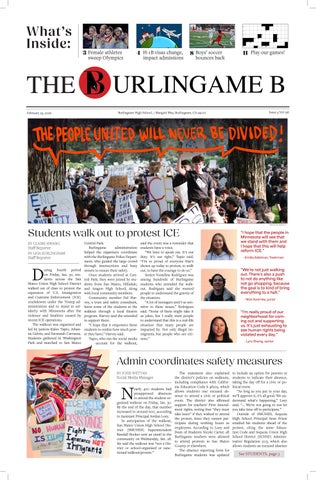
During fourth period on Friday, Jan. 30, students across the San Mateo Union High School District walked out of class to protest the expansion of U.S. Immigration and Customs Enforcement (ICE) crackdowns under the Trump administration and to stand in solidarity with Minnesota after the violence and fatalities caused by recent ICE operations.
The walkout was organized and led by juniors Kaleo Tapio, Johanna Galvin, and Savannah Carranza. Students gathered in Washington Park and marched to San Mateo
Central Park.
Burlingame administration helped the organizers coordinate with the Burlingame Police Department, who guided the large crowd through intersections and busy streets to ensure their safety.
Once students arrived at Central Park, they were joined by students from San Mateo, Hillsdale, and Aragon High School, along with local community members.
Community member Del Harvey, a trust and safety consultant, knew some of the students at the walkout through a local theatre program. Harvey said she attended to support them.
“I hope that it empowers these students to realize how much power they have,” Harvey said.
Tapio, who ran the social media account for the walkout,

said the event was a reminder that students have a voice.
“We have to speak out. It’s our duty. It’s our right,” Tapio said. “I’m so proud of everyone that’s shown up today to protest, to walk out, to have the courage to do so.”
Senior Yosseline Rodriguez was among hundreds of Burlingame students who attended the walkout. Rodriguez said she wanted people to understand the gravity of the situation.
“A lot of teenagers aren’t as sensitive to these issues,” Rodriguez said. “Some of them might take it as jokes, but I really want people to understand that this is a real-life situation that many people are impacted by. Not only illegal immigrants, but people who are citizens.”


“I hope that the people in Minnesota will see that we stand with them and I hope that this will help reform ICE.”
- Emilia Edelman, freshman



“We’re not just walking out. There’s also a push to not do anything like not go shopping, because the goal is to kind of bring everything to a halt.”
- Nick Koomey, junior
“I’m really proud of our neighborhood for coming out and supporting us. It’s just exhausting to see human rights being violated every day.”
- Lyra Sheng, senior
BY JOSIE WETTAN Social Media Manager
Nearly 400 students had preapproved absences to attend the student-organized walkout on Friday, Jan. 30. By the end of the day, that number increased to around 600, according to Assistant Principal Jordan Loey.
In anticipation of the walkout, San Mateo Union High School District (SMUHSD) Superintendent Randall Booker sent an email to the community on Wednesday, Jan. 28. He said the walkout was “not a District or school-organized or sanctioned walkout/protest.”
The statement also explained the district’s policies on walkouts, including compliance with California Education Code § 48205, which allows students one excused absence to attend a civic or political event. The district also affirmed support for teachers’ First Amendment rights, noting that “they must take leave” if they wished to attend the protest, since they cannot participate during working hours as employees. According to Loey and Dean of Students Nicole Carter, all Burlingame teachers were allowed to attend protests in San Mateo County or elsewhere. The absence reporting form for Burlingame students was updated
to include an option for parents or students to indicate their absence, taking the day off for a civic or political event.
“As long as you put in your day, we’ll approve it, it’s all good. We understand what’s happening,” Loey said. “… We’re not going to not let you take time off to participate.”
Outside of SMUHSD, Sequoia High School Principal Sean Priest emailed his students ahead of the protest, citing the same Education Code and Sequoia Union High School District (SUHSD) Administrative Regulation 5113, which also allows students an excused absence
See STUDENTS, page 3
BY INY LI Managing Editor
BY PAIGE CORNELIUS Business Manager
When an anonymous student* was in eighth grade, an Enrollment Center Investigator from the San Mateo Union High School District (SMUHSD) visited their Burlingame home to verify their home address. The visit was part of the district’s effort to prevent residency fraud, which occurs when a student’s address is falsified to bypass the intra-district transfer system.
“[The district] questioned where I lived, but we didn’t really know the extent of how they were going to see if I live [in Burlingame],” the anonymous student said. “I remember
ing is at Burlingame High, which is very, very impacted,” Booker said. “There’s no wiggle room there. I’m not placing all this on Burlingame, but in the past, we’ve had opportunities for movement, where now what we’re seeing at Burlingame is really no opportunities.”
As a result, many students interested in transferring to Burlingame struggle to secure a spot. For senior Stanley Situ, that meant moving from his San Francisco residence to Burlingame before he was granted enrollment as a sophomore.
“I believe [the district] should be more open to students outside the district, but I do understand they need to limit the number of students coming in because the district only has a select number of schools that they want to cater to their own students,” Situ said. “I just think they should be more open-minded to outsiders moving in for a good educa-

According to a district board meeting held in November 2025, Burlingame received 95 intra-district transfer requests this school year. From that total, 44 were granted, 19 were denied, and 32 declined to transfer. Seventy-six percent of requests districtwide were accommodated, a 1% increase from the previous year. During the meeting, Superintendent Randall Booker addressed concerns about Burlingame’s declining accommodation rate compared to previous years.
“Part of the other issue we’re see-
Director of Student Services Sheliah Burnette attributed the decline in the accommodation rate to two factors: fewer students attending private schools and a decrease in enrollment due to the “aging population,” a demographic shift characterized by a higher proportion of people aged 65 or older.
“Anytime now we have low enrollment, that can cause challenges for intra-district requests to balance all schools,” Burnette said. “It doesn’t mean we’ve changed our practices or processes, but we just have less options than we had in the past.”
If a student relocates outside the zoned area for an SMUHSD high school, the district considers the student’s grade level and academic progression when determining whether to grant transfer requests.

“If the student is a freshman or a sophomore, we probably would ask them to go through the lottery system for the following year,” Burnette said. “If, say, they’re ending their junior year, and now we’re just looking at senior year, that’s a little bit different. We try to really protect senior status and give seniors privileges… it is a whole lot less of a black and white decision as it is case-by-case.”
For junior Jeime Moreno, who lives in Redwood City, the decision to transfer to Burlingame came down to Burlingame’s opportunities.
“My mom works at the school, and she told me how there were a lot more opportunities at Burlingame High School that other schools, mostly where I live, don't really have,” Moreno said. “So I really wanted to join Burlingame, because I felt it would just be a better experience.”
For students who complete the intra-district transfer application, Situ advised them to “apply again if it doesn’t work the first time.”
“If you want to attend a specific school, you should probably go through the intended pathways that are created by the district, generally,” Situ said. “But I understand some parents and students are desperate to go to a school because of the opportunities it has to offer compared to the schools they may have in their own area.”
*This source was granted anonymity due to disciplinary consequences.

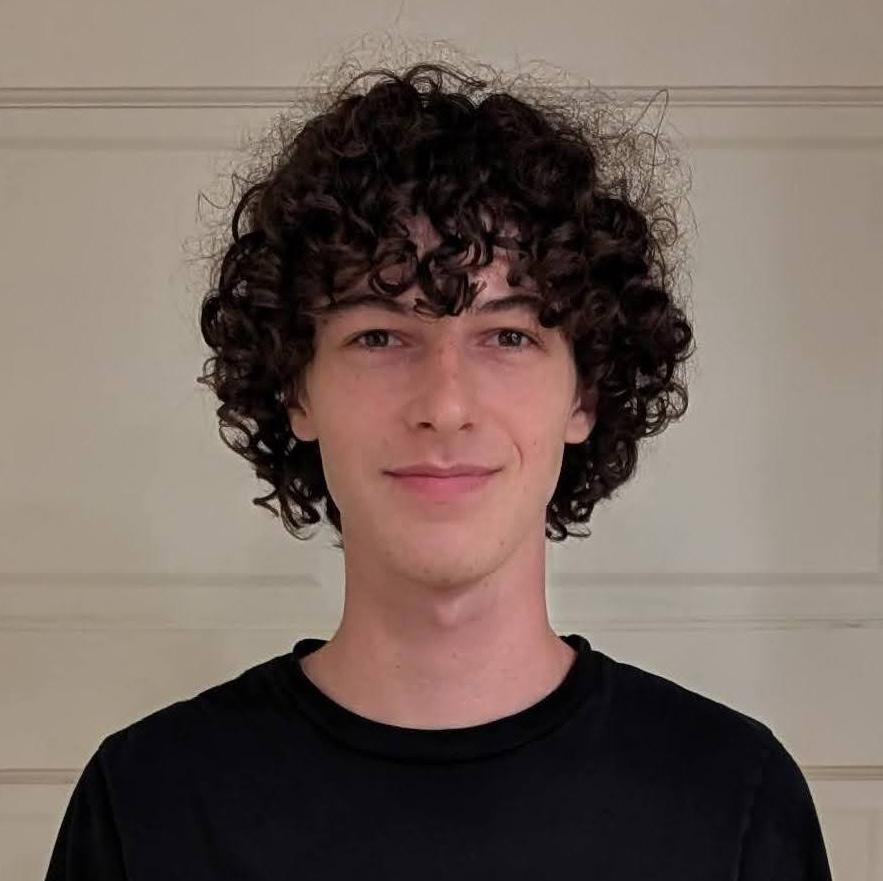
Luca Chiaro, 16, passed away from encephalitis on Dec. 28, 2025, after spending a week at Lucile Packard Children’s Hospital. He was surrounded by family and close friends. Encephalitis, a sudden and unexpected inflammation of the brain, is a rare condition triggered by viral infections.
Chiaro was a kind, easygoing, and down-to-earth person who always had a smile on his face. He enjoyed many interests, including going to the gym, lifting weights with friends, and listening to music. In his free time, he played video games and participated in the Burlingame summer basketball league during his freshman and sophomore years.
Chiaro was an independent thinker, often coming to his own conclusions. He supported Homes 4 the Homeless and the Hebrew Free Loan, organizations dedicated to helping people facing financial challenges. His work with these organizations was part of his year-long Tzedekah project at the Ronald C. Wornick Jewish Day School, and he earned the title of “Honorary Youth Ambassador for Compassion & Service.”
He leaves behind many friends and family, including his mother, Danielle Chiaro; his father, Vince Chiaro; and his sister, Bella Chiaro, who will be a freshman at Burlingame next year.
For friends, students, or staff who wish to share memories of Luca with his family, visit https://tinyurl.com/lucachiaro.

BY INY LI Managing Editor GRAPHICS BY KAYLEE HWANG

Local: County regulates e-bikes
San Mateo County Supervisor Jackie Speier hosted an “E-bike Town Hall” meeting on Tuesday, Feb. 10, for constituents to express their e-bike safety concerns. The night before, 16-year-old Cash Justin Krawetz was killed when he collided with a truck while riding an electric motorcycle. During the meeting, a draft ordinance outlining local regulations for electric conveyance devices was shared to inform countywide law enforcement agencies.

National: House passes SAVE Act
On Wednesday, Feb. 11, the House of Representatives passed the Safeguard American Voter Eligibility (SAVE) America Act, which requires nationwide proof of citizenship for voter registration. Introduced by Rep. Chip Roy and backed by President Donald Trump, this act now faces the Senate’s 60-vote filibuster rule before becoming a law.

International: Former prince jailed
The British police arrested Andrew Mountbatten-Windsor, formerly known as Prince Andrew, on Thursday, Feb. 19, on suspicion of misconduct in public office. Mountbatten-Windsor, who is still under investigation after being released 11 hours after his arrest, allegedly shared confidential government information as a trade envoy with convicted sex offender Jeffrey Epstein.

Sports: “Quad God” spins out
After clinching a gold medal for the U.S. team early in the Winter Olympics, figure skating sensation Ilia Malinin, nicknamed “Quad God,” fell twice and struggled throughout his free skate routine on Friday, Feb. 13, finishing in eighth place. On Monday, Feb. 16, Malinin posted a video on social media, citing the pressure of the Olympics as one of his struggles.

BY KAI SHAH Sports Editor
The 2026 Olympic Winter Games in Milano Cortina have been the most gender-balanced Winter Games to date, with women accounting for 47% of the athletes and four new women’s events, including the women’s sprint in ski mountaineering and the women’s dual moguls in freestyle skiing.
“I’m glad that it’s still on the rise and that it’s continuing to increase in numbers. I think it’s really important,” senior Katie Friedman said. “I think sports is a really important avenue to get closer to equality.”
In addition, all cross-country skiers will race the same distances for the first time in Olympic competition. Previously, men competed in 50km races, while women raced 30km. Now, both men and women will compete in separate 50km mass-start events. For girls’ golf and swimming coach Traci Kreppel, these changes foster a very different environment from when she grew up.
“It’s really cool what they’re allowing women to do now, because in my lifetime, there were just a lot of things that they said that women can’t do,” Kreppel said. “Because it’s too physically demanding for them, which is totally not true.”
According to the International Olympic Committee, the number of female athletes in the Olympics has steadily increased — they accounted for 23% of athletes at Los Angeles in 1984, 44% at London in 2012, and 49% at Paris in 2024.
Girls’ volleyball coach Hannah Korslund said the next step towards gender equality is putting the same

effort into promoting women’s sports as men’s sports.
“There’s a lot of attention to some boys sports, and then I think it’s great when we send out messages about girls sporting events that are happening to get big crowds to those too,” Korslund said. “And then nationally, I think similar to that, putting the same effort and time into broadcasting female professional sports as male professional sports would be cool to see.”
Specifically at Burlingame, Korslund said she thinks these changes in the Olympics — the highest stage of competitive sports — will encourage and positively influence female athletes.
Friedman said these breakthroughs send a message to young female athletes, that they’re seen and people are working towards giving them more opportunities.
“It’s sending a message that men are superior isn’t an inevitable thing, and that there is change happening, and there’s not always going to be
that vast of a gap between men and women, and we can work to shrink it,” Friedman said.
According to girls’ varsity flag football coach Nicole Carter, progress has been made with gender equality in sports, but it is still in its early stages.
“A lot of times, we’re told you can be whatever you want. And I think now we can actually back that up,” Carter said. “And so I want my female athletes who are watching to be like, ‘If this is what I want to do, if I am that committed, if I put in the work, now I can be there.”
From pg. 1
engagement in a political or civil event. In the email, Priest said that “school staff and administrators are not authorized to accompany students off campus or promote, organize, or take part in any such event.”
Carter and Loey attended the protest to ensure student safety and coordinated with the local police force.
“If you want to peacefully protest, you all have the right under the First Amendment and the Constitution to be able to do so,” Carter said. “We just wanted to make sure that you were being safe and how all of you were going about it, and everything that I observed was completely safe from all students from all different schools, colleges, and middle schools.”
Loey said open communication between walkout organizers and school administrators helped support student safety.
“I think it was a really positive experience for the students, and I really want them to hold on and capture what a really good strike and a really good organized movement looks like,” Loey said. “... Because they were so
communicative and open and kept us in the loop on everything, that allowed us to be extra prepared, keep them safe, and get all these other folks involved.”
History teacher Annie Miller stayed at school to support students who did not attend the protest, but she said she was proud of those who exercised their con stitutional rights.
“I wanted to support all students, regardless of political beliefs,” Miller said. “Some of the students who stayed back, I was assum ing, may not have agreed with the protests. But also, there were

students whose parents wouldn’t let them go. There may have been students of immigrant backgrounds who felt uncomfortable or unsafe attending a protest.”
Drama teacher Michelle Shannon, who attended the protest as a private citizen, said she also felt proud.

“It was very peaceful. It was very passionate. It was empowering,” Shannon said. “... They felt confident that they were actu-

BY OLIVIA NEWMAN Copy Editor
On Sept. 19, 2025, President Donald Trump signed a proclamation to reform the H-1B visa program to prevent visa abuses and protect U.S. workers. The change made it more difficult to obtain an H-1B work visa, affecting international and U.S. students.
The H-1B visa is a non-immigrant visa that allows U.S. employers to temporarily hire foreign workers in specialty occupations, requiring at least a bachelor’s degree or equivalent experience. The visa is intended to help employers temporarily fill positions for the U.S. workforce. Foreign workers can stay in the U.S. for up to six years.
While employers previously paid between $2,000 to $5,000 per petition, a $100,000 payment is now required for any new H-1B visa petitions submitted after 12:01 a.m. on Sept. 21, 2025, according to the U.S. Citizenship and Immigration Services. The H-1B lottery system, which was previously ran-
dom, is now a weighted selection system based on wages.
For international students who come to the U.S. for college and hope to stay for work, these changes may make it more difficult to remain in the country. Amy Grenier, founder and principal of Peninsula Scholars and college admissions advisor, said the decrease in international students coming to the U.S. is unfortunate for global diversity in colleges.
“The idea of global collaboration is kind of at risk in the university setting a little bit,” Grenier said. “Tying it directly to H-1B, I do think that closes out a big pathway for international students that are coming here because they want to stay and work. They want to stay and work in America.”
As students adjust to the visa changes, some still may choose to attend school in the U.S., even if they cannot work there afterward. Kevin Jeon, a senior and U.S. citizen who attends school in South Korea, said he has seen classmates affected by these changes.
“As someone who goes to an

international school, I see a lot of smart and dedicated people around me,” Jeon said. “And this is sometimes a bit sad to see [international students] coming back to Korea, and realizing the limited amount of opportunities that they have even if they’re able to go to the school in the U.S.”
International students in the U.S. often pay higher tuition than domestic students and have less access to financial aid, according to the American Council on Funding. Since institutions rely on international enrollment, lower enrollment could affect funding.
Senior Michelle Chow, who attended school in Hong Kong until sixth grade, said colleges may change what they look for in applicants moving forward.
“They used to take a lot more international kids because they’re the main money income for colleges, because they’re paying full tuition while a lot of local kids are supported by FAFSA and the federal government,” Chow said. “I feel like colleges are going to be more selective with the people that they’re admitting, because they’re going to want higher-income kids to compensate for that loss of income from international kids.”
According to the Migration Policy Institute, the U.S. hosted about 16% of the world’s 6.9 million international students in the 2023-24 academic year, far more than other major destinations. Jeon said the U.S. has one of the “best education systems in the world,” which attracts international students.
A report from the Institute of International Educa-
[Colleges are] going to want higher-income kids to compensate for that loss of income from international kids.”
- Michelle Chow, senior
Since I’ve been doing this, it’s the most impact ful time for international admissions. I’m really surprised.”
- Amy Grenier, college counselor

It’d be nice if there can be more measures done to help international students get work visas.”
- Kevin Jeon, senior at Korean International School
tion found a 17% decrease in new international student enrollment at U.S colleges in fall 2025. Chow said reduced competition makes it easier for domestic students to gain admission, but less funding from international students could limit colleges’ ability to provide financial aid to low-income students.
“It’s gonna be easier for us, because obviously that’s competition, but also I think it will kind of take away opportunity,” Chow said. “Take away opportunity from lower-income kids, because you have to compensate for the international tuitions.”
While the number of international students has been declining since the COVID-19 pandemic, Grenier noticed the largest drop in the past year. She said the mix of perspectives international students bring is part of what makes U.S. colleges great.
“I do think that universities are having the global collaboration and people from different perspectives and different learnings and different ideas,” Grenier said. “That’s what makes some of our institutions global leaders, because they are international, so hopefully that comes back around.”
BY ADDISON CHU Staff Reporter
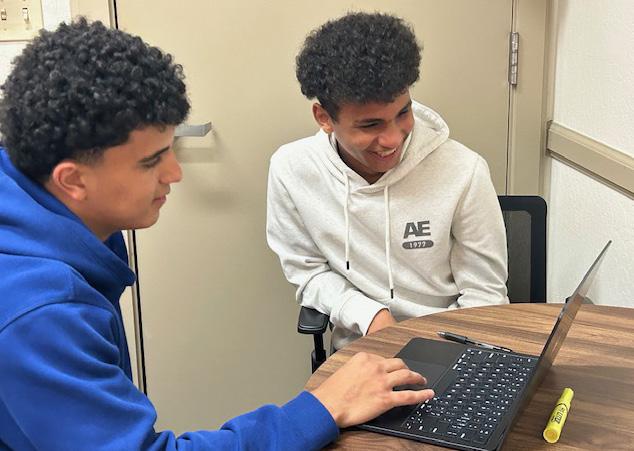
In response to rising enrollment of multilingual learners at Burlingame, intervention counselor Ted Brugman and senior peer tutor coordinator Sophia Yarmolinsky developed a program to support these students.
The program offers peer-topeer mentorship for English language learners, with tutors assisting students in their primary language. It complements the Community Literacy in Action (CLA) curriculum, an English course designed to help students reach English proficiency, while providing individualized instruction in ways larger classes cannot.
a language, combine all these things with just the inherent challenges of being a young person and being a student,” Brugman said. “There are a lot of things to speak about that make that situation challenging. So ultimately, I wanted to find ways of providing more support.”
As part of the program’s initiative, Brugman said that he personally reaches out to the students.
We have similar stories, and we could relate to a lot of things, because I was once just the same.”
- Qasim Abutair, junior
“If you’re new to a community, new to a country, new to
“Folks who oftentimes need the most support and would benefit from support the most are the least likely to kind of access that kind of support,” Brugman said. “...I have been trying to think about how to bridge that gap, how to facilitate access to support for students who are not as likely to
take advantage of some of those things.”
Typically, students meet with their tutors during or after school to receive support in subjects they find challenging. In addition, these students also work closely with Brugman, which allows him to tailor the program to individual needs.
Freshman Shaban Hassan, a student in the program who primarily speaks Arabic, said that tutoring helped him become academically successful.
“He was never good in the start with all the classes, and then when we started meeting and getting help, he started getting good grades,” peer mentor and junior Qasim Abutair said, translating for Hassan.
Abutair began working with Hassan at the beginning of the semester and meets with him on a weekly basis. Abutair said the program allowed him not only to meet new people, but also form friendships.
“It’s positive, connecting with someone that’s here from another country,” Abutair said.
“We have similar stories, and we could relate to a lot of things, because I was once just the same.”
The program is still in its early stages, with outreach for tutors still ongoing. Yarmolinsky said the program ultimately aspires to empower students as they navigate new academic environments.
“It’ll just make struggling students more open to help,” Yarmolinsky said. “I think there’s a lot of students that struggle quietly and they’re scared of speaking up. So I think having this program will really help those students.”

BY LEIA BURLINGHAM Staff Reporter
“Systems are certainly cracking in some big ways. Some people would say they are starting to collapse.”
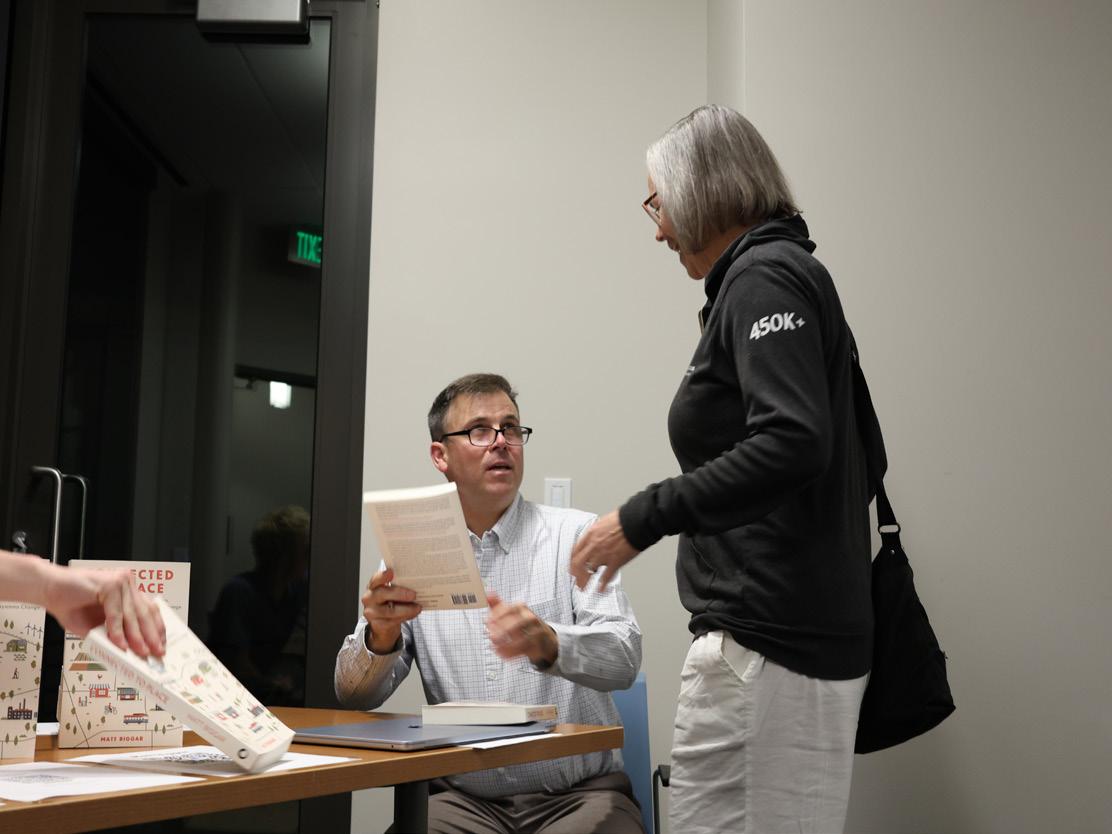
Matt Biggar, former Burlingame principal from 2002-08, delivered those words at his book signing event on Wednesday, Feb. 4. He cited isolating transportation, a lack of community spaces, and environmental damage as examples of systems under pressure and
failing to connect people to their surroundings. His book,
“Connected to Place,” released on Nov. 15, 2025, focuses on methods to rebuild nature, communities, and local economies to address this lack of connectivity.
“It’s just wanting to understand your place and give back to it and be a part of it. I think it’s very enriching when you can think that way,” Biggar said during an interview.
Biggar also cited overuse of screens as a contributing factor
to disconnection from one’s environment. At the book signing, an audience member recalled many kids on their phones at a basketball game. Biggar said the comment made him consider how one can be a participant rather than a spectator.
“The more hands-on you can get with something, the more you can kind of move away from the digital distractions and other things that kind of keep you disconnected,” Biggar said.
Natalie Dias, a junior at San Mateo High School and panelist at Biggar’s event, echoed this
action-oriented approach for youth. Dias works with Silicon Valley Youth Climate Action and Bay Area Youth Climate Summit to promote climate-focused policies.
“In a sense, it can be hard because you don’t have the same voting rights, for example,” Dias said. “But on the other hand, being a youth makes people listen to you more.”
Dias said she wished it were easier to get “clearly sustainable” ideas out there. By adopting a community-based approach, she said she has realized what needs to be addressed in her community.
“By learning about what we
Systems are certainly cracking in some big ways. Some people would say they are starting to collapse.”
- Matt Biggar, former Burlingame principal
it looks like,” Dias said.
Julie Hilborn, director of Environmental Literacy and Sustainability at the San Mateo County Office of Education, was another panelist at the event. She encouraged students to get involved locally and pay attention to city council decisions.
“[The city council] will decide what kind of city you’re going to have,” Hilborn said. “They choose the zoning for what kinds of buildings are going to go in there, and what kinds of industries, and whether you’re going to have parks or not.”

can do locally, it’s kind of given me more hope for what globally
Biggar closed the event by telling the audience that change will not happen “overnight,” but begins with “planting the seeds for what comes next.”
“It’s who we are, it’s deep in our DNA, and there’s so much richness there, and just to really start thinking about yourself as a person of a place, more than anything, becomes more your identity,” Biggar said. “I think we could make powerful change if enough people do that.”
BY ALEX BERTELLI Copy Editor
Anthropic Chief Executive Officer Dario Amodei warns that Artificial Intelligence (AI) could “wipe out” half of all white-collar jobs within the next few years. Whether his prediction becomes true or not, AI is certainly shaking up the modern computer science in dustry, especially when it comes to coding.
“There’s a difference be tween coding and program ming. Programming is going to stay around for as long as we have computers. It’s the process of debugging, engineering, all of that around creating a system on a computer,” junior Bruce Peters said. “Coding is hitting little keys on your keyboard and making letters appear and then compiling that, having a pro gram appear. Coding is dead.”
In February 2025, OpenAI co-founder Andrej Karpathy coined the term “vibe coding.” Vibe coding refers to using AI
to assist with software development. It has acquired a negative connotation because people could use AI without programming knowledge, but that is often not the case.
Junior Colin Haine, for instance, started using AI to increase productivity. With AI’s help, he recreated a months-
Similarly, Peters takes a very supervised approach to programming, even when much of the “coding” is done by AI. He generates a markdown file outlining a goal, detailed context, and a step-by-step plan. Peters said AI rarely creates code that works immediately, but effective use can increase his speed
trust what the AI is doing unless you know what it’s doing.”
A 2025 report led by Google surveyed over 5,000 tech professionals across the industry and found that 90% use AI as part of their workflow. Math and computer science teacher Christina Wade said AI’s efficiency at producing text and
that AI was another reason she was uncertain about pursuing a career in computer science.
“In my senior year, it started to become clear that large language models are becoming big in the computer science world,” Johnson said. “… and senior year is when I kind of started to wonder if this is really what I want to be doing with my fu-


Overall, though, Johnson, Wade, Peters, and Haine said the product-creation workflow will always depend on competent human supervision.
“I do think we will hit a limit, per se, where the AI can write the code, and the AI can turn the human ideas and the human language into computer language,” Johnson said. “But at some point you’re engineering a product, and that requires creativity, that requires problem solving, and I don’t think the AI is going to ever be better than humans at that.”
*To read more, view the full article at theburlingameb.org.


When
the Super Bowl comes to a new host city, it brings more than just football. Economically, Super Bowl LX and other events leading up to the game generated an estimated $500 million in California. For Super Bowl LX, not only was Santa Clara and Levi’s Stadium swarmed, but so was the rest of the Bay Area. For Burlingame students, one of the most notable events was the Super Bowl Weekend Kickoff at Pier 80 Warehouse on Friday, Feb. 6, where Calvin Harris and other big DJs performed.

“Calvin Harris is amazing,” senior Ellery Adams said before going to the
concert.
“It’s going to be a once-ina-lifetime experience. It’s probably my dream concert.”
BY CLAIRE HWANG Staff Reporter
BY OSCAR BILL Head Photographer


Senior Zadie Tsai, who also went to the concert, shared the excitement and noted that while Super Bowl weekend events were appealing, the game itself wasn’t as interesting for her.
“I’m not watching the Super Bowl, so I’m just going to the con cert.” Tsai said, “Honestly, I’m not the biggest fan of football.”

To say that New England fans fared poorly this Super Bowl is putting it mildly. The Seattle Seahawks dominated Super Bowl LX, beating the New England Patriots 29-13 in a crushing victory.

Drake Maye, the Patriots’ quarterback, only in his second season. As a result, the Patriots failed to score in the entire first half, while the Seahawks stacked up nine points before halftime. While the Seahawks’ offense put on an impressive performance, the team proved its strength lies in its defense. The Seahawks sacked Maye six times, nearly record.
From the start, the Seahawks’ defense relentlessly pressured


The Patriots put up an honorable fight, but struggled on defense, unable to break through Seattle’s aptly named “Dark Side” defense. While New England faces a bitter offseason, Seattle and their Seahawks will be riding on this momentum well into September.
Sophomore Chase Cyb, who attended the game in person, said the highlight of the weekend was the stadium’s energy on game day.
“It was one of the most energetic events I’ve ever been to,” Cyb


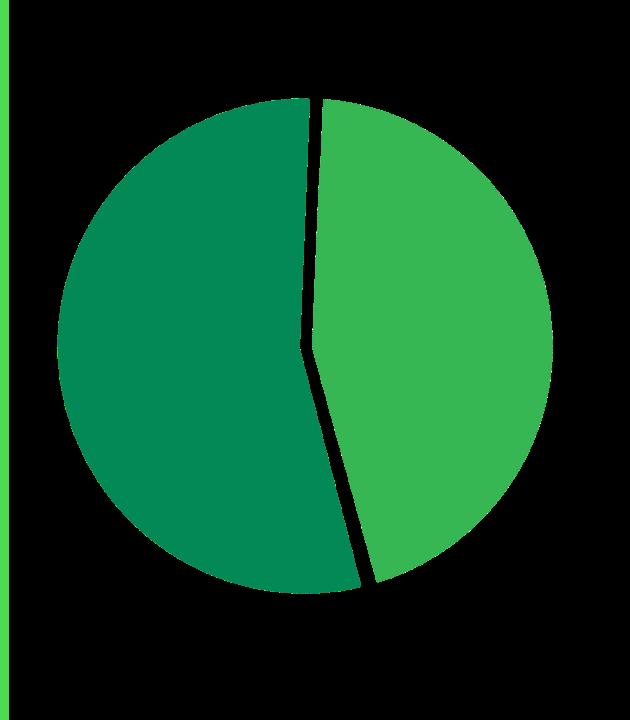








The Burlingame B collecting information from 108 students and staff asking them about their plans and opinions for Super Bowl Weekend.
What’s your favorite Super Bowl snack?


BY CHIARA WESLEY Senior Reporter
Each year, the Super Bowl raises the same questions: Who will win? Which quarterback will shine? This year, those questions took a back seat. The most talked-about moment wasn’t a touchdown or a controversial play — it was the halftime show.
Puerto Rican rapper and singer Bad Bunny (Benito Antonio Martínez Ocasio) headlined the 2026 Super Bowl halftime show. A six-time Grammy winner with 16 nominations, Bad Bunny was the first all-Spanish-language artist to be Spotify’s most-streamed artist globally, and one of the Times’ top 100 most



On Feb. 2, TPUSA announced the lineup: Kid Rock, Brantley Gilbert, Lee Brice, and Gabby Barrett.
Before the performance, reactions among Burlingame staff and students reflected a range of opinions on representation and cultural relevance. Spanish teacher Stephen Held described his initial reaction as excitement, noting that the U.S. has a large Spanish-speaking population and musical connection extends beyond lyrics.
“Of course, there’s lyrics, but it’s also the rhythms, the beats, how it makes you feel — it’s beyond,” Held said. “It feels like people are trying to make everything political when it feels like it doesn’t need to be.

Senior Mia Robelo was initially un-
I guess the difference between when Shakira and JayLo performed and now is where we seem to be. More things seem to be more politicized than that.”
- Stephen Held, Spanish teacher
influential people in 2021. Nevertheless, the announcement generated controversy, mostly due to political tensions rather than his musical merit.
Bad Bunny has publicly criticized U.S. Immigration and Customs Enforcement (ICE) and excluded the U.S. from his 2025-2026 “Debí Tirar Más Fotos” world tour out of fear that ICE could target his predominantly Latino fan base. He has also opposed ongoing debates of Puerto Rico becoming the 51st state, a stance that some conservative critics view as anti-American.
of students ranked the half-time performance as the best part of the Super Bowl. 32.4%
In response to the National Football League’s selection of Bad Bunny as halftime performer, conservative nonprofit Turning Point USA (TPUSA), founded by Charlie Kirk in 2012, announced on Oct. 9, 2025, that it would host an “All-American halftime show” to celebrate faith, family, and freedom.
aware of the TPUSA halftime show and said she was confused about its necessity.
“I just don’t think it really matters, Robela said. “There’s so much diversity, especially since the Super Bowl is in California, so I feel like it shouldn’t be a problem if there’s Spanish music. Spanish music is enjoyed throughout all of America.”
Despite the debate leading up to the game, the halftime performance shifted the conversation to the show’s overall message.

Warner said this year’s halftime show exceeded her expecta- tions, noting that its mes- sage empha- sized unity.
“I really liked the message at the end, when it said, ‘The only thing more powerful than hate is love.’ I think that’s just such an important message to be sending, especially during this time,” Warner said.
“I feel like it especially shows how people shouldn’t have been mad about Bad Bunny performing at the halftime show. He’s singing, and he’s trying to bring people together, he’s not trying to push people apart.”

Here’s a look at winter sports playoff games and season finales. Overall records are accurate as of Feb. 19.
Boys’ basketball will play in the second round of the Division II Central Coast Section (CCS) playoffs on Saturday, Feb. 21, against the winner of Soledad and Gilroy High School.
11-13
Girls’ basketball beat Woodside High School on Feb. 10 and will play in the first round of the Division II CCS playoffs in a play-in game against Ann Sobrato High School on Friday, Feb. 20.
11-4-3
Boys’ soccer will play in the Division III quarterfinals in the CCS playoffs against Monterey High School on Saturday, Feb. 21.
3-13-3
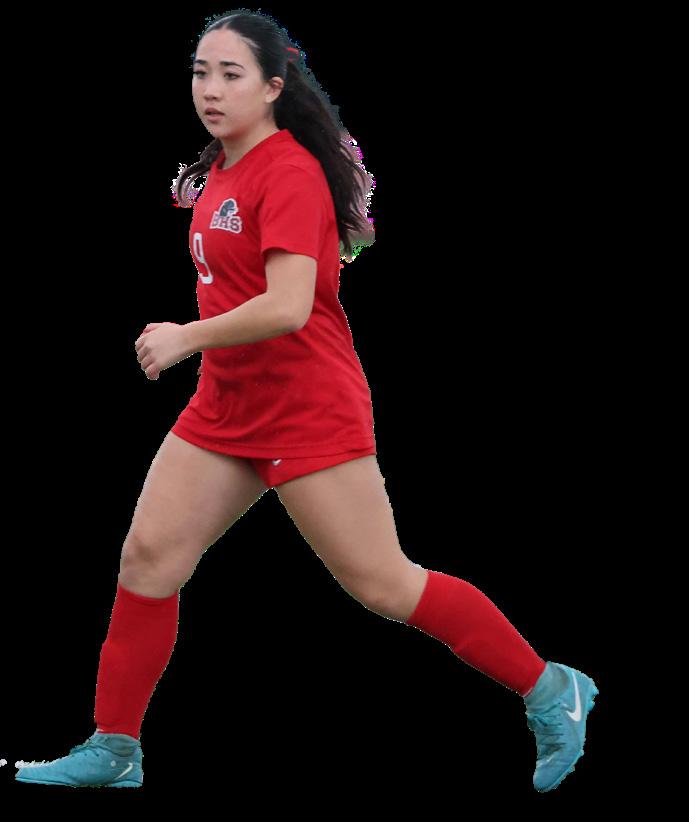
Girls’ soccer finished the season with just three overall wins, all in league play, failing to qualify for playoffs. The team is graduating ten seniors.
7-1
Wrestling
Seniors Miles Reeth, Ravi Krishnan, Mele Moengangongo, Ashley Viana, and sophomore Nora Scopazzi will compete in CCS Masters on Saturday, Feb. 21, at Watsonville High School.
BY ADDISON CHU Staff Reporter
The boys’ soccer team is shaping up to be the state championship-caliber team they aspired to be at the start of the season. After failing to qualify for the Central Coast Section (CCS) playoffs last year, the Panthers worked hard to address their shortcomings.
Despite a few losses and a disappointing tie in their final league game, the team has performed strongly, finishing third in the Peninsula Athletic League Bay Division with an 11-4-3 record. Their win count includes victories against strong teams such as Junípero Serra High School early in the season.
According to head coach Anthony Dimech, the team’s chemistry is far more apparent than last season, when they struggled to work cohesively during games.
“Sometimes it’s not always about talent, it’s just how the team plays together. There’s 11 guys on the field. They all got to work together,” Dimech said. “So I think we’re doing a better job of that as a whole. We finished out the season strong last year, but it took us a while to get going, and we’ve picked our
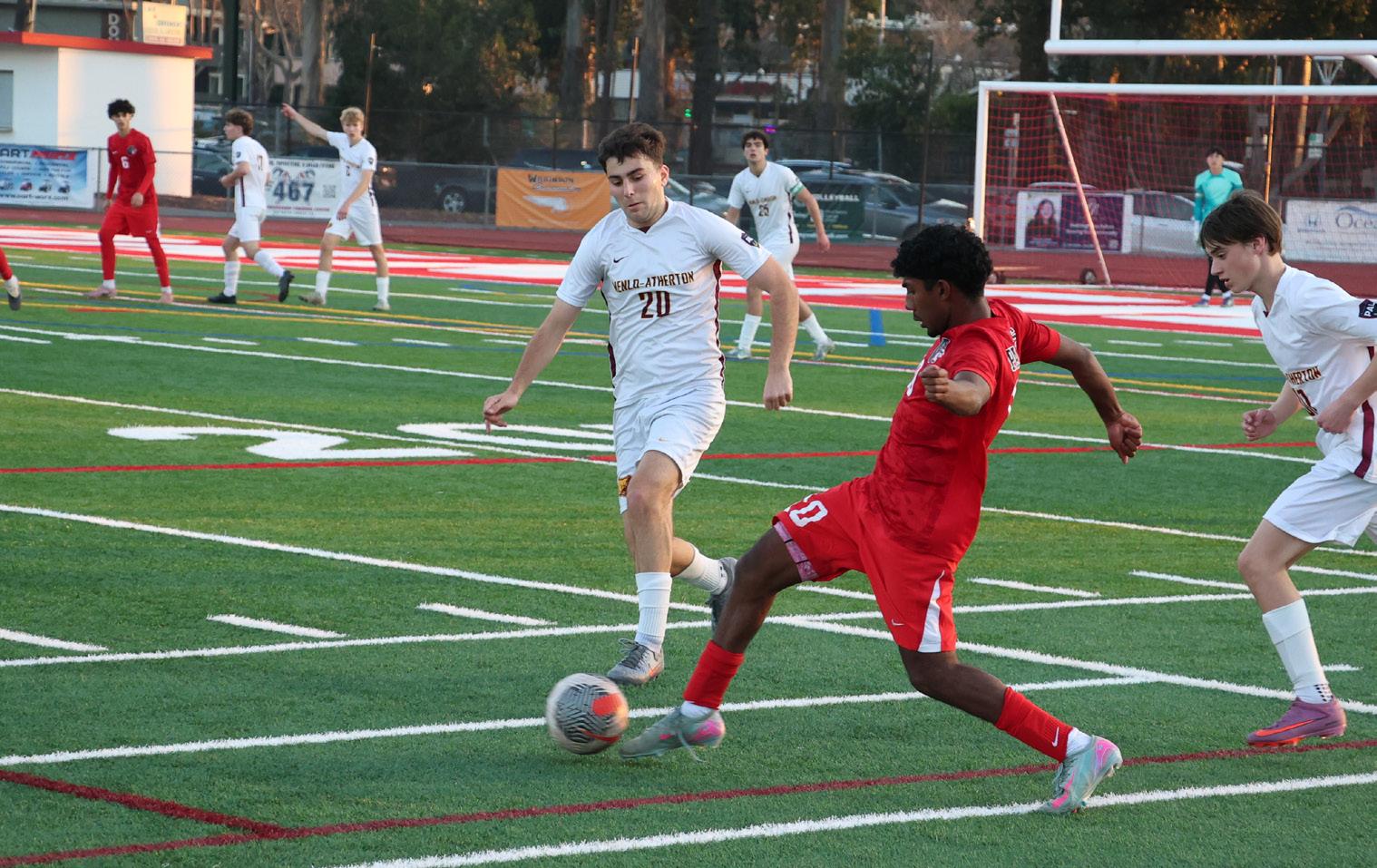
chemistry up a little bit faster.”
Dimech and the team’s co-captains, seniors Dylan
They lead by example. Man, they just work hard every day and stay focused and in the games, they give everything they got.”
- Anthony Dimech, head coach
Rossen and Ricardo Felix, said last year’s shortcomings came from a lack of leadership. To address this, Rossen and Felix stepped into the role of team captains.
“They lead by example,” Dimech said. “Man, they just work hard every day and stay focused, and in the games, they give everything they got.”
Rossen said he hopes his leadership will strengthen the team’s bonds and ensure that players are adequately prepared for each game.
The team qualified for the CCS Division III playoffs, with their first postseason match on Saturday, Feb. 21, against Monterey High School.
“We have a photo in our shed of the state championship on the CIF, and we also have a photo next to it of our NorCal championship,” Rossen said. “Two years ago, we were both on the team, so we know what that level is like to win. That’s our goal, to win the entire thing.”
“Ricky and I, as captains of the team, we try to hold each other and the team to a high standard,” Rossen said. “Even in training, even in warm-ups, we’re trying not to goof around as much and just keep the level high at all times, because if you’re training as hard in practice, you’re going to train that hard in the game. And it’s really starting to show when we play here.”
BY JASON LU Staff Reporter
There are over 800 players in the National Basketball Association (NBA), but around 350 of them are solely on NBA G-League contracts. Of those players, only 67 appeared in a game during the 2024-25 NBA season. Each NBA team is limited to three two-way contracts, which allow players to split time between the G-League and NBA. With so many G-League players and so few contracts, the margin to be overlooked is high.
The G-League is the NBA’s official minor league, designed to prepare players, coaches, and officials for the NBA. To play in the NBA, players can receive a callup from a team and sign a standard 10-day contract, a contract for the rest of the season, or longer. According to the NBA G-League, only 12 of 79 call-ups in the 202425 season led to a standard contract.
The pressure of a larger audience and entirely different opponents makes it
extremely unrealistic for G-League players to perform at their highest ability. If they make a single mistake, they may never get another opportunity.
Call-ups usually result from injuries on a team’s primary roster, meaning the process is largely up to chance. Furthermore, players also need standout statistics across the league to be considered. However, the G-League’s high-volume developmental structure forces players into positions that don’t suit them, making recognition centered on high-variance statistics rath-
er than sustainable production.
This luck-based structure is why I believe the G-League does not properly give players the opportunity to secure a spot on an NBA roster.
To create equal opportunity for players to display their skills, I propose that every five NBA seasons, the first seed in each G-League conference switches positions with the last seed in the respective NBA conference. After one season, the switch would revert, giving G-League players better opportunities since they would

be signed to the NBA, not each individual team. NBA teams could easily rebuild and add skilled players by granting these G-League players contracts.
The threat of dropping down to the G-League punishes teams for tanking, motivating head coaches and players, and fueling the NBA’s competitive atmosphere.
However, with this switch, an issue arises. When NBA teams and their G-League affiliate face off in the regular season, one team may purposely lose to allow the other to progress further. Although there’s no way to prevent team interactions, rosters could be finalized at the start of the season, with two-way players joining the G-League roster to stop teams from funneling breakout and star players into their different lineups.
I believe implementing this proposal will help overlooked players reach the NBA by fundamentally shifting the atmosphere of both the NBA and the G-League.



As a high-impact player, junior center back Thalin Rees — a varsity player since freshman year — is the anchor for the team’s defense. Despite an injury that he said affected his gameplay, he has been able to bounce back and perform strongly for the team.
“I feel like I’m performing pretty well,” Rees said. “I’m recovering from surgery, so it was a little bit slow at the start, but I’ve picked it up, and now I’m smooth sailing.”
Rees was on the team when the Panthers won the Division II NorCal State Championship in 2024 and has been a contributing member since, serving as a starting defender. This year, he attributes his personal success and the team’s
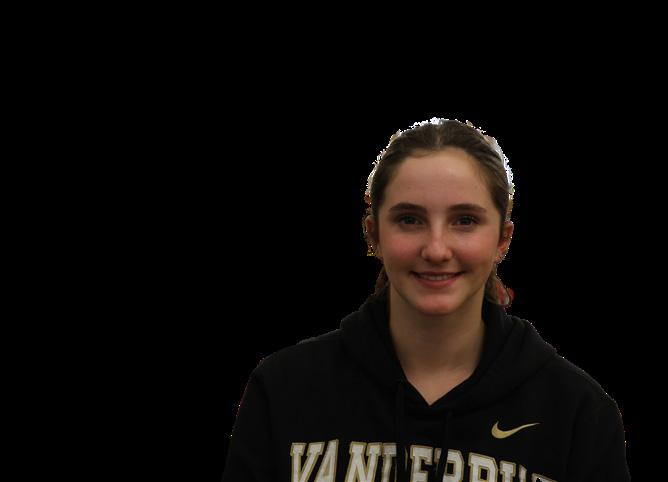
Freshman Amaya Sole never looked back after starting club soccer at age four. Today, she is one of two freshmen on the varsity girls’ soccer team.
As a freshman, Sole said that it was difficult finding her footing on the field, but when she did, she was able to succeed throughout the season.
“I feel like I’m a completely different person when I step onto the field, I feel like I’m demanding and hold myself accountable.” Sole said.
Sole credited her success as a freshman on varsity to her grounded mindset.
BY ELSA SCIMECA Staff Reporter
BY ADDISON CHU Staff Reporter
success to a more intentional team culture.
“Our team is more focused,” Rees said. “We have more passion, more desire, we just have more chemistry. A lot of people on the team have been playing outside of high school together, so we just know each other and how to play together.”

Rees said he hopes to continue improving on the field and help the team remain competitive as the season progresses to CCS.
“I just want to continue playing good. Score more goals, help out this team, play good defense, and then, for the team, trying to win it all,” Rees said.
BY LEA VON HAGEN Staff Reporter
“My dad always tells me ‘not too high, not too low,’ so it’s kind of a quote that I live by. I think it’s really important to never be too cocky and never feel too down on yourself,” Sole said. “Just stay in the middle and keep working hard.”
Though this season has been difficult, Sole said she focuses on the hard work she puts into the team.
“I’ve struggled a lot playing soccer, with a lot of setbacks, a lot of injuries, and coming back 100% and playing my best is like the biggest reward. I think all your hard work pays off,” Sole said.
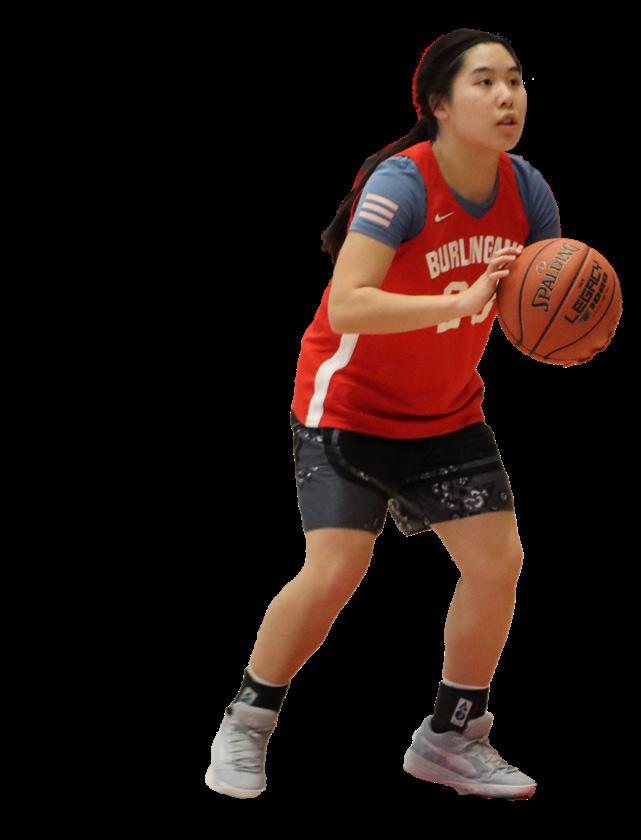
It’s safe to say junior guard Maya Siu knows ball. After playing on an Asian league basketball team since second grade, Siu progressed to becoming one of the few junior starters and first-year varsity players on the team this season.
“I mean, it’s amazing. I get to really start the game…it’s amazing to play with these senior varsity players together during the first quarter,” Siu said.
Siu said she improved both her offense and defense since last year, specifically in preventing fast breaks and blocking
After his friends introduced him to basketball, junior David Parrot found that the sport quickly became more than just a hobby. Now a guard for the Panthers and Armenia’s U18 national team, Parrot has taken on a larger role this season, playing a key role in the Panthers’ offense and defense.
While Parrot values individual improvement, he credited the team’s strong bond for its success.
“Our team chemistry has been at an ultimate high throughout this year. We all joined as one big group, which ultimately created our chemistry,” Parrot said.
Parrot said their camaraderie helped him support team-

opposing shots.
BY ABBY ZAHARN Diversity Coordinator
“I’ve been more aggressive, I would say, because when I played JV, I was very shy, and I didn’t play as well as I wanted to,” Siu said. “But now in here in varsity, I am able to improve both my offensive game and defensive game.”
Next year, Siu looks forward to being a team leader in her final season.
“I’m very excited to be a leader, bring in the team. I hope that, with my leadership, we’ll be able to have a great season,” Siu said.
BY ANDREW BARRERA Staff Reporter
mates and develop as a versatile player.
“My biggest contribution this season is being able to play all five positions on the court,” Parrot said. “Whenever someone is in foul trouble, playing the big spot or the guard, I’m always there.”
Parrot’s favorite moment from the season was the game against Junipero Serra High School, where despite the loss, the team showcased a strong performance.
“I feel like we played very well as a team, and we probably stunned a lot of people in the stands by making it a close game,” Parrot said.


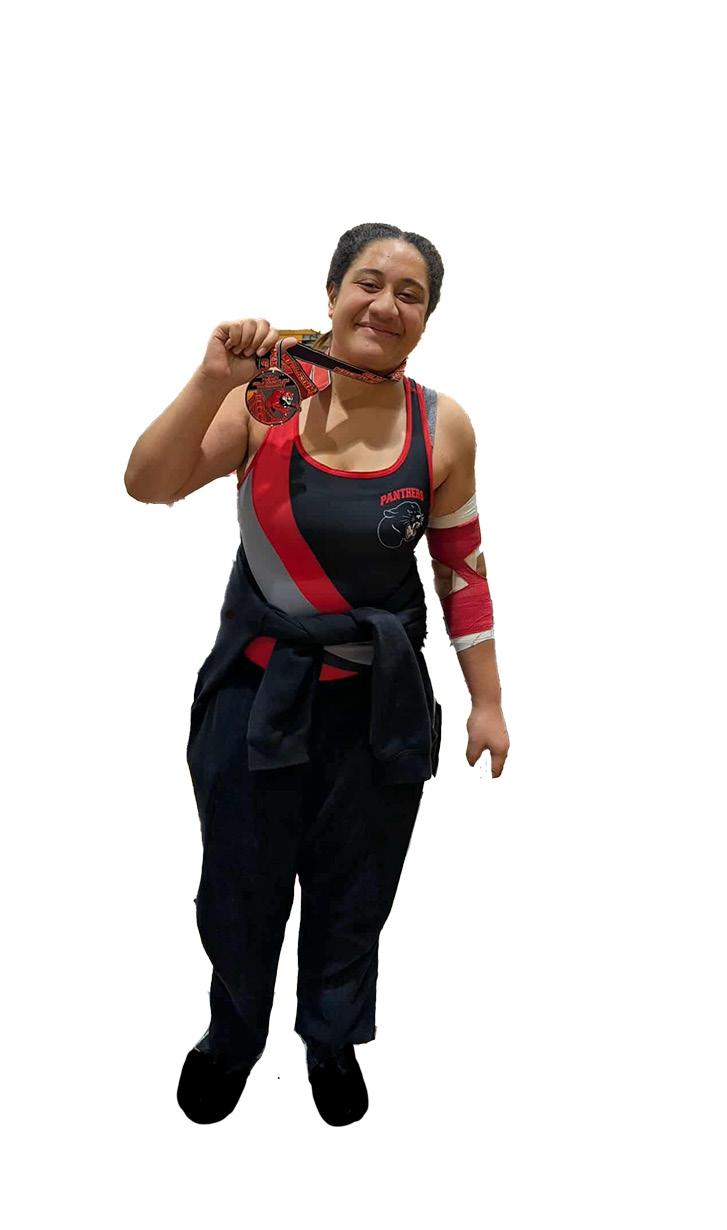
Senior Mele Moengangongo said she hopes to make it all the way to State as she nears the end of her first and final wrestling season.
“I’d like to be able to go to State because, since it’s my first year and my last year, I want to be able to make a lasting impression on the team, so they can be inspired to know that they can also do that,” Moengangongo said.
She has made the podium in multiple tournaments throughout the season. After joining wrestling at the end of her junior year, she attended practices throughout the summer of 2025. Despite initial doubts, she said she found motivation to continue with the sport.
BY JONAH MOSS Staff Reporter
“The thing about wrestling is that there’s a very mental part of it,” Moengangongo said. “Having a lot of my friends there helped me a lot, and they were able to support me in ways that a lot of other things can support me.”
She said she is grateful to her coaches, to whom she attributes a large part of her success. As a senior, she hopes to be a leader to the younger wrestlers.
“Most of my wins are dedicated to my team, my coaches and my friends that I have in wrestling,” Moengangongo said. “I don’t usually take the wins for myself, because I know there’s a team effort.”
Editor-in-Chief Joelle Huysmans
Managing Editors
Evelyn Du
Henry Gardner
Iny Li
Design Editor Kaylee Hwang
Sports Editor Kai Shah
Social Media Manager Josie Wettan
Business Manager Paige Cornelius
Arts Director Emma Yu
Head Photographer Oscar Bill
Diversity Coordinator Abby Zarahn
Social Coordinator Audrey Wei
Copy Editors
Alex Bertelli
Akira Nakamura
Olivia Newman
Senior Reporters
Chiara Wesley
Staff Reporters
Andrew Barrera
Peili Brown
Leia Burlingham
Abigail Chou
Addison Chu
Lea Von Hagen
Claire Hwang
Scarlett Ko
Chantal Lay
Faith Lee
Jason Lu
Jonah Moss
Eddy Josue Ortiz
Elsa Scimeca
Teacher Adviser
Melissa Murphy
Policy Statement:
The Burlingame B is a student-run newspaper with the sole purpose of providing an open forum for student expression. Anything printed represents the opinion of the writer, but not necessarily that of the Burlingame B staff, the administration, or the faculty of Burlingame High School, or anyone affiliated with the San Mateo Union High School District. The Burlingame B does not discriminate against race, political orientation, ethnicity, religion, gender, sexual orientation or disability. Although The Burlingame B will never refuse to publish guest submission based on the aforementioned factors, we reserve the right to edit or not publish them.
Letters to the Editor
Disagree with the writers? Bring your letters to the room A120 or email them to <theburlingameb@smuhsd.org>. Letters may be considered for publication. The Burlingame B reserves the right to edit for clarity, length, and accuracy. We welcome all comments.
Website: www.theburlingameb.org
Phone: (650) 558-2899
Email: theburlingameb@gmail.com
Address: 1 Mangini Way, Burlingame, CA 94010
BY THE BURLINGAME B EDITORIAL BOARD
“If journalists are silenced, citizens are blinded.”
Journalist Don Lemon posted this message after he was arrested on charges of conspiracy to deprive rights and interfering with religious freedoms, stemming from his coverage of an Immigration and Customs Enforcement (ICE) protest at a church in St. Paul, Minnesota. Lemon’s case highlights a wider problem in the United States: press freedom is under attack.
This happened mere days after the San Francisco District Court ordered Lowell High School to reinstate journalism adviser Eric Gustafson, who won a lawsuit against the school after being reassigned for what the school called the “declining quality of the newspaper.” The judge ruled the school violated California Education Code §48907 and the Journalism Teacher Protection Act, finding Gustafson was reassigned for protecting his student journalists’ freedom of expression.
According to the Student Press Law Center, one of the articles that drew the attention of the Lowell administration was about the use of AI grading, a topic The Burlingame B covered in its December issue. At The Burlingame B, we have the privilege of publishing content without censorship. However, we

must recognize that many student papers and national journalists do not fully exercise that right.
California falls under the standard set by Tinker v. Des Moines (1969), establishing that students do not lose their press freedom rights “at the schoolhouse gate.” However, 32 states are under the precedent set by Hazelwood School District v. Kuhlmeier (1988), allowing schools to censor school media if it relates to “legitimate pedagogical concerns”.
While Gustafson won his lawsuit thanks to the Tinker standard, student newspapers in Hazelwood states across the country have and will continue to face similar challenges from school administrators, which may have vastly different results.
From the Muckrakers to the Watergate Scandal, the United States has always been a safe space for
journalists. Press freedom is not only written into our constitution, but is ingrained in our national identity.
However, the United States now ranks 57th in the world on the Reporters Without Borders World Press Freedom Index, placing us between Sierra Leone and Gambia. In 2013, the United States ranked 29th, a drop of 28 places in 13 years. Other developed nations, such as Canada and the Netherlands, rank 21st and 3rd, respectively.
Censorship is inexcusable at any level, whether it affects a high school journalist or well-known media personalities. The press acts as a crucial watchdog, exposing scandals within the government and private organizations. If we allow censorship, we lose touch with what it means to be American and pave the way for further restrictions on press freedom.
BY PAIGE CORNELIUS Business Manager
Is the book always better than the movie?
According to a survey promot ed by CBS, it usually is, with 67% of people preferring the book to its movie adaptation. While I per sonally believe book-to-movie ad aptations can be enjoyable, I see why many prefer that their favorite books remain in their original form, as poorly-made adaptations often ruin the charm of the source mate rial. However, the rise in movie ad aptations this year alone shows how much audiences want to see the stories they read come to life. Even though they can be disappointing, there is no denying that there is still a large audience for book-tomovie adaptations.
In the early 2010s, films based on young adult novels such as “The Fault in Our Stars” and “The Maze Runner” series popularized the concept of book-to-mov ie adaptations. Later, “The Hunger Games” franchise high lighted just how much payoff these adaptations could have: the five films, based on Suzanne Collins’
books, grossed over $1.6 million.

When done right, they can be incredibly successful.
Still, there are risks to creating movie adaptations because of high expectations from pre-existing fan bases. For example, the upcoming release of “Wuthering Heights,” starring Margot Robbie and Jacob Elordi, has caused controversy by straying from the themes of the original novel. Even before its Feb. 13 release, the film had already faced months of criticism over its costuming and casting choices. However, this is not uncommon. Both adaptations of “The Housemaid” and “People We Meet on Vacation,” released earlier this year, received criticisms despite being enjoyable pieces of media. I understand that most fans want to see a picture-perfect adaptation of their favorite books; however, it is nearly impossible for that
Book fans need to accept that book-to-movie adaptations are becoming a staple of cinema, and rather than nitpicking every small detail, they should appreciate the new audiences their beloved stories can reach.
BY JASON LU Staff Reporter
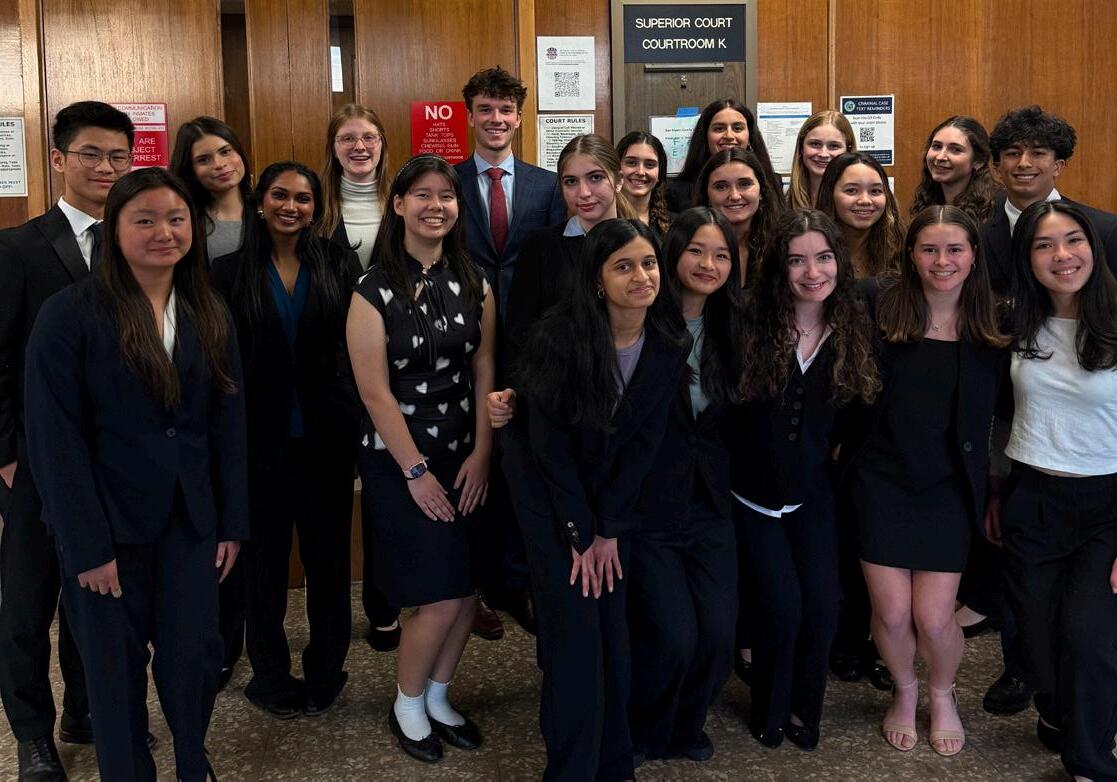
After months of preparation, Burlingame’s mock trial team concluded its season in third place in the Northern Division — just one spot away from the Central Coast Section (CCS) semifinals. In total scores ruled by judges across the season, Burlingame scored 606.52%, narrowly behind San Mateo High School’s 611.59%.
The season began with a close loss on the prosecution side, but the mock trial team built momentum towards the end of the season. Ultimately, the team’s qualification depended on their final games: the
defensive team beat Mills High School, but the prosecution lost to South San Francisco High School, sealing Burlingame’s third-place finish.
Despite missing CCS, student coach and senior Daisy Burruto said instructing members to fill knowledge-gaps propelled a successful season.
I’m just really excited, even though I won’t be here next year. I’m really hopeful that the team will keep on prospering.”
- Abby Gorin, senior
“Because we lost one of the rounds at the end, we didn’t make it to semis this year,” Burruto said. “But I’m still very proud of how the team did. I know that they were all trying really hard. There was a lot of effort that went into it, so I am still very happy with how we ended.”
Throughout the series of mock trial competitions, three-
Edited by Rain Yang
year mock trial member and senior Abby Gorin, who played a witness, found responding to cross-examinations on the spot especially challenging.
“When you do cross-examinations, the other team cross-examines you with their own questions and with their own story lines,” Gorin said. “So it’s kind of just being able to adapt to that. On the spot is what is pretty challenging.”
Over the course of the season, first-year member and sophomore Giulia Monteverdi said she learned new strategies that will lead to an even more successful season next year.
“I learned what the right times to object were,” Monteverdi said. “I also learned how things work, considering I’m a new year and I’ve only been doing this for a year, it’s been really fun to see how everything works in the process of everything, and I think all those com-
BY ALEX BERTELLI
Copy Editor BY ABBY CHOU Staff Reporter

Across Down
1. What this year’s [35-Across] is after [13-Across]
6. Amount of medicine
10. Brings of together
12. ____ Claus
13. Celebration that was Feb. 17 this year
15. Poses a question
16. Small battery type
17. Feel sick
18. Thoughts on a matter
20. Weep
21. ___ Rae, star of “Insecure”
23. Head toppers
25. Comedy show with 51 seasons
26. Muscle twitch
29. Hospital area, for short
30. Our state, for short
31. Letter after alpha
35. One of twelve cycling figures based on the [13-Across] tradition
38. Poet Poe
39. Appears to be
40. Judge
41. What last year’s [35-Across] was after [13-Across]
1. ___ hoop
2. Burden
3. Where you may play hockey
4. Equilibrium
5. Always, to a poet (contracted)
6. An apple a ___ keeps the doctor away
7. Like a short theatrical production
8. You can climb them
9. The type of bird that gets the worm
11. Crack under pressure
12. Hordes of
14. Water in French
19. It’s similar to Formula 1 21. How spies may communicate
Goop
24. Sleeping aid brand
25. ___ up (judged) 27. __ -Man (video game) 28. Sadly... 32. Actress Stone of “La La Land” 33. One of many in Among Us 34. ___ vera
Sam-___, Dr. Seuss character
1983 game console
petitions really brought out new memories and how we can do better next year as well.”
With the addition of several new members, Gorin said the season overall concluded successfully and hopes that the team will continue to improve in the future.
Rules: Draw a continuous line that travels horizontally and vertically between dots to form a loop (the line ends where it started, and you should be able to draw it in one stroke). A number in the ‘box’ formed by its four dots tells how many of that box’s edges are drawn as part of the line. Blank boxes may have any amount of line segments.

“It was very successful this year,” Gorin said. “We had a lot of new members, and everyone did really, really well. And I’m just really excited, even though I won’t be here next year. I’m really hopeful that the team will keep on prospering and continue to grow.”
Rules: Each row and column contains the numbers 1 to 6 without repeats. Each dotted-border region has a number and a + or × sign: the digits inside will add or multiply to the target number. (Example: a 3-box dotted region labeled “12x” may have 1, 2, and 6, since 1 x 2 x 6 = 12; or 1, 3, and 4). Digits can repeat within dotted regions.

Rules: The answer to each clue is a word or phrase that contains B, H, and S in order. Blanks are given. (Example: mouth cleaners:
has the answer toothBrusHeS)
Where you may sit to watch sports:
Level of illumination:




First established in the fifth century, Valentine’s Day has evolved significantly over the years. The holiday was originally meant to honor St.
poem “The Parliament of Fowls.” In 1415, a French poet wrote the first Valentine, though the tradition only gained popularity in the early 1700s.

BY ABBY CHOU Staff Reporter
BY PEILI BROWN Staff Reporter
Lately, celebrations of friendship have gained more attention. What began as a spinoff in the sitcom “Parks and Recreation,” Galentine’s


[Mr. Larkin and I] are good friends and we knew Mr. Thurtle before he came, so we were super excited that he was coming.”


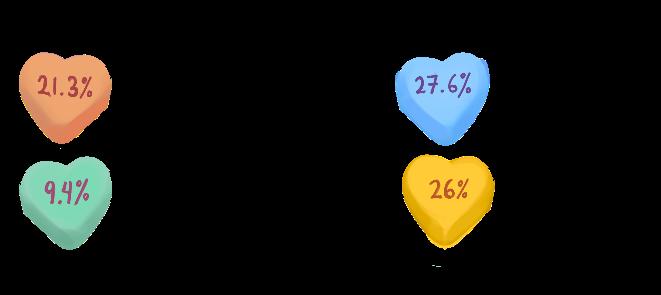




What is your favorite chocolate brand? Orchids Roses Lilies Other Lindt See’s Candies Ghiradelli’s Other Hershey’s

The B collected information from 127 students about their Valentine’s day preferences.