Healthy Kids Issue
Pages 6 and 7
THE BURLINGAME B theburlingameb.org
April 21, 2017
New Parking Restrictions limit options for students PHOTO BY CHARLES CHAPMAN
Juul, the latest e-cigarette, bound to Burlingame
Issue 7 Vol. 108
After several Juuling incidents, administration looks to address e-cigarette use on campus. BY ANDREW BATTAT Editor-in-Chief Over the last several months, Burlingame has seen a rise in student use of electronic cigarettes, the most common of which is the Juul—a brand of e-cigarettes made by PAX Labs and distinguished by its intensely high nicotine content compared to competitive devices. Several incidents have occurred on campus where students were caught “Juuling” in the bathrooms and locker rooms. “For a split second, you feel really good,” one anonymous student said. “It makes you feel relaxed and sort of takes all your stress away but only for a second.” The feeling of taking a hit on a Juul is often described as a short headrush and an intense burning sensation in the throat, noted for best resembling the feel of an actual cigarette out of all the available e-cigarettes. “Juul” is both the e-cigarette brand, and the name of the metal device used to vaporize the nicotine-containing wax found in the Juul’s cartage, or “Juulpod.” A Juulpod contains 35 mg of nicotine, while a pack of cigarettes contains approximately 20 mg. Each is said to last about the same amount of time: 200 puffs. Students Juuling–the verb coined for smoking
out of a Juul–has become a growing issue for the administration, and Assistant Principal Valerie Arbizu attributes this rise in student drug use to both the recent uptick in tobacco product purchases and the perception that e-cigarettes do not have all of the negative consequences of traditional cigarettes. She went on to explain how the company’s marketing has played a significant role in making the product more attractive. “They are these shiny, high-tech devices and they match all of the other shiny, high-tech devices, and they don’t look like grandma’s old cigarette,” Arbizu said. “They look like something that may not hurt you as much.” Arbizu said the administration is well aware of the common “hot spots” on campus for students to “Juul,” and that administrators are actively seeking out students using Juuls and other drugs in the bathrooms and behind the school. “I think that is part of our job—catch kids doing things that aren’t healthy and aren’t the best decisions and help steer them in a better direction,” Arbizu said. Another anonymous student explained how often and why they Juul, attributing their continued use no longer to pleasure: “I Juul
now because it’s an addiction and very hard to stop.” That student went on to explain, “I normally Juul throughout the entire day … I occasionally Juul at school, but I like to keep it low-key considering it is against the rules.” There is currently an ongoing debate among physicians over whether nicotine has severe health effects. While the existence of adverse health effects from tobacco based products that contain nicotine is now unanimous in the medical world, some specialists claim that the ingestion of nicotine without tobacco, as is the case with the Juul, is essentially the equivalent of ingesting caffeine concerning its harm to the body. Other physicians claim that nicotine can lead to adverse changes in adolescent brain development and cause damage to the heart, arteries, and lungs. However, no one disputes the fact that nicotine is highly addictive. The core of the debate remains over whether doctors should be worried about addition if it is in the absence of major harm to the body. Additionally, many Juul users claim several benefits from e-cigarettes—the most commonly cited health benefit being helping cigarette users break their addiction. “I used to smoke a lot of
Percentage
Cigarette and electronic cigarette use among American high schoolers
Year
cigarettes, but after using the Juul, I have cut back a massive amount,” said the previously quoted anonymous student. “I recommend not starting on the Juul unless you are trying to quit smoking cigarettes because it is an addiction that can develop very fast and you can’t just quit.” It is unclear in which grade Juuling is most common. Arbizu said that the issue was largely, though not entirely, limited to the upperclassmen, while senior Tyler Gannon believed the problem was most prevalent among the freshmen boys. While Arbizu noted a rise in student use of Juuling, she said BHS’ issues regarding substance abuse largely remain with binge drinking. She also said that while issues regarding Juuling and other drug use on campus remain relevant to the administration, they are primarily focused on addressing matters such as cell phone use and online communication. Arbizu had a final message for students: “Kids are going to try things; they are going to break the rules; they are going to look for gray areas … and, in that process, try and figure out who they are. We want to make sure that you guys are making good decisions.”
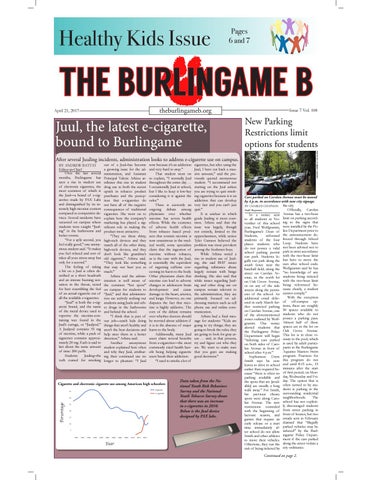
Data taken from the National Youth Risk Behaviors Survey and the National Youth Tobacco Survey shows that there was an increase in e-cigarettes in 2010. Below is the Juul device designed by PAX labs.
Cars parked on Carolan Avenue must be moved by 4 p.m. in accordance with new city signage. BY CHARLES CHAPMAN the city. Officially, Carolan Staff Reporter In a notice sent Avenue has a two-hour to all students in No- limit on parking accordvember of this school ing to the signs that year, Fred Wolfgramm, were installed by the PoBurlingame’s Dean of lice Department prior to Students, informed the announcement destudents of the four livered through School places students who Loop. Students have do not posses a valid not been advised not to school parking permit park in strict accordance can park. Students le- with the two-hour limit gally can park along the but have to move the south fence near the cars after school ends. baseball field, along the Wolfgramm said he has street on Carolan Av- “no knowledge of any enue, in the north lot students being ticketed on Oak Grove Avenue, with the two-hour limit or on any of the side being referenced bestreets along the perim- cause clearly, a student eter of the school. An cannot comply.” With the exception additional email delivered in early March fur- of off-campus opther restricted parking tions, there are roughly on Carolan Avenue, one 50 spaces available to of the aforementioned students who do not zones outlined by Wolf- posses a parking pass. gramm. This notice Almost half of these alerted students that spaces are in the lot on the Burlingame Police Oak Grove Avenue. Department will begin This lot is in close vi“ticketing cars parked cinity to the pool, which on both sides of Caro- is used by adult particilan Avenue in front of pants in the Burlingame Aquatics Masters Swim school after 4 p.m.” Sophomore Drew program. Practices for Smith says he now this program do not leaves to drive to school end until 8:15 a.m., 15 earlier than required be- minutes after the start cause “there is often no of first period, on Monparking available and day, Wednesday and Frithe spots that are [avail- day. The option that is able] are usually a long often turned to by stuwalk away.” For Smith, dents is parking in the his previous choice surrounding residential The spots were along Caro- neighborhoods. lan Avenue. The new school has not explicitly discouraged students restrictions coincided with the beginning of from street parking in lacrosse season, and front of houses, but two games that require an emails sent in February early release or a start claimed that “illegally time immediately af- parked vehicles may be ter school do not allow ticketed” by the BurlSmith and other athletes ingame Police Departto move their vehicles. ment if the cars parked Otherwise, they run the along the street violate a risk of being ticketed by city ordinance.
Continued on page 2.
2
News
April 21, 2017
PHOTO BY BENJAMIN ROSENBERG
Liberatore pilots new cell phone policy: Yondr our phones because it’s an invasion of our personal belongings,” junior Daniela Lyustin said. “But now it’s fine; I feel like I pay more attention during class.” Lyustin also said that the policy has had a positive effect on the class as a whole, which has become more attentive since its implementation. She is bothered, however, by the fact that her phone is locked up and inaccessible during class. “It increases people’s focus and ability to pay attention, but I think it’s a really strict way of doing so,” Lyustin said. Another issue with Yondr is that some students have been taking liberties with the policy, leaving the pouches unlocked or even putting another object of a similar size and shape inside the pouch, such as a wallet. “I don’t think it’s really doing much because she still has to remind people to lock their phones away,” senior Rebecca Pei said. “People have found ways to get around it already. They put other things in the pouch, or they won’t lock it up properly.”
Although students understand where Liberatore is coming from, many feel that the way she is addressing the issue of phone obsession is unnecessary. “Methods like this seem really childish,” Pei said. “I feel that since we’re in high school, you should take responsibility for your own actions. You should be able to know when you should use your phone and when you shouldn’t.” Liberatore is piloting Yondr for the remainder of the school year, so its future remains to be seen. According to Belzer, however, English teacher Bethany Lukach has also expressed interest, and Liberatore said that the students who were most drawn to their cell phones in her classes are benefiting from the policy. “The groups who need it most are doing really well and are good with it,” Liberatore said. “It starts to become just what you do. I did notice a difference, particularly in my junior classes. For some people who really can’t separate, when they don’t have the choice, it’s good.”
Teachers become students for the day
BY VICTORYA CINTRA Senior Reporter On the week of March 20, around ten teachers took the day to shadow a student at BHS. Each teacher followed their student and sat in on their classes. The purpose of the event was to allow teachers to experience what a student’s day at school is like. Through the experiment, teachers would gather information and share their observations with the rest of the staff. The student shadowing event is not unique to BHS. A similar occasion has taken place in the district and at other schools throughout the country. Professional development coordinator Kent Robie, Principal Belzer and several other teachers organized the event after they saw it successfully executed at Mills High School. To ensure the authenticity of the experience, the teacher sat with their student in the class and participated in class activities. Teachers filled out worksheets, read articles, and even took tests on subjects they had not studied in a long time. Besides jogging their memory on high school algebra, many teachers took away a great amount of knowledge from the experience. “The school day is kind of what you make of it in the sense that there’s a lot of things that might be challenging. I think there was a part
of me that became more aware of how much you have to choose to want to be in the moment … From the teacher standpoint, there’s more that can be done in terms of choosing to ask for what you need to make the class the most meaningful it can be for yourself,” said English teacher Bethany Lukach. American history teacher Annie Miller also commented on what she noticed throughout her day as a student, “As an adult living in the world and then going through just a snapshot of a student’s day, I do feel as though there is a real attempt at making curriculum relevant. It doesn’t always happen, but I feel like that was much more than maybe when I was in high school.” Miller voiced a concern many students have over the relevancy of studying certain subjects in school. Topics such as obscure math theorems, ancient history events, or vague science theories often frustrate students because they fail to see how these concepts will assist them in their future careers. “Looking back now, I recognize that it wasn’t about memorizing sine and cosine. It’s about training your brain to endure when it’s pushed. It’s really about cognitive training and discipline,” Lukach reflected. Miller said, “High school is, in so many ways … a way to train
yourself for life.” Miller explained that students get to learn social and organizational skills, along with how to take directions from multiple sources and how to prioritize what’s going to affect them the most. “It really is a microcosm for life.” The constant bustle of action and activities occurring in high school can often cause anxiety in students as they struggle to keep up with heavy workloads, countless extracurriculars, and part-time jobs. “I hope that teachers learned that students of all types have different schedules that can be challenging and difficult in their own ways, and that students are engaged in things outside their individual classroom,” junior Mackenzie Fornesi said. Lukach also addressed the concern students have with feeling overwhelmed, “I feel empathy for when a student says the demand is too much for my homework load. I want to hear that and think about that.” Lukach reflected on her own high school experience and the information she gathered while shadowing a student and concluded that the workload is manageable if distractions are eliminated. “I think there is a lot of work, but if you sign up for four AP’s or if you choose to have a thousand
Instagram followers, there’s only so many hours in the day and you’ve got to really strategize to make it all fit,” Lukach said. Miller observed the fact that many students were thoughtful and engaged in classroom activities and discussions. However, she noticed that technology has become a great source of distraction. “Phones were a bigger problem than I thought and that was really kind of frightening for me. I think the problem with phone addiction is severe and it’s worse than I thought,” Miller said. Lukach echoed a similar sentiment, “That self control piece, or the self regulation piece really, was a key takeaway for me because I feel like, as a general statement, I observed students who wanted to stop using their phones and literally couldn’t—this internal conflict of ‘I know it’s bad for me but I just have to check one more time.’” Nevertheless, the event was an insightful experience for students and teachers alike. Fornesi expressed her appreciation for the event, “I think this was an amazing experience … It’s nice to know that teachers are interested in learning more about their students and what it may be like to be a student at BHS.”
Parking continued from page 1 Wolfgramm said in the past “there have been some issues with neighbors complaining about students parking” but when students are cordial and follow all parking ordinances residential parking remains the primary option for students with no permit. Dean Wolfgramm said that he has thought “that students should be able to park along the softball field” in spaces currently designated for staff. Wolfgramm said that “often, [the spaces] are not filled, and students park in those spots anyway.” Wolfgramm said that “staff spots have been added in reaction to the increase in student population and in in turn more staff.” The construction of the F building, which borders the student lot, has also resulted in a loss of student spaces. The administration does enforce the regulations, reportedly “on a weekly basis” depending on other responsibilities. On-campus parking is limited to students that have permits. Permits are reserved solely for seniors and allocated through a lottery system. Juniors and sophomores are limited to off-campus options.
Follow The Burlingame B on all social media platforms! theBurlingameB
@theBurlingameB
@theBurlingameB
PHOTO BY BENJAMIN ROSENBERG
Alison Liberatore’s students magnetically open their Yondr pouches to retrieve their cellphones. Burlingame. As for Liberatore, she kids] to be at school,” Liberatore BY BENJAMIN ROSENBERG heard about Yondr from an article said. “You don’t want them to be Copy Editor Juniors and seniors in history in the Wall Street Journal and was on social media all day or looking teacher Alison Liberatore’s classes inspired to implement the policy in at prom dresses instead of doing a history lesson. There have to be were in for quite a surprise when her classes. “It’s not just a classroom man- some places in our lives where we they walked into room A112 on Monday, March 13. Liberatore is pi- agement tool; it’s more of a ‘hey, are not connected.” The administration was intrigued loting a new cell phone policy called be here,’” Liberatore said. “I’d like Yondr. Students place their phones to see your eyes; I’d like to see you by Yondr and approved the use of in magnetic pouches at the begin- take some notes; I’d like to see you school funding for Liberatore to pining of class and lock them up, and appreciate what we’re doing here.” lot the new policy. Liberatore has frequently no“I thought it was a unique the phones remain in their possession inside the pouches during ticed students taking photos of idea,” Principal Paul Belzer said. “I class. At the end of class, students assignments during class. This can thought it was something that premagnetically unlock the pouches mean that students would rather sented a possible option of how simply work on the assignment later we could move forward in trying to and retrieve their phones. Yondr was founded by Gra- rather than thinking about it during maximize the class experience for ham Dugoni in San Francisco and class. She also cited the concern of students.” Unsurprisingly, Liberatore’s stuwas intended to be used at social students photographing teachers gatherings, comedy shows and and each other, which could lead to dents have reacted in many different ways to the new policy. concerts. However, several other invasions of privacy. “When I think about it from the “I thought that it was kind of schools have started using it as well, The Yondr pouches open magnetically and lock when closed, making including Mercy High School in perspective of a parent, I want [my ridiculous that we have to lock up students’ phones inaccessible during the class period.
The Burlingame B
3
News
April 21, 2017
PHOTO BY LILY PAGE
After a year of research, senior expert projects come to a close
Rebecca Pei presents her project on the pharmaceutical industry. BY LILY PAGE syndrome, a genetic disease that Staff Reporter causes constant hunger, low muscle On March 29 and 30, seniors in mass, and other physical and mental CP English classes presented the disabilities. A little research in AP conclusive findings of their year- Biology on possible future solutions to Prader-Willi syndrome led long expert projects. Through the use of articles Bonk down the rabbit-hole of what written from opposing viewpoints, she likes to call “Designer Babies,” interviews, personally constructed or embryonic genetic modifications. After much research on the surveys, and other forms of research, students delved into a vari- moral weight and social and ecoety of subjects ranging from quirky nomic repercussions of this type of interests to controversial topics cur- genetic engineering, Bonk came to the conclusion that genetic changrently prominent in the media. “For some kids, it’s a very per- es made within Designer Babies are sonal project,” senior CP English tolerable if they are limited to solvteacher Jim Burke said. “All of the ing health issues. Anything else, the kids that are doing domestic abuse, modification of IQ, for example, substance abuse, addiction, [these risks leading to what she coined as are] very real, very personal topics a “Brave New World-esque world.” “I think that genetic engineerto them. The research is very meaningful. They’re willing to go long ing could be a great option because and deep into them because, unfor- women who get screened for distunately, some may have personal eases and see that they’re a carrier often don’t want to reproduce, and experience with it.” For Sophia Bonk, the project I think that this gives them the ophad deep personal significance. Her tion to reproduce without worrying youngest brother has Prader-Willi that their child is going to have to
suffer for their entire life,” Bonk said. “I think every woman should have that choice if they want to.” Both Burke and Melissa Murphy, the other senior CP English teacher, held the same view that the ability to choose the subject of such an in-depth study generates a passion that is not always fostered in other aspects of the high school experience. “My favorite questions to hear from students are, ‘I’m noticing my topic is more about X, or I’d like to explore more about Y, could I do that,’’ Murphy said. Senior Cameron Peña’s project is an example of how the process of researching and refining information leads to an evolution in the focus of the study. “I started getting into how people react to murders, and how people react to actually being the murderer themselves,” Peña said, “and that kind of led me into being interested in how people don’t feel emotion after they commit a murder. He explained how psychopathy is formed by the existence of a specific gene that leads to the overproduction of serotonin, a neurotransmitter in the brain that acts as a relaxant at high doses. “If you’re producing excess levels of serotonin, then your brain is in a constant state of relaxation, which should be a nice thing, except when you’re constantly relaxed, you’re numbed to a lot of events,” Peña said. Contrary to popular belief, it is the overproduction of serotonin coupled with traumatic experiences that leads to psychopathic behaviors. Peña spoke of how a surprising number of CEOs have psychopathic qualities, that is, they must make tough decisions for their companies that might involving laying off many employees.
Why seniors are not taking their AP tests BY ALEX LEE Senior Reporter As the year winds down, seniors must decide whether or not they will take their AP tests. The question of whether or not to take these tests, however, is more complex than it may seem. Opportunities to earn college credit, self-enrichment, the price of the tests, are only some of the many factors that seniors consider when they register for these tests. For those who don’t know, AP classes are college-level courses that students can take in high school, potentially allowing them to receive college credits. At the end of the year, students can take the AP test; their score determines whether they will be able to get credit in college for the class. Seniors, however, are put in a unique position. Most seniors, by the time AP tests are held, have already received college acceptances. Thus, seniors have multiple factors to weigh when deciding whether they should take AP tests. The counseling department frequently attends conferences with various colleges to learn more about what these colleges are looking for. Quite often, these colleges express their desire for students to take the AP tests for the AP classes in which they are enrolled. “What we’ve heard when we’ve gone to different conferences with universities, they will explicitly say we expect all students to sit for the AP exam at the conclusion of the class,” counselor Luis Mashek said. “The AP Exam is the culminating activity for that class. It’s a red flag for universities if a student has taken a class and doesn’t sit for the exam.”
Following this logic, many seniors have decided to take all or a substantial amount of their AP tests. “I’m taking my tests because in my common application I included them in the ‘tests you have taken and tests you expect to take’ section, so not signing up and taking them could be considered an issue of academic integrity for the colleges I was accepted into,” senior Elena Mosse said. The fear of upsetting the colleges a student has been admitted to, as a result of not taking AP tests, has increased this year, because of the change in how the common application asks students to describe AP classes. This year, the common application asked students to report what AP classes they were taking and what AP tests they planned to take in the future. “When you filled out your common application, did you make that statement that you were going to take the AP test? If you did make that statement, and you ultimately choose not to take the test, I’m not sure that’s the best way to present yourself,” Mashek said. “Colleges and universities have a huge pool of kids to pick from for their campus, and you don’t want to put yourself in a bad situation.” Some students believe, however, that the benefits of taking an AP test extend beyond getting college credit for classes and satisfying a college. “I would just say it depends on your school; it depends on what you want to do as a career option,” senior Ben Haber said. “If you’re taking AP Physics and you want to be a physics major, you should take
the AP test for credit because that’s what you’re going into. Also, many classes are centered around the test, and you don’t get as much out of the class if you don’t take the test.” Similarly, some believe that AP tests provide a valuable opportunity for enrichment, one that students should value. “Are you the kind of person that always needs to be rewarded for something, or do you do something for your own enrichment or your own knowledge. When you ask a question about whether or not you should take AP tests, this makes it sound like you’re only doing something if you get something in return,” Mashek said. Other students, however, have decided not to take AP tests for various reasons. “I’m not taking my AP tests because the college I’m committed to does placement tests for determining credits, and does not accept AP credit,” senior Jack Baker said. For juniors and sophomores, the decision of whether or not to take AP tests as a senior is one they will face in the future. Some current seniors have a piece of simple advice. “Be sure to reach out to the colleges you were admitted to,” senior Michael Johnson said. “It takes only a couple of minutes and you can get some really useful information about these AP tests.” Additionally, students can go to their prospective colleges’ websites to learn more about what AP tests they can get credit for having taken, and what colleges expect from students who have been admitted.
“A big misconception is that psychopaths are purely violent people. And through my research, I’ve found that, instead of, ‘you’re a psychopath, you’re automatically a killer,’ it’s more of a spectrum.” Peña said. “On one hand, you have your killers, and on the other hand, you have people that exhibit psychopathic traits, but aren’t necessarily violent.” While he was conducting research, Peña consulted a professional homicide detective. They talked about some movie portrayals of psychopaths that are relatively authentic; some examples include “Nightcrawler”, “No Country for Old Men”, and “Psycho.” Meanwhile, Matthew Janc’s project explored solutions to climate change through a unique angle. Instead of focusing on commonly discussed renewable energy sources like wind or solar power, he chose to research the possibility of harnessing energy from the ocean. “Ever since I was a little kid, I’ve always thought that the ocean is so cool, so powerful and big,” Janc said. “I feel like sooner rather than later, it’s probably a good idea to move away from gasoline and fossil fuels and stuff like that.” Janc listed several ways that this process could occur, including the use of turbines, dams, and mechanisms that harvest energy from shoreline currents. “All the power that would be required to run Earth right now would be less than a percent of the potential energy that the ocean offers, which I think is pretty cool,” Janc said. Linnea Visbal’s project dealt with yet another real-world issue: the incarceration of the mentally ill. After state-funded psychiatric clinics were deinstitutionalized in 1962, most of the lingering patients be-
came homeless or imprisoned. Visbal explained how mental illnesses often go untreated inside prisons, or are even inflamed due to harsh conditions. “Mentally ill patients are brutally abused,” Visbal said. “They’re locked up in solitary confinement, which makes their mental illness a lot worse. And, on top of that, they don’t even get affordable health care, so they have no medication, and no therapy.” Visbal discussed how the stigma surrounding mental illness is an indirect cause of their treatment in prisons. According to Visbal, shows like “American Horror Story: Asylum” or even the regular old news, often portray mental illness as extremely violent or otherwise nonexistent without any in-between. She proposed that creating a discussion in schools on mental illness is an integral part of combating these harmful stereotypes and providing a better future for those afflicted. On a long term scale, she argued for the establishment of state psychiatric institutions. “I think that [state psychiatric clinics] should be refunded and reopened because taxpayers would spend fifty times less per year than to keep the mentally ill imprisoned,” Visbal said. Additionally, Visbal believes that the better treatment and medical attention would allow the mentally ill to work towards recovery instead of simply suffering in prison. Above all, Murphy and Burke believe the expert project to be a significant step in a student’s education because it demonstrates the level of intensive research that must go into any well-supported argument. “I think the project overall is an intellectual rite of passage,” Burke said.
The Burlingame B Staff Senior Reporters: Victorya Cintra Sofia Guerra Priscilla Jin Alex Lee Chelsea Lopez Jilly Rolnick
Teacher Adviser: Melissa Murphy Editors-in-Chief: Felicia Azzopardi Andrew Battat Charlie Jones Design Editor: Stella Lorence Business Manager: Renata Servulo Web Editor: Christopher Hu Chief Photographer: Jason Rundle Copy Editor: Benjamin Rosenberg
Staff Reporters: Juliet Adelman Sasha Benke Charles Chapman Mira Guleri James Lowdon Melissa Milligan Maggie Murdoff Lily Page Vishu Prathikanti Amanda Teoman Summer Utigard Christopher Xue Daniel Yu Page Desingers: Lena Banchero Darrion Chen
Policy Statement:
The Burlingame B is a student-run newspaper with the sole purpose of providing an open forum for student expression. Anything printed represents the opinion of the writer, but not necessarily that of the The Burlingame B staff, the administration or faculty of Burlingame High School, or any person affiliated with the San Mateo Union High School District. The Burlingame B does not discriminate against race, political orientation, ethnicity, religion, gender, sexual orientation, or disability. Although The Burlingame B will never refuse to publish student guest submission based on the aforementioned factors, we reserve the right to edit or not publish them.
Letters to the Editor:
Disagree with the writers? Bring your letters to the room A120 or email them to <theburlingameb@gmail.com>. Letters may be considered for publication. The Burlingame B reserves the right to edit for clarity, length and accuracy. We welcome all comments.
4
Features
April 21, 2017
The danger of posting on ‘private’ Instagrams BY MIRA GULERI Staff Reporter
The school got involved, and everyone who had the password to the account got expelled.” Cheung In the teen sphere of social media, Instagram has been a dominant platform--so much so that teens have begun a trend of creating second Instagram accounts, or “privates,” which they keep on the private setting and only allow certain friends to follow, unlike their public, or “real,” accounts. However, many users have been overly explicit with information they post on their private Instagram accounts, which has gotten them into trouble with school administration. Private Instagrams first gained popularity for the low-stakes environment they provide in contrast to “real” Instagrams that have become a place where users fine-tune every
aspect of their post to try to maximize likes and comments and gain to followers. Among the “real,” or fine-tuned accounts, the platform has become less of a personal outlet and more of a site through which individuals put forward their public persona. Users aren’t just snapping a photo and uploading it, but rather taking many photos, editing them multiple ways through “VSCO” or other mediums, getting their friends’ input on which ones to post, and making sure to post at the right time to optimize the amount of likes they earn. “You are a lot less filtered on your private; you say things you would say to your friends,” senior Tesia Cheung said. “There isn’t the pressure to post at a specific time and you don’t worry about the amount of likes you get.” So students flock to the prospect of privates, allowing themselves to enjoy Instagram as a creative outlet and discount pressure for their page to be aesthetically pleasing. Cheung also noted that privates can contain explicit information that could cause problems if shared with the wrong audience. “You have to make sure you pay close attention to who follows it and who those people’s friends are because it’s easy to stir up drama,”
Cheung said. Because users often vent and provide personal details in their captions or post explicit photos, there is an implication that posts are only seen by select people. But oftentimes posts will be shared with the wrong people and even become so widespread the user’s school gets involved. Cheung herself is familiar with a situation in which multiple students were expelled from their school for their online posts. “There was this account that [someone] got ahold of and posted very risqué photos of other people at their school. The school got involved, and everyone who had the password to the account got expelled,” she said. From Cheung’s perspective, many people assume their posts are protected from a larger audience, but they fail to consider that all it takes is one screenshot and message for the content to be spread. Senior Isabella Hernandez is also familiar with cases in which students have run into trouble because of their posts on Instagram. “There was a private account that was used to distribute party addresses, and then somebody got ahold of it and posted it on neighborhood watch, and it was shut down,” Hernandez said.
According to Hernandez, more common scenarios involve users writing about school drama, which oftentimes puts other students in a negative light and is in effect seen as equivalent to bullying said students. “Throughout the past 4 years in high school, I’ve witnessed bullying--I personally was bullied over private Instagrams,” Hernandez said. “People would post about me saying rude things, even threatening me.” But Hernandez said that over time she has seen progress; students have become more aware of how easily word can get out, so they err on the side of caution. In one case in a nearby high school where a post did land in a the school and authorities’ hands, a student posted on her private Instagram indicating her political beliefs. The next day at school, she was attacked violently by a fellow student who felt victimized by the post. In this instance, the openness of private Instagrams exacerbated the political tensions of the 2016 elections; and similarly, posts on private Instagrams can worsen tensions between friends or groups and give rise to the already intense high school drama. Once the following of privates gets too large and users no longer
feel comfortable sharing their unfiltered opinions, many people make second privates. Although these are less common, a fair amount of users keep this for only their close knit group of friends and post very personal or revealing photos. Senior Isabella Hernandez said many people she knows have second privates and keep the following on those accounts even more selective. Although most responsible internet users are aware of the permanent footprint of online content, it is easy to lose sight of the fact that each and every piece of information posted online is retrievable when you use social media a myriad of times everyday. Even Snapchats that disappear almost as soon as they are seen and posts that are deleted can be traced back if one were to search. Instagram privates do provide a new, more personal avenue for Instagram users, but in many ways create problems due to the false assumption that information posted will remain confidential. Although it is rare that old texts, Snapchats, and Instagram posts will be scrutinized, in a digital age there is always the possibility that a future employer, lawyer or any official will use online evidence as a judgment of one’s personality and values.
Students experience history on Sojourn to the Past PHOTO COURTESY OF EILEEN KOHLI
Junior Eileen Kohli stands in front of Little Rock Central High School, a symbol of education desegregation during the Civil Rights Movement. dents to see civil rights monuments BY JULIET ADELMAN and meet civil rights leaders. The Staff Reporter Over spring break, juniors Ei- trip began in Atlanta, Georgia and leen Kohli and Jackson Gravagno moved through Arkansas, Alabama, embarked upon the Sojourn to the Mississippi, and Tennessee. The Past trip, a journey that takes stu- annual trip’s goal is to help students
Dennis J. Murphy
Your Peninsula Neighbor 415.310.7956 | dennis@dennisjmurphy.com dennisjmurphy.com
understand America’s history and encourage them to stand up for social change in the present day. Over the week-long trip, students were immersed in Civil Rights History and modern-day southern culture as they visit the Edmund Pettus Bridge and the Civil Rights Museum, both symbols of the Civil Rights Movement. They also read Martin Luther King’s “I Have a Dream” speech in front of the Confederate Stone Mountain in order to inspire students to stand for justice. Throughout the week, students also met many influential members of the Civil Right’s Movement including members of the Little Rock Nine: Minnijean Brown-Trickey and Elizabeth Eckford, among others. Overall, the trip encourages students to support and promote tolerance, justice, and nonviolence in any setting or scenario. “I decided to go on the trip because it sounded like a good opportunity to learn about history,” said
junior Eileen Kohli prior to leaving for the trip. Kohli was very interested in the Sojourn trip and expected it would mostly consist of “going around and seeing the monuments and experiences that people went through, then meeting a lot of the people who were involved with the Civil Rights Movement.” While she was surprised at how much work the trip was in terms of research, Kohli found it to be unlike any other experience she had ever had. Junior Jackson Gravagno chose to go on the trip for similar reasons, particularly “because it seemed like a really in-depth experience on a period of history that interests me a lot.” The significance of the Sojourn to the Past trip lies in how unique of an experience it is. The founder of Sojourn to the Past, Jeff Steinberg, explains that the trip “is framed in nonviolence,” which gives students an important outlook on both history and modern social justice. “[Sojourn to the Past] is really a journey of the soul,” Steinberg said. “Where else can you go where you have the ability to do something that can truly impact the rest of your life?” “The most impactful part of the trip was seeing the church that the four young girls were murdered at by the KKK,” said Kohli. “I was crying in the church for about 45 minutes.” Kohli refers to the 16th Street Baptist Church bombing in Birmingham, which resulted in the death of four young girls, and 22 other individuals being injured after the Ku Klux Klan planted at least 15 sticks of dynamite in the church. The act was one of white supremacist terrorism and left the country in shock. “Being able to meet people who were either players in the events we were talking about or were somehow directly connected to those events was incredible,” Gravagno said. “They made the history that much more impactful and real.” Getting to know key activists in the Civil Rights Movement provides
students with a personal connection to events that they did not physically experience. After seeing firsthand the effects of violence and hatred, students are motivated to speak up in the face of injustice and change the future. “Meeting Reverend Clark Olsen, who was a witness to the murder of a white preacher in Selma, really changed my outlook on history,” Kohli said. When Martin Luther King Jr. called for clergy to march in Selma, Clark Olsen made his way to Alabama to stand for African-American voting rights. As he walked to a local church with other reverends James Reeb and Orloff Miller, a group of segregationists beat James Reeb, ultimately leading to his death. This event was especially surprising at the time, as all three reverends were white. Evidently, meeting figures like Olson has the ability to change people’s perspectives on events that happened half a century ago, which is incredibly unique. Overall, Sojourn to the Past adopts a nonviolent position on history that gives a fresh look at events students may learn about in school. “The experiences and depth found in the teachings of the trip can’t be found anywhere else,” Gravagno said. Steinberg reflected on the lasting impact the trip makes on the students. “What I love is that Sojourn is not about your GPA. The way I learn best is if you hit me in the heart because you can really move me and make me think, and I feel everyone has that capacity,” Steinberg said. “So, if we all have the capacity to transform and change, maybe that’s what Dr. King was talking about when he talked about the ‘beloved community’ of people coming together and saying ‘Why don’t we talk about us instead of me?’, ‘Why don’t we talk about how we together can work to make this collective?’ Frankly, in the end, we have more in common than we do differently.”
5
Features
April 21, 2017
Popular food delivery apps banned from campus Recently, administration has seen an exponential increase in food delivery services delivering to students on campus. The use of apps at school is not isolated. Entrepreneurs around the world are creating apps to make aspects of life more easy, entertaining and organized. One of the fastest growing types of apps is food delivery services. This category of app allows people to order food from hundreds of local restaurants to have it delivered right to your door. Attracted to the ease of these apps, many people in urban areas such as the Bay Area have been using the service daily. The success of standing food delivery apps has prompted others to join in on the newly formed industry. As the practice of ordering food increases, people are beginning to order during lunch and brunch at school, and even sometimes during class. The effects of this growing industry include a shift in the way students eat. New apps such as UberEats have increased the use of food delivery at school, despite the rule against it. UberEats, which launched last year, has added to the long list of standing apps for food in the Bay Area, with popular competitors being Postmates, Doordash and GrubHub. This new addition to Uber, which originated solely as a transportation service, is available to customers from morning to 10 p.m. in San Francisco and 64 other
U.S. cities. UberEat’s motto reflects the attractiveness of food delivery: “Get the food you want, from the San Francisco restaurants you love, delivered at Uber speed.” Students have chosen to order food to BHS for a variety of reasons. “Food delivery allows me to get food with just the touch of a button,” senior Madison Fawcett said. “It is also nice because I do not need to prepare food in the morning, giving me more time to sleep.” Fawcett and many of her classmates enjoy eating from restaurants instead of making food themselves, mostly because it is easy and the food often tastes better. Furthermore, as this type of app increases in popularity, competition urges the companies to improve their services, making it extremely easy to order food speedily to any location in the Bay. However, even if customers do get their food at “Uber speed,” some student feel as if the delivery fee is too expensive. “Food delivery services aren’t worth it because of the extra money that is charged,” junior Giacomo Ferrari said. “I would rather save money by going to the restaurant.” For example, Postmates charges customers a 9.99 percent service fee, which cumulates to an expensive ordeal, especially when people order a large amount of food. Although some students will avoid these apps to save money, many other students continue to order food to school, and with the in-
crease in delivery apps, it doesn’t look like they will stop anytime soon. Though food delivery services are often used at school, they are banned at BHS, which is a rule of which few students are aware. At the code of conduct presentation, Dean of Students Fred Wolfgramm announced to students that ordering food to school was prohibited. He said that “the school doesn’t want to be held responsible for any food left in the office.” Furthermore, there are several safety preAn Uber car delivers food to a BHS student unaware of the rule against it. cautions involved, and therefore the staff must UberEats and other food delivery apps appeal to students because of their abilcreate rules to avoid ity to speedily send food straight to the customer. complications. Accordother delivery companies; how- lot as a drop-off spot,” Wolfgram ing to Wolfgramm, food delivery ever, the difference is that [food said. If students do not follow “heightens the need to be aware of deliverers] are coming into direct this rule, Wolfgramm explains that who is coming and where they are contact with students.” These un- “there will be consequences. More coming. Without food delivery, we known delivery men and wom- serious disciplinary issues occur can prevent problems and compli- en often wait in the front of the when students think it is okay to cations.” These possible complica- school for long periods of time, leave their class.” tions include delivery timing issues, distracting students from school The staff encourages students dangers from contact with strang- and sometimes blocking the road. to bring their lunches to school, get ers, and unknown contents in the So, providing a substitute for food it dropped off by a parent, or get delivery. Banning the use of these delivery apps, Wolfgramm has al- it after school. Students are bound apps during school hours “sim- lowed parents to drop off food to to use apps such as UberEats and plifies” the flow of the school as their children during lunch if need Postmates in this progressive time these possible problems are avoid- be. period, as this new industry is imed, and students can focus more “Parents are more familiar to proving and growing; however, on school. the school and we can usually vi- they must refrain from using the Wolfgramm admits, “These sually see them drop food off, as services during school. deliveries are similar to Fedex and we have set up the south parking PHOTO BY AMANDA TEOMAN
BY AMANDA TEOMAN Staff Reporter
City College of San Francisco is changing views on public education through new free tuition plan for residents BY SOFIA GUERRA Senior Reporter
year. “I heard a rumor about it last year, but I didn’t know it was going to go into effect so soon.” Some seniors have shared an appreciation for CCSF despite its recently declining enrollment. Seniors Dejanay Briseno and Alana Hroziencik commended Lee for putting
who have attended the school. Hroziencik built on this sentiment, adding that the school’s lack of prestige does not make it popular in suburban high schools, but that it has established itself as a “solid backup” in the Bay Area and a large step in closing the income inequality gap. PHOTO BY SOFIA GUERRA
In the fall of 2017, San Francisco will be the first city in the country to offer free community college to all of its residents. Unlike New York Governor Andrew Cuomo’s proposal, which would offer free tuition at all public universities in the state with the help of income taxes, City College of San Francisco is free regardless of income. The plan relies on Proposition W, which taxes properties that sell for $5 million or more. The new funds are coming from the top tiers of San Franciscan economic classes and offer free education “even to the children of the founders of Facebook,” according to City Supervisor Jane Kim. CCSF is not exactly free; students still have to pay a mandatory $17 fee each semester. The alternative, however, is an average public college tuition of $9,650 for state residents and $24,930 for out-ofstate students. San Francisco Mayor Ed Lee’s historic college tuition plan follows the declining reputation of CCSF. $2.1 million of funds raised by Prop W will allow for 45 thousand credits to be free of cost to students living in San Francisco. An additional $3.3 million goes towards $500 awards for low-income students to pay for books, transportation, supplies, and health fees. The groundbreaking announcement follows CCSF’s accreditation crisis, in which the school struggled to keep its doors open amidst accusations by a private commission that the school had become negligent in fiscal management and governance. City officials announced the end of the years-long accreditation nightmare in January of this year, but the school has not emerged unscathed.
During the intense sanction of the school, CCSF saw a steep drop in enrollment, shedding 30,000 full and part-time students and costing the school millions. For students like senior Jazmine Williams, CCSF’s enticing urban atmosphere, knowledgeable teachers,
The City College of San Francisco offers free tuition in the fall of 2017 following the five-year accreditation crisis. The city is hoping to close the income inequality gap through this new funding plan. and diverse student body have far outweighed the college’s past struggles. Last year, the school rose to the top of her prospective college list. “Free tuition is a huge plus,” said senior Jazmine Williams, who has had her eye on the metropolitan community college for the past
more emphasis on public education in San Francisco, and hope that the trend continues elsewhere in California. Briseno said that while the commute can be a bit too troublesome for Burlingame students, the free tuition plan helps students look beyond the setbacks, citing relatives
“I applied, and while it’s not my own first choice, It’s bringing a lot of opportunities to kids who otherwise wouldn’t have any other option,” Hroziencik said. Once in 1989, San Francisco classified as a “low inequality, low poverty” region according to the Washington D.C. Public Reference
Bureau. This year, Solano County is the only Bay Area county that has not attained the “high inequality” title. CCSF’s impact on the income inequality gap has yet to be seen, but it may help build and maintain the middle class according to Mayor Lee. This change in public education funding may bring about change across the country. Now that New York is following through with their own free tuition plans and the governor of Rhode Island is looking into similar reforms, San Francisco is the first of a potential nationwide shift in educational priorities. There has not been overwhelming interest in CCSF despite its historic changes. “It’s great that [San Francisco] is doing that, but there hasn’t been a lot of interest here mainly because of convenience and some stigma about community colleges in general,” college counselor Jonathan Dhyne said. The unglamorous community college name isn’t always appealing to six-figure income families in the Bay Area, but seniors at BHS are taking all options into consideration. “There’s definitely a lot of stigma surrounding community colleges, but it’s possible to get everything you want from one,” says Williams who is looking forward to participating in CCSF’s choir program. She maintains that even though CCSF is not a traditional pursuit for Burlingame seniors “the stigma doesn’t matter there.” Williams is one of many students around the Bay Area who are looking to usher in a new era for the school this fall.
6
“It’s a culmination. When you look at all of the factors, life gets a lot more serious junior year. And then you have the idea that these choices that you’re making are putting the paths in place for the rest of your life. That’s a lot to get your head around as a 17-year-old,” Carter said. ‘13 Reasons Why,’ a new show on Netflix based on Jay Asher’s 2007 novel, tells the story of a girl who commits suicide and leaves 13 tapes, each with a reason behind why committed suicide. The show’s popularity has grown exponentially, with high school students all over the country watching the new show. Because of this show, more students have realized it is easy to affect someone’s mental health with mean jokes, harassment and more. Grant Cosovich, one of the many people at BHS to watch the show in the same week it came out, said, “I knew nothing about mental health prior to my health class freshman year, which I think says a lot about the school system. They don’t teach us about mental health and stress anytime other than freshman year. ‘13 Reasons Why’ taught me even more about it.You never really know about what is going on in someone’s life, so it’s important to treat everyone well and respectfully.” Educating students and families about mental health is instrumental to erasing the stigma around it and in turn allowing affected students to feel c o m fortable seeking help. According to Carter, one in four teens suffers from depression, and oftentimes they go undiagnosed. When students feel emotionally turbulent, they do not always know whether they are just moody or whether it is something else. “What we have to look at is if in a three-week window, you’re feeling sad for no reason the majority of the time, there’s possibly something going on,” Carter said. Carter added that parent education is also a central aspect of improving the mental health of our students. In addition to the school, parents need to prioritize their child’s health over their child’s transcript and resume. “It’s time for parents to take a step back and realize that their child’s academic GPA is not who their child is; it is a piece of who their child is. We need to focus on creating a healthy, whole child who is going to be successful rather than an academically whole child,” Carter said.
High percentage of Burlingame students report struggles with mental health BY MIRA GULERI AND SASHA BENKE Staff Reporters According to the recently published Healthy Kids Survey, BHS students experience one of the highest rates of poor mental health when compared with other schools in the district. One data set explored the mental health of freshmen and juniors. It can be seen from the graph that there is a large jump in feelings of chronic sadness and hopelessness from freshman to junior year, and a significant percentage of juniors have seriously considered suicide. Some students and teachers attribute the data to an environment of high achievement at Burlingame which fosters high pressure and ultimately takes a toll on our students’ mental health. “I think the jump from freshman to junior year has to do with an environment where people feel like they can’t open up,” Vivian Yuen, President of Mental Health Advocacy Club, said. “There is also definitely a lot of stress, and not much is done to curb that stress.” Yuen believes taking the initiative to erase the stigma around mental health disorders such as depression is the first step to help students. “I have a friend who is close to me and contemplating suicide, but they can’t tell their parents because the parents don’t think of mental health as a serious issue,” Yuen said. “I think when people hear the word ‘mental health’ they automatically assume the worst,” sophomore Grant Cosovich said, explaining the different stigma that many people associate with mental health problems. “Society sort of teaches us that mental health is a weak characteristic of a person. It’s like, if [someone has] bad mental health, [they] can’t be successful or be ‘normal.’” After taking some time to think over the question, Cosovich added, “College is a huge chapter in a kid’s life, and I think with all the pressure from parents and just society itself, it makes us stressed. We’re kind of thrown into this huge change from middle school to freshman year. I know for me it was relatively easy to adjust, but I still struggled a lot with the different workload and atmosphere. Balancing your time can be hard too, especially if you play sports in or outside of school.” Health teacher Nicole Carter gave her own perspective on possible causes of the spike in students experiencing chronic sadness and contemplating suicide from freshman to junior year. “First, I think we have kids taking too many APs.You can take AS freshman year but starting sophomore year, junior year, the jump is huge,” she said. “Students are feeling the need to be extremely competitive and take classes they are mentally, emotionally and even academically unprepared for.” Carter also mentioned that aside from academics, many students’ friends and relationships are changing. By this time, many people may not be friends with the same people they were coming in to high school, and the atmosphere around dating gets more serious; there is a pressure for relationships to be more intimate, and breaking up becomes more painful. Students can experience grief and loss this way.
This graph, courtesy of the California Healthy Kids Survey, shows that BHS experiences one of the most signifacnt increases in chronic sadness from 9th to 11th grade districtwide.
Healthy Kids Survey STUDENT PERCEPTIONS OF BURLINGAME the survey to 319 current sophomores and 273 current seniors, slightly below the target sample amounts but within the range of being able to refer to the results as reputable. At Burlingame, the results from the survey were initially presented in a presentation to the staff this school year. The data provided school specific statistics and information regarding our school in comparison with other schools in the district. The statistics for males and females as well as individual grade levels were separated. The survey is designed to allow districts and schools to better understand student feelings and behaviors. The information is presented to teachers and administrators to help them shape policy. The Burlingame B wants to present this information from a student perspective to allow them to draw their own conclusions and consider from their point of view the relevance of this information. The articles printed here contain the authors’ interpretation of the data while the complete report of the findings of this survey are available on theburlingameb.org to allow all students to understand what the district and school staff will use to access the student body.
Introduction by Charles Chapman The California Healthy Kids Survey (CHKS) is a statewide program with the mission of helping schools and districts collect information on the health and behavior of students both in and out of school. The state provides guidelines in an effort to collect data that can be applied to students across the state, but the survey can be changed in accordance with local differences. At Burlingame High School, the CHKS was administered to 590 of the current sophomores and seniors in spring of last year. The questions asked students about their own behavior, feelings, and perceptions relating to mental health, bullying, substance abuse, sexual orientation, gender, and school safety. The California Department of Education justifies the choice of administering the test in the aforementioned grades because the “CHKS targets major transition years in the the developmental lives of adolescents.” While the commitment of adolescents to answering questions regarding illicit activities truthfully is under question, the Department of Education claims that their department stands behind the validity of the results claiming that “Research has provided strong evidence that data from adolescents on self-report questionnaires are valid.” Additionally, BHS administered PAGE DESIGN BY LENA BANCHERO & CHARLIE JONES
“What our goal is, as a school, is just to make sure kids are safe, they feel cared for and connected and that we partner with them...We want to educate them on how to be safe.” - counselor Karen Latham
7
the overall student population. While the social scene is a draw for some teens, plenty of students may feel pressured to live up to an expectation or stereotype of the school: that BHS students party hard and often. “When you think of a BHS party you don’t think you are hanging out with friends,” Shu said. “You think of it as a party with alcohol and drugs where you go to have fun.” “Upperclassmen tend to have fun without worrying [while] I feel like freshmen are trying to impress each other,” freshman Fiona O’Donoghue said, possibly explaining the spike in alcohol use between freshman and junior year. However, there are other aspects of the BHS community that are often overlooked. “We have a sports dominated culture that maybe not everyone is into,” Belzer said. “I don’t think Burlingame gets recognized for the diversity I think it has.” As a school that forms social engagements around our sports teams, other activities are often overshadowed. An integral part of the BHS party culture is the excitement that surrounds the risky behavior.There’s a rebellious satisfaction that comes from the danger when partaking in questionable conduct. This sensation is a reason that The Drinkaware Trust, an alcohol education charity, offers as a motive behind why some teenagers are prone to party. Many students do not drink to get drunk or smoke to get high.They thrive off of an entirely different drug: the thrill. “I think [the draw of drinking] is partly experimentation,” counselor Karen Latham said. “There’s prohibition because of their age. Folks like to push the envelope a little bit.What’s prohibited is often mysterious so therefore interesting. There may be an attempt to join the adult world.” The administration, teachers, and counselors have adopted new ways to encourage safe and educated decisions when it comes to parties and substance use. “What our goal is, as a school, is just to make sure kids are safe, they feel cared for and connected and that we partner with them,” Latham said. “Kids don’t use the way adults use. Kids usually drink to get drunk,” Latham added, highlighting the serious discrepancy between educated, cultured drinking and the experimental and often careless underage drinking. To combat these concerns, Latham is spearheading an effort to educate students on alcohol safety this month, alcohol awareness month. So far, there have been public service announcements on BTV, information on our school website for both students and parents, curriculum in classrooms, and on April 18, the counseling department hosted a lunchtime fair. The fair included several different stations educating about alcohol safety. For example, one station featured a sobriety test run by the police department with goggles that simulated the effects of being drunk. At another station Mothers Against Drunk Driving brought in a crashed car to warn about the impact of drunk driving.
Burlingame sees higher spike in alcohol use than other schools in the district
BY JILLY ROLNICK AND PRISCILLA JIN Senior Reporters As reported by the healthy kids survey, BHS surpassed all other schools in the district in one key category: alcohol use. Underage alcohol use in Burlingame jumps from 6 percent freshman year to 45 percent junior year while other schools in the district see significantly smaller increases. Capuchino High School’s increase, which was the second highest in the survey, was still less than half of Burlingame’s surge. The unusual spike at Burlingame compared with other schools has caused students and administrators to question why our school appears to be such an outlier. There may be no definitive answer, but some observers speculate that the combination of the school’s sports culture, reputation as a hyper-social and affluent school, and early exposure to partying create an environment in which drinking may be more acceptable or at least more tolerated. Junior Hannah Sarwar recalled hearing about the Burlingame party reputation on the first day of freshman year from her senior buddy, Uma Krishnan. “Uma basically told us that BHS was a party school and that her grade was crazy and that there were parties every weekend,” Sarwar said. “She was warning us about it.” Krishnan, now a sophomore at UC Berkeley, saw it as her responsibility as a peer advisor to inform her freshmen buddies of the heavy presence of parties on the campus. “Party culture has always been a huge part of Burlingame High,” Krishnan said. “Many students come here from middle to upper-middle-class socioeconomic backgrounds and therefore have a lot more access to things like liquor at a young age.” To students starting at Burlingame, joining the party culture may seem like a natural integration into the school’s social scene. When underclassmen see upperclassmen encouraging drinking, it may make them more likely to partake in the activity themselves. “I think sophomore year is when students start to get into the party scene because they get to know more upperclassmen,” junior Nicoletta Kelleher said. Principal Paul Belzer noticed the unique social environment at BHS, particularly compared to Mills High School, where he served as principal for more than a decade. “For Burlingame students... I don’t really sense a level of academic competition as much [as at Mills],” Belzer said. “But I do feel there is maybe a little bit more of a social pressure at Burlingame.” Belzer’s observation is shared by students from other schools as well. “Every school parties but BHS does have a stereotype to party more,” Aragon High School junior Megan Shu said. The social emphasis can be a draw to students not districted for BHS. Before coming to Burlingame, freshman Allie McHugh was slated for Aragon High School. She also has two older siblings that attended two other high schools in the district. Still, she chose to come to Burlingame because of its social atmosphere and sports emphasis. “I thought it seemed like Burlingame had a lot of fun activities and events… that were unique and different than the other schools I looked at,” McHugh said. The type of student that BHS draws plays into the habits and reputation of
Burlingame High School experienced the largest increase in alcohol use among schools in the San Mateo Union High School District from 9th grade to 11th grade.
8
Op-Ed
April 21, 2017
Reported low participation threatens Fundraisers achieve students’ future growth varying levels of success BY JAMES LOWDON Staff Reporter
School Engagement and Support by Race/Ethnicity (11th Grade) GRAPHIC COURTESY OF HEALTHY KIDS SURVEY
Low participation numbers are commonly widespread throughout all grades, ethnicities, and sexes. BY DARRION CHEN Staff Reporter The results of last year’s Healthy Kids Survey display an otherwise unobservable and unnoticable side of student sentiment at Burlingame High School. Among the pages and pages of results, some worth bragging about and some not, was the response percentages of “meaningful participation at school.” Appallingly, the percentage of students reporting having meaningful participation was extraordinarily low, never surpassing 25 percent in any of the demographic, grade or gender groups. The results mean that at most 25 percent of students think that participation at school is meaningful, meaning that at least 75 percent students think that participation at school is not meaningful. “I think [that number] is pretty accurate,” Ryan Lowe, a sophomore who took the survey last year, said, reflecting upon his observations as a student in class. Meanwhile, strangely enough, academic motivation at Burlingame is much higher, by a factor of two to three, reaching 48 percent in some demographics. One might think motivation and participation are directly correlated, but the numbers themselves directly disprove this assumption. The comparatively higher numbers are perplexing, especially when juxtaposed with the low participation numbers. “It is clear that most students have high motivation to do well,” counselor Karen Latham said. “So students are motivated to do well to make their parents and teachers happy, but not always because they are completely engaged [in what they are learning].”
Sure enough, the percentage of students who expressed “high expectation adults” is higher than all the other percentages, peaking at 62 percent, providing evidence for Latham’s observation. The implications of this data are chilling. “The data suggest that they are not always sure what they are doing and how it connects with real life. They can’t connect their learning to real life,” Latham said. Sophomore and freshmen English teacher Jenna Joseph reflects Latham’s analysis. “I think students ultimately care about their outcome as in a grade and their future,” Joseph said. “Deep down, every kid wants to succeed, and want to do well, but it is different from in class engagement. The motivation may not translate to day to day in class participation.” Latham and Joseph’s drawn conclusion is a bleak assumption of students’ mindsets. Unfortunately, their belief is confirmed when corroborated by the honest opinions of students. “Most people aren’t ever fully engaged, even the good students,” Lowe said. “I think it is a problem. When students are given busy work, they have the mindset of ‘just get it over with’, not really seeing any further.” The corroboration confirms that students are willing to do the busy work, work for an A in the gradebook, and satisfy the adults. However, at the same time not understand or simply do not see the meaning of what they are doing. Flatly stated, this “learning” mindset is short-sighted, and a threat to the prospect of future
growth. Students who see school as just a day-to-day grind are only blinding themselves to the purpose of school, which arguably is more of “to learn how to learn,” and less so learning facts. It is especially chilling that majority of high school students, as the survey reveals, have yet to see or understand the meaning of learning and experience beyond the letter grade. In an exterior post-high school post-college world, lives are simply judged by social participation and productivity, not graded on a letter scale. A solution to this seemingly schoolwide issue will only come as the result of collaboration between students and teachers. “Both students and teachers need to work together,” sophomore Gracy Burdick said. “Students need to care more, and teachers need to be more engaging.” Teachers also have pressure to reform their classes or style as well, to combat the bipartisan issue. “There already is a lot of information being taken in by the students, and we as teachers need to identify how it is relevant, and incorporate purpose more, even if takes us outside curriculum,” Joseph said. “I feel like teachers are confined by schedules and standards, sacrificing the space for discussion of importance.” Whether students find the real world connections themselves or teachers blatantly explain them, the connections must be understood by growing students. Otherwise, students are stranded in their own bubble-like microcosm, forced to assemble and apply what they have “learned” to an exterior real world they cannot connect to.
There are a lot of drives from so many different clubs, and since there is an advertisement from [them] every day or every other day, it’s really easy to tune it all out.” - Maxim Yu
COMIC BY DARRION CHEN
There are many great fundraisers and drives for important causes at Burlingame High School, but more often than not there is a large disconnect between the fundraiser and the student body. The “problem” consists of many different factors such as poor promotion of these fundraisers, an abundance of fundraisers and donation to these fundraisers being too difficult to attract the average student. Some students might not even know of the many fundraisers and drives our school offers. Others may be overwhelmed by the multiple fundraisers that are always being hosted at the school. Even fewer people will actually donate to these fundraisers. None of this is not the fault of the student body. The largest task and goal of a fundraiser should be the promotion of the event and spreading awareness of the fundraiser. Although some fundraisers do this very well, an overwhelming majority of them do not. A couple of posters on the walls and an event on the School Loop calendar is simply not enough. Furthermore, many of these notices fail to offer information about when and where to donate and what the fundraiser supports. There are many students that may glance at these notices on a daily basis, however, these attempts fail to grab their attention and ultimately the fundraiser or drive is perceived as unimportant. A strong promotion of a fundraiser does more than spread awareness of an event; it also increases the perceived importance of the event from the student body. When a student sees info and hears about an upcoming fundraiser several times within one day, it makes them curious, and the event is given more importance than if they had only just learned about it once or twice. When a fundraiser spends a lot of effort on promoting their issue, it secures trust and gains the attention of the student body. A significant example of this was last year’s ODFL (One Dollar For Life) fundraiser to raise money for a birthing center in Nepal. Students were seen selling donuts, holding stands, and spreading awareness for the fundraiser through various outlets. These efforts made the fundraiser stand out, and as a result, the fundraiser was incredibly successful and raised thousands of dollars. Furthermore, it proved
that BHS students were not uncharitable and were capable of raising large funds. Despite the number of drives and fundraisers BHS supports, very few students actually donate, and as evidenced by some of our most successful fundraisers and drives, the student body is not to blame. BHS has an active environment with multiple fundraisers and drives, but with many of these fundraisers following the same formula for promoting their events/drives, they fail to attract the average student. A creative element that adds to a fundraiser or drive and makes it unique can be vital to receiving support. Sophomore Maxim Yu commented on this, saying, “There are a lot of drives from so many different clubs, and since there is an advertisement from [them] every day or every other day, it’s really easy to tune it all out.” A good example of a creative way to grab the attention of the average student can currently be seen at Los Altos High School. Right now at the school, for their ODFL LEGO and DUPLO drive, they are building a tower of donated LEGOS and DUPLOS and are creating a timelapse video documenting the entire process. This type of creativity and originality is rarely seen at BHS and is necessary in order for a fundraiser to distance itself from the ‘norm.’ At BHS, a drive or fundraiser’s most common form of promotion are posts on the school website, which is fine so long as they are accompanied by other promotional efforts. These posts are not effective at convincing students to donate, especially if they don’t have information on where and how to donate. These posts should primarily be used as reminders, since it is true that many people read these posts, so long as these posts are not a fundraiser’s only form of promotion. Maxim Yu said that he mostly discovered fundraisers and drives, “Through the school website, but I’m not really bothered to look at it.” Not all fundraisers and drives at BHS are poorly organized, and now and then there are great ones that receive a lot of support from students, but fundraisers and drives as a whole need to improve, especially since there are so many great causes and respective groups on campus.
April 21, 2017
9
Advertisements
10% OFF Any One Item or Service! With this coupon. Good until 7/1/17. One per customer.
With this coupon. Good Till 3/1/17. One Per Customer
Want to advertise in the Burlingame B?
s e t i b $5 3 PM - 6 PM
BURGER DIFFERENTLY. @thecounterNorCal
Contact the Burlingame B at theburlingameb.org or TheBurlingameB@gmail.com
coconut bay Coconut Bay Thai Restaurant and Bar 1107 Howard Avenue, Burlingame, CA 94010 Tel: 650-558-8268 www.coconutbaythai.com
Visit the restaurant now for a great atmosphere and even better food!
10
Sports
Swimming
Softball BY DANIEL YU Staff Reporter
BY DANIEL YU Staff Reporter
On April 22, the team’s fastest swimmers will compete at the Palo Alto Section Invite at Sacred Heart Preparatory. This invitational meet features the most competitive bay area high school swimmers.
Badminton
Girls’ lacrosse
BY JAMES LOWDON Staff Reporter
BY PRISCILLA JIN Senior Reporter
PHOTO BY JAMES LOWDON
PHOTO BY STELLA LORENCE
The 2017 spring season has seen the girls’ lacrosse team take full advantage of their new placement in a lower division. Currently, the team boasts a 2-1 league record and is 8-2 overall. Rather than be discouraged by their step down from last year’s division, the team has continued to grow and work together to face new competition. “I actually like that we were moved down because it has given us a chance to focus on developing our team,” junior Tori Rickman said. “We’ve won all of our league games by over ten points.” Junior Emily Shatz also appreciates the opportunity a new league has given her to improve herself as a player. “My goal for this season is to focus on my stick skills and get better at playing overall,” Shatz said. Their success has encouraged them to set goals that were, for the most part, unattainable last season-- including the possibility to remain undefeated and win league. “Knowing that we have a chance of winning league adds a new vigor to our game that wasn’t present before” Rickman said.
Boys’ lacrosse
A little over halfway through the spring season, one of Burlingame High School’s most popular sports, badminton, continues to improve, showing greater promise than last year. According to the team manager, sophomore Joey Zhang, “our team has improved since last year” but, “our team this year could be doing better.” After a rough start in March the Badminton team was 2-5, but has won two straight to improve to 4-5. “The team has steadily increased their level of play since the start of the season,” Zhang said. Having lost their first game of the season against Aragon 10-5 on March 7, they came back and beat Aragon 9-6 on April 11. New additions to the team have helped the team out a lot this year. “We have a lot of new players this year, but one that stands out is Jody Chiu,” Zhang said. Badminton games take place every Tuesday and Thursday, normally with away games on Tuesday and home games on Thursday in the main gym.
Team records as of April 18
PHOTO BY JASON RUNDLE
BY JASON RUNDLE Chief Photographer This year’s boys’ lacrosse team is in transition, with players adjusting to a new coach while facing their toughest schedule ever. After multiple very successful seasons, resulting in 2 consecutive Peninsula Athletic League Ocean Division championships, the team decided to make their non-conference schedule extremely challenging. The shift in game results has been a challenge to team morale. “We have the athletic talent,” junior Jackson Gilmour said, “but the effort isn’t always there at practice.” Senior captain Zack Israelit also noted how many experienced seniors left the team for college this year, placing a significant burden on the underclassmen to step up for the Panthers. “We’ve been working hard to improve by getting the underclassmen more playing time and focusing on fundamentals during practice,” Israelit said. One of the biggest changes to this year’s team was a change in coaching. Coach Kevin Arbejeo has stepped in, making practices more strict and structured. After its rocky 2-8 start, the team is beginning to come into shape, and look to have a very strong finish in their division.
PHOTO BY JASON RUNDLE
The girls’ varsity swim team has already qualified for CCS in all three relays. Teammates believe that their strength is due to this year’s especially strong members. Junior Allison Sullivan Wu has been on the swim team since freshman year. “We have had a great season so far. Everyone has stepped up to fill spots after we lost some important seniors,” Wu said. “We will definitely be at PALs and CCS. Most of our relays and a handful of swimmers have already got their CCS times.” The boys’ team also has many freshmen on varsity and has the potential to perform well at the season’s last two meets against Carlmont and Woodside. Junior Robert Rochel has also been on the team since freshman year. “Everyone is doing very well this season, but in particular we have a lot of freshman on the team that add a lot of value, most notably Alec Sasano,” Rochel said. Currently, the girls are 2-2, and 4th in PAL-Bay league meets, and the boys are 3-1 and 3rd in PALs.
PHOTO BY DAVID ZHOU
With a current record of 5-6 and 2-2 in the PAL Bay Division, the varsity softball team has a chance to make CCS this year. Junior Annika Furr has been playing on the softball team since freshman year. “The season has been going pretty well so far. We have a really good coaching staff this year so that definitely helps a lot as well,” Furr said. “Though we haven’t won all of our games by any means, we are improving game after game and practice after practice. Chloe McNamara, our sophomore pitcher, has been doing extremely well and has been really carrying our team defensively.” McNamara believes that the whole team has contributed to their success. “A big part of this year that has stood out to me is the fact that everyone works together as a team and every win wouldn’t have the possibility of happening without teamwork,” McNamara said. “I think if we keep working as hard as we have been recently, CCS is definitely a possibility.” On April 27, the team will take on Sequoia at home.
April 21, 2017
Badminton
Overall Record League Record Place in League 3-5 3-5 PAL Bay 5th out of 8
Baseball
6-6-1
2-3 PAL Bay
5th out of 8
Boys’ golf
2-6
2-6 PAL Bay
6th out of 7
Boys’ lacrosse
1-10
0-1 PAL Ocean
4th out of 5
Boys’ swimming
3-1
3-1 PAL Bay
3rd out of 8
Boys’ tennis
8-6
8-6 PAL Bay
4th out of 8
Boys’ track
0-3
0-3 PAL Bay
6th out of 6
Girls’ lacrosse
7-2
3-1 WBAL Skyline
T3rd out of 10
Girls’ swimming
2-2
2-2 PAL Bay
4th out of 8
Girls’ track
0-3
0-3 PAL Bay
6th out of 6
Softball
5-6
2-2 PAL Bay
4th out of 8
Sports
April 21, 2017
BY BENJAMIN ROSENBERG Copy Editor The boys’ tennis team is much improved this season after a couple of rough years and has clinched a spot in the PAL team tournament after missing the playoffs the last three years. The Panthers finished the regular season at 8-6, in fourth place in the competitive PAL Bay Division, behind traditional powers Menlo-Atherton, Carlmont and Aragon. By sneaking into the PAL tournament, they will play for the PAL’s second slot in the Central Coast Section playoffs. This year’s team is a good mixture of veteran leadership and young talent. Three of the top four singles players are seniors: Chris Hu, Kevin Taggart and Tyler Vanderley. The No. 1 singles player, however, is junior Cale Goodman, and the top three doubles pairings consist entirely of sophomores, juniors and even a freshman, Connor Sheehy.
“We had some guys stepping up into big roles,” coach Bill Smith said. “The record shows that we’re in playoffs at the moment, and that’s what this team hears as goals. If we make the playoffs, that would be an indication that they’ve overachieved for the season.” In order to prepare for their matches against some of the top teams in the county, the Panthers practice four days a week (unless they have matches), going over the fundamentals of the game and simulating a real match. During pre-match warmups, the players analyze their opponents and try to get a sense for their strengths and weaknesses. One of the Panthers’ biggest strengths this year is their depth, which has allowed them to win matches at the lower levels and solidify their standing as one of the better teams in their division. “From top to bottom, there’s not an extreme difference from No.
1 singles to No. 3 doubles,” Goodman said. “The bottom half of varsity tends to win.” Along with the team tournament, many of the Panthers are hoping to play in the PAL individual tournament, which takes place April 25-27 at Burlingame. Goodman and the top doubles team of junior Oliver Nix and sophomore Evan Mahaffey are the most likely participants. The Panthers’ success is even more surprising considering that players at other schools, especially Menlo-Atherton and Carlmont, have been playing tennis for years, while many players at Burlingame only pick up tennis once they get to high school. “Kids that come to BHS, a lot of the time, don’t know how to play tennis until they join the team,” Nix said. “That’s unheard of at [Menlo-Atherton]. M-A has kids that have been playing for years.” After the Panthers beat Hillsdale
In a singles match, junior Brad Williams smashes the ball over the net during the Panthers’ victory over Mills on March 23. for the second time on April 12, order to win. To make the playoffs they clinched fourth place in league for the first time in my time at BHS and a berth in the PAL team tour- would be something great to see. I nament. don’t think there’s anything holding “We’ve exceeded my own expec- us back, so long as we perform the tations,” Vanderley said. “Everyone way that we did in the first half of on the team is dedicated to the sport the season and the way that I know and levelheaded, and they under- we’re capable of.” stand the things they have to do in
Junior left fielder Savaun Brown prepares to swing at the ball pitched by Serra High School pitcher Ryan Sutter earlier this season. BY MAGGIE MURDOFF Justin Beressi in their 12-0 victory Staff Reporter over American early in the season, The boys’ varsity baseball team along with solid performances by is in the midst of a winning season. juniors Carlo Lopiccolo and Justin With a current record of 6-5-1 and Beressi and seniors Gray Goodman standing fifth in the highly compet- and Derek Flowers, to name a few. “It’s really important for the itive PAL Bay Division, the team is confident that if they continue to pitchers to have trust in the guys behind them because they know that improve they can qualify for CCS when the ball is hit, we will all make this year. “Over the course of the season plays for them,” White said. The makeup of the team has I think we’ve developed by working as a whole and moving forward not changed much this year. The as one,” junior outfielder Savaun boys lost key seniors Alex WaldBrown said. “Hitting was sort of smith (who now pitches for Santa shaky in the beginning, but now Clara University) and Cooper Ginthat we’ve been getting reps on our draux, but the current seniors have field, it’s definitely starting to im- stepped up to fill those holes. “I wouldn’t say the team has prove.” The team may have a winning changed this year, but we know that record, but the season hasn’t been we’re not going to stomp teams perfect. The team has had a tough- with our bats,” White said. “We rely er time with private schools this heavily on our defense, pitching, season, losing to Serra and Sacred and base running. We’re confident Heart Cathedral earlier in the sea- that our defense will remain solid to seal close games as victories.” son. One of the biggest focuses of “The toughest opponents we’ve faced so far this year have probably varsity baseball this year is team been Serra and Palo Alto,” junior chemistry. “Team chemistry is huge for us,” outfielder Tyler White said. “Moving forward, all them teams in our White said. “Being close with all the guys and coaches is important league will be tough matchups.” The varsity baseball team has for us because we know if one of one of the tougher schedules, fac- us makes a mistake, the guy behind ing a variety of private and public you will pick you up.” Over the course of the season, schools. The boys play in the PAL many of the boys can attribute part Bay Division, the PAL’s top tier. “Since we’re in one of the of their success to working togethtoughest public school leagues on er as a team. “We’ve for sure grown closer tothe peninsula, every game is going gether,” Brown said. “We have a lot to be a fight,” Brown said. Pitching has been especially of faith in each other. We all have strong this year, with a combined each other’s backs.” no-hitter by senior Paulie Ferrari, junior Carlo Lopiccolo, and junior
PHOTO BY LENA BANCHERO
PHOTO BY JASON RUNDLE
Baseball looks to qualify Track and Field heads into fierce competition before PALs for CCS for third consecutive year BY CHRISTOPHER HU Web Editor Due to moving up a division this year, the Panthers have been facing much tougher competition. After meets against Sequoia, Menlo-Atherton and Aragon, both the boys’ and girls’ track teams are 0-3. “Our team is a lot smaller this year and a lot of the faster varsity athletes from the previous years have graduated,” junior Kaili Shan said. “I believe we will still do well this season but not as well as previous years. We do have many promising freshmen on the team though.” Despite these initial losses this season, the challenge to compete at a higher level motivates the team. “I am most excited for the new competition this season,” Shan said. “This year, our team moved up from the Ocean division to the Bay division, which is the most competitive one. We’ve never directly competed against these teams in dual meets and it’s nice to have a change.” To face the tougher competition, high jump coach Michelle Darbonne is focused on preparing the athletes through consistency, hard work, and encouragement. “We are stressing positive attitudes, dedication to getting better, and having fun at the same time,” Darbonne said. A typical week for the sprinters consists of an endurance workout on Monday, speed work on Tuesday, and relay and starting block practice on Wednesday. Meets are on Thursday and Friday is a recovery day. To top off the running workouts, they do strength training at the end of
PHOTO BY VISHU PRATHIKANTI
Boys’ tennis makes long-awaited return to playoffs
11
each practice. “The only way to prepare for meets is to make sure that you give everything you have in practice,” senior Jamie Carey said. “Our workouts can be really rigorous, but they do a great job at preparing us physically and mentally for meets because we work on both speed training and endurance training.” In the meantime, the athletes have each set personal goals for themselves to prepare for the meets. “I would really like to break my record for high jump Junior Rita Ventura sprints toward the finish line and have our 4 by at a meet against Menlo-Atherton on March 22. 100 relay team do well in PALs,” sethat everyone feels welcome on the nior Antonio Verrico said. team.” “I am hoping to run the 800 meTeammates enjoy spending time ters in CCS and break 2:30 by the with coaches and friends on the end of the season,” junior Julia Ra- team and seeing their peers imjkovic said. prove. The coaches agree that the “I hope to break my personal re- team is strong due to the positive cords from last season, and return spirit. to the CCS Championships,” Carey “They work hard to be competsaid. itors, but they also like having fun “I hope to be a good role model and cheering each other on,” Darfor my teammates, especially those bonne said. who joined this year,” Shan said. “I keep a positive attitude throughout practice and meets and make sure
12 How BHS students affects local businesses
BY JILLY ROLNICK Senior Reporter To Burlingame’s many establishments, Burlingame High School is more than just a school; it’s business. In some cases, it’s big business. From Starbucks to Crepevine to any store located on Burlingame Avenue, proprietors rely on students and their families every day to keep their businesses thriving. “It is critical that my business is in downtown Burlingame,” Crepevine owner and manager Mazen Fakhouri said. “BHS is part of the success of the entire area.” The convenience of Burlingame Avenue to campus is what allows the businesses to prosper. Students often choose to eat and socialize following school or after-school activities, making the downtown area a hotspot throughout the afternoon and evening. Senior Gaby Bechwati eats on Burlingame Avenue every other day. “Everything is in one place... [and] it’s very convenient,” Bechwati said, highlighting the perks of going to school next to downtown. Junior Emily Shatz agreed that convenience is a huge factor in drawing students to Burlingame Avenue. She visits restaurants about three times a week. “I love being so close to the downtown,” Shatz said. She uses downtown as a place to both socialize with her friends and spend time with her parents. According to Fakhouri, Crepevine is busiest right after school and on the weekends. The restaurant attracts many high school patrons, usually 3040 every day. The school has an effect beyond the student population. Families play an important role in the nearby businesses too. Christopher Wu, the manager of Oak Grove Market next to Burlingame High School, said that Burlingame students usually swarm his business right after school or before sports practices. But even more crucial to the success of the market is Burlingame parents. “When the parents come in for groceries after picking up the kids, that’s where most of the business comes from,” Wu said. Wu also noted a slowdown in business during the summer months. This decline is due to school not being in session and many families being out of town, which truly illustrates Burlingame High’s direct and vital impact. Being near the high school also encourages businesses to become involved in Burlingame High School affairs. For example, restaurants such as Pizza My Heart and Sixto’s have hosted fundraising nights where they donate a percent of their profits to a school club or event, and the floral store Blooming Vase hosts a yearly prom fundraiser to benefit The Burlingame High School’s impact stretches beyond the education of its students. Something as simple as grabbing a bite to eat at a local restaurant can have a substantial effect on the surrounding economy.
Student Life
April 21, 2017
Giving a voice to LGBTQ+ students BY LILY PAGE Staff Reporter Today, April 21, is the Day of Silence, so named because students vow to remain silent throughout the day in solidarity with LGBTQ+ students bullied into silence. As this day approaches, students across the country reflect on whether LGBTQ+ students have a voice at their schools, whether the student body and administration are welcoming and respectful, and ultimately, whether these students are supported. At first glance, a statistic from the Healthy Kids Survey seems to answer these questions. Last year, 80 percent of current sophomores stated that they believe Burlingame High School is safe for LGBTQ+ students. It is important to remember that this data reflects student perceptions and does not always reflect the reality for LGBTQ+ students. “When you have an opinion survey like that, it’s a reflection of people’s perspectives, and that’s not the same as ‘do you feel safe at this school,’” Viva Freedman, President of the Gay-Straight Alliance (GSA) Club, said. One should note that “safety” can take on many forms, and the individual perspective on “safety” may be different in the eyes of a student who is heterosexual versus a student who is not. In Freedman’s experience, the level of safety at BHS improved from previous years, yet still has a ways to go. As far as she is aware, physical violence against LGBTQ+ youth does not take place at BHS. Still, that does not mean that LGBTQ+ students do not face adversity. “Maybe we don’t get physically abused, maybe we don’t get pushed against lockers, but it’s not a very inclusive, very inviting environment,” Reina Ashley Nomura, former Co-President of the GSA, said (she transferred to Middle College this year).
During the past year, the GSA has stopped holding weekly meetings due to a lack of attendance, which the leaders of the club attribute to social pressures to stay closeted. “A lot of people don’t feel comfortable with their peers, and that’s why we don’t have a lot of people actively coming out or revealing anything,” Freedman said. “I’ve had friends in the last few months who’ve come out and lost all their friendships … That doesn’t sound ‘safe’ to me … if you reveal something about yourself and it affects your relationships with other people.” As of now, the GSA is essentially an active club only on paper. Frustration due to inaction, however, is not a new feeling for those involved with the club. “We wanted to make a difference in our community, but we also had very little presence in our own school,” Nomura said in reference to last year. She explained that members in the previous year had multiple ideas for maintaining a schoolwide presence: creating infographic posters, selling bracelets, doing fundraisers for the Trevor Project (a suicide hotline for LGBTQ+ youth) and Gay Lesbian Straight Education Network (GLSEN), and writing curriculums on gay history. None of these ideas were carried out, and the leaders of the club believe that the blame lies with both poor organization and a floundering club existence, in part due to a lack of support. “The thing about clubs that center around a certain identity is lots of people don’t join just because they don’t identify,” Nomura said. “Everyone can rally around mental health and homeless youth, but I think a lot of people feel like joining a GSA, you have to be gay. And, especially at BHS, there are hardly any out kids, so straight allies are really important. And we didn’t have very much, or at least if they were there, we didn’t know
them.” According to the leaders of the GSA, much of the subtler social conflict surrounding the LGBTQ+ community often goes unnoticed by teachers. Last year, people in charge of the plans for the Day of Silence sought to use it to make a statement regarding universal bullying; this vision conflicted with the GSA’s stance on the origins of the event. “I get the importance in saying that we should fight all bullying at the same time, but the fact is that the Day of Silence was originally created for queer students,” Nomura said. “Covering that up bothered us, and we wanted to make sure that it was clear that the Day of Silence was created for queer students. Having to fight that in a school in Burlingame, well, I was honestly shocked that we had to do that.” However, some teachers and members of the administration do provide helpful support for LGBTQ+ students. “I had a teacher that I went to talk about my pronouns, and just that I wanted to use male pronouns,” Drew Riviello, a transgender sophomore, said. “She really supported me and told me that I was in a safe place.” On the other hand, the treatment of some LGBTQ+ students in social settings ranges from passive apathy to outright bullying. Kijani Schubert, a non-binary identifying sophomore who uses the pronoun they and recently transferred to Skyview Therapeutic High School, explained how they responded to bullying in their freshman year. “I didn’t really feel like I had a voice against it,” Schubert said. “Then [the bullies] would be like, ‘it’s just a joke, why can’t you take a joke’ … It made me feel angry and depressed, and that’s partially why I am where I am now.” Nomura and Freedman spoke of the need to facilitate conversations in the Burlingame com-
munity. San Francisco is known throughout the world as the mecca of social activism and tolerance. According to Nomura, Burlingame’s proximity to the city fuels a culture of complacency. “I think, especially in the Bay Area, we’re in such a bubble that everyone kind of believes, ‘oh everyone’s liberal, we’re all okay with this stuff,’ that no one bothers to tackle these issues. It’s like a ‘it’s not happening here so we don’t need to talk about it’ kind of thing,” Nomura said. Nomura recognized that part of the freshman health class curriculum involves a dialogue on sexual orientation and gender identity, yet she asserted that a single powerpoint and a fill-in-theblank worksheet are not enough resources to cover the depth of this topic and its history. “It’s someone’s history, and not talking about someone’s history is denying their validity and who they are, and that’s just ridiculous,” Nomura said. Likewise, Riviello explained that he had a positive reaction to the posters hung up around the school that say “This School Welcomes … students who are LGBT.” He did admit, however, that he feels there needs to be more representation of non-heteronormative and non-cisgender students on campus than just a few posters. For now, LGBTQ+ students must provide support for one another when there is underrepresentation in the wider student body, according to Freedman. Yet without an active GSA, Freedman worries that LGBTQ+ students will not be able to form this system of protection. Regardless, these students share a common belief that change needs to happen. “We need to break down any pressures that prevent people from feeling safe and feeling that they can be open,” Freedman said.
Seniors plan their final summers before college
BY ALEX LEE Senior Reporter Check out additional senior profiles by Alex Lee on our website, theburlingameb.org
Jacob Cohen will spend a month backpacking in the Yukon territory of Canada during the summer.
Jacob Cohen will spend a month backpacking this summer in Canada. Specifically, he will be backpacking in the Yukon territory--a sparsely populated, mountainous region that includes multiple national parks. “I am looking forward to it because I enjoy hiking and exploring places I have never been,” Cohen said. “This is similar to previous summers because I have also done a month of backpacking in Mon-
tana.” Cohen advises those who are still planning their summers to keep in mind that this summer may offer more freedom and opportunity than those in the past or future. “I would make sure that you are doing something that you enjoy rather than participating in an activity that you think will look good on a resume but you dislike doing,” Cohen said.
Priya Patel will spend time with friends, relax, and prepare mentally for college during the summer.
Priya Patel will spend her summer, for the most part, at “home,” but that doesn’t mean she can’t be productive. She wants to prepare for college, volunteer, and get a job. Priya is still looking for a job, but she will volunteer at the San Mateo Homeless Shelter. “My main goal is to figure out plans for college, once I get there such as specific clothing, furniture, bedding,” Patel said. “I also want to figure out what classes I’m going to take, what clubs I’m going to join- researching more about
my college. I’m not gonna leave it alone for the summer, I don’t want to be behind, so I can start off college on a good note.” Patel also advises future seniors to spend time with friends and family, the summer after senior year. “Definitely spend time with friends and family,” Patel said. “I’m going to spend time with my sisters and family. I’m also going to spend time with my current friends, so we don’t lose touch.”