K E E P I T S A F E
Welcome to the first 2023 edition of Keep It Safe
Again, another busy time for the Federation with our annual Health & Safety conference taking place on the 8th March As always, we aim toward excellence and again this year, we have chosen the British Motor Museum in Warwick; the perfect venue for this event
Topics this year include soft skills and networking, these are essential tools for any health & safety professional needing to advocate at senior level or engage with the workforce
Topics include contractor management where the common perception for many companies is that they can contract out the risk, which unfortunately is not the case
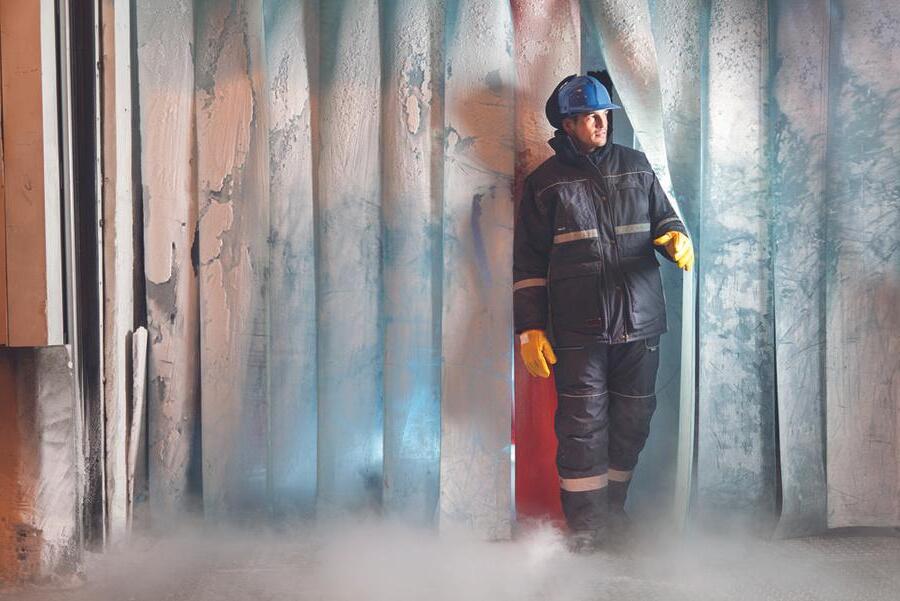
We will also receive a legal update from DWF Law which incorporates the sentencing guidelines To keep up to date with technology we have asked the HSE to talk about robotics, artificial intelligence and advanced automation with ASG services following this on integrated warehouse solutions
Many years ago we made a commitment to include an element of mental health in every conference therefore we bring you mental health essentials and the BFFF members mental health survey
With manual handling injuries still being high within our industry and a target area for the Food and Drink manufacture forum common strategy we close the day with a practical view Davy Snowdon MBE from Pristine condition


Read about:
BFFF Initiatives
Fire Safety
News and Events
Primary Authority
Enforcement
Transport Hub
Guidance
SimonBrentnall CMIOSHPIEMAAIFSM HeadofHealth&Safety BFFFO N T E N T S
Tickets are still available for the the 2023 Health and Safety will be hosted at the British Motor Museum on the 8th of March
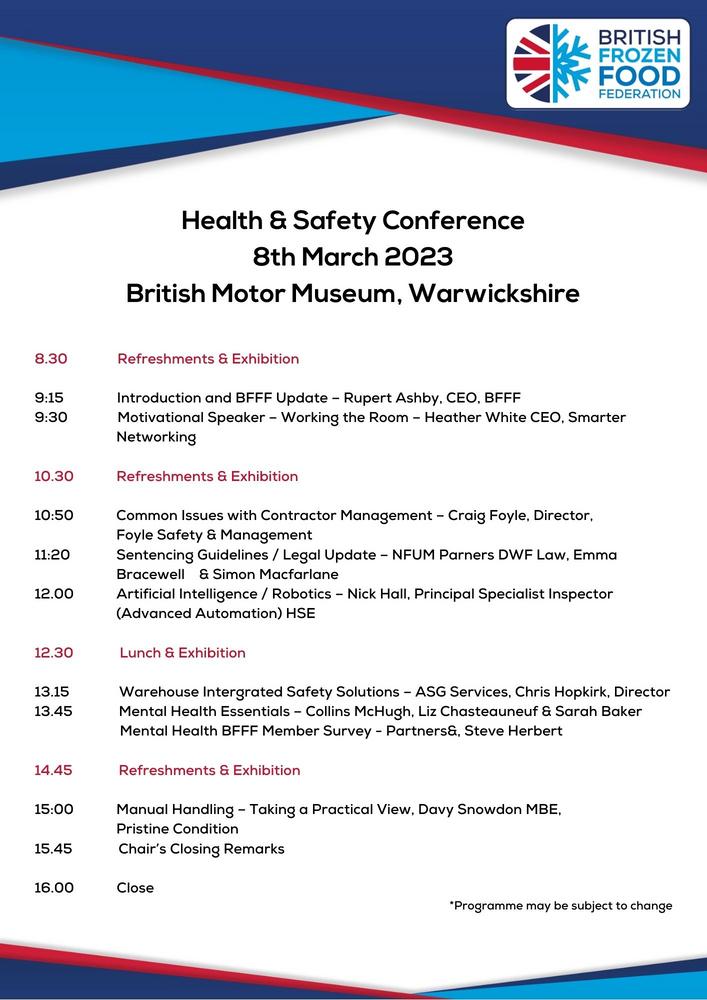
Attendees will have access to refreshments, exhibition hall and an auditorium with an agenda full of insightful industry speakers throughout the day
4 for 3 Offer
Book your tickets now and take advantage of our 'Bring Your Team' offer of 4 for the price of 3 These can be used for both Health and Safety and Technical Conferences being held simultaneously
THE FUTURE IS HERE
A brief overview of fire safety considerations when introducing Electrical Vehicles to your business
With many organisations owning fleet vehicles for transporting stock there is a move toward the introduction electrical vehicles as the company ’ s older fleet vehicles come up to a point for renewal
With motives to change to electrical vehicles (EVs) based around the environment impact and the drive by Central Government to discourage the continued use of ‘fossil fuel’ vehicles many businesses are considering their options

Incentives, such as reduced cost when operating within low emission zones which are now proposed across the country where traditionally only operating in London, will no doubt influence the decision to change.
Whether the decision-making stems from concerns about the environment or is based on the increasing costs of using fossil fuel vehicles, or both, the wider picture around the infrastructure supporting ownership of EVs should also form part of this process
Although I cannot discuss the ‘national’ infrastructure around the increasing use of EVs it is important to look in more detail at the individual organisations plans to make these changes and to ensure there is adequate facilities for the fire-safety around the ownership and use of EVs
Whilst considering these matters it is also worth thinking about the use of existing electrical apparatus in use such as electrical fork lift trucks, low level order pickers (LOLOPS), lifting equipment as well as electrically operated equipment used to transport stock around site , and don’t forget site visitors whom may be travelling in an EV, all of which my now incorporate Lithium-ion technology
What are the fire risks associated with electrically powered vehicles?
The increasing use of electrical vehicles has necessitated the provision of charging facilities that – if not managed appropriately can introduce potential increased ignition hazards to the workplace
If electrical vehicles are introduced into the business fire risk assessments should be reviewed to consider the risks associated with them This will include the consideration of passive and active fire safety elements including, but not limited to:
Measures which should be considered as part of location decision include:
Consideration to the location of the charging areas / points and the proximity to buildings This is particularly essential for buildings which incorporate composite panels as part of their structural make up
The location of any dangerous substances to the proximity of charging points
Physical segregation of the charging areas from process and storage areas If fire were to break out this could result in smoke contamination of food processing or storage
Ensure that charging areas are not located next to or in close proximity of fire escapes
Provision of a suitable power supply, control and isolation system which will help protect other power supplies used within the business such as production, refrigeration and office operations In addition this provides for quick isolation when firefighting is taking place
Where electrical charging is taking place inside premises, such as folklifts and other equipment used for moving stock, location is very important and preferably should fully separated from the main business areas, provided with detection and warning installations
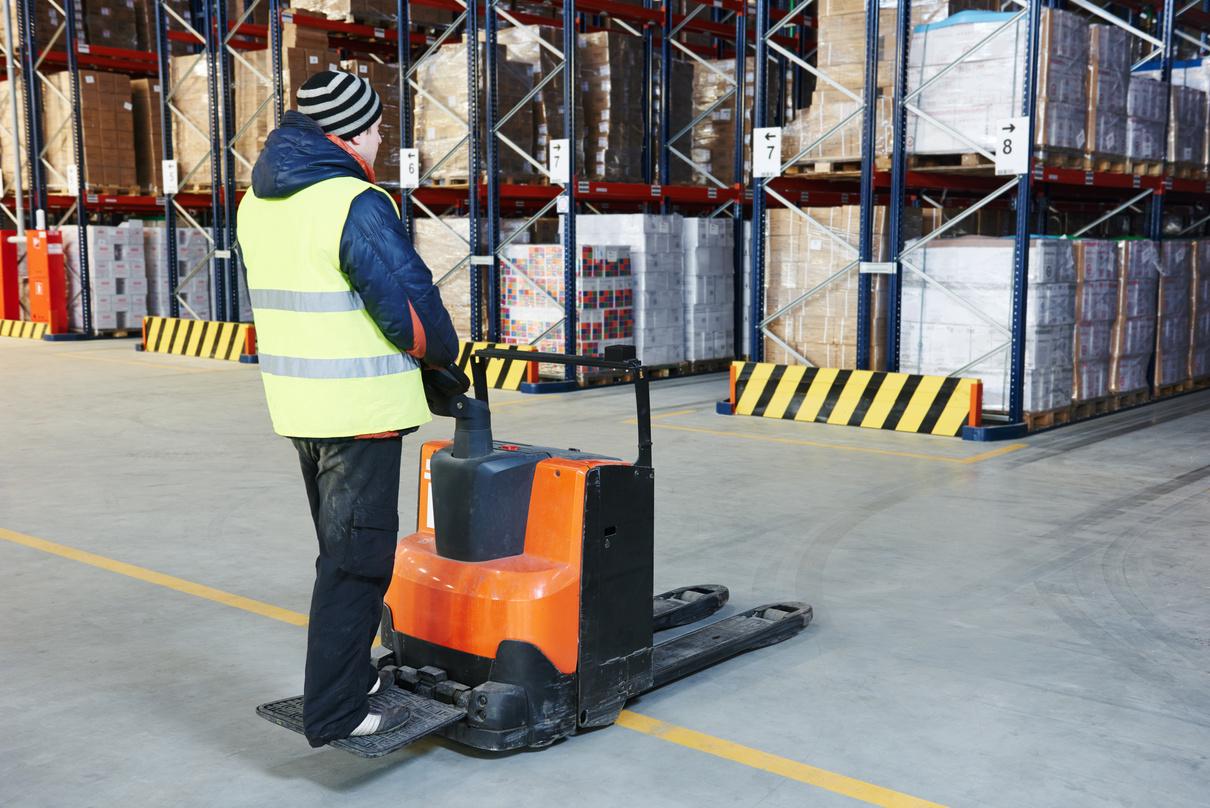
If possible fixed fire-suppression systems should be installed as part of the business continuity attempts
Staff operating with equipment should be provided with specific training around the risks associated with the electrical vehicles and equipment including safety around the connection to charging points
Charging areas should incorporate emergency lighting in accordance with BS5266
Fire spread to buildings would have a significant impact upon the business continuity and could result in major interruption to business operations
Fire spread to other vehicles in proximity to charging vehicles is also worthy of considerations as vehicle fires create huge amounts of heat and can jump very quickly to adjacent vehicles
It is a requirement under the Regulatory Reform (Fire safety) Order 2005, Article 9, to review your fire risk assessment when changes occur This means an introduction of risk such as charging points You should review your current FRA to if it has adequately offered advice or recommendations around the current risk where charging is taking place inside your premises
Business Continuity
Implications also have to be considered regarding fire involving batteries, which can burn for prolonged periods of time. This may be the case for lifting equipment left to charge overnight or at weekends when no staff is present
Where this is the case consideration to building ‘burn out’ compartments, where space allows, suppression systems or installing a security CCTV system where a manager or key holder receives an alert and is able to contact the FRS to report the fire
For times when there are no staff on site you can provide a ‘premises information box’ (PIF) containing laminated plans annotated with information about the location of charging points, access areas, electrical isolation switches and water supplies which will help the FRS manage the incident and speed up operations potentially saving a major impact on your business
Summary:
Planning ahead for changes – before making changes it is worth considering the various levels of impact that adopting new electrical vehicles and associated infrastructure to your business environment to ensure that these don’t negatively impact the business.
Always seek professional advice when locating planning and implementing changes
Use a competent fire risk assessor and ensure they have expertise in this area when planning and implementing changes within the business or for your existing use of electrical vehicles and equipment to ensure the risk assessments are suitable and sufficient before any Fire Authority visits
Ensure your FRA is up to date in light of all electrical vehicles both for cars, vans and equipment used within the premises
Do your research, the list below gives more detail when implementing the introduction of EVs to your business and will help you ensure that you have considered the variety of associated issues
Further Research:
RISC Authority documents:
RC59: Recommendations for fire safety when charging electrical vehicles
RC11: Risk Control – Recommendations for fire safety in the use of lift trucks
RC42: Risk Control – Fire safety of unattended processes
HM Government – Taking charge: the electric vehicle infrastructure strategy
FPA – Business Resilience: A guide to protecting your business and its people
Author: Jonathan Dixson Primary Authority Manager – Essex Fire and Rescue ServiceBFFF members are committed to providing a safe and healthy work environment for all involved across the various sectors of the frozen food industry
BFFF encourages all members to improve their standards of health and safety, benchmark their business and share best practice case studies as a means of improving the performance This also aligns BFFF member companies with the government’s strategy for reducing incidents, accidents and ill health
Members signing the BFFF Health & Safety pledge are encouraged to commit to the outlined values to:

Demonstrate leadership and effective workforce engagement
Comply with all current health and safety legislation, codes of practice and industry standards
Provide a safe and healthy environment for their employees and all persons affected by their undertaking via co-operation, consultation, training and review
Compile an action plan for key industry objectives to:
Reduce accidents and incidents of ill health, Effectively manage Musculoskeletal Disorder (MSD) risks, Effectively manage Slip and Trip risks, Deploy an effective Occupational Health management system which includes mental health & wellbeing, To develop links between workers at the different levels to collaborate on issues relating to occupation health and safety, Benchmark their company ’ s health and safety performance with set targets and confidentially share their annual statistics with BFFF, Collaborate and share best practice case studies as a means of improving the health and safety performance of the industry
If you would like a certificate to display, pledging your commitment please email carlabrown@bfff co uk
The BFFF Health & Safety and Technical teams are pleased to announce the dates for the 2023 Expert Group Meetings We are looking forward to meeting with the group members to continue our discussions on industry news, changes and challenges to gain a wider understanding of the impact it may have on our members and how we can support them
We are always happy for our members to raise questions or concerns for us to discuss at the expert group meetings and we will feedback accordingly The meetings are held under Chatham House rules, meaning we aren’t able to share the full set of minutes, but we can provide an update on any of the topics discussed if our members are interested
Health and Safety Expert Group Meeting Dates for 2023:
25th April 2023
13th September 2023
6th December 2023
For further information, please contact Simon or Carla
The Technical Expert Group Meeting Dates for 2023:
25th January 2023
7th June 2023
11th October 2023
For further information, please contact Denise
Following a difficult two years, as we move back to more staff being present in the workplace we would like to bring you industry 2022 accident statistics
We are one of a few organisations that provide its members with accident stats, charting the decline or increase in certain accidents. This data then helps us to help our members reduce accidents in the workplace
To submit your accident data for 2022 please go to the BFFF Website
As data is added, reports are instantly available to download and use within your own organisation to reduce accidents and near misses
Please contact carlabrown@bfff co uk if you have any queries
BFFF were the first trade association to join the original Home Authority Scheme in 2004 We are also members of a Primary Authority user group, led by the Government Department for Business, Energy & Industrial Strategy (BEIS) This is to increase member engagement in the Primary Authority Scheme that is available to all BFFF members
Primary Authority is a means for businesses to receive assured and tailored advice on meeting regulations such as environmental health, trading standards or fire safety through a single point of contact This ensures start-ups get it right at the outset and enables all businesses to invest with confidence in products, practices and procedures, knowing that the resources they devote to compliance are well spent
Primary Authority is based on legal partnerships between businesses and individual local authorities and / or fire and rescue authorities Businesses can set up their own partnership or join through BFFF as part of our existing partnership
What is Primary Authority?
Primary Authority is a government-run scheme that helps protect businesses from unnecessary legal challenges It helps to ensure businesses operating in the food sector are doing so safely and legally
Once you have Primary Authority advice signed off within a registered partnership, if you are following the assured advice issued by the PA, and it covers the issue arising, your operating practices can’t be challenged by any other enforcement authority
Direct partnerships:
A direct partnership with a Primary Authority can look at your specific policies or operating procedures on site and assure themselves that you are operating within the law In effect they endorse your operations and policies Given their legal status as a Primary Authority partner this advice then has legal backing for your business Under a direct partnership you pay an annual fee for 8 hours of support. (Extra hours can of course be purchased)
Co-ordinated partnerships: BFFF operates a co-ordinated Primary Authority scheme, and we have an expanding range of sector-wide advice This partnership operates in the same way as the direct partnership but you don’t need to deal with the Primary Authority directly, BFFF does that for you You can also rely on this advice as it also has the legal backing for your business This partnership is free of charge, however, advice is industry level and not specific to your organisation, however, this does not reduce the validity of the advice issued
Any BFFF member can benefit from advice, whether it is tailored to your business or sectoral advice put in place by BFFF
If you would like more information about joining the scheme, please contact carlabrown@bfff co uk
Nearly three quarters of UK organisations expect employee mental health to improve during 2023 as they open up about mental wellbeing
The study claims that half of employers say they plan to talk more about mental health in company communications as teams continue to struggle with the cost-of-living crisis and its impact on mental health A further 44% say they will openly and visibly practice mental wellbeing habits in the workplace
Nearly all (93%) of UK organisations are now offering their employees mental health benefits of some kind and 77% of respondents report that their employees are using mental health benefits more now compared with the beginning of 2022 With increased benefit utilisation and momentum to destigmatise these issues in the workplace, businesses are optimistic about employee mental wellbeing as the new year progresses, with 70% believing mental health will improve during 2023
When asked about the desired outcomes of such support, quality of life (64%), workplace productivity (55%) and attracting and retaining talent (50%) were cited as the top three Despite an evolving appetite to support mental health and an optimistic sentiment toward the outcomes of such programmes, the research also found that although nearly all companies offer mental health benefits, mental health is not a cultural priority for two fifths (40%) of UK organisations Further, only 39% of executive leadership teams are expected to authorise additional spending on employee mental health in 2023
With recent research showing that over half (52%) of employees in the UK haven’t felt supported by their employer when it comes to mental health, it becomes apparent that despite ongoing efforts and clear intentions to better support employee mental health, there continues to be a gap between employer perception and employees’ lived experience
While there is misalignment on priorities at the highest levels of the organisation, HR leaders have a strong pulse on what is affecting mental health at work the most
Almost two thirds (60%) of employers feel personal financial concerns have a significant negative impact on employee mental health, closely followed by workplace culture (52%), which nods to the work environment, workload, flexible hours and relationships with managers A hopeful majority of organisations (95%) do have in place plans to equip managers to recognise and deal with employee mental health issues this year, with 60% planning training on mental health awareness and almost two fifths (38%) providing access to aggregated data to help them understand their team’s mental wellbeing
For more information about the study, visit here.
Workplace Insight
December 2022
A food production company has been fined £858,000 after an employee had his arm amputated after becoming entangled in an industrial food mixer Lee Simpson was removing filling ingredients from a paddle mixer, from which the contents could be removed at the front, at David Wood Baking Limited’s premises in Sheerness, Kent when his right hand and arm were drawn in Lee, from Sheerness, who was 26 years old at the time, had to have his arm surgically removed He said he has now lost much of his independence He said: “Life has changed so much since the accident and I am doing everything I can to improve, but it will never be the same
“Since my accident I have become dependent on others, primarily my family and fiancée, to complete daily activities for me, such as cooking and domestic tasks such as doing the laundry ”
The incident happened on 27 September 2021 at the Mill House on Dorset Road, Sheerness, where David Wood Baking Limited makes sausage rolls, quiches and other food products Investigating, the HSE found that the control measures in place to prevent contact with moving parts were ineffective as the guarding of the mixer was routinely not replaced after cleaning
The ‘interlocking’ system was also defeated which meant the mixer would still operate without the front guard in place, putting employees, including Mr Simpson, at risk when operating it
“David Wood Bakery Limited pleaded guilty to breaches under the Provision and Use of Work Equipment Regulations 1998, Regulation 11(1)(b) and was fined £858,000 and ordered to pay £8,000 costs at Folkestone Magistrates Court on 21 December 2022
HSE Inspector Joanne Williams said:
“A wide variety of work equipment and machinery is used across food production Every year, a significant proportion of accidents, many of them serious and sometimes fatal, occur as a result of poorly guarded work equipment To prevent and reduce the risk of serious or fatal injury adequate arrangements and systems of work are required
“In the food and drink industries machinery and plant causes over 30% of fatal injuries and over 10% of major injuries
“In this case this was a wholly avoidable incident, caused by the failure of the company to implement safe systems of work and a failure to identify the risks
“Had the company ensured the interlocks were maintained and remained in working order, the machine could not have been used without the guard in place and this life changing injury could not have occurred ”
HSE December 2022
A wine and drinks supplier has been fined after a visiting HGV driver was killed after being hit by a forklift truck at its depot in Salford
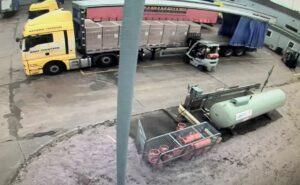
John Fitzpatrick was waiting for his trailer to be loaded at Kingsland Drinks Ltd in Irlam on 19 August 2020 when tragedy struck The 59-year-old, form Oldham, suffered serious head injuries in the incident and died in hospital having never regained consciousness
In a victim personal statement read out at Manchester Magistrates Court, his partner Paula Fitzpatrick, said how his death had affected their family
“I cannot really explain what we have lost without describing the kind of person John was, ” she said
“John was a joyful character, full of life, and often described as the life and soul of the party
“He would talk to anyone and I would often lose him for a couple of hours when he went to the local shop as he would be talking to all the neighbours on the way
“He was that kind of person – a very hardworking man who would do all the DIY around the house and that included all the family’s odd-jobs
“At the time of his death, we were planning how our future would look ”
An investigation by the Health and Safety Executive (HSE) found the company had failed in a number of areas The risk assessment was out of date and not fit for purpose, and there was no pedestrian and vehicle segregation in place in the loading area Visiting drivers were not given clear information about site safety
At a sentencing hearing at Manchester Magistrates’ Court on 25 January, Kingsland Drinks Ltd of The Winery, Fairhills Road, Irlam, Manchester, pleaded guilty to breaching section 2(1) and 3(1) of the Health and Safety at Work Act They were fined £800,000 and ordered to pay costs of £5,614 30 Speaking after the hearing HSE Inspector Sharon Butler said: “This death would have been prevented if clear controls had been in place for visiting drivers
“Companies who have loading areas need to provide information and instructions to visiting drivers and have clear segregation in place to ensure the site is safe for all who use it
“Easy steps can be taken to reduce the risk of visiting drivers becoming injured on site ”
HSE January 2023
Sysco in Great Britain has called for greater cross-industry collaboration, as it launches its latest electric vehicle, built as part of a partnership that it hopes will be the catalyst for widespread, fully electric, multitemperature deliveries
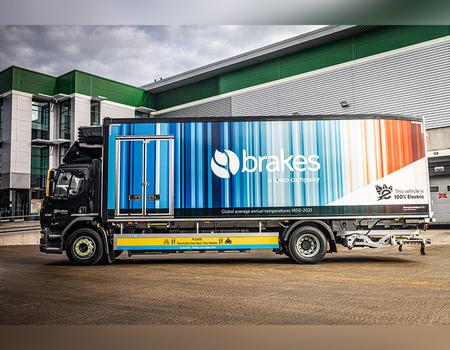
The new electric vehicle will become the first foodservice vehicle to carry the ‘Climate Stripes’ graphic, which is designed to highlight the issue of rising global temperatures The Climate Stripes were created by Professor Ed Hawkins at the University of Reading and are designed to show vividly how global average temperatures have risen over nearly two centuries
Speaking at the launch of the Climate Stripes vehicle at its Brakes depot in Reading, Peter Jackson, CEO of Sysco in Great Britain, said: “Food and transport are two of the most carbonintensive sectors. We have a huge responsibility to tackle climate change through our operations and inspire our customers to do the same
“We are on a journey to create a future where a delivery of sustainable produce arrives on an electric vehicle, charged with solar panels at the zero carbon depot This is an important step But we cannot do this alone and we need to work in partnership with customers, manufacturers, government and the rest of the foodservice industry We can only achieve real change if we work together
“Our position in the food system creates an opportunity to inspire our customers to transform their menus and the food that they buy – by far the biggest portion of our own carbon emissions We hope that the climate stripes on this vehicle will raise awareness of the challenge ”
The new DAF vehicle demonstrates the latest electric vehicle technology with a range of around 280 km and two temperature zones – frozen and chilled – powered directly from the battery, allowing frozen, fresh and ambient products to be delivered on a single vehicle This is the next step towards Sysco’s ambition to stop buying new diesel vehicles in Great Britain by 2030
As part of the launch, Jackson called for greater partnership with Government to support the uptake of zero emissions fleets, highlighting the challenges of a lack of infrastructure and the support needed to decarbonise commercial fleets
Globally, Sysco has already announced its intention to electrify 35% of its North American fleet by 2030 as it seeks to reduce its direct carbon emissions by 27 5% by 2030
This document - BS ISO 45002:2023is the new international guidance document is designed to help organisations implement BS ISO 45001 It gives guidance on how to ensure that the specific needs of different individuals and groups of workers are addressed
Organisations of all sizes and types in any sector, whether they’re looking to improve an existing implementation of BS ISO 45001, are first time users of that standard, or are not yet ready to comply with all the requirements of BS ISO 45001 but want to systematically improve their organisation’s OH&S
Users of the standards will typically be:
OH&S professionals and managers HR staff
Leaders of organisations, including CEOs and board members
Asset managers
Business owners
BS ISO 45002 gives guidance on the establishment, implementation, maintenance and continual improvement of an occupational health and safety (OH&S) management system that can help organisations conform to BS ISO 45001:2018
This document is designed to help organisations implement BS ISO 45001:2018 more effectively Where that standard states ‘what’ needs to be done, BS ISO 45002:2023 expands on the ‘how to do it’ with examples and guidance on how to implement the requirements in any type of organisation, thereby helping organisations improve OH&S performance, namely, to prevent injury and ill health to workers and provide safe and healthy workplaces, as well as fulfil legal requirements and meet other OH&S objectives
In addition, by providing additional guidance, BS ISO 45002 can help ensure the specific needs of individuals and groups of workers are being fully addressed
BS ISO 45002 can also help organisations to improve their risk management, increase trust among stakeholders and to grow sustainably
General guidelines Document
BS1
February 2023
HSE offers a wide variety of publications containing advice and guidance for employers, workers and the general public
Like all HSE publications, the health and safety guidance leaflets are available to download on HSE's website
You can also buy hard-copy versions of many of these titles, such as legal guides, through the HSE Books website
Here is a selection of some of the most read publications:
Working with substances hazardous to health: A brief guide to COSHH
Warehousing and storage: A guide to health and safety
Written in conjunction with the Warehousing Health and Safety Forum - a joint committee with representation from trade unions, trade associations and employer bodies Though in parts specific to specialist sites (eg temperature-controlled or dangerous substance storage) the majority of the book's focus applies right across the sector regardless of facility or size Many special attention topics, such as manual handling, musculoskeletal awareness, mechanical handling, site transport and working at height plus more, are covered in detail but the broader emphasis is on responsible warehouse practices, general prevention of avoidable risks and hazards and attendant information of accident and emergency procedures
A guide to workplace transport safety
This guide provides advice for employers on what they need to do to comply with the law and reduce risk It will also be useful for managers, supervisors, employees and their safety representatives, as well as contractors, vehicle operators and other organisations concerned with workplace transport safety
The new guide is much shorter and more streamlined than the previous edition and includes advice on your general legal duties and information on health and safety management There is also more specific advice on controlling risks associated with workplace transport, which has been restructured into three main areas:
Safe site (design and activity)
Safe vehicle Safe driver
The new edition has been updated to take account of new advice on workplace transport safety and also to reflect changes to relevant legislation and associated guidance There are new sections on multi-deck vehicles and multi-site deliveries, as well as minor changes to other sections, such as on weighbridges and sheeting It reflects and expands on the HSE leaflet Workplace transport safety: A brief guide
To view the publication please visit the HSE Website