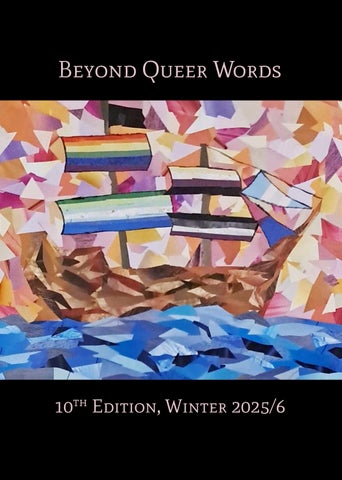
I. Emergence
Is There a Difference Between a Cock Ring and a Wedding Band?
Sam Gregory
Sam Gregory is a Minnesota-based author and artist. They love to create work that reflects love and life, even if wonderful or strange. Their goal is to show others how powerful it is to be authentically themselves!
We submit to each other, balancing. Some days I lead with a gentle hand, cupping your cheek, kissing your lips.
Other days it’s your fierce gentleness, tugging my shirt, squeezing my hips. Those days I swear you have X-ray vision.
But that is our love, Taking, giving, dancing, knowing either one of us will catch the other.
We trust our hands will only do what is asked of them, Our voices only for the other to hear. Breath in sync.
I will wake up and make coffee, You will shower our evening away, And our dance will begin again.
Homage to HRT
Miles Stevens
Miles Stevens (they/she) writes on the surreal experience that comes from their identity as a Queer person. Through this, they try to capture the wonder and complexity that dances through their life. Currently, she is an MFA Candidate with the Stonecoast program at the University of Southern Maine, working to explore identity through poetry and craft.
We attach boyhood to our clit! Secure it with alcohol glue; musty sweat tries to slough it off. Gnaws into the ovaries to rend, energized by adrenal dreams. To be given this sacred rite to touch a fresh body, masturbating the new self.
Shining hairy thighs for beach days. We will create bikini bushes for the boys and thick hips for the ladies. Rolling coils of burning heat, to show how powerful testosterone can be. Buzzing with estrogen in these breasts and the glow of kisses on my cheeks.
Transitional encounters
Lior Locher
Lior Locher is a former journalist and therapist turned writer. Lior studied writing at Grub Street (Boston), Gotham (New York) and at the Irish Writers Centre (Dublin). They are interested in people's inner dynamics and in relationships between people. and how context shapes who we are and how we change.
I don’t know who you are
But I’ll wash you
You look like you need it
You remind me of someone
That boy I never quite got to be
With grass stains on the knees and dirty fingernails
And the scar where you slipped
With the Stanley knife you stole from our Dad’s toolshed
I don’t know who you are
But I’ll feed you
You look hungry
You remind me of someone
That girl I used to be
With the tits and the constant diets that never worked
And the black tights you got from our Mum that you ripped
Immediately when you first put them on for the school disco
I don’t know who you are
But here’s a cup of tea
Your voice is all fuzzy, like you shouted too much
And nobody heard you
You remind me of someone
I haven’t had a chance to meet them yet
But I saw their footprints in the sand at Walpole Bay on Pride weekend
I don’t know who you are
But here are some clothes
You need an outfit that actually fits who you are and who you want to be next
So the world can find some new drawers
to categorize you into and judge you based on it
You’ll remind me of someone
Someday
But it’s still too early for that right now
I don’t know who you are
But I picked you a flower
You look happy. Confused for sure, but happy
You remind me of someone I’ve seen at the synagogue
Whose laughter I’d recognize in a million people
I don’t know who you are
But I have a bed for you
You’ve been tired for too long. I’ll curl up around you
You remind me of someone
You have my hip bones and my rib cage
I’m exploring them with those hands I’ve seen a million times but never actually looked at until today
I’ll cocoon you
Until you’re ready
Río Gayoso Tello
Río Gayoso Tello (he/him) is a trans, Peruvian artist, concluding his fourth year of undergraduate studies at the University of Toronto, specializing in Architecture and completing a minor in Creativity & Society. His poetry in Spanish is featured in a printed Peruvian poetry anthology, Desde La Raíz, distributed by the Colombian publishing house Ediciones Converso. He was the winner of Minerva Literary Journal’s 2024 Poetry Contest, and his work has been published in multiple University of Toronto literary journals.
my grandfather promises to my little girl self adam was born of wet clay of the earth breastfed his mother soil born too from his father it was a father my grandfather promises who first bore life I only ache to care & protect but christ-like: to sink into my first love the soil press down & move the way water fills the earth & in my tender harvest to give though I, born I, was raised to disbelieve adam ’s outline was first drawn on the grass by his father’s hand then brought up on his mother’s back warned to disbelieve his outline most of all, could be mine
so this I want possible I want a child not borne of my hipbones but rising on my shoulders like christ, to do the impossible with bare soil I, the impossible: the father & the son. I, for a heartbeat’s worth: christ.
Drinking Habibi
Joseph Marquette
Joseph Marquette lives with his husband, Robert Gibson. He teaches Italian, Latin, Spanish, and French. Occasionally, as a treat, he goes dancing in New York City with another version of himself: more stylish, more savvy. When weary, he walks the streets of Montreal to share space with people striving to be kind. Every so often, he travels to Napoli to forget he is anybody else.
I watched you bloom. I could feel your root. You were sleeping. It’s my secret.
The heat of your dreaming skin Was nestled deep in Yahweh. Your body-turn closed over me, Catching me in an oyster shell of you. I smiled to be crushed Dust to form your pearl treasure.
A hummingbird gave birth to Buddha.
Beneath you, In your sleeping, I became the cosmic egg Of a raven’s love secret.
My silence was joy-laughter.
I ran into your breath, Pulling the down from my pigeon breast. My hunger bade me feed The eager falcon of your dreaming.
Dying I returned to Eden And laughed inside the quiet of your eyes.
The wine lover senses ripened body fruit.
Many are the gardens of immortality. I, too, can covet a tree.
Vulvas: An Incorrect Anagram
Kimber Peters
Kimber Peters is a Louisiana native who loves seafood, writing, and cold coffee. Her favorite thing to do is watch cartoons and horror movies with her fiancée whom she loves very much.
Vulva, also a narcotic or salve or slave; more accurate, a vassal to ration and allocate until it melts into a coma among the cosmos; an eternity lost to lice & rats, carving names into a universe meant to remain inviolate.
I have dreams of trypophobia
Nathan Holloway
Nathan Holloway was born and raised in rural southern Arkansas to a traditional and fundamentalist baptist family. You can imagine their shock and awe when Nathan turned out gay after all their hard work and prayer. Nathan works in higher education with an emphasis on dissecting identity through the writing process and academia at large.
My skin is a lotus pod exploding
Bounties, secrets
Queer sacks of pus and vermilion
In craters so scarcely covered
The membrane will tear any minute
On purpose
You are in the splash zone
If I could reach you another way, I would
Together huddle like American gods
Gridironed posture crossing over
Stalk you from a leaning perch
Binoculars in hand to keep you
Sighted a bullet’s length away
But I can only spread
Sores I have bundled up
Kept at the point of bursting
To catch you passing
My leper colony
I will clean you just
So I can infect you again
II. Connection & Touch
In Spite
Rachel Raymond
Rachel Raymond is a 34-year-old queer artist, information professional, scientist, and writer living in West Seattle. Her interests lie in the manipulation of archival works, motion, image, and prose, with a twist of science and a dash of history. You can follow her @yeuxdessirenes on Instagram.
We were too young to understand the meaning behind your mother’s exclamation that nothing you would ever do would make you look like me in a little black dress, but we knew it was an insult all the same. For us, gender expression was not art, but an alphabet with which to compose poetry. We treated gender as our toy, a sandbox in which to play. Yet we both stumbled, clutching expectation against subversion, the result a mess of a long-term partnership. While we performed as queer lovers, you identified me as both woman and not woman enough. As I run my fingers through my hair, no longer the color you prefer, I feel the rhythm of her fingers within me. I’ve configured myself anew, my eyes embossed with metallic pigment, lips painted, and toes curving in the ecstasy of knowing, that you believe that there is an incorrect way of entering a woman. The femmes I fuck will never know your face, but they will know your ineptitude in the rituals I etch into their skin, my fingers sanctifying every failed orgasm.
Scout Frost (they/them) is a 23-year-old writer from Syracuse, NY, who writes about queerness, belonging, and hope. Scout has been published in StreetLit Magazine and Stillwater Magazine. You can visit their blog at scoutfrost.wordpress.com or follow them on Instagram @sfrostxiv.
The week before, we had good sex, the kind where you don’t give up too soon. And you said you loved me, and I said it back. Snow fell, and you said you loved that too. If we’re still for long enough, the snow will bury us here. Don’t breathe in just yet.
In cold November, everything needed to be microwaved twice. I learned to meal-prep, with no spare moment to cook each day, plus tend to each of your unspoken desires. And you were one of mine, so for a time I could ignore my neglect of self. The shower burned my frozen feet, while you checked your body in the mirror, just like you always did. If you look long enough, you might see yourself the way I do. Don’t look away just yet.
After you ended things, I popped a tire on the drive back from the grocery. The streets around here, they have teeth, and God knows I won’t bite back.
After you ended things, you took up drinking again. You told me like you were proud, but I remember when you spent my last evening in town ignoring me at the bar, then waited for me in my bed. As I packed my bags
in the morning, you only moved to heave and shower again and again.
For five months you quit drinking, and we finally had the kind of love I could hold in two hands.
After you ended things, I popped a tire and kept driving. If you run fast enough, you’ll burn rubber, but never breathe it in. That shit is toxic. Don’t breathe in. Don’t breathe just yet.
My friend, the one you don’t like, stood in the icy rain with me while the towman put on my spare. I doubt you would have stood there with me, even when things were good. Even when you loved me and the cold and riding around in that car. My mother wondered if you’d put the nail in my tire, but I didn’t need reasons to blame you.
I was the one who left the nail there; I was the one who hit the pothole. The road salt was what saved me, but the rubber still burned and I still took horrible breaths of air.
I’ll give you no blame, and I’ll grant you no credit.
I’ll forget how the same morning, when you decided it was over, you made me breakfast from scratch for the very first time. And I told myself I couldn’t leave you. I couldn’t leave just yet.
Tech Support
Tiernan Bertrand-Essington
Tiernan Bertrand-Essington is a writer living in New York City. Groundbreaking. He is a frequent contributor to Queerty and LGBTQ Nation, and is an MFA candidate in the fiction writing program at the New School.
A conversation between 15-year-old me and the Apple Tech Support Chat Line, March 28, 2013, 1:13 a.m. Central Time
Apple Tech Support: Thank you for reaching out to our 24/7 support chat line. My name is Nicholas. Give me a moment while I pull up your account details.
Me: Hi Nicholas, I think I’m gay.
Apple Tech Support: Thank you for sharing that with me. Are you reaching out about the iPad 2 connected to your Apple ID, nicknamed “LittleMonster1998?”
Me: See above.
Apple Tech Support: I understand. Is there anything I can help you with related to your Apple device?
Me: I had my first kiss tonight, Nicholas.
Apple Tech Support: Unfortunately, our services don’t extend past technological support with Apple products. Unless there is an issue pertaining to your iPad 2 I can help you with, I will unfortunately have to end this session.
Me: Everything I’ve ever known about myself has been a lie, Nicholas. I even had a girlfriend in fifth grade. We wrote love notes back and forth but were too afraid to speak to each other, so we were passionate lovers from afar. Now I’m 15 and had my first kiss and I don’t know what to do about that.
Five minutes pass.
Apple Tech Support: Well was it a gay kiss?
Me: Of course it was a gay kiss, Nicholas.
Apple Tech Support: And how do you feel about that?
Me: Thank you for finally asking a productive question, Nicholas. I feel crazy. Crazy because it was the best ten minutes of my life. That’s right, Nicholas, me and this boy kissed for ten minutes. And how did we meet? Thanks for asking, it was at church camp. We’re roommates at church camp and we kissed. And now he’s sleeping across the room from me and I’m lying awake on my iPad, which is doing fine, thank you. And he doesn’t know it but I recreated the kiss from Jennifer’s Body on him because that’s the only time I’ve seen people really kiss for a long time, where you kiss their top lip, and then their bottom lip, and then sort of in the middle, and then you slowly add tongue maybe which we definitely did. And what if I’m gay.
Apple Tech Support: Thank you for reaching out to the Apple Customer Support Chat Line. This line has been disconnected. Please take a moment to rate your experience with Nicholas. Five stars. New window.
Apple Tech Support: Thank you for reaching out to our 24/7 support chat line. My name is Nicholas. Give me a moment while I pull up your account details.
Me: Guess who, Nicholas.
Apple Tech Support: I’m glad you’ve had a productive experience at church camp. It sounds like you have a wonderful future ahead. If there’s anything I can assist you with regarding your second generation iPad, do let me know.
Me: My life is over.
Apple Tech Support: If this is an emergency, please disconnect and call 911.
Me: Don’t be dense with me, Nicholas. I’m terrified of telling my lesbian parents that I’m gay.
Five minutes pass.
Apple Tech Support: You have lesbian parents?
Me: Yes, Nicholas.
Apple Tech Support: So what are you worried about?
Me: We live in a small town. They’ve worked so hard to prove that gay families are just like anyone else. That they could raise two boys who would turn out totally normal. Now I’m gonna prove to the world that gay parents can raise a gay child, and everyone who was against gay people having kids will be proven right.
Apple Tech Support: That’s a lot of pressure to put on yourself. Most people probably aren’t thinking the mean things you think they are. Plus, if you ask me, coming out to gay parents would have been a much better experience.
Me: Nicholas, ARE YOU GAY?!
Apple Tech Support: Unfortunately I cannot disclose any personal details through the Apple Tech Support line.
Two minutes pass.
Apple Tech Support: But yes.
Me: NICHOLAS.
Apple Tech Support: Your parents will only want the best for you. They will be proud of you. I wish you the best of luck, and I truly believe everything’s going to be okay.
Me: What if I have Chlamydia, Nicholas?
Apple Tech Support: Are you experiencing symptoms?
Me: No, but honestly we did a little more than just kiss. And men often don’t show symptoms of chlamydia. So I could very well have asymptomatic chlamydia and not know it for years. And it could affect my fertility.
Apple Tech Support: Fortunately, that particular ailment is entirely curable.
Me: Right. I just don’t know how to get tested without talking to my parents.
Apple Tech Support: It sounds like all roads lead to an uncomfortable conversation.
Me: Nicholas, I would rather die than have an uncomfortable conversation.
Apple Tech Support: That has not been my experience of you this evening.
Me: Fair point.
Two minutes pass.
Me: Nicholas?
Apple Tech Support: How may I assist you?
Me: What if we do it again tomorrow night…and what if I’m not good?
Apple Tech Support: Good?
Me: Yeah. Good at…you know. Stuff.
Apple Tech Support: I understand your fear. You’ll be okay. Just make sure he’s treating you well. Only do what you want to do.
And don’t keep your shirt on because you’re scared of how you look, the sooner you get past that the better.
Me: How did you
Apple Tech Support: And just be in the moment. When you see him again. When you talk to your parents. One moment at a time. You can do it.
Me: I think he’s waking up. I should go.
Apple Tech Support: Go to him. I love you.
Me: I love you too, Nicholas.
Apple Tech Support: Thank you for reaching out to the Apple Customer Support Chat Line. This line has been disconnected. Please take a moment to rate your experience with Nicholas.
When I borrow your feet
Walt Trask
Walt Trask is an emerging poet whose work is influenced by his upbringing in the Hudson Valley, New York. His poems have been published in Ursa Minor-University of California, Berkeley Press, the poetry collection The Lightness of Being-The International Library of Poetry, WILDsound’s-online publication, Tofu Arts, and The Ana. His work appears in the 9th Edition of Beyond Queer Words. He lives in San Miguel de Allende, Mexico.
When I borrow your feet
I’ll treat them well. And you won’t have to say a word when they arch statuesquely, heels against my bedframe, toes splayed on oak floorboards in a California bungalow.
When I coddle your feet
you can still cycle roads in Europe, streets in San Francisco or wherever. Besides, I have a photograph of you to remind me in black and white and grey, bordered in wood as blond as your hair. You gave it to me so I’d return to this eddy of alphabet soup where we hid letters suspended still to not form so many words unsaid.
When I steal your feet
I’ll care for them and tell you where they are, so you won’t have to reverse-search old phone numbers, outdated addresses, living siblings. I’ll make sure they call you then and now with a smokier voice that lilts when it laughs, like treasure unburied again. When I marry your feet
I won’t wake them each morning as they lay undisturbed by church bells in a Mexican village where coffee is as strong as a perpetual stare that lingers still from across a bar with a gentle vengeance.
For Birdie Katya Engalichev
Katya Engalichev is a writer by day and a neonatal nurse by night. Her work is informed by the experience of coming out in early adulthood, a fierce desire to understand herself and the world around her, and a steadfast affection for New England and its landscape. She currently resides in the Seacoast region of New Hampshire with her beloved partner and their many animals.
This is it — this is the Great Love, born like the filly all wet and legs tied in knots. Wobbling and miraculous in its ability to organize limbs unfamiliar. Knowing, on some level, that all time is borrowed, and impatient as I am when you are late coming home. I would drink Love to oblivion except that it’s delicate as a butterfly or a hurricane or a newborn foal it demands nurture in exchange for perennity. I understand that all things will die with neglect — see how the spring folds over itself, last year’s newness left implied. I will not leave my Love a postulation, I will insist on it. Rub it down until its racing heart turns everything pink. Call for you from the twilit grass, watch you run to me, willing to raise a life entwined.
Chrome Lagoon
Lexiss Morgan
Lexiss Morgan is a writer with a passion to explore the intricate dance between humanity and unknown forces through poetry, short fiction, and screenplays. She has previously been published in Los Angeles miscellany, Attic Salt, and The Foundationalist and was a recipient of the George F. Montgomery Scholarship for her original Gothic horror short story “Damien Baal.” She is a Kindergarten teacher and loves to make matcha and roller skate in her free time.
Knees down, head forward, arms resting on the cast-iron rim.
She is bowing to the faucet of a clawfoot tub.
The water displaced by our bodies gently swaying, lapping at our waists.
Her hair is in my hands.
The wavy strands catching waterfalls, sewing beads of water into my knuckles.
Suds cascading down my wrists, to my elbows, dripping into the chrome lagoon.
And she is in my arms
Steam lounges on our napes on our spines. Soon exhaled away replaced by our steady breath.
for Debbie after twenty-seven years
Liv Strange
Liv Strange is a poet based in Tuscaloosa, Alabama, where they are currently giggling with their wife, drinking an extra cup of coffee, or gazing at their two perfect cats. They are in the first year of a creative writing MFA at the University of Alabama.
I trust no one more than a woman driving me somewhere in her bare feet. I saw it for the first time when I was five years old. She was the babysitter, a not-my-mother mother, the first person to show me what glamor was. This she did by letting me walk on her back while she watched daytime TV and sighed, by slathering mayonnaise on her long brown hair for shine, by having a boyfriend with one gold tooth that flashed like a stash of secret coins when he smiled at her. She had a laugh with no sharp edges. That day, there were no droves of other children with whom to lose myself. I rode along with her to the quiet park in town, where an asphalt “O” encircled a small scruff of lawn. There, she stopped the car and tossed her sandals into the back seat. She beckoned me into her different-mother lap and told me to put my warm hands high up on the wheel. Its curve beyond filled each of my hands from dimpled wrist to fingertip. Below, her heart-red manicure hovered near my knees as the car kicked forward and she urged me
into her own excitement, whispered joy into the tingling back of my right ear, told me I could do it I could tell us where to go.
The Lovable
Emma Wynn
Emma Wynn teaches Philosophy, LGBTQI+ U.S. History, and Psychology at a boarding high school in CT. They have been published in multiple magazines and journals and nominated for the Pushcart Prize twice. Their first fulllength book, TheWorld isOurAnchor, was published in 2023 by FutureCycle Press.
Curled against his chest like a comma, I ask if he thinks love is recognizing then choosing the lovable, as sometimes at the market they’ve made fresh guacamole and the shopping list basically rewrites itself— a heavy pack of tortillas and a can of beans, paper-coated onions and bunched cilantro’s fresh scent a promise all the way home
Or is it more like impulse shopping? Ending up home with a bright jar of new sauce, then wandering the twilight kitchen matching ingredients from cabinets and drawers, a limp carrot cut small and boiled into soup, freezer-burned corn and cold noodles softened in thyme-green broth that is to say, inventing? Is love, I ask, a sense or sense-making? Really meaning, would you do it again, have I been worth it, will you keep on choosing me?
Memory, Loss, Dream
The
morning after nothing
Belén Herrera
Belén Herrera is a poet and MFA (Creative Writing, Poetry) student at Texas State University. Recently, Belén has received the TXST Grad Merit Fellowship and is the PR Manager for Texas State's online literary journal, Porter House Review.
The sheets are wound around her waist, censoring her hips and thighs and legs and legs and calves and feet. She is naked. I can see her toes.
Her back looks soft. Touch the softest part of you: the inside of your arm, the skin between your ankle bone and heel, the underside of your breast. She is softer. I know. She's hugging a pillow, it’s pressing her stomach, it’s underneath her, it’s squeezed between her thighs, the bottom corner is curved up behind her, kissing her. There.
Her hair is a tumbleweed. Her face is smudged. Her eyes are crusty and bright. Her eyes are monsoons. Her back is milk glass. Her back is the moon.
My lips are dry and chapped. I haven't brushed my teeth. She is lying on her stomach facing him and I am sitting up behind her in their bed, staring at her back.
Kiley Karlak Malloy
Kiley Karlak Malloy is a poet and translator from Pennsylvania currently working on her PhD in comparative literature at UMass Amherst. Their poetry can be found in 4x4 Magazine and Hanging Loose Press and their translated work includes a German poem in Samovar magazine and a full-length French cookbook entitled Vegan Africa. They love dark chocolate and rain.
In every introduction to the young poet’s genius a warning: this man, shot at by a lover. This man, so fiercely loveable that you could make music out of gunfire for him, could go to prison for him. Then follows the genius, the words lifted by a tongue. His, or mine? Does it matter? Yes, it matters.
I’m calling to tell you that I know you would shoot me too, just once and somewhere non-fatal. To see the way red can spill like words do, over our hands. To be able to say “I’ll stitch you up” and “I’ll hold you close” or “I’m sorry. God, I’m so sorry,” like a greeting, like an anthem, like a song.
Coyote Boy James Daniello Jr
James Daniello Jr is the author of Wide Asleep. He lives with his man in Palm Springs, California.
Tribal fires lick my thighs, a story arrives in fragments
Coyote sagas turn it to stone, in the eyes of all the planets.
The desert and the night spread wide, wide, heal me, coyote— fuck me for the rains inside.
Half-man, half-spirit of the southwest, ride, a ride.
Straddled by dunes, by mirage, breathless heat, hit it, hit it until you hit my heart
Make the planets tilt to watch this part.
Coyote boy…
Or Else
Naomi Azriel
Naomi Azriel (IG: @owlspool) is a Bay Area based poet, Jungian analyst and queer activist. Her work was nominated for the Pushcart Prize, selected as finalist by Fjords Review, Host Publications, Inverted Syntax, and Fordham University’s Poetic Justice Prize, longlisted for Frontier Poetry's Breakthrough Prize and shortlisted for the Central Avenue Poetry Prize. Most recently, her poems be found in Clackamas Literary Review, Epoch Literary, the Jung Journal, and elsewhere.
My country spills dead semen into the earth’s lap in thrall to its own fury.
My country voids its coiled guts defiles the skies defies the gods.
In my country, dung beetles dwell in feces: roll round balls of excrement, which they use as a food source, or else as breeding chambers. Dung beetles navigate by polarized patterns in moonlight, or else by distant rays from the Milky Way. Once, in Jerusalem, on a cold night, the lips of a butch on my skin unspooled me. Home found me: a first. O, world, hold me in your lap, or else light my way with distant star milk, into the breeding chambers of a new life, here in this faraway night.
Reveal to me my polarized patterns by moonlight: fetid, filthy, holy, alive. Rename my body: my country.
Celestial Bodies
Luka Buchanan
Luka Buchanan (they/them) is a poet and visual artist from Perth/Boorloo, Australia. Luka's work has featured at Perth Poetry Festival, The Lester Prize, Audible Edge Festival of Sound, Perth Fringe Festival, and others. Also working as an experimental musician and vocalist, Luka’s work is informed by improvisational and DIY practices.
For Rus, Mary-Jane, & others
I was thinking of begging for mercy but the cop car drives right past
Bodies
take a long time to forget. Sometimes forever. My hip grinds against itself: there is no relief, even with the windows down to draw or drown out the heat. I can’t drive far or fast enough to freefall. I only comet blindly on the right side of eighty, slouched along the shore of a black river, from which I will bend to drink.
A body is a person when, barefoot, it stands unbidden on the freeway. Around which we bend with unerring purpose.
A body is an object kissed with metal. Gristle and gristle. A meteorite giving off light as it skips across the asphalt.
A body is a moment sifting through a thousand moments.
Hands hovering like a healer’s to bring up the old bones: if you do not touch me, I will not learn.
Have your hands show me mercy. Hover them a while more, raise them to my mouth so that in your absence I may recall their shape.
Rest easy here. There is a place for you, here, among fingers of fire, which don’t burn but toss like heads of daisies.
I would love you if you slept through the sound of metal grinding. I would love you with all the ache of space-time bent.
I can’t drive far enough to not one day come back to myself. To not meet the body on the road again. To not climb into the water, feel it lap at my neck. To not recall fingers madly seeking fingers.
A body is a stone around which the river bends. A million rivers, a million bodies and the shrapnel of hard conversations.
Distance is a spiral, time is thin as glass. I think I found my limit and the cop car drives right past.
Your hands are shaped like healer’s hands and there is a crash ringing out across the shore of some oil-slicked and shattered tide.
Will you grant me this kindness? Will you beg for mercy on the freeway until the road free-falls, palms to the sky, to the water, chasing old faith half-drowned in the undertow? Will you grow hungry for the kiss of metal, beg for relief as the silence folds? Will you be infallible as the cars swerve and gravel bends? Will you become a stone, a river, a body, my body
my faith? Become faith so that I may finally hold you. So that I can know what it is to have
a body to be a body or an object. To give off light as I die. To give off light as I live. To give off light as I live.
Light bends but doesn’t break. A car crash is silent until you see it. A memory is a moment giving off light as it dies.
A body
is giving off light. Will you grant me this final kindness? Wait until I am gone before you turn the big light off.
I think I found my limit and the cop car drives right past.
Silence is a stone and it skips over the river to slip and sink beneath. A meteorite skips over the river to slip and sink beneath. A light skips over the river to slip and sink beneath.
The Forgotten Postcard
Dimitrios Spyridon Chytiris
Dimitrios Spyridon Chytiris is a Greek author based in the UK. His short fiction explores intimacy, memory, and profound emotional truths, often using everyday objects and imagery as anchors for his characters' experiences. The Forgotten Postcard is a piece he views as a reflection on loss, missed opportunities, and the resilience required to keep going.
I found it inside his favourite book, the one I promised I’d read but never finished. It was sitting on page five hundred and eight. We’d been using museum tickets, plane tickets, postcards, receipts and all sorts of things as bookmarks and then forgot them there. The next time we rediscovered them, they summoned memories to mind, also forgotten.
I picked up the postcard. The thick paper felt dry against my fingertips, and the colours had begun to turn a faint sepia shade. The weathered marble statue of a dying Achilles, pulling an arrow from his heel, filled the front of the postcard, and at the bottom, golden letters proclaimed Achilleion Palace in an archaiclooking font.
It was the postcard from the trip to Corfu Island, our last holiday. We booked the tickets for September because it was cheaper, but it still felt like the heart of summer. We caught the bus in Corfu town to Achilleion, where we made our way on foot to the palace. The cicadas around us drowned out all other sounds, attacking our ears with white noise, while the crisp, resinous aroma of the Mediterranean cypress trees filled our lungs.
On our way out, we visited the souvenir shop, where tourists browsed keychains, statuettes, lavender soaps, and jewellery fashioned after Empress Sissi, who had commissioned the palace. To commemorate our visit, we got the postcard and an oval pin engraved with Achilles on it to add on the wall.
I placed Infinite Jest on the coffee table. I moved across the study, postcard in hand, towards the northern wall, where, almost two decades ago, I had drawn an outline of a political world map that covered the surface from top to bottom, with clear borders defining each country using black acrylic paint. Every time we visited a country, we filled in the corresponding space with
colour and small memorabilia. Iceland was painted ivory-blue for its glacial ice, and a light red chunk of lava rock we picked up from Kerið Crater was protruding in its midst. Italy was painted light green with a magnet of the Colosseum at its capital and a miniature Vesuvius right next to Naples. It was a crazy idea of mine that gave us an excuse to visit the world and become collectors of colours and culture, a puzzle we craved to piece together.
The pin of Achilles was attached to the island of Corfu, in the north-west of Greece, which was painted in the light blue colours of the sea and the sky. Delphi was represented by a wooden sphynx, and a marble fridge magnet of the Acropolis towered over Athens. The magnet was so heavy it had fallen countless times until it broke in half; we had to superglue it back together and then to the wall to secure it.
The medley of textures and hues produced a vivid visual mosaic, which contrasted with the emptiness of the unexplored countries. Our love for manga, bonsai, picturesque cherry blossoms, and the dramatic waves of Katsushika Hokusai drew us to Japan as our next destination. But before our excursion, we needed to save because the trip was going to be long and costly. That didn’t dishearten him, however; instead, he said it was all for the best because we would get the chance to learn some Japanese before we left. And then our plans got interrupted, and the four islands of the Japanese Archipelago remained blank.
It's funny how things sometimes turn out, realising how out of our control our lives truly are, even when we pretend we’re on top of things and schedule obligations and things to come in our calendars. I was at work when I received the call. It was as if the world had lost its cadence and the earth retreated beneath my feet. What was the man on the phone saying? He was offering
some formulaic kind words, the sort one hears in a news statement after a plane crash or a catastrophic bridge collapse.
“What?” I asked.
The monotonous voice of the caller spoke more words, words that didn’t seem to make sense at first because the stillness inside my chest drowned them out.
“Yes… I understand. Which hospital? Thank you.”
Five identical walnut desks around the office screamed with laughter and bustling colleagues going about their business, but an invisible barrier grounded my ears in a consuming tinnitus buzz. The days after the accident are still undefined in my mind as if waking up from a deep sleep, blurred-eyed, stumbling, disorientated flashbacks of images behind wet window frames. I spent them sitting on the sofa, staring at the incomplete wall map, the missing countries that would never earn their mementoes and distinctive colours, and remain empty.
Time passed. His scent slowly faded from his pillow; the bonsai tree we had grown from the seed of the great oak tree in Campbell Park withered, and I needed to feel him again. He was my Infinite Jest. I fished out his favourite book and came across the postcard, which now rested in my arms.
I reached for a pushpin and attached the postcard in the centre of the map.
Ten Krembos a Euro
Gal Slonim
Gal Slonim is an editor and social psychologist based in Berlin, where he lives with two chaotic dogs. His short stories explore belonging, queerness, immigration, and the strange corners of human connection. His work has appeared in The Wild Word, New Reader Magazine, and elsewhere. Visit him on Instagram @slonimgal.
So I went to this doctor and said, “Listen, my ball’s itching like crazy.” He looked at it with a flashlight and a magnifying glass but couldn’t find anything. It wasn’t red or swollen. Maybe it was just psychosomatic. “The way I see it,” he said, “your ball is trying to tell you something’s not right. Maybe you still haven’t adjusted to Berlin? How long have you been here?” I thought he was way off, but figured, what the hell, I’d play along. He had a great body. Broad chest, thick shoulders. Macho! And we talked and talked. He was kind of nice—friendly even, for a German. A few gray hairs in his beard. It suited him. A real cutie. We must’ve kept the waiting room crowded for a while. God knows where they get so much patience. But they’re not like us. When it comes to discipline, they’re champions. Anyway, I poured out my whole life story right there on his desk. How I came here looking for something different, to start over, to run away from that madhouse called Israel. That I’d spent a year breaking my teeth just trying to ask for something in a store, that I’m not working but still get unemployment money every month. Thank God for my luck — the German passport I got from Grandma, a real survivor. Without citizenship, Berlin would’ve been rough. And how the hell am I supposed to know if a word’s masculine, feminine, or neutral? Are there even rules for this stupid language? Whether I’m happy here? That’s a hard question. I don’t think we’ve got time now. So we said Tschüss, shook hands, and he didn’t even smile.
A month later I think it was October I went back to the dermatologist. The itch in my ball was worse, like tiny ants running a marathon down there. He still thought nothing was wrong, but he really wanted to know if my soul had quieted down. “Look,” I said, “the ten cold months are about to start. It’s no picnic. You can’t tell morning from evening. Everything’s dark all the time. Back home in the Mediterranean, the climate keeps you happy sweat, short sleeves, sun that rips your skin. And why don’t you people have air conditioning? I’m
suffocating! These ovens they call heaters could kill a man. I have to admit, one thing I really like about this city is how big it is. You can ride the U-Bahn for an hour in the same direction and people still get on, swaying with Berliner Kindl bottles in their pockets. Everyone lives how they want. Honestly, people just don’t care what’s going on with you.” And then he fucked me so hard. He opened a small door to a narrow utility room, the kind cleaning ladies use. What a mess. It reeked of chlorine and old rags. I leaned into the dark; syringes fell to the floor beside us, still in their wrappers. I grabbed two handles and arched my back. He thrust forward like at war—wham, wham, wham—in and out, sharp, hungry, unwilling to let go of the prostate, squeezing, never stopping, not even slowing down. It was the most painful thing anyone’s ever done to me. They have no mercy, those Germans.
In November, I asked Dr. Kammerhof if maybe it’d been going on too long down there why it still hadn’t gone away maybe there’s a test you can do, blood, urine, I don’t know. Because now it’s itching in the other ball too. “We can send a culture,” he said, “but you should know—sexually transmitted infections aren’t a big deal in Berlin. Everyone’s got a bit of herpes, or worse. And life goes on. That’s what’s nice here—people accept you as you are.” He pulled a cotton swab from a drawer, and while it brushed against the folds of my skin, I told him things were getting better lately. I can already read some newspapers not everything, but I get the gist. It kills me that the verb always comes at the end of the sentence. He nodded, sealed the swab inside a tube, labeled it with a black marker, and slipped it into a plastic bag. Then he went down on me with too many teeth, and when I came, he spat into the sink. “You know, Dr. Kammerhof,” I said, “sometimes I just want a hug. Nothing dramatic—just arms around me for a second. I miss hearing someone laugh beside me. A real laugh, rolling and silly, like a ridiculous joke just landed or a fart slipped out nearby. Not the
loud, hysterical kind—there’s plenty of that around. I mean normal laughter. Honest laughter. The kind that happens in the middle of the street, for no reason at all.” He only listened, his mouth curved slightly, but there was a glint in his eyes that made me think he understood.
By the end of the year, Christian had stopped working at the clinic. When I looked for him after Christmas, he was already gone. His colleague said he wasn’t feeling well. Liver problems. All his clients had already been transferred to her. And my balls, you wonder? They’re doing fine, thanks for asking. It was probably just a fungus. Maybe Christian was right and I needed to sort some things out with myself. But I caught HPV—maybe from him, maybe from someone else. And me? I’m still here. It’s been almost three years. Yesterday I renewed my lease for two more. Because say what you will there’s nowhere like Berlin. Maybe bus drivers don’t play music, maybe there are no street cats except in dreams, maybe not everything works the way you want—but you tell me: if they give you ten Krembos for a euro, wouldn’t you take them?
Note: Krembo is a popular Israeli sweet treat, a dome of marshmallow-like cream coated in chocolate, set on a cookie base. A German version exists as well, called choco-kisses. Their cookie is not as tasty, but they are very cheap.
Art, Language, Defiance
The Handwritten Film
Matthew Curlewis
Since growing up on a farm in Australia, Matthew Curlewis has lived and worked in Sydney, Tokyo, New York, and these days Amsterdam, where he runs the ongoing Writers’ Stretch & Tone workshop for Amsterdam Writers. After screening at numerous international film festivals, his short film Brilliance is now available on Lesflicks. Matthew's stories and poems appear in publications including The Guardian, Blue Pepper, t'ART, Bright Flash Literary Review, and 50-Word Stories. You can read his fortnightly-ish, optimism-led stories at Bright Side Writings on Substack, or find him on IG @AmsterdamWriters.
Once upon a time, in a land soaked in fear and violence, there lived a lonely Left Hand who had lost its Right during wartime. In this land where Hands were only publicly accepted in pairs, The Hand tried and tried to fit in, but felt itself waging a losing battle.
You see, The Hand had a dream, of knitting itself a beautiful glove— thinking maybe if it was more splendid in appearance, then others wouldn’t notice it was actually alone. But in this grey-streaked, anxious land, the decoration of Hands in any shape or form was considered a crime punishable by torture, imprisonment and often even worse. Knitting was outlawed, and gloves had been banned many years before.
One day, while seeking refuge from a mob, The Hand stumbled into a classical music concert (the only kind allowed) performed by Music Hands who’d been maimed or injured during combat. But The Hand was scarcely prepared for what it encountered the musicians here were following the lead of a Single Hand conductor. What sweet melodies that conductor could divine by swooping and diving his baton through the air!
Inspired beyond belief, The Hand ran out to purchase its own baton to begin practicing immediately. This Single Hand conductor had become successful—clearly this was the way to make others forget The Hand was single. Alone.
Behind closed doors, The Hand carefully unpacked its baton, then read the instructions and government warnings:
“CONTENTS TO BE USED ONLY FOR CONDUCTING CLASSICAL MUSIC
It is Prohibited to use this baton as: a signaling device • an element of an art work • a knitting needle • a writing implement • a weapon”
The Hand froze for a moment in disbelief. The thought had never crossed its mind until it was suggested by the warning... You see, pairs of knitting needles, by now, were only the stuff of legend; you couldn’t even get them on the black market. Yet here in front of it was, potentially, half of a pair of needles. The Hand trembled at the idea it was having, then ran as fast as it could to find him...
The Conductor at first was skeptical. His music was already borderline illegal, but knitting! (A sure way to frighten children was to tell them the grisly tale of what befell the members of PerlOnePlainTwo the revolutionary knitters’ circle. Knitting could lead to gruesome consequences.)
But of course The Conductor also understood The Hand’s anguish; and found he couldn’t help but agree. So together they devised a plan: on the pretense of the Conductor giving lessons, they would meet, and secretly knit together.
At first they were clumsy. They barely knew how to tie the wool to their baton-needles. But day by day, little by little, they made progress, making it up as they went along.
And sure enough, just as the first of winter’s winds began to chill, they managed to complete the most beautiful, spectacular glove ever created in their land. Finally it was here—the possibility The Hand had dreamed of for so long when others, beguiled by the beauty of its glove, would finally cease to notice that The Hand was, in fact, alone.
Against The Conductor’s protests (who was afraid of what The Authorities most surely would do in response), The Hand decided it would wear its glove in all its glory to The Conductor’s newest concert, opening that very night.
When The Hand arrived backstage, it was nervous. Again, The Conductor tried to dissuade it. But The Hand signaled, “These laws are outdated, insane and unjust! I HAVE to show the world that this kind of beauty is possible!”
So during the concert, at the height of the greatest crescendo, The Hand made its entrance and stopped beneath a spotlight.
At first many in the audience were afraid—they had never seen anything like this before—a Hand completely encased in the brightest white silk and woolen thread, flecked with gold and silver that made The Hand shimmer like a star. And soon, seeing that The Hand meant no harm, any fear in the room gave way to fascination.
Tentatively, Hand Pairs approached, but once up close, simply witnessing wasn’t enough they found they had to touch The Hand, and caress it, which made The Hand tremble and shiver; these were unfamiliar, new sensations.
Wonder and awe sparkled and rippled throughout the crowd. Some Pairs spontaneously started dancing. Others began leaping and bounding, while some simply fainted out cold from excitement. But the ones who were most afraid and threatened? They sent word out to The Authorities, who were quick to arrive on the scene. And their reaction was swift and merciless.
While The Conductor and the crowd looked on helplessly, The Hand was taken outside, and beaten so badly that its blood soaked through and stained the starshine glove a dark, violent crimson.
This should not have been so unusual. Hands were used to seeing terrible beatings, but this time something snapped inside everyone. How could any being with a shred of compassion be so cruel to one so defenseless, and so incomparably beautiful?
And without agreeing on anything formally, quietly, little by little, Hands began to revolt just with an occasional ring here, a nailpolish splash there, or a whimsical knot of starshine thread.
Until all at once came an outpouring of decoration, from imaginations locked up for too long, finally set free. There were gloves and hand-sashes and saris and nail art and bracelets and rings that played music and hand-painting and finger-puppets, and special memorials and tributes to The Hand who had started everything: these came in the form of decorations made to resemble blood and bruises, although added to, and made more beautiful, with jewels and crystals and splashes of glitter.
At first The Authorities tried to quell the uprisings, but soon their prisons were overflowing; they had to admit they had lost control. A declaration was made that henceforth Hands were free to wear whatever they chose and saw fit.
The Conductor was at once so saddened by the loss of The Hand who had become his closest friend—but also so honored to have been a part of this history, he set about composing a bittersweet symphony sadness and pain and joy and beauty all layered together, dedicated entirely to the bravery of The Hand.
And that could be the end of this story, except for another part that must be told. It is true that in its beauty and in its terrible suffering, everyone did in fact forget that The Hand was actually alone. But remember The Hand’s Pair who was originally lost during wartime? That history, it turns out, is a lie.
*
Because you see, I am its Pair—its other half—its partner.
*
I was taken away and imprisoned for the crime of writing. And then The Authorities falsified my disappearance. Thanks to my other half, Hands can now wear what they will. They can express themselves through adornment. But writing? Writing is still banned, writing is still a punishable crime.
Through sympathetic friends I have managed to write my partner’s story as the film you have just seen. But it will never be allowed as a piece of writing. Please carry it with you in your mind’s eye—this film will self-erase once your viewing of it is over, and all that will remain will be some pages of dissonant dark stripes, once the censors have taken to this with their thick black pens.
But I know, and now you know, the real story of what one lonely, passionate Hand was capable of achieving, by simply confronting might with right.
3-in-1
Teren
Hazzard
Teren Hazzard (@hazzardous_writings) is a transgender writer and Conservation Biology student at the University of Alberta on Treaty Six Territory. His poetry explores queer joy and the everyday. His poem Dance with Us, Girly Girl is the 1st place winner of the 2025 Centre for Literature in Canada Poetry Contest.
My hands lather soap over my skin, pushing the musty cream over calluses, stretch marks, and tans. Uneven textures washed clean, not away, with my body wash, shampoo and conditioner medley that used to be a deep breath of vanilla when hugging my mother. I’d find it buried under the sink, and it would follow me, clinging to my hair that itched the mid of my back. Crack! The plastic bottle snaps as I squeeze out the last drop of middle-ground. I add water and a bit of vanilla. Keep the mix going.
Short hair, painted nails, and hairy legs: 3-in-1
Flattened chest, ovaries, and hairy pits: 3-in-1
Acquired Taste
Sarina Bales
Sarina Bales is a Chicago-based queer poet exploring the relationships of identity, healing, and joy through deeply personal storytelling.
I’m seven years old and my aunt wants to get a pixie cut. my uncle says she’ll look like a butch lesbian, spitting the word out like it tasted bad.
the rest of my family laughs; my aunt’s desire for self-expression snipped an inch shorter than she would have liked and swept from the floor before she could protest. she never gets the cute haircut she saw in a magazine, her husband too afraid to look like he married a lesbian.
the way they said the word lesbian, rushed like it burned their mouths, or hushed like it was a secret they didn’t want heard, worried it might echo out of their mouths into their own family. the word always looked so painful to say, so I never said it.
now I’m twenty-five kissing this girl who makes me feel like no one else ever has and I don’t know what they were talking about, because oh my god being a lesbian is so sweet to the tongue— they must not have been saying it right.
my aunt’s daughter has the cutest pixie cut. this week, it’s green.
Queerness as a Love Language
Sabrina Herrmann
Sabrina Herrmann is a 27-year-old queer writer in New York City. Sabrina’s work has been featured in Eunoia Review, Voices, The Closed Eye Open, Wild Roof Journal, The Ignatian Literary Magazine, Peregrine Journal, Sunflowers at Midnight, Beyond Words Literary Magazine, Change Seven, Cathexis Northwest Press and others. Instagram: @sabrina_herrmann_
She didn’t say I love you.
She said
Tell me what you remember about the first girl you kissed. Tell me where it hurt. Tell me what you never thought you’d get to want.
She said Even the parts you haven’t named yet. She made the bed with space for both my tenderness and my fear.
Tucked the blanket under my feet because she remembered I always get cold there.
When I flinched, she didn’t flinch back. Just looked at me like I was still whole.
She learned my past like a second language. Not fluent overnight. But careful. Intentional. Tender
in the places where I was still breaking.
She didn’t need to guess who I was. She asked. Listened. Waited without reaching too far.
This is how we love— by staying long enough to hear the story even when it’s told in fragments.
Through questions that hold more gentleness than answers ever could.
Like a song we almost forgot, but still hum in the quiet.
Like a language we were born speaking but had to teach ourselves to hear.
Nature, Spirit, Collective Bloom
Selenographers
Gina Warren
Gina Warren is a writer living in Northern California. Her essays have appeared in a variety of publications, including Creative Nonfiction, Orion, Permafrost, and Treehugger. Her first book Hatched: Dispatches from the Backyard Chicken Movement was published by University of Washington Press and won a gold medal in the Independent Publisher Book Awards in 2022.
Some things we can never know. Others we know by heart.
*
The blotches on the moon, I once asked her, do you know what they are? Andrea guessed craters. Guessed meteor scars. Guessed extraterrestrial dark circles under the moon’s tired eyes.
Early astronomers thought these gray blotches were oceans. They aren’t composed of or by water, but the astronomers were using Earth as their only reference point for the rest of the galaxy.
*
Once, I lay awake staring out the sky while she slept on my chest. The moon was wide and unobscured by clouds, glowing above us pure as a chalk fingerprint on a blackboard through the open skylight. We were under my grandmother’s handmade quilt, three dogs slept at our feet, and Andrea’s hair smelled like cooking oil, breath like dark beer, hands like cilantro. Night hummed in through the open window.
I’d been learning about astronomy, so I stared at a corner of the sky and synched my breath with hers. When I tried to repeat the names of all the moon’s dark circles, I could only remember two. Mare Crisium and Mare Frigoris Sea of Crisis, Sea of Cold.
*
I used to dream about buying wine for an alcoholic ex, about crawling on my hands and knees through houses made of animal cages, about lithe women in long white dresses who pray by dancing barefoot, and about what happened when the soldiers encircling them opened machine-gun fire.
The repetitive nature of these dreams made them easy to shake in the morning. I knew the images by heart, so I could let them go.
They fell from me past quilts and our legs entwined beneath them, past early light and dog hair and old laundry and the steady warmth of her pale skin in the morning. Sometimes, Ezra Pound’s “Alba” caught in the smell of the morning and neutralized whatever dream might have passed—as cool as the pale wet leaves of lily-of-the-valley / She lay beside me in the dawn.
The things that felt more important and permanent, always.
Her dreams though, hers were the ones I couldn’t shake.
*
Sometimes we fell together perfectly and easily: the night we threw an impromptu Saint Patrick’s Day party after a beerfest, materializing soda bread and Guinness stew and cabbage out of seemingly nothing, our friends trundling in and out of the house with extra chairs and bottles of wine, smoke rising over the back porch, music turned up loud, all the plans made drunkenly that afternoon, half-heard, Andrea’s hand on the small of my back.
There was a time we had a bonfire at the beach and almost missed the high tide mark but didn’t, when I cooked oysters over a fire their shells snapping open—and our shadows conjoined as one against the marbled sandstone cliffs behind us.
There were the times we shot paintballs with her roommates in her backyard in Oregon—they never had enough guns for everyone, so one person shot and the rest tried their best to hide and how, in the pitch-black snaking through dry grass on our stomachs, we always managed to find each other. We’d kiss and whisper conspiratorially, the sound of paintball shots and someone squealing after withstanding an impact not far off. In those moments, it seemed inescapably clear how lucky we were.
*
Without water, lunar lava can pool flat and calm, spreading its arms like an oil spill. What early astronomers thought to be seas and oceans on the moon are actually large basaltic planes, three to four billion years old, caused by volcanic eruptions. Because there is no water on the moon, lunar volcanoes do not always explode. They are not as eruptive as volcanoes on Earth, which spit ash and cough fire and purge it all into the sky in rock-heavy heaves like sobs.
*
I could never know how I sounded in her sleep. She’d wake up restless and hollow-voiced, telling me: you were in danger and I couldn’t find you because you didn’t want to speak to me; you were having sex with my twin brother and wouldn’t stop; you broke up with me and I couldn’t get you back. When she awoke in the middle of the night from a bad dream, usually she couldn’t rouse me. I’d mumble and slur and roll over and refuse to hold her hand and she’d lay there, silently wide awake, thinking about what Dream-Me had just done and how Sleeping-Me didn’t seem to care.
But other times, my body would yawn into her back. I’d wrap my arms around her waist the way rings of rock and ice hold Saturn and she’d sleep smooth as I imagine that body of hydrogen and helium to be. In the morning she’d still be cupped in my arms, whatever dark turbulence she felt previously a passing phenomenon, a comet with nothing in its wake.
She’d tell me about her dream and then my midnight response as if it was something I saved her from, but her gravity was capricious: it didn’t always hold me.
*
Volcanoes on the Earth do not form the same way volcanoes on the moon do. Here tectonic plates collide into each other or drift apart, but on the moon there are no jigsaw shards of crust to rearrange. The precise cause of lunar volcanoes is unclear: they might have been catalyzed by old impact injuries, and some volcanoes, like the moon’s largest dark spot, Oceanus Procellarum—Ocean of Storms—might relate to old fissures. Whatever the cause, lunar volcanoes form like blood draining from an old scar.
*
After the St. Patrick’s Day party, she dreamed I had cysts in my arms. In the morning she told me, “I had to cut them out,” described the knife and the way I screamed. In dreams cysts are supposed to represent energies that don’t fit with the rest of your life. When she dreamed, I was always the one infected or angry or distant and sometimes, I was.
Sometimes, she’d drink. Sometimes, I was angry. Sometimes, I wouldn’t be able to collect myself, and like water turning to steam and blasting out of a volcano, I’d erupt frantic and flaming.
We tried to never fall asleep mad, so we stayed up all night throwing words like punches, as if we could bruise ourselves clear of hurting each other. We’d wake up in the morning sad and sorry and hurt and cold.
*
On Earth, at divergent boundaries, tectonic plates move away from one another, magma seeps in, and volcanoes are born. Geologists today do not know if Earth’s volcanoes form from a hot spot that grows, pressure building in the magma embedded deep
in the Earth like a cyst, or if the magma that solidifies into a volcano is just filling in a low-pressure crack left.
At convergent boundaries plates crush together; one concedes and submerges below the Earth’s crust where it exhales volatile gases as it melts, mostly water vapor, which swarm unpredictable back through the upper layer. These volcanoes are caused by permanent collisions, by things that happen slowly, by things that can’t be undone.
*
There are things I still know by heart all these endless years later. There are still things stuck in some meaningless orbit around my memories of her the sensation of her breath on my neck, rhythmized by REM, the smell of dry grass on a warm night and the sting of paintballs, the way her face was illuminated by string lights in the back of a hipster bar in Portland on our first date. That night the moon looked like it was following us home, a wide O of a surprised mouth suspended above the quiet fields. These gasps of clarity mean nothing.
The things I know by heart are smaller and less important than the things I will never know, like why she started believing her dreams were real, why hot spots exist, why she drank so much, why lunar volcanoes form, why I started leaving before I left, why we didn’t speak to each other for so long.
*
We planned to move in together. By then, I was in California, and she was in Oregon, and she was supposed to move down but got a job she loved in Portland. It was easier to date, for a while, across state lines, but it’s possible that distance is what undid us.
I used to wish I moved to Portland despite how young and stupid we were, and I still remember how much I loved her. Some things change and some don’t. Some boundaries are repaired and some aren’t. Some tectonic plates go and keep going.
*
The night we almost missed the high tide mark, it was January and freezing at the ocean beach.
I didn’t realize it then, but being earth-bound also means assuming you are the galaxy’s reference when you’re not. We put ourselves at the middle of the universe, we think we hold everything together in our own rotation, we balk when we are not the frame or model. The early astronomers thought the basaltic planes were oceans because they confused things they could never know with things they knew by heart. It’s no wonder they looked at emptiness and saw oceans. Like the early astronomers, I mistook the absence of something for its abundant existence.
That night, after we finished the wine and packed the blankets and doused the fire, we reached the rocky outcropping by the lagoon where the beach pinches off at high tide. Although we weren’t too late and although I didn’t need to and although she could’ve made it if she just slipped off her shoes, she climbed onto my back, and I carried her across. My fingers and arms, heavy with her body, had been pointing to the sky all night: Look, Orion. Cassiopeia. Look, an obscured moon.
Beach Party
Valyntina
Grenier
Valyntina Grenier is an artist living in Eugene, Oregon. She is the author of three poetry chapbooks and one full length collection. You can find those books at Finishing Line Press, Cathexis Northwest Press and various places where books are sold. You can find her, her visual art and links to individual poems around the web at valyntinagrenier.com
Caress my bones, Resting in the loam, Little skeleton.
Empty sockets, Whitest cloud, Witness whiteness,
The widest cloud, The sun obscured By moon.
The center
Of the universe
In the shadow of
A satellite, A grave sounding Mockingbird delights.
Wake and mate
Morning-call
From a wire. Call
From a luxury liner, “Hurry finish here.”
Late in the race,
Blast and shrapnel
Penetrate shade.
Shelter in place.
Apparitions arrive, Don’t rush now,
Don’t worry—
Sing to swallow this
Sad, procrastinating, mass. “Sad, procrastinating mess”
Of a world you repeat
With variation.
Oh well O wait
On a view
Of the hillside.
We buried a love,
A few poppies.
There a yellow-breasted bird, A yellow-eyed hound,
Brown upper parts
Browner shoulder patches.
Swallow or/and splash
Away in the water
For the sunflower patch. Still me here
riling for sirens.
Swallow a wheel, An arrow, a bell.
We reject the leader, The satire A breach
Through stone. Blind
Reason. A canary
Would lead us
Better to cloud
To mine solitude. Swaddle our fears
In tarlatan. Again,
A breach, a stone, Quake this weary tune. Too cold to cleanse?
Still, swim. Woven Hemp of a snake Along a rock
I dry my sundress on while I draw your nude look.
someplace somewhere, a black girl is in bloom
Camille Asia
Camille Asia is a Black queer cypher between heaven n' earth. A multidisciplinary artist from Brooklyn, New York, their work lives and breathes at the intersections of grief, girlhood, and ancestral memory.
dressed in a lullaby of light lilting lilies. a wound of a girl. her budding body, an altar of vigilant voices. her thundering throat in full bloom.
baby girl talk like she gave the stars their names like she swallowed the shimmering summer sky, like another world is ain’t got no choice but to be possible. like freedom is a pulpit, a ministry of playful ancestral palms. baby girl be knowing. she know home is a hymn of permission. a flock of promises kept & fed by your own hands
fed by your own hands, you black queer garden of a girl wearing a crescendo of cloud kissed coils & soles soft as the moon’s moaning face. you who dream of a home under a borderless sky where joy blooms in every color. youthful yellows. full belly blues. earth muddied greens. where our survival is a promise, a pink petaled lotus softening like soil in the open palms of our children. you, sitting silently at the shores of the Atlantic as the sea stirs, and conjures up the bone n’ flesh of our names. hold onto you, to the breath of your grandmother’s prayers pulsing in your palms blossom. become a kaleidoscope of butterflies in full bloom and sometimes, sometimes you’ll cry a cry so good you’ll feel the ghosts of black girls hungry and haunted by home. someplace somewhere a black girl begins to bloom into the dew of her own hands. what i’m saying is
heaven is a portrait of you & your homegirls sitting on a bridge made of hollyhocks
humming twiddly diddly dee, twiddly diddly dee, twiddly diddly dee, twiddly diddly dee, tweet, tweet tweet tweet.
My Patient
Cherie Logan
Cherie Logan is a retired RN. Published author. Lifelong storyteller who speaks at the Detroit Moth.
He fought, suffered, died.
Speculation. Rumors. Gossip.
April. May. June.
Gay Related Immunodeficiency
GRID
Fatal
Lies began to protect Victims. Family. Friends.
Lovers banned by lying parents, Rejectors of their child.
Reagan, the president, jokes then laughs.
Press corps laughs then jokes.
Pulpits shun, refuse, condemn.
Some Medical staff neglect.
Some funeral homes decline.
All justify.
Young brave souls.
Brave souls.
Souls with names.
My patient.
The Mirror in the Ocean
Tess Ezzy
Tess Ezzy writes poems like lighthouses—bright, necessary, and rooted in stormy seas. Tess is also a fibre artist and social worker, and her creative work lives at the intersection of tenderness, politics, and art.
I thought queerness was a coat I might outgrow a thrift store thing, buttons mismatched, sleeves too long.
But it was the tide, pulling me back when I swam too far from my own skin.
One day, I stopped paddling. Let the salt stitch my body to the sky. I saw myself reflected in the hush between waves: not a mistake, not a phase but a becoming.
Now I wear this body like a lighthouse wears light. Unapologetic. Unlost.