
Jan/Feb 2026

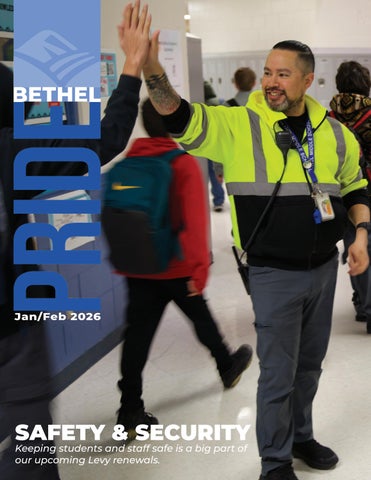
SAFETY & SECURITY
Keeping students and staff safe is a big part of our upcoming Levy renewals.

Jan/Feb 2026
Keeping students and staff safe is a big part of our upcoming Levy renewals.
In 2019, our voters approved a School Construction Bond to build new schools and renovate and expand old ones. Bond funding is kept separate from the rest of the district’s budget, including our levies that need to be renewed every four years. As the saying goes: Bonds are for Building, Levies are for Learning. Learn more at bethelsd.org/bond.
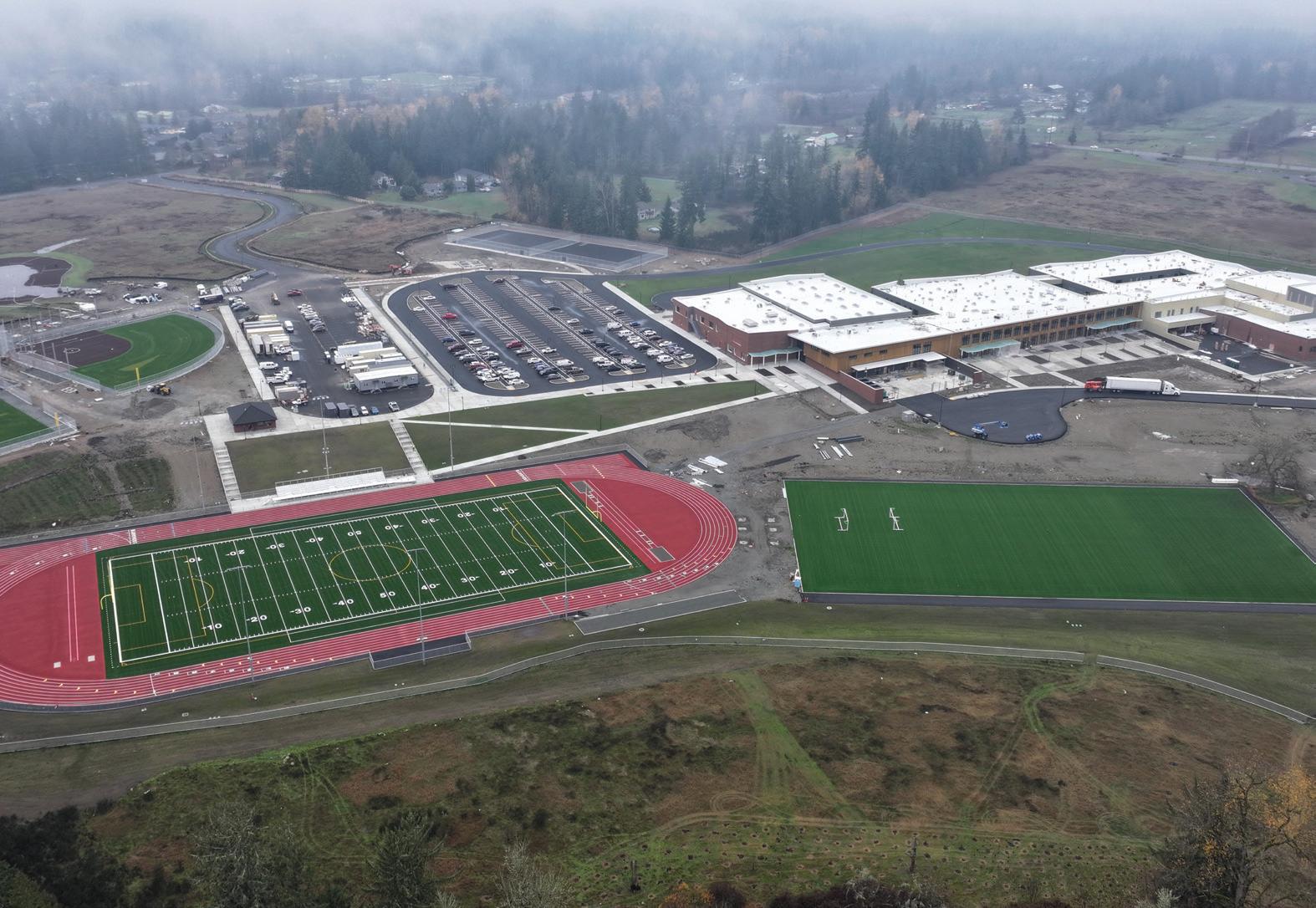
Construction on the new Bethel High School broke ground in 2024 and is scheduled to be completed in 2026. At almost 300,000 square feet, the new Bethel High School is a massive project that is now nearly two-thirds complete.
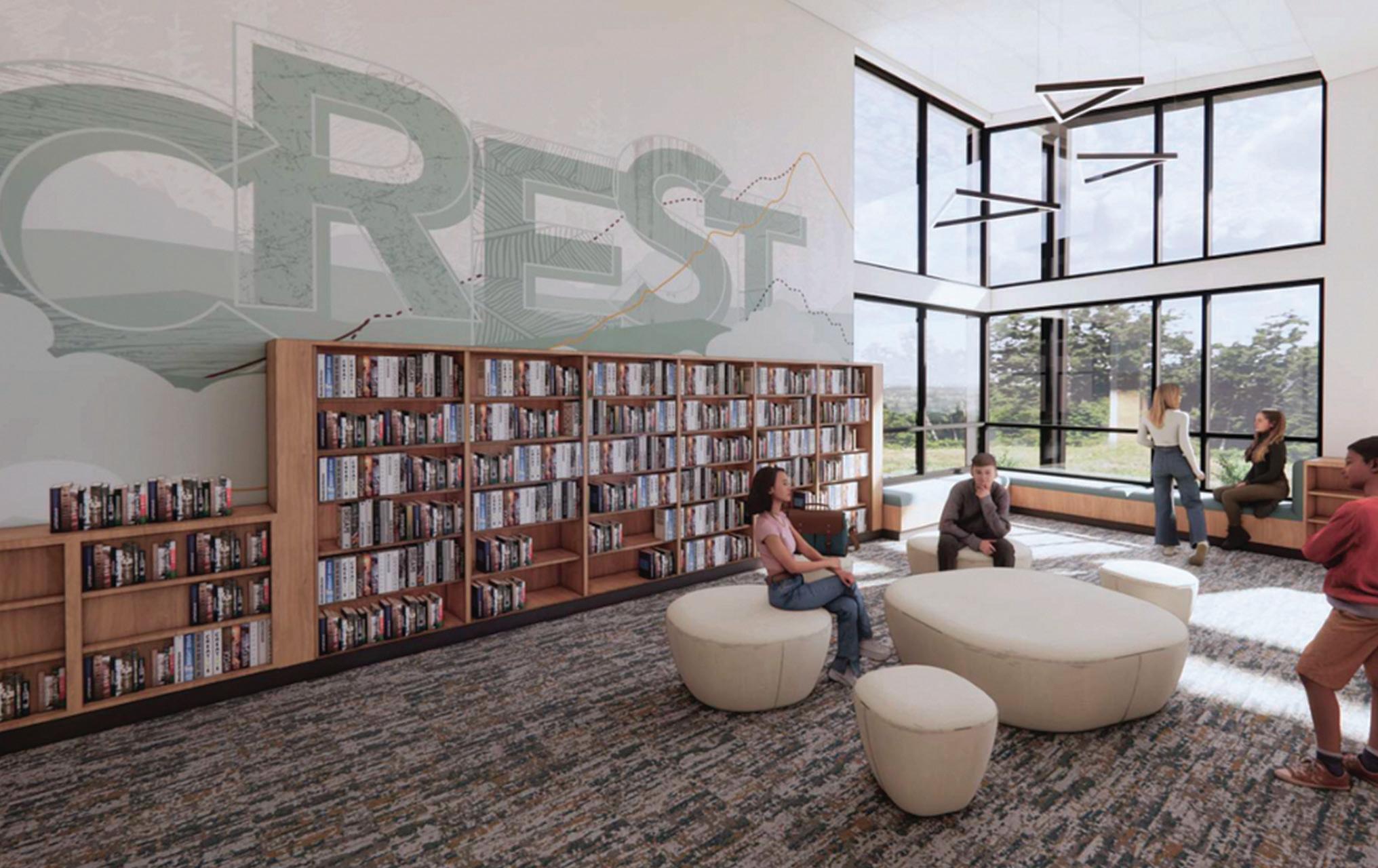
Originally planned as a modernization and expansion under the 2019 Bond, careful planning and additional state funding will now allow for a full rebuild of Cedarcrest Middle School.
The new three-story building will be nearly 123,000 square feet, featuring 39 classrooms and capacity for 850 students, up from the current 700.
Building new schools is one thing. But once they’re built, our teams work hard to keep them in great shape so they can last as long as possible for our students. This past year our teams have completed work on a number of our buildings:
• Bethel High School: Roof Replacement
• Camas Prairie: Portable Repairs
• Graham Elementary: Exterior Paint & Window Replacement
• Graham-Kapowsin High School: Interior Paint
• Kapowsin Elementary: Pavement Repairs
• North Star Elementary: Roof Replacement
• Pioneer Valley Elementary: Flooring Replacement
• Roy Elementary: ADA Access Improvements
In 2006, voters approved a bond that built Liberty Middle, Frederickson Elementary, and Nelson Elementary; rebuilt Spanaway Elementary, Clover Creek Elementary, and Shining Mountain Elementary; expanded Spanaway Middle School; modernized Spanaway Lake High School; built our Central Kitchen and Transportation Center; as well as improvements around the district to technology, safety and security, HVAC, roofing, fields, grounds, parking lots, bus loops, septic systems, cafeterias, and more.
In 2001, voters approved a bond that built GrahamKapowsin High School and Cougar Mountain Middle School, rebuilt Kapowsin Elementary, modernized Thompson Elementary and Spanaway Middle School, acquired sites for future schools, as well as heating/ventilation, safety, roofing and other projects across the district.
The national conversation about public education can be very negative. But that narrative doesn't define us here in Bethel. While others debate what's wrong, we're focused on what's right. That’s why we continue to invest in programs that work and staff who care.
I believe we each have a duty to be ambassadors for our schools and our district. If we don’t talk about the great things happening here for our students, then who will?
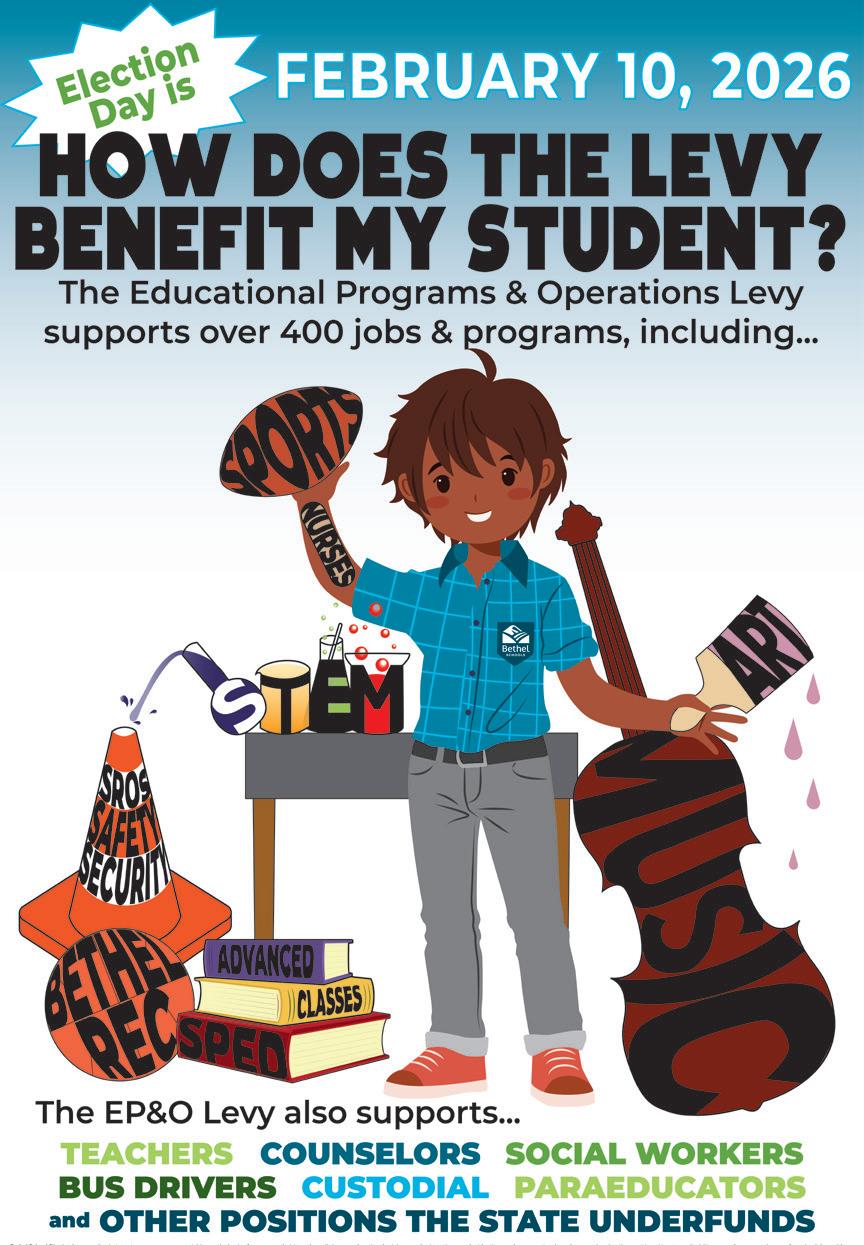
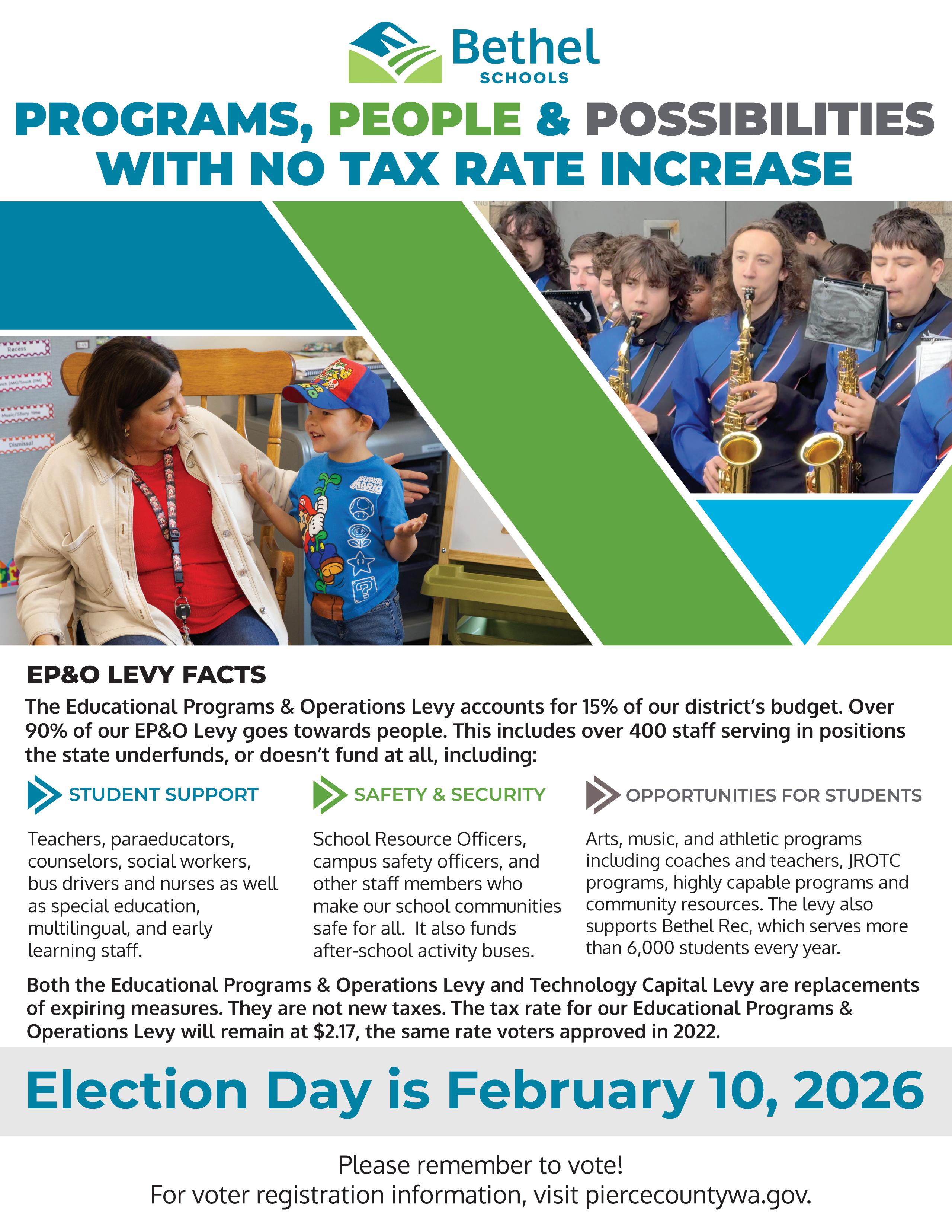
A big part of our success is thanks to our two replacement levies, which will be on the ballot in February. Our Educational Programs & Operations Levy directly supports more than 400 professionals, like teachers, counselors, social workers, nurses, coaches, and support staff. It also funds our arts programs, athletics, school safety officers, and more. These are people and programs who are making a difference for thousands of students every day.
The EP&O Levy accounts for more than 15% of our district's budget, filling critical gaps where state funding falls short. Washington's outdated funding formula simply doesn't cover the staffing levels our students need and deserve.
Alongside that is our Technology Capital Levy that keeps our students safe online with updated devices and cybersecurity updates. Both of these levies are replacements of expiring measures. They are not new taxes. And they maintain the same rates voters approved in 2022.
These levies are local, just like community schools.
Our community schools.
And that’s a story worth telling.
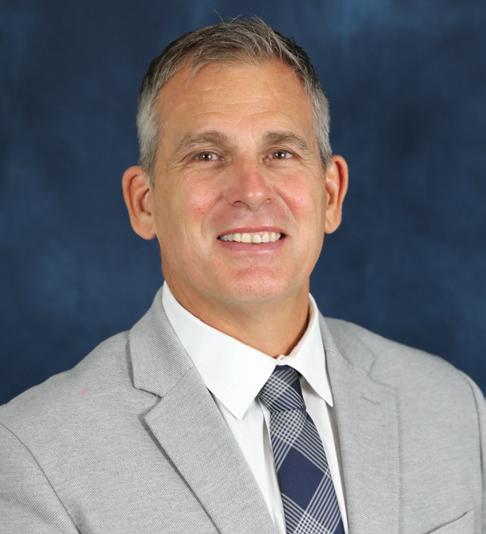
Brian Lowney, Ph.D. Superintendent
With 21,000 students in 202 square miles of unincorporated Pierce County, making sure kids get the best education they deserve is a big job.
To make sure the job is done right, more than 3,000 adults show up to work in Bethel every day. These are teachers, coaches, and support staff. It’s a well known fact that state funding in Washington is based on an outdated funding formula. In fact, all districts in Washington need to employ more teachers and staff than the formula pays for, which is why we use local levies to help supplement the appropriate number of staff and teachers.
Here in Bethel that “appropriate number” is 400 more people than the state funding allows.
These are professionals working
What planning went into these levy renewals?
Our School Board held four public Study Sessions in 2025 to discuss the levies – covering everything from what the levies fund to the potential impact to our taxpayers. You can watch each of the Study Sessions at bethelsd.org/levy.
More than just a "basic
in positions like teachers, coaches, paraeducators, counselors, social workers, School Resource Officers, campus safety officers, custodians, bus drivers, and nurses – just to name a few.
Superintendent Brian Lowney said that’s why our two replacement levies are considered essential funding here in Bethel.
“We would have far fewer than 3,000 caring adults working with kids without the support of our Educational Programs & Operations Levy and our Tech Levy,” he said. “Over 400 fulltime employees are funded by the EP&O Levy, and there are hundreds more that are partially funded with levy dollars.
Athletics are huge here in Bethel, with over 5,000 middle and high school
students participating each year. We also have Bethel Rec, another levy-funded program that annually provides extracurricular sports for more than 6,000 elementary students.
The EP&O Levy also funds arts, orchestra, band, and choir programs, as well as supplementing funds for special education, multilingual, and early learning programs, JROTC, Highly Capable programs, and community resources that support students who are in need or experiencing homelessness. It also pays for after-school activity buses.
“The state would say that none of those are ‘basic education’,” said Lowney. “I tell you that every one of our kids deserve those as ‘basic education.’”
That’s why the levies are important

Is there a tax break for senior citizens or those with disabilities?
Senior citizens and people with disabilities who meet certain income requirements may be exempt from part or all of these local property taxes. To learn more, please see the FAQ at bethelsd.org/ levy.
To be eligible to vote in the February 2026 Special Election, you must be registered to vote. You can register online at https://olvr. votewa.gov/.
Does the lottery help pay for schools?
Other than a small portion that is allocated to the state’s General Fund, none of Washington’s lottery revenue is used for K-12 public education. The state’s lottery revenue helps fund higher education, but not K-12 education.
funding here in Bethel, so students are supported and have opportunities in a corner of the county that doesn’t have many resources.
“That’s what our kids deserve,” said Lowney.
Levies are becoming increasingly important in Washington state.
Since 2019, the percentage of the state’s budget for K-12 education has gone down significantly. In 2019-21 it was 51.6%. From 2025-27 it will be 43.2%.
To “fix” this problem, the state is increasing the amount of money that school districts can ask for in their levies. In planning for our two levy renewals, Lowney and our School Board decided that just because we could ask for more, didn’t mean that
we should.
“We’re not asking the community for the limit of what we could ask them for,” said Lowney. “We’re asking for what we need. And we’re asking for exactly the same rate that they approved in the 2022 election.”
“Even our closest neighbors are suggesting and are running their levies at a higher rate than we’re asking our taxpayers for,” Lowney said. “One of the things we want to do is have consistent tax rates for our voters.”

If I rent a home, can I still vote?
Renters have the same voting rights as homeowners. Voters do not need to own their home or apartment, they just need to be registered to vote.
Do levies require a supermajority to pass?
Unlike bonds, which require a 60% supermajority to pass, levies only require a simple majority of 50%+1 in order to pass.
What's the difference between a bond and a levy?
Levies fund learning and operations: staffing, classroom programs, student services, and daily school functions. Bonds fund construction: new schools, modernizations, and major capital projects. As the saying goes, Levies are for Learning, Bonds are for Building.
How often are the EP&O Levy and Technology Levy voted on?
Every four years, pending School Board approval.
Before the Technology Capital Levy was first approved by voters in 2014, the district piloted many different options for student devices, and iPads came out on top for a variety of reasons. Apple had the biggest educational ecosystem at the time, and the devices were a good size and easy to use for all students.
That investment in iPads is now allowing taxpayers’ levy dollars to go even further.
Chief Technology Officer Mike Christianson said Apple products are efficient and dependable, plus they also have a high resale value. That’s important when devices need to be replaced every three to four years.
“So instead of a Chromebook, that after four years the device is either given away, or sold for $5 or even paid to dispose of at times, we’re receiving about a third of the value of the original purchase price.”
With 21,000 devices being replaced, that means millions of dollars are being brought back into the district, stretching those Tech Levy dollars as far as possible.
Those devices are also setting students up for success in the future. We all know technology is here to stay, but that doesn’t mean it’s tech time from the start of the school day to the final bell.
“Obviously we’re not on our iPads all day,” said Liberty Middle School teacher Melissa Heltsley. “But when we do need them, they are so effective in developing our students into the
future leaders we want to see in this world.”
Heltsley was one of the original pilot teachers who test drove those iPads more than a decade ago. “Before that, I remember how challenging it was to plan for research for all of our various topics we cover, and how I had to sign up to use the computer lab, and the kids only got one day, and it was very complex,” she said.
Now with iPads in the classroom, research is instantly at students' fingertips, and they can work on increasingly creative, complex projects.
When students are using their devices, Christianson said we need to ensure they stay safe online. That’s why cybersecurity is another big ticket item the Tech Levy pays for. Even something as simple as two-factor authentication has a cost associated with it. Christianson said with over 3,000 staff and 21,000 students, the free version of a security software isn’t going to cut it. The Tech Levy allows us to ensure the security technology is
scalable to our needs, and that it can be managed and support our users well.
Another thing the Tech Levy funds is digital storage. That may seem like a strange item, but it’s also security related.
At all of our schools and on our buses we have security cameras. The video captured needs to be stored for a certain amount of time. “Our ability to do that relies on how much storage capacity we have in our data center,” said Christianson. “We actually have a petabyte at this point.” A petabyte is one million gigabytes. “It’s a lot, and that is expensive.”
That’s all thanks to the Technology Capital Levy, which will be on the ballot alongside our Educational Programs & Operations Levy on February 10, 2026. Both levies are at the same tax rates that voters approved in 2022.
For the Tech Levy, that means it will remain at $0.31 per $1,000 of assessed value.


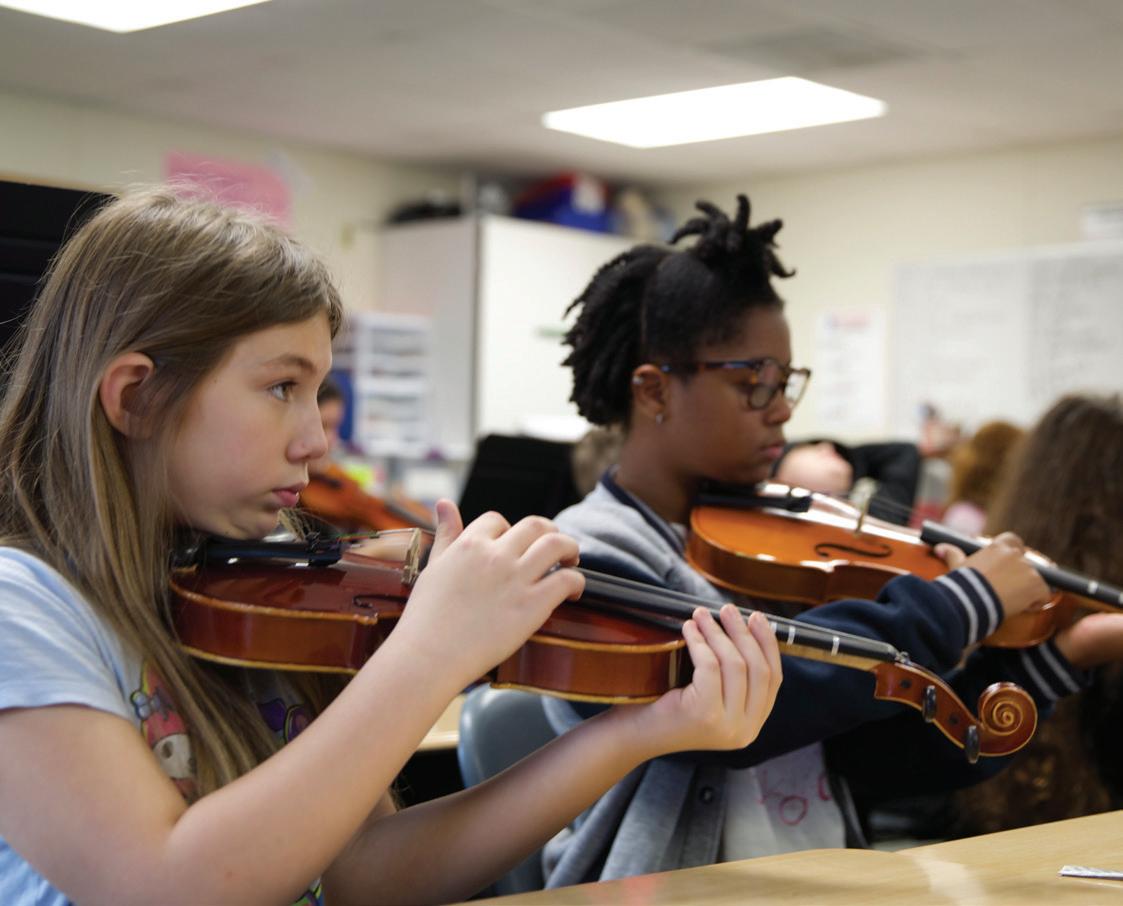
Every song, brushstroke, and dramatic performance produced in our classrooms is a testament to what’s possible when communities invest in the arts.
Across the district, the Educational Programs & Operations (EP&O) Levy helps keep that creativity alive. The levy supports teachers, materials, and opportunities that make art and music a part of every student’s education.
“The levy is the backbone supporting these programs,” said Mike Saccomanno, our Director of Teaching & Learning for Arts & Curriculum Integration. “And these programs aren’t extra. They’re really what makes a full, rich, well-rounded education.”
In Bethel, every student takes music and art. From kindergarten classrooms filled with watercolor palettes to high school stages alive with performance, the arts help students connect, collaborate, and express themselves in ways that reach far beyond a grade or report card.
and arts programs,” Saccomanno said. He said one of the most powerful parts of arts education is the way it creates connection.
“That sense of belonging we’re all striving for with all of our social-emotional programs is really embodied in music education,” he said. “There’s
academics, too. Students who study the arts often perform better in other subjects because creativity and critical thinking overlap.
“Music is a math,” Saccomanno explained. “You look at a time signature and it’s just a fraction, rhythms are just subdivisions of a beat, looking at a musical score is equivalent to looking at a scientific graph or data, a lot of the singing is in different languages.”

For many students, those skills lead to college scholarships or future careers in creative fields. For others, the arts simply spark a lifelong appreciation for expression and teamwork.
“The research is pretty clear about the multitude of benefits students receive through participation in these music
a term in music education you hear a lot – it’s called ensemble. It’s bringing a group of people together – unique voices, unique talents – and together creating something they can’t create alone.”
That sense of unity strengthens
Each year, our schools host concerts, exhibitions, and festivals that showcase student talent and welcome families and neighbors to share in the celebration.
“Our schools are just alive with these programs throughout the year and they’re open to the community,” Saccomanno said. “That’s what we do – we create art to share with others.”

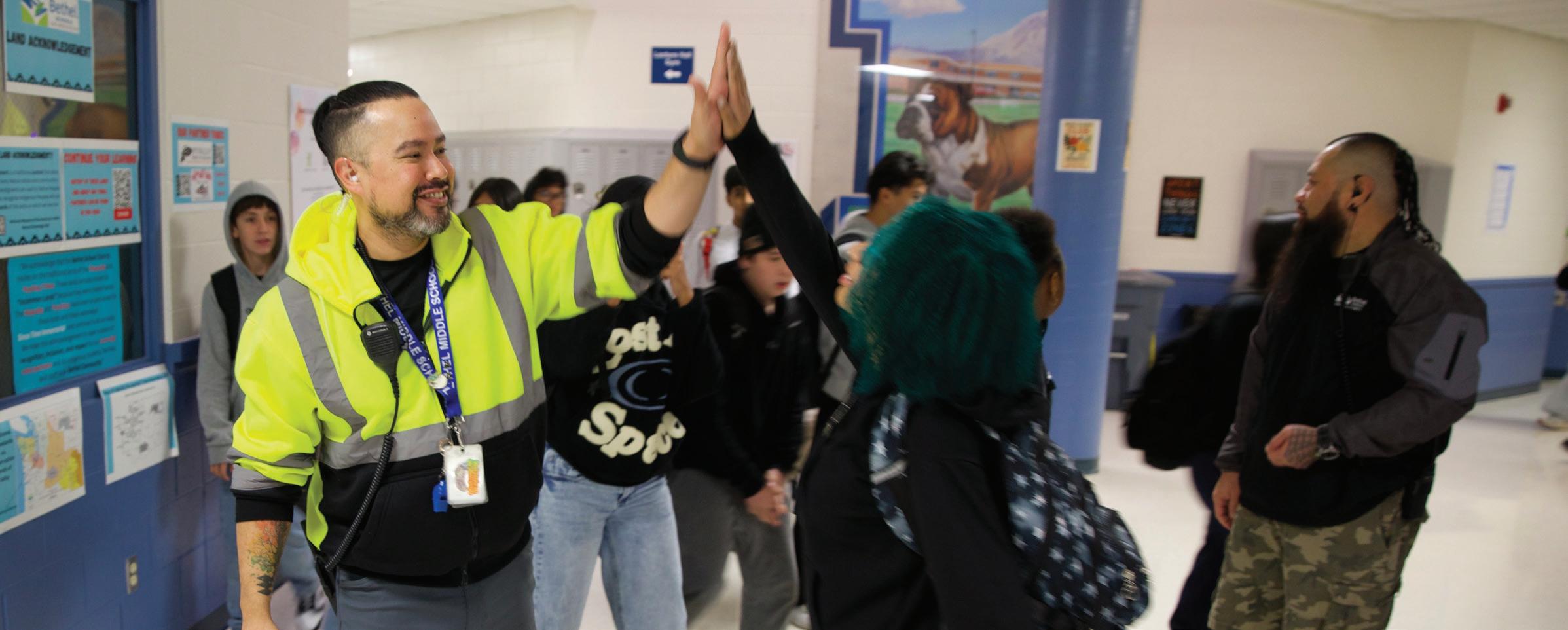
Our district's commitment to student safety goes far beyond cameras and protocols. It starts with trusted adults who students feel comfortable turning to.
Bethel Middle School Campus Safety Officer Tua Aiono and MTSS/Student Supervision lead Alberto Rodriguez are two of those people, working sideby-side to make sure every student feels protected, supported, and seen.
For them, safety begins with presence. Their team monitors hallways, classrooms, and common areas, making sure students are where they need to be and stepping in early when something doesn’t look right. Their mindset is focused: everything starts with students being safe.
Both Aiono and Rodriguez emphasize that true safety can’t exist without trust. Students need to know the adults around them are listening, not just enforcing rules. Rodriguez sees
that dynamic unfold every day.
“If these kids don’t trust you and see you as someone who’s just going to get mad and yell and not listen, they won’t be comfortable and they’ll just shut down. Then, if there’s an issue with them, they’ll have a wall built up and won’t ever open up to us,” he said.
That trust transforms their office into a place where students feel safe enough to let their guard down.
“We’ll have students – the toughest kids in the school – will come into our office and just break down," Aiono said. "We always tell them this is a safe space and they’re free to talk about whatever they need to talk about.”
Their work also extends into emergency readiness. Both staff members train regularly with School Resource Officers, participate in districtwide drills, and practice
lockdown procedures. Rodriguez explained the importance of that preparation clearly.
“In the case anything actually happens, we’re prepared, we’re trained, we know what to do, we know how to follow the policy and make sure everyone is safe.”
Much of this work – along with the systems, staffing, and training that support it – is funded through the district’s Educational Programs & Operations (EP&O) Levy. These resources help ensure schools have the personnel and tools needed to keep students safe every day.
For both men, the job is personal. Rodriguez spent eight years as a stayat-home dad before joining the school. His son attended Bethel Middle, and the schedule and school environment felt right for his family. Aiono came to the role for one reason: the kids. He wants to be someone they can count on.
In the heart of the Pacific Northwest, where aerospace giants and innovative manufacturers shape the economic landscape, students are discovering that their path to a successful career doesn’t necessarily require a traditional four-year college degree. In fact, some of them are graduating high school and stepping right into high-paid careers.
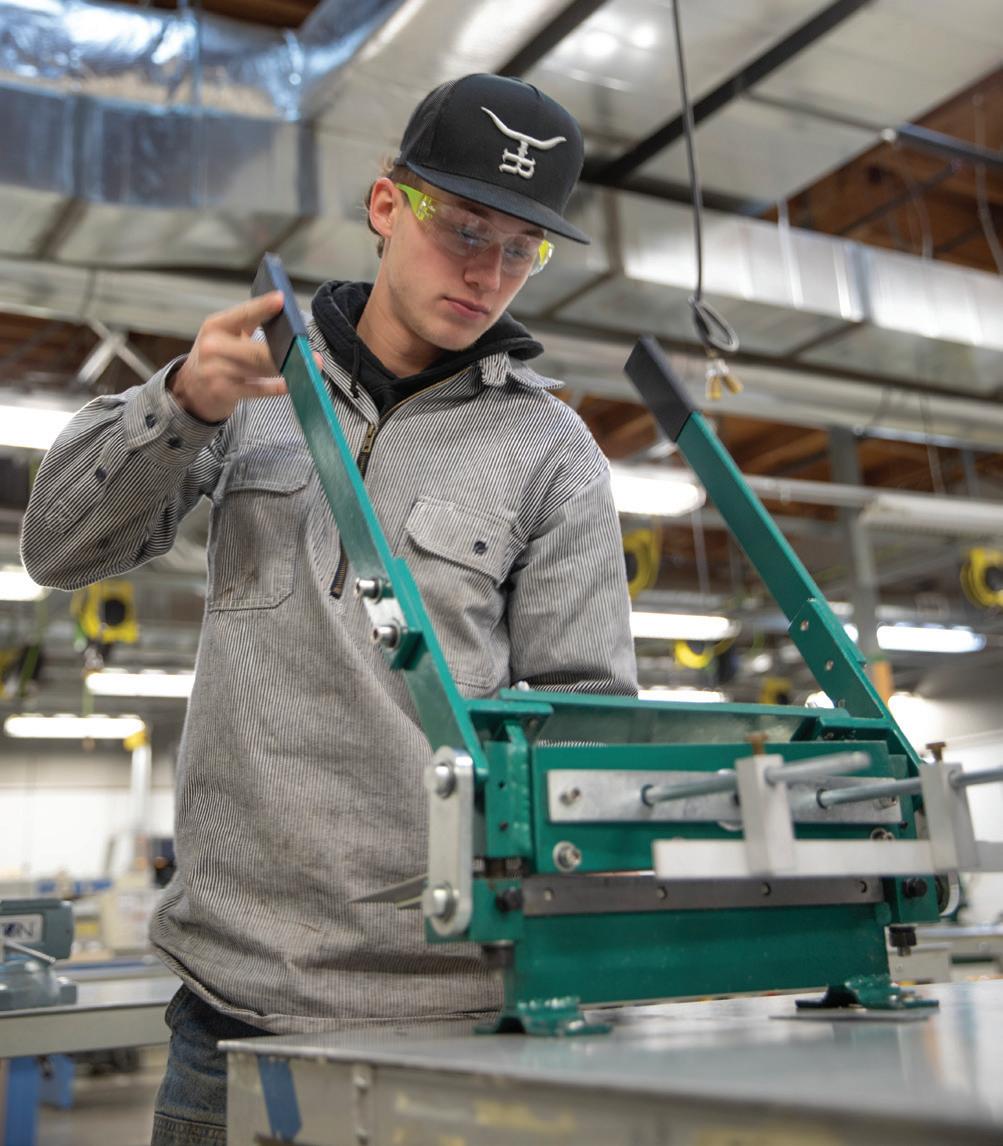
The Pierce County Skills Center’s machining class is one such avenue, because this is far more than your typical shop class. Students not only dive deep into machining and fabrication, they learn Computer-Aided Design (CAD), work with sheet metal, explore 3D printing technologies, and develop welding expertise. These aren't just random skills. Students are getting a foundational skill set that employers desperately need, that can launch them directly into entry-level positions with room to grow.
Waylon is a senior at Eatonville High School who attends PCSC. He said not only are they learning those individual skills, but they’re putting them together to create some pretty incredible class projects. "We use riveting, we practice blueprinting, we 3D print, we bend sheet metal, we cut the sheet metal to size working with dial calipers," he said. "At your home school, you can do a lot there. But the Skills Center just gives you so much more opportunity, and it gives you real life work skills, and it really just sets you up for total success out of the gate."
The machining class used to be aerospace-focused. But it’s grown over the years, broadening opportunities
for students. "We know Boeing is a big part of our world here in the Pacific Northwest. But there are plenty of other industries that manufacturing supports, from medical to automotive," said Evan Thomas, the machining instructor at PCSC. "We're lucky to be part of what they call the Boeing PreEmployment Training Program," he said. The results of that speak for themselves. Students are skipping the traditional application process entirely. "They are going into Boeing with an automatic job offer."
Partnerships like that don’t happen by accident. The Skills Center’s strong industry connections have been a labor of love ever since it opened its doors in 2010. Now serving 10 Pierce County school districts, PCSC leverages those partnerships to ensure that students graduate with credentials that employers will recognize and value.
The commitment to authentic learning extends beyond the classroom through work-based opportunities. Second-year students in the machining class work in local machine shops three days a week, gaining valuable real-world experience while still in high school. Thomas described this arrangement as, "essentially a Running Start for manufacturing.”
Where traditional Running Start students can graduate high school with an Associate’s Degree in hand, with machining, "You'll have students that will graduate with a journey level card and be a journey level machinist making upwards of $35-45 an hour."
At a time when young people face uncertain economic prospects and mounting educational debt, the Pierce County Skills Center is showing what’s possible when education aligns closely with industry needs and student aspirations. By providing comprehensive technical training, fostering industry partnerships, and providing opportunities for immediate employment, the PCSC creates a winwin situation for students, employers, and our community.


Every school day starts with an important promise to our families: Your students will get to school safely and on time, ready to learn.
For our Transportation Department, that promise now comes with new technology that makes bus routes easier and safer. This year, Bethel launched its first districtwide digital navigation system. Each bus driver now has a tablet that gives real-time, turn-by-turn directions.
This upgrade has been in the works for years. Transportation Director John West said the change began when the department saw a clear need for better tools. They wanted to make routes more efficient, improve safety, and support drivers and students with updated technology.
“How did we get here? Quite simple actually, a need was identified to support our students and staff by increasing efficiency through modernization,” he said. “After that you just have all the other stuff.”
That “other stuff” took a lot of work. The district had to install new equipment on 220 buses, connect software systems, protect student information, and train staff on how to use everything.
“This is a tool, and like most tools, calibration is necessary to ensure effectiveness,” West said. “Try planning for a new school year and integrating a brand-new system right before the start. Coordination and attention to detail were a must.”
Now that the system is running,
drivers can see directions on their tablets, get rerouted around accidents, and receive updates from dispatch instantly. This is especially helpful for new drivers or substitutes who don’t know the routes yet. The tablets also show the list of students on each run, helping drivers learn names, remember stops, and build stronger connections with students.
One of the most helpful features is the ability to send new assignments straight to drivers while they’re already on the road. If a route has no driver, dispatch can reassign it right away. The bus driver doesn’t have to return to the hub or pick up new printed sheets. This helps buses stay on time and reduces the chances of a route being late or canceled.
have real-time updates of who’s on our bus.”
The new system also makes our buses safer. Some buses are testing a new system where students can check themselves on and off the bus using the tablet. This gives the Transportation Department real-time information about who is riding the bus.
“It’s a huge step forward,” West said. “We used to have student lists on clipboards, but it didn’t allow any fluid tracking of students who go on and off the bus. So this way we’re able to
Students enjoy using the new system, and it helps them feel more confident and responsible. West said it’s exciting to watch students learn the process and use it independently.
In recent years, districtwide technology improvements supported by the Technology Capital Levy have helped modernize Bethel’s systems. These investments created the foundation that made it possible to bring new tools like this navigation system to our buses.

Bethel Pride is produced by the Bethel School District’s Communications Department.
Bethel Schools
516 176th Street East, Spanaway, WA 98387
Phone: 253.800.2000
Email: communications@bethelsd.org Website: bethelsd.org
TheBethelPrideisintendedtoinformthecommunityatlargeaboutgoingsoninthedistrict.Because weusebulkmailing,individualaddressescannotberemovedfromthemailinglist.
Bethel School District does not discriminate in any programs or activities on the basis of sex, race,
homelessness, immigration or citizenship status, disability, neurodivergence, the use of

age, and honorably discharged veteran or military status and provides equal access to the Boy Scouts and other designated youth groups. The following employees have been designated to handle questions and complaints of alleged discrimination: Civil Rights Compliance / Gender-Inclusive Schools Coordinator, Debbie Carlman, dcarlman@bethelsd.org, 253.800.2019; Title IX Coordinator, Mel Boyd, mboyd@bethelsd.org, 253.800.2029; and 504 Coordinator, Melissa Munson-Merritt, mmunsonmer@bethelsd. org, 253.800.2301. All individuals may be reached at this address: 516 176th Street East, Spanaway, WA 98387. Title IX inquiries may also be directed toward the U.S. Department of Education, Office for Civil Rights (OCR). Information about the nondiscrimination and sex-based discrimination policies and grievance procedures, and how to report a concern or complaint: bethelsd.org.
El Distrito Escolar de Bethel no discrimina en sus programas ni actividades por motivos de sexo, raza, etnia, color, religión, credo, nacionalidad, orientación sexual, expresión o identidad de género, falta de hogar, estatus migratorio o de ciudadanía, discapacidad, neurodiversidad, uso de perro guía entrenado o animal de servicio, edad, condición de veterano o militar con baja honorable. Asimismo, ofrece igualdad de acceso a los Boy Scouts y a otros grupos juveniles especificados. Los siguientes empleados han sido designados para atender consultas y quejas de supuesta discriminación: Cumplimiento de los Derechos Civiles/ Coordinadora Escolar de Inclusión de Género, Debbie Carlman, dcarlman@bethelsd.org, 253.800.2019; Coordinador del Título IX, Mel Boyd, mboyd@bethelsd.org, 253.800.2029; y Coordinadora 504, Melissa Munson-Merritt, mmunsonmer@bethelsd.org, 253.800.2301. Todas las personas pueden ser localizadas en esta dirección 516 176th Street East, Spanaway, WA 98387. Las consultas sobre el Título IX también pueden dirigirse a la Oficina de Derechos Civiles (OCR) del Departamento de Educación de los Estados Unidos. Para más información sobre las políticas de no discriminación y discriminación por razón de sexo, los procedimientos de reclamación, y sobre cómo comunicar una preocupación o queja visite: www.bethelsd.org