



Please come to the event having undertaken the following:
Prepare
▪ Bring a copy of your reflective task from the ‘Ethical Principles and Behaviours’ online course.
▪ Bring a copy of your completed leadership development record (LDR) cycle 1.
▪ Bring a copy of your leadership development record (LDR) cycle 2.
▪ Complete the pre-event task and resource below.
Consider your own school or academy. Use the table below to begin to analyse its current culture.
▪ Overall, how would you describe the culture in your school or academy?
▪ If you shared your description with the most junior member of staff in your school, are you confident they would share your view?
▪ What would other staff say?
▪ What would you change as a priority to refine the current culture in your school or academy? Why – what difference will this make?
Additional questions for international school candidates
▪ Would locally trained and expat staff have similar views?
Symbols How are visible symbols and signs used to project a culture?
Norms What agreed social behaviours exist?
Assumptions What are the assumptions underpinning your school’s culture? How do staff experience reward and/or recognition in your school?
Stories What stories does the organisation tell about itself? Who are the heroes and villains?
Rituals and routines What happens when?
Organisational structure How is the school organised? Who is accountable to whom?
Control systems What systems and processes of control are in place? What rules and regulations?
Power structures How are responsibilities organised? Who are the gatekeepers and influencers?
Christopher Day, Pam Sammons and Kristine Gorgen (2020). Successful school leadership. Education Development Trust https://files.eric.ed.gov/fulltext/ED614324.pdf
Sam Baars, Bart Shaw, Ellie Mulcahy and Loic Menzies (2018). School cultures and practices: Supporting the attainment of disadvantaged pupils; A qualitative comparison of London and non-London schools. Research report LKMcoBarr https://www.gov.uk/government/publications/school-culture-and-practice-supportingdisadvantaged-pupils
Education Endowment Foundation (2019). Toolkit: Improving behaviour in schools. https://d2tic4wvo1iusb.cloudfront.net/production/eef-guidancereports/behaviour/EEF_Improving_behaviour_in_schools_Report.pdf?v=1688472942
OECD (2015) Do teacher-student relations affect students’ well-being at school? PISA in Focus, 50 https://doi.org/10.1787/5js391zxjjf1-en
Education Endowment Foundation (2018) Toolkit: Social and emotional learning. https://educationendowmentfoundation.org.uk/evidence-summaries/teaching-learning-toolkit/social-andemotional-learning/
Cordingley, P., Higgins, S., Greany, T., Crisp, B., Araviaki, E., Coe, R. & Johns, P. (2020). Developing great leadership of continuing professional development and learning. http://www.curee.co.uk/node/5200
Education Endowment Foundation (2021). Effective professional development. https://educationendowmentfoundation.org.uk/education-evidence/guidance-reports/effective-professionaldevelopment
‘Learn that’ ‘Learn how to’
1.1. High-quality teaching has a long-term positive effect on pupils’ life chances, particularly for children from disadvantaged backgrounds.
1.2. Teacher expectations can affect pupil outcomes; setting goals that challenge and stretch pupils is essential
1.4. Teachers have the ability to affect and improve the wellbeing, motivation and behaviour of their pupils.
1.5. Teachers are key role models, who can influence the attitudes, values and behaviours of their pupils.
1.7. A culture of mutual trust and respect between colleagues fosters effective relationships and supportive professional environments.
1.8. Building alignment of staff around the intended school culture can create coherence in a school and give direction and purpose to the staff’s work teaching pupils.
‘Learn that’ ‘Learn how to’
4.1. While classroom-level strategies have a big impact on pupil behaviour, consistency and coherence at a whole school level are paramount.
4.2. Whole school changes usually take longer to embed than individually tailored or singleclassroom approaches however, behaviour programmes are more likely to have an impact on attainment outcomes if implemented at a whole school level.
Support the development of a positive, predictable and safe environment for pupils, including by:
4.a. Contributing to the creation and consistent implementation of a whole school approach to recognition, rules and sanctions that is predictable and built on good relationships between pupils and staff, complements the intended school culture and includes a clear approach to escalation of behaviour incidents.
4.11. The ability to self-regulate one’s emotions affects pupils’ ability to learn, success in school and future lives.
4.12. Building effective relationships is easier when pupils believe that their feelings will be considered and understood.
4.13. Pupils are motivated by intrinsic factors (related to their identity and values) and extrinsic factors (related to reward).
4.14. Pupils’ investment in learning is also driven by their prior experiences and perceptions of success and failure.
6.1. Helping teachers improve through evidencebased professional development that is explicitly focused on improving classroom teaching can be a cost-effective way to improve pupils’ academic outcomes when compared with other interventions, and can narrow the disadvantage attainment gap.
6.6. The content of professional development programmes should be based on the best available evidence on effective pedagogies and classroom interventions, and aim to enhance capabilities and understanding in order to improve pupil outcomes.
6.9. Teaching quality is a crucial factor in raising pupil attainment.
6.11. Teacher developers should choose approaches that suit the aims and context of their professional development programme. Successful models have included regular, expertled conversations about classroom practice, teacher development groups, and structured interventions. However, these activities do not work in all circumstances and the model should fit the educational aims, content and context of the programme.
Ensure colleagues take part in effective professional development, including by:
6.a. Supporting school leaders to align professional development with wider school improvement priorities.
6.c. Supporting teachers across the school to plan, test and implement new, evidence-informed ideas.
6.f. Supporting school leaders to identify teachers needs and make reasonable adjustments to professional development (e.g. to content, resources and venue).
Use this sheet to capture your thoughts and comments to support your feedback to colleagues.
Your leadership learning:
Specify which content areas and ‘learn that’ and/or ‘learn how to’ statements have moved your understanding on. Which research has had the most impact on your learning and leadership, and why?
(Use your understanding identified at the end of the ‘Ethical Principles and Behaviours’ short course.)
How have you applied your understanding and what impact has it had on:
a) your leadership?
b) school practice?
What behaviours have you demonstrated and how have these had an impact on your leadership?
Refer to your leadership development record review, where you have considered two or three behaviours.
What areas from ‘Ethical Principles and Behaviours’ do you need to continue to work on and develop? How will you address these?
Revisit your leadership development record review of the ‘Ethical Principles and Behaviours’ cycle to support this.
Area Research findings
Strategic direction Culture is notably positive; leaders and staff share common motivations and believe that they are able to have a positive impact on pupils’ outcomes.
High levels of shared staff purpose
Staff expectation
Hold particularly high expectations that tend to have a more tangible influence on teacher practice
RAG Implications for practice/Actions needed
Respond positively to pupils’ aspirational goals and clearly structure their practice around them
Have conviction that practices were enough to ‘make a difference’ with disadvantaged pupils
Celebrate pupil success and achievements at every opportunity, building such celebrations into their weekly timetable and actively including parents
Effective teaching and learning
Extensive use of extra-curricular opportunities for philosophy, oracy and debating
Tailor teaching to individual pupils, such as by setting more challenging work for pupils who are progressing well
Use pupils’ more idealistic aspirations (such as to become footballers or astronauts) as a ‘hook’ for other aspirations, rather than seeing them as problematic
Behaviour and attendance
Day-to-day systems used for managing behaviour and attendance
Relationships
Believe unanimously that behaviour management systems worked effectively, or that the school has the capacity to resolve persistent behaviour problems
Engender particularly positive relationships between staff, parents and pupils
High morale amongst staff, driven by team relationships and positive relationships with pupils
Believe that are able to shift parents’ aspirations and expectations of their children
Professional development Hiring newly qualified teachers (NQTs) as a positive opportunity
Emphasise the importance of supporting teachers’ career development, regardless of any potential impact on retention
Adapted from the findings of Sam Baars, Bart Shaw, Ellie Mulcahy and Loic Menzies (2018). School cultures and practices: Supporting the attainment of disadvantaged pupils; A qualitative comparison of London and non-London schools. Research report. LKMcoBarr.
https://d2tic4wvo1iusb.cloudfront.net/eef-guidance-reports/behaviour/EEF_Improving_behaviour_in_schools_Summary.pdf?v=1635355216
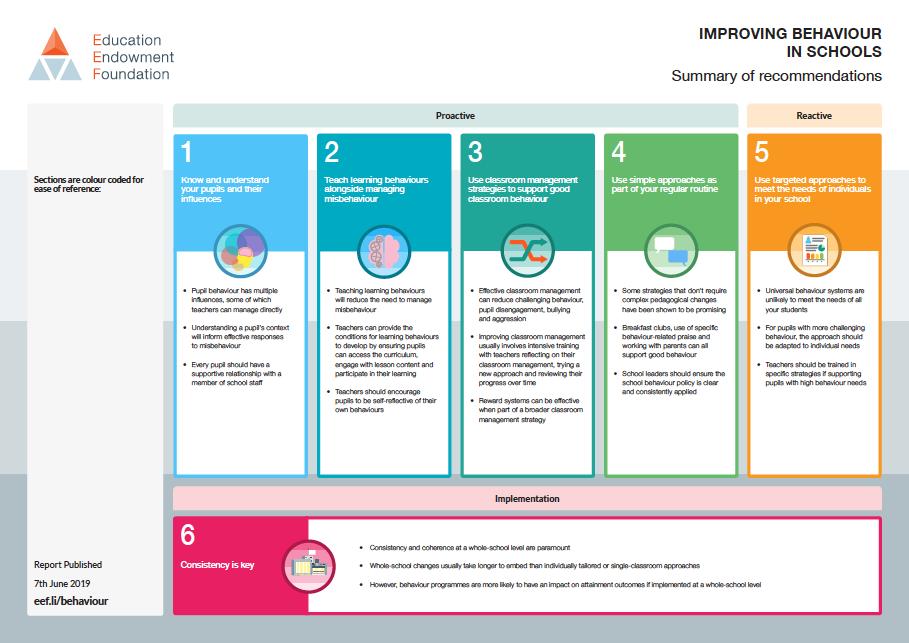
Appendix 1, in Education Endowment Foundation (2019). Toolkit: Improving behaviour in schools. https://d2tic4wvo1iusb.cloudfront.net/production/eef-guidancereports/behaviour/EEF_Improving_behaviour_in_schools_Report.pdf?v=1688472942
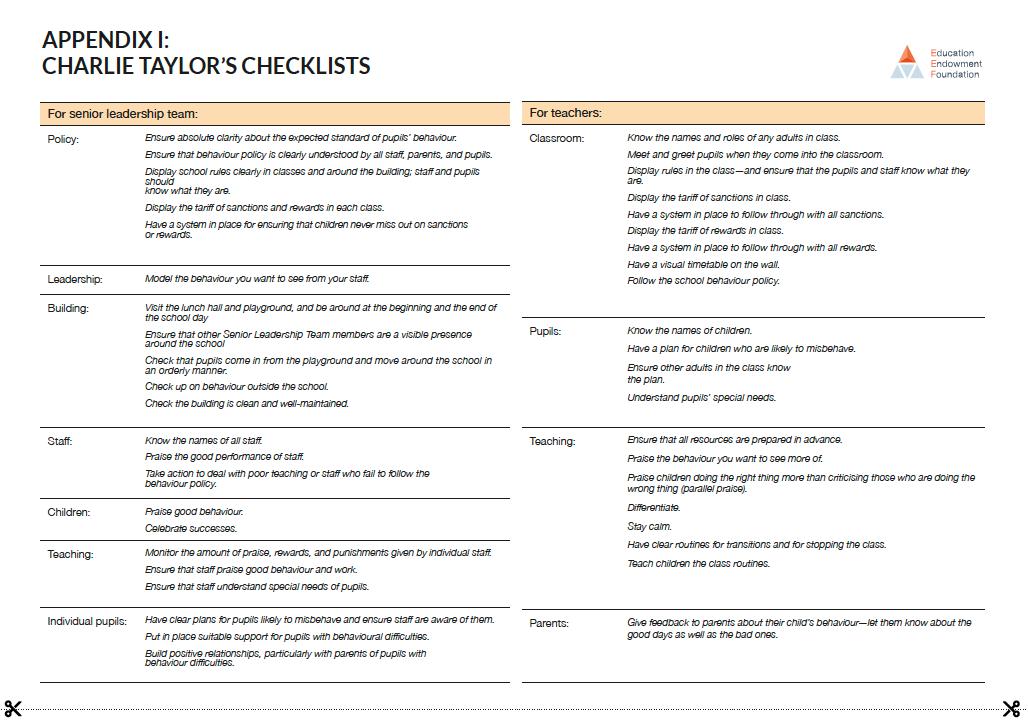
Appendix 2, in Education Endowment Foundation (2019). Toolkit: Improving behaviour in schools. https://d2tic4wvo1iusb.cloudfront.net/production/eef-guidancereports/behaviour/EEF_Improving_behaviour_in_schools_Report.pdf?v=1688472942
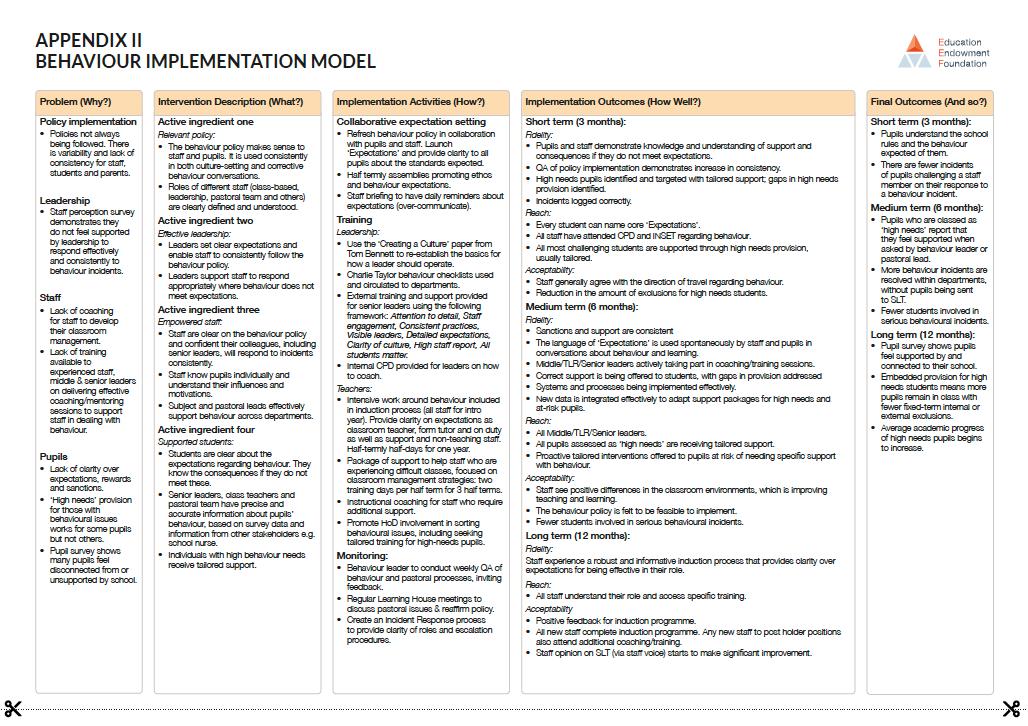
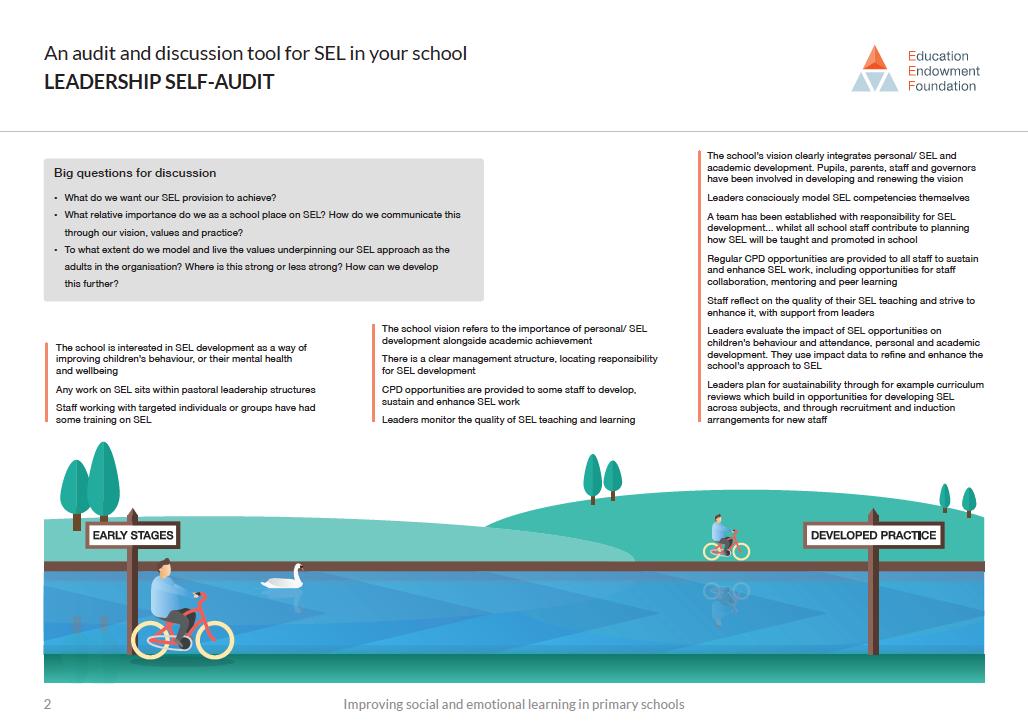
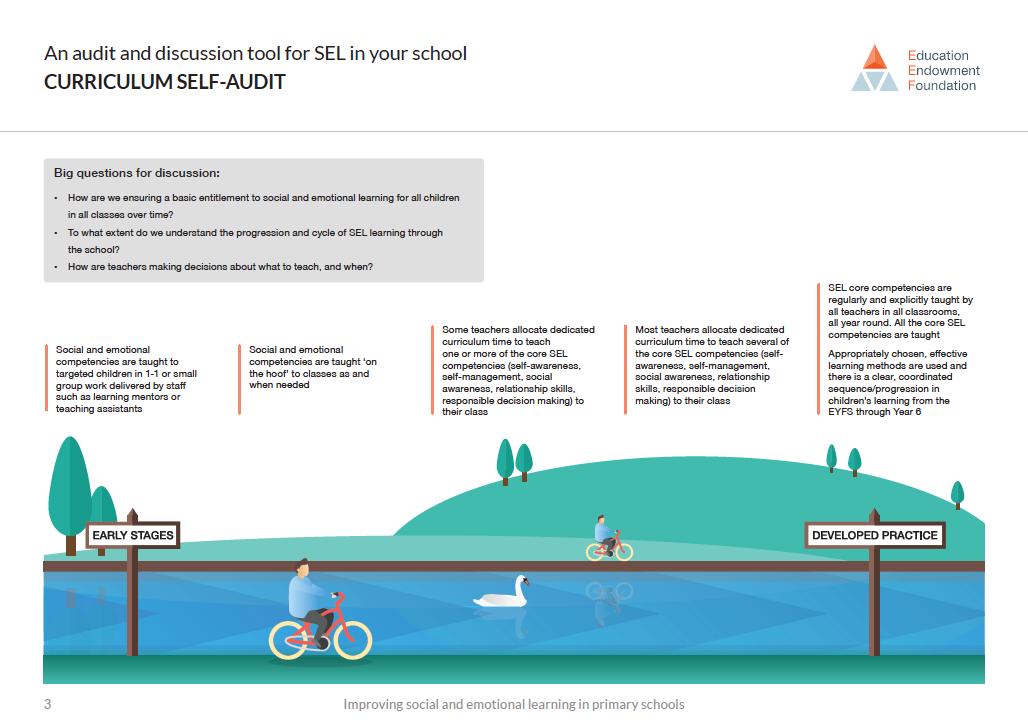
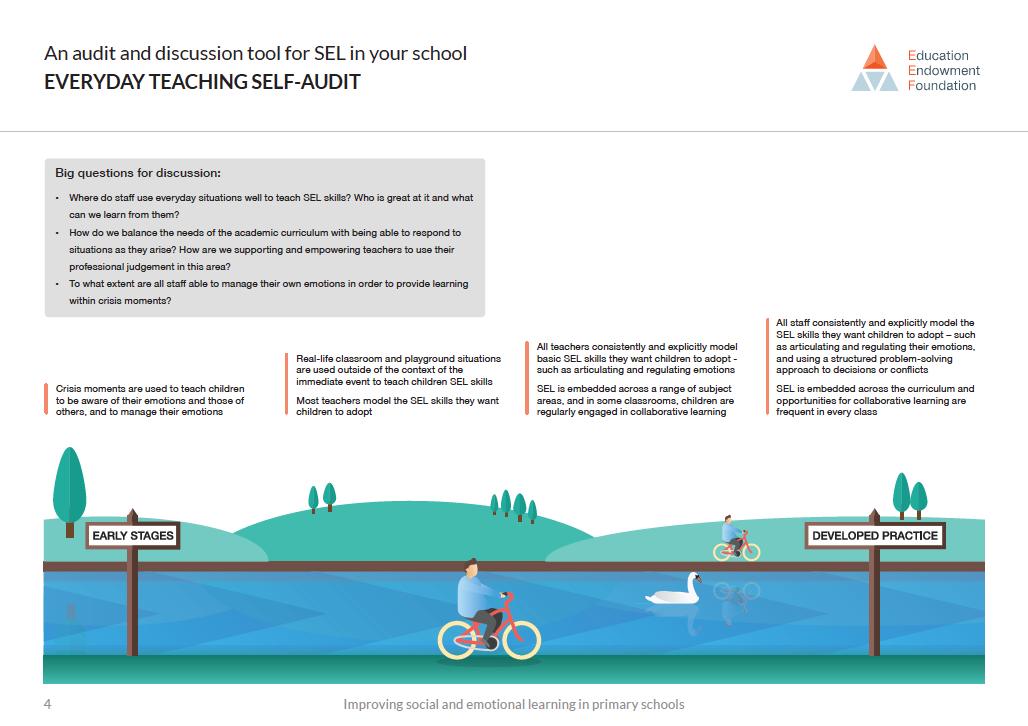
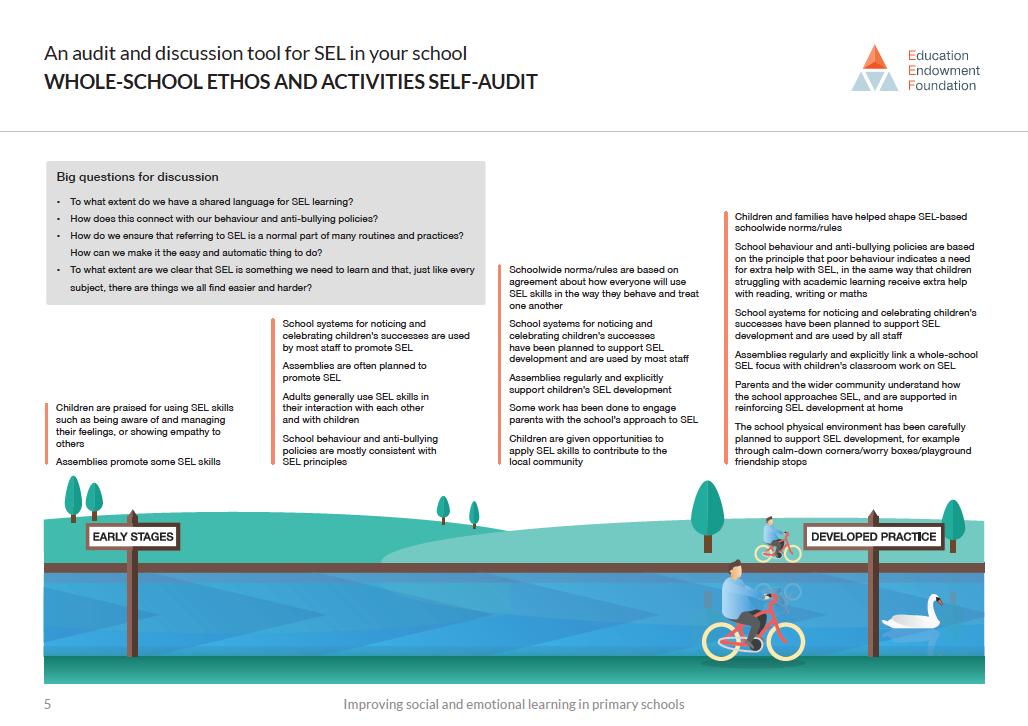
https://d2tic4wvo1iusb.cloudfront.net/eef-guidance-reports/primary-sel/EEF_SEL_Summary_of_recommendations_poster.pdf?v=1675337384
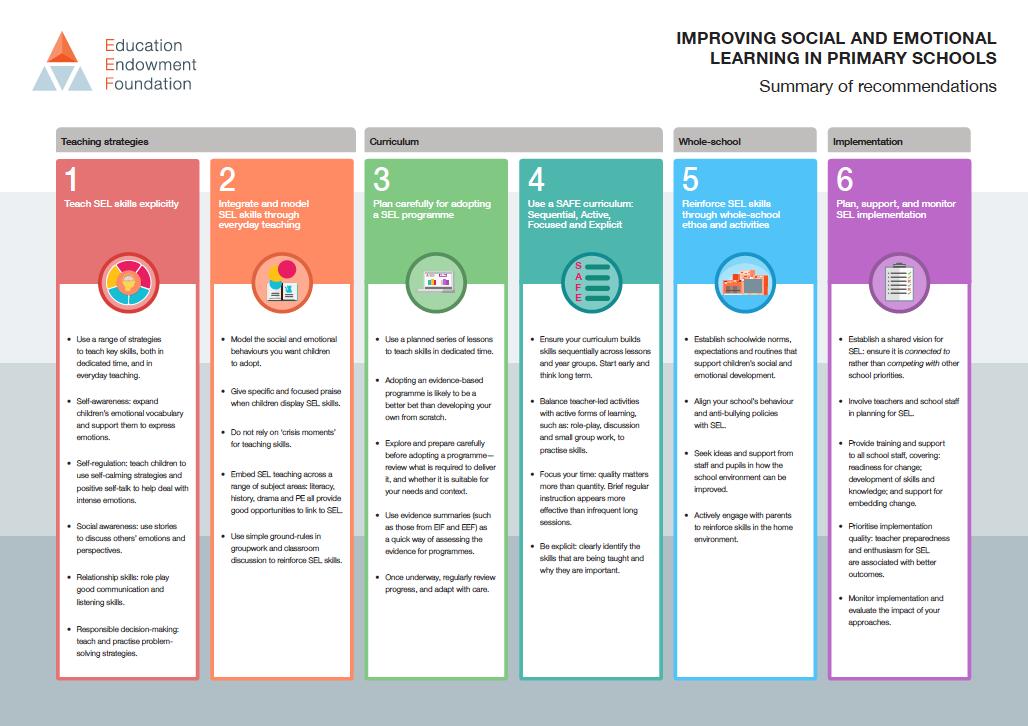
https://d2tic4wvo1iusb.cloudfront.net/eef-guidance-reports/primary-sel/EEF_SEL_Audit_Tool.pdf?v=1675337388
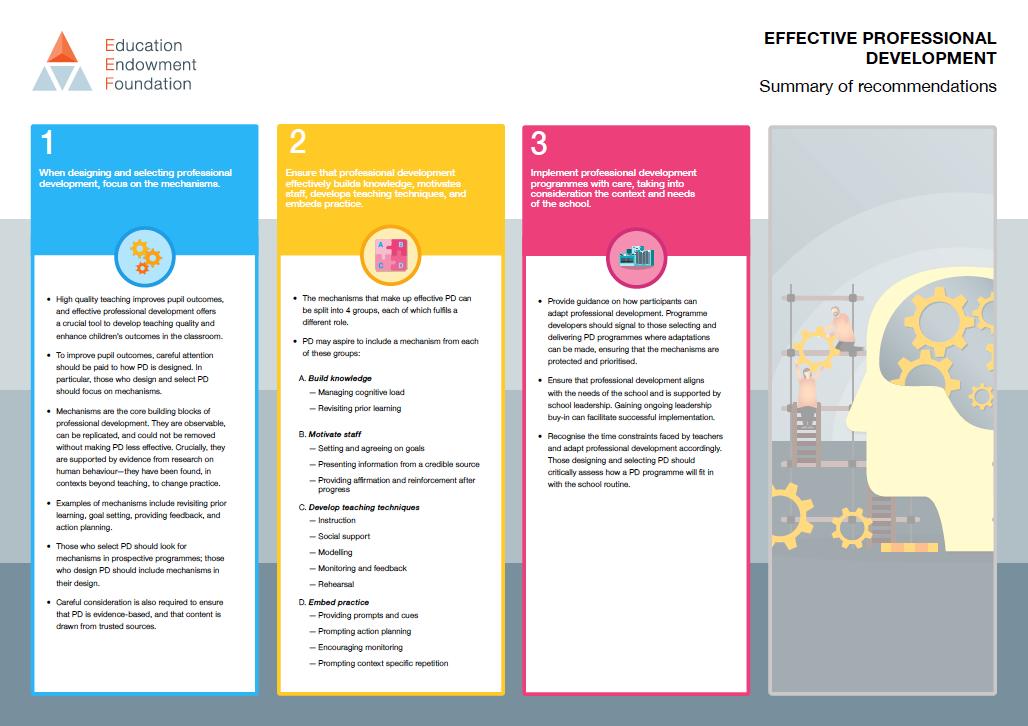
https://d2tic4wvo1iusb.cloudfront.net/eef-guidance-reports/effective-professional-development/EEF-Effective-PD-Recommendations-Poster.pdf?v=1675337510
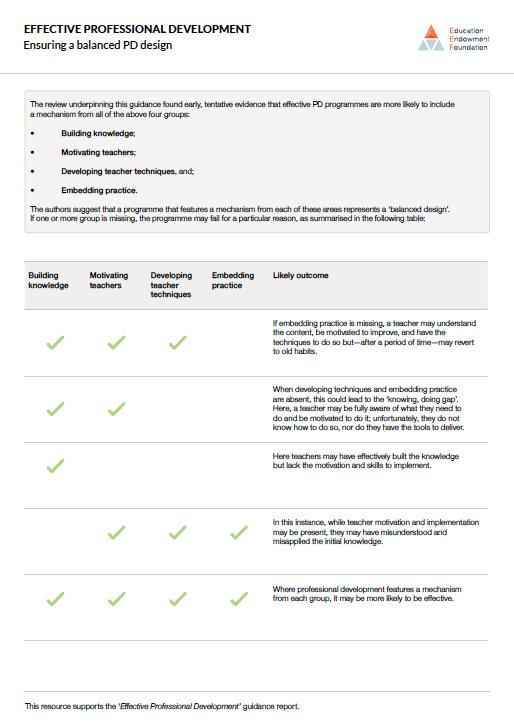
https://d2tic4wvo1iusb.cloudfront.net/eef-guidance-reports/effective-professional-development/Ensuring-abalanced-PD-design.pdf?v=1675337512
https://d2tic4wvo1iusb.cloudfront.net/eef-guidance-reports/effective-professional-development/EEF-EffectivePD-Mechanisms-Poster.pdf?v=1675337512
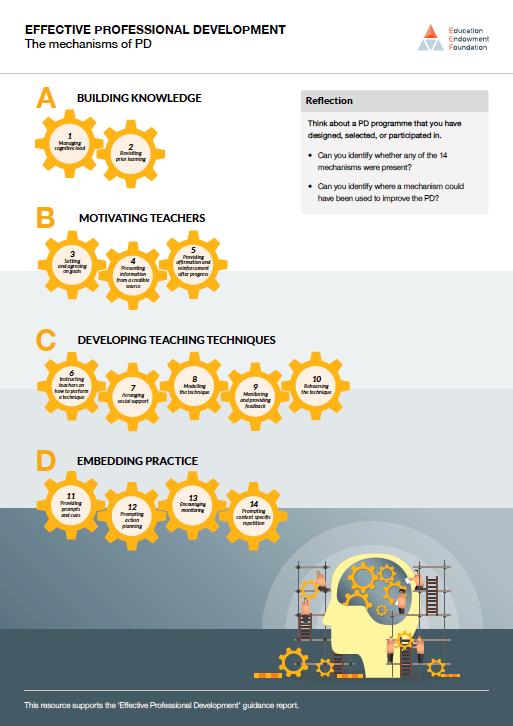
How can we effectively manage the cognitive load of teachers?
How can we revisit prior learning to embed understanding?
How can we encourage teachers to set and agree on goals?
How can we ensure information is from a credible source?
How can we offer affirmation and reinforcement after progress?


How can we best instruct teachers on how to perform a specific teaching technique?
What practical support needs to be offered (e.g. coaching)?
How can we offer models of the teaching technique and purposeful feedback on practice?
Are there opportunities to rehearse the teaching technique?
How can we provide useful prompts and cues that helpfully nudge teachers?
How can we prompt productive action planning?
How can we encourage self-monitoring?
How can we prompt context-specific repetition to embed practices?
Critical knowledge and understanding of research techniques and self-management
Critical enquiry, review, analysis and evaluation
The best leaders undertake and use research, drawn from a range of sources, to support decision making and strategy development – using their time effectively within disciplined and well-organised systems and methodologies.
The best leaders use critical thinking, statistical and data analysis tools, techniques and concepts to identify strengths and areas for development. They design effective leadership plans to support intervention, direction and development. They analyse the implications of change, deploying wellevidenced research to frame school self-evaluation and improvement.
Challenge
Dealing systematically and creatively with complex issues
The best leaders use challenge effectively and adopt a range of strategies in the best interests of achieving progress – demanding ambitious standards for all pupils and a strong sense of accountability in staff for the impact of their work on pupils’ outcomes.
The best leaders have clear systems and protocols in place that enable them to consider and find solutions to issues, as they arise, in a way which deals most effectively with the barriers and challenge they face. The systems in place do not constrain but create a firm foundation for taking positive action.
Priority identification
Clear articulation and application of knowledge
The best leaders scan the horizon to anticipate change, taking a long-term view of the implications of change and improvement need to identify short- and longterm priorities and goals with specified milestones to ensure effective leadership and management.
The best leaders take time to reflect and learn from their leadership activity and apply this knowledge to bring about improvements in themselves and their work.
Self-direction and originality
The best leaders have clear and ambitious targets for themselves as leaders, for their pupils and for their schools. They take a unique strategic view of situations and their implications for long-term impact and outcomes – sometimes using unexpected actions to get the best for those concerned.
Current insights into professional practice
The best leaders take time to reflect and evaluate their practice and effectiveness in their leadership and as leaders. They are aware of the education landscape, understand the context of their school and its needs and direct professional practice and intervention appropriately.
School culture
Contribute to establishing and sustaining the school’s strategic direction
Contribute to establishing and sustaining an effective culture across the school
Expert practice
Behaviour
Support the development of a positive, predictable and safe environment for pupils
Support colleagues to create a positive, predictable and safe environment in their classrooms
Motivate, and enable colleagues to motivate pupils
Contribute to a whole school approach in assisting pupils who need more intensive support
Prevent and respond to bullying
Expert practice
Professional development
The purpose and focus of professional development
Select evidence-based approaches and design effective professional development
A supportive environment
Creating impact with professional development
Expert practice