


Welcome, programme, process


‟Effective leaders are driven by the overarching commitment to serve the needs of all children.”
Keith Grint


Session Time Timings Activity 8:30 Registration and refreshments
Session one 9:00 10 minutes Welcome, introductions
Session two 9:10 60minutes Deliberate practice model and programme orientation
Session three 10:10 25 minutes Review
Break 10: 35 15 minutes
Session four (part one) 10: 50 60 minutes Implementation – priority planning
Session four (part two) 11.50 40 minutes Implementation
Lunch 12:30–13:25 55 minutes
Session five 13:25 40 minutes My ethical principles and behaviours
Session six 14:05 60 minutes Ethical leadership in action
Break 15:05 20 minutes
Session seven 15:25 50 minutes
Review online content outlines, including practice activities and formative assessment task
Refine and review leadership development record to review and refine target areas for development
Session eight 16:15 15 minutes Next steps 16:30 Close
My ethical principles and behaviours Implementation Feedback/ review Programme orientation
Review learning/ feed forward Ethical leadership

One’s comfort zone

Work toward well-defined

Focus intently on practice activities

Receive and respond to High-quality feedback

Develop a Mental model of expertise
SEE IT – Get buy in and confirm key insight of specific context, outcomes and practice strategies.
NAME IT – Probe and illustrate to target and make sense of participant need and context. Action experience.
USE IT – Apply in practice, implement learning in specific context.
REVIEW IT – Interpret and reconstruct, making sense of what was first seen.
What has made the biggest difference to practice?
KEEP IT –
Develop mental model and being able to articulate impact and shift in knowledge / understanding.
A culture of mutual trust and respect between colleagues fosters effective relationships and supportive professional environments (NPQH framework content area Culture: 1.7)
▪ Challenge and push beyond comfort zones
▪ Clarify learning goals and learning direction
▪ Consider the implications for practice
▪ Review and respond to feedback
▪ Consolidate and embed knowledge
To work and learn together effectively
1. what do we need in place to ensure a professional learning environment is achieved?
2. which behaviours need to be applied for the environment to be sustained?
3. Which behaviours are group members going to have to work on?
Use individual group member understanding and interpretation of the qualification from:
▪ completing Getting Started module on Canvas for standalone NPQs or Bud for apprenticeship
▪ completing Implementation short course and induction cycle LDR
▪ pre-event reading, including the Welcome Pack
To identify:
▪ specific questions where there is uncertainty about the qualification – its structure and content
▪ no more than five significant actions needed to ensure successful engagement and leadership development learning journey
At the heart of our work with/across schools are:
▪ our NPQ programmes designed and built on evidence, expert guidance and school-led quality practice
▪ our participants who commit to building their knowledge and skills to be even better leaders for the children in their schools
▪ our national network of delivery partners who contribute to assuring strong, locally driven professional development quality programmes
▪ our workforce who provide the direction and support the ambition of every participant to grow and contribute to school improvement and pupil outcomes
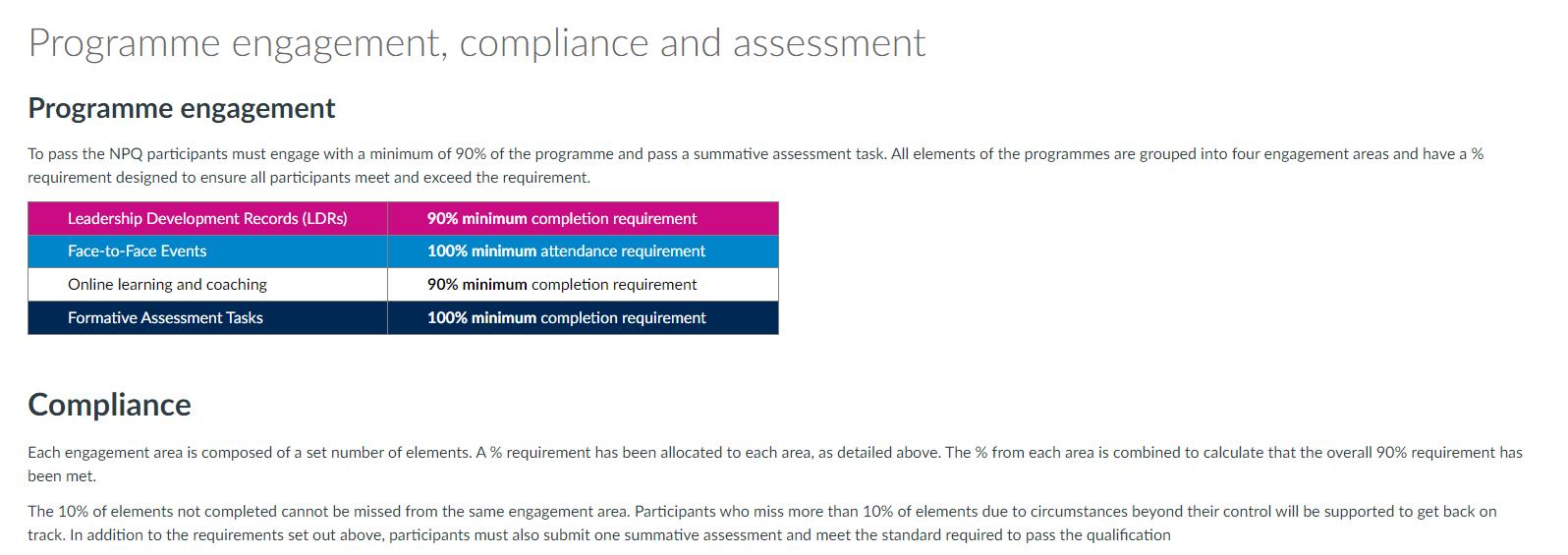
Completion of Leadership Development Record (LDR) reviews and needs analyses. Participants must complete at least 90% of all Leadership Development Records, this includes both part one skills audit and part two review. Successful completion will be confirmed by the participant’s leadership performance coach (LPC) and recorded on Canvas.
Attendance at face-to-face (FTF) events. Participants must attend all face-to-face events, unless there are valid extenuating circumstances. When a participant is unable to attend an event, Best Practice Network (BPN) will make alternative arrangements for the participant (e.g., by arranging for the participant to attend an event on an alternative date or to complete the events through a virtual alternative model on Canvas). Attendance at FTF events will be confirmed by the BPN administrative team.
Engagement with the programme’s online course study and coaching sessions. Participants must satisfactorily complete 90% of the online study practice, learning activities and coaching sessions. Successful completion will be confirmed by the participant’s leadership performance coach and recorded on Canvas.
Completion of Formative Assessment Tasks. Participants must satisfactorily complete 100% of the Formative Assessment Tasks. Satisfactory completion will be confirmed by the participant’s leadership performance coach and recorded on Canvas. (See below for further information on the features of the Formative Assessment Tasks.)
Module
Module
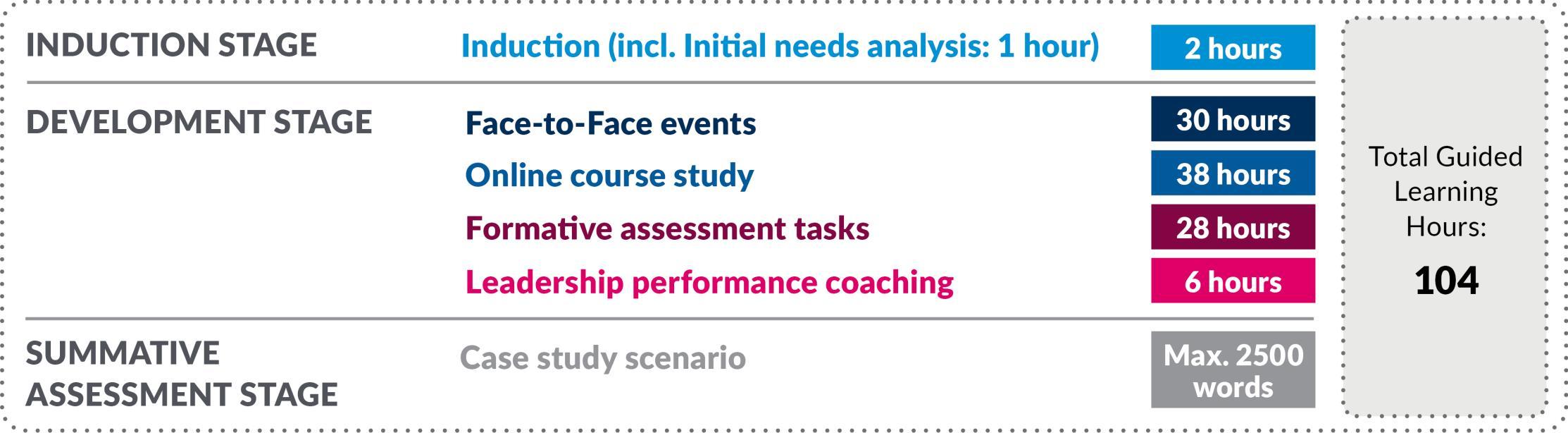
Throughout the qualification participants will take part in practice-led Formative Assessment Tasks to inform progress and development direction.
An eight-day window, at the end of the development stage, will be available to provide a written response of a maximum of 2,500 words for the case study.
To gain the qualification the participants will need to:
▪ engage with at least 90% of the programme’s elements
▪ pass one summative assessment task (case study scenario)
Feedback/ review Programme orientation
Implementation
My ethical principles and behaviours
Review learning/ feed forward Ethical leadership
Use outcomes from the LDR induction cycle, learning reflection from the short course and practice activity completion as a prompt to focus individual feedback:
▪ What significant learning did you take away from the Implementation short course?
▪ Where can you apply this learning in your leadership at school and in your NPQH study and activities?
▪ What impact has the learning had on you and your practice?
▪ Why is the implementation process an important tool for effective school leadership?
Use resource four to make notes.


Feedback/ review Programme orientation
Implementation
My ethical principles and behaviours
Review learning/ feed forward Ethical leadership
8.1. Implementation is an ongoing process that must adapt to context over time, rather than a single event. It involves the application of specific implementation activities and principles over an extended period (e.g. implementation planning, ongoing monitoring).
8.4. Effective implementation begins by accurately diagnosing the problem and making evidence-informed decisions on what to implement.
8.b. Prioritising appropriately by making a limited number of meaningful strategic changes and pursuing these diligently.
8.d. Identifying a specific area for improvement using a robust diagnostic process focusing on the problem that needs solving, rather than starting with a solution.
8.g. Examining current approaches, how they need to change and the support required to do so.
8.l. Specifying the elements of the approach that appear critical to its success (i.e. the ‘active ingredients’) and communicating expectations around these with clarity.
8.m. Developing a clear, logical and well-specified implementation plan, and using this to build collective understanding and ownership of the approach.
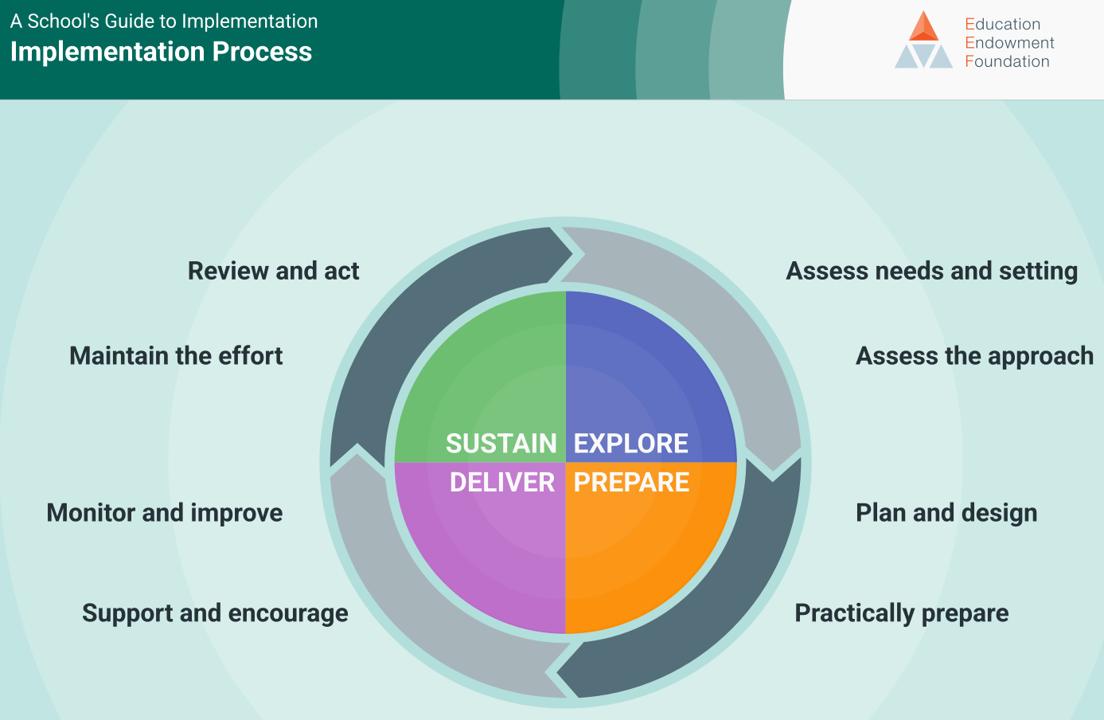
Exchange your school data and SEF/SDP with another colleague in your group.
Individually analyse the information to identify their main priorities. Use resource 5 to support this analysis.
In pairs agree four main priorities across both schools. Choose one or two you both agree is most important, what you need to do about it and what activities you will put into place to show improvement. This will create an implementation plan (resource 6).
You will present your joint plan for implementation to another pair, explaining your rationale for this and where your evidence has come from to support your decisions.
Part 1: 15 minutes individual read Part 2: 40 minutes paired task
Each pair to present to another pair their shared implementation plan, identifying:
▪ priorities (why)
▪ interventions (what)
▪ implementation strategies (how)
The pair listening should evaluate the clarity of their decision making and how the presenters are communicating effectively.
Presentation: 10 minutes
Question: 5 minutes

My ethical principles and behaviours Implementation Feedback/ review Programme orientation
Review learning/ feed forward Ethical leadership
1.f. Articulating, modelling and rehearsing practices that contribute to the intended school culture and supporting every member of the school community, particularly senior and middle leaders, to do the same.
1.g. Prioritising the use of intentional and consistent language that promotes challenge, aspiration and high expectations for pupils; and professional development and high professional standards for all colleagues.
Presentation focus
How do you as a leader demonstrate and model ethical behaviours and principles in your professional life?
How do you support others in demonstrating these behaviours and principles?
How do you articulate these to others and how consistent is your language?
In what ways do these promote high standards for pupils and staff?
Share your presentations in groups of 3.
In each group of 3:
▪ 1 person to present
▪ 1 person to act as coach
▪ 1 person to take notes against statements and behaviours (Resource 7)
Presentation: 5 minutes
Questions: 5 minutes
Individually reflect on the outcome of the presentations and feedback and review your Leadership Development Record cycle one.
What do you need to focus on in demonstrating your behaviours? What actions might you need to take to support this?
5 minutes
My ethical principles and behaviours Implementation Feedback/ review Programme orientation
Review learning/ feed forward Ethical leadership
School culture
1.7. A culture of mutual trust and respect between colleagues fosters effective relationships and supportive professional environments.
1.8. Building alignment of staff around the intended school culture can create coherence in a school and give direction and purpose to the staff’s work teaching pupils.
Organisational management
7.1. Leaders have a duty of care to pupils and staff.
Governance and accountability
10.1. High quality effective and ethical governance is key to success in our school system.
10.3. School leaders are accountable for their decisions and actions and must submit themselves to the scrutiny necessary to ensure this.
10.e. Adhering to the Principles of Public Life at all times.
1.1 Selflessness
Holders of public office should act solely in terms of the public interest.
1.2 Integrity
Holders of public office must avoid placing themselves under any obligation to people or organisations that might try inappropriately to influence them in their work. They should not act or take decisions in order to gain financial or other material benefits for themselves, their family, or their friends. They must declare and resolve any interests and relationships.
1.3 Objectivity
Holders of public office must act and take decisions impartially, fairly and on merit, using the best evidence and without discrimination or bias.
1.4 Accountability
Holders of public office are accountable to the public for their decisions and actions and must submit themselves to the scrutiny necessary to ensure this.
1.5 Openness
Holders of public office should act and take decisions in an open and transparent manner. Information should not be withheld from the public unless there are clear and lawful reasons for so doing.
1.6 Honesty
Holders of public office should be truthful.
1.7 Leadership
Holders of public office should exhibit these principles in their own behaviour. They should actively promote and robustly support the principles and be willing to challenge poor behaviour wherever it occurs.

Headteachers are expected to demonstrate consistently high standards of principled and professional conduct. They are expected to meet the teachers’ standards and be responsible for providing the conditions in which teachers can fulfil them.
Headteachers uphold and demonstrate the Seven Principles of Public Life at all times. Known as the Nolan principles, these form the basis of the ethical standards expected of public office holders.
Headteachers uphold public trust in school leadership and maintain high standards of ethics and behaviour. Both within and outside school, headteachers:
▪ build relationships rooted in mutual respect, and at all times observe proper boundaries appropriate to their professional position
▪ show tolerance of and respect for the rights of others, recognising differences and respecting cultural diversity within contemporary Britain
▪ uphold fundamental British values, including democracy, the rule of law, individual liberty and mutual respect, and tolerance of those with different faiths and beliefs
As leaders of their school community and profession, headteachers:
▪ ensure that personal beliefs are not expressed in ways which exploit their position, pupils’ vulnerability or might lead pupils to break the law
▪ serve in the best interests of the school’s pupils
▪ conduct themselves in a manner compatible with their influential position in society by behaving ethically, fulfilling their professional responsibilities and modelling the behaviour of a good citizen uphold their obligation to give account and accept responsibility
▪ know, understand, and act within the statutory frameworks which set out their professional duties and responsibilities
▪ take responsibility for their own continued professional development, engaging critically with educational research
▪ make a positive contribution to the wider education system
In small groups discuss the presentation ‘the joys and challenges of headship’.
Consider the outcomes of discussion and the emerging view of an ethical leader
▪ In what way(s) has the speaker promoted ethical principles and professional conduct?
▪ How have they built relationships which are based on mutual trust?
▪ In what ways do they show integrity and objectivity?
▪ How do they ensure that they and others are accountable for their actions?
▪ Reflecting on you and your own schools, what are the implications for developing your own practice?
Identify one question from the three below and agree a response and your groups rationale for this.
Write up the response and rationale onto a flip chart sheet and gallery.
1. What is the purpose of education and the school’s role in developing virtuous behaviour in society?
2. How well do we fulfil our roles as trusted educators?
3. How can school leaders balance the right of the child to a good education and the accountability imperatives of the school?
10 minutes
Review of learning, pathway for online study, practice activities and formative assessment tasks
My ethical principles and behaviours Implementation Feedback/ review Programme orientation
Review learning/ feed forward Ethical leadership
Individually consider what your focus and target statement areas for learning will be for the ‘ethical behaviours and principles’ online course. Which practice activities will you complete and what are the implications for completion of the formative assessment task?
15 minutes
▪ Use your Leadership Development Record cycle one and the information in your participant packs
Resource 9 – online course summary
Resource 10 – practice activities menu
Formative assessment task pack
In pairs (10 minutes each) have a coaching conversation about your proposed pathway.
Outline your rationale for choosing the module units to be studied, practice activity and formative assessment task choices.
Partner to challenge rationale, seek clarification and support confirmation and/or realignment of study and practice pathway targets.

1. Log in to Canvas
2. Go to ‘Grades’ and select ‘Assignment Group’
3. Check that you have completed the tasks at the top of the gradebook (tick or 1 in score column)
4. Scroll down until you reach today’s date and check that all tasks to that point have a tick or 1 next to them
5. If there are any incomplete/missing, make a note of them and prioritise for completion after the event

▪ Review your pathway choices (content for online course, practice activities and formative assessment task) with your in-school sponsor.
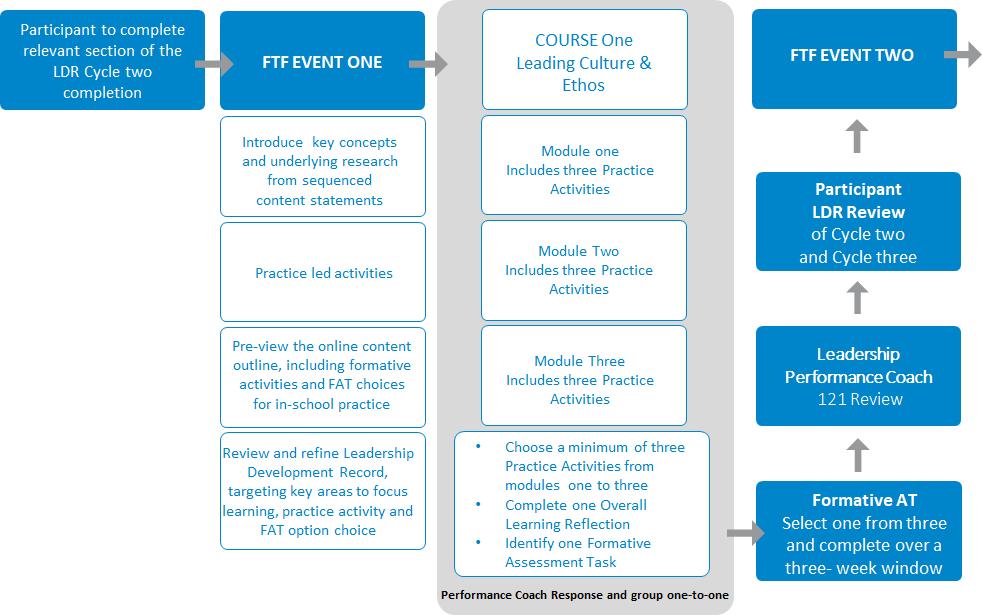
▪ Complete the online short course ‘Ethical principles and behaviours’, one practice activity and one reflective task.
▪ Complete your formative assessment task.
▪ Upload the response to the formative assessment task and your review of the leadership development record to your leadership performance coach by the date specified on the syllabus page on Canvas.
▪ Confirm performance coaching appointments.
To enhance your NPQ journey and personal progress, we are offering expert led talks that you will have the opportunity to attend. Our Expert Talks are live online webinars featuring expert speakers from the education sector and beyond. By attending, you can widen your scope of the ‘learn that’ and ‘how to’ statements while also collaborating with peers.
During these webinars, you will not only hear from our expert speakers, but you will also be able to ask questions and listen to colleagues from all over the UK and internationally.
You can access your Expert Talk webinars through your participant dashboard where you will see the date and time along with the link needed to access the webinar.
To further enhance this experience, following the webinar you will participate in a group discussion within Canvas where you will be provided with questions for you and your online group to debate, share thoughts, experiences, and impact.