

Leader Apprenticeships with NPQs
Spring 2026
Thank you for choosing Best Practice Network (BPN) as your Leader Apprenticeship with NPQ provider. BPN is a leading provider of leadership development in the education sector, and we are very proud to be working together with you, as you undertake this highly innovative ‘dual award’ programme. We want colleagues taking part in their programme to become even better leaders, as well as gain both awards. The team is here to help and support you to maximise this opportunity, so please contact us if you have any questions.
The main purpose of this Learner Handbook is to give you an insight into the key information you need throughout your programme. The information contained here is very important and will support you in your successful completion of your programme, so please keep it readily accessible.
With the support of your in-setting Apprenticeship Mentor (AM) and employer, and your BPN-appointed Apprenticeship Performance Coach (APC), we hope you thrive on this programme, and we look forward to hearing about your learning, impacts, and successes.
Best wishes,
Laura Saunders
Lead Facilitator, Best Practice Network
For every:
child to benefit from an excellent education, regardless of background
education professional to be able to grow and give their best
We are committed to a sustainable school-led partnership that:
provides all schools with access to outstanding leadership development
delivers Leader Apprenticeships with National Professional Qualifications designed by school leaders for school leaders
meets the needs of the school-led system
combines national quality assurance with locally driven accountability
measures the impact of our work on learners, leaders and school improvement
This is the foundation of everything BPN is setting out to achieve and on which we set our standards for quality professional development and training.
Best Practice Network is one of the UK’s largest providers of training, development and support for education professionals. We share the desire of every practitioner, that every child, regardless of their background, should benefit from an excellent education.
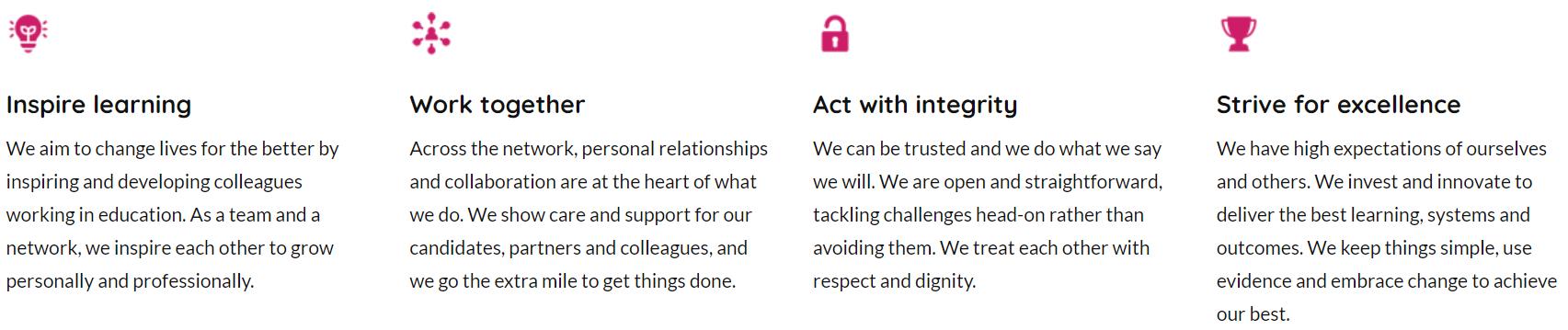
Our core values define what we stand for and how we do things, helping us to work together in the most fulfilling way to provide the best service to our learners and partners.
Your APC will be your main point of contact. They will guide, support and help you to achieve the most from your programme. They will contact you and your in-setting Apprenticeship Mentor (AM) by email after your First Day of Learning (FDoL) event.
Additionally, key contacts for your time on programme are as follows:
BPN Office Phone 0117 920 9200
Support Team Email
Report a safeguarding concern
NPQ@bestpracticenet.co.uk
https://www.bestpracticenet.co.uk/safeguarding safeguarding@bestpracticenet.co.uk
Your programme is an Apprenticeship with an embedded NPQ. They have been mapped rigorously to enable you to complete both elements as one. To successfully complete the programme, you are required to undertake both elements in full, including their assessments.
Your apprenticeship programme is supported by the NPQ in order for you to contextualise and apply your learning in practice with sector-specific knowledge and practices.
Apprenticeship standards and NPQs work slightly differently to each other in terms of engagement and compliance requirements so this Learner Handbook offers everything you need for successful learning and completion on programme. The in-setting Apprenticeship Mentor (AM) will have an Employer Handbook to support them.
Apprenticeships have a long history and exist to support people in applying new learning in practice. Today, they provide a route within our sector to ensure professionals have the knowledge, skills and behaviours they need to have impact and progress.
BPN offer a broad range of apprenticeships, creating relevant and impactful learning solutions for practitioners across your setting. More information can be found on BPN’s apprenticeship offer here
Level 2
Level 2 Early Years Practitioner Apprenticeship
Level 2 Playworker Apprenticeship
Level 3 Level 3 Leader Apprenticeship with NPQLT
Level 3 Leader Apprenticeship with NPQLTD
Level 3 Leader Apprenticeship with NPQLBC
Level 5
Level 3 Early Years Educator Apprenticeship
Level 3 Teaching Assistant Apprenticeship
Level 3 Teaching Assistant Apprenticeship SEND
Level 5 Leader Apprenticeship with NPQSL (National Professional Qualification for Senior Leaders)
Level 5 Leader Apprenticeship with NPQH (National Professional Qualification for Headship)
Level 5 Specialist Teaching Assistant Apprenticeship
Level 5 Early Years Lead Practitioner Apprenticeship
Level 5 Wellbeing Leadership programme
Level 5 Coaching in Education
Level 6 Teacher Apprenticeship with Initial Teacher Training leading to QTS (Primary)
The Leader Apprenticeships with NPQs are an innovative and exciting way of learning for leaders in the education sector, offering accessibility, flexibility and cross-sector learning with the apprenticeship standard, alongside sector-specific knowledge from the DfE’s NPQ.
The programmes harness the notion of apprenticeships being work-based learning programmes so that you can apply relevant learning in a practical way, upskilling you in your current role, whilst preparing you for future roles.
Both the Skills England Apprenticeship Standards and the BPN NPQ frameworks are designed to enable a great deal of choice for leaders in ensuring their learning journey is bespoke to them. The tripartite induction meeting enables all learners to create and track their individual learning plan comprising new knowledge, skills and behaviours (KSB) from the standard as well as Learn That and Learn How To statements from the DfE NPQ Framework; with support from the tripartite. Both elements of the programme are assessed summatively. Your Apprenticeship Performance Coach (APC) will explain the programme in full detail to both you and your in-setting Apprenticeship Mentor (‘employer’) during your Induction meeting.
Your Leader Apprenticeship with NPQ is supported and funded in the same way as standalone apprenticeships: by the National Apprenticeship Service and Education and Skills Funding Agency. Therefore, the majority of the compliance requirements of your programme derive from apprenticeship requirements and underpin the activity you will undertake throughout.

There is no maximum age limit for an apprenticeship, but they are for those aged 16 or over, living in England and not in full-time education. Apprenticeship learners can be new or current employees.
You can access the latest news, information and misconceptions about apprenticeships here: Amazing Apprenticeships
For providers and employer-providers, receiving funding for delivering apprenticeship training and onprogramme assessment in England, these rules form part of the terms and conditions for the use of funds for an apprenticeship or for government-employer co-investment: Apprenticeship funding rules.
�� Regular support from your Apprenticeship Performance Coach (APC)
Your APC will support your learning, check your progress, coach and challenge you and help you stay on track.
�� Tripartite progress reviews every month
You will meet with your APC and in-setting Apprenticeship Mentor (AM) as a tripartite to review and celebrate progress, having coaching conversations and agree next steps.
�� Workload balance support
We will help you to manage your workload and develop your skills to learn and succeed in ways relevant to you.
❤ Wellbeing and pastoral support
If you are struggling with anything inside or outside of work, we are here to help.
✍ Guidance on completing your portfolio
We will support you to collect evidence of your learning throughout your programme to use at Assessment.
�� Clear steps to successful completion
From induction to your assessment period, we will guide and support you through every stage.
All Leader Apprenticeships with NPQ programmes feature cyclical structure with ongoing support elements. They all employ a blended delivery model, balancing synchronous activities (face-to-face events, coaching, and monthly progress reviews) with asynchronous components (practice activities, some monthly progress reviews, offline check-ins, formative assessment tasks, and online modules). This approach allows you to
benefit from real-time support and challenges while engaging in flexible, bite-sized learning activities that accommodate your busy work schedule. Your Apprenticeship Performance Coach (APC) and in-setting Apprenticeship Mentor (AM) will provide feedback and guidance throughout all aspects of the programme.
The programme is divided into three main phases:
Induction period
Main learning period (consisting of multiple cycles)
Assessment period
For detailed information, please refer to the programme specifications
All programme elements contribute to the statutory overall compliance and engagement requirements for the practical (funded) period with the intended purpose of achieving the knowledge, skills, and behaviours (KSBs) of the apprenticeship standard, which incorporates the NPQ programme, as set by Skills England and the Department for Education (DfE). This means that all apprenticeship off-the-job training (OTJT) hours are built into the programme.
The LAwNs programmes are apprenticeships with NPQs mapped in. Both the apprenticeship and NPQ elements of each programme must be undertaken to progress to the assessment phase. It is not possible to start on programme and withdraw from the apprenticeship, keeping only the NPQ element.
The apprenticeship standard for your LAwNs programme is shared below, accompanied by the NPQ framework that is embedded into your programme:
Apprenticeship Standard (Skills England)
Leader Apprenticeship with NPQLT
Leader Apprenticeship with NPQLTD
Level 3 Team Leader Apprenticeship:
https://skillsengland.education.gov.uk /apprenticeships/st0384-v1-4
Level 3 Team Leader Apprenticeship:
https://skillsengland.education.gov.uk /apprenticeships/st0384-v1-4
NPQ Framework (DfE)
NPQLT Framework:
https://assets.publishing.service.gov.uk/ media/66c4ae9567dbaeb97a13e4c7/ NPQ_Leading_Teaching_.pdf
NPQLTD Framework: https://assets.publishing.service.gov.uk/ media/66c4908b057d859c0e8fa7c4/ NPQ_Leading_Teacher_Development_.p df
Leader Apprenticeship with NPQLBC
Level 3 Team Leader Apprenticeship: https://skillsengland.education.gov.uk /apprenticeships/st0384-v1-4
NPQLBC Framework: https://assets.publishing.service.gov.uk/ media/66c49042b75776507ecdf46e/ NPQ_Leading_Behaviour_and_Culture_. pdf
Leader Apprenticeship with NPQSL
Leader Apprenticeship with NPQH
Level 5 Operations Manager Apprenticeship Standard: https://skillsengland.education.gov.uk /apprenticeship-standards/st0385
Level 5 Operations Manager Apprenticeship Standard: https://skillsengland.education.gov.uk /apprenticeship-standards/st0385
NPQSL framework: https://assets.publishing.service.gov.uk/ media/63a1dc7a8fa8f539198d9bca/ NPQ_Senior_Leadership_FINAL_Ref.pdf
NPQH framework: https://assets.publishing.service.gov.uk/ media/63a1dc9d8fa8f539169b1d74/ NPQ_Headship_FINAL_Ref.pdf
The broad programme structures highlight key elements of the curriculum and delivery method:
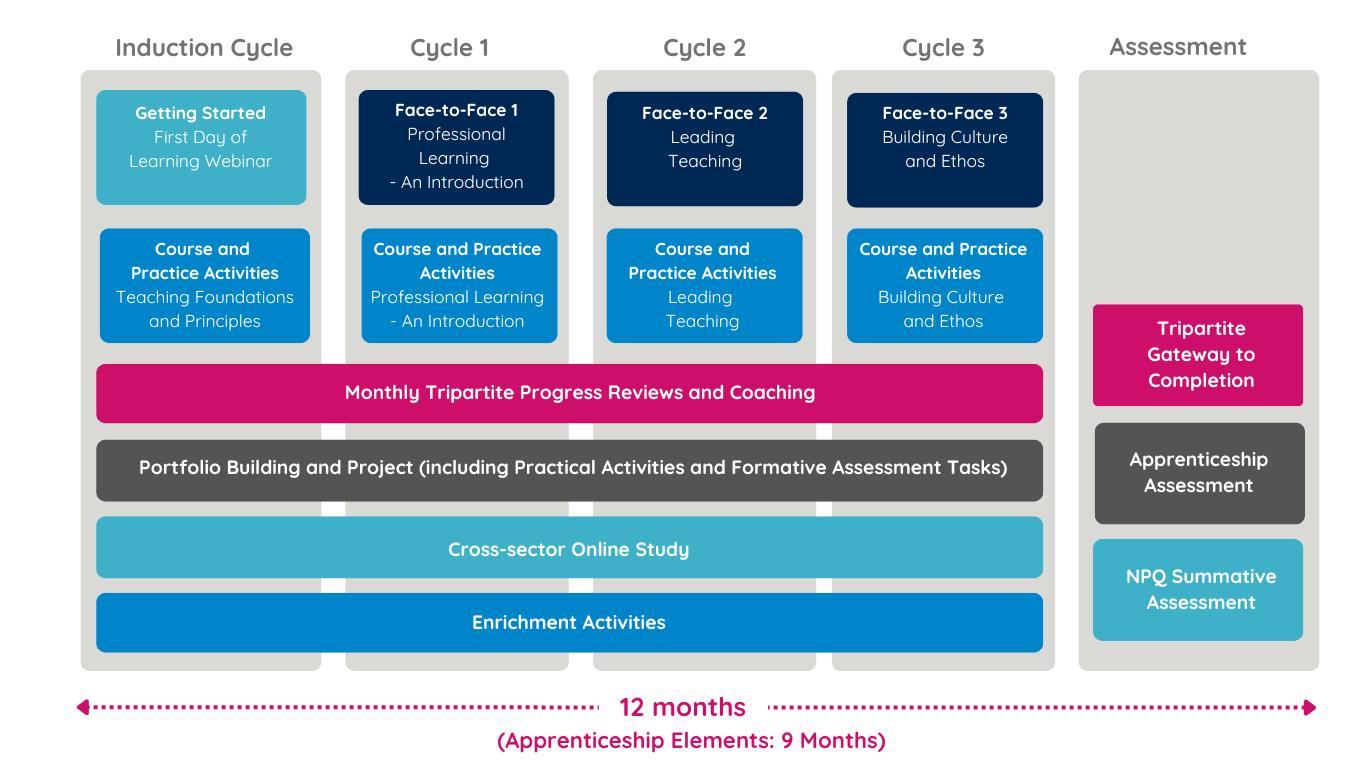
Leader Apprenticeship with NPQLTD
Level 3 Team Leader Apprenticeship with NPQLTD
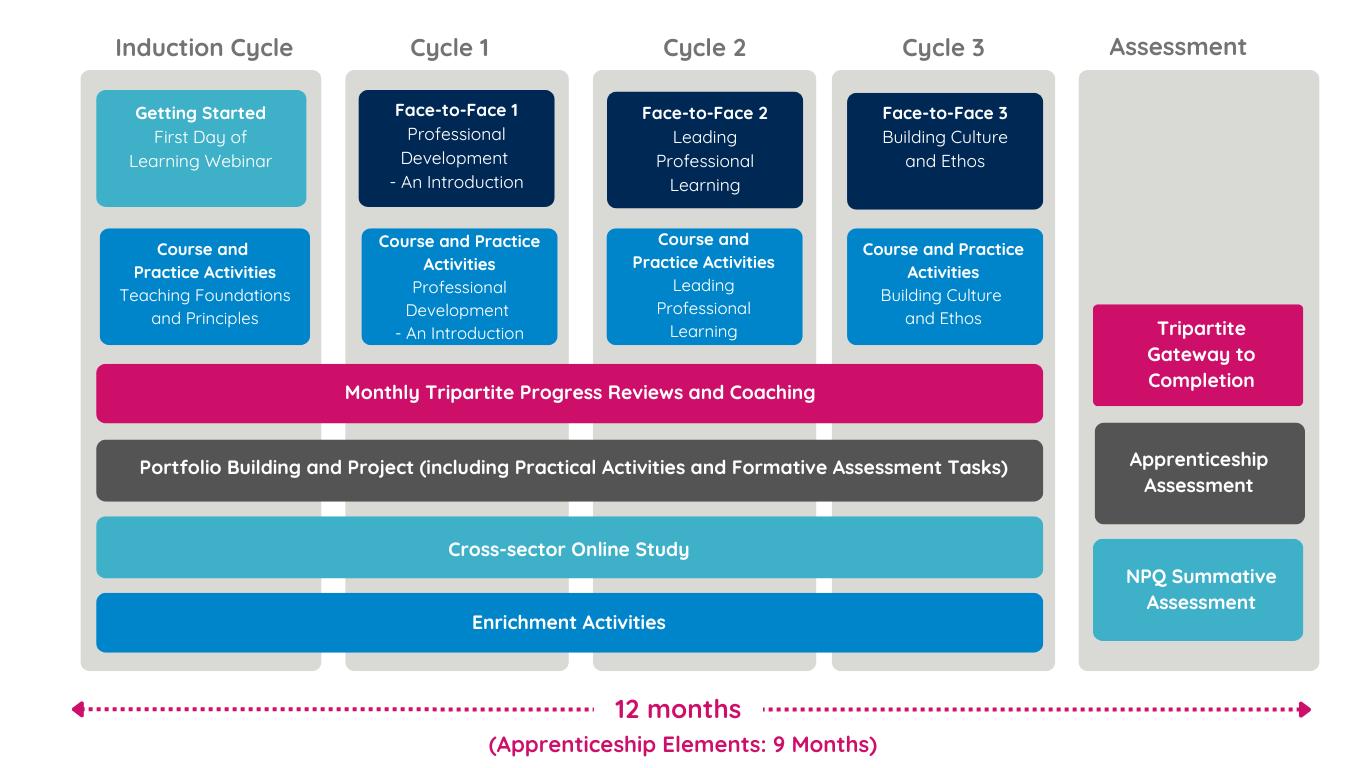
Leader Apprenticeship with NPQLBC
Level 3 Team Leader Apprenticeship with NPQLBC
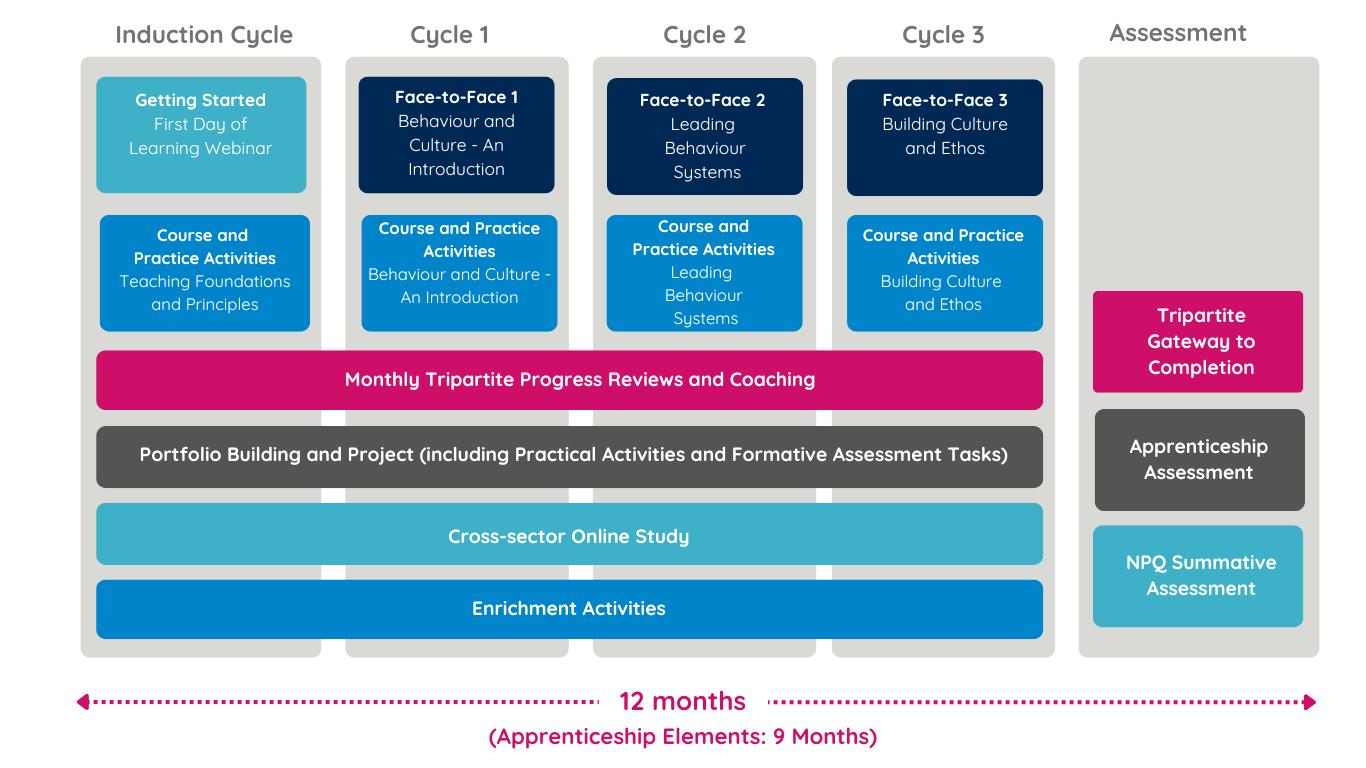
Leader Apprenticeship with NPQSL
Level 5 Operations Manager Apprenticeship with NPQSL
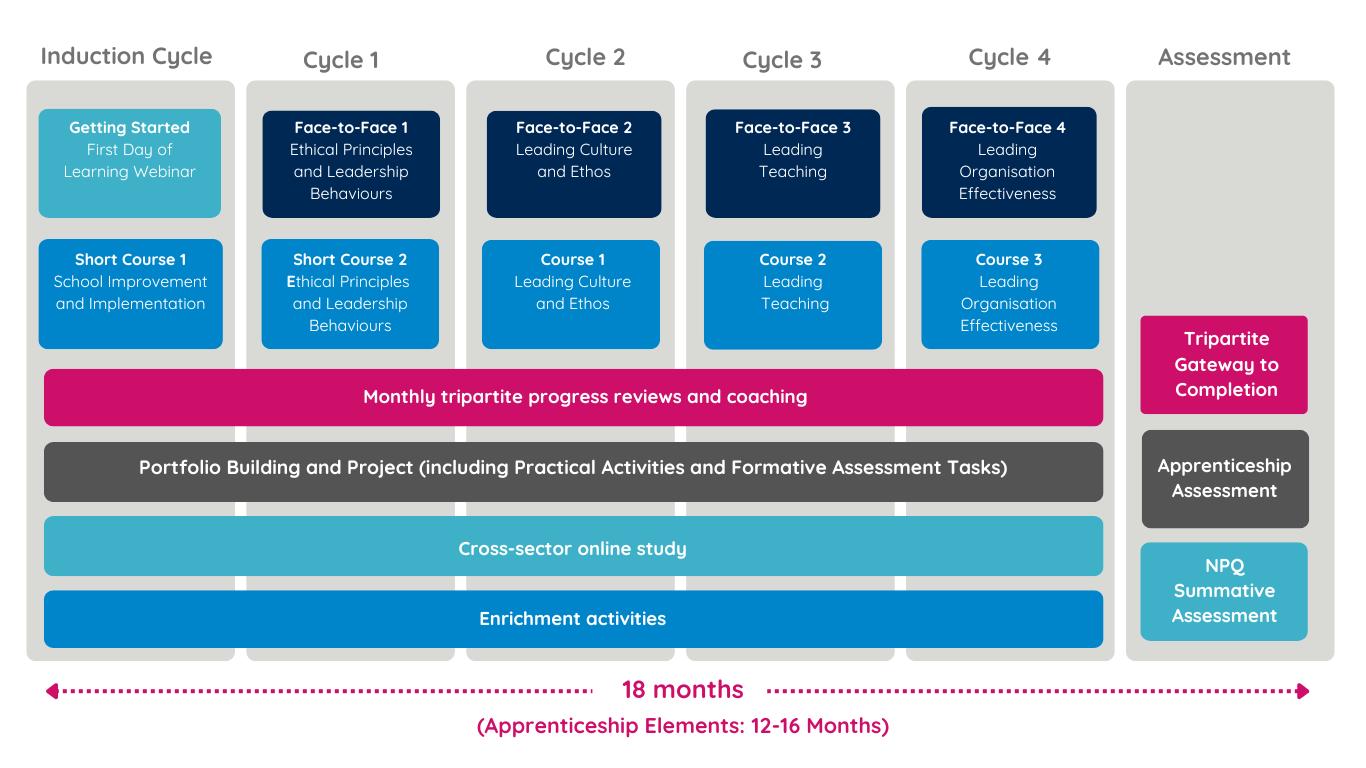
Leader Apprenticeship with NPQH
Level 5 Operations Manager Apprenticeship with NPQH
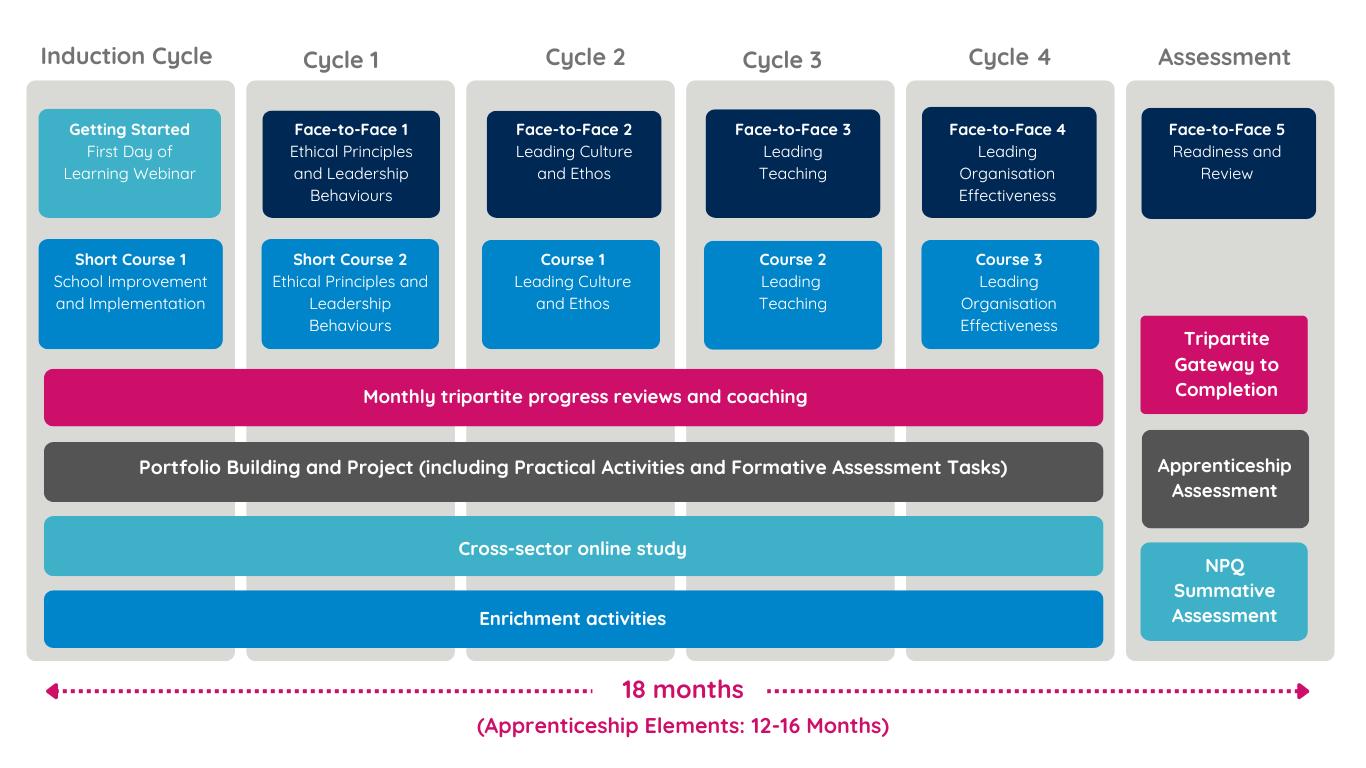
The ‘monthly tripartite progress reviews and coaching’ will mostly be synchronous (live) on Zoom and some will be asynchronous to support your workload. Your first monthly tripartite review, the induction meeting, will be synchronous and will take place soon after your First Day of learning (FDoL) event.
Following your application, you will have been asked to complete a variety of tasks, including:
Some enrolment tasks in BUD
Complete your Skills Scan on BUD
Undertake your maths and English Initial Assessments on BKSB
Evidence eligibility to be on programme (including residency in England)
These are all very important and a requirement of you starting on programme with ease. Following these initial activities, you will be invited to a short enrolment call with a member of the BPN team to ensure everything is in place for a successful start on programme.
Following completion of your initial enrolment tasks, you will have been invited to a virtual video enrolment meeting with a member of our NPQ Support Team.
This enrolment meeting covers essential aspects required for your successful start on programme, including:
Checking in on prior required actions
ID verification
Qualifications
Off-the-job-training requirements and hours
Overview of BUD (and access)
Evidence of relevant or recognised prior learning or experience
Residency status
Details of nominated Apprenticeship Mentor (AM)
Answering your questions
Selecting an FDoL date
Issuing the Learner and Employer Handbooks
Issuing the Essentials Form
Following this enrolment meeting you and your employer will receive your contracts. These contracts include your Apprenticeship Agreement and Training Plan which are vital for starting your programme. Your apprenticeship contracts must be signed by both you and your employer prior to your start on programme. These are sent via BUD for digital signatures.
Following these contracts being signed you will be invited to your First Day of Learning (FDoL) event which is your official start to the programme.
Dates for your diary are in Appendix A of this Handbook.
All activities are required as part of your programme, so it is important you are familiar with them.
Once accepted onto programme, the induction phase is vital in engaging in a new learning programme effectively. The Induction phase of the Leader Apprenticeship with NPQ programmes includes a variety of activities.
Your FDoL event is your first official learning activity, and it is important that you attend and complete a piece of work as a result. This is in order to ensure you have all the initial information you need for the start of the programme and undertake your first formal piece of learning to release the funding and comply with the requirements of starting your programme.
Your AM/Employer is not required to attend the FDoL, but speaking with them about it is vital for their active involvement in your programme.
The FDoL event takes the following form:
FDoL requirement Purpose What to do
FDoL live event: virtual introduction, orientation and first learning (approx. 4560 minutes)
To get an overview of and introduction to the programme
To understand who the key supporting people are on programme
To undertake some initial leadershipfocused learning
To register your attendance (to the full session) and begin your programme funding
During your enrolment call, you will have selected one of the FDoL date options to attend. This is a requirement of starting on programme. Whilst rescheduling is possible, it would mean your apprenticeship contracts would need to be re-signed ahead of your FDoL attendance, which would delay the start of your programme; so we encourage all learners to attend the
FDoL expert library learning (approx. 60 minutes) (only for NPQSL and NPQH)
FDoL reflection piece (approx. 30 minutes) (only for NPQSL and NPQH)
To undertake your first piece of learning on programme
To learn something new, relevant to you and your context, about leadership
To reflect on your learning from the recording
To demonstrate your reflection of learning
To comply with funding requirements of the apprenticeship
one they have originally selected.
Access the FDoL expert library (we will share a link in the live event), engage with at least one recording on the same day as the live FDoL introduction (selecting whichever one is most relevant to what you want to learn).
Write 300-500 words of reflection on your new learning from the FDoL expert recording you engaged with. Upload reflection piece to BUD for your new APC to offer feedback on. Instructions about the reflection piece and how to upload it to BUD can be found alongside the recordings.
This must be uploaded within 5 working days of the FDoL live event and feedback will be provided by the APC within a further 5 days.
Following successful completion of the FDoL activities, you and your Apprenticeship Mentor (AM) will hear from your new Apprenticeship Performance Coach (APC) who will contact you to set up your first tripartite meeting: the induction meeting.
When your APC emails you and your in-setting Apprenticeship Mentor (AM) to introduce themselves, they will send some documents to get your tripartite relationship started, and you will arrange with them for the tripartite induction meeting to take place within 10 working days of the FDoL
During this meeting, you will use the Essentials Form – Parts 1 and 2 (provided during enrolment) and a coaching contract to get to know each other, set learning goals, understand the tripartite relationship a little more, and set the most relevant learning tasks on BUD (apprenticeship activities). NB: Your NPQ activities will be made available in May.
During this meeting you will also discuss the importance and purpose of the tripartite interacting via progress reviews monthly.
Learning is at the heart of the Leader Apprenticeship with NPQ programmes. All elements demonstrated in the programme structure are designed to build your leadership knowledge, skills and behaviours to apply, with relevance, in your setting. All activities are required as part of your programme to ensure you are fully engaged, supported and compliant. In undertaking all required learning, it means that you are compliant with all off-the-job training (OTJT) requirements (a requirement of the apprenticeship).
Your apprenticeship will teach and assess your understanding and demonstration of a series of Knowledge, Skills and Behaviours (KSBs) outlined in the Skills England Apprenticeship Standard. These are the criteria assessed in the Apprenticeship Assessment (AA) in the assessment period.
Knowledge (K)
The information, technical detail and ‘know-how’ that someone needs to have and understand to successfully carry out the duties. Some knowledge will be occupation-specific, whereas some may be more generic. Think of this as the underpinning knowledge you need to have to perform the role safely and competently. Knowledge covered in the apprenticeship are labelled as ‘K’ in BUD activities.
Skills (S)
This is where knowledge is applied in a practical manner. Skills will have been learned through learning, training and experience. Skills covered in the apprenticeship are labelled as ‘S’ in BUD activities.
Behaviours (B)
Behaviours are mainly referring to the mindset that the learner demonstrates. Behaviours are measured at A. The behaviours outlined in the apprenticeship standard for your Leader Apprenticeship with NPQ programmes are labelled in BUD activities as ‘B’.
Your NPQ will teach and assess your understanding of a series of content areas, Learn That and Learn How To statements outlined in the DfE NPQ Framework. These are the criteria assessed in the Summative Assessment Task (SAT) in the assessment period (following AA).
Content Areas
The NPQ leadership frameworks that are embedded into the LAwNs programmes contain ten content areas that guide the NPQ-specific content. These content areas contain a series of Learn That and Learn How To statements.
Learn That statements
Learn That statements denote the school-specific knowledge you will learn on your Leader Apprenticeship with NPQ programme.
Learn How To statements
Learn How To statements denote the school-specific skills you will learn about and apply on your Leader Apprenticeship with NPQ programme.
As we all know, maths and English underpin success in all jobs and career paths. All apprenticeships include opportunities for learners to develop their knowledge, understanding and use of maths and English; and the subjects are holistically embedded through discussions about relevant aspects of maths and English pertaining to leadership, throughout your programme.
It is up to employers if they wish their adult apprentice learners (over 19 yrs at programme start) to study maths and/or English and take these qualifications (where Level 2 English and or maths have not been achieved previously). This will have been discussed at your enrolment call.
For the Leader Apprenticeship with NPQ programmes, you will need to undertake initial assessments in Level 2 maths and English on BKSB to demonstrate your working knowledge and understanding of English and maths. This is a requirement under DfE funding rules.
Following completion of the learning cycles and successfully meeting the engagement and compliance requirements of the programme, you will transition into the assessment period. This is your opportunity to showcase all that you have learnt and to support you towards certification and qualifications. There are several parts to it. More detail is provided later in this Learner Handbook, and in the Employer Handbook. You will also receive Assessment Guidance later in your programme.
Skills England are currently reviewing apprenticeships and some of the approaches and terminology around assessment. This may mean that, on your programme, you see the terms below used interchangeably whilst the review takes place:
The period between the practical period of the apprenticeship and the completion of the End Point Assessment (EPA).
End Point Apprenticeship An assessment that takes place, to make sure apprentices have
Assessment (EPA) Assessment (AA)
End Point Assessment Organisation (EPAO) Assessment Organisation (AO)
reached the necessary level of competence to be awarded an apprenticeship certificate. The requirements for End-Point Assessment are set out in the assessment plan for each specific apprenticeship standard.
The approach and parameters of the new Apprenticeship Assessment formulate the review.
The independent body/organisation responsible for conducting the final assessment of a learner on an apprenticeship programme.
Commitment from all involved in the learners’ experience is both a priority and incredibly important to the success of learners on programme.
In line with our values, Best Practice Network promises to help you to:
gain confidence and develop skills, knowledge and behaviours as a leader in your setting
successfully complete your programme
develop high aspirations for your leadership as well as personal goals
have a clear understanding of democracy, the rule of law and individual liberty
experience high-quality, well-planned and sequenced content and training
be enabled to own your learning in a contextually relevant way
access appropriate and relevant careers information and guidance
access learning around personal development, wellbeing, health and safety as is relevant
As part of your commitment, we ask you to:
commit to your learning from the outset
actively seek support and challenge from your Apprenticeship Mentor (AM) as the ‘employer’
engage with all monthly tripartite progress reviews reliably and consistently
attend all face-to-face events
complete all online tasks and activities as set in a timely manner
undertake a worthy project for EPA (School Leader programme only)
complete all tasks and activities yourself and not attempt to use someone else’s work and submit it as your own (plagiarism) or use artificial intelligence (AI) to support you
If you need any support around understanding some learning, changing a scheduled monthly review meeting, or getting advice about pastoral/circumstantial issues, please speak with your APC as soon as you can to seek advice. If any of these commitments are not met, it could affect learner engagement and compliance on programme. In these unusual cases, the Participant Support Team will offer support to learners and employers to enable full engagement and commitment.
There are a number of people and organisations with direct and indirect involvement in your Leader Apprenticeship with NPQ programme. To provide a little more detail, the key people you will be working with on programme are outlined below.
People with direct involvement in your programme
Employer
Sponsor
Apprenticeship Mentor (AM)
A representative from the learner’s employer to sign off contracts and funding (e.g. MAT/LA representative, school bursar/business manager) – light touch in terms of involvement with the learner.
A senior person in the learner’s setting (e.g. headteacher, chair of governors, ‘employer’ above, or learner’s line manager) who will complete the formal declaration of support for the learner, and allocate the AM.
A colleague allocated by the sponsor who will offer practical and real-time support for the learner through monthly reviews, formative dialogue about the learner’s progress and development and support for the learner to fully engage with all elements of the programme.
In-setting; representing the ‘employer’
In-setting; representing the ‘employer’
In-setting; representing the ‘employer’
Apprenticeship Performance Coach (APC)
Appointed by BPN, the APC will be the main point of contact for the learner throughout their programme. They will offer feedback on task submissions, support the learner to obtain evidence for the portfolio, and coach the learner during the
BPN-appointed, virtual interaction (alternating between synchronous and asynchronous reviews; and ongoing
Face-to-face event facili tator(s)
Other learners
monthly tripartite reviews (alternating between live synchronous and asynchronous reviews) with the AM, preparing the learner for AA and SAT.
Appointed by BPN, the facilitators lead the face-toface events and support learners’ learning and networking.
Learners across the country (online elements) and locally (FTF events) support and challenge each other, and network to share best practice.
asynchronous feedback)
BPN-appointed, inperson interaction
Nationally, virtual interaction
As you are undertaking an apprenticeship, it is important that you also have some context about the other people and organisations supporting your programme indirectly:
People with indirect involvement in your programme
BPN Quality Team (incl. Internal Quality Assurers; IQAs)
BPN Assessment Team
This team will ensure the portfolio of evidence you build whilst on programme meets the required quality standard and ensure all aspects of the programme delivery are of the highest standard so that you are well prepared for assessment. They also support assessment appeals, ensure you have completed all induction elements and you and your APC are consistently working at the required standard.
This internal team manage the operations of both the Apprenticeship Assessment and NPQ SAT during the assessment period of your programme. They provide all assessment guidance and support. They also manage all BPN-appointed assessors of the NPQ SAT.
BPN Support Team
Assessment Organisation (AO)
This internal team offer support to learners around programme operations, engagement, feedback and evaluation, face-to-face events and changes of learner circumstances.
All apprenticeship standards contain an Apprenticeship Assessment (AA). The AO is the independent, registered organisation who marks and oversees the assessment of the apprenticeship.
Ofsted Ofsted is the Office for Standards in Education, Children’s Services and Skills. They inspect organisations providing education and skills for learners of all ages. Ofsted are responsible for inspecting and reporting on the quality of training provision for apprenticeships.
They are funded by the government. Best Practice Network, as a training provider, is inspected based on the various Ofsted Inspection Frameworks relevant to its work.
Department for Education (DfE)
The Department for Education is responsible for children’s services and education, including early years, schools, higher and further education policy, apprenticeships and wider skills in England. The DfE created the reformed National Professional
Qualification (NPQ) frameworks that are part of your programme.
Skills England Skills England is an executive agency, sponsored by the DfE. It is accountable for funding education and skills for children, young people and adults.
They oversee the development approval and publication of Apprenticeship Standards and Assessment Plans as well as the occupational maps for T Levels and Apprenticeships.
Ofqual
Ofqual is the independent regulator for qualifications in England. Ofqual regulates the assessment of apprenticeship standards in England, set by Skills England.
You can expect the majority of your monthly tripartite progress reviews to be synchronous (live) review meetings. They will:
always involve you and your Apprenticeship Performance Coach (APC) for the full 60 minutes
involve your in-setting Apprenticeship Mentor (AM) for at least some of the 60 minutes
take place on Zoom (via your dashboard)
take a coaching approach to discussing your learning and applying it in a very real way to your context
provide feedback on tasks
review engagement and compliance
prepare and review project progress
gather portfolio evidence
identify alternative OTJT opportunities
provide individualised support and challenge
prepare for AA and SAT
not involve your AM during the explicitly coaching-focused parts of your meetings
always require comments and signatures from the learner, the APC and the AM in reviews in BUD. Progress reviews will also be used to record progress and outcomes of synchronous group coaching sessions.
You can expect a small number of the monthly reviews to be asynchronous ‘progress reviews’ on BUD and:
take place on a mutually agreed date (you will have agreed to it as a tripartite during the previously synchronous month’s review)
always involve you, your AM and your APC (all three must contribute to the BUD progress review via comments and signatures on BUD)
provide feedback on tasks
take a coaching-approach in style
review engagement, progress and compliance
prepare and review project progress
update on the gathering of portfolio evidence
provide individualised support and challenge
support preparation for AA and SAT
always require comments and signatures from the learner, the APC and the AM in BUD.
Your APC will also interact with you in between monthly reviews to provide feedback and challenge in response to online task and activity submissions.
School Leader programme learners can expect to take part in two group coaching sessions with other learners. They will:
be facilitated by your Apprenticeship Performance Coach (APC)
involve you, your APC, and other learners for 60 minutes
not involve your in-setting Apprenticeship Mentor (AM) at all
take place on Zoom (via your dashboard)
take a coaching approach to discussing your collective learning and application
offer the opportunity to learn from colleagues
provide group support and challenge
prepare for AA and SAT
always require comments and signatures from the learner and the APC in the progress reviews in BUD. The AM is not required to comment on or sign the group coaching progress reviews.
Welfare questions around the following topics will also feature in every monthly progress review:
personal development via BPN Boost
health and safety
safeguarding
Prevent
equality, diversity and inclusion
GDPR
British values
naturally-arising and professionally-related maths and English topics
careers information and guidance (CIAG)
Support and resources will be provided to APCs to ensure these welfare questions are fully embedded in an effective way for learners and employers.
All elements of your programme contribute to the statutory overall compliance and engagement requirements for the practical (funded) period, with the intended purpose of achieving the knowledge, skills and behaviours of both the apprenticeship and NPQ parts of the programme, as set by the Department for Education (DfE). It is extremely important you are fully engaged and compliant in order to complete your programme.
To support you in engaging and complying throughout, all off-the-job training (OTJT) hours are built into the programme and include all NPQ-related tasks as well as additional activities on BUD.
OTJT is a vital requirement for all apprenticeships. It helps to reinforce the practical, work-based skills completed on the job by the learner. It is defined as time spent during working hours, learning and/or applying new knowledge that is outside of the learner’s normal day-to-day duties. It must take place in the learner’s paid working time and involve acquiring new knowledge, skills or behaviours relevant to their
apprenticeship standard, in this case akin to leadership development. If learning takes place out of the learner’s working hours and time off is given to the learner to compensate, that can be counted as OTJT hours.
The OTJT hours are shown on BUD on your Learner Plan ‘Home’ page. Achieving the OTJT hours is relatively simple for learners to do on the Leader Apprenticeship with NPQ programmes, as their interactions on programme and all naturally arising instances of new learning during work time satisfy the requirements.
All OTJT hours are built into the Leader Apprenticeship with NPQ programmes, and choice is offered to enable relevance to all learners’ individual contexts. However, if there are other naturally arising activities applicable to learners, they can undertake those. Any activity that is not part of the learner’s normal job and that relates to the apprenticeship they are working towards can count. Below are some examples of the more common types of activities:
Training programmes, e.g. lectures, training days, in-house CPD sessions, informal discussions related to the apprenticeship standard
Shadowing, being mentored or coached (including any coaching time during monthly progress reviews)
Parts of learners contractually directed working hours that have not been allocated to their current role that can be allocated to new learning
Practical application of all new learning in-setting
Meetings with other leaders about something new to the learner
Webinars, podcasts, reading and online learning
Learning support provided by the ‘employer’
Visiting other settings or educational organisations
Writing assessments and assignments (including the project for School Leader only)
Revision sessions for Apprenticeship Assessment
Learners and their Apprenticeship Mentors (representing the ‘employer’) will be supported by APCs to capture all OTJT activities throughout the programme. BUD (our electronic portfolio) will be used to record the OTJT hours.
Employer or BPN generic induction (the coaching-focused aspects of your induction meeting are permitted to be used as OTJT)
Evidence-building, compliance and operational aspects of the progress reviews are not permitted (the coaching-focused parts of your progress reviews are permitted to be used as OTJT)
Parts of Planning, Preparation and Assessment (PPA) time that are relevant to the learner’s current role
The majority of learner’s contractually directed working hours (that have been allocated to their current role)
English and maths tuition, assessments or exams
Training that takes place outside of the learner’s working hours
Each learner plans for opportunities as is relevant to them with their APC and AM during the induction meeting, selecting activities on BUD for your individual learning plan. The learning activities are reviewed monthly to support learners and employers in tracking OTJT hours and identifying appropriate opportunities for future OTJT.
The learner's ‘employer’ is vital in the process of ensuring the OTJT requirement is met as they are crucial in allowing time and offering support for the learner in completing it and complying with programme engagement requirements. The employer signs contracts agreeing for real-time support for you during your time on programme. This is why learners are encouraged to develop a strong and supportive relationship with their in-setting Apprenticeship Mentor (AM).
It is extremely important you are fully engaged and compliant with the programme requirements in order to successfully complete your programme. To help you do that we have outlined a simple checklist of headline engagement requirements* to ensure you are engaged and compliant at all times. As a representative of your employer, your in-setting Apprenticeship Mentor is contractually bound to support you on programme.
Complete Initial Assessments on BKSB
Face-to-face events
Attend all FTF events
Offer support where a learner has selected to study maths and/or English and take the qualifications
Enable time and cover for learner to study as necessary and undertake exams if they have been selected with the learner
Enable time and cover for learner to attend all
Monthly tripartite progress reviews
Monthly learning (all contributing to OTJT)
Attend (and comment on and sign review on BUD) all monthly tripartite reviews (synchronous and asynchronous)
Undertake 90%+ of NPQ tasks on BUD
Undertake all tasks on BUD set by APC
Undertaking both of these will ensure you are actively learning every month
Assessment
Attend apprenticeship Gateway to Completion (GWtC) Review
Sign off apprenticeship GWtC documentation
Successfully prepare for and complete Apprenticeship AA methods 1 and 2 before SAT (Appendix B)
Attend NPQ Impact Review
Ensure all NPQ learning is complete and SAT can be entered
Complete NPQ SAT (after AA)
Attend (and comment on and sign review on BUD) all monthly tripartite reviews (synchronous and asynchronous)
Provide coaching-style feedback, linked to the apprenticeship KSBs and NPQ Learn That and Learn How To statements on all online submissions, marking complete
Attend apprenticeship Gateway to Completion (GWtC) Review
Sign off apprenticeship GWtC documentation
Support learner in preparing for and completing AA
Attend NPQ Impact Review
Ensure all NPQ learning is complete and SAT can be entered
FTF days in person
Attend (and comment on and sign review on BUD) all monthly tripartite reviews (synchronous and asynchronous)
Enable time, discussion, resource and opportunity for learner’s online task completion and application
Attend apprenticeship Gateway to Completion (GWtC)Review
Sign off apprenticeship GWtC documentation
Enable time for learner to undertake AA project (School Leader programme only) and complete AA
Attend NPQ Impact Review
Ensure all NPQ learning is complete and SAT can be entered
Enable time for learner to complete SAT (after AA)
*There are more detailed engagement and compliance requirements not listed here that your APC will support you with.
Our aim at Best Practice Network is for all learners with additional learning needs (ALN) to have equal access to the curriculum and work towards meeting their full potential. ALS can be offered via discrete 1:1 specialist teaching, 1:1 specialist assignment support, in-class support, mentoring, exam access arrangements and assistive technology support.
If you declare an ALN at application, enrolment or at any point on programme, your APC will support you in understanding how to formally accept or decline ALS. If you accept it, we will support you thoroughly through an ALS Plan that will be reviewed regularly. Please speak with your APC for further details.
To engage in your Leader Apprenticeship with NPQ programme, you will need access to a set of linked online platforms:
Platform What you will use it for
BUD
All of your programme learning, online activity and compliance checks will take place through BUD. You will start by uploading relevant personal profile information and completing some initial tasks. Your APC will support you with navigation and identifying the most relevant activities for you. Each time you have a tripartite review with your APC and AM, you will record your comments and signatures via BUD.
Your apprenticeship materials on BUD will be allocated to you by your APC as they are relevant for you to complete.
Your AM will have access to BUD and be asked to comment on and sign reviews in there.
The release of NPQ materials aligns with dates assigned by the DfE for the NPQ part of the programme. These release dates are fixed and sequenced to ensure an appropriate pace of learning, submission, and feedback. We carefully consider the academic year and holidays so that you can access the materials at the most appropriate times.
Participant Dashboard This will contain all the information you need for the face-to-face events, and allows you to view your event details and let us know about any dietary requirements or allergy information. As this information is unique to you, event details are not available on BUD.
You will also access your synchronous tripartite reviews on alternate months on Zoom via a ‘meet now’ button on your participant dashboard.
Your AM’s version of the dashboard will give them a ‘meet now’ button for these reviews, also.
BKSB BKSB is an online programme that is used for your maths and English initial assessments and then in preparation for maths and English testing for LAwNs learners who have opted in. You should have already completed your initial assessments and have had this explained to you during your onboarding; if not, please contact us.
For those who have opted in to taking maths and English whilst on programme, please speak to your APC for further support.
Your AM will not have access to BKSB.
Zoom Zoom is used to host all synchronous monthly reviews.
In addition, it hosts online events such as your FDoL (first day of learning) live event and our expert-led talks.
The registration links for any additional sessions, such as our expert-led webinars, will be on your Participant Dashboard.
If your learner is part of a virtual set of face-to-face events (instead of in-person), the registration links for these events will be on the Participant Dashboard.
A link to meet with your APC and AM can be found on the ‘Meet now’ tab of your dashboard.
To avoid missing out of important communications regarding any changes, we would suggest adding NPQ@bestpracticenet.co.uk and noreply@bestpracticenet.co.uk to your safe senders list in your email settings.
When embarking on any learning programme, it is useful to understand from the beginning what you are working towards in terms of assessment. An overview of the LAwNs assessment period is provided here; and more detailed information will be provided by your APC and the Assessment Guidance at a later stage.
Undertaking Gateway to Completion is a requirement of the apprenticeship assessment (AA).
To begin this period, you will undertake a tripartite Gateway to Completion Review with your APC and AM. To ‘enter Gateway to Completion’, you must have completed and achieved the minimum requirements necessary to undertake AA (as set out in the apprenticeship standard assessment plan); and then SAT.
Once the AM, APC and learner (and sometimes a member of the Quality Team) are all in agreement that the learner is ready for assessment, Gateway to Completion documentation and a Gateway Review will be signed by all parties. The learner will then be ready to enter AA, which must be completed before undertaking the NPQ Summative Assessment Task (SAT).
Apprenticeship Assessment (AA) is the name given to a series of assessments learners must take to pass the apprenticeship. It must be undertaken before learners are able to sit the NPQ Summative Assessment Task (SAT).
The assessments are carried out by an independent Assessment Organisation (AO) and accounts for 100% of the assessment of the apprenticeship standard.
Once the learner has successfully completed Gateway to Completion, the AO will work with Best Practice Network, the ‘employer’ and learner to schedule AA.
During the AA phase, the learner completes the required assessments with continued support from their employer and BPN, demonstrating their understanding and application of the knowledge, skills and behaviours (KSBs) in the apprenticeship standard. Currently, the assessment methods for AA are as follows:
Assessment method 1: Undertake and report on a project (School Leader programme); or Present and answer questions on the strategic business proposal (Headteacher and Executive Leader programmes)
Assessment method 2: Professional discussion underpinned by a portfolio of evidence (all programmes). For more information evidence for the portfolio, please refer to Appendix B
NB: In the cases of the portfolio of evidence (all programmes) and the project (School Leader programme only), these will be collated/undertaken over the course of your programme.
AA is externally assessed by the AO, resulting in a Distinction, Pass or Fail. On successful completion of all AA activities the AO will request the learner’s certificate from the DfE. This will be sent to the employer’s address marked for the attention of the learner. It can take up to eight weeks for certificates to arrive.
As mentioned earlier, you may see the terms ‘Gateway’, ‘Gateway to Completion’, ‘End Point Assessment (EPA)’ and ‘Apprenticeship Assessment’ used when referencing the assessment of your apprenticeship.
Summative Assessment Task (SAT) is the name given to a single assessment learners must take to pass the NPQ element of the programme, and the programme as a whole. To be entered for the SAT, learners must have engaged with 90%+ of programme, including the apprenticeship assessment.
Learners are asked to write a 2,500-word submission in response to an unseen case study assessing learners’ knowledge and understanding of the Learn That and Learn How To statements in the DfE NPQ Framework. Learners have an eight-day window (set by the DfE) in which to submit their response to the case study. Exact dates are given in Appendix A – dates for your diary.
The SAT is internally marked, internally and externally moderated, resulting in either a Pass or Fail, with one opportunity for resitting. Results are awarded approximately 12 weeks after the submission window closes.
Best Practice Network will provide further Assessment Guidance for all learners and employers.
Please see full details of all BPN polices
If you have a safeguarding concern, you are asked to log the concern at https://www.bestpracticenet.co.uk/safeguarding. Our Safeguarding Leads will follow up according to BPN’s Safeguarding policy.
At BPN, policies are active and working practices, supported by documentation, and as part of your programme, you will regularly speak with your APC about the importance of policy in practice. When in discussion about your learning, it will be vital for you to actively consider how you effectively lead or support the leadership of:
Safeguarding
Prevent
British values
Health and safety
GDPR
Equality, diversity and inclusion
If any circumstances change, this may affect the apprenticeship agreement and affect both your programme and its funding. Please ensure you inform NPQ@bestpracticenet.co.uk with any changes to your circumstances which may affect your programme as soon as possible:
Your job role or risk to job role
Address, phone or email
Any circumstance affecting your programme
You have any worries or concerns
You feel at risk at work (safety/harassment, bullying, victimisation)
For a change of employer, please complete the Change of Employer (CHoE) form.
BPN are here to support you throughout your learning journey. We recognise that, on occasion, learners may experience extenuating circumstances that mean they are unable to continue or need a formal break in learning or deferral. In these situations, we ask that learners contact us as soon as possible to discuss options for support on a case-by-case basis and in line with funding rules.
We can offer a variety of options to continue, and this process is always learner-led and agreed formally.
Learners considering requesting a break in learning (BiL) or withdrawal will need to contact Best Practice Network by emailing npq@bestpracticenet.co.uk. This will impact on your programme’s funding and the team can talk you through how this will affect your programme moving forward. Please see our terms and conditions for further detail.
All returns to learning will also be treated on a case-by-case basis and in line with appropriate timing of the programme and funding rules, in order to enable the learner to re-engage successfully.
Should a learner wish to make a complaint about an aspect of the programme, the procedure for doing so can be accessed here.
When you have successfully completed your Leader Apprenticeship with NPQ programme and assessments, you are eligible to apply for the following post-nominals/further qualifications:
The Chartered Management Institute Chartered Manager status
Association of Apprentices Post-Apprenticeship Recognition Scheme
Masters (MA) in Educational Leadership with University of Chester (Headteacher and Executive Leader learners only)
Providing insightful support and guidance about career development is vital when looking at your leadership progression, as well as on all apprenticeships. Our expert Apprenticeship Performance Coaches have all worked in education and will discuss your needs at any point during your programme. Several additional resources are signposted below:
Skills England Occupational Maps
The National Careers Service website
BPN provides a series of live webinars and asynchronous learning opportunities to support learners via BPN Boost which is in addition to regular discussions learners have with their APCs and AMs as part of their monthly review meetings. APCs will provide information about Boost.
Your wellbeing matters, and we are here to support you throughout your apprenticeship.
Our dedicated workforce offer tailored guidance to help you succeed - whether that’s with learning, personal development, coaching and mentoring, or welfare concerns. Support is available for a wide range of needs, and we’ll work with you to make sure you can reach your full potential.
External support can be offered via Mind for mental health support and advice; and ACAS for advice on workplace rights, disputes, and employment laws.
If you have any concerns, speak to your APC or contact NPQ@bestpracticenet.co.uk. We are here to help.
We encourage all Leader Apprenticeship with NPQ learners to utilise the networking opportunity the programmes offer via face-to-face events, online discussion fora, expert webinars and group coaching (School Leader programme only).
Additionally, the apprenticeship funding of your programme offers additional opportunities for networking with the Association of Apprentices.

TOTUM is the student discount card, and as you are undertaking an apprenticeship-funded programme, you are eligible to apply for one. The card has been saving UK students and learners cash for a great many years as it offers discounts on the things you buy every day. TOTUM has over 350 big name brands that you can access via the app or website, with a great deal of exclusive brands you won’t find anywhere else. Please contact NPQ@bestpracticenet.co.uk to request a TOTUM card.
These date windows are important to make a note of in your diary now for the upcoming 18+ months. This will help you to meet your required programme engagement which is essential for you maintain compliance and to proceed to the assessment period at the end of your programme.
Each stage of your programme is marked in pink; the face-to-face event windows in blue and sections that involve your AM are marked in green.
Enrolment & Onboarding
As programme applications are accepted
Initial maths and English assessments via BKSB
BUD access
Enrolment meeting
Asynchronous Undertake initial maths and English assessments in BKSB, regardless of exemption. This is an apprenticeship requirement.
Asynchronous You will be given access to BUD and asked to complete some initial activities and provide enrolment documents in there. These are vital for progressing onto the programme.
Synchronous virtual 121 meeting
Following enrolment meeting
Essentials Form –parts 1 and 2
A brief virtual discussion via Zoom with a member of our Support Team to cover some important operational aspects, and questions you need answering to get you started successfully. This is between you and a member of the BPN Learner Support Team only. It will be followed up with a summary email, the ‘Essentials Form’ and Learner and Employer Handbooks.
Asynchronous The form provides the opportunity at this stage for your APC to get to know those things about you and to log a formal record of its contents in a way that supports you and meets funding regulations.
Please complete the light pink sections of the
April – May 2026
(we will confirm your FDoL date in your Enrolment Call)
First day of learning (FDoL)
Synchronous virtual group meeting
Essentials Form (parts 1 and 2) prior to your FDoL and Induction meeting. You will complete the form during your Induction meeting with your APC (shortly after FDoL).
Part 1 if for the whole tripartite and Part 1 is confidential between learner and APC.
The FDoL contains three parts:
1. A supportive virtual synchronous welcome session about orientation and initial leadership learning delivered on Zoom;
2. An inspiring recorded learning session, selected from our library of expert webinar recordings, to be undertaken on the same day as part one;
3. Submit a reflective learning activity about your FDoL learning in BUD which must be submitted by you to BUD within 5 working days of the FDoL.
The FDoL marks your official programme start date.
April – May 2026
April – May 2026
(within 10 working days of FDoL)
APC welcome Asynchronous Once you have completed all three parts of your FDoL learning, you will be allocated an APC, who will send a welcome email to you and your in-setting AM including to set up your Induction meeting (your first synchronous tripartite meeting).
Induction meeting Synchronous virtual tripartite meeting
Your first tripartite session between you, your APC, and your AM. You will discuss your goals for the programme, engagement, and compliance requirements, and design how your monthly tripartite relationship will look, so they lead to the most relevant learning for you.
It will be a rich, coaching-focused discussion where you will focus on goals for your learning and initial tasks to undertake in BUD.
In your first Induction Asynchronous After your FDoL activity, the next BUD activity
month on programme activities in BUD you need to complete is the ‘Induction activity’ which we will set for you.
13/04/26 –01/05/26 Getting Started on your NPQ
From 01/05/26 FTF event details
Asynchronous An introductory module to the NPQ part of your programme, designed to accompany your Learner Handbook and Employer Handbook.
You will receive instructions for accessing your Participant Dashboard (this is not the same as BUD) from 1st May. Here you will find the details of your FTF events.
When you log in, you may not see your event information straight away. Please do not worry about this; it just means we are finalising your group and event details. We will notify you via email when these are available.
May 2026 Monthly tripartite progress review Synchronous virtual Live tripartite monthly review between you, your APC, and your AM to coach, discuss progress, impacts, and tasks.
The AM will not attend the coaching part of the synchronous discussions. These monthly reviews include the cyclical NPQ coaching (the cyclical sessions are not additional).
04/05/26 –05/06/26 NPQ Induction Cycle online course
Asynchronous Your first asynchronous online NPQ course, including interaction with other colleagues on programme, some self-study, and practice activities.
08/06/26 –12/06/26 Face-to-face –event 1 Synchronous in-person group event
Launching the learning cycle of the NPQ element of your programme, this event offers opportunities for new knowledge and sharing best practice with other learners.
Facilitated by highly skilled and experienced facilitators.
When your specific face-to-face event dates confirmed, we will notify you via the participant dashboard.
15/06/26 –17/07/26
NPQ Cycle One online course
Asynchronous Following on from the FTF event, this online NPQ course includes interaction with other colleagues on programme, some self-study, practice activities, and a formative assessment task. You will also revisit key documents to record learning and progress to date.
Ongoing online activities and portfolio-building
Your APC will support you in accessing all relevant apprenticeship activities on BUD, based on your feedback and feed forward in coaching and online tasks. You will then consider each completed activity as part of your portfolio-building activity with your APC and AM.
June 2026 Monthly tripartite progress review
Synchronous virtual Live tripartite monthly review between you, your APC, and your AM to coach, discuss progress, impacts, and tasks.
The AM will not attend the coaching part of the synchronous discussions. These monthly reviews include the cyclical NPQ (the cyclical sessions are not additional).
06/07/26 –17/07/26 ISPC Meeting Synchronous virtual Asynchronous tripartite monthly review between you, your APC, and your AM to update on progress, impacts, and tasks.
All members of the tripartite will be ‘invited’ to comment on and sign a progress review on BUD to update, challenge and offer support for your development. You will have agreed a mutually agreed date for this at the previous live progress review.
July 2026 Monthly tripartite progress review
Synchronous virtual Live tripartite monthly review between you, your APC, and your AM to coach, discuss progress, impacts, and tasks.
The AM will not attend the coaching part of the synchronous discussions. These monthly reviews include the cyclical NPQ coaching (the cyclical sessions are not additional).
August 2026 No active learning required
Learning Cycle Two
07/09/26 –11/09/26 Face-to-face –event 2
Synchronous in-person group event
Ongoing online activities and portfolio-building
Launching the learning cycle of the NPQ element of your programme, this event offers opportunities for new knowledge and sharing best practice with other learners.
Facilitated by highly skilled and experienced facilitators.
Your APC will support you in accessing all relevant apprenticeship activities on BUD, based on your feedback and feed forward in coaching and online tasks. You will then consider each completed activity as part of your portfolio-building activity with your APC and AM.
September 2026 Monthly tripartite progress review Asynchronous virtual Asynchronous tripartite monthly review between you, your APC, and your AM to update on progress, impacts, and tasks.
All members of the tripartite will be ‘invited’ to comment on and sign a progress review on BUD to update, challenge and offer support for your development. You will have agreed a mutually agreed date for this at the previous live progress review.
14/09/26 –06/11/26 NPQ Cycle Two online course
Asynchronous Following on from the FTF event, this online NPQ course includes interaction with other colleagues on programme, some self-study, practice activities, and a formative assessment task. You will also revisit key documents to record learning and progress to date.
October 2026 Monthly tripartite progress review Synchronous virtual Live tripartite monthly review between you, your APC, and your AM to coach, discuss progress, impacts, and tasks.
The AM will not attend the coaching part of the synchronous discussions. These monthly reviews include the cyclical NPQ coaching (the cyclical sessions are not additional).
12/10/26 –06/11/26 ISPC Meeting Synchronous virtual Asynchronous tripartite monthly review between you, your APC, and your AM to update on progress, impacts, and tasks.
All members of the tripartite will be ‘invited’ to comment on and sign a progress review on BUD
to update, challenge and offer support for your development. You will have agreed a mutually agreed date for this at the previous live progress review.
16/11/26 –20/11/26 Face-to-face –event 3 Synchronous in-person group event
Launching the learning cycle of the NPQ element of your programme, this event offers opportunities for new knowledge and sharing best practice with other learners.
Facilitated by highly skilled and experienced facilitators.
November 2026 Monthly tripartite progress review Synchronous virtual Live tripartite monthly review between you, your APC, and your AM to coach, discuss progress, impacts, and tasks.
The AM will not attend the coaching part of the synchronous discussions. These monthly reviews include the cyclical NPQ coaching (the cyclical sessions are not additional).
23/11/26 –11/01/27 NPQ Cycle Three online course Asynchronous Following on from the FTF event, this online NPQ course includes interaction with other colleagues on programme, some self-study, practice activities, and a formative assessment task. You will also revisit key documents to record learning and progress to date.
December 2026 Monthly tripartite progress review Synchronous virtual Live tripartite monthly review between you, your APC, and your AM to coach, discuss progress, impacts, and tasks.
The AM will not attend the coaching part of the synchronous discussions. These monthly reviews include the cyclical NPQ coaching (the cyclical sessions are not additional).
Ongoing online activities and portfolio-building
Your APC will support you in accessing all relevant apprenticeship activities on BUD, based on your feedback and feed forward in coaching and online tasks. You will then consider each completed activity as part of your portfolio-building activity with your APC and AM.
04/01/27 –22/01/27 ISPC Meeting Synchronous virtual Asynchronous tripartite monthly review between you, your APC, and your AM to update
January 2027 Monthly tripartite progress review
on progress, impacts, and tasks.
All members of the tripartite will be ‘invited’ to comment on and sign a progress review on BUD to update, challenge and offer support for your development. You will have agreed a mutually agreed date for this at the previous live progress review.
Synchronous virtual Live tripartite monthly review between you, your APC, and your AM to coach, discuss progress, impacts, and tasks.
The AM will not attend the coaching part of the synchronous discussions. These monthly reviews include the cyclical NPQ coaching (the cyclical sessions are not additional).
For some learners, this will be the Gateway to Completion Review (learners have to have been on programme for 12 months to be able to undertake Gateway to Completion and begin Apprenticeship Assessment).
February 2027 Monthly tripartite progress review Synchronous virtual Live tripartite monthly review between you, your APC, and your AM to coach, discuss progress, impacts, and tasks.
The AM will not attend the coaching part of the synchronous discussions. These monthly reviews include the cyclical NPQ coaching the cyclical sessions are not additional).
For many learners (those who have not already entered Apprenticeship Assessment), this will likely be the Gateway to Completion Review (learners have to have been on programme for 12 months to be able to undertake Gateway to Completion and begin Apprenticeship Assessment).
For learners who have already entered Apprenticeship Assessment, this will be the NPQ Impact Review.
Assessment: Following completion of the learning cycles, and successfully meeting the engagement and compliance requirements, you will transition into the assessment period.
January - June 2027
Apprenticeship assessment (AA)
Synchronous Asynchronous
January - March 2027
Tripartite NPQ impact review
March - April 2027 SAT Briefing
21/03/27 Last NPQ task submission date
21/04/27 –28/04/27 NPQ Summative Assessment Task (SAT)
Synchronous virtual meeting
AA assesses (independently) the successful completion of the apprenticeship standard. It takes place approximately 4-12 weeks after Gateway to Completion.
Assessment method 1: Propose, undertake, and report on a project (School Leader learners); Write and present on a Strategic Business proposal (Headteacher and Executive Leader learners).
Assessment method 2: Professional discussion underpinned by a portfolio of evidence.
Live tripartite review session between you, your APC, and your AM to review your goals, engagement, and progress on the NPQ; and readiness for SAT. An opportunity to celebrate achievements, ensure portfolio of evidence is in place, and prepare for SAT.
Asynchronous A recorded briefing from the BPN Assessment Team about the SAT, available on BUD.
Asynchronous Any outstanding tasks need to be submitted by this date to count towards your 90%+ NPQ programme engagement and compliance.
Asynchronous (during 8-day window)
SAT assesses successful engagement with the DfE’s NPQ framework.
Must take place after AA has been completed.
You will complete and submit a 2,500-word response to an unseen case study in this 8-day window (set by the DfE).
NB: Face-to-face events will each be a full-day event, including lunch and break refreshments.
Please be aware that all dates are subject to change. For up-to-date information, please always refer to your online platforms.
These date windows are important to make a note of in your diary now for the upcoming 18+ months. This will help you to meet your required programme engagement which is essential for you maintain compliance and to proceed to the assessment period at the end of your programme. Each stage of your programme is marked in pink; the face-to-face event windows in blue and sections that involve your AM are marked in green.
Date window Element
Enrolment & Onboarding
As programme applications are accepted
Initial maths and English assessments via BKSB
BUD access
Enrolment meeting
Following enrolment meeting Essentials Form –parts 1 and 2
Synchronous/ Asynchronous Overview
Asynchronous Undertake initial maths and English assessments in BKSB, regardless of exemption. This is an apprenticeship requirement.
Asynchronous You will be given access to BUD and asked to complete some initial activities and provide enrolment documents in there. These are vital for progressing onto the programme.
Synchronous virtual 121 meeting
A brief virtual discussion via Zoom with a member of our Support Team to cover some important operational aspects, and questions you need answering to get you started successfully. This is between you and a member of the BPN Learner Support Team only. It will be followed up with a summary email, the ‘Essentials Form’ and Learner and Employer Handbooks.
Asynchronous The form provides the opportunity at this stage for your APC to get to know those things about you and to log a formal record of its contents in a way that supports you and meets funding regulations.
Please complete the light pink sections of the Essentials Form (parts 1 and 2) prior to your
March – May 2026
(we will confirm your FDoL date in your Enrolment Call)
First day of learning (FDoL)
Synchronous virtual group meeting
FDoL and Induction meeting. You will complete the form during your Induction meeting with your APC (shortly after FDoL).
Part 1 if for the whole tripartite and Part 1 is confidential between learner and APC.
The FDoL contains three parts:
1. A supportive virtual synchronous welcome session about orientation and initial leadership learning delivered on Zoom;
2. An inspiring recorded learning session, selected from our library of expert webinar recordings, to be undertaken on the same day as part one;
3. Submit a reflective learning activity about your FDoL learning in BUD which must be submitted by you to BUD within 5 working days of the FDoL.
The FDoL marks your official programme start date.
From March 2026 APC welcome Asynchronous Once you have completed all three parts of your FDoL learning, you will be allocated an APC, who will send a welcome email to you and your in-setting AM including to set up your Induction meeting (your first synchronous tripartite meeting).
March - May 2026
(within 10 working days of FDoL)
Induction meeting Synchronous virtual tripartite meeting
Your first tripartite session between you, your APC, and your AM. You will discuss your goals for the programme, engagement, and compliance requirements, and design how your monthly tripartite relationship will look, so they lead to the most relevant learning for you.
It will be a rich, coaching-focused discussion where you will focus on goals for your learning and initial tasks to undertake in BUD.
In your first month on Induction Asynchronous After your FDoL activity, the next BUD activity you need to complete is the ‘Induction activity’
programme activities in BUD which we will set for you.
13/04/26 –01/05/26
Getting Started on your NPQ
From 01/05/26 FTF event details
May 2026 Monthly tripartite progress review
Asynchronous An introductory module to the NPQ part of your programme, designed to accompany your Learner Handbook and Employer Handbook.
You will receive instructions for accessing your Participant Dashboard (this is not the same as BUD) from 1st May. Here you will find the details of your FTF events.
When you log in, you may not see your event information straight away. Please do not worry about this; it just means we are finalising your group and event details. We will notify you via email when these are available.
Synchronous virtual Live tripartite monthly review between you, your APC, and your AM to coach, discuss progress, impacts, and tasks.
The AM will not attend the coaching part of the synchronous discussions. These monthly reviews include the cyclical NPQ coaching (the cyclical sessions are not additional).
04/05/26 –05/06/26 NPQ Induction Cycle online course
Asynchronous Your first asynchronous online NPQ course, including interaction with other colleagues on programme, some self-study, and practice activities.
08/06/26 –12/06/26 Face-to-face –event 1 Synchronous in-person group event
June 2026
Monthly tripartite
Launching the learning cycle of the NPQ element of your programme, this event offers opportunities for new knowledge and sharing best practice with other learners.
Facilitated by highly skilled and experienced facilitators.
When your specific face-to-face event dates confirmed, we will notify you via the participant dashboard.
Synchronous Live tripartite monthly review between you,
progress review virtual your APC, and your AM to coach, discuss progress, impacts, and tasks.
The AM will not attend the coaching part of the synchronous discussions. These monthly reviews include the cyclical NPQ coaching (the cyclical sessions are not additional).
15/06/26 –10/07/26 NPQ Cycle One online course
Asynchronous Following on from the FTF event, this online NPQ course includes interaction with other colleagues on programme, some self1-study, practice activities, and a formative assessment task. You will also revisit key documents to record learning and progress to date.
Ongoing online activities and portfolio-building
Your APC will support you in accessing all relevant apprenticeship activities on BUD, based on your feedback and feed forward in coaching and online tasks. You will then consider each completed activity as part of your portfolio-building activity with your APC and AM.
July 2026 Monthly tripartite progress review Synchronous virtual Live tripartite monthly review between you, your APC, and your AM to coach, discuss progress, impacts, and tasks.
The AM will not attend the coaching part of the synchronous discussions. These monthly reviews include the cyclical NPQ (the cyclical sessions are not additional).
July 2026 Group coaching Synchronous virtual group session
An opportunity to engage with other school leaders to share best practice and problem solve collaboratively. Facilitated by your APC, your group coaching sessions take place on Zoom.
You and your APC will add comments and signatures to your Progress Review as normal. Your AM will not need to attend and will therefore not need to add comments or a signature.
14/09/26 –18/09/26 Face-to-face –event 2
September 2026
Monthly tripartite progress review
21/09/26 –20/11/26 NPQ Cycle Two online course
Synchronous in-person group event
October 2026
Monthly tripartite progress review
Launching the learning cycle of the NPQ element of your programme, this event offers opportunities for new knowledge and sharing best practice with other learners.
Facilitated by highly skilled and experienced facilitators.
Asynchronous virtual Asynchronous tripartite monthly review between you, your APC, and your AM to update on progress, impacts, and tasks.
All members of the tripartite will be ‘invited’ to comment on and sign a progress review on BUD to update, challenge and offer support for your development. You will have agreed a mutually agreed date for this at the previous live progress review.
Asynchronous Following on from the FTF event, this online NPQ course includes interaction with other colleagues on programme, some self-study, practice activities, and a formative assessment task. You will also revisit key documents to record learning and progress to date.
Synchronous virtual Live tripartite monthly review between you, your APC, and your AM to coach, discuss progress, impacts, and tasks.
The AM will not attend the coaching part of the synchronous discussions. These monthly reviews include the cyclical NPQ coaching (the cyclical sessions are not additional).
November 2026 Monthly tripartite progress review Synchronous virtual Live tripartite monthly review between you, your APC, and your AM to coach, discuss progress, impacts, and tasks.
The AM will not attend the coaching part of the synchronous discussions. These monthly reviews include the cyclical NPQ coaching (the cyclical sessions are not additional).
Ongoing online activities and portfolio-building
Your APC will support you in accessing all relevant apprenticeship activities on BUD, based on your feedback and feed forward in coaching and online tasks. You will then consider each completed activity as part of your portfolio-building activity with your APC and AM.
December 2026 Monthly tripartite progress review
Learning Cycle Three
11/01/27 –15/01/27 Face-to-face –event 3
Synchronous virtual Live tripartite monthly review between you, your APC, and your AM to coach, discuss progress, impacts, and tasks.
The AM will not attend the coaching part of the synchronous discussions. These monthly reviews include the cyclical NPQ coaching (the cyclical sessions are not additional).
January 2027 Monthly tripartite progress review
Synchronous in-person group event
18/01/2712/03/27 NPQ Cycle Three online course
February 2027 Monthly tripartite progress review
Launching the learning cycle of the NPQ element of your programme, this event offers opportunities for new knowledge and sharing best practice with other learners. Facilitated by highly skilled and experienced facilitators.
Synchronous virtual Live tripartite monthly review between you, your APC, and your AM to coach, discuss progress, impacts, and tasks.
The AM will not attend the coaching part of the synchronous discussions. These monthly reviews include the cyclical NPQ coaching (the cyclical sessions are not additional).
Asynchronous Following on from the FTF event, this online NPQ course includes interaction with other colleagues on programme, some self-study, practice activities, and a formative assessment task. You will also revisit key documents to record learning and progress to date.
Synchronous virtual Live tripartite monthly review between you, your APC, and your AM to coach, discuss progress, impacts, and tasks.
The AM will not attend the coaching part of the synchronous discussions. These monthly reviews include the cyclical NPQ coaching (the cyclical sessions are not additional).
Ongoing online activities and portfolio-building
Your APC will support you in accessing all relevant apprenticeship activities on BUD, based on your feedback and feed forward in coaching and online tasks. You will then consider each completed activity as part of your portfolio-building activity with your APC and AM.
March 2027 Monthly tripartite progress review
Synchronous virtual Live tripartite monthly review between you, your APC, and your AM to coach, discuss progress, impacts, and tasks.
The AM will not attend the coaching part of the synchronous discussions. These monthly reviews include the cyclical NPQ coaching (the cyclical sessions are not additional).
March 2027 Group coaching Synchronous virtual group session
An opportunity to engage with other school leaders to share best practice and problem solve collaboratively. Facilitated by your APC, your group coaching sessions take place on Zoom.
Your AM will not need to attend but will need to add comments and a signature to BUD.
Ongoing online activities and portfolio-building
Your APC will support you in accessing all relevant apprenticeship activities on BUD, based on your feedback and feed forward in coaching and online tasks. You will then consider each completed activity as part of your portfolio-building activity with your APC and AM.
Learning Cycle Four
19/04/27 –23/04/27 Face-to-face –event 4 Synchronous in-person group event
Launching the learning cycle of the NPQ element of your programme, this event offers opportunities for new knowledge and sharing best practice with other learners.
Facilitated by highly skilled and experienced facilitators.
April 2027 Monthly tripartite progress review Synchronous virtual Live tripartite monthly review between you, your APC, and your AM to coach, discuss progress, impacts, and tasks.
The AM will not attend the coaching part of the synchronous discussions. These monthly reviews include the cyclical NPQ coaching the cyclical sessions are not additional).
For some learners, this will be the Gateway to Completion Review (learners have to have been on programme for 12 months to be able to undertake Gateway to Completion and begin Apprenticeship Assessment).
26/04/27 –25/06/27 Cycle Four online course Asynchronous Following on from the FTF event, this online NPQ course includes interaction with other colleagues on programme, some self-study, practice activities, and a formative assessment task. You will also revisit key documents to record learning and progress to date.
May 2027 Monthly tripartite progress review Asynchronous virtual Asynchronous tripartite monthly review between you, your APC, and your AM to update on progress, impacts, and tasks.
All members of the tripartite will be ‘invited’ to comment on and sign a progress review on BUD to update, challenge and offer support for your development. You will have agreed a mutually agreed date for this at the previous live progress review.
For some learners, this will be the Gateway to Completion Review (learners have to have been on programme for 12 months to be able to undertake Gateway to Completion and begin Apprenticeship Assessment).
Ongoing online activities and portfolio-building
Your APC will support you in accessing all relevant apprenticeship activities on BUD, based on your feedback and feed forward in coaching and online tasks. You will then consider each completed activity as part of your portfolio-building activity with your APC and AM.
June 2027 Monthly tripartite progress review Synchronous virtual Live tripartite monthly review between you, your APC, and your AM to coach, discuss progress, impacts, and tasks.
The AM will not attend the coaching part of the synchronous discussions. These monthly reviews include the cyclical NPQ coaching (the cyclical sessions are not additional).
For many learners (those who have not already entered Apprenticeship Assessment), this will likely be the Gateway to Completion Review
(learners have to have been on programme for 12 months to be able to undertake Gateway to Completion and begin Apprenticeship Assessment).
July 2027 Monthly tripartite progress review Synchronous virtual Live tripartite monthly review between you, your APC, and your AM to coach, discuss progress, impacts, and tasks.
The AM will not attend the coaching part of the synchronous discussions. These monthly reviews include the cyclical NPQ coaching (the cyclical sessions are not additional).
For learners who have already entered Apprenticeship Assessment, this will be the NPQ Impact Review.
August 2027 No active learning required
September 2027 Monthly tripartite progress review Synchronous virtual Live tripartite monthly review between you, your APC, and your AM to coach, discuss progress, impacts, and tasks.
The AM will not attend the coaching part of the synchronous discussions. These monthly reviews include the cyclical NPQ coaching (the cyclical sessions are not additional).
For the small number of learners who have not already entered Apprenticeship Assessment, this will be the final opportunity for the Gateway to Completion Review.
For most learners (who have already entered Apprenticeship Assessment), this will be one of the last opportunities for the NPQ Impact Review.
Assessment: Following completion of the learning cycles, and successfully meeting the engagement and compliance requirements, you will transition into the assessment period.
July - November 2027 Apprenticeship assessment (AA) Synchronous Asynchronous AA assesses (independently) the successful completion of the apprenticeship standard. It takes place approximately 4-12 weeks after Gateway to Completion.
Assessment method 1: Propose, undertake, and report on a project (School Leader learners); Write
July - September 2027
Tripartite NPQ impact review Synchronous virtual meeting
and present on a Strategic Business proposal (Headteacher and Executive Leader learners).
Assessment method 2: Professional discussion underpinned by a portfolio of evidence.
Live tripartite review session between you, your APC, and your AM to review your goals, engagement, and progress on the NPQ; and readiness for SAT. An opportunity to celebrate achievements, ensure portfolio of evidence is in place, and prepare for SAT.
September 2027 SAT Briefing Asynchronous A recorded briefing from the BPN Assessment Team about the SAT, available on BUD.
19/09/27 Last NPQ task submission date Asynchronous Any outstanding tasks need to be submitted by this date to count towards your 90%+ NPQ programme engagement and compliance.
06/10/27 –13/10/27 NPQ Summative Assessment Task (SAT) Asynchronous (during 8-day window)
SAT assesses successful engagement with the DfE’s NPQ framework.
Must take place after AA has been completed.
You will complete and submit a 2,500-word response to an unseen case study in this 8-day window (set by the DfE).
NB: Face-to-face events will each be a full-day event, including lunch and break refreshments.
Please be aware that all dates are subject to change. For up-to-date information, please always refer to your online platforms.
These date windows are important to make a note of in your diary now for the upcoming 18+ months. This will help you to meet your required programme engagement which is essential for you maintain compliance and to proceed to the assessment period at the end of your programme. Each stage of your programme is marked in pink; the face-to-face event windows in blue and sections that involve your AM are marked in green.
Date window Element
Enrolment & Onboarding
As programme applications are accepted
Initial maths and English assessments via BKSB
BUD access
Enrolment meeting
Following enrolment meeting Essentials Form –parts 1 and 2
Synchronous/ Asynchronous Overview
Asynchronous Undertake initial maths and English assessments in BKSB, regardless of exemption. This is an apprenticeship requirement.
Asynchronous You will be given access to BUD and asked to complete some initial activities and provide enrolment documents in there. These are vital for progressing onto the programme.
Synchronous virtual 121 meeting
A brief virtual discussion via Zoom with a member of our Support Team to cover some important operational aspects, and questions you need answering to get you started successfully. This is between you and a member of the BPN Learner Support Team only. It will be followed up with a summary email, the ‘Essentials Form’ and Learner and Employer Handbooks.
Asynchronous The form provides the opportunity at this stage for your APC to get to know those things about you and to log a formal record of its contents in a way that supports you and meets funding regulations.
Please complete the light pink sections of the Essentials Form (parts 1 and 2) prior to your
March – May 2026
(we will confirm your FDoL date in your Enrolment Call)
First day of learning (FDoL)
Synchronous virtual group meeting
FDoL and Induction meeting. You will complete the form during your Induction meeting with your APC (shortly after FDoL).
Part 1 if for the whole tripartite and Part 1 is confidential between learner and APC.
The FDoL contains three parts:
1. A supportive virtual synchronous welcome session about orientation and initial leadership learning delivered on Zoom;
2. An inspiring recorded learning session, selected from our library of expert webinar recordings, to be undertaken on the same day as part one;
3. Submit a reflective learning activity about your FDoL learning in BUD which must be submitted by you to BUD within 5 working days of the FDoL.
The FDoL marks your official programme start date.
From March 2026 APC welcome Asynchronous Once you have completed all three parts of your FDoL learning, you will be allocated an APC, who will send a welcome email to you and your in-setting AM including to set up your Induction meeting (your first synchronous tripartite meeting).
March - May 2026
(within 10 working days of FDoL)
Induction meeting Synchronous virtual tripartite meeting
Your first tripartite session between you, your APC, and your AM. You will discuss your goals for the programme, engagement, and compliance requirements, and design how your monthly tripartite relationship will look, so they lead to the most relevant learning for you.
It will be a rich, coaching-focused discussion where you will focus on goals for your learning and initial tasks to undertake in BUD.
In your first month on Induction Asynchronous After your FDoL activity, the next BUD activity you need to complete is the ‘Induction activity’
programme activities in BUD which we will set for you.
13/04/26 –01/05/26
Getting Started on your NPQ
From 01/05/26 FTF event details
April 2026 Monthly tripartite progress review
Asynchronous An introductory module to the NPQ part of your programme, designed to accompany your Learner Handbook and Employer Handbook.
You will receive instructions for accessing your Participant Dashboard (this is not the same as BUD) from 1st May. Here you will find the details of your FTF events.
When you log in, you may not see your event information straight away. Please do not worry about this; it just means we are finalising your group and event details. We will notify you via email when these are available.
Synchronous virtual Live tripartite monthly review between you, your APC, and your AM to coach, discuss progress, impacts, and tasks.
The AM will not attend the coaching part of the synchronous discussions. These monthly reviews include the cyclical NPQ coaching (the cyclical sessions are not additional).
04/05/26 –05/06/26 NPQ Induction Cycle online course
May 2026 Monthly tripartite progress review
Asynchronous Your first asynchronous online NPQ course, including interaction with other colleagues on programme, some self-study, and practice activities.
Synchronous virtual Live tripartite monthly review between you, your APC, and your AM to coach, discuss progress, impacts, and tasks.
The AM will not attend the coaching part of the synchronous discussions. These monthly reviews include the cyclical NPQ coaching (the cyclical sessions are not additional).
Learning Cycle One
08/06/26 –12/06/26
Face-to-face –event 1
Synchronous in-person group event
Launching the learning cycle of the NPQ element of your programme, this event offers opportunities for new knowledge and sharing best practice with other learners.
Facilitated by highly skilled and experienced
June 2026 Monthly tripartite progress review
15/06/26 –10/07/26
NPQ Cycle One online course
facilitators.
When your specific face-to-face event dates confirmed, we will notify you via the participant dashboard.
Synchronous virtual Live tripartite monthly review between you, your APC, and your AM to coach, discuss progress, impacts, and tasks.
The AM will not attend the coaching part of the synchronous discussions. These monthly reviews include the cyclical NPQ coaching (the cyclical sessions are not additional).
Asynchronous Following on from the FTF event, this online NPQ course includes interaction with other colleagues on programme, some self2-study, practice activities, and a formative assessment task. You will also revisit key documents to record learning and progress to date.
Ongoing online activities and portfolio-building
Your APC will support you in accessing all relevant apprenticeship activities on BUD, based on your feedback and feed forward in coaching and online tasks. You will then consider each completed activity as part of your portfolio-building activity with your APC and AM.
July 2026 Monthly tripartite progress review
Synchronous virtual Live tripartite monthly review between you, your APC, and your AM to coach, discuss progress, impacts, and tasks.
The AM will not attend the coaching part of the synchronous discussions. These monthly reviews include the cyclical NPQ (the cyclical sessions are not additional).
July 2026 Monthly tripartite progress review
Asynchronous virtual - 121
August 2026 No active learning required
Learning Cycle Two
14/09/26 –18/09/26 Face-to-face –event 2
September 2026 Monthly tripartite progress review
Synchronous in-person group event
Asynchronous tripartite monthly review between you, your APC, and your AM to update on progress, impacts, and tasks.
All members of the tripartite will be ‘invited’ to comment on and sign a progress review on BUD to update, challenge and offer support for your development. You will have agreed a mutually agreed date for this at the previous live progress review.
21/09/26 –20/11/26 NPQ Cycle Two online course
October 2026 Monthly tripartite progress review
Launching the learning cycle of the NPQ element of your programme, this event offers opportunities for new knowledge and sharing best practice with other learners.
Facilitated by highly skilled and experienced facilitators.
Asynchronous virtual Asynchronous tripartite monthly review between you, your APC, and your AM to update on progress, impacts, and tasks.
All members of the tripartite will be ‘invited’ to comment on and sign a progress review on BUD to update, challenge and offer support for your development. You will have agreed a mutually agreed date for this at the previous live progress review.
Asynchronous Following on from the FTF event, this online NPQ course includes interaction with other colleagues on programme, some self-study, practice activities, and a formative assessment task. You will also revisit key documents to record learning and progress to date.
Synchronous virtual
Live tripartite monthly review between you, your APC, and your AM to coach, discuss progress, impacts, and tasks.
The AM will not attend the coaching part of the
November 2026 Monthly tripartite progress review
synchronous discussions. These monthly reviews include the cyclical NPQ coaching (the cyclical sessions are not additional).
Synchronous virtual Live tripartite monthly review between you, your APC, and your AM to coach, discuss progress, impacts, and tasks.
The AM will not attend the coaching part of the synchronous discussions. These monthly reviews include the cyclical NPQ coaching (the cyclical sessions are not additional).
Ongoing online activities and portfolio-building
Your APC will support you in accessing all relevant apprenticeship activities on BUD, based on your feedback and feed forward in coaching and online tasks. You will then consider each completed activity as part of your portfolio-building activity with your APC and AM.
Learning Cycle Three
December 2026 Monthly tripartite progress review
Synchronous virtual Live tripartite monthly review between you, your APC, and your AM to coach, discuss progress, impacts, and tasks.
The AM will not attend the coaching part of the synchronous discussions. These monthly reviews include the cyclical NPQ coaching (the cyclical sessions are not additional).
07/12/26 –11/12/26 Face-to-face –event 3 Synchronous in-person group event
Launching the learning cycle of the NPQ element of your programme, this event offers opportunities for new knowledge and sharing best practice with other learners.
Facilitated by highly skilled and experienced facilitators.
January 2027 Monthly tripartite progress review Synchronous virtual Live tripartite monthly review between you, your APC, and your AM to coach, discuss progress, impacts, and tasks.
The AM will not attend the coaching part of the synchronous discussions. These monthly reviews include the cyclical NPQ coaching (the cyclical sessions are not additional).
14/12/26 –12/02/27 NPQ Cycle Three online course Asynchronous Following on from the FTF event, this online NPQ course includes interaction with other
February 2027
colleagues on programme, some self-study, practice activities, and a formative assessment task. You will also revisit key documents to record learning and progress to date.
Monthly tripartite progress review Synchronous virtual Live tripartite monthly review between you, your APC, and your AM to coach, discuss progress, impacts, and tasks.
The AM will not attend the coaching part of the synchronous discussions. These monthly reviews include the cyclical NPQ coaching (the cyclical sessions are not additional).
Ongoing online activities and portfolio-building
Your APC will support you in accessing all relevant apprenticeship activities on BUD, based on your feedback and feed forward in coaching and online tasks. You will then consider each completed activity as part of your portfolio-building activity with your APC and AM.
March 2027 Monthly tripartite progress review Synchronous virtual Live tripartite monthly review between you, your APC, and your AM to coach, discuss progress, impacts, and tasks.
The AM will not attend the coaching part of the synchronous discussions. These monthly reviews include the cyclical NPQ coaching (the cyclical sessions are not additional).
February - March 2027
Monthly tripartite progress review Asynchronous virtual - 121
Ongoing online activities and portfolio-building
Asynchronous tripartite monthly review between you, your APC, and your AM to update on progress, impacts, and tasks.
All members of the tripartite will be ‘invited’ to comment on and sign a progress review on BUD to update, challenge and offer support for your development. You will have agreed a mutually agreed date for this at the previous live progress review.
Your APC will support you in accessing all relevant apprenticeship activities on BUD, based on your feedback and feed forward in coaching and online tasks. You will then consider each completed activity as part of your portfolio-building activity with your APC and AM.
Learning Cycle Four
15/03/27 –19/03/27
Face-to-face –event 4
April 2027
Monthly tripartite progress review
12/04/27 –28/05/27 Cycle Four online course
Synchronous in-person group event
May 2027
Monthly tripartite progress review
Launching the learning cycle of the NPQ element of your programme, this event offers opportunities for new knowledge and sharing best practice with other learners.
Facilitated by highly skilled and experienced facilitators.
Synchronous virtual Live tripartite monthly review between you, your APC, and your AM to coach, discuss progress, impacts, and tasks.
The AM will not attend the coaching part of the synchronous discussions. These monthly reviews include the cyclical NPQ coaching the cyclical sessions are not additional).
For some learners, this will be the Gateway to Completion Review (learners have to have been on programme for 12 months to be able to undertake Gateway to Completion and begin Apprenticeship Assessment).
Asynchronous Following on from the FTF event, this online NPQ course includes interaction with other colleagues on programme, some self-study, practice activities, and a formative assessment task. You will also revisit key documents to record learning and progress to date.
Asynchronous virtual Asynchronous tripartite monthly review between you, your APC, and your AM to update on progress, impacts, and tasks.
All members of the tripartite will be ‘invited’ to comment on and sign a progress review on BUD to update, challenge and offer support for your development. You will have agreed a mutually agreed date for this at the previous live progress review.
For some learners, this will be the Gateway to Completion Review (learners have to have been on programme for 12 months to be able to undertake Gateway to Completion and
21/06/27 –25/06/27
Face-to-face –event 5
June 2027
Monthly tripartite progress review
Synchronous in-person group event
begin Apprenticeship Assessment).
Launching the learning cycle of the NPQ element of your programme, this event offers opportunities for new knowledge and sharing best practice with other learners.
Facilitated by highly skilled and experienced facilitators.
Synchronous virtual Live tripartite monthly review between you, your APC, and your AM to coach, discuss progress, impacts, and tasks.
The AM will not attend the coaching part of the synchronous discussions. These monthly reviews include the cyclical NPQ coaching (the cyclical sessions are not additional).
For many learners (those who have not already entered Apprenticeship Assessment), this will likely be the Gateway to Completion Review (learners have to have been on programme for 12 months to be able to undertake Gateway to Completion and begin Apprenticeship Assessment).
Ongoing online activities and portfolio-building
Your APC will support you in accessing all relevant apprenticeship activities on BUD, based on your feedback and feed forward in coaching and online tasks. You will then consider each completed activity as part of your portfolio-building activity with your APC and AM.
July 2027
Monthly tripartite progress review
Synchronous virtual Live tripartite monthly review between you, your APC, and your AM to coach, discuss progress, impacts, and tasks.
The AM will not attend the coaching part of the synchronous discussions. These monthly reviews include the cyclical NPQ coaching (the cyclical sessions are not additional).
For learners who have already entered Apprenticeship Assessment, this will be the NPQ Impact Review.
August 2027 No active learning required
September 2027
Monthly tripartite
Synchronous Live tripartite monthly review between you,
progress review virtual your APC, and your AM to coach, discuss progress, impacts, and tasks.
The AM will not attend the coaching part of the synchronous discussions. These monthly reviews include the cyclical NPQ coaching (the cyclical sessions are not additional).
For the small number of learners who have not already entered Apprenticeship Assessment, this will be the final opportunity for the Gateway to Completion Review.
For most learners (who have already entered Apprenticeship Assessment), this will be one of the last opportunities for the NPQ Impact Review.
Assessment: Following completion of the learning cycles, and successfully meeting the engagement and compliance requirements, you will transition into the assessment period.
July - November 2027 Apprenticeship assessment (AA) Synchronous Asynchronous AA assesses (independently) the successful completion of the apprenticeship standard. It takes place approximately 4-12 weeks after Gateway to Completion.
Assessment method 1: Propose, undertake, and report on a project (School Leader learners); Write and present on a Strategic Business proposal (Headteacher and Executive Leader learners).
Assessment method 2: Professional discussion underpinned by a portfolio of evidence.
July - September 2027 Tripartite NPQ impact review Synchronous virtual meeting Live tripartite review session between you, your APC, and your AM to review your goals, engagement, and progress on the NPQ; and readiness for SAT. An opportunity to celebrate achievements, ensure portfolio of evidence is in place, and prepare for SAT.
September 2027 SAT Briefing Asynchronous A recorded briefing from the BPN Assessment Team about the SAT, available on BUD.
19/09/27 Last NPQ task submission date Asynchronous Any outstanding tasks need to be submitted by this date to count towards your 90%+ NPQ programme engagement and compliance.
06/10/27 – NPQ Summative Asynchronous SAT assesses successful engagement with the
13/10/27 Assessment Task (SAT) (during 8-day window)
DfE’s NPQ framework.
Must take place after AA has been completed. You will complete and submit a 2,500-word response to an unseen case study in this 8-day window (set by the DfE).
NB: Face-to-face events will each be a full-day event, including lunch and break refreshments.
Please be aware that all dates are subject to change. For up-to-date information, please always refer to your online platforms.
The portfolio of evidence is assessment method 2 and illustrates the on-programme work that best demonstrates how you apply the knowledge (K) and skills (S) and demonstrate the behaviours (B) identified in the apprenticeship standard. Further details about how to create your portfolio can be found in ‘EPA Method 2’ in Bud.
This is your opportunity to showcase your leadership skills at their best. The portfolio of evidence is not marked or assessed – it is simply to help you provide a commentary against the criteria in the Apprenticeship Assessment (AA). It should contain a range of unique pieces of evidence to show how you meet the KSBs; drawn from the evidence you have generated during the programme. The portfolio can consist of a combination of evidence that is:
anecdotal
performance
product
Explanations and descriptions written by you that provides narrative about what happened whilst performing a specific task, activity, learning, or impact. It relies entirely on personal testimony so therefore should be supported by performance and product evidence. Anecdotal evidence provides an honest, critical analysis of performance and an opportunity to demonstrate integrity in approach and attitude to work. It is designed to allow honest appraisal of performance and look at the impact of the whole experience. The following questions and tips are useful starting points for anecdotal evidence:
What was your starting point at the beginning of the task/activity?
What specifically did you do to perform the activity?
Who was involved, what systems did you use, what policies and procedures did you follow?
What challenges did you face and how did you overcome them?
What was the outcome and output of the activity – what did you achieve?
What knowledge, skills and behaviours did you demonstrate?
What did you learn and what might you do differently next time?
Your APC will take you through a tool which helps you to effectively record the evidence being gathered in a format that is structured and logical. This is called a STAR (Situation, Task, Action and Result) document.
Performance evidence can include statements and observations from credible people, such as a line manager or AM, that confirms that the narrative presented in the anecdotal evidence is true and reflects the learner’s performance in that situation. Observations/evidence like this are called a Witness Statement or Witness Testimony.
This is their recollection of various situations they have seen you deal with and an overview of the knowledge, skills, and behaviours that you consistently display. The witness statement/testimony must be signed by the person who provides the evidence.
Product evidence refers to any real work output which you the learner produces, and some examples are listed here:
letters, emails, documents, reports, risk assessments, etc. that are workplace relevant/contextualised to your job role.
stakeholder records/files/notes
feedback/recognition
case studies
small project documentation
performance review information
learning record entries/development plans
NB: any colleague names, email addresses or any colleague specific details must be redacted prior to submitting as evidence in line with GDPR UK and data protection.
The Professional Discussion (PD) is an opportunity for you to make detailed and proactive contributions to confirm your competency across the knowledge, skills and behaviours required for the standard.
The PD is also an invaluable tool to gap fill and gather further information regarding your understanding and knowledge through giving an account or example of when you have demonstrated that knowledge, i.e. put it into practice.
This method also helps support the preparations for the professional discussion that forms part of the end point assessment. Your APC will guide you and take you through each step of the way.