

As you will recall from your Welcome Pack, the programme structure forms a blended delivery model that rigorously maps the Headteacher programme (Level 7 Senior Leader apprenticeship with NPQH)
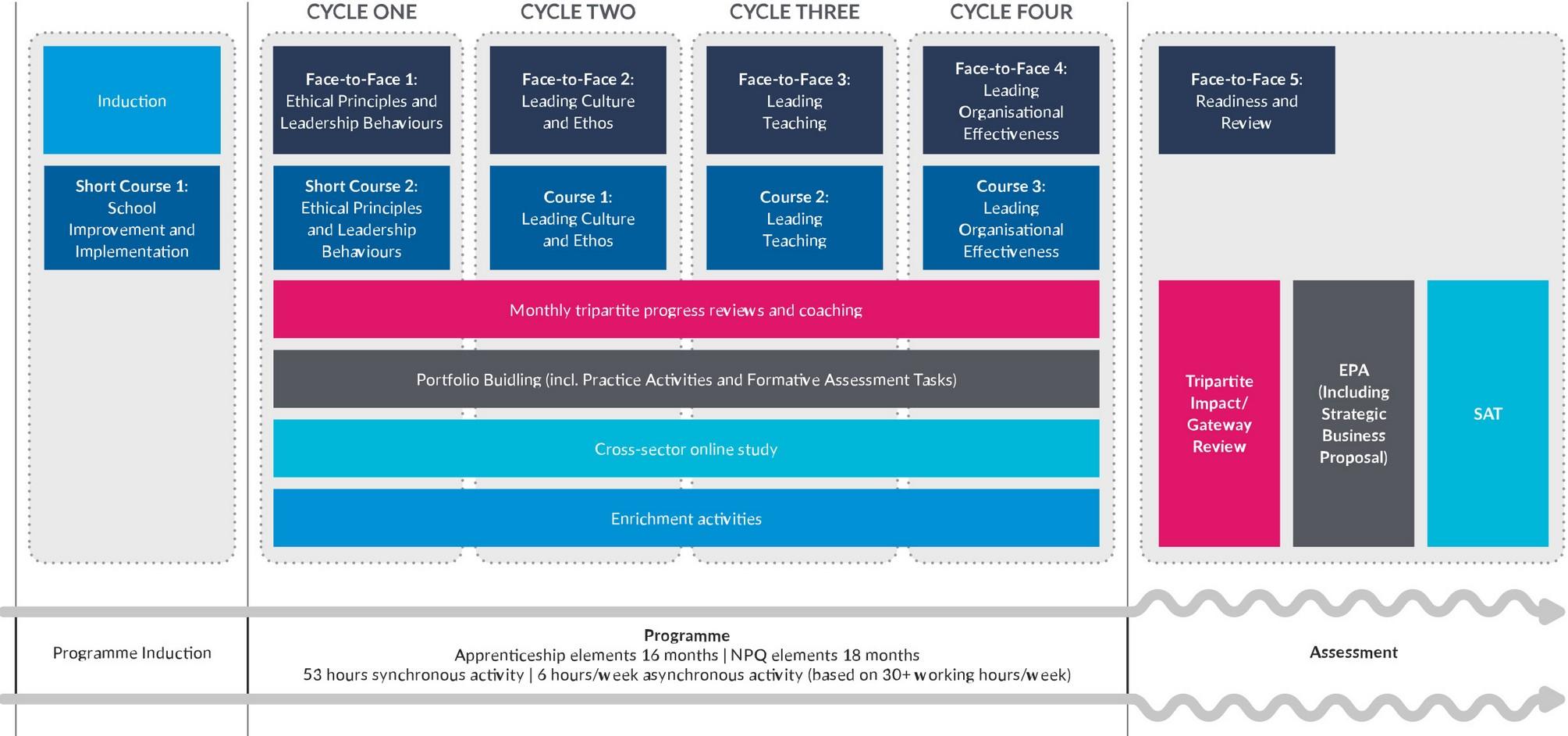
Completing all programme elements will ensure you are fully engaged and compliant with the apprenticeship off-the-job-training requirements and can successfully be entered for assessment.
Programme element
Face to Face Events
What is it?
All programme face-to-face events give participants the opportunity to work collaboratively with peers to review their prior learning, be introduced to the key concepts for the upcoming online learning activities and consider their pathways for the online course based on their Leadership Development Record (LDR) skills audit and submission.
Coaching Focused Tripartite Progress Reviews
Programme Pathway Plan
The tripartite monthly meetings will adopt a coaching approach alongside reviewing your progress on programme. You will use your submitted tasks, your PPP and your APCs feedback to develop and apply your learning, as well as collect evidence for your portfolio. This is your consistent check-in method.
NPQ Online SelfStudy Packs
Leadership Development Record (LDR): The LDR is designed to support you in identifying your strengths and areas for development across the Apprenticeship and NPQ. You will visit and build the LDR as you travel through the programme, reviewing your learning and progress. It is a key feature of the NPQ element of the programme.
The self-study packs provide research linked to the content areas’ learn that and learn how to statements, and case studies of how leaders in the field have applied the statements to their practice, in their settings.
In line with your LDR and areas for development in any given cycle, you may choose to prioritise some packs over others, going into more detail for some than others. However, all participants must engage with all self-study packs.
This will contribute to your OTJT time
NPQ Online Practice Activities
The practice activities are based on the learning undertaken during the evidence-based online course study packs, and are presented in the form of scenarios.
You are expected to respond to a series of questions about the scenarios and demonstrate your understanding of the behaviours and/or ‘learn that’ and ‘learn how to’ statements.
NPQ Online Learning Reflections
This will contribute to your OTJT time
The learning reflection can be a powerful aid to learning, helping you to consider your learning journey and how that has changed your thinking and ways of working.
Following the Face-to-Face event, self-study pack and practice activity, you can reflect on your key leadership learning and respond to relevant questions, sharing your thoughts with colleagues and Leadership Mentors/Performance Coaches.
This will contribute to your OTJT time
Formative Assessment Tasks
Gateway/Impact Review
Formative assessment tasks (FATs) bring together the online learning and its in-school application. You will complete one formative assessment task each cycle, sometimes from a choice of three.
Formative assessment tasks are tasks which are applied in your school and relate to the learning and ‘learn that’ and ‘learn how to’ statements which are covered in the online course.
The tripartite Gateway/Impact Review with your APC and AM will provide the opportunity to celebrate the development of your leadership knowledge, skills and behaviours. You will use the meeting to agree that you are ready for assessment, and then complete and sign the Gateway/Impact Review declaration form.
BUD Activities & Portfolio Of Evidence
Your APC will assign activities on BUD for you to develop and apply your leadership learning, build your portfolio of evidence and develop the apprenticeship elements and KSBs (knowledge, skills and behaviours) of the programme. Your NPQ tasks will be added to BUD as part of this
You will have seen reference to engagement and compliance during your application process, in the Welcome Pack and Learner Handbook. It is extremely important that you are fully engaged and compliant in order to complete your programme. All programme elements must be completed to ensure you are fully engaged and supported.
Your Participant Dashboard is your go-to portal for all your NPQ Event details.
View your schedule of events for the programme (‘Events’ tab)
Access your zoom links (for events that are virtual (‘Events’ tab)
Please watch this guidance video on how to use your participant dashboard. Also shown below:
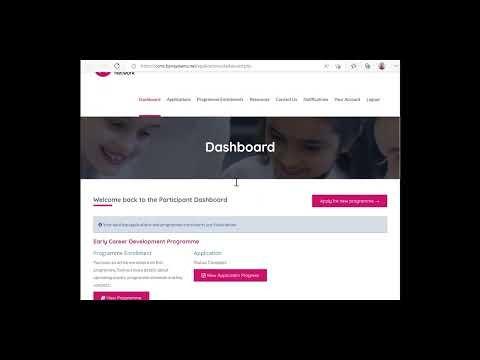
Youtube link: https://www.youtube.com/watch?v=OOJE3Ms_65s
All face-to-face events are linked to your group, which makes them unique to you; these are held on your own Participant Dashboard. As this dashboard is specific to you, you can also let us know about specific dietary requirements and allergy information (see Step 3 below).
When you login, you may not see your event information straight away. But please do not worry! It means we are finalising your group and event details and we will notify you via email when they are ready to access. You can however view the delivery window when your events will be planned to take place within your programme schedule.
If you have any questions about your events or have any specific requirements do contact us on npq@bestpracticenet.co.uk
Link to Participant Dashboard https://ccms.bpnsystems.net/applications/login.php
Participant Dashboard Username: This will be your email you signed up with in your application
Participant Dashboard Password: Will be the same as you used for your initial application
Please click “View Programme”
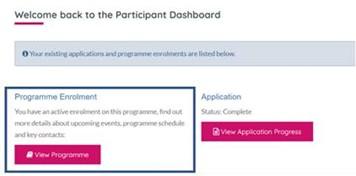
1. The Programme Schedule tab will provide an overview of the programme including dress code.
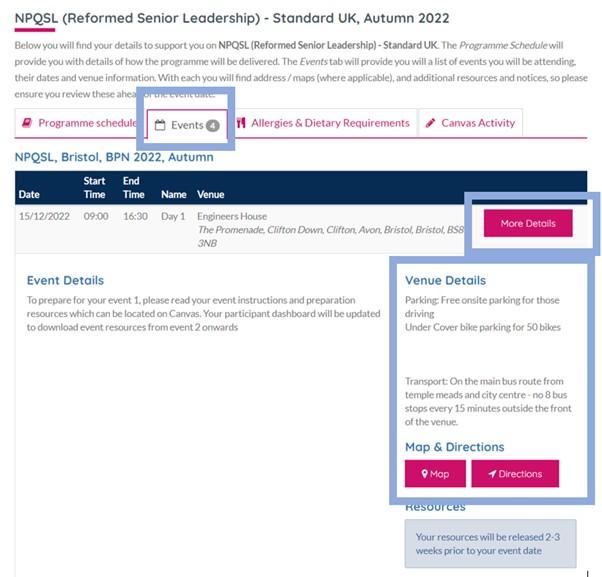
2. The events tab will provide you with the dates, times and locations of your face-to-face events.
Please note: This image is a representative example – these dates and locations will be different for each participant.
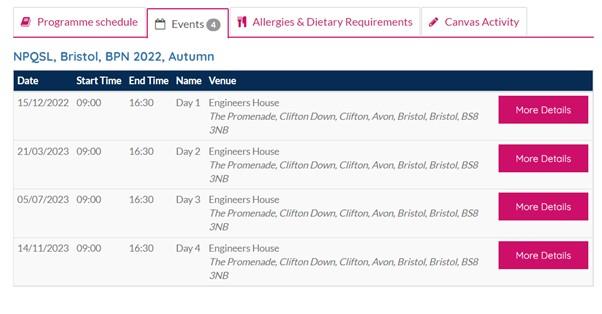
Below are the group arrangements and typical* timing information for your NPQ programme schedule.
*your events tab will state your event start and finish time.
Face-to-face (F2F) events will be full day events and typically start at 9am, finishing at 4.30pm (unless we otherwise notify you) with a smart casual dress code. We have included any extra information you might require i.e., parking / transport availability.
Please note if you:
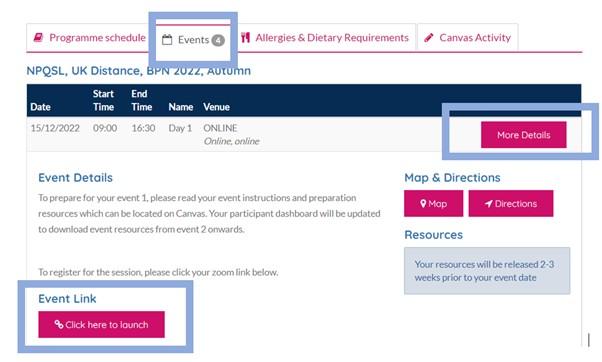
are in an online distance group, your delivery schedule will be entirely virtual through Zoom.
have any dietary requirements or allergies, please check the associated tab next to your event details to check you have informed us of these; if not, please do contact us.
Prior to each event, your event details including materials and where applicable, zoom link for virtual events, will be made available two to three weeks in advance of your event. Your event resources will be located within BUD.
Please make sure you register in advance for any events that are virtual and test your connection prior the event start. After registering, you will receive a confirmation email containing information about joining the meeting (if this doesn’t arrive, please check junk/spam folders).
If you are unable to join an event, please do notify us so we can ensure your engagement with the programme remains on track.
Or, if you are part of an online/virtual distance group (or attending a virtual event), your Events tab view will look like this:
There are a variety of people and organisations who will be supporting you on programme, as outlined below.
The key thing is to utilise that support. Your APC is an expert coach who will help you progress, learn, develop and problem-solve (as well as fully engage and comply to help you successfully complete!). Your AM holds the key to being able to offer in-setting support, resource, time and formative dialogue.
“Before beginning my Leader Apprenticeship with NPQ, I hadn’t considered how and when I was reflecting or learning and applying new things for my role. Working with my APC, I have truly reflected and continue to reflect on my leadership and how I can constantly strive to serve our pupils, team and community. I couldn’t have done that nearly as effectively without my incredible APC or my AM. The tripartite relationship was the making of my leadership as it meant I could take significant learning from every task, activity and conversation through supportive and challenging dialogue. My advice to others embarking on a Leader Apprenticeship with NPQ is to proactively lean into that tripartite network and work together to develop a strong and collaborative relationship – it is SO worth it!”

Your APC will work with you and your AM to ensure you have all ‘contracted’ around how you will work together so that you can all make the most of the relationship, as well as ensuring you are fully engaged and meeting compliance requirements consistently.
Meeting monthly is crucial, not only to the tripartite relationship and your leadership development, but also for compliance. These meetings must be prioritised, valued and ring-fenced by all three members of the tripartite.
Employer
Sponsor
Apprenticeship
Mentor (AM)
Apprenticeship
Performance Coach (APC)
A representative from the learner’s employer to sign off contracts and funding (e.g. MAT/LA representative, school bursar/business manager) – light touch in terms of involvement with the learner.
A senior person in the learner’s setting (e.g. Headteacher, Chair of Governors, ‘employer’ above, or learner’s line manager) who will complete the formal declaration of support for the learner, and allocate the AM.
A colleague allocated by the Sponsor who will offer practical and real time support for the learner through monthly meetings, formative dialogue about the learner’s progress and development and support for the learner to fully engage with all elements of the programme.
Appointed by BPN, the APC will be the main point of contact for the learner throughout their programme. They will offer feedback on task submissions, support the learner to obtain evidence for the portfolio, and coach the learner during the monthly tripartite review meetings with the AM., preparing the learner for EPA and SAT.
In setting
In setting
In setting
BPN-appointed, virtual interaction (synchronous: monthly, asynchronous ongoing)
You are also supported by a great number of people within Best Practice Network and outside to ensure your programme is exactly what it needs to be:
BPN Supporting Teams External Supporting Organisations
BPN Support Team npq@bestpracticenet.co.uk Skills England
BPN e-Learning Team Department for Education (DfE)
BPN Quality Team Ofsted
BPN Assessment Teams Apprenticeship Assessment awarding organisation
Effective work-life balance and an appropriate workload is extremely important to us. Educators and leaders have a great deal to do in their day jobs, so we want to ensure that your Leader Apprenticeship with NPQ programme supports that instead of challenging it further.
You will likely know and be using the work of Rosenshine in your setting. His 10 Principles of Instruction are becoming increasingly popular in education as they provide a much-needed bridge between scientific research and classroom instruction.
We have adopted these principles in the way your NPQ programme has been designed:
Principles 2 & 9: present material using small steps and independent practice addresses the limitations of humans’ working memory and how it is quite small. The programme’s elements and the tasks you are asked to complete are presented in small sequential steps, in specific date windows so as to ensure you are do not experience cognitive overload. Additionally, every cycle utilises several opportunities for you to apply new knowledge in practice in your setting. This will allow you to:
Make steady progress;
Make connections in your learning;
Understand why each step is important;
Have impact in your setting from the outset.
Principles 3, 4, 5, 6 & 8: Ask questions, provide models, guide your practice, check for your understanding and provide scaffolds. All of the people supporting you (online, at FTF events, central support teams) are there to support and scaffold your progress by empowering you to own your learning on programme.
All tasks and resources in all cycles are presented as choices so that you can complete the ones that offer most relevance to you, and so have impact immediately in your setting and also learn in the most relevant way to you.
You will undoubtedly have systems in place that support you in managing your time effectively and prioritising work. In case you would like to try something new to use your time more effectively, we have a couple of key tools to share:
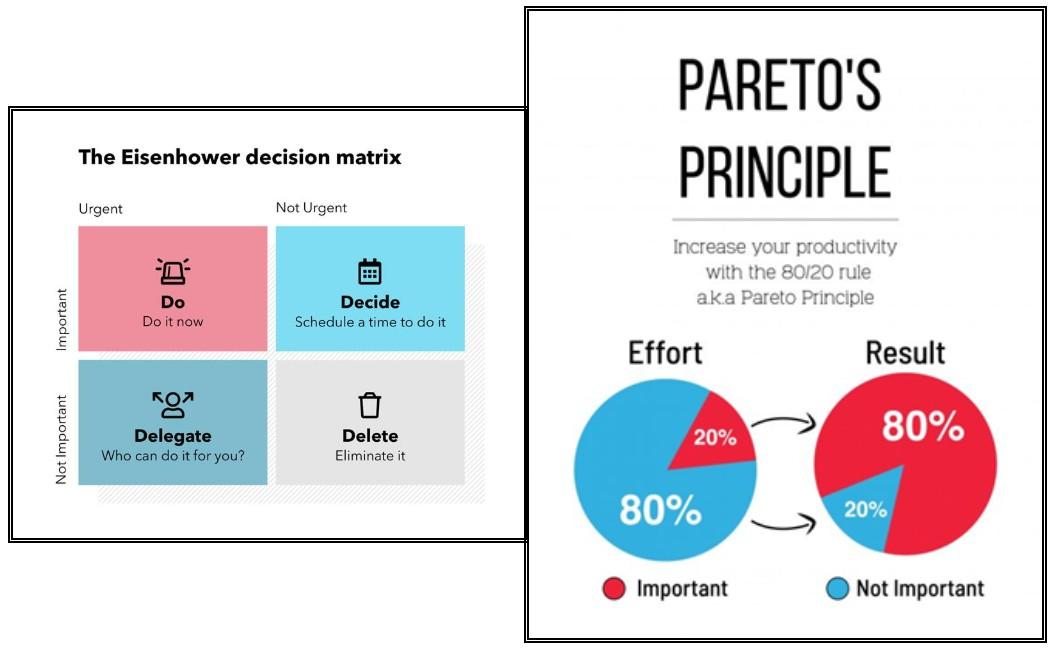
The Eisenhower Matrix offers a sorting method to make the traditional ‘to do list’ more achievable, and helps define priorities, by using levels of importance and urgency as the filters. Where safeguarding incidents and meeting deadlines will always be both urgent and important (DO), there are a number of things that we could be moving to DECIDE, DELEGATE or DELETE. Consider what’s on your current t ‘to do list’ that you could move from DO, and how it could help you prioritise your competing demands.
Pareto’s Principle asserts that 80% of outcomes (or outputs) result from 20% of all causes (or input) for any given event or piece of work. Therefore, the model suggests you identify the potentially most productive tasks and prioritise them to create more effective or impactful outputs. These are sometimes called ‘leverage tasks’, i.e. which tasks could you undertake that will have disproportionately high impact on other pieces of work? What could applying this tool mean for your workload?